107Stories About ChemistryINDEX |
10.
The Search for a �Crazy� Idea or How the Inert Gases Stopped Being Inert
�Two parallel straight lines never intersect,� asserted geometry through the lips of Euclid, the greatest mathematician of antiquity. �Not so, they must intersect! declared the Russian scientist Nikolai Lobachevsky in the middle of the last century. And thus was born a new geometry, known as non-Euclidean geometry. �Moonshine and gibberish!� was what many leading scientists said about it at first. But were it not for non-Euclidean geometry we would have neither the theory of relativity nor the daring ideas of the laws governing the structure of the universe. Many of you have no doubt read A. Tolstoy�s �Engineer Garin�s Hyperboloid.� �Excellent science fiction, � was the verdict of literary critics the world over. �Fiction that can never become reality!� echoed the scientists. Tolstoy died only fifteen years before the first ruby crystal emitted a light ray of unheard of brightness and power, and the word �laser� became known to by no means only specialists. Enthusiast-chemists continued to believe stubbornly in the possibility of conquering the unheard of obstinacy of the inert gases. If we took the trouble to thumb through the yellowing pages of scientific journals of the twenties, thirties and forties, we should come across quite a few curious articles and notes which show that chemists never relinquished the hope of drawing the inert gases into the sphere of their activities. 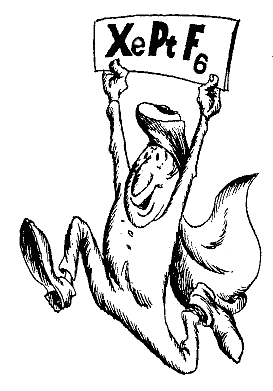 Unusual formulas stare out at us from these pages. They tell of strange substances, compounds of helium with mercury, palladium, platinum and other metals. Only one thing is wrong: these are not the chemical compounds we should like to obtain. In them helium�s two-electron shell remains unchanged, and the compounds themselves exist only at a very low temperature, in the kingdom of absolute zero. If we went on turning the pages of chemical journals we should come across another bit of news: the Soviet chemist Nikitin prepared a much less fantastic compound of xenon and radon with water, phenol and some other organic liquids: Xe�6H2O, and Rn�6H2O. They are stable under ordinary conditions, can be readily obtained, but as before, chemical bonding has nothing to do with these compounds. The xenon and radon atoms abide piously by the perfection of their outermost shell: 8 electrons there were and 8 electrons remained. More than fifty years had passed since the inert gases were discovered, but �the cart had not budged.� The twentieth century, the stormiest and most unforgettable of all the centuries of human history, will come to a close. And scientists will sum up the achievements of scientific thought during the past hundred years. The endless list of outstanding discoveries will include in a prominent plate �the production of chemical compounds of the inert gases.� And some enthusiastic commentator will add: one of the most sensational discoveries. Sensational? Hardly! Rather a romantic story. Or even a story of how simple sometimes can be the solution of a problem which for dozens of years tormented the minds of numerous scientists with its insolvability. In our days chemistry resembles a mighty tree with an immense ever-spreading crown. It is no longer possible for anyone person to study even a whole branch in full. An investigator mostly has to spend years to become acquainted in detail with a small twig, a bud, or a hardly visible shoot. Knowledge of the branch as a whole adds up from thousands of such investigations. The �twig� studied by the Canadian chemist Neil Bartlett was a compound called platinum hexafluoride in the language of chemists, and having the formula: PtF6O. It was not by accident that he devoted so much time and effort to this substance. Compounds of fluorine with the heavy metals are very interesting substances, of great importance to science and practice. One of their uses is in the separation of the uranium isotopes uranium-235 and uranium-238 for nuclear engineering. The separation of one isotope from another: is a very complicated process, but it can be accomplished with the aid of uranium hexafluoride, UF6O. Besides, heavy metal fluorides are very active chemical substances. Bartlett reacted PtF6O with oxygen and obtained a very curious compound. The oxygen is contained in it as the positively charged molecule O2, a molecule which has lost one electron. Now what is so strange about that? The strange thing is that it is very difficult indeed to tear an electron away from the oxygen molecule, as this requires a great deal of energy. Platinum hexafluoride was found to be capable of removing an electron from the oxygen molecule. Removal of an electron from the outer shells of inert gas atoms also requires a great deal of energy. There is a regularity here according to which the heavier the inert gas the smaller the amount of energy required. And it was found easier to make a xenon atom part with one of its electrons than to tear one away from the oxygen molecule. This is where the most interesting begins! Bartlett decided to make platinum hexaflouride steal an electron from the xenon atom. And he was successful - the world�s first chemical compound of an inert gas was born in 1962. This is what it looks like: XePtF6O. And it is fairly stable. Nothing like the exotic compounds of helium with platinum or mercury. This hardly noticeable grain immediately sprouted out. The sprout, which began to grow like bamboo, became a new trend in chemistry, the chemistry of the inert gases. Only yesterday many serious scientists were very sceptical. Today they have at their disposal more than thirty real chemical compounds of the inert gases, mainly fluorides of xenon, krypton, and radon. And so the myth of the infallibility of the outer electron shell of the noble gases collapsed. What about the molecular structure of the various compounds of the inert gases? Scientists are only just beginning to understand this. It turns out that atoms can possess a much larger supply of valence forces than was thought previously. Formerly the valence concept was based on recognition of the special stability, infallibility of the octet shell. But now scientists came up against the question of whether everything was quite so clear in these theories? Maybe it will fall to your lot, dear readers, to help disclose new laws in them. |




