107Stories About ChemistryINDEX |
5.
How Many Hydrogens Are There on Earth?
The Nobel Prize is the highest award to a scientist. There are and have been very many scientists in the world, but just over a hundred of them have been awarded the Nobel Prize and they received it for the most outstanding of outstanding discoveries. Three of the Nobel Prizemen for 1932 were Murphy, Urey and Brickwedde. 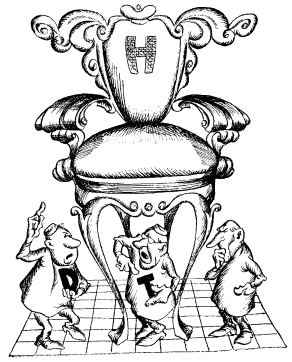 It was thought previously that there was only one hydrogen on Earth, that with an atomic weight of one. Murphy and his colleagues discovered a second hydrogen, twice as heavy. This was the hydrogen isotope having the atomic weight two. Isotopes are varieties of atoms with the same charge but different atomic weights. In other words, the nuclei of isotopic atoms contain an equal number of protons but different numbers of neutrons. Isotopes are known for all the chemical elements: some of them exist in nature; others have been obtained artificially by means of nuclear reactions. The hydrogen isotope whose nucleus is a bare proton is called protium and its symbol is H1. This is the only atomic nucleus which contains no neutrons at all. (Another unique property of hydrogen!) Add a neutron to this single proton and the result is the nucleus of the heavy hydrogen isotope called deuterium (H2 or D2). Protium is far more abundant in nature than deuterium, constituting over 99 per cent of all the hydrogen. But there is a third variety of hydrogen, with two neutrons in its nucleus; this is tritium (H3 or T3). It forms continuously in the atmosphere under the action of cosmic rays. It forms only to disappear again rather quickly. It is radioactive and decays into a helium isotope (helium-3). Tritium is a very rare element: its content in all the atmosphere of the Earth is only 6 grams. There is only one atom of tritium in every 10 cubic centimetres of air. Just recently still heavier isotopes of hydrogen H4 and H5 have been obtained artificially, but they are very unstable. The mere fact of its having isotopes does not distinguish hydrogen among the chemical elements. What does distinguish it is that hydrogen isotopes differ noticeably in properties, primarily in physical properties. Isotopes of the other elements are almost indiscriminable. Each variety of hydrogen has its own personality and behaves differently in chemical reactions. For example, protium is more active than deuterium. By studying the behaviour of hydrogen isotopes, scientists started an entirely new branch of science, known as isotope chemistry. The chemistry we know has to do with elements as a whole, with all the isotopes of each, taken together. But isotope chemistry deals with separate isotopes. It enables investigators to look into the most intricate details of various chemical processes. |




