107Stories About ChemistryINDEX |
1.
A Bird�s-Eye View of the Periodic System
A fleeting glance, a first impression, is usually of little value. Sometimes it leaves the observer indifferent, sometimes it surprises him. Once in while it makes him exclaim, like the hero of the well known anecdote when he saw the giraffe at the Zoo: �It can�t be true!� But even a first acquaintance with a thing or a phenomenon, a bird�s-eye view of it, if you like, is often useful. 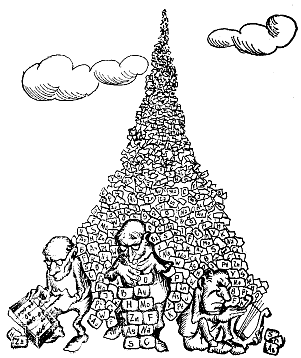 Mendeleyev�s Periodic System of Elements can hardly be called a thing or a phenomenon. It is rather a kind of mirror reflecting the essentials of one of the greatest laws of nature, the Periodic Law. This is a code of behaviour obeyed by the hundred odd elements found on Earth or produced artificially by man, a set of regulations, as it were, prevailing in the Big House of the chemical elements. A first glance at this house reveals a great deal. The first feeling is one of surprise, as if in the midst or standard large-panel buildings we suddenly saw a house of whimsical but elegant architecture. What is it that is surprising about Mendeleyev�s Table? To begin with, the fact that its periods, its storeys, have different floor plans. (Unlike ordinary houses, the �storeys� of Mendeleyev�s Big House (Periodic System) should be numbered from top to bottom, because any new �storey� that might have to be added to accommodate new elements would have to be attached to the bottom of the table.) The first storey, or first period of the Mendeleyev Table, has only two rooms or boxes. The second and third have eight each. The next two stories (the fourth and fifth) have eighteen rooms each, like in a hotel. The two below that (the sixth and seventh) have even more rooms, thirty-two each. Have you ever seen such a building Still that is the form of the Big House of chemical elements known as the Periodic System. Architect�s whim? Not at all! Any building has to be designed in accordance with the laws of physics; otherwise the least breath of wind will topple it over. The physical laws that underlie the architecture of the Periodic System are just as strict and decree that each period of the Mendeleyev Table shall contain a definite number of elements. For instance, the first period has two elements, no more and no less. That is what the physicists affirm and the chemists fully agree with them. But they didn�t always agree. There was a time when the physicists said nothing, because the Periodic Law had not yet begun to bother them. But the chemists who were discovering new elements almost every year were finding it harder and harder to know where to put the newcomers. And there were annoying situations when there was a whole queue of claimants for the same box in the table. Not a few scientists were sceptical. They declared quite soberly that the edifice of Mendeleyev�s Table was built on sand. One of these was the German chemist Bunsen, who developed the method of spectroscopic analysis together with his friend Kirchhoff. But when it came to the Periodic Law Bunsen exhibited surprising scientific shortsightedness. �One might just as well seek regularities in the figures of stock exchange bulletins!� he snapped out once in a fit of anger. There had been attempts before Mendeleyev�s to put the sixty-odd chemical elements then known into some kind of order. But they were not successful. The Englishman Newlands probably came the closest to the truth. He suggested a �Law of Octaves.� On arranging the elements in order of increasing atomic weight Newlands found that as in music where each eighth note repeats the first at a higher level, the properties of every eighth element resembled those of the first. But the reaction Newlands� discovery evoked was: �Why don�t you try arranging the elements in alphabetical order? You might detect some regularity that way too!� What could poor Newlands reply to his sarcastic opponent? Mendeleyev�s Table was not particularly lucky at first. Its �architecture� came under furious attack. For much in it remained obscure and required explanation. It was easier to discover half-a-dozen new elements than to find proper positions for them in the table. Only on the first floor did things seem satisfactory. There was no danger of an unexpected flow of lodgers here. This floor is inhabited now by hydrogen and helium. The nuclear charge of the hydrogen atom is +1, and that of the helium atom +2. There clearly are not and cannot be any other elements between them. There are no nuclei or other particles in nature that we know of, whose charges are fractional numbers. (Recently, however, theoretical physicists have persistently been discussing the question of the existence of quarks. This is the name given to primary elementary particles from which all the rest can be built, including protons and neutrons, the component parts of atomic nuclei. Quarks are assumed to have fractional electric charges: +1/3 and �1/3. If quarks actually exist, the �material arrangement� of the universe may appear in a new light.) |




