 (source)
|
Hideki Yukawa
(23 Jan 1907 - 8 Sep 1981)
Japanese physician and physicist who was awarded the Nobel Prize for Physics in 1949 for 'his prediction of the existence of mesons on the basis of theoretical work on nuclear forces.'
|
Science Quotes by Hideki Yukawa (6 quotes)
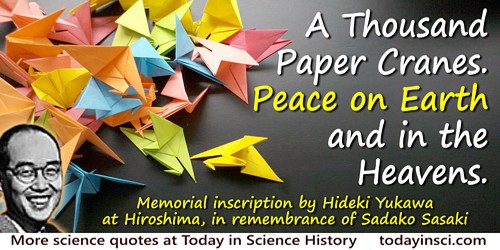
A Thousand Paper Cranes. Peace on Earth and in the Heavens.
— Hideki Yukawa
Inscribed, in the handwriting of Yukawa, on the surface of the bell inside the Children’s Peace Monument at Hiroshima, Japan. The crane is a symbol of longevity and happiness in Japan. The monument to mourn all the children whose death was caused by the atomic bomb was inspired by 12-year-old Sadako Sasaki, who believed that if she could fold 1000 paper cranes she would be cured of the leukemia that resulted from her exposure to the radiation of the atomic bomb when two years old. She died before completing them.
I do not want to write beyond this point, because those days when I studied relentlessly are nostalgic to me; and on the other hand, I am sad when I think how I have become increasingly preoccupied with matters other than study.
— Hideki Yukawa
Explaining why he went no further in his autobiography than 1934, the year he published his paper describing his great discovery, the meson theory. From the original Japanese autobiography Tabibito, translated as The Traveler (1982), 207.
Nature creates curved lines while humans create straight lines.
— Hideki Yukawa
Reality is complicated. There is no justification for all of the hasty conclusions.
— Hideki Yukawa
Reality is cruel. All of the naivete is going to be removed. Reality is always changing, and it is always unpredictable. All of the balance is going to be destroyed.
— Hideki Yukawa
Suppose there is something which a person cannot understand. He happens to notice the similarity of this something to some other thing which he understands quite well. By comparing them he may come to understand the thing which he could not understand up to that moment. If his understanding turns out to be appropriate and nobody else has ever come to such an understanding, he can claim that his thinking was really creative.
— Hideki Yukawa
Creativity and Intuition: A Physicist Looks at East and West (1973), 114.
See also:
- 23 Jan - short biography, births, deaths and events on date of Yukawa's birth.
- Tabibito (The Traveler), by Hideki Yukawa. - book suggestion.
 In science it often happens that scientists say, 'You know that's a really good argument; my position is mistaken,' and then they would actually change their minds and you never hear that old view from them again. They really do it. It doesn't happen as often as it should, because scientists are human and change is sometimes painful. But it happens every day. I cannot recall the last time something like that happened in politics or religion.
(1987) --
In science it often happens that scientists say, 'You know that's a really good argument; my position is mistaken,' and then they would actually change their minds and you never hear that old view from them again. They really do it. It doesn't happen as often as it should, because scientists are human and change is sometimes painful. But it happens every day. I cannot recall the last time something like that happened in politics or religion.
(1987) -- 




