 (source)
|
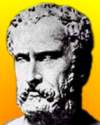
Xenophanes
(c. 570 B.C. - c. 480 B.C.)
Greek philosopher and philosopher who, while never conceiving a complete doctrine of the physical world, touched on physical questions in his writings, of which fragments remain. He contributed indirectly to the rise of systematic thinking in science.
|
Science Quotes by Xenophanes (9 quotes)
...for our wisdom is better than the strength of men or of horses. ... nor is it right to prefer strength to excellent wisdom. For if there should be in the city [any athlete whose skill] is honoured more than strength ... the city would not on that account be any better governed.
— Xenophanes
Quoted in Arthur Fairbanks (ed. And trans.), The First Philosophers of Greece (1898), 73, fragment 19.
All things that come into being and grow are earth and water.
— Xenophanes
Quoted in Arthur Fairbanks (ed. And trans.), The First Philosophers of Greece (1898), 69, fragment 10.
But without effort [God] sets in motion all things by mind and thought.
— Xenophanes
Quoted in Arthur Fairbanks (ed. And trans.), The First Philosophers of Greece (1898), 69, fragment 3.
For all things come from earth, and all things end by becoming earth.
— Xenophanes
Quoted in Arthur Fairbanks (ed. And trans.), The First Philosophers of Greece (1898), 69, fragment 8.
For we are all sprung from earth and water
— Xenophanes
Quoted in Arthur Fairbanks (ed. And trans.), The First Philosophers of Greece (1898), 69, fragment 9.
In the beginning the gods did not at all reveal all things clearly to mortals, but by searching men in the course of time find them out better.
— Xenophanes
Quoted in Arthur Fairbanks (ed. And trans.), The First Philosophers of Greece (1898), 71, fragment 16.
The sea is the source of water and the source of wind; for neither would blasts of wind arise in the clouds and blow out from within them, except for the great sea, nor would the streams of rivers nor the rain-water in the sky exist but for the sea ; but the great sea is the begetter of clouds and winds and rivers.
— Xenophanes
Quoted in Arthur Fairbanks (ed. And trans.), The First Philosophers of Greece (1898), 69, fragment 11.
This upper limit, of earth at our feet is visible and touches the air, but below it reaches to infinity
— Xenophanes
Quoted in Arthur Fairbanks (ed. And trans.), The First Philosophers of Greece (1898), 69, fragment 12.
Truly the gods have not from the beginning revealed all things to mortals, but by long seeking, mortals discover what is better.
— Xenophanes
Fragment B18, from Diels and Kranz Die Fragmente der Vorsokratiker, as translated by Kathleen Freeman in Ancilla to the Pre-Socratic Philosophers (1948, 1983), 22.
Quotes by others about Xenophanes (4)
The fire at Lipara, Xenophanes says, ceased once for sixteen years, and came back in the seventeenth. And he says that the lavastream from Aetna is neither of the nature of fire, nor is it continuous, but it appears at intervals of many years.
De mirac. oscult. 38; 833 a 16. Quoted in Arthur Fairbanks (ed. And trans.), The First Philosophers of Greece (1898), 79.
Xenophanes of Kolophon ... says that nothing comes into being, nor is anything destroyed, nor moved; and that the universe is one and is not subject to change.
Doxographists, Epiph. adv. Haer. iii. 9; Dox. 590. Quoted in Arthur Fairbanks (ed. And trans.), The First Philosophers of Greece (1898), 83.
Xenophanes of Kolophon ... says that ... [t]he sun is formed each day from small fiery particles which are gathered together: the earth is infinite, and is not surrounded by air or by sky; an infinite number of suns and moons exist, and all things come from earth. The sea, he said, is salt because so many things flow together and become mixed in it...
Doxographists, Epiph. adv. Haer. iii. 9; Dox. 590. Quoted in Arthur Fairbanks (ed. And trans.), The First Philosophers of Greece (1898), 83.
Xenophanes of Kolophon ... believes that once the earth was mingled with the sea, but in the course of time it became freed from moisture; and his proofs are such as these: that shells are found in the midst of the land and among the mountains, that in the quarries of Syracuse the imprints of a fish and of seals had been found, and in Paros the imprint of an anchovy at some depth in the stone, and in Melite shallow impressions of all sorts of sea products. He says that these imprints were made when everything long ago was covered with mud, and then the imprint dried in the mud.
Doxographists, Zeller, Vorsokr. Phil. 543, n. 1. Quoted in Arthur Fairbanks (ed. And trans.), The First Philosophers of Greece (1898), 83.
 In science it often happens that scientists say, 'You know that's a really good argument; my position is mistaken,' and then they would actually change their minds and you never hear that old view from them again. They really do it. It doesn't happen as often as it should, because scientists are human and change is sometimes painful. But it happens every day. I cannot recall the last time something like that happened in politics or religion.
(1987) --
In science it often happens that scientists say, 'You know that's a really good argument; my position is mistaken,' and then they would actually change their minds and you never hear that old view from them again. They really do it. It doesn't happen as often as it should, because scientists are human and change is sometimes painful. But it happens every day. I cannot recall the last time something like that happened in politics or religion.
(1987) -- 




