 (source)
|
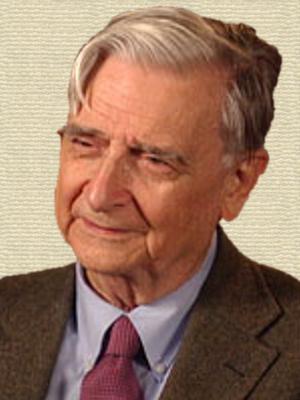
Edward O. Wilson
(10 Jun 1929 - 26 Dec 2021)
American biologist known for his study of ants. He is an active environmentalist.
|
Science Quotes by Edward O. Wilson (82 quotes)
>> Click for Edward O. Wilson Quotes on | Biology | Diversity | Evolution | Gene | Genetics | Knowledge | Organism | Population | Species |
>> Click for Edward O. Wilson Quotes on | Biology | Diversity | Evolution | Gene | Genetics | Knowledge | Organism | Population | Species |
“Biodiversity” … is the key to the maintenance of the world as we know it. Life in a local site
struck down by a passing storm springs back quickly because enough diversity still exists. … This is the assembly of life that took a billion years to evolve. It has eaten the storms—folded them into its genes—and created the world that created us. It holds the world steady.
— Edward O. Wilson
In The Diversity of Life (1992, 1999), 15.
[Bacteria are the] dark matter of the biological world [with 4 million mostly unknown species in a ton of soil].
— Edward O. Wilson
Talk as a TED prize winner (2007). From video on TEDprize website.
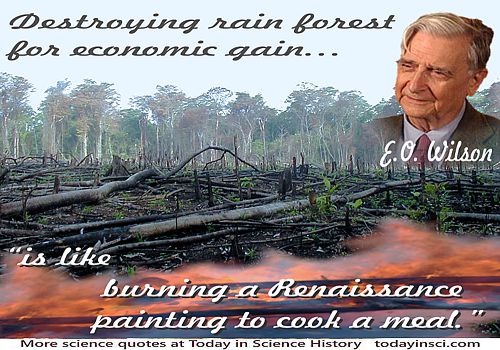
[Destroying rain forest for economic gain] is like burning a Renaissance painting to cook a meal.
— Edward O. Wilson
Quoted in R.Z. Sheppard, 'Nature: Splendor in The Grass', Time (3 Sep 1990)
[The natural world cleans water, pollinates plants and provides pharmaceuticals, among many other gifts.] Thirty trillion dollars worth of services, scot-free to humanity, every year.
— Edward O. Wilson
From transcript of PBS TV program 'Religion and Ethics' (17 Nov 2006).
A complete survey of life on Earth may appear to be a daunting task. But compared with what has been dared and achieved in high-energy physics, molecular genetics, and other branches of “big science,” it is in the second or third rank.
— Edward O. Wilson
In 'Edward O. Wilson: The Biological Diversity Crisis: A Challenge to Science', Issues in Science and Technology (Fall 1985), 2, No. 1, 26.
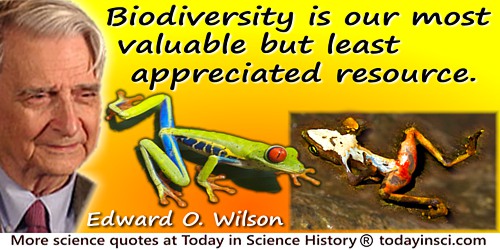
Biodiversity is our most valuable but least appreciated resource.
— Edward O. Wilson
In 'Unmined Riches', The Diversity of Life (1992), 281.
Biological diversity is the key to the maintenance of the world as we know it. Life in a local site struck down by a passing storm springs back quickly: opportunistic species rush in to fill the spaces. They entrain the succession that circles back to something resembling the original state of the environment.
— Edward O. Wilson
In 'Storm Over the Amazon', The Diversity of Life (1992), 15.
Biological diversity is unique in its importance to both developed and developing countries.
— Edward O. Wilson
In 'Edward O. Wilson: The Biological Diversity Crisis: A Challenge to Science', Issues in Science and Technology (Fall 1985), 2, No. 1, 28.
Biology is a science of three dimensions. The first is the study of each species across all levels of biological organization, molecule to cell to organism to population to ecosystem. The second dimension is the diversity of all species in the biosphere. The third dimension is the history of each species in turn, comprising both its genetic evolution and the environmental change that drove the evolution. Biology, by growing in all three dimensions, is progressing toward unification and will continue to do so.
— Edward O. Wilson
In 'Systematics and the Future of Biology', Systematics and the Origin of Species: on Ernst Mayr's 100th anniversary, Volume 102, Issues 22-26 (2005), 1.
Biophilia, if it exists, and I believe it exists, is the innately emotional affiliation of human beings to other living organisms.
— Edward O. Wilson
'Biophilia and the Conservation Ethic', essay in The Biophilia Hypothesis, editted by Stephen R. Kellert (1997), 31.
Can the cultural evolution of higher ethical values gain a direction and momentum of its own and completely replace genetic evolution? I think not. The genes hold culture an a leash. The leash is very long, but inevitably values will be constrained in accordance with their effects in the human gene pool. The brain is a product of evolution. Human behaviour—like the deepest capacities for emotional response which drive and guide it—is the circuitous technique by which human genetic material has been and will be kept intact. Morality has no other demonstrable ultimate function.
— Edward O. Wilson
In On Human Nature (1978), 167. In William Andrew Rottschaefer, The Biology and Psychology of Moral Agency (1998), 58.
Economists use the expression “opportunity costs” for losses incurred through certain choices made over others, including ignorance and inaction. For systematics, or more precisely the neglect of systematics and the biological research dependent upon it, the costs are very high.
— Edward O. Wilson
In 'Edward O. Wilson: The Biological Diversity Crisis: A Challenge to Science', Issues in Science and Technology (Fall 1985), 2, No. 1, 25.
Ecosystems, with their enormous origami-like relationships, are among the most complex of all natural constructions. To understand the patterns and laws of their common origins is one of the most important challenges of science in the present century.
— Edward O. Wilson
In 'Introduction' contributed to Enric Sala, The Nature of Nature: Why We Need the Wild (2020).
Ecosystems, with their enormous origami-like relationships, are among the most complex of all natural constructions. To understand the patterns and laws of their common origins is one of the most important challenges of science in the present century.
— Edward O. Wilson
In 'Introduction' contributed to Enric Sala, The Nature of Nature: Why We Need the Wild (2020).
From the freedom to explore comes the joy of learning. From knowledge acquired by personal initiative arises the desire for more knowledge. And from mastery of the novel and beautiful world awaiting every child comes self-confidence.
— Edward O. Wilson
In The Creation: An Appeal to Save Life on Earth (2010), 147.
Hands-on experience at the critical time, not systematic knowledge, is what counts in the making of a naturalist. Better to be an untutored savage for a while, not to know the names or anatomical detail. Better to spend long stretches of time just searching and dreaming.
— Edward O. Wilson
In Naturalist (1994), 11-12.
How can altruism, which by definition reduces personal fitness, possibly evolve by natural selection? The answer is kinship: if the genes causing the altruism are shared by two organisms because of common descent, and if the altruistic act by one organism increases the joint contribution of these genes to the next generation, the propensity to altruism will spread through the gene pool. This occurs even though the altruist makes less of a solitary contribution to the gene pool as the price of its altruistic act.
— Edward O. Wilson
In Sociobiology (1975), 3-4.
Humanity is exalted not because we are so far above other living creatures, but because knowing them well elevates the very concept of life.
— Edward O. Wilson
In Biophilia (1984, 2009), 22.
I believe it’s worth emphasizing that a scientist and a graduate student in college, and a kid in grammar school all can start with understanding something new by exploring even the simplest and most common forms of life you find right in the heart of the city. Along a fringe of a street, along the edges and into a city park, is a multitude of species, of associations, of phenomena going on that scientists themselves have not fully come to understand.
— Edward O. Wilson
From interview with National Geographic, in Andrew Revkin, 'Conservation Legend Has Big Plans For Future', on nationalgeographic.com website.
I had this experience at the age of eight. My parents gave me a microscope. I don’t recall why, but no matter. I then found my own little world, completely wild and unconstrained, no plastic, no teacher, no books, no anything predictable. At first I did not know the names of the water-drop denizens or what they were doing. But neither did the pioneer microscopists. Like them, I graduated to looking at butterfly scales and other miscellaneous objects. I never thought of what I was doing in such a way, but it was pure science. As true as could be of any child so engaged, I was kin to Leeuwenhoek, who said that his work “was not pursued in order to gain the praise I now enjoy, but chiefly from a craving after knowledge, which I notice resides in me more that most other men.”
— Edward O. Wilson
In The Creation: An Appeal to Save Life on Earth (2010), 143-144.
I have argued in this book [Biophilia] that we are human in good part because of the particular way we affiliate with other organisms. They are the matrix in which the human mind originated and is permanently rooted, and they offer the challenge and freedom innately sought. To the extent that each person can feel like a naturalist, the old excitement of the untrammeled world will be regained. I offer this as a formula of reenchantment to invigorate poetry and myth: mysterious and little known organisms live within walking distance of where you sit. Splendor awaits in minute proportions.
— Edward O. Wilson
In Biophilia (1984, 2009), 139.
I think it [my ideal birthday present] would be a commitment in the policy of the United States and internationally to go for the exploration and identification and protection of every species on Earth, with the same vigor that is building toward stabilizing earth’s climate, because the two are intimately linked.
— Edward O. Wilson
From interview with National Geographic, in Andrew Revkin, 'Conservation Legend Has Big Plans For Future', on nationalgeographic.com website.
I want us to save the creation—not just care about it, but to save it.
— Edward O. Wilson
From transcript of PBS TV program 'Religion and Ethics' (17 Nov 2006).
I was roused by the amphetamine of ambition.
— Edward O. Wilson
on writing, Sociobiology (1975).
If all mankind were to disappear, the world would regenerate back to the rich state of equilibrium that existed ten thousand years ago. If insects were to vanish, the environment would collapse into chaos.
— Edward O. Wilson
In Rosemarie Jarski, Words From The Wise (2007), 269. [Contact webmaster if you know the primary print source.]
If history and science have taught us anything, it is that passion and desire are not the same as truth. The human mind evolved to believe in the gods. It did not evolve to believe in biology.
— Edward O. Wilson
Consilience: The Unity of Knowledge (1998, 1999), 286
In a purely technical sense, each species of higher organism—beetle, moss, and so forth, is richer in information than a Caravaggio painting, Mozart symphony, or any other great work of art. Consider the typical case of the house mouse, Mus musculus. Each of its cells contains four strings of DNA, each of which comprises about a billion nucleotide pairs organized into a hundred thousand structural nucleotide pairs, organized into a hundred thousand structural genes. … The full information therein, if translated into ordinary-sized printed letters, would just about fill all 15 editions of the Encyclopaedia Britannica published since 1768.
— Edward O. Wilson
'The Biological Diversity Crisis: A Challenge to Science', Issues in Science and Technology (Fall 1985), 2:1, 22. Reprinted in Nature Revealed: Selected Writings, 1949-2006 (2006), 622.
In a world created by natural selection, homogeneity means vulnerability.
— Edward O. Wilson
In 'Unmined Riches', The Diversity of Life (1992), 301.
In the process of natural selection, then, any device that can insert a higher proportion of certain genes into subsequent generations will come to characterize the species.
— Edward O. Wilson
'The Morality of the Gene'.; Sociobiology: The New Synthesis (1975, 1980), 3.
It may be argued that to know one kind of beetle is to know them all. But a species is not like a molecule in a cloud of molecules—it is a unique population.
— Edward O. Wilson
In 'Edward O. Wilson: The Biological Diversity Crisis: A Challenge to Science', Issues in Science and Technology (Fall 1985), 2, No. 1, 22.
It may be argued that to know one kind of beetle is to know them all. But a species is not like a molecule in a cloud of molecules—it is a unique population.
— Edward O. Wilson
'The Biological Diversity Crisis: A Challenge to Science', Issues in Science and Technology (Fall 1985), 2:1, 22. Reprinted in Nature Revealed: Selected Writings, 1949-2006 (2006), 622.
Keep in mind that new ideas are commonplace, and almost always wrong. Most flashes of insight lead nowhere; statistically, they have a half-life of hours or maybe days. Most experiments to follow up the surviving insights are tedious and consume large amounts of time, only to yield negative or (worse!) ambiguous results.
— Edward O. Wilson
In Consilience: The Unity of Knowledge (1998, 1999), 60
Kids from all the local villages [on the slopes of Mount Gorongosa in Mozambique] showed up, and I had to be the expert for everything. … These kids went wild. They were listening to everything that I and others had to say about the creatures they were bringing in and the plants and so on. And I realized that anywhere a bioblitz could be a powerful instrument in introducing kids to science.
— Edward O. Wilson
Describing a community bioblitz he helped lead in 2011, while serving as an adviser during the creation of the national park there. In two hours, he counted 60 species in 39 families and 13 orders of living things were brought in. From interview with National Geographic, in Andrew Revkin, 'Conservation Legend Has Big Plans For Future', on nationalgeographic.com website. Wilson added that the park, with the help of the American conservationist and philanthropist Greg Carr, has since become “a powerful force in helping the country of Mozambique recover from a very serious civil war, and in addition, create a better life for a great many people.”
Let us get rid immediately of the notion that all you have to do is keep a little patch of the old growth somewhere, and then you can do whatever you want with the rest. That is a very dangerous and false notion.
— Edward O. Wilson
From On Human Nature (2000). As quoted in John H. Morgan, Naturally Good: A Behavioral History of Moral Development (2005), 252.
Let us see how high we can fly before the sun melts the wax in our wings.
About the ambitious pursuit of knowledge, alluding to Icarus of the Greek myth.
About the ambitious pursuit of knowledge, alluding to Icarus of the Greek myth.
— Edward O. Wilson
Consilience: The Unity of Knowledge (1999), 7.
Marxism is sociobiology without biology … Although Marxism was formulated as the enemy of ignorance and superstition, to the extent that it has become dogmatic it has faltered in that commitment and is now mortally threatened by the discoveries of human sociobiology.
— Edward O. Wilson
In On Human Nature (1978), 191.
Microwildenesses exist in a handful of soil…. A lifetime can be spent in a Magellanic voyage around the trunk of a single tree.
— Edward O. Wilson
From 'Biodiversity, Biophilia', Naturalist (1994, 2019), 364.
More than 90 percent of the forests of western Ecuador have been destroyed during the past four decades.The loss is estimated to have extinguished or doomed over half of the species of the area’s plants and animals. Many other biologically diverse areas of the world are under similar assault.
— Edward O. Wilson
In The Diversity of Life (1992), 265.
Most children have a bug period, and I never grew out of mine.
— Edward O. Wilson
In Naturalist (1994, 2006), 53.
Most scientists think of science as being a kind of purifying intellectual machinery that leads to honesty, to the withering away of ignorance and wrong ideas, including, provided they are of the atheistic persuasion, those of religion.
— Edward O. Wilson
In Pamela Weintraub (ed.), 'E. O. Wilson', The Omni Interviews (1984), 231.
Mysterious and little-known organisms live within reach of where you sit. Splendor awaits in minute proportions.
— Edward O. Wilson
In Biophilia (1984, 2009), 139.
Natural history museums have rewritten their agendas to focus on the study and conservation of ecosystems and biotas.
— Edward O. Wilson
In 'Foreword: Biodiversity at the Close of the Century', The Diversity of Life (New ed., 1999), 15.
Nature, sometimes called Mother Nature, is the metaphorical goddess of everything in the universe beyond human control, from the sweet descent of her sunsets to the tantrums of her thunderstorms; from the explosive brilliance of her ecosystems to the black void of her empty space.
— Edward O. Wilson
In 'Introduction' contributed to Enric Sala, The Nature of Nature: Why We Need the Wild (2020).
No comfort should be drawn from the spurious belief that because extinction is a natural process, man is merely another Darwinian agent.
— Edward O. Wilson
In 'Edward O. Wilson: The Biological Diversity Crisis: A Challenge to Science', Issues in Science and Technology (Fall 1985), 2, No. 1, 25.
No one knows the diversity in the world, not even to the nearest order of magnitude. … We don’t know for sure how many species there are, where they can be found or how fast they’re disappearing. It’s like having astronomy without knowing where the stars are.
— Edward O. Wilson
Quoted in Jamie Murphy and Andrea Dorfman, 'The Quiet Apocalypse,' Time (13 Oct 1986).
No species … possesses a purpose beyond the imperatives created by genetic history … The human mind is a device for survival and reproduction, and reason is just one of its various techniques.
— Edward O. Wilson
'Dilemma'. On Human Nature (1978, 1979), 2.
Now when you cut a forest, an ancient forest in particular, you are not just removing a lot of big trees and a few birds fluttering around in the canopy. You are drastically imperiling a vast array of species within a few square miles of you. The number of these species may go to tens of thousands. … Many of them are still unknown to science, and science has not yet discovered the key role undoubtedly played in the maintenance of that ecosystem, as in the case of fungi, microorganisms, and many of the insects.
— Edward O. Wilson
From On Human Nature (2000). As quoted in John H. Morgan, Naturally Good: A Behavioral History of Moral Development (2005), 251-252.
One in ten plant species contains anticancer substances of variable potency, but relatively few have been bioassayed.
— Edward O. Wilson
In 'Edward O. Wilson: The Biological Diversity Crisis: A Challenge to Science', Issues in Science and Technology (Fall 1985), 2, No. 1, 25.
Our understanding of the causes of biological diversity is still crude. The science addressing it can be generously put at about the level of physics in the late nineteenth century.
— Edward O. Wilson
In 'Edward O. Wilson: The Biological Diversity Crisis: A Challenge to Science', Issues in Science and Technology (Fall 1985), 2, No. 1, 24.
Populations of bacteria live in the spumes of volcanic thermal vents on the ocean floor, multiplying in water above the boiling point. And far beneath Earth’s surface, to a depth of 2 miles (3.2 km) or more, dwell the SLIMES (subsurface lithoautotrophic microbial ecosystems), unique assemblages of bacteria and fungi that occupy pores in the interlocking mineral grains of igneous rock and derive their energy from inorganic chemicals. The SLIMES are independent of the world above, so even if all of it were burned to a cinder, they would carry on and, given enough time, probably evolve new life-forms able to re-enter the world of air and sunlight.
— Edward O. Wilson
In 'Vanishing Before Our Eyes', Time (26 Apr 2000).
Preferring a search for objective reality over revelation is another way of satisfying religious hunger. It is an endeavor almost as old as civilization and intertwined with traditional religion, but it follows a very different course—a stoic’s creed, an acquired taste, a guidebook to adventure plotted across rough terrain. It aims to save the spirit, not by surrender but by liberation of the human mind. Its central tenet, as Einstein knew, is the unification of knowledge. When we have unified enough certain knowledge, we will understand who we are and why we are here. If those committed to the quest fail, they will be forgiven. When lost, they will find another way.
— Edward O. Wilson
In Consilience: The Unity of Knowledge (1998), 5.
Science, its imperfections notwithstanding, is the sword in the stone that humanity finally pulled.
— Edward O. Wilson
In Consilience: The Unity of Knowledge (1998, 1999), 60
Society increasingly has neglected the substructure of biology, to its own peril.
— Edward O. Wilson
In Pamela Weintraub (ed.), 'E. O. Wilson', The Omni Interviews (1984), 233.
The cutting of primeval forest and other disasters, fueled by the demands of growing human populations, are the overriding threat to biological diversity everywhere. (1992)
— Edward O. Wilson
The Diversity of Life (1999), 259
The elements of human nature are the learning rules, emotional reinforcers, and hormonal feedback loops that guide the development of social behaviour into certain channels as opposed to others. Human nature is not just the array of outcomes attained in existing societies. It is also the potential array that might be achieved through conscious design by future societies. By looking over the realized social systems of hundreds of animal species and deriving the principles by which these systems have evolved, we can be certain that all human choices represent only a tiny subset of those theoretically possible. Human nature is, moreover, a hodgepodge of special genetic adaptations to an environment largely vanished, the world of the IceAge hunter-gatherer.
— Edward O. Wilson
In On Human Nature (1978), 196.
The extinctions ongoing worldwide promise to be at least as great as the mass extinction that occurred at the end of the age of dinosaurs.
— Edward O. Wilson
Quoted in Jamie Murphy and Andrea Dorfman, 'The Quiet Apocalypse,' Time (13 Oct 1986).
The greatest scientists have always looked on scientific materialism as a kind of religion, as a mythology. They are impelled by a great desire to explore mystery, to celebrate mystery in the universe, to open it up, to read the stars, to find the deeper meaning.
— Edward O. Wilson
In Pamela Weintraub (ed.), 'E. O. Wilson', The Omni Interviews (1984), 231.
The green pre-human earth is the mystery we were chosen to solve, a guide to the birthplace of our spirit.
— Edward O. Wilson
In Diversity of Life (1992).
The growth of a naturalist is like the growth of a musician or athlete: excellence for the talented, lifelong enjoyment for the rest, benefit for humanity.
— Edward O. Wilson
In The Creation: An Appeal to Save Life on Earth (2010), 147.
The health of the sea, no less than the health of the land, is ultimately responsible for every morsel we put in our mouths, every breath of air we take. We cannot create the land and sea, but we can destroy them.
— Edward O. Wilson
In 'Introduction' contributed to Enric Sala, The Nature of Nature: Why We Need the Wild (2020).
The key to the sociobiology of mammals is milk.
— Edward O. Wilson
In Sociobiology (1975), 456.
The most wonderful mystery of life may well be the means by which it created so much diversity from so little physical matter. The biosphere, all organisms combined, makes up only about one part in ten billion of the earth’s mass. … Yet life has divided into millions of species, the fundamental units, each playing a unique role in relation to the whole.
— Edward O. Wilson
In 'The Most Fundamental Unit', The Diversity of Life (1992), 35.
The naturalist is a civilized hunter.
— Edward O. Wilson
In Biophilia (1984), 1.
The origin of species is therefore simply the evolution of some difference—any difference at all—that prevents the production of fertile hybrids between populations under natural conditions.
— Edward O. Wilson
In 'Biodiversity Rising', The Diversity of Life (1992), 56.
The rate of extinction is now about 400 times that recorded through recent geological time and is accelerating rapidly. If we continue on this path, the reduction of diversity seems destined to approach that of the great natural catastrophes at the end of the Paleozoic and Mesozoic Eras, in other words, the most extreme for 65 million years. And in at least one respect, this human-made hecatomb is worse than any time in the geological past. In the earlier mass extinctions… most of the plant diversity survived even though animal diversity was severely reduced. Now, for the first time ever, plant diversity too is declining sharply.
— Edward O. Wilson
In 'Edward O. Wilson: The Biological Diversity Crisis: A Challenge to Science', Issues in Science and Technology (Fall 1985), 2, No. 1, 25.
The still unanswered question is, do lions and tigers hybridize freely where they meet under natural conditions?
— Edward O. Wilson
In 'Biodiversity Rising', The Diversity of Life (1992), 38.
The time has come to link ecology to economic and human development. When you have seen one ant, one bird, one tree, you have not seen them all. What is happening to the rain forests of Madagascar and Brazil will affect us all.
— Edward O. Wilson
Quoted in Jamie Murphy and Andrea Dorfman, 'The Quiet Apocalypse,' Time (13 Oct 1986).
The totality of life, known as the biosphere to scientists and creation to theologians, is a membrane of organisms wrapped around Earth so thin it cannot be seen edgewise from a space shuttle, yet so internally complex that most species composing it remain undiscovered. The membrane is seamless. From Everest's peak to the floor of the Mariana Trench, creatures of one kind or another inhabit virtually every square inch of the planetary surface.
— Edward O. Wilson
In 'Vanishing Before Our Eyes', Time (26 Apr 2000). Also in The Future of Life (2002), 3.
The worst thing that will probably happen—in fact is already well underway—is not energy depletion, economic collapse, conventional war, or the expansion of totalitarian governments. As terrible as these catastrophes would be for us, they can be repaired in a few generations. The one process now going on that will take millions of years to correct is loss of genetic and species diversity by the destruction of natural habitats. This is the folly our descendants are least likely to forgive us.
— Edward O. Wilson
Biophilia (1984), 121.(1990), 182.
There are exactly eight entomologists worldwide with the general competence to identify tropical ants and termites.
— Edward O. Wilson
In 'Edward O. Wilson: The Biological Diversity Crisis: A Challenge to Science', Issues in Science and Technology (Fall 1985), 2, No. 1, 27.
There are three levels of biodiversity that we’re trying to save: ecosystems, then the species in the ecosystems, and then the genes that prescribe traits of the species that make up the ecosystem. And we should decide upon areas to be saved not by the general appearance or what are the main ecosystems in them. We don’t know enough about ecosystems. We should be choosing them according to the number of species that are in each. And particularly the number of endangered species of some kind.
— Edward O. Wilson
From interview with National Geographic, in Andrew Revkin, 'Conservation Legend Has Big Plans For Future', on nationalgeographic.com website.
This being the only living world we are ever likely to know, let us join to make the most of it.
— Edward O. Wilson
Concluding remark in 'The Biological Diversity Crisis', Bioscience (Dec 1985), 35, No. 11, 705. Also collect in Paul R. Krausman and Bruce D. Leopold (eds.), Essential Readings in Wildlife Management and Conservation (2013), 472.
Thus, remarkably, we do not know the true number of species on earth even to the nearest order of magnitude. My own guess, based on the described fauna and flora and many discussions with entomologists and other specialists, is that the absolute number falls somewhere between five and thirty million.
— Edward O. Wilson
Conservation for the 21st Century
To be anthropocentric is to remain unaware of the limits of human nature, the significance of biological processes underlying human behavior, and the deeper meaning of long-term genetic evolution.
— Edward O. Wilson
Tanner Lecture on Human Values, University of Michigan, 'Comparative Social Theory' (30 Mar 1979).
True spite is a commonplace in human societies, undoubtedly because human beings are keenly aware of their own blood lines and have the intelligence to plot intrigue. Human beings are unique in the degree of their capacity to lie to other members of their own species.
— Edward O. Wilson
In Sociobiology (1975), 119.
Unlike any creature that lived before, humans have become a geophysical force, swiftly changing the atmosphere and climate as well as the composition of the world’s fauna and flora. … Darwin’s dice have rolled badly for Earth.
— Edward O. Wilson
In 'Is Humanity Suicidal?', In Search of Nature (1996), 184.
We are compelled to drive toward total knowledge, right down to the levels of the neuron and the gene. When we have progressed enough to explain ourselves in these mechanistic terms...the result might be hard to accept.
— Edward O. Wilson
'Man: From Sociobiology to Sociology'. Sociobiology: The New Synthesis (1975, 1980), 301.
We need to explore the possibility that homosexual bonding may be a biological mechanism.
— Edward O. Wilson
In Pamela Weintraub (ed.), 'E. O. Wilson', The Omni Interviews (1984), 225.
When graduate students who have worked with me say, “What sort of projects should I do for a PhD?”, I like to tell them, “Look, go outside. Just go outside in some little woodland around Harvard here, pick up the first small organism you see.” I've actually done that with over 20 graduate students I’ve had, and they’ve all come in with successful theses, but this can be done almost anywhere in the world, as an adventure in which everyone can participate.
— Edward O. Wilson
From interview with National Geographic, in Andrew Revkin, 'Conservation Legend Has Big Plans For Future', on nationalgeographic.com website.
When my parents moved to Washington with me as a 9-year-old, when my father had a temporary job in the government, I found myself five blocks from the National Zoo and just beyond Rock Creek Park. And so while I was going through the end of grammar school, I proceeded to spend all of my time in that zoo and then exploring Rock Creek Park. And I became then and there a lifetime professional scientific naturalist…. Seeing people who are actually engaged and studying it and treasuring it and making a lot of it was just enough to make me want to study any subject so that I could be like one of them.
— Edward O. Wilson
From interview with National Geographic, in Andrew Revkin, 'Conservation Legend Has Big Plans For Future', on nationalgeographic.com website.
When you leave intact as many species as possible, in a major habitat, whether it’s a pond or a bay or a forest somewhere, the better it functions. And the better it functions, the better it serves.
— Edward O. Wilson
From interview with National Geographic, in Andrew Revkin, 'Conservation Legend Has Big Plans For Future', on nationalgeographic.com website.
Why do we study insects? Because, together with man, hummingbirds and the bristlecone pine, they are among the great achievements of organic evolution.
— Edward O. Wilson
In The Insect Societies (1971), 1.
Quotes by others about Edward O. Wilson (2)
If entomologists have things backward, their errors have spawned a host of others central to modern evolutionary science. … E.O. Wilson is … the founder of a rich and fruitful discipline—sociobiology. And sociobiology has … helped lay the groundwork for the dogma of the “selfish gene.”
In 'The Embryonic Meme', Global Brain: The Evolution of Mass Mind from the Big Bang to the 21st Century (2000), 34.
I think that we reject the evidence that our world is changing because we are still, as that wonderfully wise biologist E. O. Wilson reminded us, tribal carnivores. We are programmed by our inheritance to see other living things as mainly something to eat, and we care more about our national tribe than anything else. … . We still find alien the concept that we and the rest of life, from bacteria to whales, are parts of the much larger and diverse entity, the living Earth.
In The Revenge of Gaia (2006).
See also:
- 10 Jun - short biography, births, deaths and events on date of Wilson's birth.
- Edward O. Wilson - “Burning a Renaissance Painting to Cook a Meal” illustrated quote - Medium 500px
- Edward O. Wilson - “Burning a Renaissance Painting to Cook a Meal” illustrated quote - Large 800px
- Naturalist, by Edward O. Wilson. - book suggestion.
- Booklist for Edward O. Wilson.
 In science it often happens that scientists say, 'You know that's a really good argument; my position is mistaken,' and then they would actually change their minds and you never hear that old view from them again. They really do it. It doesn't happen as often as it should, because scientists are human and change is sometimes painful. But it happens every day. I cannot recall the last time something like that happened in politics or religion.
(1987) --
In science it often happens that scientists say, 'You know that's a really good argument; my position is mistaken,' and then they would actually change their minds and you never hear that old view from them again. They really do it. It doesn't happen as often as it should, because scientists are human and change is sometimes painful. But it happens every day. I cannot recall the last time something like that happened in politics or religion.
(1987) -- 





