 (source)
|
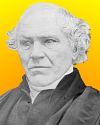
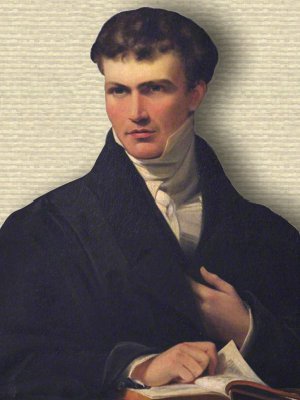
William Whewell
(24 May 1794 - 6 Mar 1866)
English scholar and philosopher known for his survey of the scientific method and for creating scientific words, including the word “scientist.”
|
Science Quotes by William Whewell (64 quotes)
>> Click for William Whewell Quotes on | Discovery | Fact | Geology | Hypothesis | Knowledge | Law | Nature | Observation | Phenomenon | Science | Truth |
>> Click for William Whewell Quotes on | Discovery | Fact | Geology | Hypothesis | Knowledge | Law | Nature | Observation | Phenomenon | Science | Truth |
...the question undoubtedly is, or soon will be, not whether or no we shall employ notation in chemistry, but whether we shall use a bad and incongruous, or a consistent and regular notation.
— William Whewell
'On the Employment of Notation in Chemistry', Journal of the Royal Institution (1838), 1, 438. Cited in Timothy L. Alborn, 'Negotiating Notation: Chemical Symbols and British Society, 1831-1835', Annals of Science (1989), 46, 437.
[A] theory is a Fact; a Fact is a familiar Theory.
— William Whewell
In The Philosophy of the Inductive Sciences (1840), Vol. I, 40.
[Astronomy was] the only progressive science produced by the ancient world.
— William Whewell
In Augustus William Hare and Julius Charles Hare, Guesses At Truth, By Two Brothers (3rd Ed., 1855)
All palaetiological sciences, all speculations which attempt to ascend from the present to the remote past, by the chain of causation, do also, by an inevitable consequence, urge us to look for the beginning of the state of things which we thus contemplate; but in none of these cases have men been able, by the aid of science, to arrive at a beginning which is homogeneous with the known course of events. The first origin of language, of civilization, of law and government, cannot be clearly made out by reasoning and research; and just as little, we may expect, will a knowledge of the origin of the existing and extinct species of plants and animals, be the result of physiological and geological investigation.
— William Whewell
In History of the Inductive Sciences (1837), Vol. 3, 581.
As we cannot use physician for a cultivator of physics, I have called him a physicist. We need very much a name to describe a cultivator of science in general. I should incline to call him a Scientist. Thus we might say, that as an Artist is a Musician, Painter or Poet, a Scientist is a Mathematician, Physicist, or Naturalist.
— William Whewell
The Philosophy of the Inductive Sciences (1840), Vol. I, cxiii.
Astronomy is … the only progressive Science which the ancient world produced.
— William Whewell
In History of the Inductive Sciences from the Earliest to the Present Times (1837), Vol 1, 90.
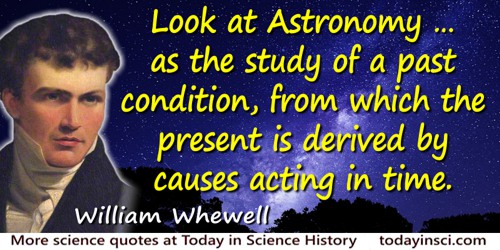
Astronomy, as the science of cyclical motions, has nothing in common with Geology. But look at Astronomy where she has an analogy with Geology; consider our knowledge of the heavens as a palaetiological science;—as the study of a past condition, from which the present is derived by causes acting in time. Is there no evidence of a beginning, or of a progress?
— William Whewell
In History of the Inductive Sciences (1857), Vol. 3, 516.
But with regard to the material world, we can at least go so far as this;—we can perceive that events are brought about, not by insulated interpositions of Divine power, exerted in each particular ease, but by the establishment of general laws.
— William Whewell
In Astronomy and General Physics Considered with Reference to Natural Theology (1833), 356. Charles Darwin placed this quote on the title page of his On the Origin of Species, identified as from Whewell's 'Bridgewater Treatise'.
By science, then, I understand the consideration of all subjects, whether of a pure or mixed nature, capable of being reduced to measurement and calculation. All things comprehended under the categories of space, time and number properly belong to our investigations; and all phenomena capable of being brought under the semblance of a law are legitimate objects of our inquiries.
— William Whewell
In Report of the British Association for the Advancement of Science (1833), xxviii.
Discoveries are not generally made in the order of their scientific arrangement: their connexions and relations are made out gradually; and it is only when the fermentation of invention has subsided that the whole clears into simplicity and order.
— William Whewell
In 'The Equilibrium of Forces on a Point', Elementary Treatise on Mechanics (1819), Vol. 1, Preface, iii.
Every detection of what is false directs us towards what is true: every trial exhausts some tempting form of error.
— William Whewell
In 'Lecture 7', Lectures on the History of Moral Philosophy in England (1852), 101.
Every failure is a step to success.
— William Whewell
In 'Lecture 7', Lectures on the History of Moral Philosophy in England (1852), 101.
Facts are the materials of science, but all Facts involve Ideas. … we must, for the purposes of science, take care that the Ideas are clear and rigorously applied.
— William Whewell
Aphorism 4, 'Aphorisms Concerning Science', The Philosophy of the Inductive Sciences (1840), Vol. 1, xxxvii.
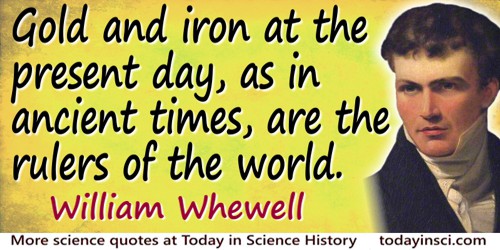
Gold and iron at the present day, as in ancient times, are the rulers of the world; and the great events in the world of mineral art are not the discovery of new substances, but of new and rich localities of old ones.
— William Whewell
Lecture (26 Npv 1851), to the London Society of Arts, 'The General Bearing of the Great Exhibition on the Progress of Art and Science', collected in Lectures on the Results of the Great Exhibition of 1851' (1852), 3.
Have the changes which lead us from one geologic state to another been, on a long average uniform in their intensity, or have they consisted of epochs of paroxysmal and catastrophic action, interposed between periods of comparative tranquillity? These two opinions will probably for some time divide the geological world into two sects, which may perhaps be designated as the Uniformitarians and the Catastrophists.
— William Whewell
In 'Review of Charles Lyell's Principles of Geology', Quarterly Review (1832), 47, 126.
Hypotheses may be useful, though involving much that is superfluous, and even erroneous: for they may supply the true bond of connexion of the facts; and the superfluity and error may afterwards be pared away.
— William Whewell
Aphorism 11, 'Aphorisms Concerning Science', The Philosophy of the Inductive Sciences (1840), Vol. 1, xxxvi.
I am persuaded that there is not in the nature of science anything unfavourable to religious feelings, and if I were not so persuaded I should be much puzzled to account for our being invested, as we so amply are, with the facilities that lead us to the discovery of scientific truth. It would be strange if our Creator should be found to be urging us on in a career which tended to be a forgetfulness of him.
— William Whewell
Letter to H. J. Rose (19 Nov 1826). Quoted in I. Todhunter (ed.), William Whewell: An Account of His Writings with Selections From His Literary and Scientific Correspondence (1876), Vol. 2, 76.
I have considered the two terms you want to substitute for eisode and exode, and upon the whole I am disposed to recommend instead of them anode and cathode. These words may signify eastern and western way, just as well as the longer compounds which you mention … I may mention too that anodos and cathodos are good, genuine Greek words, and not compounds coined for the purpose.
— William Whewell
Letter to Michael Faraday (25 Apr 1834). Quoted in I. Todhunter (ed.), William Whewell: An Account of His Writings with Selections From His Literary and Scientific Correspondence (1876), Vol. 2, 179.
In general, art has preceded science. Men have executed great, and curious, and beautiful works before they had a scientific insight into the principles on which the success of their labours was founded. There were good artificers in brass and iron before the principles of the chemistry of metals were known; there was wine among men before there was a philosophy of vinous fermentation; there were mighty masses raised into the air, cyclopean walls and cromlechs, obelisks and pyramids—probably gigantic Doric pillars and entablatures—before there was a theory of the mechanical powers. … Art was the mother of Science.
— William Whewell
Lecture (26 Nov 1851), to the London Society of Arts, 'The General Bearing of the Great Exhibition on the Progress of Art and Science', collected in Lectures on the Results of the Great Exhibition of 1851' (1852), 7-8.
In order that the facts obtained by observation and experiment may be capable of being used in furtherance of our exact and solid knowledge, they must be apprehended and analysed according to some Conceptions which, applied for this purpose, give distinct and definite results, such as can be steadily taken hold of and reasoned from.
— William Whewell
Philosophy of the Inductive Sciences (1840), Vol. 2, 205.
In this manner the whole substance of our geometry is reduced to the definitions and axioms which we employ in our elementary reasonings; and in like manner we reduce the demonstrative truths of any other science to the definitions and axioms which we there employ.
— William Whewell
In The Philosophy of the Inductive Sciences: Founded Upon Their History (1840), Vol. 1, 67.
In truth, we know causes only by their effects; and in order to learn the nature of the causes which modify the earth, we must study them through all ages of their action, and not select arbitrarily the period in which we live as the standard for all other epochs.
— William Whewell
In History of the Inductive Sciences (1857), Vol. 3, 514.
It is a peculiar feature in the fortune of principles of such high elementary generality and simplicity as characterise the laws of motion, that when they are once firmly established, or supposed to be so, men turn with weariness and impatience from all questionings of the grounds and nature of their authority. We often feel disposed to believe that truths so clear and comprehensive are necessary conditions, rather than empirical attributes of their subjects: that they are legible by their own axiomatic light, like the first truths of geometry, rather than discovered by the blind gropings of experience.
— William Whewell
In An Introduction to Dynamics (1832), x.
It is a test of true theories not only to account for but to predict phenomena.
— William Whewell
Aphorism 12, 'Aphorisms Concerning Science', The Philosophy of the Inductive Sciences (1840), Vol. 1, xxxvi.
It is a wrong business when the younger cultivators of science put out of sight and deprecate what their predecessors have done; but obviously that is the tendency of Huxley and his friends … It is very true that Huxley was bitter against the Bishop of Oxford, but I was not present at the debate. Perhaps the Bishop was not prudent to venture into a field where no eloquence can supersede the need for precise knowledge. The young naturalists declared themselves in favour of Darwin’s views which tendency I saw already at Leeds two years ago. I am sorry for it, for I reckon Darwin’s book to be an utterly unphilosophical one.
— William Whewell
Letter to James D, Forbes (24 Jul 1860). Trinity College Cambridge, Whewell Manuscripts.
Man is the Interpreter of Nature, Science the right interpretation.
— William Whewell
Aphorism 1, 'Aphorisms Concerning Ideas', The Philosophy of the Inductive Sciences (1840), Vol. 1, xvii.
Newton could not admit that there was any difference between him and other men, except in the possession of such habits as … perseverance and vigilance. When he was asked how he made his discoveries, he answered, “by always thinking about them;” and at another time he declared that if he had done anything, it was due to nothing but industry and patient thought: “I keep the subject of my inquiry constantly before me, and wait till the first dawning opens gradually, by little and little, into a full and clear light.”
— William Whewell
In History of the Inductive Sciences, Bk. 7, chap, 1, sect. 5.
Newton’s theory is the circle of generalization which includes all the others [as Kepler’s laws, Ptolemy’s theory, etc.];—the highest point of the inductive ascent;—the catastrophe of the philosophic drama to which Plato had prologized;— the point to which men’s minds had been journeying for two thousand years.
— William Whewell
In History of the Inductive Sciences, Bk. 7, chap. 2, sect. 5.
No discovery is the work of accident.
— William Whewell
Aphorism 3, 'Aphorisms Concerning Science', The Philosophy of the Inductive Sciences (1840), Vol. 1, xxxvii.
No force however great can stretch a cord however fine into an horizontal line which is accurately straight: there will always be a bending downward.
— William Whewell
In 'The Equilibrium of Forces on a Point', Elementary Treatise on Mechanics (1819), Vol. 1, 44. Note by Webmaster: …bending downward, however small.
Nobody since Newton has been able to use geometrical methods to the same extent for the like purposes; and as we read the Principia we feel as when we are in an ancient armoury where the weapons are of gigantic size; and as we look at them we marvel what manner of man he was who could use as a weapon what we can scarcely lift as a burthen.
— William Whewell
From Speech delivered at the Dejeuner, after the Inauguration of the statue of Isaac Newton at Grantham. Collected in Edmund Fillingham King, A biographical sketch of Sir Isaac Newton (1858), 105.
Order and regularity are more readily and clearly recognised when exhibited to the eye in a picture than they are when presented to the mind in any other manner.
— William Whewell
In The Philosophy of the Inductive Sciences: Founded Upon Their History (1840), 543.
Scarcely any attempt is entirely a failure; scarcely any theory, the result of steady thought, is altogether false; no tempting form of Error is without some latent charm derived from Truth.
— William Whewell
In 'Lecture 7', Lectures on the History of Moral Philosophy in England (1852), 101.
The catastrophist constructs theories, the uniformitarian demolishes them. The former adduces evidence of an Origin, the latter explains the evidence away.
— William Whewell
Aphorism 110, 'Aphorisms Concerning Ideas', The Philosophy of the Inductive Sciences (1840), Vol. 1, xxxvi.
The doctrine that logical reasoning produces no new truths, but only unfolds and brings into view those truths which were, in effect, contained in the first principles of the reasoning, is assented to by almost all who, in modern times, have attended to the science of logic.
— William Whewell
In
The Philosophy of the Inductive Sciences: Founded Upon Their History (1840), Vol. 1, 67.
The framing of hypotheses is, for the enquirer after truth, not the end, but the beginning of his work. Each of his systems is invented, not that he may admire it and follow it into all its consistent consequences, but that he may make it the occasion of a course of active experiment and observation. And if the results of this process contradict his fundamental assumptions, however ingenious, however symmetrical, however elegant his system may be, he rejects it without hesitation. He allows no natural yearning for the offspring of his own mind to draw him aside from the higher duty of loyalty to his sovereign, Truth, to her he not only gives his affections and his wishes, but strenuous labour and scrupulous minuteness of attention.
— William Whewell
Philosophy of the Inductive Sciences (1847), Vol. 2, 57.
The Greeks in the first vigour of their pursuit of mathematical truth, at the time of Plato and soon after, had by no means confined themselves to those propositions which had a visible bearing on the phenomena of nature; but had followed out many beautiful trains of research concerning various kinds of figures, for the sake of their beauty alone; as for instance in their doctrine of Conic Sections, of which curves they had discovered all the principal properties. But it is curious to remark, that these investigations, thus pursued at first as mere matters of curiosity and intellectual gratification, were destined, two thousand years later, to play a very important part in establishing that system of celestial motions which succeeded the Platonic scheme of cycles and epicycles. If the properties of conic sections had not been demonstrated by the Greeks and thus rendered familiar to the mathematicians of succeeding ages, Kepler would probably not have been able to discover those laws respecting the orbits and motions of planets which were the occasion of the greatest revolution that ever happened in the history of science.
— William Whewell
In History of Scientific Ideas, Bk. 9, chap. 14, sect. 3.
The hypotheses which we accept ought to explain phenomena which we have observed. But they ought to do more than this; our hypotheses ought to foretell phenomena which have not yet been observed; ... because if the rule prevails, it includes all cases; and will determine them all, if we can only calculate its real consequences. Hence it will predict the results of new combinations, as well as explain the appearances which have occurred in old ones. And that it does this with certainty and correctness, is one mode in which the hypothesis is to be verified as right and useful.
— William Whewell
Philosophy of the Inductive Sciences (1847), Vol. 2, 62-63.
The ideas which these sciences, Geometry, Theoretical Arithmetic and Algebra involve extend to all objects and changes which we observe in the external world; and hence the consideration of mathematical relations forms a large portion of many of the sciences which treat of the phenomena and laws of external nature, as Astronomy, Optics, and Mechanics. Such sciences are hence often termed Mixed Mathematics, the relations of space and number being, in these branches of knowledge, combined with principles collected from special observation; while Geometry, Algebra, and the like subjects, which involve no result of experience, are called Pure Mathematics.
— William Whewell
In The Philosophy of the Inductive Sciences (1868), Part 1, Bk. 2, chap. 1, sect. 4.
The law of gravitation is indisputably and incomparably the greatest scientific discovery ever made, whether we look at the advance which it involved, the extent of truth disclosed, or the fundamental and satisfactory nature of this truth.
— William Whewell
In History of the Inductive Sciences, Bk. 7, chap. 8, sect. 6.
The mystery of creation is not within the range of [Nature’s] legitimate territory; [Nature] says nothing, but she points upwards.
— William Whewell
In History of the Inductive Sciences (1837), Vol. 3, 588.
The object of science is knowledge; the objects of art are works. In art, truth is the means to an end; in science, it is the only end. Hence the practical arts are not to be classed among the sciences
— William Whewell
Aphorism 25, 'Aphorisms Respecting Knowledge', The Philosophy of the Inductive Sciences (1840), Vol. 1, xli.
The peculiar character of mathematical truth is, that it is necessarily and inevitably true; and one of the most important lessons which we learn from our mathematical studies is a knowledge that there are such truths, and a familiarity with their form and character.
This lesson is not only lost, but read backward, if the student is taught that there is no such difference, and that mathematical truths themselves are learned by experience.
This lesson is not only lost, but read backward, if the student is taught that there is no such difference, and that mathematical truths themselves are learned by experience.
— William Whewell
In Thoughts on the Study of Mathematics. Principles of English University Education (1838).
The person who did most to give to analysis the generality and symmetry which are now its pride, was also the person who made mechanics analytical; I mean Euler.
— William Whewell
From History of the Inductive Sciences from the Earliest to the Present
(1837), Vol. 2, 93.
The persons who have been employed on these problems of applying the properties of matter and the laws of motion to the explanation of the phenomena of the world, and who have brought to them the high and admirable qualities which such an office requires, have justly excited in a very eminent degree the admiration which mankind feels for great intellectual powers. Their names occupy a distinguished place in literary history; and probably there are no scientific reputations of the last century higher, and none more merited, than those earned by great mathematicians who have laboured with such wonderful success in unfolding the mechanism of the heavens; such for instance as D ’Alembert, Clairaut, Euler, Lagrange, Laplace.
— William Whewell
In Astronomy and General Physics (1833), Bk. 3, chap. 4, 327.
The ponderous instrument of synthesis, so effective in his [Newton’s] hands, has never since been grasped by one who could use it for such purposes; and we gaze at it with admiring curiosity, as on some gigantic implement of war, which stands idle among the memorials of ancient days, and makes us wonder what manner of man he was who could wield as a weapon what we can hardly lift as a burden.
— William Whewell
In History of the Inductive Sciences (1857), Vol. 2, 128.
The principles which constituted the triumph of the preceding stages of the science, may appear to be subverted and ejected by the later discoveries, but in fact they are, (so far as they were true), taken up into the subsequent doctrines and included in them. They continue to be an essential part of the science. The earlier truths are not expelled but absorbed, not contradicted but extended; and the history of each science, which may thus appear like a succession of revolutions, is, in reality, a series of developments.
— William Whewell
In History of the Inductive Sciences (1837) Vol. 1, 10.
The results of systematic symbolical reasoning must always express general truths, by their nature; and do not, for their justification, require each of the steps of the process to represent some definite operation upon quantity. The absolute universality of the interpretation of symbols is the fundamental principle of their use.
— William Whewell
In 'The Foundations of Higher Mathematics', The Philosophy of the Inductive Sciences (1847), Part I, Bk. 2, 149.
The Senses place before us the Characters of the Book of Nature; but these convey no knowledge to us, till we have discovered the Alphabet by which they are to be read.
— William Whewell
In 'Aphorisms Concerning Ideas', The Philosophy of the Inductive Sciences (1840), Vol. 1, xvii.
The tendency of the sciences has long been an increasing proclivity of separation and dismemberment … The mathematician turns away from the chemist; the chemist from the naturalist; the mathematician, left to himself divides himself into a pure mathematician and a mixed mathematician, who soon part company … And thus science, even mere physical science, loses all traces of unity. A curious illustration of this result may be observed in the want of any name by which we can designate the students of the knowledge of the material world collectively. We are informed that this difficulty was felt very oppressively by the members of the British Association for the Advancement of Science, at their meetings at York, Oxford and Cambridge, in the last three summers. There was no general term by which these gentlemen could describe themselves with reference to their pursuits … some ingenious gentleman [William Whewell] proposed that, by analogy with artist, they might form Scientist, and added that there could be no scruple … when we have words such as sciolist, economist, and atheist—but this was not generally palatable.
— William Whewell
In Review of Mrs Somerville, 'On the Connexion of the Physical Sciences', The Quarterly Review (1834), 51, 58-61.
The two processes by which Science is constructed are the Explication of Conceptions and the Colligation of Facts.
— William Whewell
Aphorism 1, 'Aphorisms Concerning Science', The Philosophy of the Inductive Sciences (1840), Vol. 1, xxxvii.
The use of every organ has been discovered by starting from the assumption that it must have been some use.
— William Whewell
In History of the Inductive Sciences (1857), Vol. 3, 385.
There is a mask of theory over the whole face of nature, if it be theory to infer more than we see.
— William Whewell
The Philosophy of the Inductive Sciences: Founded Upon Their History (1840), Vol. 1, 24.
These sciences, Geometry, Theoretical Arithmetic and Algebra, have no principles besides definitions and axioms, and no process of proof but deduction; this process, however, assuming a most remarkable character; and exhibiting a combination of simplicity and complexity, of rigour and generality, quite unparalleled in other subjects.
— William Whewell
In The Philosophy of the Inductive Sciences (1858), Part 1, Bk. 2, chap. 1, sect. 2.
This science, Geometry, is one of indispensable use and constant reference, for every student of the laws of nature; for the relations of space and number are the alphabet in which those laws are written. But besides the interest and importance of this kind which geometry possesses, it has a great and peculiar value for all who wish to understand the foundations of human knowledge, and the methods by which it is acquired. For the student of geometry acquires, with a degree of insight and clearness which the unmathematical reader can but feebly imagine, a conviction that there are necessary truths, many of them of a very complex and striking character; and that a few of the most simple and self-evident truths which it is possible for the mind of man to apprehend, may, by systematic deduction, lead to the most remote and unexpected results.
— William Whewell
In The Philosophy of the Inductive Sciences Part 1, Bk. 2, chap. 4, sect. 8 (1868).
Time, inexhaustible and ever accumulating his efficacy, can undoubtedly do much for the theorist in geology; but Force, whose limits we cannot measure, and whose nature we cannot fathom, is also a power never to be slighted: and to call in the one to protect us from the other, is equally presumptuous, to whichever of the two our superstition leans. To invoke Time, with ten thousand earthquakes, to overturn and set on edge a mountain-chain, should the phenomena indicate the change to have been sudden and not successive, would be ill excused by pleading the obligation of first appealing to known causes.
— William Whewell
In History of the Inductive Sciences (1857), Vol. 3, 513-514.
To discover a Conception of the mind which will justly represent a train of observed facts is, in some measure, a process of conjecture, ... and the business of conjecture is commonly conducted by calling up before our minds several suppositions, selecting that one which most agrees with what we know of the observed facts. Hence he who has to discover the laws of nature may have to invent many suppositions before he hits upon the right one; and among the endowments which lead to his success, we must reckon that fertility of invention which ministers to him such imaginary schemes, till at last he finds the one which conforms to the true order of nature.
— William Whewell
Philosophy of the Inductive Sciences (1847), Vol. 2, 54.
To discover the laws of operative power in material productions, whether formed by man or brought into being by Nature herself, is the work of a science, and is indeed what we more especially term Science.
— William Whewell
Lecture (26 Nov 1851), to the London Society of Arts, 'The General Bearing of the Great Exhibition on the Progress of Art and Science', collected in Lectures on the Results of the Great Exhibition of 1851' (1852), 7.
We cannot observe external things without some degree of Thought; nor can we reflect upon our Thoughts, without being influenced in the course of our reflection by the Things which we have observed.
— William Whewell
In The Elements of Morality (1845), Vol 1, 1.
We have here spoken of the prediction of facts of the same kind as those from which our rule was collected. But the evidence in favour of our induction is of a much higher and more forcible character when it enables us to explain and determine cases of a kind different from those which were contemplated in the formation of our hypothesis. The instances in which this has occurred, indeed, impress us with a conviction that the truth of our hypothesis is certain. No accident could give rise to such an extraordinary coincidence. No false supposition could, after being adjusted to one class of phenomena, so exactly represent a different class, when the agreement was unforeseen and contemplated. That rules springing from remote and unconnected quarters should thus leap to the same point, can only arise from that being where truth resides.
— William Whewell
In The Philosophy of the Inductive Sciences (1840), Vol. 2, 230.
We may best hope to understand the nature and conditions of real knowledge, by studying the nature and conditions of the most certain and stable portions of knowledge which we already possess: and we are most likely to learn the best methods of discovering truth, by examining how truths, now universally recognised, have really been discovered.
— William Whewell
In The Philosophy of the Inductive Sciences (1840), Vol. I, 3-4.
We may see how unexpectedly recondite parts of pure mathematics may bear upon physical science, by calling to mind the circumstance that Fresnel obtained one of the most curious confirmations of the theory (the laws of Circular Polarization by reflection) through an interpretation of an algebraical expression, which, according to the original conventional meaning of the symbols, involved an impossible quantity.
— William Whewell
In History of Scientific Ideas, Bk. 2, chap. 14, sect. 8.
We pass with admiration along the great series of mathematicians, by whom the science of theoretical mechanics has been cultivated, from the time of Newton to our own. There is no group of men of science whose fame is higher or brighter. The great discoveries of Copernicus, Galileo, Newton, had fixed all eyes on those portions of human knowledge on which their successors employed their labors. The certainty belonging to this line of speculation seemed to elevate mathematicians above the students of other subjects; and the beauty of mathematical relations and the subtlety of intellect which may be shown in dealing with them, were fitted to win unbounded applause. The successors of Newton and the Bernoullis, as Euler, Clairaut, D’Alembert, Lagrange, Laplace, not to introduce living names, have been some of the most remarkable men of talent which the world has seen.
— William Whewell
In History of the Inductive Sciences, Vol. 1, Bk. 4, chap. 6, sect. 6.
While the unique crystal stands on its shelf unmeasured by the goniometer, unslit by the optical lapidary, unanalysed by the chemist,—it is merely a piece of furniture, and has no more right to be considered as anything pertaining to science, than a curious china tea-cup on a chimney-piece.
— William Whewell
In 'Report on the Progress and Present State of Mineralogy', Report of the British Association for the Advancement of Science (1831 -32), 364-365.
Quotes by others about William Whewell (6)
All your names I and my friend approve of or nearly all as to sense & expression, but I am frightened by their length & sound when compounded. As you will see I have taken deoxide and skaiode because they agree best with my natural standard East and West. I like Anode & Cathode better as to sound, but all to whom I have shewn them have supposed at first that by Anode I meant No way.
Letter (3 May 1834) to William Whewell, who coined the terms. In Frank A. J. L. James (ed.), The Correspondence of Michael Faraday (1993), Vol. 2, 181. Note: Here “No way” is presumably not an idiomatic exclamation, but a misinterpretation from the Greek prefix, -a “not”or “away from,” and hodos meaning “way.” The Greek ἄνοδος anodos means “way up” or “ascent.”
I have taken your advice, and the names used are anode cathode anions cations and ions; the last I shall have but little occasion for. I had some hot objections made to them here and found myself very much in the condition of the man with his son and ass who tried to please every body; but when I held up the shield of your authority, it was wonderful to observe how the tone of objection melted away.
Letter to William Whewell, 15 May 1834. In Frank A. J. L. James (ed.), The Correspondence of Michael Faraday (1993), Vol. 2, 186.
There is nothing distinctively scientific about the hypothetico-deductive process. It is not even distinctively intellectual. It is merely a scientific context for a much more general stratagem that underlies almost all regulative processes or processes of continuous control, namely feedback, the control of performance by the consequences of the act performed. In the hypothetico-deductive scheme the inferences we draw from a hypothesis are, in a sense, its logical output. If they are true, the hypothesis need not be altered, but correction is obligatory if they are false. The continuous feedback from inference to hypothesis is implicit in Whewell’s account of scientific method; he would not have dissented from the view that scientific behaviour can be classified as appropriately under cybernetics as under logic.
Induction and Intuition in Scientific Thought (1969), 54-5.
Science is [William Whewell’s] forte and omniscience is his foible.
Quoted in J. Todhunter (ed.), William Whewell: An Account of His Writings With Selections from his Literary and Scientific Correspondence (1876), Vol. 1, 410.
The tendency of the sciences has long been an increasing proclivity of separation and dismemberment … The mathematician turns away from the chemist; the chemist from the naturalist; the mathematician, left to himself divides himself into a pure mathematician and a mixed mathematician, who soon part company … And thus science, even mere physical science, loses all traces of unity. A curious illustration of this result may be observed in the want of any name by which we can designate the students of the knowledge of the material world collectively. We are informed that this difficulty was felt very oppressively by the members of the British Association for the Advancement of Science, at their meetings at York, Oxford and Cambridge, in the last three summers. There was no general term by which these gentlemen could describe themselves with reference to their pursuits … some ingenious gentleman [William Whewell] proposed that, by analogy with artist, they might form Scientist, and added that there could be no scruple … when we have words such as sciolist, economist, and atheist—but this was not generally palatable.
In Review of Mrs Somerville, 'On the Connexion of the Physical Sciences', The Quarterly Review (1834), 51, 58-61.
If it is true as Whewell says, that the essence of the triumphs of Science and its progress consists in that it enables us to consider evident and necessary, views which our ancestors held to be unintelligible and were unable to comprehend, then the extension of the number concept to include the irrational, and we will at once add, the imaginary, is the greatest forward step which pure mathematics has ever taken.
In Theorie der Complexen Zahlensysteme (1867), 60. As translated in Robert Édouard Moritz, Memorabilia Mathematica; Or, The Philomath’s Quotation-book (1914), 281. From the original German, “Wenn es wahr ist, dass, wie Whewell meint, das Wesen der Triumphe der Wissenschaft und ihres Fortschrittes darin besteht, dass wir veranlasst werden, Ansichten, welche unsere Vorfahren für unbegreiflich hielten und unfähig waren zu begreifen, für evident und nothwendig zu halten, so war die Erweiterung des Zahlenbegriffes auf das Irrationale, und wollen wir sogleich hinzufügen, das Imaginäre, der grösste Fortschritt, den die reine Mathematik jemals gemacht hat.”
See also:
- 24 May - short biography, births, deaths and events on date of Whewell's birth.
- William Whewell - context of quote “Gold and iron…are the rulers of the world” - Medium image (500 x 250 px)
- William Whewell - context of quote “Gold and iron…are the rulers of the world” - Large image (800 x 400 px)
- William Whewell: Theory of Scientific Method, by William Whewell. - book suggestion.
 In science it often happens that scientists say, 'You know that's a really good argument; my position is mistaken,' and then they would actually change their minds and you never hear that old view from them again. They really do it. It doesn't happen as often as it should, because scientists are human and change is sometimes painful. But it happens every day. I cannot recall the last time something like that happened in politics or religion.
(1987) --
In science it often happens that scientists say, 'You know that's a really good argument; my position is mistaken,' and then they would actually change their minds and you never hear that old view from them again. They really do it. It doesn't happen as often as it should, because scientists are human and change is sometimes painful. But it happens every day. I cannot recall the last time something like that happened in politics or religion.
(1987) -- 





