 (source)
|
Francois Marie Arouet Voltaire
(21 Nov 1694 - 30 May 1778)
French author who popularized Isaac Newton's work in France by arranging a translation of Principia Mathematica. He added a commentary to explain it to non-scientists.
|
Science Quotes by Francois Marie Arouet Voltaire (37 quotes)
[My uncle said to me…] When I read, forty years ago, that shells from Syria were found in the Alps, I say, I admit, with a slightly mocking tone, that these shells were apparently brought by pilgrims who were returning from Jerusalem. M. de Buffon reprimanded me very sharply in his Theory of the Earth, page 281. I did not want to quarrel with him over shells, but I remain of the same opinion, because the impossibility that the sea formed the mountains is evident to me. Some may tell me that porphyry is made of sea urchin spikes, I’ll believe it when I see white marble is made of ostrich feathers.
— Francois Marie Arouet Voltaire
Voltaire is recounting one of the reasons his uncle (Abbe Ambroise Bazing) had told him, for disputing Buffon’s claim that the sea that made the mountains. Translated by Webmaster from 'La Défense de Mon Oncle: Des montagnes et des Coquilles', collected in Oeuvres complètes: Histoire.- Mélanges historiques (1817), Tome 15, Chap. 19, 133-134. From the original French; “Quand je lus, il y a quarante ans, qu’on avait trouvé dans les Alpes des coquilles de Syrie, je dis, je l’avoue , d’un ton un peu goguenard, que ces coquilles avaient été apparemment apportées par des pélerins qui revenaient de Jérusalem. M. de Buffon m’en reprit très-vertement dans sa Théorie de la terre, page 281. Je n’ai pas voulu me brouiller avec lui pour des coquilles, mais je suis demeuré dans non opinion, parce que l’impossibilité que la mer ait formé les montagnes m’est démontrée. On a beau me dire que le porphyre est fait de pointes d’oursin, je le croirai quand je verrai que le marbre blanc est fait de plumes d’autruche.” [Note: porphyry is a form of igneous rock. Also note, this passage does NOT appear in 'Les Singularités de la Nature', which may be found elsewhere incorrectly cited as the source. —Webmaster]
A Frenchman who arrives in London, will find Philosophy, like every Thing else, very much chang’d there. He had left the World a plenum, and he now finds it a vacuum. At Paris the Universe is seen, compos’d of Vortices of subtile Matter; but nothing like it is seen in London. In France, ‘tis the Pressure of the Moon that causes the Tides; but in England ‘tis the Sea that gravitates towards the Moon; so what when you think that the Moon should make it flood with us, those Gentlemen fancy it should be Ebb, which, very unluckily, cannot be prov’d. For to be able to do this, ‘tis necessary the Moon and the Tides should have been enquir’d into, at the very instant of the Creation.
— Francois Marie Arouet Voltaire
Letter XIV. 'On DesCartes and Sir Isaac Newton', in Letters Concerning the English Nation (1733), 109-110.
A physician is an unfortunate gentleman who is every day required to perform a miracle; namely to reconcile health with intemperance.
— Francois Marie Arouet Voltaire
In Great Thoughts from Master Minds (1887), 8, 49.
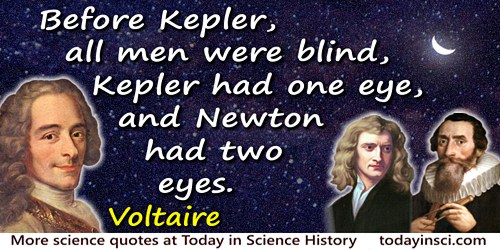
Before Kepler, all men were blind, Kepler had one eye, and Newton had two eyes.
— Francois Marie Arouet Voltaire
From Voltaire’s Notebooks (1952), 63. As translated in Peter Gay, The Enlightenment: The Science of Freedom (1996), 131. From the original French: “Avant Kepler tous les hommes étoent aveugles, Kepler fut borgne, et Newton a eu deux yeux.”
Bile makes man passionate and sick; but without bile man could not live.
— Francois Marie Arouet Voltaire
Translation of the original French, “La bile rend colère et malade; mais sans la bile l’homme ne saurait vivre.” From Zadig. Accompanied with the translation in Craufurd Tait Ramage, Beautiful Thoughts from French and Italian Authors (1866), 371.
But nothing is more estimable than a physician who, having studied nature from his youth, knows the properties of the human body, the diseases which assail it, the remedies which will benefit it, exercises his art with caution, and pays equal attention to the rich and the poor.
— Francois Marie Arouet Voltaire
A Philosophical Dictionary: from the French? (2nd Ed.,1824), Vol. 5, 239-240.
Changes That Have Occurred in the Globe: When we have seen with our own eyes a mountain progressing into a plain; that is to say, an immense boulder separating from this mountain and covering the fields; an entire castle broken into pieces over the ground; a river swallowed up which then bursts out from its abyss; clear marks of a vast amount of water having once flooded regions now inhabited, and a hundred vestiges of other transformations, then we are much more willing to believe that great changes altered the face of the earth, than a Parisian lady who knows only that the place where her house was built was once a cultivated field. However, a lady from Naples who has seen the buried ruins of Herculaneum, is much less subject to the bias which leads us to believe that everything has always been as it is today.
— Francois Marie Arouet Voltaire
From article 'Changements arrivées dans le globe', in Dictionnaire philosophique (1764), collected in Œuvres Complètes de Voltaire (1878), Vol. 2, 427-428. Translated by Ian Ellis, from the original French: “Changements arrivées dans le globe: Quand on a vu de ses yeux une montagne s’avancer dans une plaine, c’est-à-dire un immense rocher de cette montagne se détacher et couvrir des champs, un château tout entier enfoncé dans la terre, un fleuve englouti qui sort ensuite de son abîme, des marques indubitables qu’un vaste amas d’eau inondait autrefois un pays habité aujourd’hui, et cent vestiges d’autres révolutions, on est alors plus disposé à croire les grands changements qui ont altéré la face du monde, que ne l’est une dame de Paris qui sait seulement que la place où est bâtie sa maison était autrefois un champ labourable. Mais une dame de Naples, qui a vu sous terre les ruines d’Herculanum, est encore moins asservie au préjugé qui nous fait croire que tout a toujours été comme il est aujourd’hui.”
Descartes constructed as noble a road of science, from the point at which he found geometry to that to which he carried it, as Newton himself did after him. ... He carried this spirit of geometry and invention into optics, which under him became a completely new art.
— Francois Marie Arouet Voltaire
A Philosophical Dictionary: from the French? (2nd Ed.,1824), Vol. 5, 110.
Doctors are men who prescribe medicines of which they know little, to cure diseases of which they know less, in human beings of whom they know nothing. (1760)
— Francois Marie Arouet Voltaire
In Robert Allan Weinberg, The Biology of Cancer (2006), 726. (Note: Webmaster has not yet found this quote, in this wording, in a major quotation reference book. If you know a primary print source, or correction, please contact Webmaster.)
He who has heard the same thing told by twelve thousand ocular [eye]witnesses, has only twelve thousand probabilities, equal to one strong one, which is not equal to certainty.
— Francois Marie Arouet Voltaire
In 'Truth', Philosophical Dictionary (1824), Vol. 6, 297.
Heroes of physics, Argonauts of our time
Who leaped the mountains, who crossed the seas …
You have confirmed in uncomfortable places
What Newton knew without leaving his study.
Who leaped the mountains, who crossed the seas …
You have confirmed in uncomfortable places
What Newton knew without leaving his study.
— Francois Marie Arouet Voltaire
Discours en Vers sur l’Homme (1734), Quatrieme discours: de la Moderation (1738). English translation as in J. L. Heilbron, Weighing Imponderables and Other Quantitative Science around 1800 (1993), 224.
I know of nothing more laughable than a doctor who does not die of old age.
— Francois Marie Arouet Voltaire
Letter to Charles Augustin Ferriol, comte d'Argental (1767). In Raymond C. Rowe, Joseph Chamberlain, A Spoonful of Sugar (2007), 243.
In fact, no opinion should be with fervour. No one holds with fervour that seven times eight is fifty-six, because it can be shown to be the case. Fervour is only necessary in commending an opinion which is doubtful or demonstrably false.
— Francois Marie Arouet Voltaire
In Institut et Musée Voltaire, Studies on Voltaire and the Eighteenth Century (1994), 314. Also quoted in Max Perutz, Is Science Necessary? (1991), 196.
In geometry, as in most sciences, it is very rare that an isolated proposition is of immediate utility. But the theories most powerful in practice are formed of propositions which curiosity alone brought to light, and which long remained useless without its being able to divine in what way they should one day cease to be so. In this sense it may be said, that in real science, no theory, no research, is in effect useless.
— Francois Marie Arouet Voltaire
In 'Geometry', A Philosophical Dictionary, (1881), Vol. l, 374.
In medicine … beware of ambiguity.
— Francois Marie Arouet Voltaire
In A Philosophical Dictionary (1824), Vol. 1, 39.
It is in everything else as it is in colors; bad eyes can distinguish between black and white; better eyes, and eyes much exercised, can distinguish every nicer gradation.
— Francois Marie Arouet Voltaire
As translated in definition for 'Extreme', A Philosophical Dictionary: From the French (1824), Vol. 3, 139.
It is not strictly demonstrated that atoms are indivisible; but it appears that they are not divided by the laws of nature.
— Francois Marie Arouet Voltaire
In A Philosophical Dictionary (1824), Vol. 1, 339.
It is not sufficient to see and to know the beauty of a work. We must feel and be affected by it.
— Francois Marie Arouet Voltaire
…...
It is said, sometimes, that common sense is very rare.
— Francois Marie Arouet Voltaire
From the original French, “On dit quelquefois, Le sens commun est fort rare.” in Dictionnaire Philosophique Portatif (1765), New Edition, Vol. 2, 276. As, translated in A Philosophical Dictionary: From the French of M. de Voltaire (1824), Vol. 2, 242.
It is the flash which appears, the thunderbolt will follow.
— Francois Marie Arouet Voltaire
Translation of the original French, “C'est l'éclair qui paraît, la foudre va partir.” From the play, Oreste, Act 2, Scene 7. Accompanied with the translation in Craufurd Tait Ramage, Beautiful Thoughts from French and Italian Authors (1866), 365.
Mathematics must subdue the flights of our reason; they are the staff of the blind; no one can take a step without them; and to them and experience is due all that is certain in physics.
— Francois Marie Arouet Voltaire
In Oeuvres Completes (1880), t. 35, 219.
Men argue, nature acts.
— Francois Marie Arouet Voltaire
Voltaire and H.I. Woolf (trans.), Voltaire's Philosophical Dictionary? (1924), 281.
Men who are occupied in the restoration of health to other men, by the joint exertion of skill and humanity, are above all the great of the earth. They even partake of divinity, since to preserve and renew is almost as noble as to create.
— Francois Marie Arouet Voltaire
A Philosophical Dictionary? (1764, 1843), Vol. 2, 317.
One day in the year 1666 Newton had gone to the country, and seeing the fall of an apple, [as his niece (Mme Conduit) told me,] let himself be led into a deep meditation on the cause which thus draws every object along a line whose extension would pass almost through the center of the Earth.
— Francois Marie Arouet Voltaire
From the original French, “Un jour, en l'année 1666, Newton, retiré à la campagne, et voyant tomber des fruits d’un arbre, à ce que m'a conté sa nièce, (Mme Conduit) se laissa aller à une méditation profonde sur la cause qui entraîne ainsi tous les corps dans une ligne qui, si elle était prolongée, passerait à peu près par le centre de la Terre,” in Éléments de Philosophie de Newton, Part 1, Chap. 3, in Oeuvres Completes de Voltaire (1785), Vol. 31, 175. Translation as given in an epigraph, in Charles W. Misner, Kip S. Thorn and John Archibald Wheeler, Gravitation (1970, 1973), 47. An alternate translation is: “One day in the year 1666, Newton went into the country, and seeing fruit fall from a tree (as his niece, Madame Conduit, has informed me), entered into a profound train of thought as to the causes which could lead to such a drawing together or attraction.” As given in Robert Chambers (ed.), The Book of Days: A Miscellany of Popular Antiquities in Connection with the Calendar (1888), Vol. 2, 757. (Note: Voltaire originally published his Éléments in 1738, but Webmaster could not find the above quote in it.)
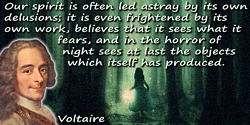
Our spirit is often led astray by its own delusions; it is even frightened by its own work, believes that it sees what it fears, and in the horror of night sees at last the objects which itself has produced.
— Francois Marie Arouet Voltaire
Translation of the original French, “Souvent de ses erreurs notre âme est obsedée; De son ouvrage même elle est intimidée, Croit voir ce qu’elle craint, et dans l’horreur des nuits, Voit enfin les objets qu’elle-même a produits.” From Sémiramis, Act 1, Scene 5. Accompanied with the translation in Craufurd Tait Ramage, Beautiful Thoughts from French and Italian Authors (1866), 364.
Society is as ancient as the world.
— Francois Marie Arouet Voltaire
From the original French, “La société est donc aussi ancienne que le monde”, in 'Politique', Collection complette des œuvres de Mr. de Voltaire (1774), Vol. 24, 255. As translated in 'Policy', A Philosophical Dictionary (1824), Vol. 5, 259.
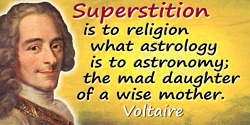
Superstition is to religion what astrology is to astronomy; the mad daughter of a wise mother.
— Francois Marie Arouet Voltaire
'A Treatise in Toleration'. In Voltaire, Tobias George Smollett (ed.) and William F. Fleming (trans.), The Works of Voltaire (1904), Vol. 4, 265.
The art of causing intemperance and health to exist in the same body is as chimerical as the philosopher’s stone, judicial astrology, and the theology of the magi.
— Francois Marie Arouet Voltaire
From the original French, “L'art de faire subsister ensemble l'intempérance et la santé, est un art aussi chimérique que la pierre philosophale, l'astrologie judiciaire, et la théologie des magies”, in Zadig. Accompanied with the translation in Craufurd Tait Ramage, Beautiful Thoughts from French and Italian Authors (1866), 371.
The art of medicine consists of amusing the patient while nature cures the disease.
— Francois Marie Arouet Voltaire
Attributed. Webmaster has found no other citation. See, for example, Bill Swainson, Encarta Book of Quotations (2000), 961.
The word atom signifies without parts—not to be divided. You divide it in thought; for, if you were to divide it in reality, it would no longer be an atom.
— Francois Marie Arouet Voltaire
In A Philosophical Dictionary (1824), Vol. 1, 338.
There is an astonishing imagination, even in the science of mathematics. … We repeat, there was far more imagination in the head of Archimedes than in that of Homer.
— Francois Marie Arouet Voltaire
In A Philosophical Dictionary: from the French (1824), 126.
There is no sect in geometry; we never say,—An Euclidian, an Archimedian.
— Francois Marie Arouet Voltaire
In 'Sects' Philosophical Dictionary (2010), 269.
Truth is an abstract word which most men use indifferently in their books and judgments, for error and falsehood.
— Francois Marie Arouet Voltaire
In 'Truth', Philosophical Dictionary (1824), Vol. 6, 297.
Vous avez trouve par de long ennuis
Ce que Newton trouva sans sortir de chez lui.
Ce que Newton trouva sans sortir de chez lui.
— Francois Marie Arouet Voltaire
In Letter to La Condamine, whose surveying expedition (after Newton’s death) had measured the arc at the equator. As Newton had calculated, the Earth was a flattened sphere, due to the effects of rotation and gravitational pull. Roughly translates as, “You have found by prolonged difficulty / What Newton found without leaving home.” In The Royal Society Newton Tercentenary Celebrations: 15-19 July 1946 (1946), 15. [Newton was born in 1642; the tercentenary celebration was delayed by WW II —Webmaster.]
We must not, however, reject all discoveries of secrets and all new inventions. It is with them as with theatrical pieces, there may be one good out of a thousand.
— Francois Marie Arouet Voltaire
In A Philosophical Dictionary (1824), Vol. 1, 66.
When he to whom a person speaks does not understand, and he who speaks does not understand himself, that is metaphysics.
— Francois Marie Arouet Voltaire
In James Wood, Dictionary of Quotations from Ancient and Modern English and Foreign Sources (1899), 361. From the original French, “Quand celui à qui l’on parle ne comprend pas et celui qui parle ne se comprend pas, c’est de la métaphysique.”
When I first read Plato and came upon this gradation of beings which rises from the lightest atom to the Supreme Being, I was struck with admiration. But when I looked at it more closely, the great phantom vanished. … At first the imagination takes a pleasure in seeing the imperceptible transition from inanimate to organic matter, from plants to zoophytes, from these to animals, from these to genii, … and finally angels.
— Francois Marie Arouet Voltaire
As quoted in Arthur O. Lovejoy, The Great Chain of Being: A Study of the History of an Idea (2011), 252.
Quotes by others about Francois Marie Arouet Voltaire (5)
Mock on, mock on, Voltaire, Rousseau!
Mock on, mock on: 'Tis all in vain!
You throw the sand against the wind,
And the wind blows it back again.
And every sand becomes a gem
Reflected in the beams divine;
Blown back they blind the mocking eye,
But still in Israel's paths they shine.
The atoms of Democritus
And Newton's particles of light
Are sands upon the Red Sea shore,
Where Israel's tents do shine so bright.
Mock on, mock on: 'Tis all in vain!
You throw the sand against the wind,
And the wind blows it back again.
And every sand becomes a gem
Reflected in the beams divine;
Blown back they blind the mocking eye,
But still in Israel's paths they shine.
The atoms of Democritus
And Newton's particles of light
Are sands upon the Red Sea shore,
Where Israel's tents do shine so bright.
Notebook Drafts (c. 1804). In W. H. Stevenson (ed.), The Poems of William Blake (1971), 481.
When I read an Italian letter [Saggio by Voltaire] on changes which had occurred on the surface of the earth, published in Paris this year (1746), I believed that these facts were reported by La Loubère. Indeed, they correspond perfectly with the author’s ideas. Petrified fish are according to him merely rare fish thrown away by Roman cooks because they were spoiled; and with respect to shells, he said that they were from the sea of the Levant and brought back by pilgrims from Syria at the time of the crusades. These shells are found today petrified in France, in Italy and in other Christian states. Why did he not add that monkeys transported shells on top of high mountains and to every place where humans cannot live? It would not have harmed his story but made his explanation even more plausible.
In 'Preuves de la Théorie de la Terre', Histoire Naturelle, Générale et Particuliere, Avec la Description du Cabinet du Roi (1749), Vol. I, 281. Trans. Albert V. and Marguerite Carozzi.
There are some men who are counted great because they represent the actuality of their own age, and mirror it as it is. Such an one was Voltaire, of whom it was epigrammatically said: “he expressed everybody's thoughts better than anyone.” But there are other men who attain greatness because they embody the potentiality of their own day and magically reflect the future. They express the thoughts which will be everybody's two or three centuries after them. Such as one was Descartes.
Quoted in James Roy Newman, The World of Mathematics (2000), Vol. 1, 239.
Hyper-selectionism has been with us for a long time in various guises; for it represents the late nineteenth century’s scientific version of the myth of natural harmony–all is for the best in the best of all possible worlds (all structures well designed for a definite purpose in this case). It is, indeed, the vision of foolish Dr. Pangloss, so vividly satirized by Voltaire in Candide–the world is not necessarily good, but it is the best we could possibly have.
…...
“On doit etre etonné ([Abbé Raynal]says) que l'Amerique n’ait pas encore produit un bon poëte, un habile mathematicien, un homme de génie dans un seul art, ou une seule science.” …“America has not yet produced one good poet.” When we shall have existed as a people as long as the Greeks did before they produced a Homer, the Romans a Virgil, the French a Racine and Voltaire, the English a Shakespeare and Milton, should this reproach be still true, we will enquire from what unfriendly causes it has proceeded, that the other countries of Europe and quarters of the earth shall not have inscribed any name in the roll of poets. But neither has America produced “one able mathematician, one man of genius in a single art or a single science.” … In physics we have produced a [Benjamin] Franklin, than whom no one of the present age has made more important discoveries, nor has enriched philosophy with more, or more ingenious solutions of the phaenomena, of nature. … [The quadrant invented by Godfrey, an American also, and with the aid of which the European nations traverse the globe, is called Hadley’s quadrant.] … We have supposed Mr. [David] Rittenhouse second to no astronomer living: that in genius he must be the first, because he is self-taught. As an artist he has exhibited as great a proof of mechanical genius as the world has ever produced. … We therefore suppose, that this reproach is as unjust as it is unkind; and that, of the geniuses which adorn the present age, America contributes its full share. [Compared to the much larger populations of European countries.]
The reference given by Jefferson for the original reproach by Abbé Raynal, an ellipsis above, is “7. Hist. Philos. p. 92. ed. Maestricht. 1774”. The original remark written in French, translates as: “One must be amazed that America has not yet produced a good poet, an able mathematician, one man of genius in a single art, or a single science.” Jefferson uses parts of it in English, to introduce his rebuttal. From Thomas Jefferson, Notes on the State of Virginia (1787), 107-110. A footnote adds that: “In a later edition of the Abbé Raynal’s work, he has withdrawn his censure…”
See also:
- 21 Nov - short biography, births, deaths and events on date of Voltaire's birth.
- The attitude of Voltaire to magic and the sciences, by Margaret Libby. - book suggestion.
 In science it often happens that scientists say, 'You know that's a really good argument; my position is mistaken,' and then they would actually change their minds and you never hear that old view from them again. They really do it. It doesn't happen as often as it should, because scientists are human and change is sometimes painful. But it happens every day. I cannot recall the last time something like that happened in politics or religion.
(1987) --
In science it often happens that scientists say, 'You know that's a really good argument; my position is mistaken,' and then they would actually change their minds and you never hear that old view from them again. They really do it. It doesn't happen as often as it should, because scientists are human and change is sometimes painful. But it happens every day. I cannot recall the last time something like that happened in politics or religion.
(1987) -- 





.jpg)