 (source)
|
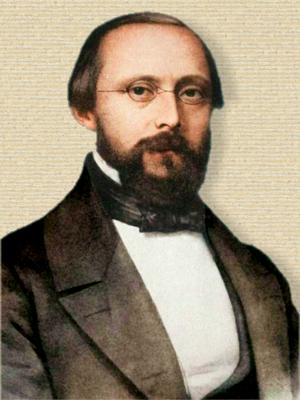
Rudolf Virchow
(13 Oct 1821 - 5 Sep 1902)
German pathologist and statesman who originated the concept that disease arises in the individual cells of a tissue and, with publication of his Cellular Pathology (1858), founded the science of cellular pathology.
|
Science Quotes by Rudolf Virchow (46 quotes)
>> Click for Rudolf Virchow Quotes on | Cell | Knowledge | Law | Life | Physician | Science |
>> Click for Rudolf Virchow Quotes on | Cell | Knowledge | Law | Life | Physician | Science |
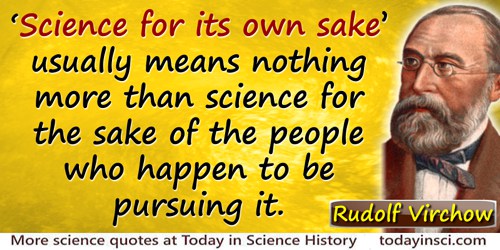
“Science for its own sake” usually means nothing more than science for the sake of the people who happen to be pursuing it.
— Rudolf Virchow
In 'Standpoints in Scientific Medicine', Disease, Life, and Man: Selected Essays (1958), 42.
“Science in itself” is nothing, for it exists only in the human beings who are its bearers.
— Rudolf Virchow
In 'Standpoints in Scientific Medicine', Disease, Life, and Man: Selected Essays (1958), 42.
Mikroskopisch sehen lernen.
Learn to see microscopically.
Learn to see microscopically.
— Rudolf Virchow
In 'Festnummer zu Ehren Rudolf Virchow', Deutsche Medicinische Wochenschrift (1891), 42, 1166. As quoted in Erwin H. Ackerknecht, Rudolf Virchow: Doctor Statesman Anthropologist (1953), 21.
Omnis cellula e cellula
Every cell from a cell.
Every cell from a cell.
— Rudolf Virchow
The doctrine he popularized (but did not originate). Given, for example, in the Latin form, in Lecture II 'Physiological Tissues' (17 Feb 1858) given to the Pathological Institute of Berlin, as translated by Frank Chance in Cellular Pathology (1860), 27-28. Also translated as: “Every cell stems from another cell”. Part of a longer quote on this page that begins: “Where a cell arises…”. Although popularized by Virchow, the aphorism was actually coined by François-Vincent Raspail.
Ueber den Glauben lässt sich wissenschaftlich nicht rechten, denn die Wissenschaft und der Glaube schliessen sich aus. Nicht so, dass der eine die andere unmöglich machte oder umgekehrt, sondern so, dass, soweit die Wissenschaft reicht, kein Glaube existirt und der Glaube erst da anfangen darf, wo die Wissenschaft aufhört. Es lässt „sich nicht läugnen, dass, wenn diese Grenze eingehalten wird, der Glaube wirklich reale Objekte haben kann. Die Aufgabe der Wissenschaft ist es daher nicht, die Gegenstände des Glaubens anzugreifen, sondern nur die Grenzen zu stecken, welche die Erkenntniss erreichen kann, und innerhalb derselben das einheitliche Selbstbewusstsein zu begründen.
There is no scientific justification for faith, for science and faith are mutually exclusive. Not that one made the other impossible, or vice versa, but that, as far as science goes, there is no faith, and faith can only begin where science ends. It can not be denied that, if this limit is adhered to, faith can really have real objects. The task of science, therefore, is not to attack the objects of faith, but merely to set the limits which knowledge can attain and to establish within it the unified self-esteem.
There is no scientific justification for faith, for science and faith are mutually exclusive. Not that one made the other impossible, or vice versa, but that, as far as science goes, there is no faith, and faith can only begin where science ends. It can not be denied that, if this limit is adhered to, faith can really have real objects. The task of science, therefore, is not to attack the objects of faith, but merely to set the limits which knowledge can attain and to establish within it the unified self-esteem.
— Rudolf Virchow
Original German from 'Der Mensch' (1849), collected in Gesammelte abhandlungen zur wissenschaftlichen medicin (1856), 6. Webmaster used Google translate for the English version. This longer quote unites the shorter quotes from within it shown separately on the Rudolf Virchow quotations page, with alternative translations, which begin: “There can be no scientific dispute…”, “Belief has no place…”, and “The task of science…”.
All of our experience indicates that life can manifest itself only in a concrete form, and that it is bound to certain substantial loci. These loci are cells and cell formations. But we are far from seeking the last and highest level of understanding in the morphology of these loci of life. Anatomy does not exclude physiology, but physiology certainly presupposes anatomy. The phenomena that the physiologist investigates occur in special organs with quite characteristic anatomical arrangements; the various morphological parts disclosed by the anatomist are the bearers of properties or, if you will, of forces probed by the physiologist; when the physiologist has established a law, whether through physical or chemical investigation, the anatomist can still proudly state: This is the structure in which the law becomes manifest.
— Rudolf Virchow
In 'Cellular-Pathologie', Archiv für pathologische Anatomie und Physiologie und fur klinische Medizin (1855), 8, 19, as translated in LellandJ. Rather, 'Cellular Pathology', Disease, Life, and Man: Selected Essays by Rudolf Virchow (1958), 84.
As long as vitalism and spiritualism are open questions so long will the gateway of science be open to mysticism.
— Rudolf Virchow
Bulletin of the New York Academy of Medicine (1928), 4, 994.
Belief begins where science leaves off and ends where science begins.
— Rudolf Virchow
In Fielding Hudson Garrison, An Introduction to the History of Medicine (1929), 14.
Belief cannot be reckoned with in terms of science, for science and faith are mutually exclusive.
— Rudolf Virchow
In Fielding Hudson Garrison, An Introduction to the History of Medicine (1966), 576.
Belief has no place as far as science reaches, and may be first permitted to take root where science stops.
— Rudolf Virchow
Translation of the original German: “Soweit die Wissenschaft reicht, kein Glaube existirt und der Glaube erst da anfangen darf, wo die Wissenschaft aufhört”, from 'Der Mensch' (1849), collected in Gesammelte abhandlungen zur wissenschaftlichen medicin (1856), 6. As translated in Lelland J. Rather (ed.), 'On Man', Disease, Life, and Man: Selected Essays (1958), 83. Google translate gives “As far as science goes, no faith exists and faith can only begin where science ends.”
Between animal and human medicine, there is no dividing line—nor should there be.
— Rudolf Virchow
On the occasion of the centenary of the Veterinary College in Berlin (1856). Translation of original German, “Zwischen Tier und Menschenmedizin gibt es keine Trennlinie, noch sollte eine bestehen.” English translation quoted (without citation), as opening remark in J.V. Klauder, 'Interrelations of human and veterinary medicine', New England Journal of Medicine (23 Jan 1958), 258, No. 4, 170.
Bismarck, enraged at Virchow’s constant criticisms, has his seconds call upon the scientist to challenge him to a duel. “As the challenged party, I have the choice of weapons,” said Virchow, “and I chose these.” He held aloft two sausages. “One of these,” he went on, “is infected with deadly germs; the other is perfectly sound. Let his Excellency decide which one he wishes to eat, and I will eat the other.” Almost immediately the message came back that the chancellor had decided to laugh off the duel.
— Rudolf Virchow
As quoted in Clifton Fadiman (ed.), André Bernard (ed.), Bartlett's Book of Anecdotes (2000), 556, citing E. Fuller, 2500 Anecdotes.
Brevity in writing is the best insurance for its perusal.
— Rudolf Virchow
In Fielding Hudson Garrison, An Introduction to the History of Medicine (1929), 16.
Cellular pathology is not an end if one cannot see any alteration in the cell. Chemistry brings the clarification of living processes nearer than does anatomy. Each anatomical change must have been preceded by a chemical one.
— Rudolf Virchow
Attributed in H. Coper and H. Herken, Deutsche Medizini Wochenschrift (18 Oct 1963), 88, No. 42, 2035, in the original German, “Nach der Überlieferung durch His soll Virchow geäußert haben: ‘Die Zellular-pathologie ist nicht am Ende, wenn man an einer Zelle keine Veränderungen mehr sehen kann. Die Chemie steht der Erklärung der Lebensvorgänge näher als die Anatomie. Jede anatomische Verände-rung setzt notwendig eine chemische voraus.’” As translated in Angel Pentschew,'Morphology and morphogenesis of lead encephalopathy', Acta Neuropathologica (Sep 1965) 5, No. 2, 133-160, as cited in I. Arthur Michaelson and Mitchell W. Sauerhoff, 'Animal Models of Human Disease: Severe and Mild Lead Encephalopathy in the Neonatal Rat', Environmental Health Perspectives (May 1974), 7, 204 & 223 footnote. Note: Although given in quotation marks in the original German text, the subject quote is almost definitely NOT verbatim, but only a paraphrase of Virchow’s teachings. The German text introduces the subject quote with, “Nach der Überlieferung durch His soll Virchow geäußert haben:…” which means, “According to tradition Virchow is said to have expressed:…” (using Google translate). However, it is useful as a succinct statement to the effect of what Virchow might say to summarize his doctrine.
Disease is not something personal and special, but only a manifestation of life under modified conditions, operating according to the same laws as apply to the living body at all times, from the first moment until death.
— Rudolf Virchow
In Ian F. McNeely, Medicine on a Grand Scale: Rudolf Virchow, Liberalism, and the Public Health (2002), 26.
Every progress that a church makes in the construction of its dogmas leads to a further taming of the free spirit; every new dogma … narrows the circle of free thought. … Science, on the other hand, liberates with every step of its development, it opens up new paths to thought … In other words, it allows the individual to be truly free.
— Rudolf Virchow
Translated from the original German, “Jeder Fortschritt, den eine Kirche in dem Aufbau ihrer Dogmen macht, führt zu einer weiter gehenden Bändigung des freien Geistes; jedes neue Dogma …
verengt den Kreis des freien Denkens. … Die Naturwissenschaft umgekehrt befreit mit jedem Schritte ihrer Entwicklung, sie eröffnet dem Gedanken neue Bahnen … Sie gestattet, mit anderen Worten, dem Einzelnen in vollem Masse wahr zu sein.” In Speech to the 24th meeting of the German Naturalists and Physicians at Rostock 'Ueber die Aufgaben der Naturwissenschaften in dem neuen nationalen Leben Deutschlands', (On the tasks of the natural sciences in the new
national life of Germany), published in Chemisches Zentralblatt (11 Oct 1871), No. 41, 654-655. English version by Webmaster using Google translate.
First, it must be a pleasure to study the human body the most miraculous masterpiece of nature and to learn about the smallest vessel and the smallest fiber. But second and most important, the medical profession gives the opportunity to alleviate the troubles of the body, to ease the pain, to console a person who is in distress, and to lighten the hour of death of many a sufferer.
— Rudolf Virchow
Reasons for his choice of medicine as a career, from essay written during his last year in the Gymnasium (high school). As quoted in Leslie Dunn, Rudolf Virchow: Now You Know His Name (2012), 8-9.
For if medicine is really to accomplish its great task, it must intervene in political and social life. It must point out the hindrances that impede the normal social functioning of vital processes, and effect their removal.
— Rudolf Virchow
In Die einheitsrebungen in der wissenschaftlichen medicin (1849), 48. As quoted and citefd in Paul Farmer, Pathologies of Power (2004), 323.
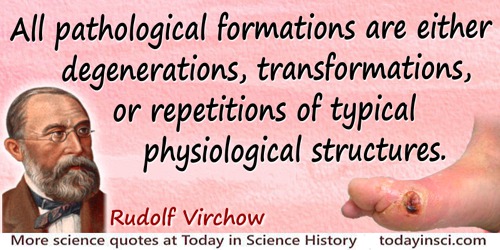
I definitely deny that any pathological process, i.e. any life-process taking place under unfavourable circumstances, is able to call forth qualitatively new formations lying beyond the customary range of forms characteristic of the species. All pathological formations are either degenerations, transformations, or repetitions of typical physiological structures.
— Rudolf Virchow
In 'Cellular-Pathologie', Archiv für pathologische Anatomie und Physiologie und fur klinische Medizin (1855), 8, 13-14, as translated in LellandJ. Rather, 'Cellular Pathology', Disease, Life, and Man: Selected Essays by Rudolf Virchow (1958), 81.
I uphold my own rights, and therefore I also recognize the rights of others. This is the principle I act upon in life, in politics and in science. We owe it to ourselves to defend our rights, for it is the only guarantee for our individual development, and for our influence upon the community at large. Such a defence is no act of vain ambition, and it involves no renunciation of purely scientific aims. For, if we would serve science, we must extend her limits, not only as far as our own knowledge is concerned, but in the estimation of others.
— Rudolf Virchow
Cellular Pathology, translated by Frank Chance (1860), x.
If popular medicine gave the people wisdom as well as knowledge, it would be the best protection for scientific and well-trained physicians.
— Rudolf Virchow
In Fielding Hudson Garrison, An Introduction to the History of Medicine (1966), 577.
If the man of science chose to follow the example of historians and pulpit-orators, and to obscure strange and peculiar phenomena by employing a hollow pomp of big and sounding words, this would be his opportunity; for we have approached one of the greatest mysteries which surround the problem of animated nature and distinguish it above all other problems of science. To discover the relations of man and woman to the egg-cell would be almost equivalent of the egg-cell in the body of the mother, the transfer to it by means of the seed, of the physical and mental characteristics of the father, affect all the questions which the human mind has ever raised in regard to existence.
— Rudolf Virchow
Quoted in Ernst Heinrich Philipp August Haeckel, The Evolution of Man (1897), vol 1, 148.
If there is real love, it is not difficult to exercise tolerance, for tolerance is the daughter of love—it is the truly Christian trait, which, of course, Christians of today do not practice.
— Rudolf Virchow
English translation of the original German, “Liebt man sich wirklich, so ist es ja nicht schwer, die Toleranz zu üben, denn die Toleranz ist die Tochter der Liebe—es ist die eigentlich christliche Eigenschaft, die freilich von der heutigen Christenwelt nicht geübt wird.” In a letter to his father (7 Apr 1851), published in Briefe an seite Eltern, 1839 bis 1864 (1907).
Imprisoned quacks are always replaced by new ones.
— Rudolf Virchow
In Fielding Hudson Garrison, An Introduction to the History of Medicine (1966), 577.
In all likelihood, it is the local conditions of society, which determine the form of the disease, and we can so far think of it as a fairly general result, that the simplest form is the more common, the more paltry and unbalanced the food, and the worse the dwellings are.
— Rudolf Virchow
From the original German, “Aller Wahrscheinlichkeit nach sind es die lokalen Verhältnisse der Gesellschaft, welche die Form der Krankheit bestimmen, und wir können bis jetzt als ein ziemlich allgemeines Resultathinstellen, daß die einfache Form umso häufiger ist, je armseliger und einseitiger die Nahrungsmittel und je schlechter die Wohnungen sind,” in 'Mittheilungen über die in Oberschlesien herrschende Typhus-Epidemie', R. Virchow and B. Reinhardt, Archiv für pathologische Anatomie und Physiologie und für klinische Medicin (1848), 2, No. 2, 248. English version by Webmaster with Google translate.
It is the curse of humanity that it learns to tolerate even the most horrible situations by habituation.
— Rudolf Virchow
From the original German, “Es ist ein Fluch des Menschengeschlechtes, dass es durch Gewöhnung auch das Schrecklichste ertragen lernt,” in 'Mittheilungen über die in Oberschlesien herrschende Typhus-Epidemie', R. Virchow and B. Reinhardt, Archiv für pathologische Anatomie und Physiologie und für klinische Medicin (1848), 2, No. 2, 156. As translated in Rudolf Virchow and L.J. Rather (ed.), 'Report on the Typhus Epidemic in Upper Silesia', Collected Essays in Public Health and Epidemiology, (1985), 213, as reprinted in Social Medicine (2006), 1, No. 1, 16.
Just as a tree constitutes a mass arranged in a definite manner, in which, in every single part, in the leaves as in the root, in the trunk as in the blossom, cells are discovered to be the ultimate elements, so is it also with the forms of animal life. Every animal presents itself as a sum of vital unities, every one of which manifests all the characteristics of life. The characteristics and unity of life cannot be limited to anyone particular spot in a highly developed organism (for example, to the brain of man), but are to be found only in the definite, constantly recurring structure, which every individual element displays. Hence it follows that the structural composition of a body of considerable size, a so-called individual, always represents a kind of social arrangement of parts, an arrangement of a social kind, in which a number of individual existences are mutually dependent, but in such a way, that every element has its own special action, and, even though it derive its stimulus to activity from other parts, yet alone effects the actual performance of its duties.
— Rudolf Virchow
In Lecture I, 'Cells and the Cellular Theory' (1858), Rudolf Virchow and Frank Chance (trans.) ,Cellular Pathology (1860), 13-14.
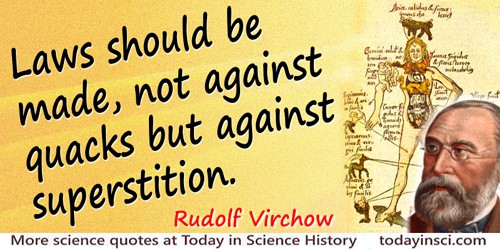
Laws should be made, not against quacks but against superstition.
— Rudolf Virchow
In Fielding Hudson Garrison, An Introduction to the History of Medicine (1966), 577.
Life itself is but the expression of a sum of phenomena, each of which follows the ordinary physical and chemical laws. (1845)
— Rudolf Virchow
In Jonathan Miller, Freud: the Man, his World, His Influence (1972), 25
Life thus forms a long, unbroken chain of generations, in which the child becomes the mother, and the effect becomes the cause.
— Rudolf Virchow
In 'On the Mechanistic Interpretation of Life' (1858), Rudolf Virchow and Lelland J. Rather (trans.) , Disease, Life, and Man: Selected Essays by Rudolf Virchow (1958), 116.
Marriages are not normally made to avoid having children.
— Rudolf Virchow
Bulletin of the New York Academy of Medicine (1928), 4, 995.
Medical education does not exist to provide student with a way of making a living, but to ensure the health of the community.
— Rudolf Virchow
Epigraph, without citation, in Robert Perlman, Evolution and Medicine (2013), xiii. Webmaster has not yet found the primary source; can you help?
Medical statistics will be our standard of measurement: we will weigh life for life and see where the dead lie thicker, among the workers or among the privileged.
— Rudolf Virchow
Inaugurating his journal, Die Medizinische Reform (1848), 182, in which he asked scholars to collect medical statistics. (The Medical Reform.) As quoted in Paul Farmer, Infections and Inequalities: The Modern Plagues (2001), 1. Cited in David L. Brunsma, Keri E. Iyall Smith and Brian K. Gran (eds.), Institutions Unbound: Social Worlds and Human Rights (2016), 10 & 207 footnote.
Medicine is a social science, and politics is nothing else but medicine on a large scale.
— Rudolf Virchow
From the original German “Die Medicin ist eine sociale Wissenschaft, und die Politik ist weiter nichts, als Medicin im Grossen.” In his weekly medical newspaper, 'Der Armenarzt' (Poor Doctor), Die Medizinische Reform, (3 Nov 1848), 3, No. 18, 125. As translated in Henry Ernest Sigerist, Medicine and Human Welfare, (1941) 93.
No doubt science cannot admit of compromises, and can only bring out the complete truth. Hence there must be controversy, and the strife may be, and sometimes must be, sharp. But must it even then be personal? Does it help science to attack the man as well as the statement? On the contrary, has not science the noble privilege of carrying on its controversies without personal quarrels?
— Rudolf Virchow
In his collected writings of 1861, preface. Quoted in Proceedings of the Royal Society of London, Vol. 75, 300.
No matter how we twist and turn we shall always come back to the cell. The eternal merit of Schwann does not lie in his cell theory that has occupied the foreground for so long, and perhaps will soon be given up, but in his description of the development of the various tissues, and in his demonstration that this development (hence all physiological activity) is in the end traceable back to the cell. Now if pathology is nothing but physiology with obstacles, and diseased life nothing but healthy life interfered with by all manner of external and internal influences then pathology too must be referred back to the cell.
— Rudolf Virchow
In 'Cellular-Pathologie', Archiv für pathologische Anatomie und Physiologie und fur klinische Medizin (1855), 8, 13-14, as translated in LellandJ. Rather, 'Cellular Pathology', Disease, Life, and Man: Selected Essays by Rudolf Virchow (1958), 81.
Only those who regard healing as the ultimate goal of their efforts can, therefore, be designated as physicians.
— Rudolf Virchow
'Standpoints in Scientific Medicine', Disease, Life, and Man: Selected Essays (1958), 39.
The body is a cell state in which every cell is a citizen. Disease is merely the conflict of the citizens of the state brought about by the action of external forces. (1858)
— Rudolf Virchow
From Die Cellularpathologie (1858). As cited in Alan Lindsay Mackay, A Dictionary of Scientific Quotations (1991), 250. Although widely quoted in this form, Webmaster has not yet been able to pin down the source of the translation in these few words. (It might be in Rudolph Virchow translated by Lelland J. Rather, Disease, Life, and Man: Selected Essays (1958), 142-9.) If you know the exact citation to the primary source, please contact Webmaster.
The future is with the vegetarians.
— Rudolf Virchow
As quoted, without source, by Charles H. Shepard, 'Diet in Disease' in John Harvey Kellogg (ed.), Modern Medicine and Bacteriological Review (Jan 1899), 8, 2. From the German, “Den Vegetariern gehört die Zukunft!” in Paedagogium (1886), 8, 235, which also attributes the quote to “Richard Wagner, Beketoff und noch viele andere, selbst Virchow,” (Richard Wagner, Beketoff and others, even Virchow). May also be translated as, “Vegetarians own the future!”
The personal views of the lecturer may seem to be brought forward with undue exclusiveness, but, as it is his business to give a clear exposition of the actual state of the science which he treats, he is obliged to define with precision the principles, the correctness of which he has proved by his own experience.
— Rudolf Virchow
Cellular Pathology, translated by Frank Chance (1860), xi.
The physicians surely are the natural advocates of the poor and the social problem largely falls within their scope.
— Rudolf Virchow
Introductory article, 'The Aims of the Journal “Medical Reform”', in the first edition of Die medizinische Reform (10 Jul 1848). From the original in German, “Die Ärzte sind die natürlichen Anwälte der Armen und die sociale Frage fallt zu einem erheblichen Theil in ihre Jurisdiction.” As translated in Rudolf Virchow and L.J. Rather (ed.), Collected Essays on Public Health and Epidemiology (1985), Vol. 1, 4. Elsewhere seen translated as “Physicians are the natural attorneys of the poor, and the social problems should largely be solved by them,” or “The physicians are the natural attorneys of the poor, and social problems fall to a large extent within their jurisdiction.”
The task of science is to stake out the limits of the knowable, and to center consciousness within them.
— Rudolf Virchow
As found in Bernard E. Farber, A Teacher’s Treasury of Quotations (1985), 264. This is probably a loose translation of the original German: “Die Aufgabe der Wissenschaftquote”..., See the more literal translation on this page, also beginning “The task of science…,” for full citation. Webmaster has not yet found a primary source for the shorter translation in these words—can you help?
The task of science, therefore, is not to attack the objects of faith, but to establish the limits beyond which knowledge cannot go and found a unified self-consciousness within these limits.
— Rudolf Virchow
Translation of the original German: Die Aufgabe der Wissenschaft ist es daher nicht, die Gegenstände des Glaubens anzugreifen, sondern nur die Grenzen zu stecken, welche die Erkenntniss erreichen kann, und innerhalb derselben das einheitliche Selbstbewusstsein zu begründen., from 'Der Mensch' (1849), collected in Gesammelte abhandlungen zur wissenschaftlichen medicin (1856), 6. As translated in Lelland J. Rather (ed., trans.), 'On Man', Disease, Life, and Man: Selected Essays (1958), 83-84.
There can be no scientific dispute with respect to faith, for science and faith exclude one another.
— Rudolf Virchow
Translation of the original German: “Ueber den Glauben lässt sich wissenschaftlich nicht rechten, denn die Wissenschaft und der Glaube schliessen sich aus”, from 'Der Mensch' (1849), collected in Gesammelte abhandlungen zur wissenschaftlichen medicin (1856), 6. As translated in Lelland J. Rather (ed.), 'On Man', Disease, Life, and Man: Selected Essays (1958), 83. Google translate gives, “There is no scientific justification for faith, for science and faith are mutually exclusive.”
We have no rational therapeutics.
— Rudolf Virchow
In Medical Century (1906), 14:11, 336.
Where a cell arises, there a cell must have previously existed (omnis cellula e cellula), just as an animal can spring only from an animal, a plant only from a plant. In this manner, although there are still a few spots in the body where absolute demonstration has not yet been afforded, the principle is nevertheless established, that in the whole series of living things, whether they be entire plants or animal organisms, or essential constituents of the same, an eternal law of continuous development prevails.
— Rudolf Virchow
In Lecture II 'Physiological Tissues' (17 Feb 1858), as translated by Frank Chance in Cellular Pathology: As Based Upon Physiological and Pathological Histology. Twenty Lectures Delivered in the Pathological Institute of Berlin During the Months of February, March and April, 1858 (1860), 27-28.
Quotes by others about Rudolf Virchow (4)
That ability to impart knowledge … what does it consist of? … a deep belief in the interest and importance of the thing taught, a concern about it amounting to a sort of passion. A man who knows a subject thoroughly, a man so soaked in it that he eats it, sleeps it and dreams it—this man can always teach it with success, no matter how little he knows of technical pedagogy. That is because there is enthusiasm in him, and because enthusiasm is almost as contagious as fear or the barber’s itch. An enthusiast is willing to go to any trouble to impart the glad news bubbling within him. He thinks that it is important and valuable for to know; given the slightest glow of interest in a pupil to start with, he will fan that glow to a flame. No hollow formalism cripples him and slows him down. He drags his best pupils along as fast as they can go, and he is so full of the thing that he never tires of expounding its elements to the dullest.
This passion, so unordered and yet so potent, explains the capacity for teaching that one frequently observes in scientific men of high attainments in their specialties—for example, Huxley, Ostwald, Karl Ludwig, Virchow, Billroth, Jowett, William G. Sumner, Halsted and Osler—men who knew nothing whatever about the so-called science of pedagogy, and would have derided its alleged principles if they had heard them stated.
This passion, so unordered and yet so potent, explains the capacity for teaching that one frequently observes in scientific men of high attainments in their specialties—for example, Huxley, Ostwald, Karl Ludwig, Virchow, Billroth, Jowett, William G. Sumner, Halsted and Osler—men who knew nothing whatever about the so-called science of pedagogy, and would have derided its alleged principles if they had heard them stated.
In Prejudices: third series (1922), 241-2.
For a longer excerpt, see H.L. Mencken on Teaching, Enthusiasm and Pedagogy.
For a longer excerpt, see H.L. Mencken on Teaching, Enthusiasm and Pedagogy.
Pathology, probably more than any other branch of science, suffers from heroes and hero-worship. Rudolf Virchow has been its archangel and William Welch its John the Baptist, while Paracelsus and Cohnheim have been relegated to the roles of Lucifer and Beelzebub. … Actually, there are no heroes in Pathology—all of the great thoughts permitting advance have been borrowed from other fields, and the renaissance of pathology stems not from pathology itself but from the philosophers Kant and Goethe.
Quoted from an address to a second year class, in Levin L. Waters, obituary for Harry S. N. Greene, M.D., in Yale Journal of Biology and Medicine (Feb-Apr 1971), 43:4-5, 207.
During the half-century that has elapsed since the enunciation of the cell-theory by Schleiden and Schwann, in 1838-39, it has became ever more clearly apparent that the key to all ultimate biological problems must, in the last analysis, be sought in the cell. It was the cell-theory that first brought the structure of plants and animals under one point of view by revealing their common plan of organization. It was through the cell-theory that Kolliker and Remak opened the way to an understanding of the nature of embryological development, and the law of genetic continuity lying at the basis of inheritance. It was the cell-theory again which, in the hands of Virchaw and Max Schultze, inaugurated a new era in the history of physiology and pathology, by showing that all the various functions of the body, in health and in disease, are but the outward expression of cell-activities. And at a still later day it was through the cell-theory that Hertwig, Fol, Van Beneden, and Strasburger solved the long-standing riddle of the fertilization of the egg, and the mechanism of hereditary transmission. No other biological generalization, save only the theory of organic evolution, has brought so many apparently diverse phenomena under a common point of view or has accomplished more far the unification of knowledge. The cell-theory must therefore be placed beside the evolution-theory as one of the foundation stones of modern biology.
In The Cell in Development and Inheritance (1896), 1.
Rudolf Virchow, often referred to as the father of modern pathology, broke sharply with such traditional concepts by proposing that the basis of all disease is injury to the smallest living unit of the body, namely, the cell. More than a century later, both clinical and experimental
pathology remain rooted in Virchow’s cellular pathology.
In Emanuel Rubin and John L. Farber (eds.), Pathology (1944), 2.
See also:
- 13 Oct - short biography, births, deaths and events on date of Virchow's birth.
- Rudolf Virchow, Obituary - from Harper’s Weekly (1902).
- Professor Rudolf Virchow Biography - Popular Science Monthly (Oct 1882)
- Collected Essays on Public Health & Epidemiology, by Rudolf Virchow. - book suggestion.
 In science it often happens that scientists say, 'You know that's a really good argument; my position is mistaken,' and then they would actually change their minds and you never hear that old view from them again. They really do it. It doesn't happen as often as it should, because scientists are human and change is sometimes painful. But it happens every day. I cannot recall the last time something like that happened in politics or religion.
(1987) --
In science it often happens that scientists say, 'You know that's a really good argument; my position is mistaken,' and then they would actually change their minds and you never hear that old view from them again. They really do it. It doesn't happen as often as it should, because scientists are human and change is sometimes painful. But it happens every day. I cannot recall the last time something like that happened in politics or religion.
(1987) -- 





.jpg)