 (source)
|
Mark Twain
(30 Nov 1835 - 21 Apr 1910)
American writer and humorist , the pen-name of Samuel Langhorne Clemens. His novels include The Adventures of Tom Sawyer and The Adventures of Huckleberry Finn. His witty remarks have endured in popularity.
|
Science Quotes by Mark Twain (62 quotes)
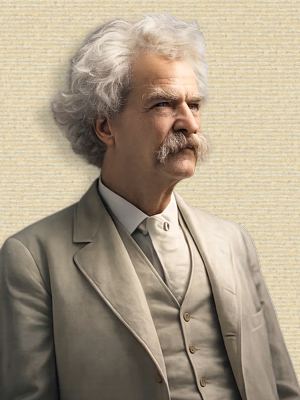
‘I was reading an article about “Mathematics”. Perfectly pure mathematics. My own knowledge of mathematics stops at “twelve times twelve,” but I enjoyed that article immensely. I didn’t understand a word of it; but facts, or what a man believes to be facts, are always delightful. That mathematical fellow believed in his facts. So do I. Get your facts first, and’—the voice dies away to an almost inaudible drone—’then you can distort ‘em as much as you please.’
— Mark Twain
In 'An Interview with Mark Twain', in Rudyard Kipling, From Sea to Sea (1899), Vol. 2, 180.
A man who keeps company with glaciers comes to feel tolerably insignificiant by and by. The Alps and the glaciers together are able to take every bit of conceit out of a man and reduce his self-importance to zero if he will only remain within the influence of their sublime presence long enough to give it a fair and reasonable chance to do its work.
— Mark Twain
In A Tramp Abroad (1880), 466.
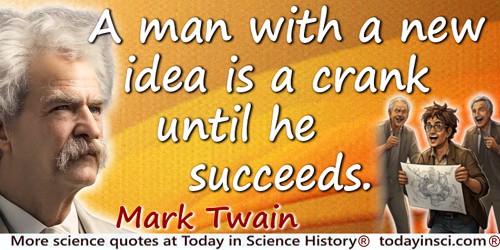
A man with a new idea is a crank until he succeeds.
— Mark Twain
In 'Pudd’nhead Wilson’s New Calendar,' Following the Equator (1897), 297.
A mile and a half from town, I came to a grove of tall cocoanut trees, with clean, branchless stems reaching straight up sixty or seventy feet and topped with a spray of green foliage sheltering clusters of cocoanuts—not more picturesque than a forest of colossal ragged parasols, with bunches of magnified grapes under them, would be. I once heard a grouty northern invalid say that a cocoanut tree might be poetical, possibly it was; but it looked like a feather-duster struck by lightning. I think that describes it better than a picture—and yet, without any question, there is something fascinating about a cocoanut tree—and graceful, too.
— Mark Twain
In Roughing It (1913), 184-85.
Adam and Eve had many advantages, but the principal one was that they escaped teething.
— Mark Twain
In Pudd’nhead Wilson: a Tale (1894), 31.
Adam is fading out. It is on account of Darwin and that crowd. I can see that he is not going to last much longer. There's a plenty of signs. He is getting belittled to a germ—a little bit of a speck that you can't see without a microscope powerful enough to raise a gnat to the size of a church. They take that speck and breed from it: first a flea; then a fly, then a bug, then cross these and get a fish, then a raft of fishes, all kinds, then cross the whole lot and get a reptile, then work up the reptiles till you've got a supply of lizards and spiders and toads and alligators and Congressmen and so on, then cross the entire lot again and get a plant of amphibiums, which are half-breeds and do business both wet and dry, such as turtles and frogs and ornithorhyncuses and so on, and cross-up again and get a mongrel bird, sired by a snake and dam'd by a bat, resulting in a pterodactyl, then they develop him, and water his stock till they've got the air filled with a million things that wear feathers, then they cross-up all the accumulated animal life to date and fetch out a mammal, and start-in diluting again till there's cows and tigers and rats and elephants and monkeys and everything you want down to the Missing Link, and out of him and a mermaid they propagate Man, and there you are! Everything ship-shape and finished-up, and nothing to do but lay low and wait and see if it was worth the time and expense.
— Mark Twain
'The Refuge of the Derelicts' collected in Mark Twain and John Sutton Tuckey, The Devil's Race-Track: Mark Twain's Great Dark Writings (1980), 340-41.
- 1980
All schools, all colleges have two great functions: to confer, and to conceal valuable knowledge.
— Mark Twain
(5 Nov 1908). 'More Maxims of Mark,' Mark Twain Collected Tales, Sketches, Speeches, & Essays, 1891-1910 (1992), 941. In Mark Twain and Brian Collins (ed.), When in Doubt, Tell the Truth: and Other Quotations from Mark Twain (1996), 43.
Anatomists see no beautiful woman in all their lives, but only a ghastly sack of bones with Latin names to them, and a network of nerves and muscles and tissues inflamed by disease.
— Mark Twain
From Letter to the San Francisco Alta California (28 May 1867; published 28 Jul 1867), collected and published by Franklin Walker and G. Ezra Dane in Mark Twain’s Travels with Mr. Brown (1940), 238.
Be careful about reading health books. You may die of a misprint.
— Mark Twain
In Mark Twain and Alex Ayres (ed.), The Wit & Wisdom of Mark Twain (1987), 97.
Biographies are but the clothes and buttons of the man—the biography of the man himself cannot be written.
— Mark Twain
In Mark Twain’s Autobiography (1924), Vol. 2, 2.
Courage is not the lack of fear. It is acting in spite of it.
— Mark Twain
…...
Darwin abolished special creations, contributed the Origin of Species and hitched all life together in one unbroken procession of Siamese Twins, the whole evolved by natural and orderly processes from one microscopic parent germ.
— Mark Twain
'The Secret History of Eddypus', in Mark Twain and David Ketterer (ed.), Tales of Wonder (2003), 223.
Education consists mainly in what we have unlearned.
— Mark Twain
Written about 1898. Mark Twain's Notebook (1935), 346. In Mark Twain and Brian Collins (ed.), When in Doubt, Tell the Truth: and Other Quotations from Mark Twain (1996), 139.
Emotions are among the toughest things in the world to manufacture out of whole cloth; it is easier to manufacture seven facts than one emotion.
— Mark Twain
In Life on the Mississippi (1883), 199
Every improvement that is put upon the real estate is the result of an idea in somebody’s head. The skyscraper is another idea; the railroad is another; the telephone and all those things are merely symbols which represent ideas. An andiron, a wash-tub, is the result of an idea that did not exist before.
— Mark Twain
Speaking to a committee considering a new Copyright Bill (6 Dec 1906). In Mark Twain and William Dean Howells (ed.), Mark Twain’s Speeches? (1910), 320. An andiron is a metal bar, used in a pair, as a stand for logs in a fireplace. The Copyright Bill proposed to give authors, artists and musicians copyright for the term of his life and for 50 years thereafter. John Philip Sousa spoke for the musicians.
Evolution is a blind giant who rolls a snowball down a hill. The ball is made of flakes—circumstances. They contribute to the mass without knowing it. They adhere without intention, and without foreseeing what is to result. When they see the result they marvel at the monster ball and wonder how the contriving of it came to be originally thought out and planned. Whereas there was no such planning, there was only a law: the ball once started, all the circumstances that happened to lie in its path would help to build it, in spite of themselves.
— Mark Twain
'The Secret History of Eddypus', in Mark Twain and David Ketterer (ed.), Tales of Wonder (2003), 222-23.
Evolution is the law of policies: Darwin said it, Socrates endorsed it, Cuvier proved it and established it for all time in his paper on 'The Survival of the Fittest.' These are illustrious names, this is a mighty doctrine: nothing can ever remove it from its firm base, nothing dissolve it, but evolution.
— Mark Twain
'Three Thousand Years Among the Microbes', Which Was the Dream? (1967), Chap. 8. In Mark Twain and Brian Collins (ed.), When in Doubt, Tell the Truth: and Other Quotations from Mark Twain (1996), 47.
Experience, the only logic sure to convince a diseased imagination and restore it to rugged health.
— Mark Twain
Written in 1892. In The American Claimant (1896), 203. In Mark Twain and Brian Collins (ed.), When in Doubt, Tell the Truth: and Other Quotations from Mark Twain (1996), 48.
Get your facts first, and then you can distort them as much as you please.
— Mark Twain
Quoted in a reported 'Interview with Mark Twain' by Rudyard Kipling in From Sea to Sea: Letters of Travel (1899), Vol. 2, 180. Kipling's book is a collection of special correspondence and occasional articles written for the Civil and Military Gazette and the Pioneer.
Herschel removed the speckled tent-roof from the world and exposed the immeasurable deeps of space, dim-flecked with fleets of colossal suns sailing their billion-leagued remoteness.
— Mark Twain
'The Secret History of Eddypus', in Mark Twain and David Ketterer (ed.), Tales of Wonder (2003), 223.
I am not one of those who in expressing opinions confine themselves to facts.
— Mark Twain
Speech to the Savage Club (6 Jul 1907). In Mark Twain and William Dean Howells (ed.), Mark Twain’s Speeches? (1910), 389.
I am trying to get the hang of this new fangled writing machine, but I am not making a shining success of it. However, this is the first attempt I have ever made & yet I perceive I shall soon & easily acquire a fine facility in its use. … The machine has several virtues. I believe it will print faster than I can write. One may lean back in his chair & work it. It piles an awful stack of words on one page. It don’t muss things or scatter ink blots around. Of course it saves paper.
— Mark Twain
Letter (9 Dec 1874). Quoted in B. Blivens, Jr., The Wonderful Writing Machine (1954), 61.
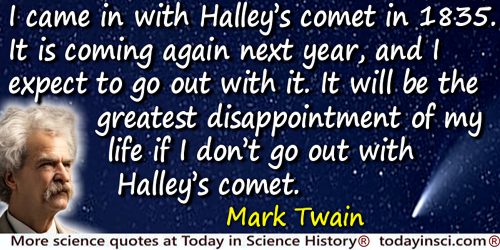
I came in with Halley’s comet in 1835. It is coming again next year, and I expect to go out with it. It will be the greatest disappointment of my life if I don’t go out with Halley’s comet. The Almighty has said, no doubt: “Now here are these two unaccountable freaks; they came in together; they must go out together.” Oh! I am looking forward to that.
— Mark Twain
As told to Albert Bigelow Paine as biographer, who published such conversations in Mark Twain, A Biography: The Personal and Literary Life of Samuel Langhorne Clemens (1912), Vol. 33, 1511. This was followed mention of Twain’s knowledge that he had heart disease.
I have been scientifically studying the traits and dispositions of the “lower animals” (so-called,) and contrasting them with the traits and dispositions of man. I find the result profoundly humiliating to me. For it obliges me to renounce my allegiance to the Darwinian theory of the Ascent of Man from the Lower Animals; since it now seems plain to me that that theory ought to be vacated in favor of a new and truer one, this new and truer one to be named the Descent of Man from the Higher Animals.
— Mark Twain
From 'Man’s Place in the Animal World' (1896) in What is Man?: and Other Philosophical Writings (1973), 81.
I have never let my schooling interfere with my education.
— Mark Twain
In Alex Ayres, The Wit & Wisdom of Mark Twain (1987), 66.
I never could do anything with figures, never had any talent for mathematics, never accomplished anything in my efforts at that rugged study, and to-day the only mathematics I know is multiplication, and the minute I get away up in that, as soon as I reach nine times seven— [He lapsed into deep thought, trying to figure nine times seven. Mr. McKelway whispered the answer to him.] I’ve got it now. It’s eighty-four. Well, I can get that far all right with a little hesitation. After that I am uncertain, and I can’t manage a statistic.
— Mark Twain
Speech at the New York Association for Promoting the Interests of the Blind (29 Mar 1906). In Mark Twain and William Dean Howells (ed.), Mark Twain’s Speeches? (1910), 323.
I stand almost with the others. They believe the world was made for man, I believe it likely that it was made for man; they think there is proof, astronomical mainly, that it was made for man, I think there is evidence only, not proof, that it was made for him. It is too early, yet, to arrange the verdict, the returns are not all in. When they are all in, I think that they will show that the world was made for man; but we must not hurry, we must patiently wait till they are all in.
— Mark Twain
Attributed.
I've come loaded with statistics, for I've noticed that a man can't prove anything without statistics. No man can.
— Mark Twain
Speech at the Republican Rally, Hartford Opera House (26 Oct 1880). In Mark Twain and Paul Fatout (ed.,) Mark Twain Speaking (2006), 140.
If the man doesn’t believe as we do, we say he is a crank, and that settles it. I mean, it does nowadays, because now we can’t burn him.
— Mark Twain
In Following the Equator: A Journey Around the World (1898), 514.
In the laboratory there are no fustian ranks, no brummagem aristocracies; the domain of Science is a republic, and all its citizens are brothers and equals, its princes of Monaco and its stonemasons of Cromarty meeting, barren of man-made gauds and meretricious decorations, upon the one majestic level!
— Mark Twain
'Three Thousand Years Among the Microbes.' In Mark Twain and John Sutton Tuckey (ed.), Which Was the Dream? and Other Symbolic Writings of the Later Years (1966), 446
In the space of one hundred and seventy-six years the Lower Mississippi has shortened itself two hundred and forty-two miles. That is an average of a trifle over one mile and a third per year. Therefore, any calm person, who is not blind or idiotic, can see that in the old Oolitic Silurian Period, must a million years ago next November, the Lower Mississippi River was upward of one million three hundred thousand miles long, and stuck out over the Gulf of Mexico like a fishing-rod. And by the same token any person can see that seven hundred and forty-two years from now the Lower Mississippi will be only a mile and three-quarters long, and Cairo and New Orleans will have their streets joined together, and be plodding comfortably along under a single mayor and a mutual board of aldermen. There is something fascinating about science. One gets such wholesale returns of conjecture out of such a trifling investment of fact.
— Mark Twain
Life on the Mississippi (1883, 2000), 173.
It is curious to reflect on how history repeats itself the world over. Why, I remember the same thing was done when I was a boy on the Mississippi River. There was a proposition in a township there to discontinue public schools because they were too expensive. An old farmer spoke up and said if they stopped the schools they would not save anything, because every time a school was closed a jail had to be built.
It's like feeding a dog on his own tail. He'll never get fat. I believe it is better to support schools than jails.
It's like feeding a dog on his own tail. He'll never get fat. I believe it is better to support schools than jails.
— Mark Twain
Address at a meeting of the Berkeley Lyceum, New York (23 Nov 1900). Mark Twain's Speeches (2006), 69-70.
It is noble to teach oneself, but still nobler to teach others and less trouble.
— Mark Twain
Attributed (doubtfully?) to Max Planck. Widely seen on the web, but always without citation. Webmaster has not yet found any evidence in print that this is a valid Planck quote, and must be skeptical that it is. Contact Webmaster if you know a primary source.
Keep away from people who try to belittle your ambitions. Small people always do that, but the really great make you feel that you, too, can become great.
— Mark Twain
…...
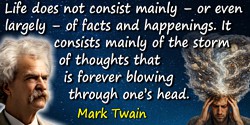
Life does not consist mainly—or even largely—of facts and happenings. It consists mainly of the storm of thoughts that is forever blowing through one’s head.
— Mark Twain
In Autobiography of Mark Twain (1929), Vol. 1, 283.
Man has been here 32,000 years. That it took a hundred million years to prepare the world for him is proof that that is what it was done for. I suppose it is, I dunno. If The Eiffel Tower were now to represent the world’s age, the skin of paint on the pinnacle knob at its summit would represent man’s share of that age; and anybody would perceive that the skin was what the tower was built for. I reckon they would, I dunno.
— Mark Twain
Declaiming Alfred Russel Wallace’s 'anthropocentric' theory, that the universe was created specifically for the evolution of mankind. From 'Was the World Made for Man?' (1903) collected in What is Man?: and Other Philosophical Writings (1973), 106. Twain used the age of the earth accepted in his time; it is now estimated as 4,500 million years. Man’s origin is now estimated as 250,000 years.
For the complete essay, see Was The World Made For Man?.
For the complete essay, see Was The World Made For Man?.
Man is a noisome bacillus whom Our Heavenly Father created because he was disappointed in the monkey.
— Mark Twain
In Bernard DeVoto, Mark Twain in Eruption: Hitherto Unpublished Pages About Men and Events(1922, 1940), xxvii.
Man is the Reasoning Animal. Such is the claim. I think it is open to dispute. Indeed, my experiments have proven to me that he is the Unreasoning Animal. … It seems plain to me that whatever he is he is not a reasoning animal. His record is the fantastic record of a maniac. I consider that the strongest count against his intelligence is the fact that with that record back of him he blandly sets himself up as the head animal of the lot: whereas by his own standards he is the bottom one.
In truth, man is incurably foolish. Simple things which the other animals easily learn, he is incapable of learning. Among my experiments was this. In an hour I taught a cat and a dog to be friends. I put them in a cage. In another hour I taught them to be friends with a rabbit. In the course of two days I was able to add a fox, a goose, a squirrel and some doves. Finally a monkey. They lived together in peace; even affectionately.
Next, in another cage I confined an Irish Catholic from Tipperary, and as soon as he seemed tame I added a Scotch Presbyterian from Aberdeen. Next a Turk from Constantinople; a Greek Christian from Crete; an Armenian; a Methodist from the wilds of Arkansas; a Buddhist from China; a Brahman from Benares. Finally, a Salvation Army Colonel from Wapping. Then I stayed away two whole days. When I came back to note results, the cage of Higher Animals was all right, but in the other there was but a chaos of gory odds and ends of turbans and fezzes and plaids and bones and flesh—not a specimen left alive. These Reasoning Animals had disagreed on a theological detail and carried the matter to a Higher Court.
In truth, man is incurably foolish. Simple things which the other animals easily learn, he is incapable of learning. Among my experiments was this. In an hour I taught a cat and a dog to be friends. I put them in a cage. In another hour I taught them to be friends with a rabbit. In the course of two days I was able to add a fox, a goose, a squirrel and some doves. Finally a monkey. They lived together in peace; even affectionately.
Next, in another cage I confined an Irish Catholic from Tipperary, and as soon as he seemed tame I added a Scotch Presbyterian from Aberdeen. Next a Turk from Constantinople; a Greek Christian from Crete; an Armenian; a Methodist from the wilds of Arkansas; a Buddhist from China; a Brahman from Benares. Finally, a Salvation Army Colonel from Wapping. Then I stayed away two whole days. When I came back to note results, the cage of Higher Animals was all right, but in the other there was but a chaos of gory odds and ends of turbans and fezzes and plaids and bones and flesh—not a specimen left alive. These Reasoning Animals had disagreed on a theological detail and carried the matter to a Higher Court.
— Mark Twain
In Mark Twain and Bernard DeVoto (ed.), Letters from the Earth: Uncensored Writings (1962), 180-181. [Note: As a humorous, irreverent consideration of Man and Christianity, these essays (written c.1909) remained unpublished for over 50 years after Twain’s death (1910), because his daughter and literary executor (Clara Clemens Samossoud) felt that some of the pieces did not accurately represent her father’s beliefs, but eventually, she consented to their publication.]
Medicine has made all its progress during the past fifty years. ... How many operations that are now in use were known fifty years ago?—they were not operations, they were executions.
— Mark Twain
Speech at the Twentieth Anniversary Dinner of the Society of Medical Jurisprudence, New York (8 Mar 1902). In Mark Twain and Paul Fatout (ed.,) Mark Twain Speaking (2006), 429-430.
Name the greatest of all inventors: Accident.
— Mark Twain
From Mark Twain’s Notebook (1935), 374. As cited in Mark Twain and Caroline Thomas Hamsberger (ed.), Everyone’s Mark Twain (1972) 288.
Never tell the truth to people who are not worthy of it.
— Mark Twain
…...
Noise proves nothing. Often a hen who has merely laid an egg cackles as if she laid an asteroid. — Pudd’nhead Wilson’s New Calendar
— Mark Twain
Epigraph to Chap. 5, In More Tramps Abroad (1897), Vol. 1, 40. Also published under the title Following the Equator (1897).
Scientists have odious manners, except when you prop up their theory; then you can borrow money off them.
— Mark Twain
The Bee (c.1902). In What is Man? And Other Essays (1917), 283. Reprinted in Charles Neider (ed.), Complete Essays (1963). In Mark Twain and Brian Collins (ed.), When in Doubt, Tell the Truth: and Other Quotations from Mark Twain (1996), 118.
Such is professional jealousy; a scientist will never show any kindness for a theory which he did not start himself.
— Mark Twain
In A Tramp Abroad (1880), 156.
Supposing is good, but finding out is better.
— Mark Twain
Mark Twain in Eruption: hitherto unpublished pages about men and events (1940), 324. In Caroline Thomas Harnsberger, Mark Twain at Your Fingertips (1948), 232.
That is the way of the scientist. He will spend thirty years in building up a mountain range of facts with the intent to prove a certain theory; then he is so happy with his achievement that as a rule he overlooks the main chief fact of all—that all his accumulation proves an entirely different thing.
— Mark Twain
'The Bee'. In What is Man? and Other Essays? (1917), 283.
That reminds me to remark, in passing, that the very first official thing I did, in my administration—and it was on the first day of it, too—was to start a patent office; for I knew that a country without a patent office and good patent laws was just a crab, and couldn't travel any way but sideways or backways.
— Mark Twain
A Connecticut Yankee in King Arthur's Court (1889), Chap. 9. In David Pressman. Patent it Yourself (2008), 9.
The altar cloth of one eon is the doormat of the next.
— Mark Twain
In More Tramps Abroad (1897), Vol. 1, 132.
The cigar-box which the European calls a 'lift' needs but to be compared with our elevators to be appreciated. The lift stops to reflect between floors. That is all right in a hearse, but not in elevators. The American elevator acts like a man's patent purge—it works.
— Mark Twain
Speech to the St. Nicholas Society, New York, 'Municipal Government' (6 Dec 1900). In Mark Twain's Speeches (1910). In Mark Twain and Brian Collins (ed.), When in Doubt, Tell the Truth: and Other Quotations from Mark Twain (1996), 44.
The fact that man knows right from wrong proves his intellectual superiority to other creatures; but the fact that he can do wrong proves his moral inferiority to any creature that cannot.
— Mark Twain
Spoken by Old Man in What is Man? In What is Man? and Other Essays (1917), 89.
The radical invents the views. When he has worn them out, the conservative adopts them.
— Mark Twain
In Albert Bigelow Paine (ed.), Mark Twain’s Notebook (1935, 1971), Chap. 31, 344, (1898 entry).
The researches of many commentators have already thrown much darkness on this subject, and it is probable that, if they continue, we shall soon know nothing at all about it.
— Mark Twain
In The Sciences, September-October 1989.
The true Southern watermelon is a boon apart, and not to be mentioned with commoner things. It is chief of this world’s luxuries, king by the grace of God over all the fruits of the earth. When one has tasted it, he knows what the angels eat.
— Mark Twain
In Pudd’nhead Wilson: and, Those Extraordinary Twins (1893, 1899), 132.
There are three kinds of lies—lies, damned lies and statistics.
— Mark Twain
In Autobiography (1924).
Training is everything. The peach was once a bitter almond; cauliflower is nothing but a cabbage with a college education.
— Mark Twain
Pudd'nhead Wilson and Those Extrraordinary Twins (1894), Chap. 5. In Mark Twain and Brian Collins (ed.), When in Doubt, Tell the Truth: and Other Quotations from Mark Twain (1996), 43.
Twenty years from now you will be more disappointed by the things you didn’t do than by the ones you did. So throw off the bowlines, Sail away from the safe harbor. Catch the trade winds in your sails. Explore. Dream. Discover.
— Mark Twain
…...
We had the sky up there, all speckled with stars, and we used to lay on our backs and look up at them, and discuss whether they was made or just happened.
— Mark Twain
In The Adventures of Huckleberry Finn (Tom Sawyer’s Comrade) (1885), Vol. 1, 214.
We have not the reverent feeling for the rainbow that a savage has, because we know how it is made. We have lost as much as we gained by prying into that matter.
— Mark Twain
In A Tramp Abroad (1907), 170.
When even the brightest mind in our world has been trained up from childhood in a superstition of any kind, it will never be possible for that mind, in its maturity, to examine sincerely, dispassionately, and conscientiously any evidence or any circumstance which shall seem to cast a doubt upon the validity of that superstition. I doubt if I could do it myself.
— Mark Twain
In Is Shakespeare Dead?: From My Autobiography (1909), 127-128.
Yes, Agassiz does recommend authors to eat fish, because the phosphorus in it makes brains. So far you are correct. But I cannot help you to a decision about the amount you need to eat—at least, not with certainty. If the specimen composition you send is about your fair usual average, I should judge that perhaps a couple of whales would be all you would want for the present. Not the largest kind, but simply good middling-sized whales.
— Mark Twain
A fallacy expressed in advice to an aspiring author. 'Answer To An Inquiry From The Coming Man', The Galaxy (Jan 1871), 11, 159. Collected in 'Answers to Correspondents', Sketches New and Old (1873), 75. Also seen shortened as, “Agassiz does recommend authors to eat fish, because the phosphorus in it makes brains. But I cannot help you to a decision about the amount you need to eat. Perhaps a couple of whales would be enough.” [Presumably Twain refers to Alexander Agassiz, marine zoologist (1835-1910) —Webmaster]
You cannot depend on your eyes when your imagination is out of focus.
— Mark Twain
In A Connecticut Yankee in King Arthur’s Court (1889), 422.
You may say organize, organize, organize; but there may be so much organization that it will interfere with the work to be done.
— Mark Twain
Speech, 'Municipal Corruption' (4 Jan 1901). In Gabriel Wells, Mark Twain's Speeches (1923), 218. In Mark Twain and Brian Collins (ed.), When in Doubt, Tell the Truth: and Other Quotations from Mark Twain (1996), 44.
Quotes by others about Mark Twain (2)
Kin Hubbard is dead. To us folks that attempt to write a little humor his death is just like Edison’s would be to the world of invention. No man in our generation was within a mile of him, and I am so glad that I didn’t wait for him to go to send flowers. I have said it from the stage and in print for twenty years. … Just think — only two lines a day, yet he expressed more original philosophy in ’em than all the rest of the paper combined. What a kick Twain and all that gang will get out of Kin.
In 'Will Rogers Pays Tribute To Hubbard and His Humor', The New York Times (27 Dec 1930), 15.
Dickens, Twain, and Jack London, each in his own way, tried to do the same thing, it seemed to me: to show that civilization is a veneer and to warn us against accepting, without question, the soothsayers of the past. Each author was saying: Don’t hide behind these façades society has erected; don’t repeat the cliches of the past and at the same time act as savagely as your predecessors did.
Recalling his high school reading of library books. In John Scopes and James Presley, Center of the Storm: Memoirs of John T. Scopes (1967), 20.
See also:
- Mark Twain - Biographette - Life magazine - 22 March 1883
- Mark Twain - Was The World Made For Man (1903), a response to Alfred Russel Wallace's book.
- What Is Man?: and Other Philosophical Writings, by Mark Twain. - book suggestion.
- Booklist for Mark Twain.
 In science it often happens that scientists say, 'You know that's a really good argument; my position is mistaken,' and then they would actually change their minds and you never hear that old view from them again. They really do it. It doesn't happen as often as it should, because scientists are human and change is sometimes painful. But it happens every day. I cannot recall the last time something like that happened in politics or religion.
(1987) --
In science it often happens that scientists say, 'You know that's a really good argument; my position is mistaken,' and then they would actually change their minds and you never hear that old view from them again. They really do it. It doesn't happen as often as it should, because scientists are human and change is sometimes painful. But it happens every day. I cannot recall the last time something like that happened in politics or religion.
(1987) -- 




