 (source)
|
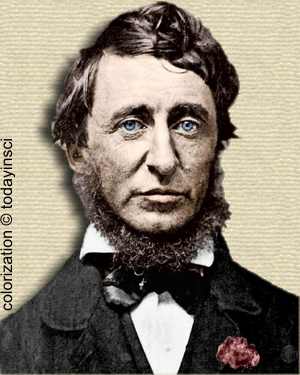
Henry Thoreau
(12 Jul 1817 - 6 May 1862)
American writer, naturalist, philosopher and poet who is best known for his study of nature, while retired to live in a hut beside Walden Pond at Concord (4 Jul 1845-6 Sep 1847). Thereafter, he wrote two books: A Week on the Concord and Merrimack Rivers (1849) and Walden, or Life in the Woods (1854).
|
Science Quotes by Henry Thoreau (92 quotes)
>> Click for Henry Thoreau Quotes on | Fact | Law | Life | Nature | Science | Truth |
>> Click for Henry Thoreau Quotes on | Fact | Law | Life | Nature | Science | Truth |
A sentence should read as if its author, had he held a plow instead of a pen, could have drawn a furrow deep and straight to the end.
— Henry Thoreau
In A Week on the Merrimac and Concord Rivers (1862), 111.
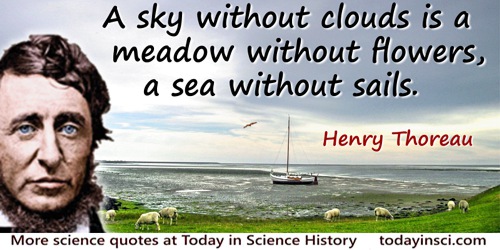
A sky without clouds is a meadow without flowers, a sea without sails.
— Henry Thoreau
(24 Jun 1852). In Henry David Thoreau and Bradford Torrey (ed.), The Writings of Henry Thoreau: Journal: IV: May 1, 1852-February 27, 1853 (1906), 139.
All good things are wild and free.
— Henry Thoreau
…...
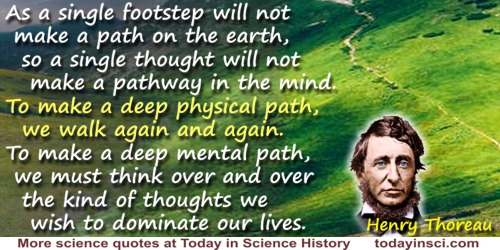
As a single footstep will not make a path on the earth, so a single thought will not make a pathway in the mind. To make a deep physical path, we walk again and again. To make a deep mental path, we must think over and over the kind of thoughts we wish to dominate our lives.
— Henry Thoreau
From The Art of Living, Day by Day 91972), 77. Frequently misattributed to Henry David Thoreau.
As if you could kill time without injuring eternity.
— Henry Thoreau
In 'Economy', in Walden: Or, Life in the Woods (1854, 1899), 10.
As the skies appear to a man, so is his mind. Some see only clouds there; some, prodigies and portents; some rarely look up at all; their heads, like the brutes, are directed toward Earth. Some behold there serenity, purity, beauty ineffable. The world runs to see the panorama, when there is a panorama in the sky which few go to see.
— Henry Thoreau
…...
At a distance in the meadow I hear still, at long intervals, the hurried commencement of the bobolink s strain, the bird just dashing into song, which is as suddenly checked, as it were, by the warder of the seasons, and the strain is left incomplete forever. Like human beings they are inspired to sing only for a short season.
— Henry Thoreau
(29 Jun 1851). In Henry David Thoreau and Bradford Torrey (ed.), The Writings of Henry Thoreau: Journal: II: 1850-September 15, 1851 (1906), 275.
Behind every man’s busy-ness there should be a level of undisturbed serenity and industry, as within the reef encircling a coral isle there is always an expanse of still water, where the depositions are going on which will finally raise it above the surface.
— Henry Thoreau
In A Week on the Concord and Merrimack Rivers (1862), 380.
Dreams are the touchstone of our character.
— Henry Thoreau
…...
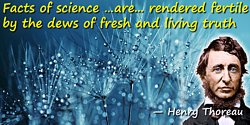
Even the facts of science may dust the mind by their dryness, unless they are … rendered fertile by the dews of fresh and living truth. Knowledge does not come to us by details, but in flashes of light from heaven.
— Henry Thoreau
Essay, first published as 'Life Without Principle', Atlantic Monthly (Oct 1863). Collected in Yankee in Canada, Etc., (1866) 267. Also excerpted in H.G.O. Blake (ed.), Thoreau's Thoughts: Selections From the Writings of Henry David Thoreau (1890, 2005), 102.
Every leaf and twig was this morning covered with a sparkling ice armor; even the grasses in exposed fields were hung with innumerable diamond pendants, which jingled merrily when brushed by the foot of the traveler. It was literally the wreck of jewels and the crash of gems.
— Henry Thoreau
(21 Jan 1838). In Henry David Thoreau and Bradford Torrey (ed.), The Writings of Henry Thoreau: Journal: I: 1837-1846 (1906), 224.
Every man looks at his wood-pile with a kind of affection. … [T]hey warmed me twice, once while I was splitting them, and again when they were on the fire, so that no fuel could give out more heat.
— Henry Thoreau
In Walden: or, Life in the Woods (1854, 1899), 263.
Every man will be a poet if he can; otherwise a philosopher or man of science. This proves the superiority of the poet.
— Henry Thoreau
Odell Shepard (Ed.), The Heart of Thoreau's Journals (1961), 84.
Every poet has trembled on the verge of science.
— Henry Thoreau
Journal entry (18 Jul 1852). Collected in The Writings of Henry David Thoreau (1906), Vol. 10, 239.
First, there is the power of the Wind, constantly exerted over the globe.... Here is an almost incalculable power at our disposal, yet how trifling the use we make of it! It only serves to turn a few mills, blow a few vessels across the ocean, and a few trivial ends besides. What a poor compliment do we pay to our indefatigable and energetic servant!
— Henry Thoreau
In 'Paradise (To Be) Regained', Democratic Review (Nov 1848). Collected in A Yankee in Canada: with Anti-slavery and Reform Papers (1866), 188-89.
Fishing has been styled “a contemplative man’s recreation,” … and science is only a more contemplative man’s recreation.
— Henry Thoreau
In A Week on the Concord and Merrimack Rivers (1862), 28.
He has something demoniacal in him, who can discern a law, or couple two facts.
— Henry Thoreau
In 'Natural History of Massachusetts', The Dial: A Magazine for Literature, Philosophy, and Religion (Jul 1842), 3, No. 1, 39-40. In 'Natural history of Massachusetts', The Dial: A Magazine for Literature, Philosophy, and Religion (Jul 1842), 3, No. 1, 39-40.
He is not a true man of science who does not bring some sympathy to his studies, and expect to learn something by behavior as well as by application. It is childish to rest in the discovery of mere coincidences, or of partial and extraneous laws.
— Henry Thoreau
In A Week on the Concord and Merrimack Rivers (1862), 381.
He who is only a traveler learns things at second-hand and by the halves, and is poor authority. We are most interested when science reports what those men already know practically or instinctively, for that alone is a true humanity.
— Henry Thoreau
In 'Higher Laws', in Walden: Or, Life in the Woods (1854, 1899), 239.
Here is the distinct trail of a fox stretching [a] quarter of a mile across the pond…. The pond his journal, and last night’s snow made a tabula rasa for him. I know which way a mind wended this morning, what horizon it faced, by the setting of these tracks; whether it moved slowly or rapidly, by the greater or less intervals and distinctness, for the swiftest step leaves yet a lasting trace.
— Henry Thoreau
(30 Jan 1841). In Henry David Thoreau and Bradford Torrey (ed.), The Writings of Henry Thoreau: Journal: I: 1837-1846 (1906), 185.
Here is this vast, savage, howling mother of ours, Nature, lying all around, with such beauty, and such affection for her children, as the leopard; and yet we are so early weaned from her breast to society, to that, culture which is exclusively an interaction of man on man.
— Henry Thoreau
Remarking how society becomes divorces individuals from nature. In essay, Walking (1862). Collected in The Writings of Henry David Thoreau (1893), Vol. 9, 291.
How can a man sit down and quietly pare his nails, while the earth goes gyrating ahead amid such a din of sphere music, whirling him along about her axis some twenty-four thousand miles between sun and sun, but mainly in a circle some two millions of miles actual progress? And then such a hurly-burly on the surface …. Can man do less than get up and shake himself?
— Henry Thoreau
(6 Mar 1838). In Henry David Thoreau and Bradford Torrey (ed.), The Writings of Henry Thoreau: Journal: I: 1837-1846 (1906), 35.
How indispensable to a correct study of Nature is a perception of her true meaning. The fact will one day flower out into a truth. The season will mature and fructify what the understanding had cultivated. Mere accumulators of facts—collectors of materials for the master-workmen—are like those plants growing in dark forests, which “put forth only leaves instead of blossoms.”
— Henry Thoreau
(16 Dec 1837). In Henry David Thoreau and Bradford Torrey (ed.), The Writings of Henry Thoreau: Journal: I: 1837-1846 (1906), 18.
I do not value any view of the universe into which man and the institutions of man enter very largely and absorb much of the attention. Man is but the place where I stand, and the prospect hence is infinite.
— Henry Thoreau
Journal, April 2, 1852.
I fear that the character of my knowledge is from year to year becoming more distinct and scientific; that, in exchange for vistas wide as heaven’s scope, I am being narrowed down to the field of the microscope. I see details, not wholes nor the shadow of the whole. I count some parts, and say, “I know.”
— Henry Thoreau
(19 Aug 1851). In Henry David Thoreau and Bradford Torrey (ed.), The Writings of Henry Thoreau: Journal: II: 1850-September 15, 1851 (1906), 406.
I have no doubt that it is a part of the destiny of the human race, in its gradual improvement, to leave off eating animals, as surely as the savage tribes have left off eating each other, when they came in contact with the more civilised.
— Henry Thoreau
In Walden: or, Life in the Woods (1854, 1899), 226.
I hear beyond the range of sound,
I see beyond the range of sight,
New earths and skies and seas around,
And in my day the sun doth pale his light.
I see beyond the range of sight,
New earths and skies and seas around,
And in my day the sun doth pale his light.
— Henry Thoreau
…...
I hear the scream of a great hawk, sailing with a ragged wing against the high wood-side, apparently to scare his prey and so detect it—shrill, harsh, fitted to excite terror in sparrows and to issue from his split and curved bill. I see his open bill the while against the sky. Spit with force from his mouth with an undulatory quaver imparted to it from his wings or motion as he flies.
— Henry Thoreau
(15 Jun 1852). In Henry David Thoreau and Bradford Torrey (ed.), The Writings of Henry Thoreau: Journal: IV: May 1, 1852-February 27,, 1853 (1906), 103.
I just looked up at a fine twinkling star and thought that a voyager whom I know, now many a days’ sail from this coast, might possibly be looking up at that same star with me. The stars are the apexes of what triangles!
— Henry Thoreau
In Henry David Thoreau and Bradford Torrey (ed.), The Writings of Henry Thoreau: Journal: I: 1837-1846 (1906), 486.
I learned this, at least, by my experiment: that if one advances confidently in the direction of his dreams, and endeavors to live the life which he has imagined, he will meet with a success unexpected in common hours.
— Henry Thoreau
In Walden: or, Life in the Woods (1854, 1893), 496.
I left the woods for as good a reason as I went there. Perhaps it seemed to me that I had several more lives to live, and could not spare any more time for that one.
— Henry Thoreau
In Walden: or, Life in the Woods (1854, 1893), 496.
I sometimes see a bird’s nest in a thorn or other bush half full of acorns and hazel-nut shells, where evidently some mouse or squirrel has left them.
— Henry Thoreau
24 August 1858. In Wild Fruits: Thoreau’s Rediscovered Last Manuscript (2000), 162.
I think that each town should have a park, or rather a primitive forest, of five hundred or a thousand acres, either in one body or several, where a stick should never be cut for fuel, nor for the navy, nor to make wagons, but stand and decay for higher uses—a common possession forever, for instruction and recreation. All Walden Wood might have been reserved, with Walden in the midst of it.
— Henry Thoreau
In Wild Fruits: Thoreau’s Rediscovered Last Manuscript (2000), 238. Also appears as an epigraph after the title page.
I think that I cannot preserve my health and spirits, unless I spend four hours a day at least—and it is commonly more than that—sauntering through the woods and over the hills and fields, absolutely free from all worldly engagements.
— Henry Thoreau
In 'Walking', The Atlantic (Jun 1862), 9, No. 56, 657-674. Collected in Walking (1841, 1914), 9.
I went to the woods because I wished to live deliberately, to front only the essential facts of life, and see if I could not learn what it had to teach, and not, when I came to die, discover that I had not lived.
— Henry Thoreau
Walden (1854), 143.
If a man does not keep pace with his companions, perhaps it is because he hears a different drummer. Let him step to the music which he hears, however measured and far away.
— Henry Thoreau
In Walden: Or, Life in the Woods (1854, 1906), 358.
If a man walked in the woods for love of them half of each day, he is in danger of being regarded as a loafer, but if he spends his whole day as a speculator shearing of those woods and making earth bald before her time, he is estimated as an industrious and enterprising citizen—as if a town had no interest in forests but to cut them down.
— Henry Thoreau
Walden. Quoted in Dr. N Sreedharan, Quotations of Wit and Wisdom (2007), 19.
If I were a physician I would try my patients thus. I would wheel them to a window and let Nature feel their pulse. It will soon appear if their sensuous existence is sound. The sounds are but the throbbing of some pulse in me.
— Henry Thoreau
(26 Feb 1841). In Henry David Thoreau and Bradford Torrey (ed.), The Writings of Henry Thoreau: Journal: I: 1837-1846 (1906), 224.
If we knew all the laws of Nature, we should need only one fact or the description of one actual phenomenon to infer all the particular results at that point. Now we know only a few laws, and our result is vitiated, not, of course, by any confusion or irregularity in Nature, but by our ignorance of essential elements in the calculation. Our notions of law and harmony are commonly confined to those instances which we detect, but the harmony which results from a far greater number of seemingly conflicting, but really concurring, laws which we have not detected, is still more wonderful. The particular laws are as our points of view, as to the traveler, a mountain outline varies with every step, and it has an infinite number of profiles, though absolutely but one form. Even when cleft or bored through, it is not comprehended in its entireness.
— Henry Thoreau
In Walden (1878), 311.

If you have built castles in the air, your work need not be lost; that is where they should be. Now put the foundations under them.
— Henry Thoreau
In last chapter 'Conclusion', from Walden: or, Life in the Woods (1854), collected in The Writings of Henry David Thoreau (1894), Vol. 2, 499.
Is not disease the rule of existence? There is not a lily pad floating on the river but has been riddled by insects. Almost every shrub and tree has its gall, oftentimes esteemed its chief ornament and hardly to be distinguished from the fruit. If misery loves company, misery has company enough. Now, at midsummer, find me a perfect leaf or fruit.
— Henry Thoreau
In The Writings of Henry David Thoreau (1893), Vol. 9, 458.
It appears to be law that you cannot have a deep sympathy with both man and nature.
— Henry Thoreau
Journal entry (11 Apr 1852).
It is something to be able to paint a particular picture or to carve a statue and so to make a few objects beautiful; but it is far more glorious to carve and paint the very atmosphere and medium through which we look, which morally we can do. To affect the quality of the day, that is the highest of arts.
— Henry Thoreau
In Walden: or, Life in the Woods (1854, 1893), 143.
Just after sundown I see a large flock of wild geese in a perfect harrow cleaving their way toward the northeast, with Napoleonic tactics splitting the forces of winter.
— Henry Thoreau
(31 Mar 1858). In Henry David Thoreau and Bradford Torrey (ed.), The Writings of Henry Thoreau: Journal: X: August 8, 1857-June 29, 1858 (1906), 336.
Let Nature do your bottling and your pickling and preserving. For all Nature is doing her best each moment to make us well. She exists for no other end. Do not resist her. With the least inclination to be well, we should not be sick. Men have discovered—or think they have discovered—the salutariness of a few wild things only, and not of all nature. Why, “nature” is but another name for health, and the seasons are but different states of health. Some men think that they are not well in spring, or summer, or autumn, or winter; it is only because they are not well in them.
— Henry Thoreau
(23 Aug 1853). In Henry David Thoreau and Bradford Torrey (ed.), The Writings of Henry Thoreau: Journal: V: March 5-November 30, 1853 (1906), 395.
Lo! Men have become the tools of their tools.
— Henry Thoreau
Walden: or, Life in the Woods (1906), 41
Man cannot afford to be a naturalist, to look at Nature directly, but only with the side of his eye. He must look through and beyond her, to look at her is fatal as to look at the head of Medusa. It turns the man of science to stone. I feel that I am dissipated by so many observations. I should be the magnet in the midst of all this dust and filings.
— Henry Thoreau
From Journal entry (23 Mar 1953), in Henry David Thoreau and Bradford Torrey (ed.), Journal (1906), Vol. 5, 45.
Men are probably nearer the essential truth in their superstitions than in their science.
— Henry Thoreau
Journal, 27 Jun 1852, in The Writings of Henry David Thoreau (1906), Vol. 10, 158.
Men have been talking now for a week at the post office about the age of the great elm, as a matter interesting but impossible to be determined. The very choppers and travelers have stood upon its prostrate trunk and speculated upon its age, as if it were a profound mystery. I stooped and read its years to them (127 at nine and a half feet), but they heard me as the wind that once sighed through its branches. They still surmised that it might be two hundred years old, but they never stooped to read the inscription. Truly they love darkness rather than light. One said it was probably one hundred and fifty, for he had heard somebody say that for fifty years the elm grew, for fifty it stood still, and for fifty it was dying. (Wonder what portion of his career he stood still!) Truly all men are not men of science. They dwell within an integument of prejudice thicker than the bark of the cork-tree, but it is valuable chiefly to stop bottles with. Tied to their buoyant prejudices, they keep themselves afloat when honest swimmers sink.
— Henry Thoreau
(26 Jan 1856). In Henry David Thoreau and Bradford Torrey (ed.), The Writings of Henry Thoreau: Journal: VIII: November 1, 1855-August 15, 1856 (1906), 145-146.
Much is said about the progress of science in these centuries. I should say that the useful results of science had accumulated, but that there had been no accumulation of knowledge, strictly speaking, for posterity; for knowledge is to be acquired only by corresponding experience. How can be know what we are told merely? Each man can interpret another’s experience only by his own.
— Henry Thoreau
In A Week on the Concord and Merrimack Rivers (1862), 384.
Nature abhors a vacuum, and if I can only walk with sufficient carelessness I am sure to be filled.
— Henry Thoreau
Early Spring, 52. Excerpt in H.G.O. Blake (ed.), Thoreau's Thoughts: Selections From the Writings of Henry David Thoreau (1890,2005), 112.
Nature is full of genius, full of the divinity; so that not a snowflake escapes its fashioning hand.
— Henry Thoreau
In Journal, (5 Jan 1856). In Henry David Thoreau and Odell Shepard (ed.), The Heart of Thoreau’s Journals (1927), 227.
Observation is so wide awake, and facts are being so rapidly added to the sum of human experience, that it appears as if the theorizer would always be in arrears, and were doomed forever to arrive at imperfect conclusion; but the power to perceive a law is equally rare in all ages of the world, and depends but little on the number of facts observed.
— Henry Thoreau
In A Week on the Concord and Merrimack Rivers (1862), 383.
Our inventions are wont to be pretty toys, which distract our attention from serious things. They are but improved means to an unimproved end.
— Henry Thoreau
In Walden (1854, 1906), 57.
Our life is frittered away by detail … Simplify, simplify.
— Henry Thoreau
In Walden; or Life in the Woods (1854), 99.
Our science, so called, is always more barren and mixed with error than our sympathies.
— Henry Thoreau
In Early Spring in Massachusetts: From the Journal of Henry Thoreau (1881), 26.
Science never saw a ghost, nor does it look for any, but it sees everywhere the traces, and it is itself the agent, of a Universal Intelligence.
— Henry Thoreau
(2 Dec 1853). In Henry David Thoreau and Bradford Torrey (ed.), The Writings of Henry Thoreau: Journal: VI: December 1, 1853-August 31, 1854 (1906), 4.
Such is always the pursuit of knowledge. The celestial fruits, the golden apples of the Hesperides, are ever guarded by a hundred-headed dragon which never sleeps, so that it is an Herculean labor to pluck them.
— Henry Thoreau
In The Writings of Henry David Thoreau: V; Excursions and Poems (1906), 307.
The ancients can still speak to us with authority, even on the themes of geology and chemistry, though these studies are thought to have had their birth in modern times.
— Henry Thoreau
In A Week on the Concord and Merrimack Rivers (1862), 384.
The eye which can appreciate the naked and absolute beauty of a scientific truth is far more rare than that which is attracted by a moral one.
— Henry Thoreau
In A Week on the Concord and Merrimack Rivers (1862), 381.
The fact which interests us most is the life of the naturalist. The purest science is still biographical.
— Henry Thoreau
In A Week on the Concord and Merrimack Rivers (1862), 382.
The intellect is a cleaver; it discerns and rifts its way into the secret of things.
— Henry Thoreau
In 'Where I Lived and What I Lived For', in Walden: Or, Life in the Woods (1854, 1899), 112.
The mass of men lead lives of quiet desperation.
— Henry Thoreau
In 'Economy', in Walden: Or, Life in the Woods (1854, 1899), 10.
The most distinct and beautiful statement of any truth [in science] must take at last the mathematical form.
— Henry Thoreau
A Week on the Concord and Merrimack Rivers (1862), 381.
The process of discovery is very simple. An unwearied and systematic application of known laws to nature, causes the unknown to reveal themselves. Almost any mode of observation will be successful at last, for what is most wanted is method.
— Henry Thoreau
In A Week on the Concord and Merrimack Rivers (1862), 382.
The science of Humboldt is one thing, poetry is another thing. The poet to-day, notwithstanding all the discoveries of science, and the accumulated... ?
— Henry Thoreau
The Columbia World of Quotations. 1996
The squirrel lives in a hazel grove. There is not a hazel bush but some squirrel has his eye on its fruit, and he will be pretty sure to anticipate you; for you think of it only between whiles, but he thinks of it all the while. As we say, “The tools to those who can use them,” so we may say, “The nuts to those who can get them.”
— Henry Thoreau
24 August 1858. In Wild Fruits: Thoreau’s Rediscovered Last Manuscript (2000), 161.
The squirrel that you kill in jest, dies in earnest.
— Henry Thoreau
Webmaster has not yet been able to authenticate this with a primary source. can you help?
The study of geometry is a petty and idle exercise of the mind, if it is applied to no larger system than the starry one. Mathematics should be mixed not only with physics but with ethics; that is mixed mathematics.
— Henry Thoreau
A Week on the Concord and Merrimack Rivers (1862), 381-382.
The true man of science will know nature better by his finer organization; he will smell, taste, see, hear, feel, better than other men. His will be a deeper and finer experience.
— Henry Thoreau
In 'Natural history of Massachusetts', The Dial: A Magazine for Literature, Philosophy, and Religion (Jul 1842), 3, No. 1, 40.
The universe is wider than our views of it.
— Henry Thoreau
In 'Conclusion', Walden (1892), Vol. 2, 493.
The works of the great poets have only been read for most part as the multitude read the stars, at most, astrologically, not astronomically.
— Henry Thoreau
In James Wood, Dictionary of Quotations from Ancient and Modern, English and Foreign Sources (1893), 464:3.
There is absolutely no common sense; it is common nonsense.
— Henry Thoreau
In 'Paradise (to be) Regained', The Democratic Review (Nov 1843), 461.
There is more religion in men’s science than there is science in their religion.
— Henry Thoreau
In A Week on the Concord and Merrimack Rivers (1862), 82.
Think how busy the squirrels are in October, in every pitch-pine grove all over the state, cutting off the twigs and collecting the cones. While the farmer is digging his potatoes and gathering his corn, he little thinks of this harvest of pine cones which the squirrel is gathering in the neighboring woods still more sedulously than himself.
— Henry Thoreau
In Wild Fruits: Thoreau’s Rediscovered Last Manuscript (2000), 269.
This shall be the test of innocence—if I can hear a taunt, and look out on this friendly moon, pacing the heavens in queenlike majesty, with the accustomed yearning.
— Henry Thoreau
In 'Sin Destroys the Perception of the Beautiful' (13 Nov 1837). In Henry David Thoreau and Bradford Torrey (ed.), The Writings of Henry Thoreau: Journal: I: 1837-1846 (1906), 9.
Time is but a stream I go a-fishing in. I drink at it; but while I drink I see the sandy bottom, and detect how shallow it is. Its thin current slides away, but eternity remains. I would drink deeper; fish in the sky, whose bottom is pebby with stars.
— Henry Thoreau
Walden (1882), Vol. 1, 155.
Time is but the stream I go a-fishing in. I drink at it; but while I drink I see the sandy bottom and detect how shallow it is. Its thin current slides away, but eternity remains.
— Henry Thoreau
In 'Where I Lived and What I Lived For', in Walden: Or, Life in the Woods (1854, 1899), 112.
Time will soon destroy the works of famous painters and sculptors, but the Indian arrowhead will balk his efforts and Eternity will have to come to his aid. They are not fossil bones, but, as it were, fossil thoughts, forever reminding me of the mind that shaped them… . Myriads of arrow-points lie sleeping in the skin of the revolving earth, while meteors revolve in space. The footprint, the mind-print of the oldest men.
— Henry Thoreau
(28 Mar 1859). In Henry David Thoreau and Bradford Torrey (ed.), The Writings of Henry Thoreau: Journal: XII: March, 2, 1859-November 30, 1859 (1906), 91.
To go to sea! Why, it is to have the experience of Noah,—to realize the deluge. Every vessel is an ark.
— Henry Thoreau
In Cape Cod (1866), 175.
We are in great haste to construct a magnetic telegraph from Maine to Texas; but Maine and Texas, it may be, have nothing important to communicate.
— Henry Thoreau
In Walden: or, Life in the Woods (1854, 1899), 84.
We do not associate the idea of antiquity with the ocean, nor wonder how it looked a thousand years ago, as we do of the land, for it was equally wild and unfathomable always.
— Henry Thoreau
…...
We do not learn by inference and deduction, and the application of mathematics to philosophy, but by direct intercourse and sympathy.
— Henry Thoreau
In 'Natural History of Massachusetts', The Dial: A Magazine for Literature, Philosophy, and Religion (Jul 1842), 3, No. 1, 40.
We have heard much about the poetry of mathematics, but very little of it has yet been sung. The ancients had a juster notion of their poetic value than we. The most distinct and beautiful statements of any truth must take at last the mathematical form.
— Henry Thoreau
In A Week on the Concord and Merrimack Rivers (1862), 381.
We sleep, and at length awake to the still reality of a winter morning. The snow lies warm as cotton or down upon the window-sill; the broadened sash and frosted panes admit a dim and private light, which enhances the snug cheer within. The stillness of the morning is impressive... From the eaves and fences hang stalactites of snow, and in the yard stand stalagmites covering some concealed core. The trees and shrubs rear white arms to the sky on every side; and where were walls and fences we see fantastic forms stretching in the frolic gambols across the dusky landscape, as if nature had strewn her fresh designs over the fields by night as models for man’s art.
— Henry Thoreau
…...
What are the libraries of science but files of newspapers?
— Henry Thoreau
Excursions, 203. Excerpt in H.G.O. Blake (ed.), Thoreau's Thoughts: Selections From the Writings of Henry David Thoreau (1890,2005), 91.
When I consider how, after sunset, the stars come out gradually in troops from behind the hills and woods, I confess that I could not have contrived a more curious and inspiring night.
— Henry Thoreau
(26 Jul 1840). In Henry David Thoreau and Bradford Torrey (ed.), The Writings of Henry Thoreau: Journal: I: 1837-1846 (1906), 170.
Where there is an observatory and a telescope, we expect that any eyes will see new worlds at once.
— Henry Thoreau
In A Week on the Concord and Merrimack Rivers (1862), 382-383.
Who could believe in the prophecies ... that the world would end this summer, while one milkweed with faith matured its seeds.
— Henry Thoreau
In William Ellery Channing, Thoreau, the Poet-Naturalist: with Memorial Verses (1873), 205. Also identified as Journal entry (24 Sep 1851), collected in Bradford Torrey (ed.), The Writings of Henry David Thoreau: Journal (1906), Vol. 3, 18.
Wisdom does not inspect, but behold. We must look a long time before we can see.
— Henry Thoreau
In 'Natural history of Massachusetts', The Dial: A Magazine for Literature, Philosophy, and Religion (Jul 1842), 3, No. 1, 39.
With all your science can you tell how it is, and whence it is, that light comes into the soul?
— Henry Thoreau
(16 Jul 1851). In Henry David Thoreau and Bradford Torrey (ed.), The Writings of Henry Thoreau: Journal: II: 1850-September 15, 1851 (1906), 307.
You can hardly convince a man of error in a life-time, but must content yourself with the reflection that the progress of science is slow. If he is not convinced, his grand-children may be. The geologists tell us that it took one hundred years to prove that fossils are organic, and one hundred and fifty more, to prove that they are not to be referred to the Noachian deluge.
— Henry Thoreau
In A Week on the Concord and Merrimack Rivers (1862), 68.
Quotes by others about Henry Thoreau (1)
George Sears, called Nessmuk, whose “Woodcraft,” published in 1884, was the first American book on forest camping, and is written with so much wisdom, wit, and insight that it makes Henry David Thoreau seem alien, humorless, and French.
Coming into the Country
See also:
- 12 Jul - short biography, births, deaths and events on date of Thoreau's birth.
- Henry Thoreau - context of quote “Dews of fresh and living truth” - Medium image (500 x 250 px)
- Henry Thoreau - context of quote “Dews of fresh and living truth” - Large image (800 x 400 px)
 In science it often happens that scientists say, 'You know that's a really good argument; my position is mistaken,' and then they would actually change their minds and you never hear that old view from them again. They really do it. It doesn't happen as often as it should, because scientists are human and change is sometimes painful. But it happens every day. I cannot recall the last time something like that happened in politics or religion.
(1987) --
In science it often happens that scientists say, 'You know that's a really good argument; my position is mistaken,' and then they would actually change their minds and you never hear that old view from them again. They really do it. It doesn't happen as often as it should, because scientists are human and change is sometimes painful. But it happens every day. I cannot recall the last time something like that happened in politics or religion.
(1987) -- 





