 (source)
|
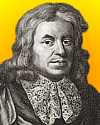
Thomas Sydenham
(baptised 10 Sep 1624 - 29 Dec 1689)
English physician.
|
Science Quotes by Thomas Sydenham (7 quotes)
Acute [diseases] meaning those of which God is the author, chronic meaning those that originate in ourselves.
— Thomas Sydenham
'Epistolary Dissertation to Dr. Cole', in The Works of Thomas Sydenham, M.D. (1850), trans. by R. G. Latham, Vol. 2, 68.
All that Anatomie can doe is only to shew us the gross and sensible parts of the body, or the vapid and dead juices all which, after the most diligent search, will be noe more able to direct a physician how to cure a disease than how to make a man; for to remedy the defects of a part whose organicall constitution and that texture whereby it operates, he cannot possibly know, is alike hard, as to make a part which he knows not how is made. Now it is certaine and beyond controversy that nature performs all her operations on the body by parts so minute and insensible that I thinke noe body will ever hope or pretend, even by the assistance of glasses or any other intervention, to come to a sight of them, and to tell us what organicall texture or what kinde offerment (for whether it be done by one or both of these ways is yet a question and like to be soe always notwithstanding all the endeavours of the most accurate dissections) separate any part of the juices in any of the viscera, or tell us of what liquors the particles of these juices are, or if this could be donne (which it is never like to be) would it at all contribute to the cure of the diseases of those very parts which we so perfectly knew.
— Thomas Sydenham
'Anatomie' (1668). Quoted in Kenneth Dewhurst (ed.), Dr. Thomas Sydenham (1624-1689): His Life and Original Writings (1966), 85-6.
In reality, I have sometimes thought that we do not go on sufficiently slowly in the removal of diseases, and that it would he better if we proceeded with less haste, and if more were often left, to Nature than is the practice now-a-days. It is a great mistake to suppose that Nature always stands in need of the assistance of Art. If that were the case, site would have made less provision for the safety of mankind than the preservation of the species demands; seeing that there is not the least proportion between the host of existing diseases and the powers possessed by man for their removal, even in those ages wherein the healing art was at the highest pitch, and most extensively cultivated.
— Thomas Sydenham
As quoted by Gavin Milroy in 'On the Writings of Sydenham', The Lancet (14 Nov 1846), 524.
Physick, says Sydenham, is not to bee learned by going to Universities, but hee is for taking apprentices; and says one had as good send a man to Oxford to learn shoemaking as practising physick.
— Thomas Sydenham
Diary of the Rev. John Ward, M. A. (1648-1769), ed. Charles Severn (1839), 242.
So much is human genius limited, by the limits of human nature, that we just know what our five senses teach.
— Thomas Sydenham
In The Works of Thomas Sydenham, (1850), Vol. 2, 182.
The whole philosophy of medicine consists in working out the histories of diseases, and applying the remedies which may dispel them; and Experience is the sole guide. This we attain by … the suggestions of common sense rather than of speculation.
— Thomas Sydenham
In The Works of Thomas Sydenham, (1850), Vol. 2, 182.
This is all very fine, but it won’t do—Anatomy—botany—Nonsense! Sir, I know an old woman in Covent Garden, who understands botany better, and as for anatomy, my butcher can dissect a joint full as well; no, young man, all that is stuff; you must go to the bedside, it is there alone you can learn disease!
Comment to Hans Sloane on Robert Boyle’s letter of introduction describing Sloane as a “ripe scholar, a good botanist, a skilful anatomist”.
Comment to Hans Sloane on Robert Boyle’s letter of introduction describing Sloane as a “ripe scholar, a good botanist, a skilful anatomist”.
— Thomas Sydenham
Quoted in John D. Comrie, 'Life of Thomas Sydenham, M. D.', in Comrie (ed.), Selected Works of Thomas Sydenham (1922), 2.
Quotes by others about Thomas Sydenham (1)
The Commonwealth of Learning is not at this time without Master-Builders, whose mighty Designs, in advancing the Sciences, will leave lasting Monuments to the Admiration of Posterity; But every one must not hope to be a Boyle, or a Sydenham; and in an Age that produces such Masters, as the Great-Huygenius, and the incomparable Mr. Newton, with some other of that Strain; 'tis Ambition enough to be employed as an Under-Labourer in clearing Ground a little, and removing some of the Rubbish, that lies in the way to Knowledge.
An Essay Concerning Human Understanding (1690). Edited by Peter Nidditch (1975), The Epistle to the Reader, 9-10.
See also:
- 10 Sep - short biography, births, deaths and events on date of Sydenham's baptism.
- Dr. Thomas Sydenham (1624-1689): His Life and Original Writings, by Kenneth Dewhurst. - book suggestion.
 In science it often happens that scientists say, 'You know that's a really good argument; my position is mistaken,' and then they would actually change their minds and you never hear that old view from them again. They really do it. It doesn't happen as often as it should, because scientists are human and change is sometimes painful. But it happens every day. I cannot recall the last time something like that happened in politics or religion.
(1987) --
In science it often happens that scientists say, 'You know that's a really good argument; my position is mistaken,' and then they would actually change their minds and you never hear that old view from them again. They really do it. It doesn't happen as often as it should, because scientists are human and change is sometimes painful. But it happens every day. I cannot recall the last time something like that happened in politics or religion.
(1987) -- 




