 (source)
|
Henry Shrapnel
(3 Jun 1761 - 13 Mar 1842)
English soldier and inventor of the Shrapnel shell and other munitions improvements.
|
Henry Shrapnel
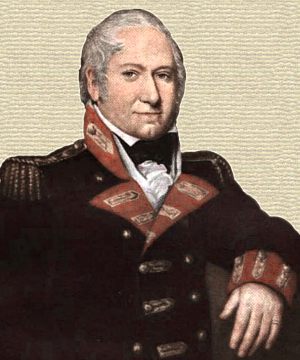
Lieutenant-Colonel, Royal Regiment of Artillery
Inventor of the “Shrapnel” shell
died lieutenant-general - 13 march, 1842
From an oil painting in the Royal Artillery Institution, Woolwich
(Painted by F. Arrowsmith, in 1812) (source)
Henry Scrope Shrapnel was an English soldier and inventor of the anti-personnel weapon known by his name - the Shrapnel artillery shell - designed to explode, widely spreading its content of small lead musket balls to injure enemy soldiers. Exploded fragments from the metal casing of modern artillery, bombs or mines are still known as shrapnel.
He invented a percussion lock for small arms (patented 1834) and other improvements in fuses, ammunition and small arms. He also prepared important artillery range tables and originated the brass tangent slide to improve the sighting of guns. Incorporating his idea of the parabolic chamber, howitzers and mortars were operated more efficiently.
Shrapnel was born in Bradford-on-Avon, Wiltshire , the youngest son in the family of nine children of clothier Zachariah and Lydia Shrapnel. He was raised at the Midway Manor House in Bradford-on-Avon, Wiltshire. A month after his 18th birthday, he began a life-long military career with the Royal Artillery, serving in various places around he world. Within a year of being commissioned, he was stationed at Newfoundland (1780-84) in the fort protecting St. John's harbour.
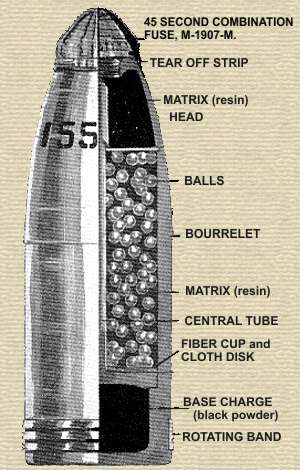
Upon his return to England, a first lieutenant in his early twenties, Shrapnel started working on an explosive shell designed to be more devastating to enemy infantry than the solid cannon ball or cannister rounds then in use. His idea was to use a hollow spherical shell carrying numerous small metal balls, equipped with a fuse and bursting charge of gunpowder. If properly adjusted, the fuse length determined that the shell would explode over the enemy in midair to scatter the shot over a wide area. For years Shrapnel devoted his free time to solving the design problems with the fuse and perfecting his invention, and eventually he got it to work dependably. This design work and testing was carried out at his own expense, which would amount to several thousand pounds as he continued his experiments over twenty-eight years to refine his shell.
Previously, artillery had used a canister - a tin container filled with iron balls but no internal explosive. When fired, the container burst open at the muzzle, and the balls could cause heavy casualties up to a range of 300 metres. At longer ranges, the common shell was used - a hollow cast iron spheres filled with gunpowder - but these fragmented poorly. Shrapnel's combination of a fuse, explosive charge and shot inside the shell increased the effective range of case to about 1100 metres.
By 1799, he had seen action in Gibralter, the West Indies and the Low Countries of Europe, achieved the rank of Captain, and presented the results of now fifteen years of intermittent design work to the Board of Ordnance.
The army adopted Shrapnel's shell in 1803, which was used successfully on the battlefield the following year when Surinam was captured from the Dutch, who promptly surrendered when subjected to the devastating rounds. By now, Shrapnel was first assistant inspector of artillery at Woolwich, where he expanded his research work to other aspects of ordnance.
After the effective use of the Shrapnel shell in the battle against the occupying French troops at Vimeiro, Portugal (21 Aug 1808), General Arthur Wellesley wanted the weapon's design kept secret. Although he regretted depriving the inventor of his due recognition, he suggested the
should in itself be sufficient reward. (Dictionary of National Biography)
Shrapnel shells were widely employed in various other military operations during the following years, including the British victory by Wellington over Napoleon at Waterloo (1815). Yet, he was never effectively recompensed for his own expenditures. In fact, when he asked the Board of Ordinance in Sep 1813, he was told there were no funds available for a merit reward. However, the following year, the government granted him a modest pension in addition to his service pay.
On 29 Jul 1825, Shrapnel retired from active service, 46 years after he joined the Royal Artillery as a cadet. He continued his contributions with further work as an experimenter and inventor. When he patented a percussion lock for small arms (1834), he was over 70 years old.
A promotion to lieutenant-general on 10 Jan 1837 was followed by a visit as the guest of William IV who praised his accomplishments. Although the king's private secretary wrote a few months later concerning making Shrapnel a baron, the king died shortly thereafter, and the baronetcy was never conferred.
The design principles Shrapnel originated were used for over a century, including shells manufactured for World War I. They were superceded by the Second World War, with high explosive shell having casings designed to fragment themselves so effectively such that additional shot was not needed.
- 3 Jun - short biography, births, deaths and events on date of Shrapnel's birth.
- Invention and Development of the Shrapnel Shell (1920)
- Shrapnel shell construction - a history of its development.





