 (source)
|
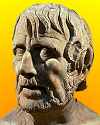
Lucius Annaeus Seneca
(c. 4 B.C. - 65)
Roman philosopher who was tutor to the young Nero, and adviser to Emperor Nero for five years. Later, in disfavour, he died by suicide at Nero's command.
|
Science Quotes by Lucius Annaeus Seneca (18 quotes)
Ita est … rerum natura, post omnia oceanus, post oceanum nihil.
Thus is nature, Beyond all things is the ocean, beyond the ocean nothing.
Thus is nature, Beyond all things is the ocean, beyond the ocean nothing.
— Lucius Annaeus Seneca
In Suasoriarum, collected in L. Annaei Senecae (1557), Vol. 4, 620.
As translated in Fridtjof Nansen, In Northern Mists: Arctic Exploration in Early Times (1911), Vol. 1, 84.
Nunc naturalem causam quaerimus et assiduam, non raram fortuitam.
Now we are looking for a natural and constant cause, not a rare and accidental one.
Now we are looking for a natural and constant cause, not a rare and accidental one.
— Lucius Annaeus Seneca
Found as an Epigraph on title page of John Playfair, Illustrations of the Huttonian Theory of the Earth (1802). The Latin form of this quote is found in 'Naturalium Questionum, Book 2', Oeuvres Complètes de Sénèque: Le Philosophe (1838), Vol. 8, 164. It is part of a discussion of the nature of thunder and lightning. A thought—that they are caused by fire extinguished in a cloud from a falling star—is dismissed with the statement in the quote.
Quaedam remedia graviora ipsis periculis sunt.
Some cures are worse than the dangers they combat.
Some cures are worse than the dangers they combat.
— Lucius Annaeus Seneca
Controversiae, 6.7. In M. Winterbottom (ed.), The Elder Seneca (1974), Vol. 1, 520.
~~[Questionable attribution]~~ Travel and change of place impart new vigor to the mind.
— Lucius Annaeus Seneca
Found widely quoted and attributed to Seneca, but Webmaster, as yet, has not identified the primary source of these words (in verbatim translation) in the writings of Seneca. Conversely, Seneca says somewhat the opposite in his Epistle CIV on 'Travelling', as translated in The Epistles of Lucius Annæus Seneca (1786), Vol. 2, 242-243. Seneca quotes Socrates, “For it is said that Socrates, when a person was complaining to him that he had received very little benefit from travelling, made this reply: I do not wonder at it, since you travelled with yourself.” However Seneca was perhaps commenting on physical health, saying further, “Medicine is requisite for a sick man, not a journey. … Why then should you think a mind … can be cured merely by change of place?” However, please contact if you can help with a different Seneca source applying to mental health.
Alexander the king of the Macedonians, began like a wretch to learn geometry, that he might know how little the earth was, whereof he had possessed very little. Thus, I say, like a wretch for this, because he was to understand that he did bear a false surname. For who can be great in so small a thing? Those things that were delivered were subtile, and to be learned by diligent attention: not which that mad man could perceive, who sent his thoughts beyond the ocean sea. Teach me, saith he, easy things. To whom his master said: These things be the same, and alike difficult unto all. Think thou that the nature of things saith this. These things whereof thou complainest, they are the same unto all: more easy things can be given unto none; but whosoever will, shall make those things more easy unto himself. How? With uprightness of mind.
— Lucius Annaeus Seneca
In Thomas Lodge (trans.), 'Epistle 91', The Workes of Lucius Annaeus Seneca: Both Morrall and Naturall (1614), 383. Also in Robert Édouard Moritz, Memorabilia Mathematica (1914), 135.
God has not revealed all things to man and has entrusted us with but a fragment of His mighty work. But He who directs all things, who has established and laid the foundation of the world, who has clothed Himself with Creation, He is greater and better than that which He has wrought. Hidden from our eyes, He can only be reached by the spirit.
— Lucius Annaeus Seneca
From Quaestiones Naturales as translated in Charles Singer, From Magic to Science (1958), 57.
How many discoveries are reserved for the ages to come when our memory shall be no more, for this world of ours contains matter for investigation for all generations.
— Lucius Annaeus Seneca
From Quaestiones Naturales as translated in Charles Singer, From Magic to Science (1958), 57.
If you are surprised at the number of our maladies, count our cooks.
— Lucius Annaeus Seneca
In Noble Words and Noble Deeds (1877), 239.
If you would make a man happy, do not add to his possessions but subtract from the sum of his desires.
— Lucius Annaeus Seneca
Quoted, without citation, in Harris Elliott Kirk, A Man of Property: Or, The Jacob Saga (1935), 45. Also in Howard W. Eves, Return to Mathematical Circles, (1988), 68.
In a moment the ashes are made, but a forest is a long time growing.
Momento fit cinis: diu sylva.
Momento fit cinis: diu sylva.
— Lucius Annaeus Seneca
Cited as from Quæstionum Naturalium, Book III. 27 in Kate Louise Roberts (ed.) Hoyt’s New Cyclopedia of Practical Quotations (1922), 798.
Nature does not allow us to explore her sanctuaries all at once. We think we are initiated, but we are still only on the threshold.
— Lucius Annaeus Seneca
Epigraph, without citation, in Sir Richard Gregory, Discovery: Or, The Spirit and Service of Science (1916), 292.
On entering a temple we assume all signs of reverence. How much more reverent then should we be before the heavenly bodies, the stars, the very nature of God!
— Lucius Annaeus Seneca
From Quaestiones Naturales as translated in Charles Singer, From Magic to Science (1958), 57.
Shun no toil to make yourself remarkable by some talent or other; yet do not devote yourself to one branch exclusively. Strive to get clear notions about all. Give up no science entirely; for science is but one.
— Lucius Annaeus Seneca
In Henry Southgate (ed.), Many Thoughts of Many Minds (1862), 340.
The pleasures of the palate deal with us like Egyptian thieves who strangle those whom they embrace.
— Lucius Annaeus Seneca
In Louis Klopsch, Many Thoughts of Many Minds (1896), 110.
There are many things akin to highest deity that are still obscure. Some may be too subtle for our powers of comprehension, others imperceptible to us because such exalted majesty conceals itself in the holiest part of its sanctuary, forbidding access to any power save that of the spirit. How many heavenly bodies revolve unseen by human eye!
— Lucius Annaeus Seneca
From Quaestiones Naturales as translated in Charles Singer, From Magic to Science (1958), 57.
To build up cities, an age is needed: but an hour destroys them.
Urbes constituit ætas: hora dissolvit.
Urbes constituit ætas: hora dissolvit.
— Lucius Annaeus Seneca
Cited as from Quæstionum Naturalium, Book III. 27 in Kate Louise Roberts (ed.) Hoyt’s New Cyclopedia of Practical Quotations (1922), 798.
When you enter some grove, peopled with ancient trees, such as are higher than ordinary, and whose boughs are so closely interwoven that you cannot see the sky; the stately loftiness of the wood, the privacy of the place, and the awful gloom, cannot but strike you, as with the presence of a deity.
— Lucius Annaeus Seneca
Epistle LXI, 'On The God Within Us', The Epistles of Lucius Annæus Seneca trans. Thomas Morell (1786), Vol. 1, 142. Also translated by Richard Mott Gummere (1916) as “If ever you come upon a grove of ancient trees which have grown to an exceptional height, shutting out a view of sky by a veil of pleached and intertwining branches, then the loftiness of the forest, the seclusion of the spot and your marvel at the thick unbroken shade in the midst of the open spaces, will prove to you the presence of deity.”
Why, then, are we surprised that comets, such a rare spectacle in the universe, are not known, when their return is at vast intervals?. … The time will come when diligent research over long periods will bring to light things which now lie hidden. A single lifetime, even though entirely devoted to the sky, would not be enough for the investigation of so vast a subject … And so this knowledge will be unfolded only through long successive ages. There will come a time when our descendants will be amazed that we did not know things that are so plain to them …. Many discoveries are reserved for ages still to come, when memory of us will have been effaced. Our universe is a sorry little affair unless it has in it something for every age to investigate … Nature does not reveal her mysteries once and for all. Someday there will be a man who will show in what regions comets have their orbit, why they travel so remote from other celestial bodies, how large they are and what sort they are.
— Lucius Annaeus Seneca
Natural Questions, Book 7. As translated by Thomas H. Corcoran in Seneca in Ten Volumes: Naturales Quaestiones II (1972), 279 and 293.
Quotes by others about Lucius Annaeus Seneca (3)
It may be observed of mathematicians that they only meddle with such things as are certain, passing by those that are doubtful and unknown. They profess not to know all things, neither do they affect to speak of all things. What they know to be true, and can make good by invincible arguments, that they publish and insert among their theorems. Of other things they are silent and pass no judgment at all, chusing [choosing] rather to acknowledge their ignorance, than affirm anything rashly. They affirm nothing among their arguments or assertions which is not most manifestly known and examined with utmost rigour, rejecting all probable conjectures and little witticisms. They submit nothing to authority, indulge no affection, detest subterfuges of words, and declare their sentiments, as in a Court of Judicature [Justice], without passion, without apology; knowing that their reasons, as Seneca testifies of them, are not brought to persuade, but to compel.
Mathematical Lectures (1734), 64.
The longer I live, the more I am convinced that the apothecary is of more importance than Seneca; and that half the unhappiness in the world proceeds from little stoppages; from a duct choked up, from food pressing in the wrong place, from a vexed duodenum, or an agitated pylorus.
'Of the Body', in Sydney Smith, Saba Holland, with Sarah Austin (ed.), A Memoir of the Reverend Sydney Smith by his Daughter, Lady Holland (3rd ed. 1855), Vol. 1, 174.
Why is it that the self-aggrandizements of Cicero, the lecheries and whining of Ovid and the blatherings of that debauched old goose Seneca made it onto the Net before the works that give us solid technical information about what Rome was really good at, viz. the construction of her great buildings and works of engineering?
From headnotes written by Bill Thayer to his online transcription of Vitruvius: On Architecture.
 In science it often happens that scientists say, 'You know that's a really good argument; my position is mistaken,' and then they would actually change their minds and you never hear that old view from them again. They really do it. It doesn't happen as often as it should, because scientists are human and change is sometimes painful. But it happens every day. I cannot recall the last time something like that happened in politics or religion.
(1987) --
In science it often happens that scientists say, 'You know that's a really good argument; my position is mistaken,' and then they would actually change their minds and you never hear that old view from them again. They really do it. It doesn't happen as often as it should, because scientists are human and change is sometimes painful. But it happens every day. I cannot recall the last time something like that happened in politics or religion.
(1987) -- 




