 (source)
|
Georg August Schweinfurth
(29 Dec 1836 - 19 Sep 1925)
German botanist and ethnologist who travelled in the interior of East Africa (from 1868) and studied the inhabitants together with the flora and fauna of the region
|
Georg August Schweinfurth
Extracts from The Heart of Africa
The Dinka
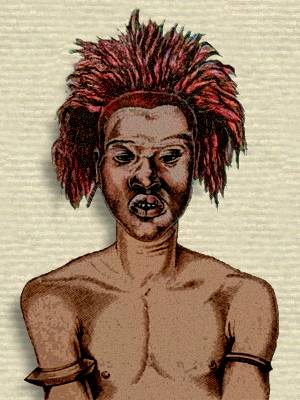
[p.150] The hair of the Dinka is nearly always very meagre; it is generally closely shorn, except at the crown, where a tuft is left, which they ornament with ostrich feathers, in imitation of a heron. The helmet-shaped combs of the Shillooks are never seen, but tufts of woolly locks are much in fashion. Occasionally, but not often, the hair is plaited in fine braids, which run in parallel lines across the head. The women wear their hair either closely shaven or as short as possible. The accompanying portrait represents what might be styled a Dinka dandy, distinguished for unusually long hair. He must be classed as belonging to that finer-formed race which has been mentioned. By continual combing and stroking with hair-pins, the hair of the negro loses much of its close curliness. Such was the case here: the hair, six inches long, was trained up into points like tongues of flame, and these, standing stiffly up all round his head, gave the man a fiendish look, which was still further increased by its being dyed a foxy red. This tint is the result of continual washing with cow-urine; a similar effect can be produced by the application for a fortnight of a mixture of dung and ashes.
…
[p.154] The most important weapon of the Dinka is the lance. Bows and arrows are unknown: the instruments that some travellers have mistaken for bows are only weapons of defence for parrying the blows of clubs. But really their favourite [p.155] weapons are clubs and sticks, which they cut out of the hard wood of the Hegelig (Balanites), or from the native ebony (Diospyrus mespiliformis). This mode of defence is ridiculed by other nations, and the Niam-niam, with whom the Dinka have become acquainted by accompanying the Khartoomers in their ivory expeditions, deride them as “A-Tagbondo” or stick-people.
Similar conditions of life in different regions, even among dissimilar races, ever produce similar habits and tendencies. This is manifest in the numerous customs that the Dinka possess in common with the far-off Kaffirs. They have the same predilection for clubs and sticks, and use a shield of the same long oval form, cut out of buffalo-hide, and which, in order to insure a firmer hold, is crossed by a stick, secured by being passed through slips cut in the thick leather. But the instruments for parrying club-blows depicted in the accompanying illustration are quite peculiar to the Dinka.
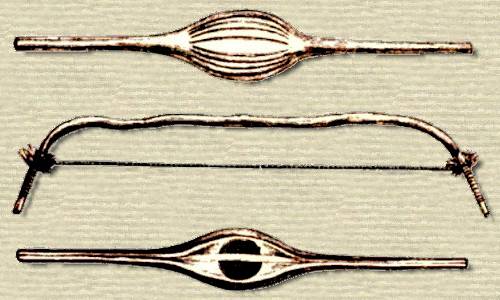
As far as I know, no previous traveller has drawn attention to these strange contrivances for defence. They are of two kinds. One consists of a neatly-carved piece of wood, rather more than a yard long, with a hollow in the centre for the [p.156] protection of the hand: these are called “quayre”. The other, which has been mistaken for a bow, is termed “dang” of which the substantial fibres seem peculiarly fitted for breaking the violence of any blow.
The Naim-naim Warriors
[p.3] The name Niam-niam* is borrowed from the dialect of the Dinka, and means “eaters” or rather “great eaters”, manifestly betokening a reference to the cannibal propensities of the people. This designation has been so universally incorporated into the Arabic of the Soudan, that it seems inadvisable to substitute for it the word “Zandey”, the name by which the people are known amongst themselves. Since among thoeMohammedans of the Soudan the term Niam-niam (plur. Niamah-niam) is principally associated with the idea of cannibalism, the same designation is sometimes applied by them to other nations who have nothing in common with the true Niam-nium, or “Zandey,” except the one characteristic of a predilection for eating human flesh.
…
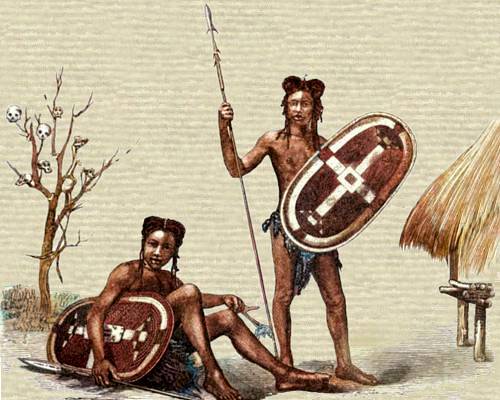
[p.9] The principal weapons of the Niam-niam are their lances and their trumbashes. The word “trumbash” which has been incorporated into the Arabic of the Soudan, is the term employed in Sennaar to denote generally all the varieties of missiles that are used by the negro races; it should, however, properly be applied solely to that sharp flat projectile of wood, a kind of boomerang, which is used for killing birds or hares, or any small game: when the weapon is made of iron, it is called “kulbeda”. The trumbash of the Niam-niam consists ordinarily of several limbs of iron, with pointed prongs and sharp edges. Iron missiles very similar in their shape are found among the tribes of the Tsad basin; and a weapon constructed on the same principle, the “changer manger” is in use among the Marghy and the Musgoo.
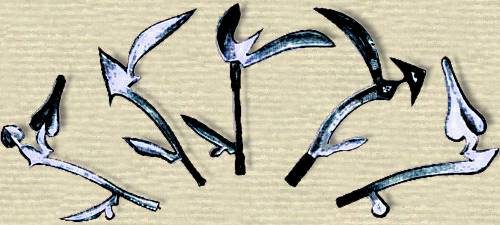
The trumbashes are always attached to the inside of the shields, which are woven from the Spanish reed, and are of long oval form, covering two-thirds of the body; they are ornamented with black and white crosses or other devices, and are so light that they do not in the least impede the combatants in their wild leaps. An expert Niam-niam, by jumping up for a moment, can protect his feet from the flying missiles of his adversary. Bows and arrows, which, as handled by the Bongo, give them a certain advantage, are not in common use among the Niam-niam, who possess a peculiar weapon of attack in their singular knives, that have blades like sickles. The Monbuttoo, who are far more skilful smiths than the Niam-niam, supply them with most of these weapons, receiving in [p.10] return a heavy kind of lance, that is adapted for the elephant and buffalo chase
…
[p.22] Notwithstanding the general warlike spirit displayed by the Niam-niam, it is a singular fact that the chieftains very rarely lead their own people into actual engagement, but are accustomed, in anxious suspense, to linger about the environs of the “mbanga”, ready, in the event of tidings of defeat, to decamp with their wives and treasures into the most inaccessible swamps, or to betake themselves for concealment to the long grass of the steppes. In the heat of combat each discharge of lances is accompanied by the loudest and wildest of battle-cries, every man as he hurls his [p.23] weapon shouting aloud the name of his chief. In the intervals between successive attacks the combatants retire to a safe distance, mounting any eminence that may present itself, or climbing to the summit of the hills of the white ants, which sometimes rise to a height of 12 or 15 feet, they proceed to assail their adversaries, for the hour together, in the most ludicrous manner, with every invective and every epithet of contempt and defiance they can command. During the few days that we were obliged to defend ourselves by an abattis against the attacks of the natives in Wando’s southern territory, we had ample opportunity of hearing these accumulated opprobriums. We could hear them vow that the “Turks” should perish, and that not one of them should quit the country alive; and then we recognised the repeated shout. “To the caldron with the Turks!” rising to the eager climax, “Meat! meat!” It was emphatically announced that there was no intention to do any injury to the white man, because he was a stranger and a newcomer to the land; but I need hardly say that, under the circumstances, I felt little inclination to throw myself upon their mercy.
* It should again be mentioned that the word Niam-niam is a dissyllable and has the Italian pronunciation of Gnam-gnam.
- Science Quotes by Georg August Schweinfurth.
- 29 Dec - short biography, births, deaths and events on date of Schweinfurth's birth.
- The Heart of Africa: Three Years’ Travels and Adventures…, by Georg August Schweinfurth. - book suggestion.





