 (source)
|
Carl Sagan
(9 Nov 1934 - 20 Dec 1996)
American astronomer, exobiologist and writer remembered for popularizing astronomy and science, especially with his public television series Cosmos. Its accompanying book spent seventy weeks on The New York Times bestseller list. He was an adviser to NASA for the Mariner, Voyager, and Viking unmanned space missions.
|
Science Quotes by Carl Sagan (119 quotes)
>> Click for Carl Sagan Quotes on | Argument | Contradiction | Cosmos | Experiment | Hypothesis | Idea | Knowledge | Life | Nuclear | Religion | Science | Science And Religion | Scientist | Sense | Skepticism | Star | Sun | Test | Thinking | Truth | Universe |
>> Click for Carl Sagan Quotes on | Argument | Contradiction | Cosmos | Experiment | Hypothesis | Idea | Knowledge | Life | Nuclear | Religion | Science | Science And Religion | Scientist | Sense | Skepticism | Star | Sun | Test | Thinking | Truth | Universe |
...the scientific cast of mind examines the world critically, as if many alternative worlds might exist, as if other things might be here which are not. Then we are forced to ask why what we see is present and not something else. Why are the Sun and moon and the planets spheres? Why not pyramids, or cubes, or dodecahedra? Why not irregular, jumbly shapes? Why so symmetrical, worlds? If you spend any time spinning hypotheses, checking to see whether they make sense, whether they conform to what else we know. Thinking of tests you can pose to substantiate or deflate hypotheses, you will find yourself doing science.
— Carl Sagan
…...
[I]magine you want to know the sex of your unborn child. There are several approaches. You could, for example, do what the late film star ... Cary Grant did before he was an actor: In a carnival or fair or consulting room, you suspend a watch or a plumb bob above the abdomen of the expectant mother; if it swings left-right it's a boy, and if it swings forward-back it's a girl. The method works one time in two. Of course he was out of there before the baby was born, so he never heard from customers who complained he got it wrong. ... But if you really want to know, then you go to amniocentesis, or to sonograms; and there your chance of being right is 99 out of 100. ... If you really want to know, you go to science.
— Carl Sagan
In 'Wonder and Skepticism', Skeptical Enquirer (Jan-Feb 1995), 19, No. 1.
[N]o scientist likes to be criticized. … But you don’t reply to critics: “Wait a minute, wait a minute; this is a really good idea. I’m very fond of it. It’s done you no harm. Please don’t attack it.” That's not the way it goes. The hard but just rule is that if the ideas don't work, you must throw them away. Don't waste any neurons on what doesn’t work. Devote those neurons to new ideas that better explain the data. Valid criticism is doing you a favor.
— Carl Sagan
In 'Wonder and Skepticism', Skeptical Enquirer (Jan-Feb 1995), 19, No. 1.
![Carl Sagan quote: [Science] is not perfect. It can be misused. It is only a tool. But it is by far the best tool we have, self-c](https://todayinsci.com/S/Sagan_Carl/SaganCarl-Misused500x250px.jpg)
[Science] is not perfect. It can be misused. It is only a tool. But it is by far the best tool we have, self-correcting, ongoing, applicable to everything. It has two rules. First: there are no sacred truths; all assumptions must be critically examined; arguments from authority are worthless. Second: whatever is inconsistent with the facts must be discarded or revised. ... The obvious is sometimes false; the unexpected is sometimes true.
— Carl Sagan
Cosmos (1985), 277.
[When I was a child] I grew up in Brooklyn, New York, and I was a street kid. … [T]here was one aspect of that environment that, for some reason, struck me as different, and that was the stars. … I could tell they were lights in the sky, but that wasn’t an explanation. I mean, what were they? Little electric bulbs on long black wires, so you couldn’t see what they were held up by? What were they? … My mother said to me, "Look, we’ve just got you a library card … get out a book and find the answer.” … It was in there. It was stunning. The answer was that the Sun was a star, except very far away. … The dazzling idea of a universe vast beyond imagining swept over me. … I sensed awe.
— Carl Sagan
In 'Wonder and Skepticism', Skeptical Enquirer (Jan-Feb 1995), 19, No. 1.
[With] our critical faculties in decline, unable to distinguish between what feels good and what’s true, we slide, almost without noticing, back into superstition. … We have also arranged things so that almost no one understands science and technology. We might get away with it for a while, but eventually this combustible mixture of ignorance and power is going to blow up in our faces.
— Carl Sagan
In 'With Science on Our Side', Washington Post (9 Jan 1994).
~~[Misattributed]~~ Somewhere, something incredible is waiting to be known.
— Carl Sagan
Although describing Sagan’s viewpoint on extra-terrestrial life, expressed in the interview, these were her own summarizing words by the reporter, Sharon Begley, in 'Seeking Other Worlds', Newsweek (15 Aug 1977), 90, 53. The statement was not in quotation marks, and not Sagan’s own words, as verified on the quoteinvestigator.com website. [Updated on todayinsci site 25 Sep 2019.] An example of this narrative text being mistakenly printed as a Sagan quote is in Larry Chang, Wisdom for the Soul: Five Millennia of Prescriptions for Spiritual Healing (2006), 561, without source reference.
A central lesson of science is that to understand complex issues (or even simple ones), we must try to free our minds of dogma and to guarantee the freedom to publish, to contradict, and to experiment. Arguments from authority are unacceptable.
— Carl Sagan
Billions and Billions: Thoughts on Life and Death at the Brink of the Millenium (1998), 190.
A googleplex is precisely as far from infinity as is the number 1 ... No matter what number you have in mind, infinity is larger.
— Carl Sagan
In Cosmos (1980, 2011), 181.
A religion old or new, that stressed the magnificence of the universe as revealed by modern science, might be able to draw forth reserves of reverence and awe hardly tapped by the conventional faiths. Sooner or later such a religion will emerge.
— Carl Sagan
Pale Blue Dot: a Vision of the Human Future in Space (1994), 52.

Advances in medicine and agriculture have saved vastly more lives than have been lost in all the wars in history.
— Carl Sagan
The Demon-Haunted World: Science as a Candle in the Dark (1996), 11.
All of the books in the world contain no more information than is broadcast as video in a single large American city in a single year. Not all bits have equal value.
— Carl Sagan
…...
An extraterrestrial being, newly arrived on Earth - scrutinizing what we mainly present to our children in television, radio, movies, newspapers, magazines, the comics, and many books - might easily conclude that we are intent on teaching them murder, rape, cruelty, superstition, credulity and consumerism.
— Carl Sagan
…...
As agonizing a disease as cancer is, I do not think it can be said that our civilization is threatened by it. … But a very plausible case can be made that our civilization is fundamentally threatened by the lack of adequate fertility control. Exponential increases of population will dominate any arithmetic increases, even those brought about by heroic technological initiatives, in the availability of food and resources, as Malthus long ago realized.
— Carl Sagan
From 'In Praise of Science and Technology', in Broca's Brain: Reflections on the Romance of Science (1975, 2011), 43.
At the heart of science is an essential balance between two seemingly contradictory attitudes—an openness to new ideas, no matter how bizarre or counterintuitive they may be, and the most ruthless skeptical scrutiny of all ideas, old and new. This is how deep truths are winnowed from deep nonsense.
— Carl Sagan
The Demon-Haunted World: Science as a Candle in the Dark (1997), 304.
But for us, it’s different. Look again at that dot. That’s here. That’s home. That’s us. On it everyone you love, everyone you know, everyone you ever heard of, every human being who ever was, lived out their lives. The aggregate of our joy and suffering, thousands of confident religions, ideologies, and economic doctrines, every hunter and forager, every hero and coward, every creator and destroyer of civilization, every king and peasant, every young couple in love, every mother and father, hopeful child, inventor and explorer, every teacher of morals, every corrupt politician, every “superstar,” every “supreme leader,” every saint and sinner in the history of our species lived there - on a mote of dust suspended in a sunbeam.
— Carl Sagan
…...
Charlie Holloway (human): “What we hoped to achieve was to meet our makers. To get answers. Why they even made us in the first place.”
David (AI robot): “Why do you think your people made me?”
Charlie Holloway (human): “We made you because we could.”
David (AI robot): “Can you imagine how disappointing it would be for you to hear the same thing from your creator?”
Charlie Holloway (human): “I guess it’s good you can’t be disappointed.”
David (AI robot): “Why do you think your people made me?”
Charlie Holloway (human): “We made you because we could.”
David (AI robot): “Can you imagine how disappointing it would be for you to hear the same thing from your creator?”
Charlie Holloway (human): “I guess it’s good you can’t be disappointed.”
— Carl Sagan
Prometheus (2012)
Children [are] born with a zest for knowledge, aware that they must live in a future molded by science, but so often convinced by their culture that science is not for them.
— Carl Sagan
In 'With Science on Our Side', Washington Post (9 Jan 1994).
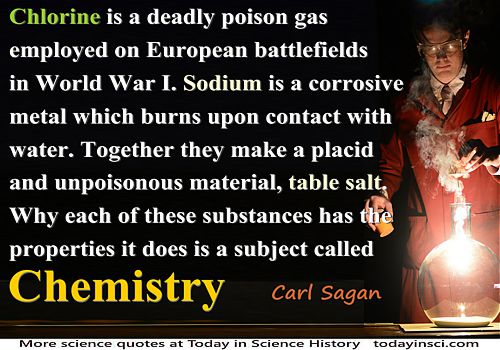
Chlorine is a deadly poison gas employed on European battlefields in World War I. Sodium is a corrosive metal which burns upon contact with water. Together they make a placid and unpoisonous material, table salt. Why each of these substances has the properties it does is a subject called chemistry.
— Carl Sagan
In Broca's Brain: The Romance of Science (1979), 18, footnote.
Comets giveth and comets taketh away.
— Carl Sagan
In Comet (1885, 1997), 337. [Note the context refers to the idea that although perhaps comets seeded life on earth, later comet collisions with Earth could cause mass extinctions.]
Every kid starts out as a natural-born scientist, and then we beat it out of them. A few trickle through the system with their wonder and enthusiasm for science intact.
— Carl Sagan
Quoted in interview with magazine staff, Psychology Today (Jan 1996).
Extraordinary claims require extraordinary evidence.
— Carl Sagan
…...
Fanatical ethnic or religious or national chauvinisms are a little difficult to maintain when we see our planet as a fragile blue crescent fading to become an inconspicuous point of light against a bastion and citadel of the stars.
— Carl Sagan
Cosmos
For me, it is far better to grasp the Universe as it really is than to persist in delusion, however satisfying and reassuring.
— Carl Sagan
…...
For myself, I like a universe that, includes much that is unknown and, at the same time, much that is knowable. A universe in which everything is known would be static and dull, as boring as the heaven of some weak-minded theologians. A universe that is unknowable is no fit place for a thinking being. The ideal universe for us is one very much like the universe we inhabit. And I would guess that this is not really much of a coincidence.
— Carl Sagan
Concluding paragraph, 'Can We know the Universe? Reflections on a Grain of Salt', Broca's Brain (1979, 1986), 21.
For small creatures such as we the vastness is bearable only through love.
— Carl Sagan
…...
Humans everywhere share the same goals when the context is large enough. And the study of the Cosmos provides the largest possible context … . If a human disagrees with you, let him live. In a hundred billion galaxies, you will not find another … . If we are to survive, our loyalties must be broadened further, to include the whole human community, the entire planet Earth.
— Carl Sagan
Cosmos
I am often amazed at how much more capability and enthusiasm for science there is among elementary school youngsters than among college students.
— Carl Sagan
In Broca's Brain: Reflections on the Romance of Science (1974, 2011), 46.
I believe that in every person is a kind of circuit which resonates to intellectual discovery—and the idea is to make that resonance work
— Carl Sagan
Quoted by Dennis Meredith, in 'Carl Sagan's Cosmic Connection and Extraterrestrial Life-Wish', Science Digest (Jun 1979), 85, 37. Reproduced in Carl Sagan and Tom Head (editor), Conversations With Sagan (2006), 54.
I grew up in Brooklyn, New York … a city neighborhood that included houses, lampposts, walls, and bushes. But with an early bedtime in the winter, I could look out my window and see the stars, and the stars were not like anything else in my neighborhood. [At age 5] I didn’t know what they were.
[At age 9] my mother … said to me, “You have a library card now, and you know how to read. Take the streetcar to the library and get a book on stars.” … I stepped up to the big librarian and asked for a book on stars. … I sat down and found out the answer, which was something really stunning.I found out that the stars are glowing balls of gas. I also found out that the Sun is a star but really close and that the stars are all suns except really far away I didn’t know any physics or mathematics at that time, but I could imagine how far you’d have to move the Sun away from us till it was only as bright as a star. It was in that library, reading that book, that the scale of the universe opened up to me. There was something beautiful about it.
At that young age, I already knew that I’d be very happy if I could devote my life to finding out more about the stars and the planets that go around them. And it’s been my great good fortune to do just that.
[At age 9] my mother … said to me, “You have a library card now, and you know how to read. Take the streetcar to the library and get a book on stars.” … I stepped up to the big librarian and asked for a book on stars. … I sat down and found out the answer, which was something really stunning.I found out that the stars are glowing balls of gas. I also found out that the Sun is a star but really close and that the stars are all suns except really far away I didn’t know any physics or mathematics at that time, but I could imagine how far you’d have to move the Sun away from us till it was only as bright as a star. It was in that library, reading that book, that the scale of the universe opened up to me. There was something beautiful about it.
At that young age, I already knew that I’d be very happy if I could devote my life to finding out more about the stars and the planets that go around them. And it’s been my great good fortune to do just that.
— Carl Sagan
Quoted in interview with Jack Rightmyer, in 'Stars in His Eyes', Highlights For Children (1 Jan 1997). Ages as given in Tom Head (ed.), Conversations with Carl Sagan (2006), x.
I know of no area of human endeavor in which science has not had at least one important thing to say.
— Carl Sagan
In 'With Science on Our Side', Washington Post (9 Jan 1994).
I maintain there is much more wonder in science than in pseudoscience. And in addition, to whatever measure this term has any meaning, science has the additional virtue, and it is not an inconsiderable one, of being true.
— Carl Sagan
Concluding remarks of keynote address at CSICOP conference, Pasadena, California (3 Apr 1987). Printed in 'The Burden of Skepticism', Skeptical Inquirer (1987), 12, No. 1. Collected in Kendrick Frazier (ed.), The Hundredth Monkey: And Other Paradigms of the Paranormal (1991), 9.
I wanted to be a scientist from my earliest school days. The crystallizing moment came when I first caught on that stars are mighty suns, and how staggeringly far away they must be to appear to us as mere points of light. I’m not sure I even knew the word science then, but I was gripped by the prospect of understanding how things work, of helping to uncover deep mysteries, of exploring new worlds.
— Carl Sagan
In 'With Science on Our Side', Washington Post (9 Jan 1994).
I was a child in a time of hope. I grew up when the expectations for science were very high: in the thirties and forties. … There was a sense of optimism about science and the future.
— Carl Sagan
In article, 'Wonder and Skepticism', Skeptical Inquirer (Jan/Feb 1995), 19, No. 1.
I’d like the [Cosmos] series to be so visually stimulating that somebody who isn’t even interested in the concepts will just watch for the effects. And I’d like people who are prepared to do some thinking to be really stimulated.
— Carl Sagan
Quoted by Dennis Meredith, in 'Carl Sagan’s Cosmic Connection and Extraterrestrial Life-Wish', Science Digest (Jun 1979), 85, 38. Reproduced in Carl Sagan and Tom Head, Conversations With Sagan (2006), 55.
If the greenhouse effect is a blanket in which we wrap ourselves to keep warm, nuclear winter kicks the blanket off.
[co-author with American atmospheric chemist Richard P. Turco (1943- )]
[co-author with American atmospheric chemist Richard P. Turco (1943- )]
— Carl Sagan
A Path Where No Man Thought: Nuclear Winter and the End of the Arms Race (1990), 24.
If we lived on a planet where nothing ever changed, there would be little to do. There would be nothing to figure out. There would be no impetus for science. And if we lived in an unpredictable world, where things changed in random or very complex ways, we would not be able to figure things out. But we live in an in-between universe, where things change, but according to patterns, rules, or as we call them, laws of nature. If I throw a stick up in the air, it always falls down. If the sun sets in the west, it always rises again the next morning in the east. And so it becomes possible to figure things out. We can do science, and with it we can improve our lives.
— Carl Sagan
Cosmos (1980, 1985), 32.
If we long to believe that the stars rise and set for us, that we are the reason there is a Universe, does science do us a disservice in deflating our conceits
— Carl Sagan
…...
If you want to save your child from polio, you can pray or you can inoculate. ... Choose science.
— Carl Sagan
The Demon-Haunted World (1996), 30.
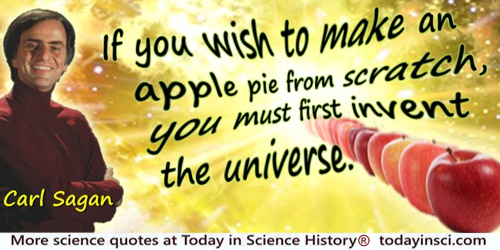
If you wish to make an apple pie from scratch, you must first invent the universe.
— Carl Sagan
From Cosmos (1980), 218. Variants are found which switch words such as: want/wish ; from/truly from ; invent/create.
Imagination will often carry us to worlds that never were. But without it we go nowhere.
— Carl Sagan
In Cosmos (1980), 4.
Imagine a room awash in gasoline, and there are two implacable enemies in that room. One of them has nine thousand matches. The other has seven thousand matches. Each of them is concerned about who's ahead, who's stronger. Well that's the kind of situation we are actually in. The amount of weapons that are available to the United States and the Soviet Union are so bloated, so grossly in excess of what's needed to dissuade the other, that if it weren't so tragic, it would be laughable. What is necessary is to reduce the matches and to clean up the gasoline.
— Carl Sagan
From Sagan's analogy about the nuclear arms race and the need for disarmament, during a panel discussion in ABC News Viewpoint following the TV movie The Day After (20 Nov 1983). Transcribed by Webmaster from a video recording. It is seen misquoted in summary form as “The nuclear arms race is like two sworn enemies standing waist deep in gasoline, one with three matches, the other with five.”
In a lot of scientists, the ratio of wonder to skepticism declines in time. That may be connected with the fact that in some fields—mathematics, physics, some others—the great discoveries are almost entirely made by youngsters.
— Carl Sagan
Quoted in interview with magazine staff, Psychology Today (Jan 1996).
In fact, the thickness of the Earth's atmosphere, compared with the size of the Earth, is in about the same ratio as the thickness of a coat of shellac on a schoolroom globe is to the diameter of the globe. That's the air that nurtures us and almost all other life on Earth, that protects us from deadly ultraviolet light from the sun, that through the greenhouse effect brings the surface temperature above the freezing point. (Without the greenhouse effect, the entire Earth would plunge below the freezing point of water and we'd all be dead.) Now that atmosphere, so thin and fragile, is under assault by our technology. We are pumping all kinds of stuff into it. You know about the concern that chlorofluorocarbons are depleting the ozone layer; and that carbon dioxide and methane and other greenhouse gases are producing global warming, a steady trend amidst fluctuations produced by volcanic eruptions and other sources. Who knows what other challenges we are posing to this vulnerable layer of air that we haven't been wise enough to foresee?
— Carl Sagan
In 'Wonder and Skepticism', Skeptical Enquirer (Jan-Feb 1995), 19, No. 1.
In science it often happens that scientists say, “You know that's a really good argument; my position is mistaken,” and then they would actually change their minds and you never hear that old view from them again. They really do it. It doesn't happen as often as it should, because scientists are human and change is sometimes painful. But it happens every day. I cannot recall the last time something like that happened in politics or religion. It’s very rare that a senator, say, replies, “That’s a good argument. I will now change my political affiliation.”
— Carl Sagan
From keynote address at CSICOP conference, Pasadena, California (3 Apr 1987). Printed in 'The Burden of Skepticism', Skeptical Inquirer (1987), 12, No. 1. Collected in Kendrick Frazier (ed.), The Hundredth Monkey: And Other Paradigms of the Paranormal (1991), 5.
In some respects, science has far surpassed religion in delivering awe. How is it that hardly any major religion has looked at science and concluded, “This is better than we thought! The Universe is much bigger than our prophets said, grander, more subtle, more elegant. God must be even greater than we dreamed”? Instead they say, 'No, no, no! My god is a little god, and I want him to stay that way.'
— Carl Sagan
Pale Blue Dot: A Vision of the Human Future in Space (1994), 52.
In the 1920s, there was a dinner at which the physicist Robert W. Wood was asked to respond to a toast … “To physics and metaphysics.” Now by metaphysics was meant something like philosophy—truths that you could get to just by thinking about them. Wood took a second, glanced about him, and answered along these lines: The physicist has an idea, he said. The more he thinks it through, the more sense it makes to him. He goes to the scientific literature, and the more he reads, the more promising the idea seems. Thus prepared, he devises an experiment to test the idea. The experiment is painstaking. Many possibilities are eliminated or taken into account; the accuracy of the measurement is refined. At the end of all this work, the experiment is completed and … the idea is shown to be worthless. The physicist then discards the idea, frees his mind (as I was saying a moment ago) from the clutter of error, and moves on to something else. The difference between physics and metaphysics, Wood concluded, is that the metaphysicist has no laboratory.
— Carl Sagan
In 'Wonder and Skepticism', Skeptical Enquirer (Jan-Feb 1995), 19, No. 1.
It has been said that astronomy is a humbling and character building experience. There is perhaps no better demonstration of the folly of human conceits than this distant image of our tiny world. To me, it underscores our responsibility to deal more kindly with one another, and to preserve and cherish the pale blue dot, the only home we’ve ever known.
— Carl Sagan
…...
It is easy to create an interstellar radio message which can be recognized as emanating unambiguously from intelligent beings. A modulated signal (‘beep,’ ‘beep-beep,’…) comprising the numbers 1, 2, 3, 5, 7, 11, 13, 17, 19, 23, 29, 31, for example, consists exclusively of the first 12 prime numbers…. A signal of this kind, based on a simple mathematical concept, could only have a biological origin. … But by far the most promising method is to send pictures.
— Carl Sagan
From 'The Quest for Extraterrestrial Intelligence', in the magazine Smithsonian (May 1978), 43-44. Reprinted in Cosmic Search (Mar 1979), 1, No. 2, 5.
It is of interest to note that while some dolphins are reported to have learned English—up to fifty words used in correct context—no human being has been reported to have learned delphinese.
— Carl Sagan
This wording was quoted, without citation, as from a “news item”, in Vernon Ingraham (ed.), Survival: Readings on Environment (1971), Vol. 2, 69, but without any attribution to Carl Sagan. In The Cosmic Connection: An Extraterrestrial Perspective (1973), 136, Carl Sagan describes meeting in Winter 1963 with a researcher, John Lilly, and a dolphin called Elvar. Sagan wrote, “John believed that Elvar had learned some dozens of words of English. To the best of my knowledge, no human has ever learned a single word of delphinese.” Sagan thought he heard Elvar utter “More!”, and that “it was in context,” because he had been scratching the dolphin’s belly. Webmaster speculates the news item referred to a subsequent interview with Sagan during which this subject came up. Can you help identify the primary news source?
It is sometimes said that scientists are unromantic, that their passion to figure out robs the world of beauty and mystery. But is it not stirring to understand how the world actually works—that white light is made of colors, that color is the way we perceive the wavelengths of light, that transparent air reflects light, that in so doing it discriminates among the waves, and that the sky is blue for the same reason that the sunset is red? It does no harm to the romance of the sunset to know a little bit about it.
— Carl Sagan
Pale Blue Dot: A Vision of the Human Future in Space (1994), 159.
It is the responsibility of scientists never to suppress knowledge, no matter how awkward that knowledge is, no matter how it may bother those in power; we are not smart enough to decide which pieces of knowledge are permissible, and which are not. …
— Carl Sagan
Quoted in Lily Splane, Quantum Consciousness (2004), 80.
It is the tension between creativity and skepticism that has produced the stunning and unexpected findings of science.
— Carl Sagan
In Broca’s Brain: Reflections on the Romance of Science (1974, 1986), 73.
It seems to me what is called for is an exquisite balance between two conflicting needs: the most skeptical scrutiny of all hypotheses that are served up to us and at the same time a great openness to new ideas … If you are only skeptical, then no new ideas make it through to you … On the other hand, if you are open to the point of gullibility and have not an ounce of skeptical sense in you, then you cannot distinguish the useful ideas from the worthless ones.
— Carl Sagan
In 'The Burden of Skepticism', Skeptical Inquirer (Fall 1987), 12, No. 1.
Its [science’s] goal is to find out how the world works, to seek what regularities there may be, to penetrate to the connections of things—from subatomic particles, which may be the constituents of all matter, to living organisms, the human social community, and thence to the cosmos as a whole.
— Carl Sagan
Broca’s Brain: Reflections on the Romance of Science (1979, 1986), 15.
Modern science has been a voyage into the unknown, with a lesson in humility waiting at every stop. Many passengers would rather have stayed home.
— Carl Sagan
Pale Blue Dot: A Vision of the Human Future in Space (1994), 23.
My deeply held belief is that if a god of anything like the traditional sort exists, our curiosity and intelligence were provided by such a god…on the other hand if such a god does not exist then our curiosity and intelligence are the essential tools for survival. In either case the enterprise of knowledge is essential for the welfare of the human species.
— Carl Sagan
In Broca’s Brain: Reflections on the Romance of Science (1979), 341.
Not explaining science seems to me perverse. When you’re in love, you want to tell the world.
— Carl Sagan
In 'With Science on Our Side', Washington Post (9 Jan 1994).
One of the great commandments of science is, 'Mistrust arguments from authority'. (Scientists, being primates, and thus given to dominance hierarchies, of course do not always follow this commandment.)
— Carl Sagan
The Demon-Haunted World: Science as a Candle in the Dark (1996), 31.
Our obligation to survive and flourish is owed not just to ourselves, but also to the cosmos, ancient and vast, from which we spring.
— Carl Sagan
…...
Our passion for learning … is our tool for survival.
— Carl Sagan
Cosmos (1980, 1985), 230-231.
Our posturing, our imagined self-importance, the delusion that we have some privileged position in the Universe, are challenged by this point of pale light. Our planet is a lonely speck in the great enveloping cosmic dark. In our obscurity, in all this vastness, there is no hint that help will come from elsewhere to save us from ourselves.
— Carl Sagan
…...
Religions are tough. Either they make no contentions which are subject to disproof or they quickly redesign doctrine after disproof. … near the core of the religious experience is something remarkably resistant to rational inquiry.
— Carl Sagan
From 'A Sunday Sermon', in Broca's Brain: Reflections on the Romance of Science (1975, 2011), 332-333.
Science and mathematics [are] much more compelling and exciting than the doctrines of pseudoscience, whose practitioners were condemned as early as the fifth century B.C. by the Ionian philosopher Heraclitus as “night walkers, magicians, priests of Bacchus, priestesses of the wine-vat, mystery-mongers.” But science is more intricate and subtle, reveals a much richer universe, and powerfully evokes our sense of wonder. And it has the additional and important virtue—to whatever extent the word has any meaning—of being true.
— Carl Sagan
Broca's Brain: Reflections on the Romance of Science (1979, 1986), 76.
Science arouses a soaring sense of wonder. But so does pseudoscience. Sparse and poor popularizations of science abandon ecological niches that pseudoscience promptly fills. If it were widely understood that claims to knowledge require adequate evidence before they can be accepted, there would be no room for pseudoscience.
— Carl Sagan
The Demon-Haunted World: Science as a Candle in the Dark (1996), 6.
Science confers power on anyone who takes the trouble to learn it.
— Carl Sagan
In 'With Science on Our Side', Washington Post (9 Jan 1994).
Science is a way of thinking much more than it is a body of knowledge.
— Carl Sagan
Broca’s Brain: Reflections on the Romance of Science (1979, 1986), 15.
Science is a way to not fool ourselves.
— Carl Sagan
Frequently seen attributed to Sagan, but always without any citation. Webmaster has found no proof that Sagan ever said, wrote or originated this. Also seen as, “Science is a way of trying not to fool yourself.” Contact webmaster if you know a primary verbatim source for either of these attributed quotes. Likely a paraphrase from a known quote by Richard Feynman, that begins, “The first principle is that you must not fool yourself…”, on the Richard Feynman Quotes page of this website.
Science is far from a perfect instrument of knowledge. It’s just the best one we have. In this respect, as in many others, it’s like democracy.
— Carl Sagan
In 'With Science on Our Side', Washington Post (9 Jan 1994).
Science is not only compatible with spirituality; it is a profound source of spirituality. When we recognize our place in an immensity of light-years and in the passage of ages, when we grasp the intricacy, beauty, and subtlety of life, then that soaring feeling, that sense of elation and humility combined, is surely spiritual ... The notion that science and spirituality are somehow mutually exclusive does a disservice to both.
— Carl Sagan
In Demon-Haunted World: Science as a Candle in the Dark (1995), 29.
Science is the golden road out of poverty and backwardness for emerging nations. The corollary, one that the United States sometimes fails to grasp, is that abandoning science is the road back into poverty and backwardness.
— Carl Sagan
In 'With Science on Our Side', Washington Post (9 Jan 1994).
Science requires an almost complete openness to all ideas. On the other hand, it requires the most rigorous and uncompromising skepticism.
— Carl Sagan
In article, 'Wonder and Skepticism', Skeptical Inquirer (Jan/Feb 1995), 19, No. 1.
Scientists constantly get clobbered with the idea that we spent 27 billion dollars on the Apollo programs, and are asked “What more do you want?” We didn't spend it; it was done for political reasons. ... Apollo was a response to the Bay of Pigs fiasco and to the successful orbital flight of Yuri Gagarin. President Kennedy's objective was not to find out the origin of the moon by the end of the decade; rather it was to put a man on the moon and bring him back, and we did that.
— Carl Sagan
Quoted by Dennis Meredith, in 'Carl Sagan's Cosmic Connection and Extraterrestrial Life-Wish', Science Digest (Jun 1979), 85, 38 & 89. Reproduced in Carl Sagan and Tom Head, Conversations With Sagan (2006), 55-56.
Skeptical scrutiny is the means, in both science and religion, by which deep insights can be winnowed from deep nonsense.
— Carl Sagan
…...
Skepticism enables us to distinguish fancy from fact, to test our speculations.
— Carl Sagan
In Cosmos (1980), 4.
Some ideas are better than others. The machinery for distinguishing them is an essential tool in dealing with the world and especially in dealing with the future. And it is precisely the mix of these two modes of thought [skeptical scrutiny and openness to new ideas] that is central to the success of science.
— Carl Sagan
In 'The Burden of Skepticism', Skeptical Inquirer (Fall 1987), 12, No. 1.
The beginning of morality is to see the world as it is.
— Carl Sagan
…...
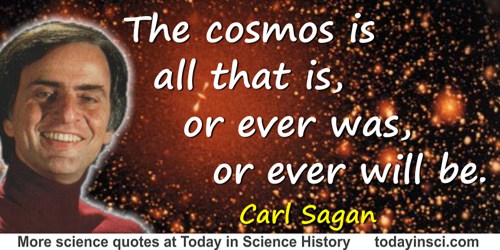
The cosmos is all that is, or ever was, or ever will be.
— Carl Sagan
Opening statement from 'The Shores of the Cosmic Ocean', episode 1, TV series, Cosmos (1980). Also in Cosmos (1980, 1985), 4.
The cure for a fallacious argument is a better argument, not the suppression of ideas.
— Carl Sagan
The Demon Haunted World: Science as a Candle in the Dark (1997), 429.
The deflation of some of our more common conceits is one of the practical applications of astronomy.
— Carl Sagan
…...
The Earth is a very small stage in a vast cosmic arena. Think of the rivers of blood spilled by all those generals and emperors, so that, in glory and triumph, they could become the momentary masters of a fraction of a dot. Think of the endless cruelties visited by the inhabitants of one corner of this pixel on the scarcely distinguishable inhabitants of some other corner, how frequent their misunderstandings, how eager they are to kill one another, how fervent their hatreds.
— Carl Sagan
…...
The fact that some geniuses were laughed at does not imply that all who are laughed at are geniuses. They laughed at Columbus, they laughed at Fulton, they laughed at the Wright brothers. But they also laughed at Bozo the clown.
— Carl Sagan
In Broca’s Brain: Reflections on the Romance of Science (1980), 34.
The major religions on the Earth contradict each other left and right. You can’t all be correct. And what if all of you are wrong? It’s a possibility, you know. You must care about the truth, right? Well, the way to winnow through all the differing contentions is to be skeptical. I’m not any more skeptical about your religious beliefs than I am about every new scientific idea I hear about. But in my line of work, they’re called hypotheses, not inspiration and not revelation.
— Carl Sagan
Contact (1997), 162.
The method of science is tried and true. It is not perfect, it’s just the best we have. And to abandon it, with its skeptical protocols, is the pathway to a dark age.
— Carl Sagan
From a sound clip from CSICOP, now CSI (Committee for Skeptical Inquiry). If you know a more specific citation, please contact Webmaster.
The method of science, as stodgy and grumpy as it may seem, is far more important than the findings of science.
— Carl Sagan
In 'The Most Precious Thing', The Demon Haunted World: Science as a Candle in the Dark (1997), 26.
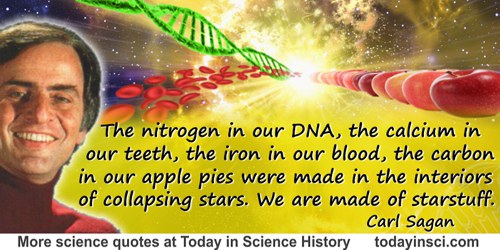
The nitrogen in our DNA, the calcium in our teeth, the iron in our blood, the carbon in our apple pies were made in the interiors of collapsing stars. We are made of starstuff.
— Carl Sagan
In Cosmos (1980), 233.

The nuclear arms race is like two sworn enemies standing waist deep in gasoline, one with three matches, the other with five.
[A summary version; not verbatim.]
[A summary version; not verbatim.]
— Carl Sagan
A summary version, as written by Kristen Ghodsee in Lost in Transition: Ethnographies of Everyday Life After Communism (2011), 2-3. Note the author states it as “I remember,” and the wording is not verbatim from Sagan's original remark made during a panel discussion in ABC News Viewpoint following the TV movie The Day After (20 Nov 1983). The verbatim quote is also on this page. It begins, “Imagine a room…”
The prediction of nuclear winter is drawn not, of course, from any direct experience with the consequences of global nuclear war, but rather from an investigation of the governing physics. (The problem does not lend itself to full experimental verification—at least not more than once.)[co-author with American atmospheric chemist Richard P. Turco (1943- )]
— Carl Sagan
A Path Where No Man Thought: Nuclear Winter and the End of the Arms Race (1990), 26.
The secrets of evolution are death and time—the deaths of enormous numbers of lifeforms that were imperfectly adapted to the environment; and time for a long succession of small mutations.
— Carl Sagan
Cosmos (1980, 1985), 20.
The size and age of the Cosmos are beyond ordinary human understanding. Lost somewhere between immensity and eternity is our tiny planetary home.
— Carl Sagan
Cosmos (1981), 4.
The suppression of uncomfortable ideas may be common in religion or in politics, but it is not the path to knowledge; it has no in the endeavor of science. We do not know in advance who will discover fundamental insights.
— Carl Sagan
In Cosmos (1985), 74.
The testimony of our common sense is suspect at high velocities.
— Carl Sagan
…...
The truth may be puzzling. It may take some work to grapple with. It may be counterintuitive. It may contradict deeply held prejudices. It may not be consonant with what we desperately want to be true. But our preferences do not determine what's true. We have a method, and that method helps us to reach not absolute truth, only asymptotic approaches to the truth—never there, just closer and closer, always finding vast new oceans of undiscovered possibilities. Cleverly designed experiments are the key.
— Carl Sagan
In 'Wonder and Skepticism', Skeptical Enquirer (Jan-Feb 1995), 19, No. 1.
The Universe forces those who live in it to understand it. Those creatures who find everyday experience a muddled jumble of events with no predictability, no regularity, are in grave peril. The Universe belongs to those who, at least to some degree, have figured it out.
— Carl Sagan
In Broca’s Brain: Reflections on the Romance of Science (1979, 1980), 19.
The universe is not required to be in perfect harmony with human ambition.
— Carl Sagan
…...
There are many hypotheses in science which are wrong. That’s perfectly all right; they’re the aperture to finding out what’s right. Science is a self-correcting process. To be accepted, new ideas must survive the most rigorous standards of evidence and scrutiny.
— Carl Sagan
Quoted in Donald R. Prothero and Carl Dennis Buell, Evolution: What the Fossils Say and Why it Matters (2007), 3.
There is a lurking fear that some things are “not meant” to be known, that some inquiries are too dangerous for human beings to make.
— Carl Sagan
In Broca’s Brain: Reflections of the Romance of Science (1979).
There is a place with four suns in the sky—red, white, blue, and yellow; two of them are so close together that they touch, and star-stuff flows between them. I know of a world with a million moons. I know of a sun the size of the Earth—and made of diamond. There are atomic nuclei a few miles across which rotate thirty times a second. There are tiny grains between the stars, with the size and atomic composition of bacteria. There are stars leaving the Milky Way, and immense gas clouds falling into it. There are turbulent plasmas writhing with X- and gamma-rays and mighty stellar explosions. There are, perhaps, places which are outside our universe. The universe is vast and awesome, and for the first time we are becoming a part of it.
— Carl Sagan
Opening paragraph, in 'Introduction' Planetary Exploration (1970), 15.
There is a reward structure in science that is very interesting: Our highest honors go to those who disprove the findings of the most revered among us. So Einstein is revered not just because he made so many fundamental contributions to science, but because he found an imperfection in the fundamental contribution of Isaac Newton.
— Carl Sagan
In 'Wonder and Skepticism', Skeptical Enquirer (Jan-Feb 1995), 19, No. 1.
There is another approach to the extraterrestrial hypothesis of UFO origins. This assessment depends on a large number of factors about which we know little, and a few about which we know literally nothing. I want to make some crude numerical estimate of the probability that we are frequently visited by extraterrestrial beings.
Now, there is a range of hypotheses that can be examined in such a way. Let me give a simple example: Consider the Santa Claus hypothesis, which maintains that, in a period of eight hours or so on December 24-25 of each year, an outsized elf visits one hundred million homes in the United States. This is an interesting and widely discussed hypothesis. Some strong emotions ride on it, and it is argued that at least it does no harm.
We can do some calculations. Suppose that the elf in question spends one second per house. This isn't quite the usual picture—“Ho, Ho, Ho,” and so on—but imagine that he is terribly efficient and very speedy; that would explain why nobody ever sees him very much-only one second per house, after all. With a hundred million houses he has to spend three years just filling stockings. I have assumed he spends no time at all in going from house to house. Even with relativistic reindeer, the time spent in a hundred million houses is three years and not eight hours. This is an example of hypothesis-testing independent of reindeer propulsion mechanisms or debates on the origins of elves. We examine the hypothesis itself, making very straightforward assumptions, and derive a result inconsistent with the hypothesis by many orders of magnitude. We would then suggest that the hypothesis is untenable.
We can make a similar examination, but with greater uncertainty, of the extraterrestrial hypothesis that holds that a wide range of UFOs viewed on the planet Earth are space vehicles from planets of other stars.
Now, there is a range of hypotheses that can be examined in such a way. Let me give a simple example: Consider the Santa Claus hypothesis, which maintains that, in a period of eight hours or so on December 24-25 of each year, an outsized elf visits one hundred million homes in the United States. This is an interesting and widely discussed hypothesis. Some strong emotions ride on it, and it is argued that at least it does no harm.
We can do some calculations. Suppose that the elf in question spends one second per house. This isn't quite the usual picture—“Ho, Ho, Ho,” and so on—but imagine that he is terribly efficient and very speedy; that would explain why nobody ever sees him very much-only one second per house, after all. With a hundred million houses he has to spend three years just filling stockings. I have assumed he spends no time at all in going from house to house. Even with relativistic reindeer, the time spent in a hundred million houses is three years and not eight hours. This is an example of hypothesis-testing independent of reindeer propulsion mechanisms or debates on the origins of elves. We examine the hypothesis itself, making very straightforward assumptions, and derive a result inconsistent with the hypothesis by many orders of magnitude. We would then suggest that the hypothesis is untenable.
We can make a similar examination, but with greater uncertainty, of the extraterrestrial hypothesis that holds that a wide range of UFOs viewed on the planet Earth are space vehicles from planets of other stars.
— Carl Sagan
The Cosmic Connection: An Extraterrestrial Perspective (1973), 200.
There is much about which even experts are ignorant; this will probably always be the case.
— Carl Sagan
In 'With Science on Our Side', Washington Post (9 Jan 1994).
Think of how many religions attempt to validate themselves with prophecy. Think of how many people rely on these prophecies, however vague, however unfulfilled, to support or prop up their beliefs. Yet has there ever been a religion with the prophetic accuracy and reliability of science? ... No other human institution comes close.
— Carl Sagan
The Demon-Haunted World: Science as a Candle in the Dark (1997), 30.
Those afraid of the universe as it really is, those who pretend to nonexistent knowledge and envision a Cosmos centered on human beings will prefer the fleeting comforts of superstition. They avoid rather than confront the world. But those with the courage to explore the weave and structure of the Cosmos, even where it differs profoundly from their wishes and prejudices, will penetrate its deepest mysteries.
— Carl Sagan
Cosmos (1985), 275.
Too much openness and you accept every notion, idea, and hypothesis—which is tantamount to knowing nothing. Too much skepticism—especially rejection of new ideas before they are adequately tested—and you're not only unpleasantly grumpy, but also closed to the advance of science. A judicious mix is what we need.
— Carl Sagan
In 'Wonder and Skepticism', Skeptical Enquirer (Jan-Feb 1995), 19, No. 1.
We are a way for the cosmos to know itself.
— Carl Sagan
From Carl Sagan's narration on a promotional video for the television series Cosmos.
We are like the inhabitants of an isolated valley in New Guinea who communicate with societies in neighboring valleys (quite different societies, I might add) by runner and by drum. When asked how a very advanced society will communicate, they might guess by an extremely rapid runner or by an improbably large drum. They might not guess a technology beyond their ken. And yet, all the while, a vast international cable and radio traffic passes over them, around them, and through them... We will listen for the interstellar drums, but we will miss the interstellar cables. We are likely to receive our first messages from the drummers of the neighboring galactic valleys - from civilizations only somewhat in our future. The civilizations vastly more advanced than we, will be, for a long time, remote both in distance and in accessibility. At a future time of vigorous interstellar radio traffic, the very advanced civilizations may be, for us, still insubstantial legends.
— Carl Sagan
…...
We are made of starstuff.
— Carl Sagan
Cosmos (1980), 190.
We are one species.
We are starstuff.
We are starstuff.
— Carl Sagan
…...
We live in a society absolutely dependent on science and technology and yet have cleverly arranged things so that almost no one understands science and technology. That’s a clear prescription for disaster.
— Carl Sagan
From interview with Anne Kalosh in her article 'Bringing Science Down to Earth', in Hemispheres (Oct 1994), 99. Collected and cited in Tom Head (ed.), Conversations with Carl Sagan (2006), 100. This was Sagan’s answer to her question, “How does not understanding science cripple people in their daily lives.”
We live in a society exquisitely dependent on science and technology, in which hardly anyone knows anything about science and technology.
— Carl Sagan
In 'Why We Need To Understand Science', The Skeptical Inquirer (Spring 1990), 14, No. 3.
We live on an obscure hunk of rock and metal circling a humdrum sun, which is on the outskirts of a perfectly ordinary galaxy comprised of 400 billion other suns, which, in turn, is one of some hundred billion galaxies that make up the universe, which, current thinking suggests, is one of a huge number—perhaps an infinite number—of other closed-off universes. From that perspective, the idea that we’re at the center, that we have some cosmic importance, is ludicrous.
— Carl Sagan
From interview with Linda Obst in her article 'Valentine to Science', in Interview (Feb 1996). Quoted and cited in Tom Head (ed.), Conversations with Carl Sagan (2006), ix, and cited on p.xix.
We’ve arranged a global civilization in which most critical elements profoundly depend on science and technology. We have also arranged things so that almost no one understands science and technology. This is a prescription for disaster. We might get away with it for a while, but sooner or later this combustible mixture of ignorance and power is going to blow up in our faces.
— Carl Sagan
From The Demon-Haunted World: Science as a Candle in the Dark (1996), 26.
What a splendid perspective contact with a profoundly different civilization might provide! In a cosmic setting vast and old beyond ordinary human understanding we are a little lonely, and we ponder the ultimate significance, if any, of our tiny but exquisite blue planet, the Earth… In the deepest sense the search for extraterrestrial intelligence is a search for ourselves.
— Carl Sagan
…...
What does it mean for a civilisation to be a million years old? We have had radio telescopes and spaceships for a few decades; our technical civilisation is a few hundred years old … an advanced civilisation millions of years old is as much beyond us as we are beyond a bushbaby or a macaque
— Carl Sagan
'Star Makers', Cosmos (Feb 2006).
Wherever possible, scientists experiment. Which experiments suggest themselves often depends on which theories currently prevail. Scientists are intent of testing those theories to the breaking point. They do not trust what is intuitively obvious. That the Earth is flat was once obvious. That heavy bodies fall faster than light ones was once obvious. That bloodsucking leeches cure most diseases was once obvious. That some people are naturally and by divine decree slaves was once obvious. That there is such a place as the center of the Universe, and that the Earth sits in that exalted spot was once obvious. That there is an absolute standard of rest was once obvious. The truth may be puzzling or counterintuitive. It may contradict deeply held beliefs. Experiment is how we get a handle on it.
— Carl Sagan
In The Demon-Haunted World: Science As A Candle in the Dark (1995), 36.
While our behavior is still significantly controlled by our genetic inheritance, we have, through our brains, a much richer opportunity to blaze new behavioral and cultural pathways on short timescales.
— Carl Sagan
The Dragons of Eden: Speculations on the Evolution of Human Intelligence (1977, 1986), 3.
Who are we? We find that we live on an insignificant planet of a humdrum star lost between two spiral arms in the outskirts of a galaxy, tucked away in some forgotten corner of a universe in which there are far more galaxies than people.
— Carl Sagan
Cosmos (1985), 160.
Who is running the science and technology in a democracy if the people don’t know anything about it?
— Carl Sagan
From transcript of interview on PBS TV show, Charlie Rose (27 May 1996). On Charlie Rose website.
Widespread intellectual and moral docility may be convenient for leaders in the short term, but it is suicidal for nations in the long term. One of the criteria for national leadership should therefore be a talent for understanding, encouraging, and making constructive use of vigorous criticism.
— Carl Sagan
Billions and Billions: Thoughts on Life and Death at the Brink of the Millenium (1998), 189.
Quotes by others about Carl Sagan (1)
Global nuclear war could have a major impact on climate—manifested by significant surface darkening over many weeks, subfreezing land temperatures persisting for up to several months, large perturbations in global circulation patterns, and dramatic changes in local weather and precipitation rates—a harsh “nuclear winter” in any season. [Co-author with Carl Sagan]
In 'Nuclear Winter: Global Consequences of Multiple Nuclear Explosions', Science (1983), 222, 1290.

See also:
- 9 Nov - short biography, births, deaths and events on date of Sagan's birth.
- Carl Sagan - context of quote “Advances in medicine and agriculture” - Medium image (500 x 250 px)
- Carl Sagan - context of quote “Advances in medicine and agriculture” - Large image (800 x 400 px)
- Carl Sagan - context of quote A Subject Called Chemistry - Medium image (500 x 350 px)
- Carl Sagan - context of quote A Subject Called Chemistry - Large image (800 x 600 px)
- Carl Sagan: A Life in the Cosmos, by William Poundstone. - book suggestion.
- Booklist for Carl Sagan.




