 (source)
|
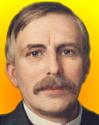
Sir Ernest Rutherford
(30 Aug 1871 - 19 Oct 1937)
New Zealand-English physicist who laid the groundwork for the development of nuclear physics. He identified alpha, beta and gamma emissions during radioactive decay, and devised the alpha-particle scattering experiment that led to the discovery of the atomic nucleus.
|
Science Quotes by Sir Ernest Rutherford (38 quotes)
>> Click for Sir Ernest Rutherford Quotes on | Discovery |
>> Click for Sir Ernest Rutherford Quotes on | Discovery |
![Ernest Rutherford quote: [From uranium] there are present at least two distinct types of radiation](https://todayinsci.com/R/Rutherford_Ernest/RutherfordErnest-AlphaBeta500x250px.jpg)
[From uranium] there are present at least two distinct types of radiation one that is very readily absorbed, which will be termed for convenience the α radiation, and the other of a more penetrative character, which will be termed the β radiation.
— Sir Ernest Rutherford
Originating the names for these two types of radiation. In 'Uranium Radiation and the Electrical Conduction Produced by It', Philosophical Magazine (1899), 47, 116.
[It] is not the nature of things for any one man to make a sudden, violent discovery; science goes step by step and every man depends on the work of his predecessors. When you hear of a sudden unexpected discovery—a bolt from the blue—you can always be sure that it has grown up by the influence of one man or another, and it is the mutual influence which makes the enormous possibility of scientific advance. Scientists are not dependent on the ideas of a single man, but on the combined wisdom of thousands of men, all thinking of the same problem and each doing his little bit to add to the great structure of knowledge which is gradually being erected.
— Sir Ernest Rutherford
Concluding remark in Lecture ii (1936) on 'Forty Years of Physics', revised and prepared for publication by J.A. Ratcliffe, collected in Needham and Pagel (eds.), Background to Modern Science: Ten Lectures at Cambridge Arranged by the History of Science Committee, (1938), 73-74. Note that the words as prepared for publication may not be verbatim as spoken in the original lecture by the then late Lord Rutherford.
~~[Attributed without source; Very dubious]~~ You should never bet against anything in science at odds of more than about 10-12 to 1.
— Sir Ernest Rutherford
Often seen, virally spread, but always without a source citation. If you can provide a primary source, please contact Webmaster. Until then the quote should be regarded as not authenticated. The odds are seen variously expressed as “10-12”, “10 or 12”, “1012”, “10^12”, or “trillion”. [All this sloppiness makes the quote a very dubious one. —Webmaster.]
~~[Attributed without source]~~ A theory that you can’t explain to a bartender is probably no damn good.
— Sir Ernest Rutherford
Variant “…explain to a cleaning lady….” Often seen, virally spread, but always without a source citation. If you can provide a primary source, please contact Webmaster. Until then the quote should be regarded as not authenticated.
~~[Attributed without source]~~ All of physics is either impossible or trivial. It is impossible until you understand it, and then it becomes trivial.
— Sir Ernest Rutherford
Often seen, virally spread, but always without a source citation. If you can provide a primary source, please contact Webmaster. Until then the quote should be regarded as not authenticated.
~~[Attributed without source]~~ All scientific men will be delighted to extend their warmest congratulations to Tesla and to express their appreciation of his great contributions to science.
— Sir Ernest Rutherford
Often seen, virally spread, but always without a source citation. If you can provide a primary source, please contact Webmaster. Until then the quote should be regarded as not authenticated.
~~[Attributed without source]~~ I have broken the machine (the atom) and touched the ghost of matter.
— Sir Ernest Rutherford
Often seen, virally spread, but always without a source citation. If you can provide a primary source, please contact Webmaster. Until then the quote should be regarded as not authenticated.
~~[Attributed without source]~~ If your result needs a statistician then you should design a better experiment.
— Sir Ernest Rutherford
Often seen, virally spread, but always without a source citation. If you can provide a primary source, please contact Webmaster. Until then the quote should be regarded as not authenticated.
~~[Attributed without source]~~ In science there is only physics; all the rest is stamp collecting.
— Sir Ernest Rutherford
Often seen, virally spread in several variants, but always without a source citation. If you can provide a primary source, please contact Webmaster. Until then the quote should be regarded as not authenticated. See the discussion on the quoteinvestigator.com site, which could only trace an early example which had no quote marks, given only in narrative form, in John Desmond Bernal, The Social Function of Science (1939), 9.
~~[Attributed without source]~~ That man is an Euclidian point: position without substance.
— Sir Ernest Rutherford
Often seen, virally spread, but always without a source citation. If you can provide a primary source, please contact Webmaster. Until then the quote should be regarded as not authenticated.
~~[Attributed without source]~~ That which is not measurable is not science. That which is not PHYSICS is stamp collecting.
— Sir Ernest Rutherford
Often seen, virally spread, but always without a source citation. If you can provide a primary source, please contact Webmaster. Until then the quote should be regarded as not authenticated.
~~[Attributed without source]~~ The more physics you have the less engineering you need.
— Sir Ernest Rutherford
Often seen, virally spread, but always without a source citation. If you can provide a primary source, please contact Webmaster. Until then the quote should be regarded as not authenticated.
~~[Attributed without source]~~ The only possible conclusion the social sciences can draw is: some do, some don’t.
— Sir Ernest Rutherford
Often seen, virally spread, but always without a source citation. If you can provide a primary source, please contact Webmaster. Until then the quote should be regarded as not authenticated.
~~[No known primary source]~~ If your experiment needs statistics, you ought to have done a better experiment.
— Sir Ernest Rutherford
As quoted, without citation in 'Preface', Norman T.J. Bailey the Mathematical Approach to Biology and Medicine (1967, 1989), v. Also in revised book, Norman T. J. Bailey, Mathematics, Statistics, and Systems for Health (1977), 51. Webmaster has so far found no primary source for verification (Can you help?)
All science is either physics or stamp collecting.
— Sir Ernest Rutherford
Quoted in J. B. Birks, Rutherford at Manchester (1962), 108, without citation. Webmaster has not been able to find any earlier example of the quote in print. If you know a primary print source, or very early reference to this quote, please contact the Webmaster. If—a strong if—truly a Rutherford quote, and such a snappy one, surely it should have been better documented from decades earlier?
Don’t let me catch anyone talking about the Universe in my department.
— Sir Ernest Rutherford
Quoted in Sage: A Life of J. D. Bernal (1980), 160.
Gentlemen, now you will see that now you see nothing. And why you see nothing you will see presently.
— Sir Ernest Rutherford
Quoted in R. Oesper, The Human Side of Scientists (1975), 164.
I am a great believer in the simplicity of things and as you probably know I am inclined to hang on to broad & simple ideas like grim death until evidence is too strong for my tenacity.
— Sir Ernest Rutherford
Letter to Irving Langmuir (10 Jun 1919). Quoted in Nathan Reingold and Ida H. Reingold, Science in America: A Documentary History 1900-1939 (1981), 354.
I came into the room, which was half dark, and presently spotted Lord Kelvin in the audience and realised that I was in for trouble at the last part of my speech dealing with the age of the earth, where my views conflicted with his. To my relief, Kelvin fell fast asleep, but as I came to the important point, I saw the old bird sit up, open an eye and cock a baleful glance at me! Then a sudden inspiration came, and I said Lord Kelvin had limited the age of the earth, provided no new source was discovered. That prophetic utterance refers to what we are now considering tonight, radium! Behold! the old boy beamed upon me.
— Sir Ernest Rutherford
The italicized phrase refers to “no new source” of energy. Concerning a Lecture by Rutherford, at the Royal Institution, dealing with the energy of subterranean radium, which had an effect prolonging the heat of the Earth. Arthur S. Eve wrote that Rutherford “used to tell humorous stories about this lecture long afterwards:” — followed by the subject quote above, as its own paragraph. As given in Arthur S. Eve, Rutherford: Being the Life and Letters of the Rt. Hon. Lord Rutherford, O.M. (1939), 107. The story lacks quotation marks, and thus should be regarded as perhaps Eve’s own words giving a faithful recollection, rather than Rutherford’s verbatim words. (However, note that the style used throughout the book is to omit quotation marks from their own separate paragraph.)
I have to keep going, as there are always people on my track. I have to publish my present work as rapidly as possible in order to keep in the race. The best sprinters in this road of investigation are Becquerel and the Curies...
— Sir Ernest Rutherford
Letter to his mother (5 Jan1902). Quoted in A. S. Eve, Rutherford: Being the Life and Letters of the Rt. Hon. Lord Rutherford (1939), 80. In Laurie M. Brown, Abraham Pais and A. B. Pippard, Twentieth Century Physics (1995), 58.
I think a strong claim can be made that the process of scientific discovery may be regarded as a form of art. This is best seen in the theoretical aspects of Physical Science. The mathematical theorist builds up on certain assumptions and according to well understood logical rules, step by step, a stately edifice, while his imaginative power brings out clearly the hidden relations between its parts. A well constructed theory is in some respects undoubtedly an artistic production. A fine example is the famous Kinetic Theory of Maxwell. ... The theory of relativity by Einstein, quite apart from any question of its validity, cannot but be regarded as a magnificent work of art.
Responding to the toast, 'Science!' at the Royal Academy of the Arts in 1932.)
Responding to the toast, 'Science!' at the Royal Academy of the Arts in 1932.)
— Sir Ernest Rutherford
Quoted in Lawrence Badash, 'Ernest Rutherford and Theoretical Physics,' in Robert Kargon and Peter Achinstein (eds.) Kelvin's Baltimore Lectures and Modern Theoretical Physics: Historical and Philosophical Perspectives (1987), 352.
I’ve just been reading some of my early papers and, you know, when I’d finished, I said to myself, ‘Rutherford, my boy, you used to be a damned clever fellow.’
— Sir Ernest Rutherford
To Sir Henry Tizzard. Epigraph, without source, in Barbara Lovett Cline, The Questioners: Physicists and the Quantum Theory (1965), 6.
If, as I have reason to believe, I have disintegrated the nucleus of the atom, this is of greater significance than the war.
[Apology to the international anti-submarine committee for being absent from several meetings during World War I.]
[Apology to the international anti-submarine committee for being absent from several meetings during World War I.]
— Sir Ernest Rutherford
(Jun 1919). Quoted in D. Wilson, Rutherford: Simple Genius (1983), 405, as cited in Laurie M. Brown, Abraham Pais, Brian Pippard, Twentieth Century Physics (1995), Vol. 1, 113.
In the light of [current research on atomic structure] the physicists have, I think, some justification for their faith that they are building on the solid rock of fact, and not, as we are often so solemnly warned by some of our scientific brethren, on the shifting sands of imaginative hypothesis.
— Sir Ernest Rutherford
From Opening Address to the Mathematics and Physics Section at the Annual Meeting of the British Association for the Advancement of Science, Winnipeg. Collected in 'The British Association at Winnipeg', Nature (26 Aug 1909), 81. No. 2078, 263.
It is essential for men of science to take an interest in the administration of their own affairs or else the professional civil servant will step in—and then the Lord help you.
— Sir Ernest Rutherford
In Bulletin of the Institute of Physics, 1950.
It was quite the most incredible event that has ever happened to me in my life. It was almost as incredible as if you fired a 15-inch shell at a piece of tissue paper and it came back and hit you.
[Recalling in 1936 the discovery of the nucleus in 1909, when some alpha particles were observed instead of travelling through a very thin gold foil were seen to rebound backward, as if striking something much more massive than the particles themselves.]
[Recalling in 1936 the discovery of the nucleus in 1909, when some alpha particles were observed instead of travelling through a very thin gold foil were seen to rebound backward, as if striking something much more massive than the particles themselves.]
— Sir Ernest Rutherford
Quoted in Abraham Pais, Inward Bound (1986), 189, from E. N. da C. Andrade, Rutherford and the nature of the atom, (1964) 111.
Now I know what the atom looks like.
— Sir Ernest Rutherford
Telling news of experimental news from the gold foil experiment, to Hans Geiger, early in 1911. Quoted, without source, in Barbara Lovett Cline, The Questioners: Physicists and the Quantum Theory (1965), 6.
Should a young scientist working with me come to me after two years of such work and ask me what to do next, I would advise him to get out of science. After two years of work, if a man does not know what to do next, he will never make a real scientist.
— Sir Ernest Rutherford
Quoted in Ralph Oesper, The Human Side of Scientists (1975), 165.
The discovery [of the neutron] is of the greatest interest and importance—possibly the greatest since the artificial disintegration of the atom.
— Sir Ernest Rutherford
In 'Discovers Neutron, Embryonic Matter', New York Times (28 Feb 1932), 1. James Chadwick’s announcement of the discovery of the neutron in a Letter to the Editor in Nature was published the day before.
The energy produced by the breaking down of the atom is a very poor kind of thing. Anyone who expects a source of power from transformation of these atoms is talking moonshine. … We hope in the next few years to get some idea of what these atoms are, how they are made, and the way they are worked.
— Sir Ernest Rutherford
Address at Leicester (11 Sep 1933), reported in The Times (12 Sep 1933). Also cited as 'Atom Powered World Absurd, Scientists Told: Lord Rutherford Scoffs at Theory of Harnessing Energy in Laboratories', New York Herald Tribune (12 Sep 1933), in Jacqueline D. Spears and Dean Zollman, The Fascination of Physics, (1985), 508.
The great object is to find the theory of the matter [of X-rays] before anyone else, for nearly every professor in Europe is now on the warpath.
— Sir Ernest Rutherford
In Letter to Mary Newton (28 Jan 1896), collected in Arthur Stewart Eve, Rutherford: Being the Life and Letters of the Rt. Hon. Lord Rutherford, O.M. (1939), 25.
The more the subject is examined the more complex must we suppose the constitution of matter in order to explain the remarkable effects observed.
— Sir Ernest Rutherford
In Radio-activity (1905), 1.
The study of the radio-active substances and of the discharge of electricity through gases has supplied very strong experimental evidence in support of the fundamental ideas of the existing atomic theory. It has also indicated that the atom itself is not the smallest unit of matter, but is a complicated structure made up of a number of smaller bodies.
— Sir Ernest Rutherford
In Radio-activity (1905), 1.
The year 1896 … marked the beginning of what has been aptly termed the heroic age of Physical Science. Never before in the history of physics has there been witnessed such a period of intense activity when discoveries of fundamental importance have followed one another with such bewildering rapidity.
— Sir Ernest Rutherford
In 'The Electrical Structure of Matter', Reports of the British Association for the Advancement of Science (1924), C2.
We are rather like children, who must take a watch to pieces to see how it works.
— Sir Ernest Rutherford
Explaining to a Daily Herald reporter why he wanted to disintegrate nuclei, as quoted in Freeman Dyson, 'Seeing the Unseen', The New York Review of Books (24 Feb 2005), collected in The Scientist as Rebel (2006), 249.
We have seen that a proton of energy corresponding to 30,000 volts can effect the transformation of lithium into two fast α-particles, which together have an energy equivalent of more than 16 million volts. Considering the individual process, the output of energy in the transmutation is more than 500 times greater than the energy carried by the proton. There is thus a great gain of energy in the single transmutation, but we must not forget that on an average more than 1000 million protons of equal energy must be fired into the lithium before one happens to hit and enter the lithium nucleus. It is clear in this case that on the whole the energy derived from transmutation of the atom is small compared with the energy of the bombarding particles. There thus seems to be little prospect that we can hope to obtain a new source of power by these processes. It has sometimes been suggested, from analogy with ordinary explosives, that the transmutation of one atom might cause the transmutation of a neighbouring nucleus, so that the explosion would spread throughout all the material. If this were true, we should long ago have had a gigantic explosion in our laboratories with no one remaining to tell the tale. The absence of these accidents indicates, as we should expect, that the explosion is confined to the individual nucleus and does not spread to the neighbouring nuclei, which may be regarded as relatively far removed from the centre of the explosion.
— Sir Ernest Rutherford
The Transmutation of the Atom (1933), 23-4
We haven’t the money, so we’ve got to think.
— Sir Ernest Rutherford
Quoted, without source, by R. V. Jones, 'Science, Technology, and Civilization', Bulletin of the Institute of Physics (1962), 13, No.4, 102. The context gives nothing specific to verify that these are the actual words of Rutherford. However, the article at least gives proof that the quote was current as early as 1962, perhaps passed through the decades by word of mouth. See the context in a longer excerpt on this site’s Ernest Rutherford Quotations webpage, beginning, “I do not…”.
You know, I am sorry for the poor fellows that haven’t got labs to work in.
— Sir Ernest Rutherford
Remark addressed to H.R. Robinson, recorded by Robinson in 'Personal Reminiscences of the Manchester Period', collected in J.B. Birks, Rutherford at Manchester (1962), 77.
Quotes by others about Sir Ernest Rutherford (17)
Most of the scientists in their twenties and thirties who went in 1939 to work on wartime problems were profoundly affected by their experience. The belief that Rutherford's boys were the best boys, that we could do anything that was do-able and could master any subject in a few days was of enormous value.
'The Effect of World War II on the Development of Knowledge in the Physical Sciences', Proceedings of the Royal Society of London, 1975, Series A, 342, 531.
But no Anglo-Saxon can understand relativity.
Said at a dinner in 1910, teasing Ernest Rutherford, who replied, 'No, they have too much sense.'
Said at a dinner in 1910, teasing Ernest Rutherford, who replied, 'No, they have too much sense.'
Quoted in Richard Reeves, A Force of Nature: The Frontier Genius of Ernest Rutherford (2007), 66.
[Ernest Rutherford is]...a second Newton.
Weizmann
Einstein ... always spoke to me of Rutherford in the highest terms, calling him a second Newton.
Trial and Error: The Autobiography of Chaim Weizman (1949), 118. Quoted in A Force of Nature: The Frontier Genius of Ernest Rutherford (2007), 65-66.
As scientists the two men were contrasting types—Einstein all calculation, Rutherford all experiment ... There was no doubt that as an experimenter Rutherford was a genius, one of the greatest. He worked by intuition and everything he touched turned to gold. He had a sixth sense.
(Reminiscence comparing his friend, Ernest Rutherford, with Albert Einstein, whom he also knew.)
(Reminiscence comparing his friend, Ernest Rutherford, with Albert Einstein, whom he also knew.)
Trial and Error: The Autobiography of Chaim Weizman (1949), 118. Quoted in A Force of Nature: The Frontier Genius of Ernest Rutherford (2007), 65-66.
They were very different men. Or boys. Someone said they were both like curious children—Einstein the merry boy, Rutherford the boisterous one. They were looking and working in different directions—Einstein looking outward, rather dreamily trying to discover where we came from, and Rutherford drilling deep to discover what we were.
A Force of Nature: The Frontier Genius of Ernest Rutherford (2007), 66.
His work was so great that it cannot be compassed in a few words. His death is one of the greatest losses ever to occur to British science.
Describing Ernest Rutherford upon his death at age 66. Thomson, then 80 years old, was once his teacher.
Describing Ernest Rutherford upon his death at age 66. Thomson, then 80 years old, was once his teacher.
Quoted in Time Magazine (1 Nov 1937).
The year that Rutherford died (1938 [sic]) there disappeared forever the happy days of free scientific work which gave us such delight in our youth. Science has lost her freedom. Science has become a productive force. She has become rich but she has become enslaved and part of her is veiled in secrecy. I do not know whether Rutherford would continue to joke and laugh as he used to.
'Notes from Here and There', Science Policy News (1969), 1, No 2, 33.
When I hear to-day protests against the Bolshevism of modern science and regrets for the old-established order, I am inclined to think that Rutherford, not Einstein, is the real villain of the piece. When we compare the universe as it is now supposed to be with the universe as we had ordinarily preconceived it, the most arresting change is not the rearrangement of space and time by Einstein but the dissolution of all that we regard as most solid into tiny specks floating in void. That gives an abrupt jar to those who think that things are more or less what they seem. The revelation by modern physics of the void within the atom is more disturbing than the revelation by astronomy of the immense void of interstellar space.
In The Nature of the Physical World (1928, 2005), 1.
There was, I think, a feeling that the best science was that done in the simplest way. In experimental work, as in mathematics, there was “style” and a result obtained with simple equipment was more elegant than one obtained with complicated apparatus, just as a mathematical proof derived neatly was better than one involving laborious calculations. Rutherford's first disintegration experiment, and Chadwick's discovery of the neutron had a “style” that is different from that of experiments made with giant accelerators.
From 'Physics in a University Laboratory Before and After World War II', Proceedings of the Royal Society of London, Series A, (1975), 342, 463. As cited in Alan McComas, Galvani's Spark: The Story of the Nerve Impulse (2011), 107.
No scientist or student of science, need ever read an original work of the past. As a general rule, he does not think of doing so. Rutherford was one of the greatest experimental physicists, but no nuclear scientist today would study his researches of fifty years ago. Their substance has all been infused into the common agreement, the textbooks, the contemporary papers, the living present.
Attempting to distinguish between science and the humanities in which original works like Shakespeare's must be studied verbatim. 'The Case of Leavis and the Serious Case', (1970), reprinted in Public Affairs (1971), 94.
The advanced course in physics began with Rutherford’s lectures. I was the only woman student who attended them and the regulations required that women should sit by themselves in the front row. There had been a time when a chaperone was necessary but mercifully that day was past. At every lecture Rutherford would gaze at me pointedly, as I sat by myself under his very nose, and would begin in his stentorian voice: “Ladies and Gentlemen”. All the boys regularly greeted this witticism with thunderous applause, stamping with their feet in the traditional manner, and at every lecture I wished I could sink into the earth. To this day I instinctively take my place as far back as possible in a lecture room.
In Cecilia Payne-Gaposchkin: An Autobiography and Other Recollections (1996), 118.
We then got to Westminster Abbey and, moving about unguided, we found the graves of Newton, Rutherford, Darwin, Faraday, and Maxwell in a cluster.
(1980). In Isaac Asimov’s Book of Science and Nature Quotations (1988), 294.
Rutherford was as straightforward and unpretentious as a physicist as he was elsewhere in life, and that no doubt was one of the secrets of his success. “I was always a believer in simplicity, being a simple man myself,” he said. If a principle of physics could not be explained to a barmaid, he insisted, the problem was with the principle, not the barmaid.
In Great Physicists (2001), 328.
As regards the co-ordination of all ordinary properties of matter, Rutherford’s model of the atom puts before us a task reminiscent of the old dream of philosophers: to reduce the interpretation of the laws of nature to the consideration of pure numbers.
In Faraday Lecture (1930), Journal of the Chemical Society (Feb 1932), 349. As quoted and cited in Chen Ning Yang, Elementary Particles (1961), 7.
Some one once asked Rutherford how it was that he always managed to keep on the crest of the wave. “Well” said Rutherford “that isn’t difficult. I made the wave, why shouldn’t I be at the top of it.” I hasten to say that my own subject is a very minor ripple compared to Rutherford’s.
From Speech (10 Dec 1963) at the Nobel Banquet in Stockholm, Sweden. Collected inGöran Liljestrand (ed.), Les Prix Nobel en 1963, (1964).
Dear Professor Rutherford, We students of our university physics club elect you our honorary president because you proved that atoms have balls.
In Letter (10 Oct 1929) received from students in Rostow na Donu, USSR, asking Ernest Rutherford USSR to become honorary president of their physics club. As quoted in George Gamow, My World Line: An Informal Autobiography (1970), 77-78. Gamow explained to Rutherford that the phrases for atomic “nucleus” and “cannonball” shared the use of the word “iadro” in Russian. The students had made faulty use of their Russian-English dictionary, but they were aware of Rutherford’s gold foil experiment. [Peter Atkins may have repeated the anecdote somewhere, but he did not originate it, yet the quote is seen attributed to him around the Web. —Webmaster]
![Ernest Rutherford quote: [From uranium] there are present at least two distinct types of radiation](https://todayinsci.com/R/Rutherford_Ernest/RutherfordErnest-AlphaBetaThm.jpg)
See also:
- 30 Aug - short biography, births, deaths and events on date of Rutherford's birth.
- A Force of Nature: The Frontier Genius of Ernest Rutherford, by Richard Reeves. - book suggestion.
- Booklist for Ernest Rutherford.
 In science it often happens that scientists say, 'You know that's a really good argument; my position is mistaken,' and then they would actually change their minds and you never hear that old view from them again. They really do it. It doesn't happen as often as it should, because scientists are human and change is sometimes painful. But it happens every day. I cannot recall the last time something like that happened in politics or religion.
(1987) --
In science it often happens that scientists say, 'You know that's a really good argument; my position is mistaken,' and then they would actually change their minds and you never hear that old view from them again. They really do it. It doesn't happen as often as it should, because scientists are human and change is sometimes painful. But it happens every day. I cannot recall the last time something like that happened in politics or religion.
(1987) -- 





