 (source)
|
Bertrand Russell
(18 May 1872 - 2 Feb 1970)
Welsh mathematician, logician and philosopher known for his work in mathematical logic, but was also active in social and political campaigns, advocating pacifism and nuclear disarmament.
|
Science Quotes by Bertrand Russell (189 quotes)
>> Click for Bertrand Russell Quotes on | Achievement | Aristotle | Arithmetic | Belief | Certainty | Difference | Error | Fact | Knowledge | Law | Life | Logic | Mathematics | Method | Mind | Mistake | Observation | Philosopher | Philosophy | Power | Science | Science And Religion | Scientific Method | Truth |
>> Click for Bertrand Russell Quotes on | Achievement | Aristotle | Arithmetic | Belief | Certainty | Difference | Error | Fact | Knowledge | Law | Life | Logic | Mathematics | Method | Mind | Mistake | Observation | Philosopher | Philosophy | Power | Science | Science And Religion | Scientific Method | Truth |
[Man] … his origin, his growth, his hopes and fears, his loves and his beliefs are but the outcome of accidental collocations of atoms; that no fire, no heroism, no intensity of thought and feeling can preserve an individual life beyond the grave; that all the labour of the ages, all the devotion, all the inspiration, all the noonday brightness of human genius are destined to extinction in the vast death of the solar system, and that the whole temple of Man's achievement must inevitably be buried beneath the debris of a universe in ruins…
— Bertrand Russell
From 'A Free Man's Worship', Independent Review (Dec 1903). Collected in Mysticism and Logic: And Other Essays (1918), 47-48.
A book should have either intelligibility or correctness; to combine the two is impossible, but to lack both is to be unworthy of a place as Euclid has occupied in education.
— Bertrand Russell
In essay, 'Mathematics and the Metaphysicians' (1901), collected in Mysticism and Logic: And Other Essays (1917), 73. The essay was also published as 'Recent Work in the Philosophy of Mathematics', in the American magazine, International Monthly.
A fact, in science, is not a mere fact, but an instance.
— Bertrand Russell
In The Scientific Outlook (1931, 2009), 38.
A good notation has a subtlety and suggestiveness which at times make it almost seem like a live teacher. … a perfect notation would be a substitute for thought.
— Bertrand Russell
In 'Introduction' by Bertrand Russell written for Ludwig Wittgenstein, Tractatus Logico-Philosophicus (1922), 17-18.
A habit of basing convictions upon evidence, and of giving to them only that degree or certainty which the evidence warrants, would, if it became general, cure most of the ills from which the world suffers.
— Bertrand Russell
In Bertrand Russell and Paul Edwards (ed.), 'Preface', Why I Am Not a Christian: And Other Essays on Religion and Related Subjects (1957), vi.
A hallucination is a fact, not an error; what is erroneous is a judgment based upon it.
— Bertrand Russell
The Monist (Apr 1914), 24:2, 173.
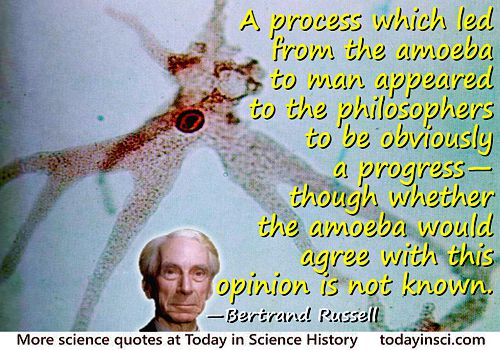
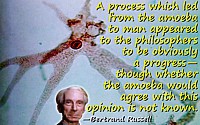
A process which led from the amoeba to man appeared to the philosophers to be obviously a progress—though whether the amoeba would agree with this opinion is not known.
— Bertrand Russell
From 'Current Tendencies', delivered as the first of a series of Lowell Lectures in Boston (Mar 1914). Collected in Our Knowledge of the External World (1914), 12.
A sense of duty is useful in work but offensive in personal relations.
— Bertrand Russell
In The Conquest of Happiness (1930), Chap. 9, 156.
A truer image of the world, I think, is obtained by picturing things as entering into the stream of time from an eternal world outside, than from a view which regards time as the devouring tyrant of all that is.
— Bertrand Russell
Essay, 'Mysticism and Logic' in Hibbert Journal (Jul 1914). Collected in Mysticism and Logic: And Other Essays (1919), 21.
All that passes for knowledge can be arranged in a hierarchy of degrees of certainty, with arithmetic and the facts of perception at the top.
— Bertrand Russell
From 'Philosophy For Laymen', collected in Unpopular Essays (1950, 1996), 39.
All the conditions of happiness are realized in the life of the man of science.
— Bertrand Russell
The Conquest of Happiness (1930), 146.
Almost all great advances have sprung originally from disinterested motives. Scientific discoveries have been made for their own sake and not for their utilization, and a race of men without a disinterested love of knowledge would never have achieved our present scientific technique. … Faraday, Maxwell, and Hertz, so far as can be discovered, never for a moment considered the possibility of any practical application of their investigations.
— Bertrand Russell
In The Scientific Outlook (1931), 152-153.
Almost everything that distinguishes the modern world from earlier centuries is attributable to science, which achieved its most spectacular triumphs in the seventeenth century.
— Bertrand Russell
In History of Western Philosophy (1979, 2004) 484.
Although this may seem a paradox, all exact science is dominated by the idea of approximation. When a man tells you that he knows the exact truth about anything, you are safe in infering that he is an inexact man. Every careful measurement in science is always given with the probable error ... every observer admits that he is likely wrong, and knows about how much wrong he is likely to be.
— Bertrand Russell
In The Scientific Outlook (1931, 2009), 42.
An extra-terrestrial philosopher, who had watched a single youth up to the age of twenty-one and had never come across any other human being, might conclude that it is the nature of human beings to grow continually taller and wiser in an indefinite progress towards perfection; and this generalization would be just as well founded as the generalization which evolutionists base upon the previous history of this planet.
— Bertrand Russell
Scientific Method in Philosophy (1914), 12.
Aristotle maintained that women have fewer teeth than men; although he was twice married, it never occurred to him to verify this statement by examining his wives' mouths.
— Bertrand Russell
In The Impact of Science on Society (1951), 7.
Aristotle, in spite of his reputation, is full of absurdities. He says that children should be conceived in the Winter, when the wind is in the North, and that if people marry too young the children will be female. He tells us that the blood of females is blacker then that of males; that the pig is the only animal liable to measles; that an elephant suffering from insomnia should have its shoulders rubbed with salt, olive-oil, and warm water; that women have fewer teeth than men, and so on. Nevertheless, he is considered by the great majority of philosophers a paragon of wisdom.
— Bertrand Russell
From An Outline of Intellectual Rubbish (1937, 1943), 19. Collected in The Basic Writings of Bertrand Russell (2009), 63.
Arithmetic must be discovered in just the same sense in which Columbus discovered the West Indies, and we no more create numbers than he created the Indians.
— Bertrand Russell
The Principles of Mathematics (1903), 451.
At first it seems obvious, but the more you think about it the stranger the deductions from this axiom seem to become; in the end you cease to understand what is meant by it.
— Bertrand Russell
As quoted, without citation, in Stories about Sets (1968), 84.
At the age of eleven, I began Euclid, with my brother as my tutor. ... I had not imagined that there was anything so delicious in the world. After I had learned the fifth proposition, my brother told me that it was generally considered difficult, but I had found no difficulty whatsoever. This was the first time it had dawned on me that I might have some intelligence.
— Bertrand Russell
In Autobiography: 1872-1914 (1967), Vol. 1, 37-38.
Bad philosophers may have a certain influence; good philosophers, never.
— Bertrand Russell
Uncertain attribution. Often seen, but Webmaster has not yet found this wording in a primary source, and remains uncertain that this is an actual Russell quote. It is included here to provide this caution. Contact Webmaster if you have more information.
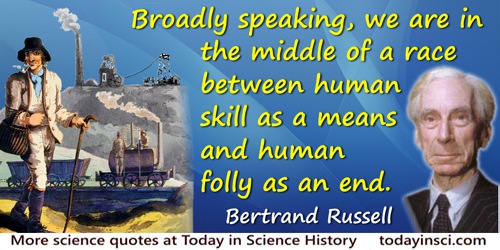
Broadly speaking, we are in the middle of a race between human skill as a means and human folly as an end.
— Bertrand Russell
In The Impact of Science on Society (1951), 97.
But it is just this characteristic of simplicity in the laws of nature hitherto discovered which it would be fallacious to generalize, for it is obvious that simplicity has been a part cause of their discovery, and can, therefore, give no ground for the supposition that other undiscovered laws are equally simple.
— Bertrand Russell
From Herbert Spencer lecture delivered at Oxford (1914) 'On Scientific Method in Philosophy', collected in Mysticism and Logic and Other Essays (1919), 102.
But, you might say, “none of this shakes my belief that 2 and 2 are 4.” You are quite right, except in marginal cases—and it is only in marginal cases that you are doubtful whether a certain animal is a dog or a certain length is less than a meter. Two must be two of something, and the proposition “2 and 2 are 4” is useless unless it can be applied. Two dogs and two dogs are certainly four dogs, but cases arise in which you are doubtful whether two of them are dogs. “Well, at any rate there are four animals,” you may say. But there are microorganisms concerning which it is doubtful whether they are animals or plants. “Well, then living organisms,” you say. But there are things of which it is doubtful whether they are living organisms or not. You will be driven into saying: “Two entities and two entities are four entities.” When you have told me what you mean by “entity,” we will resume the argument.
— Bertrand Russell
In Basic Writings, 1903-1959 (1961), 108.
Calculating machines do sums better than even the cleverest people… As arithmetic has grown easier, it has come to be less respected.
— Bertrand Russell
From An Outline of Intellectual Rubbish (1937, 1943), 5. Collected in The Basic Writings of Bertrand Russell (2009), 46.
Calculus required continuity, and continuity was supposed to require the infinitely little; but nobody could discover what the infinitely little might be.
— Bertrand Russell
In 'Recent Work on the Principles of Mathematics The International Monthly (Jul 1901), 4, No. 1, 90.
Can a society in which thought and technique are scientific persist for a long period, as, for example, ancient Egypt persisted, or does it necessarily contain within itself forces which must bring either decay or explosion?
— Bertrand Russell
The Impact of Science on Society (1951, 1985), 109.
Conventional people are roused to fury by departures from convention, largely because they regard such departures as a criticism of themselves.
— Bertrand Russell
In The Conquest of Happiness (3rd Ed. 1930), 131.
Descartes, the father of modern philosophy … would never—so he assures us—have been led to construct his philosophy if he had had only one teacher, for then he would have believed what he had been told; but, finding that his professors disagreed with each other, he was forced to conclude that no existing doctrine was certain.
— Bertrand Russell
From 'Philosophy For Laymen', collected in Unpopular Essays (1950, 1996), 57.
Do not fear to be eccentric in opinion, for every opinion now accepted was once eccentric.
— Bertrand Russell
…...
Education must be subversive if it is to be meaningful. By this I mean that it must challenge all the things we take for granted, examine all accepted assumptions, tamper with every sacred cow, and instil a desire to question and doubt.
— Bertrand Russell
As quoted, without citation, in Ronald William Clark, The Life of Bertrand Russell (1976), 423.
Even if the open windows of science at first make us shiver after the cozy indoor warmth of traditional humanizing myths, in the end the fresh air brings vigor, and the great spaces have a splendor of their own.
— Bertrand Russell
What I Believe (1925). In The Basic Writings of Bertrand Russell, 1903-1959 (1992), 370.
Even when the experts all agree, they may well be mistaken.
— Bertrand Russell
…...
Every living thing is a sort of imperialist, seeking to transform as much as possible of its environment into itself and its seed. When we compare the (present) human population of the globe with… that of former times, we see that “chemical imperialism” has been… the main end to which human intelligence has been devoted.
— Bertrand Russell
In 'Man and his Environment', An Outline of Philosophy (1927), 27.
Every proposition which we can understand must be composed wholly of constituents with which we are acquainted.
— Bertrand Russell
From 'Knowledge by Acquaintance', in Mysticism and Logic: And Other Essays (1918), 219.
Fear is the main source of superstition, and one of the main sources of cruelty. To conquer fear is the beginning of wisdom, in the pursuit of truth as in the endeavour after a worthy manner of life.
— Bertrand Russell
In An Outline of Intellectual Rubbish (1943), 23.
Frege has the merit of ... finding a third assertion by recognising the world of logic which is neither mental nor physical.
— Bertrand Russell
Our Knowledge of the External World (1914), 201.
Gradually, … the aspect of science as knowledge is being thrust into the background by the aspect of science as the power of manipulating nature. It is because science gives us the power of manipulating nature that it has more social importance than art. Science as the pursuit of truth is the equal, but not the superior, of art. Science as a technique, though it may have little intrinsic value, has a practical importance to which art cannot aspire.
— Bertrand Russell
In The Scientific Outlook (1931, 2009), xxiv.
I am afraid that education is conceived more in terms of indoctrination by most school officials than in terms of enlightenment.
— Bertrand Russell
As quoted, without citation, in Ronald William Clark, The Life of Bertrand Russell (1976), 423.
I am compelled to fear that science will be used to promote the power of dominant groups rather than to make men happy.
— Bertrand Russell
In Icarus, or the Future of Science (1924), 5.
I am paid by the word, so I always write the shortest words possible.
— Bertrand Russell
…...
I conclude that, while it is true that science cannot decide questions of value, that is because they cannot be intellectually decided at all, and lie outside the realm of truth and falsehood. Whatever knowledge is attainable, must be attained by scientific methods; and what science cannot discover, mankind cannot know.
— Bertrand Russell
Religion and Science (1935), 243.
I do not believe that science per se is an adequate source of happiness, nor do I think that my own scientific outlook has contributed very greatly to my own happiness, which I attribute to defecating twice a day with unfailing regularity. Science in itself appears to me neutral, that is to say, it increases men’s power whether for good or for evil. An appreciation of the ends of life is something which must be superadded to science if it is to bring happiness, but only the kind of society to which science is apt to give rise. I am afraid you may be disappointed that I am not more of an apostle of science, but as I grow older, and no doubt—as a result of the decay of my tissues, I begin to see the good life more and more as a matter of balance and to dread all over-emphasis upon anyone ingredient.
— Bertrand Russell
Letter to W. W. Norton, Publisher (27 Jan 1931). In The Autobiography of Bertrand Russell, 1914-1944 (1968), Vol. 2, 200.
I had at one time a very bad fever of which I almost died. In my fever I had a long consistent delirium. I dreamt that I was in Hell, and that Hell is a place full of all those happenings that are improbable but not impossible. The effects of this are curious. Some of the damned, when they first arrive below, imagine that they will beguile the tedium of eternity by games of cards. But they find this impossible, because, whenever a pack is shuffled, it comes out in perfect order, beginning with the Ace of Spades and ending with the King of Hearts. There is a special department of Hell for students of probability. In this department there are many typewriters and many monkeys. Every time that a monkey walks on a typewriter, it types by chance one of Shakespeare's sonnets. There is another place of torment for physicists. In this there are kettles and fires, but when the kettles are put on the fires, the water in them freezes. There are also stuffy rooms. But experience has taught the physicists never to open a window because, when they do, all the air rushes out and leaves the room a vacuum.
— Bertrand Russell
'The Metaphysician's Nightmare', Nightmares of Eminent Persons and Other Stories (1954), 38-9.
I ought to call myself an agnostic; but, for all practical purposes, I am an atheist. I do not think the existence of the Christian God any more probable than the existence of the Gods of Olympus or Valhalla. To take another illustration: nobody can prove that there is not between the Earth and Mars a china teapot revolving in an elliptical orbit, but nobody thinks this sufficiently likely to be taken into account in practice. I think the Christian God just as unlikely.
— Bertrand Russell
Letter (1958) to Mr Major. Collected in Dear Bertrand Russell: A Selection of his
Correspondence with the General Public, 1950 - 1968 (1969), 41-42.
I think it would be just to say the most essential characteristic of mind is memory, using this word in its broadest sense to include every influence of past experience on present reactions.
— Bertrand Russell
In Portraits from Memory: and Other Essays (1956), 143.
I wanted certainty in the kind of way in which people want religious faith. I thought that certainty is more likely to be found in mathematics than elsewhere. But I discovered that many mathematical demonstrations, which my teachers expected me to accept, were full of fallacies, and that, if certainty were indeed discoverable in mathematics, it would be in a new field of mathematics, with more solid foundations than those that had hitherto been thought secure. But as the work proceeded, I was continually reminded of the fable about the elephant and the tortoise. Having constructed an elephant upon which the mathematical world could rest, I found the elephant tottering, and proceeded to construct a tortoise to keep the elephant from falling. But the tortoise was no more secure than the elephant, and after some twenty years of very arduous toil, I came to the conclusion that there was nothing more that I could do in the way of making mathematical knowledge indubitable.
— Bertrand Russell
In 'Reflections on my Eightieth Birthday', Portraits from Memory (1956), 54.
If any philosopher had been asked for a definition of infinity, he might have produced some unintelligible rigmarole, but he would certainly not have been able to give a definition that had any meaning at all.
— Bertrand Russell
…...
If fifty million people say a foolish thing, it is still a foolish thing.
— Bertrand Russell
…...
If I were a comet, I should consider the men of our present age a degenerate breed. In former times, the respect for comets was universal and profound.
— Bertrand Russell
In 'On Comets', collected in In Praise of Idleness and Other Essays (1935), 223.
If I were a medical man, I should prescribe a holiday to any patient who considered his work important.
— Bertrand Russell
In The Conquest of Happiness (1930), 74.
If I were to suggest that between the Earth and Mars there is a china teapot revolving about the sun in an elliptical orbit, nobody would be able to disprove my assertion provided I were careful to add that the teapot is too small to be revealed even by our most powerful telescopes. But if I were to go on to say that, since my assertion cannot be disproved, it is intolerable presumption on the part of human reason to doubt it, I should rightly be thought to be talking nonsense. If, however, the existence of such a teapot were affirmed in ancient books, taught as the sacred truth every Sunday, and instilled into the minds of children at school, hesitation to believe in its existence would become a mark of eccentricity and entitle the doubter to the attentions of the psychiatrist in an enlightened age or of the Inquisitor in an earlier time.
— Bertrand Russell
In unpublished manuscript, 'Is There a God', (5 Mar 1952) written for the magazine, Illustrated. Collected in Bertrand Russell, John G. Slater (ed.) and Peter Köllner (ed.) The Collected Papers of Bertran Russell: Volume II: Last Philosophical Testament: 1943-68 (1997), 547-548.
If the matter is one that can be settled by observation, make the observation yourself. Aristotle could have avoided the mistake of thinking that women have fewer teeth than men, by the simple device of asking Mrs. Aristotle to keep her mouth open while he counted.
— Bertrand Russell
In An Outline of Intellectual Rubbish (1943), 22.
In attempting to understand the elements out of which mental phenomena are compounded, it is of the greatest importance to remember that from the protozoa to man there is nowhere a very wide gap either in structure or in behaviour. From this fact it is a highly probable inference that there is also nowhere a very wide mental gap.
— Bertrand Russell
Lecture II, 'Instinct and Habit', The Analysis of Mind
In general … science per se does not increase the destructiveness of war, since, as a rule, it strengthens the defense as much as the attack.
— Bertrand Russell
In 'Boredom or Doom in a Scientific World', United Nations World (Sep 1948), Vol. 2, No. 8, 14.
In science men have discovered an activity of the very highest value in which they are no longer, as in art, dependent for progress upon the appearance of continually greater genius, for in science the successors stand upon the shoulders of their predecessors; where one man of supreme genius has invented a method, a thousand lesser men can apply it. … In art nothing worth doing can be done without genius; in science even a very moderate capacity can contribute to a supreme achievement.
— Bertrand Russell
Essay, 'The Place Of Science In A Liberal Education.' In Mysticism and Logic: and Other Essays (1919), 41.
In the higher walks of politics the same sort of thing occurs. The statesman who has gradually concentrated all power within himself … may have had anything but a public motive… The phrases which are customary on the platform and in the Party Press have gradually come to him to seem to express truths, and he mistakes the rhetoric of partisanship for a genuine analysis of motives… He retires from the world after the world has retired from him.
— Bertrand Russell
In The Conquest of Happiness (1930, 2006), 79.
In the streets of a modern city the night sky is invisible; in rural districts, we move in cars with bright headlights. We have blotted out the heavens, and only a few scientists remain aware of stars and planets, meteorites and comets.
— Bertrand Russell
In 'On Comets', collected in In Praise of Idleness and Other Essays (1935), 224.
Infinity…belonged in former days to philosophy, but belongs now to mathematics.
— Bertrand Russell
In 'Preface', Introduction to Mathematical Philosophy (1920), v.
Into every tidy scheme for arranging the pattern of human life, it is necessary to inject a certain dose of anarchism.
— Bertrand Russell
In Sceptical Essays (2004), 217.
It is a curious and painful fact that almost all the completely futile treatments that have been believed in during the long history of medical folly have been such as caused acute suffering to the patient. When anesthetics were discovered, pious people considered them an attempt to evade the will of God. It was pointed out, however, that when God extracted Adam's rib He put him into a deep sleep. This proved that anesthetics are all right for men; women, however, ought to suffer, because of the curse of Eve.
— Bertrand Russell
In An Outline of Intellectual Rubbish (1943), 13.
It is one of the chief merits of proofs that they instil a certain scepticism as to the result proved.
— Bertrand Russell
In The Principles of Mathematics (1903), Vol. 1, 360.
It is undesirable to believe a proposition when there is no ground whatever for supposing it to be true.
— Bertrand Russell
In Sceptical Essays (1928), ii.
It seemed that animals always behave in a manner showing the rightness of the philosophy entertained by the man who observes them… . Throughout the reign of Queen Victoria all apes were virtuous monogamists, but during the dissolute twenties their morals underwent a disastrous deterioration.
— Bertrand Russell
From 'Theory of Knowledge', My Philosophical Development (1959), collected in Robert E. Egner and Lester E. Denonn (eds), The Basic Writings of Bertrand Russell (1961), 225.
John Locke invented common sense, and only Englishmen have had it ever since!
— Bertrand Russell
As quoted by Gilbert Ryle from a conversation he had with Russell during travel on a train on Locke with Gilbert Ryle. Ryle recounted this to D.C. Dennett, who used it as a chapter epigraph in his Darwin's Dangerous Idea: Evolution and the Meaning of Life (1995), 26.
Machines are worshipped because they are beautiful and valued because they confer power; they are hated because they are hideous and loathed because they impose slavery.
— Bertrand Russell
…...
Man is a credulous animal, and must believe something; in the absence of good grounds for belief, he will be satisfied with bad ones.
— Bertrand Russell
…...
Man is a part of nature, not something contrasted with nature. His thoughts and his bodily movements follow the same laws that describe the motions of stars and atoms.
— Bertrand Russell
Opening of What I Believe (1925), 1.
Man is a rational animal—so at least I have been told. … Aristotle, so far as I know, was the first man to proclaim explicitly that man is a rational animal. His reason for this view was … that some people can do sums. … It is in virtue of the intellect that man is a rational animal. The intellect is shown in various ways, but most emphatically by mastery of arithmetic. The Greek system of numerals was very bad, so that the multiplication table was quite difficult, and complicated calculations could only be made by very clever people.
— Bertrand Russell
From An Outline of Intellectual Rubbish (1937, 1943), 5. Collected in The Basic Writings of Bertrand Russell (2009), 45.
Many orthodox people speak as though it were the business of sceptics to disprove received dogmas rather than of dogmatists to prove them. This is, of course, a mistake.
— Bertrand Russell
In unpublished manuscript, 'Is There a God', (5 Mar 1952) written for the magazine, Illustrated. Collected in Bertrand Russell, John G. Slater (ed.) and Peter Köllner (ed.) The Collected Papers of Bertrand Russell: Volume II: Last Philosophical Testament: 1943-68 (1997), 547.
Many people would sooner die than think. In fact they do.
— Bertrand Russell
…...
Mathematics is a study which, when we start from its most familiar portions, may be pursued in either of two opposite directions. The more familiar direction is constructive, towards gradually increasing complexity: from integers to fractions, real numbers, complex numbers; from addition and multiplication to differentiation and integration, and on to higher mathematics. The other direction, which is less familiar, proceeds, by analysing, to greater and greater abstractness and logical simplicity; instead of asking what can be defined and deduced from what is assumed to begin with, we ask instead what more general ideas and principles can be found, in terms of which what was our starting-point can be defined or deduced. It is the fact of pursuing this opposite direction that characterises mathematical philosophy as opposed to ordinary mathematics.
— Bertrand Russell
In Introduction to Mathematical Philosophy (1920), 1.
Mathematics may be defined as the the subject in which we never know what we are talking about, not whether what we are saying is true.
— Bertrand Russell
In 'Recent Work on the Principles of Mathematics', International Monthly (1901), 4, 84. This sentence is part of a longer quote that begins, “Pure mathematics consists entirely…”, on the Bertrand Russell Quotes page of this website.
Mathematics takes us still further from what is human, into the region of absolute necessity, to which not only the world, but every possible world, must conform.
— Bertrand Russell
In 'The Study of Mathematics', The New Quarterly (1907), reprinted in Philosophical Essays (1910). As quoted and cited in 'The Retreat From Pythagoras', The Basic Writings of Bertrand Russell, 1903-1959 (1992), 254.
Mathematics, rightly viewed, possesses not only truth, but supreme beauty—a beauty cold and austere, like that of sculpture, without appeal to any part of our weaker nature, without the gorgeous trappings of painting or music, yet sublimely pure, and capable of a stern perfection such as only the greatest art can show.
— Bertrand Russell
Essay, 'The Study of Mathematics' (1902), collected in Philosophical Essays (1910), 73-74. Also collected in Mysticism and Logic: And Other Essays (1918), 60.
Men fear thought as they fear nothing else on earth more than ruin more even than death. Thought is subversive and revolutionary, destructive and terrible, thought is merciless to privilege, established institutions, and comfortable habit. Thought looks into the pit of hell and is not afraid. Thought is great and swift and free, the light of the world, and the chief glory of man.
— Bertrand Russell
…...
Men who are unhappy, like men who sleep badly, are always proud of the fact.
— Bertrand Russell
In The Conquest of Happiness (1930), Chap. 1, 24.
Mere instruction to memorise data is empty. The attempt to enforce conventional mediocrity on the young is criminal.
— Bertrand Russell
As quoted, without citation, in Ronald William Clark, The Life of Bertrand Russell (1976), 423.
Most people would rather die than think; many do.
— Bertrand Russell
This is an commonly seen paraphrase. For the verbatim words, see it as a part of a longer quote that begins, “We all have a tendency to think…” on the Bertrand Russell Quotes page of this website. In The ABC of Relativity (1925), 166.
Most people would rather die than think: many do.
— Bertrand Russell
…...
Next to enjoying ourselves, the next greatest pleasure consists in preventing others from enjoying themselves, or, more generally, in the acquisition of power.
— Bertrand Russell
In Sceptical Essays (1928), 130.
No man treats a motorcar as foolishly as he treats another human being. When the car will not go, he does not attribute its annoying behavior to sin; he does not say, “You are a wicked motorcar, and I shall not give you any more petrol until you go.” He attempts to find out what is wrong and to set it right. An analogous way of treating human beings is, however, considered to be contrary to the truths of our holy religion.
— Bertrand Russell
In 'Has Religion Made Useful Contributions to Civilization?' (1930). Collected in The Collected Papers of Bertrand Russell: A Fresh Look at Empiricism 1927-42 (1996) 224.
Of these austerer virtues the love of truth is the chief, and in mathematics, more than elsewhere, the love of truth may find encouragement for waning faith. Every great study is not only an end in itself, but also a means of creating and sustaining a lofty habit of mind; and this purpose should be kept always in view throughout the teaching and learning of mathematics.
— Bertrand Russell
Essay, 'The Study of Mathematics' (1902), collected in Philosophical Essays (1910), 73-74. Also collected in Mysticism and Logic: And Other Essays (1919), 73.
One must care about a world one will not see.
— Bertrand Russell
…...
One must expect a war between U.S.A. and U.S.S.R. which will begin with the total destruction of London. I think the war will last 30 years, and leave a world without civilised people, from which everything will have to build afresh—a process taking (say) 500 years.
Stated just one month after the Hiroshima atomic explosion. Russell became one of the best-known antinuclear activists of his era.
Stated just one month after the Hiroshima atomic explosion. Russell became one of the best-known antinuclear activists of his era.
— Bertrand Russell
Letter to Gamel Brenan (1 Sep 1945). In Nicholas Griffin (Ed.), The Selected Letters of Bertrand Russell (2002), 410.
One of the chiefest triumphs of modern mathematics consists in having discovered what mathematics really is.
— Bertrand Russell
International Monthly (1901), 4, 84. In Robert Édoward Moritz, Memorabilia Mathematica (1914), 109.
One of the main purposes of scientific inference is to justify beliefs which we entertain already; but as a rule they are justified with a difference. Our pre-scientific general beliefs are hardly ever without exceptions; in science, a law with exceptions can only be tolerated as a makeshift. Scientific laws, when we have reason to think them accurate, are different in form from the common-sense rules which have exceptions: they are always, at least in physics, either differential equations, or statistical averages. It might be thought that a statistical average is not very different from a rule with exceptions, but this would be a mistake. Statistics, ideally, are accurate laws about large groups; they differ from other laws only in being about groups, not about individuals. Statistical laws are inferred by induction from particular statistics, just as other laws are inferred from particular single occurrences.
— Bertrand Russell
The Analysis of Matter (1927), 191.
One of the symptoms of approaching nervous breakdown is the belief that one's work is terribly important.
— Bertrand Russell
Autobiography
Only mathematics and mathematical logic can say as little as the physicist means to say. (1931)
— Bertrand Russell
In The Scientific Outlook (1931, 2009), 57.
Ordinary language is totally unsuited for expressing what physics really asserts, since the words of everyday life are not sufficiently abstract. Only mathematics and mathematical logic can say as little as the physicist means to say.
— Bertrand Russell
In The Scientific Outlook (1931, 2001), 61.
Organic life, we are told, has developed gradually from the protozoan to the philosopher, and this development, we are assured, is indubitably an advance. Unfortunately it is the philosopher, not the protozoon, who gives us this assurance.
— Bertrand Russell
From Herbert Spencer lecture delivered at Oxford (1914) 'On Scientific Method in Philosophy', collected in Mysticism and Logic and Other Essays (1919), 106.
People are born ignorant, not stupid; they are made stupid by education.
— Bertrand Russell
In Dr. N Sreedharan, Quotations of Wit and Wisdom (2007), 20.
Perhaps in the times of Ahmes the multiplication table was exciting.
— Bertrand Russell
In What I Believe (1925), 3.
Persecution is used in theology, not in arithmetic, because in arithmetic there is knowledge, but in theology there is only opinion. So whenever you find yourself getting angry about a difference of opinion, be on your guard, you will probably find, on examination, that your belief is going beyond what the evidence warrants?
— Bertrand Russell
In An Outline of Intellectual Rubbish (1943), 22.
Philosophy is that part of science which at present people chose to have opinions about, but which they have no knowledge about. Therefore every advance in knowledge robs philosophy of some problems which formerly it had …and will belong to science.
— Bertrand Russell
In essay, ‘The Philosophy of Logical Atomism’ (1918), originally published in The Monist (1918), from his course of eight lectures delivered in London (1918). Collected in Robert Charles Marsh (ed.) Logic and Knowledge: Essays 1901-1950 (1956, 2007), 281.
Philosophy, though unable to tell us with certainty what is the true answer to the doubts which it raises, is able to suggest many possibilities which enlarge our thoughts and free them from the tyranny of custom.
— Bertrand Russell
In 'The Value of Philosophy', The Problems of Philosophy (1912), 157.
Physical science is thus approaching the stage when it will be complete, and therefore uninteresting. Given the laws governing the motions of electrons and protons, the rest is merely geography—a collection of particular facts.
— Bertrand Russell
In What I Believe (1925), 2.
Physics is mathematical not because we know so much about the physical world, but because we know so little: it is only its mathematical properties that we can discover.
— Bertrand Russell
In The World within the World by John D. Barrow (1988).
Physics tells us much less about the physical world than we thought it did.
— Bertrand Russell
…...
Physics, owing to the simplicity of its subject matter, has reached a higher state of development than any other science. (1931)
— Bertrand Russell
In The Scientific Outlook (1931, 2009), 42.
Probability is the most important concept in modern science, especially as nobody has the slightest notion of what it means.
— Bertrand Russell
In Lecture (1929), as quoted in E.T. Bell (ed.), Development of Mathematics (1940), 540.
Pure mathematics consists entirely of such asseverations as that, if such and such is a proposition is true of anything, then such and such another propositions is true of that thing. It is essential not to discuss whether the first proposition is really true, and not to mention what the anything is of which it is supposed to be true. Both these points would belong to applied mathematics. … If our hypothesis is about anything and not about some one or more particular things, then our deductions constitute mathematics. Thus mathematics may be defined as the the subject in which we never know what we are talking about, not whether what we are saying is true. People who have been puzzled by the beginnings of mathematics will, I hope, find comfort in this definition, and will probably agree that it is accurate.
— Bertrand Russell
In 'Recent Work on the Principles of Mathematics', International Monthly (1901), 4, 84.
Pure Mathematics is the class of all propositions of the form “p implies q,” where p and q are propositions containing one or more variables, the same in the two propositions, and neither p nor q contains any constants except logical constants. And logical constants are all notions definable in terms of the following: Implication, the relation of a term to a class of which it is a member, the notion of such that, the notion of relation, and such further notions as may be involved in the general notion of propositions of the above form. In addition to these, mathematics uses a notion which is not a constituent of the propositions which it considers, namely the notion of truth.
— Bertrand Russell
In 'Definition of Pure Mathematics', Principles of Mathematics (1903), 3.
Pure mathematics was discovered by Boole in a work which he called “The Laws of Thought” (1854).… His book was in fact concerned with formal logic, and this is the same thing as mathematics.
— Bertrand Russell
In 'Recent Work on the Principles of Mathematics', The International Monthly (Jul-Dec 1901), 4, 83. Relevant context appears in a footnote in William Bragg Ewald, From Kant to Hilbert: A Source Book in the Foundations of Mathematics (1996), Vol. 1, 442, which gives: “Russell’s essay was written for a popular audience, and (as he notes) for an editor who asked
him to make the essay ‘as romantic as possible’. Russell’s considered appraisal of Boole was more
sober. For instance, in Our Knowledge of the External World, Lecture II, he says of Boole: ‘But in him and his successors, before Peano and Frege, the only thing really achieved, apart from certain details, was the invention of a mathematical symbolism for deducing consequences from the
premises which the newer methods shared with Aristotle.’”
Real life is, to most men, a long second-best, a perpetual compromise between the ideal and the possible; but the world of pure reason ;knows no compromise, no practical limitations, no barrier to the creative activity.
— Bertrand Russell
Essay, 'The Study of Mathematics' (1902), collected in Philosophical Essays (1910), 73-74. Also collected in Mysticism and Logic: And Other Essays (1919), 60.
Reason is a harmonizing, controlling force rather than a creative one.
— Bertrand Russell
…...
Religion is something left over from the infancy of our intelligence, it will fade away as we adopt read on and science as our guidelines.
— Bertrand Russell
Unverified. Included here to provide this caution that it is widely attributed on the web, but without citation. Webmaster has not found it in a major book of quotations. If you know the primary source, please contact Webmaster.
Remote from human passions, remote even from the pitiful facts of nature, the generations have gradually created an ordered cosmos [mathematics], where pure thought can dwell in its natural home...
— Bertrand Russell
'The Study of Mathematics', Philosophical Essays (1910), 73-74. In J. E. Creighton (Ed.), Evander Bradley McGilvary, 'Reviews of Books', The Philosophical Review (1911), Vol 20, 422.
Science is what we know, and philosophy is what we don't know.
— Bertrand Russell
In Bertrand Russell Speaks his Mind (1960), 11.
Science is what you know, philosophy is what you don’t know.
— Bertrand Russell
This is a commonly seen restatement of a longer quote. See “Science is what you more or less know and philosophy is what you do not know.”
Science is what you more or less know and philosophy is what you do not know.
— Bertrand Russell
In essay, ‘The Philosophy of Logical Atomism’ (1918), originally published in The Monist (1918), from his course of eight lectures delivered in London (1918). Collected in Robert Charles Marsh (ed.) Logic and Knowledge: Essays 1901-1950 (1956, 2007), 281.
Science may be a boon if war can be abolished and democracy and cultural liberty preserved. If this cannot be done, science will precipitate evils greater than any that mankind has ever experienced.
— Bertrand Russell
In 'Boredom or Doom in a Scientific World', United Nations World (Sep 1948), Vol. 2, No. 8, 16.
Science may set limits to knowledge, but should not set limits to imagination.
— Bertrand Russell
In History of Western Philosophy (2004), 26.
Science, by itself, cannot supply us with an ethic. It can show us how to achieve a given end, and it may show us that some ends cannot be achieved. But among ends that can be achieved our choice must be decided by other than purely scientific considerations. If a man were to say, “I hate the human race, and I think it would be a good thing if it were exterminated,” we could say, “Well, my dear sir, let us begin the process with you.” But this is hardly argument, and no amount of science could prove such a man mistaken.
— Bertrand Russell
'The Science to Save us from Science', New York Times Magazine (19 Mar 1950). Collected in M. Gardner (ed.), Great Essays in Science (1950), 396-397.
Science, in its ultimate ideal, consists of a set of propositions arranged in a hierarchy, the lowest level of the hierarchy being concerned with particular facts, and the highest with some general law, governing everything in the universe. The various levels in the hierarchy have a two-fold logical connection, travelling one up, one down; the upward connection proceeds by induction, the downward by deduction.
— Bertrand Russell
In The Scientific Outlook (1931, 2009), 38.
Scientific method, although in its more refined forms it may seem complicated, is in essence remarkably simply. It consists in observing such facts as will enable the observer to discover general laws governing facts of the kind in question. The two stages, first of observation, and second of inference to a law, are both essential, and each is susceptible of almost indefinite refinement. (1931)
— Bertrand Russell
In The Scientific Outlook (1931, 2009), 3.
Since the world is what it is, it is clear that valid reasoning from sound principles cannot lead to error; but a principle may be so nearly true as to deserve theoretical respect, and yet may lead to practical consequences which we feel to be absurd. There is therefore a justification for common sense in philosophy, but only as showing that our theoretical principles cannot be quite correct so long as their consequences are condemned by an appeal to common sense which we feel to be irresistible.
— Bertrand Russell
In A History of Western Philosophy, (1945, 1996), 553.
Sir Arthur Eddington deduces religion from the fact that atoms do not obey the laws of mathematics. Sir James Jeans deduces it from the fact that they do.
— Bertrand Russell
In The Scientific Outlook (1931, 2009), 77.
Symbolism is useful because it makes things difficult. Now in the beginning everything is self-evident, and it is hard to see whether one self-evident proposition follows from another or not. Obviousness is always the enemy to correctness. Hence we must invent a new and difficult symbolism in which nothing is obvious. … Thus the whole of Arithmetic and Algebra has been shown to require three indefinable notions and five indemonstrable propositions.
— Bertrand Russell
In International Monthly (1901), 4, 85-86.
The degree of one’s emotions varies inversely with one’s knowledge of the facts—the less you know the hotter you get.
— Bertrand Russell
…...
The demand for certainty is one which is natural to man, but is nevertheless an intellectual vice. If you take your children for a picnic on a doubtful day, they will demand a dogmatic answer as to whether it will be fine or wet, and be disappointed in you when you cannot be sure.
— Bertrand Russell
From 'Philosophy For Laymen', collected in Unpopular Essays (1950, 1996), 38. This idea may be summarized as “What men want is not knowledge, but certainty” — a widely circulated aphorism attributed to Russell, but for which Webmaster has so far found no citation. (Perhaps it is a summary, never expressed in those exact words, but if you know the primary source, please contact Webmaster.)
The desire to understand the world and the desire to reform it are the two great engines of progress.
— Bertrand Russell
In Marriage and Morals (1929), 301.
The distinctive Western character begins with the Greeks, who invented the habit of deductive reasoning and the science of geometry.
— Bertrand Russell
In 'Western Civilization', collected in In Praise of Idleness and Other Essays (1935), 161.
The examination system, and the fact that instruction is treated mainly as a training for a livelihood, leads the young to regard knowledge from a purely utilitarian point of view as the road to money, not as the gateway to wisdom.
— Bertrand Russell
In 'Education as a Political Institution', Atlantic Monthly, (Jun 1916), 117 755.
Also in Principles of Social Reconstruction (1916, 2013), 113.
The fact that all Mathematics is Symbolic Logic is one of the greatest discoveries of our age; and when this fact has been established, the remainder of the principles of mathematics consists of the analysis of Symbolic Logic itself.
— Bertrand Russell
In Bertrand Russell, The Principles of Mathematics (1903), 5.
The first man who said “fire burns” was employing scientific method, at any rate if he had allowed himself to be burnt several times. This man had already passed through the two stages of observation and generalization. He had not, however, what scientific technique demands—a careful choice of significant facts on the one hand, and, on the other hand, various means of arriving at laws otherwise than my mere generalization. (1931)
— Bertrand Russell
In The Scientific Outlook (1931, 2009), 3.
The fundamental concept in social science is Power, in the same sense in which Energy is the fundamental concept in physics.
— Bertrand Russell
Power: A New Social Analysis (1938), 10.
The good life is one inspired by life and guided by knowledge.
— Bertrand Russell
…...
The human race may well become extinct before the end of the century. Speaking as a mathematician, I should say the odds are about three to one against survival.
— Bertrand Russell
Interview, Playboy (Mar 1963). 10, No. 3, 42. In Kenneth Rose One Nation Underground: The Fallout Shelter in American Culture (2004), 39.
The Italian Renaissance, though not medieval, is not modern; it is more akin to the best age of Greece. … No Italian of the Renaissance would have been unintelligible to Plato or Aristotle…. With the seventeenth century it is different: Plato and Aristotle, Aquinas and Occam, could not have made head or tail of Newton.
— Bertrand Russell
In History of Western Philosophy (1979, 2004) 484.
The method of “postulating” what we want has many advantages; they are the same as the advantages of theft over honest toil.
— Bertrand Russell
In Introduction to Mathematical Philosophy (1919), 71.
The modern development of mathematical logic dates from Boole’s Laws of Thought (1854). But in him and his successors, before Peano and Frege, the only thing really achieved, apart from certain details, was the invention of a mathematical symbolism for deducing consequences from the premises which the newer methods shared with Aristotle.
— Bertrand Russell
From a Lowell Lecture delivered in Boston (Apr 1914), 'Logic as the Essence of Philosophy". Published in Our Knowledge of the External World: As A Field For Scientific Method in Philosophy (1914), Lecture II, 40. Also quoted in William Bragg Ewald, From Kant to Hilbert: A Source Book in the Foundations of Mathematics (1996), Vol. 1, footnote, 442. In the Footnote, Ewalt contrasts a more “romantic” view of Boole written by Russell for a popular audience. Refer to the latter quote elsewhere on this Bertrand Russell webpage, which begins “Pure mathematics was discovered by Boole….”
The more we realize our minuteness and our impotence in the face of cosmic forces, the more amazing becomes what human beings have achieved.
— Bertrand Russell
New Hopes for a Changing World (1952), 187.
The most obvious and easy things in mathematics are not those that come logically at the beginning; they are things that, from the point of view of logical deduction, come somewhere in the middle. Just as the easiest bodies to see are those that are neither very near nor very far…
— Bertrand Russell
In Introduction to Mathematical Philosophy (1920), 2.
The most savage controversies are those about matters as to which there is no good evidence either way. Persecution is used in theology, not in arithmetic.
— Bertrand Russell
Unpopular Essays (1950, 2007), 104.
The nineteenth century which prides itself upon the invention of steam and evolution, might have derived a more legitimate title to fame from the discovery of pure mathematics.
— Bertrand Russell
In International Monthly (1901), 4, 83.
The nineteenth century, which prided itself upon the invention of steam and evolution, might have derived a more legitimate title to fame from the discovery of pure mathematics.
— Bertrand Russell
In 'Recent Work on the Principles of Mathematics', The International Monthly (Jul-Dec 1901), 4, 83.
The only thing that will redeem mankind is cooperation.
— Bertrand Russell
…...
The opinions that are held with passion are always those for which no good ground exists; indeed the passion is the measure of the holders lack of
— Bertrand Russell
…...
The oranges, it is true, are not all exactly of the same size, but careful machinery sorts them so that automatically all those in one box are exactly similar. They travel along with suitable things being done to them by suitable machines at suitable points until they enter a suitable refrigerator car in which they travel to a suitable market. The machine stamps the word “Sunkist” upon them, but otherwise there is nothing to suggest that nature has any part in their production.
— Bertrand Russell
From 'Modern Homogeneity', collected in In Praise of Idleness and Other Essays (1935, 2004), 131.
The point of philosophy is to start with something so simple as not to seem worth stating and to end with something so paradoxical that no one will believe it
— Bertrand Russell
The Philosophy of Logical Atomism (1959), 10.
The pure mathematician, like the musician, is a free creator of his world of ordered beauty.
— Bertrand Russell
In A History of Western Philosophy (1945), 33.
The results of science, in the form of mechanism, poison gas, and the yellow press, bid fair to lead to the total downfall of our civilization.
— Bertrand Russell
In Conway Memorial Lecture (24 Mar 1922) at South Place Institute, published as Free Thought and Official Propaganda (1922), 55.
The road to happiness and prosperity lies in an organized diminution of work.
— Bertrand Russell
In Praise of Idleness and Other Essays (1935), 12.
The root of the matter the thing I mean is love, Christian love, or compassion. If you feel this, you have a motive for existence, a guide for action, a reason for courage, an imperative necessity for intellectual honesty.
— Bertrand Russell
…...
The scientific attitude of mind involves a sweeping away of all other desires in the interest of the desire to know.
— Bertrand Russell
Mysticism and Logic: And Other Essays (1919), 44.
The significance of a fact is relative to [the general body of scientific] knowledge. To say that a fact is significant in science, is to say that it helps to establish or refute some general law; for science, though it starts from observation of the particular, is not concerned essentially with the particular, but with the general. A fact, in science, is not a mere fact, but an instance. In this the scientist differs from the artist, who, if he deigns to notice facts at all, is likely to notice them in all their particularity.
— Bertrand Russell
In The Scientific Outlook (1931, 2009), 38.
The solution of the difficulties which formerly surrounded the mathematical infinite is probably the greatest achievement of which our age has to boast.
— Bertrand Russell
In 'The Study of Mathematics', Philosophical Essays (1910), 77.
The theoretical understanding of the world, which is the aim of philosophy, is not a matter of great practical importance to animals, or to savages, or even to most civilized men.
— Bertrand Russell
…...
The time you enjoy wasting is not wasted time.
— Bertrand Russell
…...
The trouble with the world is that the stupid are cocksure and the intelligent full of doubt.
— Bertrand Russell
Essay, originally published in the Hearst chain of newspapers, 'The Triumph of Stupidity' (10 May 1933). Collected in Mortals and Others, Volume II: American Essays 1931-1935 (2014), 28.
The true spirit of delight, the exaltation, the sense of being more than man, which is the touchstone of highest excellence, is to be found in mathematics as surely as in poetry.
— Bertrand Russell
Essay, 'The Study of Mathematics' (1902), collected in Philosophical Essays (1910), 73-74. Also collected in Mysticism and Logic: And Other Essays (1919), 60.
The universe may have a purpose, but nothing we know suggests that, if so, this purpose has any similarity to ours.
— Bertrand Russell
Portraits from Memory and Other Essays
The whole problem with the world is that fools and fanatics are always so certain of themselves, but wiser people so full of doubts.
— Bertrand Russell
Apparently apocryphal. Although found widely quoted, Webmaster has as yet not found when or where he is purported to have uttered these exact words. Webmaster believes the idea may have existed as an aphorism that predates Russell. (If you know the primary source, please make contact.)
The world of mathematics, which you condemn, is really a beautiful world; it has nothing to do with life and death and human sordidness, but is eternal, cold and passionless. To me, pure, mathematics is one of the highest forms of art; it has a sublimity quite special to itself, and an immense dignity derived, from the fact that its world is exempt I, from change and time. I am quite serious in this. The only difficulty is that none but mathematicians can enter this enchanted region, and they hardly ever have a sense of beauty. And mathematics is the only thing we know of that is capable of perfection; in thinking about it we become Gods.
— Bertrand Russell
Letter to Helen Thomas (30 Dec 1901). Quoted in Nicholas Griffin (ed.), The Selected Letters of Bertrand Russell (1992), Vol. 1, 224.
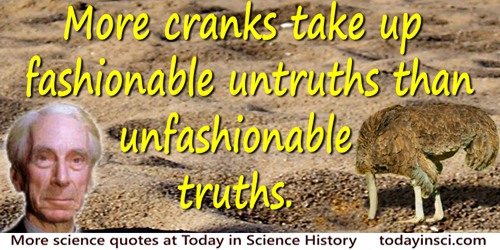
There are infinite possibilities of error, and more cranks take up fashionable untruths than unfashionable truths.
— Bertrand Russell
Principles of Social Reconstruction (1916). Also in An Outline of Intellectual Rubbish (1943), reprinted in Unpopular Essays (1950) and collected in 'An Outline of Intellectual Rubbish', The Basic Writings of Bertrand Russell (2009), 61.
There is as much difference between a collection of mentally free citizens and a community molded by modern methods of propaganda as there is between a heap of raw materials and a battleship.
— Bertrand Russell
From An Outline of Intellectual Rubbish (1937, 1943), 9. Collected in The Basic Writings of Bertrand Russell (2009), 61.
There is much pleasure to be gained from useless knowledge.
— Bertrand Russell
…...
There is no logical impossibility in the hypothesis that the world sprang into being five minutes ago, exactly as it then was, with a population that "remembered" a wholly unreal past. There is no logically necessary connection between events at different times; therefore nothing that is happening now or will happen in the future can disprove the hypothesis that the world began five minutes ago.
— Bertrand Russell
In The Analysis of Mind (1921) 159–160.
There is no need to worry about mere size. We do not necessarily respect a fat man more than a thin man. Sir Isaac Newton was very much smaller than a hippopotamus, but we do not on that account value him less.
— Bertrand Russell
…...
There will still be things that machines cannot do. They will not produce great art or great literature or great philosophy; they will not be able to discover the secret springs of happiness in the human heart; they will know nothing of love and friendship.
— Bertrand Russell
…...
This method is, to define as the number of a class the class of all classes similar to the given class. Membership of this class of classes (considered as a predicate) is a common property of all the similar classes and of no others; moreover every class of the set of similar classes has to the set of a relation which it has to nothing else, and which every class has to its own set. Thus the conditions are completely fulfilled by this class of classes, and it has the merit of being determinate when a class is given, and of being different for two classes which are not similar. This, then, is an irreproachable definition of the number of a class in purely logical terms.
— Bertrand Russell
The Principles of Mathematics (1903), 115.
Three passions, simple but overwhelmingly strong, have governed my life: the longing for love, the search for knowledge, and unbearable pity for the suffering of mankind.
— Bertrand Russell
The Autobiography of Betrand Russell (1998), 9, first sentence of the Prologue.
Throughout the last four hundred years, during which the growth of science had gradually shown men how to acquire knowledge of the ways of nature and mastery over natural forces, the clergy have fought a losing battle against science, in astronomy and geology, in anatomy and physiology, in biology and psychology and sociology. Ousted from one position, they have taken up another. After being worsted in astronomy, they did their best to prevent the rise of geology; they fought against Darwin in biology, and at the present time they fight against scientific theories of psychology and education. At each stage, they try to make the public forget their earlier obscurantism, in order that their present obscurantism may not be recognized for what it is.
— Bertrand Russell
From An Outline of Intellectual Rubbish (1937, 1943), 6. Collected in The Basic Writings of Bertrand Russell (2009), 47.
To a mind of sufficient intellectual power, the whole of mathematics would appear trivial, as trivial as the statement that a four-footed animal is an animal. (1959)
— Bertrand Russell
My Philosophical Development (1995), 207.
To be able to fill leisure intelligently is the last product of civilization.
— Bertrand Russell
The Conquest of Happiness
To expect a personality to survive the disintegration of the brain is like expecting a cricket club to survive when all of its members are dead.
— Bertrand Russell
…...
To think I have spent my life on absolute muck.
— Bertrand Russell
Exclaimed after Littlewood explained Eddington’s writings about relativity to Russell, who at that time knew no such physics. In John E. Littlewood and Béla Bollobás (ed.), A Mathematician’s Miscellany, (1953, 1986), 129.
Vagueness is very much more important in the theory of knowledge than you would judge it to be from the writings of most people. Everything is vague to a degree you do not realize till you have tried to make it precise, and everything precise is so remote from everything that we normally think, that you cannot for a moment suppose that is what we really mean when we say what we think.
— Bertrand Russell
In The Philosophy of Logical Atomism (1918, 1919), 2.
We all have a tendency to think that the world must conform to our prejudices. The opposite view involves some effort of thought, and most people would die sooner than think–in fact they do so.
— Bertrand Russell
In The ABC of Relativity (1925), 166. A paraphrase from this quote is often seen as, “Most people would rather die than think; many do.”
We are … led to a somewhat vague distinction between what we may call “hard” data and “soft” data. This distinction is a matter of degree, and must not be pressed; but if not taken too seriously it may help to make the situation clear. I mean by “hard” data those which resist the solvent influence of critical reflection, and by “soft” data those which, under the operation of this process, become to our minds more or less doubtful.
— Bertrand Russell
Our Knowledge of the External World (1925), 75.
We know very little, and yet it is astonishing that we know so much, and still more astonishing that so little knowledge can give us so much power.
— Bertrand Russell
Concluding sentence from The A B C of Relativity (1925), 231.
What Galileo and Newton were to the seventeenth century, Darwin was to the nineteenth.
— Bertrand Russell
A History of Western Philosophy (1945), 725.
What is best in mathematics deserves not merely to be learnt as a task, but to assimilated as a part of daily thought, and brought again and again before the mind with ever-renewed encouragement.
— Bertrand Russell
Essay, 'The Study of Mathematics' (1902), collected in Philosophical Essays (1910), 73-74. Also collected in Mysticism and Logic: And Other Essays (1919), 60.
What is this subject, which may be called indifferently either mathematics or logic? Is there any way in which we can define it? Certain characteristics of the subject are clear. To begin with, we do not, in this subject, deal with particular things or particular properties: we deal formally with what can be said about any thing or any property. We are prepared to say that one and one are two, but not that Socrates and Plato are two, because, in our capacity of logicians or pure mathematicians, we have never heard of Socrates or Plato. A world in which there were no such individuals would still be a world in which one and one are two. It is not open to us, as pure mathematicians or logicians, to mention anything at all, because, if we do so we introduce something irrelevant and not formal.
— Bertrand Russell
In Introduction to Mathematical Philosophy (1920), 196-197.
What men want is not knowledge, but certainty.
— Bertrand Russell
Uncertain attribution. Often seen, but Webmaster has not yet found this wording in a primary source, and remains uncertain that this is an actual Russell quote. It is included here to provide this caution. Contact Webmaster if you have more information.
When a man of science speaks of his “data,” he knows very well in practice what he means. Certain experiments have been conducted, and have yielded certain observed results, which have been recorded. But when we try to define a “datum” theoretically, the task is not altogether easy. A datum, obviously, must be a fact known by perception. But it is very difficult to arrive at a fact in which there is no element of inference, and yet it would seem improper to call something a “datum” if it involved inferences as well as observation. This constitutes a problem. …
— Bertrand Russell
In The Analysis of Matter (1954).
When Benjamin Franklin invented the lightning-rod, the clergy, both in England and America, with the enthusiastic support of George III, condemned it as an impious attempt to defeat the will of God. For, as all right-thinking people were aware, lightning is sent by God to punish impiety or some other grave sin—the virtuous are never struck by lightning. Therefore if God wants to strike any one, Benjamin Franklin [and his lightning-rod] ought not to defeat His design; indeed, to do so is helping criminals to escape. But God was equal to the occasion, if we are to believe the eminent Dr. Price, one of the leading divines of Boston. Lightning having been rendered ineffectual by the “iron points invented by the sagacious Dr. Franklin,” Massachusetts was shaken by earthquakes, which Dr. Price perceived to be due to God’s wrath at the “iron points.” In a sermon on the subject he said,“In Boston are more erected than elsewhere in New England, and Boston seems to be more dreadfully shaken. Oh! there is no getting out of the mighty hand of God.” Apparently, however, Providence gave up all hope of curing Boston of its wickedness, for, though lightning-rods became more and more common, earthquakes in Massachusetts have remained rare.
— Bertrand Russell
In An Outline of Intellectual Rubbish (1943), 6-7.
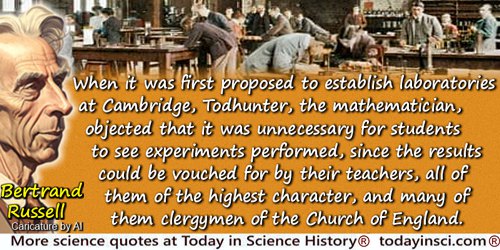
When it was first proposed to establish laboratories at Cambridge, Todhunter, the mathematician, objected that it was unnecessary for students to see experiments performed, since the results could be vouched for by their teachers, all of them of the highest character, and many of them clergymen of the Church of England.
— Bertrand Russell
In The Scientific Outlook (1931, 2009), 49.
When the intensity of emotional conviction subsides, a man who is in the habit of reasoning will search for logical grounds in favor of the belief which he finds in himself.
— Bertrand Russell
In Mysticism and Logic (2004), 15.
When we compare the (present) human population of the globe with... that of former times, we see that "chemical imperialism" has been... the main end to which human intelligence has been devoted.
— Bertrand Russell
Whenever there is a great deal of energy in one region and very little in a neighboring region, energy tends to travel from the one region to the other, until equality is established. This whole process may be described as a tendency towards democracy.
— Bertrand Russell
In 'Science and Religion', collected in Al Seckel (ed.), >Bertrand Russell on God and Religion (1986), 175.
While the dogmatist is harmful, the sceptic is useless …; one is certain of knowing, the other of not knowing. What philosophy should dissipate is certainty, whether of knowledge or of ignorance. Knowledge is not so precise a concept as is commonly thought. Instead of saying ‘I know this’, we ought to say ‘I more or less know something more or less like this’. … Knowledge in practical affairs has not the certainty or the precision of arithmetic.
— Bertrand Russell
From 'Philosophy For Laymen', collected in Unpopular Essays (1950, 1996), 38-39.
Who ever heard a theologian preface his creed, or a politician conclude his speech with an estimate of the probable error of his opinion.
— Bertrand Russell
In The Scientific Outlook (1931, 1954), 66.
Why the dinosaurs died out is not known, but it is supposed to be because they had minute brains and devoted themselves to the growth of weapons of offense in the shape of numerous horns. However that may be, it was not through their line that life developed.
— Bertrand Russell
In 'Men versus. Insects' (1933), collected in In Praise of Idleness and Other Essays (1935), 199.
William James used to preach the “will to believe.” For my part, I should wish to preach the “will to doubt.” … What is wanted is not the will to believe, but the wish to find out, which is the exact opposite.
— Bertrand Russell
From Conway Memorial Lecture, South Place Institute, London (24 Mar 1922), printed as Free Thought and Official Propaganda (1922), 14. Collected in Sceptical Essays (1928, 2004), 129.
With equal passion I have sought knowledge. I have wished to understand the hearts of men. I have wished to know why the stars shine. And I have tried to apprehend the Pythagorean power by which numbers holds sway above the flux. A little of this, but not much, I have achieved.
— Bertrand Russell
In 'Prologue: What I Have Lived For', The Autobiography of Bertrand Russell (1969). 3-4.
With the introduction of agriculture mankind entered upon a long period of meanness, misery, and madness, from which they are only now being freed by the beneficent operation of the machine.
— Bertrand Russell
In The Conquest of Happiness (1930), 152.
Work is of two kinds: first, altering the position of matter at or near the earth’s surface relative to other such matter; second, telling other people to do so. The first kind is unpleasant and ill paid; the second is pleasant and highly paid.
— Bertrand Russell
In Praise of Idleness and Other Essays (1935), 12.
Quotes by others about Bertrand Russell (9)
The difference between myth and science is the difference between divine inspiration of “unaided reason” (as Bertrand Russell put it) on the one hand and theories developed in observational contact with the real world on the other. It is the difference between the belief in prophets and critical thinking, between Credo quia absurdum (I believe because it is absurd–Tertullian) and De omnibus est dubitandum (Everything should be questioned–Descartes). To try to write a grand cosmical drama leads necessarily to myth. To try to let knowledge substitute ignorance in increasingly large regions of space and time is science.
In 'Cosmology: Myth or Science?' Journal of Astrophysics and Astronomy (1984), 5, 79-98.
Bertrand Russell had given a talk on the then new quantum mechanics, of whose wonders he was most appreciative. He spoke hard and earnestly in the New Lecture Hall. And when he was done, Professor Whitehead, who presided, thanked him for his efforts, and not least for “leaving the vast darkness of the subject unobscured.”
Quoted in Robert Oppenheimer, The Open Mind (1955), 102.
As Bertrand Russell once wrote, two plus two is four even in the interior of the sun.
In When You Were a Tadpole and I Was a Fish: And Other Speculations About This and That (2009), 124.
When the world is mad, a mathematician may find in mathematics an incomparable anodyne. For mathematics is, of all the arts and sciences, the most austere and the most remote, and a mathematician should be of all men the one who can most easily take refuge where, as Bertrand Russell says, “one at least of our nobler impulses can best escape from the dreary exile of
the actual world.”
In A Mathematician's Apology (1940, 2012), 43.
[I] browsed far outside science in my reading and attended public lectures - Bertrand Russell, H. G. Wells, Huxley, and Shaw being my favorite speakers. (The last, in a meeting at King's College, converted me to vegetarianism - for most of two years!).
Autobiography collected in Gardner Lindzey (ed.), A History of Psychology in Autobiography (1973), Vol. 6, 64.
A scientific writer can scarcely encounter anything more undesirable than, after completing a work, to have one of the foundations shaken. I became aware of this situation through a letter from Mr. Bertrand Russell as the printing of this volume neared completion.
In Epilog, Grundgestze der Arithmetic (1903), Vol. 2, 253. Russell wrote in 1901, just as Frege was about to publish Volume 2 of his last major work. English translation by Webmaster using Google translate and online dictionaries, from the original German: “Einem wissenschaftlichen Schriftsteller kann kaum etwas Unerwünschteres begegnen, als dass ihm nach Vollendung einer Arbeit eine der Grundlagen seines Baues erschüttert wird. In diese Lage wurde ich durch einen Brief des Herrn Bertrand Russell versetzt, als der Druck dieses Bandes sich seinem Ende näherte.” The translation in John E. Hopcroft, 'Turing Machines', Scientific American (May 1984), 250, No. 5, 95, gives: “A scientist can hardly meet with anything more undesirable than to have the foundations give way just as the work is finished. I was put in this position by a letter from Mr. Bertrand Russell when the work was nearly through the press.”
Mr. Bertrand Russell tells us that it can be shown that a mathematical web of some kind can be woven about any universe containing several objects. If this be so, then the fact that our universe lends itself to mathematical treatment is not a fact of any great philosophical significance.
In The Limitations of Science (1933), 229. [Notice that there are no quotation marks in the narrative statement by Sullivan. Therefore, Webmaster believes they are not necessarily, and likely not, the verbatim words from Russell. The first sentence is more likely to be Sullivan expressing in his own words an idea from Russell, and most likely the second sentence is Sullivan’s comment on that idea. (Be cautioned that quotation marks, perhaps spurious, have appeared when re-stated in later publications by other authors.) Webmaster has so far been unable to identify a primary source for these words in a text by Russell. If you know the primary source, please contact Webmaster.]
Since the examination of consistency is a task that cannot be avoided, it appears necessary to axiomatize logic itself and to prove that number theory and set theory are only parts of logic. This method was prepared long ago (not least by Frege’s profound investigations); it has been most successfully explained by the acute mathematician and logician Russell. One could regard the completion of this magnificent Russellian enterprise of the axiomatization of logic as the crowning achievement of the work of axiomatization as a whole.
Address (11 Sep 1917), 'Axiomatisches Denken' delivered before the Swiss Mathematical Society in
Zürich. Translated by Ewald as 'Axiomatic Thought', (1918), in William Bragg Ewald, From Kant to Hilbert (1996), Vol. 2, 1113.
Logic it is called [referring to Whitehead and Russell’s Principia Mathematica] and logic it is, the logic of propositions and functions and classes and relations, by far the greatest (not merely the biggest) logic that our planet has produced, so much that is new in matter and in manner; but it is also mathematics, a prolegomenon to the science, yet itself mathematics in its most genuine sense, differing from other parts of the science only in the respects that it surpasses these in fundamentally, generality and precision, and lacks traditionality. Few will read it, but all will feel its effect, for behind it is the urgence and push of a magnificent past: two thousand five hundred years of record and yet longer tradition of human endeavor to think aright.
In Science (1912), 35, 110, from his book review on Alfred North Whitehead and Bertrand Russell, Principia Mathematica.
See also:
- 18 May - short biography, births, deaths and events on date of Russell's birth.
- Bertrand Russell - context of quote “A process which led from the amoeba to man” - Medium image (500 x 350 px)
- Bertrand Russell - context of quote “A process which led from the amoeba to man” - Large image (800 x 600 px)
 In science it often happens that scientists say, 'You know that's a really good argument; my position is mistaken,' and then they would actually change their minds and you never hear that old view from them again. They really do it. It doesn't happen as often as it should, because scientists are human and change is sometimes painful. But it happens every day. I cannot recall the last time something like that happened in politics or religion.
(1987) --
In science it often happens that scientists say, 'You know that's a really good argument; my position is mistaken,' and then they would actually change their minds and you never hear that old view from them again. They really do it. It doesn't happen as often as it should, because scientists are human and change is sometimes painful. But it happens every day. I cannot recall the last time something like that happened in politics or religion.
(1987) -- 





