 (source)
|
Theodore Roosevelt
(27 Oct 1858 - 6 Jan 1919)
American president and conservationist (26th, 1901-09) whose term included efforts to conserve national resources, especially the passage of the Newlands Reclamation Act (1902). He was the first president to ride in an automobile (1902), go underwater in a submarine (1905), or fly in an airplane (1910). Immediately after leaving his presidency, he undertook a safari to Africa as hunter and naturalist. In 1913, he travelled on a scientific expedition to the interior of Brazil which produced geographic, geological, and zoological information, and almost two thousand specimens of birds and mammals were collected for the American Museum of Natural Science.
|
Science Quotes by Theodore Roosevelt (39 quotes)
[Among the books he chooses, a statesman] ought to read interesting books on history and government, and books of science and philosophy; and really good books on these subjects are as enthralling as any fiction ever written in prose or verse.
— Theodore Roosevelt
In Theodore Roosevelt: An Autobiography (1913), 333.
~~[Attributed]~~ A man who has never gone to school may steal from a freight car; but if he has a university education, he may steal the whole railroad.
— Theodore Roosevelt
As quoted, without citation, in William Joseph Grace, Art of Communicating Ideas (1952), 389. Sadly, much searching produces no primary source. Can you help?
A grove of giant redwoods or sequoias should be kept just as we keep a great or beautiful cathedral. The extermination of the passenger pigeon meant that mankind was just so much poorer; exactly as in the case of the destruction of the cathedral at Rheims. And to lose the chance to see frigate-birds soaring in circles above the storm, or a file of pelicans winging their way homeward across the crimson afterglow of the sunset, or a myriad terns flashing in the bright light of midday as they hover in a shifting maze above the beach—why, the loss is like the loss of a gallery of the masterpieces of the artists of old time.
— Theodore Roosevelt
In A Book-Lover's Holidays in the Open (1916), 316-317.
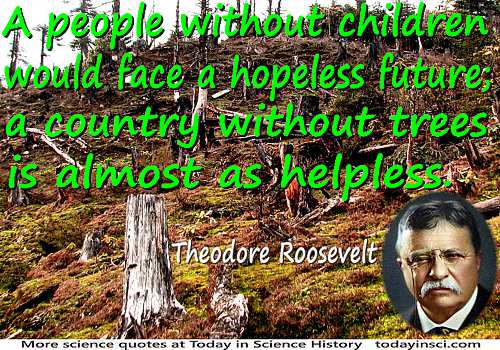
A people without children would face a hopeless future; a country without trees is almost as helpless.
— Theodore Roosevelt
Letter to the School Children of the United States, Arbor Day (15 Apr 1907), in Presidential Addresses and State Papers (1910), Vol. 6, 1208.
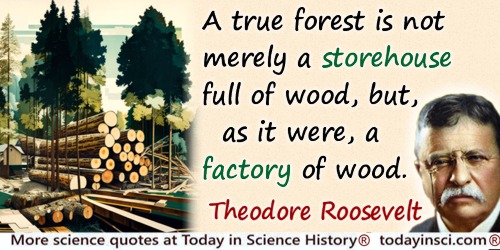
A true forest is not merely a storehouse full of wood, but, as it were, a factory of wood, and at the same time a reservoir of water.
— Theodore Roosevelt
Letter to the School Children of the United States, Arbor Day (15 Apr 1907), in Presidential Addresses and State Papers (1910), Vol. 6, 1208.
Conservation and rural-life policies are really two sides of the same policy; and down at the bottom this policy rests upon the fundamental law that neither man nor nation can prosper unless, in dealing with the present, thought is steadily given for the future.
— Theodore Roosevelt
'Rural Life' (originally published in The Outlook, 27 Aug 1910). In The Works of Theodore Roosevelt. Vol. 16: American Problems (1926), 146.
Conservation means development as much as it does protection. I recognize the right and duty of this generation to develop and use the natural resources of our land; but I do not recognize the right to waste them, or to rob, by wasteful use, the generations that come after us.
— Theodore Roosevelt
'The New Nationalism', speech at Osawatomie, Kansas, 31 Aug 1910. In Richard D. Heffner, A Documentary History of the United States: Seventh Revised Edition (2002), 272. This is one of the quotations inscribed in the Roosevelt Memorial rotunda at the American Museum of Natural History.
Defenders of the short-sighted men who in their greed and selfishness will, if permitted, rob our country of half its charm by their reckless extermination of all useful and beautiful wild things sometimes seek to champion them by saying the “the game belongs to the people.” So it does; and not merely to the people now alive, but to the unborn people. The “greatest good for the greatest number” applies to the number within the womb of time, compared to which those now alive form but an insignificant fraction. Our duty to the whole, including the unborn generations, bids us restrain an unprincipled present-day minority from wasting the heritage of these unborn generations. The movement for the conservation of wild life and the larger movement for the conservation of all our natural resources are essentially democratic in spirit, purpose, and method.
— Theodore Roosevelt
'Bird Reserves at the Mouth of the Mississippi', A Book-Lover's Holidays in the Open (1920), 300-301.
Do what you can where you are with what you have.
— Theodore Roosevelt
The Homiletic Review, Vol. 83-84 (1922), Vol. 84, 380.
Do what you can, with what you have, where you are
— Theodore Roosevelt
…...
Far and away the best prize that life has to offer is the chance to work hard at work worth doing.
— Theodore Roosevelt
From Address (7 Sep 1903), at the State Fair, Syracuse, N.Y., collected in Addresses and Presidential Messages of Theodore Roosevelt, 1902-1904 (1907), Vol. 1, 241.
Far better is it to dare mighty things, to win glorious triumphs, even though checkered by failure, than to take rank with those poor spirits who neither enjoy much or suffer much, because they live in the gray twilight that knows not victory nor defeat.
— Theodore Roosevelt
Speech (15 Apr 1899), 'The Strenuous Life', to the Hamilton Club of Chicago. Collected in Murat Halstead (ed.), The Life of Theodore Roosevelt: Twenty-fifth President of the United States (1902), 161.
Gifford Pinchot is the man to whom the nation owes most for what has been accomplished as regards the preservation of the natural resources of our country. He led, and indeed during its most vital period embodied, the fight for the preservation through use of our forests … He was the foremost leader in the great struggle to coordinate all our social and governmental forces in the effort to secure the adoption of a rational and far-seeing policy for securing the conservation of all our national resources. … I believe it is but just to say that among the many, many public officials who under my administration rendered literally invaluable service to the people of the United States, he, on the whole, stood first.
— Theodore Roosevelt
'The Natural Resources of the Nation' Autobiography (1913), ch. 11. Quoted in Douglas M. Johnston, The International Law of Fisheries (1987), 44
I can no more explain why I like “natural history” than why I like California canned peaches; nor why I do not care for that enormous brand of natural history which deals with invertebrates any more than why I do not care for brandied peaches. All I can say is that almost as soon as I began to read at all I began to like to read about the natural history of beasts and birds and the more formidable or interesting reptiles and fishes.
— Theodore Roosevelt
In 'My Life as a Naturalist', American Museum Journal (May 1918), 18, 321. As cited in Maurice Garland Fulton (ed.) Roosevelt's Writings: Selections from the Writings of Theodore Roosevelt (1920), 247.
I was a reasonably good student in college ... My chief interests were scientific. When I entered college, I was devoted to out-of-doors natural history, and my ambition was to be a scientific man of the Audubon, or Wilson, or Baird, or Coues type—a man like Hart Merriam, or Frank Chapman, or Hornaday, to-day.
— Theodore Roosevelt
In Theodore Roosevelt: An Autobiography (1913), 23.
If in a given community unchecked popular rule means unlimited waste and destruction of the natural resources—soil, fertility, waterpower, forests, game, wild-life generally—which by right belong as much to subsequent generations as to the present generation, then it is sure proof that the present generation is not yet really fit for self-control, that it is not yet really fit to exercise the high and responsible privilege of a rule which shall be both by the people and for the people. The term “for the people” must always include the people unborn as well as the people now alive, or the democratic ideal is not realized.
— Theodore Roosevelt
In A Book-Lover's Holidays in the Open (1916), 319.
In the presence of infinite might and infinite wisdom, the strength of the strongest man is but weakness, and the keenest of mortal eyes see but dimly.
— Theodore Roosevelt
Quoted in Kim Lim (ed.), 1,001 Pearls of Spiritual Wisdom: Words to Enrich, Inspire, and Guide Your Life (2014), 167
In the wilderness, people think of danger from Indians, alligators, and jaguars. They are not the things you mind. It is the mosquitoes, the poisonous ants, the maribondo wasps that are perfectly awful. It is the borrachudos and plum flies—like the black flies of the north woods,
only worse … The day after I threw away my spare clothing ants ate up all my underwear. These were white ants. The driver ants try to eat the man instead of his clothes.
— Theodore Roosevelt
In National Geographic, Great Adventures with National Geographic: Exploring Land, Sea, and Sk (1963), 109. The last sentences about the white and driver ants, with slightly different wording, also appear in Theodore Roosevelt, 'A Journey in Central Brazil', The Geographical Journey (Feb 1915), 45, No. 2, 104, previously read to the Royal Geographic Society (16 Jun 1914).
It is hard to fail, but it is worse never to have tried to succeed.
— Theodore Roosevelt
Speech, 'The Strenuous Life' (10 Apr 1899), as governor of New York, before the Hamilton Club, Chicago, Illinois. In The Works of Theodore Roosevelt (1926), Vol. 13, Chap.1, 320. Also excerpted in 'Practical Talks by Practical Men: The Strenuous Life', Illustrated World (1904), 2, 87.
It’s not the critic who counts; not the man which points out how the strong man stumbles or where the doer of deeds could have done them better. The credit belongs to the man who is actually in the arena, whose face is marred by dust and sweat and blood; who strives valiantly; who errs, who comes short again and again … who knows great enthusiasms, the great devotions; who spends himself in a worthy cause; who at the best knows in the end the triumph of high achievement, and who at the worst, if he fails, at least fails while daring greatly, so that his place shall never be with those cold and timid souls who neither know victory nor defeat.
— Theodore Roosevelt
In Joseph A. Califano, Jr., Inside: A Public and Private Life (2005), 356.
More and more, as it becomes necessary to preserve the game, let us hope that the camera will largely supplant the rifle.
— Theodore Roosevelt
Introduction to Allen Grant Wallihan, Camera Shots at Big Game (1901), 11.
No nation can be really great unless it is great in peace, in industry, integrity, honesty. Skilled intelligence in civic affairs and industrial enterprises alike; the special ability of the artist, the man of letters, the man of science, and the man of business; the rigid determination to wrong no man, and to stand for righteousness—all these are necessary in a great nation.
— Theodore Roosevelt
Address (2 Jun 1897) at U.S. Naval War College, Newport, Rhode Island. In 'Washington's Forgotten Maxim', United States Naval Institute Proceedings (1897), 23, 450.
Nowadays the field naturalist—who is usually at all points superior to the mere closet naturalist—follows a profession as full of hazard and interest as that of the explorer or of the big-game hunter in the remote wilderness.
— Theodore Roosevelt
African Game Trails (1910), 414-415.
Optimism is a good characteristic, but if carried to an excess, it becomes foolishness. We are prone to speak of the resources of this country as inexhaustible; this is not so.
— Theodore Roosevelt
Seventh Annual Message to Congress, 3 Dec, 1907. In In Presidential Addresses and State Papers (1910), Vol. 12, 1541.
The ages have been at work on it and man can only mar it.
— Theodore Roosevelt
…...
The claims of certain so-called scientific men as to 'science overthrowing religion' are as baseless as the fears of certain sincerely religious men on the same subject. The establishment of the doctrine of evolution in out time offers no more justification for upsetting religious beliefs than the discovery of the facts concerning the solar system a few centuries ago. Any faith sufficiently robust to stand the—surely very slight—strain of admitting that the world is not flat and does not move round the sun need have no apprehensions on the score of evolution, and the materialistic scientists who gleefully hail the discovery of the principle of evolution as establishing their dreary creed might with just as much propriety rest it upon the discovery of the principle of gravity.
— Theodore Roosevelt
'The Search for Truth in a Reverent Spirit', (originally published in The Outlook, 2 Dec 1911). In The Works of Theodore Roosevelt (1913), Vol. 26, 256.
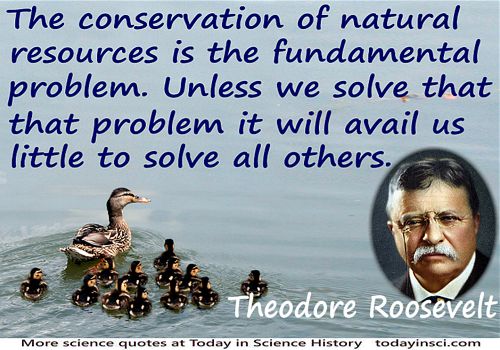
The conservation of natural resources is the fundamental problem. Unless we solve that problem it will avail us little to solve all others.
— Theodore Roosevelt
'Our National Inland Waterways Policy', Address to the Deep Waterway Convention, Memphis, Tennessee, 4 Oct 1907. In American Waterways (1908), 9.
The farmer is a poor creature who skins the land and leaves it worthless to his children. The farmer is a good farmer who, having enabled the land to support himself and to provide for the education of his children, leaves it to them a little better than he found it himself.
— Theodore Roosevelt
'The New Nationalism', speech st Osawatomie, Kansas, 31 Aug 1910. In Donald Davidson (Ed.) The Wisdom of Theodore Roosevelt (2003), 18.
The idea that our natural resources were inexhaustible still obtained, and there was as yet no real knowledge of their extent and condition. The relation of the conservation of natural resources to the problems of National welfare and National efficiency had not yet dawned on the public mind. The reclamation of arid public lands in the West was still a matter for private enterprise alone; and our magnificent river system, with its superb possibilities for public usefulness, was dealt with by the National Government not as a unit, but as a disconnected series of pork-barrel problems, whose only real interest was in their effect on the re-election or defeat of a Congressman here and there —a theory which, I regret to say, still obtains.
— Theodore Roosevelt
The Works of Theodore Roosevelt. Vol. 20: Theodore Roosevelt, An Autobiography (1926), 386.
The modern naturalist must realize that in some of its branches his profession, while more than ever a science, has also become an art.
— Theodore Roosevelt
African Game Trails (1910), 17.
The nation behaves well if it treats the natural resources as assets which it must turn over to the next generation increased, and not impaired in value. Conservation means development as much as it does protection.
— Theodore Roosevelt
Speech before Colorado Livestock Association, Denver, Colorado, 29 Aug 1910. The New Nationalism (1910), 52. In Suzy Platt, Respectfully Quoted (1993), 64. This is one of the quotations inscribed in the Roosevelt Memorial rotunda at the American Museum of Natural History. It is also in the artwork on Cox Corridor II, first floor House wing, U.S. Capitol.
The United States at this moment occupies a lamentable position as being perhaps the chief offender among civilized nations in permitting the destruction and pollution of nature. Our whole modern civilization is at fault in the matter. But we in America are probably most at fault ... We treasure pictures and sculpture. We regard Attic temples and Roman triumphal arches and Gothic cathedrals as of priceless value. But we are, as a whole, still in that low state of civilization where we do not understand that it is also vandalism wantonly to destroy or permit the destruction of what is beautiful in nature, whether it be a cliff, a forest, or a species of mammal or bird. Here in the United States we turn our rivers and streams into sewers and dumping-grounds, we pollute the air, we destroy forests and exterminate fishes, birds and mammals'not to speak of vulgarizing charming landscapes with hideous advertisements.
— Theodore Roosevelt
'Our Vanishing Wild Life', The Outlook, 25 Jan 1913. In Donald Davidson (Ed.) The Wisdom of Theodore Roosevelt (2003), 19.
There are no words that can tell the hidden spirit of the wilderness, that can reveal its mystery, its melancholy, and its charm.
— Theodore Roosevelt
African Game Trails (1910), ix. This is one of the quotations inscribed in the Roosevelt Memorial rotunda at the American Museum of Natural History.
There can be no greater issue than that of conservation in this country. Just as we must conserve our men, women and children, so we must conserve the resources of the land on which they live. We must conserve the soil so that our children shall have a land that is more and not less fertile than our fathers dwelt in. We must conserve the forests, not by disuse, but by use, making them more valuable at the same time that we use them. We must conserve the mines. Moreover, we must insure so far as possible the use of certain types of great natural resources for the benefit of the people as a whole.
— Theodore Roosevelt
Confession of Faith Speech, Progressive National Convention, Chicago, Illinois, 6 Aug 1912. In Marion Mills Miller (Ed.) Great Debates in American History (1913), Vol. 10, 111-112.
There is delight in the hardy life of the open.
— Theodore Roosevelt
African Game Trails (1910), ix. This is one of the quotations inscribed in the Roosevelt Memorial rotunda at the American Museum of Natural History.
This country will not be a permanently good place for any of us to live in unless we make it a reasonably good place for all of us to live in.
— Theodore Roosevelt
Speech at the Auditorium, Chicago, Illinois, 17 Jun 1912. In Social Justice and Popular Rule reprinted in Politics and People (1974), 316-317.
We are consuming our forests three times faster than they are being reproduced. Some of the richest timber lands of this continent have already been destroyed, and not replaced, and other vast areas are on the verge of destruction. Yet forests, unlike mines, can be so handled as to yield the best results of use, without exhaustion, just like grain fields.
— Theodore Roosevelt
Address to the Deep Waterway Convention, Memphis, Tennessee (4 Oct 1907), 'Our National Inland Waterways Policy'. In American Waterways (1908), 9.
We have a right to expect that the best trained, the best educated men on the Pacific slope, the Rocky Mountains, and great plains States will take the lead in the preservation and right use of forests, in securing the right use of waters, and in seeing that our land policy is not twisted from its original purpose, but is perpetuated by amendment, by change when such change is necessary in the life of that purpose, the purpose being to turn the public domain into farms each to be the property of the man who actually tills it and makes his home in it.
— Theodore Roosevelt
Address at Leland Stanford, Jr., University, Palo Alto, California, 12 May 1903. Addresses and Presidential Messages of Theodore Roosevelt, 1902-1904 (1904), 198.
We of an older generation can get along with what we have, though with growing hardship; but in your full manhood and womanhood you will want what nature once so bountifully supplied and man so thoughtlessly destroyed; and because of that want you will reproach us, not for what we have used, but for what we have wasted...So any nation which in its youth lives only for the day, reaps without sowing, and consumes without husbanding, must expect the penalty of the prodigal whose labor could with difficulty find him the bare means of life.
— Theodore Roosevelt
'Arbor Day: A Message to the School-Children of the United States', 15 Apr 1907. In Presidential Addresses and State Papers (1910), Vol. 11, 1207-8.
Quotes by others about Theodore Roosevelt (2)
[Theodore Roosevelt] was a naturalist on the broadest grounds, uniting much technical knowledge with knowledge of the daily lives and habits of all forms of wild life. He probably knew tenfold more natural history than all the presidents who had preceded him, and, I think one is safe in saying, more human history also.
In 'Theodore Roosevelt', Natural History (Jan 1919), 19, No.1, 5.
This isn’t just about today, this about generations to come. And you’ve got a chance to be the greatest conservation President since Theodore Roosevelt, and I think he’s done it.
From transcript, 'Exit Interview: Bruce Babbit', PBS Newshour (5 Jan 2001). On pbs.org website.
See also:
- Theodore Roosevelt - context of his “A Country Without Trees” quote - Medium image (500 x 350 px).
- Theodore Roosevelt - context of his “Conservation of natural resources is the fundamental problem” quote - Medium image (500 x 350 px)
- Theodore Roosevelt - context of his “A Country Without Trees” quote - Large image (800 x 600 px).
- Theodore Roosevelt - context of his “Conservation of natural resources is the fundamental problem” quote - Large image (800 x 600 px)
- Theodore Roosevelt - memorialized as a Naturalist in a tribute by John Burroughs in Natural History magazine (1919)
- Theodore Roosevelt, Naturalist - memorial tribute by Henry Fairfield Osborn in Natural History magazine (1919)
- Theodore Roosevelt - Friend of Man - memorial tribute by Robert Peary in Natural History magazine (1919)
- Theodore Roosevelt and Africa - memorial tribute by Carl Akeley in Natural History magazine (1919)
- Personal Glimpses of Theodore Roosevelt - memorial tribute by David Starr Jordan in Natural History Magazine (1919).
- Roosevelt, the Man of Abundant Life - memorial tribute by Gifford Pinchot in Natural History magazine (1919).
- The Wilderness Warrior: Theodore Roosevelt and the Crusade for America, by Douglas Brinkley. - book suggestion.
- Booklist for Theodore Roosevelt.
 In science it often happens that scientists say, 'You know that's a really good argument; my position is mistaken,' and then they would actually change their minds and you never hear that old view from them again. They really do it. It doesn't happen as often as it should, because scientists are human and change is sometimes painful. But it happens every day. I cannot recall the last time something like that happened in politics or religion.
(1987) --
In science it often happens that scientists say, 'You know that's a really good argument; my position is mistaken,' and then they would actually change their minds and you never hear that old view from them again. They really do it. It doesn't happen as often as it should, because scientists are human and change is sometimes painful. But it happens every day. I cannot recall the last time something like that happened in politics or religion.
(1987) -- 





