 (source)
|
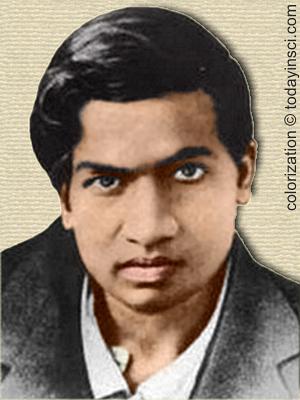
Srinivasa Ramanujan
(22 Dec 1887 - 26 Apr 1920)
Indian mathematician who displayed a natural ability in mathematics at an early age. His talent was recognized by G. H. Hardy, who arranged for him to be a student at Cambridge University. In the following few years, before an early death at age 32, Ramanujan produced an exceptional output in mathematical analysis, number theory, infinite series and continued fractions.
|
Science Quotes by Srinivasa Ramanujan (5 quotes)
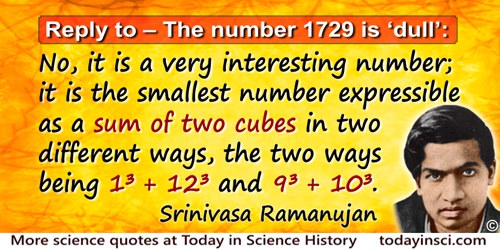
Replying to G. H. Hardy’s suggestion that the number of a taxi (1729) was “dull”: No, it is a very interesting number; it is the smallest number expressible as a sum of two cubes in two different ways, the two ways being 1³ + 12³ and 9³ + 10³.
— Srinivasa Ramanujan
Proceedings of the London Mathematical Society (26 May 1921).
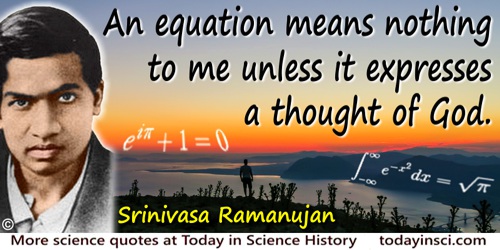
An equation means nothing to me unless it expresses a thought of God.
— Srinivasa Ramanujan
Quoted in Clifford A. Pickover, A Passion for Mathematics (2005), 1; but with no footnote to primary source.

I beg to introduce myself to you as a clerk in the Accounts Department of the Port Trust Office at Madras on a salary of only £20 per annum. I am now about 23 years of age. … After leaving school I have been employing the spare time at my disposal to work at Mathematics.
— Srinivasa Ramanujan
Opening lines of first letter to G.H. Hardy (16 Jan 1913). In Collected Papers of Srinivasa Ramanujan (1927), xxiii. Hardy notes he did “seem to remember his telling me that his friends had given him some assistance” in writing the letter because Ramanujan's “knowledge of English, at that stage of his life, could scarcely have been sufficient.”
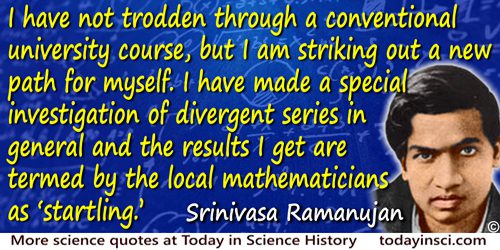
I have not trodden through a conventional university course, but I am striking out a new path for myself. I have made a special investigation of divergent series in general and the results I get are termed by the local mathematicians as “startling.”
— Srinivasa Ramanujan
First letter to G.H. Hardy (16 Jan 1913). In Collected Papers of Srinivasa Ramanujan (1927), xxiii. Hardy notes he did “seem to remember his telling me that his friends had given him some assistance” in writing the letter because Ramanujan's “knowledge of English, at that stage of his life, could scarcely have been sufficient.”

To preserve my brains I want food and this is now my first consideration. Any sympathetic letter from you will be helpful to me here to get a scholarship…
— Srinivasa Ramanujan
Letter to G.H. Hardy (27 Feb 1913). Excerpt in obituary notice by G.H. Hardy in the Proceedings of the London Mathematical Society (2) (1921), 19, xl—lviii. Reprinted in G.H. Hardy, P.V. Seshu Aiyar and B.M. Wilson (eds.) Collected Papers of Srinivasa Ramanujan (1927), xxvii.
Quotes by others about Srinivasa Ramanujan (12)
I remember once going to see him when he was lying ill at Putney. I had ridden in taxi cab number 1729 and remarked that the number seemed to me rather a dull one, and that I hoped it was not an unfavorable omen. “No,” he replied, “it is a very interesting number; it is the smallest number expressible as the sum of two cubes in two different ways.”
Quoted in G.H. Hardy, Ramanujan; Twelve Lectures on Subjects Suggested by his Life and Work (1940, reprint 1999), 12.
No mathematician should ever allow him to forget that mathematics, more than any other art or science, is a young man's game. … Galois died at twenty-one, Abel at twenty-seven, Ramanujan at thirty-three, Riemann at forty. There have been men who have done great work later; … [but] I do not know of a single instance of a major mathematical advance initiated by a man past fifty. … A mathematician may still be competent enough at sixty, but it is useless to expect him to have original ideas.
In A Mathematician's Apology (1941, reprint with Foreward by C.P. Snow 1992), 70-71.
Plenty of mathematicians, Hardy knew, could follow a step-by-step discursus unflaggingly—yet counted for nothing beside Ramanujan. Years later, he would contrive an informal scale of natural mathematical ability on which he assigned himself a 25 and Littlewood a 30. To David Hilbert, the most eminent mathematician of the day, he assigned an 80. To Ramanujan he gave 100.
In The Man who Knew Infinity: A Life of the Genius Ramanujan (1975), 226.
Srinivasa Ramanujan was the strangest man in all of mathematics, probably in the entire history of science. He has been compared to a bursting supernova, illuminating the darkest, most profound corners of mathematics, before being tragically struck down by tuberculosis at the age of
33... Working in total isolation from the main currents of his field, he was able to rederive 100 years’ worth of Western mathematics on his own. The tragedy of his life is that much of his work was wasted rediscovering known mathematics.
In Hyperspace:A Scientific Odyssey through Parallel Universes, Time Warps, and the Tenth Dimension (1994), 172.
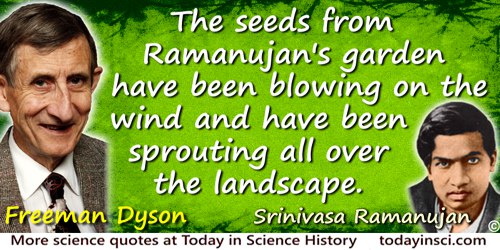
The seeds from Ramanujan’s garden have been blowing on the wind and have been sprouting all over the landscape.
[On the stimulating effects of Ramanujan's mathematical legacy.]
[On the stimulating effects of Ramanujan's mathematical legacy.]
From lecture, the Ramanujan Centenary Conference, University of Illinois (2 Jun 1987), 'A Walk in Ramanujan's Garden', collected in Selected Papers of Freeman Dyson (1996), 198.
Numbers … were his friends. In the simplest array of digits [Ramanujan] detected wonderful properties: congruences, symmetries and relationships which had escaped the notice of even the outstandingly gifted theoreticians.
In James R. Newman (ed.), 'Commentary on Srinivasa Ramanujan', The World of Mathematics (1956), Vol. 1, 367.
There is great exhilaration in breaking one of these things. … Ramanujan gives no hints, no proof of his formulas, so everything you do you feel is your own.
[About verifying Ramanujan’s equations in a newly found manuscript.]
[About verifying Ramanujan’s equations in a newly found manuscript.]
Quoted in John Noble Wilford, 'Mathematician's Final Equations Praised', New York Times (9 Jun 1981), C1.
The manuscript looks chaotic, even by mathematics standards.
[About newly-found late work of Srinivasa Ramanujan.]
[About newly-found late work of Srinivasa Ramanujan.]
Quoted in John Noble Wilford, 'Mathematician's Final Equations Praised', New York Times (9 Jun 1981), C1.
There is always more in one of Ramanujan’s formulae than meets the eye, as anyone who sets to work to verify those which look the easiest will soon discover. In some the interest lies very deep, in others comparatively near the surface; but there is not one which is not curious and entertaining.
Commenting on the formulae in the letters sent by Ramanujan from India, prior to going to England. Footnote in obituary notice by G.H. Hardy in the Proceedings of the London Mathematical Society (2) (1921), 19, xl—lviii. The same notice was printed, with slight changes, in the Proceedings of the Royal Society (A) (1921), 94, xiii—xxix. Reprinted in G.H. Hardy, P.V. Seshu Aiyar and B.M. Wilson (eds.) Collected Papers of Srinivasa Ramanujan (1927), xxi.
He adhered, with a severity most unusual in Indians resident in England, to the religious observances of his caste; but his religion was a matter of observance and not of intellectual conviction, and I remember well his telling me (much to my surprise) that all religions seemed to him more or less equally true.
In obituary notice by G.H. Hardy in the Proceedings of the London Mathematical Society (2) (1921), 19, xl—lviii. Reprinted in G.H. Hardy, P.V. Seshu Aiyar and B.M. Wilson (eds.) Collected Papers of Srinivasa Ramanujan (1927), xxxi.
I read in the proof sheets of Hardy on Ramanujan: “As someone said, each of the positive integers was one of his personal friends.” My reaction was, “I wonder who said that; I wish I had.” In the next proof-sheets I read (what now stands), “It was Littlewood who said…”. What had happened was that Hardy had received the remark in silence and with poker face, and I wrote it off as a dud.
In Béla Bollobás (ed.), Littlewood’s Miscellany, (1986), 61.
When Ramanujan was sixteen, he happened upon a copy of Carr’s Synopsis of Mathematics. This chance encounter secured immortality for the book, for it was this book that suddenly woke Ramanujan into full mathematical activity and supplied him essentially with his complete mathematical equipment in analysis and number theory. The book also gave Ramanujan his general direction as a dealer in formulas, and it furnished Ramanujan the germs of many of his deepest developments.
In Mathematical Circles Squared (1972), 158. George Shoobridge Carr (1837-1914) wrote his Synopsis of Elementary Results in Mathematics in 1886.


See also:
- 22 Dec - short biography, births, deaths and events on date of Ramanujan's birth.
- Ramanujan Obituary by P.V. Aiyar - from Journal of the Indian Mathematical Society (1920)
- Large color picture of Srinivasa Ramanujan (800 x 850 px)
- The Mystery of Srinivasa Ramanujan's Illness - was it tuberculosis or something else?
- The Man Who Knew Infinity, by Robert Kanigel. - book suggestion.
- Booklist for Srinivasa Ramanujan.
 In science it often happens that scientists say, 'You know that's a really good argument; my position is mistaken,' and then they would actually change their minds and you never hear that old view from them again. They really do it. It doesn't happen as often as it should, because scientists are human and change is sometimes painful. But it happens every day. I cannot recall the last time something like that happened in politics or religion.
(1987) --
In science it often happens that scientists say, 'You know that's a really good argument; my position is mistaken,' and then they would actually change their minds and you never hear that old view from them again. They really do it. It doesn't happen as often as it should, because scientists are human and change is sometimes painful. But it happens every day. I cannot recall the last time something like that happened in politics or religion.
(1987) -- 




