Young Quotes (255 quotes)
“But in the binary system,” Dale points out, handing back the squeezable glass, “the alternative to one isn’t minus one, it’s zero. That’s the beauty of it, mechanically.” “O.K. Gotcha. You’re asking me, What’s this minus one? I’ll tell you. It’s a plus one moving backward in time. This is all in the space-time foam, inside the Planck duration, don’t forget. The dust of points gives birth to time, and time gives birth to the dust of points. Elegant, huh? It has to be. It’s blind chance, plus pure math. They’re proving it, every day. Astronomy, particle physics, it’s all coming together. Relax into it, young fella. It feels great. Space-time foam.”
In Roger's Version: A Novel (1986), 304.
[Aldolphe Abrahams] was one among several septuagenarians who were capable of running 100 yards in 12 seconds. He scoffed at golf for young men; it was an exercise, he said, for the middle-aged and elderly, especially those mentally overworked and predisposed to introspection and melancholy.
As stated in the words of the writer of the obituary, 'Sir Aldophe Abrahams, O.B.E. M.A., M.D., F.R.C.P.', The British Medical Journal (23 Dec 1967), 4, No. 5581, 748.
[Alfred Russell] Wallace's sales agent, back in London, heard mutterings from some naturalists that young Mr. Wallace ought to quit theorizing and stick to gathering facts. Besides expressing their condescension toward him in particular, that criticism also reflected a common attitude that fact-gathering, not theory, was the proper business of all naturalists.
In The Song of the Dodo: Island Biogeography in an Age of Extinctions (1996), 41.
[As a young teenager] Galois read [Legendre's] geometry from cover to cover as easily as other boys read a pirate yarn.
Men of Mathematics (1937, 1986), 364.
[Concerning] the usual contempt with which an orthodox analytic group treats all outsiders and strangers ... I urge you to think of the young psychoanalysts as your colleagues, collaborators and partners and not as spies, traitors and wayward children. You can never develop a science that way, only an orthodox church.
Letter to a colleague (Nov 1960). In Colin Wilson, New Pathways in Psychology: Maslow and the Post-Freudian Revolution (1972, 2001), 154.
[Luis] Alvarez's whole approach to physics was that of an entrepreneur, taking big risks by building large new projects in the hope of large rewards, although his pay was academic rather than financial. He had drawn around him a group of young physicists anxious to try out the exciting ideas he was proposing.
As quoted in Walter Sullivan, 'Luis W. Alvarez, Nobel Physicist Who Explored Atom, Dies at 77: Obituary', New York Times (2 Sep 1988).
[The screw machine] was on the principle of the guage or sliding lathe now in every workshop throughout the world; the perfection of which consists in that most faithful agent gravity, making the joint, and that almighty perfect number three, which is in harmony itself. I was young when I learned that principle. I had never seen my grandmother putting a chip under a three-legged milking-stool; but she always had to put a chip under a four-legged table, to keep it steady. I cut screws of all dimensions by this machine, and did them perfectly. (1846)
Quoted in ASME International and Heritage Committee, Landmarks in Mechanical Engineering.
[The] erroneous assumption is to the effect that the aim of public education is to fill the young of the species with knowledge and awaken their intelligence, and so make them fit to discharge the duties of citizenship in an enlightened and independent manner. Nothing could be further from the truth. The aim of public education is not to spread enlightenment at all; it is simply to reduce as many individuals as possible to the same safe level, to breed and train a standardised citizenry, to put down dissent and originality.
The American Mercury (24 Apr 1924).
[Young] was afterwards accustomed to say, that at no period of his life was he particularly fond of repeating experiments, or even of very frequently attempting to originate new ones; considering that, however necessary to the advancement of science, they demanded a great sacrifice of time, and that when the fact was once established, that time was better employed in considering the purposes to which it might be applied, or the principles which it might tend to elucidate.
Hudson Gurney, Memoir of the Life of Thomas Young, M.D. F.R.S. (1831), 12-3.
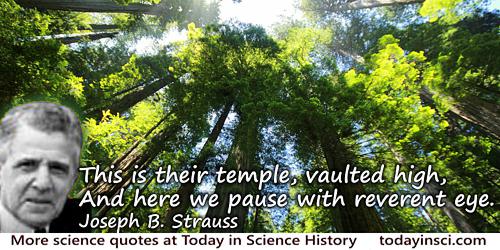
The Redwoods
Here, sown by the Creator's hand,
In serried ranks, the Redwoods stand;
No other clime is honored so,
No other lands their glory know.
The greatest of Earth's living forms,
Tall conquerors that laugh at storms;
Their challenge still unanswered rings,
Through fifty centuries of kings.
The nations that with them were young,
Rich empires, with their forts far-flung,
Lie buried now—their splendor gone;
But these proud monarchs still live on.
So shall they live, when ends our day,
When our crude citadels decay;
For brief the years allotted man,
But infinite perennials' span.
This is their temple, vaulted high,
And here we pause with reverent eye,
With silent tongue and awe-struck soul;
For here we sense life's proper goal;
To be like these, straight, true and fine,
To make our world, like theirs, a shrine;
Sink down, oh traveler, on your knees,
God stands before you in these trees.
Here, sown by the Creator's hand,
In serried ranks, the Redwoods stand;
No other clime is honored so,
No other lands their glory know.
The greatest of Earth's living forms,
Tall conquerors that laugh at storms;
Their challenge still unanswered rings,
Through fifty centuries of kings.
The nations that with them were young,
Rich empires, with their forts far-flung,
Lie buried now—their splendor gone;
But these proud monarchs still live on.
So shall they live, when ends our day,
When our crude citadels decay;
For brief the years allotted man,
But infinite perennials' span.
This is their temple, vaulted high,
And here we pause with reverent eye,
With silent tongue and awe-struck soul;
For here we sense life's proper goal;
To be like these, straight, true and fine,
To make our world, like theirs, a shrine;
Sink down, oh traveler, on your knees,
God stands before you in these trees.
In The Record: Volumes 60-61 (1938), 39.
[In refutation of evolution] They use carbon dating ... to prove that something was millions of years old. Well, we have the eruption of Mt. Saint Helens and the carbon dating test that they used then would have to then prove that these were hundreds of millions of years younger, when what happened was they had the exact same results on the fossils and canyons that they did the tests on that were supposedly 100 millions of years old. And it’s the kind of inconsistent tests like this that they’re basing their “facts” on.
[Citing results from a solitary young-Earth creationist, questioning whether the lava dome at Mount St. Helens is really a million years old.]
[Citing results from a solitary young-Earth creationist, questioning whether the lava dome at Mount St. Helens is really a million years old.]
From interview by Miles O''Brien on CNN (30 Mar 1996). Reported from transcript, via Nexis, in New York Magazine (15 Sep 2010).
After reading a paper by a young theoretical scientist, Pauli, shaking his head sadly, commented:
Das ist nicht einmal falsch.
That is not even wrong.
Das ist nicht einmal falsch.
That is not even wrong.
Attributed.
In a 1852 letter, Nightingale records the opinion of a young surgeon:
The account he gives of nurses beats everything that even I know of. This young prophet says that they are all drunkards, without exception, Sisters and all, and that there are but two whom the surgeon can trust to give the patients their medicines.
The account he gives of nurses beats everything that even I know of. This young prophet says that they are all drunkards, without exception, Sisters and all, and that there are but two whom the surgeon can trust to give the patients their medicines.
Letter to Miss H. Bonham Carter (8 Jan 1852), quoted in Edward Tyas Cook, The Life of Florence Nightingale (1914), Vol. 1, 116.
L’art d’enseigner n’est que l’art d’éveiller la curiosité des jeunes âmes pour la satisfaire ensuite.
The whole art of teaching is only the art of awakening the natural curiosity of young minds for the purpose of satisfying it afterwards.
The whole art of teaching is only the art of awakening the natural curiosity of young minds for the purpose of satisfying it afterwards.
The Crime of Sylvestre Bonnard (1894) translated by Lafcadio Hearn, in The Works of Anatole France in an English Translation (1920), 198.
Sed tamen salis petrae. VI. Part V. NOV. CORVLI. ET V. sulphuris, et sic facies toniitrum et coruscationem: sic facies artificium.
But, however, of saltpetre take six parts, live of young willow (charcoal), and five of sulphur, and so you will make thunder and lightning, and so you will turn the trick.
Bacon’s recipe for Gunpowder, partly expressed as an anagram in the original Latin.
But, however, of saltpetre take six parts, live of young willow (charcoal), and five of sulphur, and so you will make thunder and lightning, and so you will turn the trick.
Bacon’s recipe for Gunpowder, partly expressed as an anagram in the original Latin.
Roger Bacon's Letter Concerning the Marvelous Power of Art and of Nature and Concerning the Nullity of Magic, trans. T. L. Davis (1922), 48.
A Chinese tale tells of some men sent to harm a young girl who, upon seeing her beauty, become her protectors rather than her violators. That’s how I felt seeing the Earth for the first time. "I could not help but love and cherish her.
…...
A few days ago, a Master of Arts, who is still a young man, and therefore the recipient of a modern education, stated to me that until he had reached the age of twenty he had never been taught anything whatever regarding natural phenomena, or natural law. Twelve years of his life previously had been spent exclusively amongst the ancients. The case, I regret to say, is typical. Now we cannot, without prejudice to humanity, separate the present from the past.
'On the Study of Physics', From a Lecture delivered in the Royal Institution of Great Britain in the Spring of 1854. Fragments of Science for Unscientific People: A Series of Detached Essays, Lectures, and Reviews (1892), Vol. 1, 284-5.
A few of the results of my activities as a scientist have become embedded in the very texture of the science I tried to serve—this is the immortality that every scientist hopes for. I have enjoyed the privilege, as a university teacher, of being in a position to influence the thought of many hundreds of young people and in them and in their lives I shall continue to live vicariously for a while. All the things I care for will continue for they will be served by those who come after me. I find great pleasure in the thought that those who stand on my shoulders will see much farther than I did in my time. What more could any man want?
In 'The Meaning of Death,' in The Humanist Outlook edited by A. J. Ayer (1968) [See Gerald Holton and Sir Isaac Newton].
A man that is young in years may be old in hours, if he has lost no time.
‘Of Youth and Age’, Essays.
A man’s first duty, a young man’s at any rate, is to be ambitious … the noblest ambition is that of leaving behind one something of permanent value.
In A Mathematician's Apology (1940, 2012), 77.
A nutritive centre, anatomically considered, is merely a cell, the nucleus of which is the permanent source of successive broods of young cells, which from time to time fill the cavity of their parent, and carrying with them the cell wall of the parent, pass off in certain directions, and under various forms, according to the texture or organ of which their parent forms a part.
Anatomical and Pathological Observations (1845), 2.
A parable: A man was examining the construction of a cathedral. He asked a stone mason what he was doing chipping the stones, and the mason replied, “I am making stones.” He asked a stone carver what he was doing. “I am carving a gargoyle.” And so it went, each person said in detail what they were doing. Finally he came to an old woman who was sweeping the ground. She said. “I am helping build a cathedral.”
...Most of the time each person is immersed in the details of one special part of the whole and does not think of how what they are doing relates to the larger picture.
[For example, in education, a teacher might say in the next class he was going to “explain Young's modulus and how to measure it,” rather than, “I am going to educate the students and prepare them for their future careers.”]
...Most of the time each person is immersed in the details of one special part of the whole and does not think of how what they are doing relates to the larger picture.
[For example, in education, a teacher might say in the next class he was going to “explain Young's modulus and how to measure it,” rather than, “I am going to educate the students and prepare them for their future careers.”]
In The Art of Doing Science and Engineering: Learning to Learn (1975, 2005), 195.
A short, broad man of tremendous vitality, the physical type of Hereward, the last of the English, and his brother-in-arms, Winter, Sylvester’s capacious head was ever lost in the highest cloud-lands of pure mathematics. Often in the dead of night he would get his favorite pupil, that he might communicate the very last product of his creative thought. Everything he saw suggested to him something new in the higher algebra. This transmutation of everything into new mathematics was a revelation to those who knew him intimately. They began to do it themselves. His ease and fertility of invention proved a constant encouragement, while his contempt for provincial stupidities, such as the American hieroglyphics for π and e, which have even found their way into Webster’s Dictionary, made each young worker apply to himself the strictest tests.
In Florian Cajori, Teaching and History of Mathematics in the United States (1890), 265.
A young doctor makes a humpy churchyard.
In H. Pullar-Strecker, Proverbs for Pleasure (1954), 193.
A young man once asked [Erasmus Darwin] in, as he thought, an offensive manner, whether he did not find stammering very inconvenient. He answered, 'No, Sir, it gives me time for reflection, and saves me from asking impertinent questions.'
C. Darwin, The Life of Erasmus Darwin (1887), 40.
A young man passes from our public schools to the universities, ignorant almost of the elements of every branch of useful knowledge.
Reflections on the Decline of Science in England and on Some of its Causes (1830), 3.
A young person who reads a science book is confronted with a number of facts, x = ma … ma - me² … You never see in the scientific books what lies behind the discovery—the struggle and the passion of the person, who made that discovery.
From 'Asking Nature', collected in Lewis Wolpert and Alison Richards (eds.), Passionate Minds: The Inner World of Scientists (1997), 197.
All animals whatsoever, whether they fly or swim or walk upon dry land, whether they bring forth their young alive or in the egg, develop in the same way.
In The Works of Aristotle: Historia Animalium (350 BC), (The History of Animals), Book VII, Part 7, 586a21 translated in William David Ross and John Alexander Smith (eds.), D’Arcy Wentworth Thompson (trans.), (1910), Vol. 4, 27.
All programs on jungles had previously been filmed from the bottom up, with dead leaves and a dead animal or two. Suddenly, I realized that it’s at the top that everything is blossoming and populating and having a ball. So, I wrote it from the top. The director happened to be a young, ludicrously athletic fellow who decided to film me up a 200-foot kapok tree on a rope. Sheer vanity from elder to younger led me to say yes. At 5 feet off the ground it’s interesting. At 10 feet you say, “Hmmm a bit high.” At 50 feet it’s exhausting and at 90 feet terrifying because you realize that no one can get to you if you decide you don’t like it. To get down you have to retie all the ropes. You don’t just come down. I was so petrified I had forgotten I’d left my radio on, so everyone down below was falling about with laughter listening to me praying and swearing to myself in terror. By the time I came down I had recovered my cool and was going around saying it had all been fine without realizing they’d all heard me.
In Justine de Lacy, 'Around the World With Attenborough', New York Times (27 Jan 1985), Sec. 2, 25.
Almost always the men who achieve these fundamental inventions of a new paradigm have been either very young or very new to the field whose paradigm they change.
The Structure of Scientific Revolutions (1962), 89-90.
An incidental remark from a German colleague illustrates the difference between Prussian ways and our own. He had apparently been studying the progress of our various crews on the river, and had been struck with the fact that though the masters in charge of the boats seemed to say and do very little, yet the boats went continually faster and faster, and when I mentioned Dr. Young’s book to him, he made the unexpected but suggestive reply: “Mathematics in Prussia! Ah, sir, they teach mathematics in Prussia as you teach your boys rowing in England: they are trained by men who have been trained by men who have themselves been trained for generations back.”
In John Perry (ed.), Discussion on the Teaching of Mathematics (1901), 43. The discussion took place on 14 Sep 1901 at the British Association at Glasgow, during a joint meeting of the mathematics and physics sections with the education section. The proceedings began with an address by John Perry. Langley related this anecdote during the Discussion which followed.
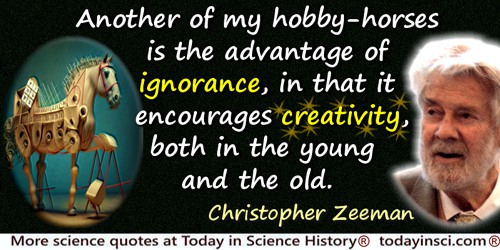
Another of my hobby-horses is the advantage of ignorance, in that it encourages creativity, both in the young and the old.
From Catastrophe Theory: Selected Papers, 1972-1977 (1977), 611. As quoted in a Review by: Hector J. Sussmann, SIAM Review (Apr 1979), 21, No. 2, 269.
Aristotle, in spite of his reputation, is full of absurdities. He says that children should be conceived in the Winter, when the wind is in the North, and that if people marry too young the children will be female. He tells us that the blood of females is blacker then that of males; that the pig is the only animal liable to measles; that an elephant suffering from insomnia should have its shoulders rubbed with salt, olive-oil, and warm water; that women have fewer teeth than men, and so on. Nevertheless, he is considered by the great majority of philosophers a paragon of wisdom.
From An Outline of Intellectual Rubbish (1937, 1943), 19. Collected in The Basic Writings of Bertrand Russell (2009), 63.
As a nation, we are too young to have true mythic heroes, and we must press real human beings into service. Honest Abe Lincoln the legend is quite a different character from Abraham Lincoln the man. And so should they be. And so should both be treasured, as long as they are distinguished. In a complex and confusing world, the perfect clarity of sports provides a focus for legitimate, utterly unambiguous support or disdain. The Dodgers are evil, the Yankees good. They really are, and have been for as long as anyone in my family can remember.
…...
As evolutionary time is measured, we have only just turned up and have hardly had time to catch breath, still marveling at our thumbs, still learning to use the brand-new gift of language. Being so young, we can be excused all sorts of folly and can permit ourselves the hope that someday, as a species, we will begin to grow up.
From 'Introduction' written by Lewis Thomas for Horace Freeland Judson, The Search for Solutions (1980, 1987), xvii.
As I stood behind the coffin of my little son the other day, with my mind bent on anything but disputation, the officiating minister read, as part of his duty, the words, 'If the dead rise not again, let us eat and drink, for to-morrow we die.' I cannot tell you how inexpressibly they shocked me. Paul had neither wife nor child, or he must have known that his alternative involved a blasphemy against all that well best and noblest in human nature. I could have laughed with scorn. What! Because I am face to face with irreparable loss, because I have given back to the source from whence it came, the cause of a great happiness, still retaining through all my life the blessings which have sprung and will spring from that cause, I am to renounce my manhood, and, howling, grovel in bestiality? Why, the very apes know better, and if you shoot their young, the poor brutes grieve their grief out and do not immediately seek distraction in a gorge.
Letter to Charles Kingsley (23 Sep 1860). In L. Huxley, The Life and Letters of Thomas Henry Huxley (1903), Vol. 1, 318.
As Love is too young to know what conscience is, so Truth and Genius are too old to know what definition is.
Samuel Butler, Henry Festing Jones (ed.), The Note-Books of Samuel Butler (1917), 221.
At first men try with magic charms
To fertilize the earth,
To keep their flocks and herds from harm
And bring new young to birth.
Then to capricious gods they turn
To save from fire or flood;
Their smoking sacrifices burn
On altars red with blood.
Next bold philosopher and sage
A settled plan decree
And prove by thought or sacred page
What Nature ought to be.
But Nature smiles—a Sphinx-like smile
Watching their little day
She waits in patience for a while—
Their plans dissolve away.
Then come those humbler men of heart
With no completed scheme,
Content to play a modest part,
To test, observe, and dream.
Till out of chaos come in sight
Clear fragments of a Whole;
Man, learning Nature’s ways aright
Obeying, can control.
To fertilize the earth,
To keep their flocks and herds from harm
And bring new young to birth.
Then to capricious gods they turn
To save from fire or flood;
Their smoking sacrifices burn
On altars red with blood.
Next bold philosopher and sage
A settled plan decree
And prove by thought or sacred page
What Nature ought to be.
But Nature smiles—a Sphinx-like smile
Watching their little day
She waits in patience for a while—
Their plans dissolve away.
Then come those humbler men of heart
With no completed scheme,
Content to play a modest part,
To test, observe, and dream.
Till out of chaos come in sight
Clear fragments of a Whole;
Man, learning Nature’s ways aright
Obeying, can control.
Epigraph in A History of Science and Its Relation with Philosophy & Religion (1968), vi.
Before the printing press, the young learned by listening, watching, doing.
In 'Classroom Without Walls', Explorations (May 1957), No. 7. Collected in Edmund Carpenter and Marshall McLuhan (eds.), Explorations in Communication, an Anthology (1960), 1.
Berzelius' symbols are horrifying. A young student in chemistry might as soon learn Hebrew as make himself acquainted with them... They appear to me equally to perplex the adepts in science, to discourage the learner, as well as to cloud the beauty and simplicity of the atomic theory.
Quoted in H. E. Roscoe, 'Presidential Address', Reports of the British Association for the Advancement of Science, 57th report, 1887, 7.
Beware of the young Doctor, & the old Barber.
In Poor Richard's Almanack (1733).
Blessings on Science! When the earth seem’d old,
When Faith grew doting, and the Reason cold,
Twas she discover’d that the world was young,
And taught a language to its lisping tongue:
’Twas she disclosed a future to its view,
And made old knowledge pale before the new.
When Faith grew doting, and the Reason cold,
Twas she discover’d that the world was young,
And taught a language to its lisping tongue:
’Twas she disclosed a future to its view,
And made old knowledge pale before the new.
From poem, 'Railways' (1846), collected in The Poetical Works of Charles Mackay: Now for the First Time Collected Complete in One Volume (1876), 214.
BODY-SNATCHER, n. A robber of grave-worms. One who supplies the young physicians with that with which the old physicians have supplied the undertaker.
The Collected Works of Ambrose Bierce (1911), Vol. 7, The Devil's Dictionary, 38-39.
But for us, it’s different. Look again at that dot. That’s here. That’s home. That’s us. On it everyone you love, everyone you know, everyone you ever heard of, every human being who ever was, lived out their lives. The aggregate of our joy and suffering, thousands of confident religions, ideologies, and economic doctrines, every hunter and forager, every hero and coward, every creator and destroyer of civilization, every king and peasant, every young couple in love, every mother and father, hopeful child, inventor and explorer, every teacher of morals, every corrupt politician, every “superstar,” every “supreme leader,” every saint and sinner in the history of our species lived there - on a mote of dust suspended in a sunbeam.
…...
By the worldly standards of public life, all scholars in their work are of course oddly virtuous. They do not make wild claims, they do not cheat, they do not try to persuade at any cost, they appeal neither to prejudice nor to authority, they are often frank about their ignorance, their disputes are fairly decorous, they do not confuse what is being argued with race, politics, sex or age, they listen patiently to the young and to the old who both know everything. These are the general virtues of scholarship, and they are peculiarly the virtues of science.
In Science and Human Values (1956).
Conferences with open attendance are very important for the stimulation of young people or other people who are new in the field. … The field of high-energy physics is, as you know, very strongly in the hands of a clique and it is hard for an outsider to enter.
From Letter to J. Howard McMillen (14 Mar 1960), in collection of Raymond Thayer Birge, Correspondence and Papers, Box 29, Folder 'Weisskopf, Victor Frederick, 1908-', Bancroft Library, University of California, Berkeley. As quoted and cited in David Kaiser, Drawing Theories Apart: The Dispersion of Feynman Diagrams in Postwar Physics (2009), 336.
Consider the plight of a scientist of my age. I graduated from the University of California at Berkeley in 1940. In the 41 years since then the amount of biological information has increased 16 fold; during these 4 decades my capacity to absorb new information has declined at an accelerating rate and now is at least 50% less than when I was a graduate student. If one defines ignorance as the ratio of what is available to be known to what is known, there seems no alternative to the conclusion that my ignorance is at least 25 times as extensive as it was when I got my bachelor’s degree. Although I am sure that my unfortunate condition comes as no surprise to my students and younger colleagues, I personally find it somewhat depressing. My depression is tempered, however, by the fact that all biologists, young or old, developing or senescing, face the same melancholy situation because of an interlocking set of circumstances.
In 'Scientific innovation and creativity: a zoologist’s point of view', American Zoologist (1982), 22, 228.
Could the young but realize how soon they will become mere walking bundles of habits, they would give more heed to their conduct while in the plastic state. We are spinning our own fates, good or evil, and never to be undone.
'The Laws of Habit', The Popular Science Monthly (Feb 1887), 451.
Darwin's characteristic perspicacity is nowhere better illustrated than in his prophecy of the reaction of the world of science. He admitted at once that it would be impossible to convince those older men '...whose minds are stocked with a multitude of facts, all viewed ... from a point of view directly opposite to mine ... A few naturalists endowed with much flexibility of mind and who have already begun to doubt the immutability of species, may be influenced by this volume; but I look with confidence to the young and rising naturalists, who will be able to view both sides with equal impartiality.
'The Reaction of American scientists to Darwinism', American Historical Review 1932), 38, 687. Quoted in David L. Hull, Science as Process (), 379.
Dermatology ... this young daughter of medicine ...
Address (7 Sep 1887), 'Dermatology in its Relation to General Medicine', at Ninth Session, International Medical Congress, Washington, D.C. In The Medical News (17 Sep 1887), 51, No. 12, 325. Unna used the expression 'daughter of medicine' in this context, but this phrase had been used before him.
ENGINEERING. The finest career for a young man; he learns all the sciences.
In The Dictionary of Accepted Ideas (1881), trans. Jaques Barzun (1968), 35.
Euler was a believer in God, downright and straightforward. The following story is told by Thiebault, in his Souvenirs de vingt ans de séjour à Berlin, … Thiebault says that he has no personal knowledge of the truth of the story, but that it was believed throughout the whole of the north of Europe. Diderot paid a visit to the Russian Court at the invitation of the Empress. He conversed very freely, and gave the younger members of the Court circle a good deal of lively atheism. The Empress was much amused, but some of her counsellors suggested that it might be desirable to check these expositions of doctrine. The Empress did not like to put a direct muzzle on her guest’s tongue, so the following plot was contrived. Diderot was informed that a learned mathematician was in possession of an algebraical demonstration of the existence of God, and would give it him before all the Court, if he desired to hear it. Diderot gladly consented: though the name of the mathematician is not given, it was Euler. He advanced toward Diderot, and said gravely, and in a tone of perfect conviction:
Monsieur, (a + bn) / n = x, donc Dieu existe; repondez!
Diderot, to whom algebra was Hebrew, was embarrassed and disconcerted; while peals of laughter rose on all sides. He asked permission to return to France at once, which was granted.
Diderot, to whom algebra was Hebrew, was embarrassed and disconcerted; while peals of laughter rose on all sides. He asked permission to return to France at once, which was granted.
In Budget of Paradoxes (1878), 251. [The declaration in French expresses, “therefore God exists; please answer!” This Euler-Diderot anecdote, as embellished by De Morgan, is generally regarded as entirely fictional. Diderot before he became an encyclopedist was an accomplished mathematician and fully capable of recognizing—and responding to—the absurdity of an algebraic expression in proving the existence of God. See B.H. Brown, 'The Euler-Diderot Anecdote', The American Mathematical Monthly (May 1942), 49, No. 5, 392-303. —Webmaster.]
Even today I still get letters from young students here and there who say, Why are you people trying to program intelligence? Why don’t you try to find a way to build a nervous system that will just spontaneously create it? Finally I decided that this was either a bad idea or else it would take thousands or millions of neurons to make it work and I couldn’t afford to try to build a machine like that.
As quoted in Jeremy Bernstein, 'A.I.', The New Yorker (14 Dec 1981), 57, 70.
First, as concerns the success of teaching mathematics. No instruction in the high schools is as difficult as that of mathematics, since the large majority of students are at first decidedly disinclined to be harnessed into the rigid framework of logical conclusions. The interest of young people is won much more easily, if sense-objects are made the starting point and the transition to abstract formulation is brought about gradually. For this reason it is psychologically quite correct to follow this course.
Not less to be recommended is this course if we inquire into the essential purpose of mathematical instruction. Formerly it was too exclusively held that this purpose is to sharpen the understanding. Surely another important end is to implant in the student the conviction that correct thinking based on true premises secures mastery over the outer world. To accomplish this the outer world must receive its share of attention from the very beginning.
Doubtless this is true but there is a danger which needs pointing out. It is as in the case of language teaching where the modern tendency is to secure in addition to grammar also an understanding of the authors. The danger lies in grammar being completely set aside leaving the subject without its indispensable solid basis. Just so in Teaching of Mathematics it is possible to accumulate interesting applications to such an extent as to stunt the essential logical development. This should in no wise be permitted, for thus the kernel of the whole matter is lost. Therefore: We do want throughout a quickening of mathematical instruction by the introduction of applications, but we do not want that the pendulum, which in former decades may have inclined too much toward the abstract side, should now swing to the other extreme; we would rather pursue the proper middle course.
Not less to be recommended is this course if we inquire into the essential purpose of mathematical instruction. Formerly it was too exclusively held that this purpose is to sharpen the understanding. Surely another important end is to implant in the student the conviction that correct thinking based on true premises secures mastery over the outer world. To accomplish this the outer world must receive its share of attention from the very beginning.
Doubtless this is true but there is a danger which needs pointing out. It is as in the case of language teaching where the modern tendency is to secure in addition to grammar also an understanding of the authors. The danger lies in grammar being completely set aside leaving the subject without its indispensable solid basis. Just so in Teaching of Mathematics it is possible to accumulate interesting applications to such an extent as to stunt the essential logical development. This should in no wise be permitted, for thus the kernel of the whole matter is lost. Therefore: We do want throughout a quickening of mathematical instruction by the introduction of applications, but we do not want that the pendulum, which in former decades may have inclined too much toward the abstract side, should now swing to the other extreme; we would rather pursue the proper middle course.
In Ueber den Mathematischen Unterricht an den hoheren Schulen; Jahresbericht der Deutschen Mathematiker Vereinigung, Bd. 11, 131.
For my own part I would as soon be descended from that heroic little monkey, who braved his dreaded enemy in order to save the life of his keeper; or from that old baboon, who, descending from the mountains, carried away in triumph his young comrade from a crowd of astonished dogs—as from a savage who delights to torture his enemies, offers up bloody sacrifices, practices infanticide without remorse, treats his wives like slaves, knows no decency, and is haunted by the grossest superstitions.
The Descent of Man (1871), Vol. 2, 404-5.
For the very first time the young are seeing history being made before it is censored by their elders.
…...
Formula for breakthroughs in research: Take young researchers, put them together in virtual seclusion, give them an unprecedented degree of freedom and turn up the pressure by fostering competitiveness.
In James Beasley Simpson, Simpson's Contemporary Quotations (1988), 145.
From the sexual, or amatorial, generation of plants new varieties, or improvements, are frequently obtained; as many of the young plants from seeds are dissimilar to the parent, and some of them superior to the parent in the qualities we wish to possess... Sexual reproduction is the chef d'oeuvre, the master-piece of nature.
Phytologia. (1800), 115, 103.
Half the joy of life is in little things taken on the run… but let us keep our hearts
young and our eyes open that nothing worth our while shall escape us. That nothing worth our while shall escape us. And everything is worth its while if we only grasp it and its significance.
Found quoted without source in The American Journal of Clinical Medicine (1907), 14, 150, and several other publications of that time period. Webmaster invites help pinpointing the primary text.
He who would lead a Christ-like life is he who is perfectly and absolutely himself. He may be a great poet, or a great man of science, or a young student at the University, or one who watches sheep upon a moor, or a maker of dramas like Shakespeare, or a thinker about God, like Spinoza. or a child who plays in a garden, or a fisherman who throws his nets into the sea. It does not matter what he is as long as he realises the perfection of the soul that is within him.
In 'The Critic As Artist', Oscariana: Epigrams (1907), 27-28
I … was therefore enforced, as a bear doth her whelps, to bring forth this confused lump; I had not time to lick it into form, as she doth her young ones, but even so to publish it.
The Anatomy of Melancholy (1857), 24.
I am always surprised when a young man tells me he wants to work at cosmology. I think of cosmology as something that happens to one, not something one can choose.
In Presidential Address (8 Feb 1963), Quarterly Journal of the Royal Astronomical Society (Mar 1963), 4, 185.
I believe that the useful methods of mathematics are easily to be learned by quite young persons, just as languages are easily learned in youth. What a wondrous philosophy and history underlie the use of almost every word in every language—yet the child learns to use the word unconsciously. No doubt when such a word was first invented it was studied over and lectured upon, just as one might lecture now upon the idea of a rate, or the use of Cartesian co-ordinates, and we may depend upon it that children of the future will use the idea of the calculus, and use squared paper as readily as they now cipher. … When Egyptian and Chaldean philosophers spent years in difficult calculations, which would now be thought easy by young children, doubtless they had the same notions of the depth of their knowledge that Sir William Thomson might now have of his. How is it, then, that Thomson gained his immense knowledge in the time taken by a Chaldean philosopher to acquire a simple knowledge of arithmetic? The reason is plain. Thomson, when a child, was taught in a few years more than all that was known three thousand years ago of the properties of numbers. When it is found essential to a boy’s future that machinery should be given to his brain, it is given to him; he is taught to use it, and his bright memory makes the use of it a second nature to him; but it is not till after-life that he makes a close investigation of what there actually is in his brain which has enabled him to do so much. It is taken because the child has much faith. In after years he will accept nothing without careful consideration. The machinery given to the brain of children is getting more and more complicated as time goes on; but there is really no reason why it should not be taken in as early, and used as readily, as were the axioms of childish education in ancient Chaldea.
In Teaching of Mathematics (1902), 14.
I confess, that after I began … to discern how useful mathematicks may be made to physicks, I have often wished that I had employed about the speculative part of geometry, and the cultivation of the specious Algebra I had been taught very young, a good part of that time and industry, that I had spent about surveying and fortification (of which I remember I once wrote an entire treatise) and other parts of practick mathematicks.
In 'The Usefulness of Mathematiks to Natural Philosophy', Works (1772), Vol. 3, 426.
I grew up in Brooklyn, New York … a city neighborhood that included houses, lampposts, walls, and bushes. But with an early bedtime in the winter, I could look out my window and see the stars, and the stars were not like anything else in my neighborhood. [At age 5] I didn’t know what they were.
[At age 9] my mother … said to me, “You have a library card now, and you know how to read. Take the streetcar to the library and get a book on stars.” … I stepped up to the big librarian and asked for a book on stars. … I sat down and found out the answer, which was something really stunning.I found out that the stars are glowing balls of gas. I also found out that the Sun is a star but really close and that the stars are all suns except really far away I didn’t know any physics or mathematics at that time, but I could imagine how far you’d have to move the Sun away from us till it was only as bright as a star. It was in that library, reading that book, that the scale of the universe opened up to me. There was something beautiful about it.
At that young age, I already knew that I’d be very happy if I could devote my life to finding out more about the stars and the planets that go around them. And it’s been my great good fortune to do just that.
[At age 9] my mother … said to me, “You have a library card now, and you know how to read. Take the streetcar to the library and get a book on stars.” … I stepped up to the big librarian and asked for a book on stars. … I sat down and found out the answer, which was something really stunning.I found out that the stars are glowing balls of gas. I also found out that the Sun is a star but really close and that the stars are all suns except really far away I didn’t know any physics or mathematics at that time, but I could imagine how far you’d have to move the Sun away from us till it was only as bright as a star. It was in that library, reading that book, that the scale of the universe opened up to me. There was something beautiful about it.
At that young age, I already knew that I’d be very happy if I could devote my life to finding out more about the stars and the planets that go around them. And it’s been my great good fortune to do just that.
Quoted in interview with Jack Rightmyer, in 'Stars in His Eyes', Highlights For Children (1 Jan 1997). Ages as given in Tom Head (ed.), Conversations with Carl Sagan (2006), x.
I had a Meccano set with which I “played” endlessly. Meccano which was invented by Frank Hornby around 1900, is called Erector Set in the US. New toys (mainly Lego) have led to the extinction of Meccano and this has been a major disaster as far as the education of our young engineers and scientists is concerned. Lego is a technically trivial plaything and kids love it partly because it is so simple and partly because it is seductively coloured. However it is only a toy, whereas Meccano is a real engineering kit and it teaches one skill which I consider to be the most important that anyone can acquire: This is the sensitive touch needed to thread a nut on a bolt and tighten them with a screwdriver and spanner just enough that they stay locked, but not so tightly that the thread is stripped or they cannot be unscrewed. On those occasions (usually during a party at your house) when the handbasin tap is closed so tightly that you cannot turn it back on, you know the last person to use the washroom never had a Meccano set.
Nobel laureate autobiography in Les Prix Nobel/Nobel Lectures 1996 (1997), 189.
I had fallen in love with a young man..., and we were planning to get married. And then he died of subacute bacterial endocarditis... Two years later with the advent of penicillin, he would have been saved. It reinforced in my mind the importance of scientific discovery...
Quoted in Susan Ambrose et al., Journeys of Women in Science and Engineering: No Universal Constants (1997)
I have been especially fortunate for about 50 years in having two memory banks available—whenever I can't remember something I ask my wife, and thus I am able to draw on this auxiliary memory bank. Moreover, there is a second way In which I get ideas ... I listen carefully to what my wife says, and in this way I often get a good idea. I recommend to ... young people ... that you make a permanent acquisition of an auxiliary memory bank that you can become familiar with and draw upon throughout your lives.
T. Goertzel and B. Goertzel, Linus Pauling (1995), 240.
I have been trying to point out that in our lives chance may have an astonishing influence and, if I may offer advice to the young laboratory worker, it would be this—never neglect an extraordinary appearance or happening. It may be—usually is, in fact—a false alarm that leads to nothing, but may on the other hand be the clue provided by fate to lead you to some important advance.
Lecture at Harvard University. Quoted in Joseph Sambrook, David W. Russell, Molecular Cloning (2001), Vol. 1, 153.
I have procured some of the mice mentioned in my former letters, a young one and a female with young, both of which I have preserved in brandy. From the colour, shape, size, and manner of nesting, I make no doubt but that the species is nondescript [not known to science]. They are much smaller and more slender than the mus domesticus medius of Ray; and have more of the squirrel or dormouse colour ... They never enter into houses; are carried into ricks and barns with the sheaves; abound in harvest, and build their nests amidst the straws of the corn above the ground, and sometimes in thistles.
[Part of his observations on the harvest mouse, which he was the first to describe as a new species.]
[Part of his observations on the harvest mouse, which he was the first to describe as a new species.]
Letter XII (4 Nov 1767) in The Natural History of Selborne (1789, 1899), 31.
I hope my studies may be an encouragement to other women, especially to young women, to devote their lives to the larger interests of the mind. It matters little whether men or women have the more brains; all we women need to do to exert our proper influence is just to use all the brains we have.
In Elinor Bluemel, Florence Sabin: Colorado Woman of the Century (1959), 124. Cited elsewhere as from speech accepting the Pictorial Review achievement award (1929).
I hope my studies may be an encouragement to other women, especially to young women, to devote their lives to the larger interests of the mind. It matters little whether men or women have the more brains; all we women need to do to exert our proper influence is just to use all the brains we have."
As quoted in part, in Eminent Women: Recipients of the National Achievement Award (1948), 8. Cited more completely elsewhere as from speech accepting the Pictorial Review achievement award (1929).
I know two people who have found it [the secret of success]. … Getting ready. Getting prepared. There were Edison and Lindbergh,—they both got ready before they started. I had to find that out too. I had to stop for ten years after I had started; I had to stop for ten years and get ready. I made my first car in 1893, but it was 1903 before I had it ready to sell. It is these simple things that young men ought to know, and they are hardest to grasp. Before everything else, get ready.
From Henry Ford and Ralph Waldo Trine, The Power that Wins (1929), 147. Often seen paraphrased as “Before everything else, getting ready is the secret of success,” for example, in Connie Robertson (ed.), The Wordsworth Dictionary of Quotations (1998), 129.
I must not pass by Dr. Young called Phaenomenon Young at Cambridge. A man of universal erudition, & almost universal accomplishments. Had he limited himself to anyone department of knowledge, he must have been first in that department. But as a mathematician, a scholar, a hieroglyphist, he was eminent; & he knew so much that it is difficult to say what he did not know. He was a most amiable & good-tempered man; too fond, perhaps, of the society of persons of rank for a true philosopher.
J. Z. Fullmer, 'Davy's Sketches of his Contemporaries', Chymia (1967), 12, 135.
I remember my first look at the great treatise of Maxwell’s when I was a young man… I saw that it was great, greater and greatest, with prodigious possibilities in its power… I was determined to master the book and set to work. I was very ignorant. I had no knowledge of mathematical analysis (having learned only school algebra and trigonometry which I had largely forgotten) and thus my work was laid out for me. It took me several years before I could understand as much as I possibly could. Then I set Maxwell aside and followed my own course. And I progressed much more quickly… It will be understood that I preach the gospel according to my interpretation of Maxwell.
From translations of a letter (24 Feb 1918), cited in Paul J. Nahin, Oliver Heaviside: The Life, Work, and Times of an Electrical Genius of the Victorian Age (2002), 24. Nahin footnotes that the words are not verbatim, but are the result of two translations. Heaviside's original letter in English was quoted, translated in to French by J. Bethenode, for the obituary he wrote, "Oliver Heaviside", in Annales des Posies Telegraphs (1925), 14, 521-538. The quote was retranslated back to English in Nadin's book. Bethenode footnoted that he made the original translation "as literally as possible in order not to change the meaning." Nadin assures that the retranslation was done likewise. Heaviside studyied Maxwell's two-volume Treatise on Electricity and Magnetism.
I should rejoice to see mathematics taught with that life and animation which the presence and example of her young and buoyant sister [natural and experimental science] could not fail to impart, short roads preferred to long ones.
From Presidential Address (1869) to the British Association, Exeter, Section A, collected in Collected Mathematical Papers of Lames Joseph Sylvester (1908), Vol. 2, 657.
I suppose I should be run after for a professorship if I had studied at Giessen, as it seems to be a settled point that no young man can be expected to know anything of chemistry unless he has studied with Liebig; while the truth is, that any one who goes there and does not afterwards correct the bad habits acquired there, in some other laboratory, is almost unfitted for doing things in Chemistry. No doubt Liebig is a remarkable man, who has done much for organic Chemistry, not to speak of his having quarreled with all the Chemists in Europe...
Letter to his brother, William Dwight Whitney (25 Apr 1846). In Edwin Tenney Brewster and Josiah Dwight Whitney, Life and Letters of Josiah Dwight Whitney (1909), 79-80.
I suspect one of the reasons that fantasy and science fiction appeal so much to younger readers is that, when the space and time have been altered to allow characters to travel easily anywhere through the continuum and thus escape physical dangers and timepiece inevitabilities, mortality is so seldom an issue.
…...
I tell young people to reach for the stars. And I can't think of a greater high than you could possibly get than by inventing something.
From audio on MIT video '1999 Lemelson-MIT Lifetime Achievement Award Winner', on 'Innovative Lives: Stephanie Kwolek and Kevlar, The Wonder Fiber' on the Smithsonian website.
I took him [Lawrence Bragg] to a young zoologist working on pattern formation in insect cuticles. The zoologist explained how disturbances introduced into these regular patterns pointed to their formation being governed by some kind of gradient. Bragg listened attentively and then exclaimed: “Your disturbed gradient behaves like a stream of sand running downhill and encountering an obstacle.” “Good heavens,” replied the zoologist, “I had been working on this problem for years before this simple analogy occurred to me and you think of it after twenty minutes.”
As quoted in David Phillips, Biographical Memoirs of Fellows of the Royal Society (Nov 1979), 25, 132, citing: Perutz, M.F. 1971 New Sci. & Sci. J. 8 July 1967.
I was introduced to Mr. Davy, who has rooms adjoining mine (in the Royal Institution); he is a very agreeable and intelligent young man, and we have interesting conversation in an evening; the principal failing in his character as a philosopher is that he does not smoke.
Letter to John Rothwell, January 1804. Quoted in J. P. Millington, John Dalton (1906), 141.
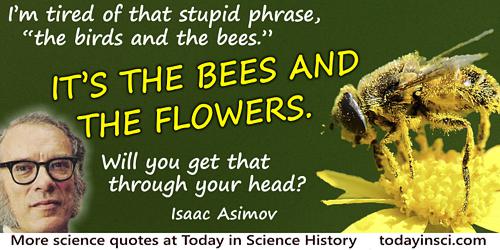
I’m tired of that stupid phrase, “the birds and the bees” which is supposed to represent “the facts of life” or the beginnings of the sex instruction of the young. … Well for heaven’s sake, has anyone ever tried to explain sex by talking about the birds and the bees? What have the birds and the bees to do with it? IT’S THE BEES AND THE FLOWERS. Will you get that through your head? IT’S THE BEES AND THE FLOWERS. The bee travels to one flower and picks up pollen from the stamens. The pollen contains the male sex cells of the plant. The bee then travels to another flower (of the same species) and the pollen brushes off onto the pistil, which contains the female sex cells of the plant. … Now in the human being … we don’t rely on bees to do it for us.
From Isaac Asimov’s letter in 'Hue and Cry' letter column in magazine, James L. Quinn (ed.), IF: Worlds of Science Fiction (Dec 1957), 7, No. 6, 119
I’ve said many times before, we’ve got to celebrate the winners of our science fairs as much as we celebrate the winners of football or basketball or other athletic competitions, because young scientists, mathematicians, engineers, they’re critical to our future.
From remarks at the fifth White House Science Fair, in Press Release (23 Mar 2015).
If catastrophic geology had at times pushed Nature to almost indecent extremes of haste, uniformitarian geology, on the other hand, had erred in the opposite direction, and pictured Nature when she was “young and wantoned in her prime”, as moving with the lame sedateness of advanced middle age. It became necessary, therefore, as Dr. Haughton expresses it, “to hurry up the phenomena”.
From British Association Address to Workingmen, 'Geology and Deluges', published in Nature (1984), 50, 505-510. Also printed in Popular Science Monthly (Dec 1894), 46 251. “Wontoned” (sic) was likely used for “wanton.” and Dr. Samuel Haughton was an Irish scientific writer —Webmaster.
If I would be a young man again and had to decide how to make my living, I would not try to become a scientist or scholar or teacher. I would rather choose to be a plumber or a peddler in the hope to find that modest degree of independence still available under present circumstances.
According to Ralph Keyes, The Quote Verifier: Who Said What, Where, and When (2006), 53, on other occasions Einstein said “he might rather have been a musician, or light-house keeper”; however it is a “popular misquotation” that refers to being a watchmaker.
If the question were, “What ought to be the next objective in science?” my answer would be the teaching of science to the young, so that when the whole population grew up there would be a far more general background of common sense, based on a knowledge of the real meaning of the scientific method of discovering truth.
Marion Savin Selections from the Scientific Correspondence of Elihu Thomson (1971), v.
If there is any kind of animal which is female and has no male separate from it, it is possible that this may generate a young one from itself. No instance of this worthy of any credit has been observed up to the present at any rate, but one case in the class of fishes makes us hesitate. No male of the so-called erythrinus has ever yet been seen, but females, and specimens full of roe, have been seen. Of this, however, we have as yet no proof worthy of credit.
Generation of Animals, 741a, 32-8. In Jonathan Barnes (ed.), The Complete Works of Aristotle (1984), Vol. I, 1150.
If there’s one thing in physics I feel more responsible for than any other, it’s this perception of how everything fits together. I like to think of myself as having a sense of judgment. I’m willing to go anywhere, talk to anybody, ask any question that will make headway. I confess to being an optimist about things, especially about someday being able to understand how things are put together. So many young people are forced to specialize in one line or another that a young person can’t afford to try and cover this waterfront — only an old fogy who can afford to make a fool of himself. If I don't, who will?
Stated during a 1983 interview. Quoted in Dennis Overbye, 'John A. Wheeler, Physicist Who Coined the Term Black Hole, Is Dead at 96', New York Times (14 Apr 2008).
If you are young, then I say: Learn something about statistics as soon as you can. Don’t dismiss it through ignorance or because it calls for thought. … If you are older and already crowned with the laurels of success, see to it that those under your wing who look to you for advice are encouraged to look into this subject. In this way you will show that your arteries are not yet hardened, and you will be able to reap the benefits without doing overmuch work yourself. Whoever you are, if your work calls for the interpretation of data, you may be able to do without statistics, but you won’t do as well.
In Facts from Figures (1951), 463.
If you wish to die young, make your physician your heir.
In H. Pullar-Strecker, Proverbs for Pleasure (1954), 193.
In diagnosis, the young are positive and the middle-aged tentative; only the old have flair.
Lancet (1951), 1, 795.
In my life as an architect, I found that the single thing which inhibits young professionals, new students most severely, is their acceptance of standards that are too low.
In 'Foreword' written for Richard P. Gabriel, Patterns of Software: Tales from the Software Community (1996), vii.
In the days when geology was young, now some two hundred years ago, it found a careful foster-mother in theology, who watched over its early growth with anxious solicitude, and stored its receptive mind with the most beautiful stories, which the young science never tired of transforming into curious fancies of its own, which it usually styled “theories of the earth.”
In British Association Address to Workingmen, 'Geology and Deluges', published in Nature (1984), 50, 505-510. Also printed in Popular Science Monthly (Dec 1894), 46 245.
It is a good morning exercise for a research scientist to discard a pet hypothesis every day before breakfast. It keeps him young.
On Aggression, trans. M. Latzke (1966), 8.
It is a wrong business when the younger cultivators of science put out of sight and deprecate what their predecessors have done; but obviously that is the tendency of Huxley and his friends … It is very true that Huxley was bitter against the Bishop of Oxford, but I was not present at the debate. Perhaps the Bishop was not prudent to venture into a field where no eloquence can supersede the need for precise knowledge. The young naturalists declared themselves in favour of Darwin’s views which tendency I saw already at Leeds two years ago. I am sorry for it, for I reckon Darwin’s book to be an utterly unphilosophical one.
Letter to James D, Forbes (24 Jul 1860). Trinity College Cambridge, Whewell Manuscripts.
It is also vital to a valuable education that independent critical thinking be developed in the young human being, a development that is greatly jeopardized by overburdening with too much and too varied subjects. Overburdening necessarily leads to superficiality.
From interview with Benjamin Fine, 'Einstein Stresses Critical Thinking', New York Times (5 Oct 1952), 37. [Here, “superficiality” has been inserted as a correction for a typo, “superciality”, in the original text. —Webmaster]
It is baffling, I must say, that in our modern world we have such blind trust in science and technology that we all accept what science tells us about everything—until, that is, it comes to climate science. All of a sudden, and with a barrage of sheer intimidation, we are told by powerful groups of deniers that the scientists are wrong and we must abandon all our faith in so much overwhelming scientific evidence. So thank goodness for our young entrepreneurs here this evening, who have the far-sightedness and confidence in what they know is happening to ignore the headless chicken brigade and do something practical to help.
Speech, awards ceremony for green entrepreneurs, Buckingham Palace (30 Jan 2014). As quoted in Benn Quinn, 'Climate Change Sceptics are ‘Headless Chickens’, Says Prince Charles', The Guardian (31 Jan 2014).
It is curious to observe with what different degrees of architectonic skill Providence has endowed birds of the same genus, and so nearly correspondent in their general mode of life! for while the swallow and the house-martin discover the greatest address in raising and securely fixing crusts or shells of loam as cunabula for their young, the bank-martin terebrates a round and regular hole in the sand or earth, which is serpentine, horizontal, and about two feet deep. At the inner end of this burrow does this bird deposit, in a good degree of safety, her rude nest, consisting of fine grasses and feathers, usually goose-feathers, very inartificially laid together.
In Letter to Daines Barrington, (26 Feb 1774), in The Natural History and Antiquities of Selborne (1789), 176.
It is disconcerting that present-day young who did not know Stalin and Hitler are displaying the old naïveté. After all that has happened they still do not know that you cannot build utopia without terror, and that before long terror is all that’s left.
In Before the Sabbath (1979), 120.
It is often assumed that because the young child is not competent to study geometry systematically he need be taught nothing geometrical; that because it would be foolish to present to him physics and mechanics as sciences it is useless to present to him any physical or mechanical principles.
An error of like origin, which has wrought incalculable mischief, denies to the scholar the use of the symbols and methods of algebra in connection with his early essays in numbers because, forsooth, he is not as yet capable of mastering quadratics! … The whole infant generation, wrestling with arithmetic, seek for a sign and groan and travail together in pain for the want of it; but no sign is given them save the sign of the prophet Jonah, the withered gourd, fruitless endeavor, wasted strength.
An error of like origin, which has wrought incalculable mischief, denies to the scholar the use of the symbols and methods of algebra in connection with his early essays in numbers because, forsooth, he is not as yet capable of mastering quadratics! … The whole infant generation, wrestling with arithmetic, seek for a sign and groan and travail together in pain for the want of it; but no sign is given them save the sign of the prophet Jonah, the withered gourd, fruitless endeavor, wasted strength.
From presidential address (9 Sep 1884) to the General Meeting of the American Social Science Association, 'Industrial Education', printed in Journal of Social Science (1885), 19, 121. Collected in Francis Amasa Walker, Discussions in Education (1899), 132.
It is only by introducing the young to great literature, drama and music, and to the excitement of great science that we open to them the possibilities that lie within the human spirit—enable them to see visions and dream dreams.
Quoted, without citation in Reader's Digest Quotable Quotes (1997), 144. This quote, usually seen attributed as 'Eric Anderson' is here tentatively linked to Sir Eric Anderson. If you can confirm this with a primary source, please contact Webmaster.
It is only necessary to check the comic books and Reader’s Digest to see the extent of the influence of applied science on the popular imagination. How much it is used to provide an atmosphere of endless thrill and excitement, quite apart from its accidental menace or utility, one can decide from such typical daily headlines as these:
London, March 10, 1947, Reuters: ROCKET TO MOON SEEN POSSIBLE BUT THOUSANDS TO DIE IN ATTEMPT
Cleveland, January 5, 1948.: LIFE SPAN OF 100, BE YOUNG AT 80, ATOM PREDICTION
Washington, June 11, 1947: SCIENTISTS AWAIT COW’S DEATH TO SOLVE MATHEMATICS PROBLEM
Needham Market, Suffolk, England. (U.P.): VICAR PROPOSES BABIES FOR YEARNING SPINSTERS, TEST-TUBE BABIES WILL PRODUCE ROBOTS
Washington, D.C., January 3, 1948. U.S. FLYER PASSING SONIC BARRIER OPENS NEW VISTAS OF DESTRUCTION ONE OF BRAVEST ACTS IN HISTORY
Those headlines represent “human interest” attempts to gear science to the human nervous system.
London, March 10, 1947, Reuters: ROCKET TO MOON SEEN POSSIBLE BUT THOUSANDS TO DIE IN ATTEMPT
Cleveland, January 5, 1948.: LIFE SPAN OF 100, BE YOUNG AT 80, ATOM PREDICTION
Washington, June 11, 1947: SCIENTISTS AWAIT COW’S DEATH TO SOLVE MATHEMATICS PROBLEM
Needham Market, Suffolk, England. (U.P.): VICAR PROPOSES BABIES FOR YEARNING SPINSTERS, TEST-TUBE BABIES WILL PRODUCE ROBOTS
Washington, D.C., January 3, 1948. U.S. FLYER PASSING SONIC BARRIER OPENS NEW VISTAS OF DESTRUCTION ONE OF BRAVEST ACTS IN HISTORY
Those headlines represent “human interest” attempts to gear science to the human nervous system.
In The Mechanical Bride: Folklore of Industrial Man (1967), 93.
It is only those who know a little of nature, who fancy they know much. I have heard a young man say, after hearing a few popular chemical lectures, and seeing a few bottle and squirt experiments: Oh, water—water is only oxygen and hydrogen!—as if he knew all about it. While the true chemist would smile sadly enough at the the youth's hasty conceit, and say in his heart: 'Well, he is a lucky fellow.'
'Thoughts in a Gravel Pit', a lecture delivered at the Mechanics' Institute, Odiham (1857). The Works of Charles Kingsley (1880), 284.
It is the malady of our age that the young are so busy teaching us that they have no time left to learn.
In Reflections on the Human Condition (1973), 22.
It is unlikely that we will ever see a star being born. Stars are like animals in the wild. We may see the very young, but never their actual birth, which is a veiled and secret event. Stars are born inside thick clouds of dust and gas in the spiral arms of the galaxy, so thick that visible light cannot penetrate them.
Perfect Symmetry: The Search for the Beginning of Time (1985), 44.
It is well-known that those who have charge of young infants, that it is difficult to feel sure when certain movements about their mouths are really expressive; that is when they really smile. Hence I carefully watched my own infants. One of them at the age of forty-five days, and being in a happy frame of mind, smiled... I observed the same thing on the following day: but on the third day the child was not quite well and there was no trace of a smile, and this renders it probable that the previous smiles were real.
The Expression of Emotions in Man and Animals
It just so happens that during the 1950s, the first great age of molecular biology, the English schools of Oxford and particularly of Cambridge produced more than a score of graduates of quite outstanding ability—much more brilliant, inventive, articulate and dialectically skillful than most young scientists; right up in the Jim Watson class. But Watson had one towering advantage over all of them: in addition to being extremely clever he had something important to be clever about.
From the postscript to 'Lucky Jim', New York Review of Books (28 Mar 1968). Also collected in 'Lucky Jim', Pluto’s Republic (1982), 275. Also excerpted in Richard Dawkins (ed.), The Oxford Book of Modern Science Writing (2008), 186.
It seems a miracle that young children easily learn the language of any environment into which they were born. The generative approach to grammar, pioneered by Chomsky, argues that this is only explicable if certain deep, universal features of this competence are innate characteristics of the human brain. Biologically speaking, this hypothesis of an inheritable capability to learn any language means that it must somehow be encoded in the DNA of our chromosomes. Should this hypothesis one day be verified, then lingusitics would become a branch of biology.
'The Generative Grammar of the Immune System', Nobel Lecture, 8 Dec 1984. In Nobel Lectures: Physiology or Medicine 1981-1990 (1993), 223.
It should be the function of medicine to have people die young as late as possible.
…...
It was to Hofmeister, working as a young man, an amateur and enthusiast, in the early morning hours of summer months, before business, at Leipzig in the years before 1851, that the vision first appeared of a common type of Life-Cycle, running through Mosses and Ferns to Gymnosperms and Flowering Plants, linking the whole series in one scheme of reproduction and life-history.
(1919). As quoted in E.J.H. Corner, The Life of Plants (1964).
It would, of course, be a poor lookout for the advancement of science if young men started believing what their elders tell them, but perhaps it is legitimate to remark that young Turks look younger, or more Turkish ... if the conclusions they eventually reach are different from what anyone had said before.
In Nature, 1969.
It’s fine if you as an adult want to run around pretending or claiming that you don’t believe in evolution, but if we educate a generation of people who don’t believe in science, that’s a recipe for disaster. … The main idea in all of biology is evolution. To not teach it to our young people is wrong.
— Bill Nye
As quoted in Sarah Fecht, 'Science Guy Bill Nye Explains Why Evolution Belongs in Science Education', Popular Mechanics (4 Feb 2011).
John [H.] Van Vleck, who was a leading young theoretical physicist when I was also a leading young theoretical physicist, said to me one day, “I never have made a contribution to physics that I didn’t get by fiddling with the equations,” and I said, “I’ve never made a contribution that I didn’t get by just having a new idea. Then I would fiddle with the equations to help support the new idea.” Van Vleck was essentially a mathematical physicist, you might say, and I was essentially a person of ideas. I don’t think I’m primarily mathematical. … I have a great curiosity about the nature of the world as a whole, and most of my ideas are qualitative rather than quantitative.
Interview with George B. Kauffman and Laurie M. Kauffman, in 'Linus Pauling: Reflections', American Scientist (Nov-Dec 1994), 82, No. 6, 523.
John Dalton was a very singular Man, a quaker by profession & practice: He has none of the manners or ways of the world. A tolerable mathematician He gained his livelihood I believe by teaching the mathematics to young people. He pursued science always with mathematical views. He seemed little attentive to the labours of men except when they countenanced or confirmed his own ideas... He was a very disinterested man, seemed to have no ambition beyond that of being thought a good Philosopher. He was a very coarse Experimenter & almost always found the results he required.—Memory & observation were subordinate qualities in his mind. He followed with ardour analogies & inductions & however his claims to originality may admit of question I have no doubt that he was one of the most original philosophers of his time & one of the most ingenious.
J. Z. Fullmer, 'Davy's Sketches of his Contemporaries', Chymia, 1967, 12, 133-134.
John Young and Bob Crippen have made us very proud. Their deeds reminded us that we as a free people can accomplish whatever we set out to do. Nothing binds our abilities except our expectations, and, given that, the farthest star is within our reach.
At Oval Office ceremony (20 May 1981) awarding NASA Distinguished Service medals to Young and Crippen, and a Congressional Space Medal of Honor to Young.
Just think of the differences today. A young person gets interested in chemistry and is given a chemical set. But it doesn't contain potassium cyanide. It doesn't even contain copper sulfate or anything else interesting because all the interesting chemicals are considered dangerous substances. Therefore, these budding young chemists don't get a chance to do anything engrossing with their chemistry sets. As I look back, I think it is pretty remarkable that Mr. Ziegler, this friend of the family, would have so easily turned over one-third of an ounce of potassium cyanide to me, an eleven-year-old boy.
In Barbara Marinacci, Linus Pauling In His Own Words (1995), 29.
Learning is wealth to the poor, an honor to the rich, an aid to the young, and a support and comfort to the aged.
As cited in Abram N. Coleman (ed.), Proverbial Wisdom: Proverbs, Maxims and Ethical Sentences (1903), 130. Often-seen attribution to John C. Lavater is probably erroneous. Several quote collections of the same era give the quote without citation. In Tryon Edwards, Dictionary of Thoughts (1908), 294, this quote is given without citation, followed by a blank line separator, and then an unrelated quote by Lavater. This juxtaposition is likely the source of confusion in attribution.
Let the young know they will never find a more interesting, more instructive book than the patient himself.
Attributed.
Life, forever dying to be born afresh, forever young and eager, will presently stand upon this Earth as upon a footstool, and stretch out its realm amidst the stars.
…...
MAMMALIA, n. pl. A family of vertebrate animals whose females in a state of nature suckle their young, but when civilized and enlightened put them out to nurse, or use the bottle.
The Collected Works of Ambrose Bierce (1911), Vol. 7, The Devil's Dictionary, 211.
Man always kills the thing he loves, and so we the pioneers have killed our wilderness. Some say we had to. Be that as it may, I am glad I shall never be young without wild country to be young in. Of what avail are forty freedoms without a blank spot on the map?
Concluding paragraph of 'Chihuahua and Sonora', A Sand County Almanac, and Sketches Here and There (1949, 1987), 148-149.
Many animals even now spring out of the soil,
Coalescing from the rains and the heat of the sun.
Small wonder, then, if more and bigger creatures,
Full-formed, arose from the new young earth and sky.
The breed, for instance, of the dappled birds
Shucked off their eggshells in the springtime, as
Crickets in summer will slip their slight cocoons
All by themselves, and search for food and life.
Earth gave you, then, the first of mortal kinds,
For all the fields were soaked with warmth and moisture.
Coalescing from the rains and the heat of the sun.
Small wonder, then, if more and bigger creatures,
Full-formed, arose from the new young earth and sky.
The breed, for instance, of the dappled birds
Shucked off their eggshells in the springtime, as
Crickets in summer will slip their slight cocoons
All by themselves, and search for food and life.
Earth gave you, then, the first of mortal kinds,
For all the fields were soaked with warmth and moisture.
On the Nature of Things, trans. Anthony M. Esolen (1995), Book 5, lines 794-803, 181.
Many billions of years will elapse before the smallest, youngest stars complete their nuclear burning and into white dwarfs. But with slow, agonizing finality perpetual night will surely fall.
In The Last Three Minutes: Conjectures About The Ultimate Fate Of The Universe (1994, 2008), 50.
Mathematics gives the young man a clear idea of demonstration and habituates him to form long trains of thought and reasoning methodically connected and sustained by the final certainty of the result; and it has the further advantage, from a purely moral point of view, of inspiring an absolute and fanatical respect for truth. In addition to all this, mathematics, and chiefly algebra and infinitesimal calculus, excite to a high degree the conception of the signs and symbols—necessary instruments to extend the power and reach of the human mind by summarizing an aggregate of relations in a condensed form and in a kind of mechanical way. These auxiliaries are of special value in mathematics because they are there adequate to their definitions, a characteristic which they do not possess to the same degree in the physical and mathematical [natural?] sciences.
There are, in fact, a mass of mental and moral faculties that can be put in full play only by instruction in mathematics; and they would be made still more available if the teaching was directed so as to leave free play to the personal work of the student.
There are, in fact, a mass of mental and moral faculties that can be put in full play only by instruction in mathematics; and they would be made still more available if the teaching was directed so as to leave free play to the personal work of the student.
In 'Science as an Instrument of Education', Popular Science Monthly (1897), 253.
Mathematics is like checkers in being suitable for the young, not too difficult, amusing, and without peril to the state.
— Plato
As given in Scripta Mathematica: A Quarterly Journal Devoted to the Philosophy, History, and Expository Treatment of Mathematics (1950), 17, 185.
May every young scientist remember … and not fail to keep his eyes open for the possibility that an irritating failure of his apparatus to give consistent results may once or twice in a lifetime conceal an important discovery.
Commenting on the discovery of thoron gas because one of Rutherford’s students had found his measurements of the ionizing property of thorium were variable. His results even seemed to relate to whether the laboratory door was closed or open. After considering the problem, Rutherford realized a radioactive gas was emitted by thorium, which hovered close to the metal sample, adding to its radioactivity—unless it was dissipated by air drafts from an open door. (Thoron was later found to be argon.)
Commenting on the discovery of thoron gas because one of Rutherford’s students had found his measurements of the ionizing property of thorium were variable. His results even seemed to relate to whether the laboratory door was closed or open. After considering the problem, Rutherford realized a radioactive gas was emitted by thorium, which hovered close to the metal sample, adding to its radioactivity—unless it was dissipated by air drafts from an open door. (Thoron was later found to be argon.)
In Barbara Lovett Cline, Men Who Made a New Physics (1987), 21.

Maybe I was young and 'cute' (after all, I was only twenty then), but I've learned over the years that when you put white lab coats on chemists, they all look alike!
(6 Jul 1989) recalling being denied a laboratory job in her youth, since - allegedly - her physical attractiveness would be distracting to male coworkers. quoted in Feminine Ingenuity by Anne L. MacDonald (1992)
Medals are great encouragement to young men and lead them to feel their work is of value, I remember how keenly I felt this when in the 1890s. I received the Darwin Medal and the Huxley Medal. When one is old, one wants no encouragement and one goes on with one's work to the extent of one’s power, because it has become habitual.
Letter to Major Greenwood (8 Dec 1933). Quoted in M. E. Magnello, 'Karl Pearson', in P. Armitage and T. Colton (eds.), The Encyclopedia of Biostatistics (1998), Vol. 4, 3314.
Men go into space to see whether it is the kind of place where other men, and their families and their children, can eventually follow them. A disturbingly high proportion of the intelligent young are discontented because they find the life before them intolerably confining. The moon offers a new frontier. It is as simple and splendid as that.
— Magazine
Editorial on the moon landing, The Economist (1969).
Mere instruction to memorise data is empty. The attempt to enforce conventional mediocrity on the young is criminal.
As quoted, without citation, in Ronald William Clark, The Life of Bertrand Russell (1976), 423.
My father had read to me [as a young boy] from Charles Darwin’s Origin of Species, Descent of Man, and The Voyage of the Beagle, which I had then finished reading for myself, and, although not a trained scholar, I thought Darwin was right. It was the only plausible explanation of man’s long and tortuous journey to his present physical and mental development.
In John Scopes and James Presley, Center of the Storm: Memoirs of John T. Scopes (1967), 53.
My final remark to young women and men going into experimental science is that they should pay little attention to the speculative physics ideas of my generation. After all, if my generation has any really good speculative ideas, we will be carrying these ideas out ourselves.
'Reflections on the Discovery of the Tau Lepton', Nobel Lecture (8 Dec 1995). In Nobel Lectures: Physics 1991-1995 (1997), 193.
My observations of the young physicists who seem to be most like me and the friends I describe in this book tell me that they feel as we would if we had been chained to those same oars. Our young counterparts aren’t going into nuclear or particle physics (they tell me it’s too unattractive); they are going into condensed-matter physics, low-temperature physics, or astrophysics, where important work can still be done in teams smaller than ten and where everyone can feel that he has made an important contribution to the success of the experiment that every other member of the collaboration is aware of. Most of us do physics because it’s fun and because we gain a certain respect in the eyes of those who know what we’ve done. Both of those rewards seem to me to be missing in the huge collaborations that now infest the world of particle physics.
Alvarez: Adventures of a Physicist (1987), 198.
My work has already received more publicity than it deserves. … If our recent studies had involved some spectacular discovery in which the public would really be interested, it would be quite a different matter,… Besides this point, I feel that the time has come when it is much more important to emphasize the work of some of the younger women in medicine.
Letter (30 Dec 1937, 12 Jan 1938) responding to Irene Kuhn, Collier’s Magazine, suggesting there were young women medical researchers more worthy than herself as subjects for a proposed article on 'Women in Science'. As quoted in Patricia J. F. Rosof, 'The Quiet Feminism of Dr. Florence Sabin: Helping Women Achieve in Science and Medicine', Gender Forum (2009), No. 24. (M.S. Box Jo-Le, APS)
My young friend, I wish that science would intoxicate you as much as our good Göttingen beer! Upon seeing a student staggering down a street.
Attributed. Quoted in G. Waldo Dunnington, Carl Friedrich Gauss: Titan of Science (2004), 416.
No collateral science had profited so much by palæontology as that which teaches the structure and mode of formation of the earth’s crust, with the relative position, time, and order of formation of its constituent stratified and unstratified parts. Geology has left her old hand-maiden mineralogy to rest almost wholly on the broad shoulders of her young and vigorous offspring, the science of organic remains.
In article 'Palæontology' contributed to Encyclopædia Britannica (8th ed., 1859), Vol. 17, 91.
No mathematician should ever allow him to forget that mathematics, more than any other art or science, is a young man's game. … Galois died at twenty-one, Abel at twenty-seven, Ramanujan at thirty-three, Riemann at forty. There have been men who have done great work later; … [but] I do not know of a single instance of a major mathematical advance initiated by a man past fifty. … A mathematician may still be competent enough at sixty, but it is useless to expect him to have original ideas.
In A Mathematician's Apology (1941, reprint with Foreward by C.P. Snow 1992), 70-71.
No mathematician should ever allow himself to forget that mathematics, more than any other art or science, is a young man's game.
A Mathematician's Apology (1940), 10.
No one had ever picked my brains about influenza so expertly as he did.
[Recalling when had met young Jonas Salk, Ann Arbor (1943).]
[Recalling when had met young Jonas Salk, Ann Arbor (1943).]
In M. Burnet, Changing Patterns: an Atypical Autobiography (1968), 169.
No study is less alluring or more dry and tedious than statistics, unless the mind and imagination are set to work, or that the person studying is particularly interested in the subject; which last can seldom be the case with young men in any rank of life.
In The Statistical Breviary: Shewing, on a Principle Entirely New, the Resources of Every State and Kingdom in Europe (1801), 16.
Not in the ground of need, not in bent and painful toil, but in the deep-centred play-instinct of the world, in the joyous mood of the eternal Being, which is always young, science has her origin and root; and her spirit, which is the spirit of genius in moments of elevation, is but a sublimated form of play, the austere and lofty analogue of the kitten playing with the entangled skein or of the eaglet sporting with the mountain winds.
In Mathematics (1907), 44.
Nothing can be more improving to a young naturalist, than a journey in a distant country.
Journal of Researches: into the Natural History and Geology of the Countries Visited During the Voyage of H.M.S. Beagle Round the World (1839), ch. XXIII, 607.
Old age came a number of times to meet me. I would just send word that I wasn’t at home! That way, old age grew older but I remained young!”
His reply when asked the secret of his “youthfulness❞ late in his life. As given in Pandri Nath, Mokshagundam Visvesvaraya: Life and Work (1987), 110.
On graduating from school, a studious young man who would withstand the tedium and monotony of his duties has no choice but to lose himself in some branch of science or literature completely irrelevant to his assignment.
From memorandum 'Mémoire sur le service des officiers du Corps du Génie' (1776) to the minister of war, the comte de Saint-Germain. Reproduced as Appendix C in C. Stewart Gillmor, Coulomb and the Evolution of Physics and Engineering in Eighteenth Century France (1971), 255-261. Coulomb proposed (unsuccessfully) that the corps of military engineers in peacetime engage their skills in construction of public works. As cited in Charles Coulston Gillispie, Science and Polity in France: The End of the Old Regime (1980, 2004), 530.
One of my complaints is that you’ve got far more scientists than ever before but the pace of discovery has not increased. Why? Because they’re all busy just filling in the details of what they think is the standard story. And the youngsters, the people with different ideas have just as big a fight as ever and normally it takes decades for science to correct itself. But science does correct itself and that’s the reason why science is such a glorious thing for our species.
From transcript of Interview (16 Aug 2007) by Robyn Williams, 'InConversation', Australian Broadcasting Corporation.
One should guard against inculcating a young man with the idea that success is the aim of life, for a successful man normally receives from his peers an incomparably greater portion than the services he has been able to render them deserve. The value of a man resides in what he gives and not in what he is capable of receiving. The most important motive for study at school, at the university, and in life is the pleasure of working and thereby obtaining results which will serve the community. The most important task for our educators is to awaken and encourage these psychological forces in a young man {or woman}. Such a basis alone can lead to the joy of possessing one of the most precious assets in the world - knowledge or artistic skill.
…...
One should guard against preaching to the young man success in the customary sense as the aim in life. ... The most important motive for work in school and in life is pleasure in work, pleasure in its result, and the knowledge of the value of the result to the community.
'On Education', address at the State University of New York, Albany (15 Oct 1936) in celebration of the Tercentenary of Higher Education in America, translation prepared by Lina Arronet. In Albert Einstein, The Einstein Reader (2006), 30.
Oxford and Cambridge. The dons are too busy educating the young men to be able to teach them anything.
Samuel Butler, Henry Festing Jones (ed.), The Note-Books of Samuel Butler (1917), 222.
Perhaps ’twas an apple fell from a tree,
That inspired young Isaac, to see.
The law of gravity it sparked,
A breakthrough, it marked,
And physics was changed, eternally!
That inspired young Isaac, to see.
The law of gravity it sparked,
A breakthrough, it marked,
And physics was changed, eternally!
Text tweaked from an original limerick by Artificial Intelligence: ChatGPT. Newton image imagined by AI: midjourney. Both had prompts formed by Webmaster. (10 Feb 2023). The original limerick as output by AI was: “There was an apple, plucked from a tree,/That inspired Sir Isaac, to see,/The laws of motion it sparked,/A breakthrough, with a mark,/And physics was changed, eternally!” Webmaster made some edits for accuracy. “Perhaps 'twas…” since the falling apple story is likely just myth. Newton was indeed young at the time; not yet “Sir”. He realized that gravity crucially affects both a falling apple and the Moon falling around in orbit. The words “it marked” scan better. The rhyming, and clever final line are entirely from AI.
Probably the simple facts about health are that all of us form bad dietary habits when we have young stomachs, and continue in them when our stomachs show the natural wear of long use. Stomachs weaken, as do eyes; but we cannot buy spectacles for our stomachs.
In Sinner Sermons: A Selection of the Best Paragraphs of E. W. Howe (1926), 12.
Relativity
There was a young lady named Bright,
Whose speed was far faster than light;
She set out one day
In a relative way,
And returned on the previous night.
There was a young lady named Bright,
Whose speed was far faster than light;
She set out one day
In a relative way,
And returned on the previous night.
Published without attribution in Punch (19 Dec 1923), 165, 591. He was later identified as the author, based his claim to have written it, in a letter to The Observer (1937).
Restoring nature to its natural state … is a cause of particular concern to young Americans, because they more than we will reap the grim consequences of our failure to act on programs which are needed now if we are to prevent disaster later.
In State of the Union Address (22 Jan 1970).
Samoa culture demonstrates how much the tragic or the easy solution of the Oedipus situation depends upon the inter-relationship between parents and children, and is not created out of whole cloth by the young child’s biological impulses.
Male and Female: A Study of the Sexes in a Changing World (1949), 119.
Science and religion are not at odds. Science is simply too young to understand.
Angels & Demons. Quoted in Kim Lim (ed.), 1,001 Pearls of Spiritual Wisdom: Words to Enrich, Inspire, and Guide Your Life (2014), 35
Science quickens and cultivates directly the faculty of observation, which in very many persons lies almost dormant through life, the power of accurate and rapid generalizations, and the mental habit of method and arrangement; it accustoms young persons to trace the sequence of cause and effect; it familiarizes then with a kind of reasoning which interests them, and which they can promptly comprehend; and it is perhaps the best corrective for that indolence which is the vice of half-awakened minds, and which shrinks from any exertion that is not, like an effort of memory, merely mechanical.
Report of the Royal Commission on Education (1861), Parliamentary Papers (1864), Vol 20, 32-33, as cited in Paul White, Thomas Huxley: Making the "Man of Science" (2003), 77, footnote. Also quoted in John Lubbock, The Pleasures of Life (1887, 2007), 63.
Scientific education is catholic; it embraces the whole field of human learning. No student can master all knowledge in the short years of his academic life, but a young man of ability and industry may reasonably hope to master the outlines of science, obtain a deep insight into the methods of scientific research, and at the same time secure an initiation into some one of the departments of science, in such a manner that he may fully appreciate the multitude of facts upon which scientific conclusions rest, and be prepared to enter the field of scientific research himself and make additions to the sum of human knowledge.
From address (1 Oct 1884), at inauguration of the Corcoran School of Science and Arts, Columbian University, Washington, D.C. Published in 'The Larger Import of Scientific Education', Popular Science Monthly (Feb 1885), 26, 453.
Second Law
All the acquisitions or losses wrought by nature on individuals, through the influence of the environment in which their race has long been placed, and hence through the influence of the predominant use or permanent disuse of any organ; all these are preserved by reproduction to the new individuals which arise, provided that the acquired modifications are common to both sexes, or at least to the individuals which produce the young.
All the acquisitions or losses wrought by nature on individuals, through the influence of the environment in which their race has long been placed, and hence through the influence of the predominant use or permanent disuse of any organ; all these are preserved by reproduction to the new individuals which arise, provided that the acquired modifications are common to both sexes, or at least to the individuals which produce the young.
Philosophie Zoologique (1809), Vol. 1, 235, trans. Hugh Elliot (1914), 113.
Seldom has there occurred a more pitifully tragic disaster than the sudden fall of the Wright aeroplane, involving the death of that promising young officer Lieut. Thomas Selfridge, and inflicting shocking injuries on the talented inventor, Orville Wright. But although the accident is deplorable, it should not be allowed to discredit the art of aeroplane navigation. If it emphasizes the risks, there is nothing in the mishap to shake our faith in the principles upon which the Wright brothers built their machine, and achieved such brilliant success.
— Magazine
In Scientific American (Sep 1908). As cited in '50, 100 & 150 Years Ago', Scientific American (Sep 2008), 299, No. 3, 14.
Several of my young acquaintances are in their graves who gave promise of making happy and useful citizens and there is no question whatever that cigarettes alone were the cause of their destruction. No boy living would commence the use of cigarettes if he knew what a useless, soulless, worthless thing they would make of him.
Quoted in Henry Ford, The Case Against the Little White Slaver (1914), Vol. 1, 20.
Should a young scientist working with me come to me after two years of such work and ask me what to do next, I would advise him to get out of science. After two years of work, if a man does not know what to do next, he will never make a real scientist.
Quoted in Ralph Oesper, The Human Side of Scientists (1975), 165.
Since being in New York and working a little with the clinical group here, I have found that the younger and the abler women in clinical medicine do not want separate societies and separate organizations and I believe that the day is happily gone by when there is any advantage to women in such separation.
In Letter (1 Apr 1933) to Bertha Van Hoosen. As quoted in Patricia J. F. Rosof, 'The Quiet Feminism of Dr. Florence Sabin: Helping Women Achieve in Science and Medicine', Gender Forum (2009), No. 24. (M.S. in Box U-We, APS).
Some of my youthful readers are developing wonderful imaginations. This pleases me. Imagination has brought mankind through the Dark Ages to its present state of civilization. Imagination led Columbus to discover America. Imagination led Franklin to discover electricity. Imagination has given us the steam engine, the telephone, the talking-machine and the automobile, for these things had to be dreamed of before they became realities. So I believe that dreams—day dreams, you know, with your eyes wide open and your brain-machinery whizzing—are likely to lead to the betterment of the world. The imaginative child will become the imaginative man or woman most apt to create, to invent, and therefore to foster civilization. A prominent educator tells me that fairy tales are of untold value in developing imagination in the young. I believe it.
Opening paragraph of preface, 'To My Readers', The Lost Princess of Oz (1917), 13.
Some young folks have wind-fall minds, prematurely detached from the tree of knowledge for a life-long sourness and pettiness.
From chapter 'Jottings from a Note-Book', in Canadian Stories (1918), 181.
Statistical accounts are to be referred to as a dictionary by men of riper years, and by young men as a grammar, to teach them the relations and proportions of different statistical subjects, and to imprint them on the mind at a time when the memory is capable of being impressed in a lasting and durable manner, thereby laying the foundation for accurate and valuable knowledge.
In The Statistical Breviary: Shewing, on a Principle Entirely New, the Resources of Every State and Kingdom in Europe (1801), 5-6.
Stay in college, get the knowledge. And stay there until you’re through. If they can make penicillin out of moldy bread, they can sure make something out of you.
Advice to a young person to continue his education.
Advice to a young person to continue his education.
From address to students at New School for Social Research, New York City, 'Words of the Week',Jet (3 Jan 1980), 57, No. 16, 32.
That alone is worthy to be called Natural History, which investigates and records the condition of living things, of things in a state of nature; if animals, of living animals:— which tells of their 'sayings and doings,' their varied notes and utterances, songs and cries; their actions, in ease and under the pressure of circumstances; their affections and passions, towards their young, towards each other, towards other animals, towards man: their various arts and devices, to protect their progeny, to procure food, to escape from their enemies, to defend themselves from attacks; their ingenious resources for concealment; their stratagems to overcome their victims; their modes of bringing forth, of feeding, and of training, their offspring; the relations of their structure to their wants and habits; the countries in which they dwell; their connexion with the intimate world around them, mountain or plain, forest or field, barren heath or bushy dell, open savanna or wild hidden glen, river, lake, or sea:— this would be indeed zoology, i.e. the science of living creatures.
A Naturalist's Sojourn in Jamaica (1851), vi-vii.
The Mathematics are Friends to Religion, inasmuch as they charm the Passions, restrain the Impetuosity of the Imagination, and purge the Mind from Error and Prejudice. Vice is Error, Confusion, and false Reasoning; and all Truth is more or less opposite to it. Besides, Mathematical Studies may serve for a pleasant Entertainment for those Hours which young Men are apt to throw away upon their Vices; the Delightfulness of them being such as to make Solitude not only easy, but desirable.
In An Essay On the Usefulness of Mathematical Learning, (1701) 8-9.
The art of invention grows young with the things invented.
Quoted by Bacon as a Maxim. As given in Gurney Benham, A Book of Quotations, Proverbs and Household Words (1907), 494.
The California climate makes the sick well and the well sick, the old young and the young old.
American saying
The child asks, “What is the moon, and why does it shine?” “What is this water and where does it run?” “What is this wind?” “What makes the waves of the sea?” “Where does this animal live, and what is the use of this plant?” And if not snubbed and stunted by being told not to ask foolish questions, there is no limit to the intellectual craving of a young child; nor any bounds to the slow, but solid, accretion of knowledge and development of the thinking faculty in this way. To all such questions, answers which are necessarily incomplete, though true as far as they go, may be given by any teacher whose ideas represent real knowledge and not mere book learning; and a panoramic view of Nature, accompanied by a strong infusion of the scientific habit of mind, may thus be placed within the reach of every child of nine or ten.
In 'Scientific Education', Lay Sermons, Addresses, and Reviews (1870), 71.
https://books.google.com/books?id=13cJAAAAIAAJ
Thomas Henry Huxley - 1870
The development doctrines are doing much harm on both sides of the Atlantic, especially among intelligent mechanics, and a class of young men engaged in the subordinate departments of trade and the law. And the harm thus considerable in amount must be necessarily more than considerable in degree. For it invariably happens, that when persons in these walks become materialists, they become turbulent subjects and bad men.
The Foot-prints of the Creator: Or, The Asterolepis of Stromness (1850, 1859), Preface, vi.
THE DYING AIRMAN
A handsome young airman lay dying,
As on the aerodrome he lay,
To the mechanics who round him came sighing,
These last words he did say.
“Take the cylinders out of my kidneys,
The connecting-rod out of my brain,
Take the cam-shaft from out of my backbone,
And assemble the engine again.”
A handsome young airman lay dying,
As on the aerodrome he lay,
To the mechanics who round him came sighing,
These last words he did say.
“Take the cylinders out of my kidneys,
The connecting-rod out of my brain,
Take the cam-shaft from out of my backbone,
And assemble the engine again.”
From Edith L. Tiempo, Introduction to Poetry: Poetry Through Image and Statement (1993), 6.
The education of young people in science is at least as important, maybe more so, than the research itself.
As quoted in Peter Davies, Success With Words: A North American Guide to the English Language (1983), 52, citing The New York Times.
The examination system, and the fact that instruction is treated mainly as a training for a livelihood, leads the young to regard knowledge from a purely utilitarian point of view as the road to money, not as the gateway to wisdom.
In 'Education as a Political Institution', Atlantic Monthly, (Jun 1916), 117 755.
Also in Principles of Social Reconstruction (1916, 2013), 113.
The fairest thing we can experience is the mysterious. It is the fundamental emotion which stands at the cradle of true science. He who knows it not, and can no longer wonder, no longer feel amazement, is as good as dead. We all had this priceless talent when we were young. But as time goes by, many of us lose it. The true scientist never loses the faculty of amazement. It is the essence of his being.
Newsweek (31 Mar 1958).
The fear of meeting the opposition of envy, or the illiberality of ignorance is, no doubt, the frequent cause of preventing many ingenious men from ushering opinions into the world which deviate from common practice. Hence for want of energy, the young idea is shackled with timidity and a useful thought is buried in the impenetrable gloom of eternal oblivion.
A Treatise on the Improvement of Canal Navigation (1796), preface, ix.
The following story is true. There was a little boy, and his father said, “Do try to be like other people. Don’t frown.” And he tried and tried, but could not. So his father beat him with a strap; and then he was eaten up by lions. Reader, if young, take warning by his sad life and death. For though it may be an honour to be different from other people, if Carlyle’s dictum about the 30 million be still true, yet other people do not like it. So, if you are different, you had better hide it, and pretend to be solemn and wooden-headed. Until you make your fortune. For most wooden-headed people worship money; and, really, I do not see what else they can do. In particular, if you are going to write a book, remember the wooden-headed. So be rigorous; that will cover a multitude of sins. And do not frown.
From 'Electromagnetic Theory, CXII', The Electrician (23 Feb 1900), Vol. 44, 615.
The form of society has a very great effect on the rate of inventions and a form of society which in its young days encourages technical progress can, as a result of the very inventions it engenders, eventually come to retard further progress until a new social structure replaces it. The converse is also true. Technical progress affects the structure of society.
In Men, Machines and History (1948).
The great object I desire to accomplish by this institution [the Cooper Institute], is to open the avenues of scientific knowledge to the youth of our country, so unfolding the volume of Nature, that the young may see the beauties of creation.
Speech (17 Sep 1853), laying the foundation stone of the Cooper Institute, in New York Times (19 Sep 1853), 3. The article clarifies that although the ceremony was spoken of as the laying of the corner-stone, the basement stories were already completed at that time.
The history of this paper suggests that highly speculative investigations, especially by an unknown author, are best brought before the world through some other channel than a scientific society, which naturally hesitates to admit into its printed records matters of uncertain value. Perhaps one may go further and say that a young author who believes himself capable of great things would usually do well to secure the favourable recognition of the scientific world by work whose scope is limited and whose value is easily judged, before embarking upon higher flights.
'On the Physics of Media that are Composed of Free and Perfectly Elastic Molecules in a State of Motion', Philosophical Transactions (1892), 183, 560.
The intellectual life of the whole of western society is increasingly being split into two polar groups… Literary intellectuals at one pole—at the other scientists, and as the most representative, the physical scientists. Between the two a gulf of mutual incomprehension—sometimes (particularly among the young) hostility and dislike, but most of all lack of understanding.
The Two Cultures and the Scientific Revolution: The Rede Lecture (1959), 4.
The mind of a young man (his gallery I mean) is often furnished different ways. According to the scenes he is placed in, so are his pictures. They disappear, and he gets a new set in a moment. But as he grows up, he gets some substantial pieces which he always preserves, although he may alter his smaller paintings in a moment.
The most important thing we can do is inspire young minds and to advance the kind of science, math and technology education that will help youngsters take us to the next phase of space travel.
As summarized on a CNN web page - without quotation marks - from a statement by Glenn about the fourth National Space Day (4 May 2000). 'All systems go for National Space Day' on CNN website.
The Newton of drift theory has not yet appeared. His absence need cause no anxiety; the theory is still young and still often treated with suspicion. In the long run, one cannot blame a theoretician for hesitating to spend time and trouble on explaining a law about whose validity no unanimity prevails.
In The Origins of Continents and Oceans (4th ed. 1929), trans. John Biram (1966), 167.
The only sure foundations of medicine are, an intimate knowledge of the human body, and observation on the effects of medicinal substances on that. The anatomical and clinical schools, therefore, are those in which the young physician should be formed. If he enters with innocence that of the theory of medicine, it is scarcely possible he should come out untainted with error. His mind must be strong indeed, if, rising above juvenile credulity, it can maintain a wise infidelity against the authority of his instructors, and the bewitching delusions of their theories.
In letter to Caspar Wistar (21 Jun 1807), collected in Thomas Jefferson Randolph (ed.), Memoir, Correspondence, And Miscellanies, From The Papers Of Thomas Jefferson (1829), Vol. 4, 93.
The person who thinks there can be any real conflict between science and religion must be either very young in science or very ignorant in religion.
In Tryon Edwards. A Dictionary of Thoughts (1908), 506.
The reproaches against science for not having yet solved the problems of the universe are exaggerated in an unjust and malicious manner; it has truly not had time enough yet for these great achievements. Science is very young—a human activity which developed late.
The Question of a Weltanschauung? (1932), in James Strachey (ed.), The Standard Edition of the Complete Psychological Works of Sigmund Freud (1964), Vol. 22, 173.
The seed of a tree has the nature of a branch or twig or bud. While it grows upon the tree it is a part of the tree: but if separated and set in the earth to be better nourished, the embryo or young tree contained in it takes root and grows into a new tree.
As quoted in Roderick W. Home, Electricity and Experimental Physics in Eighteenth-century Europe (1992), 112.
The solar system was formed 4.6 billion years ago, and the oldest fossils on Earth have been dated at about 3.8 billion years. Sometime between these two points, the chemicals of the young planet were organized into the responsive, reproducing systems we call “life.”
In 'Cosmochemistry The Earliest Evolution', The Science Teacher (Oct 1983), 50, No. 7, 35.
The spirit of science arises from the habit of seeking food; the spirit of art arises from the habit of imitation, by which the young animal first learns to feed; the spirit of music arises from primeval speech, by means of which males and females are attracted to each other.
In The Martyrdom of Man (1876), 443.
The story is told of Lord Kelvin, a famous Scotch physicist of the last century, that after he had given a lecture on atoms and molecules, one of his students came to him with the question, “Professor, what is your idea of the structure of the atom.”
“What,” said Kelvin, “The structure of the atom? Why, don’t you know, the very word ‘atom’ means the thing that can’t be cut. How then can it have a structure?”
“That,” remarked the facetious young man, “shows the disadvantage of knowing Greek.”
“What,” said Kelvin, “The structure of the atom? Why, don’t you know, the very word ‘atom’ means the thing that can’t be cut. How then can it have a structure?”
“That,” remarked the facetious young man, “shows the disadvantage of knowing Greek.”
As described in 'Assault on Atoms' (Read 23 Apr 1931 at Symposium—The Changing World) Proceedings of the American Philosophical Society (1931), 70, No. 3, 219.
The study of science teaches young men to think, while study of the classics teaches them to express thought.
In Tryon Edwards. A Dictionary of Thoughts (1908), 506.
The surgeon is a man of action. By temperament and by training he prefers to serve the sick by operating on them, and he inwardly commiserates with a patient so unfortunate as to have a disease not suited to surgical treatment. Young surgeons, busy mastering the technicalities of the art, are particularly alert to seize every legitimate opportunity to practice technical maneuvers, the more complicated the better.
American Journal of Surgery.
The undevout astronomer must be mad.
[A favorite maxim, from Edward Young.]
[A favorite maxim, from Edward Young.]
As attributed in William Joseph Federer, America's God and Country: Encyclopedia of Quotations (1996), 291. But the line is from Edward Young, The Complaint: or, Night-Thoughts on Life, Death, and Immortality (1742, 1750), 'Night 9', 260: “It calls Devotion! genuine growth of night / Devotion! Daughter of Astronomy! / An undevout astronomer is mad.”
The United States this week will commit its national pride, eight years of work and $24 billion of its fortune to showing the world it can still fulfill a dream. It will send three young men on a human adventure of mythological proportions with the whole of the civilized world invited to watch—for better or worse.
In 'Prestige of U.S. Rides on Apollo', Los Angeles Times (13 Jul 1969). As quoted and cited in Michael Collins, Carrying the Fire: An Astronaut’s Journey (2001), 315.
The venereal Disease first invaded the Spaniards and Italians, before the Efficacy of Mercury was known. … By the Use of Mercury, given with Discretion, so as to raise a Salivation; after the Use of which the whole Body, in a manner, seems to grow young again.
In Dr. Boerhaave's Academical Lectures on the Theory of Physic (1746), Vol. 6, 266-267.
The young blush much more freely than the old but not during infancy, which is remarkable, as we know that infants at a very early age redden from passion.
Expression of the Emotions in Man and Animals
The young doctor should look about early for an avocation, a pastime, that will take him away from patients, pills and potions. … No man is really happy or safe without one, and it makes precious little difference what the outside interest may be—botany, beetles or butterflies, roses, tulips or irises, fishing, mountaineering or antiquities—anything will do so long as he straddles a hobby and rides it hard.
In 'The Medical Library in Post-Graduate Work', British Medical Journal (1909), 2, 927.
The young engineer may lay to heart the advice which Mr. Moberly Bell of the London Times gave … “If your business,” said he, “is only to sweep a crossing, remember that it is your duty to make that crossing the best swept in the world.”
Address to Mysore Civil Engineers Association (14 Nov 1910), collected in Speeches by Sir M. Visvesvaraya, KCIE. Dewan of Mysore. 1910-11 to 1916-17 (1917), 10.
The young genius early exults in the contemplation of power and beauty. During Scott’s childhood, a frightful thunder-storm raged at Edinburgh, which made his brothers and the domestics huddle together in one room, shivering with fear at every peal. Young Walter was found lying on his back in the garden, the rain pitilessly pelting his face, while he, almost convulsed with delight, shouted, at every flash, “bonnie! bonnie!” Schiller was found by his father, on a similar occasion, perched upon a tree, and, on being harshly questioned as to his object, whimpered out that he wanted to see where the thunder came from.
In 'Genius', Wellman’s Miscellany (Dec 1871), 4, No. 6, 204. A variation of the anecdote about Walter Scott is given in George Gilfillan (ed.), 'Memoir of Sir Walter Scott', The Poetical Works of Sir Walter Scott: With memoir and critical dissertation (1857), viii. The anecdote about Schiller is of dubious authenticity, according to Charles Follen (ed.), The Life of Friedrich Schiller: Comprehending an Examination of His Works (1837), 7
The young specialist in English Lit, having quoted me, went on to lecture me severely on the fact that in every century people have thought they understood the Universe at last, and in every century they were proved to be wrong. It follows that the one thing we can say about our modern “knowledge” is that it is wrong.
The young man then quoted with approval what Socrates had said on learning that the Delphic oracle had proclaimed him the wisest man in Greece. “If I am the wisest man,” said Socrates, “it is because I alone know that I know nothing.” The implication was that I was very foolish because I was under the impression I knew a great deal.
Alas, none of this was new to me. (There is very little that is new to me; I wish my correspondents would realize this.) This particular theme was addressed to me a quarter of a century ago by John Campbell, who specialized in irritating me. He also told me that all theories are proven wrong in time.
My answer to him was, “John, when people thought the Earth was flat, they were wrong. When people thought the Earth was spherical, they were wrong. But if you think that thinking the Earth is spherical is just as wrong as thinking the Earth is flat, then your view is wronger than both of them put together.”
The young man then quoted with approval what Socrates had said on learning that the Delphic oracle had proclaimed him the wisest man in Greece. “If I am the wisest man,” said Socrates, “it is because I alone know that I know nothing.” The implication was that I was very foolish because I was under the impression I knew a great deal.
Alas, none of this was new to me. (There is very little that is new to me; I wish my correspondents would realize this.) This particular theme was addressed to me a quarter of a century ago by John Campbell, who specialized in irritating me. He also told me that all theories are proven wrong in time.
My answer to him was, “John, when people thought the Earth was flat, they were wrong. When people thought the Earth was spherical, they were wrong. But if you think that thinking the Earth is spherical is just as wrong as thinking the Earth is flat, then your view is wronger than both of them put together.”
In The Relativity of Wrong (1989), 214.
Theorists tend to peak at an early age; the creative juices tend to gush very early and start drying up past the age of fifteen—or so it seems. They need to know just enough; when they’re young they haven’t accumulated the intellectual baggage.
In Leon Lederman and Dick Teresi, The God Particle: If the Universe is the Answer, What is the
Question (1993), 16.
There are some viviparous flies, which bring forth 2,000 young. These in a little time would fill the air, and like clouds intercept the rays of the sun, unless they were devoured by birds, spiders, and many other animals.
Oeconomia Naturae, The Oeconomy of Nature. Trans Benjamin Stillingfleet, Miscellaneous Tracts Relating to Natural History (1775), revised edition, 1777, 119.
There are young people who constantly come to tell me: you, too, are making Op Art. I haven’t the slightest idea what that is, Op Art. I’ve been doing this work for thirty years now.
As quoted, without citation, on the mcescher.com website.
There is a story that once, not long after he came to Berlin, Planck forgot which room had been assigned to him for a lecture and stopped at the entrance office of the university to find out. Please tell me, he asked the elderly man in charge, “In which room does Professor Planck lecture today?” The old man patted him on the shoulder “Don't go there, young fellow,” he said “You are much too young to understand the lectures of our learned Professor Planck.”
In Barbara Lovett Cline, Men Who Made a New Physics: Physicists and the Quantum Theory (1987), 46.
There is always a strong inclination for a body of professionals to oppose an unorthodox view. Such a group has a considerable investment in orthodoxy: they have learned to interpret a large body of data in terms of the old view, and they have prepared lectures and perhaps written books with the old background. To think the whole subject through again when one is no longer young is not easy and involves admitting a partially misspent youth.
Referring to attitudes such as early opposition to Wegener’s theory of continental drift. In 'The Emergence of Plate Tectonics: a Personal View', Annual Review of Earth and Planetary Sciences, 3, 5.
There is no field of biological inquiry in which the influence of the Origin of Species is not traceable; the foremost men of science in every country are either avowed champions of its leading doctrines, or at any rate abstain from opposing them; a host of young and ardent investigators seek for and find inspiration and guidance in Mr. Darwin’s great work; and the general doctrine of Evolution, to one side of which it gives expression, finds in the phenomena of biology a firm base of operations whence it may conduct its conquest of the whole realm of nature.
From Lecture (19 Mar 1880) delivered at the Royal Institute 'The Coming of Age of The Origin of Species', printed in John Michels (ed.), Science (3 Jul 1880), 1, 15.
There was a young fellow from Trinity,
Who took the square root of infinity.
But the number of digits,
Gave him the fidgets;
He dropped Math and took up Divinity.
Who took the square root of infinity.
But the number of digits,
Gave him the fidgets;
He dropped Math and took up Divinity.
Epigraph on title page of One, Two, Three… Infinity: Facts and Speculations of Science (1947, 1988), i. The original text shows symbols instead of the words which appear above as “square root of infinity.”
There’s a lot of scientific data that I found out as a scientist that actually show that this is really a young Earth. I believe that the Earth is about 9,000 years old. I believe that it was created in six days as we know them. That’s what the Bible says. And what I’ve come to learn is that it’s the manufacturer’s handbook, is what I call it. It ... teaches us how to run all our public policy.
[Demonstrating the uncompromising substitution of his religious ideology for centuries of scientific facts while he is responsible for setting important public policy on matters of science.]
[Demonstrating the uncompromising substitution of his religious ideology for centuries of scientific facts while he is responsible for setting important public policy on matters of science.]
From speech (27 Sep 2012) to a sportman's banquet at Liberty Baptist Church, Hartwell, Georgia, as quoted in Matt Pearce, 'U.S. Rep. Paul Broun: Evolution a lie ‘from the pit of hell’', Los Angeles Times (7 Oct 2012).
They may say what they like; everything is organized matter. The tree is the first link of the chain; man is the last. Men are young; the earth is old. Vegetable and animal chemistry are still in their infancy. Electricity, galvanism,—what discoveries in a few years!
…...
This [the fact that the pursuit of mathematics brings into harmonious action all the faculties of the human mind] accounts for the extraordinary longevity of all the greatest masters of the Analytic art, the Dii Majores of the mathematical Pantheon. Leibnitz lived to the age of 70; Euler to 76; Lagrange to 77; Laplace to 78; Gauss to 78; Plato, the supposed inventor of the conic sections, who made mathematics his study and delight, who called them the handles or aids to philosophy, the medicine of the soul, and is said never to have let a day go by without inventing some new theorems, lived to 82; Newton, the crown and glory of his race, to 85; Archimedes, the nearest akin, probably, to Newton in genius, was 75, and might have lived on to be 100, for aught we can guess to the contrary, when he was slain by the impatient and ill mannered sergeant, sent to bring him before the Roman general, in the full vigour of his faculties, and in the very act of working out a problem; Pythagoras, in whose school, I believe, the word mathematician (used, however, in a somewhat wider than its present sense) originated, the second founder of geometry, the inventor of the matchless theorem which goes by his name, the pre-cognizer of the undoubtedly mis-called Copernican theory, the discoverer of the regular solids and the musical canon who stands at the very apex of this pyramid of fame, (if we may credit the tradition) after spending 22 years studying in Egypt, and 12 in Babylon, opened school when 56 or 57 years old in Magna Græcia, married a young wife when past 60, and died, carrying on his work with energy unspent to the last, at the age of 99. The mathematician lives long and lives young; the wings of his soul do not early drop off, nor do its pores become clogged with the earthy particles blown from the dusty highways of vulgar life.
In Presidential Address to the British Association, Collected Mathematical Papers, Vol. 2 (1908), 658.
This Academy [at Lagado] is not an entire single Building, but a Continuation of several Houses on both Sides of a Street; which growing waste, was purchased and applied to that Use.
I was received very kindly by the Warden, and went for many Days to the Academy. Every Room hath in it ' one or more Projectors; and I believe I could not be in fewer than five Hundred Rooms.
The first Man I saw was of a meagre Aspect, with sooty Hands and Face, his Hair and Beard long, ragged and singed in several Places. His Clothes, Shirt, and Skin were all of the same Colour. He had been Eight Years upon a Project for extracting Sun-Beams out of Cucumbers, which were to be put into Vials hermetically sealed, and let out to warm the Air in raw inclement Summers. He told me, he did not doubt in Eight Years more, that he should be able to supply the Governor's Gardens with Sunshine at a reasonable Rate; but he complained that his Stock was low, and interested me to give him something as an Encouragement to Ingenuity, especially since this had been a very dear Season for Cucumbers. I made him a small Present, for my Lord had furnished me with Money on purpose, because he knew their Practice of begging from all who go to see them.
I saw another at work to calcine Ice into Gunpowder; who likewise shewed me a Treatise he had written concerning the Malleability of Fire, which he intended to publish.
There was a most ingenious Architect who had contrived a new Method for building Houses, by beginning at the Roof, and working downwards to the Foundation; which he justified to me by the life Practice of those two prudent Insects the Bee and the Spider.
In another Apartment I was highly pleased with a Projector, who had found a device of plowing the Ground with Hogs, to save the Charges of Plows, Cattle, and Labour. The Method is this: In an Acre of Ground you bury at six Inches Distance, and eight deep, a quantity of Acorns, Dates, Chestnuts, and other Masts or Vegetables whereof these Animals are fondest; then you drive six Hundred or more of them into the Field, where in a few Days they will root up the whole Ground in search of their Food, and make it fit for sowing, at the same time manuring it with their Dung. It is true, upon Experiment they found the Charge and Trouble very great, and they had little or no Crop. However, it is not doubted that this Invention may be capable of great Improvement.
I had hitherto seen only one Side of the Academy, the other being appropriated to the Advancers of speculative Learning.
Some were condensing Air into a dry tangible Substance, by extracting the Nitre, and letting the acqueous or fluid Particles percolate: Others softening Marble for Pillows and Pin-cushions. Another was, by a certain Composition of Gums, Minerals, and Vegetables outwardly applied, to prevent the Growth of Wool upon two young lambs; and he hoped in a reasonable Time to propagate the Breed of naked Sheep all over the Kingdom.
I was received very kindly by the Warden, and went for many Days to the Academy. Every Room hath in it ' one or more Projectors; and I believe I could not be in fewer than five Hundred Rooms.
The first Man I saw was of a meagre Aspect, with sooty Hands and Face, his Hair and Beard long, ragged and singed in several Places. His Clothes, Shirt, and Skin were all of the same Colour. He had been Eight Years upon a Project for extracting Sun-Beams out of Cucumbers, which were to be put into Vials hermetically sealed, and let out to warm the Air in raw inclement Summers. He told me, he did not doubt in Eight Years more, that he should be able to supply the Governor's Gardens with Sunshine at a reasonable Rate; but he complained that his Stock was low, and interested me to give him something as an Encouragement to Ingenuity, especially since this had been a very dear Season for Cucumbers. I made him a small Present, for my Lord had furnished me with Money on purpose, because he knew their Practice of begging from all who go to see them.
I saw another at work to calcine Ice into Gunpowder; who likewise shewed me a Treatise he had written concerning the Malleability of Fire, which he intended to publish.
There was a most ingenious Architect who had contrived a new Method for building Houses, by beginning at the Roof, and working downwards to the Foundation; which he justified to me by the life Practice of those two prudent Insects the Bee and the Spider.
In another Apartment I was highly pleased with a Projector, who had found a device of plowing the Ground with Hogs, to save the Charges of Plows, Cattle, and Labour. The Method is this: In an Acre of Ground you bury at six Inches Distance, and eight deep, a quantity of Acorns, Dates, Chestnuts, and other Masts or Vegetables whereof these Animals are fondest; then you drive six Hundred or more of them into the Field, where in a few Days they will root up the whole Ground in search of their Food, and make it fit for sowing, at the same time manuring it with their Dung. It is true, upon Experiment they found the Charge and Trouble very great, and they had little or no Crop. However, it is not doubted that this Invention may be capable of great Improvement.
I had hitherto seen only one Side of the Academy, the other being appropriated to the Advancers of speculative Learning.
Some were condensing Air into a dry tangible Substance, by extracting the Nitre, and letting the acqueous or fluid Particles percolate: Others softening Marble for Pillows and Pin-cushions. Another was, by a certain Composition of Gums, Minerals, and Vegetables outwardly applied, to prevent the Growth of Wool upon two young lambs; and he hoped in a reasonable Time to propagate the Breed of naked Sheep all over the Kingdom.
Gulliver's Travels (1726, Penguin ed. 1967), Part III, Chap. 5, 223.
This brings me to the final point of my remarks, the relation between creativity and aging, a topic with which I have had substantial experience. Scientific research, until it has gone through the grueling and sometimes painful process of publication, is just play, and play is characteristic of young vertebrates, particularly young mammals. In some ways, scientific creativity is related to the exuberant behavior of young mammals. Indeed, creativity seems to be a natural characteristic of young humans. If one is fortunate enough to be associated with a university, even as one ages, teaching allows one to contribute to, and vicariously share, in the creativity of youth.”
In 'Integrative Biology: An Organismic Biologist’s Point of View', Integrative and Comparative Biology (2005), 45, 331.
This is all very fine, but it won’t do—Anatomy—botany—Nonsense! Sir, I know an old woman in Covent Garden, who understands botany better, and as for anatomy, my butcher can dissect a joint full as well; no, young man, all that is stuff; you must go to the bedside, it is there alone you can learn disease!
Comment to Hans Sloane on Robert Boyle’s letter of introduction describing Sloane as a “ripe scholar, a good botanist, a skilful anatomist”.
Comment to Hans Sloane on Robert Boyle’s letter of introduction describing Sloane as a “ripe scholar, a good botanist, a skilful anatomist”.
Quoted in John D. Comrie, 'Life of Thomas Sydenham, M. D.', in Comrie (ed.), Selected Works of Thomas Sydenham (1922), 2.
This is our fifth White House Science Fair. And every year, I walk out smarter than I walked in, because … these young scientists and engineers teach us something beyond the specific topics that they’re exploring. They teach us how to question assumptions; to wonder why something is the way it is, and how we can make it better. And they remind us that there’s always something more to learn, and to try, and to discover, and to imagine—and that it’s never too early, or too late to create or discover something new.
From remarks at the fifth White House Science Fair, in Press Release (23 Mar 2015).
This very important property of rods, and indeed also of each kind of cone, this limitation of output to a single dimension of change, may be called the Principle of Univariance and stated thus: “The output of a receptor depends upon its quantum catch, but not upon what quanta are caught.” … Young's theory of colour vision may now be stated in terms of cone pigments. “There are three classes of cone each containing a different visual pigment. The output of each cone is univariant, depending simply upon the quantum catch of its pigment. Our sensation of colour depends upon the ratios of these three cone outputs.”
Principle of Univariance, concerning color vision, as stated in Lecture to a meeting of the Physiological Society at Chelsea College, London (17 Apr 1970), and reported in 'Pigments and Signals in Colour Vision', The Journal of Physiology (1972), 220 No. 3, 4P.
Throughout his career, [Richard] Drew tried to create an environment where people were encouraged to follow their instincts. He was known at 3M as a consummate mentor, encouraging and helping to train many of the company’s young scientists, who went on to develop successful products of their own, paving the way for 3M’s culture of innovation.
— Magazine
In Press Release (7 May 2007) on 3M Company website.
To me, there is no greater calling. If I can inspire young people to dedicate themselves to the good of mankind, I’ve accomplished something.
As quoted by Howard Wilkinson in 'John Glenn Had the Stuff U.S. Heroes are Made of', The Cincinnati Enquirer (20 Feb 2002), explaining his pride and interest in helping the goals of the John H. Glenn Institute for Public Service and Public Policy, at Ohio State University in Columbus, Ohio.
To stay young requires unceasing cultivation of the ability to unlearn old falsehoods.
In Time Enough For Love: the Lives of Lazarus Long (1973), 364.
Today the world changes so quickly that in growing up we take leave not just of youth but of the world we were young in. … Fear and resentment of what is new is really a lament for the memories of our childhood.
From 'On The Effecting of All Things Possible', Presidential Address to the British Association for the Advancement of Science, Exeter (3 Sep 1969). In Pluto’s Republic (1982), 336.
Unless a man has talents to make something of himself, freedom is an irksome burden. Of what avail is freedom to choose if the self be ineffectual? We join a mass movement to escape individual responsibility, or, in the words of the ardent young Nazi, “to be free from freedom.”
In The True Believer: Thoughts on the Nature of Mass Movements (1951), 30.
Using any reasonable definition of a scientist, we can say that 80 to 90 percent of all the scientists that have ever lived are alive now. Alternatively, any young scientist, starting now and looking back at the end of his career upon a normal life span, will find that 80 to 90 percent of all scientific work achieved by the end of the period will have taken place before his very eyes, and that only 10 to 20 percent will antedate his experience.
Little Science, Big Science (1963), 1-2.
War has been represented as necessary to prevent the too rapid increase of the population, but war mows down the flower of the young men, while it spares the men disgraced by nature. Hence it tends to the degeneration of the species
From Appendix A, 'Extracts From the Unpublished Writings of Carnot', Reflections on the Motive Power of Heat (1890, 2nd ed. 1897), 210.
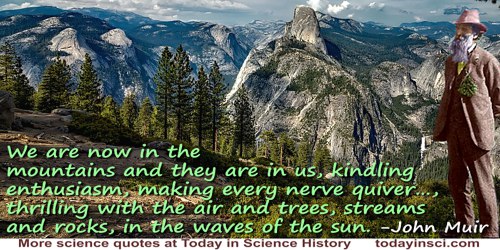
We are now in the mountains and they are in us, kindling enthusiasm, making every nerve quiver, filling every pore and cell of us. Our flesh-and-bone tabernacle seems transparent as glass to the beauty about us, as if truly an inseparable part of it, thrilling with the air and trees, streams and rocks, in the waves of the sun,—a part of all nature, neither old nor young, sick nor well, but immortal.
In My First Summer in the Sierra (1911), 20. Based on Muir’s original journals and sketches of his 1869 stay in the Sierra.
We live in a capitalist economy, and I have no particular objection to honorable self-interest. We cannot hope to make the needed, drastic improvement in primary and secondary education without a dramatic restructuring of salaries. In my opinion, you cannot pay a good teacher enough money to recompense the value of talent applied to the education of young children. I teach an hour or two a day to tolerably well-behaved near-adults–and I come home exhausted. By what possible argument are my services worth more in salary than those of a secondary-school teacher with six classes a day, little prestige, less support, massive problems of discipline, and a fundamental role in shaping minds. (In comparison, I only tinker with intellects already largely formed.)
…...
We may discover resources on the moon or Mars that will boggle the imagination, that will test our limits to dream. And the fascination generated by further exploration will inspire our young people to study math, and science, and engineering and create a new generation of innovators and pioneers.
Speech, NASA Headquarters (14 Jan 2004). In Office of the Federal Register (U.S.) Staff (eds.), Public Papers of the Presidents of the United States, George W. Bush (2007), 58-59.
We must view young people not as empty bottles to be filled, but as candles to be lit.
Quoted, without citation, in Robert Grover, Collaboration (1996).
We need to engage and inspire today’s youth to do a much better job of protecting the planet and our future than we have. My grandfather raised me believing in the power of youth to change the world. … Education and young people are key to making sure we don’t keep repeating our mistakes.
In 'Gulf Dispatch: Time to Tap Power of Teens', CNN Blog (23 Jul 2010).
We ought to observe that practice which is the hardest of all—especially for young physicians—we ought to throw in no medicine at all—to abstain—to observe a wise and masterly inactivity.
Speech (25 Jan 1828), in Register of Debates in Congress, Vol. 4, Col. 1170.
We should misjudge this scientist [Fritz Haber] seriously if we were to judge him only by his harvest. The stimulation of research and the advancement of younger scholars become ever more important to him than his own achievements.
In Richard Willstätter, Arthur Stoll (ed. of the original German) and Lilli S. Hornig (trans.), From My Life: The Memoirs of Richard Willstätter (1958), 269.
What I especially admire about you [Arnold Sommerfeld] is the way, at a stamp of your foot, a great number of talented young theorists spring up out of the ground.
As quoted in Paul Forman and Armin Hermann, 'Sommerfeld, Arnold (Johannes Wilhelm)', Biography in Dictionary of Scientific Biography (1975), Vol. 12, 529. Cited from Armin Herman (ed.), Albert Einstein/Arnold Sommerfeld. Briefwechsel: Sechzig Briefe aus dem goldenen Zeitalter der modernen Physik (1968, German), 98.
What is it to see, in an Eagle glide
Which fills a human heart with so much pride?
Is it that it soars effortless above the Earth
That steals us from our own limits & dearth?
Trapped in our seas of befuddling sludge
We try and try but cannot budge.
And then to see a mortal; with such ease take wing
Up in a breeze that makes our failing spirits sing?
Do we, vicarious birds, search in it our childishness -
When we too were young & yearned in heart to fly?
Taking flights of fancy through adolescent nights
Listening little, heeding less, knowing not why?
From its highest perch in the forest of snow
Majestic - the Eagle soars alone.
Riding thermals, lording clouds
Till dropping silent from the sky as a stone
But we, so quick and ready to fold
Give up our wings at the whiff of age
Losing years, cursing time, wasting spirit
Living out entire lives in futile rage!
Which fills a human heart with so much pride?
Is it that it soars effortless above the Earth
That steals us from our own limits & dearth?
Trapped in our seas of befuddling sludge
We try and try but cannot budge.
And then to see a mortal; with such ease take wing
Up in a breeze that makes our failing spirits sing?
Do we, vicarious birds, search in it our childishness -
When we too were young & yearned in heart to fly?
Taking flights of fancy through adolescent nights
Listening little, heeding less, knowing not why?
From its highest perch in the forest of snow
Majestic - the Eagle soars alone.
Riding thermals, lording clouds
Till dropping silent from the sky as a stone
But we, so quick and ready to fold
Give up our wings at the whiff of age
Losing years, cursing time, wasting spirit
Living out entire lives in futile rage!
…...
What led me to my science and what fascinated me from a young age was the, by no means self-evident, fact that our laws of thought agree with the regularities found in the succession of impressions we receive from the external world, that it is thus possible for the human being to gain enlightenment regarding these regularities by means of pure thought
Max Planck and Ch. Scriba (ed), Wissenschaftliche Selbstbiographie (1990), 9. Quoted in Erhard Scheibe and Brigitte Falkenburg (ed), Between Rationalism and Empiricism: Selected Papers in the Philosophy of Physics (2001), 69
When I was growing up, I always knew I’d be in the top of my class in math, and that gave me a lot of self-confidence. [But now that students can see beyond their own school, they see that] there are always going to be a million people better than you at times, or someone will always be far better than you. I feel there’s an existential angst among young people. I didn’t have that. They see enormous mountains, where I only saw one little hill to climb.
From address at a conference on Google campus, co-hosted with Common Sense Media and the Joan Ganz Cooney Center at Sesame Workshop 'Breakthrough Learning in the Digital Age'. As quoted in Technology blog report by Dan Fost, 'Google co-founder Sergey Brin wants more computers in schools', Los Angeles Times (28 Oct 2009). On latimesblogs.latimes.com website.
As quoted, without citation, in Can Akdeniz, Fast MBA (2014), 280.
When I was young I observed that nine out of every ten things I did were failures, so I did ten times more work.
…...
When I was young Science walked hand-in-hand with Art; now she walks arm-in-arm with Trade.
Clifford Dobell, 'D' Arcy Wentworth Thompson 1860-1948', Obituary Notices of Fellows of the Royal Society 1948-1949 (1949), 613.
When I was young, I said to God, “God, tell me the mystery of the universe.” But God answered, “That knowledge is for me alone”. So I said, “God, tell me the mystery of the peanut.” Then God said, “Well, George, that’s more nearly your size.” And he told me.
In Walter B. Knight, Knight’s Treasury of Illustrations (1956), 368, citing The Gospel Banner.
When one considers in its length and in its breadth the importance of this question of the education of the nation's young, the broken lives, the defeated hopes, the national failures, which result from the frivolous inertia with which it is treated, it is difficult to restrain within oneself a savage rage. In the conditions of modern life the rule is absolute, the race which does not value trained intelligence is doomed. Not all your heroism, not all your social charm, not all your wit, not all your victories on land or at sea, can move back the finger of fate. To-day we maintain ourselves. To-morrow science will have moved forward yet one more step, and there will be no appeal from the judgment which will then be pronounced on the uneducated.
In 'Organisation of Thought', The Aims of Education: & Other Essays (1917), 22.
When we are young, we think that science has to do with facts, with finding answers and solutions, and that it proceeds like an arrow from the primitive to the sophisticated, from mystery to light. But as we get older, we find that, while science does have to do with facts and laws, it has equally to do with wisdom.
In Introduction to Isaac Asimov and Jason A. Shulman (eds.), Isaac Asimov’s Book of Science and Nature Quotations (1988), xix.
When young Galileo, then a student at Pisa, noticed one day during divine service a chandelier swinging backwards and forwards, and convinced himself, by counting his pulse, that the duration of the oscillations was independent of the arc through which it moved, who could know that this discovery would eventually put it in our power, by means of the pendulum, to attain an accuracy in the measurement of time till then deemed impossible, and would enable the storm-tossed seaman in the most distant oceans to determine in what degree of longitude he was sailing?
Hermann von Helmholtz, Edmund Atkinson (trans.), Popular Lectures on Scientific Subjects: First Series (1883), 29.
Working on the final formulation of technological patents was a veritable blessing for me. It enforced many-sided thinking and also provided important stimuli to physical thought. Academia places a young person under a kind of compulsion to produce impressive quantities of scientific publications–a temptation to superficiality.
…...
Yet, hermit and stoic as he was, he was really fond of sympathy, and threw himself heartily and childlike into the company of young people whom he loved, and whom he delighted to entertain, as he only could, with the varied and endless anecdotes of his experiences by field and river: and he was always ready to lead a huckleberry-party or a search for chestnuts and grapes.
In magazine article, 'Thoreau', The Atlantic (Aug 1862), 10, 240. Emerson is credited as author on the Contents page.
You and I are just about fit to mend his pens.
[About the young William Thomson (later Lord Kelvin.)]
[About the young William Thomson (later Lord Kelvin.)]
Remark by Ellis to the mathematician Harvey Goodwin, both examiners, comparing William Thomson's mathematical prowess while still a student at the time of sitting the Tripos Examination (1845). As quoted by Harvey Goodwin in 'A Biographical Memoir', the introduction to Robert Leslie Ellis, William Walton (ed), The Mathematical and Other Writings of Robert Leslie Ellis (1863), xix.
You will be astonished to find how the whole mental disposition of your children changes with advancing years. A young child and the same when nearly grown, sometimes differ almost as much as do a caterpillar and butterfly.
Letter to E. Haeckel (19 Nov 1868). In Charles Darwin and Francis Darwin, The Life and Letters of Charles Darwin (1887), 104.
Young children were sooner allured by love, than driven by beating, to attain good learning.
The Scholemaster (1570), Book 1, Preface.
Young man, if I could remember the names of these particles, I would have been a botanist.
Given as a reply to Leon M. Lederman (then a young researcher) when he asked Fermi for his opinion of the evidence of a particle named the K-zero-two, while standing next to him in a conference lunch line. Lederman wrote his recollection of the answer in his book, The God Particle: If the Universe is the Answer, what is the Question? (1993), 15. Lederman mentioned this statement much earlier, as “If I could remember the names of these particles, I would have been a botanist,” in a lecture (9 Jan 1963) on 'Neutrino Physics,' collected in Brookhaven Lecture Series (Dec 1963), 23, 1.
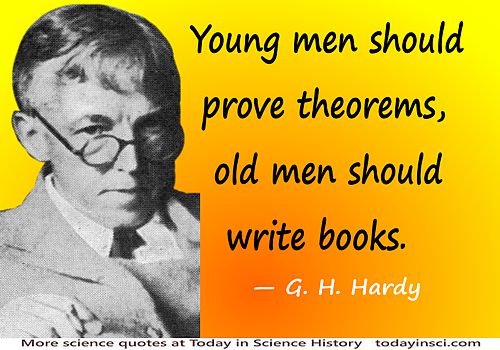
Young men should prove theorems, old men should write books.
Quoted by Freeman Dyson as the answer from G.H. Hardy about the book An Introduction to the Theory of Numbers. Dyson, while at Cambridge, had asked him why “he spent so much time and effort writing that marvellous book when he might be doing serious mathematics.” In Freeman Dyson 'A Walk Through Ramanujan's Garden', Lecture by Dyson at Ramanujan Centenary Conference (2 Jun 1987). Collected in Selected Papers of Freeman Dyson with Commentary (1996), 189. Also as quoted in 'Mathematician, Physicist, and Writer.' Interview (Jun 1990) with Donald J. Albers, The College Mathematics Journal (Jan 1994), 25, No. 1, 4.

Young men, … Live in the serene peace of laboratories and libraries. Say to yourselves first:
“What have I done for my instruction?” and, as you gradually advance, “What have I done for my country?”
Acceptance speech (27 Dec 1892) when awarded a 70th birthday commemorative medal by the Academy of Sciences in the great theatre of the Sorbonne, as translated in René Vallery-Radot and Mrs R.L. Devonshire (trans.), The Life of Pasteur (1902), Vol. 2, 297-298. Pasteur addressed an audience that included “deep masses of students” and “boys from the lycées.”
Young men, have confidence in those powerful and safe methods, of which we do not yet know all the secrets. And, whatever your career may be, do not let yourselves become tainted by a deprecating and barren skepticism … Live … until the time comes when you have the immense happiness of thinking that you have contributed in some way to the progress and to the good of humanity.
Acceptance speech (27 Dec 1892) when awarded a 70th birthday commemorative medal by the Academy of Sciences in the great theatre of the Sorbonne, as translated in René Vallery-Radot and Mrs R.L. Devonshire (trans.), The Life of Pasteur (1902), Vol. 2, 297-298. Pasteur addressed an audience that included “deep masses of students” and “boys from the lycées.”
Young men, trust those certain and powerful methods, only the first secrets of which we yet know. And all of you, whatever your career, … do not allow yourselves to be discouraged by the gloom of certain hours which pass a nation.
Advice in Speech (27 Dec 1892) to young scientists at the Golden Jubilee celebration for Pasteur's 70th birthday. As translated in Nature (1893), 47, 205. Also translated as “Young men, have faith in those powerful and safe methods, of which we do not yet know all the secrets. And, whatever your career may be, do not let yourselves be discouraged by the sadness of certain hours which pass over nations.” By René J. Dubos, quoted and cited in Maurice B. Strauss, Familiar Medical Quotations (1968), 526.
Young people should be given good support and freedom in their research. They are the greatest source of scientific creativity because they are not as committed to existing scientific orthodoxy, and they have the energy and enthusiasm to push new ideas.
From keynote address, 'Will Innovation Flourish in the Future?' (2002), as adapted for Opinion article in The Industrial Physicist (Dec-Jan 2003-03), 8, No. 6, 24. The address was presented at Conference, 'Infrastructure for e-Business, e-Education, e-Science, and e-Medicine', at Scuola Superiore G. Reiss Romoli in L’Aquila, Italy (Jul 29-Aug 4, 2002).
Young people—they care. They know that this is the world that they’re going to grow up in, that they’re going to spend the rest of their lives in. But, I think it’s more idealistic than that. They actually believe that humanity, human species, has no right to destroy and despoil regardless.
As quoted, without source, in Kate Ng, 'David Attenborough turns 95: His best quotes on nature, sustainability and humankind', Independent (8 May 2021).
Young people, especially young women, often ask me for advice. Here it is, valeat quantum. Do not undertake a scientific career in quest of fame or money. There are easier and better ways to reach them. Undertake it only if nothing else will satisfy you; for nothing else is probably what you will receive. Your reward will be the widening of the horizon as you climb. And if you achieve that reward you will ask no other.
In Cecilia Payne-Gaposchkin: An Autobiography and Other Recollections (1996), 227.
Young writers find out what kinds of writers they are by experiment. If they choose from the outset to practice exclusively a form of writing because it is praised in the classroom or otherwise carries appealing prestige, they are vastly increasing the risk inherent in taking up writing in the first place.
…...
Younger scientists cannot freely express their opinions without risking their ability to apply for grants or publish papers. Much worse than this, few of them can now follow that strange and serendipitous path that leads to deep discovery. They are not constrained by political or theological tyrannies, but by the ever-clinging hands of the jobsworths that form the vast tribe of the qualified but hampering middle management and the safety officials that surround them.
In The Revenge of Gaia: Earth’s Climate Crisis & The Fate of Humanity (2006, 2007), 93.
 In science it often happens that scientists say, 'You know that's a really good argument; my position is mistaken,' and then they would actually change their minds and you never hear that old view from them again. They really do it. It doesn't happen as often as it should, because scientists are human and change is sometimes painful. But it happens every day. I cannot recall the last time something like that happened in politics or religion.
(1987) --
In science it often happens that scientists say, 'You know that's a really good argument; my position is mistaken,' and then they would actually change their minds and you never hear that old view from them again. They really do it. It doesn't happen as often as it should, because scientists are human and change is sometimes painful. But it happens every day. I cannot recall the last time something like that happened in politics or religion.
(1987) -- 





