Year Quotes (971 quotes)
...[T]he natural history of the rat is tragically similar to that of man ... some of the more obvious qualities in which rats resemble men — ferocity, omnivorousness, and adaptability to all climates ... the irresponsible fecundity with which both species breed at all seasons of the year with a heedlessness of consequences, which subjects them to wholesale disaster on the inevitable, occasional failure of the food supply.... [G]radually, these two have spread across the earth, keeping pace with each other and unable to destroy each other, though continually hostile. They have wandered from East to West, driven by their physical needs, and — unlike any other species of living things — have made war upon their own kind. The gradual, relentless, progressive extermination of the black rat by the brown has no parallel in nature so close as that of the similar extermination of one race of man by another...
Rats, Lice and History(1935)
...the genes almost always accurately reproduce. If they don't, you get one of the following results: One, monsters—that is, grossly malformed babies resulting from genetic mistakes. Years ago most monsters died, but now many can be saved. This has made possible the National Football League.
Found widely quoted on the web, but without a print source. Please contact webmaster if you know the primary source.
“Life on Earth” [a 12-part TV series on evolution] was easier than “The Living Planet” because you have 2,000 years of narrative thrust built in. … You begin, say, with a giant jellyfish, then a fish with lungs which then became a frog. And all you have to do is say, “If you want to know what happens next, tune in next week.”
Comparing two of his famed BBC TV natural history series, in Justine de Lacy, 'Around the World With Attenborough', New York Times (27 Jan 1985), Sec. 2, 25.
[1665-12-31] Thus ends this year ... It is true we have gone through great melancholy because of the great plague, and I put to great charges by it, by keeping my family long at Woolwich, and myself and another part of my family, my clerks, at my charge at Greenwich ... But now the plague is abated almost to nothing ... But many of such as I know very well, dead. Yet to our great joy, the town fills apace, and shops begin to open again. Pray God continue the plague's decrease - for that keeps the Court away from the place of business, and so all goes to wrack as to public matters, they at this distance not thinking of it.
Diary of Samuel Pepys (31 Dec 1665)
[About any invention] (1) everything that’s already in the world when you’re born is just normal; (2) anything that gets invented between then and before you turn thirty is incredibly exciting and creative and with any luck you can make a career out of it; (3) anything that gets invented after you’re thirty is against the natural order of things and the beginning of the end of civilisation as we know it until it’s been around for about ten years when it gradually turns out to be alright really.
In News Review section, Sunday Times (29 Aug 1999).
[About the structure of DNA] [T]he whole business was like a child's toy that you could buy at the dime store, all built in this wonderful way that you could explain in Life magazine so that really a five-year-old can understand what's going on...This was the greatest surprise for everyone.
Quoted in Horace Freeland Judson, Eighth Day of Creation (1979)
[American] Motherhood is like being a crack tennis player or ballet dancer—it lasts just so long, then it’s over. We’ve made an abortive effort to turn women into people. We’ve sent them to school and put them in slacks. But we’ve focused on wifehood and reproductivity with no clue about what to do with mother after the children have left home. We’ve found no way of using the resources of women in the 25 years of post-menopausal zest. As a result many women seem to feel they should live on the recognition and care of society.
As quoted in interview with Frances Glennon, 'Student and Teacher of Human Ways', Life (14 Sep 1959), 147.
[An audience conditioned by a lifetime of television-watching is so corrupted that] their standards have been systematically lowered over the years. These guys sit in front of their sets and the gamma rays eat the white cells of their brains out!
Spoken by character Isaac Davis (played by Woody Allen) in the movie, Manhattan (1979). Quoted in Eighteen Woody Allen Films Analyzed (2000), 63. Woody Allen directed the movie, which he co-wrote with Marshall Brickman.
[Boswell]: Sir Alexander Dick tells me, that he remembers having a thousand people in a year to dine at his house: that is, reckoning each person as one, each time that he dined there.
[Johnson]: That, Sir, is about three a day.
[Boswell]: How your statement lessens the idea.
[Johnson]: That, Sir, is the good of counting. It brings every thing to a certainty, which before floated in the mind indefinitely.
[Johnson]: That, Sir, is about three a day.
[Boswell]: How your statement lessens the idea.
[Johnson]: That, Sir, is the good of counting. It brings every thing to a certainty, which before floated in the mind indefinitely.
Entry for Fri 18 Apr 1783. In George Birkbeck-Hill (ed.), Boswell's Life of Johnson (1934-50), Vol. 4, 204.
[Describing a freshman seminar titled “How the Tabby Cat Got Her Stripes or The Silence of the Genes”:] The big idea we start with is: “How is the genome interpreted, and how are stable decisions that affect gene expression inherited from one cell to the next? This is one of the most competitive areas of molecular biology at the moment, and the students are reading papers that in some instances were published this past year. As a consequence, one of the most common answers I have to give to their questions is, “We just don't know.”
As quoted by Kitta MacPherson in 'Exploring Epigenetics: President Shirley Tilghman in the Classroom,'
Princeton University Undergraduate Admission web page accessed 14 Oct 2013.
[For equal opportunity and recognition, women in science] must be prepared to work hard for the work’s sake, without thought of what it may bring to them in the way of personal acclaim and emolument. While scientific research is exciting it has its dull and plodding moments. One may delve and delve and analyze and analyze for months, and even years, without seeing anything. Then suddenly, through accumulative observation, the idea comes!”
In Genevieve Parkhurst, 'Dr. Sabin, Scientist: Winner Of Pictorial Review’s Achievement Award', Pictorial Review (Jan 1930), 70.
[I] browsed far outside science in my reading and attended public lectures - Bertrand Russell, H. G. Wells, Huxley, and Shaw being my favorite speakers. (The last, in a meeting at King's College, converted me to vegetarianism - for most of two years!).
Autobiography collected in Gardner Lindzey (ed.), A History of Psychology in Autobiography (1973), Vol. 6, 64.
[In 1909,] Paris was the center of the aviation world. Aeronautics was neither an industry nor even a science; both were yet to come. It was an “art” and I might say a “passion”. Indeed, at that time it was a miracle. It meant the realization of legends and dreams that had existed for thousands of years and had been pronounced again and again as impossible by scientific authorities. Therefore, even the brief and unsteady flights of that period were deeply impressive. Many times I observed expressions of joy and tears in the eyes of witnesses who for the first time watched a flying machine carrying a man in the air.
In address (16 Nov 1964) presented to the Wings Club, New York City, Recollections and Thoughts of a Pioneer (1964), 5.
[In] death at least there would be one profit; it would no longer be necessary to eat, to drink, to pay taxes, or to [offend] others; and as a man lies in his grave not one year, but hundreds and thousands of years, the profit was enormous. The life of man was, in short, a loss, and only his death a profit.
In short story, Rothschild’s Fiddle (1894). Collected in The Black Monk and Other Stories (1915), 138.
[In] the realm of science, … what we have achieved will be obsolete in ten, twenty or fifty years. That is the fate, indeed, that is the very meaning of scientific work. … Every scientific “fulfillment” raises new “questions” and cries out to be surpassed and rendered obsolete. Everyone who wishes to serve science has to resign himself to this.
From a Speech (1918) presented at Munich University, published in 1919, and collected in 'Wissenschaft als Beruf', Gessammelte Aufsätze zur Wissenschaftslehre (1922), 524-525. As translated by Rodney Livingstone in David Owen (ed.), The Vocation Lectures: Science as a Vocation: Politics as a Vocation (2004), 11. A different translation of a longer excerpt for this quote, beginning “In science, each of us knows …”, is also on the Max Weber Quotes web page on this site.
[J.J.] Sylvester’s methods! He had none. “Three lectures will be delivered on a New Universal Algebra,” he would say; then, “The course must be extended to twelve.” It did last all the rest of that year. The following year the course was to be Substitutions-Théorie, by Netto. We all got the text. He lectured about three times, following the text closely and stopping sharp at the end of the hour. Then he began to think about matrices again. “I must give one lecture a week on those,” he said. He could not confine himself to the hour, nor to the one lecture a week. Two weeks were passed, and Netto was forgotten entirely and never mentioned again. Statements like the following were not unfrequent in his lectures: “I haven’t proved this, but I am as sure as I can be of anything that it must be so. From this it will follow, etc.” At the next lecture it turned out that what he was so sure of was false. Never mind, he kept on forever guessing and trying, and presently a wonderful discovery followed, then another and another. Afterward he would go back and work it all over again, and surprise us with all sorts of side lights. He then made another leap in the dark, more treasures were discovered, and so on forever.
As quoted by Florian Cajori, in Teaching and History of Mathematics in the United States (1890), 265-266.
[John] Dalton was a man of regular habits. For fifty-seven years he walked out of Manchester every day; he measured the rainfall, the temperature—a singularly monotonous enterprise in this climate. Of all that mass of data, nothing whatever came. But of the one searching, almost childlike question about the weights that enter the construction of these simple molecules—out of that came modern atomic theory. That is the essence of science: ask an impertinent question, and you are on the way to the pertinent answer.
The Ascent of Man (1973), 153.
[L]et us not overlook the further great fact, that not only does science underlie sculpture, painting, music, poetry, but that science is itself poetic. The current opinion that science and poetry are opposed is a delusion. … On the contrary science opens up realms of poetry where to the unscientific all is a blank. Those engaged in scientific researches constantly show us that they realize not less vividly, but more vividly, than others, the poetry of their subjects. Whoever will dip into Hugh Miller’s works on geology, or read Mr. Lewes's “Seaside Studies,” will perceive that science excites poetry rather than extinguishes it. And whoever will contemplate the life of Goethe will see that the poet and the man of science can co-exist in equal activity. Is it not, indeed, an absurd and almost a sacrilegious belief that the more a man studies Nature the less he reveres it? Think you that a drop of water, which to the vulgar eye is but a drop of water, loses anything in the eye of the physicist who knows that its elements are held together by a force which, if suddenly liberated, would produce a flash of lightning? Think you that what is carelessly looked upon by the uninitiated as a mere snow-flake, does not suggest higher associations to one who has seen through a microscope the wondrously varied and elegant forms of snow-crystals? Think you that the rounded rock marked with parallel scratches calls up as much poetry in an ignorant mind as in the mind of a geologist, who knows that over this rock a glacier slid a million years ago? The truth is, that those who have never entered upon scientific pursuits know not a tithe of the poetry by which they are surrounded. Whoever has not in youth collected plants and insects, knows not half the halo of interest which lanes and hedge-rows can assume. Whoever has not sought for fossils, has little idea of the poetical associations that surround the places where imbedded treasures were found. Whoever at the seaside has not had a microscope and aquarium, has yet to learn what the highest pleasures of the seaside are. Sad, indeed, is it to see how men occupy themselves with trivialities, and are indifferent to the grandest phenomena—care not to understand the architecture of the Heavens, but are deeply interested in some contemptible controversy about the intrigues of Mary Queen of Scots!—are learnedly critical over a Greek ode, and pass by without a glance that grand epic written by the finger of God upon the strata of the Earth!
In Education: Intellectual, Moral, and Physical (1889), 82-83.
[May Morris (Joan Davis):] You know, I crossed the goldenrod with poison ivy once. What do you think I got? Hay fever and the seven-year itch.
From movie Josette (1938). Writer, James Edward Grant, from play by Paul Frank and Georg Fraser. In Larry Langman and Paul Gold, Comedy Quotes from the Movies (2001), 289. The phrase “seven-year itch” dates back to at least 1845, and was used as a film title in 1955.
[My grandmother] lived the latter years of her life in the horrible suspicion that electricity was dripping invisibly all over the house. It leaked, she contended, out of empty sockets if the wall switch had been left on. She would go around screwing in bulbs, and if they lighted up, she would fearfully turn off the wall switch and go back to her Pearson's or Everybody's, happy in the satisfaction that she had stopped not only a costly but dangerous leakage. nothing could ever clear this up for her.
In My Life and Hard Times (1937, 1999), 16.
[My uncle said to me…] When I read, forty years ago, that shells from Syria were found in the Alps, I say, I admit, with a slightly mocking tone, that these shells were apparently brought by pilgrims who were returning from Jerusalem. M. de Buffon reprimanded me very sharply in his Theory of the Earth, page 281. I did not want to quarrel with him over shells, but I remain of the same opinion, because the impossibility that the sea formed the mountains is evident to me. Some may tell me that porphyry is made of sea urchin spikes, I’ll believe it when I see white marble is made of ostrich feathers.
Voltaire is recounting one of the reasons his uncle (Abbe Ambroise Bazing) had told him, for disputing Buffon’s claim that the sea that made the mountains. Translated by Webmaster from 'La Défense de Mon Oncle: Des montagnes et des Coquilles', collected in Oeuvres complètes: Histoire.- Mélanges historiques (1817), Tome 15, Chap. 19, 133-134. From the original French; “Quand je lus, il y a quarante ans, qu’on avait trouvé dans les Alpes des coquilles de Syrie, je dis, je l’avoue , d’un ton un peu goguenard, que ces coquilles avaient été apparemment apportées par des pélerins qui revenaient de Jérusalem. M. de Buffon m’en reprit très-vertement dans sa Théorie de la terre, page 281. Je n’ai pas voulu me brouiller avec lui pour des coquilles, mais je suis demeuré dans non opinion, parce que l’impossibilité que la mer ait formé les montagnes m’est démontrée. On a beau me dire que le porphyre est fait de pointes d’oursin, je le croirai quand je verrai que le marbre blanc est fait de plumes d’autruche.” [Note: porphyry is a form of igneous rock. Also note, this passage does NOT appear in 'Les Singularités de la Nature', which may be found elsewhere incorrectly cited as the source. —Webmaster]
[On research] It’s got to be fun. I don't think anybody should tell you that he’s slogged his way through 25 years on a problem and there's only one reward at the end, and that's the value of the Hubble constant. That’s a bunch of hooey. The reward is learning all the wonderful properties of the things that don’t work.
As quoted in Obituary, 'Allan Sandage, 84, Astronomer, Dies; Charted Cosmos’s Age and Expansion', New York Times (17 Nov 2010), B19.
[Overfishing—] it’s not just that we’re taking too many out, it’s how we’re doing it. We are wiping out their nurseries, … [because some huge boats] … bottom trawl … [with] nets that 50 years ago you’d have to lift when you came to coral reefs or rocks or nooks and crannies. Now they’re so sophisticated and so heavy, the equipment, and the boat’s so powerful they can just drag right over the coral reefs and the rocks and the nooks and crannies, and turn them into a gravel pit. … The trouble is those are the nurseries. That’s where the little fish hide and get bigger and get big enough for us to eat.
From transcript of PBS TV interview by Tavis Smiley (28 Mar 2011).
[Professional engineers] must for years abandon their white collars except for Sunday.
Reprint of his 1916 statement in 'Engineering as a Profession', Engineer’s Week (1954).
[S]uppose you make a hole in an ordinary evacuated electric light bulb and allow the air molecules to pass in at the rate of 1,000,000 a second, the bulb will become full of air in approximately 100,000,000 years.
In Lecture (1936) on 'Forty Years of Atomic Theory', collected in Needham and Pagel (eds.) in Background to Modern Science: Ten Lectures at Cambridge Arranged by the History of Science Committee, (1938), 99.
[T]here is little chance that aliens from two societies anywhere in the Galaxy will be culturally close enough to really 'get along.' This is something to ponder as you watch the famous cantina scene in Star Wars. ... Does this make sense, given the overwhelmingly likely situation that galactic civilizations differ in their level of evolutionary development by thousands or millions of years? Would you share drinks with a trilobite, an ourang-outang, or a saber-toothed tiger? Or would you just arrange to have a few specimens stuffed and carted off to the local museum?
Quoted in 'Do Aliens Exist in the Milky Way', PBS web page for WGBH Nova, 'Origins.'
[The 1957-1961 years of the U.S. space program] were the sad years in which the joke was that our countdowns ended in "Four, three, two, one, oh shit!"
In 'Vive l'Apollo', Space World (Mar 1985), No. 256, 4. Reprinted in They All Come to Geneva: And Other Tales of a Public Diplomat (1988), 82.
[The enigmatical motto of Marischal College, Aberdeen: They say; what say they; let them say.] It expresses the three stages of an undergraduate’s career. “They say”—in his first year he accepts everything he is told as if it were inspired. “What say they”—in his second year he is skeptical and asks that question. “Let them say” expresses the attitude of contempt characteristic of his third year.
As quoted, without citation, in Alexander Macfarlane, 'Henry John Stephen Smith', Lectures on Ten British Mathematicians of the Nineteenth Century (1916), 100-101.
[The natural world cleans water, pollinates plants and provides pharmaceuticals, among many other gifts.] Thirty trillion dollars worth of services, scot-free to humanity, every year.
From transcript of PBS TV program 'Religion and Ethics' (17 Nov 2006).
[The] great fairy Science, who is likely to be queen of all the fairies for many a year to come, can only do you good, and never do you harm…
The Water-babies (1886), 98.
[There] are cases where there is no dishonesty involved but where people are tricked into false results by a lack of understanding about what human beings can do to themselves in the way of being led astray by subjective effects, wishful thinking or threshold interactions. These are examples of pathological science. These are things that attracted a great deal of attention. Usually hundreds of papers have been published upon them. Sometimes they have lasted for fifteen or twenty years and then they gradually die away.
[Coining the term “pathological science” for the self-deceiving application of science to a phenomenon that doesn't exist.]
[Coining the term “pathological science” for the self-deceiving application of science to a phenomenon that doesn't exist.]
From a Colloquium at The Knolls Research Laboratory (18 Dec 1953). Transcribed and edited by R. N. Hall. In General Electric Laboratories, Report No. 68-C-035 (April 1968).
[W]e might expect intelligent life and technological communities to have emerged in the universe billions of years ago. Given that human society is only a few thousand years old, and that human technological society is mere centuries old, the nature of a community with millions or even billions of years of technological and social progress cannot even be imagined. ... What would we make of a billion-year-old technological community?
In Are We Alone?(1995), 48.
[What verdict would a historian of the year 3000 pass upon our age? Let us hope this will be his judgement:]
“The twentieth century was, without question, the most momentous hundred years in the history of Mankind. It opened with the conquest of the air, and before it had run half its course had presented civilisation with its supreme challenge—the control of atomic energy. Yet even these events, each of which changed the world, were soon to be eclipsed. To us a thousand years later, the whole story of Mankind before the twentieth century seems like the prelude to some great drama, played on the narrow strip of stage before the curtain has risen and revealed the scenery. For countless generations of men, that tiny, crowded stage—the planet Earth—was the whole of creation, and they the only actors. Yet towards the close of that fabulous century, the curtain began slowly, inexorably to rise, and Man realised at last that the Earth was only one of many worlds; the Sun only one among many stars. The coming of the rocket brought to an end a million years of isolation. With the landing of the first spaceship on Mars and Venus, the childhood of our race was over and history as we know it began….”
“The twentieth century was, without question, the most momentous hundred years in the history of Mankind. It opened with the conquest of the air, and before it had run half its course had presented civilisation with its supreme challenge—the control of atomic energy. Yet even these events, each of which changed the world, were soon to be eclipsed. To us a thousand years later, the whole story of Mankind before the twentieth century seems like the prelude to some great drama, played on the narrow strip of stage before the curtain has risen and revealed the scenery. For countless generations of men, that tiny, crowded stage—the planet Earth—was the whole of creation, and they the only actors. Yet towards the close of that fabulous century, the curtain began slowly, inexorably to rise, and Man realised at last that the Earth was only one of many worlds; the Sun only one among many stars. The coming of the rocket brought to an end a million years of isolation. With the landing of the first spaceship on Mars and Venus, the childhood of our race was over and history as we know it began….”
In Chap. 18, 'Concerning Means and Ends', The Exploration of Space (1951), 195. [Clarke wrote this, not knowing there would be a Moon landing just 18 years later, on 20 Jul 1969. In fact, in an earlier chapter, he wrote “On our present knowledge, there is no likelihood of such spaceships for a very long time to come.” —Webmaster]
The Redwoods
Here, sown by the Creator's hand,
In serried ranks, the Redwoods stand;
No other clime is honored so,
No other lands their glory know.
The greatest of Earth's living forms,
Tall conquerors that laugh at storms;
Their challenge still unanswered rings,
Through fifty centuries of kings.
The nations that with them were young,
Rich empires, with their forts far-flung,
Lie buried now—their splendor gone;
But these proud monarchs still live on.
So shall they live, when ends our day,
When our crude citadels decay;
For brief the years allotted man,
But infinite perennials' span.
This is their temple, vaulted high,
And here we pause with reverent eye,
With silent tongue and awe-struck soul;
For here we sense life's proper goal;
To be like these, straight, true and fine,
To make our world, like theirs, a shrine;
Sink down, oh traveler, on your knees,
God stands before you in these trees.
Here, sown by the Creator's hand,
In serried ranks, the Redwoods stand;
No other clime is honored so,
No other lands their glory know.
The greatest of Earth's living forms,
Tall conquerors that laugh at storms;
Their challenge still unanswered rings,
Through fifty centuries of kings.
The nations that with them were young,
Rich empires, with their forts far-flung,
Lie buried now—their splendor gone;
But these proud monarchs still live on.
So shall they live, when ends our day,
When our crude citadels decay;
For brief the years allotted man,
But infinite perennials' span.
This is their temple, vaulted high,
And here we pause with reverent eye,
With silent tongue and awe-struck soul;
For here we sense life's proper goal;
To be like these, straight, true and fine,
To make our world, like theirs, a shrine;
Sink down, oh traveler, on your knees,
God stands before you in these trees.
In The Record: Volumes 60-61 (1938), 39.
[About Sir Roderick Impey Murchison:] The enjoyments of elegant life you early chose to abandon, preferring to wander for many successive years over the rudest portions of Europe and Asia—regions new to Science—in the hope, happily realized, of winning new truths.
By a rare union of favourable circumstances, and of personal qualifications equally rare, you have thus been enabled to become the recognized Interpreter and Historian (not without illustrious aid) of the Silurian Period.
By a rare union of favourable circumstances, and of personal qualifications equally rare, you have thus been enabled to become the recognized Interpreter and Historian (not without illustrious aid) of the Silurian Period.
Dedication page in Thesaurus Siluricus: The Flora and Fauna of the Silurian Period (1868), iv.
[In refutation of evolution] They use carbon dating ... to prove that something was millions of years old. Well, we have the eruption of Mt. Saint Helens and the carbon dating test that they used then would have to then prove that these were hundreds of millions of years younger, when what happened was they had the exact same results on the fossils and canyons that they did the tests on that were supposedly 100 millions of years old. And it’s the kind of inconsistent tests like this that they’re basing their “facts” on.
[Citing results from a solitary young-Earth creationist, questioning whether the lava dome at Mount St. Helens is really a million years old.]
[Citing results from a solitary young-Earth creationist, questioning whether the lava dome at Mount St. Helens is really a million years old.]
From interview by Miles O''Brien on CNN (30 Mar 1996). Reported from transcript, via Nexis, in New York Magazine (15 Sep 2010).
[On President Bush's plan to get to Mars in 10 years] Stupid. Robots would do a better job and be much cheaper because you don't have to bring them back.
Interview with Deborah Solomon, 'The Science of Second-Guessing', in New York Times Magazine (12 Dec 2004), 37.
[Question: What do you think was the most important physics idea to emerge this year?]
We won't know for a few years.
We won't know for a few years.
Interview with Deborah Solomon, 'The Science of Second-Guessing', in New York Times Magazine (12 Dec 2004), 37.
Between the frontiers of the three super-states Eurasia, Oceania, and Eastasia, and not permanently in possession of any of them, there lies a rough quadrilateral with its corners at Tangier, Brazzaville, Darwin, and Hongkong. These territories contain a bottomless reserve of cheap labour. Whichever power controls equatorial Africa, or the Middle East or Southern India or the Indonesian Archipelago, disposes also of the bodies of hundreds of millions of ill-paid and hardworking coolies, expended by their conquerors like so much coal or oil in the race to turn out more armaments, to capture more territory, to control more labour, to turn out more armaments, to capture more territory, to control…
Thus George Orwell—in his only reference to the less-developed world.
I wish I could disagree with him. Orwell may have erred in not anticipating the withering of direct colonial controls within the “quadrilateral” he speaks about; he may not quite have gauged the vehemence of urges to political self-assertion. Nor, dare I hope, was he right in the sombre picture of conscious and heartless exploitation he has painted. But he did not err in predicting persisting poverty and hunger and overcrowding in 1984 among the less privileged nations.
I would like to live to regret my words but twenty years from now, I am positive, the less-developed world will be as hungry, as relatively undeveloped, and as desperately poor, as today.
Thus George Orwell—in his only reference to the less-developed world.
I wish I could disagree with him. Orwell may have erred in not anticipating the withering of direct colonial controls within the “quadrilateral” he speaks about; he may not quite have gauged the vehemence of urges to political self-assertion. Nor, dare I hope, was he right in the sombre picture of conscious and heartless exploitation he has painted. But he did not err in predicting persisting poverty and hunger and overcrowding in 1984 among the less privileged nations.
I would like to live to regret my words but twenty years from now, I am positive, the less-developed world will be as hungry, as relatively undeveloped, and as desperately poor, as today.
'The Less-Developed World: How Can We be Optimists?' (1964). Reprinted in Ideals and Realities (1984), xv-xvi. Referencing a misquote from George Orwell, Nineteen Eighty Four (1949), Ch. 9.
Copernicus, who rightly did condemn
This eldest systeme, form’d a wiser scheme;
In which he leaves the Sun at Rest, and rolls
The Orb Terrestial on its proper Poles;
Which makes the Night and Day by this Career,
And by its slow and crooked Course the Year.
The famous Dane, who oft the Modern guides,
To Earth and Sun their Provinces divides:
The Earth’s Rotation makes the Night and Day,
The Sun revolving through th’ Eccliptic Way
Effects the various seasons of the Year,
Which in their Turn for happy Ends appear.
This Scheme or that, which pleases best, embrace,
Still we the Fountain of their Motion trace.
Kepler asserts these Wonders may be done
By the Magnetic Vertue of the Sun,
Which he, to gain his End, thinks fit to place
Full in the Center of that mighty Space,
Which does the Spheres, where Planets roll, include,
And leaves him with Attractive Force endu’d.
The Sun, thus seated, by Mechanic Laws,
The Earth, and every distant Planet draws;
By which Attraction all the Planets found
Within his reach, are turn'd in Ether round.
This eldest systeme, form’d a wiser scheme;
In which he leaves the Sun at Rest, and rolls
The Orb Terrestial on its proper Poles;
Which makes the Night and Day by this Career,
And by its slow and crooked Course the Year.
The famous Dane, who oft the Modern guides,
To Earth and Sun their Provinces divides:
The Earth’s Rotation makes the Night and Day,
The Sun revolving through th’ Eccliptic Way
Effects the various seasons of the Year,
Which in their Turn for happy Ends appear.
This Scheme or that, which pleases best, embrace,
Still we the Fountain of their Motion trace.
Kepler asserts these Wonders may be done
By the Magnetic Vertue of the Sun,
Which he, to gain his End, thinks fit to place
Full in the Center of that mighty Space,
Which does the Spheres, where Planets roll, include,
And leaves him with Attractive Force endu’d.
The Sun, thus seated, by Mechanic Laws,
The Earth, and every distant Planet draws;
By which Attraction all the Planets found
Within his reach, are turn'd in Ether round.
In Creation: A Philosophical Poem in Seven Books (1712), book 2, l. 430-53, p.78-9.
Die durchschnittliche Lebensdauer einer physiologischen Wahrheit ist drei bis vier Jahre.
The average lifespan of a physiological truth is three or four years.
The average lifespan of a physiological truth is three or four years.
Attributed.
Dogbert (gazing at night sky) No matter how bad the day is, the stars are always there.
Dilbert Actually, many of them burned out years ago, but their light is just now reaching earth.
DogbertThank you for shattering my comfortable misconception.
DilbertIt's the miracle of science.
Dilbert Actually, many of them burned out years ago, but their light is just now reaching earth.
DogbertThank you for shattering my comfortable misconception.
DilbertIt's the miracle of science.
Dilbert comic strip (21 Nov 1990).
If the Indians hadn’t spent the $24. In 1626 Peter Minuit, first governor of New Netherland, purchased Manhattan Island from the Indians for about $24. … Assume for simplicity a uniform rate of 7% from 1626 to the present, and suppose that the Indians had put their $24 at [compound] interest at that rate …. What would be the amount now, after 280 years? 24 x 1.07²⁸⁰ = more than 4,042,000,000.
The latest tax assessment available at the time of writing gives the realty for the borough of Manhattan as $3,820,754,181. This is estimated to be 78% of the actual value, making the actual value a little more than $4,898,400,000.
The amount of the Indians’ money would therefore be more than the present assessed valuation but less than the actual valuation.
The latest tax assessment available at the time of writing gives the realty for the borough of Manhattan as $3,820,754,181. This is estimated to be 78% of the actual value, making the actual value a little more than $4,898,400,000.
The amount of the Indians’ money would therefore be more than the present assessed valuation but less than the actual valuation.
In A Scrap-book of Elementary Mathematics: Notes, Recreations, Essays (1908), 47-48.
Man is the result of slow growth; that is why he occupies the position he does in animal life. What does a pup amount to that has gained its growth in a few days or weeks, beside a man who only attains it in as many years.
In Orison Swett Marden, 'Bell Telephone Talk: Hints on Success by Alexander G. Bell', How They Succeeded: Life Stories of Successful Men Told by Themselves (1901), 35.
Se è vero che ci si abitua al dolore, come mai con l’andare degli anni si soffre sempre di píu?
If it is true that one gets used to suffering, how is it that, as the years go by, one always suffers more?
If it is true that one gets used to suffering, how is it that, as the years go by, one always suffers more?
Diary entry for 21 Nov 1937, in Il mestiere di vivere (1947), 303. Translated as The Burning Brand: Diaries 1935-1950 (1961), 70.
Socrates: Shall we set down astronomy among the objects of study?
Glaucon: I think so, to know something about the seasons, the months and the years is of use for military purposes, as well as for agriculture and for navigation.
Socrates: It amuses me to see how afraid you are, lest the common herd of people should accuse you of recommending useless studies.
As quoted by Plato. In Richard Garnett, Léon Vallée, Alois Brandl (eds.), The Universal Anthology: A Collection of the Best Literature (1899), Vol. 4, 111.
To the Memory of Fourier
Fourier! with solemn and profound delight,
Joy born of awe, but kindling momently
To an intense and thrilling ecstacy,
I gaze upon thy glory and grow bright:
As if irradiate with beholden light;
As if the immortal that remains of thee
Attuned me to thy spirit’s harmony,
Breathing serene resolve and tranquil might.
Revealed appear thy silent thoughts of youth,
As if to consciousness, and all that view
Prophetic, of the heritage of truth
To thy majestic years of manhood due:
Darkness and error fleeing far away,
And the pure mind enthroned in perfect day.
Fourier! with solemn and profound delight,
Joy born of awe, but kindling momently
To an intense and thrilling ecstacy,
I gaze upon thy glory and grow bright:
As if irradiate with beholden light;
As if the immortal that remains of thee
Attuned me to thy spirit’s harmony,
Breathing serene resolve and tranquil might.
Revealed appear thy silent thoughts of youth,
As if to consciousness, and all that view
Prophetic, of the heritage of truth
To thy majestic years of manhood due:
Darkness and error fleeing far away,
And the pure mind enthroned in perfect day.
In R. Graves, Life of W. R. Hamilton (1882), Vol. l, 696.
~~[need primary source]~~ One of the most frightening things in the Western world and in this country in particular is the number of people who believe in things that are scientifically false. If someone tells me that the earth is less than 10000 years old in my opinion he should see a psychiatrist.
As quoted, without citation, in Joan Konner, The Atheist’s Bible: An Illustrious Collection of Irreverent Thought (2007), 46. Webmaster is dubious about authenticity, and as yet, has been unable to find a reliable primary source - can you help?
1104 … In this year the first day of Whitsuntide was on 5 June, and on the following Tuesday at noon there appeared four intersecting halos around the sun, white in color, and looking as if they had been painted. All who saw it were astonished, for they did not remember seeing anything like it before.
From the 'Peterborough Chronicle (Laud Manuscript)', The Anglo-Saxon Chronicle, as translated in The Anglo-Saxon Chronicle, Issue 1624 (1975), 239. The Chronicle is the work of many successive hands at several monasteries across England.
A farmer is always going to be rich next year.
— Philemon
In The Berkshire News (1945), 11, 5. This is the earliest example so far found by Webmaster. (Can you help find a better source?)
A few days ago, a Master of Arts, who is still a young man, and therefore the recipient of a modern education, stated to me that until he had reached the age of twenty he had never been taught anything whatever regarding natural phenomena, or natural law. Twelve years of his life previously had been spent exclusively amongst the ancients. The case, I regret to say, is typical. Now we cannot, without prejudice to humanity, separate the present from the past.
'On the Study of Physics', From a Lecture delivered in the Royal Institution of Great Britain in the Spring of 1854. Fragments of Science for Unscientific People: A Series of Detached Essays, Lectures, and Reviews (1892), Vol. 1, 284-5.
A formative influence on my undergraduate self was the response of a respected elder statesmen of the Oxford Zoology Department when an American visitor had just publicly disproved his favourite theory. The old man strode to the front of the lecture hall, shook the American warmly by the hand and declared in ringing, emotional tones: “My dear fellow, I wish to thank you. I have been wrong these fifteen years.” And we clapped our hands red. Can you imagine a Government Minister being cheered in the House of Commons for a similar admission? “Resign, Resign” is a much more likely response!
From a talk, 'Science, Delusion and the Appetite for Wonder', (21 Dec 1996), published on edge.org website.
A great ball of fire about a mile in diameter, changing colors as it kept shooting upward, from deep purple to orange, expanding, growing bigger, rising as it was expanding, an elemental force freed from its bonds after being chained for billions of years.
On the first atomic explosion in New Mexico, 16 Jul 1945.
On the first atomic explosion in New Mexico, 16 Jul 1945.
From 'Drama of the Atomic Bomb Found Climax in July 16 Test', in New York Times (26 Sep 1945). This was the first of a series of articles by Laurence, who was the only civilian witness of the first bomb test. He was on a flight to see the dropping of a bomb on Nagasaki. Laurence, science writer for the NYT, had been requested for service to the War Department to explain the atomic bomb to the lay public.
A hundred years ago … an engineer, Herbert Spencer, was willing to expound every aspect of life, with an effect on his admiring readers which has not worn off today.
Things do not happen quite in this way nowadays. This, we are told, is an age of specialists. The pursuit of knowledge has become a profession. The time when a man could master several sciences is past. He must now, they say, put all his efforts into one subject. And presumably, he must get all his ideas from this one subject. The world, to be sure, needs men who will follow such a rule with enthusiasm. It needs the greatest numbers of the ablest technicians. But apart from them it also needs men who will converse and think and even work in more than one science and know how to combine or connect them. Such men, I believe, are still to be found today. They are still as glad to exchange ideas as they have been in the past. But we cannot say that our way of life is well-fitted to help them. Why is this?
Things do not happen quite in this way nowadays. This, we are told, is an age of specialists. The pursuit of knowledge has become a profession. The time when a man could master several sciences is past. He must now, they say, put all his efforts into one subject. And presumably, he must get all his ideas from this one subject. The world, to be sure, needs men who will follow such a rule with enthusiasm. It needs the greatest numbers of the ablest technicians. But apart from them it also needs men who will converse and think and even work in more than one science and know how to combine or connect them. Such men, I believe, are still to be found today. They are still as glad to exchange ideas as they have been in the past. But we cannot say that our way of life is well-fitted to help them. Why is this?
In 'The Unification of Biology', New Scientist (11 Jan 1962), 13, No. 269, 72.
A hundred years ago the study of life was often pursued, and also presented to the public, in a highly unified way. Darwin, as everyone knows, in addressing the world at large began his story with the history of pigeons and ended it with the breeding of primroses, having made excursions on the way into the origins of coral reefs and of the races of Man.
In 'The Unification of Biology', New Scientist (11 Jan 1962), 13, No. 269, 72.
A hundred years ago, Auguste Compte, … a great philosopher, said that humans will never be able to visit the stars, that we will never know what stars are made out of, that that's the one thing that science will never ever understand, because they're so far away. And then, just a few years later, scientists took starlight, ran it through a prism, looked at the rainbow coming from the starlight, and said: “Hydrogen!” Just a few years after this very rational, very reasonable, very scientific prediction was made, that we'll never know what stars are made of.
Quoted in Nina L. Diamond, Voices of Truth (2000), 332.
A hundred years ago, the electric telegraph made possible—indeed, inevitable—the United States of America. The communications satellite will make equally inevitable a United Nations of Earth; let us hope that the transition period will not be equally bloody.
Neil Armstrong, Michael Collins, Buzz Aldrin, Edwin E. Aldrin et al., First on the Moon (1970), 389.
A hundred years ago, there were one-and-a-half billion people on Earth. Now, over six billion crowd our fragile planet. But even so, there are still places barely touched by humanity.
As quoted in Jack Shepherd, "David Attenborough: 15 of the naturalist’s best quotes: In celebration of his 94th birthday", Independent (8 May 2017), on independent.co.uk website.
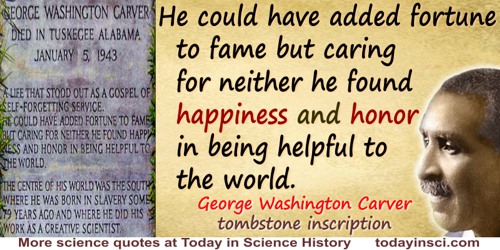
A life that stood out as a gospel of self-forgetting service.
He could have added fortune to fame but caring for neither he found happiness and honor in being helpful to the world.
The centre of his world was the south where he was born in slavery some 79 years ago and where he did his work as a creative scientist.
He could have added fortune to fame but caring for neither he found happiness and honor in being helpful to the world.
The centre of his world was the south where he was born in slavery some 79 years ago and where he did his work as a creative scientist.
Epitaph on tombstone at Tuskegee University Campus Cemetery, Alabama.
A man of about fifty-four years of age, had begun, five or six months before, to be somewhat emaciated in his whole body...a troublesome vomiting came on, of a fluid which resembl’d water, tinctur’d with soot.... Death took place.... In the stomach...was an ulcerated cancerous tumour.... Betwixt the stomach and the spleen were two glandular bodies, of the bigness of a bean, and in their colour, and substance, not much unlike that tumour which I have describ’d in the stomach.
About stomach cancer. In De Sedibus Causis Morborum (1761). Translated by Benjamin Alexander in The Seats and Causes of Diseases (1960), 43
A man that is young in years may be old in hours, if he has lost no time.
‘Of Youth and Age’, Essays.
A million years is a short time—the shortest worth messing with for most problems. You begin tuning your mind to a time scale that is the planet’s time scale. For me, it is almost unconscious now and is a kind of companionship with the earth.
In Basin and Range (1981), 134.
A moment’s consideration of this case shows what a really great advance in the theory and practise of breeding has been obtained through the discovery of Mendel’s law. What a puzzle this case would have presented to the biologist ten years ago! Agouti crossed with chocolate gives in the second filial generation (not in the first) four varieties, viz., agouti, chocolate, black and cinnamon. We could only have shaken our heads and looked wise (or skeptical).
Then we had no explanation to offer for such occurrences other than the “instability of color characters under domestication,” the “effects of inbreeding,” “maternal impressions.” Serious consideration would have been given to the proximity of cages containing both black and cinnamon-agouti mice.
Now we have a simple, rational explanation, which anyone can put to the test. We are able to predict the production of new varieties, and to produce them.
We must not, of course, in our exuberance, conclude that the powers of the hybridizer know no limits. The result under consideration consists, after all, only in the making of new combinations of unit characters, but it is much to know that these units exist and that all conceivable combinations of them are ordinarily capable of production. This valuable knowledge we owe to the discoverer and to the rediscoverers of Mendel’s law.
Then we had no explanation to offer for such occurrences other than the “instability of color characters under domestication,” the “effects of inbreeding,” “maternal impressions.” Serious consideration would have been given to the proximity of cages containing both black and cinnamon-agouti mice.
Now we have a simple, rational explanation, which anyone can put to the test. We are able to predict the production of new varieties, and to produce them.
We must not, of course, in our exuberance, conclude that the powers of the hybridizer know no limits. The result under consideration consists, after all, only in the making of new combinations of unit characters, but it is much to know that these units exist and that all conceivable combinations of them are ordinarily capable of production. This valuable knowledge we owe to the discoverer and to the rediscoverers of Mendel’s law.
'New Colour Variety of the Guinea Pig', Science, 1908, 28, 250-252.
A most vile face! and yet she spends me forty pound a year in Mercury and Hogs Bones. All her teeth were made in the Black-Fryars, both her Eyebrows i’ the Strand, and her Hair in Silver-street. Every part of Town owns a Piece of her.
A reference to artificial teeth by character Otter, speaking of his wife, in Epicoene: or, The Silent Woman (1609), Act IV, Sc. 2, 64. Also, True-wit makes a specific reference to “false Teeth” in Act I, Sc. 1, 10.
A multidisciplinary study group ... estimated that it would be 1980 before developments in artificial intelligence make it possible for machines alone to do much thinking or problem solving of military significance. That would leave, say, five years to develop man-computer symbiosis and 15 years to use it. The 15 may be 10 or 500, but those years should be intellectually the most creative and exciting in the history of mankind.
From article 'Man-Computer Symbiosis', in IRE Transactions on Human Factors in Electronics (Mar 1960), Vol. HFE-1, 4-11.

A nuclear power plant is infinitely safer than eating, because 300 people choke to death on food every year. (1977)
Quoted in G. Barry Golson (ed.) The Playboy Interview (1981).
A number of years ago, when I was a freshly-appointed instructor, I met, for the first time, a certain eminent historian of science. At the time I could only regard him with tolerant condescension.
I was sorry of the man who, it seemed to me, was forced to hover about the edges of science. He was compelled to shiver endlessly in the outskirts, getting only feeble warmth from the distant sun of science-in-progress; while I, just beginning my research, was bathed in the heady liquid heat up at the very center of the glow.
In a lifetime of being wrong at many a point, I was never more wrong. It was I, not he, who was wandering in the periphery. It was he, not I, who lived in the blaze.
I had fallen victim to the fallacy of the “growing edge;” the belief that only the very frontier of scientific advance counted; that everything that had been left behind by that advance was faded and dead.
But is that true? Because a tree in spring buds and comes greenly into leaf, are those leaves therefore the tree? If the newborn twigs and their leaves were all that existed, they would form a vague halo of green suspended in mid-air, but surely that is not the tree. The leaves, by themselves, are no more than trivial fluttering decoration. It is the trunk and limbs that give the tree its grandeur and the leaves themselves their meaning.
There is not a discovery in science, however revolutionary, however sparkling with insight, that does not arise out of what went before. “If I have seen further than other men,” said Isaac Newton, “it is because I have stood on the shoulders of giants.”
I was sorry of the man who, it seemed to me, was forced to hover about the edges of science. He was compelled to shiver endlessly in the outskirts, getting only feeble warmth from the distant sun of science-in-progress; while I, just beginning my research, was bathed in the heady liquid heat up at the very center of the glow.
In a lifetime of being wrong at many a point, I was never more wrong. It was I, not he, who was wandering in the periphery. It was he, not I, who lived in the blaze.
I had fallen victim to the fallacy of the “growing edge;” the belief that only the very frontier of scientific advance counted; that everything that had been left behind by that advance was faded and dead.
But is that true? Because a tree in spring buds and comes greenly into leaf, are those leaves therefore the tree? If the newborn twigs and their leaves were all that existed, they would form a vague halo of green suspended in mid-air, but surely that is not the tree. The leaves, by themselves, are no more than trivial fluttering decoration. It is the trunk and limbs that give the tree its grandeur and the leaves themselves their meaning.
There is not a discovery in science, however revolutionary, however sparkling with insight, that does not arise out of what went before. “If I have seen further than other men,” said Isaac Newton, “it is because I have stood on the shoulders of giants.”
Adding A Dimension: Seventeen Essays on the History of Science (1964), Introduction.
A person is smart. People are dumb ... Fifteen hundred years ago everybody knew the Earth was the center of the universe. Five hundred years ago, everybody knew the Earth was flat, and fifteen minutes ago, you knew that humans were alone on this planet. Imagine what you'll know tomorrow.
Character Agent K in movie Men in Black(1997), screen story and screenplay by Ed Solomon. Quoted in George Aichele, Culture, Entertainment and the Bible (2000), 26. In a footnote, from the post-movie novel by Steve Perry, Men in Black (1997), 66, is added, 'Yeah. A hundred years from now, whoever is here will probably pee themselves laughing at what we believe.'
A rill in a barnyard and the Grand Canyon represent, in the main, stages of valley erosion that began some millions of years apart.
Uniformitarianism. An Inquiry into Principle, Theory, and Method in Geohistory and Biohistory', M. K. Hecht and W. C. Steere (eds.), Essays in Evolution and Genetics in Honor of Theodosius Dobzhansky (1970), 83.
A schism has taken place among the chemists. A particular set of them in France have undertaken to remodel all the terms of the science, and to give every substance a new name, the composition, and especially the termination of which, shall define the relation in which it stands to other substances of the same family, But the science seems too much in its infancy as yet, for this reformation; because in fact, the reformation of this year must be reformed again the next year, and so on, changing the names of substances as often as new experiments develop properties in them undiscovered before. The new nomenclature has, accordingly, been already proved to need numerous and important reformations. ... It is espoused by the minority here, and by the very few, indeed, of the foreign chemists. It is particularly rejected in England.
Letter to Dr. Willard (Paris, 1788). In Thomas Jefferson and John P. Foley (ed.), The Jeffersonian Cyclopedia (1900), 135. From H.A. Washington, The Writings of Thomas Jefferson (1853-54). Vol 3, 15.
A single swallow, it is said, devours ten millions of insects every year. The supplying of these insects I take to be a signal instance of the Creator's bounty in providing for the lives of His creatures.
Attributed to Henry Ward Beecher as a quote under the definition of 'Bounty' in Ambrose Bierce, The Collected Works of Ambrose Bierce (1911), Vol. 7, The Devil's Dictionary, 40. Webmaster has not yet found a primary print source confirming the quote is by Beecher, and thus presently lists it under Bierce. Please contact webmaster if you know a primary print source for Beecher.
A star is drawing on some vast reservoir of energy by means unknown to us. This reservoir can scarcely be other than the subatomic energy which, it is known exists abundantly in all matter; we sometimes dream that man will one day learn how to release it and use it for his service. The store is well nigh inexhaustible, if only it could be tapped. There is sufficient in the Sun to maintain its output of heat for 15 billion years.
Address to the British Association in Cardiff, (24 Aug 1920), in Observatory (1920), 43 353. Reprinted in Foreward to Arthur S. Eddington, The Internal Constitution of the Stars (1926, 1988), x.
A story about the Jack Spratts of medicine [was] told recently by Dr. Charles H. Best, co-discoverer of insulin. He had been invited to a conference of heart specialists in North America. On the eve of the meeting, out of respect for the fat-clogs-the-arteries theory, the delegates sat down to a special banquet served without fats. It was unpalatable but they all ate it as a duty. Next morning Best looked round the breakfast room and saw these same specialists—all in the 40-60 year old, coronary age group—happily tucking into eggs, bacon, buttered toast and coffee with cream.
'Objections To High-Fat Diets', Eat Fat And Grow Slim (1958), Ch. 3.
A universe that came from nothing in the big bang will disappear into nothing in the big crunch, its glorious few zillion years of existence not even a memory.
In The Last Three Minutes: Conjectures About The Ultimate Fate Of The Universe (1994, 2008), 123.
A weird happening has occurred in the case of a lansquenet named Daniel Burghammer, of the squadron of Captain Burkhard Laymann Zu Liebenau, of the honorable Madrucci Regiment in Piadena, in Italy. When the same was on the point of going to bed one night he complained to his wife, to whom he had been married by the Church seven years ago, that he had great pains in his belly and felt something stirring therein. An hour thereafter he gave birth to a child, a girl. When his wife was made aware of this, she notified the occurrence at once. Thereupon he was examined and questioned. … He confessed on the spot that he was half man and half woman and that for more than seven years he had served as a soldier in Hungary and the Netherlands… . When he was born he was christened as a boy and given in baptism the name of Daniel… . He also stated that while in the Netherlands he only slept once with a Spaniard, and he became pregnant therefrom. This, however, he kept a secret unto himself and also from his wife, with whom he had for seven years lived in wedlock, but he had never been able to get her with child… . The aforesaid soldier is able to suckle the child with his right breast only and not at all on the left side, where he is a man. He has also the natural organs of a man for passing water. Both are well, the child is beautiful, and many towns have already wished to adopt it, which, however, has not as yet been arranged. All this has been set down and described by notaries. It is considered in Italy to be a great miracle, and is to be recorded in the chronicles. The couple, however, are to be divorced by the clergy.
'From Piadena in Italy, the 26th day of May 1601'. As quoted in George Tennyson Matthews (ed.) The Fugger Newsletter (1970), 247-248. A handwritten collection of news reports (1568-1604) by the powerful banking and merchant house of Fugger in Ausburg. This was footnoted in The Story of the Secret Service (1937), 698.
https://books.google.com/books?id=YfssAAAAMAAJ
Richard Wilmer Rowan - 1937
A wise man in China asked his gardener to plant a shrub. The gardener objected that it only flowered once in a hundred years. “In that case,” said the wise man, “plant it immediately.” [On the importance of fundamental research.]
'A Scientist and the World He Lives In', Speech to the Empire Club of Canada (27 Nov 1986) in C. Frank Turner and Tim Dickson (eds.), The Empire Club of Canada Speeches 1986-1987 (1987), 149-161.
A year spent in artificial intelligence is enough to make one believe in God.
Epigrams of Programming
Abel has left mathematicians enough to keep them busy for 500 years.
As quoted, without citation, in Eric Temple Bell, The Queen of the Sciences (1931), 10.
Abel has left mathematicians something to keep them busy for five hundred years.
As quoted by Eric Temple Bell in The Queen of the Sciences (1931, 1938), 10.
About 6 or 8 years ago My Ingenious friend Mr John Robinson having [contrived] conceived that a fire engine might be made without a Lever—by Inverting the Cylinder & placing it above the mouth of the pit proposed to me to make a model of it which was set about by having never Compleated & I [being] having at that time Ignorant little knoledge of the machine however I always thought the Machine Might be applied to [more] other as valuable purposes [than] as drawing Water.
Entry in notebook (1765). The bracketed words in square brackets were crossed out by Watt. in Eric Robinson and Douglas McKie (eds.), Partners in Science: Letters of James Watt and Joseph Black (1970), 434.
About the year 1772, being then an apprentice to a wheel-wright, or wagon maker, I laboured to discover some means of propelling land carriages without animal power. … one of my brothers [told me of] blacksmith’s boys, who, for amusement, had stopped up the touch hole of a gun barrel, then put in about a gill of water, and rammed down a tight wad; after which they put the breech in the smith’s fire, when it discharged itself with as loud a crack as if it had been loaded with powder. It immediately occurred to me, that here was the power to propel any wagon, if I could only apply it.
From 'On the Origin of Steam Boats and Steam Wagons', Thomas Cooper (ed.), The Emporium of Arts and Sciences (Feb 1814), 2, No. 2, 205.
About the year 1821, I undertook to superintend, for the Government, the construction of an engine for calculating and printing mathematical and astronomical tables. Early in the year 1833, a small portion of the machine was put together, and was found to perform its work with all the precision which had been anticipated. At that period circumstances, which I could not control, caused what I then considered a temporary suspension of its progress; and the Government, on whose decision the continuance or discontinuance of the work depended, have not yet communicated to me their wishes on the question.
In The Ninth Bridgewater Treatise: A Fragment (1838), 186.
About thirty years ago there was much talk that geologists ought only to observe and not theorise; and I well remember some one saying that at this rate a man might as well go into a gravel-pit and count the pebbles and describe the colours. How odd it is that anyone should not see that all observation must be for or against some view if it is to be of any service!
Letter to Henry Fawcett (18 Sep 1861). In Charles Darwin, Francis Darwin, Albert Charles Seward, More Letters of Charles Darwin (1903), Vol. 1, 195.
About two million years ago, man appeared. He has become the dominant species on the earth. All other living things, animal and plant, live by his sufferance. He is the custodian of life on earth, and in the solar system. It’s a big responsibility.
From speech given at an anti-war teach-in at the Massachusetts Institute of Technology, (4 Mar 1969) 'A Generation in Search of a Future', as edited by Ron Dorfman for Chicago Journalism Review, (May 1969).
Absolute, true, and mathematical time, in and of itself and of its own nature, without reference to anything external, flows uniformly and by another name is called duration. Relative, apparent, and common time is any sensible and external measure (precise or imprecise) of duration by means of motion; such as a measure—for example, an hour, a day, a month, a year—is commonly used instead of true time.
The Principia: Mathematical Principles of Natural Philosophy (1687), 3rd edition (1726), trans. I. Bernard Cohen and Anne Whitman (1999), Definitions, Scholium, 408.
Abstruse mathematical researches … are … often abused for having no obvious physical application. The fact is that the most useful parts of science have been investigated for the sake of truth, and not for their usefulness. A new branch of mathematics, which has sprung up in the last twenty years, was denounced by the Astronomer Royal before the University of Cambridge as doomed to be forgotten, on account of its uselessness. Now it turns out that the reason why we cannot go further in our investigations of molecular action is that we do not know enough of this branch of mathematics.
In 'Conditions of Mental Development', Lectures and Essays (1901), Vol. 1, 115.
According to astronomers, next week Wednesday will occur twice. They say such a thing happens only once every 60,000 years and although they don’t know why it occurs, they’re glad they have an extra day to figure it out.
In Napalm and Silly Putty (2002), 105.
Adam, the first man, didn’t know anything about the nucleus but Dr. George Gamow, visiting professor from George Washington University, pretends he does. He says for example that the nucleus is 0.00000000000003 feet in diameter. Nobody believes it, but that doesn't make any difference to him.
He also says that the nuclear energy contained in a pound of lithium is enough to run the United States Navy for a period of three years. But to get this energy you would have to heat a mixture of lithium and hydrogen up to 50,000,000 degrees Fahrenheit. If one has a little stove of this temperature installed at Stanford, it would burn everything alive within a radius of 10,000 miles and broil all the fish in the Pacific Ocean.
If you could go as fast as nuclear particles generally do, it wouldn’t take you more than one ten-thousandth of a second to go to Miller's where you could meet Gamow and get more details.
He also says that the nuclear energy contained in a pound of lithium is enough to run the United States Navy for a period of three years. But to get this energy you would have to heat a mixture of lithium and hydrogen up to 50,000,000 degrees Fahrenheit. If one has a little stove of this temperature installed at Stanford, it would burn everything alive within a radius of 10,000 miles and broil all the fish in the Pacific Ocean.
If you could go as fast as nuclear particles generally do, it wouldn’t take you more than one ten-thousandth of a second to go to Miller's where you could meet Gamow and get more details.
'Gamow interviews Gamow' Stanford Daily, 25 Jun 1936. In Helge Kragh, Cosmology and Controversy: The Historica1 Development of Two Theories of the Universe (1996), 90.
After a duration of a thousand years, the power of astrology broke down when, with Copernicus, Kepler, and Galileo, the progress of astronomy overthrew the false hypothesis upon which the entire structure rested, namely the geocentric system of the universe. The fact that the earth revolves in space intervened to upset the complicated play of planetary influences, and the silent stars, related to the unfathomable depths of the sky, no longer made their prophetic voices audible to mankind. Celestial mechanics and spectrum analysis finally robbed them of their mysterious prestige.
Franz Cumont, translated by J.B. Baker, Astrology and Religion Among the Greeks and Romans (1912, 2007), 6.
After all, we scientific workers … like women, are the victims of fashion: at one time we wear dissociated ions, at another electrons; and we are always loth to don rational clothing; some fixed belief we must have manufactured for us: we are high or low church, of this or that degree of nonconformity, according to the school in which we are brought up—but the agnostic is always rare of us and of late years the critic has been taboo.
'The Thirst of Salted Water or the Ions Overboard', Science Progress (1909), 3, 643.
After five years' work I allowed myself to speculate on the subject, and drew up some short notes; these I enlarged in 1844 into a sketch of the conclusions, which then seemed to me probable: from that period to the present day I have steadily pursued the same object. I hope that I may be excused for entering on these personal details, as I give them to show that I have not been hasty in coming to a decision.
From On the Origin of Species by Means of Natural Selection; or, The Preservation of Favoured Races in the Struggle for Life (1861), 9.
After long reflection in solitude and meditation, I suddenly had the idea, during the year 1923, that the discovery made by Einstein in 1905 should be generalised by extending it to all material particles and notably to electrons.
Preface to his re-edited 1924 Ph.D. Thesis, Recherches sur la théorie des quanta (1963), 4. In Steve Adams, Frontiers (2000), 13.
After the birth of printing books became widespread. Hence everyone throughout Europe devoted himself to the study of literature... Every year, especially since 1563, the number of writings published in every field is greater than all those produced in the past thousand years. Through them there has today been created a new theology and a new jurisprudence; the Paracelsians have created medicine anew and the Copernicans have created astronomy anew. I really believe that at last the world is alive, indeed seething, and that the stimuli of these remarkable conjunctions did not act in vain.
De Stella Nova, On the New Star (1606), Johannes Kepler Gesammelte Werke (1937- ), Vol. 1, 330-2. Quoted in N. Jardine, The Birth of History and Philosophy of Science: Kepler's A Defence of Tycho Against Ursus With Essays on its Provenance and Significance (1984), 277-8.
After the discovery of spectral analysis no one trained in physics could doubt the problem of the atom would be solved when physicists had learned to understand the language of spectra. So manifold was the enormous amount of material that has been accumulated in sixty years of spectroscopic research that it seemed at first beyond the possibility of disentanglement. An almost greater enlightenment has resulted from the seven years of Röntgen spectroscopy, inasmuch as it has attacked the problem of the atom at its very root, and illuminates the interior. What we are nowadays hearing of the language of spectra is a true 'music of the spheres' in order and harmony that becomes ever more perfect in spite of the manifold variety. The theory of spectral lines will bear the name of Bohr for all time. But yet another name will be permanently associated with it, that of Planck. All integral laws of spectral lines and of atomic theory spring originally from the quantum theory. It is the mysterious organon on which Nature plays her music of the spectra, and according to the rhythm of which she regulates the structure of the atoms and nuclei.
Atombau und Spektrallinien (1919), viii, Atomic Structure and Spectral Lines, trans. Henry L. Brose (1923), viii.
After the German occupation of Holland in May 1940, the [last] two dark years of the war I spent hiding indoors from the Nazis, eating tulip bulbs to fill the stomach and reading Kramers' book “Quantum Theorie des Elektrons und der Strahlung” by the light of a storm lamp.
After the planet becomes theirs, many millions of years will have to pass before a beetle particularly loved by God, at the end of its calculations will find written on a sheet of paper in letters of fire that energy is equal to the mass multiplied by the square of the velocity of light. The new kings of the world will live tranquilly for a long time, confining themselves to devouring each other and being parasites among each other on a cottage industry scale.
'Beetles' Other People’s Trades (1985, trans. 1989).
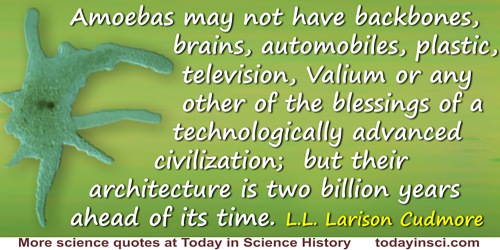
Ah, the architecture of this world. Amoebas may not have backbones, brains, automobiles, plastic, television, Valium or any other of the blessings of a technologically advanced civilization; but their architecture is two billion years ahead of its time.
In The Center of Life: A Natural History of the Cell (1977), 15-16.
All change is relative. The universe is expanding relatively to our common material standards; our material standards are shrinking relatively to the size of the universe. The theory of the “expanding universe” might also be called the theory of the “shrinking atom”. …
:Let us then take the whole universe as our standard of constancy, and adopt the view of a cosmic being whose body is composed of intergalactic spaces and swells as they swell. Or rather we must now say it keeps the same size, for he will not admit that it is he who has changed. Watching us for a few thousand million years, he sees us shrinking; atoms, animals, planets, even the galaxies, all shrink alike; only the intergalactic spaces remain the same. The earth spirals round the sun in an ever-decreasing orbit. It would be absurd to treat its changing revolution as a constant unit of time. The cosmic being will naturally relate his units of length and time so that the velocity of light remains constant. Our years will then decrease in geometrical progression in the cosmic scale of time. On that scale man’s life is becoming briefer; his threescore years and ten are an ever-decreasing allowance. Owing to the property of geometrical progressions an infinite number of our years will add up to a finite cosmic time; so that what we should call the end of eternity is an ordinary finite date in the cosmic calendar. But on that date the universe has expanded to infinity in our reckoning, and we have shrunk to nothing in the reckoning of the cosmic being.
We walk the stage of life, performers of a drama for the benefit of the cosmic spectator. As the scenes proceed he notices that the actors are growing smaller and the action quicker. When the last act opens the curtain rises on midget actors rushing through their parts at frantic speed. Smaller and smaller. Faster and faster. One last microscopic blurr of intense agitation. And then nothing.
:Let us then take the whole universe as our standard of constancy, and adopt the view of a cosmic being whose body is composed of intergalactic spaces and swells as they swell. Or rather we must now say it keeps the same size, for he will not admit that it is he who has changed. Watching us for a few thousand million years, he sees us shrinking; atoms, animals, planets, even the galaxies, all shrink alike; only the intergalactic spaces remain the same. The earth spirals round the sun in an ever-decreasing orbit. It would be absurd to treat its changing revolution as a constant unit of time. The cosmic being will naturally relate his units of length and time so that the velocity of light remains constant. Our years will then decrease in geometrical progression in the cosmic scale of time. On that scale man’s life is becoming briefer; his threescore years and ten are an ever-decreasing allowance. Owing to the property of geometrical progressions an infinite number of our years will add up to a finite cosmic time; so that what we should call the end of eternity is an ordinary finite date in the cosmic calendar. But on that date the universe has expanded to infinity in our reckoning, and we have shrunk to nothing in the reckoning of the cosmic being.
We walk the stage of life, performers of a drama for the benefit of the cosmic spectator. As the scenes proceed he notices that the actors are growing smaller and the action quicker. When the last act opens the curtain rises on midget actors rushing through their parts at frantic speed. Smaller and smaller. Faster and faster. One last microscopic blurr of intense agitation. And then nothing.
In The Expanding Universe (1933) , 90-92.
All disease, at some period or other of its course, is more or less a reparative process, not necessarily accompanied with suffering: an effort of nature to remedy a process of poisoning or of decay, which has taken place weeks, months, sometimes years beforehand, unnoticed.
In Notes on Nursing: What It Is and What It Is Not (1859), 5.
All knowledge is profitable; profitable in its ennobling effect on the character, in the pleasure it imparts in its acquisition, as well as in the power it gives over the operations of mind and of matter. All knowledge is useful; every part of this complex system of nature is connected with every other. Nothing is isolated. The discovery of to-day, which appears unconnected with any useful process, may, in the course of a few years, become the fruitful source of a thousand inventions.
In 'Report of the Secretary', Sixth Annual Report of the Board of Regents of the Smithsonian Institution for 1851 (1852), 10.
All of the books in the world contain no more information than is broadcast as video in a single large American city in a single year. Not all bits have equal value.
…...
All that we can do, is to keep steadily in mind that each organic being is striving to increase at a geometrical ratio; that each at some period of its life, during some season of the year, during each generation or at intervals, has to struggle for life, and to suffer great destruction. When we reflect on this struggle, we may console ourselves with the full belief, that the war of nature is not incessant, that no fear is felt, that death is generally prompt, and that the vigorous, the healthy, and the happy survive and multiply.
From On the Origin of Species by Means of Natural Selection; or, The Preservation of Favoured Races in the Struggle for Life (1861), 76.
All the fifty years of conscious brooding have brought me no closer to answer the question, “What are light quanta?” Of course today every rascal thinks he knows the answer, but he is deluding himself.
(1951). Quoted in Raymond W. Lam, Seasonal Affective Disorder and Beyond (1998), 1.
Almost all the world is natural chemicals, so it really makes you re-think everything. A cup of coffee is filled with chemicals. They've identified a thousand chemicals in a cup of coffee. But we only found 22 that have been tested in animal cancer tests out of this thousand. And of those, 17 are carcinogens. There are ten milligrams of known carcinogens in a cup of coffee and thats more carcinogens than youre likely to get from pesticide residues for a year!
Paper to the American Chemical Society, 'Pollution, Pesticides and Cancer Misconceptions.' As cited by Art Drysdale, 'Latest Insider News: Natural vs. Synthetic Chemical Pesticides' (14 Feb 1999), on the mitosyfraudes.org website. Bruce Ames has delivered a similar statistic in various other publications.
Almost every major systematic error which has deluded men for thousands of years relied on practical experience. Horoscopes, incantations, oracles, magic, witchcraft, the cures of witch doctors and of medical practitioners before the advent of modern medicine, were all firmly established through the centuries in the eyes of the public by their supposed practical successes. The scientific method was devised precisely for the purpose of elucidating the nature of things under more carefully controlled conditions and by more rigorous criteria than are present in the situations created by practical problems.
Personal Knowledge (1958), 183.
Although I was four years at the University [of Wisconsin], I did not take the regular course of studies, but instead picked out what I thought would be most useful to me, particularly chemistry, which opened a new world, mathematics and physics, a little Greek and Latin, botany and and geology. I was far from satisfied with what I had learned, and should have stayed longer.
[Enrolled in Feb 1861, left in 1863 without completing a degree, and began his first botanical foot journey.]
[Enrolled in Feb 1861, left in 1863 without completing a degree, and began his first botanical foot journey.]
The Story of My Boyhood and Youth (1913), 286.
An announcement of [Christopher] Zeeman’s lecture at Northwestern University in the spring of 1977 contains a quote describing catastrophe theory as the most important development in mathematics since the invention of calculus 300 years ago.
In book review of Catastrophe Theory: Collected Papers, 1972-1977, in Bulletin of the American Mathematical Society (Nov 1978), 84, No. 6, 1360. Reprinted in Stephen Smale, Roderick Wong(ed.), The Collected Papers of Stephen Smale (2000), Vol. 2, 814.
An evolution is a series of events that in itself as series is purely physical, — a set of necessary occurrences in the world of space and time. An egg develops into a chick; … a planet condenses from the fluid state, and develops the life that for millions of years makes it so wondrous a place. Look upon all these things descriptively, and you shall see nothing but matter moving instant after instant, each instant containing in its full description the necessity of passing over into the next. … But look at the whole appreciatively, historically, synthetically, as a musician listens to a symphony, as a spectator watches a drama. Now you shall seem to have seen, in phenomenal form, a story.
In The Spirit of Modern Philosophy: An Essay in the Form of Lectures (1892), 425.
An evolutionary perspective of our place in the history of the earth reminds us that Homo sapiens sapiens has occupied the planet for the tiniest fraction of that planet's four and a half thousand million years of existence. In many ways we are a biological accident, the product of countless propitious circumstances. As we peer back through the fossil record, through layer upon layer of long-extinct species, many of which thrived far longer than the human species is ever likely to do, we are reminded of our mortality as a species. There is no law that declares the human animal to be different, as seen in this broad biological perspective, from any other animal. There is no law that declares the human species to be immortal.
Co-author with American science writer Roger Amos Lewin (1946), Origins: What New Discoveries Reveal about the Emergence of our Species and its Possible Future (1977), 256.
An example of such emergent phenomena is the origin of life from non-living chemical compounds in the oldest, lifeless oceans of the earth. Here, aided by the radiation energy received from the sun, countless chemical materials were synthesized and accumulated in such a way that they constituted, as it were, a primeval “soup.” In this primeval soup, by infinite variations of lifeless growth and decay of substances during some billions of years, the way of life was ultimately reached, with its metabolism characterized by selective assimilation and dissimilation as end stations of a sluiced and canalized flow of free chemical energy.
In 'The Scientific Character of Geology', The Journal of Geology (Jul 1961), 69, No. 4, 458.
An inventor is one who can see the applicability of means to supply demand five years before it is obvious to those skilled in the art.
Aphorism listed Frederick Seitz, The Cosmic Inventor: Reginald Aubrey Fessenden (1866-1932) (1999), 54, being Transactions of the American Philosophical Society, Held at Philadelphia For Promoting Useful Knowledge, Vol. 86, Pt. 6.
An inventor is simply a fellow who doesn’t take his education too seriously. You see, from the time a person is six years old until he graduates form college he has to take three or four examinations a year. If he flunks once, he is out. But an inventor is almost always failing. He tries and fails maybe a thousand times. It he succeeds once then he’s in. These two things are diametrically opposite. We often say that the biggest job we have is to teach a newly hired employee how to fail intelligently. We have to train him to experiment over and over and to keep on trying and failing until he learns what will work.
In 'How Can We Develop Inventors?' presented to the Annual meeting of the American Society of Society Engineers. Reprinted in Mechanical Engineering (Apr 1944). Collected in Prophet of Progress: Selections from the Speeches of Charles F. Kettering (1961), 108.
An old writer says that there are four sorts of readers: “Sponges which attract all without distinguishing; Howre-glasses which receive and powre out as fast; Bagges which only retain the dregges of the spices and let the wine escape, and Sives which retaine the best onely.” A man wastes a great many years before he reaches the ‘sive’ stage.
Address for the Dedication of the New Building of the Boston Medical Library (12 Jan 1901). Printed as 'Books and Men', The Boston Medical and Surgical Journal (17 Jan 1901), 144, No. 3, 60. [Presumably “Howre-glasses” refers to Hour-glasses. -Webmaster]
An underwater-listening device, the “hydrophone,” has, in recent years, shown that sea creatures click, grunt, snap, moan, and, in general, make the ocean depths as maddeningly noisy as ever the land is.
(1965). In Isaac Asimov’s Book of Science and Nature Quotations (1988), 188.
Anaximander son of Praxiades, of Miletus: he said that the principle and element is the Indefinite, not distinguishing air or water or anything else. … he was the first to discover a gnomon, and he set one up on the Sundials (?) in Sparta, according to Favorinus in his Universal History, to mark solstices and equinoxes; and he also constructed hour indicators. He was the first to draw an outline of earth and sea, but also constructed a [celestial] globe. Of his opinions he made a summary exposition, which I suppose Apollodorus the Athenian also encountered. Apollodorus says in his Chronicles that Anaximander was sixty-four years old in the year of the fifty-eighth Olympiad [547/6 B.C.], and that he died shortly afterwards (having been near his prime approximately during the time of Polycrates, tyrant of Samos).
Diogenes Laërtius II, 1-2. In G.S. Kirk, J.E. Raven and M. Schofield (eds), The Presocratic Philosophers: A Critical History with a Selection of Texts (1957), 99. The editors of this translation note that Anaximander may have introduced the gnomon into Greece, but he did not discover it—the Babylonians used it earlier, and the celestial sphere, and the twelve parts of the day.
And do you know what “the world” is to me? Shall I show it to you in my mirror? This world: a monster of energy, without beginning, without end; a firm, iron magnitude of force that does not grow bigger or smaller, that does not expend itself but only transforms itself; as a whole, of unalterable size, a household without expenses or losses, but likewise without increase or income; enclosed by “nothingness”' as by a boundary; not by something blurry or wasted, not something endlessly extended, but set in a definite space as a definite force, and not a space that might be “empty” here or there, but rather as force throughout, as a play of forces and waves of forces, at the same time one and many, increasing here and at the same time decreasing there; a sea of forces flowing and rushing together, eternally changing, eternally flooding back, with tremendous years of recurrence, with an ebb and a flood of its forms; out of the simplest forms striving toward the most complex, out of the stillest, most rigid, coldest forms toward the hottest, most turbulent, most self-contradictory, and then again returning home to the simple out of this abundance, out of the play of contradictions back to the joy of concord, still affirming itself in this uniformity of its courses and its years, blessing itself as that which must return eternally, as a becoming that knows no satiety, no disgust, no weariness: this, my Dionysian world of the eternally self-creating, the eternally self-destroying, this mystery world of the twofold voluptuous delight, my “beyond good and evil,” without goal, unless the joy of the circle itself is a goal; without will, unless a ring feels good will toward itself-do you want a name for this world? A solution for all its riddles? A light for you, too, you best-concealed, strongest, most intrepid, most midnightly men?—This world is the will to power—and nothing besides! And you yourselves are also this will to power—and nothing besides!
The Will to Power (Notes written 1883-1888), book 4, no. 1067. Trans. W. Kaufmann and R. J. Hollingdale and ed. W. Kaufmann (1968), 549-50.
And God said, Let there be lights in the firmament of the heavens to separate the day from the night; and let them be for signs and for seasons and for days and years, and let them be lights in the firmament of the heavens to give light upon the earth.” And it was so. And God made the two great lights, the greater light to rule the day, and the lesser light to rule the night; he made the stars also.
— Bible
(circa 725 B.C.)
And if you want the exact moment in time, it was conceived mentally on 8th March in this year one thousand six hundred and eighteen, but submitted to calculation in an unlucky way, and therefore rejected as false, and finally returning on the 15th of May and adopting a new line of attack, stormed the darkness of my mind. So strong was the support from the combination of my labour of seventeen years on the observations of Brahe and the present study, which conspired together, that at first I believed I was dreaming, and assuming my conclusion among my basic premises. But it is absolutely certain and exact that the proportion between the periodic times of any two planets is precisely the sesquialterate proportion of their mean distances.
Harmonice Mundi, The Harmony of the World (1619), book V, ch. 3. Trans. E. J. Aiton, A. M. Duncan and J. V. Field (1997), 411.
And so, after many years, victory has come, and the romance of exploration, of high hopes and bitter disappointment, will in a few years simply be recorded in the text-books of organic chemistry in a few terse sentences.
Recent Developments in the Vitamin A Field', The Pedlar Lecture, 4 Dec 1947, Journal of the Chemical Society, Part I (1948), 393.
And yet surely to alchemy this right is due, that it may be compared to the husbandman whereof Æsop makes the fable, that when he died he told his sons that he had left unto them gold buried under the ground in his vineyard: and they digged over the ground, gold they found none, but by reason of their stirring and digging the mould about the roots of their vines, they had a great vintage the year following: so assuredly the search and stir to make gold hath brought to light a great number of good and fruitful inventions and experiments, as well for the disclosing of nature as for the use of man's life.
The Advancement of Learning (1605, 1712), Vol. 1, 15.
Animals generally seem naturally disposed to … intercourse at about the same period of the year, and that is when winter is changing into summer…. In the human species, the male experiences more under sexual excitement in winter, and the female in summer.
In The Works of Aristotle: Historia Animalium (350 BC), (The History of Animals), Book V, Part 8, 542a20 translated in William David Ross and John Alexander Smith (eds.), D’Arcy Wentworth Thompson (trans.), (1910), Vol. 4, 27-28

Any living cell carries with it the experience of a billion years of experimentation by its ancestors. (1949)
From Transactions of the Connecticut Academy of Arts and Sciences (Dec 1949), 38. Used as epigraph (without citation) to Chap 6, in Arnold Jay Levine, Viruses: A Scientific American Library Book (1991), 113.
Anyone informed that the universe is expanding and contracting in pulsations of eighty billion years has a right to ask, “What’s in it for me?”
In The Glory of the Hummingbird (1974), 6.
Archimedes, who combined a genius for mathematics with a physical insight, must rank with Newton, who lived nearly two thousand years later, as one of the founders of mathematical physics. … The day (when having discovered his famous principle of hydrostatics he ran through the streets shouting Eureka! Eureka!) ought to be celebrated as the birthday of mathematical physics; the science came of age when Newton sat in his orchard.
In An Introduction to Mathematics (1911), 37.
As a scientist and geneticist I started to feel that science would probably soon reach the point where its interference into the life processes would be counterproductive if a properly designed governing policy was not implemented. A heavily overcrowded planet, ninety-five percent urbanized with nuclear energy as the main source of energy and with all aspects of life highly computerized, is not too pleasant a place for human life. The life of any individual soon will be predictable from birth to death. Medicine, able to cure almost everything, will make the load of accumulated defects too heavy in the next two or three centuries. The artificial prolongation of life, which looked like a very bright idea when I started research in aging about twenty-five years ago, has now lost its attractiveness for me. This is because I now know that the aging process is so multiform and complex that the real technology and chemistry of its prevention by artificial interference must be too complex and expensive. It would be the privilege of a few, not the method for the majority. I also was deeply concerned about the fact that most research is now either directly or indirectly related to military projects and objectives for power.
Quoted in 'Zhores A(leksandrovich) Medvedev', Contemporary Authors Online, Gale, 2002.
As a second year high school chemistry student, I still have a vivid memory of my excitement when I first saw a chart of the periodic table of elements. The order in the universe seemed miraculous, and I wanted to study and learn as much as possible about the natural sciences.
In Tore Frängsmyr and Jan E. Lindsten (eds.), Nobel Lectures: Physiology Or Medicine: 1981-1990 (1993), 555.
As I show you this liquid, I too could tell you, 'I took my drop of water from the immensity of creation, and I took it filled with that fecund jelly, that is, to use the language of science, full of the elements needed for the development of lower creatures. And then I waited, and I observed, and I asked questions of it, and I asked it to repeat the original act of creation for me; what a sight it would be! But it is silent! It has been silent for several years, ever since I began these experiments. Yes! And it is because I have kept away from it, and am keeping away from it to this moment, the only thing that it has not been given to man to produce, I have kept away from it the germs that are floating in the air, I have kept away from it life, for life is the germ, and the germ is life.'
Quoted in Patrice Debré, Louis Pasteur, trans. Elborg Forster (1994), 169.
As one penetrates from seam to seam, from stratum to stratum and discovers, under the quarries of Montmartre or in the schists of the Urals, those animals whose fossilized remains belong to antediluvian civilizations, the mind is startled to catch a vista of the milliards of years and the millions of peoples which the feeble memory of man and an indestructible divine tradition have forgotten and whose ashes heaped on the surface of our globe, form the two feet of earth which furnish us with bread and flowers.
From 'La Peau de Chagrin' (1831). As translated as The Wild Ass’s Skin (1906) trans. Herbert J. Hunt, The Wild Ass's Skin (1977), 40-1.
As soon … as it was observed that the stars retained their relative places, that the times of their rising and setting varied with the seasons, that sun, moon, and planets moved among them in a plane, … then a new order of things began.… Science had begun, and the first triumph of it was the power of foretelling the future; eclipses were perceived to recur in cycles of nineteen years, and philosophers were able to say when an eclipse was to be looked for. The periods of the planets were determined. Theories were invented to account for their eccentricities; and, false as those theories might be, the position of the planets could be calculated with moderate certainty by them.
Lecture delivered to the Royal Institution (5 Feb 1864), 'On the Science of History'. Collected in Notices of the Proceedings at the Meetings of the Members of the Royal Institution of Great Britain with Abstracts of the Discourses (1866), Vol. 4, 187.
As they discover, from strata to strata and from layer to layer, deep in the quarries of Montmartre or the schists of the Urals, these creatures whose fossilized remains belong to antediluvian civilizations, it will strike terror into your soul to see many millions of years, many thousands of races forgotten by the feeble memory of mankind and by the indestructible divine tradition, and whose piles of ashes on the surface of our globe form the two feet of soil which gives us our bread and our flowers.
From 'La Peau de Chagrin' (1831). As translated as by Helen Constantine The Wild Ass’s Skin (2012), 19.
As to rocket ships flying between America and Europe, I believe it is worth seriously trying for. Thirty years ago persons who were developing flying were laughed at as mad, and that scorn hindered aviation. Now we heap similar ridicule upon stratoplane or rocket ships for trans-Atlantic flights.
Predicting high-altitude jet aircraft for routine long-distance travel. As quoted by Gobind Behari Lal, Universal Service Science Editor, as printed in 'Prof. Piccard Reaches U.S.', Syracuse Journal (13 Jan 1933), 4.
At least once per year, some group of scientists will become very excited and announce that:
•The universe is even bigger than they thought!
•There are even more subatomic particles than they thought!
•Whatever they announced last year about global warming is wrong.
•The universe is even bigger than they thought!
•There are even more subatomic particles than they thought!
•Whatever they announced last year about global warming is wrong.
From newspaper column '25 Things I Have Learned in 50 Years' (Oct 1998), collected in Dave Barry Turns Fifty (2010), 183.
At the beginning of this debate Stephen [Hawking] said that he thinks that he is a positivist, whereas I am a Platonist. I am happy with him being a positivist, but I think that the crucial point here is, rather, that I am a realist. Also, if one compares this debate with the famous debate of Bohr and Einstein, some seventy years ago, I should think that Stephen plays the role of Bohr, whereas I play Einstein's role! For Einstein argued that there should exist something like a real world, not necessarily represented by a wave function, whereas Bohr stressed that the wave function doesn't describe a 'real' microworld but only 'knowledge' that is useful for making predictions.
Debate at the Isaac Newton Institute of the Mathematical Sciences, Cambridge University (1994), transcribed in Stephen Hawking and Roger Penrose, The Nature of Space and Time (1996), 134-135.
At the end of 1854 … the aggregate length of railways opened in Great Britain and Ireland at that time measured about 8,054 miles,—about the diameter of the globe, and nearly 500 miles more than
the united lengths of the Thames, the Seine, the Rhone, the Ebro, the Tagus, the Rhine, the Elbe, the Vistula, the Dnieper, and the Danube, or the ten chief rivers of Europe. … the work of only twenty-five years.
From 'Railway System and its Results' (Jan 1856) read to the Institution of Civil Engineers, reprinted in Samuel Smiles, Life of George Stephenson (1857), 511-512.
At the planet’s very heart lies a solid rocky core, at least five times larger than Earth, seething with the appalling heat generated by the inexorable contraction of the stupendous mass of material pressing down to its centre. For more than four billion years Jupiter’s immense gravitational power has been squeezing the planet slowly, relentlessly, steadily, converting gravitational energy into heat, raising the temperature of that rocky core to thirty thousand degrees, spawning the heat flow that warms the planet from within. That hot, rocky core is the original protoplanet seed from the solar system’s primeval time, the nucleus around which those awesome layers of hydrogen and helium and ammonia, methane, sulphur compounds and water have wrapped themselves.
— Ben Bova
Jupiter
At the present rate of progress, it is almost impossible to imagine any technical feat that cannot be achieved, if it can be achieved at all, within the next five hundred years.
Profiles of the Future (1973), xvi.
At the sea shore you pick up a pebble, fashioned after a law of nature, in the exact form that best resists pressure, and worn as smooth as glass. It is so perfect that you take it as a keepsake. But could you know its history from the time when a rough fragment of rock fell from the overhanging cliff into the sea, to be taken possession of by the under currents, and dragged from one ocean to another, perhaps around the world, for a hundred years, until in reduced and perfect form it was cast upon the beach as you find it, you would have a fit illustration of what many principles, now in familiar use, have endured, thus tried, tortured and fashioned during the ages.
From Address (1 Aug 1875), 'The Growth of Principles' at Saratoga. Collected in William L. Snyder (ed.), Great Speeches by Great Lawyers: A Collection of Arguments and Speeches (1901), 246.
Atomic energy bears that same duality that has faced man from time immemorial, a duality expressed in the Book of Books thousands of years ago: “See, I have set before thee this day life and good and death and evil … therefore choose life.”
In This I Do Believe edited by Edward R. Murrow (1949).
Basic research may seem very expensive. I am a well-paid scientist. My hourly wage is equal to that of a plumber, but sometimes my research remains barren of results for weeks, months or years and my conscience begins to bother me for wasting the taxpayer’s money. But in reviewing my life’s work, I have to think that the expense was not wasted.
Basic research, to which we owe everything, is relatively very cheap when compared with other outlays of modern society. The other day I made a rough calculation which led me to the conclusion that if one were to add up all the money ever spent by man on basic research, one would find it to be just about equal to the money spent by the Pentagon this past year.
Basic research, to which we owe everything, is relatively very cheap when compared with other outlays of modern society. The other day I made a rough calculation which led me to the conclusion that if one were to add up all the money ever spent by man on basic research, one would find it to be just about equal to the money spent by the Pentagon this past year.
In The Crazy Ape (1971).
Bearing in mind that it is from the vitality of the atmospheric particles that all the mischief arises, it appears that all that is requisite is to dress the wound with some material capable of killing these septic germs, provided that any substance can be found reliable for this purpose, yet not too potent as a caustic. In the course of the year 1864 I was much struck with an account of the remarkable effects produced by carbolic acid upon the sewage of the town of Carlisle, the admixture of a very small proportion not only preventing all odour from the lands irrigated with the refuse material, but, as it was stated, destroying the entozoa which usually infest cattle fed upon such pastures.
'On a New Method of Treating Compound Fracture, Abscesses, etc: With Observations on the Conditions of Supperation', Part 1, The Lancet (1867), 327.
Because a child of one doubles its age after the passage of a single year, it can be said to be aging rapidly.
Speech at the Nobel Banquet (10 Dec 1983) for his Nobel Prize in Chemistry. In Wilhelm Odelberg (ed.), Les Prix Nobel: The Nobel Prizes (1984), 43.
Before beginning I should put in three years of intensive study, and I haven’t that much time to squander on a probable failure.
Answering (1920) why he did not attempt a proof of Fermat's last theorem. As quoted, without citation, by Eric Temple Bell, Mathematics, Queen and Servant of Science (1951, 1961), 238. Collected in 'The Queen of Mathematics', The World of Mathematics (1956), Vol. 1, 510.
Behold the mighty dinosaur,
Famous in prehistoric lore,
Not only for his power and strength
But for his intellectual length.
You will observe by these remains
The creature had two sets of brains—
One in his head (the usual place),
The other at his spinal base.
Thus he could reason 'A priori'
As well as 'A posteriori'.
No problem bothered him a bit
He made both head and tail of it.
So wise was he, so wise and solemn,
Each thought filled just a spinal column.
If one brain found the pressure strong
It passed a few ideas along.
If something slipped his forward mind
'Twas rescued by the one behind.
And if in error he was caught
He had a saving afterthought.
As he thought twice before he spoke
He had no judgment to revoke.
Thus he could think without congestion
Upon both sides of every question.
Oh, gaze upon this model beast
Defunct ten million years at least.
Famous in prehistoric lore,
Not only for his power and strength
But for his intellectual length.
You will observe by these remains
The creature had two sets of brains—
One in his head (the usual place),
The other at his spinal base.
Thus he could reason 'A priori'
As well as 'A posteriori'.
No problem bothered him a bit
He made both head and tail of it.
So wise was he, so wise and solemn,
Each thought filled just a spinal column.
If one brain found the pressure strong
It passed a few ideas along.
If something slipped his forward mind
'Twas rescued by the one behind.
And if in error he was caught
He had a saving afterthought.
As he thought twice before he spoke
He had no judgment to revoke.
Thus he could think without congestion
Upon both sides of every question.
Oh, gaze upon this model beast
Defunct ten million years at least.
'The Dinosaur: A Poem' (1912). In E. H. Colbert (ed.), The Dinosaur Book (1951), 78.
Believe me, this planet has put up with much worse than us. It’s been through earthquakes, volcanoes, plate tectonics, solar flares, sun-spots, magnetic storms, pole reversals, planetary floods, worldwide fires, tidal waves, wind and water erosion, cosmic rays, ice ages, and hundreds of thousands of years of bombardment by comets, asteroids, and meteors. And people think a few plastic bags and aluminum cans are going to make a difference?
In Napalm and Silly Putty (2002), 97.
Biological disciplines tend to guide research into certain channels. One consequence is that disciplines are apt to become parochial, or at least to develop blind spots, for example, to treat some questions as “interesting” and to dismiss others as “uninteresting.” As a consequence, readily accessible but unworked areas of genuine biological interest often lie in plain sight but untouched within one discipline while being heavily worked in another. For example, historically insect physiologists have paid relatively little attention to the behavioral and physiological control of body temperature and its energetic and ecological consequences, whereas many students of the comparative physiology of terrestrial vertebrates have been virtually fixated on that topic. For the past 10 years, several of my students and I have exploited this situation by taking the standard questions and techniques from comparative vertebrate physiology and applying them to insects. It is surprising that this pattern of innovation is not more deliberately employed.
In 'Scientific innovation and creativity: a zoologist’s point of view', American Zoologist (1982), 22, 233.
Biology has at least 50 more interesting years.
News summaries 31 Dec 1984. Quoted in James Beasley Simpson, Simpson's Contemporary Quotations (1988), 145
Biology has become as unthinkable without gene-splicing techniques as sending an explorer into the jungle without a compass.
Magazine interview (1981); one year after becoming the first scientist to make bacteria produce a facsimile of human interferon.
Magazine interview (1981); one year after becoming the first scientist to make bacteria produce a facsimile of human interferon.
'Shaping Life in the Lab'. In Time (9 Mar 1981).
Boltzmann was both a wizard of a mathematician and a physicist of international renown. The magnitude of his output of scientific papers was positively unnerving. He would publish two, three, sometimes four monographs a year; each one was forbiddingly dense, festooned with mathematics, and as much as a hundred pages in length.
In 'The Bulldog: A Profile of Ludwig Boltzmann', The American Scholar (1 Jan 1999), 99.
Bradley is one of the few basketball players who have ever been appreciatively cheered by a disinterested away-from-home crowd while warming up. This curious event occurred last March, just before Princeton eliminated the Virginia Military Institute, the year’s Southern Conference champion, from the NCAA championships. The game was played in Philadelphia and was the last of a tripleheader. The people there were worn out, because most of them were emotionally committed to either Villanova or Temple-two local teams that had just been involved in enervating battles with Providence and Connecticut, respectively, scrambling for a chance at the rest of the country. A group of Princeton players shooting basketballs miscellaneously in preparation for still another game hardly promised to be a high point of the evening, but Bradley, whose routine in the warmup time is a gradual crescendo of activity, is more interesting to watch before a game than most players are in play. In Philadelphia that night, what he did was, for him, anything but unusual. As he does before all games, he began by shooting set shots close to the basket, gradually moving back until he was shooting long sets from 20 feet out, and nearly all of them dropped into the net with an almost mechanical rhythm of accuracy. Then he began a series of expandingly difficult jump shots, and one jumper after another went cleanly through the basket with so few exceptions that the crowd began to murmur. Then he started to perform whirling reverse moves before another cadence of almost steadily accurate jump shots, and the murmur increased. Then he began to sweep hook shots into the air. He moved in a semicircle around the court. First with his right hand, then with his left, he tried seven of these long, graceful shots-the most difficult ones in the orthodoxy of basketball-and ambidextrously made them all. The game had not even begun, but the presumably unimpressible Philadelphians were applauding like an audience at an opera.
A Sense of Where You Are: Bill Bradley at Princeton
Bring out number, weight, and measure in a year of dearth.
In 'Proverbs', The Poems: With Specimens of the Prose Writings of William Blake (1885), 279.
Buffon said unreservedly, "Genius is simply patience carried to the extreme." To those who asked how he achieved fame he replied: "By spending forty years of my life bent over my writing desk.”
From Reglas y Consejos sobre Investigacíon Cientifica: Los tónicos de la voluntad. (1897), as translated by Neely and Larry W. Swanson, in Advice for a Young Investigator (1999), 39.
Buffon, who, with all his theoretical ingenuity and extraordinary eloquence, I suspect had little actual information in the science on which he wrote so admirably For instance, he tells us that the cow sheds her horns every two years; a most palpable error. ... It is wonderful that Buffon who lived so much in the country at his noble seat should have fallen into such a blunder I suppose he has confounded the cow with the deer.
In The Life of Samuel Johnson, LL.D. (1826), Vol. 3, 70, footnote.
Building goes on briskly at the therapeutic Tower of Babel; what one recommends another condemns; what one gives in large doses another scarce dares to prescribe in small doses; and what one vaunts as a novelty another thinks not worth rescuing from merited oblivion. All is confusion, contradiction, inconceivable chaos. Every country, every place, almost every doctor, have their own pet remedies, without which they imagine their patients can not be cured; and all this changes every year, aye every mouth.
Weekly Medical Gazette, of Vienna
But as no two (theoreticians) agree on this (skin friction) or any other subject, some not agreeing today with what they wrote a year ago, I think we might put down all their results, add them together, and then divide by the number of mathematicians, and thus find the average coefficient of error. (1908)
In Artificial and Natural Flight (1908), 3. Quoted in John David Anderson, Jr., Hypersonic and High Temperature Gas Dynamics (2000), 335.
But for the persistence of a student of this university in urging upon me his desire to study with me the modern algebra I should never have been led into this investigation; and the new facts and principles which I have discovered in regard to it (important facts, I believe), would, so far as I am concerned, have remained still hidden in the womb of time. In vain I represented to this inquisitive student that he would do better to take up some other subject lying less off the beaten track of study, such as the higher parts of the calculus or elliptic functions, or the theory of substitutions, or I wot not what besides. He stuck with perfect respectfulness, but with invincible pertinacity, to his point. He would have the new algebra (Heaven knows where he had heard about it, for it is almost unknown in this continent), that or nothing. I was obliged to yield, and what was the consequence? In trying to throw light upon an obscure explanation in our text-book, my brain took fire, I plunged with re-quickened zeal into a subject which I had for years abandoned, and found food for thoughts which have engaged my attention for a considerable time past, and will probably occupy all my powers of contemplation advantageously for several months to come.
In Johns Hopkins Commemoration Day Address, Collected Mathematical Papers, Vol. 3, 76.
But for twenty years previous to 1847 a force had been at work in a little county town of Germany destined to effect the education of Christendom, and at the same time to enlarge the boundaries of human knowledge, first in chemistry and the allied branches, then in every other one of the natural sciences. The place was Giessen; the inventor Liebig; the method, a laboratory for instruction and research.
A Semi-Centennial Discourse, 1847-97' (28 Oct 1897), The Sheffield Scientific School of Yale University. Quoted in Daniel Coit Gilman, University Problems in the United States (1898), 120.
But from the time I was in college I learned that there is nothing one could imagine which is so strange and incredible that it was not said by some philosopher; and since that time, I have recognized through my travels that all those whose views are different from our own are not necessarily, for that reason, barbarians or savages, but that many of them use their reason either as much as or even more than we do. I also considered how the same person, with the same mind, who was brought up from infancy either among the French or the Germans, becomes different from what they would have been if they had always lived among the Chinese or among the cannibals, and how, even in our clothes fashions, the very thing that we liked ten years ago, and that we may like again within the next ten years, appears extravagant and ridiculous to us today. Thus our convictions result from custom and example very much more than from any knowledge that is certain... truths will be discovered by an individual rather than a whole people.
Discourse on Method in Discourse on Method and Related Writings (1637), trans. Desmond M. Clarke, Penguin edition (1999), Part 2, 14-5.
But if anyone, well seen in the knowledge, not onely of Sacred and exotick History, but of Astronomical Calculation, and the old Hebrew Kalendar, shall apply himself to these studies, I judge it indeed difficult, but not impossible for such a one to attain, not onely the number of years, but even, of dayes from the Creation of the World.
In 'Epistle to the Reader', The Annals of the World (1658). As excerpted in Wallen Yep, Man Before Adam: A Correction to Doctrinal Theology, "The Missing Link Found" (2002), 18.
But in nothing are swifts more singular than in their early retreat. They retire, as to the main body of them, by the tenth of August, and sometimes a few days sooner: and every straggler invariably withdraws by the twentieth, while their congeners, all of them, stay till the beginning of October; many of them all through that month, and some occasionally to the beginning of November. This early retreat is mysterious and wonderful, since that time is often the sweetest season in the year. But, what is more extraordinary, they begin to retire still earlier in the most southerly parts of Andalusia, where they can be no ways influenced by any defect of heat; or, as one might suppose, defect of food. Are they regulated in their motions with us by failure of food, or by a propensity to moulting, or by a disposition to rest after so rapid a life, or by what? This is one of those incidents in natural history that not only baffles our searches, but almost eludes our guesses!
In Letter to Daines Barrington, (28 Sep 1774), in The Natural History and Antiquities of Selborne (1789), 278.
But neither thirty years, nor thirty centuries, affect the clearness, or the charm, of Geometrical truths. Such a theorem as “the square of the hypotenuse of a right-angled triangle is equal to the sum of the squares of the sides” is as dazzlingly beautiful now as it was in the day when Pythagoras first discovered it, and celebrated its advent, it is said, by sacrificing a hecatomb of oxen—a method of doing honour to Science that has always seemed to me slightly exaggerated and uncalled-for. One can imagine oneself, even in these degenerate days, marking the epoch of some brilliant scientific discovery by inviting a convivial friend or two, to join one in a beefsteak and a bottle of wine. But a hecatomb of oxen! It would produce a quite inconvenient supply of beef.
Written without pseudonym as Charles L. Dodgson, in Introduction to A New Theory of Parallels (1888, 1890), xvi. Note: a hecatomb is a great public sacrifice, originally of a hundred oxen.
But the dreams about the modes of creation, enquiries whether our globe has been formed by the agency of fire or water, how many millions of years it has cost Vulcan or Neptune to produce what the fiat of the Creator would effect by a single act of will, is too idle to be worth a single hour of any man’s life.
Letter (2 May 1826) to Doctor John P. Emmet. Collected in The Writings of Thomas Jefferson (1854), Vol. 7, 443.
But why, some say, the moon? Why choose this as our goal? And they may well ask; why climb the highest mountain? Why, 35 years ago, fly the Atlantic? Why does Rice play Texas?
From Address at Rice Stadium (12 Sep 1962). On website of John F. Kennedy Presidential Library and Museum. [This go-to-the-moon speech was largely written by presidential advisor and speechwriter Ted Sorensen.]
But, as we consider the totality of similarly broad and fundamental aspects of life, we cannot defend division by two as a natural principle of objective order. Indeed, the ‘stuff’ of the universe often strikes our senses as complex and shaded continua, admittedly with faster and slower moments, and bigger and smaller steps, along the way. Nature does not dictate dualities, trinities, quarterings, or any ‘objective’ basis for human taxonomies; most of our chosen schemes, and our designated numbers of categories, record human choices from a cornucopia of possibilities offered by natural variation from place to place, and permitted by the flexibility of our mental capacities. How many seasons (if we wish to divide by seasons at all) does a year contain? How many stages shall we recognize in a human life?
…...
But, beloved, do not forget this one thing, that with the Lord one day is as a thousand years, and a thousand years as one day.
— Bible
2 Peter 3:8
But, further, no animal can live upon a mixture of pure protein, fat and carbohydrate, and even when the necessary inorganic material is carefully supplied, the animal still cannot flourish. The animal body is adjusted to live either upon plant tissues or the tissues of other animals, and these contain countless substances other than the proteins, carbohydrates and fats... In diseases such as rickets, and particularly in scurvy, we have had for long years knowledge of a dietetic factor; but though we know how to benefit these conditions empirically, the real errors in the diet are to this day quite obscure. They are, however, certainly of the kind which comprises these minimal qualitative factors that I am considering.
'The Analyst and the Medical Man', The Analyst (1906), 31, 395-6.
By and large it is uniformly true in mathematics that there is a time lapse between a mathematical discovery and the moment when it is useful; and that this lapse of time can be anything from 30 to 100 years, in some cases even more.
From Address (1954) to Princeton Alumni, 'The Role of Mathematics in the Sciences and in Society', published in A.H. Taub (ed.), John von Neumann: Collected Works (1963), Vol. 6, 489. As quoted and cited in Rosemary Schmalz,Out of the Mouths of Mathematicians: A Quotation Book for Philomaths (1993), 123.
By the end of the next century, the “greenhouse effect” may increase temperatures worldwide to levels that have not been reached for at least 100,000 years. And the effects on sea level and on agriculture and other human activities are likely to be so profound that we should be planning for them now.
In 'Temperatures Rise in the Global Greenhouse', New Scientist (15 May 1986), 110, No. 1508, 32.
By the mid-1950s manatees were already scarce, and monk seals, once common as far north as Galveston, were gone. By the end of the 20th century, up to 90 percent of the sharks, tuna, swordfish, marlins, groupers, turtles, whales, and many other large creatures that prospered in the Gulf for millions of years had been depleted by overfishing.
From 'My Blue Wilderness', National Geographic Magazine (Oct 2010), 77.
By the year 2000 the commonest killers such as coronary heart disease, stroke, respiratory, diseases and many cancers will be wiped out.
Irish Times (24 Apr 1987).
By the year 2070 we cannot say, or it would be imbecile to do so, that any man alive could understand Shakespearean experience better than Shakespeare, whereas any decent eighteen-year-old student of physics will know more physics than Newton.
'The Case of Leavis and the Serious Case’, Times Literary Supplement (9 Jul 1970), 737-740. Collected in Public Affairs (1971), 95.
Cayley was singularly learned in the work of other men, and catholic in his range of knowledge. Yet he did not read a memoir completely through: his custom was to read only so much as would enable him to grasp the meaning of the symbols and understand its scope. The main result would then become to him a subject of investigation: he would establish it (or test it) by algebraic analysis and, not infrequently, develop it so to obtain other results. This faculty of grasping and testing rapidly the work of others, together with his great knowledge, made him an invaluable referee; his services in this capacity were used through a long series of years by a number of societies to which he was almost in the position of standing mathematical advisor.
In Proceedings of London Royal Society (1895), 58, 11-12.
Charles Darwin [is my personal favorite Fellow of the Royal Society]. I suppose as a physical scientist I ought to have chosen Newton. He would have won hands down in an IQ test, but if you ask who was the most attractive personality then Darwin is the one you'd wish to meet. Newton was solitary and reclusive, even vain and vindictive in his later years when he was president of the society.
From interview with Graham Lawton, 'One Minute with Martin Rees', in New Scientist (12 Dec 2009), 204, No. 2738.
Compare the length of a moment with the period of ten thousand years; the first, however minuscule, does exist as a fraction of a second. But that number of years, or any multiple of it that you may name, cannot even be compared with a limitless extent of time, the reason being that comparisons can be drawn between finite things, but not between finite and infinite.
The Consolation of Philosophy [before 524], Book II, trans. P. G. Walsh (1999), 36.
Consciously and systematically Klein sought to enthrall me with the problems of mathematical physics, and to win me over to his conception of these problems as developed it in lecture courses in previous years. I have always regarded Klein as my real teacher only in things mathematical, but also in mathematical physics and in my conception of mechanics.
As quoted in Paul Forman and Armin Hermann, 'Sommerfeld, Arnold (Johannes Wilhelm)', Biography in Dictionary of Scientific Biography (1975), Vol. 12, 526. Cited from 'Autobiographische Skizze', Gesammelte Schriften, Vol 4, 673–682.
Consider the plight of a scientist of my age. I graduated from the University of California at Berkeley in 1940. In the 41 years since then the amount of biological information has increased 16 fold; during these 4 decades my capacity to absorb new information has declined at an accelerating rate and now is at least 50% less than when I was a graduate student. If one defines ignorance as the ratio of what is available to be known to what is known, there seems no alternative to the conclusion that my ignorance is at least 25 times as extensive as it was when I got my bachelor’s degree. Although I am sure that my unfortunate condition comes as no surprise to my students and younger colleagues, I personally find it somewhat depressing. My depression is tempered, however, by the fact that all biologists, young or old, developing or senescing, face the same melancholy situation because of an interlocking set of circumstances.
In 'Scientific innovation and creativity: a zoologist’s point of view', American Zoologist (1982), 22, 228.
Deaths, births, and marriages, considering how much they are separately dependent on the freedom of the human will, should seem to be subject to no law according to which any calculation could be made beforehand of their amount; and yet the yearly registers of these events in great countries prove that they go on with as much conformity to the laws of nature as the oscillations of the weather.
'Idea of a Universal history on a Cosmo-Political Plan' (1784). As translated by Thomas De Quinsey in The London Magazine (Oct 1824), 10, 385. Reprinted in 1859 by De Quincey in Vol. 8 of his Collective Edition of his writings.
Developmental Biology, in capitals, is the wave of the future. The creeping reductionism of biochemistry and molecular biology has taken over the cell and heredity, and looks covetously toward the heights of development and evolution. Recent literature is last year. Ancient literature is a decade ago. The rest is history, doubtfully alive. There is no time and often no opportunity to find and study the work of experimental biologists of 50 or 100 years ago, yet that was a time when the world was fresh.
Developmental biology was a lowercase phrase that graduated about 1950 and had previously lived under the cloak of Experimental Zoology
Developmental biology was a lowercase phrase that graduated about 1950 and had previously lived under the cloak of Experimental Zoology
In obituary by Charles R. Scriver, Biographical Memoirs of Fellows of the Royal Society (Nov 1999), 45, 33.
Dissent is the native activity of the scientist, and it has got him into a good deal of trouble in the last years. But if that is cut off, what is left will not be a scientist. And I doubt whether it will be a man.
…...
Do you realize we’ve got 250 million years of coal? But coal has got environmental hazards to it, but there’s—I’m convinced, and I know that we—technology can be developed so we can have zero-emissions coal-fired electricity plants.
Remarks at the Associated Builders and Contractors National Legislative Conference (8 Jun 2005). The White house corrected “250 million years” to “250 years” in a footnote to the printed record, 41 WCPD 956 in 'Administration of George W. Bush', 959.
Doubtless many can recall certain books which have greatly influenced their lives, and in my own case one stands out especially—a translation of Hofmeister's epoch-making treatise on the comparative morphology of plants. This book, studied while an undergraduate at the University of Michigan, was undoubtedly the most important factor in determining the trend of my botanical investigation for many years.
D.H. Campbell, 'The Centenary of Wilhelm Hofmeister', Science (1925), 62, No. 1597, 127-128. Cited in William C. Steere, Obituary, 'Douglas Houghton Campbell', American Bryological and Lichenological Society, The Bryologist (1953), 127. The book to which Cambell refers is W. Hofmeister, On the Germination, Development, and Fructification of the Higher Cryptogamia, and on the Fructification of the Coniferae, trans. by Frederick Currey (1862).
Dr. [Allan] Sandage was a man of towering passions and many moods, and for years, you weren't anybody in astronomy if he had not stopped speaking to you.
In Obituary, 'Allan Sandage, 84, Astronomer, Dies; Charted Cosmos’s Age and Expansion', New York Times (17 Nov 2010), B19.
Dr. Paget was conducting a school examination, and in the course of his questions he happened to ask a small child the meaning of “Average.” He was utterly bewildered by the reply, “The thing that hens lay on,” until the child explained that he had read in a book that hens lay on an average so many eggs a year.
Anecdote jotted down by Lewis Carroll to possibly send to the magazine Punch, as given in Stuart Dodgson Collingwood, The Life and Letters of Lewis Carroll (1898), 157.
During my eighty-seven years I have witnessed a whole succession of technological revolutions. But none of them has done away with the need for character in the individual or the ability to think.
From My Own Story (1957), 320.
During my pre-college years I went on many trips with my father into the oil fields to visit their operations. … I puttered around the machine, electronics, and automobile shops while he carried on his business. Both of my parents are inveterate do-it-yourselfers, almost no task being beneath their dignity or beyond their ingenuity. Having picked up a keen interest in electronics from my father, I used to fix radios and later television sets for fun and spending money. I built my own hi-fi set and enjoyed helping friends with their amateur radio transmitters, but lost interest as soon as they worked.
Remarks on how his high school interests foreshadowed his career as a radio astronomer. From autobiography in Stig Lundqvist (ed.) Nobel Lectures, Physics 1971-1980 (1992).
During my second year at Edinburgh [1826-27] I attended Jameson's lectures on Geology and Zoology, but they were incredible dull. The sole effect they produced on me was the determination never as long as I lived to read a book on Geology.
Charles Darwin, His Life Told in an Autobiographical Chapter and a Selected Series of his Published Letters (1892), 15. In Patrick Wyse Jackson, Four Centuries of Geological Travel (2007), 32.
During the school period the student has been mentally bending over his desk; at the University he should stand up and look around. For this reason it is fatal if the first year at the University be frittered away in going over the old work in the old spirit. At school the boy painfully rises from the particular towards glimpses at general ideas; at the University he should start from general ideas and study their applications to concrete cases.
In 'The Rhythm of Education', The Aims of Education and Other Essays (1929), 26.
During the three years which I spent at Cambridge my time was wasted, as far as the academical studies were concerned…. I attempted mathematics, … but I got on very slowly. The work was repugnant to me, chiefly from my not being able to see any meaning in the early steps in algebra. This impatience was very foolish…
In Charles Darwin and Francis Darwin (ed.), 'Autobiography', The Life and Letters of Charles Darwin (1887, 1896), Vol. 1, 40.
During the war years I worked on the development of radar and other radio systems for the R.A.F. and, though gaining much in engineering experience and in understanding people, rapidly forgot most of the physics I had learned.
From Autobiography in Wilhelm Odelberg (ed.), Les Prix Nobel en 1974/Nobel Lectures (1975)
Dust consisting of fine fibers of asbestos, which are insoluble and virtually indestructible, may become a public health problem in the near future. At a recent international conference on the biological effects of asbestos sponsored by the New York Academy of Sciences, participants pointed out on the one hand that workers exposed to asbestos dust are prone in later life to develop lung cancer, and on the other hand that the use of this family of fibrous silicate compounds has expanded enormously during the past few decades. A laboratory curiosity 100 years ago, asbestos today is a major component of building materials.
— Magazine
In Scientific American (Sep 1964). As cited in '50, 100 & 150 Years Ago', Scientific American (Dec 2014), 311, No. 6, 98.
Each nerve cell receives connections from other nerve cells at six sites called synapses. But here is an astonishing fact—there are about one million billion connections in the cortical sheet. If you were to count them, one connection (or synapse) per second, you would finish counting some thirty-two million years after you began. Another way of getting a feeling for the numbers of connections in this extraordinary structure is to consider that a large match-head’s worth of your brain contains about a billion connections. Notice that I only mention counting connections. If we consider how connections might be variously combined, the number would be hyperastronomical—on the order of ten followed by millions of zeros. (There are about ten followed by eighty zero’s worth of positively charged particles in the whole known universe!)
Bright and Brilliant Fire, On the Matters of the Mind (1992), 17.
Each year, it seems, larger and more daunting mountains of text rise from the lush lowlands of visual reproduction.
…...
Egypt has been called the Gift of the Nile. Once every year the river overflows its banks, depositing a layer of rich alluvial soil on the parched ground. Then it recedes and soon the whole countryside, as far as the eye can reach, is covered with Egyptologists.
In 'Cheops, or Khufu', The Decline and Fall of Practically Everybody (1950), 7.
Eighteen years since the Chernobyl disaster. Is it just me surprized? Still no superheroes!
Recorded joke excerpt from a live performance used to conclude interview rebroadcast in radio programme 'Comedy Zone: Career Change Comics' on BBC Radio Scotland (21 Sep 2012).
Einstein, twenty-six years old, only three years away from crude privation, still a patent examiner, published in the Annalen der Physik in 1905 five papers on entirely different subjects. Three of them were among the greatest in the history of physics. One, very simple, gave the quantum explanation of the photoelectric effect—it was this work for which, sixteen years later, he was awarded the Nobel prize. Another dealt with the phenomenon of Brownian motion, the apparently erratic movement of tiny particles suspended in a liquid: Einstein showed that these movements satisfied a clear statistical law. This was like a conjuring trick, easy when explained: before it, decent scientists could still doubt the concrete existence of atoms and molecules: this paper was as near to a direct proof of their concreteness as a theoretician could give. The third paper was the special theory of relativity, which quietly amalgamated space, time, and matter into one fundamental unity.
This last paper contains no references and quotes no authority. All of them are written in a style unlike any other theoretical physicist’s. They contain very little mathematics. There is a good deal of verbal commentary. The conclusions, the bizarre conclusions, emerge as though with the greatest of ease: the reasoning is unbreakable. It looks as though he had reached the conclusions by pure thought, unaided, without listening to the opinions of others. To a surprisingly large extent, that is precisely what he had done.
This last paper contains no references and quotes no authority. All of them are written in a style unlike any other theoretical physicist’s. They contain very little mathematics. There is a good deal of verbal commentary. The conclusions, the bizarre conclusions, emerge as though with the greatest of ease: the reasoning is unbreakable. It looks as though he had reached the conclusions by pure thought, unaided, without listening to the opinions of others. To a surprisingly large extent, that is precisely what he had done.
In Variety of Men (1966), 100-101. First published in Commentary magazine.
Endowed with two qualities, which seemed incompatible with each other, a volcanic imagination and a pertinacity of intellect which the most tedious numerical calculations could not daunt, Kepler conjectured that the movements of the celestial bodies must be connected together by simple laws, or, to use his own expression, by harmonic laws. These laws he undertook to discover. A thousand fruitless attempts, errors of calculation inseparable from a colossal undertaking, did not prevent him a single instant from advancing resolutely toward the goal of which he imagined he had obtained a glimpse. Twenty-two years were employed by him in this investigation, and still he was not weary of it! What, in reality, are twenty-two years of labor to him who is about to become the legislator of worlds; who shall inscribe his name in ineffaceable characters upon the frontispiece of an immortal code; who shall be able to exclaim in dithyrambic language, and without incurring the reproach of anyone, “The die is cast; I have written my book; it will be read either in the present age or by posterity, it matters not which; it may well await a reader, since God has waited six thousand years for an interpreter of his words.”
In 'Eulogy on Laplace', in Smithsonian Report for the year 1874 (1875), 131-132.
Enthusiasm for the global-warming scare also ensures that heatwaves make headlines, while contrary symptoms, such as this winter’s billion-dollar loss of Californian crops to unusual frost, are relegated to the business pages. The early arrival of migrant birds in spring provides colourful evidence for a recent warming of the northern lands. But did anyone tell you that in east Antarctica the Adélie penguins and Cape petrels are turning up at their spring nesting sites around nine days later than they did 50 years ago? While sea-ice has diminished in the Arctic since 1978, it has grown by 8% in the Southern Ocean.
In 'An experiment that hints we are wrong on climate change', The Sunday Times (11 Feb 2007).
Even environmentalists seem more concerned about the loss of a year or so of life expectation through cancer than they are about the degradation of the natural world by deforestation or greenhouse gases—something that could cause the death of our grandchildren.
In 'The Earth as a Living Organism', Essay collected in E. O. Wilson and F. M. Peter (eds.), Biodiversity (1988), Chap. 56, 489.
Even happiness itself may become habitual. There is a habit of looking at the bright side of things, and also of looking at the dark side. Dr. Johnson has said that the habit of looking at the best side of a thing is worth more to a man than a thousand pounds a year. And we possess the power, to a great extent, of so exercising the will as to direct the thoughts upon objects calculated to yield happiness and improvement rather than their opposites.
In Self-help: With Illustrations of Character and Conduct (1859, 1861), 405-406.
Even if a scientific model, like a car, has only a few years to run before it is discarded, it serves its purpose for getting from one place to another.
In 'Complex Clocks', Digestive Diseases and Sciences (1983), 28, 1139.
Every 10 years, an area the size of Britain disappears under a jungle of concrete.
As quoted from BBC TV series, Planet Earth II in Joe Shute, 'David Attenborough at 90: ‘I think about my mortality every day’', The Telegraph (29 Oct 2016).
Every 12 years Jupiter returns to the same position in the sky; every 370 days it disappears in the fire of the Sun in the evening to the west, 30 days later it reappears in the morning to the east...[Observation in 4th century B.C.]
— Gan De
In the lost book Suixing Jing (Treatise on Jupiter), quoted in the extensive compilation Kaiyuan Zhanjing, (The Kaiyuan Treatise on Astrology (compiled 718-726). Quotation as given in Norman K. Glendenning, Our Place in the Universe (2007), 126. Source cited in Helaine Selin, Encyclopaedia of the History of Science, Technology, and Medicine in Non-Western Cultures (1997), 342.
Every creature alive on the earth today represents an unbroken line of life that stretches back to the first primitive organism to appear on this planet; and that is about three billion years.
In talk, 'Origin of Death' (1970).
Every new theory as it arises believes in the flush of youth that it has the long sought goal; it sees no limits to its applicability, and believes that at last it is the fortunate theory to achieve the 'right' answer. This was true of electron theory—perhaps some readers will remember a book called The Electrical Theory of the Universe by de Tunzelman. It is true of general relativity theory with its belief that we can formulate a mathematical scheme that will extrapolate to all past and future time and the unfathomed depths of space. It has been true of wave mechanics, with its first enthusiastic claim a brief ten years ago that no problem had successfully resisted its attack provided the attack was properly made, and now the disillusionment of age when confronted by the problems of the proton and the neutron. When will we learn that logic, mathematics, physical theory, are all only inventions for formulating in compact and manageable form what we already know, like all inventions do not achieve complete success in accomplishing what they were designed to do, much less complete success in fields beyond the scope of the original design, and that our only justification for hoping to penetrate at all into the unknown with these inventions is our past experience that sometimes we have been fortunate enough to be able to push on a short distance by acquired momentum.
The Nature of Physical Theory (1936), 136.
Every species of plant and animal is determined by a pool of germ plasm that has been most carefully selected over a period of hundreds of millions of years. We can understand now why it is that mutations in these carefully selected organisms almost invariably are detrimental.The situation can be suggested by a statement by Dr. J.B.S. Haldane: “My clock is not keeping perfect time. It is conceivable that it will run better if I shoot a bullet through it; but it is much more probable that it will stop altogether.” Professor George Beadle, in this connection, has asked: “What is the chance that a typographical error would improve Hamlet?”
In No More War! (1958), Chap. 4, 53.
Every year the inventions of science weave more inextricably the web that binds man to man, group to group, nation to nation.
In 'The Free Spirit Confronts the World's Coercion', collected in Living Under Tension: Sermons On Christianity Today (1941), 137.
Every year, if not every day, we have to wager our salvation upon some prophecy based upon imperfect knowledge.
Dissent in U.S. Supreme Court Case 250 U.S. 616 (1919), Abrams v. United States (1919).
Everyone is a genius at least once a year. The real geniuses simply have their bright ideas closer together.
Aphorisms (1775-1779) trans. Franz H. Mautner and Henry Hatfield. In Fred R. Shapiro and Joseph Epstein, The Yale Book of Quotations (2006), 459:3.
Excessive and prolonged use of tobacco, especially cigarettes, seems to be an important factor in the induction of bronchiogenic carcinoma. Among 605 men with bronchiogenic carcinoma, other than adenocarcinoma, 96.5 per cent were moderately heavy to chain smokers for many years, compared with 73.7 per cent among the general male hospital population without cancer. Among the cancer group 51.2 per cent were excessive or chain smokers compared to 19.1 per cent in the general hospital group without cancer.
[Co-author with Evarts Ambrose Graham]
[Co-author with Evarts Ambrose Graham]
In Ernst Wynder and Evarts Ambrose Graham, 'Tobacco Smoking as a Possible Etiologic Factor in Bronchiogenic Carcinoma', The Journal of the American Medical Association (1950), 143, 336. Graham was an American surgeon (1883-1957).
Exercises in being obedient can not begin too early, and I have, during an almost daily observation of six years, discovered no harm from an early, consistent guiding of the germinating will, provided only this guiding be done with the greatest mildness and justice, as if the infant had already an insight into the benefits of obedience.
In W. Preyer and H.W. Brown (trans.), The Mind of the Child: The Senses and the Will: Observations Concerning the Mental Development of the Human Being in the First Years of Life (1888, 1890), Vol. 1, 345.
Experiments on ornamental plants undertaken in previous years had proven that, as a rule, hybrids do not represent the form exactly intermediate between the parental strains. Although the intermediate form of some of the more striking traits, such as those relating to shape and size of leaves, pubescence of individual parts, and so forth, is indeed nearly always seen, in other cases one of the two parental traits is so preponderant that it is difficult or quite impossible, to detect the other in the hybrid. The same is true for Pisum hybrids. Each of the seven hybrid traits either resembles so closely one of the two parental traits that the other escapes detection, or is so similar to it that no certain distinction can be made. This is of great importance to the definition and classification of the forms in which the offspring of hybrids appear. In the following discussion those traits that pass into hybrid association entirely or almost entirely unchanged, thus themselves representing the traits of the hybrid, are termed dominating and those that become latent in the association, recessive. The word 'recessive' was chosen because the traits so designated recede or disappear entirely in the hybrids, but reappear unchanged in their progeny, as will be demonstrated later.
'Experiments on Plant Hybrids' (1865). In Curt Stern and Eva R. Sherwood (eds.), The Origin of Genetics: A Mendel Source Book (1966), 9.
FAUSTUS: How many heavens or spheres are there?
MEPHASTOPHILIS: Nine: the seven planets, the firmament, and the empyreal heaven.
FAUSTUS: But is there not coelum igneum, et crystallinum?
MEPH.: No Faustus, they be but fables.
FAUSTUS: Resolve me then in this one question: Why are not conjunctions, oppositions, aspects, eclipses all at one time, but in some years we have more, in some less?
MEPH.: Per inaequalem motum respectu totius.
FAUSTUS: Well, I am answered. Now tell me who made the world.
MEPH.: I will not.
FAUSTUS: Sweet Mephastophilis, tell me.
MEPH.: Move me not, Faustus.
FAUSTUS: Villain, have I not bound thee to tell me any thing?
MEPH.: Ay, that is not against our kingdom.
This is. Thou are damn'd, think thou of hell.
FAUSTUS: Think, Faustus, upon God that made the world!
MEPH.: Remember this.
MEPHASTOPHILIS: Nine: the seven planets, the firmament, and the empyreal heaven.
FAUSTUS: But is there not coelum igneum, et crystallinum?
MEPH.: No Faustus, they be but fables.
FAUSTUS: Resolve me then in this one question: Why are not conjunctions, oppositions, aspects, eclipses all at one time, but in some years we have more, in some less?
MEPH.: Per inaequalem motum respectu totius.
FAUSTUS: Well, I am answered. Now tell me who made the world.
MEPH.: I will not.
FAUSTUS: Sweet Mephastophilis, tell me.
MEPH.: Move me not, Faustus.
FAUSTUS: Villain, have I not bound thee to tell me any thing?
MEPH.: Ay, that is not against our kingdom.
This is. Thou are damn'd, think thou of hell.
FAUSTUS: Think, Faustus, upon God that made the world!
MEPH.: Remember this.
Doctor Faustus: A 1604-Version Edition, edited by Michael Keefer (1991), Act II, Scene iii, lines 60-77, 43-4.
Felling a tree was possibly the original deed of appropriation of the natural earth by early mankind in Europe. Thousands of years ago,… man lifted a heavy flint tool and struck at the base of a tree. He may have wanted the tree for shelter and fuel, or possibly to make a bridge over a river or a path through a bog…. [E]ventually the tree crashed to the floor, and the first act in the slow possession of the land by its people was complete.
In The Man Who Made Things Out of Trees: The Ash in Human Culture and History (2015), Chap. 1.
Few people think more than two or three times a year. I have made an international reputation for myself by thinking once or twice a week.
As given in 'Quotable Quotes', Reader’s Digest (May 1933). It does not appear in a work written by Shaw. It may have been contributed to the magazine as a personal recollection, though that is not specified in that source.
Fifty years after we undertook to make the first synthetic polarizers we find them the essential layer in digital liquid-crystal. And thirty four years after we undertook to make the first instant camera and film, our kind of photography has become ubiquitous.
Letter to shareholders (1978). In Alan R. Earls and Nasrin Rohani, Polaroid (2005), 21.
Fifty years ago Geology was in its infancy; there were but few who cultivated it as a Science ... If an unfortunate lover of nature was seen hammering in a stone quarry, he was generally supposed to be slightly demented.
Geology Considered with Reference to its Utility and Practical Effects', The Geologist, 1858, 1, 6.
Fifty years ago the successful doctor was said to need three things; a top hat to give him Authority, a paunch to give him Dignity, and piles to give him an Anxious Expression.
Lancet (1951), 1, 169.
Fifty years from now if an understanding of man’s origins, his evolution, his history, his progress is not in the common place of the school books we shall not exist.
In Ch. 13, 'The Long Childhood', The Ascent of Man, (2011), 328
Finally one should add that in spite of the great complexity of protein synthesis and in spite of the considerable technical difficulties in synthesizing polynucleotides with defined sequences it is not unreasonable to hope that all these points will be clarified in the near future, and that the genetic code will be completely established on a sound experimental basis within a few years.
From Nobel Lecture (11 Dec 1962), 'On the Genetic Code'. Collected in Nobel Lectures: Physiology or Medicine 1942-1962 (1964), 808.
Five year goal: Build the biggest computer in the world. One-year goal: Achieve one-fifth of the above.
As quoted in Toby Howard, 'Seymour Cray: An Appreciation', Computer World (Feb 1997).
Florey was not an easy personality. His drive and ambition were manifest from the day he arrived ... He could be ruthless and selfish; on the other hand, he could show kindliness, a warm humanity and, at times, sentiment and a sense of humour. He displayed utter integrity and he was scathing of humbug and pretence. His attitude was always—“You must take me as you find me.” But to cope with him at times, you had to do battle, raise your voice as high as his and never let him shout you down. You had to raise your pitch to his but if you insisted on your right he was always, in the end, very fair. I must say that at times, he went out of his way to cut people down to size with some very destructive criticism. But I must also say in the years I knew him he did not once utter a word of praise about himself.
Personal communication (1970) to Florey's Australian biographer, Lennard Bickel. By letter, Drury described his experience as a peer, being a research collaborator while Florey held a Studentship at Cambridge in the 1920s. This quote appears without naming Drury, in Eric Lax, The Mold in Dr. Florey's Coat: The Story of the Penicillin Miracle (2004), 40. Dury is cited in Lennard Bickel, Rise Up to Life: A Biography of Howard Walter Florey Who Gave Penicillin to the World (1972), 24. Also in Eric Lax
For a billion years the patient earth amassed documents and inscribed them with signs and pictures which lay unnoticed and unused. Today, at last, they are waking up, because man has come to rouse them. Stones have begun to speak, because an ear is there to hear them. Layers become history and, released from the enchanted sleep of eternity, life’s motley, never-ending dance rises out of the black depths of the past into the light of the present.
In 'Prologue', Conversation with the Earth (1954), 4. As translated by E.B. Garside from Gespräch mit der Erde (1947).
For all these years you were merely
A smear of light through our telescopes
On the clearest, coldest night; a hint
Of a glint, just a few pixels wide
On even your most perfectly-framed portraits.
But now, now we see you!
Swimming out of the dark - a great
Stone shark, your star-tanned skin pitted
And pocked, scarred after eons of drifting
Silently through the endless ocean of space.
Here on Earth our faces lit up as we saw
You clearly for the first time; eyes wide
With wonder we traced the strangely familiar
Grooves raked across your sides,
Wondering if Rosetta had doubled back to Mars
And raced past Phobos by mistake –
Then you were gone, falling back into the black,
Not to be seen by human eyes again for a thousand
Blue Moons or more. But we know you now,
We know you; you’ll never be just a speck of light again.
A smear of light through our telescopes
On the clearest, coldest night; a hint
Of a glint, just a few pixels wide
On even your most perfectly-framed portraits.
But now, now we see you!
Swimming out of the dark - a great
Stone shark, your star-tanned skin pitted
And pocked, scarred after eons of drifting
Silently through the endless ocean of space.
Here on Earth our faces lit up as we saw
You clearly for the first time; eyes wide
With wonder we traced the strangely familiar
Grooves raked across your sides,
Wondering if Rosetta had doubled back to Mars
And raced past Phobos by mistake –
Then you were gone, falling back into the black,
Not to be seen by human eyes again for a thousand
Blue Moons or more. But we know you now,
We know you; you’ll never be just a speck of light again.
…...
For forty-nine months between 1968 and 1972, two dozen Americans had the great good fortune to briefly visit the Moon. Half of us became the first emissaries from Earth to tread its dusty surface. We who did so were privileged to represent the hopes and dreams of all humanity. For mankind it was a giant leap for a species that evolved from the Stone Age to create sophisticated rockets and spacecraft that made a Moon landing possible. For one crowning moment, we were creatures of the cosmic ocean, an epoch that a thousand years hence may be seen as the signature of our century.
…...
For it is too bad that there are so few who seek the truth and so few who do not follow a mistaken method in philosophy. This is not, however, the place to lament the misery of our century, but to rejoice with you over such beautiful ideas for proving the truth. So I add only, and I promise, that I shall read your book at leisure; for I am certain that I shall find the noblest things in it. And this I shall do the more gladly, because I accepted the view of Copernicus many years ago, and from this standpoint I have discovered from their origins many natural phenomena, which doubtless cannot be explained on the basis of the more commonly accepted hypothesis.
Letter (4 Aug 1597) to Kepler, expressing thanks and interest in the book Kepler sent him. As quoted in translation in Jackson J. Spielvogel, Western Civilization: Alternate Volume: Since 1300 (2010), Vol. 2, 494.
For it is too bad that there are so few who seek the truth and so few who do not follow a mistaken method in philosophy. This is not, however, the place to lament the misery of our century, but to rejoice with you over such beautiful ideas for proving the truth. So I add only, and I promise, that I shall read your book at leisure; for I am certain that I shall find the noblest things in it. And this I shall do the more gladly, because I accepted the view of Copernicus many years ago, and from this standpoint I have discovered from their origins many natural phenomena, which doubtless cannot be explained on the basis of the more commonly accepted hypothesis.
In Letter to Johannes Kepler. As quoted in The Portable Renaissance Reader (1968), 597.
For many years I have been a night watchman of the Milky Way galaxy.
Essay, 'The Miky Way Galaxy' from Paul W. Hodge (editor), The Universe of Galaxies (1981) Collected in Timothy Ferris (editor), The World Treasury of Physics, Astronomy, and Mathematics (1991), 300.
For more than ten years, my theory was in limbo. Then, finally, in the late 1980s, physicists at Princeton said, “There’s nothing wrong with this theory. It’s the only one that works, and we have to open out minds to hyperspace.” We weren’t destined to discover this theory for another 100 years because it’s so bizarre, so different from everything we’d been doing. We didn’t use the normal sequence of discoveries to get to it.
Describing reaction to his superstring theory of hyperspace which mathematically relates the universe’s basic forces.
Describing reaction to his superstring theory of hyperspace which mathematically relates the universe’s basic forces.
Quoted in Nina L. Diamond, Voices of Truth (2000), 326.
For more than two years, ever since August 6, 1945, I have been looking at physicists as science writer for The New York Herald Tribune.
The context of this quote makes it interesting. White had been a staff reporter at the newspaper since 1943. The day he became science writer is notable. The first atom bomb was dropped on Hiroshima, Japan on 6 Aug 1945. The newspaper immediately responded to the need to provide information on science for the public’s interest stimulated by that event. (The newspaper also had to compete with the New York Times science reporter, William L. Laurence, who had been on the inside track at the Manhattan Project, and covered the news of the atomic attacks on Japan.) In 'A Newsman Looks at Physicists', Physics Today (May 1948), 1, No. 1, 15.
For nearly twelve years I travelled and lived mostly among uncivilised or completely savage races, and I became convinced that they all possessed good qualities, some of them in a very remarkable degree, and that in all the great characteristics of humanity they are wonderfully like ourselves. Some, indeed, among the brown Polynesians especially, are declared by numerous independent and unprejudiced observers, to be physically, mentally, and intellectually our equals, if not our superiors; and it has always seemed to me one of the disgraces of our civilisation that these fine people have not in a single case been protected from contamination by the vices and follies of our more degraded classes, and allowed to develope their own social and political organislll under the advice of some of our best and wisest men and the protection of our world-wide power. That would have been indeed a worthy trophy of our civilisation. What we have actually done, and left undone, resulting in the degradation and lingering extermination of so fine a people, is one of the most pathetic of its tragedies.
In 'The Native Problem in South Africa and Elsewhere', Independent Review (1906), 11, 182.
For several years this great man [Isaac Newton] was intensely occupied in endeavoring to discover a way of changing the base metals into gold. … There were periods when his furnace fires were not allowed to go out for six weeks; he and his secretary sitting up alternate nights to replenish them.
In 'Sir Isaac Newton', People’s Book of Biography: Or, Short Lives of the Most Interesting Persons of All Ages and Countries (1868), 256.
For some years I have been afflicted with the belief that flight is possible to man. My disease has increased in severity and I feel that it will soon cost me an increased amount of money if not my life.
Opening line his first letter (13 May 1900) to Octave Chanute. In Marvin W. McFarland (ed.) The Papers of Wilbur and Orville Wright: 1899-1905 (1953), Vol. 1, 13.
For the time of making Observations none can ever be amiss; there being no season, nor indeed hardly any place where in some Natural Thing or other does not present it self worthy of Remark: yea there are some things that require Observation all the Year round, as Springs, Rivers, &c. Nor is there any Season amiss for the gathering Natural Things. Bodies of one kind or other presenting themselves at all times, and in Winter as well as Summer.
In Brief Instructions for Making Observations in all Parts of the World (1696), 10-11.
For the better part of my last semester at Garden City High, I constructed a physical pendulum and used it to make a “precision” measurement of gravity. The years of experience building things taught me skills that were directly applicable to the construction of the pendulum. Twenty-five years later, I was to develop a refined version of this measurement using laser-cooled atoms in an atomic fountain interferometer.
[Outcome of high school physics teacher, Thomas Miner, encouraging Chu's ambitious laboratory project.]
[Outcome of high school physics teacher, Thomas Miner, encouraging Chu's ambitious laboratory project.]
Autobiography in Gösta Ekspong (ed.), Nobel Lectures: Physics 1996-2000 (2002), 116.
For the past 10 years I have had the interesting experience of observing the development of Parkinson's syndrome on myself. As a matter of fact, this condition does not come under my special medical interests or I would have had it solved long ago. … The condition has its compensations: one is not yanked from interesting work to go to the jungles of Burma ... one avoids all kinds of deadly committee meetings, etc.
Article for his 25th anniversary class report. In Barry G. Firkin, Judith A. Whitworth, Dictionary of Medical Eponyms (1996), 5.
For the sake of our children and our future, we must do more to combat climate change. Now, it’s true that no single event makes a trend. But the fact is the 12 hottest years on record have all come in the last 15. Heat waves, droughts, wildfires, floods—all are now more frequent and more intense. We can choose to believe that Superstorm Sandy, and the most severe drought in decades, and the worst wildfires some states have ever seen were all just a freak coincidence. Or we can choose to believe in the overwhelming judgment of science—and act before it’s too late.
From second State of the Union Address (12 Feb 2013) at the U.S. Capitol.
For these two years I have been gravitating towards your doctrines, and since the publication of your primula paper with accelerated velocity. By about this time next year I expect to have shot past you, and to find you pitching into me for being more Darwinian than yourself. However, you have set me going, and must just take the consequences, for I warn you I will stop at no point so long as clear reasoning will take me further.
Thomas Henry Huxley, Leonard Huxley, Life and Letters of Thomas Henry Huxley (1901), 211.
For those [observations] that I made in Leipzig in my youth and up to my 21st year, I usually call childish and of doubtful value. Those that I took later until my 28th year [i.e., until 1574] I call juvenile and fairly serviceable. The third group, however, which I made at Uraniborg during approximately the last 21 years with the greatest care and with very accurate instruments at a more mature age, until I was fifty years of age, those I call the observations of my manhood, completely valid and absolutely certain, and this is my opinion of them.
In H. Raeder, E. and B. Stromgren (eds. and trans.), Tycho Brahe’s Description of his Instruments and Scientific Work: as given in Astronomiae Instauratae Mechanica, Wandesburgi 1598 (1946), 110.
For thousands of years men have striven and suffered and begotten and woman have brought forth in pain. A hundred years ago, perhaps, another man sat on this spot; like you he gazed with awe and yearning in his heart at the dying light on the glaciers. Like you he was begotten of man and born of woman. He felt pain and brief joy as you do. Was he someone else? Was it not you yourself? What is this Self of yours? What was the necessary condition for making the thing conceived this time into you, just you and not someone else?
In Seek for the Road (1925). Quoted in Ken Wilber, Quantum Questions (1984), 96-97.
For three million years we were hunter-gatherers, and it was through the evolutionary pressures of that way of life that a brain so adaptable and so creative eventually emerged. Today we stand with the brains of hunter-gatherers in our heads, looking out on a modern world made comfortable for some by the fruits of human inventiveness, and made miserable for others by the scandal of deprivation in the midst of plenty.
Co-author with American science writer Roger Amos Lewin (1946), Origins: What New Discoveries Reveal about the Emergence of our Species and its Possible Future (1977), 249.
FORTRAN —’the infantile disorder’—, by now nearly 20 years old, is hopelessly inadequate for whatever computer application you have in mind today: it is now too clumsy, too risky, and too expensive to use. PL/I —’the fatal disease’— belongs more to the problem set than to the solution set. It is practically impossible to teach good programming to students that have had a prior exposure to BASIC: as potential programmers they are mentally mutilated beyond hope of regeneration. The use of COBOL cripples the mind; its teaching should, therefore, be regarded as a criminal offence. APL is a mistake, carried through to perfection. It is the language of the future for the programming techniques of the past: it creates a new generation of coding bums.
…...
FORTRAN, ‘the infantile disorder’, by now nearly 20 years old, is hopelessly inadequate for whatever computer application you have in mind today: it is now too clumsy, too risky, and too expensive to use.
…...
Forty thousand years of evolution and we've barely even tapped the vastness of human potential.
Movie, Spider-Man (2002). In Gary Westfahl, Science Fiction Quotations: From the Inner Mind to the Outer Limits (2006), 116.
Forty years ago the philosopher Alfred North Whitehead thought it self-evident that you would get a good government if you took power out of the hands of the acquisitive and gave it to the learned and the cultivated. At present, a child in kindergarten knows better than that.
In Before the Sabbath (1979), 40-41.
Forty years as an astronomer have not quelled my enthusiasm for lying outside after dark, staring up at the stars. It isn’t only the beauty of the night sky that thrills me. It’s the sense I have that some of those points of light—which ones I can’t even guess—are the home stars of beings not so different from us, daily cares and all, who look across space and wonder, just as we do.
In Frank Drake and Dava Sobel, Is Anyone Out There?: The Scientific Search for Extraterrestrial Intelligence (1992), 1.
Four hundred thousand South Africans are dying of AIDS every year. This makes the war on Iraq look like a birthday party.
Four years ago nobody but nuclear physicists had ever heard of the Internet. Today even my cat, Socks, has his own web page. I’m amazed at that. I meet kids all the time, been talking to my cat on the Internet.
Referring to the Next Generation Internet initiative in Remarks at Ohio State University in Columbus, Ohio (29 Oct 1996). American Presidency Project web page. [Clinton took office 20 Jan 1993, and signed the Next Generation Internet Research Act of 1998 on 28 Oct 1998.]
From a long view of the history of mankind—seen from, say, ten thousand years from now—there can be little doubt that the most significant event of the 19th century will be judged as Maxwell’s discovery of the laws of electrodynamics. The American Civil War will pale into provincial insignificance in comparison with this important scientific event of the same decade.
In The Feynman Lectures on Physics (1964), Vol. 2, page 1-11.
From one sublime genius—NEWTON—more light has proceeded than the labour of a thousand years preceding had been able to produce.
Familiar Letters on Chemistry in Its Relations to Physiology, Dietetics, Agriculture, Commerce and Political Economy (3rd ed., 1851), 3.
Fun years for me, for a guy who used to like to blow up things. We had lots of explosions, lots of blowups.
Recalling his experience as an engineer at the Propulsion Systems Laboratory. From Interview (1 Sep 2009), for the NASA Glenn History Collection, Oral History Collection, Cleveland, Ohio. As quoted an cited in Robert S. Arrighi, Pursuit of Power: NASA’s Propulsion and Systems Laboratory No. 1 and 2 (2012), 82.
Furnished as all Europe now is with Academies of Science, with nice instruments and the spirit of experiment, the progress of human knowledge will be rapid and discoveries made of which we have at present no conception. I begin to be almost sorry I was born so soon, since I cannot have the happiness of knowing what will be known a hundred years hence.
…...
Gaia is a thin spherical shell of matter that surrounds the incandescent interior; it begins where the crustal rocks meet the magma of the Earth’s hot interior, about 100 miles below the surface, and proceeds another 100 miles outwards through the ocean and air to the even hotter thermosphere at the edge of space. It includes the biosphere and is a dynamic physiological system that has kept our planet fit for life for over three billion years. I call Gaia a physiological system because it appears to have the unconscious goal of regulating the climate and the chemistry at a comfortable state for life. Its goals are not set points but adjustable for whatever is the current environment and adaptable to whatever forms of life it carries.
In The Revenge of Gaia: Earth’s Climate Crisis & The Fate of Humanity (2006, 2007), 19.
Genetics is the first biological science which got in the position in which physics has been in for many years. One can justifiably speak about such a thing as theoretical mathematical genetics, and experimental genetics, just as in physics. There are some mathematical geniuses who work out what to an ordinary person seems a fantastic kind of theory. This fantastic kind of theory nevertheless leads to experimentally verifiable prediction, which an experimental physicist then has to test the validity of. Since the times of Wright, Haldane, and Fisher, evolutionary genetics has been in a similar position.
Oral history memoir. Columbia University, Oral History Research Office, New York, 1962. Quoted in William B. Provine, Sewall Wright and Evolutionary Biology (1989), 277.
Geologists claim that although the world is running out of oil, there is still a two-hundred-year supply of brake fluid.
In Napalm and Silly Putty (2002), 105.
Geologists have not been slow to admit that they were in error in assuming that they had an eternity of past time for the evolution of the earth’s history. They have frankly acknowledged the validity of the physical arguments which go to place more or less definite limits to the antiquity of the earth. They were, on the whole, disposed to acquiesce in the allowance of 100 millions of years granted to them by Lord Kelvin, for the transaction of the whole of the long cycles of geological history. But the physicists have been insatiable and inexorable. As remorseless as Lear’s daughters, they have cut down their grant of years by successive slices, until some of them have brought the number to something less than ten millions. In vain have the geologists protested that there must somewhere be a flaw in a line of argument which tends to results so entirely at variance with the strong evidence for a higher antiquity, furnished not only by the geological record, but by the existing races of plants and animals. They have insisted that this evidence is not mere theory or imagination, but is drawn from a multitude of facts which become hopelessly unintelligible unless sufficient time is admitted for the evolution of geological history. They have not been able to disapprove the arguments of the physicists, but they have contended that the physicists have simply ignored the geological arguments as of no account in the discussion.
'Twenty-five years of Geological Progress in Britain', Nature, 1895, 51, 369.
Geology ... offers always some material for observation. ... [When] spring and summer come round, how easily may the hammer be buckled round the waist, and the student emerge from the dust of town into the joyous air of the country, for a few delightful hours among the rocks.
In The Story of a Boulder: or, Gleanings from the Note-book of a Field Geologist (1858), viii.
Giordano Bruno was the martyr; though the cause for which he suffered was not that of science, but that of free imaginative speculation. His death in the year 1600 ushered in the first century of modern science in the strict sense of the term.
In 'The Origins of Modern Science', Science and the Modern World (1926, 2011), 1.
Goethe said that he who cannot draw on 3,000 years of learning is living hand to mouth. It could just as well be said that individuals who do tap deeply into this rich cultural legacy are wealthy indeed. Yet the paradox is that much of this wisdom is buried in a sea of lesser books or like lost treasure beneath an ocean of online ignorance and trivia. That doesn’t mean that with a little bit of diligence you can’t tap into it. Yet many people, perhaps most, never take advantage of all this human experience. They aren’t obtaining knowledge beyond what they need to know for work or to get by. As a result, their view of our amazing world is diminished and their lives greatly circumscribed.
In An Embarrassment of Riches: Tapping Into the World's Greatest Legacy of Wealth (2013), 65.
Great works are performed, not by strength, but by perserverance. He that shall walk, with vigour, three hours a day, will pass, in seven years, a space equal to the circumference of the globe.
As quoted, without citation, in John Walker, A Fork in the Road: Answers to Daily Dilemmas from the Teachings of Jesus Christ (2005), 179.
Hardly a year passes that fails to find a new, oft-times exotic, research method or technique added to the armamentarium of political inquiry. Anyone who cannot negotiate Chi squares, assess randomization, statistical significance, and standard deviations
…...
He (Anaxagoras) is said to have been twenty years old at the time of Xerxes' crossing, and to have lived to seventy-two. Apollodorus says in his Chronicles that he was born in the seventieth Olympiad (500-497 B.C.) and died in the first year of the eighty-eighth (428/7). He began to be a philosopher at Athens in the archonship of Callias (456/5), at the age of twenty, as Demetrius Phalereus tells us in his Register of Archons, and they say he spent thirty years there. … There are different accounts given of his trial. Sotion, in his Succession of Philosophers, says that he was prosecuted by Cleon for impiety, because he maintained that the sun was a red hot mass of metal, and after that Pericles, his pupil, had made a speech in his defence, he was fined five talents and exiled. Satyrus in his Uves, on the other hand, says that the charge was brought by Thucydides in his political campaign against Pericles; and he adds that the charge was not only for the impiety but for Medism as well; and he was condemned to death in his absence. ... Finally he withdrew to Lampsacus, and there died. It is said that when the rulers of the city asked him what privilege he wished to be granted, he replied that the children should be given a holiday every year in the month in which he died. The custom is preserved to the present day. When he died the Lampsacenes buried him with full honours.
Diogenes Laërtius 2.7. In G. S. Kirk, J. E. Raven and M. Schofield (eds.), The Presocratic Philosophers: A Critical History with a Selection of Texts (1983), p. 353.
He [Lord Bacon] appears to have been utterly ignorant of the discoveries which had just been made by Kepler’s calculations … he does not say a word about Napier’s Logarithms, which had been published only nine years before and reprinted more than once in the interval. He complained that no considerable advance had been made in Geometry beyond Euclid, without taking any notice of what had been done by Archimedes and Apollonius. He saw the importance of determining accurately the specific gravities of different substances, and himself attempted to form a table of them by a rude process of his own, without knowing of the more scientific though still imperfect methods previously employed by Archimedes, Ghetaldus and Porta. He speaks of the εὕρηκα of Archimedes in a manner which implies that he did not clearly appreciate either the problem to be solved or the principles upon which the solution depended. In reviewing the progress of Mechanics, he makes no mention either of Archimedes, or Stevinus, Galileo, Guldinus, or Ghetaldus. He makes no allusion to the theory of Equilibrium. He observes that a ball of one pound weight will fall nearly as fast through the air as a ball of two, without alluding to the theory of acceleration of falling bodies, which had been made known by Galileo more than thirty years before. He proposed an inquiry with regard to the lever,—namely, whether in a balance with arms of different length but equal weight the distance from the fulcrum has any effect upon the inclination—though the theory of the lever was as well understood in his own time as it is now. … He speaks of the poles of the earth as fixed, in a manner which seems to imply that he was not acquainted with the precession of the equinoxes; and in another place, of the north pole being above and the south pole below, as a reason why in our hemisphere the north winds predominate over the south.
From Spedding’s 'Preface' to De Interpretations Naturae Proœmium, in The Works of Francis Bacon (1857), Vol. 3, 511-512. [Note: the Greek word “εὕρηκα” is “Eureka” —Webmaster.]
He had been eight years upon a project for extracting sunbeams out of cucumbers, which were to be put into vials hermetically sealed, and let out to warm the air in raw, inclement summers.
Travels Into Several Remote Nations of the World, by Lemuel Gulliver (1726), Vol. 1, 63.
He that desires to learn Truth should teach himself by Facts and Experiments; by which means he will learn more in a Year than by abstract reasoning in an Age.
In Academical Lectures on the Theory of Physic (1751), Vol. 1. As quoted in Thomas Steele Hall, A Source Book in Animal Biology (1951), 485.
High in the North in a land called Svithjod there is a mountain. It is a hundred miles long and a hundred miles high and once every thousand years a little bird comes to this mountain to sharpen its beak. When the mountain has thus been worn away a single day of eternity will have passed
In The Story of America (1921). As cited in David Blatner, Spectrums: Our Mind-boggling Universe from Infinitesimal to Infinity (2012), 24.
His [Henry Cavendish’s] Theory of the Universe seems to have been, that it consisted solely of a multitude of objects which could be weighed, numbered, and measured; and the vocation to which he considered himself called was, to weigh, number and measure as many of those objects as his allotted three-score years and ten would permit. This conviction biased all his doings, alike his great scientific enterprises, and the petty details of his daily life.
In George Wilson, The Life of the Honourable Henry Cavendish: Including the Abstracts of his Important Scientific Papers (1851), 186.
His [Isaac Newton’s] observations of the colours of thin films [were] the origin of the next great theoretical advance, which had to await, over a hundred years, the coming of Thomas Young.
In 'Foreword' to Isaac Newton, Opticks: Or, A Treatise of the Reflections, Refractions, Inflections & Colours of Light. Based on the 4th Ed., London, 1730 (1952), lix-lx.
His genius now began to mount upwards apace & shine out with more strength, & as he told me himself, he excelled particularly in making verses... In everything he undertook he discovered an application equal to the pregnancy of his parts & exceeded the most sanguine expectations his master had conceived of him.
[About Newton's recollection of being a schoolboy at Grantham, written by Conduitt about 65 years after that time.]
[About Newton's recollection of being a schoolboy at Grantham, written by Conduitt about 65 years after that time.]
Quoted in Richard Westfall, Never at Rest: A Biography of Isaac Newton (1980), 65. Footnoted Keynes MS 130.2, p. 32-3, in the collection at King's College, Cambridge.
His work was so great that it cannot be compassed in a few words. His death is one of the greatest losses ever to occur to British science.
Describing Ernest Rutherford upon his death at age 66. Thomson, then 80 years old, was once his teacher.
Describing Ernest Rutherford upon his death at age 66. Thomson, then 80 years old, was once his teacher.
Quoted in Time Magazine (1 Nov 1937).
History warns us … that it is the customary fate of new truths to begin as heresies and to end as superstitions; and, as matters now stand, it is hardly rash to anticipate that, in another twenty years, the new generation, educated under the influences of the present day, will be in danger of accepting the main doctrines of the “Origin of Species,” with as little reflection, and it may be with as little justification, as so many of our contemporaries, twenty years ago, rejected them.
'The Coming of Age of the Origin of Species' (1880). In Collected Essays, Vol. 2: Darwiniana (1893), 229.
How can you shorten the subject? That stern struggle with the multiplication table, for many people not yet ended in victory, how can you make it less? Square root, as obdurate as a hardwood stump in a pasture nothing but years of effort can extract it. You can’t hurry the process. Or pass from arithmetic to algebra; you can’t shoulder your way past quadratic equations or ripple through the binomial theorem. Instead, the other way; your feet are impeded in the tangled growth, your pace slackens, you sink and fall somewhere near the binomial theorem with the calculus in sight on the horizon. So died, for each of us, still bravely fighting, our mathematical training; except for a set of people called “mathematicians”—born so, like crooks.
In Too Much College: Or, Education Eating up Life, with Kindred Essays in Education and Humour (1939), 8.
How did Biot arrive at the partial differential equation? [the heat conduction equation] … Perhaps Laplace gave Biot the equation and left him to sink or swim for a few years in trying to derive it. That would have been merely an instance of the way great mathematicians since the very beginnings of mathematical research have effortlessly maintained their superiority over ordinary mortals.
The Tragicomical History of Thermodynamics, 1822-1854 (1980), 51.
How does it arise that, while the statements of geologists that other organic bodies existed millions of years ago are tacitly accepted, their conclusions as to man having existed many thousands of years ago should be received with hesitation by some geologists, and be altogether repudiated by a not inconsiderable number among the other educated classes of society?
'Anniversary Address of the Geological Society of London', Proceedings of the Geological Society of London (1861), 17, lxvii.
How far the main herd of metaphysicans are still lagging behind Plato; and how, for near two thousand years, they were almost all content to feed on the crumbs dropt from Aristotle’s table.
Co-author with his brother Augustus William Hare Guesses At Truth, By Two Brothers: Second Edition: With Large Additions (1848), Second Series, 13. (The volume is introduced as “more than three fourths new.” This quote is identified as by Julius; Augustus had died in 1833.)
How fascinating it has been for me to watch over the years the many developments in laboratories over the world, which followed from asking one simple question, namely what is the physical significance of broken symmetry in superconductors?
Concluding remark of Nobel Lecture, 'The Discovery of Tunnelling Supercurrents' (12 Dec 1973), on nobelprize.org website.
How lavish nature has adorn’d the year
How the pale primrose and blue violet spring,
And birds essay their throats disus’d to sing.
How the pale primrose and blue violet spring,
And birds essay their throats disus’d to sing.
How much has happened in these fifty years—a period more remarkable than any, I will venture to say, in the annals of mankind. I am not thinking of the rise and fall of Empires, the change of dynasties, the establishment of Governments. I am thinking of those revolutions of science which have had much more effect than any political causes, which have changed the position and prospects of mankind more than all the conquests and all the codes and all the legislators that ever lived.
Banquet speech, Glasgow. In Nature (27 Nov 1873), 9, 71.
How quickly do we grow accustomed to wonders. I am reminded of the Isaac Asimov story “Nightfall,” about the planet where the stars were visible only once in a thousand years. So awesome was the sight that it drove men mad. We who can see the stars every night glance up casually at the cosmos and then quickly down again, searching for a Dairy Queen.
…...
How to start on my adventure—how to become a forester—was not so simple. There were no schools of Forestry in America. … Whoever turned his mind toward Forestry in those days thought little about the forest itself and more about its influences, and about its influence on rainfall first of all. So I took a course in meteorology, which has to do with weather and climate. and another in botany, which has to do with the vegetable kingdom—trees are unquestionably vegetable. And another in geology, for forests grow out of the earth. Also I took a course in astronomy, for it is the sun which makes trees grow. All of which is as it should be, because science underlies the forester’s knowledge of the woods. So far I was headed right. But as for Forestry itself, there wasn’t even a suspicion of it at Yale. The time for teaching Forestry as a profession was years away.
In Breaking New Ground (1947, 1998), 3.
However improbable we regard [the spontaneous origin of life],… it will almost certainly happen at least once…. The time… is of the order of two billion years.… Given so much time, the “impossible” becomes possible, the possible probable, and the probable virtually certain. One only has to wait: time itself performs the miracles.
In 'The Origin of Life', Scientific American (Aug 1954), 191, No. 2, 46. Note that the quoted time of 2 billion years is rejected as impossibly short by such authors as H. J. Morowitz, in Energy Flow in Biology (1968), 317.
Human civilization is but a few thousand years long. Imagine having the audacity to think that we can devise a program to store lethal radioactive materials for a period of time that is longer than all of human culture to date.
In Jeremy Rifkin and Ted Howard, Entropy: Into the Greenhouse World (1980), 110.
I … began my career as a wireless amateur. After 43 years in radio, I do not mind confessing that I am still an amateur. Despite many great achievements in the science of radio and electronics, what we know today is far less than what we have still to learn.
Address at Banquet of the International Congress on Rheumatic Diseases, printed in 'Man and Science', Radio Age: Research, Manufacturing, Communications, Broadcasting, Television (Jul 1949), 8, No. 4, 3.
I … decided that the challenge of starting with a completely clean slate and mapping out a program that would influence astronomy for fifty years was just more than I could turn down.
Recalling why she took the opportunity to leave research at the Naval Research Laboratory for a management job at NASA to set up a program in space astronomy (Feb 1958). From interview by Rebecca Wright, 'Oral History Transcript' (15 Sep 2000), on NASA website.
I accepted the Copernican position several years ago and discovered from thence the causes of many natural effects which are doubtless inexplicable by the current theories. I have written up many reasons and refutations on the subject, but I have not dared until now to bring them into the open, being warned by the fortunes of Copernicus himself, our master, who procured for himself immortal fame among a few but stepped down among the great crowd (for this is how foolish people are to be numbered), only to be derided and dishonoured. I would dare publish my thoughts if there were many like you; but since there are not, I shall forbear.
Letter to Johannes Kepler, 4 Aug 1597. Quoted in G. de Santillana, Crime of Galileo (1955), 11.
I admitted, that the world had existed millions of years. I am astonished at the ignorance of the masses on these subjects. Hugh Miller has it right when he says that 'the battle of evidences must now be fought on the field of the natural sciences.'
Letter to Burke A. Hinsdale, president of Hiram College (10 Jan 1859), commenting on the audience at Garfield's debate with William Denton. Quoted in John Clark Ridpath, The Life and Work of James A. Garfield (1881), 80.
I always rejoice to hear of your being still employed in experimental researches into nature, and of the success you meet with. The rapid progress true science now makes, occasions my regretting sometimes that I was born so soon: it is impossible to imagine the height to which may be carried, in a thousand years, the power of man over matter; we may perhaps learn to deprive large masses of their gravity, and give them absolute levity for the sake of easy transport. Agriculture may diminish its labour and double its produce; all diseases may by sure means be prevented or cured (not excepting even that of old age), and our lives lengthened at pleasure even beyond the antediluvian standard. Oh! that moral science were in as fair a way of improvement; that men would cease to be wolves to one another; and that human beings would at length learn what they now improperly call humanity!
Letter to Dr Priestley, 8 Feb 1780. In Memoirs of Benjamin Franklin (1845), Vol. 2, 152.
I always tried to live up to Leo Szilard's commandment, “don't lie if you don't have to.” I had to. I filled up pages with words and plans I knew I would not follow. When I go home from my laboratory in the late afternoon, I often do not know what I am going to do the next day. I expect to think that up during the night. How could I tell them what I would do a year hence?
In 'Dionysians and Apollonians', Science (2 Jun 1972), 176, 966. Reprinted in Mary Ritchie Key, The Relationship of Verbal and Nonverbal Communication (1980), 318.
I am a creationist and an evolutionist. Evolution is God's, or Nature's method of creation. Creation is not an event that happened in 4004 BC; it is a process that began some 10 billion years ago and is still under way.
In 'Nothing in Biology Makes Sense Except in the Light of Evolution', The American Biology Teacher (Mar 1973), 125-129.
I am an atheist, out and out. It took me a long time to say it. I’ve been an atheist for years and years, but somehow I felt it was intellectually unrespectable to say one was an atheist, because it assumed knowledge that one didn't have. Somehow, it was better to say one was a humanist or an agnostic. I finally decided that I’m a creature of emotion as well as of reason. Emotionally, I am an atheist. I don't have the evidence to prove that God doesn’t exist, but I so strongly suspect he doesn’t that I don’t want to waste my time.
'Isaac Asimov on Science and the Bible'. In Sidney Hook, et. al. On the Barricades: Religion and Free Inquiry in Conflict (1989), 329.
I am inclined to think I shall owe ten years of my life to the good effects of the gas, for I inhale about 20 gallons every day in showing patients how to commence. The gas is just like air, only containing a little more oxygen. Oxygen is what gives life and vitality to the blood. We live on oxygen.
Quoted in The Electrical Review (11 Aug 1893), Vol. 33, 143.
I am not insensible to natural beauty, but my emotional joys center on the improbable yet sometimes wondrous works of that tiny and accidental evolutionary twig called Homo sapiens. And I find, among these works, nothing more noble than the history of our struggle to understand nature—a majestic entity of such vast spatial and temporal scope that she cannot care much for a little mammalian afterthought with a curious evolutionary invention, even if that invention has, for the first time in so me four billion years of life on earth, produced recursion as a creature reflects back upon its own production and evolution. Thus, I love nature primarily for the puzzles and intellectual delights that she offers to the first organ capable of such curious contemplation.
…...
I am now convinced that we have recently become possessed of experimental evidence of the discrete or grained nature of matter, which the atomic hypothesis sought in vain for hundreds and thousands of years. The isolation and counting of gaseous ions, on the one hand, which have crowned with success the long and brilliant researches of J.J. Thomson, and, on the other, agreement of the Brownian movement with the requirements of the kinetic hypothesis, established by many investigators and most conclusively by J. Perrin, justify the most cautious scientist in now speaking of the experimental proof of the atomic nature of matter, The atomic hypothesis is thus raised to the position of a scientifically well-founded theory, and can claim a place in a text-book intended for use as an introduction to the present state of our knowledge of General Chemistry.
In Grundriss der allgemeinen Chemie (4th ed., 1909), Preface, as cited by Erwin N. Hiebert and Hans-Gunther Korber in article on Ostwald in Charles Coulston Gillespie (ed.), Dictionary of Scientific Biography Supplement 1, Vol 15-16, 464.
I am of opinion, then, ... that, if there is any circumstance thoroughly established in geology, it is, that the crust of our globe has been subjected to a great and sudden revolution, the epoch of which cannot be dated much farther back than five or six thousand years ago; that this revolution had buried all the countries which were before inhabited by men and by the other animals that are now best known; that the same revolution had laid dry the bed of the last ocean, which now forms all the countries at present inhabited; that the small number of individuals of men and other animals that escaped from the effects of that great revolution, have since propagated and spread over the lands then newly laid dry; and consequently, that the human race has only resumed a progressive state of improvement since that epoch, by forming established societies, raising monuments, collecting natural facts, and constructing systems of science and of learning.
'Preliminary discourse', to Recherches sur les Ossemens Fossiles (1812), trans. R. Kerr Essay on the Theory of the Earth (1813), 171-2.
I am one of the unpraised, unrewarded millions without whom Statistics would be a bankrupt science. It is we who are born, who marry, who die, in constant ratios. It is we who are born, who marry, who die,
in constant ratios; who regularly lose so many umbrellas, post just so many unaddressed letters every year. And there are enthusiasts among us who, without the least thought of their own convenience, allow omnibuses to run over them; or throw themselves month by month, in fixed numbers, from the London bridges.
In 'Where Do I Come In', Trivia (1917,1921), 106.
I am only a physicist with nothing material to show for my labours. I have never even seen the ionosphere, although I have worked on the subject for thirty years. That does show how lucky people can be. If there had been no ionosphere I would not have been standing here this morning.
Response to receiving an honour from the Institute of Mechanical Engineers. As quoted in New Scientist (22 Nov 1956), 33.
I am reminded of the great French Marshal Lyautey, who once asked his gardener to plant a tree. The gardener objected that the tree was slow-growing and would not reach maturity for a hundred years. The Marshal replied, “In that case, there is no time to lose, plant it this afternoon.”
Address at the University of California, Berkeley, California (23 March 1962), in Public Papers of the Presidents of the United States: John F. Kennedy (1962), 266. Kennedy used this story several times. The indicated source, Marshal Lyautey, has not been verified. Contact Webmaster if you know a primary source.
I am stealing the golden vessels of the Egyptians to build a tabernacle to my God from them, far far away from the boundaries of Egypt. If you forgive me, I shall rejoice; if you are enraged with me, I shall bear it. See, I cast the die, and I write the book. Whether it is to be read by the people of the present or of the future makes no difference: let it await its reader for a hundred years, if God himself has stood ready for six thousand years for one to study him.
Harmonice Mundi, The Harmony of the World (1619), end of Introduction to Book V. Trans. E. J. Aiton, A. M. Duncan and J. V. Field (1997), 391.
I am tired of all this thing called science here. … We have spent millions in that sort of thing for the last few years, and it is time it should be stopped.
Seeking to deny any government funding to the Smithsonian Institution. Speaking to the 36th Congress Senate (26 Jan 1860), from Congressional Proceedings reprinted in The Smithsonian Institution: Documents Relative to Its Origin and History (1879), 671.

I beg to introduce myself to you as a clerk in the Accounts Department of the Port Trust Office at Madras on a salary of only £20 per annum. I am now about 23 years of age. … After leaving school I have been employing the spare time at my disposal to work at Mathematics.
Opening lines of first letter to G.H. Hardy (16 Jan 1913). In Collected Papers of Srinivasa Ramanujan (1927), xxiii. Hardy notes he did “seem to remember his telling me that his friends had given him some assistance” in writing the letter because Ramanujan's “knowledge of English, at that stage of his life, could scarcely have been sufficient.”
I believe as a matter of faith that the extension of space travel to the limits of the solar system will probably be accomplished in several decades, perhaps before the end of the century. Pluto is 4000 million miles from the sun. The required minimum launching velocity is about 10 miles per second and the transit time is 46 years. Thus we would have to make the velocity considerably higher to make the trip interesting to man. Travel to the stars is dependent on radically new discoveries in science and technology. The nearest star is 25 million million miles way and requires a travel time of more than four years at the speed of light. Prof. Dr. Ing. E. Sanger has speculated that velocities comparable with the speed of light might be attained in the next century, but such extrapolation of current technology is probably not very reliable.
In Popular Mechanics (Sep 1961), 262.
I believe that life can go on forever. It takes a million years to evolve a new species, ten million for a new genus, one hundred million for a class, a billion for a phylum—and that’s usually as far as your imagination goes. In a billion years, it seems, intelligent life might be as different from humans as humans are from insects. But what would happen in another ten billion years? It’s utterly impossible to conceive of ourselves changing as drastically as that, over and over again. All you can say is, on that kind of time scale the material form that life would take is completely open. To change from a human being to a cloud may seem a big order, but it’s the kind of change you’d expect over billions of years.
Quoted in Omni (1986), 8, 38.
I believe that the useful methods of mathematics are easily to be learned by quite young persons, just as languages are easily learned in youth. What a wondrous philosophy and history underlie the use of almost every word in every language—yet the child learns to use the word unconsciously. No doubt when such a word was first invented it was studied over and lectured upon, just as one might lecture now upon the idea of a rate, or the use of Cartesian co-ordinates, and we may depend upon it that children of the future will use the idea of the calculus, and use squared paper as readily as they now cipher. … When Egyptian and Chaldean philosophers spent years in difficult calculations, which would now be thought easy by young children, doubtless they had the same notions of the depth of their knowledge that Sir William Thomson might now have of his. How is it, then, that Thomson gained his immense knowledge in the time taken by a Chaldean philosopher to acquire a simple knowledge of arithmetic? The reason is plain. Thomson, when a child, was taught in a few years more than all that was known three thousand years ago of the properties of numbers. When it is found essential to a boy’s future that machinery should be given to his brain, it is given to him; he is taught to use it, and his bright memory makes the use of it a second nature to him; but it is not till after-life that he makes a close investigation of what there actually is in his brain which has enabled him to do so much. It is taken because the child has much faith. In after years he will accept nothing without careful consideration. The machinery given to the brain of children is getting more and more complicated as time goes on; but there is really no reason why it should not be taken in as early, and used as readily, as were the axioms of childish education in ancient Chaldea.
In Teaching of Mathematics (1902), 14.
I believe that until comparatively recent times, say a hundred years ago, few scientists would have regarded the word useful as applicable to their work. … If Euclid and Newton did scoff at utility, how useful their work now appears! Where would modern technology be without geometry, without dynamics, without the differential calculus?
From Lecture (28 Nov 1957) in the Queen’s University, Belfast, 'Is the Study of its History a Brake on the Progress of Science', printed in Hermethena (1958), 19, 31-32.
I came from Paris in the Spring of 1884, and was brought in intimate contact with him [Thomas Edison]. We experimented day and night, holidays not excepted. His existence was made up of alternate periods of work and sleep in the laboratory. He had no hobby, cared for no sport or amusement of any kind and lived in utter disregard of the most elementary rules of hygiene. There can be no doubt that, if he had not married later a woman of exceptional intelligence, who made it the one object of her life to preserve him, he would have died many years ago from consequences of sheer neglect. So great and uncontrollable was his passion for work.
As quoted in 'Tesla Says Edison Was an Empiricist', The New York Times (19 Oct 1931), 25.
I can assure you, reader, that in a very few hours, even during the first day, you will learn more natural philosophy about things contained in this book, than you could learn in fifty years by reading the theories and opinions of the ancient philosophers. Enemies of science will scoff at the astrologers: saying, where is the ladder on which they have climbed to heaven, to know the foundation of the stars? But in this respect I am exempt from such scoffing; for in proving my written reason, I satisfy sight, hearing, and touch: for this reason, defamers will have no power over me: as you will see when you come to see me in my little Academy.
The Admirable Discourses (1580), trans. Aurele La Rocque (1957), 27.
I can remember … starting to gather all sorts of things like rocks and beetles when I was about nine years old. There was no parental encouragement—nor discouragement either—nor any outside influence that I can remember in these early stages. By about the age of twelve, I had settled pretty definitely on butterflies, largely I think because the rocks around my home were limited to limestone, while the butterflies were varied, exciting, and fairly easy to preserve with household moth-balls. … I was fourteen, I remember, when … I decided to be scientific, caught in some net of emulation, and resolutely threw away all of my “childish” specimens, mounted haphazard on “common pins” and without “proper labels.” The purge cost me a great inward struggle, still one of my most vivid memories, and must have been forced by a conflict between a love of my specimens and a love for orderliness, for having everything just exactly right according to what happened to be my current standards.
In The Nature of Natural History (1950, 1990), 255.
I cannot let the year run out without sending you a sign of my continued existence and to extend my sincere wishes for the well-being of you and your dear ones in the New Year. We will not be able to send New Year greetings much longer; but even when we have passed away and have long since decomposed, the bonds that united us in life will remain and we shall be remembered as a not too common example of two men, who truly without envy and jealousy, contended and struggled in the same field, yet nevertheless remained always closely bound in friendship.
Letter from Liebig to Wohler (31 Dec 1871). Quoted in Ralph Oesper, The Human Side of Scientists (1975), 206.
I confess that Fermat’s Theorem as an isolated proposition has very little interest for me, for a multitude of such theorems can easily be set up, which one could neither prove nor disprove. But I have been stimulated by it to bring our again several old ideas for a great extension of the theory of numbers. Of course, this theory belongs to the things where one cannot predict to what extent one will succeed in reaching obscurely hovering distant goals. A happy star must also rule, and my situation and so manifold distracting affairs of course do not permit me to pursue such meditations as in the happy years 1796-1798 when I created the principal topics of my Disquisitiones arithmeticae. But I am convinced that if good fortune should do more than I expect, and make me successful in some advances in that theory, even the Fermat theorem will appear in it only as one of the least interesting corollaries.
In reply to Olbers' attempt in 1816 to entice him to work on Fermat's Theorem. The hope Gauss expressed for his success was never realised.
In reply to Olbers' attempt in 1816 to entice him to work on Fermat's Theorem. The hope Gauss expressed for his success was never realised.
Letter to Heinrich Olbers (21 Mar 1816). Quoted in G. Waldo Dunnington, Carl Friedrich Gauss: Titan of Science (2004), 413.
I confess that in 1901, I said to my brother Orville that man would not fly for fifty years...Ever since, I have distrusted myself and avoided all predictions.
…...
I devoted myself to studying the texts—the original and commentaries—in the natural sciences and metaphysics, and the gates of knowledge began opening for me. Next I sought to know medicine, and so read the books written on it. Medicine is not one of the difficult sciences, and therefore, I excelled in it in a very short time, to the point that distinguished physicians began to read the science of medicine under me. I cared for the sick and there opened to me some of the doors of medical treatment that are indescribable and can be learned only from practice. In addition I devoted myself to jurisprudence and used to engage in legal disputations, at that time being sixteen years old.
— Avicenna
W. E. Gohhnan, The Life of Ibn Sina: A Critical Edition and Annotated Translation (1974), 25-7.
I do not hope for any relief, and that is because I have committed no crime. I might hope for and obtain pardon, if I had erred, for it is to faults that the prince can bring indulgence, whereas against one wrongfully sentenced while he was innocent, it is expedient, in order to put up a show of strict lawfulness, to uphold rigor… . But my most holy intention, how clearly would it appear if some power would bring to light the slanders, frauds, and stratagems, and trickeries that were used eighteen years ago in Rome in order to deceive the authorities!
In Letter to Nicolas-Claude Fabri de Peiresc (22 Feb 1635). As quoted in translation in Giorgio de Santillana, The Crime of Galileo (1976), 324.
I do not like to see all the fine boys turning to the study of law, instead of to the study of science or technology. … Japan wants no more lawyers now; and I think the professions of literature and of teaching give small promise. What Japan needs are scientific men; and she will need more and more of them every year.
In letter to Masanobu Ōtani (1894), collected in Elizabeth Bisland The Writings of Lafcadio Hearn (1922), Vol. 14, 273.
I do not think we can impose limits on research. Through hundreds of thousands of years, man’s intellectual curiosity has been essential to all the gains we have made. Although in recent times we have progressed from chance and hit-or-miss methods to consciously directed research, we still cannot know in advance what the results may be. It would be regressive and dangerous to trammel the free search for new forms of truth.
In Margaret Mead and Rhoda Bubendey Métraux (ed.), Margaret Mead, Some Personal Views (1979), 89.
I don’t mind going back to daylight saving time. With inflation, the hour will be the only thing I’ve saved all year.
In Gene Perret and Terry Martin, Hilarious Roasts, Toasts & One-Liners (2004), 360.
I fear that the character of my knowledge is from year to year becoming more distinct and scientific; that, in exchange for vistas wide as heaven’s scope, I am being narrowed down to the field of the microscope. I see details, not wholes nor the shadow of the whole. I count some parts, and say, “I know.”
(19 Aug 1851). In Henry David Thoreau and Bradford Torrey (ed.), The Writings of Henry Thoreau: Journal: II: 1850-September 15, 1851 (1906), 406.
I feel a desperation to make people see what we are doing to the environment, what a mess we are making of our world. At this point, the more people I reach, the more I accomplish. … I miss Gombe and my wonderful years in the forest But if I were to go back to that, I wouldn’t feel I was doing what I should be doing.
Answering the question, “Why have you transferred your energies from animal research to activism?” From interview by Tamar Lewin, 'Wildlife to Tireless Crusader, See Jane Run', New York Times (20 Nov 2000), F35.
I feel that to be a director of a laboratory should not be, by definition, a permanent mission. People should have the courage to step down and go back to science. I believe you will never have a good director of a scientific laboratory unless that director knows he is prepared to become a scientist again. … I gave my contribution; I spent five years of my life to work hard for other people’s interest. … It’s time to go back to science again. I have some wonderful ideas, I feel I’m re-born.
From 'Asking Nature', collected in Lewis Wolpert and Alison Richards (eds.), Passionate Minds: The Inner World of Scientists (1997), 202.
I gang my own gait and have never belonged to my country, my home, my friends, or even my immediate family, with my whole heart; in the face of all these ties I have never lost an obstinate sense of detachment, of the need for solitude–a feeling which increases with the years.
…...
I got a four year scholarship to Harvard, and while I was there they wanted to groom me for work in the Star Wars program designing weapons ignited by hydrogen bombs. I didn't want to do that. I thought about how many scientists had died in World War II.
Quoted in Nina L. Diamond, Voices of Truth (2000), 326.
I had … during many years, followed a golden rule, namely, that whenever a published fact, a new observation or thought came across me, which was opposed by my general results, to make a memorandum of it without fail and at once; for I had found by experience that such facts and thoughts were far more apt to escape from memory than favorable ones.
In The Autobiography of Charles Darwin with original omissions restored, edited by Nora Barlow (1958).
I had a dislike for [mathematics], and ... was hopelessly short in algebra. ... [One extraordinary teacher of mathematics] got the whole year's course into me in exactly six [after-school] lessons of half an hour each. And how? More accurately, why? Simply because he was an algebra fanatic—because he believed that algebra was not only a science of the utmost importance, but also one of the greatest fascination. ... [H]e convinced me in twenty minutes that ignorance of algebra was as calamitous, socially and intellectually, as ignorance of table manners—That acquiring its elements was as necessary as washing behind the ears. So I fell upon the book and gulped it voraciously. ... To this day I comprehend the binomial theorem.
In Prejudices: third series (1922), 261-262.
For a longer excerpt, see H. L. Mencken's Recollections of School Algebra.
For a longer excerpt, see H. L. Mencken's Recollections of School Algebra.
I had fallen in love with a young man..., and we were planning to get married. And then he died of subacute bacterial endocarditis... Two years later with the advent of penicillin, he would have been saved. It reinforced in my mind the importance of scientific discovery...
Quoted in Susan Ambrose et al., Journeys of Women in Science and Engineering: No Universal Constants (1997)
I had formally advanced, in my first Memoirs upon the formation of water, that it was decomposed in a great number of chemical experiments, and particularly during the vinous fermentation. I then supposed that water exists ready formed in sugar, though I am now convinced that sugar only contains the elements proper for composing it. It may be readily conceived, that it must have cost me a good deal to abandon my first notions, but by several years reflection, and after a great number of experiments and observations upon vegetable substances, I have fixed my ideas as above.
In The Elements of Chemistry (1790), Pt. 1, Chap. 13, 139-140.
I had fought on behalf of man against the sea, but I realised that it had become more urgent to fight on behalf of the sea against men.
From an interview on the 50th anniversary of his voyage, when asked about his avid support for environmentalism in later years. As quoted in 'Alain Bombard: Transatlantic Adventurer Who Survived on the Fruits of the Sea', The Times (19 Jul 2005).
I had no books as a child. I had real machines, and I went out to work in the fields. I was driving farm machinery at five, and fixing it at age seven or eight. It’s no accident that I worked on Hubble 50 to 60 years later. My books were nature; it was very important to how I related to the Earth, and the Earth from space. No doubt when I go into space, I go back into the cool soil of Earth. I’m always thinking of it. Nature was my book. Other people come from that tradition - Emerson, Thoreau, and especially Whitman. Look at what they said in their philosophy - go out and have a direct relationship with nature.
When asked by Discover magazine what books helped inspire his passion as an astronaut.
When asked by Discover magazine what books helped inspire his passion as an astronaut.
'The 1998 Discover Science Gift Guide: Fantastic Voyages Children's Books That Mattered', Discover (Dec 1998).
I have looked further into space than ever human being did before me. I have observed stars of which the light, it can be proved, must take two million years to reach the earth.
Having identified Uranus (1781), the first planet discovered since antiquity. Quoted in Constance Anne Lubbock, The Herschel Chronicle: the Life-story of William Herschel and his Sister, Caroline Herschel (1933), 336.
I have a good idea every two years. Give me a topic, I will give you the idea!
[Reputed to have been a remark made to the head of his department at Caltech.]
[Reputed to have been a remark made to the head of his department at Caltech.]
As quoted in Norman K. Glendenning, Our Place in the Universe (2007), 48.
I have a sense of humor; but over the years that sense has developed one blind spot. I can no longer laugh at ignorance or stupidity. Those are our chief enemies, and it is dangerous to make fun of them.
Draft (22 May 1970) of speech he hoped to give upon his retirement. In Susan Hough, Richter's Scale: Measure of an Earthquake, Measure of a Man (2007), 309.
I have been especially fortunate for about 50 years in having two memory banks available—whenever I can't remember something I ask my wife, and thus I am able to draw on this auxiliary memory bank. Moreover, there is a second way In which I get ideas ... I listen carefully to what my wife says, and in this way I often get a good idea. I recommend to ... young people ... that you make a permanent acquisition of an auxiliary memory bank that you can become familiar with and draw upon throughout your lives.
T. Goertzel and B. Goertzel, Linus Pauling (1995), 240.
I have come to the conclusion that mankind consume twice too much food. According to my computation, I have eaten and drunk, between my tenth and seventieth year, forty-four horse-wagon loads more than was good for me.
Quoted in Lydia Maria Francis Child, 'Hints About Health', Looking Toward Sunset (1891), 428.
I have flown twice over Mount St. Helens out on our West Coast. I'm not a scientist and I don't know the figures, but I have a suspicion that that one little mountain has probably released more sulfur dioxide into the atmosphere of the world than has been released in the last ten years of automobile driving or things of that kind that people are so concerned about.
Address in Steubenville, Ohio (7 Oct 1980). As quoted in Douglas E. Kneeland, 'Teamsters Back Republican', New York Times (10 Oct 1980), D14. The article also stated that according to an E.P.A. spokesman, “all American manmade emissions of sulfur dioxide amounted to 81,000 tons a day, and the emissions from the volcano ranged from 500 to 2,000 tons a day.”
I have no doubt that the fundamental problem the planet faces is the enormous increase in the human population. You see it overrunning everywhere. Places that were very remote when I went there 50 years ago are now overrun.
From interview with Michael Bond, 'It’s a Wonderful Life', New Scientist (14 Dec 2002), 176, No. 2373, 48.
I have not yet lost a feeling of wonder, and of delight, that this delicate motion should reside in all the things around us, revealing itself only to him who looks for it. I remember, in the winter of our first experiments, just seven years ago, looking on snow with new eyes. There the snow lay around my doorstep—great heaps of protons quietly precessing in the earth’s magnetic field. To see the world for a moment as something rich and strange is the private reward of many a discovery.
Opening remark, Nobel Lecture (11 Dec 1952).
I heard … xenon was a good anesthesia. … I thought, “How can xenon, which doesn’t form any chemical compounds, serve as a general anesthetic? … I lay awake at night for a few minutes before going to sleep, and during the next couple of weeks each night I would think, “…how do anesthetic agents work?" Then I forgot to do it after a while, but I’d trained my unconscious mind to keep this question alive and to call [it] to my consciousness whenever a new idea turned up…. So seven years went by. [One day I] put my feet up on the desk and started reading my mail, and here was a letter from George Jeffrey … an x-ray crystallographer, on his determination of the structure of a hydrate crystal. Immediately I sat up, took my feet off the desk, and said, “I understand anesthesia!” … I spent a year [and] determined the structure of chloroform hydrate, and then I wrote my paper published in June of 1961.
Interview with George B. Kauffman and Laurie M. Kauffman, in 'Linus Pauling: Reflections', American Scientist (Nov-Dec 1994), 82, No. 6, 522-523.
I heard what was said of the universe,
Heard it and heard it of several thousand years;
It is middling well as far as it goes—but is that all?
Heard it and heard it of several thousand years;
It is middling well as far as it goes—but is that all?
'Song of Myself', Leaves of Grass (1867), 77.
I hope that in 50 years we will know the answer to this challenging question: are the laws of physics unique and was our big bang the only one? … According to some speculations the number of distinct varieties of space—each the arena for a universe with its own laws—could exceed the total number of atoms in all the galaxies we see. … So do we live in the aftermath of one big bang among many, just as our solar system is merely one of many planetary systems in our galaxy? (2006)
In 'Martin Rees Forecasts the Future', New Scientist (18 Nov 2006), No. 2578.
I kind of like scientists, in a funny way. … I'm kind of interested in genetics though. I think I would have liked to have met Gregor Mendel. Because he was a monk who just sort of figured this stuff out on his own. That's a higher mind, that’s a mind that's connected. … But I would like to know about Mendel, because I remember going to the Philippines and thinking “this is like Mendel’s garden” because it had been invaded by so many different countries over the years, and you could see the children shared the genetic traits of all their invaders over the years, and it made for this beautiful varietal garden.
Answering question: “If you could go back in time and have a conversation with one person, who would it be and why?” by Anniedog03 during an Internet Reddit AMA (Ask Me Anything) online session (17 Jan 2014).
I know two people who have found it [the secret of success]. … Getting ready. Getting prepared. There were Edison and Lindbergh,—they both got ready before they started. I had to find that out too. I had to stop for ten years after I had started; I had to stop for ten years and get ready. I made my first car in 1893, but it was 1903 before I had it ready to sell. It is these simple things that young men ought to know, and they are hardest to grasp. Before everything else, get ready.
From Henry Ford and Ralph Waldo Trine, The Power that Wins (1929), 147. Often seen paraphrased as “Before everything else, getting ready is the secret of success,” for example, in Connie Robertson (ed.), The Wordsworth Dictionary of Quotations (1998), 129.
I like to tell students that the jobs I took [at NASA] after my Ph.D. were not in existence only a few years before. New opportunities can open up for you in this ever changing field.
From interview, 'Happy 90th Birthday, Nancy', on NASA website (30 May 2017).
I live in that solitude which is painful in youth, but delicious in the years of maturity.
…...
I mean, if 10 years from now, when you are doing something quick and dirty, you suddenly visualize that I am looking over your shoulders and say to yourself “Dijkstra would not have liked this”, well, that would be enough immortality for me.
In concluding paragraph of 'Introducing a Course on Calculi' (30 Aug 1995) in the E. W. Dijkstra Archive manuscript EWD1213.
I never found it easy. People say I was lucky twice but I resent that. We stuck with [cimetidine] for four years with no progress until we eventually succeeded. It was not luck, it was bloody hard work.
[Rejecting that drug discovery was easier in the past.]
[Rejecting that drug discovery was easier in the past.]
Quoted in Andrew Jack, "An Acute Talent for Innovation", Financial Times (1 Feb 2009).
I now think the answer is very simple: it’s true. God did create the universe about 13.7 billion years ago, and of necessity has involved Himself with His creation ever since. The purpose of this universe is something that only God knows for sure, but it is increasingly clear to modern science that the universe was exquisitely fine-tuned to enable human life.
In Letter (May 2005), sent to the Hope College 2005 Alumni Banquet, read in lieu of accepting an award in person, because of declining health from cancer.
I often get letters … from people who say … I never give credit to the almighty power that created nature. … I reply … “Well, it’s funny that the people, when they say that this is evidence of the Almighty, always quote beautiful things … orchids and hummingbirds and butterflies and roses.” But I always have to think too of a little boy sitting on the banks of a river in west Africa who has a worm boring through his eyeball, turning him blind before he’s five years old. And I … say, “Well, presumably the God you speak about created the worm as well,” and now, I find that baffling to credit a merciful God with that action. And therefore it seems to me safer to show things that I know to be truth, truthful and factual, and allow people to make up their own minds about the moralities of this thing, or indeed the theology of this thing.
From BBC TV, Life on Air (2002).
I only became fired up [deciding to become a scientist] in my second year of a science degree. … I was never a boy naturalist, to my regret. It was more the intellectual, philosophical questions that interested me.
From 'Interview: Of Mind and Matter: David Attenborough Meets Richard Dawkins', The Guardian (11 Sep 2010).
I purpose, in return for the honour you do us by coming to see what are our proceedings here, to bring before you, in the course of these lectures, the Chemical History of a Candle. I have taken this subject on a former occasion; and were it left to my own will, I should prefer to repeat it almost every year—so abundant is the interest that attaches itself to the subject, so wonderful are the varieties of outlet which it offers into the various departments of philosophy. There is not a law under which any part of this universe is governed which does not come into play, and is touched upon in these phenomena. There is no better, there is no more open door by which you can enter the study of natural philosophy, than by considering the physical phenomena of a candle.
Opening of the first lecture (27 Dec 1860) delivered to a juvenile audience at the Royal Institution, as published in A Course of Six Lectures on the Chemical History of a Candle (1861), 9-10.
I recognize that to view the Earth as if it were alive is just a convenient, but different, way of organizing the facts of the Earth. I am, of course, prejudiced in favour of Gaia and have filled my life for the past 25 years with the thought that the Earth might be in certain ways be alive—not as the ancients saw her, a sentient goddess with purpose and foresight—more like a tree. A tree that exists, never moving except to sway in the wind, yet endlessly conversing with the sunlight and the soil. Using sunlight and water and nutrients to grow and change. But all done so imperceptibly that, to me, the old oak tree on the green is the same as it was when I was a child.
In Healing Gaia: Practical Medicine for the Planet (1991), 12.
I remember my father had a sermon he used to preach when we were in Florida, in which he gave a reference to the Southern Cross—about the stars, the colors, in the Southern Cross, which thrilled me very much. I must have been around 5 years old. ... Now, it turns out that the Southern Cross itself does have one red star, together with three blue ones.
'Oral History Transcript: Dr. William Wilson Morgan' (8 Aug 1978) in the Niels Bohr Library & Archives.
I remember my first look at the great treatise of Maxwell’s when I was a young man… I saw that it was great, greater and greatest, with prodigious possibilities in its power… I was determined to master the book and set to work. I was very ignorant. I had no knowledge of mathematical analysis (having learned only school algebra and trigonometry which I had largely forgotten) and thus my work was laid out for me. It took me several years before I could understand as much as I possibly could. Then I set Maxwell aside and followed my own course. And I progressed much more quickly… It will be understood that I preach the gospel according to my interpretation of Maxwell.
From translations of a letter (24 Feb 1918), cited in Paul J. Nahin, Oliver Heaviside: The Life, Work, and Times of an Electrical Genius of the Victorian Age (2002), 24. Nahin footnotes that the words are not verbatim, but are the result of two translations. Heaviside's original letter in English was quoted, translated in to French by J. Bethenode, for the obituary he wrote, "Oliver Heaviside", in Annales des Posies Telegraphs (1925), 14, 521-538. The quote was retranslated back to English in Nadin's book. Bethenode footnoted that he made the original translation "as literally as possible in order not to change the meaning." Nadin assures that the retranslation was done likewise. Heaviside studyied Maxwell's two-volume Treatise on Electricity and Magnetism.
I remember working out a blueprint for my future when I was twelve years old I resolved first to make enough money so I'd never be stopped from finishing anything; second, that to accumulate money in a hurry—and I was in a hurry—I'd have to invent something that people wanted. And third, that if I ever was going to stand on my own feet, I'd have to leave home.
In Sidney Shalett, 'Aviation’s Stormy Genius', Saturday Evening Post (13 Oct 1956), 229, No. 15, 26 & 155
I said that there is something every man can do, if he can only find out what that something is. Henry Ford has proved this. He has installed in his vast organization a system for taking hold of a man who fails in one department, and giving him a chance in some other department. Where necessary every effort is made to discover just what job the man is capable of filling. The result has been that very few men have had to be discharged, for it has been found that there was some kind of work each man could do at least moderately well. This wonderful system
adopted by my friend Ford has helped many a man to find himself. It has put many a fellow on his feet. It has taken round pegs out of square holes and found a round hole for them. I understand that last year only 120 workers out of his force of 50,000 were discharged.
As quoted from an interview by B.C. Forbes in The American Magazine (Jan 1921), 10.
I said to myself, if there's a group of these people that are so courageous and so selfless, somebody ought to carry their damn banner and do something about. That's 1965. I was 20 years old. I said I was going to commit my career to curing paralysis.
Referring to the paralyzed veteran volunteers in the spinal cord injury laboratory with whom Green worked while attending medical school.
Referring to the paralyzed veteran volunteers in the spinal cord injury laboratory with whom Green worked while attending medical school.
Quoted in Jennifer Kay 'Neurosurgeon Barth Green: Football player's treatment available to all', Associated Press news report, USA Today website (posted 27 Sep 2007).
I saw Eternity the other night,
Like a great Ring of pure and endless light,
All calm, as it was bright;
And round beneath it,
Time, in hours, days, years,
Driv’n by the spheres
Like a vast shadow mov’d; in which the world
And all her train were hurl’d.
Like a great Ring of pure and endless light,
All calm, as it was bright;
And round beneath it,
Time, in hours, days, years,
Driv’n by the spheres
Like a vast shadow mov’d; in which the world
And all her train were hurl’d.
In 'The World', in Silex Scintillans (1650), 91.
I should feel it a grave sense of loss (as you would) if a hundred years from now Shakespeare and Newton are historical fossils in the ascent of man, in the way that Homer and Euclid are.
In The Ascent of Man (2011), 329. Although printed within single quote marks, these words are presumably not verbatim, but only a narrative recollection of a conversation with the author (during WWII, in a taxi, about von Neumann’s Theory of Games).
I should not think of devoting less than 20 years to an Epic Poem. Ten to collect materials and warm my mind with universal science. I would be a tolerable Mathematician, I would thoroughly know Mechanics, Hydrostatics, Optics, and Astronomy, Botany, Metallurgy, Fossilism, Chemistry, Geology, Anatomy, Medicine—then the mind of man—then the minds of men—in all Travels, Voyages and Histories. So I would spend ten years—the next five to the composition of the poem—and the five last to the correction of it. So I would write haply not unhearing of the divine and rightly-whispering Voice, which speaks to mighty minds of predestinated Garlands, starry and unwithering.
Letter to Joseph Cottle, early April 1797. In Earl Leslie Griggs (ed.), The Collected Letters of Samuel Taylor Coleridge (1956), Vol. 1, 320-1.
I started studying law, but this I could stand just for one semester. I couldn’t stand more. Then I studied languages and literature for two years. After two years I passed an examination with the result I have a teaching certificate for Latin and Hungarian for the lower classes of the gymnasium, for kids from 10 to 14. I never made use of this teaching certificate. And then I came to philosophy, physics, and mathematics. In fact, I came to mathematics indirectly. I was really more interested in physics and philosophy and thought about those. It is a little shortened but not quite wrong to say: I thought I am not good enough for physics and I am too good for philosophy. Mathematics is in between.
From interview on his 90th birthday. In D J Albers and G L Alexanderson (eds.), Mathematical People: Profiles and Interviews (1985), 245-254.
I suspect that the changes that have taken place during the last century in the average man's fundamental beliefs, in his philosophy, in his concept of religion. in his whole world outlook, are greater than the changes that occurred during the preceding four thousand years all put together. ... because of science and its applications to human life, for these have bloomed in my time as no one in history had had ever dreamed could be possible.
In The Autobiography of Robert A. Millikan (1951, 1980), xii.
I tell [medical students] that they are the luckiest persons on earth to be in medical school, and to forget all this worry about H.M.O.’s and keep your eye on helping the patient. It’s the best time ever to be a doctor because you can heal and treat conditions that were untreatable even a couple of years ago.
From Cornelia Dean, 'A Conversation with Joseph E. Murray', New York Times (25 Sep 2001), F5.
I tell my students, with a feeling of pride that I hope they will share, that the carbon, nitrogen, and oxygen that make up ninety-nine per cent of our living substance were cooked in the deep interiors of earlier generations of dying stars. Gathered up from the ends of the universe, over billions of years, eventually they came to form, in part, the substance of our sun, its planets, and ourselves. Three billion years ago, life arose upon the earth. It is the only life in the solar system.
From speech given at an anti-war teach-in at the Massachusetts Institute of Technology, (4 Mar 1969) 'A Generation in Search of a Future', as edited by Ron Dorfman for Chicago Journalism Review, (May 1969).
I then [in 1902] possessed one decigramme of very pure radium chloride. It had taken me almost four years to produce the kind of evidence which chemical science demands, that radium is truly a new element. … The demonstration that cost so much effort was the basis of the new science of radioactivity.
As translated by Charlotte and Vernon Kellogg in Marie Curie, 'Autobiographical Notes', Pierre Curie (1923), 188.
I think all museums should be directed toward 12-year-old boys. They’re the brightest group you can find and this is the age when you can arouse their curiosity and interest.
As quoted in interview with Frances Glennon, 'Student and Teacher of Human Ways', Life (14 Sep 1959), 147. [See another quote on this webpage beginning, “Junior high school…” in which Mead compares boys “in junior high school with girls who are two years ahead of them.” That suggests that the subject quote is comparing boys with boys. Unfortunately, the subject quote includes no further context from the interview. —Webmaster]
I think and think for months and years. Ninety-nine times, the conclusion is false. The hundredth time I am right.
…...
I think it’s a very valuable thing for a doctor to learn how to do research, to learn how to approach research, something there isn't time to teach them in medical school. They don't really learn how to approach a problem, and yet diagnosis is a problem; and I think that year spent in research is extremely valuable to them.
On mentoring a medical student.
On mentoring a medical student.
Quoted in interview by Mary Ellen Avery (1997)
I think that intelligence does not emerge from a handful of very beautiful principles—like physics. It emerges from perhaps a hundred fundamentally different kinds of mechanisms that have to interact just right. So, even if it took only four years to understand them, it might take four hundred years to unscramble the whole thing.
As quoted from an interview with author Jeremy Bernstein, in Science Observed: Essays Out of My Mind (1982), 44.
I think that the event which, more than anything else, led me to the search for ways of making more powerful radio telescopes, was the recognition, in 1952, that the intense source in the constellation of Cygnus was a distant galaxy—1000 million light years away. This discovery showed that some galaxies were capable of producing radio emission about a million times more intense than that from our own Galaxy or the Andromeda nebula, and the mechanisms responsible were quite unknown. ... [T]he possibilities were so exciting even in 1952 that my colleagues and I set about the task of designing instruments capable of extending the observations to weaker and weaker sources, and of exploring their internal structure.
From Nobel Lecture (12 Dec 1974). In Stig Lundqvist (ed.), Nobel Lectures, Physics 1971-1980 (1992), 187.
I think that the formation of [DNA's] structure by Watson and Crick may turn out to be the greatest developments in the field of molecular genetics in recent years.
‘Discussion des rapports de M Pauling’, Rep. Institut International de Chemie Solvay: Conference on Proteins, 6-14 April 1953 (1953), 113.
I think there probably is life, maybe primitive life, in outer space. There might be very primitive life in our solar system—single-cell animals, that sort of thing. We may know the answer to that in five or ten years. There is very likely to be life in other solar systems, in planets around other stars. But we won’t know about that for a long time.
Interview conducted on Scholastic website (20 Nov 1998).
I thought it was a miracle that I got this faculty appointment and was so happy to be there for a few years that I just wanted to follow what was exciting for me. I didn’t have expectations of getting tenure. So this was an aspect of gender inequality that was extremely positive. It allowed me to be fearless.
As quoted in Anna Azvolinsky, 'Fearless About Folding', The Scientist (Jan 2016).
I thought that the wisdom of our City had certainly designed the laudable practice of taking and distributing these accompts [parish records of christenings and deaths] for other and greater uses than [merely casual comments], or, at least, that some other uses might be made of them; and thereupon I ... could, and (to be short) to furnish myself with as much matter of that kind ... the which when I had reduced into tables ... so as to have a view of the whole together, in order to the more ready comparing of one Year, Season, Parish, or other Division of the City, with another, in respect of all Burials and Christnings, and of all the Diseases and Casualties happening in each of them respectively...
Moreover, finding some Truths and not-commonly-believed opinions to arise from my meditations upon these neglected Papers, I proceeded further to consider what benefit the knowledge of the same would bring to the world, ... with some real fruit from those ayrie blossoms.
Moreover, finding some Truths and not-commonly-believed opinions to arise from my meditations upon these neglected Papers, I proceeded further to consider what benefit the knowledge of the same would bring to the world, ... with some real fruit from those ayrie blossoms.
From Natural and Political Observations Mentioned in a Following Index and Made upon Bills of Mortality (1662), Preface. Reproduced in Cornelius Walford, The Insurance Cyclopaedia (1871), Vol. 1, 286-287.
I took him [Lawrence Bragg] to a young zoologist working on pattern formation in insect cuticles. The zoologist explained how disturbances introduced into these regular patterns pointed to their formation being governed by some kind of gradient. Bragg listened attentively and then exclaimed: “Your disturbed gradient behaves like a stream of sand running downhill and encountering an obstacle.” “Good heavens,” replied the zoologist, “I had been working on this problem for years before this simple analogy occurred to me and you think of it after twenty minutes.”
As quoted in David Phillips, Biographical Memoirs of Fellows of the Royal Society (Nov 1979), 25, 132, citing: Perutz, M.F. 1971 New Sci. & Sci. J. 8 July 1967.
I waited for Rob and, linking arms, we took our final steps together onto the rooftop of the world. It was 8.15 am on 24 May 2004; there was nowhere higher on the planet that we could go, the world lay at our feet. Holding each other tightly, we tried to absorb where we were. To be standing here, together, exactly three years since Rob’s cancer treatment, was nothing short of a miracle. Standing on top of Everest was more than just climbing a mountain - it was a gift of life. With Pemba and Nawang we crowded together, wrapping our arms around each other. They had been more than Sherpas, they had been our guardian angels.
— Jo Gambi
…...
I wandered away on a glorious botanical and geological excursion, which has lasted nearly fifty years and is not yet completed, always happy and free, poor and rich, without thought of a diploma or of making a name, urged on and on through endless, inspiring Godful beauty.
[Shortly after leaving university in 1863, without completing a degree, at age 25, he began his first botanical foot journey along the Wisconsin River to the Mississippi.]
[Shortly after leaving university in 1863, without completing a degree, at age 25, he began his first botanical foot journey along the Wisconsin River to the Mississippi.]
The Story of My Boyhood and Youth (1913), 286.
I wanted certainty in the kind of way in which people want religious faith. I thought that certainty is more likely to be found in mathematics than elsewhere. But I discovered that many mathematical demonstrations, which my teachers expected me to accept, were full of fallacies, and that, if certainty were indeed discoverable in mathematics, it would be in a new field of mathematics, with more solid foundations than those that had hitherto been thought secure. But as the work proceeded, I was continually reminded of the fable about the elephant and the tortoise. Having constructed an elephant upon which the mathematical world could rest, I found the elephant tottering, and proceeded to construct a tortoise to keep the elephant from falling. But the tortoise was no more secure than the elephant, and after some twenty years of very arduous toil, I came to the conclusion that there was nothing more that I could do in the way of making mathematical knowledge indubitable.
In 'Reflections on my Eightieth Birthday', Portraits from Memory (1956), 54.
I was aware of Darwin's views fourteen years before I adopted them and I have done so solely and entirely from an independent study of the plants themselves.
Letter to W.H. Harvey (c. 1860), in L. Huxley, Life and Letters of Sir Joseph Dalton Hooker (1918), Vol. 1, 520. As cited in Charles Coulston Gillispie, Dictionary of Scientific Biography (1972), 490, footnote 3.
I was suffering from a sharp attack of intermittent fever, and every day during the cold and succeeding hot fits had to lie down for several hours, during which time I had nothing to do but to think over any subjects then particularly interesting me. One day something brought to my recollection Malthus's 'Principles of Population', which I had read about twelve years before. I thought of his clear exposition of 'the positive checks to increase'—disease, accidents, war, and famine—which keep down the population of savage races to so much lower an average than that of more civilized peoples. It then occurred to me that these causes or their equivalents are continually acting in the case of animals also; and as animals usually breed much more rapidly than does mankind, the destruction every year from these causes must be enormous in order to keep down the numbers of each species, since they evidently do not increase regularly from year to year, as otherwise the world would long ago have been densely crowded with those that breed most quickly. Vaguely thinking over the enormous and constant destruction which this implied, it occurred to me to ask the question, Why do some die and some live? The answer was clearly, that on the whole the best fitted live. From the effects of disease the most healthy escaped; from enemies, the strongest, swiftest, or the most cunning; from famine, the best hunters or those with the best digestion; and so on. Then it suddenly flashed upon me that this self-acting process would necessarily improve the race, because in every generation the inferior would inevitably be killed off and the superior would remain—that is, the fittest would survive.
[The phrase 'survival of the fittest,' suggested by the writings of Thomas Robert Malthus, was expressed in those words by Herbert Spencer in 1865. Wallace saw the term in correspondence from Charles Darwin the following year, 1866. However, Wallace did not publish anything on his use of the expression until very much later, and his recollection is likely flawed.]
[The phrase 'survival of the fittest,' suggested by the writings of Thomas Robert Malthus, was expressed in those words by Herbert Spencer in 1865. Wallace saw the term in correspondence from Charles Darwin the following year, 1866. However, Wallace did not publish anything on his use of the expression until very much later, and his recollection is likely flawed.]
My Life: A Record of Events and Opinions (1905), Vol. 1, 361-362, or in reprint (2004), 190.
I was there when Abbe Georges Lemaître first proposed this [Big Bang] theory. ... There is no rational reason to doubt that the universe has existed indefinitely, for an infinite time. .... It is only myth that attempts to say how the universe came to be, either four thousand or twenty billion years ago.
[Expressing his belief that the Big Bang is a myth devised to explain creation. He said he heard Lemaître (who was, at the time both a member of the Catholic hierarchy and an accomplished scientist) say in private that this theory was a way to reconcile science with St. Thomas Aquinas' theological dictum of creatio ex nihilo—creation out of nothing.]
[Expressing his belief that the Big Bang is a myth devised to explain creation. He said he heard Lemaître (who was, at the time both a member of the Catholic hierarchy and an accomplished scientist) say in private that this theory was a way to reconcile science with St. Thomas Aquinas' theological dictum of creatio ex nihilo—creation out of nothing.]
Quoted in Anthony L. Peratt, 'Dean of the Plasma Dissidents', Washington Times, supplement: The World and I (May 1988),196.
I was thrown out of NYU in my freshman year … for cheating on my metaphysics final. You know, I looked within the soul of the boy sitting next to me.
As character Alvy Singer doing a stand-up comedy act to a college audience, in movie Annie Hall (1977). Screenplay by Woody Allen with Marshall Brickman, transcript printed in Four films of Woody Allen (1982), 53.
I was x years old in the year x2.
When asked about his age (43).
When asked about his age (43).
Quoted in H. Eves, In Mathematical Circles (1969).
I was young then, and full of trigger-itch; I thought that because fewer wolves meant more deer, that no wolves would mean hunters’ paradise.… I now suspect that just as a deer herd lives in mortal fear of its wolves, so does a mountain live in mortal fear of its deer. And perhaps with better cause, for while a buck pulled down by wolves can be replaced in two or three years, a range pulled down by too many deer may fail of replacement in as many decades.
In 'Thinking Like a Mountain', A Sand County Almanac, and Sketches Here and There (1949, 1987), 130, 132.
I wasn’t aware of Chargaff’s rules when he said them, but the effect on me was quite electric because I realized immediately that if you had this sort of scheme that John Griffith was proposing, of adenine being paired with thymine, and guanine being paired with cytosine, then you should get Chargaff’s rules.
I was very excited, but I didn’t actually tell Chargaff because it was something I was doing with John Griffith. There was a sort of musical comedy effect where I forgot what the bases were and I had to go to the library to check, and I went back to John Griffith to find out which places he said. Low and behold, it turned out that John Griffith’s ideas fitted in with Chargaff’s rules!
This was very exciting, and we thought “ah ha!” and we realized—I mean what anyone who is familiar with the history of science ought to realize—that when you have one-to-one ratios, it means things go to together. And how on Earth no one pointed out this simple fact in those years, I don’t know.
I was very excited, but I didn’t actually tell Chargaff because it was something I was doing with John Griffith. There was a sort of musical comedy effect where I forgot what the bases were and I had to go to the library to check, and I went back to John Griffith to find out which places he said. Low and behold, it turned out that John Griffith’s ideas fitted in with Chargaff’s rules!
This was very exciting, and we thought “ah ha!” and we realized—I mean what anyone who is familiar with the history of science ought to realize—that when you have one-to-one ratios, it means things go to together. And how on Earth no one pointed out this simple fact in those years, I don’t know.
From Transcript of documentary by VSM Productions, The DNA Story (1973). As excerpted on web page 'Chargaff’s Rules', Linus Pauling and the Race for DNA on website scarc.library.oregonstate.edu
I will set ambitious goals—to see 500 million solar panels installed within four years and enough renewable electricity to power every home in America within 10 years.
In Hillary Clinton, 'Hillary Clinton: America Must Lead at Paris Climate Talks', Time (29 Nov 2015).
I worked for many years in almost total obscurity doing what I thought was interesting.
In interview with Associated Press, as quoted in Sean Trembath, 'Chemist Henry Taube Was Saskatchewan's First Nobel Laureate', Saskatoon StarPhoenix (5 Jan 2017)
I wrote a great deal during the next ten [early] years,but very little of any importance; there are not more than four or five papers which I can still remember with some satisfaction.
In A Mathematician’s Apology (1940, reprint with Foreward by C.P. Snow 1992), 147.
I, Galileo Galilei, son of the late Vincenzo Galilei, of Florence, aged seventy years, being brought personally to judgment, and kneeling before your Most Eminent and Most Reverend Lords Cardinals, General Inquisitors of the universal Christian republic against heretical depravity, having before my eyes the Holy Gospels, which I touch with my own hands, swear that I have always believed, and now believe, and with the help of God will in future believe, every article which the Holy Catholic and Apostolic Church of Rome holds, teaches, and preaches. But because I have been enjoined by this Holy Office altogether to abandon the false opinion which maintains that the sun is the centre and immovable, and forbidden to hold, defend, or teach the said false doctrine in any manner, and after it hath been signified to me that the said doctrine is repugnant with the Holy Scripture, I have written and printed a book, in which I treat of the same doctrine now condemned, and adduce reasons with great force in support of the same, without giving any solution, and therefore have been judged grievously suspected of heresy; that is to say, that I held and believed that the sun is the centre of the universe and is immovable, and that the earth is not the centre and is movable; willing, therefore, to remove from the minds of your Eminences, and of every Catholic Christian, this vehement suspicion rightfully entertained toward me, with a sincere heart and unfeigned faith, I abjure, curse, and detest the said errors and heresies, and generally every other error and sect contrary to Holy Church; and I swear that I will never more in future say or assert anything verbally, or in writing, which may give rise to a similar suspicion of me; but if I shall know any heretic, or anyone suspected of heresy, that I will denounce him to this Holy Office, or to the Inquisitor or Ordinary of the place where I may be; I swear, moreover, and promise, that I will fulfil and observe fully, all the penances which have been or shall be laid on me by this Holy Office. But if it shall happen that I violate any of my said promises, oaths, and protestations (which God avert!), I subject myself to all the pains and punishments which have been decreed and promulgated by the sacred canons, and other general and particular constitutions, against delinquents of this description. So may God help me, and his Holy Gospels which I touch with my own hands. I, the above-named Galileo Galilei, have abjured, sworn, promised, and bound myself as above, and in witness thereof with my own hand have subscribed this present writing of my abjuration, which I have recited word for word. At Rome, in the Convent of Minerva, June 22, 1633. I, Galileo Galilei, have abjured as above with my own hand.
Abjuration, 22 Jun 1633. In J.J. Fahie, Galileo, His Life and Work (1903), 319-321.
I'm convinced that before the year 2000 is over, the first child will have been born on the moon.
Taped TV interview, broadcast on WMAL, Washington, (7 Jan 1972), as reported in 'Birth of Child on Moon Foreseen by von Braun', New York Times (7 Jan 1972), 14.
I’d disband NASA for 10 years and take half its budget to avert natural disasters. We could do it, we’ve got the technology. I'd take the other half to deal with disease and suffering. The time has come to do something bold instead of buying wheelchairs.
Quoted in Jennifer Kay 'Neurosurgeon Barth Green: Football player's treatment available to all', Associated Press news report, USA Today website (posted 27 Sep 2007).
Ideologues of all persuasions think they know how the economy will respond to the Administration’s strange mixture of Lafferism and monetarism. Indeed, their self-confidence is so vast, and their ability to rationalize so crafty, that one cannot imagine a scenario for the next few years, that they would regard as falsifying their dogma. The failure of any prediction can always be blamed on quirky political decisions or unforeseen historical events.
In 'Mathematical Games: The Laffer Curve', Scientific American (Dec 1981), 245, No. 6, 30. Collected in The Night Is Large: Collected Essays, 1938-1995 (1997), 135.
If … you reward people for behavior that’s actually bad … then you’re going to encourage that behavior. Today, our [conservation] incentives aren’t set up well-you can make a lot of money burning fossil fuels, digging up wetlands, pumping fossil water out of aquifers that will take 10,000 years to recharge, overfishing species in international waters that are close to collapse, and so on.
From interview with Mark Tercek, 'Q&A With Ramez Naam: Dialogues on the Environment', Huffington Post (1 Jul 2013).
If a given scientist had not made a given discovery, someone else would have done so a little later. Johann Mendel dies unknown after having discovered the laws of heredity: thirty-five years later, three men rediscover them. But the book that is not written will never be written. The premature death of a great scientist delays humanity; that of a great writer deprives it.
Pensées d'un Biologiste (1939). Translated in The Substance of Man (1962), 89.
If a little less time was devoted to the translation of letters by Julius Caesar describing Britain 2000 years ago and a little more time was spent on teaching children how to describe (in simple modern English) the method whereby ethylene was converted into polythene in 1933 in the ICI laboratories at Northwich, and to discussing the enormous social changes which have resulted from this discovery, then I believe that we should be training future leaders in this country to face the world of tomorrow far more effectively than we are at the present time.
Quoted in an Obituary, D. P. Craig, Biographical Memoirs of Fellows of the Royal Society (1972), 18, 461.
If a single cell, under appropriate conditions, becomes a man in the space of a few years, there can surely be no difficulty in understanding how, under appropriate conditions, a cell may, in the course of untold millions of years, give origin to the human race.
Principles of Biology (1865, 1872), 350.
If a small animal and a lighted candle be placed in a closed flask, so that no air can enter, in a short time the candle will go out, nor will the animal long survive. ... The animal is not suffocated by the smoke of the candle. ... The reason why the animal can live some time after the candle has gone out seems to be that the flame needs a continuous rapid and full supply of nitro-aereal particles. ... For animals, a less aereal spirit is sufficient. ... The movements of the lungs help not a little towards sucking in aereal particles which may remain in said flask and towards transferring them to the blood of the animal.
Remarking (a hundred years before Priestley identified oxygen) that a component of the air is taken into the blood.
Remarking (a hundred years before Priestley identified oxygen) that a component of the air is taken into the blood.
Quoted in William Stirling, Some Apostles of Physiology (1902), 45.
If all mankind were to disappear, the world would regenerate back to the rich state of equilibrium that existed ten thousand years ago. If insects were to vanish, the environment would collapse into chaos.
In Rosemarie Jarski, Words From The Wise (2007), 269. [Contact webmaster if you know the primary print source.]
If Babbage had lived seventy-five years later I would have been out of a job.
As quoted in Jeremy Bernstein, The Analytical Engine: Computers, Past, Present, and Future (1964), 52. Note: Aiken created the Harvard Mark I computer in the 1940s. Babbage died in 1871.
If basketball was going to enable Bradley to make friends, to prove that a banker’s son is as good as the next fellow, to prove that he could do without being the greatest-end-ever at Missouri, to prove that he was not chicken, and to live up to his mother’s championship standards, and if he was going to have some moments left over to savor his delight in the game, he obviously needed considerable practice, so he borrowed keys to the gym and set a schedule for himself that he adhereded to for four full years—in the school year, three and a half hours every day after school, nine to five on Saturday, one-thirty to five on Sunday, and, in the summer, about three hours a day.
A Sense of Where You Are: Bill Bradley at Princeton
If Darwin had printed “The Origin of Species” as a serial running twenty or thirty years he might have found himself, at the end of it, a member of the House of Lords or even Archbishop of Canterbury. But he disgorged it in one stupendous and appalling dose, and in consequence he alarmed millions, including many of his fellow scientists, and got an evil name.
From Baltimore Evening Sun (6 Apr 1931). Collected in A Mencken Chrestomathy (1949, 1956), 330.
If each of us can be helped by science to live a hundred years, what will it profit us if our hates and fears, our loneliness and our remorse will not permit us to enjoy them? What use is an extra year or two to the man who “kills” what time he has?
If gold medals and prizes were awarded to institutions instead of individuals, the Peter Bent Brigham Hospital of 30 years ago would have qualified. The ruling board and administrative structure of that hospital did not falter in their support of the quixotic objective of treating end-stage renal disease despite a long list of tragic failures that resulted from these early efforts.
In Tore Frängsmyr and Jan E. Lindsten (eds.), Nobel Lectures: Physiology Or Medicine: 1981-1990 (1993), 558.
If I had influence with the good fairy who is supposed to preside over the christening of all children, I should ask that her gift to each child in the world be a sense of wonder so indestructible that it would last throughout life, as an unfailing antidote against the boredom and disenchantment of later years, the sterile preoccupation with things that are artificial, the alienation from the sources of our strength.
In The Sense of Wonder (1956, 1984), 42-43. First published in 'Help Your Child to Wonder', Womans Home Companion (Jul 1956), 24-27 & 46-48.
If I have a thousand ideas a year, and only one turns out to be good, I am satisfied.
As quoted by Linus Pauling in Nobel Prize Acceptance Speech (10 Dec 1963). As reported in Göran Liljestrand (ed.), Les Prix Nobel en 1963, (1964).
If I were entering adulthood now instead of in the environment of fifty years ago, I would choose a career that kept me in touch with nature more than science. … Too few natural areas remain; both by intent and by indifference we have insulated ourselves from the wilderness that produced us.
In 'The Wisdom of Wilderness', Life (22 Dec 1967), 63, No. 25, 10.
If I were to awaken after having slept for a thousand years, my first question would be: Has the Riemann hypothesis been proven?
…...
If Louis Pasteur were to come out of his grave because he heard that the cure for cancer still had not been found, NIH would tell him, “Of course we'll give you assistance. Now write up exactly what you will be doing during the three years of your grant.” Pasteur would say, “Thank you very much,” and would go back to his grave. Why? Because research means going into the unknown. If you know what you are going to do in science, then you are stupid! This is like telling Michelangelo or Renoir that he must tell you in advance how many reds and how many blues he will buy, and exactly how he will put those colors together.
Interview for Saturday Evening Post (Jan/Feb 1981), 30.
If Mozart, instead of playing the pianoforte at three years old with wonderfully little practice, had played a tune with no practice at all, he might truly have been said to have done so instinctively.
Origin of Species
If one small and odd lineage of fishes had not evolved fins capable of bearing weight on land (though evolved for different reasons in lakes and seas,) terrestrial vertebrates would never have arisen. If a large extraterrestrial object—the ultimate random bolt from the blue—had not triggered the extinction of dinosaurs 65 million years ago, mammals would still be small creatures, confined to the nooks and crannies of a dinosaur's world, and incapable of evolving the larger size that brains big enough for self-consciousness require. If a small and tenuous population of protohumans had not survived a hundred slings and arrows of outrageous fortune (and potential extinction) on the savannas of Africa, then Homo sapiens would never have emerged to spread throughout the globe. We are glorious accidents of an unpredictable process with no drive to complexity, not the expected results of evolutionary principles that yearn to produce a creature capable of understanding the mode of its own necessary construction.
Full House: The Spread of Excellence from Plato to Darwin (1996), 216.
If physics leads us today to a world view which is essentially mystical, it returns, in a way, to its beginning, 2,500 years ago. ... This time, however, it is not only based on intuition, but also on experiments of great precision and sophistication, and on a rigorous and consistent mathematical formalism.
In The Tao of Physics (1975), 19.
If the bee disappeared off the face of the earth, man would only have four years left to live.
This is regarded as probably NOT a quote by Einstein.
This is regarded as probably NOT a quote by Einstein.
This is something Einstein most probably did NOT say! Since scholarly search for this quote has thus far found no reliable source for it, it must at least be classed as undetermined. Furthermore, since its first appearance is 40 years after his death, in dubious context for authenticity, it deserves to be regarded as spurious. See snopes.com article. It is added here to serve as a caution to the reader.
If the earth’s population continues to double every 50 years (as it is now doing) then by 2550 A.D. it will have increased 3,000-fold. … by 2800 A.D., it would reach 630,000 billion! Our planet would have standing room only, for there would be only two-and-a-half square feet per person on the entire land surface, including Greenland and Antarctica. In fact, if the human species could be imagined as continuing to multiply further at the same rate, by 4200 A.D. the total mass of human tissue would be equal to the mass of the earth.
In The Intelligent Man's Guide to Science: The Biological Sciences (1960), 117. Also in Isaac Asimov’s Book of Science and Nature Quotations (1988), 237.
If the germ plasm wants to swim in the ocean, it makes itself a fish; if the germ plasm wants to fly in the air, it makes itself a bird. If it wants to go to Harvard, it makes itself a man. The strangest thing of all is that the germ plasm that we carry around within us has done all those things. There was a time, hundreds of millions of years ago, when it was making fish. Then … amphibia … reptiles … mammals, and now it’s making men.
In talk, 'Origin of Death' (1970). Wald gave the context whereby the most one-celled organisms continued to reproduce by cell division.
If the resident zoologist of Galaxy X had visited the earth 5 million years ago while making his inventory of inhabited planets in the universe, he would surely have corrected his earlier report that apes showed more promise than Old World monkeys and noted that monkeys had overcome an original disadvantage to gain domination among primates. (He will confirm this statement after his visit next year–but also add a footnote that one species from the ape bush has enjoyed an unusual and unexpected flowering, thus demanding closer monitoring.)
…...
If the same holds for intelligent aliens [as with our own invention of nuclear bombs], then they might not last long. Perhaps they all blow themselves up soon after they discover that E=mc². If civilizations take billions of years to evolve, only to vanish virtually overnight, then sadly we've next to no chance of hearing from them.
From Discovery TV series, Into the Universe With Stephen Hawking (2010). As quoted on nbcnews.com webpage, 'Hawking: Aliens may pose risks to Earth' (25 Apr 2010). He warned that rather than actively trying to communicate with extra-terrestrials, humans should do everything possible to avoid contact.
If the universe is measurably curved today, cosmologists must accept the miraculous fact that this is so for the first time in the 1010-year history of the universe; if it had been measurably non-flat at much earlier times, it would be much more obviously curved today than it is. This line of reasoning suggests that the observable universe is essentially exactly flat: that it contains precisely the critical density of mass.
(1986). As quoted in Isaac Asimov's Book of Science and Nature Quotations.
If there is one thing I’ve learned in my years on this planet, it’s that the happiest and most fulfilled people I’ve known are those who devoted themselves to something bigger and more profound than merely their own self interest.
From speech (3 Oct 1977) announcing he was donating his papers to Ohio State University. As quoted on the OSU website.
If this is what the McCarran Act means in practice, it seems to us a form of organized cultural suicide.
In a letter co-signed with his Princeton University physics professor colleagues, Walker Bleakney and Milton G. White, protesting that Nobel Prize-winning, Cambridge professor, Dirac having been invited for a year's visit to Princeton, had been denied a visa by the U.S. State Department under section 212A of the Immigration and Naturalization Act (McCarran Act). Quoting a report in Physics Today, this regulation includes 'categories of undesireables ranging from vagrants to stowaways.' The real reason remains unclear, but was perhaps related to Dirac's prior science-related visits to Russia. Robert Oppenheimer's security clearance had recently been revoked, and this was the era of McCarthy's rabid anti-Communism hearings.
In a letter co-signed with his Princeton University physics professor colleagues, Walker Bleakney and Milton G. White, protesting that Nobel Prize-winning, Cambridge professor, Dirac having been invited for a year's visit to Princeton, had been denied a visa by the U.S. State Department under section 212A of the Immigration and Naturalization Act (McCarran Act). Quoting a report in Physics Today, this regulation includes 'categories of undesireables ranging from vagrants to stowaways.' The real reason remains unclear, but was perhaps related to Dirac's prior science-related visits to Russia. Robert Oppenheimer's security clearance had recently been revoked, and this was the era of McCarthy's rabid anti-Communism hearings.
'Letters to the Times: Denial of Visa to Physicist Seen as Loss to American Science'. New York Times (3 Jun 1954), 26. In A. Pais, 'Playing With Equations, the Dirac Way'. Behram N. Kursunoglu (Ed.) and Eugene Paul Wigner (Ed.), Paul Adrien Maurice Dirac: Reminiscences about a Great Physicist (1990), 108.
If today you can take a thing like evolution and make it a crime to teach it in the public schools, tomorrow you can make it a crime to teach it in the private schools, and next year you can make it a crime to teach it to the hustings or in the church. At the next session you may ban books and the newspapers. Soon you may set Catholic against Protestant and Protestant against Protestant, and try to foist your own religion upon the minds of men. If you can do one you can do the other. Ignorance and fanaticism are ever busy and need feeding. Always it is feeding and gloating for more. Today it is the public school teachers; tomorrow the private. The next day the preachers and the lecturers, the magazines, the books, the newspapers. After a while, Your Honor, it is the setting of man against man and creed against creed until with flying banners and beating drums we are marching backward to the glorious ages of the sixteenth century when bigots lighted fagots to burn the men who dared to bring any intelligence and enlightenment and culture to the human mind.
Darrow’s concluding remarks before adjournment of the second day of the Scopes Monkey Trial, Dayton, Tennessee (Monday, 13 Jul 1925). In The World's Most Famous Court Trial: Tennessee Evolution Case: a Complete Stenographic Report of the Famous Court Test of the Tennessee Anti-Evolution Act, at Dayton, July 10 to 21, 1925 (1925), Second Day's Proceedings, 87.
If we are still here to witness the destruction of our planet some five billion years or more hence ..., then we will have achieved something so unprecedented in the history of life that we should be willing to sing our swan song with joy.
…...
If we ever establish contact with intelligent aliens living on a planet around a distant star … They would be made of similar atoms to us. They could trace their origins back to the big bang 13.7 billion years ago, and they would share with us the universe's future. However, the surest common culture would be mathematics.
In 'Take Me to Your Mathematician', New Scientist (14 Feb 2009), 201, No. 2695.
If we thus go very far back to the source of the Mammalian type of organisation; it is extremely improbable that any of [his relatives shall likewise] the successors of his relations now exist,—In same manner, if we take [a man from] any large family of 12 brothers & sisters [in a state which does not increase] it will be chances against anyone [of them] having progeny living ten thousand years hence; because at present day many are relatives so that tracing back the [descen] fathers would be reduced to small percentage.—& [in] therefore the chances are excessively great against, any two of the 12, having progeny, after that distant period.
P. H. Barrett et al. (eds.), Charles Darwin's Notebooks, 1836-1844: Geology, Transmutation of the Species and Metaphysical Enquiries (1987), Notebook B, 40-1.
If we were blind for one day each year, how we would enjoy the other three hundred and sixty-four.
Epigraph in Isaac Asimov’s Book of Science and Nature Quotations (1988), 123.
If you could meet your grandkids as elderly citizens in the year 2100 … you would view them as being, basically, Greek gods… that's where we're headed.
In Brian Bolduc, 'Captain Michio and the World of Tomorrow', The Wall Street Journal (9 March 2012)
If you free yourself from the conventional reaction to a quantity like a million years, you free yourself a bit from the boundaries of human time. And then in a way you do not live at all, but in another way you live forever.
In Basin and Range (1981), 135.
If you go far enough out you can see the Universe itself, all the billion light years summed up time only as a flash, just as lonely, as distant as a star on a June night if you go far enough out. And still, my friend, if you go far enough out you are only at the beginning of yourself.
…...
If you had come to me a hundred years ago, do you think I should have dreamed of the telephone? Why, even now I cannot understand it! I use it every day, I transact half my correspondence by means of it, but I don’t understand it. Thnk of that little stretched disk of iron at the end of a wire repeating in your ear not only sounds, but words—not only words, but all the most delicate and elusive inflections and nuances of tone which separate one human voice from another! Is not that something of a miracle?
Quoted in Harold Begbie in Pall Mall magazine (Jan 1903). In Albert Shaw, The American Monthly Review of Reviews (1903), 27, 232.
If, in the course of a thousand or two thousand years, science arrives at the necessity of renewing its points of view, that will not mean that science is a liar. Science cannot lie, for it’s always striving, according to the momentary state of knowledge, to deduce what is true. When it makes a mistake, it does so in good faith. It’s Christianity that’s the liar. It’s in perpetual conflict with itself.
In Adolf Hitler, Hugh Redwald Trevor-Roper, translated by Norman Cameron and R. H. Stevens, '14 October 1941', Secret Conversations (1941 - 1944) (1953), 51
Ignorant people raise questions which were answered by the wise thousands of years ago.
In The Maxims and Reflections of Goethe (1906), 187.
Imagine spending four billion years stocking the oceans with seafood, filling the ground with fossil fuels, and drilling the bees in honey production—only to produce a race of bed wetters!
In 'Stop Beaching, Think Positive', Mother Jones Magazine (Oct 1988), 14, No. 8, 8. [Note: drilling = training, like math drill.]
In [1950 in] South Africa all the geologists were disciples of Alfred Wegener and A. L. du Toit, and were anxious to correct my failure to accept continental drift, but I remained inflexible for another nine years.
Recalling his reluctance to accept the ideas of continental drift. As quoted, without citation, in G. D. Garland, 'John Tuzo Wilson', Biographical Memoirs of Fellows of the Royal Society (Nov 1995), 41, 544. This quote’s relevance is to contrast with his later writing (1962), quoted on this webpage beginning, “…continent blocks can join and rift at random…”.
In 1945, therefore, I proved a sentimental fool; and Mr. Truman could safely have classified me among the whimpering idiots he did not wish admitted to the presidential office. For I felt that no man has the right to decree so much suffering, and that science, in providing and sharpening the knife and in upholding the ram, had incurred a guilt of which it will never get rid. It was at that time that the nexus between science and murder became clear to me. For several years after the somber event, between 1947 and 1952, I tried desperately to find a position in what then appeared to me as a bucolic Switzerland,—but I had no success.
Heraclitean Fire: Sketches from a Life before Nature (1978), 4.
In 1946 [we visited] a rock called Le Veyron, around which sea life swarmed … an undersea paradise.… About thirty years later I returned … to the same depth, to the same caves, at the same time of year. The grotto was empty. Not one single fish lived among the rocks. The verdant gardens were gone.…
When I saw Le Veyron, I believed that the sea’s most monstrous force doesn’t live in Loch Ness. It lives in us.
When I saw Le Veyron, I believed that the sea’s most monstrous force doesn’t live in Loch Ness. It lives in us.
In Jacques Cousteau and Susan Schiefelbein, The Human, the Orchid, and the Octopus: Exploring and Conserving Our Natural World (2007), 40-41.
In a certain sense I made a living for five or six years out of that one star [υ Sagittarii] and it is still a fascinating, not understood, star. It’s the first star in which you could clearly demonstrate an enormous difference in chemical composition from the sun. It had almost no hydrogen. It was made largely of helium, and had much too much nitrogen and neon. It’s still a mystery in many ways … But it was the first star ever analysed that had a different composition, and I started that area of spectroscopy in the late thirties.
Oral History Transcript of interview with Dr. Jesse Greenstein by Paul Wright (31 Jul 1974), on website of American Institute of Physics, about his research on strange shell stars. As quoted in J. B. Hearnshaw, The Analysis of Starlight: One Hundred and Fifty Years of Astronomical Spectroscopy (1986, 1990), 362. Hearnshaw footnoted that Berman earlier analysed the peculiar star R CrB (1935).
In a Dublin hospital, many years ago, it was noticed that the death-rate was markedly higher in the ground-floor wards than it was in the wards upstairs. This fact was commented on in an official report, and marked down as requiring investigation. Then it was discovered that, when new patients came in, the porter of the hospital was in the habit of putting them upstairs if they could walk by themselves, and downstairs if they could not.
From 'Figures Can Lie', Science Digest (Sep 1951), 30, No. 3, 53. (As condensed from The Listener). Excerpted in Meta Riley Emberger and Marian Ross Hall, Scientific Writing (1955), 407.
In a hundred and fifty years the United States has lost one third of its topsoil. And I think about two hundred fifty million acres are turning into desert because of overgrazing and other mismanagement.
From interview collected in Pamela Weintraub (ed.), The Omni Interviews (1984), 82.
In a manner which matches the fortuity, if not the consequence, of Archimedes’ bath and Newton’s apple, the [3.6 million year old] fossil footprints were eventually noticed one evening in September 1976 by the paleontologist Andrew Hill, who fell while avoiding a ball of elephant dung hurled at him by the ecologist David Western.
Missing Links: The Hunt for Earliest Man
In a University we are especially bound to recognise not only the unity of science itself, but the communion of the workers in science. We are too apt to suppose that we are congregated here merely to be within reach of certain appliances of study, such as museums and laboratories, libraries and lecturers, so that each of us may study what he prefers. I suppose that when the bees crowd round the flowers it is for the sake of the honey that they do so, never thinking that it is the dust which they are carrying from flower to flower which is to render possible a more splendid array of flowers, and a busier crowd of bees, in the years to come. We cannot, therefore, do better than improve the shining hour in helping forward the cross-fertilization of the sciences.
'The Telephone', Nature, 15, 1878. In W. D. Niven (ed.), The Scientific Papers of James Clerk Maxwell (1890), Vol. 2, 743-4.
In at least two-thirds of the American States one of the easiest ways to get into public office is to denounce him [Charles Darwin] as a scoundrel. But by the year 2030, I daresay, what remains of his doctrine, if anything, will be accepted as complacently as the Copernican cosmography is now accepted.
From Baltimore Evening Sun (6 Apr 1931). Collected in A Mencken Chrestomathy (1949, 1956), 330.
In Cairo, I secured a few grains of wheat that had slumbered for more than thirty centuries in an Egyptian tomb. As I looked at them this thought came into my mind: If one of those grains had been planted on the banks of the Nile the year after it grew, and all its lineal descendants had been planted and replanted from that time until now, its progeny would to-day be sufficiently numerous to feed the teeming millions of the world. An unbroken chain of life connects the earliest grains of wheat with the grains that we sow and reap. There is in the grain of wheat an invisible something which has power to discard the body that we see, and from earth and air fashion a new body so much like the old one that we cannot tell the one from the other.…This invisible germ of life can thus pass through three thousand resurrections.
In In His Image (1922), 33.
In design, people like Buckminster Fuller amazed me at the levels at which he could think. He could think molecularly. And he could think at the almost galactic scale. And the idea that somebody could actually talk about molecules and talk about buildings and structures and talk about space just amazed me. As I get older–I’ll be 60 next year–what I’ve discovered is that I find myself in those three realms too.
In interview with Kerry A. Dolan, 'William McDonough On Cradle-to-Cradle Design', Forbes (4 Aug 2010)
In every phase of business life, keep at least one year ahead of the other fellow.
As quoted by H.M. Davidson, in System: The Magazine of Business (Apr 1922), 41, 412.
In general, the bigger a mountain the older it is. The biggest mountains were built before any others, because when they were built there was incomparably more flammable material within the Earth. Over the many thousands of years that have passed, the quantity of flammable material has doubtless decreased.
On the Strata of the Earth (1763), paragraph 119.
In geologists’ own lives, the least effect of time is that they think in two languages, function on two different scales. … “A million years is a short time—the shortest worth messing with for most problems.”
In Basin and Range (1981), 134.
In his wretched life of less than twenty-seven years Abel accomplished so much of the highest order that one of the leading mathematicians of the Nineteenth Century (Hermite, 1822-1901) could say without exaggeration, “Abel has left mathematicians enough to keep them busy for five hundred years.” Asked how he had done all this in the six or seven years of his working life, Abel replied, “By studying the masters, not the pupils.”
The Queen of the Sciences (1931, 1938), 10.
In less than eight years “The Origin of Species” has produced conviction in the minds of a majority of the most eminent living men of science. New facts, new problems, new difficulties as they arise are accepted, solved, or removed by this theory; and its principles are illustrated by the progress and conclusions of every well established branch of human knowledge.
From a review of four books on the subject 'Mimicry, and Other Protective Resemblances Among Animals', in The Westminster Review (Jul 1867), 88, 1. Wallace is identified as the author in the article as reprinted in William Beebe, The Book of Naturalists: An Anthology of the Best Natural History (1988), 108.
In modern Europe, the Middle Ages were called the Dark Ages. Who dares to call them so now? … Their Dante and Alfred and Wickliffe and Abelard and Bacon; their Magna Charta, decimal numbers, mariner’s compass, gunpowder, glass, paper, and clocks; chemistry, algebra, astronomy; their Gothic architecture, their painting,—are the delight and tuition of ours. Six hundred years ago Roger Bacon explained the precession of the equinoxes, and the necessity of reform in the calendar; looking over how many horizons as far as into Liverpool and New York, he announced that machines can be constructed to drive ships more rapidly than a whole galley of rowers could do, nor would they need anything but a pilot to steer; carriages, to move with incredible speed, without aid of animals; and machines to fly into the air like birds.
In 'Progress of Culture', an address read to the Phi Beta Kappa Society at Cambridge, 18 July 1867. Collected in Works of Ralph Waldo Emerson (1883), 475.
In my own field, x-ray crystallography, we used to work out the structure of minerals by various dodges which we never bothered to write down, we just used them. Then Linus Pauling came along to the laboratory, saw what we were doing and wrote out what we now call Pauling's Rules. We had all been using Pauling's Rules for about three or four years before Pauling told us what the rules were.
In The Extension of Man (1972), 116.
In one of my lectures many years ago I used the phrase “following the trail of light”. The word “light” was not meant in its literal sense, but in the sense of following an intellectual concept or idea to where it might lead. My interest in living things is probably a fundamental motivation for the scientific work in the laboratory, and we created here in Berkeley one of the first and foremost interdisciplinary laboratories in the world.
In autobiography, Following the Trail of Light: A Scientific Odyssey (1992), 134.
In recent years it has become impossible to talk about man’s relation to nature without referring to “ecology” … such leading scientists in this area as Rachel Carson, Barry Commoner, Eugene Odum, Paul Ehrlich and others, have become our new delphic voices … so influential has their branch of science become that our time might well be called the “Age of Ecology”.
In opening paragraph of Preface, Nature’s Economy: A History of Ecological Ideas (1994), 14.
In recent years scientists have grown self-conscious, perhaps because they have only lately become of age. They realize that they are now part of the drama of human history, and they look to the professional historian for background and perspective.
(1932). Epigraph, without citation, in I. Bernard Cohen, Science, Servant of Man: A Layman's Primer for the Age of Science (1948), 1.
In recent years several new particles have been discovered which are currently assumed to be “elementary,” that is, essentially structureless. The probability that all such particles should be really elementary becomes less and less as their number increases. It is by no means certain that nucleons, mesons, electrons, neutrinos are all elementary particles.
Opening statement, Enrico Fermi and C.N. Yang, 'Are Mesons Elementary Particles?', Physical Review (1949), 76, 1739. As cited in James Gleick, Genius: The Life and Science of Richard Feynman (1992), 283.
In science, each of us knows that what he has accomplished will be antiquated in ten, twenty, fifty years. That is the fate to which science is subjected; it is the very meaning of scientific work, to which it is devoted in a quite specific sense, as compared with other spheres of culture for which in general the same holds. Every scientific “fulfilment” raises new “questions”; it asks to be “surpassed” and outdated. Whoever wishes to serve science has to resign himself to this fact. Scientific works certainly can last as “gratifications” because of their artistic quality, or they may remain important as a means of training. Yet they will be surpassed scientifically—let that be repeated—for it is our common fate and, more our common goal. We cannot work without hoping that others will advance further than we have. In principle, this progress goes on ad infinitum.
From a Speech (1918) presented at Munich University, published in 1919, and collected in 'Wissenschaft als Beruf', Gessammelte Aufsätze zur Wissenschaftslehre (1922), 524-525. As given in H.H. Gerth and C. Wright-Mills (translators and eds.), 'Science as a Vocation', Max Weber: Essays in Sociology (1946), 138. A different translation of a shorter excerpt from this quote, beginning “[In] the realm of science, …” is also on the Max Weber Quotes web page on this site.
In scientific investigations it is grievously wrong to pander to the public’s impatience for results, or to let them think that for discovery it is necessary only to set up a great manufactory and a system of mass production. If in treatment team work is effective, in research it is the individual who counts first and above all. No great thought has ever sprung from anything but a single mind, suddenly conceiving. Throughout the whole world there has been too violent a forcing of the growth of ideas; too feverish a rush to perform experiments and publish conclusions. A year of vacation for calm detachment with all the individual workers thinking it all over in a desert should be proclaimed.
In Viewless Winds: Being the Recollections and Digressions of an Australian Surgeon (1939), 286.
In six thousand years, you could never grow wings on a reptile. With sixty million, however, you could have feathers, too.
Annals of the Former World
In summary, all great work is the fruit of patience and perseverance, combined with tenacious concentration on a subject over a period of months or years.
From Reglas y Consejos sobre Investigacíon Cientifica: Los tónicos de la voluntad. (1897), as translated by Neely and Larry W. Swanson, in Advice for a Young Investigator (1999), 38.
In that memorable year, 1822: Oersted, a Danish physicist, held in his hands a piece of copper wire, joined by its extremities to the two poles of a Volta pile. On his table was a magnetized needle on its pivot, and he suddenly saw (by chance you will say, but chance only favours the mind which is prepared) the needle move and take up a position quite different from the one assigned to it by terrestrial magnetism. A wire carrying an electric current deviates a magnetized needle from its position. That, gentlemen, was the birth of the modern telegraph.
Le hasard favorise l’esprit preparé
Le hasard favorise l’esprit preparé
Inaugural Address as newly appointed Professor and Dean (Sep 1854) at the opening of the new Faculté des Sciences at Lille (7 Dec 1854). In René Vallery-Radot, The Life of Pasteur, translated by Mrs. R. L. Devonshire (1919), 76.
In that same year [1932], the number of [known] particles was suddenly doubled. In two beautiful experiments, Chadwick showed that the neutron existed, and Anderson photographed the first unmistakable positron track.
In Nobel Lecture (11 Dec 1968), 'Recent Developments in Particle Physics', collected in Nobel Lectures: Physics 1963-1970 (1972), 241.
In the beginning God created Heaven and Earth … Which beginning of time, according to our Cronologie, fell upon the entrance of the night preceding the twenty third day of Octob. in the year of the Julian Calendar, 710 [or 4004 B.C.]. Upon the first day therefore of the world, or Octob. 23. being our Sunday, God, together with the highest Heaven, created the Angels. Then having finished, as it were, the roofe of this building, he fell in hand with the foundation of this wonderfull Fabrick of the World, he fashioned this lowermost Globe, consisting of the Deep, and of the Earth; all the Quire of Angels singing together and magnifying his name therefore … And when the Earth was void and without forme, and darknesse covered the face of the Deepe, on the very middle of the first day, the light was created; which God severing from the darknesses, called the one day, and the other night.
In 'Annals of the Old Testament', The Annals of the World (1658), excerpted in Louis A. Ruprecht, God Gardened East: A Gardener's Meditation on the Dynamics of Genesis (2008), 53-54.
In the beginning of the year 1665 I found the Method of approximating series & the Rule for reducing any dignity of any Bionomial into such a series. The same year in May I found the method of Tangents of Gregory & Slusius, & in November had the direct method of fluxions & the next year in January had the Theory of Colours & in May following I had entrance into ye inverse method of fluxions. And the same year I began to think of gravity extending to ye orb of the Moon & (having found out how to estimate the force with wch [a] globe revolving within a sphere presses the surface of the sphere) from Keplers rule of the periodic times of the Planets being in sesquialterate proportion of their distances from the center of their Orbs, I deduced that the forces wch keep the Planets in their Orbs must [be] reciprocally as the squares of their distances from the centers about wch they revolve: & thereby compared the force requisite to keep the Moon in her Orb with the force of gravity at the surface of the earth, & found them answer pretty nearly. All this was in the two plague years of 1665-1666. For in those days I was in the prime of my age for invention & minded Mathematicks & Philosophy more then than at any time since.
Quoted in Richard Westfall, Never at Rest: A Biography of Isaac Newton (1980), 143.
In the beginning of the year 1800 the illustrious professor [Volta] conceived the idea of forming a long column by piling up, in succession, a disc of copper, a disc of zinc, and a disc of wet cloth, with scrupulous attention to not changing this order. What could be expected beforehand from such a combination? Well, I do not hesitate to say, this apparently inert mass, this bizarre assembly, this pile of so many couples of unequal metals separated by a little liquid is, in the singularity of effect, the most marvellous instrument which men have yet invented, the telescope and the steam engine not excepted.
In François Arago, 'Bloge for Volta' (1831), Oeuvres Completes de François Arago (1854), Vol. 1, 219-20.
In the beginning there were only probabilities. The universe could only come into existence if someone observed it. It does not matter that the observers turned up several billion years later. The universe exists because we are aware of it.
In 'The Anthropic Universe', New Scientist (6 Aug 1987), 46.
In the days when geology was young, now some two hundred years ago, it found a careful foster-mother in theology, who watched over its early growth with anxious solicitude, and stored its receptive mind with the most beautiful stories, which the young science never tired of transforming into curious fancies of its own, which it usually styled “theories of the earth.”
In British Association Address to Workingmen, 'Geology and Deluges', published in Nature (1984), 50, 505-510. Also printed in Popular Science Monthly (Dec 1894), 46 245.
In the early seventies my mother [Mary Leakey] returned to Laetoli, a site in Tanzania that my parents had discovered in the thirties. In 1976, she discovered footprints of ancient hominids. These three-and-a-half-million- year-old footprints provide evidence of bipedality.
In Pamela Weintraub, The Omni Interviews (1984), 60.
In the last fifteen years we have witnessed an event that, I believe, is unique in the history of the natural sciences: their subjugation to and incorporation into the whirls and frenzies of disgusting publicity and propaganda. This is no doubt symptomatic of the precarious position assigned by present-day society to any form of intellectual activity. Such intellectual pursuits have at all times been both absurd and fragile; but they become ever more ludicrous when, as is now true of science, they become mass professions and must, as homeless pretentious parasites, justify their right to exist in a period devoted to nothing but the rapid consumption of goods and amusements. These sciences were always a divertissement in the sense in which Pascal used the word; but what is their function in a society living under the motto lunam et circenses? Are they only a band of court jesters in search of courts which, if they ever existed, have long lost their desire to be amused?
Voices in the Labyrinth: Nature, Man, and Science (1979), 27.
In the light of knowledge attained, the happy achievement seems almost a matter of course, and any intelligent student can grasp it without too much trouble. But the years of anxious searching in the dark, with their intense longing, their alternations of confidence and exhaustion, and the final emergence into the light—only those who have experienced it can understand that.
Quoted in Banesh Hoffmann and Helen Dukas, Albert Einstein: Creator and Rebel (1972), 124.
In the month of August 678, in the eighth year of Egfrid’s reign, there appeared a star known as a comet, which remained visible for three months, rising in the morning and emitting what seemed to be a tall column of bright flame.
— Bede
From Historia Ecclesiastica Gentis Anglorum, Book V, Chap. XXIII., as translated by Leo Sherley-Price, revised by R.E. Latham, Ecclesiastical History of the English People (1955, 1990), 224.
In the mountains of Parma and Piacenza, multitudes of shells and corals filled with worm-holes may be seen still adhering to the rocks, and when I was making the great horse at Milan a large sack of those which had been found in these parts was brought to my workshop by some peasants... The red stone of the mountains of Verona is found with shells all intermingled, which have become part of this stone... And if you should say that these shells have been and still constantly are being created in such places as these by the nature of the locality or by potency of the heavens in these spots, such an opinion cannot exist in brains possessed of any extensive powers of reasoning because the years of their growth are numbered upon the outer coverings of their shells; and both small and large ones may be seen; and these would not have grown without feeding, or fed without movement, and here [embedded in rock] they would not have been able to move... The peaks of the Apennines once stood up in a sea, in the form of islands surrounded by salt water... and above the plains of Italy where flocks of birds are flying today, fishes were once moving in large shoals.
'Physical Geography', in The Notebooks of Leonardo da Vinci, trans. E. MacCurdy (1938), Vol. 1, 355-6, 359.
In the next twenty centuries … humanity may begin to understand its most baffling mystery—where are we going? The earth is, in fact, traveling many thousands of miles per hour in the direction of the constellation Hercules—to some unknown destination in the cosmos. Man must understand his universe in order to understand his destiny. Mystery, however, is a very necessary ingredient in our lives. Mystery creates wonder and wonder is the basis for man’s desire to understand. Who knows what mysteries will be solved in our lifetime, and what new riddles will become the challenge of the new generation? Science has not mastered prophesy. We predict too much for the next year yet far too little for the next ten. Responding to challenges is one of democracy’s great strengths. Our successes in space can be used in the next decade in the solution of many of our planet’s problems.
In a speech to a Joint Meeting of the Two Houses of Congress to Receive the Apollo 11 Astronauts (16 Sep 1969), in the Congressional Record.
In the past century, there were more changes than in the previous thousand years. The new century will see changes that will dwarf those of the last.
Referring to the 19th and 20th centuries.
Referring to the 19th and 20th centuries.
Lecture, 'Discovery of the Future' at the Royal Institution (1902). Quoted in Martin J. Rees, Our Final Hour: a Scientist's Warning (2004), 9.
In the space of one hundred and seventy-six years the Lower Mississippi has shortened itself two hundred and forty-two miles. That is an average of a trifle over one mile and a third per year. Therefore, any calm person, who is not blind or idiotic, can see that in the old Oolitic Silurian Period, must a million years ago next November, the Lower Mississippi River was upward of one million three hundred thousand miles long, and stuck out over the Gulf of Mexico like a fishing-rod. And by the same token any person can see that seven hundred and forty-two years from now the Lower Mississippi will be only a mile and three-quarters long, and Cairo and New Orleans will have their streets joined together, and be plodding comfortably along under a single mayor and a mutual board of aldermen. There is something fascinating about science. One gets such wholesale returns of conjecture out of such a trifling investment of fact.
Life on the Mississippi (1883, 2000), 173.
In the spring of 1760, [I] went to William and Mary college, where I continued two years. It was my great good fortune, and what probably fixed the destinies of my life, that Dr. William Small of Scotland, was then Professor of Mathematics, a man profound in most of the useful branches of science, with a happy talent of communication, correct and gentlemanly manners, and an enlarged and liberal mind. He, most happily for me, became soon attached to me, and made me his daily companion when not engaged in the school; and from his conversation I got my first views of the expansion of science, and of the system of things in which we are placed.
In Thomas Jefferson and Andrew Adgate Lipscomb (ed.), The Writings of Thomas Jefferson (1904), Vol. 1, 3.
In the world’s history certain inventions and discoveries occurred of peculiar value, on account of their great efficiency in facilitating all other inventions and discoveries. Of these were the art of writing and of printing, the discovery of America, and the introduction of patent laws. The date of the first … is unknown; but it certainly was as much as fifteen hundred years before the Christian era; the second—printing—came in 1436, or nearly three thousand years after the first. The others followed more rapidly—the discovery of America in 1492, and the first patent laws in 1624.
Lecture 'Discoveries, Inventions and Improvements' (22 Feb 1860) in John George Nicolay and John Hay (eds.), Complete Works of Abraham Lincoln (1894), Vol. 5, 109-10.
In the year 1456 ... a Comet was seen passing Retrograde between the Earth and the sun... Hence I dare venture to foretell, that it will return again in the year 1758.
A Synopsis of the Astronomy of Comets (1705),22.
In the year 1666 he retired again from Cambridge... to his mother in Lincolnshire & whilst he was musing in a garden it came into his thought that the power of gravity (wch brought an apple from the tree to the ground) was not limited to a certain distance from the earth but that this power must extend much farther than was usually thought. Why not as high as the moon said he to himself & if so that must influence her motion & perhaps retain her in her orbit, whereupon he fell a calculating what would be the effect of that supposition but being absent from books & taking the common estimate in use among Geographers & our seamen before Norwood had measured the earth, that 60 English miles were contained in one degree of latitude on the surface of the Earth his computation did not agree with his theory & inclined him then to entertain a notion that together with the force of gravity there might be a mixture of that force wch the moon would have if it was carried along in a vortex.
[The earliest account of Newton, gravity and an apple.]
[The earliest account of Newton, gravity and an apple.]
Memorandum of a conversation with Newton in August 1726. Quoted in Richard Westfall, Never at Rest: A Biography of Isaac Newton (1980), 154.
In the year 1692, James Bernoulli, discussing the logarithmic spiral [or equiangular spiral, ρ = αθ] … shows that it reproduces itself in its evolute, its involute, and its caustics of both reflection and refraction, and then adds: “But since this marvellous spiral, by such a singular and wonderful peculiarity, pleases me so much that I can scarce be satisfied with thinking about it, I have thought that it might not be inelegantly used for a symbolic representation of various matters. For since it always produces a spiral similar to itself, indeed precisely the same spiral, however it may be involved or evolved, or reflected or refracted, it may be taken as an emblem of a progeny always in all things like the parent, simillima filia matri. Or, if it is not forbidden to compare a theorem of eternal truth to the mysteries of our faith, it may be taken as an emblem of the eternal generation of the Son, who as an image of the Father, emanating from him, as light from light, remains ὁμοούσιος with him, howsoever overshadowed. Or, if you prefer, since our spira mirabilis remains, amid all changes, most persistently itself, and exactly the same as ever, it may be used as a symbol, either of fortitude and constancy in adversity, or, of the human body, which after all its changes, even after death, will be restored to its exact and perfect self, so that, indeed, if the fashion of Archimedes were allowed in these days, I should gladly have my tombstone bear this spiral, with the motto, ‘Though changed, I arise again exactly the same, Eadem numero mutata resurgo.’”
In 'The Uses of Mathesis', Bibliotheca Sacra, Vol. 32, 516-516. [The Latin phrase “simillima filia matri” roughly translates as “the daughter resembles the mother”. “Spira mirabilis” is Latin for “marvellous spiral”. The Greek word (?µ???s???) translates as “consubstantial”, meaning of the same substance or essence (used especially of the three persons of the Trinity in Christian theology). —Webmaster]
In the year 1902 (while I was attempting to explain to an elementary class in chemistry some of the ideas involved in the periodic law) becoming interested in the new theory of the electron, and combining this idea with those which are implied in the periodic classification, I formed an idea of the inner structure of the atom which, although it contained certain crudities, I have ever since regarded as representing essentially the arrangement of electrons in the atom ... In accordance with the idea of Mendeleef, that hydrogen is the first member of a full period, I erroneously assumed helium to have a shell of eight electrons. Regarding the disposition in the positive charge which balanced the electrons in the neutral atom, my ideas were very vague; I believed I inclined at that time toward the idea that the positive charge was also made up of discrete particles, the localization of which determined the localization of the electrons.
Valence and the Structure of Atoms and Molecules (1923), 29-30.
In the year 2000, the solar water heater behind me, which is being dedicated today, will still be here supplying cheap, efficient energy. A generation from now, this solar heater can either be a curiosity, a museum piece, an example of a road not taken, or it can be just a small part of one of the greatest and most exciting adventures ever undertaken by the American people: harnessing the power of the Sun to enrich our lives as we move away from our crippling dependence on foreign oil.
[The next President, Republican Ronald Reagan, removed the solar panels and gutted renewable energy research budgets. The road was not taken, nationally, in the eight years of his presidency. Several of the panels are, indeed, now in museums. Most were bought as government surplus and put to good use on a college roof.]
[The next President, Republican Ronald Reagan, removed the solar panels and gutted renewable energy research budgets. The road was not taken, nationally, in the eight years of his presidency. Several of the panels are, indeed, now in museums. Most were bought as government surplus and put to good use on a college roof.]
Speech, at dedication of solar panels on the White House roof, 'Solar Energy Remarks Announcing Administration Proposals' (20 Jun 1979).
In the year of chan yan..., Jupiter was in [the Zodiacal Division of] Zi, it rose in the morning and went under in the evening together with the Lunar Mansions Xunu, Xu and Wei. It was very large and bright. Apparently, there was a small reddish (chi) star appended (fu) to its side. This is called “an alliance” (tong meng).
— Gan De
As given in Chinese Astronomy and Astrophysics (1981), 5, 242.
In the year of our Lord 729, two comets appeared around the sun, striking terror into all who saw them. One comet rose early and preceded the sun, while the other followed the setting sun at evening, seeming to portend awful calamity to east and west alike. Or else, since one comet was the precursor of day and the other of night, they indicated that mankind was menaced by evils at both times. They appeared in the month of January, and remained visible for about a fortnight, pointing their fiery torches northward as though to set the welkin aflame. At this time, a swarm of Saracens ravaged Gaul with horrible slaughter; … Both the outset and course of Ceolwulfs reign were filled by so many grave disturbances that it is quite impossible to know what to write about them or what the outcome will be.
— Bede
From Historia Ecclesiastica Gentis Anglorum, Book V, Chap. XXIII., as translated by Leo Sherley-Price, revised by R.E. Latham, Ecclesiastical History of the English People (1955, 1990), 323. Note: The observation likely was on a single comet seen twice each day. The event is also in both the Laud and Parker manuscripts of The Anglo-Saxon Chronicle.
In the year of our Lord’s incarnation 678, which is the eighth of the reign of Egfrid, in the month of August, appeared a star, called a comet, which continued for three months, rising in the morning, and darting out, as it were, a pillar of radiant flame.
— Bede
From Historia Ecclesiastica Gentis Anglorum: The Ecclesiastical History of the English Nation, Book IV, Chap. XII, as translated in J.A. Giles (ed.), The Miscellaneous Works of Venerable Bede (1843), Vol. 3, 57.
In the year of our Lord’s incarnation 729, two comets appeared about the sun, to the great terror of the beholders. One of them went before the rising sun in the morning, the other followed him when he set at night, as it were presaging much destruction to the east and west; one was the forerunner of the day, and the other of the night, to signify that mortals were threatened with calamities at both times. They carried their flaming tails towards the north, as it were ready to set the world on fire. They appeared in January, and continued nearly a fortnight. At which time a dreadful plague of Saracens ravaged France with miserable slaughter; … the beginning
and progress of Ceolwulf’s reign were so filled with commotions, that it cannot yet be known what is to be said concerning them, or what end they will have.
— Bede
From Historia Ecclesiastica Gentis Anglorum, Book V, Chap. XXIII, as translated in J.A. Giles (ed.), The Venerable Bede’s Ecclesiastical History of England. Also the Anglo-Saxon Chronicle (1894), 291-292. The editor reprinted the translation based on the 1723 work of John Stevens into modern English. Note: The observation likely was on a single comet seen twice each day. The event is also in both the Laud and Parker manuscripts of The Anglo-Saxon Chronicle.
In the years since 1932, the list of known particles has increased rapidly, but not steadily. The growth has instead been concentrated into a series of spurts of activity.
From Nobel Lecture (11 Dec 1968). Collected in Yong Zhou (ed.), Nobel Lecture: Physics, 1963-1970 (2013), 241.
In the years since man unlocked the power stored up within the atom, the world has made progress, halting, but effective, toward bringing that power under human control. The challenge may be our salvation. As we begin to master the destructive potentialities of modern science, we move toward a new era in which science can fulfill its creative promise and help bring into existence the happiest society the world has ever known.
From Address to the Centennial Convocation of the National Academy of Sciences (22 Oct 1963), 'A Century of Scientific Conquest.' Online at The American Presidency Project.
In years gone by, we would just take, take, take from the oceans but today we realize this is not an option, that the oceans keep us alive, and that we need to tread more carefully. This is now both a governance issue and a choice issue.
In 'Can We Stop Killing Our Oceans Now, Please?', Huffington Post (14 Aug 2013).
Included in this ‘almost nothing,’ as a kind of geological afterthought of the last few million years, is the first development of self-conscious intelligence on this planet–an odd and unpredictable invention of a little twig on the mammalian evolutionary bush. Any definition of this uniqueness, embedded as it is in our possession of language, must involve our ability to frame the world as stories and to transmit these tales to others. If our propensity to grasps nature as story has distorted our perceptions, I shall accept this limit of mentality upon knowledge, for we receive in trade both the joys of literature and the core of our being.
…...
Infinite space cannot be conceived by anybody; finite but unbounded space is difficult to conceive but not impossible. … [We] are using a conception of space which must have originated a million years ago and has become rather firmly imbedded in human thought. But the space of Physics ought not to be dominated by this creation of the dawning mind of an enterprising ape."
In The Nature of the Physical World (1929), 80-81.
Influenced by him, and probably even more so by my brother Theodore a year older than me, I soon became interested in biology and developed a respect for the importance of science and the scientific method.
From biographical sketch in Wilhelm Odelberg (ed.) Les Prix Nobel. The Nobel Prizes 1980, (1981).
Is it not evident, in these last hundred years (when the Study of Philosophy has been the business of all the Virtuosi in Christendome) that almost a new Nature has been revealed to us? that more errours of the School have been detected, more useful Experiments in Philosophy have been made, more Noble Secrets in Opticks, Medicine, Anatomy, Astronomy, discover'd, than in all those credulous and doting Ages from Aristotle to us? So true it is that nothing spreads more fast than Science, when rightly and generally cultivated.
Of Dramatic Poesie (1684 edition), lines 258-67, in James T. Boulton (ed.) (1964), 44
Is man a peculiar organism? Does he originate in a wholly different way from a dog, bird, frog, or fish? and does he thereby justify those who assert that he has no place in nature, and no real relationship with the lower world of animal life? Or does he develop from a similar embryo, and undergo the same slow and gradual progressive modifications? The answer is not for an instant doubtful, and has not been doubtful for the last thirty years. The mode of man’s origin and the earlier stages of his development are undoubtedly identical with those of the animals standing directly below him in the scale; without the slightest doubt, he stands in this respect nearer the ape than the ape does to the dog. (1863)
As quoted in Ernst Haeckel and E. Ray Lankester (trans.) as epigraph for Chap. 12, The History of Creation (1886), Vol. 1, 364.
Is no one inspired by our present picture of the universe? This value of science remains unsung by singers: you are reduced to hearing not a song or poem, but an evening lecture about it. This is not yet a scientific age.
Perhaps one of the reasons for this silence is that you have to know how to read music. For instance, the scientific article may say, “The radioactive phosphorus content of the cerebrum of the rat decreases to one-half in a period of two weeks.” Now what does that mean?
It means that phosphorus that is in the brain of a rat—and also in mine, and yours—is not the same phosphorus as it was two weeks ago. It means the atoms that are in the brain are being replaced: the ones that were there before have gone away.
So what is this mind of ours: what are these atoms with consciousness? Last week’s potatoes! They now can remember what was going on in my mind a year ago—a mind which has long ago been replaced. To note that the thing I call my individuality is only a pattern or dance, that is what it means when one discovers how long it takes for the atoms of the brain to be replaced by other atoms. The atoms come into my brain, dance a dance, and then go out—there are always new atoms, but always doing the same dance, remembering what the dance was yesterday.
Perhaps one of the reasons for this silence is that you have to know how to read music. For instance, the scientific article may say, “The radioactive phosphorus content of the cerebrum of the rat decreases to one-half in a period of two weeks.” Now what does that mean?
It means that phosphorus that is in the brain of a rat—and also in mine, and yours—is not the same phosphorus as it was two weeks ago. It means the atoms that are in the brain are being replaced: the ones that were there before have gone away.
So what is this mind of ours: what are these atoms with consciousness? Last week’s potatoes! They now can remember what was going on in my mind a year ago—a mind which has long ago been replaced. To note that the thing I call my individuality is only a pattern or dance, that is what it means when one discovers how long it takes for the atoms of the brain to be replaced by other atoms. The atoms come into my brain, dance a dance, and then go out—there are always new atoms, but always doing the same dance, remembering what the dance was yesterday.
'What do You Care What Other People Think?' Further Adventures of a Curious Character (1988), 244.
Isaac Newton was born at Woolsthorpe, near Grantham, in Lincolnshire, on Christmas Day, 1642: a weakly and diminutive infant, of whom it is related that, at his birth, he might have found room in a quart mug. He died on March the 20th, 1727, after more than eighty-four years of more than average bodily health and vigour; it is a proper pendant to the story of the quart mug to state that he never lost more than one of his second teeth.
In Essays on the life and work of Newton (), 4.
It [buckyballs, C60 by Richard Smalley] was an absolutely electrifying discovery. Within a year or two, you couldn’t pick up a chemistry journal without one-third of the articles being about fullerenes.
As quoted in Eric Berger, Houston Chronicle (28 Oct 2005).
It could plausibly be argued that far from Christian theology having hampered the study of nature for fifteen hundred years, it was Greek corruptions of biblical Christianity which hampered it.
Science and the Human Imagination: Aspects of the History and Logic of Physical Science (1955). Quoted in V.F. Lenzen, book review, Isis (Jun 1956), 47, No. 2, 190.
It has been a fortunate fact in the modern history of physical science that the scientist constructing a new theoretical system has nearly always found that the mathematics he required for his system had already been worked out by pure mathematicians for their own amusement. … The moral for statesmen would seem to be that, for proper scientific “planning”, pure mathematics should be endowed fifty years ahead of scientists.
In 'Scientific Deductive Systems and Their Representations', Scientific Explanation: A Study of the Function of Theory, Probability and Law in Science (1968), 48-49. This book is elaborated and developed from his series of Tarner lectures (Lent 1946).
It has been a Maxim with me for Sixty years at least, Never to be afraid of a Book.
In Letter (26 May 1817) to Thomas Jefferson.
It has cost them but a moment to cut off that head; but a hundred years will not be sufficient to produce another like it.
Comment to Delambre about Lavoisier, who was executed on 8 May 1794. As quoted by Charles Hutton in
A Philosophical and Mathematical Dictionary (1815), Vol. 1, 708. The quotation is given in Douglas McKie, Antoine Lavoisier: The Father of Modern Chemistry (1935), 299, as: “Only a moment to cut off this head and perhaps a hundred years before we shall have another like it.” In The Doctor Explains (1931), 134-135, Ralph Hermon Major words it as, “It took but an instant to cut off his head; a hundred years will not suffice to produce one like it,” but in A History of Medicine (1954), Vol. 2, 618, Major repeats it as, “A moment was sufficient to sever his head, but a hundred years will not be enough perhaps to produce another like it.” Please contact Webmaster if you know the primary source, presumably in French.
It is a common failing–and one that I have myself suffered from–to fall in love with a hypothesis and to be unwilling to take no for an answer. A love affair with a pet hypothesis can waste years of precious time. There is very often no finally decisive yes, though quite often there can be a decisive no.
Advice to a Young Scientist (1979), 73.
It is a curious property of research activity that after the problem has been solved the solution seems obvious. This is true not only for those who have not previously been acquainted with the problem, but also for those who have worked over it for years.
Address at the Franklin Institute (1937). Journal of the Franklin Institute (1937), 224, 277. Also see Paul C. Wensberg, Land's Polaroid: A Company and the Man who Invented It (1987), 31.
It is a wrong business when the younger cultivators of science put out of sight and deprecate what their predecessors have done; but obviously that is the tendency of Huxley and his friends … It is very true that Huxley was bitter against the Bishop of Oxford, but I was not present at the debate. Perhaps the Bishop was not prudent to venture into a field where no eloquence can supersede the need for precise knowledge. The young naturalists declared themselves in favour of Darwin’s views which tendency I saw already at Leeds two years ago. I am sorry for it, for I reckon Darwin’s book to be an utterly unphilosophical one.
Letter to James D, Forbes (24 Jul 1860). Trinity College Cambridge, Whewell Manuscripts.
It is above all the duty of the methodical text-book to adapt itself to the pupil’s power of comprehension, only challenging his higher efforts with the increasing development of his imagination, his logical power and the ability of abstraction. This indeed constitutes a test of the art of teaching, it is here where pedagogic tact becomes manifest. In reference to the axioms, caution is necessary. It should be pointed out comparatively early, in how far the mathematical body differs from the material body. Furthermore, since mathematical bodies are really portions of space, this space is to be conceived as mathematical space and to be clearly distinguished from real or physical space. Gradually the student will become conscious that the portion of the real space which lies beyond the visible stellar universe is not cognizable through the senses, that we know nothing of its properties and consequently have no basis for judgments concerning it. Mathematical space, on the other hand, may be subjected to conditions, for instance, we may condition its properties at infinity, and these conditions constitute the axioms, say the Euclidean axioms. But every student will require years before the conviction of the truth of this last statement will force itself upon him.
In Methodisches Lehrbuch der Elementar-Mathemalik (1904), Teil I, Vorwort, 4-5.
It is apparent to me that the possibilities of the aeroplane, which two or three years ago were thought to hold the solution to the [flying machine] problem, have been exhausted, and that we must turn elsewhere.
…...
It is better to have a few forms well known than to teach a little about many hundred species. Better a dozen specimens thoroughly studied as the result of the first year’s work, than to have two thousand dollars’ worth of shells and corals bought from a curiosity-shop. The dozen animals would be your own.
Lecture at a teaching laboratory on Penikese Island, Buzzard's Bay. Quoted from the lecture notes by David Starr Jordan, Science Sketches (1911), 147.
It is both a sad and a happy fact of engineering history that disasters have been powerful instruments of change. Designers learn from failure. Industrial society did not invent grand works of engineering, and it was not the first to know design failure. What it did do was develop powerful techniques for learning from the experience of past disasters. It is extremely rare today for an apartment house in North America, Europe, or Japan to fall down. Ancient Rome had large apartment buildings too, but while its public baths, bridges and aqueducts have lasted for two thousand years, its big residential blocks collapsed with appalling regularity. Not one is left in modern Rome, even as ruin.
In Why Things Bite Back: Technology and the Revenge of Unintended Consequences (1997), 23.
It is certain that as a nation we are all smoking a great deal too much ... Smoking among boys—to whom it cannot possibly do any kind of good, while it may do a vast amount of active harm—is becoming prevalent to a most pernicious extent. ... It would be an excellent thing for the morality of the people could the use of “intoxicants and tobacco” be forbidden to all persons under twenty years of age. (1878)
In London Daily Telegraph (22 Jan 1878). Reprinted in English Anti-Tobacco Society and Anti-Narcotic League, Monthly letters of the Committee of the English Anti-Tobacco Society and Anti-Narcotic League 1878, 1879, 1880, (1 Feb 1878), 85.
It is computed, that no less than 80,000,000 miles are annually traversed on our railways. Now, to run 80,000,000 miles per annum, 2½ miles of railway, at least, must be covered by trains, during every second of time, throughout the entire year.
From 'Railway System and its Results' (Jan 1856) read to the Institution of Civil Engineers, reprinted in Samuel Smiles, Life of George Stephenson (1857), 512.
It is easier to love humanity as a whole than to love one’s neighbor. There may even be a certain antagonism between love of humanity and love of neighbor; a low capacity for getting along with those near us often goes hand in hand with a high receptivity to the idea of the brotherhood of men. About a hundred years ago a Russian landowner by the name of Petrashevsky recorded a remarkable conclusion: “Finding nothing worthy of my attachment either among women or among men, I have vowed myself to the service of mankind.” He became a follower of Fourier, and installed a phalanstery on his estate. The end of the experiment was sad, but what one might perhaps have expected: the peasants—Petrashevsky’s neighbors-burned the phalanstery.
In 'Brotherhood', The Ordeal of Change (1963), 91.
It is for these reasons that I regard the decision last year to shift our efforts in space from low to high gear as among the most important decisions that will be made during my incumbency in the office of the Presidency.
Address at Rice University in Houston (12 Sep 1962). On website of John F. Kennedy Presidential Library and Museum. [This go-to-the-moon speech was largely written by presidential advisor and speechwriter Ted Sorensen.]
It is good to recall that three centuries ago, around the year 1660, two of the greatest monuments of modern history were erected, one in the West and one in the East; St. Paul’s Cathedral in London and the Taj Mahal in Agra. Between them, the two symbolize, perhaps better than words can describe, the comparative level of architectural technology, the comparative level of craftsmanship and the comparative level of affluence and sophistication the two cultures had attained at that epoch of history. But about the same time there was also created—and this time only in the West—a third monument, a monument still greater in its eventual import for humanity. This was Newton’s Principia, published in 1687. Newton's work had no counterpart in the India of the Mughuls.
'Ideals and Realities' (1975). Reprinted in Ideals and Realities (1984), 48.
It is grindingly, creakingly, crashingly obvious that, if Darwinism were really a theory of chance, it couldn’t work. You don't need to be a mathematician or physicist to calculate that an eye or a haemoglobin molecule would take from here to infinity to self-assemble by sheer higgledy-piggledy luck. Far from being a difficulty peculiar to Darwinism, the astronomic improbability of eyes and knees, enzymes and elbow joints and all the other living wonders is precisely the problem that any theory of life must solve, and that Darwinism uniquely does solve. It solves it by breaking the improbability up into small, manageable parts, smearing out the luck needed, going round the back of Mount Improbable and crawling up the gentle slopes, inch by million-year inch. Only God would essay the mad task of leaping up the precipice in a single bound.
In Climbing Mount Improbable (1996), 67-8.
It is hard to think of fissionable materials when fashioned into bombs as being a source of happiness. However this may be, if with such destructive weapons men are to survive, they must grow rapidly in human greatness. A new level of human understanding is needed. The reward for using the atom’s power towards man’s welfare is great and sure. The punishment for its misuse would seem to be death and the destruction of the civilization that has been growing for a thousand years. These are the alternatives that atomic power, as the steel of Daedalus, presents to mankind. We are forced to grow to greater manhood.
Atomic Quest: A Personal Narrative (1956), xix.
It is not Cayley’s way to analyze concepts into their ultimate elements. … But he is master of the empirical utilization of the material: in the way he combines it to form a single abstract concept which he generalizes and then subjects to computative tests, in the way the newly acquired data are made to yield at a single stroke the general comprehensive idea to the subsequent numerical verification of which years of labor are devoted. Cayley is thus the natural philosopher among mathematicians.
In Mathematische Annalen, Bd. 46 (1895), 479. As quoted and cited in Robert Édouard Moritz, Memorabilia Mathematica; Or, The Philomath’s Quotation-book (1914), 146.
It is notorious that the same discovery is frequently made simultaneously and quite independently, by different persons. Thus, to speak of only a few cases in late years, the discoveries of photography, of electric telegraphy, and of the planet Neptune through theoretical calculations, have all their rival claimants. It would seem, that discoveries are usually made when the time is ripe for them—that is to say, when the ideas from which they naturally flow are fermenting in the minds of many men.
Hereditary Genius (1869), 192.
It is of priceless value to the human race to know that the sun will supply the needs of the earth, as to light and heat, for millions of years; that the stars are not lanterns hung out at night, but are suns like our own; and that numbers of them probably have planets revolving around them, perhaps in many cases with inhabitants adapted to the conditions existing there. In a sentence, the main purpose of the science is to learn the truth about the stellar universe; to increase human knowledge concerning our surroundings, and to widen the limits of intellectual life.
In 'The Nature of the Astronomer’s Work', North American Review (Jun 1908), 187, No. 631, 915.
It is possible that in ten years’ time penicillin itself will be a back number and will be replaced by something better. It is quite certain though that to displace penicillin any newcomer will have to be very, very good.
In 'Truman Hails Fleming For Penicillin Drug', New York Times (26 Jul 1945), 17.
It is possible that the deepest meaning and aim of Newtonianism, or rather, of the whole scientific revolution of the seventeenth century, of which Newton is the heir and the highest expression, is just to abolish the world of the 'more or less', the world of qualities and sense perception, the world of appreciation of our daily life, and to replace it by the (Archimedean) universe of precision, of exact measures, of strict determination ... This revolution [is] one of the deepest, if not the deepest, mutations and transformations accomplished—or suffered—by the human mind since the invention of the cosmos by the Greeks, two thousand years before.
'The Significance of the Newtonian Synthesis' (1950). In Newtonian Studies (1965), 4-5.
It is said of Jacobi, that he attracted the particular attention and friendship of Böckh, the director of the philological seminary at Berlin, by the great talent he displayed for philology, and only at the end of two years’ study at the University, and after a severe mental struggle, was able to make his final choice in favor of mathematics.
In Collected Mathematical Papers, Vol. 2 (1908), 661.
It is still believed, apparently, that there is some thing mysteriously laudable about achieving viable offspring. I have searched the sacred and profane scriptures, for many years, but have yet to find any ground for this notion. To have a child is no more creditable than to have rheumatism–and no more discreditable. Ethically, it is absolutely meaningless. And practically, it is mainly a matter of chance.
…...
It is the business of science to offer rational explanations for all the events in the real world, and any scientist who calls on God to explain something is falling down on his job. This applies as much to the start of the expansion as to any other event. If the explanation is not forthcoming at once, the scientist must suspend judgment: but if he is worth his salt he will always maintain that a rational explanation will eventually be found. This is the one piece of dogmatism that a scientist can allow himself—and without it science would be in danger of giving way to superstition every time that a problem defied solution for a few years.
The Mystery of the Expanding Universe (1964), 122.
It is the middle of the night when a glittering theatre of light suddenly appears in front of the Dhaka. Where, moments before there was only darkness, suddenly there are hundreds of columns of light. The sound of helicopters and car horns carry across to the ship on the breeze. There is the scent of rain after it has evaporated from warm streets. This is unmistakably Singapore, the small city-state at the most southern point of the Asiatic mainland. Singapore was built as a centre for world trade by the British over 250 years ago, and today, Singapore has the largest container harbour in the world. This is where the axes of world trade cross paths: from the Far East to Europe, from the Far East to Southeast Asia/the East, and from the Far East to Australia. Everything runs like clockwork here. Within five hours the Dhaka has been unloaded.
Made on Earth
It is therefore easy to see why the churches have always fought science and persecuted its devotees. On the other hand, I maintain that the cosmic religious feeling is the strongest and noblest motive for scientific research. Only those who realize the immense efforts and, above all, the devotion without which pioneer work in theoretical science cannot be achieved are able to grasp the strength of the emotion out of which alone such work, remote as it is from the immediate realities of life, can issue. What a deep conviction of the rationality of the universe and what a yearning to understand, were it but a feeble reflection of the mind revealed in this world, Kepler and Newton must have had to enable them to spend years of solitary labor in disentangling the principles of celestial mechanics! Those whose acquaintance with scientific research is derived chiefly from its practical results easily develop a completely false notion of the mentality of the men who, surrounded by a skeptical world, have shown the way to kindred spirits scattered wide through the world and through the centuries. Only one who has devoted his life to similar ends can have a vivid realization of what has inspired these men and given them the strength to remain true to their purpose in spite of countless failures. It is cosmic religious feeling that gives a man such strength. A contemporary has said, not unjustly, that in this materialistic age of ours the serious scientific workers are the only profoundly religious people.
…...
It is very different to make a practical system and to introduce it. A few experiments in the laboratory would prove the practicability of system long before it could be brought into general use. You can take a pipe and put a little coal in it, close it up, heat it and light the gas that comes out of the stem, but that is not introducing gas lighting. I'll bet that if it were discovered to-morrow in New York that gas could be made out of coal it would be at least five years before the system would be in general use.
From the New York Herald (30 Jan 1879), as cited in Leslie Tomory, 'Building the First Gas Network, 1812-1820', Technology and Culture (Jan 2011), 52, No. 1, 75-102.
It is very remarkable that while the words Eternal, Eternity, Forever, are constantly in our mouths, and applied without hesitation, we yet experience considerable difficulty in contemplating any definite term which bears a very large proportion to the brief cycles of our petty chronicles. There are many minds that would not for an instant doubt the God of Nature to have existed from all Eternity, and would yet reject as preposterous the idea of going back a million of years in the History of His Works. Yet what is a million, or a million million, of solar revolutions to an Eternity?
Memoir on the Geology of Central France (1827), 165.
It may be said of some very old places, as of some very old books, that they are destined to be forever new. The nearer we approach them, the more remote they seem: the more we study them, the more we have yet to learn. Time augments rather than diminishes their everlasting novelty; and to our descendants of a thousand years hence it may safely be predicted that they will be even more fascinating than to ourselves. This is true of many ancient lands, but of no place is it so true as of Egypt.
Opening remark in Pharaohs, Fellahs and Explorers (1891), 3.
It may sound like a lot of work to keep up with organic chemistry, and it is; however, those who haven't the time to do it become subject to decay in the ability to teach and to contribute to the Science—a sort of first-order process the half-life of which can't be much more than a year or two.
Highlights of Organic Chemistry: An Advanced Textbook (1974), 112.
It might interest you that when we made the experiments that we did not read the literature well enough—and you know how that happens. On the other hand, one would think that other people would have told us about it. For instance, we had a colloquium at the time in Berlin at which all the important papers were discussed. Nobody discussed Bohr’s paper. Why not? The reason is that fifty years ago one was so convinced that nobody would, with the state of knowledge we had at that time, understand spectral line emission, so that if somebody published a paper about it, one assumed “probably it is not right.” So we did not know it.
Explaining how his experiment with Gustav Hertz produced results, without them knowing that it proved Niels Bohr’s theory of the atom and its energy levels. From an interview quoted by Gerald Holton in 'On the Recent Past of Physics', American Journal of Physics (1961), 29, 805. As cited in William H. Cropper, Great Physicists: The Life and Times of Leading Physicists from Galileo to Hawking (2001), 251.
It never occurred to me that there was going to be any stumbling block. Not that I had the answer, but [I had] the joy of going at it. When you have that joy, you do the right experiments. You let the material tell you where to go, and it tells you at every step what the next has to be because you're integrating with an overall brand new pattern in mind.
When asked how she could have worked for two years without knowing the outcome.
When asked how she could have worked for two years without knowing the outcome.
Quoted in Evelyn Fox Keller, A Feeling for the Organism: The Life and Work of Barbara McClintock (1984), 125.
It seems reasonable to envision, for a time 10 or 15 years hence, a “thinking center” that will incorporate the functions of present-day libraries together with anticipated advances in information storage and retrieval and ... a network of such centers, connected to one another by wide-band communication lines and to individual users by leased-wire services.
From article 'Man-Computer Symbiosis', in IRE Transactions on Human Factors in Electronics (Mar 1960), Vol. HFE-1, 4-11.
It takes fifty years from the discovery of a principle in medicine to its adoption in practice.
In Jess M. Brallier, Medical Wit & Wisdom (1993), 29.
It takes five years to learn when to operate and twenty years to learn when not to.
It takes many years of training to ignore the obvious.
— Magazine
In The Economist (18 Nov 1898), 77. As quoted and cited in Robert G. Evans, 'Health Care as a Threat to Health: Defense, Opulence, and the Social Environment', Daedalus (Fall 1994), 124, No. 123, 22 & Note 1 on p.40.
It takes most men about two years to completely quit smoking cigarettes and twice as long to quit bragging about it.
In E.C. McKenzie, 14,000 Quips and Quotes for Speakers, Writers, Editors, Preachers, and Teachers (1990), 84.
It took Freud 38 years to understand it. You have one night. The psych exam is in 12 hours. And your id wants to party. Your ego wants to conk out. But your superego knows you need to stay awake tonight to cram. Fortunately, you've got Vivarin [caffeine tablets]. It helps keep you awake and mentally alert… So all your brainpower can focus on understanding the brain. If Freud had used Vivarin, maybe he could have understood the brain faster, too.
Advertisement by SmithKline Beecham for Vivarin, student newspaper, Columbia Daily Spectator (16 Apr 1990), Vol. 114, No. 113, (16 April 1990), 4.
It took Galileo 16 years to master the universe. You have one night. It seems unfair. The genius had all that time. While you have a few short hours to learn sun spots from your satellites before the dreaded astronomy exam. On the other hand, Vivarin [caffeine tablets] help you keep awake and mentally alert… So even when the subject matter’s dull, your mind will remain razor sharp. If Galileo had used Vivarin, maybe he could have mastered the solar system faster, too.
Advertisement by Beecham for Vivarin, student newspaper, Columbia Daily Spectator (1 Dec 1988), Vol. 112, No. 186, 5.
It took hundreds of millions of years to produce the life that now inhabits the earth–eons of time in which that developing and evolving and diversifying life reached a state of adjustment and balance with its surroundings.
In Silent Spring (1962), 6.
It took less than an hour to make the atoms, a few hundred million years to make the stars and planets, but five billion years to make man!
In The Creation of the Universe (1952), 139.
It took more than three thousand years to make some of the trees in these western woods ... Through all the wonderful, eventful centuries since Christ's time—and long before that—God has cared for these trees, saved them from drought, disease, avalanches, and a thousand straining, leveling tempests and floods; but he cannot save them from fools.
In 'The American Forests', Atlantic Monthly (Aug 1897), Vol. 80, 157.
It took us five thousand years to put wheels on our luggage, so we’re not that smart as a design species.
In audio segment, 'William McDonough: Godfather of Green', WNYC, Studio 360 broadcast on NPR radio (18 Mar 2008) and archived on the station website.
It usually takes me from five to seven years to perfect a thing. Some things I have been working on for twenty-five years—and some of them are still unsolved. My average would be about seven years. The incandescent light was the hardest one of all: it took many years not only of concentrated thought but also of world-wide research. The storage battery took eight years. It took even longer to perfect the phonograph.
As quoted from an interview by B.C. Forbes in The American Magazine (Jan 1921), 86.

It was during my enchanted days of travel that the idea came to me, which, through the years, has come into my thoughts again and again and always happily—the idea that geology is the music of the earth.
In 'Prologue', Conversation with the Earth (1954), 3. As translated by E.B. Garside from Gespräch mit der Erde (1947).
It was his [Leibnitz’s] love of method and order, and the conviction that such order and harmony existed in the real world, and that our success in understanding it depended upon the degree and order which we could attain in our own thoughts, that originally was probably nothing more than a habit which by degrees grew into a formal rule. This habit was acquired by early occupation with legal and mathematical questions. We have seen how the theory of combinations and arrangements of elements had a special interest for him. We also saw how mathematical calculations served him as a type and model of clear and orderly reasoning, and how he tried to introduce method and system into logical discussions, by reducing to a small number of terms the multitude of compound notions he had to deal with. This tendency increased in strength, and even in those early years he elaborated the idea of a general arithmetic, with a universal language of symbols, or a characteristic which would be applicable to all reasoning processes, and reduce philosophical investigations to that simplicity and certainty which the use of algebraic symbols had introduced into mathematics.
A mental attitude such as this is always highly favorable for mathematical as well as for philosophical investigations. Wherever progress depends upon precision and clearness of thought, and wherever such can be gained by reducing a variety of investigations to a general method, by bringing a multitude of notions under a common term or symbol, it proves inestimable. It necessarily imports the special qualities of number—viz., their continuity, infinity and infinite divisibility—like mathematical quantities—and destroys the notion that irreconcilable contrasts exist in nature, or gaps which cannot be bridged over. Thus, in his letter to Arnaud, Leibnitz expresses it as his opinion that geometry, or the philosophy of space, forms a step to the philosophy of motion—i.e., of corporeal things—and the philosophy of motion a step to the philosophy of mind.
A mental attitude such as this is always highly favorable for mathematical as well as for philosophical investigations. Wherever progress depends upon precision and clearness of thought, and wherever such can be gained by reducing a variety of investigations to a general method, by bringing a multitude of notions under a common term or symbol, it proves inestimable. It necessarily imports the special qualities of number—viz., their continuity, infinity and infinite divisibility—like mathematical quantities—and destroys the notion that irreconcilable contrasts exist in nature, or gaps which cannot be bridged over. Thus, in his letter to Arnaud, Leibnitz expresses it as his opinion that geometry, or the philosophy of space, forms a step to the philosophy of motion—i.e., of corporeal things—and the philosophy of motion a step to the philosophy of mind.
In Leibnitz (1884), 44-45. [The first sentence is reworded to better introduce the quotation. —Webmaster]
It was my good fortune to be linked with Mme. Curie through twenty years of sublime and unclouded friendship. I came to admire her human grandeur to an ever growing degree. Her strength, her purity of will, her austerity toward herself, her objectivity, her incorruptible judgement—all these were of a kind seldom found joined in a single individual… The greatest scientific deed of her life—proving the existence of radioactive elements and isolating them—owes its accomplishment not merely to bold intuition but to a devotion and tenacity in execution under the most extreme hardships imaginable, such as the history of experimental science has not often witnessed.
Out of My Later Years (1950), 227-8.
It was not noisy prejudice that caused the work of Mendel to lie dead for thirty years, but the sheer inability of contemporary opinion to distinguish between a new idea and nonsense.
In 'The Commemoration of Great Men', British Medical Journal (20 Feb 1932). In The Adelphi (1932), 4, 480, and in The Collected Papers of Wilfred Trotter, FRS (1941), 27.
It was to Hofmeister, working as a young man, an amateur and enthusiast, in the early morning hours of summer months, before business, at Leipzig in the years before 1851, that the vision first appeared of a common type of Life-Cycle, running through Mosses and Ferns to Gymnosperms and Flowering Plants, linking the whole series in one scheme of reproduction and life-history.
(1919). As quoted in E.J.H. Corner, The Life of Plants (1964).
It will be possible in a few more years to build radio controlled rockets which can be steered into such orbits beyond the limits of the atmosphere and left to broadcast scientific information back to the Earth. A little later, manned rockets will be able to make similar flights with sufficient excess power to break the orbit and return to Earth. (1945) [Predicting communications satellites.]
In 'Can Rocket Stations Give Worldwide Coverage?', Wireless World (Oct 1945). Quoted and cited in Arthur C. Clarke, Greetings, Carbon-Based Bipeds!: Collected Essays, 1934-1998, 21.
It would be a very wonderful, but not an absolutely incredible result, that volcanic action has never been more violent on the whole than during the last two or three centuries; but it is as certain that there is now less volcanic energy in the whole earth than there was a thousand years ago, as it is that there is less gunpowder in a ‘Monitor’ after she has been seen to discharge shot and shell, whether at a nearly equable rate or not, for five hours without receiving fresh supplies, than there was at the beginning of the action.
In 'On the Secular Cooling of the Earth', Transactions of the Royal Society of Edinburgh (1864), 23, 159.
It’s but little good you’ll do a-watering the last year’s crop.
In Adam Bede (1862), 175.
It’s important to always bear in mind that life occurs in historical time. Everyone in every culture lives in some sort of historical time, though it might not be perceived in the same way an outside observer sees it. It’s an interesting question, “When is now?” “Now” can be drawn from some point like this hour, this day, this month, this lifetime, or this generation. “Now” can also have occurred centuries ago; things like unfair treaties, the Trail of Tears, and the Black Hawk War, for instance, remain part of the “Now” from which many Native Americans view their place in time today. Human beings respond today to people and events that actually occurred hundreds or even thousands of years ago. Ethnohistorians have played a major role in showing how now is a social concept of time, and that time is part of all social life. I can only hope that their work will further the understanding that the study of social life is a study of change over time.
From Robert S. Grumet, 'An Interview with Anthony F. C. Wallace', Ethnohistory (Winter 1998), 45, No. 1, 127.
Junior high school seemed like a fine idea when we invented it but it turned out to be an invention of the devil. We’re catching our boys in a net in which they’re socially unprepared. We put them in junior high school with girls who are two years ahead of them. There isn’t a thing they should have to do with girls at this age except growl at them.
As quoted in interview with Frances Glennon, 'Student and Teacher of Human Ways', Life (14 Sep 1959), 147.
Just as in the animal and vegetable kingdoms, an individual comes into being, so to speak, grows, remains in being, declines and passes on, will it not be the same for entire species? If our faith did not teach us that animals left the Creator's hands just as they now appear and, if it were permitted to entertain the slightest doubt as to their beginning and their end, may not a philosopher, left to his own conjectures, suspect that, from time immemorial, animal life had its own constituent elements, scattered and intermingled with the general body of matter, and that it happened when these constituent elements came together because it was possible for them to do so; that the embryo formed from these elements went through innumerable arrangements and developments, successively acquiring movement, feeling, ideas, thought, reflection, consciousness, feelings, emotions, signs, gestures, sounds, articulate sounds, language, laws, arts and sciences; that millions of years passed between each of these developments, and there may be other developments or kinds of growth still to come of which we know nothing; that a stationary point either has been or will be reached; that the embryo either is, or will be, moving away from this point through a process of everlasting decay, during which its faculties will leave it in the same way as they arrived; that it will disappear for ever from nature-or rather, that it will continue to exist there, but in a form and with faculties very different from those it displays at this present point in time? Religion saves us from many deviations, and a good deal of work. Had religion not enlightened us on the origin of the world and the universal system of being, what a multitude of different hypotheses we would have been tempted to take as nature's secret! Since these hypotheses are all equally wrong, they would all have seemed almost equally plausible. The question of why anything exists is the most awkward that philosophy can raise- and Revelation alone provides the answer.
Thoughts on the Interpretation of Nature and Other Philosophical Works (1753/4), ed. D. Adams (1999), Section LVIII, 75-6.
Just think of the differences today. A young person gets interested in chemistry and is given a chemical set. But it doesn't contain potassium cyanide. It doesn't even contain copper sulfate or anything else interesting because all the interesting chemicals are considered dangerous substances. Therefore, these budding young chemists don't get a chance to do anything engrossing with their chemistry sets. As I look back, I think it is pretty remarkable that Mr. Ziegler, this friend of the family, would have so easily turned over one-third of an ounce of potassium cyanide to me, an eleven-year-old boy.
In Barbara Marinacci, Linus Pauling In His Own Words (1995), 29.
Kids like their fossils. I’ve taken my godson fossil-hunting and there’s nothing more magical than finding a shiny shell and knowing you’re the first person to have seen it for 150 million years.
As reported by Adam Lusher in 'Sir David Attenborough', Daily Mail (28 Feb 2014).
Kin Hubbard is dead. To us folks that attempt to write a little humor his death is just like Edison's would be to the world of invention. No man in our generation was within a mile of him, and I am so glad that I didn't wait for him to go to send flowers. I have said it from the stage and in print for twenty years. … Just think — only two lines a day, yet he expressed more original philosophy in ’em than all the rest of the paper combined. What a kick Twain and all that gang will get out of Kin.
In 'Will Rogers Pays Tribute To Hubbard and His Humor', The New York Times (27 Dec 1930), 15.
Knowledge and wonder are the dyad of our worthy lives as intellectual beings. Voyager did wonders for our knowledge, but performed just as mightily in the service of wonder–and the two elements are complementary, not independent or opposed. The thought fills me with awe–a mechanical contraption that could fit in the back of a pickup truck, traveling through space for twelve years, dodging around four giant bodies and their associated moons, and finally sending exquisite photos across more than four light-hours of space from the farthest planet in our solar system.
…...
Lagrange, in one of the later years of his life, imagined that he had overcome the difficulty (of the parallel axiom). He went so far as to write a paper, which he took with him to the Institute, and began to read it. But in the first paragraph something struck him that he had not observed: he muttered: 'Il faut que j'y songe encore', and put the paper in his pocket.' [I must think about it again]
Budget of Paradoxes (1872), 173.
Language is simply alive, like an organism. We all tell each other this, in fact, when we speak of living languages, and I think we mean something more than an abstract metaphor. We mean alive. Words are the cells of language, moving the great body, on legs. Language grows and evolves, leaving fossils behind. The individual words are like different species of animals. Mutations occur. Words fuse, and then mate. Hybrid words and wild varieties or compound words are the progeny. Some mixed words are dominated by one parent while the other is recessive. The way a word is used this year is its phenotype, but it has deeply immutable meanings, often hidden, which is its genotype.... The separate languages of the Indo-European family were at one time, perhaps five thousand years ago, maybe much longer, a single language. The separation of the speakers by migrations had effects on language comparable to the speciation observed by Darwin on various islands of the Galapagos. Languages became different species, retaining enough resemblance to an original ancestor so that the family resemblance can still be seen.
in 'Living Language,' The Lives of a Cell: Notes of a Biology Watcher, (1974, 1984), 106.
Last year, I co-sponsored the Highlands Conservation Act and in a bipartisan effort we passed the bill through Congress.
…...
Lay aside all conceit. Learn to read the book of Nature for yourself. Those who have succeeded best have followed for years some slim thread which once in a while has broadened out and disclosed some treasure worth a life-long search.
Lecture at a teaching laboratory on Penikese Island, Buzzard's Bay. Quoted from the lecture notes by David Starr Jordan, Science Sketches (1911), 145.
Learning teacheth more in one year than experience in twenty.
The Scholemaster (1570). In Robert Chambers (ed.), Cyclopaedia of English Literature: A Selection of the Choicest Productions (1858), 78.
Leo Szilard’s Ten Commandments:
1. Recognize the connections of things and the laws of conduct of men, so that you may know what you are doing.
2. Let your acts be directed towards a worthy goal, but do not ask if they will reach it; they are to be models and examples, not means to an end.
3. Speak to all men as you do to yourself, with no concern for the effect you make, so that you do not shut them out from your world; lest in isolation the meaning of life slips out of sight and you lose the belief in the perfection of the creation.
4. Do not destroy what you cannot create.
5. Touch no dish, except that you are hungry.
6. Do not covet what you cannot have.
7. Do not lie without need.
8. Honor children. Listen reverently to their words and speak to them with infinite love.
9. Do your work for six years; but in the seventh, go into solitude or among strangers, so that the memory of your friends does not hinder you from being what you have become.
10. Lead your life with a gentle hand and be ready to leave whenever you are called.
1. Recognize the connections of things and the laws of conduct of men, so that you may know what you are doing.
2. Let your acts be directed towards a worthy goal, but do not ask if they will reach it; they are to be models and examples, not means to an end.
3. Speak to all men as you do to yourself, with no concern for the effect you make, so that you do not shut them out from your world; lest in isolation the meaning of life slips out of sight and you lose the belief in the perfection of the creation.
4. Do not destroy what you cannot create.
5. Touch no dish, except that you are hungry.
6. Do not covet what you cannot have.
7. Do not lie without need.
8. Honor children. Listen reverently to their words and speak to them with infinite love.
9. Do your work for six years; but in the seventh, go into solitude or among strangers, so that the memory of your friends does not hinder you from being what you have become.
10. Lead your life with a gentle hand and be ready to leave whenever you are called.
Circulated by Mrs. Szilard in July 1964, in a letter to their friends (translated by Dr. Jacob
Bronowski). As printed in Robert J. Levine, Ethics and Regulation of Clinical Research (1988), 431.
Let me describe briefly how a black hole might be created. Imagine a star with a mass 10 times that of the sun. During most of its lifetime of about a billion years the star will generate heat at its center by converting hydrogen into helium. The energy released will create sufficient pressure to support the star against its own gravity, giving rise to an object with a radius about five times the radius of the sun. The escape velocity from the surface of such a star would be about 1,000 kilometers per second. That is to say, an object fired vertically upward from the surface of the star with a velocity of less than 1,000 kilometers per second would be dragged back by the gravitational field of the star and would return to the surface, whereas an object with a velocity greater than that would escape to infinity.
When the star had exhausted its nuclear fuel, there would be nothing to maintain the outward pressure, and the star would begin to collapse because of its own gravity. As the star shrank, the gravitational field at the surface would become stronger and the escape velocity would increase. By the time the radius had got down to 10 kilometers the escape velocity would have increased to 100,000 kilometers per second, the velocity of light. After that time any light emitted from the star would not be able to escape to infinity but would be dragged back by the gravitational field. According to the special theory of relativity nothing can travel faster than light, so that if light cannot escape, nothing else can either. The result would be a black hole: a region of space-time from which it is not possible to escape to infinity.
When the star had exhausted its nuclear fuel, there would be nothing to maintain the outward pressure, and the star would begin to collapse because of its own gravity. As the star shrank, the gravitational field at the surface would become stronger and the escape velocity would increase. By the time the radius had got down to 10 kilometers the escape velocity would have increased to 100,000 kilometers per second, the velocity of light. After that time any light emitted from the star would not be able to escape to infinity but would be dragged back by the gravitational field. According to the special theory of relativity nothing can travel faster than light, so that if light cannot escape, nothing else can either. The result would be a black hole: a region of space-time from which it is not possible to escape to infinity.
'The Quantum Mechanics of Black Holes', Scientific American, 1977, 236, 34-40.
Life is order, death is disorder. A fundamental law of Nature states that spontaneous chemical changes in the universe tend toward chaos. But life has, during milliards of years of evolution, seemingly contradicted this law. With the aid of energy derived from the sun it has built up the most complicated systems to be found in the universe—living organisms. Living matter is characterized by a high degree of chemical organisation on all levels, from the organs of large organisms to the smallest constituents of the cell. The beauty we experience when we enjoy the exquisite form of a flower or a bird is a reflection of a microscopic beauty in the architecture of molecules.
The Nobel Prize for Chemistry: Introductory Address'. Nobel Lectures: Chemistry 1981-1990 (1992), 69.
Like almost every subject of human interest, this one [mathematics] is just as easy or as difficult as we choose to make it. A lifetime may be spent by a philosopher in discussing the truth of the simplest axiom. The simplest fact as to our existence may fill us with such wonder that our minds will remain overwhelmed with wonder all the time. A Scotch ploughman makes a working religion out of a system which appalls a mental philosopher. Some boys of ten years of age study the methods of the differential calculus; other much cleverer boys working at mathematics to the age of nineteen have a difficulty in comprehending the fundamental ideas of the calculus.
In Teaching of Mathematics (1902), 19-20.
Logic it is called [referring to Whitehead and Russell’s Principia Mathematica] and logic it is, the logic of propositions and functions and classes and relations, by far the greatest (not merely the biggest) logic that our planet has produced, so much that is new in matter and in manner; but it is also mathematics, a prolegomenon to the science, yet itself mathematics in its most genuine sense, differing from other parts of the science only in the respects that it surpasses these in fundamentally, generality and precision, and lacks traditionality. Few will read it, but all will feel its effect, for behind it is the urgence and push of a magnificent past: two thousand five hundred years of record and yet longer tradition of human endeavor to think aright.
In Science (1912), 35, 110, from his book review on Alfred North Whitehead and Bertrand Russell, Principia Mathematica.
Looking back over the last thousand years, one can divide the development of the machine and the machine civilization into three successive but over-lapping and interpenetrating phases: eotechnic, paleotechnic, neotechnic … Speaking in terms of power and characteristic materials, the eotechnic phase is a water-and-wood complex: the paleotechnic phase is a coal-and-wood complex… The dawn-age of our modern technics stretches roughly from the year 1000 to 1750. It did not, of course, come suddenly to an end in the middle of the eighteenth century. A new movement appeared in industrial society which had been gathering headway almost unnoticed from the fifteenth century on: after 1750 industry passed into a new phase, with a different source of power, different materials, different objectives.
Technics and Civilisation (1934), 109.
Macaulay somewhere says, that it is extraordinary that, whereas the laws of the motions of the heavenly bodies, far removed as they are from us, are perfectly well understood, the laws of the human mind, which are under our observation all day and every day, are no better understood than they were two thousand years ago.
In Notes on Nursing: What It Is and What It Is Not (1859), 7.
Malthus argued a century and a half ago that man, by using up all his available resources, would forever press on the limits of subsistence, thus condemning humanity to an indefinite future of misery and poverty. We can now begin to hope and, I believe, know that Malthus was expressing not a law of nature, but merely the limitation then of scientific and social wisdom. The truth or falsity of his prediction will depend now, with the tools we have, on our own actions, now and in the years to come.
From Address to the Centennial Convocation of the National Academy of Sciences (22 Oct 1963), 'A Century of Scientific Conquest'. Online at The American Presidency Project.
Man has been here 32,000 years. That it took a hundred million years to prepare the world for him is proof that that is what it was done for. I suppose it is, I dunno. If The Eiffel Tower were now to represent the world's age, the skin of paint on the pinnacle knob at its summit would represent man’s share of that age; and anybody would perceive that the skin was what the tower was built for. I reckon they would, I dunno.
Declaiming Alfred Russel Wallace's 'anthropocentric' theory, that the universe was created specifically for the evolution of mankind. From 'Was the World Made for Man?' (1903) collected in What is Man?: and Other Philosophical Writings (1973), 106. Twain used the age of the earth accepted in his time; it is now estimated as 4,500 million years. Man’s origin is now estimated as 250,000 years.
For the complete essay, see Was The World Made For Man?.
For the complete essay, see Was The World Made For Man?.
Man was born to be rich, or, inevitably grows rich by the use of his faculties; by the union of thought with nature. Property is an intellectual production. The game requires coolness, right reasoning, promptness, and patience in the players. Cultivated labor drives out brute labor. An infinite number of shrewd men, in infinite years, have arrived at certain best and shortest ways of doing, and this accumulated skill in arts, cultures, harvestings, curings, manufactures, navigations, exchanges, constitutes the worth of our world to-day.
In 'Wealth', Power, Wealth, Illusions (1860, 1875), 56-57.
Many a genius has been slow of growth. Oaks that flourish for a thousand years do not spring up into beauty like a reed.
In The Spanish Drama: Lope de Vega and Calderon (1846), 60.
Many billions of years will elapse before the smallest, youngest stars complete their nuclear burning and into white dwarfs. But with slow, agonizing finality perpetual night will surely fall.
In The Last Three Minutes: Conjectures About The Ultimate Fate Of The Universe (1994, 2008), 50.
Many of the nobles and senators, although of great age, mounted more than once to the top of the highest church in Venice, in order to see sails and shipping … so far off that it was two hours before they were seen without my spy-glass …, for the effect of my instrument is such that it makes an object fifty miles off appear as large as if it were only five miles away. ... The Senate, knowing the way in which I had served it for seventeen years at Padua, ... ordered my election to the professorship for life.
Quoted in Will Durant, Ariel Duran, The Age of Reason Begins (1961), 604. From Charles Singer, Studies in the History and Method of Science (1917), Vol. 1, 228.
Many scientists have spent years collecting information about the effect of human actions on the climate. There’s no question that the climate is changing, I’ve seen it all over the world. And the fact that people can deny that humans have influenced this change in climate is quite frankly absurd.
From Facebook video 10155220356117171 (31 Mar 2017) posted by Dr. Jane Goodall.
Many years ago the great British explorer George Mallory, who was to die on Mount Everest, was asked why did he want to climb it. He said, “Because it is there.” Well, space is there, and we’re going to climb it, and the moon and the planets are there, and new hopes for knowledge and peace are there. And, therefore, as we set sail we ask God’s blessing on the most hazardous and dangerous and greatest adventure on which man has ever embarked.
From Address at Rice Stadium (12 Sep 1962). On website of John F. Kennedy Presidential Library and Museum. [This go-to-the-moon speech was largely written by presidential advisor and speechwriter Ted Sorensen.]
Mars is the next frontier, what the Old West was, what America was 500 years ago. It’s been 500 years since Columbus. It’s time to strike out anew. There’s a big argument at the moment. The moon is closer, and we’ve got to go back there sometime. But whether it will ever be settled on a large scale is a question. But Mars—there’s no doubt about it. … Everything you need is on Mars.
The characteristic of human nature, and perhaps our simian family group, is curiosity and exploration. When we stop doing that, we won't be human anymore. You say there's been a decline, well, I’ve seen far more happen in my lifetime than I ever dreamed. And the momentary plateau now, well, many of our problems on Earth can only be solved by space technology. … When we get out of the present sort of slump and confusion, well, I mean the next step is space. It's inevitable.
The characteristic of human nature, and perhaps our simian family group, is curiosity and exploration. When we stop doing that, we won't be human anymore. You say there's been a decline, well, I’ve seen far more happen in my lifetime than I ever dreamed. And the momentary plateau now, well, many of our problems on Earth can only be solved by space technology. … When we get out of the present sort of slump and confusion, well, I mean the next step is space. It's inevitable.
Interview in Sri Lanka by Steve Coll for The Washington Post (9 Mar 1992), B1.
Mathematical instruction, in this as well as in other countries, is laboring under a burden of century-old tradition. Especially is this so with reference to the teaching of geometry. Our texts in this subject are still patterned more or less closely after the model of Euclid, who wrote over two thousand years ago, and whose text, moreover, was not intended for the use of boys and girls, but for mature men.
In Lectures on Fundamental Concepts of Algebra and Geometry (1911), 5.
Maybe I was young and 'cute' (after all, I was only twenty then), but I've learned over the years that when you put white lab coats on chemists, they all look alike!
(6 Jul 1989) recalling being denied a laboratory job in her youth, since - allegedly - her physical attractiveness would be distracting to male coworkers. quoted in Feminine Ingenuity by Anne L. MacDonald (1992)
Meat reared on land matures relatively quickly, and it takes only a few pounds of plants to produce a pound of meat. Tuna take 10 to 14 years to mature, require thousands of pounds of food to develop, and we’re hunting them to the point of extinction.
In 'Can We Stop Killing Our Oceans Now, Please?', Huffington Post (14 Aug 2013).
Medicine has made all its progress during the past fifty years. ... How many operations that are now in use were known fifty years ago?—they were not operations, they were executions.
Speech at the Twentieth Anniversary Dinner of the Society of Medical Jurisprudence, New York (8 Mar 1902). In Mark Twain and Paul Fatout (ed.,) Mark Twain Speaking (2006), 429-430.
Memory is a fascinating trickster. Words and images have enormous power and can easily displace actual experience over the years.
…...
Men are weak now, and yet they transform the Earth’s surface. In millions of years their might will increase to the extent that they will change the surface of the Earth, its oceans, the atmosphere, and themselves. They will control the climate and the Solar System just as they control the Earth. They will travel beyond the limits of our planetary system; they will reach other Suns, and use their fresh energy instead of the energy of their dying luminary.
In Plan of Space Exploration (1926). Quote as translated in Vitaliĭ Ivanovich Sevastʹi︠a︡nov, Arkadiĭ Dmitrievich Ursul, I︠U︡riĭ Andreevich Shkolenko, The Universe and Civilisation (1981), 104.
Men have been talking now for a week at the post office about the age of the great elm, as a matter interesting but impossible to be determined. The very choppers and travelers have stood upon its prostrate trunk and speculated upon its age, as if it were a profound mystery. I stooped and read its years to them (127 at nine and a half feet), but they heard me as the wind that once sighed through its branches. They still surmised that it might be two hundred years old, but they never stooped to read the inscription. Truly they love darkness rather than light. One said it was probably one hundred and fifty, for he had heard somebody say that for fifty years the elm grew, for fifty it stood still, and for fifty it was dying. (Wonder what portion of his career he stood still!) Truly all men are not men of science. They dwell within an integument of prejudice thicker than the bark of the cork-tree, but it is valuable chiefly to stop bottles with. Tied to their buoyant prejudices, they keep themselves afloat when honest swimmers sink.
(26 Jan 1856). In Henry David Thoreau and Bradford Torrey (ed.), The Writings of Henry Thoreau: Journal: VIII: November 1, 1855-August 15, 1856 (1906), 145-146.
Men in most cases continue to be sexually competent until they are sixty years old, and if that limit be overpassed then until seventy years; and men have been actually known to procreate children at seventy years of age.
In The Works of Aristotle: Historia Animalium (350 BC), (The History of Animals), Book VII, Part 6, 585b5 translated in William David Ross and John Alexander Smith (eds.), D’Arcy Wentworth Thompson (trans.), (1910), Vol. 4, 4
Methane is released by bogs, and some 45 million tons of the same gas, it has been calculated, are added to the atmosphere each year by the venting of intestinal gases by cattle and other large animals.
In The Intelligent Man's Guide to the Physical Sciences (1960, 1968), 120. Also in Isaac Asimov’s Book of Science and Nature Quotations (1988), 155.
More of cosmic history occurred in the first millisecond than has occurred in the ensuing 10 billion years.
As given in an epigraph, without citation, in David M. Harland (ed.), The Big Bang: A View from the 21st Century (2003), ix.
More than ever before in the history of science and invention, it is safe now to say what is possible and what is impossible. No one would claim for a moment that during the next five hundred years the accumulated stock of knowledge of geography will increase as it has during the last five hundred In the same way it may safely be affirmed that in electricity the past hundred years is not likely to be duplicated in the next, at least as to great, original, and far-reaching discoveries, or novel and almost revolutionary applications.
In A Century of Electricity (1890), 223.
Most books, after all, are ephemeral; their specifics, several years later, inspire about as much interest as daily battle reports from the Hundred Years’ War.
…...
Most educated people are aware that we're the outcome of nearly 4 billion years of Darwinian selection, but many tend to think that humans are somehow the culmination. Our sun, however, is less than halfway through its lifespan. It will not be humans who watch the sun's demise, 6 billion years from now. Any creatures that then exist will be as different from us as we are from bacteria or amoebae.
Lecture (2006), reprinted as 'Dark Materials'. As cited in J.G. Ballard, 'The Catastrophist', collected in Christopher Hitchens, Arguably: Selected Essays (2011), 353
Most of his [Euler’s] memoirs are contained in the transactions of the Academy of Sciences at St. Petersburg, and in those of the Academy at Berlin. From 1728 to 1783 a large portion of the Petropolitan transactions were filled by his writings. He had engaged to furnish the Petersburg Academy with memoirs in sufficient number to enrich its acts for twenty years—a promise more than fulfilled, for down to 1818 [Euler died in 1793] the volumes usually contained one or more papers of his. It has been said that an edition of Euler’s complete works would fill 16,000 quarto pages.
In History of Mathematics (1897), 263-264.
Most variables can show either an upward or downward trend, depending on the base year chosen.
'Penetrating the Rhetoric', The Vision of the Anointed (1996), 102.
Most, if not all, of the great ideas of modern mathematics have had their origin in observation. Take, for instance, the arithmetical theory of forms, of which the foundation was laid in the diophantine theorems of Fermat, left without proof by their author, which resisted all efforts of the myriad-minded Euler to reduce to demonstration, and only yielded up their cause of being when turned over in the blow-pipe flame of Gauss’s transcendent genius; or the doctrine of double periodicity, which resulted from the observation of Jacobi of a purely analytical fact of transformation; or Legendre’s law of reciprocity; or Sturm’s theorem about the roots of equations, which, as he informed me with his own lips, stared him in the face in the midst of some mechanical investigations connected (if my memory serves me right) with the motion of compound pendulums; or Huyghen’s method of continued fractions, characterized by Lagrange as one of the principal discoveries of that great mathematician, and to which he appears to have been led by the construction of his Planetary Automaton; or the new algebra, speaking of which one of my predecessors (Mr. Spottiswoode) has said, not without just reason and authority, from this chair, “that it reaches out and indissolubly connects itself each year with fresh branches of mathematics, that the theory of equations has become almost new through it, algebraic geometry transfigured in its light, that the calculus of variations, molecular physics, and mechanics” (he might, if speaking at the present moment, go on to add the theory of elasticity and the development of the integral calculus) “have all felt its influence”.
In 'A Plea for the Mathematician', Nature, 1, 238 in Collected Mathematical Papers, Vol. 2, 655-56.
Mr. Hillaire Belloc has pointed out that science has changed greatly, and for the worse, since it became popular. Some hundred years ago, or more, only very unusual, highly original spirits were attracted to science at all; scientific work was therefore carried out by men of exceptional intelligence. Now, scientists are turned out by mass production in our universities.
In Science is a Sacred Cow (1950), 23-24.
Much of American life for the previous twenty-five years had been defined by this adversary. American budgets, politics, weapons, foreign policy, science, research, and domestic priorities and the lives of millions of military-age Americans were influenced almost as much by what happened in Moscow as by what happened in Washington.
In My American Journey (1996), 165.
Much of the geographical work of the past hundred years... has either explicitly or implicitly taken its inspiration from biology, and in particular Darwin. Many of the original Darwinians, such as Hooker, Wallace, Huxley, Bates, and Darwin himself, were actively concerned with geographical exploration, and it was largely facts of geographical distribution in a spatial setting which provided Darwin with the germ of his theory.
'Darwin's Impact on Geography', Annals of the Association of American Geographers (1966), 56, 683.
My books have sold largely in England, have been translated into many languages, and passed through several editions in foreign countries. I have heard it said that the success of a work abroad is the best test of its enduring value. I doubt whether this is at all trustworthy; but judged by this standard my name ought to last for a few years.
The Life and Letters of Charles Darwin (1896), 81-82.
My dear nephew was only in his sixth year when I came to be detached from the family circle. But this did not hinder John and I from remaining the most affectionate friends, and many a half or whole holiday he was allowed to spend with me, was dedicated to making experiments in chemistry, where generally all boxes, tops of tea-canisters, pepper-boxes, teacups, &c., served for the necessary vessels, and the sand-tub furnished the matter to be analysed. I only had to take care to exclude water, which would have produced havoc on my carpet.
Letter to Lady Herschel, 6 Sep 1833. Quoted in Memoir and Correspondence of Caroline Herschel (1876), 259.
My decision to begin research in radio astronomy was influenced both by my wartime experience with electronics and antennas and by one of my teachers, Jack Ratcliffe, who had given an excellent course on electromagnetic theory during my final undergraduate year.
From Autobiography in Wilhelm Odelberg (ed.), Les Prix Nobel en 1974/Nobel Lectures (1975)
My father, and the father of my father, pitched their tents here before me. … For twelve hundred years have the true believers—and, praise be to God! all true wisdom is with them alone—been settled in this country, and not one of them ever heard of a palace underground. Neither did they who went before them. But lo! here comes a Frank from many days’ journey off, and he walks up to the very place, and he takes a stick … and makes a line here, and makes a line there. Here, says he, is the palace; there, says he, is the gate; and he shows us what has been all our lives beneath our feet, without our having known anything about it. Wonderful! Wonderful! Is it by books, is it by magic, is it by your prophets, that you have learnt wisdom?
(c. 1850) To Austin Layard, the English archaeologist who discovered and excavated Nineveh and Nimrud, 1845-1861.
My father’s collection of fossils was practically unnamed, but the appearance of Phillips’ book [Geology of the Yorkshire Coast], in which most of our specimens were figured, enabled us to remedy this defect. Every evening was devoted by us to accomplishing the work. This was my first introduction to true scientific study. … Phillips’ accurate volume initiated an entirely new order of things. Many a time did I mourn over the publication of this book, and the consequences immediately resulting from it. Instead of indulging in the games and idleness to which most lads are prone, my evenings throughout a long winter were devoted to the detested labour of naming these miserable stones. Such is the short-sightedness of boyhood. Pursuing this uncongenial work gave me in my thirteenth year a thorough practical familiarity with the palaeontological treasures of Eastern Yorkshire. This early acquisition happily moulded the entire course of my future life.
In Reminiscences of a Yorkshire naturalist (1896), 12.
My grandfather opened the first chapter of his story, A Smile of the Walrus, with an old nursery rhyme, “Did you ever see a walrus smile all these many years? Why yes I’ve seen a walrus smile, but it was hidden by his tears.” As we open this new chapter in the battle against climate change, I fear that if we do not take action, then the smiles of our children, like the walrus, will be hidden by the tears they shed as they pay the consequences of our inaction, our apathy and our greed.
In 'What do the Arctic, a Thermostat and COP15 Have in Common?', Huffington Post (18 Mar 2010).
My interest in science was excited at age nine by an article on astronomy in National Geographic; the author was Donald Menzel of the Harvard Observatory. For the next few years, I regularly made star maps and snuck out at night to make observations from a locust tree in our back yard.
In Wilhelm Odelberg (ed.), Les Prix Nobel. The Nobel Prizes 1986 (1987).
My many years of work and research as a biological and social anthropologist have made it abundantly clear to me that from an evolutionary and biological standpoint, the female is more advanced and constitutionally more richly endowed than the male.
In The Natural Superiority of Women (1952, 1999), 91.
My mother, my dad and I left Cuba when I was two [January, 1959]. Castro had taken control by then, and life for many ordinary people had become very difficult. My dad had worked [as a personal bodyguard for the wife of Cuban president Batista], so he was a marked man. We moved to Miami, which is about as close to Cuba as you can get without being there. It’s a Cuba-centric society. I think a lot of Cubans moved to the US thinking everything would be perfect. Personally, I have to say that those early years were not particularly happy. A lot of people didn’t want us around, and I can remember seeing signs that said: “No children. No pets. No Cubans.” Things were not made easier by the fact that Dad had begun working for the US government. At the time he couldn’t really tell us what he was doing, because it was some sort of top-secret operation. He just said he wanted to fight against what was happening back at home. [Estefan’s father was one of the many Cuban exiles taking part in the ill-fated, anti-Castro Bay of Pigs invasion to overthrow dictator Fidel Castro.] One night, Dad disappeared. I think he was so worried about telling my mother he was going that he just left her a note. There were rumors something was happening back home, but we didn’t really know where Dad had gone. It was a scary time for many Cubans. A lot of men were involved—lots of families were left without sons and fathers. By the time we found out what my dad had been doing, the attempted coup had taken place, on April 17, 1961. Initially he’d been training in Central America, but after the coup attempt he was captured and spent the next two years as a political prisoner in Cuba. That was probably the worst time for my mother and me. Not knowing what was going to happen to Dad. I was only a kid, but I had worked out where my dad was. My mother was trying to keep it a secret, so she used to tell me Dad was on a farm. Of course, I thought that she didn’t know what had really happened to him, so I used to keep up the pretense that Dad really was working on a farm. We used to do this whole pretending thing every day, trying to protect each other. Those two years had a terrible effect on my mother. She was very nervous, just going from church to church. Always carrying her rosary beads, praying her little heart out. She had her religion, and I had my music. Music was in our family. My mother was a singer, and on my father’s side there was a violinist and a pianist. My grandmother was a poet.
…...
My second fixed idea is the uselessness of men above sixty years of age, and the incalculable benefit it would be in commercial, political, and in professional life, if as a matter of course, men stopped work at this age.
In farewell address, Johns Hopkins University, 'The Fixed Period', as quoted in Harvey Cushing, The Life of Sir William Osier (1925), vol. 1, 666. He was reflecting on his own intention to retire (now age 55) because he felt a teacher should have a fixed period of service. The title of his address was from an Anthony Trollope novel The Fixed Period which discussed the retiring of college teachers at age 60.
Napoleon and other great men were makers of empires, but these eight men whom I am about to mention were makers of universes and their hands were not stained with the blood of their fellow men. I go back 2,500 years and how many can I count in that period? I can count them on the fingers of my two hands. Pythagoras, Ptolemy, Kepler, Copernicus, Aristotle, Galileo, Newton and Einstein—and I still have two fingers left vacant.
Speech (28 Oct 1930) at the Savoy Hotel, London in Einstein’s honor sponsored by a committee to help needy Jews in Eastern Europe. In Albert Einstein, Cosmic Religion: With Other Opinions and Aphorisms (1931), 31.
Nature vibrates with rhythms, climatic and diastrophic, those finding stratigraphic expression ranging in period from the rapid oscillation of surface waters, recorded in ripple-mark, to those long-deferred stirrings of the deep imprisoned titans which have divided earth history into periods and eras. The flight of time is measured by the weaving of composite rhythms- day and night, calm and storm, summer and winter, birth and death such as these are sensed in the brief life of man. But the career of the earth recedes into a remoteness against which these lesser cycles are as unavailing for the measurement of that abyss of time as would be for human history the beating of an insect's wing. We must seek out, then, the nature of those longer rhythms whose very existence was unknown until man by the light of science sought to understand the earth. The larger of these must be measured in terms of the smaller, and the smaller must be measured in terms of years.
'Rhythm and the Measurement of Geologic Time', Bulletin of the Geological Society of America, 1917, 28,746.
New sources of power … will surely be discovered. Nuclear energy is incomparably greater than the molecular energy we use today. The coal a man can get in a day can easily do five hundred times as much work as himself. Nuclear energy is at least one million times more powerful still. If the hydrogen atoms in a pound of water could be prevailed upon to combine and form helium, they would suffice to drive a thousand-horsepower engine for a whole year. If the electrons, those tiny planets of the atomic systems, were induced to combine with the nuclei in hydrogen, the horsepower would be 120 times greater still. There is no question among scientists that this gigantic source of energy exists. What is lacking is the match to set the bonfire alight, or it may be the detonator to cause the dynamite to explode. The scientists are looking for this.
[In his last major speech to the House of Commons on 1 Mar 1955, Churchill quoted from his original printed article, nearly 25 years earlier.]
[In his last major speech to the House of Commons on 1 Mar 1955, Churchill quoted from his original printed article, nearly 25 years earlier.]
'Fifty Years Hence'. Strand Magazine (Dec 1931). Reprinted in Popular Mechanics (Mar 1932), 57:3, 395.
Newton made a universe which lasted 300 years. Einstein has made a universe, which I suppose you want me to say will never stop, but I don't know how long it will last.
Speech (28 Oct 1930) at the Savoy Hotel, London in Einstein’s honor sponsored by a committee to help needy Jews in Eastern Europe. In Albert Einstein, Cosmic Religion: With Other Opinions and Aphorisms (1931), 32.
Newton was not the first of the age of reason. He was the last of the magicians, the last of the Babylonians and Sumerians, the last great mind which looked out on the visible and intellectual world with the same eyes as those who began to build our intellectual inheritance rather less than 10,000 years ago. Isaac Newton, a posthumous child born with no father on Christmas Day, 1642, was the last wonder child to whom the Magi could do sincere and appropriate homage.
In 'Newton, the Man' (1946). In Geoffrey Keynes (ed.), Essays in Biography, 2nd edition (1951), 311.
Newton’s theory is the circle of generalization which includes all the others [as Kepler’s laws, Ptolemy’s theory, etc.];—the highest point of the inductive ascent;—the catastrophe of the philosophic drama to which Plato had prologized;— the point to which men’s minds had been journeying for two thousand years.
In History of the Inductive Sciences, Bk. 7, chap. 2, sect. 5.
No history of civilization can be tolerably complete which does not give considerable space to the explanation of scientific progress. If we had any doubts about this, it would suffice to ask ourselves what constitutes the essential difference between our and earlier civilizations. Throughout the course of history, in every period, and in almost every country, we find a small number of saints, of great artists, of men of science. The saints of to-day are not necessarily more saintly than those of a thousand years ago; our artists are not necessarily greater than those of early Greece; they are more likely to be inferior; and of course, our men of science are not necessarily more intelligent than those of old; yet one thing is certain, their knowledge is at once more extensive and more accurate. The acquisition and systematization of positive knowledge is the only human activity which is truly cumulative and progressive. Our civilization is essentially different from earlier ones, because our knowledge of the world and of ourselves is deeper, more precise, and more certain, because we have gradually learned to disentangle the forces of nature, and because we have contrived, by strict obedience to their laws, to capture them and to divert them to the gratification of our own needs.
Introduction to the History of Science (1927), Vol. 1, 3-4.
No matter when you had been to this spot before, a thousand years ago or a hundred thousand years ago, or if you came back to it a million years from now, you would see some different things each time, but the scene would be generally the same.
[Referring to the topography of the Moon.]
[Referring to the topography of the Moon.]
Co-author with Michael Collins, Buzz Aldrin, Edwin E. Aldrin, Grace Farmer (ed.) and Dora Jane Hamblin (ed.), First on the Moon(1970), 297.
No more impressive warning can be given to those who would confine knowledge and research to what is apparently useful, than the reflection that conic sections were studied for eighteen hundred years merely as an abstract science, without regard to any utility other than to satisfy the craving for knowledge on the part of mathematicians, and that then at the end of this long period of abstract study, they were found to be the necessary key with which to attain the knowledge of the most important laws of nature.
In Introduction to Mathematics (1911), 136-137.
No paleogeographic map is worth the paper on which it is printed unless it depicts the actual state of affairs for a limited geologic time, say several hundred thousand years.
As quoted in Adolph Knopf, 'Charles Schuchert: 1858-1942)', National Academy Biographical Memoir (1952), Vol. 28, 372.
No scientist or student of science, need ever read an original work of the past. As a general rule, he does not think of doing so. Rutherford was one of the greatest experimental physicists, but no nuclear scientist today would study his researches of fifty years ago. Their substance has all been infused into the common agreement, the textbooks, the contemporary papers, the living present.
Attempting to distinguish between science and the humanities in which original works like Shakespeare's must be studied verbatim. 'The Case of Leavis and the Serious Case', (1970), reprinted in Public Affairs (1971), 94.
Nobody grows old merely by living a number of years. We grow old by deserting our ideals. Years may wrinkle the skin, but to give up enthusiasm wrinkles the soul.
…...
Nobody, I suppose, could devote many years to the study of chemical kinetics without being deeply conscious of the fascination of time and change: this is something that goes outside science into poetry; but science, subject to the rigid necessity of always seeking closer approximations to the truth, itself contains many poetical elements.
From Nobel Lecture (11 Dec 1956), collected in Nobel Lectures in Chemistry (1999), 474.
Nothing could be more admirable than the manner in which for forty years he [Joseph Black] performed this useful and dignified office. His style of lecturing was as nearly perfect as can well be conceived; for it had all the simplicity which is so entirely suited to scientific discourse, while it partook largely of the elegance which characterized all he said or did … I have heard the greatest understandings of the age giving forth their efforts in its most eloquent tongues—have heard the commanding periods of Pitt’s majestic oratory—the vehemence of Fox’s burning declamation—have followed the close-compacted chain of Grant’s pure reasoning—been carried away by the mingled fancy, epigram, and argumentation of Plunket; but I should without hesitation prefer, for mere intellectual gratification (though aware how much of it is derived from association), to be once more allowed the privilege which I in those days enjoyed of being present while the first philosopher of his age was the historian of his own discoveries, and be an eyewitness of those experiments by which he had formerly made them, once more performed with his own hands.
In 'Philosophers of the Time of George III', The Works of Henry, Lord Brougham, F.R.S. (1855), Vol. I, 19-21.
Nothing holds me ... I will indulge in my sacred fury; I will triumph over mankind by the honest confession that I have stolen the golden vases of the Egyptians to build up a tabernacle for my God, far away from the confines of Egypt. If you forgive me, I rejoice ; if you are angry, I can bear it. The die is cast; the book is written, to be read either now or by posterity, I care not which. It may well wait a century for a reader, as God has waited six thousand years for an observer.
As given in David Brewster, The Martyrs of Science (1841), 217.
Nothing is sudden in nature: whereas the slightest storms are forecasted several days in advance, the destruction of the world must have been announced several years beforehand by heat waves, by winds, by meteorites, in short, by an infinity of phenomena.
L' Antiquité devoilée par ses usages ou Examen critique des principales Opinions, Cérémonies & Institutions religieuses & politiques des differens Peuples de la Terre (1766), 373-4.
Now it came to me: … the independence of the gravitational acceleration from the nature of the falling substance, may be expressed as follows: In a gravitational field (of small spatial extension) things behave as they do in a space free of gravitation. … This happened in 1908. Why were another seven years required for the construction of the general theory of relativity? The main reason lies in the fact that it is not so easy to free oneself from the idea that coordinates must have an immediate metrical meaning.
In Paul Arthur Schilpp, 'Autobiographical Notes', Albert Einstein: Philosopher-Scientist (1949), 65-67.
Now, I must tell you of a strange experience which bore fruit in my later life. … We had a cold [snap] drier that ever observed before. People walking in the snow left a luminous trail behind them and a snowball thrown against an obstacle gave a flare of light like a loaf of sugar hit with a knife. [As I stroked] Mačak’s back, [it became] a sheet of light and my hand produced a shower of sparks. … My father … remarked, this is nothing but electricity, the same thing you see on the trees in a storm. My mother seemed alarmed. Stop playing with the cat, she said, he might start a fire. I was thinking abstractly. Is nature a cat? If so, who strokes its back? It can only be God, I concluded. …
I cannot exaggerate the effect of this marvelous sight on my childish imagination. Day after day I asked myself what is electricity and found no answer. Eighty years have gone by since and I still ask the same question, unable to answer it.
I cannot exaggerate the effect of this marvelous sight on my childish imagination. Day after day I asked myself what is electricity and found no answer. Eighty years have gone by since and I still ask the same question, unable to answer it.
Letter to Miss Pola Fotitch, 'A Story of Youth Told by Age' (1939). In John Ratzlaff, editor, Tesla Said (1984), 283-84. Cited in Marc J. Seifer, Wizard: The Life and Times of Nikola Tesla (1998), 5.
Numbers written on restaurant checks [bills] within the confines of restaurants do not follow the same mathematical laws as numbers written on any other pieces of paper in any other parts of the Universe.
This single statement took the scientific world by storm. It completely revolutionized it. So many mathematical conferences got held in such good restaurants that many of the finest minds of a generation died of obesity and heart failure and the science of math was put back by years.
This single statement took the scientific world by storm. It completely revolutionized it. So many mathematical conferences got held in such good restaurants that many of the finest minds of a generation died of obesity and heart failure and the science of math was put back by years.
Life, the Universe and Everything (1982, 1995), 49.
October is the opal month of the year. It is the month of glory, of ripeness. It is the picture-month.
In Proverbs from Plymouth Pulpit (1887), 10.
Oddly enough, eccentrics are happier and healthier than conformists. A study of 1,000 people found that eccentrics visit a doctor an average of just once every eight years, while conformists go twice a year. Eccentrics apparently enjoy better health because they feel less pressured to follow society’s rules, said the researcher who did the study at Royal Edinburgh Hospital in Scotland.
Eccentrics (1995).Study results in SELF magazine - 1992 National Enquirer.
Of all the departments of science no one seems to have been less advanced for the last hundred years than that of meteorology.
Letter (5 Sep 1822) to George F. Hopkins. Collected in The Writings of Thomas Jefferson (1854), Vol. 7, 259.
Of my own age I may say … I was x years old in the year x × x. … I dare say Professor De Morgan, or some of your mathematical correspondents, will be able to find my age.
In Notes and Queries: Volume Twelve: July—December 1855 (4 Aug 1855), Vol. 12 No. 301, 94. The reply is signed as by M. However De Morgan is identified as author in C.O. Tuckey, 'Noughts and Crosses', The Mathematical Gazette (Dec 1929), 14, No. 204, 577, which points out: M “contributed other replies that were certainly from the pen of De Morgan.” Furthermore, De Morgan, mathematician, born in 1806, was 43 in the year 1849 (43 × 43, which is the only reasonable solution for an adult writing in 1855 since 42² = 1764).
Ohm (a distinguished mathematician, be it noted) brought into order a host of puzzling facts connecting electromotive force and electric current in conductors, which all previous electricians had only succeeded in loosely binding together qualitatively under some rather vague statements. Even as late as 20 years ago, “quantity” and “tension” were much used by men who did not fully appreciate Ohm's law. (Is it not rather remarkable that some of Germany's best men of genius should have been, perhaps, unfairly treated? Ohm; Mayer; Reis; even von Helmholtz has mentioned the difficulty he had in getting recognised. But perhaps it is the same all the world over.)
On May 7, a few weeks after the accident at Three-Mile Island, I was in Washington. I was there to refute some of that propaganda that Ralph Nader, Jane Fonda and their kind are spewing to the news media in their attempt to frighten people away from nuclear power. I am 71 years old, and I was working 20 hours a day. The strain was too much. The next day, I suffered a heart attack. You might say that I was the only one whose health was affected by that reactor near Harrisburg. No, that would be wrong. It was not the reactor. It was Jane Fonda. Reactors are not dangerous.
From statement, published as a two-page advertisement, 'I Was the Only Victim of Three-Mile Island', placed by Dresser Industries in The Wall Street Journal (31 Jul 1979), U.S. Representative Larry McDonald entered the entire content of the ad, as Extensions of Remarks, into the Congressional Record: Proceedings and Debates of the Congress (18 Dec 1979), 36876. [Note: The Three Mile Island accident happened on 28 Mar 1979. —Webmaster]
On the basis of the results recorded in this review, it can be claimed that the average sand grain has taken many hundreds of millions of years to lose 10 per cent. of its weight by abrasion and become subangular. It is a platitude to point to the slowness of geological processes. But much depends on the way things are put. For it can also be said that a sand grain travelling on the bottom of a river loses 10 million molecules each time it rolls over on its side and that representation impresses us with the high rate of this loss. The properties of quartz have led to the concentration of its grains on the continents, where they could now form a layer averaging several hundred metres thick. But to my mind the most astounding numerical estimate that follows from the present evaluations, is that during each and every second of the incredibly long geological past the number of quartz grains on earth has increased by 1,000 million.
'Sand-its Origin, Transportation, Abrasion and Accumulation', The Geological Society of South Africa (1959), Annexure to Volume 62, 31.
Once you have mastered time, you will understand how true it is that most people overestimate what they can accomplish in a year-and underestimate what they can achieve in a decade!
…...
One day in the year 1666 Newton had gone to the country, and seeing the fall of an apple, [as his niece (Mme Conduit) told me,] let himself be led into a deep meditation on the cause which thus draws every object along a line whose extension would pass almost through the center of the Earth.
From the original French, “Un jour, en l'année 1666, Newton, retiré à la campagne, et voyant tomber des fruits d’un arbre, à ce que m'a conté sa nièce, (Mme Conduit) se laissa aller à une méditation profonde sur la cause qui entraîne ainsi tous les corps dans une ligne qui, si elle était prolongée, passerait à peu près par le centre de la Terre,” in Éléments de Philosophie de Newton, Part 1, Chap. 3, in Oeuvres Completes de Voltaire (1785), Vol. 31, 175. Translation as given in an epigraph, in Charles W. Misner, Kip S. Thorn and John Archibald Wheeler, Gravitation (1970, 1973), 47. An alternate translation is: “One day in the year 1666, Newton went into the country, and seeing fruit fall from a tree (as his niece, Madame Conduit, has informed me), entered into a profound train of thought as to the causes which could lead to such a drawing together or attraction.” As given in Robert Chambers (ed.), The Book of Days: A Miscellany of Popular Antiquities in Connection with the Calendar (1888), Vol. 2, 757. (Note: Voltaire originally published his Éléments in 1738, but Webmaster could not find the above quote in it.)
One day when the whole family had gone to a circus to see some extraordinary performing apes, I remained alone with my microscope, observing the life in the mobile cells of a transparent star-fish larva, when a new thought suddenly flashed across my brain. It struck me that similar cells might serve in the defence of the organism against intruders. Feeling that there was in this something of surpassing interest, I felt so excited that I began striding up and down the room and even went to the seashore in order to collect my thoughts.
I said to myself that, if my supposition was true, a splinter introduced into the body of a star-fish larva, devoid of blood-vessels or of a nervous system, should soon be surrounded by mobile cells as is to be observed in a man who runs a splinter into his finger. This was no sooner said than done.
There was a small garden to our dwelling, in which we had a few days previously organised a 'Christmas tree' for the children on a little tangerine tree; I fetched from it a few rose thorns and introduced them at once under the skin of some beautiful star-fish larvae as transparent as water.
I was too excited to sleep that night in the expectation of the result of my experiment, and very early the next morning I ascertained that it had fully succeeded.
That experiment formed the basis of the phagocyte theory, to the development of which I devoted the next twenty-five years of my life.
I said to myself that, if my supposition was true, a splinter introduced into the body of a star-fish larva, devoid of blood-vessels or of a nervous system, should soon be surrounded by mobile cells as is to be observed in a man who runs a splinter into his finger. This was no sooner said than done.
There was a small garden to our dwelling, in which we had a few days previously organised a 'Christmas tree' for the children on a little tangerine tree; I fetched from it a few rose thorns and introduced them at once under the skin of some beautiful star-fish larvae as transparent as water.
I was too excited to sleep that night in the expectation of the result of my experiment, and very early the next morning I ascertained that it had fully succeeded.
That experiment formed the basis of the phagocyte theory, to the development of which I devoted the next twenty-five years of my life.
In Olga Metchnikoff, Life of Elie Metchnikoff 1845-1916 (1921), 116-7.
One must expect a war between U.S.A. and U.S.S.R. which will begin with the total destruction of London. I think the war will last 30 years, and leave a world without civilised people, from which everything will have to build afresh—a process taking (say) 500 years.
Stated just one month after the Hiroshima atomic explosion. Russell became one of the best-known antinuclear activists of his era.
Stated just one month after the Hiroshima atomic explosion. Russell became one of the best-known antinuclear activists of his era.
Letter to Gamel Brenan (1 Sep 1945). In Nicholas Griffin (Ed.), The Selected Letters of Bertrand Russell (2002), 410.
One never finds fossil bones bearing no resemblance to human bones. Egyptian mummies, which are at least three thousand years old, show that men were the same then. The same applies to other mummified animals such as cats, dogs, crocodiles, falcons, vultures, oxen, ibises, etc. Species, therefore, do not change by degrees, but emerged after the new world was formed. Nor do we find intermediate species between those of the earlier world and those of today's. For example, there is no intermediate bear between our bear and the very different cave bear. To our knowledge, no spontaneous generation occurs in the present-day world. All organized beings owe their life to their fathers. Thus all records corroborate the globe's modernity. Negative proof: the barbaritY of the human species four thousand years ago. Positive proof: the great revolutions and the floods preserved in the traditions of all peoples.
'Note prese al Corso di Cuvier. Corso di Geologia all'Ateneo nel 1805', quoted in Pietro Corsi, The Age of Lamarck, trans. J. Mandelbaum (1988), 183.
One of the most striking results of modern investigation has been the way in which several different and quite independent lines of evidence indicate that a very great event occurred about two thousand million years ago. The radio-active evidence for the age of meteorites; and the estimated time for the tidal evolution of the Moon's orbit (though this is much rougher), all agree in their testimony, and, what is far more important, the red-shift in the nebulae indicates that this date is fundamental, not merely in the history of our system, but in that of the material universe as a whole.
The Solar System and its Origin (1935), 137.
One summer day, while I was walking along the country road on the farm where I was born, a section of the stone wall opposite me, and not more than three or four yards distant, suddenly fell down. Amid the general stillness and immobility about me the effect was quite startling. ... It was the sudden summing up of half a century or more of atomic changes in the material of the wall. A grain or two of sand yielded to the pressure of long years, and gravity did the rest.
Under the Apple-Trees (1916), 105.
One summer night, out on a flat headland, all but surrounded by the waters of the bay, the horizons were remote and distant rims on the edge of space. Millions of stars blazed in darkness, and on the far shore a few lights burned in cottages. Otherwise there was no reminder of human life. My companion and I were alone with the stars: the misty river of the Milky Way flowing across the sky, the patterns of the constellations standing out bright and clear, a blazing planet low on the horizon. It occurred to me that if this were a sight that could be seen only once in a century, this little headland would be thronged with spectators. But it can be seen many scores of nights in any year, and so the lights burned in the cottages and the inhabitants probably gave not a thought to the beauty overhead; and because they could see it almost any night, perhaps they never will.
In The Sense of Wonder (1956), as condensed in Reader’s Digest (1986), 129, 174.
One word characterises the most strenuous of the efforts for the advancement of science that I have made perseveringly during fifty-five years; that word is failure. I know no more of electric and magnetic force, or of the relation between ether, electricity and ponderable matter, or of chemical affinity, than I knew and tried to teach to my students of natural philosophy fifty years ago in my first session as Professor.
Address (16 Jun 1896), at Celebration for his Jubilee as Professor, at Glasgow University. Printed in The Electrician (19 Jun 1896), 37, 247.
Only a few years ago, it was generally supposed that by crossing two somewhat different species or varieties a mongrel might be produced which might, or more likely might not, surpass its parents. The fact that crossing was only the first step and that selection from the numerous variations secured in the second and a few succeeding generations was the real work of new plant creation had never been appreciated; and to-day its significance is not fully understood either by breeders or even by many scientific investigators along these very lines.
From Paper read at the Annual Meeting of the American Breeders’ Association, at Columbia, Mo. (5-8 January 1909). In 'Another Mode of Species Forming', Popular Science Monthly (Sep 1909), 75, 264-265.
Only about seventy years ago was chemistry, like a grain of seed from a ripe fruit, separated from the other physical sciences. With Black, Cavendish and Priestley, its new era began. Medicine, pharmacy, and the useful arts, had prepared the soil upon which this seed was to germinate and to flourish.
Familiar Letters on Chemistry (1851),5.

Our children will enjoy in their homes electrical energy too cheap to meter. … Transmutation of the elements, unlimited power, ability to investigate the working of living cells by tracer atoms, the secret of photosynthesis about to be uncovered, these and a host of other results, all in about fifteen short years. It is not too much to expect that our children will know of great periodic regional famines in the world only as matters of history, will travel effortlessly over the seas and under the and through the air with a minimum of danger and at great speeds, and will experience a life span far longer than ours, as disease yields and man comes to understand what causes him to age.
Speech at the 20th anniversary of the National Association of Science Writers, New York City (16 Sep 1954), as quoted in 'Abundant Power From Atom Seen', New York Times (17 Sep 1954) 5.
Our exploration of the planets represents a triumph of imagination and will for the human race. The events of the last twenty years are perhaps too recent for us to adequately appreciate their proper historical significance.
We can, however, appraise the scientific significance of these voyages of exploration: They have been nothing less than revolutionary both in providing a new picture of the nature of the solar system, its likely origin and evolution, and in giving us a new perspective on our own planet Earth.
We can, however, appraise the scientific significance of these voyages of exploration: They have been nothing less than revolutionary both in providing a new picture of the nature of the solar system, its likely origin and evolution, and in giving us a new perspective on our own planet Earth.
— NASA
NASA Advisory Committee, report of Solar System Exploration Committee, Planetary Exploration Through Year 2000: A Core Program (1983).
Our federal income tax law defines the tax y to be paid in terms of the income x; it does so in a clumsy enough way by pasting several linear functions together, each valid in another interval or bracket of income. An archaeologist who, five thousand years from now, shall unearth some of our income tax returns together with relics of engineering works and mathematical books, will probably date them a couple of centuries earlier, certainly before Galileo and Vieta.
From Address (1940), given at the Bicentennial Conference at the University of Pennsylvania, 'The Mathematical Way of Thinking'. Collected in Hermann Weyl and Peter Pesic (ed.), Levels of Infinity: Selected Writings on Mathematics and Philosophy (2012), 67.
Our national policies will not be revoked or modified, even for scientists. If the dismissal of Jewish scientists means the annihilation of contemporary German science, then we shall do without science for a few years.
Reply to Max Planck (President of the Kaiser Wilhelm Society for the Advancement of Science) when he tried to petition the Fuhrer to stop the dismissal of scientists on political grounds.
Reply to Max Planck (President of the Kaiser Wilhelm Society for the Advancement of Science) when he tried to petition the Fuhrer to stop the dismissal of scientists on political grounds.
In E. Y. Hartshorne, The German Universities and National Socialism (1937), 112.
Our truest systems of science had small beginnings, gradual and countless contributions, and finally took their place in use, as each of you, from helpless childhood and feeble boyhood, have grown to your present strength and maturity. No such system could be born in a day. It was not as when nature in fitful pulsations of her strength suddenly lifted the land into mountain ranges, but rather, as with small accretions, gathered in during countless years, she builds her islands in the seas.
From Address (1 Aug 1875), 'The Growth of Principles' at Saratoga. Collected in William L. Snyder (ed.), Great Speeches by Great Lawyers: A Collection of Arguments and Speeches (1901), 246.
Over the past fifty years or so, scientists have allowed the conventions of expression available to them to become entirely too confining. too confining. The insistence on bland impersonality and the widespread indifference to anything like the display of a unique human author in scientific exposition, have transformed the reading of most scientific papers into an act of tedious drudgery.
In Boojums All the Way Through: Communicating Science in a Prosaic Age (1990), Preface, xi-xii.
Over the years it has become clear that adjustments to the physical environment are behavioral as well as physiological and are inextricably intertwined with ecology and evolution. Consequently, a student of the physiology of adaptation should not only be a technically competent physiologist, but also be familiar with the evolutionary and ecological setting of the phenomenon that he or she is studying.
From 'Interspecific comparison as a tool for ecological physiologists', collected in M.E. Feder, A.F. Bennett, W.W. Burggren, and R.B. Huey, (eds.), New Directions in Ecological Physiology (1987), 17.
Over the years, many Americans have made sacrifices in order to promote freedom and human rights around the globe: the heroic actions of our veterans, the lifesaving work of our scientists and physicians, and generosity of countless individuals who voluntarily give of their time, talents, and energy to help others—all have enriched humankind and affirmed the importance of our Judeo-Christian heritage in shaping our government and values.
Message on the observance of Christmas (8 Dec 1992). In William J. Federer, A Treasury of Presidential Quotations (2004), 300.
Over very long time scales, when the perturbing influences of both Jupiter and Saturn are taken into account, the seemingly regular orbits of asteroids that stray into the Kirkwood gaps turn chaotic. For millions of years … such an orbit seems predictable. Then the path grows increasingly eccentric until it begins to cross the orbit of Mars and then the Earth. Collisions or close encounters with those planets are inevitable.
In article 'Tales of Chaos: Tumbling Moons and Unstable Asteroids", New York Times (20 Jan 1987), C3.

Overfishing—really easy to do with megaships equipped with sonar for fast fish finding—and the eventual result is no fish. When smaller boats were still in use, fisheries were sustainable, more or less. But in the past forty years, hyper-efficient hi-tech practices have put paid to a third of the productive ocean. … Now you've got bigger and bigger boats chasing smaller and fewer fish.
In Payback: Debt and the Shadow Side of Wealth (2008), 191.
People have been looking up at the skies for 10,000 years, wondering and dreaming. I hope we always do.
As quoted by Howard Wilkinson in 'John Glenn Had the Stuff U.S. Heroes are Made of', The Cincinnati Enquirer (20 Feb 2002)
People looked at glaciers for thousands of years before they found out that ice was a fluid, so it has taken them and will continue to take them not less before they see that the inorganic is not wholly inorganic.
In Samuel Butler and Henry Festing Jones (ed.), 'Mind and Matter', The Note-books of Samuel Butler (1912, 1917), 77.
People were pretty well spellbound by what Bohr said… While I was very much impressed by [him], his arguments were mainly of a qualitative nature, and I was not able to really pinpoint the facts behind them. What I wanted was statements which could be expressed in terms of equations, and Bohr's work very seldom provided such statements. I am really not sure how much later my work was influenced by these lectures of Bohr's... He certainly did not have a direct influence because he did not stimulate one to think of new equations.
Recalling the occasion in May 1925 (a year before receiving his Ph.D.) when he met Niels Bohr who was in Cambridge to give a talk on the fundamental difficulties of the quantum theory.
Recalling the occasion in May 1925 (a year before receiving his Ph.D.) when he met Niels Bohr who was in Cambridge to give a talk on the fundamental difficulties of the quantum theory.
In History of Twentieth Century Physics (1977), 109. In A. Pais, 'Playing With Equations, the Dirac Way'. Behram N. Kursunoglu (Ed.) and Eugene Paul Wigner (Ed.), Paul Adrien Maurice Dirac: Reminiscences about a Great Physicist (1990), 94.
Perhaps the earliest memories I have are of being a stubborn, determined child. Through the years my mother has told me that it was fortunate that I chose to do acceptable things, for if I had chosen otherwise no one could have deflected me from my path. ... The Chairman of the Physics Department, looking at this record, could only say 'That A- confirms that women do not do well at laboratory work'. But I was no longer a stubborn, determined child, but rather a stubborn, determined graduate student. The hard work and subtle discrimination were of no moment.
Autobiography, Nobel Foundation
Perhaps the majority of paleontologists of the present time, who believe in orthogenesis, the irreversibility of evolution and the polyphyletic origin families, will assume that a short molar must keep on getting shorter, that it can never get longer and then again grow relatively shorter and therefore that Propliopithecus with its extremely short third molar and Dryopithecus its long m3 are alike excluded from ancestry of the Gorilla, in which the is a slight retrogression in length of m3. After many years reflection and constant study of the evolution of the vertebrates however, I conclude that 'orthogenesis' should mean solely that structures and races evolve in a certain direction, or toward a certain goal, only until the direction of evolution shifts toward some other goal. I believe that the 'irreversibility of evolution' means only that past changes irreversibly limit and condition future possibilities, and that, as a matter of experience, if an organ is once lost the same (homogenous) organ can be regained, although nature is fertile in substituting imitations. But this not mean, in my judgement, that if one tooth is smaller than its fellows it will in all cases continue to grow smaller.
'Studies on the Evolution of the Primates’, Bulletin of the American Museum of Natural History, 1916, 35, 307.
Perhaps the most impressive illustration of all is to suppose that you could label the molecules in a tumbler of water. ... threw it anywhere you please on the earth, and went away from the earth for a few million years while all the water on the earth, the oceans, rivers, lakes and clouds had had time to mix up perfectly. Now supposing that perfect mixing had taken place, you come back to earth and draw a similar tumbler of water from the nearest tap, how many of those marked molecules would you expect to find in it? Well, the answer is 2000. There are 2000 times more molecules in a tumbler of water than there are tumblers of water in the whole earth.
In Lecture (1936) on 'Forty Years of Atomic Theory', collected in Needham and Pagel (eds.) in Background to Modern Science: Ten Lectures at Cambridge Arranged by the History of Science Committee, (1938), 99-100.
Perhaps today there is a greater kindness of tone, as there is greater ingenuity of expression to make up for the fact that all the real, solid, elemental jests against doctors were uttered some one or two thousand years ago.
In 'The Evil Spoken of Physicians', The Proceedings of the Charaka Club (1902), 1, 80.
Physical misery is great everywhere out here [Africa]. Are we justified in shutting our eyes and ignoring it because our European newspapers tell us nothing about it? We civilised people have been spoilt. If any one of us is ill the doctor comes at once. Is an operation necessary, the door of some hospital or other opens to us immediately. But let every one reflect on the meaning of the fact that out here millions and millions live without help or hope of it. Every day thousands and thousands endure the most terrible sufferings, though medical science could avert them. Every day there prevails in many and many a far-off hut a despair which we could banish. Will each of my readers think what the last ten years of his family history would have been if they had been passed without medical or surgical help of any sort? It is time that we should wake from slumber and face our responsibilities!
In On the Edge of the Primeval Forest, trans. C. T. Campion (1948, 1998), 126-127.
Plenty of mathematicians, Hardy knew, could follow a step-by-step discursus unflaggingly—yet counted for nothing beside Ramanujan. Years later, he would contrive an informal scale of natural mathematical ability on which he assigned himself a 25 and Littlewood a 30. To David Hilbert, the most eminent mathematician of the day, he assigned an 80. To Ramanujan he gave 100.
In The Man who Knew Infinity: A Life of the Genius Ramanujan (1975), 226.
Poets say science takes away from the beauty of the stars—mere globs of gas atoms. Nothing is “mere.” I too can see the stars on a desert night, and feel them. But do I see less or more? The vastness of the heavens stretches my imagination—stuck on this carousel my little eye can catch one-million-year-old light. A vast pattern—of which I am a part. … What is the pattern, or the meaning, or the “why?” It does not do harm to the mystery to know a little about it. For far more marvelous is the truth than any artists of the past imagined it. Why do the poets of the present not speak of it? What men are poets who can speak of Jupiter if he were a man, but if he is an immense spinning sphere of methane and ammonia must be silent?
In 'Astronomy', The Feynman Lectures on Physics (1961), Vol. 1, 3-6, footnote.
Population, when unchecked, goes on doubling itself every twenty-five years, or increases in a geometrical ratio. … The means of subsistence, under circumstances the most favorable to human industry, could not possibly be made to increase faster than in an arithmetical ratio.
In An Essay on the Principle of Population: (new ed. 1803), Vol. 1, 5 and 7.
Pressure, no doubt, has always been a most important factor in the metamorphism of rocks; but there is, I think, at present some danger in over-estimating this, and representing a partial statement of truth as the whole truth. Geology, like many human beings, suffered from convulsions in its infancy; now, in its later years, I apprehend an attack of pressure on the brain.
In 'The Foundation-Stones of the Earth’s Crust', Nature, 1888, 39, 93.
Printer’s ink has been running a race against gunpowder these many, many years. Ink is handicapped, in a way, because you can blow up a man with gunpowder in half a second, while it may take twenty years to blow him up with a book. But the gunpowder destroys itself along with its victim, while a book can keep on exploding for centuries.
The Haunted Bookshop (1919), 127.
Probably every physicist would believe in a creation [of the universe] if the Bible had not unfortunately said something about it many years ago and made it seem old fashioned.
'Continuous Creation and the Edge of Space', New Republic (1951), 124, 21-2.
Problems in human engineering will receive during the coming years the same genius and attention which the nineteenth century gave to the more material forms of engineering.
We have laid good foundations for industrial prosperity, now we want to assure the happiness and growth of the workers through vocational education, vocational guidance, and wisely managed employment departments. A great field for industrial experimentation and statemanship is opening up.
We have laid good foundations for industrial prosperity, now we want to assure the happiness and growth of the workers through vocational education, vocational guidance, and wisely managed employment departments. A great field for industrial experimentation and statemanship is opening up.
Letter printed in Engineering Magazine (Jan 1917), cover. Quoted in an article by Meyer Bloomfield, 'Relation of Foremen to the Working Force', reproduced in Daniel Bloomfield, Selected Articles on Employment Management (1919), 301.
Producing food for 6.2 billion people, adding a population of 80 million more a year, is not simple. We better develop an ever improved science and technology, including the new biotechnology, to produce the food that’s needed for the world today. In response to the fraction of the world population that could be fed if current farmland was convered to organic-only crops: “We are 6.6 billion people now. We can only feed 4 billion. I don’t see 2 billion volunteers to disappear.” In response to extreme critics: “These are utopian people that live on Cloud 9 and come into the third world and cause all kinds of confusion and negative impacts on the developing countries.”
…...
Professor Ayrton said that we were gradually coming within thinkable distance of the realization of a prophecy he had ventured to make four years before, of a time when, if a person wanted to call to a friend he knew not where, he would call in a very loud electromagnetic voice, heard by him who had the electromagnetic ear, silent to him who had it not. “Where are you?” he would say. A small reply would come, “I am at the bottom of a coalmine, or crossing the Andes, or in the middle of the Atlantic.” Or, perhaps in spite of all the calling, no reply would come, and the person would then know that his friend was dead. Think of what this would mean ... a real communication from a distance based on true physical laws.
[His prophecy of cell phones, as a comment on Marconi's paper, 'Syntonic Wireless Telegraphy,' read before the Society of Arts, 15 May 1901, about his early radio signal experiments.]
[His prophecy of cell phones, as a comment on Marconi's paper, 'Syntonic Wireless Telegraphy,' read before the Society of Arts, 15 May 1901, about his early radio signal experiments.]
From Engineering Magazine (Jul 1901) as described in 'Marconi and his Transatlantic Signal', The Century Illustrated Monthly Magazine (1902), Vol. 63, 782.
Quantum field theory, which was born just fifty years ago from the marriage of quantum mechanics with relativity, is a beautiful but not very robust child.
In Nobel Lecture (8 Dec 1989), 'Conceptual Foundations of the Unified Theory of Weak and Electromagnetic Interactions.'
Quite distinct from the theoretical question of the manner in which mathematics will rescue itself from the perils to which it is exposed by its own prolific nature is the practical problem of finding means of rendering available for the student the results which have been already accumulated, and making it possible for the learner to obtain some idea of the present state of the various departments of mathematics. … The great mass of mathematical literature will be always contained in Journals and Transactions, but there is no reason why it should not be rendered far more useful and accessible than at present by means of treatises or higher text-books. The whole science suffers from want of avenues of approach, and many beautiful branches of mathematics are regarded as difficult and technical merely because they are not easily accessible. … I feel very strongly that any introduction to a new subject written by a competent person confers a real benefit on the whole science. The number of excellent text-books of an elementary kind that are published in this country makes it all the more to be regretted that we have so few that are intended for the advanced student. As an example of the higher kind of text-book, the want of which is so badly felt in many subjects, I may mention the second part of Prof. Chrystal’s Algebra published last year, which in a small compass gives a great mass of valuable and fundamental knowledge that has hitherto been beyond the reach of an ordinary student, though in reality lying so close at hand. I may add that in any treatise or higher text-book it is always desirable that references to the original memoirs should be given, and, if possible, short historic notices also. I am sure that no subject loses more than mathematics by any attempt to dissociate it from its history.
In Presidential Address British Association for the Advancement of Science, Section A (1890), Nature, 42, 466.
Radiant energy, which at the beginning [of the universe] played a predominant role in the evolutionary process, gradually lost its importance and by the end of the thirty-millionth year yielded its priority in favor of ordinary atomic matter.
In The Creation of the Universe (1952, 2012), 136.
Reality is what kicks back when you kick it. This is just what physicists do with their particle accelerators. We kick reality and feel it kick back. From the intensity and duration of thousands of those kicks over many years, we have formed a coherent theory of matter and forces, called the standard model, that currently agrees with all observations.
In Has Science Found God?: The Latest Results in the Search for Purpose in the Universe (2003), 41.
Relatively few benefits have flowed to the people who live closest to the more than 3,000 protected areas that have been established in tropical countries during the past 50 years. For this reason, the preservation of biodiversity is often thought of as something that poor people are asked to do to fulfill the wishes of rich people living in comfort thousands of miles away.
…...
Religious creeds are a great obstacle to any full sympathy between the outlook of the scientist and the outlook which religion is so often supposed to require … The spirit of seeking which animates us refuses to regard any kind of creed as its goal. It would be a shock to come across a university where it was the practice of the students to recite adherence to Newton's laws of motion, to Maxwell's equations and to the electromagnetic theory of light. We should not deplore it the less if our own pet theory happened to be included, or if the list were brought up to date every few years. We should say that the students cannot possibly realise the intention of scientific training if they are taught to look on these results as things to be recited and subscribed to. Science may fall short of its ideal, and although the peril scarcely takes this extreme form, it is not always easy, particularly in popular science, to maintain our stand against creed and dogma.
Swarthmore Lecture (1929), Science and the Unseen World (1929), 54-56.
Reports that say that something hasn't happened are always interesting to me, because as we know, there are known knowns, there are things we know we know.
We also know there are known unknowns; that is to say we know there are some things we do not know. But there are also unknown unknowns—the ones we don't know we don't know. ... And each year, we discover a few more of those unknown unknowns.
We also know there are known unknowns; that is to say we know there are some things we do not know. But there are also unknown unknowns—the ones we don't know we don't know. ... And each year, we discover a few more of those unknown unknowns.
Answering a question concerning Iraq, on the facts about weapons of mass destruction, at a Press Conference, NATO Headquarters, Brussels, Belgium (6 June 2002). From transcript on U.S. Department of Defense website.
Rosenfeld’s law: From 1845 to the present, the amount of energy required to produce the same amount of gross national product has steadily decreased at the rate of about 1 percent per year. This is not quite as spectacular as Moore's Law of integrated circuits, but it has been tested over a longer period of time. One percent per year yields a factor of 2.7 when compounded over 100 years. It took 56 BTUs (59,000 joules) of energy consumption to produce one (1992) dollar of GDP in 1845. By 1998, the same dollar required only 12.5 BTUs (13,200 joules).
As given in A.H.Rosenfeld, T. M. Kaarsberg, J. J. Romm, 'Efficiency of Energy Use', in John Zumerchik (ed.), The Macmillan Encyclopedia of Energy (2001).
Samuel Pierpoint Langley, at that time regarded as one of the most distinguished scientists in the United States … evidently believed that a full sized airplane could be built and flown largely from theory alone. This resulted in two successive disastrous plunges into the Potomac River, the second of which almost drowned his pilot. This experience contrasts with that of two bicycle mechanics Orville and Wilbur Wright who designed, built and flew the first successful airplane. But they did this after hundreds of experiments extending over a number of years.
In article Total Quality: Its Origins and its Future (1995), published at the Center for Quality and Productivity Improvement.
Sarcastic Science, she would like to know,
In her complacent ministry of fear,
How we propose to get away from here
When she has made things so we have to go
Or be wiped out. Will she be asked to show
Us how by rocket we may hope to steer
To some star off there, say, a half light-year
Through temperature of absolute zero?
Why wait for Science to supply the how
When any amateur can tell it now?
The way to go away should be the same
As fifty million years ago we came—
If anyone remembers how that was
I have a theory, but it hardly does.
In her complacent ministry of fear,
How we propose to get away from here
When she has made things so we have to go
Or be wiped out. Will she be asked to show
Us how by rocket we may hope to steer
To some star off there, say, a half light-year
Through temperature of absolute zero?
Why wait for Science to supply the how
When any amateur can tell it now?
The way to go away should be the same
As fifty million years ago we came—
If anyone remembers how that was
I have a theory, but it hardly does.
'Why Wait for Science?' In Edward Connery Latham (ed.), The Poetry of Robert Frost: The Collected Poems, Complete and Unabridged (1979), 395.
Science has done more for the development of western civilization in one hundred years than Christianity did in eighteen hundred years.
From essay, 'Religious Truth', collected in The Writings of John Burrows, Volume XVII, The Light of Day (1904), 166.
Science has increased our lifespan considerably. Now we can look forward to paying our taxes at least ten years longer.
In E.C. McKenzie, 14,000 Quips and Quotes for Speakers, Writers, Editors, Preachers, and Teachers (1990), 496.
Science has not yet mastered prophecy. We predict too much for the next year and yet far too little for the next ten.
In Address to Joint Session of Congress (16 Sep 1969). Printed in 'Transcript of Astronauts’ Addresses to Congress', New York Times (17 Sep 1969), 30.
Science is complex and chilling. The mathematical language of science is understood by very few. The vistas it presents are scary—an enormous universe ruled by chance and impersonal rules, empty and uncaring, ungraspable and vertiginous. How comfortable to turn instead to a small world, only a few thousand years old, and under God's personal; and immediate care; a world in which you are His peculiar concern.
The 'Threat' of Creationism. In Ashley Montagu (ed.), Science and Creationism (1984), 192.
Science is not only compatible with spirituality; it is a profound source of spirituality. When we recognize our place in an immensity of light-years and in the passage of ages, when we grasp the intricacy, beauty, and subtlety of life, then that soaring feeling, that sense of elation and humility combined, is surely spiritual ... The notion that science and spirituality are somehow mutually exclusive does a disservice to both.
In Demon-Haunted World: Science as a Candle in the Dark (1995), 29.
Science is wonderful: for years uranium cost only a few dollars a ton until scientists discovered you could kill people with it.
In Evan Esar, 20,000 Quips and Quotes, 703.
Scientific education is catholic; it embraces the whole field of human learning. No student can master all knowledge in the short years of his academic life, but a young man of ability and industry may reasonably hope to master the outlines of science, obtain a deep insight into the methods of scientific research, and at the same time secure an initiation into some one of the departments of science, in such a manner that he may fully appreciate the multitude of facts upon which scientific conclusions rest, and be prepared to enter the field of scientific research himself and make additions to the sum of human knowledge.
From address (1 Oct 1884), at inauguration of the Corcoran School of Science and Arts, Columbian University, Washington, D.C. Published in 'The Larger Import of Scientific Education', Popular Science Monthly (Feb 1885), 26, 453.
Scientific subjects do not progress necessarily on the lines of direct usefulness. Very many applications of the theories of pure mathematics have come many years, sometimes centuries, after the actual discoveries themselves. The weapons were at hand, but the men were not able to use them.
In Perry, Teaching of Mathematics (1902), 35.
Scientific theories need reconstruction every now and then. If they didn't need reconstruction they would be facts, not theories. The more facts we know, the less radical become the changes in our theories. Hence they are becoming more and more constant. But take the theory of gravitation; it has not been changed in four hundred years.
As quoted in 'Electricity Will Keep The World From Freezing Up', New York Times (12 Nov 1911), SM4.
Scientists come in two varieties, hedgehogs and foxes. I borrow this terminology from Isaiah Berlin (1953), who borrowed it from the ancient Greek poet Archilochus. Archilochus told us that foxes know many tricks, hedgehogs only one. Foxes are broad, hedgehogs are deep. Foxes are interested in everything and move easily from one problem to another. Hedgehogs are only interested in a few problems that they consider fundamental, and stick with the same problems for years or decades. Most of the great discoveries are made by hedgehogs, most of the little discoveries by foxes. Science needs both hedgehogs and foxes for its healthy growth, hedgehogs to dig deep into the nature of things, foxes to explore the complicated details of our marvelous universe. Albert Einstein and Edwin Hubble were hedgehogs. Charley Townes, who invented the laser, and Enrico Fermi, who built the first nuclear reactor in Chicago, were foxes.
In 'The Future of Biotechnology', A Many-Colored Glass: Reflections on the Place of Life in the Universe (2007), 1.
Scientists don’t really ever grow up. I read, as a 10-or-so-year-old, a book for kids by Einstein. I think it was The Meaning of Relativity. It was exciting! Science was compared to a detective story, replete with clues, and the solution was the search for a coherent account of all the known events. Then I remember some very entrapping biographies: Crucibles, by Bernard Jaffe, was the story of chemistry told through the lives of great chemists; Microbe Hunters, by Paul de Kruif, did the same for biologists. Also, the novel Arrowsmith, by Sinclair Lewis, about a medical researcher. These books were a crucial component of getting hooked into science.
When asked by Discover magazine what books helped inspire his passion as a scientist.
When asked by Discover magazine what books helped inspire his passion as a scientist.
In 'The 1998 Discover Science Gift Guide: Fantastic Voyages Children's Books That Mattered', Discover (Dec 1998).
Should a young scientist working with me come to me after two years of such work and ask me what to do next, I would advise him to get out of science. After two years of work, if a man does not know what to do next, he will never make a real scientist.
Quoted in Ralph Oesper, The Human Side of Scientists (1975), 165.
Sir Edward has calculated that quick-growing Indian eucalyptus trees have a yield of nine and one-quarter tons of wood an acre a year. As the wood contains 0.8 per cent of the solar energy reaching the ground in the tropics in the form of heat, Sir Edward has suggested that in theory eucalyptus forests could provide a perpetual source of fuel. He has said that by rotational tree planting and felling, a forest of twenty kilometers square would enable a wood consuming power station to provide 10,000 kilowatts of power.
In 'British Hope to Use Green Trees of Jungles As Source of Power for New Steam Engine,' New York Times (27 Jun 1953), 6.
Sir W. Ramsay has striven to show that radium is in process of transformation, that it contains a store of energy enormous but not inexhaustible. The transformation of radium then would produce a
million times more heat than all known transformations; radium would wear itself out in 1,250 years; this is quite short, and you see that we are at least certain to have this point settled some hundreds of years from now. While waiting, our doubts remain.
In La Valeur de la Science (1904), 199, as translated by George Bruce Halsted, in The Value of Science (1907), 105.
So I travelled, stopping ever and again, in great strides of a thousand years or more, drawn on by the mystery of the earth’s fate, watching with a strange fascination the sun grow larger and duller in the westward sky, and the life of the old earth ebbing out.
In The Time Machine (1898), 160.
So when, by various turns of the Celestial Dance,
In many thousand years,
A Star, so long unknown, appears,
Tho’ Heaven itself more beauteous by it grow,
It troubles and alarms the World below,
Does to the Wise a Star, to Fools a Meteor show.
In many thousand years,
A Star, so long unknown, appears,
Tho’ Heaven itself more beauteous by it grow,
It troubles and alarms the World below,
Does to the Wise a Star, to Fools a Meteor show.
Society heaps honors on the unique, creative personality, but not until he has been dead for fifty years.
In Dr. N Sreedharan, Quotations of Wit and Wisdom (2007), 35.
Some mathematics problems look simple, and you try them for a year or so, and then you try them for a hundred years, and it turns out that they're extremely hard to solve. There's no reason why these problems shouldn't be easy, and yet they turn out to be extremely intricate. [Fermat's] Last Theorem is the most beautiful example of this.
From interview for PBS website on the NOVA program, 'The Proof'.
Some people think Wheeler’s gotten crazy in his later years, but he’s always been crazy.
Quoted in Dennis Overbye, 'John A. Wheeler, Physicist Who Coined the Term Black Hole, Is Dead at 96', New York Times (14 Apr 2008).
Some years ago John Kenneth Galbraith wrote in an essay on his efforts at writing a history of economics: “As one approaches the present, one is filled with a sense of hopelessness; in a year and possibly even a month, there is now more economic comment in the supposedly serious literature than survives from the whole of the thousand years commonly denominated as the Middle Ages … anyone who claims to be familiar with it all is a confessing liar.” I believe that all physicists would subscribe to the same sentiments regarding their own professional literature. I do at any rate.
In H. Henry Stroke, 'The Physical Review Then and Now', Physical Review: The First Hundred Years: a Selection of Seminal Papers and Commentaries, Vol. 1, 1.
Somehow we believe it is normal and natural for us to be alone in the world. Yet in fact, if you look at the fossil record, you find that this is totally unusual—this may be the first time that we have ever had just one species of humans in the world. We have a history of diversity and competition among human species which began some five million years ago and came to an end with the emergence of modern humans. Two million years ago, for example, there were at least four human species on the same landscape.
In interview with Amy Otchet, 'The Humans We Left Behind', UNESCO Courier (Dec 2000), 53, No. 12, 47.
Sooner or later in every talk, [David] Brower describes the creation of the world. He invites his listeners to consider the six days of Genesis as a figure of speech for what has in fact been 4 billion years. On this scale, one day equals something like six hundred and sixty-six million years, and thus, all day Monday and until Tuesday noon, creation was busy getting the world going. Life began Tuesday noon, and the beautiful organic wholeness of it developed over the next four days. At 4 p.m. Saturday, the big reptiles came on. At three minutes before midnight on the last day, man appeared. At one-fourth of a second before midnight Christ arrived. At one-fortieth of a second before midnight, the Industrial Revolution began. We are surrounded with people who think that what we have been doing for that one-fortieth of a second can go on indefinitely. They are considered normal, but they are stark. raving mad.
In Encounters with the Archdruid (1971), 79-80.
South America must have lain alongside Africa and formed a unified block which was split in two in the Cretaceous; the two parts must then have become increasingly separated over a period of millions of years like pieces of a cracked ice floe in water.
In The Origins of Continents and Oceans (4th ed. 1929), trans. John Biram (1966), 17.
Spong and I had also several fine discourses upon the globes this afternoon, particularly why the fixed stars do not rise and set at the same hour all the year long, which he could not demonstrate nor I neither.
Entry for 19 Aug 1666. In Samuel Pepys and Henry B. Wheatley (ed.), The Diary of Samuel Pepys (1895, 1900), Vol. 5, 382. He spent the day with Mr Reeves and Mr Spong.
Srinivasa Ramanujan was the strangest man in all of mathematics, probably in the entire history of science. He has been compared to a bursting supernova, illuminating the darkest, most profound corners of mathematics, before being tragically struck down by tuberculosis at the age of
33... Working in total isolation from the main currents of his field, he was able to rederive 100 years’ worth of Western mathematics on his own. The tragedy of his life is that much of his work was wasted rediscovering known mathematics.
In Hyperspace:A Scientific Odyssey through Parallel Universes, Time Warps, and the Tenth Dimension (1994), 172.
Standard mathematics has recently been rendered obsolete by the discovery that for years we have been writing the numeral five backward. This has led to reevaluation of counting as a method of getting from one to ten. Students are taught advanced concepts of Boolean algebra, and formerly unsolvable equations are dealt with by threats of reprisals.
Getting Even (1978), 44.
Statistical accounts are to be referred to as a dictionary by men of riper years, and by young men as a grammar, to teach them the relations and proportions of different statistical subjects, and to imprint them on the mind at a time when the memory is capable of being impressed in a lasting and durable manner, thereby laying the foundation for accurate and valuable knowledge.
In The Statistical Breviary: Shewing, on a Principle Entirely New, the Resources of Every State and Kingdom in Europe (1801), 5-6.
Statisticians tell us that for many years the death-rate from cancer has been slowly but steadily rising: and not unnaturally, many people conclude from this that for some reason or other we are becoming more susceptible to cancer. Actually, that conclusion does not follow at all. The rise in the cancer death-rate is probably due entirely to the fact that other causes of death have been reduced. Numbers of people who, if they had been born a century earlier, would have died in their twenties of typhoid or smallpox, say, are now living on into their seventies and dying of cancer.
From 'Figures Can Lie', Science Digest (Sep 1951), 30, No. 3, 53. (As condensed from The Listener). Excerpted in Meta Riley Emberger and Marian Ross Hall, Scientific Writing (1955), 407.
Statistics are far from being the barren array of figures ingeniously and laboriously combined into columns and tables, which many persons are apt to suppose them. They constitute rather the ledger of a nation, in which, like the merchant in his books, the citizen can read, at one view, all of the results of a year or of a period of years, as compared with other periods, and deduce the profit or the loss which has been made, in morals, education, wealth or power.
Statistical View of the United States: A Compendium of the Seventh Census (1854), 9.
Steam is no stronger now than it was a hundred years ago, but it is put to better use.
In chapter 3, 'Wealth', The Conduct of Life (1860), collected in Emerson’s Complete Works (1892), Vol. 6, 86.
Such is the character of mathematics in its profounder depths and in its higher and remoter zones that it is well nigh impossible to convey to one who has not devoted years to its exploration a just impression of the scope and magnitude of the existing body of the science. An imagination formed by other disciplines and accustomed to the interests of another field may scarcely receive suddenly an apocalyptic vision of that infinite interior world. But how amazing and how edifying were such a revelation, if it only could be made.
In Lectures on Science, Philosophy and Art (1908), 6.
Superstrings are totally lacking in empirical support, yet they offer an elegant theory with great explanatory power. I wish I could be around fifty years from now to know whether superstrings turn out to be a fruitful theory or whether they are just another blind alley in the search for a “theory of everything.”
As quoted in Kendrick Frazier, 'A Mind at Play: An Interview with Martin Gardner', Skeptical Inquirer (Mar/Apr 1998), 22, No. 2, 37.
Suppose [an] imaginary physicist, the student of Niels Bohr, is shown an experiment in which a virus particle enters a bacterial cell and 20 minutes later the bacterial cell is lysed and 100 virus particles are liberated. He will say: “How come, one particle has become 100 particles of the same kind in 20 minutes? That is very interesting. Let us find out how it happens! How does the particle get in to the bacterium? How does it multiply? Does it multiply like a bacterium, growing and dividing, or does it multiply by an entirely different mechanism ? Does it have to be inside the bacterium to do this multiplying, or can we squash the bacterium and have the multiplication go on as before? Is this multiplying a trick of organic chemistry which the organic chemists have not yet discovered ? Let us find out. This is so simple a phenomenon that the answers cannot be hard to find. In a few months we will know. All we have to do is to study how conditions will influence the multiplication. We will do a few experiments at different temperatures, in different media, with different viruses, and we will know. Perhaps we may have to break into the bacteria at intermediate stages between infection and lysis. Anyhow, the experiments only take a few hours each, so the whole problem can not take long to solve.”
[Eight years later] he has not got anywhere in solving the problem he set out to solve. But [he may say to you] “Well, I made a slight mistake. I could not do it in a few months. Perhaps it will take a few decades, and perhaps it will take the help of a few dozen other people. But listen to what I have found, perhaps you will be interested to join me.”
[Eight years later] he has not got anywhere in solving the problem he set out to solve. But [he may say to you] “Well, I made a slight mistake. I could not do it in a few months. Perhaps it will take a few decades, and perhaps it will take the help of a few dozen other people. But listen to what I have found, perhaps you will be interested to join me.”
From 'Experiments with Bacterial Viruses (Bacteriophages)', Harvey Lecture (1946), 41, 161-162. As cited in Robert Olby, The Path of the Double Helix: The Discovery of DNA (1974, 1994), 237.
Suppose the results of a line of study are negative. It might save a lot of otherwise wasted money to know a thing won’t work. But how do you accurately evaluate negative results? ... The power plant in [the recently developed streamline trains] is a Diesel engine of a type which was tried out many [around 25] years ago and found to be a failure. … We didn’t know how to build them. The principle upon which it operated was sound. [Since then much has been] learned in metallurgy [and] the accuracy with which parts can be manufactured
When this type of engine was given another chance it was an immediate success [because now] an accuracy of a quarter of a tenth of a thousandth of an inch [prevents high-pressure oil leaks]. … If we had taken the results of past experience without questioning the reason for the first failure, we would never have had the present light-weight, high-speed Diesel engine which appears to be the spark that will revitalize the railroad business.
When this type of engine was given another chance it was an immediate success [because now] an accuracy of a quarter of a tenth of a thousandth of an inch [prevents high-pressure oil leaks]. … If we had taken the results of past experience without questioning the reason for the first failure, we would never have had the present light-weight, high-speed Diesel engine which appears to be the spark that will revitalize the railroad business.
'Industrial Prospecting', an address to the Founder Societies of Engineers (20 May 1935). In National Research Council, Reprint and Circular Series of the National Research Council (1933), No. 107, 2-3.
Suppose you had a small electrical fire and... a structural engineer [looked] at your home’s wiring [and] reports that the wiring is “shot” and there is a 50% chance that your house would burn down in the next few years unless you replace all the wiring. The job will cost $20,000... so you get an independent assessment. The next engineer agrees with the first warning. You can either continue to shop for additional evaluations until you find the one engineer in 1,000 that is willing to give you the answer you want, “Your family is not in danger” or you can change the wiring.
[Comparing the urgency of action on climate change to a problem with electrical wiring in a house.]
[Comparing the urgency of action on climate change to a problem with electrical wiring in a house.]
From press conference at National Press Club (17 Sep 2008), 'Basic Research: Fueling America's Future'. Quoted on the Science Coalition website.
Suppose you were given a watch, a tube to sight with and a string, and then asked to determine the distance to the nearest star. Or you were asked the chemical composition, pressure or temperature of the Sun. A hundred or more years ago, these questions seemed impossible. Now astronomers are answering them all the time, and they believe their answers. Why? Because there are many parallel ways and tests, and they all give the same answers.
As quoted in John Noble Wilford, 'Sizing up the Cosmos: An Astronomers Quest', New York Times (12 Mar 1991), C10.
Taking a very gloomy view of the future of the human race, let us suppose that it can only expect to survive for two thousand millions years longer, a period about equal to the past age of the earth. Then, regarded as a being destined to live for three-score years and ten, humanity although it has been born in a house seventy years old, is itself only three days old. But only in the last few minutes has it become conscious that the whole world does not centre round its cradle and its trappings, and only in the last few ticks of the clock has any adequate conception of the size of the external world dawned upon it. For our clock does not tick seconds, but years; its minutes are the lives of men.
EOS: Or the Wider Aspects of Cosmology (1928), 12-3.
Technology is … “practical arts”; in that guise, technology has been around for a good two million years. The Pleistocene spearpoint flaked from pink flint…was the high technology of its day, as sophisticated and effective as a samurai sword or a fighter jet.
In 'Introduction', Visions of Technology (1999), 21-22
Telescopes are in some ways like time machines. They reveal galaxies so far away that their light has taken billions of years to reach us. We in astronomy have an advantage in studying the universe, in that we can actually see the past.
We owe our existence to stars, because they make the atoms of which we are formed. So if you are romantic you can say we are literally starstuff. If you’re less romantic you can say we’re the nuclear waste from the fuel that makes stars shine.
We’ve made so many advances in our understanding. A few centuries ago, the pioneer navigators learnt the size and shape of our Earth, and the layout of the continents. We are now just learning the dimensions and ingredients of our entire cosmos, and can at last make some sense of our cosmic habitat.
We owe our existence to stars, because they make the atoms of which we are formed. So if you are romantic you can say we are literally starstuff. If you’re less romantic you can say we’re the nuclear waste from the fuel that makes stars shine.
We’ve made so many advances in our understanding. A few centuries ago, the pioneer navigators learnt the size and shape of our Earth, and the layout of the continents. We are now just learning the dimensions and ingredients of our entire cosmos, and can at last make some sense of our cosmic habitat.
…...
That brain of mine is something more than merely mortal; as time will show; (if only my breathing & some other etceteras do not make too rapid a progress towards instead of from mortality).
Before ten years are over, the Devil’s in it if I haven’t sucked out some of the life-blood from the mysteries of this universe, in a way that no purely mortal lips or brains could do.
Before ten years are over, the Devil’s in it if I haven’t sucked out some of the life-blood from the mysteries of this universe, in a way that no purely mortal lips or brains could do.
In letter to Charles Babbage (5 Jul 1843). British Library Additional Manuscripts, MSS 37192, folio 349. As quoted and cited in Dorothy Stein (ed.), 'This First Child of Mine', Ada: A Life and a Legacy (1985), 110.
That all plants immediately and substantially stem from the element water alone I have learnt from the following experiment. I took an earthern vessel in which I placed two hundred pounds of earth dried in an oven, and watered with rain water. I planted in it a willow tree weighing five pounds. Five years later it had developed a tree weighing one hundred and sixty-nine pounds and about three ounces. Nothing but rain (or distilled water) had been added. The large vessel was placed in earth and covered by an iron lid with a tin-surface that was pierced with many holes. I have not weighed the leaves that came off in the four autumn seasons. Finally I dried the earth in the vessel again and found the same two hundred pounds of it diminished by about two ounces. Hence one hundred and sixty-four pounds of wood, bark and roots had come up from water alone. (1648)
A diligent experiment that was quantitatively correct only as far as it goes. He overlooked the essential role of air and photosynthesis in the growth process.
A diligent experiment that was quantitatively correct only as far as it goes. He overlooked the essential role of air and photosynthesis in the growth process.
Complex. atque mist. elem. fig., 30, Opp. pp. 104-5; Aufgang, 148. In Walter Pagel, Joan Baptista Van Helmont (2002) , 53.
That is the way of the scientist. He will spend thirty years in building up a mountain range of facts with the intent to prove a certain theory; then he is so happy with his achievement that as a rule he overlooks the main chief fact of all—that all his accumulation proves an entirely different thing.
'The Bee'. In What is Man? and Other Essays? (1917), 283.
The ‘Doctrine of Uniformity’ in Geology, as held by many of the most eminent of British Geologists, assumes that the earth’s surface and upper crust have been nearly as they are at present in temperature, and other physical qualities, during millions of millions of years. But the heat which we know, by observation, to be now conducted out of the earth yearly is so great, that if this action has been going on with any approach to uniformity for 20,000 million years, the amount of heat lost out of the earth would have been about as much as would heat, by 100 Cent., a quantity of ordinary surface rock of 100 times the earth’s bulk. This would be more than enough to melt a mass of surface rock equal in bulk to the whole earth. No hypothesis as to chemical action, internal fluidity, effects of pressure at great depth, or possible character of substances in the interior of the earth, possessing the smallest vestige of probability, can justify the supposition that the earth’s upper crust has remained nearly as it is, while from the whole, or from any part, of the earth, so great a quantity of heat has been lost.
In 'The “Doctrine of Uniformity” in Geology Briefly Refuted' (1866), Popular Lectures and Addresses (1891), Vol. 2, 6-7.
The ‘mad idea’ which will lie at the basis of a future fundamental physical theory will come from a realization that physical meaning has some mathematical form not previously associated with reality. From this point of view the problem of the ‘mad idea’ is the problem of choosing, not of generating, the right idea. One should not understand that too literally. In the 1960s it was said (in a certain connection) that the most important discovery of recent years in physics was the complex numbers. The author [Yuri Manin] has something like that in mind.
Mathematics and Physics (1981), Foreward. Reprinted in Mathematics as Metaphor: Selected Essays of Yuri I. Manin (2007), 90.
The “British Association for the Promotion of Science,” … is almost necessary for the purposes of science. The periodical assemblage of persons, pursuing the same or différent branches of knowledge, always produces an excitement which is favourable to the development of new ideas; whilst the long period of repose which succeeds, is advantageous for the prosecution of the reasonings or the experiments then suggested; and the récurrence of the meeting in the succeeding year, will stimulate the activity of the inquirer, by the hope of being then enabled to produce the successful result of his labours.
In 'Future Prospects', On the Economy of Machinery and Manufactures (1st ed., 1832), chap. 32, 274. Note: The British Association for the Advancement of Science held its first meeting at York in 1831, the year before the first publication of this book in 1832.
The achievements of the Beagle did not just depend on FitzRoy’s skill as a hydrographer, nor on Darwin’s skill as a natural scientist, but on the thoroughly effective fashion in which everyone on board pulled together. Of course Darwin and FitzRoy had their quarrels, but all things considered, they were remarkably infrequent. To have shared such cramped quarters for nearly five years with a man often suffering from serious depression, prostrate part of the time with sea sickness, with so little friction, Darwin must have been one of the best-natured
people ever! This is, indeed, apparent in his letters. And anyone who has participated in a scientific expedition will agree that when he wrote from Valparaiso in July 1834 that ‘The Captain keeps all smooth by rowing everyone in turn, which of course he has as much right to do as a gamekeeper to shoot partridges on the first of September’, he was putting a finger on an important ingredient in the Beagle’s success.
From Introduction to The Beagle Record (1979, 2012), 9.
The act of discovery, the act of being confronted with a new phenomenon, is a very passionate and very exciting moment in everyone’s life. It’s the reward for many, many years of effort and, also, of failures.
From 'Asking Nature', collected in Lewis Wolpert and Alison Richards (eds.), Passionate Minds: The Inner World of Scientists (1997), 197.
The actuality of us being cognizant and accepting of the fact we are but a speck of sand in a universe sized desert, whose existence is irrelevant to any facet of universal function is a hard pill to swallow. Knowing the world will go on for another billion years after death and you will have no recollection of anything, just as you have no recollection of the billion years before your birth is a mind-boggling intuition.
In White Guilt (2010), 90.
The advances of biology during the past 20 years have been breathtaking, particularly in cracking the mystery of heredity. Nevertheless, the greatest and most difficult problems still lie ahead. The discoveries of the 1970‘s about the chemical roots of memory in nerve cells or the basis of learning, about the complex behavior of man and animals, the nature of growth, development, disease and aging will be at least as fundamental and spectacular as those of the recent past.
As quoted in 'H. Bentley Glass', New York Times (12 Jan 1970), 96.
The age of the earth was thus increased from a mere score of millions [of years] to a thousand millions and more, and the geologist who had before been bankrupt in time now found himself suddenly transformed into a capitalist with more millions in the bank than he knew how to dispose of … More cautious people, like myself, too cautious, perhaps, are anxious first of all to make sure that the new [radioactive] clock is not as much too fast as Lord Kelvin’s was too slow.
1921 British Association for the Advancement of Science symposium on 'The Age of the Earth'. In Nature (1921), 108, 282.
The analysis of Nature into its individual parts, the grouping of the different natural processes and natural objects in definite classes, the study of the internal anatomy of organic bodies in their manifold forms—these were the fundamental conditions of the gigantic strides in our knowledge of Nature which have been made during the last four hundred years. But this method of investigation has also left us as a legacy the habit of observing natural objects and natural processes in their isolation, detached from the whole vast interconnection of things; and therefore not in their motion, but in their repose; not as essentially changing, but fixed constants; not in their life, but in their death.
Herr Eugen Dühring's Revolution in Science (Anti-Dühring), First Publication (1878). Trans. Emile Burns and ed. C.P. Dutt (1935), 27-8.
The ancients devoted a lifetime to the study of arithmetic; it required days to extract a square root or to multiply two numbers together. Is there any harm in skipping all that, in letting the school boy learn multiplication sums, and in starting his more abstract reasoning at a more advanced point? Where would be the harm in letting the boy assume the truth of many propositions of the first four books of Euclid, letting him assume their truth partly by faith, partly by trial? Giving him the whole fifth book of Euclid by simple algebra? Letting him assume the sixth as axiomatic? Letting him, in fact, begin his severer studies where he is now in the habit of leaving off? We do much less orthodox things. Every here and there in one’s mathematical studies one makes exceedingly large assumptions, because the methodical study would be ridiculous even in the eyes of the most pedantic of teachers. I can imagine a whole year devoted to the philosophical study of many things that a student now takes in his stride without trouble. The present method of training the mind of a mathematical teacher causes it to strain at gnats and to swallow camels. Such gnats are most of the propositions of the sixth book of Euclid; propositions generally about incommensurables; the use of arithmetic in geometry; the parallelogram of forces, etc., decimals.
In Teaching of Mathematics (1904), 12.
The animals of the Burgess Shale are holy objects–in the unconventional sense that this word conveys in some cultures. We do not place them on pedestals and worship from afar. We climb mountains and dynamite hillsides to find them. We quarry them, split them, carve them, draw them, and dissect them, struggling to wrest their secrets. We vilify and curse them for their damnable intransigence. They are grubby little creatures of a sea floor 530 million years old, but we greet them with awe because they are the Old Ones, and they are trying to tell us something.
…...
The argument of the ‘long view’ may be correct in some meaninglessly abstract sense, but it represents a fundamental mistake in categories and time scales. Our only legitimate long view extends to our children and our children’s children’s children–hundreds or a few thousands of years down the road. If we let the slaughter continue, they will share a bleak world with rats, dogs, cockroaches, pigeons, and mosquitoes. A potential recovery millions of years later has no meaning at our appropriate scale.
…...
The best time to plant a tree is twenty years ago. The second best time is now.
The biggest danger we face is overfishing. We have too many boats out there. We literally could fish out our oceans, some scientists believe, in the next 40, 50, 60 years. We are trending in that direction. … Every year, for the first time in history, we catch fewer and fewer fish with more and more sophisticated boats going out trying to find them.
From transcript of PBS TV interview by Tavis Smiley (28 Mar 2011).
The biologist can push it back to the original protist, and the chemist can push it back to the crystal, but none of them touch the real question of why or how the thing began at all. The astronomer goes back untold million of years and ends in gas and emptiness, and then the mathematician sweeps the whole cosmos into unreality and leaves one with mind as the only thing of which we have any immediate apprehension. Cogito ergo sum, ergo omnia esse videntur. All this bother, and we are no further than Descartes. Have you noticed that the astronomers and mathematicians are much the most cheerful people of the lot? I suppose that perpetually contemplating things on so vast a scale makes them feel either that it doesn’t matter a hoot anyway, or that anything so large and elaborate must have some sense in it somewhere.
As co-author with Robert Eustace, The Documents in the Case (1930), 72.
The body is most fully developed from thirty to thirty-five years of age, the mind at about forty-nine.
Rhetoric, II, xiv.
The British Medical Association is a club of London physicians and surgeons who once a year visit and patronize their professional friends in the country.
Medical Times and Gazette (18 Jan 1870), 37.
The bushels of rings taken from the fingers of the slain at the battle of Cannæ, above two thousand years ago, are recorded; … but the bushels of corn produced in England at this day, or the number of the inhabitants of the country, are unknown, at the very time that we are debating that most important question, whether or not there is sufficient substance for those who live in the kingdom.
In The Statistical Breviary: Shewing, on a Principle Entirely New, the Resources of Every State and Kingdom in Europe (1801), 7-8.
The capital ... shall form a fund, the interest of which shall be distributed annually as prizes to those persons who shall have rendered humanity the best services during the past year. ... One-fifth to the person having made the most important discovery or invention in the science of physics, one-fifth to the person who has made the most eminent discovery or improvement in chemistry, one-fifth to the one having made the most important discovery with regard to physiology or medicine, one-fifth to the person who has produced the most distinguished idealistic work of literature, and one-fifth to the person who has worked the most or best for advancing the fraternization of all nations and for abolishing or diminishing the standing armies as well as for the forming or propagation of committees of peace.
From will (27 Nov 1895), in which he established the Nobel Prizes, as translated in U.S. Dept. of Commerce, Consular Reports, Issues 156-159 (1897), 331.
The Chinese are clearly inculcating the idea that science is exciting and important, and that’s why they, as a whole—they're graduating four times as many engineers as we are, and that's just happened over the last 20 years.
NPR Radio interview, Morning Edition, (29 Apr 2005). In Lisa Rogak (ed.) The Impatient Optimist: Bill Gates in his Words (2012), 32.
The crescendo of noise—whether it comes from truck or jackhammer, siren or airplane—is more than an irritating nuisance. It intrudes on privacy, shatters serenity, and can inflict pain. We dare not be complacent about this ever mounting volume of noise. In the years ahead, it can bring even more discomfort—and worse—to the lives of people.
In 'Special Message to the Congress on Conservation: “To Renew a Nation” (8 Mar 1968). Collected in Public Papers of the Presidents of the United States: Lyndon B. Johnson: 1968-69 (1970), 363.
https://books.google.com/books?isbn=1623768977
Johnson, Lyndon B. - 1970
The desire to preserve to future ages the memory of past achievements is a universal human instinct, as witness the clay tablets of old Chaldea, the hieroglyphs of the obelisks, our countless thousands of manuscripts and printed volumes, and the gossiping old story-teller of the village or the backwoods cabin. The reliability of the record depends chiefly on the truthfulness of the recorder and the adequacy of the method employed. In Asia, the cradle of civilization, authentic history goes back thousands of years; in Europe the record begins much later, while in America the aboriginal narrative, which may be considered as fairly authentic, is all comprised within a thousand years.
The first paragraph, 'Introduction: Age of American Aboriginal Records', Calendar History of the Kiowa Indians (1898).
The development of abstract methods during the past few years has given mathematics a new and vital principle which furnishes the most powerful instrument for exhibiting the essential unity of all its branches.
In Lectures on Fundamental Concepts of Algebra and Geometry (1911), 225.
The difference between the long-term average of the graph and the ice age, 12,000 years ago, is just over 3°C. The IPCC 2001 report suggests that the line of the hockey stick graph might rise a further 5°C during this century. This is about twice as much as the temperature change from the ice age to pre-industrial times.
In The Revenge of Gaia: Earth’s Climate Crisis & The Fate of Humanity (2006, 2007), 67.
The disaster was caused neither by carelessness nor human failure. Unknown natural factors that we are still unable to explain today have made a mockery of all our efforts. The very substance intended to provide food and life to millions of our countrymen and which we have produced and supplied for years has suddenly become a cruel enemy for reasons we are as yet unable to fathom. It has reduced our site to rubble.
From the memorial service for the hundreds of people killed by the explosion of the ammonia fertilizer factory at Oppau, Germany. At the time, the explosive nature of ammonium nitrate was not understood.
From the memorial service for the hundreds of people killed by the explosion of the ammonia fertilizer factory at Oppau, Germany. At the time, the explosive nature of ammonium nitrate was not understood.
BASF corporate history webpage.
The discoveries of Darwin, himself a magnificent field naturalist, had the remarkable effect of sending the whole zoological world flocking indoors, where they remained hard at work for fifty years or more, and whence they are now beginning to put forth cautious heads into the open air.
(1960)
The discovery that these soccer-ball-like molecules can be made in large quantities will have an effect on chemistry like the sowing of a bucket of flower seeds—the results will spring up everywhere from now on. I’d be surprised if we don’t see thousands of new fullerene compounds in the next few years, some of which are almost certain to have important uses.
As quoted in Malcolm W. Browne, 'Bizarre New Class of Molecules Spawns Its Own Branch of Chemistry', New York Times (25 Dec 1990), Late Edition (East Coast), L37.
The discrepancy between what was expected and what has been observed has grown over the years, and we're straining harder and harder to fill the gap.
[Commenting on the 1984 article in Nature discrediting neutrinos as the explanation for the missing mass of the universe, leaving astrophysicists more baffled for a solution.]
[Commenting on the 1984 article in Nature discrediting neutrinos as the explanation for the missing mass of the universe, leaving astrophysicists more baffled for a solution.]
In 'If Theory is Right, Most of Universe is Still “Missing”', New York Times (11 Sep 1984).
The double horror of two Japanese city names [Hiroshima and Nagasaki] grew for me into another kind of double horror; an estranging awareness of what the United States was capable of, the country that five years before had given me its citizenship; a nauseating terror at the direction the natural sciences were going. Never far from an apocalyptic vision of the world, I saw the end of the essence of mankind an end brought nearer, or even made, possible, by the profession to which I belonged. In my view, all natural sciences were as one; and if one science could no longer plead innocence, none could.
Heraclitean Fire: Sketches from a Life before Nature (1978), 3.
The Earth has recovered after fevers like this, and there are no grounds for thinking that what we are doing will destroy Gaia, but if we continue business as usual, our species may never again enjoy the lush and verdant world we had only a hundred years ago. What is most in danger is civilization; humans are tough enough for breeding pairs to survive, and Gaia is toughest of all. What we are doing weakens her but is unlikely to destroy her. She has survived numerous catastrophes in her three billion years or more of life.
In The Revenge of Gaia: Earth’s Climate Crisis & The Fate of Humanity (2006, 2007), 76-77.
The Earth Speaks, clearly, distinctly, and, in many of the realms of Nature, loudly, to William Jennings Bryan, but he fails to hear a single sound. The earth speaks from the remotest periods in its wonderful life history in the Archaeozoic Age, when it reveals only a few tissues of its primitive plants. Fifty million years ago it begins to speak as “the waters bring forth abundantly the moving creatures that hath life.” In successive eons of time the various kinds of animals leave their remains in the rocks which compose the deeper layers of the earth, and when the rocks are laid bare by wind, frost, and storm we find wondrous lines of ascent invariably following the principles of creative evolution, whereby the simpler and more lowly forms always precede the higher and more specialized forms.
The earth speaks not of a succession of distinct creations but of a continuous ascent, in which, as the millions of years roll by, increasing perfection of structure and beauty of form are found; out of the water-breathing fish arises the air-breathing amphibian; out of the land-living amphibian arises the land-living, air-breathing reptile, these two kinds of creeping things resembling each other closely. The earth speaks loudly and clearly of the ascent of the bird from one kind of reptile and of the mammal from another kind of reptile.
This is not perhaps the way Bryan would have made the animals, but this is the way God made them!
The earth speaks not of a succession of distinct creations but of a continuous ascent, in which, as the millions of years roll by, increasing perfection of structure and beauty of form are found; out of the water-breathing fish arises the air-breathing amphibian; out of the land-living amphibian arises the land-living, air-breathing reptile, these two kinds of creeping things resembling each other closely. The earth speaks loudly and clearly of the ascent of the bird from one kind of reptile and of the mammal from another kind of reptile.
This is not perhaps the way Bryan would have made the animals, but this is the way God made them!
The Earth Speaks to Bryan (1925), 5-6. Osborn wrote this book in response to the Scopes Monkey Trial, where William Jennings Bryan spoke against the theory of evolution. They had previously been engaged in the controversy about the theory for several years. The title refers to a Biblical verse from the Book of Job (12:8), “Speak to the earth and it shall teach thee.”
The earth, formed out of the same debris of which the sun was born, is extraordinarily rich in iron—iron which once may have existed at the center of a star that exploded many billions of years ago.
(1965). In Isaac Asimov’s Book of Science and Nature Quotations (1988), 220.
The economic and technological triumphs of the past few years have not solved as many problems as we thought they would, and, in fact, have brought us new problems we did not foresee.
In 'Henry Ford on What’s Wrong With the U.S.', U.S. News & World Report (1966), 60, 24.
The energy produced by the breaking down of the atom is a very poor kind of thing. Anyone who expects a source of power from transformation of these atoms is talking moonshine. … We hope in the next few years to get some idea of what these atoms are, how they are made, and the way they are worked.
Address at Leicester (11 Sep 1933), reported in The Times (12 Sep 1933). Also cited as 'Atom Powered World Absurd, Scientists Told: Lord Rutherford Scoffs at Theory of Harnessing Energy in Laboratories', New York Herald Tribune (12 Sep 1933), in Jacqueline D. Spears and Dean Zollman, The Fascination of Physics, (1985), 508.
The events of the past few years have led to a critical examination of the function of science in society. It used to be believed that the results of scientific investigation would lead to continuous progressive improvements in conditions of life; but first the War and then the economic crisis have shown that science can be used as easily for destructive and wasteful purposes, and voices have been raised demanding the cessation of scientific research as the only means of preserving a tolerable civilization. Scientists themselves, faced with these criticisms, have been forced to consider, effectively for the first time, how the work they are doing is connected around them. This book is an attempt to analyse this connection; to investigate how far scientists, individually and collectively, are responsible for this state of affairs, and to suggest what possible steps could be taken which would lead to a fruitful and not to a destructive utilization of science.
The Social Function of Science (1939), xlii.
The evolution of the human race will not be accomplished in the ten thousand years of tame animals, but in the million years of wild animals, because man is, and always will be, a wild animal.
The Next Million Years (1953),133.
The fact that Science walks forward on two feet, namely theory and experiment, is nowhere better illustrated than in the two fields for slight contributions to which you have done me the great honour of awarding the the Nobel Prize in Physics for the year 1923. Sometimes it is one foot that is put forward first, sometimes the other, but continuous progress is only made by the use of both—by theorizing and then testing, or by finding new relations in the process of experimenting and then bringing the theoretical foot up and pushing it on beyond, and so on in unending alterations.
'The Electron and the Light-quant from the Experimental Point of View', Nobel Lecture (23 May 1924). In Nobel Lectures: Physics 1922-1941 (1998), 54.
The final results [of work on the theory of relativity] appear almost simple; any intelligent undergraduate can understand them without much trouble. But the years of searching in the dark for a truth that one feels, but cannot express; the intense effort and the alternations of confidence and misgiving, until one breaks through to clarity and understanding, are only known to him who has himself experienced them.
Concluding remark of George Gibson lecture at the University of Glasgow, 'The Origins of the General Theory of Relativity', (20 Jun 1933). Published by Glasgow University as The Origins of the General Theory of Relativity: Being the First Lecture on the George A. Gibson Foundation in the University of Glasgow, Delivered on June 20th, 1933 (1933), 11. Also quoted in 'No Hitching Posts' The Atlantic (1936), 157, 251.
The fire at Lipara, Xenophanes says, ceased once for sixteen years, and came back in the seventeenth. And he says that the lavastream from Aetna is neither of the nature of fire, nor is it continuous, but it appears at intervals of many years.
De mirac. oscult. 38; 833 a 16. Quoted in Arthur Fairbanks (ed. And trans.), The First Philosophers of Greece (1898), 79.
The first objection to Darwinism is that it is only a guess and was never anything more. It is called a “hypothesis,” but the word “hypothesis,” though euphonioous, dignified and high-sounding, is merely a scientific synonym for the old-fashioned word “guess.” If Darwin had advanced his views as a guess they would not have survived for a year, but they have floated for half a century, buoyed up by the inflated word “hypothesis.” When it is understood that “hypothesis” means “guess,” people will inspect it more carefully before accepting it.
'God and Evolution', New York Times (26 Feb 1922), 84. Rebuttals were printed a few days later from Henry Fairfield Osborn and Edwin Grant Conklin.
The frillshark has many anatomical features similar to those of the ancient sharks that lived 25 to 30 million years ago. It has too many gills and too few dorsal fins for a modern shark, and its teeth, like those of fossil sharks, are three-pronged and briarlike. Some ichthyologists regard it as a relic derived from very ancient shark ancestors that have died out in the upper waters but, through this single species, are still carrying on their struggle for earthly survival, in the quiet of the deep sea.
In The Sea Around Us (1951), 54.
The frontiers of science are separated now by long years of study, by specialized vocabularies, arts, techniques, and knowledge from the common heritage even of a most civilized society; and anyone working at the frontier of such science is in that sense a very long way from home, a long way too from the practical arts that were its matrix and origin, as indeed they were of what we today call art.
Address at the close of the year-long Bicentennial Celebration of Columbia University (26 Dec 54). Printed in 'Prospects in the Arts and Sciences', Bulletin of the Atomic Scientists (Feb 1955), 52.
The fuel in the earth will be exhausted in a thousand or more years, and its mineral wealth, but man will find substitutes for these in the winds, the waves, the sun's heat, and so forth. (1916)
From Under the Apple-Trees (1916), 308.
The gentleman [Mr. Taber] from New York says [agricultural research] is all foolish. Yes; it was foolish when Burbank was experimenting with wild cactus. It was foolish when the Wright boys went down to Kitty Hawk and had a contraption there that they were going to fly like birds. It was foolish when Robert Fulton tried to put a boiler into a sail boat and steam it up the Hudson. It was foolish when one of my ancestors thought the world was round and discovered this country so that the gentleman from New York could become a Congressman. (Laughter.) ... Do not seek to stop progress; do not seek to put the hand of politics on these scientific men who are doing a great work. As the gentleman from Texas points out, it is not the discharge of these particular employees that is at stake, it is all the work of investigation, of research, of experimentation that has been going on for years that will be stopped and lost.
Speaking (28 Dec 1932) as a member of the 72nd Congress, early in the Great Depression, in opposition to an attempt to eliminate a small amount from the agricultural appropriation bill. As quoted in 'Mayor-Elect La Guardia on Research', Science (1933), New Series, 78, No. 2031, 511.
The golden age of mathematics—that was not the age of Euclid, it is ours. Ours is the age when no less than six international congresses have been held in the course of nine years. It is in our day that more than a dozen mathematical societies contain a growing membership of more than two thousand men representing the centers of scientific light throughout the great culture nations of the world. It is in our time that over five hundred scientific journals are each devoted in part, while more than two score others are devoted exclusively, to the publication of mathematics. It is in our time that the Jahrbuch über die Fortschritte der Mathematik, though admitting only condensed abstracts with titles, and not reporting on all the journals, has, nevertheless, grown to nearly forty huge volumes in as many years. It is in our time that as many as two thousand books and memoirs drop from the mathematical press of the world in a single year, the estimated number mounting up to fifty thousand in the last generation. Finally, to adduce yet another evidence of a similar kind, it requires not less than seven ponderous tomes of the forthcoming Encyclopaedie der Mathematischen Wissenschaften to contain, not expositions, not demonstrations, but merely compact reports and bibliographic notices sketching developments that have taken place since the beginning of the nineteenth century.
In Lectures on Science, Philosophy and Art (1908), 8.
The gradual advance of Geology, during the last twenty years, to the dignity of a science, has arisen from the laborious and extensive collection of facts, and from the enlightened spirit in which the inductions founded on those facts have been deduced and discussed. To those who are unacquainted with this science, or indeed to any person not deeply versed in the history of this and kindred subjects, it is impossible to convey a just impression of the nature of that evidence by which a multitude of its conclusions are supported:—evidence in many cases so irresistible, that the records of the past ages, to which it refers, are traced in language more imperishable than that of the historian of any human transactions; the relics of those beings, entombed in the strata which myriads of centuries have heaped upon their graves, giving a present evidence of their past existence, with which no human testimony can compete.
The Ninth Bridgewater Treatise (1838), 47-8.

The great heroes and heroines of our society are of course the teachers, and in particular the teachers of kids in their first years. Once a child has been shown what the natural world is, it will live with them forever.
As quoted in Alexandra Pope, 'Attenborough Awarded RCGS Gold', Canadian Geographic, (May 2017), 137, No. 3, 73.
The great object of all knowledge is to enlarge and purify the soul, to fill the mind with noble contemplations, to furnish a refined pleasure, and to lead our feeble reason from the works of nature up to its great Author and Sustainer. Considering this as the ultimate end of science, no branch of it can surely claim precedence of Astronomy. No other science furnishes such a palpable embodiment of the abstractions which lie at the foundation of our intellectual system; the great ideas of time, and space, and extension, and magnitude, and number, and motion, and power. How grand the conception of the ages on ages required for several of the secular equations of the solar system; of distances from which the light of a fixed star would not reach us in twenty millions of years, of magnitudes compared with which the earth is but a foot-ball; of starry hosts—suns like our own—numberless as the sands on the shore; of worlds and systems shooting through the infinite spaces.
Oration at Inauguration of the Dudley Astronomical Observatory, Albany (28 Jul 1856). Text published as The Uses of Astronomy (1856), 36.
The great question that has never been answered and which I have not been able to answer, despite my thirty years of research into the feminine soul, is 'What does a woman want?'
Freud once said to Marie Bonaparte.
Freud once said to Marie Bonaparte.
Quoted in Ernest Jones (ed.), Sigmund Freud: Life and Work (1955), Vol. 2, 468.
The Greeks in the first vigour of their pursuit of mathematical truth, at the time of Plato and soon after, had by no means confined themselves to those propositions which had a visible bearing on the phenomena of nature; but had followed out many beautiful trains of research concerning various kinds of figures, for the sake of their beauty alone; as for instance in their doctrine of Conic Sections, of which curves they had discovered all the principal properties. But it is curious to remark, that these investigations, thus pursued at first as mere matters of curiosity and intellectual gratification, were destined, two thousand years later, to play a very important part in establishing that system of celestial motions which succeeded the Platonic scheme of cycles and epicycles. If the properties of conic sections had not been demonstrated by the Greeks and thus rendered familiar to the mathematicians of succeeding ages, Kepler would probably not have been able to discover those laws respecting the orbits and motions of planets which were the occasion of the greatest revolution that ever happened in the history of science.
In History of Scientific Ideas, Bk. 9, chap. 14, sect. 3.
The history of penicillin is one of the disgraces of medical research. Fleming published his
classic paper in the British Journal of Experimental Pathology for June, 1929, but it was not until 1939 that Florey followed up the clue. An antiseptic which is almost ideal, inasmuch as it has no toxic effects, was allowed to slumber for ten years. Had it not been for the exigencies of the present war it might be slumbering still.
In book review, 'The Story of a Neglected Miracle', New York Times (25 Mar 1945), BR3. (The book being reviewed was J.D. Ratcliff, Yellow Magic: The Story of Penicillin.)
The history of the universe is in every one of us. Every particle in our bodies has a multibillion-year past, every cell and every bodily organ has a multimillion-year past, and many of our ways of thinking have multithousand-year pasts.
As co-author with Nancy Ellen Abrams, in The View from the Center of the Universe: Discovering Our Extraordinary Place in the Cosmos (2006), 151.
The history of the word sankhyā shows the intimate connection which has existed for more than 3000 years in the Indian mind between ‘adequate knowledge’ and ‘number.’ As we interpret it, the fundamental aim of statistics is to give determinate and adequate knowledge of reality with the help of numbers and numerical analysis. The ancient Indian word Sankhyā embodies the same idea, and this is why we have chosen this name for the Indian Journal of Statistics.
Editorial, Vol. 1, Part 1, in the new statistics journal of the Indian Statistical Institute, Sankhayā (1933). Also reprinted in Sankhyā: The Indian Journal of Statistics (Feb 2003), 65, No. 1, xii.
The human mechanism is marvelous. But why not—it is the result of three-and-a-half billion years of tinkering.
Epigraph in Isaac Asimov’s Book of Science and Nature Quotations (1988), 12.
The idea of atomic energy is illusionary but it has taken so powerful a hold on the minds, that although I have preached against it for twenty-five years, there are still some who believe it to be realizable.
Quoted in 'Tesla, 75, Predicts New Power Source', New York Times (5 Jul 1931), Section 2, 1.
The Industrial Revolution as a whole was not designed. It took shape gradually as industrialists and engineers figured out how to make things. The result is that we put billions of pounds of toxic materials in the air, water and soil every year and generate gigantic amounts of waste. If our goal is to destroy the world—to produce global warming and toxicity and endocrine disruption—we're doing great.
In interview article, 'Designing For The Future', Newsweek (15 May 2005).
The inexperienced and presumptuous band of medical tyros let loose upon the world destroys more of human life in one year than all the Robin Hoods, Cartouches, and Macheaths do in a century.
In letter to Caspar Wistar (21 Jun 1807). Memoir, Correspondence, And Miscellanies, From The Papers Of Thomas Jefferson (1829), Vol. 4, 93. (Jefferson regards Robin Hood as a villain, on a par with with Cartouche, an 18th-century highwayway, and Macheath, the cutthroat in John Gay’s Beggar’s Opera.)
The intricate edifice of verifiable fact and tested theory that has been patiently created in just a brief few hundred years is man’s most solid achievement on earth.
In Francis Bello, Lawrence Lessing and George A.W. Boehm, Great American Scientists (1960, 1961), 117.
The key to SETI is to guess the type of communication that an alien society would use. The best guesses so far have been that they would use radio waves, and that they would choose a frequency based on 'universal' knowledge—for instance, the 1420 MHz hydrogen frequency. But these are assumptions formulated by the human brain. Who knows what sort of logic a superadvanced nonhuman life form might use? ... Just 150 years ago, an eyeblink in history, radio waves themselves were inconceivable, and we were thinking of lighting fires to signal the Martians.
Quoted on PBS web page related to Nova TV program episode on 'Origins: Do Aliens Exist in the Milky Way'.
The knowledge whose content makes up astronomy is the gain from more than 2,000 years’ work on one of the most abundant objects of human knowledge, in which the foremost minds of all times have summoned up all the resources of genius and diligence.
From 'Inaugural Lecture on Astronomy', collected in G. Waldo Dunnington (ed.), Carl Friedrich Gauss: Inaugural Lecture on Astronomy and Papers on the Foundations of Mathematics (1937), 49.
The literature [Nobel] laureate of this year has said that an author can do anything as long as his readers believe him.
A scientist cannot do anything that is not checked and rechecked by scientists of this network before it is accepted.
A scientist cannot do anything that is not checked and rechecked by scientists of this network before it is accepted.
Banquet speech accepting Nobel Prize in Physiology or Medicine (10 Dec 1982). In Wilhelm Odelberg (editor) Les Prix Nobel. The Nobel Prizes 1982 (1983)
The long-range trend toward federal regulation, which found its beginnings in the Interstate Commerce Act of 1887 and the Sherman Act of 1890, which was quickened by a large number of measures in the Progressive era, and which has found its consummation in our time, was thus at first the response of a predominantly individualistic public to the uncontrolled and starkly original collectivism of big business. In America the growth of the national state and its regulative power has never been accepted with complacency by any large part of the middle-class public, which has not relaxed its suspicion of authority, and which even now gives repeated evidence of its intense dislike of statism. In our time this growth has been possible only under the stress of great national emergencies, domestic or military, and even then only in the face of continuous resistance from a substantial part of the public. In the Progressive era it was possible only because of widespread and urgent fear of business consolidation and private business authority. Since it has become common in recent years for ideologists of the extreme right to portray the growth of statism as the result of a sinister conspiracy of collectivists inspired by foreign ideologies, it is perhaps worth emphasizing that the first important steps toward the modern organization of society were taken by arch-individualists—the tycoons of the Gilded Age—and that the primitive beginning of modern statism was largely the work of men who were trying to save what they could of the eminently native Yankee values of individualism and enterprise.
In The Age of Reform: From Bryan to F.D.R. (1955, 2011), 233-234.
The mathematical framework of quantum theory has passed countless successful tests and is now universally accepted as a consistent and accurate description of all atomic phenomena. The verbal interpretation, on the other hand – i.e., the metaphysics of quantum theory – is on far less solid ground. In fact, in more than forty years physicists have not been able to provide a clear metaphysical model.
In The Tao of Physics (1975), 132.
The mathematical framework of quantum theory has passed countless successful tests and is now universally accepted as a consistent and accurate description of all atomic phenomena. The verbal interpretation, on the other hand, i.e. the metaphysics of quantum physics, is on far less solid ground. In fact, in more than forty years physicists have not been able to provide a clear metaphysical model.
In The Tao of Physics: An Exploration of the Parallels Between Modern Physics (1975), 132.
The mathematician requires tact and good taste at every step of his work, and he has to learn to trust to his own instinct to distinguish between what is really worthy of his efforts and what is not; he must take care not to be the slave of his symbols, but always to have before his mind the realities which they merely serve to express. For these and other reasons it seems to me of the highest importance that a mathematician should be trained in no narrow school; a wide course of reading in the first few years of his mathematical study cannot fail to influence for good the character of the whole of his subsequent work.
In Presidential Address British Association for the Advancement of Science, Section A, (1890), Nature, 42, 467.
The means by which I preserve my own health are, temperance, early rising, and spunging the body every morning with cold water, a practice I have pursued for thirty years ; and though I go from this heated theatre into the squares of the Hospital, in the severest winter nights, with merely silk stockings on my legs, yet I scarcely ever have a cold...
'Lecture 3, Treatment of Inflammation', The Lectures of Sir Astley Cooper (1825), Vol. 1, 58.Lectures on surgery, Lect. 3.
The mechanical world view is a testimonial to three men: Francis Bacon, Rene Descartes, and Isaac Newton. After 300 years we are still living off their ideas.
In Jeremy Rifkin and Ted Howard, Entropy: Into the Greenhouse World (1980), 19.
The messages that DNA molecules contain are all but eternal when seen against the time scale of individual lifetimes. The lifetimes of DNA messages (give or take a few mutations) are measured in units ranging from millions of years to hundreds of millions of years; or, in other words, ranging from 10,000 individual lifetimes to a trillion individual lifetimes. Each individual organism should be seen as a temporary vehicle, in which DNA messages spend a tiny fraction of their geological lifetimes.
The Blind Watchmaker (1996), 126.
The mighty edifice of Government science dominated the scene in the middle of the 20th century as a Gothic cathedral dominated a 13th century landscape. The work of many hands over many years, it universally inspired admiration, wonder and fear.
In Science in the Federal Government: A History of Policies and Activities (1957, 1964), 375.
The mind is a vagrant thing ... Thinking is not analogous to a person working in a laboratory who invents something on company time.
Answering criticism that the book for which he won a Pulitzer Prize was written in the years he had been employed at the Smithsonian. He specified that did not write on the premises there, but only at home outside of working hours.
Answering criticism that the book for which he won a Pulitzer Prize was written in the years he had been employed at the Smithsonian. He specified that did not write on the premises there, but only at home outside of working hours.
Quoted by Barbara Gamarekian in 'Working Profile: Daniel J. Boorstin. Helping the Library of Congress Fulfill Its Mission', New York Times (8 Jul 1983), B6.
The miracle of man is not how far he has sunk but how magnificently he has risen. We are known among the stars by our poems, not our corpses. No creature who began as a mathematical improbability, who was selected through millions of years of unprecedented environmental hardship and change for ruggedness, ruthlessness, cunning, and adaptability, and who in the short ten thousand years of what we may call civilization has achieved such wonders as we find about us, may be regarded as a creature without promise.
African Genesis: A Personal Investigation into the Animal Origins and Nature of Man (1961), 348.
The moment you encounter string theory and realise that almost all of the major developments in physics over the last hundred years emerge—and emerge with such elegance—from such a simple starting point, you realise that this incredibly compelling theory is in a class of its own.
…...
The most consequential change in man's view of the world, of living nature and of himself came with the introduction, over a period of some 100 years beginning only in the 18th century, of the idea of change itself, of change over periods of time: in a word, of evolution.
'Evolution', Scientific American (Jul 1978), 239:1, 47.
The most extensive computation known has been conducted over the last billion years on a planet-wide scale: it is the evolution of life. The power of this computation is illustrated by the complexity and beauty of its crowning achievement, the human brain.
In Gary William Flake, The Computational Beauty of Nature (2000), 415.
The next care to be taken, in respect of the Senses, is a supplying of their infirmities with Instruments, and, as it were, the adding of artificial Organs to the natural; this in one of them has been of late years accomplisht with prodigious benefit to all sorts of useful knowledge, by the invention of Optical Glasses. By the means of Telescopes, there is nothing so far distant but may be represented to our view; and by the help of Microscopes, there is nothing so small, as to escape our inquiry; hence there is a new visible World discovered to the understanding. By this means the Heavens are open'd, and a vast number of new Stars, and new Motions, and new Productions appear in them, to which all the ancient Astronomers were utterly Strangers. By this the Earth it self, which lyes so neer us, under our feet, shews quite a new thing to us, and in every little particle of its matter, we now behold almost as great a variety of creatures as we were able before to reckon up on the whole Universe it self.
Micrographia, or some Physiological Descriptions of Minute Bodies made by Magnifying Glasses with Observations and Inquiries thereupon (1665), preface, sig. A2V.
The night before Easter Sunday of that year (1920) I awoke, turned on the light, and jotted down a few notes on a tiny slip of thin paper. Then I fell asleep again. It occurred to me at six o’clock in the morning that during the night I had written down something most important, but I was unable to decipher the scrawl. The next night, at three o’clock, the idea returned. It was the design of an experiment to determine whether the hypothesis of chemical transmission that I had uttered seventeen years ago was correct. I got up immediately, went to the laboratory, and performed a simple experiment on a frog heart according to the nocturnal design. I have to describe this experiment briefly since its results became the foundation of the theory of chemical transmission of the nervous impulse. The hearts of two frogs were isolated, the first with its nerves, the second without. Both hearts were attached to Straub cannulas filled with a little Ringer solution. The vagus nerve of the first heart was stimulated for a few minutes. Then the Ringer solution that had been in the first heart during the stimulation of the vagus was transferred to the second heart. It slowed and its beats diminished just as if its vagus had been stimulated. Similarly, when the accelerator nerve was stimulated and the Ringer from this period transferred, the second heart speeded up and its beats increased. These results unequivocally proved that the nerves do not influence the heart directly but liberate from their terminals specific chemical substances which, in their turn, cause the well-known modifications of the function of the heart characteristic of the stimulation of its nerves.
'An Autobiographic Sketch', Perspectives in Biology and Medicine (1960), 4, 17.
The notion that individualism came first runs against the very grain of cosmic history. … grouping has been inherent in evolution since the first quarks joined to form neutrons and protons. Similarly, replicators—RNA, DNA, and genes—have always worked in teams… The bacteria of 3.5 billion years ago were creatures of the crowd. So were the trilobites and echinoderms of the Cambrian age.
In 'The Embryonic Meme', Global Brain: The Evolution of Mass Mind from the Big Bang to the 21st Century (2000), 34.
The novelties in the fish line this week are two—brook trout and California salmon. … Long Island cultivated trout, alive, sell for $1.50 a pound; killed $1 a pound; trout from other portions of the state, 75 cents; wild trout from the Adirondacks, 50 cents; Canada trout 25 to 35 cents. … Certainly ten times as many trout are eaten in New-York as in former years. California salmon … brought 45 cents a pound. … This is rather a high price for California fish, but the catch is very light, caused by overfishing. (1879)
In 'Features of the Markets', New York Times (6 Apr 1879), 9.
The oldest empires,—what we called venerable antiquity, now that we have true measures of duration, show like creations of yesterday. … The old six thousand years of chronology become a kitchen clock,—no more a measure of time than an hour-glass or an egg-glass,—since the duration of geologic periods has come into view.
In 'Progress of Culture', an address read to the Phi Beta Kappa Society at Cambridge, 18 July 1867. Collected in Works of Ralph Waldo Emerson (1883), 475.
The opinion of Bacon on this subject [geometry] was diametrically opposed to that of the ancient philosophers. He valued geometry chiefly, if not solely, on account of those uses, which to Plato appeared so base. And it is remarkable that the longer Bacon lived the stronger this feeling became. When in 1605 he wrote the two books on the Advancement of Learning, he dwelt on the advantages which mankind derived from mixed mathematics; but he at the same time admitted that the beneficial effect produced by mathematical study on the intellect, though a collateral advantage, was “no less worthy than that which was principal and intended.” But it is evident that his views underwent a change. When near twenty years later, he published the De Augmentis, which is the Treatise on the Advancement of Learning, greatly expanded and carefully corrected, he made important alterations in the part which related to mathematics. He condemned with severity the pretensions of the mathematicians, “delidas et faslum mathematicorum.” Assuming the well-being of the human race to be the end of knowledge, he pronounced that mathematical science could claim no higher rank than that of an appendage or an auxiliary to other sciences. Mathematical science, he says, is the handmaid of natural philosophy; she ought to demean herself as such; and he declares that he cannot conceive by what ill chance it has happened that she presumes to claim precedence over her mistress.
In 'Lord Bacon', Edinburgh Review (Jul 1837). Collected in Critical and Miscellaneous Essays: Contributed to the Edinburgh Review (1857), Vol. 1, 395.
The Patent-Office Commissioner knows that all machines in use have been invented and re-invented over and over; that the mariner’s compass, the boat, the pendulum, glass, movable types, the kaleidoscope, the railway, the power-loom, etc., have been many times found and lost, from Egypt, China and Pompeii down; and if we have arts which Rome wanted, so also Rome had arts which we have lost; that the invention of yesterday of making wood indestructible by means of vapor of coal-oil or paraffine was suggested by the Egyptian method which has preserved its mummy-cases four thousand years.
In Lecture, second in a series given at Freeman Place Chapel, Boston (Mar 1859), 'Quotation and Originality', Letters and Social Aims (1875, 1917), 178-179.
The phosphorous smell which is developed when electricity (to speak the profane language) is passing from the points of a conductor into air, or when lightning happens to fall upon some terrestrial object, or when water is electrolysed, has been engaging my attention the last couple of years, and induced me to make many attempts at clearing up that mysterious phenomenon. Though baffled for a long time, at last, I think, I have succeeded so far as to have got the clue which will lead to the discovery of the true cause of the smell in question.
[His first reference to investigating ozone, for which he is remembered.]
[His first reference to investigating ozone, for which he is remembered.]
Letter to Michael Faraday (4 Apr 1840), The Letters of Faraday and Schoenbein, 1836-1862 (1899), 73. This letter was communicated to the Royal Society on 7 May, and an abstract published in the Philosophical Magazine.
The preservation of a few samples of undeveloped territory is one of the most clamant issues before us today. Just a few more years of hesitation and the only trace of that wilderness which has exerted such a fundamental influence in molding American character will lie in the musty pages of pioneer books. … To avoid this catastrophe demands immediate action.
…...
The privilege is not allowed even to genius in this world to inspect its own elements, and read its own destiny, and it is perhaps well for mankid that it is so. Could we lift the curtain which hides our future lives, and glance hastily at the misfortunes, the vexations, and the disappointments which await us, we should be discouraged from attempting the performance of even of such deeds as are destined eventually to crown us with honor.
In a book of his reminiscenses, Oliver Hampton Smith, years after his first meeting with Morse, described the inventor - who had by then overcome the initial scepticism over his invention, but instead needed to vigorously defend his exclusive right of property in the magnetic telegraph.
In a book of his reminiscenses, Oliver Hampton Smith, years after his first meeting with Morse, described the inventor - who had by then overcome the initial scepticism over his invention, but instead needed to vigorously defend his exclusive right of property in the magnetic telegraph.
Early Indiana Trials and Sketches (1858), 414.
The prize is such an extraordinary honor. It might seem unfair, however, to reward a person for having so much pleasure over the years, asking the maize plant to solve specific problems and then watching its responses.
Quoted in the New York Times, 11 Oct 1983.
The problem [evolution] presented itself to me, and something led me to think of the positive checks described by Malthus in his Essay on Population, a work I had read several years before, and which had made a deep and permanent impression on my mind. These checks—war, disease, famine, and the like—must, it occurred to me, act on animals as well as man. Then I thought of the enormously rapid multiplication of animals, causing these checks to be much more effective in them than in the case of man; and while pondering vaguely on this fact, there suddenly flashed upon me the idea of the survival of the fittest—that the individuals removed by these checks must be on the whole inferior to those that survived. I sketched the draft of my paper … and sent it by the next post to Mr. Darwin.
In 'Introductory Note to Chapter II in Present Edition', Natural Selection and Tropical Nature Essays on Descriptive and Theoretical Biology (1891, New ed. 1895), 20.
The process of mutation is the only known source of the raw materials of genetic variability, and hence of evolution. It is subject to experimental study, and considerable progress has been accomplished in this study in recent years. An apparent paradox has been disclosed. Although the living matter becomes adapted to its environment through formation of superior genetic patterns from mutational components, the process of mutation itself is not adaptive. On the contrary, the mutants which arise are, with rare exceptions, deleterious to their carriers, at least in the environments which the species normally encounters. Some of them are deleterious apparently in all environments. Therefore, the mutation process alone, not corrected and guided by natural selection, would result in degeneration and extinction rather than in improved adaptedness.
'On Methods of Evolutionary Biology and Anthropology', American Scientist, 1957, 45, 385.
The program I shall propose to Congress will be the most comprehensive and costly program in this field in America’s history. It is not a program for just one year. A year’s plan in this field is no plan at all. This is a time to look ahead not a year, but 5 years or 10 years—whatever time is required to do the job.
In State of the Union Address (22 Jan 1970). [The Clean Air Act was signed by President Richard Nixon on 31 Dec 1970.]
The prohibition of science would be contrary to the Bible, which in hundreds of places teaches us how the greatness and the glory of God shine forth marvelously in all His works, and is to be read above all in the open book of the heavens. And let no one believe that the reading of the most exalted thoughts which are inscribed upon these pages is to be accomplished through merely staring up at the radiance of the stars. There are such profound secrets and such lofty conceptions that the night labors and the researches of hundreds and yet hundreds of the keenest minds, in investigations extending over thousands of years would not penetrate them, and the delight of the searching and finding endures forever.
As stated by William H. Hobbs, 'The Making of Scientific Theories,' Address of the president of Michigan Academy of Science at the Annual Meeting, Ann Arbor (28 Mar 1917) in Science (11 May 1917), N.S. 45, No. 1167, 443.
The proving power of the intellect or the senses was questioned by the skeptics more than two thousand years ago; but they were browbeaten into confusion by the glory of Newtonian physics.
In Radio Lecture (30 Jun 1973) broadcast by the Open University, collected in Imre Lakatos, John Worrall (ed.) and Gregory Currie (ed.), 'Introduction: Science and Pseudoscience', The Methodology of Scientific Research Programmes (1978, 1980), Vol. 1, 8.
The pulse of a newborn during the neonatal period is very rapid … the pulse of old people is rather slow … the pulse is fullest and strongest in the prime years of youth.
As quoted in Fred Rosner, The Medical Legacy of Moses Maimonides (1998), 51.
The question grows more troubling with each passing year how much of what yesterday’s science fiction regarded as unspeakably dreadful has become today’s awardwinning research
…...
The races are in fact disappearing, although the process will require thousands of years at present rates
Interview (1967) with The Times. As quoted in obituary by Douglas Martin, New York Times (20 Jan 2005).
The rate of extinction is now about 400 times that recorded through recent geological time and is accelerating rapidly. If we continue on this path, the reduction of diversity seems destined to approach that of the great natural catastrophes at the end of the Paleozoic and Mesozoic Eras, in other words, the most extreme for 65 million years. And in at least one respect, this human-made hecatomb is worse than any time in the geological past. In the earlier mass extinctions… most of the plant diversity survived even though animal diversity was severely reduced. Now, for the first time ever, plant diversity too is declining sharply.
In 'Edward O. Wilson: The Biological Diversity Crisis: A Challenge to Science', Issues in Science and Technology (Fall 1985), 2, No. 1, 25.
The Reproductions of the living Ens
From sires to sons, unknown to sex, commence...
Unknown to sex the pregnant oyster swells,
And coral-insects build their radiate shells...
Birth after birth the line unchanging runs,
And fathers live transmitted in their sons;
Each passing year beholds the unvarying kinds,
The same their manners, and the same their minds.
From sires to sons, unknown to sex, commence...
Unknown to sex the pregnant oyster swells,
And coral-insects build their radiate shells...
Birth after birth the line unchanging runs,
And fathers live transmitted in their sons;
Each passing year beholds the unvarying kinds,
The same their manners, and the same their minds.
The Temple of Nature (1803), canto 2, lines 63-4, 89-90, 107-10, pages 48-52.
The ruthless destruction of their forests by the Chinese is one of the reasons why famine and plague today hold this nation in their sinister grasp. Denudation, wherever practiced, leaves naked soil; floods and erosion follow, and when the soil is gone men must also go—and the process does not take long. The great plains of Eastern China were centuries ago transformed from forest into agricultural land. The mountain plateau of Central China have also within a few hundred years been utterly devastated of tree growth, and no attempt made at either natural or artificial reforestation. As a result, the water rushes off the naked slopes in veritable floods, gullying away the mountain sides, causing rivers to run muddy with yellow soil, and carrying enormous masses of fertile earth to the sea. Water courses have also changed; rivers become uncontrollable, and the water level of the country is lowered perceptibly. In consequence, the unfortunate people see their crops wither and die for lack of water when it is most needed.
Statement (11 May 1921) by United States Department of Agriculture (USDA) concerning the famine in China in seven out of every ten years. Reported in 'Blames Deforestation: Department of Agriculture Ascribes Chinese Famine to it', New York Times (12 May 1921), 12.
The sight of day and night, and the months and the revolutions of the years, have created number and have given us conception of time, and the power of inquiring about the nature of the Universe.
— Plato
In Timaeus section 47a, as translated by Benjamin Jowett (1871, 1959), 29. The translation by W.R.M. Lamb gives this passage as “The vision of day and night and of months and circling years has created the art of number and has given us not only the notion of Time but also means of research into the nature of the Universe.”
The simplest schoolboy is now familiar with facts for which Archimedes would have sacrificed his life. What would we not give to make it possible for us to steal a look at a book that will serve primary schools in a hundred years?
In Souvenirs d’Enfance et de Jeunesse (1846), Preface, 13. From the original French, “Le simple écolier sait maintenant des vérités pour lesquelles Archimède eût sacrifié sa vie. Que ne donnerions-nous pas pour qu’il nous fût possible de jeter un coup d’œil furtif sur tel livre qui servira aux écoles primaires dans cent ans?”
The six thousand years of human history form but a portion of the geologic day that is passing over us: they do not extend into the yesterday of the globe, far less touch the myriads of ages spread out beyond.
My Schools and Schoolmasters, Or, The Story of my Education (1854), 441.
The sixth pre-Christian century—the miraculous century of Buddha, Confucius and Lâo-Tse, of the Ionian philosophers and Pythagoras—was a turning point for the human species. A March breeze seemed to blow across the planet from China to Samos, stirring man into awareness, like the breath of Adam's nostrils. In the Ionian school of philosophy, rational thought was emerging from the mythological dream-world. …which, within the next two thousand years, would transform the species more radically than the previous two hundred thousand had done.
In The Sleepwalkers: A History of Man’s Changing Vision of the Universe (1959), 21-22.
The skein of human continuity must often become this tenuous across the centuries (hanging by a thread, in the old cliché), but the circle remains unbroken if I can touch the ink of Lavoisier’s own name, written by his own hand. A candle of light, nurtured by the oxygen of his greatest discovery, never burns out if we cherish the intellectual heritage of such unfractured filiation across the ages. We may also wish to contemplate the genuine physical thread of nucleic acid that ties each of us to the common bacterial ancestor of all living creatures, born on Lavoisier’s ancienne terre more than 3.5 billion years ago—and never since disrupted, not for one moment, not for one generation. Such a legacy must be worth preserving from all the guillotines of our folly.
From The Lying Stones of Marrakech (2000, 2011), 114, previously published in an article in Natural History Magazine. Gould was writing about tangibly having Lavoisier’s signature on proof plates bought at an auction. (The plates were made to accompany Lavoisier’s sole geological article of 1789.)
The spiritual and intellectual decline which has overtaken us in the last thirty years … [may be due] to the diversion of all the best brains to technology.
In London Review of Books, 1984.
The strength and weakness of physicists is that we believe in what we can measure. And if we can't measure it, then we say it probably doesn't exist. And that closes us off to an enormous amount of phenomena that we may not be able to measure because they only happened once. For example, the Big Bang. ... That's one reason why they scoffed at higher dimensions for so many years. Now we realize that there's no alternative...
Quoted in Nina L. Diamond, Voices of Truth (2000), 333-334.
The sum of human happiness would not necessarily be reduced if for ten years every physical and chemical laboratory were closed and the patient and resourceful energy displayed in them transferred to the lost art of getting on together and finding the formula for making both ends meet in the scale of human life.
In a speech to the British Association for the Advancement of Science, Leeds, September 4, 1927.
The technologies which have had the most profound effects on human life are usually simple. A good example of a simple technology with profound historical consequences is hay. ... It was hay that allowed populations to grow and civilizations to flourish among the forests of Northern Europe. Hay moved the greatness of Rome to Paris and London, and later to Berlin and Moscow and New York.
[The year-round growth of green grass in the Mediterranean climate meant that hay was not needed by the Romans. North of the Alps, hay maintained horses and oxen and thus their motive power, and productivity.]
[The year-round growth of green grass in the Mediterranean climate meant that hay was not needed by the Romans. North of the Alps, hay maintained horses and oxen and thus their motive power, and productivity.]
In 'Quick is Beautiful', Infinite in All Directions: Gifford Lectures Given at Aberdeen, Scotland (1988, 2004), 135.
The time is ripe for poetry therapy now because the psychiatric profession is more flexible in its willingness to use new techniques.Ten years ago we were laughed at. Now they’re starting to teach it in colleges.”
As quoted in Paul L. Montgomery, 'Psychopoetry: A New Way of Reaching the Disturbed', New York Times (17 Apr 1971), 31.
The time to talk about it [genetic engineering to improve a baby's genes] in schools and churches and magazines and debate societies is now. If you wait, five years from now the gene doctor will be hanging out the MAKE A SMARTER BABY sign down the street.
'If We Have It, Do We Use It?', Time magazine (13 Sep 1999).
The total number of people who understand relativistic time, even after eighty years since the advent of special relativity, is still much smaller than the number of people who believe in horoscopes.
'Classical to Quantum: A Generalized Phase Transition', in A. van der Merwe et al. (eds.) Microphysical Reality and Quantum Formalism (1987), 145.
The United States this week will commit its national pride, eight years of work and $24 billion of its fortune to showing the world it can still fulfill a dream. It will send three young men on a human adventure of mythological proportions with the whole of the civilized world invited to watch—for better or worse.
In 'Prestige of U.S. Rides on Apollo', Los Angeles Times (13 Jul 1969). As quoted and cited in Michael Collins, Carrying the Fire: An Astronaut’s Journey (2001), 315.
The universe is simmering down, like a giant stew left to cook for four billion years. Sooner or later we won’t be able to tell the carrots from the onions.
In The Complete Murphy’s Law: A Definitive Collection(1991), 2.
The unprecedented identification of the spectrum of an apparently stellar object in terms of a large red-shift suggests either of the two following explanations.
The stellar object is a star with a large gravitational red-shift. Its radius would then be of the order of 10km. Preliminary considerations show that it would be extremely difficult, if not impossible, to account for the occurrence of permitted lines and a forbidden line with the same red-shift, and with widths of only 1 or 2 per cent of the wavelength.
The stellar object is the nuclear region of a galaxy with a cosmological red-shift of 0.158, corresponding to an apparent velocity of 47,400 km/sec. The distance would be around 500 megaparsecs, and the diameter of the nuclear region would have to be less than 1 kiloparsec. This nuclear region would be about 100 times brighter optically than the luminous galaxies which have been identified with radio sources thus far. If the optical jet and component A of the radio source are associated with the galaxy, they would be at a distance of 50 kiloparsecs implying a time-scale in excess of 105 years. The total energy radiated in the optical range at constant luminosity would be of the order of 1059 ergs.
Only the detection of irrefutable proper motion or parallax would definitively establish 3C 273 as an object within our Galaxy. At the present time, however, the explanation in terms of an extragalactic origin seems more direct and less objectionable.
The stellar object is a star with a large gravitational red-shift. Its radius would then be of the order of 10km. Preliminary considerations show that it would be extremely difficult, if not impossible, to account for the occurrence of permitted lines and a forbidden line with the same red-shift, and with widths of only 1 or 2 per cent of the wavelength.
The stellar object is the nuclear region of a galaxy with a cosmological red-shift of 0.158, corresponding to an apparent velocity of 47,400 km/sec. The distance would be around 500 megaparsecs, and the diameter of the nuclear region would have to be less than 1 kiloparsec. This nuclear region would be about 100 times brighter optically than the luminous galaxies which have been identified with radio sources thus far. If the optical jet and component A of the radio source are associated with the galaxy, they would be at a distance of 50 kiloparsecs implying a time-scale in excess of 105 years. The total energy radiated in the optical range at constant luminosity would be of the order of 1059 ergs.
Only the detection of irrefutable proper motion or parallax would definitively establish 3C 273 as an object within our Galaxy. At the present time, however, the explanation in terms of an extragalactic origin seems more direct and less objectionable.
'3C 273: A Star-like Object with Large Red-Shift', Nature (1963), 197, 1040.
The vast outpourings of publications by Professor Djerassi and his cohorts marks him as one of the most prolific scientific writers of our day... a plot of N, the papers published by Professor Djerassi in a given year, against T, the year (starting with 1945, T = 0) gives a good straight-line relationship. This line follows the equation N = 2.413T + 1.690 ... Assuming that the inevitable inflection point on the logistic curve is still some 10 years away, this equation predicts (a) a total of about 444 papers by the end of this year, (b) the average production of one paper per week or more every year beginning in 1966, and (c) the winning of the all-time productivity world championship in 10 years from now, in 1973. In that year Professor Djerassi should surpass the record of 995 items held by ...
Steroids Made it Possible (1990), 11-12.
The very closest stars would require many years to visit, even traveling at the speed of light, which is impossible according to Einstein's theory of relativity. Today's fastest spaceships would require 200,000 years to travel to Alpha Centauri, our closest bright star. The energy required to send a hundred colonists to another star, as Frank Drake has pointed out, would be enough to meet the energy needs of the entire United States over a human lifetime. And these estimates are regarding nearby stars. When we consider the distances across the entire galaxy, and between galaxies, interstellar travel seems absolutely untenable.
As co-author with his son, Marshall Fisher, in Strangers in the Night: a Brief History of Life on Other Worlds (1998).
The weeds of a seemingly learned and brilliant but actually trivial and empty philosophy of Nature which, after having been replaced some 50 years ago by the exact sciences, is now once more dug up by pseudo scientists from the lumber room of human fallacies, and like a trollop, newly attired in elegant dress and make-up, is smuggled into respectable company, to which she does not belong.
'Sign of the Times', Journal für Praktische Chemie (1877), 15, 473, trans. W. H. Brock.
The wildest stretch of the imagination of that time would not have permitted us to believe that within a space of fifteen years actually thousands of these machines would be in the air engaged in deadly combat.
From radio message (16 Dec 1923) broadcast on Station WLW, Cincinnati for 20th anniversay of the first flight. As quoted in Peter L. Jakab and Rick Young (eds.), The Published Writings of Wilbur and Orville Wright (2004).
The wintry clouds drop spangles on the mountains. If the thing occurred once in a century historians would chronicle and poets would sing of the event; but Nature, prodigal of beauty, rains down her hexagonal ice-stars year by year, forming layers yards in thickness. The summer sun thaws and partially consolidates the mass. Each winter's fall is covered by that of the ensuing one, and thus the snow layer of each year has to sustain an annually augmented weight. It is more and more compacted by the pressure, and ends by being converted into the ice of a true glacier, which stretches its frozen tongue far down beyond the limits of perpetual snow. The glaciers move, and through valleys they move like rivers.
The Glaciers of the Alps & Mountaineering in 1861 (1911), 247.
The world has changed far more in the past 100 years than in any other century in history. The reason is not political or economic but technological—technologies that flowed directly from advances in basic science. Clearly, no scientist better represents those advances than Albert Einstein: TIME’s Person of the Century.
'A Brief History of Relativity'. Time (31 Dec 1999).
The worst primary school scolding I ever received was for ridiculing a classmate who asked, ‘What’s an atom?’ To my third grader’s mind, the question betrayed a level of ignorance more befitting a preschooler, but the teacher disagreed and banned me from recess for a week. I had forgotten the incident until a few years ago, while sitting in on a quantum mechanics class taught by a Nobel Prizewinning physicist. Midway through a brutally abstract lecture on the hydrogen atom, a plucky sophomore raised his hand and asked the very same question. To the astonishment of all, our speaker fell silent. He stared out the window for what seemed like an eternity before answering, ‘I don’t know.’
'The Secret Life of Atoms'. Discover (Jun 2007), 28:6, 52.
The worst thing that will probably happen—in fact is already well underway—is not energy depletion, economic collapse, conventional war, or the expansion of totalitarian governments. As terrible as these catastrophes would be for us, they can be repaired in a few generations. The one process now going on that will take millions of years to correct is loss of genetic and species diversity by the destruction of natural habitats. This is the folly our descendants are least likely to forgive us.
Biophilia (1984), 121.(1990), 182.
The year 1896 … marked the beginning of what has been aptly termed the heroic age of Physical Science. Never before in the history of physics has there been witnessed such a period of intense activity when discoveries of fundamental importance have followed one another with such bewildering rapidity.
In 'The Electrical Structure of Matter', Reports of the British Association for the Advancement of Science (1924), C2.
The year 1918 was the time of the great influenza epidemic, the schools were closed. And this was when, as far as I can remember, the first explicitly strong interest in astronomy developed ... I took a piece of bamboo, and sawed a piece in the middle of each end, to put a couple of spectacle lenses in it. Well, the Pleiades looked nice because the stars were big. I thought I was looking at stars magnified. Well, they weren’t. It was a little thing with two lenses at random on each end, and all you got were extra focal images, big things, but I thought I was looking at star surfaces. I was 12 years old.
'Oral History Transcript: Dr. William Wilson Morgan' (8 Aug 1978) in the Niels Bohr Library & Archives.
The year that Rutherford died (1938 [sic]) there disappeared forever the happy days of free scientific work which gave us such delight in our youth. Science has lost her freedom. Science has become a productive force. She has become rich but she has become enslaved and part of her is veiled in secrecy. I do not know whether Rutherford would continue to joke and laugh as he used to.
'Notes from Here and There', Science Policy News (1969), 1, No 2, 33.
The year which has passed ... has not been unproductive in contributions of interest and value, in those sciences to which we are professedly more particularly addicted, as well as in every other walk of scientific research. It has not, indeed, been marked by any of those striking discoveries which at once revolutionize, so as to speak, the department of science on which they bear.
Summary of the year in which the Darwin-Wallace communication was read. 'Presidential Address', Proceedings of the Linnean Society, 24 May (1859), viii.
Then if the first argument remains secure (for nobody will produce a neater one, than the length of the periodic time is a measure of the size of the spheres), the order of the orbits follows this sequence, beginning from the highest: The first and highest of all is the sphere of the fixed stars, which contains itself and all things, and is therefore motionless. It is the location of the universe, to which the motion and position of all the remaining stars is referred. For though some consider that it also changes in some respect, we shall assign another cause for its appearing to do so in our deduction of the Earth’s motion. There follows Saturn, the first of the wandering stars, which completes its circuit in thirty years. After it comes Jupiter which moves in a twelve-year long revolution. Next is Mars, which goes round biennially. An annual revolution holds the fourth place, in which as we have said is contained the Earth along with the lunar sphere which is like an epicycle. In fifth place Venus returns every nine months. Lastly, Mercury holds the sixth place, making a circuit in the space of eighty days. In the middle of all is the seat of the Sun. For who in this most beautiful of temples would put this lamp in any other or better place than the one from which it can illuminate everything at the same time? Aptly indeed is he named by some the lantern of the universe, by others the mind, by others the ruler. Trismegistus called him the visible God, Sophocles' Electra, the watcher over all things. Thus indeed the Sun as if seated on a royal throne governs his household of Stars as they circle around him. Earth also is by no means cheated of the Moon’s attendance, but as Aristotle says in his book On Animals the Moon has the closest affinity with the Earth. Meanwhile the Earth conceives from the Sun, and is made pregnant with annual offspring. We find, then, in this arrangement the marvellous symmetry of the universe, and a sure linking together in harmony of the motion and size of the spheres, such as could be perceived in no other way. For here one may understand, by attentive observation, why Jupiter appears to have a larger progression and retrogression than Saturn, and smaller than Mars, and again why Venus has larger ones than Mercury; why such a doubling back appears more frequently in Saturn than in Jupiter, and still more rarely in Mars and Venus than in Mercury; and furthermore why Saturn, Jupiter and Mars are nearer to the Earth when in opposition than in the region of their occultation by the Sun and re-appearance. Indeed Mars in particular at the time when it is visible throughout the night seems to equal Jupiter in size, though marked out by its reddish colour; yet it is scarcely distinguishable among stars of the second magnitude, though recognized by those who track it with careful attention. All these phenomena proceed from the same course, which lies in the motion of the Earth. But the fact that none of these phenomena appears in the fixed stars shows their immense elevation, which makes even the circle of their annual motion, or apparent motion, vanish from our eyes.
'Book One. Chapter X. The Order of the Heavenly Spheres', in Copernicus: On the Revolutions of the Heavenly Spheres (1543), trans. A. M. Duncan (1976), 49-51.
Then we'll work a hundred years without physics and chemistry.
[Response shouted back to Carl Bosch (then still head of IG Farben), who had tried to advise him that if Jewish scientists were forced to leave the country both physics and chemistry would be set back 100 years.]
[Response shouted back to Carl Bosch (then still head of IG Farben), who had tried to advise him that if Jewish scientists were forced to leave the country both physics and chemistry would be set back 100 years.]
At first meeting between Bosch and Hitler (Mar 1933). As quoted in Joseph Borkin, (1978), 57. Pat Choate in Hot Property: The Stealing of Ideas in an Age of Globalization (2005), states the result that “A month after that meeting, the ninety-day-old Nazi-led government adopted a law that forbade anyone of ‘non-Aryan descent’ from working in the German civil service, including state-run universities. ... Within a year, almost 20 percent of Germany's mathematicians and physicists were dismissed from university positions.”
There are 60 sub-atomic particles they’ve discovered that can explain the thousands of other sub-atomic particles, and the model is too ugly. This is my analogy: it’s like taking Scotch tape and taping a giraffe to a mule to a whale to a tiger and saying this is the ultimate theory of particles. … We have so many particles that Oppenheimer once said you could give a Nobel Prize to the physicist that did not discover a particle that year. We were drowning in sub-atomic particles.
Now we realize that this whole zoo of sub-atomic particles, thousands of them coming out of our accelerators, can be explained by little vibrating strings.
Now we realize that this whole zoo of sub-atomic particles, thousands of them coming out of our accelerators, can be explained by little vibrating strings.
Quoted in Nina L. Diamond, Voices of Truth (2000), 334.
There are about 3,000,000 people seriously ill in the United States…. More than half of this illness is preventable. If we count the value of each life lost at only $1700 and reckon the average earning lost by illness at $700 a year for grown men, we find that the economic gain from mitigation of preventable disease in the United States would exceed $1,500,000,000 a year. … This gain … can be secured through medical investigation and practice, school and factory hygiene, restriction of labor by women and children, the education of the people in both public and private hygiene, and through improving the efficiency of our health service, municipal, state, and national.
From 'National Efficiency', Report of the National Conservation Commission (Feb 1909), Vol. 1, 25. Collected in United States Congressional Serial Set (1909), Issue 5397, 60th Congress, 2nd Session, Senate, Document 676. In transmitting the report to Congress on 22 Jan 1909, President Theodore Roosevelt introduced this report as the “first inventory of natural resources,” which “presents a statement of our available capital in material resources, which are the means of progress.” [It is noteworthy that the above quoted commentary on “National Efficiency” was included with the inventory of mineral, lands, forest and lands of the United States. —Webmaster]
There are fewer chemical pollutants in the air. Our drinking water is safer. Our food standards have been raised. We’ve cleaned up more toxic waste sites in three years than the previous administrations did in twelve. The environment is cleaner, and we have fought off the most vigorous assault on environmental protection since we began to protect the environment in 1970. We are moving in the right direction to the 21st century.
Remarks at the University of Pennsylvania in Philadelphia, Pennsylvania (29 Oct 1996) while seeking re-election. On the American Presidency Project web page.
There are still many unsolved problems about bird life, among which are the age that birds attain, the exact time at which some birds acquire their adult dress, and the changes which occur in this with years. Little, too, is known about the laws and routes of bird migration, and much less about the final disposition of the untold thousands which are annually produced.
There are those who say that the human kidney was created to keep the blood pure, or more precisely, to keep our internal environment in an ideal balanced state. This I must deny. I grant that the human kidney is a marvelous organ, but I cannot grant that it was purposefully designed to excrete urine or to regulate the composition of the blood or to subserve the physiological welfare of Homo sapiens in any sense. Rather I contend that the human kidney manufactures the kind of urine that it does, and it maintains the blood in the composition which that fluid has, because this kidney has a certain functional architecture; and it owes that architecture not to design or foresight or to any plan, but to the fact that the earth is an unstable sphere with a fragile crust, to the geologic revolutions that for six hundred million years have raised and lowered continents and seas, to the predacious enemies, and heat and cold, and storms and droughts; to the unending succession of vicissitudes that have driven the mutant vertebrates from sea into fresh water, into desiccated swamps, out upon the dry land, from one habitation to another, perpetually in search of the free and independent life, perpetually failing, for one reason or another, to find it.
From Fish to Philosopher (1953), 210-1.
There are three times as many people in the world as when I started making television programs 56 years ago. It is frightening. We can’t go on as we have been. We are seeing the consequences in terms of ecology, pollution, space and food production.
On becoming a patron of the Optimum Population Trust, as reported in The Times (14 Apr 2009).
There are young people who constantly come to tell me: you, too, are making Op Art. I haven’t the slightest idea what that is, Op Art. I’ve been doing this work for thirty years now.
As quoted, without citation, on the mcescher.com website.
There has never been an age so full of humbug. Humbug everywhere, even in science. For years now the scientists have been promising us every morning a new miracle, a new element, a new metal, guaranteeing to warm us with copper discs immersed in water, to feed us with nothing, to kill us at no expense whatever on a grand scale, to keep us alive indefinitely, to make iron out of heaven knows what. And all this fantastic, scientific humbugging leads to membership of the Institut, to decorations, to influence, to stipends, to the respect of serious people. In the meantime the cost of living rises, doubles, trebles; there is a shortage of raw materials; even death makes no progress—as we saw at Sebastopol, where men cut each other to ribbons—and the cheapest goods are still the worst goods in the world.
With co-author Jules de Goncourt (French writer, 1830-70)
With co-author Jules de Goncourt (French writer, 1830-70)
Diary entry, 7 Jan 1857. In R. Baldick (ed. & trans.), Pages from the Goncourt Journal (1978), 24.
There is another approach to the extraterrestrial hypothesis of UFO origins. This assessment depends on a large number of factors about which we know little, and a few about which we know literally nothing. I want to make some crude numerical estimate of the probability that we are frequently visited by extraterrestrial beings.
Now, there is a range of hypotheses that can be examined in such a way. Let me give a simple example: Consider the Santa Claus hypothesis, which maintains that, in a period of eight hours or so on December 24-25 of each year, an outsized elf visits one hundred million homes in the United States. This is an interesting and widely discussed hypothesis. Some strong emotions ride on it, and it is argued that at least it does no harm.
We can do some calculations. Suppose that the elf in question spends one second per house. This isn't quite the usual picture—“Ho, Ho, Ho,” and so on—but imagine that he is terribly efficient and very speedy; that would explain why nobody ever sees him very much-only one second per house, after all. With a hundred million houses he has to spend three years just filling stockings. I have assumed he spends no time at all in going from house to house. Even with relativistic reindeer, the time spent in a hundred million houses is three years and not eight hours. This is an example of hypothesis-testing independent of reindeer propulsion mechanisms or debates on the origins of elves. We examine the hypothesis itself, making very straightforward assumptions, and derive a result inconsistent with the hypothesis by many orders of magnitude. We would then suggest that the hypothesis is untenable.
We can make a similar examination, but with greater uncertainty, of the extraterrestrial hypothesis that holds that a wide range of UFOs viewed on the planet Earth are space vehicles from planets of other stars.
Now, there is a range of hypotheses that can be examined in such a way. Let me give a simple example: Consider the Santa Claus hypothesis, which maintains that, in a period of eight hours or so on December 24-25 of each year, an outsized elf visits one hundred million homes in the United States. This is an interesting and widely discussed hypothesis. Some strong emotions ride on it, and it is argued that at least it does no harm.
We can do some calculations. Suppose that the elf in question spends one second per house. This isn't quite the usual picture—“Ho, Ho, Ho,” and so on—but imagine that he is terribly efficient and very speedy; that would explain why nobody ever sees him very much-only one second per house, after all. With a hundred million houses he has to spend three years just filling stockings. I have assumed he spends no time at all in going from house to house. Even with relativistic reindeer, the time spent in a hundred million houses is three years and not eight hours. This is an example of hypothesis-testing independent of reindeer propulsion mechanisms or debates on the origins of elves. We examine the hypothesis itself, making very straightforward assumptions, and derive a result inconsistent with the hypothesis by many orders of magnitude. We would then suggest that the hypothesis is untenable.
We can make a similar examination, but with greater uncertainty, of the extraterrestrial hypothesis that holds that a wide range of UFOs viewed on the planet Earth are space vehicles from planets of other stars.
The Cosmic Connection: An Extraterrestrial Perspective (1973), 200.
There is no logical staircase running from the physics of 10-28 cm. to the physics of 1028 light-years.
Patterns of Discovery (1958), 157.
There is no question in my mind that we live in one of the truly bestial centuries in human history. There are plenty of signposts for the future historian, and what do they say? They say ‘Auschwitz’ and ‘Dresden’ and ‘Hiroshima’ and ‘Vietnam’ and ‘Napalm.’ For many years we all woke up to the daily body count on the radio. And if there were a way to kill people with the B Minor Mass, the Pentagon—Madison Avenue axis would have found it.
In Voices in the Labyrinth: Nature, Man, and Science (1979), 2.
There is something sublime in the secrecy in which the really great deeds of the mathematician are done. No popular applause follows the act; neither contemporary nor succeeding generations of the people understand it. The geometer must be tried by his peers, and those who truly deserve the title of geometer or analyst have usually been unable to find so many as twelve living peers to form a jury. Archimedes so far outstripped his competitors in the race, that more than a thousand years elapsed before any man appeared, able to sit in judgment on his work, and to say how far he had really gone. And in judging of those men whose names are worthy of being mentioned in connection with his,—Galileo, Descartes, Leibnitz, Newton, and the mathematicians created by Leibnitz and Newton’s calculus,—we are forced to depend upon their testimony of one another. They are too far above our reach for us to judge of them.
In 'Imagination in Mathematics', North American Review, 86, 223.
There once was a brainy baboon,
Who always breathed down a bassoon,
For he said, “It appears
That in billions of years
I shall certainly hit on a tune”.
Who always breathed down a bassoon,
For he said, “It appears
That in billions of years
I shall certainly hit on a tune”.
New Pathways in Science (1935), 62.
There’s a lot of scientific data that I found out as a scientist that actually show that this is really a young Earth. I believe that the Earth is about 9,000 years old. I believe that it was created in six days as we know them. That’s what the Bible says. And what I’ve come to learn is that it’s the manufacturer’s handbook, is what I call it. It ... teaches us how to run all our public policy.
[Demonstrating the uncompromising substitution of his religious ideology for centuries of scientific facts while he is responsible for setting important public policy on matters of science.]
[Demonstrating the uncompromising substitution of his religious ideology for centuries of scientific facts while he is responsible for setting important public policy on matters of science.]
From speech (27 Sep 2012) to a sportman's banquet at Liberty Baptist Church, Hartwell, Georgia, as quoted in Matt Pearce, 'U.S. Rep. Paul Broun: Evolution a lie ‘from the pit of hell’', Los Angeles Times (7 Oct 2012).
There’s a touch of the priesthood in the academic world, a sense that a scholar should not be distracted by the mundane tasks of day-to-day living. I used to have great stretches of time to work. Now I have research thoughts while making peanut butter and jelly sandwiches. Sure it’s impossible to write down ideas while reading “Curious George” to a two-year-old. On the other hand, as my husband was leaving graduate school for his first job, his thesis advisor told him, “You may wonder how a professor gets any research done when one has to teach, advise students, serve on committees, referee papers, write letters of recommendation, interview prospective faculty. Well, I take long showers.”
In 'In Her Own Words: Six Mathematicians Comment on Their Lives and Careers: Susan Landau', Notices of the AMS (Sep 1991), 38, No. 7, 704.
There’s no question in my mind that the capability of [the space shuttle] to put 65,000 pounds in low earth orbit—to put payloads up there cheaper than we’ve been able to do it before, not having to throw away the booster—will absolutely revolutionize the way we do business here on earth in ways that we just can’t imagine. It will help develop science and technology. With the space shuttle—when we get it operational—we’ll be able to do in 5 or 10 years what it would take us 20 to 30 years to do otherwise in science and technology development.
Interview for U.S. News & World Report (13 Apr 1981), 56.
There’s very good news from the asteroids. It appears that a large fraction of them, including the big ones, are actually very rich in H2O. Nobody imagined that. They thought they were just big rocks … It’s easier to get to an asteroid than to Mars, because the gravity is lower and landing is easier. Certainly the asteroids are much more practical, right now. If we start space colonies in, say, the next 20 years, I would put my money on the asteroids.
As quoted in Kenneth Brower, 'The Danger of Cosmic Genius', The Atlantic (Dec 2010).
These hormones still belong to the physiologist and to the clinical investigator as much as, if not more than, to the practicing physician. But as Professor Starling said many years ago, 'The physiology of today is the medicine of tomorrow'.
'The Reversibility of Certain Rheumatic and Non-rheumatic Conditions by the use of Cortisone or of the Pituitary Adrenocorticotropic Hormone', Nobel Lecture, 11 Dec 1950. In Nobel Lectures: Physiology or Medicine 1942- 1962 (1964), 334.
These neutrino observations are so exciting and significant that I think we're about to see the birth of an entirely new branch of astronomy: neutrino astronomy. Supernova explosions that are invisible to us because of dust clouds may occur in our galaxy as often as once every 10 years, and neutrino bursts could give us a way to study them.
New York Times (3 Apr 1987)
They may say what they like; everything is organized matter. The tree is the first link of the chain; man is the last. Men are young; the earth is old. Vegetable and animal chemistry are still in their infancy. Electricity, galvanism,—what discoveries in a few years!
…...
This [the fact that the pursuit of mathematics brings into harmonious action all the faculties of the human mind] accounts for the extraordinary longevity of all the greatest masters of the Analytic art, the Dii Majores of the mathematical Pantheon. Leibnitz lived to the age of 70; Euler to 76; Lagrange to 77; Laplace to 78; Gauss to 78; Plato, the supposed inventor of the conic sections, who made mathematics his study and delight, who called them the handles or aids to philosophy, the medicine of the soul, and is said never to have let a day go by without inventing some new theorems, lived to 82; Newton, the crown and glory of his race, to 85; Archimedes, the nearest akin, probably, to Newton in genius, was 75, and might have lived on to be 100, for aught we can guess to the contrary, when he was slain by the impatient and ill mannered sergeant, sent to bring him before the Roman general, in the full vigour of his faculties, and in the very act of working out a problem; Pythagoras, in whose school, I believe, the word mathematician (used, however, in a somewhat wider than its present sense) originated, the second founder of geometry, the inventor of the matchless theorem which goes by his name, the pre-cognizer of the undoubtedly mis-called Copernican theory, the discoverer of the regular solids and the musical canon who stands at the very apex of this pyramid of fame, (if we may credit the tradition) after spending 22 years studying in Egypt, and 12 in Babylon, opened school when 56 or 57 years old in Magna Græcia, married a young wife when past 60, and died, carrying on his work with energy unspent to the last, at the age of 99. The mathematician lives long and lives young; the wings of his soul do not early drop off, nor do its pores become clogged with the earthy particles blown from the dusty highways of vulgar life.
In Presidential Address to the British Association, Collected Mathematical Papers, Vol. 2 (1908), 658.
This Academy [at Lagado] is not an entire single Building, but a Continuation of several Houses on both Sides of a Street; which growing waste, was purchased and applied to that Use.
I was received very kindly by the Warden, and went for many Days to the Academy. Every Room hath in it ' one or more Projectors; and I believe I could not be in fewer than five Hundred Rooms.
The first Man I saw was of a meagre Aspect, with sooty Hands and Face, his Hair and Beard long, ragged and singed in several Places. His Clothes, Shirt, and Skin were all of the same Colour. He had been Eight Years upon a Project for extracting Sun-Beams out of Cucumbers, which were to be put into Vials hermetically sealed, and let out to warm the Air in raw inclement Summers. He told me, he did not doubt in Eight Years more, that he should be able to supply the Governor's Gardens with Sunshine at a reasonable Rate; but he complained that his Stock was low, and interested me to give him something as an Encouragement to Ingenuity, especially since this had been a very dear Season for Cucumbers. I made him a small Present, for my Lord had furnished me with Money on purpose, because he knew their Practice of begging from all who go to see them.
I saw another at work to calcine Ice into Gunpowder; who likewise shewed me a Treatise he had written concerning the Malleability of Fire, which he intended to publish.
There was a most ingenious Architect who had contrived a new Method for building Houses, by beginning at the Roof, and working downwards to the Foundation; which he justified to me by the life Practice of those two prudent Insects the Bee and the Spider.
In another Apartment I was highly pleased with a Projector, who had found a device of plowing the Ground with Hogs, to save the Charges of Plows, Cattle, and Labour. The Method is this: In an Acre of Ground you bury at six Inches Distance, and eight deep, a quantity of Acorns, Dates, Chestnuts, and other Masts or Vegetables whereof these Animals are fondest; then you drive six Hundred or more of them into the Field, where in a few Days they will root up the whole Ground in search of their Food, and make it fit for sowing, at the same time manuring it with their Dung. It is true, upon Experiment they found the Charge and Trouble very great, and they had little or no Crop. However, it is not doubted that this Invention may be capable of great Improvement.
I had hitherto seen only one Side of the Academy, the other being appropriated to the Advancers of speculative Learning.
Some were condensing Air into a dry tangible Substance, by extracting the Nitre, and letting the acqueous or fluid Particles percolate: Others softening Marble for Pillows and Pin-cushions. Another was, by a certain Composition of Gums, Minerals, and Vegetables outwardly applied, to prevent the Growth of Wool upon two young lambs; and he hoped in a reasonable Time to propagate the Breed of naked Sheep all over the Kingdom.
I was received very kindly by the Warden, and went for many Days to the Academy. Every Room hath in it ' one or more Projectors; and I believe I could not be in fewer than five Hundred Rooms.
The first Man I saw was of a meagre Aspect, with sooty Hands and Face, his Hair and Beard long, ragged and singed in several Places. His Clothes, Shirt, and Skin were all of the same Colour. He had been Eight Years upon a Project for extracting Sun-Beams out of Cucumbers, which were to be put into Vials hermetically sealed, and let out to warm the Air in raw inclement Summers. He told me, he did not doubt in Eight Years more, that he should be able to supply the Governor's Gardens with Sunshine at a reasonable Rate; but he complained that his Stock was low, and interested me to give him something as an Encouragement to Ingenuity, especially since this had been a very dear Season for Cucumbers. I made him a small Present, for my Lord had furnished me with Money on purpose, because he knew their Practice of begging from all who go to see them.
I saw another at work to calcine Ice into Gunpowder; who likewise shewed me a Treatise he had written concerning the Malleability of Fire, which he intended to publish.
There was a most ingenious Architect who had contrived a new Method for building Houses, by beginning at the Roof, and working downwards to the Foundation; which he justified to me by the life Practice of those two prudent Insects the Bee and the Spider.
In another Apartment I was highly pleased with a Projector, who had found a device of plowing the Ground with Hogs, to save the Charges of Plows, Cattle, and Labour. The Method is this: In an Acre of Ground you bury at six Inches Distance, and eight deep, a quantity of Acorns, Dates, Chestnuts, and other Masts or Vegetables whereof these Animals are fondest; then you drive six Hundred or more of them into the Field, where in a few Days they will root up the whole Ground in search of their Food, and make it fit for sowing, at the same time manuring it with their Dung. It is true, upon Experiment they found the Charge and Trouble very great, and they had little or no Crop. However, it is not doubted that this Invention may be capable of great Improvement.
I had hitherto seen only one Side of the Academy, the other being appropriated to the Advancers of speculative Learning.
Some were condensing Air into a dry tangible Substance, by extracting the Nitre, and letting the acqueous or fluid Particles percolate: Others softening Marble for Pillows and Pin-cushions. Another was, by a certain Composition of Gums, Minerals, and Vegetables outwardly applied, to prevent the Growth of Wool upon two young lambs; and he hoped in a reasonable Time to propagate the Breed of naked Sheep all over the Kingdom.
Gulliver's Travels (1726, Penguin ed. 1967), Part III, Chap. 5, 223.
This characteristic of modern experiments–that they consist principally of measurements,–is so prominent, that the opinion seems to have got abroad, that in a few years all the great physical constants will have been approximately estimated, and that the only occupation which will then be left to men of science will be to carry these measurements to another place of decimals … But we have no right to think thus of the unsearchable riches of creation, or of the untried fertility of those fresh minds into which these riches will continue to be poured.
Maxwell strongly disagreed with the prominent opinion, and was attacking it. Thus, he was saying he did not believe in such a future of merely making “measurements to another place of decimals.” In 'Introductory Lecture on Experimental Physics', (Oct 1871). In W.D. Niven (ed.), The Scientific Papers of James Clerk Maxwell (1890), Vol. 2, 244. Note that his reference to making measurements to another place of decimals is often seen extracted as a short quote without the context showing - obscuring the fact that he actually despised that opinion.
This guy's not an ordinary, garden-variety drunk. Far from it. Last year he donated his body to science, and he's preserving it in alcohol until they can use it.
In Ashton Applewhite, William R. Evans and Andrew Frothingham, And I Quote (2003), 182.
This is the Jurassic Park for particle physicists... [The Large Hadron Collider is a time machine] ... Some of the particles they are making now or are about to make haven't been around for 14 billion years.
As quoted by Alexander G. Higgins and Seth Borenstein (AP) in 'Atom Smasher Will Help Reveal "The Beginning" ', Bloomberg Businessweek (30 Mar 2010).
This leads us to ask for the reasons which call for this new theory of transmutation. The beginning of things must needs lie in obscurity, beyond the bounds of proof, though within those of conjecture or of analogical inference. Why not hold fast to the customary view, that all species were directly, instead of indirectly, created after their respective kinds, as we now behold them,--and that in a manner which, passing our comprehension, we intuitively refer to the supernatural? Why this continual striving after “the unattained and dim,”—these anxious endeavors, especially of late years, by naturalists and philosophers of various schools and different tendencies, to penetrate what one of them calls “the mystery of mysteries,” the origin of species? To this, in general, sufficient answer may be found in the activity of the human intellect, “the delirious yet divine desire to know,” stimulated as it has been by its own success in unveiling the laws and processes of inorganic Nature,—in the fact that the principal triumphs of our age in physical science have consisted in tracing connections where none were known before, in reducing heterogeneous phenomena to a common cause or origin, in a manner quite analogous to that of the reduction of supposed independently originated species to a common ultimate origin,—thus, and in various other ways, largely and legitimately extending the domain of secondary causes. Surely the scientific mind of an age which contemplates the solar system as evolved from a common, revolving, fluid mass,— which, through experimental research, has come to regard light, heat, electricity, magnetism, chemical affinity, and mechanical power as varieties or derivative and convertible forms of one force, instead of independent species,—which has brought the so-called elementary kinds of matter, such as the metals, into kindred groups, and raised the question, whether the members of each group may not be mere varieties of one species,—and which speculates steadily in the direction of the ultimate unity of matter, of a sort of prototype or simple element which may be to the ordinary species of matter what the protozoa or component cells of an organism are to the higher sorts of animals and plants,—the mind of such an age cannot be expected to let the old belief about species pass unquestioned.
— Asa Gray
'Darwin on the Origin of Species', The Atlantic Monthly (Jul 1860), 112-3. Also in 'Natural Selection Not Inconsistent With Natural Theology', Darwiniana: Essays and Reviews Pertaining to Darwinism (1876), 94-95.
This success permits us to hope that after thirty or forty years of observation on the new Planet [Neptune], we may employ it, in its turn, for the discovery of the one following it in its order of distances from the Sun. Thus, at least, we should unhappily soon fall among bodies invisible by reason of their immense distance, but whose orbits might yet be traced in a succession of ages, with the greatest exactness, by the theory of Secular Inequalities.
[Following the success of the confirmation of the existence of the planet Neptune, he considered the possibility of the discovery of a yet further planet.]
[Following the success of the confirmation of the existence of the planet Neptune, he considered the possibility of the discovery of a yet further planet.]
In John Pringle Nichol, The Planet Neptune: An Exposition and History (1848), 90.
This tomb holds Diophantus Ah, what a marvel! And the tomb tells scientifically the measure of his life. God vouchsafed that he should be a boy for the sixth part of his life; when a twelfth was added, his cheeks acquired a beard; He kindled for him the light of marriage after a seventh, and in the fifth year after his marriage He granted him a son. Alas! late-begotten and miserable child, when he had reached the measure of half his father’s life, the chill grave took him. After consoling his grief by this science of numbers for four years, he reached the end of his life.
Epigram-problem for age at his death (84). Original Greek with English translation in The Greek Anthology (1918), Vol. 5, 92-93.
Those of us who were familiar with the state of inorganic chemistry in universities twenty to thirty years ago will recall that at that time it was widely regarded as a dull and uninteresting part of the undergraduate course. Usually, it was taught almost entirely in the early years of the course and then chiefly as a collection of largely unconnected facts. On the whole, students concluded that, apart from some relationships dependent upon the Periodic table, there was no system in inorganic chemistry comparable with that to be found in organic chemistry, and none of the rigour and logic which characterised physical chemistry. It was widely believed that the opportunities for research in inorganic chemistry were few, and that in any case the problems were dull and uninspiring; as a result, relatively few people specialized in the subject... So long as inorganic chemistry is regarded as, in years gone by, as consisting simply of the preparations and analysis of elements and compounds, its lack of appeal is only to be expected. The stage is now past and for the purpose of our discussion we shall define inorganic chemistry today as the integrated study of the formation, composition, structure and reactions of the chemical elements and compounds, excepting most of those of carbon.
Inaugural Lecture delivered at University College, London (1 Mar 1956). In The Renaissance of Inorganic Chemistry (1956), 4-5.
Those whose lives are so filled with the romance of discovery, whose years are a holiday of exploration, … their work itself is adequate reward, they have more happiness already than their share.
In speech at Nobel Banquet, Stockholm (10 Dec 1923). Collected in Carl Gustaf Santesson (ed.), Les Prix Nobel en 1921-1922 (1923).
Three hundred trout are needed to support one man for a year. The trout, in turn, must consume 90,000 frogs, that must consume 27 million grasshoppers that live off of 1,000 tons of grass.
From Energetics, Kinetics, and Life: An Ecological Approach (1971), 293.

Through the animal and vegetable kingdoms, Nature has scattered the seeds of life abroad with the most profuse and liberal hand; but has been comparatively sparing in the room and the nourishment necessary to rear them. The germs of existence contained in this spot of earth, if they could freely develop themselves, would fill millions of worlds in the course of a few thousand years. Necessity, that imperious all-pervading law of nature, restrains them within the prescribed bounds. The race of plants and the race of animals shrink under this great restrictive law; and man cannot by any efforts of reason escape from it.
In An Essay on the Principle of Population (1798), 14-15.
Throughout the last four hundred years, during which the growth of science had gradually shown men how to acquire knowledge of the ways of nature and mastery over natural forces, the clergy have fought a losing battle against science, in astronomy and geology, in anatomy and physiology, in biology and psychology and sociology. Ousted from one position, they have taken up another. After being worsted in astronomy, they did their best to prevent the rise of geology; they fought against Darwin in biology, and at the present time they fight against scientific theories of psychology and education. At each stage, they try to make the public forget their earlier obscurantism, in order that their present obscurantism may not be recognized for what it is.
From An Outline of Intellectual Rubbish (1937, 1943), 6. Collected in The Basic Writings of Bertrand Russell (2009), 47.
Thursday, May 30 [1912]. This morning at 3:15, Wilbur passed away, aged 45 years, 1 month, and 14 days. A short life, full of consequences. An unfailing intellect, imperturbable temper, great selfreliance and as great modesty, seeing the right clearly, pursuing it steadily, he lived and died. Many called - many telegrams. (Probably over a thousand.)
From Milton’s handwritten Diary entry for Thur, 30 May 1912.
Time flies when you're having fun, and I've been having fun for the last thirty years.
Reflecting on the upcoming 30th anniversary of Apollo 11.
Reflecting on the upcoming 30th anniversary of Apollo 11.
As quoted in Peter Bond, 'Obituary: Charles Conrad, Jnr.', The Independent (10 Jul 1999)
Timorous readers, however, need entertain no feverish fear, on, visiting the Isle of Sheppey, of encountering either wild elephants, crocodiles, sharks, serpents, or man-eating birds of huge dimensions, bearing strange names, and armed with sets of teeth for masticating and digestive purposes, as the author can assure them that they all died out a million or so of years ago, before he undertook to look up their records and write the history of this wonderful little island. Visitors may, however, honestly deplore the absence of the feathery palm trees bearing the luscious date and the lacteous cocoa-nut; but by prosecuting a diligent search they may, at least, be consoled by procuring some of these, rare fossil remains, reminiscent of an incalculable period of time when our particular portion of this hemisphere performed its diurnal revolutions in the immediate zone of the tropics.
Quoted in Augustus A. Daly, History of the Isle of Sheppey (1975), 250.
To arrive at the simplest truth, as Newton knew and practiced, requires years of contemplation. Not activity Not reasoning. Not calculating. Not busy behaviour of any kind. Not reading. Not talking. Not making an effort. Not thinking. Simply bearing in mind what it is one needs to know. And yet those with the courage to tread this path to real discovery are not only offered practically no guidance on how to do so, they are actively discouraged and have to set about it in secret, pretending meanwhile to be diligently engaged in the frantic diversions and to conform with the deadening personal opinions which are continually being thrust upon them.
In 'Appendix 1', The Laws of Form (1969), 110.
To emphasize this opinion that mathematicians would be unwise to accept practical issues as the sole guide or the chief guide in the current of their investigations, ... let me take one more instance, by choosing a subject in which the purely mathematical interest is deemed supreme, the theory of functions of a complex variable. That at least is a theory in pure mathematics, initiated in that region, and developed in that region; it is built up in scores of papers, and its plan certainly has not been, and is not now, dominated or guided by considerations of applicability to natural phenomena. Yet what has turned out to be its relation to practical issues? The investigations of Lagrange and others upon the construction of maps appear as a portion of the general property of conformal representation; which is merely the general geometrical method of regarding functional relations in that theory. Again, the interesting and important investigations upon discontinuous two-dimensional fluid motion in hydrodynamics, made in the last twenty years, can all be, and now are all, I believe, deduced from similar considerations by interpreting functional relations between complex variables. In the dynamics of a rotating heavy body, the only substantial extension of our knowledge since the time of Lagrange has accrued from associating the general properties of functions with the discussion of the equations of motion. Further, under the title of conjugate functions, the theory has been applied to various questions in electrostatics, particularly in connection with condensers and electrometers. And, lastly, in the domain of physical astronomy, some of the most conspicuous advances made in the last few years have been achieved by introducing into the discussion the ideas, the principles, the methods, and the results of the theory of functions. … the refined and extremely difficult work of Poincare and others in physical astronomy has been possible only by the use of the most elaborate developments of some purely mathematical subjects, developments which were made without a thought of such applications.
In Presidential Address British Association for the Advancement of Science, Section A, (1897), Nature, 56, 377.
To fully understand the mathematical genius of Sophus Lie, one must not turn to books recently published by him in collaboration with Dr. Engel, but to his earlier memoirs, written during the first years of his scientific career. There Lie shows himself the true geometer that he is, while in his later publications, finding that he was but imperfectly understood by the mathematicians accustomed to the analytic point of view, he adopted a very general analytic form of treatment that is not always easy to follow.
In Lectures on Mathematics (1911), 9.
To me old age is always fifteen years older than I am.
Commenting on his 85th birthday.
Commenting on his 85th birthday.
Quoted in Newsweek (29 Aug 1955). In Alfred J. Kolatch, Great Jewish Quotations (1996), 38.
To the solid ground Of Nature trusts the mind which builds for aye.
[From the first issue, and for over one hundred years, this quote appeared under the masthead of Nature journal. 'Aye' is an archaic word meaning 'always'.]
[From the first issue, and for over one hundred years, this quote appeared under the masthead of Nature journal. 'Aye' is an archaic word meaning 'always'.]
From Sonnet 36, Poetical Works (1827), Vol. 2, 290. Reference to masthead from nature.com website.
To wage war with Marchand or anyone else again will benefit nobody and bring little profit to science. You consume yourself in this way, you ruin your liver and eventually your nerves with Morrison pills. Imagine the year 1900 when we have disintegrated into carbonic acid, ammonia and water and our bone substance is perhaps once more a constituent of the bones of the dog who defiles our graves. Who will then worry his head as to whether we have lived in peace or anger, who then will know about your scientific disputes and of your sacrifice of health and peace of mind for science? Nobody. But your good ideas and the discoveries you have made, cleansed of all that is extraneous to the subject, will still be known and appreciated for many years to come. But why am I trying to advise the lion to eat sugar.
Letter from Wohler to Liebig (9 Mar 1843). In A. W. Hofmann (ed.), Aus Justus Liebigs und Friedrich Wohlers Briefwechsel (1888), Vol. 1, 224. Trans. Ralph Oesper, The Human Side of Scientists (1975), 205.
Twenty years ago many chemists would have defended the theory of bond arms as a satisfactory explanation because they had become accustomed to thinking of it as unique and as ultimate.
The Nature of Physical Reality: A Philosophy of Modern Physics (1950), 99, n.1.
Twenty years from now you will be more disappointed by the things you didn’t do than by the ones you did. So throw off the bowlines, Sail away from the safe harbor. Catch the trade winds in your sails. Explore. Dream. Discover.
…...
Twice in my life I have spent two weary and scientifically profitless years seeking evidence to corroborate dearly loved hypotheses that later proved to be groundless; times such as these are hard for scientists—days of leaden gray skies bringing with them a miserable sense of oppression and inadequacy.
From Advice to a Young Scientist (1979), 6.
Two extreme views have always been held as to the use of mathematics. To some, mathematics is only measuring and calculating instruments, and their interest ceases as soon as discussions arise which cannot benefit those who use the instruments for the purposes of application in mechanics, astronomy, physics, statistics, and other sciences. At the other extreme we have those who are animated exclusively by the love of pure science. To them pure mathematics, with the theory of numbers at the head, is the only real and genuine science, and the applications have only an interest in so far as they contain or suggest problems in pure mathematics.
Of the two greatest mathematicians of modern tunes, Newton and Gauss, the former can be considered as a representative of the first, the latter of the second class; neither of them was exclusively so, and Newton’s inventions in the science of pure mathematics were probably equal to Gauss’s work in applied mathematics. Newton’s reluctance to publish the method of fluxions invented and used by him may perhaps be attributed to the fact that he was not satisfied with the logical foundations of the Calculus; and Gauss is known to have abandoned his electro-dynamic speculations, as he could not find a satisfying physical basis. …
Newton’s greatest work, the Principia, laid the foundation of mathematical physics; Gauss’s greatest work, the Disquisitiones Arithmeticae, that of higher arithmetic as distinguished from algebra. Both works, written in the synthetic style of the ancients, are difficult, if not deterrent, in their form, neither of them leading the reader by easy steps to the results. It took twenty or more years before either of these works received due recognition; neither found favour at once before that great tribunal of mathematical thought, the Paris Academy of Sciences. …
The country of Newton is still pre-eminent for its culture of mathematical physics, that of Gauss for the most abstract work in mathematics.
Of the two greatest mathematicians of modern tunes, Newton and Gauss, the former can be considered as a representative of the first, the latter of the second class; neither of them was exclusively so, and Newton’s inventions in the science of pure mathematics were probably equal to Gauss’s work in applied mathematics. Newton’s reluctance to publish the method of fluxions invented and used by him may perhaps be attributed to the fact that he was not satisfied with the logical foundations of the Calculus; and Gauss is known to have abandoned his electro-dynamic speculations, as he could not find a satisfying physical basis. …
Newton’s greatest work, the Principia, laid the foundation of mathematical physics; Gauss’s greatest work, the Disquisitiones Arithmeticae, that of higher arithmetic as distinguished from algebra. Both works, written in the synthetic style of the ancients, are difficult, if not deterrent, in their form, neither of them leading the reader by easy steps to the results. It took twenty or more years before either of these works received due recognition; neither found favour at once before that great tribunal of mathematical thought, the Paris Academy of Sciences. …
The country of Newton is still pre-eminent for its culture of mathematical physics, that of Gauss for the most abstract work in mathematics.
In History of European Thought in the Nineteenth Century (1903), 630.
Two years ago 1 tried to appeal to Rockefeller’s conscience about the absurd method of allocating grants, unfortunately without success. Bohr has now gone to see him, in an attempt to persuade him to take some action on behalf of the exiled German scientists.
Tyndall, ... I must remain plain Michael Faraday to the last; and let me now tell you, that if accepted the honour which the Royal Society desires to confer upon me, I would not answer for the integrity of my intellect for a single year.
On being offered the Presidency of the Royal Society.
On being offered the Presidency of the Royal Society.
John Tyndall, Faraday as a Discoverer (1868), 157-8.
Undeterred by poverty, failure, domestic tragedy, and persecution, but sustained by his mystical belief in an attainable mathematical harmony and perfection of nature, Kepler persisted for fifteen years before finding the simple regularity [of planetary orbits] he sought… . What stimulated Kepler to keep slaving all those fifteen years? An utter absurdity. In addition to his faith in the mathematical perfectibility of astronomy, Kepler also believed wholeheartedly in astrology. This was nothing against him. For a scientist of Kepler’s generation astrology was as respectable scientifically and mathematically as the quantum theory or relativity is to theoretical physicists today. Nonsense now, astrology was not nonsense in the sixteenth century.
In The Handmaiden of the Sciences (1937), 30.
Vision, in my view, is the cause of the greatest benefit to us, inasmuch as none of the accounts now given concerning the Universe would ever have been given if men had not seen the stars or the sun or the heavens. But as it is, the vision of day and night and of months and circling years has created the art of number and has given us not only the notion of Time but also means of research into the nature of the Universe. From these we have procured Philosophy in all its range, than which no greater boon ever has come or will come, by divine bestowal, unto the race of mortals.
— Plato
…...
Wait a thousand years and even the garbage left behind by a vanished civilization becomes precious to us.
Epigraph in Isaac Asimov’s Book of Science and Nature Quotations (1988), 22.
Walking home at night, I shine my flashlight up at the sky. I send billions of ... photons toward space. What is their destination? A tiny fraction will be absorbed by the air. An even smaller fraction will be intercepted by the surface of planets and stars. The vast majority ... will plod on forever. After some thousands of years they will leave our galaxy; after some millions of years they will leave our supercluster. They will wander through an even emptier, even colder realm. The universe is transparent in the direction of the future.
Atoms of Silence
Walking the streets of Tokyo with Hawking in his wheelchair ... I felt as if I were taking a walk through Galilee with Jesus Christ [as] crowds of Japanese silently streamed after us, stretching out their hands to touch Hawking's wheelchair. ... The crowds had streamed after Einstein [on Einstein's visit to Japan in 1922] as they streamed after Hawking seventy years later. ... They showed exquisite choice in their heroes. ... Somehow they understood that Einstein and Hawking were not just great scientists, but great human beings.
Foreward to Alice Calaprice, The Quotable Einstein (1996), xiii-xiv.
We are a plague on the Earth. It’s coming home to roost over the next 50 years or so. It’s not just climate change; it’s sheer space, places to grow food for this enormous horde. Either we limit our population growth or the natural world will do it for us, and the natural world is doing it for us right now.
As quoted and cited from Radio Times in Louise Gray, 'David Attenborough - Humans are Plague on Earth', The Telegraph (22 Jan 2013).
We are at that very point in time when a four-hundred-year-old age is rattling in its deathbed and another is struggling to be born. A shifting of culture, science, society and institutions enormously greater and swifter than the world has ever experienced. Ahead, lies the possibility of regeneration of individuality, liberty, community and ethics such as the world has never known, and a harmony with nature, with one another and with the divine intelligence such as the world has always dreamed.
Birth of the Chaordic Age (1999), 310-311.
We are at the very beginning of time for the human race. It is not unreasonable that we grapple with problems. But there are tens of thousands of years in the future. Our responsibility is to do what we can, learn what we can, improve the solutions, and pass them on.
…...
We are faced today with a social decision resulting from our progress in molecular genetics at least equal to, and probably greater than, that required of us twenty years ago with the maturity of nuclear power.
In 'Abstract' The Impurity of Science (19 Apr 1962), the printed version of the Robbins Lecture (27 Feb 1962) given at Pomona College, Claremont, California, as published by Ernest O. Lawrence Radiation Laboratory, University of California.
We are now witnessing, after the slow fermentation of fifty years, a concentration of technical power aimed at the essential determinants of heredity, development and disease. This concentration is made possible by the common function of nucleic acids as the molecular midwife of all reproductive particles. Indeed it is the nucleic acids which, in spite of their chemical obscurity, are giving to biology a unity which has so far been lacking, a chemical unity.
Nucleic Acid (1947), 266-7.
We are the intelligent elite among animal life on earth and whatever our mistakes, [Earth] needs us. This may seem an odd statement after … the way 20th century humans became almost a planetary disease organism. But it has taken [Earth] 2.5 billion years to evolve an animal that can think and communicate its thoughts. If we become extinct she has little chance of evolving another.
In The Vanishing Face of Gaia: A Final Warning (2010), 28.
We build our personalities laboriously and through many years, and we cannot order fundamental changes just because we might value their utility; no button reading ‘positive attitude’ protrudes from our hearts, and no finger can coerce positivity into immediate action by a single and painless pressing.
…...
We do not associate the idea of antiquity with the ocean, nor wonder how it looked a thousand years ago, as we do of the land, for it was equally wild and unfathomable always.
…...
We have before us the restoration of that ancient land whose name was a synonym for abundance, prosperity, and grandeur for many generations. Records as old as those of Egypt and as well attested tell of fertile lands and teeming populations, mighty kings and warriors, sages and wise men, over periods of thousands of years. ... A land such as this is worth resuscitating. Once we have apprehended the true cause of its present desolate and abandoned condition, we are on our way to restoring it to its ancient fertility. A land which so readily responded to ancient science, and gave a return which sufficed for the maintenance of a Persian Court in all its splendor, will surely respond to the efforts of modern science and return manifold the money and talent spent on its regeneration.
From The Restoration of the Ancient Irrigation Works on the Tigris: or, The Re-creation of Chaldea (1903), 30.
We have come to look at our planet as a resource for our species, which is funny when you think that the planet has been around for about five billion years, and Homo sapiens for perhaps one hundred thousand. We have acquired an arrogance about ourselves that I find frightening. We have come to feel that we are so far apart from the rest of nature that we have but to command.
'The Human Environment', Horace M. Albright Conservation Lectureship, Berkeley, California (23 Apr 1962).
We have little more personal stake in cosmic destiny than do sunflowers or butterflies. The transfiguration of the universe lies some 50 to 100 billion years in the future; snap your fingers twice and you will have consumed a greater fraction of your life than all human history is to such a span. ... We owe our lives to universal processes ... and as invited guests we might do better to learn about them than to complain about them. If the prospect of a dying universe causes us anguish, it does so only because we can forecast it, and we have as yet not the slightest idea why such forecasts are possible for us. ... Why should nature, whether hostile or benign, be in any way intelligible to us? All the mysteries of science are but palace guards to that mystery.
…...
We have reason not to be afraid of the machine, for there is always constructive change, the enemy of machines, making them change to fit new conditions.
We suffer not from overproduction but from undercirculation. You have heard of technocracy. I wish I had those fellows for my competitors. I'd like to take the automobile it is said they predicted could be made now that would last fifty years. Even if never used, this automobile would not be worth anything except to a junkman in ten years, because of the changes in men's tastes and ideas. This desire for change is an inherent quality in human nature, so that the present generation must not try to crystallize the needs of the future ones.
We have been measuring too much in terms of the dollar. What we should do is think in terms of useful materials—things that will be of value to us in our daily life.
We suffer not from overproduction but from undercirculation. You have heard of technocracy. I wish I had those fellows for my competitors. I'd like to take the automobile it is said they predicted could be made now that would last fifty years. Even if never used, this automobile would not be worth anything except to a junkman in ten years, because of the changes in men's tastes and ideas. This desire for change is an inherent quality in human nature, so that the present generation must not try to crystallize the needs of the future ones.
We have been measuring too much in terms of the dollar. What we should do is think in terms of useful materials—things that will be of value to us in our daily life.
In 'Quotation Marks: Against Technocracy', New York Times (1 Han 1933), E4.
We know enough to be sure that the scientific achievements of the next fifty years will be far greater, more rapid, and more surprising, than those we have already experienced. … Wireless telephones and television, following naturally upon the their present path of development, would enable their owner to connect up to any room similarly equipped and hear and take part in the conversation as well as if he put his head in through the window.
From 'Fifty Years Hence', Strand Magazine (Dec 1931). Reprinted in Popular Mechanics (Mar 1932), 57, No. 3, 394-396.
We may consider the renting of a property for several years as a sale of the usufruct during the time of the lease. Now nine years' possession, for example, is equal to more than a third of the value of the property, supposing the annual product to be one twentieth of the capital. It would then be reasonable to apply to this sort of sale the laws which govern that of landed property, and consequently the mutation tax. The person who cannot or will not cultivate his soil, instead of alienating the property itself, binds himself to alienate the usufruct for a time, and the price is paid at stated intervals instead of all at once. There is farm rent.
From Appendix A, 'Extracts From the Unpublished Writings of Carnot', Reflections on the Motive Power of Heat (1890, 2nd ed. 1897), 214.
We may reflect that physics and philosophy are at most a few thousand years old, but probably have lives of thousands of millions of years stretching in front of them.
In Physics and Philosophy (1943), 217.
We might expect … in the summer of the “great year,” which we are now considering, that there would be a great predominance of tree-ferns and plants allied to the palms and arborescent grasses in the isles of the wide ocean, while the dicotyledenous plants and other forms now most common in temperate regions would almost disappear from the earth. Then might these genera of animals return, of which the memorials are preserved in the ancient rocks of our continents. The huge iguanodon might reappear in the woods, and the ichthyosaur in the sea, while the pterodactyle might flit again through umbrageous groves of tree-ferns. Coral reefs might be prolonged beyond the arctic circle, where the whale and narwal [sic] now abound. Turtles might deposit their eggs in the sand of the sea beach, where now the walrus sleeps, and where the seal is drifted on the ice-floe.
In Principles of Geology (1830-3), Vol. 1, 123.
We seem to be heading for a state of affairs in which the determination of whether or not Doomsday has arrived will be made either by an automatic device ... or by a pre-programmed president who, whether he knows it or not, will be carrying out orders written years before by some operations analyst.
In The Race to Oblivion, (1970), 232.
We should first look at the evidence that DNA itself is not the direct template that orders amino acid sequences. Instead, the genetic information of DNA is transferred to another class of molecules which then serve as the protein templates. These intermediate templates are molecules of ribonucleic acid (RNA), large polymeric molecules chemically very similar to DNA. Their relation to DNA and protein is usually summarized by the central dogma, a How scheme for genetic information first proposed some twenty years ago.
In Molecular Biology of the Gene (1965), 281-282.
We spend long hours discussing the curious situation that the two great bodies of biological knowledge, genetics and embryology, which were obviously intimately interrelated in development, had never been brought together in any revealing way. An obvious difficulty was that the most favorable organisms for genetics, Drosophila as a prime example, were not well suited for embryological study, and the classical objects of embryological study, sea urchins and frogs as examples, were not easily investigated genetically. What might we do about it? There were two obvious approaches: one to learn more about the genetics of an embryologically favourable organism, the other to better understand the development of Drosophila. We resolved to gamble up to a year of our lives on the latter approach, this in Ephrussi’s laboratory in Paris which was admirably equipped for tissue culture, tissue or organ transplantation, and related techniques.
In 'Recollections', Annual Review of Biochemistry, 1974, 43, 6.
We spend our years as a tale that is told, but the tale varies in a hundred different ways, varies between man and man, between year and year, between youth and age, sorrow and joy, laughter and tears. How different the story of the child’s year from the man’s; how much longer it seems; how far apart seem the vacations, and the Christmases, and the New Years! But let the child become a man, and he will find that he can tell full fast enough these stories of a year; that if he is disposed to make good use of them he has no hours to wish away; the plot develops very rapidly, and the conclusion gallops on the very heels of that first chapter which records the birth of a new year.
In Edward Parsons Day (ed.), Day’s Collacon: An Encyclopaedia of Prose Quotations (1884), 1050.
We took on things which people might think would take a year or two. They weren't particularly hard. What was hard was believing they weren't hard.
[Recalling high-pressure, short-deadline problem solving leading up to planned release date of Polaroid instant color film.]
[Recalling high-pressure, short-deadline problem solving leading up to planned release date of Polaroid instant color film.]
Quoted in Alix Kerr, 'What It Took: Intuition, Goo,' Life (25 Jan 1963), 54, No. 4, 86.
We would be 1,500 years ahead if it hadn’t been for the church dragging science back by its coat tails and burning our best minds at the stake.
In Dave Lane, Isn’t Religion Weird? Quotations for Atheists (2008), 18.
We’re suffocating ourselves by cutting things down. And the awful thing is that the knowledge is there. Fifty years ago when we exterminated things, we did it without realising. Now there’s plenty of evidence of what it is we’re doing, and yet we keep on doing it.
In Rowan Hooper, 'One Minute With… David Attenborough', New Scientist (2 Feb 2013), 217, No. 2902, 25.
Wealth is in applications of mind to nature, and the art of getting rich consists not in industry, much less in saving, but in a better order, in timeliness, in being at the right spot. … Steam is no stronger now, than it was a hundred years ago; but is put to better use.
In 'Wealth', Power, Wealth, Illusions (1860, 1975), 42.
Well, it [evolution] is a theory, it is a scientific theory only, and it has in recent years been challenged in the world of science and is not yet believed in the scientific community to be as infallible as it once was believed. But if it was going to be taught in the schools, then I think that also the biblical theory of creation, which is not a theory but the biblical story of creation, should also be taught.
Responding to a question, during his 1980 Presidential Campaign, whether he agreed with the teaching of evolution in schools. Quoted in New Scientist (9 Oct 1980), 136.
What a deep faith in the rationality of the structure of the world and what a longing to understand even a small glimpse of the reason revealed in the world there must have been in Kepler and Newton to enable them to unravel the mechanism of the heavens in long years of lonely work!
'Religion and Science', The New York Times (9 Nov 1930), Sunday Magazine, 1.
What caused me to undertake the catalog was the nebula I discovered above the southern horn of Taurus on September 12, 1758, while observing the comet of that year. ... This nebula had such a resemblance to a comet in its form and brightness that I endeavored to find others, so that astronomers would not confuse these same nebulae with comets just beginning to shine. I observed further with suitable refractors for the discovery of comets, and this is the purpose I had in mind in compiling the catalog.
After me, the celebrated Herschel published a catalog of 2000 which he has observed. This unveiling the sky, made with instruments of great aperture, does not help in the perusal of the sky for faint comets. Thus my object is different from his, and I need only nebulae visible in a telescope of two feet [focal length].
After me, the celebrated Herschel published a catalog of 2000 which he has observed. This unveiling the sky, made with instruments of great aperture, does not help in the perusal of the sky for faint comets. Thus my object is different from his, and I need only nebulae visible in a telescope of two feet [focal length].
Connaissance des Temps for 1800/1801. In Charles Coulston Gillespie (ed.), Dictionary of Scientific Biography (1974), Vol. 9, 330.
What does it mean for a civilisation to be a million years old? We have had radio telescopes and spaceships for a few decades; our technical civilisation is a few hundred years old … an advanced civilisation millions of years old is as much beyond us as we are beyond a bushbaby or a macaque
'Star Makers', Cosmos (Feb 2006).
What does one have to do to be called a scientist? I decided that anyone who spent on science more than 10% of his waking, thinking time for a period of more than a year would be called a scientist, at least for that year.
Quoted in 'The Way it Was', Annual Review of Physical Chemistry (1982), 33, 1-2.
What I am going to tell you about is what we teach our physics students in the third or fourth year of graduate school… It is my task to convince you not to turn away because you don’t understand it. You see my physics students don’t understand it… That is because I don’t understand it. Nobody does.
From Lecture, the first in the first series of Alix G. Mauntner Lectures, trascribed and editted by Ralph Leighton, 'Introduction', QED, The Strange Theory of Light and Matter (1985, 1988), 9.
What is it to see, in an Eagle glide
Which fills a human heart with so much pride?
Is it that it soars effortless above the Earth
That steals us from our own limits & dearth?
Trapped in our seas of befuddling sludge
We try and try but cannot budge.
And then to see a mortal; with such ease take wing
Up in a breeze that makes our failing spirits sing?
Do we, vicarious birds, search in it our childishness -
When we too were young & yearned in heart to fly?
Taking flights of fancy through adolescent nights
Listening little, heeding less, knowing not why?
From its highest perch in the forest of snow
Majestic - the Eagle soars alone.
Riding thermals, lording clouds
Till dropping silent from the sky as a stone
But we, so quick and ready to fold
Give up our wings at the whiff of age
Losing years, cursing time, wasting spirit
Living out entire lives in futile rage!
Which fills a human heart with so much pride?
Is it that it soars effortless above the Earth
That steals us from our own limits & dearth?
Trapped in our seas of befuddling sludge
We try and try but cannot budge.
And then to see a mortal; with such ease take wing
Up in a breeze that makes our failing spirits sing?
Do we, vicarious birds, search in it our childishness -
When we too were young & yearned in heart to fly?
Taking flights of fancy through adolescent nights
Listening little, heeding less, knowing not why?
From its highest perch in the forest of snow
Majestic - the Eagle soars alone.
Riding thermals, lording clouds
Till dropping silent from the sky as a stone
But we, so quick and ready to fold
Give up our wings at the whiff of age
Losing years, cursing time, wasting spirit
Living out entire lives in futile rage!
…...
What of the future of this adventure? What will happen ultimately? We are going along guessing the laws; how many laws are we going to have to guess? I do not know. Some of my colleagues say that this fundamental aspect of our science will go on; but I think there will certainly not be perpetual novelty, say for a thousand years. This thing cannot keep on going so that we are always going to discover more and more new laws … It is like the discovery of America—you only discover it once. The age in which we live is the age in which we are discovering the fundamental laws of nature, and that day will never come again. Of course in the future there will be other interests … but there will not be the same things that we are doing now … There will be a degeneration of ideas, just like the degeneration that great explorers feel is occurring when tourists begin moving in on a territory.
In The Character of Physical Law (1965, 1994), 166.
What this country needs is radicals who will stay that way regardless of the creeping years.
What to-day is to be believed is to-morrow to be cast aside, certainly has been the law of advancement, and seemingly must continue to be so. With what a babel of discordant voices does it [medicine] celebrate its two thousand years of experience!
…...
What vexes me most is, that my female friends, who could bear me very well a dozen years ago, have now forsaken me, although I am not so old in proportion to them as I formerly was: which I can prove by arithmetic, for then I was double their age, which now I am not.
In Letter (7 Feb 1736) to Alexander Pope, The Works of Jonathan Swift (1841), Vol. 2, 764.
When a man spends his life among the stars and planets, or lays out a twelvemonth on the spots of the sun, however noble his speculations may be, they are very apt to fall into burlesque.
In The Works of Joseph Addison: Including the Whole Contents of Bp. Hurd’s Edition, with Letters and Other Pieces Not Found in Any Previous Collection; and Macaulay’s Essay on His Life and Works (1854), Vol. 2, 9.
When Big Bang proponents make assertions such as … “the evidence taken together … hangs together beautifully,” they overlook observational facts that have been piling up for 25 years and that have now become overwhelming. Of course, if one ignores contradictory observations, one can claim to have an “elegant” or “robust” theory. But it isn’t science.
In 'Letters: Wrangling Over the Bang', Science News (27 Jul 1991), 140, No. 4, 51. Also quoted in Roy C. Martin, Astronomy on Trial: A Devastating and Complete Repudiation of the Big Bang Fiasco (1999), Appendix I, 217.
When George Washington was President of the United States the land transportation here or elsewhere did not differ materially either in manner or magnitude from that of ancient Egypt four thousand years before.
In paper 'Stephenson and Transportation' (1916), collected in Francis Edgar Stanley, Theories Worth Having and Other Papers (1919), 62.
When I arrived in California to join the faculty of the New University which opened in October 1891, it was near the end of the dry season and probably no rain had fallen for three or four months. The bare cracked adobe fields surrounding the new buildings ... offered a decidedly unpromising outlook... A month or two later, however, there was a magical transformation. With the advent of the autumn rains the whole country quickly turned green, and a profusion of liverworts such as I had never seen before appeared on the open ground... I soon realized that right in my own backyard, so to speak, was a wealth of material such as I had never imagined would be my good fortune to encounter. ... Such an invitation to make a comprehensive study of the structure and development of the liverworts could not be resisted; and the next three years were largely devoted to this work which finally resulted in the publication of 'The Mosses and Ferns' in 1895.
In The Structure and Development of Mosses and Ferns (Archegoniatae) (1905, 3rd ed. 1918, rev. 1928). Cited in William C. Steere, Obituary, 'Douglas Houghton Campbell', American Bryological and Lichenological Society, The Bryologist (1953), 131.
When I entered the field of space physics in 1956, I recall that I fell in with the crowd believing, for example, that electric fields could not exist in the highly conducting plasma of space. It was three years later that I was shamed by S. Chandrasekhar into investigating Alfvén's work objectively. My degree of shock and surprise in finding Alfvén right and his critics wrong can hardly be described. I learned that a cosmic ray acceleration mechanism basically identical to the famous mechanism suggested by Fermi in 1949 had [previously] been put forth by Alfvén.
Quoted in Anthony L. Peratt, 'Dean of the Plasma Dissidents', Washington Times, supplement: The World and I (May 1988), 195.
When I read an Italian letter [Saggio by Voltaire] on changes which had occurred on the surface of the earth, published in Paris this year (1746), I believed that these facts were reported by La Loubère. Indeed, they correspond perfectly with the author’s ideas. Petrified fish are according to him merely rare fish thrown away by Roman cooks because they were spoiled; and with respect to shells, he said that they were from the sea of the Levant and brought back by pilgrims from Syria at the time of the crusades. These shells are found today petrified in France, in Italy and in other Christian states. Why did he not add that monkeys transported shells on top of high mountains and to every place where humans cannot live? It would not have harmed his story but made his explanation even more plausible.
In 'Preuves de la Théorie de la Terre', Histoire Naturelle, Générale et Particuliere, Avec la Description du Cabinet du Roi (1749), Vol. I, 281. Trans. Albert V. and Marguerite Carozzi.
When I touch that flower, I am not merely touching that flower. I am touching infinity. That little flower existed long before there were human beings on this earth. It will continue to exist for thousands, yes millions of years to come.
As quoted from a first-person conversation with the author, in Glenn Clark, The Man Who Talked With the Flowers: The Intimate Life Story of Dr. George Washington Carver (1939), 39.
When I was a little over eight years old,… I was sent to a day-school…. [By this time] my taste for natural history, and more especially for collecting, was well developed. I tried to make out the names of plants, and collected all sorts of things, shells, seals, franks, coins, and minerals. The passion for collecting which leads a man to be a systematic naturalist, a virtuoso, or a miser, was very strong in me.
In Charles Darwin and Francis Darwin (ed.), 'Autobiography', The Life and Letters of Charles Darwin (1887, 1896), Vol. 1, 26.
When I was in college studying science, I found the experience fundamentally unsatisfying. I was continually oppressed by the feeling that my only role was to “shut up and learn.” I felt there was nothing I could say to my instructors that they would find interesting. … As I sat in the science lecture hall, I was utterly silent. That’s not a good state to be in when you are 19 years old.
In Understanding the Universe: An Inquiry Approach to Astronomy and the Nature of Scientific Research (2013), ix.
When one ponders on the tremendous journey of evolution over the past three billion years or so, the prodigious wealth of structures it has engendered, and the extraordinarily effective teleonomic performances of living beings from bacteria to man, one may well find oneself beginning to doubt again whether all this could conceiveably be the product of an enormous lottery presided over by natural selection, blindly picking the rare winners from among numbers drawn at random. [Nevertheless,] a detailed review of the accumulated modern evidence [shows] that this conception alone is compatible with the facts.
In Jacques Monod and Austryn Wainhouse (trans.), Chance and Necessity: An Essay on the Natural Philosophy of Modern Biology (1971), 138.
When science, art, literature, and philosophy are simply the manifestation of personality, they are on a level where glorious and dazzling achievements are possible, which can make a man’s name live for thousands of years. But above this level, far above, separated by an abyss, is the level where the highest things are achieved. These things are essentially anonymous.
In Simone Weil and Siân Miles (ed.), 'Human Personality', Simone Weil: An Anthology (2000), 55.
When the first “thermonuclear device” was approaching the test stage and someone asked Teller, “Will it work?” he had to admit that he didn’t know. “But you didn’t know that five years ago,” the questioner pointed out. “True,” Teller answered, “but now we don’t know on much better grounds.”
As given by in Robert Coughlan, 'Dr. Edward Teller’s Magnificent Obsession', Life (6 Sep 1954), 70.
When the patient dies the kidneys may go to the pathologist, but while he lives the urine is ours. It can provide us day by day, month by month, and year by year, with a serial story of the major events going on within the kidney.
Glomerular Nephritis, Diagnosis and Treatment (1948), 2.
When we look back beyond one hundred years over the long trails of history, we see immediately why the age we live in differs from all other ages in human annals. … It remained stationary in India and in China for thousands of years. But now it is moving very fast. … A priest from Thebes would probably have felt more at home at the council of Trent, two thousand years after Thebes had vanished, than Sir Isaac Newton at a modern undergraduate physical society, or George Stephenson in the Institute of Electrical Engineers. The changes have have been so sudden and so gigantic, that no period in history can be compared with the last century. The past no longer enables us even dimly to measure the future.
From 'Fifty Years Hence', Strand Magazine (Dec 1931). Reprinted in Popular Mechanics (Mar 1932), 57, No. 3, 393.
When we reflect that all the aspects of Nature, all the emotions of the soul, and all the events of life, have been the subjects of poetry for hundreds and thousands of years, we can hardly wonder that there should be so many resemblances and coincidences of expression among poets, but rather that they are not more numerous and more striking.
In 'Table-Talk', The Poetical Works of Henry Wadsworth Longfellow: Volume 3 (1883), 1355.
When you believe you have found an important scientific fact, and are feverishly curious to publish it, constrain yourself for days, weeks, years sometimes, fight yourself, try and ruin your own experiments, and only proclaim your discovery after having exhausted all contrary hypotheses. But when, after so many efforts you have at last arrived at a certainty, your joy is one of the greatest which can be felt by a human soul.
From Speech (14 Nov 1888) at the Inauguration of the Pasteur Institute, as translated in René Vallery-Radot and Mrs R.L. Devonshire (trans.), The Life of Pasteur (1915), 443.
When you look at the companies that have really won customers over in technology—say, Apple and Google—you find that they spend billions of dollars on R&D [research and development] each year, often spending that much on a product before they ever make a dime back in profits. Unfortunately, in the environment, I don’t see as much willingness to invest heavily in R&D as I do in consumer technology. And that’s a pity.
From interview with Mark Tercek, 'Q&A With Ramez Naam: Dialogues on the Environment', Huffington Post (1 Jul 2013).
Whereas in The Two Towers you have different races, nations, cultures coming together and examining their conscience and unifying against a very real and terrifying enemy. What the United States has been doing for the past year is bombing innocent civilians without having come anywhere close to catching Osama bin Laden or any presumed enemy.
…...
While electric railroading is perhaps the most important branch of electrical engineering, at least as regards commercial importance, considering the amount capital invested therein, nevertheless it is a remarkable fact that while most other branches of electrical engineering had been developed to a very high degree of perfection, even a few years ago theoretical investigation of electric railroading was still conspicuous by its almost entire absence.
All the work was done by some kind of empirical experimenting, that is, some kind of motor was fitted up with some gearing or some sort of railway car, and then run, and if the motor burned out frequently it was replaced with a larger motor, and if it did not burn out, a trailer was put on the car, and perhaps a second trailer, until the increase of the expense account in burn-outs of the motors balanced the increased carrying capacity of the train.
All the work was done by some kind of empirical experimenting, that is, some kind of motor was fitted up with some gearing or some sort of railway car, and then run, and if the motor burned out frequently it was replaced with a larger motor, and if it did not burn out, a trailer was put on the car, and perhaps a second trailer, until the increase of the expense account in burn-outs of the motors balanced the increased carrying capacity of the train.
'The Electric Railway', Transactions of the American Institute of Electrical Engineers (1902), 125.
Who can estimate the value to civilization of the Copernican system of the sun and planets? A round earth, an earth not the centre of the universe, an earth obeying law, an earth developed by processes of evolution covering tens of millions of years, is incomparably grander than the earth which ante-Copernican imagination pictured.
In 'The Nature of the Astronomer’s Work', North American Review (Jun 1908), 187, No. 631, 915.
Why is the world five—or ten or twenty—billion years old?
Because it took that long to find that out.
Because it took that long to find that out.
Reflecting on the time before the man existed, and have consciousness of the the world to answer the question. Unattributed joke given by George Wald in lecture, 'Life and Mind in the Universe', versions of which he delivered throughout the 1980s. On the website of his son, Elijah Wald, who states it was the last of his father's major lectures.
With advancing years new impressions do not enter so rapidly, nor are they so hospitably received… There is a gradual diminution of the opportunities for age to acquire fresh knowledge. A tree grows old not by loss of the vitality of the cambium, but by the gradual increase of the wood, the non-vital tissue, which so easily falls a prey to decay.
From address, 'A Medical Retrospect'. Published in Yale Medical Journal (Oct 1910), 17, No. 2, 59. The context is that he is reflecting on how in later years of life, a person tends to give priority to long-learned experience, rather than give attention to new points of view.
With moth cytochrome C there are 30 differences and 74 identities. With bread yeast and humans, there are about 45 amino acids that are different and about 59 that are identical. Think how close together man and this other organism, bread yeast, are. What is the probability that in 59 positions the same choice out of 20 possibilities would have been made by accident? It is impossibly small. There is, there must be, a developmental explanation of this. The developmental explanation is that bread yeast and man have a common ancestor, perhaps two billion years ago. And so we see that not only are all men brothers, but men and yeast cells, too, are at least close cousins, to say nothing about men and gorillas or rhesus monkeys. It is the duty of scientists to dispel ignorance of such relationships.
'The Social Responsibilities of Scientists and Science', The Science Teacher (1933), 33, 15.
Within 100 years the profession of teaching has grown from about one-twentieth to one-fourth of the [college] graduates… Since 1880 the line for teaching has crossed that of the ministry, and since 1890 that of law. Thus at the close of the century it is the dominant profession.
Professional Distribution of College and University Graduates (1912). Quoted in Bruce A. Kimball, The True Professional Ideal in America: A History (1996), 198.
Within a hundred years of physical and chemical science, men will know what the atom is. It is my belief when science reaches this stage, God will come down to earth with His big ring of keys and will say to humanity, 'Gentlemen, it is closing time.'
Quoted in Ralph Oesper, The Human Side of Scientists (1975), 17.
Within the last five or six years [from 1916], from a common wild species of fly, the fruit fly, Drosophila ampelophila, which we have brought into the laboratory, have arisen over a hundred and twenty-five new types whose origin is completely known.
In A Critique of the Theory of Evolution (1916), 60.
Without the concepts, methods and results found and developed by previous generations right down to Greek antiquity one cannot understand either the aims or achievements of mathematics in the last fifty years.
In 'A Half-Century of Mathematics', The American Mathematical Monthly, 58, No. 8, 523.
Wollaston may be compared to Dalton for originality of view & was far his superior in accuracy. He was an admirable manipulator, steady, cautious & sure. His judgement was cool.—His views sagacious.—His inductions made with care, slowly formed & seldom renounced. He had much of the same spirit of Philosophy as Cavendish, he applied science to purposes of profit & for many years sold manufactured platinum. He died very rich.
In J. Z. Fullmer, 'Davy's Sketches of his Contemporaries', Chymia (1967), 12, 134.
Words are to the Anthropologist what rolled pebbles are to the Geologist—Battered relics of past ages often containing within them indelible records capable of intelligible interpretion—and when we see what amount of change 2000 years has been able to produce in the languages of Greece & Italy or 1000 in those of Germany, France & Spain we naturally begin to ask how long a period must have lapsed since the Chinese, the Hebrew, the Delaware & the Malesass had a point in common with the German & Italian & each other.—Time! Time! Time!—we must not impugn the Scripture Chronology, but we must interpret it in accordance with whatever shall appear on fair enquiry to be the truth for there cannot be two truths. And really there is scope enough: for the lives of the Patriarchs may as reasonably be extended to 5000 or 50000 years apiece as the days of Creation to as many thousand millions of years.
Letter to Charles Lyell, 20 Feb 1836, In Walter F. Cannon, 'The Impact of Uniformitarianism', Proceedings of the American Philosophical Society, 1961, 105, 308.
X-rays ... I am afraid of them. I stopped experimenting with them two years ago, when I came near to losing my eyesight and Dally, my assistant practically lost the use of both of his arms.
Quoted in 'Edison Fears Hidden Perils of the X-Rays', New York World (3 Aug 1903), 1.
Year after year, the slow sure records grow.
Awaiting their interpreter.
Awaiting their interpreter.
In Watchers of the Sky (1922), 253.
Years ago I used to worry about the degree to which I specialized. Vision is limited enough, yet I was not really working on vision, for I hardly made contact with visual sensations, except as signals, nor with the nervous pathways, nor the structure of the eye, except the retina. Actually my studies involved only the rods and cones of the retina, and in them only the visual pigments. A sadly limited peripheral business, fit for escapists. But it is as though this were a very narrow window through which at a distance, one can only see a crack of light. As one comes closer the view grows wider and wider, until finally looking through the same narrow window one is looking at the universe. It is like the pupil of the eye, an opening only two to three millimetres across in daylight, but yielding a wide angle of view, and manoeuvrable enough to be turned in all directions. I think this is always the way it goes in science, because science is all one. It hardly matters where one enters, provided one can come closer, and then one does not see less and less, but more and more, because one is not dealing with an opaque object, but with a window.
In Scientific American, 1960s, attributed.
You can hardly convince a man of error in a life-time, but must content yourself with the reflection that the progress of science is slow. If he is not convinced, his grand-children may be. The geologists tell us that it took one hundred years to prove that fossils are organic, and one hundred and fifty more, to prove that they are not to be referred to the Noachian deluge.
In A Week on the Concord and Merrimack Rivers (1862), 68.
You can send a message around the world in one-fifth of a second, yet it may take years for it to get from the outside of a man's head to the inside.
You cannot become a nuclear physicist capable of real work in the field merely by studying alone in a library, any more than you can become a Jesuit without a certain number of years spent in company with Jesuit scholars. This, and the fact that scientists are among the most international-minded of men, may well be the most important factor in our survival.
As quoted in Michael Amrine, 'I’m A Frightened Man', Collier’s (1946), 117, 51.
You have read my writings, and from them you have certainly understood which was the true and real motive that caused, under the lying mask of religion, this war against me that continually restrains and undercuts me in all directions, so that neither can help come to me from outside nor can I go forth to defend myself, there having been issued an express order to all Inquisitors that they should not allow any of my works to be reprinted which had been printed many years ago or grant permission to any new work that I would print. … a most rigorous and general order, I say, against all my works, omnia et edenda; so that it is left to me only to succumb in silence under the flood of attacks, exposures, derision, and insult coming from all sides.
You have read my writings, and from them you have certainly understood which was the true and real motive that caused, under the lying mask of religion, this war against me that continually restrains and undercuts me in all directions, so that neither can help come to me from outside nor can I go forth to defend myself, there having been issued an express order to all Inquisitors that they should not allow any of my works to be reprinted which had been printed many years ago or grant permission to any new work that I would print. … a most rigorous and general order, I say, against all my works, omnia et edenda; so that it is left to me only to succumb in silence under the flood of attacks, exposures, derision, and insult coming from all sides.
In Letter to Nicolas-Claude Fabri de Peiresc (16 Mar 1635). As quoted in translation in Giorgio de Santillana, The Crime of Galileo (1976), 324, with footnote that “he had known about the reserved orders to the provincial Inquisitors from Micanzio in Venice. On September 8, 1633, the Pope had further reprimanded the Inquisitor of Florence for giving permission to reprint some past works.”
You hear headlines from time to time about the Amazon rainforest disappearing at a greater or lesser rate.... The real story is that over time the rate has stayed just the same. Year after year, decade after decade, we have failed to stop or really even decrease deforestation...
Online transcript of interview, segment 'Amazon Deforestation' on NPR radio program, Living on Earth (25 Feb 2005).
You must remember that nothing happens quite by chance. It’s a question of accretion of information and experience … it’s just chance that I happened to be here at this particular time when there was available and at my disposal the great experience of all the investigators who plodded along for a number of years.
on his discovery of the polio vaccine, in Breakthrough: The Saga of Jonas Salk by Richard Carter (1965).
You too can be a toxicologist in two easy lessons, each of ten years.
(c.1955). As quoted in epigraph, in Louis J. Casarett, Curtis D. Klaassen, Mary O. Amdur, Casarett and Doull’s Toxicology: The Basic Science of Poisons (1996), 9.
You will be astonished to find how the whole mental disposition of your children changes with advancing years. A young child and the same when nearly grown, sometimes differ almost as much as do a caterpillar and butterfly.
Letter to E. Haeckel (19 Nov 1868). In Charles Darwin and Francis Darwin, The Life and Letters of Charles Darwin (1887), 104.
You’re aware the boy failed my grade school math class, I take it? And not that many years later he’s teaching college. Now I ask you: Is that the sorriest indictment of the American educational system you ever heard? [pauses to light cigarette.] No aptitude at all for long division, but never mind. It’s him they ask to split the atom. How he talked his way into the Nobel prize is beyond me. But then, I suppose it’s like the man says, it’s not what you know...
Karl Arbeiter (former teacher of Albert Einstein)
Your true inventor has a yen to invent, just as a painter or musician is impelled to create something in his art. I began wanting to invent when I was in short pants. At the age of eight—and that was forty years ago—I invented a rock-thrower. Later I found that the Romans had done a much better job some two thousand years before me.
Attributed to an unnamed “holder of many patents,” as quoted by Stacy V. Jones, in You Ought to Patent That (1962), 21.
 In science it often happens that scientists say, 'You know that's a really good argument; my position is mistaken,' and then they would actually change their minds and you never hear that old view from them again. They really do it. It doesn't happen as often as it should, because scientists are human and change is sometimes painful. But it happens every day. I cannot recall the last time something like that happened in politics or religion.
(1987) --
In science it often happens that scientists say, 'You know that's a really good argument; my position is mistaken,' and then they would actually change their minds and you never hear that old view from them again. They really do it. It doesn't happen as often as it should, because scientists are human and change is sometimes painful. But it happens every day. I cannot recall the last time something like that happened in politics or religion.
(1987) -- 





.jpg)


.jpg)


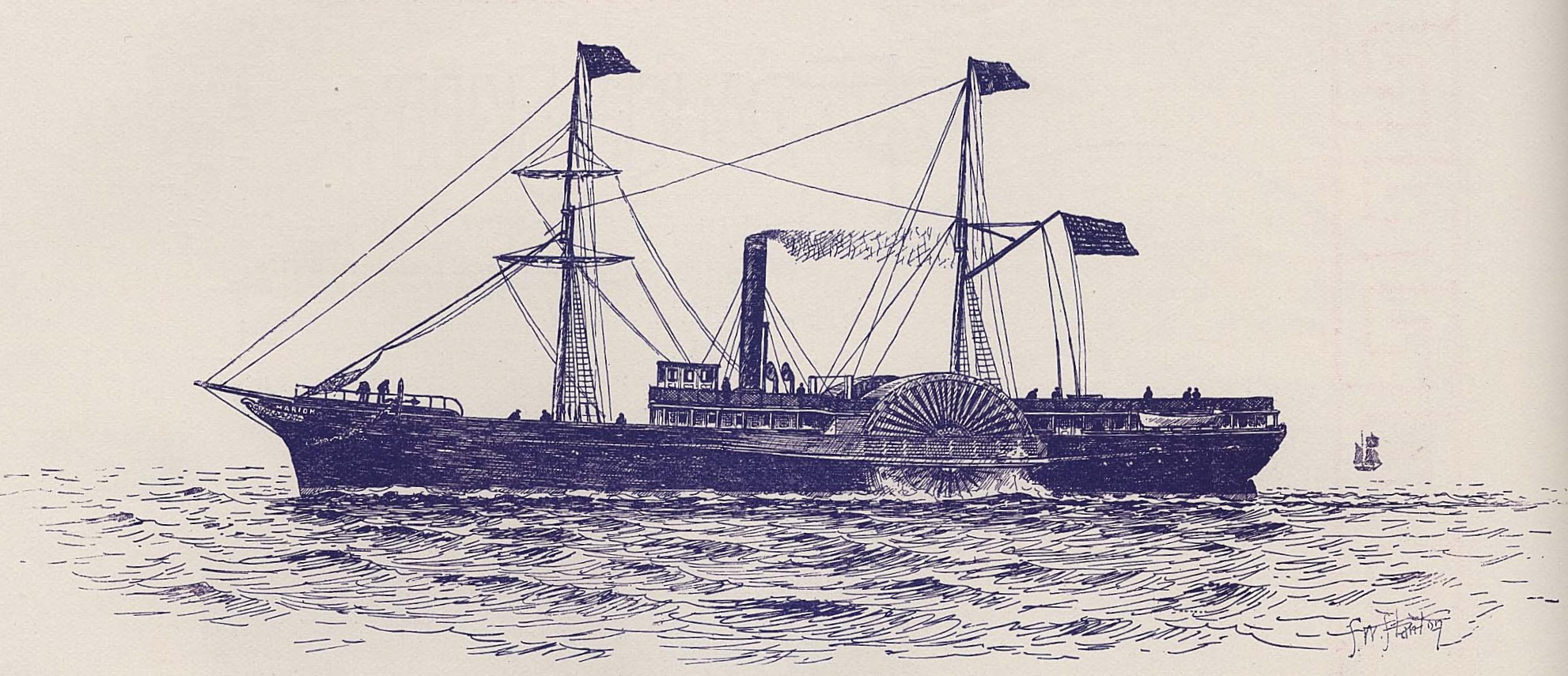

.jpg)

.jpg)