World Quotes (1870 quotes)
… however useful the words may have been in the past, they have now become handicaps to the further development of knowledge. Words like botany and zoology imply that plants and animals are quite different things. … But the differences rapidly become blurred when we start looking at the world through a microscope. … The similarities between plants and animals became more important than their differences with the discoveries that both were built up of cells, had sexual reproduction,… nutrition and respiration … and with the development of evolutionary theory.
In The Forest and the Sea (1960), 7.
… just as the astronomer, the physicist, the geologist, or other student of objective science looks about in the world of sense, so, not metaphorically speaking but literally, the mind of the mathematician goes forth in the universe of logic in quest of the things that are there; exploring the heights and depths for facts—ideas, classes, relationships, implications, and the rest; observing the minute and elusive with the powerful microscope of his Infinitesimal Analysis; observing the elusive and vast with the limitless telescope of his Calculus of the Infinite; making guesses regarding the order and internal harmony of the data observed and collocated; testing the hypotheses, not merely by the complete induction peculiar to mathematics, but, like his colleagues of the outer world, resorting also to experimental tests and incomplete induction; frequently finding it necessary, in view of unforeseen disclosures, to abandon one hopeful hypothesis or to transform it by retrenchment or by enlargement:—thus, in his own domain, matching, point for point, the processes, methods and experience familiar to the devotee of natural science.
In Lectures on Science, Philosophy and Art (1908), 26
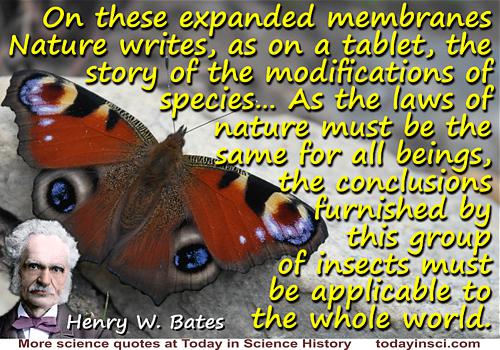
… on these expanded membranes [butterfly wings] Nature writes, as on a tablet, the story of the modifications of species, so truly do all changes of the organisation register themselves thereon. Moreover, the same colour-patterns of the wings generally show, with great regularity, the degrees of blood-relationship of the species. As the laws of nature must be the same for all beings, the conclusions furnished by this group of insects must be applicable to the whole world.
From The Naturalist on the River Amazons: A record of Adventures, Habits of Animals, Sketches of Brazilian and Indian life, and Aspects of Nature under the Equator, During Eleven Years of Travel (1864), 413.
… our “Physick” and “Anatomy” have embraced such infinite varieties of being, have laid open such new worlds in time and space, have grappled, not unsuccessfully, with such complex problems, that the eyes of Vesalius and of Harvey might be dazzled by the sight of the tree that has grown out of their grain of mustard seed.
A Lay Sermon, delivered at St. Martin's Hall (7 Jan 1866), 'On the Advisableness of Improving Natural Knowledge', published in The Fortnightly Review (1866), Vol. 3, 629.
… the world of science may be the only existing participatory democracy.
In A Slot Machine, A Broken Test Tube: An Autobiography (1984).
... there is an external world which can in principle be exhaustively described in scientific language. The scientist, as both observer and language-user, can capture the external facts of the world in prepositions that are true if they correspond to the facts and false if they do not. Science is ideally a linguistic system in which true propositions are in one-to-one relation to facts, including facts that are not directly observed because they involve hidden entities or properties, or past events or far distant events. These hidden events are described in theories, and theories can be inferred from observation, that is the hidden explanatory mechnism of the world can be discovered from what is open to observation. Man as scientist is regarded as standing apart from the world and able to experiment and theorize about it objectively and dispassionately.
'Introduction', Revolutions and Reconstructions in the Philosophy of Science (1981), xii. In John Templeton and Robert L. Herrmann, Is God the Only Reality (1994), 11-12.
… to explore strange new worlds, to seek out new life and new civilizations, to boldly go where no one has gone before.
…...
…from the same principles, I now demonstrate the frame of the System of the World.
From Principia Mathematica, Book 3, as translated from the Latin by Andrew Motte, revised by William Davis, in The Mathematical Principles of Natural Philosophy (1803), Vol. 2, 159.
…nature seems very conversant with the rules of pure mathematics, as our own mathematicians have formulated them in their studies, out of their own inner consciousness and without drawing to any appreciable extent on their experience of the outer world.
In The Mysterious Universe (1930), 113.
...the scientific cast of mind examines the world critically, as if many alternative worlds might exist, as if other things might be here which are not. Then we are forced to ask why what we see is present and not something else. Why are the Sun and moon and the planets spheres? Why not pyramids, or cubes, or dodecahedra? Why not irregular, jumbly shapes? Why so symmetrical, worlds? If you spend any time spinning hypotheses, checking to see whether they make sense, whether they conform to what else we know. Thinking of tests you can pose to substantiate or deflate hypotheses, you will find yourself doing science.
…...
…the simplicity, the indispensableness of each word, each letter, each little dash, that among all artists raises the mathematician nearest to the World-creator; it establishes a sublimity which is equalled in no other art,—Something like it exists at most in symphonic music.
As quoted in Robert E. Moritz, 'Meaning, Methods and Mission of Modern Mathematics', The Scientific Monthly (May 1928), 26, No. 5, 424.
…this discussion would be unprofitable if it did not lead us to appreciate the wisdom of our Creator, and the wondrous knowledge of the Author of the world, Who in the beginning created the world out of nothing, and set everything in number, measure and weight, and then, in time and the age of man, formulated a science which reveals fresh wonders the more we study it.
— Hrosvita
From her play Sapientia, as quoted and cited in Philip Davis with Reuben Hersh, in The Mathematical Experience (1981), 110-111. Davis and Hersh introduce the quote saying it comes “after a rather long and sophisticated discussion of certain facts in the theory of numbers” by the character Sapientia.
…tis a dangerous thing to ingage the authority of Scripture in disputes about the Natural World, in opposition to Reason; lest Time, which brings all things to light, should discover that to be evidently false which we had made Scripture to assert.
The Sacred Theory of the Earth (1681)
“Every moment dies a man,/ Every moment one is born”:
I need hardly point out to you that this calculation would tend to keep the sum total of the world's population in a state of perpetual equipoise whereas it is a well-known fact that the said sum total is constantly on the increase. I would therefore take the liberty of suggesting that in the next edition of your excellent poem the erroneous calculation to which I refer should be corrected as follows:
'Every moment dies a man / And one and a sixteenth is born.” I may add that the exact figures are 1.167, but something must, of course, be conceded to the laws of metre.
I need hardly point out to you that this calculation would tend to keep the sum total of the world's population in a state of perpetual equipoise whereas it is a well-known fact that the said sum total is constantly on the increase. I would therefore take the liberty of suggesting that in the next edition of your excellent poem the erroneous calculation to which I refer should be corrected as follows:
'Every moment dies a man / And one and a sixteenth is born.” I may add that the exact figures are 1.167, but something must, of course, be conceded to the laws of metre.
Unpublished letter to Tennyson in response to his Vision of Sin (1842). Quoted in Philip and Emily Morrison, Charles Babbage and his Calculating Engines: Selected Writings by Charles Babbage and Others (1961), xxiii.
“It's absolutely clear that the function of the world is to declare the glory of God.” I thought, what does that sentence mean?!
Quoting and reacting to a letter he saw in a newspaper about Stephen Hawking’s comments on the nonexistence of God. From 'Interview: Of Mind and Matter: David Attenborough Meets Richard Dawkins', The Guardian (11 Sep 2010).
“Mother like son” is a saying so true, the world will judge largely of mother by you.
In Silk Parachute.
“One must go further, one must go further.” This impulse to go further is an ancient thing in the world.
Quoted in Kim Lim (ed.), 1,001 Pearls of Spiritual Wisdom: Words to Enrich, Inspire, and Guide Your Life (2014), 5
“Progress” was synonymous with distance from nature. The adults, who set the pace of progress from nature, were so absorbed by their own ability to invent and to alter the existing world, that they hurried headlong, with no design for the ultimate structure. A man-made environment was the obvious goal, but who was the responsible architect? No one in my country. Not even the king of Great Britain or the president of America. Each inventor and producer who worked on building tomorrow’s world just threw in a brick or a cogwheel wherever he cared to, and it was up to us of the next generation to find out what the result would be.
In Ch. 1, 'Farewell to Civilization', Fatu-Hiva (1974), 4.
“Wu Li” was more than poetic. It was the best definition of physics that the conference would produce. It caught that certain something, that living quality that we were seeking to express in a book, that thing without which physics becomes sterile. “Wu” can mean either “matter” or “energy.” “Li” is a richly poetic word. It means “universal order” or “universal law.” It also means “organic patterns.” The grain in a panel of wood is Li. The organic pattern on the surface of a leaf is also Li, and so is the texture of a rose petal. In short, Wu Li, the Chinese word for physics, means “patterns of organic energy” (“matter/ energy” [Wu] + “universal order/organic patterns” [Li]). This is remarkable since it reflects a world view which the founders of western science (Galileo and Newton) simply did not comprehend, but toward which virtually every physical theory of import in the twentieth century is pointing!
In The Dancing Wu Li Masters: An Overview of the New Physics (1979), 5.
[1665-08-28] But now, how few people I see, and those walking like people that have taken leave of the world.... I to the Exchange, and I think there was not 50 people upon it and but few more like to be, as they told me, Sir G Smith and others. Thus I think to take Adieu today of London streets ....
Diary of Samuel Pepys (28 Aug 1665)
[A significant invention] must be startling, unexpected. It must come to a world that is not prepared for it.
Speaking at a shareholders' meeting (1975) as quoted by Victor K. McElheny, in Insisting On The Impossible: The Life Of Edwin Land (1999), 403-404.
[A]ll the ingenious men, and all the scientific men, and all the fanciful men, in the world,... could never invent, if all their wits were boiled into one, anything so curious and so ridiculous as a lobster.
The Water-babies (1886), 161.
[About any invention] (1) everything that’s already in the world when you’re born is just normal; (2) anything that gets invented between then and before you turn thirty is incredibly exciting and creative and with any luck you can make a career out of it; (3) anything that gets invented after you’re thirty is against the natural order of things and the beginning of the end of civilisation as we know it until it’s been around for about ten years when it gradually turns out to be alright really.
In News Review section, Sunday Times (29 Aug 1999).
[About Carlsbad Caverns:] It’s got all the cathedrals of the world in it, with half of ’em hanging upside down.
Syndicated 'Daily Telegram' No. 1496, 'Mr. Rogers, On Mother's Day, Takes ‘Ma’ for a 7-Mile Walk', (10 May 1931). For example, printed in 'Rogers Takes Ma For Underground Hike', The Milwaukee Journal (11 May 1931), 1.
[Am I vegetarian?] No. If you understand about the natural world, we’re a part of the system and you can’t feed lions grass. But because we have the intelligence to choose… But we haven’t got the gut to allow us to be totally vegetarian for a start. You can tell by the shape of our guts and the shape of our teeth that we evolved to be omnivores. We aren’t carnivores like lions but neither are we elephants.
Interview by Simon Gage in 'David Attenborough: I’m not an animal lover', Metro newspaper (29 Jan 2013, London).
[An engineer's] invention causes things to come into existence from ideas, makes world conform to thought; whereas science, by deriving ideas from observation, makes thought conform to existence.
Types of Technology', Research in Philosophy & Technology (1978), Vol. 1, 244.
[An outsider views a scientist] as a type of unscrupulous opportunist: he appears as a realist, insofar as he seeks to describe the world independent of the act of perception; as idealist insofar as he looks upon the concepts and theories as the free inventions of the human spirit (not logically derivable from that which is empirically given); as positivist insofar as he considers his concepts and theories justified only to the extent to which they furnish a logical representation of relations among sense experiences. He may even appear as Platonist or Pythagorean insofar as he considers the viewpoint of logical simplicity as an indispensable and effective tool of his research.
In 'Reply to Critcisms', Paul Arthur Schilpp (ed.), Albert Einstein: Philosopher-Scientist (1949, 1959), Vol. 2, 684.
[Antarctica has 90 percent of the world’s ice, and God help us if it melts,] whales will be swimming in the streets of New York.
From address (20 Sep 1989) to the National Press Club, as quoted in Phil McCombs, The Washington Post (21 Sep 1989).
[Astronomy was] the only progressive science produced by the ancient world.
In Augustus William Hare and Julius Charles Hare, Guesses At Truth, By Two Brothers (3rd Ed., 1855)
[At the funeral of Kettering’s researcher, Thomas Midgley, Jr., the minister intoned “We brought nothing into this world, and it is certain we can carry nothing out.” Afterwards Kettering commented:] It struck me then that in Midgley’s case it would have seemed so appropriate to have added, “But we can leave a lot behind for the good of the world.”
As quoted in book review, T.A. Boyd, 'Charles F. Kettering: Prophet of Progress', Science (30 Jan 1959), 256.
[Bacteria are the] dark matter of the biological world [with 4 million mostly unknown species in a ton of soil].
Talk as a TED prize winner (2007). From video on TEDprize website.
[Davy's] March of Glory, which he has run for the last six weeks—within which time by the aid and application of his own great discovery, of the identity of electricity and chemical attractions, he has placed all the elements and all their inanimate combinations in the power of man; having decomposed both the Alkalies, and three of the Earths, discovered as the base of the Alkalies a new metal... Davy supposes there is only one power in the world of the senses; which in particles acts as chemical attractions, in specific masses as electricity, & on matter in general, as planetary Gravitation... when this has been proved, it will then only remain to resolve this into some Law of vital Intellect—and all human knowledge will be Science and Metaphysics the only Science.
In November 1807 Davy gave his famous Second Bakerian Lecture at the Royal Society, in which he used Voltaic batteries to “decompose, isolate and name” several new chemical elements, notably sodium and potassium.
In November 1807 Davy gave his famous Second Bakerian Lecture at the Royal Society, in which he used Voltaic batteries to “decompose, isolate and name” several new chemical elements, notably sodium and potassium.
Letter to Dorothy Wordsworth, 24 November 1807. In Earl Leslie Griggs (ed.), The Collected Letters of Samuel Taylor Coleridge (1956), Vol. 3, 38.
[Euclid's Elements] has been for nearly twenty-two centuries the encouragement and guide of that scientific thought which is one thing with the progress of man from a worse to a better state. The encouragement; for it contained a body of knowledge that was really known and could be relied on, and that moreover was growing in extent and application. For even at the time this book was written—shortly after the foundation of the Alexandrian Museum—Mathematics was no longer the merely ideal science of the Platonic school, but had started on her career of conquest over the whole world of Phenomena. The guide; for the aim of every scientific student of every subject was to bring his knowledge of that subject into a form as perfect as that which geometry had attained. Far up on the great mountain of Truth, which all the sciences hope to scale, the foremost of that sacred sisterhood was seen, beckoning for the rest to follow her. And hence she was called, in the dialect of the Pythagoreans, ‘the purifier of the reasonable soul.’
From a lecture delivered at the Royal Institution (Mar 1873), collected postumously in W.K. Clifford, edited by Leslie Stephen and Frederick Pollock, Lectures and Essays, (1879), Vol. 1, 296.
[I doubt that in today's world, I and Francis Crick would ever have had our Eureka moment.] I recently went to my staircase at Clare College, Cambridge and there were women there! he said, with an enormous measure of retrospective sexual frustration. There have been a lot of convincing studies recently about the loss of productivity in the Western male. It may be that entertainment culture now is so engaging that it keeps people satisfied. We didn't have that. Science was much more fun than listening to the radio. When you are 16 or 17 and in that inherently semi-lonely period when you are deciding whether to be an intellectual, many now don't bother.
(Response when asked how he thought the climate of scientific research had changed since he made his discovery of the structure of life in 1953.)
(Response when asked how he thought the climate of scientific research had changed since he made his discovery of the structure of life in 1953.)
Quoted by Tim Adams in 'The New Age of Ignorance', The Observer (30 Jun 2007).
[I] could see how nervous everybody was in the beginning and how silent it was when we had trouble with the artificial heart [during the surgery, but later in the operation, when it was working, there were moments] of loud and raucous humor.
[Commenting after reviewing the video tape of the world's first human implantation of an artificial heart.]
[Commenting after reviewing the video tape of the world's first human implantation of an artificial heart.]
Quoted by Lawrence K. Altman in “Clark's Surgeon Was ‘Worried To Death’&rdquo, New York Times (12 Apr 1983), C2.
[I]t is truth alone—scientific, established, proved, and rational truth—which is capable of satisfying nowadays the awakened minds of all classes. We may still say perhaps, 'faith governs the world,'—but the faith of the present is no longer in revelation or in the priest—it is in reason and in science.
Entry for 15 Nov 1876 in Amiel’s Journal: The Journal Intime of Henri-Frédéric Amiel, trans. Humphry Ward (1893), 234.
[In 1909,] Paris was the center of the aviation world. Aeronautics was neither an industry nor even a science; both were yet to come. It was an “art” and I might say a “passion”. Indeed, at that time it was a miracle. It meant the realization of legends and dreams that had existed for thousands of years and had been pronounced again and again as impossible by scientific authorities. Therefore, even the brief and unsteady flights of that period were deeply impressive. Many times I observed expressions of joy and tears in the eyes of witnesses who for the first time watched a flying machine carrying a man in the air.
In address (16 Nov 1964) presented to the Wings Club, New York City, Recollections and Thoughts of a Pioneer (1964), 5.
[In my early youth, walking with my father,] “See that bird?” he says. “It’s a Spencer’s warbler.” (I knew he didn’t know the real name.) “Well, in Italian, it’s a Chutto Lapittida. In Portuguese, it’s a Bom da Peida. In Chinese, it’s a Chung-long-tah, and in Japanese, it’s a Katano Tekeda. You can know the name of that bird in all the languages of the world, but when you’re finished, you’ll know absolutely nothing whatever about the bird. You’ll only know about humans in different places, and what they call the bird. So let’s look at the bird and see what it’s doing—that’s what counts.” (I learned very early the difference between knowing the name of something and knowing something.)
In 'The Making of a Scientist', What Do You Care What Other People Think?": Further Adventures of a Curious Character (2001), 13-14.
[Joseph Rotblat] was a towering figure in the search for peace in the world, who dedicated his life to trying to rid the world of nuclear weapons, and ultimately to rid the world of war itself.
Speaking as president of the Pugwash Conferences. As quoted in Associated Press syndicated to newspapers, for example in, 'Joseph Rotblat, Scientist Against Nuclear Arms, Dies', Sun Journal (2 Sep 2005), A5.
[Large motorway flyovers] are the cathedrals of the modern world.
Writing about the first four-level motorway interchange, which links the M4 and M5 at Almondsbury. Entry for 22 Jul 1966 in The Castle Diaries 1964-70 (1980), 152. Cited in Brian Howard Harrison, Seeking a role: the United Kingdom, 1951-1970 (2009), 139.
[Mathematics] is an independent world
Created out of pure intelligence.
Created out of pure intelligence.
In The Prelude, Book 6, lines 186-187. [Preceding lines refer to “laws of Nature” and “a treatise of geometry.” Wordsworth did not use the word “mathematics”, which is added parenthetically to give context to the quote.]
[May] this civic and social landmark [the Washington, D.C., Jewish Community Center] ... be a constant reminder of the inspiring service that has been rendered to civilization by men and women of the Jewish faith. May [visitors] recall the long array of those who have been eminent in statecraft, in science, in literature, in art, in the professions, in business, in finance, in philanthropy and in the spiritual life of the world.
Speech upon laying the cornerstone of the Jewish Community Center, Washington, D.C. (3 May 1925). In William J. Federer, A Treasury of Presidential Quotations (2004), 240.
[My advice] will one day be found
With other relics of 'a former world,'
When this world shall be former, underground,
Thrown topsy-turvy, twisted, crisped, and curled,
Baked, fried or burnt, turned inside-out, or drowned,
Like all the worlds before, which have been hurled
First out of, and then back again to Chaos,
The Superstratum which will overlay us.
With other relics of 'a former world,'
When this world shall be former, underground,
Thrown topsy-turvy, twisted, crisped, and curled,
Baked, fried or burnt, turned inside-out, or drowned,
Like all the worlds before, which have been hurled
First out of, and then back again to Chaos,
The Superstratum which will overlay us.
Don Juan (1821), Canto 9, Verse 37. In Jerome J. McGann (ed.), Lord Byron: The Complete Poetical Works (1986), Vol. 5, 420.
[My dream dinner guest is] Charles Darwin. It’s an obvious answer, but it’s the truth. Think of any problem and before you start theorising, just check up whether Charles Darwin mentioned it in one of those green books sitting on your shelf. Whether it’s earthworms, human gestures or the origin of species, the observations that man made are unbelievable. He touched on so many subjects. Then, Alexander von Humboldt, the last polymath. There was no aspect of the natural world that he wasn’t curious about or didn’t write about in Kosmos, an extraordinary book.
From interview with Alice Roberts, 'Attenborough: My Life on Earth', The Biologist (Aug 2015), 62, No. 4, 16.
[My work as a photographer is a] mission to document endangered species and landscapes in order to show a world worth saving.
On the 'About' page of his web site.
[On the 11th day of November 1572], in the evening, after sunset, when, according to my habit, I was contemplating the stars in a clear sky, I noticed that a new and unusual star, surpassing all others in brilliancy, was shining almost directly over my head; and since I had, almost from boyhood, known all the stars of the heavens perfectly (there is no great difficulty in gaining that knowledge), it was quite evident to me that there had never before been any star in that place in the sky, even the smallest, to say nothing of a star so conspicuously bright as this. I was so astonished at this sight that I was not ashamed to doubt the trustworthiness of my own eyes. But when I observed that others, too, on having the place pointed out to them, could see that there was a star there, I had no further doubts. A miracle indeed, either the greatest of all that have occurred in the whole range of nature since the beginning of the world, or one certainly that is to be classed with those attested by the Holy Oracles.
De Stello. Nova (On the New Star) (1573). Quoted in H. Shapley and A. E. Howarth (eds.), Source Book in Astronomy (1929), 13.
[Oppenheimer is] tense, dedicated, deeper than deep, somewhat haunted, uncertain, calm, confident, and full, full, full of knowledge, not only of particles and things but of men and motives, and of the basic humanity that may be the only savior we have in this strange world he and his colleagues have discovered.
In Due to Circumstances Beyond Our Control by Fred W. Friendly (1967).
[P]olitical and social and scientific values … should be correlated in some relation of movement that could be expressed in mathematics, nor did one care in the least that all the world said it could not be done, or that one knew not enough mathematics even to figure a formula beyond the schoolboy s=(1/2)gt2. If Kepler and Newton could take liberties with the sun and moon, an obscure person ... could take liberties with Congress, and venture to multiply its attraction into the square of its time. He had only to find a value, even infinitesimal, for its attraction.
The Education of Henry Adams: An Autobiography? (1918), 376.
[Penguins] are extraordinarily like children, these little people of the Antarctic world, either like children, or like old men, full of their own importance and late for dinner, in their black tail-coats and white shirt-fronts — and rather portly withal.
In The Worst Journey in the World (1922), 64.
[Radius]: You will work. You will build ... You will serve them... Robots of the world... The power of man has fallen... A new world has arisen. The rule of the Robots... March!
The word 'robot' was coined in this play for a new working class of automatons (from the Czech word robota meaning compulsory labour)
The word 'robot' was coined in this play for a new working class of automatons (from the Czech word robota meaning compulsory labour)
R.U.R. (1920), 89-90 in 1961 ed.
[Reading a cartoon story,] the boy favored reading over reality. Adults might have characterized him in any number of negative ways—as uninquisitive, uninvolved, apathetic about the world around him and his place in it. I’ve often wondered: Are many adults much different when they read the scriptures of their respective faiths?
In Jacques Cousteau and Susan Schiefelbein, The Human, the Orchid, and the Octopus: Exploring and Conserving Our Natural World (2007), 117.
[Regarding evolution believers:] Their business is not with the possible, but the actual—not with a world which might be, but with a world that is. This they explore with a courage not unmixed with reverence, and according to methods which, like the quality of a tree, are tested by their fruits. They have but one desire—to know the truth. They have but one fear—to believe a lie.
'Scientific Use of the Imagination', Discourse Delivered Before the British Association at Liverpool, (16 Sep 1870). Fragments of Science for Unscientific People: A Series of Detached Essays, Lectures, and Reviews (1892), Vol. 2, 134.
[Saint-Gaudens and Matthew Arnold] felt a railway train as power; yet they, and all other artists, constantly complained that the power embodied in a railway train could never be embodied in art. All the steam in the world could not, like the Virgin, build Chartres.
After viewing the Palace of Electricity at the 1900 Trocadero Exposition in Paris. In The Education of Henry Brooks Adams: An Autobiography (1918), 388.
[Should Britain fail, then the entire world would] sink into the abyss of a new dark age made more sinister ... by the lights of perverted science.
“Finest Hour” speech after Dunkirk during WW II (18 Jun 1940). In Robert Rhodes James, ed. Winston Churchill: His Complete Speeches, 1897-1963 (1974), Vol. 6, p.6238.
[T]he rapt philosopher, and he who contemplates a work of art, inhabit a world with an intense and peculiar significance of its own; that significance is unrelated to the significance of life.
In Art (1913), 26.
[T]here are some common animal behaviors that seem to favor the development of intelligence, behaviors that might lead to brainy beasts on many worlds. Social interaction is one of them. If you're an animal that hangs out with others, then there's clearly an advantage in being smart enough to work out the intentions of the guy sitting next to you (before he takes your mate or your meal). And if you're clever enough to outwit the other members of your social circle, you'll probably have enhanced opportunity to breed..., thus passing on your superior intelligence. ... Nature—whether on our planet or some alien world—will stumble into increased IQ sooner or later.
Seth Shostak, Alex Barnett, Cosmic Company: the Search for Life in the Universe (2003), 62 & 67.
[The attitude of the Renaissance towards the antique world was that] Archaeology to them was not a mere science for the antiquarian; it was a means by which they could touch the dry dust of antiquity into the very breath and beauty of life, and fill with the new wine of romanticism forms that else had been old and out-worn.
In his essay 'The Truth of Masks', collected in Intentions (1904), 213.
[The compass needle] as the guide of Vasco de Gama to the East Indies, and of Columbus to the West Indies and the New World, it was pre-eminently the precursor and pioneer of the telegraph. Silently, and as with finger on its lips, it led them across the waste of waters to the new homes of the world; but when these were largely filled, and houses divided between the old and new hemispheres longed to exchange affectionate greetings, it removed its finger and broke silence. The quivering magnetic needle which lies in the coil of the galvanometer is the tongue of the electric telegraph, and already engineers talk of it as speaking.
'Progress of the Telegraph.' In Jesse Aitken Wilson, Memoirs of George Wilson. Quoted in Natural History Society of Montreal, 'Reviews and Notices of Books,' The Canadian Naturalist and Geologist (1861) Vol. 6, 392.
[The earth’s rocks] were so arranged, in their formation, that they should best serve Man’s purposes. The strata were subjected to metamorphism, and so crystallized, that he might be provided with the most perfect material for his art, his statues, temples, and dwellings; at the same time, they were filled with veins, in order to supply him with gold and silver and other treasures. The rocks were also made to enclose abundant beds of coal and iron ore, that Man might have fuel for his hearths and iron for his utensils and machinery. Mountains were raised to temper hot climates, to diversify the earth’s productiveness, and, pre-eminently, to gather the clouds into river-channels, thence to moisten the fields for agriculture, afford facilities for travel, and supply the world with springs and fountains.
In 'Concluding Remarks', A Text-book of Geology: Designed for Schools and Academies (1863), 338.
[The Elements] are mutually bound together, the lighter being restrained by the heavier, so that they cannot fly off; while, on the contrary, from the lighter tending upwards, the heavier are so suspended, that they cannot fall down. Thus, by an equal tendency in an opposite direction, each of them remains in its appropriate place, bound together by the never-ceasing revolution of the world.
In The Natural History of Pliny (1855), Vol. 1, 19.
[The error in the teaching of mathematics is that] mathematics is expected either to be immediately attractive to students on its own merits or to be accepted by students solely on the basis of the teacher’s assurance that it will be helpful in later life. [And yet,] mathematlcs is the key to understanding and mastering our physical, social and biological worlds.
In editorial in Focus, a Journal of the Mathematical Association of America (1986), quoted in obituary by Eric Pace, New York Times (11 Jun 1992).
[The launch of Nautilus, the world's first atomic submarine] marked a transition in naval warfare—a transition as sudden as that associated with the Monitor.
In 'Science in Review: Atomic-Powered Submarine Marks a Great Transition in Ships and Land Plants', New York Times (24 Jan 1954), E11.
[The nanotube] brings those properties you cannot get from other organic molecules. And it’s still carbon, so it has organic chemistry. Here is an object that has, to a superlative degree, the aspects that we hold most central to the inorganic world: hardness, toughness, terrific strength, thermal and electrical conductivity. Things you just can’t do with bone and wood. But it’s made out of carbon. It’s something that plays the game at the same level of perfection as molecules and life.
From interview in 'Wires of Wonder', Technology Review (Mar 2001), 104, No. 2, 88.
[The natural world cleans water, pollinates plants and provides pharmaceuticals, among many other gifts.] Thirty trillion dollars worth of services, scot-free to humanity, every year.
From transcript of PBS TV program 'Religion and Ethics' (17 Nov 2006).
[The original development of the Spinning Mule was a] continual endeavour to realise a more perfect principle of spinning; and though often baffled, I as often renewed the attempt, and at length succeeded to my utmost desire, at the expense of every shilling I had in the world.
'Extract from a manuscript document circulated by Crompton about the year 1809 or 1810', reprinted in The Basis of Mr. Samuel Crompton’s Claims to a Second Remuneration for his Discovery of the Mule Spinning Machine, (1868), 29.
[The Royal Society] is quite simply the voice of science in Britain. It is intellectually rigorous, not afraid to be outspoken on controversial issues such as climate change, but it is not aggressively secular either, insisting on a single view of the world. In fact, there are plenty of eminent scientists – Robert Winston, for instance – who are also men of faith.
Quoted in Max Davidson, 'Bill Bryson: Have faith, science can solve our problems', Daily Telegraph (26 Sep 2010)
[The screw machine] was on the principle of the guage or sliding lathe now in every workshop throughout the world; the perfection of which consists in that most faithful agent gravity, making the joint, and that almighty perfect number three, which is in harmony itself. I was young when I learned that principle. I had never seen my grandmother putting a chip under a three-legged milking-stool; but she always had to put a chip under a four-legged table, to keep it steady. I cut screws of all dimensions by this machine, and did them perfectly. (1846)
Quoted in ASME International and Heritage Committee, Landmarks in Mechanical Engineering.
[To a man expecting a scientific proof of the impossibility of flying saucers] I might have said to him: “Listen, I mean that from my knowledge of the world that I see around me, I think that it is much more likely that the reports of flying saucers are the results of the known irrational characteristics of terrestrial intelligence than of the unknown rational efforts of extra-terrestrial intelligence.” It is just more likely, that is all. It is a good guess. And we always try to guess the most likely explanation, keeping in the back of the mind the fact that if it does not work we must discuss the other possibilities.
In The Character of Physical Law (1965, 2001), 166.
[Using mice as model systems for genetic engineering in biomedicine, instead of bacterial or yeast systems matters because] this transition will have as big an impact on the future of biology as the shift from printing presses to video technology has had on pop culture. A mouse-based world looks and feels different from one viewed through microorganisms.
Quoted in Michael Schrage, 'Biomedical Researchers Scurry to Make Genetically Altered Mice', San Jose Mercury News (8 Feb 1993), 3D. In Donna Jeanne Haraway and Lynn M. Randolph, [email protected]: Feminism and Technoscience (1996), 98.
[Very doubtful attribution.] The purpose of anthropology is to make the world safe for human differences.
This likely misquote is included here to caution: do NOT blindly accept it. Webmaster has so far been unable to find any primary source for this viral alleged quote. It is often seen, but never with a citation. Or worse, with a citation to another source which fails to give a citation at all. ApostateAbe, 'Stop this Ruth Benedict misquote', Reddit (c.Dec 2017) directly challenges the quote: “Ruth Benedict never said it, not in any of her published writings. It seems to be merely myth. It is never specifically cited, nor does it make historical sense.” So, if you know an authentic primary source, please contact Webmaster.
[Vikram Sarabhai] said that if we want to establish ourselves in the world, we have to be self-sufficient and search for new ideas and techniques.
As given in narrative form by Mahesh Sharma, P. Bhalla and P.K. Das, in 'Prof. Vikram Sarabhai in the Opinion of Dr. Kalam', Pride Of The Nation: Dr. A.P.J. Abdul Kalam (2004), 46.
[W]e have made a thing, a most terrible weapon, that has altered abruptly and profoundly the nature of the world. We have made a thing that, by all standards of the world we grew up in, is an evil thing. And by doing so, by our participation in making it possible to make these things, we have raised again the question of whether science is good for man, of whether it is good to learn about the world, to try to understand it, to try to control it, to help give to the world of men increased insight, increased power. Because we are scientists, we must say an unalterable yes to these questions; it is our faith and our commitment, seldom made explicit, even more seldom challenged, that knowledge is a good in itself, knowledge and such power as must come with it.
Speech to the American Philosophical Society (Jan 1946). 'Atomic Weapons', printed in Proceedings of the American Philosophical Society, 90(1), 7-10. In Deb Bennett-Woods, Nanotechnology: Ethics and Society (2008), 23. Identified as a speech to the society in Kai Bird, Martin J. Sherwin, American Prometheus: the Triumph and Tragedy of J. Robert Oppenheimer (2005), 323.
[Watching natural history programs] brings a solace you can’t describe in words. It’s because we’re part of it fundamentally…. In moments of great grief, that’s where you look and immerse yourself. You realise you are not immortal, you are not a god, you are part of the natural world and you come to accept that.
Reflecting on the letters he received from newly bereaved people. While his series are running on TV, in dozens of letters daily (comprising the majority of the correspondence), they tell him that the only things they can face in their darkest moments are his natural-history programmes. From interview with Joe Shute, 'David Attenborough at 90: ‘I think about my mortality every day’', The Telegraph (29 Oct 2016).
[What verdict would a historian of the year 3000 pass upon our age? Let us hope this will be his judgement:]
“The twentieth century was, without question, the most momentous hundred years in the history of Mankind. It opened with the conquest of the air, and before it had run half its course had presented civilisation with its supreme challenge—the control of atomic energy. Yet even these events, each of which changed the world, were soon to be eclipsed. To us a thousand years later, the whole story of Mankind before the twentieth century seems like the prelude to some great drama, played on the narrow strip of stage before the curtain has risen and revealed the scenery. For countless generations of men, that tiny, crowded stage—the planet Earth—was the whole of creation, and they the only actors. Yet towards the close of that fabulous century, the curtain began slowly, inexorably to rise, and Man realised at last that the Earth was only one of many worlds; the Sun only one among many stars. The coming of the rocket brought to an end a million years of isolation. With the landing of the first spaceship on Mars and Venus, the childhood of our race was over and history as we know it began….”
“The twentieth century was, without question, the most momentous hundred years in the history of Mankind. It opened with the conquest of the air, and before it had run half its course had presented civilisation with its supreme challenge—the control of atomic energy. Yet even these events, each of which changed the world, were soon to be eclipsed. To us a thousand years later, the whole story of Mankind before the twentieth century seems like the prelude to some great drama, played on the narrow strip of stage before the curtain has risen and revealed the scenery. For countless generations of men, that tiny, crowded stage—the planet Earth—was the whole of creation, and they the only actors. Yet towards the close of that fabulous century, the curtain began slowly, inexorably to rise, and Man realised at last that the Earth was only one of many worlds; the Sun only one among many stars. The coming of the rocket brought to an end a million years of isolation. With the landing of the first spaceship on Mars and Venus, the childhood of our race was over and history as we know it began….”
In Chap. 18, 'Concerning Means and Ends', The Exploration of Space (1951), 195. [Clarke wrote this, not knowing there would be a Moon landing just 18 years later, on 20 Jul 1969. In fact, in an earlier chapter, he wrote “On our present knowledge, there is no likelihood of such spaceships for a very long time to come.” —Webmaster]
δος μοι που στω και κινω την γην — Dos moi pou sto kai kino taen gaen (in epigram form, as given by Pappus, classical Greek).
δος μοι πα στω και τα γαν κινάσω — Dos moi pa sto kai tan gan kinaso (Doric Greek).
Give me a place to stand on and I can move the Earth.
About four centuries before Pappas, but about three centuries after Archimedes lived, Plutarch had written of Archimedes' understanding of the lever:
Archimedes, a kinsman and friend of King Hiero, wrote to him that with a given force, it was possible to move any given weight; and emboldened, as it is said, by the strength of the proof, he asserted that, if there were another world and he could go to it, he would move this one.
A commonly-seen expanded variation of the aphorism is:
Give me a lever long enough and a place to stand, and I can move the earth.
δος μοι πα στω και τα γαν κινάσω — Dos moi pa sto kai tan gan kinaso (Doric Greek).
Give me a place to stand on and I can move the Earth.
About four centuries before Pappas, but about three centuries after Archimedes lived, Plutarch had written of Archimedes' understanding of the lever:
Archimedes, a kinsman and friend of King Hiero, wrote to him that with a given force, it was possible to move any given weight; and emboldened, as it is said, by the strength of the proof, he asserted that, if there were another world and he could go to it, he would move this one.
A commonly-seen expanded variation of the aphorism is:
Give me a lever long enough and a place to stand, and I can move the earth.
As attributed to Pappus (4th century A.D.) and Plutarch (c. 46-120 A.D.), in Sherman K. Stein, Archimedes: What Did He Do Besides Cry Eureka? (1999), 5, where it is also stated that Archimedes knew that ropes and pulley exploit “the principle of the lever, where distance is traded for force.” Eduard Jan Dijksterhuis, in his book, Archimedes (1956), Vol. 12., 15. writes that Hiero invited Archimedes to demonstrate his claim on a ship from the royal fleet, drawn up onto land and there loaded with a large crew and freight, and Archimedes easily succeeded. Thomas Little Heath in The Works of Archimedes (1897), xix-xx, states according to Athenaeus, the mechanical contrivance used was not pulleys as given by Plutarch, but a helix., Heath provides cites for Pappus Synagoge, Book VIII, 1060; Plutarch, Marcellus, 14; and Athenaeus v. 207 a-b. What all this boils down to, in the opinion of the Webmaster, is the last-stated aphorism would seem to be not the actual words of Archimedes (c. 287 – 212 B.C.), but restatements of the principle attributed to him, formed by other writers centuries after his lifetime.
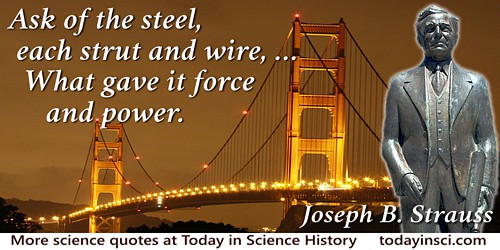
The Mighty Task is Done
At last the mighty task is done;
Resplendent in the western sun
The Bridge looms mountain high;
Its titan piers grip ocean floor,
Its great steel arms link shore with shore,
Its towers pierce the sky.
On its broad decks in rightful pride,
The world in swift parade shall ride,
Throughout all time to be;
Beneath, fleet ships from every port,
Vast landlocked bay, historic fort,
And dwarfing all the sea.
To north, the Redwood Empires gates;
To south, a happy playground waits,
In Rapturous appeal;
Here nature, free since time began,
Yields to the restless moods of man,
Accepts his bonds of steel.
Launched midst a thousand hopes and fears,
Damned by a thousand hostile sneers,
Yet Neer its course was stayed,
But ask of those who met the foe
Who stood alone when faith was low,
Ask them the price they paid.
Ask of the steel, each strut and wire,
Ask of the searching, purging fire,
That marked their natal hour;
Ask of the mind, the hand, the heart,
Ask of each single, stalwart part,
What gave it force and power.
An Honored cause and nobly fought
And that which they so bravely wrought,
Now glorifies their deed,
No selfish urge shall stain its life,
Nor envy, greed, intrigue, nor strife,
Nor false, ignoble creed.
High overhead its lights shall gleam,
Far, far below lifes restless stream,
Unceasingly shall flow;
For this was spun its lithe fine form,
To fear not war, nor time, nor storm,
For Fate had meant it so.
At last the mighty task is done;
Resplendent in the western sun
The Bridge looms mountain high;
Its titan piers grip ocean floor,
Its great steel arms link shore with shore,
Its towers pierce the sky.
On its broad decks in rightful pride,
The world in swift parade shall ride,
Throughout all time to be;
Beneath, fleet ships from every port,
Vast landlocked bay, historic fort,
And dwarfing all the sea.
To north, the Redwood Empires gates;
To south, a happy playground waits,
In Rapturous appeal;
Here nature, free since time began,
Yields to the restless moods of man,
Accepts his bonds of steel.
Launched midst a thousand hopes and fears,
Damned by a thousand hostile sneers,
Yet Neer its course was stayed,
But ask of those who met the foe
Who stood alone when faith was low,
Ask them the price they paid.
Ask of the steel, each strut and wire,
Ask of the searching, purging fire,
That marked their natal hour;
Ask of the mind, the hand, the heart,
Ask of each single, stalwart part,
What gave it force and power.
An Honored cause and nobly fought
And that which they so bravely wrought,
Now glorifies their deed,
No selfish urge shall stain its life,
Nor envy, greed, intrigue, nor strife,
Nor false, ignoble creed.
High overhead its lights shall gleam,
Far, far below lifes restless stream,
Unceasingly shall flow;
For this was spun its lithe fine form,
To fear not war, nor time, nor storm,
For Fate had meant it so.
Written upon completion of the building of the Golden Gate Bridge, May 1937. In Allen Brown, Golden Gate: biography of a Bridge (1965), 229.
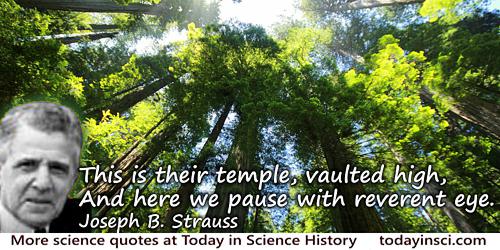
The Redwoods
Here, sown by the Creator's hand,
In serried ranks, the Redwoods stand;
No other clime is honored so,
No other lands their glory know.
The greatest of Earth's living forms,
Tall conquerors that laugh at storms;
Their challenge still unanswered rings,
Through fifty centuries of kings.
The nations that with them were young,
Rich empires, with their forts far-flung,
Lie buried now—their splendor gone;
But these proud monarchs still live on.
So shall they live, when ends our day,
When our crude citadels decay;
For brief the years allotted man,
But infinite perennials' span.
This is their temple, vaulted high,
And here we pause with reverent eye,
With silent tongue and awe-struck soul;
For here we sense life's proper goal;
To be like these, straight, true and fine,
To make our world, like theirs, a shrine;
Sink down, oh traveler, on your knees,
God stands before you in these trees.
Here, sown by the Creator's hand,
In serried ranks, the Redwoods stand;
No other clime is honored so,
No other lands their glory know.
The greatest of Earth's living forms,
Tall conquerors that laugh at storms;
Their challenge still unanswered rings,
Through fifty centuries of kings.
The nations that with them were young,
Rich empires, with their forts far-flung,
Lie buried now—their splendor gone;
But these proud monarchs still live on.
So shall they live, when ends our day,
When our crude citadels decay;
For brief the years allotted man,
But infinite perennials' span.
This is their temple, vaulted high,
And here we pause with reverent eye,
With silent tongue and awe-struck soul;
For here we sense life's proper goal;
To be like these, straight, true and fine,
To make our world, like theirs, a shrine;
Sink down, oh traveler, on your knees,
God stands before you in these trees.
In The Record: Volumes 60-61 (1938), 39.
[Answering whether there was life in other worlds, he said there probably was.] After all, there's plenty of unearthly looking things moving around in my refrigerator, so there's always a chance of life springing up almost anywhere.
In Keith Colquhoun and Ann Wroe, Economist Book of Obituaries (2008), 79.
[Introducing two perfectly ordinary performers of average stature to a circus audience.]
The Punkwat twins! Brentwood is the world's smallest giant, whilst his brother, Elwood, is the largest midget in the world. They baffle science!
The Punkwat twins! Brentwood is the world's smallest giant, whilst his brother, Elwood, is the largest midget in the world. They baffle science!
As character Larson E. Whipsnade, circus ring-master, in movie, You Can't Cheat an Honest Man (1939). As transcribed in Simon Louvish, Man on the Flying Trapeze: The Life and Times of W. C. Fields (1999), 4.
[Recalling Professor Ira Remsen's remarks (1895) to a group of his graduate students about to go out with their degrees into the world beyond the university:]
He talked to us for an hour on what was ahead of us; cautioned us against giving up the desire to push ahead by continued study and work. He warned us against allowing our present accomplishments to be the high spot in our lives. He urged us not to wait for a brilliant idea before beginning independent research, and emphasized the fact the Lavoisier's first contribution to chemistry was the analysis of a sample of gypsum. He told us that the fields in which the great masters had worked were still fruitful; the ground had only been scratched and the gleaner could be sure of ample reward.
He talked to us for an hour on what was ahead of us; cautioned us against giving up the desire to push ahead by continued study and work. He warned us against allowing our present accomplishments to be the high spot in our lives. He urged us not to wait for a brilliant idea before beginning independent research, and emphasized the fact the Lavoisier's first contribution to chemistry was the analysis of a sample of gypsum. He told us that the fields in which the great masters had worked were still fruitful; the ground had only been scratched and the gleaner could be sure of ample reward.
Quoted in Frederick Hutton Getman, The Life of Ira Remsen (1980), 73.
[When questioned on his longevity] First of all, I selected my ancestors very wisely. ... They were long-lived, healthy people. Then, as a chemist, I know how to eat, how to exercise, keep my blood circulating. ... I don't worry. I don't get angry at people. I don't worry about things I can't help. I do what I can to make the world a better place to live, but I don't complain if things aren't right. As a scientist I take the world as I find it.
[About celebrating his 77th birthday by swimming a half mile in 22 minutes] I used swim fins and webbed gloves because a man of intelligence should apply his power efficiently, not just churn the water.
[About celebrating his 77th birthday by swimming a half mile in 22 minutes] I used swim fins and webbed gloves because a man of intelligence should apply his power efficiently, not just churn the water.
As quoted in obituary by Wallace Turner, 'Joel Hildebrand, 101', New York Times (3 May 1983), D27.
Ante mare, et terras, et quod tegit omnia caelum, unus erat toto naturae vultus in orbe, quem dixere chaos: rudis indigestaque moles; nec quicquam, nisi pondus iners; congestaque eodem non bene iunctarum discordia, semina rerum.
Before there was the sea, the earth and the sky canopy, Nature presented the same aspect throughout the world, which men called Chaos: a raw, disorganized bulk; nothing but an inert mass; a jumbled heap of primordial things.
Before there was the sea, the earth and the sky canopy, Nature presented the same aspect throughout the world, which men called Chaos: a raw, disorganized bulk; nothing but an inert mass; a jumbled heap of primordial things.
The original Latin text of Ovid’s Metamorphoses, Book 1, lines 5-9, in which he described the Creation of the universe. It is freely translated by Webmaster blending several sources. See, for example, Locke (trans.), The First Book of Ovid's Metamorphoses, with a Literal Interlinear Translation (1828), 2, or Mary Innes (trans.), The Metamorphoses of Ovid (1955), 29.
Between the frontiers of the three super-states Eurasia, Oceania, and Eastasia, and not permanently in possession of any of them, there lies a rough quadrilateral with its corners at Tangier, Brazzaville, Darwin, and Hongkong. These territories contain a bottomless reserve of cheap labour. Whichever power controls equatorial Africa, or the Middle East or Southern India or the Indonesian Archipelago, disposes also of the bodies of hundreds of millions of ill-paid and hardworking coolies, expended by their conquerors like so much coal or oil in the race to turn out more armaments, to capture more territory, to control more labour, to turn out more armaments, to capture more territory, to control…
Thus George Orwell—in his only reference to the less-developed world.
I wish I could disagree with him. Orwell may have erred in not anticipating the withering of direct colonial controls within the “quadrilateral” he speaks about; he may not quite have gauged the vehemence of urges to political self-assertion. Nor, dare I hope, was he right in the sombre picture of conscious and heartless exploitation he has painted. But he did not err in predicting persisting poverty and hunger and overcrowding in 1984 among the less privileged nations.
I would like to live to regret my words but twenty years from now, I am positive, the less-developed world will be as hungry, as relatively undeveloped, and as desperately poor, as today.
Thus George Orwell—in his only reference to the less-developed world.
I wish I could disagree with him. Orwell may have erred in not anticipating the withering of direct colonial controls within the “quadrilateral” he speaks about; he may not quite have gauged the vehemence of urges to political self-assertion. Nor, dare I hope, was he right in the sombre picture of conscious and heartless exploitation he has painted. But he did not err in predicting persisting poverty and hunger and overcrowding in 1984 among the less privileged nations.
I would like to live to regret my words but twenty years from now, I am positive, the less-developed world will be as hungry, as relatively undeveloped, and as desperately poor, as today.
'The Less-Developed World: How Can We be Optimists?' (1964). Reprinted in Ideals and Realities (1984), xv-xvi. Referencing a misquote from George Orwell, Nineteen Eighty Four (1949), Ch. 9.
Boss: Dilbert, You have been chosen to design the world’s safest nuclear power plant.
Dilbert: This is the great assignment that any engineer could hope for. I'm flattered by the trust you have in me.
Boss: By “safe” I mean “not near my house.”
Dilbert: This is the great assignment that any engineer could hope for. I'm flattered by the trust you have in me.
Boss: By “safe” I mean “not near my house.”
Dilbert comic strip (18 Feb 2002).
Branches or types are characterized by the plan of their structure,
Classes, by the manner in which that plan is executed, as far as ways and means are concerned,
Orders, by the degrees of complication of that structure,
Families, by their form, as far as determined by structure,
Genera, by the details of the execution in special parts, and
Species, by the relations of individuals to one another and to the world in which they live, as well as by the proportions of their parts, their ornamentation, etc.
Classes, by the manner in which that plan is executed, as far as ways and means are concerned,
Orders, by the degrees of complication of that structure,
Families, by their form, as far as determined by structure,
Genera, by the details of the execution in special parts, and
Species, by the relations of individuals to one another and to the world in which they live, as well as by the proportions of their parts, their ornamentation, etc.
Essay on Classification (1857). Contributions to the Natural History of the United States of America (1857), Vol. I, 170.
Die Energie der Welt ist constant. Die Entropie der Welt strebt einem Maximum zu.
The energy of the world is constant. The entropy of the world tends towards a maximum.
The energy of the world is constant. The entropy of the world tends towards a maximum.
The “world” here refers to the universe as a whole. This is the way Clausius gave a summary of the first and second laws of thermodynamics. German from Clausius, conclusion of 'Ueber verschiedene für die Anwendung bequeme Formen der Hauptgleichungen der mechanischen Wärmetheorie' in Poggendorff’s Annals of Physics (1865)‚ 125, 400. Also quoted at the conclusion of 'Theorie der Wärme', in G. Quincke and B. Schwalbe (eds.), Die Fortschritte der Physik im Jahre 1866 (1869), 22, 254. As translated in P.K. Nag, Engineering Thermodynamics (5th ed., 2013), 25.
Die Grenzen meiner Sprache bedeuten die Grenzen meiner Welt.
The limits of my language mean the limits of my world.
The limits of my language mean the limits of my world.
In Tractatus logico-philosophicus (1921, 1955), Sec. 5.6, 149.
Die Religion ist der Seufzer der bedrängten Kreatur, das Gemüt einer herzlosen Welt, wie sie der Geist geistloser Zustände ist. Sie ist das Opium des Volks. Die Aufhebung der Religion als des illusorischen Glücks des Volks ist die Forderung seines wirklichen Glücks.
Religion is the sigh of the oppressed creature, the heart of a heartless world, just as it is the spirit of spiritless conditions. It is the opium of the people. To abolish religion as the illusory happiness of the people is to demand their real happiness.
Religion is the sigh of the oppressed creature, the heart of a heartless world, just as it is the spirit of spiritless conditions. It is the opium of the people. To abolish religion as the illusory happiness of the people is to demand their real happiness.
'Zur Kritik der Hegelschen Rechtsphilosophie. Einleitung' (1844), Karl Marx Fredrich Engels (1964), 378-9.
Die Welt der chemischen Vorgänge gleicht einer Bühne, auf welcher sich in unablässiger Aufeinanderfolge Scene um Scene abspielt. Die handelnden Personen auf ihr sind die Elemente.
The world of chemical reactions is like a stage, on which scene after scene is ceaselessly played. The actors on it are the elements.
The world of chemical reactions is like a stage, on which scene after scene is ceaselessly played. The actors on it are the elements.
Original German quote in Mary Elvira Weeks, The Discovery of the Elements (1934), 2, citing Winkler, 'Ueber die Entdeckung neuer Elemente im Verlaufe der letzten fünfundzwanzig Jahre," Ber. (Jan 1897), 30, 13. Translation in Mary Elvira Weeks and Henry M. Leicester (ed.)The Discovery of the Elements (6th ed. 1956), 3.
Die Welt ist alles, was der Pall ist.
The world is everything that is the case.
The world is everything that is the case.
In Tractatus logico-philosophicus (1921, 1955), Sec. 1, 31.
Dilbert: Maybe I’m unlucky in love because I’m so knowledgeable about science that I intimidate people. Their intimidation becomes low self-esteem, then they reject me to protect their egos.
Dogbert: Occam’s Razor.
Dilbert: What is “Occam's Razor”?
Dogbert: A guy named Occam had a rule about the world. Basically he said that when there are multiple explanations for something the simplest explanation is usually correct. The simplest explanation for your poor love life is that you’re immensely unattractive.
Dilbert: Maybe Occam had another rule that specifically exempted this situation, but his house burned down with all his notes. Then he forgot.
Dogbert: Occam’s Razor.
Dilbert: I’m an idiot.
Dogbert: I don’t think we can rule it out at this point.
Dogbert: Occam’s Razor.
Dilbert: What is “Occam's Razor”?
Dogbert: A guy named Occam had a rule about the world. Basically he said that when there are multiple explanations for something the simplest explanation is usually correct. The simplest explanation for your poor love life is that you’re immensely unattractive.
Dilbert: Maybe Occam had another rule that specifically exempted this situation, but his house burned down with all his notes. Then he forgot.
Dogbert: Occam’s Razor.
Dilbert: I’m an idiot.
Dogbert: I don’t think we can rule it out at this point.
Dilbert comic strip (11 Jul 1993).
Discovery always carries an honorific connotation. It is the stamp of approval on a finding of lasting value. Many laws and theories have come and gone in the history of science, but they are not spoken of as discoveries. Kepler is said to have discovered the laws of planetary motion named after him, but no the many other 'laws' which he formulated. ... Theories are especially precarious, as this century profoundly testifies. World views can and do often change. Despite these difficulties, it is still true that to count as a discovery a finding must be of at least relatively permanent value, as shown by its inclusion in the generally accepted body of scientific knowledge.
Discovery in the Physical Sciences (1969). In Rodney P. Carlisle, Scientific American Inventions and Discoveries (2004), 179.
Eine brennendste Zeitfrage allerdings! Es brennt in allen Ecken und Enden der ethnologischen Welt, brennt hell, lichterloh, in vollster Brunst, es brennt ringsum, Gross Feuer! und Niemand regt eine Hand.
A most burning question of time, though. It burns in every nook and cranny of the ethnological world, burning, bright, brightly, in the fullest blaze, and it burns all around, huge fire! and no one lifts a hand.
[Expressing his desperation over the loss of the cultural memory of ethnic traditions as so many cultures were no longer living in isolation.]
A most burning question of time, though. It burns in every nook and cranny of the ethnological world, burning, bright, brightly, in the fullest blaze, and it burns all around, huge fire! and no one lifts a hand.
[Expressing his desperation over the loss of the cultural memory of ethnic traditions as so many cultures were no longer living in isolation.]
From Das Besẗandige in den Menschenrassen und die Spielweite ihrer Veränderlichkeit (1868), 180, footnote. Approximate translation by Webmaster using Google Translate.
Indiana Jones: Archaeology is the search for fact… not truth. If it’s truth you're looking for, Dr. Tyree’s philosophy class is right down the hall. … So forget any ideas you've got about lost cities, exotic travel, and digging up the world. We do not follow maps to buried treasure, and “X” never, ever marks the spot. Seventy percent of all archaeology is done in the library. Research. Reading.
Spoken by actor Harrison Ford as character Indiana Jones in movie, Indiana Jones and the Last Crusade (1989).
Mit dem Schwerte der Wissenschaft, mit dem Panzer der Praxis, so wird Deutsche Bier die Welt erringen.
With the sword of Science and the armour of Practice, German beer will encircle the world.
With the sword of Science and the armour of Practice, German beer will encircle the world.
From address about yeast and fermentation in the brewery, to the German Brewing Congress (Jun 1884) as Director of the Experimental and Teaching Institute for Brewing in Berlin. In 'Ueber Hefe und Gärung in der Bierbrauerei', Bayerische Bierbauer, 1884, 19, 312. As cited in Ray Anderson, Brewery History (Summer 2006), No. 123, 55. Indeed, as quoting Anderson, “In 1887 beer output in the German states exceeded that in the UK for the first time and Germany became the largest producer of beer in the world.” Using Google translation, the word “armour” might also be read as “breast-plate.”
Mon royaume est de la dimension de l’univers, et mon désir n’a pas de bornes. Je vais toujours, affranchissant l’esprit et pesant les mondes, sans haine, sans peur, sans pitié, sans amour, et sans Dieu. On m’appelle la Science.
My kingdom is of the dimension of the universe and my desire has no bounds. I am going about always to free the spirit and weigh the worlds, without hatred, without fear, without pity and without God. They call me Science.
My kingdom is of the dimension of the universe and my desire has no bounds. I am going about always to free the spirit and weigh the worlds, without hatred, without fear, without pity and without God. They call me Science.
French passage from La Tentation de Saint-Antoine (1874) in Œvres Complètes de Gustave Flaubert (1885), 222. English translation by Ernest Tristan and G.F. Monkshood, The Temptation of Saint Anthony (1910), 254.
Nature is curious, and such worke may make,
That our dull sense can never finde, but scape.
For Creatures, small as Atomes, may be there,
If every Atome a Creatures Figure beare.
If foure Atomes a World can make, then see
What severall Worlds might in an Eare--ring bee:
For Millions of these Atomes may bee in
The Head of one Small, little, Single Pin.
And if thus Small, then Ladies may well weare
A World of Worlds, as Pendents in each Eare.
That our dull sense can never finde, but scape.
For Creatures, small as Atomes, may be there,
If every Atome a Creatures Figure beare.
If foure Atomes a World can make, then see
What severall Worlds might in an Eare--ring bee:
For Millions of these Atomes may bee in
The Head of one Small, little, Single Pin.
And if thus Small, then Ladies may well weare
A World of Worlds, as Pendents in each Eare.
From 'Of Many Worlds in this World', in Poems and Fancies (1653), 44-5.
Nautae etiam mare legentes, cum beneficium claritatis solis in tempore nubilo non sentiunt, aut etiam cum caligne nocturnarum tenebrarum mundus obvolvitur, et ignorant in quem mundi cardinem prora tendat, acum super mangentem ponunt, quae circulariter circumvolvitur usque dum, ejus motu cessante.
Mariners at sea, when, through cloudy weather in the day which hides the sun, or through the darkness of night, they lose knowlege of the quarter of the world to which they are sailing, touch a needle with a magnet, which will turn round till, on its motion ceasing, its point will be directed towards the north.
Mariners at sea, when, through cloudy weather in the day which hides the sun, or through the darkness of night, they lose knowlege of the quarter of the world to which they are sailing, touch a needle with a magnet, which will turn round till, on its motion ceasing, its point will be directed towards the north.
De naturis rerum. Original Latin text quoted in Thomas Wright, A Volume of Vocabularies... (1873), 114. Translation from Lloyd A Brown, The Story of Maps (1980), 127.
Sir Robert Chiltern: You think science cannot grapple with the problem of women?
Mrs. Cheveley: Science can never grapple with the irrational. That is why it has no future before it in this world.
Mrs. Cheveley: Science can never grapple with the irrational. That is why it has no future before it in this world.
In play, An Ideal Husband (1912, 2001), Act 1, 6.
Socrates: Very good; let us begin then, Protarchus, by asking whether all this which they call the universe is left to the guidance of unreason and chance medley, or, on the contrary, as our fathers have declared, ordered and governed by a marvellous intelligence and wisdom.
Protarchus: Wide asunder are the two assertions, illustrious Socrates, for that which you were just now saying to me appears to be blasphemy, but the other assertion, that mind orders all things, is worthy of the aspect of the world…
Protarchus: Wide asunder are the two assertions, illustrious Socrates, for that which you were just now saying to me appears to be blasphemy, but the other assertion, that mind orders all things, is worthy of the aspect of the world…
— Plato
From 'Philebus', collected in The Dialogues of Plato (1875), Vol. 4, 70.
Thomasina: Every week I plot your equations dot for dot, x’s against y’s in all manner of algebraical relation, and every week they draw themselves as commonplace geometry, as if the world of forms were nothing but arcs and angles. God’s truth, Septimus, if there is an equation for a curve like a bell, there must be an equation for one like a bluebell, and if a bluebell, why not a rose? Do we believe nature is written in numbers?
Septimus: We do.
Thomasina: Then why do your shapes describe only the shapes of manufacture?
Septimus: I do not know.
Thomasina: Armed thus, God could only make a cabinet.
Septimus: We do.
Thomasina: Then why do your shapes describe only the shapes of manufacture?
Septimus: I do not know.
Thomasina: Armed thus, God could only make a cabinet.
In the play, Acadia (1993), Scene 3, 37.
Wij zien daar den wereldburger Christiaan Huygens, den man, die als devies had kunnen voeren “the World is my country, to promote Science my religion.”
We see there the cosmopolitan Christiaan Huygens, the man whose motto could have been “the World is my country, to promote Science my religion."
We see there the cosmopolitan Christiaan Huygens, the man whose motto could have been “the World is my country, to promote Science my religion."
Original Dutch from Spinoza en Zijn Kring (1896), 258. The title translates as Spinosa and his Circle. English by Webmaster using Google Translate. Notice that this clearly indicates that Meinsma, using the words “had kunnen” (might have been) created the fictitious motto to describe Huygens. Thus it is a false attribution when the motto is seen some sources as being a quote directly by Christiaan Huygens. Notice that the author Meinsma and Huygens were both Dutch, but the Dutch text gives the motto in English, a clue to its real source. Meinsma likely adapted it from the well-known quote, “The world is my country, and to do good is my religion,” the common paraphrase of “My country is the world, and my religion is to do good,” as written by Thomas Paine in Rights of Man: Being an Answer to Mr. Burke's Attack on the French Revolution (1791, 1792), 50.
CLAUDIO: Death is a fearful thing.
ISABELLA: And shamed life a hateful.
CLAUDIO: Ay, but to die, and go we know not where;
To lie in cold obstruction, and to rot;
This sensible warm motion to become
A kneaded clod; and the delighted spirit
To bathe in fiery floods, or to reside
In thrilling region of thick-ribbed ice;
To be imprisioned in the viewless winds,
And blown with restless violence round about
The pendant world; or to be worst than worst
Of those lawless and incertain thought
Imagine howling—'tis too horrible!
The weariest and most loathed worldly life
That age, ache, penury, and imprisionment
Can lay on nature is a paradise
To what we fear of death.
ISABELLA: And shamed life a hateful.
CLAUDIO: Ay, but to die, and go we know not where;
To lie in cold obstruction, and to rot;
This sensible warm motion to become
A kneaded clod; and the delighted spirit
To bathe in fiery floods, or to reside
In thrilling region of thick-ribbed ice;
To be imprisioned in the viewless winds,
And blown with restless violence round about
The pendant world; or to be worst than worst
Of those lawless and incertain thought
Imagine howling—'tis too horrible!
The weariest and most loathed worldly life
That age, ache, penury, and imprisionment
Can lay on nature is a paradise
To what we fear of death.
Measure for Measure (1604), III, i.
~~[Attributed]~~ It is not once nor twice but times without number that the same ideas make their appearance in the world.
As quoted in Thomas L. Heath Manual of Greek Mathematics (1931, 2003), 205. Webmaster has so far found no primary source, and is dubious about authenticity. Can you help?
~~[need primary source]~~ One of the most frightening things in the Western world and in this country in particular is the number of people who believe in things that are scientifically false. If someone tells me that the earth is less than 10000 years old in my opinion he should see a psychiatrist.
As quoted, without citation, in Joan Konner, The Atheist’s Bible: An Illustrious Collection of Irreverent Thought (2007), 46. Webmaster is dubious about authenticity, and as yet, has been unable to find a reliable primary source - can you help?
~~[Unverified]~~ Through steady observation and a meaningful contact with the divined order of the world’s structure, arranged by God’s wisdom,–who would not be guided to admire the Builder who creates all!
As quoted, without citation, in Adam Mabry, Life and Doctrine: How the Truth and Grace of Christian Story Change Everything (2001, 2014), 17. Also seen, without citation, in Katherine Katsanis, 'In This Age of Science And Technology, How Can we Accept The Reality of Miracles?', Orthodox Observer (Sep 1997), 21, attributed to Nikolai Copernicus. As yet, Webmaster cannot identify a trustworthy primary source, is therefore presently skeptical, and meanwhile labels the quote as unverified.
A bad earthquake at once destroys the oldest associations: the world, the very emblem of all that is solid, has moved beneath our feet like a crust over a fluid; one second of time has conveyed to the mind a strange idea of insecurity, which hours of reflection would never have created.
Journal of Researches: Into the Natural History and Geology of the Countries Visited During the Voyage of H.M.S. BeagIe Round the World (1839), ch. XVI, 369.
A bilious philosopher’s opinion of the world can only be accepted with a pinch of salt, of Epsom salt by preference.
From essay in Proper Studies: The Proper Study of Mankind Is Man (1927). Extract published in Vanity Fair (1927), 28, No. 4, 100.
A black hole has no hair.
[Summarizing the simplicity of a black hole, which shows only three characteristics to the outside world (mass, charge, spin) and comparing the situation to a room full of bald-pated people who had one characteristic in common, but no differences in hair length, style or color for individual variations.]
[Summarizing the simplicity of a black hole, which shows only three characteristics to the outside world (mass, charge, spin) and comparing the situation to a room full of bald-pated people who had one characteristic in common, but no differences in hair length, style or color for individual variations.]
In Geons, Black Holes, and Quantum Foam (2000), 297. Quote introduced previously as the No-Hair Theorem in Charles W. Misner, Kip S. Thorne and John Wheeler, Gravitation (1973).
A child’s world is fresh and new and beautiful, full of wonder and excitement. It is our misfortune that for most of us that clear-eyed vision, that true instinct for what is beautiful and awe-inspiring, is dimmed and even lost before we reach adulthood.
In The Sense of Wonder (1956, 1998), 54.
A colleague likened Mr Erdos to a honeybee: an industrious creature who buzzed about the world and pollinated the fields of mathematics.
— Magazine
The Economist, October 5th 1996, page 83.
A discovery in science, or a new theory, even when it appears most unitary and most all-embracing, deals with some immediate element of novelty or paradox within the framework of far vaster, unanalysed, unarticulated reserves of knowledge, experience, faith, and presupposition. Our progress is narrow; it takes a vast world unchallenged and for granted. This is one reason why, however great the novelty or scope of new discovery, we neither can, nor need, rebuild the house of the mind very rapidly. This is one reason why science, for all its revolutions, is conservative. This is why we will have to accept the fact that no one of us really will ever know very much. This is why we shall have to find comfort in the fact that, taken together, we know more and more.
Science and the Common Understanding (1954), 53-4.
A fateful process is set in motion when the individual is released “to the freedom of his own impotence” and left to justify his existence by his own efforts. The autonomous individual, striving to realize himself and prove his worth, has created all that is great in literature, art, music, science and technology. The autonomous individual, also, when he can neither realize himself nor justify his existence by his own efforts, is a breeding call of frustration, and the seed of the convulsions which shake our world to its foundations.
In The Passionate State of Mind (1955), 18.
A Frenchman who arrives in London, will find Philosophy, like every Thing else, very much chang’d there. He had left the World a plenum, and he now finds it a vacuum. At Paris the Universe is seen, compos’d of Vortices of subtile Matter; but nothing like it is seen in London. In France, ‘tis the Pressure of the Moon that causes the Tides; but in England ‘tis the Sea that gravitates towards the Moon; so what when you think that the Moon should make it flood with us, those Gentlemen fancy it should be Ebb, which, very unluckily, cannot be prov’d. For to be able to do this, ‘tis necessary the Moon and the Tides should have been enquir’d into, at the very instant of the Creation.
Letter XIV. 'On DesCartes and Sir Isaac Newton', in Letters Concerning the English Nation (1733), 109-110.
A frequent misunderstanding of my vision of Gaia is that I champion complacence, that I claim feedback will always protect the environment from any serious harm that humans might do. It is sometimes more crudely put as “Lovelock’s Gaia gives industry the green light to pollute at will.” The truth is almost diametrically opposite. Gaia, as I see her, is no doting mother tolerant of misdemeanors, nor is she some fragile and delicate damsel in danger from brutal mankind. She is stern and tough, always keeping the world warm and comfortable for those who obey the rules, but ruthless in her destruction of those who transgress. Her unconscious goal is a planet fit for life. If humans stand in the way of this, we shall be eliminated with as little pity as would be shown by the micro-brain of an intercontinental ballistic nuclear missile in full flight to its target.
In The Ages of Gaia: A Biography of Our Living Earth (1999), 199.
A good method of discovery is to imagine certain members of a system removed and then see how what is left would behave: for example, where would we be if iron were absent from the world: this is an old example.
Aphorism 258 in Notebook J (1789-1793), as translated by R. J. Hollingdale in Aphorisms (1990). Reprinted as The Waste Books (2000), 181.
A habit of basing convictions upon evidence, and of giving to them only that degree or certainty which the evidence warrants, would, if it became general, cure most of the ills from which the world suffers.
In Bertrand Russell and Paul Edwards (ed.), 'Preface', Why I Am Not a Christian: And Other Essays on Religion and Related Subjects (1957), vi.
A hundred years ago … an engineer, Herbert Spencer, was willing to expound every aspect of life, with an effect on his admiring readers which has not worn off today.
Things do not happen quite in this way nowadays. This, we are told, is an age of specialists. The pursuit of knowledge has become a profession. The time when a man could master several sciences is past. He must now, they say, put all his efforts into one subject. And presumably, he must get all his ideas from this one subject. The world, to be sure, needs men who will follow such a rule with enthusiasm. It needs the greatest numbers of the ablest technicians. But apart from them it also needs men who will converse and think and even work in more than one science and know how to combine or connect them. Such men, I believe, are still to be found today. They are still as glad to exchange ideas as they have been in the past. But we cannot say that our way of life is well-fitted to help them. Why is this?
Things do not happen quite in this way nowadays. This, we are told, is an age of specialists. The pursuit of knowledge has become a profession. The time when a man could master several sciences is past. He must now, they say, put all his efforts into one subject. And presumably, he must get all his ideas from this one subject. The world, to be sure, needs men who will follow such a rule with enthusiasm. It needs the greatest numbers of the ablest technicians. But apart from them it also needs men who will converse and think and even work in more than one science and know how to combine or connect them. Such men, I believe, are still to be found today. They are still as glad to exchange ideas as they have been in the past. But we cannot say that our way of life is well-fitted to help them. Why is this?
In 'The Unification of Biology', New Scientist (11 Jan 1962), 13, No. 269, 72.
A hundred years ago the study of life was often pursued, and also presented to the public, in a highly unified way. Darwin, as everyone knows, in addressing the world at large began his story with the history of pigeons and ended it with the breeding of primroses, having made excursions on the way into the origins of coral reefs and of the races of Man.
In 'The Unification of Biology', New Scientist (11 Jan 1962), 13, No. 269, 72.
A life that stood out as a gospel of self-forgetting service.
He could have added fortune to fame but caring for neither he found happiness and honor in being helpful to the world.
The centre of his world was the south where he was born in slavery some 79 years ago and where he did his work as a creative scientist.
He could have added fortune to fame but caring for neither he found happiness and honor in being helpful to the world.
The centre of his world was the south where he was born in slavery some 79 years ago and where he did his work as a creative scientist.
Epitaph on tombstone at Tuskegee University Campus Cemetery, Alabama.
A lot of scientific papers do deal with matters of atheoretical fact ... for example, whenever somebody finds a new “world's largest dinosaur,” which has only slightly more scientific relevance than shooting the record moose. In short, not everything that gets published in scientific journals bears the distinctive hallmarks of science.
In 'Paleoanthropology: Science or Mythical Charter?', Journal of Anthropological Research (Summer 2002), 58, No. 2, 186.
A Man of Knowledge like a rich Soil, feeds
If not a world of Corn, a world of Weeds.
If not a world of Corn, a world of Weeds.
In Poor Richard's Almanack (1739).
A man’s interest in the world is only the overflow from his interest in himself.
From script for character Captain Shotover in play Heartbreak House. In Heartbreak House, Great Catherine, and Playlets of the War (1919), 78.
A nation which depends upon others for its new basic scientific knowledge will be slow in its industrial progress and weak in its competitive position in world trade, regardless of its mechanical skill.
Quoted by Edwin T. Layton, Jr., in 'American Ideologies of Science and Engineering', Technology and Culture (1976), 17, 689. As cited in Arie Leegwater, 'Technology and Science', Stephen V. Monsma (ed.), Responsible Technology: A Christian Perspective (1986), 79.
A natural science is one whose propositions on limited domains of nature can have only a correspondingly limited validity; and that science is not a philosophy developing a world-view of nature as a whole or about the essence of things.
In The Physicist’s Conception of Nature (1958), 152. Translated by Arnold J. Pomerans from
Das Naturbild der Heutigen Physik (1955).
A physician is obligated to consider more than a diseased organ, more than even the whole man—he must view the man in his world.
Attributed by Rene Dubos, Man Adapting (1965, 1980), Chap. 12, 342. Dubos introduces the quote with “is reported to have taught” and no other citation.
A slave world is not worth preserving. Better be lifeless like the cold moon, or primitively vegetal like desolate Mars, than be a planet populated by social robots.
From speech (Oct 1947), 'Peace or Pieces: or Who Amends the Golden Rule'. As reprinted in Henry Goddard Leach (ed.), The American-Scandinavian Review (1950), 37-38, 34. As quoted in 'Dr. Harlow Shapley Dies at 86; Dean of American Astronomers', New York Times (21 Oct 1972), 69.
A soil adapted to the growth of plants, is necessarily prepared and carefully preserved; and, in the necessary waste of land which is inhabited, the foundation is laid for future continents, in order to support the system of the living world.
In 'Concerning and System of the Earth, its Duration and Stability', a Dissertation presented to the Royal Society of Edinburgh (Mar-Apr 1785). The surviving Abstract is excerpted in Frank H. T. Rhodes, Richard O. Stone and Bruce D. Malamud (eds.), Language of the Earth: A Literary Anthology (2002, 2nd. ed. 2008), 110.
A strict materialist believes that everything depends on the motion of matter. He knows the form of the laws of motion though he does not know all their consequences when applied to systems of unknown complexity.
Now one thing in which the materialist (fortified with dynamical knowledge) believes is that if every motion great & small were accurately reversed, and the world left to itself again, everything would happen backwards the fresh water would collect out of the sea and run up the rivers and finally fly up to the clouds in drops which would extract heat from the air and evaporate and afterwards in condensing would shoot out rays of light to the sun and so on. Of course all living things would regrede from the grave to the cradle and we should have a memory of the future but not of the past.
The reason why we do not expect anything of this kind to take place at any time is our experience of irreversible processes, all of one kind, and this leads to the doctrine of a beginning & an end instead of cyclical progression for ever.
Now one thing in which the materialist (fortified with dynamical knowledge) believes is that if every motion great & small were accurately reversed, and the world left to itself again, everything would happen backwards the fresh water would collect out of the sea and run up the rivers and finally fly up to the clouds in drops which would extract heat from the air and evaporate and afterwards in condensing would shoot out rays of light to the sun and so on. Of course all living things would regrede from the grave to the cradle and we should have a memory of the future but not of the past.
The reason why we do not expect anything of this kind to take place at any time is our experience of irreversible processes, all of one kind, and this leads to the doctrine of a beginning & an end instead of cyclical progression for ever.
Letter to Mark Pattison (7 Apr 1868). In P. M. Hannan (ed.), The Scientific Letters and Papers of James Clerk Maxwell (1995), Vol. 2, 1862-1873, 360-1.
A true conservationist is a man who knows that the world is not given by his fathers, but borrowed from his children. [Misattributed?]
Probably not an authentic quote by Audubon. For example, attributed without citation, in Guy Dauncey and Patrick Mazza, Stormy Weather: 101 Solutions to Global Climate Change (2001), 211. Compare with how Wendell Berry quotes the idea in 1971, “I am speaking of the life of a man who knows the world is not given by his fathers, but borrowed from his children.” (See elsewhere on this site). So far, Webmaster has found no instance of the quote contemporary with Audubon. If you know a primary print source exists, please contact webmaster.
A truer image of the world, I think, is obtained by picturing things as entering into the stream of time from an eternal world outside, than from a view which regards time as the devouring tyrant of all that is.
Essay, 'Mysticism and Logic' in Hibbert Journal (Jul 1914). Collected in Mysticism and Logic: And Other Essays (1919), 21.
A wonder then it must needs be,—that there should be any Man found so stupid and forsaken of reason as to persuade himself, that this most beautiful and adorned world was or could be produced by the fortuitous concourse of atoms.
— John Ray
The Wisdom of God Manifested in the Works of the Creation (1691), 21-2.
A world is a circumscribed portion of sky... it is a piece cut off from the infinite.
— Epicurus
Letter to Pythocles, in Epicurus: The Extant Remains (1926), trans. C. Bailey, 59.
A world of facts lies outside and beyond the world of words.
From After-Dinner Speech (Apr 1869) delivered before the Liverpool Philomathic Society, 'Scientific Education', collected in Lay Sermons, Addresses, and Reviews (1870), 63. Previously published in Macmillan’s Magazine.
A world that did not lift a finger when Hitler was wiping out six million Jewish men, women, and children is now saying that the Jewish state of Israel will not survive if it does not come to terms with the Arabs. My feeling is that no one in this universe has the right and the competence to tell Israel what it has to do in order to survive. On the contrary, it is Israel that can tell us what to do. It can tell us that we shall not survive if we do not cultivate and celebrate courage, if we coddle traitors and deserters, bargain with terrorists, court enemies, and scorn friends.
In Before the Sabbath (1979), 6.
According to Democritus, atoms had lost the qualities like colour, taste, etc., they only occupied space, but geometrical assertions about atoms were admissible and required no further analysis. In modern physics, atoms lose this last property, they possess geometrical qualities in no higher degree than colour, taste, etc. The atom of modern physics can only be symbolized by a partial differential equation in an abstract multidimensional space. Only the experiment of an observer forces the atom to indicate a position, a colour and a quantity of heat. All the qualities of the atom of modern physics are derived, it has no immediate and direct physical properties at all, i.e. every type of visual conception we might wish to design is, eo ipso, faulty. An understanding of 'the first order' is, I would almost say by definition, impossible for the world of atoms.
Philosophic Problems of Nuclear Science, trans. F. C. Hayes (1952), 38.
According to the poet, “The world’s bread depends on the shooting of a seed.”
In The Testimony of the Rocks (1857), 26. This is paraphrase from a poem by John Savery, 'A Corner in Wheat', which begins: “Our world depends for daily bread / Upon the shooting of the seed.” Its first stanza ends similarly: “Upon the shooting of a seed / Our world depends for daily bread.” The poem is collected in Memorial Volume: Selections from the Prose and Poetical Writings of the Late John Savary (1912), 44.
According to this view of the matter, there is nothing casual in the formation of Metamorphic Rocks. All strata, once buried deep enough, (and due TIME allowed!!!) must assume that state,—none can escape. All records of former worlds must ultimately perish.
Letter to Mr Murchison, In explanation of the views expressed in his previous letter to Mr Lyell, 15 Nov 1836. Quoted in the Appendix to Charles Babbage, The Ninth Bridgewater Treatise: A Fragment (1838), 240.
Add to this the pride of achievement; the desire to rank among the successful souls on earth, and we have the factors which have brought some of the ablest of human beings into the limelight that revealed them to an admiring world, as leaders and examples.
Quoted, without citation, in front matter to T. A. Edison Foundation, Lewis Howard Latimer: A Black Inventor: a Biography and Related Experiments You Can Do (1973). If you know the primary source, please contact Webmaster.
After a short period spent in Brussels as a guest of a neurological institute, I returned to Turin on the verge of the invasion of Belgium by the German army, Spring 1940, to join my family. The two alternatives left then to us were either to emigrate to the United States, or to pursue some activity that needed neither support nor connection with the outside Aryan world where we lived. My family chose this second alternative. I then decided to build a small research unit at home and installed it in my bedroom.
Autobiography, Nobel Foundation
After the birth of printing books became widespread. Hence everyone throughout Europe devoted himself to the study of literature... Every year, especially since 1563, the number of writings published in every field is greater than all those produced in the past thousand years. Through them there has today been created a new theology and a new jurisprudence; the Paracelsians have created medicine anew and the Copernicans have created astronomy anew. I really believe that at last the world is alive, indeed seething, and that the stimuli of these remarkable conjunctions did not act in vain.
De Stella Nova, On the New Star (1606), Johannes Kepler Gesammelte Werke (1937- ), Vol. 1, 330-2. Quoted in N. Jardine, The Birth of History and Philosophy of Science: Kepler's A Defence of Tycho Against Ursus With Essays on its Provenance and Significance (1984), 277-8.
After the planet becomes theirs, many millions of years will have to pass before a beetle particularly loved by God, at the end of its calculations will find written on a sheet of paper in letters of fire that energy is equal to the mass multiplied by the square of the velocity of light. The new kings of the world will live tranquilly for a long time, confining themselves to devouring each other and being parasites among each other on a cottage industry scale.
'Beetles' Other People’s Trades (1985, trans. 1989).
Ah, the architecture of this world. Amoebas may not have backbones, brains, automobiles, plastic, television, Valium or any other of the blessings of a technologically advanced civilization; but their architecture is two billion years ahead of its time.
In The Center of Life: A Natural History of the Cell (1977), 15-16.
Alike in the external and the internal worlds, the man of science sees himself in the midst of perpetual changes of which he can discover neither the beginning nor the end.
In First Principles (1864, 1898), 68.
All creation is a mine, and every man a miner.
The whole earth, and all within it, upon it, and round about it, including himself … are the infinitely various “leads” from which, man, from the first, was to dig out his destiny.
The whole earth, and all within it, upon it, and round about it, including himself … are the infinitely various “leads” from which, man, from the first, was to dig out his destiny.
Opening sentences of lecture 'Discoveries and Inventions', (1860) in Discoveries and Inventions (1915).
All human affairs follow nature's great analogue, the growth of vegetation. There are three periods of growth in every plant. The first, and slowest, is the invisible growth by the root; the second and much accelerated is the visible growth by the stem; but when root and stem have gathered their forces, there comes the third period, in which the plant quickly flashes into blossom and rushes into fruit.
The beginnings of moral enterprises in this world are never to be measured by any apparent growth. ... At length comes the sudden ripeness and the full success, and he who is called in at the final moment deems this success his own. He is but the reaper and not the labourer. Other men sowed and tilled and he but enters into their labours.
The beginnings of moral enterprises in this world are never to be measured by any apparent growth. ... At length comes the sudden ripeness and the full success, and he who is called in at the final moment deems this success his own. He is but the reaper and not the labourer. Other men sowed and tilled and he but enters into their labours.
Life Thoughts (1858), 20.
All material Things seem to have been composed of the hard and solid Particles … variously associated with the first Creation by the Counsel of an intelligent Agent. For it became him who created them to set them in order: and if he did so, it is unphilosophical to seek for any other Origin of the World, or to pretend that it might arise out of a Chaos by the mere Laws of Nature.
From Opticks (1704, 2nd ed., 1718), 377-378.
All of the books in the world contain no more information than is broadcast as video in a single large American city in a single year. Not all bits have equal value.
…...
All over the world there lingers on the memory of a giant tree, the primal tree, rising up from the centre of the Earth to the heavens and ordering the universe around it. It united the three worlds: its roots plunged down into subterranean abysses, Its loftiest branches touched the empyrean. Thanks to the Tree, it became possible to breathe the air; to all the creatures that then appeared on Earth it dispensed its fruit, ripened by the sun and nourished by the water which it drew from the soil. From the sky it attracted the lightning from which man made fire and, beckoning skyward, where clouds gathered around its fall. The Tree was the source of all life, and of all regeneration. Small wonder then that tree-worship was so prevalent in ancient times.
From 'L'Arbre Sacre' ('The Sacred Tree'), UNESCO Courier (Jan 1989), 4. Epigraph to Chap 1, in Kenton Miller and Laura Tangley, Trees of Life: Saving Tropical Forests and Their Biological Wealt (1991), 1.
All power, all subordination rests on the executioner: he is the horror and the bond of human association. Remove this incomprehensible agent from the world, and the very moment order gives way to chaos, thrones topple, and society disappears
In Joseph de Maistre and Richard A. Lebrun (trans.), The St. Petersburg Dialogues (1993), 20.
![Charles Lapworth quote: All that comes above the surface [of the globe] lies within the province of Geography; all that comes be](https://todayinsci.com/L/Lapworth_Charles/LapworthCharles-Geography500x250px.jpg)
All that comes above that surface [of the globe] lies within the province of Geography. All that comes below that surface lies inside the realm of Geology. The surface of the earth is that which, so to speak, divides them and at the same time “binds them together in indissoluble union.” We may, perhaps, put the case metaphorically. The relationships of the two are rather like that of man and wife. Geography, like a prudent woman, has followed the sage advice of Shakespeare and taken unto her “an elder than herself;” but she does not trespass on the domain of her consort, nor could she possibly maintain the respect of her children were she to flaunt before the world the assertion that she is “a woman with a past.”
From Anniversary Address to Geological Society of London (20 Feb 1903), 'The Relations of Geology', published in Quarterly Journal of the Geological Society of London (22 May 1903), 59, Part 2, lxxviii. As reprinted in Annual Report of the Board of Regents of the Smithsonian Institution (1904), 373.
All that concerns the Mediterranean is of the deepest interest to civilized man, for the history of its progress is the history of the development of the world; the memory of the great men who have lived and died around its banks; the recollection of the undying works that have come thence to delight us for ever; the story of patient research and brilliant discoveries connected with every physical phenomenon presented by its waves and currents, and with every order of creatures dwelling in and around its waters.
From Literary Papers (1855), 106. As quoted in On Early Explorations in the Mediterranean.In George Wilson and Archibald Geikie, Memoir of Edward Forbes F.R.S. (1861), 279. Geike introduces the Forbes quote as “the recollection of these, his earliest explorations in the Mediterranean,” as written down years later.
All the inventions that the world contains,
Were not by reason first found out, nor brains;
But pass for theirs who had the luck to light
Upon them by mistake or oversight.
Were not by reason first found out, nor brains;
But pass for theirs who had the luck to light
Upon them by mistake or oversight.
Under 'Butler's Poems: Miscellaneous Thoughts', in Samuel Johnson (ed.), The Works of the English Poets from Chaucer to Cowper(1810), Vol. 8, 227.
All the world is a laboratory to the inquiring mind.
Martin H. Fischer, Howard Fabing (ed.) and Ray Marr (ed.), Fischerisms (1944).
All the world’s a stage, but the parts are often badly cast.
Aphorism in The Philistine (Jan 1905), 20, No. 2, 33.
All things are made of atoms—little particles that move around in perpetual motion, attracting each other when they are a little distance apart, but repelling upon being squeezed into one another. In that one sentence ... there is an enormous amount of information about the world.
His suggestion that the most valuable information on scientific knowledge in a single sentence using the fewest words is to state the atomic hypothesis.
His suggestion that the most valuable information on scientific knowledge in a single sentence using the fewest words is to state the atomic hypothesis.
Six Easy Pieces (1995), 4.
Almost all the world is natural chemicals, so it really makes you re-think everything. A cup of coffee is filled with chemicals. They've identified a thousand chemicals in a cup of coffee. But we only found 22 that have been tested in animal cancer tests out of this thousand. And of those, 17 are carcinogens. There are ten milligrams of known carcinogens in a cup of coffee and thats more carcinogens than youre likely to get from pesticide residues for a year!
Paper to the American Chemical Society, 'Pollution, Pesticides and Cancer Misconceptions.' As cited by Art Drysdale, 'Latest Insider News: Natural vs. Synthetic Chemical Pesticides' (14 Feb 1999), on the mitosyfraudes.org website. Bruce Ames has delivered a similar statistic in various other publications.
Alphonse of Castile is reported to have said that if he had had the making of the universe he would have done it much better. And I think so too. Instead of making a man go through the degradation of faculties and death, he should continually improve with age, and then be translated from this world to a superior planet, where he should begin life with the knowledge gained here, and so on. That would be to my mind, as an old man, a more satisfactory way of conducting affairs
Address, in 'Report to the Chemical Society's Jubilee', Nature (26 Mar 1891), 43, 493.
Although I was four years at the University [of Wisconsin], I did not take the regular course of studies, but instead picked out what I thought would be most useful to me, particularly chemistry, which opened a new world, mathematics and physics, a little Greek and Latin, botany and and geology. I was far from satisfied with what I had learned, and should have stayed longer.
[Enrolled in Feb 1861, left in 1863 without completing a degree, and began his first botanical foot journey.]
[Enrolled in Feb 1861, left in 1863 without completing a degree, and began his first botanical foot journey.]
The Story of My Boyhood and Youth (1913), 286.
Although the cooking of food presents some unsolved problems, the quick warming of cooked food and the thawing of frozen food both open up some attractive uses. ... There is no important reason why the the housewife of the future should not purchase completely frozen meals at the grocery store just as she buys quick frozen vegetables. With a quick heating, high-frequency unit in her kitchen, food preparation from a pre-cooked, frozen meal becomes a simple matter.
[Predicting home kitchen appliances could be developed from the radionic tube employed to jam enemy radar in World War II.]
[Predicting home kitchen appliances could be developed from the radionic tube employed to jam enemy radar in World War II.]
In 'Physics of Today Become the Engineering of Tomorrow', Proceedings of the National Electronics Conference (1947), Vols. 1-2, 24-25. Note: by 1947 Ratheon was able to demonstrate a refrigerator-sized commercial microwave oven.
Although the whole of this life were said to be nothing but a dream and the physical world nothing but a phantasm, I should call this dream or phantasm real enough, if, using reason well, we were never deceived by it.
Epigraph, without citation, in J.R. Newman (ed.) The World of Mathematics (1956), 1832.
Although we are mere sojourners on the surface of the planet, chained to a mere point in space, enduring but for a moment of time, the human mind is not only enabled to number worlds beyond the unassisted ken of mortal eye, but to trace the events of indefinite ages before the creation of our race, and is not even withheld from penetrating into the dark secrets of the ocean, or the interior of the solid globe; free, like the spirit which the poet described as animating the universe.
In Principles of Geology (1830).
Although with the majority of those who study and practice in these capacities [engineers, builders, surveyors, geographers, navigators, hydrographers, astronomers], secondhand acquirements, trite formulas, and appropriate tables are sufficient for ordinary purposes, yet these trite formulas and familiar rules were originally or gradually deduced from the profound investigations of the most gifted minds, from the dawn of science to the present day. … The further developments of the science, with its possible applications to larger purposes of human utility and grander theoretical generalizations, is an achievement reserved for a few of the choicest spirits, touched from time to time by Heaven to these highest issues. The intellectual world is filled with latent and undiscovered truth as the material world is filled with latent electricity.
In Orations and Speeches, Vol. 3 (1870), 513.
America, so far as her physical history is concerned, has been falsely denominated the New World. Hers was the first dry land lifted out of the waters, hers the first shore washed by the ocean that enveloped all the earth beside; and while Europe was represented only by islands rising here and there above the sea, America already stretched an unbroken line of land from Nova Scotia to the Far West.
Geological Sketches (1866), I.
Among the memoirs of Kirchhoff are some of uncommon beauty. … Can anything be beautiful, where the author has no time for the slightest external embellishment?—But—; it is this very simplicity, the indispensableness of each word, each letter, each little dash, that among all artists raises the mathematician nearest to the World-creator; it establishes a sublimity which is equalled in no other art, something like it exists at most in symphonic music. The Pythagoreans recognized already the similarity between the most subjective and the most objective of the arts.
In Ceremonial Speech (15 Nov 1887) celebrating the 301st anniversary of the Karl-Franzens-University Graz. Published as Gustav Robert Kirchhoff: Festrede zur Feier des 301. Gründungstages der Karl-Franzens-Universität zu Graz (1888), 28-29, as translated in Robert Édouard Moritz, Memorabilia Mathematica; Or, The Philomath’s Quotation-book (1914), 186. From the original German, “Gerade unter den zuletzt erwähnten Abhandlungen Kirchhoff’s sind einige von ungewöhnlicher Schönheit. … kann etwas schön sein, wo dem Autor auch zur kleinsten äusseren Ausschmückung die Zeit fehlt?–Doch–; gerade durch diese Einfachheit, durch diese Unentbehrlichkeit jedes Wortes, jedes Buchstaben, jedes Strichelchens kömmt der Mathematiker unter allen Künstlern dem Weltenschöpfer am nächsten; sie begründet eine Erhabenheit, die in keiner Kunst ein Gleiches,–Aehnliches höchstens in der symphonischen Musik hat. Erkannten doch schon die Pythagoräer die Aehnlichkeit der subjectivsten und der objectivsten der Künste.”
An egg is a chemical process, but it is not a mere chemical process. It is one that is going places—even when, in our world of chance and contingency, it ends up in an omelet and not in a chicken. Though it surely be a chemical process, we cannot understand it adequately without knowing the kind of chicken it has the power to become.
'The Changing Impact of Darwin on Philosophy', Journal of the History of Ideas (1961), 22, 457.
An evolution is a series of events that in itself as series is purely physical, — a set of necessary occurrences in the world of space and time. An egg develops into a chick; … a planet condenses from the fluid state, and develops the life that for millions of years makes it so wondrous a place. Look upon all these things descriptively, and you shall see nothing but matter moving instant after instant, each instant containing in its full description the necessity of passing over into the next. … But look at the whole appreciatively, historically, synthetically, as a musician listens to a symphony, as a spectator watches a drama. Now you shall seem to have seen, in phenomenal form, a story.
In The Spirit of Modern Philosophy: An Essay in the Form of Lectures (1892), 425.
Anaximander the Milesian, a disciple of Thales, first dared to draw the inhabited world on a tablet; after him Hecataeus the Milesian, a much-travelled man, made the map more accurate, so that it became a source of wonder.
Agathemerus 1.1. In G. S. Kirk, J. E. Raven and M. Schofield (eds.), The Presocratic Philosophers: A Critical History with a Selection of Texts (1983), p. 104.
Anaximenes ... declared that air is the principle of existing things; for from it all things come-to-be and into it they are again dissolved. As our soul, he says, being air holds us together and controls us, so does wind [or breath] and air enclose the whole world.
Aetius, 1, 3, 4. In G. S. Kirk, J. E. Raven and M.Schofield (eds), The Presocratic Philosophers: A Critical History with a Selection of Texts (1983), p. 158-9.
And as for other men, who worked in tank-rooms full of steam, and in some of which there were open vats near the level of the floor, their peculiar trouble was that they fell into the vats; and when they were fished out, there was never enough of them left to be worth exhibiting,—sometimes they would be overlooked for days, till all but the bones of them had gone out into the world as Durham's Pure Leaf Lard! This contributed to the passing of the Pure Food Act of 1906.
The Jungle (1906), 117.
And as long as industrial systems have bowels
The boss should reside in the nest that he fouls.
Economists argue that all the world lacks is
A suitable system of effluent taxes.
The boss should reside in the nest that he fouls.
Economists argue that all the world lacks is
A suitable system of effluent taxes.
In Kenneth Ewart Boulding and Richard P. Beilock (Ed.), Illustrating Economics: Beasts, Ballads and Aphorisms (1980, 2009), 3.
And do you know what “the world” is to me? Shall I show it to you in my mirror? This world: a monster of energy, without beginning, without end; a firm, iron magnitude of force that does not grow bigger or smaller, that does not expend itself but only transforms itself; as a whole, of unalterable size, a household without expenses or losses, but likewise without increase or income; enclosed by “nothingness”' as by a boundary; not by something blurry or wasted, not something endlessly extended, but set in a definite space as a definite force, and not a space that might be “empty” here or there, but rather as force throughout, as a play of forces and waves of forces, at the same time one and many, increasing here and at the same time decreasing there; a sea of forces flowing and rushing together, eternally changing, eternally flooding back, with tremendous years of recurrence, with an ebb and a flood of its forms; out of the simplest forms striving toward the most complex, out of the stillest, most rigid, coldest forms toward the hottest, most turbulent, most self-contradictory, and then again returning home to the simple out of this abundance, out of the play of contradictions back to the joy of concord, still affirming itself in this uniformity of its courses and its years, blessing itself as that which must return eternally, as a becoming that knows no satiety, no disgust, no weariness: this, my Dionysian world of the eternally self-creating, the eternally self-destroying, this mystery world of the twofold voluptuous delight, my “beyond good and evil,” without goal, unless the joy of the circle itself is a goal; without will, unless a ring feels good will toward itself-do you want a name for this world? A solution for all its riddles? A light for you, too, you best-concealed, strongest, most intrepid, most midnightly men?—This world is the will to power—and nothing besides! And you yourselves are also this will to power—and nothing besides!
The Will to Power (Notes written 1883-1888), book 4, no. 1067. Trans. W. Kaufmann and R. J. Hollingdale and ed. W. Kaufmann (1968), 549-50.
And for rejecting such a Medium, we have the Authority of those the oldest and most celebrated Philosophers of Greece and Phoenicia, who made a Vacuum, and Atoms, and the Gravity of Atoms, the first Principles of their Philosophy; tacitly attributing Gravity to some other Cause than dense Matter. Later Philosophers banish the Consideration of such a Cause out of natural Philosophy, feigning Hypotheses for explaining all things mechanically, and referring other Causes to Metaphysicks: Whereas the main Business of natural Philosophy is to argue from Phaenomena without feigning Hypotheses, and to deduce Causes from Effects, till we come to the very first Cause, which certainly is not mechanical; and not only to unfold the Mechanism of the World, but chiefly to resolve these and such like Questions. What is there in places almost empty of Matter, and whence is it that the Sun and Planets gravitate towards one another, without dense Matter between them? Whence is it that Nature doth nothing in vain; and whence arises all that Order and Beauty which we see in the World? ... does it not appear from phaenomena that there is a Being incorporeal, living, intelligent, omnipresent, who in infinite space, as it were in his Sensory, sees the things themselves intimately, and thoroughly perceives them, and comprehends them wholly by their immediate presence to himself.
In Opticks, (1704, 2nd. Ed. 1718), Book 3, Query 28, 343-5. Newton’s reference to “Nature does nothing in vain” recalls the axiom from Aristotle, which may be seen as “Natura nihil agit frustra” in the Aristotle Quotes on this web site.
And I believe there are many Species in Nature, which were never yet taken notice of by Man, and consequently of no use to him, which yet we are not to think were created in vain; but it’s likely … to partake of the overflowing Goodness of the Creator, and enjoy their own Beings. But though in this sense it be not true, that all things were made for Man; yet thus far it is, that all the Creatures in the World may be some way or other useful to us, at least to exercise our Wits and Understandings, in considering and contemplating of them, and so afford us Subject of Admiring and Glorifying their and our Maker. Seeing them, we do believe and assert that all things were in some sense made for us, we are thereby obliged to make use of them for those purposes for which they serve us, else we frustrate this End of their Creation.
— John Ray
The Wisdom of God Manifested in the Works of the Creation (1691), 169-70.
And new philosophy calls all in doubt,
The Element of fire is quite put out;
The Sun is lost, and th’earth, and no mans wit
Can well direct him where to look for it.
And freely men confesse that this world’s spent,
When in the Planets, and the Firmament
They seeke so many new; and then see that this
Is crumbled out againe to his Atomies.
’Tis all in pieces, all cohaerence gone;
All just supply, and all Relation;
Prince, Subject, Father, Sonne, are things forgot,
For every man alone thinkes he hath got
To be a phoenix, and that then can bee
None of that kinde, of which he is, but hee.
The Element of fire is quite put out;
The Sun is lost, and th’earth, and no mans wit
Can well direct him where to look for it.
And freely men confesse that this world’s spent,
When in the Planets, and the Firmament
They seeke so many new; and then see that this
Is crumbled out againe to his Atomies.
’Tis all in pieces, all cohaerence gone;
All just supply, and all Relation;
Prince, Subject, Father, Sonne, are things forgot,
For every man alone thinkes he hath got
To be a phoenix, and that then can bee
None of that kinde, of which he is, but hee.
An Anatomie of the World, I. 205-18. The Works of John Donne (Wordsworth edition 1994), 177.
And science, we should insist, better than other discipline, can hold up to its students and followers an ideal of patient devotion to the search to objective truth, with vision unclouded by personal or political motive, not tolerating any lapse from precision or neglect of any anomaly, fearing only prejudice and preconception, accepting nature’s answers humbly and with courage, and giving them to the world with an unflinching fidelity. The world cannot afford to lose such a contribution to the moral framework of its civilisation.
Concluding statements of Pilgrim Trust Lecture (22 Oct 1946) delivered at National Academy of Science Washington, DC. Published in 'The Freedom of Science', Proceedings of the American Philosophical Society (25 Feb 1947), 91, No. 1, 72.
And shall an atom of this atom world
Mutter the theme of heaven?
Mutter the theme of heaven?
The Complaint: or, Night-Thoughts on Life, Death, and Immortality (1742, 1750), Night 4, 70.
And so many think incorrectly that everything was created by the Creator in the beginning as it is seen, that not only the mountains, valleys, and waters, but also various types of minerals occurred together with the rest of the world, and therefore it is said that it is unnecessary to investigate the reasons why they differ in their internal properties and their locations. Such considerations are very dangerous for the growth of all the sciences, and hence for natural knowledge of the Earth, particularly the art of mining, though it is very easy for those clever people to be philosophers, having learnt by heart the three words 'God so created' and to give them in reply in place of all reasons.
About the Layers of the Earth and other Works on Geology (1757), trans. A. P. Lapov (1949), 55.
And thus Nature will be very conformable to her self and very simple, performing all the great Motions of the heavenly Bodies by the Attraction of Gravity which intercedes those Bodies, and almost all the small ones of their Particles by some other attractive and repelling Powers which intercede the Particles. The Vis inertiae is a passive Principle by which Bodies persist in their Motion or Rest, receive Motion in proportion to the Force impressing it, and resist as much as they are resisted. By this Principle alone there never could have been any Motion in the World. Some other Principle was necessary for putting Bodies into Motion; and now they are in Motion, some other Principle is necessary for conserving the Motion.
From Opticks, (1704, 2nd ed. 1718), Book 3, Query 31, 372-3.
And, in this case, science could learn an important lesson from the literati–who love contingency for the same basic reason that scientists tend to regard the theme with suspicion. Because, in contingency lies the power of each person, to make a difference in an unconstrained world bristling with possibilities, and nudgeable by the smallest of unpredictable inputs into markedly different channels spelling either vast improvement or potential disaster.
…...
Anthropology is the science which tells us that people are the same the whole world over—except when they are different.
The Guardian (21 Jul 1988).
Antiessentialist thinking forces us to view the world differently. We must accept shadings and continua as fundamental. We lose criteria for judgment by comparison to some ideal: short people, retarded people, people of other beliefs, colors, and religions are people of full status.
…...
Any chemist reading this book can see, in some detail, how I have spent most of my mature life. They can become familiar with the quality of my mind and imagination. They can make judgements about my research abilities. They can tell how well I have documented my claims of experimental results. Any scientist can redo my experiments to see if they still work—and this has happened! I know of no other field in which contributions to world culture are so clearly on exhibit, so cumulative, and so subject to verification.
From Design to Discovery (1990), 119-20.
Any child born into the hugely consumptionist way of life so common in the industrial world will have an impact that is, on average, many times more destructive than that of a child born in the developing world.
— Al Gore
Earth in the Balance: Ecology and the Human Spirit (2006), 308.
Anybody who looks at living organisms knows perfectly well that they can produce other organisms like themselves. This is their normal function, they wouldn’t exist if they didn’t do this, and it’s not plausible that this is the reason why they abound in the world. In other words, living organisms are very complicated aggregations of elementary parts, and by any reasonable theory of probability or thermodynamics highly improbable. That they should occur in the world at all is a miracle of the first magnitude; the only thing which removes, or mitigates, this miracle is that they reproduce themselves. Therefore, if by any peculiar accident there should ever be one of them, from there on the rules of probability do not apply, and there will be many of them, at least if the milieu is reasonable. But a reasonable milieu is already a thermodynamically much less improbable thing. So, the operations of probability somehow leave a loophole at this point, and it is by the process of self-reproduction that they are pierced.
From lecture series on self-replicating machines at the University of Illinois, Lecture 5 (Dec 1949), 'Re-evaluation of the Problems of Complicated Automata—Problems of Hierarchy and Evolution', Theory of Self-Reproducing Automata (1966).
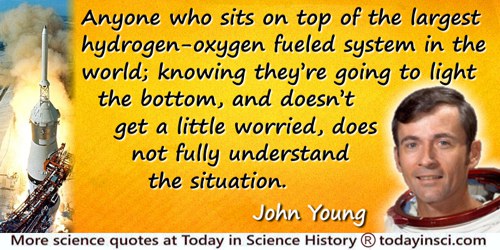
Anyone who sits on top of the largest hydrogen-oxygen fueled system in the world; knowing they’re going to light the bottom, and doesn’t get a little worried, does not fully understand the situation.
Response to question whether he was worried about embarking on the first space shuttle flight. As quoted on the nmspacemuseum.org website of the New Mexico Museum of Space History.

Anyone who thinks we can continue to have world wars but make them nice polite affairs by outlawing this weapon or that should meditate upon the outlawing of the cross-bow by Papal authority. Setting up the machinery for international law and order must surely precede disarmament. The Wild West did not abandon its shooting irons till after sheriffs and courts were established.
Speech, American Library Assiciation Conference (3 Jul 1947), as quoted by Lawrence E. Davies in 'Army's Atomic Bid Viewed in Making', New York Times (4 Jul 1947), 11.
Anything made out of destructible matter
Infinite time would have devoured before.
But if the atoms that make and replenish the world
Have endured through the immense span of the past
Their natures are immortal—that is clear.
Never can things revert to nothingness!
Infinite time would have devoured before.
But if the atoms that make and replenish the world
Have endured through the immense span of the past
Their natures are immortal—that is clear.
Never can things revert to nothingness!
On the Nature of Things, trans. Anthony M. Esolen (1995), Book I, lines 232-7, 31.
Apart from the hostile influence of man, the organic and the inorganic world are … bound together by such mutual relations and adaptations as secure, if not the absolute permanence and equilibrium of both … at least a very slow and gradual succession of changes in those conditions. But man is everywhere a disturbing agent. Wherever he plants his foot, the harmonies of nature are turned to discords.
In Man and Nature, (1864), 35-36.
Apparently separate parts of the world would be deeply and conspiratorially entangled, and our apparent free will would be entangled with them.
In 'Bertlmann's Socks and the Nature of Reality', Journal de physique (1981), 42, No.3, Supplement, C2-57.
ARCHIMEDES. On hearing his name, shout “Eureka!” Or else: “Give me a fulcrum and I will move the world”. There is also Archimedes’ screw, but you are not expected to know what that is.
The Dictionary of Accepted Ideas (1881), trans. Jaques Barzun (1968), 15.
Art and science work in quite different ways: agreed. But, bad as it may sound, I have to admit that I cannot get along as an artist without the use of one or two sciences. ... In my view, the great and complicated things that go on in the world cannot be adequately recognized by people who do not use every possible aid to understanding.
Bertolt Brecht, John Willett (trans.), Brecht on Theatre (1964), 73.
Art evokes the mystery without which the world would not exist.
John Mitchinson and John Lloyd, If Ignorance Is Bliss, Why Aren't There More Happy People?: Smart Quotes for Dumb Times (2009), 217.
Art is an expression of the world order and is, therefore, orderly, organic, subject to mathematical law, and susceptible to mathematical analysis.
In 'The Theosophic View of the Art of Architecture', The Beautiful Necessity, Seven Essays on Theosophy and Architecture (2nd ed., 1922), Preface to the Second Edition, 11.
Artificial intelligence is based on the assumption that the mind can be described as some kind of formal system manipulating symbols that stand for things in the world. Thus it doesn't matter what the brain is made of, or what it uses for tokens in the great game of thinking. Using an equivalent set of tokens and rules, we can do thinking with a digital computer, just as we can play chess using cups, salt and pepper shakers, knives, forks, and spoons. Using the right software, one system (the mind) can be mapped onto the other (the computer).
Machinery of the Mind: Inside the New Science of Artificial Intelligence (1986), 250.
As a nation, we are too young to have true mythic heroes, and we must press real human beings into service. Honest Abe Lincoln the legend is quite a different character from Abraham Lincoln the man. And so should they be. And so should both be treasured, as long as they are distinguished. In a complex and confusing world, the perfect clarity of sports provides a focus for legitimate, utterly unambiguous support or disdain. The Dodgers are evil, the Yankees good. They really are, and have been for as long as anyone in my family can remember.
…...
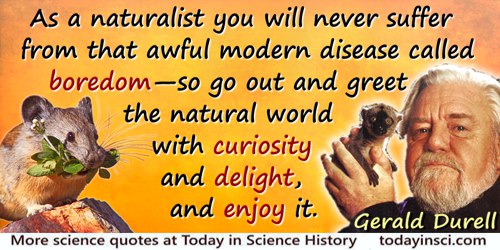
As a naturalist you will never suffer from that awful modern disease called boredom—so go out and greet the natural world with curiosity and delight, and enjoy it.
In The Amateur Naturalist (1989), 7.
As a net is made up of a series of ties, so everything in this world is connected by a series of ties. If anyone thinks that the mesh of a net is an independent, isolated thing, he is mistaken. It is called a net because it is made up of a series of a interconnected meshes, and each mesh has its place and responsibility in relation to other meshes.
In Gary William Flake, The Computational Beauty of Nature (2000), 383.
As belief shrinks from this world, it is more necessary than ever that someone believe. Wild-eyed men in caves. Nuns in black. Monks who do not speak. We are left to believe... Hell is when no one believes.
White Noise. Quoted in Kim Lim (ed.), 1,001 Pearls of Spiritual Wisdom: Words to Enrich, Inspire, and Guide Your Life (2014), 24
As children we all possess a natural, uninhibited curiosity, a hunger for explanation, which seems to die slowly as we age—suppressed, I suppose, by the high value we place on conformity and by the need not to appear ignorant.
It betokens a conviction that somehow science is innately incomprehensible. It precludes reaching deeper, thereby denying the profound truth that understanding enriches experience, that explanation vastly enhances the beauty of the natural world in the eye of the beholder.
It betokens a conviction that somehow science is innately incomprehensible. It precludes reaching deeper, thereby denying the profound truth that understanding enriches experience, that explanation vastly enhances the beauty of the natural world in the eye of the beholder.
In Toward the Habit of Truth (1990).
As for Lindbergh, another eminent servant of science, all he proved by his gaudy flight across the Atlantic was that God takes care of those who have been so fortunate as to come into the world foolish.
Expressing skepticism that adventure does not necessarily contribute to scientific knowledge.
Expressing skepticism that adventure does not necessarily contribute to scientific knowledge.
'Penguin's Eggs'. From the American Mercury (Sep 1930), 123-24. Reprinted in A Second Mencken Chrestomathy: A New Selection from the Writings of America's Legendary Editor, Critic, and Wit (2006), 167.
As I looked down, I saw a large river meandering slowly along for miles, passing from one country to another without stopping. I also saw huge forests, extending along several borders. And I watched the extent of one ocean touch the shores of separate continents. Two words leaped to mind as I looked down on all this: commonality and interdependence. We are one world.
…...
As Karl Marx once noted: “Hegel remarks somewhere that all great, world-historical facts and personages occur, as it were, twice. He forgot to add: the first time as tragedy, the second as farce.” William Jennings Bryan and the Scopes trial was a tragedy. The creationists and intelligent design theorists are a farce.
In '75 Years and Still No Peace'. Humanist (Sep 2000)
As language-using organisms, we participate in the evolution of the Universe most fruitfully through interpretation. We understand the world by drawing pictures, telling stories, conversing. These are our special contributions to existence. It is our immense good fortune and grave responsibility to sing the songs of the Cosmos.
Epigraph, without citation, in Michael Dowd, Thank God for Evolution: How the Marriage of Science and Religion Will Transform Your Life and Our World (2008), 103.
As modern physics started with the Newtonian revolution, so modern philosophy starts with what one might call the Cartesian Catastrophe. The catastrophe consisted in the splitting up of the world into the realms of matter and mind, and the identification of “mind” with conscious thinking. The result of this identification was the shallow rationalism of l’esprit Cartesien, and an impoverishment of psychology which it took three centuries to remedy even in part.
The Act of Creation (1964), 148.
As new areas of the world came into view through exploration, the number of identified species of animals and plants grew astronomically. By 1800 it had reached 70,000. Today more than 1.25 million different species, two-thirds animal and one-third plant, are known, and no biologist supposes that the count is complete.
In The Intelligent Man's Guide to Science: The Biological Sciences (1960), 654. Also in Isaac Asimov’s Book of Science and Nature Quotations (1988), 320.
As Phoebus to the world, is Science to the soul.
In poem, 'The Minstrel', collected in Beauties Selected from the Writings of James Beattie (1809), 44.
As pilgrimages to the shrines of saints draw thousands of English Catholics to the Continent, there may be some persons in the British Islands sufficiently in love with science, not only to revere the memory of its founders, but to wish for a description of the locality and birth-place of a great master of knowledge—John Dalton—who did more for the world’s civilisation than all the reputed saints in Christendom.
In The Worthies of Cumberland (1874), 25.
As soon as the art of Flying is Found out, some of their Nation will make one of the first Colonies, that shall Transplant into that other World.
In A Discovery of a New World, Or, a Discourse: Tending to Prove, that 'tis Probable There May Be Another Habitable World in the Moon (1638, 1684), 159.
![Robert Fulton quote: As the component parts of all new machines may be said to be old[,] it is a nice discriminating judgment,](https://todayinsci.com/F/Fulton_Robert/FultonRobert-Mechanic500x250px.jpg)
As the component parts of all new machines may be said to be old[,] it is a nice discriminating judgment, which discovers that a particular arrangement will produce a new and desired effect. ... Therefore, the mechanic should sit down among levers, screws, wedges, wheels, etc. like a poet among the letters of the alphabet, considering them as the exhibition of his thoughts; in which a new arrangement transmits a new idea to the world.
A Treatise on the Improvement of Canal Navigation (1796), preface, x.
As the Director of the Theoretical Division of Los Alamos, I participated at the most senior level in the World War II Manhattan Project that produced the first atomic weapons.
Now, at age 88, I am one of the few remaining such senior persons alive. Looking back at the half century since that time, I feel the most intense relief that these weapons have not been used since World War II, mixed with the horror that tens of thousands of such weapons have been built since that time—one hundred times more than any of us at Los Alamos could ever have imagined.
Today we are rightly in an era of disarmament and dismantlement of nuclear weapons. But in some countries nuclear weapons development still continues. Whether and when the various Nations of the World can agree to stop this is uncertain. But individual scientists can still influence this process by withholding their skills.
Accordingly, I call on all scientists in all countries to cease and desist from work creating, developing, improving and manufacturing further nuclear weapons - and, for that matter, other weapons of potential mass destruction such as chemical and biological weapons.
[On the occasion of the 50th Anniversary of Hiroshima.]
Now, at age 88, I am one of the few remaining such senior persons alive. Looking back at the half century since that time, I feel the most intense relief that these weapons have not been used since World War II, mixed with the horror that tens of thousands of such weapons have been built since that time—one hundred times more than any of us at Los Alamos could ever have imagined.
Today we are rightly in an era of disarmament and dismantlement of nuclear weapons. But in some countries nuclear weapons development still continues. Whether and when the various Nations of the World can agree to stop this is uncertain. But individual scientists can still influence this process by withholding their skills.
Accordingly, I call on all scientists in all countries to cease and desist from work creating, developing, improving and manufacturing further nuclear weapons - and, for that matter, other weapons of potential mass destruction such as chemical and biological weapons.
[On the occasion of the 50th Anniversary of Hiroshima.]
Letter, Bulletin of the Atomic Scientists (Nov 1995), 51:6, 3.
As the issues are greater than men ever sought to realize before, the recriminations will be fiercer and pride more desperately hurt. It may help to recall that many recognized before the bomb ever feel that the time had already come when we must learn to live in One World.
…...
As the nineteenth century drew to a close, scientists could reflect with satisfaction that they had pinned down most of the mysteries of the physical world: electricity, magnetism, gases, optics, acoustics, kinetics and statistical mechanics … all had fallen into order before them. They had discovered the X ray, the cathode ray, the electron, and radioactivity, invented the ohm, the watt, the Kelvin, the joule, the amp, and the little erg.
A Short History of Nearly Everything. In Clifford A. Pickover, Archimedes to Hawking: Laws of Science and the Great Minds Behind Them (2008), 172.
As the skies appear to a man, so is his mind. Some see only clouds there; some, prodigies and portents; some rarely look up at all; their heads, like the brutes, are directed toward Earth. Some behold there serenity, purity, beauty ineffable. The world runs to see the panorama, when there is a panorama in the sky which few go to see.
…...
As the world has seen its age of stone, its age of bronze, and its age of iron, so it may before long have embarked on a new and even more prosperous era—the age of aluminium.
— Magazine
Concluding remark in uncredited 'Topics of the Day' article, 'The Future of Aluminium', The Spectator (15 Jul 1893), 77.
As the world of science has grown in size and in power, its deepest problems have changed from the epistemological to the social.
Scientific Knowledge and its Social Problems (1971), 10.
As there is not in human observation proper means for measuring the waste of land upon the globe, it is hence inferred, that we cannot estimate the duration of what we see at present, nor calculate the period at which it had begun; so that, with respect to human observation, this world has neither a beginning nor an end.
Abstract of a Dissertation... Concerning the System of the Earth, its Duration, and Stability (1785), 28.
As to the Christian religion, Sir, … there is a balance in its favor from the number of great men who have been convinced of its truth after a serious consideration of the question. Grotius was an acute man, a lawyer, a man accustomed to examine evidence, and he was convinced. Grotius was not a recluse, but a man of the world, who surely had no bias on the side of religion. Sir Isaac Newton set out an infidel, and came to be a very firm believer.
(1763). In George Birkbeck Hill (ed.), Boswell’s Life of Johnson (1799), Vol. 1, 524.
Asked in 1919 whether it was true that only three people in the world understood the theory of general relativity, [Eddington] allegedly replied: “Who's the third?”
As described in Brian Stableford, Science Fact and Science Fiction: An Encyclopedia (2006), 150.
Astronomy is … the only progressive Science which the ancient world produced.
In History of the Inductive Sciences from the Earliest to the Present Times (1837), Vol 1, 90.
Astronomy was not studied by Kepler, Galileo, or Newton for the practical applications which might result from it, but to enlarge the bounds of knowledge, to furnish new objects of thought and contemplation in regard to the universe of which we form a part; yet how remarkable the influence which this science, apparently so far removed from the sphere of our material interests, has exerted on the destinies of the world!
In 'Report of the Secretary', Annual Report of the Board of Regents of the Smithsonian Institution for 1859 (1860), 15.
At moments of great enthusiasm it seems to me that no one in the world has ever made something this beautiful and important.
As quoted on the website mcescher.com, without citation.
At some future period, not very distant as measured by centuries, the civilised races of man will almost certainly exterminate, and replace the savage races throughout the world.
In The Descent of Man and Selection in Relation to Sex (1871), Vol. 1, 193.
At the age of eleven, I began Euclid, with my brother as my tutor. ... I had not imagined that there was anything so delicious in the world. After I had learned the fifth proposition, my brother told me that it was generally considered difficult, but I had found no difficulty whatsoever. This was the first time it had dawned on me that I might have some intelligence.
In Autobiography: 1872-1914 (1967), Vol. 1, 37-38.
At the beginning of this debate Stephen [Hawking] said that he thinks that he is a positivist, whereas I am a Platonist. I am happy with him being a positivist, but I think that the crucial point here is, rather, that I am a realist. Also, if one compares this debate with the famous debate of Bohr and Einstein, some seventy years ago, I should think that Stephen plays the role of Bohr, whereas I play Einstein's role! For Einstein argued that there should exist something like a real world, not necessarily represented by a wave function, whereas Bohr stressed that the wave function doesn't describe a 'real' microworld but only 'knowledge' that is useful for making predictions.
Debate at the Isaac Newton Institute of the Mathematical Sciences, Cambridge University (1994), transcribed in Stephen Hawking and Roger Penrose, The Nature of Space and Time (1996), 134-135.
At the bidding of a Peter the Hermit many millions of men swarmed to the East; the words of an hallucinated person … have created the force necessary to triumph over the Graeco-Roman world; an obscure monk like Luther set Europe ablaze and bathed in blood. The voice of a Galileo or a Newton will never have the least echo among the masses. The inventors of genius transform a civilization. The fanatics and the hallucinated create history.
From Les Premières Civilisations (1889), 171. English in The Psychology of Peoples (1898), Book 1, Chap. 1, 204, tweaked by Webmaster. Original French text: “A la voix d'un Pierre l'Ermite, plusieurs millions d'hommes se sont précipités sur l'Orient; les paroles d'un halluciné … ont créé la force nécessaire pour triompher du vieux monde gréco-romain; un moine obscur, comme Luther, a mis l'Europe à feu et à sang. Ce n’est pas parmi les foules que la voix d’un Galilée ou d’un Newton aura jamais le plus faible écho. Les inventeurs de génie transforment une civilisation. Les fanatiques et les hallucinés créent l’histoire.”
At the end of the book [Zoonomia] he sums up his [Erasmus Darwin] views in the following sentences: “The world has been evolved, not created: it has arisen little by little from a small beginning, and has increased through the activity of the elemental forces embodied in itself, and so has rather grown than come into being at an almighty word.” “What a sublime idea of the infinite might of the great Architect, the Cause of all causes, the Father of all fathers, the Ens Entium! For if we would compare the Infinite, it would surely require a greater Infinite to cause the causes of effects than to produce the effects themselves.”
[This is a restatement, not a verbatim quote of the original words of Erasmus Darwin, who attributed the idea he summarized to David Hume.]
[This is a restatement, not a verbatim quote of the original words of Erasmus Darwin, who attributed the idea he summarized to David Hume.]
In August Weismann, John Arthur Thomson (trans.), Margaret R. Thomson (trans.) The Evolution Theory (1904), Vol. 1, 17-18. The verbatim form of the quote from Zoonomia, in context, can be seen on the webpage here for Erasmus Darwin. Later authors have quoted from Weismann's translated book, and given the reworded passage as a direct quote by Erasmus Darwin. Webmaster has found a verbatim form in Zoonomia (1794), but has been unable to find the wording used by Weismann in any primary source by Erasmus Darwin. The rewording is perhaps due to the translation of the quote into German for Weismann's original book, Vorträge über Descendenztheorie (1902) followed by another translation for the English edition.
At the sea shore you pick up a pebble, fashioned after a law of nature, in the exact form that best resists pressure, and worn as smooth as glass. It is so perfect that you take it as a keepsake. But could you know its history from the time when a rough fragment of rock fell from the overhanging cliff into the sea, to be taken possession of by the under currents, and dragged from one ocean to another, perhaps around the world, for a hundred years, until in reduced and perfect form it was cast upon the beach as you find it, you would have a fit illustration of what many principles, now in familiar use, have endured, thus tried, tortured and fashioned during the ages.
From Address (1 Aug 1875), 'The Growth of Principles' at Saratoga. Collected in William L. Snyder (ed.), Great Speeches by Great Lawyers: A Collection of Arguments and Speeches (1901), 246.
Atheism is not a philosophy; it is not even a view of the world; it is simply a refusal to deny the obvious.
In Letter to a Christian Nation (2006, 2008), 51.
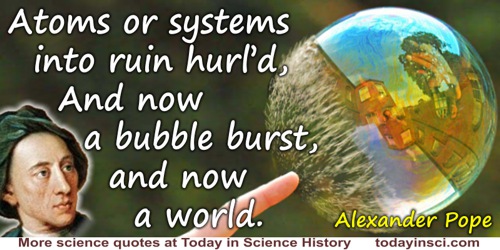
Atoms or systems into ruin hurl’d,
And now a bubble burst, and now a world.
And now a bubble burst, and now a world.
From An Essay on Man (1734), Epistle I, lines 89-90. In An Essay on Man: enlarged and improved by the author. With notes by William Warburton (1745), 5.
Attainment and science, retainment and art—the two couples keep to themselves, but when they do meet, nothing else in the world matters.
In Time and Ebb (1947) in Nine Stories(1947), 102.
Attention makes the genius; all learning, fancy, and science depend on it. Newton traced back his discoveries to its unwearied employment. It builds bridges, opens new worlds, and heals diseases; without it Taste is useless, and the beauties of literature are unobserved; as the rarest flowers bloom in vain, if the eye be not fixed upon the bed.
Pleasures, Objects, and Advantages of Literature (1855), 37.
Available energy is the main object at stake in the struggle for existence and the evolution of the world.
In Der zweite Hauptsatz der mechanischen Wärmetheorie (1886), 21, as cited in Alfred J. Lotka, 'Contribution to the Energetics of Evolution', Proceedings of the National Academy of Sciences (15 Jun 1922), 8, No. 6, 150. As translated, without quotation marks, in D'Arcy W. Thompson, On Growth and Form (1917, 2014), 14, footnote.
Ay, driven no more by passion's gale,
Nor impulse unforeseen,
Humanity shall faint and fail,
And on her ruins will prevail
The Conquering Machine!
Responsibility begone!
Let Freedom's flag be furled;
Oh, coming ages, hasten on,
And bring the true Automaton,
The monarch of the world.
Nor impulse unforeseen,
Humanity shall faint and fail,
And on her ruins will prevail
The Conquering Machine!
Responsibility begone!
Let Freedom's flag be furled;
Oh, coming ages, hasten on,
And bring the true Automaton,
The monarch of the world.
'The Conquering Machine', Dreams to Sell (1887), 29-30.
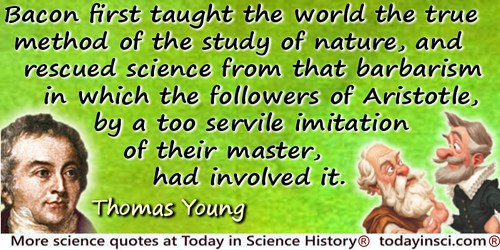
Bacon first taught the world the true method of the study of nature, and rescued science from that barbarism in which the followers of Aristotle, by a too servile imitation of their master, had involved it.
A Course of Lectures on Natural Philosophy and the Mechanical Arts (1845), 5.
Bacteria represent the world’s greatest success story. They are today and have always been the modal organisms on earth; they cannot be nuked to oblivion and will outlive us all. This time is their time, not the ‘age of mammals’ as our textbooks chauvinistically proclaim. But their price for such success is permanent relegation to a microworld, and they cannot know the joy and pain of consciousness. We live in a universe of trade-offs; complexity and persistence do not work well as partners.
…...
Basic research at universities comes in two varieties: research that requires big bucks and research that requires small bucks. Big bucks research is much like government research and in fact usually is government research but done for the government under contract. Like other government research, big bucks academic research is done to understand the nature and structure of the universe or to understand life, which really means that it is either for blowing up the world or extending life, whichever comes first. Again, that's the government's motivation. The universities' motivation for conducting big bucks research is to bring money in to support professors and graduate students and to wax the floors of ivy-covered buildings. While we think they are busy teaching and learning, these folks are mainly doing big bucks basic research for a living, all the while priding themselves on their terrific summer vacations and lack of a dress code.
Smalls bucks research is the sort of thing that requires paper and pencil, and maybe a blackboard, and is aimed primarily at increasing knowledge in areas of study that don't usually attract big bucks - that is, areas that don't extend life or end it, or both. History, political science, and romance languages are typically small bucks areas of basic research. The real purpose of small bucks research to the universities is to provide a means of deciding, by the quality of their small bucks research, which professors in these areas should get tenure.
Smalls bucks research is the sort of thing that requires paper and pencil, and maybe a blackboard, and is aimed primarily at increasing knowledge in areas of study that don't usually attract big bucks - that is, areas that don't extend life or end it, or both. History, political science, and romance languages are typically small bucks areas of basic research. The real purpose of small bucks research to the universities is to provide a means of deciding, by the quality of their small bucks research, which professors in these areas should get tenure.
Accidental Empires (1992), 78.
Beauty is the first test: there is no permanent place in the world for ugly mathematics.
In A Mathematician’s Apology (1940, reprint with Foreward by C.P. Snow 1992), 85.
Because the region of the Celestial World is of so great and such incredible magnitude as aforesaid, and since in what has gone before it was at least generally demonstrated that this comet continued within the limits of the space of the Aether, it seems that the complete explanation of the whole matter is not given unless we are also informed within narrower limits in what part of the widest Aether, and next to which orbs of the Planets [the comet] traces its path, and by what course it accomplishes this.
De Mundi Aetherei Recentioribus Phaenomenis (On Recent Phenomena in the Aetherial World) (1588). Quoted in M. Boas Hall, The Scientific Renaissance 1450-1630 (1962), 115.
Before the introduction of the Arabic notation, multiplication was difficult, and the division even of integers called into play the highest mathematical faculties. Probably nothing in the modern world could have more astonished a Greek mathematician than to learn that, under the influence of compulsory education, the whole population of Western Europe, from the highest to the lowest, could perform the operation of division for the largest numbers. This fact would have seemed to him a sheer impossibility. … Our modern power of easy reckoning with decimal fractions is the most miraculous result of a perfect notation.
In Introduction to Mathematics (1911), 59.
Behind and permeating all our scientific activity, whether in critical analysis or in discovery, there is an elementary and overwhelming faith in the possibility of grasping the real world with out concepts, and, above all, faith in the truth over which we have no control but in the service of which our rationality stands or falls. Faith and intrinsic rationality are interlocked with one another
Christian Theology of Scientific Culture (1981), 63. In Vinoth Ramachandra, Subverting Global Myths: Theology and the Public Issues Shaping our World (2008), 187.
Behold a universe so immense that I am lost in it. I no longer know where I am. I am just nothing at all. Our world is terrifying in its insignificance.
In Etretiens sur la Pluralité des Mondes (Conversations with a Lady on the Plurality of Worlds) (1686) as cited in Edward Harrison, Cosmology: The Science of the Universe (2000), 162.
Between the lowest and the highest degree of spiritual and corporal perfection, there is an almost infinite number of intermediate degrees. The succession of degrees comprises the Universal Chain. It unites all beings, ties together all worlds, embraces all the spheres. One SINGLE BEING is outside this chain, and this is HE who made it.
Contemplation de la nature (1764), Vol. I, 27. Trans. Stephen Jay Gould, Ontogeny and Phylogeny (1977), 23.
Beyond these are other suns, giving light and life to systems, not a thousand, or two thousand merely, but multiplied without end, and ranged all around us, at immense distances from each other, attended by ten thousand times ten thousand worlds, all in rapid motion; yet calm, regular and harmonious—all space seems to be illuminated, and every particle of light a world. ... all this vast assemblages of suns and worlds may bear no greater proportion to what lies beyond the utmost boundaries of human vision, than a drop of water to the ocean.
In The Geography of the Heavens and Class-Book of Astronomy (1874), 148 That knowledge is not happiness.
Biological determinism is, in its essence, a theory of limits. It takes the current status of groups as a measure of where they should and must be ... We inhabit a world of human differences and predilections, but the extrapolation of these facts to theories of rigid limits is ideology.
The Mismeasure of Man (1981), 28-9.
Biological diversity is the key to the maintenance of the world as we know it. Life in a local site struck down by a passing storm springs back quickly: opportunistic species rush in to fill the spaces. They entrain the succession that circles back to something resembling the original state of the environment.
In 'Storm Over the Amazon', The Diversity of Life (1992), 15.
Biology occupies a position among the sciences both marginal and central. Marginal because, the living world, constituting only a tiny and very “special” part of the universe, it does not seem likely that the study of living beings will ever uncover general laws applicable outside the biosphere. But if the ultimate aim of the whole of science is indeed, as I believe, to clarify man's relationship to the universe, then biology must be accorded a central position, since of all the disciplines it is the one that endeavours to go most directly to the heart of the problems that must be resolved before that of “human nature” can even be framed in other than metaphysical terms.
In Jacques Monod and Austryn Wainhouse (trans.), Chance and Necessity: An Essay on the Natural Philosophy of Modern Biology (1971), xi.
Blessings on Science! When the earth seem’d old,
When Faith grew doting, and the Reason cold,
Twas she discover’d that the world was young,
And taught a language to its lisping tongue:
’Twas she disclosed a future to its view,
And made old knowledge pale before the new.
When Faith grew doting, and the Reason cold,
Twas she discover’d that the world was young,
And taught a language to its lisping tongue:
’Twas she disclosed a future to its view,
And made old knowledge pale before the new.
From poem, 'Railways' (1846), collected in The Poetical Works of Charles Mackay: Now for the First Time Collected Complete in One Volume (1876), 214.
Blood mixture and the result drop in the racial level is the sole cause of the dying out of old cultures; for men do not perish as a result of lost wars, but by the loss of that force of resistance which is continued only in pure blood. All who are not of good race in this world are chaff.
Mein Kampf (1925-26), American Edition (1943), 296. In William Lawrence Shirer, The Rise and Fall of the Third Reich (1990), 88.
Blow, winds, and crack your cheeks! Rage, blow,
You cataracts and hurricanoes, spout
Till you have drench’d our steeples, drowned the cocks!
You sulph'rous and thought-executing fires,
Vaunt-couriers of oak-cleaving thunderbolts,
Singe my white head; and thou all-shaking thunder,
Strike flat the thick rotundity o'th' world,
Crack nature’s moulds, all germens spill at once
That makes ingrateful man.
You cataracts and hurricanoes, spout
Till you have drench’d our steeples, drowned the cocks!
You sulph'rous and thought-executing fires,
Vaunt-couriers of oak-cleaving thunderbolts,
Singe my white head; and thou all-shaking thunder,
Strike flat the thick rotundity o'th' world,
Crack nature’s moulds, all germens spill at once
That makes ingrateful man.
King Lear (1605-61, III, ii.
Bohr’s standpoint, that a space-time description is impossible, I reject a limine. Physics does not consist only of atomic research, science does not consist only of physics, and life does not consist only of science. The aim of atomic research is to fit our empirical knowledge concerning it into our other thinking. All of this other thinking, so far as it concerns the outer world, is active in space and time. If it cannot be fitted into space and time, then it fails in its whole aim and one does not know what purpose it really serves.
Letter to Willy Wien (25 Aug 1926). Quoted in Walter Moore, Schrödinger: Life and Thought (1989), 226.
Books are the carriers of civilization. Without books, history is silent, literature dumb, science crippled, thought and speculation at a standstill. Without books the development of civilization would have been impossible. They are engines of change, windows on the world, “lighthouses,” (as a poet said), “erected in the sea of time.”
In Authors League Bulletin (1979). As city in Charles Francis (ed.), Wisdom Well Said (2009), 48.
Both religion and natural science require a belief in God for their activities, to the former He is the starting point, and to the latter the goal of every thought process. To the former He is the foundation, to the latter, the crown of the edifice of every generalized world view.
Lecture, 'Religion and Natural Science' (1937) In Max Planck and Frank Gaynor (trans.), Scientific Autobiography and Other Papers (1949), 184.
But as a philosopher said, one day after mastering the winds, the waves, the tides and gravity, after all the scientific and technological achievements, we shall harness for God the energies of love. And then, for the second time in the history of the world, man will have discovered fire.
Speech accepting nomination as candidate for vice president, Democratic National Committee, Washington, D.C. (8 Aug 1972) as reported in New York Times (9 Aug 1972), 18. Shriver slightly paraphrased the similar sentiment written in 1934 by Pierre Teilhard de Chardin, translated by René Hague in 'The Evolution of Chastity', Toward the Future (1975), 86-87.
But as the wilderness areas are progressively exploited or “improve”, as the jeeps and bulldozers of uranium prospectors scar up the deserts and the roads are cut into the alpine timberlands, and as the remnants of the unspoiled and natural world are progressively eroded, every such loss is a little death in me. In us.
Letter (3 Dec 1960) written to David E. Pesonen of the Outdoor Recreation Resources Review Commission. Collected in 'Coda: Wilderness Letter', The Sound of Mountain Water: The Changing American West (1969), 150.
But if anyone, well seen in the knowledge, not onely of Sacred and exotick History, but of Astronomical Calculation, and the old Hebrew Kalendar, shall apply himself to these studies, I judge it indeed difficult, but not impossible for such a one to attain, not onely the number of years, but even, of dayes from the Creation of the World.
In 'Epistle to the Reader', The Annals of the World (1658). As excerpted in Wallen Yep, Man Before Adam: A Correction to Doctrinal Theology, "The Missing Link Found" (2002), 18.
But in science the credit goes to the man who convinces the world, not to the man to whom the idea first occurs. Not the man who finds a grain of new and precious quality but to him who sows it, reaps it, grinds it and feeds the world on it.
First Galton Lecture before the Eugenics Society', Eugenics Review, 1914, 6, 9.
But in the heavens we discover by their light, and by their light alone, stars so distant from each other that no material thing can ever have passed from one to another; and yet this light, which is to us the sole evidence of the existence of these distant worlds, tells us also that each of them is built up of molecules of the same kinds as those which we find on earth. A molecule of hydrogen, for example, whether in Sirius or in Arcturus, executes its vibrations in precisely the same time. Each molecule, therefore, throughout the universe, bears impressed on it the stamp of a metric system as distinctly as does the metre of the Archives at Paris, or the double royal cubit of the Temple of Karnac ... the exact quantity of each molecule to all others of same kind gives it, as Sir John Herschel has well said, the essential character of a manufactured article and precludes the idea of its being external and self-existent.
'Molecules', 1873. In W. D. Niven (ed.), The Scientific Papers of James Clerk Maxwell (1890), Vol. 2, 375-6.
But the World being once fram’d, and the course of Nature establish’d, the Naturalist, (except in some few cases, where God, or Incorporeal Agents interpose), has recourse to the first Cause but for its general and ordinary Support and Influence, whereby it preserves Matter and Motion from Annihilation or Desition; and in explicating particular phenomena, considers onely the Size, Shape, Motion, (or want of it) Texture, and the resulting Qualities and Attributes of the small particles of Matter.
The Origine of Formes and Qualities (1666), 194.
But when you come right down to it, the reason that we did this job is because it was an organic necessity. If you are a scientist you cannot stop such a thing. If you are a scientist you believe that it is good to find out how the world works; that it is good to find out what the realities are; that it is good to turn over to mankind at large the greatest possible power to control the world and to deal with it according to its lights and values.
Regarding the atomic bomb project.
Regarding the atomic bomb project.
From speech at Los Alamos (17 Oct 1945). Quoted in David C. Cassidy, J. Robert Oppenheimer and the American Century (2009), 214.
But why, it has been asked, did you go there [the Antarctic]? Of what use to civilization can this lifeless continent be? ... [Earlier] expeditions contributed something to the accumulating knowledge of the Antarctic ... that helps us thrust back further the physical and spiritual shadows enfolding our terrestrial existence. Is it not true that one of the strongest and most continuously sustained impulses working in civilization is that which leads to discovery? As long as any part of the world remains obscure, the curiosity of man must draw him there, as the lodestone draws the mariner's needle, until he comprehends its secret.
In 'Hoover Presents Special Medal to Byrd...', New York Times (21 Jun 1930), 1.
But with regard to the material world, we can at least go so far as this;—we can perceive that events are brought about, not by insulated interpositions of Divine power, exerted in each particular ease, but by the establishment of general laws.
In Astronomy and General Physics Considered with Reference to Natural Theology (1833), 356. Charles Darwin placed this quote on the title page of his On the Origin of Species, identified as from Whewell's 'Bridgewater Treatise'.
But, contrary to the lady’s prejudices about the engineering profession, the fact is that quite some time ago the tables were turned between theory and applications in the physical sciences. Since World War II the discoveries that have changed the world are not made so much in lofty halls of theoretical physics as in the less-noticed labs of engineering and experimental physics. The roles of pure and applied science have been reversed; they are no longer what they were in the golden age of physics, in the age of Einstein, Schrödinger, Fermi and Dirac.
'The Age of Computing: a Personal Memoir', Daedalus (1992), 121, 120.
By considering the embryological structure of man - the homologies which he presents with the lower animals - the rudiments which he retains - and the reversions to which he is liable, we can partly recall in imagination the former condition of our early progenitors; and we can approximately place them in their proper position in the zoological series. We thus learnt that man is descended from a hairy quadruped, furnished with a tail and pointed ears, probably arboreal in its habit, and an inhabitant of the Old World. This creature, if its whole structure had been examined by a naturalist, would have been classed among the Quadrumana, as surely as would be the common and still more ancient progenitor of the Old and New World monkeys.
The Descent of Man (1871), Vol. 2, 389.
By God’s mercy British and American science outpaced all German efforts. … This revelation of the secrets of nature, long mercifully withheld from man, should arouse the most solemn reflections in the mind and conscience of every human being capable of comprehension. We must indeed pray that these awful agencies will be made to conduce to peace among the nations, and that instead of wreaking measureless havoc upon the entire globe, may become a perennial fountain of world prosperity.
[Concerning use of the atomic bomb.]
[Concerning use of the atomic bomb.]
Statement drafted by Churchill following the use of an atomic bomb on Hiroshima. Due to the change in government, the statement was released by Clement Attlee (6 Aug 1945). In Sir Winston Churchill, Victory: War Speeches by the Right Hon. Winston Churchill (1946), 289.
By natural selection our mind has adapted itself to the conditions of the external world. It has adopted the geometry most advantageous to the species or, in other words, the most convenient. Geometry is not true, it is advantageous.
Science and Hypothesis (1902), in The Foundations of Science: Science and Hypothesis, The Value of Science, Science and Method(1946), trans. by George Bruce Halsted, 91.
By no amount of reasoning can we altogether eliminate all contingency from our world. Moreover, pure speculation alone will not enable us to get a determinate picture of the existing world. We must eliminate some of the conflicting possibilities, and this can be brought about only by experiment and observation.
Reason and Nature: an Essay on the Meaning of Scientific Method? (2nd Ed., 1964), 82.
By the 18th century science had been so successful in laying bare the laws of nature that many thought there was nothing left to discover. Immutable laws prescribed the motion of every particle in the universe, exactly and forever: the task of the scientist was to elucidate the implications of those laws for any particular phenomenon of interest. Chaos gave way to a clockwork world. But the world moved on ...Today even our clocks are not made of clockwork. ... With the advent of quantum mechanics, the clockwork world has become a lottery. Fundamental events, such as the decay of a radioactive atom, are held to be determined by chance, not law.
Does God Play Dice?: The New Mathematics of Chaos (2002). xi.
By the act of observation we have selected a ‘real’ history out of the many realities, and once someone has seen a tree in our world it stays there even when nobody is looking at it.
…...
By the death of Mr. O. Chanute the world has lost one whose labors had to an unusual degree influenced the course of human progress. If he had not lived the entire history of progress in flying would have been other than it has been.
Writing in Aeronautics in Jan 1911 about Chanute's death, collected in Wilbur Wright and Orville Wright, The Papers of Wilbur and Orville Wright: Volume Two 1906-1948 (1953), 1013.
By the end of the next century, the “greenhouse effect” may increase temperatures worldwide to levels that have not been reached for at least 100,000 years. And the effects on sea level and on agriculture and other human activities are likely to be so profound that we should be planning for them now.
In 'Temperatures Rise in the Global Greenhouse', New Scientist (15 May 1986), 110, No. 1508, 32.
Can it be that all great scientists of the past were really playing a game, a game in which the rules are written not by man but by God? . . . When we play we do not ask why we are playing—we just play. Play serves no moral code except that strange code which for some unknown reason, imposes itself on the play. . . . You will search in vain through scientific literature for hints of motivation. And as for the strange moral code observed by scientists, what could be stranger than an abstract regard for truth in a world which is full of concealment, deception, and taboos…? . . . In submitting to your consideration the idea that the human is at its best when playing, I am myself playing, and that makes me feel that what I am saying may have in it an element of truth.
From Lecture (28 Nov 1957) in the Queen’s University, Belfast, 'Is the Study of its History a Brake on the Progress of Science', printed in Hermethena (1958), 19, 40-41.
Can we ring the bells backward? Can we unlearn the arts that pretend to civilize, and then burn the world? There is a march of science; but who shall beat the drums for its retreat?
Letter to George Dyer (20 Dec 1830). In Charles Lamb and Thomas Noon Talfourd (Ed.), Works: Including His Most Interesting Letters, (1867), 168.
Carbon has this genius of making a chemically stable two-dimensional, one-atom-thick membrane in a three-dimensional world. And that, I believe, is going to be very important in the future of chemistry and technology in general.
From Nobel Lecture (7 Dec 1996), 'Discovering the Fullerenes', collected in Ingmar Grenthe (ed.), Nobel Lectures, Chemistry 1996-2000 (2003).
Certainly Lord Byron has expressed in words some aspects of spiritual turmoil; but our immortal natural historian has reconstructed worlds from bleached bones.
From 'La Peau de Chagrin' (1831). As translated as The Wild Ass’s Skin (1906) trans. Herbert J. Hunt, The Wild Ass’s Skin (1977), 40-1.
Cheetah genes cooperate with cheetah genes but not with camel genes, and vice versa. This is not because cheetah genes, even in the most poetic sense, see any virtue in the preservation of the cheetah species. They are not working to save the cheetah from extinction like some molecular World Wildlife Fund.
From Unweaving the Rainbow: Science, Delusion, and the Appetite for Wonder (1998), 218.
Chemistry is an art that has furnished the world with a great number of useful facts, and has thereby contributed to the improvement of many arts; but these facts lie scattered in many different books, involved in obscure terms, mixed with many falsehoods, and joined to a great deal of false philosophy; so that it is not great wonder that chemistry has not been so much studied as might have been expected with regard to so useful a branch of knowledge, and that many professors are themselves but very superficially acquainted with it. But it was particularly to be expected, that, since it has been taught in universities, the difficulties in this study should have been in some measure removed, that the art should have been put into form, and a system of it attempted—the scattered facts collected and arranged in a proper order. But this has not yet been done; chemistry has not yet been taught but upon a very narrow plan. The teachers of it have still confined themselves to the purposes of pharmacy and medicine, and that comprehends a small branch of chemistry; and even that, by being a single branch, could not by itself be tolerably explained.
John Thomson, An Account of the Life, Lectures and Writings of William Cullen, M.D. (1832), Vol. 1, 40.
Chemistry is not a primitive science like geometry and astronomy; it is constructed from the debris of a previous scientific formation; a formation half chimerical and half positive, itself found on the treasure slowly amassed by the practical discoveries of metallurgy, medicine, industry and domestic economy. It has to do with alchemy, which pretended to enrich its adepts by teaching them to manufacture gold and silver, to shield them from diseases by the preparation of the panacea, and, finally, to obtain for them perfect felicity by identifying them with the soul of the world and the universal spirit.
From Les Origines de l’Alchimie (1885), 1-2. Translation as quoted in Harry Shipley Fry, 'An Outline of the History of Chemistry Symbolically Represented in a Rookwood Fountain', The Journal of Industrial and Engineering Chemistry (1 Sep 1922), 14, No. 9, 868. From the original French, “La Chimie n’est pas une science primitive, comme la géométrie ou l’astronomie; elle s’est constituée sur les débris d’une formation scientifique antérieure; formation demi-chimérique et demi-positive, fondée elle-même sur le trésor lentement amassé des découvertes pratiques de la métallurgie, de la médecine, de l’industrie et de l’économie domestique. Il s’agit de l’alchimie, qui prétendait à la fois enrichir ses adeptes en leur apprenant à fabriquer l’or et l’argent, les mettre à l’abri des maladies par la préparation de la panacée, enfin leur procurer le bonheur parfait en les identifiant avec l’âme du monde et l’esprit universel.”
Chemistry must become the astronomy of the molecular world.
Autograph Quotation for a Charity, (1905). In G. B. Kaufman, Alfred Werner (1966), iii.
Chemists must unite in order to force upon the reluctant world the power of their discoveries.
Shortly after World War I. Quoted, as a memory of Pope, in Sir William Jackson Pope Memorial Lecture by Leslie H. Lampitt, 'Sir William Jackson Pope: His Influence on Scientific Organisation' Journal of the Royal Society of Arts (31 Jan 1947), 95, No. 4736, 174. Webmaster notes that this is given as a memory, and the wording therefore may not be verbatim.
Chlorine is a deadly poison gas employed on European battlefields in World War I. Sodium is a corrosive metal which burns upon contact with water. Together they make a placid and unpoisonous material, table salt. Why each of these substances has the properties it does is a subject called chemistry.
In Broca's Brain: The Romance of Science (1979), 18, footnote.
City wisdom became almost entirely centered on the problems of human relationships, in contrast to the wisdom of any natural tribal group, where relationships with the rest of the animate and inanimate world are still given due place.
In Gaia, a New Look at Life on Earth (1979), 135.
Climate change threatens every corner of our country, every sector of our economy and the health and future of every child. We are already seeing its impacts and we know the poorest and most vulnerable people in the United States and around the world will suffer most of all.
In Hillary Clinton, 'Hillary Clinton: America Must Lead at Paris Climate Talks', Time (29 Nov 2015).
Come, my friends,
’Tis not too late to seek a newer world.
Push off, and sitting well in order smite
The sounding furrows; for my purpose holds
To sail beyond the sunset, and the baths
Of all the western stars, until I die.
’Tis not too late to seek a newer world.
Push off, and sitting well in order smite
The sounding furrows; for my purpose holds
To sail beyond the sunset, and the baths
Of all the western stars, until I die.
From poem, 'Ulysses', collected in Walter James Turner (ed.), Great Names: Being an Anthology of English & American Literature from Chaucer to Francis Thompson (1926), 198.
Common sense in an uncommon degree is what the world calls wisdom.
In 'Hacket’s Life of Lord Keeper Williams', notes published in Henry Nelson Coleridge (ed.), The Literary Remains of Samuel Taylor Coleridge (1838), Vol. 3, 186.
Common sense is that which tells us the world is flat.
As quoted in Samuel Ichiyé Hayakawa, Language in Thought and Action (1939, 1949), 31. Hayakawa clearly specified the quote was “recently defined by Stuart Chase”. Some later sources incorrectly attribute to Hayakawa alone. Others even attribute to Einstein.
Common sense is the most widely shared commodity in the world, for every man is convinced that he is well supplied with it.
Epigraph in Ian Glynn, An Anatomy of Thought: The Origin and Machinery of the Mind (), Chap. 2, 7. A more freely translated version of the Descartes (longer) quote beginning, “Good sense is, of all things among men…” also on the René Descartes Quotes page on this website.
Common sense, the half-truths of a deceitful society, is honored as the honest truths of a frank world.
In Social Amnesia (1975), 25.
Complexity is the prodigy of the world. Simplicity is the sensation of the universe. Behind complexity, there is always simplicity to be revealed. Inside simplicity, there is always complexity to be discovered
— Gang Yu
In course Syllabus for 'Algorithm Design and Implementations' (2004) on mccombs.utexas.edu web site.
Computing is … a motionless consumption of the mind. … A generation of network surfers is becoming adept at navigating the electronic backwaters, while losing touch with the world around them.
In Silicon Snake Oil: Second Thoughts on the Information Highway (1995), 137.
Consciousness is never experienced in the plural, only in the singular. Not only has none of us ever experienced more than one consciousness, but there is also no trace of circumstantial evidence of this ever happening anywhere in the world. If I say that there cannot be more than one consciousness in the same mind, this seems a blunt tautology–we are quite unable to imagine the contrary.
…...
Consciousness is not sharply defined, but fades into sub-consciousness; and beyond that we must postulate something indefinite but yet continuous with our mental nature. This I take it be the world-stuff.
From Gifford Lecture, Edinburgh, (1927), 'Reality', collected in The Nature of the Physical World (1928), 280.
Considered from the standpoint of chemistry, living bodies appear to us as laboratories of chemical processes, for they undergo perpetual changes in their material substrate. They draw materials from the outside world and combine them with the mass of their liquid and solid parts.
In 'Allgemeine Betrachtungen der orgauischen Korper', Physiologie des Menschen (1830), Vol. 1, 34. Trans. in Kenneth L. Caneva, Robert Mayer and the Conservation of Energy (1993), 7I.
Copernicus … did not publish his book [on the nature of the solar system] until he was on his deathbed. He knew how dangerous it is to be right when the rest of the world is wrong.
In a speech at Waterville, Maine, July 30, 1885.
Cosmic evolution may teach us how the good and evil tendencies of man may have come about; but, in itself, it is incompetent to furnish any better reason why what we call good is preferable to what we call evil than we had before. Some day, I doubt not, we shall arrive at an understanding of the evolution of the aesthetic faculty; but all the understanding in the world will neither increase nor diminish the force of the intuition that this is beautiful and that is ugly.
'Evolution and Ethics' (1893). In Collected Essays (1894), Vol. 9, 80.
Cuvier … brings the void to life again, without uttering abracadabras, he excavates a fragment of gypsum, spies a footprint and shouts: “Look!” And suddenly the marbles are teeming with creatures, the dead come to life again, the world turns!
From 'La Peau de Chagrin' (1831). As translated as by Helen Constantine The Wild Ass’s Skin (2012), 19.
Cyberspace consists of transactions, relationships, and thought itself, arrayed like a standing wave in the web of our communications. Ours is a world that is both everywhere and nowhere, but it is not where bodies live. We are creating a world that all may enter without privilege or prejudice accorded by race, economic power, military force, or station of birth. We are creating a world where anyone, anywhere may express his or her beliefs, no matter how singular, without fear of being coerced into silence or conformity.
In 'A Declaration of the Independence of Cyberspace' (8 Feb 1996). Published on Electronic Frontier Foundation website. Reproduced in Lawrence Lessig, Code: Version 2.0) (2008), 303.
Dad, how do soldiers killing each other solve the world’s problems?
Dialog by Calvin (fictional character) in syndicated newspaper comic strip Calvin and Hobbes (18 Feb 1991).
Darwin's Origin of Species had come into the theological world like a plough into an ant-hill. Everywhere those thus rudely awakened from their old comfort and repose had swarmed forth angry and confused. Reviews, sermons, books light and heavy, came flying at the new thinker from all sides.
From The Warfare of Science and Theology in Christendom (1898), 70.
Darwin's characteristic perspicacity is nowhere better illustrated than in his prophecy of the reaction of the world of science. He admitted at once that it would be impossible to convince those older men '...whose minds are stocked with a multitude of facts, all viewed ... from a point of view directly opposite to mine ... A few naturalists endowed with much flexibility of mind and who have already begun to doubt the immutability of species, may be influenced by this volume; but I look with confidence to the young and rising naturalists, who will be able to view both sides with equal impartiality.
'The Reaction of American scientists to Darwinism', American Historical Review 1932), 38, 687. Quoted in David L. Hull, Science as Process (), 379.
Deprived, therefore, as regards this period, of any assistance from history, but relieved at the same time from the embarrassing interference of tradition, the archaeologist is free to follow the methods which have been so successfully pursued in geology—the rude bone and stone implements of bygone ages being to the one what the remains of extinct animals are to the other. The analogy may be pursued even further than this. Many mammalia which are extinct in Europe have representatives still living in other countries. Our fossil pachyderms, for instance, would be almost unintelligible but for the species which still inhabit some parts of Asia and Africa; the secondary marsupials are illustrated by their existing representatives in Australia and South America; and in the same manner, if we wish clearly to understand the antiquities of Europe, we must compare them with the rude implements and weapons still, or until lately, used by the savage races in other parts of the world. In fact, the Van Diemaner and South American are to the antiquary what the opossum and the sloth are to the geologist.
Pre-historic Times, as Illustrated by Ancient Remains, and the Manners and Customs of Modern Savages, (2nd ed. 1869, 1890), 429-430.
Developmental Biology, in capitals, is the wave of the future. The creeping reductionism of biochemistry and molecular biology has taken over the cell and heredity, and looks covetously toward the heights of development and evolution. Recent literature is last year. Ancient literature is a decade ago. The rest is history, doubtfully alive. There is no time and often no opportunity to find and study the work of experimental biologists of 50 or 100 years ago, yet that was a time when the world was fresh.
Developmental biology was a lowercase phrase that graduated about 1950 and had previously lived under the cloak of Experimental Zoology
Developmental biology was a lowercase phrase that graduated about 1950 and had previously lived under the cloak of Experimental Zoology
In obituary by Charles R. Scriver, Biographical Memoirs of Fellows of the Royal Society (Nov 1999), 45, 33.
Diamond, for all its great beauty, is not nearly as interesting as the hexagonal plane of graphite. It is not nearly as interesting because we live in a three-dimensional space, and in diamond each atom is surrounded in all three directions in space by a full coordination. Consequently, it is very difficult for an atom inside the diamond lattice to be confronted with anything else in this 3D world because all directions are already taken up.
From Nobel Lecture (7 Dec 1996), 'Discovering the Fullerenes', collected in Ingmar Grenthe (ed.), Nobel Lectures, Chemistry 1996-2000 (2003).
Do nothing that all the world may not know.
From Appendix A, 'Extracts From the Unpublished Writings of Carnot', Reflections on the Motive Power of Heat (1890, 2nd ed. 1897), 209.
Do there exist many worlds, or is there but a single world? This is one of the most noble and exalted questions in the study of Nature.
Quoted in Grant McColley, 'The Seventeenth-Century Doctrine of a Plurality of Worlds', Annals of Science (1936), 1, 385. As cited in George Sarton and Frances Siegel, 'Forty-Ninth Critical Bibliography of the History and Philosophy of Science and of the History of Civilization',
Isis (May 1937), 27, No. 1, 174-175.
Do you remember what Darwin says about music? He claims that the power of producing and appreciating it existed among the human race long before the power of speech was arrived at. Perhaps that is why we are so subtly influenced by it. There are vague memories in our souls of those misty centuries when the world was in its childhood.
Spoken by character, Sherlock Holmes, in A Study in Scarlet (1887), Chap. 5. Collected in Works of Arthur Conan Doyle (1902), Vol. 11, 68-69.
Do you see this egg? With this you can topple every theological theory, every church or temple in the world.
'Conversation Between d'Alembert and Diderot,' D'Alembert's Dream (written 1769, published 1830). Reprinted in Selected Writings, ed. Lester G. Crocker (1966).
Doctors have been exposed—you always will be exposed—to the attacks of those persons who consider their own undisciplined emotions more important than the world's most bitter agonies—the people who would limit and cripple and hamper research because they fear research may be accompanied by a little pain and suffering.
Doctors (1908), 28-9.
Don’t be buffaloed by experts and elites. Experts often possess more data than judgment. Elites can become so inbred that they produce hemophiliacs who bleed to death as soon as they are nicked by the real world.
In My American Journey (1996), 99.
Don’t talk to me of your Archimedes’ lever. He was an absent-minded person with a mathematical imagination. Mathematics commands all my respect, but I have no use for engines. Give me the right word and the right accent and I will move the world.
In 'Preface', A Personal Record (1912), 2.
Don’t worry about the world coming to an end today. It’s already tomorrow in Australia.
…...
Doubtless the reasoning faculty, the mind, is the leading and characteristic attribute of the human race. By the exercise of this, man arrives at the properties of the natural bodies. This is science, properly and emphatically so called. It is the science of pure mathematics; and in the high branches of this science lies the truly sublime of human acquisition. If any attainment deserves that epithet, it is the knowledge, which, from the mensuration of the minutest dust of the balance, proceeds on the rising scale of material bodies, everywhere weighing, everywhere measuring, everywhere detecting and explaining the laws of force and motion, penetrating into the secret principles which hold the universe of God together, and balancing worlds against worlds, and system against system. When we seek to accompany those who pursue studies at once so high, so vast, and so exact; when we arrive at the discoveries of Newton, which pour in day on the works of God, as if a second fiat had gone forth from his own mouth; when, further, we attempt to follow those who set out where Newton paused, making his goal their starting-place, and, proceeding with demonstration upon demonstration, and discovery upon discovery, bring new worlds and new systems of worlds within the limits of the known universe, failing to learn all only because all is infinite; however we may say of man, in admiration of his physical structure, that “in form and moving he is express and admirable,” it is here, and here without irreverence, we may exclaim, “In apprehension how like a god!” The study of the pure mathematics will of course not be extensively pursued in an institution, which, like this [Boston Mechanics’ Institute], has a direct practical tendency and aim. But it is still to be remembered, that pure mathematics lie at the foundation of mechanical philosophy, and that it is ignorance only which can speak or think of that sublime science as useless research or barren speculation.
In Works (1872), Vol. 1, 180.
During Alfvén's visit he gave a lecture at the University of Chicago, which was attended by [Enrico] Fermi. As Alfvén described his work, Fermi nodded his head and said, 'Of course.' The next day the entire world of physics said. 'Oh, of course.'
Quoted in Anthony L. Peratt, 'Dean of the Plasma Dissidents', Washington Times, supplement: The World and I (May 1988), 195.
During an intense period of lab work, the outside world vanishes and the obsession is total. Sleep is when you can curl up on the accelerator floor for an hour.
In Leon Lederman and Dick Teresi, The God Particle: If the Universe is the Answer, What is the
Question (1993), 14-15.
During seasons of great pestilence men have often believed the prophecies of crazed fanatics, that the end of the world was come. Credulity is always greatest in times of calamity. Prophecies of all sorts are rife on such occasions, and are readily believed, whether for good or evil.
From Memoirs of Extraordinary Popular Delusions (1841), Vol. 1, 170.
During the eight days I spent in space, I realized that mankind needs height primarily to better know our long-suffering Earth, to see what cannot be seen close up. Not just to love her beauty, but also to ensure that we do not bring even the slightest harm to the natural world
In Jack Hassard and Julie Weisberg , Environmental Science on the Net: The Global Thinking Project (1999), 40.
During the time that [Karl] Landsteiner gave me an education in the field of imununology, I discovered that he and I were thinking about the serologic problem in very different ways. He would ask, What do these experiments force us to believe about the nature of the world? I would ask, What is the most. simple and general picture of the world that we can formulate that is not ruled by these experiments? I realized that medical and biological investigators were not attacking their problems the same way that theoretical physicists do, the way I had been in the habit of doing.
‘Molecular Disease’, Pfizer Spectrum (1958), 6:9, 234.
During the vernal equinox, we witness the convergence of astronomy and culture, as people around the world celebrate the arrival of spring. It’s a reminder of the universal human fascination with the cycles of the natural world.
A fictional quote imagined in the style of an astronaut and physician (19 Mar 2024).
Each thing in the world has names or unnamed relations to everything else. Relations are infinite in number and kind. To be is to be related. It is evident that the understanding of relations is a major concern of all men and women. Are relations a concern of mathematics? They are so much its concern that mathematics is sometimes defined to be the science of relations.
In Mole Philosophy and Other Essays (1927), 94-95.
Each time one of the medicine men dies, it's as if a library has burned down.
{Referring to potential knowledge from indiginous peoples of the medicinal value of tropical plants, speaking as director of the plant program of the World Wildlife Fund and having spent many months living with the Tirio tribe on the Suriname-Brazil border.]
{Referring to potential knowledge from indiginous peoples of the medicinal value of tropical plants, speaking as director of the plant program of the World Wildlife Fund and having spent many months living with the Tirio tribe on the Suriname-Brazil border.]
Quoted in Jamie Murphy and Andrea Dorfman, 'The Quiet Apocalypse,' Time (13 Oct 1986).
Early in my school days a boy had a copy of the “Wonders of the World,” which I often read, and disputed with other boys about the veracity of some of the statements; and I believe that this book first gave me a wish to travel in remote countries, which was ultimately fulfilled by the voyage of the Beagle.
In Charles Darwin and Francis Darwin (ed.), 'Autobiography', The Life and Letters of Charles Darwin (1887, 1896), Vol. 1, 31.
Education enlarges the child’s survey of the world in which he lives. Education stimulates and develops a child’s individuality. Education should harmonize the individual will and the institutional will.
As quoted, without citation, in 'What Is Education?', The Journal of Education (28 Sep 1905), 62, No. 13, 354.
Education has, thus, become the chief problem of the world, its one holy cause. The nations that see this will survive, and those that fail to do so will slowly perish. There must be re-education of the will and of the heart as well as of the intellect, and the ideals of service must supplant those of selfishness and greed. ... Never so much as now is education the one and chief hope of the world.
Confessions of a Psychologist (1923). Quoted in Bruce A. Kimball, The True Professional Ideal in America: A History (1996), 198.
Education in a technological world of replaceable and expendable parts is neuter. Technology needs not people or minds but “hands.”
In The Mechanical Bride: Folklore of Industrial Man (1967) 53.
Education is a private matter between the person and the world of knowledge and experience, and has little to do with school or college.
…...
Electrical Engineering: Peace be amplified, world be rectified.
ELECTRICITY, n. The power that causes all natural phenomena not known to be caused by something else. It is the same thing as lightning, and its famous attempt to strike Dr. Franklin is one of the most picturesque incidents in that great and good man's career. The memory of Dr. Franklin is justly held in great reverence, particularly in France, where a waxen effigy of him was recently on exhibition, bearing the following touching account of his life and services to science:
Monsieur Franqulin, inventor of electricity. This illustrious savant, after having made several voyages around the world, died on the Sandwich Islands and was devoured by savages, of whom not a single fragment was ever recovered.
Electricity seems destined to play a most important part in the arts and industries. The question of its economical application to some purposes is still unsettled, but experiment has already proved that it will propel a street car better than a gas jet and give more light than a horse.
Monsieur Franqulin, inventor of electricity. This illustrious savant, after having made several voyages around the world, died on the Sandwich Islands and was devoured by savages, of whom not a single fragment was ever recovered.
Electricity seems destined to play a most important part in the arts and industries. The question of its economical application to some purposes is still unsettled, but experiment has already proved that it will propel a street car better than a gas jet and give more light than a horse.
The Cynic's Word Book (1906), 87. Also published later as The Devil's Dictionary.
Emotions are among the toughest things in the world to manufacture out of whole cloth; it is easier to manufacture seven facts than one emotion.
In Life on the Mississippi (1883), 199
Endowed with two qualities, which seemed incompatible with each other, a volcanic imagination and a pertinacity of intellect which the most tedious numerical calculations could not daunt, Kepler conjectured that the movements of the celestial bodies must be connected together by simple laws, or, to use his own expression, by harmonic laws. These laws he undertook to discover. A thousand fruitless attempts, errors of calculation inseparable from a colossal undertaking, did not prevent him a single instant from advancing resolutely toward the goal of which he imagined he had obtained a glimpse. Twenty-two years were employed by him in this investigation, and still he was not weary of it! What, in reality, are twenty-two years of labor to him who is about to become the legislator of worlds; who shall inscribe his name in ineffaceable characters upon the frontispiece of an immortal code; who shall be able to exclaim in dithyrambic language, and without incurring the reproach of anyone, “The die is cast; I have written my book; it will be read either in the present age or by posterity, it matters not which; it may well await a reader, since God has waited six thousand years for an interpreter of his words.”
In 'Eulogy on Laplace', in Smithsonian Report for the year 1874 (1875), 131-132.
Engineering training deals with the exact sciences. That sort of exactness makes for truth and conscience. It might be good for the world if more men had that sort of mental start in life even if they did not pursue the profession.
Reprint of his 1916 statement in 'Engineering as a Profession', Engineer’s Week (1954).
Engineers think that equations approximate the real world.
Physicists think that the real world approximates equations.
Mathematicians are unable to make the connection.
Physicists think that the real world approximates equations.
Mathematicians are unable to make the connection.
In Jon Fripp, Michael Fripp and Deborah Fripp, Speaking of Science (2000), 41.
England was nothing, compared to continental nations until she had become commercial … until about the middle of the last century, when a number of ingenious and inventive men, without apparent relation to each other, arose in various parts of the kingdom, succeeded in giving an immense impulse to all the branches of the national industry; the result of which has been a harvest of wealth and prosperity, perhaps without a parallel in the history of the world.
In Lives of the Engineers (1862, 1874), xvii.
Ere land and sea and the all-covering sky
Were made, in the whole world the countenance
Of nature was the same, all one, well named
Chaos, a raw and undivided mass,
Naught but a lifeless bulk, with warring seeds
Of ill-joined elements compressed together.
Were made, in the whole world the countenance
Of nature was the same, all one, well named
Chaos, a raw and undivided mass,
Naught but a lifeless bulk, with warring seeds
Of ill-joined elements compressed together.
Ovid’s description of the Creation of the universe at the beginning of Metamorphoses, Book I, lines 5-9, as translated in A.D. Melville (trans.), Ovid: Metamorphoses (1987), 1.
Eskimos living in a world of ice have no word at all for that substance—and this has been cited as evidence of their primitive mentality. But ice as such is of no interest to an Eskimo; what is of interest, indeed of vital importance, are the different kinds of ice with which he must deal virtually every day of his life.
As co-author with Floyd W. Matson, in The Human Connection (1979), 174. More often seen without explanatory context, as “The Eskimos live among ice all their lives but have no single word for ice,” for example, in Richard Brautigan, Trout Fishing in America, The Pill Versus the Springhill Mine Disaster, and In Watermelon Sugar (1989), 111.
Euclid always contemplates a straight line as drawn between two definite points, and is very careful to mention when it is to be produced beyond this segment. He never thinks of the line as an entity given once for all as a whole. This careful definition and limitation, so as to exclude an infinity not immediately apparent to the senses, was very characteristic of the Greeks in all their many activities. It is enshrined in the difference between Greek architecture and Gothic architecture, and between Greek religion and modern religion. The spire of a Gothic cathedral and the importance of the unbounded straight line in modern Geometry are both emblematic of the transformation of the modern world.
In Introduction to Mathematics (1911), 119.
Even if I knew that tomorrow the world would go to pieces, I would still plant my apple tree.
Attributed (?). Webmaster doubts authenticity and includes it only to provide this caution. Webmaster has thus far found no primary source. The quote is found only in relatively modern books - the absence in early books suggests it was not said by Martin Luther. See for example, Forbes: Vol. 122, Issues 7-13 (1978), 158. Also widely found attributed to Martin Luther King, Jr., but never with citation. If you know a primary source, please contact Webmaster. Compare with quote by Nelson Henderson.
Even in Europe a change has sensibly taken place in the mind of man. Science has liberated the ideas of those who read and reflect, and the American example has kindled feelings of right in the people. An insurrection has consequently begun of science talents and courage against rank and birth, which have fallen into contempt. It has failed in its first effort, because the mobs of the cities, the instrument used for its accomplishment, debased by ignorance, poverty and vice, could not be restrained to rational action. But the world will soon recover from the panic of this first catastrophe.
Letter to John Adams (Monticello, 1813). In Thomas Jefferson and John P. Foley (ed.), The Jeffersonian Cyclopedia (1900), 49. From Paul Leicester Ford (ed.), The Writings of Thomas Jefferson (1892-99). Vol 4, 439.
Even though the realms of religion and science in themselves are clearly marked off from each other, nevertheless there exist between the two strong reciprocal relationships and dependencies. Though religion may be that which determines the goal, it has, nevertheless, learned from science, in the broadest sense, what means will contribute to the attainment of the goals it has set up. But science can only be created by those who are thoroughly imbued with the aspiration toward truth and understanding. This source of feeling, however, springs from the sphere of religion. To this there also belongs the faith in the possibility that the regulations valid for the world of existence are rational, that is, comprehensible to reason. I cannot conceive of a genuine scientist without that profound faith. The situation may be expressed by an image: science without religion is lame, religion without science is blind.
From paper 'Science, Philosophy and Religion', prepared for initial meeting of the Conference on Science, Philosophy and Religion in Their Relation to the Democratic Way of Life, at the Jewish Theological Seminary of America, New York City (9-11 Sep 1940). Collected in Albert Einstein: In His Own Words (2000), 212.
Ever since celestial mechanics in the skillful hands of Leverrier and Adams led to the world-amazed discovery of Neptune, a belief has existed begotten of that success that still other planets lay beyond, only waiting to be found.
…...
Everest for me, and I believe for the world, is the physical and symbolic manifestation of overcoming odds to achieve a dream.
…...
Every chemical substance, whether natural or artificial, falls into one of two major categories, according to the spatial characteristic of its form. The distinction is between those substances that have a plane of symmetry and those that do not. The former belong to the mineral, the latter to the living world.
Pasteur Vallery-Radot (ed.), Oeuvres de Pasteur (1922-1939), Vol. I, 331. Quoted in Patrice Debré, Louis Pasteur, trans. Elborg Forster (1994), 261.
Every generation has the obligation to free men’s minds for a look at new worlds… to look out from a higher plateau than the last generation.
…...
Every generation has the right to build its own world out of the materials of the past, cemented by the hopes of the future.
Speech, Republican National Convention, Chicago (27 Jun 1944), 'Freedom in America and the World', collected in Addresses Upon the American Road: 1941-1945 (1946), 254.
Every man takes the limits of his own field of vision for the limits of the world.
In Arthur Schopenhauer and T. Bailey Saunders (ed., trans.), 'Further Psychological Observations', Studies in Pessimism: A Series of Essays (1891), 69.
Every physical fact, every expression of nature, every feature of the earth, the work of any and all of those agents which make the face of the world what it is, and as we see it, is interesting and instructive. Until we get hold of a group of physical facts, we do not know what practical bearings they may have, though right-minded men know that they contain many precious jewels, which science, or the expert hand of philosophy will not fail top bring out, polished, and bright, and beautifully adapted to man's purposes.
In The Physical Geography of the Sea (1855), 209-210. Maury was in particular referring to the potential use of deep-sea soundings.
Every time a significant discovery is being made one sets in motion a tremendous activity in laboratories and industrial enterprises throughout the world. It is like the ant who suddenly finds food and walks back to the anthill while sending out material called food attracting substance. The other ants follow the path immediately in order to benefit from the finding and continue to do so as long as the supply is rich.
Nobel Banquet speech (10 Dec 1982). In Wilhelm Odelberg (ed.), Les Prix Nobel. The Nobel Prizes 1982 (1983)
Every well established truth is an addition to the sum of human power, and though it may not find an immediate application to the economy of every day life, we may safely commit it to the stream of time, in the confident anticipation that the world will not fail to realize its beneficial results.
In 'Report of the Secretary', Annual Report of the Board of Regents of the Smithsonian Institution for 1856 (1857), 20.
Everyone is aware of the difficult and menacing situation in which human society–shrunk into one community with a common fate–now finds itself, but only a few act accordingly. Most people go on living their every-day life: half frightened, half indifferent, they behold the ghostly tragicomedy which is being performed on the international stage before the eyes and ears of the world. But on that stage, on which the actors under the floodlights play their ordained parts, our fate of tomorrow, life or death of the nations, is being decided.
…...
Everyone thinks of changing the world, but no one thinks of changing himself.
…...
Evolution is a theory of organic change, but it does not imply, as many people assume, that ceaseless flux is the irreducible state of nature and that structure is but a temporary incarnation of the moment. Change is more often a rapid transition between stable states than a continuous transformation at slow and steady rates. We live in a world of structure and legitimate distinction. Species are the units of nature’s morphology.
…...
Evolution: At the Mind's Cinema
I turn the handle and the story starts:
Reel after reel is all astronomy,
Till life, enkindled in a niche of sky,
Leaps on the stage to play a million parts.
Life leaves the slime and through all ocean darts;
She conquers earth, and raises wings to fly;
Then spirit blooms, and learns how not to die,-
Nesting beyond the grave in others' hearts.
I turn the handle: other men like me
Have made the film: and now I sit and look
In quiet, privileged like Divinity
To read the roaring world as in a book.
If this thy past, where shall they future climb,
O Spirit, built of Elements and Time?
I turn the handle and the story starts:
Reel after reel is all astronomy,
Till life, enkindled in a niche of sky,
Leaps on the stage to play a million parts.
Life leaves the slime and through all ocean darts;
She conquers earth, and raises wings to fly;
Then spirit blooms, and learns how not to die,-
Nesting beyond the grave in others' hearts.
I turn the handle: other men like me
Have made the film: and now I sit and look
In quiet, privileged like Divinity
To read the roaring world as in a book.
If this thy past, where shall they future climb,
O Spirit, built of Elements and Time?
'Evolution: At the Mind's Cinema' (1922), in The Captive Shrew and Other Poems of a Biologist (1932), 55.
Except the blind forces of Nature, nothing moves in this world which is not Greek in its origin.
Village-Communities in the East and West (1871), 238.
Face this world. Learn its ways, watch it, be careful of too hasty guesses at its meaning. In the end you will find clues to it all.
In The Time Machine (1898), 90.
Facts alone, no matter how numerous or verifiable, do not automatically arrange themselves into an intelligible, or truthful, picture of the world. It is the task of the human mind to invent a theoretical framework to account for them.
In Francis Bello, Lawrence Lessing and George A.W. Boehm, Great American Scientists (1960, 1961), 116.
Facts and theories are different things, not rungs in a hierarchy of increasing certainty. Facts are the world's data. Theories are structures of ideas that explain and interpret facts. Facts do not go away while scientists debate rival theories for explaining them. Einstein's theory of gravitation replaced Newton's, but apples did not suspend themselves in mid-air pending the outcome.
'Evolution as Fact and Theory', in Hen's Teeth and Horse's Toes (1983, 1994), Chap. 19.
Falling in love is not at all the most stupid thing that people do, but gravitation cannot be held responsible for it.
Scribbled by Einstein on a letter received during a visit to England (1933) from a man who suggested that gravity meant that as the world rotated people were sometimes upside down, horizontal, or at 'left angles' and that perhaps, this disorientation explained why people do foolish things like falling in love.
Scribbled by Einstein on a letter received during a visit to England (1933) from a man who suggested that gravity meant that as the world rotated people were sometimes upside down, horizontal, or at 'left angles' and that perhaps, this disorientation explained why people do foolish things like falling in love.
In Helen Dukas and Banesh Hoffmann (editors.), Einstein: The Human Side (1981), 56.
Famine seems to be the last, the most dreadful resource of nature. The power of population is so superior to the power in the earth to produce subsistence for man, that premature death must in some shape or other visit the human race. The vices of mankind are active and able ministers of depopulation. They are the precursors in the great army of destruction; and often finish the dreadful work themselves. But should they fail in this war of extermination, sickly seasons, epidemics, pestilence, and plague, advance in terrific array, and sweep off their thousands and ten thousands. Should success be still incomplete, gigantic inevitable famine stalks in the rear, and with one mighty blow, levels the population with the food of the world.
In An Essay on the Principle of Population (1798), 140, and in new enlarged edition (1803), 350.
Far must thy researches go
Wouldst thou learn the world to know;
Thou must tempt the dark abyss
Wouldst thou prove what Being is;
Naught but firmness gains the prize,—
Naught but fullness makes us wise,—
Buried deep truth ever lies!
Wouldst thou learn the world to know;
Thou must tempt the dark abyss
Wouldst thou prove what Being is;
Naught but firmness gains the prize,—
Naught but fullness makes us wise,—
Buried deep truth ever lies!
In Edgar A. Bowring (trans.), The Poems of Schiller (1875), 260.
Faraday, who had no narrow views in regard to education, deplored the future of our youth in the competition of the world, because, as he said with sadness, “our school-boys, when they come out of school, are ignorant of their ignorance at the end of all that education.”
In Inaugural Presidential Address (9 Sep 1885) to the British Association for the Advancement of Science, Aberdeen, Scotland, 'Relations of Science to the Public Weal', Report to the Fifty-Fifth Meeting of the British Association (1886), 11.
FAUSTUS: How many heavens or spheres are there?
MEPHASTOPHILIS: Nine: the seven planets, the firmament, and the empyreal heaven.
FAUSTUS: But is there not coelum igneum, et crystallinum?
MEPH.: No Faustus, they be but fables.
FAUSTUS: Resolve me then in this one question: Why are not conjunctions, oppositions, aspects, eclipses all at one time, but in some years we have more, in some less?
MEPH.: Per inaequalem motum respectu totius.
FAUSTUS: Well, I am answered. Now tell me who made the world.
MEPH.: I will not.
FAUSTUS: Sweet Mephastophilis, tell me.
MEPH.: Move me not, Faustus.
FAUSTUS: Villain, have I not bound thee to tell me any thing?
MEPH.: Ay, that is not against our kingdom.
This is. Thou are damn'd, think thou of hell.
FAUSTUS: Think, Faustus, upon God that made the world!
MEPH.: Remember this.
MEPHASTOPHILIS: Nine: the seven planets, the firmament, and the empyreal heaven.
FAUSTUS: But is there not coelum igneum, et crystallinum?
MEPH.: No Faustus, they be but fables.
FAUSTUS: Resolve me then in this one question: Why are not conjunctions, oppositions, aspects, eclipses all at one time, but in some years we have more, in some less?
MEPH.: Per inaequalem motum respectu totius.
FAUSTUS: Well, I am answered. Now tell me who made the world.
MEPH.: I will not.
FAUSTUS: Sweet Mephastophilis, tell me.
MEPH.: Move me not, Faustus.
FAUSTUS: Villain, have I not bound thee to tell me any thing?
MEPH.: Ay, that is not against our kingdom.
This is. Thou are damn'd, think thou of hell.
FAUSTUS: Think, Faustus, upon God that made the world!
MEPH.: Remember this.
Doctor Faustus: A 1604-Version Edition, edited by Michael Keefer (1991), Act II, Scene iii, lines 60-77, 43-4.
Figures govern the world.
…...
Finally, since I thought that we could have all the same thoughts, while asleep, as we have while we are awake, although none of them is true at that time, I decided to pretend that nothing that ever entered my mind was any more true than the illusions of my dreams. But I noticed, immediately afterwards, that while I thus wished to think that everything was false, it was necessarily the case that I, who was thinking this, was something. When I noticed that this truth “I think, therefore I am” was so firm and certain that all the most extravagant assumptions of the sceptics were unable to shake it, I judged that I could accept it without scruple as the first principle of the philosophy for which I was searching. Then, when I was examining what I was, I realized that I could pretend that I had no body, and that there was no world nor any place in which I was present, but I could not pretend in the same way that I did not exist. On the contrary, from the very fact that I was thinking of doubting the truth of other things, it followed very evidently and very certainly that I existed; whereas if I merely ceased to think, even if all the rest of what I had ever imagined were true, I would have no reason to believe that I existed. I knew from this that I was a substance, the whole essence or nature of which was to think and which, in order to exist, has no need of any place and does not depend on anything material. Thus this self—that is, the soul by which I am what I am—is completely distinct from the body and is even easier to know than it, and even if the body did not exist the soul would still be everything that it is.
Discourse on Method in Discourse on Method and Related Writings (1637), trans. Desmond M. Clarke, Penguin edition (1999), Part 4, 24-5.
Finding the world would not accommodate to his theory, he wisely determined to accommodate the theory to the world.
Under the pseudonym of Diedrich Knickerbocker, in A History of New York (1809). Collected in The Works of Washington Irving (1840), Vol. 1, 24.
Firm support has been found for the assertion that electricity occurs at thousands of points where we at most conjectured that it was present. Innumerable electrical particles oscillate in every flame and light source. We can in fact assume that every heat source is filled with electrons which will continue to oscillate ceaselessly and indefinitely. All these electrons leave their impression on the emitted rays. We can hope that experimental study of the radiation phenomena, which are exposed to various influences, but in particular to the effect of magnetism, will provide us with useful data concerning a new field, that of atomistic astronomy, as Lodge called it, populated with atoms and electrons instead of planets and worlds.
'Light Radiation in a Magnetic Field', Nobel Lecture, 2 May 1903. In Nobel Lectures: Physics 1901-1921 (1967), 40.
First they told us the world was flat. Then they told us it was round. Now they are telling us it isn’t even there.
…...
First, as concerns the success of teaching mathematics. No instruction in the high schools is as difficult as that of mathematics, since the large majority of students are at first decidedly disinclined to be harnessed into the rigid framework of logical conclusions. The interest of young people is won much more easily, if sense-objects are made the starting point and the transition to abstract formulation is brought about gradually. For this reason it is psychologically quite correct to follow this course.
Not less to be recommended is this course if we inquire into the essential purpose of mathematical instruction. Formerly it was too exclusively held that this purpose is to sharpen the understanding. Surely another important end is to implant in the student the conviction that correct thinking based on true premises secures mastery over the outer world. To accomplish this the outer world must receive its share of attention from the very beginning.
Doubtless this is true but there is a danger which needs pointing out. It is as in the case of language teaching where the modern tendency is to secure in addition to grammar also an understanding of the authors. The danger lies in grammar being completely set aside leaving the subject without its indispensable solid basis. Just so in Teaching of Mathematics it is possible to accumulate interesting applications to such an extent as to stunt the essential logical development. This should in no wise be permitted, for thus the kernel of the whole matter is lost. Therefore: We do want throughout a quickening of mathematical instruction by the introduction of applications, but we do not want that the pendulum, which in former decades may have inclined too much toward the abstract side, should now swing to the other extreme; we would rather pursue the proper middle course.
Not less to be recommended is this course if we inquire into the essential purpose of mathematical instruction. Formerly it was too exclusively held that this purpose is to sharpen the understanding. Surely another important end is to implant in the student the conviction that correct thinking based on true premises secures mastery over the outer world. To accomplish this the outer world must receive its share of attention from the very beginning.
Doubtless this is true but there is a danger which needs pointing out. It is as in the case of language teaching where the modern tendency is to secure in addition to grammar also an understanding of the authors. The danger lies in grammar being completely set aside leaving the subject without its indispensable solid basis. Just so in Teaching of Mathematics it is possible to accumulate interesting applications to such an extent as to stunt the essential logical development. This should in no wise be permitted, for thus the kernel of the whole matter is lost. Therefore: We do want throughout a quickening of mathematical instruction by the introduction of applications, but we do not want that the pendulum, which in former decades may have inclined too much toward the abstract side, should now swing to the other extreme; we would rather pursue the proper middle course.
In Ueber den Mathematischen Unterricht an den hoheren Schulen; Jahresbericht der Deutschen Mathematiker Vereinigung, Bd. 11, 131.
Fish does not now—nor can it ever—feed the world. … Many developed, wealthy nations … dine on seafood more for taste than for necessity. … not one would on average incur any protein deficiency even if fish were completely removed from its dinner tables.
In Jacques Cousteau and Susan Schiefelbein, The Human, the Orchid, and the Octopus: Exploring and Conserving Our Natural World (2007), 153.
Five year goal: Build the biggest computer in the world. One-year goal: Achieve one-fifth of the above.
As quoted in Toby Howard, 'Seymour Cray: An Appreciation', Computer World (Feb 1997).
Following the light of the sun, we left the Old World.
…...
Food is at present obtained almost entirely from the energy of the sunlight. The radiation from the sun produces from the carbonic acid in the air more or less complicated carbon compounds which serve us in plants and vegetables. We use the latent chemical energy of these to keep our bodies warm, we convert it into muscular effort. We employ it in the complicated process of digestion to repair and replace the wasted cells of our bodies. … If the gigantic sources of power become available, food would be produced without recourse to sunlight. Vast cellars, in which artificial radiation is generated, may replace the cornfields and potato patches of the world.
From 'Fifty Years Hence', Strand Magazine (Dec 1931). Reprinted in Popular Mechanics (Mar 1932), 57, No. 3, 396-397.
![Christiaan Barnard quote: For a dying man it is not a difficult decision [to agree to become the world’s first heart transplant]](https://todayinsci.com/B/Barnard_Christiaan/BarnardChristiaan-DecisionThm.jpg)
For a dying man it is not a difficult decision [to agree to become the world's first heart transplant] … because he knows he is at the end. If a lion chases you to the bank of a river filled with crocodiles, you will leap into the water convinced you have a chance to swim to the other side. But you would not accept such odds if there were no lion.
In Janie B. Butts and Karen Rich, Nursing Ethics (2005), 59.
For a long time it has been known that the first systems of representations with which men have pictured to themselves the world and themselves were of religious origin. There is no religion that is not a cosmology at the same time that it is a speculation upon divine things. If philosophy and the sciences were born of religion, it is because religion began by taking the place of the sciences and philosophy.
The Elementary Forms of the Religious Life (1912), trans. J. W. Swain (2nd edition 1976), 9.
For any one who is pervaded with the sense of causal law in all that happens, who accepts in real earnest the assumption of causality, the idea of a Being who interferes with the sequence of events in the world is absolutely impossible! Neither the religion of fear nor the social-moral religion can have, any hold on him. A God who rewards and punishes is for him unthinkable, because man acts in accordance with an inner and outer necessity, and would, in the eyes of God, be as little responsible as an inanimate object is for the movements which it makes. Science, in consequence, has been accused of undermining morals—but wrongly. The ethical behavior of man is better based on sympathy, education and social relationships, and requires no support from religion. Man’s plight would, indeed, be sad if he had to be kept in order through fear of punishment and hope of rewards after death.
From 'Religion and Science', The New York Times Magazine, (9 Nov 1930), 1. Article in full, reprinted in Edward H. Cotton (ed.), Has Science Discovered God? A Symposium of Modern Scientific Opinion (1931), 101. The wording differs significantly from the version collected in 'Religion And Science', Ideas And Opinions (1954), 39, giving its source as: “Written expressly for the New York Times Magazine. Appeared there November 9, 1930 (pp. 1-4). The German text was published in the Berliner Tageblatt, November 11, 1930.” This variant form of the quote from the book begins, “The man who is thoroughly convinced of the universal operation of the law of causation….” and is also on the Albert Einstein Quotes page on this website. As for why the difference, Webmaster speculates the book form editor perhaps used a revised translation from Einstein’s German article.
For Christmas, 1939, a girl friend gave me a book token which I used to buy Linus Pauling's recently published Nature of the Chemical Bond. His book transformed the chemical flatland of my earlier textbooks into a world of three-dimensional structures.
'What Holds Molecules Together', in I Wish I'd Made You Angry Earlier (1998), 165.
For hundreds of pages the closely-reasoned arguments unroll, axioms and theorems interlock. And what remains with us in the end? A general sense that the world can be expressed in closely-reasoned arguments, in interlocking axioms and theorems.
In Constructions. 1974, 278.
For if those who hold that there must be a physical basis for everything hold that these mystical views are nonsense, we may ask—What then is the physical basis of nonsense? ... In a world of ether and electrons we might perhaps encounter nonsense; we could not encounter damned nonsense.
…...
For many planet hunters, though, the ultimate goal is still greater (or actually, smaller) prey: terrestrial planets, like Earth, circling a star like the Sun. Astronomers already know that three such planets orbit at least one pulsar. But planet hunters will not rest until they are in sight of a small blue world, warm and wet, in whose azure skies and upon whose wind-whipped oceans shines a bright yellow star like our own.
…...
For nearly twelve years I travelled and lived mostly among uncivilised or completely savage races, and I became convinced that they all possessed good qualities, some of them in a very remarkable degree, and that in all the great characteristics of humanity they are wonderfully like ourselves. Some, indeed, among the brown Polynesians especially, are declared by numerous independent and unprejudiced observers, to be physically, mentally, and intellectually our equals, if not our superiors; and it has always seemed to me one of the disgraces of our civilisation that these fine people have not in a single case been protected from contamination by the vices and follies of our more degraded classes, and allowed to develope their own social and political organislll under the advice of some of our best and wisest men and the protection of our world-wide power. That would have been indeed a worthy trophy of our civilisation. What we have actually done, and left undone, resulting in the degradation and lingering extermination of so fine a people, is one of the most pathetic of its tragedies.
In 'The Native Problem in South Africa and Elsewhere', Independent Review (1906), 11, 182.
For terrestrial vertebrates, the climate in the usual meteorological sense of the term would appear to be a reasonable approximation of the conditions of temperature, humidity, radiation, and air movement in which terrestrial vertebrates live. But, in fact, it would be difficult to find any other lay assumption about ecology and natural history which has less general validity. … Most vertebrates are much smaller than man and his domestic animals, and the universe of these small creatures is one of cracks and crevices, holes in logs, dense underbrush, tunnels, and nests—a world where distances are measured in yards rather than miles and where the difference between sunshine and shadow may be the difference between life and death. Actually, climate in the usual sense of the term is little more than a crude index to the physical conditions in which most terrestrial animals live.
From 'Interaction of physiology and behavior under natural conditions', collected in R.I. Bowman (ed.), The Galapagos (1966), 40.
For the harmony of the world is made manifest in Form and Number, and the heart and soul and all the poetry of Natural Philosophy are embodied in the concept of mathematical beauty.
In 'Epilogue', On Growth and Form (1917), 778-9.
For the religious, passivism [i.e., objects are obedient to the laws of nature] provides a clear role of God as the author of the laws of nature. If the laws of nature are God’s commands for an essentially passive world…, God also has the power to suspend the laws of nature, and so perform miracles.
In The Philosophy of Nature: A Guide to the New Essentialism (2002), 2.
For the things of this world cannot be made known without a knowledge of mathematics.
(Sent to the Pope in 1267). As translated in Opus Majus (1928), Vol. 1, 128.
For the world was built in order,
And the atoms march in tune.
And the atoms march in tune.
In poem, 'Monadnock', collected in Works of Ralph Waldo Emerson (1883), 533.
For the world, I count it not an inn, but an hospital, and a place, not to live, but to die in.
In Religio Medici (1642, 1754), pt. 2, sec. 11, 203.
For those of us who make only a brief study of chemistry, the benefits to be expected are of an indirect nature. Increased capacity for enjoyment, a livelier interest in the world in which we live, a more intelligent attitude toward the great questions of the day—these are the by-products of a well-balanced education, including chemistry in its proper relation to other studies.
In 'Introduction', General Chemistry: An Elementary Survey Emphasizing Industrial Applications of Fundamental Principles (1923), 4.
For those who have seen the Earth from space, and for the hundreds and perhaps thousands more who will, the experience most certainly changes your perspective. The things that we share in our world are far more valuable than those which divide us.
As quoted, without citation, in Jeffrey O. Bennett, The Cosmic Perspective (1999), 24.
For three million years we were hunter-gatherers, and it was through the evolutionary pressures of that way of life that a brain so adaptable and so creative eventually emerged. Today we stand with the brains of hunter-gatherers in our heads, looking out on a modern world made comfortable for some by the fruits of human inventiveness, and made miserable for others by the scandal of deprivation in the midst of plenty.
Co-author with American science writer Roger Amos Lewin (1946), Origins: What New Discoveries Reveal about the Emergence of our Species and its Possible Future (1977), 249.
For what are the whales being killed? For a few hundred jobs and products that are not needed, since there are cheap substitutes. If this continues, it will be the end of living and the beginning of survival. The world is being totaled.
Attributed.
For what is thought to be a ‘system’ is after all, just conventional, and I do not see how one is supposed to divide up the world objectively so that one can make statements about parts.
…...
For what shall it profit a man, if he shall gain the whole world, and lose his own soul?
— Bible
Mark 8:36. Quoted in Kim Lim (ed.), 1,001 Pearls of Spiritual Wisdom: Words to Enrich, Inspire, and Guide Your Life (2014), 17
For when I look at the moon I do not see a hostile, empty world. I see … a radiant body where man has taken his first steps into an endless frontier.
In David Scott and Alexei Leonov, Two Sides of the Moon: Our Story of the Cold War Space Race (2004), 390.
Forests … are in fact the world’s air-conditioning system—the very lungs of the planet—and help to store the largest body of freshwater on the planet … essential to produce food for our planet’s growing population. The rainforests of the world also provide the livelihoods of more than a billion of the poorest people on this Earth… In simple terms, the rainforests, which encircle the world, are our very life-support system—and we are on the verge of switching it off.
Presidential Lecture (3 Nov 2008) at the Presidential Palace, Jakarta, Indonesia. On the Prince of Wales website.
Formal symbolic representation of qualitative entities is doomed to its rightful place of minor significance in a world where flowers and beautiful women abound.
…...
Fortunately science, like that nature to which it belongs, is neither limited by time nor by space. It belongs to the world, and is of no country and of no age. The more we know, the more we feel our ignorance; the more we feel how much remains unknown; and in philosophy, the sentiment of the Macedonian hero can never apply,– there are always new worlds to conquer.
…...
Forward, forward let us range,
Let the great world spin for ever down the ringing grooves of change.
Let the great world spin for ever down the ringing grooves of change.
'Locksley Hall' (1842), collected in Alfred Tennyson and William James Rolfe (ed.) The Poetic and Dramatic Works of Alfred, Lord Tennyson (1898), 94.
Fractal is a word invented by Mandelbrot to bring together under one heading a large class of objects that have [played] … an historical role … in the development of pure mathematics. A great revolution of ideas separates the classical mathematics of the 19th century from the modern mathematics of the 20th. Classical mathematics had its roots in the regular geometric structures of Euclid and the continuously evolving dynamics of Newton. Modern mathematics began with Cantor’s set theory and Peano’s space-filling curve. Historically, the revolution was forced by the discovery of mathematical structures that did not fit the patterns of Euclid and Newton. These new structures were regarded … as “pathological,” .… as a “gallery of monsters,” akin to the cubist paintings and atonal music that were upsetting established standards of taste in the arts at about the same time. The mathematicians who created the monsters regarded them as important in showing that the world of pure mathematics contains a richness of possibilities going far beyond the simple structures that they saw in Nature. Twentieth-century mathematics flowered in the belief that it had transcended completely the limitations imposed by its natural origins.
Now, as Mandelbrot points out, … Nature has played a joke on the mathematicians. The 19th-century mathematicians may not have been lacking in imagination, but Nature was not. The same pathological structures that the mathematicians invented to break loose from 19th-century naturalism turn out to be inherent in familiar objects all around us.
Now, as Mandelbrot points out, … Nature has played a joke on the mathematicians. The 19th-century mathematicians may not have been lacking in imagination, but Nature was not. The same pathological structures that the mathematicians invented to break loose from 19th-century naturalism turn out to be inherent in familiar objects all around us.
From 'Characterizing Irregularity', Science (12 May 1978), 200, No. 4342, 677-678. Quoted in Benoit Mandelbrot, The Fractal Geometry of Nature (1977, 1983), 3-4.
Fragments of the natural method must be sought with the greatest care. This is the first and last desideratum among botanists.
Nature makes no jumps.
[Natura non facit saltus]
All taxa show relationships on all sides like the countries on a map of the world.
Nature makes no jumps.
[Natura non facit saltus]
All taxa show relationships on all sides like the countries on a map of the world.
Philosophia Botanica (1751), aphorism 77. Trans. Frans A. Stafleu, Linnaeus and the Linnaeans: The Spreading of their Ideas in Systematic Botany, 1735-1789 (1971), 45.
Frege has the merit of ... finding a third assertion by recognising the world of logic which is neither mental nor physical.
Our Knowledge of the External World (1914), 201.
From now on we live in a world where man has walked on the Moon. It’s not a miracle; we just decided to go.
…...
From now on, we live in a world where man has walked on the moon. It wasn’t a miracle, we just decided to go.
…...
From our home on the Earth, we look out into the distances and strive to imagine the sort of world into which we were born. Today, we have reached far into space. Our immediate neighborhood we know rather intimately. But with increasing distance our knowledge fades … The search will continue. The urge is older than history. It is not satisfied and will not be suppressed.
In 'From Our Home On The Earth', The Land (1946), 5, 145. As cited on the webpage of the Edwin Powell Hubble Papers.
From the freedom to explore comes the joy of learning. From knowledge acquired by personal initiative arises the desire for more knowledge. And from mastery of the novel and beautiful world awaiting every child comes self-confidence.
In The Creation: An Appeal to Save Life on Earth (2010), 147.
From the time of Aristotle it had been said that man is a social animal: that human beings naturally form communities. I couldn’t accept it. The whole of history and pre-history is against it. The two dreadful world wars we have recently been through, and the gearing of our entire economy today for defensive war belie it. Man's loathsome cruelty to man is his most outstanding characteristic; it is explicable only in terms of his carnivorous and cannibalistic origin. Robert Hartmann pointed out that both rude and civilised peoples show unspeakable cruelty to one another. We call it inhuman cruelty; but these dreadful things are unhappily truly human, because there is nothing like them in the animal world. A lion or tiger kills to eat, but the indiscriminate slaughter and calculated cruelty of human beings is quite unexampled in nature, especially among the apes. They display no hostility to man or other animals unless attacked. Even then their first reaction is to run away.
In Africa's Place In the Emergence of Civilisation (1959), 41.
From this fountain (the free will of God) it is those laws, which we call the laws of nature, have flowed, in which there appear many traces of the most wise contrivance, but not the least shadow of necessity. These therefore we must not seek from uncertain conjectures, but learn them from observations and experimental. He who is presumptuous enough to think that he can find the true principles of physics and the laws of natural things by the force alone of his own mind, and the internal light of his reason, must either suppose the world exists by necessity, and by the same necessity follows the law proposed; or if the order of Nature was established by the will of God, the [man] himself, a miserable reptile, can tell what was fittest to be done.
…...
From thus meditating on the great similarity of the structure of the warm-blooded animals, and at the same time of the great changes they undergo both before and after their nativity; and by considering in how minute a portion of time many of the changes of animals above described have been produced; would it be too bold to imagine that, in the great length of time since the earth began to exist, perhaps millions of ages before the commencement of the history of mankind would it be too bold to imagine that all warm-blooded animals have arisen from one living filament, which THE GREAT FIRST CAUSE endued with animality, with the power of acquiring new parts, attended with new propensities, directed by irritations, sensations, volitions and associations, and thus possessing the faculty of continuing to improve by its own inherent activity, and of delivering down these improvements by generation to its posterity, world without end!
Zoonomia, Or, The Laws of Organic Life, in three parts (1803), Vol. 1, 397.
Future generations are unlikely to condone our lack of prudent concern for the integrity of the natural world that supports all life.
Silent Spring (1962), 13.
Galileo Galilei and Isaac Newton…. The relationship between these very different personalities is like that of two complementary stages of a rocket. Galileo, the argumentative “wrangler” who demanded that the universe be examined through a telescope rather than by means of a philosophy book, provided the first liftoff, and Newton, the secretive mathematician who searched among his notes to find a mislaid proof for universal gravitation, put the world into orbit.
In 'Foreword', The Universe of Galileo and Newton (1964), 7.
Generally speaking, geologists seem to have been much more intent on making little worlds of their own, than in examining the crust of that which they inhabit. It would be much more desirable that facts should be placed in the foreground and theories in the distance, than that theories should be brought forward at the expense of facts. So that, in after times, when the speculations of the present day shall have passed away, from a greater accumulation of information, the facts may be readily seized and converted to account.
Sections and Views Illustrative of Geological Phenomena (1830), iv.
Genetics has enticed a great many explorers during the past two decades. They have labored with fruit-flies and guinea-pigs, with sweet peas and corn, with thousands of animals and plants in fact, and they have made heredity no longer a mystery but an exact science to be ranked close behind physics and chemistry in definiteness of conception. One is inclined to believe, however, that the unique magnetic attraction of genetics lies in the vision of potential good which it holds for mankind rather than a circumscribed interest in the hereditary mechanisms of the lowly species used as laboratory material. If man had been found to be sharply demarcated from the rest of the occupants of the world, so that his heritage of physical form, of physiological function, and of mental attributes came about in a superior manner setting him apart as lord of creation, interest in the genetics of the humbler organisms—if one admits the truth—would have flagged severely. Biologists would have turned their attention largely to the ways of human heredity, in spite of the fact that the difficulties encountered would have rendered progress slow and uncertain. Since this was not the case, since the laws ruling the inheritance of the denizens of the garden and the inmates of the stable were found to be applicable to prince and potentate as well, one could shut himself up in his laboratory and labor to his heart's content, feeling certain that any truth which it fell to his lot to discover had a real human interest, after all.
Mankind at the Crossroads (1923), v-vi.
Genius and science have burst the limits of space, and few observations, explained by just reasoning, have unveiled the mechanism of the universe. Would it not also be glorious for man to burst the limits of time, and, by a few observations, to ascertain the history of this world, and the series of events which preceded the birth of the human race?
'Preliminary discourse', to Recherches sur les Ossemens Fossiles (1812), trans. R. Kerr Essay on the Theory of the Earth (1813), 3-4.
Genius iz always in advance ov the times, and makes sum magnificent hits, but the world owes most ov its tributes to good hoss sense.
In The Complete Works of Josh Billings (1876), 79.
Geologists claim that although the world is running out of oil, there is still a two-hundred-year supply of brake fluid.
In Napalm and Silly Putty (2002), 105.
Geometry, which before the origin of things was coeternal with the divine mind and is God himself (for what could there be in God which would not be God himself?), supplied God with patterns for the creation of the world, and passed over to Man along with the image of God; and was not in fact taken in through the eyes.
Harmonice Mundi, The Harmony of the World (1619), book IV, ch. 1. Trans. E. J. Aiton, A. M. Duncan and J. V. Field (1997), 304.

Give me a dozen healthy infants, well-formed, and my own specified world to bring them up in and I’ll guarantee to take any one at random and train him to become any type of specialist I might select—doctor, lawyer, artist, merchant-chief and, yes, even beggar-man and thief, regardless of his talents, penchants, tendencies, abilities, vocations, and race of his ancestors. (1930)
Behaviorism (1998), 82.
Give me matter, and I will construct a world out of it!
'Universal Natural History and Theory of the Heavens' (1755), preface. In W. Hastie (ed. and trans.), Kant's Cosmogony: As in his Essay on the Retardation of the Rotation of the Earth and his Natural History and Theory of the Heavens (1900), 29.
God [could] vary the laws of Nature, and make worlds of several sorts in several parts of the universe.
…...
God has not revealed all things to man and has entrusted us with but a fragment of His mighty work. But He who directs all things, who has established and laid the foundation of the world, who has clothed Himself with Creation, He is greater and better than that which He has wrought. Hidden from our eyes, He can only be reached by the spirit.
From Quaestiones Naturales as translated in Charles Singer, From Magic to Science (1958), 57.
God has ordered all his Creation by Weight and Measure.
Written over the door of the world's first instructional laboratory, founded at Giessen, 1824.
Written over the door of the world's first instructional laboratory, founded at Giessen, 1824.
As given in Patterns of Survival: An Anatomy of Life (1938), 2. It is based on a line from the Bible in Wisdom of Solomon, Chap. 11, Verse 20. Webmaster presumes this is the English translation, but Liebig used the dictum written in German. Contact webmaster if you know the specific wording of the original.
God is infinite, so His universe must be too. Thus is the excellence of God magnified and the greatness of His kingdom made manifest; He is glorified not in one, but in countless suns; not in a single earth, a single world, but in a thousand thousand, I say in an infinity of worlds.
…...
God put a secret art into the forces of Nature so as to enable it to fashion itself out of chaos into a perfect world system.
Universal Natural History and Theory of the Heavens (1755), editted and translated by William Hastie in Kant's Cosmogony (1900), 27.
God used beautiful mathematics in creating the world.
Quoted in Behram Kursunoglu and Eugene Paul Wigner, Paul Adrien Maurice Dirac (1990), Preface, xv.
Gödel proved that the world of pure mathematics is inexhaustible; no finite set of axioms and rules of inference can ever encompass the whole of mathematics; given any finite set of axioms, we can find meaningful mathematical questions which the axioms leave unanswered. I hope that an analogous Situation exists in the physical world. If my view of the future is correct, it means that the world of physics and astronomy is also inexhaustible; no matter how far we go into the future, there will always be new things happening, new information coming in, new worlds to explore, a constantly expanding domain of life, consciousness, and memory.
From Lecture 1, 'Philosophy', in a series of four James Arthur Lectures, 'Lectures on Time and its Mysteries' at New York University (Autumn 1978). Printed in 'Time Without End: Physics and Biology in an Open Universe', Reviews of Modern Physics (Jul 1979), 51, 449.
Goethe said that he who cannot draw on 3,000 years of learning is living hand to mouth. It could just as well be said that individuals who do tap deeply into this rich cultural legacy are wealthy indeed. Yet the paradox is that much of this wisdom is buried in a sea of lesser books or like lost treasure beneath an ocean of online ignorance and trivia. That doesn’t mean that with a little bit of diligence you can’t tap into it. Yet many people, perhaps most, never take advantage of all this human experience. They aren’t obtaining knowledge beyond what they need to know for work or to get by. As a result, their view of our amazing world is diminished and their lives greatly circumscribed.
In An Embarrassment of Riches: Tapping Into the World's Greatest Legacy of Wealth (2013), 65.
Gold and iron at the present day, as in ancient times, are the rulers of the world; and the great events in the world of mineral art are not the discovery of new substances, but of new and rich localities of old ones.
Lecture (26 Npv 1851), to the London Society of Arts, 'The General Bearing of the Great Exhibition on the Progress of Art and Science', collected in Lectures on the Results of the Great Exhibition of 1851' (1852), 3.
Gold is found in our own part of the world; not to mention the gold extracted from the earth in India by the ants, and in Scythia by the Griffins. Among us it is procured in three different ways; the first of which is in the shape of dust, found in running streams. … A second mode of obtaining gold is by sinking shafts or seeking among the debris of mountains …. The third method of obtaining gold surpasses the labors of the giants even: by the aid of galleries driven to a long distance, mountains are excavated by the light of torches, the duration of which forms the set times for work, the workmen never seeing the light of day for many months together.
In Pliny and John Bostock (trans.), The Natural History of Pliny (1857), Vol. 6, 99-101.
Good scholars struggle to understand the world in an integral way (pedants bite off tiny bits and worry them to death). These visions of reality ... demand our respect, for they are an intellectual’s only birthright. They are often entirely wrong and always flawed in serious ways, but they must be understood honorably and not subjected to mayhem by the excision of patches.
…...
Good, old-fashioned common sense iz one ov the hardest things in the world to out-wit, out-argy, or beat in enny way, it iz az honest az a loaf ov good domestik bread, alwus in tune, either hot from the oven or 8 days old.
In The Complete Works of Josh Billings (1876), 78.
Goodbye from the world's biggest polluter.
Comment ending a private meeting with other world leaders to discuss carbon emissions at his final G8 summit in Japan. As reported in the media, for example, The Daily Telegraph (9 Jul 2008). Senior sources said Bush was making a private joke. According to the Telegraph, “He then punched the air while grinning widely, as the rest of those present including Gordon Brown and Nicolas Sarkozy looked on in shock.” It was about six months before his presidential term ended.
Governments derive their just powers from the consent of the governed. You have neither solicited nor received ours. We did not invite you. You do not know us, nor do you know our world. Cyberspace does not lie within your borders. Do not think that you can build it, as though it were a public construction project. You cannot. It is an act of nature and it grows itself through our collective actions.
In 'A Declaration of the Independence of Cyberspace' (8 Feb 1996). Published on Electronic Frontier Foundation website. Reproduced in Lawrence Lessig, Code: Version 2.0) (2008), 303.
Governments of the Industrial World, you weary giants of flesh and steel, I come from Cyberspace, the new home of Mind. On behalf of the future, I ask you of the past to leave us alone. You are not welcome among us. You have no sovereignty where we gather.
Opening statement of 'A Declaration of the Independence of Cyberspace' (8 Feb 1996). Published on Electronic Frontier Foundation website. Reproduced in Lawrence Lessig, Code: Version 2.0) (2008), 302.
Gradually the sunken land begins to rise again, and falls perhaps again, and rises again after that, more and more gently each time, till as it were the panting earth, worn out with the fierce passions of her fiery youth, has sobbed herself to sleep once more, and this new world of man is made.
'Thoughts in a Gravel Pit', a lecture delivered at the Mechanics' Institute, Odiham (1857). The Works of Charles Kingsley (1880), 282.
Great innovations, whether in art or literature, in science or in nature, seldom take the world by storm. They must be understood before they can be estimated, and must be cultivated before they can be understood.
In Tertiary History of the Grand Cañon District: With Atlas (1882), 142.
Great men are they who see that spiritual is stronger than any material force—that thoughts rule the world.
In James Elliot Cabot (ed.), Emerson's Complete Works: Letters and Social Aims (1883), Vol. 8, 217.
Great steps in human progress are made by things that don't work the way philosophy thought they should. If things always worked the way they should, you could write the history of the world from now on. But they don't, and it is those deviations from the normal that make human progress.
Great thinkers build their edifices with subtle consistency. We do our intellectual forebears an enormous disservice when we dismember their visions and scan their systems in order to extract a few disembodied ‘gems’–thoughts or claims still accepted as true. These disarticulated pieces then become the entire legacy of our ancestors, and we lose the beauty and coherence of older systems that might enlighten us by their unfamiliarity–and their consequent challenge in our fallible (and complacent) modern world.
…...
Have the changes which lead us from one geologic state to another been, on a long average uniform in their intensity, or have they consisted of epochs of paroxysmal and catastrophic action, interposed between periods of comparative tranquillity? These two opinions will probably for some time divide the geological world into two sects, which may perhaps be designated as the Uniformitarians and the Catastrophists.
In 'Review of Charles Lyell's Principles of Geology', Quarterly Review (1832), 47, 126.
He [Robert Hooke] is but of midling stature, something crooked, pale faced, and his face but little belowe, but his head is lardge; his eie full and popping, and not quick; a grey eie. He haz a delicate head of haire, browne, and of an excellent moist curle. He is and ever was very temperate, and moderate in dyet, etc. As he is of prodigious inventive head, so is a person of great vertue and goodnes. Now when I have sayd his Inventive faculty is so great, you cannot imagine his Memory to be excellent, for they are like two Bucketts, as one goes up, the other goes downe. He is certainly the greatest Mechanick this day in the World.
Brief Lives (1680), edited by Oliver Lawson Dick (1949), 165.
He rules all things, not as the world soul but as the lord of all. And because of his dominion he is called Lord God Pantokrator. For 'god' is a relative word and has reference to servants, and godhood is the lordship of God, not over his own body as is supposed by those for whom God is the world soul, but over servants. The supreme God is an eternal, infinite, and absolutely perfect being; but a being, however perfect, without dominion is not the Lord God.
The Principia: Mathematical Principles of Natural Philosophy (1687), 3rd edition (1726), trans. I. Bernard Cohen and Anne Whitman (1999), General Scholium, 940-1.
He saw virus particles shaped like snakes, in negative images. They were white cobras tangled among themselves, like the hair of Medusa. They were the face of nature herself, the obscene goddess revealed naked. This life form thing was breathtakingly beautiful. As he stared at it, he found himself being pulled out of the human world into a world where moral boundaries blur and finally dissolve completely. He was lost in wonder and admiration, even though he knew that he was the prey.
The Hot Zone
He who works with the door open gets all kinds of interruptions, but he also occasionally gets clues as to what the world is and what might be important.
'You and Your Research', Bell Communications Research Colloquium Seminar, 7 Mar 1986.
Heat energy of uniform temperature [is] the ultimate fate of all energy. The power of sunlight and coal, electric power, water power, winds and tides do the work of the world, and in the end all unite to hasten the merry molecular dance.
Matter and Energy (1911), 140.
Hemoglobin is one of the most interesting chemical substances in the world—to me it is the most interesting of all.
In 'The Hemoglobin Molecule in Health and Disease', read 19 Apr 1951, Proceedings of the American Philosophical Society (15 Oct 1952), 96, No. 5, 556.
Heraclitus son of Bloson (or, according to some, of Herakon) of Ephesus. This man was at his prime in the 69th Olympiad. He grew up to be exceptionally haughty and supercilious, as is clear also from his book, in which he says: “Learning of many things does not teach intelligence; if so it would have taught Hesiod and Pythagoras, and again Xenophanes and Hecataeus.” … Finally he became a misanthrope, withdrew from the world, and lived in the mountains feeding on grasses and plants. However, having fallen in this way into a dropsy he came down to town and asked the doctors in a riddle if they could make a drought out of rainy weather. When they did not understand he buried himself in a cow-stall, expecting that the dropsy would be evaporated off by the heat of the manure; but even so he failed to effect anything, and ended his life at the age of sixty.
Diogenes Laertius 9.1. In G. S. Kirk, E. Raven, and M. Schofield (eds.), The Presocratic philosophers: A Critical History with a Selection of Texts (1983), 181.
Here are a few things to keep in mind the next time ants show up in the potato salad. The 8,800 known species of the family Formicidae make up from 10% to 15% of the world's animal biomass, the total weight of all fauna. They are the most dominant social insect in the world, found almost everywhere except in the polar regions. Ants turn more soil than earthworms; they prune, weed and police most of the earth’s carrion. Among the most gregarious of creatures, they are equipped with a sophisticated chemical communications system. To appreciate the strength and speed of this pesky invertebrate, consider that a leaf cutter the size of a man could run repeated four-minute miles while carrying 750 lbs. of potato salad.
From book review, 'Nature: Splendor in The Grass', Time (3 Sep 1990).
Here I most violently want you to
Avoid one fearful error, a vicious flaw.
Don’t think that our bright eyes were made that we
Might look ahead; that hips and knees and ankles
So intricately bend that we might take
Big strides, and the arms are strapped to the sturdy shoulders
And hands are given for servants to each side
That we might use them to support our lives.
All other explanations of this sort
Are twisted, topsy-turvy logic, for
Nothing what is born produces its own use.
Sight was not born before the light of the eyes,
Nor were words and pleas created before the tongue
Rather the tongue’s appearance long preceded
Speech, and the ears were formed far earlier than
The sound first heard. To sum up, all the members
Existed, I should think, before their use,
So use has not caused them to have grown.
Avoid one fearful error, a vicious flaw.
Don’t think that our bright eyes were made that we
Might look ahead; that hips and knees and ankles
So intricately bend that we might take
Big strides, and the arms are strapped to the sturdy shoulders
And hands are given for servants to each side
That we might use them to support our lives.
All other explanations of this sort
Are twisted, topsy-turvy logic, for
Nothing what is born produces its own use.
Sight was not born before the light of the eyes,
Nor were words and pleas created before the tongue
Rather the tongue’s appearance long preceded
Speech, and the ears were formed far earlier than
The sound first heard. To sum up, all the members
Existed, I should think, before their use,
So use has not caused them to have grown.
In On the Nature of Things (1995), Book IV, lines 823-842, 145 as translated by Anthony M. Esolen.
Here man is no longer the center of the world, only a witness, but a witness who is also a partner in the silent life of nature, bound by secret affinities to the trees.
From Presidential Address (20 Dec 1957), to the Annual Meeting of the Swedish Academy, 'The Linnaeus Tradition and Our Time', collected in Servant of Peace: A Selection of the Speeches and Statements of Dag Hammarskjöld, Secretary-General of the United Nations, 1953-1961 (1962), 153. Also in Public Papers of the Secretaries-General of the United Nations (1973), Vol. 3, 703.
Here’s to the crazy ones. The misfits. The rebels. The troublemakers. The round heads in the square holes. The ones who see things differently. They’re not fond of rules. You can quote them. Disagree with them. Glorify or vilify them. But the only thing you can’t do is ignore them. Because they change things. They push the human race forward. And while some may see them as the crazy ones, we see genius. Because the people who are crazy enough to think they can change the world, are the ones who do.
In Apple Computer newspaper advertisement (1997) as quoted and cited in Tad Lathrop and Jim Pettigrew, This Business of Music Marketing and Promotion (1999), 55.
Herschel removed the speckled tent-roof from the world and exposed the immeasurable deeps of space, dim-flecked with fleets of colossal suns sailing their billion-leagued remoteness.
'The Secret History of Eddypus', in Mark Twain and David Ketterer (ed.), Tales of Wonder (2003), 223.
His spiritual insights were in three major areas: First, he has inspired mankind to see the world anew as the ultimate reality. Second, he perceived and described the physical universe itself as immanently divine. And finally, he challenged us to accept the ultimate demands of modern science which assign humanity no real or ultimate importance in the universe while also aspiring us to lives of spiritual celebration attuned to the awe, beauty and wonder about us.
Written about Robinson Jeffers by John Courtney, Vice-President of the Tor House Foundation, in online article, 'Robinson Jeffers - Pantheist poet' on pantheism.net website.
Historically the most striking result of Kant's labors was the rapid separation of the thinkers of his own nation and, though less completely, of the world, into two parties;—the philosophers and the scientists.
The Order of Nature: An Essay (1917), 69.
History tells us that [leading minds] can’t do it alone. From landing on the moon, to sequencing the human genome, to inventing the Internet, America has been the first to cross that new frontier because we had leaders who paved the way: leaders like President Kennedy, who inspired us to push the boundaries of the known world and achieve the impossible; leaders who not only invested in our scientists, but who respected the integrity of the scientific process.
From weekly Democratic address as President-Elect, online video (20 Dec 2008), announcing his selection of science and technology advisers. C-Span video 282995-102.
Holding then to science with one hand—the left hand—we give the right hand to religion, and cry: ‘Open Thou mine eyes, that I may behold wondrous things, more wondrous than the shining worlds can tell.’ Obedient to the promise, religion does awaken faculties within us, does teach our eyes to the beholding of more wonderful things. Those great worlds blazing like suns die like feeble stars in the glory of the morning, in the presence of this new light. The soul knows that an infinite sea of love is all about it, throbbing through it, everlasting arms of affection lift it, and it bathes itself in the clear consciousness of a Father’s love.
…...
Hope is the bedrock of this nation. The belief that our destiny will not be written for us, but by us, by all those men and women who are not content to settle for the world as it is, who have the courage to remake the world as it should be.
From address to supporters after the Iowa Caucuses, as provided by Congressional Quarterly via The Associated Press, published in New York Times (3 Jan 2008).
Houston, Apollo 11… I’ve got the world in my window.
…...
How fascinating it has been for me to watch over the years the many developments in laboratories over the world, which followed from asking one simple question, namely what is the physical significance of broken symmetry in superconductors?
Concluding remark of Nobel Lecture, 'The Discovery of Tunnelling Supercurrents' (12 Dec 1973), on nobelprize.org website.
How hard to realize that every camp of men or beast has this glorious starry firmament for a roof! … In such places standing alone on the mountain-top it is easy to realize that whatever special nests we make—leaves and moss like the marmots and birds, or tents or piled stone—we all dwell in a house of one room—the world with the firmament for its roof—and are sailing the celestial spaces without leaving any track.
Journal Entry, written while camping on top of Quarry Mountain, seven or eight miles from the front of Muir Glacier, Alaska (18 Jul 1890). In John Muir and Linnie Marsh Wolfe (ed.), John of the Mountains: The Unpublished Journals of John Muir (1938, 1979), 321.
How many discoveries are reserved for the ages to come when our memory shall be no more, for this world of ours contains matter for investigation for all generations.
From Quaestiones Naturales as translated in Charles Singer, From Magic to Science (1958), 57.
How often might a man, after he had jumbled a set of letters in a bag, fling them out upon the ground before they would fall into an exact poem, yea, or so much as make a good discourse in prose. And may not a little book be as easily made by chance as this great volume of the world.
In The Works of the Most Reverend Dr. John Tillotson (1714), 15.
How peacefully he sleep!
Yet may his ever-questing spirit, freed at length
from all the frettings of this little world,
Wander at will among the uncharted stars.
Fairfield his name. Perchance celestial fields
disclosing long sought secrets of the past
Spread 'neath his enraptured gaze
And beasts and men that to his earthly sight
were merely bits of stone shall live again to
gladden those eager eyes.
o let us picture him—enthusiast—scientist—friend—
Seeker of truth and light through all eternity!
Yet may his ever-questing spirit, freed at length
from all the frettings of this little world,
Wander at will among the uncharted stars.
Fairfield his name. Perchance celestial fields
disclosing long sought secrets of the past
Spread 'neath his enraptured gaze
And beasts and men that to his earthly sight
were merely bits of stone shall live again to
gladden those eager eyes.
o let us picture him—enthusiast—scientist—friend—
Seeker of truth and light through all eternity!
New York Sun (13 Nov 1935). Reprinted in 'Henry Fairfield Osborn', Supplement to Natural History (Feb 1936), 37:2, 135. Bound in Kofoid Collection of Pamphlets on Biography, University of California.
However much we may enlarge our ideas of the time which has elapsed since the Niagara first began to drain the waters of the upper lakes, we have seen that this period was one only of a series, all belonging to the present zoological epoch; or that in which the living testaceous fauna, whether freshwater or marine, had already come into being. If such events can take place while the zoology of the earth remains almost stationary and unaltered, what ages may not be comprehended in those successive tertiary periods during which the Flora and Fauna of the globe have been almost entirely changed. Yet how subordinate a place in the long calendar of geological chronology do the successive tertiary periods themselves occupy! How much more enormous a duration must we assign to many antecedent revolutions of the earth and its inhabitants! No analogy can be found in the natural world to the immense scale of these divisions of past time, unless we contemplate the celestial spaces which have been measured by the astronomer.
Travels in North America (1845), Vol. 1, 51-2.
Human spirituality is to seek an answer to the question: “how can you make sense out of a world which does not seem to be intrinsically reasonable?”
Quoted in Kim Lim (ed.), 1,001 Pearls of Spiritual Wisdom: Words to Enrich, Inspire, and Guide Your Life (2014), 44
Humanism is only another name for spiritual laziness, or a vague half-creed adopted by men of science and logicians whose heads are too occupied with the world of mathematics and physics to worry about religious categories.
In The Outsider (1956), 279.
Hyper-selectionism has been with us for a long time in various guises; for it represents the late nineteenth century’s scientific version of the myth of natural harmony–all is for the best in the best of all possible worlds (all structures well designed for a definite purpose in this case). It is, indeed, the vision of foolish Dr. Pangloss, so vividly satirized by Voltaire in Candide–the world is not necessarily good, but it is the best we could possibly have.
…...
I admitted, that the world had existed millions of years. I am astonished at the ignorance of the masses on these subjects. Hugh Miller has it right when he says that 'the battle of evidences must now be fought on the field of the natural sciences.'
Letter to Burke A. Hinsdale, president of Hiram College (10 Jan 1859), commenting on the audience at Garfield's debate with William Denton. Quoted in John Clark Ridpath, The Life and Work of James A. Garfield (1881), 80.
I am a firm believer in the theory that you can do or be anything that you wish in this world, within reason, if you are prepared to make the sacrifices, think and work hard enough and long enough.
From Cameron Prize Lecture (1928), delivered before the University of Edinburgh. As quoted and cited in Editorial Section, 'Sir Frederick Banting', Canadian Public Health Journal (May 1941), 32, No. 5, 266-267.
I am a little world made cunningly
Of elements, and an angelic sprite.
Of elements, and an angelic sprite.
'Holy Sonnet V' (1618). In John Donne, Edmund Kerchever Chambers and George Saintsbury, Poems of John Donne (1896), 159.
I am absolutely convinced that no wealth in the world can help humanity forward, even in the hands of the most devoted worker. The example of great and pure individuals is the only thing that can lead us to noble thoughts and deeds. Money only appeals to selfishness and irresistibly invites abuse. Can anyone imagine Moses, Jesus or Gandhi armed with the moneybags of Carnegie?
…...
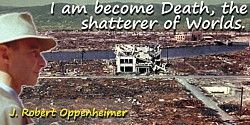
I am become death, The Shatterer of Worlds.
At the moment the first test atomic device exploded, Oppenheimer recalled a few lines from the 2,000-year-old Bhagavad Gita of India. This line is the most often quoted. In Abraham Pais and Robert P. Crease, J. Robert Oppenheimer: a Life (2006), 44. Also seen translated as “I am become Death, the destroyer of worlds.”
I am certain that none of the world’s problems … have any hope of solution except through total democratic society’s becoming thoroughly … self-educated.
In Critical Path (1982), 266.
I am confident that if we recommit ourselves to discovery; if we support science education to create the next generation of scientists and engineers right here in America; if we have the vision to believe and invest in things unseen, then we can lead the world into a new future of peace and prosperity.
From weekly Democratic address as President-Elect, online video (20 Dec 2008), announcing his selection of science and technology advisers. C-Span video 282995-102.
I am happy to report to you that the assignment of the Central Committee of the Communist party of the Soviet Union and the Soviet Government has been carried out. The world's first space flight has been accomplished in the Soviet space ship Vostok. All systems and equipment worked impeccably, I feel very well and am prepared to carry out any assignment of the party and the government.
Speech beside Khrushchev, at the tomb of Lenin and Stalin, Red Square, Moscow (14 Apr 1961). As quoted in Osgood Caruthers, 'Krushchev Leads Russian Tribute to Astronaut', New York Times (15 Apr 1961), 2.
I am one of those philosophers who have held that that “the Common Sense view of the world” is in certain fundamental features, wholly true.
In 'A Defence of Common Sense', J.H. Muirhead (ed.), Contemporary British Philosophy (1925). Reprinted in Philosophical Papers of George Edward Moore (1959), 44.
I am selling what the whole world wants: power.
In a letter to Catherine the Great of Russia offering steam engines for sale, in A Dictionary of Scientific Quotations by Alan L. Mackay (1991).
I am very astonished that the scientific picture of the real world around me is deficient. It gives a lot of factual information, puts all our experience in a magnificently consistent order, but it is ghastly silent about all and sundry that is really near to our heart, that really matters to us. It cannot tell us a word about red and blue, bitter and sweet, physical pain and physical delight; it knows nothing of beautiful and ugly, good or bad, God and eternity. Science sometimes pretends to answer questions in these domains, but the answers are very often so silly that we are not inclined to take them seriously.
…...
I appeal to the contemptible speech made lately by Sir Robert Peel to an applauding House of Commons. 'Orders of merit,' said he, 'were the proper rewards of the military' (the desolators of the world in all ages). 'Men of science are better left to the applause of their own hearts.' Most learned Legislator! Most liberal cotton-spinner! Was your title the proper reward of military prowess? Pity you hold not the dungeon-keys of an English Inquisition! Perhaps Science, like creeds, would flourish best under a little persecution.
Chemical Recreations (1834), 232.
I ask any one who has adopted the calling of an engineer, how much time he lost when he left school, because he had to devote himself to pursuits which were absolutely novel and strange, and of which he had not obtained the remotest conception from his instructors? He had to familiarize himself with ideas of the course and powers of Nature, to which his attention had never been directed during his school-life, and to learn, for the first time, that a world of facts lies outside and beyond the world of words.
From After-Dinner Speech (Apr 1869) delivered before the Liverpool Philomathic Society, 'Scientific Education', collected in Lay Sermons, Addresses, and Reviews (1870), 63. Previously published in Macmillan’s Magazine.
I believe in intuition and inspiration. Imagination is more important than knowledge. For knowledge is limited, whereas imagination embraces the entire world, stimulating progress, giving birth to evolution. It is, strictly speaking, a real factor in scientific research.
Cosmic Religion: With Other Opinions and Aphorisms (1931), 97.
I believe in Spinoza’s God, Who reveals Himself in the lawful harmony of the world, not in a God Who concerns Himself with the fate and the doings of mankind.
Response to cablegram from Rabbi Herbert Goldstein of the International Synagogue in New York, asking “Do you believe in God?” As quoted in Victor J. Stenger, Has Science Found God? (2003), 91.
I believe television is going to be the test of the modern world, and that in this new opportunity to see beyond the range of our vision we shall discover either a new and unbearable disturbance of the general peace or a saving radiance in the sky. We shall stand or fall by television—of that I am quite sure
In 'Removal' (Jul 1938), collected in One Man's Meat (1942), 3.
I believe with Schopenhauer that one of the strongest motives that lead men to art and science is escape from everyday life with its painful crudity and hopeless dreariness, from the fetters of one’s own ever shifting desires. A finely tempered nature longs to escape from personal life into the world of objective perception and thought; this desire may be compared with the townsman’s irresistible longing to escape from his noisy, cramped surroundings into the silence of high mountains, where the eye ranges freely through the still, pure air and fondly traces out the restful contours apparently built for eternity.
Address at The Physical Society, Berlin (1918) for Max Planck’s 60th birthday, 'Principles of Research', collected in Essays in Science (1934) 2.
I call upon the scientific community in our country, those who gave us nuclear weapons, to turn their great talents now to the cause of mankind and world peace, to give us the means of rendering those nuclear weapons impotent and obsolete.
About his proposed Strategic Defense Initiative, later to be known as 'Star Wars.')
About his proposed Strategic Defense Initiative, later to be known as 'Star Wars.')
National address (23 Mar 1983)
I came to biochemistry through chemistry; I came to chemistry, partly by the labyrinthine routes that I have related, and partly through the youthful romantic notion that the natural sciences had something to do with nature. What I liked about chemistry was its clarity surrounded by darkness; what attracted me, slowly and hesitatingly, to biology was its darkness surrounded by the brightness of the givenness of nature, the holiness of life. And so I have always oscillated between the brightness of reality and the darkness of the unknowable. When Pascal speaks of God in hiding, Deus absconditus, we hear not only the profound existential thinker, but also the great searcher for the reality of the world. I consider this unquenchable resonance as the greatest gift that can be bestowed on a naturalist.
Heraclitean Fire: Sketches from a Life before Nature (1978), 55.
I cannot, however, but think that the world would be better and brighter if our teachers would dwell on the Duty of Happiness as well as the Happiness of Duty; for we ought to be as cheerful as we can, if only because to be happy ourselves is a most effectual contribution to the happiness of others.
The Pleasures of Life (1887, 2007), 7.
I conclude therefore that this star [Tycho’s supernova] is not some kind of comet or a fiery meteor, whether these be generated beneath the Moon or above the Moon, but that it is a star shining in the firmament itself—one that has never previously been seen before our time, in any age since the beginning of the world.
In De Stella Nova, as translated in Dagobert D. Runes, A Treasury of World Science (1962), 108.
I despise Birth-Control first because it is ... an entirely meaningless word; and is used so as to curry favour even with those who would first recoil from its real meaning. The proceeding these quack doctors recommend does not control any birth. ... But these people know perfectly well that they dare not write the plain word Birth-Prevention, in any one of the hundred places where they write the hypocritical word Birth-Control. They know as well as I do that the very word Birth-Prevention would strike a chill into the public... Therefore they use a conventional and unmeaning word, which may make the quack medicine sound more innocuous. ... A child is the very sign and sacrament of personal freedom. He is a fresh will added to the wills of the world; he is something that his parents have freely chosen to produce ... he is their own creative contribution to creation.
In 'Babies and Distributism', The Well and the Shadows (1935). Collected in G. K. Chesterton and Dale Ahlquist (ed.), In Defense of Sanity: The Best Essays of G.K. Chesterton (2011), 272.
I do ... humbly conceive (tho' some possibly may think there is too much notice taken of such a trivial thing as a rotten Shell, yet) that Men do generally rally too much slight and pass over without regard these Records of Antiquity which Nature have left as Monuments and Hieroglyphick Characters of preceding Transactions in the like duration or Transactions of the Body of the Earth, which are infinitely more evident and certain tokens than any thing of Antiquity that can be fetched out of Coins or Medals, or any other way yet known, since the best of those ways may be counterfeited or made by Art and Design, as may also Books, Manuscripts and Inscriptions, as all the Learned are now sufficiently satisfied, has often been actually practised; but those Characters are not to be Counterfeited by all the Craft in the World, nor can they be doubted to be, what they appear, by anyone that will impartially examine the true appearances of them: And tho' it must be granted, that it is very difficult to read them, and to raise a Chronology out of them, and to state the intervalls of the Times wherein such, or such Catastrophies and Mutations have happened; yet 'tis not impossible, but that, by the help of those joined to ' other means and assistances of Information, much may be done even in that part of Information also.
Lectures and Discourses of Earthquakes (1668). In The Posthumous Works of Robert Hooke, containing his Cutlerian Lectures and other Discourses read at the Meetings of the Illustrious Royal Society (1705), 411.
![Isaac Newton Quote: like a boy playing on the seashore [pebbles]…whilst the great ocean of truth lay all undiscovered before me](https://todayinsci.com/N/Newton_Isaac/NewtonIsaac-SeashoreQuoteThm.jpg)
I do not know what I may appear to the world, but to myself I seem to have been only like a boy playing on the seashore, and diverting myself in now and then finding a smoother pebble or a prettier shell than ordinary, whilst the great ocean of truth lay all undiscovered before me.
First reported in Joseph Spence, Anecdotes, Observations and Characters, of Books and Men (1820), Vol. 1 of 1966 edn, sect. 1259, p. 462. Purported to have been addressed by Newton in the final year of his life (1727) to Chevalier Andrew Michael Ramsey (which conflicts with the Dictionary of National Biography article giving that he was in France at the time). Quoted in David Brewster, Memoirs of the Life, Writings, and Discoveries of Sir Isaac Newton (1855), Vol. 2, 407.
I do not think that G. H. Hardy was talking nonsense when he insisted that the mathematician was discovering rather than creating, nor was it wholly nonsense for Kepler to exult that he was thinking God's thoughts after him. The world for me is a necessary system, and in the degree to which the thinker can surrender his thought to that system and follow it, he is in a sense participating in that which is timeless or eternal.
'Reply to Lewis Edwin Hahn', The Philosophy of Brand Blanshard (1980), 901.
I don’t think many people remember what life was like in those days. This was the era when the Russians were claiming superiority, and they could make a pretty good case—they put up Sputnik in ’57; they had already sent men into space to orbit the earth. There was this fear that perhaps communism was the wave of the future. The astronauts, all of us, really believed we were locked in a battle of democracy versus communism, where the winner would dominate the world.
As reported by Howard Wilkinson in 'John Glenn Had the Stuff U.S. Heroes are Made of', The Cincinnati Enquirer (20 Feb 2002).
I feel a desperation to make people see what we are doing to the environment, what a mess we are making of our world. At this point, the more people I reach, the more I accomplish. … I miss Gombe and my wonderful years in the forest But if I were to go back to that, I wouldn’t feel I was doing what I should be doing.
Answering the question, “Why have you transferred your energies from animal research to activism?” From interview by Tamar Lewin, 'Wildlife to Tireless Crusader, See Jane Run', New York Times (20 Nov 2000), F35.
I feel very strongly indeed that a Cambridge education for our scientists should include some contact with the humanistic side. The gift of expression is important to them as scientists; the best research is wasted when it is extremely difficult to discover what it is all about ... It is even more important when scientists are called upon to play their part in the world of affairs, as is happening to an increasing extent.
From essay in Thomas Rice Henn, The Apple and the Spectroscope: Being Lectures on Poetry Designed (in the Main) for Science Students (1951), 142.
I find in Geology a never failing interest, as [it] has been remarked, it creates the same gran[d] ideas respecting this world, which Astronomy do[es] for the universe.—We have seen much fine scenery that of the Tropics in its glory & luxuriance, exceeds even the language of Humboldt to describe. A Persian writer could alone do justice to it, & if he succeeded he would in England, be called the 'grandfather of all liars'.— But I have seen nothing, which more completely astonished me, than the first sight of a Savage; It was a naked Fuegian his long hair blowing about, his face besmeared with paint. There is in their countenances, an expression, which I believe to those who have not seen it, must be inconceivably wild. Standing on a rock he uttered tones & made gesticulations than which, the cries of domestic animals are far more intelligible.
Letter to Charles Whitley, 23 July 1834. In F. Burkhardt and S. Smith (eds.), The Correspondence of Charles Darwin 1821-1836 (1985), Vol. I, 397.
I find myself now preaching about the golden age of manned spaceflight, because something went on there, within us, that we’re missing. When we went to the Moon, it was not only just standing on a new plateau for all mankind. We changed the way everybody in the world thought of themselves, you know. It was a change that went on inside of us. And we’re losing that.
From interview with Ron Stone (24 May 1999) for NASA Johnson Space Center Oral History Project on NASA website.
I find out what the world needs, then I proceed to invent. My main purpose in life is to make money so that I can afford to go on creating more inventions.
…...
I found out that the main ability to have was a visual, and also an almost tactile, way to imagine the physical situations, rather than a merely logical picture of the problems. … Very soon I discovered that if one gets a feeling for no more than a dozen … radiation and nuclear constants, one can imagine the subatomic world almost tangibly, and manipulate the picture dimensionally and qualitatively, before calculating more precise relationships.
In Adventures of a Mathematician (1976), 147.
I gambled on having the strength to live two lives, one for myself and one for the world.
Journal entry (in her late 30s), as quoted in Margaret Mead, 'Search: 1920-1930', An Anthropologist at Work (1959, 2011), 3.
I got a four year scholarship to Harvard, and while I was there they wanted to groom me for work in the Star Wars program designing weapons ignited by hydrogen bombs. I didn't want to do that. I thought about how many scientists had died in World War II.
Quoted in Nina L. Diamond, Voices of Truth (2000), 326.
I grew up in love with science, asking the same questions all children ask as they try to codify the world to find out what makes it work. “Who is the smartest person in the world?” and “Where is the tallest mountain in the world?” turned into questions like, “How big is the universe?” and “What is it that makes us alive?”
In Introduction to Isaac Asimov and Jason A. Shulman (eds.), Isaac Asimov’s Book of Science and Nature Quotations (1988), xix.
I had never doubted my own abilities, but I was quite prepared to believe that “the world” would decline to recognize them.
In Postscript to the Outsider (1967), 3.
I had no idea of the worldwide influence of it [the world’s first kidney transplant]. It expanded to other organs, multiple organs.
As quoted by Alvin Powell in 'A Transplant Makes History', Harvard Gazette (22 Sep 2011).
I had this experience at the age of eight. My parents gave me a microscope. I don’t recall why, but no matter. I then found my own little world, completely wild and unconstrained, no plastic, no teacher, no books, no anything predictable. At first I did not know the names of the water-drop denizens or what they were doing. But neither did the pioneer microscopists. Like them, I graduated to looking at butterfly scales and other miscellaneous objects. I never thought of what I was doing in such a way, but it was pure science. As true as could be of any child so engaged, I was kin to Leeuwenhoek, who said that his work “was not pursued in order to gain the praise I now enjoy, but chiefly from a craving after knowledge, which I notice resides in me more that most other men.”
In The Creation: An Appeal to Save Life on Earth (2010), 143-144.
I hate and fear 'science' because of my conviction that, for long to come if not for ever, it will be the remorseless enemy of mankind. I see it destroying all simplicity and gentleness of life, all the beauty of the world; I see it restoring barbarism under a mask of civilization; I see it darkening men's minds and hardening their hearts.
The Private Papers of Henry Ryecroft (1903), 268-9.
I have a vision of the world as a global village, a world without boundaries. Imagine a history teacher making history!
From an interview during her training. As quoted in Danielle Kovacs, 'Christa McAuliffe: Biography', record for Christa Corrigan McAuliffe Papers, Archives and Special Collections, Henry Whittemore Library on Framingham State College website.
I have always fancied that the end of the world will be when some enormous boiler, heated to three thousand millions of atmospheric pressure, shall explode and blow up the globe. ... They [the Americans] are great boilermakers.
Five Weeks in a Balloon (1863, 1962), 100.
I have always looked upon alchemy in natural philosophy to be like enthusiasm in divinity, and to have troubled the world much to the same.
In The Works of Sir William Temple, Bart (1814), 506.
I have always tried to fit knowledge that I acquired into my understanding of the world. … When something comes along that I don’t understand, that I can’t fit in, that bothers me, I think about it, mull over it, and perhaps ultimately do some work with it. That’s perhaps the reason that I’ve been able to make discoveries in molecular biology.
From interview with Neil A. Campbell, in 'Crossing the Boundaries of Science', BioScience (Dec 1986), 36, No. 11, 739.
I have always used the world of make-believe with a certain desperation.
In An Anthropologist at Work (1959, 2011), 140.
I have been branded with folly and madness for attempting what the world calls impossibilities, and even from the great engineer, the late James Watt, who said ... that I deserved hanging for bringing into use the high-pressure engine. This has so far been my reward from the public; but should this be all, I shall be satisfied by the great secret pleasure and laudable pride that I feel in my own breast from having been the instrument of bringing forward new principles and new arrangements of boundless value to my country, and however much I may be straitened in pecuniary circumstances, the great honour of being a useful subject can never be taken from me, which far exceeds riches.
From letter to Davies Gilbert, written a few months before Trevithick's last illness. Quoted in Francis Trevithick, Life of Richard Trevithick: With an Account of his Inventions (1872), Vol. 2, 395-6.
I have declared infinite worlds to exist beside this our earth. It would not be worthy of God to manifest Himself in less than an infinite universe.
…...
I have flown twice over Mount St. Helens out on our West Coast. I'm not a scientist and I don't know the figures, but I have a suspicion that that one little mountain has probably released more sulfur dioxide into the atmosphere of the world than has been released in the last ten years of automobile driving or things of that kind that people are so concerned about.
Address in Steubenville, Ohio (7 Oct 1980). As quoted in Douglas E. Kneeland, 'Teamsters Back Republican', New York Times (10 Oct 1980), D14. The article also stated that according to an E.P.A. spokesman, “all American manmade emissions of sulfur dioxide amounted to 81,000 tons a day, and the emissions from the volcano ranged from 500 to 2,000 tons a day.”
I have indeed lived and worked to my taste either in art or science. What more could a man desire? Knowledge has always been my goal. There is much that I shall leave behind undone…but something at least I was privileged to leave for the world to use, if it so intends…As the Latin poet said I will leave the table of the living like a guest who has eaten his fill. Yes, if I had another life to spend, I certainly would not waste it. But that cannot be, so why complain?
Letter to R. C. Craw, quoted in Tuatara (1984) Vol. 27 (1): 5-7
I have long since come to see that no one deserves either praise or blame for the ideas that come to him, but only for the actions resulting therefrom. Ideas and beliefs are certainly not voluntary acts. They come to us—we hardly know how or whence, and once they have got possession of us we can not reject or change them at will. It is for the common good that the promulgation of ideas should be free—uninfluenced by either praise or blame, reward or punishment. But the actions which result from our ideas may properly be so treated, because it is only by patient thought and work, that new ideas, if good and true, become adopted and utilized; while, if untrue or if not adequately presented to the world, they are rejected or forgotten.
In 'The Origin of the Theory of Natural Selection', Popular Science Monthly (1909), 74, 400.
I have never done anything 'useful'. No discovery of mine has made, or is likely to make, directly or indirectly, for good or ill, the least difference to the amenity of the world... Judged by all practical standards, the value of my mathematical life is nil; and outside mathematics it is trivial anyhow. I have just one chance of escaping a verdict of complete triviality, that I may be judged to have created something worth creating. And that I have created something is undeniable: the question is about its value.
A Mathematician's Apology (1940), 90-1.
I have never done anything “useful.” No discovery of mine has made, or is likely to make, directly or indirectly, for good or ill, the least difference to the amenity of the world... Judged by all practical standards, the value of my mathematical life is nil; and outside mathematics it is trivial anyhow. I have just one chance of escaping a verdict of complete triviality, that I may be judged to have created something worth creating. And that I have created something is undeniable: the question is about its value. [The things I have added to knowledge do not differ from] the creations of the other artists, great or small, who have left some kind of memorial beind them.
Concluding remarks in A Mathmatician's Apology (1940, 2012), 150-151.
I have never looked upon ease and happiness as ends in themselves–this critical basis I call the ideal of a pigsty. The ideals that have lighted my way, and time after time have given me new courage to face life cheerfully, have been Kindness, Beauty, and Truth. Without the sense of kinship with men of like mind, without the occupation with the objective world, the eternally unattainable in the field of art and scientific endeavors, life would have seemed empty to me. The trite objects of human efforts–possessions, outward success, luxury–have always seemed to me contemptible.
In 'What I Believe,' Forum and Century (1930).
I have not yet lost a feeling of wonder, and of delight, that this delicate motion should reside in all the things around us, revealing itself only to him who looks for it. I remember, in the winter of our first experiments, just seven years ago, looking on snow with new eyes. There the snow lay around my doorstep—great heaps of protons quietly precessing in the earth’s magnetic field. To see the world for a moment as something rich and strange is the private reward of many a discovery.
Opening remark, Nobel Lecture (11 Dec 1952).
I have now said enough to show you that it is indispensable for this country to have a scientific education in connexion with manufacturers, if we wish to outstrip the intellectual competition which now, happily for the world, prevails in all departments of industry. As surely as darkness follows the setting of the sun, so surely will England recede as a manufacturing nation, unless her industrial population become much more conversant with science than they are now.
In 'The Study of Abstract Science Essential to the Progress of Industry', Records of the School of Mines (1852) 1, 48.
I have presented the periodic table as a kind of travel guide to an imaginary country, of which the elements are the various regions. This kingdom has a geography: the elements lie in particular juxtaposition to one another, and they are used to produce goods, much as a prairie produces wheat and a lake produces fish. It also has a history. Indeed, it has three kinds of history: the elements were discovered much as the lands of the world were discovered; the kingdom was mapped, just as the world was mapped, and the relative positions of the elements came to take on a great significance; and the elements have their own cosmic history, which can be traced back to the stars.
In The Periodic Kingdom: A Journey Into the Land of the Chemical Elements (1995), Preface, viii.
I have therefore tried to show the tendency displayed throughout history, by the most profound investigators, to pass from the world of the senses to a world where vision becomes spiritual, where principles are elaborated, and from which the explorer emerges with conceptions and conclusions, to be approved or rejected according as they coincide with sensible things.
Heat, A Mode of Motion (1880, 1915), 6th ed., viii.
I have, also, a good deal of respect for the job they [physicists] did in the first months after Hiroshima. The world desperately needed information on this new problem in the daily life of the planet, and the physicists, after a slow start, did a good job of giving it to them. It hasn’t come out with a fraction of the efficiency that the teachers might have wished, but it was infinitely more effective than anyone would have dared expect.
In 'A Newsman Looks at Physicists', Physics Today (May 1948), 1, No. 1, 15.
I just wish the world was twice as big and half of it was still unexplored.
Epigraph Bruce L. Smith, Stories from Afield: Adventures with Wild Things in Wild Places (2016), Chap. 16, citing the TV program Life on Earth.
I know not with what weapons World War III will be fought, but World War IV will be fought with sticks and stones.
In interview, Alfred Werner, Liberal Judaism (Apr-May 1949), 16. Einstein Archive 30-1104. As cited in Alice Calaprice, The New Quotable Einstein (2005), 173.
I know well there are those who would have the Study of Nature restrained wholly to Observations; without ever proceeding further. But due Consideration, and a deeper Insight into Things, would soon have undeceived and made them sensible of their error. Assuredly, that man who should spend his whole life in amassing together stone, timber, and other materials for building, without ever at the making any use, or raising any fabrick out of them, might well be reputed very fantastic and extravagant. And a like censure would be his due, who should be perpetually heaping up of natural collections without design. building a structure of philosophy out of them, or advancing some propositions that might turn to the benefit and advantage of the world. This is in reality the true and only proper end of collections, of observations, and natural history: and they are of no manner of use or value without it.
In An Attempt Toward a Natural History of the Fossils of England (1729), xiii-xiv.
I learned a lot of different things from different schools. MIT is a very good place…. It has developed for itself a spirit, so that every member of the whole place thinks that it’s the most wonderful place in the world—it’s the center, somehow, of scientific and technological development in the United States, if not the world … and while you don’t get a good sense of proportion there, you do get an excellent sense of being with it and in it, and having motivation and desire to keep on…
From Surely You’re Joking, Mr. Feynman!: Adventures of a Curious Character (1985), 51.
I like to look at mathematics almost more as an art than as a science; for the activity of the mathematician, constantly creating as he is, guided though not controlled by the external world of the senses, bears a resemblance, not fanciful I believe but real, to the activity of an artist, of a painter let us say. Rigorous deductive reasoning on the part of the mathematician may be likened here to technical skill in drawing on the part of the painter. Just as no one can become a good painter without a certain amount of skill, so no one can become a mathematician without the power to reason accurately up to a certain point. Yet these qualities, fundamental though they are, do not make a painter or mathematician worthy of the name, nor indeed are they the most important factors in the case. Other qualities of a far more subtle sort, chief among which in both cases is imagination, go to the making of a good artist or good mathematician.
From 'Fundamental Conceptions and Methods in Mathematics', Bulletin American Mathematical Society (1904), 9, 133. As cited in Robert Édouard Moritz, Memorabilia Mathematica; Or, The Philomath’s Quotation-Book (1914), 182.
I love to race the best people in the world and the fastest people in the world.
…...
I maintain that the human mystery is incredibly demeaned by scientific reductionism, with its claim in promissory materialism to account eventually for all of the spiritual world in terms of patterns of neuronal activity. This belief must be classed as a superstition. ... We have to recognize that we are spiritual beings with souls existing in a spiritual world as well as material beings with bodies and brains existing in a material world.
In Evolution of the Brain: Creation of the Self (1991), 241.
I observed on most collected stones the imprints of innumerable plant fragments which were so different from those which are growing in the Lyonnais, in the nearby provinces, and even in the rest of France, that I felt like collecting plants in a new world… The number of these leaves, the way they separated easily, and the great variety of plants whose imprints I saw, appeared to me just as many volumes of botany representing in the same quarry the oldest library of the world.
In 'Examen des causes des Impressions des Plantes marquees sur certaines Pierres des environs de Saint-Chaumont dans le Lionnais', Memoires de l’ Academie Royale des Sciences (1718), 364, as trans. by Albert V. and Marguerite Carozzi.
I once heard a physicist and an editor discussing science news. The editor said, “If you told me that the world was flat, I’d put it in banner headlines.” The physicist replied, “I hope you’d also print a denial.” I cite that story … about the role of science in our society … that science is front-page news.
From Draft of Science Speech for Presidential Campaign (1960), held by the John F. Kennedy Presidential Library and Museum. Digital Identifier: JFKCAMP1960-0993-005.
I return to the newborn world, and the soft-soil fields,
What their first birthing lifted to the shores
Of light, and trusted to the wayward winds.
First the Earth gave the shimmer of greenery
And grasses to deck the hills; then over the meadows
The flowering fields are bright with the color of springtime,
And for all the trees that shoot into the air.
What their first birthing lifted to the shores
Of light, and trusted to the wayward winds.
First the Earth gave the shimmer of greenery
And grasses to deck the hills; then over the meadows
The flowering fields are bright with the color of springtime,
And for all the trees that shoot into the air.
On the Nature of Things, trans. Anthony M. Esolen (1995) Book 5, lines 777-84, 181.
I saw Eternity the other night,
Like a great Ring of pure and endless light,
All calm, as it was bright;
And round beneath it,
Time, in hours, days, years,
Driv’n by the spheres
Like a vast shadow mov’d; in which the world
And all her train were hurl’d.
Like a great Ring of pure and endless light,
All calm, as it was bright;
And round beneath it,
Time, in hours, days, years,
Driv’n by the spheres
Like a vast shadow mov’d; in which the world
And all her train were hurl’d.
In 'The World', in Silex Scintillans (1650), 91.
I see trees of green, red roses too,
I see them bloom for me and you,
And I think to myself, what a wonderful world.
I see them bloom for me and you,
And I think to myself, what a wonderful world.
Verse of song made popular by Louis Armstrong, written by George Weiss and Bob Thiele
I sell here, Sir, what all the world desires to have—POWER.
About the improved steam engine invented by James Watt and brought into production at Boulton’s manufactory.
About the improved steam engine invented by James Watt and brought into production at Boulton’s manufactory.
Entry for Friday 22 March 1776. In George Birkbeck-Hill (ed.), Boswell’s Life of Johnson (1934-50), Vol. 2, 459.
I shall explain a System of the World differing in many particulars from any yet known, answering in all things to the common Rules of Mechanical Motions: This depends upon three Suppositions. First, That all Cœlestial Bodies whatsoever, have an attraction or gravitating power towards their own Centers, whereby they attract not only their own parts, and keep them from flying from them, as we may observe the Earth to do, but that they do also attract all the other Cœlestial bodies that are within the sphere of their activity; and consequently that not only the Sun and Moon have an influence upon the body and motion the Earth, and the Earth upon them, but that Mercury also Venus, Mars, Saturn and Jupiter by their attractive powers, have a considerable influence upon its motion in the same manner the corresponding attractive power of the Earth hath a considerable influence upon every one of their motions also. The second supposition is this, That all bodies whatsoever that are put into a direct and simple motion, will continue to move forward in a streight line, till they are by some other effectual powers deflected and bent into a Motion, describing a Circle, Ellipse, or some other more compounded Curve Line. The third supposition is, That these attractive powers are so much the more powerful in operating, by how much the nearer the body wrought upon is to their own Centers. Now what these several degrees are I have not yet experimentally verified; but it is a notion, which if fully prosecuted as it ought to be, will mightily assist the Astronomer to reduce all the Cœlestial Motions to a certain rule, which I doubt will never be done true without it. He that understands the nature of the Circular Pendulum and Circular Motion, will easily understand the whole ground of this Principle, and will know where to find direction in Nature for the true stating thereof. This I only hint at present to such as have ability and opportunity of prosecuting this Inquiry, and are not wanting of Industry for observing and calculating, wishing heartily such may be found, having myself many other things in hand which I would first compleat and therefore cannot so well attend it. But this I durst promise the Undertaker, that he will find all the Great Motions of the World to be influenced by this Principle, and that the true understanding thereof will be the true perfection of Astronomy.
An Attempt to Prove the Motion of the Earth from Observations (1674), 27-8. Based on a Cutlerian Lecture delivered by Hooke at the Royal Society four years earlier.
I should like to urge some arguments for wilderness preservation that involve recreation,…. Hunting, fishing, hiking, mountain-climbing, camping, photography, and the enjoyment of natural scenery will all, surely, figure in your report. So will the wilderness as a genetic reserve, a scientific yardstick by which we may measure the world in its natural balance against the world in its man-made imbalance.
Letter (3 Dec 1960) written to David E. Pesonen of the Outdoor Recreation Resources Review Commission. Collected in 'Coda: Wilderness Letter', The Sound of Mountain Water: The Changing American West (1969), 145-146.
I sometimes hear preachers speak of the sad condition of men who live without God in the world, but a scientist who lives without God in the world seems to me worse off than ordinary men.
As quoted in E.P. Whipple, 'Recollections of Agassiz', in Henry Mills Alden (ed.), Harper's New Monthly Magazine (June 1879), 59, 103.
I stand almost with the others. They believe the world was made for man, I believe it likely that it was made for man; they think there is proof, astronomical mainly, that it was made for man, I think there is evidence only, not proof, that it was made for him. It is too early, yet, to arrange the verdict, the returns are not all in. When they are all in, I think that they will show that the world was made for man; but we must not hurry, we must patiently wait till they are all in.
Attributed.
I suppose that I tend to be optimistic about the future of physics. And nothing makes me more optimistic than the discovery of broken symmetries. In the seventh book of the Republic, Plato describes prisoners who are chained in a cave and can see only shadows that things outside cast on the cave wall. When released from the cave at first their eyes hurt, and for a while they think that the shadows they saw in the cave are more real than the objects they now see. But eventually their vision clears, and they can understand how beautiful the real world is. We are in such a cave, imprisoned by the limitations on the sorts of experiments we can do. In particular, we can study matter only at relatively low temperatures, where symmetries are likely to be spontaneously broken, so that nature does not appear very simple or unified. We have not been able to get out of this cave, but by looking long and hard at the shadows on the cave wall, we can at least make out the shapes of symmetries, which though broken, are exact principles governing all phenomena, expressions of the beauty of the world outside.
In Nobel Lecture (8 Dec 1989), 'Conceptual Foundations of the Unified Theory of Weak and Electromagnetic Interactions.' Nobel Lectures: Physics 1971-1980 (1992), 556.
I suspect that the changes that have taken place during the last century in the average man's fundamental beliefs, in his philosophy, in his concept of religion. in his whole world outlook, are greater than the changes that occurred during the preceding four thousand years all put together. ... because of science and its applications to human life, for these have bloomed in my time as no one in history had had ever dreamed could be possible.
In The Autobiography of Robert A. Millikan (1951, 1980), xii.
I suspect that the most important effect of World War II on physical science lay in the change in the attitude of people to science. The politicians and the public were convinced that science was useful and were in no position to argue about the details. A professor of physics might be more sinister than he was in the 1930s, but he was no longer an old fool with a beard in a comic-strip. The scientists or at any rate the physicists, had changed their attitude. They not only believed in the interest of science for themselves, they had acquired also a belief that the tax-payer should and would pay for it and would, in some unspecified length of run, benefit by it.
'The Effect of World War II on the Development of Knowledge in the Physical Sciences', Proceedings of the Royal Society of London, 1975, Series A, 342, 532.
I think every child born on this planet up to the age of about four or five is fascinated by the natural world. If they aren’t it’s because we deprive them of the opportunity. Over half the world’s population is urbanised and the thought that some children may grow up not looking at a pond or knowing how plants grow is a terrible thing. If you lose that delight and joy and intoxication, you’ve lost something hugely precious.
From interview with Alice Roberts, 'Attenborough: My Life on Earth', The Biologist (Aug 2015), 62, No. 4, 14.
I think it [the World Series] should be called the World Sequence.
As given in essay, Ronald Coifman and Robert S. Strichartz, 'The School of Antoni Zygmund', collected in Peter Duren (ed.), A Century of Mathematics in America (1989), 348. The essay states Zygmund was “walking past a lounge in the University of Chicago that was filled with a loud crowd watching TV, he asked one of his students what was going on. The student told him that the crowd was watching the World Series and explained to him some of the features of this baseball phenomenon. Zygmund thought about it all for a few minutes and commented” with the subject quote above. The authors acknowledge students of Zygmund provided personal recollections to them for the essay in general. Webmaster speculates the quote is from a student recollection, and not necessarily verbatim.
I think it’s time we recognized the Dark Ages are over. Galileo and Copernicus have been proven right. The world is in fact round; the Earth does revolve around the sun. I believe God gave us intellect to differentiate between imprisoning dogma and sound ethical science, which is what we must do here today.
Debating federal funding for stem cell research as Republican Representative (CT).
Debating federal funding for stem cell research as Republican Representative (CT).
In Eve Herold, George Daley, Stem Cell Wars (2007), 57.
I think that the difference between pure and applied mathematics is social rather than scientific. A pure mathematician is paid for making mathematical discoveries. An applied mathematician is paid for the solution of given problems.
When Columbus set sail, he was like an applied mathematician, paid for the search of the solution of a concrete problem: find a way to India. His discovery of the New World was similar to the work of a pure mathematician.
When Columbus set sail, he was like an applied mathematician, paid for the search of the solution of a concrete problem: find a way to India. His discovery of the New World was similar to the work of a pure mathematician.
In S.H. Lui, 'An Interview with Vladimir Arnol’d', Notices of the AMS (Apr 1997) 44, No. 4, 438. Reprinted from the Hong Kong Mathematics Society (Feb 1996).
I think that the unity we can seek lies really in two things. One is that the knowledge which comes to us at such a terrifyingly, inhumanly rapid rate has some order in it. We are allowed to forget a great deal, as well as to learn. This order is never adequate. The mass of ununderstood things, which cannot be summarized, or wholly ordered, always grows greater; but a great deal does get understood.
The second is simply this: we can have each other to dinner. We ourselves, and with each other by our converse, can create, not an architecture of global scope, but an immense, intricate network of intimacy, illumination, and understanding. Everything cannot be connected with everything in the world we live in. Everything can be connected with anything.
The second is simply this: we can have each other to dinner. We ourselves, and with each other by our converse, can create, not an architecture of global scope, but an immense, intricate network of intimacy, illumination, and understanding. Everything cannot be connected with everything in the world we live in. Everything can be connected with anything.
Concluding paragraphs of 'The Growth of Science and the Structure of Culture', Daedalus (Winter 1958), 87, No. 1, 76.
I think that there is a world market for about five computers.
Quoted in C. Cerf and V. Navasky (eds.), The Experts Speak (1984), 208.
I think that we reject the evidence that our world is changing because we are still, as that wonderfully wise biologist E. O. Wilson reminded us, tribal carnivores. We are programmed by our inheritance to see other living things as mainly something to eat, and we care more about our national tribe than anything else. … . We still find alien the concept that we and the rest of life, from bacteria to whales, are parts of the much larger and diverse entity, the living Earth.
In The Revenge of Gaia (2006).
I think there is something more important than believing: Action! The world is full of dreamers, there aren’t enough who will move ahead and begin to take concrete steps to actualize their vision.
…...
I think this case will be remembered because it is the first case of this sort since we stopped trying people in America for witchcraft, because here we have done our best to turn back the tide that has sought to force itself upon this modern world, of testing every fact in science by a religious dictum.
Final remarks to the Court after the jury verdict was read at the Scopes Monkey Trial Eighth day's proceedings (21 Jul 1925) in John Thomas Scopes, The World's Most Famous Court Trial: Tennessee Evolution Case: a Complete Stenographic Report of the Famous Court Test of the Tennessee Anti-Evolution Act, at Dayton, July 10 to 21, 1925, Including Speeches and Arguments of Attorneys (1925), 316.
I think we are beginning to suspect that man is not a tiny cog that doesn’t really make much difference to the running of the huge machine but rather that there is a much more intimate tie between man and the universe than we heretofore suspected. … [Consider if] the particles and their properties are not somehow related to making man possible. Man, the start of the analysis, man, the end of the analysis—because the physical world is, in some deep sense, tied to the human being.
In The Intellectual Digest (Jun 1973), as quoted and cited in Mark Chandos, 'Philosophical Essay: Story Theory", Kosmoautikon: Exodus From Sapiens (2015).
I think we may picture those domains where understanding exists, whether in physics, chemistry, biology, psychology, economics or any other discipline as cultivated valleys in a formidably mountainous country. We may recognise in principle that we all inhabit the same world but in practice we do well to cultivate our own valleys, with an occasional assault on the more accessible foothills, rather than to build roads in a vain attempt at colonisation.
From Inaugural Lecture as Cavendish Professor of Physics, Cambridge, as quoted in Gordon L. Glegg, The Development of Design (1981), 1-2.
I thought that the wisdom of our City had certainly designed the laudable practice of taking and distributing these accompts [parish records of christenings and deaths] for other and greater uses than [merely casual comments], or, at least, that some other uses might be made of them; and thereupon I ... could, and (to be short) to furnish myself with as much matter of that kind ... the which when I had reduced into tables ... so as to have a view of the whole together, in order to the more ready comparing of one Year, Season, Parish, or other Division of the City, with another, in respect of all Burials and Christnings, and of all the Diseases and Casualties happening in each of them respectively...
Moreover, finding some Truths and not-commonly-believed opinions to arise from my meditations upon these neglected Papers, I proceeded further to consider what benefit the knowledge of the same would bring to the world, ... with some real fruit from those ayrie blossoms.
Moreover, finding some Truths and not-commonly-believed opinions to arise from my meditations upon these neglected Papers, I proceeded further to consider what benefit the knowledge of the same would bring to the world, ... with some real fruit from those ayrie blossoms.
From Natural and Political Observations Mentioned in a Following Index and Made upon Bills of Mortality (1662), Preface. Reproduced in Cornelius Walford, The Insurance Cyclopaedia (1871), Vol. 1, 286-287.
I trust ... I have succeeded in convincing you that modern chemistry is not, as it has so long appeared, an ever-growing accumulation of isolated facts, as impossible for a single intellect to co-ordinate as for a single memory to grasp.
The intricate formulae that hang upon these walls, and the boundless variety of phenomena they illustrate, are beginning to be for us as a labyrinth once impassable, but to which we have at length discovered the clue. A sense of mastery and power succeeds in our minds to the sort of weary despair with which we at first contemplated their formidable array. For now, by the aid of a few general principles, we find ourselves able to unravel the complexities of these formulae, to marshal the compounds which they represent in orderly series; nay, even to multiply their numbers at our will, and in a great measure to forecast their nature ere we have called them into existence. It is the great movement of modern chemistry that we have thus, for an hour, seen passing before us. It is a movement as of light spreading itself over a waste of obscurity, as of law diffusing order throughout a wilderness of confusion, and there is surely in its contemplation something of the pleasure which attends the spectacle of a beautiful daybreak, something of the grandeur belonging to the conception of a world created out of chaos.
The intricate formulae that hang upon these walls, and the boundless variety of phenomena they illustrate, are beginning to be for us as a labyrinth once impassable, but to which we have at length discovered the clue. A sense of mastery and power succeeds in our minds to the sort of weary despair with which we at first contemplated their formidable array. For now, by the aid of a few general principles, we find ourselves able to unravel the complexities of these formulae, to marshal the compounds which they represent in orderly series; nay, even to multiply their numbers at our will, and in a great measure to forecast their nature ere we have called them into existence. It is the great movement of modern chemistry that we have thus, for an hour, seen passing before us. It is a movement as of light spreading itself over a waste of obscurity, as of law diffusing order throughout a wilderness of confusion, and there is surely in its contemplation something of the pleasure which attends the spectacle of a beautiful daybreak, something of the grandeur belonging to the conception of a world created out of chaos.
Concluding remark for paper presented at the Friday Discourse of the the Royal Institution (7 Apr 1865). 'On the Combining Power of Atoms', Proceedings of the Royal Institution (1865), 4, No. 42, 416.
I try in my prints to testify that we live in a beautiful and orderly world, and not in a formless chaos, as it sometimes appears.
(1965). As quoted in Michele Emmer and Doris Schattschneider, M.C. Escher’s Legacy: A Centennial Celebration (2007), 71.
I used to get so depressed about the environment. … But I feel much better since I joined my Environmental Grief Counseling Group, which is a wonderful New Age approach to gaining the personal serenity you need in a world of melting ice caps, shrinking rain forests, and toxic lakes.
In 'Stop Beaching, Think Positive', Mother Jones Magazine (Oct 1988), 14, No. 8, 8.
I venture to assert that the feelings one has when the beautiful symbolism of the infinitesimal calculus first gets a meaning, or when the delicate analysis of Fourier has been mastered, or while one follows Clerk Maxwell or Thomson into the strange world of electricity, now growing so rapidly in form and being, or can almost feel with Stokes the pulsations of light that gives nature to our eyes, or track with Clausius the courses of molecules we can measure, even if we know with certainty that we can never see them I venture to assert that these feelings are altogether comparable to those aroused in us by an exquisite poem or a lofty thought.
In paper (May 1891) read before Bath Branch of the Teachers’ Guild, published in The Practical Teacher (July 1891), reprinted as 'Geometry', in Frederic Spencer, Chapters on the Aims and Practice of Teaching (1897), 194.
I venture to maintain, that, if the general culture obtained in the Faculty of Arts were what it ought to be, the student would have quite as much knowledge of the fundamental principles of Physics, of Chemistry, and of Biology, as he needs, before he commenced his special medical studies. Moreover, I would urge, that a thorough study of Human Physiology is, in itself, an education broader and more comprehensive than much that passes under that name. There is no side of the intellect which it does not call into play, no region of human knowledge into which either its roots, or its branches, do not extend; like the Atlantic between the Old and the New Worlds, its waves wash the shores of the two worlds of matter and of mind; its tributary streams flow from both; through its waters, as yet unfurrowed by the keel of any Columbus, lies the road, if such there be, from the one to the other; far away from that Northwest Passage of mere speculation, in which so many brave souls have been hopelessly frozen up.
'Universities: Actual and Ideal' (1874). In Collected Essays (1893), Vol. 3, 220.
I waited for Rob and, linking arms, we took our final steps together onto the rooftop of the world. It was 8.15 am on 24 May 2004; there was nowhere higher on the planet that we could go, the world lay at our feet. Holding each other tightly, we tried to absorb where we were. To be standing here, together, exactly three years since Rob’s cancer treatment, was nothing short of a miracle. Standing on top of Everest was more than just climbing a mountain - it was a gift of life. With Pemba and Nawang we crowded together, wrapping our arms around each other. They had been more than Sherpas, they had been our guardian angels.
— Jo Gambi
…...
I want to know how God created this world. I am not interested in this or that phenomenon, in the spectrum of this or that element. I want to know His thoughts; the rest are details.
From Esther Salaman, 'A Talk with Einstein', The Listener (Sep 1955), 54, 370, as quoted and cited in Don Lincoln, 'God’s Thoughts: Practical Steps Toward a Theory of Everything', The Physics Teacher (Apr 2017), 55, No. 4, 204. Quoted, without citation, in Ronald William Clark, The Life and Times Einstein: An Illustrated Biography (1984), 19. Also given in Max Jammer, Einstein and Religion: Physics and Theology (1999), 123. The wording of the quote may not be verbatim, since Salaman is recollecting a conversation during a walk with Einstein to his office. Another source dates this event in 1905. [Webmaster has not yet seen the full text of the Salaman article to verify. If you have it, please contact webmaster.]
I wanted certainty in the kind of way in which people want religious faith. I thought that certainty is more likely to be found in mathematics than elsewhere. But I discovered that many mathematical demonstrations, which my teachers expected me to accept, were full of fallacies, and that, if certainty were indeed discoverable in mathematics, it would be in a new field of mathematics, with more solid foundations than those that had hitherto been thought secure. But as the work proceeded, I was continually reminded of the fable about the elephant and the tortoise. Having constructed an elephant upon which the mathematical world could rest, I found the elephant tottering, and proceeded to construct a tortoise to keep the elephant from falling. But the tortoise was no more secure than the elephant, and after some twenty years of very arduous toil, I came to the conclusion that there was nothing more that I could do in the way of making mathematical knowledge indubitable.
In 'Reflections on my Eightieth Birthday', Portraits from Memory (1956), 54.
I wanted to be a scientist from my earliest school days. The crystallizing moment came when I first caught on that stars are mighty suns, and how staggeringly far away they must be to appear to us as mere points of light. I’m not sure I even knew the word science then, but I was gripped by the prospect of understanding how things work, of helping to uncover deep mysteries, of exploring new worlds.
In 'With Science on Our Side', Washington Post (9 Jan 1994).
I was suffering from a sharp attack of intermittent fever, and every day during the cold and succeeding hot fits had to lie down for several hours, during which time I had nothing to do but to think over any subjects then particularly interesting me. One day something brought to my recollection Malthus's 'Principles of Population', which I had read about twelve years before. I thought of his clear exposition of 'the positive checks to increase'—disease, accidents, war, and famine—which keep down the population of savage races to so much lower an average than that of more civilized peoples. It then occurred to me that these causes or their equivalents are continually acting in the case of animals also; and as animals usually breed much more rapidly than does mankind, the destruction every year from these causes must be enormous in order to keep down the numbers of each species, since they evidently do not increase regularly from year to year, as otherwise the world would long ago have been densely crowded with those that breed most quickly. Vaguely thinking over the enormous and constant destruction which this implied, it occurred to me to ask the question, Why do some die and some live? The answer was clearly, that on the whole the best fitted live. From the effects of disease the most healthy escaped; from enemies, the strongest, swiftest, or the most cunning; from famine, the best hunters or those with the best digestion; and so on. Then it suddenly flashed upon me that this self-acting process would necessarily improve the race, because in every generation the inferior would inevitably be killed off and the superior would remain—that is, the fittest would survive.
[The phrase 'survival of the fittest,' suggested by the writings of Thomas Robert Malthus, was expressed in those words by Herbert Spencer in 1865. Wallace saw the term in correspondence from Charles Darwin the following year, 1866. However, Wallace did not publish anything on his use of the expression until very much later, and his recollection is likely flawed.]
[The phrase 'survival of the fittest,' suggested by the writings of Thomas Robert Malthus, was expressed in those words by Herbert Spencer in 1865. Wallace saw the term in correspondence from Charles Darwin the following year, 1866. However, Wallace did not publish anything on his use of the expression until very much later, and his recollection is likely flawed.]
My Life: A Record of Events and Opinions (1905), Vol. 1, 361-362, or in reprint (2004), 190.
I will not now discuss the Controversie betwixt some of the Modern Atomists, and the Cartesians; the former of whom think, that betwixt the Earth and the Stars, and betwixt these themselves there are vast Tracts of Space that are empty, save where the beams of Light do pass through them; and the later of whom tell us, that the Intervals betwixt the Stars and Planets (among which the Earth may perhaps be reckon'd) are perfectly fill'd, but by a Matter far subtiler than our Air, which some call Celestial, and others Æther. I shall not, I say, engage in this controversie, but thus much seems evident, That If there be such a Celestial Matter, it must ' make up far the Greatest part of the Universe known to us. For the Interstellar part of the world (If I may so stile it) bears so very great a proportion to the Globes, and their Atmospheres too, (If other Stars have any as well as the Earth,) that It Is almost incomparably Greater in respect of them, than all our Atmosphere is in respect of the Clouds, not to make the comparison between the Sea and the Fishes that swim in it.
A Continuation of New Experiments Physico-Mechanical, Touching the Spring and Weight of the Air, and their Effects (1669), 127.
I will write peace on your wings and you will fly all over the world.
As given in United States Committee for Cooperation with the Japan Council Against A and H Bombs, Report from Hiroshima (1961), 48. The report says Sadako murmured these (translated) words while on her deathbed, holding one of the paper cranes she had folded.
I would be content that we might procreate like trees, without conjunction, or that there were any way to perpetuate the World without this trivial and vulgar way of coition.
I would like it if everyone could make the prejudice vanish as I have that there is really a problem whether ants are machines, whether my brother is a machine, whether we are in the world, or the world is in us, if perhaps behind the word there is matter, power pushes or not, or if Locke is right that the intellect is between us and things. Or whether we are free or not free…
Given as “fashioned from Boltzmann’s notes for his lecture on natural philosophy on October 26, 1904” and translated in John Blackmore (ed.), Ludwig Boltzmann: His Later Life and Philosophy, 1900-1906 (1995), 136. Blackmore indicates (p.133) that since Boltzmann spoke freely, this may not be verbatim for what he actually said, because he did not read his lectures from his notes. However, it does “rather accurately represent his thinking” at the time he wrote his lecture. His Lectures on Natural Philosophy (1903-1906) were reconstructed from Boltzmann’s shorthand notes by Ilse M. Fasol-Boltzmann (ed.), in Ludwig Boltzmann Principien der Naturfolosofti (1990). This quote is translated from p.109.
I would rather live in a world where my life is surrounded by mystery than live in a world so small that my mind could comprehend it.
'The Mystery of Life', Riverside Sermons (1958), 22.
I would teach the world that science is the best way to understand the world, and that for any set of observations, there is only one correct explanation. Also, science is value-free, as it explains the world as it is. Ethical issues arise only when science is applied to technology – from medicine to industry.
Response to question “What is the one thing everyone should learn about science?” in 'Life Lessons' The Guardian (7 Apr 2005).
I wrote a booklet on the evil effects of the cigarette, and more than a million copies of it were distributed on the battle-front in France. About the same time, the New York World, was raising money to send hundreds of tons of cigarettes to our soldiers.
In Hudson Maxim and Clifton Johnson, 'Smoking, Swearing, and Perfumery', Hudson Maxim: Reminiscences and Comments (1924), 234. The quote is as reported by Clifton Johnson, based on interviews with Hudson Maxim.
I'm not saying … I'm gonna change the world, but I guarantee you that I will spark the brain that will change the world.
From interview on MTV (1994).
I’m one of those people that think Thomas Edison and the light bulb changed the world more than Karl Marx ever did.
Expressing his reason for having no interest in a public sector role in politics. Interview with Rolling Stone writer, Steven Levy (late Nov 1983). As quoted in Nick Bilton, 'The 30-Year-Old Macintosh and a Lost Conversation With Steve Jobs' (24 Jan 2014), on New York Times blog web page. Levy appended a transcript of the interview to an updated Kindle version of his book, Insanely Great: The Life and Times of Macintosh, the Computer that Changed Everything.
I’ve always been inspired by Dr. Martin Luther King, who articulated his Dream of an America where people are judged not by skin color but “by the content of their character.” In the scientific world, people are judged by the content of their ideas. Advances are made with new insights, but the final arbitrator of any point of view are experiments that seek the unbiased truth, not information cherry picked to support a particular point of view.
In letter (1 Feb 2013) to Energy Department employees announcing his decision not to serve a second term.
I’ve been very involved in science literacy because it’s critically important in our world today. … As a public, we’re asked to vote on issues, we’re asked to accept explanations, we’re asked to figure out what to do with our own health care, and you can’t do that unless you have some level of science literacy. Science literacy isn’t about figuring out how to solve equations like E=MC². Rather, it’s about being able to read an article in the newspaper about the environment, about health care and figuring out how to vote on it. It’s about being able to prepare nutritious meals. It’s about being able to think your way through the day.
As quoted in 'Then & Now: Dr. Mae Jemison' (19 Jun 2005) on CNN web site.
I've known rivers:
I've known rivers ancient as the world and older than the flow of human blood in human veins.
My soul has grown deep like the rivers.
I've known rivers ancient as the world and older than the flow of human blood in human veins.
My soul has grown deep like the rivers.
The Negro Speaks of Rivers (1926).
Ideas go booming through the world like cannon. Thoughts are mightier than armies.
In Hialmer Day Gould, New Practical Spelling (1905), 19
If a child is to keep alive his inborn sense of wonder, he needs the companionship of at least one adult who can share it, rediscovering with him the joy, excitement and mystery of the world we live in.
The Sense of Wonder, Harper & Row (1965)
If a little less time was devoted to the translation of letters by Julius Caesar describing Britain 2000 years ago and a little more time was spent on teaching children how to describe (in simple modern English) the method whereby ethylene was converted into polythene in 1933 in the ICI laboratories at Northwich, and to discussing the enormous social changes which have resulted from this discovery, then I believe that we should be training future leaders in this country to face the world of tomorrow far more effectively than we are at the present time.
Quoted in an Obituary, D. P. Craig, Biographical Memoirs of Fellows of the Royal Society (1972), 18, 461.
If a man write a better book, preach a better sermon, or make a better mouse-trap than his neighbour, tho' he build his house in the woods, the world will make a beaten path to his door.
Attributed to Emerson by Sarah S. B. Yule, in her book Borrowings (compiled 1889, published 1893). Mrs Yule was quoted in The Docket (Feb 1912), that she wrote this in her notebook of memorable statements during an Emerson address. The Docket thus disproved Elbert Hubbard's claim to its authorship.
If all mankind were to disappear, the world would regenerate back to the rich state of equilibrium that existed ten thousand years ago. If insects were to vanish, the environment would collapse into chaos.
In Rosemarie Jarski, Words From The Wise (2007), 269. [Contact webmaster if you know the primary print source.]
If atomic bombs are to be added as new weapons to the arsenals of a warring world, or to the arsenals of nations preparing for war, then the time will come when mankind will curse the names of Los Alamos and Hiroshima. The people must unite, or they will perish.
Speech at Fuller Lodge when the U.S. Army was honouring the work at Los Alamos. (16 Oct 1945). Quoted in Kai Bird, Martin J. Sherwin, American Prometheus: the Triumph and Tragedy of J. Robert Oppenheimer (2005), 323.
If Christianity were pruned of all which is not Christ, this religion would be the simplest in the world.
From Appendix A, 'Extracts From the Unpublished Writings of Carnot', Reflections on the Motive Power of Heat (1890, 2nd ed. 1897), 216
If Darwin were alive today the insect world would delight and astound him with its impressive verification of his theories of the survival of the fittest. Under the stress of intensive chemical spraying the weaker members of the insect populations are being weeded out… . Only the strong and fit remain to defy our efforts to control them.
In Silent Spring (1952, 1962), 263.
If every drug in the world were abolished a physician would still be a useful member of society.
As quoted in Sir William Withey Gull and Theodore Dyke Acland (ed.), A Collection of the Published Writings of William Withey Gull (1896), xxv.
If God did create the world by a word, the word would have been hydrogen.
Attributed, without source, in Johns S. Rigden, Hydrogen: The Essential Element (2003), 6. If you know the primary source, please contact Webmaster.
If I had influence with the good fairy who is supposed to preside over the christening of all children, I should ask that her gift to each child in the world be a sense of wonder so indestructible that it would last throughout life, as an unfailing antidote against the boredom and disenchantment of later years, the sterile preoccupation with things that are artificial, the alienation from the sources of our strength.
In The Sense of Wonder (1956, 1984), 42-43. First published in 'Help Your Child to Wonder', Womans Home Companion (Jul 1956), 24-27 & 46-48.
If I were emperor of the world, I would put the pedal to the floor on energy efficiency and conservation for the next decade.
Interview with Reuters (2007). Quoted in Ayesha Rascoe, 'Obama energy pick strong green voice: experts' on Reuters website (posted 11 Dec 2008).
If many a man did not feel obliged to repeat what is untrue, because he has said it once, the world would have been quite different.
In The Maxims and Reflections of Goethe (1906), 196.
If matter is not eternal, its first emergence into being is a miracle beside which all others dwindle into absolute insignificance. But, as has often been pointed out, the process is unthinkable; the sudden apocalypse of a material world out of blank nonentity cannot be imagined; its emergence into order out of chaos when “without form and void” of life, is merely a poetic rendering of the doctrine of its slow evolution.
In Nineteenth Century (Sep c.1879?). Quoted in John Tyndall, 'Professor Virchow and Evolution', Fragments of Science (1879), Vol. 2, 377.
If my theory of relativity is proven successful, Germany will claim me as a German and France will declare I am a citizen of the world. Should my theory prove untrue, France will say I am a German and Germany will declare I am a Jew.
In Speech (6 Apr 1922) to the French Philosophical Society, Sorbonne. Quoted in Alice Calaprice, The Quotable Einstein (1996), 8.
If one small and odd lineage of fishes had not evolved fins capable of bearing weight on land (though evolved for different reasons in lakes and seas,) terrestrial vertebrates would never have arisen. If a large extraterrestrial object—the ultimate random bolt from the blue—had not triggered the extinction of dinosaurs 65 million years ago, mammals would still be small creatures, confined to the nooks and crannies of a dinosaur's world, and incapable of evolving the larger size that brains big enough for self-consciousness require. If a small and tenuous population of protohumans had not survived a hundred slings and arrows of outrageous fortune (and potential extinction) on the savannas of Africa, then Homo sapiens would never have emerged to spread throughout the globe. We are glorious accidents of an unpredictable process with no drive to complexity, not the expected results of evolutionary principles that yearn to produce a creature capable of understanding the mode of its own necessary construction.
Full House: The Spread of Excellence from Plato to Darwin (1996), 216.
If one were to bring ten of the wisest men in the world together and ask them what was the most stupid thing in existence, they would not be able to discover anything so stupid as astrology.
Quoted in D MacHale, Comic Sections (1993)
If our so-called facts are changing shadows, they are shadows cast by the light of constant truth. So too in religion we are repelled by that confident theological doctrine… but we need not turn aside from the measure of light that comes into our experience showing us a Way through the unseen world.
Swarthmore Lecture (1929) at Friends’ House, London, printed in Science and the Unseen World (1929), 91.
If physicists could not quote in the text, they would not feel that much was lost with respect to advancement of knowledge of the natural world. If historians could not quote, they would deem it a disastrous impediment to the communication of knowledge about the past. A luxury for physicists, quotation is a necessity for historians, indispensable to historiography.
Historiography (1968), 385.
If physics leads us today to a world view which is essentially mystical, it returns, in a way, to its beginning, 2,500 years ago. ... This time, however, it is not only based on intuition, but also on experiments of great precision and sophistication, and on a rigorous and consistent mathematical formalism.
In The Tao of Physics (1975), 19.
If science has no country, the scientist should have one, and ascribe to it the influence which his works may have in this world.
Address at the Inauguration of the Pasteur Institute (14 Nov 1888). In René Vallery-Radot, The Life of Pasteur, translated by Mrs. R. L. Devonshire (1919), 443.
If scientific reasoning were limited to the logical processes of arithmetic, we should not get very far in our understanding of the physical world. One might as well attempt to grasp the game of poker entirely by the use of the mathematics of probability.
Endless Horizons (1946), 27.
If the mysterious influence to which the dissymmetry of nature is due should come to change in sense or direction, the constituting elements of all living beings would take an inverse dissymmetry. Perhaps a new world would be presented to us. Who could foresee the organization of living beings, if the cellulose, which is right, should become left, if the left albumen of the blood should become right? There are here mysteries which prepare immense labours for the future, and from this hour invite the most serious meditations in science.
Lecture (3 Feb 1860), to the Chemical Society of Paris, 'On the Molecular Dissymetry of Natural Organic Products', reprinted in The Chemical News and Journal of Industrial Science (3 May 1862), 5, No. 126, 248.
If the radiance of a thousand suns
Were to burst at once into the sky
That would be like the splendour of the Mighty One …
I am become Death,
The shatterer of worlds.
Were to burst at once into the sky
That would be like the splendour of the Mighty One …
I am become Death,
The shatterer of worlds.
His thoughts in reaction to viewing the fireball of the Trinity test of the first atomic bomb at Alamogordo, N.M. (16 Jul 1945). Fragments from Sacred Hindu Epic, Bhagavad-Gita. Quoted in A. Berry (ed.), The Book of Scientific Anecdotes (1989), 175.
If the resident zoologist of Galaxy X had visited the earth 5 million years ago while making his inventory of inhabited planets in the universe, he would surely have corrected his earlier report that apes showed more promise than Old World monkeys and noted that monkeys had overcome an original disadvantage to gain domination among primates. (He will confirm this statement after his visit next year–but also add a footnote that one species from the ape bush has enjoyed an unusual and unexpected flowering, thus demanding closer monitoring.)
…...
If the world goes crazy for a lovely fossil, that's fine with me. But if that fossil releases some kind of mysterious brain ray that makes people say crazy things and write lazy articles, a serious swarm of flies ends up in my ointment.
Criticism of excessive media hype about a fossil discovery, from blog 'The Loom' (19 May 2009) on Discover magazine website.
If the world had but a dozen Arbuthnots I would burn my [Gulliver's] Travels.
Letter to Pope, dated 29 Sep 1725, when Arbuthnot was seriously ill
Letter to Pope, dated 29 Sep 1725, when Arbuthnot was seriously ill
Jonathan Swift, Thomas Sheridan (ed.) John Nichols (ed.) The Works of the Rev. Jonathan Swift, (1808) , Vol. 11, 297-8.
If the world has begun with a single quantum, the notions of space and would altogether fail to have any meaning at the beginning; they would only begin to have a sensible meaning when the original quantum had been divided into a sufficient number of quanta. If this suggestion is correct, the beginning of the world happened a little before the beginning of space and time. I think that such a beginning of the world is far enough from the present order of Nature to be not at all repugnant. It may be difficult to follow up the idea in detail as we are not yet able to count the quantum packets in every case. For example, it may be that an atomic nucleus must be counted as a unique quantum, the atomic number acting as a kind of quantum number. If the future development of quantum theory happens to turn in that direction, we could conceive the beginning of the universe in the form of a unique atom, the atomic weight of which is the total mass of the universe. This highly unstable atom would divide in smaller and smaller atoms by a kind of super-radioactive process.
In a seminal short letter (457 words), 'The Beginning of the World from the Point of View of Quantum Theory', Nature (9 May 1931), 127, 706.
If the world is turning, even the church can’t stop it; if it isn’t turning, nobody can go out and make it turn.
From the play Galileo Galilei (2001) .
If the world may be thought of as a certain definite quantity of force and as a certain definite number of centers of force—and every other representation remains indefinite and therefore useless—it follows that, in the great dice game of existence, it must pass through calculable number of combinations. In infinite time, every possible combination would at some time or another be realized; more: it would be realized an infinite number of times. And since between every combination and its next recurrence all other possible combinations would have to take place, and each of these combination conditions of the entire sequence of combinations in the same series, a circular movement of absolutely identical series is thus demonstrated: the world as a circular movement that has already repeated itself infinitely often and plays its game in infinitum. This conception is not simply a mechanistic conception; for if it were that, it would not condition an infinite recurrence of identical cases, but a final state. Because the world has not reached this, mechanistic theory must be considered an imperfect and merely provisional hypothesis.
The Will to Power (Notes written 1883-1888), book 4, no. 1066. Trans. W. Kaufmann and R. J. Hollingdale and ed. W. Kaufmann (1968), 549.
If there is any work in the world which cannot be so well finished by another as by him who has commenced it, it is that at which I labour.
In Discours de la Méthode (1637). In English from John Veitch (trans.), A Discourse on Method (1912), 57.
If there is anything in the world which I do firmly believe in, it is the universal validity of the law of causation.
'Science and Morals' (1886). In Collected Essays (1994), Vol. 9, 121.
If there is such a thing as luck, then I must be the most unlucky fellow in the world. I’ve never once made a lucky strike in all my life. When I get after something that I need, I start finding everything in the world that I don’t need—one damn thing after another. I find ninety-nine things that I don’t need, and then comes number one hundred, and that—at the very last—turns out to be just what I had been looking for.
In Martin André Rosanoff, 'Edison in His Laboratory', Harper’s Magazine (Sep 1932), 406.
If to-day you ask a physicist what he has finally made out the æther or the electron to be, the answer will not be a description in terms of billiard balls or fly-wheels or anything concrete; he will point instead to a number of symbols and a set of mathematical equations which they satisfy. What do the symbols stand for? The mysterious reply is given that physics is indifferent to that; it has no means of probing beneath the symbolism. To understand the phenomena of the physical world it is necessary to know the equations which the symbols obey but not the nature of that which is being symbolised. …this newer outlook has modified the challenge from the material to the spiritual world.
Swarthmore Lecture (1929) at Friends’ House, London, printed in Science and the Unseen World (1929), 30.
If we [humans] disappeared overnight, the world would probably be better off.
Interview about Life In The Undergrowth (book and TV series on insects), The Daily Telegraph (12 Nov 2005).
If we and the rest of the backboned animals were to disappear overnight, the rest of the world would get on pretty well. But if [the invertebrates] were to disappear, the world’s ecosystems would collapse. disappear, the land’s ecosystems would collapse. The soil would lose its fertility. Many of the plants would no longer be pollinated. Lots of animals, amphibians, reptiles, birds, mammals would have nothing to eat. And our fields and pastures would be covered with dung and carrion.
From BBC TV series Life in the Undergrowth (2005). As cited in Simon Barnes, History of the World in 100 Animals (2020), end of Chap. 72.
If we drove an automobile the way we try to run civilization, I think we would face backwards, looking through the back window, admiring where we came from, and not caring where we are going. If you want a good life you must look to the future. … I think it is all right to have courses in history. But history is the “gonest” thing in the world. … Let’s keep history, but let’s take a small part of the time and study where we are going. … We can do something about the unmade history.
As quoted in book review, T.A. Boyd, 'Charles F. Kettering: Prophet of Progress', Science (30 Jan 1959), 256.
If we had a complete knowledge of all events in the world, everywhere and at all times, there would be no use for the laws of physics, or, in fact, of any other science. … They might give us a certain pleasure and perhaps amazement to contemplate, even though they would not furnish new information.
In Symmetries and Reflections: Scientific Essays of Eugene P. Wigner (1979), 17.
If we lived on a planet where nothing ever changed, there would be little to do. There would be nothing to figure out. There would be no impetus for science. And if we lived in an unpredictable world, where things changed in random or very complex ways, we would not be able to figure things out. But we live in an in-between universe, where things change, but according to patterns, rules, or as we call them, laws of nature. If I throw a stick up in the air, it always falls down. If the sun sets in the west, it always rises again the next morning in the east. And so it becomes possible to figure things out. We can do science, and with it we can improve our lives.
Cosmos (1980, 1985), 32.
If we look round the world, there seem to be not above six distinct varieties in the human species, each of which is strongly marked, and speaks the kind seldom to have mixed with any other. But there is nothing in the shape, nothing in the faculties, that shows their coming from different originals; and the varieties of climate, of nourishment, and custom, are sufficient to produce every change.
In History of the Earth and Animated Nature (1774, 1812), Vol. 2, 154.
If we stay strong, then I believe we can stabilize the world and have peace based on force. Now, peace based on force is not as good as peace based on agreement, but … I think that for the time being the only peace that we can have is the peace based on force.
From debate (20 Feb 1958) between Linus Pauling and Edward Teller on WQED-TV, San Francisco. Transcript published as Fallout and Disarmament: The Pauling-Teller Debate (1958). Reprinted in 'Fallout and Disarmament: A Debate between Linus Pauling and Edward Teller', Daedalus (Spring 1958), 87, No. 2, 154.
If we take a survey of our own world … our portion in the immense system of creation, we find every part of it, the earth, the waters, and the air that surround it, filled, and as it were crouded with life, down from the largest animals that we know of to the smallest insects the naked eye can behold, and from thence to others still smaller, and totally invisible without the assistance of the microscope. Every tree, every plant, every leaf, serves not only as an habitation, but as a world to some numerous race, till animal existence becomes so exceedingly refined, that the effluvia of a blade of grass would be food for thousands.
In The Age of Reason: Being an Investigation of True and Fabulous Theology (27 Jan O.S. 1794), 60. The word “crouded” is as it appears in the original.
If we were bees, ants, or Lacedaemonian warriors, to whom personal fear does not exist and cowardice is the most shameful thing in the world, warring would go on forever. But luckily we are only men—and cowards.
In first Tarner Lecture, at Trinity College, Cambridge (Oct 1956), 'The Physical Basis of Consciousness', printed in Mind and Matter (1958), 14. Also collected in What is Life?: With Mind and Matter and Autobiographical Sketches (1992, 2012), 102.
If we wish to make a new world we have the material ready. The first one, too, was made out of chaos.
…...
If words are not things, or maps are not the actual territory, then, obviously, the only possible link between the objective world and the linguistic world is found in structure, and structure alone.
Science and Sanity: An Introduction to Non-Aristotelian Systems and General Semantics (1958), 61.
If you advertise to tell lies, it will ruin you, but if you advertise to tell the public the truth, and particularly to give information, it will bring you success. I learned early that to tell a man how best to use tires, and to make him want them, was far better than trying to tell him that your tire is the best in the world. If you believe that yours is, let your customer find it out.
As quoted by H.M. Davidson, in System: The Magazine of Business (Apr 1922), 41, 446.
If you ask ... the man in the street ... the human significance of mathematics, the answer of the world will be, that mathematics has given mankind a metrical and computatory art essential to the effective conduct of daily life, that mathematics admits of countless applications in engineering and the natural sciences, and finally that mathematics is a most excellent instrumentality for giving mental discipline... [A mathematician will add] that mathematics is the exact science, the science of exact thought or of rigorous thinking.
Address (28 Mar 1912), Michigan School Masters' Club, Ann Arbor, 'The Humanization of the Teaching of Mathematics. Printed in Science (26 Apr 1912). Collected in The Human Worth of Rigorous Thinking: Essays and Addresses (1916), 65-66.
If you dream of something worth doing and then simply go to work on it and don't think anything of personalities, or emotional conflicts, or of money, or of family distractions; if you think of, detail by detail, what you have to do next, it is a wonderful dream even though the end is a long way off, for there are about five thousand steps to be taken before we realize it; and [when you] start taking the first ten, and ... twenty after that, it is amazing how quickly you get through through the four thousand [nine hundred] and ninety. The last ten steps you never seem to work out. But you keep on coming nearer to giving the world something.
Victor K. McElheny, Insisting on the Impossible (1999), 1.
If you look right, you can see the whole world from wherever you happen to be.
As quoted by Karin Lipson in 'The World's Wonders, In an Ecologist's Eyes', New York Times (27 Feb 2011), LI 11.
If you look the right way, you can see that the whole world is a garden.
The Secret Garden. Quoted in Kim Lim (ed.), 1,001 Pearls of Spiritual Wisdom: Words to Enrich, Inspire, and Guide Your Life (2014), 22
If you want to achieve conservation, the first thing you have to do is persuade people that the natural world is precious, beautiful, worth saving and complex. If people don’t understand that and don’t believe that in their hearts, conservation doesn't stand a chance. That’s the first step, and that is what I do.
From interview with Michael Bond, 'It’s a Wonderful Life', New Scientist (14 Dec 2002), 176, No. 2373, 48.
If you want to kill any idea in the world, get a committee working on it.
If you want to succeed in this world you don’t have to be much cleverer than other people, you just have to be one day earlier.
In Leo Szilard: His Version of the Facts edited by S. R. Weart and G. W. Szilard (1978).
If you will have your laws obeyed without mutiny. see well that they be pieces of God Almighty’s Law; otherwise, all the artillery in the world will not keep down mutiny.
In History of Friedrich II. of Prussia: Called Frederick the Great (1869), 128.
If, as I have reason to believe, I have disintegrated the nucleus of the atom, this is of greater significance than the war.
[Apology to the international anti-submarine committee for being absent from several meetings during World War I.]
[Apology to the international anti-submarine committee for being absent from several meetings during World War I.]
(Jun 1919). Quoted in D. Wilson, Rutherford: Simple Genius (1983), 405, as cited in Laurie M. Brown, Abraham Pais, Brian Pippard, Twentieth Century Physics (1995), Vol. 1, 113.
Imaginary numbers are a fine and wonderful refuge of the divine spirit almost an amphibian between being and non-being. (1702)
[Alternate translation:] The Divine Spirit found a sublime outlet in that wonder of analysis, that portent of the ideal world, that amphibian between being and not-being, which we call the imaginary root of negative unity.
[Alternate translation:] The Divine Spirit found a sublime outlet in that wonder of analysis, that portent of the ideal world, that amphibian between being and not-being, which we call the imaginary root of negative unity.
Quoted in Félix Klein, Elementary Mathematics From an Advanced Standpoint: Arithmetic, Algebra, Analysis (1924), 56. Alternate translation as quoted in Tobias Dantzig, Number, the Language of Science: a Critical Survey Written for the Cultured Non-Mathematician (1930), 204
Imagination is the Discovering Faculty, pre-eminently. … It is that which feels & discovers what is, the REAL which we see not, which exists not for our senses. … Mathematical science shows what is. It is the language of unseen relations between things. … Imagination too shows what is. … Hence she is or should be especially cultivated by the truly Scientific, those who wish to enter into the worlds around us!
Lovelace Papers, Bodleian Library, Oxford University, 175, folio 199, journal entry for 5 Jan 1841. As quoted and cited in Dorothy Stein (ed.), 'In Time I Will Do All, I Dare Say', Ada: A Life and a Legacy (1985), 128.
Imagination will often carry us to worlds that never were. But without it we go nowhere.
In Cosmos (1980), 4.
Imagine that … the world is something like a great chess game being played by the gods, and we are observers of the game. … If we watch long enough, we may eventually catch on to a few of the rules…. However, we might not be able to understand why a particular move is made in the game, merely because it is too complicated and our minds are limited…. We must limit ourselves to the more basic question of the rules of the game.
If we know the rules, we consider that we “understand” the world.
If we know the rules, we consider that we “understand” the world.
In 'Basic Physics', The Feynman Lectures on Physics (1964, 2013), Vol. 1, 2-1.
Imagine the world so greatly magnified that particles of light look like twenty-four-pound cannon balls.
As given, without source, in James Geary, Geary's Guide to the World's Great Aphorists (2008), 341.
In 1944 Erwin Schroedinger, stimulated intellectually by Max Delbruck, published a little book called What is life? It was an inspiration to the first of the molecular biologists, and has been, along with Delbruck himself, credited for directing the research during the next decade that solved the mystery of how 'like begat like.' Max was awarded this Prize in 1969, and rejoicing in it, he also lamented that the work for which he was honored before all the peoples of the world was not something which he felt he could share with more than a handful. Samuel Beckett's contributions to literature, being honored at the same time, seemed to Max somehow universally accessible to anyone. But not his. In his lecture here Max imagined his imprisonment in an ivory tower of science.
'The Polymerase Chain Reaction', Nobel Lecture (8 Dec 1993). In Nobel Lectures: Chemistry 1991-1995 (1997), 103.
In 1975, ... [speaking with Shiing Shen Chern], I told him I had finally learned ... the beauty of fiber-bundle theory and the profound Chern-Weil theorem. I said I found it amazing that gauge fields are exactly connections on fiber bundles, which the mathematicians developed without reference to the physical world. I added, “this is both thrilling and puzzling, since you mathematicians dreamed up these concepts out of nowhere.” He immediately protested: “No, no. These concepts were not dreamed up. They were natural and real.”
In 'Einstein's Impact on Theoretical Physics', collected in Jong-Ping Hsu, Leonard Hsu (eds.), JingShin Theoretical Physics Symposium in Honor of Professor Ta-You Wu (1998), 70. Reprinted from Physics Today (Jun 1980), 49. The article was adapted from a talk given at the Second Marcel Grossman meeting, held in Trieste, Italy (Jul 1979), in honor of the 100th anniversary of the birth of Albert Einstein.
In a great number of the cosmogonic myths the world is said to have developed from a great water, which was the prime matter. In many cases, as for instance in an Indian myth, this prime matter is indicated as a solution, out of which the solid earth crystallized out.
In Theories of Solutions (1912), 1.
In a sense, genetics grew up as an orphan. In the beginning botanists and zoologists were often indifferent and sometimes hostile toward it. “Genetics deals only with superficial characters”, it was often said. Biochemists likewise paid it little heed in its early days. They, especially medical biochemists, knew of Garrod’s inborn errors of metabolism and no doubt appreciated them in the biochemical sense and as diseases; but the biological world was inadequately prepared to appreciate fully the significance of his investigations and his thinking. Geneticists, it should be said, tended to be preoccupied mainly with the mechanisms by which genetic material is transmitted from one generation to, the next.
'Genes and Chemical Reactions In Neurospora', Nobel Lecture, 11 Dec 1958. In Nobel Lectures: Physiology or Medicine 1942-1962 (1964), 598.
In a time of drastic change it is the learners who inherit the future. The learned usually find themselves equipped to live in a world that no longer exists.
In Reflections on the Human Condition (1973), 22.
In a world created by natural selection, homogeneity means vulnerability.
In 'Unmined Riches', The Diversity of Life (1992), 301.
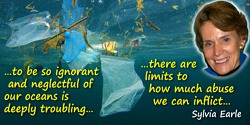
In a world that is rightly so concerned about climate change and the atmosphere, to be so ignorant and neglectful of our oceans is deeply troubling. However, … having woken up to this living disaster and having realized that there are limits to how much abuse we can inflict, it’s not too late to turn things around.
In 'Can We Stop Killing Our Oceans Now, Please?', Huffington Post (14 Aug 2013).
In Cairo, I secured a few grains of wheat that had slumbered for more than thirty centuries in an Egyptian tomb. As I looked at them this thought came into my mind: If one of those grains had been planted on the banks of the Nile the year after it grew, and all its lineal descendants had been planted and replanted from that time until now, its progeny would to-day be sufficiently numerous to feed the teeming millions of the world. An unbroken chain of life connects the earliest grains of wheat with the grains that we sow and reap. There is in the grain of wheat an invisible something which has power to discard the body that we see, and from earth and air fashion a new body so much like the old one that we cannot tell the one from the other.…This invisible germ of life can thus pass through three thousand resurrections.
In In His Image (1922), 33.
In essence, science is a perpetual search for an intelligent and integrated comprehension of the world we live in.
In Matthew M. Radmanesh, Cracking the Code of Our Physical Universe (2006), 248.
In every case the awakening touch has been the mathematical spirit, the attempt to count, to measure, or to calculate. What to the poet or the seer may appear to be the very death of all his poetry and all his visions—the cold touch of the calculating mind,—this has proved to be the spell by which knowledge has been born, by which new sciences have been created, and hundreds of definite problems put before the minds and into the hands of diligent students. It is the geometrical figure, the dry algebraical formula, which transforms the vague reasoning of the philosopher into a tangible and manageable conception; which represents, though it does not fully describe, which corresponds to, though it does not explain, the things and processes of nature: this clothes the fruitful, but otherwise indefinite, ideas in such a form that the strict logical methods of thought can be applied, that the human mind can in its inner chamber evolve a train of reasoning the result of which corresponds to the phenomena of the outer world.
In A History of European Thought in the Nineteenth Century (1896), Vol. 1, 314.
In every living being there exists a capacity for endless diversity of form; each possesses the power of adapting its organization to the variations of the external world, and it is this power, called into activity by cosmic changes, which has enabled the simple zoophytes of the primitive world to climb to higher and higher stages of organization, and has brought endless variety into nature.
From Gottfried Reinold Treviranus, Biologie, oder Philosophie der lebenden Natur [Biology, or Philosophy of Animate Nature], quoted in Lecture 1, August Weismann (1904, 2nd German ed.) as translated in August Weismann, Margaret R. Thomson (trans.), The Evolution Theory, Vol 1., 18-19.
In every thing that relates to science, I am a whole Encyclopaedia behind the rest of the world.
In 'The Old and the New Schoolmaster', The Essays of Elia (1823, 1835), 53.
In her starry shade
Of dim and solitary loveliness,
I learn the language of another world.
Of dim and solitary loveliness,
I learn the language of another world.
In honoring the Wright Brothers, it is customary and proper to recognize their contribution to scientific progress. But I believe it is equally important to emphasize the qualities in their pioneering life and the character in man that such a life produced. The Wright Brothers balanced sucess with modesty, science with simplicity. At Kitty Hawk their intellects and senses worked in mutual support. They represented man in balance, and from that balance came wings to lift a world.
Speech, quoted in Leonard Mosley, Lindbergh (2000), 347. In 1949, Lindbergh gave a speech when he received the Wright Brothers Memorial Trophy.
In its essence, the theory of natural selection is primarily an attempt to give an account of the probable mechanism of the origin of the adaptations of the organisms to their environment, and only secondarily an attempt to explain evolution at large. Some modern biologists seem to believe that the word 'adaptation' has teleological connotations, and should therefore be expunged from the scientific lexicon. With this we must emphatically disagree. That adaptations exist is so evident as to be almost a truism, although this need not mean that ours is the best of all possible worlds. A biologist has no right to close his eyes to the fact that the precarious balance between a living being and its environment must be preserved by some mechanism or mechanisms if life is to endure.
Genetics and Origin of Species (1937), 150.
In its most primitive form, life is, therefore, no longer bound to the cell, the cell which possesses structure and which can be compared to a complex wheel-work, such as a watch which ceases to exist if it is stamped down in a mortar. No, in its primitive form life is like fire, like a flame borne by the living substance;—like a flame which appears in endless diversity and yet has specificity within it;—which can adopt the form of the organic world, of the lank grass-leaf and of the stem of the tree.
Address given at the 1913 meeting of the Koninklijke Akademie van Wetenschappen in Amsterdam. Trans. in G. Van Iterson, Jr, L. E. Den Dooren De Jong and A. J. Kluyver, Martinus Willem Beilerinck: His Life and Work (1940), 120.
In light of new knowledge ... an eventual world state is not just desirable in the name of brotherhood, it is necessary for survival ... Today we must abandon competition and secure cooperation. This must be the central fact in all our considerations of international affairs; otherwise we face certain disaster. Past thinking and methods did not prevent world wars. Future thinking must prevent wars.
…...
In man, population structure reaches its greatest complexity. Mankind—the human species, Homo sapiens—is the most inclusive Mendelian population, one which inhabits nearly the whole globe.
In Radiation, Genes, and Man (1959), 102.
In man’s brain the impressions from outside are not merely registered; they produce concepts and ideas. They are the imprint of the external world upon the human brain. Therefore, it is not surprising that, after a long period of searching and erring, some of the concepts and ideas in human thinking should have come gradually closer to the fundamental laws of the world, that some of our thinking should reveal the true structure of atoms and the true movements of the stars. Nature, in the form of man, begins to recognize itself.
In Knowledge and Wonder (1962).
In many cases, mathematics is an escape from reality. The mathematician finds his own monastic niche and happiness in pursuits that are disconnected from external affairs. Some practice it as if using a drug. Chess sometimes plays a similar role. In their unhappiness over the events of this world, some immerse themselves in a kind of self-sufficiency in mathematics. (Some have engaged in it for this reason alone.)
In Adventures of a Mathematician (1976), 120.
In mathematics it is notorious that we start from absurdities to reach a realm of law, and our whole (mathematical) conception of the world is based on a foundation which we believe to have no existence.
In The Dance of Life (1923), 86.
In my opinion there is no other salvation for civilization and even for the human race than the creation of a world government with security on the basis of law. As long as there are sovereign states with their separate armaments and armament secrets, new world wars cannot be avoided.
Interview comment reported in 'For a World Government: Einstein Says This is Only Way to Save Mankind', New York Times (15 Sep 1945), 11.
In natural history, great discovery often requires a map to a hidden mine filled with gems then easily gathered by conventional tools, not a shiny new space-age machine for penetrating previously inaccessible worlds.
…...
In neurophysiology we have none of those vast tidal waves of discovery which shake the world to its foundations and which have such incalculable consequences for good or evil.
From Speech (10 Dec 1963) at the Nobel Banquet in Stockholm, Sweden. Collected inGöran Liljestrand (ed.), Les Prix Nobel en 1963, (1964).
In one of my lectures many years ago I used the phrase “following the trail of light”. The word “light” was not meant in its literal sense, but in the sense of following an intellectual concept or idea to where it might lead. My interest in living things is probably a fundamental motivation for the scientific work in the laboratory, and we created here in Berkeley one of the first and foremost interdisciplinary laboratories in the world.
In autobiography, Following the Trail of Light: A Scientific Odyssey (1992), 134.
In order that the relations between science and the age may be what they ought to be, the world at large must be made to feel that science is, in the fullest sense, a ministry of good to all, not the private possession and luxury of a few, that it is the best expression of human intelligence and not the abracadabra of a school, that it is a guiding light and not a dazzling fog.
'Hindrances to Scientific Progress', The Popular Science Monthly (Nov 1890), 38, 121.
In order to drive the individuals towards reproduction, sexuality had therefore to be associated with some other devices. Among these was pleasure. … Thus pleasure appears as a mere expedient to push individuals to indulge in sex and therefore to reproduce. A rather successful expedient indeed as judged by the state of the world population.
In 'Evolution and Tinkering,' Science, June 10, 1977.
In other branches of science, where quick publication seems to be so much desired, there may possibly be some excuse for giving to the world slovenly or ill-digested work, but there is no such excuse in mathematics. The form ought to be as perfect as the substance, and the demonstrations as rigorous as those of Euclid. The mathematician has to deal with the most exact facts of Nature, and he should spare no effort to render his interpretation worthy of his subject, and to give to his work its highest degree of perfection. “Pauca sed matura” was Gauss’s motto.
In Presidential Address British Association for the Advancement of Science, Section A, (1890), Nature, 42, 467. [The Latin motto translates as “Few, but ripe”. —Webmaster]
In outer space you develop an instant global consciousness, a people orientation, an intense dissatisfaction with the state of the world, and a compulsion to do something about it. From out there on the moon, international politics look so petty. You want to grab a politician by the scruff of the neck and drag him a quarter of a million miles out and say, “Look at that, you son of a bitch.”
…...
In pure mathematics we have a great structure of logically perfect deductions which constitutes an integral part of that great and enduring human heritage which is and should be largely independent of the perhaps temporary existence of any particular geographical location at any particular time. … The enduring value of mathematics, like that of the other sciences and arts, far transcends the daily flux of a changing world. In fact, the apparent stability of mathematics may well be one of the reasons for its attractiveness and for the respect accorded it.
In Fundamentals of Mathematics (1941), 463.
In scientific investigations it is grievously wrong to pander to the public’s impatience for results, or to let them think that for discovery it is necessary only to set up a great manufactory and a system of mass production. If in treatment team work is effective, in research it is the individual who counts first and above all. No great thought has ever sprung from anything but a single mind, suddenly conceiving. Throughout the whole world there has been too violent a forcing of the growth of ideas; too feverish a rush to perform experiments and publish conclusions. A year of vacation for calm detachment with all the individual workers thinking it all over in a desert should be proclaimed.
In Viewless Winds: Being the Recollections and Digressions of an Australian Surgeon (1939), 286.
In scientific thought we adopt the simplest theory which will explain all the facts under consideration and enable us to predict new facts of the same kind. The catch in this criterion lies in the world “simplest.” It is really an aesthetic canon such as we find implicit in our criticisms of poetry or painting. The layman finds such a law as dx/dt = κ(d²x/dy²) much less simple than “it oozes,” of which it is the mathematical statement. The physicist reverses this judgment, and his statement is certainly the more fruitful of the two, so far as prediction is concerned. It is, however, a statement about something very unfamiliar to the plain man, namely the rate of change of a rate of change.
In 'Science and Theology as Art-Forms', Possible Worlds (1927), 227.
In shades of black and blue the skies do bow as darkness falls the lights go out.
Nature softly immersed in glee as all mankind drifts off to sleep.
Water breathes a sigh of relief now aquatic creatures can do as they please.
Animals whether large or small regain the natural instincts that man has fought.
The moon shines bright he’s happy too people can’t over-ride his rules.
Midnight calms the wounds of the world the break of dawn disperses new hope...
Nature softly immersed in glee as all mankind drifts off to sleep.
Water breathes a sigh of relief now aquatic creatures can do as they please.
Animals whether large or small regain the natural instincts that man has fought.
The moon shines bright he’s happy too people can’t over-ride his rules.
Midnight calms the wounds of the world the break of dawn disperses new hope...
…...
In some remote corner of the universe, poured out and glittering in innumerable solar systems, there once was a star on which clever animals invented knowledge. That was the haughtiest and most mendacious minute of ‘world history’—yet only a minute. After nature had drawn a few breaths the star grew cold, and the clever animals had to die. ... There have been eternities when [human intellect] did not exist; and when it is done for again, nothing will have happened.
…...
In the animal world we have seen that the vast majority of species live in societies, and that they find in association the best arms for the struggle for life: understood, of course, in its wide Darwinian sense—not as a struggle for the sheer means of existence, but as a struggle against all natural conditions unfavourable to the species. The animal species, in which individual struggle has been reduced to its narrowest limits, and the practice of mutual aid has attained the greatest development, are invariably the most numerous, the most prosperous, and the most open to further progress. The mutual protection which is obtained in this case, the possibility of attaining old age and of accumulating experience, the higher intellectual development, and the further growth of sociable habits, secure the maintenance of the species, its extension, and its further progressive evolution. The unsociable species, on the contrary, are doomed to decay.
Mutual Aid: A Factor of Evolution (1902), 293.
In the animal world, on the other hand, the process of evolution is characterised by the progressive discrimination of the animal and vegetative functions, and a consequent differentiation of these two great provinces into their separate departments.
In the beginning God created Heaven and Earth … Which beginning of time, according to our Cronologie, fell upon the entrance of the night preceding the twenty third day of Octob. in the year of the Julian Calendar, 710 [or 4004 B.C.]. Upon the first day therefore of the world, or Octob. 23. being our Sunday, God, together with the highest Heaven, created the Angels. Then having finished, as it were, the roofe of this building, he fell in hand with the foundation of this wonderfull Fabrick of the World, he fashioned this lowermost Globe, consisting of the Deep, and of the Earth; all the Quire of Angels singing together and magnifying his name therefore … And when the Earth was void and without forme, and darknesse covered the face of the Deepe, on the very middle of the first day, the light was created; which God severing from the darknesses, called the one day, and the other night.
In 'Annals of the Old Testament', The Annals of the World (1658), excerpted in Louis A. Ruprecht, God Gardened East: A Gardener's Meditation on the Dynamics of Genesis (2008), 53-54.
In the center of everything rules the sun; for who in this most beautiful temple could place this luminary at another better place whence it can light up the whole at once? … In fact, the sun sitting on his royal throne guides the family of stars surrounding him. … In this arrangement we thus find an admirable harmony of the world, and a constant harmonious connection between the motion and the size of the orbits as could not be found otherwise.
In De Revolutionibus Orbium Coelestium (1543), Book 1, Ch. 10. As translated in Hermann Kesten, Copernicus and his World (1945), 182-183. From the original Latin: “In medio vero omnium residet Sol. Quis enim in hoc pulcherrimo templo lampadem hanc in alio vel meliori loco poneret, quam unde totum simul possit illuminare? … Ita profecto tanquam in solio regali Sol residens circum agentem gubernat Astrorum familiam. … Invenimus igitur sub hac ordinatione admirandam mundi symmetriam, ac certum harmoniae nexum motus et magnitudinis orbium: qualis alio modo reperiri non potest.” Corresponding translations also found in Charles Glenn Wallis (trans.), On the Revolutions of Heavenly Spheres (1939, 1995), 24-25, which gives: “In the center of all rests the sun. For who would place this lamp of a very beautiful temple in another or better place than this wherefrom it can illuminate everything at the same time? … And so the sun, as if resting on a kingly throne, governs the family of stars which wheel around. … Therefore in this ordering we find that the world has a wonderful commensurability and that there is a sure bond of harmony for the movement and magnitude of the orbital circles such as cannot be found in any other way.” The passage is translated in Robert Reinhold, 'After 500 Years, Now the Year of Copernicus', New York Times (28 Dec 1972), 33, as: “At rest in the middle of everything is the sun, for in this most beautiful temple, who would place this lamp in another or better position than that from which it can light up the whole thing at the same time? … As though seated on a royal throne, the sun governs the family of planets revolving around it.” Also seen translated in Edwin Arthur Burtt, The Metaphysical Foundations of Modern Physical Science (1925), 45, as: “Then in the middle of all stands the sun. For who, in our most beautiful temple, could set this light in another or better place, than that from which it can at once illuminate the whole? … And in fact does the sun, seated on his royal throne, guide his family of planets as they circle round him.” [Notice the original Latin reads “Astrorum familiam”, so the literal translation is “family of stars” rather than what we now call “planets.” —Webmaster]
In the course of this short tour, I became convinced that we must turn to the New World if we wish to see in perfection the oldest monuments of the earth’s history, so far at least as relates to its earliest inhabitants.
Travels in North America (1845), Vol. 1, 19.
In the heavens we discover [stars] by their light, and by their light alone ... the sole evidence of the existence of these distant worlds ... that each of them is built up of molecules of the same kinds we find on earth. A molecule of hydrogen, for example, whether in Sirius or in Arcturus, executes its vibrations in precisely the same time. Each molecule therefore throughout the universe bears impressed upon it the stamp of a metric system as distinctly as does the metre of the Archives at Paris, or the royal cubit of the Temple of Karnac.
[Footnote: Where Maxwell uses the term “molecule” we now use the term “atom.”]
[Footnote: Where Maxwell uses the term “molecule” we now use the term “atom.”]
Lecture to the British Association at Bradford (1873), 'Atoms and Molecules'. Quoted by Ernest Rutherford, in 'The Constitution of Matter and the Evolution of the Elements', The Popular Science Monthly (Aug 1915), 112.
In the higher walks of politics the same sort of thing occurs. The statesman who has gradually concentrated all power within himself … may have had anything but a public motive… The phrases which are customary on the platform and in the Party Press have gradually come to him to seem to express truths, and he mistakes the rhetoric of partisanship for a genuine analysis of motives… He retires from the world after the world has retired from him.
In The Conquest of Happiness (1930, 2006), 79.
In the modern world, science and society often interact in a perverse way. We live in a technological society, and technology causes political problems. The politicians and the public expect science to provide answers to the problems. Scientific experts are paid and encouraged to provide answers. The public does not have much use for a scientist who says, “Sorry, but we don’t know.” The public prefers to listen to scientists who give confident answers to questions and make confident predictions of what will happen as a result of human activities. So it happens that the experts who talk publicly about politically contentious questions tend to speak more clearly than they think. They make confident predictions about the future, and end up believing their own predictions. Their predictions become dogmas which they do not question. The public is led to believe that the fashionable scientific dogmas are true, and it may sometimes happen that they are wrong. That is why heretics who question the dogmas are needed.
Frederick S. Pardee Distinguished Lecture (Oct 2005), Boston University. Collected in 'Heretical Thoughts About Science and Society', A Many-Colored Glass: Reflections on the Place of Life in the Universe (2007), 43-44.
In the moonlight
While drinking homemade wine
My sorrow hung heavy
And my heart felt like lead.
The moon was golden yellow
The night soft and mellow.
There was a smell of jasmine
All around.
And I felt the weight of the world
Upon my shoulders.
I looked at the twinkling stars in the sky
So far and wide
Here’s to you
I lifted my wine
And my eyes looked upon the brilliance
Of the moon and stars
From afar...
While drinking homemade wine
My sorrow hung heavy
And my heart felt like lead.
The moon was golden yellow
The night soft and mellow.
There was a smell of jasmine
All around.
And I felt the weight of the world
Upon my shoulders.
I looked at the twinkling stars in the sky
So far and wide
Here’s to you
I lifted my wine
And my eyes looked upon the brilliance
Of the moon and stars
From afar...
…...
In the morning, we carry the world like Atlas; at noon, we stoop and bend beneath it; and at night, it crushes us flat to the ground.
In Proverbs from Plymouth Pulpit (1887), 13.
In the physical world, one cannot increase the size or quantity of anything without changing its quality. Similar figures exist only in pure geometry.
In W.H. Auden and Louis Kronenberger, The Viking Book of Aphorisms: A Personal Selection, (1966), 98.
In the vestibule of the Manchester Town Hall are placed two life-sized marble statues facing each other. One of these is that of John Dalton … the other that of James Prescott Joule. … Thus honour is done to Manchester’s two greatest sons—to Dalton, the founder of modern Chemistry and of the Atomic Theory, and the laws of chemical-combining proportions; to Joule, the founder of modern Physics and the discoverer of the Law of Conservation of Energy. The one gave to the world the final and satisfactory proof … that in every kind of chemical change no loss of matter occurs; the other proved that in all the varied modes of physical change, no loss of energy takes place.
In John Dalton and the Rise of Modern Chemistry (1895), 7.
In the whole history of the world there was never a race with less liking for abstract reasoning than the Anglo-Saxon. … Common-sense and compromise are believed in, logical deductions from philosophical principles are looked upon with suspicion, not only by legislators, but by all our most learned professional men.
In Teaching of Mathematics (1902), 20-21.
In the whole of geophysics there is probably hardly another law of such clarity and reliability as this—that there are two preferential levels for the world’s surface which occur in alternation side by side and are represented by the continents and the ocean floors, respectively. It is therefore very surprising that scarcely anyone has tried to explain this law.
In The Origins of Continents and Oceans (4th ed. 1929), trans. John Biram (1966), 37.
In the world of human thought generally, and in physical science particularly, the most important and fruitful concepts are those to which it is impossible to attach a well-defined meaning.
In M. Dresen, H. A. Kramers: Between Tradition and Revolution (1987), 539. In Magdolna Hargittai, In Our Own Image (2000), 3.
In the world of physics we watch a shadowgraph performance of the drama of familiar life. The shadow of my elbow rests on the shadow table as the shadow ink flows over the shadow paper. It is all symbolic, and as a symbol the physicist leaves it. ... The frank realization that physical science is concerned with a world of shadows is one of the most significant of recent advances.
In The Nature of the Physical World (1928, 2005), xiv-xv.
In the world of science different levels of esteem are accorded to different kinds of specialist. Mathematicians have always been eminently respectable, and so are those who deal with hard lifeless theories about what constitutes the physical world: the astronomers, the physicists, the theoretical chemists. But the more closely the scientist interests himself in matters which are of direct human relevance, the lower his social status. The real scum of the scientific world are the engineers and the sociologists and the psychologists. Indeed, if a psychologist wants to rate as a scientist he must study rats, not human beings. In zoology the same rules apply. It is much more respectable to dissect muscle tissues in a laboratory than to observe the behaviour of a living animal in its natural habitat.
From transcript of BBC radio Reith Lecture (12 Nov 1967), 'A Runaway World', on the bbc.co.uk website.
In the world of science, however, these sentiments have never been of much account. There everything depends on making opinion prevail and dominate; few men are really independent; the majority draws the individual after it.
In The Maxims and Reflections of Goethe (1906), 191.
In the world’s history certain inventions and discoveries occurred of peculiar value, on account of their great efficiency in facilitating all other inventions and discoveries. Of these were the art of writing and of printing, the discovery of America, and the introduction of patent laws. The date of the first … is unknown; but it certainly was as much as fifteen hundred years before the Christian era; the second—printing—came in 1436, or nearly three thousand years after the first. The others followed more rapidly—the discovery of America in 1492, and the first patent laws in 1624.
Lecture 'Discoveries, Inventions and Improvements' (22 Feb 1860) in John George Nicolay and John Hay (eds.), Complete Works of Abraham Lincoln (1894), Vol. 5, 109-10.
In the year of our Lord’s incarnation 729, two comets appeared about the sun, to the great terror of the beholders. One of them went before the rising sun in the morning, the other followed him when he set at night, as it were presaging much destruction to the east and west; one was the forerunner of the day, and the other of the night, to signify that mortals were threatened with calamities at both times. They carried their flaming tails towards the north, as it were ready to set the world on fire. They appeared in January, and continued nearly a fortnight. At which time a dreadful plague of Saracens ravaged France with miserable slaughter; … the beginning
and progress of Ceolwulf’s reign were so filled with commotions, that it cannot yet be known what is to be said concerning them, or what end they will have.
— Bede
From Historia Ecclesiastica Gentis Anglorum, Book V, Chap. XXIII, as translated in J.A. Giles (ed.), The Venerable Bede’s Ecclesiastical History of England. Also the Anglo-Saxon Chronicle (1894), 291-292. The editor reprinted the translation based on the 1723 work of John Stevens into modern English. Note: The observation likely was on a single comet seen twice each day. The event is also in both the Laud and Parker manuscripts of The Anglo-Saxon Chronicle.
In the years since man unlocked the power stored up within the atom, the world has made progress, halting, but effective, toward bringing that power under human control. The challenge may be our salvation. As we begin to master the destructive potentialities of modern science, we move toward a new era in which science can fulfill its creative promise and help bring into existence the happiest society the world has ever known.
From Address to the Centennial Convocation of the National Academy of Sciences (22 Oct 1963), 'A Century of Scientific Conquest.' Online at The American Presidency Project.
In this great celestial creation, the catastrophy of a world, such as ours, or even the total dissolution of a system of worlds, may possibly be no more to the great Author of Nature, than the most common accident in life with us, and in all probability such final and general Doomsdays may be as frequent there, as even Birthdays or mortality with us upon the earth. This idea has something so cheerful in it, that I know I can never look upon the stars without wondering why the whole world does not become astronomers; and that men endowed with sense and reason should neglect a science they are naturally so much interested in, and so capable of enlarging their understanding, as next to a demonstration must convince them of their immortality, and reconcile them to all those little difficulties incident to human nature, without the least anxiety. All this the vast apparent provision in the starry mansions seem to promise: What ought we then not to do, to preserve our natural birthright to it and to merit such inheritance, which alas we think created all to gratify alone a race of vain-glorious gigantic beings, while they are confined to this world, chained like so many atoms to a grain of sand.
In The Universe and the Stars: Being an Original Theory on the Visible Creation, Founded on the Laws of Nature (1750, 1837), 132.
In this physical world there is no real chaos; all is in fact orderly; all is ordered by the physical principles. Chaos is but unperceived order- it is a word indicating the limitations of the human mind and the paucity of observational facts. The words “chaos,” “accidental,” “chance,” “unpredictable," are conveniences behind which we hide our ignorance.
From Of Stars and Men: The Human Response to an Expanding Universe (1958 Rev. Ed. 1964), Foreword.
In this world [of art] the emotions of life find no place.
In Art (1913), 27.
In those parts of the world where learning and science has prevailed, miracles have ceased; but in those parts of it as are barbarous and ignorant, miracles are still in vogue.
In Reason, the Only Oracle of Man (1836), 46.
In using the present in order to reveal the past, we assume that the forces in the world are essentially the same through all time; for these forces are based on the very nature of matter, and could not have changed. The ocean has always had its waves, and those waves have always acted in the same manner. Running water on the land has ever had the same power of wear and transportation and mathematical value to its force. The laws of chemistry, heat, electricity, and mechanics have been the same through time. The plan of living structures has been fundamentally one, for the whole series belongs to one system, as much almost as the parts of an animal to the one body; and the relations of life to light and heat, and to the atmosphere, have ever been the same as now.
In 'Introduction', Manual of Geology: Treating of the Principles of the Science (1863), 7.
Inasmuch as science represents one way of dealing with the world, it does tend to separate its practitioners from the rest. Being a scientist resembles membership of a religious order and a scientist usually finds that he has more in common with a colleague on the other side of the world than with his next-door neighbor.
In A Dictionary of Scientific Quotations (1991).
Included in this ‘almost nothing,’ as a kind of geological afterthought of the last few million years, is the first development of self-conscious intelligence on this planet–an odd and unpredictable invention of a little twig on the mammalian evolutionary bush. Any definition of this uniqueness, embedded as it is in our possession of language, must involve our ability to frame the world as stories and to transmit these tales to others. If our propensity to grasps nature as story has distorted our perceptions, I shall accept this limit of mentality upon knowledge, for we receive in trade both the joys of literature and the core of our being.
…...
Increasingly, our leaders must deal with dangers that threaten the entire world, where an understanding of those dangers and the possible solutions depend on a good grasp of science. The ozone layer, the greenhouse effect, acid rain, questions of diet and of heredity--all require scientific literacy. Can Americans choose the proper leaders and support the proper programs if they are scientifically illiterate?
articles.latimes.com/1989-03-31/news/vw-543_1_scientific-literacy
Increasingly, our leaders must deal with dangers that threaten the entire world, where an understanding of those dangers and the possible solutions depends on a good grasp of science. The ozone layer, the greenhouse effect, acid rain, questions of diet and heredity. All require scientific literacy. Can Americans choose the proper leaders and support the proper programs if they themselves are scientifically illiterate? The whole premise of democracy is that it is safe to leave important questions to the court of public opinion—but is it safe to leave them to the court of public ignorance?
In Los Angeles Times (31 Mar 1989).
Indeed, nothing more beautifully simplifying has ever happened in the history of science than the whole series of discoveries culminating about 1914 which finally brought practically universal acceptance to the theory that the material world contains but two fundamental entities, namely, positive and negative electrons, exactly alike in charge, but differing widely in mass, the positive electron—now usually called a proton—being 1850 times heavier than the negative, now usually called simply the electron.
Time, Matter and Values (1932), 46. Cited in Karl Raimund Popper and William Warren Bartley (ed.), Quantum Theory and theSchism in Physics (1992), 37.
![Ronald Aylmer Fisher quote Inductive inference … [for] new knowledge.](https://todayinsci.com/F/Fisher_Ronald/FisherRonald-InferenceThm.jpg)
Inductive inference is the only process known to us by which essentially new knowledge comes into the world.
In The Design of Experiments (1935, 1971), 7.
Infectious disease is one of the few genuine adventures left in the world. The dragons are all dead and the lance grows rusty in the chimney corner. ... About the only sporting proposition that remains unimpaired by the relentless domestication of a once free-living human species is the war against those ferocious little fellow creatures, which lurk in dark corners and stalk us in the bodies of rats, mice and all kinds of domestic animals; which fly and crawl with the insects, and waylay us in our food and drink and even in our love
Rats, Lice and History (1935)
Instead of disbursing her annual millions for these dye stuffs, England will, beyond question, at no distant day become herself the greatest coloring producing country in the world; nay, by the very strangest of revolutions she may ere long send her coal-derived blues to indigo-growing India, her tar-distilled crimson to cochineal-producing Mexico, and her fossil substitutes for quercitron and safflower to China, Japan and the other countries whence these articles are now derived.
From 'Report on the Chemical Section of the Exhibition of 1862.' As quoted in Sir Frederick Abel, 'The Work of the Imperial Institute' Nature (28 Apr 1887), 35, No. 913, 620. Abel called the display of the first dye-products derived from coal tar at the Exhibition of 1862, “one of the features of greatest novelty.”
Instead of dismissing professors for finding something out, let us rather discharge those who do not. Let each teacher understand that investigation is not dangerous for him; that his bread is safe, no matter how much truth he may discover, and that his salary will not be reduced, simply because he finds that the ancient Jews did not know the entire history of the world.
In Some Mistakes of Moses (1879), 27.
Is evolution a theory, a system or a hypothesis? It is much more: it is a general condition to which all theories, all hypotheses, all systems must bow and which they must satisfy henceforth if they are to be thinkable and true. Evolution is a light illuminating all facts, a curve that all lines must follow. ... The consciousness of each of us is evolution looking at itself and reflecting upon itself....Man is not the center of the universe as once we thought in our simplicity, but something much more wonderful—the arrow pointing the way to the final unification of the world in terms of life. Man alone constitutes the last-born, the freshest, the most complicated, the most subtle of all the successive layers of life. ... The universe has always been in motion and at this moment continues to be in motion. But will it still be in motion tomorrow? ... What makes the world in which we live specifically modern is our discovery in it and around it of evolution. ... Thus in all probability, between our modern earth and the ultimate earth, there stretches an immense period, characterized not by a slowing-down but a speeding up and by the definitive florescence of the forces of evolution along the line of the human shoot.
In The Phenomenon of Man (1975), pp 218, 220, 223, 227, 228, 277.
Is it a fact—or have I dreamt it—that, by means of electricity, the world of matter has become a great nerve, vibrating thousands of miles in a breathless point of time?
In The House of the Seven Gables (1851), 203.
Is it absurd to imagine that our social behavior, from amoeba to man, is also planned and dictated, from stored Information, by the cells? And that the time has come for men to be entrusted with the task, through heroic efforts, of bringing life to other worlds?
From Nobel Prize Lecture (Dec 1974), 'The Coming Age of the Cell'. Collected in Jan Lindsten (ed.) Nobel Lectures, Physiology or Medicine 1971-1980 (1992).
Is man a peculiar organism? Does he originate in a wholly different way from a dog, bird, frog, or fish? and does he thereby justify those who assert that he has no place in nature, and no real relationship with the lower world of animal life? Or does he develop from a similar embryo, and undergo the same slow and gradual progressive modifications? The answer is not for an instant doubtful, and has not been doubtful for the last thirty years. The mode of man’s origin and the earlier stages of his development are undoubtedly identical with those of the animals standing directly below him in the scale; without the slightest doubt, he stands in this respect nearer the ape than the ape does to the dog. (1863)
As quoted in Ernst Haeckel and E. Ray Lankester (trans.) as epigraph for Chap. 12, The History of Creation (1886), Vol. 1, 364.
Is not Cuvier the great poet of our era? Byron has given admirable expression to certain moral conflicts, but our immortal naturalist has reconstructed past worlds from a few bleached bones; has rebuilt cities, like Cadmus, with monsters’ teeth; has animated forests with all the secrets of zoology gleaned from a piece of coal; has discovered a giant population from the footprints of a mammoth.
From 'La Peau de Chagrin' (1831). As translated by Ellen Marriage in The Wild Ass’s Skin (1906), 21-22.
Is not Cuvier the greatest poet of our age? Of course Lord Byron has set down in fine words certain of our souls’ longings; but our immortal naturalist has reconstructed whole worlds out of bleached bones. Like Cadmus, he has rebuilt great cities from teeth, repopulated thousands of forests with all the mysteries of zoology from a few pieces of coal, discovered races of giants in the foot of a mammoth.
From 'La Peau de Chagrin' (1831). As translated as by Helen Constantine The Wild Ass’s Skin (2012), 19.
Is pure science to be regarded as overall beneficial to society? Answer: It depends much on what you consider benefits. If you look at health, long life, transportation, communication, education, you might be tempted to say yes. If you look at the enormous social-economic dislocations, at the prospect of an immense famine in India, brought on by the advances of public health science and nutrition science, at strains on our psyches due to the imbalance between technical developments and our limited ability to adjust to the pace of change, you might be tempted to say no. Clearly, the present state of the world—to which science has contributed much—leaves a great deal to be desired, and much to be feared. So I write down … SCIENCE BENEFICIAL? DOUBTFUL.
In 'Homo Scientificus According to Beckett," collected in William Beranek, Jr. (ed.)Science, Scientists, and Society, (1972), 135. Excerpted in Ann E. Kammer, Science, Sex, and Society (1979), 276.
It [mathematics] is in the inner world of pure thought, where all entia dwell, where is every type of order and manner of correlation and variety of relationship, it is in this infinite ensemble of eternal verities whence, if there be one cosmos or many of them, each derives its character and mode of being,—it is there that the spirit of mathesis has its home and its life.
Is it a restricted home, a narrow life, static and cold and grey with logic, without artistic interest, devoid of emotion and mood and sentiment? That world, it is true, is not a world of solar light, not clad in the colours that liven and glorify the things of sense, but it is an illuminated world, and over it all and everywhere throughout are hues and tints transcending sense, painted there by radiant pencils of psychic light, the light in which it lies. It is a silent world, and, nevertheless, in respect to the highest principle of art—the interpenetration of content and form, the perfect fusion of mode and meaning—it even surpasses music. In a sense, it is a static world, but so, too, are the worlds of the sculptor and the architect. The figures, however, which reason constructs and the mathematic vision beholds, transcend the temple and the statue, alike in simplicity and in intricacy, in delicacy and in grace, in symmetry and in poise. Not only are this home and this life thus rich in aesthetic interests, really controlled and sustained by motives of a sublimed and supersensuous art, but the religious aspiration, too, finds there, especially in the beautiful doctrine of invariants, the most perfect symbols of what it seeks—the changeless in the midst of change, abiding things hi a world of flux, configurations that remain the same despite the swirl and stress of countless hosts of curious transformations.
Is it a restricted home, a narrow life, static and cold and grey with logic, without artistic interest, devoid of emotion and mood and sentiment? That world, it is true, is not a world of solar light, not clad in the colours that liven and glorify the things of sense, but it is an illuminated world, and over it all and everywhere throughout are hues and tints transcending sense, painted there by radiant pencils of psychic light, the light in which it lies. It is a silent world, and, nevertheless, in respect to the highest principle of art—the interpenetration of content and form, the perfect fusion of mode and meaning—it even surpasses music. In a sense, it is a static world, but so, too, are the worlds of the sculptor and the architect. The figures, however, which reason constructs and the mathematic vision beholds, transcend the temple and the statue, alike in simplicity and in intricacy, in delicacy and in grace, in symmetry and in poise. Not only are this home and this life thus rich in aesthetic interests, really controlled and sustained by motives of a sublimed and supersensuous art, but the religious aspiration, too, finds there, especially in the beautiful doctrine of invariants, the most perfect symbols of what it seeks—the changeless in the midst of change, abiding things hi a world of flux, configurations that remain the same despite the swirl and stress of countless hosts of curious transformations.
In 'The Universe and Beyond', Hibbert Journal (1904-1906), 3, 314.
It appears that all that can be, is. The Creator’s hand does not appear to have been opened in order to give existence to a certain determinate number of species, but it seems that it has thrown out all at once a world of relative and non-relative creatures, an infinity of harmonic and contrary combinations and a perpetuity of destructions and replacements. What idea of power is not given us by this spectacle! What feeling of respect for its Author is not inspired in us by this view of the universe!
In 'Premier Discours: De la Manière d'Étudier et de Traiter l'Histoire naturelle', Histoire Naturelle, Generale et Particulière, Avec la Description du Cabinet du Roi (1749), Vol. I, 11. Trans. Phillip R. Sloan.
It devolves upon the United States to help motorize the world.
Sep 1928 quoted in Gale Encyclopedia of U.S. Economic History
It follows from the supreme perfection of God, that in creating the universe has chosen the best possible plan, in which there is the greatest variety together with the greatest order; the best arranged ground, place, time; the most results produced in the most simple ways; the most of power, knowledge, happiness and goodness the creatures that the universe could permit. For since all the possibles in I understanding of God laid claim to existence in proportion to their perfections, the actual world, as the resultant of all these claims, must be the most perfect possible. And without this it would not be possible to give a reason why things have turned out so rather than otherwise.
The Principles of Nature and Grace (1714), The Philosophical Works of Leibnitz (1890), ed. G. M. Duncan, 213-4.
It gave me great pleasure to tell you about the mysteries with which physics confronts us. As a human being, one has been endowed with just enough intelligence to be able to see clearly how utterly inadequate that intelligence is when confronted with what exists. If such humility could be conveyed to everybody, the world of human activities would be more appealing.
Letter (19 Sep 1932) replying to Queen Elizabeth of Belgium, in which she had complimented his lucid explanation of the casual and probabilistic theories in physics during a wander with her, in a park. As quoted in Albert Einstein, edited by Helen Dukas and Banesh Hoffman, Albert Einstein, The Human Side: Glimpses from His Archives (1979, 2013), 48.
It goes so heavily with my disposition that this goodly frame, the earth, seems to me a sterile promontory. This most excellent canopy the air, look you, this brave o'erhanging, this majestic roof fretted with golden fire—why, it appears no other thing to me than a foul and pestilent congregation of vapours. What a piece of work is a man. How noble in reason, how infinite in faculty, in form and moving, how express and admirable, in action, how like an angel! in apprehension, how like a god—the beauty of the world, the paragon of animals! And yet to me, what is this quintessence of dust? Man delights not me—no, nor woman neither, though by your smiling you seem to say so.
Hamlet (1601), II, ii.
It has been said that astronomy is a humbling and character building experience. There is perhaps no better demonstration of the folly of human conceits than this distant image of our tiny world. To me, it underscores our responsibility to deal more kindly with one another, and to preserve and cherish the pale blue dot, the only home we’ve ever known.
…...
It has been said that numbers rule the world; but I know that the numbers teach us, whether it is governed well or badly.
English using Google translate from the original German, “Man hat behauptet, die Welt werde durch Zahlen regiert; das aber weiss ich, dass die Zahlen uns belehren, ob sie gut oder schlecht regiert werde,” in J.P. Eckermann, entry for Sonntag den 31 Januar 1830', Gespräche mit Goethe (1836), 180. However, notice that in the original context, the sense of Zahen is “pay.” In the translation by S.M. Fuller, the full context is thus: “Goethe read in the French periodical, the ‘Times,’ an article on the enormous salaries of the English clergy, who receive more than all other ecclesiastics in Christendom put together. ‘It has been maintained,’ said Goethe, ‘that the world is governed by pay; this I know, by examining the distribution of pay, we can find out whether it is well or ill governed.’” In J.P. Eckermann and S.M. Fuller (trans.), 'Sunday, 31st January', Conversations with Goethe in the Last Years of His Life (1839), 336. Yet commonly seen on the web as “It has been said that figures rule the world. Maybe. But I am sure that figures show us whether it is being ruled well or badly.”
It is ... indisputable that the orogenic movements which uplift the hills have been at the basis of geological history. To them the great accumulation of sediments which now form so large a part of continental land are mainly due. There can be no doubt of the fact that these movements have swayed the entire history, both inorganic and organic, of the world in which we live.
Radioactivity and Geology (1909), 115-6.
It is a better world with some buffalo left in it, a richer world with some gorgeous canyons unmarred by signboards, hot-dog stands, super highways, or high-tension lines, undrowned by power or irrigation reservoirs. If we preserved as parks only those places that have no economic possibilities, we would have no parks. And in the decades to come, it will not be only the buffalo and the trumpeter swan who need sanctuaries. Our own species is going to need them too.
It needs them now.
Conclusion of essay 'The Marks of Human Passage', collected in This is Dinosaur: Echo Park Country and its Magic Rivers (1955), 17.
It is a happy world after all. The air, the earth, the water teem with delighted existence. In a spring noon, or a summer evening, on whichever side I turn my eyes, myriads of happy beings crowd upon my view. “The insect youth are on the wing.” Swarms of new-born flies are trying their pinions in the air. Their sportive motions, their wanton mazes, their gratuitous activity testify their joy and the exultation they feel in their lately discovered faculties … The whole winged insect tribe, it is probable, are equally intent upon their proper employments, and under every variety of constitution, gratified, and perhaps equally gratified, by the offices which the author of their nature has assigned to them.
Natural Theology: or, Evidences of the Existence and Attributes of The Deity, Collected from the Appearances of Nature (1802), 490-1.
It is a remarkable illustration of the ranging power of the human intellect that a principle first detected in connection with the clumsy puffing of the early steam engines should be found to apply to the whole world, and possibly, even to the whole cosmic universe.
In Man and Energy (1955, 1963), 132.
It is a strange feeling which comes over one as he stands in the centre of the tunnel, and knows that a mighty river is rolling on over his head, and that great ships with their thousands of tons burthen, sail over him. ... There is no single work of Art in London (with the exception of St. Paul's Cathedral) which excites so much curiosity and admiration among foreigners as the Tunnel. Great buildings are common to all parts of Europe, but the world has not such another Tunnel as this. There is something grand in the idea of walking under a broad river—making a pathway dry and secure beneath ships and navies!
[About visiting Brunel's Thames Tunnel, the first in the world under a navigable waterway.]
[About visiting Brunel's Thames Tunnel, the first in the world under a navigable waterway.]
What I Saw in London: or, Men and Things in the Great Metropolis (1853), 168-169.
It is a substance called Chlorophyll, the most wonderful substance in our world. A world without chlorophyll would be a world without the higher forms of life, and in such a world no life, save perhaps that of the lowest bacteria, could possibly endure. In fact, without this remarkable pigment the living world as at present constituted could not exist.
In Life: A Book for Elementary Students (1925, 2013), 28.
It is a very strange thing to reflect that but for the invention of Professor Haber the Germans could not have continued the War after their original stack of nitrates was exhausted. The invention of this single man has enabled them, utilising the interval in which their accumulations were used up, not only to maintain an almost unlimited supply of explosives for all purposes, but to provide amply for the needs of agriculture in chemical manures. It is a remarkable fact, and shows on what obscure and accidental incidents the fortunes of possible the whole world may turn in these days of scientific discovery.
[During World War I, Fritz Haber and Karl Bosch invented a large scale process to cause the direct combination of hydrogen and nitrogen gases to chemically synthesize ammonia, thus providing a replacement for sodium nitrate in the manufacture of explosives and fertilizers.]
[During World War I, Fritz Haber and Karl Bosch invented a large scale process to cause the direct combination of hydrogen and nitrogen gases to chemically synthesize ammonia, thus providing a replacement for sodium nitrate in the manufacture of explosives and fertilizers.]
Parliamentary debate (25 Apr 1918). In Winston Churchill, Richard Langworth (ed.), Churchill by Himself: The Definitive Collection of Quotations (2008), 469.
by Winston Churchill, Richard Langworth
It is arguable whether the human race have been gainers by the march of science beyond the steam engine. Electricity opens a field of infinite conveniences to ever greater numbers, but they may well have to pay dearly for them. But anyhow in my thought I stop short of the internal combustion engine which has made the world so much smaller. Still more must we fear the consequences of entrusting a human race so little different from their predecessors of the so-called barbarous ages such awful agencies as the atomic bomb. Give me the horse.
Address to the Royal College of Surgeons (10 Jul 1951). Collected in Stemming the Tide: Speeches 1951 and 1952 (1953), 91.
It is baffling, I must say, that in our modern world we have such blind trust in science and technology that we all accept what science tells us about everything—until, that is, it comes to climate science. All of a sudden, and with a barrage of sheer intimidation, we are told by powerful groups of deniers that the scientists are wrong and we must abandon all our faith in so much overwhelming scientific evidence. So thank goodness for our young entrepreneurs here this evening, who have the far-sightedness and confidence in what they know is happening to ignore the headless chicken brigade and do something practical to help.
Speech, awards ceremony for green entrepreneurs, Buckingham Palace (30 Jan 2014). As quoted in Benn Quinn, 'Climate Change Sceptics are ‘Headless Chickens’, Says Prince Charles', The Guardian (31 Jan 2014).
It is better for all the world, if instead of waiting to execute degenerate offspring for crime, or to let them starve for their imbecility, society can prevent those who are manifestly unfit for continuing their kind. The principle that sustains compulsory vaccinations is broad enough to cover cutting Fallopian tubes. Three generations of imbeciles are enough.
Chief Justice Holmes contributed this opinion to the judgment by which the forced sterilization law of Virginia was declared constitutional. U.S. Supreme Court case Buck v. Bell, 274 U.S. 200 (1927). Decision announced 2 May 1927. Collected in Maureen Harrison, Landmark Decisions of the United States Supreme Court (1991), 51.
It is change, continuing change, inevitable change, that is the dominant factor in society today. No sensible decision can be made any longer without taking into account not only the world as it is, but the world as it will be … This, in turn, means that our statesmen, our businessmen, our everyman must take on a science fictional way of thinking.
In 'My Own View', Robert Holdstock (ed.), The Encyclopedia of Science Fiction (1978). As cited in Robert Andrews, The Columbia Dictionary of Quotations (1993), 129.
It is comforting to reflect that the disproportion of things in the world seems to be only arithmetical.
…...
It is contrary to the usual order of things, that events so harmonious as those of the system of the world, should depend on such diversified agents as are supposed to exist in our artificial arrangements; and there is reason to anticipate a great reduction in the number of undecompounded bodies, and to expect that the analogies of nature will be found conformable to the refined operations of art. The more the phenomena of the universe are studied, the more distinct their connection appears, and the more simple their causes, the more magnificent their design, and the more wonderful the wisdom and power of their Author.
Elements of Chemical Philosophy (1812), in J. Davy (ed.), The Collected Works of Sir Humphry Davy(1839-40), Vol. 4, 42.
It is curious to observe how differently these great men [Plato and Bacon] estimated the value of every kind of knowledge. Take Arithmetic for example. Plato, after speaking slightly of the convenience of being able to reckon and compute in the ordinary transactions of life, passes to what he considers as a far more important advantage. The study of the properties of numbers, he tells us, habituates the mind to the contemplation of pure truth, and raises us above the material universe. He would have his disciples apply themselves to this study, not that they may be able to buy or sell, not that they may qualify themselves to be shop-keepers or travelling merchants, but that they may learn to withdraw their minds from the ever-shifting spectacle of this visible and tangible world, and to fix them on the immutable essences of things.
Bacon, on the other hand, valued this branch of knowledge only on account of its uses with reference to that visible and tangible world which Plato so much despised. He speaks with scorn of the mystical arithmetic of the later Platonists, and laments the propensity of mankind to employ, on mere matters of curiosity, powers the whole exertion of which is required for purposes of solid advantage. He advises arithmeticians to leave these trifles, and employ themselves in framing convenient expressions which may be of use in physical researches.
Bacon, on the other hand, valued this branch of knowledge only on account of its uses with reference to that visible and tangible world which Plato so much despised. He speaks with scorn of the mystical arithmetic of the later Platonists, and laments the propensity of mankind to employ, on mere matters of curiosity, powers the whole exertion of which is required for purposes of solid advantage. He advises arithmeticians to leave these trifles, and employ themselves in framing convenient expressions which may be of use in physical researches.
In 'Lord Bacon', Edinburgh Review (Jul 1837). Collected in Critical and Miscellaneous Essays: Contributed to the Edinburgh Review (1857), Vol. 1, 394.
It is curious to reflect on how history repeats itself the world over. Why, I remember the same thing was done when I was a boy on the Mississippi River. There was a proposition in a township there to discontinue public schools because they were too expensive. An old farmer spoke up and said if they stopped the schools they would not save anything, because every time a school was closed a jail had to be built.
It's like feeding a dog on his own tail. He'll never get fat. I believe it is better to support schools than jails.
It's like feeding a dog on his own tail. He'll never get fat. I believe it is better to support schools than jails.
Address at a meeting of the Berkeley Lyceum, New York (23 Nov 1900). Mark Twain's Speeches (2006), 69-70.
It is hard to sneak a look at God’s cards. But that he would choose to play dice with the world … is something I cannot believe for a single moment.
On quantum theory. In Letter (21 Mar 1942) to his student-colleague, Cornel Lanczos. In Yale Book of Quotations (2006), 229. Also seen paraphrased as, “I cannot believe that God would choose to play dice with the universe.”
It is impossible for us adequately to conceive the boldness of the measure which aimed at universal education through the establishment of free schools. ... it had no precedent in the world's history ... But time has ratified its soundness. Two centuries proclaim it to be as wise as it was courageous, as beneficient as it was disinterested. ... The establishment of free schools was one of those grand mental and moral experiments whose effects could not be developed and made manifest in a single generation. ... The sincerity of our gratitude must be tested by our efforts to perpetuate and improve what they established. The gratitude of the lips only is an unholy offering.
Tenth Report of the Secretary of the Massachusetts Board of Education (1946). Life and Works of Horace Mann (1891), Vol. 4, 111-112.
It is impossible for us, who live in the latter ages of the world, to make observations in criticism, morality, or in any art or science, which have not been touched upon by others. We have little else left us but to represent the common sense of mankind in more strong, more beautiful, or more uncommon lights.
Spectator, No. 253. In Samuel Austin Allibone, Prose Quotations from Socrates to Macaulay (1880), 60.
It is in moments of illness that we are compelled to recognize that we live not alone but chained to a creature of a different kingdom, whole worlds apart, who has no knowledge of us, and by whom it is impossible to make ourselves understood: our body.
'Le Côté de Guermantes', À la recherche du temps perdu (1913-27).
It is in the world of ideas and in the relation of his brain to the universe itself that the superiority of Man lies. The rise of Man may justly be described as an adventure in ideas.
In Frontiers of Astronomy (1955), 1.
It is indeed an Opinion strangely prevailing amongst Men, that Houses, Mountains, Rivers, and in a word all sensible Objects have an Existence Natural or Real, distinct from their being perceived by the Understanding. But with how great an Assurance and Acquiescence soever this Principle may be entertained in the World; yet whoever shall find in his Heart to call it in Question, may, if I mistake not, perceive it to involve a manifest Contradiction. For what are the forementioned Objects but the things we perceive by Sense, and what do we perceive besides our own Ideas or Sensations; and is it not plainly repugnant that anyone of these or any Combination of them should exist unperceived?
A Treatise Concerning the Principles of Human Knowledge [first published 1710], (1734),38.
It is interesting thus to follow the intellectual truths of analysis in the phenomena of nature. This correspondence, of which the system of the world will offer us numerous examples, makes one of the greatest charms attached to mathematical speculations.
Exposition du système du monde (1799)
It is known that there are an infinite number of worlds, simply because there is an infinite amount of space for them to be in. However, not every one of them is inhabited. Therefore, there must be a finite number of inhabited worlds. Any finite number divided by infinity is as near to nothing as makes no odds, so the average population of all the planets in the Universe can be said to be zero. From this it follows that the population of the whole Universe is also zero, and that any people you may meet from time to time are merely the products of a deranged imagination.
In The Restaurant at the End of the Universe (1980, 2005), 142-143. Slightly revised from 'Fit the Fifth', The Original Hitchhiker Radio Scripts (1985), 102. The show was recorded for the BBC on 21 Feb 1978.
It is my belief that the basic knowledge that we're providing to the world will have a profound impact on the human condition and the treatments for disease and our view of our place on the biological continuum.
From Text of Remarks on the Completion of the First Survey of the First Survey of the Entire Human Genome Project (26 Jun 2000).
It is my thesis that the physical functioning of the living individual and the operation of some of the newer communication machines are precisely parallel in their analogous attempts to control entropy through feedback. Both of them have sensory receptors as one stage in their cycle of operation: that is, in both of them there exists a special apparatus for collecting information from the outer world at low energy levels, and for making it available in the operation of the individual or of the machine. In both cases these external messages are not taken neat, but through the internal transforming powers of the apparatus, whether it be alive or dead. The information is then turned into a new form available for the further stages of performance. In both the animal and the machine this performance is made to be effective on the outer world. In both of them, their performed action on the outer world, and not merely their intended aetion, is reported back to the central regulatory apparatus.
In The Human Use of Human Beings: Cybernetics and Society (1954), 26-27.
It is not a disgrace to fail. Failing is one of the greatest arts in the world.
It is not always the most brilliant speculations nor the choice of the most exotic materials that is most profitable. I prefer Monsieur de Reaumur busy exterminating moths by means of an oily fleece; or increasing fowl production by making them hatch without the help of their mothers, than Monsieur Bemouilli absorbed in algebra, or Monsieur Leibniz calculating the various advantages and disadvantages of the possible worlds.
Spectacle, 1, 475. Quoted in Camille Limoges, 'Noel-Antoine Pluche', in C. C. Gillispie (ed.), Dictionary of Scientific Biography (1974 ), Vol. 11, 43.
It is not easy to be a pioneer—but oh, it is fascinating! I would not trade one moment, even the worst moment, for all the riches in the world.
As quoted, without citation, in Arlene J. Morris-Lipsman, Notable Women (1990), 70. The author dates this to “twenty years after her graduation,” [which was on 23 Jan 1849]. Please contact Webmaster if you know the primary source.
It is not easy to name another Voyager or Traveller who has given more useful information to the world; to whom the Merchant and Mariner are so much indebted; or who has communicated his information in a more unembarrassed and intelligible manner. And this he has done in a style perfectly unassuming, equally free from affectation and from the most distant appearance of invention.
Describing Captain William Dampier in A Chronological History of the Voyages and Discoveries in the South Sea or Pacific Ocean: Vol. 4(1816), 486. [A similar quote found on the web is “It is not easy to name another sailor who has supplied such valuable information to the world; he had a passion for reporting exactly as he saw it, with a delicate and perfect style; he felt an unending curiosity that made his accounts have a unique delicate touch.” For this, Webmaster has so far not identified it in a primary source by Burney. Please contact if you know it. —Webmaster.]
It is not enough to say that we cannot know or judge because all the information is not in. The process of gathering knowledge does not lead to knowing. A child's world spreads only a little beyond his understanding while that of a great scientist thrusts outward immeasurably. An answer is invariably the parent of a great family of new questions. So we draw worlds and fit them like tracings against the world about us, and crumple them when we find they do not fit and draw new ones.
In John Steinbeck and Edward Flanders Ricketts, Sea of Cortez: a Leisurely Journal of Travel and Research (1941), 165-66.
It is not failure but success that is forcing man off this earth. It is not sickness but the triumph of health... Our capacity to survive has expanded beyond the capacity of Earth to support us. The pains we are feeling are growing pains. We can solve growth problems in direct proportion to our capacity to find new worlds... If man stays on Earth, his extinction is sure even if he lasts till the sun expands and destroys him... It is no longer reasonable to assume that the meaning of life lies on this earth alone. If Earth is all there is for man, we are reaching the foreseeable end of man.
…...
It is not for us to say whether Inspiration revealed to the Psalmist the wonders of the modern astronomy. But even though the mind be a perfect stranger to the science of these enlightened times, the heavens present a great and an elevating spectacle—an immense concave reposing on the circular boundary of the world, and the innumerable lights which are suspended from on high, moving with solemn regularity along its surface.
From Discourse, 'A Sketch of Modern Astronomy', in The Works of Thomas Chalmers (1830), 69.
It is not I who seek to base Man's dignity upon his great toe, or insinuate that we are lost if an Ape has a hippocampus minor. On the contrary, I have done my best to sweep away this vanity. I have endeavoured to show that no absolute structural line of demarcation, wider than that between the animals which immediately succeed us in the scale, can be drawn between the animal world and ourselves; and I may add the expression of my belief that the attempt to draw a physical distinction is equally futile, and that even the highest facuities of feeling and of intellect begin to germinate in lower forms of life. At the same time, no one is more strongly convinced than I am of the vastness of the gulf between civilized man and the brutes; or is more certain that whether from them or not, he is assuredly not of them.
'On the Relations of Man to the Lower Animals' (1863). In Collected Essays (1894), Vol. 7. 152-3.
It is not knowledge, but the act of learning, not possession but the act of getting there, which grants the greatest enjoyment. When I have clarified and exhausted a subject, then I turn away from it, in order to go into darkness again; the never-satisfied man is so strange if he has completed a structure, then it is not in order to dwell in it peacefully,but in order to begin another. I imagine the world conqueror must feel thus, who, after one kingdom is scarcely conquered, stretches out his arms for others.
Letter to Farkas Wolfgang Bolyai (2 Sep 1808). Quoted in G. Waldo Dunnington, Carl Friedrich Gauss: Titan of Science (2004), 416.
It is not surprising, in view of the polydynamic constitution of the genuinely mathematical mind, that many of the major heros of the science, men like Desargues and Pascal, Descartes and Leibnitz, Newton, Gauss and Bolzano, Helmholtz and Clifford, Riemann and Salmon and Plücker and Poincaré, have attained to high distinction in other fields not only of science but of philosophy and letters too. And when we reflect that the very greatest mathematical achievements have been due, not alone to the peering, microscopic, histologic vision of men like Weierstrass, illuminating the hidden recesses, the minute and intimate structure of logical reality, but to the larger vision also of men like Klein who survey the kingdoms of geometry and analysis for the endless variety of things that flourish there, as the eye of Darwin ranged over the flora and fauna of the world, or as a commercial monarch contemplates its industry, or as a statesman beholds an empire; when we reflect not only that the Calculus of Probability is a creation of mathematics but that the master mathematician is constantly required to exercise judgment—judgment, that is, in matters not admitting of certainty—balancing probabilities not yet reduced nor even reducible perhaps to calculation; when we reflect that he is called upon to exercise a function analogous to that of the comparative anatomist like Cuvier, comparing theories and doctrines of every degree of similarity and dissimilarity of structure; when, finally, we reflect that he seldom deals with a single idea at a tune, but is for the most part engaged in wielding organized hosts of them, as a general wields at once the division of an army or as a great civil administrator directs from his central office diverse and scattered but related groups of interests and operations; then, I say, the current opinion that devotion to mathematics unfits the devotee for practical affairs should be known for false on a priori grounds. And one should be thus prepared to find that as a fact Gaspard Monge, creator of descriptive geometry, author of the classic Applications de l’analyse à la géométrie; Lazare Carnot, author of the celebrated works, Géométrie de position, and Réflections sur la Métaphysique du Calcul infinitesimal; Fourier, immortal creator of the Théorie analytique de la chaleur; Arago, rightful inheritor of Monge’s chair of geometry; Poncelet, creator of pure projective geometry; one should not be surprised, I say, to find that these and other mathematicians in a land sagacious enough to invoke their aid, rendered, alike in peace and in war, eminent public service.
In Lectures on Science, Philosophy and Art (1908), 32-33.
It is obvious that man dwells in a splendid universe, a magnificent expanse of earth and sky and heaven, which manifestly is built on a majestic plan, maintains some mighty design, though man himself cannot grasp it. Yet for him it is not a pleasant or satisfying world. In his few moments of respite from labor or from his enemies, he dreams that this very universe might indeed be perfect, its laws operating just as now they seem to do, and yet he and it somehow be in full accord. The very ease with which he can frame this image to himself makes the reality all the more mocking. ... It is only too clear that man is not at home in this universe, and yet he is not good enough to deserve a better.
In The New England Mind: The Seventeenth Century (1939, 1954), 7.
It is often said that experiments should be made without preconceived ideas. That is impossible. Not only would it make every experiment fruitless, but even if we wished to do so, it could not be done. Every man has his own conception of the world, and this he cannot so easily lay aside. We must, example, use language, and our language is necessarily steeped in preconceived ideas. Only they are unconscious preconceived ideas, which are a thousand times the most dangerous of all.
Science and Hypothesis (1902), trans. W.J.G. (1905), 143.
It is perhaps just dawning on five or six minds that physics, too, is only an interpretation and exegesis of the world (to suit us, if I may say so!) and not a world-explanation.
Beyond Good and Evil (1886). Trans. W. Kaufmann (ed.), Basic Writings of Nietzsche (1968), 211.
It is popular to believe that the age of the individual and, above all, of the free individual, is past in science. There are many administrators of science and a large component of the general population who believe that mass attacks can do anything, and even that ideas are obsolete. Behind this drive to the mass attack there are a number of strong psychological motives. Neither the public or the big administrator has too good an understanding of the inner continuity of science, but they both have seen its world-shaking consequences, and they are afraid of it. Both of them wish to decerebrate the scientist, even as the Byzantine State emasculated its civil servants. Moreover, the great administrator who is not sure of his own intellectual level can aggrandize himself only by cutting his scientific employees down to size.
In I am a Mathematician (1956), Epilogue, 363-364.
It is possible that the deepest meaning and aim of Newtonianism, or rather, of the whole scientific revolution of the seventeenth century, of which Newton is the heir and the highest expression, is just to abolish the world of the 'more or less', the world of qualities and sense perception, the world of appreciation of our daily life, and to replace it by the (Archimedean) universe of precision, of exact measures, of strict determination ... This revolution [is] one of the deepest, if not the deepest, mutations and transformations accomplished—or suffered—by the human mind since the invention of the cosmos by the Greeks, two thousand years before.
'The Significance of the Newtonian Synthesis' (1950). In Newtonian Studies (1965), 4-5.
It is probable that all heavy matter possesses—latent and bound up with the structure of the atom—a similar quantity of energy to that possessed by radium. If it could be tapped and controlled, what an agent it would be in shaping the world's destiny! The man who puts his hand on the lever by which a parsimonious nature regulates so jealously the output of this store of energy would possess a weapon by which he could destroy the Earth if he chose.
A prescient remark on atomic energy after the discovery of radioactivity, but decades before the harnessing of nuclear fission in an atomic bomb became a reality.
A prescient remark on atomic energy after the discovery of radioactivity, but decades before the harnessing of nuclear fission in an atomic bomb became a reality.
Lecture to the Corps of Royal Engineers, Britain (19040. In Rodney P. Carlisle, Scientific American Inventions and Discoveries (2004), 373.
It is safe to say that the little pamphlet which was left to find its way through the slow mails to the English scientist outweighed in importance and interest for the human race all the press dispatches which have been flashed under the channel since the delivery of the address—March 24. The rapid growth of the Continental capitals, the movements of princely noodles and fat, vulgar Duchesses, the debates in the Servian Skupschina, and the progress or receding of sundry royal gouts are given to the wings of lightning; a lumbering mail-coach is swift enough for the news of one of the great scientific discoveries of the age. Similarly, the gifted gentlemen who daily sift out for the American public the pith and kernel of the Old World's news; leave Dr. KOCH and his bacilli to chance it in the ocean mails, while they challenge the admiration of every gambler and jockey in this Republic by the fullness and accuracy of their cable reports of horse-races.
New York Times (3 May 1882). Quoted in Thomas D. Brock, Robert Koch (1988), 131.
It is sometimes said that scientists are unromantic, that their passion to figure out robs the world of beauty and mystery. But is it not stirring to understand how the world actually works—that white light is made of colors, that color is the way we perceive the wavelengths of light, that transparent air reflects light, that in so doing it discriminates among the waves, and that the sky is blue for the same reason that the sunset is red? It does no harm to the romance of the sunset to know a little bit about it.
Pale Blue Dot: A Vision of the Human Future in Space (1994), 159.
It is structure that we look for whenever we try to understand anything. All science is built upon this search; we investigate how the cell is built of reticular material, cytoplasm, chromosomes; how crystals aggregate; how atoms are fastened together; how electrons constitute a chemical bond between atoms. We like to understand, and to explain, observed facts in terms of structure. A chemist who understands why a diamond has certain properties, or why nylon or hemoglobin have other properties, because of the different ways their atoms are arranged, may ask questions that a geologist would not think of formulating, unless he had been similarly trained in this way of thinking about the world.
‘The Place of Chemistry In the Integration of the Sciences’, Main Currents in Modern Thought (1950), 7, 110.
It is the business of science to offer rational explanations for all the events in the real world, and any scientist who calls on God to explain something is falling down on his job. This applies as much to the start of the expansion as to any other event. If the explanation is not forthcoming at once, the scientist must suspend judgment: but if he is worth his salt he will always maintain that a rational explanation will eventually be found. This is the one piece of dogmatism that a scientist can allow himself—and without it science would be in danger of giving way to superstition every time that a problem defied solution for a few years.
The Mystery of the Expanding Universe (1964), 122.
It is the business of scientists to explain away the magic in the world. The largest coherent body of magic remaining is the behavior of (humans) and animals.
In paper co-authored by William G. Quinn and James L. Gould, 'Nerves and genes', Nature (1 Mar 1979), 278, No. 5699, 23. As partially quoted in Michael F. Roberts and Anne E. Kruchten, Receptor Biology (2016), 238.
It is the destiny of the sciences, which must necessarily be in the hands of a few, that the utility of their progress should be invisible to the greater part of mankind, especially if those sciences are associated with unobtrusive pursuits. Let a greater facility in using our navigable waters and opening new lines of communication but once exist, simply because at present we know vastly better how to level the ground and construct locks and flood-gates—what does it amount to? The workmen have had their labors lightened, but they themselves have not the least idea of the skill of the geometer who directed them; they have been put in motion nearly as the body is by a soul of which it knows nothing; the rest of the world has even less perception of the genius which presided over the enterprise, and enjoys the success it has attained only with a species of ingratitude.
As quoted in Joseph Henry, 'Report of the Secretary', Annual Report of the Board of Regents of the Smithsonian Institution for 1859 (1860), 16-17. Webmaster has not yet been able to locate a primary source for this quote.
It is the duty of every man of good will to strive steadfastly in his own little world to make this teaching of pure humanity a living force, so far as he can. If he makes an honest attempt in this direction without being crushed and trampled under foot by his contemporaries, he may consider himself and the community to which he belongs lucky.
…...
It is the easiest thing in the world to deny a fact. People do it all the time. Yet it remains a fact just the same.
Epigraph in Isaac Asimov’s Book of Science and Nature Quotations (1988), 97.
It is the middle of the night when a glittering theatre of light suddenly appears in front of the Dhaka. Where, moments before there was only darkness, suddenly there are hundreds of columns of light. The sound of helicopters and car horns carry across to the ship on the breeze. There is the scent of rain after it has evaporated from warm streets. This is unmistakably Singapore, the small city-state at the most southern point of the Asiatic mainland. Singapore was built as a centre for world trade by the British over 250 years ago, and today, Singapore has the largest container harbour in the world. This is where the axes of world trade cross paths: from the Far East to Europe, from the Far East to Southeast Asia/the East, and from the Far East to Australia. Everything runs like clockwork here. Within five hours the Dhaka has been unloaded.
Made on Earth
It is the task of science, as a collective human undertaking, to describe from the external side, (on which alone agreement is possible), such statistical regularity as there is in a world “in which every event has a unique aspect, and to indicate where possible the limits of such description. It is not part of its task to make imaginative interpretation of the internal aspect of reality—what it is like, for example, to be a lion, an ant or an ant hill, a liver cell, or a hydrogen ion. The only qualification is in the field of introspective psychology in which each human being is both observer and observed, and regularities may be established by comparing notes. Science is thus a limited venture. It must act as if all phenomena were deterministic at least in the sense of determinable probabilities. It cannot properly explain the behaviour of an amoeba as due partly to surface and other physical forces and partly to what the amoeba wants to do, with out danger of something like 100 per cent duplication. It must stick to the former. It cannot introduce such principles as creative activity into its interpretation of evolution for similar reasons. The point of view indicated by a consideration of the hierarchy of physical and biological organisms, now being bridged by the concept of the gene, is one in which science deliberately accepts a rigorous limitation of its activities to the description of the external aspects of events. In carrying out this program, the scientist should not, however, deceive himself or others into thinking that he is giving an account of all of reality. The unique inner creative aspect of every event necessarily escapes him.
In 'Gene and Organism', American Naturalist, (1953), 87, 17.
It is therefore easy to see why the churches have always fought science and persecuted its devotees. On the other hand, I maintain that the cosmic religious feeling is the strongest and noblest motive for scientific research. Only those who realize the immense efforts and, above all, the devotion without which pioneer work in theoretical science cannot be achieved are able to grasp the strength of the emotion out of which alone such work, remote as it is from the immediate realities of life, can issue. What a deep conviction of the rationality of the universe and what a yearning to understand, were it but a feeble reflection of the mind revealed in this world, Kepler and Newton must have had to enable them to spend years of solitary labor in disentangling the principles of celestial mechanics! Those whose acquaintance with scientific research is derived chiefly from its practical results easily develop a completely false notion of the mentality of the men who, surrounded by a skeptical world, have shown the way to kindred spirits scattered wide through the world and through the centuries. Only one who has devoted his life to similar ends can have a vivid realization of what has inspired these men and given them the strength to remain true to their purpose in spite of countless failures. It is cosmic religious feeling that gives a man such strength. A contemporary has said, not unjustly, that in this materialistic age of ours the serious scientific workers are the only profoundly religious people.
…...
It is through it [intuition] that the mathematical world remains in touch with the real world, and even if pure mathematics could do without it, we should still have to have recourse to it to fill up the gulf that separates the symbol from reality.
…...
It is true that Fourier had the opinion that the principal end of mathematics was public utility and the explanation of natural phenomena; but a philosopher as he is should have known that the unique end of science is the honor of the human mind and that from this point of view a question of [the theory of] number is as important as a question of the system of the world.
From letter to Legendre, translation as given in F.R. Moulton, 'The Influence of Astronomy on Mathematics', Science (10 Mar 1911), N.S. Vol. 33, No. 845, 359. A different translation begins, “It is true that M. Fourier believed…” on the Karl Jacobi Quotes web page on this site.
It is true that M. Fourier believed that the main aim of mathematics was public utility and the explanation of natural phenomena; but a philosopher of his ability ought to have known that the sole aim of science is the honour of the human intellect, and that on this ground a problem in numbers is as important as a problem on the system of the world.
In Letter to Legendre, as quoted in an Address by Emile Picard to the Congress of Science and Art, St. Louis (22 Sep 1904), translated in 'Development of Mathematical Analysis', The Mathematical Gazette (Jul 1905), 3, No. 52, 200. A different translation begins, “It is true that Fourier had the opinion…” on the Karl Jacobi Quotes web page on this site.
It is unnatural in a large field to have only one shaft of wheat, and in the infinite Universe only one living world.
Attributed. Variations of the idea are also seen. As yet, Webmaster has been unable to find and check a primary source. See 'Hunting the Wild Quote' at www.roger-pearse.com/weblog/?p=3894.
It is well to observe the force and virtue and consequence of discoveries, and these are to be seen nowhere more conspicuously than in those three which were unknown to the ancients, and of which the origins, although recent, are obscure and inglorious; namely, printing, gunpowder, and the magnet. For these three have changed the whole face and state of things throughout the world; the first in literature, the second in warfare, the third in navigation; whence have followed innumerable changes, insomuch that no empire, no sect, no star seems to have exerted greater power and influence in human affairs than these mechanical discoveries.
From Novum Organum (1620), Book 1, Aphorism 129. Translated as The New Organon: Aphorisms Concerning the Interpretation of Nature and the Kingdom of Man), collected in James Spedding, Robert Ellis and Douglas Heath (eds.), The Works of Francis Bacon (1857), Vol. 4, 114.
It is well-known that both rude and civilized peoples are capable of showing unspeakable, and as it is erroneously termed, inhuman cruelty towards each other. These acts of cruelty, murder and rapine are often the result of the inexorable logic of national characteristics, and are unhappily truly human, since nothing like them can be traced in the animal world. It would, for instance, be a grave mistake to compare a tiger with the bloodthirsty exectioner of the Reign of Terror, since the former only satisfies his natural appetite in preying on other mammals. The atrocities of the trials for witchcraft, the indiscriminate slaughter committed by the negroes on the coast of Guinea, the sacrifice of human victims made by the Khonds, the dismemberment of living men by the Battas, find no parallel in the habits of animals in their savage state. And such a comparision is, above all, impossible in the case of anthropoids, which display no hostility towards men or other animals unless they are first attacked. In this respect the anthropid ape stands on a higher plane than many men.
Robert Hartmann, Anthropoid Apes, 294-295.
It is worth remembering (though there is nothing that we can do about it) that the world as it really is may easily be a far nastier place than it would be if scientific materialism were the whole truth and nothing but the truth about it.
Lectures on Psychical Research, Incorporating the Perrot Lectures Given in Cambridge University in 1959 and 1960 (1962), 430.
It is, as Schrödinger has remarked, a miracle that in spite of the baffling complexity of the world, certain regularities in the events could be discovered. One such regularity, discovered by Galileo, is that two rocks, dropped at the same time from the same height, reach the ground at the same time. The laws of nature are concerned with such regularities.
In 'The Unreasonable Effectiveness of Mathematics in the Natural Sciences,' Communications in Pure and Applied Mathematics (Feb 1960), 13, No. 1 (February 1960). Collected in Eugene Paul Wigner, A.S. Wightman (ed.), Jagdish Mehra (ed.), The Collected Works of Eugene Paul Wigner (1955), Vol. 6, 537.
It may be unpopular and out-of-date to say—but I do not think that a scientific result which gives us a better understanding of the world and makes it more harmonious in our eyes should be held in lower esteem than, say, an invention which reduces the cost of paving roads, or improves household plumbing.
From final remarks in 'The Semantic Conception of Truth and the Foundations of Semantics' (1944), collected in Leonard Linsky (ed.), Semantics and the Philosophy of Language: A Collection of Readings (1952), 41.
It may metaphorically be said that natural selection is daily and hourly scrutinising, throughout the world, the slightest variations; rejecting those that are bad, preserving and adding up all that are good; silently and insensibly working, whenever and wherever opportunity offers, at the improvement of each organic being in relation to its organic and inorganic conditions of life. We see nothing of these slow changes in progress, until the hand of time has marked the lapse of ages...
The Origin of Species (1870), 80.
It must be admitted that science has its castes. The man whose chief apparatus is the differential equation looks down upon one who uses a galvanometer, and he in turn upon those who putter about with sticky and smelly things in test tubes. But all of these, and most biologists too, join together in their contempt for the pariah who, not through a glass darkly, but with keen unaided vision, observes the massing of a thundercloud on the horizon, the petal as it unfolds, or the swarming of a hive of bees. And yet sometimes I think that our laboratories are but little earthworks which men build about themselves, and whose puny tops too often conceal from view the Olympian heights; that we who work in these laboratories are but skilled artisans compared with the man who is able to observe, and to draw accurate deductions from the world about him.
The Anatomy of Science (1926), 170- 1.
It remains a real world if there is a background to the symbols—an unknown quantity which the mathematical symbol x stands for. We think we are not wholly cut off from this background. It is to this background that our own personality and consciousness belong, and those spiritual aspects of our nature not to be described by any symbolism… to which mathematical physics has hitherto restricted itself.
Swarthmore Lecture (1929) at Friends’ House, London, printed in Science and the Unseen World (1929), 37-38.
It seems to be considered as a common right to all poets and artists, to live only in the world of their own thoughts, and to be quite unfitted for the world which other men inhabit.
In Lectures on the History of Literature, Ancient and Modern (1841), 5-6.
It seems to me that it had no other rationale than to show that we are not simply the country of entertainers, but also that of engineers and builders called from across the world to build bridges, viaducts, stations and major monuments of modern industry, the Eiffel Tower deserves to be treated with more consideration.
English version by Webmaster using Google Translate, from the original French, “Il me semble que, n’eût elle pas d’autre raison d’être que de montrer que nous ne sommes pas simplement le pays des amuseurs, mais aussi celui des ingénieurs et des constructeurs qu’on appelle de toutes les régions du monde pour édifier les ponts, les viaducs, les gares et les grands monuments de l’industrie moderne, la Tour Eiffel mériterait d’être traitée avec plus de consideration.” From interview of Eiffel by Paul Bourde, in the newspaper Le Temps (14 Feb 1887). Reprinted in 'Au Jour le Jour: Les Artistes Contre la Tour Eiffel', Gazette Anecdotique, Littéraire, Artistique et Bibliographique (Feb 1887), 126-127, and in Gustave Eiffel, Travaux Scientifiques Exécutés à la Tour de 300 Mètres de 1889 à 1900 (1900), 16. Also quoted in review of the Gustave Eiffel’s book La Tour Eiffel (1902), in Nature (30 Jan 1902), 65, 292.
It seems very strange … that in the course of the world’s history so obvious an improvement should never have been adopted. … The next generation of Britishers would be the better for having had this extra hour of daylight in their childhood.
In Report, and Special Report, from the Select Committee on the Daylight Saving Bill: Minutes of Evidence (1908), 116.
It still fascinates me to think that here in this room you have radio signals from stations all over the world going through, and we can stick up an antenna and receive them.
Recalling how his lifelong “natural interest in how things work” began as a youth, which included such activities as building a Tesla coil and assembling crystal radios. In interview, Rushworth M. Kidder, 'Grounded in Space Science', Christian Science Monitor (22 Dec 1989).
It usually takes me from five to seven years to perfect a thing. Some things I have been working on for twenty-five years—and some of them are still unsolved. My average would be about seven years. The incandescent light was the hardest one of all: it took many years not only of concentrated thought but also of world-wide research. The storage battery took eight years. It took even longer to perfect the phonograph.
As quoted from an interview by B.C. Forbes in The American Magazine (Jan 1921), 86.
It was his [Leibnitz’s] love of method and order, and the conviction that such order and harmony existed in the real world, and that our success in understanding it depended upon the degree and order which we could attain in our own thoughts, that originally was probably nothing more than a habit which by degrees grew into a formal rule. This habit was acquired by early occupation with legal and mathematical questions. We have seen how the theory of combinations and arrangements of elements had a special interest for him. We also saw how mathematical calculations served him as a type and model of clear and orderly reasoning, and how he tried to introduce method and system into logical discussions, by reducing to a small number of terms the multitude of compound notions he had to deal with. This tendency increased in strength, and even in those early years he elaborated the idea of a general arithmetic, with a universal language of symbols, or a characteristic which would be applicable to all reasoning processes, and reduce philosophical investigations to that simplicity and certainty which the use of algebraic symbols had introduced into mathematics.
A mental attitude such as this is always highly favorable for mathematical as well as for philosophical investigations. Wherever progress depends upon precision and clearness of thought, and wherever such can be gained by reducing a variety of investigations to a general method, by bringing a multitude of notions under a common term or symbol, it proves inestimable. It necessarily imports the special qualities of number—viz., their continuity, infinity and infinite divisibility—like mathematical quantities—and destroys the notion that irreconcilable contrasts exist in nature, or gaps which cannot be bridged over. Thus, in his letter to Arnaud, Leibnitz expresses it as his opinion that geometry, or the philosophy of space, forms a step to the philosophy of motion—i.e., of corporeal things—and the philosophy of motion a step to the philosophy of mind.
A mental attitude such as this is always highly favorable for mathematical as well as for philosophical investigations. Wherever progress depends upon precision and clearness of thought, and wherever such can be gained by reducing a variety of investigations to a general method, by bringing a multitude of notions under a common term or symbol, it proves inestimable. It necessarily imports the special qualities of number—viz., their continuity, infinity and infinite divisibility—like mathematical quantities—and destroys the notion that irreconcilable contrasts exist in nature, or gaps which cannot be bridged over. Thus, in his letter to Arnaud, Leibnitz expresses it as his opinion that geometry, or the philosophy of space, forms a step to the philosophy of motion—i.e., of corporeal things—and the philosophy of motion a step to the philosophy of mind.
In Leibnitz (1884), 44-45. [The first sentence is reworded to better introduce the quotation. —Webmaster]
It was like a new world opened to me, the world of science, which I was at last permitted to know in all liberty.
As quoted in Marie and Pierre Curie and the Discovery of Polonium and Radium, Nobel Lecture
It was my science that drove me to the conclusion that the world is much more complicated than can be explained by science. It is only through the supernatural that I can understand the mystery of existence.
As quoted in Sharon Begley, 'Science Finds God', Newsweek (1998).
It was, of course, a lie what you read about my religious convictions, a lie which is being systematically repeated. I do not believe in a personal God and I have never denied this but have expressed it clearly. If something is in me which can be called religious then it is the unbounded admiration for the structure of the world so far as our science can reveal it.
From Letter (24 Mar 1954) in Einstein archives. Quoted by Helen Dukas and Banesh Hoffman, Albert Einstein: The Human Side (1979, 2013), 43. Dukas was Einstein’s personal secretary for 28 years, so she knew his philosophy well.
It will be noticed that the fundamental theorem proved above bears some remarkable resemblances to the second law of thermodynamics. Both are properties of populations, or aggregates, true irrespective of the nature of the units which compose them; both are statistical laws; each requires the constant increase of a measurable quantity, in the one case the entropy of a physical system and in the other the fitness, measured by m, of a biological population. As in the physical world we can conceive the theoretical systems in which dissipative forces are wholly absent, and in which the entropy consequently remains constant, so we can conceive, though we need not expect to find, biological populations in which the genetic variance is absolutely zero, and in which fitness does not increase. Professor Eddington has recently remarked that “The law that entropy always increases—the second law of thermodynamics—holds, I think, the supreme position among the laws of nature.” It is not a little instructive that so similar a law should hold the supreme position among the biological sciences. While it is possible that both may ultimately be absorbed by some more general principle, for the present we should note that the laws as they stand present profound differences—-(1) The systems considered in thermodynamics are permanent; species on the contrary are liable to extinction, although biological improvement must be expected to occur up to the end of their existence. (2) Fitness, although measured by a uniform method, is qualitatively different for every different organism, whereas entropy, like temperature, is taken to have the same meaning for all physical systems. (3) Fitness may be increased or decreased by changes in the environment, without reacting quantitatively upon that environment. (4) Entropy changes are exceptional in the physical world in being irreversible, while irreversible evolutionary changes form no exception among biological phenomena. Finally, (5) entropy changes lead to a progressive disorganization of the physical world, at least from the human standpoint of the utilization of energy, while evolutionary changes are generally recognized as producing progressively higher organization in the organic world.
The Genetical Theory of Natural Selection (1930), 36.
It would not be difficult to come to an agreement as to what we understand by science. Science is the century-old endeavor to bring together by means of systematic thought the perceptible phenomena of this world into as thoroughgoing an association as possible. To put it boldly, it is the attempt at the posterior reconstruction of existence by the process of conceptualization. But when asking myself what religion is I cannot think of the answer so easily. And even after finding an answer which may satisfy me at this particular moment, I still remain convinced that I can never under any circumstances bring together, even to a slight extent, the thoughts of all those who have given this question serious consideration.
…...
It’s a case of many oceans around the world being degraded by negligence. The ocean is the lifeblood of our world. If we were to lose our fish that we appreciate so much by overfishing; or if we were to lose some of our favorite beaches to overbuilding and pollution, then how would we feel? It’s become a case of not knowing what you’ve got until it’s gone. But by no means is it too late.
From transcript of interview, 'Olympic Swimmer: Oceans Need Our help', NBC News Today web site (14 Nov 2008).
It’s a vacuous answer … To say that “God made the world” is simply a more or less sophisticated way of saying that we don't understand how the universe originated. A god, in so far as it is anything, is an admission of ignorance.
From Speech, Annual Meeting of the British Association for the Advancement of Science. As quoted in 'Professor Says Science Rules Out Belief in God', The Telegraph (11 Sep 1996). As cited in John C. Weaver and John David Weaver, Christianity and Science (1973, 1984), 22.
It’s as important an event as would be the transfer of the Vatican from Rome to the New World. The Pope of Physics has moved and the United States will now become the center of the natural sciences.
on Albert Einstein’s move to Princeton, New Jersey, from Germany in 1933, in Brighter Than a Thousand Suns by Robert Jungk (1958).
It’s humbling to think that all animals, including human beings, are parasites of the plant world.
Epigraph in Isaac Asimov’s Book of Science and Nature Quotations (1988), 39.
It’s important for students to be put in touch with real-world problems. The curriculum should include computer science. Mathematics should include statistics. The curriculums should really adjust.
From address at a conference on Google campus, co-hosted with Common Sense Media and the Joan Ganz Cooney Center at Sesame Workshop 'Breakthrough Learning in the Digital Age'. As quoted in Technology blog report by Dan Fost, 'Google co-founder Sergey Brin wants more computers in schools', Los Angeles Times (28 Oct 2009). On latimesblogs.latimes.com website.
As quoted, without citation, in Can Akdeniz, Fast MBA (2014), 280.
It’s important natural history isn’t seen as something that is “out there”, which you have to travel to. It’s right there in your garden. Public awareness of the natural history of the world as a whole has never been as great. But it’s important to know about species close to home.
As reported by Adam Lusher in 'Sir David Attenborough', Daily Mail (28 Feb 2014).
It’s very dangerous to invent something in our times; ostentatious men of the other world, who are hostile to innovations, roam about angrily. To live in peace, one has to stay away from innovations and new ideas. Innovations, like trees, attract the most destructive lightnings to themselves.
From the play Galileo Galilei (2001) .
Its [science’s] goal is to find out how the world works, to seek what regularities there may be, to penetrate to the connections of things—from subatomic particles, which may be the constituents of all matter, to living organisms, the human social community, and thence to the cosmos as a whole.
Broca’s Brain: Reflections on the Romance of Science (1979, 1986), 15.
James Watt patented his steam engine on the eve of the American Revolution, consummating a relationship between coal and the new Promethean spirit of the age, and humanity made its first tentative steps into an industrial way of life that would, over the next two centuries, forever change the world.
In The Hydrogen Economy: The Creation of the Worldwide Energy Web and the Redistribution of Power on Earth (2002), 2.
John [H.] Van Vleck, who was a leading young theoretical physicist when I was also a leading young theoretical physicist, said to me one day, “I never have made a contribution to physics that I didn’t get by fiddling with the equations,” and I said, “I’ve never made a contribution that I didn’t get by just having a new idea. Then I would fiddle with the equations to help support the new idea.” Van Vleck was essentially a mathematical physicist, you might say, and I was essentially a person of ideas. I don’t think I’m primarily mathematical. … I have a great curiosity about the nature of the world as a whole, and most of my ideas are qualitative rather than quantitative.
Interview with George B. Kauffman and Laurie M. Kauffman, in 'Linus Pauling: Reflections', American Scientist (Nov-Dec 1994), 82, No. 6, 523.
John Dalton was a very singular Man, a quaker by profession & practice: He has none of the manners or ways of the world. A tolerable mathematician He gained his livelihood I believe by teaching the mathematics to young people. He pursued science always with mathematical views. He seemed little attentive to the labours of men except when they countenanced or confirmed his own ideas... He was a very disinterested man, seemed to have no ambition beyond that of being thought a good Philosopher. He was a very coarse Experimenter & almost always found the results he required.—Memory & observation were subordinate qualities in his mind. He followed with ardour analogies & inductions & however his claims to originality may admit of question I have no doubt that he was one of the most original philosophers of his time & one of the most ingenious.
J. Z. Fullmer, 'Davy's Sketches of his Contemporaries', Chymia, 1967, 12, 133-134.
John Dalton's records, carefully preserved for a century, were destroyed during the World War II bombing of Manchester. It is not only the living who are killed in war.
In Anu Garg, Another Word a Day (2005), 210. If you know a primary print source, please contact Webmaster.
Just as in the animal and vegetable kingdoms, an individual comes into being, so to speak, grows, remains in being, declines and passes on, will it not be the same for entire species? If our faith did not teach us that animals left the Creator's hands just as they now appear and, if it were permitted to entertain the slightest doubt as to their beginning and their end, may not a philosopher, left to his own conjectures, suspect that, from time immemorial, animal life had its own constituent elements, scattered and intermingled with the general body of matter, and that it happened when these constituent elements came together because it was possible for them to do so; that the embryo formed from these elements went through innumerable arrangements and developments, successively acquiring movement, feeling, ideas, thought, reflection, consciousness, feelings, emotions, signs, gestures, sounds, articulate sounds, language, laws, arts and sciences; that millions of years passed between each of these developments, and there may be other developments or kinds of growth still to come of which we know nothing; that a stationary point either has been or will be reached; that the embryo either is, or will be, moving away from this point through a process of everlasting decay, during which its faculties will leave it in the same way as they arrived; that it will disappear for ever from nature-or rather, that it will continue to exist there, but in a form and with faculties very different from those it displays at this present point in time? Religion saves us from many deviations, and a good deal of work. Had religion not enlightened us on the origin of the world and the universal system of being, what a multitude of different hypotheses we would have been tempted to take as nature's secret! Since these hypotheses are all equally wrong, they would all have seemed almost equally plausible. The question of why anything exists is the most awkward that philosophy can raise- and Revelation alone provides the answer.
Thoughts on the Interpretation of Nature and Other Philosophical Works (1753/4), ed. D. Adams (1999), Section LVIII, 75-6.
Just as it will never be successfully challenged that the French language, progressively developing and growing more perfect day by day, has the better claim to serve as a developed court and world language, so no one will venture to estimate lightly the debt which the world owes to mathematicians, in that they treat in their own language matters of the utmost importance, and govern, determine and decide whatever is subject, using the word in the highest sense, to number and measurement.
In 'Sprüche in Prosa', Natur, III, 868.
Just as, in civil History, one consults title-deeds, one studies coins, one deciphers ancient inscriptions, in order to determine the epochs of human revolutions and to fix the dates of moral [i.e. human] events; so, in Natural History, one must excavate the archives of the world, recover ancient monuments from the depths of the earth, collect their remains, and assemble in one body of proofs all the evidence of physical changes that enable us to reach back to the different ages of Nature. This, then, is the order of the times indicated by facts and monuments: these are six epochs in the succession of the first ages of Nature; six spaces of duration, the limits of which although indeterminate are not less real; for these epochs are not like those of civil History ... that we can count and measure exactly; nevertheless we can compare them with each other and estimate their relative duration.
'Des Époques de la Nature', Histoire Naturelle, Générale et Particulière contenant les Époques de la Nature (1778), Supplement Vol. 9, 1-2, 41. Trans. Martin J. Rudwick.
Kant, discussing the various modes of perception by which the human mind apprehends nature, concluded that it is specially prone to see nature through mathematical spectacles. Just as a man wearing blue spectacles would see only a blue world, so Kant thought that, with our mental bias, we tend to see only a mathematical world.
In The Mysterious Universe (1930), 115.
Kin Hubbard is dead. To us folks that attempt to write a little humor his death is just like Edison's would be to the world of invention. No man in our generation was within a mile of him, and I am so glad that I didn't wait for him to go to send flowers. I have said it from the stage and in print for twenty years. … Just think — only two lines a day, yet he expressed more original philosophy in ’em than all the rest of the paper combined. What a kick Twain and all that gang will get out of Kin.
In 'Will Rogers Pays Tribute To Hubbard and His Humor', The New York Times (27 Dec 1930), 15.
Know then thyself, presume not God to scan;
The proper study of Mankind is Man.
Plac'd on this isthmus of a middle state,
A being darkly wise, and rudely great:
With too much knowledge for the Sceptic side,
With too much weakness for the Stoic's pride,
He hangs between; in doubt to act, or rest;
In doubt to deem himself a God, or Beast;
In doubt his Mind or Body to prefer,
Born but to die, and reas'ning but to err;
Alike in ignorance, his reason such,
Whether he thinks too little, or too much:
Chaos of Thought and Passion, all confus'd;
Still by himself abus'd, or disabus'd;
Created half to rise, and half to fall;
Great lord of all things, yet a prey to all;
Sole judge of Truth, in endless Error hurl'd:
The glory, jest, and riddle of the world!
... Superior beings, when of late they saw
A mortal Man unfold all Nature's law,
Admir'd such wisdom in an earthly shape,
And shew'd a NEWTON as we shew an Ape.
The proper study of Mankind is Man.
Plac'd on this isthmus of a middle state,
A being darkly wise, and rudely great:
With too much knowledge for the Sceptic side,
With too much weakness for the Stoic's pride,
He hangs between; in doubt to act, or rest;
In doubt to deem himself a God, or Beast;
In doubt his Mind or Body to prefer,
Born but to die, and reas'ning but to err;
Alike in ignorance, his reason such,
Whether he thinks too little, or too much:
Chaos of Thought and Passion, all confus'd;
Still by himself abus'd, or disabus'd;
Created half to rise, and half to fall;
Great lord of all things, yet a prey to all;
Sole judge of Truth, in endless Error hurl'd:
The glory, jest, and riddle of the world!
... Superior beings, when of late they saw
A mortal Man unfold all Nature's law,
Admir'd such wisdom in an earthly shape,
And shew'd a NEWTON as we shew an Ape.
'An Essay on Man' (1733-4), Epistle II. In John Butt (ed.), The Poems of Alexander Pope (1965), 516-7.
Knowledge = relation.
Explanation = classification.
The outward world a hieroglyph.
Explanation = classification.
The outward world a hieroglyph.
In Sir William Withey Gull and Theodore Dyke Acland (ed.), A Collection of the Published Writings of William Withey Gull (1896), lii.
Knowledge has been accumulating at an ever increasing rate, and knowledge, once it is available, can be used for evil as well as for good. It was inevitable that a day would come when the expanding body of knowledge would sweep across the danger level. That day, as you know, has come—and passed. Knowledge is already available by means of which men could wreck the civilization of the world—and the growth of knowledge continues faster than ever before.
The Nature of Science and Other Lectures (1954), 4.
Knowledge is limited. Imagination encircles the world.
…...
Knowledge is never the exclusive possession of any favoured race; the whole world is inter-dependent and a constant stream of thought had through ages enriched the common heritage of mankind.
From 'Sir J.C. Bose’s Address', Benares Hindu University 1905-1935 (1936), 423-424.
Knox was engaged in a theological discussion with scientist John Scott Haldane. “In a universe containing millions of planets,” reasoned Haldane, “is it not inevitable that life should appear on at least one of them?”
“Sir,” replied Knox, “if Scotland Yard found a body in your cabin trunk, would you tell them: ‘There are millions of trunks in the world; surely one of them must contain a body?’ I think they would still want to know who put it there.”
“Sir,” replied Knox, “if Scotland Yard found a body in your cabin trunk, would you tell them: ‘There are millions of trunks in the world; surely one of them must contain a body?’ I think they would still want to know who put it there.”
Quoted in Clifton Fadiman and André Bernard (eds.), Bartlett's Book of Anecdotes (2000), 324. See also Richard Hazelett and Dean Turner, Benevolent Living (1990), 49, citing John J. McAleer
Language is a guide to 'social reality.' Though language is not ordinarily thought of as essential interest to the students of social science, it powerfully conditions all our thinking about social problems and processes. Human beings do not live in the objective world alone, nor alone in the world of social activity as ordinarily understood, but are very much at the mercy of the particular language which has become the medium of expression for their society. It is quite an illusion to imagine that one adjusts to reality essentially without the use of language and that language is merely an incidental means of solving specific problems of communication or reflection. The fact of the matter is that the 'real world' is to a large extent unconsciously built up on the language habits of the group. No two languages are ever sufficiently similar to be considered as representing the same social reality. The worlds in which different societies live are distinct worlds, not merely the same world with different labels attached.
'The Status of Linguistics as a Science', Language (1929), 5, 207-14. In David Mandelbaum (ed.), Selected Writings of Edward Sapir in Language, Culture, and Personality (1949), 162.
Lavoisier was right in the deepest, almost holy, way. His passion harnessed feeling to the service of reason; another kind of passion was the price. Reason cannot save us and can even persecute us in the wrong hands; but we have no hope of salvation without reason. The world is too complex, too intransigent; we cannot bend it to our simple will.
…...
Laws, in their most general signification, are the necessary relations arising from the nature of things. In this sense all beings have their laws: the Deity His laws, the material world its laws, the intelligences superior to man their laws, the beasts their laws, man his laws.
The Spirit of the Laws (1748), Vol. 1, book 1, 1.
Learn to reverence night and to put away the vulgar fear of it, for, with the banishment of night from the experience of man, there vanishes as well a religious emotion, a poetic mood, which gives depth to the adventure of humanity. By day, space is one with the earth and with man - it is his sun that is shining, his clouds that are floating past; at night, space is his no more. When the great earth, abandoning day, rolls up the deeps of the heavens and the universe, a new door opens for the human spirit, and there are few so clownish that some awareness of the mystery of being does not touch them as they gaze. For a moment of night we have a glimpse of ourselves and of our world islanded in its stream of stars - pilgrims of mortality, voyaging between horizons across eternal seas of space and time. Fugitive though the instant be, the spirit of man is, during it, ennobled by a genuine moment of emotional dignity, and poetry makes its own both the human spirit and experience.
…...
Learning is like mercury, one of the most powerful and excellent things in the world in skillful hands; in unskillful, the most mischievous.
'Thoughts On Various Subjects', The Works of Alexander Pope (1806), Vol. 6, 406.
Leo Szilard’s Ten Commandments:
1. Recognize the connections of things and the laws of conduct of men, so that you may know what you are doing.
2. Let your acts be directed towards a worthy goal, but do not ask if they will reach it; they are to be models and examples, not means to an end.
3. Speak to all men as you do to yourself, with no concern for the effect you make, so that you do not shut them out from your world; lest in isolation the meaning of life slips out of sight and you lose the belief in the perfection of the creation.
4. Do not destroy what you cannot create.
5. Touch no dish, except that you are hungry.
6. Do not covet what you cannot have.
7. Do not lie without need.
8. Honor children. Listen reverently to their words and speak to them with infinite love.
9. Do your work for six years; but in the seventh, go into solitude or among strangers, so that the memory of your friends does not hinder you from being what you have become.
10. Lead your life with a gentle hand and be ready to leave whenever you are called.
1. Recognize the connections of things and the laws of conduct of men, so that you may know what you are doing.
2. Let your acts be directed towards a worthy goal, but do not ask if they will reach it; they are to be models and examples, not means to an end.
3. Speak to all men as you do to yourself, with no concern for the effect you make, so that you do not shut them out from your world; lest in isolation the meaning of life slips out of sight and you lose the belief in the perfection of the creation.
4. Do not destroy what you cannot create.
5. Touch no dish, except that you are hungry.
6. Do not covet what you cannot have.
7. Do not lie without need.
8. Honor children. Listen reverently to their words and speak to them with infinite love.
9. Do your work for six years; but in the seventh, go into solitude or among strangers, so that the memory of your friends does not hinder you from being what you have become.
10. Lead your life with a gentle hand and be ready to leave whenever you are called.
Circulated by Mrs. Szilard in July 1964, in a letter to their friends (translated by Dr. Jacob
Bronowski). As printed in Robert J. Levine, Ethics and Regulation of Clinical Research (1988), 431.
Let him look at that dazzling light hung aloft as an eternal lamp to lighten the universe; let him behold the earth, a mere dot compared with the vast circuit which that orb describes, and stand amazed to find that the vast circuit itself is but a very fine point compared with the orbit traced by the stars as they roll their course on high. But if our vision halts there, let imagination pass beyond; it will fail to form a conception long before Nature fails to supply material. The whole visible world is but an imperceptible speck in the ample bosom of Nature. No notion comes near it. Though we may extend our thought beyond imaginable space, yet compared with reality we bring to birth mere atoms. Nature is an infinite sphere whereof the centre is everywhere, the circumference nowhere. In short, imagination is brought to silence at the thought, and that is the most perceptible sign of the all-power of God.
Let man reawake and consider what he is compared with the reality of things; regard himself lost in this remote corner of Nature; and from the tiny cell where he lodges, to wit the Universe, weigh at their true worth earth, kingdoms, towns, himself. What is a man face to face with infinity?
Let man reawake and consider what he is compared with the reality of things; regard himself lost in this remote corner of Nature; and from the tiny cell where he lodges, to wit the Universe, weigh at their true worth earth, kingdoms, towns, himself. What is a man face to face with infinity?
Pensées (1670), Section 1, aphorism 43. In H. F. Stewart (ed.), Pascal’s Pensées (1950), 19.
Let us draw an arrow arbitrarily. If as we follow the arrow we find more and more of the random element in the state of the world, then the arrow is pointing towards the future; if the random element decreases the arrow points towards the past … I shall use the phrase “time's arrow” to express this one-way property of time which has no analogue in space.
Gifford Lectures (1927), The Nature of The Physical World (1928), 69.
Let us hope that the advent of a successful flying machine, now only dimly foreseen and nevertheless thought to be possible, will bring nothing but good into the world; that it shall abridge distance, make all parts of the globe accessible, bring men into closer relation with each other, advance civilization, and hasten the promised era in which there shall be nothing but peace and goodwill among all men.
Concluding paragraph, Progress in Flying Machines (1894), 269.
Let us keep the discoveries and indisputable measurements of physics. But ... A more complete study of the movements of the world will oblige us, little by little, to turn it upside down; in other words, to discover that if things hold and hold together, it is only by reason of complexity, from above.
In Teilhard de Chardin and Bernard Wall (trans.), The Phenomenon of Man (1959, 2008), 43. Originally published in French as Le Phénomene Humain (1955).
Let us suppose, that the Old and New worlds were formerly but one continent, and that, by a violent earthquake, the ancient Atalantis [sic] of Plato was sunk ... The sea would necessarily rush in from all quarters, and form what is now called the Atlantic ocean.
'Second Discours: Histoire et Théorie de la Terre', Histoire Naturelle, Générale et Particulière, Avec la Description du Cabinet du Roi (1749), Vol. I, 96; Natural History, General and Particular (1785), Vol. I, trans. W. Smellie, 31.
Liebig taught the world two great lessons. The first was that in order to teach chemistry it was necessary that students should be taken into a laboratory. The second lesson was that he who is to apply scientific thought and method to industrial problems must have a thorough knowledge of the sciences. The world learned the first lesson more readily than it learned the second.
Ira Remsen, Address to the Industrial Chemistry Society, Glasgow (1910). Quoted in Frederick Hutton Getman, The Life of Ira Remsen (1980), 121-122.
Life is a series of experiences, each one of which makes us bigger, even though it is hard to realize this. For the world was built to develop character, and we must learn that the setbacks and griefs which we endure help us in our marching onward.
…...
Life is the most important thing about the world, the most important thing about life is evolution. Thus, by consciously seeking what is most meaningful, I moved from poetry to mineralogy to paleontology to evolution.
This View of Life: the World of an Evolutionist (1964), 27-28.
Life through many long periods has been manifested in a countless host of varying structures, all circumscribed by one general plan, each appointed to a definite place, and limited to an appointed duration. On the whole the earth has been thus more and more covered by the associated life of plants and animals, filling all habitable space with beings capable of enjoying their own existence or ministering to the enjoyment of others; till finally, after long preparation, a being was created capable of the wonderful power of measuring and weighing all the world of matter and space which surrounds him, of treasuring up the past history of all the forms of life, and considering his own relation to the whole. When he surveys this vast and co-ordinated system, and inquires into its history and origin, can he be at a loss to decide whether it be a work of Divine thought and wisdom, or the fortunate offspring of a few atoms of matter, warmed by the anima mundi, a spark of electricity, or an accidental ray of sunshine?
Life on the Earth: Its Origin and Succession (1860), 216-7.
Like taxes, radioactivity has long been with us and in increasing amounts; it is not to be hated and feared, but accepted and controlled. Radiation is dangerous, let there be no mistake about that—but the modern world abounds in dangerous substances and situations too numerous to mention. ... Consider radiation as something to be treated with respect, avoided when practicable, and accepted when inevitable.
Recommending the same view towards radiation as the risks of automobile travel.
Recommending the same view towards radiation as the risks of automobile travel.
While in the Office of Naval Research. In Must we Hide? (1949), 44.
Like water, be gentle and strong. Be gentle enough to follow the natural paths of the earth, and strong enough to rise up and reshape the world.
…...
Little could Plato have imagined, when, indulging his instinctive love of the true and beautiful for their own sakes, he entered upon these refined speculations and revelled in a world of his own creation, that he was writing the grammar of the language in which it would be demonstrated in after ages that the pages of the universe are written.
From Lecture (4 Dec 1854) delivered to the Gresham Committee and the members of the Common Council of the City of London, 'A Probationary Lecture on Geometry', collected in Collected Mathematical Papers of James Joseph Sylvester (1908), Vol. 2, 7.
Living in a world such as this is like dancing on a live volcano.
Quoted in Kim Lim (ed.), 1,001 Pearls of Spiritual Wisdom: Words to Enrich, Inspire, and Guide Your Life (2014), 23
Logic doesn’t apply to the real world.
As quoted, without citation, as one of Minsky's “favorite claims”, in D.R. Hofstadter and D.C. Dennett (eds.) The Mind's I (1981), 343. The context by Hofstadter is that the “real world” is “chaotic and messy”.
Look at those animals and remember the greatest scientists in the world have never discovered how to make grass into milk.
As quoted in Dorothy Caruso, Enrico Caruso: His Life and Death (1963), 41.
Look round the world, contemplate the whole and every part of it: you will find it to be nothing but one great machine, subdivided into an infinite number of lesser machines, which again admit of subdivisions to a degree beyond what human senses and faculties can trace and explain. All these various machines, and even their most minute parts, are adjusted to each other with an accuracy which ravishes into admiration all men who have ever contemplated them. The curious adapting of means to ends, throughout all nature, resembles exactly, though it much exceeds, the productions of human contrivance-of human design, thought, wisdom, and intelligence.
Dialogues Concerning Natural Religion (1779), 47-48.
Looking down on this great metropolis, the ingenuity with which we continue to reshape our planet is very striking. It’s also sobering. It reminds me of just how easy it is for us to lose our connection with the natural world. Yet it is on this connection that the future of both humanity and the natural world will depend.
From BBC TV series Planet Earth II, while at London from the top of a skyscraper. As quoted in interview with Joe Shute, 'David Attenborough at 90: ‘I think about my mortality every day’', The Telegraph (29 Oct 2016).
M. Waldman … concluded with a panegyric upon modern chemistry…:— “The ancient teachers of this science” said he, “Promised impossibilities and performed nothing. The modern masters promise very little; they know that metals cannot be transmuted and that the elixir of life is a chimera. But these philosophers seem only made to dabble in dirt, and their eyes to pore over the microscope or crucible, have indeed performed miracles. They penetrate into the recesses of nature and show how she works in her hiding-places. They ascend into the heavens; they have discovered how the blood circulates, and the nature of the air we breathe. They can command the thunders of heaven, mimic the earthquake, and even mock the invisible world with its own shadows.”
In Frankenstein: Or, The Modern Prometheus (1823), Vol. 1, 73-74. Webmaster note: In the novel, when the fictional characters meet, M. Waldman, professor of chemistry, sparks Victor Frankenstein’s interest in science. Shelley was age 20 when the first edition of the novel was published anonymously (1818).
M.D.—Make Do.— Quaint idea! … Work for the handicapped … who is handicapped, your patients, or you? Both. Helping the survival of the unfit.… With more to come. What in the world was the solution. Where to find a formula for head and heart too?
Quoted in M.C. Winternitz, 'Alan Gregg, Physician', Science (20 Dec 1957), 1279.
Magnetism, galvanism, electricity, are “one form of many names.” Without magnetism we should never have discovered America; to which we are indebted for nothing but evil; diseases in the worst forms that can afflict humanity, and slavery in the worst form in which slavery can exist. The Old World had the sugar-cane and the cotton-plant, though it did not so misuse them.
Written for fictional character, the Rev. Dr. Opimian, in Gryll Grange (1861), collected in Sir Henry Cole (ed.) The Works of Thomas Love Peacock(1875), Vol. 2, 382. [Hans Øersted discovered electromagnetism in 1820. Presumably the next reference to magnetism refers to a compass needle for navigation. —Webmaster]
Man carries the world in his head, the whole astronomy and chemistry suspended in a thought. Because the history of nature is charactered in his brain, therefore he is the prophet and discoverer of her secrets. Every known fact in natural science was divined by the presentiment of somebody, before it was actually verified.
Essay, 'Nature', in Ralph Waldo Emerson, Alfred Riggs Ferguson (ed.) and Jean Ferguson Carr (ed.), The Collected Works of Ralph Waldo Emerson, Volume III, Essays: Second Series (1984), 106-107.
Man has been here 32,000 years. That it took a hundred million years to prepare the world for him is proof that that is what it was done for. I suppose it is, I dunno. If The Eiffel Tower were now to represent the world's age, the skin of paint on the pinnacle knob at its summit would represent man’s share of that age; and anybody would perceive that the skin was what the tower was built for. I reckon they would, I dunno.
Declaiming Alfred Russel Wallace's 'anthropocentric' theory, that the universe was created specifically for the evolution of mankind. From 'Was the World Made for Man?' (1903) collected in What is Man?: and Other Philosophical Writings (1973), 106. Twain used the age of the earth accepted in his time; it is now estimated as 4,500 million years. Man’s origin is now estimated as 250,000 years.
For the complete essay, see Was The World Made For Man?.
For the complete essay, see Was The World Made For Man?.
Man has mounted science, and is now run away with. I firmly believe that before many centuries more, science will be the master of men. The engines he will have invented will be beyond his strength to control. Someday science may have the existence of mankind in its power, and the human race commit suicide, by blowing up the world. Not only shall we be able to cruise in space, but I’ll be hanged if I see any reason why some future generation shouldn’t walk off like a beetle with the world on its back, or give it another rotary motion so that every zone should receive in turn its due portion of heat and light.
Letter to his brother, Charles Francis Adams Jr., London, (11 Apr 1862). In J. C. Levenson, E. Samuels, C. Vandersee and V. Hopkins Winner (eds.), The Letters of Henry Adams: 1858-1868 (1982), Vol. 1, 290.
Man is a seed and the world is his apple; and just as the seed fares in the apple, so does man fare in the world, which surrounds him.
'Man in the Cosmos', in J. Jacobi (ed.), Paracelus: Selected Writings (1951), 112.
Man is an eating animal, a drinking animal, and a sleeping animal, and one placed in a material world, which alone furnishes all the human animal can desire. He is gifted besides with knowing faculties, practically to explore and to apply the resources of this world to his use. These are realities. All else is nothing; conscience and sentiment are mere figments of the imagination. Man has but five gates of knowledge, the five senses; he can know nothing but through them; all else is a vain fancy, and as for the being of a God, the existence of a soul, or a world to come, who can know anything about them? Depend upon it, my dear madam, these are only the bugbears by which men of sense govern fools.
Attributed to Darwin by Mary Anne Schimmelpennick. Quoted in Christiana C. Hankin (ed.) Life of Mary Anne Schimmelpenninck (1858), Vol. I, 241-2.
Man is the summit, the crown of nature's development, and must comprehend everything that has preceded him, even as the fruit includes within itself all the earlier developed parts of the plant. In a word, Man must represent the whole world in miniature.
In Lorenz Oken, trans. by Alfred Tulk, Elements of Physiophilosophy (1847), 2.
Man tries to make for himself in the fashion that suits him best a simplified and intelligible picture of the world; he then tries to some extent to substitute this cosmos of his for the world of experience, and thus to overcome it. This is what the painter, the poet, the speculative philosopher, and the natural scientist do, each in his own fashion. Each makes this cosmos and its construction the pivot of his emotional life, in order to find in this way the peace and security which he cannot find in the narrow whirlpool of personal experience.
Address at The Physical Society, Berlin (1918) for Max Planck’s 60th birthday, 'Principles of Research', collected in Essays in Science (1934, 2004) 3.
Man was born to be rich, or, inevitably grows rich by the use of his faculties; by the union of thought with nature. Property is an intellectual production. The game requires coolness, right reasoning, promptness, and patience in the players. Cultivated labor drives out brute labor. An infinite number of shrewd men, in infinite years, have arrived at certain best and shortest ways of doing, and this accumulated skill in arts, cultures, harvestings, curings, manufactures, navigations, exchanges, constitutes the worth of our world to-day.
In 'Wealth', Power, Wealth, Illusions (1860, 1875), 56-57.
Man, some modern philosophers tell us, is alienated from his world: he is a stranger and afraid in a world he never made. Perhaps he is; yet so are animals, and even plants. They too were born, long ago, into a physico-chemical world, a world they never made.
'A Realist View of Logic Physics', in Wolfgang Yourgrau, et al., Physics, Logic, and History: based on the First International Colloquium held at the University of Denver, May 16-20, 1966 (1970), 1.
Mankind has gone very far into an artificial world of his own creation. He has sought to insulate himself, in his cities of steel and concrete, from the realities of earth and water and the growing seed. Intoxicated with a sense of his own power, he seems to be going farther and farther into more experiments for the destruction of himself and his world.
From speech upon receiving the John Burroughs Medal (Apr 1952) in New York, awarded for her book, The Sea Around Us. As collected in Rachel Carson and Linda Lear (ed.), 'Design for Nature Writing', Lost Woods: The Discovered Writing of Rachel Carson (1998, 2011), 94.
Mankind have been slow to believe that order reigns in the universe—that the world is a cosmos and a chaos.
… The divinities of heathen superstition still linger in one form or another in the faith of the ignorant, and even intelligent men shrink from the contemplation of one supreme will acting regularly, not fortuitously, through laws beautiful and simple rather than through a fitful and capricious system of intervention.
... The scientific spirit has cast out the demons, and presented us with nature clothed in her right mind and living under the reign of law. It has given us, for the sorceries of the alchemist, the beautiful laws of chemistry; for the dreams of the astrologer, the sublime truths of astronomy; for the wild visions of cosmogony, the monumental records of geology; for the anarchy of diabolism, the laws of God.
… The divinities of heathen superstition still linger in one form or another in the faith of the ignorant, and even intelligent men shrink from the contemplation of one supreme will acting regularly, not fortuitously, through laws beautiful and simple rather than through a fitful and capricious system of intervention.
... The scientific spirit has cast out the demons, and presented us with nature clothed in her right mind and living under the reign of law. It has given us, for the sorceries of the alchemist, the beautiful laws of chemistry; for the dreams of the astrologer, the sublime truths of astronomy; for the wild visions of cosmogony, the monumental records of geology; for the anarchy of diabolism, the laws of God.
Speech (16 Dec 1867) given while a member of the U.S. House of Representatives, introducing resolution for the appointment of a committee to examine the necessities for legislation upon the subject of the ninth census to be taken the following year. Quoted in John Clark Ridpath, The Life and Work of James A. Garfield (1881), 216.
Many luckless people imagine that romance is dead: some, overcivilised, fondly suppose that there never was romance: a poet tells us that romance is unrecognised though really present: but scientists can meet him daily, walking at large and undisguised in the world.
In speech at Nobel Banquet, Stockholm (10 Dec 1923). Collected in Carl Gustaf Santesson (ed.), Les Prix Nobel en 1921-1922 (1923).
Many people think that conservation is just about saving fluffy animals—what they don’t realise is that we’re trying to prevent the human race from committing suicide … We have declared war on the biological world, the world that supports us … At the moment the human race is in the position of a man sawing off the tree branch he is sitting on.
As quoted in Douglass Botting, Gerald Durrell: The Authorized Biography (1999), 194.
Many scientists are atheists or agnostics who want to believe that the natural world they study is all there is, and being only human, they try to persuade themselves that science gives them grounds for that belief. It’s an honorable belief, but it isn’t a research finding.
In 'Oppressed by Evolution', Discover (Mar 1998), 83. Cited in Eugenie Carol Scott, Evolution vs. Creationism: an Introduction (2005), 67.
Many scientists have spent years collecting information about the effect of human actions on the climate. There’s no question that the climate is changing, I’ve seen it all over the world. And the fact that people can deny that humans have influenced this change in climate is quite frankly absurd.
From Facebook video 10155220356117171 (31 Mar 2017) posted by Dr. Jane Goodall.
Many Species of Animals have been lost out of the World, which Philosophers and Divines are unwilling to admit, esteeming the Destruction of anyone Species a Dismembring of the Universe, and rendring the World imperfect; whereas they think the Divine Providence is especially concerned, and solicitous to secure and preserve the Works of the Creation. And truly so it is, as appears, in that it was so careful to lodge all Land Animals in the Ark at the Time of the general Deluge; and in that, of all Animals recorded in Natural Histories, we cannot say that there hath been anyone Species lost, no not of the most infirm, and most exposed to Injury and Ravine. Moreover, it is likely, that as there neither is nor can be any new Species of Animals produced, all proceeding from Seeds at first created; so Providence, without which one individual Sparrow falls not to the ground, doth in that manner watch over all that are created, that an entire Species shall not be lost or destroyed by any Accident. Now, I say, if these Bodies were sometimes the Shells and Bones of Fish, it will thence follow, that many Species have been lost out of the World... To which I have nothing to reply, but that there may be some of them remaining some where or other in the Seas, though as yet they have not come to my Knowledge. Far though they may have perished, or by some Accident been destroyed out of our Seas, yet the Race of them may be preserved and continued still in others.
— John Ray
Three Physico-Theological Discourses (1713), Discourse II, 'Of the General Deluge, in the Days of Noah; its Causes and Effects', 172-3.
Mark all Mathematical heads which be wholly and only bent on these sciences, how solitary they be themselves, how unfit to live with others, how unapt to serve the world. (c.1550)
The Scholemaster (1570), Book 1.
Mars tugs at the human imagination like no other planet. With a force mightier than gravity, it attracts the eye to its shimmering red presence in the clear night sky. It is like a glowing ember in a field of ethereal lights, projecting energy and promise. It inspires visions of an approachable world. The mind vaults to thoughts of what might have been (if Mars were a litter closer to the warming Sun) and of what could be (if humans were one day to plant colonies there). Mysterious Mars, alluring Mars, fourth planet from the Sun: so far away and yet, on a cosmic scale, so very near.
…...
Marxist philosophy holds that the most important problem does not lie in understanding the laws of the objective world and thus being able to explain it, but in applying the knowledge of these laws actively to change the world.
From 'On Practice,' (Jul 1937), in Quotations from Chairman Mao Tse-Tung (2017), 106.
Mathematic stands forth as that which unites, mediates between Man and Nature, Inner and Outer world, Thought and Perception, [as no other subject does].
In Die Erziehung der Menschheit (1826). Adapted and translated in William Henry Herford, 'The School: Mathematic', The Student’s Froebel (1894), Vol. 1, 84.
Mathematicians are only dealing with the structure of reasoning, and they do not really care what they are talking about. They do not even need to know what they are talking about … But the physicist has meaning to all his phrases. … In physics, you have to have an understanding of the connection of words with the real world.
In The Character of Physical Law (1965), 55.
Mathematicians deal with possible worlds, with an infinite number of logically consistent systems. Observers explore the one particular world we inhabit. Between the two stands the theorist. He studies possible worlds but only those which are compatible with the information furnished by observers. In other words, theory attempts to segregate the minimum number of possible worlds which must include the actual world we inhabit. Then the observer, with new factual information, attempts to reduce the list further. And so it goes, observation and theory advancing together toward the common goal of science, knowledge of the structure and observation of the universe.
Lecture to Sigma Xi, 'The Problem of the Expanding Universe' (1941), printed in Sigma Xi Quarterly (1942), 30, 104-105. Reprinted in Smithsonian Institution Report of the Board of Regents (1943), 97, 123. As cited by Norriss S. Hetherington in 'Philosophical Values and Observation in Edwin Hubble's Choice of a Model of the Universe', Historical Studies in the Physical Sciences (1982), 13, No. 1, 63.
Mathematics … above all other subjects, makes the student lust after knowledge, fills him, as it were, with a longing to fathom the cause of things and to employ his own powers independently; it collects his mental forces and concentrates them on a single point and thus awakens the spirit of individual inquiry, self-confidence and the joy of doing; it fascinates because of the view-points which it offers and creates certainty and assurance, owing to the universal validity of its methods. Thus, both what he receives and what he himself contributes toward the proper conception and solution of a problem, combine to mature the student and to make him skillful, to lead him away from the surface of things and to exercise him in the perception of their essence. A student thus prepared thirsts after knowledge and is ready for the university and its sciences. Thus it appears, that higher mathematics is the best guide to philosophy and to the philosophic conception of the world (considered as a self-contained whole) and of one’s own being.
In Die Mathematik die Fackelträgerin einer neuen Zeit (1889), 40. As translated in Robert Édouard Moritz, Memorabilia Mathematica; Or, The Philomath’s Quotation-book (1914), 49.
Mathematics can remove no prejudices and soften no obduracy. It has no influence in sweetening the bitter strife of parties, and in the moral world generally its action is perfectly null.
In James Wood, Dictionary of Quotations from Ancient and Modern, English and Foreign Sources (1893), 271:3.
Mathematics is much more than a language for dealing with the physical world. It is a source of models and abstractions which will enable us to obtain amazing new insights into the way in which nature operates. Indeed, the beauty and elegance of the physical laws themselves are only apparent when expressed in the appropriate mathematical framework.
In Principles of Electrodynamics (1972, 1987), 105.
Mathematics is not a book confined within a cover and bound between brazen clasps, whose contents it needs only patience to ransack; it is not a mine, whose treasures may take long to reduce into possession, but which fill only a limited number of veins and lodes; it is not a soil, whose fertility can be exhausted by the yield of successive harvests; it is not a continent or an ocean, whose area can be mapped out and its contour defined: it is limitless as that space which it finds too narrow for its aspirations; its possibilities are as infinite as the worlds which are forever crowding in and multiplying upon the astronomer’s gaze; it is as incapable of being restricted within assigned boundaries or being reduced to definitions of permanent validity, as the consciousness of life, which seems to slumber in each monad, in every atom of matter, in each leaf and bud cell, and is forever ready to burst forth into new forms of vegetable and animal existence.
From Commemoration Day Address (22 Feb 1877) at Johns Hopkins University, Baltimore, collected in The Collected Mathematical Papers: (1870-1883) (1909), 77-78.
Mathematics is that form of intelligence in which we bring the objects of the phenomenal world under the control of the conception of quantity.
Offered as a provision definition, in 'The Departments of Mathematics, and their Mutual Relations', Journal of Speculative Philosophy (Apr 1871), 5, No. 2, 164.
Mathematics is the gate and key of the sciences. ... Neglect of mathematics works injury to all knowledge, since he who is ignorant of it cannot know the other sciences or the things of this world. And what is worse, men who are thus ignorant are unable to perceive their own ignorance and so do not seek a remedy.
In Opus Majus, Part 4, Distinctia Prima, cap. 1.
Mathematics is the language of languages, the best school for sharpening thought and expression, is applicable to all processes in nature; and Germany needs mathematical gymnasia. Mathematics is God’s form of speech, and simplifies all things organic and inorganic. As knowledge becomes real, complete and great it approximates mathematical forms. It mediates between the worlds of mind and of matter.
Summarizing the ideas presented by Christian Heinrich Dillmann in Die Mathematik die Fackelträgerin einer neuen Zeit (1889). From book review, 'Recent Literature on Arithmetic and Arithmetical Teaching', in Granville Stanley Hall (ed.), The Pedagogical Seminary (1892), 2, 168. Dillmann’s book title translates as “Mathematics the Torchbearer of a New Era”. (However, Conant concluded that it was a “loosely-written, vague and incoherent book, which belies every anticipation awakened by its attractive title.”)
Mathematics knows no races or geographic boundaries; for mathematics, the cultural world is one country.
In H. Eves, Mathematical Circles Squared (1972). As cited in Anton Zettl, Sturm-Liouville Theory (2005), 171.
Mathematics may be compared to a mill of exquisite workmanship, which grinds you stuff of any degree of fineness; but, nevertheless, what you get out depends upon what you put in; and as the grandest mill in the world will not extract wheat-flour from peascods, so pages of formulae will not get a definite result out of loose data.
From Anniversary Address of the President to the Geological Society, Quarterly Journal of the Geological Society (1869), l. In 'Geological Reform', Collected Essays: Discourses, Biological and Geological (1894), Vol. 8, 333.
Mathematics takes us still further from what is human, into the region of absolute necessity, to which not only the world, but every possible world, must conform.
In 'The Study of Mathematics', The New Quarterly (1907), reprinted in Philosophical Essays (1910). As quoted and cited in 'The Retreat From Pythagoras', The Basic Writings of Bertrand Russell, 1903-1959 (1992), 254.
![Martin Gardner quote: Mathematics, a creation of the mind, so accurately fits the outside world. … [There is a] fantastic amount](https://todayinsci.com/G/Gardner_Martin/GardnerMartin-FormulasThm.jpg)
Mathematics, a creation of the mind, so accurately fits the outside world. … [There is a] fantastic amount of uniformity in the universe. The formulas of physics are compressed descriptions of nature's weird repetitions. The accuracy of those formulas, coupled with nature’s tireless ability to keep doing everything the same way, gives them their incredible power.
In book review, 'Adventures Of a Mathematician: The Man Who Invented the H-Bomb', New York Times (9 May 1976), 201. The book is a biography of Stanislaw Ulam, and this is Gardner’s description of one of Ulam’s reflections on nature and mathematics.
Mathematics, the science of the ideal, becomes the means of investigating, understanding and making known the world of the real. The complex is expressed in terms of the simple. From one point of view mathematics may be defined as the science of successive substitutions of simpler concepts for more complex.
In A Scrap-book of Elementary Mathematics (1908), 215.
Mathematics, too, is a language, and as concerns its structure and content it is the most perfect language which exists, superior to any vernacular; indeed, since it is understood by every people, mathematics may be called the language of languages. Through it, as it were, nature herself speaks; through it the Creator of the world has spoken, and through it the Preserver of the world continues to speak.
In Die Mathematik die Fackeltragerin einer neutn Zeit (1889), 5. As translated in Robert Édouard Moritz, Memorabilia Mathematica; Or, The Philomath’s Quotation-Book (1914), 194. From the original German, “Denn auch die Mathematik ist eine Sprache, und zwar nach Bau und Inhalt die vollkommenste Sprache, die es giebt, höher als jede Volkssprache; ja, weil alle Völker sie verstehen, kann sie die Sprache der Sprachen heißen. In ihr spricht sozusagen die Natur selbst, in ihr hat der Schöpfer der Welt geredet und in ihr redet noch immer ihr Erhalter.”
Matter and all else that is in the physical world have been reduced to a shadowy symbolism.
Swarthmore Lecture (1929) at Friends’ House, London, printed in Science and the Unseen World (1929), 33.
Men always fool themselves when they give up experience for systems born of the imagination. Man is the work of nature, he exists in nature, he is subject to its laws, he can not break free, he can not leave even in thought; it is in vain that his spirit wants to soar beyond the bounds of the visible world, he is always forced to return.
Opening statement of first chapter of Système de la Nature (1770), Vol. 1, 1. Translation by Webmaster using Google Translate. From the original French, “Les hommes se tromperont toujours, quand ils abandonneront l'expérience pour des systèmes enfantés par l’imagination. L’homme est l’ouvrage de la nature, il existe dans la nature, il est soumis à ses lois, il ne peut s’en affranchir, il ne peut même par la pensée en sortir; c’est en vain que son esprit veut s’élancer au delà des bornes du monde visible, il est toujours forcé d’y rentrer.” In the English edition (1820-21), Samuel Wilkinson gives this as “Man has always deceived himself when he abandoned experience to follow imaginary systems.—He is the work of nature.—He exists in Nature.—He is submitted to the laws of Nature.—He cannot deliver himself from them:—cannot step beyond them even in thought. It is in vain his mind would spring forward beyond the visible world: direful and imperious necessity ever compels his return.”
Men fear thought as they fear nothing else on earth more than ruin more even than death. Thought is subversive and revolutionary, destructive and terrible, thought is merciless to privilege, established institutions, and comfortable habit. Thought looks into the pit of hell and is not afraid. Thought is great and swift and free, the light of the world, and the chief glory of man.
…...
Misuse of reason might yet return the world to pre-technological night; plenty of religious zealots hunger for just such a result, and are happy to use the latest technology to effect it.
The Heart of Things: Applying Philosophy to the 21st Century (2006).
Modern civilisation rests upon physical science; take away her gifts to our own country, and our position among the leading nations of the world is gone to-morrow; for it is physical science only that makes intelligence and moral energy stronger than brute force
By Thomas Henry Huxley and Henrietta A. Huxley (ed.), Aphorisms and Reflections (1908), 80.
Modern music, headstrong, wayward, tragically confused as to what to say and how to say it, has mounted its horse, as the joke goes, and ridden off in all directions. If we require of an art that it be unified as a whole and expressed in a universal language known to all, if it must be a consistent symbolization of the era, then modern music is a disastrous failure. It has many voices, many symbolizations. It it known to one, unknown to another. But if an art may be as variable and polyvocal as the different individuals and emotional regions from which it comes in this heterogeneous modern world, then the diversity and contradiction of modern music may be acceptable.
In Art Is Action: A Discussion of Nine Arts in a Modern World (1939), 81.
Modern physics has changed nothing in the great classical disciplines of, for instance, mechanics, optics, and heat. Only the conception of hitherto unexplored regions, formed prematurely from a knowledge of only certain parts of the world, has undergone a decisive transformation. This conception, however, is always decisive for the future course of research.
In Philosophical Problems of Nuclear Science: Eight Lectures (1952), 18.
Modern Physics impresses us particularly with the truth of the old doctrine which teaches that there are realities existing apart from our sense-perceptions, and that there are problems and conflicts where these realities are of greater value for us than the richest treasures of the world of experience.
In The Universe in the Light of Modern Physics (1931), 107.
Modern Science has along with the theory that the Earth dated its beginning with the advent of man, swept utterly away this beautiful imagining. We can, indeed, find no beginning of the world. We trace back events and come to barriers which close our vistabarriers which, for all we know, may for ever close it. They stand like the gates of ivory and of horn; portals from which only dreams proceed; and Science cannot as yet say of this or that dream if it proceeds from the gate of horn or from that of ivory.
In short, of the Earth's origin we have no certain knowledge; nor can we assign any date to it. Possibly its formation was an event so gradual that the beginning was spread over immense periods. We can only trace the history back to certain events which may with considerable certainty be regarded as ushering in our geological era.
In short, of the Earth's origin we have no certain knowledge; nor can we assign any date to it. Possibly its formation was an event so gradual that the beginning was spread over immense periods. We can only trace the history back to certain events which may with considerable certainty be regarded as ushering in our geological era.
Lecture at the Royal Dublin Society, 6 Feb 1914. Published in Science Progress, Vol. 9, 37. Republished in The Birth-Time of the World and Other Scientific Essays, (1915), 2.
Modern warfare is in every respect so horrifying, that scientific people will only regret that it draws its means from the progress of the sciences. I hope that the present war [World War I] will teach the peoples of Europe a lasting lesson and bring the friends of peace into power. Otherwise the present ruling classes will really deserve to be swept away by socialism.
Fischer to Margaret Oppenheim, 14 Dec 1917. Fischer Papers, Bancroft Library, University of California. Quotation supplied by W. H. Brock.
More species of true turtle have left their remains in the London clay at the mouth of the Thames than are now known to exist in the whole world.
In article 'Palæontology' contributed to Encyclopædia Britannica (8th ed., 1859), Vol. 17, 153.
More than 90 percent of the forests of western Ecuador have been destroyed during the past four decades.The loss is estimated to have extinguished or doomed over half of the species of the area’s plants and animals. Many other biologically diverse areas of the world are under similar assault.
In The Diversity of Life (1992), 265.
More than the diamond Koh-i-noor, which glitters among their crown jewels, they prize the dull pebble which is wiser than a man, whose poles turn themselves to the poles of the world, and whose axis is parallel to the axis of the world. Now, their toys are steam and galvanism.
English Traits (1856), 47. The “dull pebble” refers to lodestone and its magnetic properties.
Moreover, within the hollows of the earth,
When from one quarter the wind builds up, lunges,
Muscles the deep caves with its headstrong power,
The earth leans hard where the force of wind has pressed it;
Then above ground, the higher the house is built,
The nearer it rises to the sky, the worse
Will it lean that way and jut out perilously,
The beams wrenched loose and hanging ready to fall.
And to think, men can't believe that for this world
Some time of death and ruin lies in wait,
Yet they see so great a mass of earth collapse!
And the winds pause for breath—that's lucky, for else
No force could rein things galloping to destruction.
But since they pause for breath, to rally their force,
Come building up and then fall driven back,
More often the earth will threaten ruin than
Perform it. The earth will lean and then sway back,
Its wavering mass restored to the right poise.
That explains why all houses reel, top floor
Most then the middle, and ground floor hardly at all.
When from one quarter the wind builds up, lunges,
Muscles the deep caves with its headstrong power,
The earth leans hard where the force of wind has pressed it;
Then above ground, the higher the house is built,
The nearer it rises to the sky, the worse
Will it lean that way and jut out perilously,
The beams wrenched loose and hanging ready to fall.
And to think, men can't believe that for this world
Some time of death and ruin lies in wait,
Yet they see so great a mass of earth collapse!
And the winds pause for breath—that's lucky, for else
No force could rein things galloping to destruction.
But since they pause for breath, to rally their force,
Come building up and then fall driven back,
More often the earth will threaten ruin than
Perform it. The earth will lean and then sway back,
Its wavering mass restored to the right poise.
That explains why all houses reel, top floor
Most then the middle, and ground floor hardly at all.
On the Nature of Things, trans. Anthony M. Esolen (1995), Book 6, lines 558-77, 216.
Mountains have been formed by one [or other] of the causes of the formation of stone, most probably from agglutinative clay which slowly dried and petrified during ages of which we have no record. It seems likely that this habitable world was in former days uninhabitable and, indeed, submerged beneath the ocean. Then, becoming exposed little by little, it petrified in the course of ages.
— Avicenna
Congelatione et Conglutinatione Lapidium (1021-23), trans. E. J. Hohnyard and D. C. Mandeville (1927), 28.
Mr Hooke sent, in his next letter [to Sir Isaac Newton] the whole of his Hypothesis, scil that the gravitation was reciprocall to the square of the distance: ... This is the greatest Discovery in Nature that ever was since the World's Creation. It was never so much as hinted by any man before. I wish he had writt plainer, and afforded a little more paper.
Brief Lives (1680), edited by Oliver Lawson Dick (1949), 166-7.
Muscles are in a most intimate and peculiar sense the organs of the will. They have built all the roads, cities and machines in the world, written all the books, spoken all the words, and, in fact done everything that man has accomplished with matter. Character might be a sense defined as a plexus of motor habits.
Youth, Its Education, Regimen and Hygiene (1907), 7.
Museums are, in a way, the cathedrals of the modern world, places where sacred issues are expressed and where people come to reflect on them. A museum is also a kind of bridge between the academy and the public.
In The Legacy of the Great War: Ninety Years On (2009), 34.
My dynamite will sooner lead to peace than a thousand world conventions. As soon as men will find that in one instant, whole armies can be utterly destroyed, they surely will abide by golden peace.
As quoted, without citation, in Peter T. Davis and Craig R. McGuffin, Wireless Local Area Networks: Technology, Issues, and Strategies (1995), 159. Various sources since then have the quote with that wording. This shares the same sentiment - and may be an alternate translation - as Nobel’s quote given by Linus Pauling in his Nobel Acceptance Speech (see elsewhere on this page). Pauling in his speech said it was from a statement by Nobel in 1892, as reported by Bertha von Sutter. Webmaster has so far found no definitive print source for either version. Please contact Webmaster if you have.
My goal is one Olympic gold medal. Not many people in this world can say, “I’m an Olympic gold medalist.”
…...
My hobby is my work. I have the best of both worlds because I love what I do. Do I ever get tired of it? Not so far.
Quoted in Johns Hopkins University News Release (9 Jan 2003) on jh.edu web site.
My impression about the Panama Canal is that the great revolution it is going to introduce in the trade of the world is in the trade between the east and the west coast of the United States.
Speech at a banquet in San Francisco (5 Oct 1909). Collected in Presidential addresses and state papers, from March 4, 1909 to March 4, 1910 (1910), 330.
My kingdom is as wide as the universe, and my desire has no limits. I am always going about enfranchising the mind and weighing the worlds, without hate, without fear, without love, and without God. I am called Science.
From La Tentation de Saint-Antoine (1874), as The Temptation of Saint Anthony, collected in The Complete Works of Gustave Flaubert (1904), 141.
My kingdom is as wide as the world, and my desire has no limit. I go forward always, freeing spirits and weighing worlds, without fear, without compassion, without love, and without God. Men call me science.
From La Tentation de Saint-Antoine (The Temptation of Saint Anthony) (1874), as translated, without citation, in Isaac Asimov, Isaac Asimov’s Book Science and Nature Quotations (1988), 247.
My kingdom is vast as the universe; and my desire knows no limits. I go on forever,—freeing minds, weighing worlds,—without hatred, without fear, without pity, without love, and without God. Men call me Science!
From La Tentation de Saint-Antoine (1874), as translated by Lafcadio Hearn, The Temptation of Saint Anthony (1911), 218-219.
My observations of the young physicists who seem to be most like me and the friends I describe in this book tell me that they feel as we would if we had been chained to those same oars. Our young counterparts aren’t going into nuclear or particle physics (they tell me it’s too unattractive); they are going into condensed-matter physics, low-temperature physics, or astrophysics, where important work can still be done in teams smaller than ten and where everyone can feel that he has made an important contribution to the success of the experiment that every other member of the collaboration is aware of. Most of us do physics because it’s fun and because we gain a certain respect in the eyes of those who know what we’ve done. Both of those rewards seem to me to be missing in the huge collaborations that now infest the world of particle physics.
Alvarez: Adventures of a Physicist (1987), 198.
My Opinion is this—that deep Thinking is attainable only by a man of deep Feeling, and that all Truth is a species of Revelation. The more I understand of Sir Isaac Newton’s works, the more boldly I dare utter to my own mind … that I believe the Souls of 500 Sir Isaac Newtons would go to the making up of a Shakspere [sic] or a Milton… Mind in his system is always passive—a lazy Looker-on on an external World. If the mind be not passive, if it be indeed made in God's Image, & that too in the sublimest sense—the image of the Creator—there is ground for suspicion, that any system built on the passiveness of the mind must be false, as a system.
Letter to Thomas Poole, 23 March 1801. In Earl Leslie Griggs (ed.), The Collected Letters of Samuel Taylor Coleridge (1956), Vol. 2, 709.
My original decision to devote myself to science was a direct result of the discovery which has never ceased to fill me with enthusiasm since my early youth—the comprehension of the far from obvious fact that the laws of human reasoning coincide with the laws governing the sequences of the impressions we receive from the world about us; that, therefore, pure reasoning can enable man to gain an insight into the mechanism of the latter. In this connection, it is of paramount importance that the outside world is something independent from man, something absolute, and the quest for the laws which apply to this absolute appeared to me as the most sublime scientific pursuit in life.
'A Scientific Autobiography' (1948), in Scientific Autobiography and Other Papers, trans. Frank Gaynor (1950), 13.
My picture of the world is drawn in perspective and not like a model to scale. The foreground is occupied by human beings and the stars are all as small as three-penny bits. I don't really believe in astronomy, except as a complicated description of part of the course of human and possibly animal sensation. I apply my perspective not merely to space but also to time. In time the world will cool and everything will die; but that is a long time off still and its present value at compound discount is almost nothing.
From a paper read to the Apostles, a Cambridge discussion society (1925). In 'The Foundations of Mathematics' (1925), collected in Frank Plumpton Ramsey and D.H. Mellor (ed.), Philosophical Papers (1990), Epilogue, 249. Citation to the paper, in Nils-Eric Sahlin, The Philosophy of F.P. Ramsey (1990), 225.
My practice as a scientist is atheistic. That is to say, when I set up an experiment I assume that no god, angel or devil is going to interfere with its course; and this assumption has been justified by such success as I have achieved in my professional career. I should therefore be intellectually dishonest if I were not also atheistic in the affairs of the world.
In Fact and Faith (1934), vi.
My view of the matter, for what it is worth, is that there is no such thing as a logical method of having new ideas, or a logical reconstruction of this process. My view may be expressed by saying that every discovery contains an “irrational element,” or “a creative intuition,” in Bergson's sense. In a similar way Einstein speaks of the “search for those highly universal laws … from which a picture of the world can be obtained by pure deduction. There is no logical path.” he says, “leading to these … laws. They can only be reached by intuition, based upon something like an intellectual love (Einfühlung) of the objects of experience.”
In The Logic of Scientific Discovery: Logik Der Forschung (1959, 2002), 8.
Myths and science fulfill a similar function: they both provide human beings with a representation of the world and of the forces that are supposed to govern it. They both fix the limits of what is considered as possible.
The Possible and the Actual (1982), 9.
Natural law is not applicable to the unseen world behind the symbols, because it is unadapted to anything except symbols, and its perfection is a perfection of symbolic linkage. You cannot apply such a scheme to the parts of our personality which are not measurable by symbols any more than you can extract the square root of a sonnet.
Swarthmore Lecture (1929) at Friends’ House, London, printed in Science and the Unseen World (1929), 53.
Natural science is one of man’s weapons in his fight for freedom. For the purpose of attaining freedom in the world of nature, man must use natural science to understand, conquer, and change nature and thus attain freedom from nature.
In Speech (5 Feb 1940) to the Natural Science Research Society for the Border Regions, The Thoughts of Chairman Mao Tse-tung (1967) 127.
Naturally, some intriguing thoughts arise from the discovery that the three chief particles making up matter—the proton, the neutron, and the electron—all have antiparticles. Were particles and antiparticles created in equal numbers at the beginning of the universe? If so, does the universe contain worlds, remote from ours, which are made up of antiparticles?
In The Intelligent Man's Guide to the Physical Sciences (1960, 1968), 222. Also in Isaac Asimov’s Book of Science and Nature Quotations (1988), 138.
Nature has no reverence towards life. Nature treats life as though it were the most valueless thing in the world. … Nature does not act by purposes.
In Tarner Lecture, at Trinity College, Cambridge (Oct 1956), 'The Arithmetical Paradox: The Oneness of Mind', printed in Mind and Matter (1958), 66. Also collected in What is Life?: With Mind and Matter and Autobiographical Sketches (1992, 2012), 138.
Nature is neutral. Man has wrested from nature the power to make the world a desert or make the deserts bloom. There is no evil in the atom; only in men’s souls.
Speech (18 Sep 1952), in Hartford, Connecticut, 'The Atomic Future', collected in Richard Harrity (ed.) A. Stevenson, Speeches (1953), 129.
Nature that framed us of four elements,
Warring within our breasts for regiment,
Doth teach us all to have aspiring minds:
Our souls, whose faculties can comprehend
The wondrous architecture of the world
And measure every wandering planet’s course,
Still climbing after knowledge infinite,
And always moving as the restless spheres,
Will us to wear ourselves, and never rest…
Warring within our breasts for regiment,
Doth teach us all to have aspiring minds:
Our souls, whose faculties can comprehend
The wondrous architecture of the world
And measure every wandering planet’s course,
Still climbing after knowledge infinite,
And always moving as the restless spheres,
Will us to wear ourselves, and never rest…
From Christopher Marlowe, Arthur Henry Bullen (ed.), 'Tamburlaine the Great', The Works of Christopher Marlowe (Vol. 1, 1885), Pt 1, Act 2, Scene 7, lines 18-26.
Nature when more shy in one, hath more freely confest and shewn herself in another; and a Fly sometimes hath given greater light towards the true knowledge of the structure and the uses of the Parts in Humane Bodies, than an often repeated dissection of the same might have done … We must not therefore think the meanest of the Creation vile or useless, since that in them in lively Characters (if we can but read) we may find the knowledge of a Deity and ourselves … In every Animal there is a world of wonders; each is a Microcosme or a world in it self.
Phocrena, or the Anatomy of a Porpess, dissected at Gresham College: With a Prreliminary Discourse Concerning Anatomy, and a Natural History of Animals (1680), 2-3.
Nature, the parent of all things, designed the human backbone to be like a keel or foundation. It is because we have a backbone that we can walk upright and stand erect. But this was not the only purpose for which Nature provided it; here, as elsewhere, she displayed great skill in turning the construction of a single member to a variety of different uses.
It Provides a Path for the Spinal Marrow, Yet is Flexible.
Firstly, she bored a hole through the posterior region of the bodies of all the vertebrae, thus fashioning a suitable pathway for the spinal marrow which would descend through them.
Secondly, she did not make the backbone out of one single bone with no joints. Such a unified construction would have afforded greater stability and a safer seat for the spinal marrow since, not having joints, the column could not have suffered dislocations, displacements, or distortions. If the Creator of the world had paid such attention to resistance to injury and had subordinated the value and importance of all other aims in the fabric of parts of the body to this one, he would certainly have made a single backbone with no joints, as when someone constructing an animal of wood or stone forms the backbone of one single and continuous component. Even if man were destined only to bend and straighten his back, it would not have been appropriate to construct the whole from one single bone. And in fact, since it was necessary that man, by virtue of his backbone, be able to perform a great variety of movements, it was better that it be constructed from many bones, even though as a result of this it was rendered more liable to injury.
It Provides a Path for the Spinal Marrow, Yet is Flexible.
Firstly, she bored a hole through the posterior region of the bodies of all the vertebrae, thus fashioning a suitable pathway for the spinal marrow which would descend through them.
Secondly, she did not make the backbone out of one single bone with no joints. Such a unified construction would have afforded greater stability and a safer seat for the spinal marrow since, not having joints, the column could not have suffered dislocations, displacements, or distortions. If the Creator of the world had paid such attention to resistance to injury and had subordinated the value and importance of all other aims in the fabric of parts of the body to this one, he would certainly have made a single backbone with no joints, as when someone constructing an animal of wood or stone forms the backbone of one single and continuous component. Even if man were destined only to bend and straighten his back, it would not have been appropriate to construct the whole from one single bone. And in fact, since it was necessary that man, by virtue of his backbone, be able to perform a great variety of movements, it was better that it be constructed from many bones, even though as a result of this it was rendered more liable to injury.
From De Humani Corporis Fabrica Libri Septem: (1543), Book I, 57-58, as translated by William Frank Richardson, in 'Nature’s Skill in Creating a Backbone to Hold Us Erect', On The Fabric of the Human Body: Book I: The Bones and Cartilages (1998), 138.
Nazis started the Science of Eugenics. It’s the theory that to them, justified the holocaust. The problem is the Science has been broadly accepted around the world, including the United States. We even went as far as to hire the Scientists that were working on it and brought them over here rather then charging them with war crimes. [Project Paperclip] I think it is a very dangerous Science that contains ideologies that are a grave danger to the entire world.
…...
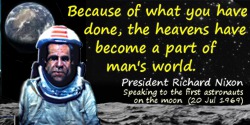
Neil and Buzz, I am talking to you by telephone from the Oval Office at the White House, and this certainly has to be the most historic telephone call ever made. Because of what you have done, the heavens have become a part of man’s world. As you talk to us from the Sea of Tranquility, it inspires us to redouble our efforts to bring peace and tranquility to Earth.
Speaking to the first astronauts while they were standing on the Moon (20 Jul 1969).
Neither had Watt of the Steam engine a heroic origin, any kindred with the princes of this world. The princes of this world were shooting their partridges… While this man with blackened fingers, with grim brow, was searching out, in his workshop, the Fire-secret.
From Chartism, collected in James Wood (ed.) The Carlyle Reader (1894), 73.
Neither in the subjective nor in the objective world can we find a criterion for the reality of the number concept, because the first contains no such concept, and the second contains nothing that is free from the concept. How then can we arrive at a criterion? Not by evidence, for the dice of evidence are loaded. Not by logic, for logic has no existence independent of mathematics: it is only one phase of this multiplied necessity that we call mathematics.
How then shall mathematical concepts be judged? They shall not be judged. Mathematics is the supreme arbiter. From its decisions there is no appeal. We cannot change the rules of the game, we cannot ascertain whether the game is fair. We can only study the player at his game; not, however, with the detached attitude of a bystander, for we are watching our own minds at play.
How then shall mathematical concepts be judged? They shall not be judged. Mathematics is the supreme arbiter. From its decisions there is no appeal. We cannot change the rules of the game, we cannot ascertain whether the game is fair. We can only study the player at his game; not, however, with the detached attitude of a bystander, for we are watching our own minds at play.
In Number: The Language of Science; a Critical Survey Written for the Cultured Non-Mathematician (1937), 244-245.
Neither the absolute nor the relative size of the brain can be used to measure the degree of mental ability in animal or in man. So far as man is concerned, the weights of the brains or the volumes of the cranial cavities of a hundred celebrities of all branches of knowledge all over the world have been listed. … At the bottom of those lists are Gall, the famous phrenologist, Anatole France, the French novelist, and Gambetta, the French statesman, each with about 1,100 cc brain mass. The lists are topped by Dean Jonathan Swift, the English writer, Lord Byron, the English poet, and Turgenev, the Russian novelist, all with about 2,000 cc … Now our mental test! Had Turgenev really twice the mental ability of Anatole France?
In 'The Human Brain in the Light of Its Phylogenetic Development', Scientific Monthly (Aug 1948), 67, No. 2, 104-105. Collected in Sherwood Larned Washburn and Davida Wolffson (eds.), The Shorter Anthropological Papers of Franz Weidenreich Published in the Period 1939-1948: A Memorial Volume (1949), 18.
Neither the Army nor the Navy is of any protection, or very slight protection, against aerial raids. We may therefore look forward with certainty to the time that is coming, and indeed is almost now at hand, when sea power and land power will be secondary to air power, and that nation which gains control of the air will practically control the world.
In 'Preparedness for Aerial Defense', Addresses Before the Eleventh Annual Convention of the Navy League of the United States, Washington, D.C., April 10-13, 1916 (1916), 76.
Neurosis is the result of a conflict between the ego and its id, whereas psychosis is the analogous outcome of a similar disturbance in the relation between the ego and the external world.
Neurosis and Psychosis (1924), in James Strachey (ed.), The Standard Edition of the Complete Psychological Works of Sigmund Freud (1961), Vol. 19, 149.

Never doubt that a small group of thoughtful, committed citizens can change the world; indeed, it is the only thing that ever has.
Although this quote is frequently seen, “the quotation does not appear in any of Mead’s published work, and may have first appeared in one of her public speeches, perhaps, some say, in her speech at the first Earth Day celebration in 1970.” As stated by Nancy Lutkehaus, 'Margaret Mead: Public Anthropologist', Anthropology Now (Apr 2009), 1, No. 1, 34, [The quote is not in the Earth Day speech as it appears online; though it may be in some other undocumented speech. Webmaster.]
Never say there is nothing beautiful in the world anymore. There is always something to make you wonder in the shape of a tree, the trembling of a leaf.
In The Schweitzer Album: A Portrait in Words and Pictures (1965), 39.
Never to have seen anything but the temperate zone is to have lived on the fringe of the world. Between the Tropic of Capricorn and the Tropic of Cancer live the majority of all the plant species, the vast majority of the insects, most of the strange ... quadrupeds, all of the great and most of the poisonous snakes and large lizards, most of the brilliantly colored sea fishes, and the strangest and most gorgeously plumaged of the birds.
Exploring For Plants (1930), 329.
Nevertheless, paradigm changes do cause scientists to see the world of their research engagements differently. Insofar as their only recourse to that world is through what they see and do, we may want to say that after a revolution scientists are responding to a different world.
In The Structure of Scientific Revolutions (1962), 110.
New scientific ideas never spring from a communal body, however organized, but rather from the head of an individually inspired researcher who struggles with his problems in lonely thought and unites all his thought on one single point which is his whole world for the moment.
Address on the 25th anniversary of the Kaiser-Wilhelm Gesellschaft (Jan 1936). Quoted in Surviving the Swastika: Scientific Research in Nazi Germany (1993), 97.
Newton has shown us that a law is only a necessary relation between the present state of the world and its immediately subsequent state. All the other laws since discovered are nothing else; they are in sum, differential equations.
In Henri Poincaré and George Bruce Halsted (trans.), The Value of Science: Essential Writings of Henri Poincare (1907), 87.
Newton was not the first of the age of reason. He was the last of the magicians, the last of the Babylonians and Sumerians, the last great mind which looked out on the visible and intellectual world with the same eyes as those who began to build our intellectual inheritance rather less than 10,000 years ago. Isaac Newton, a posthumous child born with no father on Christmas Day, 1642, was the last wonder child to whom the Magi could do sincere and appropriate homage.
In 'Newton, the Man' (1946). In Geoffrey Keynes (ed.), Essays in Biography, 2nd edition (1951), 311.
Newton was the greatest genius that ever existed, and the most fortunate, for we cannot find more than once a system of the world to establish.
Quoted by F. R. Moulton, in Introduction to Astronomy (1906), 199.
Newton’s and Darwin’s world were different from the worlds of most men, and yet their worlds were not the world, but more and better than mine, as they had followed out further and better the teachings of the sense.
In Sir William Withey Gull and Theodore Dyke Acland (ed.), A Collection of the Published Writings of William Withey Gull (1896), xlviii.
Night after night, among the gabled roofs,
Climbing and creeping through a world unknown
Save to the roosting stork, he learned to find
The constellations, Cassiopeia’s throne,
The Plough still pointing to the Polar Star,
The movements of the planets, hours and hours,
And wondered at the mystery of it all.
Climbing and creeping through a world unknown
Save to the roosting stork, he learned to find
The constellations, Cassiopeia’s throne,
The Plough still pointing to the Polar Star,
The movements of the planets, hours and hours,
And wondered at the mystery of it all.
In 'Tycho Brahe', The Torch-Bearers: Watchers of the Sky (1922), Vol. 1, 40.
No country in the world is so much indebted for its progress in power and intelligence to science than ours, and yet no country does so little to encourage or advance it.
Address (2 Jun 1874) at the Laying of the Cornerstone of the American Museum of Natural History, in Fifth and Sixth Annual Reports of the American Museum of Natural History (1 Dec 1874), 47.
No discovery of mine has made, or is likely to make, directly or indirectly, for good or ill, the least difference to the amenity of the world.
In A Mathematician’s Apology (1941, reprint with Foreward by C.P. Snow 1992), 150.
No history of civilization can be tolerably complete which does not give considerable space to the explanation of scientific progress. If we had any doubts about this, it would suffice to ask ourselves what constitutes the essential difference between our and earlier civilizations. Throughout the course of history, in every period, and in almost every country, we find a small number of saints, of great artists, of men of science. The saints of to-day are not necessarily more saintly than those of a thousand years ago; our artists are not necessarily greater than those of early Greece; they are more likely to be inferior; and of course, our men of science are not necessarily more intelligent than those of old; yet one thing is certain, their knowledge is at once more extensive and more accurate. The acquisition and systematization of positive knowledge is the only human activity which is truly cumulative and progressive. Our civilization is essentially different from earlier ones, because our knowledge of the world and of ourselves is deeper, more precise, and more certain, because we have gradually learned to disentangle the forces of nature, and because we have contrived, by strict obedience to their laws, to capture them and to divert them to the gratification of our own needs.
Introduction to the History of Science (1927), Vol. 1, 3-4.
No longer can we be satisfied with a life where the heart has its reasons which reason cannot know. Our hearts must know the world of reason, and reason must be guided by an informed heart.
In The Guardian, March 15, 1990.
No man ever looks at the world with pristine eyes. He sees it edited by a definite set of customs and institutions and ways of thinking.
In 'The Science of Custom', Patterns of Culture (1934, 2005), 2.
No one knows the diversity in the world, not even to the nearest order of magnitude. … We don’t know for sure how many species there are, where they can be found or how fast they’re disappearing. It’s like having astronomy without knowing where the stars are.
Quoted in Jamie Murphy and Andrea Dorfman, 'The Quiet Apocalypse,' Time (13 Oct 1986).
No other explanation of living forms is allowed than heredity, and any which is founded on another basis must be rejected. The present fashion requires that even the smallest and most indifferent inquiry must be dressed in phylogenetic costume, and whilst in former centuries authors professed to read in every natural detail some intention of the creator mundi, modern scientists have the aspiration to pick out from every occasional observation a fragment of the ancestral history of the living world.
'On the Principles of Animal Morphology', Proceedings of the Royal Society of Edinburgh (2 Apr 1888), 15, 294. Original as Letter to Mr John Murray, communicated to the Society by Professor Sir William Turner. Page given as in collected volume published 1889.
No part of the world can be truly understood without a knowledge of its garment of vegetation, for this determines not only the nature of the animal inhabitants but also the occupations of the majority of human beings.
The Red Man's Continent: A Chronicle of Aboriginal America (1919), 88.
No video, no photographs, no verbal descriptions, no lectures can provide the enchantment that a few minutes out-of-doors can: watch a spider construct a web; observe a caterpillar systematically ravaging the edge of a leaf; close your eyes, cup your hands behind your ears, and listen to aspen leaves rustle or a stream muse about its pools and eddies. Nothing can replace plucking a cluster of pine needles and rolling them in your fingers to feel how they’re put together, or discovering that “sedges have edges and grasses are round,” The firsthand, right-and-left-brain experience of being in the out-of-doors involves all the senses including some we’ve forgotten about, like smelling water a mile away. No teacher, no student, can help but sense and absorb the larger ecological rhythms at work here, and the intertwining of intricate, varied and complex strands that characterize a rich, healthy natural world.
Into the Field: A Guide to Locally Focused Teaching
Nobody … took me seriously. They wondered why in the world I wanted to be a chemist when no women were doing that. The world was not waiting for me.
Quoted in interview by Mary Ellen Avery (1997).
Nobody in the world of policy appears to be asking what is best for society, wild fish or farmed fish. And what sort of farmed fish, anyway? Were this question to be asked, and answered honestly, we might find that our interests lay in prioritizing wild fish and making their ecosystems more productive by leaving them alone enough of the time.
In The End of the Line: How Overfishing Is Changing the World and What We Eat (2008), 313.
None of Darwin’s particular doctrines will necessarily endure the test of time and trial. Into the melting-pot must they go as often as any man of science deems it fitting. But Darwinism as the touch of nature that makes the whole world kin can hardly pass away.
Anthropology (1912), 11.
None of us deny evolution. We know it and study it with pleasure. Catholic universities do not see anything in evolution to prevent a Christian accepting it, but with the reservation that the great problem of the origin of the world and of the creation of man is the secret of God. The Catholic church accepts what science gives it on condition that science reports facts which can be proved, for it is a fact that there is no scientific truth which can contradict eternal truth.
The position of the Catholic Church on the theory of evolution, as stated by Monseigneur Piette, as he introduced the next speaker Dr. Thomas Hunt Morgan, professor of experimental zoology at Columbia University. As given in The School of Education Record of the University of North Dakota (Jun 1926), Vol.11, No. 9, 72.
Not all is doom and gloom. We are beginning to understand the natural world and are gaining a reverence for life - all life.
Source unverified. Please contact Webmaster if you know the primary source.
Not all the winds, and storms, and earthquakes, and seas, and seasons of the world, have done so much to revolutionize the earth as Man, the power of an endless life, has done since the day he came forth upon it, and received dominion over it.
From Sermon on the Power of Endless Life, and Other Sermons (1876), 310.
Not enough of our society is trained how to understand and interpret quantitative information. This activity is a centerpiece of science literacy to which we should all strive—the future health, wealth, and security of our democracy depend on it. Until that is achieved, we are at risk of making under-informed decisions that affect ourselves, our communities, our country, and even the world.
From email message, as published on Huffington Post website (5 Feb 2015).
Not explaining science seems to me perverse. When you’re in love, you want to tell the world.
In 'With Science on Our Side', Washington Post (9 Jan 1994).
Not in the ground of need, not in bent and painful toil, but in the deep-centred play-instinct of the world, in the joyous mood of the eternal Being, which is always young, science has her origin and root; and her spirit, which is the spirit of genius in moments of elevation, is but a sublimated form of play, the austere and lofty analogue of the kitten playing with the entangled skein or of the eaglet sporting with the mountain winds.
In Mathematics (1907), 44.
Not only is science fiction an idea of tremendous import, but it is to be an important factor in making the world a better place to live in, through educating the public to the possibilities of science and the influence of science on life which, even today, are not appreciated by the man on the street. … If every man, woman, boy and girl, could be induced to read science fiction right along, there would certainly be a great resulting benefit to the community, in that the educational standards of its people would be raised tremendously. Science fiction would make people happier, give them a broader understanding of the world, make than more tolerant.
Editorial, Science Fiction Week (1930). In Gary Westfahl, Hugo Gernsback and the Century of Science Fiction (2007), 166.
Not to know what has been transacted in former times is to be always a child. If no use is made of the labors of past ages, the world must remain always in the infancy of knowledge.
In Samuel Johnson and Arthur Murphy, The works of Samuel Johnson (1837), 237.
Nothing I then learned [in high school] had any bearing at all on the big and real questions. Who am I? What am I doing here? What is the world? What is my relationship to it?
This View of Life: the World of an Evolutionist (1964), 37.
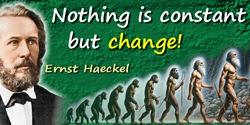
Nothing is constant but change! All existence is a perpetual flux of “being and becoming!” That is the broad lesson of the evolution of the world.
As translated by Joseph McCabe in Haeckel's The Wonders of Life: a Popular Study of Biological Philosophy (1904), 100.
Nothing is sudden in nature: whereas the slightest storms are forecasted several days in advance, the destruction of the world must have been announced several years beforehand by heat waves, by winds, by meteorites, in short, by an infinity of phenomena.
L' Antiquité devoilée par ses usages ou Examen critique des principales Opinions, Cérémonies & Institutions religieuses & politiques des differens Peuples de la Terre (1766), 373-4.
Now [Michele Besso] has departed from this strange world a little ahead of me. That signifies nothing. For us believing in physicists, the distinction between past, present and future is only a stubbornly persistent illusion.
Letter of condolence to the family of Michele Besso, his lifelong friend (21 Mar 1955). In Tabatha Yeatts, Albert Einstein (2007), 116. (Besso died on 15 Mar 1955. Einstein died 18 Apr 1955.)
Now and then, in the course of the century, a great man of science, like Darwin; a great poet, like Keats; a fine critical spirit, like M. Renan; a supreme artist, like Flaubert, has been able to isolate himself, to keep himself out of reach of the clamorous claims of others, to stand “under the shelter of the wall,” as Plato puts it, and so to realise the perfection of what was in him, to his own incomparable gain, and to the incomparable and lasting gain of the whole world.
In Sebastian Melmoth (1908), 133-134.
Now do you not see that the eye embraces the beauty of the whole world? It counsels and corrects all the arts of mankind... it is the prince of mathematics, and the sciences founded on it are absolutely certain. It has measured the distances and sizes of the stars it has discovered the elements and their location... it has given birth to architecture and to perspective and to the divine art of painting.
…...
Now this supreme wisdom, united to goodness that is no less infinite, cannot but have chosen the best. For as a lesser evil is a kind of good, even so a lesser good is a kind of evil if it stands in the way of a greater good; and the would be something to correct in the actions of God if it were possible to the better. As in mathematics, when there is no maximum nor minimum, in short nothing distinguished, everything is done equally, or when that is not nothing at all is done: so it may be said likewise in respect of perfect wisdom, which is no less orderly than mathematics, that if there were not the best (optimum) among all possible worlds, God would not have produced any.
Theodicy: Essays on the Goodness of God and Freedom of Man and the Origin of Evil (1710), 128.
Nowadays everyone knows that the US is the world’s biggest polluter, and that with only one 20th of the world’s population it produces a quarter of its greenhouse gas emissions. But the US government, in an abdication of leadership of epic proportions, is refusing to take the problem seriously. … Emissions from the US are up 14% on those in 1990 and are projected to rise by a further 12% over the next decade.
In 'Global Warming is Now a Weapon of Mass Destruction', The Guardian (28 Jul 2003).
Numbers written on restaurant checks [bills] within the confines of restaurants do not follow the same mathematical laws as numbers written on any other pieces of paper in any other parts of the Universe.
This single statement took the scientific world by storm. It completely revolutionized it. So many mathematical conferences got held in such good restaurants that many of the finest minds of a generation died of obesity and heart failure and the science of math was put back by years.
This single statement took the scientific world by storm. It completely revolutionized it. So many mathematical conferences got held in such good restaurants that many of the finest minds of a generation died of obesity and heart failure and the science of math was put back by years.
Life, the Universe and Everything (1982, 1995), 49.
Observation is so wide awake, and facts are being so rapidly added to the sum of human experience, that it appears as if the theorizer would always be in arrears, and were doomed forever to arrive at imperfect conclusion; but the power to perceive a law is equally rare in all ages of the world, and depends but little on the number of facts observed.
In A Week on the Concord and Merrimack Rivers (1862), 383.
Obviously everyone wants to be successful, but I want to be looked back on as being very innovative, very trusted and ethical and ultimately making a big difference in the world.
Concerning philanthropy and investment in alternative energy research. In Tim Walker, 'Sergey Brin: Engine Driver', Independent (15 Jan 2010).
OCEAN, n. A body of water occupying about two-thirds of a world made for man—who has no gills.
The Collected Works of Ambrose Bierce (1911), Vol. 7, The Devil's Dictionary, 235.
October 9, 1863
Always, however great the height of the balloon, when I have seen the horizon it has roughly appeared to be on the level of the car though of course the dip of the horizon is a very appreciable quantity or the same height as the eye. From this one might infer that, could the earth be seen without a cloud or anything to obscure it, and the boundary line of the plane approximately the same height as the eye, the general appearance would be that of a slight concavity; but I have never seen any part of the surface of the earth other than as a plane.
Towns and cities, when viewed from the balloon are like models in motion. I shall always remember the ascent of 9th October, 1863, when we passed over London about sunset. At the time when we were 7,000 feet high, and directly over London Bridge, the scene around was one that cannot probably be equalled in the world. We were still so low as not to have lost sight of the details of the spectacle which presented itself to our eyes; and with one glance the homes of 3,000,000 people could be seen, and so distinct was the view, that every large building was easily distinguishable. In fact, the whole of London was visible, and some parts most clearly. All round, the suburbs were also very distinct, with their lines of detached villas, imbedded as it were in a mass of shrubs; beyond, the country was like a garden, its fields, well marked, becoming smaller and smaller as the eye wandered farther and farther away.
Again looking down, there was the Thames, throughout its whole length, without the slightest mist, dotted over its winding course with innumerable ships and steamboats, like moving toys. Gravesend was visible, also the mouth of the Thames, and the coast around as far as Norfolk. The southern shore of the mouth of the Thames was not so clear, but the sea beyond was seen for many miles; when at a higher elevation, I looked for the coast of France, but was unable to see it. On looking round, the eye was arrested by the garden-like appearance of the county of Kent, till again London claimed yet more careful attention.
Smoke, thin and blue, was curling from it, and slowly moving away in beautiful curves, from all except one part, south of the Thames, where it was less blue and seemed more dense, till the cause became evident; it was mixed with mist rising from the ground, the southern limit of which was bounded by an even line, doubtless indicating the meeting of the subsoils of gravel and clay. The whole scene was surmounted by a canopy of blue, everywhere free from cloud, except near the horizon, where a band of cumulus and stratus extended all round, forming a fitting boundary to such a glorious view.
As seen from the earth, the sunset this evening was described as fine, the air being clear and the shadows well defined; but, as we rose to view it and its effects, the golden hues increased in intensity; their richness decreased as the distance from the sun increased, both right and left; but still as far as 90º from the sun, rose-coloured clouds extended. The remainder of the circle was completed, for the most part, by pure white cumulus of well-rounded and symmetrical forms.
I have seen London by night. I have crossed it during the day at the height of four miles. I have often admired the splendour of sky scenery, but never have I seen anything which surpassed this spectacle. The roar of the town heard at this elevation was a deep, rich, continuous sound the voice of labour. At four miles above London, all was hushed; no sound reached our ears.
Always, however great the height of the balloon, when I have seen the horizon it has roughly appeared to be on the level of the car though of course the dip of the horizon is a very appreciable quantity or the same height as the eye. From this one might infer that, could the earth be seen without a cloud or anything to obscure it, and the boundary line of the plane approximately the same height as the eye, the general appearance would be that of a slight concavity; but I have never seen any part of the surface of the earth other than as a plane.
Towns and cities, when viewed from the balloon are like models in motion. I shall always remember the ascent of 9th October, 1863, when we passed over London about sunset. At the time when we were 7,000 feet high, and directly over London Bridge, the scene around was one that cannot probably be equalled in the world. We were still so low as not to have lost sight of the details of the spectacle which presented itself to our eyes; and with one glance the homes of 3,000,000 people could be seen, and so distinct was the view, that every large building was easily distinguishable. In fact, the whole of London was visible, and some parts most clearly. All round, the suburbs were also very distinct, with their lines of detached villas, imbedded as it were in a mass of shrubs; beyond, the country was like a garden, its fields, well marked, becoming smaller and smaller as the eye wandered farther and farther away.
Again looking down, there was the Thames, throughout its whole length, without the slightest mist, dotted over its winding course with innumerable ships and steamboats, like moving toys. Gravesend was visible, also the mouth of the Thames, and the coast around as far as Norfolk. The southern shore of the mouth of the Thames was not so clear, but the sea beyond was seen for many miles; when at a higher elevation, I looked for the coast of France, but was unable to see it. On looking round, the eye was arrested by the garden-like appearance of the county of Kent, till again London claimed yet more careful attention.
Smoke, thin and blue, was curling from it, and slowly moving away in beautiful curves, from all except one part, south of the Thames, where it was less blue and seemed more dense, till the cause became evident; it was mixed with mist rising from the ground, the southern limit of which was bounded by an even line, doubtless indicating the meeting of the subsoils of gravel and clay. The whole scene was surmounted by a canopy of blue, everywhere free from cloud, except near the horizon, where a band of cumulus and stratus extended all round, forming a fitting boundary to such a glorious view.
As seen from the earth, the sunset this evening was described as fine, the air being clear and the shadows well defined; but, as we rose to view it and its effects, the golden hues increased in intensity; their richness decreased as the distance from the sun increased, both right and left; but still as far as 90º from the sun, rose-coloured clouds extended. The remainder of the circle was completed, for the most part, by pure white cumulus of well-rounded and symmetrical forms.
I have seen London by night. I have crossed it during the day at the height of four miles. I have often admired the splendour of sky scenery, but never have I seen anything which surpassed this spectacle. The roar of the town heard at this elevation was a deep, rich, continuous sound the voice of labour. At four miles above London, all was hushed; no sound reached our ears.
Travels in the Air (1871), 99-100.
Of … habitable worlds, such as the Earth, all which we may suppose to be of a terrestrial or terraqueous nature, and filled with beings of the human species, subject to mortality, it may not be amiss in this place to compute how many may he conceived within our finite view every clear Star-light night. … In all together then we may safely reckon 170,000,000, and yet be much within compass, exclusive Of the Comets which I judge to be by far the most numerous part of the creation.
In The Universe and the Stars: Being an Original Theory on the Visible Creation, Founded on the Laws of Nature (1750, 1837), 131-132.
Of all the forces of nature, I should think the wind contains the largest amount of motive power—that is, power to move things. Take any given space of the earth’s surface— for instance, Illinois; and all the power exerted by all the men, and beasts, and running-water, and steam, over and upon it, shall not equal the one hundredth part of what is exerted by the blowing of the wind over and upon the same space. And yet it has not, so far in the world’s history, become proportionably valuable as a motive power. It is applied extensively, and advantageously, to sail-vessels in navigation. Add to this a few windmills, and pumps, and you have about all. … As yet, the wind is an untamed, and unharnessed force; and quite possibly one of the greatest discoveries hereafter to be made, will be the taming, and harnessing of it.
Lecture 'Discoveries and Inventions', (1860) in Discoveries and Inventions (1915).
Of all the frictional resistances, the one that most retards human movement is ignorance, what Buddha called 'the greatest evil in the world.' The friction which results from ignorance ... can be reduced only by the spread of knowledge and the unification of the heterogeneous elements of humanity. No effort could be better spent.
In 'The Problem of Increasing Human Energy', Century Illustrated Monthly Magazine (Jun 1900), 60, 182.
Often in evolutionary processes a species must adapt to new conditions in order to survive. Today the atomic bomb has altered profoundly the nature of the world as we know it, and the human race consequently finds itself in a new habitat to which it must adapt its thinking.
…...
Oh! But I have better news for you, Madam, if you have any patriotism as citizen of this world and wish its longevity. Mr. Herschel has found out that our globe is a comely middle-aged personage, and has not so many wrinkles as seven stars, who are evidently our seniors. Nay, he has discovered that the Milky Way is not only a mob of stars, but that there is another dairy of them still farther off, whence, I conclude, comets are nothing but pails returning from milking, instead of balloons filled with inflammable air.
Letter to the Countess of Upper Ossory (4 Jul 1785) in W. S. Lewis (ed.), Horace Walpole's Correspondence with the Countess of Upper Ossory (1965), Vol. 33, 474.
Ohm (a distinguished mathematician, be it noted) brought into order a host of puzzling facts connecting electromotive force and electric current in conductors, which all previous electricians had only succeeded in loosely binding together qualitatively under some rather vague statements. Even as late as 20 years ago, “quantity” and “tension” were much used by men who did not fully appreciate Ohm's law. (Is it not rather remarkable that some of Germany's best men of genius should have been, perhaps, unfairly treated? Ohm; Mayer; Reis; even von Helmholtz has mentioned the difficulty he had in getting recognised. But perhaps it is the same all the world over.)
Old King Coal was a merry old soul:
“I’ll move the world,” quoth he;
“My England’s high, and rich, and great,
But greater she shall be !”
And he call’d for the pick, and he call’d for the spade,
And he call’d for his miners bold;
“ And it’s dig,” he said, “in the deep, deep earth;
You’ll find my treasures better worth
Than mines of Indian gold!”
Old King Coal was a merry old soul,
Yet not content was he;
And he said, “I’ve found what I’ve desired,
Though ’tis but one of three.”
And he call’d for water, he call’d for fire,
For smiths and workmen true:
“Come, build me engines great and strong ;
We’ll have,” quoth he, “a change ere long;
We’ll try what Steam can do.”
Old King Coal was a merry old soul:
“’Tis fairly done,” quoth he,
When he saw the myriad wheels at work
O’er all the land and sea.
They spared the bones and strength of men,
They hammer’d, wove, and spun;
There was nought too great, too mean, or small,
The giant Steam had power for all;—
His task was never done.
“I’ll move the world,” quoth he;
“My England’s high, and rich, and great,
But greater she shall be !”
And he call’d for the pick, and he call’d for the spade,
And he call’d for his miners bold;
“ And it’s dig,” he said, “in the deep, deep earth;
You’ll find my treasures better worth
Than mines of Indian gold!”
Old King Coal was a merry old soul,
Yet not content was he;
And he said, “I’ve found what I’ve desired,
Though ’tis but one of three.”
And he call’d for water, he call’d for fire,
For smiths and workmen true:
“Come, build me engines great and strong ;
We’ll have,” quoth he, “a change ere long;
We’ll try what Steam can do.”
Old King Coal was a merry old soul:
“’Tis fairly done,” quoth he,
When he saw the myriad wheels at work
O’er all the land and sea.
They spared the bones and strength of men,
They hammer’d, wove, and spun;
There was nought too great, too mean, or small,
The giant Steam had power for all;—
His task was never done.
From song, 'Old King Coal' (1846), collected in The Poetical Works of Charles Mackay: Now for the First Time Collected Complete in One Volume (1876), 565. To the melody of 'Old King Cole'.
On all levels primary, and secondary and undergraduate - mathematics is taught as an isolated subject with few, if any, ties to the real world. To students, mathematics appears to deal almost entirely with things whlch are of no concern at all to man.
In editorial in Focus, a Journal of the Mathematical Association of America (1986), quoted in obituary by Eric Pace, New York Times (11 Jun 1992).
On principle, there is nothing new in the postulate that in the end exact science should aim at nothing more than the description of what can really be observed. The question is only whether from now on we shall have to refrain from tying description to a clear hypothesis about the real nature of the world. There are many who wish to pronounce such abdication even today. But I believe that this means making things a little too easy for oneself.
…...
On Saturday, I was a surgeon in South Africa, very little known ... [and] ... On Monday, I was world renowned.
In Janie B. Butts and Karen Rich, Nursing Ethics (2005), 59.
On the question of the world as a whole, science founders. For scientific knowledge the world lies in fragments, the more so the more precise our scientific knowledge becomes.
Kleine Schule des philosophischen Denkens (1965), trans. R. F. C. Hull and G. Wels, Philosophy is for Everyman: A Short Course in Philosophical Thinking (1969), 8.
On the theory of natural selection we can clearly understand the full meaning of that old canon in natural history, “Natura non facit saltum.” This canon, if we look only to the present inhabitants of the world, is not strictly correct, but if we include all those of past times, it must by my theory be strictly true.
From On the Origin of Species by Means of Natural Selection; or, The Preservation of Favoured Races in the Struggle for Life (1861), 183.
Once early in the morning, at two or three in the morning, when the master was asleep, the books in the library began to quarrel with each other as to which was the king of the library. The dictionary contended quite angrily that he was the master of the library because without words there would be no communication at all. The book of science argued stridently that he was the master of the library for without science there would have been no printing press or any of the other wonders of the world. The book of poetry claimed that he was the king, the master of the library, because he gave surcease and calm to his master when he was troubled. The books of philosophy, the economic books, all put in their claims, and the clamor was great and the noise at its height when a small low voice was heard from an old brown book lying in the center of the table and the voice said, “The Lord is my shepherd, I shall not want.” And all of the noise and the clamor in the library ceased, and there was a hush in the library, for all of the books knew who the real master of the library was.
'Ministers of Justice', address delivered to the Eighty-Second Annual Convention of the Tennessee Bar Association at Gatlinburg (5 Jun 1963). In Tennessee Law Review (Fall 1963), 31, No. 1, 19.
Once in a while you find yourself in an odd situation. You get into it by degrees and in the most natural way but, when you are right in the midst of it, you are suddenly astonished and ask yourself how in the world it all came about.
Opening sentences in Kon-Tiki: Across the Pacific by Raft (1990), 9.
One [of the most exciting moment of my career] would be when I first dived on a coral reef and I was able to move among a world of unrevealed complexity.
From 'Interview: Of Mind and Matter: David Attenborough Meets Richard Dawkins', The Guardian (11 Sep 2010).
One aim of physical sciences had been to give an exact picture the material world. One achievement of physics in the twentieth century has been to prove that that aim is unattainable.
From The Ascent of Man (1973), 353.
One began to hear it said that World War I was the chemists’ war, World War II was the physicists’ war, World War III (may it never come) will be the mathematicians’ war.
Co-author with and Reuben Hersh, The Mathematical Experience (1981), 96.
One can truly say that the irresistible progress of natural science since the time of Galileo has made its first halt before the study of the higher parts of the brain, the organ of the most complicated relations of the animal to the external world. And it seems, and not without reason, that now is the really critical moment for natural science; for the brain, in its highest complexity—the human brain—which created and creates natural science, itself becomes the object of this science.
Natural Science and Brain (1909), 120.
One day at Fenner's (the university cricket ground at Cambridge), just before the last war, G. H. Hardy and I were talking about Einstein. Hardy had met him several times, and I had recently returned from visiting him. Hardy was saying that in his lifetime there had only been two men in the world, in all the fields of human achievement, science, literature, politics, anything you like, who qualified for the Bradman class. For those not familiar with cricket, or with Hardy's personal idiom, I ought to mention that “the Bradman class” denoted the highest kind of excellence: it would include Shakespeare, Tolstoi, Newton, Archimedes, and maybe a dozen others. Well, said Hardy, there had only been two additions in his lifetime. One was Lenin and the other Einstein.
Variety of Men (1966), 87. First published in Commentary magazine.
One may not regard the world as a sort of metaphysical brothel for emotions.
In Arthur Koestler and Daphne Hardy (trans.), Darkness at Noon (1941), 152.
One may say “the eternal mystery of the world is its comprehensibility” … The fact that it is comprehensible is a miracle.
‘Physics and Reality’, Franklin Institute Journal (Mar 1936). Collected in Out of My Later Years (1950), 60.
One might be led to question whether the scientists acted wisely in presenting the statesmen of the world with this appalling problem. Actually there was no choice. Once basic knowledge is acquired, any attempt at preventing its fruition would be as futile as hoping to stop the earth from revolving around the sun.
'Atomic Energy for Power', Collected Papers (Note e Memorie): The United States 1939-1945 (1962), Vol. 2, 556.
One must care about a world one will not see.
…...
One must expect a war between U.S.A. and U.S.S.R. which will begin with the total destruction of London. I think the war will last 30 years, and leave a world without civilised people, from which everything will have to build afresh—a process taking (say) 500 years.
Stated just one month after the Hiroshima atomic explosion. Russell became one of the best-known antinuclear activists of his era.
Stated just one month after the Hiroshima atomic explosion. Russell became one of the best-known antinuclear activists of his era.
Letter to Gamel Brenan (1 Sep 1945). In Nicholas Griffin (Ed.), The Selected Letters of Bertrand Russell (2002), 410.
One never finds fossil bones bearing no resemblance to human bones. Egyptian mummies, which are at least three thousand years old, show that men were the same then. The same applies to other mummified animals such as cats, dogs, crocodiles, falcons, vultures, oxen, ibises, etc. Species, therefore, do not change by degrees, but emerged after the new world was formed. Nor do we find intermediate species between those of the earlier world and those of today's. For example, there is no intermediate bear between our bear and the very different cave bear. To our knowledge, no spontaneous generation occurs in the present-day world. All organized beings owe their life to their fathers. Thus all records corroborate the globe's modernity. Negative proof: the barbaritY of the human species four thousand years ago. Positive proof: the great revolutions and the floods preserved in the traditions of all peoples.
'Note prese al Corso di Cuvier. Corso di Geologia all'Ateneo nel 1805', quoted in Pietro Corsi, The Age of Lamarck, trans. J. Mandelbaum (1988), 183.
One of the great problems of the world today is undoubtedly this problem of not being able to talk to scientists, because we don’t understand science; they can’t talk to us because they don’t understand anything else, poor dears.
From dialogue in At the Drop of a Hat, revue performed by Michael Flanders and Donald Swann (1959).
One of the greatest gifts science has brought to the world is continuing elimination of the supernatural, and it was a lesson that my father passed on to me, that knowledge liberates mankind from superstition. We can live our lives without the constant fear that we have offended this or that deity who must be placated by incantation or sacrifice, or that we are at the mercy of devils or the Fates. With increasing knowledge, the intellectual darkness that surrounds us is illuminated and we learn more of the beauty and wonder of the natural world.
…...
One of the hardest things in the world is to convey a meaning accurately from one mind to another.
Letter to Miss Dora Abdy (1896). Quoted in Stuart Dodgson Collingwood, The Life and Letters of Lewis Carroll (1898), 331.
One of the largest promises of science is, that the sum of human happiness will be increased, ignorance destroyed, and, with ignorance, prejudice and superstition, and that great truth taught to all, that this world and all it contains were meant for our use and service; and that where nature by her own laws has defined the limits of original unfitness, science may by extract so modify those limits as to render wholesome that which by natural wildness was hurtful, and nutritious that which by natural poverty was unnourishing. We do not yet know half that chemistry may do by way of increasing our food.
'Common Cookery'. Household Words (26 Jan 1856), 13, 45. An English weekly magazine edited by Charles Dickens.
One of the most impressive discoveries was the origin of the energy of the stars, that makes them continue to burn. One of the men who discovered this was out with his girl friend the night after he realized that nuclear reactions must be going on in the stars in order to make them shine.
She said “Look at how pretty the stars shine!”
He said, “Yes, and right now I am the only man in the world who knows why they shine.”
She merely laughed at him. She was not impressed with being out with the only man who, at that moment, knew why stars shine. Well, it is sad to be alone, but that is the way it is in this world.
She said “Look at how pretty the stars shine!”
He said, “Yes, and right now I am the only man in the world who knows why they shine.”
She merely laughed at him. She was not impressed with being out with the only man who, at that moment, knew why stars shine. Well, it is sad to be alone, but that is the way it is in this world.
…...
One of the strongest motives that lead men to art and science is escape from everyday life with its painful crudity and hopeless dreariness, from the fetters of one's own ever-shifting desires. A finely tempered nature longs to escape from the personal life into the world of objective perception and thought.
Albert Einstein and Walter Shropshire (ed.), The Joys of Research (1981), 40.
One of the ways the telegraph changed us as humans was it gave us a new sense of what time it is. It gave us an understanding of simultaneity. It gave us the ability to synchronize clocks from one place to another. It made it possible for the world to have standard time and time zones and then Daylight Savings Time and then after that jetlag. All of that is due to the telegraph because, before that, the time was whatever it was wherever you were.
From transcript for video interview on bigthink website
One of the wonders of this world is that objects so small can have such consequences: any visible lump of matter—even the merest speck—contains more atoms than there are stars in our galaxy.
In Scientific American Library, Molecules (1987), 4.
One orbit, with a radius of 42,000 kilometers, has a period of exactly 24 hours. A body in such an orbit, if its plane coincided with that of the Earth’s equator, would revolve with the Earth and would thus be stationary above the same spot on the planet. It would remain fixed in the sky of a whole hemisphere ... [to] provide coverage to half the globe, and for a world service three would be required, though more could be readily utilized. (1945) [Predidicting geosynchronous communication satellites]
In 'Can Rocket Stations Give Worldwide Coverage?', Wireless World (Oct 1945). Quoted and cited in Arthur C. Clarke, Greetings, Carbon-Based Bipeds!: Collected Essays, 1934-1998, 22.
One person could change the whole world for better, as long as they don’t give a damn who gets the credit.
One should guard against inculcating a young man with the idea that success is the aim of life, for a successful man normally receives from his peers an incomparably greater portion than the services he has been able to render them deserve. The value of a man resides in what he gives and not in what he is capable of receiving. The most important motive for study at school, at the university, and in life is the pleasure of working and thereby obtaining results which will serve the community. The most important task for our educators is to awaken and encourage these psychological forces in a young man {or woman}. Such a basis alone can lead to the joy of possessing one of the most precious assets in the world - knowledge or artistic skill.
…...
One should not understand this compulsion to construct concepts, species, forms, purposes, laws ('a world of identical cases') as if they enabled us to fix the real world; but as a compulsion to arrange a world for ourselves in which our existence is made possible:—we thereby create a world which is calculable, simplified, comprehensible, etc., for us.
The Will to Power (Notes written 1883-1888), book 3, no. 521. Trans. W. Kaufmann and R. J. Hollingdale and ed. W. Kaufmann (1968), 282.
One touch of Darwin makes the whole world kin.
A section title, in Back to Methuselah: A Metabiological Pentateuch (1921), lxiv.
One touch of nature makes the whole world kin.
Ulysses speaking to Achilles, in Troilus and Cressida, Act 3, Scene 3, line 175. John Phin and Edward Dowden clarify to the true meaning of this quote in The Shakespeare Cyclopædia and New Glossary (1902), 183, writing that in ‘an article in the Galaxy for Feb., 1877, Grant White calls attention to its true meaning, which is: “There is one point on which all men are alike, one touch of human nature which shows the kindred of all mankind—that they slight familiar merit and prefer trivial novelty. ... [It is] one of the most cynical utterances of an undisputable moral truth, disparaging to the nature of all mankind, that ever came from Shakespeare's pen.” ’
One wonders whether a generation that demands instant satisfaction of all its needs and instant solution of the world’s problems will produce anything of lasting value. Such a generation, even when equipped with the most modern technology, will be essentially primitive - it will stand in awe of nature, and submit to the tutelage of medicine men.
In Reflections on the Human Condition (1973), 38.
Only in quiet waters things mirror themselves undistorted. Only in a quiet mind is adequate perception of the world.
Quoted in Kim Lim (ed.), 1,001 Pearls of Spiritual Wisdom: Words to Enrich, Inspire, and Guide Your Life (2014), 183
Only rarely do we see beyond the needs of humanity. … Now that we are over six billion hungry and greedy individuals, all aspiring to a first-world lifestyle, our urban way of life encroaches upon the domain of the living Earth. We are taking so much that it is no longer able to sustain the familiar and comfortable world we have taken for granted. Now it is changing, according to its own internal rules, to a state where we are no longer welcome.
In The Revenge of Gaia: Earth’s Climate Crisis & The Fate of Humanity (2006, 2007), 9. The first sentence is a concept acknowledged to John Gray, Straw Dogs (2002).
Our atom of carbon enters the leaf, colliding with other innumerable (but here useless) molecules of nitrogen and oxygen. It adheres to a large and complicated molecule that activates it, and simultaneously receives the decisive message from the sky, in the flashing form of a packet of solar light; in an instant, like an insect caught by a spider, it is separated from its oxygen, combined with hydrogen and (one thinks) phosphorus, and finally inserted in a chain, whether long or short does not matter, but it is the chain of life. All this happens swiftly, in silence, at the temperature and pressure of the atmosphere, and gratis: dear colleagues, when we learn to do likewise we will be sicut Deus [like God], and we will have also solved the problem of hunger in the world.
Levi Primo and Raymond Rosenthal (trans.), The Periodic Table (1975, 1984), 227-228. In this final section of his book, Levi imagines the life of a carbon atom. He calls this his first “literary dream”. It came to him at Auschwitz.
Our challenge is to give what account we can of what becomes of life in the solar system, this corner of the universe that is our home; and, most of all, what becomes of men—all men, of all nations, colors, and creeds. This has become one world, a world for all men. It is only such a world that can now offer us life, and the chance to go on.
From speech given at an anti-war teach-in at the Massachusetts Institute of Technology, (4 Mar 1969) 'A Generation in Search of a Future', as edited by Ron Dorfman for Chicago Journalism Review, (May 1969).
Our children will enjoy in their homes electrical energy too cheap to meter. … Transmutation of the elements, unlimited power, ability to investigate the working of living cells by tracer atoms, the secret of photosynthesis about to be uncovered, these and a host of other results, all in about fifteen short years. It is not too much to expect that our children will know of great periodic regional famines in the world only as matters of history, will travel effortlessly over the seas and under the and through the air with a minimum of danger and at great speeds, and will experience a life span far longer than ours, as disease yields and man comes to understand what causes him to age.
Speech at the 20th anniversary of the National Association of Science Writers, New York City (16 Sep 1954), as quoted in 'Abundant Power From Atom Seen', New York Times (17 Sep 1954) 5.
Our emphasis on science has resulted in an alarming rise in world populations, the demand and ever-increasing emphasis of science to improve their standards and maintain their vigor. I have been forced to the conclusion that an over-emphasis of science weakens character and upsets life's essential balance.
In 'The Wisdom of Wilderness', Life (22 Dec 1967), 63, No. 25, 9.
Our failure to discern a universal good does not record any lack of insight or ingenuity, but merely demonstrates that nature contains no moral messages framed in human terms. Morality is a subject for philosophers, theologians, students of the humanities, indeed for all thinking people. The answers will not be read passively from nature; they do not, and cannot, arise from the data of science. The factual state of the world does not teach us how we, with our powers for good and evil, should alter or preserve it in the most ethical manner.
…...
Our fathers thought the world was flat, and we think it is round, not because the earth has changed its shape, but because men have revised their thoughts.
The Homiletic Review, Vol. 83-84 (1922), Vol. 83, 208.
Our immediate interests are after all of but small moment. It is what we do for the future, what we
add to the sum of man's knowledge, that counts most. As someone has said, 'The individual withers and the world is more and more.' Man dies at 70, 80, or 90, or at some earlier age, but through his power of physical reproduction, and with the means that he has to transmit the results of effort to those who come after him, he may be said to be immortal.
'Willis Rodney Whitney', National Academy of Sciences, Biographical Memoirs (1960), 360.
Our knowledge of the external world must always consist of numbers, and our picture of the universe—the synthesis of our knowledge—must necessarily be mathematical in form. All the concrete details of the picture, the apples, the pears and bananas, the ether and atoms and electrons, are mere clothing that we ourselves drape over our mathematical symbols— they do not belong to Nature, but to the parables by which we try to make Nature comprehensible. It was, I think, Kronecker who said that in arithmetic God made the integers and man made the rest; in the same spirit, we may add that in physics God made the mathematics and man made the rest.
From Address (1934) to the British Association for the Advancement of Science, Aberdeen, 'The New World—Picture of Modern Physics'. Printed in Nature (Sep 1934) 134, No. 3384, 356. As quoted and cited in Wilbur Marshall Urban, Language and Reality: The Philosophy of Language and the Principles of Symbolism (2004), Vol. 15, 542.
Our most successful theories in physics are those that explicitly leave room for the unknown, while confining this room sufficiently to make the theory empirically disprovable. It does not matter whether this room is created by allowing for arbitrary forces as Newtonian dynamics does, or by allowing for arbitrary equations of state for matter, as General Relativity does, or for arbitrary motions of charges and dipoles, as Maxwell's electrodynamics does. To exclude the unknown wholly as a “unified field theory” or a “world equation” purports to do is pointless and of no scientific significance.
Our new Constitution is now established, and has an appearance that promises permanency; but in this world nothing can be said to be certain, except death and taxes.
Letter to Jean Baptiste Le Roy, 13 Nov 1789. Quoted in Albert Henry Smyth (ed.) The Writings of Benjamin Franklin (1907), vol. 10, 69.
Our only complete assurance of surviving World War III is to halt it before it starts.
Speech (10 Nov 1948) preceding Armistice Day, at Boston, Massachusetts.
Our present work sets forth mathematical principles of philosophy. For the basic problem of philosophy seems to be to discover the forces of nature from the phenomena of motions and then to demonstrate the other phenomena from these forces. It is to these ends that the general propositions in books 1 and 2 are directed, while in book 3 our explanation of the system of the world illustrates these propositions.
The Principia: Mathematical Principles of Natural Philosophy (1687), 3rd edition (1726), trans. I. Bernard Cohen and Anne Whitman (1999), Preface to the first edition, 382.
Our problem is that the climate crisis hatched in our laps at a moment in history when political and social conditions were uniquely hostile to a problem of this nature and magnitude—that moment being the tail end of the go-go ’80s, the blastoff point for the crusade to spread deregulated capitalism around the world. Climate change is a collective problem demanding collective action the likes of which humanity has never actually accomplished. Yet it entered mainstream consciousness in the midst of an ideological war being waged on the very idea of the collective sphere.
In 'The Change Within: The Obstacles We Face Are Not Just External', The Nation (12 May 2014).
Our problem is, in fact, to lit the world to our perceptions, and not our perceptions to the world.
In The Organisation of Thought: Educational and Scientific (1917), 228.
Our science is a drop, our ignorance a sea. Whatever else be certain, this at least is certain—that the world of our present natural knowledge is enveloped in a larger world of some sort of whose residual properties we at present can frame no positive idea.
In Address to Harvard Young Men’s Christian Association, 'Is Life Worth Living?', collected in The Will to Believe and other Essays in Popular Philosophy, (1897, 2006), 54. Published earlier in International Journal of Ethics (Oct 1895).
Our world depends for daily bread
Upon the shooting of a seed.
Upon the shooting of a seed.
In 'A Corner in Wheat', Memorial Volume: Selections from the Prose and Poetical Writings of the Late John Savary (1912), 44. The quoted lines begin the first stanza, which ends similarly: “Upon the shooting of a seed
Our world depends for daily bread.”
Our world depends for daily bread.”
Our world faces a crisis as yet unperceived by those possessing power to make great decisions for good or evil. The unleashed power of the atom has changed everything save our modes of thinking and we thus drift toward unparalleled catastrophe. We scientists who released this immense power have an overwhelming responsibility in this world life-and-death struggle to harness the atom for the benefit of mankind and not for humanity’s destruction. … We need two hundred thousand dollars at once for a nation-wide campaign to let people know that a new type of thinking is essential if mankind is to survive and move toward higher levels. This appeal is sent to you only after long consideration of the immense crisis we face. … We ask your help at this fateful moment as a sign that we scientists do not stand alone.
In 'Atomic Education Urged by Einstein', New York Times (25 May 1946), 13. Extract from a telegram (24 May 1946) to “several hundred prominent Americans”, signed by Albert Einstein as Chairman, with other members, of the Emergency Committee of Atomic Scientists. It was also signed by the Federation of American Scientists.
Our world is not an optimal place, fine tuned by omnipotent forces of selection. It is a quirky mass of imperfections, working well enough (often admirably); a jury-rigged set of adaptations built of curious parts made available by past histories in different contexts ... A world optimally adapted to current environments is a world without history, and a world without history might have been created as we find it. History matters; it confounds perfection and proves that current life transformed its own past.
…...
Our world will yet grow so subtle that it will be as ludicrous to believe in a god as it is today to believe in ghosts.
Aphorism 57 in Notebook D (1773-1775), as translated by R.J. Hollingdale in Aphorisms (1990). Reprinted as The Waste Books (2000), 52.
Ours is a brand-new world of allatonceness [all-at-once-ness]. “Time” has ceased, “space” has vanished. We now live in a global village … a simultaneous happening. … The new electronic interdependence recreates the world in the image of a global village.
Co-author with Quentin Fiore, in The Medium is the Massage (1967), 63-67.
Outside our consciousness there lies the cold and alien world of actual things. Between the two stretches the narrow borderland of the senses. No communication between the two worlds is possible excepting across the narrow strip. For a proper understanding of ourselves and of the world, it is of the highest importance that this borderland should be thoroughly explored.
Keynote Address, a tribute to Helmholtz, at the Imperial Palace, Berlin (Aug 1891). Cited in Davis Baird, R.I.G. Hughes and Alfred Nordmann, Heinrich Hertz: Classical Physicist, Modern Philosopher (1998), 157.
Peace cannot be obtained by wishing for it. We live in the same world with Russia, whose leader has said he “wants to bury us”—and he means it. Disarmament, the cessation of tests, will not automatically bring us closer to peace.
From debate (20 Feb 1958) between Linus Pauling and Edward Teller on WQED-TV, San Francisco. Transcript published as Fallout and Disarmament: The Pauling-Teller Debate (1958). Reprinted in 'Fallout and Disarmament: A Debate between Linus Pauling and Edward Teller', Daedalus (Spring 1958), 87, No. 2, 153.
Peace means creative giving, making a contribution to the betterment of our own people and to the betterment of people throughout the world. And who better understands that than the men and women of American agriculture?
'Remarks to Farm Leaders Participating in the “Salute to Agriculture”' (7 May 1971), Public Papers of the Presidents of the United States: Richard M. Nixon (1972), 627.
People are always blaming their circumstances for what they are. I don’t believe in circumstances. The people who get on in this world are the people who get up and look for the circumstances they want, and if they can’t find them, make them.
…...
People say to me, “Are you looking for the ultimate laws of physics?” No, I’m not; I’m just looking to find out more about the world and if it turns out there is a simple ultimate law which explains everything, so be it; that would be very nice to discover. If it turns out it’s like an onion with millions of layers, and we’re just sick and tired of looking at the layers, then that’s the way it is …
From Interview in BBC TV program Horizon (1981). As quoted in The Pleasure of Finding Things Out: The Best Short Works of Richard P. Feynman 1983, (1999), 23.
Perhaps a thousand other worlds that lie
Remote from us, and latent in the sky,
Are lightened by his beams, and kindly nurs’d.
Remote from us, and latent in the sky,
Are lightened by his beams, and kindly nurs’d.
From 'Eleanora' (1692). Collected in Samuel Johnson (ed.), The Works of th Poets of Great Britain and Ireland (1800), Vol. 3, 130.
Perhaps it is better in this present world of ours that a revolutionary idea or invention instead of being helped and patted be hampered and ill-treated in its adolescence—by want of means, by selfish interest, pedantry, stupidity and ignorance; that it be attacked and stifled; that it pass through bitter trials and tribulations, through the heartless strife of commercial existence. ... So all that was great in the past was ridiculed, condemned, combatted, suppressed—only to emerge all the more powerfully, all the more triumphantly from the struggle.
'The Transmission of Electrical Energy Without Wires As a Means for Furthering Peace', Electrical World and Engineer (7 Jan 1905), 24. Reproduced in John T. Ratzlaff, editor, Tesla Said (1984), 86. Also reprinted in Nikola Tesla, Miscellaneous Writings (2007), 58.
Perhaps randomness is not merely an adequate description for complex causes that we cannot specify. Perhaps the world really works this way, and many events are uncaused in any conventional sense of the word. Perhaps our gut feeling that it cannot be so reflects only our hopes and prejudices, our desperate striving to make sense of a complex and confusing world, and not the ways of nature.
…...
Pestilences of many sorts have brought death and misery to mankind throughout history. Over the last 100 years most of these plagues have been brought under control; the black death, cholera, yellow fever, typhus, and smallpox no longer rage unchecked every few years. But there is one disease that continues to flourish and cause pandemics that sweep around the world periodically without restraint by modern medical science: the last of the great plagues is influenza.
In Preface, Influenza: The Last Great Plague: An Unfinished Story of Discovery (1977), x.
Phenomena unfold on their own appropriate scales of space and time and may be invisible in our myopic world of dimensions assessed by comparison with human height and times metered by human lifespans. So much of accumulating importance at earthly scales ... is invisible by the measuring rod of a human life. So much that matters to particles in the microscopic world of molecules ... either averages out to stability at our scale or simply stands below our limits of perception.
…...
Philosophers no longer write for the intelligent, only for their fellow professionals. The few thousand academic philosophers in the world do not stint themselves: they maintain more than seventy learned journals. But in the handful that cover more than one subdivision of philosophy, any given philosopher can hardly follow more than one or two articles in each issue. This hermetic condition is attributed to “technical problems” in the subject. Since William James, Russell, and Whitehead, philosophy, like history, has been confiscated by scholarship and locked away from the contamination of general use.
In The Culture We Deserve (1989), 9.
Philosophers of science constantly discuss theories and representation of reality, but say almost nothing about experiment, technology, or the use of knowledge to alter the world. This is odd, because ‘experimental method’ used to be just another name for scientific method.... I hope [to] initiate a Back-to-Bacon movement, in which we attend more seriously to experimental science. Experimentation has a life of its own.
Representing and Intervening, p. 149f (1983). Announcing the author's intention to stress 'intervening' as an essential component of science.
Philosophers say, that Man is a Microcosm, or little World, resembling in Miniature every Part of the Great: And, in my Opinion, the Body Natural may be compared to the Body Politic: and if this be so, how can the Epicureans Opinion be true, that the Universe was formed by a fortuitous Concourse of Atoms; which I will no more believe, than that the accidental Jumbling of the Letters of the Alphabet, could fall by Chance into a most ingenious and learned Treatise of Philosophy. Risum teneatis Amici, Hor.
In 'A Tritical Essay Upon the Faculties of the Mind' (6 Aug 1707), collected in various volumes and editions, for example, The Works of J.S, D.D, D.S.P.D.: Volume 1: Miscellanies in Prose (1739), 173. An earlier, undated, fourth volume of Miscellanies gives the 6 Aug 1707 date the essay was written. The final Latin phrase can be translated as, “Can you help laughing, friends?” attributed to Horace. In Jonathan Swift and Temple Scott (ed.), The Prose Works of Jonathan Swift: A Tale of a Tub: the Battle of the Books, and Other Early Works (1897, reprint 1907), Vol. 1, 291, the editor footnotes that “this essay is a parody on the pseudo-philosophical essays of the time, in which all sense was lost in the maze of inconsequential quotations.” Indeed, the rest of the essay is, by design, a jumble of disjointed thoughts and makes next to no sense.
Philosophy, and science, and the springs
Of wonder, and th wisdom of the world,
I have essayed; and in my mind there is
A power to make these subject to itself...
Of wonder, and th wisdom of the world,
I have essayed; and in my mind there is
A power to make these subject to itself...
From poem 'Manfred'.
Phrenology is the only major pseudoscience I know about that once flourished around the world and has since faded away.
In Kendrick Frazier, 'A Mind at Play: An Interview with Martin Gardner', Skeptical Inquirer (Mar/Apr 1998), 37.
Physical concepts are free creations of the human mind, and are not, however it may seem, uniquely determined by the external world. In our endeavour to understand reality we are somewhat like a man trying to understand the mechanism of a closed watch. He sees the face and the moving hands, even hears its ticking, but he has no way of opening the case. If he is ingenious he may form some picture of a mechanism which could be responsible for all the things he observes, but he may never be quite sure his picture is the only one which could explain his observations. He will never be able to compare his picture with the real mechanism and he cannot even imagine the possibility or the meaning of such a comparison. But he certainly believes that, as his knowledge increases, his picture of reality will become simpler and simpler and will explain a wider and wider range of his sensuous impressions. He may also believe in the existence of the ideal limit of knowledge and that it is approached by the human mind. He may call this ideal limit the objective truth.
Albert Einstein and Leopold Infeld, The Evolution of Physics (1938), 33.
Physicians, of all men, are most happy; whatever good success soever they have, the world proclaimeth; and what faults they commit, the earth covereth.
In 'Nicocles', Emblems, Divine and Moral; The School of the Heart; and Hieroglyphics of the Life of Man (1866), 404.
Physicists and astronomers see their own implications in the world being round, but to me it means that only one-third of the world is asleep at any given time and the other two-thirds is up to something.
Speech to American Bar Association, Atlanta, Ga. (22 Oct 1964), quoted in The Atlanta Constitution (23 Oct 1964), 10. In James H. Billington, Respectfully Quoted (2010), 380.
Physics does not change the nature of the world it studies, and no science of behavior can change the essential nature of man, even though both sciences yield technologies with a vast power to manipulate their subject matters.
In article 'Man', Proceedings of the American Philosophical Society (1964), 108, 482-85. Collected in Cumulative Record: Definitive Edition (2015).
Physics inquires whether the world is eternal, or perpetual, or had a beginning and will have an end in time, or whether none of these alternatives is accurate.
In The Metalogicon of John of Salisbury: A Twelfth-Century Defense of the Verbal and Logical Arts of the Trivium, Book 2, Chap. 12, as translated by Daniel D. McGarry (1955, 2009), 103. The translator footnotes “eternal” as “without beginning or end” and “perpetual” as “having a beginning, but without end.” The context is describing “physics” as one of the three fields of philosophy (literally, faculties): natural, moral and rational—translated as Physics, Ethics, Logic.
Physics investigates the essential nature of the world, and biology describes a local bump. Psychology, human psychology, describes a bump on the bump.
Theories and Things (1981), 93.
Physics is mathematical not because we know so much about the physical world, but because we know so little: it is only its mathematical properties that we can discover.
In The World within the World by John D. Barrow (1988).
Physics tells us much less about the physical world than we thought it did.
…...
Physio-philosophy has to show how, and in accordance indeed with what laws, the Material took its origin; and, therefore, how something derived its existence from nothing. It has to portray the first periods of the world's development from nothing; how the elements and heavenly bodies originated; in what method by self-evolution into higher and manifold forms, they separated into minerals, became finally organic, and in Man attained self-consciousness.
In Lorenz Oken, trans. by Alfred Tulk, Elements of Physiophilosophy (1847), 1.
Physiology is concerned with all those phenomena of life that present them selves to us in sense perception as bodily processes, and accordingly form part of that total environment which we name the external world.
Plain English aint plain at all; it’s like common sense, the most oncommon thing in the world.
In Wise-Saws: Or, Sam Slick in Search of a Wife (1855), 126. Note: “oncommon” [sic].
Poetry, mythology, and religion represent the world as man would like to have it, while science represents the world as he gradually comes to discover it.
In The Modern Temper: a Study and a Confession (1929), 6.
Populations of bacteria live in the spumes of volcanic thermal vents on the ocean floor, multiplying in water above the boiling point. And far beneath Earth’s surface, to a depth of 2 miles (3.2 km) or more, dwell the SLIMES (subsurface lithoautotrophic microbial ecosystems), unique assemblages of bacteria and fungi that occupy pores in the interlocking mineral grains of igneous rock and derive their energy from inorganic chemicals. The SLIMES are independent of the world above, so even if all of it were burned to a cinder, they would carry on and, given enough time, probably evolve new life-forms able to re-enter the world of air and sunlight.
In 'Vanishing Before Our Eyes', Time (26 Apr 2000).
Portable communication instruments will be developed that will enable an individual to communicate directly and promptly with anyone, anywhere in the world. As we learn more about the secrets of space, we shall increase immeasurably the number of usable frequencies until we are able to assign a separate frequency to an individual as a separate telephone number is assigned to each instrument.
In address (Fall 1946) at a dinner in New York to commemorate the 40 years of Sarnoff’s service in the radio field, 'Institute News and Radio Notes: The Past and Future of Radio', Proceedings of the Institute of Radio Engineers (I.R.E.), (May 1947), 35, No. 5, 498. [In 1946, foretelling the cell phone and a hint of the communications satellite? —Webmaster]
Prayer moves the hand which moves the world.
Quoted in Kim Lim (ed.), 1,001 Pearls of Spiritual Wisdom: Words to Enrich, Inspire, and Guide Your Life (2014), 178
Producing food for 6.2 billion people, adding a population of 80 million more a year, is not simple. We better develop an ever improved science and technology, including the new biotechnology, to produce the food that’s needed for the world today. In response to the fraction of the world population that could be fed if current farmland was convered to organic-only crops: “We are 6.6 billion people now. We can only feed 4 billion. I don’t see 2 billion volunteers to disappear.” In response to extreme critics: “These are utopian people that live on Cloud 9 and come into the third world and cause all kinds of confusion and negative impacts on the developing countries.”
…...
Progress should mean that we are always changing the world to fit the vision, instead we are always changing the vision.
From Orthodoxy (1908, 1909), 195.
Psychiatrist David Shainberg argued that mental illness, which appears chaotic, is actually the reverse. Mental illness occurs when images of the self become rigid and closed, restricting an open creative response to the world.[Co-author with David Peat]
In John F. Briggs and David Peat, Seven Life Lessons of Chaos: Spiritual Wisdom from the Science of Change (1999, 2000), 29. A footnote gives the source of this idea as from David Shainberg, The Transforming Self: New Dimensions in Psychoanalytic Process (1973).
Psychogenesis has led to man. Now it effaces itself, relieved or absorbed by another and a higher function—the engendering and subsequent development of the mind, in one word noogenesis. When for the first time in a living creature instinct perceived itself in its own mirror, the whole world took a pace forward.
In Teilhard de Chardin and Bernard Wall (trans.), The Phenomenon of Man (1959, 2008), 181. Originally published in French as Le Phénomene Humain (1955).
Pure mathematics … reveals itself as nothing but symbolic or formal logic. It is concerned with implications, not applications. On the other hand, natural science, which is empirical and ultimately dependent upon observation and experiment, and therefore incapable of absolute exactness, cannot become strictly mathematical. The certainty of geometry is thus merely the certainty with which conclusions follow from non-contradictory premises. As to whether these conclusions are true of the material world or not, pure mathematics is indifferent.
In 'Non-Euclidian Geometry of the Fourth Dimension', collected in Henry Parker Manning (ed.), The Fourth Dimension Simply Explained (1910), 58.
Quantum theory thus reveals a basic oneness of the universe. It shows that we cannot decompose the world into independently existing smallest units. As we penetrate into matter, nature does not show us any isolated “building blocks,” but rather appears as a complicated web of relations between the various parts of the whole. These relations always include the observer in an essential way. The human observer constitute the final link in the chain of observational processes, and the properties of any atomic object can be understood only in terms of the object’s interaction with the observer.
In The Tao of Physics (1975), 68.
Quantum theory—at least in the Heisenberg interpretation—describes the way the world works as a literal moment-to-moment emergence of actual facts out of a background of less factual 'potentia.'
Quoted in article 'Nick Herbert', in Gale Cengage Learning, Contemporary Authors Online (2002).
Racism is an ism to which everyone in the world today is exposed; for or against, we must take sides. And the history of the future will differ according to the decision which we make.
In Race: Science and Politics (1945), 5.
Real life is, to most men, a long second-best, a perpetual compromise between the ideal and the possible; but the world of pure reason ;knows no compromise, no practical limitations, no barrier to the creative activity.
Essay, 'The Study of Mathematics' (1902), collected in Philosophical Essays (1910), 73-74. Also collected in Mysticism and Logic: And Other Essays (1919), 60.
Realizing how often ingenious speculation in the complex biological world has led nowhere and how often the real advances in biology as well as in chemistry, physics and astronomy have kept within the bounds of mechanistic interpretation, we geneticists should rejoice, even with our noses on the grindstone (which means both eyes on the objectives), that we have at command an additional means of testing whatever original ideas pop into our heads.
'The Rise of Genetics', Science (1932), 1969, 264.
Reason is man’s faculty for grasping the world by thought, in contradiction to intelligence, which is man’s ability to manipulate the world with the help of thought. Reason is man’s instrument for arriving at the truth, intelligence is man's instrument for manipulating the world more successfully; the former is essentially human, the latter belongs to the animal part of man.
In The Sane Society (1955), 64.
Recollections [his autobiographical work] might possibly interest my children or their children. I know that it would have interested me greatly to have read even so short and dull a sketch of the mind of my grandfather, written by himself, and what he thought and did, and how he worked. I have attempted to write the following account of myself as if I were a dead man in another world looking back at my own life. Nor have I found this difficult, for life is nearly over with me.
Relations between authors and referees are, of course, almost always strained. Authors are convinced that the malicious stupidity of the referee is alone preventing them from laying their discoveries before an admiring world. Referees are convinced that authors are too arrogant and obtuse to recognize blatant fallacies in their own reasoning, even when these have been called to their attention with crystalline lucidity. All physicists know this, because all physicists are both authors and referees, but it does no good. The ability of one person to hold both views is an example of what Bohr called complementarity.
In Boojums All the Way Through: Communicating Science in a Prosaic Age (1990), 19-20.
Reliable scientific knowledge is value free and has no moral or ethical value. Science tells us how the world is. … Dangers and ethical issue arise only when science is applied as technology.
Nobel Symposium, at Stockholm, Sweden on 'Virtual Museums and Public Understanding of Science and Culture' (26-29 May 2002), Lecture 'Is Science Dangerous'. Published in 'Is Cell Science Dangerous?', Journal of Medical Ethics (Jun 2007), 33, No. 6, 345.
Religion, in contrast to science, deploys the repugnant view that the world is too big for our understanding. Science, in contrast to religion, opens up the great questions of being to rational discussion, to discussion with the prospect of resolution and elucidation.
Essay collected in John Cornwell (ed.), 'The Limitless Power of Science', Nature's Imagination: The Frontiers of Scientific Vision (1995), 125.
Renegade scientists and totalitarian loonies are not the folks most likely to abuse genetic engineering. You and I are--not because we are bad but because we want to do good. In a world dominated by competition, parents understandably want to give their kids every advantage. ... The most likely way for eugenics to enter into our lives is through the front door as nervous parents ... will fall over one another to be first to give Junior a better set of genes.
'What Should the Rules Be?', Time magazine (22 Jan 2001).
Reproduction anywhere in the world of photographic pictures and all kinds of drawings or records.
One of 12 visionary goals listed in Brochure (1900) on his 'World System of Wireless Transmission', In Arthur J. Beckhard, Electrical Genius Nikola Tesla (1959), 176. Webmaster note: Tesla was years ahead of his time predicting possibilities of radio.
Repudiating the sensible world, which he neither sees himself nor believes from those who have, the Peripatetic joins combat by childish quibbling in a world on paper, and denies the Sun shines because he himself is blind.
Letter to Galileo Galilei (28 Mar 1611). Johannes Kepler Gesammelte Werke (1937- ), Vol. 16, letter 611, 1. 17-20, p. 372.
Reservations of scenery are the cathedrals of the modern world.
Letter to Boston Metropolitan Park Commission (22 June 1896), in biography by his father, Charles William Eliot, Charles Eliot, Landscape Architect (1902), 655.
Roger, Tranquility. Be advised there are lots of smiling faces in this room and all over the world. Over.
From the taped recording of Air-to-Ground Transmissions during Apollo 11 moon mission, after the Lunar Module had just landed on the moon surface. Charlie Duke was the designated Communicator at Mission Control. Also in Bob Blaisdell (ed.), Essential Documents of American History: From Reconstruction to the Twenty-First Century (2016), Vol. 2, 329
Round about what is, lies a whole mysterious world of might be, — a psychological romance of possibilities and things that do not happen. By going out a few minutes sooner or later, by stopping to speak with a friend at a corner, by meeting this man or that, or by turning down this street instead of the other, we may let slip some great occasion good, or avoid some impending evil, by which the whole current of our lives would have been changed. There is no possible solution to the dark enigma but the one word, “Providence.”
In 'Table-Talk', The Poetical Works of Henry Wadsworth Longfellow: Volume 3 (1883), 1354.
Run the tape again, and let the tiny twig of Homo sapiens expire in Africa. Other hominids may have stood on the threshold of what we know as human possibilities, but many sensible scenarios would never generate our level of mentality. Run the tape again, and this time Neanderthal perishes in Europe and Homo erectus in Asia (as they did in our world). The sole surviving human stock, Homo erectus in Africa, stumbles along for a while, even prospers, but does not speciate and therefore remains stable. A mutated virus then wipes Homo erectus out, or a change in climate reconverts Africa into inhospitable forest. One little twig on the mammalian branch, a lineage with interesting possibilities that were never realized, joins the vast majority of species in extinction. So what? Most possibilities are never realized, and who will ever know the difference? Arguments of this form lead me to the conclusion that biology's most profound insight into human nature, status, and potential lies in the simple phrase, the embodiment of contingency: Homo sapiens is an entity, not a tendency.
Wonderful Life (1989), 320.
Science … is teaching the world that the ultimate court of appeal is observation and experiment, and not authority; she is teaching it to estimate the value of evidence.
From lecture, 'On Zoology', delivered at The South Kensington Museum (14 May 1860), published as a 16-page pamphlet, Lectures Addressed to Teachers: Lecture IV (1869), 14. Also known in later collections by the title, 'A Lobster; or, The Study of Zoology', for example, in Twelve Lectures and Essays (1908), 128.
Science aims at constructing a world which shall be symbolic of the world of commonplace experience. It is not at all necessary that every individual symbol that is used should represent something in common experience or even something explicable in terms of common experience. The man in the street is always making this demand for concrete explanation of the things referred to in science; but of necessity he must be disappointed. It is like our experience in learning to read. That which is written in a book is symbolic of a story in real life. The whole intention of the book is that ultimately a reader will identify some symbol, say BREAD, with one of the conceptions of familiar life. But it is mischievous to attempt such identifications prematurely, before the letters are strung into words and the words into sentences. The symbol A is not the counterpart of anything in familiar life.
From 'Introduction', The Nature of the Physical World (1928), xiii.
Science and art belong to the whole world, and the barriers of nationality vanish before them.
Wissenschaft und Kunst gehoren der Welt an, und vor ihhen verschwinden die Schranken der Nationalitat.
Wissenschaft und Kunst gehoren der Welt an, und vor ihhen verschwinden die Schranken der Nationalitat.
From 'In a Conversation With a German Historian' (1813), in Kate Louise Roberts (ed.), Hoyt’s New Cyclopedia of Practical Quotations (1922), 691.
Science and knowledge are subject, in their extension and increase, to laws quite opposite to those which regulate the material world. Unlike the forces of molecular attraction, which cease at sensible distances; or that of gravity, which decreases rapidly with the increasing distance from the point of its origin; the farther we advance from the origin of our knowledge, the larger it becomes, and the greater power it bestows upon its cultivators, to
add new fields to its dominions.
In 'Future Prospects', On the Economy of Machinery and Manufactures (1st ed., 1832), chap. 32, 277-278.
Science and technology have freed humanity from many burdens and given us this new perspective and great power. This power can be used for the good of all. If wisdom governs our actions; but if the world is mad or foolish, it can destroy itself just when great advances and triumphs are almost without its grasp.
As quoted in Suranjan Das 'The Nehru Years in Indian politics', Edinburgh Papers on South Asian Studies (16 Nov 2001), 16, 230. As cited in M.J. Vinod and Meena Deshpande, Contemporary Political Theory (2013), 507. Vinod and Deshpande introduce the quote by writing “Nehru was largely instrumental for building a scientific temper and culture in India” and “emphasized the need for building national laboratories and research institutes.”
Science can amuse and fascinate us all, but it is engineering that changes the world.
Isaac Asimov’s Book of Science and Nature Quotations (1988), 78.
Science can give us only the tools in the box, these mechanical miracles that it has already given us. But of what use to us are miraculous tools until we have mastered the humane, cultural use of them? We do not want to live in a world where the machine has mastered the man; we want to live in a world where man has mastered the machine.
Frank Lloyd Wright on Architecture: Selected Writings 1894-1940 (1941), 258.
Science can purify religion from error and superstition. Religion can purify science from idolatry and false absolutes. Each can draw the other into a wider world, a world in which both can flourish.
In Letter (1 Jun 1988) to Father George V. Coyne, Director of the Vatican Observatory. On vatican.va website.
Science derives its conclusions by the laws of logic from our sense perceptions, Thus it does not deal with the real world, of which we know nothing, but with the world as it appears to our senses. … All our sense perceptions are limited by and attached to the conceptions of time and space. … Modern physics has come to the same conclusion in the relativity theory, that absolute space and absolute time have no existence, but, time and space exist only as far as things or events fill them, that is, are forms of sense perception.
In 'Religion and Modern Science', The Christian Register (16 Nov 1922), 101, 1089. The article is introduced as “the substance of an address to the Laymen’s League in All Soul’s Church (5 Nov 1922).
Science enhances the moral value of life, because it furthers a love of truth and reverence—love of truth displaying itself in the constant endeavor to arrive at a more exact knowledge of the world of mind and matter around us, and reverence, because every advance in knowledge brings us face to face with the mystery of our own being.
In Max Planck and James Vincent Murphy (trans.), Where is Science Going?, (1932), 169.
Science fiction is the most important literature in the history of the world, because it’s the history of ideas, the history of our civilization birthing itself; Science fiction is central to everything we’ve ever done, and people who make fun of science fiction writers don’t know what they’’re talking about
…...
Science has “explained” nothing; the more we know the more fantastic the world becomes and the profounder the surrounding darkness.
Along the Road: Notes and Essays of a Tourist (1928), 108.
Science has nothing to be ashamed of even in the ruins of Nagasaki. The shame is theirs who appeal to other values than the human imaginative values which science has evolved. The shame is ours if we do not make science part of our world...
Lecture, 'The Sense of Human Dignity', at the Massachusetts Institute of Technology (19 Mar 1953), printed in Science and Human Values (1959), 94.
Science in the modern world has many uses, its chief use, however, is to provide long words to cover the errors of the rich. The word “kleptomania” is a vulgar example of what I mean.
From 'Celts and Celtophiles', in Heretics (1905, 1909), 171.
Science is a body of truths which offers clear and certain knowledge about the real world and is therefore superior to tradition philosophy religion dogma and superstition which offer shadowy knowledge about an ideal world.
Need primary source (can you help?).
Science is a boundless adventure of the human spirit, its insights afford terror as well as beauty, and it will continue to agitate the world with new findings and new powers.
In Francis Bello, Lawrence Lessing and George A.W. Boehm, Great American Scientists (1960, 1961), 4.
Science is a method for testing claims about the natural world, not an immutable compendium of absolute truths. The fundamentalists, by ‘knowing’ the answers before they start, and then forcing nature into the straitjacket of their discredited preconceptions, lie outside the domain of science–or of any honest intellectual inquiry.
…...
Science is being daily more and more personified and anthromorphized into a god. By and by they will say that science took our nature upon him, and sent down his only begotten son, Charles Darwin, or Huxley, into the world so that those who believe in him, &c.; and they will burn people for saying that science, after all, is only an expression for our ignorance of our own ignorance.
Samuel Butler, Henry Festing Jones (ed.), The Note-Books of Samuel Butler (1917), 32.
Science is complex and chilling. The mathematical language of science is understood by very few. The vistas it presents are scary—an enormous universe ruled by chance and impersonal rules, empty and uncaring, ungraspable and vertiginous. How comfortable to turn instead to a small world, only a few thousand years old, and under God's personal; and immediate care; a world in which you are His peculiar concern.
The 'Threat' of Creationism. In Ashley Montagu (ed.), Science and Creationism (1984), 192.
Science is dangerous. There is no question but that poison gas, genetic engineering, and nuclear weapons and power stations are terrifying. It may be that civilization is falling apart and the world we know is coming to an end. In that case, why no turn to religion and look forward to the Day of Judgment, ... [being] lifted into eternal bliss ... [and] watching the scoffers and disbelievers writhe forever in torment.
The 'Threat' of Creationism. In Ashley Montagu (ed.), Science and Creationism (1984), 192.
Science is no longer what one man says. The likes of Newton, Pascal and Einstein may live again. But the need for intense specialization has combined with the need for huge facilities to make group work imperative. Los Alamos, Brookhaven, and the Institute for Advanced Studies are symbols of the change. The world of science is no longer a world of lonely geniuses. It is a collection of communities.
From Draft of Science Speech for Presidential Campaign (1960), held by the John F. Kennedy Presidential Library and Museum. Digital Identifier: JFKCAMP1960-0993-005.
Science is not the enemy of humanity but one of the deepest expressions of the human desire to realize that vision of infinite knowledge. Science shows us that the visible world is neither matter nor spirit; the visible world is the invisible organization of energy.
The Cosmic Code (1982), 348.
Science is the language of the temporal world; love is that of the spiritual world. Man, indeed, describes more than he explains; while the angelic spirit sees and understands. Science saddens man; love enraptures the angel; science is still seeking; love has found.
The Works of Honoré de Balzac (1896), Vol. 19, 80.
Science is the organised attempt of mankind to discover how things work as causal systems. The scientific attitude of mind is an interest in such questions. It can be contrasted with other attitudes, which have different interests; for instance the magical, which attempts to make things work not as material systems but as immaterial forces which can be controlled by spells; or the religious, which is interested in the world as revealing the nature of God.
In The Scientific Attitude (1941), Foreword, 9.
Science is the way—a powerful way, indeed—to study the natural world. Science is not particularly effective—in fact, it’s rather ineffective—in making commentary about the supernatural world. Both worlds, for me, are quite real and quite important. They are investigated in different ways. They coexist. They illuminate each other.
From transcript of interview by Bob Abernathy with Francis Collins on PBS TV program 'Religion and Ethics'(16 Jun 2000).
Science itself, no matter whether it is the search for truth or merely the need to gain control over the external world, to alleviate suffering, or to prolong life, is ultimately a matter of feeling, or rather, of desire—the desire to know or the desire to realize.
In New Perspectives in Physics (1962), 196.
Science knows no country because knowledge belongs to humanity, and is the torch which illuminates the world. Science is the highest personification of the nation because that nation will remain the first which carries the furthest the works of thought and intelligence.
From banquet Toast (1876), at the International Congress of Sericulture, Milan, Italy, as translated in René Dubos, Louis Pasteur, Free Lance of Science (1960), 85. Banquet date identified in Maurice B. Strauss, Familiar Medical Quotations (1968), 519.
Science must be free. We can permit no restrictions to be placed upon the scientists’ right to question, to experiment, and to think. Because America has held liberty above all else, distinguished men of science have come here to live, to work, and to seek new knowledge. The world has been the benefactor and science has moved forward.
In address (Fall 1946) at a dinner in New York to commemorate the 40 years of Sarnoff’s service in the radio field, 'Institute News and Radio Notes: The Past and Future of Radio', Proceedings of the Institute of Radio Engineers (I.R.E.), (May 1947), 35, No. 5, 498.
Science requires an engagement with the world, a live encounter between the knower and the known.
In The Courage to Teach: Exploring the Inner Landscape of a Teacher’s Life (1998), 54.
Science unfolded her treasures and her secrets to the desperate demands of men, and placed in their hands agencies and apparatus almost decisive in their character.
Reflecting on the outcome of World War I, and an ominous future.
Reflecting on the outcome of World War I, and an ominous future.
The Second World War: The Gathering Storm (1948, 1986), Vol. 1, 35. Quoting himself from his earlier book, The Aftermath: Being a Sequel to The World Crisis (1929).
Science would not be what it is if there had not been a Galileo, a Newton or a Lavoisier, any more than music would be what it is if Bach, Beethoven and Wagner had never lived. The world as we know it is the product of its geniuses—and there may be evil as well as beneficent genius—and to deny that fact, is to stultify all history, whether it be that of the intellectual or the economic world.
What is Science? (1921), 73.
Science, testing absolutely all thoughts, all works, has already burst well upon the world—a sun, mounting, most illuminating, most glorious—surely never again to set.
In Specimen Days & Collect (1882), 244.
Scientific practice is above all a story-telling practice. ... Biology is inherently historical, and its form of discourse is inherently narrative. ... Biology as a way of knowing the world is kin to Romantic literature, with its discourse about organic form and function. Biology is the fiction appropriate to objects called organisms; biology fashions the facts “discovered” about organic beings.
Primate Visions: Gender, Race and Nature in the World of Modern Science(1989), 4-5.
Scientific realism is the doctrine that science describes the real world: that the world actually is as science takes it to be, and that its furnishings are as science envisages them to be It is quite clear that it is not… ”
In Priceless Knowledge?: Natural Science in Economic Perspective (1996), 159-160.
Scientific research can reduce superstition by encouraging people to think and survey things in terms of cause and effect. Certain it is that a conviction, akin to religious feeling, of the rationality or intelligibility of the world lies behind all scientific work of a higher order.
From 'Scientific Truth' in Essays in Science (1934, 2004), 11.
Scientific studies on marine reserves around the world show that if you close a place to fishing, the number of species increases 20 percent, the average size of a fish increases by a third, and the total weight of fish per hectare increases almost five times—in less than a decade.
From interview with Terry Waghorn, 'Can We Eat Our Fish and Protect Them Too?', Forbes (21 Feb 2012)
Scientists [still] refuse to consider man as an object of scientific scrutiny except through his body. The time has come to realise that an interpretation of the universe—even a positivist one—remains unsatisfying unless it covers the interior as well as the exterior of things; mind as well as matter. The true physics is that which will, one day, achieve the inclusion of man in his wholeness in a coherent picture of the world.
In Teilhard de Chardin and Bernard Wall (trans.), The Phenomenon of Man (1959, 2008), 36. Originally published in French as Le Phénomene Humain (1955).
Scientists alone can establish the objectives of their research, but society, in extending support to science, must take account of its own needs. As a layman, I can suggest only with diffidence what some of the major tasks might be on your scientific agenda, but … First, I would suggest the question of the conservation and development of our natural resources. In a recent speech to the General Assembly of the United Nations, I proposed a world-wide program to protect land and water, forests and wildlife, to combat exhaustion and erosion, to stop the contamination of water and air by industrial as well as nuclear pollution, and to provide for the steady renewal and expansion of the natural bases of life.
From Address to the Centennial Convocation of the National Academy of Sciences (22 Oct 1963), 'A Century of Scientific Conquest'. Online at The American Presidency Project.
Scientists are entitled to be proud of their accomplishments, and what accomplishments can they call ‘theirs’ except the things they have done or thought of first? People who criticize scientists for wanting to enjoy the satisfaction of intellectual ownership are confusing possessiveness with pride of possession. Meanness, secretiveness and, sharp practice are as much despised by scientists as by other decent people in the world of ordinary everyday affairs; nor, in my experience, is generosity less common among them, or less highly esteemed.
…...
Scientists are the easiest to fool. ... They think in straight, predictable, directable, and therefore misdirectable, lines. The only world they know is the one where everything has a logical explanation and things are what they appear to be. Children and conjurors—they terrify me. Scientists are no problem; against them I feel quite confident.
Code of the Lifemaker (1983, 2000),Chapter 1.
Scientists can only carry on with their work, addressing legitimate questions as they arise and challenging misinformation. … Scientists work to fill the gaps in human knowledge and to build a theory that can explain observations of the world. Climate sceptics revel in such gaps, sometimes long after they have been filled.
Editorial, Nature (28 Jul 2011), 475, 423-424.
Seeing and thinking have done much for human progress; in the sphere of mind and morals everything, and could the world have been saved by armchair philosophy, the Greeks would have done it; but only a novum organon could do this, the powerful possibilities of which were only revealed when man began to search our the secrets of nature by way of experiment, to use the words of Harvey.
Address at the opening of the new Pathological Institute of the Royal Infirmary, Glasgow (4 Oct 1911). Printed in 'The Pathological Institute of a General Hospital', Glasgow Medical Journal (1911), 76, 326.
Seeing therefore the variety of Motion which we find in the World is always decreasing, there is a necessity of conserving and recruiting it by active Principles, such as are the cause of Gravity, by which Planets and Comets keep their Motions in their Orbs, and Bodies acquire great Motion in falling; and the cause of Fermentation, by which the Heart and Blood of Animals are kept in perpetual Motion and Heat; the inward Parts of the Earth are constantly warm'd, and in some places grow very hot; Bodies burn and shine, Mountains take fire, the Caverns of the Earth are blown up, and the Sun continues violently hot and lucid, and warms all things by his Light. For we meet with very little Motion in the World, besides what is owing to these active Principles.
From Opticks, (1704, 2nd ed. 1718), Book 3, Query 31, 375.
Self-esteem must be earned! When you dare to dream, dare to follow that dream, dare to suffer through the pain, sacrifice, self-doubts, and friction from the world, you will genuinely impress yourself.
…...
Several of the young people here [at the fifth White House Science Fair] are first-generation Americans. Their parents came here, in part, so their kids could develop their talents and make a difference in the world. … America is going to be stronger and smarter and healthier, and a much more interesting place because of you.
From remarks at the fifth White House Science Fair, in Press Release (23 Mar 2015).
Shall an invention be patented or donated to the public freely? I have known some well-meaning scientific men to look askance at the patenting of inventions, as if it were a rather selfish and ungracious act, essentially unworthy. The answer is very simple. Publish an invention freely, and it will almost surely die from lack of interest in its development. It will not be developed and the world will not be benefited. Patent it, and if valuable, it will be taken up and developed into a business.
Address as M.I.T. acting president, to the graduating class (11 Jun 1920). Published in Massachusetts Institute of Technology, Technology Review (Jul 1920), 22, 420.
Since [World War I] we have seen the atomic age, the computer age, the space age, and the bio-engineering age, each as epochal as the Bronze Age, the Iron Age, the Renaissance and the Industrial Revolution. And all these have occurred in one generation. Man has stood on the moon and looked back on the earth, that small planet now reduced to a neighbourhood. But our material achievements have exceeded the managerial capacities of our human minds and institutions.
As quoted in Colin Bingham (ed.), Wit and Wisdom: A Public Affairs Miscellany (1982), 227.
Since as the Creation is, so is the Creator also magnified, we may conclude in consequence of an infinity, and an infinite all-active power, that as the visible creation is supposed to be full of siderial systems and planetary worlds, so on, in like similar manner, the endless Immensity is an unlimited plenum of creations not unlike the known Universe.… That this in all probability may be the real case, is in some degree made evident by the many cloudy spots, just perceivable by us, as far without our starry Regions, in which tho’ visibly luminous spaces, no one Star or particular constituent body can possibly be distinguished; those in all likelyhood may be external creation, bordering upon the known one, too remote for even our Telescopes to reach.
In The Universe and the Stars: Being an Original Theory on the Visible Creation, Founded on the Laws of Nature (1750, 1837), 143-144.
Since the discovery of oxygen the civilised world has undergone a revolution in manners and customs. The knowledge of the composition of the atmosphere, of the solid crust of the earth, of water, and of their influence upon the life of plants and animals, was linked to that discovery. The successful pursuit of innumerable trades and manufactures, the profitable separation of metals from their ores, also stand in the closest connection therewith.
Familiar Letters on Chemistry (1851), 5.
Since the world is what it is, it is clear that valid reasoning from sound principles cannot lead to error; but a principle may be so nearly true as to deserve theoretical respect, and yet may lead to practical consequences which we feel to be absurd. There is therefore a justification for common sense in philosophy, but only as showing that our theoretical principles cannot be quite correct so long as their consequences are condemned by an appeal to common sense which we feel to be irresistible.
In A History of Western Philosophy, (1945, 1996), 553.
So is not mathematical analysis then not just a vain game of the mind? To the physicist it can only give a convenient language; but isn’t that a mediocre service, which after all we could have done without; and, it is not even to be feared that this artificial language be a veil, interposed between reality and the physicist’s eye? Far from that, without this language most of the intimate analogies of things would forever have remained unknown to us; and we would never have had knowledge of the internal harmony of the world, which is, as we shall see, the only true objective reality.
From La valeur de la science. In Anton Bovier, Statistical Mechanics of Disordered Systems (2006), 3, giving translation "approximately" in the footnote of the opening epigraph in the original French: “L’analyse mathématique, n’est elle donc qu’un vain jeu d’esprit? Elle ne peut pas donner au physicien qu’un langage commode; n’est-ce pa là un médiocre service, dont on aurait pu se passer à la rigueur; et même n’est il pas à craindre que ce langage artificiel ne soit pas un voile interposé entre la réalité at l’oeil du physicien? Loin de là, sans ce langage, la pluspart des anaologies intimes des choses nous seraient demeurées à jamais inconnues; et nous aurions toujours ignoré l’harmonie interne du monde, qui est, nous le verrons, la seule véritable réalité objective.” Another translation, with a longer quote, beginning “Without this language…”, is on the Henri Poincaré Quotes" page of this website.
So it is clear, since there will be no end to time and the world is eternal, that neither the Tanais nor the Nile has always been flowing, but that the region whence they flow was once dry; for their action has an end, but time does not. And this will be equally true of all other rivers. But if rivers come into existence and perish and the same parts of the earth were not always moist, the sea must needs change correspondingly. And if the sea is always advancing in one place and receding in another it is clear that the same parts of the whole earth are not always either sea or land, but that all this changes in the course of time.
Meteorology, 353a, 14-24. In Jonathan Barnes (ed.), The Complete Works of Aristotle (1984), Vol. I, 575.
So when, by various turns of the Celestial Dance,
In many thousand years,
A Star, so long unknown, appears,
Tho’ Heaven itself more beauteous by it grow,
It troubles and alarms the World below,
Does to the Wise a Star, to Fools a Meteor show.
In many thousand years,
A Star, so long unknown, appears,
Tho’ Heaven itself more beauteous by it grow,
It troubles and alarms the World below,
Does to the Wise a Star, to Fools a Meteor show.
So why fret and care that the actual version of the destined deed was done by an upper class English gentleman who had circumnavigated the globe as a vigorous youth, lost his dearest daughter and his waning faith at the same time, wrote the greatest treatise ever composed on the taxonomy of barnacles, and eventually grew a white beard, lived as a country squire just south of London, and never again traveled far enough even to cross the English Channel? We care for the same reason that we love okapis, delight in the fossil evidence of trilobites, and mourn the passage of the dodo. We care because the broad events that had to happen, happened to happen in a certain particular way. And something unspeakably holy –I don’t know how else to say this–underlies our discovery and confirmation of the actual details that made our world and also, in realms of contingency, assured the minutiae of its construction in the manner we know, and not in any one of a trillion other ways, nearly all of which would not have included the evolution of a scribe to record the beauty, the cruelty, the fascination, and the mystery.
…...
So-called psychoanalysis is the occupation of lustful rationalists who trace everything in the world to sexual causes—with the exception of their occupation.
Trans. by Harry Zohn, originally published in Beim Wort genommen (1955). Half-Truths and One-and-a-Half Truths, University of Chicago Press (1990)
Soccer ball C60 quickly became a sort of “Rosetta Stone” leading to the discovery of a new world of geodesic structures of pure carbon built on the nanometer scale.
From Nobel Lecture (7 Dec 1996), 'Discovering the Fullerenes', collected in Ingmar Grenthe (ed.), Nobel Lectures, Chemistry 1996-2000 (2003).
Society is as ancient as the world.
From the original French, “La société est donc aussi ancienne que le monde”, in 'Politique', Collection complette des œuvres de Mr. de Voltaire (1774), Vol. 24, 255. As translated in 'Policy', A Philosophical Dictionary (1824), Vol. 5, 259.
Society itself, which should create Kindness, destroys what little we had got:
To feel for none is the true social art
Of the world’s stoics—men without a heart.
To feel for none is the true social art
Of the world’s stoics—men without a heart.
Some day science may have the existence of man in its power, and the human race may commit suicide by blowing up the world.
Letter to his brother Charles Francis Adams, Jr. (11 Apr 1862). In The Letters of Henry Adams: Vol 1: 1858-1868 (1982), 290.
Some gifted adventurer is always sailing round the world of art and science, to bring home costly merchandise from every port.
Pleasures, Objects, and Advantages of Literature (1855), 53.
Some ideas are better than others. The machinery for distinguishing them is an essential tool in dealing with the world and especially in dealing with the future. And it is precisely the mix of these two modes of thought [skeptical scrutiny and openness to new ideas] that is central to the success of science.
In 'The Burden of Skepticism', Skeptical Inquirer (Fall 1987), 12, No. 1.
Some of my youthful readers are developing wonderful imaginations. This pleases me. Imagination has brought mankind through the Dark Ages to its present state of civilization. Imagination led Columbus to discover America. Imagination led Franklin to discover electricity. Imagination has given us the steam engine, the telephone, the talking-machine and the automobile, for these things had to be dreamed of before they became realities. So I believe that dreams—day dreams, you know, with your eyes wide open and your brain-machinery whizzing—are likely to lead to the betterment of the world. The imaginative child will become the imaginative man or woman most apt to create, to invent, and therefore to foster civilization. A prominent educator tells me that fairy tales are of untold value in developing imagination in the young. I believe it.
Opening paragraph of preface, 'To My Readers', The Lost Princess of Oz (1917), 13.
Some say the world will end in fire,
Some say in ice.
From what I've tasted of desire
I hold with those who favor fire
But if I had to perish twice,
I think I know enough of hate
To say that for destruction ice
Is also great
And would suffice. - Robert Frost
Some say in ice.
From what I've tasted of desire
I hold with those who favor fire
But if I had to perish twice,
I think I know enough of hate
To say that for destruction ice
Is also great
And would suffice. - Robert Frost
Poem, 'Fire and Ice', collected in New Hampshire (1923). First published in Harper’s Magazine (Dec 1920).
Some things mankind can finish and be done with, but not ... science, that persists, and changes from ancient Chaldeans studying the stars to a new telescope with a 200-inch reflector and beyond; not religion, that persists, and changes from old credulities and world views to new thoughts of God and larger apprehensions of his meaning.
In 'What Keeps Religion Going?', collected in Living Under Tension: Sermons On Christianity Today (1941), 51-52.
Somehow we believe it is normal and natural for us to be alone in the world. Yet in fact, if you look at the fossil record, you find that this is totally unusual—this may be the first time that we have ever had just one species of humans in the world. We have a history of diversity and competition among human species which began some five million years ago and came to an end with the emergence of modern humans. Two million years ago, for example, there were at least four human species on the same landscape.
In interview with Amy Otchet, 'The Humans We Left Behind', UNESCO Courier (Dec 2000), 53, No. 12, 47.
Someone with a fresh mind, one not conditioned by upbringing and environment, would doubtless look at science and the powerful reductionism that it inspires as overwhelmingly the better mode of understanding the world, and would doubtless scorn religion as sentimental wishful thinking.
Essay collected in John Cornwell (ed.), 'The Limitless Power of Science', Nature's Imagination: The Frontiers of Scientific Vision (1995), 123.
Sometimes scientists change their minds. New developments cause a rethink. If this bothers you, consider how much damage is being done to the world by people for whom new developments do not cause a rethink.
In Terry Pratchett, Ian Stewart and Jack Cohen, revised introductory section, 'The Story Starts Here', The Science of Discworld (Rev. ed. 2002), 14, PPS. The section is initialed by all three coauthors. Which of them wrote which lines, is not designated.
Somewhere in the arrangement of this world there seems to be a great concern about giving us delight, which shows that, in the universe, over and above the meaning of matter and forces, there is a message conveyed through the magic touch of personality. ...
Is it merely because the rose is round and pink that it gives me more satisfaction than the gold which could buy me the necessities of life, or any number of slaves. ... Somehow we feel that through a rose the language of love reached our hearts.
Is it merely because the rose is round and pink that it gives me more satisfaction than the gold which could buy me the necessities of life, or any number of slaves. ... Somehow we feel that through a rose the language of love reached our hearts.
The Religion of Man (1931), 102. Quoted in H. E. Hunter, The Divine Proportion (1970), 6.
Sooner or later for good or ill, a united mankind, equipped with science and power, will probably turn its attention to the other planets, not only for economic exploitation, but also as possible homes for man... The goal for the solar system would seem to be that it should become an interplanetary community of very diverse worlds... each contributing to the common experience its characteristic view of the universe. Through the pooling of this wealth of experience, through this “commonwealth of worlds,” new levels of mental and spiritual development should become possible, levels at present quite inconceivable to man.
…...
Sooner or later in every talk, [David] Brower describes the creation of the world. He invites his listeners to consider the six days of Genesis as a figure of speech for what has in fact been 4 billion years. On this scale, one day equals something like six hundred and sixty-six million years, and thus, all day Monday and until Tuesday noon, creation was busy getting the world going. Life began Tuesday noon, and the beautiful organic wholeness of it developed over the next four days. At 4 p.m. Saturday, the big reptiles came on. At three minutes before midnight on the last day, man appeared. At one-fourth of a second before midnight Christ arrived. At one-fortieth of a second before midnight, the Industrial Revolution began. We are surrounded with people who think that what we have been doing for that one-fortieth of a second can go on indefinitely. They are considered normal, but they are stark. raving mad.
In Encounters with the Archdruid (1971), 79-80.
Sophie Germain proved to the world that even a woman can accomplish something in the most rigorous and abstract of sciences and for that reason would well have deserved an honorary degree.
Quoted in G. Waldo Dunnington, Carl Friedrich Gauss: Titan of Science (2004), 68.
Sound … cannot travel across what we call a vacuum. … Light and our eyes that see it deal with the doings of the whole universe; sound belongs to the world only. I may talk of the universe of light, but I can only talk of the world of sound.
In The World of Sound (1921), 10.
Speaking of libraries: A big open-stack academic or public library is no small pleasure to work in. You’re, say, trying to do a piece on something in Nevada, and you go down to C Floor, deep in the earth, and out to what a miner would call a remote working face. You find 10995.497S just where the card catalog and the online computer thought it would be, but that is only the initial nick. The book you knew about has led you to others you did not know about. To the ceiling the shelves are loaded with books about Nevada. You pull them down, one at a time, and sit on the floor and look them over until you are sitting on a pile five feet high, at which point you are late home for dinner and you get up and walk away. It’s an incomparable boon to research, all that; but it is also a reason why there are almost no large open-stack libraries left in the world.
…...
Spending an evening on the World Wide Web is much like sitting down to a dinner of Cheetos, two hours later your fingers are yellow and you’re no longer hungry, but you haven’t been nourished.
Quoted, without source, in Harmik Vaishnav, Dictionary of Humourous Quotations (2021), 32.
Study of the scientific world cannot prescribe the orientation of something which is excluded from the scientific world.
Swarthmore Lecture (1929) at Friends’ House, London, printed in Science and the Unseen World (1929), 43.
Success is achievable without public recognition, and the world has many unsung heroes. The teacher who inspires you to pursue your education to your ultimate ability is a success. The parents who taught you the noblest human principles are a success. The coach who shows you the importance of teamwork is a success. The spiritual leader who instills in you spiritual values and faith is a success. The relatives, friends, and neighbors with whom you develop a reciprocal relationship of respect and support - they, too, are successes. The most menial workers can properly consider themselves successful if they perform their best and if the product of their work is of service to humanity.
From 'Getting to the Heart of Success', in Jim Stovall, Success Secrets of Super Achievers: Winning Insights from Those Who Are at the Top (1999), 42-43.
Such is the character of mathematics in its profounder depths and in its higher and remoter zones that it is well nigh impossible to convey to one who has not devoted years to its exploration a just impression of the scope and magnitude of the existing body of the science. An imagination formed by other disciplines and accustomed to the interests of another field may scarcely receive suddenly an apocalyptic vision of that infinite interior world. But how amazing and how edifying were such a revelation, if it only could be made.
In Lectures on Science, Philosophy and Art (1908), 6.
Suicide is merely the product of the general condition of society, and that the individual felon only carries into effect what is a necessary consequence of preceding circumstances. In a given state of society, a certain number of persons must put an end to their own life. This is the general law; and the special question as to who shall commit the crime depends of course upon special laws; which, however, in their total action, must obey the large social law to which they are all subordinate. And the power of the larger law is so irresistible, that neither the love of life nor the fear of another world can avail any thing towards even checking its operation.
In History of Civilization in England (1857, 1904), 15-16.
Suppose it were perfectly certain that the life and fortune of every one of us would, one day or other, depend upon his winning or losing a game of chess. Don't you think that we should all consider it to be a primary duty to learn at least the names and the moves of the pieces; to have a notion of a gambit, and a keen eye for all the means of giving and getting out of check? Do you not think that we should look with a disapprobation amounting to scorn upon the father who allowed his son, or the state which allowed its members, to grow up without knowing a pawn from a knight?
Yet, it is a very plain and elementary truth that the life, the fortune, and the happiness of every one of us, and, more or less, of those who are connected with us, do depend upon our knowing something of the rules of a game infinitely more difficult and complicated than chess. It is a game which has been played for untold ages, every man and woman of us being one of the two players in a game of his or her own. The chess-board is the world, the pieces are the phenomena of the universe, the rules of the game are what we call the laws of nature. The player on the other side is hidden from us. We know that his play is always fair, just, and patient. But also we know, to our cost, that he never overlooks a mistake, or makes the smallest allowance for ignorance. To the man who plays well the highest stakes are paid with that sort of overflowing generosity with which the strong shows delight in strength. And one who plays ill is checkmated—without haste, but without remorse.
Yet, it is a very plain and elementary truth that the life, the fortune, and the happiness of every one of us, and, more or less, of those who are connected with us, do depend upon our knowing something of the rules of a game infinitely more difficult and complicated than chess. It is a game which has been played for untold ages, every man and woman of us being one of the two players in a game of his or her own. The chess-board is the world, the pieces are the phenomena of the universe, the rules of the game are what we call the laws of nature. The player on the other side is hidden from us. We know that his play is always fair, just, and patient. But also we know, to our cost, that he never overlooks a mistake, or makes the smallest allowance for ignorance. To the man who plays well the highest stakes are paid with that sort of overflowing generosity with which the strong shows delight in strength. And one who plays ill is checkmated—without haste, but without remorse.
Address to the South London Working Men’s College. 'A Liberal Education; and Where to Find It', in David Masson, (ed.), Macmillan’s Magazine (Mar 1868), 17, 369. Also in 'A Liberal Education and Where to Find it' (1868). In Collected Essays (1893), Vol. 3, 82.
Suppose then I want to give myself a little training in the art of reasoning; suppose I want to get out of the region of conjecture and probability, free myself from the difficult task of weighing evidence, and putting instances together to arrive at general propositions, and simply desire to know how to deal with my general propositions when I get them, and how to deduce right inferences from them; it is clear that I shall obtain this sort of discipline best in those departments of thought in which the first principles are unquestionably true. For in all our thinking, if we come to erroneous conclusions, we come to them either by accepting false premises to start with—in which case our reasoning, however good, will not save us from error; or by reasoning badly, in which case the data we start from may be perfectly sound, and yet our conclusions may be false. But in the mathematical or pure sciences,—geometry, arithmetic, algebra, trigonometry, the calculus of variations or of curves,— we know at least that there is not, and cannot be, error in our first principles, and we may therefore fasten our whole attention upon the processes. As mere exercises in logic, therefore, these sciences, based as they all are on primary truths relating to space and number, have always been supposed to furnish the most exact discipline. When Plato wrote over the portal of his school. “Let no one ignorant of geometry enter here,” he did not mean that questions relating to lines and surfaces would be discussed by his disciples. On the contrary, the topics to which he directed their attention were some of the deepest problems,— social, political, moral,—on which the mind could exercise itself. Plato and his followers tried to think out together conclusions respecting the being, the duty, and the destiny of man, and the relation in which he stood to the gods and to the unseen world. What had geometry to do with these things? Simply this: That a man whose mind has not undergone a rigorous training in systematic thinking, and in the art of drawing legitimate inferences from premises, was unfitted to enter on the discussion of these high topics; and that the sort of logical discipline which he needed was most likely to be obtained from geometry—the only mathematical science which in Plato’s time had been formulated and reduced to a system. And we in this country [England] have long acted on the same principle. Our future lawyers, clergy, and statesmen are expected at the University to learn a good deal about curves, and angles, and numbers and proportions; not because these subjects have the smallest relation to the needs of their lives, but because in the very act of learning them they are likely to acquire that habit of steadfast and accurate thinking, which is indispensable to success in all the pursuits of life.
In Lectures on Teaching (1906), 891-92.
Surely something is wanting in our conception of the universe. We know positive and negative electricity, north and south magnetism, and why not some extra terrestrial matter related to terrestrial matter, as the source is to the sink. … Worlds may have formed of this stuff, with element and compounds possessing identical properties with our own, indistinguishable from them until they are brought into each other’s vicinity. … Astronomy, the oldest and most juvenile of the sciences, may still have some surprises in store. May anti-matter be commended to its care! … Do dreams ever come true?
[Purely whimsical prediction long before the 1932 discovery of the positron, the antiparticle of the electron.]
[Purely whimsical prediction long before the 1932 discovery of the positron, the antiparticle of the electron.]
'Potential Matter—A Holiday Dream', Letter to the Editor, Nature (18 Aug 1898), 58, No. 1503, 367. Quoted in Edward Robert Harrison, Cosmology: the Science of the Universe (2000), 433.
Surely the mitochondrion that first entered another cell was not thinking about the future benefits of cooperation and integration; it was merely trying to make its own living in a tough Darwinian world
Wonderful Life: the Burgess Shale and the Nature of History (1990), 310.
Sylvester’s writings are flowery and eloquent. He was able to make the dullest subject bright, fresh and interesting. His enthusiasm is evident in every line. He would get quite close up to his subject, so that everything else looked small in comparison, and for the time would think and make others think that the world contained no finer matter for contemplation. His handwriting was bad, and a trouble to his printers. His papers were finished with difficulty. No sooner was the manuscript in the editor’s hands than alterations, corrections, ameliorations and generalizations would suggest themselves to his mind, and every post would carry further directions to the editors and printers.
In Nature (1897), 55, 494.
Take the sum of human achievement in action, in science, in art, in literature—subtract the work of the men above forty, and while we should miss great treasures, even priceless treasures, we would practically be where we are today. … The effective, moving, vitalizing work of the world is done between the ages of twenty-five and forty.
In farewell address, Johns Hopkins University, 'The Fixed Period', as quoted in Harvey Cushing, The Life of Sir William Osier (1925), vol. 1, 666.
Taking a very gloomy view of the future of the human race, let us suppose that it can only expect to survive for two thousand millions years longer, a period about equal to the past age of the earth. Then, regarded as a being destined to live for three-score years and ten, humanity although it has been born in a house seventy years old, is itself only three days old. But only in the last few minutes has it become conscious that the whole world does not centre round its cradle and its trappings, and only in the last few ticks of the clock has any adequate conception of the size of the external world dawned upon it. For our clock does not tick seconds, but years; its minutes are the lives of men.
EOS: Or the Wider Aspects of Cosmology (1928), 12-3.
Taking him for all and all, I think it will be conceded that Michael Faraday was the greatest experimental philosopher the world has ever seen; and I will add the opinion, that the progress of future research will tend, not to dim or to diminish, but to enhance and glorify the labours of this mighty investigator.
In Faraday as a Discoverer (1868), 147.
Taking mathematics from the beginning of the world to the time when Newton lived, what he had done was much the better half.
As quoted in Edmund Fillingham King, A Biographical Sketch of Sir Isaac Newton (1858), 97, stating this was Leibniz’s reply “when asked at the royal table in Berlin his opinion of Newton.” No source citation was given, although all the next quotes that followed had footnotes. The lack of citation leaves the accuracy of the quote unverified. If you know a primary source, please contact the Webmaster.
Taxonomy is often regarded as the dullest of subjects, fit only for mindless ordering and sometimes denigrated within science as mere “stamp collecting” (a designation that this former philatelist deeply resents). If systems of classification were neutral hat racks for hanging the facts of the world, this disdain might be justified. But classifications both reflect and direct our thinking. The way we order represents the way we think. Historical changes in classification are the fossilized indicators of conceptual revolutions.
In Hen’s Teeth and Horse’s Toes: Further Reflections in Natural History (1983, 2010), 72
Technology [is] the knack of so arranging the world that we don’t have to experience it.
Max Frisch and Michael Bullock (trans.), Homo Faber (1959), 178.
Technology, when misused, poisons air, soil, water and lives. But a world without technology would be prey to something worse: the impersonal ruthlessness of the natural order, in which the health of a species depends on relentless sacrifice of the weak.
Editorial, 'Nature As Demon', (29 Aug 1986), A26.
That alone is worthy to be called Natural History, which investigates and records the condition of living things, of things in a state of nature; if animals, of living animals:— which tells of their 'sayings and doings,' their varied notes and utterances, songs and cries; their actions, in ease and under the pressure of circumstances; their affections and passions, towards their young, towards each other, towards other animals, towards man: their various arts and devices, to protect their progeny, to procure food, to escape from their enemies, to defend themselves from attacks; their ingenious resources for concealment; their stratagems to overcome their victims; their modes of bringing forth, of feeding, and of training, their offspring; the relations of their structure to their wants and habits; the countries in which they dwell; their connexion with the intimate world around them, mountain or plain, forest or field, barren heath or bushy dell, open savanna or wild hidden glen, river, lake, or sea:— this would be indeed zoology, i.e. the science of living creatures.
A Naturalist's Sojourn in Jamaica (1851), vi-vii.
That night I lie out under the stars again. The Pleiades are there winking at me. I am no longer on my way from one place to another. I have changed lives. My life now is as black and white as night and day; a life of fierce struggle under the sun, and peaceful reflection under the night sky. I feel as though I am floating on a raft far, far away from any world I ever knew.
…...
That no real Species of Living Creatures is so utterly extinct, as to be lost entirely out of the World, since it was first Created, is the Opinion of many Naturalists; and 'tis grounded on so good a Principle of Providence taking Care in general of all its Animal Productions, that it deserves our Assent. However great Vicissitudes may be observed to attend the Works of Nature, as well as Humane Affairs; so that some entire Species of Animals, which have been formerly Common, nay even numerous in certain Countries; have, in Process of time, been so perfectly soft, as to become there utterly unknown; tho' at the same time it cannot be denyed, but the kind has been carefully preserved in some other part of the World.
'A Discourse concerning the Large Horns frequently found under Ground in Ireland, Concluding from them that the great American Deer, call'd a Moose, was formerly common in that Island: With Remarks on some other things Natural to that Country', Philosophical Transactions of the Royal Society of London (1697), 19, 489.
That special substance according to whose mass and degree of development all the creatures of this world take rank in the scale of creation, is not bone, but brain.
The Foot-prints of the Creator: Or, The Asterolepis of Stromness (1850, 1859), 160.
That the fundamental aspects of heredity should have turned out to be so extraordinarily simple supports us in the hope that nature may, after all, be entirely approachable. Her much-advertised inscrutability has once more been found to be an illusion due to our ignorance. This is encouraging, for, if the world in which we live were as complicated as some of our friends would have us believe we might well despair that biology could ever become an exact science.
The Physical Basis of Heredity (1919), 15.
That there should be more Species of intelligent Creatures above us, than there are of sensible and material below us, is probable to me from hence; That in all the visible corporeal World, we see no Chasms, or no Gaps.
In An Essay Concerning Humane Understanding (1689, 1706, 5th ed.), 381. This was later quoted verbatim in Joseph Addison The Spectator (25 Oct 1712), No. 519, as collected in Vol. 7 (1729, 10th ed.), 176. Quote collections attributing to Addison are in error.
The actuality of us being cognizant and accepting of the fact we are but a speck of sand in a universe sized desert, whose existence is irrelevant to any facet of universal function is a hard pill to swallow. Knowing the world will go on for another billion years after death and you will have no recollection of anything, just as you have no recollection of the billion years before your birth is a mind-boggling intuition.
In White Guilt (2010), 90.
The adequate study of culture, our own and those on the opposite side of the globe, can press on to fulfillment only as we learn today from the humanities as well as from the sciences.
In An Anthropologist at Work (1959, 2011), 470.
The aim of science is to apprehend this purely intelligible world as a thing in itself, an object which is what it is independently of all thinking, and thus antithetical to the sensible world.... The world of thought is the universal, the timeless and spaceless, the absolutely necessary, whereas the world of sense is the contingent, the changing and moving appearance which somehow indicates or symbolizes it.
'Outlines of a Philosophy of Art,' Essays in the Philosophy of Art, Indiana University Press (1964).
The Archetypal idea was manifested in the flesh, under divers such modifications, upon this planet, long prior to the existence of those animal species that actually exemplify it. To what natural laws or secondary causes the orderly succession and progression of such organic phaenomena may have been committed we as yet are ignorant. But if, without derogation of the Divine power, we may conceive the existence of such ministers, and personify them by the term 'Nature,' we learn from the past history of our globe that she has advanced with slow and stately steps, guided by the archetypal light, amidst the wreck of worlds, from the first embodiment of the Vertebrate idea under its old Ichthyic vestment, until it became arrayed in the glorious garb of the Human form.
On the Nature of Limbs (1849), 86.
The argument of the ‘long view’ may be correct in some meaninglessly abstract sense, but it represents a fundamental mistake in categories and time scales. Our only legitimate long view extends to our children and our children’s children’s children–hundreds or a few thousands of years down the road. If we let the slaughter continue, they will share a bleak world with rats, dogs, cockroaches, pigeons, and mosquitoes. A potential recovery millions of years later has no meaning at our appropriate scale.
…...
The assumptions of population thinking are diametrically opposed to those of the typologist. The populationist stresses the uniqueness of everything in the organic world. What is true for the human species,–that no two individuals are alike, is equally true for all other species of animals and plants ... All organisms and organic phenomena are composed of unique features and can be described collectively only in statistical terms. Individuals, or any kind of organic entities, form populations of which we can determine the arithmetic mean and the statistics of variation. Averages are merely statistical abstractions, only the individuals of which the populations are composed have reality. The ultimate conclusions of the population thinker and of the typologist are precisely the opposite. For the typologist, the type (eidos) is real and the variation. an illusion, while for the populationist the type (average) is an abstraction and only the variation is real. No two ways of looking at nature could be more different.
Darwin and the Evolutionary Theory in Biology (1959), 2.
The Atomic Age began at exactly 5.30 Mountain War Time on the morning of July 15, 1945, on a stretch of semi-desert land about 50 airline miles from Alamogordo, New Mexico. And just at that instance there rose from the bowels of the earth a light not of this world, the light of many suns in one. ... At first it was a giant column that soon took the shape of a supramundane mushroom.
On the first atomic explosion in New Mexico, 16 Jul 1945.
On the first atomic explosion in New Mexico, 16 Jul 1945.
From 'Drama of the Atomic Bomb Found Climax in July 16 Test', in New York Times (26 Sep 1945), 1.
The Atomic Age was born in secrecy, and for two decades after Hiroshima, the high priests of the cult of the atom concealed vital information about the risks to human health posed by radiation. Dr. Alice Stewart, an audacious and insightful medical researcher, was one of the first experts to alert the world to the dangers of low-level radiation.
(Udeall is a former U.S. Secretary of the Interior.)
(Udeall is a former U.S. Secretary of the Interior.)
Quoted in Gayle Jacoba Greene, The Woman Who Knew Too Much (1999), back cover.
The attitude which the man in the street unconsciously adopts towards science is capricious and varied. At one moment he scorns the scientist for a highbrow, at another anathematizes him for blasphemously undermining his religion; but at the mention of a name like Edison he falls into a coma of veneration. When he stops to think, he does recognize, however, that the whole atmosphere of the world in which he lives is tinged by science, as is shown most immediately and strikingly by our modern conveniences and material resources. A little deeper thinking shows him that the influence of science goes much farther and colors the entire mental outlook of modern civilised man on the world about him.
Reflections of a Physicist (1950), 81.
The beginning of morality is to see the world as it is.
…...
The belief that mathematics, because it is abstract, because it is static and cold and gray, is detached from life, is a mistaken belief. Mathematics, even in its purest and most abstract estate, is not detached from life. It is just the ideal handling of the problems of life, as sculpture may idealize a human figure or as poetry or painting may idealize a figure or a scene. Mathematics is precisely the ideal handling of the problems of life, and the central ideas of the science, the great concepts about which its stately doctrines have been built up, are precisely the chief ideas with which life must always deal and which, as it tumbles and rolls about them through time and space, give it its interests and problems, and its order and rationality. That such is the case a few indications will suffice to show. The mathematical concepts of constant and variable are represented familiarly in life by the notions of fixedness and change. The concept of equation or that of an equational system, imposing restriction upon variability, is matched in life by the concept of natural and spiritual law, giving order to what were else chaotic change and providing partial freedom in lieu of none at all. What is known in mathematics under the name of limit is everywhere present in life in the guise of some ideal, some excellence high-dwelling among the rocks, an “ever flying perfect” as Emerson calls it, unto which we may approximate nearer and nearer, but which we can never quite attain, save in aspiration. The supreme concept of functionality finds its correlate in life in the all-pervasive sense of interdependence and mutual determination among the elements of the world. What is known in mathematics as transformation—that is, lawful transfer of attention, serving to match in orderly fashion the things of one system with those of another—is conceived in life as a process of transmutation by which, in the flux of the world, the content of the present has come out of the past and in its turn, in ceasing to be, gives birth to its successor, as the boy is father to the man and as things, in general, become what they are not. The mathematical concept of invariance and that of infinitude, especially the imposing doctrines that explain their meanings and bear their names—What are they but mathematicizations of that which has ever been the chief of life’s hopes and dreams, of that which has ever been the object of its deepest passion and of its dominant enterprise, I mean the finding of the worth that abides, the finding of permanence in the midst of change, and the discovery of a presence, in what has seemed to be a finite world, of being that is infinite? It is needless further to multiply examples of a correlation that is so abounding and complete as indeed to suggest a doubt whether it be juster to view mathematics as the abstract idealization of life than to regard life as the concrete realization of mathematics.
In 'The Humanization of Teaching of Mathematics', Science, New Series, 35, 645-46.
The believer has the whole world of wealth (Prov. 17: 6 LXX) and “possesses all things as if he had nothing” (2 Cor. 6: 10) by virtue of his attachment to you whom all things serve; yet he may know nothing about the circuits of the Great Bear. It is stupid to doubt that he is better than the person who measures the heaven and counts the stars and weighs the elements, but neglects you who have disposed everything “by measure and number and weight” (Wisd. 11: 21).
Confessions [c.397], Book V, chapter 4 (7), trans. H. Chadwick (1991), 76.
The best and most beautiful things in the world cannot be seen or even touched. They must be felt with the heart.
…...
The best education will not immunize a person against corruption by power. The best education does not automatically make people compassionate. We know this more clearly than any preceding generation. Our time has seen the best-educated society, situated in the heart of the most civilized part of the world, give birth to the most murderously vengeful government in history.
In Before the Sabbath (1979), 40-41.
The Bible is like a telescope. If a man looks through his telescope, then he sees worlds beyond; but, if he looks at his telescope, then he does not see anything but that.
In Proverbs from Plymouth Pulpit (1887), 136.
The Big Idea that had been developed in the seventeenth century ... is now known as the scientific method. It says that the way to proceed when investigating how the world works is to first carry out experiments and/or make observations of the natural world. Then, develop hypotheses to explain these observations, and (crucially) use the hypothesis to make predictions about the future outcome of future experiments and/or observations. After comparing the results of those new observations with the predictions of the hypotheses, discard those hypotheses which make false predictions, and retain (at least, for the time being) any hypothesis that makes accurate predictions, elevating it to the status of a theory. Note that a theory can never be proved right. The best that can be said is that it has passed all the tests applied so far.
In The Fellowship: the Story of a Revolution (2005), 275.
The biggest thrill of my life was finding out something that nobody in the world ever knew before. Another gratification is a recognition of the fact that you really do understand a lot of things that go on in the world that most people don’t—like planets moving around the sun.
In interview, Rushworth M. Kidder, 'Grounded in Space Science', Christian Science Monitor (22 Dec 1989).
The books of the great scientists are gathering dust on the shelves of learned libraries. ... While the artist's communication is linked forever with its original form, that of the scientist is modified, amplified, fused with the ideas and results of others and melts into the stream of knowledge and ideas which forms our culture. The scientist has in common with the artist only this: that he can find no better retreat from the world than his work and also no stronger link with the world than his work.
From Nobel Lecture (10 Dec 1969), 'A Physicist's Renewed Look at Biology – Twenty Years Later.' in Nobel Lectures, Physiology or Medicine 1963-1970 (1972), 409.
The Builder of this Universe was wise,
He plann’d all souls, all systems, planets, particles:
The Plan He shap'd all Worlds and Æons by,
Was—Heavens!—was thy small Nine-and-thirty Articles!
He plann’d all souls, all systems, planets, particles:
The Plan He shap'd all Worlds and Æons by,
Was—Heavens!—was thy small Nine-and-thirty Articles!
In 'Practical-Devotional', Past and Present, Book 2, Chap 15, collected in On Heroes, Hero-Worship and the Heroic in History (1840), 101. Note: “Nine-and-thirty Articles” of the Church of England.
The burgeoning field of computer science has shifted our view of the physical world from that of a collection of interacting material particles to one of a seething network of information. In this way of looking at nature, the laws of physics are a form of software, or algorithm, while the material world—the hardware—plays the role of a gigantic computer.
'Laying Down the Laws', New Scientist. In Clifford A. Pickover, Archimedes to Hawking: Laws of Science and the Great Minds Behind Them (2008), 183.
The century after the Civil War was to be an Age of Revolution—of countless, little-noticed revolutions, which occurred not in the halls of legislatures or on battlefields or on the barricades but in homes and farms and factories and schools and stores, across the landscape and in the air—so little noticed because they came so swiftly, because they touched Americans everywhere and every day. Not merely the continent but human experience itself, the very meaning of community, of time and space, of present and future, was being revised again and again, a new democratic world was being invented and was being discovered by Americans wherever they lived.
In The Americans: The Democratic Experience (1973, 1974), ix.
The chess-board is the world; the pieces are the phenomena of the universe; the rules of the game are what we call the laws of Nature. The player on the other side is hidden from us. We know that his play is always fair, just and patient. But we know, to our cost, that he never overlooks a mistake, or makes the slightest allowance for ignorance.
From an address to the South London Working Men’s College (4 Jan 1868), 'A Liberal Education, and Where to Find It'. Printed in David Masson, (ed.), Macmillan’s Magazine (Mar 1868), 17, 369. Also collected in Chap. 3, 'The Physical Basis of Life', Select Works of Thomas H. Huxley (1886), 497.
The chief aim of all investigations of the external world should be to discover the rational order and harmony which has been imposed on it by God and which He revealed to us in the language of mathematics.
Epigraph, without citation, in Morris Kline, Mathematical Thought from Ancient to Modern Times (1972), 231. Need primary source. Can you help?
The claims of certain so-called scientific men as to 'science overthrowing religion' are as baseless as the fears of certain sincerely religious men on the same subject. The establishment of the doctrine of evolution in out time offers no more justification for upsetting religious beliefs than the discovery of the facts concerning the solar system a few centuries ago. Any faith sufficiently robust to stand the—surely very slight—strain of admitting that the world is not flat and does not move round the sun need have no apprehensions on the score of evolution, and the materialistic scientists who gleefully hail the discovery of the principle of evolution as establishing their dreary creed might with just as much propriety rest it upon the discovery of the principle of gravity.
'The Search for Truth in a Reverent Spirit', (originally published in The Outlook, 2 Dec 1911). In The Works of Theodore Roosevelt (1913), Vol. 26, 256.
The Columbia is lost; there are no survivors. … In an age when space flight has come to seem almost routine, it is easy to overlook the dangers of travel by rocket, and the difficulties of navigating the fierce outer atmosphere of the Earth. These astronauts knew the dangers, and they faced them willingly, knowing they had a high and noble purpose in life. Because of their courage and daring idealism, we will miss them all the more. … The cause in which they died will continue. Mankind is led into the darkness beyond our world by the inspiration of discovery and the longing to understand. Our journey into space will go on.
Address to the Nation on the Space Shuttle Columbia tragedy, from the Cabinet Room (1 Feb 2003). In William J. Federer, A Treasury of Presidential Quotations (2004), 437.
The Commissioner of Patents may be likened to a wine merchant. He has in his office the wine of human progress of every kind and quality—wine, one may say, produced from the fermentation of the facts of the world through the yeast of human effort. Sometimes the yeast is “wild” and sometimes the “must” is poor, and while it all lies there shining with its due measure of the sparkle of divine effort, it is but occasionally that one finds a wine whose bouquet is the result of a pure culture on the true fruit of knowledge. But it is this true, pure wine of discovery that is alone of lasting significance.
In Some Chemical Problems of Today (1911), 108.
The complacent manner in which geologists have produced their theories has been extremely amusing; for often with knowledge (and that frequently inaccurate) not extending beyond a given province, they have described the formation of a world with all the detail and air of eye-witnesses. That much good ensues, and that the science is greatly advanced, by the collision of various theories, cannot be doubted. Each party is anxious to support opinions by facts. Thus, new countries are explored, and old districts re-examined; facts come to light that do not suit either party; new theories spring up; and, in the end, a greater insight into the real structure of the earth's surface is obtained.
Sections and Views Illustrative of Geological Phenomena (1830), iii.
The complexity of the world is the outcome of huge numbers of sometimes conflicting simple events.
In 'Religion - The Antithesis to Science', Chemistry & Industry (Feb 1997).
The concept of an independent system is a pure creation of the imagination. For no material system is or can ever be perfectly isolated from the rest of the world. Nevertheless it completes the mathematician’s “blank form of a universe” without which his investigations are impossible. It enables him to introduce into his geometrical space, not only masses and configurations, but also physical structure and chemical composition. Just as Newton first conclusively showed that this is a world of masses, so Willard Gibbs first revealed it as a world of systems.
The Order of Nature: An Essay (1917), 126.
The conclusion forced upon me in the course of a life devoted to natural science is that the universe as it is assumed to be in physical science is only an idealized world, while the real universe is the spiritual universe in which spiritual values count for everything.
The Sciences and Philosophy: Gifford Lectures, University of Glasgow, 1927 & 1925 (1929), 273.
The conditions that direct the order of the whole of the living world around us, are marked by their persistence in improving the birthright of successive generations. They determine, at much cost of individual comfort, that each plant and animal shall, on the general average, be endowed at its birth with more suitable natural faculties than those of its representative in the preceding generation.
In 'The Observed Order of Events', Inquiries Into Human Faculty and Its Development (1882), 229.
The created world is but a small parenthesis in eternity.
Quoted in Kim Lim (ed.), 1,001 Pearls of Spiritual Wisdom: Words to Enrich, Inspire, and Guide Your Life (2014), 7
The creation of a science, like that of a world, demands more than a single day; but when our successors write the history of our science, I am convinced that they will say that the work of Suess marks the end of the first day, when there was light.
As translated to English, in Karl Alfred von Zittel, History of Geology and Palæontology to the End of the Nineteenth Century (1901), 321, from Bertrand’s Preface to the French translation by Emile de Margerie of Éduard Seuss, Das Antlitz der Erde (The Face of the Earth). The quote is the concluding sentence of La Face de la Terre (1897), Preface, xvi: “Il faut savoir attendre; la création d’une science, comme celle d’un monde, demande plus d’un jour; mais quand nos successeurs écriront l’histoire de la nôtre, ils diront, j’en suis persuadé, que l’œuvre de M. Suess marque dans cette histoire la fin du premier jour, celui où la lumière fut.”
The dangers that face the world can, every one of them, be traced back to science. The salvations that may save the world will, every one of them, be traced back to science.
In Today and Tomorrow (1974), 304.
The day dawned grey and dreary
The sky made of silver
While the first snowflakes
Began to fall.
A lone bird chirped
In a tree bare of its leaves.
Standing on a lonely road
I stood watching as the world
Started changing.
And I embraced the winter
With memories of summer’s warmth
Still in my heart.
And soon the snowflakes
Began to dance about me
And I twirled around and around
As everything
Turned into a winter wonderland.
The sky made of silver
While the first snowflakes
Began to fall.
A lone bird chirped
In a tree bare of its leaves.
Standing on a lonely road
I stood watching as the world
Started changing.
And I embraced the winter
With memories of summer’s warmth
Still in my heart.
And soon the snowflakes
Began to dance about me
And I twirled around and around
As everything
Turned into a winter wonderland.
…...
The day will come when, after harnessing space, the winds, the tides, and gravitation, we shall harness for God the energies of love. And on that day, for the second time in the history of the world, we shall have discovered fire.
From 'The Evolution of Chastity' (Feb 1934), as translated by René Hague in Toward the Future (1975), 86-87.
The deepest intelligence of philosophy and science are inseparable from a religious view of the world.
…...
The desire to understand the world and the desire to reform it are the two great engines of progress.
In Marriage and Morals (1929), 301.
The determination of the relationship and mutual dependence of the facts in particular cases must be the first goal of the Physicist; and for this purpose he requires that an exact measurement may be taken in an equally invariable manner anywhere in the world… Also, the history of electricity yields a well-known truth—that the physicist shirking measurement only plays, different from children only in the nature of his game and the construction of his toys.
In 'Mémoire sur la mesure de force de l'électricité', Journal de Physique (1782), 21, 191. English version by Google Translate tweaked by Webmaster. From the original French, “La determination de la relation & de la dépendance mutuelle de ces données dans certains cas particuliers, doit être le premier but du Physicien; & pour cet effet, il falloit one mesure exacte qui indiquât d’une manière invariable & égale dans tous les lieux de la terre, le degré de l'électricité au moyen duquel les expéiences ont été faites… Aussi, l’histoire de l'électricité prouve une vérité suffisamment reconnue; c’est que le Physicien sans mesure ne fait que jouer, & qu’il ne diffère en cela des enfans, que par la nature de son jeu & la construction de ses jouets.”
The dexterous management of terms and being able to fend and prove with them, I know has and does pass in the world for a great part of learning; but it is learning distinct from knowledge, for knowledge consists only in perceiving the habitudes and relations of ideas one to another, which is done without words; the intervention of sounds helps nothing to it. And hence we see that there is least use of distinction where there is most knowledge: I mean in mathematics, where men have determined ideas with known names to them; and so, there being no room for equivocations, there is no need of distinctions.
In Conduct of the Understanding, Sect. 31.
The difference between myth and science is the difference between divine inspiration of “unaided reason” (as Bertrand Russell put it) on the one hand and theories developed in observational contact with the real world on the other. It is the difference between the belief in prophets and critical thinking, between Credo quia absurdum (I believe because it is absurd–Tertullian) and De omnibus est dubitandum (Everything should be questioned–Descartes). To try to write a grand cosmical drama leads necessarily to myth. To try to let knowledge substitute ignorance in increasingly large regions of space and time is science.
In 'Cosmology: Myth or Science?' Journal of Astrophysics and Astronomy (1984), 5, 79-98.
The dimmed outlines of phenomenal things all merge into one another unless we put on the focusing-glass of theory, and screw it up sometimes to one pitch of definition and sometimes to another, so as to see down into different depths through the great millstone of the world.
Are There Real Analogies in Nature?' (Feb 1856). Quoted in Lewis Campbell and William GarnettThe Life of James Clerk Maxwell (1882), 237.
The discoveries of Darwin, himself a magnificent field naturalist, had the remarkable effect of sending the whole zoological world flocking indoors, where they remained hard at work for fifty years or more, and whence they are now beginning to put forth cautious heads into the open air.
(1960)
The discovery of the conic sections, attributed to Plato, first threw open the higher species of form to the contemplation of geometers. But for this discovery, which was probably regarded in Plato’s tune and long after him, as the unprofitable amusement of a speculative brain, the whole course of practical philosophy of the present day, of the science of astronomy, of the theory of projectiles, of the art of navigation, might have run in a different channel; and the greatest discovery that has ever been made in the history of the world, the law of universal gravitation, with its innumerable direct and indirect consequences and applications to every department of human research and industry, might never to this hour have been elicited.
In 'A Probationary Lecture on Geometry, Collected Mathematical Papers, Vol. 2 (1908), 7.
The diversity of life is extraordinary. There is said to be a million or so different kinds of living animals, and hundreds of thousands of kinds of plants. But we don’t need to think of the world at large. It is amazing enough to stop and look at a forest or at a meadow—at the grass and trees and caterpillars and hawks and deer. How did all these different kinds of things come about; what forces governed their evolution; what forces maintain their numbers and determine their survival or extinction; what are their relations to each other and to the physical environment in which they live? These are the problems of natural history.
In The Nature of Natural History (1950), 8.
The double horror of two Japanese city names [Hiroshima and Nagasaki] grew for me into another kind of double horror; an estranging awareness of what the United States was capable of, the country that five years before had given me its citizenship; a nauseating terror at the direction the natural sciences were going. Never far from an apocalyptic vision of the world, I saw the end of the essence of mankind an end brought nearer, or even made, possible, by the profession to which I belonged. In my view, all natural sciences were as one; and if one science could no longer plead innocence, none could.
Heraclitean Fire: Sketches from a Life before Nature (1978), 3.
The Earth has recovered after fevers like this, and there are no grounds for thinking that what we are doing will destroy Gaia, but if we continue business as usual, our species may never again enjoy the lush and verdant world we had only a hundred years ago. What is most in danger is civilization; humans are tough enough for breeding pairs to survive, and Gaia is toughest of all. What we are doing weakens her but is unlikely to destroy her. She has survived numerous catastrophes in her three billion years or more of life.
In The Revenge of Gaia: Earth’s Climate Crisis & The Fate of Humanity (2006, 2007), 76-77.
The Earth would only have to move a few million kilometers sunward—or starward—for the delicate balance of climate to be destroyed. The Antarctic icecap would melt and flood all low-lying land; or the oceans would freeze and the whole world would be locked in eternal winter. Just a nudge in either direction would be enough.
In Rendezvous With Rama (1973), 9.
The earth’s becoming at a particular period the residence of human beings, was an era in the moral, not in the physical world, that our study and contemplation of the earth, and the laws which govern its animate productions, ought no more to be considered in the light of a disturbance or deviation from the system, than the discovery of the satellites of Jupiter should be regarded as a physical event in the history of those heavenly bodies, however influential they may have become from that time in advancing the progress of sound philosophy among men.
In Principles of Geology, Being an Attempt to Explain the Former Changes of the of the Earth’s Surface, by Reference to Causes Now in Operation(1830), Vol. 1, 163.
The Earthworm plows the whole world with his tunnels, drains and aerates the earth… If you ever buy any land, be sure it has plenty of Earthworms toiling and moiling all day so that you can sit down and relax. (1949)
How to Attract the Wombat (2002), 165
The easiest thing to be in the world is you. The most difficult thing to be is what other people want you to be. Don’t let them put you in that position.
…...
The effort of the economist is to see, to picture the interplay of economic elements. The more clearly cut these elements appear in his vision, the better; the more elements he can grasp and hold in his mind at once, the better. The economic world is a misty region. The first explorers used unaided vision. Mathematics is the lantern by which what before was dimly visible now looms up in firm, bold outlines. The old phantasmagoria disappear. We see better. We also see further.
In Mathematical Investigations in the Theory of Value and Prices (1892), 119.
The Einsteinian and the Newtonian vision of the world are two faithful reflectors of it: just as the two images, polarized in opposite directions, which Iceland spar shows us in its strange crystal both share the light of the same object.
In Einstein and the Universe; A Popular Exposition of the Famous Theory (1922), 239.
The elements of human nature are the learning rules, emotional reinforcers, and hormonal feedback loops that guide the development of social behaviour into certain channels as opposed to others. Human nature is not just the array of outcomes attained in existing societies. It is also the potential array that might be achieved through conscious design by future societies. By looking over the realized social systems of hundreds of animal species and deriving the principles by which these systems have evolved, we can be certain that all human choices represent only a tiny subset of those theoretically possible. Human nature is, moreover, a hodgepodge of special genetic adaptations to an environment largely vanished, the world of the IceAge hunter-gatherer.
In On Human Nature (1978), 196.
The end of the ridge and the end of the world... then nothing but that clear, empty air. There was nowhere else to climb. I was standing on the top of the world.
…...
The Engineer is one who, in the world of physics and applied sciences, begets new things, or adapts old things to new and better uses; above all, one who, in that field, attains new results in the best way and at lowest cost.
From Address on 'Industrial Engineering' at Purdue University (24 Feb 1905). Reprinted by Yale & Towne Mfg Co of New York and Stamford, Conn. for the use of students in its works.
The engineer is the key figure in the material progress of the world. It is his engineering that makes a reality of the potential value of science by translating scientific knowledge into tools, resources, energy and labor to bring them to the service of man ... To make contribution of this kind the engineer requires the imagination to visualize the needs of society and to appreciate what is possible as well as the technological and broad social age understanding to bring his vision to reality.
In Philip Sporn, Foundations of Engineering: Cornell College of Engineering Lectures, Spring 1963 (1964), 22.
The entire cosmos is made out of one and the same world-stuff, operated by the same energy as we ourselves. “Mind” and “matter” appears as two aspects of our unitary mind-bodies. There is no separate supernatural realm: all phenomena are part of one natural process of evolution. There is no basic cleavage between science and religion; they are both organs of evolving humanity.
In essay, 'The New Divinity', originally published in The Twentieth Century (1962), 170, 9. Collected in Essays of a Humanist (1964), 218.
The entire world we apprehend through our senses is no more than a tiny fragment in the vastness of Nature.
The Universe in the Light of Modern Physics (1931), 8.
The Epicureans, according to whom animals had no creation, doe suppose that by mutation of one into
another, they were first made; for they are the substantial part of the world; like as Anaxagoras and
Euripides affirme in these tearmes: nothing dieth, but in changing as they doe one for another they show sundry formes.
— Plutarch
Fom Morals, translated by Philemon Holland, The Philosophie, Commonlie Called, the Moral Written by the Learned Philosopher Plutarch of Chæronea (1603), 846. As cited in Harris Hawthorne Wilder, History of the Human Body (1909), 26.
The equations of dynamics completely express the laws of the historical method as applied to matter, but the application of these equations implies a perfect knowledge of all the data. But the smallest portion of matter which we can subject to experiment consists of millions of molecules, not one of which ever becomes individually sensible to us. We cannot, therefore, ascertain the actual motion of anyone of these molecules; so that we are obliged to abandon the strict historical method, and to adopt the statistical method of dealing with large groups of molecules … Thus molecular science teaches us that our experiments can never give us anything more than statistical information, and that no law derived from them can pretend to absolute precision. But when we pass from the contemplation of our experiments to that of the molecules themselves, we leave a world of chance and change, and enter a region where everything is certain and immutable.
'Molecules' (1873). In W. D. Niven (ed.), The Scientific Papers of James Clerk Maxwell (1890), Vol. 2, 374.
The essence of modernity is that progress no longer waits on genius; instead we have learned to put our faith in the organized efforts of ordinary men. Science is as old as the race, but the effective organization of science is new. Ancient science, like placer mining, was a pursuit of solitary prospectors. Nuggets of truth were found, but the total wealth of knowledge increased slowly. Modern man began to transform this world when he began to mine the hidden veins of knowledge systematically.
In School and Society (1930), 31, 581.
The expenditure [on building railways] of £286,000,000 by the people has secured to us the advantages of internal communication all but perfect,—of progress in science and arts unexampled at any period of the history of the world,—of national progress almost unchecked, and of prosperity and happiness increased beyond all precedent.
From 'Railway System and its Results' (Jan 1856) read to the Institution of Civil Engineers, reprinted in Samuel Smiles, Life of George Stephenson (1857), 512.
The experiment serves two purposes, often independent one from the other: it allows the observation of new facts, hitherto either unsuspected, or not yet well defined; and it determines whether a working hypothesis fits the world of observable facts.
In Louis Pasteur, Free Lance of Science (1960), 362.
The exploration of the external world by the methods of physical science leads not to a concrete reality but to a shadow world of symbols, beneath which those methods are unadapted for penetrating.
Swarthmore Lecture (1929) at Friends’ House, London, printed in Science and the Unseen World (1929), 73.
The external world of physics has … become a world of shadows. In removing our illusions we have removed the substance, for indeed we have seen that substance is one of the greatest of our illusions. Later perhaps we may inquire whether in our zeal to cut out all that is unreal we may not have used the knife too ruthlessly. Perhaps, indeed, reality is a child which cannot survive without its nurse illusion. But if so, that is of little concern to the scientist, who has good and sufficient reasons for pursuing his investigations in the world of shadows and is content to leave to the philosopher the determination of its exact status in regard to reality.
In Introduction to The Nature of the Physical World (1928), xiv.
The eye is the window of the human body through which it feels its way and enjoys the beauty of the world.
…...
The eyes of the world now look into space, to the moon and to the planets beyond, and we have vowed that we shall not see it governed by a hostile flag of conquest, but by a banner of freedom and peace. We have vowed that we shall not see space filled with weapons of mass destruction, but with instruments of knowledge and understanding.
Address at Rice University in Houston (12 Sep 1962). On website of John F. Kennedy Presidential Library and Museum. [This go-to-the-moon speech was largely written by presidential advisor and speechwriter Ted Sorensen.]
The fact that no limits exist to the destructiveness of this weapon [the “Super”, i.e. the hydrogen bomb] makes its very existence and the knowledge of its construction a danger to humanity as a whole. It is necessarily an evil thing considered in any light. For these reasons, we believe it important for the President of the United States to tell the American public and the world what we think is wrong on fundamental ethical principles to initiate the development of such a weapon.
Enrico Fermi and I.I. Rabi, 'Minority Report of the General Advisory Committee', United States Atomic Energy Commission: In the Matter of J. Robert Oppenheimer: Transcript of Hearing before Personnel Security Board, Washington, D.C. April 12th 1954—May 6th 1954 (1954), 79-80.
The fear of meeting the opposition of envy, or the illiberality of ignorance is, no doubt, the frequent cause of preventing many ingenious men from ushering opinions into the world which deviate from common practice. Hence for want of energy, the young idea is shackled with timidity and a useful thought is buried in the impenetrable gloom of eternal oblivion.
A Treatise on the Improvement of Canal Navigation (1796), preface, ix.
The first business of a man of science is to proclaim the truth as he finds it, and let the world adjust itself as best it can to the new knowledge.
Letter to R. M. Hunter, 23 October 1919. In Maila L. Walter, Science and Cultural Crisis: An Intellectual Biography of Percy Williams Bridgman (1990), 32.
The first concept of continental drift first came to me as far back as 1910, when considering the map of the world, under the direct impression produced by the congruence of the coast lines on either side of the Atlantic. At first I did not pay attention to the ideas because I regarded it as improbable. In the fall of 1911, I came quite accidentally upon a synoptic report in which I learned for the first time of palaeontological evidence for a former land bridge between Brazil and Africa. As a result I undertook a cursory examination of relevant research in the fields of geology and palaeontology, and this provided immediately such weighty corroboration that a conviction of the fundamental soundness of the idea took root in my mind.
In The Origins of Continents and Oceans (4th ed. 1929), trans. John Biram (1966), 1.
The first principles of the universe are atoms and empty space. Everything else is merely thought to exist. The worlds are unlimited. They come into being and perish. Nothing can come into being from that which is not nor pass away into that which is not. Further, the atoms are unlimited in size and number, and they are borne along in the whole universe in a vortex, and thereby generate all composite things—-fire, water, air, earth. For even these are conglomerations of given atoms. And it is because of their solidarity that these atoms are impassive and unalterable. The sun and the moon have been composed of such smooth and spherical masses [i.e. atoms], and so also the soul, which is identical with reason.
Diogenes Laertius IX, 44. Trans. R. D. Hicks (1925), Vol. 2, 453-5. An alternate translation of the opening is "Nothing exists except atoms and empty space; everything else is opinion."
The first quality we know in matter is centrality,—we call it gravity,—which holds the universe together, which remains pure and indestructible in each mote, as in masses and planets, and from each atom rays out illimitable influence. To this material essence answers Truth, in the intellectual world,—Truth, whose centre is everywhere, and its circumference nowhere, whose existence we cannot disimagine,—the soundness and health of things, against which no blow can be struck but it recoils on the striker,—Truth, on whose side we always heartily are. And the first measure of a mind is its centrality, its capacity of truth, and its adhesion to it.
In 'Progress of Culture', an address read to the Phi Beta Kappa Society at Cambridge, 18 July 1867. Collected in Works of Ralph Waldo Emerson (1883), 477.
The first telescope opened the heavens; the first microscope opened the world of the microbes; radioisotopic methodology, as examplified by RIA [radioimmunoassay], has shown the potential for opening new vistas in science and medicine
'Radioimmunoassay: A Probe for the Fine Structure of Biologic Systems', Nobel Lecture (8 Dec 1977). In Nobel Lectures: Physiology or Medicine 1971-1980 (1992), 465.
The first thing to realize about physics ... is its extraordinary indirectness.... For physics is not about the real world, it is about “abstractions” from the real world, and this is what makes it so scientific.... Theoretical physics runs merrily along with these unreal abstractions, but its conclusions are checked, at every possible point, by experiments.
In Science is a Sacred Cow (1950), 60-62.
The first three men in the world were a gardener, a ploughman, and a grazier; and if any object that the second of these was a murderer, I desire him to consider that as soon as he was so, he quitted our profession, and turned builder.
The flight of most members of a profession to the high empyrean, where they can work peacefully on purely scientific problems, isolated from the turmoil of real life, was perhaps quite appropriate at an earlier stage of science; but in today's world it is a luxury we cannot afford.
The Scientific Imagination: Case Studies (1978), 250.
The following general conclusions are drawn from the propositions stated above, and known facts with reference to the mechanics of animal and vegetable bodies:—
There is at present in the material world a universal tendency to the dissipation of mechanical energy.
Any restoration of mechanical energy, without more than an equivalent of dissipation, is impossible in inanimate material processes, and is probably never effected by means of organized matter, either endowed with vegetable life, or subjected to the will of an animated creature.
Within a finite period of time past the earth must have been, and within a finite period of time to come the earth must again be, unfit for the habitation of man as at present constituted, unless operations have been, or are to be performed, which are impossible under the laws to which the known operations going on at present in the material world are subject.
There is at present in the material world a universal tendency to the dissipation of mechanical energy.
Any restoration of mechanical energy, without more than an equivalent of dissipation, is impossible in inanimate material processes, and is probably never effected by means of organized matter, either endowed with vegetable life, or subjected to the will of an animated creature.
Within a finite period of time past the earth must have been, and within a finite period of time to come the earth must again be, unfit for the habitation of man as at present constituted, unless operations have been, or are to be performed, which are impossible under the laws to which the known operations going on at present in the material world are subject.
In 'On a Universal Tendency in Nature to the Dissipation of Mechanical Energy', Proceedings of the Royal Society of Edinburgh, 1852, 3, 141-142. In Mathematical and Physical Papers (1882-1911), Vol. 1, 513-514.
The forms of art are inexhaustible; but all lead by the same road of aesthetic emotion to the same world of aesthetic ecstasy.
In Art (1913), 37.
The frost is God’s plough which he drives through every inch of ground in the world, opening each clod, and pulverizing the whole.
As quoted in Henry Southgate (ed.), Many Thoughts of Many Minds (1862), 237.
The future of humanity is uncertain, even in the most prosperous countries, and the quality of life deteriorates; and yet I believe that what is being discovered about the infinitely large and the infinitely small is sufficient to absolve this end of the century and millennium. What a very few are acquiring in knowledge of the physical world will perhaps cause this period not to be judged as a pure return to barbarism.
In 'News from the Sky', Other People’s Trades (1989), 23-24.
The future of Thought, and therefore of History, lies in the hands of the physicists, and … the future historian must seek his education in the world of mathematical physics. A new generation must be brought up to think by new methods, and if our historical departments in the Universities cannot enter this next phase, the physical departments will have to assume this task alone.
In The Degradation of the Democratic Dogma (1920), 283.
The future offers very little hope for those who expect that our new mechanical slaves will offer us a world in which we may rest from thinking. Help us they may, but at the cost of supreme demands upon our honesty and our intelligence. The world of the future will be an ever more demanding struggle against the limitations of our intelligence, not a comfortable hammock in which we can lie down to be waited upon by our robot slaves.
In God & Golem, Inc (1964), 73-74.
The general emphasis on God’s absolute power that was fostered by the Condemnation of 1277 encouraged many not only to take seriously the possibility that God could create other worlds than our own but to assume that he had actually done so.
In Planets, Stars, & Orbs: The Medieval Cosmos, 1220-1687 (1994), 156.
The genesis of mathematical invention is a problem that must inspire the psychologist with the keenest interest. For this is the process in which the human mind seems to borrow least from the exterior world, in which it acts, or appears to act, only by itself and on itself, so that by studying the process of geometric thought, we may hope to arrive at what is most essential in the human mind
As translated in Arthur I. Miller, Imagery in Scientific Thought Creating 20th-Century Physics (1984, 2013), 307. Opening of Paper delivered at Conference at the Institut Général Psychologique, Paris, 'L’Invention Mathématique', published in Enseignment Mathématique (1908), 10, 357. From the original French, “La genèse do l’Invention mathématique est un problème qui doit inspirer le plus vif intérêt au psychologue. C’est l’acte dans lequel l’esprit humain semble le moins emprunter au monde extérieur, où il n’agit ou ne paraît agir que par lui-même et sur lui-même, de sorte, qu’en étudiant le processus de la pensée géométrique, c’est ce qu’il y a de plus essentiel dans l’esprit humain que nous pouvons espérer atteindre.”
The gentleman [Mr. Taber] from New York says [agricultural research] is all foolish. Yes; it was foolish when Burbank was experimenting with wild cactus. It was foolish when the Wright boys went down to Kitty Hawk and had a contraption there that they were going to fly like birds. It was foolish when Robert Fulton tried to put a boiler into a sail boat and steam it up the Hudson. It was foolish when one of my ancestors thought the world was round and discovered this country so that the gentleman from New York could become a Congressman. (Laughter.) ... Do not seek to stop progress; do not seek to put the hand of politics on these scientific men who are doing a great work. As the gentleman from Texas points out, it is not the discharge of these particular employees that is at stake, it is all the work of investigation, of research, of experimentation that has been going on for years that will be stopped and lost.
Speaking (28 Dec 1932) as a member of the 72nd Congress, early in the Great Depression, in opposition to an attempt to eliminate a small amount from the agricultural appropriation bill. As quoted in 'Mayor-Elect La Guardia on Research', Science (1933), New Series, 78, No. 2031, 511.
The genuine spirit of Mathesis is devout. No intellectual pursuit more truly leads to profound impressions of the existence and attributes of a Creator, and to a deep sense of our filial relations to him, than the study of these abstract sciences. Who can understand so well how feeble are our conceptions of Almighty Power, as he who has calculated the attraction of the sun and the planets, and weighed in his balance the irresistible force of the lightning? Who can so well understand how confused is our estimate of the Eternal Wisdom, as he who has traced out the secret laws which guide the hosts of heaven, and combine the atoms on earth? Who can so well understand that man is made in the image of his Creator, as he who has sought to frame new laws and conditions to govern imaginary worlds, and found his own thoughts similar to those on which his Creator has acted?
In 'The Imagination in Mathematics', North American Review, 85, 226.
The golden age of mathematics—that was not the age of Euclid, it is ours. Ours is the age when no less than six international congresses have been held in the course of nine years. It is in our day that more than a dozen mathematical societies contain a growing membership of more than two thousand men representing the centers of scientific light throughout the great culture nations of the world. It is in our time that over five hundred scientific journals are each devoted in part, while more than two score others are devoted exclusively, to the publication of mathematics. It is in our time that the Jahrbuch über die Fortschritte der Mathematik, though admitting only condensed abstracts with titles, and not reporting on all the journals, has, nevertheless, grown to nearly forty huge volumes in as many years. It is in our time that as many as two thousand books and memoirs drop from the mathematical press of the world in a single year, the estimated number mounting up to fifty thousand in the last generation. Finally, to adduce yet another evidence of a similar kind, it requires not less than seven ponderous tomes of the forthcoming Encyclopaedie der Mathematischen Wissenschaften to contain, not expositions, not demonstrations, but merely compact reports and bibliographic notices sketching developments that have taken place since the beginning of the nineteenth century.
In Lectures on Science, Philosophy and Art (1908), 8.
The Good Spirit never cared for the colleges, and though all men and boys were now drilled in Greek, Latin, and Mathematics, it had quite left these shells high on the beach, and was creating and feeding other matters [science] at other ends of the world.
The Prose Works of Ralph Waldo Emerson (1870), 553.
The great basic thought that the world is not to be comprehended as a complex of ready-made things, but as a complex of processes, in which the things apparently stable no less than their mind-images in our heads, the concepts, go through an uninterrupted change of coming into being and passing away, in which, in spite of all seeming accidents and of all temporary retrogression, a progressive development asserts itself in the end—this great fundamental thought has, especially since the time of Hegel, so thoroughly permeated ordinary consciousness that in this generality it is scarcely ever contradicted.
Ludwig Feuerbach and the Outcome of Classical German Philosophy (1886). C. P. Dutt (ed.) (1934), 54.
The great heroes and heroines of our society are of course the teachers, and in particular the teachers of kids in their first years. Once a child has been shown what the natural world is, it will live with them forever.
As quoted in Alexandra Pope, 'Attenborough Awarded RCGS Gold', Canadian Geographic, (May 2017), 137, No. 3, 73.
The great object of all knowledge is to enlarge and purify the soul, to fill the mind with noble contemplations, to furnish a refined pleasure, and to lead our feeble reason from the works of nature up to its great Author and Sustainer. Considering this as the ultimate end of science, no branch of it can surely claim precedence of Astronomy. No other science furnishes such a palpable embodiment of the abstractions which lie at the foundation of our intellectual system; the great ideas of time, and space, and extension, and magnitude, and number, and motion, and power. How grand the conception of the ages on ages required for several of the secular equations of the solar system; of distances from which the light of a fixed star would not reach us in twenty millions of years, of magnitudes compared with which the earth is but a foot-ball; of starry hosts—suns like our own—numberless as the sands on the shore; of worlds and systems shooting through the infinite spaces.
Oration at Inauguration of the Dudley Astronomical Observatory, Albany (28 Jul 1856). Text published as The Uses of Astronomy (1856), 36.
The great purpose of school can be realized better in dark, airless, ugly places … It is to master the physical self, to transcend the beauty of nature. School should develop the power to withdraw from the external world.
As quoted in various 21st century books, each time cited only as from the The Philosophy of Education (1906), with no page number. For example, in John Taylor Gatto, A Different Kind of Teacher: Solving the Crisis of American Schooling (2000), 61. Note: Webmaster is suspicious of the attribution of this quote. The Library of Congress lists no such title by Harris in 1906. The LOC does catalog this title by Harris for 1893, which is a 9-page pamphlet printing the text of a series of five lectures. These lectures do not contain this quote. William Torrey Harris was editor of the International Education Series of books, of which Vol. 1 was the translation by Anna Callender Bracket of The Philosophy of Education by Johann Karl Friedrich Rosenkranz (2nd ed. rev. 1886). The translation was previously published in The Journal of Speculative Philosophy (1872, -73, -74), Vols vi-viii. Webmaster does not find the quote in that book, either. Webmaster has so far been unable to verify this quote, in these words, or even find the quote in any 19th or 20th century publication (which causes more suspicion). If you have access to the primary source for this quote, please contact Webmaster.
The great thing [about Kant’s philosophy] was to form the idea that this one thing—mind or world—may well be capable of other forms of appearance that we cannot grasp and that do not imply the notions of space and time. This means an imposing liberation from our inveterate prejudice.
…...
The greatest and noblest pleasure which we can have in this world is to discover new truths; and the next is to shake off old prejudices.
Epigraph, without citation, in Sir Richard Gregory, Discovery: Or, The Spirit and Service of Science (1916), 23.
The hand is where the mind meets the world.
Opening statement in 'Hands', National Geographic (May 2012).
The hardest thing to understand in the world is the income tax.
…...
The highest of the world’s mountains, it seems, has to make but a single gesture of magnificence to be the lord of all, vast in unchallenged and isolated supremacy.
…...
The highest purpose of science is the search for knowledge, truth and a greater understanding of the world around us. That will be my goal as President of the United States.
From weekly Democratic address as President-Elect, online video (20 Dec 2008), announcing his selection of science and technology advisers. C-Span video 282995-102.
The historian of science may be tempted to claim that when paradigms change, the world itself changes with them. Led by a new paradigm, scientists adopt new instruments and look in new places. even more important, during revolutions, scientists see new and different things when looking with familiar instruments in places they have looked before. It is rather as if the professional community had been suddenly transported to another planet where familiar objects are seen in a different light and are joined by unfamiliar ones as well.
In The Structure of Scientific Revolutions (1962, 2nd ed. 1970). Excerpt 'Revolutions as Changes of World View', in Joseph Margolis and Jacques Catudal, The Quarrel between Invariance and Flux (2001), 35-36.
The history of a species, or any natural phenomenon that requires unbroken continuity in a world of trouble, works like a batting streak. All are games of a gambler playing with a limited stake against a house with infinite resources. The gambler must eventually go bust. His aim can only be to stick around as long as possible, to have some fun while he’s at it, and, if he happens to be a moral agent as well, to worry about staying the course with honor.
In Bully for Brontosaurus: Reflections in Natural History (1991), 471-472.
The history of civilization proves beyond doubt just how sterile the repeated attempts of metaphysics to guess at nature’s laws have been. Instead, there is every reason to believe that when the human intellect ignores reality and concentrates within, it can no longer explain the simplest inner workings of life’s machinery or of the world around us.
From Reglas y Consejos sobre Investigacíon Cientifica: Los tónicos de la voluntad. (1897), as translated by Neely and Larry W. Swanson, in Advice for a Young Investigator (1999), 2.
The history of the knowledge of the phenomena of life and of the organized world can be divided into two main periods. For a long time anatomy, and particularly the anatomy of the human body, was the α and ω of scientific knowledge. Further progress only became possible with the discovery of the microscope. A long time had yet to pass until through Schwann the cell was established as the final biological unit. It would mean bringing coals to Newcastle were I to describe here the immeasurable progress which biology in all its branches owes to the introduction of this concept of the cell concept. For this concept is the axis around which the whole of the modern science of life revolves.
Nobel Lecture (11 Dec 1908) 'Partial Cell Functions.' Collected in Nobel Lectures: Physiology or Medicine 1901-1921 (1967), 304.
The history of the living world can be summarized as the elaboration of ever more perfect eyes within a cosmos in which there is always something more to be seen.
In The Phenomenon of Man (1955).
The History of the World is nothing but the development of the Idea of Freedom.
From Vorlesungen über die philosophie der weltgeschichte (1837), as translated from the Third German Edition by J. Sibree (1857), in The Philosophy of History (1857, 1861), 476.
The history of the world is replete with illustrations to the effect that the greater the ignorance the greater the abomination of unconforming opinion, and the greater the knowledge the greater the charity for dissenting opinions.
From address (1 Oct 1884), at inauguration of the Corcoran School of Science and Arts, Columbian University, Washington, D.C. Published in 'The Larger Import of Scientific Education', Popular Science Monthly (Feb 1885), 26, 456.
The history of this paper suggests that highly speculative investigations, especially by an unknown author, are best brought before the world through some other channel than a scientific society, which naturally hesitates to admit into its printed records matters of uncertain value. Perhaps one may go further and say that a young author who believes himself capable of great things would usually do well to secure the favourable recognition of the scientific world by work whose scope is limited and whose value is easily judged, before embarking upon higher flights.
'On the Physics of Media that are Composed of Free and Perfectly Elastic Molecules in a State of Motion', Philosophical Transactions (1892), 183, 560.
The history of thought should warn us against concluding that because the scientific theory of the world is the best that has yet been formulated, it is necessarily complete and final. We must remember that at bottom the generalizations of science or, in common parlance, the laws of nature are merely hypotheses devised to explain that ever-shifting phantasmagoria of thought which we dignify with the high-sounding names of the world and the universe. In the last analysis magic, religion, and science are nothing but theories of thought.
In The Golden Bough: A Study in Magic and Religion (1890, 1900), Vol. 3, 460.
The hope that new experiments will lead us back to objective events in time and space is about as well founded as the hope of discovering the end of the world in the unexplored regions of the Antarctic.
In Philosophical Problems of Quantum Physics (1952, 1979), 18.
The human mind delights in finding pattern–so much so that we often mistake coincidence or forced analogy for profound meaning. No other habit of thought lies so deeply within the soul of a small creature trying to make sense of a complex world not constructed for it.
…...
The human race has reached a turning point. Man has opened the secrets of nature and mastered new powers. If he uses them wisely, he can reach new heights of civilization. If he uses them foolishly, they may destroy him. Man must create the moral and legal framework for the world which will insure that his new powers are used for good and not for evil.
State of the Union Address (4 Jan 1950). In William J. Federer, A Treasury of Presidential Quotations (2004), 291.
The human understanding is of its own nature prone to suppose the existence of more order and regularity in the world than it finds. And though there be many things in nature which are singular and unmatched, yet it devises for them parallels and conjugates and relatives which do not exist. Hence the fiction that all celestial bodies move in perfect circles, spirals and dragons being (except in name) utterly rejected.
From Aphorism 45, Novum Organum, Book I (1620). Collected in James Spedding (ed.), The Works of Francis Bacon (1858), Vol. 4, 55.
The human understanding is unquiet; it cannot stop or rest, and still presses onward, but in vain. Therefore it is that we cannot conceive of any end or limit to the world, but always as of necessity it occurs to us that there is something beyond... But he is no less an unskilled and shallow philosopher who seeks causes of that which is most general, than he who in things subordinate and subaltern omits to do so
From Aphorism 48, Novum Organum, Book I (1620). Collected in James Spedding (ed.), The Works of Francis Bacon (1858), Vol. 4, 57.
The hype, skepticism and bewilderment associated with the Internet—concerns about new forms of crime, adjustments in social mores, and redefinition of business practices— mirror the hopes, fears, and misunderstandings inspired by the telegraph. Indeed, they are only to be expected. They are the direct consequences of human nature, rather than technology.
Given a new invention, there will always be some people who see only its potential to do good, while others see new opportunities to commit crime or make money. We can expect the same reactions to whatever new inventions appear in the twenty-first century.
Such reactions are amplified by what might be termed chronocentricity—the egotism that one’s own generation is poised on the very cusp of history. Today, we are repeatedly told that we are in the midst of a communications revolution. But the electric telegraph was, in many ways, far more disconcerting for the inhabitants of the time than today’s advances are for us. If any generation has the right to claim that it bore the full bewildering, world-shrinking brunt of such a revolution, it is not us—it is our nineteenth- century forebears.
Given a new invention, there will always be some people who see only its potential to do good, while others see new opportunities to commit crime or make money. We can expect the same reactions to whatever new inventions appear in the twenty-first century.
Such reactions are amplified by what might be termed chronocentricity—the egotism that one’s own generation is poised on the very cusp of history. Today, we are repeatedly told that we are in the midst of a communications revolution. But the electric telegraph was, in many ways, far more disconcerting for the inhabitants of the time than today’s advances are for us. If any generation has the right to claim that it bore the full bewildering, world-shrinking brunt of such a revolution, it is not us—it is our nineteenth- century forebears.
In The Victorian Internet (1998).
The ideal chemist of the future will be an investigator, one who dares to think and work with an independent freedom not permissible heretofore, unfolding before our very eyes a veritable mystic maze of new and useful products from material almost or quite beneath our feet and now considered of little or no value. This is the work of the creative research chemist, and it is to this group of workers that the whole civilized world must look for its greatest development.
From opening of Address at Third Session on 'Chemistry and Peace', New York (1939). Excerpted in Glenn Clarke, The Man Who Talks With the Flowers: The Intimate Life Story of Dr. George Washington Carver (1939), 62.
The ideal government of all reflective men, from Aristotle onward, is one which lets the individual alone–one which barely escapes being no government at all. This ideal, I believe, will be realized in the world twenty or thirty centuries after I have passed from these scenes and taken up my public duties in Hell.
…...
The ideal of the supreme being is nothing but a regulative principle of reason which directs us to look upon all connection in the world as if it originated from an all-sufficient necessary cause.
Critique of Pure Reason (1781), trans. Norman Kemp Smith (1929), 517.
The idealistic tinge in my conception of the physical world arose out of mathematical researches on the relativity theory. In so far as I had any earlier philosophical views, they were of an entirely different complexion.
From the beginning I have been doubtful whether it was desirable for a scientist to venture so far into extra-scientific territory. The primary justification for such an expedition is that it may afford a better view of his own scientific domain.
From the beginning I have been doubtful whether it was desirable for a scientist to venture so far into extra-scientific territory. The primary justification for such an expedition is that it may afford a better view of his own scientific domain.
From 'Introduction', The Nature of the Physical World (1928), vi.
The ideas that are basic to [my work] often bear witness to my amazement and wonder at the laws of nature which operate in the world around us.
In M.C. Escher: The Graphic Work (1978), 8.
The ideas which these sciences, Geometry, Theoretical Arithmetic and Algebra involve extend to all objects and changes which we observe in the external world; and hence the consideration of mathematical relations forms a large portion of many of the sciences which treat of the phenomena and laws of external nature, as Astronomy, Optics, and Mechanics. Such sciences are hence often termed Mixed Mathematics, the relations of space and number being, in these branches of knowledge, combined with principles collected from special observation; while Geometry, Algebra, and the like subjects, which involve no result of experience, are called Pure Mathematics.
In The Philosophy of the Inductive Sciences (1868), Part 1, Bk. 2, chap. 1, sect. 4.
The illusion of purpose and design is perhaps the most pervasive illusion about nature that science has to confront on a daily basis. Everywhere we look, it appears that the world was designed so that we could flourish.
In op-ed, 'A Universe Without Purpose', Los Angeles Times (1 Apr 2012).
The importance of C.F. Gauss for the development of modern physical theory and especially for the mathematical fundament of the theory of relativity is overwhelming indeed; also his achievement of the system of absolute measurement in the field of electromagnetism. In my opinion it is impossible to achieve a coherent objective picture of the world on the basis of concepts which are taken more or less from inner psychological experience.
Quoted in G. Waldo Dunnington, Carl Friedrich Gauss: Titan of Science (2004), 350.
The importance of rice will grow in the coming decades because of potential changes in temperature, precipitation, and sea-level rise, as a result of global warming. Rice grows under a wide range of latitudes and altitudes and can become the anchor of food security in a world confronted with the challenge of climate change.
In 'Science and Shaping the Future of Rice', collected in Pramod K. Aggarwal et al. (eds.), 206 International Rice Congress: Science, Technology, and Trade for Peace and Prosperity (2007), 4.
The individual feels the futility of human desires and aims and the sublimity and marvelous order which reveal themselves both in nature and in the world of thought. Individual existence impresses him as a sort of prison and he wants to experience the universe as a single significant whole. The beginnings of cosmic religious feeling already appear at an early stage of development, e.g., in many of the Psalms of David and in some of the Prophets. Buddhism, as we have learned especially from the wonderful writings of Schopenhauer, contains a much stronger element of this. The religious geniuses of all ages have been distinguished by this kind of religious feeling, which knows no dogma and no God conceived in man’s image; so that there can be no church whose central teachings are based on it. Hence it is precisely among the heretics of every age that we find men who were filled with this highest kind of religious feeling and were in many cases regarded by their contemporaries as atheists, sometimes also as saints. Looked at in this light, men like Democritus, Francis of Assisi, and Spinoza are closely akin to one another.
In 'Religion and Science', New York Times Magazine (9 Nov 1930), 136. Collected in Cal Seelig (ed.), Ideas and Opinions (1954, 1982), 38.
The Industrial Revolution as a whole was not designed. It took shape gradually as industrialists and engineers figured out how to make things. The result is that we put billions of pounds of toxic materials in the air, water and soil every year and generate gigantic amounts of waste. If our goal is to destroy the world—to produce global warming and toxicity and endocrine disruption—we're doing great.
In interview article, 'Designing For The Future', Newsweek (15 May 2005).
The inexperienced and presumptuous band of medical tyros let loose upon the world destroys more of human life in one year than all the Robin Hoods, Cartouches, and Macheaths do in a century.
In letter to Caspar Wistar (21 Jun 1807). Memoir, Correspondence, And Miscellanies, From The Papers Of Thomas Jefferson (1829), Vol. 4, 93. (Jefferson regards Robin Hood as a villain, on a par with with Cartouche, an 18th-century highwayway, and Macheath, the cutthroat in John Gay’s Beggar’s Opera.)
The invention of the scientific method and science is, I'm sure we'll all agree, the most powerful intellectual idea, the most powerful framework for thinking and investigating and understanding and challenging the world around us that there is, and it rests on the premise that any idea is there to be attacked. If it withstands the attack then it lives to fight another day and if it doesn't withstand the attack then down it goes. Religion doesn't seem to work like that.
From impromptu speech at a Cambridge conference (1998). Quoted in Richard Dawkins, A Devil's Chaplain: Reflections on Hope, Lies, Science, and Love (2004), 168. In Douglas Adams, The Salmon of Doubt: Hitchhiking the Galaxy One Last Time (2002), 141.
The inventor is a man who looks upon the world and is not contented with things as they are. He wants to improve whatever he sees, he wants to benefit the world; he is haunted by an idea. The spirit of invention possesses him, seeking materialization.
From Speech to the Patent Congress (1891) in Washington, D.C., as quoted in Jean Lesage, 'Alexander Graham Bell Museum: Tribute to Genius', The National Geographic Magazine (Aug 1956), 110, No. 2, 232. The article notes that this statement is “prominently displayed near the foyer” of the Canadian museum opened that month to memorialize Bell, in Baddeck, Nova Scotia.
The Johns Hopkins University certifies that John Wentworth Doe does not know anything but Biochemistry. Please pay no attention to any pronouncements he may make on any other subject, particularly when he joins with others of his kind to save the world from something or other. However, he worked hard for this degree and is potentially a most valuable citizen. Please treat him kindly.
[An imaginary academic diploma reworded to give a more realistic view of the value of the training of scientists.]
[An imaginary academic diploma reworded to give a more realistic view of the value of the training of scientists.]
'Our Splintered Learning and the Nature of Scientists', Science (15 Apr 1955), 121, 516.
The Judeo-Christian tradition describes the beginning of the world in a way that is surprisingly similar to the scientific model. Previously, it seemed scientifically unsound to have light created before the sun. The present scientific view does indeed assume the early universe to be filled with various kinds of radiation long before the sun was created.
In concluding paragraph of 'The Origin of the Universe: An introduction to Recent Theoretical Developments That are Linking Cosmology and Particle Physics', American Scientist (Sep-Oct 1983), 71, No. 5, 480.
The key to the utilization of atomic energy for world peace will be found in the will of all people to restrict its use for the betterment of mankind.
Opening address (7 Nov 1945) of Town Hall’s annual lecture series, as quoted in 'Gen. Groves Warns on Atom ‘Suicide’', New York Times (8 Nov 1945), 4. (Just three months before he spoke, two atom bombs dropped on Japan in Aug 1945 effectively ended WW II.)
The knowledge of Natural-History, being Observation of Matters of Fact, is more certain than most others, and in my slender Opinion, less subject to Mistakes than Reasonings, Hypotheses, and Deductions are; ... These are things we are sure of, so far as our Senses are not fallible; and which, in probability, have been ever since the Creation, and will remain to the End of the World, in the same Condition we now find them.
A Voyage to the Islands Madera, Barbados, Nieves, S. Christophers and Jamaica: With the Natural History of the Herbs and Trees, Four-footed Beasts, Fishes, Birds, Insects, Reptiles, &c. of the Last of those Islands (1707), Vol. 1, 1.
The last few centuries have seen the world freed from several scourges—slavery, for example; death by torture for heretics; and, most recently, smallpox. I am optimistic enough to believe that the next scourge to disappear will be large-scale warfare—killed by the existence and nonuse of nuclear weapons.
Alvarez: Adventures of a Physicist (1987), 152.
The late Mr. David Hume, in his posthumous works, places the powers of generation much above those of our boasted reason; and adds, that reason can only make a machine, as a clock or a ship, but the power of generation makes the maker of the machine; … he concludes, that the world itself might have been generated, rather than created; that is, it might have been gradually produced from very small beginnings, increasing by the activity of its inherent principles, rather than by a sudden evolution of the whole by the Almighty fiat.—What a magnificent idea of the infinite power of THE GREAT ARCHITECT! THE CAUSE OF CAUSES! PARENT OF PARENTS! ENS ENTIUM!
For if we may compare infinities, it would seem to require a greater infinity of power to cause the causes of effects, than to cause the effects themselves.
For if we may compare infinities, it would seem to require a greater infinity of power to cause the causes of effects, than to cause the effects themselves.
'Generation', Zoonomia (1794), Vol. 1, 509. Note that this passage was restated in a 1904 translation of a book by August Weismann. That rewording was given in quotation marks and attributed to Erasumus Darwin without reference to David Hume. In the reworded form, it is seen in a number of later works as a direct quote made by Erasmus Darwin. For that restated form see the webpage for August Weismann. Webmaster has checked the quotation on this webpage in the original Zoonomia, and is the only verbatim form found so far.
The laws of logic and pure mathematics, by their very nature, cannot be used as a basis for a scientific explanation because they tell us nothing that distinguishes the actual world from some other possible world. When we ask for the explanation of a fact, a particular observation in the actual world, we must use of empirical laws. They do not possess the certainty of logical and mathematical laws, but they do tell us something about the structure of the world.
In An Introduction to the Philosophy of Science (1966, 1995), 11-12.
The layman, taught to revere scientists for their absolute respect for the observed facts, and for the judiciously detached and purely provisional manner in which they hold scientific theories (always ready to abandon a theory at the sight of any contradictory evidence) might well have thought that, at [Dayton C.] Miller's announcement of this overwhelming evidence of a “positive effect” [indicating that the speed of light is not independent from the motion of the observer, as Einstein's theory of relativity demands] in his presidential address to the American Physical Society on December 29th, 1925, his audience would have instantly abandoned the theory of relativity. Or, at the very least, that scientists—wont to look down from the pinnacle of their intellectual humility upon the rest of dogmatic mankind—might suspend judgment in this matter until Miller's results could be accounted for without impairing the theory of relativity. But no: by that time they had so well closed their minds to any suggestion which threatened the new rationality achieved by Einstein's world-picture, that it was almost impossible for them to think again in different terms. Little attention was paid to the experiments, the evidence being set aside in the hope that it would one day turn out to be wrong.
Personal Knowledge: Towards a Post-Critical Philosophy (1958, 1998), 13. Miller had earlier presented his evidence against the validity of the relativity theory at the annual meeting, 28 Apr 1925, of the National Academy of Sciences. Miller believed he had, by a much-refined and improved repetition of the so-called Michelson-Morley experiment, shown that there is a definite and measurable motion of the earth through the ether. In 1955, a paper by R.S. Shankland, et al., in Rev. Modern Phys. (1955), 27, 167, concluded that statistical fluctuations and temperature effects in the data had simulated what Miller had taken to be he apparent ether drift.
The life and soul of science is its practical application, and just as the great advances in mathematics have been made through the desire of discovering the solution of problems which were of a highly practical kind in mathematical science, so in physical science many of the greatest advances that have been made from the beginning of the world to the present time have been made in the earnest desire to turn the knowledge of the properties of matter to some purpose useful to mankind.
From 'Electrical Units of Measurement', a lecture delivered at the Institution of Civil Engineers, London (3 May 1883), Popular Lectures and Addresses Vol. 1 (1891), 86-87.
The living world is a unique and spectacular marvel. Billions of individuals, and millions of kinds of plants and animals …. Working together to benefit from the energy of the sun and the minerals of the earth. Leading lives that interlock in such a way that they sustain each other. We rely entirely on this finely tuned life-support machine. And it relies on its biodiversity to run smoothly. Yet the way we humans live on Earth now is sending biodiversity into a decline.
From introductory narration to Netflix TV program, A Life on Our Planet: My Witness Statement and a Vision for the Future (4 Oct 2020).
The long summer was over. For ages a tropical climate had prevailed over a great part of the earth, and animals whose home is now beneath the Equator roamed over the world from the far South to the very borders of the Arctics ... But their reign was over. A sudden intense winter, that was also to last for ages, fell upon our globe.
Geological Sketches (1866), 208.
The longer I live, the more I am convinced that the apothecary is of more importance than Seneca; and that half the unhappiness in the world proceeds from little stoppages; from a duct choked up, from food pressing in the wrong place, from a vexed duodenum, or an agitated pylorus.
'Of the Body', in Sydney Smith, Saba Holland, with Sarah Austin (ed.), A Memoir of the Reverend Sydney Smith by his Daughter, Lady Holland (3rd ed. 1855), Vol. 1, 174.
The losses of the natural world are our loss, their silence silences something within the human mind. Human language is lit with animal life: we play cats-cradle or have hare-brained ideas; we speak of badgering, or outfoxing someone; to squirrel something away and to ferret it out. … When our experience of the wild world shrinks, we no longer fathom the depths of our own words; language loses its lustre and vividness.
In 'Fifty Years On, the Silence of Rachel Carson’s Spring Consumes Us', The Guardian (25 Sep 2012),
The main Business of Natural Philosophy is to argue from Phænomena without feigning Hypotheses, and to deduce Causes from Effects till we come to the very first Cause, which certainly is not mechanical; and not only to unfold the Mechanism of the World, but chiefly to resolve these, and to such like Questions.
From 'Query 31', Opticks (1704, 2nd ed., 1718), 344.
The major gift of science to the world is a mighty increase of power. Did science then create that power? Not a bit of it! Science discovered that power in the universe and set it free. Science found out the conditions, fulfilling which, the endless dynamic forces of the cosmos are liberated. Electricity is none of man’s making, but man has learned how to fulfill the conditions that release it. Atomic energy is a force that man did not create, but that some day man may liberate. Man by himself is still a puny animal; a gorilla is much the stronger. Man's significance lies in another realm—he knows how to fulfill conditions so that universal power not his own is set free. The whole universe as man now sees it is essentially a vast system of power waiting to be released.
In 'When Prayer Means Power', collected in Living Under Tension: Sermons On Christianity Today (1941), 78-79.
The marriage of reason and nightmare which has dominated the 20th century has given birth to an ever more ambiguous world. Across the communications landscape move the specters of sinister technologies and the dreams that money can buy. Thermonuclear weapons systems and soft drink commercials coexist in an overlit realm ruled by advertising and pseudoevents, science and pornography. Over our lives preside the great twin leitmotifs of the 20th century—sex and paranoia.
Crash (1973, 1995), catalogue notes. In J. G. Ballard, The Kindness of Women (2007), 221.
The material world begins to seem so trivial, so arbitrary, so ephemeral when contrasted with the timeless beauty of mathematics.
In The Mathematical Universe: An Alphabetical Journey Through the Great Proofs, Problems, and Personalities (1994), 160.
The material world has only been constructed at the price of taking the self, that is, mind, out of it, removing it; mind is not part of it.
In Tarner Lecture, at Trinity College, Cambridge (Oct 1956), 'The Principle of Objectivation', printed in Mind and Matter (1958), 39. Also collected in What is Life?: With Mind and Matter and Autobiographical Sketches (1992, 2012), 119.
The material world is only the shell of the universe: the world of life are its inhabitants.
From The Spectator (25 Oct 1712), No. 519, collected in The Works of the Right Honorable Joseph Addison (1721), Vol. 4, 18.
The mathematician is entirely free, within the limits of his imagination, to construct what worlds he pleases. What he is to imagine is a matter for his own caprice; he is not thereby discovering the fundamental principles of the universe nor becoming acquainted with the ideas of God. If he can find, in experience, sets of entities which obey the same logical scheme as his mathematical entities, then he has applied his mathematics to the external world; he has created a branch of science.
Aspects of Science: Second Series (1926), 92.
The mathematician's patterns … must be beautiful … Beauty is the first test; there is no permanent place in the world for ugly mathematics.
In A Mathematician's Apology (1940, 2012), 85.
The Mecca of the biological world.
Describing the Naples Biological Station, one of the world’s leading marine laboratories in the world.
Describing the Naples Biological Station, one of the world’s leading marine laboratories in the world.
The Biological Stations of Europe (1910), 9.
The mechanical world view is a testimonial to three men: Francis Bacon, Rene Descartes, and Isaac Newton. After 300 years we are still living off their ideas.
In Jeremy Rifkin and Ted Howard, Entropy: Into the Greenhouse World (1980), 19.
The mechanization of the world picture.
The Mechanization of the World Picture, trans. C. Dikshoorn (1961), 39.
The metaphysical doctrine of determinism simply asserts that all events in this world are fixed, or unalterable, or predetermined. It does not assert that they are known to anybody, or predictable by scientific means. But it asserts that the future is as little changeable as is the past. Everybody knows what we mean when we say that the past cannot be changed. It is in precisely the same sense that the future cannot be changed, according to metaphysical determinism.
Karl Raimund Popper and William Warren Bartley (ed.), The Open Universe: an Argument for Indeterminism (1991), 8.
The method of science depends on our attempts to describe the world with simple theories: theories that are complex may become untestable, even if they happen to be true. Science may be described as the art of systematic over-simplification—the art of discerning what we may with advantage omit.
Karl Raimund Popper and William Warren Bartley (ed.), The Open Universe: an Argument for Indeterminism (1991), 44.
by Karl Raimund Popper, William Warren Bartley - Science - 1991
The mind of man has perplexed itself with many hard questions. Is space infinite, and in what sense? Is the material world infinite in extent, and are all places within that extent equally full of matter? Do atoms exist or is matter infinitely divisible?
The Theory of Molecules', lecture to the British Association at Bradford. In The Popular Science Monthly (1874) vol. 4, 277.
The mind-stuff is not spread in space and time. But we must presume that in some other way or aspect it can be differentiated into parts. Only here and there does it arise to the level of consciousness, but from such islands proceeds all knowledge. The latter includes our knowledge of the physical world.
From Gifford Lecture, Edinburgh, (1927), 'Reality', collected in The Nature of the Physical World (1928), 277.
The mind, in short, works on the data it receives very much as a sculptor works on his block of stone. In a sense the statue stood there from eternity. But there were a thousand different ones beside it, and the sculptor alone is to thank for having extricated this one from the rest. Just so with the world of each of us, howsoever different our several views of it may be, all lay embedded in the primordial chaos of sensations, which gave the mere matter to the thought of all of us indifferently.
In 'The Stream of Thought', The Principles of Psychology (1890), Vol. 1, 288.
The modern airplane creates a new geographical dimension. A navigable ocean of air blankets the whole surface of the globe. There are no distant places any longer: the world is small and the world is one.
…...
The moment after, I began to respire 20 quarts of unmingled nitrous oxide. A thrilling, extending from the chest to the extremities, was almost immediately produced. I felt a sense of tangible extension highly pleasurable in every limb; my visible impressions were dazzling, and apparently magnified, I heard distinctly every sound in the room and was perfectly aware of my situation. By degrees, as the pleasurable sensations increased, I last all connection with external things; trains of vivid visible images rapidly passed through my mind, and were connected with words in such a manner, as to produce perceptions perfectly novel. I existed in a world of newly connected and newly modified ideas. I theorised—I imagined that I made discoveries. When I was awakened from this semi-delirious trance by Dr. Kinglake, who took the bag from my mouth, indignation and pride were the first feelings produced by the sight of the persons about me. My emotions were enthusiastic and sublime; and for a minute I walked round the room, perfectly regardless of what was said to me. As I recovered my former state of mind, I felt an inclination to communicate the discoveries I had made during the experiment. I endeavoured to recall the ideas, they were feeble and indistinct; one collection of terms, however, presented itself: and with the most intense belief and prophetic manner, I exclaimed to Dr Kinglake, 'Nothing exists but thoughts!—the universe is composed of impressions, ideas, pleasures and pains!'
Researches, Chemical and Philosophical (1800), in J. Davy (ed.), The Collected Works of Sir Humphry Davy (1839-40), Vol 3, 289-90.
The moment man first picked up a stone or a branch to use as a tool, he altered irrevocably the balance between him and his environment. From this point on, the way in which the world around him changed was different. It was no longer regular or predictable. New objects appeared that were not recognizable as a mutation of something that existed before, and as each one merged it altered the environment not for one season, but for ever.
from Introduction to Connections by James Burke, Macmillan (1978)
The Moon is a white strange world, great, white, soft-seeming globe in the night sky, and what she actually communicates to me across space I shall never fully know. But the Moon that pulls the tides, and the Moon that controls the menstrual periods of women, and the Moon that touches the lunatics, she is not the mere dead lump of the astronomist.... When we describe the Moon as dead, we are describing the deadness in ourselves. When we find space so hideously void, we are describing our own unbearable emptiness.
…...
The moon, which is a favorite of the poets and portrayed by the Buddhists as representing the esthetic qualities of peace, serenity and beauty, is now being conquered by man’s ever expanding knowledge of science and technology. What was a mere conceptional imagination is today a concrete reality. The American landing on the moon symbolizes the very acme of scientific achievement. It is indeed a phenomenal feat of far-reaching consequences for the world of science.
In 'Reactions to Man’s Landing on the Moon Show Broad Variations in Opinions', The New York Times (21 Jul 1969), 6.
The moral principle inherent in evolution, that nothing can be gained in this world without an effort; the ethical principle inherent in evolution is that only the best has the right to survive; the spiritual principle in evolution is the evidence of beauty, of order, and of design in the daily myriad of miracles to which we owe our existence.
'Evolution and Religion', New York Times (5 Mar 1922), 91.
The more I think of it, I find this conclusion more impressed upon me—that the greatest thing a human soul ever does in this world is to see something, and tell what it saw in a plain way.
Modern Painters: pt. 4. Of Many Things (1850), 268.
books.google.com
John Ruskin - 1850
The more we know about this universe, the more mysterious it is. The old world that Job knew was marvelous enough, and his description of its wonders is among the noblest poetry of the race, but today the new science has opened to our eyes vistas of mystery that transcend in their inexplicable marvel anything the ancients ever dreamed.
In 'What Keeps Religion Going?', collected in Living Under Tension: Sermons On Christianity Today (1941), 53.
The mortal enemies of man are not his fellows of another continent or race; they are the aspects of the physical world which limit or challenge his control, the disease germs that attack him and his domesticated plants and animals, and the insects that carry many of these germs as well as working notable direct injury. This is not even the age of man, however great his superiority in size and intelligence; it is literally the age of insects.
In Chap. 7, 'Some Human Implications', The Social Life of Animals (1938), 240-241. [Books that cite a source of The Social Life of Insects are incorrect. There is no such title in the Library of Congress catalog. —Webmaster]
The most consequential change in man's view of the world, of living nature and of himself came with the introduction, over a period of some 100 years beginning only in the 18th century, of the idea of change itself, of change over periods of time: in a word, of evolution.
'Evolution', Scientific American (Jul 1978), 239:1, 47.
The most dangerous tendency of the modern world is the way in which bogus theories are given the force of dogma.
The Lord of History (1958), 103.
The most incomprehensible thing about the world is that it is comprehensible.
In Banesh Hoffmann and Helen Dukas, Albert Einstein: Creator and Rebel (1972, 1973), 18.
The most merciful thing in the world, I think, is the inability of the human mind to correlate all its contents. We live on a placid island of ignorance in the midst of black seas of infinity, and it was not meant that we should voyage far. The sciences, each straining in its own direction, have hitherto harmed us little; but some day the piecing together of dissociated knowledge will open up such terrifying vistas of reality, and of our frightful position therein, that we shall either go mad from the revelation or flee from the light into the peace and safety of a new dark age.
Written in 1926, and first published in magazine, Weird Tales (Feb 1928), 11, No. 2, first paragraph. In The Call of Cthulhu (2014), 2.
The most pathetic person in the world is someone who has sight, but has no vision.
…...
The most powerful factors in the world are clear ideas in the minds of energetic men of good will.
In Outline of Science (1922), Vol. 1, 180.
The most tragic thing in the world is a sick doctor.
…...
The mystic and the physicist arrive at the same conclusion; one starting from the inner realm, the other from the outer world. The harmony between their views confirms the ancient Indian wisdom that Brahman, the ultimate reality without, is identical to Atman, the reality within.
In The Tao of Physics (1975), 305.
The mystical is not how the world is, but that it is.
John Mitchinson and John Lloyd, If Ignorance Is Bliss, Why Aren't There More Happy People?: Smart Quotes for Dumb Times (2009), 217.
The natural history of these islands is eminently curious, and well deserves attention. Most of the organic productions are aboriginal creations, found nowhere else; there is even a difference between the inhabitants of the different islands; yet all show a marked relationship with those of America, though separated from that continent by an open space of ocean, between 500 and 600 miles in width. The archipelago is a little world within itself, or rather a satellite attached to America, whence it has derived a few stray colonists, and has received the general character of its indigenous productions. Considering the small size of these islands, we feel the more astonished at the number of their aboriginal beings, and at their confined range. Seeing every height crowned with its crater, and the boundaries of most of the lava-streams still distinct, we are led to believe that within a period, geologically recent, the unbroken ocean was here spread out. Hence, both in space and time, we seem to be brought somewhere near to that great fact—that mystery of mysteries—the first appearance of new beings on this earth.
Journal of Researches into the Natural History and Geology of the Countries Visited During the Voyage of H.M.S. Beagle Round the World, 2nd edn. (1845), 377-8.
The natural sciences are sometimes said to have no concern with values, nor to seek morality and goodness, and therefore belong to an inferior order of things. Counter-claims are made that they are the only living and dynamic studies... Both contentions are wrong. Language, Literature and Philosophy express, reflect and contemplate the world. But it is a world in which men will never be content to stay at rest, and so these disciplines cannot be cut off from the great searching into the nature of things without being deprived of life-blood.
Presidential Address to Classical Association, 1959. In E. J. Bowen's obituary of Hinshelwood, Chemistry in Britain (1967), Vol. 3, 536.
The natural world in which we live is nothing short of entrancing—wondrous really. Personally, I take great joy in sharing a world with the shimmering variety of life on earth. Nor can I believe any of us really want a planet which is a lonely wasteland.
In Reith Lecture, 'Biodiversity', BBC Radio 4 (19 Apr 2000). Audio on BBC website.
The new mathematics is a sort of supplement to language, affording a means of thought about form and quantity and a means of expression, more exact, compact, and ready than ordinary language. The great body of physical science, a great deal of the essential facts of financial science, and endless social and political problems are only accessible and only thinkable to those who have had a sound training in mathematical analysis, and the time may not be very remote when it will be understood that for complete initiation as an efficient citizen of the great complex world-wide States that are now developing, it is as necessary to be able to compute, to think in averages and maxima and minima, as it is now to be able to read and write.
Mankind in the Making (1903), 204. This is seen in a shorter form, somewhat misquoted in a paraphrase as: “Statistical thinking will one day be as necessary for efficient citizenship as the ability to read and write.” However, note that in fact, Wells refers only to “mathematical analysis” such as “averages and maxima and minima” — and did not specify (more complex) “statistics” at all! For citation of the paraphrase, see Samuel Wilks Quotations on this site.
The news today about ‘Atomic bombs’ is so horrifying one is stunned. The utter folly of these lunatic physicists to consent to do such work for war-purposes: calmly plotting the destruction of the world!
From Letter (No. 102) to Christopher Tolkien (9 Aug 1945). In Humphrey Carpenter (ed.) assisted by Christopher Tolkien, The Letters of J.R.R. Tolkien (1995, 2014), 116, Letter No. 102.
The next care to be taken, in respect of the Senses, is a supplying of their infirmities with Instruments, and, as it were, the adding of artificial Organs to the natural; this in one of them has been of late years accomplisht with prodigious benefit to all sorts of useful knowledge, by the invention of Optical Glasses. By the means of Telescopes, there is nothing so far distant but may be represented to our view; and by the help of Microscopes, there is nothing so small, as to escape our inquiry; hence there is a new visible World discovered to the understanding. By this means the Heavens are open'd, and a vast number of new Stars, and new Motions, and new Productions appear in them, to which all the ancient Astronomers were utterly Strangers. By this the Earth it self, which lyes so neer us, under our feet, shews quite a new thing to us, and in every little particle of its matter, we now behold almost as great a variety of creatures as we were able before to reckon up on the whole Universe it self.
Micrographia, or some Physiological Descriptions of Minute Bodies made by Magnifying Glasses with Observations and Inquiries thereupon (1665), preface, sig. A2V.
The nineteenth century is a turning point in history, simply on account of the work of two men, Darwin and Renan, the one the critic of the Book of Nature, the other the critic of the books of God. Not to recognise this is to miss the meaning of one of the most important eras in the progress of the world.
In Essay, 'The Critic as Artist With Some Remarks Upon the Importance of Doing Nothing and Discussing Everything', published in essay collection Intentions (1891), 174.
The notion of evolution predicts the nested pattern of relationships we find in the living world; supernatural creation, on the other hand, predicts nothing. It is concepts of this latter kind that are truly untestable.
In The Monkey in the Mirror: Essays on the Science of What Makes Us Human (2003), 15.
The object of pure Physic is the unfolding of the laws of the intelligible world; the object of pure Mathematic that of unfolding the laws of human intelligence.
In 'On a theorem connected with Newton's Rule, etc.', Collected Mathematical Papers, 3, 424.
The observations we make in everyday life as well as the more systematic observations of science reveal certain repetitions or regularities in the world. Day always follows night; the seasons repeat themselves in the same order; fire always feels hot; objects fall when we drop them; and so on. The laws of science are nothing more than statements expressing these regularities as precisely as possible.
In An Introduction to the Philosophy of Science (1966, 1995), 3.
The observing mind is not a physical system, it cannot interact with any physical system. And it might be better to reserve the term ‘subject ‘ for the observing mind ... For the subject, if anything, is the thing that senses and thinks. Sensations and thoughts do not belong to the ‘world of energy.’
…...
The only biodiversity we’re going to have left is Coke versus Pepsi. … We’re landscaping the whole world one stupid mistake at a time.
In Lullaby: A Novel (2002), 115.
The only condition more appalling, less practical, than world government is the lack of it in this atomic age. Most of the scientists who produced the bomb admit that. Nationalism and the split atom cannot coexist in the planet.
In 'Talk of the Town', The New Yorker (1 Jun 1946), 17.
The only fence against the world is a thorough knowledge of it.
Some Thoughts Concerning Education (1693).
The open society, the unrestricted access to knowledge, the unplanned and uninhibited association of men for its furtherance—these are what may make a vast, complex, ever growing, ever changing, ever more specialized and expert technological world, nevertheless a world of human community.
'Science and the Common Understanding' (1954), 95. Reprinted in John Dewey and Julius A. Sigler, Classical Selections On Great Issues, Vol. 8, Science, Technology, and Society (1997), 35.
The ordinary naturalist is not sufficiently aware that when dogmatizing on what species are, he is grappling with the whole question of the organic world & its connection with the time past & with Man; that it involves the question of Man & his relation to the brutes, of instinct, intelligence & reason, of Creation, transmutation & progressive improvement or development. Each set of geological questions & of ethnological & zool. & botan. are parts of the great problem which is always assuming a new aspect.
Leonard G. Wilson (ed.), Sir Charles Lyell's Scientific Journals on the Species Question (1970), 164.
The organism, as we have long been saying, is a little world (microcosm) in the great universe (macrocosm).
The origin of what we call civilization is not due to religion but to skepticism. … The modern world is the child of doubt and inquiry, as the ancient world was the child of fear and faith.
In Summer for the Gods by Edward J. Larson (1997).
The other book you may have heard of and perhaps read, but it is not one perusal which will enable any man to appreciate it. I have read it through five or six times, each time with increasing admiration. It will live as long as the ‘Principia’ of Newton. It shows that nature is, as I before remarked to you, a study that yields to none in grandeur and immensity. The cycles of astronomy or even the periods of geology will alone enable us to appreciate the vast depths of time we have to contemplate in the endeavour to understand the slow growth of life upon the earth. The most intricate effects of the law of gravitation, the mutual disturbances of all the bodies of the solar system, are simplicity itself compared with the intricate relations and complicated struggle which have determined what forms of life shall exist and in what proportions. Mr. Darwin has given the world a new science, and his name should, in my opinion, stand above that of every philosopher of ancient or modem times. The force of admiration can no further go!!!
Letter to George Silk (1 Sep 1860), in My Life (1905), Vol. I, 372-373.
The Pacific coral reef, as a kind of oasis in a desert, can stand as an object lesson for man who must now learn that mutualism between autotrophic and heterotrophic components, and between producers and consumers in the societal realm, coupled with efficient recycling of materials and use of energy, are the keys to maintaining prosperity in a world of limited resources.
'The Emergence of Ecology as a New Integrative Discipline', Science (1977), 195, 1290.
The persons who have been employed on these problems of applying the properties of matter and the laws of motion to the explanation of the phenomena of the world, and who have brought to them the high and admirable qualities which such an office requires, have justly excited in a very eminent degree the admiration which mankind feels for great intellectual powers. Their names occupy a distinguished place in literary history; and probably there are no scientific reputations of the last century higher, and none more merited, than those earned by great mathematicians who have laboured with such wonderful success in unfolding the mechanism of the heavens; such for instance as D ’Alembert, Clairaut, Euler, Lagrange, Laplace.
In Astronomy and General Physics (1833), Bk. 3, chap. 4, 327.
The phenomena in these exhausted tubes reveal to physical science a new world—a world where matter may exist in a fourth state, where the corpuscular theory of light may be true, and where light does not always move in straight lines, but where we can never enter, and with which we must be content to observe and experiment from the outside.
'On the Illumination of Lines of Molecular Pressure and the Trajectory of Molecules', Philosophical Transactions 1879, 170, 164.
The philosophers have only interpreted the world in various ways, the point is to change it.
Epitaph on Marx’s tombstone in Highgate Cemetery. In Theses on Feuerbach (1845), 5.
The phrase 'nature and nurture' is a convenient jingle of words, for it separates under two distinct heads the innumerable elements of which personality is composed. Nature is all that a man brings with himself into the world; nurture is every influence without that affects him after his birth.
English Men of Science: Their Nature and Nurture (1874), 12.
The physicist is like someone who’s watching people playing chess and, after watching a few games, he may have worked out what the moves in the game are. But understanding the rules is just a trivial preliminary on the long route from being a novice to being a grand master. So even if we understand all the laws of physics, then exploring their consequences in the everyday world where complex structures can exist is a far more daunting task, and that’s an inexhaustible one I'm sure.
In Lewis Wolpert and Alison Richards, A Passion For Science (1988), 37.
The picture of the natural world we all take for granted today, has one remarkable feature, which cannot be ignored in any study of the ancestry of science: it is a historical picture.
[Co-author with June Coodfield]
[Co-author with June Coodfield]
In Stephen Toulmin and CoodfieldThe Discovery of Time (1965), Reissued in paperback (1967), 17. Coodfield is a British historian (1927-)
The plain message physical science has for the world at large is this, that were our political and social and moral devices only as well contrived to their ends as a linotype machine, an antiseptic operating plant, or an electric tram-car, there need now at the present moment be no appreciable toil in the world.
A Modern Utopia (1904, 2006), 49.
The point [is] largely scientific in character …[concerning] the methods which can be invented or adopted or discovered to enable the Earth to control the Air, to enable defence from the ground to exercise control—indeed dominance—upon aeroplanes high above its surface. … science is always able to provide something. We were told that it was impossible to grapple with submarines, but methods were found … Many things were adopted in war which we were told were technically impossible, but patience, perseverance, and above all the spur of necessity under war conditions, made men’s brains act with greater vigour, and science responded to the demands.
[Remarks made in the House of Commons on 7 June 1935. His speculation was later proved correct with the subsequent development of radar during World War II, which was vital in the air defence of Britain.]
[Remarks made in the House of Commons on 7 June 1935. His speculation was later proved correct with the subsequent development of radar during World War II, which was vital in the air defence of Britain.]
Quoting himself in The Second World War: The Gathering Storm (1948, 1986), Vol. 1, 134.
The position of the anthropologist of to-day resembles in some sort the position of classical scholars at the revival of learning. To these men the rediscovery of ancient literature came like a revelation, disclosing to their wondering eyes a splendid vision of the antique world, such as the cloistered of the Middle Ages never dreamed of under the gloomy shadow of the minster and within the sound of its solemn bells. To us moderns a still wider vista is vouchsafed, a greater panorama is unrolled by the study which aims at bringing home to us the faith and the practice, the hopes and the ideals, not of two highly gifted races only, but of all mankind, and thus at enabling us to follow the long march, the slow and toilsome ascent, of humanity from savagery to civilization. And as the scholar of the Renaissance found not merely fresh food for thought but a new field of labour in the dusty and faded manuscripts of Greece and Rome, so in the mass of materials that is steadily pouring in from many sides—from buried cities of remotest antiquity as well as from the rudest savages of the desert and the jungle—we of to-day must recognise a new province of knowledge which will task the energies of generations of students to master.
'Author’s Introduction' (1900). In Dr Theodor H. Gaster (ed.), The New Golden Bough (1959), xxv-xxvi.
The power of man to do work—one man-power—is, in its purely physical sense, now an insignificant accomplishment, and could only again justify his existence if other sources of power failed. … Curious persons in cloisteral seclusion are experimenting with new sources of energy, which, if ever harnessed, would make coal and oil as useless as oars and sails. If they fail in their quest, or are too late, so that coal and oil, everywhere sought for, are no longer found, and the only hope of men lay in their time-honoured traps to catch the sunlight, who doubts that galley-slaves and helots would reappear in the world once more?
Science and Life (1920), 6.
The present lack of a definitely acceptable account of the origin of life should certainly not be taken as a stumbling block for the whole Darwinian world view.
In The Blind Watchmaker (1991), 166.
The Primal Plant is going be the strangest creature in the world, which Nature herself must envy me. With this model and the key to it, it will be possible to go on for ever inventing plants and know that their existence is logical; that is to say, if they do not actually exist, they could, for they are not the shadowy phantoms of a vain imagination, but possess an inner necessity and truth. The same law will be applicable to all other living organisms.
To Herder, 17 May 1787. Italian Journey (1816-17), trans. W. H. Auden and Elizabeth Mayer (1970), 310-11.
The Principle of Uncertainty is a bad name. In science or outside of it we are not uncertain; our knowledge is merely confined, within a certain tolerance. We should call it the Principle of Tolerance. And I propose that name in two senses: First, in the engineering sense, science has progressed, step by step, the most successful enterprise in the ascent of man, because it has understood that the exchange of information between man and nature, and man and man, can only take place with a certain tolerance. But second, I also use the word, passionately, about the real world. All knowledge, all information between human beings, can only be exchanged within a play of tolerance. And that is true whether the exchange is in science, or in literature, or in religion, or in politics, or in any form of thought that aspires to dogma. It’s a major tragedy of my lifetime and yours that scientists were refining, to the most exquisite precision, the Principle of Tolerance, and turning their backs on the fact that all around them, tolerance was crashing to the ground beyond repair. The Principle of Uncertainty or, in my phrase, the Principle of Tolerance, fixed once for all the realization that all knowledge is limited. It is an irony of history that at the very time when this was being worked out there should rise, under Hitler in Germany and other tyrants elsewhere, a counter-conception: a principle of monstrous certainty. When the future looks back on the 1930s it will think of them as a crucial confrontation of culture as I have been expounding it, the ascent of man, against the throwback to the despots’ belief that they have absolute certainty. It is said that science will dehumanize people and turn them into numbers. That is false: tragically false. Look for yourself. This is the concentration camp and crematorium at Auschwitz. This is where people were turned into numbers. Into this pond were flushed the ashes of four million people. And that was not done by gas. It was done by arrogance. It was done by dogma. It was done by ignorance. When people believe that they have absolute knowledge, with no test in reality this is how they behave. This is what men do when they aspire to the knowledge of gods. Science is a very human form of knowledge. We are always at the brink of the known; we always feel forward for what is to be hoped. Every judgment in science stands on the edge of error, and is personal. Science is a tribute to what we can know although we are fallible. In the end, the words were said by Oliver Cromwell: “I beseech you, in the bowels of Christ: Think it possible you may be mistaken.” We have to cure ourselves of the itch for absolute knowledge and power. We have to close the distance between the push-button order and the human act. We have to touch people. [Referring to Heisenberg’s Uncertainty Principle.]
'Knowledge or Certainty,' episode 11, The Ascent of Man (1972), BBC TV series.
The principles of Geology like those of geometry must begin at a point, through two or more of which the Geometrician draws a line and by thus proceeding from point to point, and from line to line, he constructs a map, and so proceeding from local to gen maps, and finally to a map of the world. Geometricians founded the science of Geography, on which is based that of Geology.
Abstract View of Geology, page proofs of unpublished work, Department of Geology, University of Oxford, 1.
The privilege is not allowed even to genius in this world to inspect its own elements, and read its own destiny, and it is perhaps well for mankid that it is so. Could we lift the curtain which hides our future lives, and glance hastily at the misfortunes, the vexations, and the disappointments which await us, we should be discouraged from attempting the performance of even of such deeds as are destined eventually to crown us with honor.
In a book of his reminiscenses, Oliver Hampton Smith, years after his first meeting with Morse, described the inventor - who had by then overcome the initial scepticism over his invention, but instead needed to vigorously defend his exclusive right of property in the magnetic telegraph.
In a book of his reminiscenses, Oliver Hampton Smith, years after his first meeting with Morse, described the inventor - who had by then overcome the initial scepticism over his invention, but instead needed to vigorously defend his exclusive right of property in the magnetic telegraph.
Early Indiana Trials and Sketches (1858), 414.
The problem in the world is that there are too many rich people.
In Associated Press, 'Population Expert Faults Wealthy', Sarasota Herald-Tribune (6 Apr 1990), 15A.
The problems of the world cannot possibly be solved by skeptics or cynics whose horizons are limited by the obvious realities. We need men who can dream of things that never were.
From Address (Jun 1963) to the Irish Parliament, Dublin, as collected in Public Papers of the Presidents of the United States: John F. Kennedy (1964), 537.
The progress of Science consists in observing interconnections and in showing with a patient ingenuity that the events of this ever-shifting world are but examples of a few general relations, called laws. To see what is general in what is particular, and what is permanent in what is transitory, is the aim of scientific thought.
In An Introduction to Mathematics (1911), 11.
The progress of science requires more than new data; it needs novel frameworks and contexts. And where do these fundamentally new views of the world arise? They are not simply discovered by pure observation; they require new modes of thought. And where can we find them, if old modes do not even include the right metaphors? The nature of true genius must lie in the elusive capacity to construct these new modes from apparent darkness. The basic chanciness and unpredictability of science must also reside in the inherent difficulty of such a task.
…...
The progressive development of man is vitally dependent on invention. It is the most important product of his creative brain. Its ultimate purpose is the complete mastery of mind over the material world, the harnessing of the forces of nature to human needs. This is the difficult task of the inventor.
Opening lines of 'My Early Life, Part 1 of 'My Inventions', first of a series of articles in Electrical Experimenter (May 1919), 7, No. 73, 16. Collected in 'My Early Life', My Inventions: And Other Writings (2016), 1.
The psyche is distinctly more complicated and inaccessible than the body. It is, so to speak, the half of the world which comes into existence only when we become conscious of it. For that reason the psyche is not only a personal but a world problem, and the psychiatrist has to deal with an entire world.
From Erinnerungen, Träume, Gedanken, as translated in Memories, Dreams, Reflections (1963), 132.
The pure mathematician, like the musician, is a free creator of his world of ordered beauty.
In A History of Western Philosophy (1945), 33.
The pursuit of natural knowledge, the investigation of the world – mental and material – in which we live, is not a dull and spiritless affair: rather is it a voyage of adventure of the human mind, a holiday for reckless and imaginative souls.
In speech at Nobel Banquet, Stockholm (10 Dec 1923). Collected in Carl Gustaf Santesson (ed.), Les Prix Nobel en 1921-1922 (1923).
The quantum entered physics with a jolt. It didn’t fit anywhere; it made no sense; it contradicted everything we thought we knew about nature. Yet the data seemed to demand it. ... The story of Werner Heisenberg and his science is the story of the desperate failures and ultimate triumphs of the small band of brilliant physicists who—during an incredibly intense period of struggle with the data, the theories, and each other during the 1920s—brought about a revolutionary new understanding of the atomic world known as quantum mechanics.
Beyond Uncertainty: Heisenberg, Quantum Physics, and the Bomb (2009), 90. Selected and contributed to this website by the author.
The quest of the absolute leads into the four-dimensional world.
From Gifford Lecture, Edinburgh, (1927), 'Relativity', collected in The Nature of the Physical World (1928), 26.
The question now at issue, whether the living species are connected with the extinct by a common bond of descent, will best be cleared up by devoting ourselves to the study of the actual state of the living world, and to those monuments of the past in which the relics of the animate creation of former ages are best preserved and least mutilated by the hand of time.
The Antiquity of Man (1863), 470.
The rays of the sun
filter through the window
making me toasty
and warm
burning the paper
browning the plants
the magic you have
upon the world
through the summer
your always there
making us all so happy
a big ball of sunshine
for all to share
filter through the window
making me toasty
and warm
burning the paper
browning the plants
the magic you have
upon the world
through the summer
your always there
making us all so happy
a big ball of sunshine
for all to share
…...
The real problem in speech is not precise language. The problem is clear language. The desire is to have the idea clearly communicated to the other person. [But] precise language is not precise in any sense if you deal with the real objects of the world, and is overly pedantic and quite confusing to use it unless there are some special subtleties which have to be carefully distinguished.
Criticizing “overly pedantic” language in proposed textbooks for a modified arithmetic course for grades 1-8 in California schools. In article, 'New Textbooks for the ‘New’ Mathematics', Engineering and Science (Mar 1965), 28, No. 6. Collected in Perfectly Reasonable Deviations from the Beaten Track: The Letters of Richard Feynman (2008), 454. He was writing as a member of the California State Curriculum Committee
The real trouble with this world of ours is not that it is an unreasonable world, nor even that it is a reasonable one. The commonest kind of trouble is that it is nearly reasonable, but not quite. … It looks just a little more mathematical and regular than it is; its exactitude is obvious, but its inexactitude is hidden; its wilderness lies in wait.
In Orthodoxy (1908), 148.
The real value of science is in the getting, and those who have tasted the pleasure of discovery alone know what science is. A problem solved is dead. A world without problems to be solved would be devoid of science.
In Matter and Energy (1912), 18.
The realization that our small planet is only one of many worlds gives mankind the perspective it needs to realize sooner that our own world belongs to all of its creatures, that the Moon landing marks the end of our childhood as a race and the beginning of a newer and better civilization.
Webmaster, as yet, has not traced a primary source. Although this is widely quoted in print and online, each time is without source cited. An early example is Laurence J. Peter (ed.), Peter’s Quotations (1977, 1979), 539. The moon landing was on 20 Jul 1969, and Clarke may have contributed this quote during an interview after that day. Clarke had previously speculated, in 1951, on the possible words of a historian from the year 3000, “The coming of the rocket brought to an end a million years of isolation. With the landing of the first spaceship on Mars and Venus, the childhood of our race was over and history as we know it began.” In 'Concerning Means and Ends', The Exploration of Space (1951), 195. This is contained in a longer quote on this webpage, beginning: “[What verdict would a historian of the year 3000…].
The realm of science is the public domain of positive knowledge. The world of values is the private domain of personal convictions. These two realms, together, form the universe in which we spend our lives; they do not overlap.
The Nature of Science and Other Lectures (1954), 6-7.
The reason that iron filings placed in a magnetic field exhibit a pattern—or have form, as we say—is that the field they are in is not homogeneous. If the world were totally regular and homogeneous, there would be no forces, and no forms. Everything would be amorphous. But an irregular world tries to compensate for its own irregularities by fitting itself to them, and thereby takes on form.
In Notes on the Synthesis of Form (1964), 15.
The reasonable man adapts himself to the world: the unreasonable one persists in trying to adapt the world to himself. Therefore all progress depends on the unreasonable man.
In 'Maxims for Revolutionists: Reason', in Man and Superman (1903), 238. Also seen misquoted (?) as “Reasonable people adapt themselves to the world. Unreasonable people attempt to adapt the world to themselves. All progress, therefore, depends on unreasonable people.”
The religious right around the world has made embryonic stem cell research the surrogate battle between religion and science.
In Eve Herold, George Daley, Stem Cell Wars (2007), 21.
The Republic of Technology where we will be living is a feedback world.
In The Republic of Technology: Reflections on our Future Community (1979), 9.
The research rat of the future allows experimentation without manipulation of the real world. This is the cutting edge of modeling technology.
…...
The role of hypothesis in research can be discussed more effectively if we consider first some examples of discoveries which originated from hypotheses. One of the best illustrations of such a discovery is provided by the story of Christopher Columbus’ voyage; it has many of the features of a classic discovery in science. (a) He was obsessed with an idea—that since the world is round he could reach the Orient by sailing West, (b) the idea was by no means original, but evidently he had obtained some additional evidence from a sailor blown off his course who claimed to have reached land in the west and returned, (c) he met great difficulties in getting someone to provide the money to enable him to test his idea as well as in the actual carrying out of the experimental voyage, (d) when finally he succeeded he did not find the expected new route, but instead found a whole new world, (e) despite all evidence to the contrary he clung to the bitter end to his hypothesis and believed that he had found the route to the Orient, (f) he got little credit or reward during his lifetime and neither he nor others realised the full implications of his discovery, (g) since his time evidence has been brought forward showing that he was by no means the first European to reach America.
The Art of Scientific Investigation (1950), 41.
The Romans would never have found time to conquer the world if they had been obliged first to learn Latin.
In Heinrich Heinne and Charles Godfrey Leland (trans.), Pictures of Travel (1871), 183.
The same society which receives the rewards of technology must, as a cooperating whole, take responsibility for control. To deal with these new problems will require a new conservation. We must not only protect the countryside and save it from destruction, we must restore what has been destroyed and salvage the beauty and charm of our cities. Our conservation must be not just the classic conservation of protection and development, but a creative conservation of restoration and innovation. Its concern is not with nature alone, but with the total relation between man and the world around him. Its object is not just man's welfare, but the dignity of man's spirit.
In his 'Message to Congress on Conservation and Restoration of Natural Beauty' written to Congress (8 Feb 1965). It was a broad initiative aimed at beautifying America, guaranteeing water and air quality, and preserving natural areas. In Lyndon B. Johnson: Containing the Public Messages, Speeches, and Statements of the President (1965), Vol.1, 156.
United States. President (1963-1969 : Johnson), Lyndon Baines Johnson, United States. Office of the Federal Register - 1970
The school of Plato has advanced the interests of the race as much through geometry as through philosophy. The modern engineer, the navigator, the astronomer, built on the truths which those early Greeks discovered in their purely speculative investigations. And if the poetry, statesmanship, oratory, and philosophy of our day owe much to Plato’s divine Dialogues, our commerce, our manufactures, and our science are equally indebted to his Conic Sections. Later instances may be abundantly quoted, to show that the labors of the mathematician have outlasted those of the statesman, and wrought mightier changes in the condition of the world. Not that we would rank the geometer above the patriot, but we claim that he is worthy of equal honor.
In 'Imagination in Mathematics', North American Review, 85, 228.
The Science of crystallography has been accused of being overrun with women and has been likened to 'intellectual knitting.' ... The international figure for women in crystallography in 1981 was 14 per cent of the population of 8,174 entries in the World Directory of Crystallographers.
'Women in Crystallography', in Gabriele Kass-Simon, Patricia Farnes and Deborah NashWomen of Science (reprint 1993), 335-336.
The science of the Mediterranean is the epitome of the science of the world. The very name of that inland sea is the text from which the sermon on all other seas must be preached”
From Literary Papers (1855), 106. As quoted in On Early Explorations in the Mediterranean.In George Wilson and Archibald Geikie, Memoir of Edward Forbes F.R.S. (1861), 279.
The science of weapons and war has made us all one world and one human race with one common destiny.
Address Before the 18th General Assembly of the United Nations, 20 Sep 1963. In Edward C. Luck, Mixed Messages: American Politics and International Organization, 1919-1999 (1999), 41.
The science, the art, the jurisprudence, the chief political and social theories, of the modern world have grown out of Greece and Rome—not by favour of, but in the teeth of, the fundamental teachings of early Christianity, to which science, art, and any serious occupation with the things of this world were alike despicable.
'Agnosticism and Christianity'. Collected Essays (1900), 315.
The scientific answer is relevant so far as concerns the sense-impressions… For the rest the human spirit must turn to the unseen world to which it itself belongs.
Swarthmore Lecture (1929) at Friends’ House, London, printed in Science and the Unseen World (1929), 43.
The scientific method is a potentiation of common sense, exercised with a specially firm determination not to persist in error if any exertion of hand or mind can deliver us from it. Like other exploratory processes, it can be resolved into a dialogue between fact and fancy, the actual and the possible; between what could be true and what is in fact the case. The purpose of scientific enquiry is not to compile an inventory of factual information, nor to build up a totalitarian world picture of Natural Laws in which every event that is not compulsory is forbidden. We should think of it rather as a logically articulated structure of justifiable beliefs about nature. It begins as a story about a Possible World—a story which we invent and criticise and modify as we go along, so that it ends by being, as nearly as we can make it, a story about real life.
Induction and Intuition in Scientific Thought (1969), 59.
The scientific method is the only authentic means at our command for getting at the significance of our everyday experiences of the world in which we live. It means that scientific method provides a working pattern of the way in which and the conditions under which experiences are used to lead ever onward and outward. … Consequently, whatever the level of experience, we have no choice but either to operate in accord with the pattern it provides or else to neglect the place of intelligence in the development and control of a living and moving experience.
In Experience And Education (1938), 88.
The scientific world-picture vouchsafes a very complete understanding of all that happens–it makes it just a little too understandable. It allows you to imagine the total display as that of a mechanical clockwork which, for all that science knows, could go on just the same as it does, without there being consciousness, will, endeavor, pain and delight and responsibility connected with it–though they actually are. And the reason for this disconcerting situation is just this: that for the purpose of constructing the picture of the external world, we have used the greatly simplifying device of cutting our own personality out, removing it; hence it is gone, it has evaporated, it is ostensibly not needed.
…...
The scientist explores the world of phenomena by successive approximations. He knows that his data are not precise and that his theories must always be tested. It is quite natural that he tends to develop healthy skepticism, suspended judgment, and disciplined imagination.
In Commencement Address, California Institute of Technology (10 Jun 1938), 'Experiment and Experience'. Collected in abridged form in The Huntington Library Quarterly (Apr 1939), 2, No. 3, 245
The scientist has marched in and taken the place of the poet. But one day somebody will find the solution to the problems of the world and remember, it will be a poet, not a scientist.
As quoted in The Star (1959). Collected in Jonathon Green, Morrow's International Dictionary of Contemporary Quotations (1982).
The second law of thermodynamics is, without a doubt, one of the most perfect laws in physics. Any reproducible violation of it, however small, would bring the discoverer great riches as well as a trip to Stockholm. The world’s energy problems would be solved at one stroke… . Not even Maxwell’s laws of electricity or Newton’s law of gravitation are so sacrosanct, for each has measurable corrections coming from quantum effects or general relativity. The law has caught the attention of poets and philosophers and has been called the greatest scientific achievement of the nineteenth century.
In Thermodynamics (1964). As cited in The Mathematics Devotional: Celebrating the Wisdom and Beauty of Physics (2015), 82.
The secret of science is to ask the right question, and it is the choice of problem more than anything else that marks the man of genius in the scientific world.
As quoted in the Inaugural Sir Henry Tizard Memorial Lecture at Westminster School (21 Feb 1963) by Sir George Thomson 'Research in Theory and Practice'. As cited Ray Corrigan, Digital Decision Making: Back to the Future (2007), 142.
The Secretary of the Navy [Josephus Daniels] has decided that the science of aerial navigation has reached that point where aircraft must form a large part of our naval force for offensive and defensive operations. Nearly all countries having a Navy are giving attention to this subject. This country has not fully realized the value of aeronautics in preparation for war, but it is believed we should take our proper place.
Statement on the future of U.S. Naval Aviation made on the eve of World War I.
Statement on the future of U.S. Naval Aviation made on the eve of World War I.
News release, U.S. Navy Department, 10 Jan 1914. In Aviation in the United States Navy (1965), 5. In Kevin L. Falk, Why Nations Put to Sea (2000), 48.
The secular world is full of holes. We have secularized badly.
Quoted in Kim Lim (ed.), 1,001 Pearls of Spiritual Wisdom: Words to Enrich, Inspire, and Guide Your Life (2014), 27
The secular world is more spiritual than it thinks, just as the ecclesiastical world is more materialist than it cares to acknowledge.
Quoted in Kim Lim (ed.), 1,001 Pearls of Spiritual Wisdom: Words to Enrich, Inspire, and Guide Your Life (2014), 27
The sense that the meaning of the universe had evaporated was what seemed to escape those who welcomed Darwin as a benefactor of mankind. Nietzsche considered that evolution presented a correct picture of the world, but that it was a disastrous picture. His philosophy was an attempt to produce a new world-picture which took Darwinism into account but was not nullified by it.
In Nietzsche: the Man and his Philosophy (1965), 90.
The sick in soul insist that it is humanity that is sick, and they are the surgeons to operate on it. They want to turn the world into a sickroom. And once they get humanity strapped to the operating table, they operate on it with an ax.
In The Passionate State of Mind (1955, 1996), 68.
The Simiadae then branched off into two great stems, the New World and Old World monkeys; and from the latter at a remote period, Man, the wonder and the glory of the universe, proceeded.
In The Descent of Man, and Selection in Relation to Sex (1871), 213.
The simple fact is that the world is not paying for the services the forests provide. At the moment, they are worth more dead than alive–for soya, for beef, for palm oil and for logging, feeding the demand from other countries. … I think we need to be clear that the drivers of rainforest destruction do not originate in the rainforest nations, but in the more developed countries which, unwittingly or not, have caused climate change.
Presidential Lecture (3 Nov 2008) at the Presidential Palace, Jakarta, Indonesia. On the Prince of Wales website.
The situation with regard to insulin is particularly clear. In many parts of the world diabetic children still die from lack of this hormone. ... [T]hose of us who search for new biological facts and for new and better therapeutic weapons should appreciate that one of the central problems of the world is the more equitable distribution and use of the medical and nutritional advances which have already been established. The observations which I have recently made in parts of Africa and South America have brought this fact very forcible to my attention.
'Studies on Diabetes and Cirrhosis', Proceedings, American Philosophical Society (1952) 96, No. 1, 29.
The sixth pre-Christian century—the miraculous century of Buddha, Confucius and Lâo-Tse, of the Ionian philosophers and Pythagoras—was a turning point for the human species. A March breeze seemed to blow across the planet from China to Samos, stirring man into awareness, like the breath of Adam's nostrils. In the Ionian school of philosophy, rational thought was emerging from the mythological dream-world. …which, within the next two thousand years, would transform the species more radically than the previous two hundred thousand had done.
In The Sleepwalkers: A History of Man’s Changing Vision of the Universe (1959), 21-22.
The sky seems to be a pure, a cooler blue, the trees a deeper green. The whole world is charged with the glory of God and I feel fire and music under my feet.
On reading the scriptures. Quoted in Kim Lim (ed.), 1,001 Pearls of Spiritual Wisdom: Words to Enrich, Inspire, and Guide Your Life (2014), 166
The smallest particles of matter were said [by Plato] to be right-angled triangles which, after combining in pairs, ... joined together into the regular bodies of solid geometry; cubes, tetrahedrons, octahedrons and icosahedrons. These four bodies were said to be the building blocks of the four elements, earth, fire, air and water ... [The] whole thing seemed to be wild speculation. ... Even so, I was enthralled by the idea that the smallest particles of matter must reduce to some mathematical form ... The most important result of it all, perhaps, was the conviction that, in order to interpret the material world we need to know something about its smallest parts.
[Recalling how as a teenager at school, he found Plato's Timaeus to be a memorable poetic and beautiful view of atoms.]
[Recalling how as a teenager at school, he found Plato's Timaeus to be a memorable poetic and beautiful view of atoms.]
In Werner Heisenberg and A.J. Pomerans (trans.) The Physicist's Conception of Nature (1958), 58-59. Quoted in Jagdish Mehra and Helmut Rechenberg, The Historical Development of Quantum Theory (2001), Vol. 2, 12. Cited in Mauro Dardo, Nobel Laureates and Twentieth-Century Physics (2004), 178.
The so-called “scientific revolution,” popularly associated with the sixteenth and seventeenth centuries, but reaching back in an unmistakably continuous line to a period much earlier still. Since that revolution overturned the authority in science not only of the middle ages but of the ancient world—since it ended not only in the eclipse of scholastic philosophy but in the destruction of Aristotelian physics—it outshines everything since the rise of Christianity and reduces the Renaissance and Reformation to the rank of mere episodes, mere internal displacements, within the system of medieval Christendom … It looms so large as the real origin of the modern world and of the modern mentality that our customary periodisation of European history has become an anachronism and an encumbrance.
The Origins of Modern Science (1949), viii.
The soul of God is poured into the world through the thoughts of men.
In 'Perpetual Forces', North American Review (1877), No. 125. Collected in Ralph Waldo Emerson and James Elliot Cabot (ed.), Lectures and Biographical Sketches (1883), 73.
The steady progress of physics requires for its theoretical formulation a mathematics which get continually more advanced. ... it was expected that mathematics would get more and more complicated, but would rest on a permanent basis of axioms and definitions, while actually the modern physical developments have required a mathematics that continually shifts its foundation and gets more abstract. Non-euclidean geometry and noncommutative algebra, which were at one time were considered to be purely fictions of the mind and pastimes of logical thinkers, have now been found to be very necessary for the description of general facts of the physical world. It seems likely that this process of increasing abstraction will continue in the future and the advance in physics is to be associated with continual modification and generalisation of the axioms at the base of mathematics rather than with a logical development of any one mathematical scheme on a fixed foundation.
Introduction to a paper on magnetic monopoles, 'Quantised singularities in the electromagnetic field', Proceedings of the Royal Society of Lonndon (1931), A, 133 60. In Helge Kragh, Dirac: a Scientific Biography (1990), 208.
The stone age did not end for lack of stone, and the oil age will end long before the world runs out of oil.
…...
The story of scientific discovery has its own epic unity—a unity of purpose and endeavour—the single torch passing from hand to hand through the centuries; and the great moments of science when, after long labour, the pioneers saw their accumulated facts falling into a significant order—sometimes in the form of a law that revolutionised the whole world of thought—have an intense human interest, and belong essentially to the creative imagination of poetry.
In Prefactory Note, Watchers of the Sky (1922), v.
The strata of the earth are frequently very much bent, being raised in some places, and depressed in others, and this sometimes with a very quick ascent or descent; but as these ascents and descents, in a great measure, compensate one another, if we take a large extent of country together, we may look upon the whole set of strata, as lying nearly horizontally. What is very remarkable, however, in their situation, is, that from most, if not all, large tracts of high and mountainous countries, the strata lie in a situation more inclined to the horizon, than the country itself, the mountainous countries being generally, if not always, formed out of the lower strata of earth. This situation of the strata may be not unaptly represented in the following manner. Let a number of leaves of paper, of several different sorts or colours, be pasted upon one another; then bending them up together into a ridge in the middle, conceive them to be reduced again to a level surface, by a plane so passing through them, as to cut off all the part that had been raised; let the middle now be again raised a little, and this will be a good general representation of most, if not of all, large tracts of mountainous countries, together with the parts adjacent, throughout the whole world.
'Conjectures Concerning the Cause, and Observations upon the Phenomena of Earthquakes', Philosophical Transactions of the Royal Society of London (1760), 51, 584-5.
The Struggle for Existence amongst all organic beings throughout the world, which inevitably follows from their high geometrical powers of increase ... This is the doctrine of Malthus, applied to the whole animal and vegetable kingdoms. As many more individuals of each species are born than can possibly survive; and as, consequently, there is a frequently recurring struggle for existence, it follows that any being, if it vary however slightly in any manner profitable to itself, under the complex and sometimes varying conditions of life, will have a better chance of surviving, and thus be naturally selected. From the strong principle of inheritance, any selected variety will tend to propagate its new and modified form.
From On the Origin of Species by Means of Natural Selection; or, The Preservation of Favoured Races in the Struggle for Life (1861), 12.
The struggle for existence holds as much in the intellectual as in the physical world. A theory is a species of thinking, and its right to exist is coextensive with its power of resisting extinction by its rivals.
Science and Culture, and Other Essays (1890), 335.
The student of palaetiological sciences is a scientist and a historian. The former tries to be as uniformitarian as possible, the latter has to recognize the contingency of events which will ever be a 'skandalon' to the scientist. Verily, the geologist 'lives in a divided world'.
Natural Law and Divine Miracle: The Principle of Uniformity in Geology, Biology and Theology (1963), 151.
The study of fish in the sea may be the most necessary of all our oceanographic researches because we shall increasingly be made to turn to the sea as a vast food producer by the increase in the population of the world.
In 'Man Explores the Sea', Journal of the Royal Society of Arts (Sep 1963), 111, No. 5086, 787.
The subsequent course of nature, teaches, that God, indeed, gave motion to matter; but that, in the beginning, he so guided the various motion of the parts of it, as to contrive them into the world he design'd they should compose; and establish'd those rules of motion, and that order amongst things corporeal, which we call the laws of nature. Thus, the universe being once fram'd by God, and the laws of motion settled, and all upheld by his perpetual concourse, and general providence; the same philosophy teaches, that the phenomena of the world, are physically produced by the mechanical properties of the parts of matter; and, that they operate upon one another according to mechanical laws. 'Tis of this kind of corpuscular philosophy, that I speak.
'The Excellence and Grounds of the Mechanical Philosophy', In P. Shaw (ed.), The Philosophical Works of Robert Boyle (1725), Vol. 1, 187.
The Sun is no lonelier than its neighbors; indeed, it is a very common-place star,—dwarfish, though not minute,—like hundreds, nay thousands, of others. By accident the brighter component of Alpha Centauri (which is double) is almost the Sun's twin in brightness, mass, and size. Could this Earth be transported to its vicinity by some supernatural power, and set revolving about it, at a little less than a hundred million miles' distance, the star would heat and light the world just as the Sun does, and life and civilization might go on with no radical change. The Milky Way would girdle the heavens as before; some of our familiar constellations, such as Orion, would be little changed, though others would be greatly altered by the shifting of the nearer stars. An unfamiliar brilliant star, between Cassiopeia and Perseus would be—the Sun. Looking back at it with our telescopes, we could photograph its spectrum, observe its motion among the stars, and convince ourselves that it was the same old Sun; but what had happened to the rest of our planetary system we would not know.
The Solar System and its Origin (1935), 2-3.
The technologists claim that if everything works [in a nuclear fission reactor] according to their blueprints, fission energy will be a safe and very attractive solution to the energy needs of the world. ... The real issue is whether their blueprints will work in the real world and not only in a “technological paradise.”...
Opponents of fission energy point out a number of differences between the real world and the “technological paradise.” ... No acts of God can be permitted.
Opponents of fission energy point out a number of differences between the real world and the “technological paradise.” ... No acts of God can be permitted.
'Energy and Environment', Bulletin of the Atomic Scientists (May 1972), 6.
The tendency of modern physics is to resolve the whole material universe into waves, and nothing but waves. These waves are of two kinds: bottled-up waves, which we call matter, and unbottled waves, which we call radiation or light. If annihilation of matter occurs, the process is merely that of unbottling imprisoned wave-energy and setting it free to travel through space. These concepts reduce the whole universe to a world of light, potential or existent, so that the whole story of its creation can be told with perfect accuracy and completeness in the six words: 'God said, Let there be light'.
In The Mysterious Universe (1930, 1932), 97-98
The tendency of the sciences has long been an increasing proclivity of separation and dismemberment … The mathematician turns away from the chemist; the chemist from the naturalist; the mathematician, left to himself divides himself into a pure mathematician and a mixed mathematician, who soon part company … And thus science, even mere physical science, loses all traces of unity. A curious illustration of this result may be observed in the want of any name by which we can designate the students of the knowledge of the material world collectively. We are informed that this difficulty was felt very oppressively by the members of the British Association for the Advancement of Science, at their meetings at York, Oxford and Cambridge, in the last three summers. There was no general term by which these gentlemen could describe themselves with reference to their pursuits … some ingenious gentleman [William Whewell] proposed that, by analogy with artist, they might form Scientist, and added that there could be no scruple … when we have words such as sciolist, economist, and atheist—but this was not generally palatable.
In Review of Mrs Somerville, 'On the Connexion of the Physical Sciences', The Quarterly Review (1834), 51, 58-61.
The theoretical understanding of the world, which is the aim of philosophy, is not a matter of great practical importance to animals, or to savages, or even to most civilized men.
…...
The thing about electronic games is that they are basically repetitive. After a while, the children get bored. They need something different. [Meccano construction toy kits] offer creativity, a notion of mechanics, discovery of the world around you.
As quoted in by Hugh Schofield in web article 'Meccano Revives French Production' (23 Dec 2010).
The thought that we’re in competition with Russians or with Chinese is all a mistake, and trivial. We are one species, with a world to win. There’s life all over this universe, but the only life in the solar system is on earth, and in the whole universe we are the only men.
From speech given at an anti-war teach-in at the Massachusetts Institute of Technology, (4 Mar 1969) 'A Generation in Search of a Future', as edited by Ron Dorfman for Chicago Journalism Review, (May 1969).
The thoughts of Plato and Machiavelli... don't seem quite enough armor for a world beset with splitting the atoms, urban guerrillas, nineteen varieties of psychotherapists, amplified guitars, napalm, computers, astronauts, and an atmosphere polluted simultaneously with auto exhaust and TV commercials.
The time is coming when man will be so well-versed in the earth’s habits that he will be able to anticipate earthquakes and prepare for them. When this happens, a unity between man and earth will have been achieved, a unity without which a consistent concept of the world is impossible.
In 'Prologue', Conversation with the Earth (1954), 9. As translated by E.B. Garside from Gespräch mit der Erde (1947).
The traditional boundaries between various fields of science are rapidly disappearing and what is more important science does not know any national borders. The scientists of the world are forming an invisible network with a very free flow of scientific information - a freedom accepted by the countries of the world irrespective of political systems or religions. ... Great care must be taken that the scientific network is utilized only for scientific purposes - if it gets involved in political questions it loses its special status and utility as a nonpolitical force for development.
Banquet speech accepting Nobel Prize in Physiology or Medicine (10 Dec 1982). In Wilhelm Odelberg (editor) Les Prix Nobel. The Nobel Prizes 1982 (1983)
The tragedy of the world is that those who are imaginative have but slight experience, and those who are experienced have feeble imaginations. Fools act on imagination without knowledge, pedants act on knowledge without imagination.
In 'Universities and Their Function', Aims of Education: & Other Essays (1917), 140.
The training which mathematics gives in working with symbols is an excellent preparation for other sciences; … the world’s work requires constant mastery of symbols.
In Teaching of Mathematics in the Elementary and the Secondary School (1906), 42.
The trees are man’s best friends; but man has treated them as his worst enemies. The history of our race may be said to be the history of warfare upon the tree world. But while man has seemed to be the victor, his victories have brought upon him inevitable disasters.
'What We Owe to the Trees', Harper's New Monthly Magazine (Apr 1882), 46, No. 383, 675.
The tropical rain forests of the world harbor the majority of the planet’s species, yet this wealth of species is being quickly spent. While the exact numbers of species involved and the rate of forest clearing are still under debate, the trend is unmistakable—the richest terrestrial biome is being altered at a scale unparalleled in geologic history.
In The Fragmented Forest: Island Biogeography Theory and the Preservation of Biotic Diversity (1984),
The trouble with the world is that the stupid are cocksure and the intelligent full of doubt.
Essay, originally published in the Hearst chain of newspapers, 'The Triumph of Stupidity' (10 May 1933). Collected in Mortals and Others, Volume II: American Essays 1931-1935 (2014), 28.
The true contrast between science and religion is that science unites the world and makes it possible for people of widely differing backgrounds to work together and to cooperate. Religion, on the other hand, by its very claim to know “The Truth” through “revelation,” is inherently divisive and a creator of separatism and hostility.
Conclusion to 'Uniting the World—Or Dividing It: Which Outlook Is Truly Universal, which Parochial in the Extreme?', Free Inquiry (Spring 1998), 18, No.2. Collected in Science and Religion: Are They Compatible?, 148. Not found in that article, a widely circulated, brief form of this idea is: “Religion divides us, while it is our human characteristics that bind us to each other.” but Webmaster has not yet confirmed any source for that form. If you know a primary source for it, please contact Webmaster.
The true excellence and importance of those arts and sciences which exert and display themselves in writing, may be seen, in a more general point of view, in the great influence which they have exerted on the character and fate of nations, throughout the history of the world.
In Lectures on the History of Literature, Ancient and Modern (1841), 10.
The true logic of this world is the calculus of probabilities.
In James Clerk Maxwell and Peter Michael Harman (ed.), The Scientific Letters and Papers of James Clerk Maxwell, Vol. 1, 1846-1862- (1990), 197.
The true mathematician is always a good deal of an artist, an architect, yes, of a poet. Beyond the real world, though perceptibly connected with it, mathematicians have intellectually created an ideal world, which they attempt to develop into the most perfect of all worlds, and which is being explored in every direction. None has the faintest conception of this world, except he who knows it.
In Jahresbericht der Deutschen Mathematiker Vereinigung, 32, 381. As translated in Robert Édouard Moritz, Memorabilia Mathematica; Or, The Philomath’s Quotation-Book (1914), 184.
The true men of action in our time, those who transform the world, are not the politicians and statesmen, but the scientists. Unfortunately poetry cannot celebrate them because their deeds are concerned with things, not persons, and are, therefore, speechless.
In 'The Poet and the City' (1962), collected in The Dyer’s Hand and Other Essays (1965), 81.
The true Southern watermelon is a boon apart, and not to be mentioned with commoner things. It is chief of this world’s luxuries, king by the grace of God over all the fruits of the earth. When one has tasted it, he knows what the angels eat.
In Pudd’nhead Wilson: and, Those Extraordinary Twins (1893, 1899), 132.
The unconscious is the true psychical reality; in its innermost nature it is as much unknown to us as the reality of the external world, and it is as incompletely presented by the data of consciousness as is the external world by the communications of our sense organs.
The Interpretation of Dreams (1900), In James Strachey (ed.), The Standard Edition of the Complete Psychological Works of Sigmund Freud (1953), Vol. 5, 613.
The unexpected and the incredible belong in this world. Only then is life whole.
…...
The United States is the most powerful technically advanced country in the world to-day. Its influence on the shaping of international relations is absolutely incalculable. But America is a large country and its people have so far not shown much interest in great international problems, among which the problem of disarmament occupies first place today. This must be changed, if only in the essential interests of the Americans. The last war has shown that there are no longer any barriers between the continents and that the destinies of all countries are closely interwoven. The people of this country must realize that they have a great responsibility in the sphere of international politics. The part of passive spectator is unworthy of this country and is bound in the end to lead to disaster all round.
…...
The United States pledges before you—and therefore before the world—its determination to help solve the fearful atomic dilemma—to devote its entire heart and mind to find the way by which the miraculous inventiveness of man shall not be dedicated to his death, but consecrated to his life.
From address to the General Assembly of the United Nations (8 Dec 1953).
The United States this week will commit its national pride, eight years of work and $24 billion of its fortune to showing the world it can still fulfill a dream. It will send three young men on a human adventure of mythological proportions with the whole of the civilized world invited to watch—for better or worse.
In 'Prestige of U.S. Rides on Apollo', Los Angeles Times (13 Jul 1969). As quoted and cited in Michael Collins, Carrying the Fire: An Astronaut’s Journey (2001), 315.
The universe flows, carrying with it milky ways and worlds, Gondwanas and Eurasias, inconsistent visions and clumsy systems. But the good conceptual models, these serena templa of intelligence on which several masters have worked, never disappear entirely. They are the great legacy of the past. They linger under more and more harmonious forms and actually never cease to grow. They bring solace by the great art that is inseparable from them. Their permanence relies on the immortal poetry of truth, of the truth that is given to us in minute amounts, foretelling an order whose majesty dominates time.
In Tectonics of Asia (1924, 1977), 164, trans. Albert V. and Marguerite Carozzi.
The universe is of the nature of a thought or sensation in a universal Mind… To put the conclusion crudely—the stuff of the world is mind-stuff. As is often the way with crude statements, I shall have to explain that by “mind” I do not exactly mean mind and by “stuff” I do not at all mean stuff. Still that is about as near as we can get to the idea in a simple phrase. The mind-stuff of the world is something more general than our individual conscious minds; but we may think of its nature as not altogether foreign to feelings in our consciousness… Having granted this, the mental activity of the part of world constituting ourselves occasions no great surprise; it is known to us by direct self-knowledge, and we do not explain it away as something other than we know it to be—or rather, it knows itself to be.
From Gifford Lecture, Edinburgh, (1927), 'Reality', collected in The Nature of the Physical World (1928), 276.
The usual designation of the magnitude scale to my name does less than justice to the great part that Dr. Gutenberg played in extending the scale to apply to earthquakes in all parts of the world.
From interview with Henry Spall, as in an abridged version of Earthquake Information Bulletin (Jan-Feb 1980), 12, No. 1, that is on the USGS website.
The validity of mathematical propositions is independent of the actual world—the world of existing subject-matters—is logically prior to it, and would remain unaffected were it to vanish from being. Mathematical propositions, if true, are eternal verities.
In The Pastures of Wonder: The Realm of Mathematics and the Realm of Science (1929), 99.
The value the world sets upon motives is often grossly unjust and inaccurate. Consider, for example, two of them: mere insatiable curiosity and the desire to do good. The latter is put high above the former, and yet it is the former that moves some of the greatest men the human race has yet produced: the scientific investigators. What animates a great pathologist? Is it the desire to cure disease, to save life? Surely not, save perhaps as an afterthought. He is too intelligent, deep down in his soul, to see anything praiseworthy in such a desire. He knows by life-long observation that his discoveries will do quite as much harm as good, that a thousand scoundrels will profit to every honest man, that the folks who most deserve to be saved will probably be the last to be saved. No man of self-respect could devote himself to pathology on such terms. What actually moves him is his unquenchable curiosity–his boundless, almost pathological thirst to penetrate the unknown, to uncover the secret, to find out what has not been found out before. His prototype is not the liberator releasing slaves, the good Samaritan lifting up the fallen, but the dog sniffing tremendously at an infinite series of rat-holes.
In 'Types of Men: The Scientist', Prejudices (1923), 269-70.
The various elements had different places before they were arranged so as to form the universe. At first, they were all without reason and measure. But when the world began to get into order, fire and water and earth and air had only certain faint traces of themselves, and were altogether such as everything might be expected in the absence of God; this, I say, was their nature at that time, and God fashioned them by form and number.
— Plato
In Plato and B. Jowett (trans.), The Dialogues of Plato: Republic (3rd ed., 1892), Vol. 3, 473.
The vast outpourings of publications by Professor Djerassi and his cohorts marks him as one of the most prolific scientific writers of our day... a plot of N, the papers published by Professor Djerassi in a given year, against T, the year (starting with 1945, T = 0) gives a good straight-line relationship. This line follows the equation N = 2.413T + 1.690 ... Assuming that the inevitable inflection point on the logistic curve is still some 10 years away, this equation predicts (a) a total of about 444 papers by the end of this year, (b) the average production of one paper per week or more every year beginning in 1966, and (c) the winning of the all-time productivity world championship in 10 years from now, in 1973. In that year Professor Djerassi should surpass the record of 995 items held by ...
Steroids Made it Possible (1990), 11-12.
The vast spread
Of darkness
That speaks of mystery
The darkness that reveals
The beauty that lies beneath
In the form of glittering
Stars, a countless beauty
That seemed to conceal
A million stories
That can make the mankind
Take a new look at life
And the majestic moon
That silently looks at mankind
Wondering how its serenity
Was disturbed by the little steps
Of a man from the beautiful earth
Yet softly smiling back
And let the world sleep
In its magical glow
A glow that soothes
The world’s senses
And forget the pain of reality
Of darkness
That speaks of mystery
The darkness that reveals
The beauty that lies beneath
In the form of glittering
Stars, a countless beauty
That seemed to conceal
A million stories
That can make the mankind
Take a new look at life
And the majestic moon
That silently looks at mankind
Wondering how its serenity
Was disturbed by the little steps
Of a man from the beautiful earth
Yet softly smiling back
And let the world sleep
In its magical glow
A glow that soothes
The world’s senses
And forget the pain of reality
…...
The vernal equinox is a celestial event that invites us to witness the delicate balance between light and darkness, a reminder of the eternal dance of cosmic forces shaping our world.
A fictional quote imagined in the style typical of a scientist (19 Mar 2024).
The vernal equinox is a celestial event that transcends borders and cultures. It's a moment when people around the world can come together to appreciate the wonders of the cosmos and the intricate dance of our planet within it.
A fictional quote imagined in the style of a physicist and science communicator (19 Mar 2024).
The vigorous branching of life’s tree, and not the accumulating valor of mythical marches to progress, lies behind the persistence and expansion of organic diversity in our tough and constantly stressful world. And if we do not grasp the fundamental nature of branching as the key to life’s passage across the geological stage, we will never understand evolution aright.
…...
The violence in the world comes about because we human beings are forever creating barriers between men who are like us and men who are not like us.
From transcript of BBC radio Reith Lecture (12 Nov 1967), 'A Runaway World', on the bbc.co.uk website.
The volume now in press will make the new gospel of geology and mineralogy, and if I live to complete my mineralogical text-book, I shall do for the mineral what Darwin did for the organic world.
Letter to a friend (1886), as quoted in Paper read before the American Philosophical Society (1 Apr 1898) by James Douglas, printed as A Memoir of Thomas Sterry Hunt (1898), 12.
The voyager is always man, his vessel nothing less than all the world.
In 'Reactions to Man’s Landing on the Moon Show Broad Variations in Opinions', The New York Times (21 Jul 1969), 6.
The wallpaper with which the men of science have covered the world of reality is falling to tatters.
In The Tropic of Cancer (1934).
The way a child discovers the world constantly replicates the way science began. You start to notice what’s around you, and you get very curious about how things work. How things interrelate. It’s as simple as seeing a bug that intrigues you. You want to know where it goes at night; who its friends are; what it eats.
In David Chronenberg and Chris Rodley (ed.), Chronenberg on Chronenberg (1992), 5.
The web is more a social creation than a technical one. I designed it for a social effect—to help people work together—and not as a technical toy. The ultimate goal of the Web is to support and improve our weblike existence in the world. We clump into families, associations, and companies. We develop trust across the miles and distrust around the corner.
Weaving The Web: The Original Design and Ultimate Destiny of the World Wide Web (2004), 123.
The weight of any heavy body of known weight at a particular distance from the center of the world varies according to the variation of its distance therefrom: so that as often as it is removed from the center, it becomes heavier, and when brought near to it, is lighter. On this account, the relation of gravity to gravity is as the relation of distance to distance from the center.
From Book of the Balance of Wisdom. As cited in an epigraph in Charles W. Misner, Kip S. Thorne and John Archibald Wheeler, Gravity (1973), 37.
The whole problem with the world is that fools and fanatics are always so certain of themselves, but wiser people so full of doubts.
Apparently apocryphal. Although found widely quoted, Webmaster has as yet not found when or where he is purported to have uttered these exact words. Webmaster believes the idea may have existed as an aphorism that predates Russell. (If you know the primary source, please make contact.)
The wisest decision I ever made with regard to science, I made as a child. In the summer of 1932, shortly after my thirteenth birthday, I decided to become a zoologist, because I thought it would be fascinating to visit distant parts of the world and study exotic animals. I was right. It has been.
In 'Integrative Biology: An Organismic Biologist’s Point of View', Integrative and Comparative Biology (2005), 45, 332.
The wisest man could ask no more of fate
Than to be simple, modest, manly, true,
Safe from the many, honored by the few;
Nothing to count in world, or church, or state,
But inwardly in secret to be great;
To feel mysterious nature ever new,
To touch, if not to grasp, her endless clue,
And learn by each discovery how to wait,
To widen knowledge and escape the praise;
Wisely to teach because more wise to learn;
To toil for science, not to draw men’s gate,
But for her love of self denial stern;
That such a man could spring from our decays
Fans the soul’s nobler faith until it burn.
Than to be simple, modest, manly, true,
Safe from the many, honored by the few;
Nothing to count in world, or church, or state,
But inwardly in secret to be great;
To feel mysterious nature ever new,
To touch, if not to grasp, her endless clue,
And learn by each discovery how to wait,
To widen knowledge and escape the praise;
Wisely to teach because more wise to learn;
To toil for science, not to draw men’s gate,
But for her love of self denial stern;
That such a man could spring from our decays
Fans the soul’s nobler faith until it burn.
Elegy to Dr. Leidy for introduction to the inauguration of the Joseph Leidy Memorial Lectureship. As published in 'The Joseph Leidy Lecture: Introduction by the Provost of the University of Pennsylvania', Science (30 May 1913), 37, No. 961, 809.
The world always makes the assumption that the exposure of an error is identical with the discovery of truth that the error and truth are simply opposite. They are nothing of the sort. What the world turns to, when it is cured on one error, is usually simply another error, and maybe one worse than the first one.
…...
The world changed from having the determinism of a clock to having the contingency of a pinball machine.
On quantum theory's break with classical Newtonian physics, The Cosmic Code Simon & Schuster 82
The world goes up and the world goes down,
And the sunshine follows the rain;
And yesterday’s sneer and yesterday’s frown
can never come over again.
And the sunshine follows the rain;
And yesterday’s sneer and yesterday’s frown
can never come over again.
…...
The world has achieved brilliance without wisdom, power without conscience. Ours is a world of nuclear giants and ethical infants. We know more about war than we know about peace, more about killing than we know about living.
Speech (10 Nov 1948) in Boston, Massachusetts, preceding Armistice Day, Collected Writings (1967), Vol. 1. Quoted in Bulletin of the Atomic Scientists (Apr 1952), 8, No. 4, 114.
The world has arisen in some way or another. How it originated is the great question, and Darwin's theory, like all other attempts, to explain the origin of life, is thus far merely conjectural. I believe he has not even made the best conjecture possible in the present state of our knowledge.
In Evolution and Permanence of Type (1874), 12.
The world has been centuries in learning to use other metals; in learning to roll, draw, temper and polish them. Aluminum is new. but we are learning how to deal with it, how to secure the qualities of strength, hardness, ductility, lustre, etc., when required, much more rapidly than has occurred in the history of the other metals.
Conclusion of article, Chas. M. Hall, 'The Properties of Aluminum', Western Electrician (30 May 1891), 8, No. 22, 312.
The world has changed far more in the past 100 years than in any other century in history. The reason is not political or economic but technological—technologies that flowed directly from advances in basic science. Clearly, no scientist better represents those advances than Albert Einstein: TIME’s Person of the Century.
'A Brief History of Relativity'. Time (31 Dec 1999).
The world has different owners at sunrise… Even your own garden does not belong to you. Rabbits and blackbirds have the lawns; a tortoise-shell cat who never appears in daytime patrols the brick walls, and a golden-tailed pheasant glints his way through the iris spears.
In Listen! The Wind (1938), 125.
The world hates change, yet it is the only thing that has brought progress.
The world hath been much abused by the opinion of making gold; the work itself I judge to be possible; but the means, hitherto propounded, to effect it are, in the practice, full of error and imposture; and in the theory, full of unfound imaginations.
From 'Experiment Solitary Touching the Making of Gold', Sylva Sylvarum: Or, a Natural History (1627), published posthumously by William Rawley. As collected and translated in The Works of Francis Bacon (1765), Vol. 1, 204. As quoted in Samuel Austin Allibone, Prose Quotations From Socrates to Macaulay (1876), 28.
The world in which we live is a hopeless case. I myself prefer to abide in abstractions that have nothing to do with reality.
(Jan 1967). As quoted in Michele Emmer and Doris Schattschneider, M.C. Escher’s Legacy: A Centennial Celebration (2007), 71.
The world is a book and those who do not travel read only one page.
…...
The world is a construct of our sensations, perceptions, memories. It is convenient to regard it as existing objectively on its own. But it certainly does not become manifest by its mere existence.
Opening remark in first Tarner Lecture, at Trinity College, Cambridge (Oct 1956), 'The Physical Basis of Consciousness', printed in Mind and Matter (1958), 1. Also collected in What is Life?: With Mind and Matter and Autobiographical Sketches (1992, 2012).
The world is a contradiction; the universe a paradox.
…...
The world is a dangerous place, not because of those who do evil, but because of those who look on and do nothing.
Widely quoted, but without citation, for example in Eve Herold, George Daley, Stem Cell Wars (2007), 79. If you know a primary source, please contact Webmaster.
The world is a museum in which all men are destined to be employed and amused, and they cannot be too much interested in the objects around them. Goldsmith the elegant imitator of Buffon, says “The mere uninformed spectator passes on in gloomy solitude; while the naturalist in every plant, in every insect, and in every pebble, finds something to entertain his curiosity and excite his speculation.”
From Introduction to a Course of Lectures on Natural History: Delivered in the University of Pennsylvania, Nov. 16, 1799 (1800), 19.
The world is a very different one now. For man holds in his mortal hands the power to abolish all forms of human poverty, and all forms of human life.
Inaugural address (1961). Robert G. Torricelli and Andrew Carroll, In Our Own words: Extraordinary Speeches of the American Century (1999), 222.
The world is anxious to admire that apex and culmination of modern mathematics: a theorem so perfectly general that no particular application of it is feasible.
In 'A Story With a Moral', Mathematical Gazette (Jun 1973), 57, No. 400, 87.
The world is charged with the grandeur of God. It will flame out, like shining from shook foil.
Quoted in Kim Lim (ed.), 1,001 Pearls of Spiritual Wisdom: Words to Enrich, Inspire, and Guide Your Life (2014), 165
The world is comparable to ice, and the Truth to water, the origin of this ice. The name “ice” is only lent to this coagulation; it is the name of water which is restored to it, according to its essential reality.
— Al- Jill
Universal Man. In Seyyed Hossein Nasr, Science and Civilisation in Islam (1968), 341.
The world is desperately imperfect. Even if a quarter of the working people were engrossed in new thoughts and inventions and lived off the others, humanity would still gain tremendously thanks to the constant stream of inventions and intellectual work emerging from this horde of people striving upward.
Manuscript (1918), 'The Genius of the People'.
The world is devoted to physical science, because it believes theses discoveries will increase its capacity of luxury and self-indulgence. But the pursuit of science only leads to the insoluble.
In Lothair (1879), 70.
The world is full of signals that we don’t perceive. Tiny creatures live in a different world of unfamiliar forces. Many animals of our scale greatly exceed our range of perception for sensations familiar to us ... What an imperceptive lot we are. Surrounded by so much, so fascinating and so real, that we do not see (hear, smell, touch, taste) in nature, yet so gullible and so seduced by claims for novel power that we mistake the tricks of mediocre magicians for glimpses of a psychic world beyond our ken. The paranormal may be a fantasy; it is certainly a haven for charlatans. But ‘parahuman’ powers of perception lie all about us in birds, bees, and bacteria.
…...
The world is given to me only once, not one existing and one perceived. Subject and object are only one. The barrier between them cannot be said to have broken down as a result of recent experience in the physical sciences, for this barrier does not exist.
Concluding remark in Lecture, 'The Principle of Objectivation', the Tarner Lectures Delivered at Trinity College, Cambridge (Oct 1956), published in Mind and Matter (1958). Reprinted in collection What is Life?: With Mind and Matter and Autobiographical Sketches (1992, 2006), 127
The world is like a vast sea: mankind like a vessel sailing on its tempestuous bosom. … [T]he sciences serve us for oars.
From concluding paragraph, 'Letters from a Chinese Philosopher', LXXXIII, first published in journal The Public Ledger collected in The Miscellaneous Works of Oliver Goldsmith (1762, 1809), 41.
The World is my Country, Science my Religion.
…...
The world is not as it was when it came from its Maker’s hands. It has been modified by many great revolutions, brought about by an inner mechanism of which we very imperfectly comprehend the movements; but of which we gain a glimpse by studying their effects: and their many causes still acting on the surface of our globe with undiminished power, which are changing, and will continue to change it, as long as it shall last.
Letter 1 to William Wordsworth. Quoted in the appendix to W. Wordsworth, A Complete Guide to the Lakes, Comprising Minute Direction for the Tourist, with Mr Wordsworth's Description of the Scenery of the County and Three Letters upon the Geology of the Lake District (1841), 6.
The world is only saved by the breath of the school children.
— Talmud
Louis Klopsch, Many Thoughts of Many Minds (1896), 77.
The world is so full of a number of things,
I’m sure we should all be as happy as kings.
I’m sure we should all be as happy as kings.
In 'Happy Thought', in A Child's Garden of Verses (1885), 28.
The world is so full of wonderful things we should all, if we were taught how to appreciate it, be far richer than kings.
In Growing Young (1989), 120.
The world is the geologist’s great puzzle-box; he stands before it like the child to whom the separate pieces of his puzzle remain a mystery till he detects their relation and sees where they fit, and then his fragments grow at once into a connected picture beneath his hand.
Geological Sketches (1866), II.
The world is to me my proposition of it; and so is the pig’s world, the pig’s proposition of it; or, to use a common saying, “the pig sees with pig’s eyes.”
In Sir William Withey Gull and Theodore Dyke Acland (ed.), A Collection of the Published Writings of William Withey Gull (1896), xlviii.
The world is very complicated and it is clearly impossible for the human mind to understand it completely. Man has therefore devised an artifice which permits the complicated nature of the world to be blamed on something which is called accidental and thus permits him to abstract a domain in which simple laws can be found.
In Floyd Merrell, Unthinking Thinking: Jorge Luis Borges, Mathematics, and the New Physics (1991), 156.
The world is your school.
The world itself looks cleaner and so much more beautiful. Maybe we can make it that way - the way God intended it to be - by giving everybody that new perspective from out in space.
…...
The world little knows how many of the thoughts and theories which have passed through the mind of a scientific investigator, have been crushed in silence and secrecy by his own severe criticism and adverse examination; that in the most successful instances not a tenth of the suggestions, the hopes, the wishes, the preliminary conclusions have been realized.
In 'Observations On Mental Education', a lecture before the Prince Consort and the Royal Institution (6 May 1854). Experimental Researches in Chemistry and Physics (1859), 486.
The world looks like a multiplication-table, or a mathematical equation, which, turn it how you will, balances itself.
From 'Compensation', collected in The Complete Works of Ralph Waldo Emerson (1903), 102.
The world looks marvelous from up here, so peaceful, so wonderful and so fragile. Everybody, all of us down there, not only in Israel, have to keep it clean and good.
( Israeli Air Force Colonel)
The world looks so different after learning science. For example, trees are made of air, primarily. When they are burned, they go back to air, and in the flaming heat is released the flaming heat of the sun which was bound in to convert the air into tree, and in the ash is the small remnant of the part which did not come from air, that came from the solid earth, instead. These are beautiful things, and the content of science is wonderfully full of them. They are very inspiring, and they can be used to inspire others.
From address (1966) at the 14th Annual Convention of the National Science Teachers Association, New York City, printed in 'What is science?', The Physics Teacher (1969), 7, No. 6, 320.
The world makes a messy laboratory for ecologists, a cauldron of five million interacting species. Or is it fifty million? Ecologists do not actually know.
In Chaos: Making a New Science (1985, 1987), 59.
The world makes up for all its follies and injustices by being damnably sentimental.
…...
The world needs heroes and it’s better they be harmless men like me than villains like Hitler.
As quoted in an anecdote, without further citation, in Howard W. Eves Return to Mathematical Circles, (1988), 21. Described as a comment made by Einstein, at home, while his bust was being sculpted by Robert Berks (1953).
The world of ideas which it [mathematics] discloses or illuminates, the contemplation of divine beauty and order which it induces, the harmonious connexion of its parts, the infinite hierarchy and absolute evidence of the truths with which it is concerned, these, and such like, are the surest grounds of the title of mathematics to human regard, and would remain unimpeached and unimpaired were the plan of the universe unrolled like a map at our feet, and the mind of man qualified to take in the whole scheme of creation at a glance.
In Presidential Address to British Association (19 Aug 1869), 'A Plea for the Mathematician', published in Nature (6 Jan 1870), 1, 262. Collected in Collected Mathematical Papers (1908), Vol. 2, 659.
The world of learning is so broad, and the human soul is so limited in power! We reach forth and strain every nerve, but we seize only a bit of the curtain that hides the infinite from us.
In Life, Letters, and Journals (1896).
The world of mathematics and theoretical physics is hierarchical. That was my first exposure to it. There's a limit beyond which one cannot progress. The differences between the limiting abilities of those on successively higher steps of the pyramid are enormous. I have not seen described anywhere the shock a talented man experiences when he finds, late in his academic life, that there are others enormously more talented than he. I have personally seen more tears shed by grown men and women over this discovery than I would have believed possible. Most of those men and women shift to fields where they can compete on more equal terms
Alvarez: Adventures of a Physicist (1987), 20.
The world of mathematics, which you condemn, is really a beautiful world; it has nothing to do with life and death and human sordidness, but is eternal, cold and passionless. To me, pure, mathematics is one of the highest forms of art; it has a sublimity quite special to itself, and an immense dignity derived, from the fact that its world is exempt I, from change and time. I am quite serious in this. The only difficulty is that none but mathematicians can enter this enchanted region, and they hardly ever have a sense of beauty. And mathematics is the only thing we know of that is capable of perfection; in thinking about it we become Gods.
Letter to Helen Thomas (30 Dec 1901). Quoted in Nicholas Griffin (ed.), The Selected Letters of Bertrand Russell (1992), Vol. 1, 224.
The world of organisms, of animals and plants, is built up of individuals. I like to think, then, of natural history as the study of life at the level of the individual—of what plants and animals do, how they react to each other and their environment, how they are organized into larger groupings like populations and communities.
In The Nature of Natural History (1961, 2014), 7.
The world over which early man wandered was to him the theatre of a never-ending conflict, in which were arrayed against him impassable seas, unscalable mountains, gloomy forests peopled by deadly beasts of prey, raging streams and foaming torrents, each and all the haunts of spirits luring him to doom.
In 'The Relations of Geology', Scottish Geographical Magazine (Aug 1902), 19, No. 8, 395-396.
The world probably being of much greater antiquity than physical science has thought to be possible, it is interesting and harmless to speculate whether man has shared with the world its more remote history. … Some of the beliefs and legends which have come down to us from antiquity are so universal and deep-rooted that we have are accustomed to consider them almost as old as the race itself. One is tempted to inquire how far the unsuspected aptness of some of these beliefs and sayings to the point of view so recently disclosed is the result of mere chance or coincidence, and how far it may be evidence of a wholly unknown and unsuspected ancient civilization of which all other relic has disappeared.
In 'The Elixir of Life', The Interpretation of Radium: Being the Substance of Six Free Popular Lectures Delivered at the University of Glasgow (1909, 1912), 248-250. The original lectures of early 1908, were greatly edited, rearranged and supplemented by the author for the book form.
The world tells us what we need to know when we are ready to know it and not before. That’s the way of things.
In World of Warcraft: Cycle of Hatred (2007), 17.
The world was created on 22nd October, 4004 BC at six o’clock in the evening.
This quote is definitely not verbatim wording, but a commonly seen synopsis giving the date of creation Ussher worked out from scripture chronology. Full text from which this paraphrase is condensed comes from Annals of the World Oxford (1658), and starts, “In the beginning…” on the James Usher Quotes page of this website. Also seen cited as Bishop of Armagh, Chronologia Sacra (1660), 45.
The world was full of locked doors, and he had to get his hand on every key.
Ender's Shadow (1999)
The world we know at present is in no fit state to take over the dreariest little meteor ... If we have the courage and patience, the energy and skill, to take us voyaging to other planets, then let us use some of these to tidy up and civilize this earth. One world at a time, please.
Column in the London News Chronicle as quoted in article, 'Notions in Motion,' Time (24 Nov 1952).
The world will never starve for want of wonders but only for the want of wonder.
In Tremendous Trifles (1909), 7.
The world won’t come to an end, but the incidence of disasters will have a very big impact, and in ways we can't predict. … Rises in seas levels will displace millions of people. It’s estimated there will be 150 million refugees by 2050, homeless as a result of global warming. It’s how we deal with these problems that is as much the challenge as tackling the causes of global warming.
In The Independent (10 Aug 2003).
The world, I think, will wait a long time for Nikola Tesla's equal in achievement and imagination.
Attributed.
The world, nature, human beings, do not move like machines. The edges are never clear-cut, but always frayed. Nature never draws a line without smudging it.
From Great Contemporaries (1937), 113. Writing about Herbert Henry Asquith, British Prime Minister (1908-16), the context of this quote was the necessity for a leader to have flexibility of judgment in the face of change.
The world, unfortunately, rarely matches our hopes and consistently refuses to behave in a reasonable manner.
…...
The world's forests need to be seen for what they are—giant global utilities, providing essential public services to humanity on a vast scale. They store carbon, which is lost to the atmosphere when they burn, increasing global warming. The life they support cleans the atmosphere of pollutants and feeds it with moisture. They act as a natural thermostat, helping to regulate our climate and sustain the lives of 1.4 billion of the poorest people on this Earth. And they do these things to a degree that is all but impossible to imagine.
Speech (25 Oct 2007) at the World Wildlife Fund gala dinner, Hampton Court Palace, announcing the Prince's Rainforests Project. On the Prince of Wales website.
The world’s first spaceship, Vostok (East), with a man on board was launched into orbit from the Soviet Union on April 12, 1961. The pilot space-navigator of the satellite-spaceship Vostok is a citizen of the U.S.S.R., Flight Major Yuri Gagarin.
The launching of the multistage space rocket was successful and, after attaining the first escape velocity and the separation of the last stage of the carrier rocket, the spaceship went in to free flight on around-the-earth orbit. According to preliminary data, the period of revolution of the satellite spaceship around the earth is 89.1 min. The minimum distance from the earth at perigee is 175 km (108.7 miles) and the maximum at apogee is 302 km (187.6 miles), and the angle of inclination of the orbit plane to the equator is 65º 4’. The spaceship with the navigator weighs 4725 kg (10,418.6 lb), excluding the weight of the final stage of the carrier rocket.
The first man in space was announced by the Soviet newsagency Tass on 12 April 1961, 9:59 a.m. Moscow time.
The launching of the multistage space rocket was successful and, after attaining the first escape velocity and the separation of the last stage of the carrier rocket, the spaceship went in to free flight on around-the-earth orbit. According to preliminary data, the period of revolution of the satellite spaceship around the earth is 89.1 min. The minimum distance from the earth at perigee is 175 km (108.7 miles) and the maximum at apogee is 302 km (187.6 miles), and the angle of inclination of the orbit plane to the equator is 65º 4’. The spaceship with the navigator weighs 4725 kg (10,418.6 lb), excluding the weight of the final stage of the carrier rocket.
The first man in space was announced by the Soviet newsagency Tass on 12 April 1961, 9:59 a.m. Moscow time.
— Tass
Quoted in John David Anderson, Jr., Hypersonic and High Temperature Gas Dynamics (2000), 2.
The world’s the book where the eternal sense
Wrote his own thoughts; the living temple where,
Painting his very self, with figures fair
He filled the whole immense circumference.
Wrote his own thoughts; the living temple where,
Painting his very self, with figures fair
He filled the whole immense circumference.
In 'Some Sonnets of Campanella', The Cornhill Magazine (Nov 1877), 36, 549.
The worlds of our solar system are widely different, but all share a common gravitational tie to the sun.
Epigraph in Isaac Asimov’s Book of Science and Nature Quotations (1988), 218.
The Wright Brothers created the single greatest cultural force since the invention of writing. The airplane became the first World Wide Web, bringing people, languages, ideas, and values together.
…...
The X-ray spectrometer opened up a new world. It proved to be a far more powerful method of analysing crystal structure…. One could examine the various faces of a crystal in succession, and by noting the angles at which and the intensity with which they reflected the X-rays, one could deduce the way in which the atoms were arranged in sheets parallel to these faces. The intersections of these sheets pinned down the positions of the atoms in space.… It was like discovering an alluvial gold field with nuggets lying around waiting to be picked up.… It was a glorious time when we worked far into every night with new worlds unfolding before us in the silent laboratory.
In The History of X-ray Analysis (1943), 9.
The young engineer may lay to heart the advice which Mr. Moberly Bell of the London Times gave … “If your business,” said he, “is only to sweep a crossing, remember that it is your duty to make that crossing the best swept in the world.”
Address to Mysore Civil Engineers Association (14 Nov 1910), collected in Speeches by Sir M. Visvesvaraya, KCIE. Dewan of Mysore. 1910-11 to 1916-17 (1917), 10.
Then we upon our globe’s last verge shall go,
And view the ocean leaning on the sky:
From thence our rolling Neighbours we shall know,
And on the Lunar world securely pry.
And view the ocean leaning on the sky:
From thence our rolling Neighbours we shall know,
And on the Lunar world securely pry.
'Annus Mirabilis The year of Wonders, 1666' (1667), lines 653-6, in James Kinsley (ed.), The Poems and Fables of John Dryden (1962), 81.
Theories are nets cast to catch what we call “the world”: to rationalize, to explain, and to master it. We endeavor to make the mesh ever finer and finer.
In The Logic of Scientific Discovery (1959).
Theory is a window into the world. Theory leads to prediction. Without prediction, experience and examples teach nothing.
In The New Economics for Industry, Government, Education (1993), 103.
There are four classes of Idols which beset men’s minds. To these for distinction’s sake I have assigned names,—calling the first class Idols of the Tribe; the second, Idols of the Cave; the third, Idols of the Market Place; the fourth, Idols of the Theatre …
The Idols of the Tribe have their foundation in human nature itself, and in the tribe or race of men. For it is a false assertion that the sense of man is the measure of things. On the contrary, all perceptions as well of the sense as of the mind are according to the measure of the individual and not according to the measure of the universe. And the human understanding is like a false mirror, which, receiving rays irregularly, distorts and discolours the nature of things by mingling its own nature with it.
The Idols of the Cave are the idols of the individual man. For every one (besides the errors common to human nature in general) has a cave or den of his own, which refracts and discolours the light of nature; owing either to his own proper and peculiar nature; or to his education and conversation with others; or to the reading of books, and the authority of those whom he esteems and admires; or to the differences of impressions, accordingly as they take place in a mind preoccupied and predisposed or in a mind indifferent and settled; or the like.
There are also Idols formed by the intercourse and association of men with each other, which I call Idols of the Market-place, on account of the commerce and consort of men there. For it is by discourse that men associate; and words are imposed according to the apprehension of the vulgar, and therefore the ill and unfit choice of words wonderfully obstructs the understanding. Nor do the definitions or explanations where with in some things learned men are wont to guard and defend themselves, by any means set the matter right. But words plainly force and overrule the understanding, and throw all into confusion, and lead men away into numberless empty controversies and idle fancies.
Lastly, there are Idols which have immigrated into men’s minds from the various dogmas of philosophies, and also from wrong laws of demonstration. These I call Idols of the Theatre; because in my judgment all the received systems are but so many stage-plays, representing worlds of their own creation after an unreal and scenic fashion.
The Idols of the Tribe have their foundation in human nature itself, and in the tribe or race of men. For it is a false assertion that the sense of man is the measure of things. On the contrary, all perceptions as well of the sense as of the mind are according to the measure of the individual and not according to the measure of the universe. And the human understanding is like a false mirror, which, receiving rays irregularly, distorts and discolours the nature of things by mingling its own nature with it.
The Idols of the Cave are the idols of the individual man. For every one (besides the errors common to human nature in general) has a cave or den of his own, which refracts and discolours the light of nature; owing either to his own proper and peculiar nature; or to his education and conversation with others; or to the reading of books, and the authority of those whom he esteems and admires; or to the differences of impressions, accordingly as they take place in a mind preoccupied and predisposed or in a mind indifferent and settled; or the like.
There are also Idols formed by the intercourse and association of men with each other, which I call Idols of the Market-place, on account of the commerce and consort of men there. For it is by discourse that men associate; and words are imposed according to the apprehension of the vulgar, and therefore the ill and unfit choice of words wonderfully obstructs the understanding. Nor do the definitions or explanations where with in some things learned men are wont to guard and defend themselves, by any means set the matter right. But words plainly force and overrule the understanding, and throw all into confusion, and lead men away into numberless empty controversies and idle fancies.
Lastly, there are Idols which have immigrated into men’s minds from the various dogmas of philosophies, and also from wrong laws of demonstration. These I call Idols of the Theatre; because in my judgment all the received systems are but so many stage-plays, representing worlds of their own creation after an unreal and scenic fashion.
From Novum Organum (1620), Book 1, Aphorisms 39, 41-44. Translated as The New Organon: Aphorisms Concerning the Interpretation of Nature and the Kingdom of Man), collected in James Spedding, Robert Ellis and Douglas Heath (eds.), The Works of Francis Bacon (1857), Vol. 4, 53-55.
There are four great sciences, without which the other sciences cannot be known nor a knowledge of things secured … Of these sciences the gate and key is mathematics … He who is ignorant of this [mathematics] cannot know the other sciences nor the affairs of this world.
Opus Majus [1266-1268], Part IV, distinction I, chapter I, trans. R. B. Burke, The Opus Majus of Roger Bacon (1928), Vol. I, 116.
There are in this world optimists who feel that any symbol that starts off with an integral sign must necessarily denote something that will have every property that they should like an integral to possess. This of course is quite annoying to us rigorous mathematicians; what is even more annoying is that by doing so they often come up with the right answer.
In 'Integrals Devised for Special Purposes', Bulletin of the American Mathematical Society (1963), 69, 611.
There are infinite worlds both like and unlike this world of ours. For the atoms being infinite in number... are borne on far out into space.
— Epicurus
Letter to Herodotus, in Epicurus: The Extant Remains (1926), trans. C. Bailey, 25.
There are many Green Dragons in this world of wayside inns, even as there are many White Harts, Red Lions, Silent Women and other incredible things.
In A Traveller in Little Things (1921), 9.
There are many modes of thinking about the world around us and our place in it. I like to consider all the angles from which we might gain perspective on our amazing universe and the nature of existence.
With co-author Kenneth William Ford Geons, Black Holes, and Quantum Foam: A Life in Physics (1998, 2010), 153.
There are no shortcuts to moral insight. Nature is not intrinsically anything that can offer comfort or solace in human terms–if only because our species is such an insignificant latecomer in a world not constructed for us. So much the better. The answers to moral dilemmas are not lying out there, waiting to be discovered. They reside, like the kingdom of God, within us–the most difficult and inaccessible spot for any discovery or consensus.
…...
There are only two classes of mankind in the world - doctors and patients.
…...
There are seven sins in the world: wealth without work, pleasure without conscience, knowledge without character, commerce without morality, science without humanity, worship without sacrifice, and politics without principle.
Respectfully Quoted: A Dictionary of Quotations (1989), 319.
There are some four million different kinds of animals and plants in the world. Four million different solutions to the problems of staying alive.
As quoted in Jack Shepherd, "David Attenborough: 15 of the naturalist’s best quotes: In celebration of his 94th birthday", Independent (8 May 2017), on independent.co.uk website.
There are three great things in the world: there is religion, there is science, and there is gossip.
1963, in The Timeline Book of Science by George Ochoa and Melinda Corey (1995).
There are three times as many people in the world as when I started making television programs 56 years ago. It is frightening. We can’t go on as we have been. We are seeing the consequences in terms of ecology, pollution, space and food production.
On becoming a patron of the Optimum Population Trust, as reported in The Times (14 Apr 2009).
There exists, if I am not mistaken, an entire world which is the totality of mathematical truths, to which we have access only with our mind, just as a world of physical reality exists, the one like the other independent of ourselves, both of divine creation.
As quoted, without citation, in the original French, “Il existe, si je ne me trompe, tout un monde qui est l'ensemble des vérités mathématiques, dans lequel nous n’avons accès que par l'intelligence, comme existe le monde des réalités physiques; l’un et l’autre indépendants de nous, tous deux de création divine,” in Gaston Darboux, 'La Vie et l’Oeuvre de Charles Hermite', La Revue du Mois (10 Jan 1906), 46. As translated in Armand Borel, 'On the Place of Mathematics in Culture', in Armand Borel: Œvres: Collected Papers (1983), Vol. 4, 428.
There has come about a general public awareness that America is not automatically, and effortlessly, and unquestionably the leader of the world in science and technology. This comes as no surprise to those of us who have watched and tried to warn against the steady deterioration in the teaching of science and mathematics in the schools for the past quarter century. It comes as no surprise to those who have known of dozens of cases of scientists who have been hounded out of jobs by silly disloyalty charges, and kept out of all professional employment by widespread blacklisting practices.
Banquet speech at American Physical Society, St. Louis, Missouri. (29 Nov 1957). In "Time to Stop Baiting Scientists", Bulletin of the Atomic Scientists (Feb 1958), 80.
There has never been an age so full of humbug. Humbug everywhere, even in science. For years now the scientists have been promising us every morning a new miracle, a new element, a new metal, guaranteeing to warm us with copper discs immersed in water, to feed us with nothing, to kill us at no expense whatever on a grand scale, to keep us alive indefinitely, to make iron out of heaven knows what. And all this fantastic, scientific humbugging leads to membership of the Institut, to decorations, to influence, to stipends, to the respect of serious people. In the meantime the cost of living rises, doubles, trebles; there is a shortage of raw materials; even death makes no progress—as we saw at Sebastopol, where men cut each other to ribbons—and the cheapest goods are still the worst goods in the world.
With co-author Jules de Goncourt (French writer, 1830-70)
With co-author Jules de Goncourt (French writer, 1830-70)
Diary entry, 7 Jan 1857. In R. Baldick (ed. & trans.), Pages from the Goncourt Journal (1978), 24.
There has not been any science so much esteemed and honored as this of mathematics, nor with so much industry and vigilance become the care of great men, and labored in by the potentates of the world, viz. emperors, kings, princes, etc.
In 'On the Usefulness of Mathematics', in Works (1840), Vol. 2, 28.
There is a noble vision of the great Castle of Mathematics, towering somewhere in the Platonic World of Ideas, which we humbly and devotedly discover (rather than invent). The greatest mathematicians manage to grasp outlines of the Grand Design, but even those to whom only a pattern on a small kitchen tile is revealed, can be blissfully happy. … Mathematics is a proto-text whose existence is only postulated but which nevertheless underlies all corrupted and fragmentary copies we are bound to deal with. The identity of the writer of this proto-text (or of the builder of the Castle) is anybody’s guess. …
In 'Mathematical Knowledge: Internal, Social, and Cultural Aspects', Mathematics As Metaphor: Selected Essays (2007), 4.
There is a place with four suns in the sky—red, white, blue, and yellow; two of them are so close together that they touch, and star-stuff flows between them. I know of a world with a million moons. I know of a sun the size of the Earth—and made of diamond. There are atomic nuclei a few miles across which rotate thirty times a second. There are tiny grains between the stars, with the size and atomic composition of bacteria. There are stars leaving the Milky Way, and immense gas clouds falling into it. There are turbulent plasmas writhing with X- and gamma-rays and mighty stellar explosions. There are, perhaps, places which are outside our universe. The universe is vast and awesome, and for the first time we are becoming a part of it.
Opening paragraph, in 'Introduction' Planetary Exploration (1970), 15.
There is a point of view among astronomical researchers that is generally referred to as the Principle of Mediocrity. ... If the Sun and its retinue of worlds is only one system among many, then many other systems will be like ours: home to life. Indeed, to the extent that this is true, we should be prepared for the possibility that, even in the Milky Way galaxy, billions of planets may be carpeted by the dirty, nasty business known as life.
Quoted in 'Do Aliens Exist in the Milky Way', PBS web page for WGBH Nova, 'Origins.'
There is a river in the ocean. In the severest droughts it never fails, and in the mightiest floods it never overflows. Its banks and its bottom are of cold water, while its current is of warm. The Gulf of Mexico is its fountain, and its mouth is in the Arctic Seas. It is the Gulf Stream. There is in the world no other such majestic flow of waters. Its current is more rapid than the Mississippi or the Amazon.
In The Physical Geography of the Sea and Its Meteorology (1855), 25.
There is no area of the world that should not be investigated by scientists. There will always remain some questions that have not been answered. In general, these are the questions that have not yet been posed.
As quoted in J. Robert Moskin, Morality in America, 70-71. Otherwise unconfirmed in this form. Please contact webmaster if you know a primary print source.
There is no branch of mathematics, however abstract, which may not some day be applied to phenomena of the real world.
As quoted, without source, in D’Arcy Wentworth Thompson, On Growth and Form (1942), Vol. 1, 10. If you know the primary source, please contact Webmaster.
There is no foundation in geological facts, for the popular theory of the successive development of the animal and vegetable world, from the simplest to the most perfect forms.
Principles of Geology (1830-3), Vol. 1, 153.
There is no logical impossibility in the hypothesis that the world sprang into being five minutes ago, exactly as it then was, with a population that "remembered" a wholly unreal past. There is no logically necessary connection between events at different times; therefore nothing that is happening now or will happen in the future can disprove the hypothesis that the world began five minutes ago.
In The Analysis of Mind (1921) 159–160.
There is no study in the world which brings into more harmonious action all the faculties of the mind than [mathematics], … or, like this, seems to raise them, by successive steps of initiation, to higher and higher states of conscious intellectual being.
In Presidential Address to British Association (19 Aug 1869), 'A Plea for the Mathematician', published in Nature (6 Jan 1870), 1, 261.
There is not wholly unexpected surprise, but surprise nevertheless, that mathematics has direct application to the physical world about us.
In The American Mathematical Monthly (1949), 56, 19. Excerpted in John Ewing (ed,), A Century of Mathematics: Through the Eyes of the Monthly (1996), 186.
There is nothing besides a spiritual world...
Quoted in Kim Lim (ed.), 1,001 Pearls of Spiritual Wisdom: Words to Enrich, Inspire, and Guide Your Life (2014), 13
There is nothing in the world except empty curved space. Matter, charge, electromagnetism, and other fields are only manifestations of the curvature of space.
(1957) Quoted in New Scientist, 26 Sep 1974.
There is nothing in the world more peaceful than apple-leaves with an early moon.
…...
There is one thing stronger than all the armies in the world; and that is an idea whose time has come.
The Nation, 15 April 1943.
There is, however, no genius so gifted as not to need control and verification. ... [T]he brightest flashes in the world of thought are incomplete until they have been proved to have their counterparts in the world of fact. Thus the vocation of the true experimentalist may be defined as the continued exercise of spiritual insight, and its incessant correction and realisation. His experiments constitute a body, of which his purified intuitions are, as it were, the soul.
In 'Vitality', Scientific Use of the Imagination and Other Essays (1872), 43.
There is, however, no universal recipe for scientific advance. It is a matter of groping forward into terra incognita of the outer world by means of methods which should be adapted to the circumstances.
In 'The Scientific Character of Geology', The Journal of Geology (Jul 1961), 69, No. 4, 455.
There is, it appears, a conspiracy of scientists afoot. Their purpose is to break down religion, propagate immorality, and so reduce mankind to the level of brutes. They are the sworn and sinister agents of Beelzebub, who yearns to conquer the world, and has his eye especially upon Tennessee.
[Report on the Scopes Monkey Trial.]
[Report on the Scopes Monkey Trial.]
Baltimore Evening Sun (11 Jul 1925). In H.L. Mencken, S. T. Joshi (Ed.), H.L. Mencken on Religion (2002), 178.
There seems to me too much misery in the world. I cannot persuade myself that a beneficent & omnipotent God would have designedly created the Ichneumonidae with the express intention of their feeding within the living bodies of caterpillars, or that a cat should play with mice.
Letter to Asa Gray (22 May 1860). In Charles Darwin and Francis Darwin (ed.), Charles Darwin: His Life Told in an Autobiographical Chapter, and in a Selected Series of His Published Letters (1892), 236. [Perhaps Darwin would have been interested to know that these parasitic wasps (Ichneumonidae, also known as Darwin wasps) have now been used for biological control of insect pests in orchards, crops and forests, with the benefit of reducing the need for harmful pesticides. —Webmaster]
There was this huge world out there, independent of us human beings and standing before us like a great, eternal riddle, at least partly accessible to our inspection and thought. The contemplation of that world beckoned like a liberation.
…...
There will come a time when the world will look back to modern vivisection in the name of science as they now do the burning at the stake in the name of religion.
Concluding remark from 'Vivisection', an original paper in Surgical Anaesthesia: Addresses, and Other Papers (1894, 1900), 370.
There’s a touch of the priesthood in the academic world, a sense that a scholar should not be distracted by the mundane tasks of day-to-day living. I used to have great stretches of time to work. Now I have research thoughts while making peanut butter and jelly sandwiches. Sure it’s impossible to write down ideas while reading “Curious George” to a two-year-old. On the other hand, as my husband was leaving graduate school for his first job, his thesis advisor told him, “You may wonder how a professor gets any research done when one has to teach, advise students, serve on committees, referee papers, write letters of recommendation, interview prospective faculty. Well, I take long showers.”
In 'In Her Own Words: Six Mathematicians Comment on Their Lives and Careers: Susan Landau', Notices of the AMS (Sep 1991), 38, No. 7, 704.
There’s Nature and she’s going to come out the way She is. So therefore when we go to investigate we shouldn’t predecide what it is we’re looking for only to find out more about it. Now you ask: “Why do you try to find out more about it?” If you began your investigation to get an answer to some deep philosophical question, you may be wrong. It may be that you can’t get an answer to that particular question just by finding out more about the character of Nature. But that’s not my interest in science; my interest in science is to simply find out about the world and the more I find out the better it is, I like to find out...
…...
There’s probably 5000 times more solar energy than the humans will ever need. We could cover our highways with solar collectors to make ribbons of energy, and I think that it’s really the largest job creation program in the history of the planet that’s in front of us. It’s a celebration of the abundance of human creativity combined with the abundance of the natural world.
In audio segment, 'William McDonough: Godfather of Green', WNYC, Studio 360 broadcast on NPR radio (18 Mar 2008) and archived on the station website.
There's nothing situate under heaven's eye
But hath his bond in earth, in sea, in sky.
The beasts, the fishes, and the winged fowls
Are their males' subjects and at their controls.
Man, more divine, the master of all these,
Lord of the wide world and wild wat'ry seas,
Indu'd with intellectual sense and souls,
Of more pre-eminence than fish and fowls,
Are masters to their females, and their lords;
Then let your will attend on their accords.
But hath his bond in earth, in sea, in sky.
The beasts, the fishes, and the winged fowls
Are their males' subjects and at their controls.
Man, more divine, the master of all these,
Lord of the wide world and wild wat'ry seas,
Indu'd with intellectual sense and souls,
Of more pre-eminence than fish and fowls,
Are masters to their females, and their lords;
Then let your will attend on their accords.
The Comedy of Errors (1594), II, i.
These days malls are the cathedrals of the modern world, and old buildings that had character are gone to allow for econo-worship and peso-pilgrimages.
In Urban Stew: the Manila Menu (2005), 27.
These duplicates in those parts of the body, without which a man might have very well subsisted, though not so well as with them, are a plain demonstration of an all-wise Contriver, as those more numerous copyings which are found among the vessels of the same body are evident demonstrations that they could not be the work of chance. This argument receives additional strength if we apply it to every animal and insect within our knowledge, as well as to those numberless living creatures that are objects too minute for a human eye: and if we consider how the several species in this whole world of life resemble one another in very many particulars, so far as is convenient for their respective states of existence, it is much more probable that a hundred millions of dice should be casually thrown a hundred millions of times in the same number than that the body of any single animal should be produced by the fortuitous concourse of matter.
In The Spectator (22 Nov 1712), No. 543, as collected in Vol. 4 (1721, 10th ed.), 48.
These microscopic organisms form an entire world composed of species, families and varieties whose history, which has barely begun to be written, is already fertile in prospects and findings of the highest importance. The names of these organisms are very numerous and will have to be defined and in part discarded. The word microbe which has the advantage of being shorter and carrying a more general meaning, and of having been approved by my illustrious friend, M. Littré, the most competent linguist in France, is one we will adopt.
In paper read to the Académie de Medecine (Mar 1878). In Charles-Emile Sedillot, 'Influence de M. Pasteur sur les progres de la chirurgie' [Influence of Pasteur on the progress of surgery].
These turdy-facy-nasty-paty-lousy-fartical rogues, with one poor groat's worth of unprepared antimony, finely wrapt up in several scartoccios, are able, very well, to kill their twenty a week, and play; yet, these meagre, started spirits, who have half stopt the organs of their minds with earthy oppilations, want not their favorers among your shrivell’d sallad-eating artizans, who are overjoyed that they may have their half-pe’rth of physic; though it purge them into another world, it makes no matter.
Spoken by character Volpone, disguised as a “mountebank Doctor” in Valpone: or, The Foxe (1605), collected in Ben Jonson and William Gifford, The Works of Ben Johnson (1879), 282.
These works [the creation of the world] are recorded to have been completed in six days … because six is a perfect number … [and] the perfection of the works was signified by the number six.
From De Civitate Dei (early 400s), as translated by Marcus Dods, collected in The Works of Aurelius Augustine (1871), Vol. 1: 'Of the Perfection of the Number Six, which is the First of the Numbers Which is Composed of its Aliquot Parts', The City of God, Book 11, sect. 30, 474. Also seen translated as “Six is a number perfect in itself, and not because God created the world in six days; rather the contrary is true. God created the world in six days because this number is perfect, and it would remain perfect, even if the work of the six days did not exist.” [Note: 6 can be exactly divided (excluding itself) by 1, 2 or 3. It is a perfect number because those possible divisors also add up to a sum of 6.]
They will have the World to be in Large, what a Watch is in Small; which is very regular, and depends only upon the just disposing of the several Parts of the Movement.
Conversations on the Plurality of Words (1686), trans. William Gardiner (1715), 11.
Think of a single problem confronting the world today. Disease, poverty, global warming… If the problem is going to be solved, it is science that is going to solve it. Scientists tend to be unappreciated in the world at large, but you can hardly overstate the importance of the work they do. If anyone ever cures cancer, it will be a guy with a science degree. Or a woman with a science degree.
Quoted in Max Davidson, 'Bill Bryson: Have faith, science can solve our problems', Daily Telegraph (26 Sep 2010)
Think of the image of the world in a convex mirror. ... A well-made convex mirror of moderate aperture represents the objects in front of it as apparently solid and in fixed positions behind its surface. But the images of the distant horizon and of the sun in the sky lie behind the mirror at a limited distance, equal to its focal length. Between these and the surface of the mirror are found the images of all the other objects before it, but the images are diminished and flattened in proportion to the distance of their objects from the mirror. ... Yet every straight line or plane in the outer world is represented by a straight line or plane in the image. The image of a man measuring with a rule a straight line from the mirror, would contract more and more the farther he went, but with his shrunken rule the man in the image would count out exactly the same results as in the outer world, all lines of sight in the mirror would be represented by straight lines of sight in the mirror. In short, I do not see how men in the mirror are to discover that their bodies are not rigid solids and their experiences good examples of the correctness of Euclidean axioms. But if they could look out upon our world as we look into theirs without overstepping the boundary, they must declare it to be a picture in a spherical mirror, and would speak of us just as we speak of them; and if two inhabitants of the different worlds could communicate with one another, neither, as far as I can see, would be able to convince the other that he had the true, the other the distorted, relation. Indeed I cannot see that such a question would have any meaning at all, so long as mechanical considerations are not mixed up with it.
In 'On the Origin and Significance of Geometrical Axioms,' Popular Scientific Lectures< Second Series (1881), 57-59. In Robert Édouard Moritz, Memorabilia Mathematica (1914), 357-358.
Thinking is the most unhealthy thing in the world, and people die of it just as they die of any other disease.
In 'Decay of Lying', The Writings of Oscar Wilde: Epigrams, Phrases and Philosophies For the Use of the Young (1907), 6.
Thinking, after a while, becomes the most pleasurable thing in the world. Give me a satchel and a fishing rod, and I could hie myself off and keep busy at thinking forever. I don't need anybody to amuse me. It is the same way with my friends John Burroughs, the naturalist, and Henry Ford, who is a natural-born mechanic. We can derive the most satisfying kind of joy from thinking and thinking and thinking.
As quoted from an interview by B.C. Forbes in The American Magazine (Jan 1921), 86.
This being the only living world we are ever likely to know, let us join to make the most of it.
Concluding remark in 'The Biological Diversity Crisis', Bioscience (Dec 1985), 35, No. 11, 705. Also collect in Paul R. Krausman and Bruce D. Leopold (eds.), Essential Readings in Wildlife Management and Conservation (2013), 472.
This Excellent Mathematician having given us, in the Transactions of February last, an account of the cause, which induced him to think upon Reflecting Telescopes, instead of Refracting ones, hath thereupon presented the curious world with an Essay of what may be performed by such Telescopes; by which it is found, that Telescopical Tubes may be considerably shortened without prejudice to their magnifiying effect.
On his invention of the catadioptrical telescope, as he communicated to the Royal Society.
On his invention of the catadioptrical telescope, as he communicated to the Royal Society.
'An Account of a New Catadioptrical Telescope Invented by Mr Newton', Philosophical Transactions (1672), 7, 4004.
This great pressure of a people always moving to new frontiers, in search of new lands, new power, the full freedom of a virgin world, has ruled our course and formed our policies like a Fate.
From Address (26 Dec 1901) delivered on the 125th anniversary of the battle of Trenton, published in 'The Ideals of America', The Atlantic (1902), 90, No. 542, 726.
This is a moment to seize. The kaleidoscope has been shaken. The pieces are in flux. Soon they will settle again. Before they do, let us re-order this world around us. Today, humankind has the science and technology to destroy itself or to provide prosperity to all. Yet science can’t make that choice for us. Only the moral power of a world acting as a community can.
Address to Labour Party Conference, Brighton (2 Oct 2001), in the wake of the 9/11 destruction of the World Trade Center. Quoted in Tony Blair, A Journey: My Political Life (2011), 367.
This is often the way it is in physics—our mistake is not that we take our theories too seriously, but that we do not take them seriously enough. It is always hard to realize that these numbers and equations we play with at our desks have something to do with the real world.
In The First Three Minutes: A Modern View of the Origin of the Universe (1977, Rev. ed. 1993), 131-132.
This is our cry. This is our prayer. Peace in the world.
Inscription on a stone beneath the statue of Sadako Sasaki, Children's Peace Memorial, Hiroshima, Japan (dedicated 1958).
This is the excellent foppery of the world: that when we are sick in fortune—often the surfeits of our own behaviour—we make guilty of our disasters the sun, the moon, and stars, as if we were villains on necessity, fools by heavenly compulsion, knaves, thieves, and treachers by spherical predominance, drunkards, liars, and adulterers, by an enforced obedience of planetary influence, and all that we are evil in, by a divine thrusting on. An admirable evasion of whoremaster man, to lay his goatish disposition on the charge of a star! My father compounded with my mother under the Dragon's tail and my nativity was under Ursa Major, so that it follows that I am rough and lecherous. Fut! I should have been that I am had the maidenliest star in the firmament twinkled on my bastardizing.
King Lear (1605-6), I, ii.
This is the goal: To make available for life every place where life is possible. To make inhabitable all worlds as yet uninhabitable, and all life purposeful.
In G.P.H. Freville (trans.), Man Into Space: New Projects for Rocket and Space Travel (1957), 167. Quoted, for example, in Charles H. Holbrow, 'Suburbs in Space', The Rotarian (Jun 1978), 19.
This is the greatest week in the history of the world since the Creation, because as a result of what happened in this week, the world is bigger, infinitely, and also … as a result of what you have done, the world has never been closer together before.
Referring to their successful landing on the Moon, as he spoke to the returning Apollo 11 astronauts, through a window in their mobile quarantine unit, on the rescue ship USS Hornet (24 Jul 1969).
This is the kingdom of the chemical elements, the substances from which everything tangible is made. It is not an extensive country, for it consists of only a hundred or so regions (as we shall often term the elements), yet it accounts for everything material in our actual world. From the hundred elements that are at the center of our story, all planets, rocks, vegetation, and animals are made. These elements are the basis of the air, the oceans, and the Earth itself. We stand on the elements, we eat the elements, we are the elements. Because our brains are made up of elements, even our opinions are, in a sense, properties of the elements and hence inhabitants of the kingdom.
In 'The Terrain', The Periodic Kingdom: A Journey Into the Land of the Chemical Elements (1995), 3.
This morning’s messages announce the death oF Thomas Alva Edison, the great American inventor who for two generations has been an almost legendary figure. … He seemed to belong to a past which was already becoming remote, a past, without the incandescent electric light, and without the phonograph, and without other gifts with which his ingenuity and persistence endowed the world. … In the philosophical, theoretical sense he [Thomas Edison] was not a scientific man. To the understanding of electricity, with the use of which most of his inventions are concerned, he contributed little or nothing. Yet no man discovered more, or more ingenious, ways of using electricity for practical purposes.
In 'Thomas Edison', The Times (19 Oct 1931), 13.
This organ deserves to be styled the starting point of life and the sun of our microcosm just as much as the sun deserves to be styled the heart of the world. For it is by the heart's vigorous beat that the blood is moved, perfected, activated, and protected from injury and coagulation. The heart is the tutelary deity of the body, the basis of life, the source of all things, carrying out its function of nourishing, warming, and activating body as a whole. But we shall more fittingly speak of these matters when we consider the final cause of this kind of movement.
De Motu Cordis (1628), The Circulation of the Blood and Other Writings, trans. Kenneth J. Franklin (1957), Chapter 8, 59. Alternate translation: “The heart is the beginning of life; the sun of the microcosm, even as the sun in his turn might well be designated the heart of the world; for it is the heart by whose virtue and pulse the blood is moved, perfected, made apt to nourish, and is preserved from corruption and coagulation; it is the household divinity which, discharging its function, nourishes, cherishes, quickens the whole body, and is indeed the foundation of life, the source of all action. … The heart, like the prince in a kingdom, in whose hands lie the chief highest authority, rules over all; it is the original and foundation from which all power is derived, on which all power depends in the animal body.” In translation by Geoffrey Keynes (1953), 59.
This property of human languages—their resistance to algorithmic processing— is perhaps the ultimate reason why only mathematics can furnish an adequate language for physics. It is not that we lack words for expressing all this E = mc² and ∫eiS(Φ)DΦ … stuff … , the point is that we still would not be able to do anything with these great discoveries if we had only words for them. … Miraculously, it turns out that even very high level abstractions can somehow reflect reality: knowledge of the world discovered by physicists can be expressed only in the language of mathematics.
In 'Mathematical Knowledge: Internal, Social, And Cultural Aspects', Mathematics As Metaphor: Selected Essays (2007), 5.
This theme of mutually invisible life at widely differing scales bears an important implication for the ‘culture wars’ that supposedly now envelop our universities and our intellectual discourse in general ... One side of this false dichotomy features the postmodern relativists who argue that all culturally bound modes of perception must be equally valid, and that no factual truth therefore exists. The other side includes the benighted, old-fashioned realists who insist that flies truly have two wings, and that Shakespeare really did mean what he thought he was saying. The principle of scaling provides a resolution for the false parts of this silly dichotomy. Facts are facts and cannot be denied by any rational being. (Often, facts are also not at all easy to determine or specify–but this question raises different issues for another time.) Facts, however, may also be highly scale dependent–and the perceptions of one world may have no validity or expression in the domain of another. The one-page map of Maine cannot recognize the separate boulders of Acadia, but both provide equally valid representations of a factual coastline.
The World as I See It (1999)
This whole period was a golden age of immunology, an age abounding in important synthetic discoveries all over the world, a time we all thought it was good to be alive. We, who were working on these problems, all knew each other and met as often as we could to exchange ideas and hot news from the laboratory.
In Memoir of a Thinking Radish: An Autobiography (1986), 135.
This world is but the vestibule of an immortal life. Every action of our lives touches on some chord that will vibrate in eternity.
Quoted in Kim Lim (ed.), 1,001 Pearls of Spiritual Wisdom: Words to Enrich, Inspire, and Guide Your Life (2014), 167
This world was once a fluid haze of light,
Till toward the centre set the starry tides,
And eddied into suns, that wheeling cast
The planets: then the monster, then the man.
Till toward the centre set the starry tides,
And eddied into suns, that wheeling cast
The planets: then the monster, then the man.
&039;The Princess&039; (1847), part 2, collected in Alfred Tennyson and William James Rolfe (ed.) The Poetic and Dramatic Works of Alfred, Lord Tennyson (1898), 124.
This world, after all our science and sciences, is still a miracle; wonderful, inscrutable, magical and more, to whosoever will think of it.
In Lecture 1 (5 May 1840), collected in On Heroes, Hero-Worship and the Heroic in History (1841), 11.
Tho' there be no such Thing as Chance in the World; our Ignorance of the real Ccause of any Event has the same Influence on the Understanding, and begets a like Species of Belief or Opinion.
An Enquiry Concerning Human Understanding (1748), 93.
Those afraid of the universe as it really is, those who pretend to nonexistent knowledge and envision a Cosmos centered on human beings will prefer the fleeting comforts of superstition. They avoid rather than confront the world. But those with the courage to explore the weave and structure of the Cosmos, even where it differs profoundly from their wishes and prejudices, will penetrate its deepest mysteries.
Cosmos (1985), 275.
Those who have long and carefully studied the Grand Cañon of the Colorado do not hesitate for a moment to pronounce it by far the most sublime of all earthly spectacles. If its sublimity consisted only in its dimensions, it could be sufficiently set forth in a single sentence. It is more than 200 miles long, from 5 to 12 miles wide, and from 5,000 to 6,000 feet deep. There are in the world valleys which are longer and a few which are deeper. There are valleys flanked by summits loftier than the palisades of the Kaibab. Still the Grand Cañon is the sublimest thing on earth. It is so not alone by virtue of its magnitudes, but by virtue of the whole—its ensemble.
In Tertiary History of the Grand Cañon District: With Atlas (1882), Vol. 2, 142-143.
Thou shalt not answer questionnaires
Or quizzes upon World-Affairs,
Nor with compliance
Take any test. Thou shalt not sit
With statisticians nor commit
A social science.
Or quizzes upon World-Affairs,
Nor with compliance
Take any test. Thou shalt not sit
With statisticians nor commit
A social science.
Stanza from the Phi Beta Kappa poem 'Under Which Lyre (A Reactionary Tract for the Times)', which Auden wrote and delivered at the 1946 Victory Commencement of Harvard University (Jun 1946). Quoted in Adam Kirsch, 'A Poet's Warning', Harvard Magazine (Nov-Dec 2007) which gives more background on the poem. Also in Collected Poems of W.H. Auden (1976), 262.
Though a little one, the master-word looms large in meaning. It is the open sesame to every portal, the great equalizer in the world, the true philosopher’s stone which transmutes all the base metal of humanity into gold. … The master-word is Work.
In Harvey Cushing, The Life of Sir William Osler (1926), Vol. 1, 617. 'The Master-Word in Medicine' was written for a festival (1903) for inauguration of new laboratories at the University of Toronto. It was published as No. 18 in Aequanimitas and other Addresses (1904, 1906), 373-374.
Though rich in places, Britain as a whole is one of the most nature-depleted countries in the world.
From narration to BBC TV documentary, 'Saving Our Wild Isles', Wild Isles (2023), Ep. 6. As quoted in Barbara Ellen, 'Review: The week in TV: Wild Isles', The Guardian, (19 Mar 2023), on theguardian.com website.
Though the theories of plate tectonics now provide us with a modus operandi, they still seem to me to be a periodic phenomenon. Nothing is world-wide, but everything is episodic. In other words, the history of any one part of the earth, like the life of a soldier, consists of long periods of boredom and short periods of terror.
In The Nature of the Stratigraphical Record (1973), 100.
Though the world does not change with a change of paradigm, the scientist afterward works in a different world... I am convinced that we must learn to make sense of statements that at least resemble these. What occurs during a scientific revolution is not fully reducible to a re-interpretation of individual and stable data. In the first place, the data are not unequivocally stable.
The Structure of Scientific Revolutions (1962), 120.
Though to the layman, the world revealed by the chemist may seem more commonplace, it is not so to him. Each new insight into how the atoms in their interactions express themselves in structure and transformations, not only of inanimate matter, but particularly also of living matter, provides a thrill.
Speech at the Nobel Banquet (10 Dec 1983) for his Nobel Prize in Chemistry. In Wilhelm Odelberg (ed.), Les Prix Nobel: The Nobel Prizes (1984), 43.
Thought and science follow their own law of development; they are slowly elaborated in the growth and forward pressure of humanity, in what Shakespeare calls
...The prophetic soul,
Of the wide world dreaming on things to come.
...The prophetic soul,
Of the wide world dreaming on things to come.
St. Paul and Protestantism (1875), 155.
Three apples changed the world, Adam's apple, Newton's apple, and Steve's apple.
[Tweeted tribute for Steve Jobs, co-founder the Apple computer company.]
[Tweeted tribute for Steve Jobs, co-founder the Apple computer company.]
In Fouad Ajami, 'The Arab World's Unknown Son', Wall Street Journal (12 Oct 2011).
Through and through the world is infected with quantity: To talk sense is to talk quantities. It is not use saying the nation is large—How large? It is no use saying the radium is scarce—How scarce? You cannot evade quantity. You may fly to poetry and music, and quantity and number will face you in your rhythms and your octaves.
In 'The Aims of Education', The Aims of Education: & Other Essays (1917), 11.
Through our scientific and technological genius we’ve made of this world a neighborhood. And now through our moral and ethical commitment we must make of it a brotherhood. We must all learn to live together as brothers—or we will all perish together as fools.
Commencement Address for Oberlin College, Ohio, 'Remaining Awake Through a Great Revolution' ,(Jun 1965). Oberlin College website.
Through purely logical thinking we can attain no knowledge whatsoever of the empirical world.
In Francis Crick, The Astonishing Hypothesis: the Scientific Search for the Soul (1995), 215.
Through radio I look forward to a United States of the World. Radio is standardizing the peoples of the Earth, English will become the universal language because it is predominantly the language of the ether. The most important aspect of radio is its sociological influence. (1926)
As quoted (without citation) in Orrin Elmer Dunlap, Radio's 100 Men of Science: Biographical Narratives of Pathfinders (1944), 131.
Through the animal and vegetable kingdoms, Nature has scattered the seeds of life abroad with the most profuse and liberal hand; but has been comparatively sparing in the room and the nourishment necessary to rear them. The germs of existence contained in this spot of earth, if they could freely develop themselves, would fill millions of worlds in the course of a few thousand years. Necessity, that imperious all-pervading law of nature, restrains them within the prescribed bounds. The race of plants and the race of animals shrink under this great restrictive law; and man cannot by any efforts of reason escape from it.
In An Essay on the Principle of Population (1798), 14-15.
Throughout all of human history, we have taken, taken, taken, from the natural world. All creatures, however large or small, do this as a way of making a living. Humans, though, have gone way beyond what elephants have done to the planet or what birds or what any fish in the sea is capable of doing.
In interview with Pierce Nahigyan, 'Dr. Sylvia Earle: “We’re Literally Destroying The Systems That Keep Us Alive”', Huffington Post (6 Jan 2016).
Thus God himself was too kind to remain idle, and began to play the game of signatures, signing his likeness into the world; therefore I chance to think that all nature and the graceful sky are symbolized in the art of geometry.
In Tertius Interveniens (1610), as quoted in Freeman Dyson, 'Mathematics in the Physical Sciences', Scientific American (Sep 1964), 211, No. 3, 129.
Thus it might be said, that the vegetable is only the sketch, nor rather the ground-work of the animal; that for the formation of the latter, it has only been requisite to clothe the former with an apparatus of external organs, by which it might be connected with external objects.
From hence it follows, that the functions of the animal are of two very different classes. By the one (which is composed of an habitual succession of assimilation and excretion) it lives within itself, transforms into its proper substance the particles of other bodies, and afterwards rejects them when they are become heterogeneous to its nature. By the other, it lives externally, is the inhabitant of the world, and not as the vegetable of a spot only; it feels, it perceives, it reflects on its sensations, it moves according to their influence, and frequently is enabled to communicate by its voice its desires, and its fears, its pleasures, and its pains.
The aggregate of the functions of the first order, I shall name the organic life, because all organized beings, whether animal or vegetable, enjoy it more or less, because organic texture is the sole condition necessary to its existence. The sum of the functions of the second class, because it is exclusively the property of the animal, I shall denominate the animal life.
From hence it follows, that the functions of the animal are of two very different classes. By the one (which is composed of an habitual succession of assimilation and excretion) it lives within itself, transforms into its proper substance the particles of other bodies, and afterwards rejects them when they are become heterogeneous to its nature. By the other, it lives externally, is the inhabitant of the world, and not as the vegetable of a spot only; it feels, it perceives, it reflects on its sensations, it moves according to their influence, and frequently is enabled to communicate by its voice its desires, and its fears, its pleasures, and its pains.
The aggregate of the functions of the first order, I shall name the organic life, because all organized beings, whether animal or vegetable, enjoy it more or less, because organic texture is the sole condition necessary to its existence. The sum of the functions of the second class, because it is exclusively the property of the animal, I shall denominate the animal life.
Physiological Researches on Life and Death (1815), trans. P. Gold, 22-3.
Thus one becomes entangled in contradictions if one speaks of the probable position of the electron without considering the experiment used to determine it ... It must also be emphasized that the statistical character of the relation depends on the fact that the influence of the measuring device is treated in a different manner than the interaction of the various parts of the system on one another. This last interaction also causes changes in the direction of the vector representing the system in the Hilbert space, but these are completely determined. If one were to treat the measuring device as a part of the system—which would necessitate an extension of the Hilbert space—then the changes considered above as indeterminate would appear determinate. But no use could be made of this determinateness unless our observation of the measuring device were free of indeterminateness. For these observations, however, the same considerations are valid as those given above, and we should be forced, for example, to include our own eyes as part of the system, and so on. The chain of cause and effect could be quantitatively verified only if the whole universe were considered as a single system—but then physics has vanished, and only a mathematical scheme remains. The partition of the world into observing and observed system prevents a sharp formulation of the law of cause and effect. (The observing system need not always be a human being; it may also be an inanimate apparatus, such as a photographic plate.)
The Physical Principles of the Quantum Theory, trans. Carl Eckart and Frank C. Hoyt (1949), 58.
Thus the system of the world only oscillates around a mean state from which it never departs except by a very small quantity. By virtue of its constitution and the law of gravity, it enjoys a stability that can be destroyed only by foreign causes, and we are certain that their action is undetectable from the time of the most ancient observations until our own day. This stability in the system of the world, which assures its duration, is one of the most notable among all phenomena, in that it exhibits in the heavens the same intention to maintain order in the universe that nature has so admirably observed on earth for the sake of preserving individuals and perpetuating species.
'Sur l'Équation Séculaire de la Lune' (1786, published 1788). In Oeuvres complètes de Laplace, 14 Vols. (1843-1912), Vol. 11, 248-9, trans. Charles Coulston Gillispie, Pierre-Simon Laplace 1749-1827: A Life in Exact Science (1997), 145.
Thus there can be no doubt that the world was not created in time but with time. An event in time happens after one time and before another, after the past and before the future. But at the time of creation there could have been no past, because there was nothing created to provide the change and movement which is the condition of time.
De Civitate Dei (The City of God) [413-426], Book XI, chapter 6, trans. H. Bettenson (1972), 436.
To a body of infinite size there can be ascribed neither center nor boundary ... Just as we regard ourselves as at the center of that universally equidistant circle, which is the great horizon and the limit of our own encircling ethereal region, so doubtless the inhabitants of the moon believe themselves to be at the center (of a great horizon) that embraces this earth, the sun, and the stars, and is the boundary of the radii of their own horizon. Thus the earth no more than any other world is at the center; moreover no points constitute determined celestial poles for our earth, just as she herself is not a definite and determined pole to any other point of the ether, or of the world-space; and the same is true for all other bodies. From various points of view these may all be regarded either as centers, or as points on the circumference, as poles, or zeniths and so forth. Thus the earth is not in the center of the universe; it is central only to our own surrounding space.
Irving Louis Horowitz, The Renaissance Philosophy of Giordano Bruno (1952), 60.
To act intelligently in human affairs is only possible if an attempt is made to understand the thoughts, motives, and apprehensions of one’s opponent so fully that one can see the world through his eyes.
In The New York Times, 1948.
To act with common sense according to the moment, is the best wisdom I know; and the best philosophy, to do one’s duties, take the world as it comes, submit respectfully to one’s lot, bless the Goodness that has given so much happiness with it, whatever it is, and despise affectation.
From Letter (27 May 1776) to Horace Mann, collected in Letters of Horace Walpole, Earl of Orford, to Sir Horace Mann (1843), Vol. 2, 378.
To appreciate a work of art we need bring with us nothing from life, no knowledge of its ideas and affairs, no familiarity with its emotions. Art transports us from the world of man’s activity to a world of æsthetic exaltation. For a moment we are shut off from human interests; our anticipations and memories are arrested; we are lifted above the stream of life. The pure mathematician rapt in his studies knows a state of mind which I take to be similar, if not identical. He feels an emotion for his speculations which arises from no perceived relation between them and the lives of men, but springs, inhuman or super-human, from the heart of an abstract science. I wonder, sometimes, whether the appreciators of art and of mathematical solutions are not even more closely allied.
In Art (1913), 25.
To ask what qualities distinguish good from routine scientific research is to address a question that should be of central concern to every scientist. We can make the question more tractable by rephrasing it, “What attributes are shared by the scientific works which have contributed importantly to our understanding of the physical world—in this case the world of living things?” Two of the most widely accepted characteristics of good scientific work are generality of application and originality of conception. . These qualities are easy to point out in the works of others and, of course extremely difficult to achieve in one’s own research. At first hearing novelty and generality appear to be mutually exclusive, but they really are not. They just have different frames of reference. Novelty has a human frame of reference; generality has a biological frame of reference. Consider, for example, Darwinian Natural Selection. It offers a mechanism so widely applicable as to be almost coexistent with reproduction, so universal as to be almost axiomatic, and so innovative that it shook, and continues to shake, man’s perception of causality.
In 'Scientific innovation and creativity: a zoologist’s point of view', American Zoologist (1982), 22, 230.
To awaken quite alone in a strange town is one of the pleasantest sensations in the world.
…...
To be in a world which is a hell, to be of that world and neither to believe in or guess at anything but that world is not merely hell but the only possible damnation: the act of a man damning himself. It may be—I hope it is—redemption to guess and perhaps perceive that the universe, the hell which we see for all its beauty, vastness, majesty, is only part of a whole which is quite unimaginable.
Lecture (11 Apr 1980), Hamburg, Germany. Collected in 'Belief and Creativity',A Moving Target (1982), 201.
To believe in a God means to see that the facts of the world are not the end of the matter.
Quoted in Kim Lim (ed.), 1,001 Pearls of Spiritual Wisdom: Words to Enrich, Inspire, and Guide Your Life (2014), 41
To call ourselves a Microcosme, or little world, I thought it onely a pleasant trope of Rhetorick, till my neare judgement and second thoughts told me there was a reall truth therein: for first wee are a rude masse, and in the ranke of creatures, which only are, and have a dull kinde of being not yet priviledged with life, or preferred to sense or reason; next we live the life of plants, the life of animals, the life of men, and at last the life of spirits, running on in one mysterious nature those five kinds of existence, which comprehend the creatures not onely of world, but of the Universe.
Religio Medici (1642), Part I, Section 34. In L. C. Martin (ed.), Thomas Browne: Religio Medici and Other Works (1964), 33.
To choose a rough example, think of a thorn which has stuck in a finger and produces an inflammation and suppuration. Should the thorn be discharged with the pus, then the finger of another individual may be pricked with it, and the disease may be produced a second time. In this case it would not be the disease, not even its product, that would be transmitted by the thorn, but rather the stimulus which engendered it. Now supposing that the thorn is capable of multiplying in the sick body, or that every smallest part may again become a thorn, then one would be able to excite the same disease, inflammation and suppuration, in other individuals by transmitting any of its smallest parts. The disease is not the parasite but the thorn. Diseases resemble one another, because their causes resemble each other. The contagion in our sense is therefore not the germ or seed of the disease, but rather the cause of the disease. For example, the egg of a taenia is not the product of a worm disease even though the worm disease may have been the cause, which first gave rise to the taenia in the intestinal contents—nor of the individual afflicted with the worm disease, but rather of the parasitic body, which, no matter how it may have come into the world at first, now reproduces itself by means of eggs, and produces the symptoms of the worm disease, at least in part. It is not the seed of the disease; the latter multiplies in the sick organism, and is again excreted at the end of the disease.
'On Miasmata and Contagia', trans. G. Rosen, Bulletin of the Institute of the History of Medicine (1938), 6, 924.
To choose art means to turn one's back on the world, or at least on certain of its distractions.
In Christian Science Monitor (10 Apr 1985). Cited in Michael C. Thomsett and Linda Rose Thomsett, A Speaker's Treasury of Quotations: Maxims, Witticisms and Quips for Speeches and Presentations (2009), 13.
To communicate wonder, we must have a spirit of wonder. A leader who’s filled with wonder, joy and love for the natural world draws these good feelings out of others.
Sharing the Joy of Nature
To connect the dinosaurs, creatures of interest to everyone but the veriest dullard, with a spectacular extraterrestrial event like the deluge of meteors … seems a little like one of those plots that a clever publisher might concoct to guarantee enormous sales. All the Alvarez-Raup theories lack is some sex and the involvement of the Royal family and the whole world would be paying attention to them.
In The Canberra Times (20 May 1984).
To function efficiently in today’s world, you need math. The world is so technical, if you plan to work in it, a math background will let you go farther and faster.
In 'Ross, Mary Golda :The Cherokee Nation Remembers the First Woman Engineer for Lockheed', Indian Country News, article published online (13 May 2008) on the indiancountrynews.com website.
To have a railroad, there must have been first the discoverers, who found out the properties of wood and iron, fire and water, and their latent power to carry men over the earth; next the organizers, who put these elements together, surveyed the route, planned the structure, set men to grade the hill, to fill the valley, and pave the road with iron bars; and then the administrators, who after all that is done, procure the engines, engineers, conductors, ticket-distributors, and the rest of the “hands;” they buy the coal and see it is not wasted, fix the rates of fare, calculate the savings, and distribute the dividends. The discoverers and organizers often fare hard in the world, lean men, ill-clad and suspected, often laughed at, while the administrator is thought the greater man, because he rides over their graves and pays the dividends, where the organizer only called for the assessments, and the discoverer told what men called a dream. What happens in a railroad happens also in a Church, or a State.
Address at the Melodeon, Boston (5 Mar 1848), 'A Discourse occasioned by the Death of John Quincy Adams'. Collected in Discourses of Politics: The Collected Works of Theodore Parker: Part 4 (1863), 139. Note: Ralph Waldo Emerson earlier used the phrase “pave the road with iron bars,” in Nature (1836), 17.
To him who looks at the world rationally the world looks rationally back.
Quoted in Reason in History: A General Introduction to the Philosophy of History (1953), trans. Robert S. Hartmann, 13.
To live is the rarest thing in the world. Most people exist, that is all.
Quoted in Kim Lim (ed.), 1,001 Pearls of Spiritual Wisdom: Words to Enrich, Inspire, and Guide Your Life (2014), 22
To me there never has been a higher source of earthly honour or distinction than that connected with advances in science. I have not possessed enough of the eagle in my character to make a direct flight to the loftiest altitudes in the social world; and I certainly never endeavored to reach those heights by using the creeping powers of the reptile, who, in ascending, generally chooses the dirtiest path, because it is the easiest.
In Maturin Murray Ballou, Treasury of Thought (1894), 459.
To me there never has been a higher source of honour or distinction than that connected with advances in science. I have not possessed enough of the eagle in my character to make a direct flight to the loftiest altitudes in the social world; and I certainly never endeavored to reach those heights by using the creeping powers of the reptile, who in ascending, generally chooses the dirtiest path, because it is the easiest.
Consolations in Travel (1830), Dialogue 5, The Chemical Philosopher, 225.
To me, science is an expression of the human spirit, which reaches every sphere of human culture. It gives an aim and meaning to existence as well as a knowledge, understanding, love, and admiration for the world. It gives a deeper meaning to morality and another dimension to esthetics.
From a letter to his long-time associate, Jerrold Zacharias. Quoted in A tribute to I. I. Rabi, Department of Physics, Columbia University, June 1970. In John S. Rigden, in Rabi, Scientist and Citizen (2000), xxi.
To our senses, the elements are four
and have ever been, and will ever be
for they are the elements of life, of poetry, and of perception,
the four Great Ones, the Four Roots, the First Four
of Fire and the Wet, Earth and the wide Air of the World.
To find the other many elements, you must go to the laboratory
and hunt them down.
But the four we have always with us, they are our world.
Or rather, they have us with them.
and have ever been, and will ever be
for they are the elements of life, of poetry, and of perception,
the four Great Ones, the Four Roots, the First Four
of Fire and the Wet, Earth and the wide Air of the World.
To find the other many elements, you must go to the laboratory
and hunt them down.
But the four we have always with us, they are our world.
Or rather, they have us with them.
'The Four', David Herbert Lawrence, The Works of D.H. Lawrence (1994), 593.
To overturn orthodoxy is no easier in science than in philosophy, religion, economics, or any of the other disciplines through which we try to comprehend the world and the society in which we live.
…...
To preach conservation at such a time, when all our resources, national and otherwise are being sacrificed in unprecedented measure, might seem to some anomalous, even ironical. ... But we firmly believe, and now are more acutely aware than ever, that conservation is basically related to the peace of the world and the future of the race.
Breaking New Ground
To restore stability to our planet, therefore, we must restore its biodiversity, the very thing we have removed. It is the only way out of this crisis that we ourselves have created. We must rewild the world!
As quoted, without source, in Kate Ng, 'David Attenborough turns 95: His best quotes on nature, sustainability and humankind', Independent (8 May 2021).
To see a World in a grain of Sand,
And a Heaven in a Wild Flower,
Hold Infinity in the palm of your hand,
And Eternity in an hour.
And a Heaven in a Wild Flower,
Hold Infinity in the palm of your hand,
And Eternity in an hour.
William Blake and Alexander Gilchrist (ed.), Life of William Blake: with selections from his poems and other writings (1880), Vol. 2, 107.
To see a world in a grain of sand
And a heaven in a wild flower,
Hold infinity in the palm of your hand
And eternity in an hour.
And a heaven in a wild flower,
Hold infinity in the palm of your hand
And eternity in an hour.
'The Pickering Manuscript' - Auguries of Innocence (c.1805). In W. H. Stevenson (ed.), The Poems of William Blake (1971), 585.
To see the world, things dangerous to come to, to see behind walls, to draw closer, to find each other and to feel. That is the purpose of Life.
The Secret Life of Walter Mitty
To show, therefore, that we are capable of knowing, i.e. being certain that there is a God, and how we may come by this certainty, I think we need go no further than ourselves, and that undoubted knowledge we have of our own existence... For man knows that he himself exists... If any one pretends to be so sceptical as to deny his own existence, (for really to doubt of it is manifestly impossible,) let him for me enjoy his beloved happiness of being nothing, until hunger or some other pain convince him of the contrary... He knows also that nothing cannot produce a being; therefore something must have existed from eternity... Next, it is evident, that what had its being and beginning from another, must also have all that which is in and belongs to its being from another too. All the powers it has must be owing to and received from the same source. This eternal source, then, of all being must also be the source and original of all power; and so this eternal Being must be also the most powerful... And most knowing. Again, a man finds in himself perception and knowledge. We have then got one step further; and we are certain now that there is not only some being, but some knowing, intelligent being in the world. There was a time, then, when there was no knowing being, and when knowledge began to be; or else there has been also a knowing being from eternity...And therefore God.
Essay Concerning Human Understanding (1690), book 4, ch. 10, sec 19.
To suppose that the eye, with all its inimitable contrivances for adjusting the focus to different distances, for admitting different amounts of light, and for the correction of spherical and chromatic aberration, could have been formed by natural selection, seems, I freely confess, absurd in the highest possible degree. When it was first said that the sun stood still and the world turned round, the common sense of mankind declared the doctrine false; but the old saying of Vox populi, vox Dei, as every philosopher knows, cannot be trusted in science. Reason tells me, that if numerous gradations from a perfect and complex eye to one very imperfect and simple, each grade being useful to its possessor, can be shown to exist; if further, the eye does vary ever so slightly, and the variations be inherited, which is certainly the case; and if any variation or modification in the organ be ever useful to an animal under changing conditions of life, then the difficulty of believing that a perfect and complex eye could be formed by natural selection, though insuperable by our imagination, can hardly be considered real.
On The Origin of Species by Means of Natural Selection (1859, 1882), 143-144.
To the average mathematician who merely wants to know his work is securely based, the most appealing choice is to avoid difficulties by means of Hilbert's program. Here one regards mathematics as a formal game and one is only concerned with the question of consistency ... . The Realist position is probably the one which most mathematicians would prefer to take. It is not until he becomes aware of some of the difficulties in set theory that he would even begin to question it. If these difficulties particularly upset him, he will rush to the shelter of Formalism, while his normal position will be somewhere between the two, trying to enjoy the best of two worlds.
In Axiomatic Set Theory (1971), 9-15. In Thomas Tymoczko, New Directions in the Philosophy of Mathematics: an Anthology (), 11-12.
To this day, we see all around us the Promethean drive to omnipotence through technology and to omniscience through science. The effecting of all things possible and the knowledge of all causes are the respective primary imperatives of technology and of science. But the motivating imperative of society continues to be the very different one of its physical and spiritual survival. It is now far less obvious than it was in Francis Bacon's world how to bring the three imperatives into harmony, and how to bring all three together to bear on problems where they superpose.
In 'Science, Technology and the Fourth Discontinuity' (1982). Reprinted in The Advancement of Science, and its Burdens (1986), 183.
To those who have any intimate acquaintance with the laws of chemistry and physics the suggestion that the spiritual world could be ruled by laws of allied character is as preposterous as the suggestion that a nation could be ruled by laws like the laws of grammar.
Swarthmore Lecture (1929) at Friends’ House, London, printed in Science and the Unseen World (1929), 54.
To unfold the secret laws and relations of those high faculties of thought by which all beyond the merely perceptive knowledge of the world and of ourselves is attained or matured, is a object which does not stand in need of commendation to a rational mind.
An Investigation of the Laws of Thought (1854), 3.
To use Newton’s words, our efforts up till this moment have but turned over a pebble or shell here and there on the beach, with only a forlorn hope that under one of them was the gem we were seeking. Now we have the sieve, the minds, the hands, the time, and, particularly, the dedication to find those gems—no matter in which favorite hiding place the children of distant worlds have placed them.
[Co-author with Dava Sobel.]
[Co-author with Dava Sobel.]
In Frank Drake and Dava Sobel, Is Anyone Out There? (1993), 236.
To write the true natural history of the world, we should need to be able to follow it from within. It would thus appear no longer as an interlocking succession of structural types replacing one another, but as an ascension of inner sap spreading out in a forest of consolidated instincts. Right at its base, the living world is constituted by conscious clothes in flesh and bone.
In Teilhard de Chardin and Bernard Wall (trans.), The Phenomenon of Man (1959, 2008), 151. Originally published in French as Le Phénomene Humain (1955).
Today every city, town, or village is affected by it. We have entered the Neon Civilization and become a plastic world.. It goes deeper than its visual manifestations, it affects moral matters; we are engaged, as astrophysicists would say, on a decaying orbit.
On the official Raymond Loewry website.
Today the earth speaks with resonance and clearness and every ear in every civilized country of the world is attuned to its wonderful message of the creative evolution of man, except the ear of William Jennings Bryan; he alone remains stone-deaf, he alone by his own resounding voice drowns the eternal speech of nature.
In The Earth Speaks to Bryan (1925), 8.
Today the world changes so quickly that in growing up we take leave not just of youth but of the world we were young in. … Fear and resentment of what is new is really a lament for the memories of our childhood.
From 'On The Effecting of All Things Possible', Presidential Address to the British Association for the Advancement of Science, Exeter (3 Sep 1969). In Pluto’s Republic (1982), 336.
Today there remain but a few small areas on the world’s map unmarked by explorers’ trails. Human courage and endurance have conquered the Poles; the secrets of the tropical jungles have been revealed. The highest mountains of the earth have heard the voice of man. But this does not mean that the youth of the future has no new worlds to vanquish. It means only that the explorer must change his methods.
On the Trail of Ancient Man (1926), 5.
Today we are on the eve of launching a new industry, based on imagination, on scientific research and accomplishment. … Now we add radio sight to sound. It is with a feeling of humbleness that I come to this moment of announcing the birth in this country of a new art so important in its implications that it is bound to affect all society. It is an art which shines like a torch of hope in the troubled world. It is a creative force which we must learn to utilize for the benefit of all mankind. This miracle of engineering skill which one day will bring the world to the home also brings a new American industry to serve man’s material welfare … [Television] will become an important factor in American economic life.
Address at dedication of RCA Exhibit Building, New York World Fair before unveiling the RCA television exhibit (20 Apr 1939). In RCA Review: A Technical Journal (1938), Vols 3-4, 4.
As quoted in Marcy Carsey and Tom Werner, 'Father of Broadcasting: David Sarnoff (Time 100)', Time (7 Dec 1998), 152, No. 23, 88; and in Eugene Lyons, David Sarnoff: A Biography (1966), 216.
Today, more than ever before, science holds the key to our survival as a planet and our security and prosperity as a nation. It’s time we once again put science at the top of our agenda and work to restore America’s place as the world leader in science and technology.
From weekly Democratic address as President-Elect, online video (20 Dec 2008), announcing his selection of science and technology advisers. C-Span video 282995-102.
Tragically isolated, imprisoned in his own “self,” man has made a desperate effort to “leap beyond his shadow,” to embrace the external world. From this effort was born science….
In Einstein and the Universe; A Popular Exposition of the Famous Theory (1922), 239.
True Agnosticism will not forget that existence, motion, and law-abiding operation in nature are more stupendous miracles than any recounted by the mythologies, and that there may be things, not only in the heavens and earth, but beyond the intelligible universe, which “are not dreamt of in our philosophy.” The theological “gnosis” would have us believe that the world is a conjurer’s house; the anti-theological “gnosis” talks as if it were a “dirt-pie,” made by the two blind children, Law and Force. Agnosticism simply says that we know nothing of what may be behind phenomena.
In Life and Letters of Thomas Henry Huxley (1913), Vol. 3, 98, footnote 3.
Truth is a naked and open daylight, that doth not shew the masks and mummeries and triumphs of the world, half so stately and daintily as candlelights.
Essays Civil and Moral,' I, 'Of Truth'. In The Works of Francis Bacon (1824), Vol. 2, 253.
Truth is born into this world only with pangs and tribulations, and every fresh truth is received unwillingly. To expect the world to receive a new truth, or even an old truth, without challenging it, is to look for one of those miracles which do not occur.
In 'Alfred Russel Wallace: An interview by W. B. Northrop', The Outlook (1913), 105, 622.
Truth is the most powerful thing in the world, since even fiction itself must be governed by it, and can only please by its resemblance.
In 'A Letter Concerning Enthusiasm', Characteristicks of Men, Manners, Opinions, Times (1723), Vol. 1, 4.
Truth travels down from the heights of philosophy to the humblest walks of life, and up from the simplest perceptions of an awakened intellect to the discoveries which almost change the face of the world. At every stage of its progress it is genial, luminous, creative. When first struck out by some distinguished and fortunate genius, it may address itself only to a few minds of kindred power. It exists then only in the highest forms of science; it corrects former systems, and authorizes new generalizations. Discussion, controversy begins; more truth is elicited, more errors exploded, more doubts cleared up, more phenomena drawn into the circle, unexpected connexions of kindred sciences are traced, and in each step of the progress, the number rapidly grows of those who are prepared to comprehend and carry on some branches of the investigation,— till, in the lapse of time, every order of intellect has been kindled, from that of the sublime discoverer to the practical machinist; and every department of knowledge been enlarged, from the most abstruse and transcendental theory to the daily arts of life.
In An Address Delivered Before the Literary Societies of Amherst College (25 Aug 1835), 16-17.
Tungsten, X-rays, and Coolidge form a trinity that has left an indelible impression upon our life and times. The key word in this triad is Coolidge, for his work brought the element tungsten from laboratory obscurity to the central role of the industrial stage and gave the X-ray a central role in the progress of medicine throughout the world.
In National Academy of Sciences, Biographical Memoirs, Vol. 53, 141.
Two kinds of symbol must surely be distinguished. The algebraic symbol comes naked into the world of mathematics and is clothed with value by its masters. A poetic symbol—like the Rose, for Love, in Guillaume de Lorris—comes trailing clouds of glory from the real world, clouds whose shape and colour largely determine and explain its poetic use. In an equation, x and y will do as well as a and b; but the Romance of the Rose could not, without loss, be re-written as the Romance of the Onion, and if a man did not see why, we could only send him back to the real world to study roses, onions, and love, all of them still untouched by poetry, still raw.
C.S. Lewis and E.M. Tillyard, The Personal Heresy: A Controversy (1936), 97.
Two lights for guidance. The first, our little glowing atom of community, with all that it signifies. The second, the cold light of the stars, symbol of the hypercosmical reality, with its crystal ecstasy. Strange that in this light, in which even the dearest love is frostily asserted, and even the possible defeat of our half-waking world is contemplated without remission of praise, the human crisis does not lose but gains significance. Strange, that it seems more, not less, urgent to play some part in this struggle, this brief effort of animalcules striving to win for their race some increase of lucidity before the ultimate darkness.
…...
Tyndall declared that he saw in Matter the promise and potency of all forms of life, and with his Irish graphic lucidity made a picture of a world of magnetic atoms, each atom with a positive and a negative pole, arranging itself by attraction and repulsion in orderly crystalline structure. Such a picture is dangerously fascinating to thinkers oppressed by the bloody disorders of the living world. Craving for purer subjects of thought, they find in the contemplation of crystals and magnets a happiness more dramatic and less childish than the happiness found by mathematicians in abstract numbers, because they see in the crystals beauty and movement without the corrupting appetites of fleshly vitality.
In Back to Methuselah: A Metabiological Pentateuch (1921), lxi-lxii.
Understanding the world for a man is reducing it to the human, stamping it with his seal.
…...
Unlike any creature that lived before, humans have become a geophysical force, swiftly changing the atmosphere and climate as well as the composition of the world’s fauna and flora. … Darwin’s dice have rolled badly for Earth.
In 'Is Humanity Suicidal?', In Search of Nature (1996), 184.
Unlike the boundaries of the sea by the shorelines, the “ocean of air” laps at the border of every state, city, town and home throughout the world.
Until now, physical theories have been regarded as merely models with approximately describe the reality of nature. As the models improve, so the fit between theory and reality gets closer. Some physicists are now claiming that supergravity is the reality, that the model and the real world are in mathematically perfect accord.
Superforce (1984, 1985), 149.
Vannevar Bush has said that there is no more thrilling experience for a man than to be able to state that he has learned something no other person in the world has ever known before him. … I have been lucky enough to be included in such an event.
From address to the 101st Meeting of the American Astronomical Society, Gainesville, Florida (27 Dec 1958). Printed in 'An Account of the Discovery of Jupiter as a Radio Source', The Astronomical Journal (Mar 1959), 64, No. 2, 37.
Various accounts of Empedocles’ death are given in ancient sources. His enemies said that his desire to be thought a god led him to throw himself into the crater of Mount Etna so that he might vanish from the world completely and thus lead men to believe he had achieved apotheosis. Unfortunately the volcano defeated his design by throwing out one of the philosopher’s sandals.
As described in Clifton Fadiman (ed.), André Bernard (ed.), Bartlett's Book of Anecdotes (2000), 193, citing Oxford Classical Dictionary.
Very few people realize the enormous bulk of contemporary mathematics. Probably it would be easier to learn all the languages of the world than to master all mathematics at present known. The languages could, I imagine, be learnt in a lifetime; mathematics certainly could not. Nor is the subject static.
In 'The Extent of Mathematics', Prelude to Mathematics (1955), 11.
Very few, even among those who have taken the keenest interest in the progress of the revolution in natural knowledge set afoot by the publication of the “Origin of Species”; and who have watched, not without astonishment, the rapid and complete change which has been effected both inside and outside the boundaries of the scientific world in the attitude of men’s minds towards the doctrines which are expounded in that great work, can have been prepared for the extraordinary manifestation of affectionate regard for the man, and of profound reverence for the philosopher, which followed the announcement, on Thursday last, of the death of Mr Darwin.
'Obituary [of Charles Darwin]' (1882). In Collected Essays (1893), Vol. 2, 244.
Very little of Roman literature will find its way into the kingdom of heaven, when the events of this world will have lost their importance. The languages of heaven will be Chinese, Greek, French, German, Italian, and English, and the blessed Saints will dwell with delight on these golden expressions of eternal life. They will be wearied with the moral fervour of Hebrew literature in its battle with a vanished evil, and with Roman authors who have mistaken the Forum for the footstool of the living God.
In 'The Place of Classics in Education', The Aims of Education: & Other Essays (1917), 104.
Village cricket spread fast through the land. In those days, before it became scientific, cricket was the best game in the world to watch ... each ball a potential crisis.
Illustrated English Social History (1967), 106.
Von Neumann gave me an interesting idea: that you don’t have to be responsible for the world that you’re in. So I have developed a very powerful sense of social irresponsibility as a result of Von Neumann’s advice. It’s made me a very happy man ever since.
In 'Los Alamos From Below', “Surely You're Joking, Mr. Feynman!”: Adventures of a Curious Character (1997, 2010), 132, a collection of stories told to Ralph Leighton and edited by Edward Hutchings.
We all felt the majesty of the body. In a very short period of time we had seen something that was bigger than each of us. A lot of people, even those who were not religious, were reverent and attributed the success to God. As we saw the artificial heart beat in Dr. Clark, the feeling was not aren't we great, but aren't we small.
[Comment after surgery for the world's first human implant of a total artificial heart in the chest of dentist Dr. Barney Clark ]
[Comment after surgery for the world's first human implant of a total artificial heart in the chest of dentist Dr. Barney Clark ]
Quoted by Lawrence K. Altman in “Clark's Surgeon Was ‘Worried To Death’&rdquo, New York Times (12 Apr 1983), C2.
We all have a tendency to think that the world must conform to our prejudices. The opposite view involves some effort of thought, and most people would die sooner than think–in fact they do so.
In The ABC of Relativity (1925), 166. A paraphrase from this quote is often seen as, “Most people would rather die than think; many do.”
We are a plague on the Earth. It’s coming home to roost over the next 50 years or so. It’s not just climate change; it’s sheer space, places to grow food for this enormous horde. Either we limit our population growth or the natural world will do it for us, and the natural world is doing it for us right now.
As quoted and cited from Radio Times in Louise Gray, 'David Attenborough - Humans are Plague on Earth', The Telegraph (22 Jan 2013).
We are at that very point in time when a four-hundred-year-old age is rattling in its deathbed and another is struggling to be born. A shifting of culture, science, society and institutions enormously greater and swifter than the world has ever experienced. Ahead, lies the possibility of regeneration of individuality, liberty, community and ethics such as the world has never known, and a harmony with nature, with one another and with the divine intelligence such as the world has always dreamed.
Birth of the Chaordic Age (1999), 310-311.
We are gliding across the world in total silence, with absolute smoothness; a motion of stately grace which makes me feel godlike as I stand erect in my sideways chariot, cruising the night sky.
…...
We are living beyond our means. As a people we have developed a life-style that is draining the earth of its priceless and irreplaceable resources without regard for the future of our children and people all around the world.
…...
We are living in a world in which all wars are wars of defense.
From speech given at an anti-war teach-in at the Massachusetts Institute of Technology, (4 Mar 1969) 'A Generation in Search of a Future', as edited by Ron Dorfman for Chicago Journalism Review, (May 1969).
We are not to consider the world as the body of God: he is an uniform being, void of organs, members, or parts; and they are his creatures, subordinate to him, and subservient to his will.
From 'Query 31', Opticks (1704, 2nd ed., 1718), 379.
We are now, as a society, close to the point of trusting only modern science to give reliable knowledge of the world. I think this is terribly dangerous.
From interview with Marion Long, 'The Turncoat of the Computer Revolution', New Age Journal (1985), II, No. 5, 49-51, as quoted in Lester W. Milbrath, Envisioning a Sustainable Society: Learning Our Way Out (1989), 257.
We are so presumptuous that we would wish to be known by all the world, even by people who shall come after, when we shall be no more; and we are so vain that the esteem of five or six neighbours delights and contents us.
In Pensées (1670), Section 2, No. 5. As translated in Blaise Pascal and W.F. Trotter (trans.), 'Thoughts', No. 148, collected in Charles W. Eliot (ed.), The Harvard Classics (1910), Vol. 48, 60. A similar translation is in W.H. Auden and L. Kronenberger (eds.) The Viking Book of Aphorisms (1966). From the original French, “Nous sommes si présomptueux, que nous voudrions être connus de toute la terre, et même des gens qui viendront quand nous ne serons plus; et nous sommes si vains, que l'estime de cinq ou six personnes qui nous environment, nous amuse et nous contente,” in Ernest Havet (ed.), Pensées de Pascal (1892), 122-123.
We are told that “Mathematics is that study which knows nothing of observation, nothing of experiment, nothing of induction, nothing of causation.” I think no statement could have been made more opposite to the facts of the case; that mathematical analysis is constantly invoking the aid of new principles, new ideas, and new methods, not capable of being defined by any form of words, but springing direct from the inherent powers and activities of the human mind, and from continually renewed introspection of that inner world of thought of which the phenomena are as varied and require as close attention to discern as those of the outer physical world (to which the inner one in each individual man may, I think, be conceived to stand somewhat in the same relation of correspondence as a shadow to the object from which it is projected, or as the hollow palm of one hand to the closed fist which it grasps of the other), that it is unceasingly calling forth the faculties of observation and comparison, that one of its principal weapons is induction, that it has frequent recourse to experimental trial and verification, and that it affords a boundless scope for the exercise of the highest efforts of the imagination and invention.
In Presidential Address to British Association, Exeter British Association Report (1869), pp. 1-9, in Collected Mathematical Papers, Vol. 2, 654.
We called the new [fourth] quark the “charmed quark” because we were pleased, and fascinated by the symmetry it brought to the subnuclear world. “Charm” also means a “a magical device to avert evil,” and in 1970 it was realized that the old three quark theory ran into very serious problems. ... As if by magic the existence of the charmed quark would [solve those problems].
From asppearance in the BBC-TV program written by Nigel Calder, 'The Key to the Universe,' (27 Jan 1977). As cited in Arthur Lewis Caso, 'The Production of New Scientific Terms', American Speech (Summer 1980), 55, No. 2, 102.
We can continue to try and clean up the gutters all over the world and spend all of our resources looking at just the dirty spots and trying to make them clean. Or we can lift our eyes up and look into the skies and move forward in an evolutionary way.
…...
We cannot hope to build a better world without improving the individual. Toward this end, each of us must work for his own highest development, accepting at the same time his share of responsibility in the general life of humanity—our particular duty being to aid those to whom we think we can be most useful.
Quoted in Eve Curie Labouisse and Eve Curie, trans. by Vincent Sheean, Madame Curie (1937), 53.
We come finally, however, to the relation of the ideal theory to real world, or “real” probability. If he is consistent a man of the mathematical school washes his hands of applications. To someone who wants them he would say that the ideal system runs parallel to the usual theory: “If this is what you want, try it: it is not my business to justify application of the system; that can only be done by philosophizing; I am a mathematician”. In practice he is apt to say: “try this; if it works that will justify it”. But now he is not merely philosophizing; he is committing the characteristic fallacy. Inductive experience that the system works is not evidence.
In A Mathematician’s Miscellany (1953). Reissued as Béla Bollobás (ed.), Littlewood’s Miscellany (1986), 73.
We dissect nature along lines laid down by our native languages. The categories and types that we isolate from the world of phenomena we do not find there because they stare every observer in the face; on the contrary, the world is presented in a kaleidoscopic flux of impressions which has to be organized by our minds—and this means largely by the linguistic systems in our minds.
In Four Articles on Metalinguistics (1950), 5.
We divide the world to stop us feeling frightened,
Into wrong and into right and
Into black and into white…
Yeah we want the world binary, binary - 01001000!
Into wrong and into right and
Into black and into white…
Yeah we want the world binary, binary - 01001000!
From song, 'The Fence' (2010).
We divide the world…
Into chemical and natural,
Into fictional and factual.
Into science and supernatural
. But it’s actually naturally not that white and black.
Into chemical and natural,
Into fictional and factual.
Into science and supernatural
. But it’s actually naturally not that white and black.
From song, 'The Fence' (2010).
We divide the world…
Into things that give you cancer and the things that cure cancer
And the things that don't cause cancer, but there's a chance they will cause cancer in the future.
Into things that give you cancer and the things that cure cancer
And the things that don't cause cancer, but there's a chance they will cause cancer in the future.
From song, 'The Fence' (2010).
We do not belong to this material world that science constructs for us. We are not in it; we are outside. We are only spectators. The reason why we believe that we are in it, that we belong to the picture, is that our bodies are in the picture. Our bodies belong to it. Not only my own body, but those of my friends, also of my dog and cat and horse, and of all the other people and animals. And this is my only means of communicating with them.
…...
We do not draw conclusions with our eyes, but with our reasoning powers, and if the whole of the rest of living nature proclaims with one accord from all sides the evolution of the world of organisms, we cannot assume that the process stopped short of Man. But it follows also that the factors which brought about the development of Man from his Simian ancestry must be the same as those which have brought about the whole of evolution.
Translation of Weismann's work in German, by John Arthur Thomson and Margaret R. Thomson, The Evolution Theory (1904), Vol. 2, 393.
We do not inhabit a perfected world where natural selection ruthlessly scrutinizes all organic structures and then molds them for optimal utility. Organisms inherit a body form and a style of embryonic development; these impose constraint s upon future change and adaptation. In many cases, evolutionary pathways reflect inherited patterns more than current environmental demands. These inheritances constrain, but they also provide opportunity. A potentially minor genetic change ... entails a host of complex, nonadaptive consequences ... What ‘play’ would evolution have if each structure were built for a restricted purpose and could be used for nothing else? How could humans learn to write if our brain had not evolved for hunting, social cohesion, or whatever, and could not transcend the adaptive boundaries of its original purpose?
…...
We do not know why we are born into the world, but we can try to find out what sort of a world it is—at least in its physical aspects.
As quoted in Gale E. Christianson, Edwin Hubble: Mariner of the Nebulae (1996), 183. Cited as from Edwin P. Hubble Manuscript Collection, Henry Huntington Library. San Manno, California, in writings of Grace Burke Hubble on E.P H. Characteristics, 2: 82(9). Box 7, 23.
We ever long for visions of beauty,
We ever dream of unknown worlds.
We ever dream of unknown worlds.
Quoted in Carl Sagan, Broca’s Brain: Reflections on the Romance of Science (1979, 1986), 269.
We have spent the best part of the past century enthusiastically testing the world to utter destruction; not looking closely enough at the long-term impact our actions will have.
Speech, awards ceremony for green entrepreneurs, Buckingham Palace (30 Jan 2014). As quoted in Benn Quinn, 'Climate Change Sceptics are ‘Headless Chickens’, Says Prince Charles', The Guardian (31 Jan 2014).
We have the satisfaction to find, that in nature there is wisdom, system and consistency. For having, in the natural history of this earth, seen a succession of worlds, we may from this conclude that, there is a system in nature; in like manner as, from seeing revolutions of the planets, it is concluded, that there is a system by which they are intended to continue those revolutions. But if the succession of worlds is established in the system of nature, it is vain to look for anything higher in the origin of the earth. The result, therefore, of our present enquiry is, that we find no vestige of a beginning,-no prospect of an end.
'Theory of the Earth', Transactions of the Royal Society of Edinburgh, 1788, 1, 304.
We have to build the spiritual world out of symbols taken from our own personality, as we build the scientific world out of the symbols of the mathematician.
Swarthmore Lecture (1929) at Friends’ House, London, printed in Science and the Unseen World (1929), 82.
We have to understand that the world can only be grasped by action, not by contemplation. The hand is more important than the eye ... The hand is the cutting edge of the mind.
The Ascent of Man (1973), 115-6.
We hence acquire this sublime and interesting idea; that all the calcareous mountains in the world, and all the strata of clay, coal, marl, sand, and iron, which are incumbent on them, are MONUMENTS OF THE PAST FELICITY OF ORGANIZED NATURE!
Phytologia (1800), 560.
We in the modern world expect that tomorrow will be better than today.
In Day the Universe Changed (1985), 19.
We inhabit a complex world. Some boundaries are sharp and permit clean and definite distinctions. But nature also includes continua that cannot be neatly parceled into two piles of unambiguous yeses and noes. Biologists have rejected, as fatally flawed in principle, all attempts by antiabortionists to define an unambiguous ‘beginning of life,’ because we know so well that the sequence from ovulation or spermatogenesis to birth is an unbreakable continuum–and surely no one will define masturbation as murder.
…...
We knew the world would not be the same. A few people laughed, a few people cried. Most people were silent. I remembered the line from the Hindu scripture, the Bhagavad Gita: Vishnu is trying to pursue the Prince that he should do his duty and to impress him takes on his multi-armed form and says, “Now I am become Death, destroyer of worlds.” I suppose we all thought that one
way or another. There was a great deal of solemn talk that this was the end of the great wars of the century.
At the first atomic bomb test (16 Jul 1945), in Len Giovanitti and Fred Freed, The Decision to Drop the Bomb (1965), 197
We live in a wonderful world that is full of beauty, charm and adventure. There is no end to the adventures that we can have if only we seek them with our eyes open.
…...
We live in a world where unfortunately the distinction between true and false appears to become increasingly blurred by manipulation of facts, by exploitation of uncritical minds, and by the pollution of the language.
As attributed in prepared statement by David I. Haberman to Tiselius (1970 Nobel Prize Ceremony) in United States Congress, Senate Committee on Foreign Relations, Subcommittee on Multinational Corporations, Multinational Corporations and United States Foreign Policy (1974), 41.
We love to discover in the cosmos the geometrical forms that exist in the depths of our consciousness. The exactitude of the proportions of our monuments and the precision of our machines express a fundamental character of our mind. Geometry does not exist in the earthly world. It has originated in ourselves. The methods of nature are never so precise as those of man. We do not find in the universe the clearness and accuracy of our thought. We attempt, therefore, to abstract from the complexity of phenomena some simple systems whose components bear to one another certain relations susceptible of being described mathematically.
In Man the Unknown (1935), 8.
We make a lot of mistakes in the environmental space. … We don’t do a good-enough job of asking, “What are the fundamentals of telling a good story?” And that is not statistics, it’s usually not science, or at least complex science. It’s people stories. … It’s got to have adventure, it’s got to be funny, it’s got to pull my heart strings, it’s got to have conflict, setting, character. It’s a story. And if it doesn’t have those things, it can be the best-meaning story in the world, and nobody’s going to buy it.
From interview with Dan Conover, 'A Conversation with Philippe Cousteau Jr.', Charleston City Paper (27 Jul 2012).
We may, perhaps, imagine that the creation was finished long ago. But that would be quite wrong. It continues still more magnificently, and at the highest levels of the world.
In The Divine Milieu (1927, 1968), 62.
We must be part not only of the human community, but of the whole community; we must acknowledge some sort of oneness not only with our neighbors, our countrymen and our civilization but also some respect for the natural as well as for the man-made community. Ours is not only “one world” in the sense usually implied by that term. It is also “one earth”. Without some acknowledgement of that fact, men can no more live successfully than they can if they refuse to admit the political and economic interdependency of the various sections of the civilized world. It is not a sentimental but a grimly literal fact that unless we share this terrestrial globe with creatures other than ourselves, we shall not be able to live on it for long.
The Voice of the Desert (1956), 194-5.
We must draw our standards from the natural world. … We must honor with the humility of the wise the bounds of that natural world and the mystery which lies beyond them, admitting that there is something in the order of being which evidently exceeds all our competence.
In speech 'Politics and Conscience' written upon receiving an honorary degree from the University of Toulouse, delivered by Tom Stoppard because Havel was forbidden to travel abroad. First published in Czech, collected in The Natural World as Political Problem: Essays on Modern Man (1984). As translated by Erazim Kohák and Roger Scruton in Salisbury Review (Jan 1985), No. 2.
We must go beyond textbooks, go out into the bypaths and untrodden depths of the wilderness and travel and explore and tell the world the glories of our journey.
From speech (late spring semester 1896), delivered in Nashville, Tennessee, 'The Need of a Liberal Education for Us, and That, Too, in the South', excerpted in Ridgely Torrence, The Story of John Hope (1948), 116. [Note: The quote is often seen misattributed to John Hope Franklin.]
We need another and a wiser and perhaps a more mystical concept of animals. Remote from universal nature, and living by complicated artifice, man in civilization surveys the creature through the glass of his knowledge and sees thereby a feather magnified and the whole image in distortion. We patronize them for their incompleteness, for their tragic fate of having taken form so far below ourselves. And therein we err, and greatly err. For the animal shall not be measured by man. In a world older and more complete than ours they move finished and complete, gifted with extensions of the senses we have lost or never attained, living by voices we shall never hear. They are not brethren, they are not underlings; they are other nations, caught with ourselves in the net of life and time, fellow prisoners of the splendour and travail of the earth.
The Outermost House (1928), 25.
We need science education to produce scientists, but we need it equally to create literacy in the public. Man has a fundamental urge to comprehend the world about him, and science gives today the only world picture which we can consider as valid. It gives an understanding of the inside of the atom and of the whole universe, or the peculiar properties of the chemical substances and of the manner in which genes duplicate in biology. An educated layman can, of course, not contribute to science, but can enjoy and participate in many scientific discoveries which as constantly made. Such participation was quite common in the 19th century, but has unhappily declined. Literacy in science will enrich a person’s life.
In Popular Mechanics (Sep 1961), 256
We need to be realistic. There is very little we can do now to stop the ice from disappearing from the North Pole in the Summer. And we probably cannot prevent the melting of the permafrost and the resulting release of methane. In addition, I fear that we may be too late to help the oceans maintain their ability to absorb carbon dioxide. But there is something we can do—and it could make the whole difference and buy us time to develop the necessary low carbon economies. We can halt the destruction of the world’s rainforests—and even restore parts of them—in order to ensure that the forests do what they are so good at—in other words storing carbon naturally. This is a far easier, cheaper and quicker option than imagining we can rely on as yet unproven technology to capture carbon at a cost of some $50 per tonne or, for that matter, imagining we can achieve what is necessary through plantation timber.
Presidential Lecture (3 Nov 2008) at the Presidential Palace, Jakarta, Indonesia. On the Prince of Wales website.
We need to engage and inspire today’s youth to do a much better job of protecting the planet and our future than we have. My grandfather raised me believing in the power of youth to change the world. … Education and young people are key to making sure we don’t keep repeating our mistakes.
In 'Gulf Dispatch: Time to Tap Power of Teens', CNN Blog (23 Jul 2010).
We need to teach the highly educated man that it is not a disgrace to fail and that he must analyze every failure to find its cause. He must learn how to fail intelligently, for failing is one of the greatest arts in the world.
We pass with admiration along the great series of mathematicians, by whom the science of theoretical mechanics has been cultivated, from the time of Newton to our own. There is no group of men of science whose fame is higher or brighter. The great discoveries of Copernicus, Galileo, Newton, had fixed all eyes on those portions of human knowledge on which their successors employed their labors. The certainty belonging to this line of speculation seemed to elevate mathematicians above the students of other subjects; and the beauty of mathematical relations and the subtlety of intellect which may be shown in dealing with them, were fitted to win unbounded applause. The successors of Newton and the Bernoullis, as Euler, Clairaut, D’Alembert, Lagrange, Laplace, not to introduce living names, have been some of the most remarkable men of talent which the world has seen.
In History of the Inductive Sciences, Vol. 1, Bk. 4, chap. 6, sect. 6.
We reverence ancient Greece as the cradle of western science. Here for the first time the world witnessed the miracle of a logical system which proceeded from step to step with such precision that every single one of its propositions was absolutely indubitable—I refer to Euclid’s geometry. This admirable triumph of reasoning gave the human intellect the necessary confidence in itself for its subsequent achievements. If Euclid failed to kindle your youthful enthusiasm, then you were not born to be a scientific thinker.
From 'On the Method of Theoretical Physics', in Essays in Science (1934, 2004), 13.
We thought of universities as the cathedrals of the modern world. In the middle ages, the cathedral was the center and symbol of the city. In the modern world, its place could be taken by the university.
L.A. Times (21 Jul 1999)
We thus learn that man is descended from a hairy quadruped, furnished with a tail and pointed ears, probably arboreal in its habits, and an inhabitant of the Old World.
The Descent of Man (1871), Vol. 2, 389.
We will not act prematurely or unnecessarily risk the costs of worldwide nuclear war in which even the fruits of victory would be ashes in our mouth. But neither will we shrink from that risk at any time it must be faced.
(1962) From address televised during the Cuban missile crisis (22 Oct 1962). As quoted in The Uncommon Wisdom of JFK: A Portrait in His Own Words 92003), 89.
We’re very safety conscious, aren’t we? [In 1989,] I did a programme on fossils, Lost Worlds, Vanished Lives, and got a letter from a geologist saying, “You should have been wearing protective goggles when you were hitting that rock. Fragments could have flown into your eye and blinded you. What a bad example you are.” I thought, “Oh, for goodness sake...”
As reported by Adam Lusher in 'Sir David Attenborough', Daily Mail (28 Feb 2014).
Well, evolution is a theory. It is also a fact. And facts and theories are different things, not rungs in a hierarchy of increasing certainty. Facts are the world’s data. Theories are structures of ideas that explain and interpret facts. Facts do not go away while scientists debate rival theories for explaining them. Einstein’s theory of gravitation replaced Newton’s, but apples did not suspend themselves in mid-air pending the outcome. And human beings evolved from apelike ancestors whether they did so by Darwin’s proposed mechanism or by some other, yet to be discovered … Evolutionists make no claim for perpetual truth, though creationists often do (and then attack us for a style of argument that they themselves favor).
'Evolution as Fact and Theory', in Hen’s Teeth and Horse’s Toes: Further Reflections in Natural History (1983), 254-255.
Well, it [evolution] is a theory, it is a scientific theory only, and it has in recent years been challenged in the world of science and is not yet believed in the scientific community to be as infallible as it once was believed. But if it was going to be taught in the schools, then I think that also the biblical theory of creation, which is not a theory but the biblical story of creation, should also be taught.
Responding to a question, during his 1980 Presidential Campaign, whether he agreed with the teaching of evolution in schools. Quoted in New Scientist (9 Oct 1980), 136.
Were I to make the announcement and to run, the reasons I would run is because I have a great belief in this country [America]. … There’s more natural resources than any nation in the world; the greatest education population in the world; the greatest technology of any country in the world; the greatest capacity for innovation in the world; and the greatest political system in the world.
Answer to “Why do you want to be President,” interview with Roger Mudd, CBS TV documentary (12 Oct 1979). In Jim Lehrer and James Lehrer, Tension City: Inside the Presidential Debates (2011), 184.
Were there no God, we would be in this glorious world with grateful hearts and no one to thank.
Quoted in Kim Lim (ed.), 1,001 Pearls of Spiritual Wisdom: Words to Enrich, Inspire, and Guide Your Life (2014), 179
What a deep faith in the rationality of the structure of the world and what a longing to understand even a small glimpse of the reason revealed in the world there must have been in Kepler and Newton to enable them to unravel the mechanism of the heavens in long years of lonely work!
'Religion and Science', The New York Times (9 Nov 1930), Sunday Magazine, 1.
What a weak, credulous, incredulous, unbelieving, superstitious, bold, frightened, what a ridiculous world ours is, as far as concerns the mind of man. How full of inconsistencies, contradictions and absurdities it is. I declare that taking the average of many minds that have recently come before me … I should prefer the obedience, affections and instinct of a dog before it.
Letter to C. Schoenbein (25 Jul 1853). In Georg W.A. Kahlbaum and Francis V. Darbishire (eds.), The Letters of Faraday and Schoenbein, 1836-1862 (1899), 215.
What about the magical number seven? What about the seven wonders of the world, the seven seas, the seven deadly sins, the seven daughters of Atlas in the Pleiades, the seven ages of man, the seven levels of hell, the seven primary colors, the seven notes of the musical scale, and the seven days of the week? What about the seven-point rating scale, the seven categories for absolute judgment, the seven objects in the span of attention, and the seven digits in the span of immediate memory? For the present I propose to withhold judgment. Perhaps there is something deep and profound behind all these sevens, something just calling out for us to discover it. But I suspect that it is only a pernicious, Pythagorean coincidence.
The Magical Number Seven, Plus or Minus Two (1956), 42-3.
What Art was to the ancient world, Science is to the modern: the distinctive faculty. In the minds of men the useful has succeeded to the beautiful. … There are great truths to tell, if we had either the courage to announce them or the temper to receive them.
In Coningsby: or the New Generation (1844), Vol. 2, Book 4, Chap. 1, 2.
What Art was to the ancient world, Science is to the modern: the distinctive faculty. In the minds of men the useful has succeeded to the beautiful. Instead of the city of the Violet Crown, a Lancashire village has expanded into a mighty region of factories and warehouses. Yet, rightly understood, Manchester is as great a human exploit; as Athens.
In Coningsby: Or The New Generation (1844), Vol. 2, Book 4, Ch.1, 2.
What binds us to space-time is our rest mass, which prevents us from flying at the speed of light, when time stops and space loses meaning. In a world of light there are neither points nor moments of time; beings woven from light would live “nowhere” and “nowhen”; only poetry and mathematics are capable of speaking meaningfully about such things.
In 'Mathematics and Physics', collected in Mathematics as Metaphor: Selected Essays of Yuri I. Manin (2007), 130.
What happened to those Ice Age beasts? What caused the mammoth and mastodon and wooly rhinoceros to pay the ultimate Darwinian penalty, while bison and musk ox survived? Why didn't the fauna of Africa suffer the kinds of losses evident in other regions of the world? And if something like climatic change caused the extinction of North America's Pleistocene horse, how have feral horses managed to reestablish themselves on the western range?
(1986)
What happens when you place an insupportable strain on a mass, such that it cannot remain where it is? While leaving it nowhere to go? This is … the oldest proto-paradox, the one about the irresistible force and the immovable body. The mass implodes. It is squeezed out of its own world into some other.
In Glory Road (1963, 1981), 114.
What has been learned in physics stays learned. People talk about scientific revolutions. The social and political connotations of revolution evoke a picture of a body of doctrine being rejected, to be replaced by another equally vulnerable to refutation. It is not like that at all. The history of physics has seen profound changes indeed in the way that physicists have thought about fundamental questions. But each change was a widening of vision, an accession of insight and understanding. The introduction, one might say the recognition, by man (led by Einstein) of relativity in the first decade of this century and the formulation of quantum mechanics in the third decade are such landmarks. The only intellectual casualty attending the discovery of quantum mechanics was the unmourned demise of the patchwork quantum theory with which certain experimental facts had been stubbornly refusing to agree. As a scientist, or as any thinking person with curiosity about the basic workings of nature, the reaction to quantum mechanics would have to be: “Ah! So that’s the way it really is!” There is no good analogy to the advent of quantum mechanics, but if a political-social analogy is to be made, it is not a revolution but the discovery of the New World.
From Physics Survey Committee, U.S. National Academy of Sciences, National
Research Council, 'The Nature of Physics', in report Physics in Perspective (1973), 61-62. As cited in I. Bernard Cohen, Revolution in Science (1985), 554-555.
What I’m really interested in is whether God could have made the world in a different way; that is, whether the necessity of logical simplicity leaves any freedom at all.
Told to Ernst Straus. As quoted in Gerald Holton, The Scientific Imagination: Case Studies (1978), xii.
What if angry vectors veer
Round your sleeping head, and form.
There’s never need to fear
Violence of the poor world’s abstract storm.
Round your sleeping head, and form.
There’s never need to fear
Violence of the poor world’s abstract storm.
Poem, 'Lullaby: Smile in Sleep' (1957). In John D. Burt (ed.), The Collected Poems of Robert Penn Warren (1998), 128.
What induces you, oh man, to depart from your home in town, to leave parents and friends, and go to the countryside over mountains and valleys, if it is not for the beauty of the world of nature?
…...
What is this subject, which may be called indifferently either mathematics or logic? Is there any way in which we can define it? Certain characteristics of the subject are clear. To begin with, we do not, in this subject, deal with particular things or particular properties: we deal formally with what can be said about any thing or any property. We are prepared to say that one and one are two, but not that Socrates and Plato are two, because, in our capacity of logicians or pure mathematicians, we have never heard of Socrates or Plato. A world in which there were no such individuals would still be a world in which one and one are two. It is not open to us, as pure mathematicians or logicians, to mention anything at all, because, if we do so we introduce something irrelevant and not formal.
In Introduction to Mathematical Philosophy (1920), 196-197.
What led me to my science and what fascinated me from a young age was the, by no means self-evident, fact that our laws of thought agree with the regularities found in the succession of impressions we receive from the external world, that it is thus possible for the human being to gain enlightenment regarding these regularities by means of pure thought
Max Planck and Ch. Scriba (ed), Wissenschaftliche Selbstbiographie (1990), 9. Quoted in Erhard Scheibe and Brigitte Falkenburg (ed), Between Rationalism and Empiricism: Selected Papers in the Philosophy of Physics (2001), 69
What progress individuals could make, and what progress the world would make, if thinking were given proper consideration! It seems to me that not one man in a thousand appreciates what can be accomplished by training the mind to think.
As quoted from an interview by B.C. Forbes in The American Magazine (Jan 1921), 10.
What really interests me is whether God had any choice in the creation of the world.
…...
What the founders of modern science, among them Galileo, had to do, was not to criticize and to combat certain faulty theories, and to correct or to replace them by better ones. They had to do something quite different. They had to destroy one world and to replace it by another. They had to reshape the framework of our intellect itself, to restate and to reform its concepts, to evolve a new approach to Being, a new concept of knowledge, a new concept of science—and even to replace a pretty natural approach, that of common sense, by another which is not natural at all.
In 'Galileo and Plato', Journal of the History of Ideas (1943), 405.
What was once called the objective world is a sort of Rorschach ink blot, into which each culture, each system of science and religion, each type of personality, reads a meaning only remotely derived from the shape and color of the blot itself.
In 'Orientation to Life,' The Conduct of Life (1951).
What was really great about 'Star Trek' when I was growing up as a little girl is not only did they have Lt. Uhura played by Nichelle Nichols as a technical officer—she was African. ... At the same time, they had this crew that was composed of people from all around the world and they were working together to learn more about the universe. ... So that helped to fuel my whole idea that I could be involved in space exploration as well as in the sciences.
As quoted in 'Then & Now: Dr. Mae Jemison' (19 Jun 2005) on CNN web site.
What we are doing to the forests of the world is but a mirror reflection of what we are doing to ourselves and to one another.
From Forest Primeval: The Natural History of an Ancient Forest (1989), 230. Seen in various sources erroneously attributed to Mahatma Gandhi. The context in Maser’s book is: What we are doing to the forests … to one another, and as Gandhi said, “An eye for an eye only makes the whole world blind.” Since the subject quote is stated without quotation marks, but the other is in quotation marks and specifically attributed to Gandhi, Webmaster believes the subject quote (the former) is original to Maser. Furthermore, Webmaster has, as yet, found no earlier instance of the quote. If indeed made by Gandhi (died 1948), one would surely expect to find the quote at an earlier date. Contact Webmaster if you find an earlier primary source.
What we do see through geological time is the emergence of more complex worlds. ... [W]hen within the animal we see the emergence of larger and more complex brains, sophisticated vocalizations, echolocation, electrical perception, advanced social systems including eusociality, viviparity, warm-bloodedness, and agriculture—all of which are convergent—then to me that sounds like progress.
Life's Solution, 307. In Vinoth Ramachandra, Subverting Global Myths: Theology and the Public Issues Shaping our World (2008), 184.
What would the world be, once bereft
Of Wet and Wilderness? Let them be left,
O let them be left, wilderness and wet;
Long live the weeds and the wilderness yet.
Of Wet and Wilderness? Let them be left,
O let them be left, wilderness and wet;
Long live the weeds and the wilderness yet.
'Inversnaid' (1881), reprinted in Gerard Manley Hopkins and Michael White (ed.) Some Poems of Gerard Manley Hopkins, (1945), 16, stanza 4.
Whatsoever accidents Or qualities our sense make us think there be in the world, they are not there, but are seemings and apparitions only. The things that really are in the world without us, are those motions by which these seemings are caused. And this is the great deception of sense, which also is by sense to be corrected. For as sense telleth me, when I see directly, that the colour seemeth to be in the object; so also sense telleth me, when I see by reflection, that colour is not in the object.
The Elements of Law: Natural and Politic (1640), Ferdinand Tonnies edn. (1928), Part 1, Chapter 2, 6.
When a Parliament, acting against the declared Sense of the Nation, would have appeared as surprising a phœnomenon in the moral World, as a retrograde Motion of the Sun, or any other signal Deviation of Things from their ordinary Course in the natural World.
In A Dissertation Upon Parties: In Several Letters to Caleb D’Anvers, Esq. (1733, 1735), 39.
When a true genius appears in the world you may know him by this sign: that all the dunces are in confederacy against him.
…...
When an hypothesis has come to birth in the mind, or gained footing there, it leads a life so far comparable with the life of an organism, as that it assimilates matter from the outside world only when it is like in kind with it and beneficial; and when contrarily, such matter is not like in kind but hurtful, the hypothesis, equally with the organism, throws it off, or, if forced to take it, gets rid of it again entirely.
In Arthur Schopenhauer and T. Bailey Saunders (ed., trans), The Art of Literature: A Series of Essays (1891), 81.
When asked … [about] an underlying quantum world, Bohr would answer, “There is no quantum world. There is only an abstract quantum physical description. It is wrong to think that the task of physics is to find out how nature is. Physics concerns what we can say about Nature.”
As quoted in Aage Petersen, 'The Philosophy of Niels Bohr', Bulletin of the Atomic Scientists, 1963, 19, 12. Note: Bohr's remark, although in quotation marks, should not be regarded as a direct quote in these exact words. It is a generalised statement in Petersen’s words to represent Bohr’s viewpoint. This is explained in a footnote in Michael Frayn, The Human Touch (2007), 431 based on an article by N. David Mermin in Physics Today (Feb 2004).
When Cayley had reached his most advanced generalizations he proceeded to establish them directly by some method or other, though he seldom gave the clue by which they had first been obtained: a proceeding which does not tend to make his papers easy reading. …
His literary style is direct, simple and clear. His legal training had an influence, not merely upon his mode of arrangement but also upon his expression; the result is that his papers are severe and present a curious contrast to the luxuriant enthusiasm which pervades so many of Sylvester’s papers. He used to prepare his work for publication as soon as he carried his investigations in any subject far enough for his immediate purpose. … A paper once written out was promptly sent for publication; this practice he maintained throughout life. … The consequence is that he has left few arrears of unfinished or unpublished papers; his work has been given by himself to the world.
His literary style is direct, simple and clear. His legal training had an influence, not merely upon his mode of arrangement but also upon his expression; the result is that his papers are severe and present a curious contrast to the luxuriant enthusiasm which pervades so many of Sylvester’s papers. He used to prepare his work for publication as soon as he carried his investigations in any subject far enough for his immediate purpose. … A paper once written out was promptly sent for publication; this practice he maintained throughout life. … The consequence is that he has left few arrears of unfinished or unpublished papers; his work has been given by himself to the world.
In Proceedings of London Royal Society (1895), 58, 23-24.
When chemists have brought their knowledge out of their special laboratories into the laboratory of the world, where chemical combinations are and have been through all time going on in such vast proportions,—when physicists study the laws of moisture, of clouds and storms, in past periods as well as in the present,—when, in short, geologists and zoologists are chemists and physicists, and vice versa,—then we shall learn more of the changes the world has undergone than is possible now that they are separately studied.
Geological Sketches (1866), 73.
When even the brightest mind in our world has been trained up from childhood in a superstition of any kind, it will never be possible for that mind, in its maturity, to examine sincerely, dispassionately, and conscientiously any evidence or any circumstance which shall seem to cast a doubt upon the validity of that superstition. I doubt if I could do it myself.
In Is Shakespeare Dead?: From My Autobiography (1909), 127-128.
When graduate students who have worked with me say, “What sort of projects should I do for a PhD?”, I like to tell them, “Look, go outside. Just go outside in some little woodland around Harvard here, pick up the first small organism you see.” I've actually done that with over 20 graduate students I’ve had, and they’ve all come in with successful theses, but this can be done almost anywhere in the world, as an adventure in which everyone can participate.
From interview with National Geographic, in Andrew Revkin, 'Conservation Legend Has Big Plans For Future', on nationalgeographic.com website.
When Hitler arrived in 1933, the tradition of scholarship in Germany was destroyed, almost overnight. … Europe was no longer hospitable to the imagination—and not just the scientific imagination. A whole conception of culture was in retreat…. Silence fell, as after the trial of Galileo. The great men went out into a threatened world. Max Born. Erwin Schrödinger. Albert Einstein. Sigmund Freud. Thomas Mann. Bertolt Brecht. Arturo Toscanini. Bruno Walter. Marc Chagall. Enrico Fermi. Leo Szilard….
In Ch. 11, 'Knowledge or Certainty', The Ascent of Man, (1973), 367.
When I dipt into the future far as human eye could see;
Saw the Vision of the World, and all the wonders that would be.
Saw the Vision of the World, and all the wonders that would be.
'Locksley Hall' (1842), collected in Alfred Tennyson and William James Rolfe (ed.) The Poetic and Dramatic Works of Alfred, Lord Tennyson (1898), 93.
When I received the Nobel Prize, the only big lump sum of money I have ever seen, I had to do something with it. The easiest way to drop this hot potato was to invest it, to buy shares. I knew that World War II was coming and I was afraid that if I had shares which rise in case of war, I would wish for war. So I asked my agent to buy shares which go down in the event of war. This he did. I lost my money and saved my soul.
In The Crazy Ape (1970), 21.
When rich men are thus brought to regard themselves as trustees, and poor men learn to be industrious, economical, temperate, self-denying, and diligent in the acquisition of knowledge, then the deplorable strife between capital and labor, tending to destroy their fundamental, necessary, and irrefragable harmony will cease, and the world will no longer be afflicted with such unnatural industrial conflicts as we have seen during the past century...
Address (31 May 1871) to the 12th annual commencement at the Cooper Union, honoring his 80th birthday, in New York City Mission and Tract Society, Annual report of the New York City Mission and Tract Society (1872), 69.
When science makes minor mysteries disappear, greater mysteries stand confessed. For one object of delight whose emotional value science has inevitably lessened—as Newton damaged the rainbow for Keats—science gives back double. To the grand primary impressions of the worldpower, the immensities, the pervading order, and the universal flux, with which the man of feeling has been nurtured from of old, modern science has added thrilling impressions of manifoldness, intricacy, uniformity, inter-relatedness, and evolution. Science widens and clears the emotional window. There are great vistas to which science alone can lead, and they make for elevation of mind. The opposition between science and feeling is largely a misunderstanding. As one of our philosophers has remarked, science is in a true sense 'one of the humanities.'
J. Arthur Thomson (ed.), The Outline of Science: A Plain Story Simply Told (1921/2), Vol. 2, Science and Modern Thought, 787.
When the solution is simple, God is answering. Where the world ceases to be the scene of our personal hopes and wishes, where we face it as free beings admiring, asking and observing, there we enter the realm of Art and Science.
…...
When the world is mad, a mathematician may find in mathematics an incomparable anodyne. For mathematics is, of all the arts and sciences, the most austere and the most remote, and a mathematician should be of all men the one who can most easily take refuge where, as Bertrand Russell says, “one at least of our nobler impulses can best escape from the dreary exile of
the actual world.”
In A Mathematician's Apology (1940, 2012), 43.
When understanding of the universe has become widespread, when the majority of men know that the stars are not sources of light but worlds, perhaps inhabited worlds like ours, then the Christian doctrine will be convicted of absurdity.
In Adolf Hitler, Hugh Redwald Trevor-Roper, translated by Norman Cameron and R. H. Stevens, '14 October 1941', Secret Conversations (1941 - 1944) (1953), 50
When we mention the end of the world, the idea of some kind of catastrophe always comes to mind.
In Teilhard de Chardin and Sara Appleton-Weber (trans.), The Human Phenomenon (1999, 2003), 196. Originally published in French as Le Phénomene Humain (1955).
When you can dump a load of bricks on a corner lot, and let me watch them arrange themselves into a house — when you can empty a handful of springs and wheels and screws on my desk, and let me see them gather themselves together into a watch — it will be easier for me to believe that all these thousands of worlds could have been created, balanced, and set to moving in their separate orbits, all without any directing intelligence at all.
In 'If A Man Die, Shall He Live again?', More Power To You: Fifty Editorials From Every Week (1917), 218-219.
When you live in a complex world, you have to simplify it in order to understand it.
With co-author Jack Cohen. In Terry Pratchett, Ian Stewart and Jack Cohen, Chap. 4, 'Science and Magic', The Science of Discworld (1999), 39. Pratchett wrote the fantasy story told in the odd-numbered chapters. Following each, relevant real science is provided by his co-authors, Stewart and Cohen, in the even-numbered chapters (such as Chap. 4), but which of the two wrote which lines, is not designated.
Whence is it that nature does nothing in vain; and whence arises all that order and beauty which we see in the world?
Part of a longer quote by Newton that begins: “And for rejecting such a medium we have the authority…. See the full quote, and citation, elsewhere in the collection of Newton quotes on this web site. Newton’s reference to “Nature does nothing in vain” recalls the axiom from Aristotle, which may be seen as “Natura nihil agit frustra” in the Aristotle Quotes on this web site.
Whenever I get gloomy with the state of the world, I think about the arrivals gate at Heathrow Airport. General opinion’s starting to make out that we live in a world of hatred and greed, but I don’t see that. It seems to me that love is everywhere. Often it’s not particularly dignified or newsworthy, but it’s always there - fathers and sons, mothers and daughters, husbands and wives, boyfriends, girlfriends, old friends. When the planes hit the Twin Towers, as far as I know none of the phone calls from the people on board were messages of hate or revenge - they were all messages of love. If you look for it, I’ve got a sneaky feeling you’ll find that love actually is all around.
— Movie
Love Actually (Prime Minister)
Where a body is in motion, there exists space and time, the simplest sentient creature in this world would thus be a measure of them. Our hearing, and perhaps our seeing too, consists of a counting of oscillations.
Aphorism 54 in Notebook D (1773-1775), as translated by R.J. Hollingdale in Aphorisms (1990). Reprinted as The Waste Books (2000), 52.
Where the world ceases to be the scene of our personal hopes and wishes, where we face it as free beings admiring, asking and observing, there we enter the realm of Art and Science. If what is seen is seen and experienced is portrayed in the language of logic, we are engaged in science. If it is communicated through forms whose connections are not accessible to the conscious mind but are recognized intuitively as meaningful, then we are engaged in art.
'What Artistic and Scientific Experience Have in Common', Menschen (27 Jan 1921). In Albert Einstein, Helen Dukas, Banesh Hoffmann, Albert Einstein, The Human Side (1981), 37-38. The article was published in a German magazine on modern art, upon a request from the editor, Walter Hasenclever, for a few paragraphs on the idea that there was a close connection between the artistic developments and the scientific results belonging to a given epoch. (The magazine name, and editor's name are given by Ze'ev Rosenkranz, The Einstein Scrapbook (2002), 27.
Where there is an observatory and a telescope, we expect that any eyes will see new worlds at once.
In A Week on the Concord and Merrimack Rivers (1862), 382-383.
Whereas there is nothing more necessary for promoting the improvement of Philosophical Matters, than the communicating to such, as apply their Studies and Endeavours that way, such things as are discovered or put in practice by others; it is therefore thought fit to employ the Press, as the most proper way to gratifie those, whose engagement in such Studies, and delight in the advancement of Learning and profitable Discoveries, doth entitle them to the knowledge of what this Kingdom, or other parts of the World, do, from time to time, afford as well of the progress of the Studies, Labours, and attempts of the Curious and learned in things of this kind, as of their compleat Discoveries and performances: To the end, that such Productions being clearly and truly communicated, desires after solid and usefull knowledge may be further entertained, ingenious Endeavours and Undertakings cherished, and those, addicted to and conversant in such matters, may be invited and encouraged to search, try, and find out new things, impart their knowledge to one another, and contribute what they can to the Grand design of improving Natural knowledge, and perfecting all Philosophical Arts, and Sciences. All for the Glory of God, the Honour and Advantage of these Kingdoms, and the Universal Good of Mankind.
'Introduction', Philosophical Transactions (1665), 1, 1-2.
Whereas you have a very expensive dept. for destroying human life, would it not be for the honour of the New World to have a little national establishment for the preservation of human life; more especially as the devouring monster, small pox, has already destroyed many millions (some say 40) more lives than there are people now on the face of the earth.
(Conclusion of a letter (14 Dec 1826) to Massachusetts Congressman Edward Everett (1794-1865), in which he outlined his experience with vaccination.)
(Conclusion of a letter (14 Dec 1826) to Massachusetts Congressman Edward Everett (1794-1865), in which he outlined his experience with vaccination.)
Whether it’s the science to slow global warming; the technology to protect our troops and confront bioterror and weapons of mass destruction; the research to find life-saving cures; or the innovations to remake our industries and create twenty-first century jobs—Today, more than ever before, science holds the key to our survival as a planet and our security and prosperity as a nation. It’s time we once again put science at the top of our agenda and work to restore America’s place as the world leader in science and technology.
From weekly Democratic address as President-Elect, online video (20 Dec 2008), announcing his selection of science and technology advisers. C-Span video 282995-102.
Whether moral and social phenomena are really exceptions to the general certainty and uniformity of the course of nature; and how far the methods, by which so many of the laws of the physical world have been numbered among truths irrevocably acquired and universally assented to, can be made instrumental to the gradual formation of a similar body of received doctrine in moral and political science.
A System of Logic, Ratiocinative and Inductive (1858), v.
Which do I consider my greatest invention? … I like the phonograph best … because I love music. And then it has brought so much joy into millions of homes all over this country, and, indeed, all over the world.
As quoted from an interview by B.C. Forbes in The American Magazine (Jan 1921), 86.
While all bodies are composed of the four elements, that is, of heat, moisture, the earthy, and air, yet there are mixtures according to natural temperament which make up the natures of all the different animals of the world, each after its kind.
In De Architectura, Book 1, Chap 4, Sec. 5. As translated in Morris Hicky Morgan (trans.), Vitruvius: The Ten Books on Architecture (1914), 16.
While speaking, M. Bertrand is always in motion; now he seems in combat with some outside enemy, now he outlines with a gesture of the hand the figures he studies. Plainly he sees and he is eager to paint, this is why he calls gesture to his aid. With M. Hermite, it is just the opposite; his eyes seem to shun contact with the world; it is not without, it is within he seeks the vision of truth.
From La Valeur de la Science (1904), 14, as translated by George Bruce Halsted (trans.), in The Value of Science (1907), 16. From the French, “Tout en parlant, M. Bertrand est toujours en action; tantôt il semble aux prises avec quelque ennemi extérieur, tantôt il dessine d'un geste de la main les figures qu’il étudie. Évidemment, il voit et il cherche à peindre, c’est pour cela qu’il appelle le geste à son secours. Pour M. Hermite, c’est tout le contraire; ses yeux semblent fuir le contact du monde; ce n’est pas au dehors, c’est au dedans qu’il cherche la vision de la vérité.”
While stands the Coliseum, Rome shall stand;
When falls the Coliseum, Rome shall fall;
And when Rome falls—the world.
When falls the Coliseum, Rome shall fall;
And when Rome falls—the world.
While the vaccine discovery was progressive, the joy I felt at the prospect before me of being the instrument destined to take away from the world one of its greatest calamities [smallpox], blended with the fond hope of enjoying independence and domestic peace and happiness, was often so excessive that, in pursuing my favourite subject among the meadows, I have sometimes found myself in a kind of reverie.
John Baron, The Life of Dr. Jenner (1827), 140.
While there is still much to learn and discover through space exploration, we also need to pay attention to our unexplored world here on earth. Our next big leap into the unknown can be every bit as exciting and bold as our pioneering work in space. It possesses the same “wow” factor: alien worlds, dazzling technological feats and the mystery of the unknown.
In 'Why Exploring the Ocean is Mankind’s Next Giant Leap', contributed to CNN 'Lightyears Blog' (13 Mar 2012)
Who could believe in the prophecies ... that the world would end this summer, while one milkweed with faith matured its seeds.
In William Ellery Channing, Thoreau, the Poet-Naturalist: with Memorial Verses (1873), 205. Also identified as Journal entry (24 Sep 1851), collected in Bradford Torrey (ed.), The Writings of Henry David Thoreau: Journal (1906), Vol. 3, 18.
Who then can calculate the path of the molecule? how do we know that the creations of worlds are not determined by the fall of grains of sand?
Victor Hugo and Charles E. Wilbour (trans.), Les Misérables (1862), 41.
Who—aside from certain big children who are indeed found in the natural sciences—still believes that the findings of astronomy, biology, physics, or chemistry could teach us anything about the meaning of the world?
From a Speech (1918) presented at Munich University, published in 1919, and collected in 'Wissenschaft als Beruf', Gessammelte Aufsätze zur Wissenschaftslehre (1922), 524-525. As given in H.H. Gerth and C. Wright-Mills (translators and eds.), 'Science as a Vocation', Max Weber: Essays in Sociology (1946), 142.
Whoever … proves his point and demonstrates the prime truth geometrically should be believed by all the world, for there we are captured.
In J. Heidrich (ed.), 'Von Menschlicher Proportion', Albrecht Dürer’s Schriftlicher Nachlass (1920), 270. From the original German: “Welcher aber … durch die Geometria sein Ding beweist und die gründliche Wahrheit anzeigt, dem soll alle Welt glauben. Denn da ist man gefangen.”
Whoever limits his exertions to the gratification of others, whether by personal exhibition, as in the case of the actor and of the mimic, or by those kinds of literary composition which are calculated for no end but to please or to entertain, renders himself, in some measure, dependent on their caprices and humours. The diversity among men, in their judgments concerning the objects of taste, is incomparably greater than in their speculative conclusions; and accordingly, a mathematician will publish to the world a geometrical demonstration, or a philosopher, a process of abstract reasoning, with a confidence very different from what a poet would feel, in communicating one of his productions even to a friend.
In Elements of the Philosophy of the Human Mind (1827), Vol. 3, Chap. 1, Sec. 3, 202.
Whoever looks at the insect world, at flies, aphides, gnats and innumerable parasites, and even at the infant mammals, must have remarked the extreme content they take in suction, which constitutes the main business of their life. If we go into a library or newsroom, we see the same function on a higher plane, performed with like ardor, with equal impatience of interruption, indicating the sweetness of the act. In the highest civilization the book is still the highest delight.
In Lecture, second in a series given at Freeman Place Chapel, Boston (Mar 1859), 'Quotation and Originality', in Letters and Social Aims (1875, 1917), 177.
Why Become Extinct? Authors with varying competence have suggested that dinosaurs disappeared because the climate deteriorated (became suddenly or slowly too hot or cold or dry or wet), or that the diet did (with too much food or not enough of such substances as fern oil; from poisons in water or plants or ingested minerals; by bankruptcy of calcium or other necessary elements). Other writers have put the blame on disease, parasites, wars, anatomical or metabolic disorders (slipped vertebral discs, malfunction or imbalance of hormone and endocrine systems, dwindling brain and consequent stupidity, heat sterilization, effects of being warm-blooded in the Mesozoic world), racial old age, evolutionary drift into senescent overspecialization, changes in the pressure or composition of the atmosphere, poison gases, volcanic dust, excessive oxygen from plants, meteorites, comets, gene pool drainage by little mammalian egg-eaters, overkill capacity by predators, fluctuation of gravitational constants, development of psychotic suicidal factors, entropy, cosmic radiation, shift of Earth’s rotational poles, floods, continental drift, extraction of the moon from the Pacific Basin, draining of swamp and lake environments, sunspots, God’s will, mountain building, raids by little green hunters in flying saucers, lack of standing room in Noah’s Ark, and palaeoweltschmerz.
'Riddles of the Terrible Lizards', American Scientist (1964) 52, 231.
Why do I call [Isaac Newton] a magician? Because he looked on the whole universe and all that is in it as a riddle, as a secret which could be read by applying pure thought to certain evidence, certain mystic clues which God had laid about the world to allow a sort of philosopher's treasure hunt.
In 'Newton, the Man' (1946). In Geoffrey Keynes (ed.), Essays in Biography, 2nd edition (1951), 313.
Why is the world five—or ten or twenty—billion years old?
Because it took that long to find that out.
Because it took that long to find that out.
Reflecting on the time before the man existed, and have consciousness of the the world to answer the question. Unattributed joke given by George Wald in lecture, 'Life and Mind in the Universe', versions of which he delivered throughout the 1980s. On the website of his son, Elijah Wald, who states it was the last of his father's major lectures.
Why then be concerned about the conservation of wildlife when for all practical purposes we would be much better off if humans and their domestic animals and pets were the only living creatures on the face of the earth? There is no obvious and demolishing answer to this rather doubtful logic although in practice the destruction of all wild animals would certainly bring devastating changes to our existence on this planet as we know it today… The trouble is that everything in nature is completely interdependent. Tinker with one part of it and the repercussions ripple out in all directions… Wildlife—and that includes everything from microbes to blue whales and from a fungus to a redwood tree—has been so much part of life on the earth that we are inclined to take its continued existence for granted… Yet the wildlife of the world is disappearing, not because of a malicious and deliberate policy of slaughter and extermination, but simply because of a general and widespread ignorance and neglect.
World Wildlife Fund Dinner, York, (1969). As quoted and cited in 'The Mirror of a Duke', The Dorset Eye on dorseteye.com website
Why we love science. It’s more than a school subject, or the periodic table, or the properties of waves. It is an approach to the world, a critical way to understand and explore and engage with the world, and then have the capacity to change that world, and to share this accumulated knowledge. It’s a mindset that says we that can use reason and logic and honest inquiry to reach new conclusions and solve big problems.
From remarks at the fifth White House Science Fair, in Press Release (23 Mar 2015).
Why, it is asked, since the scientist, by means of classification and experiment, can predict the “action of the physical world, shall not the historian do as much for the moral world”! The analogy is false at many points; but the confusion arises chiefly from the assumption that the scientist can predict the action of the physical world. Certain conditions precisely given, the scientist can predict the result; he cannot say when or where in the future those conditions will obtain.
In 'A New Philosophy of History', The Dial (2 Sep 1915), 148. This is Becker’s review of a book by L. Cecil Jane, The Interpretation of History. Becker refutes Jane’s idea that the value of history lies in whether it consists in furnishing “some clue as to what the future will bring.”
With such wisdom has nature ordered things in the economy of this world, that the destruction of one continent is not brought about without the renovation of the earth in the production of another.
Theory of the Earth, with Proofs and Illustrations, Vol. 1 (1795), 183.
With the experience and knowledge gained on the moon, we will then be ready to take the next steps of space exploration: human missions to Mars and to worlds beyond.
Speech, NASA Headquarters (14 Jan 2004). In Office of the Federal Register (U.S.) Staff (eds.), Public Papers of the Presidents of the United States, George W. Bush (2007), 58.
With us ther was a DOCTOUR OF PHISIK;
In al the world ne was ther noon hym lik,
To speak of phisik and of surgerye,
For he was grounded in astronomye.
He kepte his pacient a fuI greet deel
In houres by his magyk natureel.
Wel koude he fortunen the ascendent
Of his ymages for his pacient.
He knew the cause of everich maladye,
Were it of hoot, or cooled, or moyste, or drye,
And where they engendred, and of what humour.
In al the world ne was ther noon hym lik,
To speak of phisik and of surgerye,
For he was grounded in astronomye.
He kepte his pacient a fuI greet deel
In houres by his magyk natureel.
Wel koude he fortunen the ascendent
Of his ymages for his pacient.
He knew the cause of everich maladye,
Were it of hoot, or cooled, or moyste, or drye,
And where they engendred, and of what humour.
Fragment I, General Prologue. In Larry D. Benson (ed.), The Riverside Chaucer (1988), 30.
Without any remaining wilderness we are committed wholly, without chance for even momentary reflection and rest, to a headlong drive into our technological termite-life, the Brave New World of a completely man-controlled environment. We need wilderness preserved—as much of it as is still left, and as many kinds—because it was the challenge against which our character as a people was formed.
Letter (3 Dec 1960) written to David E. Pesonen of the Outdoor Recreation Resources Review Commission. Collected in 'Coda: Wilderness Letter', The Sound of Mountain Water: The Changing American West (1969), 147.
Without the slightest doubt there is something through which material and spiritual energy hold togehter and are complementary. In the last analysis, somehow or other, there must be a single energy operating in the world. And the first idea that occurs to us is that the 'soul' must be as it were the focal point of transformation at which, from all the points of nature, the forces of bodies converge, to become interiorised and sublimated in beauty and truth.
In Teilhard de Chardin and Bernard Wall (trans.), The Phenomenon of Man (1959, 2008), 63. Originally published in French as Le Phénomene Humain (1955).
Without this language [mathematics] most of the intimate analogies of things would have remained forever unknown to us; and we should forever have been ignorant of the internal harmony of the world, which is the only true objective reality. …
This harmony … is the sole objective reality, the only truth we can attain; and when I add that the universal harmony of the world is the source of all beauty, it will be understood what price we should attach to the slow and difficult progress which little by little enables us to know it better.
This harmony … is the sole objective reality, the only truth we can attain; and when I add that the universal harmony of the world is the source of all beauty, it will be understood what price we should attach to the slow and difficult progress which little by little enables us to know it better.
From La Valeur de la Science, as translated by George Bruce Halsted, in 'The Value of Science', Popular Science Monthly (Sep 1906), 69 195-196.
Wood was the main source of energy in the world until the eighteen-fifties, and it still could be. Roughly a tenth of the annual growth of all the trees on earth could yield alcohol enough to run everything that now uses coal and petroleum—every airplane, every industry, every automobile.
Pieces of the Frame
World Game finds that 60 percent of all the jobs in the U.S.A. are not producing any real wealth—i.e., real life support. They are in fear-underwriting industries or are checking-on-other-checkers, etc.
In Critical Path (1982), 223.
World views are social constructions and they channel the search for facts. But facts are found and knowledge progresses, however fitfully.
…...
World-wide practice of Conservation and the fair and continued access by all nations to the resources they need are the two indispensable foundations of continuous plenty and of permanent peace.
…...
Would it (the world) otherwise (without consciousness) have remained a play before empty benches, not existing for anybody, thus quite properly not existing?
…...
Yes, Shakespeare foremost and forever (Darwin too). But also teach about the excellence of pygmy bushcraft and Fuegian survival in the world’s harshest climate. Dignity and inspiration come in many guises. Would anyone choose the tinhorn patriotism of George Armstrong Custer over the eloquence of Chief Joseph in defeat?
…...
Yet is it possible in terms of the motion of atoms to explain how men can invent an electric motor, or design and build a great cathedral? If such achievements represent anything more than the requirements of physical law, it means that science must investigate the additional controlling factors, whatever they may be, in order that the world of nature may be adequately understood. For a science which describes only the motions of inanimate things but fails to include the actions of living organisms cannot claim universality.
The Human Meaning of Science (1940), 31.
Yet man does recognise himself [as an animal]. But I ask you and the whole world for a generic differentia between man and ape which conforms to the principles of natural history, I certainly know of none... If I were to call man ape or vice versa, I should bring down all the theologians on my head. But perhaps I should still do it according to the rules of science.
Letter to Johann Gmelon (14 Jan 1747), quoted in Mary Gribbin, Flower Hunters (2008), 56.
You believe in the God who plays dice, and I in complete law and order in a world that objectively exists, and which I, in a wildly speculative way, am trying to capture. … Even the great initial success of the quantum theory does not make me believe in the fundamental dice-game, although I am well aware that our younger colleagues interpret this as a consequence of senility. No doubt the day will come when we will see whose instinctive attitude was the correct one.
Letter to Max Born (7 Sep 1944). In Born-Einstein Letters, 146. Einstein Archives 8-207. In Albert Einstein, Alice Calaprice, Freeman Dyson, The Ultimate Quotable Einstein (2011), 393-394. Often seen paraphrased as “I cannot believe that God plays dice with the cosmos.” Also see a related quote about God playing dice on the Stephen W. Hawking Quotes page of this website.
You can always create a fraction by putting one variable upstairs and another variable downstairs, but that soes not establish any causal relationship between them, nor does the resulting quotient have any necessary relationship to anything in the real world.
'Penetrating the Rhetoric', The Vision of the Anointed (1996), 103.
You can send a message around the world in one-fifth of a second, yet it may take years for it to get from the outside of a man's head to the inside.
You cannot get through a single day without having an impact on the world around you. What you do makes a difference, and you have to decide what kind of difference you want to make.
…...
You have chosen the most fascinating and dynamic profession there is, a profession with the highest potential for greatness, since the physician’s daily work is wrapped up in the subtle web of history. Your labors are linked with those of your colleagues who preceded you in history, and those who are now working all over the world. It is this spiritual unity with our colleagues of all periods and all countries that has made medicine so universal and eternal. For this reason we must study and try to imitate the lives of the “Great Doctors” of history.
epilogue to A Prelude to Medical History
You have probably heard or said at some point, “I could not live without my cell phone.” Well, the world cannot live without the Arctic; it affects every living thing on Earth and acts as a virtual thermostat, reflecting sunlight and cooling the planet.
In 'What do the Arctic, a Thermostat and COP15 Have in Common?', Huffington Post (18 Mar 2010).
You have to dream. We all have to dream. Dreaming is okay. Imagine me teaching from space, all over the world, touching so many people’s lives. That’s a teacher’s dream!
From an interview during her training. As quoted in Danielle Kovacs, 'Christa McAuliffe: Biography', record for Christa Corrigan McAuliffe Papers, Archives and Special Collections, Henry Whittemore Library on Framingham State College website.
You may perceive something of the distinction which I think necessary to keep in view between art and science, between the artist and the man of knowledge, or the philosopher. The man of knowledge, the philosopher, is he who studies and acquires knowledge in order to improve his own mind; and with a desire of extending the department of knowledge to which he turns his attention, or to render it useful to the world, by discoveries, or by inventions, which may be the foundation of new arts, or of improvements in those already established. Excited by one or more of these motives, the philosopher employs himself in acquiring knowledge and in communicating it. The artist only executes and practises what the philosopher or man of invention has discovered or contrived, while the business of the trader is to retail the productions of the artist, exchange some of them for others, and transport them to distant places for that purpose.
From the first of a series of lectures on chemistry, collected in John Robison (ed.), Lectures on the Elements of Chemistry: Delivered in the University of Edinburgh (1807), Vol. 1, 3.
You may take the noblest poetry in the world, and, if you stumble through it at snail's pace, it collapses from a work of art into a rubbish heap.
In 'The Place of Classics in Education', The Aims of Education and Other Essays (1929), 76.
You may tear apart the baby’s rattle and see what makes the noise inside, but there is a veil covering the unseen world which not the strongest man, nor even the united strength of all the strongest men that ever lived, could tear apart.
'Is There a Santa Claus,' editorial in the New York City newspaper, The Sun (21 Sep 1897), 6.
You must not give the world what it asks for, but what it needs.
…...
You must not talk about “ain’t and can’t” when you speak of this great wonderful world round you, of which the wisest man knows only the very smallest corner, and is, as the great Sir Isaac Newton said, only a child picking up pebbles on the shore of a boundless ocean.
In The Water-babies (1886), 80.
You tell me of an invisible planetary system in which electrons gravitate around a nucleus. You explain this world to me with an image. I realize that you have been reduced to poetry. … So that science that was to teach me everything ends up in a hypothesis, that lucidity founders in metaphor, that uncertainty is resolved in a work of art.
In Albert Camus and Justin O’Brien (trans.), 'An Absurd Reasoning', The Myth of Sisyphus and Other Essays (1955), 15.
You treat world history as a mathematician does mathematics, in which nothing but laws and formulae exist, no reality, no good and evil, no time, no yesterday, no tomorrow, nothing but an eternal, shallow, mathematical present.
From Das Glasperlemspeil (1943) translated as The Glass Bead Game (1969, 1990), 168.
You’ve climbed the highest mountain in the world. What’s left? It’s all downhill from there. You’ve got to set your sights on something higher than Everest.
…...
Young people—they care. They know that this is the world that they’re going to grow up in, that they’re going to spend the rest of their lives in. But, I think it’s more idealistic than that. They actually believe that humanity, human species, has no right to destroy and despoil regardless.
As quoted, without source, in Kate Ng, 'David Attenborough turns 95: His best quotes on nature, sustainability and humankind', Independent (8 May 2021).
Your theories are those which you and many other people find easiest and pleasantest to believe, but, so far as I can see, they have no foundation other than they lead to a pleasant view of life … I agree that faith is essential to success in life … but I do not accept your definition of faith, i.e. belief in life after death. In my view, all that is necessary for faith is the belief that by doing our best we shall come nearer to success and that success in our aims (the improvement of the lot of mankind, present and future) is worth attaining … I maintain that faith in this world is perfectly possible without faith in another world.
Letter to her father, Ellis Franklin (undated, summer 1940? while she was an undergraduate at Cambridge). Excerpted in Brenda Maddox, The Dark Lady of DNA (2002), 61.
 In science it often happens that scientists say, 'You know that's a really good argument; my position is mistaken,' and then they would actually change their minds and you never hear that old view from them again. They really do it. It doesn't happen as often as it should, because scientists are human and change is sometimes painful. But it happens every day. I cannot recall the last time something like that happened in politics or religion.
(1987) --
In science it often happens that scientists say, 'You know that's a really good argument; my position is mistaken,' and then they would actually change their minds and you never hear that old view from them again. They really do it. It doesn't happen as often as it should, because scientists are human and change is sometimes painful. But it happens every day. I cannot recall the last time something like that happened in politics or religion.
(1987) -- 








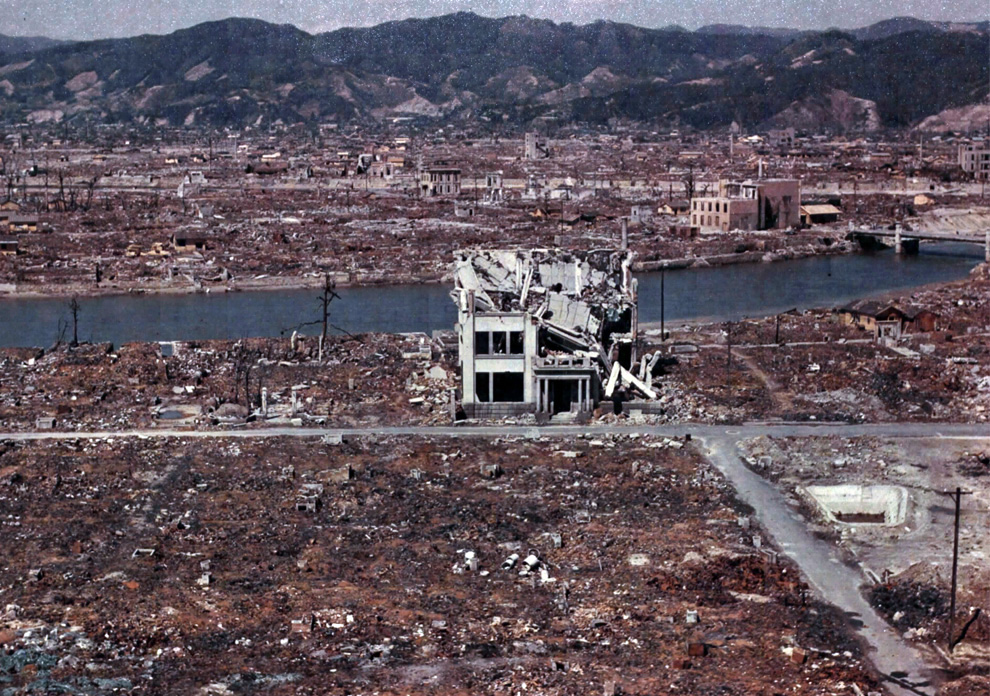


.jpg)