Wisdom Quotes (236 quotes)
...for our wisdom is better than the strength of men or of horses. ... nor is it right to prefer strength to excellent wisdom. For if there should be in the city [any athlete whose skill] is honoured more than strength ... the city would not on that account be any better governed.
Quoted in Arthur Fairbanks (ed. And trans.), The First Philosophers of Greece (1898), 73, fragment 19.
…indeed what reason may not go to Schoole to the wisdome of Bees, Aunts, and Spiders? what wise hand teacheth them to doe what reason cannot teach us? Ruder heads stand amazed at those prodigious pieces of nature, Whales, Elephants, Dromidaries and Camels; these I confesse, are the Colossus and Majestick pieces of her hand; but in these narrow Engines there is more curious Mathematicks, and the civilitie of these little Citizens more neatly sets forth the wisedome of their Maker.
In Religio Medici and Other Writings (1909), 17.
…this discussion would be unprofitable if it did not lead us to appreciate the wisdom of our Creator, and the wondrous knowledge of the Author of the world, Who in the beginning created the world out of nothing, and set everything in number, measure and weight, and then, in time and the age of man, formulated a science which reveals fresh wonders the more we study it.
— Hrosvita
From her play Sapientia, as quoted and cited in Philip Davis with Reuben Hersh, in The Mathematical Experience (1981), 110-111. Davis and Hersh introduce the quote saying it comes “after a rather long and sophisticated discussion of certain facts in the theory of numbers” by the character Sapientia.
“Facts speak for themselves.” Illusion! Facts are ventriloquists’ dummies. Sitting on a wise man’s knee they may be made to utter words of wisdom; elsewhere, they say nothing, or talk nonsense, or indulge in sheer diabolism.
In Time Must Have A Stop (1916), 295.
[After science lost] its mystical inspiration … man’s destiny was no longer determined from “above” by a super-human wisdom and will, but from “below” by the sub-human agencies of glands, genes, atoms, or waves of probability. … A puppet of the Gods is a tragic figure, a puppet suspended on his chromosomes is merely grotesque.
In 'Epilogue', The Sleepwalkers: A History of Man’s Changing Vision of the Universe (1959), 539.
[Helmholtz] is not a philosopher in the exclusive sense, as Kant, Hegel, Mansel are philosophers, but one who prosecutes physics and physiology, and acquires therein not only skill in developing any desideratum, but wisdom to know what are the desiderata, e.g., he was one of the first, and is one of the most active, preachers of the doctrine that since all kinds of energy are convertible, the first aim of science at this time. should be to ascertain in what way particular forms of energy can be converted into each other, and what are the equivalent quantities of the two forms of energy.
Letter to Lewis Campbell (21 Apr 1862). In P.M. Harman (ed.), The Scientific Letters and Papers of James Clerk Maxwell (1990), Vol. 1, 711.
[It] is not the nature of things for any one man to make a sudden, violent discovery; science goes step by step and every man depends on the work of his predecessors. When you hear of a sudden unexpected discovery—a bolt from the blue—you can always be sure that it has grown up by the influence of one man or another, and it is the mutual influence which makes the enormous possibility of scientific advance. Scientists are not dependent on the ideas of a single man, but on the combined wisdom of thousands of men, all thinking of the same problem and each doing his little bit to add to the great structure of knowledge which is gradually being erected.
Concluding remark in Lecture ii (1936) on 'Forty Years of Physics', revised and prepared for publication by J.A. Ratcliffe, collected in Needham and Pagel (eds.), Background to Modern Science: Ten Lectures at Cambridge Arranged by the History of Science Committee, (1938), 73-74. Note that the words as prepared for publication may not be verbatim as spoken in the original lecture by the then late Lord Rutherford.
[When questioned on his longevity] First of all, I selected my ancestors very wisely. ... They were long-lived, healthy people. Then, as a chemist, I know how to eat, how to exercise, keep my blood circulating. ... I don't worry. I don't get angry at people. I don't worry about things I can't help. I do what I can to make the world a better place to live, but I don't complain if things aren't right. As a scientist I take the world as I find it.
[About celebrating his 77th birthday by swimming a half mile in 22 minutes] I used swim fins and webbed gloves because a man of intelligence should apply his power efficiently, not just churn the water.
[About celebrating his 77th birthday by swimming a half mile in 22 minutes] I used swim fins and webbed gloves because a man of intelligence should apply his power efficiently, not just churn the water.
As quoted in obituary by Wallace Turner, 'Joel Hildebrand, 101', New York Times (3 May 1983), D27.
Epitaph of John Hunter
The Royal College of Surgeons of England have placed this tablet over the grave of Hunter, to record their admiration of his genius as a gifted interpreter of the Divine Power and Wisdom at work in the Laws of Organic Life, and their grateful veneration for his services to mankind as the Founder of Scientific Surgery.
The Royal College of Surgeons of England have placed this tablet over the grave of Hunter, to record their admiration of his genius as a gifted interpreter of the Divine Power and Wisdom at work in the Laws of Organic Life, and their grateful veneration for his services to mankind as the Founder of Scientific Surgery.
— Epitaph
Memorial brass in the floor of north aisle of Westminster Abbey, placed when Hunter's remains were reinterred there (28 Mar 1859). In Charles Coulston Gillespie (ed.), Dictionary of Scientific Biography (1972), Vol. 6, 568.
Haec quippe prima sapientiae clavis definitur, assidua scilicet seu frequens interrogatio … Dubitando enim ad inquisitionem venimus; inquirendo veritatem percipimus.
For this is the first key to wisdom, assiduous and frequent questioning. ... By doubting we come to inquiry; by inquiry we perceive the truth.
For this is the first key to wisdom, assiduous and frequent questioning. ... By doubting we come to inquiry; by inquiry we perceive the truth.
Sic et Non (c. 1120). Latin text in Peter Abelard, E.L.T. Henke and G.S. Lindenkohl (eds.), Sic et Non (1851), 16-17. Title translates as Yes or No. As translated in Frederick Denison Maurice, Mediaeval Philosophy; Or, A Treatise of Moral and Metaphysical Philosophy (1870), 138.
Lyveris to-forn us
Useden to marke
For selkouthes that thei seighen,
Hir sones for to teche;
And helden it an heigh science
Hir wittes to knowe.
Ac thorugh hir science soothly
Was nevere no soule y-saved,
Ne broght by hir bokes
To blisse ne to joye;
For alle hir kynde knowynges
Come but of diverse sightes.
Patriarkes and prophetes
Repreveden hir science,
And seiden hir wordes and hir wisdomes
Nas but a folye
And to the clergie of Crist
Counted it but a trufle.
Our ancestors in olden days used to record
The strange things they saw, and teach them to their sons;
And they held it a high science, to have knowledge of such things.
But no soul was ever saved by all that science,
Nor brought by books into eternal bliss;
Their science was only a series of sundry observations.
So patriarchs and prophets disapproved of their science,
And said their so-called words of wisdom were but folly—
And compared with Christian philosophy, a contemptible thing.
Useden to marke
For selkouthes that thei seighen,
Hir sones for to teche;
And helden it an heigh science
Hir wittes to knowe.
Ac thorugh hir science soothly
Was nevere no soule y-saved,
Ne broght by hir bokes
To blisse ne to joye;
For alle hir kynde knowynges
Come but of diverse sightes.
Patriarkes and prophetes
Repreveden hir science,
And seiden hir wordes and hir wisdomes
Nas but a folye
And to the clergie of Crist
Counted it but a trufle.
Our ancestors in olden days used to record
The strange things they saw, and teach them to their sons;
And they held it a high science, to have knowledge of such things.
But no soul was ever saved by all that science,
Nor brought by books into eternal bliss;
Their science was only a series of sundry observations.
So patriarchs and prophets disapproved of their science,
And said their so-called words of wisdom were but folly—
And compared with Christian philosophy, a contemptible thing.
In William Langland and B. Thomas Wright (ed.) The Vision and Creed of Piers Ploughman (1842), 235-236. Modern translation by Terrence Tiller in Piers Plowman (1981, 1999), 123.
Prudens interrogatio quasi dimidium sapientiae.
A prudent question is, as it were, one half of wisdom.
A prudent question is, as it were, one half of wisdom.
In The Works of Francis Bacon: Philosophical Works (1857), 635. Also in Henry Thomas Riley, Dictionary of Latin Quotations, Proverbs, Maxims, and Mottos (1866), 349.
Sapere aude.
Dare to be wise.
[Alternate: Dare to know.]
Dare to be wise.
[Alternate: Dare to know.]
— Horace
Epistles bk. 1, no. 2, 1. 40. In Satires, Epistles and Ars Poetica, trans. H. Rushton Fairclough (1926), 264-5.
Socrates: Very good; let us begin then, Protarchus, by asking whether all this which they call the universe is left to the guidance of unreason and chance medley, or, on the contrary, as our fathers have declared, ordered and governed by a marvellous intelligence and wisdom.
Protarchus: Wide asunder are the two assertions, illustrious Socrates, for that which you were just now saying to me appears to be blasphemy, but the other assertion, that mind orders all things, is worthy of the aspect of the world…
Protarchus: Wide asunder are the two assertions, illustrious Socrates, for that which you were just now saying to me appears to be blasphemy, but the other assertion, that mind orders all things, is worthy of the aspect of the world…
— Plato
From 'Philebus', collected in The Dialogues of Plato (1875), Vol. 4, 70.
~~[Unverified]~~ Through steady observation and a meaningful contact with the divined order of the world’s structure, arranged by God’s wisdom,–who would not be guided to admire the Builder who creates all!
As quoted, without citation, in Adam Mabry, Life and Doctrine: How the Truth and Grace of Christian Story Change Everything (2001, 2014), 17. Also seen, without citation, in Katherine Katsanis, 'In This Age of Science And Technology, How Can we Accept The Reality of Miracles?', Orthodox Observer (Sep 1997), 21, attributed to Nikolai Copernicus. As yet, Webmaster cannot identify a trustworthy primary source, is therefore presently skeptical, and meanwhile labels the quote as unverified.
A fool sees not the same tree that a wise man sees.
In 'Proverbs', The Poems: With Specimens of the Prose Writings of William Blake (1885), 279.
A society grows great when old men plant trees whose shade they know they shall never sit in.
In recent years, this has been widely quoted and cited as an (ancient?) Greek proverb. Seen, for example in, Violence on Television: Hearings Before the House Committee on Energy and Commerce, Subcommittee on Telecommunications and Finance (1994), 340. Webmaster however has so far found no example of this wording in, say, 19th century quotation collections. Which leaves the authenticity of the citation in question. Variations exist (for example “The beginning of wisdom comes when a person plants trees, the shade under which they know they will never sit.” (1993) or “Thoughtless men might ask why an old man plants a tree when he may never hope to sit in its shade” (1954).) However, the general sentiment has indeed existed for a long time. For example, “He that plants Trees, loves others besides himself,” collected in Thomas Fuller, Gnomologia: Adagies and Proverbs (1731), 91, No. 2248.
A week or so after I learned that I was to receive the Miller Award, our president, Marty Morton, phoned and asked me if I would utter a few words of scientific wisdom as a part of the ceremony. Unfortunately for me, and perhaps for you, I agreed to do so. In retrospect I fear that my response was a serious error, because I do not feel wise. I do not know whether to attribute my response to foolhardiness, to conceit, to an inordinate susceptibility to flattery, to stupidity, or to some combination of these unfortunate attributes all of which I have been told are recognizable in my personality. Personally, I tend to favor stupidity, because that is a condition over which I have little control.
Bartholomew, April 1993, unpublished remarks when receiving the Miller Award from the Cooper Ornithological Society.
A wise man in China asked his gardener to plant a shrub. The gardener objected that it only flowered once in a hundred years. “In that case,” said the wise man, “plant it immediately.” [On the importance of fundamental research.]
'A Scientist and the World He Lives In', Speech to the Empire Club of Canada (27 Nov 1986) in C. Frank Turner and Tim Dickson (eds.), The Empire Club of Canada Speeches 1986-1987 (1987), 149-161.
A wise man’s day is worth a fool’s life
Arabic proverb. In Hialmer Day Gould, New Practical Spelling (1905), 27
A wise physician, skill’d our wounds to heal, is more than armies to the public weal.
Homer and Alexander Pope (trans.), The Iliad of Homer (1809), Vol. 2, 144.
After what has been premised, I think we may lay down the following Conclusions. First, It is plain Philosophers amuse themselves in vain, when they inquire for any natural efficient Cause, distinct from a Mind or Spirit. Secondly, Considering the whole Creation is the Workmanship of a wise and good Agent, it should seem to become Philosophers, to employ their Thoughts (contrary to what some hold) about the final Causes of Things: And I must confess, I see no reason, why pointing out the various Ends, to which natural Things are adapted and for which they were originally with unspeakable Wisdom contrived, should not be thought one good way of accounting for them, and altogether worthy a Philosopher.
A Treatise Concerning the Principles of Human Knowledge [first published 1710], (1734), 126-7.
An amoeba never is torn apart through indecision, though, for even if two parts of the amoeba are inclined to go in different directions, a choice is always made. We could interpret this as schizophrenia or just confusion, but it could also be a judicious simultaneous sampling of conditions, in order to make a wise choice of future direction.
In The Center of Life: A Natural History of the Cell (1977, 1978), 73.
And men ought to know that from nothing else but thence [from the brain] come joys, delights, laughter and sports, and sorrows, griefs, despondency, and lamentations. And by this, in an especial manner, we acquire wisdom and knowledge, and see and hear, and know what are foul and hat are fair, what are bad and what are good, what are sweet, and what unsavory... And by the same organ we become mad and delirious, and fears and terrors assail us... All these things we endure from the brain, when it is not healthy... In these ways I am of the opinion that the brain exercises the greatest power in the man. This is the interpreter to us of those things which emanate from the air, when it [the brain] happens to be in a sound state.
The Genuine Works of Hippocrates, trans. Francis Adams (1886), Vol. 2, 344-5.
And when with excellent Microscopes I discern in otherwise invisible Objects the Inimitable Subtlety of Nature’s Curious Workmanship; And when, in a word, by the help of Anatomicall Knives, and the light of Chymicall Furnaces, I study the Book of Nature, and consult the Glosses of Aristotle, Epicurus, Paracelsus, Harvey, Helmont, and other learn'd Expositors of that instructive Volumne; I find my self oftentimes reduc’d to exclaim with the Psalmist, How manifold are thy works, O Lord? In wisdom hast thou made them all.
Some Motives and Incentives to the Love of God (1659), 56-7.
Aristotle, in spite of his reputation, is full of absurdities. He says that children should be conceived in the Winter, when the wind is in the North, and that if people marry too young the children will be female. He tells us that the blood of females is blacker then that of males; that the pig is the only animal liable to measles; that an elephant suffering from insomnia should have its shoulders rubbed with salt, olive-oil, and warm water; that women have fewer teeth than men, and so on. Nevertheless, he is considered by the great majority of philosophers a paragon of wisdom.
From An Outline of Intellectual Rubbish (1937, 1943), 19. Collected in The Basic Writings of Bertrand Russell (2009), 63.
As far as the meaning of life in general, or in the abstract, as far as I can see, there is none. If all of life were suddenly to disappear from earth and anywhere else it may exist, or if none had ever formed in the first place, I think the Universe would continue to exist without perceptible change. However, it is always possible for an individual to invest his own life with meaning that he can find significant. He can so order his life that he may find as much beauty and wisdom in it as he can, and spread as much of that to others as possible.
In a book proposal for The Meaning of Life edited by Hugh S. Moorhead, 1989.
As knowledge advances, science ceases to scoff at religion; and religion ceases to frown on science. The hour of mockery by the one, and of reproof by the other, is passing away. Henceforth, they will dwell together in unity and goodwill. They will mutually illustrate the wisdom, power, and grace of God. Science will adorn and enrich religion; and religion will ennoble and sanctify science.
In Tryon Edwards, A Dictionary of Thoughts (1908), 505.
As one of the elder members of the community of integrative biologists, I am overwhelmingly aware that during this continuing intellectual revolution, seniority is more likely to be correlated with obsolescence than with wisdom.
In 'Integrative Biology: An Organismic Biologist’s Point of View', Integrative and Comparative Biology (2005), 45, 330.
At Gabriel College there was a very holy object on the high altar of the Oratory, covered with a black velvet cloth... At the height of the invocation the Intercessor lifted the cloth to reveal in the dimness a glass dome inside which there was something too distant to see, until he pulled a string attached to a shutter above, letting a ray of sunlight through to strike the dome exactly. Then it became clear: a little thing like a weathervane, with four sails black on one side and white on the other, began to whirl around as the light struck it. It illustrated a moral lesson, the Intercessor explained, for the black of ignorance fled from the light, whereas the wisdom of white rushed to embrace it.
[Alluding to Crookes's radiometer.]
[Alluding to Crookes's radiometer.]
Northern Lights (2001), 149.
Behold the mighty dinosaur,
Famous in prehistoric lore,
Not only for his power and strength
But for his intellectual length.
You will observe by these remains
The creature had two sets of brains—
One in his head (the usual place),
The other at his spinal base.
Thus he could reason 'A priori'
As well as 'A posteriori'.
No problem bothered him a bit
He made both head and tail of it.
So wise was he, so wise and solemn,
Each thought filled just a spinal column.
If one brain found the pressure strong
It passed a few ideas along.
If something slipped his forward mind
'Twas rescued by the one behind.
And if in error he was caught
He had a saving afterthought.
As he thought twice before he spoke
He had no judgment to revoke.
Thus he could think without congestion
Upon both sides of every question.
Oh, gaze upon this model beast
Defunct ten million years at least.
Famous in prehistoric lore,
Not only for his power and strength
But for his intellectual length.
You will observe by these remains
The creature had two sets of brains—
One in his head (the usual place),
The other at his spinal base.
Thus he could reason 'A priori'
As well as 'A posteriori'.
No problem bothered him a bit
He made both head and tail of it.
So wise was he, so wise and solemn,
Each thought filled just a spinal column.
If one brain found the pressure strong
It passed a few ideas along.
If something slipped his forward mind
'Twas rescued by the one behind.
And if in error he was caught
He had a saving afterthought.
As he thought twice before he spoke
He had no judgment to revoke.
Thus he could think without congestion
Upon both sides of every question.
Oh, gaze upon this model beast
Defunct ten million years at least.
'The Dinosaur: A Poem' (1912). In E. H. Colbert (ed.), The Dinosaur Book (1951), 78.
Books and libraries and the will to use them are among the most important tools our nation has to diffuse knowledge and to develop our powers of creative wisdom.
Statement on the Occasion of National Library Week (16 Apr 1961). In Public Papers of the Presidents of the United States: John F. Kennedy, 1961 (1962), 125.
Books won’t stay banned. They won’t burn. Ideas won’t go to jail. In the long run of history, the censor and the inquisitor have always lost. The only sure weapon against bad ideas is better ideas. The source of better ideas is wisdom. The surest path to wisdom is a liberal education.
From Essays on Education. In Alfred Whitney Griswold, 1906-1963: In Memoriam (1964), 24.
By science calmed, over the peaceful soul,
Bright with eternal Wisdom's lucid ray,
Peace, meek of eye, extends her soft control,
And drives the puny Passions far away.
Bright with eternal Wisdom's lucid ray,
Peace, meek of eye, extends her soft control,
And drives the puny Passions far away.
Memoirs of the Life of Sir Humphry Davy, in J. Davy (ed.), The Collected Works of Sir Humphry Davy. (1839-40), Vol 1, 26.
By three methods we may learn wisdom: first, by reflection, which is noblest; second, by imitation, which is easiest; and third, by experience, which is the most bitter.
Quoted in Kim Lim (ed.), 1,001 Pearls of Spiritual Wisdom: Words to Enrich, Inspire, and Guide Your Life (2014), 109
City wisdom became almost entirely centered on the problems of human relationships, in contrast to the wisdom of any natural tribal group, where relationships with the rest of the animate and inanimate world are still given due place.
In Gaia, a New Look at Life on Earth (1979), 135.
Common sense in an uncommon degree is what the world calls wisdom.
In 'Hacket’s Life of Lord Keeper Williams', notes published in Henry Nelson Coleridge (ed.), The Literary Remains of Samuel Taylor Coleridge (1838), Vol. 3, 186.
Conscience is wiser than science.
In George Augustus Lofton, Character Sketches (1893), 344.
Create a vision and never let the environment, other people’s beliefs, or the limits of what has been done in the past shape your decisions. Ignore conventional wisdom.
…...
Data is not information, Information is not knowledge, Knowledge is not understanding, Understanding is not wisdom.
Attributed to Cliff Stoll and Gary Schubert, in Mark R Keeler, Nothing to Hide: Privacy in the 21st Century (2006), 112. A similar quote, 'Information is not knowledge, Knowledge is not wisdom,' is in the lyrics of Frank Zappa's album, Joe's Garage, track 'Packard Goose.' The sentiment of the above quote is presented in Clifford Stoll, Silicon Snake Oil: Second Thoughts on the Information Highway (1996), 193-194. The elements of the above quote are fragmented and distributed within three paragraphs. “Data isn't information ... information is not knowledge ... doesn't mean you understand ... There's a relationship between data, information, knowledge, understanding, and wisdom. ... perhaps knowledge becomes wisdom.” [If you know a primary print source and date for Stoll and Schubert's quote, in the exact words of the summary form as above, please contact webmaster.]
Data is not necessarily information. Information does not necessarily lead to knowledge. And knowledge is not always sufficient to discover truth and breed wisdom.
From post 're:The Pursuit of Knowledge, from Genesis to Google' to the 'Interesting People' List (6 Jan 2005), now archived at interesting-people.org website
Data isn't information. ... Information, unlike data, is useful. While there’s a gulf between data and information, there’s a wide ocean between information and knowledge. What turns the gears in our brains isn't information, but ideas, inventions, and inspiration. Knowledge—not information—implies understanding. And beyond knowledge lies what we should be seeking: wisdom.
In High-Tech Heretic: Reflections of a Computer Contrarian (2000), 185-186.
Despite the vision and the far-seeing wisdom of our wartime heads of state, the physicists felt a peculiarly intimate responsibility for suggesting, for supporting, and in the end, in large measure, for achieving the realization of atomic weapons. Nor can we forget that these weapons, as they were in fact used, dramatized so mercilessly the inhumanity and evil of modern war. In some sort of crude sense which no vulgarity, no humor, no overstatement can quite extinguish, the physicists have known sin; and this is a knowledge which they cannot lose.
In Arthur Dehon Little Memorial Lecture (25 Nov 1947) to the Massachusetts Institute of Technology, 'Physics in the Contemporary World'. Collected in J. Robert Oppenheimer, The Open Mind (1955), 88.
Doubt is the beginning, not the end, of wisdom.
From chapter 'Jottings from a Note-book', in Canadian Stories (1918), 167.
Early to bed and early to rise, makes a man healthy wealthy and wise.
In Poor Richard's Almanack (1735).
Even bigger machines, entailing even bigger concentrations of economic power and exerting ever greater violence against the environment, do not represent progress: they are a denial of wisdom. Wisdom demands a new orientation of science and technology towards the organic, the gentle, the non-violent, the elegant and beautiful.
In Small is Beautiful: Economics as if People Mattered (1973).
Every discovery in science is a tacit criticism of things as they are. That is why the wise man is invariably called a fool.
Martin H. Fischer, Howard Fabing (ed.) and Ray Marr (ed.), Fischerisms (1944).
Every farm woodland, in addition to yielding lumber, fuel, and posts, should provide its owner a liberal education. This crop of wisdom never fails, but it is not always harvested.
In A Sand County Almanac: and Sketches Here and There (1949, 1989), 73.
Every good psychologist must be wise as well as technically efficient. It is rather a lame statement because I don’t know how anybody can learn to be wise. Perhaps a way of putting it is to say that he must know where and how to look for evidence, which will enable him to advance beyond evidence and then to return once more to seek confirming evidence.
From archive recording (3 Jun 1959) with to John C. Kenna, giving his recollection of his farewell speech to Cambridge Psychological Society (4 Mar 1952), in which he gave a summary of points he considered to be basic requirements for a good experimental psychologist. End of point 3 of 7, from transcription of recording held at British Psychological Society History of Psychology Centre, London, as abridged on thepsychologist.bps.org.uk website.
Examinations are formidable even to the best prepared, for the greatest fool may ask more than the wisest man can answer.
Lacon: Or, Many Things in Few Words (1865), 97.
EXPERIENCE, n. The wisdom that enables us to recognize as an undesirable old acquaintance the folly that we have already embraced.
The Collected Works of Ambrose Bierce (1911), Vol. 7, The Devil's Dictionary, 93.
Facts are to the mind the same thing as food to the body. On the due digestion of facts depends the strength and wisdom of the one, just as vigor and health depend on the other. The wisest in council, the ablest in debate, and the most agreeable in the commerce of life is that man who has assimilated to his understanding the greatest number of facts.
Fear is the main source of superstition, and one of the main sources of cruelty. To conquer fear is the beginning of wisdom, in the pursuit of truth as in the endeavour after a worthy manner of life.
In An Outline of Intellectual Rubbish (1943), 23.
Focusing on the science-technology relationship may strike some as strange, because conventional wisdom views this relationship as an unproblematic given. … Technology is seen as being, at best, applied science … the conventional view perceives science as clearly preceding and founding technology. … Recent studies in the history of technology have begun to challenge this assumed dependency of technology on science. … But the conventional view of science is persistent.
In 'Technology and Science', Stephen V. Monsma (ed.), Responsible Technology: A Christian Perspective (1986), 78-79.
For a modern ruler the laws of conservation and transformation of energy, when the vivifing stream takes its source, the ways it wends its course in nature, and how, under wisdom and knowledge, it may be intertwined with human destiny, instead of careering headlong to the ocean, are a study at least as pregnant with consequences to life as any lesson taught by the long unscientific history of man.
Science and Life (1920), 5.
For between true Science, and erroneous Doctrines, Ignorance is in the middle. Naturall sense and imagination, are not subject to absurdity. Nature it selfe cannot erre: and as men abound in copiousnesses of language; so they become more wise, or more mad than ordinary. Nor is it possible without Letters for any man to become either excellently wise, or (unless his memory be hurt by disease, or ill constitution of organs) excellently foolish. For words are wise men's counters, they do but reckon by them; but they are the money of fools that value them by the authority of an Aristotle, a Cicero, or a Thomas, or any other Doctor whatsoever, if but a man.
Leviathan (1651), ed. C. B. Macpherson (1968), Part 1, Chapter 4, 106.
For in much wisdom is much grief and he that increaseth knowledge, increaseth sorrow.
— Bible
From 'Ecclesiastes', 1:18. In King James Version, The Bible: Containing the Old and New Testaments Translated Out Of the Original Tongues (circa 725 B.C., 1834)
https://books.google.com/books?id=qbaVYV0QiPMC
1834
For it is owing to their wonder that men now both begin and at first began to philosophize; they wondered originally at the obvious difficulties, then advanced little by little and stated difficulties about the greater matters, e.g. about the phenomena of the moon and those of the sun and the stars, and about the genesis of the universe. And a man who is puzzled and wonders thinks himself ignorant (whence even the lover of myth is in a sense a lover of wisdom, for myth is composed of wonders); therefore since they philosophized in order to escape from ignorance, evidently they were pursuing science in order to know, and not for any utilitarian end. And this is confirmed by the facts; for it was when almost all the necessities of life and the things that make for comfort and recreation were present, that such knowledge began to be sought. Evidently then we do not seek it for the sake of any advantage; but as the man is free, we say, who exists for himself and not for another, so we pursue this as the only free science, for it alone exists for itself.
Metaphysics, 982b, 12-27. In Jonathan Baines (ed.), The Complete Works of Aristotle (1984), Vol. 2, 1554.
Geology has shared the fate of other infant sciences, in being for a while considered hostile to revealed religion; so like them, when fully understood, it will be found a potent and consistent auxiliary to it, exalting our conviction of the Power, and Wisdom, and Goodness of the Creator.
Geology and Mineralogy Considered with Reference to Natural Theology (1836), Vol. 1, 9.
Geology is part of that remarkable dynamic process of the human mind which is generally called science and to which man is driven by an inquisitive urge. By noticing relationships in the results of his observations, he attempts to order and to explain the infinite variety of phenomena that at first sight may appear to be chaotic. In the history of civilization this type of progressive scientist has been characterized by Prometheus stealing the heavenly fire, by Adam eating from the tree of knowledge, by the Faustian ache for wisdom.
In 'The Scientific Character of Geology', The Journal of Geology (Jul 1961), 69, No. 4, 454.
George Sears, called Nessmuk, whose “Woodcraft,” published in 1884, was the first American book on forest camping, and is written with so much wisdom, wit, and insight that it makes Henry David Thoreau seem alien, humorless, and French.
Coming into the Country
Go to the ant, thou sluggard; consider her ways, and be wise.
— Bible
Proverbs 6:6. In Gary William Flake, The Computational Beauty of Nature (2000), 261.
Go, wondrous creature, mount where science guides.
Go, measure earth, weigh air, and state the tides;
Instruct the planets in what orbs to run,
Correct old Time, and regulate the sun;
Go, teach Eternal Wisdom how to rule,
Then drop into thyself and be a fool.
Go, measure earth, weigh air, and state the tides;
Instruct the planets in what orbs to run,
Correct old Time, and regulate the sun;
Go, teach Eternal Wisdom how to rule,
Then drop into thyself and be a fool.
Quoted in James Wood Dictionary of Quotations from Ancient and Modern, English and Foreign Sources (1893), 125.
God in His wisdom made the fly
And then forgot to tell us why.
And then forgot to tell us why.
'The Fly' (1942), Good Intentions (1943), 220.
Goethe said that he who cannot draw on 3,000 years of learning is living hand to mouth. It could just as well be said that individuals who do tap deeply into this rich cultural legacy are wealthy indeed. Yet the paradox is that much of this wisdom is buried in a sea of lesser books or like lost treasure beneath an ocean of online ignorance and trivia. That doesn’t mean that with a little bit of diligence you can’t tap into it. Yet many people, perhaps most, never take advantage of all this human experience. They aren’t obtaining knowledge beyond what they need to know for work or to get by. As a result, their view of our amazing world is diminished and their lives greatly circumscribed.
In An Embarrassment of Riches: Tapping Into the World's Greatest Legacy of Wealth (2013), 65.
Google can aggregate all web and paper-based information, and they can build fantastic search engines, but that will not directly lead to truth or wisdom. For that we will continue to need education, training in critical thought, and good editors who can help us winnow the fact from the fiction.
From post 're:The Pursuit of Knowledge, from Genesis to Google' to the 'Interesting People' List (6 Jan 2005) maintained by David J. Farber, now archived at interesting-people.org website.
Gravity is only the bark of wisdom’s tree, but it preserves it.
In Samuel Arthur Bent, Short Sayings of Great Men (1882), 159
He that breaks a thing to find out what it is has left the path of wisdom.
The Fellowship of the Ring (1954)
He was doomed, like millions, to flee from wisdom and be a hero.
In Lost Horizon (1933, 1962), 198.
He who knows not, and knows not he knows not, he is a fool—shun him;
He who knows not, and knows he knows not, he is simple—teach him;
He who knows, and knows not he knows, he is asleep—wake him;
He who knows, and knows he knows, he is wise—follow him.
He who knows not, and knows he knows not, he is simple—teach him;
He who knows, and knows not he knows, he is asleep—wake him;
He who knows, and knows he knows, he is wise—follow him.
Hesiod, 'Works and Days,' 293-7. In William White, Notes and Queries (1904), Series 10, Vol. 1, 235, the correspondent H.A. Strong says that the origin of these lines is to be found in Hesiod [Greek, 8th Century B.C.], Works and Days, 293-7; that the passage was very celebrated in antiquity, and is quoted by Aristotle, Nic. Eth., i. 4; and that both Livy (xxii. 29) and Cicero (Pro Cluent., 31) refer to it. Another correspondent (J.H.K.) said it was stated to be an Arab proverb in Lady [Isabel] Burton, Life of [Captain] Sir Richard [F.] Burton (1893), Vol. 1, 548, footnote, which prepends to the quote, “Men are four.”
Herewith I offer you the Omnipotent Finger of God in the anatomy of a louse: wherein you will find miracles heaped on miracles and will see the wisdom of God clearly manifested in a minute point.
Letter to Melchisedec Thevenot (Apr 1678). In G. A. Lindeboom (ed.), The Letters of Jan Swammerdam to Melchisedec Thivenot (1975), 104-5.
I believe in the wisdom of often saying “probably” and “perhaps.”
In This Week Magazine (19 Dec 1937). As epigraph citing the magazine title in Elmer Beneken Mode, Elements of Statistics (1942, 1961), 121. Magazine date cited for another Hilton quote from it, in John T. Moore, Fundamental Principles of Mathematics (1960), 470.
I do not fancy this acquiescence in second-hand hearsay knowledge; for, though we may be learned by the help of another’s knowledge, we can never be wise but by our own wisdom.
In 'Of Pedantry', collected in The Essays of Michael Seigneur de Montaigne: Translated Into English (1759), Vol. 1, 144.
I grow increasingly aware, and in more ways than expected that I am at the center of my own field; and whether it be folly or wisdom, it is a very pleasant feeling.
In Davis Baird, R.I.G. Hughes and Alfred Nordmann, Heinrich Hertz: Classical Physicist, Modern Philosopher (1998), 1.
I have often pondered over the roles of knowledge or experience, on the one hand, and imagination or intuition, on the other, in the process of discovery. I believe that there is a certain fundamental conflict between the two, and knowledge, by advocating caution, tends to inhibit the flight of imagination. Therefore, a certain naivete, unburdened by conventional wisdom, can sometimes be a positive asset.
In R. Langlands, 'Harish-Chandra', Biographical Memoirs of Fellows of the Royal Society (1985), Vol. 31, 206.
I thought that the wisdom of our City had certainly designed the laudable practice of taking and distributing these accompts [parish records of christenings and deaths] for other and greater uses than [merely casual comments], or, at least, that some other uses might be made of them; and thereupon I ... could, and (to be short) to furnish myself with as much matter of that kind ... the which when I had reduced into tables ... so as to have a view of the whole together, in order to the more ready comparing of one Year, Season, Parish, or other Division of the City, with another, in respect of all Burials and Christnings, and of all the Diseases and Casualties happening in each of them respectively...
Moreover, finding some Truths and not-commonly-believed opinions to arise from my meditations upon these neglected Papers, I proceeded further to consider what benefit the knowledge of the same would bring to the world, ... with some real fruit from those ayrie blossoms.
Moreover, finding some Truths and not-commonly-believed opinions to arise from my meditations upon these neglected Papers, I proceeded further to consider what benefit the knowledge of the same would bring to the world, ... with some real fruit from those ayrie blossoms.
From Natural and Political Observations Mentioned in a Following Index and Made upon Bills of Mortality (1662), Preface. Reproduced in Cornelius Walford, The Insurance Cyclopaedia (1871), Vol. 1, 286-287.
I was just going to say, when I was interrupted, that one of the many ways of classifying minds is under the heads of arithmetical and algebraical intellects. All economical and practical wisdom is an extension or variation of the following arithmetical formula: 2+2=4. Every philosophical proposition has the more general character of the expression a+b=c. We are mere operatives, empirics, and egotists, until we learn to think in letters instead of figures.
The Autocrat of the Breakfast Table (1858), 1.
I wished to show that Pythagoras, the first founder of the vegetable regimen, was at once a very great physicist and a very great physician; that there has been no one of a more cultured and discriminating humanity; that he was a man of wisdom and of experience; that his motive in commending and introducing the new mode of living was derived not from any extravagant superstition, but from the desire to improve the health and the manners of men.
From Dell Vitto Pitagorico (1743), (The Pythagorean Diet: for the Use of the Medical Faculty), as translated quotes in Howard Williams, The Ethics of Diet: A Catena of Authorities Deprecatory of the Practice of Flesh-Eating (1883), 158.
If popular medicine gave the people wisdom as well as knowledge, it would be the best protection for scientific and well-trained physicians.
In Fielding Hudson Garrison, An Introduction to the History of Medicine (1966), 577.
If thou art able, O stranger, to find out all these things and gather them together in your mind, giving all the relations, thou shalt depart crowned with glory and knowing that thou hast been adjudged perfect in this species of wisdom.
From a letter to Eratosthenes, the chief librarian at Alexandria, containing the Cattle Problem, an exceedingly difficult calculation involving huge numbers (which was not solved exactly until the use of a supercomputer in 1981). In David J. Darling, The Universal Book of Mathematics (2004), 23. The debate by scholars regarding whether Archimedes is the true author is in T. L. Heath (ed.), The Works of Archimedes (1897), xxxiv.
If we can combine our knowledge of science with the wisdom of wildness, if we can nurture civilization through roots in the primitive, man’s potentialities appear to be unbounded, Through this evolving awareness, and his awareness of that awareness, he can emerge with the miraculous—to which we can attach what better name than “God”? And in this merging, as long sensed by intuition but still only vaguely perceived by rationality, experience may travel without need for accompanying life.
A Letter From Lindbergh', Life (4 Jul 1969), 61. In Eugene C. Gerhart, Quote it Completely! (1998), 409.
Illness is the most heeded of doctors: to goodness and wisdom we only make promises; pain we obey.
…...
In fact, the thickness of the Earth's atmosphere, compared with the size of the Earth, is in about the same ratio as the thickness of a coat of shellac on a schoolroom globe is to the diameter of the globe. That's the air that nurtures us and almost all other life on Earth, that protects us from deadly ultraviolet light from the sun, that through the greenhouse effect brings the surface temperature above the freezing point. (Without the greenhouse effect, the entire Earth would plunge below the freezing point of water and we'd all be dead.) Now that atmosphere, so thin and fragile, is under assault by our technology. We are pumping all kinds of stuff into it. You know about the concern that chlorofluorocarbons are depleting the ozone layer; and that carbon dioxide and methane and other greenhouse gases are producing global warming, a steady trend amidst fluctuations produced by volcanic eruptions and other sources. Who knows what other challenges we are posing to this vulnerable layer of air that we haven't been wise enough to foresee?
In 'Wonder and Skepticism', Skeptical Enquirer (Jan-Feb 1995), 19, No. 1.
In mathematics it [sophistry] had no place from the beginning: Mathematicians having had the wisdom to define accurately the terms they use, and to lay down, as axioms, the first principles on which their reasoning is grounded. Accordingly we find no parties among mathematicians, and hardly any disputes.
In Essays on the Intellectual Powers of Man, Essay 1, chap. 1.
In modern thought, (if not in fact)
Nothing is that doesn’t act, So that is reckoned wisdom which
Describes the scratch but not the itch.
Nothing is that doesn’t act, So that is reckoned wisdom which
Describes the scratch but not the itch.
Understanding Media: the Extensions of Man? (2nd Ed.,1964), 25.
In science, as in art, and, as I believe, in every other sphere of human activity, there may be wisdom in a multitude of counsellors, but it is only in one or two of them. And in scientific inquiry, at any rate, it is to that one or two that we must look for light and guidance.
'The Progress of Science'. Collected essays (1898), Vol. 1, 57.
In the preface to his great History of Europe, H. A. L. Fisher wrote: “Men wiser than and more learned than I have discerned in history a plot, a rhythm, a predetermined pattern. These harmonies are concealed from me. I can see only one emergency following upon another as wave follows upon wave …” It seems to me that the same is true of the much older [geological stratigraphical] history of Europe.
In The Nature of the Stratigraphical Record (1973), 79.
In the presence of infinite might and infinite wisdom, the strength of the strongest man is but weakness, and the keenest of mortal eyes see but dimly.
Quoted in Kim Lim (ed.), 1,001 Pearls of Spiritual Wisdom: Words to Enrich, Inspire, and Guide Your Life (2014), 167
In the school of political projectors, I was but ill entertained, the professors appearing, in my judgment, wholly out of their senses; which is a scene that never fails to make me melancholy. These unhappy people were proposing schemes for persuading monarchs to choose favourites upon the score of their wisdom, capacity, and virtue; of teaching ministers to consult the public good; of rewarding merit, great abilities, and eminent services; of instructing princes to know their true interest, by placing it on the same foundation with that of their people; of choosing for employment persons qualified to exercise them; with many other wild impossible chimeras, that never entered before into the heart of man to conceive, and confirmed in me the old observation, that there is nothing so extravagant and irrational which some philosophers have not maintained for truth.
Gulliver's Travels (1726, Penguin ed. 1967), Part III, Chap. 6, 232.
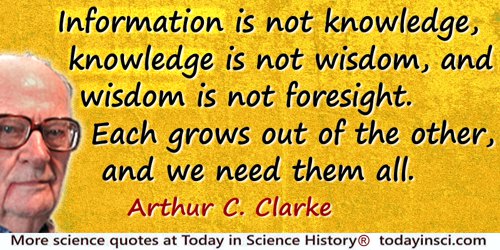
Information is not knowledge, knowledge is not wisdom, and wisdom is not foresight. Each grows out of the other, and we need them all.
Speech in Sri Lanka (1993). Quoted in Marshall B. Rosenberg and Riane Eisler, Life-Enriching Education (2003), xix. [If you know a primary print source reference, please contact Webmaster.]
Is there a due regard to be had, … for the golden tongue of wisdom, that relisheth all not by imagination but true judgement.
In 'To the Reader', The Optick Glass of Humors (1607), 10.
It is a right, yes a duty, to search in cautious manner for the numbers, sizes, and weights, the norms for everything [God] has created. For He himself has let man take part in the knowledge of these things ... For these secrets are not of the kind whose research should be forbidden; rather they are set before our eyes like a mirror so that by examining them we observe to some extent the goodness and wisdom of the Creator.
Epitome of Copernican Astronomy. In Michael B. Foster, Mystery and Philosophy, 61. Cited by Max Casper and Doris Hellman, trans., ed. Kepler (1954), 381. Cited by Gerald J. Galgan, Interpreting the Present: Six Philosophical Essays (1993), 105.
Gerald J. Galgan
It is contrary to the usual order of things, that events so harmonious as those of the system of the world, should depend on such diversified agents as are supposed to exist in our artificial arrangements; and there is reason to anticipate a great reduction in the number of undecompounded bodies, and to expect that the analogies of nature will be found conformable to the refined operations of art. The more the phenomena of the universe are studied, the more distinct their connection appears, and the more simple their causes, the more magnificent their design, and the more wonderful the wisdom and power of their Author.
Elements of Chemical Philosophy (1812), in J. Davy (ed.), The Collected Works of Sir Humphry Davy(1839-40), Vol. 4, 42.
It is part of wisdom never to revisit a wilderness, for the more golden the lily, the more certain that someone has gilded it. To return not only spoils a trip, but tarnishes a memory.
In 'The Green Lagoons', A Sand County Almanac, and Sketches Here and There (1949, 1987), 141.
It is sometimes asserted that a surgical operation is or should be a work of art … fit to rank with those of the painter or sculptor. … That proposition does not admit of discussion. It is a product of the intellectual innocence which I think we surgeons may fairly claim to possess, and which is happily not inconsistent with a quite adequate worldly wisdom.
Address, opening of 1932-3 session of U.C.H. Medical School (4 Oct 1932), 'Art and Science in Medicine', The Collected Papers of Wilfred Trotter, FRS (1941), 93.
It is the province of knowledge to speak and it is the privilege of wisdom to listen.
In The Poet at the Breakfast-Table (1892), 264.
It is the wisdom of rats, that will be sure to leave a house somewhat before it fall.
From essay, 'Of Wisdom for a Man’s Self'. As collected and translated in The Works of Francis Bacon (1765), Vol. 1, 479.
It is the wisdom of the crocodiles, that shed tears when they devour.
From essay, 'Of Wisdom for a Man’s Self'. As collected and translated in The Works of Francis Bacon (1765), Vol. 1, 479.
It is well to be up before daybreak, for such habits contribute to health, wealth and wisdom.
Attributed.
Know then thyself, presume not God to scan;
The proper study of Mankind is Man.
Plac'd on this isthmus of a middle state,
A being darkly wise, and rudely great:
With too much knowledge for the Sceptic side,
With too much weakness for the Stoic's pride,
He hangs between; in doubt to act, or rest;
In doubt to deem himself a God, or Beast;
In doubt his Mind or Body to prefer,
Born but to die, and reas'ning but to err;
Alike in ignorance, his reason such,
Whether he thinks too little, or too much:
Chaos of Thought and Passion, all confus'd;
Still by himself abus'd, or disabus'd;
Created half to rise, and half to fall;
Great lord of all things, yet a prey to all;
Sole judge of Truth, in endless Error hurl'd:
The glory, jest, and riddle of the world!
... Superior beings, when of late they saw
A mortal Man unfold all Nature's law,
Admir'd such wisdom in an earthly shape,
And shew'd a NEWTON as we shew an Ape.
The proper study of Mankind is Man.
Plac'd on this isthmus of a middle state,
A being darkly wise, and rudely great:
With too much knowledge for the Sceptic side,
With too much weakness for the Stoic's pride,
He hangs between; in doubt to act, or rest;
In doubt to deem himself a God, or Beast;
In doubt his Mind or Body to prefer,
Born but to die, and reas'ning but to err;
Alike in ignorance, his reason such,
Whether he thinks too little, or too much:
Chaos of Thought and Passion, all confus'd;
Still by himself abus'd, or disabus'd;
Created half to rise, and half to fall;
Great lord of all things, yet a prey to all;
Sole judge of Truth, in endless Error hurl'd:
The glory, jest, and riddle of the world!
... Superior beings, when of late they saw
A mortal Man unfold all Nature's law,
Admir'd such wisdom in an earthly shape,
And shew'd a NEWTON as we shew an Ape.
'An Essay on Man' (1733-4), Epistle II. In John Butt (ed.), The Poems of Alexander Pope (1965), 516-7.
Know thyself! This is the source of all wisdom, said the great thinkers of the past, and the sentence was written in golden letters on the temple of the gods. To know himself, Linnæus declared to be the essential indisputable distinction of man above all other creatures. I know, indeed, in study nothing more worthy of free and thoughtful man than the study of himself. For if we look for the purpose of our existence, we cannot possibly find it outside ourselves. We are here for our own sake.
As translated and quoted in Ernst Haeckel and E. Ray Lankester (trans.) as epigraph for Chap. 9, The History of Creation (1886), Vol. 1, 244.
Know, oh Brother (May God assist thee and us by the Spirit from Him) that God, Exalted Be His Praise, when He created all creatures and brought all things into being, arranged them and brought them into existence by a process similar to the process of generation of numbers from one, so that the multiplicity [of numbers] should be a witness to his Oneness, and their classification and order an indication of the perfection of His wisdom in creation. And this would be a witness to the fact, too, that they [creatures] are related to Him who created them, in the same way as the numbers are related to the One which is prior to two, and which is the principle, origin and source of numbers, as we have shown in our treatise on arithmetic.
Rasa'il. In Seyyed Hossein Nasr, Science and Civilisation in Islam (1968), 155-6.
Knowledge and wisdom are indeed not identical; and every man’s experience must have taught him that there may be much knowledge with little wisdom, and much wisdom with little knowledge. But with imperfect knowledge it is difficult or impossible to arrive at right conclusions. Many of the vices, many of the miseries, many of the follies and absurdities by which human society has been infested and disgraced may be traced to a want of knowledge.
Presidential Address to Anniversary meeting of the Royal Society (30 Nov 1859), Proceedings of the Royal Society of London (1860), 10, 163.
Knowledge and wisdom, far from being one,
Have ofttimes no connection. Knowledge dwells
In heads replete with thoughts of other men,
Wisdom in minds attentive to their own.
Knowledge is proud that he has learned so much,
Wisdom is humble that he knows no more.
Have ofttimes no connection. Knowledge dwells
In heads replete with thoughts of other men,
Wisdom in minds attentive to their own.
Knowledge is proud that he has learned so much,
Wisdom is humble that he knows no more.
The Task, Book 6, 'The Winter Walk at Noon' (published 1785). In William Cowper and Humphrey Sumner Milford (ed.), The Complete Poetical Works of William Cowper (1905), 221.
Knowledge comes by taking things apart, analysis. But wisdom comes by putting things together.
From The Role of Religion in Education. As cited in Braude’s Handbook of Stories for Toastmasters and Speakers (1975), 194.
Knowledge comes, but wisdom lingers.
'Locksley Hall' (1842), collected in Alfred Tennyson and William James Rolfe (ed.) The Poetic and Dramatic Works of Alfred, Lord Tennyson (1898), 93.
Knowledge is a process of piling up facts; wisdom lies in their simplification.
In Fischerisms (1930), 7.
Knowledge is indivisible. When people grow wise in one direction, they are sure to make it easier for themselves to grow wise in other directions as well. On the other hand, when they split up knowledge, concentrate on their own field, and scorn and ignore other fields, they grow less wise–even in their own field.
In The Roving Mind (1983), 116.
Knowledge leads us from the simple to the complex; wisdom leads us from the complex to the simple.
In Dianna Daniels Booher, Your Signature Life: Pursuing God's Best Every Day (2003), 30.
Learning acquired in youth arrests the evil of old age; and if you understand that old age has wisdom for its food, you will so conduct yourself in youth that your old age will not lack for nourishment.
…...
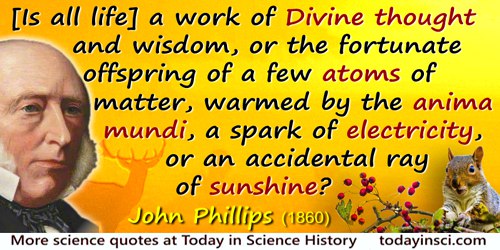
Life through many long periods has been manifested in a countless host of varying structures, all circumscribed by one general plan, each appointed to a definite place, and limited to an appointed duration. On the whole the earth has been thus more and more covered by the associated life of plants and animals, filling all habitable space with beings capable of enjoying their own existence or ministering to the enjoyment of others; till finally, after long preparation, a being was created capable of the wonderful power of measuring and weighing all the world of matter and space which surrounds him, of treasuring up the past history of all the forms of life, and considering his own relation to the whole. When he surveys this vast and co-ordinated system, and inquires into its history and origin, can he be at a loss to decide whether it be a work of Divine thought and wisdom, or the fortunate offspring of a few atoms of matter, warmed by the anima mundi, a spark of electricity, or an accidental ray of sunshine?
Life on the Earth: Its Origin and Succession (1860), 216-7.
Logic, logic, logic. Logic is the beginning of wisdom, Valeris, not the end.
Spoken by character Dr. Spock in movie Star Trek VI: The Undiscovered Country (1992), screenwriters Nicholas Meyer and Denny Martin Flinn. As cited in Gary Westfahl (ed.), The Greenwood Encyclopedia of Science Fiction and Fantasy (2005), Vol. 2, 892.
Logical consequences are the scarecrows of fools and the beacons of wise men.
'On the Hypothesis that Animals are Automata', The Fortnightly (1874), 22, 577.
Look round the world, contemplate the whole and every part of it: you will find it to be nothing but one great machine, subdivided into an infinite number of lesser machines, which again admit of subdivisions to a degree beyond what human senses and faculties can trace and explain. All these various machines, and even their most minute parts, are adjusted to each other with an accuracy which ravishes into admiration all men who have ever contemplated them. The curious adapting of means to ends, throughout all nature, resembles exactly, though it much exceeds, the productions of human contrivance-of human design, thought, wisdom, and intelligence.
Dialogues Concerning Natural Religion (1779), 47-48.
Look wise, say nothing, and grunt. Speech was given to conceal thought.
William Bennett Bean (ed.), Sir William Osler: Aphorisms from his Bedside Teachings and Writings, No. 267 (1950), 126.
Malthus argued a century and a half ago that man, by using up all his available resources, would forever press on the limits of subsistence, thus condemning humanity to an indefinite future of misery and poverty. We can now begin to hope and, I believe, know that Malthus was expressing not a law of nature, but merely the limitation then of scientific and social wisdom. The truth or falsity of his prediction will depend now, with the tools we have, on our own actions, now and in the years to come.
From Address to the Centennial Convocation of the National Academy of Sciences (22 Oct 1963), 'A Century of Scientific Conquest'. Online at The American Presidency Project.
Man’s usurpation over nature is an egotism that will destroy human as well as whale kingdoms. … Academies should return to wisdom study in tree groves rather than robot study in plastic cells…
Resolution at World Poetry Conference in Stony Brook, Long Island, New York by Beat Bard, Allen Ginsberg and 35 others. Quoted in Time (12 Jul 1968).
Mathematical studies … when combined, as they now generally are, with a taste for physical science, enlarge infinitely our views of the wisdom and power displayed in the universe. The very intimate connexion indeed, which, since the date of the Newtonian philosophy, has existed between the different branches of mathematical and physical knowledge, renders such a character as that of a mere mathematician a very rare and scarcely possible occurrence.
In Elements of the Philosophy of the Human Mind (1827), Vol. 3, Chap. 1, Sec. 3, 184.
Men are wise in proportion, not to their experience, but to their capacity for experience.
In 'Maxims for Revolutionists: Experience', in Man and Superman (1903), 239.
Mere knowledge is comparatively worthless unless digested into practical wisdom and common sense as applied to the affairs of life.
As quoted, without citation, in John Walker, A Fork in the Road: Answers to Daily Dilemmas from the Teachings of Jesus Christ (2005), 71.
Mistakes are a source of experience; and it is the essence of experience that we call wisdom.
From Henry Ford and Ralph Waldo Trine, The Power that Wins (1929), 25-26.
More than the diamond Koh-i-noor, which glitters among their crown jewels, they prize the dull pebble which is wiser than a man, whose poles turn themselves to the poles of the world, and whose axis is parallel to the axis of the world. Now, their toys are steam and galvanism.
English Traits (1856), 47. The “dull pebble” refers to lodestone and its magnetic properties.
Much wisdom goes with fewest words.
In Hialmer Day Gould, New Practical Spelling (1905), 16.
My child you may search forever the depths of this science [metaphysics] and you will never find a bottom. The secrets of eternal wisdom are not to be fathomed by our narrow understandings.
Letter to George Washington Adams (grandson) (10 Feb 1822). Quoted in James H. Hutson (ed.), The Founders on Religion: A Book of Quotations (2009), 49; citing Adams Papers (microfilm), reel 454, Library of Congress. Hutson provided "metaphysics" as the meaning of "science" in this context.
My father, and the father of my father, pitched their tents here before me. … For twelve hundred years have the true believers—and, praise be to God! all true wisdom is with them alone—been settled in this country, and not one of them ever heard of a palace underground. Neither did they who went before them. But lo! here comes a Frank from many days’ journey off, and he walks up to the very place, and he takes a stick … and makes a line here, and makes a line there. Here, says he, is the palace; there, says he, is the gate; and he shows us what has been all our lives beneath our feet, without our having known anything about it. Wonderful! Wonderful! Is it by books, is it by magic, is it by your prophets, that you have learnt wisdom?
(c. 1850) To Austin Layard, the English archaeologist who discovered and excavated Nineveh and Nimrud, 1845-1861.
Nature, everywhere the most amazingly and outstandingly remarkable producer of living bodies, being most carefully arranged according to physical, mechanical, and chemical laws, does not give even the smallest hint of its extraordinary and tireless workings and quite clearly points to its work as being alone worthy of a benign and omnipotent God; and it carries this bright quality in all of its traces, in that, just as all of its general mechanisms rejoice, so also do all of their various smallest component parts rejoice in the depth of wisdom, in the height of perfection, and in the lofty arrangement of forms and qualities, which lie far beyond every investigation of the human mind.
'Inaugural Physico-Medical Dissertation on the Blood and the Circulation of the Microcosm' (1749). Trans. Arthur Donovan and Joseph Prentiss, James Hutton's Medical Dissertation (1980), 29.
No Man is the wiser for his Learning: it may administer Matter to work in, or Objects to work upon; but Wit and Wisdom are born with a man.
In John Selden, Richard Milward (ed.), 'Learning', Table-Talk of John Selden (1689, 1856), 85.
No research will answer all queries that the future may raise. It is wiser to praise the work for what it has accomplished and then to formulate the problems still to be solved.
Letter to Dr. E. B. Krumhaar (11 Oct 1933), in Journal of Bacteriology (Jan 1934), 27, No. 1, 19.
Nobody before the Pythagoreans had thought that mathematical relations held the secret of the universe. Twenty-five centuries later, Europe is still blessed and cursed with their heritage. To non-European civilizations, the idea that numbers are the key to both wisdom and power, seems never to have occurred.
In The Sleepwalkers: A History of Man's Changing Vision of the Universe (1959), Preface, 40.
Now that is the wisdom of a man, in every instance of his labor, to hitch his wagon to a star, and see his chore done by the gods themselves. That is the way we are strong, by borrowing the might of the elements. The forces of steam, gravity, galvanism, light, magnets, wind, fire, serve us day by day and cost us nothing.
From Chap. 2, 'Civilization', in Society and Solitude (1870), 24.
Now this supreme wisdom, united to goodness that is no less infinite, cannot but have chosen the best. For as a lesser evil is a kind of good, even so a lesser good is a kind of evil if it stands in the way of a greater good; and the would be something to correct in the actions of God if it were possible to the better. As in mathematics, when there is no maximum nor minimum, in short nothing distinguished, everything is done equally, or when that is not nothing at all is done: so it may be said likewise in respect of perfect wisdom, which is no less orderly than mathematics, that if there were not the best (optimum) among all possible worlds, God would not have produced any.
Theodicy: Essays on the Goodness of God and Freedom of Man and the Origin of Evil (1710), 128.
![Ernest Henry Starling quote: Only by following out the injunction of our great predecessor [William Harvey] to search out and st](https://todayinsci.com/S/Starling_Ernest/StarlingErnest-Mastery500x250px.jpg)
Only by following out the injunction of our great predecessor [William Harvey] to search out and study the secrets of Nature by way of experiment, can we hope to attain to a comprehension of 'the wisdom of the body and the understanding of the heart,' and thereby to the mastery of disease and pain, which will enable us to relieve the burden of mankind.
'The Wisdom of the Body', The Lancet (1923), 205, 870.
Only for you, children of doctrine and learning, have we written this work. Examine this book, ponder the meaning we have dispersed in various places and gathered again; what we have concealed in one place we have disclosed in another, that it may be understood by your wisdom.
In De Occulta Philosophia (1531), Vol. 3, 65. As quoted and cited in epigraph, Umberto Eco and William Weaver (trans.), Foucault’s Pendulum (2007), Front matter before title page.
Our commercial and mercantile law was no sudden invention. It was not the work of a day, or of one set of minds… In the incipient, the early existence of this system, a single maxim obtained force, others succeeded; one rule of right formed a nucleus around which other kindred rules might cling; the necessities of trade originated customs, customs ripened into law; a few feeble decisions of courts laid the foundation for others; the wisdom and experience of each succeeding generation improved upon the wisdom and experience of generations that were past; and thus the edifice arose, perfect in its parts, beautiful in its proportions.
From biographical preface by T. Bigelow to Austin Abbott (ed.), Official Report of the Trial of Henry Ward Beecher (1875), Vol. 1, xi-xii.
Our scientific work in physics consists in asking questions about nature in the language that we possess and trying to get an answer from experiment by the means at our disposal. In this way quantum theory reminds us, as Bohr has put it, of the old wisdom that when searching for harmony in life one must never forget that in the drama of existence we are ourselves both players and spectators. It is understandable that in our scientific relation to nature our own activity becomes very important when we have to deal with parts of nature into which we can penetrate only by using the most elaborate tools.
The Copenhagen Interpretation of Quantum Theory (1958). In Steve Adams, Frontiers (2000), 13.
Our stability is but balance, and wisdom lies
In masterful administration of the unforeseen.
In masterful administration of the unforeseen.
In The Testament of Beauty (1929), Book 1, 1, lines 6-7.
Papyra, throned upon the banks of Nile,
Spread her smooth leaf, and waved her silver style.
The storied pyramid, the laurel’d bust,
The trophy’d arch had crumbled into dust;
The sacred symbol, and the epic song (Unknown the character, forgot the tongue,)
With each unconquer’d chief, or sainted maid,
Sunk undistinguish’d in Oblivion’s shade.
Sad o’er the scatter’d ruins Genius sigh’d,
And infant Arts but learn’d to lisp, and died.
Till to astonish’d realms Papyra taught To paint in mystic colours Sound and Thought,
With Wisdom’s voice to print the page sublime,
And mark in adamant the steps of Time.
Spread her smooth leaf, and waved her silver style.
The storied pyramid, the laurel’d bust,
The trophy’d arch had crumbled into dust;
The sacred symbol, and the epic song (Unknown the character, forgot the tongue,)
With each unconquer’d chief, or sainted maid,
Sunk undistinguish’d in Oblivion’s shade.
Sad o’er the scatter’d ruins Genius sigh’d,
And infant Arts but learn’d to lisp, and died.
Till to astonish’d realms Papyra taught To paint in mystic colours Sound and Thought,
With Wisdom’s voice to print the page sublime,
And mark in adamant the steps of Time.
Philosophy, and science, and the springs
Of wonder, and th wisdom of the world,
I have essayed; and in my mind there is
A power to make these subject to itself...
Of wonder, and th wisdom of the world,
I have essayed; and in my mind there is
A power to make these subject to itself...
From poem 'Manfred'.
Positive, objective knowledge is public property. It can be transmitted directly from one person to another, it can be pooled, and it can be passed on from one generation to the next. Consequently, knowledge accumulates through the ages, each generation adding its contribution. Values are quite different. By values, I mean the standards by which we judge the significance of life. The meaning of good and evil, of joy and sorrow, of beauty, justice, success-all these are purely private convictions, and they constitute our store of wisdom. They are peculiar to the individual, and no methods exist by which universal agreement can be obtained. Therefore, wisdom cannot be readily transmitted from person to person, and there is no great accumulation through the ages. Each man starts from scratch and acquires his own wisdom from his own experience. About all that can be done in the way of communication is to expose others to vicarious experience in the hope of a favorable response.
The Nature of Science and Other Lectures (1954), 7.
Realistic thinking accrues only after mistake making, which is the cosmic wisdom's most cogent way of teaching each of us how to carry on.
In Buckminster Fuller and Answar Dil, Humans in Universe (1983), 218.
Science and technology have freed humanity from many burdens and given us this new perspective and great power. This power can be used for the good of all. If wisdom governs our actions; but if the world is mad or foolish, it can destroy itself just when great advances and triumphs are almost without its grasp.
As quoted in Suranjan Das 'The Nehru Years in Indian politics', Edinburgh Papers on South Asian Studies (16 Nov 2001), 16, 230. As cited in M.J. Vinod and Meena Deshpande, Contemporary Political Theory (2013), 507. Vinod and Deshpande introduce the quote by writing “Nehru was largely instrumental for building a scientific temper and culture in India” and “emphasized the need for building national laboratories and research institutes.”
Science at best is not wisdom, it is knowledge. Wisdom is knowledge tempered with judgment.
From essay, 'Mortgaging the Old Homestead', in Frank H.T. Rhodes and Richard O. Stone (eds.), Language of the Earth (2013), 361.
Science gives us knowledge, but only philosophy can give us wisdom.
In The Story of Philosophy: The Lives and Opinions of the Greater Philosophers (1928), 3.
Science gives us the grounds of premises from which religious truths are to be inferred; but it does not set about inferring them, much less does it reach the inference; that is not its province. It brings before us phenomena, and it leaves us, if we will, to call them works of design, wisdom, or benevolence; and further still, if we will, to proceed to confess an Intelligent Creator. We have to take its facts, and to give them a meaning, and to draw our own conclusions from them. First comes Knowledge, then a view, then reasoning, then belief. This is why Science has so little of a religious tendency; deductions have no power of persuasion. The heart is commonly reached, not through the reason, but through the imagination, by means of direct impressions, by the testimony of facts and events, by history, by description. Persons influence us, voices melt us, looks subdue us, deeds inflame us. Many a man will live and die upon a dogma; no man will be a martyr for a conclusion.
Letter collected in Tamworth Reading Room: Letters on an Address Delivered by Sir Robert Peel, Bart., M.P. on the Establishment of a Reading Room at Tamworth (1841), 32. Excerpted in John Henry Newman, An Essay in Aid of a Grammar of Assent (1870), 89 & 94 footnote.
Science has always promised two things not necessarily related—an increase first in our powers, second in our happiness and wisdom, and we have come to realize that it is the first and less important of the two promises which it has kept most abundantly.
In 'The Disillusion with the Laboratory,', The Modern Temper (1929).
Science has radically changed the conditions of human life on earth. It has expanded our knowledge and our power but not our capacity to use them with wisdom.
In Old Myths and New Realities (1964).
Science in the service of humanity is technology, but lack of wisdom may make the service harmful.
Epigraph in Isaac Asimov’s Book of Science and Nature Quotations (1988), 321.
Science investigates; religion interprets. Science gives man knowledge which is power; religion gives man wisdom which is control. Science deals mainly with facts; religion deals mainly with values. The two are not rivals. They are complementary.
In 'A Tough Mind and a Tender Heart', Strength To Love (1963), 3.
Science is always discovering odd scraps of magical wisdom and making a tremendous fuss about its cleverness.
Referring to Freudian theories.
Referring to Freudian theories.
The Confessions of Aleister Crowley, ch. 14 (1929, rev 1970).
Science is one thing, wisdom is another. Science is an edged tool, with which men play like children, and cut their own fingers. If you look at the results which science has brought in its train, you will find them to consist almost wholly in elements of mischief. See how much belongs to the word “Explosion” alone, of which the ancients knew nothing.
Written for fictional character, the Rev. Dr. Opimian, in Gryll Grange (1861), collected in Sir Henry Cole (ed.) The Works of Thomas Love Peacock(1875), Vol. 2, 380. (An incorrect citation is found in Robert L. Weber, More Random Walks in Science (1982), 48. Weber attributes to Arthur Eddington in 'The Decline of Determinism.' Webmaster checked an article by this name in Mathematical Gazette (May 1932) but found nothing resembling the quote therein.)
Science is organized knowledge. Wisdom is organized life.
[Author Will Durant’s summary of Kant’s ideas; not a direct translation of Kant’s own words.]
[Author Will Durant’s summary of Kant’s ideas; not a direct translation of Kant’s own words.]
Although often seen, these are (almost certainly) not Kant’s own words. While explaining Kant’s ideas, this are the words used by Will Durant in 'Kant and German Idealism: Transcendental Analytic', The Story of Philosophy (1924, 1938), 295-296. The first sentence, “Science is organized knowledge,” was first stated by Herbert Spencer in 1854 (see Science Quotes by Herbert Spencer.) On the webside of quoteinvestigator.com, which pinpoints Durant as the origin of the quote, it is further explained that Kant’s writing style used complicated expression that makes it rare to find intelligible direct quotes of Kant’s own words.
Science may be learned by rote, but Wisdom not.
(1759). From The Life and Opinions of Tristram Shandy, Gentleman, collected in Collection of Ancient and Modern British Novels and Romances (1832), Vol. 38, 311.
Science moves, but slowly, slowly, creeping on from point to point. ...
Yet I doubt not through the ages one increasing purpose runs,
And the thoughts of men are widened with the process of the suns.…
Knowledge comes, but wisdom lingers…
Yet I doubt not through the ages one increasing purpose runs,
And the thoughts of men are widened with the process of the suns.…
Knowledge comes, but wisdom lingers…
In poem, 'Locksley Hall', collected in Poems by Alfred Tennyson (1842), Vol. 1, 105-106.
Science robs men of wisdom and usually converts them into phantom beings loaded up with facts.
In Miguel de Unamuno and John Ernest Crawford Flitch (trans.), 'Arbitrary Reflections Upon Europeanization', Essays and Soliloquies, (1925), 55.
Science says: “We must live,” and seeks the means of prolonging, increasing, facilitating and amplifying life, of making it tolerable and acceptable, wisdom says: “We must die,” and seeks how to make us die well.
'Arbitrary Reflections', Essays and Soliloquies, translated by John Ernest Crawford Flitch (1925), 154. In Robert Andrews, The Columbia Dictionary of Quotations (1993), 844:9.
Sciences may be learned by rote, but Wisdom not.
The Life and Opinions of Tristram Shandy Gentleman (1759-67), Penguin edition (1997), 324.
Background of ocean and rocky outcrop with kelp on sandy shore in foreground, at Channel Islands NMS, California. , Photo by Claire Fackler, NOAA (source)
Socrates said, our only knowledge was
“To know that nothing could be known;” a pleasant
Science enough, which levels to an ass
Each Man of Wisdom, future, past, or present.
Newton, (that Proverb of the Mind,) alas!
Declared, with all his grand discoveries recent,
That he himself felt only “like a youth
Picking up shells by the great Ocean—Truth.”
“To know that nothing could be known;” a pleasant
Science enough, which levels to an ass
Each Man of Wisdom, future, past, or present.
Newton, (that Proverb of the Mind,) alas!
Declared, with all his grand discoveries recent,
That he himself felt only “like a youth
Picking up shells by the great Ocean—Truth.”
From poem, 'Don Juan,' (1822), canto 7, verse V. In Lord Byron, Don Juan: Cantos VI, VII and VIII (1823), 67.
Statistics is a science which ought to be honourable, the basis of many most important sciences; but it is not to be carried on by steam, this science, any more than others are; a wise head is requisite for carrying it on.
Chartism (1839, 1840), 9.
Subtlety is not a proof of wisdom. Fools and even madmen are at times extraordinarily subtle. One can add that subtlety rarely combines with genius, which is usually ingenuous, or with greatness of character, which is always frank.
(1827). In Aleksandr Sergeevich Pushkin, John Bayley (ed.), Pushkin on Literature (1986), 211.
Suppose that we are wise enough to learn and know—and yet not wise enough to control our learning and knowledge, so that we use it to destroy ourselves? Even if that is so, knowledge remains better than ignorance. It is better to know—even if the knowledge endures only for the moment that comes before destruction—than to gain eternal life at the price of a dull and swinish lack of comprehension of a universe that swirls unseen before us in all its wonder. That was the choice of Achilles, and it is mine, too.
Widely seen on the Web, but always without citation, so regard attribution as uncertain. Webmaster has not yet found reliable verification. Contact Webmaster if you know a primary print source.
Take the so called standard of living. What do most people mean by “living”? They don’t mean living. They mean the latest and closest plural approximation to singular prenatal passivity which science, in its finite but unbounded wisdom, has succeeded in selling their wives.
Introduction, Poems (1954).
Taxes are a means of influencing production and commerce to give to them a direction which they would not naturally have taken. Such an influence may undoubtedly have disagreeable consequences if the taxes are imposed without discrimination or exclusively for a fiscal purpose, but it is entirely otherwise if wisdom and tact preside at their institution.
From Appendix A, 'Extracts From the Unpublished Writings of Carnot', Reflections on the Motive Power of Heat (1890, 2nd ed. 1897), 212.
The aim of science is not to open the door to infinite wisdom, but to set a limit to infinite error.
Play, The Life of Galileo (1939, 1994), scene 9, 74.
The art of being wise is the art of knowing what to overlook.
In The Principles of Psychology (1918), Vol. 2, 369.
The beginning of wisdom is the statement “I do not know.” The person who cannot make that statement is one who will never learn anything.
In World of Warcraft: Cycle of Hatred (2007), 77.
The biggest difficulty with mankind today is that our knowledge has increased so much faster than our wisdom
…...
The Builder of this Universe was wise,
He plann’d all souls, all systems, planets, particles:
The Plan He shap'd all Worlds and Æons by,
Was—Heavens!—was thy small Nine-and-thirty Articles!
He plann’d all souls, all systems, planets, particles:
The Plan He shap'd all Worlds and Æons by,
Was—Heavens!—was thy small Nine-and-thirty Articles!
In 'Practical-Devotional', Past and Present, Book 2, Chap 15, collected in On Heroes, Hero-Worship and the Heroic in History (1840), 101. Note: “Nine-and-thirty Articles” of the Church of England.
The central nerve chain of an invertebrate such as the lobster runs beneath its alimentary canal, whereas the main portion of its rudimentary brain is placed above it, in its forehead. In other words, the lobster’s gullet, from mouth to stomach, has to pass through the midst of its brain ganglia. If its brain were to expand—and expand it must if the lobster is to grow in wisdom—its
gullet would be squeezed and it would starve.
In Epilogue, The Sleepwalkers: A History of Man’s Changing Vision of the Universe (1959), 516.
The combination in time and space of all these thoughtful conceptions [of Nature] exhibits not only thought, it shows also premeditation, power, wisdom, greatness, prescience, omniscience, providence. In one word, all these facts in their natural connection proclaim aloud the One God, whom man may know, adore, and love; and Natural History must in good time become the analysis of the thoughts of the Creator of the Universe….
In Essay on Classification (1851), 205.
The examination system, and the fact that instruction is treated mainly as a training for a livelihood, leads the young to regard knowledge from a purely utilitarian point of view as the road to money, not as the gateway to wisdom.
In 'Education as a Political Institution', Atlantic Monthly, (Jun 1916), 117 755.
Also in Principles of Social Reconstruction (1916, 2013), 113.
The fading of ideals is sad evidence of the defeat of human endeavour. In the schools of antiquity philosophers aspired to impart wisdom, in modern colleges our humbler aim is to teach subjects
Opening lines of 'The Rhythmic Claims of Freedom and Discipline', The Aims of Education: & Other Essays (1917), 45.
The farther researches we make into this admirable scene of things, the more beauty and harmony we see in them: And the stronger and clearer convictions they give us, of the being, power and wisdom of the divine Architect, who has made all things to concur with a wonderful conformity, in carrying on, by various and innumerable combinations of matter, such a circulation of causes, and effects, as was necessary to the great ends of nature. And since we are assured that the all-wise Creator has observed the most exact proportions, of number, weight and measure, in the make of all things; the most likely way therefore, to get any insight into the nature of those parts of the creation, which come within our observation, must in all reason be to number, weigh and measure. And we have much encouragement to pursue this method, of searching into the nature of things, from the great success that has attended any attempts of this kind.
Vegetable Staticks (1727), xxxi.
The fear of the Lord is the beginning of knowledge: but fools despise wisdom and instruction.
— Bible
King James Version, Proverbs 1:7.
The first step in wisdom is to know the things themselves; this notion consists in having a true idea of the objects; objects are distinguished and known by classifying them methodically and giving them appropriate names. Therefore, classification and name-giving will be the foundation of our science.
Systema Naturae (1735), trans. M. S. J. Engel-Ledeboer and H. Engel (1964), 19.
The genuine spirit of Mathesis is devout. No intellectual pursuit more truly leads to profound impressions of the existence and attributes of a Creator, and to a deep sense of our filial relations to him, than the study of these abstract sciences. Who can understand so well how feeble are our conceptions of Almighty Power, as he who has calculated the attraction of the sun and the planets, and weighed in his balance the irresistible force of the lightning? Who can so well understand how confused is our estimate of the Eternal Wisdom, as he who has traced out the secret laws which guide the hosts of heaven, and combine the atoms on earth? Who can so well understand that man is made in the image of his Creator, as he who has sought to frame new laws and conditions to govern imaginary worlds, and found his own thoughts similar to those on which his Creator has acted?
In 'The Imagination in Mathematics', North American Review, 85, 226.
The great truths with which it [mathematics] deals, are clothed with austere grandeur, far above all purposes of immediate convenience or profit. It is in them that our limited understandings approach nearest to the conception of that absolute and infinite, towards which in most other things they aspire in vain. In the pure mathematics we contemplate absolute truths, which existed in the divine mind before the morning stars sang together, and which will continue to exist there, when the last of their radiant host shall have fallen from heaven. They existed not merely in metaphysical possibility, but in the actual contemplation of the supreme reason. The pen of inspiration, ranging all nature and life for imagery to set forth the Creator’s power and wisdom, finds them best symbolized in the skill of the surveyor. "He meted out heaven as with a span;" and an ancient sage, neither falsely nor irreverently, ventured to say, that “God is a geometer”.
In Orations and Speeches (1870), Vol. 3, 614.
The highest wisdom has one science—the science of the All—the universal science which explains all creation, and the place man occupies in it.
As translated from the Russian by Nathan Haskell Dole, in War and Peace (1868, 1889), Vol. 1, 73.
The hours of Folly are measured by the clock, but of Wisdom no clock can measure.
In 'Proverbs', The Poems: With Specimens of the Prose Writings of William Blake (1885), 279.
The instinct of brutes and insects can be the effect of nothing else than the wisdom and skill of a powerful ever-living agent.
From 'Query 31', Opticks (1704, 2nd ed., 1718), 379.
The largest land animal is the elephant, and it is the nearest to man in intelligence: it understands the language of its country and obeys orders, remembers duties that it has been taught, is pleased by affection and by marks of honour, nay more it possesses virtues rare even in man, honesty, wisdom, justice, also respect for the stars and reverence for the sun and moon.
Natural History, 8, I. Trans. H. Rackham, Pliny: Natural History (1947), Vol. 3, 3.
The many who believe they are the wiser for reading accounts of experiments deceive themselves. It is as impossible to learn science from hearsay as to gain wisdom from proverbs.
Said by the fictional character Lydia in Cashel Byron’s Profession (1886, 1906), 87-88.
The most beautiful emotion we can experience is the mystical. It is the power of all true art and science. He to whom this emotion is a stranger, who can no longer wonder and stand rapt in awe, is as good as dead. To know that what is impenetrable to us really exists, manifesting itself as the highest wisdom and the most radiant beauty, which our dull faculties can comprehend only in their most primitive forms — this knowledge, this feeling, is at the center of true religiousness. In this sense, and in this sense only, I belong to the rank of devoutly religious men.
As quoted in Philip Frank, Einstein: His Life and Times (1947), chap. 12, sec. 5 - “Einstein’s Attitude Toward Religion.”
The mystic and the physicist arrive at the same conclusion; one starting from the inner realm, the other from the outer world. The harmony between their views confirms the ancient Indian wisdom that Brahman, the ultimate reality without, is identical to Atman, the reality within.
In The Tao of Physics (1975), 305.
The next decade will perhaps raise us a step above despair to a cleaner, clearer wisdom and biology cannot fail to help in this. As we become increasingly aware of the ethical problems raised by science and technology, the frontiers between the biological and social sciences are clearly of critical importance—in population density and problems of hunger, psychological stress, pollution of the air and water and exhaustion of irreplaceable resources.
As quoted in 'H. Bentley Glass', New York Times (12 Jan 1970), 96.
The only sure foundations of medicine are, an intimate knowledge of the human body, and observation on the effects of medicinal substances on that. The anatomical and clinical schools, therefore, are those in which the young physician should be formed. If he enters with innocence that of the theory of medicine, it is scarcely possible he should come out untainted with error. His mind must be strong indeed, if, rising above juvenile credulity, it can maintain a wise infidelity against the authority of his instructors, and the bewitching delusions of their theories.
In letter to Caspar Wistar (21 Jun 1807), collected in Thomas Jefferson Randolph (ed.), Memoir, Correspondence, And Miscellanies, From The Papers Of Thomas Jefferson (1829), Vol. 4, 93.
The philosophies of one age have become the absurdities of the next, and the foolishness of yesterday has become the wisdom of tomorrow.
Address to the Canadian Medical Association, Montreal (17 Sep 1902), 'Chauvinism in Medicine', published in The Montreal Medical Journal (1902), 31, 267. Collected in Aequanimitas, with Other Addresses to Medical Students, Nurses and Practitioners of Medicine (1904), 281.
The problem of distinguishing prime numbers from composite numbers and of resolving the latter into their prime factors is known to be one of the most important and useful in arithmetic. It has engaged the industry and wisdom of ancient and modern geometers to such an extent that it would be superfluous to discuss the problem at length... Further, the dignity of the science itself seems to require that every possible means be explored for the solution of a problem so elegant and so celebrated.
Disquisitiones Arithmeticae (1801), Article 329
The saddest aspect of life right now is that science gathers knowledge faster than society gathers wisdom.
IIsaac Asimov's Book of Science and Nature Quotations (1988), 281.
The study of abstract science … offers unbounded fields of pleasurable, healthful, and ennobling exercise to the restless intellect of man, expanding his powers and enlarging his conceptions of the wisdom, the energy, and the beneficence of the Great Ruler of the universe
In 'Report of the Secretary', Annual Report of the Board of Regents of the Smithsonian Institution for 1859 (1860), 17.
The wisdom of the wise and the experience of the ages are preserved by quotations.
From Section, 'Quotation', Curiosities of Literature (1834), Vol. 1, 2nd Series, 53. This quotation appears in a printed primary source. It should not be confused with a spurious misquoted variant attributed to his son, Benjamin Disraeli, in which “preserved” is replaced with “perpetuated”.
The wise man should study the acquisition of science and riches as if he were not subject to sickness and death; but to the duties of religion he should attend as if death had seized him by the hair.
In Charles Wilkins (trans.) Fables and Proverbs from the Sanskrit: being the Hitopadesa (1885), 18.
The wise man, however, will avoid partial views of things. He will not, with the miser, look to gold and silver as the only blessings of life; nor will he, with the cynic, snarl at mankind for preferring them to copper and iron. … That which is convenient is that which is useful, and that which is useful is that which is valuable.
From 13th Lecture in 1818, in Bence Jones, The Life and Letters of Faraday (1870), Vol. 1, 255.
The world has achieved brilliance without wisdom, power without conscience. Ours is a world of nuclear giants and ethical infants. We know more about war than we know about peace, more about killing than we know about living.
Speech (10 Nov 1948) in Boston, Massachusetts, preceding Armistice Day, Collected Writings (1967), Vol. 1. Quoted in Bulletin of the Atomic Scientists (Apr 1952), 8, No. 4, 114.
There is no arithmetician like him who hath learned to number his days, and to apply his heart unto wisdom.
In 'The Epistle Dedicatory, The Works of George Swinnock (1868), Vol. 1, 370.
There is waste going on in the business life of our people in many ways—waste both of resources and of opportunities. There is waste of energy due to insufficient occupation, because agriculture gives full employment for only six or seven months in the year. There is waste due to illiteracy, because ninety-four persons out of every hundred are uneducated. There is waste through ignorance of the ways of the civilized people, because we fail to utilize their accumulated asset of wisdom and experience. Waste is also going on through our imperfect acquaintance with the commonplaces of civilization and lack of correct business ideals and business standards in daily life. Mental energy is wasted in caste disputes and village factions. Capital is wasted because money is hoarded instead of being made available for productive purposes. There is waste of health because, although leading moral lives normally, men and women grow prematurely old for want of pride of person and attention to the elementary laws of health. The largest waste of all is the lack of capacity for cooperation, the difficulty of ensuring harmony, sympathy and oneness of feeling, in matters affecting the larger interests of the State.
Speech (3 Jun 1914), 'Address to the Mycore Economic Conference'. Collected in Speeches: 1910-11 to 1916-17: by Sir Mokshagundam Visvesvaraya (1917), 152-153.
There is, then, one great purpose for man and for us today, and that is to try to discover man’s purpose by every means in our power. That is the ultimate relevance of science, and not only of science, but of every branch of learning which can improve our understanding. In the words of Tolstoy, “The highest wisdom has but one science, the science of the whole, the science explaining the Creation and man’s place in it.”
In The Times, June 21,1975.
These duplicates in those parts of the body, without which a man might have very well subsisted, though not so well as with them, are a plain demonstration of an all-wise Contriver, as those more numerous copyings which are found among the vessels of the same body are evident demonstrations that they could not be the work of chance. This argument receives additional strength if we apply it to every animal and insect within our knowledge, as well as to those numberless living creatures that are objects too minute for a human eye: and if we consider how the several species in this whole world of life resemble one another in very many particulars, so far as is convenient for their respective states of existence, it is much more probable that a hundred millions of dice should be casually thrown a hundred millions of times in the same number than that the body of any single animal should be produced by the fortuitous concourse of matter.
In The Spectator (22 Nov 1712), No. 543, as collected in Vol. 4 (1721, 10th ed.), 48.
To act with common sense according to the moment, is the best wisdom I know; and the best philosophy, to do one’s duties, take the world as it comes, submit respectfully to one’s lot, bless the Goodness that has given so much happiness with it, whatever it is, and despise affectation.
From Letter (27 May 1776) to Horace Mann, collected in Letters of Horace Walpole, Earl of Orford, to Sir Horace Mann (1843), Vol. 2, 378.
To know how to grow old is the master-work of wisdom, and one of the most difficult chapters in the great art of living.
Amiel's Journal The Journal Intime of Henri-Frederic Amiel, (21 Sep 1874), trans. By Mrs Humphry Ward (1889),177.
True wisdom consists not in seeing what is immediately before our eyes, but in foreseeing what is to come.
— Terence
…...
True wisdom is to know what is best worth knowing, and to do what is best worth doing.
In Hialmer Day Gould, New Practical Spelling (1905), 16.
We are not to suppose, that there is any violent exertion of power, such as is required in order to produce a great event in little time; in nature, we find no deficiency in respect of time, nor any limitation with regard to power. But time is not made to flow in vain; nor does there ever appear the exertion of superfluous power, or the manifestation of design, not calculated in wisdom to effect some general end.
'Theory of the Earth', Transactions of the Royal Society of Edinburgh, 1788, 1, 294.
We have the satisfaction to find, that in nature there is wisdom, system and consistency. For having, in the natural history of this earth, seen a succession of worlds, we may from this conclude that, there is a system in nature; in like manner as, from seeing revolutions of the planets, it is concluded, that there is a system by which they are intended to continue those revolutions. But if the succession of worlds is established in the system of nature, it is vain to look for anything higher in the origin of the earth. The result, therefore, of our present enquiry is, that we find no vestige of a beginning,-no prospect of an end.
'Theory of the Earth', Transactions of the Royal Society of Edinburgh, 1788, 1, 304.
We learn wisdom from failure much more than from success. We often discover what will do, by finding out what will not do; and probably he who never made a mistake never made a discovery.
In Self-help: With Illustrations of Character and Conduct (1859, 1861), 349.
We need another, wiser, and perhaps a more mystical concept of animals. For the animal shall not be measured by man....They are not underlings. They are other nations, caught with ourselves in the net of life and time, fellow prisoners of the splendor and travail of Earth.
The Outermost House: A Year of Life On The Great Beach of Cape Cod (2003), 24-25.
We need constantly new accessions of truth as to the universe and better definition of the truths which are old. Such knowledge, tested and placed in order, we call science. Science is the gathered wisdom of the race.
From Presidential Address (5 Dec 1896) to the Biological Society of Washington, 'The Malarial Parasite and Other Pathogenic Protozoa', Popular Science Monthly (Mar 1897), 642.
We shall find everywhere, that the several Species are linked together, and differ but in almost insensible degrees. And when we consider the infinite Power and Wisdom of the Maker, we have reason to think, that it is suitable to the magnificent Harmony of the Universe, and the great Design and infinite Goodness of the Architect, that the Species of Creatures should also, by gentle degrees, ascend upward from us toward his infinite Perfection, as we see they gradually descend from us downwards.
In An Essay Concerning Humane Understanding (1689, 1706, 5th ed.), 381.
We should therefore, with grace and optimism, embrace NOMA’s tough-minded demand: Acknowledge the personal character of these human struggles about morals and meanings, and stop looking for definite answers in nature’s construction. But many people cannot bear to surrender nature as a ‘transitional object’–a baby’s warm blanket for our adult comfort. But when we do (for we must) , nature can finally emerge in her true form: not as a distorted mirror of our needs, but as our most fascinating companion. Only then can we unite the patches built by our separate magisteria into a beautiful and coherent quilt called wisdom.
From essay, 'Non-overlapping Magisteria', Natural History magazine (Mar 1997), 106, 16–22 and 60–62. Collected in Rocks of Ages: Science and Religion in the Fullness of Life (1999), 178. [NOMA or Non-overlapping magisteria, is viewpoint advocated by Gould, that science and religion each represent different areas of inquiry, fact vs. values, and thus he aims to resolve the supposed conflict between science and religion. He draws the term “magisterium” from an encyclical of Pope Pius XII.
about science and religion. —Webmaster]
What a curious picture it is to find man, homo sapiens, of divine origin, we are told, seriously considering going underground to escape the consequences of his own folly. With a little wisdom and foresight, surely it is not yet necessary to forsake life in the fresh air and in the warmth of sunlight. What a paradox if our own cleverness in science should force us to live underground with the moles.
'The Effect of the Atomic Bomb on American Foreign Policy', address to the Foreign Policy Association, New York City, 20 Oct 1945. Congressional Record 2 Nov 1945, 91, Appendix, p. A4654.
When first I applied my mind to Mathematics I read straight away most of what is usually given by the mathematical writers, and I paid special attention to Arithmetic and Geometry because they were said to be the simplest and so to speak the way to all the rest. But in neither case did I then meet with authors who fully satisfied me. I did indeed learn in their works many propositions about numbers which I found on calculation to be true. As to figures, they in a sense exhibited to my eyes a great number of truths and drew conclusions from certain consequences. But they did not seem to make it sufficiently plain to the mind itself why these things are so, and how they discovered them. Consequently I was not surprised that many people, even of talent and scholarship, should, after glancing at these sciences, have either given them up as being empty and childish or, taking them to be very difficult and intricate, been deterred at the very outset from learning them. … But when I afterwards bethought myself how it could be that the earliest pioneers of Philosophy in bygone ages refused to admit to the study of wisdom any one who was not versed in Mathematics … I was confirmed in my suspicion that they had knowledge of a species of Mathematics very different from that which passes current in our time.
In Elizabeth S. Haldane (trans.) and G.R.T. Ross (trans.), 'Rules for the Direction of the Mind', The Philosophical Works of Descartes (1911, 1973), Vol. 1, Rule 4, 11.
When we are young, we think that science has to do with facts, with finding answers and solutions, and that it proceeds like an arrow from the primitive to the sophisticated, from mystery to light. But as we get older, we find that, while science does have to do with facts and laws, it has equally to do with wisdom.
In Introduction to Isaac Asimov and Jason A. Shulman (eds.), Isaac Asimov’s Book of Science and Nature Quotations (1988), xix.
When we trace the part of which this terrestrial system is composed, and when we view the general connection of those several parts, the whole presents a machine of a peculiar construction by which it is adapted to a certain end. We perceive a fabric, erected in wisdom, to obtain a purpose worthy of the power that is apparent in the production of it.
'Theory of the Earth', Transactions of the Royal Society of Edinburgh (1788), 1, 209.
When you make a mistake, don’t look back at it long. Take the reason of the thing into your mind, and then look forward. Mistakes are lessons of wisdom. The past cannot be changed. The future is yet in your power.
…...
Where is the wisdom we have lost in knowledge?
Where is the knowledge we have lost in information?
Where is the knowledge we have lost in information?
The Rock (1934), part 1.
Whoever despises the high wisdom of mathematics nourishes himself on delusion.
As quoted, without citation, in Nicholas J. Rose, Mathematical Maxims and Minims (1988).
Will our Philosophy to later Life
Seem but a crudeness of the planet's youth,
Our Wisdom but a parasite of Truth?
Seem but a crudeness of the planet's youth,
Our Wisdom but a parasite of Truth?
Essay read at the Heretics Club, Cambridge (May 1922), 'Philosophic Ants', collected in Essays of a Biologist (1923), 176.
Wisdom alone is a science of other sciences, and of itself.
— Plato
&039;Charmides, or Temperance,&039; in The Dialogues of Plato, translated by B. Jowett (1892) 3rd ed., Vol I, 25.
Wisdom and deep intelligence require an honest appreciation of mystery.
The Re-enchantment of Everyday Life (1997), Introduction, x.
Wisdom begins in wonder
…...
Wisdom cannot be directly transmitted, and does not readily accumulate through the ages.
From manuscript on English Science in the Renaissance (1937), Edwin Hubble collection, Box 2, Huntington Library, San Marino, California. As cited by Norriss S. Hetherington in 'Philosophical Values and Observation in Edwin Hubble's Choice of a Model of the Universe', Historical Studies in the Physical Sciences (1982), 13, No. 1, 41.
Wisdom comes from experience. Experience is often a result of lack of wisdom.
Widely seen, attributed to Terry Pratchett, but always without citation. This seems dubious to Webmaster, who has, so far, found no primary source to verify this quote—not found for Pratchett, nor for anyone else. (Can you help?)
Wisdom does not inspect, but behold. We must look a long time before we can see.
In 'Natural history of Massachusetts', The Dial: A Magazine for Literature, Philosophy, and Religion (Jul 1842), 3, No. 1, 39.
Wisdom is a river that runs deep and slow. Inspiration and intuition are
lightning flashes reflected on its surface.
In Barbara A. Robinson, Mind Bungee Jumping: Words of Life, Love, Inspiration, Encouragement and Motivation (2008), 287.
by - Poetry - 2008
Wisdom is knowing what to do next, skill is knowing how to do it, and virtue is doing it.
In 'American University Tendencies' (23 Mar 1903), Address at the Charter Day exercise to University of California, stenographic report in University Chronicle (1903), 6, 5.
Wisdom is not a product of schooling but of the lifelong attempt to acquire it.
…...
Wisdom is not additive; its maximum is that of the wisest man in a given group.
In Glory Road (1963, 1981), 233.
Wisdom is not knowledge, but lies in the use we make of knowledge.
In Helena Petrovna Blavatsky (ed.)The Theosophist (1986), 108, 95.
Wisdom is rooted in watching with affection the way people grow.
Epigraph, without citation, in Prelude to mathematics (1955), 7. Webmaster has thus far found no earlier example of this quote, which like so many others attributed to Confucius, should be treated with suspicion until a primary source is found. Can you help?
Wisdom is the right use of knowledge.
In Hialmer Day Gould, New Practical Spelling (1905), 16.
Wisdom oft lurks beneath a tattered coat.
From the original Latin, “Saepe est etiam sub palliolo sordido sapientia,” in Fabulae Incertae, Fragment XVIII, (II). As translated in Thomas Benfield Harbottle, Dictionary of Quotations (Classical) (1897), 256.
Wise men know when to speak his mind and when to mind his speech.
As stated in Ebrahim Kazim, Scientific Commentary of Suratul Faateḥah (2010).
Wise men put their trust in ideas and not in circumstances.
In Lecture, Boston, (Mar 1838). Printed in E. P. Peabody (ed.), Aesthetic Papers (1849). Collected in 'War', Complete Works (1883), Vol. 2, 190.
Wit and Wisdom differ; Wit is upon the sudden turn, Wisdom is in bringing about ends.
In John Selden, Richard Milward (ed.), 'Wit', Table-Talk of John Selden (1689), 60.
With such wisdom has nature ordered things in the economy of this world, that the destruction of one continent is not brought about without the renovation of the earth in the production of another.
Theory of the Earth, with Proofs and Illustrations, Vol. 1 (1795), 183.
You seek for knowledge and wisdom as I once did; and I ardently hope that the gratification of your wishes may not be a serpent to sting you, as mine has been.
In Frankenstein: Or, The Modern Prometheus (1818, 1823), Vol. 1, 35.
YOUTH AND AGE
Though leaves are many, the root is one;
Through all the lying days of my youth
I swayed my leaves and flowers in the sun;
Now I may wither into the truth.
Though leaves are many, the root is one;
Through all the lying days of my youth
I swayed my leaves and flowers in the sun;
Now I may wither into the truth.
In McClure's Magazine (Dec 1910), 36, No. 2, 168.
 In science it often happens that scientists say, 'You know that's a really good argument; my position is mistaken,' and then they would actually change their minds and you never hear that old view from them again. They really do it. It doesn't happen as often as it should, because scientists are human and change is sometimes painful. But it happens every day. I cannot recall the last time something like that happened in politics or religion.
(1987) --
In science it often happens that scientists say, 'You know that's a really good argument; my position is mistaken,' and then they would actually change their minds and you never hear that old view from them again. They really do it. It doesn't happen as often as it should, because scientists are human and change is sometimes painful. But it happens every day. I cannot recall the last time something like that happened in politics or religion.
(1987) --