Wire Quotes (36 quotes)
[When I was a child] I grew up in Brooklyn, New York, and I was a street kid. … [T]here was one aspect of that environment that, for some reason, struck me as different, and that was the stars. … I could tell they were lights in the sky, but that wasn’t an explanation. I mean, what were they? Little electric bulbs on long black wires, so you couldn’t see what they were held up by? What were they? … My mother said to me, "Look, we’ve just got you a library card … get out a book and find the answer.” … It was in there. It was stunning. The answer was that the Sun was a star, except very far away. … The dazzling idea of a universe vast beyond imagining swept over me. … I sensed awe.
In 'Wonder and Skepticism', Skeptical Enquirer (Jan-Feb 1995), 19, No. 1.
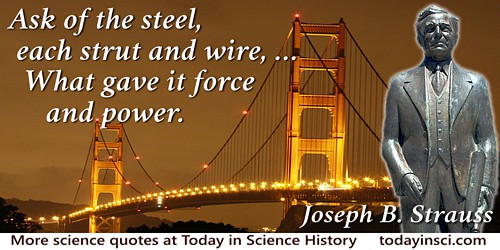
The Mighty Task is Done
At last the mighty task is done;
Resplendent in the western sun
The Bridge looms mountain high;
Its titan piers grip ocean floor,
Its great steel arms link shore with shore,
Its towers pierce the sky.
On its broad decks in rightful pride,
The world in swift parade shall ride,
Throughout all time to be;
Beneath, fleet ships from every port,
Vast landlocked bay, historic fort,
And dwarfing all the sea.
To north, the Redwood Empires gates;
To south, a happy playground waits,
In Rapturous appeal;
Here nature, free since time began,
Yields to the restless moods of man,
Accepts his bonds of steel.
Launched midst a thousand hopes and fears,
Damned by a thousand hostile sneers,
Yet Neer its course was stayed,
But ask of those who met the foe
Who stood alone when faith was low,
Ask them the price they paid.
Ask of the steel, each strut and wire,
Ask of the searching, purging fire,
That marked their natal hour;
Ask of the mind, the hand, the heart,
Ask of each single, stalwart part,
What gave it force and power.
An Honored cause and nobly fought
And that which they so bravely wrought,
Now glorifies their deed,
No selfish urge shall stain its life,
Nor envy, greed, intrigue, nor strife,
Nor false, ignoble creed.
High overhead its lights shall gleam,
Far, far below lifes restless stream,
Unceasingly shall flow;
For this was spun its lithe fine form,
To fear not war, nor time, nor storm,
For Fate had meant it so.
At last the mighty task is done;
Resplendent in the western sun
The Bridge looms mountain high;
Its titan piers grip ocean floor,
Its great steel arms link shore with shore,
Its towers pierce the sky.
On its broad decks in rightful pride,
The world in swift parade shall ride,
Throughout all time to be;
Beneath, fleet ships from every port,
Vast landlocked bay, historic fort,
And dwarfing all the sea.
To north, the Redwood Empires gates;
To south, a happy playground waits,
In Rapturous appeal;
Here nature, free since time began,
Yields to the restless moods of man,
Accepts his bonds of steel.
Launched midst a thousand hopes and fears,
Damned by a thousand hostile sneers,
Yet Neer its course was stayed,
But ask of those who met the foe
Who stood alone when faith was low,
Ask them the price they paid.
Ask of the steel, each strut and wire,
Ask of the searching, purging fire,
That marked their natal hour;
Ask of the mind, the hand, the heart,
Ask of each single, stalwart part,
What gave it force and power.
An Honored cause and nobly fought
And that which they so bravely wrought,
Now glorifies their deed,
No selfish urge shall stain its life,
Nor envy, greed, intrigue, nor strife,
Nor false, ignoble creed.
High overhead its lights shall gleam,
Far, far below lifes restless stream,
Unceasingly shall flow;
For this was spun its lithe fine form,
To fear not war, nor time, nor storm,
For Fate had meant it so.
Written upon completion of the building of the Golden Gate Bridge, May 1937. In Allen Brown, Golden Gate: biography of a Bridge (1965), 229.
Question: What is the reason that the hammers which strike the strings of a pianoforte are made not to strike the middle of the strings? Why are the bass strings loaded with coils of wire?
Answer: Because the tint of the clang would be bad. Because to jockey them heavily.
Answer: Because the tint of the clang would be bad. Because to jockey them heavily.
Genuine student answer* to an Acoustics, Light and Heat paper (1880), Science and Art Department, South Kensington, London, collected by Prof. Oliver Lodge. Quoted in Henry B. Wheatley, Literary Blunders (1893), 176, Question 3. (*From a collection in which Answers are not given verbatim et literatim, and some instances may combine several students' blunders.)
As great Pythagoras of yore,
Standing beside the blacksmith’s door,
And hearing the hammers, as they smote
The anvils with a different note,
Stole from the varying tones, that hung
Vibrant on every iron tongue,
The secret of the sounding wire.
And formed the seven-chorded lyre.
Standing beside the blacksmith’s door,
And hearing the hammers, as they smote
The anvils with a different note,
Stole from the varying tones, that hung
Vibrant on every iron tongue,
The secret of the sounding wire.
And formed the seven-chorded lyre.
From poem 'To A Child' (1847), as collected in The Poetical Works of H.W. Longfellow (1855), 132.
By research in pure science I mean research made without any idea of application to industrial matters but solely with the view of extending our knowledge of the Laws of Nature. I will give just one example of the ‘utility’ of this kind of research, one that has been brought into great prominence by the War—I mean the use of X-rays in surgery. Now, not to speak of what is beyond money value, the saving of pain, or, it may be, the life of the wounded, and of bitter grief to those who loved them, the benefit which the state has derived from the restoration of so many to life and limb, able to render services which would otherwise have been lost, is almost incalculable. Now, how was this method discovered? It was not the result of a research in applied science starting to find an improved method of locating bullet wounds. This might have led to improved probes, but we cannot imagine it leading to the discovery of X-rays. No, this method is due to an investigation in pure science, made with the object of discovering what is the nature of Electricity. The experiments which led to this discovery seemed to be as remote from ‘humanistic interest’ —to use a much misappropriated word—as anything that could well be imagined. The apparatus consisted of glass vessels from which the last drops of air had been sucked, and which emitted a weird greenish light when stimulated by formidable looking instruments called induction coils. Near by, perhaps, were great coils of wire and iron built up into electro-magnets. I know well the impression it made on the average spectator, for I have been occupied in experiments of this kind nearly all my life, notwithstanding the advice, given in perfect good faith, by non-scientific visitors to the laboratory, to put that aside and spend my time on something useful.
In Speech made on behalf of a delegation from the Conjoint Board of Scientific Studies in 1916 to Lord Crewe, then Lord President of the Council. In George Paget Thomson, J. J. Thomson and the Cavendish Laboratory in His Day (1965), 167-8.
Can imagination picture what the future of this invention is to be! … We may talk by light to any visible distance without any conducting wire.
Letter to his father (26 Feb 1880), describing his photophone research. Transcript with Bell Papers, Library of Congress.
Dear Mr. Bell: … Sir Wm. Thomson … speaks with much enthusiasm of your achievement. What yesterday he would have declared impossible he has today seen realized, and he declares it the most wonderful thing he has seen in America. You speak of it as an embryo invention, but to him it seems already complete, and he declares that, before long, friends will whisper their secrets over the electric wire. Your undulating current he declares a great and happy conception.
Letter to Alexander Graham Bell (25 Jun 1876). Quoted in Alexander Graham Bell, The Bell Telephone: The Deposition of Alexander Graham Bell, in the Suit Brought by the United States to Annul the Bell Patents (1908), 101. Note: William Thomson is better known as Lord Kelvin.
Edmund Wilson attacked the pedantry of scholarly editions of literary classics, which (he claimed) took the pleasure out of reading. Extensive footnotes … spoiled the reader’s pleasure in the text. Wilson’s friend Lewis Mumford had compared footnote numbers … to “barbed wire” keeping the reader at arm’s length.
In Academic Instincts (2001), 39.
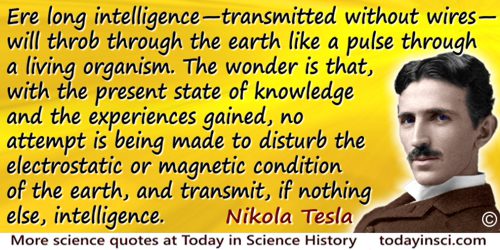
Ere long intelligence—transmitted without wires—will throb through the earth like a pulse through a living organism. The wonder is that, with the present state of knowledge and the experiences gained, no attempt is being made to disturb the electrostatic or magnetic condition of the earth, and transmit, if nothing else, intelligence.
Electrical Engineer (24 Jun 1892), 11, 609.
Fourier’s Theorem … is not only one of the most beautiful results of modern analysis, but it may be said to furnish an indispensable instrument in the treatment of nearly every recondite question in modern physics. To mention only sonorous vibrations, the propagation of electric signals along a telegraph wire, and the conduction of heat by the earth’s crust, as subjects in their generality intractable without it, is to give but a feeble idea of its importance.
In William Thomson and Peter Guthrie Tait, Treatise on Natural Philosophy (1867), Vol. 1, 28.
I feel that I have at last struck the solution of a great problem—and the day is coming when telegraph wires will be laid on to houses just like water or gas—and friends converse with each other without leaving home.
Letter (10 Mar 1876) to his father on the day his first words were sent by wire to Mr. Watson. As quoted in Robert V. Bruce, Bell: Alexander Graham Bell and the Conquest of Solitude (1973, 1990), 181.
I had made up my mind to find that for which I was searching even if it required the remainder of my life. After innumerable failures I finally uncovered the principle for which I was searching, and I was astounded at its simplicity. I was still more astounded to discover the principle I had revealed not only beneficial in the construction of a mechanical hearing aid but it served as well as means of sending the sound of the voice over a wire. Another discovery which came out of my investigation was the fact that when a man gives his order to produce a definite result and stands by that order it seems to have the effect of giving him what might be termed a second sight which enables him to see right through ordinary problems. What this power is I cannot say; all I know is that it exists and it becomes available only when a man is in that state of mind in which he knows exactly what he wants and is fully determined not to quit until he finds it.
As quoted, without citation, in Mack R. Douglas, Making a Habit of Success: How to Make a Habit of Succeeding, How to Win With High Self-Esteem (1966, 1994), 38. Note: Webmaster is dubious of a quote which seems to appear in only one source, without a citation, decades after Bell’s death. If you know a primary source, please contact Webmaster.
I have read somewhere that the resistance offered by a wire ... is affected by the tension of the wire. If this is so, a continuous current of electricity passed through a vibrating wire should meet with a varying resistance, and hence a pulsatory action should be induced in the current ... [corresponding] in amplitude, as well as in rate of movement, to the vibrations of the string ... [Thus] the timbre of a sound [a quality essential to intelligible speech] could be transmitted ... [and] the strength of the current can be increased ad libitum without destroying the relative intensities of the vibrations.
Letter to Gardiner Greene Hubbard (4 May 1875), 3-4. Bell Papers, Library of Congress.
If you had come to me a hundred years ago, do you think I should have dreamed of the telephone? Why, even now I cannot understand it! I use it every day, I transact half my correspondence by means of it, but I don’t understand it. Thnk of that little stretched disk of iron at the end of a wire repeating in your ear not only sounds, but words—not only words, but all the most delicate and elusive inflections and nuances of tone which separate one human voice from another! Is not that something of a miracle?
Quoted in Harold Begbie in Pall Mall magazine (Jan 1903). In Albert Shaw, The American Monthly Review of Reviews (1903), 27, 232.
In one department of his [Joseph Black’s] lecture he exceeded any I have ever known, the neatness and unvarying success with which all the manipulations of his experiments were performed. His correct eye and steady hand contributed to the one; his admirable precautions, foreseeing and providing for every emergency, secured the other. I have seen him pour boiling water or boiling acid from a vessel that had no spout into a tube, holding it at such a distance as made the stream’s diameter small, and so vertical that not a drop was spilt. While he poured he would mention this adaptation of the height to the diameter as a necessary condition of success. I have seen him mix two substances in a receiver into which a gas, as chlorine, had been introduced, the effect of the combustion being perhaps to produce a compound inflammable in its nascent state, and the mixture being effected by drawing some string or wire working through the receiver's sides in an air-tight socket. The long table on which the different processes had been carried on was as clean at the end of the lecture as it had been before the apparatus was planted upon it. Not a drop of liquid, not a grain of dust remained.
In Lives of Men of Letters and Science, Who Flourished in the Time of George III (1845), 346-7.
In that memorable year, 1822: Oersted, a Danish physicist, held in his hands a piece of copper wire, joined by its extremities to the two poles of a Volta pile. On his table was a magnetized needle on its pivot, and he suddenly saw (by chance you will say, but chance only favours the mind which is prepared) the needle move and take up a position quite different from the one assigned to it by terrestrial magnetism. A wire carrying an electric current deviates a magnetized needle from its position. That, gentlemen, was the birth of the modern telegraph.
Le hasard favorise l’esprit preparé
Le hasard favorise l’esprit preparé
Inaugural Address as newly appointed Professor and Dean (Sep 1854) at the opening of the new Faculté des Sciences at Lille (7 Dec 1854). In René Vallery-Radot, The Life of Pasteur, translated by Mrs. R. L. Devonshire (1919), 76.
It appears, according to the reported facts, that the electric conflict is not restricted to the conducting wire, but that it has a rather extended sphere of activity around it … the nature of the circular action is such that movements that it produces take place in directions precisely contrary to the two extremities of a given diameter. Furthermore, it seems that the circular movement, combined with the progressive movement in the direction of the length of the conjunctive wire, should form a mode of action which is exerted as a helix around this wire as an axis.
Recherches sur l’identité des forces chimiques et électriques (1813), 248. In James R. Hofmann, André-Marie Ampère (1996), 231.
It seems reasonable to envision, for a time 10 or 15 years hence, a “thinking center” that will incorporate the functions of present-day libraries together with anticipated advances in information storage and retrieval and ... a network of such centers, connected to one another by wide-band communication lines and to individual users by leased-wire services.
From article 'Man-Computer Symbiosis', in IRE Transactions on Human Factors in Electronics (Mar 1960), Vol. HFE-1, 4-11.
It was shortly after midday on December 12, 1901, [in a hut on the cliffs at St. John’s, Newfoundland] that I placed a single earphone to my ear and started listening. The receiver on the table before me was very crude—a few coils and condensers and a coherer—no valves [vacuum tubes], no amplifiers, not even a crystal. I was at last on the point of putting the correctness of all my beliefs to test. … [The] answer came at 12:30. … Suddenly, about half past twelve there sounded the sharp click of the “tapper” … Unmistakably, the three sharp clicks corresponding to three dots sounded in my ear. “Can you hear anything, Mr. Kemp?” I asked, handing the telephone to my assistant. Kemp heard the same thing as I. … I knew then that I had been absolutely right in my calculations. The electric waves which were being sent out from Poldhu [Cornwall, England] had travelled the Atlantic, serenely ignoring the curvature of the earth which so many doubters considered a fatal obstacle. … I knew that the day on which I should be able to send full messages without wires or cables across the Atlantic was not far distant.
As quoted in Degna Marconi, My Father, Marconi (2000), 93.
Looking at the thunder machine which had been set up, I saw not the slightest indication of the presence of electricity. However, while they were putting the food on the table, I obtained extraordinary electric sparks from the wire. My wife and others approached from it, for the reason that I wished to have witnesses see the various colors of fire about which the departed Professor Richmann used to argue with me. Suddenly it thundered most violently at the exact time that I was holding my hand to the metal, and sparks crackled. All fled away from me, and my wife implored that I go away. Curiosity kept me there two or three minutes more, until they told me that the soup was getting cold. By that time the force of electricity greatly subsided. I had sat at table only a few minutes when the man servant of the departed Richmann suddenly opened the door, all in tears and out of breath from fear. I thought that some one had beaten him as he was on his way to me, but he said, with difficulty, that the professor had been injured by thunder… . Nonetheless, Mr. Richmann died a splendid death, fulfilling a duty of his profession.
As quoted in Boris Menshutkin, 'Lomonosov: Excerpts', collected in Thomas Riha (ed.), Readings for Introduction to Russian Civilization (1963), Vol. 2, 30.
Most American homes have alternating current, which means that the electricty goes in one direction for a while, then goes in the other direction. This prevents harmful electron buildup in the wires.
In The Taming of the Screw: How to Sidestep Several Million Homeowner’s Problems (1983), 12.
My method consists in allowing the mind to play freely for a very brief period, until a couple or so of ideas have passed through it, and then, while the traces or echoes of those ideas are still lingering in the brain, to turn the attention upon them with a sudden and complete awakening; to arrest, to scrutinise them, and to record their exact appearance... The general impression they have left upon me is like that which many of us have experienced when the basement of our house happens to be under thorough sanitary repairs, and we realise for the first time the complex system of drains and gas and water pipes, flues, bell-wires, and so forth, upon which our comfort depends, but which are usually hidden out of sight, and with whose existence, so long as they acted well, we had never troubled ourselves.
Inquiries into Human Faculty and its Development (1883),185-6.
Science has thus, most unexpectedly, placed in our hands a new power of great but unknown energy. It does not wake the winds from their caverns; nor give wings to water by the urgency of heat; nor drive to exhaustion the muscular power of animals; nor operate by complicated mechanism; nor summon any other form of gravitating force, but, by the simplest means—the mere contact of metallic surfaces of small extent, with feeble chemical agents, a power everywhere diffused through nature, but generally concealed from our senses, is mysteriously evolved, and by circulation in insulated wires, it is still more mysteriously augmented, a thousand and a thousand fold, until it breaks forth with incredible energy.
Comment upon 'The Notice of the Electro-Magnetic Machine of Mr. Thomas Davenport, of Brandon, near Rutland, Vermont, U.S.', The Annals of Electricity, Magnetism, & Chemistry; and Guardian of Experimental Science (1838), 2, 263.
So there he is at last. Man on the moon. The poor magnificent bungler! He can't even get to the office without undergoing the agonies of the damned, but give him a little metal, a few chemicals, some wire and twenty or thirty billion dollars and, vroom! there he is, up on a rock a quarter of a million miles up in the sky.
[Written when the first manned mission to the Moon, Apollo 11, landed (20 Jul 1969).]
[Written when the first manned mission to the Moon, Apollo 11, landed (20 Jul 1969).]
'Why on Earth Are We There? Because It's Impossible', New York Times (21 Jul 1969), 17.
Technology, while adding daily to our physical ease, throws daily another loop of fine wire around our souls. It contributes hugely to our mobility, which we must not confuse with freedom. The extensions of our senses, which we find so fascinating, are no
My Faith in Democratic Capitalism, in Fortune (Oct 1955).
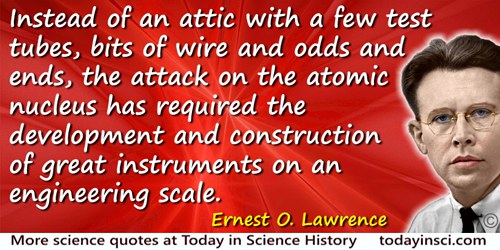
The day when the scientist, no matter how devoted, may make significant progress alone and without material help is past. This fact is most self-evident in our work. Instead of an attic with a few test tubes, bits of wire and odds and ends, the attack on the atomic nucleus has required the development and construction of great instruments on an engineering scale.
Nobel Prize banquet speech (29 Feb 1940)
The external resistance may also be varied. For instance, let mercury or some other liquid form part of a voltaic circuit, then the more deeply the conducting wire is immersed in the mercury or other liquid the less resistance does the liquid offer to the passage of the current Hence the vibration of the conducting wire in mercury or other liquid included in the circuit occasions undulations in the current…
Specification of Patent (filed 14 Feb 1876), United States Patent Office, 'Improvement in Telegraphy', No. 174, 465. Also quoted in George Bartlett Prescott, 'The Speaking Telephone, Talking Phonograph, and Other Novelties', Electric Engineering (1878), 212.
The fact that stares one in the face is that people of the greatest sincerity and of all levels of intelligence differ and have always differed in their religious beliefs. Since at most one faith can be true, it follows that human beings are extremely liable to believe firmly and honestly in something untrue in the field of revealed religion. One would have expected this obvious fact to lead to some humility, to some thought that however deep one's faith, one may conceivably be mistaken. Nothing is further from the believer, any believer, than this elementary humility. All in his power … must have his faith rammed down their throats. In many cases children are indeed indoctrinated with the disgraceful thought that they belong to the one group with superior knowledge who alone have a private wire to the office of the Almighty, all others being less fortunate than they themselves.
From 'Religion is a Good Thing', collected in R. Duncan and M. Wesson-Smith (eds.) Lying Truths: A Critical Scruting of Current Beliefs and Conventions (1979), 205. As quoted in Paul Davies, God and the New Physics (1984), 6-7.
The first time the appearance of the liquid had really escaped our observation. … [L]ater on we clearly saw the liquid level get hollow by the blowing of the gas from the valve … The surface of the liquid was soon made clearly visible by reflection of light from below and that unmistakably, because it was clearly pierced by the two wires of the thermoelement. … After the surface had once been seen, the sight of it was no more lost. It stood out sharply defined like the edge of a knife against the glass wall.
In 'The Liquefaction of Helium', Communication No. 108 from the Physical Laboratory at Leiden, Proceedings of the Royal Academy of Amsterdam (1909), 11, Part 1, 181.
The neurons that fire together wire together.
Hebb's rule, saying that two neurons firing together will strengthen the connection and make it easier for the two neurons to illicit a response from the third in neural networking. This is a catch-phrase, a summary, not a verbatim quote. Hebb explains his idea at length in The Organization of Behavior (1949).
The relative importance of the white and gray matter is often misunderstood. Were it not for the manifold connection of the nerve cells in the cortex by the tens of millions of fibres which make up the under-estimated white matter, such a brain would be useless as a telephone or telegraph station with all the interconnecting wires destroyed.
Address to the American Association for the Advancement of Science in Philadelphia (28 Dec 1904), as quoted in 'Americans of Future Will Have Best Brains', New York Times (29 Dec 1904), 6.
The word “electromagnetic” which is used to characterize the phenomena produced by the conducting wires of the voltaic pile, … were those which M. Oersted discovered, exhibited by an electric current and a magnet. I have determined to use the word electrodynamic in order to unite under a common name all these phenomena, and particularly to designate those which I have observed between two voltaic conductors. It expresses their true character, that of being produced by electricity in motion: while the electric attractions and repulsions, which have been known for a long time, are electrostatic phenomena produced by the unequal distribution of electricity at rest in the bodies in which they are observed.
New terminology introduced in 'Experiments on the New Electrodynamical Phenomena', Annales de Chemie et de Physique (1822), Series 2, Vol. 20, 60. As translated in Dagobert David Runes (ed.), A Treasury of World Science (1962), 5.
There is no plea which will justify the use of high-tension and alternating currents, either in a scientific or a commercial sense. They are employed solely to reduce investment in copper wire and real estate.
In 'The Dangers of Electric Lighting', North American Review (Nov 1889), 149, No. 396, 633.
Those who take refuge behind theological barbed wire fences, quite often wish they could have more freedom of thought, but fear the change to the great ocean of truth as they would a cold bath.
Quoted in Dr. D. M. Brooks, The Necessity of Atheism (1933), 341.
We believe that each molecular vibration disturbs the ether; that spectra are thus begotten, each wavelength of light resulting from a molecular tremor of corresponding wavelength. The molecule is, in fact, the sender, the ether the wire, and the eye the receiving instrument, in this new telegraphy.
In Studies in Spectrum Analysis (1878), 118-119.
You see, wire telegraph is a kind of a very, very long cat. You pull his tail in New York and his head is meowing in Los Angeles. Do you understand this? And radio operates exactly the same way: you send signals here, they receive them there. The only difference is that there is no cat.
When asked to describe radio
When asked to describe radio
…...
 In science it often happens that scientists say, 'You know that's a really good argument; my position is mistaken,' and then they would actually change their minds and you never hear that old view from them again. They really do it. It doesn't happen as often as it should, because scientists are human and change is sometimes painful. But it happens every day. I cannot recall the last time something like that happened in politics or religion.
(1987) --
In science it often happens that scientists say, 'You know that's a really good argument; my position is mistaken,' and then they would actually change their minds and you never hear that old view from them again. They really do it. It doesn't happen as often as it should, because scientists are human and change is sometimes painful. But it happens every day. I cannot recall the last time something like that happened in politics or religion.
(1987) -- 





