Wing Quotes (80 quotes)
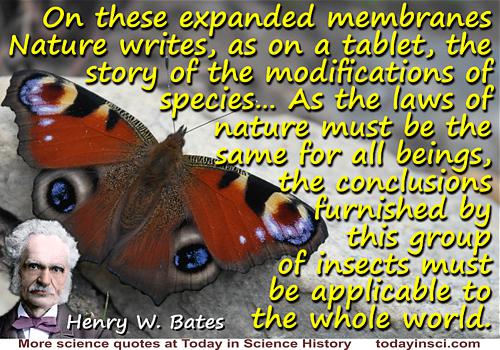
… on these expanded membranes [butterfly wings] Nature writes, as on a tablet, the story of the modifications of species, so truly do all changes of the organisation register themselves thereon. Moreover, the same colour-patterns of the wings generally show, with great regularity, the degrees of blood-relationship of the species. As the laws of nature must be the same for all beings, the conclusions furnished by this group of insects must be applicable to the whole world.
From The Naturalist on the River Amazons: A record of Adventures, Habits of Animals, Sketches of Brazilian and Indian life, and Aspects of Nature under the Equator, During Eleven Years of Travel (1864), 413.
A Bat meeting any one running away, signifies an evasion: for although she have no wings, yet she flies.
In De Occulta Philosophia (1533), Vol. 1. Translation by J.F. (1651) reprinted as The Philosophy of Natural Magic (1913), 169.
A believer is a bird in a cage, a free-thinker is an eagle parting the clouds with tireless wing.
From 'Individuality', collected in The Gods, and Other Lectures (1874), 190.
A bird maintains itself in the air by imperceptible balancing, when near to the mountains or lofty ocean crags; it does this by means of the curves of the winds which as they strike against these projections, being forced to preserve their first impetus bend their straight course towards the sky with divers revolutions, at the beginning of which the birds come to a stop with their wings open, receiving underneath themselves the continual buffetings of the reflex courses of the winds.
'Flight', in The Notebooks of Leonardo da Vinci, trans. E. MacCurdy (1938), Vol. 1, 471.
A good ornithologist should be able to distinguish birds by their air as well as by their colors and shape; on the ground as well as on the wing, and in the bush as well as in the hand. For, though it must not be said that every species of birds has a manner peculiar to itself, yet there is somewhat, in most genera at least, that at first sight discriminates them and enables a judicious observer to pronounce upon them with some certainty.
Letter (7 Aug 1778) to Daines Barrington, collected in The Natural History of Selborne (1829), 274.
A mind which has once imbibed a taste for scientific enquiry, and has learnt the habit of applying its principles readily to the cases which occur, has within itself an inexhaustable source of pure and exciting contemplations:— One would think that Shakespeare had such a mind in view when he describes a contemplative man as finding
“Tongues in trees—books in running brooks—
Sermons in stones—and good in everything.”
Accustomed to trace the operations of general causes and the exemplification of general laws, in circumstances where the uninformed and uninquiring eye, perceives neither novelty nor beauty, he walks in the midst of wonders; every object which falls in his way elucidates some principle, affords some instruction and impresses him with a sense of harmony and order. Nor is it a mere passive pleasure which is thus communicated. A thousand questions are continually arising in his mind, a thousand objects of enquiry presenting themselves, which keep his faculties in constant exercise, and his thoughts perpetually on the wing, so that lassitude is excluded from his life, and that craving after artificial excitement and dissipation of the mind, which leads so many into frivolous, unworthy, and destructive pursuits, is altogether eradicated from his bosom.
“Tongues in trees—books in running brooks—
Sermons in stones—and good in everything.”
Accustomed to trace the operations of general causes and the exemplification of general laws, in circumstances where the uninformed and uninquiring eye, perceives neither novelty nor beauty, he walks in the midst of wonders; every object which falls in his way elucidates some principle, affords some instruction and impresses him with a sense of harmony and order. Nor is it a mere passive pleasure which is thus communicated. A thousand questions are continually arising in his mind, a thousand objects of enquiry presenting themselves, which keep his faculties in constant exercise, and his thoughts perpetually on the wing, so that lassitude is excluded from his life, and that craving after artificial excitement and dissipation of the mind, which leads so many into frivolous, unworthy, and destructive pursuits, is altogether eradicated from his bosom.
In Dionysius Lardner (ed.), Cabinet Cyclopaedia, Vol 1, Preliminary Discourse on the Study of Natural Philosophy (1831), 14-15.
Are the humanistic and scientific approaches different? Scientists can calculate the torsion of a skyscraper at the wing-beat of a bird, or 155 motions of the Moon and 500 smaller ones in addition. They move in academic garb and sing logarithms. They say, “The sky is ours”, like priests in charge of heaven. We poor humanists cannot even think clearly, or write a sentence without a blunder, commoners of “common sense”. We never take a step without stumbling; they move solemnly, ever unerringly, never a step back, and carry bell, book, and candle.
Quoting himself in Stargazers and Gravediggers: Memoirs to Worlds in Collision (2012), 212.
As the proverb says, “You cannot fly like an eagle with the wings of a wren.”
In Afoot in England (1909, 1922), 80. He might have originated this specific wording, but as this full sentence shows, Hudson was quoting a proverb. Many sources simply attribute the quote to him. Yet, in fact, the expression goes back to at least 1607, for it appears in Thomas Walkington, 'To the Reader', The Optick Glasse of Humors as “I have soared also above my pitch, attempting an Eagles flight with the wing of a Wrenne.”
At lunch Francis [Crick] winged into the Eagle to tell everyone within hearing distance that we had found the secret of life.
Purported remark made at The Eagle pub (28 Feb 1953), near the Cavendish Laboratory in Cambridge, to celebrate the fact that they, Crick and Watson, had unravelled the structure of DNA. Stated by James Watson in The Double Helix: A Personal Account of the Discovery of the Structure of DNA (1968, 1998), 197. However Francis Crick, in What Mad Pursuit (1990), 77, writes that was “according to Jim,” but “of that I have no recollection.” Nevertheless, some quote collections report this incident with a direct quote as “We have discovered the secret of life!”
Bad news has the wings of an eagle, good news the legs of a sloth.
Aphorism as given by the fictional character Dezhnev Senior, in Fantastic Voyage II: Destination Brain (1987), 119.
Courage is the price that
Life exacts for granting peace.
The soul that knows it not, knows no release
From little things:
Knows not the livid loneliness of fear,
Nor mountain heights where bitter joy can hear
The sound of wings.
Life exacts for granting peace.
The soul that knows it not, knows no release
From little things:
Knows not the livid loneliness of fear,
Nor mountain heights where bitter joy can hear
The sound of wings.
From poem 'Courage' (1927), opening lines, included in magazine article by Marion Perkins, 'Who Is Amelia Earhart?', Survey (1 Jul 1928), 60. Quoted as epigraph, and cited in Mary S. Lovell, The Sound of Wings: The Life of Amelia Earhart (1989), ix.
Do not all charms fly
At the mere touch of cold philosophy?
There was an awful rainbow once in heaven:
We know her woof, her texture; she is given
In the dull catalogue of common things.
Philosophy will clip an Angel’s wings,
Conquer all mysteries by rule and line,
Empty the haunted air, and gnomed mine
Unweave a rainbow.
At the mere touch of cold philosophy?
There was an awful rainbow once in heaven:
We know her woof, her texture; she is given
In the dull catalogue of common things.
Philosophy will clip an Angel’s wings,
Conquer all mysteries by rule and line,
Empty the haunted air, and gnomed mine
Unweave a rainbow.
Lamia 1820, II, lines 229-37. In John Barnard (ed.), John Keats. The Complete Poems (1973), 431.
Evolution is the conviction that organisms developed their current forms by an extended history of continual transformation, and that ties of genealogy bind all living things into one nexus. Panselectionism is a denial of history, for perfection covers the tracks of time. A perfect wing may have evolved to its current state, but it may have been created just as we find it. We simply cannot tell if perfection be our only evidence. As Darwin himself understood so well, the primary proofs of evolution are oddities and imperfections that must record pathways of historical descent–the panda’s thumb and the flamingo’s smile of my book titles (chosen to illustrate this paramount principle of history).
…...
Evolution: At the Mind's Cinema
I turn the handle and the story starts:
Reel after reel is all astronomy,
Till life, enkindled in a niche of sky,
Leaps on the stage to play a million parts.
Life leaves the slime and through all ocean darts;
She conquers earth, and raises wings to fly;
Then spirit blooms, and learns how not to die,-
Nesting beyond the grave in others' hearts.
I turn the handle: other men like me
Have made the film: and now I sit and look
In quiet, privileged like Divinity
To read the roaring world as in a book.
If this thy past, where shall they future climb,
O Spirit, built of Elements and Time?
I turn the handle and the story starts:
Reel after reel is all astronomy,
Till life, enkindled in a niche of sky,
Leaps on the stage to play a million parts.
Life leaves the slime and through all ocean darts;
She conquers earth, and raises wings to fly;
Then spirit blooms, and learns how not to die,-
Nesting beyond the grave in others' hearts.
I turn the handle: other men like me
Have made the film: and now I sit and look
In quiet, privileged like Divinity
To read the roaring world as in a book.
If this thy past, where shall they future climb,
O Spirit, built of Elements and Time?
'Evolution: At the Mind's Cinema' (1922), in The Captive Shrew and Other Poems of a Biologist (1932), 55.
Given angel’s wings, where might you fly?
In what sweet heaven might you find your love?
Unwilling to be bound, where might you move,
Lost between the wonder and the why?...
In what sweet heaven might you find your love?
Unwilling to be bound, where might you move,
Lost between the wonder and the why?...
…...
Have you ever plunged into the immensity of space and time by reading the geological treatises of Cuvier? Borne away on the wings of his genius, have you hovered over the illimitable abyss of the past as if a magician’s hand were holding you aloft?
From 'La Peau de Chagrin' (1831). As translated by Herbert J. Hunt in The Wild Ass’s Skin (1977), 40-41.
He who has imagination without learning has wings and no feet.
In Tryon Edwards, A Dictionary of Thoughts (1908), 245.
Hold fast to dreams for if dreams die, life is a broken winged bird that cannot fly.
…...
I am sorry the infernal Divinities, who visit mankind with diseases, and are therefore at perpetual war with Doctors, should have prevented my seeing all you great Men at Soho to-day-Lord! what inventions, what wit, what rhetoric, metaphysical, mechanical and pyrotecnical, will be on the wing, bandy'd like a shuttlecock from one to another of your troop of philosophers! while poor I, I by myself I, imprizon'd in a post chaise, am joggled, and jostled, and bump'd, and bruised along the King's high road, to make war upon a pox or a fever!
Letter to Matthew Boulton, 5 April 1778. Quoted in Desmond King-Hele (ed.), The Letters of Erasmus Darwin (1981), 84.
I find in the domestic duck that the bones of the wing weigh less and the bones of the leg more, in proportion to the whole skeleton, than do the same bones in the wild duck; and this change may be safely attributed to the domestic duck flying much less, and walking more, than its wild parents.
From On the Origin of Species by Means of Natural Selection; or, The Preservation of Favoured Races in the Struggle for Life (1861), 17.
I have soared also above my pitch, attempting an Eagles flight with the wings of a Wrenne.
In 'To the Reader', The Optick Glass of Humors (1607), 10-11. This is quoted by William Henry Hudson: “As the proverb says, ‘You cannot fly like an Eagle with the wings of a wren.’” in Afoot in England (1909, 1922), 80.
I hear the scream of a great hawk, sailing with a ragged wing against the high wood-side, apparently to scare his prey and so detect it—shrill, harsh, fitted to excite terror in sparrows and to issue from his split and curved bill. I see his open bill the while against the sky. Spit with force from his mouth with an undulatory quaver imparted to it from his wings or motion as he flies.
(15 Jun 1852). In Henry David Thoreau and Bradford Torrey (ed.), The Writings of Henry Thoreau: Journal: IV: May 1, 1852-February 27,, 1853 (1906), 103.
I searched along the changing edge
Where, sky-pierced now the cloud had broken.
I saw no bird, no blade of wing,
No song was spoken.
I stood, my eyes turned upward still
And drank the air and breathed the light.
Then, like a hawk upon the wind,
I climbed the sky, I made the flight.
Where, sky-pierced now the cloud had broken.
I saw no bird, no blade of wing,
No song was spoken.
I stood, my eyes turned upward still
And drank the air and breathed the light.
Then, like a hawk upon the wind,
I climbed the sky, I made the flight.
…...
I think modern science should graft functional wings on a pig, simply so no one can ever use that stupid saying again.
In K. D. Sullivan, A Cure for the Common Word (2007), 134.
I will write peace on your wings and you will fly all over the world.
As given in United States Committee for Cooperation with the Japan Council Against A and H Bombs, Report from Hiroshima (1961), 48. The report says Sadako murmured these (translated) words while on her deathbed, holding one of the paper cranes she had folded.
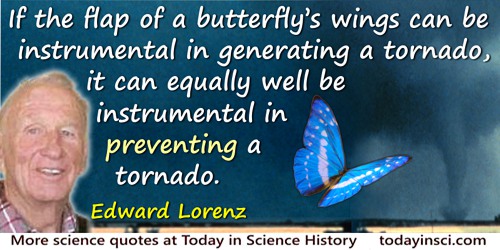
If the flap of a butterfly’s wings can be instrumental in generating a tornado, it can equally well be instrumental in preventing a tornado.
In talk presented at the 139th Annual Meeting in Washington, D.C. of the American Association for the Advancement of Science (29 Dec 1972). The text of the talk, in its original form, as then prepared for press release but unpublished, is in Edward Lorenz, Essence of Chaos (1995), Appendix 1, 181.
If you are young, then I say: Learn something about statistics as soon as you can. Don’t dismiss it through ignorance or because it calls for thought. … If you are older and already crowned with the laurels of success, see to it that those under your wing who look to you for advice are encouraged to look into this subject. In this way you will show that your arteries are not yet hardened, and you will be able to reap the benefits without doing overmuch work yourself. Whoever you are, if your work calls for the interpretation of data, you may be able to do without statistics, but you won’t do as well.
In Facts from Figures (1951), 463.
In all works on Natural History, we constantly find details of the marvellous adaptation of animals to their food, their habits, and the localities in which they are found. But naturalists are now beginning to look beyond this, and to see that there must be some other principle regulating the infinitely varied forms of animal life. It must strike every one, that the numbers of birds and insects of different groups having scarcely any resemblance to each other, which yet feed on the same food and inhabit the same localities, cannot have been so differently constructed and adorned for that purpose alone. Thus the goat-suckers, the swallows, the tyrant fly-catchers, and the jacamars, all use the same kind ‘Of food, and procure it in the same manner: they all capture insects on the wing, yet how entirely different is the structure and the whole appearance of these birds!
In A Narrative of Travels on the Amazon and Rio Negro (1853), 83-84.
In ancient days two aviators procured to themselves wings. Daedalus flew safely through the middle air and was duly honored on his landing. Icarus soared upwards to the sun till the wax melted which bound his wings and his flight ended in fiasco. In weighing their achievements, there is something to be said for Icarus. The classical authorities tell us that he was only “doing a stunt,” but I prefer to think of him as the man who brought to light a serious constructional defect in the flying machines of his day.
In honoring the Wright Brothers, it is customary and proper to recognize their contribution to scientific progress. But I believe it is equally important to emphasize the qualities in their pioneering life and the character in man that such a life produced. The Wright Brothers balanced sucess with modesty, science with simplicity. At Kitty Hawk their intellects and senses worked in mutual support. They represented man in balance, and from that balance came wings to lift a world.
Speech, quoted in Leonard Mosley, Lindbergh (2000), 347. In 1949, Lindbergh gave a speech when he received the Wright Brothers Memorial Trophy.
In six thousand years, you could never grow wings on a reptile. With sixty million, however, you could have feathers, too.
Annals of the Former World
Is this your triumph—this your proud applause,
Children of Truth, and champions of her cause?
For this has Science search’d, on weary wing,
By shore and sea—each mute and living thing!
Children of Truth, and champions of her cause?
For this has Science search’d, on weary wing,
By shore and sea—each mute and living thing!
'Pleasures of Hope', Part 2. In Samuel Rogers, Thomas Campbell, et al, The Poetical Works of Rogers, Campbell, J. Montgomery, Lamb, and Kirke White (1830), 121.
It is a happy world after all. The air, the earth, the water teem with delighted existence. In a spring noon, or a summer evening, on whichever side I turn my eyes, myriads of happy beings crowd upon my view. “The insect youth are on the wing.” Swarms of new-born flies are trying their pinions in the air. Their sportive motions, their wanton mazes, their gratuitous activity testify their joy and the exultation they feel in their lately discovered faculties … The whole winged insect tribe, it is probable, are equally intent upon their proper employments, and under every variety of constitution, gratified, and perhaps equally gratified, by the offices which the author of their nature has assigned to them.
Natural Theology: or, Evidences of the Existence and Attributes of The Deity, Collected from the Appearances of Nature (1802), 490-1.
It is by the aid of iron that we construct houses, cleave rocks, and perform so many other useful offices of life. But it is with iron also that wars, murders, and robberies are effected, and this, not only hand to hand, but from a distance even, by the aid of missiles and winged weapons, now launched from engines, now hurled by the human arm, and now furnished with feathery wings. This last I regard as the most criminal artifice that has been devised by the human mind; for, as if to bring death upon man with still greater rapidity, we have given wings to iron and taught it to fly. ... Nature, in conformity with her usual benevolence, has limited the power of iron, by inflicting upon it the punishment of rust; and has thus displayed her usual foresight in rendering nothing in existence more perishable, than the substance which brings the greatest dangers upon perishable mortality.
Natural History of Pliny, translation (1857, 1898) by John Bostock and H. T. Riley, 205-6.
It is safe to say that the little pamphlet which was left to find its way through the slow mails to the English scientist outweighed in importance and interest for the human race all the press dispatches which have been flashed under the channel since the delivery of the address—March 24. The rapid growth of the Continental capitals, the movements of princely noodles and fat, vulgar Duchesses, the debates in the Servian Skupschina, and the progress or receding of sundry royal gouts are given to the wings of lightning; a lumbering mail-coach is swift enough for the news of one of the great scientific discoveries of the age. Similarly, the gifted gentlemen who daily sift out for the American public the pith and kernel of the Old World's news; leave Dr. KOCH and his bacilli to chance it in the ocean mails, while they challenge the admiration of every gambler and jockey in this Republic by the fullness and accuracy of their cable reports of horse-races.
New York Times (3 May 1882). Quoted in Thomas D. Brock, Robert Koch (1988), 131.
Knowledge falters when imagination clips its wings or fears to use them.
'The Copernican Revolution', in The Quest for Certainty: A Study of the Relation of Knowledge and Action (1929), 294. Collected in John Dewey. Volume 4: The Later Works, 1925-1953: 1929 The Quest for Certainty (1984), 247.
Let us see how high we can fly before the sun melts the wax in our wings.
About the ambitious pursuit of knowledge, alluding to Icarus of the Greek myth.
About the ambitious pursuit of knowledge, alluding to Icarus of the Greek myth.
Consilience: The Unity of Knowledge (1999), 7.
Most pilots learn, when they pin on their wings and go out and get in a fighter, especially, that one thing you don’t do, you don’t believe anything anybody tells you about an airplane.
Nature crying out and speaking to country people in these words: Clown, wherefore dost thou behold the heavens? Why dost thou seek after the stars? When thou art now werry with short sleep, the nights are troublesome to thee. So I scatter little stars in the grass, and I shew them in the evening when thy labour is ended, and thou art miraculously allured to look upon them when thous passest by: Dost thou not see how a light like fire is covered when she closeth her wings, and she carrieth both night and day with her.
In Thomas Moffett, 'Glow-Worms', The Theater of Insects.
Nature vibrates with rhythms, climatic and diastrophic, those finding stratigraphic expression ranging in period from the rapid oscillation of surface waters, recorded in ripple-mark, to those long-deferred stirrings of the deep imprisoned titans which have divided earth history into periods and eras. The flight of time is measured by the weaving of composite rhythms- day and night, calm and storm, summer and winter, birth and death such as these are sensed in the brief life of man. But the career of the earth recedes into a remoteness against which these lesser cycles are as unavailing for the measurement of that abyss of time as would be for human history the beating of an insect's wing. We must seek out, then, the nature of those longer rhythms whose very existence was unknown until man by the light of science sought to understand the earth. The larger of these must be measured in terms of the smaller, and the smaller must be measured in terms of years.
'Rhythm and the Measurement of Geologic Time', Bulletin of the Geological Society of America, 1917, 28,746.
None but a naturalist can understand the intense excitement I experienced when I at length captured it [a hitherto unknown species of butterfly]. On taking it out of my net and opening the glorious wings, my heart began to beat, violently, the blood rushed to my head, and I felt much more like fainting than I have done when in apprehension of immediate death. I had a headache the rest of the day, so great was the excitement produced by what will appear to most people a very inadequate cause.
The Malay Archipelago (1890), 257-258.
Now, at Suiattle Pass, Brower was still talking about butterflies. He said he had raised them from time to time and had often watched them emerge from the chrysalis—first a crack in the case, then a feeler, and in an hour a butterfly. He said he had felt that he wanted to help, to speed them through the long and awkward procedure; and he had once tried. The butterflies came out with extended abdomens, and their wings were balled together like miniature clenched fists. Nothing happened. They sat there until they died. ‘I have never gotten over that,’ he said. ‘That kind of information is all over in the country, but it’s not in town.”
…...
Oh that I had wings like a dove! for then would I fly away, and be at rest.
— Bible
Psalm 55:6, The Holy Bible (1815), 475.
Oh, I have slipped the surly bonds of earth
and danced the skies on laughter-silvered wings;
Sunward I’ve climbed, and joined the tumbling mirth
of sun-split clouds and done a hundred things
you have not dreamed of wheeled and soared and swung
high in the sunlit silence. Hovering there,
I’ve chased the shouting wind along, and flung
my eager craft through footless halls of air.
Up, up the long, delirious, burning blue
I’ve topped the windswept heights with easy grace
where never lark, or even eagle flew
and, while with silent, lifting mind I’ve trod
the high untrespassed sanctity of space,
put out my hand, and touched the face of God.
and danced the skies on laughter-silvered wings;
Sunward I’ve climbed, and joined the tumbling mirth
of sun-split clouds and done a hundred things
you have not dreamed of wheeled and soared and swung
high in the sunlit silence. Hovering there,
I’ve chased the shouting wind along, and flung
my eager craft through footless halls of air.
Up, up the long, delirious, burning blue
I’ve topped the windswept heights with easy grace
where never lark, or even eagle flew
and, while with silent, lifting mind I’ve trod
the high untrespassed sanctity of space,
put out my hand, and touched the face of God.
…...
On motionless wing they emerge from the lifting mists, sweep a final arc of sky, and settle in clangorous descending spirals to their feeding grounds. A new day has begun on the crane marsh.
In 'Wisconsin: Marshland Elegy', A Sand County Almanac, and Sketches Here and There (1949, 1987), 95.
One thought [spectra are] marvellous, but it is not possible to make progress there. Just as if you have the wing of a butterfly then certainly it is very regular with the colors and so on, but nobody thought one could get the basis of biology from the coloring of the wing of a butterfly.
Quoted from Interviews (I, 7) in 'The Genesis of the Bohr Atom', J.L. Heilbron and T.S. Kuhn, Historical Studies in the Physical Sciences (1969), 257, reprinted in J. L. Heilbron, Historical Studies in the Theory of Atomic Structure (1981), 195.
ORGANIC LIFE beneath the shoreless waves
Was born and nurs'd in Ocean's pearly caves;
First, forms minute, unseen by spheric glass,
Move on the mud, or pierce the watery mass;
These, as successive generations bloom,
New powers acquire, and larger limbs assume;
Whence countless groups of vegetation spring,
And breathing realms of fin, and feet, and wing.
Thus the tall Oak, the giant of the wood,
Which bears Britannia's thunders on the flood;
The Whale, unmeasured monster of the main,
The lordly Lion, monarch of the plain,
The Eagle soaring in the realms of air,
Whose eye undazzled drinks the solar glare,
Imperious man, who rules the bestial crowd,
Of language, reason, and reflection proud,
With brow erect, who scorns this earthy sod,
And styles himself the image of his God;
Arose from rudiments of form and sense,
An embryon point, or microscopic ens!
Was born and nurs'd in Ocean's pearly caves;
First, forms minute, unseen by spheric glass,
Move on the mud, or pierce the watery mass;
These, as successive generations bloom,
New powers acquire, and larger limbs assume;
Whence countless groups of vegetation spring,
And breathing realms of fin, and feet, and wing.
Thus the tall Oak, the giant of the wood,
Which bears Britannia's thunders on the flood;
The Whale, unmeasured monster of the main,
The lordly Lion, monarch of the plain,
The Eagle soaring in the realms of air,
Whose eye undazzled drinks the solar glare,
Imperious man, who rules the bestial crowd,
Of language, reason, and reflection proud,
With brow erect, who scorns this earthy sod,
And styles himself the image of his God;
Arose from rudiments of form and sense,
An embryon point, or microscopic ens!
The Temple of Nature (1803), canto 1, lines 295-314, pages 26-8.
OSTRICH, n. A large bird to which (for its sins, doubtless) nature has denied that hinder toe in which so many pious naturalists have seen a conspicuous evidence of design. The absence of a good working pair of wings is no defect, for, as has been ingeniously pointed out, the ostrich does not fly.
The Collected Works of Ambrose Bierce (1911), Vol. 7, The Devil's Dictionary, 241.
Our treasure lies in the beehives of our knowledge. We are perpetually on our way thither, being by nature winged insects and honey gatherers of the mind. The only thing that lies close to our heart is the desire to bring something home to the hive.
The Genealogy of Morals (1887), as translated by Francis Golffing (1956), 149. In another translation, by Maudemarie Clark and Alan J. Swensen, it appears as: “It has rightly been said: ‘where your treasure is, there will your heart be also’; our treasure is where the beehives of our knowledge stand. We are forever underway towards them, as born winged animals and honey-gathers of the spirit, concerned will all our heart about only one thing—"bringing home" something.”
Perfect as the wing of a bird may be, it will never enable the bird to fly if unsupported by the air. Facts are the air of science. Without them a man of science can never rise. Without them your theories are vain surmises. But while you are studying, observing, experimenting, do not remain content with the surface of things. Do not become a mere recorder of facts, but try to penetrate the mystery of their origin. Seek obstinately for the laws that govern them.
Translation of a note, 'Bequest of Pavlov to the Academic Youth of his Country', written a few days before his death for a student magazine, The Generation of the Victors. As published in 'Pavlov and the Spirit of Science', Nature (4 Apr 1936), 137, 572.
Poised for flight,
Wings spread bright,
Spring from night into the Sun.
Wings spread bright,
Spring from night into the Sun.
Help on the Way

Predictability: Does the flap of a butterfly’s wings in Brazil set off a tornado in Texas?
Title of paper presented at the 139th Annual Meeting in Washington, D.C. of the American Association for the Advancement of Science (29 Dec 1972). The text of the talk, in its original form, as then prepared for press release but unpublished, is in Edward Lorenz, Essence of Chaos (1995), Appendix 1, 181. Note: Webmaster has been unable to find a verbatim source for a widely circulated variant, namely: The fluttering of a butterfly’s wing in Rio de Janeiro, amplified by atmospheric currents, could cause a tornado in Texas two weeks later. That form is given in Laura Nader, Naked Science: Anthropological Inquiry Into Boundaries (1996), 209. However, it appears in a sentence as narrative, without quotation marks, and has no citation. Webmaster believes it may be the concept restated by Nader in her own words. Webmaster has not yet found any earlier printed, cited or verbatim example in the wording of the variant. If you know a primary source for this variant, please contact Webmaster.
Science has thus, most unexpectedly, placed in our hands a new power of great but unknown energy. It does not wake the winds from their caverns; nor give wings to water by the urgency of heat; nor drive to exhaustion the muscular power of animals; nor operate by complicated mechanism; nor summon any other form of gravitating force, but, by the simplest means—the mere contact of metallic surfaces of small extent, with feeble chemical agents, a power everywhere diffused through nature, but generally concealed from our senses, is mysteriously evolved, and by circulation in insulated wires, it is still more mysteriously augmented, a thousand and a thousand fold, until it breaks forth with incredible energy.
Comment upon 'The Notice of the Electro-Magnetic Machine of Mr. Thomas Davenport, of Brandon, near Rutland, Vermont, U.S.', The Annals of Electricity, Magnetism, & Chemistry; and Guardian of Experimental Science (1838), 2, 263.
Science is continually correcting what it has said. Fertile corrections... science is a ladder... poetry is a winged flight... An artistic masterpiece exists for all time... Dante does not efface Homer.
Quoted in Pierre Biquard, Frederic Joliot-Curie: The Man and his Theories (1961), trans. Geoffrey Strachan (1965), 168.
Science! true daughter of Old Time thou art!
alterest all things with thy peering eyes.
preyest thou thus upon the poet’s heart,
Vulture, whose wings are dull realities?
How should he love thee? or how deem thee wise,
Who wouldst not leave him in his wandering .
To seek for treasure in the jewelled skies,
Albeit he soared with an undaunted wing?
Hast thou not dragged Diana from her car?
And driven the Hamadryad from the wood
To seek a shelter in some happier star?
Hast thou not torn the Naiad from her flood,
The Elfin from the green grass, and from me
The summer dread beneath the tamarind tree?
alterest all things with thy peering eyes.
preyest thou thus upon the poet’s heart,
Vulture, whose wings are dull realities?
How should he love thee? or how deem thee wise,
Who wouldst not leave him in his wandering .
To seek for treasure in the jewelled skies,
Albeit he soared with an undaunted wing?
Hast thou not dragged Diana from her car?
And driven the Hamadryad from the wood
To seek a shelter in some happier star?
Hast thou not torn the Naiad from her flood,
The Elfin from the green grass, and from me
The summer dread beneath the tamarind tree?
Sonnet, 'To Science' (1829), Saturday Evening Post (11 Sep 1830). In Poems of Edgar Allan Poe (1917), 33, and Notes, 169.
Soon shall thy arm, UNCONQUER’D STEAM! afar
Drag the slow barge, or drive the rapid car;
Or on wide-waving wings expanded bear
The flying-chariot through the fields of air.
Drag the slow barge, or drive the rapid car;
Or on wide-waving wings expanded bear
The flying-chariot through the fields of air.
From 'Botanic Garden' (1781), part 1, canto 1, lines 289-92. The Botanic Garden, with Philosophical Notes (4th Ed., 1799). At the time Erasmus Darwin penned his poem, he would have been aware of a limited history of steam power: Edward Someset, 2nd Marquis of Worcester steam pump (1663), Thomas Savery's steam pump (1698), Thomas Newcomen atmospheric engine (1712), Matthew Boulton and James Watt first commercial steam engine (1776). Watt did not build his first 'double acting' engine, which enabled using a flywheel, until 1783 (two years after Darwin's poem). It was also after Darwin's poem was written that the first steamboat, using paddles, the Pyroscaphe steamed up a French river on 15 Jul 1783. Darwin's predicted future for the steam engine car did not come to pass until Richard Trevithick tested his Camborne road engine (1801). The Wrights' first airplane flight came a century later, in 1903.
The adults of Drosophila react positively to light, i.e., they go toward a source of light … whether the animals walk or fly. Removal of the wings causes the flies to become less responsive to light, … roughly proportional to the amount of the wing that is cut off. As was to be expected from this fact, mutant races with parts of the wings gone or deformed show the same relations—the smaller the amount of normal wing present, the less marked is the reaction to light.
In The North American Species of Drosophila (1921), 4.
The Dark Ages may return—the Stone Age may return on the gleaming wings of Science; and what might now shower immeasureable material blessings upon mankind may even bring about its total destruction. Beware! I say. Time may be short.
Referring to the discovery of atomic energy.
Referring to the discovery of atomic energy.
“Iron Curtain” speech at Fulton, Missouri (5 Mar 1946). Maxims and Reflections (1947), 164.
The dodo never had a chance. He seems to have been invented for the sole purpose of becoming extinct and that was all he was good for. … I’m not blaming the Dodo but he was a mess. He had an ugly face with a large hooked beak, a tail in the wrong place, wings too small … and a very prominent stomach.
In 'The Dodo', How to Become Extinct (1941), 163.
The great art consists in devising décisive experiments, leaving no place to the imagination of the observer. Imagination is needed to give wings to thought at the beginning of experimental investigations on any given subject. When, however, the time has come to conclude, and to interpret the facts derived from observations, imagination must submit to the factual results of the experiments.
Speech (8 Jul 1876), to the French Academy of Medicine. As translated in René J. Dubos, Louis Pasteur, Free Lance of Science (1950, 1986), 376. Date of speech identified in Maurice B. Strauss, Familiar Medical Quotations (1968), 502.
The infinite variations in the ways creatures fulfill the same requirement—to fuel energy needs—constantly astound me. Booby birds and pelicans … actually performed underwater dives, descending some twenty feet below the surface and then flapping their wings to fly through water. Totally encrusted with tiny diamond bubbles—like the jeweled nightingales of Asian emperors—they soared around below for nearly half a minute.
In Jacques Cousteau and Susan Schiefelbein, The Human, the Orchid, and the Octopus: Exploring and Conserving Our Natural World (2007), 282.
The swallow is come!
The swallow is come!
O, fair are the seasons, and light
Are the days that she brings,
With her dusky wings,
And her bosom snowy white!
The swallow is come!
O, fair are the seasons, and light
Are the days that she brings,
With her dusky wings,
And her bosom snowy white!
In Hyperion: A Romance (1839), Vol. 1, Book 2, 97.
The understanding must not however be allowed to jump and fly from particulars to axioms remote and of almost the highest generality (such as the first principles, as they are called, of arts and things), and taking stand upon them as truths that cannot be shaken, proceed to prove and frame the middle axioms by reference to them; which has been the practice hitherto, the understanding being not only carried that way by a natural impulse, but also by the use of syllogistic demonstration trained and inured to it. But then, and then only, may we hope well of the sciences when in a just scale of ascent, and by successive steps not interrupted or broken, we rise from particulars to lesser axioms; and then to middle axioms, one above the other; and last of all to the most general. For the lowest axioms differ but slightly from bare experience, while the highest and most general (which we now have) are notional and abstract and without solidity. But the middle are the true and solid and living axioms, on which depend the affairs and fortunes of men; and above them again, last of all, those which are indeed the most general; such, I mean, as are not abstract, but of which those intermediate axioms are really limitations.
The understanding must not therefore be supplied with wings, but rather hung with weights, to keep it from leaping and flying. Now this has never yet been done; when it is done, we may entertain better hopes of science.
The understanding must not therefore be supplied with wings, but rather hung with weights, to keep it from leaping and flying. Now this has never yet been done; when it is done, we may entertain better hopes of science.
From Novum Organum (1620), Book 1, Aphorism 104. Translated as The New Organon: Aphorisms Concerning the Interpretation of Nature and the Kingdom of Man), collected in James Spedding, Robert Ellis and Douglas Heath (eds.), The Works of Francis Bacon (1857), Vol. 4, 97.
There shall be wings! If the accomplishment be not for me, ’tis for some other. The spirit cannot die; and man, who shall know all and shall have wings...
…...
There's nothing situate under heaven's eye
But hath his bond in earth, in sea, in sky.
The beasts, the fishes, and the winged fowls
Are their males' subjects and at their controls.
Man, more divine, the master of all these,
Lord of the wide world and wild wat'ry seas,
Indu'd with intellectual sense and souls,
Of more pre-eminence than fish and fowls,
Are masters to their females, and their lords;
Then let your will attend on their accords.
But hath his bond in earth, in sea, in sky.
The beasts, the fishes, and the winged fowls
Are their males' subjects and at their controls.
Man, more divine, the master of all these,
Lord of the wide world and wild wat'ry seas,
Indu'd with intellectual sense and souls,
Of more pre-eminence than fish and fowls,
Are masters to their females, and their lords;
Then let your will attend on their accords.
The Comedy of Errors (1594), II, i.
These insecticides are not selective poisons; they do not single out the one species of which we desire to be rid. … Scientific observers at Sheldon described the symptoms of a meadowlark found near death: “Although it lacked muscular coordination and could not fly or stand, it continued to beat its wings and clutch with its toes while lying on its side. Its beak was held open and breathing was labored.”
In 'Needless Havoc', Silent Spring (1962), 99. [Note: Summarizing Carson (pp 92-93), for several years from 1954, Sheldon, in eastern Illinois, was subjected to extensive spraying of dieldrin (50 times more poisonous than DDT) by the Agriculture Departments of the U.S. and Illinois, to attempt to eradicate the Japanese beetle along the line of its invasive advance into Illinois. The dieldrin used was roughly equivalent to 150 pounds of DDT per acre. —Webmaster]
This [the fact that the pursuit of mathematics brings into harmonious action all the faculties of the human mind] accounts for the extraordinary longevity of all the greatest masters of the Analytic art, the Dii Majores of the mathematical Pantheon. Leibnitz lived to the age of 70; Euler to 76; Lagrange to 77; Laplace to 78; Gauss to 78; Plato, the supposed inventor of the conic sections, who made mathematics his study and delight, who called them the handles or aids to philosophy, the medicine of the soul, and is said never to have let a day go by without inventing some new theorems, lived to 82; Newton, the crown and glory of his race, to 85; Archimedes, the nearest akin, probably, to Newton in genius, was 75, and might have lived on to be 100, for aught we can guess to the contrary, when he was slain by the impatient and ill mannered sergeant, sent to bring him before the Roman general, in the full vigour of his faculties, and in the very act of working out a problem; Pythagoras, in whose school, I believe, the word mathematician (used, however, in a somewhat wider than its present sense) originated, the second founder of geometry, the inventor of the matchless theorem which goes by his name, the pre-cognizer of the undoubtedly mis-called Copernican theory, the discoverer of the regular solids and the musical canon who stands at the very apex of this pyramid of fame, (if we may credit the tradition) after spending 22 years studying in Egypt, and 12 in Babylon, opened school when 56 or 57 years old in Magna Græcia, married a young wife when past 60, and died, carrying on his work with energy unspent to the last, at the age of 99. The mathematician lives long and lives young; the wings of his soul do not early drop off, nor do its pores become clogged with the earthy particles blown from the dusty highways of vulgar life.
In Presidential Address to the British Association, Collected Mathematical Papers, Vol. 2 (1908), 658.
This theme of mutually invisible life at widely differing scales bears an important implication for the ‘culture wars’ that supposedly now envelop our universities and our intellectual discourse in general ... One side of this false dichotomy features the postmodern relativists who argue that all culturally bound modes of perception must be equally valid, and that no factual truth therefore exists. The other side includes the benighted, old-fashioned realists who insist that flies truly have two wings, and that Shakespeare really did mean what he thought he was saying. The principle of scaling provides a resolution for the false parts of this silly dichotomy. Facts are facts and cannot be denied by any rational being. (Often, facts are also not at all easy to determine or specify–but this question raises different issues for another time.) Facts, however, may also be highly scale dependent–and the perceptions of one world may have no validity or expression in the domain of another. The one-page map of Maine cannot recognize the separate boulders of Acadia, but both provide equally valid representations of a factual coastline.
The World as I See It (1999)
To speak of this subject you must... explain the nature of the resistance of the air, in the second the anatomy of the bird and its wings, in the third the method of working the wings in their various movements, in the fourth the power of the wings and the tail when the wings are not being moved and when the wind is favorable to serve as guide in various movements.
…...
We all remember the fairy tales of science in our infancy, which played with the supposition that large animals could jump in the proportion of small ones. If an elephant were as strong as a grasshopper, he could (I suppose) spring clean out of the Zoological Gardens and alight trumpeting upon Primrose Hill. If a whale could leap from the water like a trout, perhaps men might look up and see one soaring above Yarmouth like the winged island of Laputa.
In Manalive (1912), 26.
We have also here an acting cause to account for that balance so often observed in nature,—a deficiency in one set of organs always being compensated by an increased development of some others—powerful wings accompanying weak feet, or great velocity making up for the absence of defensive weapons; for it has been shown that all varieties in which an unbalanced deficiency occurred could not long continue their existen The action of this principle is exactly like that of the centrifugal governor of the steam engine, which checks and corrects any irregularities almost before they become evident; and in like manner no unbalanced deficiency in the animal kingdom can ever reach any conspicuous magnitude, because it would make itself felt at the very first step, by rendering existence difficult and extinction almost sure soon to follow.
In 'On the Tendency of Varieties to Depart Indefinitely from the Original Type', Journal of the Proceedings of the Linnean Society, Zoology (1858), 3, 61-62.
We should stop the non-scientific, pseudo-scientific, and anti-scientific nonsense emanating from the right wing, and start demanding immediate action to reduce global warming and prevent catastrophic climate change that may be on our horizon now. We must not let the [Bush] Administration distort science and rewrite and manipulate scientific reports in other areas. We must not let it turn the Environmental Protection Agency into the Environmental Pollution Agency.
Address to National Press Club, Washington, DC (12 Jan 2005). In Bill Adler (ed.), The Wit and Wisdom of Ted Kennedy (2011).
What can be more curious than that the hand of a man, formed for grasping, that of a mole for digging, the leg of the horse, the paddle of the porpoise, and the wing of the bat, should all be constructed on the same pattern?
In Origin of Species (1869), 516.
What is it to see, in an Eagle glide
Which fills a human heart with so much pride?
Is it that it soars effortless above the Earth
That steals us from our own limits & dearth?
Trapped in our seas of befuddling sludge
We try and try but cannot budge.
And then to see a mortal; with such ease take wing
Up in a breeze that makes our failing spirits sing?
Do we, vicarious birds, search in it our childishness -
When we too were young & yearned in heart to fly?
Taking flights of fancy through adolescent nights
Listening little, heeding less, knowing not why?
From its highest perch in the forest of snow
Majestic - the Eagle soars alone.
Riding thermals, lording clouds
Till dropping silent from the sky as a stone
But we, so quick and ready to fold
Give up our wings at the whiff of age
Losing years, cursing time, wasting spirit
Living out entire lives in futile rage!
Which fills a human heart with so much pride?
Is it that it soars effortless above the Earth
That steals us from our own limits & dearth?
Trapped in our seas of befuddling sludge
We try and try but cannot budge.
And then to see a mortal; with such ease take wing
Up in a breeze that makes our failing spirits sing?
Do we, vicarious birds, search in it our childishness -
When we too were young & yearned in heart to fly?
Taking flights of fancy through adolescent nights
Listening little, heeding less, knowing not why?
From its highest perch in the forest of snow
Majestic - the Eagle soars alone.
Riding thermals, lording clouds
Till dropping silent from the sky as a stone
But we, so quick and ready to fold
Give up our wings at the whiff of age
Losing years, cursing time, wasting spirit
Living out entire lives in futile rage!
…...
What makes planets go around the sun? At the time of Kepler, some people answered this problem by saying that there were angels behind them beating their wings and pushing the planets around an orbit. As you will see, the answer is not very far from the truth. The only difference is that the angels sit in a different direction and their wings push inward.
In The Character of Physical Law (1965), 18.
What was Freud’s Galapagos, what species fluttered what kinds of wings before his searching eyes? It has often been pointed out derisively: his creative laboratory was the neurologist’s office, the dominant species hysterical ladies.
From Lecture, as collected in 'The First Psychoanalyst', Insight and Responsibility (1964, 1993), 23. As given in 'Acknowledgments' of that book, 'The First Psychoanalyst' was originally published in the Yale Review (1956), 46, 40-62, and reprinted in Benjamin Nelson (ed.), Freud and the Twentieth Century (1958).
When the difficulty of a problem lies only in finding out what follows from certain fixed premises, mathematical methods furnish invaluable wings for flying over intermediate obstructions.
From The Economic Theory of the Location of Railways (1887, 1914), viii.
When, to the flame that the natural heat of youth kindles, the oil of riches is added, little more than the ashes of the phoenix remains; and only a Goethe has had the forbearance not to singe his phoenix wings at the sun of Fortune.
From 'Autobiography' translated from the original German by Eliza Buckminster Lee, collected in Life of Jean Paul Frederic Richter (1842), Vol. 1, 20-21.
Yesterday, a small white keel feather escaped from my goose and lodged in the bank boughs near the kitchen porch, where I spied it as I came home in the cold twilight. The minute I saw the feather, I was projected into May, knowing a barn swallow would be along to claim the prize and use it to decorate the front edge of its nest. Immediately, the December air seemed full of wings of swallows and the warmth of barns.
In 'Home-Coming' (10 Dec 1955), collected in Essays of E.B. White (1977), 12.
You know, all is development. The principle is perpetually going on. First, there was nothing, then there was something; then—I forget the next—I think there were shells, then fishes; then we came—let me see—did we come next? Never mind that; we came at last. And at the next change there will be something very superior to us—something with wings. Ah! That's it: we were fishes, and I believe we shall be crows.
Tancred: or, The New Crusade (1847), 124.
 In science it often happens that scientists say, 'You know that's a really good argument; my position is mistaken,' and then they would actually change their minds and you never hear that old view from them again. They really do it. It doesn't happen as often as it should, because scientists are human and change is sometimes painful. But it happens every day. I cannot recall the last time something like that happened in politics or religion.
(1987) --
In science it often happens that scientists say, 'You know that's a really good argument; my position is mistaken,' and then they would actually change their minds and you never hear that old view from them again. They really do it. It doesn't happen as often as it should, because scientists are human and change is sometimes painful. But it happens every day. I cannot recall the last time something like that happened in politics or religion.
(1987) -- 




