Wind Quotes (143 quotes)

…what would be observed (if not with one’s actual eyes at least with those of the mind) if an eagle, carried by the force of the wind, were to drop a rock from its talons?
From 'The Second Day', Dialogue Concerning the Two Chief World Systems, Ptolemaic and Copernican (1953), 143, as translated by Stillman Drake.
…winds are produced by differences of air temperature, and hence density, between two regions of earth.
Lecture to the Accademia della Crusca. Quoted in Archana Srinivasan, Great Inventors (2007), 29.
[During a violent dust storm, Bartender (Dewey Robinson):] You ain't aimin' to drive back to your farm tonight, mister?
[John Phillips (John Wayne):] Why not?
[Bartender:] Save time by stayin' put. Let the wind blow the farm to you.
[John Phillips (John Wayne):] Why not?
[Bartender:] Save time by stayin' put. Let the wind blow the farm to you.
From movie Three Faces West (1940). Writers, F. Hugh Herbert, Joseph Moncure March, Samuel Ornitz. In Larry Langman and Paul Gold, Comedy Quotes from the Movies (2001), 241.
[In Adelie Land, Antarctica, a howling river of] wind, 50 miles wide, blows off the plateau, month in and month out, at an average velocity of 50 m.p.h. As a source of power this compares favorably with 6,000 tons of water falling every second over Niagara Falls. I will not further anticipate some H. G. Wells of the future who will ring the antarctic with power-producing windmills; but the winds of the Antarctic have to be felt to be believed, and nothing is quite impossible to physicists and engineers.
Speaking at convention of the British Association for the Advancement of Science, Norwich (1935). As quoted in 'Science: One Against Darwin', Time (23 Sep 1935).
[To the cultures of Asia and the continent of Africa] it is the Western impact which has stirred up the winds of change and set the processes of modernization in motion. Education brought not only the idea of equality but also another belief which we used to take for granted in the West—the idea of progress, the idea that science and technology can be used to better human conditions. In ancient society, men tended to believe themselves fortunate if tomorrow was not worse than today and anyway, there was little they could do about it.
Lecture at State University of Iowa (6 Apr 1961). In Barbara Ward, The Unity of the Free World (1961), 12.
[On the propulsive force of rockets] One part of fire takes up as much space as ten parts of air, and one part of air takes up the space of ten parts of water, and one part of water as much as ten parts of earth. Now powder is earth, consisting of the four elementary principles, and when the sulfur conducts the fire into the dryest part of the powder, fire, and air increase … the other elements also gird themselves for battle with each other and the rage of battle is changed by their heat and moisture into a strong wind.
In De La Pirotechnia (1540). From the 1943 English translation, as given in Willy Ley, Rockets: The Future of Travel Beyond the Stratosphere (1944), 64. Though Birinuccio provided the first insight into what propels a rocket, the “strong wind” blowing downward, he did not explain why that should cause the rocket to rise upward, as Issac Newton would do with his Third Law of Motion, nearly a century and a half later.
CLAUDIO: Death is a fearful thing.
ISABELLA: And shamed life a hateful.
CLAUDIO: Ay, but to die, and go we know not where;
To lie in cold obstruction, and to rot;
This sensible warm motion to become
A kneaded clod; and the delighted spirit
To bathe in fiery floods, or to reside
In thrilling region of thick-ribbed ice;
To be imprisioned in the viewless winds,
And blown with restless violence round about
The pendant world; or to be worst than worst
Of those lawless and incertain thought
Imagine howling—'tis too horrible!
The weariest and most loathed worldly life
That age, ache, penury, and imprisionment
Can lay on nature is a paradise
To what we fear of death.
ISABELLA: And shamed life a hateful.
CLAUDIO: Ay, but to die, and go we know not where;
To lie in cold obstruction, and to rot;
This sensible warm motion to become
A kneaded clod; and the delighted spirit
To bathe in fiery floods, or to reside
In thrilling region of thick-ribbed ice;
To be imprisioned in the viewless winds,
And blown with restless violence round about
The pendant world; or to be worst than worst
Of those lawless and incertain thought
Imagine howling—'tis too horrible!
The weariest and most loathed worldly life
That age, ache, penury, and imprisionment
Can lay on nature is a paradise
To what we fear of death.
Measure for Measure (1604), III, i.
A “pacifist male” is a contradiction in terms. Most self-described “pacifists” are not pacific; they simply assume false colors. When the wind changes, they hoist the Jolly Roger.
In 'From the Notebooks of Lazarus Long', Time Enough for Love: The Lives of Lazarus Long (1973), 258.
A biologist, if he wishes to know how many toes a cat has, does not "frame the hypothesis that the number of feline digital extremities is 4, or 5, or 6," he simply looks at a cat and counts. A social scientist prefers the more long-winded expression every time, because it gives an entirely spurious impression of scientificness to what he is doing.
In Science is a Sacred Cow (1950), 151.
A bird maintains itself in the air by imperceptible balancing, when near to the mountains or lofty ocean crags; it does this by means of the curves of the winds which as they strike against these projections, being forced to preserve their first impetus bend their straight course towards the sky with divers revolutions, at the beginning of which the birds come to a stop with their wings open, receiving underneath themselves the continual buffetings of the reflex courses of the winds.
'Flight', in The Notebooks of Leonardo da Vinci, trans. E. MacCurdy (1938), Vol. 1, 471.
A new era of ocean exploration can yield discoveries that will help inform everything from critical medical advances to sustainable forms of energy. Consider that AZT, an early treatment for HIV, is derived from a Caribbean reef sponge, or that a great deal of energy—from offshore wind, to OTEC (ocean thermal energy conservation), to wind and wave energy—is yet untapped in our oceans.
In 'Why Exploring the Ocean is Mankind’s Next Giant Leap', contributed to CNN 'Lightyears Blog' (13 Mar 2012).
A single tree by itself is dependent upon all the adverse chances of shifting circumstances. The wind stunts it: the variations in temperature check its foliage: the rains denude its soil: its leaves are blown away and are lost for the purpose of fertilisation. You may obtain individual specimens of line trees either in exceptional circumstances, or where human cultivation had intervened. But in nature the normal way in which trees flourish is by their association in a forest. Each tree may lose something of its individual perfection of growth, but they mutually assist each other in preserving the conditions of survival. The soil is preserved and shaded; and the microbes necessary for its fertility are neither scorched, nor frozen, nor washed away. A forest is the triumph of the organisation of mutually dependent species.
In Science and the Modern World (1926), 296-7.
A strange feeling of complete, almost solemn contentment suddenly overcame me when the descent module landed, rocked, and stilled. The weather was foul, but I smelled Earth, unspeakably sweet and intoxicating. And wind. Now utterly delightful; wind after long days in space.
…...
Academies have been instituted to guard the avenues of their languages, to retain fugitives, and repulse intruders; but their vigilance and activity have hitherto been vain; sounds are too volatile and subtile for legal restraints; to enchain syllables, and to lash the wind, are equally the undertakings of pride, unwilling to measure its desires by its strength.
From Dictionary of the English Language (1818), Vol. 1, Preface, xxiii. Note: Subtile means subtle.
According to the theory of aerodynamics, as may be readily demonstrated through wind tunnel experiments, the bumblebee is unable to fly. This is because the size, weight and shape of his body in relation to the total wingspread make flying impossible. But the bumblebee, being ignorant of these scientific truths, goes ahead and flies anyway—and makes a little honey every day.
Sign in a General Motors Corporation factory. As quoted in Ralph L. Woods, The Businessman's
Book of Quotations (1951), 249-50. Cited in Suzy Platt (ed)., Respectfully Quoted: A Dictionary of Quotations (1989), 118.
According to their [Newton and his followers] doctrine, God Almighty wants to wind up his watch from time to time: otherwise it would cease to move. He had not, it seems, sufficient foresight to make it a perpetual motion. Nay, the machine of God's making, so imperfect, according to these gentlemen; that he is obliged to clean it now and then by an extraordinary concourse, and even to mend it, as clockmaker mends his work.
'Mr. Leibniz's First Paper' (1715). In H. G. Alexander (ed.), The Leibniz-Clarke Correspondence (1956), 11-2.
Among those whom I could never pursuade to rank themselves with idlers, and who speak with indignation of my morning sleeps and nocturnal rambles, one passes the day in catching spiders, that he may count their eyes with a microscope; another exhibits the dust of a marigold separated from the flower with a dexterity worthy of Leuwenhoweck himself. Some turn the wheel of electricity; some suspend rings to a lodestone, and find that what they did yesterday, they can do again to-day.—Some register the changes of the wind, and die fully convinced that the wind is changeable.—There are men yet more profound, who have heard that two colorless liquors may produce a color by union, and that two cold bodies will grow hot of they are mingled: they mingle them, and produce the effect expected, say it is strange, and mingle them again.
In Tryon Edwards, A Dictionary of Thoughts (1908), 243.
Anaximenes ... also says that the underlying nature is one and infinite ... but not undefined as Anaximander said but definite, for he identifies it as air; and it differs in its substantial nature by rarity and density. Being made finer it becomes fire; being made thicker it becomes wind, then cloud, then (when thickened still more) water, then earth, then stones; and the rest come into being from these.
Simplicius, Commentary on Aristotle’s Physics, 24, 26-31, quoting Theophrastus on Anaximenes. In G. S. Kirk, J. E. Raven and M.Schofield (eds), The Presocratic Philosophers: A Critical History with a Selection of Texts (1983), p. 145.
Anaximenes ... declared that air is the principle of existing things; for from it all things come-to-be and into it they are again dissolved. As our soul, he says, being air holds us together and controls us, so does wind [or breath] and air enclose the whole world.
Aetius, 1, 3, 4. In G. S. Kirk, J. E. Raven and M.Schofield (eds), The Presocratic Philosophers: A Critical History with a Selection of Texts (1983), p. 158-9.
Anaximenes ... said that infinite air was the principle, from which the things that are becoming, and that are, and that shall be, and gods and things divine, all come into being, and the rest from its products. The form of air is of this kind: whenever it is most equable it is invisible to sight, but is revealed by the cold and the hot and the damp and by movement. It is always in motion; for things that change do not change unless there be movement. Through becoming denser or finer it has different appearances; for when it is dissolved into what is finer it becomes fire, while winds, again, are air that is becoming condensed, and cloud is produced from air by felting. When it is condensed still more, water is produced; with a further degree of condensation earth is produced, and when condensed as far as possible, stones. The result is that the most influential components of the generation are opposites, hot and cold.
Hippolytus, Refutation, 1.7.1. In G. S. Kirk, J. E. Raven and M. Schofield (eds.), The Presocratic Philosophers: A Critical History with a Selection of Texts (1983), p. 145.
Anaximenes and Anaxagoras and Democritus say that its [the earth’s] flatness is responsible for it staying still: for it does not cut the air beneath but covers it like a lid, which flat bodies evidently do: for they are hard to move even for the winds, on account of their resistance.
Aristotle, On the Heavens, 294b, 13. In G. S. Kirk, J. E. Raven and M.Schofield (eds), The Presocratic Philosophers: A Critical History with a Selection of Texts (1983), p. 153.
Aristotle, in spite of his reputation, is full of absurdities. He says that children should be conceived in the Winter, when the wind is in the North, and that if people marry too young the children will be female. He tells us that the blood of females is blacker then that of males; that the pig is the only animal liable to measles; that an elephant suffering from insomnia should have its shoulders rubbed with salt, olive-oil, and warm water; that women have fewer teeth than men, and so on. Nevertheless, he is considered by the great majority of philosophers a paragon of wisdom.
From An Outline of Intellectual Rubbish (1937, 1943), 19. Collected in The Basic Writings of Bertrand Russell (2009), 63.
Art thou the bird whom Man loves best,
The pious bird with the scarlet breast,
Our little English Robin;
The bird that comes about our doors
When autumn winds are sobbing?
The pious bird with the scarlet breast,
Our little English Robin;
The bird that comes about our doors
When autumn winds are sobbing?
From poem, 'The Redbreast and Butterfly', collected in The Poetical Works of William Wordsworth: Complete in One Volume (1828), 72.
Ask a follower of Bacon what [science] the new philosophy, as it was called in the time of Charles the Second, has effected for mankind, and his answer is ready; “It has lengthened life; it has mitigated pain; it has extinguished diseases; it has increased the fertility of the soil; it has given new securities to the mariner; it has furnished new arms to the warrior; it has spanned great rivers and estuaries with bridges of form unknown to our fathers; it has guided the thunderbolt innocuously from heaven to earth; it has lighted up the night with the splendour of the day; it has extended the range of the human vision; it has multiplied the power of the human muscles; it has accelerated motion; it has annihilated distance; it has facilitated intercourse, correspondence, all friendly offices, all dispatch of business; it has enabled man to descend to the depths of the sea, to soar into the air, to penetrate securely into the noxious recesses of the earth, to traverse the land in cars which whirl along without horses, to cross the ocean in ships which run ten knots an hour against the wind. These are but a part of its fruits, and of its first-fruits; for it is a philosophy which never rests, which has never attained, which is never perfect. Its law is progress. A point which yesterday was invisible is its goal to-day, and will be its starting-point to-morrow.”
From essay (Jul 1837) on 'Francis Bacon' in Edinburgh Review. In Baron Thomas Babington Macaulay and Lady Trevelyan (ed.) The Works of Lord Macaulay Complete (1871), Vol. 6, 222.
At length being at Clapham where there is, on the common, a large pond which, I observed to be one day very rough with the wind, I fetched out a cruet of oil and dropt a little of it on the water. I saw it spread itself with surprising swiftness upon the surface; but the effect of smoothing the waves was not produced; for I had applied it first on the leeward side of the pond, where the waves were largest, and the wind drove my oil back upon the shore. I then went to the windward side, where they began to form; and there the oil, though not more than a tea-spoonful, produced an instant calm over a space several yards square, which spread amazingly, and extended itself gradually till it reached the leeside, making all that quarter of the pond, perhaps half an acre, as smooth as a looking-glass.
[Experiment to test an observation made at sea in 1757, when he had seen the wake of a ship smoothed, explained by the captain as presumably due to cooks emptying greasy water in to the sea through the scuppers.]
[Experiment to test an observation made at sea in 1757, when he had seen the wake of a ship smoothed, explained by the captain as presumably due to cooks emptying greasy water in to the sea through the scuppers.]
Letter, extract in 'Of the still of Waves by Means of Oil The Gentleman's Magazine (1775), Vol. 45, 82.
At the bottom of every leaf-stem is a cradle, and in it is an infant germ; the winds will rock it, the birds will sing to it all summer long, but the next season it will unfold and go alone.
In Proverbs from Plymouth Pulpit (1887), 7.
Become as fast as the wind, yet as sturdy as the forest. Raid and plunder like fire, yet be as impassive as mountains. Let your plans be dark as night, and when you move, strike like lightning.
— Sun Tzu
In Sun Tzu and Jeff Mcneill (trans.), The Art of War by Sun Tzu: New Modern Edition (2012), Chap. 7, 17.
Believe me, this planet has put up with much worse than us. It’s been through earthquakes, volcanoes, plate tectonics, solar flares, sun-spots, magnetic storms, pole reversals, planetary floods, worldwide fires, tidal waves, wind and water erosion, cosmic rays, ice ages, and hundreds of thousands of years of bombardment by comets, asteroids, and meteors. And people think a few plastic bags and aluminum cans are going to make a difference?
In Napalm and Silly Putty (2002), 97.
Blow, winds, and crack your cheeks! Rage, blow,
You cataracts and hurricanoes, spout
Till you have drench’d our steeples, drowned the cocks!
You sulph'rous and thought-executing fires,
Vaunt-couriers of oak-cleaving thunderbolts,
Singe my white head; and thou all-shaking thunder,
Strike flat the thick rotundity o'th' world,
Crack nature’s moulds, all germens spill at once
That makes ingrateful man.
You cataracts and hurricanoes, spout
Till you have drench’d our steeples, drowned the cocks!
You sulph'rous and thought-executing fires,
Vaunt-couriers of oak-cleaving thunderbolts,
Singe my white head; and thou all-shaking thunder,
Strike flat the thick rotundity o'th' world,
Crack nature’s moulds, all germens spill at once
That makes ingrateful man.
King Lear (1605-61, III, ii.
But as a philosopher said, one day after mastering the winds, the waves, the tides and gravity, after all the scientific and technological achievements, we shall harness for God the energies of love. And then, for the second time in the history of the world, man will have discovered fire.
Speech accepting nomination as candidate for vice president, Democratic National Committee, Washington, D.C. (8 Aug 1972) as reported in New York Times (9 Aug 1972), 18. Shriver slightly paraphrased the similar sentiment written in 1934 by Pierre Teilhard de Chardin, translated by René Hague in 'The Evolution of Chastity', Toward the Future (1975), 86-87.
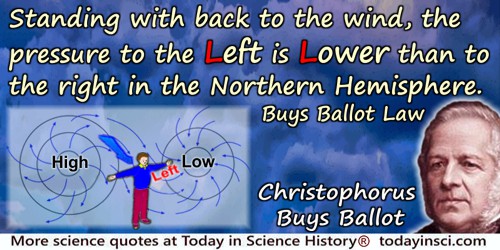
Buys Ballot Law: Standing with back to the wind, the pressure to the left is lower than to the right in the Northern Hemisphere.
Slightly reworded from the Glossary of Meteorology online at the site of the American Meteorological Society. Various statements of this law are found in different sources.
By the fruit one judges the tree; the tree of science grows exceedingly slowly; centuries elapse before one can pluck the ripe fruits; even today it is hardly possible for us to shell and appraise the kernel of the teachings that blossomed in the seventeenth century. He who sows cannot therefore judge the worth of the corn. He must have faith in the fruitfulness of the seed in order that he may follow untiringly his chosen furrow when he casts his ideas to the four winds of heaven.
As quoted in Philipp Frank, Modern Science and its Philosophy (1949), 62, which cites Évolution de la Mécanique (1903).
Climb the mountains and get their good tidings. Nature’s peace will flow into you as sunshine flows into trees. The winds will blow their own freshness into you, and the storms their energy, while cares will drop off like autumn leaves.
In 'The Yellowstone National Park', Our National Parks (1901), Chap. 2, 56.
Come, see the north-wind’s masonry,
Out of an unseen quarry evermore
Furnished with tile, the fierce artificer
Curves his white bastions with projected roof
Round every windward stake, or tree, or door.
Speeding, the myriad-handed, his wild work
So fanciful, so savage, naught cares he
For number or proportion.
Out of an unseen quarry evermore
Furnished with tile, the fierce artificer
Curves his white bastions with projected roof
Round every windward stake, or tree, or door.
Speeding, the myriad-handed, his wild work
So fanciful, so savage, naught cares he
For number or proportion.
From 'The Snow-Storm', Poems of R. W. Emerson (1847), 65-66.
Confucius once said that a bear could not fart at the North Pole without causing a big wind in Chicago.
By this he meant that all events, therefore, all men, are interconnected in an unbreakable web. What man does, no matter how seemingly insignificant, vibrates through the strands and affects every man.
By this he meant that all events, therefore, all men, are interconnected in an unbreakable web. What man does, no matter how seemingly insignificant, vibrates through the strands and affects every man.
Riders of the Purple Wage (1967). In Gary Westfahl, Science Fiction Quotations: From the Inner Mind to the Outer Limits (2006), 1.
Consider the very roots of our ability to discern truth. Above all (or perhaps I should say “underneath all”), common sense is what we depend on—that crazily elusive, ubiquitous faculty we all have to some degree or other. … If we apply common sense to itself over and over again, we wind up building a skyscraper. The ground floor of the structure is the ordinary common sense we all have, and the rules for building news floors are implicit in the ground floor itself. However, working it all out is a gigantic task, and the result is a structure that transcends mere common sense.
In Metamagical Themas: Questing for the Essence of Mind and Pattern (1985), 93–94.
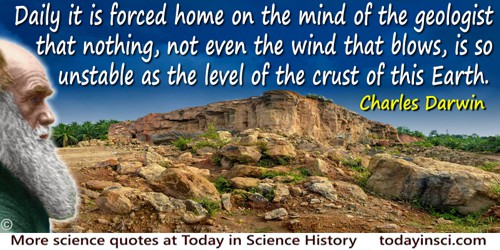
Daily it is forced home on the mind of the geologist that nothing, not even the wind that blows, is so unstable as the level of the crust of this Earth.
Decision differs from willfulness as atmospheric pressure from the fitful wind.
From chapter 'Jottings from a Note-book', in Canadian Stories (1918), 170.
Diseased nature oftentimes breaks forth
In strange eruptions: oft the teeming earth
Is with a kind of colic pinch’d and vex’d
By the imprisoning of unruly wind
Within her womb; which, for enlargement striving,
Shakes the old beldam earth, and topples down
Steeples and moss-grown towers.
In strange eruptions: oft the teeming earth
Is with a kind of colic pinch’d and vex’d
By the imprisoning of unruly wind
Within her womb; which, for enlargement striving,
Shakes the old beldam earth, and topples down
Steeples and moss-grown towers.
Dialogue by Hotspur to Glendower, in King Henry IV, Part I (c. 1597), Act III, Scene 1. Reprinted in The Works of Shakespeare: The First Part of King Henry IV (1790), 47.
Each of us has read somewhere that in New Guinea pidgin the word for 'piano' is (I use English spelling) 'this fellow you hit teeth belonging to him he squeal all same pig'. I am inclined to doubt whether this expression is authentic; it looks just like the kind of thing a visitor to the Islands would facetiously invent. But I accept 'cut grass belong head belong me' for 'haircut' as genuine... Such phrases seem very funny to us, and make us feel very superior to the ignorant foreigners who use long winded expressions for simple matters. And then it is our turn to name quite a simple thing, a small uncomplicated molecule consisting of nothing more than a measly 11 carbons, seven hydrogens, one nitrogen and six oxygens. We sharpen our pencils, consult our rule books and at last come up with 3-[(1, 3- dihydro-1, 3-dioxo-2H-isoindol-2-yl) oxy]-3-oxopropanoic acid. A name like that could drive any self-respecting Papuan to piano-playing.
The Chemist's English (1990), 3rd Edition, 57.
Earthquakes may be brought about because wind is caught up in the earth, so the earth is dislocated in small masses and is continually shaken, and that causes it to sway.
— Epicurus
Letter to Pythocles, in Epicurus: The Extant Remains (1926), trans. C. Bailey, 71.
Even in populous districts, the practice of medicine is a lonely road which winds up-hill all the way and a man may easily go astray and never reach the Delectable Mountains unless he early finds those shepherd guides of whom Bunyan tells, Knowledge, Experience, Watchful, and Sincere.
In Aequanimitas (1904), 299.
Even now, the imprisoned winds which the earliest poet made the Grecian warrior bear for the protection of his fragile bark; or those which, in more modern times, the Lapland wizards sold to the deluded sailors;—these, the unreal creations of fancy or of fraud, called, at the command of science, from their shadowy existence, obey a holier spell: and the unruly masters of the poet and the seer become the obedient slaves of civilized man.
In 'Future Prospects', On the Economy of Machinery and Manufactures (1st ed., 1832), chap. 32, 280.
First, there is the power of the Wind, constantly exerted over the globe.... Here is an almost incalculable power at our disposal, yet how trifling the use we make of it! It only serves to turn a few mills, blow a few vessels across the ocean, and a few trivial ends besides. What a poor compliment do we pay to our indefatigable and energetic servant!
In 'Paradise (To Be) Regained', Democratic Review (Nov 1848). Collected in A Yankee in Canada: with Anti-slavery and Reform Papers (1866), 188-89.
For many planet hunters, though, the ultimate goal is still greater (or actually, smaller) prey: terrestrial planets, like Earth, circling a star like the Sun. Astronomers already know that three such planets orbit at least one pulsar. But planet hunters will not rest until they are in sight of a small blue world, warm and wet, in whose azure skies and upon whose wind-whipped oceans shines a bright yellow star like our own.
…...
For they have sown the wind, and they shall reap the whirlwind.
— Bible
Hosea, 9:7. In Robert Andrews Famous Lines: a Columbia Dictionary of Familiar Quotations (1997), 340.
Groves hated the weather, and the weathermen; they represented chaos and the messengers of chaos. Weather violated boundaries, ignored walls and gates, failed to adhere to deadlines, disobeyed orders. Weather caused delays. The weather forecasters had opposed the [atomic bomb] test date for months—it was set within a window of unfavorable conditions: thunderstorms, rain, high winds, inversion layers. Groves had overridden them. … Groves saw it as a matter of insubordination when the weather forecasters refused to forecast good weather for the test.
In Atomic Spaces: Living on the Manhattan Project (1999), 312. For the attitude of Groves toward the weather see his, 'Some Recollections of July 16, 1945', Bulletin of the Atomic Scientists (Jun 1970), 26, No. 6, 27.
He [Lord Bacon] appears to have been utterly ignorant of the discoveries which had just been made by Kepler’s calculations … he does not say a word about Napier’s Logarithms, which had been published only nine years before and reprinted more than once in the interval. He complained that no considerable advance had been made in Geometry beyond Euclid, without taking any notice of what had been done by Archimedes and Apollonius. He saw the importance of determining accurately the specific gravities of different substances, and himself attempted to form a table of them by a rude process of his own, without knowing of the more scientific though still imperfect methods previously employed by Archimedes, Ghetaldus and Porta. He speaks of the εὕρηκα of Archimedes in a manner which implies that he did not clearly appreciate either the problem to be solved or the principles upon which the solution depended. In reviewing the progress of Mechanics, he makes no mention either of Archimedes, or Stevinus, Galileo, Guldinus, or Ghetaldus. He makes no allusion to the theory of Equilibrium. He observes that a ball of one pound weight will fall nearly as fast through the air as a ball of two, without alluding to the theory of acceleration of falling bodies, which had been made known by Galileo more than thirty years before. He proposed an inquiry with regard to the lever,—namely, whether in a balance with arms of different length but equal weight the distance from the fulcrum has any effect upon the inclination—though the theory of the lever was as well understood in his own time as it is now. … He speaks of the poles of the earth as fixed, in a manner which seems to imply that he was not acquainted with the precession of the equinoxes; and in another place, of the north pole being above and the south pole below, as a reason why in our hemisphere the north winds predominate over the south.
From Spedding’s 'Preface' to De Interpretations Naturae Proœmium, in The Works of Francis Bacon (1857), Vol. 3, 511-512. [Note: the Greek word “εὕρηκα” is “Eureka” —Webmaster.]
Heat energy of uniform temperature [is] the ultimate fate of all energy. The power of sunlight and coal, electric power, water power, winds and tides do the work of the world, and in the end all unite to hasten the merry molecular dance.
Matter and Energy (1911), 140.
How many times did the sun shine, how many times did the wind howl over the desolate tundras, over the bleak immensity of the Siberian taigas, over the brown deserts where the Earth’s salt shines, over the high peaks capped with silver, over the shivering jungles, over the undulating forests of the tropics! Day after day, through infinite time, the scenery has changed in imperceptible features. Let us smile at the illusion of eternity that appears in these things, and while so many temporary aspects fade away, let us listen to the ancient hymn, the spectacular song of the seas, that has saluted so many chains rising to the light.
In Tectonics of Asia (1924, 1977), 165, trans. Albert V. and Marguerite Carozzi.
I am the daughter of earth and water, And the nursling of the sky;
I pass through the pores of the ocean and shores;
I change, but I cannot die.
For after the rain when with never a stain,
The pavilion of Heaven is bare,
And the winds and sunbeams with their convex gleams,
Build up the blue dome of air,
I silently laugh at my own cenotaph, And out of the caverns of rain,
Like a child from the womb, like a ghost from the tomb,
I arise and unbuild it again.
I pass through the pores of the ocean and shores;
I change, but I cannot die.
For after the rain when with never a stain,
The pavilion of Heaven is bare,
And the winds and sunbeams with their convex gleams,
Build up the blue dome of air,
I silently laugh at my own cenotaph, And out of the caverns of rain,
Like a child from the womb, like a ghost from the tomb,
I arise and unbuild it again.
The Cloud (1820). In K. Raine (ed.), Shelley (1974), 289.
I can hear the sizzle of newborn stars, and know anything of meaning, of the fierce magic emerging here. I am witness to flexible eternity, the evolving past, and I know we will live forever, as dust or breathe in the face of stars, in the shifting pattern of winds.
In Secrets from the Center of the World (1989), 56.
I can’t change the direction of the wind, but I can adjust my sails to always reach my destination.
…...
I have always liked horticulturists, people who make their living from orchards and gardens, whose hands are familiar with the feel of the bark, whose eyes are trained to distinguish the different varieties, who have a form memory. Their brains are not forever dealing with vague abstractions; they are satisfied with the romance which the seasons bring with them, and have the patience and fortitude to gamble their lives and fortunes in an industry which requires infinite patience, which raise hopes each spring and too often dashes them to pieces in fall. They are always conscious of sun and wind and rain; must always be alert lest they lose the chance of ploughing at the right moment, pruning at the right time, circumventing the attacks of insects and fungus diseases by quick decision and prompt action. They are manufacturers of a high order, whose business requires not only intelligence of a practical character, but necessitates an instinct for industry which is different from that required by the city dweller always within sight of other people and the sound of their voices. The successful horticulturist spends much time alone among his trees, away from the constant chatter of human beings.
I never saw a discontented tree. They grip the ground as though they liked it, and though fast rooted they travel about as far as we do. They go wandering forth in all directions with every wind.
In Linnie Marsh Wolfe (ed.), John of the Mountains: The Unpublished Journals of John Muir (1938 1979), 313. Entered in journal while on sled trip exploring Muir Glacier, its boundaries and tributaries; Hemlock Mountain (11-21 Jul 1890).
I recognize that to view the Earth as if it were alive is just a convenient, but different, way of organizing the facts of the Earth. I am, of course, prejudiced in favour of Gaia and have filled my life for the past 25 years with the thought that the Earth might be in certain ways be alive—not as the ancients saw her, a sentient goddess with purpose and foresight—more like a tree. A tree that exists, never moving except to sway in the wind, yet endlessly conversing with the sunlight and the soil. Using sunlight and water and nutrients to grow and change. But all done so imperceptibly that, to me, the old oak tree on the green is the same as it was when I was a child.
In Healing Gaia: Practical Medicine for the Planet (1991), 12.

I return to the newborn world, and the soft-soil fields,
What their first birthing lifted to the shores
Of light, and trusted to the wayward winds.
First the Earth gave the shimmer of greenery
And grasses to deck the hills; then over the meadows
The flowering fields are bright with the color of springtime,
And for all the trees that shoot into the air.
What their first birthing lifted to the shores
Of light, and trusted to the wayward winds.
First the Earth gave the shimmer of greenery
And grasses to deck the hills; then over the meadows
The flowering fields are bright with the color of springtime,
And for all the trees that shoot into the air.
On the Nature of Things, trans. Anthony M. Esolen (1995) Book 5, lines 777-84, 181.
I searched along the changing edge
Where, sky-pierced now the cloud had broken.
I saw no bird, no blade of wing,
No song was spoken.
I stood, my eyes turned upward still
And drank the air and breathed the light.
Then, like a hawk upon the wind,
I climbed the sky, I made the flight.
Where, sky-pierced now the cloud had broken.
I saw no bird, no blade of wing,
No song was spoken.
I stood, my eyes turned upward still
And drank the air and breathed the light.
Then, like a hawk upon the wind,
I climbed the sky, I made the flight.
…...
I think the causes have not been fully explained by any of those who have wrote on that Subject, for want of more particularly and distinctly considering the Share the diurnal Motion of the Earth has in the Production of them: For although this has been mention’d by some amongst the Causes of those Winds, yet they have not proceeded to shew how it contributes to their Production; or else have applied it to the Explication of these Phænomena, upon such Principles as will appear upon Examination not to be sufficient.
First paragraph from 'Concerning the Cause of the General Trade-Winds', Philosophical Transactions of the Royal Society of London (30 Jun 1735), 39, No. 437, 58.
I went to Polynesia to study how animals had reached oceanic islands, carried by winds and currents. I came home with a controversial theory of how man had reached these islands in prehistoric times.
In 'Foreword to the 35th Anniversary Edition', Kon-Tiki: Across the Pacific by Raft (1990), xii.
If one of these elements, heat, becomes predominant in any body whatsoever, it destroys and dissolves all the others with its violence. …Again if too much moisture enters the channels of a body, and thus introduces disproportion, the other elements, adulterated by the liquid, are impaired, and the virtues of the mixture dissolved. This defect, in turn, may arise from the cooling properties of moist winds and breezes blowing upon the body. In the same way, increase or diminution of the proportion of air or of the earthy which is natural to the body may enfeeble the other elements.
In De Architectura, Book 1, Chap 4, Sec. 6. As translated in Morris Hicky Morgan (trans.), Vitruvius: The Ten Books on Architecture (1914), 18-19.
If one of these people, in whom the chance-worship of our remoter ancestors thus strangely survives, should be within reach of the sea when a heavy gale is blowing, let him betake himself to the shore and watch the scene. Let him note the infinite variety of form and size of the tossing waves out at sea; or against the curves of their foam-crested breakers, as they dash against the rocks; let him listen to the roar and scream of the shingle as it is cast up and torn down the beach; or look at the flakes of foam as they drive hither and thither before the wind: or note the play of colours, which answers a gleam of sunshine as it falls upon their myriad bubbles. Surely here, if anywhere, he will say that chance is supreme, and bend the knee as one who has entered the very penetralia of his divinity. But the man of science knows that here, as everywhere, perfect order is manifested; that there is not a curve of the waves, not a note in the howling chorus, not a rainbow-glint on a bubble, which is other than a necessary consequence of the ascertained laws of nature; and that with a sufficient knowledge of the conditions, competent physico-mathematical skill could account for, and indeed predict, every one of these 'chance' events.
In 'On the Reception of the Origin of Species'. In Francis Darwin (ed.), The Life and Letters of Charles Darwin, Including an Autobiographical Chapter (1888), Vol. 2, 200-1.
If there is a major eruption [of Vesuvius] with little warning and the winds are blowing toward Naples, you could have tremendous loss of life.
As quoted in Doug Stewart, 'Resurrecting Pompeii', Smithsonian Magazine (Feb 2006).
If we do not learn to eliminate waste and to be more productive and more efficient in the ways we use energy, then we will fall short of this goal [for the Nation to derive 20 percent of all the energy we use from the Sun, by 2000]. But if we use our technological imagination, if we can work together to harness the light of the Sun, the power of the wind, and the strength of rushing streams, then we will succeed.
Speech, at dedication of solar panels on the White House roof, 'Solar Energy Remarks Announcing Administration Proposals' (20 Jun 1979).
If you are on the side whence the wind is blowing you will see the trees looking much lighter than you would see them on the other sides; and this is due to the fact that the wind turns up the reverse side of the leaves which in all trees is much whiter than the upper side.
…...
In the bleak midwinter Frosty wind made moan, Earth stood hard as iron, Water like a stone; Snow had fallen, snow on snow, Snow on snow, In the bleak midwinter, Long ago.
…...
Iris from sea brings wind or mighty rain.
Fragment 50. In The Fragments of Empedocles, translated by William Ellery Leonard, (1908), 35.
It has been found that within a 100 mile radius a wind is always blowing. Windmills installed around
the world converting their direct current into alternating current and feeding the electric energy into the world network can harvest the planet Earth’s prime daily energy income source—the wind—and adequately supply all the world’s energy needs.
In Critical Path (1982), 208.
It is the triumph of civilization that at last communities have obtained such a mastery over natural laws that they drive and control them. The winds, the water, electricity, all aliens that in their wild form were dangerous, are now controlled by human will, and are made useful servants.
In Tryon Edwards, A Dictionary of Thoughts (1908), 75.
It was the movement of the air that provided the image of spirituality, since the spirit borrows its name from the breath of wind...
Quoted in Kim Lim (ed.), 1,001 Pearls of Spiritual Wisdom: Words to Enrich, Inspire, and Guide Your Life (2014), 6
Jupiter is the largest of all the solar system’s planets, more than ten times bigger and three hundred times as massive as Earth. Jupiter is so immense it could swallow all the other planets easily. Its Great Red Spot, a storm that has raged for centuries, is itself wider than Earth. And the Spot is merely one feature visible among the innumerable vortexes and streams of Jupiter’s frenetically racing cloud tops. Yet Jupiter is composed mainly of the lightest elements, hydrogen and helium, more like a star than a planet. All that size and mass, yet Jupiter spins on its axis in less than ten hours, so fast that the planet is clearly not spherical: Its poles are noticeably flattened. Jupiter looks like a big, colorfully striped beach ball that’s squashed down as if some invisible child were sitting on it. Spinning that fast, Jupiter’s deep, deep atmosphere is swirled into bands and ribbons of multihued clouds: pale yellow, saffron orange, white, tawny yellow-brown, dark brown, bluish, pink and red. Titanic winds push the clouds across the face of Jupiter at hundreds of kilometers per hour.
— Ben Bova
Jupiter
Just a rock, a dome of snow, the deep blue sky, and a hunk of orange-painted metal from which a shredded American flag cracked in the wind. Nothing more. Except two tiny figures walking together those last few feet to the top of the Earth.
…...
Laws and institutions are constantly tending to gravitate. Like clocks, they must be occasionally cleansed, and wound up, and set to true time.
In Life Thoughts (1860), 80.
Lo! the poor Indian! whose untutor’d mind
Sees God in clouds, or hears him in the wind;
His soul proud Science never taught to stray
Far as the solar walk or milky way.
Sees God in clouds, or hears him in the wind;
His soul proud Science never taught to stray
Far as the solar walk or milky way.
Essay on Man. Epistle I. Line 99. In Alexander Pope, Maynard Mack (Ed.), An Essay on Man (reprint of the Twickenham Edition of the Poems of Alexander Pope, 1982), 27.
by Alexander Pope, Maynard Mack - Poetry - 1982 - 186 pages
Man is occupied and has been persistently occupied since his separate evolution, with three kinds of struggle: first with the massive unintelligent forces of nature, heat and cold, winds, rivers, matter and energy; secondly, with the things closer to him, animals and plants, his own body, its health and disease; and lastly, with his desires and fears, his imaginations and stupidities.
In The World, the Flesh and the Devil (1929).
May the road rise to meet you. May the wind always be at your back. May the sun shine warm upon your face, the rains fall soft upon your fields and, until we meet again, may God hold you in the palm of his hand.
…...
Men have been talking now for a week at the post office about the age of the great elm, as a matter interesting but impossible to be determined. The very choppers and travelers have stood upon its prostrate trunk and speculated upon its age, as if it were a profound mystery. I stooped and read its years to them (127 at nine and a half feet), but they heard me as the wind that once sighed through its branches. They still surmised that it might be two hundred years old, but they never stooped to read the inscription. Truly they love darkness rather than light. One said it was probably one hundred and fifty, for he had heard somebody say that for fifty years the elm grew, for fifty it stood still, and for fifty it was dying. (Wonder what portion of his career he stood still!) Truly all men are not men of science. They dwell within an integument of prejudice thicker than the bark of the cork-tree, but it is valuable chiefly to stop bottles with. Tied to their buoyant prejudices, they keep themselves afloat when honest swimmers sink.
(26 Jan 1856). In Henry David Thoreau and Bradford Torrey (ed.), The Writings of Henry Thoreau: Journal: VIII: November 1, 1855-August 15, 1856 (1906), 145-146.
Mock on, mock on, Voltaire, Rousseau!
Mock on, mock on: 'Tis all in vain!
You throw the sand against the wind,
And the wind blows it back again.
And every sand becomes a gem
Reflected in the beams divine;
Blown back they blind the mocking eye,
But still in Israel's paths they shine.
The atoms of Democritus
And Newton's particles of light
Are sands upon the Red Sea shore,
Where Israel's tents do shine so bright.
Mock on, mock on: 'Tis all in vain!
You throw the sand against the wind,
And the wind blows it back again.
And every sand becomes a gem
Reflected in the beams divine;
Blown back they blind the mocking eye,
But still in Israel's paths they shine.
The atoms of Democritus
And Newton's particles of light
Are sands upon the Red Sea shore,
Where Israel's tents do shine so bright.
Notebook Drafts (c. 1804). In W. H. Stevenson (ed.), The Poems of William Blake (1971), 481.
Moreover, within the hollows of the earth,
When from one quarter the wind builds up, lunges,
Muscles the deep caves with its headstrong power,
The earth leans hard where the force of wind has pressed it;
Then above ground, the higher the house is built,
The nearer it rises to the sky, the worse
Will it lean that way and jut out perilously,
The beams wrenched loose and hanging ready to fall.
And to think, men can't believe that for this world
Some time of death and ruin lies in wait,
Yet they see so great a mass of earth collapse!
And the winds pause for breath—that's lucky, for else
No force could rein things galloping to destruction.
But since they pause for breath, to rally their force,
Come building up and then fall driven back,
More often the earth will threaten ruin than
Perform it. The earth will lean and then sway back,
Its wavering mass restored to the right poise.
That explains why all houses reel, top floor
Most then the middle, and ground floor hardly at all.
When from one quarter the wind builds up, lunges,
Muscles the deep caves with its headstrong power,
The earth leans hard where the force of wind has pressed it;
Then above ground, the higher the house is built,
The nearer it rises to the sky, the worse
Will it lean that way and jut out perilously,
The beams wrenched loose and hanging ready to fall.
And to think, men can't believe that for this world
Some time of death and ruin lies in wait,
Yet they see so great a mass of earth collapse!
And the winds pause for breath—that's lucky, for else
No force could rein things galloping to destruction.
But since they pause for breath, to rally their force,
Come building up and then fall driven back,
More often the earth will threaten ruin than
Perform it. The earth will lean and then sway back,
Its wavering mass restored to the right poise.
That explains why all houses reel, top floor
Most then the middle, and ground floor hardly at all.
On the Nature of Things, trans. Anthony M. Esolen (1995), Book 6, lines 558-77, 216.
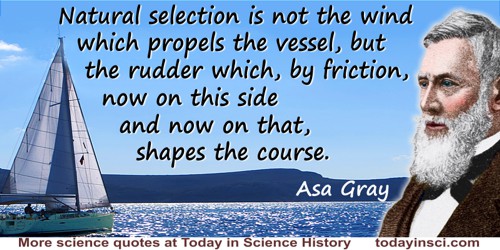
Natural selection is not the wind which propels the vessel, but the rudder which, by friction, now on this side and now on that, shapes the course.
— Asa Gray
Illustrating the Darwinian Doctrine, in his essay 'Evolutionary Teleology,' in Darwiniana: Essays and Reviews Pertaining to Darwinism (1876), 386.
Nature uncovers the inner secrets of nature in two ways: one by the force of bodies operating outside it; the other by the very movements of its innards. The external actions are strong winds, rains, river currents, sea waves, ice, forest fires, floods; there is only one internal force—earthquake.
About the Layers of the Earth and other Works on Geology (1757), trans. A. P. Lapov (1949), 45.
Nature, with equal mind,
Sees all her sons at play,
Sees man control the wind,
The wind sweep man away.
Sees all her sons at play,
Sees man control the wind,
The wind sweep man away.
From dramatic poem, 'Empedocles on Etna', first published anonymously, collected in Empedocles on Etna, and Other Poems (1852). As quoted in The Contemporary Review (1867), Vol. 6, 344. Also in The Poems of Matthew Arnold, 1840-1867 (1909), 94.
Neither fire nor wind, birth nor death can erase our good deeds.
— Buddha
Quoted in Kim Lim (ed.), 1,001 Pearls of Spiritual Wisdom: Words to Enrich, Inspire, and Guide Your Life (2014), 239
Not all the winds, and storms, and earthquakes, and seas, and seasons of the world, have done so much to revolutionize the earth as Man, the power of an endless life, has done since the day he came forth upon it, and received dominion over it.
From Sermon on the Power of Endless Life, and Other Sermons (1876), 310.
Not from the stars do I my judgement pluck,
And yet methinks I have astronomy.
But not to tell of good or evil luck,
Of plagues, of dearths, or season's quality;
Nor can I fortune to brief minutes tell,
Pointing to each his thunder, rain, and wind,
Or say with princes if it shall go well …
And yet methinks I have astronomy.
But not to tell of good or evil luck,
Of plagues, of dearths, or season's quality;
Nor can I fortune to brief minutes tell,
Pointing to each his thunder, rain, and wind,
Or say with princes if it shall go well …
Opening lines of 'Sonnet 14' (1609) in Complete Dramatic Works and Miscellaneous Poems (1823), 776.
(1906), 14.
Not in the ground of need, not in bent and painful toil, but in the deep-centred play-instinct of the world, in the joyous mood of the eternal Being, which is always young, science has her origin and root; and her spirit, which is the spirit of genius in moments of elevation, is but a sublimated form of play, the austere and lofty analogue of the kitten playing with the entangled skein or of the eaglet sporting with the mountain winds.
In Mathematics (1907), 44.
Nothing is sudden in nature: whereas the slightest storms are forecasted several days in advance, the destruction of the world must have been announced several years beforehand by heat waves, by winds, by meteorites, in short, by an infinity of phenomena.
L' Antiquité devoilée par ses usages ou Examen critique des principales Opinions, Cérémonies & Institutions religieuses & politiques des differens Peuples de la Terre (1766), 373-4.
Now that is the wisdom of a man, in every instance of his labor, to hitch his wagon to a star, and see his chore done by the gods themselves. That is the way we are strong, by borrowing the might of the elements. The forces of steam, gravity, galvanism, light, magnets, wind, fire, serve us day by day and cost us nothing.
From Chap. 2, 'Civilization', in Society and Solitude (1870), 24.
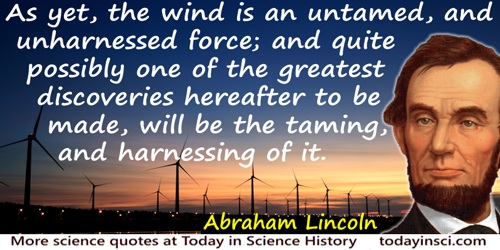
Of all the forces of nature, I should think the wind contains the largest amount of motive power—that is, power to move things. Take any given space of the earth’s surface— for instance, Illinois; and all the power exerted by all the men, and beasts, and running-water, and steam, over and upon it, shall not equal the one hundredth part of what is exerted by the blowing of the wind over and upon the same space. And yet it has not, so far in the world’s history, become proportionably valuable as a motive power. It is applied extensively, and advantageously, to sail-vessels in navigation. Add to this a few windmills, and pumps, and you have about all. … As yet, the wind is an untamed, and unharnessed force; and quite possibly one of the greatest discoveries hereafter to be made, will be the taming, and harnessing of it.
Lecture 'Discoveries and Inventions', (1860) in Discoveries and Inventions (1915).
Oh, I have slipped the surly bonds of earth
and danced the skies on laughter-silvered wings;
Sunward I’ve climbed, and joined the tumbling mirth
of sun-split clouds and done a hundred things
you have not dreamed of wheeled and soared and swung
high in the sunlit silence. Hovering there,
I’ve chased the shouting wind along, and flung
my eager craft through footless halls of air.
Up, up the long, delirious, burning blue
I’ve topped the windswept heights with easy grace
where never lark, or even eagle flew
and, while with silent, lifting mind I’ve trod
the high untrespassed sanctity of space,
put out my hand, and touched the face of God.
and danced the skies on laughter-silvered wings;
Sunward I’ve climbed, and joined the tumbling mirth
of sun-split clouds and done a hundred things
you have not dreamed of wheeled and soared and swung
high in the sunlit silence. Hovering there,
I’ve chased the shouting wind along, and flung
my eager craft through footless halls of air.
Up, up the long, delirious, burning blue
I’ve topped the windswept heights with easy grace
where never lark, or even eagle flew
and, while with silent, lifting mind I’ve trod
the high untrespassed sanctity of space,
put out my hand, and touched the face of God.
…...
On the day of Cromwell’s death, when Newton was sixteen, a great storm raged all over England. He used to say, in his old age, that on that day he made his first purely scientific experiment. To ascertain the force of the wind, he first jumped with the wind and then against it; and, by comparing these distances with the extent of his own jump on a calm day, he was enabled to compute the force of the storm. When the wind blew thereafter, he used to say it was so many feet strong.
In 'Sir Isaac Newton', People’s Book of Biography: Or, Short Lives of the Most Interesting Persons of All Ages and Countries (1868), 248.
Once I dipt into the future far as human eye could see,
And I saw the Chief Forecaster, dead as any one can be-
Dead and damned and shut in Hades as a liar from his birth,
With a record of unreason seldom paralleled on earth.
While I looked he reared him solemnly, that incandescent youth,
From the coals that he’s preferred to the advantages of truth.
He cast his eyes about him and above him; then he wrote
On a slab of thin asbestos what I venture here to quote-
For I read it in the rose-light of the everlasting glow:
Cloudy; variable winds, with local showers; cooler; snow.
And I saw the Chief Forecaster, dead as any one can be-
Dead and damned and shut in Hades as a liar from his birth,
With a record of unreason seldom paralleled on earth.
While I looked he reared him solemnly, that incandescent youth,
From the coals that he’s preferred to the advantages of truth.
He cast his eyes about him and above him; then he wrote
On a slab of thin asbestos what I venture here to quote-
For I read it in the rose-light of the everlasting glow:
Cloudy; variable winds, with local showers; cooler; snow.
Once the hatch was opened, I turned the lock handle and bright rays of sunlight burst through it. I opened the hatch and dust from the station flew in like little sparklets, looking like tiny snowflakes on a frosty day. Space, like a giant vacuum cleaner, began to suck everything out. Flying out together with the dust were some little washers and nuts that dad got stuck somewhere; a pencil flew by.
My first impression when I opened the hatch was of a huge Earth and of the sense of unreality concerning everything that was going on. Space is very beautiful. There was the dark velvet of the sky, the blue halo of the Earth and fast-moving lakes, rivers, fields and clouds clusters. It was dead silence all around, nothing whatever to indicate the velocity of the flight… no wind whistling in your ears, no pressure on you. The panorama was very serene and majestic.
My first impression when I opened the hatch was of a huge Earth and of the sense of unreality concerning everything that was going on. Space is very beautiful. There was the dark velvet of the sky, the blue halo of the Earth and fast-moving lakes, rivers, fields and clouds clusters. It was dead silence all around, nothing whatever to indicate the velocity of the flight… no wind whistling in your ears, no pressure on you. The panorama was very serene and majestic.
…...
Patience is what you need in the Antarctic. Wait—Give wind and tide a chance to change.
Muttered by Byrd onboard the ship Bear while locked in Antarctic ice. Recalled by George Dufek, 'Admiral Byrd's Greatest Discovery', This Week: The National Sunday Magazine (7 Jul 1959), as cited in Lisle A.Rose, Explorer: The Life of Richard E. Byrd (2008), 414.
Science has thus, most unexpectedly, placed in our hands a new power of great but unknown energy. It does not wake the winds from their caverns; nor give wings to water by the urgency of heat; nor drive to exhaustion the muscular power of animals; nor operate by complicated mechanism; nor summon any other form of gravitating force, but, by the simplest means—the mere contact of metallic surfaces of small extent, with feeble chemical agents, a power everywhere diffused through nature, but generally concealed from our senses, is mysteriously evolved, and by circulation in insulated wires, it is still more mysteriously augmented, a thousand and a thousand fold, until it breaks forth with incredible energy.
Comment upon 'The Notice of the Electro-Magnetic Machine of Mr. Thomas Davenport, of Brandon, near Rutland, Vermont, U.S.', The Annals of Electricity, Magnetism, & Chemistry; and Guardian of Experimental Science (1838), 2, 263.
Since you are now studying geometry and trigonometry, I will give you a problem. A ship sails the ocean. It left Boston with a cargo of wool. It grosses 200 tons. It is bound for Le Havre. The mainmast is broken, the cabin boy is on deck, there are 12 passengers aboard, the wind is blowing East-North-East, the clock points to a quarter past three in the afternoon. It is the month of May. How old is the captain?
Letter (14 Aug 1853) to Louise Colet. As quote and cited in Robert A. Nowlan, Masters of Mathematics: The Problems They Solved, Why These Are Important, and What You Should Know about Them (2017), 271.
Some guns were fired to give notice that the departure of the balloon was near. ... Means were used, I am told, to prevent the great balloon's rising so high as might endanger its bursting. Several bags of sand were taken on board before the cord that held it down was cut, and the whole weight being then too much to be lifted, such a quantity was discharged as would permit its rising slowly. Thus it would sooner arrive at that region where it would be in equilibrio with the surrounding air, and by discharging more sand afterwards, it might go higher if desired. Between one and two o’clock, all eyes were gratified with seeing it rise majestically from above the trees, and ascend gradually above the buildings, a most beautiful spectacle. When it was about two hundred feet high, the brave adventurers held out and waved a little white pennant, on both sides of their car, to salute the spectators, who returned loud claps of applause. The wind was very little, so that the object though moving to the northward, continued long in view; and it was a great while before the admiring people began to disperse. The persons embarked were Mr. Charles, professor of experimental philosophy, and a zealous promoter of that science; and one of the Messrs Robert, the very ingenious constructors of the machine.
While U.S. ambassador to France, writing about witnessing, from his carriage outside the garden of Tuileries, Paris, the first manned balloon ascent using hydrogen gas on the afternoon of 1 Dec 1783. A few days earlier, he had watched the first manned ascent in Montgolfier's hot-air balloon, on 21 Nov 1783.
While U.S. ambassador to France, writing about witnessing, from his carriage outside the garden of Tuileries, Paris, the first manned balloon ascent using hydrogen gas on the afternoon of 1 Dec 1783. A few days earlier, he had watched the first manned ascent in Montgolfier's hot-air balloon, on 21 Nov 1783.
Letter to Sir Charles Banks (1 Dec 1783). In The Writings of Benjamin Franklin: 1783-1788 (1906), Vol. 9, 119-120.
Some of what these pamphlets [of astrological forecasts] say will turn out to be true, but most of it time and experience will expose as empty and worthless. The latter part will be forgotten [literally: written on the winds] while the former will be carefully entered in people’s memories, as is usual with the crowd.
On giving astrology sounder foundations, De fundamentis astrologiae certioribus, (1602), Thesis 2, Johannes Kepler Gesammelte Werke (1937- ), Vol. 4, 12, trans. J. V. Field, in Archive for History of Exact Sciences, 1984, 31, 229-72.
Some young folks have wind-fall minds, prematurely detached from the tree of knowledge for a life-long sourness and pettiness.
From chapter 'Jottings from a Note-Book', in Canadian Stories (1918), 181.
Standing now in diffused light, with the wind at my back, I experience suddenly a feeling of completeness–not a feeling of having achieved something or of being stronger than everyone who was ever here before, not a feeling of having arrived at the ultimate point, not a feeling of supremacy. Just a breath of happiness deep inside my mind and my breast. The summit seemed suddenly to me to be a refuge, and I had not expected to find any refuge up here. Looking at the steep, sharp ridges below us, I have the impression that to have come later would have been too late. Everything we now say to one another, we only say out of embarrassment. I don’t think anymore. As I pull the tape recorder, trancelike, from my rucksack, and switch it on wanting to record a few appropriate phrases, tears again well into my eyes. “Now we are on the summit of Everest,” I begin, “it is so cold that we cannot take photographs…” I cannot go on, I am immediately shaken with sobs. I can neither talk nor think, feeling only how this momentous experience changes everything. To reach only a few meters below the summit would have required the same amount of effort, the same anxiety and burden of sorrow, but a feeling like this, an eruption of feeling, is only possible on the summit itself.
In Everest: Expedition to the Ultimate (1979), 180.
Suddenly there was an enormous explosion, like a violent volcano. The nuclear reactions had led to overheating in the underground burial grounds. The explosion poured radioactive dust and materials high up into the sky. It was just the wrong weather for such a tragedy. Strong winds blew the radioactive clouds hundreds of miles away. It was difficult to gauge the extent of the disaster immediately, and no evacuation plan was put into operation right away. Many villages and towns were only ordered to evacuate when the symptoms of radiation sickness were already quite apparent. Tens of thousands of people were affected, hundreds dying, though the real figures have never been made public. The large area, where the accident happened, is still considered dangerous and is closed to the public.
'Two Decades of Dissidence', New Scientist (4 Nov 1976), 72, No. 72, 265.
The [mechanical] bird I have described ought to be able by the help of the wind to rise to a great height, and this will prove to be its safety; since even if… revolutions [of the winds] were to befall it, it would still have time to regain a condition of equilibrium; provided that its various parts have a great power of resistance, so that they can safely withstand the fury and violence of the descent, by the aid of the defenses which I have mentioned; and its joints should be made of strong tanned hide, and sewn with cords of strong raw silk. And let no one encumber himself with iron bands, for these are very soon broken at the joints or else they become worn out, and consequently it is well not to encumber oneself with them.
'Of the Bird’s Movement' from Sul Voio degli Uccelli, 8 [7] r. in Leonardo da Vinci's Notebooks, trans. E. MacCurdy (1906), 153-4.
The astronomer who studies the motion of the stars is surely like a blind man who, with only a staff [mathematics] to guide him, must make a great, endless, hazardous journey that winds through innumerable desolate places. What will be the result? Proceeding anxiously for a while and groping his way with his staff, he will at some time, leaning upon it, cry out in despair to Heaven, Earth and all the Gods to aid him in his misery.
In The Sleepwalkers by Arthur Koestler (1968).
The cause of rain is now, I consider, no longer an object of doubt. If two masses of air of unequal temperatures, by the ordinary currents of the winds, are intermixed, when saturated with vapour, a precipitation ensues. If the masses are under saturation, then less precipitation takes place, or none at all, according to the degree. Also, the warmer the air, the greater is the quantity of vapour precipitated in like circumstances. ... Hence the reason why rains are heavier in summer than in winter, and in warm countries than in cold.
Memoirs of the Literary and Philosophical Society of Manchester (1819), 3, 507. Quoted in George Drysdale Dempsey and Daniel Kinnear Clark, On the Drainage of Lands, Towns, & Buildings (1887), 246.
The child asks, “What is the moon, and why does it shine?” “What is this water and where does it run?” “What is this wind?” “What makes the waves of the sea?” “Where does this animal live, and what is the use of this plant?” And if not snubbed and stunted by being told not to ask foolish questions, there is no limit to the intellectual craving of a young child; nor any bounds to the slow, but solid, accretion of knowledge and development of the thinking faculty in this way. To all such questions, answers which are necessarily incomplete, though true as far as they go, may be given by any teacher whose ideas represent real knowledge and not mere book learning; and a panoramic view of Nature, accompanied by a strong infusion of the scientific habit of mind, may thus be placed within the reach of every child of nine or ten.
In 'Scientific Education', Lay Sermons, Addresses, and Reviews (1870), 71.
https://books.google.com/books?id=13cJAAAAIAAJ
Thomas Henry Huxley - 1870
The day will come when, after harnessing space, the winds, the tides, and gravitation, we shall harness for God the energies of love. And on that day, for the second time in the history of the world, we shall have discovered fire.
From 'The Evolution of Chastity' (Feb 1934), as translated by René Hague in Toward the Future (1975), 86-87.
The diseases which are hard to cure in neighborhoods… are catarrh, hoarseness, coughs, pleurisy, consumption, spitting of blood, and all others that are cured not by lowering the system but by building it up. They are hard to cure, first, because they are originally due to chills; secondly, because the patient's system being already exhausted by disease, the air there, which is in constant agitation owing to winds and therefore deteriorated, takes all the sap of life out of their diseased bodies and leaves them more meager every day. On the other hand, a mild, thick air, without drafts and not constantly blowing back and forth, builds up their frames by its unwavering steadiness, and so strengthens and restores people who are afflicted with these diseases.
In De Architectura, Book 1, Chap 6, Sec. 3. As translated in Morris Hicky Morgan (trans.), Vitruvius: The Ten Books on Architecture (1914), 25.
The Earth Speaks, clearly, distinctly, and, in many of the realms of Nature, loudly, to William Jennings Bryan, but he fails to hear a single sound. The earth speaks from the remotest periods in its wonderful life history in the Archaeozoic Age, when it reveals only a few tissues of its primitive plants. Fifty million years ago it begins to speak as “the waters bring forth abundantly the moving creatures that hath life.” In successive eons of time the various kinds of animals leave their remains in the rocks which compose the deeper layers of the earth, and when the rocks are laid bare by wind, frost, and storm we find wondrous lines of ascent invariably following the principles of creative evolution, whereby the simpler and more lowly forms always precede the higher and more specialized forms.
The earth speaks not of a succession of distinct creations but of a continuous ascent, in which, as the millions of years roll by, increasing perfection of structure and beauty of form are found; out of the water-breathing fish arises the air-breathing amphibian; out of the land-living amphibian arises the land-living, air-breathing reptile, these two kinds of creeping things resembling each other closely. The earth speaks loudly and clearly of the ascent of the bird from one kind of reptile and of the mammal from another kind of reptile.
This is not perhaps the way Bryan would have made the animals, but this is the way God made them!
The earth speaks not of a succession of distinct creations but of a continuous ascent, in which, as the millions of years roll by, increasing perfection of structure and beauty of form are found; out of the water-breathing fish arises the air-breathing amphibian; out of the land-living amphibian arises the land-living, air-breathing reptile, these two kinds of creeping things resembling each other closely. The earth speaks loudly and clearly of the ascent of the bird from one kind of reptile and of the mammal from another kind of reptile.
This is not perhaps the way Bryan would have made the animals, but this is the way God made them!
The Earth Speaks to Bryan (1925), 5-6. Osborn wrote this book in response to the Scopes Monkey Trial, where William Jennings Bryan spoke against the theory of evolution. They had previously been engaged in the controversy about the theory for several years. The title refers to a Biblical verse from the Book of Job (12:8), “Speak to the earth and it shall teach thee.”
The fact remains that, if the supply of energy failed, modern civilization would come to an end as abruptly as does the music of an organ deprived of wind.
Matter and Energy (1911), 251.
The fuel in the earth will be exhausted in a thousand or more years, and its mineral wealth, but man will find substitutes for these in the winds, the waves, the sun's heat, and so forth. (1916)
From Under the Apple-Trees (1916), 308.
The fundamental idea of these pylons, or great archways, is based on a method of construction peculiar to me, of which the principle consists in giving to the edges of the pyramid a curve of such a nature that this pyramid shall be capable of resisting the force of the wind without necessitating the junction of the edges by diagonals as is usually done.
Writing of his tower after its completion in 1889. As quoted (translated) in 'Eiffel’s Monument His Famous Tower', New York Times (6 Jan 1924), X8.
The last few meters up to the summit no longer seem so hard. On reaching the top, I sit down and let my legs dangle into space. I don’t have to climb anymore. I pull my camera from my rucksack and, in my down mittens, fumble a long time with the batteries before I have it working properly. Then I film Peter. Now, after the hours of torment, which indeed I didn’t recognize as torment, now, when the monotonous motion of plodding upwards is at an end, and I have nothing more to do than breathe, a great peace floods my whole being. I breathe like someone who has run the race of his life and knows that he may now rest forever. I keep looking all around, because the first time I didn’t see anything of the panorama I had expected from Everest, neither indeed did I notice how the wind was continually chasing snow across the summit. In my state of spiritual abstraction, I no longer belong to myself and to my eyesight. I am nothing more than a single, narrow, gasping lung, floating over the mists and the summits.
In Everest: Expedition to the Ultimate (1979), 180.
The late James McNeil Whistler had a French poodle of which he was extravagantly fond. This poodle was seized with an affection of the throat, and Whistler had the audacity to send for the great throat specialist, Mackenzie. Sir Morell, when he saw that he had been called to treat a dog, didn't like it much, it was plain. But he said nothing. He prescribed, pocketed a big fee, and drove away.
The next day he sent posthaste for Whistler. And Whistler, thinking he was summoned on some matter connected with his beloved dog, dropped his work and rushed like the wind to Mackenzie's. On his arrival Sir Morell said, gravely: “How do you do, Mr. Whistler? I wanted to see you about having my front door painted.”
The next day he sent posthaste for Whistler. And Whistler, thinking he was summoned on some matter connected with his beloved dog, dropped his work and rushed like the wind to Mackenzie's. On his arrival Sir Morell said, gravely: “How do you do, Mr. Whistler? I wanted to see you about having my front door painted.”
Attributed or merely a legend. This anecdote wording is from 'Turn About Is Fair Play', Collier's (26 Mar 1904), 32, No. 26, 24, the earliest version the Webmaster has found so far. It has been variously reworded and printed in a number of books and magazines over the decades since, and is still circulated in the present day. The wording of Mackenzie's remark changes from one version to another, but remains true to the sense of it. In Medical Record (4 Jan 1913), 83, No. 1, 46, a reprinted column from The Universal Medical Record says: “‘X’ relates that he ‘has recently been watching through the weekly papers, of a story anent the artist Whistler and Sir mrell Mackenzie, which, curiously enough, starting in Paris, has now reached the American medical Journals and seems embarked on a long and active career. ... Mr. Ben Trovato, the eminent raconteur, seems for the moment at fault. Still, the natural history of such legends as this leads us to suppose that the story of the laryngologist and the poodle will continue to circulate, till after having served its day it ‘falls on sleep,’ later to be revived by the journalists of the next generation about some heroes of to-day.” Examples of other versions are in La Vulgarisation scientifique: revue mensuelle illustrée (1906); Don C. Seitz Whistler Stories (1913); Lewis C. Henry, Humorous Anecdotes About Famous People (1948); Graeme Garden The Best Medicine (1984); The Reader's Digest (1986), 128, Nos. 765-769, 40. So, in fact, this anecdote has, indeed, been revived for over a century, but is still narrated about Whistler and Mackenzie. Meanwhile, the column in the Medical Record mentioned above comments: “Why Whistler—whose brother, by-the-bye, was almost equally celebrated in the same department of medicine—should have desired the services of a laryngologist for his poodle, heaven only knows.” So, whether to regard this as entirely legend, or perhaps having some foundation of truth, the Webmaster cannot say, but would like to hear from anyone with more historical background to add.
The microbial global brain—gifted with long-range transport, data trading, genetic variants … and the ability to reinvent genomes—began its operations some 91 trillion bacterial generations before the birth of the Internet. Ancient bacteria, if they functioned like those today, had mastered the art of worldwide information exchange. … The earliest microorganisms would have used planet-sweeping currents of wind and water to carry the scraps of genetic code…
In 'Creative Nets in the Precambrian Era', Global Brain: The Evolution of Mass Mind from the Big Bang to the 21st Century (2000), 18-19.
The mountain slopes … are covered with dense forests of pines and firs. The lakes are often fringed with beautiful aspens, and when the autumn winds come their golden leaves are carried over the landscape in clouds of resplendent sheen.
In Canyons of the Colorado (1895), 68.
The path towards sustainable energy sources will be long and sometimes difficult. But America cannot resist this transition, we must lead it. We cannot cede to other nations the technology that will power new jobs and new industries, we must claim its promise. That’s how we will maintain our economic vitality and our national treasure—our forests and waterways, our crop lands and snow-capped peaks. That is how we will preserve our planet, commanded to our care by God. That’s what will lend meaning to the creed our fathers once declared.
In Second Inaugural Address (21 Jan 2013) at the United States Capitol.
The sea is the source of water and the source of wind; for neither would blasts of wind arise in the clouds and blow out from within them, except for the great sea, nor would the streams of rivers nor the rain-water in the sky exist but for the sea ; but the great sea is the begetter of clouds and winds and rivers.
Quoted in Arthur Fairbanks (ed. And trans.), The First Philosophers of Greece (1898), 69, fragment 11.
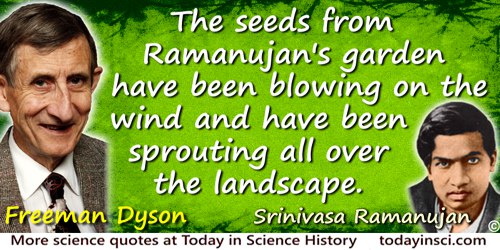
The seeds from Ramanujan’s garden have been blowing on the wind and have been sprouting all over the landscape.
[On the stimulating effects of Ramanujan's mathematical legacy.]
[On the stimulating effects of Ramanujan's mathematical legacy.]
From lecture, the Ramanujan Centenary Conference, University of Illinois (2 Jun 1987), 'A Walk in Ramanujan's Garden', collected in Selected Papers of Freeman Dyson (1996), 198.
The sun's rays are the ultimate source of almost every motion which takes place on the surface of the earth. By their heat are produced all winds, and those disturbances in the electric equilibrium of the atmosphere which give rise to the phenomena of terrestrial magnetism. By their vivifying action vegetables are elaborated from inorganic matter, and become in their turn the support of animals and of man, and the sources of those great deposits of dynamical efficiency which are laid up for human use in our coal strata. By them the waters of the sea are made to circulate in vapor through the air, and irrigate the land, producing springs and rivers. By them are produced all disturbances of the chemical equilibrium of the elements of nature which, by a series of compositions and decompositions, give rise to new products, and originate a transfer of materials. Even the slow degradation of the solid constituents of the surface, in which its chief geological changes consist, and their diffusion among the waters of the ocean, are entirely due to the abrasion of the wind, rain, and tides, which latter, however, are only in part the effect of solar influence and the alternate action of the seasons.
from Outlines of Astronomy (1849), 237.
The universe is one great kindergarten for man. Everything that exists has brought with it its own peculiar lesson. The mountain teaches stability and grandeur; the ocean immensity and change. Forests, lakes, and rivers, clouds and winds, stars and flowers, stupendous glaciers and crystal snowflakes—every form of animate or inanimate existence, leaves its impress upon the soul of man.
…...
The weather is warm
The sun is out
There are people all around
The waves come flowing
And hits the shore
But makes so little sound
The wind is blowing
Oh so softly
The sand between my feet
The dolphins jump
The people watch
They even take a seat
I fly around
Watching from above
Today is like everyday
That is something I love
The sun is out
There are people all around
The waves come flowing
And hits the shore
But makes so little sound
The wind is blowing
Oh so softly
The sand between my feet
The dolphins jump
The people watch
They even take a seat
I fly around
Watching from above
Today is like everyday
That is something I love
…...
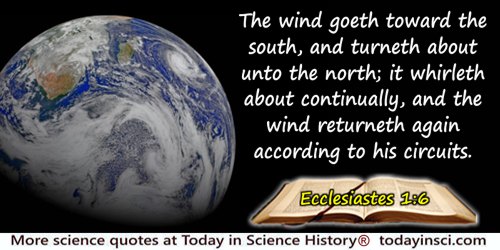
The wind goeth toward the south, and turneth about unto the north; it whirleth about continually, and the wind returneth again according to his circuits.
— Bible
King James Version, Ecclesiastes 1:6.
The wind makes music in the woods, but the tune changes with the seasons.
In 'Why We Should Celebrate Winter Woodland–Not Just the Christmas Tree', The Guardian (12 Dec 2015).
The winds, the sea, and the moving tides are what they are. If there is wonder and beauty and majesty in them, science will discover these qualities. If they are not there, science cannot create them. If there is poetry in my book about the sea, it is not because I deliberately put it there, but because no one could write truthfully about the sea and leave out the poetry.
Address upon receiving National Book Award at reception, Hotel Commodore, New York (27 Jan 1952). As cited in Linda Lear, Rachel Carson: Witness for Nature (1997), 219. She was referring to her book being recognized, The Sea Around Us.
The worst city is that which is sheltered from the east winds and in which hot and cold winds blow.
As quoted in Robert Taylor, White Coat Tales: Medicine's Heroes, Heritage, and Misadventures (2010), 126.
There are various causes for the generation of force: a tensed spring, an air current, a falling mass of water, fire burning under a boiler, a metal that dissolves in an acid—one and the same effect can be produced by means of all these various causes. But in the animal body we recognise only one cause as the ultimate cause of all generation of force, and that is the reciprocal interaction exerted on one another by the constituents of the food and the oxygen of the air. The only known and ultimate cause of the vital activity in the animal as well as in the plant is a chemical process.
'Der Lebensprocess im Thiere und die Atmosphare', Annalen der Chemie und Pharmacie (1841), 41, 215-7. Trans. Kenneth L. Caneva, Robert Mo.yer and the Conservation of Energy (1993), 78.
There is an even cleaner form of energy than the sun, more renewable than the wind: it’s the energy we don’t consume.
There is another passage from the Old Testament that comes nearer to my own sympathies—“And behold the Lord passed by, and a great and strong wind rent the mountains, and brake in pieces the rocks before the Lord; but the Lord was not in the wind: and after the wind an earthquake; but the Lord was not in the earthquake: and after the earthquake a fire; but the Lord was not in the fire: and after the fire a still small voice. …And behold there came a voice unto him, and said. What doest thou here, Elijah?”
Swarthmore Lecture (1929) at Friends’ House, London, printed in Science and the Unseen World (1929), 25-26.
Though all the winds of doctrine were let loose to play upon the earth, so Truth be in the field…. Let her and Falsehood grapple; who ever knew Truth put to the worse, in a free and open encounter?
In Areopagitica: A speech of Mr John Milton for the Liberty of Unlicenced printing to the Parliament of England (23 Nov 1644), 35.
Through countless dimensions, riding high the winds of intellectual adventure and filled with the zest of discovery, the mathematician tracks the heavens for harmony and eternal verity.
In The American Mathematical Monthly (1949), 56, 19. Excerpted in John Ewing (ed,), A Century of Mathematics: Through the Eyes of the Monthly (1996), 186.
Thursday, December 17 [1903]. In the afternoon about 5:30 we received the following telegram from Orvill[e], dated Kitty Hawk, N.C., Dec. 17. “Bishop M. Wright: “Success four flights Thursday morning all against a twenty-one mile wind started from level with engine power alone average speed through the air thirty one miles—longest 57 seconds. XXX home Christmas. Orville Wright.”
From Milton’s handwritten Diary entry for Thur, 17 Dec 1903. Milton is now age 75.
To speak of this subject you must... explain the nature of the resistance of the air, in the second the anatomy of the bird and its wings, in the third the method of working the wings in their various movements, in the fourth the power of the wings and the tail when the wings are not being moved and when the wind is favorable to serve as guide in various movements.
…...
To vary the compression of the muscle therefore, and so to swell and shrink it, there needs nothing but to change the consistency of the included ether… . Thus may therefore the soul, by determining this ethereal animal spirit or wind into this or that nerve, perhaps with as much ease as air is moved in open spaces, cause all the motions we see in animals.
From 'An Hypothesis explaining the Properties of Light, discoursed of in my several Papers', in Thomas Birch, The History of the Royal Society (1757), Vol. 3, 252. This was from Newton’s Second Paper on Color and Light, read at the Royal Society (9 Dec 1675).
Twenty years from now you will be more disappointed by the things you didn’t do than by the ones you did. So throw off the bowlines, Sail away from the safe harbor. Catch the trade winds in your sails. Explore. Dream. Discover.
…...
Typhoons are a sort of violent whirlwinds. Before these whirlwinds come on... there appears a heavy cloud to the northeast which is very black near the horizon, but toward the upper part is a dull reddish color. The tempest came with great violence, but after a while, the winds ceased all at once and a calm succeeded. This lasted... an hour, more or less, then the gales were turned around, blowing with great fury from the southwest.
from A New Voyage Round the World (1697)
We are like tenant farmers chopping down the fence around our house for fuel when we should be using Natures inexhaustible sources of energy — sun, wind and tide. ... I'd put my money on the sun and solar energy. What a source of power! I hope we don't have to wait until oil and coal run out before we tackle that.
Edison in conversation Henry Ford and Harvey Firestone (1931), quoted as a recollection of the author, in James Newton, Uncommon Friends: Life with Thomas Edison, Henry Ford, Harvey Firestone, Alexis Carrel & Charles Lindbergh (1987), 31. The quote is not cited from a print source. However, in the introduction the author said he “kept a diary in which I noted times and places, key phrases, and vivid impressions.” He also “relied on publications by and about my friends, which jogged my memory.” Webmaster has found no earlier record of this quote, and thus suggests the author may have the gist of what Edison said, but is not quoting the exact words uttered by Edison, although quote marks are used to state what Edison said.
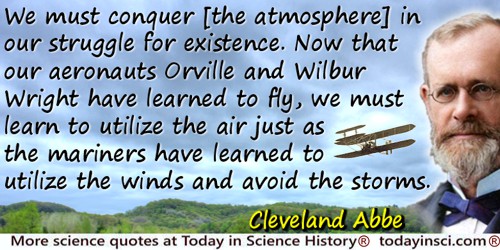
We must conquer [the atmosphere] in our struggle for existence. Now that our aeronauts Orville and Wilbur Wright have learned to fly, we must learn to utilize the air just as the mariners have learned to utilize the winds and avoid the storms.
From Address (16 Mar 1909) at Columbia University, printed in 'Meteorology of the Future', Popular Science Monthly (Dec 1910), 78, 22.
We will build the roads and bridges, the electric grids and digital lines that feed our commerce and bind us together. We'll restore science to its rightful place, and wield technology's wonders to raise health care's quality and lower its cost. We will harness the sun and the winds and the soil to fuel our cars and run our factories. And we will transform our schools and colleges and universities to meet the demands of a new age. All this we can do. All this we will do.
From First Inaugural Address (20 Jan 2009)
What sir, would you make a ship sail against the wind and currents by lighting a bonfire under her deck? I pray you excuse me. I have no time to listen to such nonsense.
In Ashton Applewhite, Tripp Evans and Andrew Frothingham, And I Quote (1992), 172, but without definitive source. Webmaster has not found any 19th-century book with such a quotation. Contact webmaster if you can help identify if this is a valid quote or merely a joke.
When April wind wakes the call for the soil, I hold the plough as my only hold upon the earth, and, as I follow through the fresh and fragrant furrow, I am planted with every foot-step, growing, budding, blooming in a spirit of spring.
Wind, earthquake, fire—meteorology, seismology, physics—pass in review, as we have been reviewing the natural forces of evolution; the Lord was not in them. Afterwards, a stirring, an awakening in the organ of the brain, a voice which asks “What doest thou here?”
Swarthmore Lecture (1929) at Friends’ House, London, printed in Science and the Unseen World (1929), 26.
Yes, gentlemen, give me the map of any country, its configuration, its climate, its waters, its winds, and the whole of its physical geography; give me its natural productions, its flora, its zoology, &c., and I pledge myself to tell you, a priori, what will be the quality of man in history:—not accidentally, but necessarily; not at any particular epoch, but in all; in short, —what idea he is called to represent.
Introduction to the History of Philosophy (1832), trans. by Henning Gotfried Linberg, 240.
Zorrillos, or skunks…, … are far from uncommon. … Conscious of its power, it roams by day about the open plain, and fears neither dog nor man. If a dog is urged to the attack, its courage is instantly checked by a few drops of the fetid oil, which brings on violent sickness and running at the nose. Whatever is once polluted by it, is for ever useless. Azara says the smell can be perceived at a league distant; more than once, when entering the harbour of Monte Video, the wind being off shore, we have perceived the odour on board the Beagle. Certain it is, that every animal most willingly makes room for the Zorrillo.
In Voyage of the Beagle (1839, 1909), 87. [Darwin’s way of saying, “I smell skunk!”, nearly two centuries ago. He references Félix Manuel de Azara, The Natural History of the Quadrupeds of Paraquay and the River la Plata (1838), 272. —Webmaster]
 In science it often happens that scientists say, 'You know that's a really good argument; my position is mistaken,' and then they would actually change their minds and you never hear that old view from them again. They really do it. It doesn't happen as often as it should, because scientists are human and change is sometimes painful. But it happens every day. I cannot recall the last time something like that happened in politics or religion.
(1987) --
In science it often happens that scientists say, 'You know that's a really good argument; my position is mistaken,' and then they would actually change their minds and you never hear that old view from them again. They really do it. It doesn't happen as often as it should, because scientists are human and change is sometimes painful. But it happens every day. I cannot recall the last time something like that happened in politics or religion.
(1987) -- 




