Watch Quotes (121 quotes)
’Tis a short sight to limit our faith in laws to those of gravity, of chemistry, of botany, and so forth. Those laws do not stop where our eyes lose them, but push the same geometry and chemistry up into the invisible plane of social and rational life, so that, look where we will, in a boy's game, or in the strifes of races, a perfect reaction, a perpetual judgment keeps watch and ward.
From 'Worship', The Conduct of Life (1860) collected in The Complete Works of Ralph Waldo Emerson (1866), Vol.2, 401.
’Tis late; the astronomer in his lonely height
Exploring all the dark, descries from far
Orbs that like distant isles of splendor are,
And mornings whitening in the infinite.…
He summons one disheveled, wandering star,—
Return ten centuries hence on such a night.
That star will come. It dare not by one hour
Cheat science, or falsify her calculation;
Men will have passed, but watchful in the tower
Man shall remain in sleepless contemplation;
And should all men have perished there in turn,
Truth in their stead would watch that star’s return.
Exploring all the dark, descries from far
Orbs that like distant isles of splendor are,
And mornings whitening in the infinite.…
He summons one disheveled, wandering star,—
Return ten centuries hence on such a night.
That star will come. It dare not by one hour
Cheat science, or falsify her calculation;
Men will have passed, but watchful in the tower
Man shall remain in sleepless contemplation;
And should all men have perished there in turn,
Truth in their stead would watch that star’s return.
From poem, 'The Appointment', as translated by Arthur O’Shaughnessy, collected in Samuel Waddington (ed.), The Sonnets of Europe (1886), 154.
[I]magine you want to know the sex of your unborn child. There are several approaches. You could, for example, do what the late film star ... Cary Grant did before he was an actor: In a carnival or fair or consulting room, you suspend a watch or a plumb bob above the abdomen of the expectant mother; if it swings left-right it's a boy, and if it swings forward-back it's a girl. The method works one time in two. Of course he was out of there before the baby was born, so he never heard from customers who complained he got it wrong. ... But if you really want to know, then you go to amniocentesis, or to sonograms; and there your chance of being right is 99 out of 100. ... If you really want to know, you go to science.
In 'Wonder and Skepticism', Skeptical Enquirer (Jan-Feb 1995), 19, No. 1.
[In 1909,] Paris was the center of the aviation world. Aeronautics was neither an industry nor even a science; both were yet to come. It was an “art” and I might say a “passion”. Indeed, at that time it was a miracle. It meant the realization of legends and dreams that had existed for thousands of years and had been pronounced again and again as impossible by scientific authorities. Therefore, even the brief and unsteady flights of that period were deeply impressive. Many times I observed expressions of joy and tears in the eyes of witnesses who for the first time watched a flying machine carrying a man in the air.
In address (16 Nov 1964) presented to the Wings Club, New York City, Recollections and Thoughts of a Pioneer (1964), 5.
[T]here is little chance that aliens from two societies anywhere in the Galaxy will be culturally close enough to really 'get along.' This is something to ponder as you watch the famous cantina scene in Star Wars. ... Does this make sense, given the overwhelmingly likely situation that galactic civilizations differ in their level of evolutionary development by thousands or millions of years? Would you share drinks with a trilobite, an ourang-outang, or a saber-toothed tiger? Or would you just arrange to have a few specimens stuffed and carted off to the local museum?
Quoted in 'Do Aliens Exist in the Milky Way', PBS web page for WGBH Nova, 'Origins.'
[Two college boys on the Flambeau River in a canoe]… their watches had run down, and for the first time in their lives there was no clock, whistle, or radio to set watches by. For two days they had lived by “sun-time,” and were getting a thrill out of it. No servant brought them meals: they got their meat out of the river, or went without. No traffic cop whistled them off the hidden rock in the next rapids. No friendly roof kept them dry when they misguessed whether or not to pitch the tent. No guide showed them which camping spots offered a nightlong breeze, and which a nightlong misery of mosquitoes; which firewood made clean coals, and which only smoke.
In 'Wisconsin: Flambeau', A Sand County Almanac, and Sketches Here and There (1949, 1987), 112-113.
[We need not think] that there is any Contradiction, when Philosophy teaches that to be done by Nature; which Religion, and the Sacred Scriptures, teach us to be done by God: no more, than to say, That the balance of a Watch is moved by the next Wheel, is to deny that Wheel, and the rest, to be moved by the Spring; and that both the Spring, and all the other Parts, are caused to move together by the Maker of them. So God may be truly the Cause of This Effect, although a Thousand other Causes should be supposed to intervene: For all Nature is as one Great Engine, made by, and held in His Hand.
'An Idea of a Philosophical History of Plants', in The Anatomy of Plants With an Idea of a Philosophical History of Plants and Several Other Lectures Read Before the Royal Society (1682),80.
Question: Explain how to determine the time of vibration of a given tuning-fork, and state what apparatus you would require for the purpose.
Answer: For this determination I should require an accurate watch beating seconds, and a sensitive ear. I mount the fork on a suitable stand, and then, as the second hand of my watch passes the figure 60 on the dial, I draw the bow neatly across one of its prongs. I wait. I listen intently. The throbbing air particles are receiving the pulsations; the beating prongs are giving up their original force; and slowly yet surely the sound dies away. Still I can hear it, but faintly and with close attention; and now only by pressing the bones of my head against its prongs. Finally the last trace disappears. I look at the time and leave the room, having determined the time of vibration of the common “pitch” fork. This process deteriorates the fork considerably, hence a different operation must be performed on a fork which is only lent.
Answer: For this determination I should require an accurate watch beating seconds, and a sensitive ear. I mount the fork on a suitable stand, and then, as the second hand of my watch passes the figure 60 on the dial, I draw the bow neatly across one of its prongs. I wait. I listen intently. The throbbing air particles are receiving the pulsations; the beating prongs are giving up their original force; and slowly yet surely the sound dies away. Still I can hear it, but faintly and with close attention; and now only by pressing the bones of my head against its prongs. Finally the last trace disappears. I look at the time and leave the room, having determined the time of vibration of the common “pitch” fork. This process deteriorates the fork considerably, hence a different operation must be performed on a fork which is only lent.
Genuine student answer* to an Acoustics, Light and Heat paper (1880), Science and Art Department, South Kensington, London, collected by Prof. Oliver Lodge. Quoted in Henry B. Wheatley, Literary Blunders (1893), 176-7, Question 4. (*From a collection in which Answers are not given verbatim et literatim, and some instances may combine several students' blunders.)
A person filled with gumption doesn’t sit about stewing about things. He’s at the front of the train of his own awareness, watching to see what’s up the track and meeting it when it comes. That’s gumption. If you’re going to repair a motorcycle, an adequate supply of gumption is the first and most important tool. If you haven’t got that you might as well gather up all the other tools and put them away, because they won’t do you any good.
In Zen and the Art of Motorcycle Maintenance (1974), 272.
According to their [Newton and his followers] doctrine, God Almighty wants to wind up his watch from time to time: otherwise it would cease to move. He had not, it seems, sufficient foresight to make it a perpetual motion. Nay, the machine of God's making, so imperfect, according to these gentlemen; that he is obliged to clean it now and then by an extraordinary concourse, and even to mend it, as clockmaker mends his work.
'Mr. Leibniz's First Paper' (1715). In H. G. Alexander (ed.), The Leibniz-Clarke Correspondence (1956), 11-2.
All the summer long is the swallow a most instructive pattern of unwearied industry and affection; for, from morning to night, while there is a family to be supported, she spends the whole day in skimming close to the ground, and exerting the most sudden turns and quick evolutions. Avenues, and long walks under hedges, and pasture-fields, and mown meadows where cattle graze, are her delight, especially if there are trees interspersed; because in such spots insects most abound. When a fly is taken a smart snap from her bill is heard, resembling the noise at the shutting of a watch case; but the motion of the mandibles are too quick for the eye.
In Letter to Daines Barrington (29 Jan 1774), in In The Natural History and Antiquities of Selborne (1789), 169-170.
Always preoccupied with his profound researches, the great Newton showed in the ordinary-affairs of life an absence of mind which has become proverbial. It is related that one day, wishing to find the number of seconds necessary for the boiling of an egg, he perceived, after waiting a minute, that he held the egg in his hand, and had placed his seconds watch (an instrument of great value on account of its mathematical precision) to boil!
This absence of mind reminds one of the mathematician Ampere, who one day, as he was going to his course of lectures, noticed a little pebble on the road; he picked it up, and examined with admiration the mottled veins. All at once the lecture which he ought to be attending to returned to his mind; he drew out his watch; perceiving that the hour approached, he hastily doubled his pace, carefully placed the pebble in his pocket, and threw his watch over the parapet of the Pont des Arts.
This absence of mind reminds one of the mathematician Ampere, who one day, as he was going to his course of lectures, noticed a little pebble on the road; he picked it up, and examined with admiration the mottled veins. All at once the lecture which he ought to be attending to returned to his mind; he drew out his watch; perceiving that the hour approached, he hastily doubled his pace, carefully placed the pebble in his pocket, and threw his watch over the parapet of the Pont des Arts.
Popular Astronomy: a General Description of the Heavens (1884), translated by J. Ellard Gore, (1907), 93.
An evolution is a series of events that in itself as series is purely physical, — a set of necessary occurrences in the world of space and time. An egg develops into a chick; … a planet condenses from the fluid state, and develops the life that for millions of years makes it so wondrous a place. Look upon all these things descriptively, and you shall see nothing but matter moving instant after instant, each instant containing in its full description the necessity of passing over into the next. … But look at the whole appreciatively, historically, synthetically, as a musician listens to a symphony, as a spectator watches a drama. Now you shall seem to have seen, in phenomenal form, a story.
In The Spirit of Modern Philosophy: An Essay in the Form of Lectures (1892), 425.
An extra-terrestrial philosopher, who had watched a single youth up to the age of twenty-one and had never come across any other human being, might conclude that it is the nature of human beings to grow continually taller and wiser in an indefinite progress towards perfection; and this generalization would be just as well founded as the generalization which evolutionists base upon the previous history of this planet.
Scientific Method in Philosophy (1914), 12.
And yet the books which then I valued most
Are dearest to me now; for, having scanned,
Not heedlessly, the laws, and watched the forms
Of Nature, in that knowledge I possessed
A standard, often usefully applied,
Even when unconsciously, to things removed
From a familiar sympathy.
Are dearest to me now; for, having scanned,
Not heedlessly, the laws, and watched the forms
Of Nature, in that knowledge I possessed
A standard, often usefully applied,
Even when unconsciously, to things removed
From a familiar sympathy.
From 'The Prelude' in Book 5, collected in Henry Reed (ed.), The Complete Poetical Works of William Wordsworth (1851), 503.
Ants are so much like human beings as to be an embarrassment. They farm fungi, raise aphids as livestock, launch armies into wars, use chemical sprays to alarm and confuse enemies, capture slaves…. They exchange information ceaselessly. They do everything but watch television.
(1974) In 'On Societies as Organisms', A Long Line of Cells: Collected Essays (1990), 10.
As a teenage fisherman, I watched and followed terns to find fish. Later I studied terns for my Ph.D. During those studies I came to see and love other seabirds. Albatrosses are the biggest, so they get your attention.
In 'Field Notes', National Geographic (Dec 2007).
As I looked down, I saw a large river meandering slowly along for miles, passing from one country to another without stopping. I also saw huge forests, extending along several borders. And I watched the extent of one ocean touch the shores of separate continents. Two words leaped to mind as I looked down on all this: commonality and interdependence. We are one world.
…...
At first men try with magic charms
To fertilize the earth,
To keep their flocks and herds from harm
And bring new young to birth.
Then to capricious gods they turn
To save from fire or flood;
Their smoking sacrifices burn
On altars red with blood.
Next bold philosopher and sage
A settled plan decree
And prove by thought or sacred page
What Nature ought to be.
But Nature smiles—a Sphinx-like smile
Watching their little day
She waits in patience for a while—
Their plans dissolve away.
Then come those humbler men of heart
With no completed scheme,
Content to play a modest part,
To test, observe, and dream.
Till out of chaos come in sight
Clear fragments of a Whole;
Man, learning Nature’s ways aright
Obeying, can control.
To fertilize the earth,
To keep their flocks and herds from harm
And bring new young to birth.
Then to capricious gods they turn
To save from fire or flood;
Their smoking sacrifices burn
On altars red with blood.
Next bold philosopher and sage
A settled plan decree
And prove by thought or sacred page
What Nature ought to be.
But Nature smiles—a Sphinx-like smile
Watching their little day
She waits in patience for a while—
Their plans dissolve away.
Then come those humbler men of heart
With no completed scheme,
Content to play a modest part,
To test, observe, and dream.
Till out of chaos come in sight
Clear fragments of a Whole;
Man, learning Nature’s ways aright
Obeying, can control.
Epigraph in A History of Science and Its Relation with Philosophy & Religion (1968), vi.
Before the printing press, the young learned by listening, watching, doing.
In 'Classroom Without Walls', Explorations (May 1957), No. 7. Collected in Edmund Carpenter and Marshall McLuhan (eds.), Explorations in Communication, an Anthology (1960), 1.
Better far off to leave half the ruins and nine-tenths of the churches unseen and to see well the rest; to see them not once, but again and often again; to watch them, to learn them, to live with them, to love them, till they have become a part of life and life’s recollections.
…...
Bradley is one of the few basketball players who have ever been appreciatively cheered by a disinterested away-from-home crowd while warming up. This curious event occurred last March, just before Princeton eliminated the Virginia Military Institute, the year’s Southern Conference champion, from the NCAA championships. The game was played in Philadelphia and was the last of a tripleheader. The people there were worn out, because most of them were emotionally committed to either Villanova or Temple-two local teams that had just been involved in enervating battles with Providence and Connecticut, respectively, scrambling for a chance at the rest of the country. A group of Princeton players shooting basketballs miscellaneously in preparation for still another game hardly promised to be a high point of the evening, but Bradley, whose routine in the warmup time is a gradual crescendo of activity, is more interesting to watch before a game than most players are in play. In Philadelphia that night, what he did was, for him, anything but unusual. As he does before all games, he began by shooting set shots close to the basket, gradually moving back until he was shooting long sets from 20 feet out, and nearly all of them dropped into the net with an almost mechanical rhythm of accuracy. Then he began a series of expandingly difficult jump shots, and one jumper after another went cleanly through the basket with so few exceptions that the crowd began to murmur. Then he started to perform whirling reverse moves before another cadence of almost steadily accurate jump shots, and the murmur increased. Then he began to sweep hook shots into the air. He moved in a semicircle around the court. First with his right hand, then with his left, he tried seven of these long, graceful shots-the most difficult ones in the orthodoxy of basketball-and ambidextrously made them all. The game had not even begun, but the presumably unimpressible Philadelphians were applauding like an audience at an opera.
A Sense of Where You Are: Bill Bradley at Princeton
Don’t forget that the bacteria watch us from the other end of the microscope.
More Unkempt Thoughts (1969), 1.
Ecosystems are always in some state of dynamics, sometimes very obviously so, sometimes not. An analogy can be drawn with watching the second and hour hands on a clock. Both hands move, but you can only detect movement in the second hand. Stare at the hour hand all you want: it never seems to move, though it obviously does. Ecosystem change ranges from “watching the second hand” to “watching the hour hand,” depending on what sort of change is occurring.
From interview (16 Jul 2009) on rorotoko.com about his book The Balance of Nature: Ecology’s Enduring Myth (2009).
Exits sun; enters moon.
This moon is never alone.
Stars are seen all around.
These twinklers do not make a sound.
The tiny ones shine from their place.
Mother moon watches with a smiling face.
Its light is soothing to the eyes.
Night’s darkness hides its face.
Cool and calm is its light.
Heat and sweat are never felt.
Some days, moon is not seen.
Makes kids wonder, where had it been?
Partial eclipse shades the moon.
In summers it does not arrive soon.
Beautiful is this milky ball.
It is the love of one and all.
This moon is never alone.
Stars are seen all around.
These twinklers do not make a sound.
The tiny ones shine from their place.
Mother moon watches with a smiling face.
Its light is soothing to the eyes.
Night’s darkness hides its face.
Cool and calm is its light.
Heat and sweat are never felt.
Some days, moon is not seen.
Makes kids wonder, where had it been?
Partial eclipse shades the moon.
In summers it does not arrive soon.
Beautiful is this milky ball.
It is the love of one and all.
…...
Face this world. Learn its ways, watch it, be careful of too hasty guesses at its meaning. In the end you will find clues to it all.
In The Time Machine (1898), 90.
Firefly meteorites blazed against a dark background, and sometimes the lightning was frighteningly brilliant. Like a boy, I gazed open-mouthed at the fireworks, and suddenly, before my eyes, something magical occurred. A greenish radiance poured from Earth directly up to the station, a radiance resembling gigantic phosphorescent organ pipes, whose ends were glowing crimson, and overlapped by waves of swirling green mist.
“Consider yourself very lucky, Vladimir,” I said to myself, “to have watched the northern lights.”
“Consider yourself very lucky, Vladimir,” I said to myself, “to have watched the northern lights.”
…...
For my confirmation, I didn't get a watch and my first pair of long pants, like most Lutheran boys. I got a telescope. My mother thought it would make the best gift.
Quoted in 'Reach For The Stars', Time (17 Feb 1958), 71, 22.
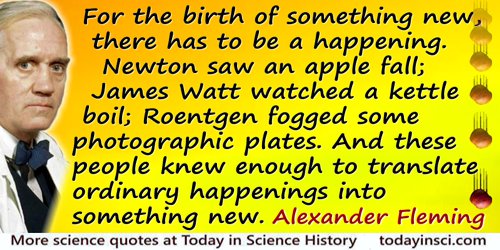
For the birth of something new, there has to be a happening. Newton saw an apple fall; James Watt watched a kettle boil; Roentgen fogged some photographic plates. And these people knew enough to translate ordinary happenings into something new...
Quoted by André Maurois, The Life of Sir Alexander Fleming, trans. by Gerard Hopkins (1959), 167. Cited in Steven Otfinoski, Alexander Fleming: Conquering Disease with Penicillin (1993), 1.
Happy Birthday Mrs Chown! Tell your son to stop trying to fill your head with science—for to fill your heart with love is enough. Richard P. Feynman (the man you watched on BBC Horizon).
Note to the mother of Marcus Chown. Reproduced in Christopher Simon Sykes, No Ordinary Genius: The Illustrated Richard Feynman (1996), 161. Chown's mother, though usually disinterested in science, had given close attention to a 1981 BBC Horizon science documentary that profiled Feynman. This was Feynman’s own choice of a birthday message, although Chown (then a physics graduate student at Caltech) had anticipated that the scientist would have helped him interest his mother in scientific things. Marcus Chown was a radio astronomer at Caltech and is now a writer and broadcaster.
Have you ever watched an eagle held captive in a zoo, fat and plump and full of food and safe from danger too?
Then have you seen another wheeling high up in the sky, thin and hard and battle-scarred, but free to soar and fly?
Well, which have you pitied the caged one or his brother? Though safe and warm from foe or storm, the captive, not the other!
There’s something of the eagle in climbers, don’t you see; a secret thing, perhaps the soul, that clamors to be free.
It’s a different sort of freedom from the kind we often mean, not free to work and eat and sleep and live in peace serene.
But freedom like a wild thing to leap and soar and strive, to struggle with the icy blast, to really be alive.
That’s why we climb the mountain’s peak from which the cloud-veils flow, to stand and watch the eagle fly, and soar, and wheel... below...
Then have you seen another wheeling high up in the sky, thin and hard and battle-scarred, but free to soar and fly?
Well, which have you pitied the caged one or his brother? Though safe and warm from foe or storm, the captive, not the other!
There’s something of the eagle in climbers, don’t you see; a secret thing, perhaps the soul, that clamors to be free.
It’s a different sort of freedom from the kind we often mean, not free to work and eat and sleep and live in peace serene.
But freedom like a wild thing to leap and soar and strive, to struggle with the icy blast, to really be alive.
That’s why we climb the mountain’s peak from which the cloud-veils flow, to stand and watch the eagle fly, and soar, and wheel... below...
…...
How fascinating it has been for me to watch over the years the many developments in laboratories over the world, which followed from asking one simple question, namely what is the physical significance of broken symmetry in superconductors?
Concluding remark of Nobel Lecture, 'The Discovery of Tunnelling Supercurrents' (12 Dec 1973), on nobelprize.org website.
I am besotted with birds of paradise. Watching them display is the most extraordinary thing I’ve ever seen in my life.
From interview with Alice Roberts, 'Attenborough: My Life on Earth', The Biologist (Aug 2015), 62, No. 4, 16.
I have watched all the work going on there, and the more I see of it the more I am convinced that Mendelism has nothing to do with evolution.
Letter, 'Embryology and Evolution,' Nature (1931), 127, 56.
I start with the seedling, and I don't want to leave it. I don't feel I really know the story if I don't watch the plant all the way along. So I know every plant in the field. I know them intimately, and I find it a real pleasure to know them.
In Jay B. McDaniel, 'Christian Spirituality as Openness to Fellow Creatures', Environmental Ethics (1986) 8(1), 34. Quoted in Charles Birch, Biology and the Riddle of Life (1999), 56.
I watched Baeyer activating magnesium with iodine for a difficult Grignard reaction; it was done in a test tube, which he watched carefully as he moved it gently by hand over a flame for three quarters of an hour. The test tube was the apparatus to Baeyer.
In Richard Willstätter, Arthur Stoll (ed. of the original German) and Lilli S. Hornig (trans.), From My Life: The Memoirs of Richard Willstätter (1958), 140.
I watched his countenance closely, to see if he was not deranged ... and I was assured by other senators after he left the room that they had no confidence in it.
Reminiscence by Oliver Hampton Smith, Senator for Indiana, upon meeting Morse at the demonstration of his telegraph to the U.S. Congress in 1842.
Reminiscence by Oliver Hampton Smith, Senator for Indiana, upon meeting Morse at the demonstration of his telegraph to the U.S. Congress in 1842.
Early Indiana Trials and Sketches (1858), 413
I’d like the [Cosmos] series to be so visually stimulating that somebody who isn’t even interested in the concepts will just watch for the effects. And I’d like people who are prepared to do some thinking to be really stimulated.
Quoted by Dennis Meredith, in 'Carl Sagan’s Cosmic Connection and Extraterrestrial Life-Wish', Science Digest (Jun 1979), 85, 38. Reproduced in Carl Sagan and Tom Head, Conversations With Sagan (2006), 55.
If a patient is poor he is committed to a public hospital as a 'psychotic.' If he can afford a sanitarium, the diagnosis is 'neurasthenia.' If he is wealthy enough to be in his own home under the constant watch of nurses and physicians, he is simply 'an indisposed eccentric.'
…...
If one of these people, in whom the chance-worship of our remoter ancestors thus strangely survives, should be within reach of the sea when a heavy gale is blowing, let him betake himself to the shore and watch the scene. Let him note the infinite variety of form and size of the tossing waves out at sea; or against the curves of their foam-crested breakers, as they dash against the rocks; let him listen to the roar and scream of the shingle as it is cast up and torn down the beach; or look at the flakes of foam as they drive hither and thither before the wind: or note the play of colours, which answers a gleam of sunshine as it falls upon their myriad bubbles. Surely here, if anywhere, he will say that chance is supreme, and bend the knee as one who has entered the very penetralia of his divinity. But the man of science knows that here, as everywhere, perfect order is manifested; that there is not a curve of the waves, not a note in the howling chorus, not a rainbow-glint on a bubble, which is other than a necessary consequence of the ascertained laws of nature; and that with a sufficient knowledge of the conditions, competent physico-mathematical skill could account for, and indeed predict, every one of these 'chance' events.
In 'On the Reception of the Origin of Species'. In Francis Darwin (ed.), The Life and Letters of Charles Darwin, Including an Autobiographical Chapter (1888), Vol. 2, 200-1.
If the kind of controversy which so often springs up between modernism and traditionalism in religion were applied to more commonplace affairs of life we might see some strange results. …It arises, let us say, from a passage in an obituary notice which mentions that the deceased had loved to watch the sunsets from his peaceful country home.. …it is forgotten that what the deceased man looked out for each evening was an experience and not a creed.
Swarthmore Lecture (1929) at Friends’ House, London, printed in Science and the Unseen World (1929), 84-85.
If you don’t know what’s meant by God, watch a forsythia branch or a lettuce leaf sprout.
Imagine that … the world is something like a great chess game being played by the gods, and we are observers of the game. … If we watch long enough, we may eventually catch on to a few of the rules…. However, we might not be able to understand why a particular move is made in the game, merely because it is too complicated and our minds are limited…. We must limit ourselves to the more basic question of the rules of the game.
If we know the rules, we consider that we “understand” the world.
If we know the rules, we consider that we “understand” the world.
In 'Basic Physics', The Feynman Lectures on Physics (1964, 2013), Vol. 1, 2-1.
In a dispassionate comparison of the relative values of human and robotic spaceflight, the only surviving motivation for continuing human spaceflight is the ideology of adventure. But only a tiny number of Earth’s six billion inhabitants are direct participants. For the rest of us, the adventure is vicarious and akin to that of watching a science fiction movie.
In 'Is Human Spaceflight Obsolete?', Issues in Science and Technology (Summer 2004). [Note: published one year after the loss of seven lives in the Space Shuttle Columbia disaster. —Webmaster]
In crossing a heath, suppose I pitched my foot against a stone, and were asked how the stone came to be there, I might possibly answer, that, for any thing I knew to the contrary, it had lain there for ever: nor would it perhaps be very easy to shew the absurdity of this answer. But suppose I had found a watch upon the ground, and it should be enquired how the watch happened to be in that place, I should hardly think of the answer which I had before given, that, for any thing I knew, the watch might have always been there.
Natural Theology: or, Evidences of the Existence and Attributes of the Deity, Collected from the Appearances of Nature (1802), 1-2.
In general the actions which we see ever taking place around us are complex, or due to the simultaneous action of many causes. When, as in astronomy, we endeavour to ascertain these causes by simply watching their effects, we observe; when, as in our laboratories, we interfere arbitrarily with the causes or circumstances of a phenomenon, we are said to experiment.
In William Thomson and Peter Guthrie Tait, Treatise on Natural Philosophy (1867), Vol. 1, 305.
In her book My Life With the Chimpanzees, Goodall told the story of “Mike,” a chimp who maintained his dominance by kicking a series of kerosene cans ahead of him as he moved down a road, creating confusion and noise that made his rivals flee and cower. She told me she would be thinking of Mike as she watched [Donald Trump in] the upcoming debates.
In magazine article by 'When Donald Meets Hillary', The Atlantic (Oct 2016). The reporter stated “Jane Goodall … told me shortly before Trump won the GOP nomination.”
In its most primitive form, life is, therefore, no longer bound to the cell, the cell which possesses structure and which can be compared to a complex wheel-work, such as a watch which ceases to exist if it is stamped down in a mortar. No, in its primitive form life is like fire, like a flame borne by the living substance;—like a flame which appears in endless diversity and yet has specificity within it;—which can adopt the form of the organic world, of the lank grass-leaf and of the stem of the tree.
Address given at the 1913 meeting of the Koninklijke Akademie van Wetenschappen in Amsterdam. Trans. in G. Van Iterson, Jr, L. E. Den Dooren De Jong and A. J. Kluyver, Martinus Willem Beilerinck: His Life and Work (1940), 120.
In studying the fate of our forest king, we have thus far considered the action of purely natural causes only; but, unfortunately, man is in the woods, and waste and pure destruction are making rapid headway. If the importance of the forests were even vaguely understood, even from an economic standpoint, their preservation would call forth the most watchful attention of government
In The Mountains of California (1894), 198.
In the days when geology was young, now some two hundred years ago, it found a careful foster-mother in theology, who watched over its early growth with anxious solicitude, and stored its receptive mind with the most beautiful stories, which the young science never tired of transforming into curious fancies of its own, which it usually styled “theories of the earth.”
In British Association Address to Workingmen, 'Geology and Deluges', published in Nature (1984), 50, 505-510. Also printed in Popular Science Monthly (Dec 1894), 46 245.
In the republic of scholarship everybody wants to rule, there are no aldermen there, and that is a bad thing: every general must, so to speak, draw up the plan, stand sentry, sweep out the guardroom and fetch the water; no one wants to work for the good of another.
Aphorism 80 in Notebook D (1773-1775), as translated by R.J. Hollingdale in Aphorisms (1990). Reprinted as The Waste Books (2000), 56.
In the world of physics we watch a shadowgraph performance of the drama of familiar life. The shadow of my elbow rests on the shadow table as the shadow ink flows over the shadow paper. It is all symbolic, and as a symbol the physicist leaves it. ... The frank realization that physical science is concerned with a world of shadows is one of the most significant of recent advances.
In The Nature of the Physical World (1928, 2005), xiv-xv.
It doesn't seem to me that this fantastically marvelous universe, this tremendous range of time and space and different kinds of animals, and all the different planets, and all these atoms with all their motions, and so on, all this complicated thing can merely be a stage so that God can watch human beings struggle for good and evil—which is the view that religion has. The stage is too big for the drama.
'Viewpoint' Interview (with Bill Stout) for Los Angeles KNXT television station (1 May 1959), printed in Michelle Feynman (ed.) Perfectly Reasonable Deviations (from the Beaten Track) (2006), Appendix I, 426. Also quoted in James Gleick, Genius: The Life and Science of Richard Feynman (1992), 372. Gleick adds that KNXT “felt obliged to suppress” the interview. It was not broadcast until after Feynman, asked to redo the interview, wrote back with a letter objecting to “a direct censorship of the expression of my views.”
It has been just so in all my inventions. The first step is an intuition—and comes with a burst, then difficulties arise. This thing that gives out and then that—“Bugs” as such little faults and difficulties are called show themselves and months of anxious watching, study and labor are requisite before commercial success—or failure—is certainly reached.
Describing his invention of a storage battery that involved 10,296 experiments. Note Edison’s use of the term “Bug” in the engineering research field for a mechanical defect greatly predates the use of the term as applied by Admiral Grace Murray Hopper to a computing defect upon finding a moth in the electronic mainframe.] Letter to Theodore Puskas (18 Nov 1878). In The Yale Book of Quotations (2006), 226.
It is fair to say that astronomy is still just about the only science in which the amateur can make valuable contributions today, and in which the work is welcomed by professionals. For example, amateurs search for new comets and ‘new stars’ or novae, and since they generally know the sky much better than their professional colleagues they have a fine record of success. Routinely, they keep watch on objects such as variable stars, and they monitor the surfaces of the planets in a way that professionals have neither the time nor the inclination to do.
From 'Introduction', The Amateur Astronomer (11th Ed., 1990), 1-2.
It is well-known that those who have charge of young infants, that it is difficult to feel sure when certain movements about their mouths are really expressive; that is when they really smile. Hence I carefully watched my own infants. One of them at the age of forty-five days, and being in a happy frame of mind, smiled... I observed the same thing on the following day: but on the third day the child was not quite well and there was no trace of a smile, and this renders it probable that the previous smiles were real.
The Expression of Emotions in Man and Animals
Leadership is doing what is right when no one is watching.
…...
Lectures with demonstrations are certainly valuable—more valuable than the lectures with text-books alone. Yet analyzing the object itself is infinitely more valuable than to watch the results exposed by another. Wrestling with the part which is being studied, handling it and viewing it from all sides, and tabulating and classifying the parts worked out, give us the greatest reward. All this can be accomplished by practical laboratory work. If we can make the student work thoroughly and carefully, a great result is achieved. It makes of him an artist, an actor, an expert, not a dilettante. He is upon the stage, not in the audience.
As quoted from a paper by Mall (1896), in Florence R. Sabin, Franklin Paine Mall: The Story of a Mind. (1934), 142.
Long lives are not necessarily pleasurable…. We will be lucky if we can postpone the search for new technologies for a while, until we have discovered some satisfactory things to do with the extra time. Something will surely have to be found to take the place of sitting on the porch re-examining one’s watch.
In 'The Long Habit', The Lives of a Cell: Notes of a Biology Watcher (1974), 57.
Looking through the telescope, one saw a circle of deep blue and the little round planet swimming in the field. It seemed such a little thing, so bright and small and still, faintly marked with transverse stripes, and slightly flattened from the perfect round. But so little it was, so silvery warm—a pin’s-head of light! It was as if it quivered, but really this was the telescope vibrating with the activity of the clockwork that kept the planet in view.
As I watched, the planet seemed to grow larger and smaller and to advance and recede, but that was simply that my eye was tired. Forty millions of miles it was from us—more than forty millions of miles of void. Few people realise the immensity of vacancy in which the dust of the material universe swims.
As I watched, the planet seemed to grow larger and smaller and to advance and recede, but that was simply that my eye was tired. Forty millions of miles it was from us—more than forty millions of miles of void. Few people realise the immensity of vacancy in which the dust of the material universe swims.
The War of the Worlds (1898), editted by Frank D. McConnell (1977), 128.
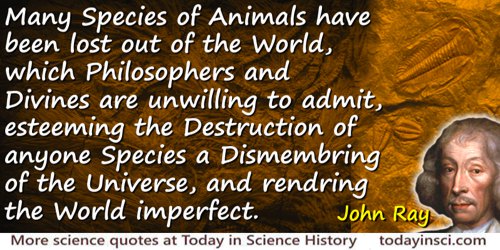
Many Species of Animals have been lost out of the World, which Philosophers and Divines are unwilling to admit, esteeming the Destruction of anyone Species a Dismembring of the Universe, and rendring the World imperfect; whereas they think the Divine Providence is especially concerned, and solicitous to secure and preserve the Works of the Creation. And truly so it is, as appears, in that it was so careful to lodge all Land Animals in the Ark at the Time of the general Deluge; and in that, of all Animals recorded in Natural Histories, we cannot say that there hath been anyone Species lost, no not of the most infirm, and most exposed to Injury and Ravine. Moreover, it is likely, that as there neither is nor can be any new Species of Animals produced, all proceeding from Seeds at first created; so Providence, without which one individual Sparrow falls not to the ground, doth in that manner watch over all that are created, that an entire Species shall not be lost or destroyed by any Accident. Now, I say, if these Bodies were sometimes the Shells and Bones of Fish, it will thence follow, that many Species have been lost out of the World... To which I have nothing to reply, but that there may be some of them remaining some where or other in the Seas, though as yet they have not come to my Knowledge. Far though they may have perished, or by some Accident been destroyed out of our Seas, yet the Race of them may be preserved and continued still in others.
— John Ray
Three Physico-Theological Discourses (1713), Discourse II, 'Of the General Deluge, in the Days of Noah; its Causes and Effects', 172-3.
Maybe the situation is hopeless. Television is just the wrong medium, at least in prime time, to teach science. I think it is hopeless if it insists on behaving like television… The people who produce these programs always respond to such complaints by insisting that no one would watch a program consisting of real scientists giving real lectures to real students. If they are right, then this sort of program is just another form of entertainment.
(1986).
Most educated people are aware that we're the outcome of nearly 4 billion years of Darwinian selection, but many tend to think that humans are somehow the culmination. Our sun, however, is less than halfway through its lifespan. It will not be humans who watch the sun's demise, 6 billion years from now. Any creatures that then exist will be as different from us as we are from bacteria or amoebae.
Lecture (2006), reprinted as 'Dark Materials'. As cited in J.G. Ballard, 'The Catastrophist', collected in Christopher Hitchens, Arguably: Selected Essays (2011), 353
Neither in the subjective nor in the objective world can we find a criterion for the reality of the number concept, because the first contains no such concept, and the second contains nothing that is free from the concept. How then can we arrive at a criterion? Not by evidence, for the dice of evidence are loaded. Not by logic, for logic has no existence independent of mathematics: it is only one phase of this multiplied necessity that we call mathematics.
How then shall mathematical concepts be judged? They shall not be judged. Mathematics is the supreme arbiter. From its decisions there is no appeal. We cannot change the rules of the game, we cannot ascertain whether the game is fair. We can only study the player at his game; not, however, with the detached attitude of a bystander, for we are watching our own minds at play.
How then shall mathematical concepts be judged? They shall not be judged. Mathematics is the supreme arbiter. From its decisions there is no appeal. We cannot change the rules of the game, we cannot ascertain whether the game is fair. We can only study the player at his game; not, however, with the detached attitude of a bystander, for we are watching our own minds at play.
In Number: The Language of Science; a Critical Survey Written for the Cultured Non-Mathematician (1937), 244-245.
No video, no photographs, no verbal descriptions, no lectures can provide the enchantment that a few minutes out-of-doors can: watch a spider construct a web; observe a caterpillar systematically ravaging the edge of a leaf; close your eyes, cup your hands behind your ears, and listen to aspen leaves rustle or a stream muse about its pools and eddies. Nothing can replace plucking a cluster of pine needles and rolling them in your fingers to feel how they’re put together, or discovering that “sedges have edges and grasses are round,” The firsthand, right-and-left-brain experience of being in the out-of-doors involves all the senses including some we’ve forgotten about, like smelling water a mile away. No teacher, no student, can help but sense and absorb the larger ecological rhythms at work here, and the intertwining of intricate, varied and complex strands that characterize a rich, healthy natural world.
Into the Field: A Guide to Locally Focused Teaching
Now, at Suiattle Pass, Brower was still talking about butterflies. He said he had raised them from time to time and had often watched them emerge from the chrysalis—first a crack in the case, then a feeler, and in an hour a butterfly. He said he had felt that he wanted to help, to speed them through the long and awkward procedure; and he had once tried. The butterflies came out with extended abdomens, and their wings were balled together like miniature clenched fists. Nothing happened. They sat there until they died. ‘I have never gotten over that,’ he said. ‘That kind of information is all over in the country, but it’s not in town.”
…...
Nurses, as well as midwives, ought to be of middle age, sober, patient, and discreet, able to bear fatigue and watching, free from external deformity, cutaneous eruptions, and inward complaints that may be troublesome or infectious.
In A Treatise on the Theory and Practice of Midwifery (1766), 444.
Once you have learned to fly your plane, it is far less fatiguing to fly than it is to drive a car. You don’t have to watch every second for cats, dogs, children, lights, road signs, ladies with baby carriages and citizens who drive out in the middle of the block against the lights... Nobody who has not been up in the sky on a glorious morning can possibly imagine the way a pilot feels in free heaven.
…...
Our mistake is that we doubt what is certain and want to establish what is uncertain. My maxim in the study of Nature is this: hold fast what is certain and keep a watch on what is uncertain.
In The Maxims and Reflections of Goethe (1906), 196.
Physical concepts are free creations of the human mind, and are not, however it may seem, uniquely determined by the external world. In our endeavour to understand reality we are somewhat like a man trying to understand the mechanism of a closed watch. He sees the face and the moving hands, even hears its ticking, but he has no way of opening the case. If he is ingenious he may form some picture of a mechanism which could be responsible for all the things he observes, but he may never be quite sure his picture is the only one which could explain his observations. He will never be able to compare his picture with the real mechanism and he cannot even imagine the possibility or the meaning of such a comparison. But he certainly believes that, as his knowledge increases, his picture of reality will become simpler and simpler and will explain a wider and wider range of his sensuous impressions. He may also believe in the existence of the ideal limit of knowledge and that it is approached by the human mind. He may call this ideal limit the objective truth.
Albert Einstein and Leopold Infeld, The Evolution of Physics (1938), 33.
Science and Theology. We should endow neither; we should treat them as we treat conservatism and liberalism, encouraging both, so that they may keep watch upon one another, and letting them go in and out of power with the popular vote concerning them
Samuel Butler, Henry Festing Jones (ed.), The Note-Books of Samuel Butler (1917), 340.
So I travelled, stopping ever and again, in great strides of a thousand years or more, drawn on by the mystery of the earth’s fate, watching with a strange fascination the sun grow larger and duller in the westward sky, and the life of the old earth ebbing out.
In The Time Machine (1898), 160.
Some guns were fired to give notice that the departure of the balloon was near. ... Means were used, I am told, to prevent the great balloon's rising so high as might endanger its bursting. Several bags of sand were taken on board before the cord that held it down was cut, and the whole weight being then too much to be lifted, such a quantity was discharged as would permit its rising slowly. Thus it would sooner arrive at that region where it would be in equilibrio with the surrounding air, and by discharging more sand afterwards, it might go higher if desired. Between one and two o’clock, all eyes were gratified with seeing it rise majestically from above the trees, and ascend gradually above the buildings, a most beautiful spectacle. When it was about two hundred feet high, the brave adventurers held out and waved a little white pennant, on both sides of their car, to salute the spectators, who returned loud claps of applause. The wind was very little, so that the object though moving to the northward, continued long in view; and it was a great while before the admiring people began to disperse. The persons embarked were Mr. Charles, professor of experimental philosophy, and a zealous promoter of that science; and one of the Messrs Robert, the very ingenious constructors of the machine.
While U.S. ambassador to France, writing about witnessing, from his carriage outside the garden of Tuileries, Paris, the first manned balloon ascent using hydrogen gas on the afternoon of 1 Dec 1783. A few days earlier, he had watched the first manned ascent in Montgolfier's hot-air balloon, on 21 Nov 1783.
While U.S. ambassador to France, writing about witnessing, from his carriage outside the garden of Tuileries, Paris, the first manned balloon ascent using hydrogen gas on the afternoon of 1 Dec 1783. A few days earlier, he had watched the first manned ascent in Montgolfier's hot-air balloon, on 21 Nov 1783.
Letter to Sir Charles Banks (1 Dec 1783). In The Writings of Benjamin Franklin: 1783-1788 (1906), Vol. 9, 119-120.
Suppose you were given a watch, a tube to sight with and a string, and then asked to determine the distance to the nearest star. Or you were asked the chemical composition, pressure or temperature of the Sun. A hundred or more years ago, these questions seemed impossible. Now astronomers are answering them all the time, and they believe their answers. Why? Because there are many parallel ways and tests, and they all give the same answers.
As quoted in John Noble Wilford, 'Sizing up the Cosmos: An Astronomers Quest', New York Times (12 Mar 1991), C10.
Surely no child, and few adults, have ever watched a bird in flight without envy.
Isaac Asimov and Jason A. Shulman, Isaac Asimov’s Book of Science and Nature Quotations (1988), 3.
The attempted synthesis of paleontology and genetics, an essential part of the present study, may be particularly surprising and possibly hazardous. Not long ago, paleontologists felt that a geneticist was a person who shut himself in a room, pulled down the shades, watched small flies disporting themselves in milk bottles, and thought that he was studying nature. A pursuit so removed from the realities of life, they said, had no significance for the true biologist. On the other hand, the geneticists said that paleontology had no further contributions to make to biology, that its only point had been the completed demonstration of the truth of evolution, and that it was a subject too purely descriptive to merit the name 'science'. The paleontologist, they believed, is like a man who undertakes to study the principles of the internal combustion engine by standing on a street corner and watching the motor cars whiz by.
Tempo and Mode in Evolution (1944), 1.
The belief in an all-powerful Being, who loves us and watches over us, gives to the mind great strength to endure misfortune.
From Appendix A, 'Extracts From the Unpublished Writings of Carnot', Reflections on the Motive Power of Heat (1890, 2nd ed. 1897), 217.
The day dawned grey and dreary
The sky made of silver
While the first snowflakes
Began to fall.
A lone bird chirped
In a tree bare of its leaves.
Standing on a lonely road
I stood watching as the world
Started changing.
And I embraced the winter
With memories of summer’s warmth
Still in my heart.
And soon the snowflakes
Began to dance about me
And I twirled around and around
As everything
Turned into a winter wonderland.
The sky made of silver
While the first snowflakes
Began to fall.
A lone bird chirped
In a tree bare of its leaves.
Standing on a lonely road
I stood watching as the world
Started changing.
And I embraced the winter
With memories of summer’s warmth
Still in my heart.
And soon the snowflakes
Began to dance about me
And I twirled around and around
As everything
Turned into a winter wonderland.
…...
The facts, gentlemen, and nothing but the facts, for careful eyes are narrowly watching.
In Fact and Fancy (1962), 11.
The first watch of night is given
To the red planet Mars.
Is it the tender star of love?
The star of love and dreams?
Oh. no! from that blue tent above,
A hero’s armour gleams.
And earnest thoughts within me rise,
When I behold afar,
Suspended in the evening skies,
The shield of that red star.
O star of strength! I see thee stand
And smile upon my pain;
Thou beckonest with thy mailèd hand,
And I am strong again.
To the red planet Mars.
Is it the tender star of love?
The star of love and dreams?
Oh. no! from that blue tent above,
A hero’s armour gleams.
And earnest thoughts within me rise,
When I behold afar,
Suspended in the evening skies,
The shield of that red star.
O star of strength! I see thee stand
And smile upon my pain;
Thou beckonest with thy mailèd hand,
And I am strong again.
From 'The Light of Stars', The Poetical Works of Henry Wadsworth Longfellow (1855), 43.
The mind likes a strange idea as little as the body likes a strange protein and resists it with similar energy. It would not perhaps be too fanciful to say that a new idea is the most quickly acting antigen known to science. If we watch ourselves honestly we shall often find that we have begun to argue against a new idea even before it has been completely stated.
In The Collected Papers of Wilfred Trotter, FRS (1941), 186. This is seen in several places attributed to W.I.B. Beveridge. However,it appears in his The Art of Scientific Investigation (1950), 109, where it is clearly shown as a quote from Wilfred Trotter, with a footnote citing the source as Collected Papers. (The quote has been removed from the Beveridge page on this web site 29 Jun 2015.)
The personal adventures of a geologist would form an amusing narrative. He is trudging along, dusty and weatherbeaten, with his wallet at his back, and his hammer on his shoulder, and he is taken for a stone-mason travelling in search of work. In mining-countries, he is supposed to be in quest of mines, and receives many tempting offers of shares in the ‘Wheel Dream’, or the ‘Golden Venture’;—he has been watched as a smuggler; it is well if he has not been committed as a vagrant, or apprehended as a spy, for he has been refused admittance to an inn, or has been ushered into the room appropriated to ostlers and postilions. When his fame has spread among the more enlightened part of the community of a district which he has been exploring, and inquiries are made of the peasantry as to the habits and pursuits of the great philosopher who has been among them, and with whom they have become familiar, it is found that the importance attached by him to shells and stones, and such like trumpery, is looked upon as a species of derangement, but they speak with delight of his affability, sprightliness, and good-humour. They respect the strength of his arm, and the weight of his hammer, as they point to marks which he inflicted on the rocks, and they recount with wonder his pedestrian performances, and the voracious appetite with which, at the close of a long day’s work he would devour the coarsest food that was set before him.
In Practical Geology and Mineralogy: With Instructions for the Qualitative Analysis of Minerals (1841), 31-2.
The rat, the mouse, the fox, the rabbit, watch the roots; the lion, the tiger, the horse, the elephant the fruits.
In 'Proverbs', The Poems: With Specimens of the Prose Writings of William Blake (1885), 279.
The rockets that have made spaceflight possible are an advance that, more than any other technological victory of the twentieth century, was grounded in science fiction… . One thing that no science fiction writer visualized, however, as far as I know, was that the landings on the Moon would be watched by people on Earth by way of television.
In Asimov on Physics (1976), 35. Also in Isaac Asimov’s Book of Science and Nature Quotations (1988), 307.
The sad and solemn night
Hath yet her multitude of cheerful fires;
The glorious host of light
Walk the dark hemisphere till she retires;
All through her silent watches, gliding slow,
Her constellations come, and climb the heavens, and go.
Hath yet her multitude of cheerful fires;
The glorious host of light
Walk the dark hemisphere till she retires;
All through her silent watches, gliding slow,
Her constellations come, and climb the heavens, and go.
Poem, 'Hymn to the North Star', collected in Poems by William Cullen Bryant: Collected and Arranged by Himself (1873), 84.
The science of the geologist seems destined to exert a marked influence on that of the natural theologian... Not only—to borrow from Paley's illustration—does it enable him to argue on the old grounds, from the contrivance exhibited in the watch found on the moor, that the watch could not have lain upon the moor for ever; but it establishes further, on different and more direct evidence, that there was a time when absolutely the watch was not there; nay, further, so to speak, that there was a previous time in which no watches existed at all, but only water-clocks; yet further, that there was at time in which there we not even water-clocks, but only sun-dials; and further, an earlier time still in which sun-dials were not, nor an measurers of time of any kind.
Lecture to the Edinburgh Philosophical Institution, 'Geology in its Bearings on the Two Theologies, Part 1', collected in The Testimony of the Rocks: or, Geology in Its Bearings on the Two Theologies, Natural and Revealed (1857), 211.
The stars hang bright above,
Silent, as if they watch’d the sleeping earth.
Silent, as if they watch’d the sleeping earth.
The strength of all sciences is, as the strength of the old man’s faggot, in the band. For the harmony of a science, supporting each part the other, is and ought to be the true and brief confutation and suppression of all the smaller sort of objections; but, on the other side, if you take out every axiom, as the sticks of the faggot, one by one, you may quarrel with them and bend them and break them at your pleasure: so that, as was said of Seneca, Verborum minutiis rerum frangit pondera [that he broke up the weight and mass of the matter by verbal points and niceties], so a man may truly say of the schoolmen, Quaestionum minutiis scientiarum frangunt soliditatem [they broke up the solidarity and coherency of the sciences by the minuteness and nicety of their questions]. For were it not better for a man in fair room to set up one great light, or branching candlestick of lights, than to go about with a small watch-candle into every corner?
The Works of Francis Bacon (1864), Vol. 6, 123
The United States this week will commit its national pride, eight years of work and $24 billion of its fortune to showing the world it can still fulfill a dream. It will send three young men on a human adventure of mythological proportions with the whole of the civilized world invited to watch—for better or worse.
In 'Prestige of U.S. Rides on Apollo', Los Angeles Times (13 Jul 1969). As quoted and cited in Michael Collins, Carrying the Fire: An Astronaut’s Journey (2001), 315.
The vital act is the act of participation. “Participator” is the incontrovertible new concept given by quantum mechanics. It strikes down the term “observer” of classical theory, the man who stands safely behind the thick glass wall and watches what goes on without taking part. It can’t be done, quantum mechanics says.
In Charles W. Misner, Kip S. Thorne, John Archibald Wheeler, 'Beyond the Edge of Time', Gravitation (1973), Part 3, 1217.
The watchmaker to whom one gives a watch that does not run will take it all apart and will examine each of the pieces until he finds out which one is damaged. The physician to whom one presents a patient cannot dissect him to establish the diagnosis. The physicist resembles a doctor, not a watchmaker.
In Revue des Questions Scientifiques, 1897.
The weather is warm
The sun is out
There are people all around
The waves come flowing
And hits the shore
But makes so little sound
The wind is blowing
Oh so softly
The sand between my feet
The dolphins jump
The people watch
They even take a seat
I fly around
Watching from above
Today is like everyday
That is something I love
The sun is out
There are people all around
The waves come flowing
And hits the shore
But makes so little sound
The wind is blowing
Oh so softly
The sand between my feet
The dolphins jump
The people watch
They even take a seat
I fly around
Watching from above
Today is like everyday
That is something I love
…...
There has come about a general public awareness that America is not automatically, and effortlessly, and unquestionably the leader of the world in science and technology. This comes as no surprise to those of us who have watched and tried to warn against the steady deterioration in the teaching of science and mathematics in the schools for the past quarter century. It comes as no surprise to those who have known of dozens of cases of scientists who have been hounded out of jobs by silly disloyalty charges, and kept out of all professional employment by widespread blacklisting practices.
Banquet speech at American Physical Society, St. Louis, Missouri. (29 Nov 1957). In "Time to Stop Baiting Scientists", Bulletin of the Atomic Scientists (Feb 1958), 80.
There is no record in human history of a happy philosopher; they exist only in romantic legend. Many of them have committed suicide; many others have turned their children out of doors and beaten their wives. And no wonder. If you want to find out how a philosopher feels when he is engaged in the practise of his profession, go to the nearest zoo and watch a chimpanzee at the wearying and hopeless job of chasing fleas. Both suffer damnably, and neither can win.
From The Human Mind, Prejudices: Sixth Series (1927), 85. Collected in A Mencken Chrestomathy (1949, 1956), 16.
There was one quality of mind which seemed to be of special and extreme advantage in leading him [Charles Darwin] to make discoveries. It was the power of never letting exceptions pass unnoticed. Everybody notices a fact as an exception when it is striking or frequent, but he had a special instinct for arresting an exception. A point apparently slight and unconnected with his present work is passed over by many a man almost unconsciously with some half-considered explanation, which is in fact no explanation. It was just these things that he seized on to make a start from. In a certain sense there is nothing special in this procedure, many discoveries being made by means of it. I only mention it because, as I watched him at work, the value of this power to an experimenter was so strongly impressed upon me.
In Charles Darwin: His Life Told in an Autobiographical Chapter, and in a Selected Series of his Published Letters (1908), 94-95.
They will have the World to be in Large, what a Watch is in Small; which is very regular, and depends only upon the just disposing of the several Parts of the Movement.
Conversations on the Plurality of Words (1686), trans. William Gardiner (1715), 11.
This is true of all science. Successes were largely due to forgetting completely about what one ultimately wanted, or whether one wanted anything ultimately; in refusing to investigate things which profit, and in relying solely on guidance by criteria of intellectual elegance. … And I think it extremely instructive to watch the role of science in everyday life, and to note how in this area the principle of laissez faire has led to strange and wonderful results.
Address (Jun 1954) to Princeton Graduate Alumni, 'The Role of Mathematics in the Science and in Society', in Collected Works: Vol. 6: Theory of Games, Astrophysics, Hydrodynamics and Meteorology (1961), Vol. 6, 489. As quoted in Armand Borel, 'On the Place of Mathematics in Culture', in Armand Borel: Œvres: Collected Papers (1983), Vol. 4, 422.
Those who judge of a work by rule are in regard to others as those who have a watch are in regard to others. One says, “It is two hours ago”; the other says, “It is only three-quarters of an hour.” I look at my watch, and say to the one, “You are weary,” and to the other, “Time gallops with you”; for it is only an hour and a half ago, and I laugh at those who tell me that time goes slowly with me, and that I judge by imagination. They do not know that I judge by my watch.
In Pascal’s Pensées (1958), 3-4.
Throughout the 1960s and 1970s devoted Beckett readers greeted each successively shorter volume from the master with a mixture of awe and apprehensiveness; it was like watching a great mathematician wielding an infinitesimal calculus, his equations approaching nearer and still nearer to the null point.
Quoted in a review of Samuel Beckett’s Nohow On: Ill Seen Ill Said, Worstward Ho, in 'The Last Word', The New York Review of Books (13 Aug 1992).
To day we made the grand experiment of burning the diamond and certainly the phenomena presented were extremely beautiful and interesting… The Duke’s burning glass was the instrument used to apply heat to the diamond. It consists of two double convex lenses … The instrument was placed in an upper room of the museum and having arranged it at the window the diamond was placed in the focus and anxiously watched. The heat was thus continued for 3/4 of an hour (it being necessary to cool the globe at times) and during that time it was thought that the diamond was slowly diminishing and becoming opaque … On a sudden Sir H Davy observed the diamond to burn visibly, and when removed from the focus it was found to be in a state of active and rapid combustion. The diamond glowed brilliantly with a scarlet light, inclining to purple and, when placed in the dark, continued to burn for about four minutes. After cooling the glass heat was again applied to the diamond and it burned again though not for nearly so long as before. This was repeated twice more and soon after the diamond became all consumed. This phenomenon of actual and vivid combustion, which has never been observed before, was attributed by Sir H Davy to be the free access of air; it became more dull as carbonic acid gas formed and did not last so long.
Entry (Florence, 27 Mar 1814) in his foreign journal kept whilst on a continental tour with Sir Humphry Davy. In Michael Faraday, Bence Jones (ed.), The Life and Letters of Faraday (1870), Vol. 1, 119. Silvanus Phillips Thompson identifies the Duke as the Grand Duke of Tuscany, in Michael Faraday, His Life and Work (1901), 21.
To pick a hole–say in the 2nd law of Ωcs, that if two things are in contact the hotter cannot take heat from the colder without external agency.
Now let A & B be two vessels divided by a diaphragm and let them contain elastic molecules in a state of agitation which strike each other and the sides. Let the number of particles be equal in A & B but let those in A have equal velocities, if oblique collisions occur between them their velocities will become unequal & I have shown that there will be velocities of all magnitudes in A and the same in B only the sum of the squares of the velocities is greater in A than in B.
When a molecule is reflected from the fixed diaphragm CD no work is lost or gained.
If the molecule instead of being reflected were allowed to go through a hole in CD no work would be lost or gained, only its energy would be transferred from the one vessel to the other.
Now conceive a finite being who knows the paths and velocities of all the molecules by simple inspection but who can do no work, except to open and close a hole in the diaphragm, by means of a slide without mass.
Let him first observe the molecules in A and when lie sees one coming the square of whose velocity is less than the mean sq. vel. of the molecules in B let him open a hole & let it go into B. Next let him watch for a molecule in B the square of whose velocity is greater than the mean sq. vel. in A and when it comes to the hole let him draw and slide & let it go into A, keeping the slide shut for all other molecules.
Then the number of molecules in A & B are the same as at first but the energy in A is increased and that in B diminished that is the hot system has got hotter and the cold colder & yet no work has been done, only the intelligence of a very observant and neat fingered being has been employed. Or in short if heat is the motion of finite portions of matter and if we can apply tools to such portions of matter so as to deal with them separately then we can take advantage of the different motion of different portions to restore a uniformly hot system to unequal temperatures or to motions of large masses. Only we can't, not being clever enough.
Now let A & B be two vessels divided by a diaphragm and let them contain elastic molecules in a state of agitation which strike each other and the sides. Let the number of particles be equal in A & B but let those in A have equal velocities, if oblique collisions occur between them their velocities will become unequal & I have shown that there will be velocities of all magnitudes in A and the same in B only the sum of the squares of the velocities is greater in A than in B.
When a molecule is reflected from the fixed diaphragm CD no work is lost or gained.
If the molecule instead of being reflected were allowed to go through a hole in CD no work would be lost or gained, only its energy would be transferred from the one vessel to the other.
Now conceive a finite being who knows the paths and velocities of all the molecules by simple inspection but who can do no work, except to open and close a hole in the diaphragm, by means of a slide without mass.
Let him first observe the molecules in A and when lie sees one coming the square of whose velocity is less than the mean sq. vel. of the molecules in B let him open a hole & let it go into B. Next let him watch for a molecule in B the square of whose velocity is greater than the mean sq. vel. in A and when it comes to the hole let him draw and slide & let it go into A, keeping the slide shut for all other molecules.
Then the number of molecules in A & B are the same as at first but the energy in A is increased and that in B diminished that is the hot system has got hotter and the cold colder & yet no work has been done, only the intelligence of a very observant and neat fingered being has been employed. Or in short if heat is the motion of finite portions of matter and if we can apply tools to such portions of matter so as to deal with them separately then we can take advantage of the different motion of different portions to restore a uniformly hot system to unequal temperatures or to motions of large masses. Only we can't, not being clever enough.
Letter to Peter Guthrie Tait (11 Dec 1867). In P. M. Harman (ed.), The Scientific Letters and Papers of James Clerk Maxwell (1995), Vol. 2, 331-2.
Tree…
he watching you.
You look at tree,
he listen to you.
He got no finger,
he can’t speak.
But that leaf...
he pumping, growing,
growing in the night.
While you sleeping
you dream something.
Tree and grass same thing.
They grow with your body,
with your feeling.
he watching you.
You look at tree,
he listen to you.
He got no finger,
he can’t speak.
But that leaf...
he pumping, growing,
growing in the night.
While you sleeping
you dream something.
Tree and grass same thing.
They grow with your body,
with your feeling.
Poem from Gagadju Man Bill Neidjie: The Environmental and Spiritual Philosophy of a Senior
Traditional Owner, Kakadu National Park, Northern Territory Australia (2002), 40.
Truth forever on the scaffold, Wrong forever on the throne,—
Yet that scaffold sways the Future, and, behind the dim unknown,
Standeth God within the shadow, keeping watch above his own.
Yet that scaffold sways the Future, and, behind the dim unknown,
Standeth God within the shadow, keeping watch above his own.
'The Present Crisis', The poetical works of James R. Lowell (1858), 161.
Understanding … must begin by saturating itself with facts and realities. … Besides, we only understand that which is already within us. To understand is to possess the thing understood, first by sympathy and then by intelligence. Instead of first dismembering and dissecting the object to be conceived, we should begin by laying hold of it in its ensemble. The procedure is the same, whether we study a watch or a plant, a work of art or a character.
(7 Apr 1886). In Mary A. Ward (trans.), Amiel’s Journal: The Journal Intime of Henri-Frédéric Amiel (1889), 119.
Very few, even among those who have taken the keenest interest in the progress of the revolution in natural knowledge set afoot by the publication of the “Origin of Species”; and who have watched, not without astonishment, the rapid and complete change which has been effected both inside and outside the boundaries of the scientific world in the attitude of men’s minds towards the doctrines which are expounded in that great work, can have been prepared for the extraordinary manifestation of affectionate regard for the man, and of profound reverence for the philosopher, which followed the announcement, on Thursday last, of the death of Mr Darwin.
'Obituary [of Charles Darwin]' (1882). In Collected Essays (1893), Vol. 2, 244.
Village cricket spread fast through the land. In those days, before it became scientific, cricket was the best game in the world to watch ... each ball a potential crisis.
Illustrated English Social History (1967), 106.
Watch the stars, and from them learn. To the Master’s honor all must turn, each in its track, without a sound, forever tracing Newton’s ground.
…...
Watch your thoughts; they become words.
Watch your words; they become actions.
Watch your actions; they become habits.
Watch your habits; they become character.
Watch your character; it becomes your destiny.
Watch your words; they become actions.
Watch your actions; they become habits.
Watch your habits; they become character.
Watch your character; it becomes your destiny.
…...
We are rather like children, who must take a watch to pieces to see how it works.
Explaining to a Daily Herald reporter why he wanted to disintegrate nuclei, as quoted in Freeman Dyson, 'Seeing the Unseen', The New York Review of Books (24 Feb 2005), collected in The Scientist as Rebel (2006), 249.
We are tied to the ocean. And when we go back to the sea, whether it is to sail or to watch it we are going back from whence we came.
Speech at the America’s Cup Dinner (14 Sep 1962).
We can see that there is only one substance in the universe and that man is the most perfect one. He is to the ape and the cleverest animals what Huygens's planetary clock is to one of Julien Leroy's watches. If it took more instruments, more cogs, more springs to show or tell the time, if it took Vaucanson more artistry to make his flautist than his duck, he would have needed even more to make a speaking machine, which can no longer be considered impossible, particularly at the hands of a new Prometheus. Thus, in the same way, nature needed more artistry and machinery to construct and maintain a machine which could continue for a whole century to tell all the beats of the heart and the mind; for we cannot tell the time from the pulse, it is at least the barometer of heat and liveliness, from which we can judge the nature of the soul.
Machine Man (1747), in Ann Thomson (ed.), Machine Man and Other Writings (1996), 33-4.
What beauty. I saw clouds and their light shadows on the distant dear earth…. The water looked like darkish, slightly gleaming spots…. When I watched the horizon, I saw the abrupt, contrasting transition from the earth’s light-colored surface to the absolutely black sky. I enjoyed the rich color spectrum of the earth. It is surrounded by a light blue aureole that gradually darkens, becomes turquoise, dark blue, violet, and finally coal black.
Describing his view while making the first manned orbit of the earth (12 Apr 1961). As quoted in Don Knefel, Writing and Life: A Rhetoric for Nonfiction with Readings (1986), 93.
Front Cover
What helps luck is a habit of watching for opportunities, of having a patient but restless mind, of sacrificing one’s ease or vanity, or uniting a love of detail to foresight, and of passing through hard times bravely [and cheerfully].
In The Wish of His Life (1878), Vol. 1, 25. The ending "and cheerfully" is not part of the original text, though it is seen added in Tryon Edwards, A Dictionary of Thoughts: Being a Cyclopedia of Laconic Quotations from the Best Authors, Both Ancient and Modern (1891), 320. The original text ends “whistling the air of ‘Marlbrough’.”
When you can dump a load of bricks on a corner lot, and let me watch them arrange themselves into a house — when you can empty a handful of springs and wheels and screws on my desk, and let me see them gather themselves together into a watch — it will be easier for me to believe that all these thousands of worlds could have been created, balanced, and set to moving in their separate orbits, all without any directing intelligence at all.
In 'If A Man Die, Shall He Live again?', More Power To You: Fifty Editorials From Every Week (1917), 218-219.
Why may we not say, that all Automata (Engines that move themselves by springs and wheeles as doth a watch) have an artificiall life? For what is the Heart, but a Spring; and the Nerves, but so many Strings; and the Joynts, but so many Wheeles, giving motion to the whole Body, such as was intended by the Artificer? Art goes yet further, imitating the rationall and most excellent worke of Nature, Man. For by Art is created the great LEVIATHAN called a COMMON-WEALTH, or STATE, (in latine CIVITAS) which is but an Artificiall Man; though of greater stature and strength than the Naturall, for whose protection and defence it was intended; and in which, the Soveraignty is an Artificiall Soul, as giving life and motion to the whole body.
Leviathan (1651), ed. C. B. Macpherson (1968), Part I, Introduction, 81.
Winter opened its vaults last night, flinging fistfuls of crystalline diamonds into the darkening sky. Like white-tulled ballerinas dancing gracefully on heaven’s stage, silent stars stood entranced by their intricate beauty. Motionless, I watched each lacy gem drift softly by my upturned face, as winter’s icy hands guided them gently on their swirling lazy way, and blanketed the waiting earth in cold splendor. The shivering rustling of reeds, the restless fingers of the trees snapping in the frosty air, broke the silent stillness, as winter quietly pulled up its white coverlet over the sleepy earth.
…...
Wisdom is rooted in watching with affection the way people grow.
Epigraph, without citation, in Prelude to mathematics (1955), 7. Webmaster has thus far found no earlier example of this quote, which like so many others attributed to Confucius, should be treated with suspicion until a primary source is found. Can you help?
With an interest almost amounting to anxiety, geologists will watch the development of researches which may result in timing the strata and the phases of evolutionary advance; and may even-going still further back—give us reason to see in the discrepancy between denudative and radioactive methods, glimpses of past aeons, beyond that day of regeneration which at once ushered in our era of life, and, for all that went before, was 'a sleep and a forgetting'.
Radioactivity and Geology (1909), 250-1.
With NMR we don’t touch the cell at all. We can follow it through time, watch its development.
Describing the benefits of the newly developed nuclear magnetic resonance imaging microscope. As quoted in L. Davis, 'Seeing the Cell and Letting it Live', Science News (19 Jul 1986), 130, No. 3, 39. Reference to Letter, James B. Aguayo, et al.,'Nuclear Magnetic Resonance Imaging of a Single Cell', Nature (10 Jul 1986), 322, 190–191, which announced the first NMR images of a single cell.
You can never be too cautious in your prognosis, in the view of the great uncertainty of the course of any disease not long watched, and the many unexpected turns it may take.
In Valedictory Address Delivered to the Medical Graduates at Harvard University, at the Annual Commencement, Wednesday, March 10, 1858) (1858), 14. Reprinted, as published in The Boston Medical and Surgical Journal (25 Mar 1858), 58, No. 8, 158.
You say Beasts are Machines like Watches? But put the Machine called a Dog, and the Machine called a Bitch to one another for some time, and there may result another little Machine; whereas two Watches might be together all their Life-time, without ever producing a third Watch. Now Madam de B— and I think, according to our Philosophy, that all things which being but two, are endued with the Virtue of making themselves three, are of a much higher Nature than a Machine.
'Letter XI to Mr. C: Upon his studying the Philosophy of Descartes', Letters of Gallantry (1685), trans. Mr Ozell (1715), 25.
 In science it often happens that scientists say, 'You know that's a really good argument; my position is mistaken,' and then they would actually change their minds and you never hear that old view from them again. They really do it. It doesn't happen as often as it should, because scientists are human and change is sometimes painful. But it happens every day. I cannot recall the last time something like that happened in politics or religion.
(1987) --
In science it often happens that scientists say, 'You know that's a really good argument; my position is mistaken,' and then they would actually change their minds and you never hear that old view from them again. They really do it. It doesn't happen as often as it should, because scientists are human and change is sometimes painful. But it happens every day. I cannot recall the last time something like that happened in politics or religion.
(1987) --