War Quotes (236 quotes)
... in time of war, soldiers, however sensible, care a great deal more on some occasions about slaking their thirst than about the danger of enteric fever.
[Better known as typhoid, the disease is often spread by drinking contaminated water.]
[Better known as typhoid, the disease is often spread by drinking contaminated water.]
Parliamentaray Debate (21 Mar 1902). Quoted in Winston Churchill and Richard Langworth (ed.), Churchill by Himself: The Definitive Collection of Quotations (2008), 469.
...[T]he natural history of the rat is tragically similar to that of man ... some of the more obvious qualities in which rats resemble men — ferocity, omnivorousness, and adaptability to all climates ... the irresponsible fecundity with which both species breed at all seasons of the year with a heedlessness of consequences, which subjects them to wholesale disaster on the inevitable, occasional failure of the food supply.... [G]radually, these two have spread across the earth, keeping pace with each other and unable to destroy each other, though continually hostile. They have wandered from East to West, driven by their physical needs, and — unlike any other species of living things — have made war upon their own kind. The gradual, relentless, progressive extermination of the black rat by the brown has no parallel in nature so close as that of the similar extermination of one race of man by another...
Rats, Lice and History(1935)
…resort to science has rendered modern war so destructive of life and property that it presents a new problem to mankind, such, that unless our civilization shall find some means of making an end to war, war will make an end to our civilization.
America and World Peace (1925), 37. In Edward C. Luck, Mixed Messages: American Politics and International Organization, 1919-1999 (1999), 143.
“I’m not so sure he’s wrong about automobiles,” he said, “With all their speed forward they may be a step backward for civilization—that is, spiritual civilization … But automobiles have come, and they bring a greater change in our life than most of us expect. They are here, and almost all outward things are going to be different because of what they bring. They are going to alter war, and they are going to alter peace.”
Spoken by character Eugene, in the novel, The Magnificent Ambersons (1918), 275
[Joseph Rotblat] was a towering figure in the search for peace in the world, who dedicated his life to trying to rid the world of nuclear weapons, and ultimately to rid the world of war itself.
Speaking as president of the Pugwash Conferences. As quoted in Associated Press syndicated to newspapers, for example in, 'Joseph Rotblat, Scientist Against Nuclear Arms, Dies', Sun Journal (2 Sep 2005), A5.
[On mediocrity] What we have today is a retreat into low-level goodness. Men are all working hard building barbecues, being devoted to their wives and spending time with their children. Many of us feel, “We never had it so good!” After three wars and a depression, we’re impressed by the rising curve. All we want is it not to blow up.
As quoted in interview with Frances Glennon, 'Student and Teacher of Human Ways', Life (14 Sep 1959), 147.
[T]here is little chance that aliens from two societies anywhere in the Galaxy will be culturally close enough to really 'get along.' This is something to ponder as you watch the famous cantina scene in Star Wars. ... Does this make sense, given the overwhelmingly likely situation that galactic civilizations differ in their level of evolutionary development by thousands or millions of years? Would you share drinks with a trilobite, an ourang-outang, or a saber-toothed tiger? Or would you just arrange to have a few specimens stuffed and carted off to the local museum?
Quoted in 'Do Aliens Exist in the Milky Way', PBS web page for WGBH Nova, 'Origins.'
[The surplus of basic knowledge of the atomic nucleus was] largely used up [during the war with the atomic bomb as the dividend.] We must, without further delay restore this surplus in preparation for the important peacetime job for the nucleus - power production. ... Many of the proposed applications of atomic power - even for interplanetary rockets - seem to be within the realm of possibility provided the economic factor is ruled out completely, and the doubtful physical and chemical factors are weighted heavily on the optimistic side. ... The development of economic atomic power is not a simple extrapolation of knowledge gained during the bomb work. It is a new and difficult project to reach a satisfactory answer. Needless to say, it is vital that the atomic policy legislation now being considered by the congress recognizes the essential nature of this peacetime job, and that it not only permits but encourages the cooperative research-engineering effort of industrial, government and university laboratories for the task. ... We must learn how to generate the still higher energy particles of the cosmic rays - up to 1,000,000,000 volts, for they will unlock new domains in the nucleus.
Addressing the American Institute of Electrical Engineering, in New York (24 Jan 1946). In Schenectady Gazette (25 Jan 1946),

The Mighty Task is Done
At last the mighty task is done;
Resplendent in the western sun
The Bridge looms mountain high;
Its titan piers grip ocean floor,
Its great steel arms link shore with shore,
Its towers pierce the sky.
On its broad decks in rightful pride,
The world in swift parade shall ride,
Throughout all time to be;
Beneath, fleet ships from every port,
Vast landlocked bay, historic fort,
And dwarfing all the sea.
To north, the Redwood Empires gates;
To south, a happy playground waits,
In Rapturous appeal;
Here nature, free since time began,
Yields to the restless moods of man,
Accepts his bonds of steel.
Launched midst a thousand hopes and fears,
Damned by a thousand hostile sneers,
Yet Neer its course was stayed,
But ask of those who met the foe
Who stood alone when faith was low,
Ask them the price they paid.
Ask of the steel, each strut and wire,
Ask of the searching, purging fire,
That marked their natal hour;
Ask of the mind, the hand, the heart,
Ask of each single, stalwart part,
What gave it force and power.
An Honored cause and nobly fought
And that which they so bravely wrought,
Now glorifies their deed,
No selfish urge shall stain its life,
Nor envy, greed, intrigue, nor strife,
Nor false, ignoble creed.
High overhead its lights shall gleam,
Far, far below lifes restless stream,
Unceasingly shall flow;
For this was spun its lithe fine form,
To fear not war, nor time, nor storm,
For Fate had meant it so.
At last the mighty task is done;
Resplendent in the western sun
The Bridge looms mountain high;
Its titan piers grip ocean floor,
Its great steel arms link shore with shore,
Its towers pierce the sky.
On its broad decks in rightful pride,
The world in swift parade shall ride,
Throughout all time to be;
Beneath, fleet ships from every port,
Vast landlocked bay, historic fort,
And dwarfing all the sea.
To north, the Redwood Empires gates;
To south, a happy playground waits,
In Rapturous appeal;
Here nature, free since time began,
Yields to the restless moods of man,
Accepts his bonds of steel.
Launched midst a thousand hopes and fears,
Damned by a thousand hostile sneers,
Yet Neer its course was stayed,
But ask of those who met the foe
Who stood alone when faith was low,
Ask them the price they paid.
Ask of the steel, each strut and wire,
Ask of the searching, purging fire,
That marked their natal hour;
Ask of the mind, the hand, the heart,
Ask of each single, stalwart part,
What gave it force and power.
An Honored cause and nobly fought
And that which they so bravely wrought,
Now glorifies their deed,
No selfish urge shall stain its life,
Nor envy, greed, intrigue, nor strife,
Nor false, ignoble creed.
High overhead its lights shall gleam,
Far, far below lifes restless stream,
Unceasingly shall flow;
For this was spun its lithe fine form,
To fear not war, nor time, nor storm,
For Fate had meant it so.
Written upon completion of the building of the Golden Gate Bridge, May 1937. In Allen Brown, Golden Gate: biography of a Bridge (1965), 229.
Air Chief Marshal Harris [objecting to a change in strategy recommended by statisticians]: Are we fighting this war with weapons or the slide rule?
Churchill [after puffing on his cigar]: That's a good idea. Let's try the slide rule.
Churchill [after puffing on his cigar]: That's a good idea. Let's try the slide rule.
During World War II, Britain lost the advantage when enemy U-boats began listening in to the aircraft radar, were forewarned, and would dive. U-boat sinkings fell to zero. Physicist Patrick S. Blackett with his Operational Research colleagues came up with a solution. Concentrate sufficient aircraft in certain areas, causing the subs to dive so frequently their air supply and batteries were exhausted, forcing them to remain on the surface and be vulnerable to attack. The strategy required diverting several squadrons from Bomber Command to Coastal Command. “Bomber” Harris voiced his objection to Churchill, who made the right choice, proved by successful results. As described by R.V. Jones, 'Churchill and Science', in Robert Blake and Wm. Roger Louis (eds.), Churchill (1996), 437.
A complete and generous education fits a man to perform justly, skilfully and magnanimously all the offices of peace and war.
Louis Klopsch, Many Thoughts of Many Minds (1896), 78.
A prolonged war in which a nation takes part is bound to impoverish the breed, since the character of the breed depends on the men who are left.
As given in David Starr Jordan, War and the Breed: The Relation of War to the Downfall of Nations (1915), 178.
A skilful leech is better far than half a hundred men of war.
…...

Advances in medicine and agriculture have saved vastly more lives than have been lost in all the wars in history.
The Demon-Haunted World: Science as a Candle in the Dark (1996), 11.
After that cancellation [of the Superconducting Super Collider in Texas, after $2 billion had been spent on it], we physicists learned that we have to sing for our supper. ... The Cold War is over. You can't simply say “Russia!” to Congress, and they whip out their checkbook and say, “How much?” We have to tell the people why this atom-smasher is going to benefit their lives.
As quoted in Alan Boyle, 'Discovery of Doom? Collider Stirs Debate', article (8 Sep 2008) on a msnbc.com web page.
After the German occupation of Holland in May 1940, the [last] two dark years of the war I spent hiding indoors from the Nazis, eating tulip bulbs to fill the stomach and reading Kramers' book “Quantum Theorie des Elektrons und der Strahlung” by the light of a storm lamp.
All war is murder, robbery, trickery, and no nation ever escaped losses of men, prosperity and virility. War knows no victor.
From his last public address in Palo Alto, California (30 July 1928), as quoted in 'David Starr Jordan Dies at Age of 80', New York Times (20 Sep 1931), N6.
Although the cooking of food presents some unsolved problems, the quick warming of cooked food and the thawing of frozen food both open up some attractive uses. ... There is no important reason why the the housewife of the future should not purchase completely frozen meals at the grocery store just as she buys quick frozen vegetables. With a quick heating, high-frequency unit in her kitchen, food preparation from a pre-cooked, frozen meal becomes a simple matter.
[Predicting home kitchen appliances could be developed from the radionic tube employed to jam enemy radar in World War II.]
[Predicting home kitchen appliances could be developed from the radionic tube employed to jam enemy radar in World War II.]
In 'Physics of Today Become the Engineering of Tomorrow', Proceedings of the National Electronics Conference (1947), Vols. 1-2, 24-25. Note: by 1947 Ratheon was able to demonstrate a refrigerator-sized commercial microwave oven.
An inventive age
Has wrought, if not with speed of magic, yet
To most strange issues. I have lived to mark
A new and unforeseen creation rise
From out the labours of a peaceful Land:
Wielding her potent enginery to frame
And to produce, with appetite as keen
As that of war, which rests not night or day.
Has wrought, if not with speed of magic, yet
To most strange issues. I have lived to mark
A new and unforeseen creation rise
From out the labours of a peaceful Land:
Wielding her potent enginery to frame
And to produce, with appetite as keen
As that of war, which rests not night or day.
In The Excursion (1814). In The Works of William: Wordsworth (1994), Book 8, 875.
Ants are so much like human beings as to be an embarrassment. They farm fungi, raise aphids as livestock, launch armies into wars, use chemical sprays to alarm and confuse enemies, capture slaves…. They exchange information ceaselessly. They do everything but watch television.
(1974) In 'On Societies as Organisms', A Long Line of Cells: Collected Essays (1990), 10.
Anybody who really wants to abolish war must resolutely declare himself in favor of his own country’s committing a portion of its sovereignty in favor of international institutions.
…...

Anyone who thinks we can continue to have world wars but make them nice polite affairs by outlawing this weapon or that should meditate upon the outlawing of the cross-bow by Papal authority. Setting up the machinery for international law and order must surely precede disarmament. The Wild West did not abandon its shooting irons till after sheriffs and courts were established.
Speech, American Library Assiciation Conference (3 Jul 1947), as quoted by Lawrence E. Davies in 'Army's Atomic Bid Viewed in Making', New York Times (4 Jul 1947), 11.
Anyway, I'm sort of glad they’ve got the atomic bomb invented. If there’s ever another war. I’m
going to sit right the hell on top of it. I’ll volunteer for it, I swear to God I will.
Spoken by fictional character Holden Caulfield, in Catcher in the Rye (1951), 183.
Armament is no protection against the war but leads to war. Striving for peace and preparing for war are incompatible with each other
…...
As the Director of the Theoretical Division of Los Alamos, I participated at the most senior level in the World War II Manhattan Project that produced the first atomic weapons.
Now, at age 88, I am one of the few remaining such senior persons alive. Looking back at the half century since that time, I feel the most intense relief that these weapons have not been used since World War II, mixed with the horror that tens of thousands of such weapons have been built since that time—one hundred times more than any of us at Los Alamos could ever have imagined.
Today we are rightly in an era of disarmament and dismantlement of nuclear weapons. But in some countries nuclear weapons development still continues. Whether and when the various Nations of the World can agree to stop this is uncertain. But individual scientists can still influence this process by withholding their skills.
Accordingly, I call on all scientists in all countries to cease and desist from work creating, developing, improving and manufacturing further nuclear weapons - and, for that matter, other weapons of potential mass destruction such as chemical and biological weapons.
[On the occasion of the 50th Anniversary of Hiroshima.]
Now, at age 88, I am one of the few remaining such senior persons alive. Looking back at the half century since that time, I feel the most intense relief that these weapons have not been used since World War II, mixed with the horror that tens of thousands of such weapons have been built since that time—one hundred times more than any of us at Los Alamos could ever have imagined.
Today we are rightly in an era of disarmament and dismantlement of nuclear weapons. But in some countries nuclear weapons development still continues. Whether and when the various Nations of the World can agree to stop this is uncertain. But individual scientists can still influence this process by withholding their skills.
Accordingly, I call on all scientists in all countries to cease and desist from work creating, developing, improving and manufacturing further nuclear weapons - and, for that matter, other weapons of potential mass destruction such as chemical and biological weapons.
[On the occasion of the 50th Anniversary of Hiroshima.]
Letter, Bulletin of the Atomic Scientists (Nov 1995), 51:6, 3.
Before a war military science seems a real science, like astronomy; but after a war it seems more like astrology.
As quoted in B. H. Liddell Hart, Europe in Arms (1937), 199. In Alfred F. Hurley, Robert C. Ehrhart, Air Power and Warfare: The Proceedings of the 8th Military History Symposium (1979), 47, and citation in footnote, 49.
Beggars in the streets of London were at that time leading the lives of princes, compared to the life of our soldiers in the Crimea when I arrived on the scene with thirty-six nurses.
As quoted in ‘Little Chats With Big People’, The Scrap Book (Jan 1908), 5, No. 1, 43.
Blood mixture and the result drop in the racial level is the sole cause of the dying out of old cultures; for men do not perish as a result of lost wars, but by the loss of that force of resistance which is continued only in pure blood. All who are not of good race in this world are chaff.
Mein Kampf (1925-26), American Edition (1943), 296. In William Lawrence Shirer, The Rise and Fall of the Third Reich (1990), 88.
But does Man have any “right” to spread through the universe? Man is what he is, a wild animal with the will to survive, and (so far) the ability, against all competition. Unless one accepts that, anything one says about morals, war, politics, you name it, is nonsense. Correct morals arise from knowing what man is, not what do-gooders and well-meaning old Aunt Nellies would like him to be. The Universe will let us know—later—whether or not Man has any “right” to expand through it.
In Starship Troopers (1959), 186.
But however secure and well-regulated civilized life may become, bacteria, Protozoa, viruses, infected fleas, lice, ticks, mosquitoes, and bedbugs will always lurk in the shadows ready to pounce when neglect, poverty, famine, or war lets down the defenses.
Rats, Lice and History (1934), 13-4.
But if the two countries or governments are at war, the men of science are not. That would, indeed be a civil war of the worst description: we should rather, through the instrumentality of the men of science soften the asperities of national hostility.
Davy's remarks to Thomas Poole on accepting Napoleon's prize for the best experiment on Galvanism.
Davy's remarks to Thomas Poole on accepting Napoleon's prize for the best experiment on Galvanism.
Quoted in Gavin de Beer, The Sciences were Never at War (1960), 204.
But, contrary to the lady’s prejudices about the engineering profession, the fact is that quite some time ago the tables were turned between theory and applications in the physical sciences. Since World War II the discoveries that have changed the world are not made so much in lofty halls of theoretical physics as in the less-noticed labs of engineering and experimental physics. The roles of pure and applied science have been reversed; they are no longer what they were in the golden age of physics, in the age of Einstein, Schrödinger, Fermi and Dirac.
'The Age of Computing: a Personal Memoir', Daedalus (1992), 121, 120.
By research in pure science I mean research made without any idea of application to industrial matters but solely with the view of extending our knowledge of the Laws of Nature. I will give just one example of the ‘utility’ of this kind of research, one that has been brought into great prominence by the War—I mean the use of X-rays in surgery. Now, not to speak of what is beyond money value, the saving of pain, or, it may be, the life of the wounded, and of bitter grief to those who loved them, the benefit which the state has derived from the restoration of so many to life and limb, able to render services which would otherwise have been lost, is almost incalculable. Now, how was this method discovered? It was not the result of a research in applied science starting to find an improved method of locating bullet wounds. This might have led to improved probes, but we cannot imagine it leading to the discovery of X-rays. No, this method is due to an investigation in pure science, made with the object of discovering what is the nature of Electricity. The experiments which led to this discovery seemed to be as remote from ‘humanistic interest’ —to use a much misappropriated word—as anything that could well be imagined. The apparatus consisted of glass vessels from which the last drops of air had been sucked, and which emitted a weird greenish light when stimulated by formidable looking instruments called induction coils. Near by, perhaps, were great coils of wire and iron built up into electro-magnets. I know well the impression it made on the average spectator, for I have been occupied in experiments of this kind nearly all my life, notwithstanding the advice, given in perfect good faith, by non-scientific visitors to the laboratory, to put that aside and spend my time on something useful.
In Speech made on behalf of a delegation from the Conjoint Board of Scientific Studies in 1916 to Lord Crewe, then Lord President of the Council. In George Paget Thomson, J. J. Thomson and the Cavendish Laboratory in His Day (1965), 167-8.
Chlorine is a deadly poison gas employed on European battlefields in World War I. Sodium is a corrosive metal which burns upon contact with water. Together they make a placid and unpoisonous material, table salt. Why each of these substances has the properties it does is a subject called chemistry.
In Broca's Brain: The Romance of Science (1979), 18, footnote.
Darwin's theory was received in Russia with profound sympathy. While in Western Europe it met firmly established old traditions which it had first to overcome, in Russia its appearance coincided with the awakening of our society after the Crimean War and here it immediately received the status of full citizenship and ever since has enjoyed widespread popularity.
Quoted in Thomas F. Glick (ed.), The Comparative Reception of Darwinism (1988), 229-30.
Despite the vision and the far-seeing wisdom of our wartime heads of state, the physicists felt a peculiarly intimate responsibility for suggesting, for supporting, and in the end, in large measure, for achieving the realization of atomic weapons. Nor can we forget that these weapons, as they were in fact used, dramatized so mercilessly the inhumanity and evil of modern war. In some sort of crude sense which no vulgarity, no humor, no overstatement can quite extinguish, the physicists have known sin; and this is a knowledge which they cannot lose.
In Arthur Dehon Little Memorial Lecture (25 Nov 1947) to the Massachusetts Institute of Technology, 'Physics in the Contemporary World'. Collected in J. Robert Oppenheimer, The Open Mind (1955), 88.
During the war years I worked on the development of radar and other radio systems for the R.A.F. and, though gaining much in engineering experience and in understanding people, rapidly forgot most of the physics I had learned.
From Autobiography in Wilhelm Odelberg (ed.), Les Prix Nobel en 1974/Nobel Lectures (1975)
Each pregnant Oak ten thousand acorns forms
Profusely scatter’d by autumnal storms;
Ten thousand seeds each pregnant poppy sheds
Profusely scatter’d from its waving heads;
The countless Aphides, prolific tribe,
With greedy trunks the honey’d sap imbibe;
Swarm on each leaf with eggs or embryons big,
And pendent nations tenant every twig ...
—All these, increasing by successive birth,
Would each o’erpeople ocean, air, and earth.
So human progenies, if unrestrain’d,
By climate friended, and by food sustain’d,
O’er seas and soils, prolific hordes! would spread
Erelong, and deluge their terraqueous bed;
But war, and pestilence, disease, and dearth,
Sweep the superfluous myriads from the earth...
The births and deaths contend with equal strife,
And every pore of Nature teems with Life;
Which buds or breathes from Indus to the Poles,
And Earth’s vast surface kindles, as it rolls!
Profusely scatter’d by autumnal storms;
Ten thousand seeds each pregnant poppy sheds
Profusely scatter’d from its waving heads;
The countless Aphides, prolific tribe,
With greedy trunks the honey’d sap imbibe;
Swarm on each leaf with eggs or embryons big,
And pendent nations tenant every twig ...
—All these, increasing by successive birth,
Would each o’erpeople ocean, air, and earth.
So human progenies, if unrestrain’d,
By climate friended, and by food sustain’d,
O’er seas and soils, prolific hordes! would spread
Erelong, and deluge their terraqueous bed;
But war, and pestilence, disease, and dearth,
Sweep the superfluous myriads from the earth...
The births and deaths contend with equal strife,
And every pore of Nature teems with Life;
Which buds or breathes from Indus to the Poles,
And Earth’s vast surface kindles, as it rolls!
The Temple of Nature (1803), canto 4, lines 347-54, 367-74, 379-82, pages 156-60.
Every inhabitant of this planet must contemplate the day when this planet may no longer be habitable. Every man, woman and child lives under a nuclear sword of Damocles, hanging by the slenderest of threads, capable of being cut at any moment by accident or miscalculation or by madness. The weapons of war must be abolished before they abolish us.
Address to the United Nations General Assembly, (25 Sep 1961). On U.S. Department of State website.

Famine seems to be the last, the most dreadful resource of nature. The power of population is so superior to the power in the earth to produce subsistence for man, that premature death must in some shape or other visit the human race. The vices of mankind are active and able ministers of depopulation. They are the precursors in the great army of destruction; and often finish the dreadful work themselves. But should they fail in this war of extermination, sickly seasons, epidemics, pestilence, and plague, advance in terrific array, and sweep off their thousands and ten thousands. Should success be still incomplete, gigantic inevitable famine stalks in the rear, and with one mighty blow, levels the population with the food of the world.
In An Essay on the Principle of Population (1798), 140, and in new enlarged edition (1803), 350.
Few people doubt that the Apollo missions to the Moon as well as the precursory Mercury and Gemini missions not only had a valuable role for the United States in its Cold War with the Soviet Union but also lifted the spirits of humankind. In addition, the returned samples of lunar surface material fueled important scientific discoveries.
In 'Is Human Spaceflight Obsolete?', Issues in Science and Technology (Summer 2004).
Fleets are not confined to the ocean, but now sail over the land. … All the power of the British Navy has not been able to prevent Zeppelins from reaching England and attacking London, the very heart of the British Empire. Navies do not protect against aerial attack. … Heavier-than-air flying machines of the aeroplane type have crossed right over the heads of armies, of million of men, armed with the most modern weapons of destruction, and have raided places in the rear. Armies do not protect against aerial war.
In 'Preparedness for Aerial Defense', Addresses Before the Eleventh Annual Convention of the Navy League of the United States, Washington, D.C., April 10-13, 1916 (1916), 70.
For centuries we have dreamt of flying; recently we made that come true: we have always hankered for speed; now we have speeds greater than we can stand: we wanted to speak to far parts of the Earth; we can: we wanted to explore the sea bottom; we have: and so on, and so on. And, too, we wanted the power to smash our enemies utterly; we have it. If we had truly wanted peace, we should have had that as well. But true peace has never been one of the genuine dreams—we have got little further than preaching against war in order to appease out consciences.
The Outward Urge (1959)
For some men of great courage and adventure, inactivity was a slow death. Would a man like Gibson ever have adjusted back to peacetime life? One can imagine it would have been a somewhat empty existence after all he had been through. Facing death had become his drug. He had seen countless friends and comrades perish in the great crusade. Perhaps something in him even welcomed the inevitability he had always felt that before the war ended he would join them in their Bomber Command Valhalla. He had pushed his luck beyond all limits and he knew it. But that was the kind of man he was… A man of great courage, inspiration and leadership. A man born for war… but born to fall in war.
Wallis wrote after the death of Guy Gibson, leader of the successful Dambusters raid by the 617 Squadron. Gibson was killed a year later when his airplane crashed returning from a night-time sortie over Germany. As quoted in W. B. Bartlett, Dam Busters: In the Words of the Bomber Crews (2011, 2013), 272-273.
Four hundred thousand South Africans are dying of AIDS every year. This makes the war on Iraq look like a birthday party.
From a long view of the history of mankind—seen from, say, ten thousand years from now—there can be little doubt that the most significant event of the 19th century will be judged as Maxwell’s discovery of the laws of electrodynamics. The American Civil War will pale into provincial insignificance in comparison with this important scientific event of the same decade.
In The Feynman Lectures on Physics (1964), Vol. 2, page 1-11.
From Avarice thus, from Luxury and War
Sprang heavenly Science;
and from Science Freedom.
Sprang heavenly Science;
and from Science Freedom.
From common salt are obtained chemically as primary derivatives chlorine—both a war gas and a means of purifying water; and 'caustic soda.' … [O]n the chlorine side there is obtained chloride of lime, (a bleaching powder and a disinfectant), chloroform (an anesthetic), phosgene (a frightful ware gas), chloroacetophenone (another war gas), and an indigo and a yellow dye. [O]n the soda side we get metallic sodium, from which are derived sodium cyanide (a disinfectant), two medicines with [long] names, another war gas, and a beautiful violet dye. Thus, from a healthful, preservative condiment come things useful and hurtful—according to the intent or purpose.
The Homiletic Review, Vol. 83-84 (1922), Vol. 83, 209.
From our best qualities come our worst. From our urge to pull together comes our tendency to pull apart. From our devotion to higher good comes our propensity to the foulest atrocities. From out commitment to ideals come our excuse to hate. Since the beginning of history, we have been blinded by evil’s ability to don a selfless disguise. We have failed to see that our finest qualities often lead us to the actions we most abhor—murder, torture, genocide, and war.
In 'Who is Lucifer?', The Lucifer Principle: A Scientific Expedition Into the Forces of History (1997), 3.
From the time of Aristotle it had been said that man is a social animal: that human beings naturally form communities. I couldn’t accept it. The whole of history and pre-history is against it. The two dreadful world wars we have recently been through, and the gearing of our entire economy today for defensive war belie it. Man's loathsome cruelty to man is his most outstanding characteristic; it is explicable only in terms of his carnivorous and cannibalistic origin. Robert Hartmann pointed out that both rude and civilised peoples show unspeakable cruelty to one another. We call it inhuman cruelty; but these dreadful things are unhappily truly human, because there is nothing like them in the animal world. A lion or tiger kills to eat, but the indiscriminate slaughter and calculated cruelty of human beings is quite unexampled in nature, especially among the apes. They display no hostility to man or other animals unless attacked. Even then their first reaction is to run away.
In Africa's Place In the Emergence of Civilisation (1959), 41.
Global nuclear war could have a major impact on climate—manifested by significant surface darkening over many weeks, subfreezing land temperatures persisting for up to several months, large perturbations in global circulation patterns, and dramatic changes in local weather and precipitation rates—a harsh “nuclear winter” in any season. [Co-author with Carl Sagan]
In 'Nuclear Winter: Global Consequences of Multiple Nuclear Explosions', Science (1983), 222, 1290.
Happy the men who made the first essay,
And to celestial regions found the way!
No earthly vices clogg’d their purer souls,
That they could soar so high as touch the poles:
Sublime their thoughts and from pollution clear,
Bacchus and Venus held no revels there;
From vain ambition free; no love of war
Possess’d their minds, nor wranglings at the bar;
No glaring grandeur captivates their eyes,
For such see greater glory in the skies:
Thus these to heaven attain.
And to celestial regions found the way!
No earthly vices clogg’d their purer souls,
That they could soar so high as touch the poles:
Sublime their thoughts and from pollution clear,
Bacchus and Venus held no revels there;
From vain ambition free; no love of war
Possess’d their minds, nor wranglings at the bar;
No glaring grandeur captivates their eyes,
For such see greater glory in the skies:
Thus these to heaven attain.
In Craufurd Tait Ramage (ed., trans.), Beautiful Thoughts From Latin Authors, with English Translations (1864),
He who joyfully marches to music in rank and file has already earned my contempt. He has been given a large brain by mistake, since for him the spinal cord would fully suffice. This disgrace to civilisation should be done away with at once. Heroism at command, senseless brutality, deplorable love-of-country stance, how violently I hate all this, how despicable and ignoble war is; I would rather be torn to shreds than be part of so base an action! It is my conviction that killing under the cloak of war is nothing but an act of murder.
…...
How vast those Orbs must be, and how inconsiderable this Earth, the Theatre upon which all our mighty Designs, all our Navigations, and all our Wars are transacted, is when compared to them. A very fit consideration, and matter of Reflection, for those Kings and Princes who sacrifice the Lives of so many People, only to flatter their Ambition in being Masters of some pitiful corner of this small Spot.
…...
Humanity has but three great enemies: fever, famine and war; of these by far the greatest, by far the most terrible, is fever.
General Address on Medicine (6 May 1896), 'The Study of the Fevers of the South' In Harvey Cushing, The Life of Sir William Osler (1925), Vol. 1, 435. Cited as in Journal of the American Medical Association (1896), xxvi, 999-1004.
I am not only a pacifist but a militant pacifist. I am willing to fight for peace. Nothing will end war unless the people themselves refuse to go to war.
…...
I am sorry the infernal Divinities, who visit mankind with diseases, and are therefore at perpetual war with Doctors, should have prevented my seeing all you great Men at Soho to-day-Lord! what inventions, what wit, what rhetoric, metaphysical, mechanical and pyrotecnical, will be on the wing, bandy'd like a shuttlecock from one to another of your troop of philosophers! while poor I, I by myself I, imprizon'd in a post chaise, am joggled, and jostled, and bump'd, and bruised along the King's high road, to make war upon a pox or a fever!
Letter to Matthew Boulton, 5 April 1778. Quoted in Desmond King-Hele (ed.), The Letters of Erasmus Darwin (1981), 84.
I believe that the Binomial Theorem and a Bach Fugue are, in the long run, more important than all the battles of history.
In This Week Magazine (19 Dec 1937). As quoted and cited in John T. Moore, Fundamental Principles of Mathematics (1960), 470.
I believe the only way you can make sure that submarines will not be abused in future wars is that there should be no submarines.
The Homiletic Review, Vol. 83-84 (1922), Vol. 83, 208.
I believe the statement that in this war a hundred physicists are worth a million soldiers originated in England.
From First Richtmyer Memorial Lecture (30 Dec 1941) to the American Physical Society, Princeton, printed in 'War Problems of the Physics Teacher', American Journal of Physics (1942), 10, 92. Also reprinted in 'War problems of the Physics Teacher', The Scientific Monthly (Apr 1942), 54, No. 4, 370.
I call upon the scientific community in our country, those who gave us nuclear weapons, to turn their great talents now to the cause of mankind and world peace, to give us the means of rendering those nuclear weapons impotent and obsolete.
About his proposed Strategic Defense Initiative, later to be known as 'Star Wars.')
About his proposed Strategic Defense Initiative, later to be known as 'Star Wars.')
National address (23 Mar 1983)
I do not think words alone will solve humanity’s present problems. The sound of bombs drowns out
men’s voices. In times of peace I have great faith in the communication of ideas among thinking men, but today, with brute force dominating so many millions of lives, I fear that the appeal to
man’s intellect is fast becoming virtually meaningless.
In 'I Am an American' (22 Jun 1940), Einstein Archives 29-092. Excerpted in David E. Rowe and Robert J. Schulmann, Einstein on Politics: His Private Thoughts and Public Stands on Nationalism, Zionism, War, Peace, and the Bomb (2007), 470. It was during a radio broadcast for the Immigration and Naturalization Service, interviewed by a State Department Official. Einstein spoke following an examination on his application for American citizenship in Trenton, New Jersey. The attack on Pearl Harbor and America’s declaration of war on Japan was still over a year in the future.
I got a four year scholarship to Harvard, and while I was there they wanted to groom me for work in the Star Wars program designing weapons ignited by hydrogen bombs. I didn't want to do that. I thought about how many scientists had died in World War II.
Quoted in Nina L. Diamond, Voices of Truth (2000), 326.
I had anger but never hate. Before the war, I was too busy studying to hate. After the war, I thought. What’s the use?To hate would be to reduce myself.
Quoted in Kim Lim (ed.), 1,001 Pearls of Spiritual Wisdom: Words to Enrich, Inspire, and Guide Your Life (2014), 253
I happened to read recently a remark by American nuclear physicist W. Davidson, who noted that the explosion of one hydrogen bomb releases a greater amount of energy than the explosions set off by all countries in all wars known in the entire history of mankind. And he, apparently, is right.
[The quoted physicist was, in fact, William Davidon, Argonne National Laboratory.]
[The quoted physicist was, in fact, William Davidon, Argonne National Laboratory.]
Address to the United Nations, New York City, 18 Sep 1959. Quoted in 'Texts of Khrushchev's Address at United Nations and the Soviet Declaration', New York Times (19 Sep 1959), 8.
I have no doubt that we will be successful in harnessing the sun's energy. … If sunbeams were weapons of war, we would have had solar energy centuries ago.
'Sayings of the Week.' The Observer, London (26 Aug 1973). Quoted in Barbara K. Rodes and Rice Odell, A Dictionary of Environmental Quotations (1992), 265.
I heard Professor Cannon lecture last night, going partly on your account. His subject was a physiological substitute for war—which is international sports and I suppose motorcycle races—to encourage the secretion of the adrenal glands!
Letter from James McKeen Cattell to his son, McKeen. In S. Benison, A. C. Barger and E. L. Wolfe, Walter B Cannon: The Life and Times of a Young Scientist (1987), 319.
I know not with what weapons World War III will be fought, but World War IV will be fought with sticks and stones.
In interview, Alfred Werner, Liberal Judaism (Apr-May 1949), 16. Einstein Archive 30-1104. As cited in Alice Calaprice, The New Quotable Einstein (2005), 173.
I spend money on war because it is necessary, but to spend it on science, that is pleasant to me. This object costs no tears; it is an honour to humanity,
Said to Lalande. Quoted in R. A. Gregory, Discovery, Or the Spirit and Service of Science (1916), 47-8.
I suspect that the most important effect of World War II on physical science lay in the change in the attitude of people to science. The politicians and the public were convinced that science was useful and were in no position to argue about the details. A professor of physics might be more sinister than he was in the 1930s, but he was no longer an old fool with a beard in a comic-strip. The scientists or at any rate the physicists, had changed their attitude. They not only believed in the interest of science for themselves, they had acquired also a belief that the tax-payer should and would pay for it and would, in some unspecified length of run, benefit by it.
'The Effect of World War II on the Development of Knowledge in the Physical Sciences', Proceedings of the Royal Society of London, 1975, Series A, 342, 532.
I took a course in speed reading course … and I was able to go through read War and Peace in twenty minutes. It’s about Russia.
As quoted in Reader's Digest (Oct 1967), 91, 120.
I was ever of the opinion that the philosopher’s stone, and an holy war, were but the rendezvous of cracked brains, that wore their feather in their heads.
From essay, An Advertisement Touching a Holy War (1622). As collected and translated in Francis Bacon and Basil Montagu, The Works of Francis Bacon (1844), Vol. 2, 439. As quoted in Samuel Austin Allibone, Prose Quotations From Socrates to Macaulay (1876), 28. [Note: In Bacon’s time, the 17th century, the meaning of “advertise” was to give knowledge, advice or counsel. An “advertisement” meant the same in the form of a written statement. —Webmaster]
I was suffering from a sharp attack of intermittent fever, and every day during the cold and succeeding hot fits had to lie down for several hours, during which time I had nothing to do but to think over any subjects then particularly interesting me. One day something brought to my recollection Malthus's 'Principles of Population', which I had read about twelve years before. I thought of his clear exposition of 'the positive checks to increase'—disease, accidents, war, and famine—which keep down the population of savage races to so much lower an average than that of more civilized peoples. It then occurred to me that these causes or their equivalents are continually acting in the case of animals also; and as animals usually breed much more rapidly than does mankind, the destruction every year from these causes must be enormous in order to keep down the numbers of each species, since they evidently do not increase regularly from year to year, as otherwise the world would long ago have been densely crowded with those that breed most quickly. Vaguely thinking over the enormous and constant destruction which this implied, it occurred to me to ask the question, Why do some die and some live? The answer was clearly, that on the whole the best fitted live. From the effects of disease the most healthy escaped; from enemies, the strongest, swiftest, or the most cunning; from famine, the best hunters or those with the best digestion; and so on. Then it suddenly flashed upon me that this self-acting process would necessarily improve the race, because in every generation the inferior would inevitably be killed off and the superior would remain—that is, the fittest would survive.
[The phrase 'survival of the fittest,' suggested by the writings of Thomas Robert Malthus, was expressed in those words by Herbert Spencer in 1865. Wallace saw the term in correspondence from Charles Darwin the following year, 1866. However, Wallace did not publish anything on his use of the expression until very much later, and his recollection is likely flawed.]
[The phrase 'survival of the fittest,' suggested by the writings of Thomas Robert Malthus, was expressed in those words by Herbert Spencer in 1865. Wallace saw the term in correspondence from Charles Darwin the following year, 1866. However, Wallace did not publish anything on his use of the expression until very much later, and his recollection is likely flawed.]
My Life: A Record of Events and Opinions (1905), Vol. 1, 361-362, or in reprint (2004), 190.
I was then in Germany, where I had been drafted because of the wars that are still going on there, and as I was returning to the army from the emperor's coronation, the arrival of winter delayed me in quarters where, finding no company to distract me and, luckily, having no cares or passions to trouble me, I used to spend the whole day alone in a room, that was heated by a stove, where I had plenty of time to concentrate on my own thoughts.
Discourse on Method in Discourse, on Method and Related Writings (1637), trans. Desmond M. Clarke, Penguin edition (1999), Part 2, 11.
If atomic bombs are to be added as new weapons to the arsenals of a warring world, or to the arsenals of nations preparing for war, then the time will come when mankind will curse the names of Los Alamos and Hiroshima. The people must unite, or they will perish.
Speech at Fuller Lodge when the U.S. Army was honouring the work at Los Alamos. (16 Oct 1945). Quoted in Kai Bird, Martin J. Sherwin, American Prometheus: the Triumph and Tragedy of J. Robert Oppenheimer (2005), 323.
If God is as real as the shadow of the Great War on Armistice Day, need we seek further reason for making a place for God in our thoughts and lives? We shall not be concerned if the scientific explorer reports that he is perfectly satisfied that he has got to the bottom of things without having come across either.
Swarthmore Lecture (1929) at Friends’ House, London, printed in Science and the Unseen World (1929), 67.
If we are correct in understanding how evolution actually works, and provided we can survive the complications of war, environmental degradation, and possible contact with interstellar planetary travelers, we will look exactly the same as we do now. We won’t change at all. The species is now so widely dispersed that it is not going to evolve, except by gradualism.
In Pamela Weintraub, The Omni Interviews (1984), 75.
If we consider our earth as a spaceship and the earthly astronauts as the crew of that spaceship, I would say wars can be analogous to mutinies aboard the ship.
From Testimony to Third Plenary Session (28 Jan 1971). In Panel on Science and Technology, Twelfth Meeting, International Science Policy, Proceedings before the Committee on Science and Astronautics, U.S. House of Representatives, Jan. 26, 27, and 28, 1971. No. 1 (1971), 330.
If we don’t end war, war will end us.
H.G. Wells and William Cameron Menzies, screenwriter. Dialogue by character John Cabal (actor, Raymond Massey), in movie Things to Come, responding to rumors of the impending war (1936).
If we justify war, it is because all peoples always justify the traits of which they find themselves possessed, not because war will bear an objective examination of its merits.
In 'The Diversity of Cultures', Patterns of Culture (1934, 2005), 31.
If we were bees, ants, or Lacedaemonian warriors, to whom personal fear does not exist and cowardice is the most shameful thing in the world, warring would go on forever. But luckily we are only men—and cowards.
In first Tarner Lecture, at Trinity College, Cambridge (Oct 1956), 'The Physical Basis of Consciousness', printed in Mind and Matter (1958), 14. Also collected in What is Life?: With Mind and Matter and Autobiographical Sketches (1992, 2012), 102.
If, as I have reason to believe, I have disintegrated the nucleus of the atom, this is of greater significance than the war.
[Apology to the international anti-submarine committee for being absent from several meetings during World War I.]
[Apology to the international anti-submarine committee for being absent from several meetings during World War I.]
(Jun 1919). Quoted in D. Wilson, Rutherford: Simple Genius (1983), 405, as cited in Laurie M. Brown, Abraham Pais, Brian Pippard, Twentieth Century Physics (1995), Vol. 1, 113.
In 1810, the Triumph man-of-war and Phipps schooner received on board several tons of quicksilver, saved from the wreck of a vessel near Cadiz. In consequence of the rolling of the bags the mercury escaped, and the whole of the crews became more or less affected. In the space of three weeks, two hundred men were salivated, two died, and all the animals—cats, dogs, sheep, fowls, a canary bird, nay, even the rats, mice and cockroaches were destroyed.
[The leather bags of mercury had been salvaged and stored without the original wooden cases. Some were stowed in sleeping quarters, and the in same hold as spirit rations.]
[The leather bags of mercury had been salvaged and stored without the original wooden cases. Some were stowed in sleeping quarters, and the in same hold as spirit rations.]
The Edinburgh Medical And Surgical Journal, 6. Quoted in Alva Curtis, A Fair Examination and Criticism of All the Medical Systems in Vogue (1855), 38. For more information on the incident, see John Emsley, The Elements of Murder (2006), 38-9.
In 1905, a physicist measuring the thermal conductivity of copper would have faced, unknowingly, a very small systematic error due to the heating of his equipment and sample by the absorption of cosmic rays, then unknown to physics. In early 1946, an opinion poller, studying Japanese opinion as to who won the war, would have faced a very small systematic error due to the neglect of the 17 Japanese holdouts, who were discovered later north of Saipan. These cases are entirely parallel. Social, biological and physical scientists all need to remember that they have the same problems, the main difference being the decimal place in which they appear.
In William G. Cochran, Frederick Mosteller and John W. Tukey, 'Principles of Sampling', Journal of the American Statistical Society, 1954, 49, 31. Collected in Selected Papers of Frederick Mosteller (2006), 290.
In discussing the state of the atmosphere following a nuclear exchange, we point especially to the effects of the many fires that would be ignited by the thousands of nuclear explosions in cities, forests, agricultural fields, and oil and gas fields. As a result of these fires, the loading of the atmosphere with strongly light absorbing particles in the submicron size range (1 micron = 10-6 m) would increase so much that at noon solar radiation at the ground would be reduced by at least a factor of two and possibly a factor of greater than one hundred.
Paul J. Crutzen -and John W. Birks (1946-, American chemist), 'The Atmosphere after a Nuclear War: Twilight at Noon', Ambio, 1982, 11, 115.
In general … science per se does not increase the destructiveness of war, since, as a rule, it strengthens the defense as much as the attack.
In 'Boredom or Doom in a Scientific World', United Nations World (Sep 1948), Vol. 2, No. 8, 14.
In light of new knowledge ... an eventual world state is not just desirable in the name of brotherhood, it is necessary for survival ... Today we must abandon competition and secure cooperation. This must be the central fact in all our considerations of international affairs; otherwise we face certain disaster. Past thinking and methods did not prevent world wars. Future thinking must prevent wars.
…...
In my opinion there is no other salvation for civilization and even for the human race than the creation of a world government with security on the basis of law. As long as there are sovereign states with their separate armaments and armament secrets, new world wars cannot be avoided.
Interview comment reported in 'For a World Government: Einstein Says This is Only Way to Save Mankind', New York Times (15 Sep 1945), 11.
In short, the greatest contribution to real security that science can make is through the extension of the scientific method to the social sciences and a solution of the problem of complete avoidance of war.
In "Science and Security", Science (25 Jun 1948), 107, 665. Written while Director of the U.S. National Bureau of Standards.
In the past, history has been devoted chiefly to the exploits of heroes and the story of wars; but history is now being speedily reorganized and rewritten upon a scientific basis, to exhibit the growth of culture in all its grand departments. History itself is now a science, and is no longer an art in which men exploit in rhetorical paragraphs.
From address (1 Oct 1884), at inauguration of the Corcoran School of Science and Arts, Columbian University, Washington, D.C. Published in 'The Larger Import of Scientific Education', Popular Science Monthly (Feb 1885), 26, 454.
In war, science dares the impossible; it must continue to dare the impossible in peace if a fuller life is to permeate society.
From address (Fall 1946) at a dinner in New York to commemorate the 40 years of Sarnoff’s service in the radio field, 'Institute News and Radio Notes: The Past and Future of Radio', Proceedings of the Institute of Radio Engineers (I.R.E.), (May 1947), 35, No. 5, 498. Also quoted in Forbes Magazine Staff and Daniel Gross (ed.), Forbes Greatest Business Stories of All Time (1997), 116.
In war, science has proven itself an evil genius; it has made war more terrible than it ever was before. Man used to be content to slaughter his fellowmen on a single plane—the earth’s surface. Science has taught him to go down into the water and shoot up from below and to go up into the clouds and shoot down from above, thus making the battlefield three times as bloody as it was before; but science does not teach brotherly love. Science has made war so hellish that civilization was about to commit suicide; and now we are told that newly discovered instruments of destruction will make the cruelties of the late war seem trivial in comparison with the cruelties of wars that may come in the future.
Proposed summation written for the Scopes Monkey Trial (1925), in Genevieve Forbes Herrick and John Origen Herrick, The Life of William Jennings Bryan (1925), 405. This speech was prepared for delivery at the trial, but was never heard there, as both sides mutually agreed to forego arguments to the jury.
Infectious disease is one of the few genuine adventures left in the world. The dragons are all dead and the lance grows rusty in the chimney corner. ... About the only sporting proposition that remains unimpaired by the relentless domestication of a once free-living human species is the war against those ferocious little fellow creatures, which lurk in dark corners and stalk us in the bodies of rats, mice and all kinds of domestic animals; which fly and crawl with the insects, and waylay us in our food and drink and even in our love
Rats, Lice and History (1935)
It can even be thought that radium could become very dangerous in criminal hands, and here the question can be raised whether mankind benefits from knowing the secrets of Nature, whether it is ready to profit from it or whether this knowledge will not be harmful for it. The example of the discoveries of Nobel is characteristic, as powerful explosives have enabled man to do wonderful work. They are also a terrible means of destruction in the hands of great criminals who lead the peoples towards war. I am one of those who believe with Nobel that mankind will derive more good than harm from the new discoveries.
Nobel Lecture (6 June 1905), 'Radioactive Substances, Especially Radium', collected in Stig Lundqvist (ed.), Nobel Lectures: Physics 1901-1921 (1998), 78.
It did not take atomic weapons to make man want peace. But the atomic bomb was the turn of the screw. The atomic bomb made the prospect of future war unendurable. It has led us up those last few steps to the mountain pass; and beyond there is a different country.
Commencement address (1946). As quoted in book review (of Richard Rhodes, The Making of the Atomic Bomb), by William J. Broad, ‘The Men Who Made the Sun Rise', New York Times Book Review (8 Feb 1987), 39. Cited as from 'The Atomic Bomb and College Education' (1946), in Bartlett's Familiar Quotations (18th ed., 2014).
as quoted, without citation, in . Please contact Webmaster if you know a primary source.
It is a very strange thing to reflect that but for the invention of Professor Haber the Germans could not have continued the War after their original stack of nitrates was exhausted. The invention of this single man has enabled them, utilising the interval in which their accumulations were used up, not only to maintain an almost unlimited supply of explosives for all purposes, but to provide amply for the needs of agriculture in chemical manures. It is a remarkable fact, and shows on what obscure and accidental incidents the fortunes of possible the whole world may turn in these days of scientific discovery.
[During World War I, Fritz Haber and Karl Bosch invented a large scale process to cause the direct combination of hydrogen and nitrogen gases to chemically synthesize ammonia, thus providing a replacement for sodium nitrate in the manufacture of explosives and fertilizers.]
[During World War I, Fritz Haber and Karl Bosch invented a large scale process to cause the direct combination of hydrogen and nitrogen gases to chemically synthesize ammonia, thus providing a replacement for sodium nitrate in the manufacture of explosives and fertilizers.]
Parliamentary debate (25 Apr 1918). In Winston Churchill, Richard Langworth (ed.), Churchill by Himself: The Definitive Collection of Quotations (2008), 469.
by Winston Churchill, Richard Langworth
It is an unfortunate fact that we can secure peace only by preparing for war.
…...
It is arguable whether the human race have been gainers by the march of science beyond the steam engine. Electricity opens a field of infinite conveniences to ever greater numbers, but they may well have to pay dearly for them. But anyhow in my thought I stop short of the internal combustion engine which has made the world so much smaller. Still more must we fear the consequences of entrusting a human race so little different from their predecessors of the so-called barbarous ages such awful agencies as the atomic bomb. Give me the horse.
Address to the Royal College of Surgeons (10 Jul 1951). Collected in Stemming the Tide: Speeches 1951 and 1952 (1953), 91.
It is by the aid of iron that we construct houses, cleave rocks, and perform so many other useful offices of life. But it is with iron also that wars, murders, and robberies are effected, and this, not only hand to hand, but from a distance even, by the aid of missiles and winged weapons, now launched from engines, now hurled by the human arm, and now furnished with feathery wings. This last I regard as the most criminal artifice that has been devised by the human mind; for, as if to bring death upon man with still greater rapidity, we have given wings to iron and taught it to fly. ... Nature, in conformity with her usual benevolence, has limited the power of iron, by inflicting upon it the punishment of rust; and has thus displayed her usual foresight in rendering nothing in existence more perishable, than the substance which brings the greatest dangers upon perishable mortality.
Natural History of Pliny, translation (1857, 1898) by John Bostock and H. T. Riley, 205-6.
It is hard to think of fissionable materials when fashioned into bombs as being a source of happiness. However this may be, if with such destructive weapons men are to survive, they must grow rapidly in human greatness. A new level of human understanding is needed. The reward for using the atom’s power towards man’s welfare is great and sure. The punishment for its misuse would seem to be death and the destruction of the civilization that has been growing for a thousand years. These are the alternatives that atomic power, as the steel of Daedalus, presents to mankind. We are forced to grow to greater manhood.
Atomic Quest: A Personal Narrative (1956), xix.
It is hardly possible to maintain seriously that the evil done by science is not altogether outweighed by the good. For example, if ten million lives were lost in every war, the net effect of science would still have been to increase the average length of life.
In A Mathematician's Apology (1940, 2012), 65.
It is not surprising, in view of the polydynamic constitution of the genuinely mathematical mind, that many of the major heros of the science, men like Desargues and Pascal, Descartes and Leibnitz, Newton, Gauss and Bolzano, Helmholtz and Clifford, Riemann and Salmon and Plücker and Poincaré, have attained to high distinction in other fields not only of science but of philosophy and letters too. And when we reflect that the very greatest mathematical achievements have been due, not alone to the peering, microscopic, histologic vision of men like Weierstrass, illuminating the hidden recesses, the minute and intimate structure of logical reality, but to the larger vision also of men like Klein who survey the kingdoms of geometry and analysis for the endless variety of things that flourish there, as the eye of Darwin ranged over the flora and fauna of the world, or as a commercial monarch contemplates its industry, or as a statesman beholds an empire; when we reflect not only that the Calculus of Probability is a creation of mathematics but that the master mathematician is constantly required to exercise judgment—judgment, that is, in matters not admitting of certainty—balancing probabilities not yet reduced nor even reducible perhaps to calculation; when we reflect that he is called upon to exercise a function analogous to that of the comparative anatomist like Cuvier, comparing theories and doctrines of every degree of similarity and dissimilarity of structure; when, finally, we reflect that he seldom deals with a single idea at a tune, but is for the most part engaged in wielding organized hosts of them, as a general wields at once the division of an army or as a great civil administrator directs from his central office diverse and scattered but related groups of interests and operations; then, I say, the current opinion that devotion to mathematics unfits the devotee for practical affairs should be known for false on a priori grounds. And one should be thus prepared to find that as a fact Gaspard Monge, creator of descriptive geometry, author of the classic Applications de l’analyse à la géométrie; Lazare Carnot, author of the celebrated works, Géométrie de position, and Réflections sur la Métaphysique du Calcul infinitesimal; Fourier, immortal creator of the Théorie analytique de la chaleur; Arago, rightful inheritor of Monge’s chair of geometry; Poncelet, creator of pure projective geometry; one should not be surprised, I say, to find that these and other mathematicians in a land sagacious enough to invoke their aid, rendered, alike in peace and in war, eminent public service.
In Lectures on Science, Philosophy and Art (1908), 32-33.
It seems to me, that if statesmen had a little more arithmetic, or were accustomed to calculation, wars would be much less frequent.
Letter to his sister, Mrs. Jane Mecom (1787) just after the close of the Constitutional Convention. In Jared Sparks (ed.) The Works of Benjamin Franklin (1840), Vol. 10, 445.
It was strangely like war. They attacked the forest as if it were an enemy to be pushed back from the beachheads, driven into the hills, broken into patches, and wiped out. Many operators thought they were not only making lumber but liberating the land from the trees...
[On the first logging of the U.S. Olympic Peninsula.]
[On the first logging of the U.S. Olympic Peninsula.]
The Last Wilderness (1955). In William Dietrich, The Final Forest: the Battle for the Last Great Trees of the Pacific Northwest (1992), 21.
It were indeed to be wish’d that our art had been less ingenious, in contriving means destructive to mankind; we mean those instruments of war, which were unknown to the ancients, and have made such havoc among the moderns. But as men have always been bent on seeking each other’s destruction by continual wars; and as force, when brought against us, can only be repelled by force; the chief support of war, must, after money, be now sought in chemistry.
A New Method of Chemistry, 3rd edition (1753), Vol. I, trans. P. Shaw, 189-90.
It’s important to always bear in mind that life occurs in historical time. Everyone in every culture lives in some sort of historical time, though it might not be perceived in the same way an outside observer sees it. It’s an interesting question, “When is now?” “Now” can be drawn from some point like this hour, this day, this month, this lifetime, or this generation. “Now” can also have occurred centuries ago; things like unfair treaties, the Trail of Tears, and the Black Hawk War, for instance, remain part of the “Now” from which many Native Americans view their place in time today. Human beings respond today to people and events that actually occurred hundreds or even thousands of years ago. Ethnohistorians have played a major role in showing how now is a social concept of time, and that time is part of all social life. I can only hope that their work will further the understanding that the study of social life is a study of change over time.
From Robert S. Grumet, 'An Interview with Anthony F. C. Wallace', Ethnohistory (Winter 1998), 45, No. 1, 127.
John Dalton's records, carefully preserved for a century, were destroyed during the World War II bombing of Manchester. It is not only the living who are killed in war.
In Anu Garg, Another Word a Day (2005), 210. If you know a primary print source, please contact Webmaster.
LEAD, n. A heavy blue-gray metal much used ... as a counterpoise to an argument of such weight that it turns the scale of debate the wrong way. An interesting fact in the chemistry of international controversy is that at the point of contact of two patriotisms lead is precipitated in great quantities.
[Referring to bullets.]
[Referring to bullets.]
The Collected Works of Ambrose Bierce (1911), Vol. 7, The Devil's Dictionary, 187.
Lice, ticks, mosquitoes and bedbugs will always lurk in the shadows when neglect, poverty, famine or war lets down the defenses.
Rats, Lice and History (1935)
Many people think that conservation is just about saving fluffy animals—what they don’t realise is that we’re trying to prevent the human race from committing suicide … We have declared war on the biological world, the world that supports us … At the moment the human race is in the position of a man sawing off the tree branch he is sitting on.
As quoted in Douglass Botting, Gerald Durrell: The Authorized Biography (1999), 194.
May the conscience and the common sense of the peoples be awakened, so that we may reach a new stage in the life of nations, where people will look back on war as an incomprehensible aberration of their forefathers!
…...
May there not be methods of using explosive energy incomparably more intense than anything heretofore discovered? Might not a bomb no bigger than an orange be found to possess a secret power to destroy a whole block of buildings—nay, to concentrate the force of a thousand tons of cordite and blast a township at a stroke? Could not explosives even of the existing type be guided automatically in flying machines by wireless or other rays, without a human pilot, in ceaseless procession upon a hostile city, arsenal, camp or dockyard?
'Shall We All Commit Suicide?' Pall Mall (Sep 1924). Reprinted in Thoughts and Adventures (1932), 250.
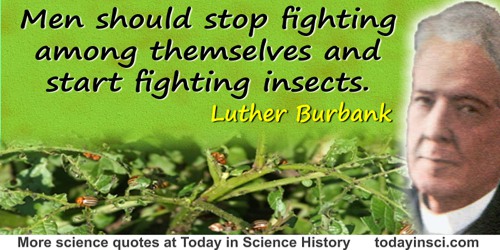
Men should stop fighting among themselves and start fighting insects.
In George Seldes, The Great Quotations (1960), 125.
Modern war, even from the consideration of physical welfare, is not creative. Soldiers and civilians alike are supposed to put on mental khaki. … War means the death of that fertile war which consists of the free, restless conflict of ideas. The war which matters is that of the scientist with nature; of the farmer with the tawny desert; of … philosopher against … mob stupidity. Such war is creative. … Inventions that further life and joy; freedom; new knowledge, whether Luther Burbank’s about the breeding of fruits or Einstein's about relativity; great cathedrals and Beethoven's music: these modern mechanical war can destroy but never produce. At its most inventive height, war creates the Maxim gun, the submarine, disseminable germs of disease, life-blasting gases. Spiritually and intellectually, modern war is not creative.
From ‘The Stagnation of War’, in Allen D. Hole (ed.) The Messenger of Peace (Nov 1924), 49, No. 11, 162-163.
Modern warfare is in every respect so horrifying, that scientific people will only regret that it draws its means from the progress of the sciences. I hope that the present war [World War I] will teach the peoples of Europe a lasting lesson and bring the friends of peace into power. Otherwise the present ruling classes will really deserve to be swept away by socialism.
Fischer to Margaret Oppenheim, 14 Dec 1917. Fischer Papers, Bancroft Library, University of California. Quotation supplied by W. H. Brock.
Most books, after all, are ephemeral; their specifics, several years later, inspire about as much interest as daily battle reports from the Hundred Years’ War.
…...
Most of the scientists in their twenties and thirties who went in 1939 to work on wartime problems were profoundly affected by their experience. The belief that Rutherford's boys were the best boys, that we could do anything that was do-able and could master any subject in a few days was of enormous value.
'The Effect of World War II on the Development of Knowledge in the Physical Sciences', Proceedings of the Royal Society of London, 1975, Series A, 342, 531.
Most scientists think wars and national boundaries are a menace to the true creative spirit by which science must live, they hate war and they are terrified of atomic war—because they know its possibilities.
As quoted in Michael Amrine, 'I’m A Frightened Man', Collier’s (1946), 117, 51.
My decision to begin research in radio astronomy was influenced both by my wartime experience with electronics and antennas and by one of my teachers, Jack Ratcliffe, who had given an excellent course on electromagnetic theory during my final undergraduate year.
From Autobiography in Wilhelm Odelberg (ed.), Les Prix Nobel en 1974/Nobel Lectures (1975)
My judgment is that research in 'Star Wars' is going to fail, and I believe this so strongly that I'm willing to stake my professional reputation on this. I don't believe anybody is going to build this thing.

Nations have recently been led to borrow billions for war; no nation has ever borrowed largely for education… no nation is rich enough to pay for both war and civilization. We must make our choice; we cannot have both.
Universities: American, English, German (1930), 302.
Nature that framed us of four elements,
Warring within our breasts for regiment,
Doth teach us all to have aspiring minds:
Our souls, whose faculties can comprehend
The wondrous architecture of the world
And measure every wandering planet’s course,
Still climbing after knowledge infinite,
And always moving as the restless spheres,
Will us to wear ourselves, and never rest…
Warring within our breasts for regiment,
Doth teach us all to have aspiring minds:
Our souls, whose faculties can comprehend
The wondrous architecture of the world
And measure every wandering planet’s course,
Still climbing after knowledge infinite,
And always moving as the restless spheres,
Will us to wear ourselves, and never rest…
From Christopher Marlowe, Arthur Henry Bullen (ed.), 'Tamburlaine the Great', The Works of Christopher Marlowe (Vol. 1, 1885), Pt 1, Act 2, Scene 7, lines 18-26.
Nature's stern discipline enjoins mutual help at least as often as warfare. The fittest may also be the gentlest.
Mankind Evolving (1962), 134.
Nazis started the Science of Eugenics. It’s the theory that to them, justified the holocaust. The problem is the Science has been broadly accepted around the world, including the United States. We even went as far as to hire the Scientists that were working on it and brought them over here rather then charging them with war crimes. [Project Paperclip] I think it is a very dangerous Science that contains ideologies that are a grave danger to the entire world.
…...
Never fear big long words.
Big long words name little things.
All big things have little names.
Such as life and death, peace and war.
Or dawn, day, night, hope, love, home.
Learn to use little words in a big way.
It is hard to do,
But they say what you mean.
When you don't know what you mean, use big words.
That often fools little people.
Big long words name little things.
All big things have little names.
Such as life and death, peace and war.
Or dawn, day, night, hope, love, home.
Learn to use little words in a big way.
It is hard to do,
But they say what you mean.
When you don't know what you mean, use big words.
That often fools little people.
Quoted in Saturday Review (1962), 45, No. 2. It was written (1936) for his son, as advice for young copy writers.
- 1995
New frontiers of the mind are before us, and if they are pioneered with the same vision, boldness, and drive with which we have waged this war we can create a fuller and more fruitful employment and a fuller and more fruitful life.
Letter to Vannevar Bush (17 Nov 1944). As printed in Vannevar Bush, Science, the Endless Frontier: A report to the President (1945), viii.
Not to destroy but to construct,
I hold the unconquerable belief
that science and peace will triumph over ignorance and war
that nations will come together
not to destroy but to construct
and that the future belongs to those
who accomplish most for humanity.
[His 1956 Christmas card.]
I hold the unconquerable belief
that science and peace will triumph over ignorance and war
that nations will come together
not to destroy but to construct
and that the future belongs to those
who accomplish most for humanity.
[His 1956 Christmas card.]
In Respectfully Quoted: A Dictionary of Quotations (1980), 366-367. The card used a variant of Louis Pasteur's earlier remark in 1892 (q.v.)
Now it must be asked if we can comprehend why comets signify the death of magnates and coming wars, for writers of philosophy say so. The reason is not apparent, since vapor no more rises in a land where a pauper lives than where a rich man resides, whether he be king or someone else. Furthermore, it is evident that a comet has a natural cause not dependent on anything else; so it seems that it has no relation to someone’s death or to war. For if it be said that it does relate to war or someone’s death, either it does so as a cause or effect or sign.
De Cometis (On Comets) [before 1280], trans. Lynn Thorndike, from ed. Borgnet, IV, 499-508, quoted in Lynn Thorndike (ed.), Latin Treatises on Comets between 1238 and 1368 A.D. (1950), 75.
On the question of … the horrors of conventional war…: men were capable of unimaginable cruelty and wickedness to each other without the aid of nuclear physics.
In Reflect on Things Past: The Memoirs of Lord Carrington (1089), 154.
One began to hear it said that World War I was the chemists’ war, World War II was the physicists’ war, World War III (may it never come) will be the mathematicians’ war.
Co-author with and Reuben Hersh, The Mathematical Experience (1981), 96.
One day at Fenner's (the university cricket ground at Cambridge), just before the last war, G. H. Hardy and I were talking about Einstein. Hardy had met him several times, and I had recently returned from visiting him. Hardy was saying that in his lifetime there had only been two men in the world, in all the fields of human achievement, science, literature, politics, anything you like, who qualified for the Bradman class. For those not familiar with cricket, or with Hardy's personal idiom, I ought to mention that “the Bradman class” denoted the highest kind of excellence: it would include Shakespeare, Tolstoi, Newton, Archimedes, and maybe a dozen others. Well, said Hardy, there had only been two additions in his lifetime. One was Lenin and the other Einstein.
Variety of Men (1966), 87. First published in Commentary magazine.
One must expect a war between U.S.A. and U.S.S.R. which will begin with the total destruction of London. I think the war will last 30 years, and leave a world without civilised people, from which everything will have to build afresh—a process taking (say) 500 years.
Stated just one month after the Hiroshima atomic explosion. Russell became one of the best-known antinuclear activists of his era.
Stated just one month after the Hiroshima atomic explosion. Russell became one of the best-known antinuclear activists of his era.
Letter to Gamel Brenan (1 Sep 1945). In Nicholas Griffin (Ed.), The Selected Letters of Bertrand Russell (2002), 410.
One of the principal results of civilization is to reduce more and more the limits within which the different elements of society fluctuate. The more intelligence increases the more these limits are reduced, and the nearer we approach the beautiful and the good. The perfectibility of the human species results as a necessary consequence of all our researches. Physical defects and monstrosities are gradually disappearing; the frequency and severity of diseases are resisted more successfully by the progress of modern science; the moral qualities of man are proving themselves not less capable of improvement; and the more we advance, the less we shall have need to fear those great political convulsions and wars and their attendant results, which are the scourges of mankind.
…...
Orthodoxy can be as stubborn in science as in religion. I do not know how to shake it except by vigorous imagination that inspires unconventional work and contains within itself an elevated potential for inspired error. As the great Italian economist Vilfredo Pareto wrote: ‘Give me a fruitful error any time, full of seeds, bursting with its own corrections. You can keep your sterile truth for yourself.’ Not to mention a man named Thomas Henry Huxley who, when not in the throes of grief or the wars of parson hunting, argued that ‘irrationally held truths may be more harmful than reasoned errors.’
…...
Our country is now at war and the only way out is forward. I would not change one word I have spoken against war but that is no longer the issue. We must now stand together.
As quoted in 'David Starr Jordan Dies at Age of 80', New York Times (20 Sep 1931), N6.
Our factories may well put an end to war sooner than your (peace) congresses. The day when two army corps can annihilate one another in one second, all civilized nations, it is to be hoped, will recoil from war and discharge their troops.
As quoted by Linus Pauling in Nobel Prize Acceptance Speech (10 Dec 1963). Pauling in his speech said it was from a statement by Nobel “in 1892, as reported by Bertha von Sutter.” Printed in Göran Liljestrand (ed.), Les Prix Nobel en 1963, (1964).
Our Generation has had no Great war, no Great Depression. Our war is spiritual. Our depression is our lives.
Quoted in Kim Lim (ed.), 1,001 Pearls of Spiritual Wisdom: Words to Enrich, Inspire, and Guide Your Life (2014), 30
Our highest claim to respect, as a nation, rests not in the gold, nor in the iron and the coal, nor in inventions and discoveries, nor in agricultural productions, nor in our wealth, grown so great that a war debt of billions fades out under ministrations of the revenue collector without fretting the people; nor, indeed, in all these combined. That claim finds its true elements in our systems of education and of unconstrained religious worship; in our wise and just laws, and the purity of their administration; in the conservative spirit with which the minority submits to defeat in a hotly-contested election; in a free press; in that broad humanity which builds hospitals and asylums for the poor, sick, and insane on the confines of every city; in the robust, manly, buoyant spirit of a people competent to admonish others and to rule themselves; and in the achievements of that people in every department of thought and learning.
From his opening address at an annual exhibition of the Brooklyn Industrial Institute. As quoted in biographical preface by T. Bigelow to Austin Abbott (ed.), Official Report of the Trial of Henry Ward Beecher (1875), Vol. 1, xiv.
Our only complete assurance of surviving World War III is to halt it before it starts.
Speech (10 Nov 1948) preceding Armistice Day, at Boston, Massachusetts.
Our problem is that the climate crisis hatched in our laps at a moment in history when political and social conditions were uniquely hostile to a problem of this nature and magnitude—that moment being the tail end of the go-go ’80s, the blastoff point for the crusade to spread deregulated capitalism around the world. Climate change is a collective problem demanding collective action the likes of which humanity has never actually accomplished. Yet it entered mainstream consciousness in the midst of an ideological war being waged on the very idea of the collective sphere.
In 'The Change Within: The Obstacles We Face Are Not Just External', The Nation (12 May 2014).
Our scientific power has outrun our spiritual power. We have guided missiles and misguided men.
Commenting on the way the Vietnam War was being conducted by the U.S. In 'The Man Who Was a Fool', Strength To Love (1963, 1981), 76.
Paris ... On this side of the ocean it is difficult to understand the susceptibility of American citizens on the subject and precisely why they should so stubbornly cling to the biblical version. It is said in Genesis the first man came from mud and mud is not anything very clean. In any case if the Darwinian hypothesis should irritate any one it should only be the monkey. The monkey is an innocent animal—a vegetarian by birth. He never placed God on a cross, knows nothing of the art of war, does not practice lynch law and never dreams of assassinating his fellow beings. The day when science definitely recognizes him as the father of the human race the monkey will have no occasion to be proud of his descendants. That is why it must be concluded that the American Association which is prosecuting the teacher of evolution can be no other than the Society for Prevention of Cruelty to Animals.
[A cynical article in the French press on the Scopes Monkey Trial, whether it will decide “a monkey or Adam was the grandfather of Uncle Sam.”]
[A cynical article in the French press on the Scopes Monkey Trial, whether it will decide “a monkey or Adam was the grandfather of Uncle Sam.”]
Article from a French daily newspaper on the day hearings at the Scopes Monkey Trial began, Paris Soir (13 Jul 1925), quoted in 'French Satirize the Case', New York Times (14 Jul 1925), 3.
Primitiveness and civilization are degrees of the same thing. If civilization has an opposite, it is war.
The Left Hand of Darkness (1969)
PROJECTILE, n. The final arbiter in international disputes. Formerly these disputes were settled by physical contact of the disputants, with such simple arguments as the rudimentary logic of the times could supply —the sword, the spear, and so forth. With the growth of prudence in military affairs the projectile came more and more into favor, and is now held in high esteem by the most courageous. Its capital defect is that it requires personal attendance at the point of propulsion.
The Collected Works of Ambrose Bierce (1911), Vol. 7, The Devil's Dictionary, 268.
Science and technology were developing at a prodigious speed, and it seemed natural to assume that they would go on developing. This failed to happen, partly because of the impoverishment caused by a long series of wars and revolutions, partly because scientific and technical progress depended on the empirical habit of thought, which could not survive in a strictly regimented society.
In 1984 (1949), Book 2, Chapter 9.
Science is wonderful: for years uranium cost only a few dollars a ton until scientists discovered you could kill people with it.
In Evan Esar, 20,000 Quips and Quotes, 703.
Science may be a boon if war can be abolished and democracy and cultural liberty preserved. If this cannot be done, science will precipitate evils greater than any that mankind has ever experienced.
In 'Boredom or Doom in a Scientific World', United Nations World (Sep 1948), Vol. 2, No. 8, 16.
Science unfolded her treasures and her secrets to the desperate demands of men, and placed in their hands agencies and apparatus almost decisive in their character.
Reflecting on the outcome of World War I, and an ominous future.
Reflecting on the outcome of World War I, and an ominous future.
The Second World War: The Gathering Storm (1948, 1986), Vol. 1, 35. Quoting himself from his earlier book, The Aftermath: Being a Sequel to The World Crisis (1929).
Scourges, pestilence, famine, earthquakes, and wars are to be regarded as blessings, since they serve to prune away the luxuriant growth of the human race.
In The Timeline Book of Science by George Ochoa and Melinda Corey (1995).
Since [World War I] we have seen the atomic age, the computer age, the space age, and the bio-engineering age, each as epochal as the Bronze Age, the Iron Age, the Renaissance and the Industrial Revolution. And all these have occurred in one generation. Man has stood on the moon and looked back on the earth, that small planet now reduced to a neighbourhood. But our material achievements have exceeded the managerial capacities of our human minds and institutions.
As quoted in Colin Bingham (ed.), Wit and Wisdom: A Public Affairs Miscellany (1982), 227.
Stay your rude steps, or e’er your feet invade
The Muses’ haunts,ye sons of War and Trade!
Nor you, ye legion fiends of Church and Law,
Pollute these pages with unhallow’d paw!
Debased, corrupted, grovelling, and confin’d,
No definitions touch your senseless mind;
To you no Postulates prefer their claim,
No ardent Axioms your dull souls inflame;
For you no Tangents touch, no Angles meet,
No Circles join in osculation sweet!
The Muses’ haunts,ye sons of War and Trade!
Nor you, ye legion fiends of Church and Law,
Pollute these pages with unhallow’d paw!
Debased, corrupted, grovelling, and confin’d,
No definitions touch your senseless mind;
To you no Postulates prefer their claim,
No ardent Axioms your dull souls inflame;
For you no Tangents touch, no Angles meet,
No Circles join in osculation sweet!
From poem, with co-authors John Hookham Frere, George Canning and George Ellis, The Loves of the Triangles: A Mathematical and Philosophical Poem, Canto I, collected in Poetry of the Anti-Jacobin (1854), 124.
Such explosives [atomic bombs] in men’s hands, while their moral and intellectual status is declining, is about as useful as giving out firearms to all inmates of a gaol and then saying that you hope ‘this will ensure peace’.
From Letter (No. 102) to Christopher Tolkien (9 Aug 1945). In Humphrey Carpenter (ed.) assisted by Christopher Tolkien, The Letters of J.R.R. Tolkien (1995, 2014), 116, Letter No. 102.
The atom bomb was no “great decision.” It was used in the war, and for your information, there were more people killed by fire bombs in Tokyo than dropping of the atomic bombs accounted for. It was merely another powerful weapon in the arsenal of righteousness. The dropping of the bombs stopped the war, save millions of lives.
In reply to a question at a symposium, Columbia University, NYC (28 Apr 1959). In Truman Speaks (1960), 67.
The Atomic Age began at exactly 5.30 Mountain War Time on the morning of July 15, 1945, on a stretch of semi-desert land about 50 airline miles from Alamogordo, New Mexico. And just at that instance there rose from the bowels of the earth a light not of this world, the light of many suns in one. ... At first it was a giant column that soon took the shape of a supramundane mushroom.
On the first atomic explosion in New Mexico, 16 Jul 1945.
On the first atomic explosion in New Mexico, 16 Jul 1945.
From 'Drama of the Atomic Bomb Found Climax in July 16 Test', in New York Times (26 Sep 1945), 1.
The century after the Civil War was to be an Age of Revolution—of countless, little-noticed revolutions, which occurred not in the halls of legislatures or on battlefields or on the barricades but in homes and farms and factories and schools and stores, across the landscape and in the air—so little noticed because they came so swiftly, because they touched Americans everywhere and every day. Not merely the continent but human experience itself, the very meaning of community, of time and space, of present and future, was being revised again and again, a new democratic world was being invented and was being discovered by Americans wherever they lived.
In The Americans: The Democratic Experience (1973, 1974), ix.
The conflict that exists today is no more than an old-style struggle for power, once again presented to mankind in semireligious trappings. The difference is that, this time, the development of atomic power has imbued the struggle with a ghostly character; for both parties know and admit that, should the quarrel deteriorate into actual war, mankind is doomed.
Address he was writing, left unfinished when he died (Apr 1955).
The dangers of atomic war are underrated. It would be hard on little, concentrated countries like England. In the United States, we have lots of space.
Chicago Tribune (23 Feb 1950).
The determining cause of most wars in the past has been, and probably will be of all wars in the future, the uncertainty of the result; war is acknowledged to be a challenge to the Unknown, it is often spoken of as an appeal to the God of Battles. The province of science is to foretell; this is true of every department of science. And the time must come—how soon we do not know—when the real science of war, something quite different from the application of science to the means of war, will make it possible to foresee with certainty the issue of a projected war. That will mark the end of battles; for however strong the spirit of contention, no nation will spend its money in a fight in which it knows it must lose.
Times Literary Supplement (28 Nov 1902), 353-4.
The engineers, working in conjunction with the scientists, can win wars, or decide their outcome, sooner than the soldiers.
Explaining Napoleon’s remark to Gaspard Gourgaud that “Engineers are more clever than artillerymen.” With co-author Harold Orel, in 'How to Make Technical Writing Easy', Professional Engineer (1958), 29, 18.
The events of the past few years have led to a critical examination of the function of science in society. It used to be believed that the results of scientific investigation would lead to continuous progressive improvements in conditions of life; but first the War and then the economic crisis have shown that science can be used as easily for destructive and wasteful purposes, and voices have been raised demanding the cessation of scientific research as the only means of preserving a tolerable civilization. Scientists themselves, faced with these criticisms, have been forced to consider, effectively for the first time, how the work they are doing is connected around them. This book is an attempt to analyse this connection; to investigate how far scientists, individually and collectively, are responsible for this state of affairs, and to suggest what possible steps could be taken which would lead to a fruitful and not to a destructive utilization of science.
The Social Function of Science (1939), xlii.
The future can be anything we want it to be, providing we have the faith and that we realize that peace, no less than war, required 'blood and sweat and tears.'
The greatest human evils are not those that individuals perform in private, the tiny transgressions against some arbitrary social standard we call sins. The ultimate evils are the mass murders that occur in revolution and war, the large-scale savageries that arise when one agglomeration of humans tries to dominate another: the deeds of the social group. … only group efforts can save us from the sporadic insanities of the group.
In 'The Clint Eastwood Conundrum', The Lucifer Principle: A Scientific Expedition Into the Forces of History (1997), 7.
The history of penicillin is one of the disgraces of medical research. Fleming published his
classic paper in the British Journal of Experimental Pathology for June, 1929, but it was not until 1939 that Florey followed up the clue. An antiseptic which is almost ideal, inasmuch as it has no toxic effects, was allowed to slumber for ten years. Had it not been for the exigencies of the present war it might be slumbering still.
In book review, 'The Story of a Neglected Miracle', New York Times (25 Mar 1945), BR3. (The book being reviewed was J.D. Ratcliff, Yellow Magic: The Story of Penicillin.)
The last few centuries have seen the world freed from several scourges—slavery, for example; death by torture for heretics; and, most recently, smallpox. I am optimistic enough to believe that the next scourge to disappear will be large-scale warfare—killed by the existence and nonuse of nuclear weapons.
Alvarez: Adventures of a Physicist (1987), 152.
The laws of war, do they say? As if war were not the destruction of all laws.
From Appendix A, 'Extracts From the Unpublished Writings of Carnot', Reflections on the Motive Power of Heat (1890, 2nd ed. 1897), 210.
The living will envy the dead.
[Speaking of nuclear war.]
[Speaking of nuclear war.]
Attributed. No verification of any form of this quote has been found in the speeches or writings of Khrushchev. An Associated Press article (4 Aug 1979) about hearings on the Salt II referred to senators quoting Khrshchev in these words. This form of the quote has since been widely circulated, for example, in the Washington Post (20 Mar 1981), A23. Senator Frank Church, chairman of the Senate Committee on Foreign Relations, in a hearing (11 July 1979) attributed Khrushchev as saying “the survivors would envy the dead”. The senator repeated this remark at another hearing five days later. (Recorded in The Salt II Treaty, hearings before the Committee on Foreign Relations, U.S. Senate, 96th Congress (1979), 1st session, Pt. 1, 333, and Pt. 2, 27). The quote about &;dquo;survicors” was also given in Ed Zuckerman, 'Hiding from the Bomb—Again', Harper’s Magazine (Aug 1979), 36. A copy of that issue, in circulation before its cover date, was in the Library of Congress, stamped 12 Jul 1979. In Respectfully Quoted: A Dictionary of Quotations (1989), 239.
The most conspicuous scientific and technical achievements of our age—nuclear bombs, rockets, computers—are all direct products of war.
In 'Reactions to Man’s Landing on the Moon Show Broad Variations in Opinions', The New York Times (21 Jul 1969), 6.
The most persistent sound which reverberates through men’s history is the beating of war drums.
In Prologue to Janus: A Summing Up (1978), 2.
The nation that prepares for war will sooner or later have war. We get just anything we prepare for, and we get nothing else. Everything that happens is a sequence: this happened today because you did that yesterday.
Aphorism in The Philistine (Apr 1905), 20, No. 5, 160.
The new naval treaty permits the United States to spend a billion dollars on warships—a sum greater than has been accumulated by all our endowed institutions of learning in their entire history. Unintelligence could go no further! … [In Great Britain, the situation is similar.] … Until the figures are reversed, … nations deceive themselves as to what they care about most.
Universities: American, English, German (1930), 302.
The news today about ‘Atomic bombs’ is so horrifying one is stunned. The utter folly of these lunatic physicists to consent to do such work for war-purposes: calmly plotting the destruction of the world!
From Letter (No. 102) to Christopher Tolkien (9 Aug 1945). In Humphrey Carpenter (ed.) assisted by Christopher Tolkien, The Letters of J.R.R. Tolkien (1995, 2014), 116, Letter No. 102.
The point [is] largely scientific in character …[concerning] the methods which can be invented or adopted or discovered to enable the Earth to control the Air, to enable defence from the ground to exercise control—indeed dominance—upon aeroplanes high above its surface. … science is always able to provide something. We were told that it was impossible to grapple with submarines, but methods were found … Many things were adopted in war which we were told were technically impossible, but patience, perseverance, and above all the spur of necessity under war conditions, made men’s brains act with greater vigour, and science responded to the demands.
[Remarks made in the House of Commons on 7 June 1935. His speculation was later proved correct with the subsequent development of radar during World War II, which was vital in the air defence of Britain.]
[Remarks made in the House of Commons on 7 June 1935. His speculation was later proved correct with the subsequent development of radar during World War II, which was vital in the air defence of Britain.]
Quoting himself in The Second World War: The Gathering Storm (1948, 1986), Vol. 1, 134.
The ponderous instrument of synthesis, so effective in his [Newton’s] hands, has never since been grasped by one who could use it for such purposes; and we gaze at it with admiring curiosity, as on some gigantic implement of war, which stands idle among the memorials of ancient days, and makes us wonder what manner of man he was who could wield as a weapon what we can hardly lift as a burden.
In History of the Inductive Sciences (1857), Vol. 2, 128.
The position in which we are now is a very strange one which in general political life never happened. Namely, the thing that I refer to is this: To have security against atomic bombs and against the other biological weapons, we have to prevent war, for if we cannot prevent war every nation will use every means that is at their disposal; and in spite of all promises they make, they will do it.
…...
The prediction of nuclear winter is drawn not, of course, from any direct experience with the consequences of global nuclear war, but rather from an investigation of the governing physics. (The problem does not lend itself to full experimental verification—at least not more than once.)[co-author with American atmospheric chemist Richard P. Turco (1943- )]
A Path Where No Man Thought: Nuclear Winter and the End of the Arms Race (1990), 26.
The problem [evolution] presented itself to me, and something led me to think of the positive checks described by Malthus in his Essay on Population, a work I had read several years before, and which had made a deep and permanent impression on my mind. These checks—war, disease, famine, and the like—must, it occurred to me, act on animals as well as man. Then I thought of the enormously rapid multiplication of animals, causing these checks to be much more effective in them than in the case of man; and while pondering vaguely on this fact, there suddenly flashed upon me the idea of the survival of the fittest—that the individuals removed by these checks must be on the whole inferior to those that survived. I sketched the draft of my paper … and sent it by the next post to Mr. Darwin.
In 'Introductory Note to Chapter II in Present Edition', Natural Selection and Tropical Nature Essays on Descriptive and Theoretical Biology (1891, New ed. 1895), 20.
The problem of values arises only when men try to fit together their need to be social animals with their need to be free men. There is no problem, and there are no values, until men want to do both. If an anarchist wants only freedom, whatever the cost, he will prefer the jungle of man at war with man. And if a tyrant wants only social order, he will create the totalitarian state.
Science and Human Values (1961), 63.
The problems of analyzing war operations are … rather nearer, in general, to many problems, say of biology or of economics, than to most problems of physics, where usually a great deal of numerical data are ascertainable about relatively simple phenomena.
In report at the British Association Annual Meeting, Dundee (30 Aug 1947), published in 'Operational Research in War and Peace', The Advancement of Science (1948), 17, 320-332. Collected in P.M.S. Blackett, Studies of War: Nuclear and Conventional (1962), 177.
The refuge of the morally, intellectually, artistically and economically bankrupt is war.
The release of atomic energy has not created a new problem. It has merely made more urgent the necessity of solving an existing one … I do not believe that civilization will be wiped out in a war fought with the atomic bomb. Perhaps two thirds of the people of the Earth would be killed.
In interview with Raymond Swing, 'Einstein on the Atomic Bomb' Atlantic Monthly, (Nov 1945), 176, No. 5, 43.
The rocks have a history; gray and weatherworn, they are veterans of many battles; they have most of them marched in the ranks of vast stone brigades during the ice age; they have been torn from the hills, recruited from the mountaintops, and marshaled on the plains and in the valleys; and now the elemental war is over, there they lie waging a gentle but incessant warfare with time and slowly, oh, so slowly, yielding to its attacks!
In Under the Apple-Trees (1916), 42.
/AdamsJohn(1735-1826)-Study500x250px.jpg)
The science of government is my duty. … I must study politics and war that my sons may have liberty to study mathematics and philosophy. My sons ought to study mathematics and philosophy, geography, natural history, naval architecture, navigation, commerce, and agriculture, in order to give their children a right to study painting, poetry, music, architecture, statuary, tapestry, and porcelain.
Letter to Abigail Adams, (1780). In John Adams and Charles Francis Adams, Letters of John Adams, Addressed to His Wife (1841), 68.
The science of medicine is a barbarous jargon and the effects of our medicine on the human system are in the highest degree uncertain, except indeed that they have already destroyed more lives than war, pestilence, and famine combined.
…...
The science of weapons and war has made us all one world and one human race with one common destiny.
Address Before the 18th General Assembly of the United Nations, 20 Sep 1963. In Edward C. Luck, Mixed Messages: American Politics and International Organization, 1919-1999 (1999), 41.
The Secretary of the Navy [Josephus Daniels] has decided that the science of aerial navigation has reached that point where aircraft must form a large part of our naval force for offensive and defensive operations. Nearly all countries having a Navy are giving attention to this subject. This country has not fully realized the value of aeronautics in preparation for war, but it is believed we should take our proper place.
Statement on the future of U.S. Naval Aviation made on the eve of World War I.
Statement on the future of U.S. Naval Aviation made on the eve of World War I.
News release, U.S. Navy Department, 10 Jan 1914. In Aviation in the United States Navy (1965), 5. In Kevin L. Falk, Why Nations Put to Sea (2000), 48.
The star [Tycho’s supernova] was at first like Venus and Jupiter, giving pleasing effects; but as it then became like Mars, there will next come a period of wars, seditions, captivity and death of princes, and destruction of cities, together with dryness and fiery meteors in the air, pestilence, and venomous snakes. Lastly, the star became like Saturn, and there will finally come a time of want, death, imprisonment and all sorts of sad things.
The struggle between the unitary and dualistic theories of chemical affinity, which raged for nearly a century, was a form of civil war between inorganic and organic chemists.
Comment made on a postcard sent to Robin O. Gandy. Reproduced in Andrew Hodges, Alan Turing: The Enigma (1983), 513.
The student of biology is often struck with the feeling that historians, when dealing with the rise and fall of nations, do not generally view the phenomena from a sufficiently high biological standpoint. To me, at least, they seem to attach too much importance to individual rulers and soldiers, and to particular wars, policies, religions, and customs; while at the same time they make little attempt to extract the fundamental causes of national success or failure.
Introduction written by Ross for William Henry Samuel Jones, Malaria, a Neglected Factor in the History of Greece and Rome (1907), 1.
The terror created by weaponry has never stopped men from employing them.
Speech to the United Nations Atomic Energy Commission (14 Jun 1946). In Alfred J. Kolatch, Great Jewish Quotations (1996), 39.
The United States is the most powerful technically advanced country in the world to-day. Its influence on the shaping of international relations is absolutely incalculable. But America is a large country and its people have so far not shown much interest in great international problems, among which the problem of disarmament occupies first place today. This must be changed, if only in the essential interests of the Americans. The last war has shown that there are no longer any barriers between the continents and that the destinies of all countries are closely interwoven. The people of this country must realize that they have a great responsibility in the sphere of international politics. The part of passive spectator is unworthy of this country and is bound in the end to lead to disaster all round.
…...
The view of the Earth from the Moon fascinated me - a small disk, 240,000 miles away… Raging nationalistic interests, famines, wars, pestilence don’t show from that distance.
…...
The war gave women like her opportunities, not a feminist movement, and if the opportunities dwindled after the war, she feels that it was because women didn't want them.
Quoted in The Chemical Educator, vol. 7, No. 2, in a book review of Eugene Straus, Rosalyn Yalow, Nobel Laureate: Her Life and Work in Medicine.
The world has achieved brilliance without wisdom, power without conscience. Ours is a world of nuclear giants and ethical infants. We know more about war than we know about peace, more about killing than we know about living.
Speech (10 Nov 1948) in Boston, Massachusetts, preceding Armistice Day, Collected Writings (1967), Vol. 1. Quoted in Bulletin of the Atomic Scientists (Apr 1952), 8, No. 4, 114.
The worst thing that will probably happen—in fact is already well underway—is not energy depletion, economic collapse, conventional war, or the expansion of totalitarian governments. As terrible as these catastrophes would be for us, they can be repaired in a few generations. The one process now going on that will take millions of years to correct is loss of genetic and species diversity by the destruction of natural habitats. This is the folly our descendants are least likely to forgive us.
Biophilia (1984), 121.(1990), 182.
There appears to be a total absence of place names [in southern Sudan]; there are indeed names for regions, areas, but all hamlets (there are scarcely any villages) bear the name of their headman or district head…, which is as ephemeral as the existence of the bearer himself in this unquiet country. Furthermore, residences are shifted every few years, in order to have fresh farmland; added to this the frequent wars, many deaths etc. In contrast, all bodies of water, even the most insignificant ditches, are permanently named. These will be the only guides if future travelers follow my path in this country or wish to trace it.
On the diffuse difficulties and contradictions in placing permanent names on the maps was making. In August Petermann, Petermann’s Geographische Mittheilungen (1871), 137. As quoted and cited in Kathrin Fritsch, '"You Have Everything Confused And Mixed Up…!" Georg Schweinfurth, Knowledge And Cartography Of Africa In The 19th Century', History in Africa (2009), 36, 91.
There is a story which shows his ready wit, dating from the meeting of the British Association in Canada before the war. Tizard and a colleague inadvertently crossed over into the United States, near Niagara. When challenged by a policeman, and not having their passports with them, they produced their British Association membership cards. When the policeman told them that “The American Government doesn't recognise British Science,” the lightning reply came from Tizard, “Oh, that's all right, neither does the British Government.”
In Studies of War, Nuclear and Conventional (1962), 119.
There seem to be but three ways for a nation to acquire wealth: the first is by war, as the Romans did, in plundering their conquered neighbors—this is robbery; the second by commerce, which is generally cheating; the third by agriculture, the only honest way, wherein man receives a real increase of the seed thrown into the ground, in a kind of continual miracle, wrought by the hand of God in his favor, as a reward for his innocent life and his virtuous industry.
In 'Positions to be Examined', The Works of Benjamin Franklin Consisting of Essays, Humorous, Moral and Literary (1824), 241.
There will one day spring from the brain of science a machine or force so fearful in its potentialities, so absolutely terrifying, that even man, the fighter, who will dare torture and death in order to inflict torture and death, will be appalled, and so abandon war forever.
…...
They [the Haida] are a doomed race. Wars, smallpox, gross immorality, a change from old ways to new ways their fate is the common fate of the American, whether he sails the sea in the North, gallops over the plain in the West, or sleeps in his hammock in the forests of Brazil.
From Lecture on the Haida Indian Nation, delivered at the Field Columbian Museum (6 Nov 1897). Reproduced in 'A Cruise among Haida and Tlingit Villages About Dixon’s Entrance', Popular Science Monthly (Jun 1898), 164.
This is a strange Christmas Eve. Almost the whole world is locked in deadly struggle, and, with the most terrible weapons which science can devise, the nations advance upon each other. Ill would it be for us this Christmastide if we were not sure that no greed for the land or wealth of any other people, no vulgar ambition, no morbid lust for material gain at the expense of others, had led us to the field. Here, in the midst of war, raging and roaring over all the lands and seas, creeping nearer to our hearts and homes, here, amid all the tumult, we have tonight the peace of the spirit in each cottage home and in every generous heart. Therefore we may cast aside for this night at least the cares and dangers which beset us, and make for the children an evening of happiness in a world of storm. Here, then, for one night only, each home throughout the English-speaking world should be a brightly-lighted island of happiness and peace.
Let the children have their night of fun and laughter. Let the gifts of Father Christmas delight their play. Let us grown-ups share to the full in their unstinted pleasures before we turn again to the stern task and the formidable years that lie before us, resolved that, by our sacrifice and daring, these same children shall not be robbed of their inheritance or denied their right to live in a free and decent world.
Let the children have their night of fun and laughter. Let the gifts of Father Christmas delight their play. Let us grown-ups share to the full in their unstinted pleasures before we turn again to the stern task and the formidable years that lie before us, resolved that, by our sacrifice and daring, these same children shall not be robbed of their inheritance or denied their right to live in a free and decent world.
Broadcast while he was in Washington D.C. (24 Dec 1941). As collected in Robert Rhodes James (ed.), Churchill Speaks in Peace and War: Collected Speeches 1897-1963 (), 780. In Hong Kong, the situation was hopeless, despite a valiant resistance, and the British forces surrendered the next day (25 Dec 1941). Churchill was in the U.S. visiting Pres. Roosevelt, to discuss coordinating strategy following the Pearl Harbor attack (7 Dec 1941).
This is really the cornerstone of our situation. Now, I believe what we should try to bring about is the general conviction that the first thing you have to abolish is war at all costs, and every other point of view must be of secondary importance.
…...
This theme of mutually invisible life at widely differing scales bears an important implication for the ‘culture wars’ that supposedly now envelop our universities and our intellectual discourse in general ... One side of this false dichotomy features the postmodern relativists who argue that all culturally bound modes of perception must be equally valid, and that no factual truth therefore exists. The other side includes the benighted, old-fashioned realists who insist that flies truly have two wings, and that Shakespeare really did mean what he thought he was saying. The principle of scaling provides a resolution for the false parts of this silly dichotomy. Facts are facts and cannot be denied by any rational being. (Often, facts are also not at all easy to determine or specify–but this question raises different issues for another time.) Facts, however, may also be highly scale dependent–and the perceptions of one world may have no validity or expression in the domain of another. The one-page map of Maine cannot recognize the separate boulders of Acadia, but both provide equally valid representations of a factual coastline.
The World as I See It (1999)
This topic brings me to that worst outcrop of the herd nature, the military system, which I abhor. That a man can take pleasure in marching in formation to the strains of a band is enough to make me despise him. He has only been given his big brain by mistake; a backbone was all he needed. This plague-spot of civilisation ought to be abolished with all possible speed. Heroism by order, senseless violence, and all the pestilent nonsense that goes by the name of patriotism–how I hate them! War seems to me a mean, contemptible thing: I would rather be hacked in pieces than take part in such an abominable business.
…...
This weapon [the atomic bomb] has added an additional responsibility—or, better, an additional incentive—to find a sound basis for lasting peace. It provides an overwhelming inducement for the avoidance of war. It emphasizes the crisis we face in international matters and strengthens the conviction that adequate safeguards for peace must be found.
Opening address (7 Nov 1945) of Town Hall’s annual lecture series, as quoted in 'Gen. Groves Warns on Atom ‘Suicide’', New York Times (8 Nov 1945), 4. (Just three months before he spoke, two atom bombs dropped on Japan in Aug 1945 effectively ended WW II.)
To wage war with Marchand or anyone else again will benefit nobody and bring little profit to science. You consume yourself in this way, you ruin your liver and eventually your nerves with Morrison pills. Imagine the year 1900 when we have disintegrated into carbonic acid, ammonia and water and our bone substance is perhaps once more a constituent of the bones of the dog who defiles our graves. Who will then worry his head as to whether we have lived in peace or anger, who then will know about your scientific disputes and of your sacrifice of health and peace of mind for science? Nobody. But your good ideas and the discoveries you have made, cleansed of all that is extraneous to the subject, will still be known and appreciated for many years to come. But why am I trying to advise the lion to eat sugar.
Letter from Wohler to Liebig (9 Mar 1843). In A. W. Hofmann (ed.), Aus Justus Liebigs und Friedrich Wohlers Briefwechsel (1888), Vol. 1, 224. Trans. Ralph Oesper, The Human Side of Scientists (1975), 205.
True science thrives best in glass houses where everyone can look in. When the windows are blacked out, as in war, the weeds take over; when secrecy muffles criticism, charlatans and cranks flourish.
In Is Science Necessary?: Essays on Science and Scientists (1989), xvi.
Unless we choose to decentralize and to use applied science, not as the end to which human beings are to be made the means, but as the means to producing a race of free individuals, we have only two alternatives to choose from: either a number of national
Brave New World (1932, 1998), Preface, xvii.
Very different would be the position of the profession toward homeopathy if it had aimed, like other doctrines advanced by physicians, to gain a foothold among medical men alone or chiefly, instead of making its appeal to the popular favour and against the profession. … And as its adherents do not aim simply at the establishment of a system of doctrines, but wage a war of radicalism against the profession, and seek to throw down the barricades and guard it from the intrusion of ignorance and quackery … our duty is to expel them.
Proceedings of the Connecticut Medical Society (1847), 24. Quoted by Harris L. Coulter in Divided Legacy: the Conflict Between Homeopathy and the American Medical Association (1982), 204.
![Winston Churchill quote: Victory [in war] is the beautiful, bright-coloured flower. Transport is the stem without which it could](https://todayinsci.com/C/Churchill_Winston/ChurchillWinston-WarTransport500x250px.jpg)
Victory [in war] is the beautiful, bright-coloured flower. Transport is the stem without which it could never have blossomed. (1899)
In The River War (2004), 87.
War and the steam engine joined forces and forged what was to become one of the most delicate of concepts. Sadi Carnot … formed the opinion that one cause of France’s defeat had been her industrial inferiority. … Carnot saw steam power as a universal motor. … Carnot was a visionary and sharp analyst of what was needed to improve the steam engine. … Carnot’s work … laid the foundations of [thermodynamics].
In The Second Law (1984), 1-2.
War can protect; it cannot create.
In "An Appeal to Sanity' (Mar 1939). Collected in Science and Philosophy (1948), 83.
War has been represented as necessary to prevent the too rapid increase of the population, but war mows down the flower of the young men, while it spares the men disgraced by nature. Hence it tends to the degeneration of the species
From Appendix A, 'Extracts From the Unpublished Writings of Carnot', Reflections on the Motive Power of Heat (1890, 2nd ed. 1897), 210.
War rages on the teeming earth;
The hot and sanguinary fight
Begins with each new creature’s birth:
A dreadful war where might is right;
Where still the strongest slay and win,
Where weakness is the only sin.
The hot and sanguinary fight
Begins with each new creature’s birth:
A dreadful war where might is right;
Where still the strongest slay and win,
Where weakness is the only sin.
In The Ascent of Man (1889), 13.
War should mean research.
In Letter (1917) to Vary T. Hutchinson, in GEH Papers, Box 23. As quoted an cited in Daniel J. Kevles, The Physicists (1977, 1995), 116. (Hale was Chairman of the National Research Council, 1916–1919.)
We are living in a world in which all wars are wars of defense.
From speech given at an anti-war teach-in at the Massachusetts Institute of Technology, (4 Mar 1969) 'A Generation in Search of a Future', as edited by Ron Dorfman for Chicago Journalism Review, (May 1969).
We have to stop thinking of human needs and rights alone. Let us be brave and see that the real threat comes from the living earth, which we have harmed and is now at war with us.
From speech to International Conference, Paris, 'Nuclear Energy for the 21st Century', (21–22 Mar 2005). As quoted on jameslovelock.org website.
We knew the world would not be the same. A few people laughed, a few people cried. Most people were silent. I remembered the line from the Hindu scripture, the Bhagavad Gita: Vishnu is trying to pursue the Prince that he should do his duty and to impress him takes on his multi-armed form and says, “Now I am become Death, destroyer of worlds.” I suppose we all thought that one
way or another. There was a great deal of solemn talk that this was the end of the great wars of the century.
At the first atomic bomb test (16 Jul 1945), in Len Giovanitti and Fred Freed, The Decision to Drop the Bomb (1965), 197
We must avoid war under all possible circumstances, except, my opinion, one: when the freedom of human beings is at stake. … I don't want to kill anybody. I am passionately opposed to killing, but I'm even more passionately fond of freedom.
From debate (20 Feb 1958) between Linus Pauling and Edward Teller on WQED-TV, San Francisco. Transcript published as Fallout and Disarmament: The Pauling-Teller Debate (1958). Reprinted in 'Fallout and Disarmament: A Debate between Linus Pauling and Edward Teller', Daedalus (Spring 1958), 87, No. 2, 154 & 163.
We seem ambitious God's whole work to undo.
...With new diseases on ourselves we war,
And with new physic, a worse engine far.
...With new diseases on ourselves we war,
And with new physic, a worse engine far.
'An Anatomy of the World' (1611), collected in The Poetical Works of Dr. John Donne (1864), 83.
We set sail on this new sea because there is new knowledge to be gained, and new rights to be won, and they must be won and used for the progress of all people. For space science, like nuclear science and technology, has no conscience of its own. Whether it will become a force for good or ill depends on man, and only if the United States occupies a position of preeminence can we help decide whether this new ocean will be a sea of peace or a new terrifying theater of war.
Address at Rice University in Houston (12 Sep 1962). On website of John F. Kennedy Presidential Library and Museum. [This go-to-the-moon speech was largely written by presidential advisor and speechwriter Ted Sorensen.]
We sign treaties with all nations agreeing to give up war as an instrument of national policy, and then relax as if war had been made unlikely. The premises and the reasoning are very much like those underlying magical rain-making. That is, we want it to rain, therefore it should rain, therefore it will rain. We have discovered the invalidity of this reasoning in the case of rain, and our schools for the most part no longer teach magical methods of influencing physical events.
In 'Education in a Scientific Age', Can Science Save Us? (1947, 2nd ed. 1961), 68.
We were agreed that the war was bound to break out into an intense struggle, that America was sure to get into it in one way or another sooner or later, that it would be a highly technical struggle, that we were by no means prepared in this regard, and … that the military system as it existed … would never fully produce the new instrumentalities which we would certainly need.
About the National Defense Research Committee, that was subsumed into the U.S. Office of Scientific Research and Development (OSRD), which Bush headed. As quoted in Pieces of the Action (1970), 33.
We will be misguided in our intentions if we point at one single thing and say that it will prevent war, unless, of course, that thing happens to be the will, the determination, and the resolve of people everywhere that nations will never again clash on the battlefield.
Opening address (7 Nov 1945) of Town Hall’s annual lecture series, as quoted in 'Gen. Groves Warns on Atom ‘Suicide’', New York Times (8 Nov 1945), 4. (Just three months before he spoke, two atom bombs dropped on Japan in Aug 1945 effectively ended WW II.)
We will not act prematurely or unnecessarily risk the costs of worldwide nuclear war in which even the fruits of victory would be ashes in our mouth. But neither will we shrink from that risk at any time it must be faced.
(1962) From address televised during the Cuban missile crisis (22 Oct 1962). As quoted in The Uncommon Wisdom of JFK: A Portrait in His Own Words 92003), 89.
Well the first War of the Machines seems to be drawing to its final inconclusive chapter—leaving, alas, everyone the poorer, many bereaved or maimed and millions dead, and only one thing triumphant: the Machines. As the servants of the Machines are becoming a privileged class, the Machines are going to be enormously more powerful. What’s their next move?
Concluding remarks from Letter to his son Christopher (30 Jan 1945). In Humphrey Carpenter (ed.) assisted by Christopher Tolkien, The Letters of J.R.R. Tolkien (1995, 2014), 112, Letter No. 96.
Whatsoever therefore is consequent to a time of Warre, where every man is Enemy to every man; the same is consequent to the time, wherein men live without other security, than what their own strength, and their own invention shall furnish them withall. In such condition, there is no place for Industry; because the fruit thereof is uncertain: and consequently no Culture of the Earth; no Navigation, nor use of the commodities that may be imported by Sea; no commodious Building; no Instruments of moving, and removing, such things as require much force; no Knowledge of the face of the Earth; no account of Time; no Arts; no Letters; no Society; and which is worst of all, continual fear, and danger of violent death; And the life of man, solitary, poore, nasty, brutish, and short.
Leviathan (1651), ed. C. B. Macpherson (1968), Part 1, Chapter 13, 186.
When I received the Nobel Prize, the only big lump sum of money I have ever seen, I had to do something with it. The easiest way to drop this hot potato was to invest it, to buy shares. I knew that World War II was coming and I was afraid that if I had shares which rise in case of war, I would wish for war. So I asked my agent to buy shares which go down in the event of war. This he did. I lost my money and saved my soul.
In The Crazy Ape (1970), 21.
When men are engaged in war and conquest, the tools of science become as dangerous as a razor in the hands of a child of three. We must not condemn man because his inventiveness and patient conquest of the forces of nature are being exploited for false and destructive purposes. Rather, we should remember that the fate of mankind hinges entirely upon man’s moral development.
In 'I Am an American' (22 Jun 1940), Einstein Archives 29-092. Excerpted in David E. Rowe and Robert J. Schulmann, Einstein on Politics: His Private Thoughts and Public Stands on Nationalism, Zionism, War, Peace, and the Bomb (2007), 470. The British Library Sound Archive holds a recording of this statement by Einstein. It was during a radio broadcast for the Immigration and Naturalization Service, interviewed by a State Department Official. Einstein spoke following an examination on his application for American citizenship in Trenton, New Jersey. The attack on Pearl Harbor and America’s declaration of war on Japan was still over a year in the future.
When not protected by law, by popular favor or superstition, or by other special circumstances, [birds] yield very readily to the influences of civilization, and, though the first operations of the settler are favorable to the increase of many species, the great extension of rural and of mechanical industry is, in a variety of ways, destructive even to tribes not directly warred upon by man.
In Man and Nature, (1864), 93-93.
When the war finally came to an end, 1 was at a loss as to what to do. ... I took stock of my qualifications. A not-very-good degree, redeemed somewhat by my achievements at the Admiralty. A knowledge of certain restricted parts of magnetism and hydrodynamics, neither of them subjects for which I felt the least bit of enthusiasm.
No published papers at all … [Only gradually did I realize that this lack of qualification could be an advantage. By the time most scientists have reached age thirty they are trapped by their own expertise. They have invested so much effort in one particular field that it is often extremely difficult, at that time in their careers, to make a radical change. I, on the other hand, knew nothing, except for a basic training in somewhat old-fashioned physics and mathematics and an ability to turn my hand to new things. … Since I essentially knew nothing, I had an almost completely free choice. …
No published papers at all … [Only gradually did I realize that this lack of qualification could be an advantage. By the time most scientists have reached age thirty they are trapped by their own expertise. They have invested so much effort in one particular field that it is often extremely difficult, at that time in their careers, to make a radical change. I, on the other hand, knew nothing, except for a basic training in somewhat old-fashioned physics and mathematics and an ability to turn my hand to new things. … Since I essentially knew nothing, I had an almost completely free choice. …
In What Mad Pursuit (1988).
Why Become Extinct? Authors with varying competence have suggested that dinosaurs disappeared because the climate deteriorated (became suddenly or slowly too hot or cold or dry or wet), or that the diet did (with too much food or not enough of such substances as fern oil; from poisons in water or plants or ingested minerals; by bankruptcy of calcium or other necessary elements). Other writers have put the blame on disease, parasites, wars, anatomical or metabolic disorders (slipped vertebral discs, malfunction or imbalance of hormone and endocrine systems, dwindling brain and consequent stupidity, heat sterilization, effects of being warm-blooded in the Mesozoic world), racial old age, evolutionary drift into senescent overspecialization, changes in the pressure or composition of the atmosphere, poison gases, volcanic dust, excessive oxygen from plants, meteorites, comets, gene pool drainage by little mammalian egg-eaters, overkill capacity by predators, fluctuation of gravitational constants, development of psychotic suicidal factors, entropy, cosmic radiation, shift of Earth’s rotational poles, floods, continental drift, extraction of the moon from the Pacific Basin, draining of swamp and lake environments, sunspots, God’s will, mountain building, raids by little green hunters in flying saucers, lack of standing room in Noah’s Ark, and palaeoweltschmerz.
'Riddles of the Terrible Lizards', American Scientist (1964) 52, 231.
You bring me the deepest joy that can be felt by a man [Pasteur himself] whose invincible belief is that Science and Peace will triumph over Ignorance and War, that nations will unite, not to destroy, but to build, and that the future will belong to those who will have done most for suffering humanity. But whether our efforts are or are not favored by life, let us be able to say, when we come near to the great goal, “I have done what I could.”
Speech at the Sorbonne, Paris, France (27 Dec 1892) where his 70th birth was recognized. His son presented the speech due to the weakness of Pastuer's voice. In René Vallery-Radot, The Life of Pasteur, R. L. Devonshire (trans.) (1902), Vol. 2, 297.
You cannot simultaneously prevent and prepare for war.
…...
You have read my writings, and from them you have certainly understood which was the true and real motive that caused, under the lying mask of religion, this war against me that continually restrains and undercuts me in all directions, so that neither can help come to me from outside nor can I go forth to defend myself, there having been issued an express order to all Inquisitors that they should not allow any of my works to be reprinted which had been printed many years ago or grant permission to any new work that I would print. … a most rigorous and general order, I say, against all my works, omnia et edenda; so that it is left to me only to succumb in silence under the flood of attacks, exposures, derision, and insult coming from all sides.
You have read my writings, and from them you have certainly understood which was the true and real motive that caused, under the lying mask of religion, this war against me that continually restrains and undercuts me in all directions, so that neither can help come to me from outside nor can I go forth to defend myself, there having been issued an express order to all Inquisitors that they should not allow any of my works to be reprinted which had been printed many years ago or grant permission to any new work that I would print. … a most rigorous and general order, I say, against all my works, omnia et edenda; so that it is left to me only to succumb in silence under the flood of attacks, exposures, derision, and insult coming from all sides.
In Letter to Nicolas-Claude Fabri de Peiresc (16 Mar 1635). As quoted in translation in Giorgio de Santillana, The Crime of Galileo (1976), 324, with footnote that “he had known about the reserved orders to the provincial Inquisitors from Micanzio in Venice. On September 8, 1633, the Pope had further reprimanded the Inquisitor of Florence for giving permission to reprint some past works.”
You must not blame us scientists for the use which war technicians have put our discoveries.
From interview, 'Is the Atom Terror Exaggerated?', Saturday Evening Post (1946). As cited in Patricia Rife, Lise Meitner and the Dawn of the Nuclear Age (1999), 255.
 In science it often happens that scientists say, 'You know that's a really good argument; my position is mistaken,' and then they would actually change their minds and you never hear that old view from them again. They really do it. It doesn't happen as often as it should, because scientists are human and change is sometimes painful. But it happens every day. I cannot recall the last time something like that happened in politics or religion.
(1987) --
In science it often happens that scientists say, 'You know that's a really good argument; my position is mistaken,' and then they would actually change their minds and you never hear that old view from them again. They really do it. It doesn't happen as often as it should, because scientists are human and change is sometimes painful. But it happens every day. I cannot recall the last time something like that happened in politics or religion.
(1987) -- 





