Want Quotes (504 quotes)
...I may perhaps venture a short word on the question much discussed in certain quarters, whether in the work of excavation it is a good thing to have cooperation between men and women ... Of a mixed dig ... I have seen something, and it is an experiment that I would be reluctant to try again. I would grant if need be that women are admirable fitted for the work, yet I would uphold that they should undertake it by themselves ... the work of an excavator on the dig and off it lays on those who share it a bond of closer daily intercourse than is conceivable ... between men and women, except in chance cases, I do not believe that such close and unavoidable companionship can ever be other than a source of irritation; at any rate, I believe that however it may affect women, the ordinary male at least cannot stand it ... A minor ... objection lies in one particular form of contraint ... moments will occur on the best regulated dig when you want to say just what you think without translation, which before the ladies, whatever their feelings about it, cannot be done.
Archaeological Excavation (1915), 63-64. In Getzel M. Cohen and Martha Sharp Joukowsky Breaking Ground (2006), 557-558.
By (), 163-164.
“Facts, facts, facts,” cries the scientist if he wants to emphasize the necessity of a firm foundation for science. What is a fact? A fact is a thought that is true. But the scientist will surely not recognize something which depends on men's varying states of mind to be the firm foundation of science.
From the first chapter of an unfinished book, The Thought: A Logical Inquiry (1918), collected in Arthur Sullivan (ed.), Logicism and the Philosophy of Language: Selections from Frege and Russell (2003), 215.
“Would you tell me please, which way I ought to go from here?”
“That depends a good deal on where you want to get to,” said the Cat.
“I don’t much care where … ,” said Alice.
“Then it doesn’t matter which way you go,” said the Cat.
“So long as I get somewhere,” Alice added as an explanation. “Oh, you’re sure to do that,” said the Cat, “if only you walk long enough.”
“That depends a good deal on where you want to get to,” said the Cat.
“I don’t much care where … ,” said Alice.
“Then it doesn’t matter which way you go,” said the Cat.
“So long as I get somewhere,” Alice added as an explanation. “Oh, you’re sure to do that,” said the Cat, “if only you walk long enough.”
In Alice’s Adventures in Wonderland (1865, 1869), 89.
[A key to success] is being able to talk to camera without a teleprompter. … If you believe something and want to make clear what you are talking about, you ought to be able to articulate it without a teleprompter.
From interview with Michael Bond, 'It’s a Wonderful Life', New Scientist (14 Dec 2002), 176, No. 2373, 48.
[Alice asks the Cheshire Cat] Would you tell me, please, which way I ought to walk from here?
“That depends a good deal on where you want to get to,” said the Cat.
“I don’t much care where———” said Alice.
“Then it doesn’t matter which way you walk,” said the Cat.
“That depends a good deal on where you want to get to,” said the Cat.
“I don’t much care where———” said Alice.
“Then it doesn’t matter which way you walk,” said the Cat.
In Alice's Adventures in Wonderland (1866), 36.
[Certain students] suppose that because science has penetrated the structure of the atom it can solve all the problems of the universe. ... They are known in every ... college as the most insufferable, cocksure know-it-alls. If you want to talk to them about poetry, they are likely to reply that the "emotive response" to poetry is only a conditioned reflex .... If they go on to be professional scientists, their sharp corners are rubbed down, but they undergo no fundamental change. They most decidedly are not set apart from the others by their intellectual integrity and faith, and their patient humility in front of the facts of nature.... They are uneducated, in the fullest sense of the word, and they certainly are no advertisement for the claims of science teachers.
In Science is a Sacred Cow (1950), 18-19.
[Experimental Physicist] Phys. I know that it is often a help to represent pressure and volume as height and width on paper; and so geometry may have applications to the theory of gases. But is it not going rather far to say that geometry can deal directly with these things and is not necessarily concerned with lengths in space?
[Mathematician] Math. No. Geometry is nowadays largely analytical, so that in form as well as in effect, it deals with variables of an unknown nature. …It is literally true that I do not want to know the significance of the variables x, y, z, t that I am discussing. …
Phys. Yours is a strange subject. You told us at the beginning that you are not concerned as to whether your propositions are true, and now you tell us you do not even care to know what you are talking about.
Math. That is an excellent description of Pure Mathematics, which has already been given by an eminent mathematician [Bertrand Russell].
[Mathematician] Math. No. Geometry is nowadays largely analytical, so that in form as well as in effect, it deals with variables of an unknown nature. …It is literally true that I do not want to know the significance of the variables x, y, z, t that I am discussing. …
Phys. Yours is a strange subject. You told us at the beginning that you are not concerned as to whether your propositions are true, and now you tell us you do not even care to know what you are talking about.
Math. That is an excellent description of Pure Mathematics, which has already been given by an eminent mathematician [Bertrand Russell].
In Space, Time and Gravitation: An Outline of the General Relativity Theory (1920, 1921), 14.
[Florence Nightingale] was a great administrator, and to reach excellence here is impossible without being an ardent student of statistics. Florence Nightingale has been rightly termed the “Passionate Statistician.” Her statistics were more than a study, they were indeed her religion. For her, Quetelet was the hero as scientist, and the presentation copy of his Physique Sociale is annotated by her on every page. Florence Nightingale believed—and in all the actions of her life acted upon that belief—that the administrator could only be successful if he were guided by statistical knowledge. The legislator—to say nothing of the politician—too often failed for want of this knowledge. Nay, she went further: she held that the universe—including human communities—was evolving in accordance with a divine plan; that it was man's business to endeavour to understand this plan and guide his actions in sympathy with it. But to understand God's thoughts, she held we must study statistics, for these are the measure of his purpose. Thus the study of statistics was for her a religious duty.
In Karl Pearson, The Life, Letters and Labours of Francis Galton (1924), Vol. 2, 414-5.
[I]magine you want to know the sex of your unborn child. There are several approaches. You could, for example, do what the late film star ... Cary Grant did before he was an actor: In a carnival or fair or consulting room, you suspend a watch or a plumb bob above the abdomen of the expectant mother; if it swings left-right it's a boy, and if it swings forward-back it's a girl. The method works one time in two. Of course he was out of there before the baby was born, so he never heard from customers who complained he got it wrong. ... But if you really want to know, then you go to amniocentesis, or to sonograms; and there your chance of being right is 99 out of 100. ... If you really want to know, you go to science.
In 'Wonder and Skepticism', Skeptical Enquirer (Jan-Feb 1995), 19, No. 1.
[Like people] if you torture statistics long enough, they'll tell you anything you want to hear.
In Erica Beecher-Monas, Evaluating Scientific Evidence (2007), 63.
[My uncle said to me…] When I read, forty years ago, that shells from Syria were found in the Alps, I say, I admit, with a slightly mocking tone, that these shells were apparently brought by pilgrims who were returning from Jerusalem. M. de Buffon reprimanded me very sharply in his Theory of the Earth, page 281. I did not want to quarrel with him over shells, but I remain of the same opinion, because the impossibility that the sea formed the mountains is evident to me. Some may tell me that porphyry is made of sea urchin spikes, I’ll believe it when I see white marble is made of ostrich feathers.
Voltaire is recounting one of the reasons his uncle (Abbe Ambroise Bazing) had told him, for disputing Buffon’s claim that the sea that made the mountains. Translated by Webmaster from 'La Défense de Mon Oncle: Des montagnes et des Coquilles', collected in Oeuvres complètes: Histoire.- Mélanges historiques (1817), Tome 15, Chap. 19, 133-134. From the original French; “Quand je lus, il y a quarante ans, qu’on avait trouvé dans les Alpes des coquilles de Syrie, je dis, je l’avoue , d’un ton un peu goguenard, que ces coquilles avaient été apparemment apportées par des pélerins qui revenaient de Jérusalem. M. de Buffon m’en reprit très-vertement dans sa Théorie de la terre, page 281. Je n’ai pas voulu me brouiller avec lui pour des coquilles, mais je suis demeuré dans non opinion, parce que l’impossibilité que la mer ait formé les montagnes m’est démontrée. On a beau me dire que le porphyre est fait de pointes d’oursin, je le croirai quand je verrai que le marbre blanc est fait de plumes d’autruche.” [Note: porphyry is a form of igneous rock. Also note, this passage does NOT appear in 'Les Singularités de la Nature', which may be found elsewhere incorrectly cited as the source. —Webmaster]
[On mediocrity] What we have today is a retreat into low-level goodness. Men are all working hard building barbecues, being devoted to their wives and spending time with their children. Many of us feel, “We never had it so good!” After three wars and a depression, we’re impressed by the rising curve. All we want is it not to blow up.
As quoted in interview with Frances Glennon, 'Student and Teacher of Human Ways', Life (14 Sep 1959), 147.
[On the practical applications of particle physics research with the Large Hadron Collider.] Sometimes the public says, “What's in it for Numero Uno? Am I going to get better television reception? Am I going to get better Internet reception?” Well, in some sense, yeah. … All the wonders of quantum physics were learned basically from looking at atom-smasher technology. … But let me let you in on a secret: We physicists are not driven to do this because of better color television. … That's a spin-off. We do this because we want to understand our role and our place in the universe.
As quoted in Alan Boyle, 'Discovery of Doom? Collider Stirs Debate', article (8 Sep 2008) on a msnbc.com web page. The article writer included the information that Kaku noted that past discoveries from the world of particle physics ushered in many of the innovations we enjoy today, ranging from satellite communications and handheld media players to medical PET scanners (which put antimatter to practical use)."
[Rochelle Esposito] said that she didn’t normally interfere, but wanted to tell me that it was really risky to switch organisms before getting tenure.
Recollection in her own words, as quoted in Anna Azvolinsky, 'Fearless About Folding', The Scientist (Jan 2016).
[The body of law] has taxed the deliberative spirit of ages. The great minds of the earth have done it homage. It was the fruit of experience. Under it men prospered, all the arts flourished, and society stood firm. Every right and duty could be understood because the rules regulating each had their foundation in reason, in the nature and fitness of things; were adapted to the wants of our race, were addressed to the mind and to the heart; were like so many scraps of logic articulate with demonstration. Legislation, it is true occasionally lent its aid, but not in the pride of opinion, not by devising schemes inexpedient and untried, but in a deferential spirit, as a subordinate co-worker.
From biographical preface by T. Bigelow to Austin Abbott (ed.), Official Report of the Trial of Henry Ward Beecher (1875), Vol. 1, xii.
[The human control of atomic energy could] virtually provide anyone who wanted it with a private sun of his own.
'Advances in the Study of Radio-active Bodies', Two lectures delivered at the Royal Institution on 15 and 18 May 1915. Quoted in Thaddeus Trenn, 'The Central Role of Energy in Soddy's Holistic and Critical Approach to Nuclear Science, Economics, and Social Responsibility', British Journal for the History of Science (1979), 42, 261.
[There is no shortage of scientific talent.] But [I am] much less optimistic about the managerial vision [of the pharmaceutical industry] to catalyse these talents to deliver the results we all want.
Quoted in Andrew Jack, "An Acute Talent for Innovation", Financial Times (1 Feb 2009).
[We] do not learn for want of time,
The sciences that should become our country.
The sciences that should become our country.
In Henry V (1599), Act 5, Scene 2, line 59-60.
[Why people buy quarter-inch drill bits.] They don't want quarter-inch bits. They want quarter-inch holes.
As quoted in Theodore Levitt, The Marketing Imagination (1983, 1986), 128. The quote is sometimes attributed to Theodore Levitt, who popularized it. If you know biographical information about Leo McGinneva, please contact Webmaster.
[Bibendum, the iconic Michelin Man, was inspired upon seeing a pile of tires resemble the body of a man.] All it needed was arms, for, being a Frenchman, it wanted to speak!
As quoted by H.M. Davidson, in System: The Magazine of Business (Apr 1922), 41, 446. The comment by Édouard Michelin, a former artist, refers to the idea that Frenchmen speak with hand gestures.
[Editorial cartoon showing an executive sitting behind a desk with a Big Oil nameplate]
You want Coal? We own the mines.
You want oil and gas? We own the wells.
You want nuclear energy? We own the uranium.
You want solar power? We own the er..ah..
Solar power isn't feasible.
You want Coal? We own the mines.
You want oil and gas? We own the wells.
You want nuclear energy? We own the uranium.
You want solar power? We own the er..ah..
Solar power isn't feasible.
Mike Peters in Dayton Daily News. Please contact webmaster if you know the date of publication. It was on the cover of the book Solar Gas (1979) by David Hoye.
C’est à vous d'être lacaniens, si vous voulez. Moi, je suis freudien.
You can be Lacanians, if you want. As for me, I’m a Freudian.
You can be Lacanians, if you want. As for me, I’m a Freudian.
'Le séminaire de Caracas' (12 Jul 1980), 30-1. Transcription printed in L’Ane, 1981. Trans. O. Zentner (ed.), Papers of the Freudian School of Melbourne (1981).
Der bis zur Vorrede, die ihn abweist, gelangte Leser hat das Buch für baares Geld gekauft und frägt, was ihn schadlos hält? – Meine letzte Zuflucht ist jetzt, ihn zu erinnern, daß er ein Buch, auch ohne es gerade zu lesen, doch auf mancherlei Art zu benutzen weiß. Es kann, so gut wie viele andere, eine Lücke seiner Bibliothek ausfüllen, wo es sich, sauber gebunden, gewiß gut ausnehmen wird. Oder auch er kann es seiner gelehrten Freundin auf die Toilette, oder den Theetisch legen. Oder endlich er kann ja, was gewiß das Beste von Allem ist und ich besonders rathe, es recensiren.
The reader who has got as far as the preface and is put off by that, has paid money for the book, and wants to know how he is to be compensated. My last refuge now is to remind him that he knows of various ways of using a book without precisely reading it. It can, like many another, fill a gap in his library, where, neatly bound, it is sure to look well. Or he can lay it on the dressing-table or tea-table of his learned lady friend. Or finally he can review it; this is assuredly the best course of all, and the one I specially advise.
The reader who has got as far as the preface and is put off by that, has paid money for the book, and wants to know how he is to be compensated. My last refuge now is to remind him that he knows of various ways of using a book without precisely reading it. It can, like many another, fill a gap in his library, where, neatly bound, it is sure to look well. Or he can lay it on the dressing-table or tea-table of his learned lady friend. Or finally he can review it; this is assuredly the best course of all, and the one I specially advise.
In Preface, written at Dresden in August 1818, first German edition, Die Welt als Wille und Vorstellung, 4 Bücher nebst einem Anhange der die Kritik der Kentischen Philosophie (1819), xv-xvi. As translated by E.F.J. Payne in The World as Will and Representation (1958, 1969), Vol. 1, xvii. In the preface, Schopenhauer is joking that some readers of his book may find his work does not interest them.
Here, you see, it takes all the running you can do, to keep in the same place. If you want to get somewhere else, you must run at least twice as fast as that!
Said by the fictional Red Queen character, in Through the Looking Glass and What Alice Found There (1872, 1896), 36.
M.A. Rosanoff: Mr. Edison, please tell me what laboratory rules you want me to observe.
Edison: Hell! There ain’t no rules around here! We’re trying to accomplish somep’n.
Edison: Hell! There ain’t no rules around here! We’re trying to accomplish somep’n.
In Martin André Rosanoff, 'Edison in His Laboratory', Harper’s Magazine (Sep 1932), 403.
Question: Why do the inhabitants of cold climates eat fat? How would you find experimentally the relative quantities of heat given off when equal weights of sulphur, phosphorus, and carbon are thoroughly burned?
Answer: An inhabitant of cold climates (called Frigid Zoans) eats fat principally because he can't get no lean, also because he wants to rise is temperature. But if equal weights of sulphur phosphorus and carbon are burned in his neighbourhood he will give off eating quite so much. The relative quantities of eat given off will depend upon how much sulphur etc. is burnt and how near it is burned to him. If I knew these facts it would be an easy sum to find the answer.
Answer: An inhabitant of cold climates (called Frigid Zoans) eats fat principally because he can't get no lean, also because he wants to rise is temperature. But if equal weights of sulphur phosphorus and carbon are burned in his neighbourhood he will give off eating quite so much. The relative quantities of eat given off will depend upon how much sulphur etc. is burnt and how near it is burned to him. If I knew these facts it would be an easy sum to find the answer.
Genuine student answer* to an Acoustics, Light and Heat paper (1880), Science and Art Department, South Kensington, London, collected by Prof. Oliver Lodge. Quoted in Henry B. Wheatley, Literary Blunders (1893), 183, Question 32. (*From a collection in which Answers are not given verbatim et literatim, and some instances may combine several students' blunders.)
Steckt keine Poesie in der Lokomotive, die brausend durch die Nacht zieht und über die zitternde Erde hintobt, als wollte sie Raum und Zeit zermalmen, in dem hastigen, aber wohl geregelten Zucken und Zerren ihrer gewaltigen Glieder, in dem stieren, nur auf ein Ziel losstürmenden Blick ihrer roten Augen, in dem emsigen, willenlosen Gefolge der Wagen, die kreischend und klappernd, aber mit unfehlbarer Sicherheit dem verkörperten Willen aus Eisen
und Stahl folge leisten?
Is there no poetry in the locomotive roaring through the night and charging over the quivering earth as if it wanted to crush time and space? Is there no poetry in the hasty but regular jerking and tugging of its powerful limbs, in the stare of its red eyes that never lose sight of their goal? Is there no poetry in the bustling, will-less retinue of cars that follow, screeching and clattering with unmistakable surety, the steel and iron embodiment of will?
Is there no poetry in the locomotive roaring through the night and charging over the quivering earth as if it wanted to crush time and space? Is there no poetry in the hasty but regular jerking and tugging of its powerful limbs, in the stare of its red eyes that never lose sight of their goal? Is there no poetry in the bustling, will-less retinue of cars that follow, screeching and clattering with unmistakable surety, the steel and iron embodiment of will?
— Max Eyth
From 'Poesie und Technik' (1904) (Poetry and Technology), in Schweizerische Techniker-Zeitung (1907), Vol 4, 306, as translated in Paul A. Youngman, Black Devil and Iron Angel: The Railway in Nineteenth-Century German Realism (2005), 128.
Theologus esse volebam: diu angebar: Deus ecce mea opera etiam in astronomia celebratur.
I wanted to become a theologian. For a long time I was restless. Now, however, behold how through my effort God is being celebrated in astronomy.
I wanted to become a theologian. For a long time I was restless. Now, however, behold how through my effort God is being celebrated in astronomy.
Letter to Michael Maestlin (3 Oct 1595). Johannes Kepler Gesammelte Werke (1937- ), Vol. 13, letter 23, l. 256-7, p. 40. As translated in Owen Gingerich, 'Johannes Kepler' article in Charles Coulston Gillespie (ed.) Dictionary of Scientific Biography (1973), Vol. 7, 291.
Also seen translated as “I wanted to become a theologian; for a long time I was unhappy. Now, behold, God is praised by my work even in astronomy.”
Wilst du ins Unendliche schreiten, Geh nur im Endlichen nach allen Seiten.
If you want to reach the infinite, explore every aspect of the finite.
If you want to reach the infinite, explore every aspect of the finite.
Jeremy Naydler (ed.), Goethe On Science: An Anthology of Goethe’s Scientific Writings (1996), 37.
A Canadian newspaperman said yesterday that this is the President's “Easter egghead roll on the White House lawn.” I want to deny that!
[Welcoming Nobel Prize winners as his guests at a White House dinner.]
[Welcoming Nobel Prize winners as his guests at a White House dinner.]
Remarks at a dinner honoring Nobel Prize Winners of the Western Hemisphere (29 Apr 1962). From John T. Woolley and Gerhard Peters, The American Presidency Project [online].
A fact is a simple statement that everyone believes. It is innocent, unless found guilty. A hypothesis is a novel suggestion that no one wants to believe. It is guilty until found effective.
Edward Teller, Wendy Teller, Wilson Talley, Conversations on the Dark Secrets of Physics (1991, 2002), Footnote, 69.
A few of the results of my activities as a scientist have become embedded in the very texture of the science I tried to serve—this is the immortality that every scientist hopes for. I have enjoyed the privilege, as a university teacher, of being in a position to influence the thought of many hundreds of young people and in them and in their lives I shall continue to live vicariously for a while. All the things I care for will continue for they will be served by those who come after me. I find great pleasure in the thought that those who stand on my shoulders will see much farther than I did in my time. What more could any man want?
In 'The Meaning of Death,' in The Humanist Outlook edited by A. J. Ayer (1968) [See Gerald Holton and Sir Isaac Newton].
A graduate with a science degree asks: 'Why does it work?'
A graduate with an engineering degree asks: 'How does it work?'
A graduate with an accounting degree asks: 'How much will it cost?'
A graduate with an arts degree asks: 'Do you want fries with that?'
A graduate with an engineering degree asks: 'How does it work?'
A graduate with an accounting degree asks: 'How much will it cost?'
A graduate with an arts degree asks: 'Do you want fries with that?'
In Geoff Tibballs, The Mammoth Book of Humor (2000), 83.
A manure containing several ingredients acts in this wise: The effect of all of them in the soil accommodates itself to that one among them which, in comparison to the wants of the plant, is present in the smallest quantity.
'Laws of Minimum', in Natural Laws of Husbandry (1863), 215.
A mathematician thinks that two points are enough to define a straight line, while a physicist wants more data.
A moral principle in genetic testing is that it should always be done with the consent of the individual. No one wants someone snooping into his DNA.
Quoted in S.C. Gwynne, 'Genes and Money', Time magazine (12 Apr 1999).
A persistent and age-old instinct makes us want to wander
Into regions yet untrod
And read what is still unread
In the manuscripts of God.
Into regions yet untrod
And read what is still unread
In the manuscripts of God.
Address upon receiving the Perkin Medal Award, 'The Big Things in Chemistry', The Journal of Industrial and Engineering Chemistry (Feb 1921), 13, No. 2, 163. These lines concluded his remarks, without citation, and since Webmaster has found no other source has assumed the words are his own. Contact Webmaster if you know a different primary source.
A plain, reasonable working man supposes, in the old way which is also the common-sense way, that if there are people who spend their lives in study, whom he feeds and keeps while they think for him—then no doubt these men are engaged in studying things men need to know; and he expects of science that it will solve for him the questions on which his welfare, and that of all men, depends. He expects science to tell him how he ought to live: how to treat his family, his neighbours and the men of other tribes, how to restrain his passions, what to believe in and what not to believe in, and much else. And what does our science say to him on these matters?
It triumphantly tells him: how many million miles it is from the earth to the sun; at what rate light travels through space; how many million vibrations of ether per second are caused by light, and how many vibrations of air by sound; it tells of the chemical components of the Milky Way, of a new element—helium—of micro-organisms and their excrements, of the points on the hand at which electricity collects, of X rays, and similar things.
“But I don't want any of those things,” says a plain and reasonable man—“I want to know how to live.”
It triumphantly tells him: how many million miles it is from the earth to the sun; at what rate light travels through space; how many million vibrations of ether per second are caused by light, and how many vibrations of air by sound; it tells of the chemical components of the Milky Way, of a new element—helium—of micro-organisms and their excrements, of the points on the hand at which electricity collects, of X rays, and similar things.
“But I don't want any of those things,” says a plain and reasonable man—“I want to know how to live.”
In 'Modern Science', Essays and Letters (1903), 221-222.
A vision of the whole of life!. Could any human undertaking be ... more grandiose? This attempt stands without rival as the most audacious enterprise in which the mind of man has ever engaged ... Here is man, surrounded by the vastness of a universe in which he is only a tiny and perhaps insignificant part—and he wants to understand it.
…...
Absorbed in the special investigation, I paid no heed to the edifice which was meanwhile unconsciously building itself up. Having however completed the comparison of the fossil species in Paris, I wanted, for the sake of an easy revision of the same, to make a list according to their succession in geological formations, with a view of determining the characteristics more exactly and bringing them by their enumeration into bolder relief. What was my joy and surprise to find that the simplest enumeration of the fossil fishes according to their geological succession was also a complete statement of the natural relations of the families among themselves; that one might therefore read the genetic development of the whole class in the history of creation, the representation of the genera and species in the several families being therein determined; in one word, that the genetic succession of the fishes corresponds perfectly with their zoological classification, and with just that classification proposed by me.
Quoted in Elizabeth Cary Agassiz (ed.), Louis Agassiz: His Life and Correspondence (1885), Vol. I, 203-4.
According to their [Newton and his followers] doctrine, God Almighty wants to wind up his watch from time to time: otherwise it would cease to move. He had not, it seems, sufficient foresight to make it a perpetual motion. Nay, the machine of God's making, so imperfect, according to these gentlemen; that he is obliged to clean it now and then by an extraordinary concourse, and even to mend it, as clockmaker mends his work.
'Mr. Leibniz's First Paper' (1715). In H. G. Alexander (ed.), The Leibniz-Clarke Correspondence (1956), 11-2.
Adam is fading out. It is on account of Darwin and that crowd. I can see that he is not going to last much longer. There's a plenty of signs. He is getting belittled to a germ—a little bit of a speck that you can't see without a microscope powerful enough to raise a gnat to the size of a church. They take that speck and breed from it: first a flea; then a fly, then a bug, then cross these and get a fish, then a raft of fishes, all kinds, then cross the whole lot and get a reptile, then work up the reptiles till you've got a supply of lizards and spiders and toads and alligators and Congressmen and so on, then cross the entire lot again and get a plant of amphibiums, which are half-breeds and do business both wet and dry, such as turtles and frogs and ornithorhyncuses and so on, and cross-up again and get a mongrel bird, sired by a snake and dam'd by a bat, resulting in a pterodactyl, then they develop him, and water his stock till they've got the air filled with a million things that wear feathers, then they cross-up all the accumulated animal life to date and fetch out a mammal, and start-in diluting again till there's cows and tigers and rats and elephants and monkeys and everything you want down to the Missing Link, and out of him and a mermaid they propagate Man, and there you are! Everything ship-shape and finished-up, and nothing to do but lay low and wait and see if it was worth the time and expense.
'The Refuge of the Derelicts' collected in Mark Twain and John Sutton Tuckey, The Devil's Race-Track: Mark Twain's Great Dark Writings (1980), 340-41.
- 1980
After having a wash I proceeded to the bar where—believe it or not—there was a white-coated barman who was not only serving drinks but also cigarettes! I hastened forward and rather timidly said ‘Can I have some cigarettes?’
‘What’s your rank?’ was the slightly unexpected reply.
‘I am afraid I haven’t got one,’ I answered.
‘Nonsense—everyone who comes here has a rank.’
‘I’m sorry but I just don’t have one.’
‘Now that puts me in a spot,’ said the barman, ‘for orders about cigarettes in this camp are clear—twenty for officers and ten for other ranks. Tell me what exactly are you?’
Now I really wanted those cigarettes so I drew myself up and said ‘I am the Professor of Chemistry at Manchester University.’
The barman contemplated me for about thirty seconds and then said ‘I’ll give you five.’
Since that day I have had few illusions about the importance of professors!
‘What’s your rank?’ was the slightly unexpected reply.
‘I am afraid I haven’t got one,’ I answered.
‘Nonsense—everyone who comes here has a rank.’
‘I’m sorry but I just don’t have one.’
‘Now that puts me in a spot,’ said the barman, ‘for orders about cigarettes in this camp are clear—twenty for officers and ten for other ranks. Tell me what exactly are you?’
Now I really wanted those cigarettes so I drew myself up and said ‘I am the Professor of Chemistry at Manchester University.’
The barman contemplated me for about thirty seconds and then said ‘I’ll give you five.’
Since that day I have had few illusions about the importance of professors!
In A Time to Remember: The Autobiography of a Chemist (1983), 59. This event took place after a visit to the Defence Research Establishment at Porton to observe a demonstration of a new chemical anti-tank weapon (1941).
Aging is an inevitable process. I surely wouldn't want to grow younger. The older you become, the more you know; your bank account of knowledge is much richer.
Found in several quote books, but without citation, for example, in Tom Crisp, The Book of Bill: Choice Words Memorable Men (2009), 220. If you know the primary source, please contact Webmaster.
An inventor is an opportunist, one who takes occasion by the hand; who, having seen where some want exists, successfully applies the right means to attain the desired end. The means may be largely, or even wholly, something already known, or there may be a certain originality or discovery in the means employed. But in every case the inventor uses the work of others. If I may use a metaphor, I should liken him to the man who essays the conquest of some virgin alp. At the outset he uses the beaten track, and, as he progresses in the ascent, he uses the steps made by those who have preceded him, whenever they lead in the right direction; and it is only after the last footprints have died out that he takes ice-axe in hand and cuts the remaining steps, few or many, that lift him to the crowning height which is his goal.
In Kenneth Raydon Swan, Sir Joseph Swan (1946), 44.
And do you know what “the world” is to me? Shall I show it to you in my mirror? This world: a monster of energy, without beginning, without end; a firm, iron magnitude of force that does not grow bigger or smaller, that does not expend itself but only transforms itself; as a whole, of unalterable size, a household without expenses or losses, but likewise without increase or income; enclosed by “nothingness”' as by a boundary; not by something blurry or wasted, not something endlessly extended, but set in a definite space as a definite force, and not a space that might be “empty” here or there, but rather as force throughout, as a play of forces and waves of forces, at the same time one and many, increasing here and at the same time decreasing there; a sea of forces flowing and rushing together, eternally changing, eternally flooding back, with tremendous years of recurrence, with an ebb and a flood of its forms; out of the simplest forms striving toward the most complex, out of the stillest, most rigid, coldest forms toward the hottest, most turbulent, most self-contradictory, and then again returning home to the simple out of this abundance, out of the play of contradictions back to the joy of concord, still affirming itself in this uniformity of its courses and its years, blessing itself as that which must return eternally, as a becoming that knows no satiety, no disgust, no weariness: this, my Dionysian world of the eternally self-creating, the eternally self-destroying, this mystery world of the twofold voluptuous delight, my “beyond good and evil,” without goal, unless the joy of the circle itself is a goal; without will, unless a ring feels good will toward itself-do you want a name for this world? A solution for all its riddles? A light for you, too, you best-concealed, strongest, most intrepid, most midnightly men?—This world is the will to power—and nothing besides! And you yourselves are also this will to power—and nothing besides!
The Will to Power (Notes written 1883-1888), book 4, no. 1067. Trans. W. Kaufmann and R. J. Hollingdale and ed. W. Kaufmann (1968), 549-50.
And if you want the exact moment in time, it was conceived mentally on 8th March in this year one thousand six hundred and eighteen, but submitted to calculation in an unlucky way, and therefore rejected as false, and finally returning on the 15th of May and adopting a new line of attack, stormed the darkness of my mind. So strong was the support from the combination of my labour of seventeen years on the observations of Brahe and the present study, which conspired together, that at first I believed I was dreaming, and assuming my conclusion among my basic premises. But it is absolutely certain and exact that the proportion between the periodic times of any two planets is precisely the sesquialterate proportion of their mean distances.
Harmonice Mundi, The Harmony of the World (1619), book V, ch. 3. Trans. E. J. Aiton, A. M. Duncan and J. V. Field (1997), 411.
And yet in a funny way our lack of success led to our breakthrough; because, since we could not get a cell line off the shelf doing what we wanted, we were forced to construct it. And the original experiment ... developed into a method for the production of hybridomas ... [which] was of more importance than our original purpose.
From Nobel Lecture (8 Dec 1984), collected in Tore Frängsmyr and Jan Lindsten (eds.), Nobel Lectures in Physiology Or Medicine: 1981-1990 (1993), 256-257.
Any country that wants to make full use of all its potential scientists and technologists … must not expect to get the women quite so simply as it gets the men. It seems to me that marriage and motherhood are at least as socially important as military service. Government regulations are framed to ensure (in the United Kingdom) that a man returning to work from military service is not penalized by his absence. Is it utopian, then, to suggest that any country that really wants a woman to return to a scientific career when her children no longer need her physical presence should make special arrangements to encourage her to do so?
In Impact of Science on Society (1970), 20 58. Commenting how for men who went to war, their jobs were held for them pending their return.

Any customer can have a car painted any color that he wants so long as it is black.
Remark made while announcing (1909) that production was being switched to only one model, the Model T. As quoted in Henry Ford and Samuel Crowther, My Life and Work (1922), 71. Often seen as a shorter paraphrase, such as “You can have any color as long as it's black.”
Any scientist of any age who wants to make important discoveries must study important problems. Dull or piffling problems yield dull or piffling answers. It is not not enough that a problem should be “interesting.” … The problem must be such that it matters what the answer is—whether to science generally or to mankind.
From 'What Shall I Do Research On?', Advice to a Young Scientist (1979), 13.
Anybody who really wants to abolish war must resolutely declare himself in favor of his own country’s committing a portion of its sovereignty in favor of international institutions.
…...
Archaeology is the peeping Tom of the sciences. It is the sandbox of men who care not where they are going; they merely want to know where everyone else has been.
…...
As a scientist, I am hostile to fundamentalist religion because it actively debauches the scientific enterprise. It teaches us not to change our minds, and not to want to know exciting things that are available to be known. It subverts science and saps the intellect.
In The God Delusion (2007), 321. As cited in John C. Weaver and John David Weaver, Christianity and Science (1973, 1984), 22.
As a second year high school chemistry student, I still have a vivid memory of my excitement when I first saw a chart of the periodic table of elements. The order in the universe seemed miraculous, and I wanted to study and learn as much as possible about the natural sciences.
In Tore Frängsmyr and Jan E. Lindsten (eds.), Nobel Lectures: Physiology Or Medicine: 1981-1990 (1993), 555.
As early as the ninth grade I was telling people I wanted to be an aerospace engineer.
Quoted in magazine article, 'Space Trio: New Faces Among Shuttle Crew', Ebony (Mar 1979), 60.
As our technology evolves, we will have the capacity to reach new, ever-increasing depths. The question is: What kind of technology, in the end, do we want to deploy in the far reaches of the ocean? Tools of science, ecology and documentation, or the destructive tools of heavy industry? Some parts of our oceans, like the rich and mysterious recesses of our Atlantic submarine canyons and seamounts, are so stunning and sensitive they deserve to be protected from destructive activities.
In 'Ocean Oases: Protecting Canyons & Seamounts of the Atlantic Coast', The Huffington Post (8 Jun 2011).
As there is no study which may be so advantageously entered upon with a less stock of preparatory knowledge than mathematics, so there is none in which a greater number of uneducated men have raised themselves, by their own exertions, to distinction and eminence. … Many of the intellectual defects which, in such cases, are commonly placed to the account of mathematical studies, ought to be ascribed to the want of a liberal education in early youth.
In Elements of the Philosophy of the Human Mind (1827), Vol. 3, Chap. 1, Sec. 3, 183.
Authority. Man cannot exist without it, and yet it brings in its train just as much of error as of truth. It perpetuates one by one things which should pass away one by one; it rejects that which should be preserved and allows it to pass away; and it is chiefly to blame for mankind’s want of progress.
In The Maxims and Reflections of Goethe (1906), 188.
Be you in what line of life you may, it will be amongst your misfortunes if you have not time properly to attend to [money management]; for. ... want of attention to pecuniary matters … has impeded the progress of science and of genius itself.
Advice to Young Men (1833), 50.
Because of the way it came into existence, the solar system has only one-way traffic—like Piccadilly Circus. … If we want to make a model to scale, we must take a very tiny object, such as a pea, to represent the sun. On the same scale the nine planets will be small seeds, grains of sand and specks of dust. Even so, Piccadilly Circus is only just big enough to contain the orbit of Pluto. … The whole of Piccadilly Circus was needed to represent the space of the solar system, but a child can carry the whole substance of the model in its hand. All the rest is empty space.
In The Stars in Their Courses (1931, 1954), 49-50 & 89.
Before I built a wall I’d ask to know
What I was walling in or walling out,
And to whom I was like to give offence.
Something there is that doesn’t love a wall,
That wants it down.
What I was walling in or walling out,
And to whom I was like to give offence.
Something there is that doesn’t love a wall,
That wants it down.
From 'Mending Wall', in North of Boston (1914). Collected in Robert Frost and Thomas Fasano (ed.), Selected Early Poems of Robert Frost (2008), 52. Note: This passage may be the source which John F. Kennedy had in mind when he wrote in his personal notebook, "Don't ever take a fence down until you know the reason why it was put up." (see John F. Kennedy quotes on this site). The words in that terse paraphrase are those of Kennedy, and are neither those of Frost, or, as often attributed, G.K. Chesterton (q.v).
Before you tell the ‘truth’ to the patient, be sure you know the ‘truth’ and that the patient wants to hear it.
Chinese proverb.
Between men of different studies and professions, may be observed a constant reciprocation of reproaches. The collector of shells and stones derides the folly of him who pastes leaves and flowers upon paper, pleases himself with colours that are perceptibly fading, and amasses with care what cannot be preserved. The hunter of insects stands amazed that any man can waste his short time upon lifeless matter, while many tribes of animals yet want their history. Every one is inclined not only to promote his own study, but to exclude all others from regard, and having heated his imagination with some favourite pursuit, wonders that the rest of mankind are not seized with the same passion.
From 'Numb. 83, Tuesday, January 1, 1750', The Rambler (1756), Vol. 2, 150.
Both the physicist and the mystic want to communicate their knowledge, and when they do so with words their statements are paradoxical and full of logical contradictions.
In The Tao of Physics (1975), 46.
But nature is remarkably obstinate against purely logical operations; she likes not schoolmasters nor scholastic procedures. As though she took a particular satisfaction in mocking at our intelligence, she very often shows us the phantom of an apparently general law, represented by scattered fragments, which are entirely inconsistent. Logic asks for the union of these fragments; the resolute dogmatist, therefore, does not hesitate to go straight on to supply, by logical conclusions, the fragments he wants, and to flatter himself that he has mastered nature by his victorious intelligence.
'On the Principles of Animal Morphology', Proceedings of the Royal Society of Edinburgh (2 Apr 1888), 15, 289. Original as Letter to Mr John Murray, communicated to the Society by Professor Sir William Turner. Page given as in collected volume published 1889.
But the World being once fram’d, and the course of Nature establish’d, the Naturalist, (except in some few cases, where God, or Incorporeal Agents interpose), has recourse to the first Cause but for its general and ordinary Support and Influence, whereby it preserves Matter and Motion from Annihilation or Desition; and in explicating particular phenomena, considers onely the Size, Shape, Motion, (or want of it) Texture, and the resulting Qualities and Attributes of the small particles of Matter.
The Origine of Formes and Qualities (1666), 194.
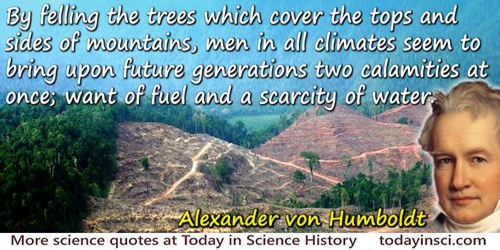
By felling the trees which cover the tops and sides of mountains, men in all climates seem to bring upon future generations two calamities at once; want of fuel and a scarcity of water.
In Alexander von Humboldt, Aimé Bonpland and Thomasina Ross (trans. and ed.) Personal Narrative of Travels to the Equinoctial Regions of America: During the Years 1799-1804 (1852), Vol. 2, 9. (Translated from the original in French.)
Chance may be the pseudonym God uses when He doesn't want to sign His name.
As quoted, without citation, by Marcus Bach, 'Serendiptiy in the Business World', in The Rotarian (Oct 1981), 139, No. 4, 40. If you know the primary source, please contact Webmaster.
Does it mean, if you don’t understand something, and the community of physicists don’t understand it, that means God did it? Is that how you want to play this game? Because if it is, here’s a list of the things in the past that the physicists—at the time—didn’t understand … [but now we do understand.] If that’s how you want to invoke your evidence for God, then God is an ever-receding pocket of scientific ignorance, that’s getting smaller and smaller and smaller, as time moves on. So just be ready for that to happen, if that’s how you want to come at the problem. That’s simply the “God of the Gaps” argument that’s been around for ever.
From interview, The Science Studio video series of The Science Network website, episode 'The Moon, the Tides and why Neil DeGrasse Tyson is Colbert’s God' (20 Jan 2011), time 26:58-27:55.
Einstein uses his concept of God more often than a Catholic priest. Once I asked him:
'Tomorrow is Sunday. Do you want me to come to you, so we can work?'
'Why not?'
'Because I thought perhaps you would like to rest on Sunday.'
Einstein settled the question by saying with a loud laugh: 'God does not rest on Sunday either.'
'Tomorrow is Sunday. Do you want me to come to you, so we can work?'
'Why not?'
'Because I thought perhaps you would like to rest on Sunday.'
Einstein settled the question by saying with a loud laugh: 'God does not rest on Sunday either.'
Quest: The Evolution of a Scientist (1941), 247.
Electricity is but yet a new agent for the arts and manufactures, and, doubtless, generations unborn will regard with interest this century, in which it has been first applied to the wants of mankind.
In Preface to the Third Edition ofElements of Electro-Metallurgy: or The Art of Working in Metals by the Galvanic Fluid (1851), viii.
Every body continues in its state of rest or uniform motion in a straight line, except in so far as it doesn’t. … The suggestion that the body really wanted to go straight but some mysterious agent made it go crooked is picturesque but unscientific.
Paraphasing Newton’s First Law of Motion. In a Gifford Lecture delivered at the University of Edinburgh (1927), 'Gravitation: The Law', The Nature of the Physical World (1928), 124.
Every day we are interacting with the economy, whether we want to or not, and whether we know it or not. To have a level of control over our lives, we need to understand the connections between money and events and ourselves.
As quoted in brochure for PBS TV financial news series, Adam Smith’s Money World.
Everybody likes to hear about a man laying down his life for his country, but nobody wants to hear about a country giving her shirt for her planet.
In 'The Wild Flag', The New Yorker (9 Sep 1944), 35. Quote collected in In the Words of E.B. White: Quotations from America’s Most Companionable of Writers (2011), 150.
Everybody now wants to discover universal laws which will explain the structure and behavior of the nucleus of the atom. But actually our knowledge of the elementary particles that make up the nucleus is tiny. The situation calls for more modesty. We should first try to discover more about these elementary particles and about their laws. Then it will be the time for the major synthesis of what we really know, and the formulation of the universal law.
As quoted in Robert Coughlan, 'Dr. Edward Teller’s Magnificent Obsession', Life (6 Sep 1954), 74.
Everywhere science is enriched by unscientific methods and unscientific results, ... the separation of science and non-science is not only artificial but also detrimental to the advancement of knowledge. If we want to understand nature, if we want to master our physical surroundings, then we must use all ideas, all methods, and not just a small selection of them.
Against Method: Outline of an Anarchistic Theory of Knowledge (1975), 305-6.
Exper. I. I made a small hole in a window-shutter, and covered it with a piece of thick paper, which I perforated with a fine needle. For greater convenience of observation I placed a small looking-glass without the window-shutter, in such a position as to reflect the sun's light, in a direction nearly horizontal, upon the opposite wall, and to cause the cone of diverging light to pass over a table on which were several little screens of card-paper. I brought into the sunbeam a slip of card, about one-thirtieth of an inch in breadth, and observed its shadow, either on the wall or on other cards held at different distances. Besides the fringes of colour on each side of the shadow, the shadow itself was divided by similar parallel fringes, of smaller dimensions, differing in number, according to the distance at which the shadow was observed, but leaving the middle of the shadow always white. Now these fringes were the joint effects of the portions of light passing on each side of the slip of card and inflected, or rather diffracted, into the shadow. For, a little screen being placed a few inches from the card, so as to receive either edge of the shadow on its margin, all the fringes which had before been observed in the shadow on the wall, immediately disappeared, although the light inflected on the other side was allowed to retain its course, and although this light must have undergone any modification that the proximity of the other edge of the slip of card might have been capable of occasioning... Nor was it for want of a sufficient intensity of light that one of the two portions was incapable of producing the fringes alone; for when they were both uninterrupted, the lines appeared, even if the intensity was reduced to one-tenth or one-twentieth.
'Experiments and Calculations Relative to Physical Optics' (read in 1803), Philosophical Transactions (1804), 94, 2-3.
Failure is a reality; we all fail at times, and it’s painful when we do. But it’s better to fail while striving for something wonderful, challenging, adventurous, and uncertain than to say, “I don’t want to try because I may not succeed completely.”
In Sources of Strength: Meditations on Scripture for a Living Faith (1999), 240.
Fed on the dry husks of facts, the human heart has a hidden want which science cannot supply.
Science and Immorality (1904), 76.
Felling a tree was possibly the original deed of appropriation of the natural earth by early mankind in Europe. Thousands of years ago,… man lifted a heavy flint tool and struck at the base of a tree. He may have wanted the tree for shelter and fuel, or possibly to make a bridge over a river or a path through a bog…. [E]ventually the tree crashed to the floor, and the first act in the slow possession of the land by its people was complete.
In The Man Who Made Things Out of Trees: The Ash in Human Culture and History (2015), Chap. 1.
First, as concerns the success of teaching mathematics. No instruction in the high schools is as difficult as that of mathematics, since the large majority of students are at first decidedly disinclined to be harnessed into the rigid framework of logical conclusions. The interest of young people is won much more easily, if sense-objects are made the starting point and the transition to abstract formulation is brought about gradually. For this reason it is psychologically quite correct to follow this course.
Not less to be recommended is this course if we inquire into the essential purpose of mathematical instruction. Formerly it was too exclusively held that this purpose is to sharpen the understanding. Surely another important end is to implant in the student the conviction that correct thinking based on true premises secures mastery over the outer world. To accomplish this the outer world must receive its share of attention from the very beginning.
Doubtless this is true but there is a danger which needs pointing out. It is as in the case of language teaching where the modern tendency is to secure in addition to grammar also an understanding of the authors. The danger lies in grammar being completely set aside leaving the subject without its indispensable solid basis. Just so in Teaching of Mathematics it is possible to accumulate interesting applications to such an extent as to stunt the essential logical development. This should in no wise be permitted, for thus the kernel of the whole matter is lost. Therefore: We do want throughout a quickening of mathematical instruction by the introduction of applications, but we do not want that the pendulum, which in former decades may have inclined too much toward the abstract side, should now swing to the other extreme; we would rather pursue the proper middle course.
Not less to be recommended is this course if we inquire into the essential purpose of mathematical instruction. Formerly it was too exclusively held that this purpose is to sharpen the understanding. Surely another important end is to implant in the student the conviction that correct thinking based on true premises secures mastery over the outer world. To accomplish this the outer world must receive its share of attention from the very beginning.
Doubtless this is true but there is a danger which needs pointing out. It is as in the case of language teaching where the modern tendency is to secure in addition to grammar also an understanding of the authors. The danger lies in grammar being completely set aside leaving the subject without its indispensable solid basis. Just so in Teaching of Mathematics it is possible to accumulate interesting applications to such an extent as to stunt the essential logical development. This should in no wise be permitted, for thus the kernel of the whole matter is lost. Therefore: We do want throughout a quickening of mathematical instruction by the introduction of applications, but we do not want that the pendulum, which in former decades may have inclined too much toward the abstract side, should now swing to the other extreme; we would rather pursue the proper middle course.
In Ueber den Mathematischen Unterricht an den hoheren Schulen; Jahresbericht der Deutschen Mathematiker Vereinigung, Bd. 11, 131.
For centuries we have dreamt of flying; recently we made that come true: we have always hankered for speed; now we have speeds greater than we can stand: we wanted to speak to far parts of the Earth; we can: we wanted to explore the sea bottom; we have: and so on, and so on. And, too, we wanted the power to smash our enemies utterly; we have it. If we had truly wanted peace, we should have had that as well. But true peace has never been one of the genuine dreams—we have got little further than preaching against war in order to appease out consciences.
The Outward Urge (1959)
For if as scientists we seek simplicity, then obviously we try the simplest surviving theory first, and retreat from it only when it proves false. Not this course, but any other, requires explanation. If you want to go somewhere quickly, and several alternate routes are equally likely to be open, no one asks why you take the shortest. The simplest theory is to be chosen not because it is the most likely to be true but because it is scientifically the most rewarding among equally likely alternatives. We aim at simplicity and hope for truth.
Problems and Projects (1972), 352.
For those who want some proof that physicists are human, the proof is in the idiocy of all the different units which they use for measuring energy.
In The Character of Physical Law (1967, 2001), 75.
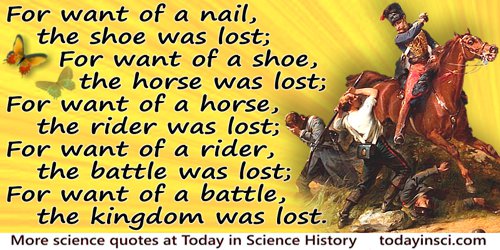
For want of a nail the shoe was lost; for want of a shoe the horse was lost; and for want of a horse, the rider was lost, being overtaken and slain by the enemy; all for the want of a horse-shoe nail.
As given in Benjamin Franklin, The Way to Wealth; As Clearly Shewn in the Preface of an Old Pennsylvania Almanack, Intitled, Poor Richard Improved (1774), 8. There are various other wordings of this proverb, including loss of the knight or message, the battle, the kingdom: “For want of a nail, the shoe was lost; For want of a shoe, the horse was lost; For want of a horse, the rider was lost; For want of a rider, the battle was lost; For want of a battle, the kingdom was lost.”
For want of timely care
Millions have died of medicable wounds.
Millions have died of medicable wounds.
Art of Preserving Health.
For, the great enemy of knowledge is not error, but inertness. All that we want is discussion, and then we are sure to do well, no matter what our blunders may be. One error conflicts with another; each destroys its opponent, and truth is evolved.
In History of Civilization in England (1861), Vol. 2, 408.
Fortunately Nature herself seems to have prepared for us the means of supplying that want which arises from the impossibility of making certain experiments on living bodies. The different classes of animals exhibit almost all the possible combinations of organs: we find them united, two and two, three and three, and in all proportions; while at the same time it may be said that there is no organ of which some class or some genus is not deprived. A careful examination of the effects which result from these unions and privations is therefore sufficient to enable us to form probable conclusions respecting the nature and use of each organ, or form of organ. In the same manner we may proceed to ascertain the use of the different parts of the same organ, and to discover those which are essential, and separate them from those which are only accessory. It is sufficient to trace the organ through all the classes which possess it, and to examine what parts constantly exist, and what change is produced in the respective functions of the organ, by the absence of those parts which are wanting in certain classes.
Letter to Jean Claude Mertrud. In Lectures on Comparative Anatomy (1802), Vol. I, xxiii--xxiv.
From earliest memory I wanted to be a surgeon, possibly influenced by the qualities of our family doctor who cared for our childhood ailments.
In Tore Frängsmyr and Jan E. Lindsten (eds.), Nobel Lectures: Physiology Or Medicine: 1981-1990 (1993), 555.
Get a scalpel, and practice just, say, cutting a piece of meat or something like that. You sort of learn how you want to hold your fingers, and that sort of thing, and try to become graceful when you operate.
Governments, universities and industry must put their faith in science and tell their people to study what they want to study.
From speech at the University of Saskatchewan, as quoted in Sean Trembath, 'Chemist Henry Taube Was Saskatchewan's First Nobel Laureate', Saskatoon StarPhoenix (5 Jan 2017).
He [Robert Boyle] is very tall (about six foot high) and straight, very temperate, and vertuouse, and frugall: a batcheler; keepes a Coach; sojournes with his sister, the Lady Ranulagh. His greatest delight is Chymistrey. He has at his sister’s a noble laboratory, and severall servants (Prentices to him) to look to it. He is charitable to ingeniose men that are in want, and foreigne Chymists have had large proofe of his bountie, for he will not spare for cost to get any rare Secret.
John Aubrey, Brief Lives (1680), edited by Oliver Lawson Dick (1949), 37.
Here I most violently want you to
Avoid one fearful error, a vicious flaw.
Don’t think that our bright eyes were made that we
Might look ahead; that hips and knees and ankles
So intricately bend that we might take
Big strides, and the arms are strapped to the sturdy shoulders
And hands are given for servants to each side
That we might use them to support our lives.
All other explanations of this sort
Are twisted, topsy-turvy logic, for
Nothing what is born produces its own use.
Sight was not born before the light of the eyes,
Nor were words and pleas created before the tongue
Rather the tongue's appearance long preceded
Speech, and the ears were formed far earlier than
The sound first heard. To sum up, all the members Existed, I should think, before their use, So use has not caused them to have grown.
Avoid one fearful error, a vicious flaw.
Don’t think that our bright eyes were made that we
Might look ahead; that hips and knees and ankles
So intricately bend that we might take
Big strides, and the arms are strapped to the sturdy shoulders
And hands are given for servants to each side
That we might use them to support our lives.
All other explanations of this sort
Are twisted, topsy-turvy logic, for
Nothing what is born produces its own use.
Sight was not born before the light of the eyes,
Nor were words and pleas created before the tongue
Rather the tongue's appearance long preceded
Speech, and the ears were formed far earlier than
The sound first heard. To sum up, all the members Existed, I should think, before their use, So use has not caused them to have grown.
On the Nature of Things, trans. Anthony M. Esolen (1995), Book 4, lines 820-8, 145.

History is more or less bunk. It’s tradition. We want to live in the present and the only history that is worth a tinker’s damn is the history we make today.
As quoted in interview by Charles Wheeler, Chicago Tribune (25 May 1916). Often misquoted, and misunderstood out of context, as “History is bunk”. There is much important context needed to interpret what Ford really meant by it. Articles have been written on that subject, for example, Roger Butterfield, 'Henry Ford, the Wayside Inn, and the Problem of “History Is Bunk”', Proceedings of the Massachusetts Historical Society (1965), 3rd Series, 77, 53-66.
I am a simple man and I want simple answers.
Said to be a favorite line a favorite line of his when challenging his students. As stated, without citation in Robert Slater, Portraits in Silicon (1987), 88.
I am afraid of radium and polonium ... I don’t want to monkey with them.
Quoted in 'Edison Fears Hidden Perils of the X-Rays', New York World (3 Aug 1903), 1.
I am always surprised when a young man tells me he wants to work at cosmology. I think of cosmology as something that happens to one, not something one can choose.
In Presidential Address (8 Feb 1963), Quarterly Journal of the Royal Astronomical Society (Mar 1963), 4, 185.
I am an atheist, out and out. It took me a long time to say it. I’ve been an atheist for years and years, but somehow I felt it was intellectually unrespectable to say one was an atheist, because it assumed knowledge that one didn't have. Somehow, it was better to say one was a humanist or an agnostic. I finally decided that I’m a creature of emotion as well as of reason. Emotionally, I am an atheist. I don't have the evidence to prove that God doesn’t exist, but I so strongly suspect he doesn’t that I don’t want to waste my time.
'Isaac Asimov on Science and the Bible'. In Sidney Hook, et. al. On the Barricades: Religion and Free Inquiry in Conflict (1989), 329.
I am awaiting the day when people remember the fact that discovery does not work by deciding what you want and then discovering it.
In 'How Not to Create Tigers', Physics Today (Aug 1999), 52, No. 8, 12. Collected in Why Quark Rhymes with Pork: And Other Scientific Diversions (2012), 150.
I am not merely satisfied in making money for myself, for I am endeavoring to provide employment for hundreds of women of my race. ... I want to say to every Negro woman present, don't sit down and wait for the opportunities to come. Get up and make them!
Address at the annual convention of the National Negro Business League (1914). As cited in Marshall Cavendish Corporation, America in the 20th Century (2003), Vol. 12, 273.
I am selling what the whole world wants: power.
In a letter to Catherine the Great of Russia offering steam engines for sale, in A Dictionary of Scientific Quotations by Alan L. Mackay (1991).
I believe citizens are beginning to realize that their birthright, a healthy ecosystem, has been stolen, and they want it back.
In The End of the Line: How Overfishing is Changing the World and what We Eat (2004), 317.
I believe in only one thing: liberty; but I do not believe in liberty enough to want to force it upon anyone.
…...
I believe that producing pictures, as I do, is almost solely a question of wanting so very much to do it well.
As quoted on the website mcescher.com, without citation.
I despise people who depend on these things [heroin and cocaine]. If you really want a mind-altering experience, look at a tree.
Quoted in interview by Tim Adams, 'This much I know: A.C. Grayling', The Observer (4 Jul 2009).
I didn’t really decide that I wanted to be an astronaut for sure until the end of college. But even in elementary school and junior high, I was very interested in space and in the space program. I had both male and female heroes. One was a high school science teacher who was very important in encouraging me to pursue science. Because I was a tennis player, Billie Jean King was a hero of mine. And the early astronauts, John Glenn and Neil Armstrong, were heroes of mine as well.
Interview conducted on Scholastic website (20 Nov 1998).
I do not believe in freedom of the will. Schopenhauer’s words: ‘Man can do what he wants, but he cannot will what he wills’ accompany me in all situations throughout my life and reconcile me with the actions of others even if they are rather painful to me. This awareness of the lack of freedom of will preserves me from taking too seriously myself and my fellow men as acting and deciding individuals and from losing my temper.
…...
I do not like to see all the fine boys turning to the study of law, instead of to the study of science or technology. … Japan wants no more lawyers now; and I think the professions of literature and of teaching give small promise. What Japan needs are scientific men; and she will need more and more of them every year.
In letter to Masanobu Ōtani (1894), collected in Elizabeth Bisland The Writings of Lafcadio Hearn (1922), Vol. 14, 273.
I do not personally want to believe that we already know the equations that determine the evolution and fate of the universe; it would make life too dull for me as a scientist. … I hope, and believe, that the Space Telescope might make the Big Bang cosmology appear incorrect to future generations, perhaps somewhat analogous to the way that Galileo’s telescope showed that the earth-centered, Ptolemaic system was inadequate.
From 'The Space Telescope (the Hubble Space Telescope): Out Where the Stars Do Not Twinkle', in NASA Authorization for Fiscal Year 1978: Hearings before the Committee on Commerce, Science and Transportation, United States Senate, 95th Congress, first session on S.365 (1977), 124. This was testimony to support of authorization for NASA beginning the construction of the Space Telescope, which later became known as the Hubble Space Telescope.
I do not remember having felt, as a boy, any passion for mathematics, and such notions as I may have had of the career of a mathematician were far from noble. I thought of mathematics in terms of examinations and scholarships: I wanted to beat other boys, and this seemed to be the way in which I could do so most decisively.
In A Mathematician's Apology (1940, reprint with Foreward by C.P. Snow 1992), 144.
I do not see how a man can work on the frontiers of physics and write poetry at the same time. They are in opposition. In science you want to say something that nobody knew before, in words which everyone can understand. In poetry you are bound to say ... something that everyone knows already in words that nobody can understand.
Commenting to him about the poetry J. Robert Oppenheimer wrote.
Commenting to him about the poetry J. Robert Oppenheimer wrote.
Quoted in Steven George Krantz, Mathematical Apocrypha Redux: More Stories and Anecdotes of Mathematicians (2005), 169
I do not want chemistry to degenerate into a religion; I do not want the chemist to believe in the existence of atoms as the Christian believes in the existence of Christ in the communion wafer.
Said to Alfred Nacquet in a debate on chemical education. Quoted in 'Berthelot', Berichte, 1908, 41, 4855.
I do not want to label myself a crystallographer as against a physicist and think indeed that though my research is concerned with crystals it is the physical side of it which attracts me.
In Letter (3 Jun 1929) to Ernest Rutherford, in Royal Society Archives, as quoted in David Phillips, Biographical Memoirs of Fellows of the Royal Society (Nov 1979), 25, 104.
I do not want to write beyond this point, because those days when I studied relentlessly are nostalgic to me; and on the other hand, I am sad when I think how I have become increasingly preoccupied with matters other than study.
Explaining why he went no further in his autobiography than 1934, the year he published his paper describing his great discovery, the meson theory. From the original Japanese autobiography Tabibito, translated as The Traveler (1982), 207.
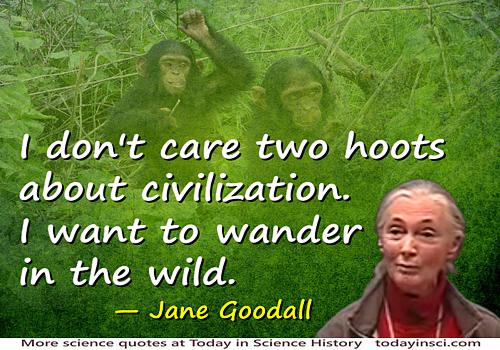
I don't care two hoots about civilization. I want to wander in the wild.
Repeating a remark made in the past to Dr. Leakey, as quoted by Nan Robertson in 'Three Who Have Chosen a Life in the Wild', New York Times (1 May 1981), B36. The article featured three primatologists (Dian Fossey, Biruté Galdikas and Goodall) at a symposium, 'What We Can Learn About Humankind From the Apes' at Sweet Briar College campus.
I don't really care how time is reckoned so long as there is some agreement about it, but I object to being told that I am saving daylight when my reason tells me that I am doing nothing of the kind. I even object to the implication that I am wasting something valuable if I stay in bed after the sun has risen. As an admirer of moonlight I resent the bossy insistence of those who want to reduce my time for enjoying it. At the back of the Daylight Saving scheme I detect the bony, blue-fingered hand of Puritanism, eager to push people into bed earlier, and get them up earlier, to make them healthy, wealthy and wise in spite of themselves.
In The Diary of Samuel Marchbanks (1947), 75.
I don’t have to be what you want me to be. I’m free to be what I want.
In Robert Lipsyte, 'Clay Discusses His Future, Liston and Black Muslims', New York Times (27 Feb 1964). (At age 22.)
I got a four year scholarship to Harvard, and while I was there they wanted to groom me for work in the Star Wars program designing weapons ignited by hydrogen bombs. I didn't want to do that. I thought about how many scientists had died in World War II.
Quoted in Nina L. Diamond, Voices of Truth (2000), 326.
I had made up my mind to find that for which I was searching even if it required the remainder of my life. After innumerable failures I finally uncovered the principle for which I was searching, and I was astounded at its simplicity. I was still more astounded to discover the principle I had revealed not only beneficial in the construction of a mechanical hearing aid but it served as well as means of sending the sound of the voice over a wire. Another discovery which came out of my investigation was the fact that when a man gives his order to produce a definite result and stands by that order it seems to have the effect of giving him what might be termed a second sight which enables him to see right through ordinary problems. What this power is I cannot say; all I know is that it exists and it becomes available only when a man is in that state of mind in which he knows exactly what he wants and is fully determined not to quit until he finds it.
As quoted, without citation, in Mack R. Douglas, Making a Habit of Success: How to Make a Habit of Succeeding, How to Win With High Self-Esteem (1966, 1994), 38. Note: Webmaster is dubious of a quote which seems to appear in only one source, without a citation, decades after Bell’s death. If you know a primary source, please contact Webmaster.
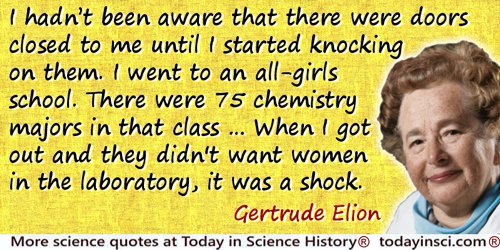
I hadn’t been aware that there were doors closed to me until I started knocking on them. I went to an all-girls school. There were 75 chemistry majors in that class, but most were going to teach it … When I got out and they didn't want women in the laboratory, it was a shock … It was the Depression and nobody was getting jobs. But I had taken that to mean nobody was getting jobs … [when I heard] “You're qualified. But we’ve never had a woman in the laboratory before, and we think you’d be a distracting influence.”
As quoted in Sharon Bertsch McGrayne, Nobel Prize Women in Science: Their Lives, Struggles and Momentous Discoveries (1993).
I happen to be a kind of monkey. I have a monkeylike curiosity that makes me want to feel, smell, and taste things which arouse my curiosity, then to take them apart. It was born in me. Not everybody is like that, but a scientific researchist should be. Any fool can show me an experiment is useless. I want a man who will try it and get something out of it.
Quoted in Guy Suits, ''Willis Rodney Whitney', National Academy of Sciences, Biographical Memoirs (1960), 357.
I have a true aversion to teaching. The perennial business of a professor of mathematics is only to teach the ABC of his science; most of the few pupils who go a step further, and usually to keep the metaphor, remain in the process of gathering information, become only Halbwisser [one who has superficial knowledge of the subject], for the rarer talents do not want to have themselves educated by lecture courses, but train themselves. And with this thankless work the professor loses his precious time.
Letter to Heinrich Olbers (26 Oct 1802). Quoted in G. Waldo Dunnington, Carl Friedrich Gauss: Titan of Science (2004), 414.
I have before mentioned mathematics, wherein algebra gives new helps and views to the understanding. If I propose these it is not to make every man a thorough mathematician or deep algebraist; but yet I think the study of them is of infinite use even to grown men; first by experimentally convincing them, that to make anyone reason well, it is not enough to have parts wherewith he is satisfied, and that serve him well enough in his ordinary course. A man in those studies will see, that however good he may think his understanding, yet in many things, and those very visible, it may fail him. This would take off that presumption that most men have of themselves in this part; and they would not be so apt to think their minds wanted no helps to enlarge them, that there could be nothing added to the acuteness and penetration of their understanding.
In The Conduct of the Understanding, Sect. 7.
I have considered the two terms you want to substitute for eisode and exode, and upon the whole I am disposed to recommend instead of them anode and cathode. These words may signify eastern and western way, just as well as the longer compounds which you mention … I may mention too that anodos and cathodos are good, genuine Greek words, and not compounds coined for the purpose.
Letter to Michael Faraday (25 Apr 1834). Quoted in I. Todhunter (ed.), William Whewell: An Account of His Writings with Selections From His Literary and Scientific Correspondence (1876), Vol. 2, 179.
I have never been disappointed upon asking microorganisms for whatever I wanted.
Quoted in Armin Fietchter, History of Modern Biology (2000), 43.
I have never really had dreams to fulfil…. You just want to go on looking at these ecosystems and trying to understand them and they are all fascinating. To achieve a dream suggests snatching a prize from the top of a tree and running off with it, and that’s the end of it. It isn’t like that. … What you are trying to achieve is understanding and you don’t do that just by chasing dreams.
From interview with Michael Bond, 'It’s a Wonderful Life', New Scientist (14 Dec 2002), 176, No. 2373, 52.
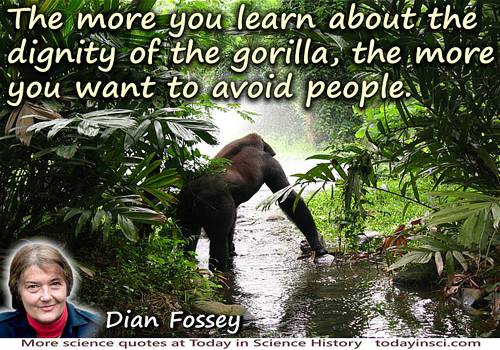
I have no friends. The more you learn about the dignity of the gorilla, the more you want to avoid people.
From article about interview (May 1985) with Associated Press East Africa Correspondent, Barry Shlachter, at her Karisoke Research Station. Syndicated in Summer 1985. Seen, for example, in Barry Shlachter, 'Woman Fierce Protector of Gorilla Friends', Lawrence Journal-World (29 Jul 1985), 7.
I just want to say one word to you—just one word ...“plastics!” ... There's a great future in plastics.
Advice by Mr. McGuire, a Los Angeles businessman to Ben Braddock (acted by Dustin Hoffman) in movie The Graduate (1967), based on the book by Charles Webb. In Graydon Carter, Vanity Fair's Tales of Hollywood: Rebels, Reds, and Graduates and the Wild Stories of 13 Iconic Films
the scene is attributed solely to Buck Henry (it did not appear in the original book) who added it when he took over the script writing from Calder Willingham.
I know each conversation with a psychiatrist in the morning made me want to hang myself because I knew I could not strangle him.
Attributed.
I learnt very quickly that the only reason that would be accepted for not attending a committee meeting was that one already had a previous commitment to attend a meeting of another organization on the same day. I therefore invented a society, the Orion Society, a highly secret and very exclusive society that spawned a multitude of committees, sub-committees, working parties, evaluation groups and so on that, regrettably, had a prior claim on my attention. Soon people wanted to know more about this club and some even decided that they would like to join it. However, it was always made clear to them that applications were never entertained and that if they were deemed to qualify for membership they would be discreetly approached at the appropriate time.
Loose Ends from Current Biology (1997), 14.
I love nuclear energy. I just want to make sure it stays where God put it—93 million miles away, in the sun.
In article, interview with Anne Underwood, 'Designing For The Future', Newsweek (15 May 2005).
I love to do research, I want to do research, I have to do research, and I hate to sit down and begin to do research—I always try to put it off just as long as I can.
In I Want to be a Mathematician: an Automathography (1985), 321.
I never pick up an item without thinking of how I might improve it. I never perfected an invention that I did not think about in terms of the service it might give others. I want to save and advance human life, not destroy it. I am proud of the fact that I never invented weapons to kill. The dove is my emblem.
…...
I remember being with my grandmother and mother and my uncle came in and asked what I wanted to be when grew up. I said ‘A doctor,’ which took him aback. He was expecting me to say ‘nurse’ or ‘actress.’ And my mother and grandmother laughed like, ‘Kids say the darndest things.’ I grew up in a time when women were not expected to do anything interesting.
As quoted in Anna Azvolinsky, 'Fearless About Folding', The Scientist (Jan 2016).
I remember working out a blueprint for my future when I was twelve years old I resolved first to make enough money so I'd never be stopped from finishing anything; second, that to accumulate money in a hurry—and I was in a hurry—I'd have to invent something that people wanted. And third, that if I ever was going to stand on my own feet, I'd have to leave home.
In Sidney Shalett, 'Aviation’s Stormy Genius', Saturday Evening Post (13 Oct 1956), 229, No. 15, 26 & 155
I saw a horrible brown heap on the floor in the corner, which, but for previous experience in this dismal wise, I might not have suspected to be “the bed.” There was something thrown upon it and I asked what it was. “’Tis the poor craythur that stays here, sur; and ’tis very bad she is, ’tis very bad she’s been this long time, and ’tis better she’ll never be, and ’tis slape she doos all day, and ’tis wake she doos all night, and ‘tis the lead, Sur.” “The what?” “The lead, Sur. Sure, ’tis the lead-mills, where women gets took on at eighteen pence a day, Sur, when they makes application early enough, and is lucky and wanted, and ’tis lead-pisoned she is, Sur, and some of them gits lead-pisoned soon and some of them gets lead-pisoned later, and some but not many, niver, and ’tis all according to the constitooshun, Sur, and some constitooshuns is strong, and some is weak, and her constitooshun is lead-pisoned, bad as can be, Sur, and her brain is coming out at her ear, and it hurts her dreadful, and that’s what it is and niver no more and niver so less, Sur.”
In 'New Uncommercial Samples: A Small Star in the East', All the Year Round (19 Dec 1868), New Series, No. 3, 62.
I should object to any experimentation which can justly be called painful, for the purpose of elementary instruction ... [but I regret] a condition of the law which permits a boy to troll for pike, or set lines with live frog bait, for idle amusement; and, at the same time, lays the teacher of that boy open to the penalty of fine and imprisonment, if he uses the same animal for the purpose of exhibiting one of the most beautiful and instructive of physiological spectacles, the circulation in the web of the foot. ... [Maybe the frog is] inconvenienced by being wrapped up in a wet rag, and having his toes tied out ... But you must not inflict the least pain on a vertebrated animal for scientific purposes (though you may do a good deal in that way for gain or for sport) without due licence of the Secretary of State for the Home Department, granted under the authority of the Vivisection Act.
... [Yet, in] 1877, two persons may be charged with cruelty to animals. One has impaled a frog, and suffered the creature to writhe about in that condition for hours; the other has pained the animal no more than one of us would be pained by tying strings round his fingers, and keeping him in the position of a hydropathic patient. The first offender says, 'I did it because I find fishing very amusing,' and the magistrate bids him depart in peace; nay, probably wishes him good sport. The second pleads, 'I wanted to impress a scientific truth, with a distinctness attainable in no other way, on the minds of my scholars,' and the magistrate fines him five pounds.
I cannot but think that this is an anomalous and not wholly creditable state of things.
... [Yet, in] 1877, two persons may be charged with cruelty to animals. One has impaled a frog, and suffered the creature to writhe about in that condition for hours; the other has pained the animal no more than one of us would be pained by tying strings round his fingers, and keeping him in the position of a hydropathic patient. The first offender says, 'I did it because I find fishing very amusing,' and the magistrate bids him depart in peace; nay, probably wishes him good sport. The second pleads, 'I wanted to impress a scientific truth, with a distinctness attainable in no other way, on the minds of my scholars,' and the magistrate fines him five pounds.
I cannot but think that this is an anomalous and not wholly creditable state of things.
'On Elementary Instruction in Physiology'. Science and Culture (1882), 92.
I spend a great deal of the hours that I’m awake within myself. You never want to stop doing it, especially when it’s a pleasure. It’s vital to my existence and I couldn’t live if I wasn’t an inventor.
Quoted in Timothy L. O’Brien, 'Not Invented here: Are U.S. Innovators Losing Their Competitive Edge?', New York Times (13 Nov 2005), B6.
I stand before you as somebody who is both physicist and a priest, and I want to hold together my scientific and my religious insights and experiences . I want to hold them together, as far as I am able, without dishonesty and without compartmentalism. I don’t want to be a priest on Sunday and a physicist on Monday; I want to be both on both days.
…...
I stand in favor of using seeds and products that have a proven track record. … There is a big gap between what the facts are, and what the perceptions are. … I mean “genetically modified” sounds Frankensteinish. Drought-resistant sounds really like something you’d want.
Speech at Biotechnology Industry Organization (BIO) convention, San Diego (Jun 2014). Audio on AgWired website.
I start with the seedling, and I don't want to leave it. I don't feel I really know the story if I don't watch the plant all the way along. So I know every plant in the field. I know them intimately, and I find it a real pleasure to know them.
In Jay B. McDaniel, 'Christian Spirituality as Openness to Fellow Creatures', Environmental Ethics (1986) 8(1), 34. Quoted in Charles Birch, Biology and the Riddle of Life (1999), 56.
I then began to study arithmetical questions without any great apparent result, and without suspecting that they could have the least connexion with my previous researches. Disgusted at my want of success, I went away to spend a few days at the seaside, and thought of entirely different things. One day, as I was walking on the cliff, the idea came to me, again with the same characteristics of conciseness, suddenness, and immediate certainty, that arithmetical transformations of indefinite ternary quadratic forms are identical with those of non-Euclidian geometry.
Science and Method (1908), trans. Francis Maitland (1914), 53-4.

I then shouted into M [the mouthpiece] the following sentence: “Mr. Watson—Come here—I want to see you.” To my delight he came and declared that he had heard and understood what I said. I asked him to repeat the words. He answered “You said—‘Mr. Watson—-come here—I want to see you.’” We then changed places and I listened at S [the reed receiver] while Mr. Watson read a few passages from a book into the mouth piece M. It was certainly the case that articulate sounds proceeded from S. The effect was loud but indistinct and muffled. If I had read beforehand the passage given by Mr. Watson I should have recognized every word. As it was I could not make out the sense—but an occasional word here and there was quite distinct. I made out “to” and “out” and “further”; and finally the sentence “Mr. Bell do you understand what I say? Do—you—un—der—stand—what—I—say” came quite clearly and intelligibly. No sound was audible when the armature S was removed.
Notebook, 'Experiments made by A. Graham Bell, vol. I'. Entry for 10 March 1876. Quoted in Robert V. Bruce, Bell: Alexander Graham Bell and the Conquest of Solitude (1973), 181.
I think at the moment we did not even want to break the seal [on the inner chamber of the tomb of Tutankhamen], for a feeling of intrusion had descended heavily upon us... We felt that we were in the presence of the dead King and must do him reverence, and in imagination could see the doors of the successive shrines open one.
Howard Carter, Arthur Cruttenden Mace, The Discovery of the Tomb of Tutankhamen (reprint 1977), 183.
I think of the ocean as the blue heart of the planet. Well, how much of your heart do you want to protect?
From narration to the short, hand-drawn animated film for World Ocean’s Day 2013, Ideas For Change.
I thought it was a miracle that I got this faculty appointment and was so happy to be there for a few years that I just wanted to follow what was exciting for me. I didn’t have expectations of getting tenure. So this was an aspect of gender inequality that was extremely positive. It allowed me to be fearless.
As quoted in Anna Azvolinsky, 'Fearless About Folding', The Scientist (Jan 2016).
I took biology in high school and didn't like it at all. It was focused on memorization. ... I didn't appreciate that biology also had principles and logic ... [rather than dealing with a] messy thing called life. It just wasn't organized, and I wanted to stick with the nice pristine sciences of chemistry and physics, where everything made sense. I wish I had learned sooner that biology could be fun as well.
Interview (23 May 1998), 'Creating the Code to Life', Academy of Achievement web site.
I use the word nursing for want of a better. It has been limited to signify little more than the administration of medicines and the application of poultices. It ought to signify the proper use of fresh air, light, warmth, cleanliness, quiet, and the proper selection and administration of diet—all at the least expense of vital power to the patient.
Notes on Nursing: What it is and what it is not (1860), 2.
I want my books sold on airport bookstalls.
Interview with Deborah Solomon, 'The Science of Second-Guessing', in New York Times Magazine (12 Dec 2004), 37.
I want to argue that the ‘sudden’ appearance of species in the fossil record and our failure to note subsequent evolutionary change within them is the proper prediction of evolutionary theory as we understand it ... Evolutionary ‘sequences’ are not rungs on a ladder, but our retrospective reconstruction of a circuitous path running like a labyrinth, branch to branch, from the base of the bush to a lineage now surviving at its top.
…...

I want to find a voracious, small-minded predator and name it after the IRS.
Quoted, without citation, in E. Gene Davis, Get 'Em Laughing: Public Speaking Humor, Quotes and Illustrations (2007), 195.
I want to get back again from Chemistry to Physics as soon as I can. The second-rate men seem to know their place so much better.
R. J. Strutt, John William Strutt, Third Baron Rayleigh (1924), 222.
I want to get out in the water. I want to see fish, real fish, not fish in a laboratory.
Interview (27 Jan 1991), on Academy of Achievement website.
I want to know God’s thoughts; the rest are details.
…...
I want to know how God created this world. I am not interested in this or that phenomenon, in the spectrum of this or that element. I want to know His thoughts; the rest are details.
…...
I want to note that, because there is the aforementioned difference between mountain and mountain, it will be appropriate, to avoid confusion, to distinguish one [type] from another by different terms; so I shall call the first Primary and the second Secondary.
From De’ Crostacei e degli altri Marini Corpi che si truovano su’ monti (1740), 263, as translated by Ezio Vaccari, from the original Italian, “Qui sol piacemi notare, che, giacchè tra monti e monti v’è l'accennata differenza, farà bene, per ischifar la confusione , distinguere gli uni dagli altri con differenti vocaboli; e perciò i primi Primarie, i secondi Secondarie monti per me si appelleranno.”
I want to put in something about Bernoulli’s numbers, in one of my Notes, as an example of how the implicit function may be worked out by the engine, without having been worked out by human head & hands first. Give me the necessary data & formulae.
Lovelace Papers, Bodleian Library, Oxford University, 42, folio 12 (6 Feb 1841). As quoted and cited in Dorothy Stein (ed.), 'This First Child of Mine', Ada: A Life and a Legacy (1985), 106-107.
I want to stay as close to the edge as I can without going over. Out on the edge you see all kinds of things you can't see from the center.
Player Piano (1999), 84. In Gary William Flake, The Computational Beauty of Nature (2000), 327.
I want to turn women loose on the environmental crisis…. Nobody knows more about pollution when detergents back up in the sink.
In Unity, Freedom & Peace: A Blueprint for Tomorrow (1968), 87.
I want us to save the creation—not just care about it, but to save it.
From transcript of PBS TV program 'Religion and Ethics' (17 Nov 2006).
I want you to understand I shall not hold you to any [medieval] code of faithfulness to me nor shall I consider myself bound to you similarly.
From note to her husband-to-be, George P. Putnam, on the morning of their wedding (7 Feb 1931). As quoted in Mary S. Lovell, The Sound of Wings (1989), 166. Earhart’s misspelling as “midaevil” in the original note has been corrected to “medieval” above.
I wanted certainty in the kind of way in which people want religious faith. I thought that certainty is more likely to be found in mathematics than elsewhere. But I discovered that many mathematical demonstrations, which my teachers expected me to accept, were full of fallacies, and that, if certainty were indeed discoverable in mathematics, it would be in a new field of mathematics, with more solid foundations than those that had hitherto been thought secure. But as the work proceeded, I was continually reminded of the fable about the elephant and the tortoise. Having constructed an elephant upon which the mathematical world could rest, I found the elephant tottering, and proceeded to construct a tortoise to keep the elephant from falling. But the tortoise was no more secure than the elephant, and after some twenty years of very arduous toil, I came to the conclusion that there was nothing more that I could do in the way of making mathematical knowledge indubitable.
In 'Reflections on my Eightieth Birthday', Portraits from Memory (1956), 54.
I wanted some new names to express my facts in Electrical science without involving more theory than I could help & applied to a friend Dr Nicholl [his doctor], who has given me some that I intend to adopt for instance, a body decomposable by the passage of the Electric current, I call an ‘electrolyte’ and instead of saying that water is electro chemically decomposed I say it is ‘electrolyzed’. The intensity above which a body is decomposed beneath which it conducts without decomposition I call the ‘Electrolyte intensity’ &c &c. What have been called: the poles of the battery I call the electrodes they are not merely surfaces of metal, but even of water & air, to which the term poles could hardly apply without receiving a new sense. Electrolytes must consist of two parts which during the electrolization, are determined the one in the one direction, and the other towards the poles where they are evolved; these evolved substances I call zetodes, which are therefore the direct constituents of electrolites.
Letter to William Whewell (24 Apr 1834). In Frank A. J. L. James (ed.), The Correspondence of Michael Faraday: Volume 2, 1832-1840 (1993), 176.
I wanted to be a scientist from my earliest school days. The crystallizing moment came when I first caught on that stars are mighty suns, and how staggeringly far away they must be to appear to us as mere points of light. I’m not sure I even knew the word science then, but I was gripped by the prospect of understanding how things work, of helping to uncover deep mysteries, of exploring new worlds.
In 'With Science on Our Side', Washington Post (9 Jan 1994).
I wanted to see what no one had yet observed, even if I had to pay for this curiosity with my life.
Twenty Thousand Leagues Under the Sea translated by Walter James Miller and Frederick Paul Walter (1870). In Gary Westfahl, Science Fiction Quotations: From the Inner Mind to the Outer Limits (2006), 116.
I was interested in flying beginning at age 7, when a close family friend took me in his little airplane. And I remember looking at the wheel of the airplane as we rolled down the runway, because I wanted to remember the exact moment that I first went flying... the other thing growing up is that I was always interested in science.
…...
I was just so interested in what I was doing I could hardly wait to get up in the morning and get at it. One of my friends, a geneticist, said I was a child, because only children can't wait to get up in the morning to get at what they want to do.
Quoted in Evelyn Fox Keller, A Feeling for the Organism: The Life and Work of Barbara McClintock (1984), 70.
I was the only female in my class. I sat on one side of the room and the guys on the other side of the room. I guess they didn't want to associate with me. But I could hold my own with them, and sometimes did better.
In interview with Laurel M. Sheppard, 'An Interview with Mary Ross: First Native American Woman Engineer Aerospace Pioneer Returns to her Native American Roots', on website of Lash Publications.
I wish they would use English instead of Greek words. When I want to know why a leaf is green, they tell me it is coloured by “chlorophyll,” which at first sounds very instructive; but if they would only say plainly that a leaf is coloured green by a thing which is called “green leaf,” we should see more precisely how far we had got.
The word “chlorophyll” is formed from the Greek words for “green” “leaf.” In The Queen of the Air: a Study of the Greek Myths of Cloud and Storm (1869, 1889), 51.
I would like to see us continue to explore space. There's just a lot for us to keep learning. I think it’s a good investment, so on my list of things that I want our country to invest in—in terms of research and innovation and science, basic science, exploring space, exploring our oceans, exploring our genome—we’re at the brink of all kinds of new information. Let's not back off now!
At Town Hall Meeting, Dover, New Hampshire (16 Jul 2015). As quoted in Clare Foran, 'Hillary Clinton: I Wanted to Be an Astronaut', National Journal (16 Jul 2015).
I… formerly had two pair of spectacles, which I shifted occasionally, as in travelling I sometimes read, and often wanted to regard the prospects. Finding this change troublesome, and not always sufficiently ready, I had the glasses cut, and half of each kind associated in the same circle. … By this means, as I wear my spectacles constantly, I have only to move my eyes up or down, as I want to see distinctly far or near, the proper glasses being always ready.
Letter (23 May 1785) to George Wheatley). Collected in William Temple Franklin (ed.), The Works of Dr. Benjamin Franklin (1809), Vol. 6, 168.
I’m addicted to the entire planet. I don’t want to leave it. I want to get down into it. I want to say hello. On the beach, I could have stopped all day long and looked at those damned shells, looked for all the messages that come not in bottles but in shells...
In Encounters with the Archdruid (1971), 144.
I’m astounded by people who want to “know” the universe when its hard enough to find your way around Chinatown.
Getting Even. In Lily Splane, Quantum Consciousness (2004),307
I’m sick of people thinking that efficiency is going to be sufficient. I’m sick of seeing people say, “I’m going to reduce my carbon footprint,” and think that being less bad is being good. … I want healthy, safe things in closed cycles, not just being less bad.
In interview with Kerry A. Dolan, 'William McDonough On Cradle-to-Cradle Design', Forbes (4 Aug 2010)
I’ve been turning it over in after-dinner speeches, but it looks awkward—it’s not what people are
used to—it wants a good deal of Latin to make it go down.
From Felix Holt: The Radical (1866), Vol. 1, 59.
Idleness, assuming the specious disguise of industry, will lull to sleep all suspicion of our want of an active exertion of strength.
In Discourse XII, Discourses on Painting and the Fine Arts: Delivered at the Royal Academy (1826), 226
If any student comes to me and says he wants to be useful to mankind and go into research to alleviate human suffering, I advise him to go into charity instead. Research wants real egotists who seek their own pleasure and satisfaction, but find it in solving the puzzles of nature.
In Science Today (May 1980), 35. In Vladimir Burdyuzha, The Future of Life and the Future of Our Civilization (2006), 374.
If God wanted man to become a space faring species, He would have given man a moon.
…...
If I want to stop a research program I can always do it by getting a few experts to sit in on the subject, because they know right away that it was a fool thing to try in the first place.
If my legs give up, they give up. But in that case I could sit and do programmes about amoebas—Micro Monsters, perhaps. What else do you want to do? Sit by the fire and read yesterday’s newspaper?
Stating his intent to never retire. Reported by Adam Lusher in 'Sir David Attenborough', Daily Mail (28 Feb 2014).
If the current flow is taking you where you want to go, don’t argue.
Aphorism as given by the fictional character Dezhnev Senior, in Fantastic Voyage II: Destination Brain (1987), 136.
If the germ plasm wants to swim in the ocean, it makes itself a fish; if the germ plasm wants to fly in the air, it makes itself a bird. If it wants to go to Harvard, it makes itself a man. The strangest thing of all is that the germ plasm that we carry around within us has done all those things. There was a time, hundreds of millions of years ago, when it was making fish. Then … amphibia … reptiles … mammals, and now it’s making men.
In talk, 'Origin of Death' (1970). Wald gave the context whereby the most one-celled organisms continued to reproduce by cell division.
If the human race wants to go to hell in a basket, technology can help it get there by jet. It won’t change the desire or the direction, but it can greatly speed the passage.
In a speech at Wake Forest University, Winston-Salem, North Carolina, April 25, 1967.
If the Humours of the Eye by old Age decay, so as by shrinking to make the Cornea and Coat of the Crystalline Humour grow flatter than before, the Light will not be refracted enough, and for want of a sufficient Refraction will not converge to the bottom of the Eye but to some place beyond it, and by consequence paint in the bottom of the Eye a confused Picture, and according to the Indistinctuess of this Picture the Object will appear confused. This is the reason of the decay of sight in old Men, and shews why their Sight is mended by Spectacles. For those Convex glasses supply the defect of plumpness in the Eye, and by increasing the Refraction make the rays converge sooner, so as to convene distinctly at the bottom of the Eye if the Glass have a due degree of convexity. And the contrary happens in short-sighted Men whose Eyes are too plump. For the Refraction being now too great, the Rays converge and convene in the Eyes before they come at the bottom; and therefore the Picture made in the bottom and the Vision caused thereby will not be distinct, unless the Object be brought so near the Eye as that the place where the converging Rays convene may be removed to the bottom, or that the plumpness of the Eye be taken off and the Refractions diminished by a Concave-glass of a due degree of Concavity, or lastly that by Age the Eye grow flatter till it come to a due Figure: For short-sighted Men see remote Objects best in Old Age, and therefore they are accounted to have the most lasting Eyes.
Opticks (1704), Book 1, Part 1, Axiom VII, 10-11.

If the present arrangements of society will not admit of woman’s free development, then society must be remodelled, and adapted to the great wants of humanity.
From letter (12 Aug 1848) to Emily Collins, reproduced in Elizabeth Cady Stanton, Susan Brownell Anthony, Matilda Joslyn Gage, History of Woman Suffrage (1881), Vol. 1, 91.
If this “critical openminded attitude” … is wanted, the question at once arises, Is it science that should be studied in order to achieve it? Why not study law? A judge has to do everything that a scientist is exhorted to do in the way of withholding judgment until all the facts are in, and then judging impartially on the merits of the case as well as he can. … Why not a course in Sherlock Holmes? The detectives, or at least the detective-story writers, join with the scientists in excoriating “dogmatic prejudice, lying, falsification of facts, and data, and willful fallacious reasoning.”
In Science is a Sacred Cow (1950), 191.
If this [the Mysterium cosmographicum] is published, others will perhaps make discoveries I might have reserved for myself. But we are all ephemeral creatures (and none more so than I). I have, therefore, for the Glory of God, who wants to be recognized from the book of Nature, that these things may be published as quickly as possible. The more others build on my work the happier I shall be.
Letter to Michael Maestlin (3 Oct 1595). Johannes Kepler Gesammelte Werke (1937- ), Vol. 13, letter 23, l. 251, p. 39-40.
If tombstones were still in style, I would want to have the two words [“Renaissance hack”] chiseled right under my name.
In an encounter Flanagan had with The New Yorker film critic, Pauline Kael, she claimed to knew nothing about science. He gently scolded her. Kael responded with the genial retort: “Oh, you're a Renaissance hack,” a description which pleased him. Recounted in Flanagan's Version: A Spectator's Guide to Science on the Eve of the 21st Century (1988), 3.
If we die, we want people to accept it. We’re in a risky business, and we hope that if anything happens to us it will not delay the program. The conquest of space is worth the risk of life.
As quoted in John Andrews Barbour, Footprints on the Moon (1969), 125.
If we drove an automobile the way we try to run civilization, I think we would face backwards, looking through the back window, admiring where we came from, and not caring where we are going. If you want a good life you must look to the future. … I think it is all right to have courses in history. But history is the “gonest” thing in the world. … Let’s keep history, but let’s take a small part of the time and study where we are going. … We can do something about the unmade history.
As quoted in book review, T.A. Boyd, 'Charles F. Kettering: Prophet of Progress', Science (30 Jan 1959), 256.
If we want an answer from nature, we must put our questions in acts, not words, and the acts may take us to curious places. Some questions were answered in the laboratory, others in mines, others in a hospital where a surgeon pushed tubes in my arteries to get blood samples, others on top of Pike’s Peak in the Rocky Mountains, or in a diving dress on the bottom of the sea. That is one of the things I like about scientific research. You never know where it will take you next.
From essay 'Some Adventures of a Biologist', as quoted in Ruth Moore, Man, Time, And Fossils (1953), 174.
If we want to solve a problem that we have never solved before, we must leave the door to the unknown ajar.
In 'The Value of Science,' What Do You Care What Other People Think? (1988, 2001), 247. Collected in The Pleasure of Finding Things Out (2000), 149.
If you advertise to tell lies, it will ruin you, but if you advertise to tell the public the truth, and particularly to give information, it will bring you success. I learned early that to tell a man how best to use tires, and to make him want them, was far better than trying to tell him that your tire is the best in the world. If you believe that yours is, let your customer find it out.
As quoted by H.M. Davidson, in System: The Magazine of Business (Apr 1922), 41, 446.
If you could see what I almost daily see in my practice … persons … in the very last stages of wretched existence, emaciated to a skeleton, with both tables of the skull almost completely perforated in many places, half the nose gone, with rotten jaws, ulerated throats, breaths most pestiferous more intolerable than poisonous upas, limbs racked with the pains of the Inquisition, minds as imbecile as the puling babe, a grievous burden to themselves and a disgusting spectacle to others, you would exclaim as I have often done, 'O! the lamentable want of science that dictates the abuse (use) of that noxious drug calomel!'
[Calomel is the mercury compound, Hg2Cl2.]
[Calomel is the mercury compound, Hg2Cl2.]
Quoted in Wooster Beach, A Treatise on Anatomy, Physiology, and Health (1848), 177.
If you don’t wake up at three in the morning and want to do something, you’re wasting your time.
As quoted in J. Kim Vandiver and Pagan Kennedy, 'Harold Eugene Edgerton', Biographical Memoirs (National Academy of Sciences, 2005), Vol. 86, 111.
If you want excellence, you must aim at perfection. It has its drawbacks but being finicky is essential.
Quoted in India Today (Apr 2008), 33, No 16, as cited on webpage of Dhirubhai Ambani Institute of Information and Communication Technology.
If you want my opinion on the mystery of life and all that, I can give it to you in a nutshell; the universe is like a safe to which there is a key. But the key is locked up in the safe.
John Mitchinson and John Lloyd, If Ignorance Is Bliss, Why Aren't There More Happy People?: Smart Quotes for Dumb Times (2009), 217.
If you want to achieve conservation, the first thing you have to do is persuade people that the natural world is precious, beautiful, worth saving and complex. If people don’t understand that and don’t believe that in their hearts, conservation doesn't stand a chance. That’s the first step, and that is what I do.
From interview with Michael Bond, 'It’s a Wonderful Life', New Scientist (14 Dec 2002), 176, No. 2373, 48.
If you want to be a physicist, you must do three things—first, study mathematics, second, study more mathematics, and third, do the same.
Interview with Paul H. Kirkpatrick, in Daniel J. Kevles, The Physicists (1978), 200.
If you want to become a chemist, you will have to ruin your health. If you don’t ruin your health studying, you won’t accomplish anything these days in chemistry.
Liebig's advice to Kekulé. Quoted in Berichte der Deutschen Chemischen Gesellschaft, 23, 1890. Trans. W. H. Brock.
If you want to build a ship, don’t recruit the men to gather the wood, divide the work and give orders. Instead, teach them to yearn for vast and endless sea.
Not found as such in a work by Saint-Exupéry. Probably an anonymous paraphrase of a related passage in Citadelle (1948), section 75, 687. See the quote beginning, “One will weave the canvas…” on the Antoine de Saint-Exupéry Quotes page of this website.
If you want to find out anything from the theoretical physicists about the methods they use, I advise you to stick closely to one principle: don't listen to their words, fix your attention on their deeds. To him who is a discoverer in this field the products of his imagination appear so necessary and natural that he regards them, and would like to have them regarded by others, not as creations of thought but as given realities.
From 'On the Method of Theoretical Physics', in Essays in Science (1934, 2004), 12.
If you want to grow old as a pilot, you’ve got to know when to push it, and when to back off.
If you want to hear, you must begin by listening.
Aphorism as given by the fictional character Dezhnev Senior, in Fantastic Voyage II: Destination Brain (1987), 238.
If you want to kill any idea in the world, get a committee working on it.
If you want to know if water is boiling, don’t test it by hand.
Aphorism as given by the fictional character Dezhnev Senior, in Fantastic Voyage II: Destination Brain (1987), 157.
If you want to penetrate into the heart of physics, then let yourself be initiated into the mysteries of poetry.
Friedrich Schlegel's Lucinde and the Fragments, trans. Peter Firchow (1971), 250.
If you want to really understand about a tumor, you've got be be a tumor.
Quoted in Evelyn Fox Keller, A Feeling for the Organism: The Life and Work of Barbara McClintock (1984), 207.
If you want to save your child from polio, you can pray or you can inoculate. ... Choose science.
The Demon-Haunted World (1996), 30.
If you want to see an endangered species, get up and look in the mirror.
As quoted on the nmspacemuseum.org website of the New Mexico Museum of Space History.
If you want to succeed in this world you don’t have to be much cleverer than other people, you just have to be one day earlier.
In Leo Szilard: His Version of the Facts edited by S. R. Weart and G. W. Szilard (1978).
If you want to understand human beings, there are plenty of people to go to besides psychologists.... Most of these people are incapable of communicating their knowledge, but those who can communicate it are novelists. They are good novelists precisely because they are good psychologists.
In Science is a Sacred Cow (1950), 128.
If you want your children to be intelligent, read them fairy tales. If you want them to be more intelligent, read them more fairy tales.
…...
If you wish to make an apple pie from scratch, you must first invent the universe.
From Cosmos (1980), 218. Variants are found which switch words such as: want/wish ; from/truly from ; invent/create.
Imagine a school-boy who has outgrown his clothes. Imagine the repairs made on the vestments where the enlarged frame had burst the narrow limits of the enclosure. Imagine the additions made where the projecting limbs had fairly and far emerged beyond the confines of the garment. Imagine the boy still growing, and the clothes, mended allover, now more than ever in want of mending—such is chemistry, and such is nomenclature.
Chemical Recreations (1834), 206, footnote.
In 1891, during the Presidency of William Henry Harrison [Benjamin Harrison], electric lights were first installed in the White House, the residence of the leaders of our country. At that time, commercial electricity was not economically feasible, but President Harrison wanted to affirm his confidence in the technological capability of our country.
Speech, at dedication of solar panels on the White House roof, 'Solar Energy Remarks Announcing Administration Proposals' (20 Jun 1979).
In 1912 I went to a book sale and bought ten books for fifty cents. One of the books was by Ostwald The Scientific Foundations of Analytical Chemistry. Ostwald wrote at the beginning of that book that analytical chemists are the maidservants of other chemists. This made quite an impression on me, because I didn't want to be a maidservant.
Comment during interview, Beckman Center (15 March 1984), as recorded on tape held by The Chemical Heritage Foundation, Philadelphia. Quotation provided by W. H. Brock.
In fulfilling the wants of the public, a manufacturer should keep as far ahead as his imagination and his knowledge of his buying public will let him. One should never wait to see what it is a customer is going to want. Give him, rather, what he needs, before he has sensed that need himself.
As quoted by H.M. Davidson, in System: The Magazine of Business (Apr 1922), 41, 413.
In my opinion instruction is very purposeless for such individuals who do no want merely to collect a mass of knowledge, but are mainly interested in exercising (training) their own powers. One doesn't need to grasp such a one by the hand and lead him to the goal, but only from time to time give him suggestions, in order that he may reach it himself in the shortest way.
Letter to Heinrich Schumacher (2 Oct 1808). Quoted in G. Waldo Dunnington, Carl Friedrich Gauss: Titan of Science (2004), 416.
In order to pursue chemotherapy successfully we must look for substances which possess a high affinity and high lethal potency in relation to the parasites, but have a low toxicity in relation to the body, so that it becomes possible to kill the parasites without damaging the body to any great extent. We want to hit the parasites as selectively as possible. In other words, we must learn to aim and to aim in a chemical sense. The way to do this is to synthesize by chemical means as many derivatives as possible of relevant substances.
'Ueber den jetzigen Stand der Chemotherapie'. Berichte der Deutschen Chemischen Gesellschagt, 1909, 42, 17-47. Translated in B. Holmstedt and G. Liljestrand (eds.), Readings in Pharmacology (1963), 286.
In our search after the Knowledge of Substances, our want of Ideas, that are suitable to such a way of proceeding, obliges us to a quite different method. We advance not here, as in the other (where our abstract Ideas are real as well as nominal Essences) by contemplating our Ideas, and considering their Relations and Correspondencies; that helps us very little, for the Reasons, and in another place we have at large set down. By which, I think it is evident, that Substances afford Matter of very little general Knowledge; and the bare Contemplation of their abstract Ideas, will carry us but a very little way in the search of Truth and Certainty. What then are we to do for the improvement of our Knowledge in Substantial beings? Here we are to take a quite contrary Course, the want of Ideas of their real essences sends us from our own Thoughts, to the Things themselves, as they exist.
An Essay Concerning Human Understanding (1690). Edited by Peter Nidditch (1975), Book 4, Chapter 12, Section 9, 644.
In outer space you develop an instant global consciousness, a people orientation, an intense dissatisfaction with the state of the world, and a compulsion to do something about it. From out there on the moon, international politics look so petty. You want to grab a politician by the scruff of the neck and drag him a quarter of a million miles out and say, “Look at that, you son of a bitch.”
…...
In some respects, science has far surpassed religion in delivering awe. How is it that hardly any major religion has looked at science and concluded, “This is better than we thought! The Universe is much bigger than our prophets said, grander, more subtle, more elegant. God must be even greater than we dreamed”? Instead they say, 'No, no, no! My god is a little god, and I want him to stay that way.'
Pale Blue Dot: A Vision of the Human Future in Space (1994), 52.
In the republic of scholarship everybody wants to rule, there are no aldermen there, and that is a bad thing: every general must, so to speak, draw up the plan, stand sentry, sweep out the guardroom and fetch the water; no one wants to work for the good of another.
Aphorism 80 in Notebook D (1773-1775), as translated by R.J. Hollingdale in Aphorisms (1990). Reprinted as The Waste Books (2000), 56.
In the world of science different levels of esteem are accorded to different kinds of specialist. Mathematicians have always been eminently respectable, and so are those who deal with hard lifeless theories about what constitutes the physical world: the astronomers, the physicists, the theoretical chemists. But the more closely the scientist interests himself in matters which are of direct human relevance, the lower his social status. The real scum of the scientific world are the engineers and the sociologists and the psychologists. Indeed, if a psychologist wants to rate as a scientist he must study rats, not human beings. In zoology the same rules apply. It is much more respectable to dissect muscle tissues in a laboratory than to observe the behaviour of a living animal in its natural habitat.
From transcript of BBC radio Reith Lecture (12 Nov 1967), 'A Runaway World', on the bbc.co.uk website.
In want of other proofs, the thumb would convince me of the existence of a God.
Quoted in Kim Lim (ed.), 1,001 Pearls of Spiritual Wisdom: Words to Enrich, Inspire, and Guide Your Life (2014), 42
Invention breeds invention. No sooner is the electric telegraph devised than gutta-percha, the very material it requires, is found. The aeronaut is provided with gun-cotton, the very fuel he wants for his balloon.
In Ralph Waldo Emerson and J.E. Cabot (ed.), Emerson's Complete Works (1884), Vol. 7, 161.
It did not take atomic weapons to make man want peace. But the atomic bomb was the turn of the screw. The atomic bomb made the prospect of future war unendurable. It has led us up those last few steps to the mountain pass; and beyond there is a different country.
Commencement address (1946). As quoted in book review (of Richard Rhodes, The Making of the Atomic Bomb), by William J. Broad, ‘The Men Who Made the Sun Rise', New York Times Book Review (8 Feb 1987), 39. Cited as from 'The Atomic Bomb and College Education' (1946), in Bartlett's Familiar Quotations (18th ed., 2014).
as quoted, without citation, in . Please contact Webmaster if you know a primary source.
It has always seemed to me extreme presumptuousness on the part of those who want to make human ability the measure of what nature can and knows how to do, since, when one comes down to it, there is not one effect in nature, no matter how small, that even the most speculative minds can fully understand.
…...
It has been my misfortune never to have had any neighbours whose studies have led them towards the pursuit of natural knowledge; so that, for want of a companion to quicken my industry and sharpen my attention, I have made but slender progress in a kind of information to which I have been attached from my childhood.
In Letter to Thomas Pennant (4 Aug 1767), in The Natural History and Antiquities of Selborne (1789), 27.
It is clear that the twentieth century is the most disturbed century within the memory of humanity. Any contemporary of ours who wants peace and comfort above all has chosen a bad time to be born.
In 'On the New Germany', Manchester Guardian (22 Mar 1933). Also seen paraphrased as, “Anyone desiring a quiet life has done badly to be born in the twentieth century.”
It is easy to overlook this thought that life just is. As humans we are inclined to feel that life must have a point. We have plans and aspirations and desires. We want to take constant advantage of the intoxicating existence we’ve been endowed with. But what’s life to a lichen? Yet its impulse to exist, to be, is every bit as strong as ours-arguably even stronger. If I were told that I had to spend decades being a furry growth on a rock in the woods, I believe I would lose the will to go on. Lichens don’t. Like virtually all living things, they will suffer any hardship; endure any insult, for a moment’s additions existence. Life, in short just wants to be.
…...
It is evident that scientists and philosophers can help each other. For the scientist sometimes wants a new idea, and the philosopher is enlightened as to meanings by the study of the scientific consequences.
From Epilogue to a collection of lectures, 'The Aim of Philosophy', Modes of Thought (1938), 235.
It is fashionable nowadays to talk about the endless riches of the sea. The ocean is regarded as a sort of bargain basement, but I don’t agree with that estimate. People don’t realize that water in the liquid state is very rare in the universe. Away from earth it is usually a gas. This moisture is a blessed treasure, and it is our basic duty, if we don’t want to commit suicide, to preserve it.
As quoted by Nancy Hicks in 'Cousteau’s Philosophy of the Sea Helps Him Get Another Medal', New York Times (25 Oct 1970), 54.
It is for such inquiries the modern naturalist collects his materials; it is for this that he still wants to add to the apparently boundless treasures of our national museums, and will never rest satisfied as long as the native country, the geographical distribution, and the amount of variation of any living thing remains imperfectly known. He looks upon every species of animal and plant now living as the individual letters which go to make up one of the volumes of our earth’s history; and, as a few lost letters may make a sentence unintelligible, so the extinction of the numerous forms of life which the progress of cultivation invariably entails will necessarily render obscure this invaluable record of the past. It is, therefore, an important object, which governments and scientific institutions should immediately take steps to secure, that in all tropical countries colonised by Europeans the most perfect collections possible in every branch of natural history should be made and deposited in national museums, where they may be available for study and interpretation. If this is not done, future ages will certainly look back upon us as a people so immersed in the pursuit of wealth as to be blind to higher considerations. They will charge us with having culpably allowed the destruction of some of those records of Creation which we had it in our power to preserve; and while professing to regard every living thing as the direct handiwork and best evidence of a Creator, yet, with a strange inconsistency, seeing many of them perish irrecoverably from the face of the earth, uncared for and unknown.
In 'On the Physical Geography of the Malay Archipelago', Journal of the Royal Geographical Society (1863), 33, 234.
It is important for him who wants to discover not to confine himself to one chapter of science, but to keep in touch with various others.
In An Essay on the Psychology of Invention in the Mathematical Field (1954), 54.
It is impossible for a Die, with such determin'd force and direction, not to fall on such determin'd side, only I don't know the force and direction which makes it fall on such determin'd side, and therefore I call it Chance, which is nothing but the want of art.... .
Of the Laws of Chance (1692), preface
It is more important to pave the way for the child to want to know than to put him on a diet of facts he is not ready to assimilate.
In The Sense of Wonder (1956, 1965), 45.
It is not equal time the creationists want. ... Don't kid yourself. They want all the time there is.
In The Roving Mind (1983), 18.
It is often assumed that because the young child is not competent to study geometry systematically he need be taught nothing geometrical; that because it would be foolish to present to him physics and mechanics as sciences it is useless to present to him any physical or mechanical principles.
An error of like origin, which has wrought incalculable mischief, denies to the scholar the use of the symbols and methods of algebra in connection with his early essays in numbers because, forsooth, he is not as yet capable of mastering quadratics! … The whole infant generation, wrestling with arithmetic, seek for a sign and groan and travail together in pain for the want of it; but no sign is given them save the sign of the prophet Jonah, the withered gourd, fruitless endeavor, wasted strength.
An error of like origin, which has wrought incalculable mischief, denies to the scholar the use of the symbols and methods of algebra in connection with his early essays in numbers because, forsooth, he is not as yet capable of mastering quadratics! … The whole infant generation, wrestling with arithmetic, seek for a sign and groan and travail together in pain for the want of it; but no sign is given them save the sign of the prophet Jonah, the withered gourd, fruitless endeavor, wasted strength.
From presidential address (9 Sep 1884) to the General Meeting of the American Social Science Association, 'Industrial Education', printed in Journal of Social Science (1885), 19, 121. Collected in Francis Amasa Walker, Discussions in Education (1899), 132.
It is perhaps difficult sufficiently to emphasise Seeking without disparaging its correlative Finding. But I must risk this, for Finding has a clamorous voice that proclaims its own importance; it is definite and assured, something that we can take hold of —that is what we all want, or think we want. Yet how transitory it proves.
The finding of one generation will not serve for the next. It tarnishes rapidly except it be reserved with an ever-renewed spirit of seeking.
The finding of one generation will not serve for the next. It tarnishes rapidly except it be reserved with an ever-renewed spirit of seeking.
Swarthmore Lecture (1929) at Friends’ House, London, printed in Science and the Unseen World (1929), 87-88.
It is profitable nevertheless to permit ourselves to talk about 'meaningless' terms in the narrow sense if the preconditions to which all profitable operations are subject are so intuitive and so universally accepted as to form an almost unconscious part of the background of the public using the term. Physicists of the present day do constitute a homogenous public of this character; it is in the air that certain sorts of operation are valueless for achieving certain sorts of result. If one wants to know how many planets there are one counts them but does not ask a philosopher what is the perfect number.
Reflections of a Physicist (1950), 6.
It is the task of science, as a collective human undertaking, to describe from the external side, (on which alone agreement is possible), such statistical regularity as there is in a world “in which every event has a unique aspect, and to indicate where possible the limits of such description. It is not part of its task to make imaginative interpretation of the internal aspect of reality—what it is like, for example, to be a lion, an ant or an ant hill, a liver cell, or a hydrogen ion. The only qualification is in the field of introspective psychology in which each human being is both observer and observed, and regularities may be established by comparing notes. Science is thus a limited venture. It must act as if all phenomena were deterministic at least in the sense of determinable probabilities. It cannot properly explain the behaviour of an amoeba as due partly to surface and other physical forces and partly to what the amoeba wants to do, with out danger of something like 100 per cent duplication. It must stick to the former. It cannot introduce such principles as creative activity into its interpretation of evolution for similar reasons. The point of view indicated by a consideration of the hierarchy of physical and biological organisms, now being bridged by the concept of the gene, is one in which science deliberately accepts a rigorous limitation of its activities to the description of the external aspects of events. In carrying out this program, the scientist should not, however, deceive himself or others into thinking that he is giving an account of all of reality. The unique inner creative aspect of every event necessarily escapes him.
In 'Gene and Organism', American Naturalist, (1953), 87, 17.
It is the unqualified result of all my experience with the sick that, second only to their need of fresh air, is their need of light; that, after a close room, what hurts them most is a dark room and that it is not only light but direct sunlight they want.
Notes on Nursing: What it is and what it is not (1860), 120.
It is they who hold the secret of the mysterious property of the mind by which error ministers to truth, and truth slowly but irrevocably prevails. Theirs is the logic of discovery, the demonstration of the advance of knowledge and the development of ideas, which as the earthly wants and passions of men remain almost unchanged, are the charter of progress, and the vital spark in history.
Lecture, 'The Study of History' (11 Jun 1895) delivered at Cambridge, published as A Lecture on The Study of History (1895), 54-55.
It may be that ... when the advance of destructive weapons enables everyone to kill everybody else nobody will want to kill anyone at all. [Referring to the hydrogen bomb.]
Parliamentary debate concerning the hydrogen bomb (Nov 1953). In Robert Rhodes James, ed. Winston Churchill: His Complete Speeches, 1897-1963 (1974), Vol. 6, p.8505.
It must be for truth’s sake, and not for the sake of its usefulness to humanity, that the scientific man studies Nature. The application of science to the useful arts requires other abilities, other qualities, other tools than his; and therefore I say that the man of science who follows his studies into their practical application is false to his calling. The practical man stands ever ready to take up the work where the scientific man leaves it, and adapt it to the material wants and uses of daily life.
Methods of Study in Natural History (1863),24.
It often seems to me as if History was like a child’s box of letters, with which we can spell any word we please. We have only to pick out such letters as we want, arrange them as we like, and say nothing about those which do not suit our purpose.
Lecture delivered to the Royal Institution (5 Feb 1864), 'On the Science of History'. Collected in Notices of the Proceedings at the Meetings of the Members of the Royal Institution of Great Britain with Abstracts of the Discourses (1866), Vol. 4, 180.
It seems to me that your Reverence and Signor Galileo act prudently when you content yourselves with speaking hypothetically and not absolutely, as I have always understood that Copernicus spoke. To say that on the supposition of the Earth’s movement and the Sun's quiescence all the celestial appearances are explained better than by the theory of eccentrics and epicycles is to speak with excellent good sense and to run no risk whatsoever. Such a manner of speaking is enough for a mathematician. But to want to affirm that the Sun, in very truth, is at the center of the universe and only rotates on its axis without going from east to west, is a very dangerous attitude and one calculated not only to arouse all Scholastic philosophers and theologians but also to injure our holy faith by contradicting the Scriptures.
Letter to Paolo Antonio Foscarini, 12 April 1615. Quoted in Giorgio De Santillana, The Crime of Galileo (1955), 99.
It took Freud 38 years to understand it. You have one night. The psych exam is in 12 hours. And your id wants to party. Your ego wants to conk out. But your superego knows you need to stay awake tonight to cram. Fortunately, you've got Vivarin [caffeine tablets]. It helps keep you awake and mentally alert… So all your brainpower can focus on understanding the brain. If Freud had used Vivarin, maybe he could have understood the brain faster, too.
Advertisement by SmithKline Beecham for Vivarin, student newspaper, Columbia Daily Spectator (16 Apr 1990), Vol. 114, No. 113, (16 April 1990), 4.
It was long before I got at the maxim, that in reading an old mathematician you will not read his riddle unless you plough with his heifer; you must see with his light, if you want to know how much he saw.
Letter to W. R. Hamilton, 27 January 1853. In R. P. Graves (ed.), A Life of Sir W. R. Hamilton (1889), Vol. 3, 438.
It would be very unsafe, unwise, and incorrect to assume that a patient either can or wants to present all aspects of his or her personality fully to the eaxminer.
'Integration of Projective Techniques in the clinical case study.' In A. I. Rabin (Ed.), Assessment with projective techniques: A concise introduction (1981), 259. Cited in Donald J. Viglione and Bridget Rivera, 'Assessing Personality and Psychopathology with Projective Methods', in Irving B. Weiner et al., Handbook of Psychology (2003), 542.
It’s fine if you as an adult want to run around pretending or claiming that you don’t believe in evolution, but if we educate a generation of people who don’t believe in science, that’s a recipe for disaster. … The main idea in all of biology is evolution. To not teach it to our young people is wrong.
— Bill Nye
As quoted in Sarah Fecht, 'Science Guy Bill Nye Explains Why Evolution Belongs in Science Education', Popular Mechanics (4 Feb 2011).
It’s not that I’m afraid to die, I just don’t want to be there when it happens.
Spoken by the character Kleinman in Death: A Comedy in One Act p. 63 (1975)
It’s very good jam, said the Queen.
“Well, I don’t want any to-day, at any rate.”
“You couldn’t have it if you did want it,” the Queen said.
“The rule is jam tomorrow and jam yesterday but never jam to-day.”
“It must come sometimes to “jam to-day,” Alice objected.
“No it can’t,” said the Queen.
“It’s jam every other day; to-day isn’t any other day, you know.”
“I don’t understand you,” said Alice. “It’s dreadfully confusing.”
“Well, I don’t want any to-day, at any rate.”
“You couldn’t have it if you did want it,” the Queen said.
“The rule is jam tomorrow and jam yesterday but never jam to-day.”
“It must come sometimes to “jam to-day,” Alice objected.
“No it can’t,” said the Queen.
“It’s jam every other day; to-day isn’t any other day, you know.”
“I don’t understand you,” said Alice. “It’s dreadfully confusing.”
From Through the Looking Glass. In Alice’s Adventures in Wonderland And, Through the Looking Glass (1898), 149.
Knowing how hard it is to collect a fact, you understand why most people want to have some fun analyzing it.
Quoted in Fortune (May 1960), as cited in Maxine Block, Anna Herthe Rothe and Marjorie Dent Candee, Current Biography Yearbook 1963 (1964), 161.
Knowledge and wisdom are indeed not identical; and every man’s experience must have taught him that there may be much knowledge with little wisdom, and much wisdom with little knowledge. But with imperfect knowledge it is difficult or impossible to arrive at right conclusions. Many of the vices, many of the miseries, many of the follies and absurdities by which human society has been infested and disgraced may be traced to a want of knowledge.
Presidential Address to Anniversary meeting of the Royal Society (30 Nov 1859), Proceedings of the Royal Society of London (1860), 10, 163.
Knox was engaged in a theological discussion with scientist John Scott Haldane. “In a universe containing millions of planets,” reasoned Haldane, “is it not inevitable that life should appear on at least one of them?”
“Sir,” replied Knox, “if Scotland Yard found a body in your cabin trunk, would you tell them: ‘There are millions of trunks in the world; surely one of them must contain a body?’ I think they would still want to know who put it there.”
“Sir,” replied Knox, “if Scotland Yard found a body in your cabin trunk, would you tell them: ‘There are millions of trunks in the world; surely one of them must contain a body?’ I think they would still want to know who put it there.”
Quoted in Clifton Fadiman and André Bernard (eds.), Bartlett's Book of Anecdotes (2000), 324. See also Richard Hazelett and Dean Turner, Benevolent Living (1990), 49, citing John J. McAleer
Let people who have to observe sickness and death look back and try to register in their observation the appearances which have preceded relapse, attack or death, and not assert that there were none, or that there were not the right ones. A want of the habit of observing conditions and an inveterate habit of taking averages are each of them often equally misleading.
Notes on Nursing: What it is, and What it is Not (1860), 67.
Let us only imagine that birds had studied their own development and that it was they in turn who investigated the structure of the adult mammal and of man. Wouldn’t their physiological textbooks teach the following? “Those four and two-legged animals bear many resemblances to embryos, for their cranial bones are separated, and they have no beak, just as we do in the first live or six days of incubation; their extremities are all very much alike, as ours are for about the same period; there is not a single true feather on their body, rather only thin feather-shafts, so that we, as fledglings in the nest, are more advanced than they shall ever be … And these mammals that cannot find their own food for such a long time after their birth, that can never rise freely from the earth, want to consider themselves more highly organized than we?”
Über Entwicklungsgeschichte der Thiere: Beobachtung und Reflexion (1828), 203. Trans. Stephen Jay Gould, Ontogeny and Phylogeny (1977), 54.
Lies are crafted to match the hopes and desires and the fears of the intended listener… truth, on the other hand, is what it is, neither what you want it to be, nor what you are afraid it will be. So that is why lies are always more believable than the truth.
In 'Why We Believe Lies' (2011), on web site geoffreylandis.com.
Life is no brief candle to me. It is a sort of splendid torch which I have got a hold of for the moment, and I want to make it burn as brightly as possible before handing it on to future generations.
As referenced to a private conversation with Professor henderson and quoted in Edwin Björkman, 'The Serious Bernard Shaw', The American Review of Reviews (1911), 43, 425.
Man does not live by bread alone, there are other wants to be supplied, and even in a practical point of view, a single thought may be fraught with a thousand useful inventions.
Presidential Address (Aug 1853) to the American Association for the Advancement of Education, in Proceedings of the Third Session of the American Association for the Advancement of Education (1854), 29.
Mankind lies groaning, half-crushed beneath the weight of its own progress. Men do not sufficiently realize that their future is in their own hands. Theirs is the task of determining first of all whether they want to go on living or not. Theirs the responsibility, then, for deciding if they want merely to live, or intend to make just the extra effort required for fulfilling, even on their refractory planet, the essential function of the universe, which is a machine for the making of gods.
The Two Sources of Morality and Religion, trans. by R. Ashley Audra and Cloudesley Brereton (1935), 275.
Many scientists are atheists or agnostics who want to believe that the natural world they study is all there is, and being only human, they try to persuade themselves that science gives them grounds for that belief. It’s an honorable belief, but it isn’t a research finding.
In 'Oppressed by Evolution', Discover (Mar 1998), 83. Cited in Eugenie Carol Scott, Evolution vs. Creationism: an Introduction (2005), 67.
Many times every day I think of taking off in that missile. I’ve tried a thousand times to visualize that moment, to anticipate how I’ll feel if I’m first, which I very much want to be. But whether I go first or go later. I approach it now with some awe, and I’m sure I’ll approach it with even more awe on my day. In spite of the fact that I will he very busy getting set and keeping tabs on all the instruments, there’s no question that I’ll need—and will have—all my confidence.
As he wrote in an article for Life (14 Sep 1959), 38.
Many years ago the great British explorer George Mallory, who was to die on Mount Everest, was asked why did he want to climb it. He said, “Because it is there.” Well, space is there, and we’re going to climb it, and the moon and the planets are there, and new hopes for knowledge and peace are there. And, therefore, as we set sail we ask God’s blessing on the most hazardous and dangerous and greatest adventure on which man has ever embarked.
From Address at Rice Stadium (12 Sep 1962). On website of John F. Kennedy Presidential Library and Museum. [This go-to-the-moon speech was largely written by presidential advisor and speechwriter Ted Sorensen.]
Mathematics is a form of poetry which transcends poetry in that it proclaims a truth; a form of reasoning which transcends reasoning in that it wants to bring about the truth it proclaims; a form of action, of ritual behavior, which does not find fulfilment in the act but must proclaim and elaborate a poetic form of truth.
'Why Mathematics Grows', Journal of the History of Ideas (Jan-Mar 1965), 26, No. 1, 3. In Salomon Bochner and Robert Clifford Gunning (ed.) Collected Papers of Salomon Bochner (1992), Vol. 4, 191. Footnoted as restating about Mathematics what was written about Myth by Henri Frankfort, et al., in The Intellectual Adventures of Ancient Man (1946), 8.
Mathematics is the study of analogies between analogies. All science is. Scientists want to show that things that don’t look alike are really the same. That is one of their innermost Freudian motivations. In fact, that is what we mean by understanding.
In 'A Mathematician's Gossip', Indiscrete Thoughts (2008), 214.
Mathematics, among all school subjects, is especially adapted to further clearness, definite brevity and precision in expression, although it offers no exercise in flights of rhetoric. This is due in the first place to the logical rigour with which it develops thought, avoiding every departure from the shortest, most direct way, never allowing empty phrases to enter. Other subjects excel in the development of expression in other respects: translation from foreign languages into the mother tongue gives exercise in finding the proper word for the given foreign word and gives knowledge of laws of syntax, the study of poetry and prose furnish fit patterns for connected presentation and elegant form of expression, composition is to exercise the pupil in a like presentation of his own or borrowed thoughtsand their development, the natural sciences teach description of natural objects, apparatus and processes, as well as the statement of laws on the grounds of immediate sense-perception. But all these aids for exercise in the use of the mother tongue, each in its way valuable and indispensable, do not guarantee, in the same manner as mathematical training, the exclusion of words whose concepts, if not entirely wanting, are not sufficiently clear. They do not furnish in the same measure that which the mathematician demands particularly as regards precision of expression.
In Anleitung zum mathematischen Unterricht in höheren Schulen (1906), 17.
Medals are great encouragement to young men and lead them to feel their work is of value, I remember how keenly I felt this when in the 1890s. I received the Darwin Medal and the Huxley Medal. When one is old, one wants no encouragement and one goes on with one's work to the extent of one’s power, because it has become habitual.
Letter to Major Greenwood (8 Dec 1933). Quoted in M. E. Magnello, 'Karl Pearson', in P. Armitage and T. Colton (eds.), The Encyclopedia of Biostatistics (1998), Vol. 4, 3314.
Men always fool themselves when they give up experience for systems born of the imagination. Man is the work of nature, he exists in nature, he is subject to its laws, he can not break free, he can not leave even in thought; it is in vain that his spirit wants to soar beyond the bounds of the visible world, he is always forced to return.
Opening statement of first chapter of Système de la Nature (1770), Vol. 1, 1. Translation by Webmaster using Google Translate. From the original French, “Les hommes se tromperont toujours, quand ils abandonneront l'expérience pour des systèmes enfantés par l’imagination. L’homme est l’ouvrage de la nature, il existe dans la nature, il est soumis à ses lois, il ne peut s’en affranchir, il ne peut même par la pensée en sortir; c’est en vain que son esprit veut s’élancer au delà des bornes du monde visible, il est toujours forcé d’y rentrer.” In the English edition (1820-21), Samuel Wilkinson gives this as “Man has always deceived himself when he abandoned experience to follow imaginary systems.—He is the work of nature.—He exists in Nature.—He is submitted to the laws of Nature.—He cannot deliver himself from them:—cannot step beyond them even in thought. It is in vain his mind would spring forward beyond the visible world: direful and imperious necessity ever compels his return.”
Men will not be content to manufacture life: they will want to improve on it.
The World, The Flesh and The Devil: An Enquiry into the Future of the Three Enemies of the Rational Soul (1929), 56.
Metals are the great agents by which we can examine the recesses of nature; and their uses are so multiplied, that they have become of the greatest importance in every occupation of life. They are the instruments of all our improvements, of civilization itself, and are even subservient to the progress of the human mind towards perfection. They differ so much from each other, that nature seems to have had in view all the necessities of man, in order that she might suit every possible purpose his ingenuity can invent or his wants require.
From 'Artist and Mechanic', The artist & Tradesman’s Guide: embracing some leading facts & principles of science, and a variety of matter adapted to the wants of the artist, mechanic, manufacturer, and mercantile community (1827), 16.
Microorganisms will give you anything you want if you know how to ask them.
as quoted by Koki Horikoshi, in his closing remarks atThe 5th Japan Science and Technology Corporation International Symposium:New Frontiers in Microbiology, 30-31 Jan 1997, Tokyo, Japan
Modern masters of science are much impressed with the need of beginning all inquiry with a fact. The ancient masters of religion were quite equally impressed with that necessity. They began with the fact of sin—a fact as practical as potatoes. Whether or not man could be washed in miraculous waters, there was no doubt at any rate that he wanted washing.
In Orthodoxy (1908), 24.
Money never made a man happy yet, nor will it. There is nothing in its nature to produce happiness. The more a man has, the more he wants. Instead of filling a vacuum, it makes one.
…...
Montaigne simply turns his mind loose and writes whatever he feels like writing. Mostly, he wants to say that reason is not a special, unique gift of human beings, marking us off from the rest of nature.
In The Medusa and the Snail: More Notes of a Biology Watcher (1974, 1979), 147.
Most discussions of the population crisis lead logically to zero population growth as the ultimate goal, because any growth rate, if continued, will eventually use up the earth... Turning to the actual measures taken we see that the very use of family planning as the means for implementing population policy poses serious but unacknowledged limits the intended reduction in fertility. The family-planning movement, clearly devoted to the improvement and dissemination of contraceptive devices, states again and again that its purpose is that of enabling couples to have the number of children they want.
With the publication of this article 'zero population growth' and the acronym 'ZPG' came into general use.
With the publication of this article 'zero population growth' and the acronym 'ZPG' came into general use.
'Population Policy: Will Current Programs Succeed?', Science, 1967, 158, 732.
Mr. Watson—come here—I want you.
Notebook, 'Experiments Made by A. Graham Bell, vol. I'. Entry for 10 March 1876. Quoted in Robert V. Bruce, Bell: Alexander Graham Bell and the Conquest of Solitude (1973, 1990), 181.
Mr. Watson, please come here. I want to see you.
Notable as the first words communicated with his telephone invention. Laboratory notebook, held by the Library of Congress (10 Mar 1876).
My mother, my dad and I left Cuba when I was two [January, 1959]. Castro had taken control by then, and life for many ordinary people had become very difficult. My dad had worked [as a personal bodyguard for the wife of Cuban president Batista], so he was a marked man. We moved to Miami, which is about as close to Cuba as you can get without being there. It’s a Cuba-centric society. I think a lot of Cubans moved to the US thinking everything would be perfect. Personally, I have to say that those early years were not particularly happy. A lot of people didn’t want us around, and I can remember seeing signs that said: “No children. No pets. No Cubans.” Things were not made easier by the fact that Dad had begun working for the US government. At the time he couldn’t really tell us what he was doing, because it was some sort of top-secret operation. He just said he wanted to fight against what was happening back at home. [Estefan’s father was one of the many Cuban exiles taking part in the ill-fated, anti-Castro Bay of Pigs invasion to overthrow dictator Fidel Castro.] One night, Dad disappeared. I think he was so worried about telling my mother he was going that he just left her a note. There were rumors something was happening back home, but we didn’t really know where Dad had gone. It was a scary time for many Cubans. A lot of men were involved—lots of families were left without sons and fathers. By the time we found out what my dad had been doing, the attempted coup had taken place, on April 17, 1961. Initially he’d been training in Central America, but after the coup attempt he was captured and spent the next two years as a political prisoner in Cuba. That was probably the worst time for my mother and me. Not knowing what was going to happen to Dad. I was only a kid, but I had worked out where my dad was. My mother was trying to keep it a secret, so she used to tell me Dad was on a farm. Of course, I thought that she didn’t know what had really happened to him, so I used to keep up the pretense that Dad really was working on a farm. We used to do this whole pretending thing every day, trying to protect each other. Those two years had a terrible effect on my mother. She was very nervous, just going from church to church. Always carrying her rosary beads, praying her little heart out. She had her religion, and I had my music. Music was in our family. My mother was a singer, and on my father’s side there was a violinist and a pianist. My grandmother was a poet.
…...
My own prejudices are exactly the opposite of the functionalists’: “If you want to understand function, study structure.” I was supposed to have said in my molecular biology days. (I believe I was sailing at the time.)
What Mad Pursuit: A Personal View of Scientific Discovery (1988), 150.
Nature! … She creates needs because she loves action. Wondrous! that she produces all this action so easily. Every need is a benefit, swiftly satisfied, swiftly renewed.—Every fresh want is a new source of pleasure, but she soon reaches an equilibrium.
As quoted by T.H. Huxley, in Norman Lockyer (ed.), 'Nature: Aphorisms by Goethe', Nature (1870), 1, 10.
Neither the naked hand nor the understanding left to itself can effect much. It is by instruments and helps that the work is done, which are as much wanted for the understanding as for the hand. And as the instruments of the hand either give motion or guide it, so the instruments of the mind supply either suggestions for the understanding or cautions.
From Novum Organum (1620), Book 1, Aphorism 2. Translated as The New Organon: Aphorisms Concerning the Interpretation of Nature and the Kingdom of Man), collected in James Spedding, Robert Ellis and Douglas Heath (eds.), The Works of Francis Bacon (1857), Vol. 4, 47.
Never, I believe, did a vessel leave England better provided, or fitted for the service she was destined to perform, and for the health and comfort of her crew, than the Beagle. If we did want any thing which could have been carried, it was our own fault; for all that was asked for, from the Dockyard, Victualling Department, Navy Board, or Admiralty, was granted.
In Narrative of the Surveying Voyages of His Majesty's Ships Adventure and Beagle between the Years 1826 and 1836 (1839), Vol. 2, 43.
Nevertheless, paradigm changes do cause scientists to see the world of their research engagements differently. Insofar as their only recourse to that world is through what they see and do, we may want to say that after a revolution scientists are responding to a different world.
In The Structure of Scientific Revolutions (1962), 110.
Newton made a universe which lasted 300 years. Einstein has made a universe, which I suppose you want me to say will never stop, but I don't know how long it will last.
Speech (28 Oct 1930) at the Savoy Hotel, London in Einstein’s honor sponsored by a committee to help needy Jews in Eastern Europe. In Albert Einstein, Cosmic Religion: With Other Opinions and Aphorisms (1931), 32.
Next to ignorance of the grammar of one’s native language, nothing betrays want of information so soon as ignorance in matters of geography, without which it is almost impossible to carry on conversation long on any general subject.
In The Statistical Breviary: Shewing, on a Principle Entirely New, the Resources of Every State and Kingdom in Europe (1801), 5.
No great man ever complains of want of opportunity.
…...
No man of science wants merely to know. He acquires knowledge to appease his passion for discovery. He does not discover in order to know, he knows in order to discover.
In 'Technical Education and Its Relation to Science and Literature', The Aims of Education: & Other Essays (1917), 74.
No one wants to learn by mistakes, but we cannot learn enough from successes to go beyond the state of the art
To Engineer is Human: The Role of Failure in Successful Design (1992), 62.
No woman wants an abortion. Either she wants a child or she wishes to avoid pregnancy.
Letter to the Lancet
No! What we need are not prohibitory marriage laws, but a reformed society, an educated public opinion which will teach individual duty in these matters. And it is to the women of the future that I look for the needed reformation. Educate and train women so that they are rendered independent of marriage as a means of gaining a home and a living, and you will bring about natural selection in marriage, which will operate most beneficially upon humanity. When all women are placed in a position that they are independent of marriage, I am inclined to think that large numbers will elect to remain unmarried—in some cases, for life, in others, until they encounter the man of their ideal. I want to see women the selective agents in marriage; as things are, they have practically little choice. The only basis for marriage should be a disinterested love. I believe that the unfit will be gradually eliminated from the race, and human progress secured, by giving to the pure instincts of women the selective power in marriage. You can never have that so long as women are driven to marry for a livelihood.
In 'Heredity and Pre-Natal Influences. An Interview With Dr. Alfred Russel Wallace', Humanitarian (1894), 4, 87.
No. I have been teaching it all my life, and I do not want to have my ideas upset.
Reply when James Clerk Maxwell’s asked if he would like to see an experimental demonstration of conical refraction. As given in James G. Crowther, The Cavendish Laboratory, 1874-1974 (1974), 9.
Nobody … took me seriously. They wondered why in the world I wanted to be a chemist when no women were doing that. The world was not waiting for me.
Quoted in interview by Mary Ellen Avery (1997).
Not explaining science seems to me perverse. When you’re in love, you want to tell the world.
In 'With Science on Our Side', Washington Post (9 Jan 1994).
Nothing can so quickly blur and distort the facts as desire—the wish to use the facts for some purpose of your own—and nothing can so surely destroy the truth. As soon as the witness wants to prove something he is no longer impartial and his evidence is no longer to be trusted.
From 'Getting at the Truth', The Saturday Review (19 Sep 1953), 36, No. 38, 12. Excerpted in Meta Riley Emberger and Marian Ross Hall, Scientific Writing (1955), 400.
Now and then women should do for themselves what men have already done—and occasionally what men have not done—thereby establishing themselves as persons, and perhaps encouraging other women toward greater independence of thought and action. Some such consideration was a contributing reason for my wanting to do what I so much wanted to do.
In Amelia Earhart and George Palmer Putnam (ed.), Last Flight (1937), 74.
Now if we want poets to interpret physical science as Milton and Shelley did (Shelley and Keats were the last English poets who were at all up-to-date in their chemical knowledge), we must see that our possible poets are instructed, as their masters were, in science and economics.
In Daedalus or Science and the Future (1924). Reprinted in Haldane's Daedalus Revisited (1995), 31.
Now, at Suiattle Pass, Brower was still talking about butterflies. He said he had raised them from time to time and had often watched them emerge from the chrysalis—first a crack in the case, then a feeler, and in an hour a butterfly. He said he had felt that he wanted to help, to speed them through the long and awkward procedure; and he had once tried. The butterflies came out with extended abdomens, and their wings were balled together like miniature clenched fists. Nothing happened. They sat there until they died. ‘I have never gotten over that,’ he said. ‘That kind of information is all over in the country, but it’s not in town.”
…...
Now, the downside to conservation is that so much is done for the public, which almost always mars the environment that one wanted to conserve.
…...
Now, what I want is, Facts. Teach these boys and girls nothing but Facts. Facts alone are wanted in life. Plant nothing else. And root out everything else. You can only form the minds of reasoning animals upon Facts: nothing else will ever be of any service to them. This is the principle on which I bring up my own children, and this is the principle on which I bring up these children. Stick to Facts, sir! ... In this life, we want nothing but Facts, sir: nothing but Facts!
Spoken by fictional character Thomas Gringrind, first paragraph, chap. 1, Hard Times, published in Household Words (1 Apr 1854), Vol. 36, 1.
Obviously everyone wants to be successful, but I want to be looked back on as being very innovative, very trusted and ethical and ultimately making a big difference in the world.
Concerning philanthropy and investment in alternative energy research. In Tim Walker, 'Sergey Brin: Engine Driver', Independent (15 Jan 2010).
On certain occasions, the eyes of the mind can supply the want of the most powerful telescopes, and lead to astronomical discoveries of the highest importance.
In François Arago, trans. by William Henry Smyth, Baden Powell and Robert Grant, 'Laplace', Biographies of Distinguished Scientific Men (1859), Vol. 1, 347. This comment refers to the ability of a mathematician to describe a circumstance before an actual observation confirms it.
Once early in the morning, at two or three in the morning, when the master was asleep, the books in the library began to quarrel with each other as to which was the king of the library. The dictionary contended quite angrily that he was the master of the library because without words there would be no communication at all. The book of science argued stridently that he was the master of the library for without science there would have been no printing press or any of the other wonders of the world. The book of poetry claimed that he was the king, the master of the library, because he gave surcease and calm to his master when he was troubled. The books of philosophy, the economic books, all put in their claims, and the clamor was great and the noise at its height when a small low voice was heard from an old brown book lying in the center of the table and the voice said, “The Lord is my shepherd, I shall not want.” And all of the noise and the clamor in the library ceased, and there was a hush in the library, for all of the books knew who the real master of the library was.
'Ministers of Justice', address delivered to the Eighty-Second Annual Convention of the Tennessee Bar Association at Gatlinburg (5 Jun 1963). In Tennessee Law Review (Fall 1963), 31, No. 1, 19.
Once you have learned how to ask relevant and appropriate questions, you have learned how to learn and no one can keep you from learning whatever you want or need to know.
[Co-author with Charles Weingartner.]
[Co-author with Charles Weingartner.]
Neil Postman and Charles Weingartner, Teaching as a Subversive Activity (1971), 23.
One could almost phrase the motto of our modern civilization thus: Science is my shepherd; I shall not want.
In 'The Real Point of Conflict between Science and Religion', collected in Living Under Tension: Sermons On Christianity Today (1941), 140.
One day the zoo-keeper noticed that the orangutan was reading two books—the Bible and Darwin’s Origin of Species. In surprise, he asked the ape,“Why are you reading both those books?”
“Well,” said the orangutan, “I just wanted to know if I was my brother’s keeper, or my keeper’s brother.”
“Well,” said the orangutan, “I just wanted to know if I was my brother’s keeper, or my keeper’s brother.”
In Jon Fripp, Michael Fripp and Deborah Fripp, Speaking of Science (2000), 27.
One more word on “designed laws” and “undesigned results.” - I see a bird which I want for food, take my gun and kill it, I do this designedly.—An innocent and good man stands under a tree and is killed by a flash of lightning. Do you believe (& I really should like to hear) that God designedly killed this man? Many or most persons do believe this; I can’t and don’t.—If you believe so, do you believe that when a swallow snaps up a gnat that God designed that that particular swallow should snap up that particular gnat at that particular instant? I believe that the man and the gnat are in the same predicament. If the death of neither man nor gnat are designed, I see no good reason to believe that their first birth or production should be necessarily designed.
Letter to Asa Gray, 3 July 1860. In F. Burkhardt and S. Smith (eds.), The Correspondence of Charles Darwin 1860 (1993), Vol. 8, 275.
Our confused wish finds expression in the confused question as to the nature of force and electricity. But the answer which we want is not really an answer to this question. It is not by finding out more and fresh relations and connections that it can be answered; but by removing the contradictions existing between those already known, and thus perhaps by reducing their number. When these painful contradictions are removed, the question as to the nature of force will not have been answered; but our minds, no longer vexed, will cease to ask illegitimate questions.
Principles of Mechanics (1899), 7-8.
Our mistake is that we doubt what is certain and want to establish what is uncertain. My maxim in the study of Nature is this: hold fast what is certain and keep a watch on what is uncertain.
In The Maxims and Reflections of Goethe (1906), 196.
Peace cannot be obtained by wishing for it. We live in the same world with Russia, whose leader has said he “wants to bury us”—and he means it. Disarmament, the cessation of tests, will not automatically bring us closer to peace.
From debate (20 Feb 1958) between Linus Pauling and Edward Teller on WQED-TV, San Francisco. Transcript published as Fallout and Disarmament: The Pauling-Teller Debate (1958). Reprinted in 'Fallout and Disarmament: A Debate between Linus Pauling and Edward Teller', Daedalus (Spring 1958), 87, No. 2, 153.
People accept their limitations so as to prevent themselves from wanting anything they might get.
In The Decline and Fall of Science (1976), 2.
People are always blaming their circumstances for what they are. I don’t believe in circumstances. The people who get on in this world are the people who get up and look for the circumstances they want, and if they can’t find them, make them.
…...
People know they are lacking something, they are constantly wanting some kind of spiritual guidance.
Quoted in Kim Lim (ed.), 1,001 Pearls of Spiritual Wisdom: Words to Enrich, Inspire, and Guide Your Life (2014), 13
People were pretty well spellbound by what Bohr said… While I was very much impressed by [him], his arguments were mainly of a qualitative nature, and I was not able to really pinpoint the facts behind them. What I wanted was statements which could be expressed in terms of equations, and Bohr's work very seldom provided such statements. I am really not sure how much later my work was influenced by these lectures of Bohr's... He certainly did not have a direct influence because he did not stimulate one to think of new equations.
Recalling the occasion in May 1925 (a year before receiving his Ph.D.) when he met Niels Bohr who was in Cambridge to give a talk on the fundamental difficulties of the quantum theory.
Recalling the occasion in May 1925 (a year before receiving his Ph.D.) when he met Niels Bohr who was in Cambridge to give a talk on the fundamental difficulties of the quantum theory.
In History of Twentieth Century Physics (1977), 109. In A. Pais, 'Playing With Equations, the Dirac Way'. Behram N. Kursunoglu (Ed.) and Eugene Paul Wigner (Ed.), Paul Adrien Maurice Dirac: Reminiscences about a Great Physicist (1990), 94.
Perhaps it is better in this present world of ours that a revolutionary idea or invention instead of being helped and patted be hampered and ill-treated in its adolescence—by want of means, by selfish interest, pedantry, stupidity and ignorance; that it be attacked and stifled; that it pass through bitter trials and tribulations, through the heartless strife of commercial existence. ... So all that was great in the past was ridiculed, condemned, combatted, suppressed—only to emerge all the more powerfully, all the more triumphantly from the struggle.
'The Transmission of Electrical Energy Without Wires As a Means for Furthering Peace', Electrical World and Engineer (7 Jan 1905), 24. Reproduced in John T. Ratzlaff, editor, Tesla Said (1984), 86. Also reprinted in Nikola Tesla, Miscellaneous Writings (2007), 58.
Perhaps the problem is the seeming need that people have of making black-and-white cutoffs when it comes to certain mysterious phenomena, such as life and consciousness. People seem to want there to be an absolute threshold between the living and the nonliving, and between the thinking and the “merely mechanical,” ... But the onward march of science seems to force us ever more clearly into accepting intermediate levels of such properties.
‘Shades of Gray Along the Consciousness Continuum’, Fluid Concepts & Creative Analogies: Computer Models of the Fundamental Mechanisms of Thought (1995), 310.
Problems in human engineering will receive during the coming years the same genius and attention which the nineteenth century gave to the more material forms of engineering.
We have laid good foundations for industrial prosperity, now we want to assure the happiness and growth of the workers through vocational education, vocational guidance, and wisely managed employment departments. A great field for industrial experimentation and statemanship is opening up.
We have laid good foundations for industrial prosperity, now we want to assure the happiness and growth of the workers through vocational education, vocational guidance, and wisely managed employment departments. A great field for industrial experimentation and statemanship is opening up.
Letter printed in Engineering Magazine (Jan 1917), cover. Quoted in an article by Meyer Bloomfield, 'Relation of Foremen to the Working Force', reproduced in Daniel Bloomfield, Selected Articles on Employment Management (1919), 301.
Professor Ayrton said that we were gradually coming within thinkable distance of the realization of a prophecy he had ventured to make four years before, of a time when, if a person wanted to call to a friend he knew not where, he would call in a very loud electromagnetic voice, heard by him who had the electromagnetic ear, silent to him who had it not. “Where are you?” he would say. A small reply would come, “I am at the bottom of a coalmine, or crossing the Andes, or in the middle of the Atlantic.” Or, perhaps in spite of all the calling, no reply would come, and the person would then know that his friend was dead. Think of what this would mean ... a real communication from a distance based on true physical laws.
[His prophecy of cell phones, as a comment on Marconi's paper, 'Syntonic Wireless Telegraphy,' read before the Society of Arts, 15 May 1901, about his early radio signal experiments.]
[His prophecy of cell phones, as a comment on Marconi's paper, 'Syntonic Wireless Telegraphy,' read before the Society of Arts, 15 May 1901, about his early radio signal experiments.]
From Engineering Magazine (Jul 1901) as described in 'Marconi and his Transatlantic Signal', The Century Illustrated Monthly Magazine (1902), Vol. 63, 782.
Psychological experiments have shown … that humans tend to seek out even weak evidence to support their existing beliefs, and to ignore evidence that undercuts those beliefs. In the process, we apply stringent tests to evidence we don't want to hear, while letting slide uncritically into our minds any information that suits our needs.
As co-author with Kathleen Hall Jamieson, in unSpun: Finding Facts in a World of Disinformation (2007), 69-70.
Psychological introspection goes hand in hand with the methods of experimental physiology. If one wants to put the main emphasis on the characteristic of the method, our science, experimental psychology, is to be distinguished from the ordinary mental philosophy [Seelenlehre], based purely on introspection.
In Grundzüge der physiologischen Psychologie [Principles of Physiological Psychology] (1874), 2-3. Trans. K. Damiger, Constructing the Subject: Historical Origins of Psychological Research (1990), 206.
Quite distinct from the theoretical question of the manner in which mathematics will rescue itself from the perils to which it is exposed by its own prolific nature is the practical problem of finding means of rendering available for the student the results which have been already accumulated, and making it possible for the learner to obtain some idea of the present state of the various departments of mathematics. … The great mass of mathematical literature will be always contained in Journals and Transactions, but there is no reason why it should not be rendered far more useful and accessible than at present by means of treatises or higher text-books. The whole science suffers from want of avenues of approach, and many beautiful branches of mathematics are regarded as difficult and technical merely because they are not easily accessible. … I feel very strongly that any introduction to a new subject written by a competent person confers a real benefit on the whole science. The number of excellent text-books of an elementary kind that are published in this country makes it all the more to be regretted that we have so few that are intended for the advanced student. As an example of the higher kind of text-book, the want of which is so badly felt in many subjects, I may mention the second part of Prof. Chrystal’s Algebra published last year, which in a small compass gives a great mass of valuable and fundamental knowledge that has hitherto been beyond the reach of an ordinary student, though in reality lying so close at hand. I may add that in any treatise or higher text-book it is always desirable that references to the original memoirs should be given, and, if possible, short historic notices also. I am sure that no subject loses more than mathematics by any attempt to dissociate it from its history.
In Presidential Address British Association for the Advancement of Science, Section A (1890), Nature, 42, 466.
Religious leaders and men of science have the same ideals; they want to understand and explain the universe of which they are part; they both earnestly desire to solve, if a solution be ever possible, that great riddle: Why are we here?
Concerning Man's Origin (1927), viii.
Renegade scientists and totalitarian loonies are not the folks most likely to abuse genetic engineering. You and I are--not because we are bad but because we want to do good. In a world dominated by competition, parents understandably want to give their kids every advantage. ... The most likely way for eugenics to enter into our lives is through the front door as nervous parents ... will fall over one another to be first to give Junior a better set of genes.
'What Should the Rules Be?', Time magazine (22 Jan 2001).
Revolutions of ages do not oft recover the loss of a rejected truth, for the want of which whole nations fare the worse.
In Areopagitica: A speech of Mr John Milton for the Liberty of Unlicenced printing to the Parliament of England (23 Nov 1644), 4.
Science can give us only the tools in the box, these mechanical miracles that it has already given us. But of what use to us are miraculous tools until we have mastered the humane, cultural use of them? We do not want to live in a world where the machine has mastered the man; we want to live in a world where man has mastered the machine.
Frank Lloyd Wright on Architecture: Selected Writings 1894-1940 (1941), 258.
Science is wonderful at destroying metaphysical answers, but incapable of providing substitute ones. Science takes away foundations without providing a replacement. Whether we want to be there or not, science has put us in the position of having to live without foundations. It was shocking when Nietzsche said this, but today it is commonplace; our historical position—and no end to it is in sight—is that of having to philosophise without 'foundations'.
In Hilary Putnam (ed.), The Many Faces of Realism: The Paul Carns Lectures (1987), 29. Excerpt 'Realism and Reasonableness', in Joseph Margolis and Jacques Catudal, The Quarrel between Invariance and Flux (2001), 122.
Scientists are entitled to be proud of their accomplishments, and what accomplishments can they call ‘theirs’ except the things they have done or thought of first? People who criticize scientists for wanting to enjoy the satisfaction of intellectual ownership are confusing possessiveness with pride of possession. Meanness, secretiveness and, sharp practice are as much despised by scientists as by other decent people in the world of ordinary everyday affairs; nor, in my experience, is generosity less common among them, or less highly esteemed.
…...
Scientists constantly get clobbered with the idea that we spent 27 billion dollars on the Apollo programs, and are asked “What more do you want?” We didn't spend it; it was done for political reasons. ... Apollo was a response to the Bay of Pigs fiasco and to the successful orbital flight of Yuri Gagarin. President Kennedy's objective was not to find out the origin of the moon by the end of the decade; rather it was to put a man on the moon and bring him back, and we did that.
Quoted by Dennis Meredith, in 'Carl Sagan's Cosmic Connection and Extraterrestrial Life-Wish', Science Digest (Jun 1979), 85, 38 & 89. Reproduced in Carl Sagan and Tom Head, Conversations With Sagan (2006), 55-56.
Several times every day I observed the portions of the polyp with a magnifying glass. On the 4th December, that is to say on the ninth day after having cut the polyp, I seemed in the morning to be able to perceive, on the edges of the anterior end of the second part (the part that had neither head nor arms), three little points arising from those edges. They immediately made me think of the horns that serve as the legs and arms of the polyp. Nevertheless I did not want to decide at once that these were actually arms that were beginning to grow. Throughout the next day I continually observed these points: this excited me extremely, and awaited with impatience the moment when I should know with certainty what they were. At last, on the following day, they were so big that there was no longer any room for doubt that they were actually arms growing at the anterior extremity of this second part. The next day two more arms started to grow out, and a few days later three more. The second part thus had eight of them, and they were all in a short time as long as those of the first part, that is to say as long as those the polyp possessed before it was cut. I then no longer found any difference between the second part and a polyp that had never been cut. I had remarked the same thing about the first part since the day after the operation. When I observed them with the magnifying glass with all the attention of which I was capable, each of the two appeared perceptibly to be a complete polyp, and they performed all the functions that were known to me: they extended, contracted, and walked.
Mémoires, pour servir à l'histoire d'un genre de polyps d'eau douce à bras en forme de cornes (1744), 7-16. Trans. John R. Baker, in Abraham Trembley of Geneva: Scientist and Philosopher 1710-1784 (1952), 32.
Since being in New York and working a little with the clinical group here, I have found that the younger and the abler women in clinical medicine do not want separate societies and separate organizations and I believe that the day is happily gone by when there is any advantage to women in such separation.
In Letter (1 Apr 1933) to Bertha Van Hoosen. As quoted in Patricia J. F. Rosof, 'The Quiet Feminism of Dr. Florence Sabin: Helping Women Achieve in Science and Medicine', Gender Forum (2009), No. 24. (M.S. in Box U-We, APS).
So I want to admit the assumption which the astronomer—and indeed any scientist—makes about the Universe he investigates. It is this: that the same physical causes give rise to the same physical results anywhere in the Universe, and at any time, past, present, and future. The fuller examination of this basic assumption, and much else besides, belongs to philosophy. The scientist, for his part, makes the assumption I have mentioned as an act of faith; and he feels confirmed in that faith by his increasing ability to build up a consistent and satisfying picture of the universe and its behavior.
From Science and the Nation (1957), 49. Also quoted in Ronald Keast, Dancing in the Dark: The Waltz in Wonder of Quantum Metaphysics (2009), 106.
Some filosifers think that a fakkilty’s granted
The minnit it’s felt to be thoroughly wanted.…
That the fears of a monkey whose holt chanced to fail
Drawed the vertibry out to a prehensile tail.
The minnit it’s felt to be thoroughly wanted.…
That the fears of a monkey whose holt chanced to fail
Drawed the vertibry out to a prehensile tail.
Satire, from 'Biglow Papers', as quoted in Horatio Hackett Newman (ed.), Readings in Evolution, Genetics, and Eugenics (1921), 330.
Some of them wanted to sell me snake oil and I’m not necessarily going to dismiss all of these, as I have never found a rusty snake.
Speech to Alzheimer's Research Trust Conference, Bristol (13 Mar 2008).
Sometimes an idea hangs on, not because it is good, or even seductive, but because it has been around a long time, or constantly repeated. If one wants to verify something written in the newspaper, should one buy 100 more copies of the paper to check it?
As quoted Gordon Younger Craig and John Hewett Hull, James Hutton: Present and Future (1999), 21
Space travel is at the frontier of my profession. It is going to be accomplished and I want to be in on it. There is also an element of simple duty involved. I am convinced that I have something to give this project.
As he wrote in an article for Life (14 Sep 1959), 38.
Standing now in diffused light, with the wind at my back, I experience suddenly a feeling of completeness–not a feeling of having achieved something or of being stronger than everyone who was ever here before, not a feeling of having arrived at the ultimate point, not a feeling of supremacy. Just a breath of happiness deep inside my mind and my breast. The summit seemed suddenly to me to be a refuge, and I had not expected to find any refuge up here. Looking at the steep, sharp ridges below us, I have the impression that to have come later would have been too late. Everything we now say to one another, we only say out of embarrassment. I don’t think anymore. As I pull the tape recorder, trancelike, from my rucksack, and switch it on wanting to record a few appropriate phrases, tears again well into my eyes. “Now we are on the summit of Everest,” I begin, “it is so cold that we cannot take photographs…” I cannot go on, I am immediately shaken with sobs. I can neither talk nor think, feeling only how this momentous experience changes everything. To reach only a few meters below the summit would have required the same amount of effort, the same anxiety and burden of sorrow, but a feeling like this, an eruption of feeling, is only possible on the summit itself.
In Everest: Expedition to the Ultimate (1979), 180.
Statistics are somewhat like old medical journals, or like revolvers in newly opened mining districts. Most men rarely use them, and find it troublesome to preserve them so as to have them easy of access; but when they do want them, they want them badly.
'On Vital and Medical Statistics', The Medical Record, 1889, 36, 589.
Stop the mindless wishing that things would be different. Rather than wasting time and emotional and spiritual energy in explaining why we don’t have what we want, we can start to pursue other ways to get it.
…...
Such pretensions to nicety in experiments of this nature, are truly laughable! They will be telling us some day of the WEIGHT of the MOON, even to drams, scruples and grains—nay, to the very fraction of a grain!—I wish there were infallible experiments to ascertain the quantum of brains each man possesses, and every man's integrity and candour:—This is a desideratum in science which is most of all wanted.
The Death Warrant of the French Theory of Chemistry (1804), 217.
Suppose then I want to give myself a little training in the art of reasoning; suppose I want to get out of the region of conjecture and probability, free myself from the difficult task of weighing evidence, and putting instances together to arrive at general propositions, and simply desire to know how to deal with my general propositions when I get them, and how to deduce right inferences from them; it is clear that I shall obtain this sort of discipline best in those departments of thought in which the first principles are unquestionably true. For in all our thinking, if we come to erroneous conclusions, we come to them either by accepting false premises to start with—in which case our reasoning, however good, will not save us from error; or by reasoning badly, in which case the data we start from may be perfectly sound, and yet our conclusions may be false. But in the mathematical or pure sciences,—geometry, arithmetic, algebra, trigonometry, the calculus of variations or of curves,— we know at least that there is not, and cannot be, error in our first principles, and we may therefore fasten our whole attention upon the processes. As mere exercises in logic, therefore, these sciences, based as they all are on primary truths relating to space and number, have always been supposed to furnish the most exact discipline. When Plato wrote over the portal of his school. “Let no one ignorant of geometry enter here,” he did not mean that questions relating to lines and surfaces would be discussed by his disciples. On the contrary, the topics to which he directed their attention were some of the deepest problems,— social, political, moral,—on which the mind could exercise itself. Plato and his followers tried to think out together conclusions respecting the being, the duty, and the destiny of man, and the relation in which he stood to the gods and to the unseen world. What had geometry to do with these things? Simply this: That a man whose mind has not undergone a rigorous training in systematic thinking, and in the art of drawing legitimate inferences from premises, was unfitted to enter on the discussion of these high topics; and that the sort of logical discipline which he needed was most likely to be obtained from geometry—the only mathematical science which in Plato’s time had been formulated and reduced to a system. And we in this country [England] have long acted on the same principle. Our future lawyers, clergy, and statesmen are expected at the University to learn a good deal about curves, and angles, and numbers and proportions; not because these subjects have the smallest relation to the needs of their lives, but because in the very act of learning them they are likely to acquire that habit of steadfast and accurate thinking, which is indispensable to success in all the pursuits of life.
In Lectures on Teaching (1906), 891-92.
Suppose you had a small electrical fire and... a structural engineer [looked] at your home’s wiring [and] reports that the wiring is “shot” and there is a 50% chance that your house would burn down in the next few years unless you replace all the wiring. The job will cost $20,000... so you get an independent assessment. The next engineer agrees with the first warning. You can either continue to shop for additional evaluations until you find the one engineer in 1,000 that is willing to give you the answer you want, “Your family is not in danger” or you can change the wiring.
[Comparing the urgency of action on climate change to a problem with electrical wiring in a house.]
[Comparing the urgency of action on climate change to a problem with electrical wiring in a house.]
From press conference at National Press Club (17 Sep 2008), 'Basic Research: Fueling America's Future'. Quoted on the Science Coalition website.
That alone is worthy to be called Natural History, which investigates and records the condition of living things, of things in a state of nature; if animals, of living animals:— which tells of their 'sayings and doings,' their varied notes and utterances, songs and cries; their actions, in ease and under the pressure of circumstances; their affections and passions, towards their young, towards each other, towards other animals, towards man: their various arts and devices, to protect their progeny, to procure food, to escape from their enemies, to defend themselves from attacks; their ingenious resources for concealment; their stratagems to overcome their victims; their modes of bringing forth, of feeding, and of training, their offspring; the relations of their structure to their wants and habits; the countries in which they dwell; their connexion with the intimate world around them, mountain or plain, forest or field, barren heath or bushy dell, open savanna or wild hidden glen, river, lake, or sea:— this would be indeed zoology, i.e. the science of living creatures.
A Naturalist's Sojourn in Jamaica (1851), vi-vii.
The aim of poetry is to give a high and voluptuous plausibility to what is palpably not true. I offer the Twenty-third Psalm as an example: ‘The Lord is my shepherd: I shall not want.’ It is immensely esteemed by the inmates of almshouses, and by gentlemen waiting to be hanged. I have to limit my own reading of it, avoiding soft and yielding moods, for I too, in my way, am a gentleman waiting to be hanged, as you are.
…...
The Arctic has a call that is compelling. The distant mountains [of the Brooks Range in Alaska] make one want to go on and on over the next ridge and over the one beyond. The call is that of a wilderness known only to a few…. This last American wilderness must remain sacrosanct.
…...
The attitude of the intellectual community toward America is shaped not by the creative few but by the many who for one reason or another cannot transmute their dissatisfaction into a creative impulse, and cannot acquire a sense of uniqueness and of growth by developing and expressing their capacities and talents. There is nothing in contemporary America that can cure or alleviate their chronic frustration. They want power, lordship, and opportunities for imposing action. Even if we should banish poverty from the land, lift up the Negro to true equality, withdraw from Vietnam, and give half of the national income as foreign aid, they will still see America as an air-conditioned nightmare unfit for them to live in.
In 'Some Thoughts on the Present', The Temper of Our Time (1967), 107.
The best class of scientific mind is the same as the best class of business mind. The great desideratum in either case is to know how much evidence is enough to warrant action. It is as unbusiness-like to want too much evidence before buying or selling as to be content with too little. The same kind of qualities are wanted in either case. The difference is that if the business man makes a mistake, he commonly has to suffer for it, whereas it is rarely that scientific blundering, so long as it is confined to theory, entails loss on the blunderer. On the contrary it very often brings him fame, money and a pension. Hence the business man, if he is a good one, will take greater care not to overdo or underdo things than the scientific man can reasonably be expected to take.
Samuel Butler, Henry Festing Jones (ed.), The Note-Books of Samuel Butler (1917), 217.
The chemist works along his own brilliant line of discovery and exposition; the astronomer has his special field to explore; the geologist has a well-defined sphere to occupy. It is manifest, however, that not one of these men can tell the whole tale, and make a complete story of creation. Another man is wanted. A man who, though not necessarily going into formal science, sees the whole idea, and speaks of it in its unity. This man is the theologian. He is not a chemist, an astronomer, a geologist, a botanist——he is more: he speaks of circles, not of segments; of principles, not of facts; of causes and purposes rather than of effects and appearances. Not that the latter are excluded from his study, but that they are so wisely included in it as to be put in their proper places.
In The People's Bible: Discourses Upon Holy Scripture: Vol. 1. Genesis (1885), 120.
The concepts of ‘soul’ or ‘life’ do not occur in atomic physics, and they could not, even indirectly, be derived as complicated consequences of some natural law. Their existence certainly does not indicate the presence of any fundamental substance other than energy, but it shows only the action of other kinds of forms which we cannot match with the mathematical forms of modern atomic physics ... If we want to describe living or mental processes, we shall have to broaden these structures. It may be that we shall have to introduce yet other concepts.
…...
The easiest thing to be in the world is you. The most difficult thing to be is what other people want you to be. Don’t let them put you in that position.
…...
The education explosion is producing a vast number of people who want to live significant, important lives but lack the ability to satisfy this craving for importance by individual achievement. The country is being swamped with nobodies who want to be somebodies.
From address to employees of the Phillips Petroleum Co. In Bartlesville, Oklahoma, excerpted in the Franklin, Indiana, The Daily Journal (23 Jan 1978), 2.
The end of the eighteenth and the beginning of the nineteenth century were remarkable for the small amount of scientific movement going on in this country, especially in its more exact departments. ... Mathematics were at the last gasp, and Astronomy nearly so—I mean in those members of its frame which depend upon precise measurement and systematic calculation. The chilling torpor of routine had begun to spread itself over all those branches of Science which wanted the excitement of experimental research.
Quoted in Sophia Elizabeth De Morgan, Memoir of Augustus De Morgan (1882), 41
The Europeans and the Americans are not throwing $10 billion down this gigantic tube for nothing. We're exploring the very forefront of physics and cosmology with the Large Hadron Collider because we want to have a window on creation, we want to recreate a tiny piece of Genesis to unlock some of the greatest secrets of the universe.
Quoted by Alexander G. Higgins (AP), in 'Particle Collider: Black Hole or Crucial Machine', The Journal Gazette (7 Aug 2009).
The fear of meeting the opposition of envy, or the illiberality of ignorance is, no doubt, the frequent cause of preventing many ingenious men from ushering opinions into the world which deviate from common practice. Hence for want of energy, the young idea is shackled with timidity and a useful thought is buried in the impenetrable gloom of eternal oblivion.
A Treatise on the Improvement of Canal Navigation (1796), preface, ix.
The first rule to proper diet? Ask them what they want and then give it to them. There are few exceptions.
Martin H. Fischer, Howard Fabing (ed.) and Ray Marr (ed.), Fischerisms (1944).
The following is one of the many stories told of “old Donald McFarlane” the faithful assistant of Sir William Thomson.
The father of a new student when bringing him to the University, after calling to see the Professor [Thomson] drew his assistant to one side and besought him to tell him what his son must do that he might stand well with the Professor. “You want your son to stand weel with the Profeessorr?” asked McFarlane. “Yes.” “Weel, then, he must just have a guid bellyful o’ mathematics!”
The father of a new student when bringing him to the University, after calling to see the Professor [Thomson] drew his assistant to one side and besought him to tell him what his son must do that he might stand well with the Professor. “You want your son to stand weel with the Profeessorr?” asked McFarlane. “Yes.” “Weel, then, he must just have a guid bellyful o’ mathematics!”
As given in Life of Lord Kelvin (1910), Vol. 1, 420, footnote. [Note: William Thomson, later became Lord Kelvin. —Webmaster]
The future can be anything we want it to be, providing we have the faith and that we realize that peace, no less than war, required 'blood and sweat and tears.'
The geologist, who is blest with an assured conviction of the immensity of geological time, moves with an ease and freedom from cause to effect wholly denied to those wanting in this conviction.
In 'The Relations of Geology', Scottish Geographical Magazine (Aug 1902), 19, No. 8, 398.
The great question that has never been answered and which I have not been able to answer, despite my thirty years of research into the feminine soul, is 'What does a woman want?'
Freud once said to Marie Bonaparte.
Freud once said to Marie Bonaparte.
Quoted in Ernest Jones (ed.), Sigmund Freud: Life and Work (1955), Vol. 2, 468.
The High-Elves, … the Noldor or Loremasters, were always on the side of ‘science and technology’, as we should call it: they wanted to have the knowledge that Sauron genuinely had.
From Letter draft to Peter Hastings (manager of a Catholic bookshop in Oxford, who wrote about his enthusiasm for Lord of the Rings) (Sep 1954). In Humphrey Carpenter (ed.) assisted by Christopher Tolkien, The Letters of J.R.R. Tolkien (1995, 2014), 190, Letter No. 153.
The history of this country was made largely by people who wanted to be left alone. Those who could not thrive when left to themselves never felt at ease in America.
In Reflections on the Human Condition (1973), 34.
The hypochondriac disease consists in indigestion and consequent flatulency, with anxiety or want of pleasurable sensation.
Zoonomia, Or, The Laws of Organic Life, in three parts, complete in two volumes (1818), Vol. 2, 112.
The individual feels the futility of human desires and aims and the sublimity and marvelous order which reveal themselves both in nature and in the world of thought. Individual existence impresses him as a sort of prison and he wants to experience the universe as a single significant whole. The beginnings of cosmic religious feeling already appear at an early stage of development, e.g., in many of the Psalms of David and in some of the Prophets. Buddhism, as we have learned especially from the wonderful writings of Schopenhauer, contains a much stronger element of this. The religious geniuses of all ages have been distinguished by this kind of religious feeling, which knows no dogma and no God conceived in man’s image; so that there can be no church whose central teachings are based on it. Hence it is precisely among the heretics of every age that we find men who were filled with this highest kind of religious feeling and were in many cases regarded by their contemporaries as atheists, sometimes also as saints. Looked at in this light, men like Democritus, Francis of Assisi, and Spinoza are closely akin to one another.
…...
The intellectual craves a social order in which uncommon people perform uncommon tasks every day. He wants a society throbbing with dedication, reverence, and worshiHe sees it as scandalous that the discoveries of science and the feats of heroes should have as their denouement the comfort and affluence of common folk. A social order run by and for the people is to him a mindless organism motivated by sheer physiologism.
In 'Concerning Individual Freedom', The Ordeal of Change (1963, 1990), 100.
The inventor and the research man are confused because they both examine results of physical or chemical operations. But they are exact opposites, mirror images of one another. The research man does something and does not care [exactly] what it is that happens, he measures whatever it is. The inventor wants something to happen, but does not care how it happens or what it is that happens if it is not what he wants.
Aphorism listed Frederick Seitz, The Cosmic Inventor: Reginald Aubrey Fessenden (1866-1932) (1999), 54, being Transactions of the American Philosophical Society, Held at Philadelphia For Promoting Useful Knowledge, Vol. 86, Pt. 6.
The inventor is a man who looks upon the world and is not contented with things as they are. He wants to improve whatever he sees, he wants to benefit the world; he is haunted by an idea. The spirit of invention possesses him, seeking materialization.
From Speech to the Patent Congress (1891) in Washington, D.C., as quoted in Jean Lesage, 'Alexander Graham Bell Museum: Tribute to Genius', The National Geographic Magazine (Aug 1956), 110, No. 2, 232. The article notes that this statement is “prominently displayed near the foyer” of the Canadian museum opened that month to memorialize Bell, in Baddeck, Nova Scotia.
The joke in aviation is, “If you want to make a million, you’d better start with £10m.”
As quoted on imdb.com biography page for Bruce Dickinson. Webmaster has not yet found a primary source for this quote. Can you help?
The late James McNeil Whistler had a French poodle of which he was extravagantly fond. This poodle was seized with an affection of the throat, and Whistler had the audacity to send for the great throat specialist, Mackenzie. Sir Morell, when he saw that he had been called to treat a dog, didn't like it much, it was plain. But he said nothing. He prescribed, pocketed a big fee, and drove away.
The next day he sent posthaste for Whistler. And Whistler, thinking he was summoned on some matter connected with his beloved dog, dropped his work and rushed like the wind to Mackenzie's. On his arrival Sir Morell said, gravely: “How do you do, Mr. Whistler? I wanted to see you about having my front door painted.”
The next day he sent posthaste for Whistler. And Whistler, thinking he was summoned on some matter connected with his beloved dog, dropped his work and rushed like the wind to Mackenzie's. On his arrival Sir Morell said, gravely: “How do you do, Mr. Whistler? I wanted to see you about having my front door painted.”
Attributed or merely a legend. This anecdote wording is from 'Turn About Is Fair Play', Collier's (26 Mar 1904), 32, No. 26, 24, the earliest version the Webmaster has found so far. It has been variously reworded and printed in a number of books and magazines over the decades since, and is still circulated in the present day. The wording of Mackenzie's remark changes from one version to another, but remains true to the sense of it. In Medical Record (4 Jan 1913), 83, No. 1, 46, a reprinted column from The Universal Medical Record says: “‘X’ relates that he ‘has recently been watching through the weekly papers, of a story anent the artist Whistler and Sir mrell Mackenzie, which, curiously enough, starting in Paris, has now reached the American medical Journals and seems embarked on a long and active career. ... Mr. Ben Trovato, the eminent raconteur, seems for the moment at fault. Still, the natural history of such legends as this leads us to suppose that the story of the laryngologist and the poodle will continue to circulate, till after having served its day it ‘falls on sleep,’ later to be revived by the journalists of the next generation about some heroes of to-day.” Examples of other versions are in La Vulgarisation scientifique: revue mensuelle illustrée (1906); Don C. Seitz Whistler Stories (1913); Lewis C. Henry, Humorous Anecdotes About Famous People (1948); Graeme Garden The Best Medicine (1984); The Reader's Digest (1986), 128, Nos. 765-769, 40. So, in fact, this anecdote has, indeed, been revived for over a century, but is still narrated about Whistler and Mackenzie. Meanwhile, the column in the Medical Record mentioned above comments: “Why Whistler—whose brother, by-the-bye, was almost equally celebrated in the same department of medicine—should have desired the services of a laryngologist for his poodle, heaven only knows.” So, whether to regard this as entirely legend, or perhaps having some foundation of truth, the Webmaster cannot say, but would like to hear from anyone with more historical background to add.
The little beggars are doing just what I don’t want them to.
Referring to his garden plants.
The Mathematician deals with two properties of objects only, number and extension, and all the inductions he wants have been formed and finished ages ago. He is now occupied with nothing but deduction and verification.
In 'On the Educational Value of the Natural History Sciences', Lay Sermons, Addresses and Reviews (1872), 87.
The method of “postulating” what we want has many advantages; they are the same as the advantages of theft over honest toil.
In Introduction to Mathematical Philosophy (1919), 71.
The modern system of elevating every minor group, however trifling the characters by which it is distinguished, to the rank of genus, evinces, we think, a want of appreciation of the true value of classification. The genus is the group which, in consequence of our system of nomenclature, is kept most prominently before the mind, and which has therefore most importance attached to it ... The rashness of some botanists is productive of still more detrimental effects to the science in the case of species; for though a beginner may pause before venturing to institute a genus, it rarely enters into his head to hesitate before proposing a new species.
(With Thomas Thomson) Flora Indica: A Systematic Account of the Plants of British India (1855),10-11.
The more you’re in this business, the more conservative you get. I’ve been in it long enough to be very conservative, to want to improve what we’ve got rather than begin by building what we haven’t.
Expressing being wary of unproved new ideas. Quoted in 'Reach For The Stars', Time (17 Feb 1958), 71, 25.
The most abstract statements or propositions in science are to be regarded as bundles of hypothetical maxims packed into a portable shape and size. Every scientific fact is a short-hand expression for a vast number of practical directions: if you want so-and-so, do so-and-so.
In 'On The Scientific Basis of Morals', Contemporary Review (Sep 1875), collected in Leslie Stephen and Frederick Pollock (eds.), Lectures and Essays: By the Late William Kingdon Clifford, F.R.S. (1886), 289.
The most disgraceful cause of the scarcity [of remedies] is that even those who know them do not want to point them out, as if they were going to lose what they pass on to others.
Natural History, 25, 16. Trans. R. W. Sharples.
The most remarkable feature about the magnitude scale was that it worked at all and that it could be extended on a worldwide basis. It was originally envisaged as a rather rough-and-ready procedure by which we could grade earthquakes. We would have been happy if we could have assigned just three categories, large, medium, and small; the point is, we wanted to avoid personal judgments. It actually turned out to be quite a finely tuned scale.
From interview with Henry Spall, as in an abridged version of Earthquake Information Bulletin (Jan-Feb 1980), 12, No. 1, that is on the USGS website.
The narrow slit through which the scientist, if he wants to be successful, must view nature constructs, if this goes on for a long time, his entire character; and, more often than not, he ends up becoming what the German language so appropriately calls a Fachidiot (professional idiot).
Heraclitean Fire: Sketches from a Life before Nature (1978), 33.
The natural world in which we live is nothing short of entrancing—wondrous really. Personally, I take great joy in sharing a world with the shimmering variety of life on earth. Nor can I believe any of us really want a planet which is a lonely wasteland.
In Reith Lecture, 'Biodiversity', BBC Radio 4 (19 Apr 2000). Audio on BBC website.
The ocean is not just blank blue space but rather the habitat for amazing wildlife, and we have to take care how we use it. If we want to keep having the goods and services it provides, we have to treat it more carefully in terms of fishing and dumping.
As quoted by Ain Stewart in '2 Long Islanders Get MacArthurs', New York Times (18 Jun 2000), 9.
The opening of a foreign trade, by making them acquainted with new objects, or tempting them by the easier acquisition of things which they had not previously thought attainable, sometimes works a sort of industrial revolution in a country whose resources were previously undeveloped for want of energy and ambition in the people; inducing those who were satisfied with scanty comforts and little work to work harder for the gratification of their new tastes, and even to save, and accumulate capital, for the still more complete satisfaction of those tastes at a future time.
In Principles of Political Economy, with Some of Their Applications to Social Philosophy Vol. 1 (1873), Vol. 1, 351.
The ordinary patient goes to his doctor because he is in pain or some other discomfort and wants to be comfortable again; he is not in pursuit of the ideal of health in any direct sense. The doctor on the other hand wants to discover the pathological condition and control it if he can. The two are thus to some degree at cross purposes from the first, and unless the affair is brought to an early and happy conclusion this diversion of aims is likely to become more and more serious as the case goes on.
Address, opening of 1932-3 session of U.C.H. Medical School (4 Oct 1932), 'Art and Science in Medicine', The Collected Papers of Wilfred Trotter, FRS (1941), 98.
The Patent-Office Commissioner knows that all machines in use have been invented and re-invented over and over; that the mariner’s compass, the boat, the pendulum, glass, movable types, the kaleidoscope, the railway, the power-loom, etc., have been many times found and lost, from Egypt, China and Pompeii down; and if we have arts which Rome wanted, so also Rome had arts which we have lost; that the invention of yesterday of making wood indestructible by means of vapor of coal-oil or paraffine was suggested by the Egyptian method which has preserved its mummy-cases four thousand years.
In Lecture, second in a series given at Freeman Place Chapel, Boston (Mar 1859), 'Quotation and Originality', Letters and Social Aims (1875, 1917), 178-179.
The patient does not care about your science; what he wants to know is, can you cure him?
The pilots I worked with in the aerospace industry were willing to put on almost anything to keep them safe in case of a crash, but regular people in cars don't want to be uncomfortable even for a minute.
as quoted by Karl Ritter, Associated Press writer in news article Inventor of Three-Point Seat Belt Dies, 26 Sep 2002
The problem of values arises only when men try to fit together their need to be social animals with their need to be free men. There is no problem, and there are no values, until men want to do both. If an anarchist wants only freedom, whatever the cost, he will prefer the jungle of man at war with man. And if a tyrant wants only social order, he will create the totalitarian state.
Science and Human Values (1961), 63.
The process of discovery is very simple. An unwearied and systematic application of known laws to nature, causes the unknown to reveal themselves. Almost any mode of observation will be successful at last, for what is most wanted is method.
In A Week on the Concord and Merrimack Rivers (1862), 382.
The process that I want to call scientific is a process that involves the continual apprehension of meaning, the constant appraisal of significance accompanied by a running act of checking to be sure that I am doing what I want to do, and of judging correctness or incorrectness. This checking and judging and accepting, that together constitute understanding, are done by me and can be done for me by no one else. They are as private as my toothache, and without them science is dead.
Reflections of a Physicist (1950), 50.
The progress of civilization consists merely in the multiplication and refinement of human wants.
Statement prepared for a dinner-symposium on 'Previews of Industrial Progress in the Next century', held in Chicago (25 May 1935), the evening preceding the reopening of the Century of Progress Exposition. In Alfred P. Sloan, Jr., 'Science and Industry in the Coming Century', The Scientific Monthly (Jul 1934), 39, No. 1, 75. Also in Address (20 Apr 1939) at a dinner of the Merchants and Manufacturers celebrating the opening of the New York World’s Fair, as “Civilization consists in the multiplication and refinement of human wants.” Collected in Representative American Speeches (1939), 13, No. 3, 193.
The publication of the Darwin and Wallace papers in 1858, and still more that of the 'Origin' in 1859, had the effect upon them of the flash of light, which to a man who has lost himself in a dark night, suddenly reveals a road which, whether it takes him straight home or not, certainly goes his way. That which we were looking for, and could not find, was a hypothesis respecting the origin of known organic forms, which assumed the operation of no causes but such as could be proved to be actually at work. We wanted, not to pin our faith to that or any other speculation, but to get hold of clear and definite conceptions which could be brought face to face with facts and have their validity tested. The 'Origin' provided us with the working hypothesis we sought.
'On the Reception of the Origin of Species'. In F. Darwin (ed.), The Life and Letters of Charles Darwin, Including an Autobiographical Chapter (1888), Vol 2, 197.
The results of mathematics are seldom directly applied; it is the definitions that are really useful. Once you learn the concept of a differential equation, you see differential equations all over, no matter what you do. This you cannot see unless you take a course in abstract differential equations. What applies is the cultural background you get from a course in differential equations, not the specific theorems. If you want to learn French, you have to live the life of France, not just memorize thousands of words. If you want to apply mathematics, you have to live the life of differential equations. When you live this life, you can then go back to molecular biology with a new set of eyes that will see things you could not otherwise see.
In 'A Mathematician's Gossip', Indiscrete Thoughts (2008), 213.
The routine produces. But each day, nevertheless, when you try to get started you have to transmogrify, transpose yourself; you have to go through some kind of change from being a normal human being, into becoming some kind of slave.
I simply don’t want to break through that membrane. I’d do anything to avoid it. You have to get there and you don’t want to go there because there’s so much pressure and so much strain and you just want to stay on the outside and be yourself. And so the day is a constant struggle to get going.
And if somebody says to me, You’re a prolific writer—it seems so odd. It’s like the difference between geological time and human time. On a certain scale, it does look like I do a lot. But that’s my day, all day long, sitting there wondering when I’m going to be able to get started. And the routine of doing this six days a week puts a little drop in a bucket each day, and that’s the key. Because if you put a drop in a bucket every day, after three hundred and sixty-five days, the bucket’s going to have some water in it.
I simply don’t want to break through that membrane. I’d do anything to avoid it. You have to get there and you don’t want to go there because there’s so much pressure and so much strain and you just want to stay on the outside and be yourself. And so the day is a constant struggle to get going.
And if somebody says to me, You’re a prolific writer—it seems so odd. It’s like the difference between geological time and human time. On a certain scale, it does look like I do a lot. But that’s my day, all day long, sitting there wondering when I’m going to be able to get started. And the routine of doing this six days a week puts a little drop in a bucket each day, and that’s the key. Because if you put a drop in a bucket every day, after three hundred and sixty-five days, the bucket’s going to have some water in it.
https://www.theparisreview.org/interviews/5997/john-mcphee-the-art-of-nonfiction-no-3-john-mcphee
The sciences are like a beautiful river, of which the course is easy to follow, when it has acquired a certain regularity; but if one wants to go back to the source, one will find it nowhere, because it is everywhere; it is spread so much [as to be] over all the surface of the earth; it is the same if one wants to go back to the origin of the sciences, one will find only obscurity, vague ideas, vicious circles; and one loses oneself in the primitive ideas.
In Essai sur les machines en général (1783), conclusion, as translated in Ivor Grattan-Guinness, Convolutions in French Mathematics, 1800-1840 (1990), Vol. 1, 32.
The sick in soul insist that it is humanity that is sick, and they are the surgeons to operate on it. They want to turn the world into a sickroom. And once they get humanity strapped to the operating table, they operate on it with an ax.
In The Passionate State of Mind (1955, 1996), 68.
The star [Tycho’s supernova] was at first like Venus and Jupiter, giving pleasing effects; but as it then became like Mars, there will next come a period of wars, seditions, captivity and death of princes, and destruction of cities, together with dryness and fiery meteors in the air, pestilence, and venomous snakes. Lastly, the star became like Saturn, and there will finally come a time of want, death, imprisonment and all sorts of sad things.
The stories of Whitney’s love for experimenting are legion. At one time he received a letter asking if insects could live in a vacuum. Whitney took the letter to one of the members of his staff and asked the man if he cared to run an experiment on the subject. The man replied that there was no point in it, since it was well established that life could not exist without a supply of oxygen. Whitney, who was an inveterate student of wild life, replied that on his farm he had seen turtles bury themselves in mud each fall, and, although the mud was covered with ice and snow for months, emerge again in the spring. The man exclaimed, “Oh, you mean hibernation!” Whitney answered, “I don’t know what I mean, but I want to know if bugs can live in a vacuum.”
He proceeded down the hall and broached the subject to another member of the staff. Faced with the same lack of enthusiasm for pursuing the matter further, Whitney tried another illustration. “I’ve been told that you can freeze a goldfish solidly in a cake of ice, where he certainly can’t get much oxygen, and can keep him there for a month or two. But if you thaw him out carefully he seems none the worse for his experience.” The second scientist replied, “Oh, you mean suspended animation.” Whitney once again explained that his interest was not in the terms but in finding an answer to the question.
Finally Whitney returned to his own laboratory and set to work. He placed a fly and a cockroach in a bell jar and removed the air. The two insects promptly keeled over. After approximately two hours, however, when he gradually admitted air again, the cockroach waved its feelers and staggered to its feet. Before long, both the cockroach and the fly were back in action.
He proceeded down the hall and broached the subject to another member of the staff. Faced with the same lack of enthusiasm for pursuing the matter further, Whitney tried another illustration. “I’ve been told that you can freeze a goldfish solidly in a cake of ice, where he certainly can’t get much oxygen, and can keep him there for a month or two. But if you thaw him out carefully he seems none the worse for his experience.” The second scientist replied, “Oh, you mean suspended animation.” Whitney once again explained that his interest was not in the terms but in finding an answer to the question.
Finally Whitney returned to his own laboratory and set to work. He placed a fly and a cockroach in a bell jar and removed the air. The two insects promptly keeled over. After approximately two hours, however, when he gradually admitted air again, the cockroach waved its feelers and staggered to its feet. Before long, both the cockroach and the fly were back in action.
'Willis Rodney Whitney', National Academy of Sciences, Biographical Memoirs (1960), 357-358.
The symptoms or the sufferings generally considered to be inevitable and incident to the disease are very often not symptoms of the disease at all, but of something quite different—of the want of fresh air, or of light, or of warmth, or of quiet, or of cleanliness, or of punctuality and care in the administration of diet, of each or of all of these.
In Notes on Nursing: What It Is and What It Is Not (1859), 5.
The tendency of the sciences has long been an increasing proclivity of separation and dismemberment … The mathematician turns away from the chemist; the chemist from the naturalist; the mathematician, left to himself divides himself into a pure mathematician and a mixed mathematician, who soon part company … And thus science, even mere physical science, loses all traces of unity. A curious illustration of this result may be observed in the want of any name by which we can designate the students of the knowledge of the material world collectively. We are informed that this difficulty was felt very oppressively by the members of the British Association for the Advancement of Science, at their meetings at York, Oxford and Cambridge, in the last three summers. There was no general term by which these gentlemen could describe themselves with reference to their pursuits … some ingenious gentleman [William Whewell] proposed that, by analogy with artist, they might form Scientist, and added that there could be no scruple … when we have words such as sciolist, economist, and atheist—but this was not generally palatable.
In Review of Mrs Somerville, 'On the Connexion of the Physical Sciences', The Quarterly Review (1834), 51, 58-61.
The things I want to express are so beautiful and pure.
As quoted, without citation, on the mcescher.com website.
The truth may be puzzling. It may take some work to grapple with. It may be counterintuitive. It may contradict deeply held prejudices. It may not be consonant with what we desperately want to be true. But our preferences do not determine what's true. We have a method, and that method helps us to reach not absolute truth, only asymptotic approaches to the truth—never there, just closer and closer, always finding vast new oceans of undiscovered possibilities. Cleverly designed experiments are the key.
In 'Wonder and Skepticism', Skeptical Enquirer (Jan-Feb 1995), 19, No. 1.
The Universe can be pictured, although still very imperfectly and inadequately, as consisting of pure thought, the thought of what for want of a wider word, we must describe as a mathematical thinker.
In The Mysterious Universe (1930, Rev. Ed. 1942), 168.
The value of mathematical instruction as a preparation for those more difficult investigations, consists in the applicability not of its doctrines but of its methods. Mathematics will ever remain the past perfect type of the deductive method in general; and the applications of mathematics to the simpler branches of physics furnish the only school in which philosophers can effectually learn the most difficult and important of their art, the employment of the laws of simpler phenomena for explaining and predicting those of the more complex. These grounds are quite sufficient for deeming mathematical training an indispensable basis of real scientific education, and regarding with Plato, one who is … as wanting in one of the most essential qualifications for the successful cultivation of the higher branches of philosophy
In System of Logic, Bk. 3, chap. 24, sect. 9.
The war gave women like her opportunities, not a feminist movement, and if the opportunities dwindled after the war, she feels that it was because women didn't want them.
Quoted in The Chemical Educator, vol. 7, No. 2, in a book review of Eugene Straus, Rosalyn Yalow, Nobel Laureate: Her Life and Work in Medicine.
The way a child discovers the world constantly replicates the way science began. You start to notice what’s around you, and you get very curious about how things work. How things interrelate. It’s as simple as seeing a bug that intrigues you. You want to know where it goes at night; who its friends are; what it eats.
In David Chronenberg and Chris Rodley (ed.), Chronenberg on Chronenberg (1992), 5.
The world will never starve for want of wonders but only for the want of wonder.
In Tremendous Trifles (1909), 7.
The young genius early exults in the contemplation of power and beauty. During Scott’s childhood, a frightful thunder-storm raged at Edinburgh, which made his brothers and the domestics huddle together in one room, shivering with fear at every peal. Young Walter was found lying on his back in the garden, the rain pitilessly pelting his face, while he, almost convulsed with delight, shouted, at every flash, “bonnie! bonnie!” Schiller was found by his father, on a similar occasion, perched upon a tree, and, on being harshly questioned as to his object, whimpered out that he wanted to see where the thunder came from.
In 'Genius', Wellman’s Miscellany (Dec 1871), 4, No. 6, 204. A variation of the anecdote about Walter Scott is given in George Gilfillan (ed.), 'Memoir of Sir Walter Scott', The Poetical Works of Sir Walter Scott: With memoir and critical dissertation (1857), viii. The anecdote about Schiller is of dubious authenticity, according to Charles Follen (ed.), The Life of Friedrich Schiller: Comprehending an Examination of His Works (1837), 7
There are two classes [of scientists], those who want to know, and do not care whether others think they know or not, and those who do not much care about knowing, but care very greatly about being reputed as knowing.
Samuel Butler, Henry Festing Jones (ed.), The Note-Books of Samuel Butler (1917), 58.
There are two kinds of physician - those who work for love, and those who work for their own profit. They are both known by their works; the true and just physician is known by his love and by his unfailing love for his neighbor. The unjust physicians are known for their transgressions against the commandment; for they reap, although they have not sown, and they are like ravening wolves; they reap because they want to reap, in order to increase their profit, and they are heedless of the commandment of love.
…...
There came in February the issue of Life saying on the cover “Dr. Teller Refutes 9000 Scientists”… I wrote to Life and said first that Teller hadn’t refuted 9000 scientists and second I felt that they should publish the article that I had written… They sent the article back and said that they didn’t want it and then I offered it to Look. The editor of Look called me and said they couldn’t get into a controversy with Life. Then I offered it to the Saturday Evening Post and the Ladies Home Journal and Readers Digest and none of them were interested in it. And then I thought, “What shall I do? I’ll have to write a book and see if I can’t get it published.”’
As quoted in Ted Goertzel, et al., Linus Pauling: A Life in Science and Politics (1965, 1995), 46.
There is another approach to the extraterrestrial hypothesis of UFO origins. This assessment depends on a large number of factors about which we know little, and a few about which we know literally nothing. I want to make some crude numerical estimate of the probability that we are frequently visited by extraterrestrial beings.
Now, there is a range of hypotheses that can be examined in such a way. Let me give a simple example: Consider the Santa Claus hypothesis, which maintains that, in a period of eight hours or so on December 24-25 of each year, an outsized elf visits one hundred million homes in the United States. This is an interesting and widely discussed hypothesis. Some strong emotions ride on it, and it is argued that at least it does no harm.
We can do some calculations. Suppose that the elf in question spends one second per house. This isn't quite the usual picture—“Ho, Ho, Ho,” and so on—but imagine that he is terribly efficient and very speedy; that would explain why nobody ever sees him very much-only one second per house, after all. With a hundred million houses he has to spend three years just filling stockings. I have assumed he spends no time at all in going from house to house. Even with relativistic reindeer, the time spent in a hundred million houses is three years and not eight hours. This is an example of hypothesis-testing independent of reindeer propulsion mechanisms or debates on the origins of elves. We examine the hypothesis itself, making very straightforward assumptions, and derive a result inconsistent with the hypothesis by many orders of magnitude. We would then suggest that the hypothesis is untenable.
We can make a similar examination, but with greater uncertainty, of the extraterrestrial hypothesis that holds that a wide range of UFOs viewed on the planet Earth are space vehicles from planets of other stars.
Now, there is a range of hypotheses that can be examined in such a way. Let me give a simple example: Consider the Santa Claus hypothesis, which maintains that, in a period of eight hours or so on December 24-25 of each year, an outsized elf visits one hundred million homes in the United States. This is an interesting and widely discussed hypothesis. Some strong emotions ride on it, and it is argued that at least it does no harm.
We can do some calculations. Suppose that the elf in question spends one second per house. This isn't quite the usual picture—“Ho, Ho, Ho,” and so on—but imagine that he is terribly efficient and very speedy; that would explain why nobody ever sees him very much-only one second per house, after all. With a hundred million houses he has to spend three years just filling stockings. I have assumed he spends no time at all in going from house to house. Even with relativistic reindeer, the time spent in a hundred million houses is three years and not eight hours. This is an example of hypothesis-testing independent of reindeer propulsion mechanisms or debates on the origins of elves. We examine the hypothesis itself, making very straightforward assumptions, and derive a result inconsistent with the hypothesis by many orders of magnitude. We would then suggest that the hypothesis is untenable.
We can make a similar examination, but with greater uncertainty, of the extraterrestrial hypothesis that holds that a wide range of UFOs viewed on the planet Earth are space vehicles from planets of other stars.
The Cosmic Connection: An Extraterrestrial Perspective (1973), 200.
There is beauty in space, and it is orderly. There is no weather, and there is regularity. It is predictable…. Everything in space obeys the laws of physics. If you know these laws, and obey them, space will treat you kindly. And don't tell me that man doesn't belong out there. Man belongs wherever he wants to go—and he’ll do plenty well when he gets there.
Quoted in 'Reach For The Stars', Time (17 Feb 1958), 71, 25.
There is no art or science that is too difficult for industry to attain to; it is the gift of tongues, and makes a man understood and valued in all countries, and by all nations; it is the philosopher's stone, that turns all metals, and even stones, into gold, and suffers not want to break into its dwelling; it is the northwest passage, that brings the merchant's ships as soon to him as he can desire: in a word, it conquers all enemies, and makes fortune itself pay contribution.
'Essay on Industry' (1670). In Thomas Henry Lister, Life and Administration of Edward, first Earl of Clarendon (1838), Vol. 2, 566.
There is no more wild, free, vigorous growth of the forest, but everything is in pots or rows like a rococo garden... The pupil is in the age of spontaneous variation which at no period of life is so great. He does not want a standardized, overpeptonized mental diet. It palls on his appetite.
Hall, GS (1904b). Adolescence: Its psychology and its relations to physiology, anthropology, sociology, sex, crime, religion and education (1904), Vol. 2, 509.
There is no record in human history of a happy philosopher; they exist only in romantic legend. Many of them have committed suicide; many others have turned their children out of doors and beaten their wives. And no wonder. If you want to find out how a philosopher feels when he is engaged in the practise of his profession, go to the nearest zoo and watch a chimpanzee at the wearying and hopeless job of chasing fleas. Both suffer damnably, and neither can win.
From The Human Mind, Prejudices: Sixth Series (1927), 85. Collected in A Mencken Chrestomathy (1949, 1956), 16.
There is no supernatural, there is only nature. Nature alone exists and contains all. All is. There is the part of nature that we perceive, and the part of nature that we do not perceive. … If you abandon these facts, beware; charlatans will light upon them, also the imbecile. There is no mean: science, or ignorance. If science does not want these facts, ignorance will take them up. You have refused to enlarge human intelligence, you augment human stupidity. When Laplace withdraws Cagliostro appears.
In Victor Hugo and Lorenzo O'Rourke (trans.) Victor Hugo's Intellectual Autobiography: (Postscriptum de ma vie) (1907), 320.
There was a time when we wanted to be told what an electron is. The question was never answered. No familiar conceptions can be woven around the electron; it belongs to the waiting list.
The Nature Of The Physical World (1928), 290.
There was no point in telling your bosses everything; they were busy men, they didn’t want explanations. There was no point in burdening them. What they wanted was little stories that they felt they could understand, and then they’d go away and stop worrying.
In Terry Pratchett, Ian Stewart and Jack Cohen, Chap. 1, 'Splitting the Thaum', The Science of Discworld (1999), 16. Pratchett wrote the fantasy story told in the odd-numbered chapters (such as Chap. 1). Relevant real science is contributed by his co-authors, Stewart and Cohen, in the even-numbered chapters.
There was yet another disadvantage attaching to the whole of Newton’s physical inquiries, ... the want of an appropriate notation for expressing the conditions of a dynamical problem, and the general principles by which its solution must be obtained. By the labours of LaGrange, the motions of a disturbed planet are reduced with all their complication and variety to a purely mathematical question. It then ceases to be a physical problem; the disturbed and disturbing planet are alike vanished: the ideas of time and force are at an end; the very elements of the orbit have disappeared, or only exist as arbitrary characters in a mathematical formula
Address to the Mechanics Institute, 'An Address on the Genius and Discoveries of Sir Isaac Newton' (1835), excerpted in paper by Luis M. Laita, Luis de Ledesma, Eugenio Roanes-Lozano and
Alberto Brunori, 'George Boole, a Forerunner of Symbolic Computation', collected in John A. Campbell and Eugenio Roanes-Lozano (eds.), Artificial Intelligence and Symbolic Computation: International Conference AISC 2000 (2001), 3.
There’s pretty good evidence that we generally don’t truly want good information—but rather information that confirms our prejudices. We may believe intellectually in the clash of opinions, but in practice we like to embed ourselves in the reassuring womb of an echo chamber.
In New York Times (18 Mar 2009).
These turdy-facy-nasty-paty-lousy-fartical rogues, with one poor groat's worth of unprepared antimony, finely wrapt up in several scartoccios, are able, very well, to kill their twenty a week, and play; yet, these meagre, started spirits, who have half stopt the organs of their minds with earthy oppilations, want not their favorers among your shrivell’d sallad-eating artizans, who are overjoyed that they may have their half-pe’rth of physic; though it purge them into another world, it makes no matter.
Spoken by character Volpone, disguised as a “mountebank Doctor” in Valpone: or, The Foxe (1605), collected in Ben Jonson and William Gifford, The Works of Ben Johnson (1879), 282.
They think that differential equations are not reality. Hearing some colleagues speak, it’s as though theoretical physics was just playing house with plastic building blocks. This absurd idea has gained currency, and now people seem to feel that theoretical physicists are little more than dreamers locked away ivory towers. They think our games, our little houses, bear no relation to their everyday worries, their interests, their problems, or their welfare. But I’m going to tell you something, and I want you to take it as a ground rule for this course. From now on I will be filling this board with equations. … And when I'm done, I want you to do the following: look at those numbers, all those little numbers and Greek letters on the board, and repeat to yourselves, “This is reality,” repeat it over and over.
Zig Zag, trans. Lisa Dillman (2008), 63.
They wanted facts. Facts! They demanded facts from him, as if facts could explain anything.
In Lord Jim (1900), 24.
They who clamor loudest for freedom are often the ones least likely to be happy in a free society. The frustrated, oppressed by their shortcomings, blame their failure on existing restraints. Actually, their innermost desire is for an end to the “free for all.” They want to eliminate free competition and the ruthless testing to which the individual is continually subjected in a free society.
In The True Believer: Thoughts on the Nature of Mass Movements (1951), 32.
This compassion, or sympathy with the pains of others, ought also to extend to the brute creation, as far as our necessities will admit; for we cannot exist long without the destruction of other animal or vegetable beings either in their mature or embryon state. Such is the condition of mortality, that the first law of nature is “eat, or be eaten.” Hence for the preservation of our existence we may be supposed to have a natural right to kill those brute creatures, which we want to eat, or which want to eat us; but to destroy even insects wantonly shows an unreflecting mind, or a depraved heart.
In A Plan for the Conduct of Female Education in Boarding Schools (1797), 48.
This is only one step in a much larger project. I discovered (no, not me: my team) the function of sugar nucleotides in cell metabolism. I want others to understood this, but it is not easy to explain: this is not a very noteworthy deed, and we hardly know even a little.
[replying when asked about the significance of his Nobel prize-winning achievement.]
[replying when asked about the significance of his Nobel prize-winning achievement.]
As quoted in John H. Exto, Crucible of Science: The Story of the Cori Laboratory (2013), 52.
This is true of all science. Successes were largely due to forgetting completely about what one ultimately wanted, or whether one wanted anything ultimately; in refusing to investigate things which profit, and in relying solely on guidance by criteria of intellectual elegance. … And I think it extremely instructive to watch the role of science in everyday life, and to note how in this area the principle of laissez faire has led to strange and wonderful results.
Address (Jun 1954) to Princeton Graduate Alumni, 'The Role of Mathematics in the Science and in Society', in Collected Works: Vol. 6: Theory of Games, Astrophysics, Hydrodynamics and Meteorology (1961), Vol. 6, 489. As quoted in Armand Borel, 'On the Place of Mathematics in Culture', in Armand Borel: Œvres: Collected Papers (1983), Vol. 4, 422.
This part of optics [perspectiva], when well understood, shows us how we may make things a very long way off appear to be placed very close, and large near things appear very small, and how we may make small things placed at a distance appear as large as we want, so that it is possible for us to read the smallest letters at an incredible distance, or to count sand, or grain, or seeds, or any sort of minute objects.
Describing the use of a lens for magnification.
Describing the use of a lens for magnification.
De iride, in Baur, Die philosophischen Werke, 74.
Those laws [of nature] are within the grasp of the human mind; God wanted us to recognize them by creating us after his own image so that we could share in his own thoughts.
[Seen capsulized as: “I am thinking God’s thoughts after him.”]
[Seen capsulized as: “I am thinking God’s thoughts after him.”]
Letter (9/10 Apr 1599) to the Bavarian chancellor Herwart von Hohenburg. Collected in Carola Baumgardt and Jamie Callan, Johannes Kepler Life and Letters (1953), 50. See additional notes with the very short alternate version shown above. Thanks for comparing these two versions go to Ted Davis, Professor of the History of Science, Messiah College.
Those who are accustomed to judge by feeling do not understand the process of reasoning, because they want to comprehend at a glance and are not used to seeking for first principles. Those, on the other hand, who are accustomed to reason from first principles do not understand matters of feeling at all, because they look for first principles and are unable to comprehend at a glance.
In Pensées (1670), Section 7, No. 33. As translated in W.H. Auden and L. Kronenberger (eds.) The Viking Book of Aphorisms (1966), 351. Also translated as “Those who are accustomed to judge by feeling do not understand the process of reasoning, for they would understand at first sight, and are not used to seek for principles. And others, on the contrary, who are accustomed to reason from principles, do not at all understand matters of feeling, seeking principles, and being unable to see at a glance,” in Blaise Pascal and W.F. Trotter (trans.), 'Thoughts', No. 3, collected in Charles W. Eliot (ed.), The Harvard Classics (1910), Vol. 48, 9. From the original French, “Ceux qui sont accoutumés à juger par le sentiment ne comprennent rien aux choses de raisonnement, car ils veulent d’abord pénétrer d’une vue et ne sont point accoutumés à chercher les principes. Et les autres, au contraire, qui sont accoutumés à raisonner par principes, ne comprennent rien aux choses de sentiment, y cherchant des principes et ne pouvant voir d’une vue,” in Ernest Havet (ed.), Pensées de Pascal (1892), 224.
Though human ingenuity may make various inventions which, by the help of various machines answering the same end, it will never devise any inventions more beautiful, nor more simple, nor more to the purpose than Nature does; because in her inventions nothing is wanting, and nothing is superfluous, and she needs no counterpoise when she makes limbs proper for motion in the bodies of animals.
W. An. IV. 184a (7). Translated by Jean Paul Richter, in 'Physiology', The Literary Works of Leonardo da Vinci: Compiled and Edited from the Original Manuscripts (1883), Vol. 2, 126, selection 837.
To be great, a surgeon must have a fierce determination to be the leader in his field. He must have a driving ego, a hunger beyond money. He must have a passion for perfectionism. He is like the actor who wants his name in lights.
Quoted in 'The Best Hope of All', Time (3 May 1963)
To preserve my brains I want food and this is now my first consideration. Any sympathetic letter from you will be helpful to me here to get a scholarship…
Letter to G.H. Hardy (27 Feb 1913). Excerpt in obituary notice by G.H. Hardy in the Proceedings of the London Mathematical Society (2) (1921), 19, xl—lviii. Reprinted in G.H. Hardy, P.V. Seshu Aiyar and B.M. Wilson (eds.) Collected Papers of Srinivasa Ramanujan (1927), xxvii.
To prove to an indignant questioner on the spur of the moment that the work I do was useful seemed a thankless task and I gave it up. I turned to him with a smile and finished, “To tell you the truth we don’t do it because it is useful but because it’s amusing.” The answer was thought of and given in a moment: it came from deep down in my soul, and the results were as admirable from my point of view as unexpected. My audience was clearly on my side. Prolonged and hearty applause greeted my confession. My questioner retired shaking his head over my wickedness and the newspapers next day, with obvious approval, came out with headlines “Scientist Does It Because It’s Amusing!” And if that is not the best reason why a scientist should do his work, I want to know what is. Would it be any good to ask a mother what practical use her baby is? That, as I say, was the first evening I ever spent in the United States and from that moment I felt at home. I realised that all talk about science purely for its practical and wealth-producing results is as idle in this country as in England. Practical results will follow right enough. No real knowledge is sterile. The most useless investigation may prove to have the most startling practical importance: Wireless telegraphy might not yet have come if Clerk Maxwell had been drawn away from his obviously “useless” equations to do something of more practical importance. Large branches of chemistry would have remained obscure had Willard Gibbs not spent his time at mathematical calculations which only about two men of his generation could understand. With this faith in the ultimate usefulness of all real knowledge a man may proceed to devote himself to a study of first causes without apology, and without hope of immediate return.
From lecture to a scientific society in Philadelphia on “The Mechanism of the Muscle” given by invitation after he received a Nobel Prize for that work. The quote is Hill’s response to a post-talk audience question asking disapprovingly what practical use the speaker thought there was in his research. The above quoted answer, in brief, is—for the intellectual curiosity. As quoted about Hill by Bernard Katz in his own autobiographical chapter, 'Sir Bernard Katz', collected in Larry R. Squire (ed.), The History of Neuroscience in Autobiography (1996), Vol. 1, 350-351. Two excerpts from the above have been highlighted as standalone quotes here in this same quote collection for A. V. Hill. They begin “All talk about science…” and “The most useless investigation may prove…”.
To see every day how people get the name “genius” just as the wood-lice in the
cellar the name “millipede”—not because they have that many feet, but because most people don't want to count to 14—this has had the result that I don't believe anyone any more without checking.
Lichtenberg: Aphorisms & Letters (1969), 48, translated by Franz H. Mautner and Henry Hatfield.
To the average mathematician who merely wants to know his work is securely based, the most appealing choice is to avoid difficulties by means of Hilbert's program. Here one regards mathematics as a formal game and one is only concerned with the question of consistency ... . The Realist position is probably the one which most mathematicians would prefer to take. It is not until he becomes aware of some of the difficulties in set theory that he would even begin to question it. If these difficulties particularly upset him, he will rush to the shelter of Formalism, while his normal position will be somewhere between the two, trying to enjoy the best of two worlds.
In Axiomatic Set Theory (1971), 9-15. In Thomas Tymoczko, New Directions in the Philosophy of Mathematics: an Anthology (), 11-12.
To want peace and quiet above all else is to want death.
Aphorism as given by the fictional character Dezhnev Senior, in Fantastic Voyage II: Destination Brain (1987), 158.
Tonight, the moon came out, it was nearly full.
Way down here on earth, I could feel it’s pull.
The weight of gravity or just the lure of life,
Made me want to leave my only home tonight.
I’m just wondering how we know where we belong
Is it in the arc of the moon, leaving shadows on the lawn
In the path of fireflies and a single bird at dawn
Singing in between here and gone
Way down here on earth, I could feel it’s pull.
The weight of gravity or just the lure of life,
Made me want to leave my only home tonight.
I’m just wondering how we know where we belong
Is it in the arc of the moon, leaving shadows on the lawn
In the path of fireflies and a single bird at dawn
Singing in between here and gone
…...
True conservation provides for wise use by the general public. The American people do not want our resources preserved for the exclusive use of the wealthy. These land and water resources belong to the people, and people of all income levels should have easy access to them.
As quoted, without source citation, in John Eggink, Managing Energy Costs: A Behavioral and Non-Technical Approach (2007), 217.
Unfortunately, in many cases, people who write science fiction violate the laws of nature, not because they want to make a point, but because they don't know what the laws of nature are.
In Carl Howard Freedman (ed.), Conversations with Isaac Asimov (2005), back cover.
Universities hire professors the way some men choose wives—they want the ones the others will admire.
In Why the Professor Can’t Teach: Mathematics and the Dilemma of University Education (1977), 92.
Upon the rivers which are tributary to the Mississippi and also upon those which empty themselves into Lake Michigan, there are interminable forests of pine, sufficient to supply all the wants of the citizens ... for all time to come.
Speech to the U.S. House of Representatives (22 Jul 1852), Congressional Globe (1851-52). In Susan Flader, The Great Lakes Forest: an Environmental and Social History (1983), 124.
Vanity is so anchored in the heart of man … and wishes to have his admirers. … Those who write against it want to have the glory of having written well, and those who read it desire the glory of having read it. I who write this have perhaps this desire, and perhaps those who will read it….
In Pensées (1670), Section 2, No. 3. As translated in Blaise Pascal and W.F. Trotter (trans.), 'Thoughts', No. 150, collected in Charles W. Eliot (ed.), The Harvard Classics (1910), Vol. 48, 60. A similar translation is in W.H. Auden and L. Kronenberger (eds.) The Viking Book of Aphorisms (1966), 40. From the original French, “La vanité est si ancrée dans le cœur de l’homme … et veut avoir ses admirateurs;… Ceux qui écrivent contre veulent avoir la gloire d’avoir bien écrit; et ceux qui le lisent veulent avoir la gloire de l’avoir lu; et moi qui écris ceci, ai peut-être cette envie; et peut-être que ceux qui le liront…” in Ernest Havet (ed.), Pensées de Pascal (1892), 122.
Want to make your computer go really fast? Throw it out a window.
In L. R. Parenti, Durata Del Dramma: Life Of Drama (2005), 32.
We are dabbling in what will always be considered the blackest of black magic. The day will come when people will want to string us up from the nearest lamppost.
His first remark at the first meeting of the Reactor Safety Committee of the Atomic Energy Commission (1947).
His first remark at the first meeting of the Reactor Safety Committee of the Atomic Energy Commission (1947).
Quoted in Edward Teller with Judith L. Shoolery, Memoirs: A Twentieth-Century Journey in Science and Politics (2001), 265.
We are not very pleased when we are forced to accept a mathematical truth by virtue of a complicated chain of formal conclusions and computations, which we traverse blindly, link by link, feeling our way by touch. We want first an overview of the aim and of the road; we want to understand the idea of the proof, the deeper context.
Unterrichtsblätter für Mathematik und Naturwissenschaften (1932), 38, 177-188. As translated by Abe Shenitzer, in 'Part I. Topology and Abstract Algebra as Two Roads of Mathematical Comprehension', The American Mathematical Monthly (May 1995), 102, No. 7, 453.
We are stuck with technology when all we really want is just stuff that works. How do you recognize something that is still technology? A good clue is if it comes with a manual.
In The Salmon of Doubt: Hitchhiking the Galaxy One Last Time (2002), 115.
We come finally, however, to the relation of the ideal theory to real world, or “real” probability. If he is consistent a man of the mathematical school washes his hands of applications. To someone who wants them he would say that the ideal system runs parallel to the usual theory: “If this is what you want, try it: it is not my business to justify application of the system; that can only be done by philosophizing; I am a mathematician”. In practice he is apt to say: “try this; if it works that will justify it”. But now he is not merely philosophizing; he is committing the characteristic fallacy. Inductive experience that the system works is not evidence.
In A Mathematician’s Miscellany (1953). Reissued as Béla Bollobás (ed.), Littlewood’s Miscellany (1986), 73.
We divide the world to stop us feeling frightened,
Into wrong and into right and
Into black and into white…
Yeah we want the world binary, binary - 01001000!
Into wrong and into right and
Into black and into white…
Yeah we want the world binary, binary - 01001000!
From song, 'The Fence' (2010).
We do not want a religion that deceives us for our own good.
Swarthmore Lecture (1929) at Friends’ House, London, printed in Science and the Unseen World (1929), 68.
We don’t teach our students enough of the intellectual content of experiments—their novelty and their capacity for opening new fields… . My own view is that you take these things personally. You do an experiment because your own philosophy makes you want to know the result. It’s too hard, and life is too short, to spend your time doing something because someone else has said it’s important. You must feel the thing yourself—feel that it will change your outlook and your way of life.
In Bernstein, 'Profiles: Physicists: I', The New Yorker (13 Oct 1975), 108.
We greatly want a brief word to express the science of improving stock, which is by no means confined to questions of judicious mating, but which, especially in the case of man, takes cognisance of all influences that tend in however remote a degree to give to the more suitable races or strains of blood a better chance of prevailing speedily over the less suitable than they otherwise would have had. The word eugenics would sufficiently express the idea; it is at least a neater word and a more generalised one than viviculture, which I once ventured to use.
First use of the term Eugenics.
First use of the term Eugenics.
Inquiries into Human Faculty and its Development (1883), 25, footnote.
We have an A-bomb … What more do you want, mermaids?
From testimony on 21 Apr 1954, In the Matter of J. Robert Oppenheimer: Transcript of Hearing Before Personnel Security Board, Washington, D.C., April 12, 1954, through May 5, 1954 (1954), 468. Rabi was objecting to the suspension of the security clearance of Robert Oppenheimer (his friend) stressing the “real positive record” and “tremendous achievement” and more that already documented his loyalty.
We have here no esoteric theory of the ultimate nature of concepts, nor a philosophical championing of the primacy of the 'operation'. We have merely a pragmatic matter, namely that we have observed after much experience that if we want to do certain kinds of things with our concepts, our concepts had better be constructed in certain ways. In fact one can see that the situation here is no different from what we always find when we push our analysis to the limit; operations are not ultimately sharp or irreducible any more than any other sort of creature. We always run into a haze eventually, and all our concepts are describable only in spiralling approximation.
In Reflections of a Physicist (1950), 9.
We have refused to recognize the creativity of youth. We don’t want our children to write poetry or go to the stars. We want them to go steady, get married and have four children.
As quoted in interview with Frances Glennon, 'Student and Teacher of Human Ways', Life (14 Sep 1959), 147.
We have to come back to something like ordinary language after all when we want to talk “about” mathematics!
As co-author with Bertha Swirles Jeffreys, in Methods of Mathematical Physics (1946, 1999), 2.
We just want to have great people working for us.
As quoted, without citation, in Can Akdeniz, Fast MBA (2014), 281.
We know next to nothing about virtually everything. It is not necessary to know the origin of the universe; it is necessary to want to know. Civilization depends not on any particular knowledge, but on the disposition to crave knowledge
In A Toolbox for Humanity: More than 9000 Years of Thought (2006), Vol. 1, 68.
We lift ourselves by our thought. We climb upon our vision of ourselves. If you want to enlarge your life, you must first enlarge your thought of it and of yourself. Hold the ideal of yourself as you long to be, always everywhere.
…...
We may affirm of Mr. Buffon, that which has been said of the chemists of old; though he may have failed in attaining his principal aim, of establishing a theory, yet he has brought together such a multitude of facts relative to the history of the earth, and the nature of its fossil productions, that curiosity finds ample compensation, even while it feels the want of conviction.
In History of the Earth and Animated Nature (1774, 1847), Vol. 1, 73.
We must avoid war under all possible circumstances, except, my opinion, one: when the freedom of human beings is at stake. … I don't want to kill anybody. I am passionately opposed to killing, but I'm even more passionately fond of freedom.
From debate (20 Feb 1958) between Linus Pauling and Edward Teller on WQED-TV, San Francisco. Transcript published as Fallout and Disarmament: The Pauling-Teller Debate (1958). Reprinted in 'Fallout and Disarmament: A Debate between Linus Pauling and Edward Teller', Daedalus (Spring 1958), 87, No. 2, 154 & 163.
We need a name for the new replicator, a noun that conveys the idea of a unit of cultural transmission, or a unit of imitation. 'Mimeme' comes from a suitable Greek root, but I want a monosyllable that sounds a bit like 'gene'. I hope my classicist friends will forgive me if I abbreviate mimeme to meme. If it is any consolation, it could alternatively be thought of as being related to 'memory', or to the French word même. It should be pronounced to rhyme with 'cream'.
In The Selfish Gene (1976).
We need go back only a few centuries to find the great mass of people depending on religion for the satisfaction of practically all their wishes. From rain out of the sky to good health on earth, they sought their desires at the altars of their gods. Whether they wanted large families, good crops, freedom from pestilence, or peace of mind, they conceived themselves as dependent on the favor of heaven. Then science came with its alternative, competitive method of getting what we want. That is science’s most important attribute. As an intellectual influence it is powerful enough, but as a practical way of achieving man’s desires it is overwhelming.
In 'The Real Point of Conflict between Science and Religion', collected in Living Under Tension: Sermons On Christianity Today (1941), 140-141.
We never attempted to decipher the meaning of life; we wanted only to testify to the miracle of life.
In Jacques Cousteau and Susan Schiefelbein, The Human, the Orchid, and the Octopus: Exploring and Conserving Our Natural World (2007), 39.
We of an older generation can get along with what we have, though with growing hardship; but in your full manhood and womanhood you will want what nature once so bountifully supplied and man so thoughtlessly destroyed; and because of that want you will reproach us, not for what we have used, but for what we have wasted...So any nation which in its youth lives only for the day, reaps without sowing, and consumes without husbanding, must expect the penalty of the prodigal whose labor could with difficulty find him the bare means of life.
'Arbor Day: A Message to the School-Children of the United States', 15 Apr 1907. In Presidential Addresses and State Papers (1910), Vol. 11, 1207-8.
We scientists are clever—too clever—are you not satisfied? Is four square miles in one bomb not enough? Men are still thinking. Just tell us how big you want it!
As quoted in James Gleick, Genius: The Life and Science of Richard Feynman (1992), 204.
We should do astronomy because it is beautiful and because it is fun. We should do it because people want to know. We want to know our place in the universe and how things happen.
From interview in 'A New Decade Dawns for Astronomy', Sky and Telescope (Jan 1990), 79, No. 1, 19. The quote is cited in Current Biography Yearbook (2000), 30.
We sign treaties with all nations agreeing to give up war as an instrument of national policy, and then relax as if war had been made unlikely. The premises and the reasoning are very much like those underlying magical rain-making. That is, we want it to rain, therefore it should rain, therefore it will rain. We have discovered the invalidity of this reasoning in the case of rain, and our schools for the most part no longer teach magical methods of influencing physical events.
In 'Education in a Scientific Age', Can Science Save Us? (1947, 2nd ed. 1961), 68.
We want them to use the education to be leaders in their community with an understanding of ecology and conservation for the wild outdoors far beyond their legislators back home. We expect these people to he a grain of sand on the beach of future leadership.
…...
We want to explore. We’re curious people. Look back over history, people have put their lives at stake to go out and explore... We believe in what we’re doing. Now it’s time to go.
…...
We wanted to fly. We also had such big egos that we felt that we could fly the crates they shipped these things in. We honestly felt that, with things that were wrong, we always had a mental workaround on them.
Rejecting concern about Apollo spacecraft safety. From interview with Ron Stone (24 May 1999) for NASA Johnson Space Center Oral History Project.
What a true saying it is that he who wants to deceive mankind must before all things make absurdity plausible.
In The Maxims and Reflections of Goethe (1906), 200.
What I really want is a creative person. You can always hire a Ph.D. to take care of the details.
A recollection by Ray Hunder on Drew's philosophy, as quoted in A Century of Innovation: The 3M Story (2002), 27. (Note: The quote is in the words of Ray Hunder, and not necessarily a verbatim quote as spoken by Drew.)
What I want to stress is that the pre-condition of scientific discovery is a society which does not demand “usefulness” from the scientist, but grants him the liberty which he needs for concentration and for the conscientious detailed work without which creation is impossible.
In 'Science Needs Freedom', World Digest (1943), 55, 50. As cited in John R. Baker, Science and the Planned State (1945), 42-43 and 115, footnote 98.
What is terrorism? Terrorism in some sense is a reaction against the creation of a type one [planet-wide advanced] civilization. Now most terrorists cannot articulate this. … What they’re reacting to is not modernism. What they’re reacting to is the fact that we’re headed toward a multicultural tolerant scientific society and that is what they don’t want. They don’t want science. They want a theocracy. They don’t want multiculturalism. They want monoculturalism. So instinctively they don’t like the march toward a type one civilization. Now which tendency will win? I don’t know, but I hope that we emerge as a type one civilization.
From transcript of online video interview (29 Sep 2010) with Paul Hoffman, 'What is the likelihood that mankind will destroy itself?', on bigthink.com website.
What is there about fire that's so lovely? ... It's perpetual motion; the thing man wanted to invent but never did. Or almost perpetual motion. ... What is fire? It's a mystery. Scientists give us gobbledegook about friction and molecules. But they don't really know.
[Fahrenheit 451 refers to the temperature at which book paper burns. In the short novel of this title 'firemen' burn books forbidden by the totalitaran regime.]
[Fahrenheit 451 refers to the temperature at which book paper burns. In the short novel of this title 'firemen' burn books forbidden by the totalitaran regime.]
Fahrenheit 451 (1953, 1996), 115.
What is wanted in architecture, as in so many things, is a man. ... One suggestion might be made—no profession in England has done its duty until it has furnished a victim. ... Even our boasted navy never achieved a great victory until we shot an admiral. Suppose an architect were hanged? Terror has its inspiration, as well as competition.
Tancred: Or, The New Crusade (1907), 112.
What men of science want is only a fair day's wages for more than a fair day's work.
'Administrative Nihilism' (1871). In Collected Essays (1893), Vol. 1, 287.
What men want is not knowledge, but certainty.
Uncertain attribution. Often seen, but Webmaster has not yet found this wording in a primary source, and remains uncertain that this is an actual Russell quote. It is included here to provide this caution. Contact Webmaster if you have more information.
What we want is to see the child in pursuit of knowledge, and not knowledge in pursuit of the child.
…...
When a problem begins to clear, so that the conclusions are evident and so that all the paths to the end are clear, then I lose interest in it and want to try something else.
As quoted in Harold Walker, 'Academy of Sciences Opens to a Woman: Dr. Florence Sabin Describes Her Successful Blood Investigations as Romantic Adventure', New York Times (17 May 1925), Sunday Magazine, 6. The reporter noted that Sabin described her work with words such as “romantic”, “an adventure” and often used the word “fun” to explain its fascination to her. Also, “She sees it in prospect, rather than in retrospect.”
When Benjamin Franklin invented the lightning-rod, the clergy, both in England and America, with the enthusiastic support of George III, condemned it as an impious attempt to defeat the will of God. For, as all right-thinking people were aware, lightning is sent by God to punish impiety or some other grave sin—the virtuous are never struck by lightning. Therefore if God wants to strike any one, Benjamin Franklin [and his lightning-rod] ought not to defeat His design; indeed, to do so is helping criminals to escape. But God was equal to the occasion, if we are to believe the eminent Dr. Price, one of the leading divines of Boston. Lightning having been rendered ineffectual by the “iron points invented by the sagacious Dr. Franklin,” Massachusetts was shaken by earthquakes, which Dr. Price perceived to be due to God’s wrath at the “iron points.” In a sermon on the subject he said,“In Boston are more erected than elsewhere in New England, and Boston seems to be more dreadfully shaken. Oh! there is no getting out of the mighty hand of God.” Apparently, however, Providence gave up all hope of curing Boston of its wickedness, for, though lightning-rods became more and more common, earthquakes in Massachusetts have remained rare.
In An Outline of Intellectual Rubbish (1943), 6-7.
When Da Vinci wanted an effect, he willed, he planned the means to make it happen: that was the purpose of his machines. But the machines of Newton … are means not for doing but for observing. He saw an effect, and he looked for its cause.
From The Common Sense of Science (1951), 25.
When I undertake the dissection of a human cadaver I pass a stout rope tied like a noose beneath the lower jaw and through the two zygomas up to the top of the head, either more toward the forehead or more toward the occiput according as I want the cadaver to hang with its head up or down. The longer end of the noose I run through a pulley fixed to a beam in the room so that I may raise or lower the cadaver as it hangs there or may turn it round in any direction to suit my purpose; and should I so wish I can allow it to recline at an angle upon a table, since a table can easily be placed underneath the pulley. This is how the cadaver was suspended for drawing all the muscle tables... though while that one was being drawn the rope was passed around the occiput so as to show the muscles in the neck. If the lower jaw has been removed in the course of dissection, or the zygomas have been broken, the hollows for the temporal muscles will nonetheless hold the noose sufficiently firmly. You must take care not to put the noose around the neck, unless some of the muscles connected to the occipital bone have already been cut away. It is best to suspend the cadaver like this because a human body lying on a table is very difficult to turn over on to its chest or its back.
From De Humani Corporis Fabrica Libri Septem (1543), Book II, 268, as translated by William Frank Richardson and John Burd Carman, in 'How the Cadaver Can Be Held Erect While These Muscles are Dissected', On The Fabric of the Human Body: Book II: The Ligaments and Muscles (1998), 234.
When I was … a teenager … like, 14, … the space program was getting started, and I wanted to be an astronaut. I wrote to NASA and I said, “What do I have to do to be prepared to be an astronaut?” And they wrote back and said, “Thank you very much but we’re not taking girls.” … That thankfully changed with Sally Ride and a lot of the other great women astronauts.
At Town Hall Meeting, Dover, New Hampshire (16 Jul 2015). As quoted in Clare Foran, 'Hillary Clinton: I Wanted to Be an Astronaut', National Journal (16 Jul 2015).
When I was research head of General Motors and wanted a problem solved, I’d place a table outside the meeting room with a sign: “Leave slide rules here.” If I didn’t do that, I'd find someone reaching for his slide rule. Then he’d be on his feet saying, “Boss, you can’t do it.”
In Jacob Morton Braude, Speaker's Desk Book of Quips, Quotes, & Anecdotes (1966), 323.
When the Heavens were a little blue Arch, stuck with Stars, methought the Universe was too straight and close: I was almost stifled for want of Air: but now it is enlarged in height and breadth, and a thousand Vortex’s taken in. I begin to breathe with more freedom, and I think the Universe to be incomparably more magnificent than it was before.
In A Plurality of Worlds (1688), 126, as translated by Mr. Glanvill.
When you’re really shipwrecked, you do really find what you want. When you’re really on a desert island, you never find it a desert. If we were really besieged in this garden we’d find a hundred English birds and English berries that we never knew were here.
In Manalive (1912), 58.
Whenever you look at a piece of work and you think the fellow was crazy, then you want to pay some attention to that. One of you is likely to be, and you had better find out which one it is. It makes an awful lot of difference.
Why does a man want to be a scientist? There are many goals: fame, position, a thirst for understanding. The first two can be attained without intellectual integrity; the third cannot. … The thirst for knowledge, what Thomas Huxley called the ‘Divine dipsomania’, can only be satisfied by complete intellectual integrity. It seems to me the only one of the three goals that continues to reward the pursuer. He presses on, “knowing that Nature never did betray the heart that loved her”. Here is another kind of love, that has so many faces. Love is neither passion, nor pride, nor pity, nor blind adoration, but it can be any or all of these if they are transfigured by deep and unbiased understanding.
In Cecilia Payne-Gaposchkin: An Autobiography and Other Recollections (1996), 123.
William James used to preach the “will to believe.” For my part, I should wish to preach the “will to doubt.” … What is wanted is not the will to believe, but the wish to find out, which is the exact opposite.
From Conway Memorial Lecture, South Place Institute, London (24 Mar 1922), printed as Free Thought and Official Propaganda (1922), 14. Collected in Sceptical Essays (1928, 2004), 129.
With respect to those who may ask why Nature does not produce new beings? We may enquire of them in turn, upon what foundation they suppose this fact? What it is that authorizes them to believe this sterility in Nature? Know they if, in the various combinations which she is every instant forming, Nature be not occupied in producing new beings, without the cognizance of these observers? Who has informed them that this Nature is not actually assembling, in her immense elaboratory, the elements suitable to bring to light, generations entirely new, that will have nothing in common with those of the species at present existing? What absurdity then, or what want of just inference would there be, to imagine that the man, the horse, the fish, the bird will be no more? Are these animals so indispensably requisite to Nature, that without them she cannot continue her eternal course? Does not all change around us? Do we not ourselves change? ... Nature contains no one constant form.
The System of Nature (1770), trans. Samuel Wilkinson (1820), Vol. 1, 94-95.
Wonder [admiratio astonishment, marvel] is a kind of desire for knowledge. The situation arises when one sees an effect and does not know its cause, or when the cause of the particular effect is one that exceeds his power of understanding. Hence, wonder is a cause of pleasure insofar as there is annexed the hope of attaining understanding of that which one wants to know. ... For desire is especially aroused by the awareness of ignorance, and consequently a man takes the greatest pleasure in those things which he discovers for himself or learns from the ground up.
From Summa Theologiae Question 32, 'The Causes of Pleasure,' Article 8, 'Is Pleasure Caused by Wondering.'(1a2ae 32.8). As translated in James Vincent Cunningham, Tragic Effect and Tragic Process in Some Plays of Shakespeare (1945). Also in The Collected Essays of J.V. Cunningham (1976), 72-73.
Wonder [admiratio astonishment, marvel] is a kind of desire for knowledge. The situation arises when one sees an effect and does not know its cause, or when the cause of the particular effect is one that exceeds his power of understanding. Hence, wonder is a cause of pleasure insofar as there is annexed the hope of attaining understanding of that which one wants to know. ... For desire is especially aroused by the awareness of ignorance, and consequently a man takes the greatest pleasure in those things which he discovers for himself or learns from the ground up.
From Summa Theologiae Question 32, 'The Causes of Pleasure,' Article 8, 'Is Pleasure Caused by Wondering.'(1a2ae 32.8). As translated in James Vincent Cunningham, Tragic Effect and Tragic Process in Some Plays of Shakespeare (1945). Also in The Collected Essays of J.V. Cunningham (1976), 72-73.
You can go anywhere you want if you look serious and carry a rack of microfuge tubes.
Found in The NIH Catalyst (May-June 2003), 11, No. 3, 8, as part of list 'A Scientist’s Dozen,' cited as “culled and adapted…from a variety of sources” by Howard Young.
You cannot force ideas. Successful ideas are the result of slow growth. Ideas do not reach perfection in a day, no matter how much study is put upon them. It is perserverance in the pursuit of studies that is really wanted.
In Orison Swett Marden, 'Bell Telephone Talk: Hints on Success by Alexander G. Bell', How They Succeeded: Life Stories of Successful Men Told by Themselves (1901), 34.
You don’t get rich writing science fiction. If you want to get rich, you start a religion.
…...
You have to have a lot of ideas. First, if you want to make discoveries, it’s a good thing to have good ideas. And second, you have to have a sort of sixth sense—the result of judgment and experience—which ideas are worth following up. I seem to have the first thing, a lot of ideas, and I also seem to have good judgment as to which are the bad ideas that I should just ignore, and the good ones, that I’d better follow up.
As quoted by Nancy Rouchette, The Journal of NIH Research (Jul 1990), 2, 63. Reprinted in Linus Pauling, Barclay Kamb, Linus Pauling: Selected Scientific Papers, Vol. 2, Biomolecular Sciences (2001), 1101.
You must never believe all these things which the scientists say because they always want more than they can get—they are never satisfied.
[Responding to a complaint of inadequate support for research.]
[Responding to a complaint of inadequate support for research.]
Quoted in Senate Internal Security Subcommittee, Nuclear Scientist Defect to the United States (1965). In Daniel S. Greenberg, The Politics of Pure Science (1999), 156, footnote.
You must simply show the thing so truthfully that it lends strength to people’s awareness of what you might call the politics of the environment. … People do not want to sit in their armchairs and be made to feel that everything is awful and it's all their fault.
Attenborough felt—in the reporter’s narrative words—it would be a misuse of his position to waggle his finger at people and put across film-laden messages. In Justine de Lacy, 'Around the World With Attenborough', New York Times (27 Jan 1985), Sec. 2, 25.
You want to find out what the facts are, and what you do is in that respect similar to what a laboratory technician does. Possibly philosophers would look on us mathematicians the same way as we look on the technicians, if they dared.
In I Want to be a Mathematician: an Automathography (1985), 321.
You will never find time for anything. If you want time you must make it.
…...
Your average scientist is not a good PR person because he wants to get on with his science.
On BBC website, 'Climate change scientists losing “PR war”' (11 Feb 2010).
 In science it often happens that scientists say, 'You know that's a really good argument; my position is mistaken,' and then they would actually change their minds and you never hear that old view from them again. They really do it. It doesn't happen as often as it should, because scientists are human and change is sometimes painful. But it happens every day. I cannot recall the last time something like that happened in politics or religion.
(1987) --
In science it often happens that scientists say, 'You know that's a really good argument; my position is mistaken,' and then they would actually change their minds and you never hear that old view from them again. They really do it. It doesn't happen as often as it should, because scientists are human and change is sometimes painful. But it happens every day. I cannot recall the last time something like that happened in politics or religion.
(1987) --