Volcano Quotes (47 quotes)
Volcanic Quotes, Volcanoes Quotes
Volcanic Quotes, Volcanoes Quotes
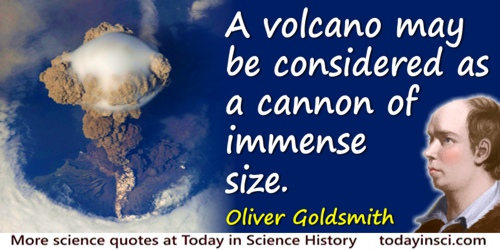
Eruption of Sarychev volcano, Matua Island, Russia, seen from International Space Station (12 Jul 2009) (source)
[On the volcano.] And many a fire there burns beneath the ground.
Fragment 52. In The Fragments of Empedocles, translated by William Ellery Leonard, (1908), 35.
![Oliver Goldsmith quote: [T]here are depths of thousands of miles which are hidden from our inquiry. The only tidings we have fro](https://todayinsci.com/G/Goldsmith_Oliver/GoldsmithOliver-Depths500x250px.jpg)
[T]here are depths of thousands of miles which are hidden from our inquiry. The only tidings we have from those unfathomable regions are by means of volcanoes, those burning mountains that seem to discharge their materials from the lowest abysses of the earth.
In History of the Earth and Animated Nature (1774, 1847), Vol. 1, 92.
A bewildering assortment of (mostly microscopic) life-forms has been found thriving in what were once thought to be uninhabitable regions of our planet. These hardy creatures have turned up in deep, hot underground rocks, around scalding volcanic vents at the bottom of the ocean, in the desiccated, super-cold Dry Valleys of Antarctica, in places of high acid, alkaline, and salt content, and below many meters of polar ice. ... Some deep-dwelling, heat-loving microbes, genetic studies suggest, are among the oldest species known, hinting that not only can life thrive indefinitely in what appear to us totally alien environments, it may actually originate in such places.
In Life Everywhere: the Maverick Science of Astrobiology (2002), xi.
A map of the moon... should be in every geological lecture room; for no where can we have a more complete or more magnificent illustration of volcanic operations. Our sublimest volcanoes would rank among the smaller lunar eminences; and our Etnas are but spitting furnaces.
'On the Volcanoes of the Moon', American Journal of Science, 1846, 2 (2nd Series), 347.
A volcano may be considered as a cannon of immense size.
In A History of the Earth and Animated Nature (New ed. 1805), Vol. 1, 77.
At any given instant
All solids dissolve, no wheels revolve,
And facts have no endurance—
And who knows if it is by design or pure inadvertence
That the Present destroys its inherited self-importance?
All solids dissolve, no wheels revolve,
And facts have no endurance—
And who knows if it is by design or pure inadvertence
That the Present destroys its inherited self-importance?
Stanza from poem 'For the Time Being' (1944). In The Collected Poetry of W. H. Auden (1945), 430. Used as epigraph in Simon Winchester, about the volcano in his book Krakatoa (2003).
Believe me, this planet has put up with much worse than us. It’s been through earthquakes, volcanoes, plate tectonics, solar flares, sun-spots, magnetic storms, pole reversals, planetary floods, worldwide fires, tidal waves, wind and water erosion, cosmic rays, ice ages, and hundreds of thousands of years of bombardment by comets, asteroids, and meteors. And people think a few plastic bags and aluminum cans are going to make a difference?
In Napalm and Silly Putty (2002), 97.
By death the moon was gathered in Long ago, ah long ago;
Yet still the silver corpse must spin
And with another's light must glow.
Her frozen mountains must forget
Their primal hot volcanic breath,
Doomed to revolve for ages yet,
Void amphitheatres of death.
And all about the cosmic sky,
The black that lies beyond our blue,
Dead stars innumerable lie,
And stars of red and angry hue
Not dead but doomed to die.
Yet still the silver corpse must spin
And with another's light must glow.
Her frozen mountains must forget
Their primal hot volcanic breath,
Doomed to revolve for ages yet,
Void amphitheatres of death.
And all about the cosmic sky,
The black that lies beyond our blue,
Dead stars innumerable lie,
And stars of red and angry hue
Not dead but doomed to die.
'Cosmic Death' (1923), in The Captive Shrew and Other Poems of a Biologist (1932), 30.
Diseased nature oftentimes breaks forth
In strange eruptions: oft the teeming earth
Is with a kind of colic pinch’d and vex’d
By the imprisoning of unruly wind
Within her womb; which, for enlargement striving,
Shakes the old beldam earth, and topples down
Steeples and moss-grown towers.
In strange eruptions: oft the teeming earth
Is with a kind of colic pinch’d and vex’d
By the imprisoning of unruly wind
Within her womb; which, for enlargement striving,
Shakes the old beldam earth, and topples down
Steeples and moss-grown towers.
Dialogue by Hotspur to Glendower, in King Henry IV, Part I (c. 1597), Act III, Scene 1. Reprinted in The Works of Shakespeare: The First Part of King Henry IV (1790), 47.
Each volcano is an independent machine—nay, each vent and monticule is for the time being engaged in its own peculiar business, cooking as it were its special dish, which in due time is to be separately served. We have instances of vents within hailing distance of each other pouring out totally different kinds of lava, neither sympathizing with the other in any discernible manner nor influencing other in any appreciable degree.
In Report on the Geology of the High Plateaus of Utah (1880), 115.
Endowed with two qualities, which seemed incompatible with each other, a volcanic imagination and a pertinacity of intellect which the most tedious numerical calculations could not daunt, Kepler conjectured that the movements of the celestial bodies must be connected together by simple laws, or, to use his own expression, by harmonic laws. These laws he undertook to discover. A thousand fruitless attempts, errors of calculation inseparable from a colossal undertaking, did not prevent him a single instant from advancing resolutely toward the goal of which he imagined he had obtained a glimpse. Twenty-two years were employed by him in this investigation, and still he was not weary of it! What, in reality, are twenty-two years of labor to him who is about to become the legislator of worlds; who shall inscribe his name in ineffaceable characters upon the frontispiece of an immortal code; who shall be able to exclaim in dithyrambic language, and without incurring the reproach of anyone, “The die is cast; I have written my book; it will be read either in the present age or by posterity, it matters not which; it may well await a reader, since God has waited six thousand years for an interpreter of his words.”
In 'Eulogy on Laplace', in Smithsonian Report for the year 1874 (1875), 131-132.
Etna presents us not merely with an image of the power of subterranean heat, but a record also of the vast period of time during which that power has been exerted. A majestic mountain has been produced by volcanic action, yet the time of which the volcanic forms the register, however vast, is found by the geologist to be of inconsiderable amount, even in the modern annals of the earth’s history. In like manner, the Falls of Niagara teach us not merely to appreciate the power of moving water, but furnish us at the same time with data for estimating the enormous lapse of ages during which that force has operated. A deep and long ravine has been excavated, and the river has required ages to accomplish the task, yet the same region affords evidence that the sum of these ages is as nothing, and as the work of yesterday, when compared to the antecedent periods, of which there are monuments in the same district.
Travels in North America (1845), Vol. 1, 28-9.
Geology depends on impressions made by floods, earthquakes, volcanoes. The mountains tell the story of their oppressions and rebellions. The outstanding data of this science of Mother Earth are those furnished by the most violent impressions that mark an epoch in evolution
In I Am an Impure Thinker (1970), 16.
Great Empedocles, that ardent soul,
Leapt into Etna and was roasted whole.
Leapt into Etna and was roasted whole.
As quoted, from an unknown poet, in Bertrand Russell, A History of Western Philosophy (1946), 60.
I always love geology. In winter, particularly, it is pleasant to listen to theories about the great mountains one visited in the summer; or about the Flood or volcanoes; about great catastrophes or about blisters; above all about fossils … Everywhere there are hypotheses, but nowhere truths; many workmen, but no experts; priests, but no God. In these circumstances each man can bring his hypothesis like a candle to a burning altar, and on seeing his candle lit declare ‘Smoke for smoke, sir, mine is better than yours’. It is precisely for this reason that I love geology.
In Nouvelles Genevoises (1910), 306. First edition, 1841.
I have spent most of my days with wild mountain gorillas. Their home, and mine, has been the misty wooded slopes of the Virunga range, eight lofty volcanoes shared by three African nations, Rwanda, Uganda and the Democratic Republic of the Congo … My study of the wild gorilla is not yet finished, and even when it is complete, it will contribute only a small part toward man’s understanding of his closest animal relatives, the great apes…
As quoted on the back cover of Camilla De la Bédoyère, No One Loved Gorillas More: Dian Fossey’s Letters From the Mist (2005), 178.
If I was to establish a system, it would be, that Mountains are produced by Volcanoes, and not Volcanoes by Mountains.
Observations on Mount Vesuvius, Mount Etna, and other Volcanoes (1774), 52.
In fact, the thickness of the Earth's atmosphere, compared with the size of the Earth, is in about the same ratio as the thickness of a coat of shellac on a schoolroom globe is to the diameter of the globe. That's the air that nurtures us and almost all other life on Earth, that protects us from deadly ultraviolet light from the sun, that through the greenhouse effect brings the surface temperature above the freezing point. (Without the greenhouse effect, the entire Earth would plunge below the freezing point of water and we'd all be dead.) Now that atmosphere, so thin and fragile, is under assault by our technology. We are pumping all kinds of stuff into it. You know about the concern that chlorofluorocarbons are depleting the ozone layer; and that carbon dioxide and methane and other greenhouse gases are producing global warming, a steady trend amidst fluctuations produced by volcanic eruptions and other sources. Who knows what other challenges we are posing to this vulnerable layer of air that we haven't been wise enough to foresee?
In 'Wonder and Skepticism', Skeptical Enquirer (Jan-Feb 1995), 19, No. 1.
Innovations, free thinking is blowing like a storm; those that stand in front of it, ignorant scholars like you, false scientists, perverse conservatives, obstinate goats, resisting mules are being crushed under the weight of these innovations. You are nothing but ants standing in front of the giants; nothing but chicks trying to challenge roaring volcanoes!
From the play Galileo Galilei (2001) .
It is believed that contraction of the Earth due to its emission of lava and volcanic gases provides a tentative theory for the building of mountains and continents which is capable of explaining more of the details of these features than any other theory yet proposed.
In Sigma XI National Lecture (1957-58), published in 'Geophysics and Continental Growth', American Scientist (Mar 1959), 47, No. 1, 23.
It is to heat that should be attributed the vast movements observed on the Earth; the disturbances of the atmosphere are due to heat, the arising of clouds, the fall of rains and other aspects of weather, the currents of water crisscrossing the globe’s surface of which man manages to harness a small fraction; finally, earthquakes and volcanic eruptions are also caused by heat.
As translated by Webmaster from the original French: “C’est à la chaleur que doivent être attribués les grands mouvements qui frappent nos regards sur la terre; c’est à elle que sont dues les agitations de l’atmosphère, l’ascension des nuages, la chute des pluies et des autres météores, les courants d’eau qui sillonnent la surface du globe et dont l’homme est parvenue à employer pour son usage une faible partie; enfin les tremblements de terre, les éruptions volcaniques reconnaissent aussi pour cause la chaleur.” From Réflexions sur la Puissance Motrice du Feu et sur les Machines Propres a Développer cette Puissance (1824, 1878), 1-2. Also in N.-L.-S. Carnot and R. H. Thurston (ed.), Reflections on the Motive Power of Heat and on Machines Fitted to Develop That Power (1890, 2nd ed. 1897), 11 (in French), and 37-38 (in English) as: “To heat also are due the vast movements which take place on the earth. It causes the agitations of the atmosphere, the ascension of clouds, the fall of rain and of meteors*, the currents of water which channel the surface of the globe, and of which man has thus far employed but a small portion. Even earthquakes and volcanic eruptions are the result of heat.” [*Note the obsolete term “meteors” meaning atmospheric or meteorological phenomena, and does not refer here to rocks falling from space. —Webmaster]
It’s tempting to go to the throat of the volcano to get the data, because if you do you’re a hero … It’s a battle between your mind and your emotions. If your emotions win out, you can get yourself in a lot of trouble.
Quoted by Ron Russell in 'Column One: In pursuit of Deadly Volcanoes', Los Angeles Times (25 Jun 1991), an article about for three scientists that had died in a volcano eruption.
Living in a world such as this is like dancing on a live volcano.
Quoted in Kim Lim (ed.), 1,001 Pearls of Spiritual Wisdom: Words to Enrich, Inspire, and Guide Your Life (2014), 23
Looking back across the long cycles of change through which the land has been shaped into its present form, let us realise that these geographical revolutions are not events wholly of the dim past, but that they are still in progress. So slow and measured has been their march, that even from the earliest times of human history they seem hardly to have advanced at all. But none the less are they surely and steadily transpiring around us. In the fall of rain and the flow of rivers, in the bubble of springs and the silence of frost, in the quiet creep of glaciers and the tumultuous rush of ocean waves, in the tremor of the earthquake and the outburst of the volcano, we may recognise the same play of terrestrial forces by which the framework of the continents has been step by step evolved.
Lecture at the Evening Meeting, Royal Geographical Society (24 Mar 1879), 'Discussion on Geographical Evolution', in Proceedings of the Royal Geographical Society and Monthly Record (1879), New Monthly Series, 1, 443.
May not subterraneous fire be considered as the great plough (if I may be allowed the expression) which Nature makes use of to turn up the bowels of the earth?
Observations on Mount Vesuvius, Mount Etna, and other Volcanoes (1774),161.
Most of these Mountains and Inland places whereon these kind of Petrify’d Bodies and Shells are found at present, or have been heretofore, were formerly under the Water, and that either by the descending of the Waters to another part of the Earth by the alteration of the Centre of Gravity of the whole bulk, or rather by the Eruption of some kind of Subterraneous Fires or Earthquakes, great quantities of Earth have been deserted by the Water and laid bare and dry.
Lectures and Discourses of Earthquakes (1668). In The Posthumous Works of Robert Hooke, containing his Cutlerian Lectures and other Discourses read at the Meetings of the Illustrious Royal Society (1705), 320-1.
One of the ironies of volcanoes is that they tend to produce very fertile soils, and that tends to lure people to live around them.
As quoted in Doug Stewart, 'Resurrecting Pompeii', Smithsonian Magazine (Feb 2006).
Our earth is very old, an old warrior that has lived through many battles. Nevertheless, the face of it is still changing, and science sees no certain limit of time for its stately evolution. Our solid earth, apparently so stable, inert, and finished, is changing, mobile, and still evolving. Its major quakings are largely the echoes of that divine far-off event, the building of our noble mountains. The lava floods and intriguing volcanoes tell us of the plasticity, mobility, of the deep interior of the globe. The slow coming and going of ancient shallow seas on the continental plateaus tell us of the rhythmic distortion of the deep interior-deep-seated flow and changes of volume. Mountain chains prove the earth’s solid crust itself to be mobile in high degree. And the secret of it all—the secret of the earthquake, the secret of the “temple of fire,” the secret of the ocean basin, the secret of the highland—is in the heart of the earth, forever invisible to human eyes.
In Our Mobile Earth (1926), 320.
Placed in a universe of constant change, on an isolated globe surrounded by distant celestial objects on all sides, subjected to influences of various kinds, it is a sublime occupation to measure the earth and weigh the planets, to predict their changes, and even to discover the materials of which they are composed; to investigate the causes of the tempest and volcano; to bring the lightning from the clouds; to submit it to experiment by which it shall reveal its character; and to estimate the size and weight of those invisible atoms which constitute the universe of things.
In Letter (3 Feb 1873) to the Committee of Arrangements, in Proceedings of the Farewell Banquet to Professor Tyndall (4 Feb 1873), 19. Reprinted as 'On the Importance of the Cultivation of Science', The Popular Science Monthly (1873), Vol. 2, 645.
Populations of bacteria live in the spumes of volcanic thermal vents on the ocean floor, multiplying in water above the boiling point. And far beneath Earth’s surface, to a depth of 2 miles (3.2 km) or more, dwell the SLIMES (subsurface lithoautotrophic microbial ecosystems), unique assemblages of bacteria and fungi that occupy pores in the interlocking mineral grains of igneous rock and derive their energy from inorganic chemicals. The SLIMES are independent of the world above, so even if all of it were burned to a cinder, they would carry on and, given enough time, probably evolve new life-forms able to re-enter the world of air and sunlight.
In 'Vanishing Before Our Eyes', Time (26 Apr 2000).
Returning now to the Malay Archipelago, we find that all the wide expanse of sea which divides Java, Sumatra, and Borneo from each other, and from Malacca and Siam, is so shallow that ships can anchor in any part of it, since it rarely exceeds forty fathoms in depth; and if we go as far as the line of a hundred fathoms, we shall include the Philippine Islands and Bali, east of Java. If, therefore, these islands have been separated from each other and the continent by subsidence of the intervening tracts of land, we should conclude that the separation has been comparatively recent, since the depth to which the land has subsided is so small. It is also to be remarked that the great chain of active volcanoes in Sumatra and Java furnishes us with a sufficient cause for such subsidence, since the enormous masses of matter they have thrown out would take away the foundations of the surrounding district; and this may be the true explanation of the often-noticed fact that volcanoes and volcanic chains are always near the sea. The subsidence they produce around them will, in time, make a sea, if one does not already exist.
Malay Archipelago
Seeing therefore the variety of Motion which we find in the World is always decreasing, there is a necessity of conserving and recruiting it by active Principles, such as are the cause of Gravity, by which Planets and Comets keep their Motions in their Orbs, and Bodies acquire great Motion in falling; and the cause of Fermentation, by which the Heart and Blood of Animals are kept in perpetual Motion and Heat; the inward Parts of the Earth are constantly warm'd, and in some places grow very hot; Bodies burn and shine, Mountains take fire, the Caverns of the Earth are blown up, and the Sun continues violently hot and lucid, and warms all things by his Light. For we meet with very little Motion in the World, besides what is owing to these active Principles.
From Opticks, (1704, 2nd ed. 1718), Book 3, Query 31, 375.
Suddenly there was an enormous explosion, like a violent volcano. The nuclear reactions had led to overheating in the underground burial grounds. The explosion poured radioactive dust and materials high up into the sky. It was just the wrong weather for such a tragedy. Strong winds blew the radioactive clouds hundreds of miles away. It was difficult to gauge the extent of the disaster immediately, and no evacuation plan was put into operation right away. Many villages and towns were only ordered to evacuate when the symptoms of radiation sickness were already quite apparent. Tens of thousands of people were affected, hundreds dying, though the real figures have never been made public. The large area, where the accident happened, is still considered dangerous and is closed to the public.
'Two Decades of Dissidence', New Scientist (4 Nov 1976), 72, No. 72, 265.
The birth of a volcanic island is an event marked by prolonged and violent travail; the forces of the earth striving to create, and all the forces of the sea opposing.
In The Sea Around Us (1951), 83.
The fire at Lipara, Xenophanes says, ceased once for sixteen years, and came back in the seventeenth. And he says that the lavastream from Aetna is neither of the nature of fire, nor is it continuous, but it appears at intervals of many years.
De mirac. oscult. 38; 833 a 16. Quoted in Arthur Fairbanks (ed. And trans.), The First Philosophers of Greece (1898), 79.
The forces which displace continents are the same as those which produce great fold-mountain ranges. Continental drift, faults and compressions, earthquakes, volcanicity, transgression cycles and polar wandering are undoubtedly connected causally on a grand scale. Their common intensification in certain periods of the earth’s history shows this to be true. However, what is cause and what effect, only the future will unveil.
In The Origins of Continents and Oceans (4th ed. 1929), trans. John Biram (1966), 179.
The lessons of science should be experimental also. The sight of a planet through a telescope is worth all the course on astronomy; the shock of the electric spark in the elbow outvalues all theories; the taste of the nitrous oxide, the firing of an artificial volcano, are better than volumes of chemistry.
The Prose Works of Ralph Waldo Emerson (1870), 552.
The origin of volcanic energy is one of the blankest mysteries of science, and it is strange indeed, that a class of phenomena so long familiar to the human race and so zealously studied through all the ages should be so utterly without explanation. (1880)
In Report on the Geology of the High Plateaus of Utah (1880), 113.
The real difficulty about vulcanism is not to see how it can start, but how it can stop.
Earthquakes and Mountains, 2nd edition (1950), 187.
The standard of proof is not very high for an investigation that announces that a plume is responsible for a bit of magma or a bit of chemistry found in, or near, or away from a volcano. The standard is being lowered all the time. Plumes were invented to explain small-scale features such as volcanoes. They were 100 kilometers wide. Then they were used to provide magmas 600 km away from a volcano, or to interact with distant ridges. Then the whole North Atlantic, from Canada to England needed to be serviced by a single plume. Then all of Africa. Then a bit of basalt on the East Pacific Rise was found to be similar to a Hawaiian basalt, so the plume influence was stretched to 5000 kilometers! No reviewer or editor has been found to complain yet. Superplumes are now routinely used to affect geology all around the Pacific. This is called creeping incredulity. It can also be called a Just-So Story.
Please contact Webmaster if you know the primary source for this quote.
Underneath his sweetness and gentleness was the heat of a volcano. [Michael Faraday] was a man of excitable and fiery nature; but through high self-discipline he had converted the fire into a central glow and motive power of life, instead of permitting it to waste itself in useless passion.
In Faraday as a Discoverer (1868), 37.
Various accounts of Empedocles’ death are given in ancient sources. His enemies said that his desire to be thought a god led him to throw himself into the crater of Mount Etna so that he might vanish from the world completely and thus lead men to believe he had achieved apotheosis. Unfortunately the volcano defeated his design by throwing out one of the philosopher’s sandals.
As described in Clifton Fadiman (ed.), André Bernard (ed.), Bartlett's Book of Anecdotes (2000), 193, citing Oxford Classical Dictionary.
Vesuvius is actually inside the exploded skeleton of an older volcano. If you look at an aerial photograph, you can see the remaining ridge of a much larger volcano on the north side.
As quoted in Doug Stewart, 'Resurrecting Pompeii', Smithsonian Magazine (Feb 2006). Stewart adds, “It likely blew, violently, long before human settlement.”
Volcanic action is essentially paroxysmal; yet Mr. Lyell will admit no greater paroxysms than we ourselves have witnessed—no periods of feverish spasmodic energy, during which the very framework of nature has been convulsed and torn asunder. The utmost movements that he allows are a slight quivering of her muscular integuments.
'Address to the Geological Society, delivered on the Evening of the 18th of February 1831', Proceedings of the Geological Society (1834), 1, 307.
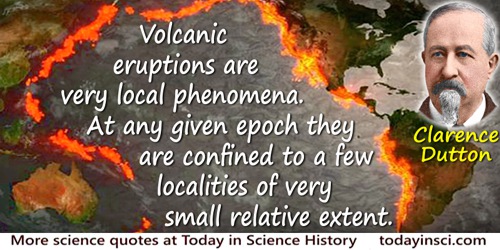
Volcanic eruptions are very local phenomena. At any given epoch they are confined to a few localities of very small relative extent.
In Report on the Geology of the High Plateaus of Utah (1880), 115.
We rest in the immense and complete order of the earth. And then it may well happen that what we have been seeing as beautiful repose changes into motions; lines seem to rise and fall, surfaces wave and swing. Folding, which long ago buckled horizontal strata into huge subterranean waves of stone (folds) is revived. The rounded crests of folds rise and fall rhythmically. Giant smoking volcanoes stand in a row like the pipes of a cosmic organ through which the earth’s mighty breath blows its roaring music. Granite domes in the deserts, the broadly arched shields of the Rocky Mountains become the chimes waiting only for the earthquake’s stroke to awaken the mighty symphony that drowns out all human tones and resounds throughout the world.
In 'Prologue', Conversation with the Earth (1954), 4. As translated by E.B. Garside from Gespräch mit der Erde (1947).
Why Become Extinct? Authors with varying competence have suggested that dinosaurs disappeared because the climate deteriorated (became suddenly or slowly too hot or cold or dry or wet), or that the diet did (with too much food or not enough of such substances as fern oil; from poisons in water or plants or ingested minerals; by bankruptcy of calcium or other necessary elements). Other writers have put the blame on disease, parasites, wars, anatomical or metabolic disorders (slipped vertebral discs, malfunction or imbalance of hormone and endocrine systems, dwindling brain and consequent stupidity, heat sterilization, effects of being warm-blooded in the Mesozoic world), racial old age, evolutionary drift into senescent overspecialization, changes in the pressure or composition of the atmosphere, poison gases, volcanic dust, excessive oxygen from plants, meteorites, comets, gene pool drainage by little mammalian egg-eaters, overkill capacity by predators, fluctuation of gravitational constants, development of psychotic suicidal factors, entropy, cosmic radiation, shift of Earth’s rotational poles, floods, continental drift, extraction of the moon from the Pacific Basin, draining of swamp and lake environments, sunspots, God’s will, mountain building, raids by little green hunters in flying saucers, lack of standing room in Noah’s Ark, and palaeoweltschmerz.
'Riddles of the Terrible Lizards', American Scientist (1964) 52, 231.
 In science it often happens that scientists say, 'You know that's a really good argument; my position is mistaken,' and then they would actually change their minds and you never hear that old view from them again. They really do it. It doesn't happen as often as it should, because scientists are human and change is sometimes painful. But it happens every day. I cannot recall the last time something like that happened in politics or religion.
(1987) --
In science it often happens that scientists say, 'You know that's a really good argument; my position is mistaken,' and then they would actually change their minds and you never hear that old view from them again. They really do it. It doesn't happen as often as it should, because scientists are human and change is sometimes painful. But it happens every day. I cannot recall the last time something like that happened in politics or religion.
(1987) -- 





