Vegetation Quotes (24 quotes)
All human affairs follow nature's great analogue, the growth of vegetation. There are three periods of growth in every plant. The first, and slowest, is the invisible growth by the root; the second and much accelerated is the visible growth by the stem; but when root and stem have gathered their forces, there comes the third period, in which the plant quickly flashes into blossom and rushes into fruit.
The beginnings of moral enterprises in this world are never to be measured by any apparent growth. ... At length comes the sudden ripeness and the full success, and he who is called in at the final moment deems this success his own. He is but the reaper and not the labourer. Other men sowed and tilled and he but enters into their labours.
The beginnings of moral enterprises in this world are never to be measured by any apparent growth. ... At length comes the sudden ripeness and the full success, and he who is called in at the final moment deems this success his own. He is but the reaper and not the labourer. Other men sowed and tilled and he but enters into their labours.
Life Thoughts (1858), 20.
And God said, “Let the earth put forth vegetation, plants yielding seed, and fruit trees bearing fruit in which is their seed, each according to its kind.” And God saw that it was good. And there was evening and there was morning, a third day.
— Bible
(circa 725 B.C.)
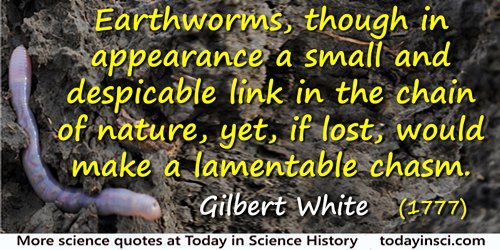
Earthworms, though in appearance a small and despicable link in the chain of nature, yet, if lost, would make a lamentable chasm … worms seem to be the great promoters of vegetation, which would proceed but lamely without them.
[Showing an early awareness in ecology.]
[Showing an early awareness in ecology.]
Letter XXXV, to Daines Barrington, (20 May 1777) in The Natural History of Selborne (1789), 216 and (1899), 174.
EMBALM, v.t. To cheat vegetation by locking up the gases upon which it feeds. By embalming their dead and thereby deranging the natural balance between animal and vegetable life, the Egyptians made their once fertile and populous country barren and incapable of supporting more than a meagre crew. The modern metallic burial casket is a step in the same direction, and many a dead man who ought now to be ornamenting his neighbor's lawn as a tree, or enriching his table as a bunch of radishes, is doomed to a long inutility. We shall get him after awhile if we are spared, but in the meantime the violet and rose are languishing for a nibble at his glutæus maximus.
The Cynic's Word Book (1906), 90. Also published later as The Devil's Dictionary.
God said, “Let the earth produce vegetation… . Let the earth produce every kind of living creature. …” God said, “Let us make man in our image, in the likeness of ourselves, and let them be masters of the fish of the sea, the birds of heaven, the cattle, all the wild beasts, and all the reptiles that crawl upon the earth. “
— Bible
(circa 725 B.C.)
I am above the forest region, amongst grand rocks & such a torrent as you see in Salvator Rosa's paintings vegetation all a scrub of rhodods. with Pines below me as thick & bad to get through as our Fuegian Fagi on the hill tops, & except the towering peaks of P. S. [perpetual snow] that, here shoot up on all hands there is little difference in the mt scenery—here however the blaze of Rhod. flowers and various colored jungle proclaims a differently constituted region in a naturalists eye & twenty species here, to one there, always are asking me the vexed question, where do we come from?
Letter to Charles Darwin (24 Jun 1849). Quoted in The Correspondence of Charles Darwin (1988), Vol. 4, 1847-1850, 242.
I know Teddy Kennedy had fun at the Democratic convention when he said that I said that trees and vegetation caused 80 percent of the air pollution in this country. ... Well, now he was a little wrong about what I said. I didn't say 80 percent. I said 92 percent—93 percent, pardon me. And I didn’t say air pollution, I said oxides of nitrogen. Growing and decaying vegetation in this land are responsible for 93 percent of the oxides of nitrogen. ... If we are totally successful and can eliminate all the manmade oxides of nitrogen, we’ll still have 93 percent as much as we have in the air today.
[Reagan reconfirming his own pathetic lack of understanding of air pollutants.]
[Reagan reconfirming his own pathetic lack of understanding of air pollutants.]
Address to senior citizens at Sea World, Orlando, Florida (9 Oct 1980). As quoted later in Douglas E. Kneeland, 'Teamsters Back Republican', New York Times (10 Oct 1980), D14.
I observed that plants not only have a faculty to correct bad air in six to ten days, by growing in it…but that they perform this important office in a complete manner in a few hours; that this wonderful operation is by no means owing to the vegetation of the plant, but to the influence of light of the sun upon the plant.
In Tobias George Smollett (ed.), 'Experiments Upon Vegetables', The Critical Review, Or, Annals of Literature (1779), 48, 334.
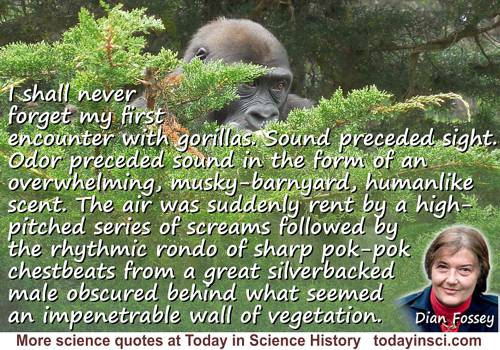
I shall never forget my first encounter with gorillas. Sound preceded sight. Odor preceded sound in the form of an overwhelming, musky-barnyard, humanlike scent. The air was suddenly rent by a high-pitched series of screams followed by the rhythmic rondo of sharp pok-pok chestbeats from a great silverbacked male obscured behind what seemed an impenetrable wall of vegetation.
Describing her 1963 trip to Kabara in Gorillas in the Mist (1983), 3. (The screams and chest-beating were of alarm, not ferocity.)
I shall never forget the sight. The vessel of crystallization was three quarters full of slightly muddy water—that is, dilute water-glass—and from the sandy bottom there strove upwards a grotesque little landscape of variously colored growths: a confused vegetation of blue, green, and brown shoots which reminded one of algae, mushrooms, attached polyps, also moss, then mussels, fruit pods, little trees or twigs from trees, here, and there of limbs. It was the most remarkable sight I ever saw, and remarkable not so much for its profoundly melancholy nature. For when Father Leverkühn asked us what we thought of it and we timidly answered him that they might be plants: “No,” he replied, “they are not, they only act that way. But do not think the less of them. Precisely because they do, because they try as hard as they can, they are worthy of all respect.”
It turned out that these growths were entirely unorganic in their origin; they existed by virtue of chemicals from the apothecary's shop.
It turned out that these growths were entirely unorganic in their origin; they existed by virtue of chemicals from the apothecary's shop.
Description of a “chemical garden” in Doktor Faustus: The Life of the German Composer Adrian Leverkühn, as Told by a Friend, (1947), 19.
If a solution fails to appear … and yet we feel success is just around the corner, try resting for a while. … Like the early morning frost, this intellectual refreshment withers the parasitic and nasty vegetation that smothers the good seed. Bursting forth at last is the flower of truth.
From Reglas y Consejos sobre Investigacíon Cientifica: Los tónicos de la voluntad. (1897), as translated by Neely and Larry W. Swanson, in Advice for a Young Investigator (1999), 35.
It is difficult to conceive a grander mass of vegetation:—the straight shafts of the timber-trees shooting aloft, some naked and clean, with grey, pale, or brown bark; others literally clothed for yards with a continuous garment of epiphytes, one mass of blossoms, especially the white Orchids Caelogynes, which bloom in a profuse manner, whitening their trunks like snow. More bulky trunks were masses of interlacing climbers, Araliaceae, Leguminosae, Vines, and Menispermeae, Hydrangea, and Peppers, enclosing a hollow, once filled by the now strangled supporting tree, which has long ago decayed away. From the sides and summit of these, supple branches hung forth, either leafy or naked; the latter resembling cables flung from one tree to another, swinging in the breeze, their rocking motion increased by the weight of great bunches of ferns or Orchids, which were perched aloft in the loops. Perpetual moisture nourishes this dripping forest: and pendulous mosses and lichens are met with in profusion.
Himalayan Journals (1854), vol. 1, 110-1.
Man has generally been preoccupied with obtaining as much “production” from the landscape as possible, by developing and maintaining early successional types of ecosystems, usually monocultures. But, of course, man does not live by food and fiber alone; he also needs a balanced CO2-O2 atmosphere, the climactic buffer provided by oceans and masses of vegetation, and clean (that is, unproductive) water for cultural and industrial uses. Many essential life-cycle resources, not to mention recreational and esthetic needs, are best provided man by the less 'productive' landscapes. In other words, the landscape is not just a supply depot but is also the oikos—the home—in which we must live.
'The Strategy of Ecosystem Development. An Understanding of Ecological Succession Provides a Basis for Resolving Man's Conflict with Nature', Science (1969), 164, 266.
No part of the world can be truly understood without a knowledge of its garment of vegetation, for this determines not only the nature of the animal inhabitants but also the occupations of the majority of human beings.
The Red Man's Continent: A Chronicle of Aboriginal America (1919), 88.
Now it is a well-known principle of zoological evolution that an isolated region, if large and sufficiently varied in its topography, soil, climate and vegetation, will give rise to a diversified fauna according to the law of adaptive radiation from primitive and central types. Branches will spring off in all directions to take advantage of every possible opportunity of securing food. The modifications which animals undergo in this adaptive radiation are largely of mechanical nature, they are limited in number and kind by hereditary, stirp or germinal influences, and thus result in the independent evolution of similar types in widely-separated regions under the law of parallelism or homoplasy. This law causes the independent origin not only of similar genera but of similar families and even of our similar orders. Nature thus repeats herself upon a vast scale, but the similarity is never complete and exact.
'The Geological and Faunal Relations of Europe and America during the Tertiary Period and the Theory of the Successive Invasions of an African Fauna', Science (1900), 11, 563-64.
ORGANIC LIFE beneath the shoreless waves
Was born and nurs'd in Ocean's pearly caves;
First, forms minute, unseen by spheric glass,
Move on the mud, or pierce the watery mass;
These, as successive generations bloom,
New powers acquire, and larger limbs assume;
Whence countless groups of vegetation spring,
And breathing realms of fin, and feet, and wing.
Thus the tall Oak, the giant of the wood,
Which bears Britannia's thunders on the flood;
The Whale, unmeasured monster of the main,
The lordly Lion, monarch of the plain,
The Eagle soaring in the realms of air,
Whose eye undazzled drinks the solar glare,
Imperious man, who rules the bestial crowd,
Of language, reason, and reflection proud,
With brow erect, who scorns this earthy sod,
And styles himself the image of his God;
Arose from rudiments of form and sense,
An embryon point, or microscopic ens!
Was born and nurs'd in Ocean's pearly caves;
First, forms minute, unseen by spheric glass,
Move on the mud, or pierce the watery mass;
These, as successive generations bloom,
New powers acquire, and larger limbs assume;
Whence countless groups of vegetation spring,
And breathing realms of fin, and feet, and wing.
Thus the tall Oak, the giant of the wood,
Which bears Britannia's thunders on the flood;
The Whale, unmeasured monster of the main,
The lordly Lion, monarch of the plain,
The Eagle soaring in the realms of air,
Whose eye undazzled drinks the solar glare,
Imperious man, who rules the bestial crowd,
Of language, reason, and reflection proud,
With brow erect, who scorns this earthy sod,
And styles himself the image of his God;
Arose from rudiments of form and sense,
An embryon point, or microscopic ens!
The Temple of Nature (1803), canto 1, lines 295-314, pages 26-8.
Plants, in a state of nature, are always warring with one another, contending for the monopoly of the soil,—the stronger ejecting the weaker,—the more vigorous overgrowing and killing the more delicate. Every modification of climate, every disturbance of the soil, every interference with the existing vegetation of an area, favours some species at the expense of others.
(With Thomas Thomson) Flora Indica: A Systematic Account of the Plants of British India (1855), 41.
Rocks have, no doubt, their grandeur, and there is a beauty in running waters, and even in placid lakes; but, let the rock be naked of vegetation down to and around its base, and its grandeur is painful,—it seems a ruin.
Using pseudonym Peter Parley, in Peter Parley’s Cyclopedia of Botany (1838), Chap. 1, ix.
The landscape everywhere, away from the river, is of rock—cliffs of rock; plateaus of rock; terraces of rock; crags of rock—ten thousand strangely carved forms; rocks everywhere, and no vegetation, no soil, no sand. In long, gentle curves the river winds about these rocks.
In Canyons of the Colorado (1895), 206.
The poet alone knows astronomy, chemistry, vegetation, and animation, for he does not stop at these facts, but employs them as signs. He knows why the plain, or meadow of space, was strown with these flowers we call suns, and moons, and stars; why the deep is adorned with animals, with men, and gods; for, in every word he speaks he rides on them as the horses of thought.
Essay, 'The Poet', in Ralph Waldo Emerson, Alfred Riggs Ferguson (ed.) and Jean Ferguson Carr (ed.), The Collected Works of Ralph Waldo Emerson, Volume III, Essays: Second Series (1984), 104.
There are, I believe, very few maxims in philosophy that have laid firmer hold upon the mind, than that air, meaning atmospherical air (free from various foreign matters, which were always supposed to be dissolved, and intermixed with it) is a simple elementary substance, indestructible, and unalterable, at least as much so as water is supposed to be. In the course of my enquiries, I was, however, soon satisfied that atmospherical air is not an unalterable thing; for that the phlogiston with which it becomes loaded from bodies burning in it, and animals breathing it, and various other chemical processes, so far alters and depraves it, as to render it altogether unfit for inflammation, respiration, and other purposes to which it is subservient; and I had discovered that agitation in water, the process of vegetation, and probably other natural processes, by taking out the superfluous phlogiston, restore it to its original purity.
'On Dephlogisticated Air, and the Constitution of the Atmosphere', in The Discovery of Oxygen, Part I, Experiments by Joseph Priestley 1775 (Alembic Club Reprint, 1894), 6.
This is the kingdom of the chemical elements, the substances from which everything tangible is made. It is not an extensive country, for it consists of only a hundred or so regions (as we shall often term the elements), yet it accounts for everything material in our actual world. From the hundred elements that are at the center of our story, all planets, rocks, vegetation, and animals are made. These elements are the basis of the air, the oceans, and the Earth itself. We stand on the elements, we eat the elements, we are the elements. Because our brains are made up of elements, even our opinions are, in a sense, properties of the elements and hence inhabitants of the kingdom.
In 'The Terrain', The Periodic Kingdom: A Journey Into the Land of the Chemical Elements (1995), 3.
Through the magic of motion pictures, someone who’s never left Peoria knows the softness of a Paris spring, the color of a Nile sunset, the sorts of vegetation one will find along the upper Amazon and that Big Ben has not yet gone digital.
…...
When air has been freshly and strongly tainted with putrefaction, so as to smell through the water, sprigs of mint have presently died, upon being put into it, their leaves turning black; but if they do not die presently, they thrive in a most surprizing manner. In no other circumstances have I ever seen vegetation so vigorous as in this kind of air, which is immediately fatal to animal life. Though these plants have been crouded in jars filled with this air, every leaf has been full of life; fresh shoots have branched out in various , and have grown much faster than other similiar plants, growing in the same exposure in common air.
This observation led me to conclude that plants, instead of affecting the air in the same manner with animal respiration, reverse the effects of breathing, and tend to keep the atmosphere sweet and wholesome, when it is become noxious, in consequence on animals living and breathing, or dying and putrefying in it.
In order to ascertain this, I took a quantity of air, made thoroughly noxious, by mice breathing and dying in it, and divided it into two parts; one of which I put into a phial immersed in water; and to the other (which was contained in a glass jar, standing in water) I put a sprig of mint. This was about the beginning of August 1771, and after eight or nine days, I found that a mouse lived perfectly well in that part of the air, in which the sprig of mint had grown, but died the moment it was put into the other part of the same original quantity of air; and which I had kept in the very same exposure, but without any plant growing in it.
This observation led me to conclude that plants, instead of affecting the air in the same manner with animal respiration, reverse the effects of breathing, and tend to keep the atmosphere sweet and wholesome, when it is become noxious, in consequence on animals living and breathing, or dying and putrefying in it.
In order to ascertain this, I took a quantity of air, made thoroughly noxious, by mice breathing and dying in it, and divided it into two parts; one of which I put into a phial immersed in water; and to the other (which was contained in a glass jar, standing in water) I put a sprig of mint. This was about the beginning of August 1771, and after eight or nine days, I found that a mouse lived perfectly well in that part of the air, in which the sprig of mint had grown, but died the moment it was put into the other part of the same original quantity of air; and which I had kept in the very same exposure, but without any plant growing in it.
'Observations on Different Kinds of Air', Philosophical Transactions (1772), 62, 193-4.
 In science it often happens that scientists say, 'You know that's a really good argument; my position is mistaken,' and then they would actually change their minds and you never hear that old view from them again. They really do it. It doesn't happen as often as it should, because scientists are human and change is sometimes painful. But it happens every day. I cannot recall the last time something like that happened in politics or religion.
(1987) --
In science it often happens that scientists say, 'You know that's a really good argument; my position is mistaken,' and then they would actually change their minds and you never hear that old view from them again. They really do it. It doesn't happen as often as it should, because scientists are human and change is sometimes painful. But it happens every day. I cannot recall the last time something like that happened in politics or religion.
(1987) -- 





