Vegetable Quotes (50 quotes)
A ... hypothesis may be suggested, which supposes the word 'beginning' as applied by Moses in the first of the Book of Genesis, to express an undefined period of time which was antecedent to the last great change that affected the surface of the earth, and to the creation of its present animal and vegetable inhabitants; during which period a long series of operations and revolutions may have been going on, which, as they are wholly unconnected with the history of the human race, are passed over in silence by the sacred historian, whose only concern with them was largely to state, that the matter of the universe is not eternal and self-existent but was originally created by the power of the Almighty.
Vindiciae Geologicae (1820), 31-2.
All sorts of dung and compost contain some matter which, when mixed with the soil, ferments therein; and by such ferment dissolves, crumbles, and divides the earth very much. This is the chief and almost only use of dung. … This proves, that its (manure) use is not to nourish, but to dissolve, i.e., divide the terrestrial matter, which affords nourishment to the Mouths of vegetable roots.
His underestimate of the value of manure. In The Horse-Hoeing Husbandry (1733), 18.
Although the cooking of food presents some unsolved problems, the quick warming of cooked food and the thawing of frozen food both open up some attractive uses. ... There is no important reason why the the housewife of the future should not purchase completely frozen meals at the grocery store just as she buys quick frozen vegetables. With a quick heating, high-frequency unit in her kitchen, food preparation from a pre-cooked, frozen meal becomes a simple matter.
[Predicting home kitchen appliances could be developed from the radionic tube employed to jam enemy radar in World War II.]
[Predicting home kitchen appliances could be developed from the radionic tube employed to jam enemy radar in World War II.]
In 'Physics of Today Become the Engineering of Tomorrow', Proceedings of the National Electronics Conference (1947), Vols. 1-2, 24-25. Note: by 1947 Ratheon was able to demonstrate a refrigerator-sized commercial microwave oven.
BOTANY, n. The science of vegetables—those that are not good to eat, as well as those that are. It deals largely with their flowers, which are commonly badly designed, inartistic in color, and ill-smelling.
The Collected Works of Ambrose Bierce (1911), Vol. 7, The Devil's Dictionary, 40.
Botany,—the science of the vegetable kingdom, is one of the most attractive, most useful, and most extensive departments of human knowledge. It is, above every other, the science of beauty.
Using pseudonym Peter Parley, in Peter Parley’s Cyclopedia of Botany (1838), ix. [This is a correction. Earlier on this website, the quote was identified as by Joseph Paxton, because that author’s name was on Google’s (erroneous) cover image of the book search result.]
EMBALM, v.t. To cheat vegetation by locking up the gases upon which it feeds. By embalming their dead and thereby deranging the natural balance between animal and vegetable life, the Egyptians made their once fertile and populous country barren and incapable of supporting more than a meagre crew. The modern metallic burial casket is a step in the same direction, and many a dead man who ought now to be ornamenting his neighbor's lawn as a tree, or enriching his table as a bunch of radishes, is doomed to a long inutility. We shall get him after awhile if we are spared, but in the meantime the violet and rose are languishing for a nibble at his glutæus maximus.
The Cynic's Word Book (1906), 90. Also published later as The Devil's Dictionary.
Everything is determined … by forces over which we have no control. It is determined for the insect as well as the star. Human beings, vegetables, or cosmic dust—we all dance to a mysterious tune, intoned in the distance by an invisible piper.
In interview, George Sylvester Viereck, 'What Life Means to Einstein', The Saturday Evening Post (26 Oct 1929), 117.
Food is at present obtained almost entirely from the energy of the sunlight. The radiation from the sun produces from the carbonic acid in the air more or less complicated carbon compounds which serve us in plants and vegetables. We use the latent chemical energy of these to keep our bodies warm, we convert it into muscular effort. We employ it in the complicated process of digestion to repair and replace the wasted cells of our bodies. … If the gigantic sources of power become available, food would be produced without recourse to sunlight. Vast cellars, in which artificial radiation is generated, may replace the cornfields and potato patches of the world.
From 'Fifty Years Hence', Strand Magazine (Dec 1931). Reprinted in Popular Mechanics (Mar 1932), 57, No. 3, 396-397.
Geology fully proves that organic creation passed through a series of stages before the highest vegetable and animal forms appeared.
Explanations (1845), 31
How to start on my adventure—how to become a forester—was not so simple. There were no schools of Forestry in America. … Whoever turned his mind toward Forestry in those days thought little about the forest itself and more about its influences, and about its influence on rainfall first of all. So I took a course in meteorology, which has to do with weather and climate. and another in botany, which has to do with the vegetable kingdom—trees are unquestionably vegetable. And another in geology, for forests grow out of the earth. Also I took a course in astronomy, for it is the sun which makes trees grow. All of which is as it should be, because science underlies the forester’s knowledge of the woods. So far I was headed right. But as for Forestry itself, there wasn’t even a suspicion of it at Yale. The time for teaching Forestry as a profession was years away.
In Breaking New Ground (1947, 1998), 3.
I had formally advanced, in my first Memoirs upon the formation of water, that it was decomposed in a great number of chemical experiments, and particularly during the vinous fermentation. I then supposed that water exists ready formed in sugar, though I am now convinced that sugar only contains the elements proper for composing it. It may be readily conceived, that it must have cost me a good deal to abandon my first notions, but by several years reflection, and after a great number of experiments and observations upon vegetable substances, I have fixed my ideas as above.
In The Elements of Chemistry (1790), Pt. 1, Chap. 13, 139-140.
I have repeatedly had cause to refer to certain resemblances between the phenomena of irritability in the vegetable kingdom and those of the animal body, thus touching a province of investigation which has hitherto been far too little cultivated. In the last instance, indeed, I might say animal and vegetable life must of necessity agree in all essential points, including the phenomena of irritability also, since it is established that the animal organism is constructed entirely and simply from the properties of these substances that all vital movements both of plants and animals are to be explained.
Lectures on the Physiology of Plants (1887), 600.
I should like to compare this rearrangement which the proteins undergo in the animal or vegetable organism to the making up of a railroad train. In their passage through the body parts of the whole may be left behind, and here and there new parts added on. In order to understand fully the change we must remember that the proteins are composed of Bausteine united in very different ways. Some of them contain Bausteine of many kinds. The multiplicity of the proteins is determined by many causes, first through the differences in the nature of the constituent Bausteine; and secondly, through differences in the arrangement of them. The number of Bausteine which may take part in the formation of the proteins is about as large as the number of letters in the alphabet. When we consider that through the combination of letters an infinitely large number of thoughts may be expressed, we can understand how vast a number of the properties of the organism may be recorded in the small space which is occupied by the protein molecules. It enables us to understand how it is possible for the proteins of the sex-cells to contain, to a certain extent, a complete description of the species and even of the individual. We may also comprehend how great and important the task is to determine the structure of the proteins, and why the biochemist has devoted himself with so much industry to their analysis.
'The Chemical Composition of the Cell', The Harvey Lectures (1911), 7, 45.
I wished to show that Pythagoras, the first founder of the vegetable regimen, was at once a very great physicist and a very great physician; that there has been no one of a more cultured and discriminating humanity; that he was a man of wisdom and of experience; that his motive in commending and introducing the new mode of living was derived not from any extravagant superstition, but from the desire to improve the health and the manners of men.
From Dell Vitto Pitagorico (1743), (The Pythagorean Diet: for the Use of the Medical Faculty), as translated quotes in Howard Williams, The Ethics of Diet: A Catena of Authorities Deprecatory of the Practice of Flesh-Eating (1883), 158.
I’m very good at integral and differential calculus,
I know the scientific names of beings animalculous:
In short, in matters vegetable, animal, and mineral,
I am the very model of a modern Major-General.
I know the scientific names of beings animalculous:
In short, in matters vegetable, animal, and mineral,
I am the very model of a modern Major-General.
In The Pirates of Penzance (1879), Act 1.
If the finding of Coines, Medals, Urnes, and other Monuments of famous Persons, or Towns, or Utensils, be admitted for unquestionable Proofs, that such Persons or things have, in former Times, had a being, certainly those Petrifactions may be allowed to be of equal Validity and Evidence, that there have been formerly such Vegetables or Animals. These are truly Authentick Antiquity not to be counterfeited, the Stamps, and Impressions, and Characters of Nature that are beyond the Reach and Power of Humane Wit and Invention, and are true universal Characters legible to all rational Men.
Lectures and Discourses of Earthquakes (1668). In The Posthumous Works of Robert Hooke, containing his Cutlerian Lectures and other Discourses read at the Meetings of the Illustrious Royal Society (1705), 449.
If we range through the whole territory of nature, and endeavour to extract from each department the rich stores of knowledge and pleasure they respectively contain, we shall not find a more refined or purer source of amusement, or a more interesting and unfailing subject for recreation, than that which the observation and examination of the structure, affinities, and habits of plants and vegetables, afford.
In A Practical Treatise on the Cultivation of the Dahlia (1838), 2.
In India we have clear evidence that administrative statistics had reached a high state of organization before 300 B.C. In the Arthasastra of Kautilya … the duties of the Gopa, the village accountant, [include] “by setting up boundaries to villages, by numbering plots of grounds as cultivated, uncultivated, plains, wet lands, gardens, vegetable gardens, fences (váta), forests altars, temples of gods, irrigation works, cremation grounds, feeding houses (sattra), places where water is freely supplied to travellers (prapá), places of pilgrimage, pasture grounds and roads, and thereby fixing the boundaries of various villages, of fields, of forests, and of roads, he shall register gifts, sales, charities, and remission of taxes regarding fields.”
Editorial, introducing the new statistics journal of the Indian Statistical Institute, Sankhayā (1933), 1, No. 1. Also reprinted in Sankhyā: The Indian Journal of Statistics (Feb 2003), 65, No. 1, viii.
Just as in the animal and vegetable kingdoms, an individual comes into being, so to speak, grows, remains in being, declines and passes on, will it not be the same for entire species? If our faith did not teach us that animals left the Creator's hands just as they now appear and, if it were permitted to entertain the slightest doubt as to their beginning and their end, may not a philosopher, left to his own conjectures, suspect that, from time immemorial, animal life had its own constituent elements, scattered and intermingled with the general body of matter, and that it happened when these constituent elements came together because it was possible for them to do so; that the embryo formed from these elements went through innumerable arrangements and developments, successively acquiring movement, feeling, ideas, thought, reflection, consciousness, feelings, emotions, signs, gestures, sounds, articulate sounds, language, laws, arts and sciences; that millions of years passed between each of these developments, and there may be other developments or kinds of growth still to come of which we know nothing; that a stationary point either has been or will be reached; that the embryo either is, or will be, moving away from this point through a process of everlasting decay, during which its faculties will leave it in the same way as they arrived; that it will disappear for ever from nature-or rather, that it will continue to exist there, but in a form and with faculties very different from those it displays at this present point in time? Religion saves us from many deviations, and a good deal of work. Had religion not enlightened us on the origin of the world and the universal system of being, what a multitude of different hypotheses we would have been tempted to take as nature's secret! Since these hypotheses are all equally wrong, they would all have seemed almost equally plausible. The question of why anything exists is the most awkward that philosophy can raise- and Revelation alone provides the answer.
Thoughts on the Interpretation of Nature and Other Philosophical Works (1753/4), ed. D. Adams (1999), Section LVIII, 75-6.
Mathematics is not a book confined within a cover and bound between brazen clasps, whose contents it needs only patience to ransack; it is not a mine, whose treasures may take long to reduce into possession, but which fill only a limited number of veins and lodes; it is not a soil, whose fertility can be exhausted by the yield of successive harvests; it is not a continent or an ocean, whose area can be mapped out and its contour defined: it is limitless as that space which it finds too narrow for its aspirations; its possibilities are as infinite as the worlds which are forever crowding in and multiplying upon the astronomer’s gaze; it is as incapable of being restricted within assigned boundaries or being reduced to definitions of permanent validity, as the consciousness of life, which seems to slumber in each monad, in every atom of matter, in each leaf and bud cell, and is forever ready to burst forth into new forms of vegetable and animal existence.
From Commemoration Day Address (22 Feb 1877) at Johns Hopkins University, Baltimore, collected in The Collected Mathematical Papers: (1870-1883) (1909), 77-78.
Natural bodies are divided into three kingdoms of nature: viz. the mineral, vegetable, and animal kingdoms. Minerals grow, Plants grow and live, Animals grow, live, and have feeling.
'Observations on the Three Kingdoms of Nature', Nos 14-15. Systema Naturae (1735). As quoted (translated) in Étienne Gilson, From Aristotle to Darwin and Back Again: A Journey in Final Causality (2009), 42-43.
Nature proceeds little by little from things lifeless to animal life in such a way that it is impossible to determine the exact line of demarcation, nor on which side thereof an intermediate form should lie. Thus, next after lifeless things comes the plant, and of plants one will differ from another as to its amount of apparent vitality; and, in a word, the whole genus of plants, whilst it is devoid of life as compared with an animal, is endowed with life as compared with other corporeal entities. Indeed, as we just remarked, there is observed in plants a continuous scale of ascent towards the animal. So, in the sea, there are certain objects concerning which one would be at a loss to determine whether they be animal or vegetable. For instance, certain of these objects are fairly rooted, and in several cases perish if detached.
History of Animals, 588b, 4-14. In Jonathan Barnes (ed.) The Complete Works of Aristotle (1984), Vol. 1, 922.
No occupation is more worthy of an intelligent and enlightened mind, than the study of Nature and natural objects; and whether we labour to investigate the structure and function of the human system, whether we direct our attention to the classification and habits of the animal kingdom, or prosecute our researches in the more pleasing and varied field of vegetable life, we shall constantly find some new object to attract our attention, some fresh beauties to excite our imagination, and some previously undiscovered source of gratification and delight.
In A Practical Treatise on the Cultivation of the Dahlia (1838), 1-2.
Scientists and Drapers. Why should the botanist, geologist or other-ist give himself such airs over the draper’s assistant? Is it because he names his plants or specimens with Latin names and divides them into genera and species, whereas the draper does not formulate his classifications, or at any rate only uses his mother tongue when he does? Yet how like the sub-divisions of textile life are to those of the animal and vegetable kingdoms! A few great families—cotton, linen, hempen, woollen, silk, mohair, alpaca—into what an infinite variety of genera and species do not these great families subdivide themselves? And does it take less labour, with less intelligence, to master all these and to acquire familiarity with their various habits, habitats and prices than it does to master the details of any other great branch of science? I do not know. But when I think of Shoolbred’s on the one hand and, say, the ornithological collections of the British Museum upon the other, I feel as though it would take me less trouble to master the second than the first.
Samuel Butler, Henry Festing Jones (ed.), The Note-Books of Samuel Butler (1917), 218.
See dying Vegetables Life sustain,
See Life dissolving vegetate again.
All Forms that perish other forms supply,
By turns they catch the vital breath, and die.
See Life dissolving vegetate again.
All Forms that perish other forms supply,
By turns they catch the vital breath, and die.
In 'Epistle III', Essay on Man,: Being the First Book of Ethic Epistles (1734), 39.
The Animal and Vegetable Kingdoms are to nearly join’d, that if you will take the lowest of one, and the highest of the other, there will scarce be perceived any great difference between them.
In An Essay Concerning Humane Understanding (1689, 1706, 5th ed.), 381.
The book of Nature is the book of Fate. She turns the gigantic pages,—leaf after leaf,—never re-turning one. One leaf she lays down, a floor of granite; then a thousand ages, and a bed of slate; a thousand ages, and a measure of coal; a thousand ages, and a layer of marl and mud: vegetable forms appear; her first misshapen animals, zoophyte, trilobium, fish; then, saurians,—rude forms, in which she has only blocked her future statue, concealing under these unwieldy monsters the fine type of her coming king. The face of the planet cools and dries, the races meliorate, and man is born. But when a race has lived its term, it comes no more again.
From 'Fate', collected in The Complete Works of Ralph Waldo Emerson, Volume 6: The Conduct of Life (1860), 15. This paragraph is the prose version of his poem, 'Song of Nature'.
The conclusion of Science which recognizes unbroken casual connection between the past and the present would undoubtedly be that the molten earth contained within it elements of life, which grouped themselves into their present forms as the planet cooled. … The difficulty and reluctance encountered by this conception, arise solely from the fact that the theologic conception obtained a prior footing in the human mind. Did the latter depend upon reasoning alone, it could not hold its ground for an hour against its rival. * * * Were not man’s origin implicated, we should accept without a murmur the derivation of animal and vegetable life from what we call inorganic nature. The conclusion of pure intellect points this way and no other.
As quoted in 'The Origin of Life', Scientific American (25 Dec 1875), 33, No. 26, 400. The article (by an unnamed writer), having quoted Tyndall, includes a parenthetical clarification, “The context shows that by ‘elements of life,’ Professor Tyndall does not mean entities but possibilities of molecular condition by which the phenomena of life were to be evolved in the natural course of events, not by the miraculous addition of a new force but by means of the forces already in play.”
The effort to eliminate synthetic pesticides because of unsubstantiated fears about residues in food will make fruits and vegetables more expensive, decrease consumption, and thus increase cancer rates. The levels of synthetic pesticide residues are trivial in comparison to natural chemicals, and thus their potential for cancer causation is extremely low. [Ames believes that “to eat your veggies” is the best way to prevent cancer.]
Paper to the American Chemical Society, 'Pollution, Pesticides and Cancer Misconceptions.' As cited by Art Drysdale, 'Latest Insider News: Natural vs. Synthetic Chemical Pesticides' (14 Feb 1999), on the mitosyfraudes.org website. Bruce Ames has written a similar sentiment in various other publications.
The equation of animal and vegetable life is too complicated a problem for human intelligence to solve, and we can never know how wide a circle of disturbance we produce in the harmonies of nature when we throw the smallest pebble into the ocean of organic life.
Man and Nature, (1864), 103.
The following general conclusions are drawn from the propositions stated above, and known facts with reference to the mechanics of animal and vegetable bodies:—
There is at present in the material world a universal tendency to the dissipation of mechanical energy.
Any restoration of mechanical energy, without more than an equivalent of dissipation, is impossible in inanimate material processes, and is probably never effected by means of organized matter, either endowed with vegetable life, or subjected to the will of an animated creature.
Within a finite period of time past the earth must have been, and within a finite period of time to come the earth must again be, unfit for the habitation of man as at present constituted, unless operations have been, or are to be performed, which are impossible under the laws to which the known operations going on at present in the material world are subject.
There is at present in the material world a universal tendency to the dissipation of mechanical energy.
Any restoration of mechanical energy, without more than an equivalent of dissipation, is impossible in inanimate material processes, and is probably never effected by means of organized matter, either endowed with vegetable life, or subjected to the will of an animated creature.
Within a finite period of time past the earth must have been, and within a finite period of time to come the earth must again be, unfit for the habitation of man as at present constituted, unless operations have been, or are to be performed, which are impossible under the laws to which the known operations going on at present in the material world are subject.
In 'On a Universal Tendency in Nature to the Dissipation of Mechanical Energy', Proceedings of the Royal Society of Edinburgh, 1852, 3, 141-142. In Mathematical and Physical Papers (1882-1911), Vol. 1, 513-514.
The frying pan you should give to your enemy. Food should not be prepared in fat. Our bodies are adapted to a stone age diet of roots and vegetables.
The greatest delight which the fields and woods minister, is the suggestion of an occult relation between man and the vegetable. I am not alone and unacknowledged. They nod to me, and I to them. The waving of the boughs in the storm, is new to me and old. It takes me by surprise, and yet is not unknown. Its effect is like that of a higher thought or a better emotion coming over me, when I deemed I was thinking justly or doing right.
In Nature: An Essay, to Which is Added, Orations, Lectures, and Addresses (1845), 5.
The ravages committed by man subvert the relations and destroy the balance which nature had established between her organized and her inorganic creations; and she avenges herself upon the intruder, by letting loose upon her defaced provinces destructive energies hitherto kept in check by organic forces destined to be his best auxiliaries, but which he has unwisely dispersed and driven from the field of action. When the forest is gone, the great reservoir of moisture stored up in its vegetable mould is evaporated, and returns only in deluges of rain to wash away the parched dust into which that mould has been converted. The well-wooded and humid hills are turned to ridges of dry rock, which encumbers the low grounds and chokes the watercourses with its debris, and–except in countries favored with an equable distribution of rain through the seasons, and a moderate and regular inclination of surface–the whole earth, unless rescued by human art from the physical degradation to which it tends, becomes an assemblage of bald mountains, of barren, turfless hills, and of swampy and malarious plains. There are parts of Asia Minor, of Northern Africa, of Greece, and even of Alpine Europe, where the operation of causes set in action by man has brought the face of the earth to a desolation almost as complete as that of the moon; and though, within that brief space of time which we call “the historical period,” they are known to have been covered with luxuriant woods, verdant pastures, and fertile meadows, they are now too far deteriorated to be reclaimable by man, nor can they become again fitted for human use, except through great geological changes, or other mysterious influences or agencies of which we have no present knowledge, and over which we have no prospective control. The earth is fast becoming an unfit home for its noblest inhabitant, and another era of equal human crime and human improvidence, and of like duration with that through which traces of that crime and that improvidence extend, would reduce it to such a condition of impoverished productiveness, of shattered surface, of climatic excess, as to threaten the depravation, barbarism, and perhaps even extinction of the species.
Man and Nature, (1864), 42-3.
The sciences of Natural History and Botany require so much time to be devoted to them that, however pleasing, they may be justly considered as improper objects for the man of business to pursue scientifically, so as to enter into the exact arrangement and classification of the different bodies of the animal, vegetable, and mineral kingdoms. But reading and personal observation will supply him with ample matter for reflection and admiration.
'On the Advantages of Literature and Philosophy in general and especially on the Consistency of Literary and Philosophical with Commercial Pursuits' (Read 3 Oct 1781). As quoted in Robert Angus Smith, A Centenary of Science in Manchester (1883), 79.
The specific qualities in diseases also tend more rapidly to the skin than to the deeper-seated parts, except the cancer; although even in this disease the progress towards the superficies is more quick than its progress towards the centre. In short, this is a law in nature, and it probably is upon the same principle by which vegetables always approach the surface of the earth.
In A Treatise on the Blood, Inflammation and Gun-shot Wounds (1794, 1828), 299-300.
The Struggle for Existence amongst all organic beings throughout the world, which inevitably follows from their high geometrical powers of increase ... This is the doctrine of Malthus, applied to the whole animal and vegetable kingdoms. As many more individuals of each species are born than can possibly survive; and as, consequently, there is a frequently recurring struggle for existence, it follows that any being, if it vary however slightly in any manner profitable to itself, under the complex and sometimes varying conditions of life, will have a better chance of surviving, and thus be naturally selected. From the strong principle of inheritance, any selected variety will tend to propagate its new and modified form.
From On the Origin of Species by Means of Natural Selection; or, The Preservation of Favoured Races in the Struggle for Life (1861), 12.
The sun's rays are the ultimate source of almost every motion which takes place on the surface of the earth. By their heat are produced all winds, and those disturbances in the electric equilibrium of the atmosphere which give rise to the phenomena of terrestrial magnetism. By their vivifying action vegetables are elaborated from inorganic matter, and become in their turn the support of animals and of man, and the sources of those great deposits of dynamical efficiency which are laid up for human use in our coal strata. By them the waters of the sea are made to circulate in vapor through the air, and irrigate the land, producing springs and rivers. By them are produced all disturbances of the chemical equilibrium of the elements of nature which, by a series of compositions and decompositions, give rise to new products, and originate a transfer of materials. Even the slow degradation of the solid constituents of the surface, in which its chief geological changes consist, and their diffusion among the waters of the ocean, are entirely due to the abrasion of the wind, rain, and tides, which latter, however, are only in part the effect of solar influence and the alternate action of the seasons.
from Outlines of Astronomy (1849), 237.
The vulgar opinion, then, which, on health reasons, condemns vegetable food and so much praises animal food, being so ill-founded, I have always thought it well to oppose myself to it, moved both by experience and by that refined knowledge of natural things which some study and conversation with great men have given me. And perceiving now that such my constancy has been honoured by some learned and wise physicians with their authoritative adhesion (della autorevole sequela), I have thought it my duty publicly to diffuse the reasons of the Pythagorean diet, regarded as useful in medicine, and, at the same time, as full of innocence, of temperance, and of health. And it is none the less accompanied with a certain delicate pleasure, and also with a refined and splendid luxury (non è privo nemmeno d’una certa delicate voluttà e d’un lusso gentile e splendido ancora), if care and skill be applied in selection and proper supply of the best vegetable food, to which the fertility and the natural character of our beautiful country seem to invite us. For my part I have been so much the more induced to take up this subject, because I have persuaded myself that I might be of service to intending diet-reformers, there not being, to my knowledge, any book of which this is the sole subject, and which undertakes exactly to explain the origin and the reasons of it.
From Dell Vitto Pitagorico (1743), (The Pythagorean Diet: for the Use of the Medical Faculty), as translated quotes in Howard Williams, The Ethics of Diet: A Catena of Authorities Deprecatory of the Practice of Flesh-Eating (1883), 158.
The whole Terrestrial Globe was taken all to Pieces and dissolved at the Deluge, the Particles of Stone, Marble, and all other solid Fossils being dissevered, taken up into the Water, and there sustained with Sea-Shells and other Animal and Vegetable Bodyes: and that the present Earth consists, and was formed out of that promiscuous Mass of Sand, Earth, Shells, and the rest, falling down again, and subsiding from the Water.
In An Essay Towards a Natural History of the Earth (3rd ed., 1723), Preface.
There is no foundation in geological facts, for the popular theory of the successive development of the animal and vegetable world, from the simplest to the most perfect forms.
Principles of Geology (1830-3), Vol. 1, 153.
They may say what they like; everything is organized matter. The tree is the first link of the chain; man is the last. Men are young; the earth is old. Vegetable and animal chemistry are still in their infancy. Electricity, galvanism,—what discoveries in a few years!
…...
This Academy [at Lagado] is not an entire single Building, but a Continuation of several Houses on both Sides of a Street; which growing waste, was purchased and applied to that Use.
I was received very kindly by the Warden, and went for many Days to the Academy. Every Room hath in it ' one or more Projectors; and I believe I could not be in fewer than five Hundred Rooms.
The first Man I saw was of a meagre Aspect, with sooty Hands and Face, his Hair and Beard long, ragged and singed in several Places. His Clothes, Shirt, and Skin were all of the same Colour. He had been Eight Years upon a Project for extracting Sun-Beams out of Cucumbers, which were to be put into Vials hermetically sealed, and let out to warm the Air in raw inclement Summers. He told me, he did not doubt in Eight Years more, that he should be able to supply the Governor's Gardens with Sunshine at a reasonable Rate; but he complained that his Stock was low, and interested me to give him something as an Encouragement to Ingenuity, especially since this had been a very dear Season for Cucumbers. I made him a small Present, for my Lord had furnished me with Money on purpose, because he knew their Practice of begging from all who go to see them.
I saw another at work to calcine Ice into Gunpowder; who likewise shewed me a Treatise he had written concerning the Malleability of Fire, which he intended to publish.
There was a most ingenious Architect who had contrived a new Method for building Houses, by beginning at the Roof, and working downwards to the Foundation; which he justified to me by the life Practice of those two prudent Insects the Bee and the Spider.
In another Apartment I was highly pleased with a Projector, who had found a device of plowing the Ground with Hogs, to save the Charges of Plows, Cattle, and Labour. The Method is this: In an Acre of Ground you bury at six Inches Distance, and eight deep, a quantity of Acorns, Dates, Chestnuts, and other Masts or Vegetables whereof these Animals are fondest; then you drive six Hundred or more of them into the Field, where in a few Days they will root up the whole Ground in search of their Food, and make it fit for sowing, at the same time manuring it with their Dung. It is true, upon Experiment they found the Charge and Trouble very great, and they had little or no Crop. However, it is not doubted that this Invention may be capable of great Improvement.
I had hitherto seen only one Side of the Academy, the other being appropriated to the Advancers of speculative Learning.
Some were condensing Air into a dry tangible Substance, by extracting the Nitre, and letting the acqueous or fluid Particles percolate: Others softening Marble for Pillows and Pin-cushions. Another was, by a certain Composition of Gums, Minerals, and Vegetables outwardly applied, to prevent the Growth of Wool upon two young lambs; and he hoped in a reasonable Time to propagate the Breed of naked Sheep all over the Kingdom.
I was received very kindly by the Warden, and went for many Days to the Academy. Every Room hath in it ' one or more Projectors; and I believe I could not be in fewer than five Hundred Rooms.
The first Man I saw was of a meagre Aspect, with sooty Hands and Face, his Hair and Beard long, ragged and singed in several Places. His Clothes, Shirt, and Skin were all of the same Colour. He had been Eight Years upon a Project for extracting Sun-Beams out of Cucumbers, which were to be put into Vials hermetically sealed, and let out to warm the Air in raw inclement Summers. He told me, he did not doubt in Eight Years more, that he should be able to supply the Governor's Gardens with Sunshine at a reasonable Rate; but he complained that his Stock was low, and interested me to give him something as an Encouragement to Ingenuity, especially since this had been a very dear Season for Cucumbers. I made him a small Present, for my Lord had furnished me with Money on purpose, because he knew their Practice of begging from all who go to see them.
I saw another at work to calcine Ice into Gunpowder; who likewise shewed me a Treatise he had written concerning the Malleability of Fire, which he intended to publish.
There was a most ingenious Architect who had contrived a new Method for building Houses, by beginning at the Roof, and working downwards to the Foundation; which he justified to me by the life Practice of those two prudent Insects the Bee and the Spider.
In another Apartment I was highly pleased with a Projector, who had found a device of plowing the Ground with Hogs, to save the Charges of Plows, Cattle, and Labour. The Method is this: In an Acre of Ground you bury at six Inches Distance, and eight deep, a quantity of Acorns, Dates, Chestnuts, and other Masts or Vegetables whereof these Animals are fondest; then you drive six Hundred or more of them into the Field, where in a few Days they will root up the whole Ground in search of their Food, and make it fit for sowing, at the same time manuring it with their Dung. It is true, upon Experiment they found the Charge and Trouble very great, and they had little or no Crop. However, it is not doubted that this Invention may be capable of great Improvement.
I had hitherto seen only one Side of the Academy, the other being appropriated to the Advancers of speculative Learning.
Some were condensing Air into a dry tangible Substance, by extracting the Nitre, and letting the acqueous or fluid Particles percolate: Others softening Marble for Pillows and Pin-cushions. Another was, by a certain Composition of Gums, Minerals, and Vegetables outwardly applied, to prevent the Growth of Wool upon two young lambs; and he hoped in a reasonable Time to propagate the Breed of naked Sheep all over the Kingdom.
Gulliver's Travels (1726, Penguin ed. 1967), Part III, Chap. 5, 223.
This compassion, or sympathy with the pains of others, ought also to extend to the brute creation, as far as our necessities will admit; for we cannot exist long without the destruction of other animal or vegetable beings either in their mature or embryon state. Such is the condition of mortality, that the first law of nature is “eat, or be eaten.” Hence for the preservation of our existence we may be supposed to have a natural right to kill those brute creatures, which we want to eat, or which want to eat us; but to destroy even insects wantonly shows an unreflecting mind, or a depraved heart.
In A Plan for the Conduct of Female Education in Boarding Schools (1797), 48.
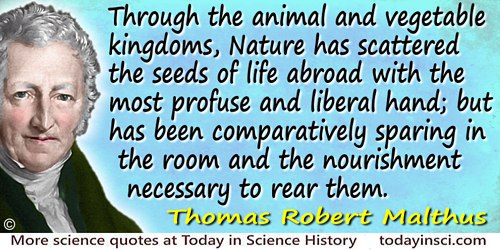
Through the animal and vegetable kingdoms, Nature has scattered the seeds of life abroad with the most profuse and liberal hand; but has been comparatively sparing in the room and the nourishment necessary to rear them. The germs of existence contained in this spot of earth, if they could freely develop themselves, would fill millions of worlds in the course of a few thousand years. Necessity, that imperious all-pervading law of nature, restrains them within the prescribed bounds. The race of plants and the race of animals shrink under this great restrictive law; and man cannot by any efforts of reason escape from it.
In An Essay on the Principle of Population (1798), 14-15.
Thus it might be said, that the vegetable is only the sketch, nor rather the ground-work of the animal; that for the formation of the latter, it has only been requisite to clothe the former with an apparatus of external organs, by which it might be connected with external objects.
From hence it follows, that the functions of the animal are of two very different classes. By the one (which is composed of an habitual succession of assimilation and excretion) it lives within itself, transforms into its proper substance the particles of other bodies, and afterwards rejects them when they are become heterogeneous to its nature. By the other, it lives externally, is the inhabitant of the world, and not as the vegetable of a spot only; it feels, it perceives, it reflects on its sensations, it moves according to their influence, and frequently is enabled to communicate by its voice its desires, and its fears, its pleasures, and its pains.
The aggregate of the functions of the first order, I shall name the organic life, because all organized beings, whether animal or vegetable, enjoy it more or less, because organic texture is the sole condition necessary to its existence. The sum of the functions of the second class, because it is exclusively the property of the animal, I shall denominate the animal life.
From hence it follows, that the functions of the animal are of two very different classes. By the one (which is composed of an habitual succession of assimilation and excretion) it lives within itself, transforms into its proper substance the particles of other bodies, and afterwards rejects them when they are become heterogeneous to its nature. By the other, it lives externally, is the inhabitant of the world, and not as the vegetable of a spot only; it feels, it perceives, it reflects on its sensations, it moves according to their influence, and frequently is enabled to communicate by its voice its desires, and its fears, its pleasures, and its pains.
The aggregate of the functions of the first order, I shall name the organic life, because all organized beings, whether animal or vegetable, enjoy it more or less, because organic texture is the sole condition necessary to its existence. The sum of the functions of the second class, because it is exclusively the property of the animal, I shall denominate the animal life.
Physiological Researches on Life and Death (1815), trans. P. Gold, 22-3.
Thus we conclude, that the strata both primary and secondary, both those of ancient and those of more recent origin, have had their materials furnished from the ruins of former continents, from the dissolution of rocks, or the destruction of animal or vegetable bodies, similar, at least in some respects, to those that now occupy the surface of the earth.
Illustrations of the Huttonian Theory of the Earth (1802), 14-5.
We have really, that I know of, no philosophical basis for high and low. Moreover, the vegetable kingdom does not culminate, as the animal kingdom does. It is not a kingdom, but a common-wealth; a democracy, and therefore puzzling and unaccountable from the former point of view.
— Asa Gray
Letter to Charles Darwin (27 Jan 1863), collected in Letters of Asa Gray (1893), Vol. 2, 496. Gray was replying to Darwin’s question, “If flowers of an Oak or Beech tree had fine well-colored corolla & calyx, would they still be classed as low in the Vegetable Kingdom?”
Would it sound too presumptuous to speak of perception as a quintessence of sensation, language (that is, communicable thought) of perception, mathematics of language? We should then have four terms differentiating from inorganic matter and from each other the Vegetable, Animal, Rational, and Super-sensual modes of existence.
From Presidential Address (1869) to the British Association, Exeter, Section A, collected in Collected Mathematical Papers of James Joseph Sylvester (1908), Vol. 2, 652, footnote.
You will be astonished when I tell you what this curious play of carbon amounts to. A candle will burn some four, five, six, or seven hours. What, then, must be the daily amount of carbon going up into the air in the way of carbonic acid! ... Then what becomes of it? Wonderful is it to find that the change produced by respiration ... is the very life and support of plants and vegetables that grow upon the surface of the earth.
From the concluding lecture (8 Jan 1861) given to a juvenile audience at the Royal Institution, as published in A Course of Six Lectures on the Chemical History of a Candle (1861), 177.
 In science it often happens that scientists say, 'You know that's a really good argument; my position is mistaken,' and then they would actually change their minds and you never hear that old view from them again. They really do it. It doesn't happen as often as it should, because scientists are human and change is sometimes painful. But it happens every day. I cannot recall the last time something like that happened in politics or religion.
(1987) --
In science it often happens that scientists say, 'You know that's a really good argument; my position is mistaken,' and then they would actually change their minds and you never hear that old view from them again. They really do it. It doesn't happen as often as it should, because scientists are human and change is sometimes painful. But it happens every day. I cannot recall the last time something like that happened in politics or religion.
(1987) -- 





