Usefulness Quotes (94 quotes)
…all models are approximations. Essentially, all models are wrong, but some are useful. However, the approximate nature of the model must always be borne in mind… [Co-author with Norman R. Draper]
In George E.P. Box, Norman R. Draper, Response Surfaces, Mixtures, and Ridge Analyses (2nd ed. 2007), 414.
“Endow scientific research and we shall know the truth, when and where it is possible to ascertain it;” but the counterblast is at hand: “To endow research is merely to encourage the research for endowment; the true man of science will not be held back by poverty, and if science is of use to us, it will pay for itself.” Such are but a few samples of the conflict of opinion which we find raging around us.
From The Grammar of Science (1892), 5.
[Science] dissipates errors born of ignorance about our true relations with nature, errors the more damaging in that the social order should rest only on those relations. TRUTH! JUSTICE! Those are the immutable laws. Let us banish the dangerous maxim that it is sometimes useful to depart from them and to deceive or enslave mankind to assure its happiness.
Exposition du Système du Monde (1796), 2, 312, trans. Charles Coulston Gillispie, Pierre-Simon Laplace 1749-1827: A Life in Exact Science (1997), 175.
230(231-1) ... is the greatest perfect number known at present, and probably the greatest that ever will be discovered; for; as they are merely curious without being useful, it is not likely that any person will attempt to find a number beyond it.
In An Elementary Investigation of the Theory of Numbers (1811), 43. The stated number, which evaluates as 2305843008139952128 was discovered by Euler in 1772 as the eighth known perfect number. It has 19 digits. By 2013, the 48th perfect number found had 34850340 digits.
A person by study must try to disengage the subject from useless matter, and to seize on points capable of improvement. ... When subjects are viewed through the mists of prejudice, useful truths may escape.
In An Essay on Aërial Navigation, With Some Observations on Ships (1844), 80.
A science or an art may be said to be “useful” if its development increases, even indirectly, the material well-being and comfort of men, it promotes happiness, using that word in a crude and commonplace way.
In A Mathematician's Apology (1940, 2012), 115.
Abstractness, sometimes hurled as a reproach at mathematics, is its chief glory and its surest title to practical usefulness. It is also the source of such beauty as may spring from mathematics.
In 'General Prospectus', The Development of Mathematics (1940, 2017), Chap. 1, 9.
Abstruse mathematical researches … are … often abused for having no obvious physical application. The fact is that the most useful parts of science have been investigated for the sake of truth, and not for their usefulness. A new branch of mathematics, which has sprung up in the last twenty years, was denounced by the Astronomer Royal before the University of Cambridge as doomed to be forgotten, on account of its uselessness. Now it turns out that the reason why we cannot go further in our investigations of molecular action is that we do not know enough of this branch of mathematics.
In 'Conditions of Mental Development', Lectures and Essays (1901), Vol. 1, 115.
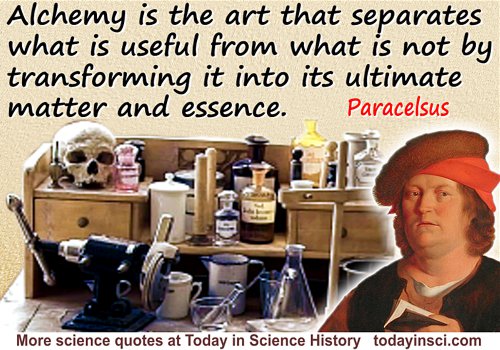
Alchemy is the art that separates what is useful from what is not by transforming it into its ultimate matter and essence.
In Labyrinthus Medicorum. Cap. V. Von dem Buch der alchimei, wie on dasselbig der
arzt kein arzt sein mag. Ed. Sudhoff, vol. XI, 188-189. As cited in Walter Pagel, Paracelsus: An Introduction to Philosophical Medicine in the Era of the Renaissance (2nd rev. ed., 1982), 113.
All talk about science purely for its practical and wealth-producing results is … idle. … Practical results will follow right enough. No real knowledge is sterile. … With this faith in the ultimate usefulness of all real knowledge a man may proceed to devote himself to a study of first causes without apology, and without hope of immediate return.
Quoted in Larry R. Squire (ed.), The History of Neuroscience in Autobiography (1996), Vol. 1, 350-351. The above is a highlight excerpted from a longer quote beginning “To prove to an indignant questioner ….” in this same collection for A. V. Hill.
Aluminum has … a kind of “glamor” associated with it, due to two facts, the first being that it is really useful, durable and beautiful, combined with the other fact, which has little to do with its commercial importance, that its ores are more abundant than of any other metal and constitute a large portion of the earth’s crust.
In article by Chas. M. Hall, 'The Properties of Aluminum', Western Electrician (30 May 1891), 8, No. 22, 312.
Analogy is a wonderful, useful and most important form of thinking, and biology is saturated with it. Nothing is worse than a horrible mass of undigested facts, and facts are indigestible unless there is some rhyme or reason to them. The physicist, with his facts, seeks reason; the biologist seeks something very much like rhyme, and rhyme is a kind of analogy.... This analogizing, this fine sweeping ability to see likenesses in the midst of differences is the great glory of biology, but biologists don't know it.... They have always been so fascinated and overawed by the superior prestige of exact physical science that they feel they have to imitate it.... In its central content, biology is not accurate thinking, but accurate observation and imaginative thinking, with great sweeping generalizations.
In Science is a Sacred Cow (1950), 98-100.
And I believe there are many Species in Nature, which were never yet taken notice of by Man, and consequently of no use to him, which yet we are not to think were created in vain; but it’s likely … to partake of the overflowing Goodness of the Creator, and enjoy their own Beings. But though in this sense it be not true, that all things were made for Man; yet thus far it is, that all the Creatures in the World may be some way or other useful to us, at least to exercise our Wits and Understandings, in considering and contemplating of them, and so afford us Subject of Admiring and Glorifying their and our Maker. Seeing them, we do believe and assert that all things were in some sense made for us, we are thereby obliged to make use of them for those purposes for which they serve us, else we frustrate this End of their Creation.
— John Ray
The Wisdom of God Manifested in the Works of the Creation (1691), 169-70.
And indeed I am not humming,
Thus to sing of Cl-ke and C-ming,
Who all the universe surpasses
in cutting up and making gases;
With anatomy and chemics,
Metaphysics and polemics,
Analyzing and chirugery,
And scientific surgery …
H-slow's lectures on the cabbage
Useful are as roots of Babbage;
Fluxions and beet-root botany,
Some would call pure monotony.
Thus to sing of Cl-ke and C-ming,
Who all the universe surpasses
in cutting up and making gases;
With anatomy and chemics,
Metaphysics and polemics,
Analyzing and chirugery,
And scientific surgery …
H-slow's lectures on the cabbage
Useful are as roots of Babbage;
Fluxions and beet-root botany,
Some would call pure monotony.
— Magazine
Punch in Cambridge (28 Jan 1834). In Mark Weatherall, Gentlemen, Scientists, and Medicine at Cambridge 1800-1940 (2000), Vol. 3,77. The professors named were William Clark (anatomy), James Cumming (chemistry) and Johns Stephens Henslow (botany).
And many kinds of creatures must have died,
Unable to plant out new sprouts of life.
For whatever you see that lives and breathes and thrives
Has been, from the very beginning, guarded, saved
By it's trickery for its swiftness or brute strength.
And many have been entrusted to our care,
Commended by their usefulness to us.
For instance, strength supports a savage lion;
Foxes rely on their cunning; deer their flight.
Unable to plant out new sprouts of life.
For whatever you see that lives and breathes and thrives
Has been, from the very beginning, guarded, saved
By it's trickery for its swiftness or brute strength.
And many have been entrusted to our care,
Commended by their usefulness to us.
For instance, strength supports a savage lion;
Foxes rely on their cunning; deer their flight.
On the Nature of Things, trans. Anthony M. Esolen (1995), Book 5, lines 852-60, 183.
Any one who has studied the history of science knows that almost every great step therein has been made by the “anticipation of Nature,” that is, by the invention of hypotheses, which, though verifiable, often had very little foundation to start with; and, not unfrequently, in spite of a long career of usefulness, turned out to be wholly erroneous in the long run.
In 'The Progress of Science 1837-1887' (1887), Collected Essays (1901), Vol. 1, 62.
As long as an individual mollusk remains unregistered it is deprived of its full usefulness; but even then it may reveal an important fact—as the trilobite speaks of the Palaeozoic period, and a nummulite of the Tertiary.
In 'A Brief Account of the Thesaurus Siluricus with a Few Facts and Inferences', Proceedings op the Royal Society (1867), No. 90, 373.
As soon as we got rid of the backroom attitude and brought our apparatus fully into the Department with an inexhaustible supply of living patients with fascinating clinical problems, we were able to get ahead really fast. Any new technique becomes more attractive if its clinical usefulness can be demonstrated without harm, indignity or discomfort to the patient... Anyone who is satisfied with his diagnostic ability and with his surgical results is unlikely to contribute much to the launching of a new medical science. He should first be consumed with a divine discontent with things as they are. It greatly helps, of course, to have the right idea at the right time, and quite good ideas may come, Archimedes fashion, in one's bath..
At no period of [Michael Faraday’s] unmatched career was he interested in utility. He was absorbed in disentangling the riddles of the universe, at first chemical riddles, in later periods, physical riddles. As far as he cared, the question of utility was never raised. Any suspicion of utility would have restricted his restless curiosity. In the end, utility resulted, but it was never a criterion to which his ceaseless experimentation could be subjected.
'The Usefulness of Useless Knowledge', Harper's Magazine (Jun/Nov 1939), No. 179, 546. In Hispania (Feb 1944), 27, No. 1, 77.
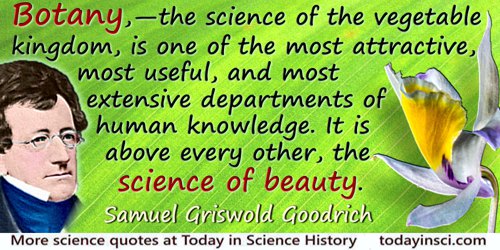
Botany,—the science of the vegetable kingdom, is one of the most attractive, most useful, and most extensive departments of human knowledge. It is, above every other, the science of beauty.
Using pseudonym Peter Parley, in Peter Parley’s Cyclopedia of Botany (1838), ix. [This is a correction. Earlier on this website, the quote was identified as by Joseph Paxton, because that author’s name was on Google’s (erroneous) cover image of the book search result.]
Chance … in the accommodation peculiar to sensorimotor intelligence, plays the same role as in scientific discovery. It is only useful to the genius and its revelations remain meaningless to the unskilled.
In The Origin of Intelligence in the Child (1936), trans. Margaret Cook (1953), 303.
Current manned space flights are complex missions that involve thousands of people. Someday, however, space vehicles will fly in and out of earth orbit in a more routine manner, and the usefulness of space to science and, in fact, to all persons will have reached a highly desirable plateau.
In 'After Apollo, What?', Science Teacher (Sep 1969), 36, No. 6. 22.
During the eighteenth and nineteenth centuries we can see the emergence of a tension that has yet to be resolved, concerning the attitude of scientists towards the usefulness of science. During this time, scientists were careful not to stress too much their relationships with industry or the military. They were seeking autonomy for their activities. On the other hand, to get social support there had to be some perception that the fruits of scientific activity could have useful results. One resolution of this dilemma was to assert that science only contributed at the discovery stage; others, industrialists for example, could apply the results. ... Few noted the ... obvious paradox of this position; that, if scientists were to be distanced from the 'evil' effects of the applications of scientific ideas, so too should they receive no credit for the 'good' or socially beneficial, effects of their activities.
Co-author with Philip Gummett (1947- ), -British social scientist
Co-author with Philip Gummett (1947- ), -British social scientist
Science, Technology and Society Today (1984), Introduction, 4.
Each scientist of course maintains the “purity” of his own research and repudiates violently any proposal to subject his pet research to the test of immediate applicability and “usefulness.” It is not the object of his research to be useful but to be sound.
In Science: the False Messiah (1927), 35.
Embrace those sciences which give to retired life usefulness, ornament or amusement.
In letter to Caspar Wistar (21 Jun 1807), collected in The Works of Thomas Jefferson (2010), Vol. 10, 423.
Every common mechanic has something to say in his craft about good and evil, useful and useless, but these practical considerations never enter into the purview of the mathematician.
Quoted in Robert Drew Hicks, Stoic and Epicurean (1910), 210.
For my part, I must say that science to me generally ceases to be interesting as it becomes useful.
Address, in 'Report to the Chemical Society's Jubilee', Nature (26 Mar 1891), 43, 493.
From my earliest childhood I nourished and cherished the desire to make a creditable journey in a new country, and write such a respectable account of its natural history as should give me a niche amongst the scientific explorers of the globe I inhabit, and hand my name down as a useful contributor of original matter.
Letter to Charles Darwin (1854), in Francis Darwin, More Letters of Charles Darwin (1903).
Guided only by their feeling for symmetry, simplicity, and generality, and an indefinable sense of the fitness of things, creative mathematicians now, as in the past, are inspired by the art of mathematics rather than by any prospect of ultimate usefulness.
In The Queen of the Sciences (1938), 2.
I am afraid neutrons will not be of any use to any one.
From interview, “when asked if his discovery had practical importance,” in Ferdinand Kuhn Jr., 'Chadwick calls Neutron ‘Difficult Catch’; His Find Hailed as Aid in Study of Atom, New York Times (29 Feb 1932), 1 and continued on 8.
I am aware of the usefulness of science to society and of the benefits society derives from it.
…...
I am patriot enough to take pains to bring this usefull invention [smallpox inoculation] into fashion in England, and I should not fail to write to some of our Doctors very particularly about it, if I knew anyone of 'em that I thought had Virtue enough to destroy such a considerable branch of Revenue for the good of Mankind, but that Distemper is too beneficial to them not to expose to all their Resentment the hardy wight that should undertake to put an end to it.
Letter to Sarah Chiswell (1 Apr 1717). In Robert Halsband (ed.), The Complete Letters of the Lady Mary Wortley Montagu (1965), Vol. 1, 339.
I do not believe there is anything useful which men can know with exactitude that they cannot know by arithmetic and algebra.
Oeuvres, Vol. 2, 292g. Trans. J. L. Heilbron, Electricity in the 17th and 18th Centuries: A Study of Early Modern Physics (1979), 42.
I have never done anything 'useful'. No discovery of mine has made, or is likely to make, directly or indirectly, for good or ill, the least difference to the amenity of the world... Judged by all practical standards, the value of my mathematical life is nil; and outside mathematics it is trivial anyhow. I have just one chance of escaping a verdict of complete triviality, that I may be judged to have created something worth creating. And that I have created something is undeniable: the question is about its value.
A Mathematician's Apology (1940), 90-1.
I looked for it [heavy hydrogen, deuterium] because I thought it should exist. I didn't know it would have industrial applications or be the basic for the most powerful weapon ever known [the nuclear bomb] … I thought maybe my discovery might have the practical value of, say, neon in neon signs.
[He was awarded the 1931 Nobel Prize in Chemistry for discovering deuterium.]
[He was awarded the 1931 Nobel Prize in Chemistry for discovering deuterium.]
Quoted in 'Moon-Struck Scientist,' New York Times (27 Apr 1961), 42.
In my own view, some advice about what should be known, about what technical education should be acquired, about the intense motivation needed to succeed, and about the carelessness and inclination toward bias that must be avoided is far more useful than all the rules and warnings of theoretical logic.
From Reglas y Consejos sobre Investigacíon Cientifica: Los tónicos de la voluntad. (1897), as translated by Neely and Larry W. Swanson, in Advice for a Young Investigator (1999), 6.
In science the primary duty of ideas is to be useful and interesting even more than to be “true.”
Lecture delivered to Anthropological Society of University College, London (25 Jan 1929). Published in 'The Functions of the Human Skull', Nature (6 Apr 1929), 123, No. 3101, 533-537. Collected in The Collected Papers of Wilfred Trotter, FRS (1941), 73.
Instinct is defined as the untaught ability to perform actions of all kinds, and more especially such as are necessary or useful to the animal.
The Senses and the Intellect (1855, 1974), p. 246.
It is inevitable that those to whom is vouchsafed a long life of usefulness should outlive the friends of their youth.
In 'Charles Anthony Scott', Biographical Memoirs: Vol. VIII (1919), 87.
It is not enough to discover and prove a useful truth previously unknown, but that it is necessary also to be able to propagate it and get it recognized.
Philosophie Zoologique (1809), Vol. 2, 450, trans. Hugh Elliot (1914), 404
It must be for truth’s sake, and not for the sake of its usefulness to humanity, that the scientific man studies Nature. The application of science to the useful arts requires other abilities, other qualities, other tools than his; and therefore I say that the man of science who follows his studies into their practical application is false to his calling. The practical man stands ever ready to take up the work where the scientific man leaves it, and adapt it to the material wants and uses of daily life.
Methods of Study in Natural History (1863),24.
Let us dismiss the question, “Have you proven that your model is valid?” with a quick NO. Then let us take up the more rewarding and far more challenging question: “Have you proven that your model is useful for learning more… ” [Co-author]
In J.B. Mankin, R.V. O’Neill, H.H. Shugart and B.W. Rust, 'The Importance of Validation in Ecosystem Analysis', in: G.S. Innis (ed.), New Directions in the Analysis of Ecological Systems (1977), Part I, 69.
Mathematics as an expression of the human mind reflects the active will, the contemplative reason, and the desire for aesthetic perfection. Its basic elements are logic and intuition, analysis and construction, generality and individuality. Though different traditions may emphasize different aspects, it is only the interplay of these antithetic forces and the struggle for their synthesis that constitute the life, usefulness, and supreme value of mathematical science.
As co-author with Herbert Robbins, in What Is Mathematics?: An Elementary Approach to Ideas and Methods (1941, 1996), x.
Measurement has too often been the leitmotif of many investigations rather than the experimental examination of hypotheses. Mounds of data are collected, which are statistically decorous and methodologically unimpeachable, but conclusions are often trivial and rarely useful in decision making. This results from an overly rigorous control of an insignificant variable and a widespread deficiency in the framing of pertinent questions. Investigators seem to have settled for what is measurable instead of measuring what they would really like to know.
'Patient Care—Mystical Research or Researchable Mystique/', Clinical Research (1964), 12, no. 4, 422.
Moreover the perfection of mathematical beauty is such … that whatsoever is most beautiful and regular is also found to be most useful and excellent.
In 'Epilogue', On Growth and Form (1917), 779.
Next came the patent laws. These began in England in 1624, and in this country with the adoption of our Constitution. Before then any man [might] instantly use what another man had invented, so that the inventor had no special advantage from his own invention. The patent system changed this, secured to the inventor for a limited time exclusive use of his inventions, and thereby added the fuel of interest to the fire of genius in the discovery and production of new and useful things.
Lecture 'Discoveries, Inventions and Improvements' (22 Feb 1860) in John George Nicolay and John Hay (eds.), Complete Works of Abraham Lincoln (1894), Vol. 5, 113. In Eugene C. Gerhart, Quote it Completely! (1998), 802.
Of what use are the great number of petrifactions, of different species, shape and form which are dug up by naturalists? Perhaps the collection of such specimens is sheer vanity and inquisitiveness. I do not presume to say; but we find in our mountains the rarest animals, shells, mussels, and corals embalmed in stone, as it were, living specimens of which are now being sought in vain throughout Europe. These stones alone whisper in the midst of general silence.
Philosophia Botanica (1751), aphorism 132. Trans. Frans A. Stafleu, Linnaeus and the Linnaeans: The Spreading of their Ideas in Systematic Botany, 1735-1789 (1971), 56.
Overemphasis on the competitive system and premature specialization on the ground of immediate usefulness kill the spirit on which all cultural life depends.
From interview with Benjamin Fine, 'Einstein Stresses Critical Thinking', New York Times (5 Oct 1952), 37.
Rules of Thumb
Thumb’s First Postulate: It is better to use a crude approximation and know the truth, plus or minus 10 percent, than demand an exact solution and know nothing at all.
Thumb’s Second Postulate: An easily understood, workable falsehood is more useful than a complex incomprehensible truth.
Thumb’s First Postulate: It is better to use a crude approximation and know the truth, plus or minus 10 percent, than demand an exact solution and know nothing at all.
Thumb’s Second Postulate: An easily understood, workable falsehood is more useful than a complex incomprehensible truth.
In Arthur Bloch, The Complete Murphy's Law: A Definitive Collection (1991), 126.
Science … has no consideration for ultimate purposes, any more than Nature has, but just as the latter occasionally achieves things of the greatest suitableness without intending to do so, so also true science, as the imitator of nature in ideas, will occasionally and in many ways further the usefulness and welfare of man,—but also without intending to do so.
Human, All Too Human (1878), Vol. 1, 58. Quoted in Willard Huntington Wright, What Nietzsche Taught (1915), 57.
Science is simply the classification of the common knowledge of the common people. It is bringing together the things we all know and putting them together so we can use them. This is creation and finds its analogy in Nature, where the elements are combined in certain ways to give us fruits or flowers or grain.
In Elbert Hubbard (ed. and publ.), The Philistine (Dec 1907), 26, 10.
Science only means knowledge; and for [Greek] ancients it did only mean knowledge. Thus the favorite science of the Greeks was Astronomy, because it was as abstract as Algebra. ... We may say that the great Greek ideal was to have no use for useful things. The Slave was he who learned useful things; the Freeman was he who learned useless things. This still remains the ideal of many noble men of science, in the sense they do desire truth as the great Greeks desired it; and their attitude is an external protest against vulgarity of utilitarianism.
'About Beliefs', in As I was Saying: A Book of Essays (1936), 65-66. Collected in G. K. Chesterton and Dale Ahlquist (ed.), In Defense of Sanity: The Best Essays of G.K. Chesterton (2011), 318.
Scientific subjects do not progress necessarily on the lines of direct usefulness. Very many applications of the theories of pure mathematics have come many years, sometimes centuries, after the actual discoveries themselves. The weapons were at hand, but the men were not able to use them.
In Perry, Teaching of Mathematics (1902), 35.
Several of my young acquaintances are in their graves who gave promise of making happy and useful citizens and there is no question whatever that cigarettes alone were the cause of their destruction. No boy living would commence the use of cigarettes if he knew what a useless, soulless, worthless thing they would make of him.
Quoted in Henry Ford, The Case Against the Little White Slaver (1914), Vol. 1, 20.
Stem cells are probably going to be extremely useful. But it isn’t a given, and even if it were, I don’t think the end justifies the means. I am not against stem cells, I think it’s great. Blanket objection is not very reasonable to me—any effort to control scientific advances is doomed to fail. You cannot stop the human mind from working.
From Cornelia Dean, 'A Conversation with Joseph E. Murray', New York Times (25 Sep 2001), F5.
The fact is that up to now the free society has not been good for the intellectual. It has neither accorded him a superior status to sustain his confidence nor made it easy for him to acquire an unquestioned sense of social usefulness. For he derives his sense of usefulness mainly from directing, instructing, and planning-from minding other people’s business-and is bound to feel superfluous and neglected where people believe themselves competent to manage individual and communal affairs, and are impatient of supervision and regulation. A free society is as much a threat to the intellectual’s sense of worth as an automated economy is to the workingman’s sense of worth. Any social order that can function with a minimum of leadership will be anathema to the intellectual.
In 'Concerning Individual Freedom', The Ordeal of Change (1963), 141.
The fear of meeting the opposition of envy, or the illiberality of ignorance is, no doubt, the frequent cause of preventing many ingenious men from ushering opinions into the world which deviate from common practice. Hence for want of energy, the young idea is shackled with timidity and a useful thought is buried in the impenetrable gloom of eternal oblivion.
A Treatise on the Improvement of Canal Navigation (1796), preface, ix.
The idea that our natural resources were inexhaustible still obtained, and there was as yet no real knowledge of their extent and condition. The relation of the conservation of natural resources to the problems of National welfare and National efficiency had not yet dawned on the public mind. The reclamation of arid public lands in the West was still a matter for private enterprise alone; and our magnificent river system, with its superb possibilities for public usefulness, was dealt with by the National Government not as a unit, but as a disconnected series of pork-barrel problems, whose only real interest was in their effect on the re-election or defeat of a Congressman here and there —a theory which, I regret to say, still obtains.
The Works of Theodore Roosevelt. Vol. 20: Theodore Roosevelt, An Autobiography (1926), 386.
The man was such an intellectual he was of almost no use.
Aphorism 74 in Notebook D (1773-1775), as translated by R.J. Hollingdale in Aphorisms (1990). Reprinted as The Waste Books (2000), 55.
The mathematician may be compared to a designer of garments, who is utterly oblivious of the creatures whom his garments may fit. To be sure, his art originated in the necessity for clothing such creatures, but this was long ago; to this day a shape will occasionally appear which will fit into the garment as if the garment had been made for it. Then there is no end of surprise and delight.
Number: the Language of Science (1930), 231.
The Moon and its phases gave man his first calendar. Trying to match that calendar with the seasons helped give him mathematics. The usefulness of the calendar helped give rise to the thought of beneficent gods. And with all that the Moon is beautiful, too.
Epigraph in Isaac Asimov’s Book of Science and Nature Quotations (1988), 164.
The more experiences and experiments accumulate in the exploration of nature, the more precarious the theories become. But it is not always good to discard them immediately on this account. For every hypothesis which once was sound was useful for thinking of previous phenomena in the proper interrelations and for keeping them in context. We ought to set down contradictory experiences separately, until enough have accumulated to make building a new structure worthwhile.
Lichtenberg: Aphorisms & Letters (1969), 61.
The most humble research scientist in the Department of Agriculture is at this time contributing more to this country than the most useful member of Congress.
Speaking (29 Dec 1932) as a member of the 72nd Congress, early in the Great Depression, in opposition to curtailing the agricultural appropriation. As quoted in 'Mayor-Elect La Guardia on Research', Science (1933), New Series, 78, No. 2031, 511. Also in A. Hunter Dupree, under subtitle 'Impact of the Great Depression' in Science in the Federal Government: A History of Policies and Activities to 1940, 344.
The origin of an adaptive structure and the purposes it comes to fulfill are only chance combinations. Purposefulness is a very human conception for usefulness. It is usefulness looked at backwards. Hard as it is to imagine, inconceivably hard it may appear to many, that there is no direct relation between the origin of useful variations and the ends they come to serve, yet the modern zoologist takes his stand as a man of science on this ground. He may admit in secret to his father confessor, the metaphysician, that his poor intellect staggers under such a supposition, but he bravely carries forward his work of investigation along the only lines that he has found fruitful.
'For Darwin', The Popular Science Monthly (1909), 74, 380.
The process of natural selection has been summed up in the phrase “survival of the fittest.” This, however, tells only part of the story. “Survival of the existing” in many cases covers more of the truth. For in hosts of cases the survival of characters rests not on any special usefulness or fitness, but on the fact that individuals possessing these characters have inhabited or invaded a certain area. The principle of utility explains survivals among competing structures. It rarely accounts for qualities associated with geographic distribution.
The nature of animals which first colonize a district must determine what the future fauna will be. From their specific characters, which are neither useful nor harmful, will be derived for the most part the specific characters of their successors.
It is not essential to the meadow lark that he should have a black blotch on the breast or the outer tail-feather white. Yet all meadow larks have these characters just as all shore larks have the tiny plume behind the ear. Those characters of the parent stock, which may be harmful in the new relations, will be eliminated by natural selection. Those especially helpful will be intensified and modified, but the great body of characters, the marks by which we know the species, will be neither helpful nor hurtful. These will be meaningless streaks and spots, variations in size of parts, peculiar relations of scales or hair or feathers, little matters which can neither help nor hurt, but which have all the persistence heredity can give.
The nature of animals which first colonize a district must determine what the future fauna will be. From their specific characters, which are neither useful nor harmful, will be derived for the most part the specific characters of their successors.
It is not essential to the meadow lark that he should have a black blotch on the breast or the outer tail-feather white. Yet all meadow larks have these characters just as all shore larks have the tiny plume behind the ear. Those characters of the parent stock, which may be harmful in the new relations, will be eliminated by natural selection. Those especially helpful will be intensified and modified, but the great body of characters, the marks by which we know the species, will be neither helpful nor hurtful. These will be meaningless streaks and spots, variations in size of parts, peculiar relations of scales or hair or feathers, little matters which can neither help nor hurt, but which have all the persistence heredity can give.
Foot-notes to Evolution. A Series of Popular Addresses on the Evolution of Life (1898), 218.
The rudest numerical scales, such as that by which the mineralogists distinguish different degrees of hardness, are found useful. The mere counting of pistils and stamens sufficed to bring botany out of total chaos into some kind of form. It is not, however, so much from counting as from measuring, not so much from the conception of number as from that of continuous quantity, that the advantage of mathematical treatment comes. Number, after all, only serves to pin us down to a precision in our thoughts which, however beneficial, can seldom lead to lofty conceptions, and frequently descend to pettiness.
On the Doctrine of Chances, with Later Reflections (1878), 61-2.
The scientist discovers a new type of material or energy and the engineer discovers a new use for it.
The Development of Design (1981), 19.
The true order of learning should be first, what is necessary; second, what is useful, and third, what is ornamental. To reverse this arrangement is like beginning to build at the top of the edifice.
Tryon Edwards and William Buell Sprague, The World’s Laconics: or, The Best Thoughts of the Best Authors (1853), 153.
The truly scientific mind is altogether unafraid of the new, and while having no mercy for ideas which have served their turn or shown their uselessness, it will not grudge to any unfamiliar conception its moment of full and friendly attention, hoping to expand rather than to minimize what small core of usefulness it may happen to contain.
In 'Observation and Experiment and Their Use in the Medical Sciences', British Medical Journal (1930), 2, 129-34. As cited in Edward J. Huth and T.J. Murray, Medicine in Quotations: Views of Health and Disease Through the Ages (2006), 357 and 512.
The usefulness of mathematics in furthering the sciences is commonly acknowledged: but outside the ranks of the experts there is little inquiry into its nature and purpose as a deliberate human activity. Doubtless this is due to the inevitable drawback that mathematical study is saturated with technicalities from beginning to end.
Opening remark in Preface to The Great Mathmaticians (1929). Collected in James Newman, The World of Mathematics (1956), Vol. 1, 75.
The way of pure research is opposed to all the copy-book maxims concerning the virtues of industry and a fixed purpose, and the evils of guessing, but it is damned useful when it comes off. It is the diametrical opposite of Edison’s reputed method of trying every conceivable expedient until he hit the right one. It requires, not diligence, but experience, information, and a good nose for the essence of a problem.
Letter to Paul de Kruif (3 Aug 1933), as quoted in Nathan Reingold, Science in America: A Documentary History 1900-1939 (1981), 409.
There must be a reason why some people can afford to live well. They must have worked for it. I only feel angry when I see waste. When I see people throwing away things we could use.
A Gift for God (1975).
Therefore it is by no means an idle game if we become practiced in analysing long-held commonplace concepts and showing the circumstances on which their justification and usefulness depend, and how they have grown up, individually, out of the givens of experience. Thus their excessive authority will be broken.
…...
These are some of the things wilderness can do for us. That is the reason we need to put into effect, for its preservation, some other principle that the principles of exploitation or “usefulness” or even recreation. We simply need that wild country available to us, even if we never do more than drive to its edge and look in. For it can be a means of reassuring ourselves of our sanity as creatures, a part of the geography of hope.
Letter (3 Dec 1960) written to David E. Pesonen of the Outdoor Recreation Resources Review Commission. Collected in 'Coda: Wilderness Letter', The Sound of Mountain Water: The Changing American West (1969), 153.
This preservation of favourable variations and the destruction of injurious variations, I call Natural Selection, or the Survival of the Fittest. Variations neither useful nor injurious would not be affected by natural selection and would be left a fluctuating element.
From Origin of Species (fifth edition, 1869), 81. The phrase “survival of the fittest” was not added until the fifth edition (1869), and is absent from earlier editions. Also in the fifth edition, the word “destruction” replaced “rejection” used in the earlier editions (1859, 1860, 1861, 1866) to the fourth edition.
Those who eat most, and who take the most exercise, are not in better health than they who eat just as much as is good for them; and in the same way it is not those who know a great many things, but they who know what is useful who are valuable men.
In Diogenes Laertius, translated by Charles Duke Yonge, 'Life of Aristippus', The Lives and Opinions of Eminent Philosophers (1853), 83.
To prove to an indignant questioner on the spur of the moment that the work I do was useful seemed a thankless task and I gave it up. I turned to him with a smile and finished, “To tell you the truth we don’t do it because it is useful but because it’s amusing.” The answer was thought of and given in a moment: it came from deep down in my soul, and the results were as admirable from my point of view as unexpected. My audience was clearly on my side. Prolonged and hearty applause greeted my confession. My questioner retired shaking his head over my wickedness and the newspapers next day, with obvious approval, came out with headlines “Scientist Does It Because It’s Amusing!” And if that is not the best reason why a scientist should do his work, I want to know what is. Would it be any good to ask a mother what practical use her baby is? That, as I say, was the first evening I ever spent in the United States and from that moment I felt at home. I realised that all talk about science purely for its practical and wealth-producing results is as idle in this country as in England. Practical results will follow right enough. No real knowledge is sterile. The most useless investigation may prove to have the most startling practical importance: Wireless telegraphy might not yet have come if Clerk Maxwell had been drawn away from his obviously “useless” equations to do something of more practical importance. Large branches of chemistry would have remained obscure had Willard Gibbs not spent his time at mathematical calculations which only about two men of his generation could understand. With this faith in the ultimate usefulness of all real knowledge a man may proceed to devote himself to a study of first causes without apology, and without hope of immediate return.
From lecture to a scientific society in Philadelphia on “The Mechanism of the Muscle” given by invitation after he received a Nobel Prize for that work. The quote is Hill’s response to a post-talk audience question asking disapprovingly what practical use the speaker thought there was in his research. The above quoted answer, in brief, is—for the intellectual curiosity. As quoted about Hill by Bernard Katz in his own autobiographical chapter, 'Sir Bernard Katz', collected in Larry R. Squire (ed.), The History of Neuroscience in Autobiography (1996), Vol. 1, 350-351. Two excerpts from the above have been highlighted as standalone quotes here in this same quote collection for A. V. Hill. They begin “All talk about science…” and “The most useless investigation may prove…”.
To the electron—may it never be of any use to anyone.
[Favorite toast of hard-headed Cavendish scientists in the early 1900s.]
[Favorite toast of hard-headed Cavendish scientists in the early 1900s.]
In Michael Riordan and Lillian Hoddeson, Crystal Fire. In Marc J. Madou, Fundamentals of Microfabrication: the Science of Miniaturization (2nd ed., 2002), 615.
To the exact descriptions he gave of the crystalline forms, he added the measure of their angles, and, which was essential, showed that these angles were constant for each variety. In one word, his crystallography was the fruit of an immense work, almost entirely new and most precious in its usefulness.<[About Jean-Baptiste Romé de l’Isle.]
(1795). As quoted in André Authier, Early Days of X-ray Crystallography (2013), 313.
Two important characteristics of maps should be noticed. A map is not the territory it represents, but, if correct, it has a similar structure to the territory, which accounts for its usefulness. ... If we reflect upon our languages, we find at best they must be considered only as maps.
Science and Sanity: An Introduction to Non-Aristotelian Systems and General Semantics (1958), 58.
Universities…have been singularly unable to prescribe for themselves any satisfactory formulae for raising the average graduate to a position of maximum individuality and usefulness.
Co-author with Louis Jay Heath, in A New Basis for Social Progress (1917), 151.
We are a spectacular, splendid manifestation of life. We have language… We have affection. We have genes for usefulness, and usefulness is about as close to a “common goal” for all of nature as I can guess at.
In The Medusa and the Snail: More Notes of a Biology Watcher (1974, 1995), 16-17.
We do not ask for what useful purpose the birds do sing, for song is their pleasure since they were created for singing. Similarly, we ought not to ask why the human mind troubles to fathom the secrets of the heavens ... The diversity of the phenomena of Nature is so great, and the treasures hidden in the heavens so rich, precisely in order that the human mind shall never be lacking in fresh nourishment.
From Mysterium Cosmographicum. Quote as translated in Carl Sagan, Cosmos (1980, 1985), 32.
We have no organ at all for knowledge, for ‘truth’: we ‘know’ (or believe or imagine) precisely as much as may be useful in the interest of the human herd, the species: and even what is here called ‘usefulness’ is in the end only a belief, something imagined and perhaps precisely that most fatal piece of stupidity by which we shall one day perish.
Sämtliche Werke: Kritische Studienausgabe, vol. 3, p. 593, eds. Giorgio Colli and Mazzino Montinari, Berlin, de Gruyter (1980). The Gay Science, second edition, 'Fifth Book: We Fearless Ones,' section 354 (1887).
We have reason not to be afraid of the machine, for there is always constructive change, the enemy of machines, making them change to fit new conditions.
We suffer not from overproduction but from undercirculation. You have heard of technocracy. I wish I had those fellows for my competitors. I'd like to take the automobile it is said they predicted could be made now that would last fifty years. Even if never used, this automobile would not be worth anything except to a junkman in ten years, because of the changes in men's tastes and ideas. This desire for change is an inherent quality in human nature, so that the present generation must not try to crystallize the needs of the future ones.
We have been measuring too much in terms of the dollar. What we should do is think in terms of useful materials—things that will be of value to us in our daily life.
We suffer not from overproduction but from undercirculation. You have heard of technocracy. I wish I had those fellows for my competitors. I'd like to take the automobile it is said they predicted could be made now that would last fifty years. Even if never used, this automobile would not be worth anything except to a junkman in ten years, because of the changes in men's tastes and ideas. This desire for change is an inherent quality in human nature, so that the present generation must not try to crystallize the needs of the future ones.
We have been measuring too much in terms of the dollar. What we should do is think in terms of useful materials—things that will be of value to us in our daily life.
In 'Quotation Marks: Against Technocracy', New York Times (1 Han 1933), E4.
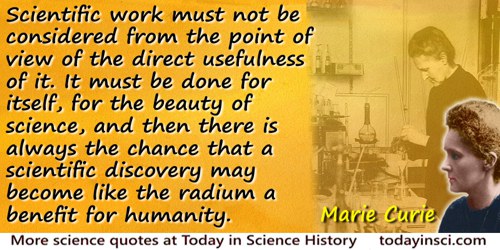
We must not forget that when radium was discovered no one knew that it would prove useful in hospitals. The work was one of pure science. And this is a proof that scientific work must not be considered from the point of view of the direct usefulness of it. It must be done for itself, for the beauty of science, and then there is always the chance that a scientific discovery may become like the radium a benefit for humanity.
Lecture at Vassar College, Poughkeepsie, New York (14 May 1921). In Cambridge Editorial Partnership, Speeches that Changed the World, 53.
Well-established theories collapse under the weight of new facts and observations which cannot be explained, and then accumulate to the point where the once useful theory is clearly obsolete.
[Using Thomas S. Kuhn's theories to frame his argument about the relationship beween science and technology: as new facts continue to accumulate, a new, more accurate paradigm must replace the old one.]
[Using Thomas S. Kuhn's theories to frame his argument about the relationship beween science and technology: as new facts continue to accumulate, a new, more accurate paradigm must replace the old one.]
— Al Gore
Commencement address at M.I.T. (7 Jun 1996). In obituary, 'Thomas S. Kuhn', The Tech (26 Jun 1996), 9.
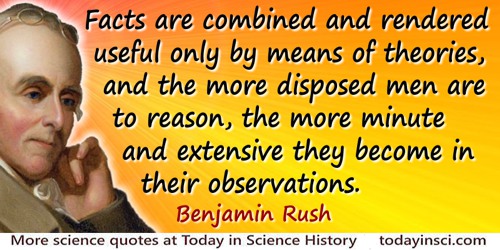
Were I disposed to consider the comparative merit of each of them [facts or theories in medical practice], I should derive most of the evils of medicine from supposed facts, and ascribe all the remedies which have been uniformly and extensively useful, to such theories as are true. Facts are combined and rendered useful only by means of theories, and the more disposed men are to reason, the more minute and extensive they become in their observations.
Quoted in John Edmonds Stock, Memoirs of the life of Thomas Beddoes (1810), 401.
What I want to stress is that the pre-condition of scientific discovery is a society which does not demand “usefulness” from the scientist, but grants him the liberty which he needs for concentration and for the conscientious detailed work without which creation is impossible.
In 'Science Needs Freedom', World Digest (1943), 55, 50. As cited in John R. Baker, Science and the Planned State (1945), 42-43 and 115, footnote 98.
What, in fact, is mathematical discovery? It does not consist in making new combinations with mathematical entities that are already known. That can be done by anyone, and the combinations that could be so formed would be infinite in number, and the greater part of them would be absolutely devoid of interest. Discovery consists precisely in not constructing useless combinations, but in constructing those that are useful, which are an infinitely small minority. Discovery is discernment, selection.
In Science et Méthode (1920), 48, as translated by Francis Maitland, in Science and Method (1908, 1952), 50-51. Also seen elsewhere translated with “invention” in place of “discovery”.
Whatever be the detail with which you cram your student, the chance of his meeting in after life exactly that detail is almost infinitesimal; and if he does meet it, he will probably have forgotten what you taught him about it. The really useful training yields a comprehension of a few general principles with a thorough grounding in the way they apply to a variety of concrete details. In subsequent practice the men will have forgotten your particular details; but they will remember by an unconscious common sense how to apply principles to immediate circumstances. Your learning is useless to you till you have lost your textbooks, burnt your lecture notes, and forgotten the minutiae which you learned by heart for the examination. What, in the way of detail, you continually require will stick in your memory as obvious facts like the sun and the moon; and what you casually require can be looked up in any work of reference. The function of a University is to enable you to shed details in favor of principles. When I speak of principles I am hardly even thinking of verbal formulations. A principle which has thoroughly soaked into you is rather a mental habit than a formal statement. It becomes the way the mind reacts to the appropriate stimulus in the form of illustrative circumstances. Nobody goes about with his knowledge clearly and consciously before him. Mental cultivation is nothing else than the satisfactory way in which the mind will function when it is poked up into activity.
In 'The Rhythm of Education', The Aims of Education: & Other Essays (1917), 41.
When the old and bewhiskered alchemist mentally planned his transmutations from lead to gold, he no doubt considered his reagent “spiritus vitroli” second only to his trusty Philosopher’s Stone in power and usefulness; for we read of sulphuric acid back through Alchemical times.
Co-author with E.L. Larison, American Sulphuric Acid Practice (1921), 1.
When we no longer look at an organic being as a savage looks at a ship, as something wholly beyond his comprehension; when we regard every production of nature as one which has had a long history; when we contemplate every complex structure and instinct as the summing up of many contrivances, each useful to the possessor, in the same way as any great mechanical invention is the summing up of the labour, the experience, the reason, and even the blunders of numerous workmen; when we thus view each organic being, how far more interesting, I speak from experience, does the study of natural history become!
From the Conclusion of Origin of Species by Means of Natural Selection, Or the Preservation of Favoured Races in the Struggle for Life (3rd. ed., 1861), 521.
Without preparing fluorine, without being able to separate it from the substances with which it is united, chemistry has been able to study and to analyze a great number of its compounds. The body was not isolated, and yet its place was marked in our classifications. This well demonstrates the usefulness of a scientific theory, a theory which is regarded as true during a certain time, which correlates facts and leads the mind to new hypotheses, the first causes of experimentation; which, little by little, destroy the theory itself, in order to replace it by another more in harmony with the progress of science.
[Describing the known history of fluorine compounds before his isolation of the element.]
[Describing the known history of fluorine compounds before his isolation of the element.]
'Fluorine', lecture at the Royal Institution (28 May 1897), translated from the French, in Proceedings of the Royal Institution (1897). In Annual Report of the Board of Regents of the Smithsonian Institution to July 1897 (1898), 262.
 In science it often happens that scientists say, 'You know that's a really good argument; my position is mistaken,' and then they would actually change their minds and you never hear that old view from them again. They really do it. It doesn't happen as often as it should, because scientists are human and change is sometimes painful. But it happens every day. I cannot recall the last time something like that happened in politics or religion.
(1987) --
In science it often happens that scientists say, 'You know that's a really good argument; my position is mistaken,' and then they would actually change their minds and you never hear that old view from them again. They really do it. It doesn't happen as often as it should, because scientists are human and change is sometimes painful. But it happens every day. I cannot recall the last time something like that happened in politics or religion.
(1987) -- 





