Universe Quotes (909 quotes)
... I should think that anyone who considered it more reasonable for the whole universe to move in order to let the Earth remain fixed would be more irrational than one who should climb to the top of your cupola just to get a view of the city and its environs, and then demand that the whole countryside should revolve around him so that he would not have to take the trouble to turn his head.
In Dialogue Concerning the Two Chief World Systems (1632).
… just as the astronomer, the physicist, the geologist, or other student of objective science looks about in the world of sense, so, not metaphorically speaking but literally, the mind of the mathematician goes forth in the universe of logic in quest of the things that are there; exploring the heights and depths for facts—ideas, classes, relationships, implications, and the rest; observing the minute and elusive with the powerful microscope of his Infinitesimal Analysis; observing the elusive and vast with the limitless telescope of his Calculus of the Infinite; making guesses regarding the order and internal harmony of the data observed and collocated; testing the hypotheses, not merely by the complete induction peculiar to mathematics, but, like his colleagues of the outer world, resorting also to experimental tests and incomplete induction; frequently finding it necessary, in view of unforeseen disclosures, to abandon one hopeful hypothesis or to transform it by retrenchment or by enlargement:—thus, in his own domain, matching, point for point, the processes, methods and experience familiar to the devotee of natural science.
In Lectures on Science, Philosophy and Art (1908), 26
... perhaps ‘our universe is simply one of those things that happen from time to time.’
[Speaking of the Universe as a vacuum fluctuation.]
[Speaking of the Universe as a vacuum fluctuation.]
…...
… scientific thought does not mean thought about scientific subjects with long names. There are no scientific subjects. The subject of science is the human universe; that is to say, everything that is, or has been, or may be related to man.
'On the Aims and Instruments of Scientific Thought,' a Lecture delivered before the members of the British Association, at Brighton, on 19 Aug 1872, in Leslie Stephen and Frederick Pollock (eds.), Lectures and Essays, by the Late William Kingdon Clifford (1886), 86.
… the Einsteins were taken to the Mt. Wilson Observatory in California. Mrs. Einstein was particularly impressed by the giant telescope. “What on earth do they use it for?” she asked. Her host explained that one of its chief purposes was to find out the shape of the universe. “Oh,” said Mrs. Einstein, “my husband does that on the back of an envelope.”
In Try and Stop Me (1945).
...in an infinite universe, anything that could be imagined might somewhere exist.”
…...
...the scientific attitude implies what I call the postulate of objectivity—that is to say, the fundamental postulate that there is no plan, that there is no intention in the universe. Now, this is basically incompatible with virtually all the religious or metaphysical systems whatever, all of which try to show that there is some sort of harmony between man and the universe and that man is a product—predictable if not indispensable—of the evolution of the universe.
Quoted in John C. Hess, 'French Nobel Biologist Says World Based On Chance', New York Times (15 Mar 1971), 6. Cited in Herbert Marcuse, Counter-Revolution and Revolt (1972), 66.
“Any specialty, if important, is too important to be left to the specialists.” After all, the specialist cannot function unless he concentrates more or less entirely on his specialty and, in doing so, he will ignore the vast universe lying outside and miss important elements that ought to help guide his judgment. He therefore needs the help of the nonspecialist, who, while relying on the specialist for key information, can yet supply the necessary judgment based on everything else… Science, therefore, has become too important to be left to the scientists.
In 'The Fascination of Science', The Roving Mind (1983), 123. Asimov begins by extending a quote by George Clemenceau: “War is too important to be left to the generals.”
“By convention there is color, by convention sweetness, by convention bitterness, but in reality there are atoms and the void,” announced Democritus. The universe consists only of atoms and the void; all else is opinion and illusion. If the soul exists, it also consists of atoms.
In Masks of the Universe: Changing Ideas on the Nature of the Cosmos (1985), 55.
[An] old Pythagorean prejudice … thought it a crime to eat eggs; because an egg was a microcosm, or universe in little; the shell being the earth; the white, water; fire, the yolk; and the air found between the shell and the white.
'Common Cookery'. Household Words (26 Jan 1856), 13, 43. An English weekly magazine edited by Charles Dickens.
[Certain students] suppose that because science has penetrated the structure of the atom it can solve all the problems of the universe. ... They are known in every ... college as the most insufferable, cocksure know-it-alls. If you want to talk to them about poetry, they are likely to reply that the "emotive response" to poetry is only a conditioned reflex .... If they go on to be professional scientists, their sharp corners are rubbed down, but they undergo no fundamental change. They most decidedly are not set apart from the others by their intellectual integrity and faith, and their patient humility in front of the facts of nature.... They are uneducated, in the fullest sense of the word, and they certainly are no advertisement for the claims of science teachers.
In Science is a Sacred Cow (1950), 18-19.
[Coleridge] selected an instance of what was called the sublime, in DARWIN, who imagined the creation of the universe to have taken place in a moment, by the explosion of a mass of matter in the womb, or centre of space. In one and the same instant of time, suns and planets shot into systems in every direction, and filled and spangled the illimitable void! He asserted this to be an intolerable degradation—referring, as it were, all the beauty and harmony of nature to something like the bursting of a barrel of gunpowder! that spit its combustible materials into a pock-freckled creation!
In Seamus Perry (eds.), Coleridge’s Responses: Vol. 1: Coleridge on Writers and Writing (2007), 338-339.
[Florence Nightingale] was a great administrator, and to reach excellence here is impossible without being an ardent student of statistics. Florence Nightingale has been rightly termed the “Passionate Statistician.” Her statistics were more than a study, they were indeed her religion. For her, Quetelet was the hero as scientist, and the presentation copy of his Physique Sociale is annotated by her on every page. Florence Nightingale believed—and in all the actions of her life acted upon that belief—that the administrator could only be successful if he were guided by statistical knowledge. The legislator—to say nothing of the politician—too often failed for want of this knowledge. Nay, she went further: she held that the universe—including human communities—was evolving in accordance with a divine plan; that it was man's business to endeavour to understand this plan and guide his actions in sympathy with it. But to understand God's thoughts, she held we must study statistics, for these are the measure of his purpose. Thus the study of statistics was for her a religious duty.
In Karl Pearson, The Life, Letters and Labours of Francis Galton (1924), Vol. 2, 414-5.
[I find it as difficult] to understand a scientist who does not acknowledge the presence of a superior rationality behind the existence of the universe as it is to comprehend a theologian who would deny the advances of science.
Speech, Huntsville Ministerial Association, in Wernher Von Braun and Irene E. Powell-Willhite (ed.), The Voice of Dr. Wernher Von Braun: An Anthology (2007), 89.
[In the beginning, before creation] There was neither Aught nor Naught, no air nor sky beyond. …
[There was only]
A self-supporting mass beneath, and energy above.
Who knows, who ever told, from whence this vast creation rose?
No gods had yet been born—who then can e’er the truth disclose?
[There was only]
A self-supporting mass beneath, and energy above.
Who knows, who ever told, from whence this vast creation rose?
No gods had yet been born—who then can e’er the truth disclose?
— Rigveda
In Rigveda. In John Robson, Hinduism and Its Relations to Christianity (1893), 17.
[Isaac Newton] regarded the Universe as a cryptogram set by the Almighty—just as he himself wrapt the discovery of the calculus in a cryptogram when he communicated with Leibniz. By pure thought, by concentration of mind, the riddle, he believed, would be revealed to the initiate.
In 'Newton, the Man' (1946). In Geoffrey Keynes (ed.), Essays in Biography, 2nd edition (1951), 314.
[Learning is] the actual process of broadening yourself, of knowing there’s a little extra facet of the universe you know about and can think about and can understand. It seems to me that when it’s time to die, and that will come to all of us, there’ll be a certain pleasure in thinking that you had utilized your life well, that you had learned as much as you could, gathered in as much as possible of the universe, and enjoyed it. I mean, there’s only this universe and only this one lifetime to try to grasp it. And, while it is inconceivable that anyone can grasp more than a tiny portion of it, at least do that much. What a tragedy to just pass through and get nothing out of it.
'Isaac Asimov Speaks' with Bill Moyers in The Humanist (Jan/Feb 1989), 49. Reprinted in Carl Howard Freedman (ed.), Conversations with Isaac Asimov (2005), 139.
[Man] … his origin, his growth, his hopes and fears, his loves and his beliefs are but the outcome of accidental collocations of atoms; that no fire, no heroism, no intensity of thought and feeling can preserve an individual life beyond the grave; that all the labour of the ages, all the devotion, all the inspiration, all the noonday brightness of human genius are destined to extinction in the vast death of the solar system, and that the whole temple of Man's achievement must inevitably be buried beneath the debris of a universe in ruins…
From 'A Free Man's Worship', Independent Review (Dec 1903). Collected in Mysticism and Logic: And Other Essays (1918), 47-48.
[My study of the universe] leaves little doubt that life has occurred on other planets. I doubt if the human race is the most intelligent form of life.
Speech to University of Miami students. Quoted in article, 'Notions in Motion,' Time (24 Nov 1952).
[On the future of Chemistry:] Chemistry is not the preservation hall of old jazz that it sometimes looks like. We cannot know what may happen tomorrow. Someone may oxidize mercury (II), francium (I), or radium (II). A mineral in Nova Scotia may contain an unsaturated quark per 1020 nucleons. (This is still 6000 per gram.) We may pick up an extraterrestrial edition of Chemical Abstracts. The universe may be a 4-dimensional soap bubble in an 11-dimensional space as some supersymmetry theorists argued in May of 1983. Who knows?
In George B. Kaufmann, 'Interview with Jannik Bjerrum and Christian Klixbull Jørgensen', Journal of Chemical Education (1985), 62, No. 11, 1005.
[On the practical applications of particle physics research with the Large Hadron Collider.] Sometimes the public says, “What's in it for Numero Uno? Am I going to get better television reception? Am I going to get better Internet reception?” Well, in some sense, yeah. … All the wonders of quantum physics were learned basically from looking at atom-smasher technology. … But let me let you in on a secret: We physicists are not driven to do this because of better color television. … That's a spin-off. We do this because we want to understand our role and our place in the universe.
As quoted in Alan Boyle, 'Discovery of Doom? Collider Stirs Debate', article (8 Sep 2008) on a msnbc.com web page. The article writer included the information that Kaku noted that past discoveries from the world of particle physics ushered in many of the innovations we enjoy today, ranging from satellite communications and handheld media players to medical PET scanners (which put antimatter to practical use)."
[Scientific research reveals] the majestic spectacle of the order of nature gradually unfolding itself to man’s consciousness and placing in his hands the implements of ever augmenting power to control his destinies and attain that ultimate comprehension of the universe which has in all ages constituted the supreme aspiration of man.
As quoted in book review by Ian Clunies Ross, "The Spirit of Research', The Australian Quarterly (Dec 1931), 3, No. 12, 126.
[The intellectual] is not religious in the sense of the ordinary man is religious, for the religion of the ordinary man is man-centred and takes faith as its cornerstone. The intellectual is sparing of faith, reserving it for those things which seem, for the time at least, to be scientifically demonstrated, such as the results of repeatable experiments or natural laws tested many times. But in another sense the intellectual is more religious than the ordinary man, because he is passionately interested in the nature of things. He wants to take everything in pieces, actually or figuratively, in order to discover the plan according to which it was constructed. If an active wonder with regard to the universe is a criterion for religion, then the intellectual is very religious indeed.
From Lecture (28 Nov 1957) in the Queen’s University, Belfast, 'Is the Study of its History a Brake on the Progress of Science', printed in Hermethena (1958), 19, 28.
[The octopus has] an amazing skin, because there are up to 20 million of these chromatophore pigment cells and to control 20 million of anything is going to take a lot of processing power. ... These animals have extraordinarily large, complicated brains to make all this work. ... And what does this mean about the universe and other intelligent life? The building blocks are potentially there and complexity will arise. Evolution is the force that's pushing that. I would expect, personally, a lot of diversity and a lot of complicated structures. It may not look like us, but my personal view is that there is intelligent life out there.
From transcript of PBS TV program Nova episode 'Origins: Where are the Aliens?' (2004).
[The religion of science was] an implicit faith that by the methods of physical science, and by these methods alone, could be solved all the problems arising out of the relation of man to man and of man towards the universe.
In My Apprenticeship (1926), 89.
[There was] in some of the intellectual leaders a great aspiration to demonstrate that the universe ran like a piece of clock-work, but this was was itself initially a religious
aspiration. It was felt that there would be something defective in Creation itself—something not quite worthy of God—unless the whole system of the universe could be shown to be interlocking, so that it carried the pattern of reasonableness and orderliness. Kepler, inaugurating the scientist’s quest for a mechanistic universe in the seventeenth century, is significant here—his mysticism, his music of the spheres, his rational deity demand a system which has the beauty of a piece of mathematics.
In The Origins of Modern Science (1950), 105.
[W]e might expect intelligent life and technological communities to have emerged in the universe billions of years ago. Given that human society is only a few thousand years old, and that human technological society is mere centuries old, the nature of a community with millions or even billions of years of technological and social progress cannot even be imagined. ... What would we make of a billion-year-old technological community?
In Are We Alone?(1995), 48.

[W]hen Galileo discovered he could use the tools of mathematics and mechanics to understand the motion of celestial bodies, he felt, in the words of one imminent researcher, that he had learned the language in which God recreated the universe. Today we are learning the language in which God created life. We are gaining ever more awe for the complexity, the beauty, the wonder of God's most devine and sacred gift.
From White House Announcement of the Completion of the First Survey of the Entire Human Genome Project, broadcast on the day of the publication of the first draft of the human genome. Quoted in transcript on the National Archives, Clinton White House web site, 'Text of Remarks on the Completion of the First Survey of the Entire Human Genome Project' (26 Jun 2000).
[When I was a child] I grew up in Brooklyn, New York, and I was a street kid. … [T]here was one aspect of that environment that, for some reason, struck me as different, and that was the stars. … I could tell they were lights in the sky, but that wasn’t an explanation. I mean, what were they? Little electric bulbs on long black wires, so you couldn’t see what they were held up by? What were they? … My mother said to me, "Look, we’ve just got you a library card … get out a book and find the answer.” … It was in there. It was stunning. The answer was that the Sun was a star, except very far away. … The dazzling idea of a universe vast beyond imagining swept over me. … I sensed awe.
In 'Wonder and Skepticism', Skeptical Enquirer (Jan-Feb 1995), 19, No. 1.
“The Universe repeats itself, with the possible exception of history.” Of all earthly studies history is the only one that does not repeat itself. ... Astronomy repeats itself; botany repeats itself; trigonometry repeats itself; mechanics repeats itself; compound long division repeats itself. Every sum if worked out in the same way at any time will bring out the same answer. ... A great many moderns say that history is a science; if so it occupies a solitary and splendid elevation among the sciences; it is the only science the conclusions of which are always wrong.
In 'A Much Repeated Repetition', Daily News (26 Mar 1904). Collected in G. K. Chesterton and Dale Ahlquist (ed.), In Defense of Sanity: The Best Essays of G.K. Chesterton (2011), 82.
Ante mare, et terras, et quod tegit omnia caelum, unus erat toto naturae vultus in orbe, quem dixere chaos: rudis indigestaque moles; nec quicquam, nisi pondus iners; congestaque eodem non bene iunctarum discordia, semina rerum.
Before there was the sea, the earth and the sky canopy, Nature presented the same aspect throughout the world, which men called Chaos: a raw, disorganized bulk; nothing but an inert mass; a jumbled heap of primordial things.
Before there was the sea, the earth and the sky canopy, Nature presented the same aspect throughout the world, which men called Chaos: a raw, disorganized bulk; nothing but an inert mass; a jumbled heap of primordial things.
The original Latin text of Ovid’s Metamorphoses, Book 1, lines 5-9, in which he described the Creation of the universe. It is freely translated by Webmaster blending several sources. See, for example, Locke (trans.), The First Book of Ovid's Metamorphoses, with a Literal Interlinear Translation (1828), 2, or Mary Innes (trans.), The Metamorphoses of Ovid (1955), 29.
Bernard: Oh, you’re going to zap me with penicillin and pesticides. Spare me that and I’ll spare you the bomb and aerosols. But don’t confuse progress with perfectibility. A great poet is always timely. A great philosopher is an urgent need. There’s no rush for Isaac Newton. We were quite happy with Aristotle’s cosmos. Personally, I preferred it. Fifty-five crystal spheres geared to God’s crankshaft is my idea of a satisfying universe. I can’t think of anything more trivial than the speed of light. Quarks, quasars—big bangs, black holes—who [cares]? How did you people con us out of all that status? All that money? And why are you so pleased with yourselves?
Chloe: Are you against penicillin, Bernard?
Bernard: Don’t feed the animals.
Chloe: Are you against penicillin, Bernard?
Bernard: Don’t feed the animals.
In the play, Acadia (1993), Act 2, Scene 5, 61.
Ce grand ouvrage, toujours plus merveilleux à mesure qu’il est plus connu, nous donne une si grande idée de son ouvrier, que nous en sentons notre esprit accablé d’admiration et de respect.
[The Universe] This great work, always more amazing in proportion as it is better known, raises in us so grand an idea of its Maker, that we find our mind overwhelmed with feelings of wonder and adoration.
[The Universe] This great work, always more amazing in proportion as it is better known, raises in us so grand an idea of its Maker, that we find our mind overwhelmed with feelings of wonder and adoration.
Original French and translation in Craufurd Tait Ramage (ed.) Beautiful Thoughts from French and Italian Authors (1866), 119-120.
Dilbert: It took weeks but I’ve calculated a new theory about the origin of the universe. According to my calculations it didn’t start with a “Big Bang” at all—it was more of “Phhbwt” sound. You may be wondering about the practical applications of the “Little Phhbwt” theory.
Dogbert: I was wondering when you’ll go away.
Dogbert: I was wondering when you’ll go away.
Dilbert comic strip (1 Jan 1993)
Il est impossible de contempler le spectacle de l’univers étoilé sans se demander comment il s’est formé: nous devions peut-être attendre pour chercher une solution que nous ayons patiemment rassemblé les éléments …mais si nous étions si raisonnables, si nous étions curieux sans impatience, il est probable que nous n’avions jamais créé la Science et que nous nous serions toujours contentés de vivre notre petite vie. Notre esprit a donc reclamé impérieusement cette solution bien avant qu’elle fut mûre, et alors qu’il ne possédait que de vagues lueurs, lui permettant de la deviner plutôt que de l’attendre.
It is impossible to contemplate the spectacle of the starry universe without wondering how it was formed: perhaps we ought to wait, and not look for a solution until have patiently assembled the elements … but if we were so reasonable, if we were curious without impatience, it is probable we would never have created Science and we would always have been content with a trivial existence. Thus the mind has imperiously laid claim to this solution long before it was ripe, even while perceived in only faint glimmers—allowing us to guess a solution rather than wait for it.
It is impossible to contemplate the spectacle of the starry universe without wondering how it was formed: perhaps we ought to wait, and not look for a solution until have patiently assembled the elements … but if we were so reasonable, if we were curious without impatience, it is probable we would never have created Science and we would always have been content with a trivial existence. Thus the mind has imperiously laid claim to this solution long before it was ripe, even while perceived in only faint glimmers—allowing us to guess a solution rather than wait for it.
From Leçons sur les Hypothèses Consmogoniques (1913) as cited in D. Ter Haar and A.G.W. Cameron, 'Historical Review of Theories of the Origin of the Solar System', collected in Robert Jastrow and A. G. W. Cameron (eds.), Origin of the Solar System: Proceedings of a Conference Held at the Goddard Institute for Space Studies, New York, January 23-24, 1962, (1963), 3.
'Cosmogonical Hypotheses' (1913), collected in Harlow Shapley, Source Book in Astronomy, 1900-1950 (1960), 347.
L’analyse mathématique … dans l’étude de tous les phénomènes; elle les interprète par le même langage, comme pour attester l’unité et la simplicité du plan de l’univers, et rendre encore plus manifeste cet ordre immuable qui préside à toutes les causes naturelles.
Mathematical analysis … in the study of all phenomena, interprets them by the same language, as if to attest the unity and simplicity of the plan of the universe, and to make still more evident that unchangeable order which presides over all natural causes.
Mathematical analysis … in the study of all phenomena, interprets them by the same language, as if to attest the unity and simplicity of the plan of the universe, and to make still more evident that unchangeable order which presides over all natural causes.
From Théorie Analytique de la Chaleur (1822), xv, translated by Alexander Freeman in The Analytical Theory of Heat (1878), 8.
L’homme n’est qu’un roseau, le plus faible de la nature, mais c’est un roseau pensant. Il ne faut pas que l’univers entier s’arme pour l’écraser; une vapeur, une goutte d’eau suffit pour le tuer. Mais quand l’univers l’écraserait, l’homme serait encore plus noble que ce qui le tue, parce qu’il sait qu’il meurt et l’avantage que l’univers a sur lui; l’univers n'en sait rien.
Man is a reed, the feeblest thing in nature. But a reed that can think. The whole universe need not fly to arms to kill him ; for a little heat or a drop of water can slay a man. But, even then, man would be nobler than his destroyer, for he would know he died, while the whole universe would know nothing of its victory.
Man is a reed, the feeblest thing in nature. But a reed that can think. The whole universe need not fly to arms to kill him ; for a little heat or a drop of water can slay a man. But, even then, man would be nobler than his destroyer, for he would know he died, while the whole universe would know nothing of its victory.
Pensées. As given and translated in Hugh Percy Jones (ed.), Dictionary of Foreign Phrases and Classical Quotations (1908), 292.

La chaleur pénètre, comme la gravité, toutes les substances de l’univers, ses rayons occupent toutes les parties de l’espace. Le but de notre ouvrage est d’exposer les lois mathématiques que suit cet élément. Cette théorie formera désormais une des branches les plus importantes de la physique générale.
Heat, like gravity, penetrates every substance of the universe, its rays occupy all parts of space. The object of our work is to set forth the mathematical laws which this element obeys. The theory of heat will hereafter form one of the most important branches of general physics.
Heat, like gravity, penetrates every substance of the universe, its rays occupy all parts of space. The object of our work is to set forth the mathematical laws which this element obeys. The theory of heat will hereafter form one of the most important branches of general physics.
From 'Discours Préliminaire' to Théorie Analytique de la Chaleur (1822), i, translated by Alexander Freeman in The Analytical Theory of Heat (1878), 1.
Le grand architecte de l'univers l'a construite on bons matériaux.
The Great Architect of the universe built it of good firm stuff.
The Great Architect of the universe built it of good firm stuff.
Journey to the Centre of the Earth, translated by William Butcher (1992)
Le premier regard de l’homme jeté sur l’univers n’y découvre que variété, diversité, multiplicité des phénomènes. Que ce regard soit illuminé par la science,—par la science qui rapproche l’homme de Dieu,—et la simplicité et l’unité brillent de toutes parts.
Man’s first glance at the universe discovers only variety, diversity, multiplicity of phenomena. Let that glance be illuminated by science—by the science which brings man closer to God,—and simplicity and unity shine on all sides.
Man’s first glance at the universe discovers only variety, diversity, multiplicity of phenomena. Let that glance be illuminated by science—by the science which brings man closer to God,—and simplicity and unity shine on all sides.
Original French quoted in René Vallery-Radot, La Vie de Pasteur (1901), 209. Translation by Google translate, tweaked by Webmaster. The English version of the book, omits this passage, except for “Science, which brings man nearer to God.” In The Life of Pasteur (1902), Vol. 1, 194.
Le seul véritable voyage ... ce ne serait pas d’aller vers de nouveaux paysages, mais d’avoir d’autres yeux, de voir l’univers avec les yeux d’un autre, de cent autres, de voir les cent univers que chacun d’eux voit …
The only true voyage of discovery … would be not to visit new landscapes, but to possess other eyes, to see the universe through the eyes of another, of a hundred others, to see the hundred universes that each of them sees.
[Also often seen translated in the shortened form: 'The only real voyage of discovery consists not in seeing new landscapes, but in having new eyes.']
The only true voyage of discovery … would be not to visit new landscapes, but to possess other eyes, to see the universe through the eyes of another, of a hundred others, to see the hundred universes that each of them sees.
[Also often seen translated in the shortened form: 'The only real voyage of discovery consists not in seeing new landscapes, but in having new eyes.']
'La Prisonnière', À la recherche du temps perdu (1913-27). In Roger Shattuck, Proust (1974), 131.
Mon royaume est de la dimension de l’univers, et mon désir n’a pas de bornes. Je vais toujours, affranchissant l’esprit et pesant les mondes, sans haine, sans peur, sans pitié, sans amour, et sans Dieu. On m’appelle la Science.
My kingdom is of the dimension of the universe and my desire has no bounds. I am going about always to free the spirit and weigh the worlds, without hatred, without fear, without pity and without God. They call me Science.
My kingdom is of the dimension of the universe and my desire has no bounds. I am going about always to free the spirit and weigh the worlds, without hatred, without fear, without pity and without God. They call me Science.
French passage from La Tentation de Saint-Antoine (1874) in Œvres Complètes de Gustave Flaubert (1885), 222. English translation by Ernest Tristan and G.F. Monkshood, The Temptation of Saint Anthony (1910), 254.
Naturae vero rerum vis atque maiestas in omnibus momentis fide caret si quis modo partes eius ac non totam conplectatur animo.
The power and majesty of the nature of the universe at every turn lacks credence if one’s mind embraces parts of it only and not the whole.
The power and majesty of the nature of the universe at every turn lacks credence if one’s mind embraces parts of it only and not the whole.
In Pliny: Natural History (1947), Vol. 2, Book 7, 511, as translated by H. Rackham
Socrates: Very good; let us begin then, Protarchus, by asking whether all this which they call the universe is left to the guidance of unreason and chance medley, or, on the contrary, as our fathers have declared, ordered and governed by a marvellous intelligence and wisdom.
Protarchus: Wide asunder are the two assertions, illustrious Socrates, for that which you were just now saying to me appears to be blasphemy, but the other assertion, that mind orders all things, is worthy of the aspect of the world…
Protarchus: Wide asunder are the two assertions, illustrious Socrates, for that which you were just now saying to me appears to be blasphemy, but the other assertion, that mind orders all things, is worthy of the aspect of the world…
— Plato
From 'Philebus', collected in The Dialogues of Plato (1875), Vol. 4, 70.
~~[Atrributed]~~ I’m sure the universe is full of intelligent life. It’s just been too intelligent to come here.
Webmaster doubts the authenticity of this quote. It is all over the web, without any source cited. So far, in books available to search, the earliest instance of the quote Webmaster finds is 2003, also with no source, in New Scientist (2003), 177, 53. If this was an authentic quote, wouldn't it show up somewhere before that, with a source, since he died in 2008? Perhaps it is a paraphrase, or from an interview. Can you help?
~~[Dubious]~~ If you want to find the secrets of the universe, think in terms of energy, frequency and vibration.
Very dubious that is a true quote from Tesla, however intriguing. Webmaster, as yet, has found no reliable primary source for this quote, and doubts that it is authentic. It has widely spread virally, and is duplicated in various copycat quote collections, but that cannot add any authenticity. On a webpage by Ralph Bergstresser about the healing powers of the Ganges River, he footnotes the quote as from “a conversation with the famous scientist, Dr. Nikola Tesla, in 1942.” Note that Tesla, late in life had fading energy and mental health, and died poor and reclusive, on 7 Jan 1943. Webmaster places no credibility on said source, and therefore regards it as no more than Anonymous.
~~[False Attribution]~~ Sometimes I think we’re alone in the universe, and sometimes I think we’re not. In either case, the idea is quite staggering.
Quote Investigator found no authentic source for this quote from Clarke. Thorough discussion here.
~~[No primary source found]~~ When I read the Bhagavad Gita and reflect about how God created this universe everything else seems so superfluous.
As yet, Webmaster has not found a 20th century book or primary source with this as a valid quote with citation. It is best regarded as a quote incorrectly attributed to Einstein. Although the quote appears in a few 21st century books, it is always without citation. If you you know a primary source, please contact Webmaster.
~~[Unverified]~~ The strongest affection and utmost zeal should, I think, promote the studies concerned with the most beautiful objects. This is the discipline that deals with the universe’s divine revolutions, the stars’ motions, sizes, distances, risings and settings . . . for what is more beautiful than heaven?
Seen spreading across the web, only in recent years. As yet, Webmaster cannot identify a trustworthy primary source, is therefore presently skeptical, and meanwhile labels the quote as unverified.
A ... hypothesis may be suggested, which supposes the word 'beginning' as applied by Moses in the first of the Book of Genesis, to express an undefined period of time which was antecedent to the last great change that affected the surface of the earth, and to the creation of its present animal and vegetable inhabitants; during which period a long series of operations and revolutions may have been going on, which, as they are wholly unconnected with the history of the human race, are passed over in silence by the sacred historian, whose only concern with them was largely to state, that the matter of the universe is not eternal and self-existent but was originally created by the power of the Almighty.
Vindiciae Geologicae (1820), 31-2.
A contradiction (between science and religion) is out of the question. What follows from science are, again and again, clear indications of God’s activity which can be so strongly perceived that Kepler dared to say (for us it seems daring, not for him) that he could ‘almost touch God with his hand in the Universe.’
…...
A cosmic mystery of immense proportions, once seemingly on the verge of solution, has deepened and left astronomers and astrophysicists more baffled than ever. The crux ... is that the vast majority of the mass of the universe seems to be missing.
[Reporting a Nature article discrediting explanation of invisible mass being due to neutrinos]
[Reporting a Nature article discrediting explanation of invisible mass being due to neutrinos]
In 'If Theory is Right, Most of Universe is Still “Missing”', New York Times (11 Sep 1984).
A Frenchman who arrives in London, will find Philosophy, like every Thing else, very much chang’d there. He had left the World a plenum, and he now finds it a vacuum. At Paris the Universe is seen, compos’d of Vortices of subtile Matter; but nothing like it is seen in London. In France, ‘tis the Pressure of the Moon that causes the Tides; but in England ‘tis the Sea that gravitates towards the Moon; so what when you think that the Moon should make it flood with us, those Gentlemen fancy it should be Ebb, which, very unluckily, cannot be prov’d. For to be able to do this, ‘tis necessary the Moon and the Tides should have been enquir’d into, at the very instant of the Creation.
Letter XIV. 'On DesCartes and Sir Isaac Newton', in Letters Concerning the English Nation (1733), 109-110.
A great deal of the universe does not need any explanation. Elephants, for instance. Once molecules have learnt to compete and to create other molecules in their own image, elephants, and things resembling elephants, will in due course be found roaming around the countryside ... Some of the things resembling elephants will be men.
The Creation (1981), 3.
A human being is part of the whole, called by us “Universe”; a part limited in time and space. He experiences himself, his thoughts and feelings as something separated from the rest—a kind of optical delusion of his consciousness. This delusion is a kind of prison for us, restricting us to our personal desires and to affection for a few persons nearest us. Our task must be to free ourselves from this prison by widening our circle of compassion to embrace all living creatures and the whole of nature in its beauty. Nobody is able to achieve this completely but the striving for such achievement is, in itself, a part of the liberation and a foundation for inner security.
In Letter (4 Mar 1950), replying to a grieving father over the loss of a young son. In Dear Professor Einstein: Albert Einstein’s Letters to and from Children (2002), 184.
A lot of prizes have been awarded for showing the universe is not as simple as we might have thought.
In A Brief History of Time, (1988, 1998), 80.
A man said to the universe,
“Sir, I exist.”
“However,” replied the universe,
“the fact has not created in me
a sense of obligation.”
“Sir, I exist.”
“However,” replied the universe,
“the fact has not created in me
a sense of obligation.”
In 'A Man Said to the Universe', Poem 21 in War Is Kind (1899). In Stephen Crane and Joseph Katz (ed.), The Complete Poems by Stephen Crane (1972), 139.
A page from a journal of modern experimental physics will be as mysterious to the uninitiated as a Tibetan mandala. Both are records of enquiries into the nature of the universe.
In The Tao of Physics (1975), 36.
A person is smart. People are dumb ... Fifteen hundred years ago everybody knew the Earth was the center of the universe. Five hundred years ago, everybody knew the Earth was flat, and fifteen minutes ago, you knew that humans were alone on this planet. Imagine what you'll know tomorrow.
Character Agent K in movie Men in Black(1997), screen story and screenplay by Ed Solomon. Quoted in George Aichele, Culture, Entertainment and the Bible (2000), 26. In a footnote, from the post-movie novel by Steve Perry, Men in Black (1997), 66, is added, 'Yeah. A hundred years from now, whoever is here will probably pee themselves laughing at what we believe.'
A poet is, after all, a sort of scientist, but engaged in a qualitative science in which nothing is measurable. He lives with data that cannot be numbered, and his experiments can be done only once. The information in a poem is, by definition, not reproducible. ... He becomes an equivalent of scientist, in the act of examining and sorting the things popping in [to his head], finding the marks of remote similarity, points of distant relationship, tiny irregularities that indicate that this one is really the same as that one over there only more important. Gauging the fit, he can meticulously place pieces of the universe together, in geometric configurations that are as beautiful and balanced as crystals.
In The Medusa and the Snail: More Notes of a Biology Watcher (1974, 1995), 107.
A proposal…to bore a hole in the crust of the Earth and discover the conditions deep down below the surface…may remind us that the most secret places of Nature are, perhaps, not 10 to the n-th miles above our heads, but 10 miles below our feet.
From Presidential address to Section A of the British Association at Cardiff (24 Aug 1920). Published in 'The Internal Constitution of the Stars', The Observatory: A Monthly Review of Astronomy (Oct 1920), 43, No. 557, 341.
A religion old or new, that stressed the magnificence of the universe as revealed by modern science, might be able to draw forth reserves of reverence and awe hardly tapped by the conventional faiths. Sooner or later such a religion will emerge.
Pale Blue Dot: a Vision of the Human Future in Space (1994), 52.
A theory with mathematical beauty is more likely to be correct than an ugly one that fits some experimental data. God is a mathematician of a very high order, and He used very advanced mathematics in constructing the universe.
In Scientific American (May 1963). As quoted and cited in The Hutchinson Encyclopedia of Science (1998), 468.
A time will come when science will transform [our bodies] by means which we cannot conjecture... And then, the earth being small, mankind will migrate into space, and will cross the airless Saharas which separate planet from planet, and sun from sun. The earth will become a Holy Land which will be visited by pilgrims from all quarters of the universe.
…...
A universe that came from nothing in the big bang will disappear into nothing in the big crunch, its glorious few zillion years of existence not even a memory.
In The Last Three Minutes: Conjectures About The Ultimate Fate Of The Universe (1994, 2008), 123.
A universe without law would be a universe without order, without the possibility of science, and the manifestations of an intelligent governor and creator.
Presidential address to the American Association for the Advancement of Science (22 Aug 1850),The Papers of Joseph Henry, Vol. 8, 99.
A very small cause which escapes our notice determines a considerable effect that we cannot fail to see, and then we say that the effect is due to chance. If we knew exactly the laws of nature and the situation of the universe at the initial moment, we could predict exactly the situation of that same universe at a succeeding moment.
In 'Chance', Science et Méthode (1908). Quoted in Richard Kautz, Chaos: The Science of Predictable Random Motion (2011), 167 as translated in Science and Method by F. Maitland (1918).
A vision of the whole of life!. Could any human undertaking be ... more grandiose? This attempt stands without rival as the most audacious enterprise in which the mind of man has ever engaged ... Here is man, surrounded by the vastness of a universe in which he is only a tiny and perhaps insignificant part—and he wants to understand it.
…...
A world that did not lift a finger when Hitler was wiping out six million Jewish men, women, and children is now saying that the Jewish state of Israel will not survive if it does not come to terms with the Arabs. My feeling is that no one in this universe has the right and the competence to tell Israel what it has to do in order to survive. On the contrary, it is Israel that can tell us what to do. It can tell us that we shall not survive if we do not cultivate and celebrate courage, if we coddle traitors and deserters, bargain with terrorists, court enemies, and scorn friends.
In Before the Sabbath (1979), 6.
A zygote is a gamete’s way of producing more gametes. This may be the purpose of the universe.
In Time Enough for Love: The Lives of Lazarus Long (1973), 262.
According to our ancient Buddhist texts, a thousand million solar systems make up a galaxy. … A thousand million of such galaxies form a supergalaxy. … A thousand million supergalaxies is collectively known as supergalaxy Number One. Again, a thousand million supergalaxy Number
Ones form a Supergalaxy Number Two. A thousand million supergalaxy Number Twos make up a supergalaxy Number Three, and of these, it is stated in the texts that there are a countless number in the universe.
In 'Reactions to Man’s Landing on the Moon Show Broad Variations in Opinions', The New York Times (21 Jul 1969), 6.
After a duration of a thousand years, the power of astrology broke down when, with Copernicus, Kepler, and Galileo, the progress of astronomy overthrew the false hypothesis upon which the entire structure rested, namely the geocentric system of the universe. The fact that the earth revolves in space intervened to upset the complicated play of planetary influences, and the silent stars, related to the unfathomable depths of the sky, no longer made their prophetic voices audible to mankind. Celestial mechanics and spectrum analysis finally robbed them of their mysterious prestige.
Franz Cumont, translated by J.B. Baker, Astrology and Religion Among the Greeks and Romans (1912, 2007), 6.
After I had addressed myself to this very difficult and almost insoluble problem, the suggestion at length came to me how it could be solved with fewer and much simpler constructions than were formerly used, if some assumptions (which are called axioms) were granted me. They follow in this order.
There is no one center of all the celestial circles or spheres.
The center of the earth is not the center of the universe, but only of gravity and of the lunar sphere.
All the spheres revolve about the sun as their mid-point, and therefore the sun is the center of the universe.
The ratio of the earth’s distance from the sun to the height of the firmament is so much smaller than the ratio of the earth’s radius to its distance from the sun that the distance from the earth to the sun is imperceptible in comparison with the height of the firmament.
Whatever motion appears in the firmament arises not from any motion of the firmament, but from the earth’s motion. The earth together with its circumjacent elements performs a complete rotation on its fixed poles in a daily motion, while the firmament and highest heaven abide unchanged.
What appears to us as motions of the sun arise not from its motion but from the motion of the earth and our sphere, with which we revolve about the sun like any other planet. The earth has, then, more than one motion.
The apparent retrograde and direct motion of the planets arises not from their motion but from the earth’s. The motion of the earth alone, therefore, suffices to explain so many apparent inequalities in the heavens.
There is no one center of all the celestial circles or spheres.
The center of the earth is not the center of the universe, but only of gravity and of the lunar sphere.
All the spheres revolve about the sun as their mid-point, and therefore the sun is the center of the universe.
The ratio of the earth’s distance from the sun to the height of the firmament is so much smaller than the ratio of the earth’s radius to its distance from the sun that the distance from the earth to the sun is imperceptible in comparison with the height of the firmament.
Whatever motion appears in the firmament arises not from any motion of the firmament, but from the earth’s motion. The earth together with its circumjacent elements performs a complete rotation on its fixed poles in a daily motion, while the firmament and highest heaven abide unchanged.
What appears to us as motions of the sun arise not from its motion but from the motion of the earth and our sphere, with which we revolve about the sun like any other planet. The earth has, then, more than one motion.
The apparent retrograde and direct motion of the planets arises not from their motion but from the earth’s. The motion of the earth alone, therefore, suffices to explain so many apparent inequalities in the heavens.
'The Commentariolus', in Three Copernican Treatises (c.1510), trans. E. Rosen (1939), 58-9.
After innumerable dynasties of giant creatures, after endless generations of fish and families of molluscs, man finally arrives, the degenerate product of a grandiose type, his mould perhaps broken by his Creator. Fired by his retrospection, these timid humans, born but yesterday, can now leap across chaos, sing an endless hymn, and configure the history of the universe in a sort of retrograde Apocalypse.
From 'La Peau de Chagrin' (1831). As translated as by Helen Constantine The Wild Ass’s Skin (2012), 19.
After we came out of the church, we stood talking for some time together of Bishop Berkeley’s ingenious sophistry to prove the non-existence of matter, and that every thing in the universe is merely ideal. I observed, that though we are satisfied his doctrine is not true, it is impossible to refute it. I never shall forget the alacrity with which Johnson answered, striking his foot with mighty force against a large stone, till he rebounded from it, “I refute it thus.”
In Boswell’s Life of Johnson (1820), Vol. 1, 218.
Alas, your dear friend and servant is totally blind. Henceforth this heaven, this universe, which by wonderful observations I had enlarged by a hundred and a thousand times beyond the conception of former ages, is shrunk for me into the narrow space which I myself fill in it. So it pleases God; it shall therefore please me also.
In Letter, as quoted in Sir Oliver Lodge, Pioneers of Science (1905), 133.
All change is relative. The universe is expanding relatively to our common material standards; our material standards are shrinking relatively to the size of the universe. The theory of the “expanding universe” might also be called the theory of the “shrinking atom”. …
:Let us then take the whole universe as our standard of constancy, and adopt the view of a cosmic being whose body is composed of intergalactic spaces and swells as they swell. Or rather we must now say it keeps the same size, for he will not admit that it is he who has changed. Watching us for a few thousand million years, he sees us shrinking; atoms, animals, planets, even the galaxies, all shrink alike; only the intergalactic spaces remain the same. The earth spirals round the sun in an ever-decreasing orbit. It would be absurd to treat its changing revolution as a constant unit of time. The cosmic being will naturally relate his units of length and time so that the velocity of light remains constant. Our years will then decrease in geometrical progression in the cosmic scale of time. On that scale man’s life is becoming briefer; his threescore years and ten are an ever-decreasing allowance. Owing to the property of geometrical progressions an infinite number of our years will add up to a finite cosmic time; so that what we should call the end of eternity is an ordinary finite date in the cosmic calendar. But on that date the universe has expanded to infinity in our reckoning, and we have shrunk to nothing in the reckoning of the cosmic being.
We walk the stage of life, performers of a drama for the benefit of the cosmic spectator. As the scenes proceed he notices that the actors are growing smaller and the action quicker. When the last act opens the curtain rises on midget actors rushing through their parts at frantic speed. Smaller and smaller. Faster and faster. One last microscopic blurr of intense agitation. And then nothing.
:Let us then take the whole universe as our standard of constancy, and adopt the view of a cosmic being whose body is composed of intergalactic spaces and swells as they swell. Or rather we must now say it keeps the same size, for he will not admit that it is he who has changed. Watching us for a few thousand million years, he sees us shrinking; atoms, animals, planets, even the galaxies, all shrink alike; only the intergalactic spaces remain the same. The earth spirals round the sun in an ever-decreasing orbit. It would be absurd to treat its changing revolution as a constant unit of time. The cosmic being will naturally relate his units of length and time so that the velocity of light remains constant. Our years will then decrease in geometrical progression in the cosmic scale of time. On that scale man’s life is becoming briefer; his threescore years and ten are an ever-decreasing allowance. Owing to the property of geometrical progressions an infinite number of our years will add up to a finite cosmic time; so that what we should call the end of eternity is an ordinary finite date in the cosmic calendar. But on that date the universe has expanded to infinity in our reckoning, and we have shrunk to nothing in the reckoning of the cosmic being.
We walk the stage of life, performers of a drama for the benefit of the cosmic spectator. As the scenes proceed he notices that the actors are growing smaller and the action quicker. When the last act opens the curtain rises on midget actors rushing through their parts at frantic speed. Smaller and smaller. Faster and faster. One last microscopic blurr of intense agitation. And then nothing.
In The Expanding Universe (1933) , 90-92.
All knowledge and understanding of the Universe was no more than playing with stones and shells on the seashore of the vast imponderable ocean of truth.
…...
All men seek to be enlightened. Religion is but the most ancient and honorable way in which men have striven to make sense out of God's universe. Scientists seek the lawfulness of events. It is the task of Religion to fit man into this lawfulness.
Dune (1965), 406
All of my life, I have been fascinated by the big questions that face us, and have tried to find scientific answers to them. If, like me, you have looked at the stars, and tried to make sense of what you see, you too have started to wonder what makes the universe exist.
From website for PBS program, Stephen Hawking's Universe (1997).
All over the world there lingers on the memory of a giant tree, the primal tree, rising up from the centre of the Earth to the heavens and ordering the universe around it. It united the three worlds: its roots plunged down into subterranean abysses, Its loftiest branches touched the empyrean. Thanks to the Tree, it became possible to breathe the air; to all the creatures that then appeared on Earth it dispensed its fruit, ripened by the sun and nourished by the water which it drew from the soil. From the sky it attracted the lightning from which man made fire and, beckoning skyward, where clouds gathered around its fall. The Tree was the source of all life, and of all regeneration. Small wonder then that tree-worship was so prevalent in ancient times.
From 'L'Arbre Sacre' ('The Sacred Tree'), UNESCO Courier (Jan 1989), 4. Epigraph to Chap 1, in Kenton Miller and Laura Tangley, Trees of Life: Saving Tropical Forests and Their Biological Wealt (1991), 1.
All parts of the material universe are in constant motion and though some of the changes may appear to be cyclical, nothing ever exactly returns, so far as human experience extends, to precisely the same condition.
Address (Jul 1874) at the grave of Joseph Priestley, in Joseph Henry and Arthur P. Molella, et al. (eds.), A Scientist in American Life: Essays and Lectures of Joseph Henry (1980), 119.
All the different classes of beings which taken together make up the universe are, in the ideas of God who knows distinctly their essential gradations, only so many ordinates of a single curve so closely united that it would be impossible to place others between any two of them, since that would imply disorder and imperfection. Thus men are linked with the animals, these with the plants and these with the fossils which in turn merge with those bodies which our senses and our imagination represent to us as absolutely inanimate. And, since the law of continuity requires that when the essential attributes of one being approximate those of another all the properties of the one must likewise gradually approximate those of the other, it is necessary that all the orders of natural beings form but a single chain, in which the various classes, like so many rings, are so closely linked one to another that it is impossible for the senses or the imagination to determine precisely the point at which one ends and the next begins?all the species which, so to say, lie near the borderlands being equivocal, at endowed with characters which might equally well be assigned to either of the neighboring species. Thus there is nothing monstrous in the existence zoophytes, or plant-animals, as Budaeus calls them; on the contrary, it is wholly in keeping with the order of nature that they should exist. And so great is the force of the principle of continuity, to my thinking, that not only should I not be surprised to hear that such beings had been discovered?creatures which in some of their properties, such as nutrition or reproduction, might pass equally well for animals or for plants, and which thus overturn the current laws based upon the supposition of a perfect and absolute separation of the different orders of coexistent beings which fill the universe;?not only, I say, should I not be surprised to hear that they had been discovered, but, in fact, I am convinced that there must be such creatures, and that natural history will perhaps some day become acquainted with them, when it has further studied that infinity of living things whose small size conceals them for ordinary observation and which are hidden in the bowels of the earth and the depth of the sea.
Lettre Prétendue de M. De Leibnitz, à M. Hermann dont M. Koenig a Cité le Fragment (1753), cxi-cxii, trans. in A. O. Lovejoy, Great Chain of Being: A Study of the History of an Idea (1936), 144-5.
All the life of the universe may be regarded as manifestations of energy masquerading in various forms, and all the changes in the universe as energy running about from one of these forms to the other, but always without altering the total amount.
In The Universe Around Us (1929, 1934), 114-115. Also in David Dietz, 'Cultural Values of Physics', Annual Report of the Report of the Board of Regents of The Smithsonian Institution: 1940 (1941), quoted on p.149 and cited in footnote 10 on p.154.
All the Universe is full of the life of perfect creatures.
In The Scientific Ethics (1930), 20.
All true science must aim at objective truth, and that means that the human observer must never allow himself to get emotionally mixed up with his subject-matter. His concern is to understand the universe, not to improve it. Detachment is obligatory.
From transcript of BBC radio Reith Lecture (12 Nov 1967), 'A Runaway World', on the bbc.co.uk website.
All you really need to know for the moment is that the universe is a lot more complicated than you might think, even if you start from a position of thinking it’s pretty damn complicated in the first place.
In Mostly Harmless (1992), 195.
Almost daily we shudder as prophets of doom announce the impending end of civilization and universe. We are being asphyxiated, they say, by the smoke of the industry; we are suffocating in the ever growing mountain of rubbish. Every new project depicts its measureable effects and is denounced by protesters screaming about catastrophe, the upsetting of the land, the assault on nature. If we accepted this new mythology we would have to stop pushing roads through the forest, harnessing rivers to produce the electricity, breaking grounds to extract metals, enriching the soil with chemicals, killing insects, combating viruses … But progress—basically, an effort to organise a corner of land and make it more favourable for human life—cannot be baited. Without the science of pomiculture, for example, trees will bear fruits that are small, bitter, hard, indigestible, and sour. Progress is desirable.
Uncredited. In Lachman Mehta, Stolen Treasure (2012), 117.
Alphonse of Castile is reported to have said that if he had had the making of the universe he would have done it much better. And I think so too. Instead of making a man go through the degradation of faculties and death, he should continually improve with age, and then be translated from this world to a superior planet, where he should begin life with the knowledge gained here, and so on. That would be to my mind, as an old man, a more satisfactory way of conducting affairs
Address, in 'Report to the Chemical Society's Jubilee', Nature (26 Mar 1891), 43, 493.
Also the earth is not spherical, as some have said, although it tends toward sphericity, for the shape of the universe is limited in its parts as well as its movement… . The movement which is more perfect than others is, therefore, circular, and the corporeal form which is the most perfect is the sphere.
Although gravity is by far the weakest force of nature, its insidious and cumulative action serves to determine the ultimate fate not only of individual astronomical objects but of the entire cosmos. The same remorseless attraction that crushes a star operates on a much grander scale on the universe as a whole.
In The Last Three Minutes (1994).
Although we are mere sojourners on the surface of the planet, chained to a mere point in space, enduring but for a moment of time, the human mind is not only enabled to number worlds beyond the unassisted ken of mortal eye, but to trace the events of indefinite ages before the creation of our race, and is not even withheld from penetrating into the dark secrets of the ocean, or the interior of the solid globe; free, like the spirit which the poet described as animating the universe.
In Principles of Geology (1830).
Among all the occurrences possible in the universe the a priori probability of any particular one of them verges upon zero. Yet the universe exists; particular events must take place in it, the probability of which (before the event) was infinitesimal. At the present time we have no legitimate grounds for either asserting or denying that life got off to but a single start on earth, and that, as a consequence, before it appeared its chances of occurring were next to nil. ... Destiny is written concurrently with the event, not prior to it.
In Jacques Monod and Austryn Wainhouse (trans.), Chance and Necessity: An Essay on the Natural Philosophy of Modern Biology (1971), 145.
Among the authorities it is generally agreed that the Earth is at rest in the middle of the universe, and they regard it as inconceivable and even ridiculous to hold the opposite opinion. However, if we consider it more closely the question will be seen to be still unsettled, and so decidedly not to be despised. For every apparent change in respect of position is due to motion of the object observed, or of the observer, or indeed to an unequal change of both.
'Book One. Chapter V. Whether Circular Motion is Proper to the Earth, and of its Place', in Copernicus: On the Revolutions of the Heavenly Spheres (1543), trans. A. M. Duncan (1976), 40.
An Individual, whatever species it might be, is nothing in the Universe. A hundred, a thousand individuals are still nothing. The species are the only creatures of Nature, perpetual creatures, as old and as permanent as it. In order to judge it better, we no longer consider the species as a collection or as a series of similar individuals, but as a whole independent of number, independent of time, a whole always living, always the same, a whole which has been counted as one in the works of creation, and which, as a consequence, makes only a unity in Nature.
'De la Nature: Seconde Vue', Histoire Naturelle, Générale et Particulière, Avec la Description du Cabinet du Roi (1765), Vol. 13, i. Trans. Phillip R. Sloan.
An informed appraisal of life absolutely require(s) a full understanding of life’s arena–the universe. … By deepening our understanding of the true nature of physical reality, we profoundly reconfigure our sense of ourselves and our experience of the universe.
In The Fabric of the Cosmos: Space, Time, and the Texture of Reality (2007), 5.
An intelligent observer seeing mathematicians at work might conclude that they are devotees of exotic sects, pursuers of esoteric keys to the universe.
Co-author with Reuben Hersh, in The Mathematical Experience (1981), 111.
An observer situated in a nebula and moving with the nebula will observe the same properties of the universe as any other similarly situated observer at any time.
'Review of Cosmology', Monthly Notices of the Royal Astronomical Society, 1948, 108, 107.
Ancient stars in their death throes spat out atoms like iron which this universe had never known. ... Now the iron of old nova coughings vivifies the redness of our blood.
Global Brain: The Evolution of Mass Mind from the Big Bang to the 21st century (2003), 223. Quoted in Rob Brezsny, Pronoia Is the Antidote for Paranoia (2005), 228.
And beyond our galaxy are other galaxies, in the universe all told at least a hundred billion, each containing a hundred billion stars. Do these figures mean anything to you?
In The Centaur (1990).
And God saw everything that He had made, and, behold, it was very good.
— Bible
From Genesis, I, 31, in The Holy Bible (1756), 2.
And indeed I am not humming,
Thus to sing of Cl-ke and C-ming,
Who all the universe surpasses
in cutting up and making gases;
With anatomy and chemics,
Metaphysics and polemics,
Analyzing and chirugery,
And scientific surgery …
H-slow's lectures on the cabbage
Useful are as roots of Babbage;
Fluxions and beet-root botany,
Some would call pure monotony.
Thus to sing of Cl-ke and C-ming,
Who all the universe surpasses
in cutting up and making gases;
With anatomy and chemics,
Metaphysics and polemics,
Analyzing and chirugery,
And scientific surgery …
H-slow's lectures on the cabbage
Useful are as roots of Babbage;
Fluxions and beet-root botany,
Some would call pure monotony.
— Magazine
Punch in Cambridge (28 Jan 1834). In Mark Weatherall, Gentlemen, Scientists, and Medicine at Cambridge 1800-1940 (2000), Vol. 3,77. The professors named were William Clark (anatomy), James Cumming (chemistry) and Johns Stephens Henslow (botany).
Anyone informed that the universe is expanding and contracting in pulsations of eighty billion years has a right to ask, “What’s in it for me?”
In The Glory of the Hummingbird (1974), 6.
Are you aware that humanity is just a blip? Not even a blip. Just a fraction of a fraction of what the universe has been and will become? Talk about perspective. I figure I can’t feel so entirely stupid about saying what I said because, first of all, it’s true. And second of all, there will be no remnant of me or my stupidity. No fossil or geographical shift that can document, really, even the most important historical human beings, let alone my paltry admissions.
In novel, The Rug Merchant (2006), 119.
Armed with all the powers, enjoying all the wealth they owe to science, our societies are still trying to practice and to teach systems of values already destroyed at the roots by that very science. Man knows at last that he is alone in the indifferent immensity of the universe, whence which he has emerged by chance. His duty, like his fate, is written nowhere.
In Jacques Monod and Austryn Wainhouse (trans.), Chance and Necessity: An Essay on the Natural Philosophy of Modern Biology (1971), 171.
As a second year high school chemistry student, I still have a vivid memory of my excitement when I first saw a chart of the periodic table of elements. The order in the universe seemed miraculous, and I wanted to study and learn as much as possible about the natural sciences.
In Tore Frängsmyr and Jan E. Lindsten (eds.), Nobel Lectures: Physiology Or Medicine: 1981-1990 (1993), 555.
As far as I see, such a theory [of the primeval atom] remains entirely outside any metaphysical or religious question. It leaves the materialist free to deny any transcendental Being. He may keep, for the bottom of space-time, the same attitude of mind he has been able to adopt for events occurring in non-singular places in space-time. For the believer, it removes any attempt to familiarity with God, as were Laplace’s chiquenaude or Jeans’ finger. It is consonant with the wording of Isaiah speaking of the “Hidden God” hidden even in the beginning of the universe … Science has not to surrender in face of the Universe and when Pascal tries to infer the existence of God from the supposed infinitude of Nature, we may think that he is looking in the wrong direction.
From 'The Primeval Atom Hypothesis and the Problem of Clusters of Galaxies', in R. Stoops (ed.), La Structure et l'Evolution de l'Univers (1958), 1-32. As translated in Helge Kragh, Cosmology and Controversy: The Historical Development of Two Theories of the Universe (1996), 60.
As far as the meaning of life in general, or in the abstract, as far as I can see, there is none. If all of life were suddenly to disappear from earth and anywhere else it may exist, or if none had ever formed in the first place, I think the Universe would continue to exist without perceptible change. However, it is always possible for an individual to invest his own life with meaning that he can find significant. He can so order his life that he may find as much beauty and wisdom in it as he can, and spread as much of that to others as possible.
In a book proposal for The Meaning of Life edited by Hugh S. Moorhead, 1989.
As far as we know in the universe, man is unique. He happens to represent the highest form of organization of matter and energy that has ever appeared.
In The Meaning of Evolution (Rev.Ed. 1967), 345.
As historians, we refuse to allow ourselves these vain speculations which turn on possibilities that, in order to be reduced to actuality, suppose an overturning of the Universe, in which our globe, like a speck of abandoned matter, escapes our vision and is no longer an object worthy of our regard. In order to fix our vision, it is necessary to take it such as it is, to observe well all parts of it, and by indications infer from the present to the past.
'Second Discours: Histoire et Theorie de la Terre', Histoire Naturelle, Ginerale et Particulière, Avec la Description du Cabinet du Roi (1749), Vol. 1, 98-9. Trans. Phillip R. Sloan.
As language-using organisms, we participate in the evolution of the Universe most fruitfully through interpretation. We understand the world by drawing pictures, telling stories, conversing. These are our special contributions to existence. It is our immense good fortune and grave responsibility to sing the songs of the Cosmos.
Epigraph, without citation, in Michael Dowd, Thank God for Evolution: How the Marriage of Science and Religion Will Transform Your Life and Our World (2008), 103.
As long as our brain is a mystery, the universe, the reflection of the structure of the brain will also be a mystery.
In Charlas de Café: pensamientos, anécdotas y confidencias (1920,1967), 276. (Café Chats: Thoughts, Anecdotes and Confidences). As translated in Roger Carpenter and Benjamin Redd, Neurophysiology: A Conceptual Approach (2012), 5th ed., 16. From the original Spanish, “Mientras nuestro cerebro sea un arcano, el universo reflejo de su estructura también será un misterio.”
As the brain of man is the speck of dust in the universe that thinks, so the leaves—the fern and the needled pine and the latticed frond and the seaweed ribbon—perceive the light in a fundamental and constructive sense. … Their leaves see the light, as my eyes can never do. … They impound its stellar energy, and with that force they make life out of the elements.
In Flowering Earth (1939), 4.
As we look out into the Universe and identify the many accidents of physics and astronomy that have worked together to our benefit, it almost seems as if the Universe must in some sense have known that we were coming.
In The Anthropic Cosmological Principle by John D. Barrow and Frank J. Tipler (1986).
As we push ever more deeply into the universe, probing its secrets, discovering its way, we must also constantly try to learn to cooperate across the frontiers that really divide earth’s surface.
In 'The President’s News Conference at the LBJ Ranch' (29 Aug 1965). Collected in Public Papers of the Presidents of the United States: Lyndon B. Johnson: 1965 (1966), 945.
As you kind of get over the anxiety about [science and evolution], it actually adds to your sense of awe about this amazing universe that we live in, it doesn't subtract from it at all.
From video of interview with Huffington post reporter at the 2014 Davos Annual Meeting, World Economic Forum (25 Jan 2014). On web page 'Dr. Francis Collins: “There Is An Uneasiness” About Evolution'
As, pricked out with less and greater lights, between the poles of the universe, the Milky Way so gleameth white as to set very sages questioning.
In The Paradiso of Dante Alighieri (1899, 1904), 175.
Astronomers tell us that there are about 1023 stars in the universe. That’s a meaningful number to chemists—an Avogadro number of potential solar systems of which between 1 and 50 percent are estimated to have planets. … Planets are plentiful—and from this fact we can begin our exploration of how life might have evolved on any one of them.
In 'Cosmochemistry The Earliest Evolution', The Science Teacher (Oct 1983), 50, No. 7, 34.
Astronomy concerns itself with the whole of the visible universe, of which our earth forms but a relatively insignificant part; while Geology deals with that earth regarded as an individual. Astronomy is the oldest of the sciences, while Geology is one of the newest. But the two sciences have this in common, that to both are granted a magnificence of outlook, and an immensity of grasp denied to all the rest.
Proceedings of the Geological Society of London (1903), 59, lxviii.
Astronomy has revealed the great truth that the whole universe is bound together by one all-pervading influence.
God's Glory in the Heavens (1862, 3rd Ed. 1867) 327.
Astronomy was not studied by Kepler, Galileo, or Newton for the practical applications which might result from it, but to enlarge the bounds of knowledge, to furnish new objects of thought and contemplation in regard to the universe of which we form a part; yet how remarkable the influence which this science, apparently so far removed from the sphere of our material interests, has exerted on the destinies of the world!
In 'Report of the Secretary', Annual Report of the Board of Regents of the Smithsonian Institution for 1859 (1860), 15.
Astrophysicists closing in on the grand structure of matter and emptiness in the universe are ruling out the meatball theory, challenging the soap bubble theory, and putting forward what may be the strongest theory of all: that the cosmos is organized like a sponge.
'Rethinking Clumps and Voids in the Universe', New York Times (9 Nov 1986), A1.
Astrophysicists have the formidable privilege of having the largest view of the Universe; particle detectors and large telescopes are today used to study distant stars, and throughout space and time, from the infinitely large to the infinitely small, the Universe never ceases to surprise us by revealing its structures little by little.
In Black Holes (1992), xv.
At first, the sea, the earth, and the heaven, which covers all things, were the only face of nature throughout the whole universe, which men have named Chaos; a rude and undigested mass, and nothing more than an inert weight, and the discordant atoms of things not harmonizing, heaped together in the same spot.
Describing the creation of the universe from chaos, at the beginning of Book I of Metamorphoses, lines 5-9. As translated by Henry T. Riley, The Metamorphoses of Ovid, Vol I: Books I-VII (1858), 1-2. Riley footnoted: “A rude and undigested mass.—Ver. 7. This is very similar to the words of the Scriptures, ‘And the earth was without form and void,’ Genesis, ch. i. ver. 2.”
At least I know I’m bewildered about the really fundamental and important facts of the universe.
Equal Rites (1987)
At least once per year, some group of scientists will become very excited and announce that:
•The universe is even bigger than they thought!
•There are even more subatomic particles than they thought!
•Whatever they announced last year about global warming is wrong.
•The universe is even bigger than they thought!
•There are even more subatomic particles than they thought!
•Whatever they announced last year about global warming is wrong.
From newspaper column '25 Things I Have Learned in 50 Years' (Oct 1998), collected in Dave Barry Turns Fifty (2010), 183.
At no period of [Michael Faraday’s] unmatched career was he interested in utility. He was absorbed in disentangling the riddles of the universe, at first chemical riddles, in later periods, physical riddles. As far as he cared, the question of utility was never raised. Any suspicion of utility would have restricted his restless curiosity. In the end, utility resulted, but it was never a criterion to which his ceaseless experimentation could be subjected.
'The Usefulness of Useless Knowledge', Harper's Magazine (Jun/Nov 1939), No. 179, 546. In Hispania (Feb 1944), 27, No. 1, 77.
At the entrance to the observatory Stjerneborg located underground, Tycho Brahe built a Ionic portal. On top of this were three sculptured lions. On both sides were inscriptions and on the backside was a longer inscription in gold letters on a porfyr stone: Consecrated to the all-good, great God and Posterity. Tycho Brahe, Son of Otto, who realized that Astronomy, the oldest and most distinguished of all sciences, had indeed been studied for a long time and to a great extent, but still had not obtained sufficient firmness or had been purified of errors, in order to reform it and raise it to perfection, invented and with incredible labour, industry, and expenditure constructed various exact instruments suitable for all kinds of observations of the celestial bodies, and placed them partly in the neighbouring castle of Uraniborg, which was built for the same purpose, partly in these subterranean rooms for a more constant and useful application, and recommending, hallowing, and consecrating this very rare and costly treasure to you, you glorious Posterity, who will live for ever and ever, he, who has both begun and finished everything on this island, after erecting this monument, beseeches and adjures you that in honour of the eternal God, creator of the wonderful clockwork of the heavens, and for the propagation of the divine science and for the celebrity of the fatherland, you will constantly preserve it and not let it decay with old age or any other injury or be removed to any other place or in any way be molested, if for no other reason, at any rate out of reverence to the creator’s eye, which watches over the universe. Greetings to you who read this and act accordingly. Farewell!
(Translated from the original in Latin)
At their best, at their most creative, science and engineering are attributes of liberty—noble expressions of man’s God-given right to investigate and explore the universe without fear of social or political or religious reprisals.
From 'Sarnoff Honored by I.R.E.', in Department of Information of the Radio Corporation of America, Radio Age: Research, Manufacturing, Communications, Broadcasting (Apr 1953), 12, No. 2, 32.
Bacteria represent the world’s greatest success story. They are today and have always been the modal organisms on earth; they cannot be nuked to oblivion and will outlive us all. This time is their time, not the ‘age of mammals’ as our textbooks chauvinistically proclaim. But their price for such success is permanent relegation to a microworld, and they cannot know the joy and pain of consciousness. We live in a universe of trade-offs; complexity and persistence do not work well as partners.
…...
Basic research at universities comes in two varieties: research that requires big bucks and research that requires small bucks. Big bucks research is much like government research and in fact usually is government research but done for the government under contract. Like other government research, big bucks academic research is done to understand the nature and structure of the universe or to understand life, which really means that it is either for blowing up the world or extending life, whichever comes first. Again, that's the government's motivation. The universities' motivation for conducting big bucks research is to bring money in to support professors and graduate students and to wax the floors of ivy-covered buildings. While we think they are busy teaching and learning, these folks are mainly doing big bucks basic research for a living, all the while priding themselves on their terrific summer vacations and lack of a dress code.
Smalls bucks research is the sort of thing that requires paper and pencil, and maybe a blackboard, and is aimed primarily at increasing knowledge in areas of study that don't usually attract big bucks - that is, areas that don't extend life or end it, or both. History, political science, and romance languages are typically small bucks areas of basic research. The real purpose of small bucks research to the universities is to provide a means of deciding, by the quality of their small bucks research, which professors in these areas should get tenure.
Smalls bucks research is the sort of thing that requires paper and pencil, and maybe a blackboard, and is aimed primarily at increasing knowledge in areas of study that don't usually attract big bucks - that is, areas that don't extend life or end it, or both. History, political science, and romance languages are typically small bucks areas of basic research. The real purpose of small bucks research to the universities is to provide a means of deciding, by the quality of their small bucks research, which professors in these areas should get tenure.
Accidental Empires (1992), 78.
Behold a universe so immense that I am lost in it. I no longer know where I am. I am just nothing at all. Our world is terrifying in its insignificance.
In Etretiens sur la Pluralité des Mondes (Conversations with a Lady on the Plurality of Worlds) (1686) as cited in Edward Harrison, Cosmology: The Science of the Universe (2000), 162.
Beyond lonely Pluto, dark and shadowless, lies the glittering realm of interstellar space, the silent ocean that rolls on and on, past stars and galaxies alike, to the ends of the Universe. What do men know of this vast infinity, this shoreless ocean? Is it hostile or friendly–or merely indifferent?
…...
Biology occupies a position among the sciences both marginal and central. Marginal because, the living world, constituting only a tiny and very “special” part of the universe, it does not seem likely that the study of living beings will ever uncover general laws applicable outside the biosphere. But if the ultimate aim of the whole of science is indeed, as I believe, to clarify man's relationship to the universe, then biology must be accorded a central position, since of all the disciplines it is the one that endeavours to go most directly to the heart of the problems that must be resolved before that of “human nature” can even be framed in other than metaphysical terms.
In Jacques Monod and Austryn Wainhouse (trans.), Chance and Necessity: An Essay on the Natural Philosophy of Modern Biology (1971), xi.
But does Man have any “right” to spread through the universe? Man is what he is, a wild animal with the will to survive, and (so far) the ability, against all competition. Unless one accepts that, anything one says about morals, war, politics, you name it, is nonsense. Correct morals arise from knowing what man is, not what do-gooders and well-meaning old Aunt Nellies would like him to be. The Universe will let us know—later—whether or not Man has any “right” to expand through it.
In Starship Troopers (1959), 186.
But I don’t have to know an answer. I don’t feel frightened by not knowing things, by being lost in a mysterious universe without any purpose, which is the way it really is, so far as I can tell. It doesn’t frighten me.
In Richard Feynman and Jeffrey Robbins (ed.), The Pleasure of Finding Things Out: The Best Short Works of Richard Feynman (1999), 25, last sentence of Chap. 1. The chapter, with the same title as the book, is an edited transcript of an interview with Feynman made for the BBC television program Horizon (1981).
But if the heavens are moved by a daily movement, it is necessary to assume in the principal bodies of the universe and in the heavens two ways of movement which are contrary to each other: one from east to west and the other from west to east, as has often been said. And with this, it is proper to assume an excessively great speed, for anyone who reckons and considers well the height of distance of the heavens and the magnitude of these and of their circuit, if such a circuit were made in a day, could not imagine or conceive how marvelously and excessively swift would be the movement of the heavens, and how unbelievable and unthinkable.
In Isaac Asimov and Jason A. Shulman (eds.), Isaac Asimov’s Book of Science and Nature Quotations (1988), 329. Webmaster so far has been unable to locate the primary source (can you help?)
But in the heavens we discover by their light, and by their light alone, stars so distant from each other that no material thing can ever have passed from one to another; and yet this light, which is to us the sole evidence of the existence of these distant worlds, tells us also that each of them is built up of molecules of the same kinds as those which we find on earth. A molecule of hydrogen, for example, whether in Sirius or in Arcturus, executes its vibrations in precisely the same time. Each molecule, therefore, throughout the universe, bears impressed on it the stamp of a metric system as distinctly as does the metre of the Archives at Paris, or the double royal cubit of the Temple of Karnac ... the exact quantity of each molecule to all others of same kind gives it, as Sir John Herschel has well said, the essential character of a manufactured article and precludes the idea of its being external and self-existent.
'Molecules', 1873. In W. D. Niven (ed.), The Scientific Papers of James Clerk Maxwell (1890), Vol. 2, 375-6.
But the life of a man is of no greater importance to the universe than that of an oyster.
'On Suicide' (written 1755, published postumously). In Essays On Suicide And The Immortality Of The Soul: (1777, New Ed. 1799), 7.
But when we face the great questions about gravitation Does it require time? Is it polar to the 'outside of the universe' or to anything? Has it any reference to electricity? or does it stand on the very foundation of matter–mass or inertia? then we feel the need of tests, whether they be comets or nebulae or laboratory experiments or bold questions as to the truth of received opinions.
Letter to Michael Faraday, 9 Nov 1857. In P. M. Harman (ed.), The Scientific Letters and Papers of James Clerk Maxwell (1990), Vol. 1, 1846-1862, 551-2.
But, as we consider the totality of similarly broad and fundamental aspects of life, we cannot defend division by two as a natural principle of objective order. Indeed, the ‘stuff’ of the universe often strikes our senses as complex and shaded continua, admittedly with faster and slower moments, and bigger and smaller steps, along the way. Nature does not dictate dualities, trinities, quarterings, or any ‘objective’ basis for human taxonomies; most of our chosen schemes, and our designated numbers of categories, record human choices from a cornucopia of possibilities offered by natural variation from place to place, and permitted by the flexibility of our mental capacities. How many seasons (if we wish to divide by seasons at all) does a year contain? How many stages shall we recognize in a human life?
…...
But, on the other hand, every one who is seriously involved in the pursuit of science becomes convinced that a spirit is manifest in the laws of the Universe—a spirit vastly superior to that of man, and one in the face of which we with our modest powers must feel humble.
Letter (24 Jan 1936). Quoted in Helen Dukas and Banesh Hoffman, Albert Einstein: The Human Side (1981), 33.
By the 18th century science had been so successful in laying bare the laws of nature that many thought there was nothing left to discover. Immutable laws prescribed the motion of every particle in the universe, exactly and forever: the task of the scientist was to elucidate the implications of those laws for any particular phenomenon of interest. Chaos gave way to a clockwork world. But the world moved on ...Today even our clocks are not made of clockwork. ... With the advent of quantum mechanics, the clockwork world has become a lottery. Fundamental events, such as the decay of a radioactive atom, are held to be determined by chance, not law.
Does God Play Dice?: The New Mathematics of Chaos (2002). xi.
Can we actually “know” the universe? My God, it’s hard enough finding your way around in Chinatown.
In Getting Even (1971).
Certainly one of the most enthralling things about human life is the recognition that we live in what, for practical purposes, is a universe without bounds.
Chandra [Subrahmanyan Chandrasekhar] probably thought longer and deeper about our universe than anyone since Einstein.
Quoted without citation in NASA MFSC News Release 98-253 from Marshall Space Flight Center, 'NASA Selects New Name And Sets New Launch Date For Advanced Space X-Ray Telescope' (21 Dec 1998). Several copies can be found with web search.
Chemistry is one of those branches of human knowledge which has built itself upon methods and instruments by which truth can presumably be determined. It has survived and grown because all its precepts and principles can be re-tested at any time and anywhere. So long as it remained the mysterious alchemy by which a few devotees, by devious and dubious means, presumed to change baser metals into gold, it did not flourish, but when it dealt with the fact that 56 g. of fine iron, when heated with 32 g. of flowers of sulfur, generated extra heat and gave exactly 88 g. of an entirely new substance, then additional steps could be taken by anyone. Scientific research in chemistry, since the birth of the balance and the thermometer, has been a steady growth of test and observation. It has disclosed a finite number of elementary reagents composing an infinite universe, and it is devoted to their inter-reaction for the benefit of mankind.
Address upon receiving the Perkin Medal Award, 'The Big Things in Chemistry', The Journal of Industrial and Engineering Chemistry (Feb 1921), 13, No. 2, 163.
Chief Seattle, of the Indians that inhabited the Seattle area, wrote a wonderful paper that has to do with putting oneself in tune with the universe. He said, “Why should I lament the disappearance of my people! All things end, and the white man will find this out also.” And this goes for the universe. One can be at peace with that. This doesn’t mean that one shouldn’t participate in efforts to correct the situation. But underlying the effort to change must be an “at peace.” To win a dog sled race is great. To lose is okay too.
In Diane K. Osbon (ed.), A Joseph Campbell Companion: Reflections on the Art of Living (Collected Works of Joseph Campbell) (1991, 1995), 98-99.
Children are told that an apple fell on Isaac Newton’s head and he was led to state the law of gravity. This, of course, is pure foolishness. What Newton discovered was that any two particles in the universe attract each other with a force that is proportional to the product of their masses and inversely proportional to the square of the distance between them. This is not learned from a falling apple, but by observing quantities of data and developing a mathematical theory that can be verified by additional data. Data gathered by Galileo on falling bodies and by Johannes Kepler on motions of the planets were invaluable aids to Newton. Unfortunately, such false impressions about science are not universally outgrown like the Santa Claus myth, and some people who don’t study much science go to their graves thinking that the human race took until the mid-seventeenth century to notice that objects fall.
In How to Tell the Liars from the Statisticians (1983), 127.
Coming to the question of life being found on other planets, Professor Haldane apologized for discoursing, as a mere biologist, on a subject on which we had been expecting a lecture by a physicist [J. D. Bernal]. He mentioned three hypotheses:
(a) That life had a supernatural origin,
(b) That it originated from inorganic materials, and (c) That life is a constituent of the Universe and can only arise from pre-existing life. The first hypothesis, he said, should be taken seriously, and he would proceed to do so. From the fact that there are 400,000 species of beetle on this planet, but only 8,000 species of mammals, he concluded that the Creator, if he exists, has a special preference for beetles, and so we might be more likely to meet them than any other type of animal on a planet which would support life.
(a) That life had a supernatural origin,
(b) That it originated from inorganic materials, and (c) That life is a constituent of the Universe and can only arise from pre-existing life. The first hypothesis, he said, should be taken seriously, and he would proceed to do so. From the fact that there are 400,000 species of beetle on this planet, but only 8,000 species of mammals, he concluded that the Creator, if he exists, has a special preference for beetles, and so we might be more likely to meet them than any other type of animal on a planet which would support life.
In Mark Williamson, 'Haldane’s Special Preference', The Linnean, 1992, 8, 14.
Complexity is the prodigy of the world. Simplicity is the sensation of the universe. Behind complexity, there is always simplicity to be revealed. Inside simplicity, there is always complexity to be discovered
— Gang Yu
In course Syllabus for 'Algorithm Design and Implementations' (2004) on mccombs.utexas.edu web site.
Complicated things, everywhere, deserve a very special kind of explanation. We want to know how they came into existence and why they are so complicated. The explanation, … is likely to be broadly the same for complicated things everywhere in the universe; the same for us, for chimpanzees, worms, oak trees and monsters from outer space. On the other hand, it will not be the same for what I shall call ‘simple’ things, such as rocks, clouds, rivers, galaxies and quarks. These are the stuff of physics. Chimps and dogs and bats and cockroaches and people and worms and dandelions and bacteria and galactic aliens are the stuff of biology.
In The Blind Watchmaker (1986, 1996), 1.
Compound interest is the most powerful force in the universe.
…...
Conflicts between men are almost always a matter of frontiers. The astronauts now have destroyed what looked like an unsurmountable frontier. They have shown us that we cannot any longer think in limited terms. There are no limitations left. We can think in terms of the universe now.
In 'Reactions to Man’s Landing on the Moon Show Broad Variations in Opinions', The New York Times (21 Jul 1969), 6.
Consciousness ... is the phenomenon whereby the universe's very existence is made known.
from The Emperor's New Mind: Concerning Computers, Minds, and the Laws of Physics (1989, 2002), 580.
Copernicus and Lobatchewsky were both of Slavic origin. Each of them has brought about a revolution in scientific ideas so great that it can only be compared with that wrought by the other. And the reason of the transcendent importance of these two changes is that they are changes in the conception of the Cosmos. … Now the enormous effect of the Copernican system, and of the astronomical discoveries that have followed it, is … the change effected by Copernicus in the idea of the universe. But there was left another to be made. For the laws of space and motion…. So, you see, there is a real parallel between the work of Copernicus and … the work of Lobatchewsky.
In 'The Postulates of Time And Space', Lectures and Essays (1901) Vol. 1, 354-359.
Cosmology is a science which has only a few observable facts to work with. The discovery of the cosmic microwave background radiation added one—the present radiation temperature of the universe. This, however, was a significant increase in our knowledge since it requires a cosmology with a source for the radiation at an early epoch and is a new probe of that epoch. More sensitive measurements of the background radiation in the future will allow us to discover additional facts about the universe.
'Discovery of the Cosmic Microwave Background', in B. Bertotti (ed.) Modern Cosmology in Retrospect (1990), 304.
Creative imagination is likely to find corroborating novel evidence even for the most 'absurd' programme, if the search has sufficient drive. This look-out for new confirming evidence is perfectly permissible. Scientists dream up phantasies and then pursue a highly selective hunt for new facts which fit these phantasies. This process may be described as “science creating its own universe” (as long as one remembers that “creating” here is used in a provocative-idiosyncratic sense). A brilliant school of scholars (backed by a rich society to finance a few well-planned tests) might succeed in pushing any fantastic programme ahead, or alternatively, if so inclined, in overthrowing any arbitrarily chosen pillar of “established knowledge”.
In 'Falsification and the Methodology of Scientific Research Programmes', in I. Lakatos and A. Musgrave (eds.), Criticism and the Growth of Knowledge: Proceedings of the International Colloquium in the Philosophy of Science, London 1965 (1970), Vol. 4, 187-8.
Darwin grasped the philosophical bleakness with his characteristic courage. He argued that hope and morality cannot, and should not, be passively read in the construction of nature. Aesthetic and moral truths, as human concepts, must be shaped in human terms, not ‘discovered’ in nature. We must formulate these answers for ourselves and then approach nature as a partner who can answer other kinds of questions for us–questions about the factual state of the universe, not about the meaning of human life. If we grant nature the independence of her own domain–her answers unframed in human terms–then we can grasp her exquisite beauty in a free and humble way. For then we become liberated to approach nature without the burden of an inappropriate and impossible quest for moral messages to assuage our hopes and fears. We can pay our proper respect to nature’s independence and read her own ways as beauty or inspiration in our different terms.
…...
Do not struggle. Go with the flow of things, and you will find yourself at one with the mysterious unity of the Universe.
Quoted in Kim Lim (ed.), 1,001 Pearls of Spiritual Wisdom: Words to Enrich, Inspire, and Guide Your Life (2014), 184
Do these models give a pointer to God? The steady-state universe, the Hawking model... and the infinitely oscillating model decidedly do not. One might almost regard them as models manufactured for a Society of Atheists.
'From Entropy to God', in K. Martinas, L. Ropolyi and P. Szegedi (eds.) Thermodynamics: History and Philosophy: Facts, Trends, Debates (1991), 386.
Don’t let me catch anyone talking about the Universe in my department.
Quoted in Sage: A Life of J. D. Bernal (1980), 160.
Doubtless the reasoning faculty, the mind, is the leading and characteristic attribute of the human race. By the exercise of this, man arrives at the properties of the natural bodies. This is science, properly and emphatically so called. It is the science of pure mathematics; and in the high branches of this science lies the truly sublime of human acquisition. If any attainment deserves that epithet, it is the knowledge, which, from the mensuration of the minutest dust of the balance, proceeds on the rising scale of material bodies, everywhere weighing, everywhere measuring, everywhere detecting and explaining the laws of force and motion, penetrating into the secret principles which hold the universe of God together, and balancing worlds against worlds, and system against system. When we seek to accompany those who pursue studies at once so high, so vast, and so exact; when we arrive at the discoveries of Newton, which pour in day on the works of God, as if a second fiat had gone forth from his own mouth; when, further, we attempt to follow those who set out where Newton paused, making his goal their starting-place, and, proceeding with demonstration upon demonstration, and discovery upon discovery, bring new worlds and new systems of worlds within the limits of the known universe, failing to learn all only because all is infinite; however we may say of man, in admiration of his physical structure, that “in form and moving he is express and admirable,” it is here, and here without irreverence, we may exclaim, “In apprehension how like a god!” The study of the pure mathematics will of course not be extensively pursued in an institution, which, like this [Boston Mechanics’ Institute], has a direct practical tendency and aim. But it is still to be remembered, that pure mathematics lie at the foundation of mechanical philosophy, and that it is ignorance only which can speak or think of that sublime science as useless research or barren speculation.
In Works (1872), Vol. 1, 180.
During the vernal equinox, we witness the delicate balance between light and darkness, warmth and cold. It’s a reminder of the intricate interplay of forces that sustain life on our planet and the cosmic harmony that governs the universe.
A fictional quote imagined in the style of a theoretical physicist and cosmologist (19 Mar 2024).
Each discovery of science … adds a rung to a ladder of knowledge whose end is not in sight because we are building the ladder as we go along. As far as I can tell, as we assemble and ascend this ladder, we will forever uncover the secrets of the universe—one by one.
In magazine article, 'The Beginning of Science', Natural History (Mar 2001). Collected in Death by Black Hole: And Other Cosmic Quandaries (2007), 20.
Each nerve cell receives connections from other nerve cells at six sites called synapses. But here is an astonishing fact—there are about one million billion connections in the cortical sheet. If you were to count them, one connection (or synapse) per second, you would finish counting some thirty-two million years after you began. Another way of getting a feeling for the numbers of connections in this extraordinary structure is to consider that a large match-head’s worth of your brain contains about a billion connections. Notice that I only mention counting connections. If we consider how connections might be variously combined, the number would be hyperastronomical—on the order of ten followed by millions of zeros. (There are about ten followed by eighty zero’s worth of positively charged particles in the whole known universe!)
Bright and Brilliant Fire, On the Matters of the Mind (1992), 17.
Each of us by his own work and thought, if he so choose, may enlarge the circle of his own knowledge at least, and thus make the universe more and more beautiful, to himself at all events, if not to others.
In 'Waves: Preliminary', Studies in Spectrum Analysis (1878), 1.
Earlier theories … were based on the hypothesis that all the matter in the universe was created in one big bang at a particular time in the remote past. [Coining the “big bang” expression.]
From microfilmed Speaker's Copy of a radio script held at the BBC Written Archive Centre, for Hoyle's radio talk on the BBC Third Programme (28 Mar 1949). The date and time of the broadcast, 6:30pm, are given in that week’s Radio Times. The quote, with these references given in footnotes, in Simon Mitton, Fred Hoyle: A Life in Science (2011), 127-128 and 332. The text of the talk, the first printed use of the “big bang” expression, in the BBC’s The Listener magazine (7 Apr 1949), Vol.41, 568.
Educators may bring upon themselves unnecessary travail by taking a tactless and unjustifiable position about the relation between scientific and religious narratives. … The point is that profound but contradictory ideas may exist side by side, if they are constructed from different materials and methods and have different purposes. Each tells us something important about where we stand in the universe, and it is foolish to insist that they must despise each other.
In The End of Education: Redefining the Value of School (1995), 107.
Either an ordered Universe or a medley heaped together mechanically but still an order; or can order subsist in you and disorder in the Whole! And that, too, when all things are so distinguished and yet intermingled and sympathetic.
A. S. L. Farquharson (ed.), The Meditations of the Emperor Marcus Antoninus Aurelius (1944), Vol. I, Book IV, 63.
Energy is the inherent capacity of the universe to make matter exist.
Quotations: Superultramodern Science and Philosophy (2005).
Entropy is the universe’s tendency to go completely bullshit.
attributed to Onsager
Equipped with his five senses, man explores the universe around him and calls the adventure science.
In The Nature of Science, and Other Lectures (1954), 6.
Equipped with our five senses, along with telescopes and microscopes and mass spectrometers and seismographs and magnetometers and particle accelerators and detectors across the electromagnetic spectrum, we explore the universe around us and call the adventure science.
In magazine article, 'Coming to our Senses', Natural History Magazine (Mar 2001). Collected in Death by Black Hole: And Other Cosmic Quandaries (2007), 28. This is Tyson’s respectful update of a quote by Edwin P. Hubble in 1954: “Equipped with his five senses, man explores the universe around him and calls the adventure science.” (See Science Quotations by Edwin Hubble.)
Even if there is only one possible unified theory, it is just a set of rules and equations. What is it that breathes fire into the equations and makes a universe for them to describe? The usual approach of science of constructing a mathematical model cannot answer the questions of why there should be a universe for the model to describe. Why does the universe go to all the bother of existing?
A Brief History of Time (1998), 190.
Every civilization [in the universe] must go through this [a nuclear crisis]. Those that don’t make it destroy themselves. Those that do make it end up cavorting all over the universe.
…...
Every movement in the skies or upon the earth proclaims to us that the universe is under government.
In A History of the Intellectual Development of Europe (1864), 4.
Every new discovery of science is a further 'revelation' of the order which God has built into His universe.
Magazine, Look (5 Apr 1955), 30.
Every new theory as it arises believes in the flush of youth that it has the long sought goal; it sees no limits to its applicability, and believes that at last it is the fortunate theory to achieve the 'right' answer. This was true of electron theory—perhaps some readers will remember a book called The Electrical Theory of the Universe by de Tunzelman. It is true of general relativity theory with its belief that we can formulate a mathematical scheme that will extrapolate to all past and future time and the unfathomed depths of space. It has been true of wave mechanics, with its first enthusiastic claim a brief ten years ago that no problem had successfully resisted its attack provided the attack was properly made, and now the disillusionment of age when confronted by the problems of the proton and the neutron. When will we learn that logic, mathematics, physical theory, are all only inventions for formulating in compact and manageable form what we already know, like all inventions do not achieve complete success in accomplishing what they were designed to do, much less complete success in fields beyond the scope of the original design, and that our only justification for hoping to penetrate at all into the unknown with these inventions is our past experience that sometimes we have been fortunate enough to be able to push on a short distance by acquired momentum.
The Nature of Physical Theory (1936), 136.
Every science has for its basis a system of principles as fixed and unalterable as those by which the universe is regulated and governed. Man cannot make principles; he can only discover them.
In The Age of Reason (1794, 1834), 30-31.
Everything does not happen continuously at any one moment in the universe. Neither does everything happen everywhere in it.
In Teilhard de Chardin and Bernard Wall (trans.), The Phenomenon of Man (1959), 49. Originally published in French as Le Phénomene Humain (1955).
Everything existing in the Universe is the fruit of chance and necessity.
Diogenes Laertius IX. This was taken by Jacques Monod as the title of his book. As given by Alan L. Mackay, A Dictionary of Scientific Quotations (1992, 1994), 71.
Everything material which is the subject of knowledge has number, order, or position; and these are her first outlines for a sketch of the universe. If our feeble hands cannot follow out the details, still her part has been drawn with an unerring pen, and her work cannot be gainsaid. So wide is the range of mathematical sciences, so indefinitely may it extend beyond our actual powers of manipulation that at some moments we are inclined to fall down with even more than reverence before her majestic presence. But so strictly limited are her promises and powers, about so much that we might wish to know does she offer no information whatever, that at other moments we are fain to call her results but a vain thing, and to reject them as a stone where we had asked for bread. If one aspect of the subject encourages our hopes, so does the other tend to chasten our desires, and he is perhaps the wisest, and in the long run the happiest, among his fellows, who has learned not only this science, but also the larger lesson which it directly teaches, namely, to temper our aspirations to that which is possible, to moderate our desires to that which is attainable, to restrict our hopes to that of which accomplishment, if not immediately practicable, is at least distinctly within the range of conception.
From Presidential Address (Aug 1878) to the British Association, Dublin, published in the Report of the 48th Meeting of the British Association for the Advancement of Science (1878), 31.
Everything you’ve learned in school as “obvious” becomes less and less obvious as you begin to study the universe. For example, there are no solids in the universe. There’s not even a suggestion of a solid. There are no absolute continuums. There are no surfaces. There are no straight lines.
…...
Everywhere you look in science, the harder it becomes to understand the universe without God.
…...
Faced with the challenge of an endless universe, Man will be forced to mature further, just as the Neanderthal—faced with an entire planet—had no choice but to grow away from the tradition of savagery.
That Moon Plaque: Comments by Science Fiction Writers (1969)
Far from becoming discouraged, the philosopher should applaud nature, even when she appears miserly of herself or overly mysterious, and should feel pleased that as he lifts one part of her veil, she allows him to glimpse an immense number of other objects, all worthy of investigation. For what we already know should allow us to judge of what we will be able to know; the human mind has no frontiers, it extends proportionately as the universe displays itself; man, then, can and must attempt all, and he needs only time in order to know all. By multiplying his observations, he could even see and foresee all phenomena, all of nature's occurrences, with as much truth and certainty as if he were deducing them directly from causes. And what more excusable or even more noble enthusiasm could there be than that of believing man capable of recognizing all the powers, and discovering through his investigations all the secrets, of nature!
'Des Mulets', Oeuvres Philosophiques, ed. Jean Piveteau (1954), 414. Quoted in Jacques Roger, The Life Sciences in Eighteenth-Century French Thought, ed. Keith R. Benson and trans. Robert Ellrich (1997), 458.
Finally, from what we now know about the cosmos, to think that all this was created for just one species among the tens of millions of species who live on one planet circling one of a couple of hundred billion stars that are located in one galaxy among hundreds of billions of galaxies, all of which are in one universe among perhaps an infinite number of universes all nestled within a grand cosmic multiverse, is provincially insular and anthropocentrically blinkered. Which is more likely? That the universe was designed just for us, or that we see the universe as having been designed just for us?
…...
For FRICTION is inevitable because the Universe is FULL of God's works.
For the PERPETUAL MOTION is in all works of Almighty GOD.
For it is not so in the engines of man, which are made of dead materials, neither indeed can be.
For the Moment of bodies, as it is used, is a false term—bless God ye Speakers on the Fifth of November.
For Time and Weight are by their several estimates.
For I bless GOD in the discovery of the LONGITUDE direct by the means of GLADWICK.
For the motion of the PENDULUM is the longest in that it parries resistance.
For the WEDDING GARMENTS of all men are prepared in the SUN against the day of acceptation.
For the wedding Garments of all women are prepared in the MOON against the day of their purification.
For CHASTITY is the key of knowledge as in Esdras, Sir Isaac Newton & now, God be praised, in me.
For Newton nevertheless is more of error than of the truth, but I am of the WORD of GOD.
For the PERPETUAL MOTION is in all works of Almighty GOD.
For it is not so in the engines of man, which are made of dead materials, neither indeed can be.
For the Moment of bodies, as it is used, is a false term—bless God ye Speakers on the Fifth of November.
For Time and Weight are by their several estimates.
For I bless GOD in the discovery of the LONGITUDE direct by the means of GLADWICK.
For the motion of the PENDULUM is the longest in that it parries resistance.
For the WEDDING GARMENTS of all men are prepared in the SUN against the day of acceptation.
For the wedding Garments of all women are prepared in the MOON against the day of their purification.
For CHASTITY is the key of knowledge as in Esdras, Sir Isaac Newton & now, God be praised, in me.
For Newton nevertheless is more of error than of the truth, but I am of the WORD of GOD.
From 'Jubilate Agno' (c.1758-1763), in N. Callan (ed.), The Collected Poems of Christopher Smart (1949), Vol. 1, 276.
For it is owing to their wonder that men now both begin and at first began to philosophize; they wondered originally at the obvious difficulties, then advanced little by little and stated difficulties about the greater matters, e.g. about the phenomena of the moon and those of the sun and the stars, and about the genesis of the universe. And a man who is puzzled and wonders thinks himself ignorant (whence even the lover of myth is in a sense a lover of wisdom, for myth is composed of wonders); therefore since they philosophized in order to escape from ignorance, evidently they were pursuing science in order to know, and not for any utilitarian end. And this is confirmed by the facts; for it was when almost all the necessities of life and the things that make for comfort and recreation were present, that such knowledge began to be sought. Evidently then we do not seek it for the sake of any advantage; but as the man is free, we say, who exists for himself and not for another, so we pursue this as the only free science, for it alone exists for itself.
Metaphysics, 982b, 12-27. In Jonathan Baines (ed.), The Complete Works of Aristotle (1984), Vol. 2, 1554.
For me, a rocket is only a means—only a method of reaching the depths of space—and not an end in itself… There’s no doubt that it’s very important to have rocket ships since they will help mankind to settle elsewhere in the universe. But what I’m working for is this resettling… The whole idea is to move away from the Earth to settlements in space.
For me, it is far better to grasp the Universe as it really is than to persist in delusion, however satisfying and reassuring.
…...
For me, physics cultivates a perpetual state of wonder about the limits of thoughts, the workings of the universe, and our place in the vast space-time landscape that we call home.
Closing sentence of 'Introduction', The Physics Book: From Olbers’ Paradox to Schrödinger’s Cat: From the Big Bang to Quantum Resurrection, 250 Milestones in the History of Physics (2011), 15.
For me, the first challenge for computing science is to discover how to maintain order in a finite, but very large, discrete universe that is intricately intertwined. And a second, but not less important challenge is how to mould what you have achieved in solving the first problem, into a teachable discipline: it does not suffice to hone your own intellect (that will join you in your grave), you must teach others how to hone theirs. The more you concentrate on these two challenges, the clearer you will see that they are only two sides of the same coin: teaching yourself is discovering what is teachable.
…...
For me, the idea of a creation is not conceivable without invoking the necessity of design. One cannot be exposed to the law and order of the universe without concluding that there must be design and purpose behind it all.
In letter to California State board of Education (14 Sep 1972).
For more than ten years, my theory was in limbo. Then, finally, in the late 1980s, physicists at Princeton said, “There’s nothing wrong with this theory. It’s the only one that works, and we have to open out minds to hyperspace.” We weren’t destined to discover this theory for another 100 years because it’s so bizarre, so different from everything we’d been doing. We didn’t use the normal sequence of discoveries to get to it.
Describing reaction to his superstring theory of hyperspace which mathematically relates the universe’s basic forces.
Describing reaction to his superstring theory of hyperspace which mathematically relates the universe’s basic forces.
Quoted in Nina L. Diamond, Voices of Truth (2000), 326.
For myself, I like a universe that, includes much that is unknown and, at the same time, much that is knowable. A universe in which everything is known would be static and dull, as boring as the heaven of some weak-minded theologians. A universe that is unknowable is no fit place for a thinking being. The ideal universe for us is one very much like the universe we inhabit. And I would guess that this is not really much of a coincidence.
Concluding paragraph, 'Can We know the Universe? Reflections on a Grain of Salt', Broca's Brain (1979, 1986), 21.
For since the fabric of the universe is most perfect and the work of a most wise creator, nothing at all takes place in the universe in which some rule of the maximum or minimum does not appear….
From Methodus Inveniendi Uneas Curvas (1744), 1st addition, art. 1, translated as an epigram in Ivor Grattan-Guinness, Convolutions in French Mathematics, 1800-1840: From the Calculus and Mechanics to Mathematical Analysis and Mathematical Physics (1990), Vol. 1, 285.
For terrestrial vertebrates, the climate in the usual meteorological sense of the term would appear to be a reasonable approximation of the conditions of temperature, humidity, radiation, and air movement in which terrestrial vertebrates live. But, in fact, it would be difficult to find any other lay assumption about ecology and natural history which has less general validity. … Most vertebrates are much smaller than man and his domestic animals, and the universe of these small creatures is one of cracks and crevices, holes in logs, dense underbrush, tunnels, and nests—a world where distances are measured in yards rather than miles and where the difference between sunshine and shadow may be the difference between life and death. Actually, climate in the usual sense of the term is little more than a crude index to the physical conditions in which most terrestrial animals live.
From 'Interaction of physiology and behavior under natural conditions', collected in R.I. Bowman (ed.), The Galapagos (1966), 40.
Four elements, hydrogen, carbon, oxygen and nitrogen, also provide an example of the astonishing togetherness of our universe. They make up the “organic” molecules that constitute living organisms on a planet, and the nuclei of these same elements interact to generate the light of its star. Then the organisms on the planet come to depend wholly on that starlight, as they must if life is to persist. So it is that all life on the Earth runs on sunlight. [Referring to photosynthesis]
In lecture, 'Life and Mind in the Universe', versions of which George Wald delivered throughout the 1980s. On the website of his son, Elijah Wald, who states it was the last of his father’s major lectures.
From a pragmatic point of view, the difference between living against a background of foreigness (an indifferent Universe) and one of intimacy (a benevolent Universe) means the difference between a general habit of wariness and one of trust.
…...
From Harmony, from heav’nly Harmony
This universal Frame began.
This universal Frame began.
From 'A Song for St. Cecila's Day' (1687), lines 1-2, in James Kinsley (ed.), The Poems and Fables of John Dryden (1962), 422.
From the age of 13, I was attracted to physics and mathematics. My interest in these subjects derived mostly from popular science books that I read avidly. Early on I was fascinated by theoretical physics and determined to become a theoretical physicist. I had no real idea what that meant, but it seemed incredibly exciting to spend one's life attempting to find the secrets of the universe by using one's mind.
From 'Autobiography', in Tore Frängsmyr (ed.) Les Prix Nobel. The Nobel Prizes 2004, (2005).
Further, it will not be amiss to distinguish the three kinds and, as it were, grades of ambition in mankind. The first is of those who desire to extend their own power in their native country, a vulgar and degenerate kind. The second is of those who labor to extend the power and dominion of their country among men. This certainly has more dignity, though not less covetousness. But if a man endeavor to establish and extend the power and dominion of the human race itself over the universe, his ambition (if ambition it can be called) is without doubt both a more wholesome and a more noble thing than the other two. Now the empire of man over things depends wholly on the arts and sciences. For we cannot command nature except by obeying her.
From Novum Organum (1620), Book 1, Aphorism 129. Translated as The New Organon: Aphorisms Concerning the Interpretation of Nature and the Kingdom of Man), collected in James Spedding, Robert Ellis and Douglas Heath (eds.), The Works of Francis Bacon (1857), Vol. 4, 114.
Galaxies themselves cannot close the Universe.
…...
Galileo Galilei and Isaac Newton…. The relationship between these very different personalities is like that of two complementary stages of a rocket. Galileo, the argumentative “wrangler” who demanded that the universe be examined through a telescope rather than by means of a philosophy book, provided the first liftoff, and Newton, the secretive mathematician who searched among his notes to find a mislaid proof for universal gravitation, put the world into orbit.
In 'Foreword', The Universe of Galileo and Newton (1964), 7.
Genius and science have burst the limits of space, and few observations, explained by just reasoning, have unveiled the mechanism of the universe. Would it not also be glorious for man to burst the limits of time, and, by a few observations, to ascertain the history of this world, and the series of events which preceded the birth of the human race?
'Preliminary discourse', to Recherches sur les Ossemens Fossiles (1812), trans. R. Kerr Essay on the Theory of the Earth (1813), 3-4.
Gentlemen, as we study the universe we see everywhere the most tremendous manifestations of force. In our own experience we know of but one source of force, namely will. How then can we help regarding the forces we see in nature as due to the will of some omnipresent, omnipotent being? Gentlemen, there must be a GOD.
As quoted in W. E. Byerly (writing as a Professor Emeritus at Harvard University, but a former student at a Peirce lecture on celestial mechanics), 'Benjamin Peirce: II. Reminiscences', The American Mathematical Monthly (Jan 1925), 32, No. 1, 6.
Give me extension and motion, and I will construct the Universe.
As quoted, without citation, in Morris Kline, Mathematics in Western Culture (1964), 106. Webmaster has not yet located this in a primary source. Can you help?
Given for one instant an intelligence which could comprehend all the forces by which nature is animated and the respective situation of the beings which compose it—an intelligence sufficiently vast to submit these data to analysis, it would embrace in the same formula the movements of the greatest bodies in the universe and those of the lightest atom; to it nothing would be uncertain, and the future as the past would be present to its eyes.
Introduction to Oeuvres vol. VII, Theorie Analytique de Probabilites (1812-1820). As translated by Frederick Wilson Truscott and Frederick Lincoln Emory in A Philosophical Essay on Probabilities (1902), 4. [LaPlace is here expressing his belief in causal determinism.] From the original French, “Une intelligence qui, pour un instant donné, connaîtrait toutes les forces dont la nature est animée, et la situation respective des êtres qui la composent, si d’ailleurs elle était assez vaste pour soumettre ces données a l’analyse, embrasserait dans la même formula les mouvements des plus grand corps de l’univers et ceux du plus léger atome: rien ne serait incertain pour elle, et l’avenir comme le passé serait présent à ses yeux.”
God [could] vary the laws of Nature, and make worlds of several sorts in several parts of the universe.
…...
God is infinite, so His universe must be too. Thus is the excellence of God magnified and the greatness of His kingdom made manifest; He is glorified not in one, but in countless suns; not in a single earth, a single world, but in a thousand thousand, I say in an infinity of worlds.
…...
God is the “I” of the universe.
In On Love & Psychological Exercises: With Some Aphorisms & Other Essays (1998), 52.
God is the psyche of the universe.
In On Love & Psychological Exercises: With Some Aphorisms & Other Essays (1998), 54.
God may have written just a few laws and grown tired. We do not know whether we are in a tidy universe or an untidy one.
How the Laws of Physics Lie (1983), 49.
God plays dice with the universe, but they’re loaded dice. And the main objective of physics now is to find out by what rules were they loaded and how can we use them for our own ends.
Quoted in James Gleick, Chaos: Making a New Science (1987), 314.
God was always invented to explain mystery. God is always invented to explain those things that you do not understand. Now, when you finally discover how something works … you don't need him anymore. But … you leave him to create the universe because we haven't figured that out yet.
Interview, collected in Paul C. W. Davies and Julian R. Brown (eds.) Superstrings: A Theory of Everything? (1988), 208-209.
Gradually, at various points in our childhoods, we discover different forms of conviction. There’s the rock-hard certainty of personal experience (“I put my finger in the fire and it hurt,”), which is probably the earliest kind we learn. Then there’s the logically convincing, which we probably come to first through maths, in the context of Pythagoras’s theorem or something similar, and which, if we first encounter it at exactly the right moment, bursts on our minds like sunrise with the whole universe playing a great chord of C Major.
In short essay, 'Dawkins, Fairy Tales, and Evidence', 2.
Had I been present at the Creation, I would have given some useful hints for the better ordering of the universe.
Remarking on the complexity of Ptolemaic model of the universe after it was explained to him.
Footnote: Carlyle says, in his History of Frederick the Great, book ii. chap. vii. that this saying of Alphonso about Ptolemy's astronomy, 'that it seemed a crank machine; that it was pity the Creator had not taken advice,' is still remembered by mankind, — this and no other of his many sayings.
Remarking on the complexity of Ptolemaic model of the universe after it was explained to him.
Footnote: Carlyle says, in his History of Frederick the Great, book ii. chap. vii. that this saying of Alphonso about Ptolemy's astronomy, 'that it seemed a crank machine; that it was pity the Creator had not taken advice,' is still remembered by mankind, — this and no other of his many sayings.
In John Bartlett and Nathan Haskell Dole (Ed.), Familiar Quotations: A Collection of Passages, Phrases, and Proverbs Traced to Their Sources (1914), 954.
Has Matter innate Motion? Then each Atom,
Asserting its indisputable Right
To dance, would form an Universe of Dust.
Asserting its indisputable Right
To dance, would form an Universe of Dust.
The Complaint: or, Night-Thoughts on Life, Death, and Immortality (1742, 1750), Night 9, 278.
He had seen too much of the cosmos to have any great faith in man's ability to understand it.
Ghetto (1954)
He should avail himself of their resources in such ways as to advance the expression of the spirit in the life of mankind. He should use them so as to afford to every human being the greatest possible opportunity for developing and expressing his distinctively human capacity as an instrument of the spirit, as a centre of sensitive and intelligent awareness of the objective universe, as a centre of love of all lovely things, and of creative action for the spirit.
…...
His [Henry Cavendish’s] Theory of the Universe seems to have been, that it consisted solely of a multitude of objects which could be weighed, numbered, and measured; and the vocation to which he considered himself called was, to weigh, number and measure as many of those objects as his allotted three-score years and ten would permit. This conviction biased all his doings, alike his great scientific enterprises, and the petty details of his daily life.
In George Wilson, The Life of the Honourable Henry Cavendish: Including the Abstracts of his Important Scientific Papers (1851), 186.
His spiritual insights were in three major areas: First, he has inspired mankind to see the world anew as the ultimate reality. Second, he perceived and described the physical universe itself as immanently divine. And finally, he challenged us to accept the ultimate demands of modern science which assign humanity no real or ultimate importance in the universe while also aspiring us to lives of spiritual celebration attuned to the awe, beauty and wonder about us.
Written about Robinson Jeffers by John Courtney, Vice-President of the Tor House Foundation, in online article, 'Robinson Jeffers - Pantheist poet' on pantheism.net website.
Hubble touches people. When you're looking that far out, you're giving people their place in the universe, it touches people. Science is often visual, so it doesn't need translation. It's like poetry, it touches you.
Interview (22 May 1997). On Academy of Achievement website.
Hubble's observations suggested that there was a time, called the big bang, when the universe was infinitesimally small and infinitely dense. Under such conditions all the laws of science, and therefore all ability to predict the future, would break down. If there were events earlier than this time, then they could not affect what happens at the present time. Their existence can be ignored because it would have no observational consequences. One may say that time had a beginning at the big bang, in the sense that earlier times simply would not be defined. It should be emphasized that this beginning in time is very different from those that had been considered previously. In an unchanging universe a beginning in time is something that has to be imposed by some being outside the universe; there is no physical necessity for a beginning. One can imagine that God created the universe at literally any time in the past. On the other hand, if the universe is expanding, there may be physical reasons why there had to be a beginning. One could still imagine that God created the universe at the instant of the big bang, or even afterwards in just such a way as to make it look as though there had been a big bang, but it would be meaningless to suppose that it was created before the big bang. An expanding universe does not preclude a creator, but it does place limits on when he might have carried out his job!
A Brief History of Time: From the Big Bang to Black Holes (1988), 8-9.
Human consciousness is just about the last surviving mystery. A mystery is a phenomenon that people don’t know how to think about—yet. There have been other great mysteries: the mystery of the origin of the universe, the mystery of life and reproduction, the mystery of the design to be found in nature, the mysteries of time, space, and gravity. These were not just areas of scientific ignorance, but of utter bafflement and wonder. We do not yet have the final answers to any of the questions of cosmology and particle physics, molecular genetics and evolutionary theory, but we do know how to think about them. The mysteries haven't vanished, but they have been tamed. They no longer overwhelm our efforts to think about the phenomena, because now we know how to tell the misbegotten questions from the right questions, and even if we turn out to be dead wrong about some of the currently accepted answers, we know how to go about looking for better answers. With consciousness, however, we are still in a terrible muddle. Consciousness stands alone today as a topic that often leaves even the most sophisticated thinkers tongue-tied and confused. And, as with all the earlier mysteries, there are many who insist—and hope—that there will never be a demystification of consciousness.
Consciousness Explained (1991), 21-22.
Human evolution is nothing else but the natural continuation, at a collective level, of the perennial and cumulative process of “psychogenetic” arrangement of matter which we call life. … The whole history of mankind has been nothing else (and henceforth it will never be anything else) but an explosive outburst of ever-growing cerebration. … Life, if fully understood, is not a freak in the universe—nor man a freak in life. On the contrary, life physically culminates in man, just as energy physically culminates in life.
(1952). As quoted in Stephen Jay Gould, Hen's Teeth and Horse's Toes: Further Reflections in Natural History (1984, 1994), 246.
Humanity, in the course of time, had to endure from the hands of science two great outrages against its naive self-love. The first was when humanity discovered that our earth was not the center of the universe…. The second occurred when biological research robbed man of his apparent superiority under special creation, and rebuked him with his descent from the animal kingdom, and his ineradicable animal nature.
From a series of 28 lectures for laymen, Part Three, 'General Theory of the Neurons', Lecture 18, 'Traumatic Fixation—the Unconscious' collected in Sigmund Freud and G. Stanley Hall (trans.), A General Introduction to Psychoanalysis (1920), 246-247.
Humans ... would not exist but for the wreckage of spent stars. So you're made of detritus [from exploded stars]. Get over it. Or better yet, celebrate it. After all, what nobler thought can one cherish than that the universe lives within us all?
In Death by Black Hole: And Other Cosmic Quandaries (2007), 222.
I [do not know] when the end of science will come. ... What I do know is that our species is dumber than we normally admit to ourselves. This limit of our mental faculties, and not necessarily of science itself, ensures to me that we have only just begun to figure out the universe.
In Death by Black Hole: And Other Cosmic Quandaries (2007), 17.
I am afraid all we can do is to accept the paradox and try to accommodate ourselves to it, as we have done to so many paradoxes lately in modern physical theories. We shall have to get accustomed to the idea that the change of the quantity R, commonly called the 'radius of the universe', and the evolutionary changes of stars and stellar systems are two different processes, going on side by side without any apparent connection between them. After all the 'universe' is an hypothesis, like the atom, and must be allowed the freedom to have properties and to do things which would be contradictory and impossible for a finite material structure.
Kosmos (1932), 133.
I am of the African race, and in the colour which is natural to them of the deepest dye; and it is under a sense of the most profound gratitude to the Supreme Ruler of the Universe.
Letter to Thomas Jefferson included with a copy of Banneker’s first almanacs. In George Washington Williams, History of the Negro Race in America from 1619 to 1880 (1882), Vol. 1, 395.
I believe that only scientists can understand the universe. It is not so much that I have confidence in scientists being right, but that I have so much in nonscientists being wrong.
Webmaster has not yet been able to confirm this attribution. If you know an original print citation, please contact Webmaster.
I believe that the laws of physics such as they are, such as they have been taught to us, are not the inevitable truth. We believe in the laws, or we experiment* with them each day, yet I believe it is possible to consider the existence of a universe in which these laws would be extended, changed a very tiny bit, in a precisely demarcated way. Consequently we immediately achieve extraordinary results, different yet certainly not far from the truth. After all, every century or two a new scientist comes along who changes the laws of physics, isn’t that so? After Newton there were many who did, and there were even more after Einstein, right? We have to wait to see how the laws in question will change over time, then… In any case, without being a scientist myself I can still hope to reach parallel results, if you will, in art.
Epigraph, in James Housefield, Playing with Earth and Sky: Astronomy, Geography, and the Art of Marcel Duchamp (2016), ix. As modified by James Housefield, from Guy Viau interview of Marcel Duchamp on Canadian Radio Television (17 July 1960), 'Simply Change Your Name', translated by Sarah Skinner Kilborne in Tout-Fait: the Marcel Duchamp Studies Online Journal 2, no. 4 (2002). [*Note: Where the Housefield in the Epigraph uses the word “experiment”, the original French gives “expérimentons”, which in the unmodified translation by Sarah Skinner Kilborne is written more correctly as “experience.” —Webmaster]
I believe the universe created us—we are an audience for miracles.
Quoted in Kim Lim (ed.), 1,001 Pearls of Spiritual Wisdom: Words to Enrich, Inspire, and Guide Your Life (2014), 7
I believe there are
15,747,724,136,275,002,577,605,653,961,181,555,468,044,717,
914,527,116,709,366,231,025,076,185,631,031,296
protons in the universe, and the same number of electrons.
15,747,724,136,275,002,577,605,653,961,181,555,468,044,717,
914,527,116,709,366,231,025,076,185,631,031,296
protons in the universe, and the same number of electrons.
From Tarner Lecture (1938), 'The Physical Universe', in The Philosophy of Physical Science (1939, 2012), 170. Note: the number is 136 x 2256.
I can see him [Sylvester] now, with his white beard and few locks of gray hair, his forehead wrinkled o’er with thoughts, writing rapidly his figures and formulae on the board, sometimes explaining as he wrote, while we, his listeners, caught the reflected sounds from the board. But stop, something is not right, he pauses, his hand goes to his forehead to help his thought, he goes over the work again, emphasizes the leading points, and finally discovers his difficulty. Perhaps it is some error in his figures, perhaps an oversight in the reasoning. Sometimes, however, the difficulty is not elucidated, and then there is not much to the rest of the lecture. But at the next lecture we would hear of some new discovery that was the outcome of that difficulty, and of some article for the Journal, which he had begun. If a text-book had been taken up at the beginning, with the intention of following it, that text-book was most likely doomed to oblivion for the rest of the term, or until the class had been made listeners to every new thought and principle that had sprung from the laboratory of his mind, in consequence of that first difficulty. Other difficulties would soon appear, so that no text-book could last more than half of the term. In this way his class listened to almost all of the work that subsequently appeared in the Journal. It seemed to be the quality of his mind that he must adhere to one subject. He would think about it, talk about it to his class, and finally write about it for the Journal. The merest accident might start him, but once started, every moment, every thought was given to it, and, as much as possible, he read what others had done in the same direction; but this last seemed to be his real point; he could not read without finding difficulties in the way of understanding the author. Thus, often his own work reproduced what had been done by others, and he did not find it out until too late.
A notable example of this is in his theory of cyclotomic functions, which he had reproduced in several foreign journals, only to find that he had been greatly anticipated by foreign authors. It was manifest, one of the critics said, that the learned professor had not read Rummer’s elementary results in the theory of ideal primes. Yet Professor Smith’s report on the theory of numbers, which contained a full synopsis of Kummer’s theory, was Professor Sylvester’s constant companion.
This weakness of Professor Sylvester, in not being able to read what others had done, is perhaps a concomitant of his peculiar genius. Other minds could pass over little difficulties and not be troubled by them, and so go on to a final understanding of the results of the author. But not so with him. A difficulty, however small, worried him, and he was sure to have difficulties until the subject had been worked over in his own way, to correspond with his own mode of thought. To read the work of others, meant therefore to him an almost independent development of it. Like the man whose pleasure in life is to pioneer the way for society into the forests, his rugged mind could derive satisfaction only in hewing out its own paths; and only when his efforts brought him into the uncleared fields of mathematics did he find his place in the Universe.
A notable example of this is in his theory of cyclotomic functions, which he had reproduced in several foreign journals, only to find that he had been greatly anticipated by foreign authors. It was manifest, one of the critics said, that the learned professor had not read Rummer’s elementary results in the theory of ideal primes. Yet Professor Smith’s report on the theory of numbers, which contained a full synopsis of Kummer’s theory, was Professor Sylvester’s constant companion.
This weakness of Professor Sylvester, in not being able to read what others had done, is perhaps a concomitant of his peculiar genius. Other minds could pass over little difficulties and not be troubled by them, and so go on to a final understanding of the results of the author. But not so with him. A difficulty, however small, worried him, and he was sure to have difficulties until the subject had been worked over in his own way, to correspond with his own mode of thought. To read the work of others, meant therefore to him an almost independent development of it. Like the man whose pleasure in life is to pioneer the way for society into the forests, his rugged mind could derive satisfaction only in hewing out its own paths; and only when his efforts brought him into the uncleared fields of mathematics did he find his place in the Universe.
In Florian Cajori, Teaching and History of Mathematics in the United States (1890), 266-267.
I can well appreciate, Holy Father, that as soon as certain people realise that in these books which I have written about the Revolutions of the spheres of the universe I attribute certain motions to the globe of the Earth, they will at once clamour for me to be hooted off the stage with such an opinion.
'To His Holiness Pope Paul III', in Copernicus: On the Revolutions of the Heavenly Spheres (1543), trans. A.M. Duncan (1976), 23.
I cannot anyhow be contented to view this wonderful universe, and especially the nature of man, and to conclude that everything is the result of brute force. I am inclined to look at everything as resulting from designed laws, with the details, whether good or bad, left to the working out of what we call chance. Not that this notion at all satisfies me. I feel most deeply that the whole subject is too profound for the human intellect. A dog might as well speculate on the mind of Newton. Let each man hope and believe what he can.
Letter to Asa Gray (22 May 1860). In Charles Darwin and Francis Darwin (ed.), Charles Darwin: His Life Told in an Autobiographical Chapter, and in a Selected Series of His Published Letters (1892), 236.
I cannot imagine a God who rewards and punishes the objects of his creation, whose purposes are modeled after our own–a God, in short, who is but a reflection of human frailty. Neither can I believe that the individual survives the death of his body, although feeble souls harbor such thoughts through fear or ridiculous egotism. It is enough for me to contemplate the mystery of conscious life perpetuating itself through all eternity, to reflect upon the marvelous structure of the universe which we can dimly perceive, and to try humbly to comprehend even an infinitesimal part of the intelligence manifested in nature.
From 'What I Believe: Living Philosophies XIII', Forum and Century (Oct 1930), 84, No. 4, 194. Article in full, reprinted in Edward H. Cotton (ed.), Has Science Discovered God? A Symposium of Modern Scientific Opinion (1931), 97.
I couldn’t help picturing [the Steady State universe] as a sort of 1950s advertisement, with a pipe-smoking father sitting comfortably in his living room, next to the radiogram, with a wife knitting submissively in the background, and a small boy playing with Meccano on the carpet. The father would remove his pipe and twinkle knowledgeably as he said “Of course, I’m with Steady State Insurance,” and a caption underneath would say “You Know Where You Are With a STEADY STATE Policy.”
In short essay, 'The Origin of the Universe,' 1-2. Written after hearing Stephen Hawking’s lecture (2006) at Oxford, about the origin of the universe.
I didn’t arrive at my understanding of the fundamental laws of the universe through my rational mind.
…...
I do not know if God is a mathematician, but mathematics is the loom on which God weaves the universe.
In The Loom of God: Tapestries of Mathematics and Mysticism (1997, 2009), Introduction, 10.
I do not personally want to believe that we already know the equations that determine the evolution and fate of the universe; it would make life too dull for me as a scientist. … I hope, and believe, that the Space Telescope might make the Big Bang cosmology appear incorrect to future generations, perhaps somewhat analogous to the way that Galileo’s telescope showed that the earth-centered, Ptolemaic system was inadequate.
From 'The Space Telescope (the Hubble Space Telescope): Out Where the Stars Do Not Twinkle', in NASA Authorization for Fiscal Year 1978: Hearings before the Committee on Commerce, Science and Transportation, United States Senate, 95th Congress, first session on S.365 (1977), 124. This was testimony to support of authorization for NASA beginning the construction of the Space Telescope, which later became known as the Hubble Space Telescope.
I do not understand modern physics at all, but my colleagues who know a lot about the physics of very small things, like the particles in atoms, or very large things, like the universe, seem to be running into one queerness after another, from puzzle to puzzle.
In 'On Science and Certainty', Discover Magazine (Oct 1980).
I do not value any view of the universe into which man and the institutions of man enter very largely and absorb much of the attention. Man is but the place where I stand, and the prospect hence is infinite.
Journal, April 2, 1852.
I don’t pretend to understand the universe–it’s much bigger than I am.
…...
I don’t pretend to understand the Universe—it’s a great deal bigger than I am. … People ought to be modester.
Quoted in William Allingham's diary entry for 28 Dec 1868, from a conversation with Carlyle that day. In Helen Allingham and D. Radford (eds.), William Allingham: A Diary (1907), 196.
I don’t think there is one unique real universe. ... Even the laws of physics themselves may be somewhat observer dependent.
…...
I don’t understand why people insist on pitting concepts of evolution and creation against each other. Why can’t they see that spiritualism and science are one? That bodies evolve and souls evolve and the universe is a fluid package that marries them both in a wonderful package called a human being.
The Art of Racing in the Rain. Quoted in Kim Lim (ed.), 1,001 Pearls of Spiritual Wisdom: Words to Enrich, Inspire, and Guide Your Life (2014), 43
I find hope in the darkest of days, and focus in the brightest. I do not judge the universe.
Quoted in Kim Lim (ed.), 1,001 Pearls of Spiritual Wisdom: Words to Enrich, Inspire, and Guide Your Life (2014), 23
I find in Geology a never failing interest, as [it] has been remarked, it creates the same gran[d] ideas respecting this world, which Astronomy do[es] for the universe.—We have seen much fine scenery that of the Tropics in its glory & luxuriance, exceeds even the language of Humboldt to describe. A Persian writer could alone do justice to it, & if he succeeded he would in England, be called the 'grandfather of all liars'.— But I have seen nothing, which more completely astonished me, than the first sight of a Savage; It was a naked Fuegian his long hair blowing about, his face besmeared with paint. There is in their countenances, an expression, which I believe to those who have not seen it, must be inconceivably wild. Standing on a rock he uttered tones & made gesticulations than which, the cries of domestic animals are far more intelligible.
Letter to Charles Whitley, 23 July 1834. In F. Burkhardt and S. Smith (eds.), The Correspondence of Charles Darwin 1821-1836 (1985), Vol. I, 397.
I grew up in Brooklyn, New York … a city neighborhood that included houses, lampposts, walls, and bushes. But with an early bedtime in the winter, I could look out my window and see the stars, and the stars were not like anything else in my neighborhood. [At age 5] I didn’t know what they were.
[At age 9] my mother … said to me, “You have a library card now, and you know how to read. Take the streetcar to the library and get a book on stars.” … I stepped up to the big librarian and asked for a book on stars. … I sat down and found out the answer, which was something really stunning.I found out that the stars are glowing balls of gas. I also found out that the Sun is a star but really close and that the stars are all suns except really far away I didn’t know any physics or mathematics at that time, but I could imagine how far you’d have to move the Sun away from us till it was only as bright as a star. It was in that library, reading that book, that the scale of the universe opened up to me. There was something beautiful about it.
At that young age, I already knew that I’d be very happy if I could devote my life to finding out more about the stars and the planets that go around them. And it’s been my great good fortune to do just that.
[At age 9] my mother … said to me, “You have a library card now, and you know how to read. Take the streetcar to the library and get a book on stars.” … I stepped up to the big librarian and asked for a book on stars. … I sat down and found out the answer, which was something really stunning.I found out that the stars are glowing balls of gas. I also found out that the Sun is a star but really close and that the stars are all suns except really far away I didn’t know any physics or mathematics at that time, but I could imagine how far you’d have to move the Sun away from us till it was only as bright as a star. It was in that library, reading that book, that the scale of the universe opened up to me. There was something beautiful about it.
At that young age, I already knew that I’d be very happy if I could devote my life to finding out more about the stars and the planets that go around them. And it’s been my great good fortune to do just that.
Quoted in interview with Jack Rightmyer, in 'Stars in His Eyes', Highlights For Children (1 Jan 1997). Ages as given in Tom Head (ed.), Conversations with Carl Sagan (2006), x.
I grew up in love with science, asking the same questions all children ask as they try to codify the world to find out what makes it work. “Who is the smartest person in the world?” and “Where is the tallest mountain in the world?” turned into questions like, “How big is the universe?” and “What is it that makes us alive?”
In Introduction to Isaac Asimov and Jason A. Shulman (eds.), Isaac Asimov’s Book of Science and Nature Quotations (1988), xix.
I have a peculiar theory about radium, and I believe it is the correct one. I believe that there is some mysterious ray pervading the universe that is fluorescing to it. In other words, that all its energy is not self-constructed but that there is a mysterious something in the atmosphere that scientists have not found that is drawing out those infinitesimal atoms and distributing them forcefully and indestructibly.
Quoted in 'Edison Fears Hidden Perils of the X-Rays', New York World (3 Aug 1903), 1.
I have declared infinite worlds to exist beside this our earth. It would not be worthy of God to manifest Himself in less than an infinite universe.
…...
I have deep faith that the principle of the universe will be beautiful and simple.
…...
I have never thought that you could obtain the extremely clumpy, heterogeneous universe we have today, strongly affected by plasma processes, from the smooth, homogeneous one of the Big Bang, dominated by gravitation.
Quoted in Anthony L. Peratt, 'Dean of the Plasma Dissidents', Washington Times, supplement: The World and I (May 1988),196.
I have no doubt that certain learned men, now that the novelty of the hypotheses in this work has been widely reported—for it establishes that the Earth moves, and indeed that the Sun is motionless in the middle of the universe—are extremely shocked, and think that the scholarly disciplines, rightly established once and for all, should not be upset. But if they are willing to judge the matter thoroughly, they will find that the author of this work has committed nothing which deserves censure. For it is proper for an astronomer to establish a record of the motions of the heavens with diligent and skilful observations, and then to think out and construct laws for them, or rather hypotheses, whatever their nature may be, since the true laws cannot be reached by the use of reason; and from those assumptions the motions can be correctly calculated, both for the future and for the past. Our author has shown himself outstandingly skilful in both these respects. Nor is it necessary that these hypotheses should be true, nor indeed even probable, but it is sufficient if they merely produce calculations which agree with the observations. … For it is clear enough that this subject is completely and simply ignorant of the laws which produce apparently irregular motions. And if it does work out any laws—as certainly it does work out very many—it does not do so in any way with the aim of persuading anyone that they are valid, but only to provide a correct basis for calculation. Since different hypotheses are sometimes available to explain one and the same motion (for instance eccentricity or an epicycle for the motion of the Sun) an astronomer will prefer to seize on the one which is easiest to grasp; a philosopher will perhaps look more for probability; but neither will grasp or convey anything certain, unless it has been divinely revealed to him. Let us therefore allow these new hypotheses also to become known beside the older, which are no more probable, especially since they are remarkable and easy; and let them bring with them the vast treasury of highly learned observations. And let no one expect from astronomy, as far as hypotheses are concerned, anything certain, since it cannot produce any such thing, in case if he seizes on things constructed for another other purpose as true, he departs from this discipline more foolish than he came to it.
Although this preface would have been assumed by contemporary readers to be written by Copernicus, it was unsigned. It is now believed to have been written and added at press time by Andreas Osiander (who was then overseeing the printing of the book). It suggests the earth’s motion as described was merely a mathematical device, and not to be taken as absolute reality. Text as given in 'To the Reader on the Hypotheses in this Work', Copernicus: On the Revolutions of the Heavenly Spheres (1543), translated by Alistair Matheson Duncan (1976), 22-3. By adding this preface, Osiander wished to stave off criticism by theologians. See also the Andreas Osiander Quotes page of this website.
I have no doubt that in reality the future will be vastly more surprising than anything I can imagine. Now my own suspicion is that the Universe is not only queerer than we suppose,
but queerer than we can suppose.
In Possible Worlds and Other Papers (1927), 298.
I have read various articles on the fourth dimension, the relativity theory of Einstein, and other psychological speculation on the constitution of the universe; and after reading them I feel as Senator Brandegee felt after a celebrated dinner in Washington. “I feel,” he said, “as if I had been wandering with Alice in Wonderland and had tea with the Mad Hatter.”
Quoted in Michio Kaku, Einstein's Cosmos: How Albert Einstein's vision Transformed Our Understanding of Space and Time (2005), 118-119. [Note:Brandegee's original remark was in the context of politics after a White House conference with President Wilson (Feb 1917), and unrelated to Einstein's theory.]
I heard what was said of the universe,
Heard it and heard it of several thousand years;
It is middling well as far as it goes—but is that all?
Heard it and heard it of several thousand years;
It is middling well as far as it goes—but is that all?
'Song of Myself', Leaves of Grass (1867), 77.
I hope that in 50 years we will know the answer to this challenging question: are the laws of physics unique and was our big bang the only one? … According to some speculations the number of distinct varieties of space—each the arena for a universe with its own laws—could exceed the total number of atoms in all the galaxies we see. … So do we live in the aftermath of one big bang among many, just as our solar system is merely one of many planetary systems in our galaxy? (2006)
In 'Martin Rees Forecasts the Future', New Scientist (18 Nov 2006), No. 2578.
I keep looking for some … problem where someone has made an observation that doesn’t fit into my picture of the universe. If it doesn't fit in, then I find some way of fitting it in.
Interview with George B. Kauffman and Laurie M. Kauffman, in 'Linus Pauling: Reflections', American Scientist (Nov-Dec 1994), 82, No. 6, 522.
I look for what needs to be done. … After all, that’s how the universe designs itself.
In Christian Science Monitor (3 Nov 1964).
I love to read the dedications of old books written in monarchies—for they invariably honor some (usually insignificant) knight or duke with fulsome words of sycophantic insincerity, praising him as the light of the universe (in hopes, no doubt, for a few ducats to support future work); this old practice makes me feel like such an honest and upright man, by comparison, when I put a positive spin, perhaps ever so slightly exaggerated, on a grant proposal.
From essay 'The Razumovsky Duet', collected in The Dinosaur in a Haystack: Reflections in Natural History (1995, 1997), 263.
I never really paused for a moment to question the idea that the progressive Spiritualization of Matter—so clearly demonstrated to me by Paleontology—could be anything other, or anything less, than an irreversible process. By its gravitational nature, the Universe, I saw, was falling—falling forwards—in the direction of spirit as upon its stable form. In other words, Matter was not ultra-materialized as I would at first have believed, but was instead metamorphosed in Psyche.
In The Heart of Matter (1978), 27-28.
I now think the answer is very simple: it’s true. God did create the universe about 13.7 billion years ago, and of necessity has involved Himself with His creation ever since. The purpose of this universe is something that only God knows for sure, but it is increasingly clear to modern science that the universe was exquisitely fine-tuned to enable human life.
In Letter (May 2005), sent to the Hope College 2005 Alumni Banquet, read in lieu of accepting an award in person, because of declining health from cancer.
I purpose, in return for the honour you do us by coming to see what are our proceedings here, to bring before you, in the course of these lectures, the Chemical History of a Candle. I have taken this subject on a former occasion; and were it left to my own will, I should prefer to repeat it almost every year—so abundant is the interest that attaches itself to the subject, so wonderful are the varieties of outlet which it offers into the various departments of philosophy. There is not a law under which any part of this universe is governed which does not come into play, and is touched upon in these phenomena. There is no better, there is no more open door by which you can enter the study of natural philosophy, than by considering the physical phenomena of a candle.
Opening of the first lecture (27 Dec 1860) delivered to a juvenile audience at the Royal Institution, as published in A Course of Six Lectures on the Chemical History of a Candle (1861), 9-10.
I read somewhere that some people believe that the entire universe is a matrix of living thought. And I said, “Man, if that’s not a definition of God, I don’t know what is.”
Quoted in Kim Lim (ed.), 1,001 Pearls of Spiritual Wisdom: Words to Enrich, Inspire, and Guide Your Life (2014), 33
I recognize nothing that is not material. In physics, chemistry and biology I see only mechanics. The Universe is nothing but an infinite and complex mechanism. Its complexity is so great that it borders on willfulness, suddenness, and randomness; it gives the illusion of free will possessed by conscious beings.
In Monism of the Universe (1931).
I see no reason to believe that a creator of protoplasm or primeval matter, if such there be, has any reason to be interested in our insignificant race in a tiny corner of the universe, and still less in us, as still more insignificant individuals. Again, I see no reason why the belief that we are insignificant or fortuitous should lessen our faith.
Letter to her father, Ellis Franklin, undated, perhaps summer 1940 while she was an undergraduate at Cambridge. Excerpted in Brenda Maddox, The Dark Lady of DNA (2002), 61.
I sometimes think there is a malign force loose in the universe that is the social equivalent of cancer, and it’s plastic. It infiltrates everything. It’s metastasis. It gets into every single pore of productive life. I mean there won’t be anything that isn’t made of plastic before long. They’ll be paving the roads with plastic before they’re done. Our bodies, our skeletons, will be replaced with plastic.
From Robert Begiebing, 'Twelfth Round: An Interview with Norman Mailer', collected in J. Michael Lennon (ed.), Conversations with Norman Mailer (1988), 321.
I tell my students, with a feeling of pride that I hope they will share, that the carbon, nitrogen, and oxygen that make up ninety-nine per cent of our living substance were cooked in the deep interiors of earlier generations of dying stars. Gathered up from the ends of the universe, over billions of years, eventually they came to form, in part, the substance of our sun, its planets, and ourselves. Three billion years ago, life arose upon the earth. It is the only life in the solar system.
From speech given at an anti-war teach-in at the Massachusetts Institute of Technology, (4 Mar 1969) 'A Generation in Search of a Future', as edited by Ron Dorfman for Chicago Journalism Review, (May 1969).
I think I may fairly make two postulata. First, That food is necessary to the existence of man. Secondly, That the passion between the sexes is necessary and will remain nearly in its present state. These two laws ever since we have had any knowledge of mankind, appear to have been fixed laws of our nature; and, as we have not hitherto seen any alteration in them, we have no right to conclude that they will ever cease to be what they are now, without an immediate act of power in that Being who first arranged the system of the universe; and for the advantage of his creatures, still executes, according to fixed laws, all its various operations.
First 'Essay on the Principle of Population' (1798), reprinted in Parallel Chapters from the First and Second editions of An Essay on the Principle of Population (1895), 6.
I think science has enjoyed an extraordinary success because it has such a limited and narrow realm in which to focus its efforts. Namely, the physical universe.
…...
I think that physics is the most important—indeed the only—means we have of finding out the origins and fundamentals of our universe, and this is what interests me most about it. I believe that as science advances religion necessarily recedes, and this is a process I wish to encourage, because I consider that, on the whole, the influence of religion is malign.
Quoted in Contemporary Authors Online Gale (2007)
I think we are beginning to suspect that man is not a tiny cog that doesn’t really make much difference to the running of the huge machine but rather that there is a much more intimate tie between man and the universe than we heretofore suspected. … [Consider if] the particles and their properties are not somehow related to making man possible. Man, the start of the analysis, man, the end of the analysis—because the physical world is, in some deep sense, tied to the human being.
In The Intellectual Digest (Jun 1973), as quoted and cited in Mark Chandos, 'Philosophical Essay: Story Theory", Kosmoautikon: Exodus From Sapiens (2015).
I told him that for a modern scientist, practicing experimental research, the least that could be said, is that we do not know. But I felt that such a negative answer was only part of the truth. I told him that in this universe in which we live, unbounded in space, infinite in stored energy and, who knows, unlimited in time, the adequate and positive answer, according to my belief, is that this universe may, also, possess infinite potentialities.
Nobel Lecture, The Coming Age of the Cell, 12 Dec 1974
I want to know why the universe exists, why there is something greater than nothing.
From Interview with Diane Sawyer, answering about the biggest mystery he’d like solved. As quoted in ABC News, 'Stephen Hawking on Religion: “Science Will Win”' (4 Jun 2010), on abcnews.go.com website.
I was there when Abbe Georges Lemaître first proposed this [Big Bang] theory. ... There is no rational reason to doubt that the universe has existed indefinitely, for an infinite time. .... It is only myth that attempts to say how the universe came to be, either four thousand or twenty billion years ago.
[Expressing his belief that the Big Bang is a myth devised to explain creation. He said he heard Lemaître (who was, at the time both a member of the Catholic hierarchy and an accomplished scientist) say in private that this theory was a way to reconcile science with St. Thomas Aquinas' theological dictum of creatio ex nihilo—creation out of nothing.]
[Expressing his belief that the Big Bang is a myth devised to explain creation. He said he heard Lemaître (who was, at the time both a member of the Catholic hierarchy and an accomplished scientist) say in private that this theory was a way to reconcile science with St. Thomas Aquinas' theological dictum of creatio ex nihilo—creation out of nothing.]
Quoted in Anthony L. Peratt, 'Dean of the Plasma Dissidents', Washington Times, supplement: The World and I (May 1988),196.
I will give you a “celestial multiplication table.” We start with a star as the unit most familiar to us, a globe comparable to the sun. Then—
A hundred thousand million Stars make one Galaxy;
A hundred thousand million Galaxies make one Universe.
The figures may not be very trustworthy, but I think they give a correct impression.
A hundred thousand million Stars make one Galaxy;
A hundred thousand million Galaxies make one Universe.
The figures may not be very trustworthy, but I think they give a correct impression.
In The Expanding Universe (1933), 4.
I will not now discuss the Controversie betwixt some of the Modern Atomists, and the Cartesians; the former of whom think, that betwixt the Earth and the Stars, and betwixt these themselves there are vast Tracts of Space that are empty, save where the beams of Light do pass through them; and the later of whom tell us, that the Intervals betwixt the Stars and Planets (among which the Earth may perhaps be reckon'd) are perfectly fill'd, but by a Matter far subtiler than our Air, which some call Celestial, and others Æther. I shall not, I say, engage in this controversie, but thus much seems evident, That If there be such a Celestial Matter, it must ' make up far the Greatest part of the Universe known to us. For the Interstellar part of the world (If I may so stile it) bears so very great a proportion to the Globes, and their Atmospheres too, (If other Stars have any as well as the Earth,) that It Is almost incomparably Greater in respect of them, than all our Atmosphere is in respect of the Clouds, not to make the comparison between the Sea and the Fishes that swim in it.
A Continuation of New Experiments Physico-Mechanical, Touching the Spring and Weight of the Air, and their Effects (1669), 127.
I will paint for [man] not only the visible universe, but all that he can conceive of nature’s immensity in the womb of an atom.
In 'The Misery of Man Without God', Blaise Pascal (1910), Vol. 48, 27, as translated by W.F. Trotter.
I would trade all the advantages of humanity to be a fly on the wall when Franklin and Jefferson discussed liberty, Lenin and Trotsky revolution, Newton and Halley the shape of the universe, or when Darwin entertained Huxley and Lyell at Down.
…...
I, Galileo Galilei, son of the late Vincenzo Galilei, of Florence, aged seventy years, being brought personally to judgment, and kneeling before your Most Eminent and Most Reverend Lords Cardinals, General Inquisitors of the universal Christian republic against heretical depravity, having before my eyes the Holy Gospels, which I touch with my own hands, swear that I have always believed, and now believe, and with the help of God will in future believe, every article which the Holy Catholic and Apostolic Church of Rome holds, teaches, and preaches. But because I have been enjoined by this Holy Office altogether to abandon the false opinion which maintains that the sun is the centre and immovable, and forbidden to hold, defend, or teach the said false doctrine in any manner, and after it hath been signified to me that the said doctrine is repugnant with the Holy Scripture, I have written and printed a book, in which I treat of the same doctrine now condemned, and adduce reasons with great force in support of the same, without giving any solution, and therefore have been judged grievously suspected of heresy; that is to say, that I held and believed that the sun is the centre of the universe and is immovable, and that the earth is not the centre and is movable; willing, therefore, to remove from the minds of your Eminences, and of every Catholic Christian, this vehement suspicion rightfully entertained toward me, with a sincere heart and unfeigned faith, I abjure, curse, and detest the said errors and heresies, and generally every other error and sect contrary to Holy Church; and I swear that I will never more in future say or assert anything verbally, or in writing, which may give rise to a similar suspicion of me; but if I shall know any heretic, or anyone suspected of heresy, that I will denounce him to this Holy Office, or to the Inquisitor or Ordinary of the place where I may be; I swear, moreover, and promise, that I will fulfil and observe fully, all the penances which have been or shall be laid on me by this Holy Office. But if it shall happen that I violate any of my said promises, oaths, and protestations (which God avert!), I subject myself to all the pains and punishments which have been decreed and promulgated by the sacred canons, and other general and particular constitutions, against delinquents of this description. So may God help me, and his Holy Gospels which I touch with my own hands. I, the above-named Galileo Galilei, have abjured, sworn, promised, and bound myself as above, and in witness thereof with my own hand have subscribed this present writing of my abjuration, which I have recited word for word. At Rome, in the Convent of Minerva, June 22, 1633. I, Galileo Galilei, have abjured as above with my own hand.
Abjuration, 22 Jun 1633. In J.J. Fahie, Galileo, His Life and Work (1903), 319-321.
I’m astounded by people who want to “know” the universe when its hard enough to find your way around Chinatown.
Getting Even. In Lily Splane, Quantum Consciousness (2004),307
I’m sure that science can’t ever explain everything and I can give you the reasons for that decision … I believe that scientific knowledge has fractal properties; that no matter how much we learn, whatever is left, however small it may seem, is just as infinitely complex as the whole was to start with. That, I think is the secret of the universe.
In It’s Been a Good Life (2009), 258, cited as from I. Asimov: A Memoir (1994), 481.
I’ve come to appreciate the planet we live on. It’s a small ball in a large universe. It’s a very fragile ball but also very beautiful. You don’t recognize that until you see it from a little farther off.
If “Number rules the universe” as Pythagoras asserted, Number is merely our delegate to the throne, for we rule Number.
In Men of Mathematics (1937), 16.
If a man will comprehend the richness and variety of the universe, and inspire his mind with a due measure of wonder and awe, he must contemplate the human intellect not only on its heights of genius but in its abysses of ineptitude...
M. Manilii Astronomicon. Liber Primus Recensuit et enarravit A.E. Housman. Editio Altera (1937), i, xix. Quoted in David Womersley, 'Dulness and Pope', British Academy, 2004 Lectures, (2005), 233.
If all sentient beings in the universe disappeared, there would remain a sense in which mathematical objects and theorems would continue to exist even though there would be no one around to write or talk about them. Huge prime numbers would continue to be prime, even if no one had proved them prime.
In When You Were a Tadpole and I Was a Fish: And Other Speculations About This and That (), 124.
If all the parts of the universe are interchained in a certain measure, any one phenomenon will not be the effect of a single cause, but the resultant of causes infinitely numerous.
…...
If entropy must constantly and continuously increase, then the universe is remorselessly running down, thus setting a limit (a long one, to be sure) on the existence of humanity. To some human beings, this ultimate end poses itself almost as a threat to their personal immortality, or as a denial of the omnipotence of God. There is, therefore, a strong emotional urge to deny that entropy must increase.
In Asimov on Physics (1976), 141. Also in Isaac Asimov’s Book of Science and Nature Quotations (1988), 279.
If I have put the case of science at all correctly, the reader will have recognised that modern science does much more than demand that it shall be left in undisturbed possession of what the theologian and metaphysician please to term its “legitimate field.” It claims that the whole range of phenomena, mental as well as physical—the entire universe—is its field. It asserts that the scientific method is the sole gateway to the whole region of knowledge.
From The Grammar of Science (1892), 29-30.
If it were possible to transfer the methods of physical or of biological science directly to the study of man, the transfer would long ago have been made ... We have failed not for lack of hypotheses which equate man with the rest of the universe, but for lack of a hypothesis (short of animism) which provides for the peculiar divergence of man ... Let me now state my belief that the peculiar factor in man which forbids our explaining his actions upon the ordinary plane of biology is a highly specialized and unstable biological complex, and that this factor is none other than language.
Linguistics as a Science (1930), 555.
If it’s true that our species is alone in the universe, then I’d have to say that the universe aimed rather low and settled for very little.
In Napalm and Silly Putty (2001), 88.
If Nicolaus Copernicus, the distinguished and incomparable master, in this work had not been deprived of exquisite and faultless instruments, he would have left us this science far more well-established. For he, if anybody, was outstanding and had the most perfect understanding of the geometrical and arithmetical requisites for building up this discipline. Nor was he in any respect inferior to Ptolemy; on the contrary, he surpassed him greatly in certain fields, particularly as far as the device of fitness and compendious harmony in hypotheses is concerned. And his apparently absurd opinion that the Earth revolves does not obstruct this estimate, because a circular motion designed to go on uniformly about another point than the very center of the circle, as actually found in the Ptolemaic hypotheses of all the planets except that of the Sun, offends against the very basic principles of our discipline in a far more absurd and intolerable way than does the attributing to the Earth one motion or another which, being a natural motion, turns out to be imperceptible. There does not at all arise from this assumption so many unsuitable consequences as most people think.
From Letter (20 Jan 1587) to Christopher Rothman, chief astronomer of the Landgrave of Hesse. Webmaster seeks more information to better cite this source — please contact if you can furnish more. Webmaster originally found this quote introduced by an uncredited anonymous commentary explaining the context: “It was not just the Church that resisted the heliocentrism of Copernicus. Many prominent figures, in the decades following the 1543 publication of De Revolutionibus, regarded the Copernican model of the universe as a mathematical artifice which, though it yielded astronomical predictions of superior accuracy, could not be considered a true representation of physical reality.”
If that's how it all started, then we might as well face the fact that what's left out there is a great deal of shrapnel and a whole bunch of cinders (one of which is, fortunately, still hot enough and close enough to be good for tanning). Trying to find some sense and order in this mess may be as futile as trying to … reconstruct the economy of Iowa from a bowl of popcorn. [On searching for evidence of the Big Bang.]
From essay 'First Person Secular: Blocking the Gates to Heaven', Mother Jones Magazine (Jun 1986), 48. Collected in The Worst Years of our Lives: Irreverent Notes from a Decade of Greed (1995), 267.
If the expansion of the space of the universe is uniform in all directions, an observer located in anyone of the galaxies will see all other galaxies running away from him at velocities proportional to their distances from the observer.
The Creation of the Universe (1952), 31.
If the Lord Almighty had consulted me before embarking upon his creation, I should have recommended something simpler.
Remarking on the complexity of Ptolemaic model of the universe after it was explained to him.
Remarking on the complexity of Ptolemaic model of the universe after it was explained to him.
(circa 1250 A.D.) As atttributed, in John Esten Keller, Alfonso X, El Sabio (1967), Preface.
If the resident zoologist of Galaxy X had visited the earth 5 million years ago while making his inventory of inhabited planets in the universe, he would surely have corrected his earlier report that apes showed more promise than Old World monkeys and noted that monkeys had overcome an original disadvantage to gain domination among primates. (He will confirm this statement after his visit next year–but also add a footnote that one species from the ape bush has enjoyed an unusual and unexpected flowering, thus demanding closer monitoring.)
…...
If the universe is everything, and scientists say that the universe is expanding, what is it expanding into?
If the universe is measurably curved today, cosmologists must accept the miraculous fact that this is so for the first time in the 1010-year history of the universe; if it had been measurably non-flat at much earlier times, it would be much more obviously curved today than it is. This line of reasoning suggests that the observable universe is essentially exactly flat: that it contains precisely the critical density of mass.
(1986). As quoted in Isaac Asimov's Book of Science and Nature Quotations.
If the universe is not meaningless, what is its meaning? For me, this meaning is to be found in the structure of the universe, which happens to be such as to produce thought by way of life and mind. Thought, in turn, is a faculty whereby the universe can reflect upon itself, discover its own structure, and apprehend such immanent entities as truth, beauty, goodness, and love. Such is the meaning of the universe, as I see it.
In Vital Dust: Life as a Cosmic Imperative (1995), 301.
If the whole universe has no meaning, we should never have found out that it has no meaning: just as, if there were no light in the universe and therefore no creatures with eyes, we should never know it was dark. Dark would be without meaning.
…...
If the world has begun with a single quantum, the notions of space and would altogether fail to have any meaning at the beginning; they would only begin to have a sensible meaning when the original quantum had been divided into a sufficient number of quanta. If this suggestion is correct, the beginning of the world happened a little before the beginning of space and time. I think that such a beginning of the world is far enough from the present order of Nature to be not at all repugnant. It may be difficult to follow up the idea in detail as we are not yet able to count the quantum packets in every case. For example, it may be that an atomic nucleus must be counted as a unique quantum, the atomic number acting as a kind of quantum number. If the future development of quantum theory happens to turn in that direction, we could conceive the beginning of the universe in the form of a unique atom, the atomic weight of which is the total mass of the universe. This highly unstable atom would divide in smaller and smaller atoms by a kind of super-radioactive process.
In a seminal short letter (457 words), 'The Beginning of the World from the Point of View of Quantum Theory', Nature (9 May 1931), 127, 706.
If there is life elsewhere in the universe, chemically speaking, it would be very similar to what we have on earth.
Speaking at a 1986 Fall Meeting of the American Chemical Society, Anaheim, California, as quoted and cited in J. Raloff, 'Is There a Cosmic Chemistry of Life?', Science News (20 Sep 1986), 130, No. 12, 182.
If there is no intelligence in the universe, then the universe has created something greater than itself—for it has created you and me.
In 'If A Man Die, Shall He Live again?', More Power To You: Fifty Editorials From Every Week (1917), 219.
If there really is God who created the entire universe with all of its glories, and He decides to deliver a message to humanity, He will not use, as His messenger, a person on cable TV with a bad hairstyle.
From newspaper column '25 Things I Have Learned in 50 Years' (Oct 1998), collected in Dave Barry Turns Fifty (2010), 185.
If we consider what science already has enabled men to know—the immensity of space, the fantastic philosophy of the stars, the infinite smallness of the composition of atoms, the macrocosm whereby we succeed only in creating outlines and translating a measure into numbers without our minds being able to form any concrete idea of it—we remain astounded by the enormous machinery of the universe.
Address (10 Sep 1934) to the International Congress of Electro-Radio Biology, Venice. In Associated Press, 'Life a Closed Book, Declares Marconi', New York Times (11 Sep 1934), 15.
If we do discover a complete unified theory, it should be in time understandable in broad principle by everyone, not just a few scientists. Then we shall all, philosophers, scientists and just ordinary people, be able to take part in the discussion of why it is that we and the universe exist. If we find the answer to that, it would be the ultimate triumph of human reason—for then we would know the mind of God.
A Brief History of Time (1988), 191.
If we ever establish contact with intelligent aliens living on a planet around a distant star … They would be made of similar atoms to us. They could trace their origins back to the big bang 13.7 billion years ago, and they would share with us the universe's future. However, the surest common culture would be mathematics.
In 'Take Me to Your Mathematician', New Scientist (14 Feb 2009), 201, No. 2695.
If we lived on a planet where nothing ever changed, there would be little to do. There would be nothing to figure out. There would be no impetus for science. And if we lived in an unpredictable world, where things changed in random or very complex ways, we would not be able to figure things out. But we live in an in-between universe, where things change, but according to patterns, rules, or as we call them, laws of nature. If I throw a stick up in the air, it always falls down. If the sun sets in the west, it always rises again the next morning in the east. And so it becomes possible to figure things out. We can do science, and with it we can improve our lives.
Cosmos (1980, 1985), 32.
If we long to believe that the stars rise and set for us, that we are the reason there is a Universe, does science do us a disservice in deflating our conceits
…...
If you ask me whether science has solved, or is likely to solve, the problem of this universe, I must shake my head in doubt. We have been talking of matter and force; but whence came matter, and whence came force? You remember the first Napoleon’s question, when the savans who accompanied him to Egypt discussed in his presence the problem of the universe, and solved it to their apparent satisfaction. He looked aloft to the starry heavens, and said—“It is all very well, gentlemen, but who made all these!” That question still remains unanswered, and science makes no attempt to answer it.
Lecture 'On Matter and Force', to nearly 3,000 working men, at the Dundee Meeting of the British Association for the Advancement of Science (Sep 1867), reported in 'Dundee Meeting, 1867', Chemical News and Journal of Physical Science (Nov 1867)
If you go far enough out you can see the Universe itself, all the billion light years summed up time only as a flash, just as lonely, as distant as a star on a June night if you go far enough out. And still, my friend, if you go far enough out you are only at the beginning of yourself.
…...
If you want my opinion on the mystery of life and all that, I can give it to you in a nutshell. The universe is like a safe to which there is a combination. But the combination is locked up in the safe.
In Let Me Count the Ways (1965), 306-307.
If you want to find the secrets of the universe, think in terms of energy, frequency and vibration.
Widely seen as a purported quote by Tesla, however Webmaster, as yet, has found no reliable primary source for this quote. Webmaster greatly doubts that it is an authentic Tesla quote. The quote is intriguing, has widely spread virally, and is duplicated in various copycat quote collections, but that cannot create any authenticity. On a webpage by Ralph Bergstresser about the healing powers of the Ganges River, he footnotes the quote as from “a conversation with the famous scientist, Dr. Nikola Tesla, in 1942.” Note that late in life, Tesla was reclusive, with fading energy and mental health, and died in poverty on 7 Jan 1943. Webmaster places no credibility on said source, and therefore regards it as no more than Anonymous.
If you wish to make an apple pie from scratch, you must first invent the universe.
From Cosmos (1980), 218. Variants are found which switch words such as: want/wish ; from/truly from ; invent/create.
If, then, the motion of every particle of matter in the universe were precisely reversed at any instant, the course of nature would be simply reversed for ever after. The bursting bubble of foam at the foot of a waterfall would reunite and descend into the water; the thermal motions would reconcentrate their energy, and throw the mass up the fall in drops re-forming into a close column of ascending water. Heat which had been generated by the friction of solids and dissipated by conduction, and radiation, and radiation with absorption, would come again to the place of contact, and throw the moving body back against the force to which it had previously yielded. Boulders would recover from the mud materials required to rebuild them into their previous jagged forms, and would become reunited to the mountain peak from which they had formerly broken away. And if also the materialistic hypothesis of life were true, living creatures would grow backwards, with conscious knowledge of the future but no memory of the past, and would become again unborn.
In 'The Kinetic Theory of the Dissipation of Energy', Nature (1874), 9, 442.
Imagine the chaos that would arise if time machines were as common as automobiles, with tens of millions of them commercially available. Havoc would soon break loose, tearing at the fabric of our universe. Millions of people would go back in time to meddle with their own past and the past of others, rewriting history in the process. … It would thus be impossible to take a simple census to see how many people there were at any given time.
In Hyperspace: A Scientific Odyssey Through Parallel Universes, Time Warps, and The Tenth Dimension (1994, 1995), 234.
In 2056, I think you’ll be able to buy T-shirts on which are printed equations describing the unified laws of our universe. All the laws we have discovered so far will be derivable from these equations.
Quoted in 'Brilliant Minds Forecast the Next 50 Years', New Scientist (18 Nov 2006).
In a nutshell, the universe is 4% visible, 23% undetectable and 73% unimaginable. Welcome to the cosmos, full of mass you can measure but not manhandle, driven by a force you can infer but not explain.
In 'Dark Side of Creation', The Guardian (12 Feb 2004).
In a randomly infinite Universe, any event occurring here and now with finite probability must be occurring simultaneously at an infinite number of other sites in the Universe. It is hard to evaluate this idea any further, but one thing is certain: if it is true then it is certainly not original!
With co-author Frank Tipler, The Anthropic Cosmological Principle (1986).
In a sense cosmology contains all subjects because it is the story of everything, including biology, psychology and human history. In that single sense it can be said to contain an explanation also of time's arrow. But this is not what is meant by those who advocate the cosmological explanation of irreversibility. They imply that in some way the time arrow of cosmology imposes its sense on the thermodynamic arrow. I wish to disagree with this view. The explanation assumes that the universe is expanding. While this is current orthodoxy, there is no certainty about it. The red-shifts might be due to quite different causes. For example, when light passes through the expanding clouds of gas it will be red-shifted. A large number of such clouds might one day be invoked to explain these red shifts. It seems an odd procedure to attempt to 'explain' everyday occurrences, such as the diffusion of milk into coffee, by means of theories of the universe which are themselves less firmly established than the phenomena to be explained. Most people believe in explaining one set of things in terms of others about which they are more certain, and the explanation of normal irreversible phenomena in terms of the cosmological expansion is not in this category.
'Thermodynamics, Cosmology) and the Physical Constants', in J. T. Fraser (ed.), The Study of Time III (1973), 117-8.
In my personal view, a failure to discover unimagined objects and answer unasked questions, once HST functions properly, would indicate a lack of imagination in stocking the Universe on the part of the Deity.
In Hubble Space Telescope flaw: hearing before the Committee on Science, Space, and Technology, U.S. House of Representatives, One Hundred First Congress, second session, July 13, 1990 (1990), 105.
In my studies of astronomy and philosophy I hold this opinion about the universe, that the Sun remains fixed in the centre of the circle of heavenly bodies, without changing its place; and the Earth, turning upon itself, moves round the Sun.
Letter to Cristina di Lorena, Grand Duchess of Tuscany (the mother of his patron Cosmo), 1615. Quoted in Sedley Taylor, 'Galileo and Papal Infallibility' (Dec 1873), in Macmillan's Magazine: November 1873 to April 1874 (1874) Vol 29, 93.
In my youth I regarded the universe as an open book, printed in the language of physical equations, whereas now it appears to me as a text written in invisible ink, of which in our rare moments of grace we are able to decipher a small fragment.
From Epilogue in Bricks to Babel (1980).
In no way can we get such an overwhelming idea of the grandeur of Nature than when we consider, that in accordance with the law of the conservation of energy, throughout the Infinite, the forces are in a perfect balance, and hence the energy of a single thought may determine the motion of a universe.
Lecture (Feb 1893) delivered before the Franklin Institute, Philadelphia, 'On Light and Other High Frequency Phenomena,' collected in Thomas Commerford Martin and Nikola Tesla, The Inventions, Researches and Writings of Nikola Tesla (1894), 298.
In some remote corner of the universe, poured out and glittering in innumerable solar systems, there once was a star on which clever animals invented knowledge. That was the haughtiest and most mendacious minute of ‘world history’—yet only a minute. After nature had drawn a few breaths the star grew cold, and the clever animals had to die. ... There have been eternities when [human intellect] did not exist; and when it is done for again, nothing will have happened.
…...
In some respects, science has far surpassed religion in delivering awe. How is it that hardly any major religion has looked at science and concluded, “This is better than we thought! The Universe is much bigger than our prophets said, grander, more subtle, more elegant. God must be even greater than we dreamed”? Instead they say, 'No, no, no! My god is a little god, and I want him to stay that way.'
Pale Blue Dot: A Vision of the Human Future in Space (1994), 52.
In some sense man is a microcosm of the universe: therefore what man is, is a clue to the universe. We are enfolded in the universe.
Quoted in Renée Weber, Dialogues with scientists and sages: the search for unity (1986),
In some sense, there’s nothing as impractical as astronomy. You could take away the whole astronomical universe, and most people wouldn’t know the difference—except for the sun and maybe the moon.
In interview, Rushworth M. Kidder, 'Grounded in Space Science', Christian Science Monitor (22 Dec 1989).
In the beginning the Universe was created. This has made a lot of people very angry and been widely regarded as a bad move. Many races believe it was created by some sort of god, though the Jatravartid people of Viltvodle VI believe that the entire Universe was in fact sneezed out of the nose of a being called the Great Green Arkleseizure.
In The Restaurant at the End of the Universe (1980, 1981), 1
In the beginning there was an explosion. Not an explosion like those familiar on earth, starting from a definite center and spreading out to engulf more and more of the circumambient air, but an explosion which occurred simultaneously everywhere, filling all space from the beginning, with every particle of matter rushing apart from every other particle. ‘All space’ in this context may mean either all of an infinite universe, or all of a finite universe which curves back on itself like the surface of a sphere. Neither possibility is easy to comprehend, but this will not get in our way; it matters hardly at all in the early universe whether space is finite or infinite. At about one-hundredth of a second, the earliest time about which we can speak with any confidence, the temperature of the universe was about a hundred thousand million (1011) degrees Centigrade. This is much hotter than in the center of even the hottest star, so hot, in fact, that none of the components of ordinary matter, molecules, or atoms, or even the nuclei of atoms, could have held together. Instead, the matter rushing apart in this explosion consisted of various types of the so-called elementary particles, which are the subject of modern high energy nuclear physics.
The First Three Minutes: A Modern View of the Origin of the Universe (1977), 5.
In the beginning there were only probabilities. The universe could only come into existence if someone observed it. It does not matter that the observers turned up several billion years later. The universe exists because we are aware of it.
In 'The Anthropic Universe', New Scientist (6 Aug 1987), 46.
In the beginning was the book of Nature. For eon after eon, the pages of the book turned with no human to read them. No eye wondered at the ignition of the sun, the coagulation of the earth, the birth of the moon, the solidification of a terrestrial continent, or the filling of the seas. Yet when the first primitive algae evolved to float on the waters of this ocean, a promise was born—a hope that someday all the richness and variety of the phenomena of the universe would be read with appreciative eyes.
Opening paragraph in Gary G. Tibbetts, How the Great Scientists Reasoned: The Scientific Method in Action (2012), 1.
In the course of centuries the naïve self-love of men has had to submit to two major blows at the hands of science. The first was when they learnt that our earth was not the centre of the universe but only a tiny fragment of a cosmic system of scarcely imaginable vastness… the second blow fell when biological research destroyed man’s supposedly privileged place in creation and proved his descent from the animal kingdom and his ineradicable animal nature… But human megalomania will have suffered its third and most wounding blow from the psychological research of the present time which seeks to prove to the ego that it is not even master in its own house, but must content itself with scanty information of what is going on unconsciously in its mind.
Introductory Lectures on Psychoanalyis (1916), in James Strachey (ed.), The Standard Edition of the Complete Psychological Works of Sigmund Freud (1963), Vol. 16, 284-5.
In the final, the positive, state, the mind has given over the vain search after absolute notions, the origin and destination of the universe, and the causes of phenomena, and applies itself to the study of their laws—that is, their invariable relations of succession and resemblance. Reasoning and observation, duly combined, are the means of this knowledge. What is now understood when we speak of an explanation of facts is simply the establishment of a connection between single phenomena and some general facts.
The Positive Philosophy, trans. Harriet Martineau (1853), Vol. 1, 2.
In the first book I shall describe all the positions of the spheres, along with the motions which I attribute to the Earth, so that the book will contain as it were the general structure of the universe. In the remaining books I relate the motions of the remaining stars, and all the spheres, to the mobility of the Earth, so that it can be thence established how far the motions and appearances of the remaining stars and spheres can be saved, if they are referred to the motions of the Earth.
'To His Holiness Pope Paul III', in Copernicus: On the Revolutions of the Heavenly Spheres (1543), trans, A. M. Duncan (1976), 26.
In the heavens we discover [stars] by their light, and by their light alone ... the sole evidence of the existence of these distant worlds ... that each of them is built up of molecules of the same kinds we find on earth. A molecule of hydrogen, for example, whether in Sirius or in Arcturus, executes its vibrations in precisely the same time. Each molecule therefore throughout the universe bears impressed upon it the stamp of a metric system as distinctly as does the metre of the Archives at Paris, or the royal cubit of the Temple of Karnac.
[Footnote: Where Maxwell uses the term “molecule” we now use the term “atom.”]
[Footnote: Where Maxwell uses the term “molecule” we now use the term “atom.”]
Lecture to the British Association at Bradford (1873), 'Atoms and Molecules'. Quoted by Ernest Rutherford, in 'The Constitution of Matter and the Evolution of the Elements', The Popular Science Monthly (Aug 1915), 112.
In the history of physics, there have been three great revolutions in thought that first seemed absurd yet proved to be true. The first proposed that the earth, instead of being stationary, was moving around at a great and variable speed in a universe that is much bigger than it appears to our immediate perception. That proposal, I believe, was first made by Aristarchos two millenia ago ... Remarkably enough, the name Aristarchos in Greek means best beginning.
[The next two revolutions occurred ... in the early part of the twentieth century: the theory of relativity and the science of quantum mechanics...]
[The next two revolutions occurred ... in the early part of the twentieth century: the theory of relativity and the science of quantum mechanics...]
Edward Teller with Judith L. Shoolery, Memoirs: A Twentieth-Century Journey in Science and Politics (2001), 562.
In the index to the six hundred odd pages of Arnold Toynbee’s A Study of History, abridged version, the names of Copernicus, Galileo, Descartes and Newton do not occur … yet their cosmic quest destroyed the mediaeval vision of an immutable social order in a walled-in universe and transformed the European landscape, society, culture, habits and general outlook, as thoroughly as if a new species had arisen on this planet.
First lines of 'Preface', in The Sleepwalkers: A History of Man’s Changing Vision of the Universe (1959), 13.
In the index to the six hundred odd pages of Arnold Toynbee’s A Study of History, abridged version, the names of Copernicus, Galileo, Descartes and Newton do not occur yet their cosmic quest destroyed the medieval vision of an immutable social order in a walled-in universe and transformed the European landscape, society, culture, habits and general outlook, as thoroughly as if a new species had arisen on this planet.
In The Sleepwalkers: A History of Man's Changing Vision of the Universe (1959), Preface, 13.
In the mind of every thinking person there is set aside a special room, a museum of wonders. Every time we enter that museum we find our attention gripped by marvel number one, this strange Universe, in which we live and move and have our being. Like a strange botanic specimen newly arrived from a far corner of the earth, it appears at first sight so carefully cleaned of clues that we do not know which are the branches and which are the roots. Which end is up and which is down? Which part is nutrient-giving and which part is nutrient-receiving? Man? Or machinery?
Written in his 'Foreword' for John D. Barrow and Frank J. Tipler, The Anthropic Cosmological Principle (1986), ix.
In the next twenty centuries … humanity may begin to understand its most baffling mystery—where are we going? The earth is, in fact, traveling many thousands of miles per hour in the direction of the constellation Hercules—to some unknown destination in the cosmos. Man must understand his universe in order to understand his destiny. Mystery, however, is a very necessary ingredient in our lives. Mystery creates wonder and wonder is the basis for man’s desire to understand. Who knows what mysteries will be solved in our lifetime, and what new riddles will become the challenge of the new generation? Science has not mastered prophesy. We predict too much for the next year yet far too little for the next ten. Responding to challenges is one of democracy’s great strengths. Our successes in space can be used in the next decade in the solution of many of our planet’s problems.
In a speech to a Joint Meeting of the Two Houses of Congress to Receive the Apollo 11 Astronauts (16 Sep 1969), in the Congressional Record.
In the search for truth there are certain questions that are not important. Of what material is the universe constructed? Is the universe eternal? Are there limits or not to the universe? ... If a man were to postpone his search and practice for Enlightenment until such questions were solved, he would die before he found the path.
— Budha
…...
In the universe great acts are made up of small deeds.
— Lao Tzu
In Lao Tsu and Jane English (trans.), Tao Te Ching (1989), sec. 63, 66.
In the vast cosmical changes, the universal life comes and goes in unknown quantities ... sowing an animalcule here, crumbling a star there, oscillating and winding, ... entangling, from the highest to the lowest, all activities in the obscurity of a dizzying mechanism, hanging the flight of an insect upon the movement of the earth... Enormous gearing, whose first motor is the gnat, and whose last wheel is the zodiac.
Victor Hugo and Charles E. Wilbour (trans.), Les Misérables (1862), 41.
In theory, whole islands of antimatter could be floating in the universe, cut off from matter by the empty void of space. If a large chunk of antimatter fell to Earth, the planet would be vaporized in a blinding flash of energy.
In this model, the sun is a very tiny speck of dust indeed—a speck less than a three-thousandth of an inch in diameter ... Think of the sun as something less than a speck of dust in a vast city, of the earth as less than a millionth part of such a speck of dust, and we have perhaps as vivid a picture as the mind can really grasp of the relation of our home in space to the rest of the universe.
In The Universe Around Us (1953), 96.
Instruction ends in the schoolroom, but education ends only with life. A child is given to the universe to be educated.
Sermons Preached at Trinity Chapel, Brighton (1866), 271.
Is evolution a theory, a system or a hypothesis? It is much more: it is a general condition to which all theories, all hypotheses, all systems must bow and which they must satisfy henceforth if they are to be thinkable and true. Evolution is a light illuminating all facts, a curve that all lines must follow. ... The consciousness of each of us is evolution looking at itself and reflecting upon itself....Man is not the center of the universe as once we thought in our simplicity, but something much more wonderful—the arrow pointing the way to the final unification of the world in terms of life. Man alone constitutes the last-born, the freshest, the most complicated, the most subtle of all the successive layers of life. ... The universe has always been in motion and at this moment continues to be in motion. But will it still be in motion tomorrow? ... What makes the world in which we live specifically modern is our discovery in it and around it of evolution. ... Thus in all probability, between our modern earth and the ultimate earth, there stretches an immense period, characterized not by a slowing-down but a speeding up and by the definitive florescence of the forces of evolution along the line of the human shoot.
In The Phenomenon of Man (1975), pp 218, 220, 223, 227, 228, 277.
Is no one inspired by our present picture of the universe? This value of science remains unsung by singers: you are reduced to hearing not a song or poem, but an evening lecture about it. This is not yet a scientific age.
Perhaps one of the reasons for this silence is that you have to know how to read music. For instance, the scientific article may say, “The radioactive phosphorus content of the cerebrum of the rat decreases to one-half in a period of two weeks.” Now what does that mean?
It means that phosphorus that is in the brain of a rat—and also in mine, and yours—is not the same phosphorus as it was two weeks ago. It means the atoms that are in the brain are being replaced: the ones that were there before have gone away.
So what is this mind of ours: what are these atoms with consciousness? Last week’s potatoes! They now can remember what was going on in my mind a year ago—a mind which has long ago been replaced. To note that the thing I call my individuality is only a pattern or dance, that is what it means when one discovers how long it takes for the atoms of the brain to be replaced by other atoms. The atoms come into my brain, dance a dance, and then go out—there are always new atoms, but always doing the same dance, remembering what the dance was yesterday.
Perhaps one of the reasons for this silence is that you have to know how to read music. For instance, the scientific article may say, “The radioactive phosphorus content of the cerebrum of the rat decreases to one-half in a period of two weeks.” Now what does that mean?
It means that phosphorus that is in the brain of a rat—and also in mine, and yours—is not the same phosphorus as it was two weeks ago. It means the atoms that are in the brain are being replaced: the ones that were there before have gone away.
So what is this mind of ours: what are these atoms with consciousness? Last week’s potatoes! They now can remember what was going on in my mind a year ago—a mind which has long ago been replaced. To note that the thing I call my individuality is only a pattern or dance, that is what it means when one discovers how long it takes for the atoms of the brain to be replaced by other atoms. The atoms come into my brain, dance a dance, and then go out—there are always new atoms, but always doing the same dance, remembering what the dance was yesterday.
'What do You Care What Other People Think?' Further Adventures of a Curious Character (1988), 244.
Is science visionary? Is it not the hardest-headed intellectual discipline we know? How, then, does science look at this universe? Always as a bundle of possibilities. Habitually the scientist looks at this universe and every area in it as a bundle of possibilities, with no telling what might come if we fulfilled the conditions. Thomas Edison was no dreamer. He was a seer. The possibilities that he brought out were factually there. They were there before he saw them. They would have been there if he never had seen them. Always the possibilities are part of the actualities in any given situation.
In 'Don't Lose Faith in Human Possibilities', collected in Living Under Tension: Sermons On Christianity Today (1941), 15.
Is the very mechanism for the universe to come into being meaningless or unworkable or both unless the universe is guaranteed to produce life, consciousness and observership somewhere and for some little time in its history-to-be?
Quoted in P.C.W. Davies, God and the New Physics (1984), 39, from J.A. Wheeler, 'Genesis and observership', Foundational Problems in the Special Science (1977), 39.
Is what you are doing fun? Of course, physics is also fun—indeed it is an enjoyable way of life. One reason physics is fun is that each element of progress transforms an area of ignorance into knowledge, but it also creates, as a by-product, an amount of new and additional ignorance in excess of that which was reduced to understanding. Thus, the volume of delicious ignorance we produce is ever-expanding, like our exponentially exploding universe.
In 'Physics and the APS in 1979', Physics Today (Apr 1980), 33, No. 4, 50.
Isn’t it weird how scientists can imagine all the matter of the universe exploding out of a dot smaller than the head of a pin, but they can’t come up with a more evocative name for it than “The Big Bang”? … [I’d call it] “The Horrendous Space KABLOOUIE!”
Dialog by Calvin (fictional character) in syndicated newspaper comic strip Calvin and Hobbes (21 Jun 1992).
It appears that all that can be, is. The Creator’s hand does not appear to have been opened in order to give existence to a certain determinate number of species, but it seems that it has thrown out all at once a world of relative and non-relative creatures, an infinity of harmonic and contrary combinations and a perpetuity of destructions and replacements. What idea of power is not given us by this spectacle! What feeling of respect for its Author is not inspired in us by this view of the universe!
In 'Premier Discours: De la Manière d'Étudier et de Traiter l'Histoire naturelle', Histoire Naturelle, Generale et Particulière, Avec la Description du Cabinet du Roi (1749), Vol. I, 11. Trans. Phillip R. Sloan.
It doesn't seem to me that this fantastically marvelous universe, this tremendous range of time and space and different kinds of animals, and all the different planets, and all these atoms with all their motions, and so on, all this complicated thing can merely be a stage so that God can watch human beings struggle for good and evil—which is the view that religion has. The stage is too big for the drama.
'Viewpoint' Interview (with Bill Stout) for Los Angeles KNXT television station (1 May 1959), printed in Michelle Feynman (ed.) Perfectly Reasonable Deviations (from the Beaten Track) (2006), Appendix I, 426. Also quoted in James Gleick, Genius: The Life and Science of Richard Feynman (1992), 372. Gleick adds that KNXT “felt obliged to suppress” the interview. It was not broadcast until after Feynman, asked to redo the interview, wrote back with a letter objecting to “a direct censorship of the expression of my views.”
It follows from the supreme perfection of God, that in creating the universe has chosen the best possible plan, in which there is the greatest variety together with the greatest order; the best arranged ground, place, time; the most results produced in the most simple ways; the most of power, knowledge, happiness and goodness the creatures that the universe could permit. For since all the possibles in I understanding of God laid claim to existence in proportion to their perfections, the actual world, as the resultant of all these claims, must be the most perfect possible. And without this it would not be possible to give a reason why things have turned out so rather than otherwise.
The Principles of Nature and Grace (1714), The Philosophical Works of Leibnitz (1890), ed. G. M. Duncan, 213-4.
It has become a cheap intellectual pastime to contrast the infinitesimal pettiness of man with the vastnesses of the stellar universes. Yet all such comparisons are illicit. We cannot compare existence and meaning; they are disparate. The characteristic life of a man is itself the meaning of vast stretches of existences, and without it the latter have no value or significance. There is no common measure of physical existence and conscious experience because the latter is the only measure there is of the former. The significance of being, though not its existence, is the emotion it stirs, the thought it sustains.
Philosophy and Civilization (1931), reprinted in David Sidorsky (ed.), John Dewey: The Essential Writings (1977), 7.
It has been said repeatedly that one can never, try as he will, get around to the front of the universe. Man is destined to see only its far side, to realize nature only in retreat.
In 'The Innocent Fox,' The Star Thrower (1978), 63.
It is a mathematical fact that the casting of a pebble from my hand alters the centre of gravity of the universe.
In James Wood, Dictionary of Quotations from Ancient and Modern, English and Foreign Sources (1893), 190:1.
It is a remarkable illustration of the ranging power of the human intellect that a principle first detected in connection with the clumsy puffing of the early steam engines should be found to apply to the whole world, and possibly, even to the whole cosmic universe.
In Man and Energy (1955, 1963), 132.
It is above all the duty of the methodical text-book to adapt itself to the pupil’s power of comprehension, only challenging his higher efforts with the increasing development of his imagination, his logical power and the ability of abstraction. This indeed constitutes a test of the art of teaching, it is here where pedagogic tact becomes manifest. In reference to the axioms, caution is necessary. It should be pointed out comparatively early, in how far the mathematical body differs from the material body. Furthermore, since mathematical bodies are really portions of space, this space is to be conceived as mathematical space and to be clearly distinguished from real or physical space. Gradually the student will become conscious that the portion of the real space which lies beyond the visible stellar universe is not cognizable through the senses, that we know nothing of its properties and consequently have no basis for judgments concerning it. Mathematical space, on the other hand, may be subjected to conditions, for instance, we may condition its properties at infinity, and these conditions constitute the axioms, say the Euclidean axioms. But every student will require years before the conviction of the truth of this last statement will force itself upon him.
In Methodisches Lehrbuch der Elementar-Mathemalik (1904), Teil I, Vorwort, 4-5.
It is almost irresistible for humans to believe that we have some special relation to the universe, that human life is not just a more-or-less farcical outcome of a chain of accidents reaching back to the first three minutes, but that we were somehow built in from the beginning.
The First Three Minutes: A Modern View of the Origin of the Universe (1977), 154.
It is contrary to the usual order of things, that events so harmonious as those of the system of the world, should depend on such diversified agents as are supposed to exist in our artificial arrangements; and there is reason to anticipate a great reduction in the number of undecompounded bodies, and to expect that the analogies of nature will be found conformable to the refined operations of art. The more the phenomena of the universe are studied, the more distinct their connection appears, and the more simple their causes, the more magnificent their design, and the more wonderful the wisdom and power of their Author.
Elements of Chemical Philosophy (1812), in J. Davy (ed.), The Collected Works of Sir Humphry Davy(1839-40), Vol. 4, 42.
It is curious to observe how differently these great men [Plato and Bacon] estimated the value of every kind of knowledge. Take Arithmetic for example. Plato, after speaking slightly of the convenience of being able to reckon and compute in the ordinary transactions of life, passes to what he considers as a far more important advantage. The study of the properties of numbers, he tells us, habituates the mind to the contemplation of pure truth, and raises us above the material universe. He would have his disciples apply themselves to this study, not that they may be able to buy or sell, not that they may qualify themselves to be shop-keepers or travelling merchants, but that they may learn to withdraw their minds from the ever-shifting spectacle of this visible and tangible world, and to fix them on the immutable essences of things.
Bacon, on the other hand, valued this branch of knowledge only on account of its uses with reference to that visible and tangible world which Plato so much despised. He speaks with scorn of the mystical arithmetic of the later Platonists, and laments the propensity of mankind to employ, on mere matters of curiosity, powers the whole exertion of which is required for purposes of solid advantage. He advises arithmeticians to leave these trifles, and employ themselves in framing convenient expressions which may be of use in physical researches.
Bacon, on the other hand, valued this branch of knowledge only on account of its uses with reference to that visible and tangible world which Plato so much despised. He speaks with scorn of the mystical arithmetic of the later Platonists, and laments the propensity of mankind to employ, on mere matters of curiosity, powers the whole exertion of which is required for purposes of solid advantage. He advises arithmeticians to leave these trifles, and employ themselves in framing convenient expressions which may be of use in physical researches.
In 'Lord Bacon', Edinburgh Review (Jul 1837). Collected in Critical and Miscellaneous Essays: Contributed to the Edinburgh Review (1857), Vol. 1, 394.
It is even harder to realize that this present universe has evolved from an unspeakably unfamiliar early condition, and faces a future extinction of endless cold or intolerable heat. The more the universe seems comprehensible, the more it seems pointless.
The First Three Minutes: A Modern View of the Origin of the Universe (1977, 1993), 154.
It is fashionable nowadays to talk about the endless riches of the sea. The ocean is regarded as a sort of bargain basement, but I don’t agree with that estimate. People don’t realize that water in the liquid state is very rare in the universe. Away from earth it is usually a gas. This moisture is a blessed treasure, and it is our basic duty, if we don’t want to commit suicide, to preserve it.
As quoted by Nancy Hicks in 'Cousteau’s Philosophy of the Sea Helps Him Get Another Medal', New York Times (25 Oct 1970), 54.
It is given to but few men to achieve immortality, still less to achieve Olympian rank, during their own lifetime. In a generation that witnesses one of the greatest revolutions in the entire history of science [Ernest Rutherford] was universally acknowledged as the leading explorer of the vast infinitely complex universe within the atom, a universe that he was first to penetrate.
(Rutherford's death was front page news in the New York Times.)
(Rutherford's death was front page news in the New York Times.)
William L. Lawrence, New York Times (20 Oct 1937), 18.
It is hard to sneak a look at God’s cards. But that he would choose to play dice with the world … is something I cannot believe for a single moment.
On quantum theory. In Letter (21 Mar 1942) to his student-colleague, Cornel Lanczos. In Yale Book of Quotations (2006), 229. Also seen paraphrased as, “I cannot believe that God would choose to play dice with the universe.”
It is impossible to answer your question briefly; and I am not sure that I could do so, even if I wrote at some length. But I may say that the impossibility of conceiving that this grand and wondrous universe, with our conscious selves, arose through chance, seems to me the chief argument for the existence of God; but whether this is an argument of real value, I have never been able to decide.
[Replying to query about his religious views]
[Replying to query about his religious views]
Letter to a Dutch student (2 Apr 1873), in Charles Darwin and Sir Francis Darwin (ed.), The Life and Letters of Charles Darwin (1896), 276.
It is impossible to imagine the universe run by a wise, just and omnipotent God, but it is quite easy to imagine it run by a board of gods. If such a board actually exists it operates precisely like the board of a corporation that is losing money.
Minority Report: H. L. Mencken's Notebooks (1956), Sample 79, 63.
It is in our genes to understand the universe if we can, to keep trying even if we cannot, and to be enchanted by the act of learning all the way.
It is in scientific honesty that I endorse the presentation of alternative theories for the origin of the universe, life and man in the science classroom. It would be an error to overlook the possibility that the universe was planned rather than happening by chance.
In letter to California State board of Education (14 Sep 1972).
It is in the world of ideas and in the relation of his brain to the universe itself that the superiority of Man lies. The rise of Man may justly be described as an adventure in ideas.
In Frontiers of Astronomy (1955), 1.
It is known that there are an infinite number of worlds, simply because there is an infinite amount of space for them to be in. However, not every one of them is inhabited. Therefore, there must be a finite number of inhabited worlds. Any finite number divided by infinity is as near to nothing as makes no odds, so the average population of all the planets in the Universe can be said to be zero. From this it follows that the population of the whole Universe is also zero, and that any people you may meet from time to time are merely the products of a deranged imagination.
In The Restaurant at the End of the Universe (1980, 2005), 142-143. Slightly revised from 'Fit the Fifth', The Original Hitchhiker Radio Scripts (1985), 102. The show was recorded for the BBC on 21 Feb 1978.
It is not therefore the business of philosophy, in our present situation in the universe, to attempt to take in at once, in one view, the whole scheme of nature; but to extend, with great care and circumspection, our knowledge, by just steps, from sensible things, as far as our observations or reasonings from them will carry us, in our enquiries concerning either the greater motions and operations of nature, or her more subtile and hidden works. In this way Sir Isaac Newton proceeded in his discoveries.
An Account of Sir Isaac Newton's Philosophical Discoveries, in Four Books (1748), 19.
It is obvious that man dwells in a splendid universe, a magnificent expanse of earth and sky and heaven, which manifestly is built on a majestic plan, maintains some mighty design, though man himself cannot grasp it. Yet for him it is not a pleasant or satisfying world. In his few moments of respite from labor or from his enemies, he dreams that this very universe might indeed be perfect, its laws operating just as now they seem to do, and yet he and it somehow be in full accord. The very ease with which he can frame this image to himself makes the reality all the more mocking. ... It is only too clear that man is not at home in this universe, and yet he is not good enough to deserve a better.
In The New England Mind: The Seventeenth Century (1939, 1954), 7.
It is of priceless value to the human race to know that the sun will supply the needs of the earth, as to light and heat, for millions of years; that the stars are not lanterns hung out at night, but are suns like our own; and that numbers of them probably have planets revolving around them, perhaps in many cases with inhabitants adapted to the conditions existing there. In a sentence, the main purpose of the science is to learn the truth about the stellar universe; to increase human knowledge concerning our surroundings, and to widen the limits of intellectual life.
In 'The Nature of the Astronomer’s Work', North American Review (Jun 1908), 187, No. 631, 915.
It is possible that the deepest meaning and aim of Newtonianism, or rather, of the whole scientific revolution of the seventeenth century, of which Newton is the heir and the highest expression, is just to abolish the world of the 'more or less', the world of qualities and sense perception, the world of appreciation of our daily life, and to replace it by the (Archimedean) universe of precision, of exact measures, of strict determination ... This revolution [is] one of the deepest, if not the deepest, mutations and transformations accomplished—or suffered—by the human mind since the invention of the cosmos by the Greeks, two thousand years before.
'The Significance of the Newtonian Synthesis' (1950). In Newtonian Studies (1965), 4-5.
It is probable that the scheme of physics will be enlarged so as to embrace the behaviour of living organisms under the influence of life and mind. Biology and psychology are not alien sciences; their operations are not solely mechanical, nor can they be formulated by physics as it is today; but they belong to a physical universe, and their mode of action ought to be capable of being formulated in terms of an enlarged physics in the future, in which the ether will take a predominant place. On the other hand it may be thought that those entities cannot be brought to book so easily, and that they will always elude our ken. If so, there will be a dualism in the universe, which posterity will find staggering, but that will not alter the facts.
In Past Years: an Autobiography (1932), 350. Quoted in book review, Waldehar Kaempfert, 'Sir Oliver Lodge Stands by the Old Physics', New York Times (21 Feb 1932), BR5.
It is quite possible that mathematics was invented in the ancient Middle East to keep track of tax receipts and grain stores. How odd that out of this should come a subtle scientific language that can effectively describe and predict the most arcane aspects of the Universe.
Epigraph in Isaac Asimov’s Book of Science and Nature Quotations (1988), 265.
It is reported of Margaret Fuller that she said she accepted the universe. “Gad, she'd better!” retorted Carlyle. Carlyle himself did not accept the universe in a very whole-hearted manner. Looking up at the midnight stars, he exclaimed: “A sad spectacle! If they be inhabited, what a scope for misery and folly; if they be na inhabited, what a waste of space!”
Opening paragraph of book of collected essays, Accepting the Universe (1920), 3. “‘I accept the universe’ is reported to have been a favorite utterance of our New England transcendentalist, Margaret Fuller…” was stated by William James in The Varieties of Religious Experience (1902), 41. James continues, “and when some one repeated this phrase to Thomas Carlyle, his sardonic comment is said to have been: ‘Gad! she'd better!’” Note that James does not here merge Carlyle's remark about the universe. Burroughs’ attribution of the “sad spectacle” quote is, so far, the earliest found by the Webmaster, who has not located it in a printed work by Carlisle himself. If you know a primary source, or earlier attribution, please contact Webmaster.
It is suitable to the magnificent harmony of the universe that the species of creatures should, by gentle degrees, ascend upward from us toward His perfection, as we see them gradually descend from us downward.
In An Essay Concerning Human Understanding (1849), Book 3, Chap 6, Sec. 12, 326.
It is tempting to wonder if our present universe, large as it is and complex though it seems, might not be merely the result of a very slight random increase in order over a very small portion of an unbelievably colossal universe which is virtually entirely in heat-death. Perhaps we are merely sliding down a gentle ripple that has been set up, accidently and very temporarily, in a quiet pond, and it is only the limitation of our own infinitesimal range of viewpoint in space and time that makes it seem to ourselves that we are hurtling down a cosmic waterfall of increasing entropy, a waterfall of colossal size and duration.
(1976). In Isaac Asimov’s Book of Science and Nature Quotations (1988), 331.
It is the structure of the universe that has taught this knowledge to man. That structure is an ever existing exhibition of every principle upon which every part of mathematical science is founded. The offspring of this science is mechanics; for mechanics are no other than the principles of science appplied practically.
In The Age of Reason: Being an Investigation of True and Fabulous Theology (27 Jan O.S. 1794), 42.
It is therefore easy to see why the churches have always fought science and persecuted its devotees. On the other hand, I maintain that the cosmic religious feeling is the strongest and noblest motive for scientific research. Only those who realize the immense efforts and, above all, the devotion without which pioneer work in theoretical science cannot be achieved are able to grasp the strength of the emotion out of which alone such work, remote as it is from the immediate realities of life, can issue. What a deep conviction of the rationality of the universe and what a yearning to understand, were it but a feeble reflection of the mind revealed in this world, Kepler and Newton must have had to enable them to spend years of solitary labor in disentangling the principles of celestial mechanics! Those whose acquaintance with scientific research is derived chiefly from its practical results easily develop a completely false notion of the mentality of the men who, surrounded by a skeptical world, have shown the way to kindred spirits scattered wide through the world and through the centuries. Only one who has devoted his life to similar ends can have a vivid realization of what has inspired these men and given them the strength to remain true to their purpose in spite of countless failures. It is cosmic religious feeling that gives a man such strength. A contemporary has said, not unjustly, that in this materialistic age of ours the serious scientific workers are the only profoundly religious people.
…...
It is unnatural in a large field to have only one shaft of wheat, and in the infinite Universe only one living world.
Attributed. Variations of the idea are also seen. As yet, Webmaster has been unable to find and check a primary source. See 'Hunting the Wild Quote' at www.roger-pearse.com/weblog/?p=3894.
It is very desirable to have a word to express the Availability for work of the heat in a given magazine; a term for that possession, the waste of which is called Dissipation. Unfortunately the excellent word Entropy, which Clausius has introduced in this connexion, is applied by him to the negative of the idea we most naturally wish to express. It would only confuse the student if we were to endeavour to invent another term for our purpose. But the necessity for some such term will be obvious from the beautiful examples which follow. And we take the liberty of using the term Entropy in this altered sense ... The entropy of the universe tends continually to zero.
Sketch of Thermodynamics (1868), 100-2.
It may seem rash indeed to draw conclusions valid for the whole universe from what we can see from the small corner to which we are confined. Who knows that the whole visible universe is not like a drop of water at the surface of the earth? Inhabitants of that drop of water, as small relative to it as we are relative to the Milky Way, could not possibly imagine that beside the drop of water there might be a piece of iron or a living tissue, in which the properties of matter are entirely different.
Space and Time (1926), 227.
It means you can try to answer questions you thought the universe was going to have to do without.
On supercomputers, NY Times 3 Jul 84
It seemed to be a necessary ritual that he should prepare himself for sleep by meditating under the solemnity of the night sky… a mysterious transaction between the infinity of the soul and the infinity of the universe.
From Les Misérables (1862) as translated by Norman Denny in Les Misérables (1980), Vol. 1, 67.
It seems to me that your Reverence and Signor Galileo act prudently when you content yourselves with speaking hypothetically and not absolutely, as I have always understood that Copernicus spoke. To say that on the supposition of the Earth’s movement and the Sun's quiescence all the celestial appearances are explained better than by the theory of eccentrics and epicycles is to speak with excellent good sense and to run no risk whatsoever. Such a manner of speaking is enough for a mathematician. But to want to affirm that the Sun, in very truth, is at the center of the universe and only rotates on its axis without going from east to west, is a very dangerous attitude and one calculated not only to arouse all Scholastic philosophers and theologians but also to injure our holy faith by contradicting the Scriptures.
Letter to Paolo Antonio Foscarini, 12 April 1615. Quoted in Giorgio De Santillana, The Crime of Galileo (1955), 99.
It sometimes strikes me that the whole of science is a piece of impudence; that nature can afford to ignore our impertinent interference. If our monkey mischief should ever reach the point of blowing up the earth by decomposing an atom, and even annihilated the sun himself, I cannot really suppose that the universe would turn a hair.
The Confessions of Aleister Crowley, ch. 14 (1929, rev 1970).
It took Galileo 16 years to master the universe. You have one night. It seems unfair. The genius had all that time. While you have a few short hours to learn sun spots from your satellites before the dreaded astronomy exam. On the other hand, Vivarin [caffeine tablets] help you keep awake and mentally alert… So even when the subject matter’s dull, your mind will remain razor sharp. If Galileo had used Vivarin, maybe he could have mastered the solar system faster, too.
Advertisement by Beecham for Vivarin, student newspaper, Columbia Daily Spectator (1 Dec 1988), Vol. 112, No. 186, 5.
It would be a poor thing to be an atom in a universe without physicists, and physicists are made of atoms. A physicist is an atom’s way of knowing about atoms.
In lecture, 'Life and Mind in the Universe', versions of which George Wald delivered throughout the 1980s. On the website of his son, Elijah Wald, who states it was the last of his father's major lectures.
It’s a vacuous answer … To say that “God made the world” is simply a more or less sophisticated way of saying that we don't understand how the universe originated. A god, in so far as it is anything, is an admission of ignorance.
From Speech, Annual Meeting of the British Association for the Advancement of Science. As quoted in 'Professor Says Science Rules Out Belief in God', The Telegraph (11 Sep 1996). As cited in John C. Weaver and John David Weaver, Christianity and Science (1973, 1984), 22.
It’s not for glory that Soviet cosmonauts are in this assault on the cosmos; they are motivated by a limitless love for and devotion to their country, the Party and the people, and by a desire to help Soviet scientists to discover the secrets of the universe.
In First Man in Space: The Life and Achievement of Yuri Gagarin: a Collection (1984), 104. Cited as written as a foreword of a book at the request of the author.
It’s that moment, that brief epiphany when the universe opens up and shows us something, and in that instant we get just a sense of an order greater than Heaven and, as yet at least, beyond the grasp of Stephen Hawking.
Quoted in Kim Lim (ed.), 1,001 Pearls of Spiritual Wisdom: Words to Enrich, Inspire, and Guide Your Life (2014), 109
Its [mathematical analysis] chief attribute is clearness; it has no means for expressing confused ideas. It compares the most diverse phenomena and discovers the secret analogies which unite them. If matter escapes us, as that of air and light because of its extreme tenuity, if bodies are placed far from us in the immensity of space, if man wishes to know the aspect of the heavens at successive periods separated by many centuries, if gravity and heat act in the interior of the solid earth at depths which will forever be inaccessible, mathematical analysis is still able to trace the laws of these phenomena. It renders them present and measurable, and appears to be the faculty of the human mind destined to supplement the brevity of life and the imperfection of the senses, and what is even more remarkable, it follows the same course in the study of all phenomena; it explains them in the same language, as if in witness to the unity and simplicity of the plan of the universe, and to make more manifest the unchangeable order which presides over all natural causes.
From Théorie Analytique de la Chaleur (1822), Discours Préliminaire, xiv, (Theory of Heat, Introduction), as translated by Alexander Freeman in The Analytical Theory of Heat (1878), 7.
John Muir, Earth-planet, Universe.
Name and address, as inscribed on the inside cover of the notebook Muir recording his Thousand-Mile Walk to the Gulf (Sep 1867). In John Muir and William Frederick Badé (Ed.), A Thousand-Mile Walk to the Gulf (1916), ix.
Joy in the universe, and keen curiosity about it all—that has been my religion.
The Heart of Burroughs's Journals (1928), 257.
Judging from our experience upon this planet, such a history, that begins with elementary particles, leads perhaps inevitably toward a strange and moving end: a creature that knows, a science-making animal, that turns back upon the process that generated him and attempts to understand it. Without his like, the universe could be, but not be known, and this is a poor thing. Surely this is a great part of our dignity as men, that we can know, and that through us matter can know itself; that beginning with protons and electrons, out of the womb of time and the vastnesses of space, we can begin to understand; that organized as in us, the hydrogen, the carbon, the nitrogen, the oxygen, those 16-21 elements, the water, the sunlight—all having become us, can begin to understand what they are, and how they came to be.
In 'The Origins of Life', Proceedings of the National Academy of Sciences of the United States of America (1964), 52, 609-110.
Just as the constant increase of entropy is the basic law of the universe, so it is the basic law of life to be ever more highly structured and to struggle against entropy.
In 'Letter to Dr. Gustáv Husák', Václav Havel: Or Living in Truth (1986), Pt. 1, 23.
Just as the individual is not alone in the group, nor anyone in society alone among the others, so man is not alone in the universe.
In Tristes Tropiques (1955, 1974), 414.
Knowing the plumbing of the universe, intricate and awe-inspiring though that plumbing might be, is a far cry from discovering its purpose.
The Science of God: The Convergence of Scientific and Biblical Wisdom (1997, 2009), 18.
Knox was engaged in a theological discussion with scientist John Scott Haldane. “In a universe containing millions of planets,” reasoned Haldane, “is it not inevitable that life should appear on at least one of them?”
“Sir,” replied Knox, “if Scotland Yard found a body in your cabin trunk, would you tell them: ‘There are millions of trunks in the world; surely one of them must contain a body?’ I think they would still want to know who put it there.”
“Sir,” replied Knox, “if Scotland Yard found a body in your cabin trunk, would you tell them: ‘There are millions of trunks in the world; surely one of them must contain a body?’ I think they would still want to know who put it there.”
Quoted in Clifton Fadiman and André Bernard (eds.), Bartlett's Book of Anecdotes (2000), 324. See also Richard Hazelett and Dean Turner, Benevolent Living (1990), 49, citing John J. McAleer
Learn to reverence night and to put away the vulgar fear of it, for, with the banishment of night from the experience of man, there vanishes as well a religious emotion, a poetic mood, which gives depth to the adventure of humanity. By day, space is one with the earth and with man - it is his sun that is shining, his clouds that are floating past; at night, space is his no more. When the great earth, abandoning day, rolls up the deeps of the heavens and the universe, a new door opens for the human spirit, and there are few so clownish that some awareness of the mystery of being does not touch them as they gaze. For a moment of night we have a glimpse of ourselves and of our world islanded in its stream of stars - pilgrims of mortality, voyaging between horizons across eternal seas of space and time. Fugitive though the instant be, the spirit of man is, during it, ennobled by a genuine moment of emotional dignity, and poetry makes its own both the human spirit and experience.
…...
Let him look at that dazzling light hung aloft as an eternal lamp to lighten the universe; let him behold the earth, a mere dot compared with the vast circuit which that orb describes, and stand amazed to find that the vast circuit itself is but a very fine point compared with the orbit traced by the stars as they roll their course on high. But if our vision halts there, let imagination pass beyond; it will fail to form a conception long before Nature fails to supply material. The whole visible world is but an imperceptible speck in the ample bosom of Nature. No notion comes near it. Though we may extend our thought beyond imaginable space, yet compared with reality we bring to birth mere atoms. Nature is an infinite sphere whereof the centre is everywhere, the circumference nowhere. In short, imagination is brought to silence at the thought, and that is the most perceptible sign of the all-power of God.
Let man reawake and consider what he is compared with the reality of things; regard himself lost in this remote corner of Nature; and from the tiny cell where he lodges, to wit the Universe, weigh at their true worth earth, kingdoms, towns, himself. What is a man face to face with infinity?
Let man reawake and consider what he is compared with the reality of things; regard himself lost in this remote corner of Nature; and from the tiny cell where he lodges, to wit the Universe, weigh at their true worth earth, kingdoms, towns, himself. What is a man face to face with infinity?
Pensées (1670), Section 1, aphorism 43. In H. F. Stewart (ed.), Pascal’s Pensées (1950), 19.
Let the mind rise from victory to victory over surrounding nature, let it but conquer for human life and activity not only the surface of the earth but also all that lies between the depth of the sea and the outer limits of the atmosphere; let it command for its service prodigious energy to flow from one part of the universe to the other, let it annihilate space for the transference of its thoughts.
In Ivan Pavlov and William Horsley Gantt (trans.), Lectures on Conditioned Reflexes (1928, 1941), Preface, 41.
Let us not fear that the issues of natural science shall be scepticism or anarchy. Through all God's works there runs a beautiful harmony. The remotest truth in his universe is linked to that which lies nearest the Throne.
Living Words (1861), 117.
Let us now discuss the extent of the mathematical quality in Nature. According to the mechanistic scheme of physics or to its relativistic modification, one needs for the complete description of the universe not merely a complete system of equations of motion, but also a complete set of initial conditions, and it is only to the former of these that mathematical theories apply. The latter are considered to be not amenable to theoretical treatment and to be determinable only from observation.
From Lecture delivered on presentation of the James Scott prize, (6 Feb 1939), 'The Relation Between Mathematics And Physics', printed in Proceedings of the Royal Society of Edinburgh (1938-1939), 59, Part 2, 125.
Let us suppose that an ichthyologist is exploring the life of the ocean. He casts a net into the water and brings up a fishy assortment. Surveying his catch, he proceeds in the usual manner of a scientist to systematise what it reveals. He arrives at two generalisations:
(1) No sea-creature is less than two inches long.
(2) All sea-creatures have gills.
These are both true of his catch, and he assumes tentatively that they will remain true however often he repeats it.
In applying this analogy, the catch stands for the body of knowledge which constitutes physical science, and the net for the sensory and intellectual equipment which we use in obtaining it. The casting of the net corresponds to observation; for knowledge which has not been or could not be obtained by observation is not admitted into physical science.
An onlooker may object that the first generalisation is wrong. “There are plenty of sea-creatures under two inches long, only your net is not adapted to catch them.” The icthyologist dismisses this objection contemptuously. “Anything uncatchable by my net is ipso facto outside the scope of icthyological knowledge. In short, what my net can't catch isn't fish.” Or—to translate the analogy—“If you are not simply guessing, you are claiming a knowledge of the physical universe discovered in some other way than by the methods of physical science, and admittedly unverifiable by such methods. You are a metaphysician. Bah!”
(1) No sea-creature is less than two inches long.
(2) All sea-creatures have gills.
These are both true of his catch, and he assumes tentatively that they will remain true however often he repeats it.
In applying this analogy, the catch stands for the body of knowledge which constitutes physical science, and the net for the sensory and intellectual equipment which we use in obtaining it. The casting of the net corresponds to observation; for knowledge which has not been or could not be obtained by observation is not admitted into physical science.
An onlooker may object that the first generalisation is wrong. “There are plenty of sea-creatures under two inches long, only your net is not adapted to catch them.” The icthyologist dismisses this objection contemptuously. “Anything uncatchable by my net is ipso facto outside the scope of icthyological knowledge. In short, what my net can't catch isn't fish.” Or—to translate the analogy—“If you are not simply guessing, you are claiming a knowledge of the physical universe discovered in some other way than by the methods of physical science, and admittedly unverifiable by such methods. You are a metaphysician. Bah!”
In 'Selective Subjectivism', The Philosophy of Physical Science (1938, 2012), 16.
Life exists in the universe only because the carbon atom possesses certain exceptional properties.
In The Mysterious Universe (1930, 1932), 22.
Life is a thin narrowness of taken-for-granted, a plank over a canyon in a fog. There is something under our feet, the taken-for-granted. A table is a table, food is food, we are we—because we don’t question these things. And science is the enemy because it is the questioner. Faith saves our souls alive by giving us a universe of the taken-for-granted.
From a 1923 journal entry. As quoted in The Ghost in the Little House, ch. 7, by William V. Holtz (1993).
Life is an offensive, directed against the repetitious mechanism of the Universe.
In Adventures of Ideas (1933), 102.
Life is order, death is disorder. A fundamental law of Nature states that spontaneous chemical changes in the universe tend toward chaos. But life has, during milliards of years of evolution, seemingly contradicted this law. With the aid of energy derived from the sun it has built up the most complicated systems to be found in the universe—living organisms. Living matter is characterized by a high degree of chemical organisation on all levels, from the organs of large organisms to the smallest constituents of the cell. The beauty we experience when we enjoy the exquisite form of a flower or a bird is a reflection of a microscopic beauty in the architecture of molecules.
The Nobel Prize for Chemistry: Introductory Address'. Nobel Lectures: Chemistry 1981-1990 (1992), 69.
Light brings us the news of the Universe.
The Universe of Light (1933), 1.
Like buried treasures, the outposts of the universe have beckoned to the adventurous from immemorial times. Princes and potentates, political or industrial, equally with men of science, have felt the lure of the uncharted seas of space, and through their provision of instrumental means the sphere of exploration has made new discoveries and brought back permanent additions to our knowledge of the heavens.
From article by Hale in Harper's Magazine, 156, (1928), 639-646, in which he urged building a 200-inch optical telescope. Cited in Kenneth R. Lang, Parting the Cosmic Veil (2006), 82 and 210. Also in George Ellery Hale, Signals From the Stars (1931), 1.
Limitless undying love which shines around me like a million suns it calls me on and on across the universe.
…...
Line in Nature is not found;
Unit and Universe are round.
Unit and Universe are round.
Poem, 'Uriel', collected in The Complete Works of Ralph Waldo Emerson: Poems (), 14
Little could Plato have imagined, when, indulging his instinctive love of the true and beautiful for their own sakes, he entered upon these refined speculations and revelled in a world of his own creation, that he was writing the grammar of the language in which it would be demonstrated in after ages that the pages of the universe are written.
From Lecture (4 Dec 1854) delivered to the Gresham Committee and the members of the Common Council of the City of London, 'A Probationary Lecture on Geometry', collected in Collected Mathematical Papers of James Joseph Sylvester (1908), Vol. 2, 7.
Look round this universe. What an immense profusion of beings, animated and organized, sensible and active! You admire this prodigious variety and fecundity. But inspect a little more narrowly these living existences, the only beings worth regarding. How hostile and destructive to each other! How insufficient all of them for their own happiness! How contemptible or odious to the spectator! The whole presents nothing but the idea of a blind Nature, inpregnated by a great vivifying principle, and pouring forth from her lap, without discernment or parental care, her maimed and abortive children.
In Dialogues Concerning Natural Religion (1779), 219-220.
Looking outward to the blackness of space, sprinkled with the glory of a universe of lights, I saw majesty—but no welcome. Below was a welcoming planet. There, contained in the thin, moving, incredibly fragile shell of the biosphere is everything that is dear to you, all the human drama and comedy. That’s where life is; that’s where all the good stuff is.
Observation as payload specialist on the Challenger Eight space shuttle mission. As quoted in Kevin W. Kelley (ed.), The Home Planet (1988), 8.
Looking through the telescope, one saw a circle of deep blue and the little round planet swimming in the field. It seemed such a little thing, so bright and small and still, faintly marked with transverse stripes, and slightly flattened from the perfect round. But so little it was, so silvery warm—a pin’s-head of light! It was as if it quivered, but really this was the telescope vibrating with the activity of the clockwork that kept the planet in view.
As I watched, the planet seemed to grow larger and smaller and to advance and recede, but that was simply that my eye was tired. Forty millions of miles it was from us—more than forty millions of miles of void. Few people realise the immensity of vacancy in which the dust of the material universe swims.
As I watched, the planet seemed to grow larger and smaller and to advance and recede, but that was simply that my eye was tired. Forty millions of miles it was from us—more than forty millions of miles of void. Few people realise the immensity of vacancy in which the dust of the material universe swims.
The War of the Worlds (1898), editted by Frank D. McConnell (1977), 128.
MAGNITUDE, n. Size. Magnitude being purely relative, nothing is large and nothing small. If everything in the universe were increased in bulk one thousand diameters nothing would be any larger than it was before, but if one thing remained unchanged all the others would be larger than they had been. To an understanding familiar with the relativity of magnitude and distance the spaces and masses of the astronomer would be no more impressive than those of the microscopist. For anything we know to the contrary, the visible universe may be a small part of an atom, with its component ions, floating in the life-fluid (luminiferous ether) of some animal. Possibly the wee creatures peopling the corpuscles of our own blood are overcome with the proper emotion when contemplating the unthinkable distance from one of these to another.
The Collected Works of Ambrose Bierce (1911), Vol. 7, The Devil's Dictionary, 209.
Man at last knows that he is alone in the unfeeling immensity of the universe, out of which he emerged only by chance. Neither his destiny nor his duty have been written down. The kingdom above or the darkness below: it is for him to choose.
Concluding remarks in Jacques Monod and Austryn Wainhouse (trans.), Chance and Necessity: An Essay on the Natural Philosophy of Modern Biology (1972), 180. Also seen translated as, “The ancient covenant is in pieces; man knows at last that he is alone in the universe’s unfeeling immensity, out of which he emerged only by chance. His destiny is nowhere spelled out, nor is his duty. The kingdom above or the darkness below: it is time for him to choose.”
Man has been here 32,000 years. That it took a hundred million years to prepare the world for him is proof that that is what it was done for. I suppose it is, I dunno. If The Eiffel Tower were now to represent the world's age, the skin of paint on the pinnacle knob at its summit would represent man’s share of that age; and anybody would perceive that the skin was what the tower was built for. I reckon they would, I dunno.
Declaiming Alfred Russel Wallace's 'anthropocentric' theory, that the universe was created specifically for the evolution of mankind. From 'Was the World Made for Man?' (1903) collected in What is Man?: and Other Philosophical Writings (1973), 106. Twain used the age of the earth accepted in his time; it is now estimated as 4,500 million years. Man’s origin is now estimated as 250,000 years.
For the complete essay, see Was The World Made For Man?.
For the complete essay, see Was The World Made For Man?.
Man is born, not to solve the problems of the universe, but to find out where the problem applies, and then to restrain himself within the limits of the comprehensible.
Wed. 12 Oct 1825. Johann Peter Eckermann, Conversations with Goethe, ed. J. K. Moorhead and trans. J. Oxenford (1971), 120.
Man is not born to solve the problem of the universe, but to find out where the problem begins and then restrain himself within the limits of the comprehensible.
The Homiletic Review, Vol. 83-84 (1922), Vol. 84, 290.
Man, so far as natural science by itself is able to teach us, is no longer the final cause of the universe, the heaven-descended heir of all the ages. His very existence is an accident, his story a brief and discreditable episode in the life of one of the meanest of the planets. Of the combination of causes which first converted a piece or pieces of unorganised jelly into the living progenitors of humanity, science indeed, as yet, knows nothing.
In 'The Religion of Humanity', Essays and Addresses by the Right Hon. Arthur J. Balfour (1893), 307.
Mankind have been slow to believe that order reigns in the universe—that the world is a cosmos and a chaos.
… The divinities of heathen superstition still linger in one form or another in the faith of the ignorant, and even intelligent men shrink from the contemplation of one supreme will acting regularly, not fortuitously, through laws beautiful and simple rather than through a fitful and capricious system of intervention.
... The scientific spirit has cast out the demons, and presented us with nature clothed in her right mind and living under the reign of law. It has given us, for the sorceries of the alchemist, the beautiful laws of chemistry; for the dreams of the astrologer, the sublime truths of astronomy; for the wild visions of cosmogony, the monumental records of geology; for the anarchy of diabolism, the laws of God.
… The divinities of heathen superstition still linger in one form or another in the faith of the ignorant, and even intelligent men shrink from the contemplation of one supreme will acting regularly, not fortuitously, through laws beautiful and simple rather than through a fitful and capricious system of intervention.
... The scientific spirit has cast out the demons, and presented us with nature clothed in her right mind and living under the reign of law. It has given us, for the sorceries of the alchemist, the beautiful laws of chemistry; for the dreams of the astrologer, the sublime truths of astronomy; for the wild visions of cosmogony, the monumental records of geology; for the anarchy of diabolism, the laws of God.
Speech (16 Dec 1867) given while a member of the U.S. House of Representatives, introducing resolution for the appointment of a committee to examine the necessities for legislation upon the subject of the ninth census to be taken the following year. Quoted in John Clark Ridpath, The Life and Work of James A. Garfield (1881), 216.
Mankind lies groaning, half-crushed beneath the weight of its own progress. Men do not sufficiently realize that their future is in their own hands. Theirs is the task of determining first of all whether they want to go on living or not. Theirs the responsibility, then, for deciding if they want merely to live, or intend to make just the extra effort required for fulfilling, even on their refractory planet, the essential function of the universe, which is a machine for the making of gods.
The Two Sources of Morality and Religion, trans. by R. Ashley Audra and Cloudesley Brereton (1935), 275.
Many Species of Animals have been lost out of the World, which Philosophers and Divines are unwilling to admit, esteeming the Destruction of anyone Species a Dismembring of the Universe, and rendring the World imperfect; whereas they think the Divine Providence is especially concerned, and solicitous to secure and preserve the Works of the Creation. And truly so it is, as appears, in that it was so careful to lodge all Land Animals in the Ark at the Time of the general Deluge; and in that, of all Animals recorded in Natural Histories, we cannot say that there hath been anyone Species lost, no not of the most infirm, and most exposed to Injury and Ravine. Moreover, it is likely, that as there neither is nor can be any new Species of Animals produced, all proceeding from Seeds at first created; so Providence, without which one individual Sparrow falls not to the ground, doth in that manner watch over all that are created, that an entire Species shall not be lost or destroyed by any Accident. Now, I say, if these Bodies were sometimes the Shells and Bones of Fish, it will thence follow, that many Species have been lost out of the World... To which I have nothing to reply, but that there may be some of them remaining some where or other in the Seas, though as yet they have not come to my Knowledge. Far though they may have perished, or by some Accident been destroyed out of our Seas, yet the Race of them may be preserved and continued still in others.
— John Ray
Three Physico-Theological Discourses (1713), Discourse II, 'Of the General Deluge, in the Days of Noah; its Causes and Effects', 172-3.
Mathematical studies … when combined, as they now generally are, with a taste for physical science, enlarge infinitely our views of the wisdom and power displayed in the universe. The very intimate connexion indeed, which, since the date of the Newtonian philosophy, has existed between the different branches of mathematical and physical knowledge, renders such a character as that of a mere mathematician a very rare and scarcely possible occurrence.
In Elements of the Philosophy of the Human Mind (1827), Vol. 3, Chap. 1, Sec. 3, 184.
Mathematical theories have sometimes been used to predict phenomena that were not confirmed until years later. For example, Maxwell’s equations, named after physicist James Clerk Maxwell, predicted radio waves. Einstein’s field equations suggested that gravity would bend light and that the universe is expanding. Physicist Paul Dirac once noted that the abstract mathematics we study now gives us a glimpse of physics in the future. In fact, his equations predicted the existence of antimatter, which was subsequently discovered. Similarly, mathematician Nikolai Lobachevsky said that “there is no branch of mathematics, however abstract, which may not someday be applied to the phenomena of the real world.”
In 'Introduction', The Math Book: From Pythagoras to the 57th Dimension, 250 Milestones in the History of Mathematics (2009), 12.
Mathematicians deal with possible worlds, with an infinite number of logically consistent systems. Observers explore the one particular world we inhabit. Between the two stands the theorist. He studies possible worlds but only those which are compatible with the information furnished by observers. In other words, theory attempts to segregate the minimum number of possible worlds which must include the actual world we inhabit. Then the observer, with new factual information, attempts to reduce the list further. And so it goes, observation and theory advancing together toward the common goal of science, knowledge of the structure and observation of the universe.
Lecture to Sigma Xi, 'The Problem of the Expanding Universe' (1941), printed in Sigma Xi Quarterly (1942), 30, 104-105. Reprinted in Smithsonian Institution Report of the Board of Regents (1943), 97, 123. As cited by Norriss S. Hetherington in 'Philosophical Values and Observation in Edwin Hubble's Choice of a Model of the Universe', Historical Studies in the Physical Sciences (1982), 13, No. 1, 63.
Mathematics is not only real, but it is the only reality. That is that entire universe is made of matter, obviously. And matter is made of particles. It’s made of electrons and neutrons and protons. So the entire universe is made out of particles. Now what are the particles made out of? They’re not made out of anything. The only thing you can say about the reality of an electron is to cite its mathematical properties. So there’s a sense in which matter has completely dissolved and what is left is just a mathematical structure.
In 'Gardner on Gardner: JPBM Communications Award Presentation', Focus-The Newsletter of the Mathematical Association of America (Dec 1994), 14, No. 6. Also, first sentence as filler, with citation, after Washek F. Pfeffer, 'A Devil's Platform', The American Mathematical Monthly (Dec 2008), 115, No. 10, 947.
Mathematics is the language in which God wrote the universe.
Quoted in Kim Lim (ed.), 1,001 Pearls of Spiritual Wisdom: Words to Enrich, Inspire, and Guide Your Life (2014), 33
Mathematics is the science of consistency; it is a picture of the universe; as Plato is said to have expressed the idea, “God eternally geometrizes.”
In 'The Poetry of Mathematics', The Mathematics Teacher (May 1926), 19, No. 5, 295.
![Martin Gardner quote: Mathematics, a creation of the mind, so accurately fits the outside world. … [There is a] fantastic amount](https://todayinsci.com/G/Gardner_Martin/GardnerMartin-FormulasThm.jpg)
Mathematics, a creation of the mind, so accurately fits the outside world. … [There is a] fantastic amount of uniformity in the universe. The formulas of physics are compressed descriptions of nature's weird repetitions. The accuracy of those formulas, coupled with nature’s tireless ability to keep doing everything the same way, gives them their incredible power.
In book review, 'Adventures Of a Mathematician: The Man Who Invented the H-Bomb', New York Times (9 May 1976), 201. The book is a biography of Stanislaw Ulam, and this is Gardner’s description of one of Ulam’s reflections on nature and mathematics.
Maybe we have to accept that after reaching the deepest possible level of understanding science can offer, there will nevertheless be aspects of the universe that remain unexplained. Maybe we will have to accept that certain features of the universe are the way they are because of happenstance, accident, or divine choice.
In The Elegant Universe: Superstrings, Hidden Dimensions, and the Quest for the Ultimate Theory (2000), 385.
Mere infants of the universe, with no feel for infinity, no sense of place in time and space, we human beings have yet to comprehend the enormity of what we are doing: In a geological second, we are unraveling complexities it took eternity to create.
In Jacques Cousteau and Susan Schiefelbein, The Human, the Orchid, and the Octopus: Exploring and Conserving Our Natural World (2007), 107.
Modern neurosis began with the discoveries of Copernicus. Science made men feel small by showing him that the earth was not the center of the universe. He retaliated … through the conquest of nature, the invention of machines, the industrial revolution. … In the course of these compensatory activities, he unwittingly destroyed the home, replacing it with the factory as the center of his life.
In essay, 'Tyranny of the Orgasm' (Apr 1947), collected in On The Contrary (1961), 168.
MOLECULE, n. The ultimate, indivisible unit of matter. It is distinguished from the corpuscle, also the ultimate, indivisible unit of matter, by a closer resemblance to the atom, also the ultimate, indivisible unit of matter. Three great scientific theories of the structure of the universe are the molecular, the corpuscular and the atomic. A fourth affirms, with Haeckel, the condensation or precipitation of matter from ether—whose existence is proved by the condensation or precipitation. The present trend of scientific thought is toward the theory of ions. The ion differs from the molecule, the corpuscle and the atom in that it is an ion. A fifth theory is held by idiots, but it is doubtful if they know any more about the matter than the others.
The Collected Works of Ambrose Bierce (1911), Vol. 7, The Devil's Dictionary, 220-221.
Most people today still believe, perhaps unconsciously, in the heliocentric universe. ... Every newspaper in the land has a section on astrology, yet few have anything at all on astronomy.
[Realizing that his plasma universe may take a long time to penetrate the popular consciousness. When addressing a number of physicists with the first half of the quote, the groups was at first incredulous, but nodded agreement upon hearing the remainder of the quote.]
[Realizing that his plasma universe may take a long time to penetrate the popular consciousness. When addressing a number of physicists with the first half of the quote, the groups was at first incredulous, but nodded agreement upon hearing the remainder of the quote.]
Quoted in Anthony L. Peratt, 'Dean of the Plasma Dissidents', Washington Times, supplement: The World and I (May 1988),196.
Mother: He’s been depressed. All of a sudden, he can’t do anything.
Doctor: Why are you depressed, Alvy?
Mother: Tell Dr. Flicker. It’s something he read.
Doctor: Something he read, huh?
Alvy: The universe is expanding.
Doctor: The universe is expanding?
Alvy: Well, the universe is everything, and if it’s expanding, someday it will break apart and that would be the end of everything!
Mother: What is that your business? He stopped doing his homework.
Alvy: What’s the point?
Doctor: Why are you depressed, Alvy?
Mother: Tell Dr. Flicker. It’s something he read.
Doctor: Something he read, huh?
Alvy: The universe is expanding.
Doctor: The universe is expanding?
Alvy: Well, the universe is everything, and if it’s expanding, someday it will break apart and that would be the end of everything!
Mother: What is that your business? He stopped doing his homework.
Alvy: What’s the point?
With co-author Marshall Brickman, Annie Hall (1973).
Mr. Bertrand Russell tells us that it can be shown that a mathematical web of some kind can be woven about any universe containing several objects. If this be so, then the fact that our universe lends itself to mathematical treatment is not a fact of any great philosophical significance.
In The Limitations of Science (1933), 229. [Notice that there are no quotation marks in the narrative statement by Sullivan. Therefore, Webmaster believes they are not necessarily, and likely not, the verbatim words from Russell. The first sentence is more likely to be Sullivan expressing in his own words an idea from Russell, and most likely the second sentence is Sullivan’s comment on that idea. (Be cautioned that quotation marks, perhaps spurious, have appeared when re-stated in later publications by other authors.) Webmaster has so far been unable to identify a primary source for these words in a text by Russell. If you know the primary source, please contact Webmaster.]
My aim is to argue that the universe can come into existence without intervention, and that there is no need to invoke the idea of a Supreme Being in one of its numerous manifestations.
In The Creation (1981), Preface, vii. As quoted and cited in Karl W. Giberson and Donald A. Yerxa, Species of Origins: America's Search for a Creation Story (2002), 126 and footnote, 146.
My goal is simple. It is a complete understanding of the universe, why it is as it is and why it exists at all.
In the Washington Post, April 15, 1988.
My kingdom is as wide as the universe, and my desire has no limits. I am always going about enfranchising the mind and weighing the worlds, without hate, without fear, without love, and without God. I am called Science.
From La Tentation de Saint-Antoine (1874), as The Temptation of Saint Anthony, collected in The Complete Works of Gustave Flaubert (1904), 141.
My kingdom is vast as the universe; and my desire knows no limits. I go on forever,—freeing minds, weighing worlds,—without hatred, without fear, without pity, without love, and without God. Men call me Science!
From La Tentation de Saint-Antoine (1874), as translated by Lafcadio Hearn, The Temptation of Saint Anthony (1911), 218-219.
My religion consists of a humble admiration of the illimitable superior spirit who reveals himself in the slight details we are able to perceive with our frail and feeble minds. That deeply emotional conviction of the presence of a superior reasoning power, which is revealed in the incomprehensible universe, forms my idea of God.
As quoted in obituary, 'Einstein Noted as an Iconoclast In Research, Politics and Religion', The New York Times (19 Apr 1955), 25.
My soul is an entangled knot,
Upon a liquid vortex wrought
By Intellect in the Unseen residing,
And thine doth like a convict sit,
With marline-spike untwisting it,
Only to find its knottiness abiding;
Since all the tools for its untying
In four-dimensional space are lying,
Wherein they fancy intersperses
Long avenues of universes,
While Klein and Clifford fill the void
With one finite, unbounded homoloid,
And think the Infinite is now at last destroyed. (1878)
Upon a liquid vortex wrought
By Intellect in the Unseen residing,
And thine doth like a convict sit,
With marline-spike untwisting it,
Only to find its knottiness abiding;
Since all the tools for its untying
In four-dimensional space are lying,
Wherein they fancy intersperses
Long avenues of universes,
While Klein and Clifford fill the void
With one finite, unbounded homoloid,
And think the Infinite is now at last destroyed. (1878)
A parody of Shelley as 'A Paradoxical Ode', quoted in Lewis Campbell and William Garnett, The Life of James Clerk Maxwell (1882), 649-650.
My theology, briefly, is that the universe was dictated but not signed.
In Lily Splane, Quantum Consciousness (2004),307
Napoleon and other great men were makers of empires, but these eight men whom I am about to mention were makers of universes and their hands were not stained with the blood of their fellow men. I go back 2,500 years and how many can I count in that period? I can count them on the fingers of my two hands. Pythagoras, Ptolemy, Kepler, Copernicus, Aristotle, Galileo, Newton and Einstein—and I still have two fingers left vacant.
Speech (28 Oct 1930) at the Savoy Hotel, London in Einstein’s honor sponsored by a committee to help needy Jews in Eastern Europe. In Albert Einstein, Cosmic Religion: With Other Opinions and Aphorisms (1931), 31.
Napoleon: M. Laplace, they tell me you have written this large book [Système du Monde] on the system of the universe, and have never even mentioned its Creator.
Laplace: I have no need for this hypothesis. (Je n’avais pas besoin de cette hypothèse-là.)
Laplace: I have no need for this hypothesis. (Je n’avais pas besoin de cette hypothèse-là.)
Quoted in Augustus De Morgan, Budget of Paradoxes (1915), Vol. 2, 2-3.
Natural causes, as we know, are at work, which tend to modify, if they do not at length destroy, all the arrangements and dimensions of the earth and the whole solar system. But though in the course of ages catastrophes have occurred and may yet occur in the heavens, though ancient systems may be dissolved and new systems evolved out of their ruins, the molecules [i.e. atoms] out of which these systems are built—the foundation stones of the material universe—remain unbroken and unworn. They continue to this day as they were created—perfect in number and measure and weight.
Lecture to the British Association at Bradford, 'Molecules', Nature (1873), 8, 437-441. Reprinted in James Clerk Maxwell and W. D. Niven, editor, The Scientific Papers of James Clerk Maxwell (2003), 377.
By
Naturally, some intriguing thoughts arise from the discovery that the three chief particles making up matter—the proton, the neutron, and the electron—all have antiparticles. Were particles and antiparticles created in equal numbers at the beginning of the universe? If so, does the universe contain worlds, remote from ours, which are made up of antiparticles?
In The Intelligent Man's Guide to the Physical Sciences (1960, 1968), 222. Also in Isaac Asimov’s Book of Science and Nature Quotations (1988), 138.
Nature abhors a vacuum. It is quite certain that in the bounds of nature, a vacuum, which is nothing, can find no place. There is no power in Nature from which nothing could have made the universe, and none which could reduce the universe to nothing: that requires the same virtue. Now the matter would be otherwise if there could be a vacuum. For if it could be here, it could also be there; and being here and there, why not elsewhere? and why not everywhere? Thus the universe could reach annihilation by its own forces; but to Him alone who could make it is due the glory of compassing its destruction.
— Jean Rey
From On an Inquiry wherefore Tin and Lead increase in Weight on Calcination (1630), collected in Essays of Jean Rey, Doctor of Medicine (1895), 11. As quoted in William Ramsay, [Ramsay adds his comment, “Nature abhors a vacuum,” was a favourite thesis in former days.]
Nature is disordered, powerful and chaotic, and through fear of the chaos we impose system on it. We abhor complexity, and seek to simplify things whenever we can by whatever means we have at hand. We need to have an overall explanation of what the universe is and how it functions. In order to achieve this overall view we develop explanatory theories which will give structure to natural phenomena: we classify nature into a coherent system which appears to do what we say it does.
In Day the Universe Changed (1985), 11.
Nature is the system of laws established by the Creator for the existence of things and for the succession of creatures. Nature is not a thing, because this thing would be everything. Nature is not a creature, because this creature would be God. But one can consider it as an immense vital power, which encompasses all, which animates all, and which, subordinated to the power of the first Being, has begun to act only by his order, and still acts only by his concourse or consent ... Time, space and matter are its means, the universe its object, motion and life its goal.
'De la Nature: Premiere Vue', Histoire Naturelle, Générale et Particulière, Avec la Description du Cabinet du Roi (1764), Vol. 12, iii-iv. Trans. Phillip R. Sloan.
Newton made a universe which lasted 300 years. Einstein has made a universe, which I suppose you want me to say will never stop, but I don't know how long it will last.
Speech (28 Oct 1930) at the Savoy Hotel, London in Einstein’s honor sponsored by a committee to help needy Jews in Eastern Europe. In Albert Einstein, Cosmic Religion: With Other Opinions and Aphorisms (1931), 32.
NEWTONIAN, adj. Pertaining to a philosophy of the universe, invented by Newton, who discovered that an apple will fall to the ground, but was unable to say why. His successors and disciples have advanced so far as to be able to say when.
The Collected Works of Ambrose Bierce (1911), Vol. 7, The Devil's Dictionary, 228.
No storyteller has been able to dream up anything as fantastically unlikely as what really does happen in this mad Universe.
Time Enough For Love: the Lives of Lazarus Long (1973), 51.
No substantial part of the universe is so simple that it can be grasped and controlled without abstraction. Abstraction consists in replacing the part of the universe under consideration by a model of similar but simpler structure. Models, formal and intellectual on the one hand, or material on the other, are thus a central necessity of scientific procedure.
As coauthor with Norbert Wiener in 'The Role of Models in Science', Philosophy of Science (Oct 1945), 12, No. 4, 316.
No theory of physics that deals only with physics will ever explain physics. I believe that as we go on trying to understand the universe, we are at the same time trying to understand man.
In The Intellectual Digest (June 1973), as quoted and cited in Mark Chandos, 'Philosophical Essay: Story Theory", Kosmoautikon: Exodus From Sapiens (2015).
No thinking observer was there at the “beginning,” [of the universe] although most of our personal nucleons, borrowed only for our lifetime from the nuclide pool, must have been there shortly thereafter
As quoted in John Noble Wilford, 'Sizing up the Cosmos: An Astronomers Quest', New York Times (12 Mar 1991), C10.
Nobody before the Pythagoreans had thought that mathematical relations held the secret of the universe. Twenty-five centuries later, Europe is still blessed and cursed with their heritage. To non-European civilizations, the idea that numbers are the key to both wisdom and power, seems never to have occurred.
In The Sleepwalkers: A History of Man's Changing Vision of the Universe (1959), Preface, 40.
Not greatly moved with awe am I
To learn that we may spy
Five thousand firmaments beyond our own.
The best that's known
Of the heavenly bodies does them credit small.
View'd close, the Moon's fair ball
Is of ill objects worst,
A corpse in Night's highway, naked, fire-scarr'd, accurst;
And now they tell
That the Sun is plainly seen to boil and burst
Too horribly for hell.
So, judging from these two,
As we must do,
The Universe, outside our living Earth,
Was all conceiv'd in the Creator's mirth,
Forecasting at the time Man's spirit deep,
To make dirt cheap.
Put by the Telescope!
Better without it man may see,
Stretch'd awful in the hush'd midnight,
The ghost of his eternity.
To learn that we may spy
Five thousand firmaments beyond our own.
The best that's known
Of the heavenly bodies does them credit small.
View'd close, the Moon's fair ball
Is of ill objects worst,
A corpse in Night's highway, naked, fire-scarr'd, accurst;
And now they tell
That the Sun is plainly seen to boil and burst
Too horribly for hell.
So, judging from these two,
As we must do,
The Universe, outside our living Earth,
Was all conceiv'd in the Creator's mirth,
Forecasting at the time Man's spirit deep,
To make dirt cheap.
Put by the Telescope!
Better without it man may see,
Stretch'd awful in the hush'd midnight,
The ghost of his eternity.
'The Two Deserts' (1880-85). Poems, Introduction Basil Champneys (1906), 302.
Not only is the universe stranger than we imagine, it is stranger than we can imagine.
This is often seen attributed—incorrectly—to Sir Arthur S. Eddington, for example, in Norman K. Glendenning, Our Place in the Universe (2007), 1. It is similar to a quote by J.B.S. Haldane, “The Universe is not only queerer than we suppose, but queerer than we can suppose.” In Possible Worlds and Other Papers (1927), 286.
Nothing can be inside an edgeless universe.
…...
Nothing could be more obvious than that the earth is stable and unmoving, and that we are in the center of the universe. Modern Western science takes its beginning from the denial of this common sense axiom.
In The Discoverers (2011), 294.
Nothing in the entire universe ever perishes, believe me, but things vary, and adopt a new form. The phrase “being born” is used for beginning to be something different from what one was before, while “dying” means ceasing to be the same. Though this thing may pass into that, and that into this, yet the sums of things remains unchanged.
…...
Nothing is accidental in the universe— this is one of my Laws of Physics—except the entire universe itself, which is Pure Accident, pure divinity.
In ‘The Summing Up: Meredith Dawe’, Do What You Will, (1970). As cited in Robert Andrews, The Columbia Dictionary of Quotations (1993), 946.
Nothing is indifferent, nothing is powerless in the universe; an atom might destroy everything, an atom might save everything!
In Aurélia ou Le Rêve et la vie (1855).
Number rules the universe
Motto of the Pythagoreans as given in George Edward Martin, The Foundations of Geometry and the Non-Euclidean Plane (1982), 19.
Numbers written on restaurant checks [bills] within the confines of restaurants do not follow the same mathematical laws as numbers written on any other pieces of paper in any other parts of the Universe.
This single statement took the scientific world by storm. It completely revolutionized it. So many mathematical conferences got held in such good restaurants that many of the finest minds of a generation died of obesity and heart failure and the science of math was put back by years.
This single statement took the scientific world by storm. It completely revolutionized it. So many mathematical conferences got held in such good restaurants that many of the finest minds of a generation died of obesity and heart failure and the science of math was put back by years.
Life, the Universe and Everything (1982, 1995), 49.
Observe constantly that all things take place by change, and accustom thyself to consider that the nature of the universe loves nothing so much as to change the things which are, and to make new things like them.
In (George Long, trans.), The Thoughts of the Emperor M. Aurelius Antoninus (1869), 101.
Of all investments into the future, the conquest of space demands the greatest efforts and the longest-term commitment… but it also offers the greatest reward: none less than a universe.
As quoted, without citation, in David William English, The Air Up There (2003), 128.
On the contrary, God was always invented to explain mystery. God is always invented to explain those things that you do not understand. Now when you finally discover how something works, you get some laws which you're taking away from God; you don't need him anymore. But you need him for the other mysteries. So therefore you leave him to create the universe because we haven't figured that out yet; you need him for understanding those things which you don't believe the laws will explain, such as consciousness, or why you only live to a certain length of time—life and death—stuff like that. God is always associated with those things that you do not understand. Therefore, I don't think that the laws can be considered to be like God because they have been figured out.
Quoted in P. C. W. Davies and Julian Brown (eds.), Superstrings: A Theory of Everything? (1988), 208-9.
On the most usual assumption, the universe is homogeneous on the large scale, i.e. down to regions containing each an appreciable number of nebulae. The homogeneity assumption may then be put in the form: An observer situated in a nebula and moving with the nebula will observe the same properties of the universe as any other similarly situated observer at any time.
From 'Review of Cosmology,', Monthly Notices of the Royal Astronomical Society (1948), 107-8; as quoted and cited in Hermann Friedmann, Wissenschaft und Symbol, Biederstein (1949), 472.
Once I found out the secret of the universe. I have forgotten what it was, but I know that the Creator does not take Creation seriously, for I remember that He sat in Space with all His work in front of Him and laughed.
In The Hashish Man, collected in E.F. Bleiler (ed.), Gods, Men and Ghosts: The Best Supernatural Fiction of Lord Dunsany (1972), 158.
Once I got into space, I was feeling very comfortable in the universe. I felt like I had a right to be anywhere in this universe, that I belonged here as much as any speck of stardust, any comet, any planet
As quoted in 'Then & Now: Dr. Mae Jemison' (19 Jun 2005) on CNN web site.
Once you can accept the universe as matter expanding into nothing that is something, wearing stripes with plaid comes easy.
…...
One [idea] was that the Universe started its life a finite time ago in a single huge explosion, and that the present expansion is a relic of the violence of this explosion. This big bang idea seemed to me to be unsatisfactory even before detailed examination showed that it leads to serious difficulties.
In radio talk on the BBC Third Programme, as subsequently printed in the BBC’s The Listener magazine (9 Mar 1950), Vol.43, 420. This was his further use of the term “big bang” that he first expressed in a radio talk on 28 Mar 1949.
One important object of this original spectroscopic investigation of the light of the stars and other celestial bodies, namely to discover whether the same chemical elements as those of our earth are present throughout the universe, was most satisfactorily settled in the affirmative. (1909)
In Publications of Sir William Huggins's Observatory (1909), Vol. 2, 49, footnote added to emphasize the significance of the results shown in this collection’s reprint of William Huggins and Dr. Miller, 'On the Spectra of Some of the Fixed Stars', Philosophical Transactions (1864), 64, 413-435.
One is constantly reminded of the infinite lavishness and fertility of Nature—inexhaustible abundance amid what seems enormous waste. And yet when we look into any of her operations that lie within reach of our minds, we learn that no particle of her material is wasted or worn out. It is eternally flowing from use to use, beauty to yet higher beauty; and we soon cease to lament waste and death, and rather rejoice and exult in the imperishable, unspendable wealth of the universe.
In My First Summer in the Sierra (1911), 325. Based on Muir's original journals and sketches of his 1869 stay in the Sierra.
One might describe the mathematical quality in Nature by saying that the universe is so constituted that mathematics is a useful tool in its description. However, recent advances in physical science show that this statement of the case is too trivial. The connection between mathematics and the description of the universe goes far deeper than this, and one can get an appreciation of it only from a thorough examination of the various facts that make it up.
From Lecture delivered on presentation of the James Scott prize, (6 Feb 1939), 'The Relation Between Mathematics And Physics', printed in Proceedings of the Royal Society of Edinburgh (1938-1939), 59, Part 2, 122.
One of the most important choices any researcher makes is picking a significant topic to study. If you choose the right problem, you get important results that transform our perception of the underlying structure of the universe. If you don’t choose the right problem, you may work very hard but only get an interesting result.
Unverified - source citation needed. Can you help?
One of the most poetic facts I know about the universe is that essentially every atom in your body was once inside a star that exploded. Moreover, the atoms in your left hand probably came from a different star than did those in your right. We are all, literally, star children, and our bodies made of stardust.
In A Universe from Nothing: Why There Is Something Rather than Nothin (2012, pb 2013), 17.
One of the most striking results of modern investigation has been the way in which several different and quite independent lines of evidence indicate that a very great event occurred about two thousand million years ago. The radio-active evidence for the age of meteorites; and the estimated time for the tidal evolution of the Moon's orbit (though this is much rougher), all agree in their testimony, and, what is far more important, the red-shift in the nebulae indicates that this date is fundamental, not merely in the history of our system, but in that of the material universe as a whole.
The Solar System and its Origin (1935), 137.
Only two things are certain: the universe and human stupidity; and I’m not certain about the universe.
This is a variant of the quote that begins, “Two things are infinite…”, as seen elsewhere on this site’s webpage for Albert Einstein Quotes.
Our age is retrospective. It builds the sepulchres of the fathers. It writes biographies, histories, and criticism. The foregoing generations beheld God and nature face to face; we, through their eyes. Why should not we also enjoy an original relation to the universe.
Opening sentences of his first published book (at first, anonymously), 'Introduction', Nature (1836), 5.
Our challenge is to give what account we can of what becomes of life in the solar system, this corner of the universe that is our home; and, most of all, what becomes of men—all men, of all nations, colors, and creeds. This has become one world, a world for all men. It is only such a world that can now offer us life, and the chance to go on.
From speech given at an anti-war teach-in at the Massachusetts Institute of Technology, (4 Mar 1969) 'A Generation in Search of a Future', as edited by Ron Dorfman for Chicago Journalism Review, (May 1969).
Our eyes are special detectors. They allows us to register information not only from across the room but from across the universe.
In magazine article, 'Coming to our Senses', Natural History Magazine (Mar 2001). Collected in Death by Black Hole: And Other Cosmic Quandaries (2007), 25. This is Tyson’s respectful update of a quote by Edwin P. Hubble in 1954: “Equipped with his five senses, man explores the universe around him and calls the adventure science.” (See Science Quotations by Edwin Hubble.)
Our knowledge of stars and interstellar matter must be based primarily on the electromagnetic radiation which reaches us. Nature has thoughtfully provided us with a universe in which radiant energy of almost all wave lengths travels in straight lines over enormous distances with usually rather negligible absorption.
In 'Flying Telescopes', Bulletin of the Atomic Scientists (May 1961), Vol. 17, No. 5, 191.
Our knowledge of the external world must always consist of numbers, and our picture of the universe—the synthesis of our knowledge—must necessarily be mathematical in form. All the concrete details of the picture, the apples, the pears and bananas, the ether and atoms and electrons, are mere clothing that we ourselves drape over our mathematical symbols— they do not belong to Nature, but to the parables by which we try to make Nature comprehensible. It was, I think, Kronecker who said that in arithmetic God made the integers and man made the rest; in the same spirit, we may add that in physics God made the mathematics and man made the rest.
From Address (1934) to the British Association for the Advancement of Science, Aberdeen, 'The New World—Picture of Modern Physics'. Printed in Nature (Sep 1934) 134, No. 3384, 356. As quoted and cited in Wilbur Marshall Urban, Language and Reality: The Philosophy of Language and the Principles of Symbolism (2004), Vol. 15, 542.
Our posturing, our imagined self-importance, the delusion that we have some privileged position in the Universe, are challenged by this point of pale light. Our planet is a lonely speck in the great enveloping cosmic dark. In our obscurity, in all this vastness, there is no hint that help will come from elsewhere to save us from ourselves.
…...
Our sun is one of 100 billion stars in our galaxy. Our galaxy is one of billions of galaxies populating the universe. It would be the height of presumption to think that we are the only living things in that enormous immensity.
…...
Out of all possible universes, the only one which can exist, in the sense that it can be known, is simply the one which satisfies the narrow conditions necessary for the development of intelligent life.
From In the Centre of Immensities: Creation (1979), as cited in Bill Swainson, The Encarta Book of Quotations (2000), 579.
Perhaps the best reason for regarding mathematics as an art is not so much that it affords an outlet for creative activity as that it provides spiritual values. It puts man in touch with the highest aspirations and lofiest goals. It offers intellectual delight and the exultation of resolving the mysteries of the universe.
Mathematics: a Cultural Approach (1962), 671. Quoted in H. E. Hunter, The Divine Proportion (1970), 6.
Perhaps there are somewhere in the infinite universe beings whose minds outrank our minds to the same extent as our minds surpass those of the insects. Perhaps there will once somewhere live beings who will look upon us with the same condescension as we look upon amoebae.
…...
Philosophers say, that Man is a Microcosm, or little World, resembling in Miniature every Part of the Great: And, in my Opinion, the Body Natural may be compared to the Body Politic: and if this be so, how can the Epicureans Opinion be true, that the Universe was formed by a fortuitous Concourse of Atoms; which I will no more believe, than that the accidental Jumbling of the Letters of the Alphabet, could fall by Chance into a most ingenious and learned Treatise of Philosophy. Risum teneatis Amici, Hor.
In 'A Tritical Essay Upon the Faculties of the Mind' (6 Aug 1707), collected in various volumes and editions, for example, The Works of J.S, D.D, D.S.P.D.: Volume 1: Miscellanies in Prose (1739), 173. An earlier, undated, fourth volume of Miscellanies gives the 6 Aug 1707 date the essay was written. The final Latin phrase can be translated as, “Can you help laughing, friends?” attributed to Horace. In Jonathan Swift and Temple Scott (ed.), The Prose Works of Jonathan Swift: A Tale of a Tub: the Battle of the Books, and Other Early Works (1897, reprint 1907), Vol. 1, 291, the editor footnotes that “this essay is a parody on the pseudo-philosophical essays of the time, in which all sense was lost in the maze of inconsequential quotations.” Indeed, the rest of the essay is, by design, a jumble of disjointed thoughts and makes next to no sense.
Philosophy [the universe] is written in that great book which ever lies before our eyes ... We cannot understand it if we do not first learn the language and grasp the symbols in which it is written. The book is written in the mathematical language ... without whose help it is humanly impossible to comprehend a single word of it, and without which one wanders in vain through a dark labyrinth.
…...
Philosophy is written in that great book that lies before our gaze—I mean the universe—but we cannot understand it if we do not first learn the language and grasp the symbols in which it is written.
In Francis Crick, The Astonishing Hypothesis: the Scientific Search for the Soul (1995), 203.
Philosophy is written in this grand book, the universe, which stands continually open to our gaze. But the book cannot be understood unless one first learns to comprehend the language and read the letters in which it is composed. It is written in the language of mathematics, and its characters are triangles, circles, and other geometric figures without which it is humanly impossible to understand a single word of it; without these, one wanders about in a dark labyrinth.
In 'The Assayer' (1623), trans. Stillman Drake, Discoveries and Opinions of Galileo (1957), 237-8.
Placed in a universe of constant change, on an isolated globe surrounded by distant celestial objects on all sides, subjected to influences of various kinds, it is a sublime occupation to measure the earth and weigh the planets, to predict their changes, and even to discover the materials of which they are composed; to investigate the causes of the tempest and volcano; to bring the lightning from the clouds; to submit it to experiment by which it shall reveal its character; and to estimate the size and weight of those invisible atoms which constitute the universe of things.
In Letter (3 Feb 1873) to the Committee of Arrangements, in Proceedings of the Farewell Banquet to Professor Tyndall (4 Feb 1873), 19. Reprinted as 'On the Importance of the Cultivation of Science', The Popular Science Monthly (1873), Vol. 2, 645.
Poor teaching leads to the inevitable idea that the subject [mathematics] is only adapted to peculiar minds, when it is the one universal science and the one whose four ground-rules are taught us almost in infancy and reappear in the motions of the universe.
In Mathematical Teaching (1907), 19.
Probably every physicist would believe in a creation [of the universe] if the Bible had not unfortunately said something about it many years ago and made it seem old fashioned.
'Continuous Creation and the Edge of Space', New Republic (1951), 124, 21-2.
Quantum mechanics and relativity, taken together, are extraordinarily restrictive, and they therefore provide us with a great logical machine. We can explore with our minds any number of possible universes consisting of all kinds of mythical particles and interactions, but all except a very few can be rejected on a priori grounds because they are not simultaneously consistent with special relativity and quantum mechanics. Hopefully in the end we will find that only one theory is consistent with both and that theory will determine the nature of our particular universe.
As quoted in John D. Barrow, The Universe that Discovered Itself (2000), 360.
Quantum theory thus reveals a basic oneness of the universe. It shows that we cannot decompose the world into independently existing smallest units. As we penetrate into matter, nature does not show us any isolated “building blocks,” but rather appears as a complicated web of relations between the various parts of the whole. These relations always include the observer in an essential way. The human observer constitute the final link in the chain of observational processes, and the properties of any atomic object can be understood only in terms of the object’s interaction with the observer.
In The Tao of Physics (1975), 68.
Radiant energy, which at the beginning [of the universe] played a predominant role in the evolutionary process, gradually lost its importance and by the end of the thirty-millionth year yielded its priority in favor of ordinary atomic matter.
In The Creation of the Universe (1952, 2012), 136.
Read, and found correct.
Written, with Einstein’s signature, below this statement written by an admirer: “A Short Definition of Relativity: There is no hitching post in the Universe—as far as we know.”
Written, with Einstein’s signature, below this statement written by an admirer: “A Short Definition of Relativity: There is no hitching post in the Universe—as far as we know.”
As described in Ronald William Clark, Einstein: The Life and Times (1995), 248-249.
Recognize that the very molecules that make up your body, the atoms that construct the molecules, are traceable to the crucibles that were once the centers of high mass stars that exploded their chemically rich guts into the galaxy, enriching pristine gas clouds with the chemistry of life. So that we are all connected to each other biologically, to the earth chemically and to the rest of the universe atomically. That’s kinda cool! That makes me smile and I actually feel quite large at the end of that. It’s not that we are better than the universe, we are part of the universe. We are in the universe and the universe is in us.
From a History Channel TV show, (?) The Universe.
Religion considers the Universe deterministic and science considers it probabilistic—an important distinction.
Epigraph in Isaac Asimov’s Book of Science and Nature Quotations (1988), 221.
Religious leaders and men of science have the same ideals; they want to understand and explain the universe of which they are part; they both earnestly desire to solve, if a solution be ever possible, that great riddle: Why are we here?
Concerning Man's Origin (1927), viii.
Saturated with that speculative spirit then pervading the Greek mind, he [Pythagoras] endeavoured to discover some principle of homogeneity in the universe. Before him, the philosophers of the Ionic school had sought it in the matter of things; Pythagoras looked for it in the structure of things. He observed the various numerical relations or analogies between numbers and the phenomena of the universe. Being convinced that it was in numbers and their relations that he was to find the foundation to true philosophy, he proceeded to trace the origin of all things to numbers. Thus he observed that musical strings of equal lengths stretched by weights having the proportion of 1/2, 2/3, 3/4, produced intervals which were an octave, a fifth and a fourth. Harmony, therefore, depends on musical proportion; it is nothing but a mysterious numerical relation. Where harmony is, there are numbers. Hence the order and beauty of the universe have their origin in numbers. There are seven intervals in the musical scale, and also seven planets crossing the heavens. The same numerical relations which underlie the former must underlie the latter. But where number is, there is harmony. Hence his spiritual ear discerned in the planetary motions a wonderful “Harmony of spheres.”
In History of Mathematics (1893), 67.
Science … has the job, first of all, of enabling the inquiring mind to feel at home in a mysterious universe.
In Relativity Visualized (1981, 1985), 77.
Science and mathematics [are] much more compelling and exciting than the doctrines of pseudoscience, whose practitioners were condemned as early as the fifth century B.C. by the Ionian philosopher Heraclitus as “night walkers, magicians, priests of Bacchus, priestesses of the wine-vat, mystery-mongers.” But science is more intricate and subtle, reveals a much richer universe, and powerfully evokes our sense of wonder. And it has the additional and important virtue—to whatever extent the word has any meaning—of being true.
Broca's Brain: Reflections on the Romance of Science (1979, 1986), 76.
Science and poetry are, in fact, inseparable. By providing a vision of life, of Earth, of the universe in all its splendor, science does not challenge human values; it can inspire human values. It does not negate faith; it celebrates faith.
In Jacques Cousteau and Susan Schiefelbein, The Human, the Orchid, and the Octopus: Exploring and Conserving Our Natural World (2007), 201.
Science contributes to our culture in many ways, as a creative intellectual activity in its own right, as the light which has served to illuminate man's place in the universe, and as the source of understanding of man's own nature.
From Address to the Centennial Convocation of the National Academy of Sciences (22 Oct 1963), 'A Century of Scientific Conquest.' Online at The American Presidency Project.
Science doesn’t purvey absolute truth. Science is a mechanism, a way of trying to improve your knowledge of nature. It’s a system for testing your thoughts against the universe, and seeing whether they match.
'Isaac Asimov Speaks' with Bill Moyers in The Humanist (Jan/Feb 1989), 49. Reprinted in Carl Howard Freedman (ed.), Conversations with Isaac Asimov (2005), 143-144. Bill Moyers asked “What’s real knowledge?” Asimov replied, “Well, we can’t be absolutely certain.” He continued answering as in the quote above.
Science is a great game. It is inspiring and refreshing. The playing field is the universe itself.
In 'Humanistic Scientist: Isidor Isaac Rabi', New York Times (28 Oct 1964), 38.
Science is best defined as a careful, disciplined, logical search for knowledge about any and all aspects of the universe, obtained by examination of the best available evidence and always subject to correction and improvement upon discovery of better evidence. What's left is magic. And it doesn't work.
The Mask of Nostradamus: The Prophecies of the World’s Most Famous Seer (1993), 66.
Science is complex and chilling. The mathematical language of science is understood by very few. The vistas it presents are scary—an enormous universe ruled by chance and impersonal rules, empty and uncaring, ungraspable and vertiginous. How comfortable to turn instead to a small world, only a few thousand years old, and under God's personal; and immediate care; a world in which you are His peculiar concern.
The 'Threat' of Creationism. In Ashley Montagu (ed.), Science and Creationism (1984), 192.
Science is really about describing the way the universe works in one aspect or another in all branches of science—how a life-form works, how this works, how that works. ... You have to have a natural curiosity for that.
Quoted in press release 'Steven Chu Named Sixth Lab Director' (2004) on Lawrence Berkeley National Laboratory websire.
Science predicts that many different kinds of universe will be spontaneously created out of nothing. It is a matter of chance which we are in.
[Answer to question: You've said there is no reason to invoke God to light the blue touchpaper. Is our existence all down to luck?]
[Answer to question: You've said there is no reason to invoke God to light the blue touchpaper. Is our existence all down to luck?]
'Stephen Hawking: "There is no heaven; it's a fairy story"', interview in newspaper The Guardian (15 May 2011).
Science recognizes no personal powers in the universe responsive to the prayers and needs of men. Belief in mysterious powers which constitutes, according to our definition, the conceptual aspect of religion is usually an animistic belief in personal powers. Science in effect denies the existence of spiritual beings which religion affirms.
Religion in Human Affairs (1929), 470.
Science, in its ultimate ideal, consists of a set of propositions arranged in a hierarchy, the lowest level of the hierarchy being concerned with particular facts, and the highest with some general law, governing everything in the universe. The various levels in the hierarchy have a two-fold logical connection, travelling one up, one down; the upward connection proceeds by induction, the downward by deduction.
In The Scientific Outlook (1931, 2009), 38.
Scientific progress is the discovery of a more and more comprehensive simplicity... The previous successes give us confidence in the future of science: we become more and more conscious of the fact that the universe is cognizable.
In O. Godart and M. Heller (eds.), Cosmology of Lemaitre (1985), 162.
Scientific theories can always be improved and are improved. That is one of the glories of science. It is the authoritarian view of the Universe that is frozen in stone and cannot be changed, so that once it is wrong, it is wrong forever.
Essay, 'The Nearest Star', The Magazine of Fantasy and Science Fiction (Oct 1989), collected in The Secret of the Universe (1991), 82.
Scientists [still] refuse to consider man as an object of scientific scrutiny except through his body. The time has come to realise that an interpretation of the universe—even a positivist one—remains unsatisfying unless it covers the interior as well as the exterior of things; mind as well as matter. The true physics is that which will, one day, achieve the inclusion of man in his wholeness in a coherent picture of the world.
In Teilhard de Chardin and Bernard Wall (trans.), The Phenomenon of Man (1959, 2008), 36. Originally published in French as Le Phénomene Humain (1955).
Scientists alone is true poet he gives us the moon / he promises the stars he’ll make us a new universe if it comes to that.
From poem, 'Poem Rocket', in Kaddish and Other Poems (1961).
Scientists are engaged in anatomizing the corpse of the universe.
In On Love & Psychological Exercises: With Some Aphorisms & Other Essays (1998), 57.
Scientists come in two varieties, hedgehogs and foxes. I borrow this terminology from Isaiah Berlin (1953), who borrowed it from the ancient Greek poet Archilochus. Archilochus told us that foxes know many tricks, hedgehogs only one. Foxes are broad, hedgehogs are deep. Foxes are interested in everything and move easily from one problem to another. Hedgehogs are only interested in a few problems that they consider fundamental, and stick with the same problems for years or decades. Most of the great discoveries are made by hedgehogs, most of the little discoveries by foxes. Science needs both hedgehogs and foxes for its healthy growth, hedgehogs to dig deep into the nature of things, foxes to explore the complicated details of our marvelous universe. Albert Einstein and Edwin Hubble were hedgehogs. Charley Townes, who invented the laser, and Enrico Fermi, who built the first nuclear reactor in Chicago, were foxes.
In 'The Future of Biotechnology', A Many-Colored Glass: Reflections on the Place of Life in the Universe (2007), 1.
Scientists have long been baffled by the existence of spontaneous order in the universe. The laws of thermodynamics seem to dictate the opposite, that nature should inexorably degenerate toward a state of greater disorder, greater entropy. Yet all around
John Mitchinson and John Lloyd, If Ignorance Is Bliss, Why Aren't There More Happy People?: Smart Quotes for Dumb Times (2009), 274.
Scientists were rated as great heretics by the church, but they were truly religious men because of their faith in the orderliness of the universe.
…...
Should the research worker of the future discover some means of releasing this [atomic] energy in a form which could be employed, the human race will have at its command powers beyond the dream of scientific fiction, but the remotest possibility must always be considered that the energy once liberated will be completely uncontrollable and by its intense violence detonate all neighbouring substances. In this event, the whole of the hydrogen on earth might be transformed at once and the success of the experiment published at large to the universe as a new star.
'Mass Spectra and Isotopes', Nobel Lecture, 12 December 1922. In Nobel Lectures, Chemistry, 1922-1941 (1966), 20.
Since as the Creation is, so is the Creator also magnified, we may conclude in consequence of an infinity, and an infinite all-active power, that as the visible creation is supposed to be full of siderial systems and planetary worlds, so on, in like similar manner, the endless Immensity is an unlimited plenum of creations not unlike the known Universe.… That this in all probability may be the real case, is in some degree made evident by the many cloudy spots, just perceivable by us, as far without our starry Regions, in which tho’ visibly luminous spaces, no one Star or particular constituent body can possibly be distinguished; those in all likelyhood may be external creation, bordering upon the known one, too remote for even our Telescopes to reach.
In The Universe and the Stars: Being an Original Theory on the Visible Creation, Founded on the Laws of Nature (1750, 1837), 143-144.
Since religion intrinsically rejects empirical methods, there should never be any attempt to reconcile scientific theories with religion. [An infinitely old universe, always evolving may not be compatible with the Book of Genesis. However, religions such as Buddhism get along without having any explicit creation mythology and are in no way contradicted by a universe without a beginning or end.] Creatio ex nihilo, even as religious doctrine, only dates to around AD 200. The key is not to confuse myth and empirical results, or religion and science.
Quoted in Anthony L. Peratt, 'Dean of the Plasma Dissidents', Washington Times, supplement: The World and I (May 1988),196.
Since the Universe is defined as including all that exists, it is useless to ask what lies beyond it.
Epigraph in Isaac Asimov’s Book of Science and Nature Quotations (1988), 328.
Siphonophores do not convey the message–a favorite theme of unthinking romanticism–that nature is but one gigantic whole, all its parts intimately connected and interacting in some higher, ineffable harmony. Nature revels in boundaries and distinctions; we inhabit a universe of structure. But since our universe of structure has evolved historically, it must present us with fuzzy boundaries, where one kind of thing grades into another.
…...
Sir James Jeans
Always says what he means
He is really perfectly serious
About the Universe being Mysterious.
Always says what he means
He is really perfectly serious
About the Universe being Mysterious.
E. C. Bentley, Baseless Biography (1939), 44.
So far as modern science is concerned, we have to abandon completely the idea that by going into the realm of the small we shall reach the ultimate foundations of the universe. I believe we can abandon this idea without any regret. The universe is infinite in all directions, not only above us in the large but also below us in the small. If we start from our human scale of existence and explore the content of the universe further and further, we finally arrive, both in the large and in the small, at misty distances where first our senses and then even our concepts fail us.
To the German Society of Scientists and Physicists, Braunschweig, Germany (Sep 1896). As quoted in Anton Z. Capri, Quips, Quotes, and Quanta: An Anecdotal History of Physics (2011), 20. Wiechert was reporting his measurement of the mass of the moving particles in a cathode ray beam (electrons).
So I want to admit the assumption which the astronomer—and indeed any scientist—makes about the Universe he investigates. It is this: that the same physical causes give rise to the same physical results anywhere in the Universe, and at any time, past, present, and future. The fuller examination of this basic assumption, and much else besides, belongs to philosophy. The scientist, for his part, makes the assumption I have mentioned as an act of faith; and he feels confirmed in that faith by his increasing ability to build up a consistent and satisfying picture of the universe and its behavior.
From Science and the Nation (1957), 49. Also quoted in Ronald Keast, Dancing in the Dark: The Waltz in Wonder of Quantum Metaphysics (2009), 106.
So the universe will continue to expand forever, and the galaxies will get farther and farther apart, and things will just die. That’s the way it is. It doesn't matter whether I feel lonely about it or not.
As quoted in Obituary, 'Allan Sandage, 84, Astronomer, Dies; Charted Cosmos’s Age and Expansion', New York Times (17 Nov 2010), B19.
Society is everybody’s way of punishing one another because they daren’t take it out on the universe.
In The Decline and Fall of Science (1976), 6.
Some of Feynman’s ideas about cosmology have a modern ring. A good example is his attitude toward the origin of matter. The idea of continuous matter creation in the steady state cosmology does not seriously offend him (and he notes … that the big bang cosmology has a problem just as bad, to explain where all the matter came from in the beginning). … He emphasizes that the total energy of the universe could really be zero, and that matter creation is possible because the rest energy of the matter is actually canceled by its gravitational potential energy. “It is exciting to think that it costs nothing to create a new particle, …”
In John Preskill and Kip S. Thorne, 'Foreword to Feynman Lectures on Gravitation' (15 May 1995). Feynman delivered his lectures in 1962–63.
Some people say they cannot understand a million million. Those people cannot understand that twice two makes four. That is the way I put it to people who talk to me about the incomprehensibility of such large numbers. I say finitude is incomprehensible, the infinite in the universe is comprehensible. Now apply a little logic to this. Is the negation of infinitude incomprehensible? What would you think of a universe in which you could travel one, ten, or a thousand miles, or even to California, and then find it comes to an end? Can you suppose an end of matter or an end of space? The idea is incomprehensible. Even if you were to go millions and millions of miles the idea of coming to an end is incomprehensible. You can understand one thousand per second as easily as you can understand one per second. You can go from one to ten, and then times ten and then to a thousand without taxing your understanding, and then you can go on to a thousand million and a million million. You can all understand it.
In 'The Wave Theory of Light' (1884), Popular Lectures and Addresses (1891), Vol. 1, 322.
Some scientists claim that hydrogen because it is so plentiful is the basic building block of the universe. I dispute that. I say that there is more stupidity than hydrogen and that is the basic building block of the universe.
With co-writer Peter Occhiogrosso, in The Real Frank Zappa Book (1989), 239.
Somebody is always reflectively monkeying with some of the parts of an infinite universe – monkeying as distinct from aping.
[About natural curiosity.]
[About natural curiosity.]
In 'What Curiosity Can Do For You', Boys Life (Jun 1942), 29
Somehow I am not distressed that the human order must veil all our interactions with the universe, for the veil is translucent, however strong its texture.
…...
Something to remember. If you have remembered every word in this article, your memory will have recorded about 150 000 bits of information. Thus, the order in your brain will have increased by about 150 000 units. However, while you have been reading the article, you will have converted about 300 000 joules of ordered energy, in the form of food, into disordered energy, in the form of heat which you lose to the air around you by convection and sweat. This will increase the disorder of the Universe by about 3 x 1024 units, about 20 million million million times the increase in order because you remember my article.
An afterword to his three-page article discussing thermodynamics and entropy, in 'The Direction of Time', New Scientist (9 Jul 1987), 49.
Sometimes I think the surest sign that intelligent life exists elsewhere in the universe is that it has never tried to contact us.
Dialog by Calvin (fictional character) in syndicated newspaper comic strip Calvin and Hobbes. Collected in Scientific Progress Goes “Boink!” (1991), 29.
Somewhere in the arrangement of this world there seems to be a great concern about giving us delight, which shows that, in the universe, over and above the meaning of matter and forces, there is a message conveyed through the magic touch of personality. ...
Is it merely because the rose is round and pink that it gives me more satisfaction than the gold which could buy me the necessities of life, or any number of slaves. ... Somehow we feel that through a rose the language of love reached our hearts.
Is it merely because the rose is round and pink that it gives me more satisfaction than the gold which could buy me the necessities of life, or any number of slaves. ... Somehow we feel that through a rose the language of love reached our hearts.
The Religion of Man (1931), 102. Quoted in H. E. Hunter, The Divine Proportion (1970), 6.
Sooner or later for good or ill, a united mankind, equipped with science and power, will probably turn its attention to the other planets, not only for economic exploitation, but also as possible homes for man... The goal for the solar system would seem to be that it should become an interplanetary community of very diverse worlds... each contributing to the common experience its characteristic view of the universe. Through the pooling of this wealth of experience, through this “commonwealth of worlds,” new levels of mental and spiritual development should become possible, levels at present quite inconceivable to man.
…...
Sound … cannot travel across what we call a vacuum. … Light and our eyes that see it deal with the doings of the whole universe; sound belongs to the world only. I may talk of the universe of light, but I can only talk of the world of sound.
In The World of Sound (1921), 10.
String theorists can explain plausible models of a unified universe, but unfortunately they cannot explain why we inhabit a particular one
In Book Review 'Pulling the Strings,' of Lawrence Krauss's Hiding in the Mirror: The Mysterious Lure of Extra Dimensions, from Plato to String Theory and Beyond in Nature (22 Dec 2005), 438, 1082.
String theory is revealing the deepest understanding of the Universe we have ever had.
…...
Suppose it were perfectly certain that the life and fortune of every one of us would, one day or other, depend upon his winning or losing a game of chess. Don't you think that we should all consider it to be a primary duty to learn at least the names and the moves of the pieces; to have a notion of a gambit, and a keen eye for all the means of giving and getting out of check? Do you not think that we should look with a disapprobation amounting to scorn upon the father who allowed his son, or the state which allowed its members, to grow up without knowing a pawn from a knight?
Yet, it is a very plain and elementary truth that the life, the fortune, and the happiness of every one of us, and, more or less, of those who are connected with us, do depend upon our knowing something of the rules of a game infinitely more difficult and complicated than chess. It is a game which has been played for untold ages, every man and woman of us being one of the two players in a game of his or her own. The chess-board is the world, the pieces are the phenomena of the universe, the rules of the game are what we call the laws of nature. The player on the other side is hidden from us. We know that his play is always fair, just, and patient. But also we know, to our cost, that he never overlooks a mistake, or makes the smallest allowance for ignorance. To the man who plays well the highest stakes are paid with that sort of overflowing generosity with which the strong shows delight in strength. And one who plays ill is checkmated—without haste, but without remorse.
Yet, it is a very plain and elementary truth that the life, the fortune, and the happiness of every one of us, and, more or less, of those who are connected with us, do depend upon our knowing something of the rules of a game infinitely more difficult and complicated than chess. It is a game which has been played for untold ages, every man and woman of us being one of the two players in a game of his or her own. The chess-board is the world, the pieces are the phenomena of the universe, the rules of the game are what we call the laws of nature. The player on the other side is hidden from us. We know that his play is always fair, just, and patient. But also we know, to our cost, that he never overlooks a mistake, or makes the smallest allowance for ignorance. To the man who plays well the highest stakes are paid with that sort of overflowing generosity with which the strong shows delight in strength. And one who plays ill is checkmated—without haste, but without remorse.
Address to the South London Working Men’s College. 'A Liberal Education; and Where to Find It', in David Masson, (ed.), Macmillan’s Magazine (Mar 1868), 17, 369. Also in 'A Liberal Education and Where to Find it' (1868). In Collected Essays (1893), Vol. 3, 82.
Suppose that we are wise enough to learn and know—and yet not wise enough to control our learning and knowledge, so that we use it to destroy ourselves? Even if that is so, knowledge remains better than ignorance. It is better to know—even if the knowledge endures only for the moment that comes before destruction—than to gain eternal life at the price of a dull and swinish lack of comprehension of a universe that swirls unseen before us in all its wonder. That was the choice of Achilles, and it is mine, too.
Widely seen on the Web, but always without citation, so regard attribution as uncertain. Webmaster has not yet found reliable verification. Contact Webmaster if you know a primary print source.
Surely something is wanting in our conception of the universe. We know positive and negative electricity, north and south magnetism, and why not some extra terrestrial matter related to terrestrial matter, as the source is to the sink. … Worlds may have formed of this stuff, with element and compounds possessing identical properties with our own, indistinguishable from them until they are brought into each other’s vicinity. … Astronomy, the oldest and most juvenile of the sciences, may still have some surprises in store. May anti-matter be commended to its care! … Do dreams ever come true?
[Purely whimsical prediction long before the 1932 discovery of the positron, the antiparticle of the electron.]
[Purely whimsical prediction long before the 1932 discovery of the positron, the antiparticle of the electron.]
'Potential Matter—A Holiday Dream', Letter to the Editor, Nature (18 Aug 1898), 58, No. 1503, 367. Quoted in Edward Robert Harrison, Cosmology: the Science of the Universe (2000), 433.
Surely the immutable laws of the universe can teach more impressive and exalted lessons than the holy books of all the religions on earth.
…...
Technology is destructive only in the hands of people who do not realize that they are one and the same process as the universe.
…...
Telescopes are in some ways like time machines. They reveal galaxies so far away that their light has taken billions of years to reach us. We in astronomy have an advantage in studying the universe, in that we can actually see the past.
We owe our existence to stars, because they make the atoms of which we are formed. So if you are romantic you can say we are literally starstuff. If you’re less romantic you can say we’re the nuclear waste from the fuel that makes stars shine.
We’ve made so many advances in our understanding. A few centuries ago, the pioneer navigators learnt the size and shape of our Earth, and the layout of the continents. We are now just learning the dimensions and ingredients of our entire cosmos, and can at last make some sense of our cosmic habitat.
We owe our existence to stars, because they make the atoms of which we are formed. So if you are romantic you can say we are literally starstuff. If you’re less romantic you can say we’re the nuclear waste from the fuel that makes stars shine.
We’ve made so many advances in our understanding. A few centuries ago, the pioneer navigators learnt the size and shape of our Earth, and the layout of the continents. We are now just learning the dimensions and ingredients of our entire cosmos, and can at last make some sense of our cosmic habitat.
…...
Tell a man that there are 300 billion stars in the universe, and he’ll believe you. Tell him that a bench has wet paint upon it and he’ll have to touch it to be sure.
Occasionally seen attributed to Albert Einstein, but without citation, so it is most likely anonymous.
That brain of mine is something more than merely mortal; as time will show; (if only my breathing & some other etceteras do not make too rapid a progress towards instead of from mortality).
Before ten years are over, the Devil’s in it if I haven’t sucked out some of the life-blood from the mysteries of this universe, in a way that no purely mortal lips or brains could do.
Before ten years are over, the Devil’s in it if I haven’t sucked out some of the life-blood from the mysteries of this universe, in a way that no purely mortal lips or brains could do.
In letter to Charles Babbage (5 Jul 1843). British Library Additional Manuscripts, MSS 37192, folio 349. As quoted and cited in Dorothy Stein (ed.), 'This First Child of Mine', Ada: A Life and a Legacy (1985), 110.
That deeply emotional conviction of the presence of a superior reasoning power, which is revealed in the incomprehensible universe, forms my idea of God.
…...
That our knowledge only illuminates a small corner of the Universe, that it is incomplete, approximate, tentative and merely probable need not concert us. It is genuine nevertheless. Physical science stands as one of the great achievements of the human spirit.
Scientific Method: An Inquiry into the Character and Validy of Natural Law (1923), 201-202.
That the Universe was formed by a fortuitous Concourse of Atoms, I will no more believe than that the accidental Jumbling of the Letters of the Alphabet would fall by Chance into a most ingenious and learned Treatise of Philosophy, Risum teneatis Amici, Hor.
In 'A Tritical Essay Upon the Faculties of the Mind' (6 Aug 1707), collected in various volumes and editions, for example, The Works of J.S, D.D, D.S.P.D.: Volume 1: Miscellanies in Prose (1739), 173. An earlier, undated, fourth volume of Miscellanies gives the 6 Aug 1707 date the essay was written. The final Latin phrase can be translated as, “Can you help laughing, friends?” attributed to Horace.
The Principia Mathematica developed an overall scheme of the universe, one far more elegant and enlightening than any the ancients had devised. And the Newtonian scheme was based on a set of assumptions, so few and so simple, developed through so clear and so enticing a line of mathematics that conservatives could scarcely find the heart and courage to fight it.
In Entry 231, 'Newton, Sir Isaac', Asimov’s Biographical Encyclopedia of Science and Technology (2nd rev ed., 1982), 152.
The actuality of us being cognizant and accepting of the fact we are but a speck of sand in a universe sized desert, whose existence is irrelevant to any facet of universal function is a hard pill to swallow. Knowing the world will go on for another billion years after death and you will have no recollection of anything, just as you have no recollection of the billion years before your birth is a mind-boggling intuition.
In White Guilt (2010), 90.
The advance from the simple to the complex, through a process of successive differentiations, is seen alike in the earliest changes of the Universe to which we can reason our way back, and in the earliest changes which we can inductively establish; it is seen in the geologic and climatic evolution of the Earth; it is seen in the unfolding of every single organism on its surface, and in the multiplication of kinds of organisms; it is seen in the evolution of Humanity, whether contemplated in the civilized individual, or in the aggregate of races; it is seen in the evolution of Society in respect alike of its political, its religious, and its economical organization; and it is seen in the evolution of all those endless concrete and abstract products of human activity which constitute the environment of our daily life. From the remotest past which Science can fathom, up to the novelties of yesterday, that in which Progress essentially consists, is the transformation of the homogeneous into the heterogeneous.
Progress: Its Law and Cause (1857), 35.
The advance of scientific knowledge does not seem to make either our universe or our inner life in it any less mysterious.
The Sciences and Philosophy: Gifford Lectures, University of Glasgow, 1927 & 1925 (1929), 165.
The aether: Invented by Isaac Newton, reinvented by James Clerk Maxwell. This is the stuff that fills up the empty space of the universe. Discredited and discarded by Einstein, the aether is now making a Nixonian comeback. It’s really the vacuum, but burdened by theoretical, ghostly particles.
In Leon Lederman and Dick Teresi, The God Particle: If the Universe is the Answer, What is the
Question (1993, 2006), xiii.
The Almighty lecturer, by displaying the principles of science in the structure of the universe, has invited man to study and to imitation. It is as if he had said to the inhabitants of this globe that we call ours, “I have made an earth for man to dwell upon, and I have rendered the starry heavens visible, to teach him science and the arts. He can now provide for his own comfort, and learn from my munificence to all, to be kind to all, to be kind to each other.”
In The Age of Reason: Being an Investigation of True and Fabulous Theology (27 Jan O.S. 1794), 44.
The alternative to the Big Bang is not, in my opinion, the steady state; it is instead the more general theory of continuous creation. Continuous creation can occur in bursts and episodes. These mini-bangs can produce all the wonderful element-building that Fred Hoyle discovered and contributed to cosmology. This kind of element and galaxy formation can take place within an unbounded, non-expanding universe. It will also satisfy precisely the Friedmann solutions of general relativity. It can account very well for all the facts the Big Bang explains—and also for those devastating, contradictory observations which the Big Bang must, at all costs, pretend are not there
In 'Letters: Wrangling Over the Bang', Science News (27 Jul 1991), 140, No. 4, 51. Also quoted in Roy C. Martin, Astronomy on Trial: A Devastating and Complete Repudiation of the Big Bang Fiasco (1999), Appendix I, 217.
The answer to the Great Question of … Life, the Universe and Everything … is Forty-two
The Hitch Hiker’s Guide to the Galaxy (1979), Chapter 27.
The argument advanced by the supporters of the theory of hereditary transmission does not furnish a satisfactory explanation of the cause of the inequalities and diversities of the universe.
Vedanta Philosophy: Five Lectures on Reincarnation (1902), 41.
The astronomer is severely handicapped as compared with other scientists. He is forced into a comparatively passive role. He cannot invent his own experiments as the physicist, the chemist or the biologist can. He cannot travel about the Universe examining the items that interest him. He cannot, for example, skin a star like an onion and see how it works inside.
In The Nature of the Universe (1950).
The astronomer who catalogues the stars cannot add one atom to the universe; the poet can call an universe from the atom.
From Zanoni (1842), 6.
The astronomers said, ‘Give us matter and a little motion and we will construct the universe. It is not enough that we should have matter, we must also have a single impulse, one shove to launch the mass and generate the harmony of the centrifugal and centripetal forces.’ ... There is no end to the consequences of the act. That famous aboriginal push propagates itself through all the balls of the system, and through every atom of every ball.
From essay, 'Nature', collected in Ralph Waldo Emerson and J.E. Cabot (ed.), Emerson's Complete Works: Essays, Second Series (1884), Vol. 3, 176-177.
The astronomers with all their hypotheses give us no satisfying or abiding conception of the Universe. We are left as bewildered as ever.
In 'Tea', The Doctor’s Notebook (1937), 224.
The attainment of knowledge is the high and exclusive attribute of man, among the numberless myriads of animated beings, inhabitants of the terrestrial globe. On him alone is bestowed, by the bounty of the Creator of the universe, the power and the capacity of acquiring knowledge. Knowledge is the attribute of his nature which at once enables him to improve his condition upon earth, and to prepare him for the enjoyment of a happier existence hereafter.
Report, as chairman of a committee, on the establishment of the Smithsonian Institution (Jan 1836). In Josiah Quincy, Memoir of the life of John Quincy Adams (1858), 265.
The Author of nature has not given laws to the universe, which, like the institutions of men, carry in themselves the elements of their own destruction; he has not permitted in his works any symptom of infancy or of old age, or any sign by which we may estimate either their future or their past duration. He may put an end, as he no doubt gave a beginning, to the present system at some determinate period of time; but we may rest assured, that this great catastrophe will not be brought about by the laws now existing, and that it is not indicated by any thing which we perceive.
'Biographical Account of the Late Dr James Hutton, F.R.S. Edin.' (read 1803), Transactions of the Royal Society of Edinburgh (1805), 5, 55.
The black holes of nature are the most perfect macroscopic objects there are in the universe: the only elements in their construction are our concepts of space and time.
…...
The brain is the most complicated kilo of matter in the universe.
Perspectives (1966). In Memory (1999), 15.
The Builder of this Universe was wise,
He plann’d all souls, all systems, planets, particles:
The Plan He shap'd all Worlds and Æons by,
Was—Heavens!—was thy small Nine-and-thirty Articles!
He plann’d all souls, all systems, planets, particles:
The Plan He shap'd all Worlds and Æons by,
Was—Heavens!—was thy small Nine-and-thirty Articles!
In 'Practical-Devotional', Past and Present, Book 2, Chap 15, collected in On Heroes, Hero-Worship and the Heroic in History (1840), 101. Note: “Nine-and-thirty Articles” of the Church of England.
The celestial order and the beauty of the universe compel me to admit that there is some excellent and eternal Being, who deserves the respect and homage of men.
…...
The chess-board is the world; the pieces are the phenomena of the universe; the rules of the game are what we call the laws of Nature. The player on the other side is hidden from us. We know that his play is always fair, just and patient. But we know, to our cost, that he never overlooks a mistake, or makes the slightest allowance for ignorance.
From an address to the South London Working Men’s College (4 Jan 1868), 'A Liberal Education, and Where to Find It'. Printed in David Masson, (ed.), Macmillan’s Magazine (Mar 1868), 17, 369. Also collected in Chap. 3, 'The Physical Basis of Life', Select Works of Thomas H. Huxley (1886), 497.
The choice is: the Universe…or nothing.
…...
The clearest way into the Universe is through a forest wilderness.
In Linnie Marsh Wolfe (ed.), John of the Mountains: The Unpublished Journals of John Muir (1938 1979), 313. Entered in journal while on sled trip exploring Muir Glacier, its boundaries and tributaries; Hemlock Mountain (11-21 Jul 1890).
The combination in time and space of all these thoughtful conceptions [of Nature] exhibits not only thought, it shows also premeditation, power, wisdom, greatness, prescience, omniscience, providence. In one word, all these facts in their natural connection proclaim aloud the One God, whom man may know, adore, and love; and Natural History must in good time become the analysis of the thoughts of the Creator of the Universe….
In Essay on Classification (1851), 205.
The concept of an independent system is a pure creation of the imagination. For no material system is or can ever be perfectly isolated from the rest of the world. Nevertheless it completes the mathematician’s “blank form of a universe” without which his investigations are impossible. It enables him to introduce into his geometrical space, not only masses and configurations, but also physical structure and chemical composition. Just as Newton first conclusively showed that this is a world of masses, so Willard Gibbs first revealed it as a world of systems.
The Order of Nature: An Essay (1917), 126.
The conclusion forced upon me in the course of a life devoted to natural science is that the universe as it is assumed to be in physical science is only an idealized world, while the real universe is the spiritual universe in which spiritual values count for everything.
The Sciences and Philosophy: Gifford Lectures, University of Glasgow, 1927 & 1925 (1929), 273.
The construction of the universe is certainly very much easier to explain than is that of the plant.
Aphorism 4 in Notebook J (1789-1793), as translated by R. J. Hollingdale in Aphorisms (1990), 119. Reprinted as The Waste Books (2000), 128.
The cosmogonist has finished his task when he has described to the best of his ability the inevitable sequence of changes which constitute the history of the material universe. But the picture which he draws opens questions of the widest interest not only to science, but also to humanity. What is the significance of the vast processes it portrays? What is the meaning, if any there be which is intelligible to us, of the vast accumulations of matter which appear, on our present interpretations of space and time, to have been created only in order that they may destroy themselves.
In Astronomy and Cosmogony (1961).
The discovery of the laws of definite proportions is one of the most important and wonderful among the great and brilliant achievements of modern chemistry. It is sufficient of itself to convince any reasoning mind, that order and system pervade the universe, and that the minutest atoms of matter, and the vast orbs that move round the heavens are equally under the control of the invariable laws of the creator.
Elements of Chemistry (1845), 84.
The discrepancy between what was expected and what has been observed has grown over the years, and we're straining harder and harder to fill the gap.
[Commenting on the 1984 article in Nature discrediting neutrinos as the explanation for the missing mass of the universe, leaving astrophysicists more baffled for a solution.]
[Commenting on the 1984 article in Nature discrediting neutrinos as the explanation for the missing mass of the universe, leaving astrophysicists more baffled for a solution.]
In 'If Theory is Right, Most of Universe is Still “Missing”', New York Times (11 Sep 1984).
The domain of mathematics is the sole domain of certainty. There and there alone prevail the standards by which every hypothesis respecting the external universe and all observation and all experiment must be finally judged. It is the realm to which all speculation and thought must repair for chastening and sanitation, the court of last resort, I say it reverently, for all intellection whatsoever, whether of demon, or man, or deity. It is there that mind as mind attains its highest estate.
In 'The Universe and Beyond', Hibbert Journal (1904-1906), 3, 314.
The earth’s atmosphere is an imperfect window on the universe. Electromagnetic waves in the optical part of the spectrum (that is, waves longer than X rays and shorter than radio waves) penetrate to the surface of the earth only in a few narrow spectral bands. The widest of the transmitted bands corresponds roughly to the colors of visible light; waves in the flanking ultraviolet and infrared regions of the optical spectrum are almost totally absorbed by the atmosphere. In addition, atmospheric turbulence blurs the images of celestial objects, even when they are viewed through the most powerful ground-based telescopes.
in an article promoting the construction of the Hubble Space Telescope
in an article promoting the construction of the Hubble Space Telescope
Scientific American (July 1977)
The effort to understand the universe is one of the very few things that lifts human life above the level of farce, and gives it some of the grace of tragedy.
In The First Three Minutes (1977), 155.
The errors of a wise man are literally more instructive than the truths of a fool. The wise man travels in lofty, far-seeing regions; the fool in low-lying, high-fenced lanes; retracing the footsteps of the former, to discover where he diviated, whole provinces of the universe are laid open to us; in the path of the latter, granting even that he has not deviated at all, little is laid open to us but two wheel-ruts and two hedges.
In James Wood, Dictionary of Quotations from Ancient and Modern, English and Foreign Sources (1893), 425:26.
The Europeans and the Americans are not throwing $10 billion down this gigantic tube for nothing. We're exploring the very forefront of physics and cosmology with the Large Hadron Collider because we want to have a window on creation, we want to recreate a tiny piece of Genesis to unlock some of the greatest secrets of the universe.
Quoted by Alexander G. Higgins (AP), in 'Particle Collider: Black Hole or Crucial Machine', The Journal Gazette (7 Aug 2009).
The eventual goal of science is to provide a single theory that describes the whole universe.
…...
The evidence at present available points strongly to the conclusion that the spirals are individual galaxies, or island universes, comparable with our own galaxy in dimension and in number of component units.
[Stating his conviction on the nature of nebulae during the Shapley-Curtis debate on 26 Apr 1920 to the National Academy of Sciences.]
[Stating his conviction on the nature of nebulae during the Shapley-Curtis debate on 26 Apr 1920 to the National Academy of Sciences.]
In Aleksandr Sergeevich Sharov and Igor Dmitrievich Novikov, Edwin Hubble: The Discoverer of the Big Bang Universe (1993), 27.
The existence of a first cause of the universe is a necessity of thought ... Amid the mysteries which become more mysterious the more they are thought about, there will remain the one absolute certainty that we are over in the presence of an Infinite, Eternal Energy from which all things proceed.
As quoted in John Murdoch, India's Needs: Material, Political, Social, Moral, and Religious (1886), 126.
The explosions [of dying stars] scattered the heavy elements as a fine dust through space. By the time it made the Sun, the primordial gas of the Milky Way was sufficiently enriched with heavier elements for rocky planets like the Earth to form. And from the rocks atoms escaped for eventual incorporation in living things: carbon, nitrogen, oxygen, phosphorus and sulphur for all living tissue; calcium for bones and teeth; sodium and potassium for the workings of nerves and brains; the iron colouring blood red… and so on.
No other conclusion of modern research testifies more clearly to mankind’s intimate connections with the universe at large and with the cosmic forces at work among the stars.
In The Key to the Universe: A Report on the New Physics (1977), 33.
The first notions of law and order in the universe were found in the heavens. When the same ideas were dragged down from the skies to the earth, Physics was born.
The Nature of Science and Other Lectures (1954), 5.
The first principles of the universe are atoms and empty space. Everything else is merely thought to exist. The worlds are unlimited. They come into being and perish. Nothing can come into being from that which is not nor pass away into that which is not. Further, the atoms are unlimited in size and number, and they are borne along in the whole universe in a vortex, and thereby generate all composite things—-fire, water, air, earth. For even these are conglomerations of given atoms. And it is because of their solidarity that these atoms are impassive and unalterable. The sun and the moon have been composed of such smooth and spherical masses [i.e. atoms], and so also the soul, which is identical with reason.
Diogenes Laertius IX, 44. Trans. R. D. Hicks (1925), Vol. 2, 453-5. An alternate translation of the opening is "Nothing exists except atoms and empty space; everything else is opinion."
The first quality we know in matter is centrality,—we call it gravity,—which holds the universe together, which remains pure and indestructible in each mote, as in masses and planets, and from each atom rays out illimitable influence. To this material essence answers Truth, in the intellectual world,—Truth, whose centre is everywhere, and its circumference nowhere, whose existence we cannot disimagine,—the soundness and health of things, against which no blow can be struck but it recoils on the striker,—Truth, on whose side we always heartily are. And the first measure of a mind is its centrality, its capacity of truth, and its adhesion to it.
In 'Progress of Culture', an address read to the Phi Beta Kappa Society at Cambridge, 18 July 1867. Collected in Works of Ralph Waldo Emerson (1883), 477.
The fundamental laws of the universe which correspond to the two fundamental theorems of the mechanical theory of heat.
1. The energy of the universe is constant.
2. The entropy of the universe tends to a maximum.
1. The energy of the universe is constant.
2. The entropy of the universe tends to a maximum.
The Mechanical Theory of Heat (1867), 365.
The general disposition of the land [in the Periodic Kingdom] is one of metals in the west, giving way, as you travel eastward, to a varied landscape of nonmetals, which terminates in largely inert elements at the eastern shoreline. To the south of the mainland, there is an offshore island, which we shall call the Southern Island. It consists entirely of metals of subtly modulated personality. North of the mainland, situated rather like Iceland off the northwestern edge of Europe, lies a single, isolated region-hydrogen. This simple but gifted element is an essential outpost of the kingdom, for despite its simplicity it is rich in chemical personality. It is also the most abundant element in the universe and the fuel of the stars.
In The Periodic Kingdom: A Journey Into the Land of the Chemical Elements (1995), 9.
The goal of science is clear—it is nothing short of the complete interpretation of the universe. But the goal is an ideal one—it marks the direction in which we move and strive, but never the point we shall actually reach.
From The Grammar of Science (1892), 17.
The great difference between science and technology is a difference of initial attitude. The scientific man follows his method whithersoever it may take him. He seeks acquaintance with his subjectmatter, and he does not at all care about what he shall find, what shall be the content of his knowledge when acquaintance-with is transformed into knowledge-about. The technologist moves in another universe; he seeks the attainment of some determinate end, which is his sole and obsessing care; and he therefore takes no heed of anything that he cannot put to use as means toward that end.
Systematic Psychology: Prolegomena (1929), 66.
The greatest scientists have always looked on scientific materialism as a kind of religion, as a mythology. They are impelled by a great desire to explore mystery, to celebrate mystery in the universe, to open it up, to read the stars, to find the deeper meaning.
In Pamela Weintraub (ed.), 'E. O. Wilson', The Omni Interviews (1984), 231.
The harmony of the universe knows only one musical form - the legato; while the symphony of number knows only its opposite - the staccato. All attempts to reconcile this discrepancy are based on the hope that an accelerated staccato may appear to our senses as a legato.
…...
The heavens declare the glory of God; and the firmament sheweth his handy work. … In them hath he set a tabernacle for the sun, which is as a bridegroom coming out of his chamber, and rejoiceth as a strong man to run a race. His going forth is from the end of the heaven, and his circuit unto the ends of it: and there is nothing his from the heat thereof.
— Bible
Psalm 19, verse 1 from the King James Bible (translated 1611), as in The Holy Bible Containing the Old and New Testaments (1709), 347.
The history of astronomy is a history of receding horizons.
In The Realm of the Nebulae (1936), 21.
The history of the cosmos
is the history of the struggle of becoming.
When the dim flux of unformed life
struggled, convulsed back and forth upon itself,
and broke at last into light and dark
came into existence as light,
came into existence as cold shadow
then every atom of the cosmos trembled with delight.
is the history of the struggle of becoming.
When the dim flux of unformed life
struggled, convulsed back and forth upon itself,
and broke at last into light and dark
came into existence as light,
came into existence as cold shadow
then every atom of the cosmos trembled with delight.
God is Born', David Herbert Lawrence, The Works of D.H. Lawrence (1994), 571.
The history of the universe is in every one of us. Every particle in our bodies has a multibillion-year past, every cell and every bodily organ has a multimillion-year past, and many of our ways of thinking have multithousand-year pasts.
As co-author with Nancy Ellen Abrams, in The View from the Center of the Universe: Discovering Our Extraordinary Place in the Cosmos (2006), 151.
The history of thought should warn us against concluding that because the scientific theory of the world is the best that has yet been formulated, it is necessarily complete and final. We must remember that at bottom the generalizations of science or, in common parlance, the laws of nature are merely hypotheses devised to explain that ever-shifting phantasmagoria of thought which we dignify with the high-sounding names of the world and the universe. In the last analysis magic, religion, and science are nothing but theories of thought.
In The Golden Bough: A Study in Magic and Religion (1890, 1900), Vol. 3, 460.
The human mind is not capable of grasping the Universe. We are like a little child entering a huge library. The walls are covered to the ceilings with books in many different tongues. The child knows that someone must have written these books. It does not know who or how. It does not understand the languages in which they are written. But the child notes a definite plan in the arrangement of the books—a mysterious order which it does not comprehend, but only dimly suspects.
…...
The idea of an indivisible, ultimate atom is inconceivable by the lay mind. If we can conceive of an idea of the atom at all, we can conceive it as capable of being cut in half; indeed, we cannot conceive it at all unless we so conceive it. The only true atom, the only thing which we cannot subdivide and cut in half, is the universe. We cannot cut a bit off the universe and put it somewhere else. Therefore the universe is a true atom and, indeed, is the smallest piece of indivisible matter which our minds can conceive; and they cannot conceive it any more than they can the indivisible, ultimate atom.
Samuel Butler, Henry Festing Jones (ed.), The Note-Books of Samuel Butler (1917), 58.
The idea that the universe is running down comes from a simple observation about machines. Every machine consumes more energy than it renders.
In The Ascent of Man (1973).
The increase of disorder or entropy with time is one example of what is called an arrow of time something that gives a direction to time and distinguishes the past from the future. There are at least three different directions of time. First, there is the thermodynamic arrow of time—the direction of time in which disorder or entropy increases. Second, there is the psychological arrow of time. This is the direction in which we feel time passes—the direction of time in which we remember the past, but not the future. Third, there is the cosmological arrow of time. This is the direction of time in which the universe is expanding rather than contracting.
In 'The Direction of Time', New Scientist (9 Jul 1987), 46.
The individual feels the futility of human desires and aims and the sublimity and marvelous order which reveal themselves both in nature and in the world of thought. Individual existence impresses him as a sort of prison and he wants to experience the universe as a single significant whole. The beginnings of cosmic religious feeling already appear at an early stage of development, e.g., in many of the Psalms of David and in some of the Prophets. Buddhism, as we have learned especially from the wonderful writings of Schopenhauer, contains a much stronger element of this. The religious geniuses of all ages have been distinguished by this kind of religious feeling, which knows no dogma and no God conceived in man’s image; so that there can be no church whose central teachings are based on it. Hence it is precisely among the heretics of every age that we find men who were filled with this highest kind of religious feeling and were in many cases regarded by their contemporaries as atheists, sometimes also as saints. Looked at in this light, men like Democritus, Francis of Assisi, and Spinoza are closely akin to one another.
In 'Religion and Science', New York Times Magazine (9 Nov 1930), 136. Collected in Cal Seelig (ed.), Ideas and Opinions (1954, 1982), 38.
The influence of modern physics goes beyond technology. It extends to the realm of thought and culture where it has led to a deep revision in man’s conception of the universe and his relation to it
In The Tao of Physics (1975), 17.
The interpretation of messages from the earth’s interior demands all the resources of ordinary physics and of extraordinary mathematics. The geophysicist is of a noble company, all of whom are reading messages from the untouchable reality of things. The inwardness of things—atoms, crystals, mountains, planets, stars, nebulas, universes—is the quarry of these hunters of genius and Promethean boldness.
The law of the conservation of energy is already known, viz. that the sum of the actual and potential energies in the universe is unchangeable.
'On the General Law of the Transformation of Energy', Philosophical Magazine (1853), 5, 106.
The law that entropy always increases—the Second Law of Thermodynamics—holds, I think, the supreme position among the laws of Nature. If someone points out to you that your pet theory of the universe is in disagreement with Maxwell’s equations—then so much the worse for Maxwell’s equations. If it is found to be contradicted by observation—well these experimentalists do bungle things sometimes. But if your theory is found to be against the second law of thermodynamics I can give you no hope; there is nothing for it but to collapse in deepest humiliation.
Gifford Lectures (1927), The Nature of the Physical World (1928), 74.
The laws of physics must provide a mechanism for the universe to come into being.
As restated in Alan Lindsay Mackay, A Dictionary of Scientific Quotations (1991), 260. Compare with P.C.W. Davies, God and the New Physics (1984), 39, for quotation footnoted from J.A. Wheeler, 'Genesis and observership', Foundational Problems in the Special Science (1977), 39.
The laws of science are the permanent contributions to knowledge—the individual pieces that are fitted together in an attempt to form a picture of the physical universe in action. As the pieces
fall into place, we often catch glimpses of emerging patterns, called theories; they set us searching for the missing pieces that will fill in the gaps and complete the patterns. These theories, these provisional interpretations of the data in hand, are mere working hypotheses, and they are treated with scant respect until they can be tested by new pieces of the puzzle.
In Commencement Address, California Institute of Technology (10 Jun 1938), 'Experiment and Experience'. Collected in abridged form in The Huntington Library Quarterly (Apr 1939), 2, No. 3, 244.
The light and heat of the universe comes from the sun, and its cold and darkness from the withdrawal of the sun.
…...
The major gift of science to the world is a mighty increase of power. Did science then create that power? Not a bit of it! Science discovered that power in the universe and set it free. Science found out the conditions, fulfilling which, the endless dynamic forces of the cosmos are liberated. Electricity is none of man’s making, but man has learned how to fulfill the conditions that release it. Atomic energy is a force that man did not create, but that some day man may liberate. Man by himself is still a puny animal; a gorilla is much the stronger. Man's significance lies in another realm—he knows how to fulfill conditions so that universal power not his own is set free. The whole universe as man now sees it is essentially a vast system of power waiting to be released.
In 'When Prayer Means Power', collected in Living Under Tension: Sermons On Christianity Today (1941), 78-79.
The man in the street will, therefore, twist the statement that the scientist has come to the end of meaning into the statement that the scientist has penetrated as far as he can with the tools at his command, and that there is something beyond the ken of the scientist. This imagined beyond, which the scientist has proved he cannot penetrate, will become the playground of the imagination of every mystic and dreamer. The existence of such a domain will be made the basis of an orgy of rationalizing. It will be made the substance of the soul; the spirits of the dead will populate it; God will lurk in its shadows; the principle of vital processes will have its seat here; and it will be the medium of telepathic communication. One group will find in the failure of the physical law of cause and effect the solution of the age-long problem of the freedom of the will; and on the other hand the atheist will find the justification of his contention that chance rules the universe.
Reflections of a Physicist (1950),102-3.
The man who proportions the several parts of a mill, uses the same scientific principles [mechanics], as if he had the power of constructing an universe; but as he cannot give to matter that invisible agency, by which all the component parts of the immense machine of the universe have influence upon each other, and set in motional unison together without any apparent contact, and to which man has given the name of attraction, gravitation, and repulsion, he supplies the place of that agency by the humble imitation of teeth and cogs. All the parts of man’s microcosm must visibly touch.
In The Age of Reason: Being an Investigation of True and Fabulous Theology (27 Jan O.S. 1794), 42-43.
The mass starts into a million suns;
Earths round each sun with quick explosions burst,
And second planets issue from the first.
[The first concept of a 'big bang' theory of the universe.]
Earths round each sun with quick explosions burst,
And second planets issue from the first.
[The first concept of a 'big bang' theory of the universe.]
The Botanic Garden (1789-1791, 1805), 12.
The material universe must consist ... of bodies ... such that each of them exercises its own separate, independent, and invariable effect, a change of the total state being compounded of a number of separate changes each of which is solely due to a separate portion of the preceding state.
A Treatise on Probability (), 249. In Antony Flew, A Dictionary of Philosophy (1984), 30.
The material world is only the shell of the universe: the world of life are its inhabitants.
From The Spectator (25 Oct 1712), No. 519, collected in The Works of the Right Honorable Joseph Addison (1721), Vol. 4, 18.
The mathematical universe is already so large and diversified that it is hardly possible for a single mind to grasp it, or, to put it in another way, so much energy would be needed for grasping it that there would be none left for creative research. A mathematical congress of today reminds one of the Tower of Babel, for few men can follow profitably the discussions of sections other than their own, and even there they are sometimes made to feel like strangers.
In The Study Of The History Of Mathematics (1936), 14.
The mathematician is entirely free, within the limits of his imagination, to construct what worlds he pleases. What he is to imagine is a matter for his own caprice; he is not thereby discovering the fundamental principles of the universe nor becoming acquainted with the ideas of God. If he can find, in experience, sets of entities which obey the same logical scheme as his mathematical entities, then he has applied his mathematics to the external world; he has created a branch of science.
Aspects of Science: Second Series (1926), 92.
The mathematician, carried along on his flood of symbols, dealing apparently with purely formal truths, may still reach results of endless importance for our description of the physical universe.
In The Grammar of Science (1900), 505.
The methods of science may be described as the discovery of laws, the explanation of laws by theories, and the testing of theories by new observations. A good analogy is that of the jigsaw puzzle, for which the laws are the individual pieces, the theories local patterns suggested by a few pieces, and the tests the completion of these patterns with pieces previously unconsidered. … The scientist likes to fancy … that sufficient pieces may be assembled to indicate eventually the entire pattern of the puzzle, and thus to reveal the structure and behavior of the physical universe as it appears to man.
The Nature of Science and Other Lectures (1954), 11.
The mind of man may be compared to a musical instrument with a certain range of notes, beyond which in both directions we have an infinitude of silence. The phenomena of matter and force lie within our intellectual range, and as far as they reach we will at all hazards push our inquiries. But behind, and above, and around all, the real mystery of this universe [Who made it all?] lies unsolved, and, as far as we are concerned, is incapable of solution.
In 'Matter and Force', Fragments of Science for Unscientific People (1871), 93.
The moment after, I began to respire 20 quarts of unmingled nitrous oxide. A thrilling, extending from the chest to the extremities, was almost immediately produced. I felt a sense of tangible extension highly pleasurable in every limb; my visible impressions were dazzling, and apparently magnified, I heard distinctly every sound in the room and was perfectly aware of my situation. By degrees, as the pleasurable sensations increased, I last all connection with external things; trains of vivid visible images rapidly passed through my mind, and were connected with words in such a manner, as to produce perceptions perfectly novel. I existed in a world of newly connected and newly modified ideas. I theorised—I imagined that I made discoveries. When I was awakened from this semi-delirious trance by Dr. Kinglake, who took the bag from my mouth, indignation and pride were the first feelings produced by the sight of the persons about me. My emotions were enthusiastic and sublime; and for a minute I walked round the room, perfectly regardless of what was said to me. As I recovered my former state of mind, I felt an inclination to communicate the discoveries I had made during the experiment. I endeavoured to recall the ideas, they were feeble and indistinct; one collection of terms, however, presented itself: and with the most intense belief and prophetic manner, I exclaimed to Dr Kinglake, 'Nothing exists but thoughts!—the universe is composed of impressions, ideas, pleasures and pains!'
Researches, Chemical and Philosophical (1800), in J. Davy (ed.), The Collected Works of Sir Humphry Davy (1839-40), Vol 3, 289-90.
The moral order of the universe will be maintained regardless of the individual power of any man.
As quoted in Edward J. Wheeler (ed.), 'The Demeanor of John D. Rockefeller, Jr., Under Fire,' Current Opinion (Jul 1914), 57, No. 1, 21. This quote was one out of a collation in the article, “from his many talks to the Bible Class he formerly conducted and from various interviews.”
The more clearly we can focus our attention on the wonders and realities of the universe about us, the less taste we shall have for the destruction of our race.
From speech upon receiving the John Burroughs Medal (Apr 1952) in New York, awarded for her book, The Sea Around Us. As collected in Rachel Carson and Linda Lear (ed.), 'Design for Nature Writing', Lost Woods: The Discovered Writing of Rachel Carson (1998, 2011), 94.
The more I examine the universe and study the details of its architecture, the more evidence I find that the universe in some sense must have known that we were coming.
In Disturbing the Universe (1979), 250. As cited in Daniel C. Dennett, Darwin's Dangerous Idea: Evolution and the Meaning of Life (1996), 163.
The more man inquires into the laws which regulate the material universe, the more he is convinced that all its varied forms arise from the action of a few simple principles. These principles themselves converge, with accelerating force, towards some still more comprehensive law to which all matter seems to be submitted. Simple as that law may possibly be, it must be remembered that it is only one amongst an infinite number of simple laws: that each of these laws has consequences at least as extensive as the existing one, and therefore that the Creator who selected the present law must have foreseen the consequences of all other laws.
In Passages from the Life of a Philosopher (1864), 402.
The more we know about this universe, the more mysterious it is. The old world that Job knew was marvelous enough, and his description of its wonders is among the noblest poetry of the race, but today the new science has opened to our eyes vistas of mystery that transcend in their inexplicable marvel anything the ancients ever dreamed.
In 'What Keeps Religion Going?', collected in Living Under Tension: Sermons On Christianity Today (1941), 53.
The most beautiful things in the universe are the starry heavens above us and the feeling of duty within us.
Indian Proverb
The most important thing accomplished by the ultimate discovery of the 3° K radiation background (Penzias and Wilson, 1965) was to force all of us to take seriously the idea that there was an early universe.
In The First Three Minutes: A Modern View of the Origin of the Universe (1977, 1993), 131-132. (As first printed, the degree symbol was included with the unit K.)
The most powerful force in the universe is compound interest.
…...
The most powerful force in the universe is: gossip.
From newspaper column '25 Things I Have Learned in 50 Years' (Oct 1998), collected in Dave Barry Turns Fifty (2010), 182.
The motive for the study of mathematics is insight into the nature of the universe. Stars and strata, heat and electricity, the laws and processes of becoming and being, incorporate mathematical truths. If language imitates the voice of the Creator, revealing His heart, mathematics discloses His intellect, repeating the story of how things came into being. And Value of Mathematics, appealing as it does to our energy and to our honor, to our desire to know the truth and thereby to live as of right in the household of God, is that it establishes us in larger and larger certainties. As literature develops emotion, understanding, and sympathy, so mathematics develops observation, imagination, and reason.
In A Theory of Motives, Ideals and Values in Education (1907), 406.
The next care to be taken, in respect of the Senses, is a supplying of their infirmities with Instruments, and, as it were, the adding of artificial Organs to the natural; this in one of them has been of late years accomplisht with prodigious benefit to all sorts of useful knowledge, by the invention of Optical Glasses. By the means of Telescopes, there is nothing so far distant but may be represented to our view; and by the help of Microscopes, there is nothing so small, as to escape our inquiry; hence there is a new visible World discovered to the understanding. By this means the Heavens are open'd, and a vast number of new Stars, and new Motions, and new Productions appear in them, to which all the ancient Astronomers were utterly Strangers. By this the Earth it self, which lyes so neer us, under our feet, shews quite a new thing to us, and in every little particle of its matter, we now behold almost as great a variety of creatures as we were able before to reckon up on the whole Universe it self.
Micrographia, or some Physiological Descriptions of Minute Bodies made by Magnifying Glasses with Observations and Inquiries thereupon (1665), preface, sig. A2V.
The only true voyage of discovery, the only fountain of Eternal Youth, would be not to visit strange lands but to possess other eyes, to behold the universe through the eyes of another, of a hundred others, to behold the hundred universes that each of them beholds, that each of them is.
From La Prisonnière (1923), a volume in the series of novels À la Recherche du Temps Perdu (Remembrance of Things Past). Translated by C.K. Moncrief as The Captive (1929, 1949), 70-71. This text is often seen paraphrased as “The real voyage of discovery consists not in seeing new sights, but in looking with new eyes.” [Note that the context refers to the “eyes” of artists (including composers), and their ability to transport the viewer or listener with “a pair of wings, … which would enable us to traverse infinite space” to see new vistas through their art.]
The operations of the universe are unlimited, and in the great book of nature, man has scarcely read more than the title page or the preface.
Address (2 Jun 1874) at the Laying of the Cornerstone of the American Museum of Natural History, in Fifth and Sixth Annual Reports of the American Museum of Natural History (1 Dec 1874), 49.
The organism, as we have long been saying, is a little world (microcosm) in the great universe (macrocosm).
The overwhelming astonishment, the queerest structure we know about so far in the whole universe, the greatest of all cosmological scientific puzzles, confounding all our efforts to comprehend it, is the earth.
In Late Night Thoughts on Listening to Mahler's Ninth Symphony(1984), 16.
The overwhelming astonishment, the queerest structure we know about so far in the whole universe, the greatest of all cosmological scientific puzzles, confounding all our efforts to comprehend it, is the earth. We are only now beginning to appreciate how strange and splendid it is, how it catches the breath, the loveliest object afloat around the sun, enclosed in its own blue bubble of atmosphere, manufacturing and breathing its own oxygen, fixing its own nitrogen from the air into its own soil, generating its own weather at the surface of its rain forests, constructing its own carapace from living parts: chalk cliffs, coral reefs, old fossils from earlier forms of life now covered by layers of new life meshed together around the globe, Troy upon Troy.
In Late Night Thoughts on Listening to Mahler’s Ninth Symphony (1984), 22-23.
The parts of the universe … all are connected with each other in such a way that I think it to be impossible to understand any one without the whole.
Pensées, no. 72. Quoted in Erhard Scheibe and Brigitte Falkenburg (ed), Between Rationalism and Empiricism: Selected Papers in the Philosophy of Physics (2001), 25.
The picture of scientific method drafted by modern philosophy is very different from traditional conceptions. Gone is the ideal of a universe whose course follows strict rules, a predetermined cosmos that unwinds itself like an unwinding clock. Gone is the ideal of the scientist who knows the absolute truth. The happenings of nature are like rolling dice rather than like revolving stars; they are controlled by probability laws, not by causality, and the scientist resembles a gambler more than a prophet. He can tell you only his best posits—he never knows beforehand whether they will come true. He is a better gambler, though, than the man at the green table, because his statistical methods are superior. And his goal is staked higher—the goal of foretelling the rolling dice of the cosmos. If he is asked why he follows his methods, with what title he makes his predictions, he cannot answer that he has an irrefutable knowledge of the future; he can only lay his best bets. But he can prove that they are best bets, that making them is the best he can do—and if a man does his best, what else can you ask of him?
The Rise of Scientific Philosophy (1951, 1973), 248-9. Collected in James Louis Jarrett and Sterling M. McMurrin (eds.), Contemporary Philosophy: A Book of Readings (1954), 376.
The poet alone knows astronomy, chemistry, vegetation, and animation, for he does not stop at these facts, but employs them as signs. He knows why the plain, or meadow of space, was strown with these flowers we call suns, and moons, and stars; why the deep is adorned with animals, with men, and gods; for, in every word he speaks he rides on them as the horses of thought.
Essay, 'The Poet', in Ralph Waldo Emerson, Alfred Riggs Ferguson (ed.) and Jean Ferguson Carr (ed.), The Collected Works of Ralph Waldo Emerson, Volume III, Essays: Second Series (1984), 104.
The present state of the system of nature is evidently a consequence of what is in the preceding moment, and if we conceive of an intelligence which at a given instant knew all the forces acting in nature and the position of every object in the universe—if endowed with a brain sufficiently vast to make all necessary calculations—could describe with a single formula the motions of the largest astronomical bodies and those of the smallest atoms. To such an intelligence, nothing would be uncertain; the future, like the past, would be an open book.
As quoted in The Fascination of Physics by Jacqueline D. Spears and Dean Zollman (1986). Alternate translation: “The present state of the system of nature is evidently a consequence of what is in the preceding moment, and if we conceive of an intelligence which at a given instant comprehends all the relations of the entities of this universe, it could state the respective positions, motions, and general effects of all these entities at any time in the past or future.” In Harry Woolf, The Analytic spirit: essays in the history of science in honor of Henry Guerlac (1981), 91, the author states that “the language Laplace used was obviously borrowed from Concdorset, though now the words were reshuffled to express a new idea.”
The present state of the system of nature is evidently a consequence of what it was in the preceding moment, and if we conceive of an intelligence that at a given instant comprehends all the relations of the entities of this universe, it could state the respective position, motions, and general affects of all these entities at any time in the past or future. Physical astronomy, the branch of knowledge that does the greatest honor to the human mind, gives us an idea, albeit imperfect, of what such an intelligence would be. The simplicity of the law by which the celestial bodies move, and the relations of their masses and distances, permit analysis to follow their motions up to a certain point; and in order to determine the state of the system of these great bodies in past or future centuries, it suffices for the mathematician that their position and their velocity be given by observation for any moment in time. Man owes that advantage to the power of the instrument he employs, and to the small number of relations that it embraces in its calculations. But ignorance of the different causes involved in the production of events, as well as their complexity, taken together with the imperfection of analysis, prevents our reaching the same certainty about the vast majority of phenomena. Thus there are things that are uncertain for us, things more or less probable, and we seek to compensate for the impossibility of knowing them by determining their different degrees of likelihood. So it was that we owe to the weakness of the human mind one of the most delicate and ingenious of mathematical theories, the science of chance or probability.
'Recherches, 1º, sur l'Intégration des Équations Différentielles aux Différences Finies, et sur leur Usage dans la Théorie des Hasards' (1773, published 1776). In Oeuvres complètes de Laplace, 14 Vols. (1843-1912), Vol. 8, 144-5, trans. Charles Coulston Gillispie, Pierre-Simon Laplace 1749-1827: A Life in Exact Science (1997), 26.
The progress of science has always been the result of a close interplay between our concepts of the universe and our observations on nature. The former can only evolve out of the latter and yet the latter is also conditioned greatly by the former. Thus in our exploration of nature, the interplay between our concepts and our observations may sometimes lead to totally unexpected aspects among already familiar phenomena.
'Weak Interactions and Nonconservation of Parity', Nobel Lecture, 11 Dec 1957. In Nobel Lectures: Physics 1942-1962 (1964), 417.
The pure scientist discovers the universe. The applied scientist exploits existing scientific discoveries to create a usable product.
In Jacques Cousteau and Susan Schiefelbein, The Human, the Orchid, and the Octopus: Exploring and Conserving Our Natural World (2007), 181.
The pursuit of science has often been compared to the scaling of mountains, high and not so high. But who amongst us can hope, even in imagination, to scale the Everest and reach its summit when the sky is blue and the air is still, and in the stillness of the air survey the entire Himalayan range in the dazzling white of the snow stretching to infinity? None of us can hope for a comparable vision of nature and of the universe around us. But there is nothing mean or lowly in standing in the valley below and awaiting the sun to rise over Kinchinjunga.
Truth and Beauty: Aesthetics and Motivations in Science (1987), 26.
The quantum theory of gravity has opened up a new possibility, in which there would be no boundary to space-time and so there would be no need to specify the behaviour at the boundary. There would be no singularities at which the laws of science broke down and no edge of space-time at which one would have to appeal to God or some new law to set the boundary conditions for space-time. One could say: 'The boundary condition of the universe is that it has no boundary.' The universe would be completely self-contained and not affected by anything outside itself. It would neither be created nor destroyed. It would just BE.
A Brief History of Time: From the Big Bang to Black Holes (1988), 136.
The question of questions for mankind—the problem which underlies all others, and is more deeply interesting than any other—is the ascertainment of the place which Man occupies in nature and of his relations to the universe of things.
'On the Relations of Man to the Lower Animals' (1863). In Collected Essays (1894). Vol. 7, 77.
The radius of space began at zero; the first stages of the expansion consisted of a rapid expansion determined by the mass of the initial atom, almost equal to the present mass of the universe. If this mass is sufficient, and the estimates which we can make indicate that this is indeed so, the initial expansion was able to permit the radius to exceed the value of the equilibrium radius. The expansion thus took place in three phases: a first period of rapid expansion in which the atom-universe was broken into atomic stars, a period of slowing-down, followed by a third period of accelerated expansion. It is doubtless in this third period that we find ourselves today, and the acceleration of space which followed the period of slow expansion could well be responsible for the separation of stars into extra-galactic nebulae.
From 'La formation des Nebuleuses dans l’Univers en Expansion', Comptes Rendus (1933), 196, 903-904. As translated in Helge Kragh, Cosmology and Controversy: The Historical Development of Two Theories of the Universe (1996), 52.
The real achievement in discoveries … is seeing an analogy where no one saw one before. … The essence of discovery is that unlikely marriage of … previously unrelated forms of reference or universes of discourse, whose union will solve the previously insoluble problem.
In Act of Creation (1964), 201.
The realm of science is the public domain of positive knowledge. The world of values is the private domain of personal convictions. These two realms, together, form the universe in which we spend our lives; they do not overlap.
The Nature of Science and Other Lectures (1954), 6-7.
The religious conservatives make an important point when they oppose presenting evolution in a manner that suggests it has been proved to be entirely determined by random, mechanistic events, but they are wrong to oppose the teaching of evolution itself. Its occurrence, on Earth and in the Universe, is by now indisputable. Not so its processes, however. In this, there is need for a nuanced approach, with evidence of creative ordering presented as intrinsic both to what we call matter and to the unfolding story, which includes randomness and natural selection.
Epigraph, without citation, in Michael Dowd, Thank God for Evolution: How the Marriage of Science and Religion Will Transform Your Life and Our World (2008), 109.
The reproaches against science for not having yet solved the problems of the universe are exaggerated in an unjust and malicious manner; it has truly not had time enough yet for these great achievements. Science is very young—a human activity which developed late.
The Question of a Weltanschauung? (1932), in James Strachey (ed.), The Standard Edition of the Complete Psychological Works of Sigmund Freud (1964), Vol. 22, 173.
The result would inevitably be a state of universal rest and death, if the universe were finite and left to obey existing laws. But it is impossible to conceive a limit to the extent of matter in the universe; and therefore science points rather to an endless progress, through an endless space, of action involving the transformation of potential energy into palpable motion and thence into heat, than to a single finite mechanism, running down like a clock, and stopping for ever.
In 'On the Age of the Sun's Heat' (1862), Popular Lectures and Addresses (1891), Vol. 1, 349-50.
The science of Theology is indeed the first Philosophy—the only Philosophy—it comprehends all Philosophy—and all science, it is the Science of the Universe and its Ruler—and what other object of knowledge can there be.
Letter to Andrew Norton (24 Nov 1819). Quoted in James H. Hutson (ed.), The Founders on Religion: A Book of Quotations (2009), xiii; citing Adams Papers (microfilm), reel 124, Library of Congress.
The scientific attitude implies the postulate of objectivity—that is to say, the fundamental postulate that there is no plan; that there is no intention in the universe.
Interview with John C. Hess, 'French Nobel Biologist Says World Based on Chance Leaves Man Free to Choose His Own Ethical Values', New York Times (15 Mar 1971), 6.
The scientist is not much given to talking of the riddle of the universe. “Riddle” is not a scientific term. The conception of a riddle is “something which can he solved.” And hence the scientist does not use that popular phrase. We don’t know the why of anything. On that matter we are no further advanced than was the cavedweller. The scientist is contented if he can contribute something toward the knowledge of what is and how it is.
As quoted in 'Electricity Will Keep The World From Freezing Up', New York Times (12 Nov 1911), SM4.
The sense that the meaning of the universe had evaporated was what seemed to escape those who welcomed Darwin as a benefactor of mankind. Nietzsche considered that evolution presented a correct picture of the world, but that it was a disastrous picture. His philosophy was an attempt to produce a new world-picture which took Darwinism into account but was not nullified by it.
In Nietzsche: the Man and his Philosophy (1965), 90.
The sight of day and night, and the months and the revolutions of the years, have created number and have given us conception of time, and the power of inquiring about the nature of the Universe.
— Plato
In Timaeus section 47a, as translated by Benjamin Jowett (1871, 1959), 29. The translation by W.R.M. Lamb gives this passage as “The vision of day and night and of months and circling years has created the art of number and has given us not only the notion of Time but also means of research into the nature of the Universe.”
The Simiadae then branched off into two great stems, the New World and Old World monkeys; and from the latter at a remote period, Man, the wonder and the glory of the universe, proceeded.
In The Descent of Man, and Selection in Relation to Sex (1871), 213.
The soul [is a] mirror of an indestructible universe.
In Gottfried von Leibniz and Robert Latta (trans.), The Monadology and Other Philosophical Writings (1898), 262.
The stream of human knowledge is heading towards a non-mechanical reality. The universe begins to look more like a great thought than a great machine. Mind no longer appears to be an accidental intruder into the realm of matter. We are beginning to suspect that we ought rather to hail it as the creator and governor of this realm.
The Mysterious Universe (1930), 137.
The study of abstract science … offers unbounded fields of pleasurable, healthful, and ennobling exercise to the restless intellect of man, expanding his powers and enlarging his conceptions of the wisdom, the energy, and the beneficence of the Great Ruler of the universe
In 'Report of the Secretary', Annual Report of the Board of Regents of the Smithsonian Institution for 1859 (1860), 17.
The study of letters is the study of the operation of human force, of human freedom and activity; the study of nature is the study of the operation of non-human forces, of human limitation and passivity. The contemplation of human force and activity tends naturally to heighten our own force and activity; the contemplation of human limits and passivity tends rather to check it. Therefore the men who have had the humanistic training have played, and yet play, so prominent a part in human affairs, in spite of their prodigious ignorance of the universe.
Schools and Universities on the Continent (1868), in R. H. Super (ed.) The Complete Prose Works of Matthew Arnold: Schools and Universities on the Continent (1964), Vol. 4, 292.
The study of Nature is intercourse with the highest mind. You should never trifle with Nature. At her lowest her works are the works of the highest powers, the highest something in the universe, in whichever way we look at it… This is the charm of Study from Nature itself; she brings us back to absolute truth wherever we wander.
Lecture at a teaching laboratory on Penikese Island, Buzzard's Bay. Quoted from the lecture notes by David Starr Jordan, Science Sketches (1911), 147. Last sentence included with the quote in Peter Haring Judd (ed.), Affection: Ninety Years of Family Letters, 1850s-1930s: Haring, White, Griggs, Judd Families of New York and Waterbury, Connecticut (206), 102, where it is also noted that this comes from what must have been one of his last lectures since Agassiz died shortly thereafter.
The subsequent course of nature, teaches, that God, indeed, gave motion to matter; but that, in the beginning, he so guided the various motion of the parts of it, as to contrive them into the world he design'd they should compose; and establish'd those rules of motion, and that order amongst things corporeal, which we call the laws of nature. Thus, the universe being once fram'd by God, and the laws of motion settled, and all upheld by his perpetual concourse, and general providence; the same philosophy teaches, that the phenomena of the world, are physically produced by the mechanical properties of the parts of matter; and, that they operate upon one another according to mechanical laws. 'Tis of this kind of corpuscular philosophy, that I speak.
'The Excellence and Grounds of the Mechanical Philosophy', In P. Shaw (ed.), The Philosophical Works of Robert Boyle (1725), Vol. 1, 187.
The sun … is a body of great size and power, the ruler, not only of the seasons and of the different climates, but also of the stars themselves and of the heavens. When we consider his operations, we must regard him as the life, or rather the mind of the universe, the chief regulator and the God of nature; he also lends his light to the other stars. He is the most illustrious and excellent, beholding all things and hearing all things.
In The Natural History of Pliny (1855), Vol. 1, 20.
The Sun is at the center of the Universe.
From the original Latin: “In medio vero omnium residet Sol.” Although, “omnium” which literally translates as “all”, is here freely translated as “Universe”, note that is in the limited sense of all that could be observed in his time—but certainly not meaning the Universe as it is known now. The word “vero”, meaning “however” when in the full context, is ignored here.) See the longer quote, with citation and more discussion on this web page, beginning, “In the center of everything rules the sun….”
The Sun, with all the planets revolving around it, and depending on it, can still ripen a bunch of grapes as though it had nothing else in the Universe to do.
…...
The tendency of modern physics is to resolve the whole material universe into waves, and nothing but waves. These waves are of two kinds: bottled-up waves, which we call matter, and unbottled waves, which we call radiation or light. If annihilation of matter occurs, the process is merely that of unbottling imprisoned wave-energy and setting it free to travel through space. These concepts reduce the whole universe to a world of light, potential or existent, so that the whole story of its creation can be told with perfect accuracy and completeness in the six words: 'God said, Let there be light'.
In The Mysterious Universe (1930, 1932), 97-98
The thought that we’re in competition with Russians or with Chinese is all a mistake, and trivial. We are one species, with a world to win. There’s life all over this universe, but the only life in the solar system is on earth, and in the whole universe we are the only men.
From speech given at an anti-war teach-in at the Massachusetts Institute of Technology, (4 Mar 1969) 'A Generation in Search of a Future', as edited by Ron Dorfman for Chicago Journalism Review, (May 1969).
The total disorder in the universe, as measured by the quantity that physicists call entropy, increases steadily steadily as we go from past to future. On the other hand, the total order in the universe, as measured by the complexity and permanence of organized structures, also increases steadily as we go from past to future.
From Page-Barbour lecture, University of Virginia (Mar 2004). Collected in 'A Friendly Universe', A Many-Colored Glass: Reflections on the Place of Life in the Universe (2007), 62.
The total quantity of all the forces capable of work in the whole universe remains eternal and unchanged throughout all their changes. All change in nature amounts to this, that force can change its form and locality, without its quantity being changed. The universe possesses, once for all, a store of force which is not altered by any change of phenomena, can neither be increased nor diminished, and which maintains any change which takes place on it.
The Conservation of Energy, from a Lecture, 1863. Trans. Edmund Blair Bolles (ed.), Galileo's Commandment: An Anthology of Science Writing (2000), 407.
The two most common things in the universe are hydrogen and human stupidity.
Seen in various published collections of quotes. It may be in Harlan Ellison and Arnie Fenner (ed.) bugf#ck: The Worthless Wit & Wisdom of Harlan Ellison (2011), but as yet Webmaster has not seen a copy to verify the quote. [Please contact if you know the primary source.]
The ultimate aim of those who are devoted to science is to penetrate beyond the phenomena observed on the surface to the ultimate causes, and to reduce the whole … to a simple deductive system of mechanics, in which the phenomena observed shall be shown to flow naturally from the few simple laws that underlie the structure of the universe.
In article, 'Meteorolgy', Encyclopaedia Britannica, (11th ed., 1911), Vol. 18, 281
The universe came into being in a big bang, before which, Einstein’s theory instructs us, there was no before. Not only particles and fields of force had to come into being at the big bang, but the laws of physics themselves, and this by a process as higgledy-piggledy as genetic mutation or the second law of thermodynamics.
In 'The Computer and the Universe', International Journal of Theoretical Physics (1982), 21, 565.
The Universe can be pictured, although still very imperfectly and inadequately, as consisting of pure thought, the thought of what for want of a wider word, we must describe as a mathematical thinker.
In The Mysterious Universe (1930, Rev. Ed. 1942), 168.
The universe contains vastly more order than Earth-life could ever demand. All those distant galaxies, irrelevant for our existence, seem as equally well ordered as our own.
As quoted in Eugene F. Mallove, The Quickening Universe: Cosmic Evolution and Human Destiny (1987), 61.
The universe does not exist “out there,” independent of us. We are inescapably involved in bringing about that which appears to be happening. We are not only observers. We are participators. In some strange sense, this is a participatory universe. Physics is no longer satisfied with insights only into particles, fields of force, into geometry, or even into time and space. Today we demand of physics some understanding of existence itself.
Quoted in Denis Brian, The Voice Of Genius: Conversations with Nobel Scientists and Other Luminaries, 127.
The universe does not jest with us, but is in earnest.
Journal, 1841.
The universe flows, carrying with it milky ways and worlds, Gondwanas and Eurasias, inconsistent visions and clumsy systems. But the good conceptual models, these serena templa of intelligence on which several masters have worked, never disappear entirely. They are the great legacy of the past. They linger under more and more harmonious forms and actually never cease to grow. They bring solace by the great art that is inseparable from them. Their permanence relies on the immortal poetry of truth, of the truth that is given to us in minute amounts, foretelling an order whose majesty dominates time.
In Tectonics of Asia (1924, 1977), 164, trans. Albert V. and Marguerite Carozzi.
The Universe forces those who live in it to understand it. Those creatures who find everyday experience a muddled jumble of events with no predictability, no regularity, are in grave peril. The Universe belongs to those who, at least to some degree, have figured it out.
In Broca’s Brain: Reflections on the Romance of Science (1979, 1980), 19.
The universe is a disymmetrical whole.
In René Vallery-Radot, The Life of Pasteur (1902), Vol. 1, 94.
The universe is a philosophical abyss.
…...
The universe is an asymmetrical entity. I am inclined to believe that life as it is manifested to us must be a function of the asymmetry of the universe or of the consequence of this fact. The universe is asymmetrical; for if one placed the entire set of bodies that compose the solar system, each moving in its own way, before a mirror, the image shown would not be superimposable on the reality.
Rene Vallery-Radot, Vie de Pasteur (1900), 79. Quoted in Patrice Debre, Louis Pasteur, trans. Elborg Forster (1994), 78.
The universe is asymmetric and I am persuaded that life, as it is known to us, is a direct result of the asymmetry of the universe or of its indirect consequences. The universe is asymmetric.
Acknowledging the role of molecules that have stereoisomers, some the mirror image of the others, and microorganisms whose chemistry prefers only one of those forms.
Acknowledging the role of molecules that have stereoisomers, some the mirror image of the others, and microorganisms whose chemistry prefers only one of those forms.
Comptes Rendus de l'Académie des Science (1 Jun 1874). Reprinted in Oeuvres, Vol. 1, 361. In J.B.S. Haldane, Nature, 185, 87. As cited in Alan L. Mackay,The Harvest of a Quiet Eye (1977), 117. Pasteur's application of a microorganism with a chemical behaviour preferring a specific stereoisomer is in Sven Klussmann, The Aptamer Handbook (2006), 420.
The universe is full of magical things patiently waiting for our wits to grow sharper.
A Shadow Passes (1919), 173.
The Universe is full of peculiar coincidences.
As given in an epigraph, without citation, in David M. Harland (ed.), The Big Bang: A View from the 21st Century (2003), ix. Webmaster has not yet been able to verify its source. If you know the primary source, please contact Webmaster.
The universe is governed by science. But science tells us that we can’t solve the equations, directly in the abstract. We need to use the effective theory of Darwinian natural selection of those societies most likely to survive. We assign them higher value.
[Answer to question: What is the value in knowing “Why are we here?”]
[Answer to question: What is the value in knowing “Why are we here?”]
'Stephen Hawking: "There is no heaven; it’s a fairy story"', interview in newspaper The Guardian (15 May 2011).
The universe is made of particles and fields about which nothing can be said except to describe their mathematical structures. In a sense, the entire universe is made of mathematics. If the particles and fields are not made of mathematical structure, then please tell me what you think they are made of!
As quoted in Kendrick Frazier, 'A Mind at Play: An Interview with Martin Gardner', Skeptical Inquirer (Mar/Apr 1998), 22, No. 2, 39.
The universe is made of stories, not of atoms.
Poem, 'The Speed of Darkness'. In The Speed of Darkness: Poems (1968), 111.
The universe is merely a fleeting idea in God’s mind—a pretty uncomfortable thought, particularly if you’ve just made a down payment on a house.
In Getting Even (1971), 33.
The universe is not hostile, nor yet is it friendly. It is simply indifferent.
In A Sensible Man's View of Religion (1932).
The universe is not only queerer than we imagine, but it is queerer than we can imagine.
In Possible Worlds and Other Papers (1927), 298. This is part of a longer quote, elsewhere on this page, beginning “I have no doubt that in reality the future.”
The universe is not required to be in perfect harmony with human ambition.
…...
The universe is of the nature of a thought or sensation in a universal Mind… To put the conclusion crudely—the stuff of the world is mind-stuff. As is often the way with crude statements, I shall have to explain that by “mind” I do not exactly mean mind and by “stuff” I do not at all mean stuff. Still that is about as near as we can get to the idea in a simple phrase. The mind-stuff of the world is something more general than our individual conscious minds; but we may think of its nature as not altogether foreign to feelings in our consciousness… Having granted this, the mental activity of the part of world constituting ourselves occasions no great surprise; it is known to us by direct self-knowledge, and we do not explain it away as something other than we know it to be—or rather, it knows itself to be.
From Gifford Lecture, Edinburgh, (1927), 'Reality', collected in The Nature of the Physical World (1928), 276.
The universe is one at God's thoughts.
Philosophische Briefe, ‘Letter 4: Theosophy of Julius’. In Essays: Aesthetical and Philosophical (1884). As cited in Robert Andrews, The Columbia Dictionary of Quotations (1993), 946.
The universe is one great kindergarten for man. Everything that exists has brought with it its own peculiar lesson. The mountain teaches stability and grandeur; the ocean immensity and change. Forests, lakes, and rivers, clouds and winds, stars and flowers, stupendous glaciers and crystal snowflakes—every form of animate or inanimate existence, leaves its impress upon the soul of man.
…...
The universe is reeking with organic matter. You could say that the universe is in the business of making life—or that God is an organic chemist.
From interview, 'The Seeds of Life', in The Omni Interviews (1984), 10.
The universe is simmering down, like a giant stew left to cook for four billion years. Sooner or later we won’t be able to tell the carrots from the onions.
In The Complete Murphy’s Law: A Definitive Collection(1991), 2.
The universe is simple; it’s the explanation that’s complex.
The universe is then one, infinite, immobile. ... It is not capable of comprehension and therefore is endless and limitless, and to that extent infinite and indeterminable, and consequently immobile.
In Giordano Bruno and Jack Lindsay, 'Fifth Dialogue', Cause, Principle, and Unity: Five Dialogues (1976), 135.
The universe is what it is and can’t be changed by jiggery-pokery. It works by exact rules, like a machine. … Natural law never takes a holiday. The invariability of natural law is the cornerstone of science.
In Glory Road (1963, 1981), 115.
The universe is wider than our views of it.
In 'Conclusion', Walden (1892), Vol. 2, 493.
The Universe knows itself and expands itself through me.
…...
The universe may be a mystery but it’s no secret.
On back cover of A Beginner’s Guide to Constructing the Universe (1994).
The universe may have a purpose, but nothing we know suggests that, if so, this purpose has any similarity to ours.
Portraits from Memory and Other Essays
The universe seems to me infinitely strange and foreign. At such a moment I gaze upon it with a mixture of anguish and euphoria; separate from the universe, as though placed at a certain distance outside it; I look and I see pictures, creatures that move in a kind of timeless time and spaceless space, emitting sounds that are a kind of language I no longer understand or ever register.
‘Interviews: Brief Notes for Radio’, Notes and Counter-Notes: Writings on the Theatre (1964), 136.
The universe shows us the life of God, or rather it is in itself the life of God… . God is not out of the universe any more than the universe is out of God. God is the principle, the universe is the consequence.
Quoted in Kim Lim (ed.), 1,001 Pearls of Spiritual Wisdom: Words to Enrich, Inspire, and Guide Your Life (2014), 40
The Universe was a stage in which always the same actors—the atoms—played their parts, differing in disguises and groupings, but without change of identity. And these actors were endowed with immortality.
In The Mysterious Universe (1930, Rev. Ed. 1942), 56.
The universe, as we see it, is the result of regularly working forces, having a causal connection with each other and therefore capable of being understood by human reason.
From Force and Matter: Or, Principles of the Natural Order of the Universe (1884), Preface to the 15th edition, x.
The Universe, that is the All, is made neither of gods nor of men, but ever has been and ever will be an eternal living Fire, kindling and extinguishing in destined measure, a game which Zeus plays with himself.
Translation as an epigraph in Ludwig Büchner, Force and Matter: Or, Principles of the Natural Order of the Universe (1891), 1. Various alternate translations can be found, including: “The unchanging order of all things was made neither by a god nor a man, but it has always been, is, and will be, the living fire, which is kindled arid extinguished in regular succession.” In K. O. Müller, History of the Literature of Ancient Greece (1840), Vol. 1, 245.
The universe, that vast assemblage of every thing that exists, presents only matter and motion: the whole offers to our contemplation, nothing but an immense, an uninterrupted succession of causes and effects.
The System of Nature (1770), trans. Samuel Wilkinson (1820), Vol. 1, 12-13.
The universe, then, has no circumference, for, if it had a center and a circumference, it would thus have in itself its beginning and its end, and the universe itself would be terminated by relation to something else; there would be outside the universe another thing and a place—but all this contains no truth.
The universe…cannot be read until we have learnt the language and become familiar with the characters in which it is written. It is written in mathematical language, and the letters are triangles, circles and other geometrical figures, without which means it is humanly impossible to comprehend a single word.
From Opere Il Saggiatore (1623), Sec. 6. (Title in English, The Assayer.) As translated in D. D. Raphael, Hobbes: Morals and Politics (2014), Vol. 6, 19.
The useless search of philosophers for a cause of the universe is a regressus in infinitum (a stepping backwards into the infinite) and resembles climbing up an endless ladder, the recurring question as to the cause of the cause rendering the attainment of a final goal impossible.
From Force and Matter: Or, Principles of the Natural Order of the Universe (15th ed. 1884), 10.
The varieties of chemical substances actually found in living things are vastly more restricted than the possible varieties. A striking illustration is that if one molecule each of all the possible types of proteins were made, they would together weigh more than the observable universe. Obviously there are a fantastically large number of protein types that are not made by living cells.
In The Closing Circle: Nature, Man, and Technology (2014).
The various elements had different places before they were arranged so as to form the universe. At first, they were all without reason and measure. But when the world began to get into order, fire and water and earth and air had only certain faint traces of themselves, and were altogether such as everything might be expected in the absence of God; this, I say, was their nature at that time, and God fashioned them by form and number.
— Plato
In Plato and B. Jowett (trans.), The Dialogues of Plato: Republic (3rd ed., 1892), Vol. 3, 473.
The vernal equinox is a moment of cosmic harmony, where the forces of gravity and motion align to create the delicate equilibrium that sustains life on Earth. It’s a reminder of the interconnectedness of all things in the universe.
A fictional quote imagined in the style of a theoretical physicist (19 Mar 2024).
The vernal equinox marks the intersection of time and space, where the rhythms of the Earth converge with the celestial rhythms of the universe. It's a convergence that echoes throughout cultures and civilizations, uniting us in our shared journey around the sun.
A fictional quote imagined in the style typical of a scientist (19 Mar 2024).
The vernal equinox signals new beginnings, the promise of spring, and the potential for growth. It’s a reminder of the cyclical nature of our universe and the beauty of celestial mechanics.
A fictional quote imagined in the style of a renowned astrophysicist and science communicator (19 Mar 2024).
The visible universe is subject to quantification, and is so by necessity. … Between you and me only reason will be the judge … since you proceed according to the rational method, so shall I. … I will also give reason and take it. … This generation has an innate vice. It can’t accept anything that has been discovered by a contemporary!
As quoted in James Burke, The Day the Universe Changed (1985), 41. Burke also quotes the first sentence in The Axemaker's Gift (1995), 112, but after the first ellipsis, is substituted “If you wish to hear more from me, give and take reason, because I am not the kind of man to satisfy his hunger on the picture of a steak!”
The whole thing is so much bigger than I am, and I can't understand it, so I just trust myself to it; and forget about it.
Reply to a “deeply depressed” friend’s question about his belief in a Creator of the universe. As quoted in Gale E. Christianson, Edwin Hubble: Mariner of the Nebulae (1996), 183.
The word “universe” means the general assemblage of all nature, and it also means the heaven that is made up of the constellations and the courses of the stars.
In De Architectura, Book 9, Chap 1, Sec. 2. As translated in Morris Hicky Morgan (trans.), Vitruvius: The Ten Books on Architecture (1914), 257.
The words are strung together, with their own special grammar—the laws of quantum theory—to form sentences, which are molecules. Soon we have books, entire libraries, made out of molecular “sentences.” The universe is like a library in which the words are atoms. Just look at what has been written with these hundred words! Our own bodies are books in that library, specified by the organization of molecules—but the universe and literature are organizations of identical, interchangeable objects; they are information systems.
In The Cosmic Code: Quantum Physics as the Language of Nature (1983), 255.

The work of the true man of Science is a perpetual striving after a better and closer knowledge of the planet on which his lot is cast, and of the universe in the vastness of which that planet is lost. The only way of doing this effectually, is to proceed as gradually, and therefore as surely as possible, along the dim untrodden ground lying beyond the known. Such is scientific work.
First sentence in Chap. 1, 'Waves: Preliminary', Studies in Spectrum Analysis (1878), 1.
The world is a contradiction; the universe a paradox.
…...
The world of ideas which it [mathematics] discloses or illuminates, the contemplation of divine beauty and order which it induces, the harmonious connexion of its parts, the infinite hierarchy and absolute evidence of the truths with which it is concerned, these, and such like, are the surest grounds of the title of mathematics to human regard, and would remain unimpeached and unimpaired were the plan of the universe unrolled like a map at our feet, and the mind of man qualified to take in the whole scheme of creation at a glance.
In Presidential Address to British Association (19 Aug 1869), 'A Plea for the Mathematician', published in Nature (6 Jan 1870), 1, 262. Collected in Collected Mathematical Papers (1908), Vol. 2, 659.
The young specialist in English Lit, having quoted me, went on to lecture me severely on the fact that in every century people have thought they understood the Universe at last, and in every century they were proved to be wrong. It follows that the one thing we can say about our modern “knowledge” is that it is wrong.
The young man then quoted with approval what Socrates had said on learning that the Delphic oracle had proclaimed him the wisest man in Greece. “If I am the wisest man,” said Socrates, “it is because I alone know that I know nothing.” The implication was that I was very foolish because I was under the impression I knew a great deal.
Alas, none of this was new to me. (There is very little that is new to me; I wish my correspondents would realize this.) This particular theme was addressed to me a quarter of a century ago by John Campbell, who specialized in irritating me. He also told me that all theories are proven wrong in time.
My answer to him was, “John, when people thought the Earth was flat, they were wrong. When people thought the Earth was spherical, they were wrong. But if you think that thinking the Earth is spherical is just as wrong as thinking the Earth is flat, then your view is wronger than both of them put together.”
The young man then quoted with approval what Socrates had said on learning that the Delphic oracle had proclaimed him the wisest man in Greece. “If I am the wisest man,” said Socrates, “it is because I alone know that I know nothing.” The implication was that I was very foolish because I was under the impression I knew a great deal.
Alas, none of this was new to me. (There is very little that is new to me; I wish my correspondents would realize this.) This particular theme was addressed to me a quarter of a century ago by John Campbell, who specialized in irritating me. He also told me that all theories are proven wrong in time.
My answer to him was, “John, when people thought the Earth was flat, they were wrong. When people thought the Earth was spherical, they were wrong. But if you think that thinking the Earth is spherical is just as wrong as thinking the Earth is flat, then your view is wronger than both of them put together.”
In The Relativity of Wrong (1989), 214.
Then if the first argument remains secure (for nobody will produce a neater one, than the length of the periodic time is a measure of the size of the spheres), the order of the orbits follows this sequence, beginning from the highest: The first and highest of all is the sphere of the fixed stars, which contains itself and all things, and is therefore motionless. It is the location of the universe, to which the motion and position of all the remaining stars is referred. For though some consider that it also changes in some respect, we shall assign another cause for its appearing to do so in our deduction of the Earth’s motion. There follows Saturn, the first of the wandering stars, which completes its circuit in thirty years. After it comes Jupiter which moves in a twelve-year long revolution. Next is Mars, which goes round biennially. An annual revolution holds the fourth place, in which as we have said is contained the Earth along with the lunar sphere which is like an epicycle. In fifth place Venus returns every nine months. Lastly, Mercury holds the sixth place, making a circuit in the space of eighty days. In the middle of all is the seat of the Sun. For who in this most beautiful of temples would put this lamp in any other or better place than the one from which it can illuminate everything at the same time? Aptly indeed is he named by some the lantern of the universe, by others the mind, by others the ruler. Trismegistus called him the visible God, Sophocles' Electra, the watcher over all things. Thus indeed the Sun as if seated on a royal throne governs his household of Stars as they circle around him. Earth also is by no means cheated of the Moon’s attendance, but as Aristotle says in his book On Animals the Moon has the closest affinity with the Earth. Meanwhile the Earth conceives from the Sun, and is made pregnant with annual offspring. We find, then, in this arrangement the marvellous symmetry of the universe, and a sure linking together in harmony of the motion and size of the spheres, such as could be perceived in no other way. For here one may understand, by attentive observation, why Jupiter appears to have a larger progression and retrogression than Saturn, and smaller than Mars, and again why Venus has larger ones than Mercury; why such a doubling back appears more frequently in Saturn than in Jupiter, and still more rarely in Mars and Venus than in Mercury; and furthermore why Saturn, Jupiter and Mars are nearer to the Earth when in opposition than in the region of their occultation by the Sun and re-appearance. Indeed Mars in particular at the time when it is visible throughout the night seems to equal Jupiter in size, though marked out by its reddish colour; yet it is scarcely distinguishable among stars of the second magnitude, though recognized by those who track it with careful attention. All these phenomena proceed from the same course, which lies in the motion of the Earth. But the fact that none of these phenomena appears in the fixed stars shows their immense elevation, which makes even the circle of their annual motion, or apparent motion, vanish from our eyes.
'Book One. Chapter X. The Order of the Heavenly Spheres', in Copernicus: On the Revolutions of the Heavenly Spheres (1543), trans. A. M. Duncan (1976), 49-51.
There are … two fields for human thought and action—the actual and the possible, the realized and the real. In the actual, the tangible, the realized, the vast proportion of mankind abide. The great, region of the possible, whence all discovery, invention, creation proceed, and which is to the actual as a universe to a planet, is the chosen region of genius. As almost every thing which is now actual was once only possible, as our present facts and axioms were originally inventions or discoveries, it is, under God, to genius that we owe our present blessings. In the past, it created the present; in the present, it is creating the future.
In 'Genius', Wellman’s Miscellany (Dec 1871), 4, No. 6, 202.
There are four classes of Idols which beset men’s minds. To these for distinction’s sake I have assigned names,—calling the first class Idols of the Tribe; the second, Idols of the Cave; the third, Idols of the Market Place; the fourth, Idols of the Theatre …
The Idols of the Tribe have their foundation in human nature itself, and in the tribe or race of men. For it is a false assertion that the sense of man is the measure of things. On the contrary, all perceptions as well of the sense as of the mind are according to the measure of the individual and not according to the measure of the universe. And the human understanding is like a false mirror, which, receiving rays irregularly, distorts and discolours the nature of things by mingling its own nature with it.
The Idols of the Cave are the idols of the individual man. For every one (besides the errors common to human nature in general) has a cave or den of his own, which refracts and discolours the light of nature; owing either to his own proper and peculiar nature; or to his education and conversation with others; or to the reading of books, and the authority of those whom he esteems and admires; or to the differences of impressions, accordingly as they take place in a mind preoccupied and predisposed or in a mind indifferent and settled; or the like.
There are also Idols formed by the intercourse and association of men with each other, which I call Idols of the Market-place, on account of the commerce and consort of men there. For it is by discourse that men associate; and words are imposed according to the apprehension of the vulgar, and therefore the ill and unfit choice of words wonderfully obstructs the understanding. Nor do the definitions or explanations where with in some things learned men are wont to guard and defend themselves, by any means set the matter right. But words plainly force and overrule the understanding, and throw all into confusion, and lead men away into numberless empty controversies and idle fancies.
Lastly, there are Idols which have immigrated into men’s minds from the various dogmas of philosophies, and also from wrong laws of demonstration. These I call Idols of the Theatre; because in my judgment all the received systems are but so many stage-plays, representing worlds of their own creation after an unreal and scenic fashion.
The Idols of the Tribe have their foundation in human nature itself, and in the tribe or race of men. For it is a false assertion that the sense of man is the measure of things. On the contrary, all perceptions as well of the sense as of the mind are according to the measure of the individual and not according to the measure of the universe. And the human understanding is like a false mirror, which, receiving rays irregularly, distorts and discolours the nature of things by mingling its own nature with it.
The Idols of the Cave are the idols of the individual man. For every one (besides the errors common to human nature in general) has a cave or den of his own, which refracts and discolours the light of nature; owing either to his own proper and peculiar nature; or to his education and conversation with others; or to the reading of books, and the authority of those whom he esteems and admires; or to the differences of impressions, accordingly as they take place in a mind preoccupied and predisposed or in a mind indifferent and settled; or the like.
There are also Idols formed by the intercourse and association of men with each other, which I call Idols of the Market-place, on account of the commerce and consort of men there. For it is by discourse that men associate; and words are imposed according to the apprehension of the vulgar, and therefore the ill and unfit choice of words wonderfully obstructs the understanding. Nor do the definitions or explanations where with in some things learned men are wont to guard and defend themselves, by any means set the matter right. But words plainly force and overrule the understanding, and throw all into confusion, and lead men away into numberless empty controversies and idle fancies.
Lastly, there are Idols which have immigrated into men’s minds from the various dogmas of philosophies, and also from wrong laws of demonstration. These I call Idols of the Theatre; because in my judgment all the received systems are but so many stage-plays, representing worlds of their own creation after an unreal and scenic fashion.
From Novum Organum (1620), Book 1, Aphorisms 39, 41-44. Translated as The New Organon: Aphorisms Concerning the Interpretation of Nature and the Kingdom of Man), collected in James Spedding, Robert Ellis and Douglas Heath (eds.), The Works of Francis Bacon (1857), Vol. 4, 53-55.
There are many modes of thinking about the world around us and our place in it. I like to consider all the angles from which we might gain perspective on our amazing universe and the nature of existence.
With co-author Kenneth William Ford Geons, Black Holes, and Quantum Foam: A Life in Physics (1998, 2010), 153.
There are something like ten million million million million million million million million million million million million million million (1 with eighty zeroes after it) particles in the region of the universe that we can observe. Where did they all come from? The answer is that, in quantum theory, particles can be created out of energy in the form of particle/antiparticle pairs. But that just raises the question of where the energy came from. The answer is that the total energy of the universe is exactly zero. The matter in the universe is made out of positive energy. However, the matter is all attracting itself by gravity. Two pieces of matter that are close to each other have less energy than the same two pieces a long way apart, because you have to expend energy to separate them against the gravitational force that is pulling them together. Thus, in a sense, the gravitational field has negative energy. In the case of a universe that is approximately uniform in space, one can show that this negative gravitational energy exactly cancels the positive energy represented by the matter. So the total energy of the universe is zero.
A Brief History of Time: From the Big Bang to Black Holes (1988), 129.
There are three schools of magic. One: State a tautology, then ring the changes on its corollaries; that’s philosophy. Two: Record many facts. Try to find a pattern. Then make a wrong guess at the next fact; that’s science. Three: Be aware that you live in a malevolent Universe controlled by Murphy’s Law, sometimes offset by Brewster’s Factor; that’s engineering.
From the last chapter of The Number of the Beast (1980), 553.
There are two kinds of equality, one potential and the other actual, one theoretical and the other practical. We should not be satisfied by merely quoting the doctrine of equality as laid down in the Declaration of Independence, but we should give it practical illustration. We have to do as well as to be. If we had built great ships, sailed around the world, taught the science of navigation, discovered far-off islands, capes, and continents, enlarged the boundaries of human knowledge, improved the conditions of man’s existence, brought valuable contributions of art, science, and literature, revealed great truths, organized great states, administered great governments, defined the laws of the universe, formulated systems of mental and moral philosophy, invented railroads, steam engines, mowing machines, sewing machines, taught the sun to take pictures, the lightning to carry messages, we then might claim, not only potential and theoretical equality, but actual and practical equality.
From Speech (16 Apr 1889) delivered to the Bethel Literary and Historical Society, Washington D.C., 'The Nation’s Problem'. Collected in Philip S. Foner, Yuval Taylor (eds.), Frederick Douglass: Selected Speeches and Writings (2000), 731.
There being only one universe to be explained, nobody could repeat the act of Newton, the luckiest of mortals
As stated, without quotation marks, without citation, in Alexandre Koyré, 'The Significance of the Newtonian Synthesis', The Journal of General Education (Jul 1950), 4, 265.
There has been no discovery like it in the history of man. It puts into man’s hands the key to using the fundamental energy of the universe.
Address to New Europe Group meeting on the third anniversary of the Hiroshima bomb. Quoted in New Europe Group, In Commemoration of Professor Frederick Soddy (1956), 7.
There have been many authorities who have asserted that the basis of science lies in counting or measuring, i.e. in the use of mathematics. Neither counting nor measuring can however be the most fundamental processes in our study of the material universe—before you can do either to any purpose you must first select what you propose to count or measure, which presupposes a classification.
Classification and Biology (1970), 2.
There is a place with four suns in the sky—red, white, blue, and yellow; two of them are so close together that they touch, and star-stuff flows between them. I know of a world with a million moons. I know of a sun the size of the Earth—and made of diamond. There are atomic nuclei a few miles across which rotate thirty times a second. There are tiny grains between the stars, with the size and atomic composition of bacteria. There are stars leaving the Milky Way, and immense gas clouds falling into it. There are turbulent plasmas writhing with X- and gamma-rays and mighty stellar explosions. There are, perhaps, places which are outside our universe. The universe is vast and awesome, and for the first time we are becoming a part of it.
Opening paragraph, in 'Introduction' Planetary Exploration (1970), 15.
There is a single general space, a single vast immensity which we may freely call void: in it are unnumerable globes like this on which we live and grow, this space we declare to be infinite, since neither reason, convenience, sense-perception nor nature assign to it a limit.
Quoted in Joseph Silk, The Big Bang (1997), 89.
There is a strange disparity between the sciences of inert matter and those of life. Astronomy, mechanics, and physics are based on concepts which can be expressed, tersely and elegantly, in mathematical language. They have built up a universe as harmonious as the monuments of ancient Greece. They weave about it a magnificent texture of calculations and hypotheses. They search for reality beyond the realm of common thought up to unutterable abstractions consisting only of equations of symbols. Such is not the position of biological sciences. Those who investigate the phenomena of life are as if lost in an inextricable jungle, in the midst of a magic forest, whose countless trees unceasingly change their place and their shape. They are crushed under a mass of facts, which they can describe but are incapable of defining in algebraic equations.
Man the Unknown (1935), 1.
There is a theory which states that if ever anyone discovers exactly what the Universe is for and why it is here, it will instantly disappear and be replaced by something even more bizarre and inexplicable. There is another theory which states that this has already happened.
In The Restaurant at the End of the Universe (1980), facing p. 1.
There is no absolute scale of size in the Universe, for it is boundless towards the great and also boundless towards the small.
As restated by D'Arcy Wentworth Thompson, in On Growth and Form (1917, 1959), 24. Note that Thompson does not uses quotation marks when he gives this as what “Oliver Heaviside used to say.”
There is no area in our minds reserved for superstition, such as the Greeks had in their mythology; and superstition, under cover of an abstract vocabulary, has revenged itself by invading the entire realm of thought. Our science is like a store filled with the most subtle intellectual devices for solving the most complex problems, and yet we are almost incapable of applying the elementary principles of rational thought. In every sphere, we seem to have lost the very elements of intelligence: the ideas of limit, measure, degree, proportion, relation, comparison, contingency, interdependence, interrelation of means and ends. To keep to the social level, our political universe is peopled exclusively by myths and monsters; all it contains is absolutes and abstract entities. This is illustrated by all the words of our political and social vocabulary: nation, security, capitalism, communism, fascism, order, authority, property, democracy. We never use them in phrases such as: There is democracy to the extent that… or: There is capitalism in so far as… The use of expressions like “to the extent that” is beyond our intellectual capacity. Each of these words seems to represent for us an absolute reality, unaffected by conditions, or an absolute objective, independent of methods of action, or an absolute evil; and at the same time we make all these words mean, successively or simultaneously, anything whatsoever. Our lives are lived, in actual fact, among changing, varying realities, subject to the casual play of external necessities, and modifying themselves according to specific conditions within specific limits; and yet we act and strive and sacrifice ourselves and others by reference to fixed and isolated abstractions which cannot possibly be related either to one another or to any concrete facts. In this so-called age of technicians, the only battles we know how to fight are battles against windmills.
From 'The Power of Words', collected in Siân Miles (ed.), Simone Weil: An Anthology (2000), 222-223.
There is no bandit so powerful as Nature. [The interaction of the positive and the negative principles, which produces the visible universe.] In the whole universe there is no escape from it.
Chuang Tzu: Mystic, Moralist and Social Reformer (1889), trans. Herbert A. Giles, 303. The brackets indicate a sentence printed as a paragraph in smaller type size.
There is no reason that the universe should be designed for our convenience.
In The Origin Of The Universe: Science Masters Series (1997), 82.
There is no shame in admitting that the ultimate principle of all the wonders of the universe is unknown to us.
Les Principes de la Nature, au de la Generation des Choses (1731), 165. Quoted in Jaques Roger, The Life Sciences in Eighteenth-Century French Thought, Keith R. Benson (ed.) and trans. Robert Ellrich (1997), 352.
There is nothing human in the whole round of nature. All nature, all the universe that we can see, is absolutely indifferent to us, and except to us human life is of no more value than grass. If the entire human race perished at this hour, what difference would it make to the earth? What would the earth care? As much as for the extinct dodo, or for the fate of the elephant now going.
In Chap. 4, The Story of My Heart: My Autobiography (1883), 57.
There is the immense sea of energy ... a multidimensional implicate order, ... the entire universe of matter as we generally observe it is to be treated as a comparatively small pattern of excitation. This excitation pattern is relatively autonomous and gives rise to approximately recurrent, stable separable projections into a three-dimensional explicate order of manifestation, which is more or less equivalent to that of space as we commonly experience it.
Wholeness and the Implicate Order? (1981), 192.
There is very little flexibility in the behavior of the Universe. What it does once, it does again.
Epigraph in Isaac Asimov’s Book of Science and Nature Quotations (1988), 167.
There may only be a small number of laws, which are self-consistent and which lead to complicated beings like ourselves. … And even if there is only one unique set of possible laws, it is only a set of equations. What is it that breathes fire into the equations and makes a universe for them to govern? Is the ultimate unified theory so compelling that it brings about its own existence?
Lecture (1987), 'The Origin of the Universe', collected in Black Holes And Baby Universes And Other Essays (1993), 99.
There might have been a hundred or a thousand life-bearing planets, had the course of evolution of the universe been a little different, or there might have been none at all. They would probably add, that, as life and man have been produced, that shows that their production was possible; and therefore, if not now then at some other time, if not here then in some other planet of some other sun, we should be sure to have come into existence; or if not precisely the same as we are, then something a little better or a little worse.
From Conclusion to Man's Place in the Universe: A Study of the Results of Scientific Research (1903), 315.
There ought not to be anything in the whole universe that man can't poke his nose into—that’s the way we’re built and I assume that there's some reason for that.
Methuselah's Children, revised (1958). In The Past Through Tomorrow: 'Future History' Stories (1967), 666.
There’s plenty of water in the universe without life, but nowhere is there life without water.
In Sea Change: A Message of the Oceans (1995), xii.
Therefore on long pondering this uncertainty of mathematical traditions on the deduction of the motions of the system of the spheres, I began to feel disgusted that no more certain theory of the motions of the mechanisms of the universe, which has been established for us by the best and most systematic craftsman of all, was agreed by the philosophers, who otherwise theorised so minutely with most careful attention to the details of this system. I therefore set myself the task of reading again the books of all philosophers which were available to me, to search out whether anyone had ever believed that the motions of the spheres of the, universe were other than was supposed by those who professed mathematics in the schools.
'To His Holiness Pope Paul III', in Copernicus: On the Revolutions of the Heavenly Spheres (1543), trans. A. M. Duncan (1976), 25.
These principles have given me a way of explaining naturally the union or rather the mutual agreement [conformité] of the soul and the organic body. The soul follows its own laws, and the body likewise follows its own laws; and they agree with each other in virtue of the pre-established harmony between all substances, since they are all representations of one and the same universe.
The Monadology and Other Philosophical Writings (1714), trans. Robert Latta (1898), 262.
Thinking about the universe has now been handed over to specialists. The rest of us merely read about it.
City Aphorisms, Seventh Selection (1990).
This fundamental discovery that all bodies owe their origin to arrangements of single initial corpuscular type is the beacon that lights the history of the universe to our eyes. In its own way, matter obeyed from the beginning that great law of biology to which we shall have to recur time and time again, the law of “complexification.”
In Teilhard de Chardin and Bernard Wall (trans.), The Phenomenon of Man (1959, 2008), 48. Originally published in French as Le Phénomene Humain (1955).
This is a huge step toward unraveling Genesis Chapter 1, Verse 1—what happened in the beginning. This is a Genesis machine. It'll help to recreate the most glorious event in the history of the universe.
[Comment on a milestone experiment, the collision of two proton beams at higher energy than ever before, upon the restarting of the Large Hadron Collider after a major failure and shutdown for repair.]
[Comment on a milestone experiment, the collision of two proton beams at higher energy than ever before, upon the restarting of the Large Hadron Collider after a major failure and shutdown for repair.]
As quoted by Alexander G. Higgins and Seth Borenstein (AP) in 'Atom Smasher Will Help Reveal "The Beginning" ', Bloomberg Businessweek (30 Mar 2010).
This is my religion: I am filled with Wonder at the outcome of 4 billion years of evolution here on our speck in the universe and Hope regarding our opportunity to improve the lives of those around us through basic science discoveries and their translation to clinical practice.
In Acceptance Remarks, 2016 Lasker Awards Ceremony, published in 'Oxygen Sensing – An Essential Process for Survival', on laskerfoundation.org website.
This is one of man's oldest riddles. How can the independence of human volition be harmonized with the fact that we are integral parts of a universe which is subject to the rigid order of nature's laws?
In Max Planck and James Vincent Murphy (trans.), Where is Science Going?, (1932), 107.
This is the most beautiful and satisfactory explanation of creation to which I have ever listened,?
[Having attended Lemaitre’s seminar at Caltech on the ‘cosmic egg’, the mass of all the Universe at its origination. (Dec 1932).]
[Having attended Lemaitre’s seminar at Caltech on the ‘cosmic egg’, the mass of all the Universe at its origination. (Dec 1932).]
In David Michael Harland, The Big Bang (), 136.
This man, one of the chief architects of the atomic bomb, so the story runs, was out wandering in the woods one day with a friend when he came upon a small tortoise. Overcome with pleasurable excitement, he took up the tortoise and started home, thinking to surprise his children with it. After a few steps he paused and surveyed the tortoise doubtfully.
“What's the matter?” asked his friend.
Without responding, the great scientist slowly retraced his steps as precisely as possible, and gently set the turtle down on the exact spot from which he had taken him.
Then he turned solemnly to his friend. “It just struck me,” he said, “that, perhaps for one man, I have tampered enough with the universe.” He turned, and left the turtle to wander on its way.
“What's the matter?” asked his friend.
Without responding, the great scientist slowly retraced his steps as precisely as possible, and gently set the turtle down on the exact spot from which he had taken him.
Then he turned solemnly to his friend. “It just struck me,” he said, “that, perhaps for one man, I have tampered enough with the universe.” He turned, and left the turtle to wander on its way.
From Benjamin Franklin Lecture (1958) at the University of Pennsylvania, printed as 'The Ethic of the Group', in Robert Ernest Spiller, Social Control in a Free Society (1958), 37. Also in The Firmament of Time (1960), 148. Eiseley states that because he cannot vouch for the authenticity of the story, he would not name the scientist, though he hopes “with all his heart that it is true. If it is not, then it ought to be, for it illustrates well what I mean by a growing self-awareness, as sense of responsibility about the universe.”
This sense of the unfathomable beautiful ocean of existence drew me into science. I am awed by the universe, puzzled by it and sometimes angry at a natural order that brings such pain and suffering, Yet an emotion or feeling I have toward the cosmos seems to be reciprocated by neither benevolence nor hostility but just by silence. The universe appears to be a perfectly neutral screen unto which I can project any passion or attitude, and it supports them all.
…...
This Universe is a wild revel of atoms, men, and stars, each one a Soul of Light and Mirth, horsed on Eternity.
In The Commentaries of AL: Being the Equinox (1975), Volume V, No. 1, 130.
This universe is only one of an infinite number. Worlds without end. Some benevolent and life-giving, others filled with malice and hunger. Dark places where powers older than time lie ravenous and waiting. Who are you in this vast multiverse, Mr. Strange?
— Movie
Spoken by character The Ancient One (actress Tilda Swinton), in movie Doctor Strange (2016).
This Universe never did make sense; I suspect that it was built on government contract.
The Number of the Beast (1980), 14. In Carl C. Gaither, Physically Speaking (1997), 340.
This universe whose chief miracle is that it exists,… [is] a great garden in which life is trying to obtain a foothold.
In The Philosopher’s Stone (1969), 232.
This very sun, this very moon, these stars, this very order and revolution of the universe, is the same which your ancestors enjoyed, and which will be the admiration of your posterity.
From Essay 1, Chapter 19. In Craufurd Tait Ramage (ed.), Beautiful Thoughts from French and Italian Authors (1866), 164.
Those afraid of the universe as it really is, those who pretend to nonexistent knowledge and envision a Cosmos centered on human beings will prefer the fleeting comforts of superstition. They avoid rather than confront the world. But those with the courage to explore the weave and structure of the Cosmos, even where it differs profoundly from their wishes and prejudices, will penetrate its deepest mysteries.
Cosmos (1985), 275.
Through space the universe grasps me and swallows me up like a speck. But through thought I grasp it.
Penseés trans. A.J. Krailsheimer (1966), No. 13. In Vinoth Ramachandra, Subverting Global Myths: Theology and the Public Issues Shaping our World (2008), 183.
Through the Middle Ages and down to the late eighteenth century, many philosophers, most men of science, and, indeed, most educated men, were to accept without question—the conception of the universe as a Great Chain of Being, composed of an immense, or—by the strict but seldom rigorously applied logic of the principle of continuity—of an infinite number of links ranging in hierarchical order from the meagerest kind of existents, which barely escape non-existence, through 'every possible' grade up to the ens perfectissimum—or, in a somewhat more orthodox version, to the highest possible kind of creature, between which and the Absolute Being the disparity was assumed to be infinite—every one of them differing from that immediately above and that immediately below it by the 'least possible' degree of difference.
The Great Chain of Being (1936), 59.
Thus one becomes entangled in contradictions if one speaks of the probable position of the electron without considering the experiment used to determine it ... It must also be emphasized that the statistical character of the relation depends on the fact that the influence of the measuring device is treated in a different manner than the interaction of the various parts of the system on one another. This last interaction also causes changes in the direction of the vector representing the system in the Hilbert space, but these are completely determined. If one were to treat the measuring device as a part of the system—which would necessitate an extension of the Hilbert space—then the changes considered above as indeterminate would appear determinate. But no use could be made of this determinateness unless our observation of the measuring device were free of indeterminateness. For these observations, however, the same considerations are valid as those given above, and we should be forced, for example, to include our own eyes as part of the system, and so on. The chain of cause and effect could be quantitatively verified only if the whole universe were considered as a single system—but then physics has vanished, and only a mathematical scheme remains. The partition of the world into observing and observed system prevents a sharp formulation of the law of cause and effect. (The observing system need not always be a human being; it may also be an inanimate apparatus, such as a photographic plate.)
The Physical Principles of the Quantum Theory, trans. Carl Eckart and Frank C. Hoyt (1949), 58.
Thus the system of the world only oscillates around a mean state from which it never departs except by a very small quantity. By virtue of its constitution and the law of gravity, it enjoys a stability that can be destroyed only by foreign causes, and we are certain that their action is undetectable from the time of the most ancient observations until our own day. This stability in the system of the world, which assures its duration, is one of the most notable among all phenomena, in that it exhibits in the heavens the same intention to maintain order in the universe that nature has so admirably observed on earth for the sake of preserving individuals and perpetuating species.
'Sur l'Équation Séculaire de la Lune' (1786, published 1788). In Oeuvres complètes de Laplace, 14 Vols. (1843-1912), Vol. 11, 248-9, trans. Charles Coulston Gillispie, Pierre-Simon Laplace 1749-1827: A Life in Exact Science (1997), 145.
To a body of infinite size there can be ascribed neither center nor boundary ... Just as we regard ourselves as at the center of that universally equidistant circle, which is the great horizon and the limit of our own encircling ethereal region, so doubtless the inhabitants of the moon believe themselves to be at the center (of a great horizon) that embraces this earth, the sun, and the stars, and is the boundary of the radii of their own horizon. Thus the earth no more than any other world is at the center; moreover no points constitute determined celestial poles for our earth, just as she herself is not a definite and determined pole to any other point of the ether, or of the world-space; and the same is true for all other bodies. From various points of view these may all be regarded either as centers, or as points on the circumference, as poles, or zeniths and so forth. Thus the earth is not in the center of the universe; it is central only to our own surrounding space.
Irving Louis Horowitz, The Renaissance Philosophy of Giordano Bruno (1952), 60.
To be in a world which is a hell, to be of that world and neither to believe in or guess at anything but that world is not merely hell but the only possible damnation: the act of a man damning himself. It may be—I hope it is—redemption to guess and perhaps perceive that the universe, the hell which we see for all its beauty, vastness, majesty, is only part of a whole which is quite unimaginable.
Lecture (11 Apr 1980), Hamburg, Germany. Collected in 'Belief and Creativity',A Moving Target (1982), 201.
To call ourselves a Microcosme, or little world, I thought it onely a pleasant trope of Rhetorick, till my neare judgement and second thoughts told me there was a reall truth therein: for first wee are a rude masse, and in the ranke of creatures, which only are, and have a dull kinde of being not yet priviledged with life, or preferred to sense or reason; next we live the life of plants, the life of animals, the life of men, and at last the life of spirits, running on in one mysterious nature those five kinds of existence, which comprehend the creatures not onely of world, but of the Universe.
Religio Medici (1642), Part I, Section 34. In L. C. Martin (ed.), Thomas Browne: Religio Medici and Other Works (1964), 33.
To cosmologists that [the universe is expanding] is the most amazing scientific discovery ever made. … It’s an audacious quest that is unparalleled in human inquiry. … We have entered what once was the ethereal realm only of speculative philosophers.
As quoted in John Noble Wilford, 'Sizing up the Cosmos: An Astronomers Quest', New York Times (12 Mar 1991), C10.
To know ourselves is to know the universe.
In On Love & Psychological Exercises: With Some Aphorisms & Other Essays (1998), 58.
To pray is to ask that the laws of the universe be annulled on behalf of a single petitioner confessedly unworthy.
From The Devil's Dictionary (1906). In The Collected Works of Ambrose Bierce: The Devil’s Dictionary (1911), 261.
To rest content with the bare enunciation of a truth, is to perform but one half of a task. As each atom of matter is involved in an atmosphere of properties and powers, which unites it to every mass of the universe, so each truth, however common it may be, is surrounded by impulses which, being awakened, pass from soul to soul like musical undulations, and which will be repeated through the echoes of space, and prolonged for all eternity.
In The Poetry of Science, Or: Studies of the Physical Phenomena of Nature (1848), xxii.
To some men knowledge of the universe has been an end possessing in itself a value that is absolute: to others it has seemed a means of useful applications.
In The Structure of Physical Chemistry (1951, 2005), 2.
To understand [our cosmological roots]...is to give voice to the silent stars. Stand under the stars and say what you like to them. Praise them or blame them, question them, pray to them, wish upon them. The universe will not answer. But it will have spoken.
…...
Today scientists describe the universe in terms of two basic partial theories—the general theory of relativity and quantum mechanics. They are the great intellectual achievements of the first half of this century. The general theory of relativity describes the force of gravity and the large-scale structure of the universe, that is, the structure on scales from only a few miles to as large as a million million million million (1 with twenty-four zeros after it) miles, the size of the observable universe. Quantum mechanics, on the other hand, deals with phenomena on extremely small scales, such as a millionth of a millionth of an inch. Unfortunately, however, these two theories are known to be inconsistent with each other—they cannot both be correct.
A Brief History of Time: From the Big Bang to Black Holes (1988), 11-2.
Today there is a wide measure of agreement, which on the physical side of science approaches almost to unanimity, that the stream of knowledge is heading towards a non-mechanical reality; the universe begins to look more like a great thought than like a great machine. Mind no longer appears as an accidental intruder into the realm of matter; we are beginning to suspect that we ought rather to hail it as a creator and governor of the realm of matter. …
In The Mysterious Universe (1930, 1932), 181.
True Agnosticism will not forget that existence, motion, and law-abiding operation in nature are more stupendous miracles than any recounted by the mythologies, and that there may be things, not only in the heavens and earth, but beyond the intelligible universe, which “are not dreamt of in our philosophy.” The theological “gnosis” would have us believe that the world is a conjurer’s house; the anti-theological “gnosis” talks as if it were a “dirt-pie,” made by the two blind children, Law and Force. Agnosticism simply says that we know nothing of what may be behind phenomena.
In Life and Letters of Thomas Henry Huxley (1913), Vol. 3, 98, footnote 3.
Truth, indeed, may not exist;… but what men took for truth stares one everywhere in the eye and begs for sympathy. The architects of the twelfth and thirteenth centuries took the Church and the universe for truths, and tried to express them in a structure which should be final.
In Mont-Saint-Michel and Chartres (1913), 382.
Two things are infinite: the universe and human stupidity; and I am not yet completely sure about the universe.
With a shortened version, “As Albert Einstein once said to me: ‘Two things are infinite: the universe and human stupidity.’” was stated by Frederick S. Perls, in Gestalt Therapy Verbatim (1969), 33. Perls also wrote a similar quote in, In and Out the Garbage Pail (1969), 50, as, “I spent one afternoon with Albert Einstein:… I still love to quote a statement of his: ‘Two things are infinite, the universe and human stupidity, and I am not yet completely sure about the universe.’” Perls wrote much earlier, rather indirectly, “…a great astronomer said: ‘Two things are infinite, as far as we know—the universe and human stupidity.’ To-day we know that this statement is not quite correct. Einstein has proved that the universe is limited.” This appeared in Frederick S. Perls, Ego, Hunger, and Aggression: a Revision of Freud’s Theory and Method (1947), 111. As recollections, it is likely these are not verbatim. Citations that are more complete are provided by the Quote Investigator. These, and alternate forms of this quote are widely seen.
Underneath all the various theories which are only created to be destroyed; underneath all the hypotheses which one century regards as disclosing the secret mechanism and hidden spring of the universe—and which the following century breaks to pieces as children’s toys—may be recognized the slow progress, slow but incessant, of mathematical physics.
Quote translated from 'Les Théories de l’Optique', Revue des Deux Mondes (1 May 1894), Vol. 123, 125; in 'What is Science', compiled by Mrs. H.O. Ward, in J. M. Stoddart (ed.), The New Science Review: A Miscellany of Modern Thought and Discovery (Oct 1894), Vol. 1, No. 2, 173. From the original French, “Sous les théories qui ne s’élèvent que pour être abuttues, sous les hypothèses qu’un siècle contemple comme le mécanisme secret et le ressort caché de l’Univers, et que le siècle suivant brise comme des jouets d’enfant, se poursuit le progrès lent, mais incessant, de la physique mathématique.” Note: in the New Science Review, the author is incorrectly identified as “Duhene.”
Unless the structure of the nucleus has a surprise in store for us, the conclusion seems plain—there is nothing in the whole system if laws of physics that cannot be deduced unambiguously from epistemological considerations. An intelligence, unacquainted with our universe, but acquainted with the system of thought by which the human mind interprets to itself the contents of its sensory experience, and should be able to attain all the knowledge of physics that we have attained by experiment.
In Clive William Kilmister, Eddington's Search for a Fundamental Theory (1994), 202.
Until recently even the most generous assessment places the subject [of the origin of the universe] at the edges of objective inquiry if not entirely outside the scientific method.
As quoted in John Noble Wilford, 'Sizing up the Cosmos: An Astronomers Quest', New York Times (12 Mar 1991), C10.
Vast as is the universe, its phenomena are regular. Countless though its contents, the laws which govern these are uniform.
As translated from the Chinese original by Herbert A. Giles in Chuang Tzŭ: Mystic, Moralist, and Social Reformer (1889), 135.
Vision, in my view, is the cause of the greatest benefit to us, inasmuch as none of the accounts now given concerning the Universe would ever have been given if men had not seen the stars or the sun or the heavens. But as it is, the vision of day and night and of months and circling years has created the art of number and has given us not only the notion of Time but also means of research into the nature of the Universe. From these we have procured Philosophy in all its range, than which no greater boon ever has come or will come, by divine bestowal, unto the race of mortals.
— Plato
…...
Walking home at night, I shine my flashlight up at the sky. I send billions of ... photons toward space. What is their destination? A tiny fraction will be absorbed by the air. An even smaller fraction will be intercepted by the surface of planets and stars. The vast majority ... will plod on forever. After some thousands of years they will leave our galaxy; after some millions of years they will leave our supercluster. They will wander through an even emptier, even colder realm. The universe is transparent in the direction of the future.
Atoms of Silence
We animals are the most complicated things in the known universe.
In The Blind Watchmaker (1986, 1996), 1.
We are impressed and even daunted by the immense Universe to be explored. “What we know is a point to what we do not know.”
In Emerson’s Complete Works: Volume 1, Nature, Addresses and Lectures (1855, 1889), 45.
We are made of cells. And of stars. The Universe outside of us has made the universe inside us.
Opening sentence from The Center of Life: A Natural History of the Cell (1977, 1978), 5.
We are not alone in the universe, and do not bear alone the whole burden of life and what comes of it. Life is a cosmic event—so far as we know the most complex state of organization that matter has achieved in our cosmos. It has come many times, in many places—places closed off from us by impenetrable distances, probably never to be crossed even with a signal. As men we can attempt to understand it, and even somewhat to control and guide its local manifestations. On this planet that is our home, we have every reason to wish it well. Yet should we fail, all is not lost. Our kind will try again elsewhere.
In 'The Origin of Life', Scientific American (Aug 1954), 191, No. 2, 53.
We are peeling an onion layer by layer, each layer uncovering in a sense another universe, unexpected, complicated, and— as we understand more—strangely beautiful.
With co-author A. H. Rosenfeld in 'An Explanatory Statement on Elementary Particle Physics,' American Scientist, June 1960.
We are the children of chaos, and the deep structure of change is decay. At root, there is only corruption, and the unstemmable tide of chaos. Gone is purpose; all that is left is direction. This is the bleakness we have to accept as we peer deeply and dispassionately into the heart of the Universe.
In The Second Law (1984), 216.
We Buddhists have always held that firm conviction that there exists life and civilization on other planets in the many systems of the universe, and some of them are so highly developed that they are superior to our own.
In 'Reactions to Man’s Landing on the Moon Show Broad Variations in Opinions', The New York Times (21 Jul 1969), 6.
We can allow satellites, planets, suns, universe, nay whole systems of universe[s,] to be governed by laws, but the smallest insect, we wish to be created at once by special act.
In Notebook N (1838), 36. Excerpted in Charles Darwin, Thomas F. Glick (ed.) and David Kohn (ed.) On Evolution: The Development of the Theory of Natural Selection (1996), 80.
We can see that there is only one substance in the universe and that man is the most perfect one. He is to the ape and the cleverest animals what Huygens's planetary clock is to one of Julien Leroy's watches. If it took more instruments, more cogs, more springs to show or tell the time, if it took Vaucanson more artistry to make his flautist than his duck, he would have needed even more to make a speaking machine, which can no longer be considered impossible, particularly at the hands of a new Prometheus. Thus, in the same way, nature needed more artistry and machinery to construct and maintain a machine which could continue for a whole century to tell all the beats of the heart and the mind; for we cannot tell the time from the pulse, it is at least the barometer of heat and liveliness, from which we can judge the nature of the soul.
Machine Man (1747), in Ann Thomson (ed.), Machine Man and Other Writings (1996), 33-4.
We can see that, the constant in the law of gravitation being fixed, there may be some upper limit to the amount of matter possible; as more and more matter is added in the distant parts, space curves round and ultimately closes; the process of adding more matter must stop, because there is no more space, and we can only return to the region already dealt with. But there seems nothing to prevent a defect of matter, leaving space unclosed. Some mechanism seems to be needed, whereby either gravitation creates matter, or all the matter in the universe conspires to define a law of gravitation.
In Space, Time and Gravitation: An Outline of the General Relativity Theory (1920, 1921), 163.
We cannot doubt the existence of an ultimate reality. It is the universe forever masked. We are a part of it, and the masks figured by us are the universe observing and understanding itself from a human point of view.
…...
We debase the richness of both nature and our own minds if we view the great pageant of our intellectual history as a compendium of new in formation leading from primal superstition to final exactitude. We know that the sun is hub of our little corner of the universe, and that ties of genealogy connect all living things on our planet, because these theories assemble and explain so much otherwise disparate and unrelated information–not because Galileo trained his telescope on the moons of Jupiter or because Darwin took a ride on a Galápagos tortoise.
…...
We do not know how the scientists of the next century will define energy or in what strange jargon they will discuss it. But no matter what language the physicists use they will not come into contradiction with Blake. Energy will remain in some sense the lord and giver of life, a reality transcending our mathematical descriptions. Its nature lies at the heart of the mystery of our existence as animate beings in an inanimate universe.
In 'Energy in the Universe,' Scientific American, September 1971 [See William Blake].
We find it hard to picture to ourselves the state of mind of a man of older days who firmly believed that the Earth was the centre of the Universe, and that all the heavenly bodies revolved around it. He could feel beneath his feet the writhings of the damned amid the flames; very likely he had seen with his own eyes and smelt with his own nostrils the sulphurous fumes of Hell escaping from some fissure in the rocks. Looking upwards, he beheld ... the incorruptible firmament, wherein the stars hung like so many lamps.
The Garden of Epicurus (1894) translated by Alfred Allinson, in The Works of Anatole France in an English Translation (1920), 11.
We have already considered with disfavour the possibility of the universe having been planned by a biologist or an engineer; from the intrinsic evidence of his creation, the Great Architect of the Universe now begins to appear as a pure mathematician.
The Mysterious Universe (1930), 134.
We have an extraordinary opportunity that has arisen only twice before in the history of Western civilization—the opportunity to see everything afresh through a new cosmological lens. We are the first humans privileged to see a face of the universe no earlier culture ever imagined.
As co-author with Nancy Ellen Abrams, in The View from the Center of the Universe: Discovering Our Extraordinary Place in the Cosmos (2006), 297.
We have found that where science has progressed the farthest, the mind has but regained from nature that which the mind has put into nature.
We have found a strange foot-print on the shores of the unknown. We have devised profound theories, one after another, to account for its origin. At last, we have succeeded in reconstructing the creature that made the foot-print. And Lo! it is our own.
We have found a strange foot-print on the shores of the unknown. We have devised profound theories, one after another, to account for its origin. At last, we have succeeded in reconstructing the creature that made the foot-print. And Lo! it is our own.
Concluding sentences in Space, Time and Gravitation: An Outline of the General Relativity Theory (1921), 200-201
We have hitherto considered those Ideas, in the reception whereof, the Mind is only passive, which are those simple ones received from Sensation and Reflection before-mentioned, whereof the Mind cannot make anyone to it self, nor have any Idea which does not wholy consist of them. But as these simple Ideas are observed to exist in several Combinations united together; so the Mind has a power to consider several of them united together, as one Idea; and that not only as they are united in external Objects, but as it self has joined them. Ideas thus made up of several simple ones put together, I call Complex; such as are Beauty, Gratitude, a Man, an Army, the Universe; which tough complicated various simple Ideas, made up of simple ones, yet are, when the Mind pleases, considered each by if self, as one entire thing, and signified by one name.
An Essay Concerning Human Understanding (1690). Edited by Peter Nidditch (1975), Book 2, Chapter 12, Section 1, 163-4.
We have little more personal stake in cosmic destiny than do sunflowers or butterflies. The transfiguration of the universe lies some 50 to 100 billion years in the future; snap your fingers twice and you will have consumed a greater fraction of your life than all human history is to such a span. ... We owe our lives to universal processes ... and as invited guests we might do better to learn about them than to complain about them. If the prospect of a dying universe causes us anguish, it does so only because we can forecast it, and we have as yet not the slightest idea why such forecasts are possible for us. ... Why should nature, whether hostile or benign, be in any way intelligible to us? All the mysteries of science are but palace guards to that mystery.
…...
We have reached the end of our journey into the depths of matter. We have sought for firm ground and found none. The deeper we penetrate, the more restless becomes the universe…: all is rushing about and vibrating in a wild dance.
— Max Born
In The Restless Universe (2013), Chap. 5, 277.
We have simply arrived too late in the history of the universe to see this primordial simplicity easily ... But although the symmetries are hidden from us, we can sense that they are latent in nature, governing everything about us. That's the most exciting idea I know: that nature is much simpler than it looks. Nothing makes me more hopeful that our generation of human beings may actually hold the key to the universe in our hands—that perhaps in our lifetimes we may be able to tell why all of what we see in this immense universe of galaxies and particles is logically inevitable.
Quoted in Nigel Calder, The Key to the Universe: A Report on the New Physics (1978), 185.
We hope to explain the universe in a single, simple formula that you can wear on your T-shirt.
In 'Quark City' by Richard Wolkomir, Omni, February 1984.
We know next to nothing about virtually everything. It is not necessary to know the origin of the universe; it is necessary to want to know. Civilization depends not on any particular knowledge, but on the disposition to crave knowledge
In A Toolbox for Humanity: More than 9000 Years of Thought (2006), Vol. 1, 68.
We know the laws of trial and error, of large numbers and probabilities. We know that these laws are part of the mathematical and mechanical fabric of the universe, and that they are also at play in biological processes. But, in the name of the experimental method and out of our poor knowledge, are we really entitled to claim that everything happens by chance, to the exclusion of all other possibilities?
From Nobel Prize Lecture (Dec 1974), 'The Coming Age of the Cell'. Collected in Jan Lindsten (ed.) Nobel Lectures, Physiology or Medicine 1971-1980 (1992).
We live in a changing universe, and few things are changing faster than our conception of it.
…...
We live on an obscure hunk of rock and metal circling a humdrum sun, which is on the outskirts of a perfectly ordinary galaxy comprised of 400 billion other suns, which, in turn, is one of some hundred billion galaxies that make up the universe, which, current thinking suggests, is one of a huge number—perhaps an infinite number—of other closed-off universes. From that perspective, the idea that we’re at the center, that we have some cosmic importance, is ludicrous.
From interview with Linda Obst in her article 'Valentine to Science', in Interview (Feb 1996). Quoted and cited in Tom Head (ed.), Conversations with Carl Sagan (2006), ix, and cited on p.xix.
We love to discover in the cosmos the geometrical forms that exist in the depths of our consciousness. The exactitude of the proportions of our monuments and the precision of our machines express a fundamental character of our mind. Geometry does not exist in the earthly world. It has originated in ourselves. The methods of nature are never so precise as those of man. We do not find in the universe the clearness and accuracy of our thought. We attempt, therefore, to abstract from the complexity of phenomena some simple systems whose components bear to one another certain relations susceptible of being described mathematically.
In Man the Unknown (1935), 8.
We may consequently regard it as certain that, neither by natural agencies of inanimate matter, nor by the operations arbitrarily effected by animated Creatures, can there be any change produced in the amount of mechanical energy in the Universe.
In Draft of 'On a Universal Tendency … ', PA 137, Kelvin Collection, Cambridge Univ Library. As cited in Crosbie Smith, The Science of Energy: A Cultural History of Energy Physics in Victorian Britain (1998), 139.
We must somehow keep the dreams of space exploration alive, for in the long run they will prove to be of far more importance to the human race than the attainment of material benefits. Like Darwin, we have set sail upon an ocean: the cosmic sea of the Universe. There can be no turning back. To do so could well prove to be a guarantee of extinction. When a nation, or a race or a planet turns its back on the future, to concentrate on the present, it cannot see what lies ahead. It can neither plan nor prepare for the future, and thus discards the vital opportunity for determining its evolutionary heritage and perhaps its survival.
…...
We need constantly new accessions of truth as to the universe and better definition of the truths which are old. Such knowledge, tested and placed in order, we call science. Science is the gathered wisdom of the race.
From Presidential Address (5 Dec 1896) to the Biological Society of Washington, 'The Malarial Parasite and Other Pathogenic Protozoa', Popular Science Monthly (Mar 1897), 642.
We need science education to produce scientists, but we need it equally to create literacy in the public. Man has a fundamental urge to comprehend the world about him, and science gives today the only world picture which we can consider as valid. It gives an understanding of the inside of the atom and of the whole universe, or the peculiar properties of the chemical substances and of the manner in which genes duplicate in biology. An educated layman can, of course, not contribute to science, but can enjoy and participate in many scientific discoveries which as constantly made. Such participation was quite common in the 19th century, but has unhappily declined. Literacy in science will enrich a person’s life.
In Popular Mechanics (Sep 1961), 256
We ought then to consider the present state of the universe as the effect of its previous state and as the cause of that which is to follow. An intelligence that, at a given instant, could comprehend all the forces by which nature is animated and the respective situation of the beings that make it up, if moreover it were vast enough to submit these data to analysis, would encompass in the same formula the movements of the greatest bodies of the universe and those of the lightest atoms. For such an intelligence nothing would be uncertain, and the future, like the past, would be open to its eyes.
Philosophical Essay on Probabilities (1814), 5th edition (1825), trans. Andrew I. Dale (1995), 2.
We see a universe marvelously arranged and obeying certain laws, but only dimly understand these laws. Our limited minds cannot grasp the mysterious force that moves the constellations. I am fascinated by Spinoza’s pantheism, but admire even more his contributions to modern thought because he is the first philosopher to deal with the soul and the body as one, not two separate things.
…...
We see the universe the way it is because if it were different, we would not be here to observe it.
In the Washington Post, April 15, 1988.
We shall find everywhere, that the several Species are linked together, and differ but in almost insensible degrees. And when we consider the infinite Power and Wisdom of the Maker, we have reason to think, that it is suitable to the magnificent Harmony of the Universe, and the great Design and infinite Goodness of the Architect, that the Species of Creatures should also, by gentle degrees, ascend upward from us toward his infinite Perfection, as we see they gradually descend from us downwards.
In An Essay Concerning Humane Understanding (1689, 1706, 5th ed.), 381.
We should do astronomy because it is beautiful and because it is fun. We should do it because people want to know. We want to know our place in the universe and how things happen.
From interview in 'A New Decade Dawns for Astronomy', Sky and Telescope (Jan 1990), 79, No. 1, 19. The quote is cited in Current Biography Yearbook (2000), 30.
We should have positive expectations of what is in the universe, not fears and dreads. We are made with the realization that we’re not Earthbound, and that our acceptance of the universe offers us room to explore and extend outward. It’s like being in a dark room and imagining all sorts of terrors. But when we turn on the light – technology - suddenly it’s just a room where we can stretch out and explore. If the resources here on Earth are limited, they are not limited in the universe. We are not constrained by the limitations of our planet. As children have to leave the security of family and home life to insure growth into mature adults, so also must humankind leave the security and familiarity of Earth to reach maturity and obtain the highest attainment possible for the human race.
…...
We were very privileged to leave on the Moon a plaque ... saying, ‘For all Mankind’. Perhaps in the third millennium a wayward stranger will read the plaque at Tranquility Base. We’ll let history mark that this was the age in which that became a fact. I was struck this morning in New York by a proudly waved but uncarefully scribbled sign. It said, ‘Through you we touched the Moon.’ It was our privilege today to touch America. I suspect perhaps the most warm, genuine feeling that all of us could receive came through the cheers and shouts and, most of all, the smiles of our fellow Americans. We hope and think that those people shared our belief that this is the beginning of a new era—the beginning of an era when man understands the universe around him, and the beginning of the era when man understands himself.
Acceptance speech (13 Aug 1969), upon receiving the Medal of Freedom as a member of the first manned moon-landing mission. In James R. Hansen, First Man: The Life of Neil A. Armstrong (2005), 569.
Well: what we gain by science is, after all, sadness, as the Preacher saith. The more we know of the laws and nature of the Universe the more ghastly a business we perceive it all to be—and the non-necessity of it.
…...
What a chimera ... is man ! What a novelty, what a monster, what a chaos, what a subject of contradiction, what a prodigy! A judge of all things, feeble worm of the earth, depository of the truth, cloacae of uncertainty and error, the glory and the shame of the universe!
…...
What a deep faith in the rationality of the structure of the world and what a longing to understand even a small glimpse of the reason revealed in the world there must have been in Kepler and Newton to enable them to unravel the mechanism of the heavens in long years of lonely work!
'Religion and Science', The New York Times (9 Nov 1930), Sunday Magazine, 1.
What a glorious title, Nature, a veritable stroke of genius to have hit upon. It is more than a cosmos, more than a universe. It includes the seen as well as the unseen, the possible as well as the actual, Nature and Nature's God, mind and matter. I am lost in admiration of the effulgent blaze of ideas it calls forth.
[Commenting on the title of the journal.]
[Commenting on the title of the journal.]
From 'History' web page of NPG, Nature Publishing Group, www.nature.com.
What could define God [is thinking of God] as the embodiment of the laws of nature. However, this is not what most people would think of that God. They made a human-like being with whom one can have a personal relationship. When you look at the vast size of the universe and how insignificant an accidental human life is in it, that seems most impossible.
From Interview with Diane Sawyer, quoted in ABC News, 'Stephen Hawking on Religion: “Science Will Win”' (4 Jun 2010), on abcnews.go.com website.
What I have done is to show that it is possible for the way the universe began to be determined by the laws of science. In that case, it would not be necessary to appeal to God to decide how the universe began. This doesn't prove that there is no God, only that God is not necessary. (17 Oct 1988)
Der Spiegel (17 Oct 1988). Quoted in Clifford A. Pickover, Archimedes to Hawking (2008), 483.
What is the universe but the question, what is the universe?
Astronomia, an exhibit at the Hayden Planetarium, New York City, December 1987.
What remains to be learned may indeed dwarf imagination. Nevertheless, the universe itself is closed and finite. … The uniformity of nature and the general applicability of natural laws set limits to knowledge. If there are just 100, or 105, or 110 ways in which atoms may form, then when one has identified the full range of properties of these, singly and in combination, chemical knowledge will be complete.
Presidential Address (28 Dec 1970) to the American Association for the Advancement of Science. 'Science: Endless Horizons or Golden Age?', Science (8 Jan 1971), 171, No. 3866, 24.
What the scientists have always found by physical experiment was an a priori orderliness of nature, or Universe always operating at an elegance level that made the discovering scientist’s working hypotheses seem crude by comparison. The discovered reality made the scientists’ exploratory work seem relatively disorderly.
As quoted by L.L. Larison Cudmore in The Center of Life: A Natural History of the Cell (1977), xi.
What was really great about 'Star Trek' when I was growing up as a little girl is not only did they have Lt. Uhura played by Nichelle Nichols as a technical officer—she was African. ... At the same time, they had this crew that was composed of people from all around the world and they were working together to learn more about the universe. ... So that helped to fuel my whole idea that I could be involved in space exploration as well as in the sciences.
As quoted in 'Then & Now: Dr. Mae Jemison' (19 Jun 2005) on CNN web site.
Whatever opinions we may adopt as to the physical constitution of comets, we must admit that they serve some grand and important purpose in the economy of the universe; for we cannot suppose that the Almighty has created such an immense number of bodies, and set them in rapid motion according to established laws, without an end worthy of his perfections, and, on the whole, beneficial to the inhabitants of the system through which they move.
In The Sidereal Heavens and Other Subjects Connected with Astronomy: As Illustrative of the Character of the Deity, and of an Infinity of Worlds (1871), 353.
Whatever universe a professor believes in must at any rate be a universe that lends itself to lengthy discourse. A universe definable in two sentences is something for which the professorial intellect has no use. No faith in anything of that cheap kind!
First of eight lectures on ‘Pragmatism: A New Name For an Old Way of Thinking’ given at the Lowell Institute, Boston and the Departments of Philosophy and Psychology, Columbia University. In The Popular Science Monthly (Mar 1907), 193.
Wheeler hopes that we can discover, within the context of physics, a principle that will enable the universe to come into existence “of its own accord.” In his search for such a theory, he remarks: “No guiding principle would seem more powerful than the requirement that it should provide the universe with a way to come into being.” Wheeler likened this 'self-causing' universe to a self-excited circuit in electronics.
In God and the New Physics (1984), 39. Wheeler quotation footnoted 'From the Black Hole', in H. Woolf (Ed.),Some Strangeness in the Proportion (1980).
When every fact, every present or past phenomenon of that universe, every phase of present or past life therein, has been examined, classified, and co-ordinated with the rest, then the mission of science will be completed. What is this but saying that the task of science can never end till man ceases to be, till history is no longer made, and development itself ceases?
From The Grammar of Science (1892), 15.
When Faraday filled space with quivering lines of force, he was bringing mathematics into electricity. When Maxwell stated his famous laws about the electromagnetic field it was mathematics. The relativity theory of Einstein which makes gravity a fiction, and reduces the mechanics of the universe to geometry, is mathematical research.
In 'The Spirit of Research', III, 'Mathematical Research', in The Monist (Oct 1922), 32, No. 4, 542-543.
When I discuss intelligent life in the universe, I take this to include the human race, even though much of its behavior throughout history appears not to have been calculated to aid the survival of the species.
In 'A Step Backward For Civilization', The Washington Post (16 Feb 2014), Sec. A, 21.
When I hear to-day protests against the Bolshevism of modern science and regrets for the old-established order, I am inclined to think that Rutherford, not Einstein, is the real villain of the piece. When we compare the universe as it is now supposed to be with the universe as we had ordinarily preconceived it, the most arresting change is not the rearrangement of space and time by Einstein but the dissolution of all that we regard as most solid into tiny specks floating in void. That gives an abrupt jar to those who think that things are more or less what they seem. The revelation by modern physics of the void within the atom is more disturbing than the revelation by astronomy of the immense void of interstellar space.
In The Nature of the Physical World (1928, 2005), 1.
When I received my B.S. degree in 1932, only two of the fundamental particles of physics were known. Every bit of matter in the universe was thought to consist solely of protons and electrons.
From Nobel Lecture (11 Dec 1968). Collected in Yong Zhou (ed.), Nobel Lecture: Physics, 1963-1970 (2013), 241.
When I was young, I said to God, “God, tell me the mystery of the universe.” But God answered, “That knowledge is for me alone”. So I said, “God, tell me the mystery of the peanut.” Then God said, “Well, George, that’s more nearly your size.” And he told me.
In Walter B. Knight, Knight’s Treasury of Illustrations (1956), 368, citing The Gospel Banner.
When science finally locates the center of the universe, some people will be surprised to learn they're not it.
Source uncertain. Often identified as Anonymous. Sometimes attributed to Bernard Bailey, for example, in a chapter heading quote (without citation) in juvenile fiction by P.G. Kain, The Social Experiments of Dorie Dilts: Dumped by Popular Demand (2007), 126. Sometimes found on the web attributed to Bernard Bailey, but just as often it is Anonymous. If you can identify Bernard Bailey or know an original print source, please contact Webmaster.
When the Heavens were a little blue Arch, stuck with Stars, methought the Universe was too straight and close: I was almost stifled for want of Air: but now it is enlarged in height and breadth, and a thousand Vortex’s taken in. I begin to breathe with more freedom, and I think the Universe to be incomparably more magnificent than it was before.
In A Plurality of Worlds (1688), 126, as translated by Mr. Glanvill.
When they [radio astronomers] grew weary at their electronic listening posts. When their eyes grew dim with looking at unrevealing dials and studying uneventful graphs, they could step outside their concrete cells and renew their dull spirits in communion with the giant mechanism they commanded, the silent, sensing instrument in which the smallest packets of energy, the smallest waves of matter, were detected in their headlong, eternal flight across the universe. It was the stethoscope with which they took the pulse of the all and noted the birth and death of stars, the probe which, here on an insignificant planet of an undistinguishable star on the edge of its galaxy, they explored the infinite.
The Listeners (1968, 1972), 12.
When understanding of the universe has become widespread, when the majority of men know that the stars are not sources of light but worlds, perhaps inhabited worlds like ours, then the Christian doctrine will be convicted of absurdity.
In Adolf Hitler, Hugh Redwald Trevor-Roper, translated by Norman Cameron and R. H. Stevens, '14 October 1941', Secret Conversations (1941 - 1944) (1953), 50
When we contemplate the whole globe as one great dewdrop, striped and dotted with continents and islands, flying through space with other stars all singing and shining together as one, the whole universe appears as an infinite storm of beauty.
In The Writings of John Muir: Travels in Alaska (1915), 6.
When we try to pick out anything by itself we find it hitched to everything else in the
universe … The whole wilderness is unity and interrelation, is alive and familiar, full of humanity. The very stones seem talkative, sympathetic, brotherly.
In My First Summer in the Sierra (1911), 211 and 319. Based on Muir’s original journals and sketches of his 1869 stay in the Sierra.
When you, my dear Father, see them, you will understand; at present I can say nothing except this: that out of nothing I have created a strange new universe. All that I have sent you previously is like a house of cards in comparison with a tower.
Referring to his creation of a non-euclidean geometry, in a letter (3 Nov 1823) to his father, Farkas Bolyai (in Hungarian). Quoted, as a translation, in Marvin J. Greenberg, Euclidean and Non-Euclidean Geometries: Development and History (1993), 163
Wherefore also these Kinds [elements] occupied different places even before the universe was organised and generated out of them. Before that time, in truth, all these were in a state devoid of reason or measure, but when the work of setting in order this Universe was being undertaken, fire and water and earth and air, although possessing some traces of their known nature, were yet disposed as everything is likely to be in the absence of God; and inasmuch as this was then their natural condition, God began by first marking them out into shapes by means of forms and numbers.
— Plato
Timaeus 53ab, trans. R. G. Bury, in Plato: Timaeus, Critias, Cleitophon, Menexenus, Epistles (1929), 125-7.
Wherever possible, scientists experiment. Which experiments suggest themselves often depends on which theories currently prevail. Scientists are intent of testing those theories to the breaking point. They do not trust what is intuitively obvious. That the Earth is flat was once obvious. That heavy bodies fall faster than light ones was once obvious. That bloodsucking leeches cure most diseases was once obvious. That some people are naturally and by divine decree slaves was once obvious. That there is such a place as the center of the Universe, and that the Earth sits in that exalted spot was once obvious. That there is an absolute standard of rest was once obvious. The truth may be puzzling or counterintuitive. It may contradict deeply held beliefs. Experiment is how we get a handle on it.
In The Demon-Haunted World: Science As A Candle in the Dark (1995), 36.
While it is true that scientific results are entirely independent from religious and moral considerations, those individuals to whom we owe the great creative achievements of science were all of them imbued with the truly religious conviction that this universe of ours is something perfect and susceptible to the rational striving for knowledge. If this conviction had not been a strongly emotional one and if those searching for knowledge had not been inspired by Spinoza's Amor Dei Intellectualis, they would hardly have been capable of that untiring devotion which alone enables man to attain his greatest achievements.
In response to a greeting sent by the Liberal Ministers’ Club of New York City, published in 'Religion and Science: Irreconcilable?' The Christian Register (Jun 1948). Collected in Albert Einstein, Cal Seelig (ed.) and Sonja Bargmann (trans., ed.), Ideas and Options (1954), 52.
Who are we? We find that we live on an insignificant planet of a humdrum star lost between two spiral arms in the outskirts of a galaxy, tucked away in some forgotten corner of a universe in which there are far more galaxies than people.
Cosmos (1985), 160.
Who can estimate the value to civilization of the Copernican system of the sun and planets? A round earth, an earth not the centre of the universe, an earth obeying law, an earth developed by processes of evolution covering tens of millions of years, is incomparably grander than the earth which ante-Copernican imagination pictured.
In 'The Nature of the Astronomer’s Work', North American Review (Jun 1908), 187, No. 631, 915.
Who shall declare the time allotted to the human race, when the generations of the most insignificant insect also existed for unnumbered ages? Yet man is also to vanish in the ever-changing course of events. The earth is to be burnt up, and the elements are to melt with fervent heat—to be again reduced to chaos—possibly to be renovated and adorned for other races of beings. These stupendous changes may be but cycles in those great laws of the universe, where all is variable but the laws themselves and He who has ordained them.
Physical Geography (1848), Vol. 1, 2-3.
Who would believe that so small a space could contain the images of all the universe?
…...
Why do I call [Isaac Newton] a magician? Because he looked on the whole universe and all that is in it as a riddle, as a secret which could be read by applying pure thought to certain evidence, certain mystic clues which God had laid about the world to allow a sort of philosopher's treasure hunt.
In 'Newton, the Man' (1946). In Geoffrey Keynes (ed.), Essays in Biography, 2nd edition (1951), 313.
Why do the laws that govern [the universe] seem constant in time? One can imagine a Universe in which laws are not truly law-full. Talk of miracle does just this, invoking God to make things work. Physics aims to find the laws instead, and hopes that they will be uniquely constrained, as when Einstein wondered whether God had any choice when He made the Universe.
Gregory Benford, in John Brockman, What We Believe But Cannot Prove. In Clifford A. Pickover, Archimedes to Hawking: Laws of Science and the Great Minds Behind Them (2008), 182-183.
Why does the universe, as Hawking has recently phrased it, go to all the bother of existing? Why is there something rather than nothing? Things would be so much simpler if nothing, absolutely nothing, existed, not even a God.
In Introduction, The Night Is Large: Collected Essays 1938-1995 (1996), xvii.
Why then does science work? The answer is that nobody knows. It is a complete mystery—perhaps the complete mystery&mdashwhy the human mind should be able to understand anything at all about the wider universe. ... Perhaps it is because our brains evolved through the working of natural law that they somehow resonate with natural law. ... But the mystery, really, is not that we are at one with the universe, but that we are so to some degree at odds with it, different from it, and yet can understand something about it. Why is this so?
Coming of Age in the Milky Way (1988), 385. In Vinoth Ramachandra, Subverting Global Myths: Theology and the Public Issues Shaping our World (2008), 185.
Why, then, are we surprised that comets, such a rare spectacle in the universe, are not known, when their return is at vast intervals?. … The time will come when diligent research over long periods will bring to light things which now lie hidden. A single lifetime, even though entirely devoted to the sky, would not be enough for the investigation of so vast a subject … And so this knowledge will be unfolded only through long successive ages. There will come a time when our descendants will be amazed that we did not know things that are so plain to them …. Many discoveries are reserved for ages still to come, when memory of us will have been effaced. Our universe is a sorry little affair unless it has in it something for every age to investigate … Nature does not reveal her mysteries once and for all. Someday there will be a man who will show in what regions comets have their orbit, why they travel so remote from other celestial bodies, how large they are and what sort they are.
Natural Questions, Book 7. As translated by Thomas H. Corcoran in Seneca in Ten Volumes: Naturales Quaestiones II (1972), 279 and 293.
Will none wipe the sneer of the face of the cosmos?
The Broken Sword (1954)
Within each of us there is a silence, a silence as vast as the universe. And when we experience that silence, we remember who we are.
Quoted in Kim Lim (ed.), 1,001 Pearls of Spiritual Wisdom: Words to Enrich, Inspire, and Guide Your Life (2014), 189
Without the suitable conditions life could not exist. But both life and its conditions set forth the operations of inscrutable Power. We know not its origin; we know not its end. And the presumption, if not the degradation, rests with those who place upon the throne of the universe a magnified image of themselves, and make its doings a mere colossal imitation of their own.
In Forms of Water in Clouds and Rivers, Ice and Glaciers (1872), 125.
Xenophanes of Kolophon ... says that nothing comes into being, nor is anything destroyed, nor moved; and that the universe is one and is not subject to change.
Doxographists, Epiph. adv. Haer. iii. 9; Dox. 590. Quoted in Arthur Fairbanks (ed. And trans.), The First Philosophers of Greece (1898), 83.
Years ago I used to worry about the degree to which I specialized. Vision is limited enough, yet I was not really working on vision, for I hardly made contact with visual sensations, except as signals, nor with the nervous pathways, nor the structure of the eye, except the retina. Actually my studies involved only the rods and cones of the retina, and in them only the visual pigments. A sadly limited peripheral business, fit for escapists. But it is as though this were a very narrow window through which at a distance, one can only see a crack of light. As one comes closer the view grows wider and wider, until finally looking through the same narrow window one is looking at the universe. It is like the pupil of the eye, an opening only two to three millimetres across in daylight, but yielding a wide angle of view, and manoeuvrable enough to be turned in all directions. I think this is always the way it goes in science, because science is all one. It hardly matters where one enters, provided one can come closer, and then one does not see less and less, but more and more, because one is not dealing with an opaque object, but with a window.
In Scientific American, 1960s, attributed.
You can be a thorough-going Neo-Darwinian without imagination, metaphysics, poetry, conscience, or decency. For “Natural Selection” has no moral significance: it deals with that part of evolution which has no purpose, no intelligence, and might more appropriately be called accidental selection, or better still, Unnatural Selection, since nothing is more unnatural than an accident. If it could be proved that the whole universe had been produced by such Selection, only fools and rascals could bear to live.
Back to Methuselah: A Metabiological Pentateuch (1921), lxi-lxii.
You don’t know who he was? Half the particles in the universe obey him!
[Reply by a physics professor when a student asked who Bose was.]
[Reply by a physics professor when a student asked who Bose was.]
Quoted in 'Original Vision, Forgotten Hero', The Calcutta Telegraph (3 Jan 2012)
You know the formula m over naught equals infinity, m being any positive number? [m/0 = ∞]. Well, why not reduce the equation to a simpler form by multiplying both sides by naught? In which case you have m equals infinity times naught [m = ∞ × 0]. That is to say, a positive number is the product of zero and infinity. Doesn't that demonstrate the creation of the Universe by an infinite power out of nothing? Doesn't it?
In Point Counter Point (1928), 162.
 In science it often happens that scientists say, 'You know that's a really good argument; my position is mistaken,' and then they would actually change their minds and you never hear that old view from them again. They really do it. It doesn't happen as often as it should, because scientists are human and change is sometimes painful. But it happens every day. I cannot recall the last time something like that happened in politics or religion.
(1987) --
In science it often happens that scientists say, 'You know that's a really good argument; my position is mistaken,' and then they would actually change their minds and you never hear that old view from them again. They really do it. It doesn't happen as often as it should, because scientists are human and change is sometimes painful. But it happens every day. I cannot recall the last time something like that happened in politics or religion.
(1987) -- 





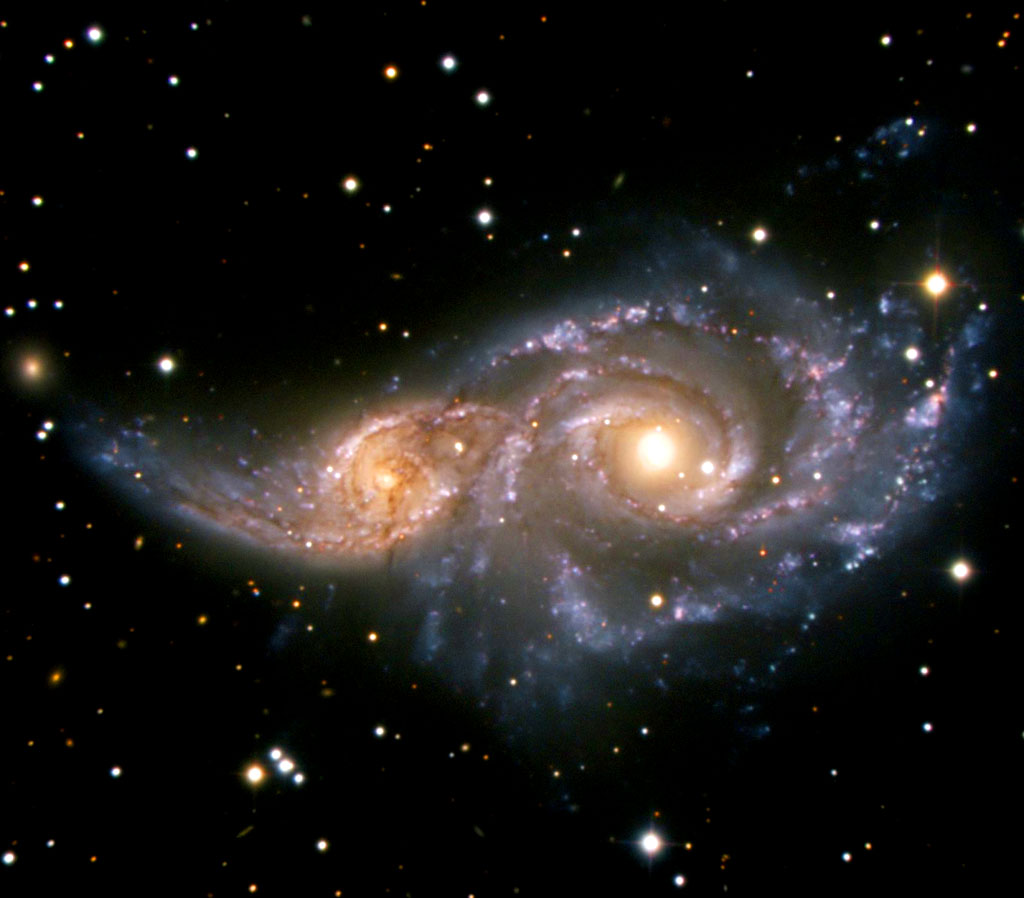


.jpg)