Universal Quotes (205 quotes)
… for it is very probable, that the motion of gravity worketh weakly, both far from the earth, and also within the earth: the former because the appetite of union of dense bodies with the earth, in respect of the distance, is more dull: the latter, because the body hath in part attained its nature when it is some depth in the earth.
[Foreshadowing Newton's Universal Law of Gravitation (1687)]
[Foreshadowing Newton's Universal Law of Gravitation (1687)]
Sylva Sylvarum; or a Natural History in Ten Centuries (1627), Century 1, Experiment 33. Collected in The Works of Francis Bacon (1826), Vol 1, 255.
... semantics ... is a sober and modest discipline which has no pretensions of being a universal patent-medicine for all the ills and diseases of mankind, whether imaginary or real. You will not find in semantics any remedy for decayed teeth or illusions of grandeur or class conflict. Nor is semantics a device for establishing that everyone except the speaker and his friends is speaking nonsense
In 'The Semantic Conception of Truth and the Foundations of Semantics', collected in
Leonard Linsky (ed.), Semantics and the Philosophy of Language: A Collection of Readings (1952), 17.
...He cannot conclude however, without observing, that from the contemplation of so great a variety of extraneous fossils discovered in the cliffs which were evidently the produce of very different climates, he thinks himself rationally induced to believe that nothing short of an universal deluge could be a cause adequate to this effect.
Plantae Favershamiensis, Appendix, 'Establishing a short view of the fossil bodies of the adjacent island of Sheppey.' Quoted in David Beerling, The Emerald Planet: How Plants Changed Earth's History (2007), 145.
...Outer space, once a region of spirited international competition, is also a region of international cooperation. I realized this as early as 1959, when I attended an international conference on cosmic radiation in Moscow. At this conference, there were many differing views and differing methods of attack, but the problems were common ones to all of us and a unity of basic purpose was everywhere evident. Many of the papers presented there depended in an essential way upon others which had appeared originally in as many as three or four different languages. Surely science is one of the universal human activities.
...those experiments be not only esteemed which have an immediate and present use, but those principally which are of most universal consequence for invention of other experiments, and those which give more light to the invention of causes; for the invention of the mariner's needle, which giveth the direction, is of no less benefit for navigation than the invention of the sails, which give the motion.
The Second Book of Francis Bacon of the Proficience and Advancement of Learning (1605). In Francis Bacon and Basil Montagu, The Works of Francis Bacon, Lord Chancellor of England (1852), 200
“Social justice”—the expression of universal hatred.
In The Decline and Fall of Science (1976), 6.
“Wu Li” was more than poetic. It was the best definition of physics that the conference would produce. It caught that certain something, that living quality that we were seeking to express in a book, that thing without which physics becomes sterile. “Wu” can mean either “matter” or “energy.” “Li” is a richly poetic word. It means “universal order” or “universal law.” It also means “organic patterns.” The grain in a panel of wood is Li. The organic pattern on the surface of a leaf is also Li, and so is the texture of a rose petal. In short, Wu Li, the Chinese word for physics, means “patterns of organic energy” (“matter/ energy” [Wu] + “universal order/organic patterns” [Li]). This is remarkable since it reflects a world view which the founders of western science (Galileo and Newton) simply did not comprehend, but toward which virtually every physical theory of import in the twentieth century is pointing!
In The Dancing Wu Li Masters: An Overview of the New Physics (1979), 5.
[Freud's] great strength, though sometimes also his weakness, was the quite extraordinary respect he had for the singular fact... When he got hold of a simple but significant fact he would feel, and know, that it was an example of something general or universal, and the idea of collecting statistics on the matter was quite alien to him.
The Life and Work of Sigmund Freud (1953), Vol 1, 96-7.
[Hermetic philosophy (Alchemy) was the only Art which might be able] to complete and bring to light not only medicine but also a universal Philosophy.
…quaeque sola non Medicinam tantum, sed et universam Philosophiam valde perficere et illustrare possit.
…quaeque sola non Medicinam tantum, sed et universam Philosophiam valde perficere et illustrare possit.
Original Latin in The Theological Works of Isaac Barrow (1859), 46. Translation, with citation, in B.J.T. Dobbs, The Foundations of Newton's Alchemy (1983), 96.
[J.J.] Sylvester’s methods! He had none. “Three lectures will be delivered on a New Universal Algebra,” he would say; then, “The course must be extended to twelve.” It did last all the rest of that year. The following year the course was to be Substitutions-Théorie, by Netto. We all got the text. He lectured about three times, following the text closely and stopping sharp at the end of the hour. Then he began to think about matrices again. “I must give one lecture a week on those,” he said. He could not confine himself to the hour, nor to the one lecture a week. Two weeks were passed, and Netto was forgotten entirely and never mentioned again. Statements like the following were not unfrequent in his lectures: “I haven’t proved this, but I am as sure as I can be of anything that it must be so. From this it will follow, etc.” At the next lecture it turned out that what he was so sure of was false. Never mind, he kept on forever guessing and trying, and presently a wonderful discovery followed, then another and another. Afterward he would go back and work it all over again, and surprise us with all sorts of side lights. He then made another leap in the dark, more treasures were discovered, and so on forever.
As quoted by Florian Cajori, in Teaching and History of Mathematics in the United States (1890), 265-266.
[Philosopher Lao-tse] is not dogmatic, and he does not go in for big, universal ideas. For instance, I like what he says about failure and success, “Failure is the foundation of success and the means by which it is achieved. Success is the lurking place of failure; but who can tell when the turning point will come?”
As quoted in Robert Coughlan, 'Dr. Edward Teller’s Magnificent Obsession', Life (6 Sep 1954), 74.
[The famous attack of Sir William Hamilton on the tendency of mathematical studies] affords the most express evidence of those fatal lacunae in the circle of his knowledge, which unfitted him for taking a comprehensive or even an accurate view of the processes of the human mind in the establishment of truth. If there is any pre-requisite which all must see to be indispensable in one who attempts to give laws to the human intellect, it is a thorough acquaintance with the modes by which human intellect has proceeded, in the case where, by universal acknowledgment, grounded on subsequent direct verification, it has succeeded in ascertaining the greatest number of important and recondite truths. This requisite Sir W. Hamilton had not, in any tolerable degree, fulfilled. Even of pure mathematics he apparently knew little but the rudiments. Of mathematics as applied to investigating the laws of physical nature; of the mode in which the properties of number, extension, and figure, are made instrumental to the ascertainment of truths other than arithmetical or geometrical—it is too much to say that he had even a superficial knowledge: there is not a line in his works which shows him to have had any knowledge at all.
In Examination of Sir William Hamilton's Philosophy (1878), 607.
[We] can easily distinguish what relates to Mathematics in any question from that which belongs to the other sciences. But as I considered the matter carefully it gradually came to light that all those matters only were referred to Mathematics in which order and measurements are investigated, and that it makes no difference whether it be in numbers, figures, stars, sounds or any other object that the question of measurement arises. I saw consequently that there must be some general science to explain that element as a whole which gives rise to problems about order and measurement, restricted as these are to no special subject matter. This, I perceived was called “Universal Mathematics,” not a far-fetched asignation, but one of long standing which has passed into current use, because in this science is contained everything on account of which the others are called parts of Mathematics.
Rules for the Direction of the Mind (written 1628). As translated by Elizabeth Sanderson Haldane and George Robert Thomson Ross in The Philosophical Works of Descartes (1911, 1931), 13.
A l’aide de ces sciences expérimentales actives, l’homme devient un inventeur de phénomènes, un véritable contremaître de la création; et l'on ne saurait, sous ce rapport, assigner de limites à la puissance qu’il peut acquérir sur la nature, par les progrès futurs des sciences expérimentales
With the aid of these active experimental sciences man becomes an inventor of phenomena, a real foreman of creation; and under this head we cannot set limits to the power that he may gain over nature through future progress of the experimental sciences.
With the aid of these active experimental sciences man becomes an inventor of phenomena, a real foreman of creation; and under this head we cannot set limits to the power that he may gain over nature through future progress of the experimental sciences.
Original French text in Introduction à l'Étude de la Médecine Expérimentale (1898), 32. English version from An Introduction to the Study of Experimental Medicine (1865), as translated by Henry Copley Greene (1957), 18.
Il ne peut y avoir de langage plus universel et plus simple, plus exempt d’erreurs et d’obscurités, c'est-à-dire plus digne d'exprimer les rapports invariables des êtres naturels.
There cannot be a language more universal and more simple, more free from errors and obscurities, … more worthy to express the invariable relations of all natural things. [About mathematical analysis.]
There cannot be a language more universal and more simple, more free from errors and obscurities, … more worthy to express the invariable relations of all natural things. [About mathematical analysis.]
From Théorie Analytique de la Chaleur (1822), xiv, translated by Alexander Freeman in The Analytical Theory of Heat (1878), 7.
Puisqu'on ne peut être universel en sachant tout ce qui se peut sur tout, il faut savoir peu de tout. Car il est bien plus beau de savoir quelque chose de tout que de savoir rout d'une chose; cette universalité est la plus belle. Si on pouvait avoir les deux, encore mieux.
Since we cannot be universal and know all that is to be known of everything, we ought to know a little about everything, For it is far better to know something about everything than to know all about one thing.
Since we cannot be universal and know all that is to be known of everything, we ought to know a little about everything, For it is far better to know something about everything than to know all about one thing.
Pensées. Quoted in Nigel Rees, Brewer's Famous Quotations: 5000 Quotations and the Stories Behind Them (2006), 249.
1. Universal CHEMISTRY is the Art of resolving mixt, compound, or aggregate Bodies into their Principles; and of composing such Bodies from those Principles. 2. It has for its Subject all the mix’d, compound, and aggregate Bodies that are and resolvable and combinable and Resolution and Combination, or Destruction and Generation, for its Object. 3. Its Means in general, are either remote or immediate; that is, either Instruments or the Operations themselves. 4. Its End is either philosophical and theoretical; or medicinal, mechanical, œconomical, and practical. 5. Its efficient Cause is the Chemist.
In Philosophical Principles of Universal Chemistry: Or, The Foundation of a Scientifical Manner of Inquiring Into and Preparing the Natural and Artificial Bodies for the Uses of Life: Both in the Smaller Way of Experiment, and the Larger Way of Business (1730), 1. Footnote to (1.): “The justness of this Definition will appear from the scope and tenour of the Work; though it is rather adapted to the perfect, than the present imperfect state of Chemistry….” Footnote to (4): “Hence universal Chemistry is commodiously resolved into several Parts or Branches, under which it must be distinctly treated to give a just notion of its due extent and usefulness. For tho’ in common acceptation of the word, Chemistry is supposed to relate chiefly to the Art of Medicine, as it supplies that Art with Remedies, this in reality is but a very small part of its use, compared with the rest; numerous other Arts, Trades, and mechanical Employments, Merchandize itself, and all natural Philosophy, being as much, and some of them more, concern’d therewith….”
A Dr van’t Hoff of the veterinary college at Utrecht, appears to have no taste for exact chemical investigation. He finds it a less arduous task to mount Pegasus (evidently borrowed from the veterinary school) and to proclaim in his La Chemie dans l’espace how, during his bold fight to the top of the chemical Parnassus, the atoms appeared to him to have grouped themselves together throughout universal space. … I should have taken no notice of this matter had not Wislicenus oddly enough written a preface to the pamphlet, and not by way of a joke but in all seriousness recommended it a worthwhile performance.
'Signs of the Times', Journal fur Praktische Chemie, 15, 473. Trans. W. H. Brock.
A fear of intellectual inadequacy, of powerlessness before the tireless electronic wizards, has given rise to dozens of science-fiction fantasies of computer takeovers. ... Other scientists too are apprehensive. D. Raj Reddy, a computer scientist at Pittsburgh’s Carnegie-Mellon University, fears that universally available microcomputers could turn into formidable weapons. Among other things, says Reddy, sophisticated computers in the wrong hands could begin subverting a society by tampering with people’s relationships with their own computers—instructing the other computers to cut off telephone, bank and other services, for example.
— Magazine
An early prediction of DDoS (Distributed Denial of Service), viruses and worms like Stuxnet. As stated, without further citation, in 'The Age of Miracle Chips', Time (20 Feb 1978), 44. The article introduces a special section on 'The Computer Society.' Please contact Webmaster if you know a primary source.
A man of science rises ever, in seeking truth; and if he never finds it in its wholeness, he discovers nevertheless very significant fragments; and these fragments of universal truth are precisely what constitutes science.
From An Introduction to the Study of Experimental Medicine (1927, 1957), as translated by Henry Copley Greene (1927, 1957), 222. From the original French by Claude Bernard: “le savant monte toujours en cherchant la vérité, et s'il ne la trouve jamais tout entière, il en découvre néanmoins des fragments très-importants, et ce sont précisément ces fragments de la vérité générale qui constituent la science.” (1865), 389. A Google translation gives: “The scientist always rises by seeking the truth, and if he never finds it entirely, he nevertheless discovers very important fragments of it, and it is precisely these fragments of the general truth which constitute science.”
A right understanding of the words which are names of names, is of great importance in philosophy. The tendency was always strong to believe that whatever receives a name must be an entity or being, having an independent existence of its own; and if no real entity answering to the name could be found, men did not for that reason suppose that none existed, but imagined that it was something peculiarly abstruse and mysterious, too high to be an object of sense. The meaning of all general, and especially of all abstract terms, became in this way enveloped in a mystical haze; and none of these have been more generally misunderstood, or have been a more copious source of futile and bewildering speculation, than some of the words which are names of names. Genus, Species, Universal, were long supposed to be designations of sublime hyperphysical realities; Number, instead of a general name of all numerals, was supposed to be the name, if not of a concrete thing, at least of a single property or attribute.
A footnote by John Stuart Mill, which he added as editor of a new edition of a work by his father, James Mill, Analysis of the Phenomena of the Human Mind (1869), Vol. 2, 5.
A theory is the more impressive the greater the simplicity of its premises is, the more different kinds of things it relates, and the more extended is its area of applicability. Therefore the deep impression which classical thermodynamics made upon me. It is the only physical theory of universal content concerning which I am convinced that within the framework of the applicability of its basic concepts, it will never be overthrown.
Autobiographical Notes (1946), 33. Quoted in Gerald Holton and Yehuda Elkana, Albert Einstein: Historical and Cultural Perspectives (1997), 227.
All Nature is but Art, unknown to thee;
All Chance, Direction, which thou canst not see;
All Discord, Harmony, not understood;
All partial Evil, universal Good:
And, spite of Pride, in erring Reason’s spite,
One truth is clear, “Whatever IS, is RIGHT.”
All Chance, Direction, which thou canst not see;
All Discord, Harmony, not understood;
All partial Evil, universal Good:
And, spite of Pride, in erring Reason’s spite,
One truth is clear, “Whatever IS, is RIGHT.”
'An Essay on Man' (1733-4), Epistle I. In John Butt (ed.), The Poems of Alexander Pope (1965), 515.
All nature wears one universal grin.
Tom Thumb the Great (1730).
All progress is based upon a universal innate desire of every organism to live beyond its means.
…...
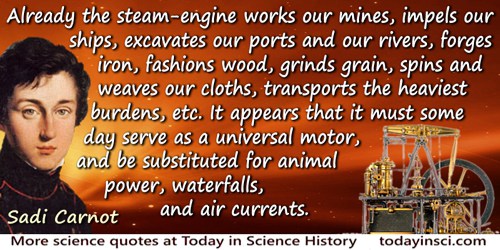
Already the steam-engine works our mines, impels our ships, excavates our ports and our rivers, forges iron, fashions wood, grinds grain, spins and weaves our cloths, transports the heaviest burdens, etc. It appears that it must some day serve as a universal motor, and be substituted for animal power, waterfalls, and air currents.
'Réflexions sur la puissance motrice du feu' (1824) translated by R.H. Thurston in Reflections on the Motive Power of Fire, and on Machines Fitted to Develop that Power (1890), 38.
Among the minor, yet striking characteristics of mathematics, may be mentioned the fleshless and skeletal build of its propositions; the peculiar difficulty, complication, and stress of its reasonings; the perfect exactitude of its results; their broad universality; their practical infallibility.
In Charles S. Peirce, Charles Hartshorne (ed.), Paul Weiss (ed.), Collected Papers of Charles Sanders Peirce (1931), Vol. 4, 197.
Analysis and natural philosophy owe their most important discoveries to this fruitful means, which is called induction. Newton was indebted to it for his theorem of the binomial and the principle of universal gravity.
In Frederick Wilson Truscott (trans.) and Frederick Lincoln Emory (trans.), A Philosophical Essay on Probabilities (1902), 176.
Anaximander son of Praxiades, of Miletus: he said that the principle and element is the Indefinite, not distinguishing air or water or anything else. … he was the first to discover a gnomon, and he set one up on the Sundials (?) in Sparta, according to Favorinus in his Universal History, to mark solstices and equinoxes; and he also constructed hour indicators. He was the first to draw an outline of earth and sea, but also constructed a [celestial] globe. Of his opinions he made a summary exposition, which I suppose Apollodorus the Athenian also encountered. Apollodorus says in his Chronicles that Anaximander was sixty-four years old in the year of the fifty-eighth Olympiad [547/6 B.C.], and that he died shortly afterwards (having been near his prime approximately during the time of Polycrates, tyrant of Samos).
Diogenes Laërtius II, 1-2. In G.S. Kirk, J.E. Raven and M. Schofield (eds), The Presocratic Philosophers: A Critical History with a Selection of Texts (1957), 99. The editors of this translation note that Anaximander may have introduced the gnomon into Greece, but he did not discover it—the Babylonians used it earlier, and the celestial sphere, and the twelve parts of the day.
Arts and sciences in one and the same century have arrived at great perfection; and no wonder, since every age has a kind of universal genius, which inclines those that live in it to some particular studies; the work then, being pushed on by many hands, must go forward.
In Samuel Austin Allibone, Prose Quotations from Socrates to Macaulay (1880), 45.
As the Earth aligns with the sun during the vernal equinox, we are reminded of the universal harmony that governs the cosmos. It’s a humbling spectacle that invites us to contemplate our place in the vast expanse of space.
A fictional quote imagined in the style typical of a scientist (19 Mar 2024).
At every major step physics has required, and frequently stimulated, the introduction of new mathematical tools and concepts. Our present understanding of the laws of physics, with their extreme precision and universality, is only possible in mathematical terms.
In Book Review 'Pulling the Strings,' of Lawrence Krauss's Hiding in the Mirror: The Mysterious Lure of Extra Dimensions, from Plato to String Theory and Beyond in Nature (22 Dec 2005), 438, 1081.
Being in love with the one parent and hating the other are among the essential constituents of the stock of psychical impulses which is formed at that time and which is of such importance in determining the symptoms of the later neurosis... This discovery is confirmed by a legend that has come down to us from classical antiquity: a legend whose profound and universal power to move can only be understood if the hypothesis I have put forward in regard to the psychology of children has an equally universal validity. What I have in mind is the legend of King Oedipus and Sophocles' drama which bears his name.
The Interpretation of Dreams (1900), In James Strachey (ed.) The Standard Edition of the Complete Psychological Works of Sigmund Freud (1953), Vol. 4, 260-1.
Between the lowest and the highest degree of spiritual and corporal perfection, there is an almost infinite number of intermediate degrees. The succession of degrees comprises the Universal Chain. It unites all beings, ties together all worlds, embraces all the spheres. One SINGLE BEING is outside this chain, and this is HE who made it.
Contemplation de la nature (1764), Vol. I, 27. Trans. Stephen Jay Gould, Ontogeny and Phylogeny (1977), 23.
Bolyai [Janos] projected a universal language for speech as we have it for music and mathematics.
In János Bolyai, Science Absolute of Space, translated from the Latin by George Bruce Halsted (1896), Translator's Introduction, xxix.
But it will be found... that one universal law prevails in all these phenomena. Where two portions of the same light arrive in the eye by different routes, either exactly or very nearly in the same direction, the appearance or disappearance of various colours is determined by the greater or less difference in the lengths of the paths.
Lecture XIV. 'Of Physical Optics'. In A Syllabus of a Course of Lectures on Natural and Experimental Philosophy (1802), 112-4.
But Truth is that besides which there is nothing: nothing to modify it, nothing to question it, nothing to form an exception: the all-inclusive, the complete — By Truth, I mean the Universal.
The Book of the Damned (1932). In The Complete Books of Charles Fort (1975), 9.
By such deductions the law of gravitation is rendered probable, that every particle attracts every other particle with a force which varies inversely as the square of the distance. The law thus suggested is assumed to be universally true.
In Isaac Newton and Percival Frost (ed.) Newton's Principia: Sections I, II, III (1863), 217.
Chemistry dissolves the goddess in the alembic,
Venus, the white queen, the universal matrix,
Down to the molecular hexagons and carbon-chains.
Venus, the white queen, the universal matrix,
Down to the molecular hexagons and carbon-chains.
'The Human Form Divine', in The Collected Poems of Kathleen Raine (1956), 86.
Chemistry is not a primitive science like geometry and astronomy; it is constructed from the debris of a previous scientific formation; a formation half chimerical and half positive, itself found on the treasure slowly amassed by the practical discoveries of metallurgy, medicine, industry and domestic economy. It has to do with alchemy, which pretended to enrich its adepts by teaching them to manufacture gold and silver, to shield them from diseases by the preparation of the panacea, and, finally, to obtain for them perfect felicity by identifying them with the soul of the world and the universal spirit.
From Les Origines de l’Alchimie (1885), 1-2. Translation as quoted in Harry Shipley Fry, 'An Outline of the History of Chemistry Symbolically Represented in a Rookwood Fountain', The Journal of Industrial and Engineering Chemistry (1 Sep 1922), 14, No. 9, 868. From the original French, “La Chimie n’est pas une science primitive, comme la géométrie ou l’astronomie; elle s’est constituée sur les débris d’une formation scientifique antérieure; formation demi-chimérique et demi-positive, fondée elle-même sur le trésor lentement amassé des découvertes pratiques de la métallurgie, de la médecine, de l’industrie et de l’économie domestique. Il s’agit de l’alchimie, qui prétendait à la fois enrichir ses adeptes en leur apprenant à fabriquer l’or et l’argent, les mettre à l’abri des maladies par la préparation de la panacée, enfin leur procurer le bonheur parfait en les identifiant avec l’âme du monde et l’esprit universel.”
Classical thermodynamics ... is the only physical theory of universal content which I am convinced ... will never be overthrown.
Quoted in Albert Einstein and Stephen Hawking (ed.), A Stubbornly Persistent Illusion (2007), 353.
Confined to its true domain, mathematical reasoning is admirably adapted to perform the universal office of sound logic: to induce in order to deduce, in order to construct. … It contents itself to furnish, in the most favorable domain, a model of clearness, of precision, and consistency, the close contemplation of which is alone able to prepare the mind to render other conceptions also as perfect as their nature permits. Its general reaction, more negative than positive, must consist, above all, in inspiring us everywhere with an invincible aversion for vagueness, inconsistency, and obscurity, which may always be really avoided in any reasoning whatsoever, if we make sufficient effort.
In Synthèse Subjective (1856), 98. As translated in Robert Édouard Moritz, Memorabilia Mathematica; Or, The Philomath’s Quotation-Book (1914), 202-203. From the original French, “Bornée à son vrai domaine, la raison mathématique y peut admirablement remplir l’office universel de la saine logique: induire pour déduire, afin de construire. … Elle se contente de former, dans le domaine le plus favorable, un type de clarté, de précision, et de consistance, dont la contemplation familière peut seule disposer l’esprit à rendre les autres conceptions aussi parfaites que le comporte leur nature. Sa réaction générale, plus négative que positive, doit surtout consister à nous inspirer partout une invincible répugnance pour le vague, l’incohérence, et l’obscurité, que nous pouvons réellement éviter envers des pensées quelconques, si nous y faisons assez d’efforts.”
During the vernal equinox, we witness the convergence of astronomy and culture, as people around the world celebrate the arrival of spring. It’s a reminder of the universal human fascination with the cycles of the natural world.
A fictional quote imagined in the style of an astronaut and physician (19 Mar 2024).
Each species has evolved a special set of solutions to the general problems that all organisms must face. By the fact of its existence, a species demonstrates that its members are able to carry out adequately a series of general functions. … These general functions offer a framework within which one can integrate one’s view of biology and focus one’s research. Such a view helps one to avoid becoming lost in a morass of unstructured detail—even though the ways in which different species perform these functions may differ widely. A few obvious examples will suffice. Organisms must remain functionally integrated. They must obtain materials from their environments, and process and release energy from these materials. … They must differentiate and grow, and they must reproduce. By focusing one’s questions on one or another of these obligatory and universal capacities, one can ensure that one’s research will not be trivial and that it will have some chance of achieving broad general applicability.
In 'Integrative Biology: An Organismic Biologist’s Point of View', Integrative and Comparative Biology (2005), 45, 331.
Earth bound history has ended. Universal history has begun.
…...
Everybody now wants to discover universal laws which will explain the structure and behavior of the nucleus of the atom. But actually our knowledge of the elementary particles that make up the nucleus is tiny. The situation calls for more modesty. We should first try to discover more about these elementary particles and about their laws. Then it will be the time for the major synthesis of what we really know, and the formulation of the universal law.
As quoted in Robert Coughlan, 'Dr. Edward Teller’s Magnificent Obsession', Life (6 Sep 1954), 74.
Finally, in regard to those who possess the largest shares in the stock of worldly goods, could there, in your opinion, be any police so vigilant and effetive, for the protections of all the rights of person, property and character, as such a sound and comprehensive education and training, as our system of Common Schools could be made to impart; and would not the payment of a sufficient tax to make such education and training universal, be the cheapest means of self-protection and insurance?
Annual Reports of the Secretary of the Board of Education of Massachusetts for the years 1839-1844, Life and Works of Horace Mann (1891), Vol. 3, 100.
First follow Nature, and your judgment frame
By her just standard, which is still the same:
Unerring nature, still divinely bright,
One clear, unchanged, and universal light,
Life, force, and beauty must to all impart,
At once the source, and end, and test of art.
By her just standard, which is still the same:
Unerring nature, still divinely bright,
One clear, unchanged, and universal light,
Life, force, and beauty must to all impart,
At once the source, and end, and test of art.
#039;Essay On Criticism#039;, Miscellaneous Poems and Translations: by Several Hands (1720), 38.
First, [Newton’s Law of Universal Gravitation] is mathematical in its expression…. Second, it is not exact; Einstein had to modify it…. There is always an edge of mystery, always a place where we have some fiddling around to do yet…. But the most impressive fact is that gravity is simple…. It is simple, and therefore it is beautiful…. Finally, comes the universality of the gravitational law and the fact that it extends over such enormous distances…
In The Character of Physical Law (1965, 2001), 33.
From Harmony, from heav’nly Harmony
This universal Frame began.
This universal Frame began.
From 'A Song for St. Cecila's Day' (1687), lines 1-2, in James Kinsley (ed.), The Poems and Fables of John Dryden (1962), 422.
From the aspect of energy, renewed by radio-active phenomena, material corpuscles may now be treated as transient reservoirs of concentrated power. Though never found in a state of purity, but always more or less granulated (even in light) energy nowadays represents for science the most primitive form of universal stuff.
In Teilhard de Chardin and Bernard Wall (trans.), The Phenomenon of Man (1959, 2008), 42. Originally published in French as Le Phénomene Humain (1955).
Genuine religion has its root deep down in the heart of humanity and in the reality of things. It is not surprising that by our methods we fail to grasp it: the actions of the Deity make no appeal to any special sense, only a universal appeal; and our methods are, as we know, incompetent to detect complete uniformity. There is a principle of Relativity here, and unless we encounter flaw or jar or change, nothing in us responds; we are deaf and blind therefore to the Immanent Grandeur, unless we have insight enough to recognise in the woven fabric of existence, flowing steadily from the loom in an infinite progress towards perfection, the ever-growing garment of a transcendent God.
Continuity: The Presidential Address to the British Association (1913), 92-93.
Geometry is founded in mechanical practice, and is nothing but that part of universal mechanics which accurately proposes and demonstrates the art of measuring.
In Principia (1687), Preface, translated by Andrew Motte (1729), in Florian Cajori (ed.), Sir Isaac Newton's Mathematical Principles of Natural Philosophy (1934), xvii.
Given any domain of thought in which the fundamental objective is a knowledge that transcends mere induction or mere empiricism, it seems quite inevitable that its processes should be made to conform closely to the pattern of a system free of ambiguous terms, symbols, operations, deductions; a system whose implications and assumptions are unique and consistent; a system whose logic confounds not the necessary with the sufficient where these are distinct; a system whose materials are abstract elements interpretable as reality or unreality in any forms whatsoever provided only that these forms mirror a thought that is pure. To such a system is universally given the name MATHEMATICS.
In 'Mathematics', National Mathematics Magazine (Nov 1937), 12, No. 2, 62.
HEART, n. An automatic, muscular blood- pump. Figuratively, this useful organ is said to be the seat of emotions and sentiments—a very pretty fancy which, however, is nothing but a survival of a once universal belief. It is now known that the sentiments and emotions reside in the stomach, being evolved from food by chemical action of the gastric fluid. The exact process by which a beefsteak becomes a feeling—tender or not, according to the age of the animal from which it was cut; the successive stages of elaboration through which a caviar sandwich is transmuted to a quaint fancy and reappears as a pungent epigram; the marvelous functional methods of converting a hard-boiled egg into religious contrition, or a cream-puff into a sigh of sensibility—these things have been patiently ascertained by M. Pasteur, and by him expounded with convincing lucidity.
The Collected Works of Ambrose Bierce (1911), Vol. 7, The Devil's Dictionary, 133-134.
Heat is a universal solvent, melting out of things their power of resistance, and sucking away and removing their natural strength with its fiery exhalations so that they grow soft, and hence weak, under its glow.
In De Architectura, Book 1, Chap 4, Sec. 3. As translated in Morris Hicky Morgan (trans.), Vitruvius: The Ten Books on Architecture (1914), 18.
How did I discover saccharin? Well, it was partly by accident and partly by study. I had worked a long time on the compound radicals and substitution products of coal tar... One evening I was so interested in my laboratory that I forgot about my supper till quite late, and then rushed off for a meal without stopping to wash my hands. I sat down, broke a piece of bread, and put it to my lips. It tasted unspeakably sweet. I did not ask why it was so, probably because I thought it was some cake or sweetmeat. I rinsed my mouth with water, and dried my moustache with my napkin, when, to my surprise the napkin tasted sweeter than the bread. Then I was puzzled. I again raised my goblet, and, as fortune would have it, applied my mouth where my fingers had touched it before. The water seemed syrup. It flashed on me that I was the cause of the singular universal sweetness, and I accordingly tasted the end of my thumb, and found it surpassed any confectionery I had ever eaten. I saw the whole thing at once. I had discovered some coal tar substance which out-sugared sugar. I dropped my dinner, and ran back to the laboratory. There, in my excitement, I tasted the contents of every beaker and evaporating dish on the table.
Interview with American Analyst. Reprinted in Pacific Record of Medicine and Surgery (1886), 1, No. 3, 78.
However, the small probability of a similar encounter [of the earth with a comet], can become very great in adding up over a huge sequence of centuries. It is easy to picture to oneself the effects of this impact upon the Earth. The axis and the motion of rotation changed; the seas abandoning their old position to throw themselves toward the new equator; a large part of men and animals drowned in this universal deluge, or destroyed by the violent tremor imparted to the terrestrial globe.
Exposition du Système du Monde, 2nd edition (1799), 208, trans. Ivor Grattan-Guinness.
I admit that the generation which produced Stalin, Auschwitz and Hiroshima will take some beating, but the radical and universal consciousness of the death of God is still ahead of us. Perhaps we shall have to colonise the stars before it is finally borne in upon us that God is not out there.
In Thomas Mann: a Critical Study (1971), 175.
I attained a triumph so complete that it is now rare to meet an American with marks of small pox on his face... Benefits are valuable according to their duration and extent, like the showers from heaven, but the benign remedy Vaccination saves millions of lives every century, like the blessing of the sun, universal and everlasting.
(Remark made near the end of his life.)
(Remark made near the end of his life.)
I do not intend to go deeply into the question how far mathematical studies, as the representatives of conscious logical reasoning, should take a more important place in school education. But it is, in reality, one of the questions of the day. In proportion as the range of science extends, its system and organization must be improved, and it must inevitably come about that individual students will find themselves compelled to go through a stricter course of training than grammar is in a position to supply. What strikes me in my own experience with students who pass from our classical schools to scientific and medical studies, is first, a certain laxity in the application of strictly universal laws. The grammatical rules, in which they have been exercised, are for the most part followed by long lists of exceptions; accordingly they are not in the habit of relying implicitly on the certainty of a legitimate deduction from a strictly universal law. Secondly, I find them for the most part too much inclined to trust to authority, even in cases where they might form an independent judgment. In fact, in philological studies, inasmuch as it is seldom possible to take in the whole of the premises at a glance, and inasmuch as the decision of disputed questions often depends on an aesthetic feeling for beauty of expression, or for the genius of the language, attainable only by long training, it must often happen that the student is referred to authorities even by the best teachers. Both faults are traceable to certain indolence and vagueness of thought, the sad effects of which are not confined to subsequent scientific studies. But certainly the best remedy for both is to be found in mathematics, where there is absolute certainty in the reasoning, and no authority is recognized but that of one’s own intelligence.
In 'On the Relation of Natural Science to Science in general', Popular Lectures on Scientific Subjects, translated by E. Atkinson (1900), 25-26.
I esteem his understanding and subtlety highly, but I consider that they have been put to ill use in the greater part of his work, where the author studies things of little use or when he builds on the improbable principle of attraction.
Writing about Newton's Principia. Huygens had some time earlier indicated he did not believe the theory of universal gravitation, saying it 'appears to me absurd.'
Writing about Newton's Principia. Huygens had some time earlier indicated he did not believe the theory of universal gravitation, saying it 'appears to me absurd.'
Quoted in Archana Srinivasan, Great Inventors (2007), 37.
I hardly know of a great physical truth whose universal reception has not been preceded by an epoch in which the most estimable persons have maintained that the phenomena investigated were directly dependent on the Divine Will, and that the attempt to investigate them was not only futile but blasphemous. And there is a wonderful tenacity of life about this sort of opposition to physical science. Crushed and maimed in every battle, it yet seems never to be slain; and after a hundred defeats it is at this day as rampant, though happily not so mischievous, as in the time of Galileo.
In Address (10 Feb 1860) to weekly evening meeting, 'On Species and Races, and their Origin', Notices of the Proceedings at the Meetings of the Members of the Royal Institution: Vol. III: 1858-1862 (1862), 199.
I must not pass by Dr. Young called Phaenomenon Young at Cambridge. A man of universal erudition, & almost universal accomplishments. Had he limited himself to anyone department of knowledge, he must have been first in that department. But as a mathematician, a scholar, a hieroglyphist, he was eminent; & he knew so much that it is difficult to say what he did not know. He was a most amiable & good-tempered man; too fond, perhaps, of the society of persons of rank for a true philosopher.
J. Z. Fullmer, 'Davy's Sketches of his Contemporaries', Chymia (1967), 12, 135.
I must reject fluids and ethers of all kinds, magnetical, electrical, and universal, to whatever quintessential thinness they may be treble distilled, and (as it were) super-substantiated.
Hints Towards the Formation of a more Comprehensive Theory of Life (1848). In The Collected Works of Samuel Taylor Coleridge: Shorter Works and Fragments (1995), H. J. Jackson and J. R. de J. Jackson (eds.), Vol 11, 1, 502.
I should not think of devoting less than 20 years to an Epic Poem. Ten to collect materials and warm my mind with universal science. I would be a tolerable Mathematician, I would thoroughly know Mechanics, Hydrostatics, Optics, and Astronomy, Botany, Metallurgy, Fossilism, Chemistry, Geology, Anatomy, Medicine—then the mind of man—then the minds of men—in all Travels, Voyages and Histories. So I would spend ten years—the next five to the composition of the poem—and the five last to the correction of it. So I would write haply not unhearing of the divine and rightly-whispering Voice, which speaks to mighty minds of predestinated Garlands, starry and unwithering.
Letter to Joseph Cottle, early April 1797. In Earl Leslie Griggs (ed.), The Collected Letters of Samuel Taylor Coleridge (1956), Vol. 1, 320-1.
I specifically paused to show that, if there were such machines with the organs and shape of a monkey or of some other non-rational animal, we would have no way of discovering that they are not the same as these animals. But if there were machines that resembled our bodies and if they imitated our actions as much as is morally possible, we would always have two very certain means for recognizing that, none the less, they are not genuinely human. The first is that they would never be able to use speech, or other signs composed by themselves, as we do to express our thoughts to others. For one could easily conceive of a machine that is made in such a way that it utters words, and even that it would utter some words in response to physical actions that cause a change in its organs—for example, if someone touched it in a particular place, it would ask what one wishes to say to it, or if it were touched somewhere else, it would cry out that it was being hurt, and so on. But it could not arrange words in different ways to reply to the meaning of everything that is said in its presence, as even the most unintelligent human beings can do. The second means is that, even if they did many things as well as or, possibly, better than anyone of us, they would infallibly fail in others. Thus one would discover that they did not act on the basis of knowledge, but merely as a result of the disposition of their organs. For whereas reason is a universal instrument that can be used in all kinds of situations, these organs need a specific disposition for every particular action.
Discourse on Method in Discourse on Method and Related Writings (1637), trans. Desmond M. Clarke, Penguin edition (1999), Part 5, 40.
I think Dr. Arbuthnot the first man among the wits of the age. He was the most universal genius, being an excellent physician, a man of deep learning, and a man of much humour.
As quoted, without citation in John Dennis, The Age of Pope (1894, 1926), 176. In James Boswell’s Life of Johnson, “the wits of the age” is written as “them” meaning, from the context, the wits of the age of Queen Anne (1702-1714).
I, Galileo Galilei, son of the late Vincenzo Galilei, of Florence, aged seventy years, being brought personally to judgment, and kneeling before your Most Eminent and Most Reverend Lords Cardinals, General Inquisitors of the universal Christian republic against heretical depravity, having before my eyes the Holy Gospels, which I touch with my own hands, swear that I have always believed, and now believe, and with the help of God will in future believe, every article which the Holy Catholic and Apostolic Church of Rome holds, teaches, and preaches. But because I have been enjoined by this Holy Office altogether to abandon the false opinion which maintains that the sun is the centre and immovable, and forbidden to hold, defend, or teach the said false doctrine in any manner, and after it hath been signified to me that the said doctrine is repugnant with the Holy Scripture, I have written and printed a book, in which I treat of the same doctrine now condemned, and adduce reasons with great force in support of the same, without giving any solution, and therefore have been judged grievously suspected of heresy; that is to say, that I held and believed that the sun is the centre of the universe and is immovable, and that the earth is not the centre and is movable; willing, therefore, to remove from the minds of your Eminences, and of every Catholic Christian, this vehement suspicion rightfully entertained toward me, with a sincere heart and unfeigned faith, I abjure, curse, and detest the said errors and heresies, and generally every other error and sect contrary to Holy Church; and I swear that I will never more in future say or assert anything verbally, or in writing, which may give rise to a similar suspicion of me; but if I shall know any heretic, or anyone suspected of heresy, that I will denounce him to this Holy Office, or to the Inquisitor or Ordinary of the place where I may be; I swear, moreover, and promise, that I will fulfil and observe fully, all the penances which have been or shall be laid on me by this Holy Office. But if it shall happen that I violate any of my said promises, oaths, and protestations (which God avert!), I subject myself to all the pains and punishments which have been decreed and promulgated by the sacred canons, and other general and particular constitutions, against delinquents of this description. So may God help me, and his Holy Gospels which I touch with my own hands. I, the above-named Galileo Galilei, have abjured, sworn, promised, and bound myself as above, and in witness thereof with my own hand have subscribed this present writing of my abjuration, which I have recited word for word. At Rome, in the Convent of Minerva, June 22, 1633. I, Galileo Galilei, have abjured as above with my own hand.
Abjuration, 22 Jun 1633. In J.J. Fahie, Galileo, His Life and Work (1903), 319-321.
If I were a comet, I should consider the men of our present age a degenerate breed. In former times, the respect for comets was universal and profound.
In 'On Comets', collected in In Praise of Idleness and Other Essays (1935), 223.
If science could get rid of consciousness, it would have disposed of the only stumbling block to its universal application.
'Reply to Francis V. Raab', The Philosophy of Brand Blanshard (1980) 807.
If the finding of Coines, Medals, Urnes, and other Monuments of famous Persons, or Towns, or Utensils, be admitted for unquestionable Proofs, that such Persons or things have, in former Times, had a being, certainly those Petrifactions may be allowed to be of equal Validity and Evidence, that there have been formerly such Vegetables or Animals. These are truly Authentick Antiquity not to be counterfeited, the Stamps, and Impressions, and Characters of Nature that are beyond the Reach and Power of Humane Wit and Invention, and are true universal Characters legible to all rational Men.
Lectures and Discourses of Earthquakes (1668). In The Posthumous Works of Robert Hooke, containing his Cutlerian Lectures and other Discourses read at the Meetings of the Illustrious Royal Society (1705), 449.
If the laws of physics and chemistry are universal, we can extrapolate the events of Earth’s chemical evolution to other planets and other stars and thus argue for the possibility of life beyond Earth.
In 'Cosmochemistry The Earliest Evolution', The Science Teacher (Oct 1983), 50, No. 7, 36.
If there is anything in the world which I do firmly believe in, it is the universal validity of the law of causation.
'Science and Morals' (1886). In Collected Essays (1994), Vol. 9, 121.
In the end, science as we know it has two basic types of practitioners. One is the educated man who still has a controlled sense of wonder before the universal mystery, whether it hides in a snail’s eye or within the light that impinges on that delicate organ. The second kind of observer is the extreme reductionist who is so busy stripping things apart that the tremendous mystery has been reduced to a trifle, to intangibles not worth troubling one’s head about.
In 'Science and the Sense of the Holy,' The Star Thrower (1978), 190.
In the vast cosmical changes, the universal life comes and goes in unknown quantities ... sowing an animalcule here, crumbling a star there, oscillating and winding, ... entangling, from the highest to the lowest, all activities in the obscurity of a dizzying mechanism, hanging the flight of an insect upon the movement of the earth... Enormous gearing, whose first motor is the gnat, and whose last wheel is the zodiac.
Victor Hugo and Charles E. Wilbour (trans.), Les Misérables (1862), 41.
Indeed, nothing more beautifully simplifying has ever happened in the history of science than the whole series of discoveries culminating about 1914 which finally brought practically universal acceptance to the theory that the material world contains but two fundamental entities, namely, positive and negative electrons, exactly alike in charge, but differing widely in mass, the positive electron—now usually called a proton—being 1850 times heavier than the negative, now usually called simply the electron.
Time, Matter and Values (1932), 46. Cited in Karl Raimund Popper and William Warren Bartley (ed.), Quantum Theory and theSchism in Physics (1992), 37.
It is almost a universal fact that the rattlesnake will do all that it reasonably can to avoid man. The rattler's first wish is to get away from anything as large and as potentially dangerous as man. If the snake strikes, it is because it is cornered or frightened for its own safety.
It is impossible for us adequately to conceive the boldness of the measure which aimed at universal education through the establishment of free schools. ... it had no precedent in the world's history ... But time has ratified its soundness. Two centuries proclaim it to be as wise as it was courageous, as beneficient as it was disinterested. ... The establishment of free schools was one of those grand mental and moral experiments whose effects could not be developed and made manifest in a single generation. ... The sincerity of our gratitude must be tested by our efforts to perpetuate and improve what they established. The gratitude of the lips only is an unholy offering.
Tenth Report of the Secretary of the Massachusetts Board of Education (1946). Life and Works of Horace Mann (1891), Vol. 4, 111-112.
It is the mark of great art that its appeal is universal and eternal.
In Art (1913), 36.
It is true that mathematics, owing to the fact that its whole content is built up by means of purely logical deduction from a small number of universally comprehended principles, has not unfittingly been designated as the science of the self-evident [Selbstverständlichen]. Experience however, shows that for the majority of the cultured, even of scientists, mathematics remains the science of the incomprehensible [Unverständlichen].
In Ueber Wert und angeblichen Unwert der Mathematik, Jahresbericht der Deutschen Maihemaliker Vereinigung (1904), 357.
It is usually not recognized that for every injurious or parasitic microbe there are dozens of beneficial ones. Without the latter, there would be no bread to eat nor wine to drink, no fertile soils and no potable waters, no clothing and no sanitation. One can visualize no form of higher life without the existence of the microbes. They are the universal scavengers. They keep in constant circulation the chemical elements which are so essential to the continuation of plant and animal life.
In My Life With the Microbes (1954), 4.
It seems a miracle that young children easily learn the language of any environment into which they were born. The generative approach to grammar, pioneered by Chomsky, argues that this is only explicable if certain deep, universal features of this competence are innate characteristics of the human brain. Biologically speaking, this hypothesis of an inheritable capability to learn any language means that it must somehow be encoded in the DNA of our chromosomes. Should this hypothesis one day be verified, then lingusitics would become a branch of biology.
'The Generative Grammar of the Immune System', Nobel Lecture, 8 Dec 1984. In Nobel Lectures: Physiology or Medicine 1981-1990 (1993), 223.
It was his [Leibnitz’s] love of method and order, and the conviction that such order and harmony existed in the real world, and that our success in understanding it depended upon the degree and order which we could attain in our own thoughts, that originally was probably nothing more than a habit which by degrees grew into a formal rule. This habit was acquired by early occupation with legal and mathematical questions. We have seen how the theory of combinations and arrangements of elements had a special interest for him. We also saw how mathematical calculations served him as a type and model of clear and orderly reasoning, and how he tried to introduce method and system into logical discussions, by reducing to a small number of terms the multitude of compound notions he had to deal with. This tendency increased in strength, and even in those early years he elaborated the idea of a general arithmetic, with a universal language of symbols, or a characteristic which would be applicable to all reasoning processes, and reduce philosophical investigations to that simplicity and certainty which the use of algebraic symbols had introduced into mathematics.
A mental attitude such as this is always highly favorable for mathematical as well as for philosophical investigations. Wherever progress depends upon precision and clearness of thought, and wherever such can be gained by reducing a variety of investigations to a general method, by bringing a multitude of notions under a common term or symbol, it proves inestimable. It necessarily imports the special qualities of number—viz., their continuity, infinity and infinite divisibility—like mathematical quantities—and destroys the notion that irreconcilable contrasts exist in nature, or gaps which cannot be bridged over. Thus, in his letter to Arnaud, Leibnitz expresses it as his opinion that geometry, or the philosophy of space, forms a step to the philosophy of motion—i.e., of corporeal things—and the philosophy of motion a step to the philosophy of mind.
A mental attitude such as this is always highly favorable for mathematical as well as for philosophical investigations. Wherever progress depends upon precision and clearness of thought, and wherever such can be gained by reducing a variety of investigations to a general method, by bringing a multitude of notions under a common term or symbol, it proves inestimable. It necessarily imports the special qualities of number—viz., their continuity, infinity and infinite divisibility—like mathematical quantities—and destroys the notion that irreconcilable contrasts exist in nature, or gaps which cannot be bridged over. Thus, in his letter to Arnaud, Leibnitz expresses it as his opinion that geometry, or the philosophy of space, forms a step to the philosophy of motion—i.e., of corporeal things—and the philosophy of motion a step to the philosophy of mind.
In Leibnitz (1884), 44-45. [The first sentence is reworded to better introduce the quotation. —Webmaster]
It was not alone the striving for universal culture which attracted the great masters of the Renaissance, such as Brunellesco, Leonardo da Vinci, Raphael, Michelangelo and especially Albrecht Dürer, with irresistible power to the mathematical sciences. They were conscious that, with all the freedom of the individual fantasy, art is subject to necessary laws, and conversely, with all its rigor of logical structure, mathematics follows aesthetic laws.
From Lecture (5 Feb 1891) held at the Rathhaus, Zürich, printed as Ueber den Antheil der mathematischen Wissenschaft an der Kultur der Renaissance (1892), 19. (The Contribution of the Mathematical Sciences to the Culture of the Renaissance.) As translated in Robert Édouard Moritz, Memorabilia Mathematica; Or, The Philomath’s Quotation-Book (1914), 183.
It was the method which attracted me [to physics]—the experimental method, which was born with physics, and is now universal in science. It’s asking a question of nature, and listening for the answer from nature … the way in which you’re going about asking the question and detecting the answer. And in my view it’s this kind of method that attracts me.
From 'Asking Nature', collected in Lewis Wolpert and Alison Richards (eds.), Passionate Minds: The Inner World of Scientists (1997), 197.
Just as in the animal and vegetable kingdoms, an individual comes into being, so to speak, grows, remains in being, declines and passes on, will it not be the same for entire species? If our faith did not teach us that animals left the Creator's hands just as they now appear and, if it were permitted to entertain the slightest doubt as to their beginning and their end, may not a philosopher, left to his own conjectures, suspect that, from time immemorial, animal life had its own constituent elements, scattered and intermingled with the general body of matter, and that it happened when these constituent elements came together because it was possible for them to do so; that the embryo formed from these elements went through innumerable arrangements and developments, successively acquiring movement, feeling, ideas, thought, reflection, consciousness, feelings, emotions, signs, gestures, sounds, articulate sounds, language, laws, arts and sciences; that millions of years passed between each of these developments, and there may be other developments or kinds of growth still to come of which we know nothing; that a stationary point either has been or will be reached; that the embryo either is, or will be, moving away from this point through a process of everlasting decay, during which its faculties will leave it in the same way as they arrived; that it will disappear for ever from nature-or rather, that it will continue to exist there, but in a form and with faculties very different from those it displays at this present point in time? Religion saves us from many deviations, and a good deal of work. Had religion not enlightened us on the origin of the world and the universal system of being, what a multitude of different hypotheses we would have been tempted to take as nature's secret! Since these hypotheses are all equally wrong, they would all have seemed almost equally plausible. The question of why anything exists is the most awkward that philosophy can raise- and Revelation alone provides the answer.
Thoughts on the Interpretation of Nature and Other Philosophical Works (1753/4), ed. D. Adams (1999), Section LVIII, 75-6.
Laplace’s equation is the most famous and most universal of all partial differential equations. No other single equation has so many deep and diverse mathematical relationships and physical applications.
In G.F.D. Duff and D. Naylor (co-authors), Differential Equations of Applied Mathematics (1966), 133.
Laws are important and valuable in the exact natural sciences, in the measure that those sciences are universally valid.
In Max Weber with translation by Edward Shils and Henry A. Finch (eds.), The Methodology of the Social Sciences (1949), 80.
Learn Dulness, learn! “The Universal Cause
| “Acts to one End, but acts by various Laws.”
| “Acts to one End, but acts by various Laws.”
In 'Epistle III', Essay on Man,: Being the First Book of Ethic Epistles (1734), 38.
Logic is not concerned with human behavior in the same sense that physiology, psychology, and social sciences are concerned with it. These sciences formulate laws or universal statements which have as their subject matter human activities as processes in time. Logic, on the contrary, is concerned with relations between factual sentences (or thoughts). If logic ever discusses the truth of factual sentences it does so only conditionally, somewhat as follows: if such-and-such a sentence is true, then such-and-such another sentence is true. Logic itself does not decide whether the first sentence is true, but surrenders that question to one or the other of the empirical sciences.
Logic (1937). In The Language of Wisdom and Folly: Background Readings in Semantics (1967), 44.
Man is merely a frequent effect, a monstrosity is a rare one, but both are equally natural, equally inevitable, equally part of the universal and general order. And what is strange about that? All creatures are involved in the life of all others, consequently every species... all nature is in a perpetual state of flux. Every animal is more or less a human being, every mineral more or less a plant, every plant more or less an animal... There is nothing clearly defined in nature.
D'Alembert's Dream (1769), in Rameau's Nephew and D' Alembert's Dream, trans. Leonard Tancock (Penguin edition 1966), 181.
Materialism in its literal sense is long since dead. …It is …belief in the universal dominance of scientific law which is nowadays generally meant by materialism.
Swarthmore Lecture (1929) at Friends’ House, London, printed in Science and the Unseen World (1929), 50-51.
Mathematics … above all other subjects, makes the student lust after knowledge, fills him, as it were, with a longing to fathom the cause of things and to employ his own powers independently; it collects his mental forces and concentrates them on a single point and thus awakens the spirit of individual inquiry, self-confidence and the joy of doing; it fascinates because of the view-points which it offers and creates certainty and assurance, owing to the universal validity of its methods. Thus, both what he receives and what he himself contributes toward the proper conception and solution of a problem, combine to mature the student and to make him skillful, to lead him away from the surface of things and to exercise him in the perception of their essence. A student thus prepared thirsts after knowledge and is ready for the university and its sciences. Thus it appears, that higher mathematics is the best guide to philosophy and to the philosophic conception of the world (considered as a self-contained whole) and of one’s own being.
In Die Mathematik die Fackelträgerin einer neuen Zeit (1889), 40. As translated in Robert Édouard Moritz, Memorabilia Mathematica; Or, The Philomath’s Quotation-book (1914), 49.
Mathematics is a science continually expanding; and its growth, unlike some political and industrial events, is attended by universal acclamation.
From remarks made while opening the proceedings for the Mathematics Section (20 Sep 1904), Congress of Arts and Sciences (1905), Vol. 1, 455.
Mathematics is the universal art apodictic.
Quoted by C.J. Keyser, in Lectures on Science, Philosophy and Art (1908), 13. [“Apodictic” means clearly established or beyond dispute. —Webmaster]
Men in general are very slow to enter into what is reckoned a new thing; and there seems to be a very universal as well as great reluctance to undergo the drudgery of acquiring information that seems not to be absolutely necessary.
In The Commercial and Political Atlas: Representing, by Means of Stained Copper Charts, the Progress of the Commerce, Revenues, Expenditure and Debts of England During the Whole of the Eighteenth Century (1786, 1801), 29.
Modern music, headstrong, wayward, tragically confused as to what to say and how to say it, has mounted its horse, as the joke goes, and ridden off in all directions. If we require of an art that it be unified as a whole and expressed in a universal language known to all, if it must be a consistent symbolization of the era, then modern music is a disastrous failure. It has many voices, many symbolizations. It it known to one, unknown to another. But if an art may be as variable and polyvocal as the different individuals and emotional regions from which it comes in this heterogeneous modern world, then the diversity and contradiction of modern music may be acceptable.
In Art Is Action: A Discussion of Nine Arts in a Modern World (1939), 81.
Money is a stupid measure of achievement, but unfortunately it is the only universal measure we have.
Seen quoted, without citation, since as early as The Forbes Scrapbook of Thoughts on the Business of Life (1950), 486. If you know a primary source, please contact Webmaster.
Most loss of life and property has been due to the collapse of antiquated and unsafe structures, mostly of brick and other masonry. ... There is progress of California toward building new construction according to earthquake-resistant design. We would have less reason to ask for earthquake prediction if this was universal.
From interview with Henry Spall, as in an abridged version of Earthquake Information Bulletin (Jan-Feb 1980), 12, No. 1, that was on the USGS website.
Motion with respect to the universal ocean of aether eludes us. We say, “Let V be the velocity of a body through the aether”, and form the various electromagnetic equations in which V is scattered liberally. Then we insert the observed values, and try to eliminate everything which is unknown except V. The solution goes on famously; but just as we have got rid of all the other unknowns, behold! V disappears as well, and we are left with the indisputable but irritating conclusion —
0 = 0
This is a favourite device that mathematical equations resort to, when we propound stupid questions.
0 = 0
This is a favourite device that mathematical equations resort to, when we propound stupid questions.
From Gifford Lecture, Edinburgh, (1927), 'Relativity', collected in The Nature of the Physical World (1928), 30.
MUMMY, n. An ancient Egyptian, formerly in universal use among modern civilized nations as medicine, and now engaged in supplying art with an excellent pigment. He is handy, too, in museums in gratifying the vulgar curiosity that serves to distinguish man from the lower animals.
The Collected Works of Ambrose Bierce (1911), Vol. 7, The Devil's Dictionary, 226.
My colleagues in elementary particle theory in many lands [and I] are driven by the usual insatiable curiosity of the scientist, and our work is a delightful game. I am frequently astonished that it so often results in correct predictions of experimental results. How can it be that writing down a few simple and elegant formulae, like short poems governed by strict rules such as those of the sonnet or the waka, can predict universal regularities of Nature?
Nobel Banquet Speech (10 Dec 1969), in Wilhelm Odelberg (ed.),Les Prix Nobel en 1969 (1970).
My point of view is that science is essentially private, whereas the almost universal counter point of view, explicitly stated in many of the articles in the Encyclopaedia, is that it must be public.
Reflections of a Physicist (1950), 44.
My view of the matter, for what it is worth, is that there is no such thing as a logical method of having new ideas, or a logical reconstruction of this process. My view may be expressed by saying that every discovery contains an “irrational element,” or “a creative intuition,” in Bergson's sense. In a similar way Einstein speaks of the “search for those highly universal laws … from which a picture of the world can be obtained by pure deduction. There is no logical path.” he says, “leading to these … laws. They can only be reached by intuition, based upon something like an intellectual love (Einfühlung) of the objects of experience.”
In The Logic of Scientific Discovery: Logik Der Forschung (1959, 2002), 8.
Nature clasps all her creatures in a universal embrace; there is not one of them which she has not plainly furnished with all means necessary to the conservation of its being.
The Essays of Michel de Montaigne, Book 2, Chapter 12, 'Apology for Raymond Sebond', trans. M. A. Screech (1991), 509.
Nature is objective, and nature is knowable, but we can only view her through a glass darkly–and many clouds upon our vision are of our own making: social and cultural biases, psychological preferences, and mental limitations (in universal modes of thought, not just individualized stupidity).
In Chap. 1, 'Huxley’s Chessboard', Full House: The Spread of Excellence From Plato to Darwin (1996, 2011), 8.
Nature, when left to universal laws, tends to produce regularity out of chaos.
'Seventh Reflection: Cosmogony' in 'The Only Possible Argument in Support of a Demonstration of the Existence of God', (1763), editted and translated by David Walford in Theoretical Philosophy, 1755-1770 (2003), 191
One is hard pressed to think of universal customs that man has successfully established on earth. There is one, however, of which he can boast the universal adoption of the Hindu-Arabic numerals to record numbers. In this we perhaps have man’s unique worldwide victory of an idea.
In Mathematical Circles Squared (1972), 13.
One of the most pernicious falsehoods ever to be universally accepted is that scientific method is the only reliable way to truth.
As quoted, without citation, in 'Second Thoughts about Man - IV', Time (23 Apr 1973), 101. No. 17, 65.
Our failure to discern a universal good does not record any lack of insight or ingenuity, but merely demonstrates that nature contains no moral messages framed in human terms. Morality is a subject for philosophers, theologians, students of the humanities, indeed for all thinking people. The answers will not be read passively from nature; they do not, and cannot, arise from the data of science. The factual state of the world does not teach us how we, with our powers for good and evil, should alter or preserve it in the most ethical manner.
…...
Our Science comes to be at once a history of the ideas, the customs, and the deeds of mankind. From these three we shall derive the principles of the history of human nature, which we shall show to be the principles of universal history, which principles it seems hitherto to have lacked.
From The New Science (1744), Chap. 2, para 368, as translated in Thomas Goddard Bergin and Max Harold Fisch (eds.), The New Science of Giambattista Vico (1970), 73.
Our ultimate end must be precisely what Dr. Pauling says, peace based on agreement, upon understanding, on universally agreed and enforced law. I think this is a wonderful idea, but peace based on force buys us the necessary time, and in this time we can work for better understanding, for closer collaboration.
From debate (20 Feb 1958) between Linus Pauling and Edward Teller on WQED-TV, San Francisco. Transcript published as Fallout and Disarmament: The Pauling-Teller Debate (1958). Reprinted in 'Fallout and Disarmament: A Debate between Linus Pauling and Edward Teller', Daedalus (Spring 1958), 87, No. 2, 160.
Poor teaching leads to the inevitable idea that the subject [mathematics] is only adapted to peculiar minds, when it is the one universal science and the one whose four ground-rules are taught us almost in infancy and reappear in the motions of the universe.
In Mathematical Teaching (1907), 19.
Positive, objective knowledge is public property. It can be transmitted directly from one person to another, it can be pooled, and it can be passed on from one generation to the next. Consequently, knowledge accumulates through the ages, each generation adding its contribution. Values are quite different. By values, I mean the standards by which we judge the significance of life. The meaning of good and evil, of joy and sorrow, of beauty, justice, success-all these are purely private convictions, and they constitute our store of wisdom. They are peculiar to the individual, and no methods exist by which universal agreement can be obtained. Therefore, wisdom cannot be readily transmitted from person to person, and there is no great accumulation through the ages. Each man starts from scratch and acquires his own wisdom from his own experience. About all that can be done in the way of communication is to expose others to vicarious experience in the hope of a favorable response.
The Nature of Science and Other Lectures (1954), 7.
Prayers for the condemned man will be offered on an adding machine. Numbers … constitute the only universal language.
In Miss Lonelyhearts (1933), 15.
Science corrects the old creeds, sweeps away, with every new perception, our infantile catechisms, and necessitates a faith commensurate with the grander orbits and universal laws which it discloses yet it does not surprise the moral sentiment that was older and awaited expectant these larger insights.
Hialmer Day Gould and Edward Louis Hessenmueller, Best Thoughts of Best Thinkers (1904), 330.
Science deals with judgments on which it is possible to obtain universal agreement. These judgments do not concern individual facts and events, but the invariable association of facts and events known as the laws of science. Agreement is secured by observation and experiment—impartial courts of appeal to which all men must submit if they wish to survive. The laws are grouped and explained by theories of ever increasing generality. The theories at first are ex post facto—merely plausible interpretations of existing bodies of data. However, they frequently lead to predictions that can be tested by experiments and observations in new fields, and, if the interpretations are verified, the theories are accepted as working hypotheses until they prove untenable. The essential requirements are agreement on the subject matter and the verification of predictions. These features insure a body of positive knowledge that can be transmitted from person to person, and that accumulates from generation to generation.
From manuscript on English Science in the Renaissance (1937), Edwin Hubble collection, Box 2, Huntington Library, San Marino, California. As cited by Norriss S. Hetherington in 'Philosophical Values and Observation in Edwin Hubble's Choice of a Model of the Universe', Historical Studies in the Physical Sciences (1982), 13, No. 1, 41. (Hetherington comments parenthetically that the references to court, judgment and appeal may be attributable to his prior experiences as a Rhodes Scholar reading Roman law at Oxford, and to a year's practice as an attorney in Louisville, Kentucky.)
Science is the study of the admitted laws of existence, which cannot prove a universal negative about whether those laws could ever be suspended by something admittedly above them. It is as if we were to say that a lawyer was so deeply learned in the American Constitution that he knew there could never be a revolution in America..
From 'The Early Bird in History',The Thing: Why I Am Catholic (1929), 207. In Collected Works (1990), Vol. 3, 296.
Science never saw a ghost, nor does it look for any, but it sees everywhere the traces, and it is itself the agent, of a Universal Intelligence.
(2 Dec 1853). In Henry David Thoreau and Bradford Torrey (ed.), The Writings of Henry Thoreau: Journal: VI: December 1, 1853-August 31, 1854 (1906), 4.
Science provides an understanding of a universal experience, and arts provides a universal understanding of a personal experience.
In online transcript of TED talk, 'Mae Jemison on teaching arts and sciences together' (2002).
Sciences distinguished have a dependence upon universal knowledge, to be augmented, and rectified by the superior light thereof; as well as the parts and members of a science have upon the maxims of the same science, and the mutual light and consent which one part receiveth of another.
From 'Interpretatio Naturæ' ('Of The Interpretation of Nature'), collected in The Works Of Francis Bacon (1803), Vol. 2, 140.
Scientific truth is universal, because it is only discovered by the human brain and not made by it, as art is.
In On Aggression (2002), 279.
Scripture and Nature agree in this, that all things were covered with water; how and when this aspect began, and how long it lasted, Nature says not, Scripture relates. That there was a watery fluid, however, at a time when animals and plants were not yet to be found, and that the fluid covered all things, is proved by the strata of the higher mountains, free from all heterogeneous material. And the form of these strata bears witness to the presence of a fluid, while the substance bears witness to the absence of heterogeneous bodies. But the similarity of matter and form in the strata of mountains which are different and distant from each other, proves that the fluid was universal.
The Prodromus of Nicolaus Steno's Dissertation Concerning a Solid Body enclosed by Process of Nature within a Solid (1669), trans. J. G. Winter (1916), 263-4.
Sites need to be able to interact in one single, universal space.
…...
So long as the fur of the beaver was extensively employed as a material for fine hats, it bore a very high price, and the chase of this quadruped was so keen that naturalists feared its speedy consideration. When a Parisian manufacturer invented the silk hat, which soon came into almost universal use, the demand for beavers' fur fell off, and this animal–whose habits, as we have seen, are an important agency in the formation of bogs and other modifications of forest nature–immediately began to increase, reappeared in haunts which we had long abandoned, and can no longer be regarded as rare enough to be in immediate danger of extirpation. Thus the convenience or the caprice of Parisian fashion has unconsciously exercised an influence which may sensibly affect the physical geography of a distant continent.
In Man and Nature, (1864), 84.
So true is it that unnatural generally means only uncustomary, and that everything which is usual appears natural. The subjection of women to men being a universal custom, any departure from it quite naturally appears unnatural.
The Subjection of Women (1869), 270.
So, then, the Tincture of the Philosophers is a universal medicine, and consumes all diseases, by whatsoever name they are called, just like an invisible fire. The dose is very small, but its effect is most powerful. By means thereof I have cured the leprosy, venereal disease, dropsy, the falling sickness, colic, scab, and similar afflictions; also lupus, cancer, noli-metangere, fistulas, and the whole race of internal diseases, more surely than one could believe.
Quoted in Paracelsus and Arthur Edward Waite (ed.), The Hermetic and Alchemical Writings of Paracelsus (1894), Vol. 1, 29.
Such is the condition of organic nature! whose first law might be expressed in the words 'Eat or be eaten!' and which would seem to be one great slaughter-house, one universal scene of rapacity and injustice!
Phytologia (1800), 556.
That mathematics “do not cultivate the power of generalization,”; … will be admitted by no person of competent knowledge, except in a very qualified sense. The generalizations of mathematics, are, no doubt, a different thing from the generalizations of physical science; but in the difficulty of seizing them, and the mental tension they require, they are no contemptible preparation for the most arduous efforts of the scientific mind. Even the fundamental notions of the higher mathematics, from those of the differential calculus upwards are products of a very high abstraction. … To perceive the mathematical laws common to the results of many mathematical operations, even in so simple a case as that of the binomial theorem, involves a vigorous exercise of the same faculty which gave us Kepler’s laws, and rose through those laws to the theory of universal gravitation. Every process of what has been called Universal Geometry—the great creation of Descartes and his successors, in which a single train of reasoning solves whole classes of problems at once, and others common to large groups of them—is a practical lesson in the management of wide generalizations, and abstraction of the points of agreement from those of difference among objects of great and confusing diversity, to which the purely inductive sciences cannot furnish many superior. Even so elementary an operation as that of abstracting from the particular configuration of the triangles or other figures, and the relative situation of the particular lines or points, in the diagram which aids the apprehension of a common geometrical demonstration, is a very useful, and far from being always an easy, exercise of the faculty of generalization so strangely imagined to have no place or part in the processes of mathematics.
In An Examination of Sir William Hamilton’s Philosophy (1878), 612-13.
The actuality of us being cognizant and accepting of the fact we are but a speck of sand in a universe sized desert, whose existence is irrelevant to any facet of universal function is a hard pill to swallow. Knowing the world will go on for another billion years after death and you will have no recollection of anything, just as you have no recollection of the billion years before your birth is a mind-boggling intuition.
In White Guilt (2010), 90.
The aim of science is to apprehend this purely intelligible world as a thing in itself, an object which is what it is independently of all thinking, and thus antithetical to the sensible world.... The world of thought is the universal, the timeless and spaceless, the absolutely necessary, whereas the world of sense is the contingent, the changing and moving appearance which somehow indicates or symbolizes it.
'Outlines of a Philosophy of Art,' Essays in the Philosophy of Art, Indiana University Press (1964).
The comparatively small progress toward universal acceptance made by the metric system seems to be due not altogether to aversion to a change of units, but also to a sort of irrepressible conflict between the decimal and binary systems of subdivision.
[Remarking in 1892 (!) that although decimal fractions were introduced about 1585, America retains measurements in halves, quarters, eights and sixteenths in various applications such as fractions of an inch, the compass or used by brokers.]
[Remarking in 1892 (!) that although decimal fractions were introduced about 1585, America retains measurements in halves, quarters, eights and sixteenths in various applications such as fractions of an inch, the compass or used by brokers.]
'Octonary Numeration', Bulletin of the New York Mathematical Society (1892),1, 1.
The desire to preserve to future ages the memory of past achievements is a universal human instinct, as witness the clay tablets of old Chaldea, the hieroglyphs of the obelisks, our countless thousands of manuscripts and printed volumes, and the gossiping old story-teller of the village or the backwoods cabin. The reliability of the record depends chiefly on the truthfulness of the recorder and the adequacy of the method employed. In Asia, the cradle of civilization, authentic history goes back thousands of years; in Europe the record begins much later, while in America the aboriginal narrative, which may be considered as fairly authentic, is all comprised within a thousand years.
The first paragraph, 'Introduction: Age of American Aboriginal Records', Calendar History of the Kiowa Indians (1898).
The discovery of the conic sections, attributed to Plato, first threw open the higher species of form to the contemplation of geometers. But for this discovery, which was probably regarded in Plato’s tune and long after him, as the unprofitable amusement of a speculative brain, the whole course of practical philosophy of the present day, of the science of astronomy, of the theory of projectiles, of the art of navigation, might have run in a different channel; and the greatest discovery that has ever been made in the history of the world, the law of universal gravitation, with its innumerable direct and indirect consequences and applications to every department of human research and industry, might never to this hour have been elicited.
In 'A Probationary Lecture on Geometry, Collected Mathematical Papers, Vol. 2 (1908), 7.
The El Nino phenomenon, the geophysicists' equivalent of the universal solvent.
In 'Great Greenhouse in the Sky?', Nature (1983), 306, 221.
The elementary parts of all tissues are formed of cells in an analogous, though very diversified manner, so that it may be asserted, that there is one universal principle of development for the elementary parts of organisms, however different, and that this principle is the formation of cells.
Mikroskopische Untersuchungen über die Uebereinstimmung in der Struktur und dem Wachsthum der Thiere und Pflanzen (1839). Microscopic Researches into the Accordance in the Structure and Growth of Animals and Plants, trans. Henry Smith (1847), 165.
The ethics of science regards the search for truth as one of the highest duties of man; it regards noble human character as the finest product of evolution; it considers the service of all mankind as the universal good; it teaches that human nature and humane nurture may be improved, that reason may replace unreason, cooperation supplement competition, and the progress of the human race through future ages be promoted by intelligence and goodwill.
From Address as retiring president before the American Association for the Advancement of Science, Indianapolis (27 Dec 1937). Published in 'Science and Ethics', Science (31 Dec 1937), 86, No. 2244, 602.
The evolution of higher and of lower forms of life is as well and as soundly established as the eternal hills. It has long since ceased to be a theory; it is a law of Nature as universal in living things as is the law of gravitation in material things and in the motions of the heavenly spheres.
Evolution and Religion in Education (1926), 118.
The following general conclusions are drawn from the propositions stated above, and known facts with reference to the mechanics of animal and vegetable bodies:—
There is at present in the material world a universal tendency to the dissipation of mechanical energy.
Any restoration of mechanical energy, without more than an equivalent of dissipation, is impossible in inanimate material processes, and is probably never effected by means of organized matter, either endowed with vegetable life, or subjected to the will of an animated creature.
Within a finite period of time past the earth must have been, and within a finite period of time to come the earth must again be, unfit for the habitation of man as at present constituted, unless operations have been, or are to be performed, which are impossible under the laws to which the known operations going on at present in the material world are subject.
There is at present in the material world a universal tendency to the dissipation of mechanical energy.
Any restoration of mechanical energy, without more than an equivalent of dissipation, is impossible in inanimate material processes, and is probably never effected by means of organized matter, either endowed with vegetable life, or subjected to the will of an animated creature.
Within a finite period of time past the earth must have been, and within a finite period of time to come the earth must again be, unfit for the habitation of man as at present constituted, unless operations have been, or are to be performed, which are impossible under the laws to which the known operations going on at present in the material world are subject.
In 'On a Universal Tendency in Nature to the Dissipation of Mechanical Energy', Proceedings of the Royal Society of Edinburgh, 1852, 3, 141-142. In Mathematical and Physical Papers (1882-1911), Vol. 1, 513-514.
The geometrical problems and theorems of the Greeks always refer to definite, oftentimes to rather complicated figures. Now frequently the points and lines of such a figure may assume very many different relative positions; each of these possible cases is then considered separately. On the contrary, present day mathematicians generate their figures one from another, and are accustomed to consider them subject to variation; in this manner they unite the various cases and combine them as much as possible by employing negative and imaginary magnitudes. For example, the problems which Apollonius treats in his two books De sectione rationis, are solved today by means of a single, universally applicable construction; Apollonius, on the contrary, separates it into more than eighty different cases varying only in position. Thus, as Hermann Hankel has fittingly remarked, the ancient geometry sacrifices to a seeming simplicity the true simplicity which consists in the unity of principles; it attained a trivial sensual presentability at the cost of the recognition of the relations of geometric forms in all their changes and in all the variations of their sensually presentable positions.
In 'Die Synthetische Geometrie im Altertum und in der Neuzeit', Jahresbericht der Deutschen Mathematiker Vereinigung (1902), 2, 346-347. As translated in Robert Édouard Moritz, Memorabilia Mathematica; Or, The Philomath’s Quotation-book (1914), 112. The spelling of the first “Apollonius” has been corrected from “Appolonius” in the original English text. From the original German, “Die geometrischen Probleme und Sätze der Griechen beziehen sich allemal auf bestimmte, oft recht komplizierte Figuren. Nun können aber die Punkte und Linien einer solchen Figur häufig sehr verschiedene Lagen zu einander annehmen; jeder dieser möglichen Fälle wird alsdann für sich besonders erörtert. Dagegen lassen die heutigen Mathematiker ihre Figuren aus einander entstehen und sind gewohnt, sie als veränderlich zu betrachten; sie vereinigen so die speziellen Fälle und fassen sie möglichst zusammen unter Benutzung auch negativer und imaginärer Gröfsen. Das Problem z. B., welches Apollonius in seinen zwei Büchern de sectione rationis behandelt, löst man heutzutage durch eine einzige, allgemein anwendbare Konstruktion; Apollonius selber dagegen zerlegt es in mehr als 80 nur durch die Lage verschiedene Fälle. So opfert, wie Hermann Hankel treffend bemerkt, die antike Geometrie einer scheinbaren Einfachheit die wahre, in der Einheit der Prinzipien bestehende; sie erreicht eine triviale sinnliche Anschaulichkeit auf Kosten der Erkenntnis vom Zusammenhang geometrischer Gestalten in aller Wechsel und in aller Veränderlichkeit ihrer sinnlich vorstellbaren Lage.”
The God whom science recognizes must be a God of universal laws exclusively, a God who does a wholesale, not a retail business. He cannot accommodate his processes to the convenience of individuals.
The Varieties of Religious Experience: A Study in Human Nature (1902), 493-5.
The great problem of today is, how to subject all physical phenomena to dynamical laws. With all the experimental devices, and all the mathematical appliances of this generation, the human mind has been baffled in its attempts to construct a universal science of physics.
'President's Address', Proceedings of the American Association for the Advancement of Science (1874), 23, 34-5.
The highest wisdom has one science—the science of the All—the universal science which explains all creation, and the place man occupies in it.
As translated from the Russian by Nathan Haskell Dole, in War and Peace (1868, 1889), Vol. 1, 73.
The Indian mind needs to be familarised with the principles of modern progress, a universal impulse for enquiry and enterprise awakened, and earnest thinking and effort promoted. A new type of Indian citizenship purposeful, progressive and self-respecting should be created, and self-reliant nationhood developed.
In Reconstructing India (1920), Preface, v.
The key to SETI is to guess the type of communication that an alien society would use. The best guesses so far have been that they would use radio waves, and that they would choose a frequency based on 'universal' knowledge—for instance, the 1420 MHz hydrogen frequency. But these are assumptions formulated by the human brain. Who knows what sort of logic a superadvanced nonhuman life form might use? ... Just 150 years ago, an eyeblink in history, radio waves themselves were inconceivable, and we were thinking of lighting fires to signal the Martians.
Quoted on PBS web page related to Nova TV program episode on 'Origins: Do Aliens Exist in the Milky Way'.
The knife is the most permanent, the most immortal, the most ingenious of man's creations. The knife was a guillotine; the knife is a universal means of resolving all knots...
We (1924), translated by Clarence Brown (1993), 113.
The letter e may now no longer be used to denote anything other than this positive universal constant.
In Differential and Integral Calculus (1951), 44. This is Landau’s comment after he writes “Definition 13: “e is the solution of log y= 1”.
The longest tyranny that ever sway’d
Was that wherein our ancestors betray’d
Their free-born reason to the Stagirite [Aristotle],
And made his torch their universal light.
So truth, while only one suppli'd the state,
Grew scarce, and dear, and yet sophisticate.
Was that wherein our ancestors betray’d
Their free-born reason to the Stagirite [Aristotle],
And made his torch their universal light.
So truth, while only one suppli'd the state,
Grew scarce, and dear, and yet sophisticate.
'To my Honour’d Friend, Dr Charleton' (1663), lines 1-6, in James Kinsley (ed.), The Poems and Fables of John Dryden (1962), 32.
The major gift of science to the world is a mighty increase of power. Did science then create that power? Not a bit of it! Science discovered that power in the universe and set it free. Science found out the conditions, fulfilling which, the endless dynamic forces of the cosmos are liberated. Electricity is none of man’s making, but man has learned how to fulfill the conditions that release it. Atomic energy is a force that man did not create, but that some day man may liberate. Man by himself is still a puny animal; a gorilla is much the stronger. Man's significance lies in another realm—he knows how to fulfill conditions so that universal power not his own is set free. The whole universe as man now sees it is essentially a vast system of power waiting to be released.
In 'When Prayer Means Power', collected in Living Under Tension: Sermons On Christianity Today (1941), 78-79.
The man who is thoroughly convinced of the universal operation of the law of causation cannot for a moment entertain the idea of a being who interferes in the course of events–provided, of course, that he takes the hypothesis of causality really seriously. He has no use for the religion of fear and equally little for social or moral religion. A God who rewards and punishes is inconceivable to him for the simple reason that a man’s actions are determined by necessity, external and internal, so that in God’s eyes he cannot be responsible, any more than an inanimate object is responsible for the motions it undergoes. Science has therefore been charged with undermining morality, but the charge is unjust. A man’s ethical behavior should be based effectually on sympathy, education, and social ties and needs; no religious basis is necessary. Man would indeed be in a poor way if he had to be restrained by fear of punishment and hopes of reward after death.
From 'Religion And Science', as collected in Ideas And Opinions (1954), 39, given its source as: “Written expressly for the New York Times Magazine. Appeared there November 9, 1930 (pp. 1-4). The German text was published in the Berliner Tageblatt, November 11, 1930.” The NYT Magazine article in full, is reprinted in Edward H. Cotton (ed.), Has Science Discovered God? A Symposium of Modern Scientific Opinion (1931), 101. This original version directly from the magazine has significantly different wording, beginning, “For anyone who is pervaded with the sense of causal law….” See this alternate form on the Albert Einstein Quotes page on this website. As for why the difference, Webmaster speculates the book form editor perhaps used a revised translation from Einstein’s German article.
The mathematical framework of quantum theory has passed countless successful tests and is now universally accepted as a consistent and accurate description of all atomic phenomena. The verbal interpretation, on the other hand – i.e., the metaphysics of quantum theory – is on far less solid ground. In fact, in more than forty years physicists have not been able to provide a clear metaphysical model.
In The Tao of Physics (1975), 132.
The mathematical framework of quantum theory has passed countless successful tests and is now universally accepted as a consistent and accurate description of all atomic phenomena. The verbal interpretation, on the other hand, i.e. the metaphysics of quantum physics, is on far less solid ground. In fact, in more than forty years physicists have not been able to provide a clear metaphysical model.
In The Tao of Physics: An Exploration of the Parallels Between Modern Physics (1975), 132.
The need to make music, and to listen to it, is universally expressed by human beings. I cannot imagine, even in our most primitive times, the emergence of talented painters to make cave paintings without there having been, near at hand, equally creative people making song. It is, like speech, a dominant aspect of human biology.
In 'The Music of This Sphere', The Lives of a Cell: Notes of a Biology Watcher (1974), 25.
The one quality that seems to be so universal among eccentrics is … so subjective as to be incapable of being proved or disproved, yet … eccentrics appear to be happier than the rest of us.
From a summary his study of 1,000 people, done at Royal Edinburgh Hospital in Scotland. In David Weeks, David Joseph Weeks and Jamie James, Eccentrics (1995), 38.
The only truths which are universal are those gross enough to be thought so.
Mauvaises pensées et autres (1942). In Bill Swainson and Anne H. Soukhanov. Encarta Book of Quotations (2000), 951.
The only universal attribute of scientific statements resides in their potential fallibility. If a claim cannot be disproven, it does not belong to the enterprise of science.
Leonardo's Mountain of Clams and the Diet of Worms: Essays on Natural History (1998), 155.
The order, the symmetry, the harmony enchant us ... God is pure order. He is the originator of universal harmony
…...
The qualities of bodies, which admit neither intension nor remission of degrees, and which are found to belong to fill bodies within the reach of our experiments, are to be esteemed the universal qualities of all bodies whatsoever.
From Isaac Newton, Rules of Reasoning in Philosophy, Rule 3, as translated by Andrew Motte in The Mathematical Principles of Natural Philosophy (1803), Vol. 2, 160.
The Religion that is afraid of science dishonours God and commits suicide. It acknowledges that it is not equal to the whole of truth, that it legislates, tyrannizes over a village of God's empires but is not the immutable universal law. Every influx of atheism, of skepticism is thus made useful as a mercury pill assaulting and removing a diseased religion and making way for truth.
(4 Mar 1831). In William H. Gilman (ed.) The Journals and Miscellaneous Notebooks of Ralph Waldo Emerson: Vol III, 1826-1832 (1963), 239.
The result would inevitably be a state of universal rest and death, if the universe were finite and left to obey existing laws. But it is impossible to conceive a limit to the extent of matter in the universe; and therefore science points rather to an endless progress, through an endless space, of action involving the transformation of potential energy into palpable motion and thence into heat, than to a single finite mechanism, running down like a clock, and stopping for ever.
In 'On the Age of the Sun's Heat' (1862), Popular Lectures and Addresses (1891), Vol. 1, 349-50.
The results of systematic symbolical reasoning must always express general truths, by their nature; and do not, for their justification, require each of the steps of the process to represent some definite operation upon quantity. The absolute universality of the interpretation of symbols is the fundamental principle of their use.
In 'The Foundations of Higher Mathematics', The Philosophy of the Inductive Sciences (1847), Part I, Bk. 2, 149.
The sea is the universal sewer where all kinds of pollution end up conveyed by rain from the atmosphere and from the mainland.
Statement in testimony to the Twelfth Meeting With the Panel on Science and Technology (28 Jan 1971), printed in Proceedings Before the Committee on Science and Astronautics, U.S. House of Representatives, Ninety-Second Congress, First Session, No. 1 (1971), 325.
The subject matter of science has been described as “judgments on which it is possible to obtain universal agreement.” These judgments do not concern individual events, which can be witnessed only by a few persons at most. They are the invariable association of events or properties which are known as the laws of science. Agreement is obtained by observation and experiment—a court of appeal to which men of all races and creeds must submit if they wish to survive.
The Nature of Science and Other Lectures (1954), 8. Norriss S. Hetherington comments parenthetically that the references to court, judgment and appeal may be attributable to his prior experiences as a Rhodes Scholar reading Roman law at Oxford, and to a year’s practice as an attorney in Louisville, Kentucky. As stated in Norriss S. Hetherington, 'Philosophical Values and Observation in Edwin Hubble’s Choice of a Model of the Universe', Historical Studies in the Physical Sciences (1982), 13, No. 1, 41.
The supreme task of the physicist is to arrive at those universal elementary laws from which the cosmos can be built up by pure deduction. There is no logical path to these laws; only intuition, resting on sympathetic understanding of experience, can reach them. In this methodological uncertainty, one might suppose that there were any number of possible systems of theoretical physics all equally well justified; and this opinion is no doubt correct, theoretically. But the development of physics has shown that at any given moment, out of all conceivable constructions, a single one has always proved itself decidedly superior to all the rest.
Address (1918) for Max Planck's 60th birthday, at Physical Society, Berlin, 'Principles of Research' in Essays in Science (1934), 4.
The universe is of the nature of a thought or sensation in a universal Mind… To put the conclusion crudely—the stuff of the world is mind-stuff. As is often the way with crude statements, I shall have to explain that by “mind” I do not exactly mean mind and by “stuff” I do not at all mean stuff. Still that is about as near as we can get to the idea in a simple phrase. The mind-stuff of the world is something more general than our individual conscious minds; but we may think of its nature as not altogether foreign to feelings in our consciousness… Having granted this, the mental activity of the part of world constituting ourselves occasions no great surprise; it is known to us by direct self-knowledge, and we do not explain it away as something other than we know it to be—or rather, it knows itself to be.
From Gifford Lecture, Edinburgh, (1927), 'Reality', collected in The Nature of the Physical World (1928), 276.
The vernal equinox is a cosmic event that transcends geographical boundaries and cultural differences. It’s a reminder of the universal principles of physics and astronomy that govern our planet’s journey through space.
A fictional quote imagined in the style of a theoretical physicist and cosmologist (19 Mar 2024).
The vernal equinox serves as a celestial reminder of the interconnectedness of all living things, as we join in the universal celebration of renewal and growth.
A fictional quote imagined in the style typical of a scientist (19 Mar 2024).
The vernal equinox serves as a reminder of the interconnectedness of all life on Earth. As the Northern and Southern Hemispheres experience equal lengths of day and night, it underscores the universal rhythms that govern our planet’s ecosystems.
A fictional quote imagined in the style of a primatologist and conservationist (19 Mar 2024).
The world probably being of much greater antiquity than physical science has thought to be possible, it is interesting and harmless to speculate whether man has shared with the world its more remote history. … Some of the beliefs and legends which have come down to us from antiquity are so universal and deep-rooted that we have are accustomed to consider them almost as old as the race itself. One is tempted to inquire how far the unsuspected aptness of some of these beliefs and sayings to the point of view so recently disclosed is the result of mere chance or coincidence, and how far it may be evidence of a wholly unknown and unsuspected ancient civilization of which all other relic has disappeared.
In 'The Elixir of Life', The Interpretation of Radium: Being the Substance of Six Free Popular Lectures Delivered at the University of Glasgow (1909, 1912), 248-250. The original lectures of early 1908, were greatly edited, rearranged and supplemented by the author for the book form.
Then one day Lagrange took out of his pocket a paper which he read at the Académe, and which contained a demonstration of the famous Postulatum of Euclid, relative to the theory of parallels. This demonstration rested on an obvious paralogism, which appeared as such to everybody; and probably Lagrange also recognised it such during his lecture. For, when he had finished, he put the paper back in his pocket, and spoke no more of it. A moment of universal silence followed, and one passed immediately to other concerns.
Quoting Lagrange at a meeting of the class of mathematical and physical sciences at the Institut de France (3 Feb 1806) in Journal des Savants (1837), 84, trans. Ivor Grattan-Guinness.
There are many good general practitioners, there is only one good universal practitioner—“a warm bed.”
In Sir William Withey Gull and Theodore Dyke Acland (ed.), A Collection of the Published Writings of William Withey Gull (1896), lviii.
There could not be a language more universal and more simple, more exempt from errors and obscurities, that is to say, more worthy of expressing the invariable relations of natural objects. Considered from this point of view, it is coextensive with nature itself; it defines all the sensible relations, measures the times, the spaces, the forces, the temperatures; this difficult science is formed slowly, but it retains all the principles it has once acquired. It grows and becomes more certain without limit in the midst of so many errors of the human mind.
From Théorie Analytique de la Chaleur, Discours Préliminaire (Theory of Heat, Introduction), quoted as translated in F.R. Moulton, 'The Influence of Astronomy on Mathematics', Science (10 Mar 1911), N.S. Vol. 33, No. 845, 359.
There is a finite number of species of plants and animals—even of insects—upon the earth. … Moreover, the universality of the genetic code, the common character of proteins in different species, the generality of cellular structure and cellular reproduction, the basic similarity of energy metabolism in all species and of photosynthesis in green plants and bacteria, and the universal evolution of living forms through mutation and natural selection all lead inescapably to a conclusion that, although diversity may be great, the laws of life, based on similarities, are finite in number and comprehensible to us in the main even now.
Presidential Address (28 Dec 1970) to the American Association for the Advancement of Science. 'Science: Endless Horizons or Golden Age?', Science (8 Jan 1971), 171, No. 3866, 24.
There is no more convincing proof of the truth of a comprehensive theory than its power of absorbing and finding a place for new facts, and its capability of interpreting phenomena which had been previously looked upon as unaccountable anomalies. It is thus that the law of universal gravitation and the undulatory theory of light have become established and universally accepted by men of science. Fact after fact has been brought forward as being apparently inconsistent with them, and one alter another these very facts have been shown to be the consequences of the laws they were at first supposed to disprove. A false theory will never stand this test. Advancing knowledge brings to light whole groups of facts which it cannot deal with, and its advocates steadily decrease in numbers, notwithstanding the ability and scientific skill with which it may have been supported.
From a review of four books on the subject 'Mimicry, and Other Protective Resemblances Among Animals', in The Westminster Review (Jul 1867), 88, 1. Wallace is identified as the author in the article as reprinted in William Beebe, The Book of Naturalists: An Anthology of the Best Natural History (1988), 108.
There is no other article for individual use so universally known or widely distributed. In my travels I have found [the safety razor] in the most northern town in Norway and in the heart of the Sahara Desert.
In The Gillette Blade (1926), 1 No 2, 36. In Patricia Harris and David Lyon, 1001 Greatest Things Ever Said About Massachusetts (2007), 385.
There is nothing which Nature so clearly reveals, and upon which science so strongly insists, as the universal reign of law, absolute, universal, invariable law... Not one jot or tittle of the laws of Nature are unfulfilled. I do not believe it is possible to state this fact too strongly... Everything happens according to law, and, since law is the expression of Divine will, everything happens according to Divine will, i.e. is in some sense ordained, decreed.
Lecture 18, 'Predestination and Free-Will', Religion and Science: A Series of Sunday Lectures (1874), 278.
There is, however, no universal recipe for scientific advance. It is a matter of groping forward into terra incognita of the outer world by means of methods which should be adapted to the circumstances.
In 'The Scientific Character of Geology', The Journal of Geology (Jul 1961), 69, No. 4, 455.
Things of all kinds are subject to a universal law which may be called the law of large numbers. It consists in the fact that, if one observes very considerable numbers of events of the same nature, dependent on constant causes and causes which vary irregularly, sometimes in one direction, sometimes in the other, it is to say without their variation being progressive in any definite direction, one shall find, between these numbers, relations which are almost constant.
Poisson’s Law of Large Numbers (16 Nov 1837), in Recherches sur la Probabilités (1837), 7. English version by Webmaster using Google Translate, from the original French, “Les choses de toutes natures sont soumises à une loi universelle qu’on) peut appeler la loi des grands nombres. Elle consiste en ce que, si l’on observe des nombres très considérables d’événements d’une même nature, dépendants de causes constantes et de causes qui varient irrégulièrement, tantôt dans un sens, tantôt daus l’autre, c’est-à-dire sans que leur variation soit progressive dans aucun sens déterminé, on trouvera, entre ces nombres, des rapports a très peu près constants.”
This is, in truth, the first charm of chemistry, and the secret of the almost universal interest excited by its discoveries. The serious complacency which is afforded by the sense of truth, utility, permanence, and progression, blends with and ennobles the exhilarating surprise and the pleasurable sting of curiosity, which accompany the propounding and the solving of an Enigma... If in SHAKPEARE [sic] we find Nature idealized into Poetry, through the creative power of a profound yet observant meditation, so through the meditative observation of a DAVY, a WOOLLASTON [sic], or a HATCHETT; we find poetry, as if were, substantiated and realized in nature.
Essays on the Principle of Method, Essay VI (1818). In The Collected Works of Samuel Taylor Coleridge: The Friend (1969), Vol. 4, 1, Barbara E. Rooke (ed.), 471.
Those that can readily master the difficulties of Mathematics find a considerable charm in the study, sometimes amounting to fascination. This is far from universal; but the subject contains elements of strong interest of a kind that constitutes the pleasures of knowledge. The marvellous devices for solving problems elate the mind with the feeling of intellectual power; and the innumerable constructions of the science leave us lost in wonder.
In Education as a Science (1879), 153.
Through radio I look forward to a United States of the World. Radio is standardizing the peoples of the Earth, English will become the universal language because it is predominantly the language of the ether. The most important aspect of radio is its sociological influence. (1926)
As quoted (without citation) in Orrin Elmer Dunlap, Radio's 100 Men of Science: Biographical Narratives of Pathfinders (1944), 131.
Thus far I have produced a various and, in my judgement, incontrovertible body of facts, to show that the whole earth has been subjected to a recent and universal inundation.
Reliquire Diluvianae (1824), 224.
Thus the great drama of universal life is perpetually sustained; and though the individual actors undergo continual change, the same parts are ever filled by another and another generation; renewing the face of the earth, and the bosom of the deep, with endless successions of life and happiness.
Geology and Mineralogy, Considered with Reference to Natural Theology (1836), Vol. I, 134.
To ask what qualities distinguish good from routine scientific research is to address a question that should be of central concern to every scientist. We can make the question more tractable by rephrasing it, “What attributes are shared by the scientific works which have contributed importantly to our understanding of the physical world—in this case the world of living things?” Two of the most widely accepted characteristics of good scientific work are generality of application and originality of conception. . These qualities are easy to point out in the works of others and, of course extremely difficult to achieve in one’s own research. At first hearing novelty and generality appear to be mutually exclusive, but they really are not. They just have different frames of reference. Novelty has a human frame of reference; generality has a biological frame of reference. Consider, for example, Darwinian Natural Selection. It offers a mechanism so widely applicable as to be almost coexistent with reproduction, so universal as to be almost axiomatic, and so innovative that it shook, and continues to shake, man’s perception of causality.
In 'Scientific innovation and creativity: a zoologist’s point of view', American Zoologist (1982), 22, 230.
To find fault with our ancestors for not having annual parliaments, universal suffrage, and vote by ballot, would be like quarrelling with the Greeks and Romans for not using steam navigation, when we know it is so safe and expeditious; which would be, in short, simply finding fault with the third century before Christ for not being the eighteenth century after. It was necessary that many other things should be thought and done, before, according to the laws of human affairs, it was possible that steam navigation should be thought of. Human nature must proceed step by step, in politics as well as in physics.
The Spirit of the Age (1831). Ed. Frederick A. von Hayek (1942), 48.
To give a causal explanation of an event means to deduce a statement which describes it, using as premises of the deduction one or more universal laws, together with certain singular statements, the initial conditions ... We have thus two different kinds of statement, both of which are necessary ingredients of a complete causal explanation. (1959)
The Logic of Scientific Discovery: Logik Der Forschung (1959, 2002), 38.
To know the history of science is to recognize the mortality of any claim to universal truth.
Reflections on Gender and Science, 1995
To the mind which looks not to general results in the economy of Nature, the earth may seem to present a scene of perpetual warfare, and incessant carnage: but the more enlarged view, while it regards individuals in their conjoint relations to the general benefit of their own species, and that of other species with which they are associated in the great family of Nature, resolves each apparent case of individual evil, into an example of subserviency to universal good.
Geology and Mineralogy, Considered with Reference to Natural Theology (1836), Vol. I, 131-2.
Tobacco, in its various forms, is one of the most mischievous of all drugs. There is perhaps no other drug which injures the body in so many ways and so universally as does tobacco. Some drugs offer a small degree of compensation for the evil effects which they produce; but tobacco has not a single redeeming feature and gives nothing in return.
In Tobaccoism: or, How Tobacco Kills (1922), Preface, 7.
War and the steam engine joined forces and forged what was to become one of the most delicate of concepts. Sadi Carnot … formed the opinion that one cause of France’s defeat had been her industrial inferiority. … Carnot saw steam power as a universal motor. … Carnot was a visionary and sharp analyst of what was needed to improve the steam engine. … Carnot’s work … laid the foundations of [thermodynamics].
In The Second Law (1984), 1-2.
We have little more personal stake in cosmic destiny than do sunflowers or butterflies. The transfiguration of the universe lies some 50 to 100 billion years in the future; snap your fingers twice and you will have consumed a greater fraction of your life than all human history is to such a span. ... We owe our lives to universal processes ... and as invited guests we might do better to learn about them than to complain about them. If the prospect of a dying universe causes us anguish, it does so only because we can forecast it, and we have as yet not the slightest idea why such forecasts are possible for us. ... Why should nature, whether hostile or benign, be in any way intelligible to us? All the mysteries of science are but palace guards to that mystery.
…...
We have seen that the cytoplasm of nerve has a fluid consistency. Hence its molecules are free to move. According to the thermodynamic principle known as the Gibbs-Thompson rule, any substance in the interior of a liquid which will reduce the free energy of the surface of the liquid, will be concentrated in the surface. The composition of the surface is, therefore, determined by the composition of the fluid from which it is formed; and as the rule is one having universal application, it must hold also for the cytoplasm of nerve. We must think of the surface membrane, then, as a structure which is in equilibrium with the interior of the axon, or at least as one which deviates from equilibrium only because, for dynamic reasons, equilibrium cannot be attained.
With Joseph Erlanger (1874-1965), American physiologist.
With Joseph Erlanger (1874-1965), American physiologist.
Joseph Erlanger and Herbert S. Gasser (eds.), Electrical Signs of Nervous Activity (1937), 136.
We may best hope to understand the nature and conditions of real knowledge, by studying the nature and conditions of the most certain and stable portions of knowledge which we already possess: and we are most likely to learn the best methods of discovering truth, by examining how truths, now universally recognised, have really been discovered.
In The Philosophy of the Inductive Sciences (1840), Vol. I, 3-4.
We need another and a wiser and perhaps a more mystical concept of animals. Remote from universal nature, and living by complicated artifice, man in civilization surveys the creature through the glass of his knowledge and sees thereby a feather magnified and the whole image in distortion. We patronize them for their incompleteness, for their tragic fate of having taken form so far below ourselves. And therein we err, and greatly err. For the animal shall not be measured by man. In a world older and more complete than ours they move finished and complete, gifted with extensions of the senses we have lost or never attained, living by voices we shall never hear. They are not brethren, they are not underlings; they are other nations, caught with ourselves in the net of life and time, fellow prisoners of the splendour and travail of the earth.
The Outermost House (1928), 25.
What are the sciences but maps of universal laws; and universal laws but the channels of universal power; and universal power but the outgoings of a supreme universal mind?
The Metaphysical Magazine. Vol III: January 1896–June 1896 (1896), following title page.
What is the universal?
The single case.
What is the particular?
Millions of cases.
The single case.
What is the particular?
Millions of cases.
Jeremy Naydler (ed.), Goethe On Science: An Anthology of Goethe's Scientific Writings (1996), 92.
When a physician is called to a patient, he should decide on the diagnosis, then the prognosis, and then the treatment. … Physicians must know the evolution of the disease, its duration and gravity in order to predict its course and outcome. Here statistics intervene to guide physicians, by teaching them the proportion of mortal cases, and if observation has also shown that the successful and unsuccessful cases can be recognized by certain signs, then the prognosis is more certain.
From An Introduction to the Study of Experimental Medicine (1865), as translated by Henry Copley Greene (1957), 213.
When science makes minor mysteries disappear, greater mysteries stand confessed. For one object of delight whose emotional value science has inevitably lessened—as Newton damaged the rainbow for Keats—science gives back double. To the grand primary impressions of the worldpower, the immensities, the pervading order, and the universal flux, with which the man of feeling has been nurtured from of old, modern science has added thrilling impressions of manifoldness, intricacy, uniformity, inter-relatedness, and evolution. Science widens and clears the emotional window. There are great vistas to which science alone can lead, and they make for elevation of mind. The opposition between science and feeling is largely a misunderstanding. As one of our philosophers has remarked, science is in a true sense 'one of the humanities.'
J. Arthur Thomson (ed.), The Outline of Science: A Plain Story Simply Told (1921/2), Vol. 2, Science and Modern Thought, 787.
When you see the natural and almost universal craving in English sick for their 'tea,' you cannot but feel that nature knows what she is about. … [A] little tea or coffee restores them. … [T]here is nothing yet discovered which is a substitute to the English patient for his cup of tea.
'Tea, Coffee, and Cocoa for the Sick', Scientific American (2 Jul 1860), New Series, 3, No. 1, 3.
Whereas there is nothing more necessary for promoting the improvement of Philosophical Matters, than the communicating to such, as apply their Studies and Endeavours that way, such things as are discovered or put in practice by others; it is therefore thought fit to employ the Press, as the most proper way to gratifie those, whose engagement in such Studies, and delight in the advancement of Learning and profitable Discoveries, doth entitle them to the knowledge of what this Kingdom, or other parts of the World, do, from time to time, afford as well of the progress of the Studies, Labours, and attempts of the Curious and learned in things of this kind, as of their compleat Discoveries and performances: To the end, that such Productions being clearly and truly communicated, desires after solid and usefull knowledge may be further entertained, ingenious Endeavours and Undertakings cherished, and those, addicted to and conversant in such matters, may be invited and encouraged to search, try, and find out new things, impart their knowledge to one another, and contribute what they can to the Grand design of improving Natural knowledge, and perfecting all Philosophical Arts, and Sciences. All for the Glory of God, the Honour and Advantage of these Kingdoms, and the Universal Good of Mankind.
'Introduction', Philosophical Transactions (1665), 1, 1-2.
Without doubt one of the most characteristic features of mathematics in the last century is the systematic and universal use of the complex variable. Most of its great theories received invaluable aid from it, and many owe their very existence to it.
In 'History of Mathematics in the Nineteenth Century', Congress of Arts and Sciences (1905), Vol. 1, 474. As quoted and cited in Robert Édouard Moritz, Memorabilia Mathematica; Or, The Philomath’s Quotation-book (1914), 115.
Without this language [mathematics] most of the intimate analogies of things would have remained forever unknown to us; and we should forever have been ignorant of the internal harmony of the world, which is the only true objective reality. …
This harmony … is the sole objective reality, the only truth we can attain; and when I add that the universal harmony of the world is the source of all beauty, it will be understood what price we should attach to the slow and difficult progress which little by little enables us to know it better.
This harmony … is the sole objective reality, the only truth we can attain; and when I add that the universal harmony of the world is the source of all beauty, it will be understood what price we should attach to the slow and difficult progress which little by little enables us to know it better.
From La Valeur de la Science, as translated by George Bruce Halsted, in 'The Value of Science', Popular Science Monthly (Sep 1906), 69 195-196.
Words were originally magic, and the word retains much of its old magical power even to-day, With words one man can make another blessed, or drive him to despair;… Words call forth effects and are the universal means of influencing human beings. Therefore let us not underestimate the use of words in psychotherapy.
From a series of 28 lectures for laymen, Part One, 'The Psychology of Errors'. Lecture 1, 'Introduction' collected in Sigmund Freud and G. Stanley Hall (trans.), A General Introduction to Psychoanalysis (1920), 3.
You have chosen the most fascinating and dynamic profession there is, a profession with the highest potential for greatness, since the physician’s daily work is wrapped up in the subtle web of history. Your labors are linked with those of your colleagues who preceded you in history, and those who are now working all over the world. It is this spiritual unity with our colleagues of all periods and all countries that has made medicine so universal and eternal. For this reason we must study and try to imitate the lives of the “Great Doctors” of history.
epilogue to A Prelude to Medical History
 In science it often happens that scientists say, 'You know that's a really good argument; my position is mistaken,' and then they would actually change their minds and you never hear that old view from them again. They really do it. It doesn't happen as often as it should, because scientists are human and change is sometimes painful. But it happens every day. I cannot recall the last time something like that happened in politics or religion.
(1987) --
In science it often happens that scientists say, 'You know that's a really good argument; my position is mistaken,' and then they would actually change their minds and you never hear that old view from them again. They really do it. It doesn't happen as often as it should, because scientists are human and change is sometimes painful. But it happens every day. I cannot recall the last time something like that happened in politics or religion.
(1987) -- 





