Uniformity Quotes (38 quotes)
[My] numberless observations... made on the Strata... [have] made me confident of their uniformity throughout this Country & [have] led me to conclude that the same regularity... will be found to extend to every part of the Globe for Nature has done nothing by piecemeal. [T]here is no inconsistency in her productions. [T]he Horse never becomes an Ass nor the Crab an Apple by any intermixture or artificial combination whatever[. N]or will the Oak ever degenerate into an Ash or an Ash into an Elm. [H]owever varied by Soil or Climate the species will still be distinct on this ground. [T]hen I argue that what is found here may be found elsewhere[.] When proper allowances are made for such irregularities as often occur and the proper situation and natural agreement is well understood I am satisfied there will be no more difficulty in ascertaining the true quality of the Strata and the place of its possition [sic] than there is now in finding the true Class and Character of Plants by the Linean [sic] System.
Natural Order of the Strata in England and Wales Accurately Delineated and Described, unpublished manuscript, Department of Geology, University of Oxford, 1801, f. 7v.
[The] first postulate of the Principle of Uniformity, namely, that the laws of nature are invariant with time, is not peculiar to that principle or to geology, but is a common denominator of all science. In fact, instead of being an assumption or an ad hoc hypothesis, it is simply a succinct summation of the totality of all experimental and observational evidence.
'Critique of the Principle of Uniformity', in C. C. Albritton (ed.), Uniformity and Simplicity (1967), 29.
[Defining Life] The constant uniformity of phenomena under diversity of external influences.
Biologie (1802). As cited in translated form in George Henry Lewes, Physiology of Common Life (1875), Vol. 2, 356.
Absolute, true, and mathematical time, in and of itself and of its own nature, without reference to anything external, flows uniformly and by another name is called duration. Relative, apparent, and common time is any sensible and external measure (precise or imprecise) of duration by means of motion; such as a measure—for example, an hour, a day, a month, a year—is commonly used instead of true time.
The Principia: Mathematical Principles of Natural Philosophy (1687), 3rd edition (1726), trans. I. Bernard Cohen and Anne Whitman (1999), Definitions, Scholium, 408.
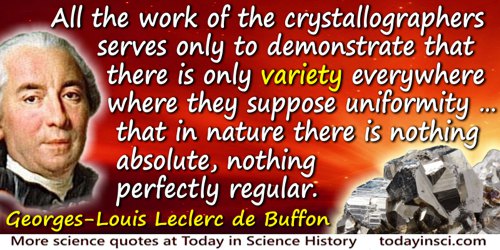
All the work of the crystallographers serves only to demonstrate that there is only variety everywhere where they suppose uniformity … that in nature there is nothing absolute, nothing perfectly regular.
In Histoire Naturelle des Minéraux (1783-88), Vol. 3, 433.
An experiment is an observation that can be repeated, isolated and varied. The more frequently you can repeat an observation, the more likely are you to see clearly what is there and to describe accurately what you have seen. The more strictly you can isolate an observation, the easier does your task of observation become, and the less danger is there of your being led astray by irrelevant circumstances, or of placing emphasis on the wrong point. The more widely you can vary an observation, the more clearly will the uniformity of experience stand out, and the better is your chance of discovering laws.
In A Text-Book of Psychology (1909), 20.
And do you know what “the world” is to me? Shall I show it to you in my mirror? This world: a monster of energy, without beginning, without end; a firm, iron magnitude of force that does not grow bigger or smaller, that does not expend itself but only transforms itself; as a whole, of unalterable size, a household without expenses or losses, but likewise without increase or income; enclosed by “nothingness”' as by a boundary; not by something blurry or wasted, not something endlessly extended, but set in a definite space as a definite force, and not a space that might be “empty” here or there, but rather as force throughout, as a play of forces and waves of forces, at the same time one and many, increasing here and at the same time decreasing there; a sea of forces flowing and rushing together, eternally changing, eternally flooding back, with tremendous years of recurrence, with an ebb and a flood of its forms; out of the simplest forms striving toward the most complex, out of the stillest, most rigid, coldest forms toward the hottest, most turbulent, most self-contradictory, and then again returning home to the simple out of this abundance, out of the play of contradictions back to the joy of concord, still affirming itself in this uniformity of its courses and its years, blessing itself as that which must return eternally, as a becoming that knows no satiety, no disgust, no weariness: this, my Dionysian world of the eternally self-creating, the eternally self-destroying, this mystery world of the twofold voluptuous delight, my “beyond good and evil,” without goal, unless the joy of the circle itself is a goal; without will, unless a ring feels good will toward itself-do you want a name for this world? A solution for all its riddles? A light for you, too, you best-concealed, strongest, most intrepid, most midnightly men?—This world is the will to power—and nothing besides! And you yourselves are also this will to power—and nothing besides!
The Will to Power (Notes written 1883-1888), book 4, no. 1067. Trans. W. Kaufmann and R. J. Hollingdale and ed. W. Kaufmann (1968), 549-50.
BIRTH, n. The first and direst of all disasters. As to the nature of it there appears to be no uniformity. Castor and Pollux were born from the egg. Pallas came out of a skull. Galatea was once a block of stone. Peresilis, who wrote in the tenth century, avers that he grew up out of the ground where a priest had spilled holy water. It is known that Arimaxus was derived from a hole in the earth, made by a stroke of lightning. Leucomedon was the son of a cavern in Mount Etna, and I have myself seen a man come out of a wine cellar.
The Collected Works of Ambrose Bierce (1911), Vol. 7, The Devil's Dictionary, 38.
Both history of nature and history of humanity are 'historical' and yet cannot dispense with uniformity. In both there is 'uniformity' ('science') as well as non-uniformity ('history'); in both 'history respects itself and 'history does not repeat itself. But, as even the history of humanity has its uniformitarian features, uniformity can still less be dispensed with in 'history' of nature, which, being one of the natural sciences, is less historical and, consequently, more uniformitarian.
Natural Law and Divine Miracle: The Principle of Uniformity in Geology, Biology and Theology (1963), 151.
Combining in our survey then, the whole range of deposits from the most recent to the most ancient group, how striking a succession do they present:– so various yet so uniform–so vast yet so connected. In thus tracing back to the most remote periods in the physical history of our continents, one system of operations, as the means by which many complex formations have been successively produced, the mind becomes impressed with the singleness of nature's laws; and in this respect, at least, geology is hardly inferior in simplicity to astronomy.
The Silurian System (1839), 574.
Gases are distinguished from other forms of matter, not only by their power of indefinite expansion so as to fill any vessel, however large, and by the great effect heat has in dilating them, but by the uniformity and simplicity of the laws which regulate these changes.
Theory of Heat (1904), 31.
Genuine religion has its root deep down in the heart of humanity and in the reality of things. It is not surprising that by our methods we fail to grasp it: the actions of the Deity make no appeal to any special sense, only a universal appeal; and our methods are, as we know, incompetent to detect complete uniformity. There is a principle of Relativity here, and unless we encounter flaw or jar or change, nothing in us responds; we are deaf and blind therefore to the Immanent Grandeur, unless we have insight enough to recognise in the woven fabric of existence, flowing steadily from the loom in an infinite progress towards perfection, the ever-growing garment of a transcendent God.
Continuity: The Presidential Address to the British Association (1913), 92-93.
Human behaviour reveals uniformities which constitute natural laws. If these uniformities did not exist, then there would be neither social science nor political economy, and even the study of history would largely be useless. In effect, if the future actions of men having nothing in common with their past actions, our knowledge of them, although possibly satisfying our curiosity by way of an interesting story, would be entirely useless to us as a guide in life.
In Cours d’Economie Politique (1896-7), Vol. 2, 397.
In terms of the way a geologist operates, there is no past until after the assumption of uniformity has been made.
'The Theory of Geology', in C. C. Albritton (ed.), The Fabric of Geology (1963), 63.
It is difficult to give an idea of the vast extent of modern mathematics. The word “extent” is not the right one: I mean extent crowded with beautiful detail—not an extent of mere uniformity such as an objectless plain, but of a tract of beautiful country seen at first in the distance, but which will bear to be rambled through and studied in every detail of hillside and valley, stream, rock, wood, and flower.
President’s address (1883) to the British Association for the Advancement of Science, in The Collected Mathematical Papers (1895), Vol. 8, xxii.
![Martin Gardner quote: Mathematics, a creation of the mind, so accurately fits the outside world. … [There is a] fantastic amount](https://todayinsci.com/G/Gardner_Martin/GardnerMartin-Formulas500x250px.jpg)
Mathematics, a creation of the mind, so accurately fits the outside world. … [There is a] fantastic amount of uniformity in the universe. The formulas of physics are compressed descriptions of nature's weird repetitions. The accuracy of those formulas, coupled with nature’s tireless ability to keep doing everything the same way, gives them their incredible power.
In book review, 'Adventures Of a Mathematician: The Man Who Invented the H-Bomb', New York Times (9 May 1976), 201. The book is a biography of Stanislaw Ulam, and this is Gardner’s description of one of Ulam’s reflections on nature and mathematics.
Nature, as far as we can judge from the plan and scheme of things surrounding us, delights in simplicity and uniformity, and, by general laws applied to particular bodies, produces a vast variety of operations; nor is it at all improbable that an animal body is a system regulated much after the same manner.
In An Essay on the Vital and Other Involuntary Motions of Animals (1751), 3.
Nor can it be supposed that the diversity of chemical structure and process stops at the boundary of the species, and that within that boundary, which has no real finality, rigid uniformity reigns. Such a conception is at variance with any evolutionary conception of the nature and origin of species. The existence of chemical individuality follows of necessity from that of chemical specificity, but we should expect the differences between individuals to be still more subtle and difficult of detection. Indications of their existence are seen, even in man, in the various tints of skin, hair, and eyes, and in the quantitative differences in those portions of the end-products of metabolism which are endogenous and are not affected by diet, such as recent researches have revealed in increasing numbers. Even those idiosyncrasies with regard to drugs and articles of food which are summed up in the proverbial saying that what is one man's meat is another man's poison presumably have a chemical basis.
Inborn Errors of Metabolism: The Croonian Lectures delivered before the Royal College of Physicians of London, in June, 1908 (1909), 2-3.
Science has sometimes been said to be opposed to faith and inconsistent with it. But all science in fact rests on a basis of faith for it assumes the permanence and uniformity of natural laws—a thing which can never be demonstrated.
In Tryon Edwards (ed.), A Dictionary of Thoughts: Being a Cyclopedia of Laconic Quotations from the Best Authors of the World, Both Ancient and Modern (1891), 165.
Science is the reduction of the bewildering diversity of unique events to manageable uniformity within one of a number of symbol systems, and technology is the art of using these symbol systems so as to control and organize unique events. Scientific observation is always a viewing of things through the refracting medium of a symbol system, and technological praxis is always handling of things in ways that some symbol system has dictated. Education in science and technology is essentially education on the symbol level.
Essay in Daedalus (Spring1962), 279.
Science, though apparently transformed into pure knowledge, has yet never lost its character of being a craft; and that it is not the knowledge itself which can rightly be called science, but a special way of getting and of using knowledge. Namely, science is the getting of knowledge from experience on the assumption of uniformity in nature, and the use of such knowledge to guide the actions of men.
In 'On The Scientific Basis of Morals', Contemporary Review (Sep 1875), collected in Leslie Stephen and Frederick Pollock (eds.), Lectures and Essays: By the Late William Kingdon Clifford, F.R.S. (1886), 289.
The ‘Doctrine of Uniformity’ in Geology, as held by many of the most eminent of British Geologists, assumes that the earth’s surface and upper crust have been nearly as they are at present in temperature, and other physical qualities, during millions of millions of years. But the heat which we know, by observation, to be now conducted out of the earth yearly is so great, that if this action has been going on with any approach to uniformity for 20,000 million years, the amount of heat lost out of the earth would have been about as much as would heat, by 100 Cent., a quantity of ordinary surface rock of 100 times the earth’s bulk. This would be more than enough to melt a mass of surface rock equal in bulk to the whole earth. No hypothesis as to chemical action, internal fluidity, effects of pressure at great depth, or possible character of substances in the interior of the earth, possessing the smallest vestige of probability, can justify the supposition that the earth’s upper crust has remained nearly as it is, while from the whole, or from any part, of the earth, so great a quantity of heat has been lost.
In 'The “Doctrine of Uniformity” in Geology Briefly Refuted' (1866), Popular Lectures and Addresses (1891), Vol. 2, 6-7.
The aim of scientific thought, then, is to apply past experience to new circumstances; the instrument is an observed uniformity in the course of events. By the use of this instrument it gives us information transcending our experience, it enables us to infer things that we have not seen from things that we have seen; and the evidence for the truth of that information depends on our supposing that the uniformity holds good beyond our experience.
'On the Aims and Instruments of Scientific Thought,' a Lecture delivered before the members of the British Association, at Brighton, on 19 Aug 1872, in Leslie Stephen and Frederick Pollock (eds.), Lectures and Essays, by the Late William Kingdon Clifford (1886), 90.
The reduced variability of small populations is not always due to accidental gene loss, but sometimes to the fact that the entire population was started by a single pair or by a single fertilized female. These “founders” of the population carried with them only a very small proportion of the variability of the parent population. This “founder” principle sometimes explains even the uniformity of rather large populations, particularly if they are well isolated and near the borders of the range of the species.
Systematics and the Origin of Species: From the Viewpoint of a Zoologist (1942), 237.
The student of palaetiological sciences is a scientist and a historian. The former tries to be as uniformitarian as possible, the latter has to recognize the contingency of events which will ever be a 'skandalon' to the scientist. Verily, the geologist 'lives in a divided world'.
Natural Law and Divine Miracle: The Principle of Uniformity in Geology, Biology and Theology (1963), 151.
The term ‘community’ implies a diversity but at the same time a certain organized uniformity in the units. The units are the many individual plants that occur in every community, whether this be a beech-forest, a meadow, or a heath. Uniformity is established when certain atmospheric, terrestrial, and any of the other factors discussed in Section I are co-operating, and appears either because a certain, defined economy makes its impress on the community as a whole, or because a number of different growth-forms are combined to form a single aggregate which has a definite and constant guise.
Oecology of Plants: An Introduction to the Study of Plant Communities (1909), 91-92.
The uniformity of the earth’s life, more astonishing than its diversity, is accountable by the high probability that we derived, originally, from some single cell, fertilized in a bolt of lightning as the earth cooled. It is from the progeny of this parent cell that we take our looks; we still share genes around, and the resemblance of the enzymes of grasses to those of whales is a family resemblance.
In The Lives of a Cell (1974), 5.
There are certain general Laws that run through the whole Chain of natural Effects: these are learned by the Observation and Study of Nature, and are by Men applied as well to the framing artificial things for the Use and Ornament of Life, as to the explaining the various Phænomena: Which Explication consists only in shewing the Conformity any particular Phænomenon hath to the general Laws of Nature, or, which is the same thing, in discovering the Uniformity there is in the production of natural Effects; as will be evident to whoever shall attend to the several Instances, wherin Philosophers pretend to account for Appearances.
A Treatise Concerning the Principles of Human Knowledge [first published 1710], (1734), 87-8.
Those who see their lives as spoiled and wasted crave equality and fraternity more than they do freedom. If they clamor for freedom, it is but freedom to establish equality and uniformity. The passion for equality is partly a passion for anonymity: to be one thread of the many which make up a tunic; one thread not distinguishable from the others. No one can then point us out, measure us against others and expose our inferiority.
In The True Believer: Thoughts on the Nature of Mass Movements (1951), 31-32.
To take one of the simplest cases of the dissipation of energy, the conduction of heat through a solid—consider a bar of metal warmer at one end than the other and left to itself. To avoid all needless complication, of taking loss or gain of heat into account, imagine the bar to be varnished with a substance impermeable to heat. For the sake of definiteness, imagine the bar to be first given with one half of it at one uniform temperature, and the other half of it at another uniform temperature. Instantly a diffusing of heat commences, and the distribution of temperature becomes continuously less and less unequal, tending to perfect uniformity, but never in any finite time attaining perfectly to this ultimate condition. This process of diffusion could be perfectly prevented by an army of Maxwell’s ‘intelligent demons’* stationed at the surface, or interface as we may call it with Prof. James Thomson, separating the hot from the cold part of the bar.
* The definition of a ‘demon’, according to the use of this word by Maxwell, is an intelligent being endowed with free will, and fine enough tactile and perceptive organisation to give him the faculty of observing and influencing individual molecules of matter.
* The definition of a ‘demon’, according to the use of this word by Maxwell, is an intelligent being endowed with free will, and fine enough tactile and perceptive organisation to give him the faculty of observing and influencing individual molecules of matter.
In 'The Kinetic Theory of the Dissipation of Energy', Nature (1874), 9, 442.
Uniformity and Evolution are one.
Presidential Address to the Geology Section, Report of the British Association for the Advancement of Science (1892), 707.
Uniformity in the currency, weights, and measures of the United States is an object of great importance, and will, I am persuaded, be duly attended to.
First Annual Message to Congress on the State of the Union (8 Jan 1790).
Were the succession of stars endless, then the background of the sky would present us an uniform luminosity, like that displayed by the Galaxy—since there could be absolutely no point, in all that background, at which would not exist a star. The only mode, therefore, in which, under such a state of affairs, we could comprehend the voids which our telescopes find in innumerable directions, would be by supposing the distance of the invisible background so immense that no ray from it has yet been able to reach us at all.
'Eureka: An Essay on the Material and Spiritual Universe' (1848). Collected in The Works of the Late Edgar Allan Poe (1857), Vol. 2, 183.
What remains to be learned may indeed dwarf imagination. Nevertheless, the universe itself is closed and finite. … The uniformity of nature and the general applicability of natural laws set limits to knowledge. If there are just 100, or 105, or 110 ways in which atoms may form, then when one has identified the full range of properties of these, singly and in combination, chemical knowledge will be complete.
Presidential Address (28 Dec 1970) to the American Association for the Advancement of Science. 'Science: Endless Horizons or Golden Age?', Science (8 Jan 1971), 171, No. 3866, 24.
When science makes minor mysteries disappear, greater mysteries stand confessed. For one object of delight whose emotional value science has inevitably lessened—as Newton damaged the rainbow for Keats—science gives back double. To the grand primary impressions of the worldpower, the immensities, the pervading order, and the universal flux, with which the man of feeling has been nurtured from of old, modern science has added thrilling impressions of manifoldness, intricacy, uniformity, inter-relatedness, and evolution. Science widens and clears the emotional window. There are great vistas to which science alone can lead, and they make for elevation of mind. The opposition between science and feeling is largely a misunderstanding. As one of our philosophers has remarked, science is in a true sense 'one of the humanities.'
J. Arthur Thomson (ed.), The Outline of Science: A Plain Story Simply Told (1921/2), Vol. 2, Science and Modern Thought, 787.
When the first mathematical, logical, and natural uniformities, the first laws, were discovered, men were so carried away by the clearness, beauty and simplification that resulted, that they believed themselves to have deciphered authentically the eternal thoughts of the Almighty.
From Lecture (Nov 1906) at the Lowell Institute, Boston. Published in 'The Present Dilemma in Philosophy',Pragmatism: A New Name for Some Old Ways of Thinking: Popular Lectures on Philosophy (1907), 56.
Whether moral and social phenomena are really exceptions to the general certainty and uniformity of the course of nature; and how far the methods, by which so many of the laws of the physical world have been numbered among truths irrevocably acquired and universally assented to, can be made instrumental to the gradual formation of a similar body of received doctrine in moral and political science.
A System of Logic, Ratiocinative and Inductive (1858), v.
Without the discovery of uniformities there can be no concepts, no classifications, no formulations, no principles, no laws; and without these no science can exist.
Co-editor with American psychologist Henry Murray (1893-1988)
Co-editor with American psychologist Henry Murray (1893-1988)
'Personality Formation: the Determinants'. In Clyde Kluckhohn and Henry A. Murray (eds.), Personality in Nature, Society, and Culture (1949), 37-8.
 In science it often happens that scientists say, 'You know that's a really good argument; my position is mistaken,' and then they would actually change their minds and you never hear that old view from them again. They really do it. It doesn't happen as often as it should, because scientists are human and change is sometimes painful. But it happens every day. I cannot recall the last time something like that happened in politics or religion.
(1987) --
In science it often happens that scientists say, 'You know that's a really good argument; my position is mistaken,' and then they would actually change their minds and you never hear that old view from them again. They really do it. It doesn't happen as often as it should, because scientists are human and change is sometimes painful. But it happens every day. I cannot recall the last time something like that happened in politics or religion.
(1987) -- 





