Trouble Quotes (119 quotes)
... I should think that anyone who considered it more reasonable for the whole universe to move in order to let the Earth remain fixed would be more irrational than one who should climb to the top of your cupola just to get a view of the city and its environs, and then demand that the whole countryside should revolve around him so that he would not have to take the trouble to turn his head.
In Dialogue Concerning the Two Chief World Systems (1632).
“If there are two theories, one simpler man the other, the simpler one is to be preferred.” At first sight this does not seem quite so bad, but a little thought shows that our tendency to prefer the simpler possibility is psychological rather than scientific. It is less trouble to think that way. Experience invariably shows that the more correct a theory becomes, the more complex does it seem. … So this … interpretation of [Ockham’s Razor] is … worthless.
With co-author Nalin Chandra Wickramasinghe, Evolution from Space (1981), 135.
“Unless,” said I [Socrates], “either philosophers become kings in our states or those whom we now call our kings and rulers take to the pursuit of' philosophy seriously and adequately, and there is a conjunction of these two things, political power and philosophic intelligence, while the motley horde of the natures who at present pursue either apart from the other are compulsorily excluded, there can be no cessation of troubles, dear Glaucon, for our states, nor, I fancy for the human race either. Nor, until this happens, will this constitution which we have been expounding in theory ever be put into practice within the limits of possibility and see the light of the sun.”
— Plato
From The Republic 5 473 c-e, in Paul Shorey (trans.), Plato in Twelve Volumes (1930, 1969), Vol. 5, 509.
[1665-06-10] ...In the evening home to supper, and there to my great trouble hear that the plague is come into the City (though it hath these three or four weeks since its beginning been wholly out of the City); but where it begin but in my good friend and neighbour's, Dr Burnett in Fanchurch Street - which in both points troubles me mightily. To the office to finish my letters, and then home to bed, being troubled at the sickness ... and particularly how to put my things and estate in order, in case it should please God to call me away.
Diary of Samuel Pepys (10 Jun 1665)
[1665-06-17] It stroke me very deep this afternoon, going with a hackney-coach from my Lord Treasurer's down Holborne - the coachman I found to drive easily and easily; at last stood still, and came down hardly able to stand; and told me that he was suddenly stroke very sick and almost blind. So I light and went into another coach, with a sad heart for the poor man and trouble for myself, lest he should have been stroke with the plague - being at that end of the town that I took him up. But God have mercy upon us all.
Diary of Samuel Pepys (17 Jun 1665)
[1665-08-16] ...Hence to the Exchange, which I have not been a great while. But Lord, how sad a sight it is to see the streets empty of people, and very few upon the Change - jealous of every door that one sees shut up, lest it should be the plague - and about us, two shops in three, if not more, generally shut up. ... It was dark before I could get home; and so land at church-yard stairs, where to my great trouble I met a dead Corps, of the plague, in the narrow ally, just bringing down a little pair of stairs - but I thank God I was not much disturbed at it. However, I shall beware of being late abroad again.
Diary of Samuel Pepys (16 Aug 1665)
[I] could see how nervous everybody was in the beginning and how silent it was when we had trouble with the artificial heart [during the surgery, but later in the operation, when it was working, there were moments] of loud and raucous humor.
[Commenting after reviewing the video tape of the world's first human implantation of an artificial heart.]
[Commenting after reviewing the video tape of the world's first human implantation of an artificial heart.]
Quoted by Lawrence K. Altman in “Clark's Surgeon Was ‘Worried To Death’&rdquo, New York Times (12 Apr 1983), C2.
[Overfishing—] it’s not just that we’re taking too many out, it’s how we’re doing it. We are wiping out their nurseries, … [because some huge boats] … bottom trawl … [with] nets that 50 years ago you’d have to lift when you came to coral reefs or rocks or nooks and crannies. Now they’re so sophisticated and so heavy, the equipment, and the boat’s so powerful they can just drag right over the coral reefs and the rocks and the nooks and crannies, and turn them into a gravel pit. … The trouble is those are the nurseries. That’s where the little fish hide and get bigger and get big enough for us to eat.
From transcript of PBS TV interview by Tavis Smiley (28 Mar 2011).
Goldsmith: If you put a tub full of blood into a stable, the horses are like to go mad.
Johnson: I doubt that.
Goldsmith: Nay, sir, it is a fact well authenticated.
Thrale: You had better prove it before you put it into your book on natural history. You may do it in my stable if you will.
Johnson: Nay, sir, I would not have him prove it. If he is content to take his information from others, he may get through his book with little trouble, and without much endangering his reputation. But if he makes experiments for so comprehensive a book as his, there would be no end to them; his erroneous assertions would then fall upon himself: and he might be blamed for not having made experiments as to every particular.
Johnson: I doubt that.
Goldsmith: Nay, sir, it is a fact well authenticated.
Thrale: You had better prove it before you put it into your book on natural history. You may do it in my stable if you will.
Johnson: Nay, sir, I would not have him prove it. If he is content to take his information from others, he may get through his book with little trouble, and without much endangering his reputation. But if he makes experiments for so comprehensive a book as his, there would be no end to them; his erroneous assertions would then fall upon himself: and he might be blamed for not having made experiments as to every particular.
In James Boswell, The Life of Samuel Johnson, LL.D.: Comprehending an Account of His Studies and Numerous Works (1785, 1830), 229-230.
In primis, hominis est propria VERI inquisitio atque investigato. Itaque cum sumus negotiis necessariis, curisque vacui, tum avemus aliquid videre, audire, ac dicere, cognitionemque rerum, aut occultarum aut admirabilium, ad benè beatéque vivendum necessariam ducimus; —ex quo intelligitur, quod VERUM, simplex, sincerumque sit, id esse naturæ hominis aptissimum. Huic veri videndi cupiditati adjuncta est appetitio quædam principatûs, ut nemini parere animus benè a naturâ informatus velit, nisi præcipienti, aut docenti, aut utilitatis causâ justè et legitimè imperanti: ex quo animi magnitudo existit, et humanarum rerum contemtio.
Before all other things, man is distinguished by his pursuit and investigation of TRUTH. And hence, when free from needful business and cares, we delight to see, to hear, and to communicate, and consider a knowledge of many admirable and abstruse things necessary to the good conduct and happiness of our lives: whence it is clear that whatsoever is TRUE, simple, and direct, the same is most congenial to our nature as men. Closely allied with this earnest longing to see and know the truth, is a kind of dignified and princely sentiment which forbids a mind, naturally well constituted, to submit its faculties to any but those who announce it in precept or in doctrine, or to yield obedience to any orders but such as are at once just, lawful, and founded on utility. From this source spring greatness of mind and contempt of worldly advantages and troubles.
Before all other things, man is distinguished by his pursuit and investigation of TRUTH. And hence, when free from needful business and cares, we delight to see, to hear, and to communicate, and consider a knowledge of many admirable and abstruse things necessary to the good conduct and happiness of our lives: whence it is clear that whatsoever is TRUE, simple, and direct, the same is most congenial to our nature as men. Closely allied with this earnest longing to see and know the truth, is a kind of dignified and princely sentiment which forbids a mind, naturally well constituted, to submit its faculties to any but those who announce it in precept or in doctrine, or to yield obedience to any orders but such as are at once just, lawful, and founded on utility. From this source spring greatness of mind and contempt of worldly advantages and troubles.
In De Officiis, Book 1. Sect. 13. As given in epigraph to John Frederick William Herschel, A Preliminary Discourse on the Study of Natural Philosophy (1830), viii.
The Water-baby story character, Tom, asks: 'I heard, ma'am, that you were always making new beasts out of old.'
Mother Carey [Mother Nature] replies: 'So people fancy. But I am not going to trouble myself to make things, my little dear. I sit here and make them make themselves.'
[The author's indirect reference to evolution.]
Mother Carey [Mother Nature] replies: 'So people fancy. But I am not going to trouble myself to make things, my little dear. I sit here and make them make themselves.'
[The author's indirect reference to evolution.]
The Water-babies (1886), 307.
Macbeth: How does your patient, doctor?
Doctor: Not so sick, my lord,
As she is troubled with thick-coming fancies,
That keep her from her rest.
Macbeth: Cure her of that.
Canst thou not minister to a mind diseased,
Pluck from the memory a rooted sorrow,
Raze out the written troubles of the brain,
And with some sweet oblivious antidote
Cleanse the stuffed bosom of that perilous stuff
Which weighs upon the heart?
Doctor: Therein the patient
Must minister to himself.
Macbeth: Throw physic to the dogs; I'll none of it.
Doctor: Not so sick, my lord,
As she is troubled with thick-coming fancies,
That keep her from her rest.
Macbeth: Cure her of that.
Canst thou not minister to a mind diseased,
Pluck from the memory a rooted sorrow,
Raze out the written troubles of the brain,
And with some sweet oblivious antidote
Cleanse the stuffed bosom of that perilous stuff
Which weighs upon the heart?
Doctor: Therein the patient
Must minister to himself.
Macbeth: Throw physic to the dogs; I'll none of it.
Macbeth (1606), V, iii.
A chemist without a nose is in for trouble.
In 'Arsenic', The Periodic Table (1975, 1996), 178.
A New Arithmetic: “I am not much of a mathematician,” said the cigarette, “but I can add nervous troubles to a boy, I can subtract from his physical energy, I can multiply his aches and pains, I can divide his mental powers, I can take interest from his work and discount his chances for success.”
In Henry Ford, The Case Against the Little White Slaver (1914), Vol. 3, 40.
A very sincere and serious freshman student came to my office with a question that had clearly been troubling him deeply. He said to me, ‘I am a devout Christian and have never had any reason to doubt evolution, an idea that seems both exciting and well documented. But my roommate, a proselytizing evangelical, has been insisting with enormous vigor that I cannot be both a real Christian and an evolutionist. So tell me, can a person believe both in God and in evolution?’ Again, I gulped hard, did my intellectual duty, a nd reassured him that evolution was both true and entirely compatible with Christian belief –a position that I hold sincerely, but still an odd situation for a Jewish agnostic.
…...
An intelligent patient, private or otherwise, to whom you have taken the trouble to explain the nature of the investigation, makes the best laboratory animal.
'Some of the ‘Do’s’ and ‘Do-Nots’ in Clinical Investigation,' Journal of Clinical Investigation (1944), 23, 921-26.
And as for other men, who worked in tank-rooms full of steam, and in some of which there were open vats near the level of the floor, their peculiar trouble was that they fell into the vats; and when they were fished out, there was never enough of them left to be worth exhibiting,—sometimes they would be overlooked for days, till all but the bones of them had gone out into the world as Durham's Pure Leaf Lard! This contributed to the passing of the Pure Food Act of 1906.
The Jungle (1906), 117.
Are the worst enemies of society those who attack it or those who do not even give themselves the trouble of defending it?
From original French, “Les pires ennemis de la société sont-ils ceux qui l'attaquent ou ceux qui ne se donnent même pas la peine de la défendre?” in Psychologie du Socialisme (1898), 61. English in The Psychology of Socialism (1899), 52.
Circles to square and cubes to double
Would give a man excessive trouble.
The longitude uncertain roams,
In spite of Whiston and his bombs.
Would give a man excessive trouble.
The longitude uncertain roams,
In spite of Whiston and his bombs.
In 'Alma', Canto III, in Samuel Johnson, The Works of the English Poets, from Chaucer to Cowper (1810), 203. The reference to longitude reflects the difficulty of its determination at sea, and the public interest in the attempts to win the prize instituted by the British government in 1714 for a successful way to find longitude at sea (eventually won by John Harrison's chronometer). In this poem, William Whiston (who succeeded Isaac Newton as Lucasian Professor at Cambridge) is being satirized for what many thought was a crack-brained scheme to find the longitude. This proposed, with Humphrey Ditton, the use of widely separated ships firing off shells programmed to explode at a set time, and calculation of distance between them made from the time-lag between the observed sounds of the explosions using the known speed of sound.
Daniel Bernoulli used to tell two little adventures, which he said had given him more pleasure than all the other honours he had received. Travelling with a learned stranger, who, being pleased with his conversation, asked his name; “I am Daniel Bernoulli,” answered he with great modesty; “and I,” said the stranger (who thought he meant to laugh at him) “am Isaac Newton.” Another time, having to dine with the celebrated Koenig, the mathematician, who boasted, with some degree of self-complacency, of a difficult problem he had solved with much trouble, Bernoulli went on doing the honours of his table, and when they went to drink coffee he presented Koenig with a solution of the problem more elegant than his own.
In A Philosophical and Mathematical Dictionary (1815), 1, 226.
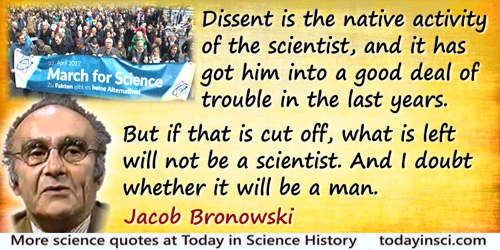
Dissent is the native activity of the scientist, and it has got him into a good deal of trouble in the last years. But if that is cut off, what is left will not be a scientist. And I doubt whether it will be a man.
…...
Every honest researcher I know admits he’s just a professional amateur. He’s doing whatever he’s doing for the first time. That makes him an amateur. He has sense enough to know that he’s going to have a lot of trouble, so that makes him a professional.
…...
Everything is always in trouble at the frontier. Any science that is not in this kind of trouble is dead.
As quoted in John Noble Wilford, 'Sizing up the Cosmos: An Astronomers Quest', New York Times (12 Mar 1991), C10.
Evolution has encountered no intellectual trouble; no new arguments have been offered. Creationism is a home-grown phenomenon of American sociocultural history—a splinter movement … who believe that every word in the Bible must be literally true, whatever such a claim might mean.
Leonardo's Mountain of Clams and the Diet of Worms: Essays on Natural History (1998), 270.
First, it must be a pleasure to study the human body the most miraculous masterpiece of nature and to learn about the smallest vessel and the smallest fiber. But second and most important, the medical profession gives the opportunity to alleviate the troubles of the body, to ease the pain, to console a person who is in distress, and to lighten the hour of death of many a sufferer.
Reasons for his choice of medicine as a career, from essay written during his last year in the Gymnasium (high school). As quoted in Leslie Dunn, Rudolf Virchow: Now You Know His Name (2012), 8-9.
Genius … has been defined as a supreme capacity for taking trouble… It more fitly could be described as a supreme capacity for getting its possessors into trouble of all kinds and keeping them there so long as the genius remains.
In Samuel Butler and Henry Festing Jones (ed.), The Note-Books of Samuel Butler (1913), 174-175.
Genius is an immense capacity for taking trouble.
Louis Klopsch, Many Thoughts of Many Minds (1896), 105.
Genuine science, of course, is neutral. But its practical effects, when harnessed to the appetites of the market, are something less than neutral. Heartbeats are human, but when harnessed to a public-address system, they can be terrifying. Ordinary human appetites for comfort, prestige, or power have in history been troublesome enough, but when they are given exaggerated expression by means of applied science they promise swift destruction.
In The Mechanical Bride: Folklore of Industrial Man (1967), 93.
He [Heinrich Rose] looked upon the various substances that he was manipulating, as well as their reactions, under a thoroughly familial point of view: they were like so many children entrusted to his tutelage. Every time he explained simple, clear, well-defined phenomena, he assumed a jovial and smiling countenance; on the other hand, he almost got angry at certain mischievous bodies, the properties of which did not obey ordinary laws and troubled general theoretical views; in his eyes, this was unruly behavior.
As his student, about the lectures of Heinrich Rose, as quoted in entry by Stuart Pierson, 'Rose, Heinrich', in Charles Coulston Gillespie (ed.), Dictionary of Scientific Biography (1975), Vol.11, 541, citing Adolphe Remelé, 'Notice biographique sur le Professeur Henri Rose', in Moniteur Scientifique (1864), 2nd ser., 6, 385–389. [Remelé’s italics.]
Hypothesis is a tool which can cause trouble if not used properly. We must be ready to abandon our hypothesis as soon as it is shown to be inconsistent with the facts.
In The Art of Scientific Investigation (1950,1957), 66.
I am astonished that in the United States a scientist gets into such trouble because of his scientific beliefs; that your activity in 1957 and 1958 in relation to the petition to the United Nations asking for a bomb-test agreement causes you now to be called before the authorities and ordered to give the names of the scientists who have the same opinions that you have and who have helped you to gather signatures to the petition. I think that I must be dreaming!
Letter to Linus Pauling (23 Jul 1960). As quoted on the Linus Pauling and the International Peace Movement website at scarc.library.oregonstate.edu.
I came into the room, which was half dark, and presently spotted Lord Kelvin in the audience and realised that I was in for trouble at the last part of my speech dealing with the age of the earth, where my views conflicted with his. To my relief, Kelvin fell fast asleep, but as I came to the important point, I saw the old bird sit up, open an eye and cock a baleful glance at me! Then a sudden inspiration came, and I said Lord Kelvin had limited the age of the earth, provided no new source was discovered. That prophetic utterance refers to what we are now considering tonight, radium! Behold! the old boy beamed upon me.
The italicized phrase refers to “no new source” of energy. Concerning a Lecture by Rutherford, at the Royal Institution, dealing with the energy of subterranean radium, which had an effect prolonging the heat of the Earth. Arthur S. Eve wrote that Rutherford “used to tell humorous stories about this lecture long afterwards:” — followed by the subject quote above, as its own paragraph. As given in Arthur S. Eve, Rutherford: Being the Life and Letters of the Rt. Hon. Lord Rutherford, O.M. (1939), 107. The story lacks quotation marks, and thus should be regarded as perhaps Eve’s own words giving a faithful recollection, rather than Rutherford’s verbatim words. (However, note that the style used throughout the book is to omit quotation marks from their own separate paragraph.)
I can see him [Sylvester] now, with his white beard and few locks of gray hair, his forehead wrinkled o’er with thoughts, writing rapidly his figures and formulae on the board, sometimes explaining as he wrote, while we, his listeners, caught the reflected sounds from the board. But stop, something is not right, he pauses, his hand goes to his forehead to help his thought, he goes over the work again, emphasizes the leading points, and finally discovers his difficulty. Perhaps it is some error in his figures, perhaps an oversight in the reasoning. Sometimes, however, the difficulty is not elucidated, and then there is not much to the rest of the lecture. But at the next lecture we would hear of some new discovery that was the outcome of that difficulty, and of some article for the Journal, which he had begun. If a text-book had been taken up at the beginning, with the intention of following it, that text-book was most likely doomed to oblivion for the rest of the term, or until the class had been made listeners to every new thought and principle that had sprung from the laboratory of his mind, in consequence of that first difficulty. Other difficulties would soon appear, so that no text-book could last more than half of the term. In this way his class listened to almost all of the work that subsequently appeared in the Journal. It seemed to be the quality of his mind that he must adhere to one subject. He would think about it, talk about it to his class, and finally write about it for the Journal. The merest accident might start him, but once started, every moment, every thought was given to it, and, as much as possible, he read what others had done in the same direction; but this last seemed to be his real point; he could not read without finding difficulties in the way of understanding the author. Thus, often his own work reproduced what had been done by others, and he did not find it out until too late.
A notable example of this is in his theory of cyclotomic functions, which he had reproduced in several foreign journals, only to find that he had been greatly anticipated by foreign authors. It was manifest, one of the critics said, that the learned professor had not read Rummer’s elementary results in the theory of ideal primes. Yet Professor Smith’s report on the theory of numbers, which contained a full synopsis of Kummer’s theory, was Professor Sylvester’s constant companion.
This weakness of Professor Sylvester, in not being able to read what others had done, is perhaps a concomitant of his peculiar genius. Other minds could pass over little difficulties and not be troubled by them, and so go on to a final understanding of the results of the author. But not so with him. A difficulty, however small, worried him, and he was sure to have difficulties until the subject had been worked over in his own way, to correspond with his own mode of thought. To read the work of others, meant therefore to him an almost independent development of it. Like the man whose pleasure in life is to pioneer the way for society into the forests, his rugged mind could derive satisfaction only in hewing out its own paths; and only when his efforts brought him into the uncleared fields of mathematics did he find his place in the Universe.
A notable example of this is in his theory of cyclotomic functions, which he had reproduced in several foreign journals, only to find that he had been greatly anticipated by foreign authors. It was manifest, one of the critics said, that the learned professor had not read Rummer’s elementary results in the theory of ideal primes. Yet Professor Smith’s report on the theory of numbers, which contained a full synopsis of Kummer’s theory, was Professor Sylvester’s constant companion.
This weakness of Professor Sylvester, in not being able to read what others had done, is perhaps a concomitant of his peculiar genius. Other minds could pass over little difficulties and not be troubled by them, and so go on to a final understanding of the results of the author. But not so with him. A difficulty, however small, worried him, and he was sure to have difficulties until the subject had been worked over in his own way, to correspond with his own mode of thought. To read the work of others, meant therefore to him an almost independent development of it. Like the man whose pleasure in life is to pioneer the way for society into the forests, his rugged mind could derive satisfaction only in hewing out its own paths; and only when his efforts brought him into the uncleared fields of mathematics did he find his place in the Universe.
In Florian Cajori, Teaching and History of Mathematics in the United States (1890), 266-267.
I don’t think necessity is the mother of invention. Invention, in my opinion, arises directly from idleness, possibly also from laziness—to save oneself trouble.
In An Autobiography (1977, 19990), 121.
I feel it myself, the glitter of nuclear weapons. It is irresistible if you come to them as a scientist. To feel it’s there in your hands. To release the energy that fuels the stars. To let it do your bidding. And to perform these miracles, to lift a million tons of rock into the sky, it is something that gives people an illusion of illimitable power, and it is in some ways responsible for all our troubles, I would say, this is what you might call ‘technical arrogance’ that overcomes people when they see what they can do with their minds.
As quoted in Ian Sample, Massive: The Hunt for the God Particle (2010), 41, citing it as: The Day After Trinity, a documentary about the life and work of Robert Oppenheimer.
I have always looked upon alchemy in natural philosophy to be like enthusiasm in divinity, and to have troubled the world much to the same.
In The Works of Sir William Temple, Bart (1814), 506.
I have had a fairly long life, above all a very happy one, and I think that I shall be remembered with some regrets and perhaps leave some reputation behind me. What more could I ask? The events in which I am involved will probably save me from the troubles of old age. I shall die in full possession of my faculties, and that is another advantage that I should count among those that I have enjoyed. If I have any distressing thoughts, it is of not having done more for my family; to be unable to give either to them or to you any token of my affection and my gratitude is to be poor indeed.
Letter to Augez de Villiers, undated. Quoted in D. McKie, Antoine Lavoisier: Scientist, Economist, Social Reformer (1952), 303.
I have just finished my sketch of my species theory. If as I believe that my theory is true & if it be accepted even by one competent judge, it will be a considerable step in science. I therefore write this, in case of my sudden death, as my most solemn & last request, which I am sure you will consider the same as if legally entered in my will, that you will devote 400£ to its publication & further will yourself, or through Hensleigh [Wedgwood], take trouble in promoting it.
Letter to Emma Darwin, 5 July 1844. In F. Burkhardt and S. Smith (eds.), The Correspondence of Charles Darwin 1844-1846 (1987), Vol. 3, 43.
I have no trouble publishing in Soviet astrophysical journals, but my work is unacceptable to the American astrophysical journals.
[Referring to the trouble he had with the peer reviewers of Anglo-American astrophysical journals because his ideas often conflicted with the generally accepted or “standard"” theories.]
[Referring to the trouble he had with the peer reviewers of Anglo-American astrophysical journals because his ideas often conflicted with the generally accepted or “standard"” theories.]
Quoted in Anthony L. Peratt, 'Dean of the Plasma Dissidents', Washington Times, supplement: The World and I (May 1988),197.
I shall always feel respect for every one who has written a book, let it be what it may, for I had no idea of the trouble which trying to write common English could cost one—And alas there yet remains the worst part of all correcting the press.
Letter to W. D. Fox, 7 July 1837, referring to his Journal of Researches. In F. Burkhardt and S. Smith (eds), The Correspondence of Charles Darwin 1837-1843 (1986), Vol. 2, 29.
I was then in Germany, where I had been drafted because of the wars that are still going on there, and as I was returning to the army from the emperor's coronation, the arrival of winter delayed me in quarters where, finding no company to distract me and, luckily, having no cares or passions to trouble me, I used to spend the whole day alone in a room, that was heated by a stove, where I had plenty of time to concentrate on my own thoughts.
Discourse on Method in Discourse, on Method and Related Writings (1637), trans. Desmond M. Clarke, Penguin edition (1999), Part 2, 11.
I was unable to devote myself to the learning of this al-jabr [algebra] and the continued concentration upon it, because of obstacles in the vagaries of Time which hindered me; for we have been deprived of all the people of knowledge save for a group, small in number, with many troubles, whose concern in life is to snatch the opportunity, when Time is asleep, to devote themselves meanwhile to the investigation and perfection of a science; for the majority of people who imitate philosophers confuse the true with the false, and they do nothing but deceive and pretend knowledge, and they do not use what they know of the sciences except for base and material purposes; and if they see a certain person seeking for the right and preferring the truth, doing his best to refute the false and untrue and leaving aside hypocrisy and deceit, they make a fool of him and mock him.
A. P. Youschkevitch and B. A. Rosenfeld, 'Al-Khayyami', in C. C. Gillispie (ed.), Dictionary of Scientific Biography (1973), Vol. 7, 324.
If trouble were as easy to get out of as into—life would be one sweet song.
Aphorism as given by the fictional character Dezhnev Senior, in Fantastic Voyage II: Destination Brain (1987), 280.
In all spheres of science, art, skill, and handicraft it is never doubted that, in order to master them, a considerable amount of trouble must be spent in learning and in being trained. As regards philosophy, on the contrary, there seems still an assumption prevalent that, though every one with eyes and fingers is not on that account in a position to make shoes if he only has leather and a last, yet everybody understands how to philosophize straight away, and pass judgment on philosophy, simply because he possesses the criterion for doing so in his natural reason.
From Phänomenologie des Geistes (1807) as translated by J.B. Baillie in 'Preface', The Phenomenology of Mind (1910), Vol. 1, 67.
In passing, I firmly believe that research should be offset by a certain amount of teaching, if only as a change from the agony of research. The trouble, however, I freely admit, is that in practice you get either no teaching, or else far too much.
From 'The Mathematician's Art of Work' (1967) in Béla Bollobás (ed.) Littlewood's Miscellany (1986), 194.
In physics, you don’t have to go around making trouble for yourself - nature does it for you.
…...
In the end, science as we know it has two basic types of practitioners. One is the educated man who still has a controlled sense of wonder before the universal mystery, whether it hides in a snail’s eye or within the light that impinges on that delicate organ. The second kind of observer is the extreme reductionist who is so busy stripping things apart that the tremendous mystery has been reduced to a trifle, to intangibles not worth troubling one’s head about.
In 'Science and the Sense of the Holy,' The Star Thrower (1978), 190.
In the light of knowledge attained, the happy achievement seems almost a matter of course, and any intelligent student can grasp it without too much trouble. But the years of anxious searching in the dark, with their intense longing, their alternations of confidence and exhaustion, and the final emergence into the light—only those who have experienced it can understand that.
Quoted in Banesh Hoffmann and Helen Dukas, Albert Einstein: Creator and Rebel (1972), 124.
It did not cause anxiety that Maxwell’s equations did not apply to gravitation, since nobody expected to find any link between electricity and gravitation at that particular level. But now physics was faced with an entirely new situation. The same entity, light, was at once a wave and a particle. How could one possibly imagine its proper size and shape? To produce interference it must be spread out, but to bounce off electrons it must be minutely localized. This was a fundamental dilemma, and the stalemate in the wave-photon battle meant that it must remain an enigma to trouble the soul of every true physicist. It was intolerable that light should be two such contradictory things. It was against all the ideals and traditions of science to harbor such an unresolved dualism gnawing at its vital parts. Yet the evidence on either side could not be denied, and much water was to flow beneath the bridges before a way out of the quandary was to be found. The way out came as a result of a brilliant counterattack initiated by the wave theory, but to tell of this now would spoil the whole story. It is well that the reader should appreciate through personal experience the agony of the physicists of the period. They could but make the best of it, and went around with woebegone faces sadly complaining that on Mondays, Wednesdays, and Fridays they must look on light as a wave; on Tuesdays, Thursdays, and Saturdays, as a particle. On Sundays they simply prayed.
The Strange Story of the Quantum (1947), 42.
It is certainly true that all physical phenomena are subject to strictly mathematical conditions, and mathematical processes are unassailable in themselves. The trouble arises from the data employed. Most phenomena are so highly complex that one can never be quite sure that he is dealing with all the factors until the experiment proves it. So that experiment is rather the criterion of mathematical conclusions and must lead the way.
In Matter, Ether, Motion (1894), 89.
It is like the man who became short-sighted and refused to wear glasses, saying there was nothing wrong with him, but that the trouble was that the recent papers were so badly printed.
In Psychological Commentaries on the Teaching of Gurdjieff (1972), 98.
It is noble to teach oneself, but still nobler to teach others and less trouble.
Attributed (doubtfully?) to Max Planck. Widely seen on the web, but always without citation. Webmaster has not yet found any evidence in print that this is a valid Planck quote, and must be skeptical that it is. Contact Webmaster if you know a primary source.
It may be true, that as Francis Thompson noted, ‘Thou canst not stir a flower without troubling a star’, but in computing the motion of stars and planets, the effects of flowers do not loom large. It is the disregarding of the effect of flowers on stars that allows progress in astronomy. Appropriate abstraction is critical to progress in science.
…...
It really is worth the trouble to invent a new symbol if we can thus remove not a few logical difficulties and ensure the rigour of the proofs. But many mathematicians seem to have so little feeling for logical purity and accuracy that they will use a word to mean three or four different things, sooner than make the frightful decision to invent a new word.
Grundgesetz der Arithmetik(1893), Vol. 2, Section 60, In P. Greach and M. Black (eds., Translations from the Philosophical Writings of Gottlob Frege (1952), 144.
It troubles me that we are so easily pressured by purveyors of technology into permitting so-called “progress” to alter our lives without attempting to control it—as if technology were an irrepressible force of nature to which we must meekly submit.
Quoted in The American Land (1979). In Barbara K. Rodes and Rice Odell, A Dictionary of Environmental Quotations (1992), 274.
It’s tempting to go to the throat of the volcano to get the data, because if you do you’re a hero … It’s a battle between your mind and your emotions. If your emotions win out, you can get yourself in a lot of trouble.
Quoted by Ron Russell in 'Column One: In pursuit of Deadly Volcanoes', Los Angeles Times (25 Jun 1991), an article about for three scientists that had died in a volcano eruption.
Jupiter’s passed through Orion
And come into conjunction with Mars.
Saturn is wheeling through infinite space
To its preordained place in the stars.
And I gaze at the planets in wonder
At the trouble and time they spend,
All to warn me to be careful
In dealings involving a friend!
And come into conjunction with Mars.
Saturn is wheeling through infinite space
To its preordained place in the stars.
And I gaze at the planets in wonder
At the trouble and time they spend,
All to warn me to be careful
In dealings involving a friend!
Lyrics of 'Horoscope' from At the Drop of Another Hat, revue performance by Michael Flanders and Donald Swann (Haymarket Theatre, London, opened 2 Oct 1963), and on LP recording (released 1964).
Let us be well assured of the Matter of Fact, before we trouble our selves with enquiring into the Cause. It is true, that this Method is too slow for the greatest part of Mankind, who run naturally to the Cause, and pass over the Truth of the Matter of Fact.
The History of Oracles. In two Dissertations (1687), trans. S. Whatley (1750), 20.
Life is pleasant. Death is peaceful. It’s the transition that’s troublesome.
Aphorism as given by the fictional character Dezhnev Senior, in Fantastic Voyage II: Destination Brain (1987), 71.
Like teeth husbands are hard to get and while we have them they give us a great deal of pain and trouble. But once we lose them they leave a wide gap.
Attributed (per W. H. Brock).
Looking at these stars suddenly dwarfed my own troubles and all the gravities of terrestrial life. I thought of their unfathomable distance, and the slow inevitable drift of their movements out of the unknown past into the unknown future.
In The Time Machine (1898), 144.
Most people would succeed in small things, if they were not troubled with great ambitions.
In 'Table-Talk', The Poetical Works of Henry Wadsworth Longfellow: Volume 3 (1883), 1354.
Nearly everybody agrees that, whatever other troubles the advancement of science may have brought in its wake, it has released us from some age-long fears and insecurities. The natural sciences have undoubtedly given us a large measure of control over many of our traditional [natural] enemies.
In Ch. 1, 'Prescientific Thoughtways in a Technological Age', Can Science Save Us? (1947, 2nd ed. 1961), 1-2.
Newton supposed that the case of the planet was similar to that of [a ball spun around on the end of an elastic string]; that it was always pulled in the direction of the sun, and that this attraction or pulling of the sun produced the revolution of the planet, in the same way that the traction or pulling of the elastic string produces the revolution of the ball. What there is between the sun and the planet that makes each of them pull the other, Newton did not know; nobody knows to this day; and all we are now able to assert positively is that the known motion of the planet is precisely what would be produced if it were fastened to the sun by an elastic string, having a certain law of elasticity. Now observe the nature of this discovery, the greatest in its consequences that has ever yet been made in physical science:—
I. It begins with an hypothesis, by supposing that there is an analogy between the motion of a planet and the motion of a ball at the end of a string.
II. Science becomes independent of the hypothesis, for we merely use it to investigate the properties of the motion, and do not trouble ourselves further about the cause of it.
I. It begins with an hypothesis, by supposing that there is an analogy between the motion of a planet and the motion of a ball at the end of a string.
II. Science becomes independent of the hypothesis, for we merely use it to investigate the properties of the motion, and do not trouble ourselves further about the cause of it.
'On Some of the Conditions of Mental Development,' a discourse delivered at the Royal Institution, 6 Mar 1868, in Leslie Stephen and Frederick Pollock (eds.), Lectures and Essays, by the Late William Kingdon Clifford (1886), 56.
One stops being a child when one realizes that telling one’s trouble does not make it better.
Diary entry for 31 Oct 1937, The Burning Brand: Diaries 1935-1950 (1961), 66.
One way of dealing with errors is to have friends who are willing to spend the time necessary to carry out a critical examination of the experimental design beforehand and the results after the experiments have been completed. An even better way is to have an enemy. An enemy is willing to devote a vast amount of time and brain power to ferreting out errors both large and small, and this without any compensation. The trouble is that really capable enemies are scarce; most of them are only ordinary. Another trouble with enemies is that they sometimes develop into friends and lose a great deal of their zeal. It was in this way the writer lost his three best enemies. Everyone, not just scientists, needs a good few enemies.
Quoted in George A. Olah, A Life of Magic Chemistry (2001), 146.
People who look for the first time through a microscope say now I see this and then I see that—and even a skilled observer can be fooled. On these observations I have spent more time than many will believe, but I have done them with joy, and I have taken no notice of those who have said why take so much trouble and what good is it?—but I do not write for such people but only for the philosophical!
As quoted, without citation, by Dugald Caleb Jackson and Walter Paul Jones, in This Scientific Age: Essays in Modern Thought and Achievement (1930), 132.
Problems are the price of progress. Don’t bring me anything but trouble. Good news weakens me.
Read no newspapers, try to find a few friends who think as you do, read the wonderful writers of earlier times, Kant, Goethe, Lessing, and the classics of other lands, and enjoy the natural beauties of Munich’s surroundings. Make believe all the time that you are living, so to speak, on Mars among alien creatures and blot out any deeper interest in the actions of those creatures. Make friends with a few animals. Then you will become a cheerful man once more and nothing will be able to trouble you.
Letter (5 Apr 1933). As quoted in Jamie Sayen, Einstein in America: The Scientist’s Conscience in the Age of Hitler and Hiroshima (1985), 12. This is part of Einstein’s reply to a letter from a troubled, unemployed musician, presumably living in Munich.
Religion is so great a thing that it is right that those who will not take the trouble to seek it if it be obscure, should be deprived of it.
In Pensées (1670), Section 24, No. 10. As translated in Blaise Pascal and W.F. Trotter (trans.), 'Thoughts', No. 574, collected in Charles W. Eliot (ed.), The Harvard Classics (1910), Vol. 48, 92. From the original French, “La religion est une chose si grande, qu’il est juste que ceux qui ne voudraient pas prendre la peine de la chercher, si elle est obscure, en soient privés,” in Ernest Havet (ed.), Pensées de Pascal (1892), 422.
Science confers power on anyone who takes the trouble to learn it.
In 'With Science on Our Side', Washington Post (9 Jan 1994).
Scientists and Drapers. Why should the botanist, geologist or other-ist give himself such airs over the draper’s assistant? Is it because he names his plants or specimens with Latin names and divides them into genera and species, whereas the draper does not formulate his classifications, or at any rate only uses his mother tongue when he does? Yet how like the sub-divisions of textile life are to those of the animal and vegetable kingdoms! A few great families—cotton, linen, hempen, woollen, silk, mohair, alpaca—into what an infinite variety of genera and species do not these great families subdivide themselves? And does it take less labour, with less intelligence, to master all these and to acquire familiarity with their various habits, habitats and prices than it does to master the details of any other great branch of science? I do not know. But when I think of Shoolbred’s on the one hand and, say, the ornithological collections of the British Museum upon the other, I feel as though it would take me less trouble to master the second than the first.
Samuel Butler, Henry Festing Jones (ed.), The Note-Books of Samuel Butler (1917), 218.
Seeing there is nothing that is so troublesome to mathematical practice … than the multiplications, divisions, square and cubical extractions of great numbers, which besides the tedious expense of time are … subject to many slippery errors, I began therefore to consider [how] I might remove those hindrances.
From Mirifici Logarithmorum Canonis Descriptio (1614), as translated by William Rae Macdonald in A Description of the Wonderful Canon of Logarithms (1889),
Sir Isaac Newton and Dr. Bentley met accidentally in London, and on Sir Isaac’s inquiring what philosophical pursuits were carrying on at Cambridge, the doctor replied—None—for when you go a hunting Sir Isaac, you kill all the game; you have left us nothing to pursue.—Not so, said the philosopher, you may start a variety of game in every bush if you will but take the trouble to beat for it.
From Richard Watson, Chemical Essays (1786, 1806), Vol. 4, 257-258. No citation given, so—assuming it is more or less authentic—Webmaster offers this outright guess. Watson was the source of another anecdote about Newton (see “I find more sure marks…”). Thus, one might by pure speculation wonder if this quote was passed along in the same way. Was this another anecdote relayed to Watson by his former teacher, Dr. Robert Smith (Master of Trinity House), who might have been told this by Newton himself? Perhaps we’ll never know, but if you know a primary source, please contact Webmaster.
So when, by various turns of the Celestial Dance,
In many thousand years,
A Star, so long unknown, appears,
Tho’ Heaven itself more beauteous by it grow,
It troubles and alarms the World below,
Does to the Wise a Star, to Fools a Meteor show.
In many thousand years,
A Star, so long unknown, appears,
Tho’ Heaven itself more beauteous by it grow,
It troubles and alarms the World below,
Does to the Wise a Star, to Fools a Meteor show.
Society is becoming increasingly aware of the power of science to bring weal or woe to mankind. But now when it is seen that the same science that brings prosperity and comfort may lead to depression and discomfort, men are beginning to look with mixed feelings at this monster which society may exalt or persecute, but cannot view with indifference. Perhaps my topic today should have read “Ought Scientists to be Burnt at the Stake?” I shall not attempt to decide this question, but only to present in a cursory way some of the pros and cons … But if scientists are to be destroyed, let them not alone by the victims; every creative thought must be extirpated. A philosopher’s epigram may kindle a world war. So scientist, inventor, artist, poet and every sort of troublous enthusiast must together be brought before the bar of the new inquisition
As quoted in Lecture (1981), American Chemical Society, Symposium of the Division of Chemical Education on Gilbert Newton Lewis Melvin Calvin, 'Gilbert Newton Lewis: His Influence on Physical-Organic Chemists at Berkeley', published in Chemical Biodynamics Division, Lawrence Berkeley Laboratory, Proceedings (Mar 1982).
Sylvester’s writings are flowery and eloquent. He was able to make the dullest subject bright, fresh and interesting. His enthusiasm is evident in every line. He would get quite close up to his subject, so that everything else looked small in comparison, and for the time would think and make others think that the world contained no finer matter for contemplation. His handwriting was bad, and a trouble to his printers. His papers were finished with difficulty. No sooner was the manuscript in the editor’s hands than alterations, corrections, ameliorations and generalizations would suggest themselves to his mind, and every post would carry further directions to the editors and printers.
In Nature (1897), 55, 494.
Tape playback in automobiles is going to be the next big thing. I’m going to be in the position of a man with a boat full of life jackets following a ship he knows is going to sink. He won’t have any trouble selling them.
About making 100,000 new eight-track tape units before having any orders for them. As quoted by C.P. Gilmore, 'Hard-Nosed Gambler in the Plane Game', (1966). Collected in Max Gunther, The Very, Very Rich and How They Got That Way: The Spectacular Success (1972, 2010) 182.
That ability to impart knowledge … what does it consist of? … a deep belief in the interest and importance of the thing taught, a concern about it amounting to a sort of passion. A man who knows a subject thoroughly, a man so soaked in it that he eats it, sleeps it and dreams it—this man can always teach it with success, no matter how little he knows of technical pedagogy. That is because there is enthusiasm in him, and because enthusiasm is almost as contagious as fear or the barber’s itch. An enthusiast is willing to go to any trouble to impart the glad news bubbling within him. He thinks that it is important and valuable for to know; given the slightest glow of interest in a pupil to start with, he will fan that glow to a flame. No hollow formalism cripples him and slows him down. He drags his best pupils along as fast as they can go, and he is so full of the thing that he never tires of expounding its elements to the dullest.
This passion, so unordered and yet so potent, explains the capacity for teaching that one frequently observes in scientific men of high attainments in their specialties—for example, Huxley, Ostwald, Karl Ludwig, Virchow, Billroth, Jowett, William G. Sumner, Halsted and Osler—men who knew nothing whatever about the so-called science of pedagogy, and would have derided its alleged principles if they had heard them stated.
This passion, so unordered and yet so potent, explains the capacity for teaching that one frequently observes in scientific men of high attainments in their specialties—for example, Huxley, Ostwald, Karl Ludwig, Virchow, Billroth, Jowett, William G. Sumner, Halsted and Osler—men who knew nothing whatever about the so-called science of pedagogy, and would have derided its alleged principles if they had heard them stated.
In Prejudices: third series (1922), 241-2.
For a longer excerpt, see H.L. Mencken on Teaching, Enthusiasm and Pedagogy.
For a longer excerpt, see H.L. Mencken on Teaching, Enthusiasm and Pedagogy.
The arithmetization of mathematics … which began with Weierstrass … had for its object the separation of purely mathematical concepts, such as number and correspondence and aggregate, from intuitional ideas, which mathematics had acquired from long association with geometry and mechanics. These latter, in the opinion of the formalists, are so firmly entrenched in mathematical thought that in spite of the most careful circumspection in the choice of words, the meaning concealed behind these words, may influence our reasoning. For the trouble with human words is that they possess content, whereas the purpose of mathematics is to construct pure thought. But how can we avoid the use of human language? The … symbol. Only by using a symbolic language not yet usurped by those vague ideas of space, time, continuity which have their origin in intuition and tend to obscure pure reason—only thus may we hope to build mathematics on the solid foundation of logic.
In Tobias Dantzig and Joseph Mazur (ed.), Number: The Language of Science (1930, ed. by Joseph Mazur 2007), 99.
The ancients devoted a lifetime to the study of arithmetic; it required days to extract a square root or to multiply two numbers together. Is there any harm in skipping all that, in letting the school boy learn multiplication sums, and in starting his more abstract reasoning at a more advanced point? Where would be the harm in letting the boy assume the truth of many propositions of the first four books of Euclid, letting him assume their truth partly by faith, partly by trial? Giving him the whole fifth book of Euclid by simple algebra? Letting him assume the sixth as axiomatic? Letting him, in fact, begin his severer studies where he is now in the habit of leaving off? We do much less orthodox things. Every here and there in one’s mathematical studies one makes exceedingly large assumptions, because the methodical study would be ridiculous even in the eyes of the most pedantic of teachers. I can imagine a whole year devoted to the philosophical study of many things that a student now takes in his stride without trouble. The present method of training the mind of a mathematical teacher causes it to strain at gnats and to swallow camels. Such gnats are most of the propositions of the sixth book of Euclid; propositions generally about incommensurables; the use of arithmetic in geometry; the parallelogram of forces, etc., decimals.
In Teaching of Mathematics (1904), 12.
The bitterness of the potion, and the abhorrence of the patient are necessary circumstances to the operation. It must be something to trouble and disturb the stomach that must purge and cure it.
In Tryon Edwards (ed.), A Dictionary of Thoughts (1908), 339.
The final results [of work on the theory of relativity] appear almost simple; any intelligent undergraduate can understand them without much trouble. But the years of searching in the dark for a truth that one feels, but cannot express; the intense effort and the alternations of confidence and misgiving, until one breaks through to clarity and understanding, are only known to him who has himself experienced them.
Concluding remark of George Gibson lecture at the University of Glasgow, 'The Origins of the General Theory of Relativity', (20 Jun 1933). Published by Glasgow University as The Origins of the General Theory of Relativity: Being the First Lecture on the George A. Gibson Foundation in the University of Glasgow, Delivered on June 20th, 1933 (1933), 11. Also quoted in 'No Hitching Posts' The Atlantic (1936), 157, 251.
The greatest spiritual revolutionary Western history, Saint Francis, proposed what he thought was an alternative Christian view of nature and man’s relation to it: he tried to substitute the idea of the equality of creatures, including man, for the idea of man’s limitless rule of creation. He failed. Both our present science and our present technology are so tinctured with orthodox Christian arrogance toward nature that no solution for our ecologic crisis can be expected from them alone. Since the roots of our trouble are so largely religious, the remedy must also be essentially religious, whether we call it that or not. We must rethink and refeel our nature and destiny. The profoundly religious, but heretical, sense of the primitive Franciscans for the spiritual autonomy of all parts of nature may point a direction. I propose Francis as a patron saint for ecologists.
In The Historical Roots of our Ecologic Crisis (1967), 1207.
The Himalayas are the crowning achievement of the Indo-Australian plate. India in the Oligocene crashed head on into Tibet, hit so hard that it not only folded and buckled the plate boundaries but also plowed into the newly created Tibetan plateau and drove the Himalayas five and a half miles into the sky. The mountains are in some trouble. India has not stopped pushing them, and they are still going up. Their height and volume are already so great they are beginning to melt in their own self-generated radioactive heat. When the climbers in 1953 planted their flags on the highest mountain, they set them in snow over the skeletons of creatures that had lived in a warm clear ocean that India, moving north, blanked out. Possibly as much as 20,000 feet below the sea floor, the skeletal remains had turned into rock. This one fact is a treatise in itself on the movements of the surface of the earth.
If by some fiat, I had to restrict all this writing to one sentence; this is the one I would choose: the summit of Mount Everest is marine limestone.
If by some fiat, I had to restrict all this writing to one sentence; this is the one I would choose: the summit of Mount Everest is marine limestone.
Annals of the Former World
The history of a species, or any natural phenomenon that requires unbroken continuity in a world of trouble, works like a batting streak. All are games of a gambler playing with a limited stake against a house with infinite resources. The gambler must eventually go bust. His aim can only be to stick around as long as possible, to have some fun while he’s at it, and, if he happens to be a moral agent as well, to worry about staying the course with honor.
In Bully for Brontosaurus: Reflections in Natural History (1991), 471-472.
The large collection of problems which our modern Cambridge books supply will be found to be almost an exclusive peculiarity of these books; such collections scarcely exist in foreign treatises on mathematics, nor even in English treatises of an earlier date. This fact shows, I think, that a knowledge of mathematics may be gained without the perpetual working of examples. … Do not trouble yourselves with the examples, make it your main business, I might almost say your exclusive business, to understand the text of your author.
In 'Private Study of Mathematics', Conflict of Studies and other Essays (1873), 74.
The Newton of drift theory has not yet appeared. His absence need cause no anxiety; the theory is still young and still often treated with suspicion. In the long run, one cannot blame a theoretician for hesitating to spend time and trouble on explaining a law about whose validity no unanimity prevails.
In The Origins of Continents and Oceans (4th ed. 1929), trans. John Biram (1966), 167.
The price of progress is trouble, and I don’t think the price is too high.
As quoted in book review, T.A. Boyd, 'Charles F. Kettering: Prophet of Progress', Science (30 Jan 1959), 256.
The question grows more troubling with each passing year how much of what yesterday’s science fiction regarded as unspeakably dreadful has become today’s awardwinning research
…...
The real trouble with this world of ours is not that it is an unreasonable world, nor even that it is a reasonable one. The commonest kind of trouble is that it is nearly reasonable, but not quite. … It looks just a little more mathematical and regular than it is; its exactitude is obvious, but its inexactitude is hidden; its wilderness lies in wait.
In Orthodoxy (1908), 148.
The regularity with which we conclude that further advances in a particular field are impossible seems equaled only by the regularity with which events prove that we are of too limited vision. And it always seems to be those who have the fullest opportunity to know who are the most limited in view. What, then, is the trouble? I think that one answer should be: we do not realize sufficiently that the unknown is absolutely infinite, and that new knowledge is always being produced.
Quoted in Guy Suits, 'Willis Rodney Whitney', National Academy of Sciences, Biographical Memoirs (1960), 357.
The sciences have sworn among themselves an inviolable partnership; it is almost impossible to separate them, for they would rather suffer than be torn apart; and if anyone persists in doing so, he gets for his trouble only imperfect and confused fragments. Yet they do not arrive all together, but they hold each other by the hand so that they follow one another in a natural order which it is dangerous to change, because they refuse to enter in any other way where they are called. ...
Les Préludes de l'Harmonie Universelle (1634), 135-139. In Charles Coulston Gillespie (ed.), Dictionary of Scientific Biography (1974), Vol. 9, 316.
The study of the mathematics is like climbing up a steep and craggy mountain; when once you reach the top, it fully recompenses your trouble, by opening a fine, clear, and extensive prospect.
In Tryon Edwards (ed.), A Dictionary of Thoughts (1908), 337.
The trouble about always trying to preserve the health of the body is that it is so difficult to do it without destroying the health of the mind.
In 'The Health of the Mind', Illustrated London News (10 Aug 1929), collected in Selected Essays (1955), 22.
The trouble is not that we are never happy—it is that happiness is so episodical. … I cannot see what holds it together.
In An Anthropologist at Work (1959, 2011), 121.
The trouble is that all the investigators proceeded in exactly the same spirit, the spirit that is of scientific curiosity, and with no possibility of telling whether the issue of their work would prove them to be fiends, or dreamers, or angels.
'The Presidential Address: Part II Science and Warfare', Reports of the British Association for the Advancement of Science (1938), 18-9.
The trouble with economizing is that it can be very expensive.
Aphorism as given by the fictional character Dezhnev Senior, in Fantastic Voyage II: Destination Brain (1987), 58.
The trouble with human progress is that it tends to go too fast—that is, too fast for the great majority of comfortable and incurious men.
From Baltimore Evening Sun (6 Apr 1931). Collected in A Mencken Chrestomathy (1949, 1956), 329-330.
The trouble with life isn’t that there is no answer, it’s that there are so many answers.
Journal entry, as a young woman, as quoted in Margaret Mead, Ruth Benedict: A Humanist in Anthropology (1974), 2.
The trouble with the integers is that we have examined only the small ones. Maybe all the exciting stuff happens at really big numbers, ones we can’t get our hands on or even begin to think about in any very definite way. So maybe all the action is really inaccessible and we’re just fiddling around.
As quoted by Paul Hoffman, 'The Man Who Loves Only Numbers', The Atlantic (Nov 1987), 260, No. 5, 74. Also quoted in Clifford Pickover, 'Preface', Wonders of Numbers: Adventures in Mathematics, Mind and Meaning (2000), x.
The trouble with the world is that the stupid are cocksure and the intelligent full of doubt.
Essay, originally published in the Hearst chain of newspapers, 'The Triumph of Stupidity' (10 May 1933). Collected in Mortals and Others, Volume II: American Essays 1931-1935 (2014), 28.
The trouble with triumph is that you may be on the other side.
Aphorism as given by the fictional character Dezhnev Senior, in Fantastic Voyage II: Destination Brain (1987), 299.
The truly wise ask what the thing is in itself and in relation to other things, and do not trouble themselves about the use of it,—in other words, about the way in which it may be applied to the necessities of existence and what is already known. This will soon be discovered by minds of a very different order—minds that feel the joy of living, and are keen, adroit, and practical.
In The Maxims and Reflections of Goethe (1906), 190.
The wild gas, the fixed air is plainly broke loose: but we ought to suspend our judgments until the first effervescence is a little subsided, till the liquor is cleared, and until we see something deeper than the agitation of the troubled and frothy surface.
[About the “spirit of liberty;” alluding to Priestley’s Observations on Air]
[About the “spirit of liberty;” alluding to Priestley’s Observations on Air]
Reflections on the Revolution in France (1790), 8.
There are many arts and sciences of which a miner should not be ignorant. First there is Philosophy, that he may discern the origin, cause, and nature of subterranean things; for then he will be able to dig out the veins easily and advantageously, and to obtain more abundant results from his mining. Secondly there is Medicine, that he may be able to look after his diggers and other workman ... Thirdly follows astronomy, that he may know the divisions of the heavens and from them judge the directions of the veins. Fourthly, there is the science of Surveying that he may be able to estimate how deep a shaft should be sunk … Fifthly, his knowledge of Arithmetical Science should be such that he may calculate the cost to be incurred in the machinery and the working of the mine. Sixthly, his learning must comprise Architecture, that he himself may construct the various machines and timber work required underground … Next, he must have knowledge of Drawing, that he can draw plans of his machinery. Lastly, there is the Law, especially that dealing with metals, that he may claim his own rights, that he may undertake the duty of giving others his opinion on legal matters, that he may not take another man’s property and so make trouble for himself, and that he may fulfil his obligations to others according to the law.
In De Re Metallica (1556), trans. H.C. and L.H. Hoover (1950), 3-4.
There isn’t one, not one, instance where it’s known what pattern of neural connectivity realizes a certain cognitive content, inate or learned, in either the infant’s nervous system or the adult’s. To be sure, our brains must somehow register the contents of our mental states. The trouble is: Nobody knows how—by what neurological means—they do so. Nobody can look at the patterns of connectivity (or of anything else) in a brain and figure out whether it belongs to somebody who knows algebra, or who speaks English, or who believes that Washington was the Father of his country.
In Critical Condition: Polemic Essays on Cognitive science and the Philosophy of the Mind (1988), 269-71. In Vinoth Ramachandra, Subverting Global Myths: Theology and the Public Issues Shaping our World (2008), 180.
There may be fairies at the bottom of the garden. There is no evidence of it, but you can’t prove that there aren’t any so shouldn’t we be agnostic with respect to fairies? The trouble with the agnostic argument is that it can be applied to anything. There is an infinite number of hypothetical beliefs we could hold which we can’t positively disprove. On the whole, people don’t believe in most of them, such as fairies, unicorns, dragons, Father Christmas, and so on. But on the whole they do believe in a creator God, together with whatever particular baggage goes with the religion of their parents.
From speech at the Edinburgh International Science Festival (15 Apr 1992), published in the Independent newspaper. Included in excerpt in Alec Fisher, The Logic of Real Arguments (2004), 84. The full speech was reprinted in The Nullifidian, (Dec 1994). Transcribed online in the Richard Dawkins archive, article 89, titled: Lecture from 'The Nullifidian' (Dec 94).
These Disciplines [mathematics] serve to inure and corroborate the Mind to a constant Diligence in Study; to undergo the Trouble of an attentive Meditation, and cheerfully contend with such Difficulties as lie in the Way. They wholly deliver us from a credulous Simplicity, most strongly fortify us against the Vanity of Scepticism, effectually restrain from a rash Presumption, most easily incline us to a due Assent, perfectly subject us to the Government of right Reason, and inspire us with Resolution to wrestle against the unjust Tyranny of false Prejudices. If the Fancy be unstable and fluctuating, it is to be poized by this Ballast, and steadied by this Anchor, if the Wit be blunt it is sharpened upon this Whetstone; if luxuriant it is pared by this Knife; if headstrong it is restrained by this Bridle; and if dull it is rouzed by this Spur. The Steps are guided by no Lamp more clearly through the dark Mazes of Nature, by no Thread more surely through the intricate Labyrinths of Philosophy, nor lastly is the Bottom of Truth sounded more happily by any other Line. I will not mention how plentiful a Stock of Knowledge the Mind is furnished from these, with what wholesome Food it is nourished, and what sincere Pleasure it enjoys. But if I speak farther, I shall neither be the only Person, nor the first, who affirms it; that while the Mind is abstracted and elevated from sensible Matter, distinctly views pure Forms, conceives the Beauty of Ideas, and investigates the Harmony of Proportions; the Manners themselves are sensibly corrected and improved, the Affections composed and rectified, the Fancy calmed and settled, and the Understanding raised and excited to more divine Contemplations. All which I might defend by Authority, and confirm by the Suffrages of the greatest Philosophers.
Prefatory Oration in Mathematical Lectures (1734), xxxi.
This Academy [at Lagado] is not an entire single Building, but a Continuation of several Houses on both Sides of a Street; which growing waste, was purchased and applied to that Use.
I was received very kindly by the Warden, and went for many Days to the Academy. Every Room hath in it ' one or more Projectors; and I believe I could not be in fewer than five Hundred Rooms.
The first Man I saw was of a meagre Aspect, with sooty Hands and Face, his Hair and Beard long, ragged and singed in several Places. His Clothes, Shirt, and Skin were all of the same Colour. He had been Eight Years upon a Project for extracting Sun-Beams out of Cucumbers, which were to be put into Vials hermetically sealed, and let out to warm the Air in raw inclement Summers. He told me, he did not doubt in Eight Years more, that he should be able to supply the Governor's Gardens with Sunshine at a reasonable Rate; but he complained that his Stock was low, and interested me to give him something as an Encouragement to Ingenuity, especially since this had been a very dear Season for Cucumbers. I made him a small Present, for my Lord had furnished me with Money on purpose, because he knew their Practice of begging from all who go to see them.
I saw another at work to calcine Ice into Gunpowder; who likewise shewed me a Treatise he had written concerning the Malleability of Fire, which he intended to publish.
There was a most ingenious Architect who had contrived a new Method for building Houses, by beginning at the Roof, and working downwards to the Foundation; which he justified to me by the life Practice of those two prudent Insects the Bee and the Spider.
In another Apartment I was highly pleased with a Projector, who had found a device of plowing the Ground with Hogs, to save the Charges of Plows, Cattle, and Labour. The Method is this: In an Acre of Ground you bury at six Inches Distance, and eight deep, a quantity of Acorns, Dates, Chestnuts, and other Masts or Vegetables whereof these Animals are fondest; then you drive six Hundred or more of them into the Field, where in a few Days they will root up the whole Ground in search of their Food, and make it fit for sowing, at the same time manuring it with their Dung. It is true, upon Experiment they found the Charge and Trouble very great, and they had little or no Crop. However, it is not doubted that this Invention may be capable of great Improvement.
I had hitherto seen only one Side of the Academy, the other being appropriated to the Advancers of speculative Learning.
Some were condensing Air into a dry tangible Substance, by extracting the Nitre, and letting the acqueous or fluid Particles percolate: Others softening Marble for Pillows and Pin-cushions. Another was, by a certain Composition of Gums, Minerals, and Vegetables outwardly applied, to prevent the Growth of Wool upon two young lambs; and he hoped in a reasonable Time to propagate the Breed of naked Sheep all over the Kingdom.
I was received very kindly by the Warden, and went for many Days to the Academy. Every Room hath in it ' one or more Projectors; and I believe I could not be in fewer than five Hundred Rooms.
The first Man I saw was of a meagre Aspect, with sooty Hands and Face, his Hair and Beard long, ragged and singed in several Places. His Clothes, Shirt, and Skin were all of the same Colour. He had been Eight Years upon a Project for extracting Sun-Beams out of Cucumbers, which were to be put into Vials hermetically sealed, and let out to warm the Air in raw inclement Summers. He told me, he did not doubt in Eight Years more, that he should be able to supply the Governor's Gardens with Sunshine at a reasonable Rate; but he complained that his Stock was low, and interested me to give him something as an Encouragement to Ingenuity, especially since this had been a very dear Season for Cucumbers. I made him a small Present, for my Lord had furnished me with Money on purpose, because he knew their Practice of begging from all who go to see them.
I saw another at work to calcine Ice into Gunpowder; who likewise shewed me a Treatise he had written concerning the Malleability of Fire, which he intended to publish.
There was a most ingenious Architect who had contrived a new Method for building Houses, by beginning at the Roof, and working downwards to the Foundation; which he justified to me by the life Practice of those two prudent Insects the Bee and the Spider.
In another Apartment I was highly pleased with a Projector, who had found a device of plowing the Ground with Hogs, to save the Charges of Plows, Cattle, and Labour. The Method is this: In an Acre of Ground you bury at six Inches Distance, and eight deep, a quantity of Acorns, Dates, Chestnuts, and other Masts or Vegetables whereof these Animals are fondest; then you drive six Hundred or more of them into the Field, where in a few Days they will root up the whole Ground in search of their Food, and make it fit for sowing, at the same time manuring it with their Dung. It is true, upon Experiment they found the Charge and Trouble very great, and they had little or no Crop. However, it is not doubted that this Invention may be capable of great Improvement.
I had hitherto seen only one Side of the Academy, the other being appropriated to the Advancers of speculative Learning.
Some were condensing Air into a dry tangible Substance, by extracting the Nitre, and letting the acqueous or fluid Particles percolate: Others softening Marble for Pillows and Pin-cushions. Another was, by a certain Composition of Gums, Minerals, and Vegetables outwardly applied, to prevent the Growth of Wool upon two young lambs; and he hoped in a reasonable Time to propagate the Breed of naked Sheep all over the Kingdom.
Gulliver's Travels (1726, Penguin ed. 1967), Part III, Chap. 5, 223.
This prime matter which is proper for the form of the Elixir is taken from a single tree which grows in the lands of the West. It has two branches, which are too high for whoso seeks to eat the fruit thereof to reach them without labour and trouble; and two other branches, but the fruit of these is drier and more tanned than that of the two preceding. The blossom of one of the two is red [corresponding to gold], and the blossom of the second is between white and black [corresponding to silver]. Then there are two other branches weaker and softer than the four preceding, and the blossom of one of them is black [referring to iron] and the other between white and yellow [probably tin]. And this tree grows on the surface of the ocean [the material prima from which all metals are formed] as plants grow on the surface of the earth. This is the tree of which whosoever eats, man and jinn obey him; it is also the tree of which Adam (peace be upon him!) was forbidden to eat, and when he ate thereof he was transformed from his angelic form to human form. And this tree may be changed into every animal shape.
'Cultivation of Gold', trans. E. J. Holmyard (1923), 23. Quoted and annotated in Seyyed Hossein Nasr, Science and Civilization in Islam (1968), 279.
![Giovanni Battista Morgagni quote: Those who have dissected or inspected many [bodies] have at least learnt to doubt; while other](https://todayinsci.com/M/Morgagni_Giovanni/MorgagniGiovanni-Doubt500x250px.jpg)
Those who have dissected or inspected many [bodies] have at least learnt to doubt; while others who are ignorant of anatomy and do not take the trouble to attend it are in no doubt at all.
Letter xvi, Art. 25, as translated by Benjamin Alexander. Cited in Edward W. Adams, 'Founders of Modern Medicine II: Giovanni Battista Morgagni', Medical Library and Historical Journal (1903), Vol. 1, 276.
To describe all the several pairs of the spinal Nerves, and to rehearse all their branchings, and to unfold the uses and actions of them, would be a work of an immense labour and trouble: and as this Neurologie cannot be learned nor understood without an exact knowledge of the Muscles, we may justly here forbear entring upon its particular institution.
In Anatomy of the Brain and Nerves (1664), trans. Samuel Pordage (1681), reprinted in William Peindel (ed.), Thomas Willis: Anatomy of the Brain and Nerves (1965), Vol. 2, 178.
To find the cause of our ills in something outside ourselves, something specific that can be spotted and eliminated, is a diagnosis that cannot fail to appeal. To say that the cause of our troubles is not in us but in the Jews, and pass immediately to the extermination of the Jews, is a prescription likely to find a wide acceptance.
In The Passionate State of Mind (1955), 79.
Unfortunately the media have trouble distinguishing between real science and propaganda cross-dressed as science.
Unfortunately, where there is no experiment of exact science to settle the matter, it takes as much time and trouble to pull down a falsehood as to build up a truth.
In Robert Martin (ed.), 'General Remarks on the Practice of Medicine', The Collected Works of Dr. P. M. Latham (1873), Vol. 2, 398.
We do not ask for what useful purpose the birds do sing, for song is their pleasure since they were created for singing. Similarly, we ought not to ask why the human mind troubles to fathom the secrets of the heavens ... The diversity of the phenomena of Nature is so great, and the treasures hidden in the heavens so rich, precisely in order that the human mind shall never be lacking in fresh nourishment.
From Mysterium Cosmographicum. Quote as translated in Carl Sagan, Cosmos (1980, 1985), 32.
Why then be concerned about the conservation of wildlife when for all practical purposes we would be much better off if humans and their domestic animals and pets were the only living creatures on the face of the earth? There is no obvious and demolishing answer to this rather doubtful logic although in practice the destruction of all wild animals would certainly bring devastating changes to our existence on this planet as we know it today… The trouble is that everything in nature is completely interdependent. Tinker with one part of it and the repercussions ripple out in all directions… Wildlife—and that includes everything from microbes to blue whales and from a fungus to a redwood tree—has been so much part of life on the earth that we are inclined to take its continued existence for granted… Yet the wildlife of the world is disappearing, not because of a malicious and deliberate policy of slaughter and extermination, but simply because of a general and widespread ignorance and neglect.
World Wildlife Fund Dinner, York, (1969). As quoted and cited in 'The Mirror of a Duke', The Dorset Eye on dorseteye.com website
Worry is interest paid on trouble before it falls due.
Saying. Seen, for example, in advertisement, 'Be As You Would Seem To Be: Who Is Powers?', The Grape Belt (2 Oct 1906).
 In science it often happens that scientists say, 'You know that's a really good argument; my position is mistaken,' and then they would actually change their minds and you never hear that old view from them again. They really do it. It doesn't happen as often as it should, because scientists are human and change is sometimes painful. But it happens every day. I cannot recall the last time something like that happened in politics or religion.
(1987) --
In science it often happens that scientists say, 'You know that's a really good argument; my position is mistaken,' and then they would actually change their minds and you never hear that old view from them again. They really do it. It doesn't happen as often as it should, because scientists are human and change is sometimes painful. But it happens every day. I cannot recall the last time something like that happened in politics or religion.
(1987) -- 





