Torment Quotes (19 quotes)

A philosopher is a fool who torments himself while he is alive, to be talked of after he is dead.
As translated, without citation, in Familiar Short Sayings of Great Men: With Historical and Explanatory Notes (1887), 6.
Ardent desire for knowledge, in fact, is the one motive attracting and supporting investigators in their efforts; and just this knowledge, really grasped and yet always flying before them, becomes at once their sole torment and their sole happiness. Those who do not know the torment of the unknown cannot have the joy of discovery which is certainly the liveliest that the mind of man can ever feel.
From An Introduction to the Study of Experimental Medicine (1927, 1957), 221-222, as translated by Henry Copley Greene. From the original French by Claude Bernard: “Le désir ardent de la connaissance est l’unique mobile qui attire et soutient l’investigateur dans ses efforts; et c’est précisément cette connaissance qu’il saisit réellement et qui fuit cependant toujours devant lui, qui devient à la fois son seul tourment et son seul bonheur. Celui qui ne connaît pas les tourments de l’inconnu doit ignorer les joies de la découverte qui sont certainement les plus vives que l’esprit de l’homme puisse jamais ressentir.” (1865), 388. A Google translation gives: “The ardent desire for knowledge is the only motive which attracts and sustains the inquirer in his efforts; and it is precisely this knowledge which he really grasps and which nevertheless always flees before him, which becomes at the same time his only torment and his only happiness. He who does not know the torments of the unknown must ignore the joys of discovery which are certainly the most vivid that the mind of man can ever experience.”
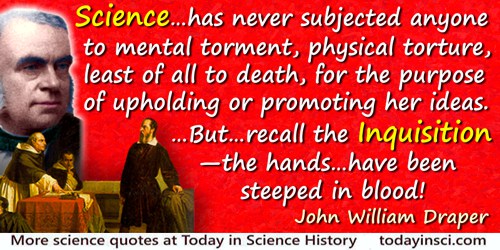
As to Science, she has never sought to ally herself to civil power. She has never attempted to throw odium or inflict social ruin on any human being. She has never subjected anyone to mental torment, physical torture, least of all to death, for the purpose of upholding or promoting her ideas. She presents herself unstained by cruelties and crimes. But in the Vatican—we have only to recall the Inquisition—the hands that are now raised in appeals to the Most Merciful are crimsoned. They have been steeped in blood!
History of the Conflict between Religion and Science (1875), xi.
I am convinced that an important stage of human thought will have been reached when the physiological and the psychological, the objective and the subjective, are actually united, when the tormenting conflicts or contradictions between my consciousness and my body will have been factually resolved or discarded.
Physiology of the Higher Nervous Activity (1932), 93-4.
I had at one time a very bad fever of which I almost died. In my fever I had a long consistent delirium. I dreamt that I was in Hell, and that Hell is a place full of all those happenings that are improbable but not impossible. The effects of this are curious. Some of the damned, when they first arrive below, imagine that they will beguile the tedium of eternity by games of cards. But they find this impossible, because, whenever a pack is shuffled, it comes out in perfect order, beginning with the Ace of Spades and ending with the King of Hearts. There is a special department of Hell for students of probability. In this department there are many typewriters and many monkeys. Every time that a monkey walks on a typewriter, it types by chance one of Shakespeare's sonnets. There is another place of torment for physicists. In this there are kettles and fires, but when the kettles are put on the fires, the water in them freezes. There are also stuffy rooms. But experience has taught the physicists never to open a window because, when they do, all the air rushes out and leaves the room a vacuum.
'The Metaphysician's Nightmare', Nightmares of Eminent Persons and Other Stories (1954), 38-9.
I’ll change my state with any wretch
Thou canst from gaol of dunghill fetch.
My pain’s past cure, another hell;
I may not in this torment dwell.
Now desperate I hate my life,
Lend me a halter or a knife!
All my griefs to this are jolly,
Naught so damned as melancholy.
Thou canst from gaol of dunghill fetch.
My pain’s past cure, another hell;
I may not in this torment dwell.
Now desperate I hate my life,
Lend me a halter or a knife!
All my griefs to this are jolly,
Naught so damned as melancholy.
Nevertheless, his [Dostoyevsky’s] personality retained sadistic traits in plenty, which show themselves in his irritability, his love of tormenting, and his intolerance even towards people he loved, and which appear also in the way in which, as an author, he treats his readers. Thus in little things he was a sadist towards others, and in bigger things a sadist towards himself, in fact a masochist—that is to say the mildest, kindliest, most helpful person possible.
In James Strachey (ed.), 'Dostoyevsky and Parricide', The Standard Edition of the Complete Psychological Works of Sigmund Freud (1953-74), Vol. 21, 178-179. Reprinted in Writings on Art and Literature (1997), 236
No anatomist ever discovered a system of organization, calculated to produce pain and disease; or, in explaining the parts of the human body, ever said, this is to irritate; this is to inflame; this duct is to convey the gravel to the kidneys; this gland to secrete the humour which forms the gout: if by chance he come at a part of which he knows not the use, the most he can say is, that it is useless; no one ever suspects that it is put there to incommode, to annoy, or torment.
The Principles of Moral and Political Philosophy (1785), Vol. 1, 79.
Nothing will ever equal that moment of joyous excitement which filled my whole being when I felt myself flying away from the earth. It was not mere pleasure; it was perfect bliss. Escaped from the frightful torments of persecution and of calumny, I felt that I was answering all in rising above all.
after making man's first ascent by hydrogen balloon in 1783 quoted in Wonderful Balloon Ascents: Or, the Conquest of the Skies by F. Marion
Researchers, with science as their authority, will be able to cut [animals] up, alive, into small pieces, drop them from a great height to see if they are shattered by the fall, or deprive them of sleep for sixteen days and nights continuously for the purposes of an iniquitous monograph... Animal trust, undeserved faith, when at last will you turn away from us? Shall we never tire of deceiving, betraying, tormenting animals before they cease to trust us?
…...
Science is dangerous. There is no question but that poison gas, genetic engineering, and nuclear weapons and power stations are terrifying. It may be that civilization is falling apart and the world we know is coming to an end. In that case, why no turn to religion and look forward to the Day of Judgment, ... [being] lifted into eternal bliss ... [and] watching the scoffers and disbelievers writhe forever in torment.
The 'Threat' of Creationism. In Ashley Montagu (ed.), Science and Creationism (1984), 192.
The difficulty really is psychological and exists in the perpetual torment that results from your saying to yourself, “But how can it be like that?” which is a reflection of uncontrolled but utterly vain desire to see it in terms of something familiar. … If you will simply admit that maybe [Nature] does behave like this, you will find her a delightful, entrancing thing. Do not keep saying to yourself, if you can possible avoid it, "But how can it be like that?" because you will get 'down the drain', into a blind alley from which nobody has escaped. Nobody knows how it can be like that.
[About wave-particle duality.]
[About wave-particle duality.]
'Probability abd Uncertainty—the Quantum Mechanical View of Nature', the sixth of his Messenger Lectures (1964), Cornell University. Collected in The Character of Physical Law (1967), 129.
The last few meters up to the summit no longer seem so hard. On reaching the top, I sit down and let my legs dangle into space. I don’t have to climb anymore. I pull my camera from my rucksack and, in my down mittens, fumble a long time with the batteries before I have it working properly. Then I film Peter. Now, after the hours of torment, which indeed I didn’t recognize as torment, now, when the monotonous motion of plodding upwards is at an end, and I have nothing more to do than breathe, a great peace floods my whole being. I breathe like someone who has run the race of his life and knows that he may now rest forever. I keep looking all around, because the first time I didn’t see anything of the panorama I had expected from Everest, neither indeed did I notice how the wind was continually chasing snow across the summit. In my state of spiritual abstraction, I no longer belong to myself and to my eyesight. I am nothing more than a single, narrow, gasping lung, floating over the mists and the summits.
In Everest: Expedition to the Ultimate (1979), 180.
The Mathematics, I say, which effectually exercises, not vainly deludes or vexatiously torments studious Minds with obscure Subtilties, perplexed Difficulties, or contentious Disquisitions; which overcomes without Opposition, triumphs without Pomp, compels without Force, and rules absolutely without Loss of Liberty; which does not privately over-reach a weak Faith, but openly assaults an armed Reason, obtains a total Victory, and puts on inevitable Chains; whose Words are so many Oracles, and Works as many Miracles; which blabs out nothing rashly, nor designs anything from the Purpose, but plainly demonstrates and readily performs all Things within its Verge; which obtrudes no false Shadow of Science, but the very Science itself, the Mind firmly adhering to it, as soon as possessed of it, and can never after desert it of its own Accord, or be deprived of it by any Force of others: Lastly the Mathematics, which depends upon Principles clear to the Mind, and agreeable to Experience; which draws certain Conclusions, instructs by profitable Rules, unfolds pleasant Questions; and produces wonderful Effects; which is the fruitful Parent of, I had almost said all, Arts, the unshaken Foundation of Sciences, and the plentiful Fountain of Advantage to human Affairs.
Address to the University of Cambridge upon being elected Lucasian Professor of Mathematics (14 Mar 1664). In Mathematical Lectures (1734), xxviii.
The next object which I have observed is the essence or substance of the Milky Way. By the aid of a telescope anyone may behold this in a manner which so distinctly appeals to the senses that all the disputes which have tormented philosophers through so many ages are exploded at once by the irrefragable evidence of our eyes, and we are freed from wordy disputes upon this subject, for the Galaxy is nothing else but a mass of innumerable stars planted together in clusters.
In pamphlet, The Sidereal Messenger (1610), reprinted in The Sidereal Messenger of Galileo Galilei: And a Part of the Preface to the Preface to Kepler's Dioptrics Containing the Original Account of Galileo's Astronomical Discoveries (1880), 42.
There is nothing frightening about an eternal dreamless sleep. Surely it is better than eternal torment in Hell and eternal boredom in Heaven.
…...
To be creative, scientists need libraries and laboratories and the company of other scientists; certainly a quiet and untroubled life is a help. A scientist's work is in no way deepened or made more cogent by privation, anxiety, distress, or emotional harassment. To be sure, the private lives of scientists may be strangely and even comically mixed up, but not in ways that have any special bearing on the nature and quality of their work. If a scientist were to cut off an ear, no one would interpret such an action as evidence of an unhappy torment of creativity; nor will a scientist be excused any bizarrerie, however extravagant, on the grounds that he is a scientist, however brilliant.
In Advice to a Young Scientist (1979), 40.
To each conqueror can be said, when he has ceased tormenting our poor globe, ‘Would you not have been able to tilt equally well against a little globe of pasteboard?
From Appendix A, 'Extracts From the Unpublished Writings of Carnot', Reflections on the Motive Power of Heat (1890, 2nd ed. 1897), 210.
Well do I remember that dark hot little office in the hospital at Begumpett, with the necessary gleam of light coming in from under the eaves of the veranda. I did not allow the punka to be used because it blew about my dissected mosquitoes, which were partly examined without a cover-glass; and the result was that swarms of flies and of 'eye-flies' - minute little insects which try to get into one's ears and eyelids - tormented me at their pleasure
In Memoirs, With a Full Account of the Great Malaria Problem and its Solution (1923), 221.
 In science it often happens that scientists say, 'You know that's a really good argument; my position is mistaken,' and then they would actually change their minds and you never hear that old view from them again. They really do it. It doesn't happen as often as it should, because scientists are human and change is sometimes painful. But it happens every day. I cannot recall the last time something like that happened in politics or religion.
(1987) --
In science it often happens that scientists say, 'You know that's a really good argument; my position is mistaken,' and then they would actually change their minds and you never hear that old view from them again. They really do it. It doesn't happen as often as it should, because scientists are human and change is sometimes painful. But it happens every day. I cannot recall the last time something like that happened in politics or religion.
(1987) --