Tissue Quotes (51 quotes)
[Beyond natural history] Other biological sciences take up the study at other levels of organization: dissecting the individual into organs and tissues and seeing how these work together, as in physiology; reaching down still further to the level of cells, as in cytology; and reaching the final biological level with the study of living molecules and their interactions, as in biochemistry. No one of these levels can be considered as more important than any other.
In The Nature of Natural History (1961, 2014), 7.
[My friends and I studied science to get away from] the stench of Fascist truths which tainted the sky. ... [T]he chemistry and physics on which we fed, besides being nourishment vital in themselves, were an antidote to Fascism. ... [T]hey were clear and distinct and verifiable at every step, and not a tissue of lies and emptiness like the radio and the newspapers.
The Periodic Table, trans. Raymond Rosenthal (1986), 42. In Vinoth Ramachandra, Subverting Global Myths: Theology and the Public Issues Shaping our World (2008), 170.
[The popular impression about some chemists is that] the aquafortis and the chlorine of the laboratories have as effectually bleached the poetry out of them, as they destroy the colours of tissues exposed to their action.
'The Alleged Antagonism between Poetry and Chemistry.' In Jesse Aitken Wilson, Memoirs of George Wilson. Quoted in Natural History Society of Montreal, 'Reviews and Notices of Books,' The Canadian Naturalist and Geologist (1861) Vol. 6, 391.
A drop from the nose of Fleming, who had a cold, fell onto an agar plate where large yellow colonies of a contaminant had grown, and lysosyme was discovered. He made this important discovery because when he saw that the colonies of the contaminant were fading, his mind went straight to the right cause of the phenomenon he was observing—that the drop from his nose contained a lytic substance. And also immediately, he thought that this substance might be present in many secretions and tissues of the body. And he found this was so—the substance was in tears, saliva, leucocytes, skin, fingernails, mother's milk—thus very widely distributed in amounts and also in plants.
Personal recollections of Alexander Fleming by Lady Amelia Fleming. Quoted in Molecular Cloning (2001), Vol. 1, 153.
According to the older view, for every single effect of a serum, there was a separate substance, or at least a particular chemical group... A normal serum contained as many different haemagglutinins as it agglutinated different cells. The situation was undoubtedly made much simpler if, to use the Ehrlich terminology... the separate haptophore groups can combine with an extremely large number of receptors in stepwise differing quantities as a stain does with different animal tissues, though not always with the same intensity. A normal serum would therefore visibly affect such a large number of different blood cells... not because it contained countless special substances, but because of the colloids of the serum, and therefore of the agglutinins by reason of their chemical constitution and the electrochemical properties resulting from it. That this manner of representation is a considerable simplification is clear; it also opens the way to direct experimental testing by the methods of structural chemistry.
'Die Theorien der Antikorperbildung ... ', Wiener klinische Wöchenschrift (1909), 22, 1623-1631. Trans. Pauline M. H. Mazumdar.
All tissues are formed from cells and every cell from a cell. [? Misquoted]
Although apparently misquoted and misattributed, Webmaster includes this as an interesting variant, presumably, of Raspail’s Omnis cellula e cellula dictum (also popularized by Rudolf Virchow). The above quote was given as an aphorism apparently misattributed as “Schwann’s Law,” in by J.W. Young, in 'Causation of Tumors', Western Medical Review (15 Jul 1898), 3, 262. Webmaster has not yet found another source either with this wording, or as “Schwann’s Law.” Webmaster suspects J.W. Young misquoted and misattributed the quote.
An immune system of enormous complexity is present in all vertebrate animals. When we place a population of lymphocytes from such an animal in appropriate tissue culture fluid, and when we add an antigen, the lymphocytes will produce specific antibody molecules, in the absence of any nerve cells. I find it astonishing that the immune system embodies a degree of complexity which suggests some more or less superficial though striking analogies with human language, and that this cognitive system has evolved and functions without assistance of the brain.
'The Generative Grammar of the Immune System', Nobel Lecture, 8 Dec 1984. In Nobel Lectures: Physiology or Medicine 1981-1990 (1993), 223.
Anatomists see no beautiful woman in all their lives, but only a ghastly sack of bones with Latin names to them, and a network of nerves and muscles and tissues inflamed by disease.
From Letter to the San Francisco Alta California (28 May 1867; published 28 Jul 1867), collected and published by Franklin Walker and G. Ezra Dane in Mark Twain's Travels with Mr. Brown (1940), 238.
And now, as a germination of planetary dimensions, comes the thinking layer which over its full extent develops and intertwines its fibres, not to confuse and neutralise them but to reinforce them in the living unity of a single tissue.
In Teilhard de Chardin and Bernard Wall (trans.), The Phenomenon of Man (1959, 2008), 244. Originally published in French as Le Phénomene Humain (1955).
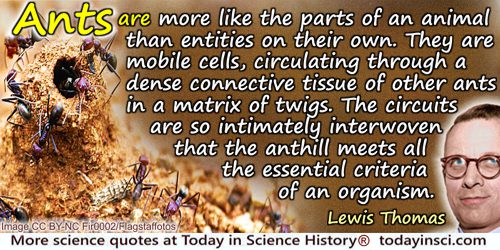
Ants are more like the parts of an animal than entities on their own. They are mobile cells, circulating through a dense connective tissue of other ants in a matrix of twigs. The circuits are so intimately interwoven that the anthill meets all the essential criteria of an organism.
In 'Antaeus in Manhattan', The Lives of a Cell: Notes of a Biology Watcher (1974), 63.
As a progressive discipline [biochemistry] belongs to the present century. From the experimental physiologists of the last century it obtained a charter, and, from a few pioneers of its own, a promise of success; but for the furtherance of its essential aim that century left it but a small inheritance of facts and methods. By its essential or ultimate aim I myself mean an adequate and acceptable description of molecular dynamics in living cells and tissues.
'Some Chemical Aspects of Life', Address (Sep 1933) in Report on the 103rd Meeting of the British Association for the Advancement of Science (1933), 3.
As soon as we touch the complex processes that go on in a living thing, be it plant or animal, we are at once forced to use the methods of this science [chemistry]. No longer will the microscope, the kymograph, the scalpel avail for the complete solution of the problem. For the further analysis of these phenomena which are in flux and flow, the investigator must associate himself with those who have labored in fields where molecules and atoms, rather than multicellular tissues or even unicellular organisms, are the units of study.
'Experimental and Chemical Studies of the Blood with an Appeal for More Extended Chemical Training for the Biological and Medical Investigator', Science (6 Aug 1915), 42, 176.
Borel makes the amusing supposition of a million monkeys allowed to play upon the keys of a million typewriters. What is the chance that this wanton activity should reproduce exactly all of the volumes which are contained in the library of the British Museum? It certainly is not a large chance, but it may be roughly calculated, and proves in fact to be considerably larger than the chance that a mixture of oxygen and nitrogen will separate into the two pure constituents. After we have learned to estimate such minute chances, and after we have overcome our fear of numbers which are very much larger or very much smaller than those ordinarily employed, we might proceed to calculate the chance of still more extraordinary occurrences, and even have the boldness to regard the living cell as a result of random arrangement and rearrangement of its atoms. However, we cannot but feel that this would be carrying extrapolation too far. This feeling is due not merely to a recognition of the enormous complexity of living tissue but to the conviction that the whole trend of life, the whole process of building up more and more diverse and complex structures, which we call evolution, is the very opposite of that which we might expect from the laws of chance.
The Anatomy of Science (1926), 158-9.
But, further, no animal can live upon a mixture of pure protein, fat and carbohydrate, and even when the necessary inorganic material is carefully supplied, the animal still cannot flourish. The animal body is adjusted to live either upon plant tissues or the tissues of other animals, and these contain countless substances other than the proteins, carbohydrates and fats... In diseases such as rickets, and particularly in scurvy, we have had for long years knowledge of a dietetic factor; but though we know how to benefit these conditions empirically, the real errors in the diet are to this day quite obscure. They are, however, certainly of the kind which comprises these minimal qualitative factors that I am considering.
'The Analyst and the Medical Man', The Analyst (1906), 31, 395-6.
Cancer cells invade surrounding tissue, make their way into blood vessels, and spread throughout the body. What are they searching for? My guess is oxygen.
In Acceptance Remarks, 2016 Lasker Awards Ceremony, published in 'Oxygen Sensing – An Essential Process for Survival', on laskerfoundation.org website.
Cell and tissue, shell and bone, leaf and flower, are so many portions of matter, and it is in obedience to the laws of physics that their particles have been moved, moulded and confirmed. They are no exception to the rule that God always geometrizes. Their problems of form are in the first instance mathematical problems, their problems of growth are essentially physical problems, and the morphologist is, ipso facto, a student of physical science.
On Growth and Form (1917), 7-8.
Constant, or free, life is the third form of life; it belongs to the most highly organized animals. In it, life is not suspended in any circumstance, it unrolls along a constant course, apparently indifferent to the variations in the cosmic environment, or to the changes in the material conditions that surround the animal. Organs, apparatus, and tissues function in an apparently uniform manner, without their activity undergoing those considerable variations exhibited by animals with an oscillating life. This because in reality the internal environment that envelops the organs, the tissues, and the elements of the tissues does not change; the variations in the atmosphere stop there, so that it is true to say that physical conditions of the environment are constant in the higher animals; it is enveloped in an invariable medium, which acts as an atmosphere of its own in the constantly changing cosmic environment. It is an organism that has placed itself in a hot-house. Thus the perpetual changes in the cosmic environment do not touch it; it is not chained to them, it is free and independent.
Lectures on the Phenomena of Life Common to Animals and Plants (1878), trans. Hebbel E. Hoff, Roger Guillemin and Lucienne Guillemin (1974), 83.
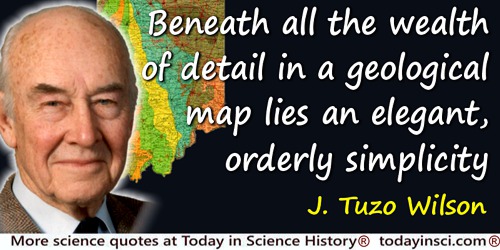
Continents are complexes of crustal scar tissue.
In Sigma XI National Lecture (1957-58), published in 'Geophysics and Continental Growth', American Scientist (Mar 1959), 47, No. 1, 23.
E.W. Goodpasture showed that the virus of fowl pox could be grown in the tissues of the developing chick embryo. Nearly all the later practical advances in the control of virus diseases in man and animals sprang from this single discovery.
In 'Filterable Viruses', Encyclopaedia Britannica (1954), Vol. 9, 237. As quoted and cited by Esmond R. Long, 'Ernest William Goodpasture', National Academy of Sciences Biographical Memoirs (1965), 122.
Experience is the great teacher; unfortunately, experience leaves mental scars, and scar tissue contracts.
From speech 'In the Time of Henry Jacob Bigelow', given to the Boston Surgical Society, Medalist Meeting (6 Jun 1921). Printed in Journal of the Medical Association (1921), 77, 599.
Food may be defined as material which, when taken into the body, serves to either form tissue or yield energy, or both. This definition includes all the ordinary food materials, since they both build tissue and yield energy. It includes sugar and starch, because they yield energy and form fatty tissue. It includes alcohol, because the latter is burned to yield energy, though it does not build tissue. It excludes creatin, creatininin, and other so-called nitrogeneous extractives of meat, and likewise thein or caffein of tea and coffee, because they neither build tissue nor yield energy, although they may, at times, be useful aids to nutrition.
Methods and Results of Investigations on the Chemistry and Economy of Food, Bulletin 21, US Department of Agriculture (1895). Quoted in Ira Wolinsky, Nutrition in Exercise and Sport (1998), 36.
However, on many occasions, I examined normal blood and normal tissues and there was no possibility of overlooking bacteria or confusing them with granular masses of equal size. I never found organisms. Thus, I conclude that bacteria do not occur in healthy human or animal tissues.
'Investigations of the Etiology of Wound Infections' (1878), Essays of Robert Koch (1987), trans. K. Codell Carter, 27.
I could clearly see that the blood is divided and flows through tortuous vessels and that it is not poured out into spaces, but is always driven through tubules and distributed by the manifold bendings of the vessels... [F]rom the simplicity Nature employs in all her works, we may conclude... that the network I once believed to be nervous [that is, sinewy] is really a vessel intermingled with the vesicles and sinuses and carrying the mass of blood to them or away from them... though these elude even the keenest sight because of their small size... From these considerations it is highly probable that the question about the mutual union and anastomosis of the vessels can be solved; for if Nature once circulates the blood within vessels and combines their ends in a network, it is probable that they are joined by anastomosis at other times too.
'The Return to Bologna 1659-1662', in H. B. Adelmann (ed.), Marcello Malpighi and the Evolution of Embryology (1966), Vol. 1, 194-5.
I do not believe that science per se is an adequate source of happiness, nor do I think that my own scientific outlook has contributed very greatly to my own happiness, which I attribute to defecating twice a day with unfailing regularity. Science in itself appears to me neutral, that is to say, it increases men’s power whether for good or for evil. An appreciation of the ends of life is something which must be superadded to science if it is to bring happiness, but only the kind of society to which science is apt to give rise. I am afraid you may be disappointed that I am not more of an apostle of science, but as I grow older, and no doubt—as a result of the decay of my tissues, I begin to see the good life more and more as a matter of balance and to dread all over-emphasis upon anyone ingredient.
Letter to W. W. Norton, Publisher (27 Jan 1931). In The Autobiography of Bertrand Russell, 1914-1944 (1968), Vol. 2, 200.
If diphtheria is a disease caused by a microorganism, it is essential that three postulates be fulfilled. The fulfilment of these postulates is necessary in order to demonstrate strictly the parasitic nature of a disease:
1) The organism must be shown to be constantly present in characteristic form and arrangement in the diseased tissue.
2) The organism which, from its behaviour appears to be responsible for the disease, must be isolated and grown in pure culture.
3) The pure culture must be shown to induce the disease experimentally.
An early statement of Koch's postulates.
1) The organism must be shown to be constantly present in characteristic form and arrangement in the diseased tissue.
2) The organism which, from its behaviour appears to be responsible for the disease, must be isolated and grown in pure culture.
3) The pure culture must be shown to induce the disease experimentally.
An early statement of Koch's postulates.
Mittheilungen aus den Kaiserliche Gesundheitsamt (1884) Vol. 2. Trans. T. D. Brock, Robert Koch: A Life in Medicine and Bacteriology (1988), 180.
If the earth’s population continues to double every 50 years (as it is now doing) then by 2550 A.D. it will have increased 3,000-fold. … by 2800 A.D., it would reach 630,000 billion! Our planet would have standing room only, for there would be only two-and-a-half square feet per person on the entire land surface, including Greenland and Antarctica. In fact, if the human species could be imagined as continuing to multiply further at the same rate, by 4200 A.D. the total mass of human tissue would be equal to the mass of the earth.
In The Intelligent Man's Guide to Science: The Biological Sciences (1960), 117. Also in Isaac Asimov’s Book of Science and Nature Quotations (1988), 237.
Immediately after the separation of the formative materials into the two layers of the germ-primule, there appears in the ectoderm a groove, open above, at the bottom of which is a streak of darker tissue.
In the tissues generally, and in such a cavity as the abdomen, the pressure is everywhere and practically always very nearly atmospheric, and must be so, because the integuments give way very easily to any excess of pressure, whether positive or negative.
In The Anatomy and Physiology of Capillaries (1922), 244.
In the world of science different levels of esteem are accorded to different kinds of specialist. Mathematicians have always been eminently respectable, and so are those who deal with hard lifeless theories about what constitutes the physical world: the astronomers, the physicists, the theoretical chemists. But the more closely the scientist interests himself in matters which are of direct human relevance, the lower his social status. The real scum of the scientific world are the engineers and the sociologists and the psychologists. Indeed, if a psychologist wants to rate as a scientist he must study rats, not human beings. In zoology the same rules apply. It is much more respectable to dissect muscle tissues in a laboratory than to observe the behaviour of a living animal in its natural habitat.
From transcript of BBC radio Reith Lecture (12 Nov 1967), 'A Runaway World', on the bbc.co.uk website.
It may seem rash indeed to draw conclusions valid for the whole universe from what we can see from the small corner to which we are confined. Who knows that the whole visible universe is not like a drop of water at the surface of the earth? Inhabitants of that drop of water, as small relative to it as we are relative to the Milky Way, could not possibly imagine that beside the drop of water there might be a piece of iron or a living tissue, in which the properties of matter are entirely different.
Space and Time (1926), 227.
It was quite the most incredible event that has ever happened to me in my life. It was almost as incredible as if you fired a 15-inch shell at a piece of tissue paper and it came back and hit you.
[Recalling in 1936 the discovery of the nucleus in 1909, when some alpha particles were observed instead of travelling through a very thin gold foil were seen to rebound backward, as if striking something much more massive than the particles themselves.]
[Recalling in 1936 the discovery of the nucleus in 1909, when some alpha particles were observed instead of travelling through a very thin gold foil were seen to rebound backward, as if striking something much more massive than the particles themselves.]
Quoted in Abraham Pais, Inward Bound (1986), 189, from E. N. da C. Andrade, Rutherford and the nature of the atom, (1964) 111.
My interest in the biology of tissue and organ transplantation arose from my [WW II] military experience at Valley Forge General Hospital in Pennsylvania … a major plastic surgical center. While there, I spent all my available spare time on the plastic surgical wards which were jammed with hundreds of battle casualties. I enjoyed talking to the patients, helping with dressings, and observing the results of the imaginative reconstructive surgical operations.
As a First Lieutenant with only a nine-month surgical internship, randomly assigned to VFGH to await overseas duty. In Tore Frängsmyr and Jan E. Lindsten (eds.), Nobel Lectures: Physiology Or Medicine: 1981-1990 (1993), 556.
No matter how we twist and turn we shall always come back to the cell. The eternal merit of Schwann does not lie in his cell theory that has occupied the foreground for so long, and perhaps will soon be given up, but in his description of the development of the various tissues, and in his demonstration that this development (hence all physiological activity) is in the end traceable back to the cell. Now if pathology is nothing but physiology with obstacles, and diseased life nothing but healthy life interfered with by all manner of external and internal influences then pathology too must be referred back to the cell.
In 'Cellular-Pathologie', Archiv für pathologische Anatomie und Physiologie und fur klinische Medizin (1855), 8, 13-14, as translated in LellandJ. Rather, 'Cellular Pathology', Disease, Life, and Man: Selected Essays by Rudolf Virchow (1958), 81.
One reason which has led the organic chemist to avert his mind from the problems of Biochemistry is the obsession that the really significant happenings in the animal body are concerned in the main with substances of such high molecular weight and consequent vagueness of molecular structure as to make their reactions impossible of study by his available and accurate methods. There remains, I find, pretty widely spread, the feeling—due to earlier biological teaching—that, apart from substances which are obviously excreta, all the simpler products which can be found in cells or tissues are as a class mere objects, already too remote from the fundamental biochemical events to have much significance. So far from this being the case, recent progress points in the clearest way to the fact that the molecules with which a most important and significant part of the chemical dynamics of living tissues is concerned are of a comparatively simple character.
In 'The Dynamic Side of Biochemistry', Address (11 Sep 1913) in Report on the 83rd Meeting of the British Association for the Advancement of Science (1914), 657-8.
Plasticity, then, in the wide sense of the word, means the possession of a structure weak enough to yield to an influence, but strong enough not to yield all at once. Each relatively stable phase of equilibrium in such a structure is marked by what we may call a new set of habits. Organic matter, especially nervous tissue, seems endowed with a very extraordinary degree of plasticity of this sort ; so that we may without hesitation lay down as our first proposition the following, that the phenomena of habit in living beings are due to plasticity of the organic materials of which their bodies are composed.
'The Laws of Habit', The Popular Science Monthly (Feb 1887), 434.
The cell was the first invention of the animal kingdom, and all higher animals are and must be cellular in structure. Our tissues were formed ages on ages ago; they have all persisted. Most of our organs are as old as worms. All these are very old, older than the mountains.
In The Whence and Whither of Man; a Brief History of his Origin and Development through Conformity to Environment; being the Morse Lectures of 1895. (1896), 173. The Morse lectureship was founded by Prof. Samuel F.B. Morse in 1865 at Union Theological Seminary, the lectures to deal with “the relation of the Bible to any of the sciences.”
The Earth Speaks, clearly, distinctly, and, in many of the realms of Nature, loudly, to William Jennings Bryan, but he fails to hear a single sound. The earth speaks from the remotest periods in its wonderful life history in the Archaeozoic Age, when it reveals only a few tissues of its primitive plants. Fifty million years ago it begins to speak as “the waters bring forth abundantly the moving creatures that hath life.” In successive eons of time the various kinds of animals leave their remains in the rocks which compose the deeper layers of the earth, and when the rocks are laid bare by wind, frost, and storm we find wondrous lines of ascent invariably following the principles of creative evolution, whereby the simpler and more lowly forms always precede the higher and more specialized forms.
The earth speaks not of a succession of distinct creations but of a continuous ascent, in which, as the millions of years roll by, increasing perfection of structure and beauty of form are found; out of the water-breathing fish arises the air-breathing amphibian; out of the land-living amphibian arises the land-living, air-breathing reptile, these two kinds of creeping things resembling each other closely. The earth speaks loudly and clearly of the ascent of the bird from one kind of reptile and of the mammal from another kind of reptile.
This is not perhaps the way Bryan would have made the animals, but this is the way God made them!
The earth speaks not of a succession of distinct creations but of a continuous ascent, in which, as the millions of years roll by, increasing perfection of structure and beauty of form are found; out of the water-breathing fish arises the air-breathing amphibian; out of the land-living amphibian arises the land-living, air-breathing reptile, these two kinds of creeping things resembling each other closely. The earth speaks loudly and clearly of the ascent of the bird from one kind of reptile and of the mammal from another kind of reptile.
This is not perhaps the way Bryan would have made the animals, but this is the way God made them!
The Earth Speaks to Bryan (1925), 5-6. Osborn wrote this book in response to the Scopes Monkey Trial, where William Jennings Bryan spoke against the theory of evolution. They had previously been engaged in the controversy about the theory for several years. The title refers to a Biblical verse from the Book of Job (12:8), “Speak to the earth and it shall teach thee.”
The elementary parts of all tissues are formed of cells in an analogous, though very diversified manner, so that it may be asserted, that there is one universal principle of development for the elementary parts of organisms, however different, and that this principle is the formation of cells.
Mikroskopische Untersuchungen über die Uebereinstimmung in der Struktur und dem Wachsthum der Thiere und Pflanzen (1839). Microscopic Researches into the Accordance in the Structure and Growth of Animals and Plants, trans. Henry Smith (1847), 165.
The explosions [of dying stars] scattered the heavy elements as a fine dust through space. By the time it made the Sun, the primordial gas of the Milky Way was sufficiently enriched with heavier elements for rocky planets like the Earth to form. And from the rocks atoms escaped for eventual incorporation in living things: carbon, nitrogen, oxygen, phosphorus and sulphur for all living tissue; calcium for bones and teeth; sodium and potassium for the workings of nerves and brains; the iron colouring blood red… and so on.
No other conclusion of modern research testifies more clearly to mankind’s intimate connections with the universe at large and with the cosmic forces at work among the stars.
In The Key to the Universe: A Report on the New Physics (1977), 33.
The extracellular genesis of cells in animals seemed to me, ever since the publication of the cell theory [of Schwann], just as unlikely as the spontaneous generation of organisms. These doubts produced my observations on the multiplication of blood cells by division in bird and mammalian embryos and on the division of muscle bundles in frog larvae. Since then I have continued these observations in frog larvae, where it is possible to follow the history of tissues back to segmentation.
'Ueber extracellulare Eutstehung thierischer Zelleu und üüber Vermehrung derselben durch Theilung', Archiv für Anatomie, Physiologie und Wissenschaftliche Medicin (1852), 1, 49-50. Quoted in Erwin H. Ackerknecht, Rudolf Virchow: Doctor Statesman Anthropologist (1953), 83-4.
The fact that death from cancer is on the increase is not only a problem of medicine, but its at the same time testifies to the wonderful efficiency of medical science... [as it] enables more persons top live long enough to develop some kind of cancer in old and less resistant tissues.
Charles H. Mayo and William A. Hendricks, 'Carcinoma of the Right Segment of the Colon', presented to Southern Surgical Assoc. (15 Dec 1925). In Annals of Surgery (Mar 1926), 83, 357.
The first entirely vital action, so termed because it is not effected outside the influence of life, consists in the creation of the glycogenic material in the living hepatic tissue. The second entirely chemical action, which can be effected outside the influence of life, consists in the transformation of the glycogenic material into sugar by means of a ferment.
Sur le Méchanisme de la Fonction du Sucre dans Ie Foie (1857), 583. Translated in Joseph S. Fruton, Proteins, Enzymes, Genes: The Interplay of Chemistry and Biology (1999), 340.
The law of the heart is thus the same as the law of muscular tissue generally, that the energy of contraction, however measured, is a function of the length of the muscle fibre.
The Linacre Lecture on the Law of the Heart (1918), 142.
The microscope has shown me that all the varied forms in the animal tissues are nothing but transformed cells. … All my work has authorized me to apply to animals as to plants the doctrine of the individuality of the cells.
From his preliminary announcement (1838). As quoted in William Dobinson Halliburton, A Textbook of Chemical Physiology and Pathology (1891) 186.
The plant cell, like the animal cell, is a type of laboratory of cellular tissues that organize themselves and develop within its innermost substance; its imperforate walls, to judge from our strongest magnifying instruments, have the property of drawing out by aspiration from the ambient liquid the elements necessary for its elaboration. They thus have the property of acting as a sorter, of admitting certain substances and preventing the passage of others, and consequently of separating the elements of certain combinations in order to admit only a portion of them.
As quoted in article
Marc Klein,'François-Vincent Raspail', in Charles Coulston Gillispie (ed.), Dictionary of Scientific Biography (1975). Vol.11, 300.
The question of protection against the noxious action of the X rays appears to be assuming more and more importance, as we begin to recognise the searching nature of their action on the deep-seated tissues and their far-reaching therapeutic effect on the internal organs.
In 'Protection in X-Ray Work', Archives of the Roentgen Ray (July 1905), 10, No. 2, 38. [Note that this concern for protection, written in 1905, comes within 10 years of the discovery of X-Rays in 1895. —Webmaster]
The significant chemicals of living tissue are rickety and unstable, which is exactly what is needed for life.
As shown, without citation, in Randy Moore, Writing to Learn Science (1997), 226.
The use of fetuses as organ and tissue donors is a ticking time bomb of bioethics.
Quoted in Andrea Dorf and Joe Levine 'Help From The Unborn Fetal-Cell', Time magazine (12 Jan 1987).
We spend long hours discussing the curious situation that the two great bodies of biological knowledge, genetics and embryology, which were obviously intimately interrelated in development, had never been brought together in any revealing way. An obvious difficulty was that the most favorable organisms for genetics, Drosophila as a prime example, were not well suited for embryological study, and the classical objects of embryological study, sea urchins and frogs as examples, were not easily investigated genetically. What might we do about it? There were two obvious approaches: one to learn more about the genetics of an embryologically favourable organism, the other to better understand the development of Drosophila. We resolved to gamble up to a year of our lives on the latter approach, this in Ephrussi’s laboratory in Paris which was admirably equipped for tissue culture, tissue or organ transplantation, and related techniques.
In 'Recollections', Annual Review of Biochemistry, 1974, 43, 6.
With advancing years new impressions do not enter so rapidly, nor are they so hospitably received… There is a gradual diminution of the opportunities for age to acquire fresh knowledge. A tree grows old not by loss of the vitality of the cambium, but by the gradual increase of the wood, the non-vital tissue, which so easily falls a prey to decay.
From address, 'A Medical Retrospect'. Published in Yale Medical Journal (Oct 1910), 17, No. 2, 59. The context is that he is reflecting on how in later years of life, a person tends to give priority to long-learned experience, rather than give attention to new points of view.
You are literally filled with the fruit of your own devices, with rats and mice and such small deer, paramecia, and entomostraceæ, and kicking things with horrid names, which you see in microscopes at the Polytechnic, and rush home and call for brandy—without the water—stone, and gravel, and dyspepsia, and fragments of your own muscular tissue tinged with your own bile.
'The Water Supply of London', North British Review (1851), 15, 246
 In science it often happens that scientists say, 'You know that's a really good argument; my position is mistaken,' and then they would actually change their minds and you never hear that old view from them again. They really do it. It doesn't happen as often as it should, because scientists are human and change is sometimes painful. But it happens every day. I cannot recall the last time something like that happened in politics or religion.
(1987) --
In science it often happens that scientists say, 'You know that's a really good argument; my position is mistaken,' and then they would actually change their minds and you never hear that old view from them again. They really do it. It doesn't happen as often as it should, because scientists are human and change is sometimes painful. But it happens every day. I cannot recall the last time something like that happened in politics or religion.
(1987) -- 





