Time Quotes (1929 quotes)
... I left Caen, where I was living, to go on a geologic excursion under the auspices of the School of Mines. The incidents of the travel made me forget my mathematical work. Having reached Coutances, we entered an omnibus to go to some place or other. At the moment when I put my foot on the step, the idea came to me, without anything in my former thoughts seeming to have paved the way for it, that the transformations I had used to define the Fuchsian functions were identical with those of non-Eudidean geometry. I did not verify the idea; I should not have had time, as upon taking my seat in the omnibus, I went on with a conversation already commenced, but I felt a perfect certainty. On my return to Caen, for convenience sake, I verified the result at my leisure.
Quoted in Sir Roger Penrose, The Emperor's New Mind: Concerning Computers, Minds, and the Laws of Physics (1990), 541. Science and Method (1908) 51-52, 392.
... in time of war, soldiers, however sensible, care a great deal more on some occasions about slaking their thirst than about the danger of enteric fever.
[Better known as typhoid, the disease is often spread by drinking contaminated water.]
[Better known as typhoid, the disease is often spread by drinking contaminated water.]
Parliamentaray Debate (21 Mar 1902). Quoted in Winston Churchill and Richard Langworth (ed.), Churchill by Himself: The Definitive Collection of Quotations (2008), 469.
… our “Physick” and “Anatomy” have embraced such infinite varieties of being, have laid open such new worlds in time and space, have grappled, not unsuccessfully, with such complex problems, that the eyes of Vesalius and of Harvey might be dazzled by the sight of the tree that has grown out of their grain of mustard seed.
A Lay Sermon, delivered at St. Martin's Hall (7 Jan 1866), 'On the Advisableness of Improving Natural Knowledge', published in The Fortnightly Review (1866), Vol. 3, 629.
... perhaps ‘our universe is simply one of those things that happen from time to time.’
[Speaking of the Universe as a vacuum fluctuation.]
[Speaking of the Universe as a vacuum fluctuation.]
…...
… the truth is that the knowledge of external nature and of the sciences which that knowledge requires or includes, is not the great or the frequent business of the human mind. Whether we provide for action or conversation, whether we wish to be useful or pleasing, the first requisite is the religious and moral knowledge of right and wrong; the next is an acquaintance with the history of mankind, and with those examples which may be said to embody truth, and prove by events the reasonableness of opinions. Prudence and justice are virtues, and excellencies, of all times and of all places; we are perpetually moralists, but we are geometricians only by chance. Our intercourse with intellectual nature is necessary; our speculations upon matter are voluntary, and at leisure. Physical knowledge is of such rare emergence, that one man may know another half his life without being able to estimate his skill in hydrostatics or astronomy; but his moral and prudential character immediately appears.
In Lives of the Poets (1779-81).
... we ought to have saints' days to commemorate the great discoveries which have been made for all mankind, and perhaps for all time—or for whatever time may be left to us. Nature ... is a prodigal of pain. I should like to find a day when we can take a holiday, a day of jubilation when we can fête good Saint Anaesthesia and chaste and pure Saint Antiseptic. ... I should be bound to celebrate, among others, Saint Penicillin...
Speech at Guildhall, London (10 Sep 1947). Collected in Winston Churchill and Randolph Spencer Churchill (ed.), Europe Unite: Speeches, 1947 and 1948 (1950), 138.
…as our friend Zach has often noted, in our days those who do the best for astronomy are not the salaried university professors, but so-called dillettanti, physicians, jurists, and so forth.Lamenting the fragmentary time left to a professor has remaining after fulfilling his teaching duties.
Letter to Heinrich Olbers (26 Oct 1802). Quoted in G. Waldo Dunnington, Carl Friedrich Gauss: Titan of Science (2004), 415.
…continental blocks can join and rift at random.… The fact that two provinces of the Canadian Shield have been together during post-Cambrian time does not necessarily mean that they were formed close together or that the sediments lying in one province were derived from the province now beside it.
In 'The Effect of New Orogenetic Theories Upon Ideas of the Tectonics of the Canadian Shield', collected in Royal Society of Canada, Special Publication No. 4, The Tectonics of the Canadian Shield (1962), 135-138. As quoted and cited in Biographical Memoirs of Fellows of the Royal Society (Nov 1995), 41, 544. This quote’s relevance is to show that after some years of reluctance, Wilson did eventually accept the idea of continental drift.
...learning chiefly in mathematical sciences can so swallow up and fix one's thought, as to possess it entirely for some time; but when that amusement is over, nature will return, and be where it was, being rather diverted than overcome by such speculations.
An Exposition of the Thirty-nine Articles of the Church of England (1850), 154
…the Form or true definition of heat … is in few words as follows: Heat is a motion; expansive, restrained, and acting in its strife upon the smaller particles of bodies. But the expansion is thus modified; while it expands all ways, it has at the same time an inclination upward. And the struggle in the particles is modified also; it is not sluggish, but hurried and with violence.
Novum Organum (1620), Book 2, Aphorism 20. Translated as 'First Vintage Concerning the Form of Heat', The New Organon: Aphorisms Concerning the Interpretation of Nature and the Kingdom of Man), collected in James Spedding, Robert Ellis and Douglas Heath (eds.), The Works of Francis Bacon (1857), Vol. 4, 154-5.
…The present revolution of scientific thought follows in natural sequence on the great revolutions at earlier epochs in the history of science. Einstein’s special theory of relativity, which explains the indeterminateness of the frame of space and time, crowns the work of Copernicus who first led us to give up our insistence on a geocentric outlook on nature; Einstein's general theory of relativity, which reveals the curvature or non-Euclidean geometry of space and time, carries forward the rudimentary thought of those earlier astronomers who first contemplated the possibility that their existence lay on something which was not flat. These earlier revolutions are still a source of perplexity in childhood, which we soon outgrow; and a time will come when Einstein’s amazing revelations have likewise sunk into the commonplaces of educated thought.
In The Theory of Relativity and its Influence on Scientific Thought (1922), 31-32
...the scientific cast of mind examines the world critically, as if many alternative worlds might exist, as if other things might be here which are not. Then we are forced to ask why what we see is present and not something else. Why are the Sun and moon and the planets spheres? Why not pyramids, or cubes, or dodecahedra? Why not irregular, jumbly shapes? Why so symmetrical, worlds? If you spend any time spinning hypotheses, checking to see whether they make sense, whether they conform to what else we know. Thinking of tests you can pose to substantiate or deflate hypotheses, you will find yourself doing science.
…...
…this discussion would be unprofitable if it did not lead us to appreciate the wisdom of our Creator, and the wondrous knowledge of the Author of the world, Who in the beginning created the world out of nothing, and set everything in number, measure and weight, and then, in time and the age of man, formulated a science which reveals fresh wonders the more we study it.
— Hrosvita
From her play Sapientia, as quoted and cited in Philip Davis with Reuben Hersh, in The Mathematical Experience (1981), 110-111. Davis and Hersh introduce the quote saying it comes “after a rather long and sophisticated discussion of certain facts in the theory of numbers” by the character Sapientia.
…tis a dangerous thing to ingage the authority of Scripture in disputes about the Natural World, in opposition to Reason; lest Time, which brings all things to light, should discover that to be evidently false which we had made Scripture to assert.
The Sacred Theory of the Earth (1681)
‘I was reading an article about “Mathematics”. Perfectly pure mathematics. My own knowledge of mathematics stops at “twelve times twelve,” but I enjoyed that article immensely. I didn’t understand a word of it; but facts, or what a man believes to be facts, are always delightful. That mathematical fellow believed in his facts. So do I. Get your facts first, and’—the voice dies away to an almost inaudible drone—’then you can distort ‘em as much as you please.’
In 'An Interview with Mark Twain', in Rudyard Kipling, From Sea to Sea (1899), Vol. 2, 180.
’Tis evident, that as common Air when reduc’d to half Its wonted extent, obtained near about twice as forcible a Spring as it had before; so this thus- comprest Air being further thrust into half this narrow room, obtained thereby a Spring about as strong again as that It last had, and consequently four times as strong as that of the common Air. And there is no cause to doubt, that If we had been here furnisht with a greater quantity of Quicksilver and a very long Tube, we might by a further compression of the included Air have made It counter-balance “the pressure” of a far taller and heavier Cylinder of Mercury. For no man perhaps yet knows how near to an infinite compression the Air may be capable of, If the compressing force be competently increast.
A Defense of the Doctrine Touching the Spring and Weight of the Air (1662), 62.
“Advance, ye mates! Cross your lances full before me. Well done! Let me touch the axis.” So saying, with extended arm, he grasped the three level, radiating lances at their crossed centre; while so doing, suddenly and nervously twitched them; meanwhile, glancing intently from Starbuck to Stubb; from Stubb to Flask. It seemed as though, by some nameless, interior volition, he would fain have shocked into them the same fiery emotion accumulated within the Leyden jar of his own magnetic life. The three mates quailed before his strong, sustained, and mystic aspect. Stubb and Flask looked sideways from him; the honest eye of Starbuck fell downright.
“In vain!&rsdquo; cried Ahab; “but, maybe, ’tis well. For did ye three but once take the full-forced shock, then mine own electric thing, that had perhaps expired from out me. Perchance, too, it would have dropped ye dead.…”
[Commentary by Henry Schlesinger: Electricity—mysterious and powerful as it seemed at the time—served as a perfect metaphor for Captain Ahab’s primal obsession and madness, which he transmits through the crew as if through an electrical circuit in Moby-Dick.]
“In vain!&rsdquo; cried Ahab; “but, maybe, ’tis well. For did ye three but once take the full-forced shock, then mine own electric thing, that had perhaps expired from out me. Perchance, too, it would have dropped ye dead.…”
[Commentary by Henry Schlesinger: Electricity—mysterious and powerful as it seemed at the time—served as a perfect metaphor for Captain Ahab’s primal obsession and madness, which he transmits through the crew as if through an electrical circuit in Moby-Dick.]
Extract from Herman Melville, Moby-Dick and comment by Henry Schlesinger from his The Battery: How Portable Power Sparked a Technological Revolution (2010), 64.
“But in the binary system,” Dale points out, handing back the squeezable glass, “the alternative to one isn’t minus one, it’s zero. That’s the beauty of it, mechanically.” “O.K. Gotcha. You’re asking me, What’s this minus one? I’ll tell you. It’s a plus one moving backward in time. This is all in the space-time foam, inside the Planck duration, don’t forget. The dust of points gives birth to time, and time gives birth to the dust of points. Elegant, huh? It has to be. It’s blind chance, plus pure math. They’re proving it, every day. Astronomy, particle physics, it’s all coming together. Relax into it, young fella. It feels great. Space-time foam.”
In Roger's Version: A Novel (1986), 304.
“I should have more faith,” he said; “I ought to know by this time that when a fact appears opposed to a long train of deductions it invariably proves to be capable of bearing some other interpretation.”
Spoken by character, Sherlock Holmes, in A Study in Scarlet (1887), in Works of Arthur Conan Doyle (1902), Vol. 11, 106.
“Normal science” means research firmly based upon one or more past scientific achievements, achievements that some particular scientific community acknowledges for a time as supplying the foundation for its further practice.
The Structure of Scientific Revolutions (1962), 10.
“Science studies everything,” say the scientists. But, really, everything is too much. Everything is an infinite quantity of objects; it is impossible at one and the same time to study all. As a lantern cannot light up everything, but only lights up the place on which it is turned or the direction in which the man carrying it is walking, so also science cannot study everything, but inevitably only studies that to which its attention is directed. And as a lantern lights up most strongly the place nearest to it, and less and less strongly objects that are more and more remote from it, and does not at all light up those things its light does not reach, so also human science, of whatever kind, has always studied and still studies most carefully what seems most important to the investigators, less carefully what seems to them less important, and quite neglects the whole remaining infinite quantity of objects. ... But men of science to-day ... have formed for themselves a theory of “science for science's sake,” according to which science is to study not what mankind needs, but everything.
In 'Modern Science', Essays and Letters (1903), 223.
“Scientific people,” proceeded the Time Traveler, after the pause required for the proper assimilation of this, “know very well that Time is only a kind of Space.”
In The Time Machine (1898), 6.
“She can't do sums a bit!” the Queens said together, with great emphasis.
“Can you do sums?” Alice said, turning suddenly on the White Queen, for she didn't like being found fault with so much.
The Queen gasped and shut her eyes. “I can do Addition, if you give me time-but I can do Subtraction, under any circumstances!”
“Can you do sums?” Alice said, turning suddenly on the White Queen, for she didn't like being found fault with so much.
The Queen gasped and shut her eyes. “I can do Addition, if you give me time-but I can do Subtraction, under any circumstances!”
Through the Looking Glass and What Alice Found There (1871, 1897), 191.
“The time has come,” the Walrus said,
“To talk of many things”…
In Through the Looking Glass and What Alice Found There (1871, 1897), 80.
“These changes in the body,” he wrote in the review paper he sent to the American Journal of Physiology late in 1913, “are, each one of them, directly serviceable in making the organism more efficient in the struggle which fear or rage or pain may involve; for fear and rage are organic preparations for action, and pain is the most powerful known stimulus to supreme exertion. The organism which with the aid of increased adrenal secretion can best muster its energies, can best call forth sugar to supply the labouring muscles, can best lessen fatigue, and can best send blood to the parts essential in the run or the fight for life, is most likely to survive. Such, according to the view here propounded, is the function of the adrenal medulla at times of great emergency.”
Quoted in S. Benison, A. C. Barger and E. L. Wolfe, Walter B Cannon: The Life and Times of a Young Scientist (1987), 311.
“They were apes only yesterday. Give them time.”
“Once an ape—always an ape.”…
“No, it will be different. … Come back here in an age or so and you shall see. …”
[The gods, discussing the Earth, in the movie version of Wells’ The Man Who Could Work Miracles (1936).]
“Once an ape—always an ape.”…
“No, it will be different. … Come back here in an age or so and you shall see. …”
[The gods, discussing the Earth, in the movie version of Wells’ The Man Who Could Work Miracles (1936).]
The Man Who Could Work Miracles: a film by H.G. Wells based on the short story (1936), 105-106. Quoted in Carl Sagan, Broca’s Brain (1979, 1986), 3.
“Time’s noblest offspring is the last.” This line of Bishop Berkeley’s expresses the real cause of the belief in progress in the animal creation.
Leonard G. Wilson (ed.), Sir Charles Lyell’s Scientific Journals on the Species Question (1970), 162.
[A contemporary study] predicted the loss of two-thirds of all tropical forests by the turn of the century. Hundreds of thousands of species will perish, and this reduction of 10 to 20 percent of the earth’s biota will occur in about half a human life span. … This reduction of the biological diversity of the planet is the most basic issue of our time.
Foreword, written for Michael Soulé and Bruce Wilcox (eds.), papers from the 1978 International Conference on Conservation Biology, collected as Conservation Biology (1980), ix. As quoted and cited in Timothy J. Farnham, Saving Nature's Legacy: Origins of the Idea of Biological Diversity (2007), 208.
[About the great synthesis of atomic physics in the 1920s:] It was a heroic time. It was not the doing of any one man; it involved the collaboration of scores of scientists from many different lands. But from the first to last the deeply creative, subtle and critical spirit of Niels Bohr guided, restrained, deepened and finally transmuted the enterprise.
Quoted in Bill Becker, 'Pioneer of the Atom', New York Times Sunday Magazine (20 Oct 1957), 54.
[Alchemists] finde out men so covetous of so much happiness, whom they easily perswade that they shall finde greater Riches in Hydargyrie [mercury], than Nature affords in Gold. Such, whom although they have twice or thrice already been deluded, yet they have still a new Device wherewith to deceive um again; there being no greater Madness…. So that the smells of Coles, Sulphur, Dung, Poyson, and Piss, are to them a greater pleasure than the taste of Honey; till their Farms, Goods, and Patrimonies being wasted, and converted into Ashes and Smoak, when they expect the rewards of their Labours, births of Gold, Youth, and Immortality, after all their Time and Expences; at length, old, ragged, famisht, with the continual use of Quicksilver [mercury] paralytick, onely rich in misery, … a laughing-stock to the people: … compell’d to live in the lowest degree of poverty, and … at length compell’d thereto by Penury, they fall to Ill Courses, as Counterfeiting of Money.
In The Vanity of the Arts and Sciences (1530), translation (1676), 313.
[American] Fathers are spending too much time taking care of babies. No other civilization ever let responsible and important men spend their time in this way. They should not be involved in household details. They should take the children on trips, explore with them and talk things over. Men today have lost something by turning towards the home instead of going out of it.
As quoted in interview with Frances Glennon, 'Student and Teacher of Human Ways', Life (14 Sep 1959), 147.
[Before the time of Benjamin Peirce it never occurred to anyone that mathematical research] was one of the things for which a mathematical department existed. Today it is a commonplace in all the leading universities. Peirce stood alone—a mountain peak whose absolute height might be hard to measure, but which towered above all the surrounding country.
In 'The Story of Mathematics at Harvard', Harvard Alumni Bulletin (3 Jan 1924), 26, 376. Cited by R. C. Archibald in 'Benjamin Peirce: V. Biographical Sketch', The American Mathematical Monthly (Jan 1925), 32, No. 1, 10.
[Boswell]: Sir Alexander Dick tells me, that he remembers having a thousand people in a year to dine at his house: that is, reckoning each person as one, each time that he dined there.
[Johnson]: That, Sir, is about three a day.
[Boswell]: How your statement lessens the idea.
[Johnson]: That, Sir, is the good of counting. It brings every thing to a certainty, which before floated in the mind indefinitely.
[Johnson]: That, Sir, is about three a day.
[Boswell]: How your statement lessens the idea.
[Johnson]: That, Sir, is the good of counting. It brings every thing to a certainty, which before floated in the mind indefinitely.
Entry for Fri 18 Apr 1783. In George Birkbeck-Hill (ed.), Boswell's Life of Johnson (1934-50), Vol. 4, 204.
[Choosing to become a geophysicist was] entirely accidental and was due to the difficulty of getting a job during the depression. There happened to be one available in Cambridge at the time when I needed it.
Quoted in 'Edward Crisp Bullard,' Current Biography (1954)
[Coleridge] selected an instance of what was called the sublime, in DARWIN, who imagined the creation of the universe to have taken place in a moment, by the explosion of a mass of matter in the womb, or centre of space. In one and the same instant of time, suns and planets shot into systems in every direction, and filled and spangled the illimitable void! He asserted this to be an intolerable degradation—referring, as it were, all the beauty and harmony of nature to something like the bursting of a barrel of gunpowder! that spit its combustible materials into a pock-freckled creation!
In Seamus Perry (eds.), Coleridge’s Responses: Vol. 1: Coleridge on Writers and Writing (2007), 338-339.
[Concerning the Piltdown hoax,] that jaw has been literally a bone of contention for a long time.
In 'Quotation Marks', New York Times (29 Nov 1953), SM71.
[Davy's] March of Glory, which he has run for the last six weeks—within which time by the aid and application of his own great discovery, of the identity of electricity and chemical attractions, he has placed all the elements and all their inanimate combinations in the power of man; having decomposed both the Alkalies, and three of the Earths, discovered as the base of the Alkalies a new metal... Davy supposes there is only one power in the world of the senses; which in particles acts as chemical attractions, in specific masses as electricity, & on matter in general, as planetary Gravitation... when this has been proved, it will then only remain to resolve this into some Law of vital Intellect—and all human knowledge will be Science and Metaphysics the only Science.
In November 1807 Davy gave his famous Second Bakerian Lecture at the Royal Society, in which he used Voltaic batteries to “decompose, isolate and name” several new chemical elements, notably sodium and potassium.
In November 1807 Davy gave his famous Second Bakerian Lecture at the Royal Society, in which he used Voltaic batteries to “decompose, isolate and name” several new chemical elements, notably sodium and potassium.
Letter to Dorothy Wordsworth, 24 November 1807. In Earl Leslie Griggs (ed.), The Collected Letters of Samuel Taylor Coleridge (1956), Vol. 3, 38.
[Decimal currency is desirable because] by that means all calculations of interest, exchange, insurance, and the like are rendered much more simple and accurate, and, of course, more within the power of the great mass of people. Whenever such things require much labor, time, and reflection, the greater number who do not know, are made the dupes of the lesser number who do.
Letter to Congress (15 Jan 1782). 'Coinage Scheme Proposed by Robert Morris, Superintendent of Finance', from MS. letters and reports of the Superintendent of Finance, No, 137, Vol. 1, 289-300. Reprinted as Appendix, in Executive Documents, Senate of the U.S., Third Session of the Forty-Fifth Congress, 1878-79 (1879), 430.
[Defining Life] the sum of the phenomena proper to organized beings. In consists essentially in this, that organized beings are all, during a certain time, the centres to which foreign substances penetrate and are appropriated, and from which others issue.
Béclard, "Anatomie Générale." In The British Controversialist and Literary Magazine (1865), 234.
[During a violent dust storm, Bartender (Dewey Robinson):] You ain't aimin' to drive back to your farm tonight, mister?
[John Phillips (John Wayne):] Why not?
[Bartender:] Save time by stayin' put. Let the wind blow the farm to you.
[John Phillips (John Wayne):] Why not?
[Bartender:] Save time by stayin' put. Let the wind blow the farm to you.
From movie Three Faces West (1940). Writers, F. Hugh Herbert, Joseph Moncure March, Samuel Ornitz. In Larry Langman and Paul Gold, Comedy Quotes from the Movies (2001), 241.
[Euclid's Elements] has been for nearly twenty-two centuries the encouragement and guide of that scientific thought which is one thing with the progress of man from a worse to a better state. The encouragement; for it contained a body of knowledge that was really known and could be relied on, and that moreover was growing in extent and application. For even at the time this book was written—shortly after the foundation of the Alexandrian Museum—Mathematics was no longer the merely ideal science of the Platonic school, but had started on her career of conquest over the whole world of Phenomena. The guide; for the aim of every scientific student of every subject was to bring his knowledge of that subject into a form as perfect as that which geometry had attained. Far up on the great mountain of Truth, which all the sciences hope to scale, the foremost of that sacred sisterhood was seen, beckoning for the rest to follow her. And hence she was called, in the dialect of the Pythagoreans, ‘the purifier of the reasonable soul.’
From a lecture delivered at the Royal Institution (Mar 1873), collected postumously in W.K. Clifford, edited by Leslie Stephen and Frederick Pollock, Lectures and Essays, (1879), Vol. 1, 296.
[Helmholtz] is not a philosopher in the exclusive sense, as Kant, Hegel, Mansel are philosophers, but one who prosecutes physics and physiology, and acquires therein not only skill in developing any desideratum, but wisdom to know what are the desiderata, e.g., he was one of the first, and is one of the most active, preachers of the doctrine that since all kinds of energy are convertible, the first aim of science at this time. should be to ascertain in what way particular forms of energy can be converted into each other, and what are the equivalent quantities of the two forms of energy.
Letter to Lewis Campbell (21 Apr 1862). In P.M. Harman (ed.), The Scientific Letters and Papers of James Clerk Maxwell (1990), Vol. 1, 711.
[I predict] the electricity generated by water power is the only thing that is going to keep future generations from freezing. Now we use coal whenever we produce electric power by steam engine, but there will be a time when there’ll be no more coal to use. That time is not in the very distant future. … Oil is too insignificant in its available supply to come into much consideration.
As quoted in 'Electricity Will Keep The World From Freezing Up', New York Times (12 Nov 1911), SM4.
[I was advised] to read Jordan's 'Cours d'analyse'; and I shall never forget the astonishment with which I read that remarkable work, the first inspiration for so many mathematicians of my generation, and learnt for the first time as I read it what mathematics really meant.
In A Mathematician’s Apology (1940, reprint with Foreward by C.P. Snow 1992), 23.
[I] learnt, for the first time, the joys of substituting hard, disciplined study for the indulgence of day-dreaming.
[Comment on his successful undergraduate studies at the University of St. Andrews.]
[Comment on his successful undergraduate studies at the University of St. Andrews.]
As quoted in Obituary, The Times (24 Mar 2010)
[I]magine you want to know the sex of your unborn child. There are several approaches. You could, for example, do what the late film star ... Cary Grant did before he was an actor: In a carnival or fair or consulting room, you suspend a watch or a plumb bob above the abdomen of the expectant mother; if it swings left-right it's a boy, and if it swings forward-back it's a girl. The method works one time in two. Of course he was out of there before the baby was born, so he never heard from customers who complained he got it wrong. ... But if you really want to know, then you go to amniocentesis, or to sonograms; and there your chance of being right is 99 out of 100. ... If you really want to know, you go to science.
In 'Wonder and Skepticism', Skeptical Enquirer (Jan-Feb 1995), 19, No. 1.
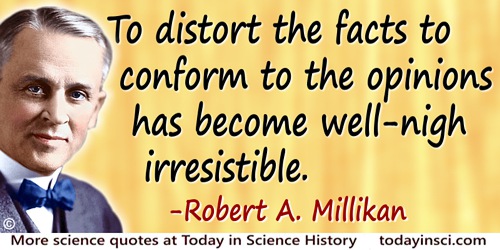
[Ignorance] of the principle of conservation of energy … does not prevent inventors without background from continually putting forward perpetual motion machines… Also, such persons undoubtedly have their exact counterparts in the fields of art, finance, education, and all other departments of human activity… persons who are unwilling to take the time and to make the effort required to find what the known facts are before they become the champions of unsupported opinions—people who take sides first and look up facts afterward when the tendency to distort the facts to conform to the opinions has become well-nigh irresistible.
From Evolution in Science and Religion (1927), 58-59. An excerpt from the book including this quote appears in 'New Truth and Old', Christian Education (Apr 1927), 10, No. 7, 394-395.
[In 1909,] Paris was the center of the aviation world. Aeronautics was neither an industry nor even a science; both were yet to come. It was an “art” and I might say a “passion”. Indeed, at that time it was a miracle. It meant the realization of legends and dreams that had existed for thousands of years and had been pronounced again and again as impossible by scientific authorities. Therefore, even the brief and unsteady flights of that period were deeply impressive. Many times I observed expressions of joy and tears in the eyes of witnesses who for the first time watched a flying machine carrying a man in the air.
In address (16 Nov 1964) presented to the Wings Club, New York City, Recollections and Thoughts of a Pioneer (1964), 5.
[In childhood, to overcome fear, the] need took me back again and again to a sycamore tree rising from the earth at the edge of a ravine. It was a big, old tree that had grown out over the ravine, so that when you climbed it, you looked straight down fifty feet or more. Every time I climbed that tree, I forced myself to climb to the last possible safe limb and then look down. Every time I did it, I told myself I’d never do it again. But I kept going back because it scared me and I had to know I could overcome that.
In John Glenn and Nick Taylor, John Glenn: A Memoir (2000), 16.
[It] is the little causes, long continued, which are considered as bringing about the greatest changes of the earth.
Theory of the Earth, with Proofs and Illustrations, Vol. 2 (1795), 205.
[J.J.] Sylvester’s methods! He had none. “Three lectures will be delivered on a New Universal Algebra,” he would say; then, “The course must be extended to twelve.” It did last all the rest of that year. The following year the course was to be Substitutions-Théorie, by Netto. We all got the text. He lectured about three times, following the text closely and stopping sharp at the end of the hour. Then he began to think about matrices again. “I must give one lecture a week on those,” he said. He could not confine himself to the hour, nor to the one lecture a week. Two weeks were passed, and Netto was forgotten entirely and never mentioned again. Statements like the following were not unfrequent in his lectures: “I haven’t proved this, but I am as sure as I can be of anything that it must be so. From this it will follow, etc.” At the next lecture it turned out that what he was so sure of was false. Never mind, he kept on forever guessing and trying, and presently a wonderful discovery followed, then another and another. Afterward he would go back and work it all over again, and surprise us with all sorts of side lights. He then made another leap in the dark, more treasures were discovered, and so on forever.
As quoted by Florian Cajori, in Teaching and History of Mathematics in the United States (1890), 265-266.
[Learning is] the actual process of broadening yourself, of knowing there’s a little extra facet of the universe you know about and can think about and can understand. It seems to me that when it’s time to die, and that will come to all of us, there’ll be a certain pleasure in thinking that you had utilized your life well, that you had learned as much as you could, gathered in as much as possible of the universe, and enjoyed it. I mean, there’s only this universe and only this one lifetime to try to grasp it. And, while it is inconceivable that anyone can grasp more than a tiny portion of it, at least do that much. What a tragedy to just pass through and get nothing out of it.
'Isaac Asimov Speaks' with Bill Moyers in The Humanist (Jan/Feb 1989), 49. Reprinted in Carl Howard Freedman (ed.), Conversations with Isaac Asimov (2005), 139.
[M]y work, which I’ve done for a long time, was not pursued in order to gain the praise I now enjoy, but chiefly from a craving after knowledge, which I notice resides in me more than in most other men. And therewithal, whenever I found out anything remarkable, I have thought it my duty to put down my discovery on paper, so that all ingenious people might be informed thereof.
Letter (27 Jun 1716) thanking the University of Louvain for ending him a medal designed in honour of his research. (Leeuwenhoek was then in his 84th year.) As cited by Charles-Edward Amory Winslow in The Conquest of Epidemic Disease: A Chapter in the History of Ideas (), 156.
[Molecular biology] is concerned particularly with the forms of biological molecules and with the evolution, exploitation and ramification of these forms in the ascent to higher and higher levels of organisation. Molecular biology is predominantly three-dimensional and structural—which does not mean, however, that it is merely a refinement of morphology. It must at the same time inquire into genesis and function.
From Harvey lecture (1951). As cited by John Law in 'The Case of X-ray Protein Crystallography', collected in Gerard Lemaine (ed.), Perspectives on the Emergence of Scientific Disciplines, 1976, 141.
[My Book] will endeavour to establish the principle[s] of reasoning in ... [geology]; and all my geology will come in as illustration of my views of those principles, and as evidence strengthening the system necessarily arising out of the admission of such principles, which... are neither more nor less than that no causes whatever have from the earliest time to which we can look back, to the present, ever acted, but those now acting; and that they never acted with different degrees of energy from that which they now exert.
Letter to Roderick Murchison Esq. (15 Jan 1829). In Mrs Lyell (ed.), The Life, Letters and Journals of Sir Charles Lyell, Bart (1881), Vol. 1, 234.
[My research] throve best under adversity … in Germany in the middle 1930s under the Nazis when things became quite unpleasant and official seminars became dull. … We had a little private club… theoretical physicists and biologists. The discussions we had at that time have had a remarkable long-range effect, an effect that astonished us all. This was one adverse situation. Like the great Plague in Florence in 1348, which is the background setting for Bocaccio's Decameron.
In 'Homo Scientificus According to Beckett', collected in William Beranek, Jr. (ed.),Science, Scientists, and Society, (1972), 135-. Excerpted in Ann E. Kammer, Science, Sex, and Society (1979), 278.
[On mediocrity] What we have today is a retreat into low-level goodness. Men are all working hard building barbecues, being devoted to their wives and spending time with their children. Many of us feel, “We never had it so good!” After three wars and a depression, we’re impressed by the rising curve. All we want is it not to blow up.
As quoted in interview with Frances Glennon, 'Student and Teacher of Human Ways', Life (14 Sep 1959), 147.
[P]olitical and social and scientific values … should be correlated in some relation of movement that could be expressed in mathematics, nor did one care in the least that all the world said it could not be done, or that one knew not enough mathematics even to figure a formula beyond the schoolboy s=(1/2)gt2. If Kepler and Newton could take liberties with the sun and moon, an obscure person ... could take liberties with Congress, and venture to multiply its attraction into the square of its time. He had only to find a value, even infinitesimal, for its attraction.
The Education of Henry Adams: An Autobiography? (1918), 376.
[Reply when questioned, “Don’t you find it very inconvenient stammering, Dr. Darwin?”] No, sir, because I have time to think before I speak, and don’t ask impertinent questions.
In Charles Darwin and Francis Darwin (ed.), 'Reminiscences', The Life and Letters of Charles Darwin (1887, 1896), Vol. 1, 118, footnote. The quote is stated by Francis Darwin to have been told to him by his father, Charles Darwin.
[Resist the temptation to] work so hard that there is no time left for serious thinking …[Scientists] should heed the saying, “A busy life is a wasted life.”
As quoted in J. Michael Bishop, How to Win the Nobel Prize: An Unexpected Life in Science (2009), 59. Citing What Mad Pursuit: A Personal View of Scientific Discovery (1988), 145.
[T]he 47th proposition in Euclid might now be voted down with as much ease as any proposition in politics; and therefore if Lord Hawkesbury hates the abstract truths of science as much as he hates concrete truth in human affairs, now is his time for getting rid of the multiplication table, and passing a vote of censure upon the pretensions of the hypotenuse.
In 'Peter Plymley's Letters', Essays Social and Political (1877), 530.
[The black hole] teaches us that space can be crumpled like a piece of paper into an infinitesimal dot, that time can be extinguished like a blown-out flame, and that the laws of physics that we regard as “sacred,” as immutable, are anything but.
In John A. Wheeler and Kenneth Ford, Geons, Black Holes & Quantum Foam: A Life in Physics. Quoted in Dennis Overbye, 'John A. Wheeler, Physicist Who Coined the Term Black Hole, Is Dead at 96', New York Times (14 Apr 2008).
[The toughest part of being in charge is] killing ideas that are great but poorly timed. And delivering tough feedback that’s difficult to hear but that I know will help people—and the team—in the long term.
In Issie Lapowsky, 'Scott Belsky', Inc. (Nov 2013), 140. Biography in Context,
[The] first postulate of the Principle of Uniformity, namely, that the laws of nature are invariant with time, is not peculiar to that principle or to geology, but is a common denominator of all science. In fact, instead of being an assumption or an ad hoc hypothesis, it is simply a succinct summation of the totality of all experimental and observational evidence.
'Critique of the Principle of Uniformity', in C. C. Albritton (ed.), Uniformity and Simplicity (1967), 29.
[Thomas Henry] Huxley, I believe, was the greatest Englishman of the Nineteenth Century—perhaps the greatest Englishman of all time. When one thinks of him, one thinks inevitably of such men as Goethe and Aristotle. For in him there was that rich, incomparable blend of intelligence and character, of colossal knowledge and high adventurousness, of instinctive honesty and indomitable courage which appears in mankind only once in a blue moon. There have been far greater scientists, even in England, but there has never been a scientist who was a greater man.
'Thomas Henry Huxley.' In the Baltimore Evening Sun (4 May 1925). Reprinted in A Second Mencken Chrestomathy: A New Selection from the Writings of America's Legendary Editor, Critic, and Wit (2006), 157.
[To one of his students he saw in a school dramatic production:] I’ve always been proud that Course X leaves little time for outside activities. You have proved me wrong so far and I’m glad you have. But don’t push your luck too far!
As quoted in A Dollar to a Doughnut: The Doc Lewis Story (1953), 49, which was a privately printed collection of anecdotes published by former students upon his retirement. Note that “X” was the actual designation of his chemical engineering course at MIT. The boy was a Course X student who had played the leading “lady” in the previous MIT Tech Show. The anecdote continues: “A word to the wise was sufficient—the leading lady that year was not from Course X.”
[To] mechanical progress there is apparently no end: for as in the past so in the future, each step in any direction will remove limits and bring in past barriers which have till then blocked the way in other directions; and so what for the time may appear to be a visible or practical limit will turn out to be but a bend in the road.
Opening address to the Mechanical Science Section, Meeting of the British Association, Manchester. In Nature (15 Sep 1887), 36, 475.
[We are] a fragile species, still new to the earth, … here only a few moments as evolutionary time is measured, … in real danger at the moment of leaving behind only a thin layer of of our fossils, radioactive at that.
The Fragile Species (1992, 1996), 25.
[We] do not learn for want of time,
The sciences that should become our country.
The sciences that should become our country.
In Henry V (1599), Act 5, Scene 2, line 59-60.
[When combustion occurs,] one body, at least, is oxygenated, and another restored, at the same time, to its combustible state... This view of combustion may serve to show how nature is always the same, and maintains her equilibrium by preserving the same quantities of air and water on the surface of our globe: for as fast as these are consumed in the various processes of combustion, equal quantities are formed, and rise regenerated like the Phoenix from her ashes.
Fulhame believed 'that water was the only source of oxygen, which oxygenates combustible bodies' and that 'the hydrogen of water is the only substance that restores bodies to their combustible state.'
Fulhame believed 'that water was the only source of oxygen, which oxygenates combustible bodies' and that 'the hydrogen of water is the only substance that restores bodies to their combustible state.'
An Essay on Combustion with a View to a New Art of Dyeing and Painting (1794), 179-180. In Marilyn Bailey Ogilvie and Joy Dorothy Harvey, The Biographical Dictionary of Women in Science (2000), 478.
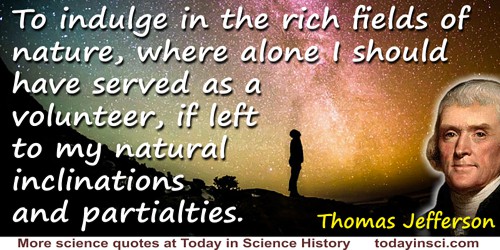
[Writing this letter] has permitted me, for a moment, to abstract myself from the dry and dreary waste of politics, into which I have been impressed by the times on which I happened, and to indulge in the rich fields of nature, where alone I should have served as a volunteer, if left to my natural inclinations and partialties.
In letter to Caspar Wistar (21 Jun 1807), collected in Thomas Jefferson Randolph (ed.), Memoir, Correspondence, And Miscellanies, From The Papers Of Thomas Jefferson (1829), Vol. 4, 94.
[Young] was afterwards accustomed to say, that at no period of his life was he particularly fond of repeating experiments, or even of very frequently attempting to originate new ones; considering that, however necessary to the advancement of science, they demanded a great sacrifice of time, and that when the fact was once established, that time was better employed in considering the purposes to which it might be applied, or the principles which it might tend to elucidate.
Hudson Gurney, Memoir of the Life of Thomas Young, M.D. F.R.S. (1831), 12-3.
“The Universe repeats itself, with the possible exception of history.” Of all earthly studies history is the only one that does not repeat itself. ... Astronomy repeats itself; botany repeats itself; trigonometry repeats itself; mechanics repeats itself; compound long division repeats itself. Every sum if worked out in the same way at any time will bring out the same answer. ... A great many moderns say that history is a science; if so it occupies a solitary and splendid elevation among the sciences; it is the only science the conclusions of which are always wrong.
In 'A Much Repeated Repetition', Daily News (26 Mar 1904). Collected in G. K. Chesterton and Dale Ahlquist (ed.), In Defense of Sanity: The Best Essays of G.K. Chesterton (2011), 82.
Ode to The Amoeba
Recall from Time's abysmal chasm
That piece of primal protoplasm
The First Amoeba, strangely splendid,
From whom we're all of us descended.
That First Amoeba, weirdly clever,
Exists today and shall forever,
Because he reproduced by fission;
He split himself, and each division
And subdivision deemed it fitting
To keep on splitting, splitting, splitting;
So, whatsoe'er their billions be,
All, all amoebas still are he.
Zoologists discern his features
In every sort of breathing creatures,
Since all of every living species,
No matter how their breed increases
Or how their ranks have been recruited,
From him alone were evoluted.
King Solomon, the Queen of Sheba
And Hoover sprang from that amoeba;
Columbus, Shakespeare, Darwin, Shelley
Derived from that same bit of jelly.
So famed is he and well-connected,
His statue ought to be erected,
For you and I and William Beebe
Are undeniably amoebae!
Recall from Time's abysmal chasm
That piece of primal protoplasm
The First Amoeba, strangely splendid,
From whom we're all of us descended.
That First Amoeba, weirdly clever,
Exists today and shall forever,
Because he reproduced by fission;
He split himself, and each division
And subdivision deemed it fitting
To keep on splitting, splitting, splitting;
So, whatsoe'er their billions be,
All, all amoebas still are he.
Zoologists discern his features
In every sort of breathing creatures,
Since all of every living species,
No matter how their breed increases
Or how their ranks have been recruited,
From him alone were evoluted.
King Solomon, the Queen of Sheba
And Hoover sprang from that amoeba;
Columbus, Shakespeare, Darwin, Shelley
Derived from that same bit of jelly.
So famed is he and well-connected,
His statue ought to be erected,
For you and I and William Beebe
Are undeniably amoebae!
(1922). Collected in Gaily the Troubadour (1936), 18.
Strictly Germ-proof
The Antiseptic Baby and the Prophylactic Pup
Were playing in the garden when the Bunny gamboled up;
They looked upon the Creature with a loathing undisguised;—
It wasn't Disinfected and it wasn't Sterilized.
They said it was a Microbe and a Hotbed of Disease;
They steamed it in a vapor of a thousand-odd degrees;
They froze it in a freezer that was cold as Banished Hope
And washed it in permanganate with carbolated soap.
In sulphurated hydrogen they steeped its wiggly ears;
They trimmed its frisky whiskers with a pair of hard-boiled shears;
They donned their rubber mittens and they took it by the hand
And elected it a member of the Fumigated Band.
There's not a Micrococcus in the garden where they play;
They bathe in pure iodoform a dozen times a day;
And each imbibes his rations from a Hygienic Cup—
The Bunny and the Baby and the Prophylactic Pup.
The Antiseptic Baby and the Prophylactic Pup
Were playing in the garden when the Bunny gamboled up;
They looked upon the Creature with a loathing undisguised;—
It wasn't Disinfected and it wasn't Sterilized.
They said it was a Microbe and a Hotbed of Disease;
They steamed it in a vapor of a thousand-odd degrees;
They froze it in a freezer that was cold as Banished Hope
And washed it in permanganate with carbolated soap.
In sulphurated hydrogen they steeped its wiggly ears;
They trimmed its frisky whiskers with a pair of hard-boiled shears;
They donned their rubber mittens and they took it by the hand
And elected it a member of the Fumigated Band.
There's not a Micrococcus in the garden where they play;
They bathe in pure iodoform a dozen times a day;
And each imbibes his rations from a Hygienic Cup—
The Bunny and the Baby and the Prophylactic Pup.
Printed in various magazines and medical journals, for example, The Christian Register (11 Oct 1906), 1148, citing Women's Home Companion. (Making fun of the contemporary national passion for sanitation.)
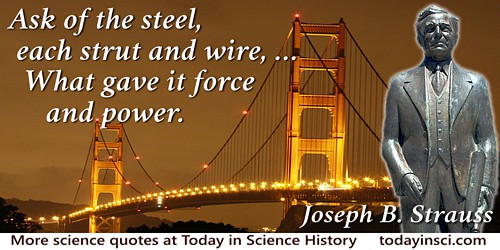
The Mighty Task is Done
At last the mighty task is done;
Resplendent in the western sun
The Bridge looms mountain high;
Its titan piers grip ocean floor,
Its great steel arms link shore with shore,
Its towers pierce the sky.
On its broad decks in rightful pride,
The world in swift parade shall ride,
Throughout all time to be;
Beneath, fleet ships from every port,
Vast landlocked bay, historic fort,
And dwarfing all the sea.
To north, the Redwood Empires gates;
To south, a happy playground waits,
In Rapturous appeal;
Here nature, free since time began,
Yields to the restless moods of man,
Accepts his bonds of steel.
Launched midst a thousand hopes and fears,
Damned by a thousand hostile sneers,
Yet Neer its course was stayed,
But ask of those who met the foe
Who stood alone when faith was low,
Ask them the price they paid.
Ask of the steel, each strut and wire,
Ask of the searching, purging fire,
That marked their natal hour;
Ask of the mind, the hand, the heart,
Ask of each single, stalwart part,
What gave it force and power.
An Honored cause and nobly fought
And that which they so bravely wrought,
Now glorifies their deed,
No selfish urge shall stain its life,
Nor envy, greed, intrigue, nor strife,
Nor false, ignoble creed.
High overhead its lights shall gleam,
Far, far below lifes restless stream,
Unceasingly shall flow;
For this was spun its lithe fine form,
To fear not war, nor time, nor storm,
For Fate had meant it so.
At last the mighty task is done;
Resplendent in the western sun
The Bridge looms mountain high;
Its titan piers grip ocean floor,
Its great steel arms link shore with shore,
Its towers pierce the sky.
On its broad decks in rightful pride,
The world in swift parade shall ride,
Throughout all time to be;
Beneath, fleet ships from every port,
Vast landlocked bay, historic fort,
And dwarfing all the sea.
To north, the Redwood Empires gates;
To south, a happy playground waits,
In Rapturous appeal;
Here nature, free since time began,
Yields to the restless moods of man,
Accepts his bonds of steel.
Launched midst a thousand hopes and fears,
Damned by a thousand hostile sneers,
Yet Neer its course was stayed,
But ask of those who met the foe
Who stood alone when faith was low,
Ask them the price they paid.
Ask of the steel, each strut and wire,
Ask of the searching, purging fire,
That marked their natal hour;
Ask of the mind, the hand, the heart,
Ask of each single, stalwart part,
What gave it force and power.
An Honored cause and nobly fought
And that which they so bravely wrought,
Now glorifies their deed,
No selfish urge shall stain its life,
Nor envy, greed, intrigue, nor strife,
Nor false, ignoble creed.
High overhead its lights shall gleam,
Far, far below lifes restless stream,
Unceasingly shall flow;
For this was spun its lithe fine form,
To fear not war, nor time, nor storm,
For Fate had meant it so.
Written upon completion of the building of the Golden Gate Bridge, May 1937. In Allen Brown, Golden Gate: biography of a Bridge (1965), 229.
[Colonel Ross:] “Is there any point to which you would wish to draw my attention?”
[Sherlock Holmes:] “To the curious incident of the dog in the night-time.”
“The dog did nothing in the night-time.”
“That was the curious incident.”
[Sherlock Holmes:] “To the curious incident of the dog in the night-time.”
“The dog did nothing in the night-time.”
“That was the curious incident.”
Fiction from 'XIII—The Adventure of the Silver Blaze', Adventures of Sherlock Holmes, in The Strand Magazine: An Illustrated Monthly (Dec 1892), Vol. 4, 656-657.
[On seeing the marsupials in Australia for the first time and comparing them to placental mammals:] An unbeliever … might exclaim “Surely two distinct Creators must have been at work.”
In Diary (19 Jan 1836). In Richard D. Keynes (ed.), The Beagle Record: Selections from the Original Pictorial Records and Written Accounts of the Voyage of HMS Beagle (1979), 345.
Dilbert: Evolution must be true because it is a logical conclusion of the scientific method.
Dogbert: But science is based on the irrational belief that because we cannot perceive reality all at once, things called “time” and “cause and effect” exist.
Dilbert: That’s what I was taught and that’s what I believe.
Dogbert: Sounds cultish.
Dogbert: But science is based on the irrational belief that because we cannot perceive reality all at once, things called “time” and “cause and effect” exist.
Dilbert: That’s what I was taught and that’s what I believe.
Dogbert: Sounds cultish.
Dilbert comic strip (8 Feb 1992).
Dilbert: I’m obsessed with inventing a perpetual motion machine. Most scientists think it's impossible, but I have something they don’t.
Dogbert: A lot of spare time?
Dilbert: Exactly.
Dogbert: A lot of spare time?
Dilbert: Exactly.
Dilbert cartoon strip (8 Aug 1991).
Eine brennendste Zeitfrage allerdings! Es brennt in allen Ecken und Enden der ethnologischen Welt, brennt hell, lichterloh, in vollster Brunst, es brennt ringsum, Gross Feuer! und Niemand regt eine Hand.
A most burning question of time, though. It burns in every nook and cranny of the ethnological world, burning, bright, brightly, in the fullest blaze, and it burns all around, huge fire! and no one lifts a hand.
[Expressing his desperation over the loss of the cultural memory of ethnic traditions as so many cultures were no longer living in isolation.]
A most burning question of time, though. It burns in every nook and cranny of the ethnological world, burning, bright, brightly, in the fullest blaze, and it burns all around, huge fire! and no one lifts a hand.
[Expressing his desperation over the loss of the cultural memory of ethnic traditions as so many cultures were no longer living in isolation.]
From Das Besẗandige in den Menschenrassen und die Spielweite ihrer Veränderlichkeit (1868), 180, footnote. Approximate translation by Webmaster using Google Translate.
Forging differs from hoaxing, inasmuch as in the later the deceit is intended to last for a time, and then be discovered, to the ridicule of those who have credited it; whereas the forger is one who, wishing to acquire a reputation for science, records observations which he has never made.
Reflections on the Decline of Science in England (1830). In Calyampudi Radhakrishna Rao, Statistics and Truth (1997), 84.
If the Indians hadn’t spent the $24. In 1626 Peter Minuit, first governor of New Netherland, purchased Manhattan Island from the Indians for about $24. … Assume for simplicity a uniform rate of 7% from 1626 to the present, and suppose that the Indians had put their $24 at [compound] interest at that rate …. What would be the amount now, after 280 years? 24 x 1.07²⁸⁰ = more than 4,042,000,000.
The latest tax assessment available at the time of writing gives the realty for the borough of Manhattan as $3,820,754,181. This is estimated to be 78% of the actual value, making the actual value a little more than $4,898,400,000.
The amount of the Indians’ money would therefore be more than the present assessed valuation but less than the actual valuation.
The latest tax assessment available at the time of writing gives the realty for the borough of Manhattan as $3,820,754,181. This is estimated to be 78% of the actual value, making the actual value a little more than $4,898,400,000.
The amount of the Indians’ money would therefore be more than the present assessed valuation but less than the actual valuation.
In A Scrap-book of Elementary Mathematics: Notes, Recreations, Essays (1908), 47-48.
L’astronomie … est l’arbitre de la division civile du temps, l'ame de la chronologie et de la géographie, et l’unique guide des navigateurs.
Astronomy is the governor of the civil division of time, the soul of chronology and geography, and the only guide of the navigator.
Astronomy is the governor of the civil division of time, the soul of chronology and geography, and the only guide of the navigator.
Original French in Leçons Élémentaires d’Astronomie Géométrique et Physique (1764), iii. English as quoted in Preface to Hannah Mary Bouvier Peterson, Bouvier’s Familiar Astronomy; Or, An Introduction to the Study of the Heavens (1855), Preface, 5.
La verità fu sola figliola del tenpo.
Truth was the only daughter of Time.
Truth was the only daughter of Time.
From manuscript original “Moto, colpo,” 58b, editted and translated by Jean Paul Richter (ed.) compiled in 'Philosphical Maxims, Morals, Polemics and Speculations' The Literary Works of Leonardo da Vinci (1883), Vol. 2, 288, Maxim No. 1152.
Longtemps les objets dont s'occupent les mathématiciens étaient our la pluspart mal définis; on croyait les connaître, parce qu'on se les représentatit avec le sens ou l'imagination; mais on n'en avait qu'une image grossière et non une idée précise sure laquelle le raisonment pût avoir prise.
For a long time the objects that mathematicians dealt with were mostly ill-defined; one believed one knew them, but one represented them with the senses and imagination; but one had but a rough picture and not a precise idea on which reasoning could take hold.
For a long time the objects that mathematicians dealt with were mostly ill-defined; one believed one knew them, but one represented them with the senses and imagination; but one had but a rough picture and not a precise idea on which reasoning could take hold.
La valeur de la science. In Anton Bovier, Statistical Mechanics of Disordered Systems (2006), 97.
Opinionum commenta delet dies, naturae judicia confirmat
Time obliterates the fictions of opinion and confirms the decisions of nature.
Time obliterates the fictions of opinion and confirms the decisions of nature.
De Natura Deorum, II, ii, 5. In Samuel Johnson, W. Jackson Bate, The Selected Essays from the Rambler, Adventurer, and Idler (1968),167
Or any science under sonne,
The sevene artz and alle,
But thei ben lerned for oure Lordes love
Lost is al the tyme.
Every science under the sun, including the Seven Arts,
Unless learned for love of Our Lord, is only time lost.
The sevene artz and alle,
But thei ben lerned for oure Lordes love
Lost is al the tyme.
Every science under the sun, including the Seven Arts,
Unless learned for love of Our Lord, is only time lost.
In William Langland and B. Thomas Wright (ed.) The Vision and Creed of Piers Ploughman (1842), 212. An associated Note on p.539 lists: “The seven arts studied in the schools were very famous throughout the middle ages. They were grammar, dialectics, rhetoric, music, arithmetic, geometry, astronomy; and were included in the following memorial distich:—
“Gram, loquitur, Dia. vera docet, Rliet. verba colorat,
Mus. canit, Ar. numerat, Geo. ponderat, As. colit astra.”
Modern translation by Terrence Tiller in Piers Plowman (1981, 1999), 109.
“Gram, loquitur, Dia. vera docet, Rliet. verba colorat,
Mus. canit, Ar. numerat, Geo. ponderat, As. colit astra.”
Modern translation by Terrence Tiller in Piers Plowman (1981, 1999), 109.
Parkinson's First Law: Work expands so as to fill the time available for its completion.
Parkinson's Law or the Pursuit of Progress1 (1958), 4.
Question: Explain how to determine the time of vibration of a given tuning-fork, and state what apparatus you would require for the purpose.
Answer: For this determination I should require an accurate watch beating seconds, and a sensitive ear. I mount the fork on a suitable stand, and then, as the second hand of my watch passes the figure 60 on the dial, I draw the bow neatly across one of its prongs. I wait. I listen intently. The throbbing air particles are receiving the pulsations; the beating prongs are giving up their original force; and slowly yet surely the sound dies away. Still I can hear it, but faintly and with close attention; and now only by pressing the bones of my head against its prongs. Finally the last trace disappears. I look at the time and leave the room, having determined the time of vibration of the common “pitch” fork. This process deteriorates the fork considerably, hence a different operation must be performed on a fork which is only lent.
Answer: For this determination I should require an accurate watch beating seconds, and a sensitive ear. I mount the fork on a suitable stand, and then, as the second hand of my watch passes the figure 60 on the dial, I draw the bow neatly across one of its prongs. I wait. I listen intently. The throbbing air particles are receiving the pulsations; the beating prongs are giving up their original force; and slowly yet surely the sound dies away. Still I can hear it, but faintly and with close attention; and now only by pressing the bones of my head against its prongs. Finally the last trace disappears. I look at the time and leave the room, having determined the time of vibration of the common “pitch” fork. This process deteriorates the fork considerably, hence a different operation must be performed on a fork which is only lent.
Genuine student answer* to an Acoustics, Light and Heat paper (1880), Science and Art Department, South Kensington, London, collected by Prof. Oliver Lodge. Quoted in Henry B. Wheatley, Literary Blunders (1893), 176-7, Question 4. (*From a collection in which Answers are not given verbatim et literatim, and some instances may combine several students' blunders.)
Question: If you walk on a dry path between two walls a few feet apart, you hear a musical note or “ring” at each footstep. Whence comes this?
Answer: This is similar to phosphorescent paint. Once any sound gets between two parallel reflectors or walls, it bounds from one to the other and never stops for a long time. Hence it is persistent, and when you walk between the walls you hear the sounds made by those who walked there before you. By following a muffin man down the passage within a short time you can hear most distinctly a musical note, or, as it is more properly termed in the question, a “ring” at every (other) step.
Answer: This is similar to phosphorescent paint. Once any sound gets between two parallel reflectors or walls, it bounds from one to the other and never stops for a long time. Hence it is persistent, and when you walk between the walls you hear the sounds made by those who walked there before you. By following a muffin man down the passage within a short time you can hear most distinctly a musical note, or, as it is more properly termed in the question, a “ring” at every (other) step.
Genuine student answer* to an Acoustics, Light and Heat paper (1880), Science and Art Department, South Kensington, London, collected by Prof. Oliver Lodge. Quoted in Henry B. Wheatley, Literary Blunders (1893), 175-6, Question 2. (*From a collection in which Answers are not given verbatim et literatim, and some instances may combine several students' blunders.)
Quinquies exscriptus, maneat tot millibus annis.
(I wrote it out five times, may it last the same number of millennia.)
(I wrote it out five times, may it last the same number of millennia.)
final line of Ars magna
Steckt keine Poesie in der Lokomotive, die brausend durch die Nacht zieht und über die zitternde Erde hintobt, als wollte sie Raum und Zeit zermalmen, in dem hastigen, aber wohl geregelten Zucken und Zerren ihrer gewaltigen Glieder, in dem stieren, nur auf ein Ziel losstürmenden Blick ihrer roten Augen, in dem emsigen, willenlosen Gefolge der Wagen, die kreischend und klappernd, aber mit unfehlbarer Sicherheit dem verkörperten Willen aus Eisen
und Stahl folge leisten?
Is there no poetry in the locomotive roaring through the night and charging over the quivering earth as if it wanted to crush time and space? Is there no poetry in the hasty but regular jerking and tugging of its powerful limbs, in the stare of its red eyes that never lose sight of their goal? Is there no poetry in the bustling, will-less retinue of cars that follow, screeching and clattering with unmistakable surety, the steel and iron embodiment of will?
Is there no poetry in the locomotive roaring through the night and charging over the quivering earth as if it wanted to crush time and space? Is there no poetry in the hasty but regular jerking and tugging of its powerful limbs, in the stare of its red eyes that never lose sight of their goal? Is there no poetry in the bustling, will-less retinue of cars that follow, screeching and clattering with unmistakable surety, the steel and iron embodiment of will?
— Max Eyth
From 'Poesie und Technik' (1904) (Poetry and Technology), in Schweizerische Techniker-Zeitung (1907), Vol 4, 306, as translated in Paul A. Youngman, Black Devil and Iron Angel: The Railway in Nineteenth-Century German Realism (2005), 128.
Temporis fila.
Child of time.
A favourite expression of Linnaeus.
Child of time.
A favourite expression of Linnaeus.
Quoted in Tore Frängsmyr, 'Linnaeus as a Geologist', in Tore Frangsmyr (ed.), Linnaeus: The Man and his Work (1983), 143.
Temporis filia veritas; cui me obstetricari non pudet.
Truth is the daughter of time, and I feel no shame in being her midwife.
Truth is the daughter of time, and I feel no shame in being her midwife.
Opening remark from 'Narratio de observatis a se quatuor Jovis satellitibus erronibus, quos Galilaeus Galilaeus Mathematicus Florentinus jure inventionis medicaea sidera nuncupavit' (Account of personal observations of the four moving satellites of Jupiter, which Florentine Mathematician Galileo Galilei had the right of discovery to Name as the Medicicaean Stars) (observed 30 Aug 1610, written 11 Sep 1610, printed about Oct 1610) in which he confirmed having seen the things announced by Galileo in Mar 1610. Collected in Cav. Giambatista Venturi, Memorie e Lettere Inedite Finora o Disperse di Galileo Galilei (Memoirs and Letters, Previously Unpublished or Missing, of Galileo Galilei) (1811), Vol 1, 144.
Theologus esse volebam: diu angebar: Deus ecce mea opera etiam in astronomia celebratur.
I wanted to become a theologian. For a long time I was restless. Now, however, behold how through my effort God is being celebrated in astronomy.
I wanted to become a theologian. For a long time I was restless. Now, however, behold how through my effort God is being celebrated in astronomy.
Letter to Michael Maestlin (3 Oct 1595). Johannes Kepler Gesammelte Werke (1937- ), Vol. 13, letter 23, l. 256-7, p. 40. As translated in Owen Gingerich, 'Johannes Kepler' article in Charles Coulston Gillespie (ed.) Dictionary of Scientific Biography (1973), Vol. 7, 291.
Also seen translated as “I wanted to become a theologian; for a long time I was unhappy. Now, behold, God is praised by my work even in astronomy.”
Vladimir: That passed the time.
Esragon: It would have passed in any case.
Esragon: It would have passed in any case.
From Act 1 of the play, Waiting for Godot. In The Collected Works of Samuel Beckett (1970), Vol. 15, 31.
books.google.com/books?id=lEYrAQAAIAAJ
CALPURNIA: When beggars die there are no comets seen;
The heavens themselves blaze forth the death of princes.
CAESAR: Cowards die many times before their deaths;
The valiant never taste of death but once.
Of all the wonders that I have yet heard,
It seems to me most strange that men should fear,
Seeing that death, a necessary end,
Will come when it will come.
The heavens themselves blaze forth the death of princes.
CAESAR: Cowards die many times before their deaths;
The valiant never taste of death but once.
Of all the wonders that I have yet heard,
It seems to me most strange that men should fear,
Seeing that death, a necessary end,
Will come when it will come.
Julius Caesar (1599), II, ii.
SCIENCE: a way of finding things out and then making them work. Science explains what is happening around us the whole time. So does RELIGION, but science is better because it comes up with more understandable excuses when it’s wrong.
In Wings (1990, 2007), 147.
~~[Attributed]~~ I have had my results for a long time; but I do not yet know how I am to arrive at them.
Quoted, without primary source citation, in Agnes Arber, The Mind and the Eye: A Study of the Biologist’s Standpoint (1954, 1964), 47. Arber footnotes finding the quote also in Leonard Nelson and T.K. Brown (trans.), Socratic Method and Critical Philosophy (1949, 1965), 89; W.I.B. Beveridge, The Art of Scientific Investigation (1950, 1957), 149. Notably, Arber states being “unable to trace this dictum to its original source.” With benefit of Google, Webmaster also has, yet, no success, either. In German, guessed as, “Meine Lösungen habe ich schon lange, ich weiß nur noch nicht, wie ich zu ihnen gelangel!” Webmaster found the quote in a 1968 German book, and “Meine Resultate habe ich schon lange, ich weiß nur nicht, wie ich zu ihnen gelangen kann” (1958). All of these leave a century of apparent silence before them. Can you help?
~~[Attributed]~~ It is not once nor twice but times without number that the same ideas make their appearance in the world.
As quoted in Thomas L. Heath Manual of Greek Mathematics (1931, 2003), 205. Webmaster has so far found no primary source, and is dubious about authenticity. Can you help?
~~[Misattributed; NOT by Collins]~~ Hypochondriacs squander large sums of time in search of nostrums by which they vainly hope they may get more time to squander.
This appears in Charles Caleb Colton, Lacon: Or Many Things in Few Words, Addressed to Those who Think (1823), Vol. 1, 99. Since Mortimer Collins was born in 1827, four years after the Colton publication, Collins cannot be the author. Nevertheless, it is widely seen misattributed to Collins, for example in Peter McDonald (ed.), Oxford Dictionary of Medical Quotations (2004), 27. Even seen attributed to Peter Ouspensky (born 1878), in Encarta Book of Quotations (2000). See the Charles Caleb Colton Quotes page on this website. The quote appears on this page to include it with this caution of misattribution.
~~[Misattributed]~~ Time and space are modes by which we think and not conditions in which we live.
Although seen in later years in various sources as a direct quote by Einstein, it apparently is not. This statement first appears as these authors’ own commentary about Einstein’s relativity theory, as given by Dimitri Marianoff and Palma Wayne, Einstein: An Intimate Study of a Great Man (1944), 62.
1066. … At that time, throughout all England, a portent such as men had never seen before was seen in the heavens. Some declared that the star was a comet, which some call “the long-haired star”: it first appeared on the eve of the festival of Letania Maior, that is on 24 April, and shone every night for a week.
In George Norman Garmonsway (ed., trans.), 'The Parker Chronicle', The Anglo-Saxon Chronicle (1953), 195. This translation from the original Saxon, is a modern printing of an ancient anthology known as The Anglo-Saxon Chronicle. Manuscript copies were held at various English monasteries. These copies of the Chronicle include content first recorded in the late 9th century. The monasteries continued independently updating these annals. This quote comes from a copy once owned by Matthew Parker, Archbishop of Canterbury. Known as the Winchester (or Parker) Chronicle, it is the oldest surviving manuscript.
1106. … In the first week of Lent, on the Friday, 16 February, a strange star appeared in the evening, and for a long time afterwards was seen shining for a while each evening. The star made its appearance in the south-west, and seemed to be small and dark, but the light that shone from it was very bright, and appeared like an enormous beam of light shining north-east; and one evening it seemed as if the beam were flashing in the opposite direction towards the star. Some said that they had seen other unknown stars about this time, but we cannot speak about these without reservation, because we did not ourselves see them.
In George Norman Garmonsway (ed., trans.), 'The Parker Chronicle', The Anglo-Saxon Chronicle (1953), 240. This translation from the original Saxon, is a modern printing of an ancient anthology known as The Anglo-Saxon Chronicle. Manuscript copies were held at various English monasteries. These copies of the Chronicle include content first recorded in the late 9th century. This quote comes from the copy known as the Peterborough Chronicle (a.k.a. Laud manuscript).
A ... hypothesis may be suggested, which supposes the word 'beginning' as applied by Moses in the first of the Book of Genesis, to express an undefined period of time which was antecedent to the last great change that affected the surface of the earth, and to the creation of its present animal and vegetable inhabitants; during which period a long series of operations and revolutions may have been going on, which, as they are wholly unconnected with the history of the human race, are passed over in silence by the sacred historian, whose only concern with them was largely to state, that the matter of the universe is not eternal and self-existent but was originally created by the power of the Almighty.
Vindiciae Geologicae (1820), 31-2.
A bad earthquake at once destroys the oldest associations: the world, the very emblem of all that is solid, has moved beneath our feet like a crust over a fluid; one second of time has conveyed to the mind a strange idea of insecurity, which hours of reflection would never have created.
Journal of Researches: Into the Natural History and Geology of the Countries Visited During the Voyage of H.M.S. BeagIe Round the World (1839), ch. XVI, 369.
A biologist, if he wishes to know how many toes a cat has, does not "frame the hypothesis that the number of feline digital extremities is 4, or 5, or 6," he simply looks at a cat and counts. A social scientist prefers the more long-winded expression every time, because it gives an entirely spurious impression of scientificness to what he is doing.
In Science is a Sacred Cow (1950), 151.
A body of work such as Pasteur’s is inconceivable in our time: no man would be given a chance to create a whole science. Nowadays a path is scarcely opened up when the crowd begins to pour in.
Pensées d’un Biologiste (1939). Translated in The Substance of Man (1962), Chap. 6.
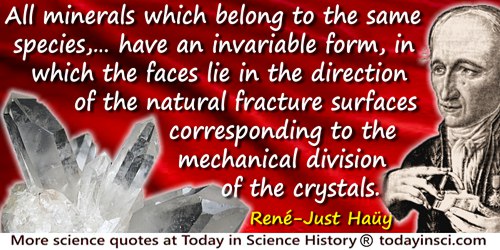
A casual glance at crystals may lead to the idea that they were pure sports of nature, but this is simply an elegant way of declaring one’s ignorance. With a thoughtful examination of them, we discover laws of arrangement. With the help of these, calculation portrays and links up the observed results. How variable and at the same time how precise and regular are these laws! How simple they are ordinarily, without losing anything of their significance! The theory which has served to develop these laws is based entirely on a fact, whose existence has hitherto been vaguely discerned rather than demonstrated. This fact is that in all minerals which belong to the same species, these little solids, which are the crystal elements and which I call their integrant molecules, have an invariable form, in which the faces lie in the direction of the natural fracture surfaces corresponding to the mechanical division of the crystals. Their angles and dimensions are derived from calculations combined with observation.
Traité de mineralogie … Publié par le conseil des mines (1801), Vol. 1, xiii-iv, trans. Albert V. and Marguerite Carozzi.
A Chinese tale tells of some men sent to harm a young girl who, upon seeing her beauty, become her protectors rather than her violators. That’s how I felt seeing the Earth for the first time. "I could not help but love and cherish her.
…...
A circumstance which influenced my whole career more than any other … was my friendship with Professor Henslow … a man who knew every branch of science…. During the latter half of my time at Cambridge [I] took long walks with him on most days; so that I was called by some of the dons “the man who walks with Henslow.”
In Charles Darwin and Francis Darwin (ed.), 'Autobiography', The Life and Letters of Charles Darwin (1887, 1896), Vol. 1, 44.
A crystal is like a class of children arranged for drill, but standing at ease, so that while the class as a whole has regularity both in time and space, each individual child is a little fidgety!
In Crystals and X-Rays (1948), 22.
A definition of what we mean by “probability”. … The German Dictionary by Jakob and Wilhelm Grimm gives us detailed information: The Latin term “probabilis”, we are told, was at one time translated by “like truth”, or, by “with an appearance of truth” (“mit einem Schein der Wahrheit”). Only since the middle of the seventeenth century has it been rendered by “wahrscheinlich” (lit. truth-resembling).
In Probability, Statistics, and Truth (1939, 2nd. ed., 1957), 2.
A drop of old tuberculin, which is an extract of tubercle bacilli, is put on the skin and then a small superficial scarification is made by turning, with some pressure, a vaccination lancet on the surface of the skin. The next day only those individuals show an inflammatory reaction at the point of vaccination who have already been infected with tuberculosis, whereas the healthy individuals show no reaction at all. Every time we find a positive reaction, we can say with certainty that the child is tuberculous.
'The Relation of Tuberculosis to Infant Mortality', read at the third mid-year meeting of the American Academy of Medicine, New Haven, Conn, (4 Nov 1909). In Bulletin of the American Academy of Medicine (1910), 11, 75.
A fair number of people who go on to major in astronomy have decided on it certainly by the time they leave junior high, if not during junior high. I think it’s somewhat unusual that way. I think most children pick their field quite a bit later, but astronomy seems to catch early, and if it does, it sticks.
From interview by Rebecca Wright, 'Oral History Transcript' (15 Sep 2000), on NASA website.
A few of the results of my activities as a scientist have become embedded in the very texture of the science I tried to serve—this is the immortality that every scientist hopes for. I have enjoyed the privilege, as a university teacher, of being in a position to influence the thought of many hundreds of young people and in them and in their lives I shall continue to live vicariously for a while. All the things I care for will continue for they will be served by those who come after me. I find great pleasure in the thought that those who stand on my shoulders will see much farther than I did in my time. What more could any man want?
In 'The Meaning of Death,' in The Humanist Outlook edited by A. J. Ayer (1968) [See Gerald Holton and Sir Isaac Newton].
A good many times I have been present at gatherings of people who, by the standards of the traditional culture, are thought highly educated and who have with considerable gusto been expressing their incredulity at the illiteracy of scientists. Once or twice I have been provoked and have asked the company how many of them could describe the Second Law of Thermodynamics. The response was cold: it was also negative. Yet I was asking something which is about the scientific equivalent of: Have you read a work of Shakespeare’s?
The Two Cultures: The Rede Lecture (1959), 15-6.
A good notation has a subtlety and suggestiveness which at times make it almost seem like a live teacher. … a perfect notation would be a substitute for thought.
In 'Introduction' by Bertrand Russell written for Ludwig Wittgenstein, Tractatus Logico-Philosophicus (1922), 17-18.
A good physiological experiment like a good physical one requires that it should present anywhere, at any time, under identical conditions, the same certain and unequivocal phenomena that can always be confirmed.
Bestätigung des Bell'schen Lehrsatzes, dass die doppelten Wurzeln der Rückenmarksnerven verschiedene Functionen haben, durch neue nod entscheidende Experimente' (1831). Trans. Edwin Clarke and C. D. O'Malley, The Human Brain and Spinal Cord (1968), 304.
A great advantage of X-ray analysis as a method of chemical structure analysis is its power to show some totally unexpected and surprising structure with, at the same time, complete certainty.
In 'X-ray Analysis of Complicated Molecules', Nobel Lecture (11 Dec 1964). In Nobel Lectures: Chemistry 1942-1962 (1964), 83.
A great department of thought must have its own inner life, however transcendent may be the importance of its relations to the outside. No department of science, least of all one requiring so high a degree of mental concentration as Mathematics, can be developed entirely, or even mainly, with a view to applications outside its own range. The increased complexity and specialisation of all branches of knowledge makes it true in the present, however it may have been in former times, that important advances in such a department as Mathematics can be expected only from men who are interested in the subject for its own sake, and who, whilst keeping an open mind for suggestions from outside, allow their thought to range freely in those lines of advance which are indicated by the present state of their subject, untrammelled by any preoccupation as to applications to other departments of science. Even with a view to applications, if Mathematics is to be adequately equipped for the purpose of coping with the intricate problems which will be presented to it in the future by Physics, Chemistry and other branches of physical science, many of these problems probably of a character which we cannot at present forecast, it is essential that Mathematics should be allowed to develop freely on its own lines.
In Presidential Address British Association for the Advancement of Science, Sheffield, Section A,
Nature (1 Sep 1910), 84, 286.
A great invention for dieters would be a refrigerator which weighs you every time you open the door.
In E.C. McKenzie, 14,000 Quips and Quotes for Speakers, Writers, Editors, Preachers, and Teachers (1990), 546.
A great reform in geological speculation seems now to have become necessary. … It is quite certain that a great mistake has been made—that British popular geology at the present time is in direct opposition to the principles of Natural Philosophy.
From Sir W. Thomson, Address (27 Feb 1868), to the Geological Society of Glasgow, 'On Geological Time', Transactions of the Geological Society of Glasgow 3, collected in Popular Lectures and Addresses (1894), Vol. 2, 10 & 44. As Epigraph in Thomas Henry Huxley, 'Geological Reform' (1869), Collected Essays: Discourses, Biological and Geological (1894), 306.
A great swindle of our time is the assumption that science has made religion obsolete. All science has damaged is the story of Adam and Eve and the story of Jonah and the Whale. Everything else holds up pretty well, particularly lessons about fairness and gentleness. People who find those lessons irrelevant in the twentieth century are simply using science as an excuse for greed and harshness. Science has nothing to do with it, friends.
Through the Looking Glass. In Carl Sagan, Broca's Brain (1986), 206.
A grove of giant redwoods or sequoias should be kept just as we keep a great or beautiful cathedral. The extermination of the passenger pigeon meant that mankind was just so much poorer; exactly as in the case of the destruction of the cathedral at Rheims. And to lose the chance to see frigate-birds soaring in circles above the storm, or a file of pelicans winging their way homeward across the crimson afterglow of the sunset, or a myriad terns flashing in the bright light of midday as they hover in a shifting maze above the beach—why, the loss is like the loss of a gallery of the masterpieces of the artists of old time.
In A Book-Lover's Holidays in the Open (1916), 316-317.
A human being is part of the whole, called by us “Universe”; a part limited in time and space. He experiences himself, his thoughts and feelings as something separated from the rest—a kind of optical delusion of his consciousness. This delusion is a kind of prison for us, restricting us to our personal desires and to affection for a few persons nearest us. Our task must be to free ourselves from this prison by widening our circle of compassion to embrace all living creatures and the whole of nature in its beauty. Nobody is able to achieve this completely but the striving for such achievement is, in itself, a part of the liberation and a foundation for inner security.
In Letter (4 Mar 1950), replying to a grieving father over the loss of a young son. In Dear Professor Einstein: Albert Einstein’s Letters to and from Children (2002), 184.
A hundred times every day I remind myself that my inner and outer life depends on the labors of other men, living and dead, and that I must exert myself in order to give in the measure as I have received and am still receiving.
…...
A hundred years ago … an engineer, Herbert Spencer, was willing to expound every aspect of life, with an effect on his admiring readers which has not worn off today.
Things do not happen quite in this way nowadays. This, we are told, is an age of specialists. The pursuit of knowledge has become a profession. The time when a man could master several sciences is past. He must now, they say, put all his efforts into one subject. And presumably, he must get all his ideas from this one subject. The world, to be sure, needs men who will follow such a rule with enthusiasm. It needs the greatest numbers of the ablest technicians. But apart from them it also needs men who will converse and think and even work in more than one science and know how to combine or connect them. Such men, I believe, are still to be found today. They are still as glad to exchange ideas as they have been in the past. But we cannot say that our way of life is well-fitted to help them. Why is this?
Things do not happen quite in this way nowadays. This, we are told, is an age of specialists. The pursuit of knowledge has become a profession. The time when a man could master several sciences is past. He must now, they say, put all his efforts into one subject. And presumably, he must get all his ideas from this one subject. The world, to be sure, needs men who will follow such a rule with enthusiasm. It needs the greatest numbers of the ablest technicians. But apart from them it also needs men who will converse and think and even work in more than one science and know how to combine or connect them. Such men, I believe, are still to be found today. They are still as glad to exchange ideas as they have been in the past. But we cannot say that our way of life is well-fitted to help them. Why is this?
In 'The Unification of Biology', New Scientist (11 Jan 1962), 13, No. 269, 72.
A learned man is an idler who kills time with study. Beware of his false knowledge: it is more dangerous than ignorance.
In 'Maxims for Revolutionists: Education', in Man and Superman (1905), 230.
A liberal education may be had at a very slight cost of time …[with] ten books which you may make close friends.
I. Old and New Testament.
II. Shakespeare.
III. Montaigne.
IV. Plutarch’s Lives.
V. Marcus Aurelius.
VI. Epictetus.
VII. Religio Medici.
VIII. Don Quixote.
IX. Emerson
X. Oliver Wendell Holmes—Breakfast-Table Series.
I. Old and New Testament.
II. Shakespeare.
III. Montaigne.
IV. Plutarch’s Lives.
V. Marcus Aurelius.
VI. Epictetus.
VII. Religio Medici.
VIII. Don Quixote.
IX. Emerson
X. Oliver Wendell Holmes—Breakfast-Table Series.
From 'Bed-Side Reading List For Medical Students', final page of Aequanimitas and Other Addresses (1904, 1906), 475.
A line is not made up of points. … In the same way, time is not made up of parts considered as indivisible “nows.”
Part of Aristotle’s reply to Zeno's paradox concerning continuity.
Part of Aristotle’s reply to Zeno's paradox concerning continuity.
A succinct summary, not a direct quotation of Aristotle's words. From Aristotle's Physics, Book VI. Sections 1 and 9 as given by Florian Cajori in part 2 of an article 'The History of Zeno's Arguments on Motion', in The American Mathematical Monthly (Feb 1915), 22:2, 41.
A man in twenty-four hours converts as much as seven ounces of carbon into carbonic acid; a milch cow will convert seventy ounces, and a horse seventy-nine ounces, solely by the act of respiration. That is, the horse in twenty-four hours burns seventy-nine ounces of charcoal, or carbon, in his organs of respiration to supply his natural warmth in that time ..., not in a free state, but in a state of combination.
From the concluding lecture (8 Jan 1861) given to a juvenile audience at the Royal Institution, as published in A Course of Six Lectures on the Chemical History of a Candle (1861), 177.
A man loses his fortune; he gains earnestness. His eyesight goes; it leads him to a spirituality... We think we are pushing our own way bravely, but there is a great Hand in ours all the time.
Quoted in Kim Lim (ed.), 1,001 Pearls of Spiritual Wisdom: Words to Enrich, Inspire, and Guide Your Life (2014), 20
A Man may Smoak, or Drink, or take Snuff, ’till he is unable to pass away his Time without
it.
In The Spectator (2 Aug 1712), No. 447, collected in The Spectator (9th ed., 1728), Vol. 6, 225.
A man that is young in years may be old in hours, if he has lost no time.
‘Of Youth and Age’, Essays.
A man who dares to waste one hour of time has not discovered the value of life.
In a Letter to his sister Susan (Aug 1836), collected in Francis Darwin (ed.), Charles Darwin: His Life Told in an Autobiographical Chapter, and in a Selected Series of His Published Letters, Volume 5 (1892), 137.
A man who has once looked with the archaeological eye will never see quite normally. He will be wounded by what other men call trifles. It is possible to refine the sense of time until an old shoe in the bunch grass or a pile of nineteenth century beer bottles in an abandoned mining town tolls in one’s head like a hall clock.
The Night Country (1971), 81.

A man who is all theory is like “a rudderless ship on a shoreless sea.” … Theories and speculations may be indulged in with safety only as long as they are based on facts that we can go back to at all times and know that we are on solid ground.
In Nature's Miracles: Familiar Talks on Science (1899), Vol. 1, Introduction, vii.
A man, in his books, may be said to walk the earth a long time after he is gone.
Quoted, without citation, in John Muir and Edwin Way Teale (ed.) The Wilderness World of John Muir (1954, 2001), Introduction, xx.
A mathematical argument is, after all, only organized common sense, and it is well that men of science should not always expound their work to the few behind a veil of technical language, but should from time to time explain to a larger public the reasoning which lies behind their mathematical notation.
In The Tides and Kindred Phenomena in the Solar System: The Substance of Lectures Delivered in 1897 at the Lowell Institute, Boston, Massachusetts (1898), Preface, v.
Preface
A mathematician … has no material to work with but ideas, and so his patterns are likely to last longer, since ideas wear less with time than words.
In A Mathematician's Apology (1940, 2012), 84.
A million years is a short time—the shortest worth messing with for most problems. You begin tuning your mind to a time scale that is the planet’s time scale. For me, it is almost unconscious now and is a kind of companionship with the earth.
In Basin and Range (1981), 134.
A mind is accustomed to mathematical deduction, when confronted with the faulty foundations of astrology, resists a long, long time, like an obstinate mule, until compelled by beating and curses to put its foot into that dirty puddle.
As quoted in Arthur Koestler, The Sleep Walkers: A History of Man’s Changing Vision of the Universe (1959), 243, citing De Stella Nova in Pede Serpentarii (1606).
A mouse can fall down a mine shaft a third of a mile deep without injury. A rat falling the same distance would break his bones; a man would simply splash ... Elephants have their legs thickened to an extent that seems disproportionate to us, but this is necessary if their unwieldly bulk is to be moved at all ... A 60-ft. man would weigh 1000 times as much as a normal man, but his thigh bone would have its area increased by only 100 times ... Consequently such an unfortunate monster would break his legs the moment he tried to move.
Expressing, in picturesque terms, the strength of an organism relative to its bulk.
Expressing, in picturesque terms, the strength of an organism relative to its bulk.
Address at the annual congress of the British Association for the Advancement of Science. Quoted in 'On the Itchen', Time Magazine (Mon. 14 Sep 1925).
A Native American elder once described his own inner struggles in this manner: Inside of me there are two dogs. One of the dogs is mean and evil. The other dog is good. The mean dog fights the good dog all the time. When asked which dog wins, he reflected for a moment and replied, The one I feed the most.
Widely found in varied accounts, so is most likely proverbial. Seen misattributed (?) to George Bernard Shaw, but Webmaster has not yet found a primary source as verification.
A noteworthy and often-remarked similarity exists between the facts and methods of geology and those of linguistic study. The science of language is, as it were, the geology of the most modern period, the Age of the Man, having for its task to construct the history of development of the earth and its inhabitants from the time when the proper geological record remains silent … The remains of ancient speech are like strata deposited in bygone ages, telling of the forms of life then existing, and of the circumstances which determined or affected them; while words are as rolled pebbles, relics of yet more ancient formations, or as fossils, whose grade indicates the progress of organic life, and whose resemblances and relations show the correspondence or sequence of the different strata; while, everywhere, extensive denudation has marred the completeness of the record, and rendered impossible a detailed exhibition of the whole course of development.
In Language and the Study of Language (1867), 47.
A number of years ago, when I was a freshly-appointed instructor, I met, for the first time, a certain eminent historian of science. At the time I could only regard him with tolerant condescension.
I was sorry of the man who, it seemed to me, was forced to hover about the edges of science. He was compelled to shiver endlessly in the outskirts, getting only feeble warmth from the distant sun of science-in-progress; while I, just beginning my research, was bathed in the heady liquid heat up at the very center of the glow.
In a lifetime of being wrong at many a point, I was never more wrong. It was I, not he, who was wandering in the periphery. It was he, not I, who lived in the blaze.
I had fallen victim to the fallacy of the “growing edge;” the belief that only the very frontier of scientific advance counted; that everything that had been left behind by that advance was faded and dead.
But is that true? Because a tree in spring buds and comes greenly into leaf, are those leaves therefore the tree? If the newborn twigs and their leaves were all that existed, they would form a vague halo of green suspended in mid-air, but surely that is not the tree. The leaves, by themselves, are no more than trivial fluttering decoration. It is the trunk and limbs that give the tree its grandeur and the leaves themselves their meaning.
There is not a discovery in science, however revolutionary, however sparkling with insight, that does not arise out of what went before. “If I have seen further than other men,” said Isaac Newton, “it is because I have stood on the shoulders of giants.”
I was sorry of the man who, it seemed to me, was forced to hover about the edges of science. He was compelled to shiver endlessly in the outskirts, getting only feeble warmth from the distant sun of science-in-progress; while I, just beginning my research, was bathed in the heady liquid heat up at the very center of the glow.
In a lifetime of being wrong at many a point, I was never more wrong. It was I, not he, who was wandering in the periphery. It was he, not I, who lived in the blaze.
I had fallen victim to the fallacy of the “growing edge;” the belief that only the very frontier of scientific advance counted; that everything that had been left behind by that advance was faded and dead.
But is that true? Because a tree in spring buds and comes greenly into leaf, are those leaves therefore the tree? If the newborn twigs and their leaves were all that existed, they would form a vague halo of green suspended in mid-air, but surely that is not the tree. The leaves, by themselves, are no more than trivial fluttering decoration. It is the trunk and limbs that give the tree its grandeur and the leaves themselves their meaning.
There is not a discovery in science, however revolutionary, however sparkling with insight, that does not arise out of what went before. “If I have seen further than other men,” said Isaac Newton, “it is because I have stood on the shoulders of giants.”
Adding A Dimension: Seventeen Essays on the History of Science (1964), Introduction.
A nutritive centre, anatomically considered, is merely a cell, the nucleus of which is the permanent source of successive broods of young cells, which from time to time fill the cavity of their parent, and carrying with them the cell wall of the parent, pass off in certain directions, and under various forms, according to the texture or organ of which their parent forms a part.
Anatomical and Pathological Observations (1845), 2.
A painter makes patterns with shapes and colours, a poet with words. A painting may embody an “idea,” but the idea is usually commonplace and unimportant. In poetry, ideas count for a good deal more; but, as Housman insisted, the importance of ideas in poetry is habitually exaggerated. … The poverty of ideas seems hardly to affect the beauty of the verbal pattern. A mathematician, on the other hand, has no material to work with but ideas, and so his patterns are likely to last longer, since ideas wear less with time than words.
In A Mathematician’s Apology (1940, 2012), 84-85.
A parable: A man was examining the construction of a cathedral. He asked a stone mason what he was doing chipping the stones, and the mason replied, “I am making stones.” He asked a stone carver what he was doing. “I am carving a gargoyle.” And so it went, each person said in detail what they were doing. Finally he came to an old woman who was sweeping the ground. She said. “I am helping build a cathedral.”
...Most of the time each person is immersed in the details of one special part of the whole and does not think of how what they are doing relates to the larger picture.
[For example, in education, a teacher might say in the next class he was going to “explain Young's modulus and how to measure it,” rather than, “I am going to educate the students and prepare them for their future careers.”]
...Most of the time each person is immersed in the details of one special part of the whole and does not think of how what they are doing relates to the larger picture.
[For example, in education, a teacher might say in the next class he was going to “explain Young's modulus and how to measure it,” rather than, “I am going to educate the students and prepare them for their future careers.”]
In The Art of Doing Science and Engineering: Learning to Learn (1975, 2005), 195.
A physician ought to have his shop provided with plenty of all necessary things, as lint, rollers, splinters: let there be likewise in readiness at all times another small cabinet of such things as may serve for occasions of going far from home; let him have also all sorts of plasters, potions, and purging medicines, so contrived that they may keep some considerable time, and likewise such as may be had and used whilst they are fresh.
In Prose Quotations from Socrates to Macaulay (1876), 536.
A quarter-horse jockey learns to think of a twenty-second race as if it were occurring across twenty minutes—in distinct parts, spaced in his consciousness. Each nuance of the ride comes to him as he builds his race. If you can do the opposite with deep time, living in it and thinking in it until the large numbers settle into place, you can sense how swiftly the initial earth packed itself together, how swiftly continents have assembled and come apart, how far and rapidly continents travel, how quickly mountains rise and how quickly they disintegrate and disappear.
Annals of the Former World
A science in its infancy is the least satisfactory, and, at the same time, the most profitable theme for a general description.
In Modern Astrophysics (1924), Preface, v.
A single ray of light from a distant star falling upon the eye of a tyrant in bygone times, may have altered the course of his life, may have changed the destiny of nations, may have transformed the surface of the globe, so intricate, so inconceivably complex are the processes of nature.
Lecture (Feb 1893) delivered before the Franklin Institute, Philadelphia, 'On Light and Other High Frequency Phenomena,' collected in Thomas Commerford Martin and Nikola Tesla, The Inventions, Researches and Writings of Nikola Tesla (1894), 298.
A social fact is every way of acting, fixed or not, capable of exercising on the individual an external constraint; or again, every way of acting which is general throughout a given society, while at the same time existing in its own right independent of its individual manifestations.
The Rules of Sociological Method (1895), 8th edition, trans. Sarah A. Solovay and John M. Mueller, ed. George E. G. Catlin (1938, 1964 edition), 13.
A stitch in time would have confused Einstein.
In Lily Splane, Quantum Consciousness (2004), 307
A strict materialist believes that everything depends on the motion of matter. He knows the form of the laws of motion though he does not know all their consequences when applied to systems of unknown complexity.
Now one thing in which the materialist (fortified with dynamical knowledge) believes is that if every motion great & small were accurately reversed, and the world left to itself again, everything would happen backwards the fresh water would collect out of the sea and run up the rivers and finally fly up to the clouds in drops which would extract heat from the air and evaporate and afterwards in condensing would shoot out rays of light to the sun and so on. Of course all living things would regrede from the grave to the cradle and we should have a memory of the future but not of the past.
The reason why we do not expect anything of this kind to take place at any time is our experience of irreversible processes, all of one kind, and this leads to the doctrine of a beginning & an end instead of cyclical progression for ever.
Now one thing in which the materialist (fortified with dynamical knowledge) believes is that if every motion great & small were accurately reversed, and the world left to itself again, everything would happen backwards the fresh water would collect out of the sea and run up the rivers and finally fly up to the clouds in drops which would extract heat from the air and evaporate and afterwards in condensing would shoot out rays of light to the sun and so on. Of course all living things would regrede from the grave to the cradle and we should have a memory of the future but not of the past.
The reason why we do not expect anything of this kind to take place at any time is our experience of irreversible processes, all of one kind, and this leads to the doctrine of a beginning & an end instead of cyclical progression for ever.
Letter to Mark Pattison (7 Apr 1868). In P. M. Hannan (ed.), The Scientific Letters and Papers of James Clerk Maxwell (1995), Vol. 2, 1862-1873, 360-1.
A superstition is a premature explanation that overstays its time.
From chapter 'Jottings from a Note-book', in Canadian Stories (1918), 168.
A taxonomy of abilities, like a taxonomy anywhere else in science, is apt to strike a certain type of impatient student as a gratuitous orgy of pedantry. Doubtless, compulsions to intellectual tidiness express themselves prematurely at times, and excessively at others, but a good descriptive taxonomy, as Darwin found in developing his theory, and as Newton found in the work of Kepler, is the mother of laws and theories.
From Intelligence: Its Structure, Growth and Action: Its Structure, Growth and Action (1987), 61.
A teacher of mathematics has a great opportunity. If he fills his allotted time with drilling his students in routine operations he kills their interest, hampers their intellectual development, and misuses his opportunity. But if he challenges the curiosity of his students by setting them problems proportionate to their knowledge, and helps them to solve their problems with stimulating questions, he may give them a taste for, and some means of, independent thinking.
In How to Solve It (1948), Preface.
A time will come when men will stretch out their eyes. They should see planets like our Earth.
Inaugural Lecture as Professor of Astronomy, Gresham College. In Stephen Webb, If the Universe is Teeming With Aliens—Where is Everybody? (2002), 150.
A time will come when science will transform [our bodies] by means which we cannot conjecture... And then, the earth being small, mankind will migrate into space, and will cross the airless Saharas which separate planet from planet, and sun from sun. The earth will become a Holy Land which will be visited by pilgrims from all quarters of the universe.
…...
A time will come, when fields will be manured with a solution of glass (silicate of potash), with the ashes of burnt straw, and with the salts of phosphoric acid, prepared in chemical manufactories, exactly as at present medicines are given for fever and goitre.
Agricultural Chemistry (1847), 4th edn., 186.
A time will however come (as I believe) when physiology will invade and destroy mathematical physics, as the latter has destroyed geometry.
In Daedalus, or Science and the Future (1923). Reprinted in Krishna R. Dronamraju (ed.),
Haldane’s Daedalus Revisited (1995), 27.
A truer image of the world, I think, is obtained by picturing things as entering into the stream of time from an eternal world outside, than from a view which regards time as the devouring tyrant of all that is.
Essay, 'Mysticism and Logic' in Hibbert Journal (Jul 1914). Collected in Mysticism and Logic: And Other Essays (1919), 21.

A word is not a crystal, transparent and unchanged, it is the skin of a living thought and may vary greatly in color and content according to the circumstances and the time in which it is used.
In Towne v. Eisner (1918), 245 U.S. 425. As quoted in Richard A. Posner (ed.), The Essential Holmes: Selections from the Letters, Speeches, Judicial Opinions, and Other Writings of Oliver Wendell Holmes, Jr. (1992), 287.
A work of genius is something like the pie in the nursery song, in which the four and twenty blackbirds are baked. When the pie is opened, the birds begin to sing. Hereupon three fourths of the company run away in a fright; and then after a time, feeling ashamed, they would fain excuse themselves by declaring, the pie stank so, they could not sit near it. Those who stay behind, the men of taste and epicures, say one to another, We came here to eat. What business have birds, after they have been baked, to be alive and singing? This will never do. We must put a stop to so dangerous an innovation: for who will send a pie to an oven, if the birds come to life there? We must stand up to defend the rights of all the ovens in England. Let us have dead birds..dead birds for our money. So each sticks his fork into a bird, and hacks and mangles it a while, and then holds it up and cries, Who will dare assert that there is any music in this bird’s song?
Co-author with his brother Augustus William Hare Guesses At Truth, By Two Brothers: Second Edition: With Large Additions (1848), Second Series, 86. (The volume is introduced as “more than three fourths new.” This quote is identified as by Julius; Augustus had died in 1833.)
A young man once asked [Erasmus Darwin] in, as he thought, an offensive manner, whether he did not find stammering very inconvenient. He answered, 'No, Sir, it gives me time for reflection, and saves me from asking impertinent questions.'
C. Darwin, The Life of Erasmus Darwin (1887), 40.
About 6 or 8 years ago My Ingenious friend Mr John Robinson having [contrived] conceived that a fire engine might be made without a Lever—by Inverting the Cylinder & placing it above the mouth of the pit proposed to me to make a model of it which was set about by having never Compleated & I [being] having at that time Ignorant little knoledge of the machine however I always thought the Machine Might be applied to [more] other as valuable purposes [than] as drawing Water.
Entry in notebook (1765). The bracketed words in square brackets were crossed out by Watt. in Eric Robinson and Douglas McKie (eds.), Partners in Science: Letters of James Watt and Joseph Black (1970), 434.
About 85 per cent of my “thinking” time was spent getting into a position to think, to make a decision, to learn something I needed to know. Much more time went into finding or obtaining information than into digesting it. Hours went into the plotting of graphs... When the graphs were finished, the relations were obvious at once, but the plotting had to be done in order to make them so.
From article 'Man-Computer Symbiosis', in IRE Transactions on Human Factors in Electronics (Mar 1960), Vol. HFE-1, 4-11.
About eight days ago I discovered that sulfur in burning, far from losing weight, on the contrary, gains it; it is the same with phosphorus; this increase of weight arises from a prodigious quantity of air that is fixed during combustion and combines with the vapors. This discovery, which I have established by experiments, that I regard as decisive, has led me to think that what is observed in the combustion of sulfur and phosphorus may well take place in the case of all substances that gain in weight by combustion and calcination; and I am persuaded that the increase in weight of metallic calxes is due to the same cause... This discovery seems to me one of the most interesting that has been made since Stahl and since it is difficult not to disclose something inadvertently in conversation with friends that could lead to the truth I have thought it necessary to make the present deposit to the Secretary of the Academy to await the time I make my experiments public.
Sealed note deposited with the Secretary of the French Academy 1 Nov 1772. Oeuvres de Lavoisier, Correspondance, Fasc. II. 1770-75 (1957), 389-90. Adapted from translation by A. N. Meldrum, The Eighteenth-Century Revolution in Science (1930), 3.
Absolute, true, and mathematical time, in and of itself and of its own nature, without reference to anything external, flows uniformly and by another name is called duration. Relative, apparent, and common time is any sensible and external measure (precise or imprecise) of duration by means of motion; such as a measure—for example, an hour, a day, a month, a year—is commonly used instead of true time.
The Principia: Mathematical Principles of Natural Philosophy (1687), 3rd edition (1726), trans. I. Bernard Cohen and Anne Whitman (1999), Definitions, Scholium, 408.
According to astronomers, next week Wednesday will occur twice. They say such a thing happens only once every 60,000 years and although they don’t know why it occurs, they’re glad they have an extra day to figure it out.
In Napalm and Silly Putty (2002), 105.
According to my derivative hypothesis, a change takes place first in the structure of the animal, and this, when sufficiently advanced, may lead to modifications of habits… . “Derivation” holds that every species changes, in time, by virtue of inherent tendencies thereto. “Natural Selection” holds that no such change can take place without the influence of altered external circumstances educing or selecting such change… . The hypothesis of “natural selection” totters on the extension of a conjectural condition, explanatory of extinction to the majority of organisms, and not known or observed to apply to the origin of any species.
In On the Anatomy of Vertebrates (1868), Vol. 3, 808.
According to the common law of nature, deficiency of power is supplied by duration of time.
'Geological Illustrations', Appendix to G. Cuvier, Essay on the Theory of the Earth, trans. R. Jameson (1827), 430.
According to their [Newton and his followers] doctrine, God Almighty wants to wind up his watch from time to time: otherwise it would cease to move. He had not, it seems, sufficient foresight to make it a perpetual motion. Nay, the machine of God's making, so imperfect, according to these gentlemen; that he is obliged to clean it now and then by an extraordinary concourse, and even to mend it, as clockmaker mends his work.
'Mr. Leibniz's First Paper' (1715). In H. G. Alexander (ed.), The Leibniz-Clarke Correspondence (1956), 11-2.
According to this view of the matter, there is nothing casual in the formation of Metamorphic Rocks. All strata, once buried deep enough, (and due TIME allowed!!!) must assume that state,—none can escape. All records of former worlds must ultimately perish.
Letter to Mr Murchison, In explanation of the views expressed in his previous letter to Mr Lyell, 15 Nov 1836. Quoted in the Appendix to Charles Babbage, The Ninth Bridgewater Treatise: A Fragment (1838), 240.
Accordingly the primordial state of things which I picture is an even distribution of protons and electrons, extremely diffuse and filling all (spherical) space, remaining nearly balanced for an exceedingly long time until its inherent instability prevails. We shall see later that the density of this distribution can be calculated; it was about one proton and electron per litre. There is no hurry for anything to begin to happen. But at last small irregular tendencies accumulate, and evolution gets under way. The first stage is the formation of condensations ultimately to become the galaxies; this, as we have seen, started off an expansion, which then automatically increased in speed until it is now manifested to us in the recession of the spiral nebulae.
As the matter drew closer together in the condensations, the various evolutionary processes followed—evolution of stars, evolution of the more complex elements, evolution of planets and life.
As the matter drew closer together in the condensations, the various evolutionary processes followed—evolution of stars, evolution of the more complex elements, evolution of planets and life.
The Expanding Universe (1933), 56-57.
Accordingly, we find Euler and D'Alembert devoting their talent and their patience to the establishment of the laws of rotation of the solid bodies. Lagrange has incorporated his own analysis of the problem with his general treatment of mechanics, and since his time M. Poinsôt has brought the subject under the power of a more searching analysis than that of the calculus, in which ideas take the place of symbols, and intelligent propositions supersede equations.
J. C. Maxwell on Louis Poinsôt (1777-1859) in 'On a Dynamical Top' (1857). In W. D. Niven (ed.), The Scientific Papers of James Clerk Maxwell (1890), Vol. 1, 248.
Act as if you are going to live for ever and cast your plans way ahead. You must feel responsible without time limitations, and the consideration of whether you may or may not be around to see the results should never enter your thoughts.
In Theodore Rockwell, The Rickover Effect: How One Man Made A Difference (2002), 342.
Adam is fading out. It is on account of Darwin and that crowd. I can see that he is not going to last much longer. There's a plenty of signs. He is getting belittled to a germ—a little bit of a speck that you can't see without a microscope powerful enough to raise a gnat to the size of a church. They take that speck and breed from it: first a flea; then a fly, then a bug, then cross these and get a fish, then a raft of fishes, all kinds, then cross the whole lot and get a reptile, then work up the reptiles till you've got a supply of lizards and spiders and toads and alligators and Congressmen and so on, then cross the entire lot again and get a plant of amphibiums, which are half-breeds and do business both wet and dry, such as turtles and frogs and ornithorhyncuses and so on, and cross-up again and get a mongrel bird, sired by a snake and dam'd by a bat, resulting in a pterodactyl, then they develop him, and water his stock till they've got the air filled with a million things that wear feathers, then they cross-up all the accumulated animal life to date and fetch out a mammal, and start-in diluting again till there's cows and tigers and rats and elephants and monkeys and everything you want down to the Missing Link, and out of him and a mermaid they propagate Man, and there you are! Everything ship-shape and finished-up, and nothing to do but lay low and wait and see if it was worth the time and expense.
'The Refuge of the Derelicts' collected in Mark Twain and John Sutton Tuckey, The Devil's Race-Track: Mark Twain's Great Dark Writings (1980), 340-41.
- 1980
Adapting from the earlier book Gravitation, I wrote, “Spacetime tells matter how to move; matter tells spacetime how to curve.” In other words, a bit of matter (or mass, or energy) moves in accordance with the dictates of the curved spacetime where it is located. … At the same time, that bit of mass or energy is itself contributing to the curvature of spacetime everywhere.
With co-author Kenneth William Ford Geons, Black Holes, and Quantum Foam: A Life in Physics (1998, 2010), 235. Adapted from his earlier book, co-authored with Charles W. Misner and Kip S. Thorne, Gravitation (1970, 1973), 5, in which one of the ideas in Einstein’s geometric theory of gravity was summarized as, “Space acts on matter, telling it how to move. In turn, matter reacts back on space, telling it how to curve”.
Adrenalin does not excite sympathetic ganglia when applied to them directly, as does nicotine. Its effective action is localised at the periphery. The existence upon plain muscle of a peripheral nervous network, that degenerates only after section of both the constrictor and inhibitory nerves entering it, and not after section of either alone, has been described. I find that even after such complete denervation, whether of three days' or ten months' duration, the plain muscle of the dilatator pupillae will respond to adrenalin, and that with greater rapidity and longer persistence than does the iris whose nervous relations are uninjured. Therefore it cannot be that adrenalin excites any structure derived from, and dependent for its persistence on, the peripheral neurone. But since adrenalin does not evoke any reaction from muscle that has at no time of its life been innervated by the sympathetic, the point at which the stimulus of the chemical excitant is received, and transformed into what may cause the change of tension of the muscle fibre, is perhaps a mechanism developed out of the muscle cell in response to its union with the synapsing sympathetic fibre, the function of which is to receive and transform the nervous impulse. Adrenalin might then be the chemical stimulant liberated on each occasion when the impulse arrives at the periphery.
'On the Action of Adrenalin', Proceedings of the Physiological Society, 21 May 1904, in The Journal of Physiology 1904, 31, xxi.
After a tremendous task has been begun in our time, first by Copernicus and then by many very learned mathematicians, and when the assertion that the earth moves can no longer be considered something new, would it not be much better to pull the wagon to its goal by our joint efforts, now that we have got it underway, and gradually, with powerful voices, to shout down the common herd, which really does not weigh arguments very carefully?
Letter to Galileo (13 Oct 1597). In James Bruce Ross (ed.) and Mary Martin (ed., trans.), 'Comrades in the Pursuit of Truth', The Portable Renaissance Reader (1953, 1981), 599. As quoted and cited in Merry E. Wiesner, Early Modern Europe, 1450-1789 (2013), 377.
After all, we scientific workers … like women, are the victims of fashion: at one time we wear dissociated ions, at another electrons; and we are always loth to don rational clothing; some fixed belief we must have manufactured for us: we are high or low church, of this or that degree of nonconformity, according to the school in which we are brought up—but the agnostic is always rare of us and of late years the critic has been taboo.
'The Thirst of Salted Water or the Ions Overboard', Science Progress (1909), 3, 643.
After having produced aquatic animals of all ranks and having caused extensive variations in them by the different environments provided by the waters, nature led them little by little to the habit of living in the air, first by the water's edge and afterwards on all the dry parts of the globe. These animals have in course of time been profoundly altered by such novel conditions; which so greatly influenced their habits and organs that the regular gradation which they should have exhibited in complexity of organisation is often scarcely recognisable.
Hydrogéologie (1802), trans. A. V. Carozzi (1964), 69-70.
After the discovery of spectral analysis no one trained in physics could doubt the problem of the atom would be solved when physicists had learned to understand the language of spectra. So manifold was the enormous amount of material that has been accumulated in sixty years of spectroscopic research that it seemed at first beyond the possibility of disentanglement. An almost greater enlightenment has resulted from the seven years of Röntgen spectroscopy, inasmuch as it has attacked the problem of the atom at its very root, and illuminates the interior. What we are nowadays hearing of the language of spectra is a true 'music of the spheres' in order and harmony that becomes ever more perfect in spite of the manifold variety. The theory of spectral lines will bear the name of Bohr for all time. But yet another name will be permanently associated with it, that of Planck. All integral laws of spectral lines and of atomic theory spring originally from the quantum theory. It is the mysterious organon on which Nature plays her music of the spectra, and according to the rhythm of which she regulates the structure of the atoms and nuclei.
Atombau und Spektrallinien (1919), viii, Atomic Structure and Spectral Lines, trans. Henry L. Brose (1923), viii.
After the planet becomes theirs, many millions of years will have to pass before a beetle particularly loved by God, at the end of its calculations will find written on a sheet of paper in letters of fire that energy is equal to the mass multiplied by the square of the velocity of light. The new kings of the world will live tranquilly for a long time, confining themselves to devouring each other and being parasites among each other on a cottage industry scale.
'Beetles' Other People’s Trades (1985, trans. 1989).
After we came out of the church, we stood talking for some time together of Bishop Berkeley’s ingenious sophistry to prove the non-existence of matter, and that every thing in the universe is merely ideal. I observed, that though we are satisfied his doctrine is not true, it is impossible to refute it. I never shall forget the alacrity with which Johnson answered, striking his foot with mighty force against a large stone, till he rebounded from it, “I refute it thus.”
In Boswell’s Life of Johnson (1820), Vol. 1, 218.
Again and again, often in the busiest phases of the insulin investigations, he [Frederick Banting] found time to set a fracture or perform a surgical operation on one of his army comrades or on some patient who was in need.
In 'Obituary: Sir Frederick Banting', Science (14 Mar 1941), N.S. 93, No. 2411, 248.
Ah, the architecture of this world. Amoebas may not have backbones, brains, automobiles, plastic, television, Valium or any other of the blessings of a technologically advanced civilization; but their architecture is two billion years ahead of its time.
In The Center of Life: A Natural History of the Cell (1977), 15-16.
Alas, your dear friend and servant is totally blind. Henceforth this heaven, this universe, which by wonderful observations I had enlarged by a hundred and a thousand times beyond the conception of former ages, is shrunk for me into the narrow space which I myself fill in it. So it pleases God; it shall therefore please me also.
In Letter, as quoted in Sir Oliver Lodge, Pioneers of Science (1905), 133.
All change is relative. The universe is expanding relatively to our common material standards; our material standards are shrinking relatively to the size of the universe. The theory of the “expanding universe” might also be called the theory of the “shrinking atom”. …
:Let us then take the whole universe as our standard of constancy, and adopt the view of a cosmic being whose body is composed of intergalactic spaces and swells as they swell. Or rather we must now say it keeps the same size, for he will not admit that it is he who has changed. Watching us for a few thousand million years, he sees us shrinking; atoms, animals, planets, even the galaxies, all shrink alike; only the intergalactic spaces remain the same. The earth spirals round the sun in an ever-decreasing orbit. It would be absurd to treat its changing revolution as a constant unit of time. The cosmic being will naturally relate his units of length and time so that the velocity of light remains constant. Our years will then decrease in geometrical progression in the cosmic scale of time. On that scale man’s life is becoming briefer; his threescore years and ten are an ever-decreasing allowance. Owing to the property of geometrical progressions an infinite number of our years will add up to a finite cosmic time; so that what we should call the end of eternity is an ordinary finite date in the cosmic calendar. But on that date the universe has expanded to infinity in our reckoning, and we have shrunk to nothing in the reckoning of the cosmic being.
We walk the stage of life, performers of a drama for the benefit of the cosmic spectator. As the scenes proceed he notices that the actors are growing smaller and the action quicker. When the last act opens the curtain rises on midget actors rushing through their parts at frantic speed. Smaller and smaller. Faster and faster. One last microscopic blurr of intense agitation. And then nothing.
:Let us then take the whole universe as our standard of constancy, and adopt the view of a cosmic being whose body is composed of intergalactic spaces and swells as they swell. Or rather we must now say it keeps the same size, for he will not admit that it is he who has changed. Watching us for a few thousand million years, he sees us shrinking; atoms, animals, planets, even the galaxies, all shrink alike; only the intergalactic spaces remain the same. The earth spirals round the sun in an ever-decreasing orbit. It would be absurd to treat its changing revolution as a constant unit of time. The cosmic being will naturally relate his units of length and time so that the velocity of light remains constant. Our years will then decrease in geometrical progression in the cosmic scale of time. On that scale man’s life is becoming briefer; his threescore years and ten are an ever-decreasing allowance. Owing to the property of geometrical progressions an infinite number of our years will add up to a finite cosmic time; so that what we should call the end of eternity is an ordinary finite date in the cosmic calendar. But on that date the universe has expanded to infinity in our reckoning, and we have shrunk to nothing in the reckoning of the cosmic being.
We walk the stage of life, performers of a drama for the benefit of the cosmic spectator. As the scenes proceed he notices that the actors are growing smaller and the action quicker. When the last act opens the curtain rises on midget actors rushing through their parts at frantic speed. Smaller and smaller. Faster and faster. One last microscopic blurr of intense agitation. And then nothing.
In The Expanding Universe (1933) , 90-92.
All fossil anthropoids found hitherto have been known only from mandibular or maxillary fragments, so far as crania are concerned, and so the general appearance of the types they represented had been unknown; consequently, a condition of affairs where virtually the whole face and lower jaw, replete with teeth, together with the major portion of the brain pattern, have been preserved, constitutes a specimen of unusual value in fossil anthropoid discovery. Here, as in Homo rhodesiensis, Southern Africa has provided documents of higher primate evolution that are amongst the most complete extant. Apart from this evidential completeness, the specimen is of importance because it exhibits an extinct race of apes intermediate between living anthropoids and man ... Whether our present fossil is to be correlated with the discoveries made in India is not yet apparent; that question can only be solved by a careful comparison of the permanent molar teeth from both localities. It is obvious, meanwhile, that it represents a fossil group distinctly advanced beyond living anthropoids in those two dominantly human characters of facial and dental recession on one hand, and improved quality of the brain on the other. Unlike Pithecanthropus, it does not represent an ape-like man, a caricature of precocious hominid failure, but a creature well advanced beyond modern anthropoids in just those characters, facial and cerebral, which are to be anticipated in an extinct link between man and his simian ancestor. At the same time, it is equally evident that a creature with anthropoid brain capacity and lacking the distinctive, localised temporal expansions which appear to be concomitant with and necessary to articulate man, is no true man. It is therefore logically regarded as a man-like ape. I propose tentatively, then, that a new family of Homo-simidæ be created for the reception of the group of individuals which it represents, and that the first known species of the group be designated Australopithecus africanus, in commemoration, first, of the extreme southern and unexpected horizon of its discovery, and secondly, of the continent in which so many new and important discoveries connected with the early history of man have recently been made, thus vindicating the Darwinian claim that Africa would prove to be the cradle of mankind.
'Australopithicus africanus: The Man-Ape of South Africa', Nature, 1925, 115, 195.
All frescoes are as high finished as miniatures or enamels, and they are known to be unchangeable; but oil, being a body itself, will drink or absorb very little colour, and changing yellow, and at length brown, destroys every colour it is mixed with, especially every delicate colour. It turns every permanent white to a yellow and brown putty, and has compelled the use of that destroyer of colour, white lead, which, when its protecting oil is evaporated, will become lead again. This is an awful thing to say to oil painters ; they may call it madness, but it is true. All the genuine old little pictures, called cabinet pictures, are in fresco and not in oil. Oil was not used except by blundering ignorance till after Vandyke’s time ; but the art of fresco painting being lost, oil became a fetter to genius and a dungeon to art.
In 'Opinions', The Poems: With Specimens of the Prose Writings of William Blake (1885), 276-277.
All good intellects have repeated, since Bacon’s time, that there can be no real knowledge but that which is based on observed facts. This is incontestable, in our present advanced stage; but, if we look back to the primitive stage of human knowledge, we shall see that it must have been otherwise then. If it is true that every theory must be based upon observed facts, it is equally true that facts cannot be observed without the guidance of some theory. Without such guidance, our facts would be desultory and fruitless; we could not retain them: for the most part we could not even perceive them.
The Positive Philosophy, trans. Harriet Martineau (1853), Vol. 1, 3-4.
All in all, the total amount of power conceivably available from the uranium and thorium supplies of the earth is about twenty times that available from the coal and oil we have left.
In The Intelligent Man's Guide to Science: The physical sciences (1960), 371.
All men and women are born, live suffer and die; what distinguishes us one from another is our dreams, whether they be dreams about worldly or unworldly things, and what we do to make them come about... We do not choose to be born. We do not choose our parents. We do not choose our historical epoch, the country of our birth, or the immediate circumstances of our upbringing. We do not, most of us, choose to die; nor do we choose the time and conditions of our death. But within this realm of choicelessness, we do choose how we live.
…...
All over the world there lingers on the memory of a giant tree, the primal tree, rising up from the centre of the Earth to the heavens and ordering the universe around it. It united the three worlds: its roots plunged down into subterranean abysses, Its loftiest branches touched the empyrean. Thanks to the Tree, it became possible to breathe the air; to all the creatures that then appeared on Earth it dispensed its fruit, ripened by the sun and nourished by the water which it drew from the soil. From the sky it attracted the lightning from which man made fire and, beckoning skyward, where clouds gathered around its fall. The Tree was the source of all life, and of all regeneration. Small wonder then that tree-worship was so prevalent in ancient times.
From 'L'Arbre Sacre' ('The Sacred Tree'), UNESCO Courier (Jan 1989), 4. Epigraph to Chap 1, in Kenton Miller and Laura Tangley, Trees of Life: Saving Tropical Forests and Their Biological Wealt (1991), 1.
![Charles Lapworth quote: All that comes above the surface [of the globe] lies within the province of Geography; all that comes be](https://todayinsci.com/L/Lapworth_Charles/LapworthCharles-Geography500x250px.jpg)
All that comes above that surface [of the globe] lies within the province of Geography. All that comes below that surface lies inside the realm of Geology. The surface of the earth is that which, so to speak, divides them and at the same time “binds them together in indissoluble union.” We may, perhaps, put the case metaphorically. The relationships of the two are rather like that of man and wife. Geography, like a prudent woman, has followed the sage advice of Shakespeare and taken unto her “an elder than herself;” but she does not trespass on the domain of her consort, nor could she possibly maintain the respect of her children were she to flaunt before the world the assertion that she is “a woman with a past.”
From Anniversary Address to Geological Society of London (20 Feb 1903), 'The Relations of Geology', published in Quarterly Journal of the Geological Society of London (22 May 1903), 59, Part 2, lxxviii. As reprinted in Annual Report of the Board of Regents of the Smithsonian Institution (1904), 373.
All the human culture, all the results of art, science and technology that we see before us today, are almost exclusively the creative product of the Aryan. This very fact admits of the not unfounded inference that he alone was the founder of all higher humanity, therefore representing the prototype of all that we understand by the word 'man.' He is the Prometheus of mankind from whose shining brow the divine spark of genius has sprung at all times, forever kindling anew that fire of knowledge which illuminated the night of silent mysteries and thus caused man to climb the path to mastery over the other beings of the earth ... It was he who laid the foundations and erected the walls of every great structure in human culture.
Mein Kampf (1925-26), American Edition (1943), 290. In William Lawrence Shirer, The Rise and Fall of the Third Reich (1990), 86-87.
All things on the earth are the result of chemical combination. The operation by which the commingling of molecules and the interchange of atoms take place we can imitate in our laboratories; but in nature they proceed by slow degrees, and, in general, in our hands they are distinguished by suddenness of action. In nature chemical power is distributed over a long period of time, and the process of change is scarcely to be observed. By acts we concentrate chemical force, and expend it in producing a change which occupies but a few hours at most.
In chapter 'Chemical Forces', The Poetry of Science: Or, Studies of the Physical Phenomena of Nature (1848), 235-236. Charles Dicken used this quote, with his own sub-head of 'Relative Importance Of Time To Man And Nature', to conclude his review of the book, published in The Examiner (1848).
Although few expressions are more commonly used in writing about science than “science revolution,” there is a continuing debate as to the propriety of applying the concept and term “revolution” to scientific change. There is, furthermore, a wide difference of opinion as to what may constitute a revolution. And although almost all historians would agree that a genuine alteration of an exceptionally radical nature (the Scientific Revolution) occurred in the sciences at some time between the late fifteenth (or early sixteenth) century and the end of the seventeenth century, the question of exactly when this revolution occurred arouses as much scholarly disagreement as the cognate question of precisely what it was.
The Newtonian Revolution (1980), 3.
Although the time of death is approaching me, I am not afraid of dying and going to Hell or (what would be considerably worse) going to the popularized version of Heaven. I expect death to be nothingness and, for removing me from all possible fears of death, I am thankful to atheism.
In John Altson, Patti Rae Miliotis, What Happened to Grandpa? (2009).
Although we are mere sojourners on the surface of the planet, chained to a mere point in space, enduring but for a moment of time, the human mind is not only enabled to number worlds beyond the unassisted ken of mortal eye, but to trace the events of indefinite ages before the creation of our race, and is not even withheld from penetrating into the dark secrets of the ocean, or the interior of the solid globe; free, like the spirit which the poet described as animating the universe.
In Principles of Geology (1830).
Although with the majority of those who study and practice in these capacities [engineers, builders, surveyors, geographers, navigators, hydrographers, astronomers], secondhand acquirements, trite formulas, and appropriate tables are sufficient for ordinary purposes, yet these trite formulas and familiar rules were originally or gradually deduced from the profound investigations of the most gifted minds, from the dawn of science to the present day. … The further developments of the science, with its possible applications to larger purposes of human utility and grander theoretical generalizations, is an achievement reserved for a few of the choicest spirits, touched from time to time by Heaven to these highest issues. The intellectual world is filled with latent and undiscovered truth as the material world is filled with latent electricity.
In Orations and Speeches, Vol. 3 (1870), 513.
Aluminum is at once as white as silver, as incorrodible as gold, as tenacious as iron, as fusible as copper, and as light as glass. It is easily worked; it is widely spread in nature, alumina forming the bases of most rocks; it is three times lighter than iron; in short, it seems to have been created expressly to furnish material for our projectile!
Planning a spacecraft to be fired from a cannon to the moon. In From the Earth to the Moon (1865, 1890), 38.
Amazing that the human race has taken enough time out from thinking about food or sex to create the arts and sciences.
City Aphorisms, Eighth Selection (1991).
Among all the occurrences possible in the universe the a priori probability of any particular one of them verges upon zero. Yet the universe exists; particular events must take place in it, the probability of which (before the event) was infinitesimal. At the present time we have no legitimate grounds for either asserting or denying that life got off to but a single start on earth, and that, as a consequence, before it appeared its chances of occurring were next to nil. ... Destiny is written concurrently with the event, not prior to it.
In Jacques Monod and Austryn Wainhouse (trans.), Chance and Necessity: An Essay on the Natural Philosophy of Modern Biology (1971), 145.
Among the memoirs of Kirchhoff are some of uncommon beauty. … Can anything be beautiful, where the author has no time for the slightest external embellishment?—But—; it is this very simplicity, the indispensableness of each word, each letter, each little dash, that among all artists raises the mathematician nearest to the World-creator; it establishes a sublimity which is equalled in no other art, something like it exists at most in symphonic music. The Pythagoreans recognized already the similarity between the most subjective and the most objective of the arts.
In Ceremonial Speech (15 Nov 1887) celebrating the 301st anniversary of the Karl-Franzens-University Graz. Published as Gustav Robert Kirchhoff: Festrede zur Feier des 301. Gründungstages der Karl-Franzens-Universität zu Graz (1888), 28-29, as translated in Robert Édouard Moritz, Memorabilia Mathematica; Or, The Philomath’s Quotation-book (1914), 186. From the original German, “Gerade unter den zuletzt erwähnten Abhandlungen Kirchhoff’s sind einige von ungewöhnlicher Schönheit. … kann etwas schön sein, wo dem Autor auch zur kleinsten äusseren Ausschmückung die Zeit fehlt?–Doch–; gerade durch diese Einfachheit, durch diese Unentbehrlichkeit jedes Wortes, jedes Buchstaben, jedes Strichelchens kömmt der Mathematiker unter allen Künstlern dem Weltenschöpfer am nächsten; sie begründet eine Erhabenheit, die in keiner Kunst ein Gleiches,–Aehnliches höchstens in der symphonischen Musik hat. Erkannten doch schon die Pythagoräer die Aehnlichkeit der subjectivsten und der objectivsten der Künste.”
Ampère was a mathematician of various resources & I think might rather be called excentric [sic] than original. He was as it were always mounted upon a hobby horse of a monstrous character pushing the most remote & distant analogies. This hobby horse was sometimes like that of a child ['s] made of heavy wood, at other times it resembled those [?] shapes [?] used in the theatre [?] & at other times it was like a hypogrif in a pantomime de imagie. He had a sort of faith in animal magnetism & has published some refined & ingenious memoirs to prove the identity of electricity & magnetism but even in these views he is rather as I said before excentric than original. He has always appeared to me to possess a very discursive imagination & but little accuracy of observation or acuteness of research.
'Davy’s Sketches of his Contemporaries', Chymia, 1967, 12, 135-6.
An engineer passing a pond heard a frog say, “If you kiss me, I’ll turn into a beautiful princess.” He picked up the frog, looked at it, and put it in his pocket. The frog said, “Why didn’t you kiss me?” Replied the engineer, “Look, I’m an engineer. I don’t have time for a girlfriend, but a talking frog is cool.”
An Englishman, unless asleep, feels an invisible compulsion to be doing something, to consider time as of some importance. With us, according to custom and tradition, the charm of life consists in ease—ease from the absence of compulsion to do anything.
Comparing English and Indian culture in Address to Mysore Civil Engineers Association (14 Nov 1910), collected in Speeches by Sir M. Visvesvaraya, KCIE. Dewan of Mysore. 1910-11 to 1916-17 (1917), 11.
An enthusiasm about psychiatry is preposterous—it shows one just hasn’t grown up; but at the same time, for the psychiatrist to be indifferent toward his work is fatal.
The Psychiatric Interview (1954, 1970), 10.
An evolution is a series of events that in itself as series is purely physical, — a set of necessary occurrences in the world of space and time. An egg develops into a chick; … a planet condenses from the fluid state, and develops the life that for millions of years makes it so wondrous a place. Look upon all these things descriptively, and you shall see nothing but matter moving instant after instant, each instant containing in its full description the necessity of passing over into the next. … But look at the whole appreciatively, historically, synthetically, as a musician listens to a symphony, as a spectator watches a drama. Now you shall seem to have seen, in phenomenal form, a story.
In The Spirit of Modern Philosophy: An Essay in the Form of Lectures (1892), 425.
An evolutionary view of human health and disease is not surprising or new; it is merely inevitable in the face of evidence and time.
Epigraph, without citation, in Robert Perlman, Evolution and Medicine (2013), xiii. Webmaster has not yet found the primary source; can you help?
An honest man, armed with all the knowledge available to us now, could only state that in some sense, the origin of life appears at the moment to be almost a miracle, so many are the conditions which would have had to have been satisfied to get it going. But this should not be taken to imply that there are good reasons to believe that it could not have started on the earth by a perfectly reasonable sequence of fairly ordinary chemical reactions. The plain fact is that the time available was too long, the many microenvironments on the earth’s surface too diverse, the various chemical possibilities too numerous and our own knowledge and imagination too feeble to allow us to be able to unravel exactly how it might or might not have happened such a long time ago, especially as we have no experimental evidence from that era to check our ideas against.
In Life Itself: Its Origin and Nature (1981), 88.
An Individual, whatever species it might be, is nothing in the Universe. A hundred, a thousand individuals are still nothing. The species are the only creatures of Nature, perpetual creatures, as old and as permanent as it. In order to judge it better, we no longer consider the species as a collection or as a series of similar individuals, but as a whole independent of number, independent of time, a whole always living, always the same, a whole which has been counted as one in the works of creation, and which, as a consequence, makes only a unity in Nature.
'De la Nature: Seconde Vue', Histoire Naturelle, Générale et Particulière, Avec la Description du Cabinet du Roi (1765), Vol. 13, i. Trans. Phillip R. Sloan.
An induction shock results in a contraction or fails to do so according to its strength; if it does so at all, it produces in the muscle at that time the maximal contraction that can result from stimuli of any strength.
Über die Eigentümlichkeiten der Reizbarkeit welche die Muskelfasern des Herzen zeigen', Ber. süchs. Akad. Wiss., Math.-nat Klasse, 1871, 23, 652-689. Trans. Edwin Clarke and C. D. O'Malley, The Human Brain and Spinal Cord (1968), 218.
An inventor fails 999 times, and if he succeeds once, he’s in. He treats his failures simply as practice shots.
An inventor is simply a fellow who doesn’t take his education too seriously. You see, from the time a person is six years old until he graduates form college he has to take three or four examinations a year. If he flunks once, he is out. But an inventor is almost always failing. He tries and fails maybe a thousand times. It he succeeds once then he’s in. These two things are diametrically opposite. We often say that the biggest job we have is to teach a newly hired employee how to fail intelligently. We have to train him to experiment over and over and to keep on trying and failing until he learns what will work.
In 'How Can We Develop Inventors?' presented to the Annual meeting of the American Society of Society Engineers. Reprinted in Mechanical Engineering (Apr 1944). Collected in Prophet of Progress: Selections from the Speeches of Charles F. Kettering (1961), 108.
An observer situated in a nebula and moving with the nebula will observe the same properties of the universe as any other similarly situated observer at any time.
'Review of Cosmology', Monthly Notices of the Royal Astronomical Society, 1948, 108, 107.
An old medical friend gave me some excellent practical advice. He said: “You will have for some time to go much oftener down steps than up steps. Never mind! win the good opinions of washerwomen and such like, and in time you will hear of their recommendations of you to the wealthier families by whom they are employed.” I did so, and found it succeed as predicted.
[On beginning a medical practice.]
[On beginning a medical practice.]
From Reminiscences of a Yorkshire Naturalist (1896), 94. Going “down steps” refers to the homes of lower-class workers of the era that were often in basements and entered by exterior steps down from street level.
Anaximander son of Praxiades, of Miletus: he said that the principle and element is the Indefinite, not distinguishing air or water or anything else. … he was the first to discover a gnomon, and he set one up on the Sundials (?) in Sparta, according to Favorinus in his Universal History, to mark solstices and equinoxes; and he also constructed hour indicators. He was the first to draw an outline of earth and sea, but also constructed a [celestial] globe. Of his opinions he made a summary exposition, which I suppose Apollodorus the Athenian also encountered. Apollodorus says in his Chronicles that Anaximander was sixty-four years old in the year of the fifty-eighth Olympiad [547/6 B.C.], and that he died shortly afterwards (having been near his prime approximately during the time of Polycrates, tyrant of Samos).
Diogenes Laërtius II, 1-2. In G.S. Kirk, J.E. Raven and M. Schofield (eds), The Presocratic Philosophers: A Critical History with a Selection of Texts (1957), 99. The editors of this translation note that Anaximander may have introduced the gnomon into Greece, but he did not discover it—the Babylonians used it earlier, and the celestial sphere, and the twelve parts of the day.
Anaximenes son of Eurystratus, of Miletus, was a pupil of Anaximander; some say he was also a pupil of Parmenides. He said that the material principle was air and the infinite; and that the stars move, not under the earth, but round it. He used simple and economical Ionic speech. He was active, according to what Apollodorus says, around the time of the capture of Sardis, and died in the 63rd Olympiad.
Diogenes Laertius 2.3. In G. S. Kirk, J. E. Raven and M. Schofield (eds), The Presocratic Philosophers: A Critical History with a Selection of Texts(1983), p. 143.
And do you know what “the world” is to me? Shall I show it to you in my mirror? This world: a monster of energy, without beginning, without end; a firm, iron magnitude of force that does not grow bigger or smaller, that does not expend itself but only transforms itself; as a whole, of unalterable size, a household without expenses or losses, but likewise without increase or income; enclosed by “nothingness”' as by a boundary; not by something blurry or wasted, not something endlessly extended, but set in a definite space as a definite force, and not a space that might be “empty” here or there, but rather as force throughout, as a play of forces and waves of forces, at the same time one and many, increasing here and at the same time decreasing there; a sea of forces flowing and rushing together, eternally changing, eternally flooding back, with tremendous years of recurrence, with an ebb and a flood of its forms; out of the simplest forms striving toward the most complex, out of the stillest, most rigid, coldest forms toward the hottest, most turbulent, most self-contradictory, and then again returning home to the simple out of this abundance, out of the play of contradictions back to the joy of concord, still affirming itself in this uniformity of its courses and its years, blessing itself as that which must return eternally, as a becoming that knows no satiety, no disgust, no weariness: this, my Dionysian world of the eternally self-creating, the eternally self-destroying, this mystery world of the twofold voluptuous delight, my “beyond good and evil,” without goal, unless the joy of the circle itself is a goal; without will, unless a ring feels good will toward itself-do you want a name for this world? A solution for all its riddles? A light for you, too, you best-concealed, strongest, most intrepid, most midnightly men?—This world is the will to power—and nothing besides! And you yourselves are also this will to power—and nothing besides!
The Will to Power (Notes written 1883-1888), book 4, no. 1067. Trans. W. Kaufmann and R. J. Hollingdale and ed. W. Kaufmann (1968), 549-50.
And if you want the exact moment in time, it was conceived mentally on 8th March in this year one thousand six hundred and eighteen, but submitted to calculation in an unlucky way, and therefore rejected as false, and finally returning on the 15th of May and adopting a new line of attack, stormed the darkness of my mind. So strong was the support from the combination of my labour of seventeen years on the observations of Brahe and the present study, which conspired together, that at first I believed I was dreaming, and assuming my conclusion among my basic premises. But it is absolutely certain and exact that the proportion between the periodic times of any two planets is precisely the sesquialterate proportion of their mean distances.
Harmonice Mundi, The Harmony of the World (1619), book V, ch. 3. Trans. E. J. Aiton, A. M. Duncan and J. V. Field (1997), 411.
Animals, even plants, lie to each other all the time, and we could restrict the research to them, putting off the real truth about ourselves for the several centuries we need to catch our breath. What is it that enables certain flowers to resemble nubile insects, or opossums to play dead, or female fireflies to change the code of their flashes in order to attract, and then eat, males of a different species?
In Late Night Thoughts on Listening to Mahler's Ninth Symphony(1984), 131.
Another error is a conceit that … the best has still prevailed and suppressed the rest: so as, if a man should begin the labor of a new search, he were but like to light upon somewhat formerly rejected, and by rejection brought into oblivion; as if the multitude, or the wisest for the multitude’s sake, were not ready to give passage rather to that which is popular and superficial, than to that which is substantial and profound: for the truth is, that time seemeth to be of the nature of a river or stream, which carrieth down to us that which is light and blown up, and sinketh and drowneth that which is weighty and solid.
Advancement of Learning, Book 1. Collected in The Works of Francis Bacon (1826), Vol 1, 36.
Anthropologists are highly individual and specialized people. Each of them is marked by the kind of work he or she prefers and has done, which in time becomes an aspect of that individual’s personality.
In Margaret Mead and Rhoda Bubendey Métraux (ed.), Margaret Mead, Some Personal Views (1979), 258.
Anthropology has reached that point of development where the careful investigation of facts shakes our firm belief in the far-reaching theories that have been built up. The complexity of each phenomenon dawns on our minds, and makes us desirous of proceeding more cautiously. Heretofore we have seen the features common to all human thought. Now we begin to see their differences. We recognize that these are no less important than their similarities, and the value of detailed studies becomes apparent. Our aim has not changed, but our method must change. We are still searching for the laws that govern the growth of human culture, of human thought; but we recognize the fact that before we seek for what is common to all culture, we must analyze each culture by careful and exact methods, as the geologist analyzes the succession and order of deposits, as the biologist examines the forms of living matter. We see that the growth of human culture manifests itself in the growth of each special culture. Thus we have come to understand that before we can build up the theory of the growth of all human culture, we must know the growth of cultures that we find here and there among the most primitive tribes of the Arctic, of the deserts of Australia, and of the impenetrable forests of South America; and the progress of the civilization of antiquity and of our own times. We must, so far as we can, reconstruct the actual history of mankind, before we can hope to discover the laws underlying that history.
The Jesup North Pacific Expedition: Memoir of the American Museum of Natural History (1898), Vol. 1, 4.
Anton Chekhov wrote that ‘one must not put a loaded rifle on stage if no one is thinking of firing it.’ Good drama requires spare and purposive action, sensible linking of potential causes with realized effects. Life is much messier; nothing happens most of the time. Millions of Americans (many hotheaded) own rifles (many loaded), but the great majority, thank God, do not go off most of the time. We spend most of real life waiting for Godot, not charging once more unto the breach.
…...
Any child born into the hugely consumptionist way of life so common in the industrial world will have an impact that is, on average, many times more destructive than that of a child born in the developing world.
— Al Gore
Earth in the Balance: Ecology and the Human Spirit (2006), 308.
Any time you wish to demonstrate something, the number of faults is proportional to the number of viewers.
Bye's First Law of Model Railroading. In Paul Dickson, The Official Rules, (1978), 23.
Anyone who considers arithmetical methods of producing random digits is, of course, in the state of sin. For, as has been pointed out several times, there is no such thing as a random number—there are only methods to produce random numbers, and a strict arithmetic procedure of course is not such a method.
In paper delivered at a symposium on the Monte Carlo method. 'Various Techniques Used in Connection with Random Digits', Journal of Research of the National Bureau of Standards, Appl. Math. Series, Vol. 3 (1951), 3, 36. Reprinted in John von Neumann: Collected Works (1963), Vol. 5, 700. Also often seen misquoted (?) as “Anyone who attempts to generate random numbers by deterministic means is, of course, living in a state of sin.”
Anything made out of destructible matter
Infinite time would have devoured before.
But if the atoms that make and replenish the world
Have endured through the immense span of the past
Their natures are immortal—that is clear.
Never can things revert to nothingness!
Infinite time would have devoured before.
But if the atoms that make and replenish the world
Have endured through the immense span of the past
Their natures are immortal—that is clear.
Never can things revert to nothingness!
On the Nature of Things, trans. Anthony M. Esolen (1995), Book I, lines 232-7, 31.
Anything worth doing is worth doing twice, the first time quick and dirty and the second time the best way you can.
As quoted in Steven Chu and Charles H. Townes, 'Arthur Schawlow', Biographical Memoirs of the National Academy of Sciences (2003), Vol. 83, 201.
Apprehension, uncertainty, waiting, expectation, fear of surprise, do a patient more harm than any exertion. Remember he is face to face with his enemy all the time.
In Notes on Nursing: What it is, and What it is Not (1860), 53.
Archimedes … had stated that given the force, any given weight might be moved, and even boasted, we are told, relying on the strength of demonstration, that if there were another earth, by going into it he could remove this. Hiero being struck with amazement at this, and entreating him to make good this problem by actual experiment, and show some great weight moved by a small engine, he fixed accordingly upon a ship of burden out of the king’s arsenal, which could not be drawn out of the dock without great labor and many men; and, loading her with many passengers and a full freight, sitting himself the while far off with no great endeavor, but only holding the head of the pulley in his hand and drawing the cords by degrees, he drew the ship in a straight line, as smoothly and evenly, as if she had been in the sea. The king, astonished at this, and convinced of the power of the art, prevailed upon Archimedes to make him engines accommodated to all the purposes, offensive and defensive, of a siege. … the apparatus was, in most opportune time, ready at hand for the Syracusans, and with it also the engineer himself.
— Plutarch
In John Dryden (trans.), Life of Marcellus.
Are part-time band leaders semi-conductors?
Seen, for example, collected in Stephen Motway, Jokes, Quotes, and Other Assorted Things (2010), 327.
Arithmetic is where the answer is right and everything is nice and you can look out of the window and see the blue sky—or the answer is wrong and you have to start all over and try again and see how it comes out this time.
From 'Arithmetic', Harvest Poems, 1910-1960 (1960), 115.
As a result of the phenomenally rapid change and growth of physics, the men and women who did their great work one or two generations ago may be our distant predecessors in terms of the state of the field, but they are our close neighbors in terms of time and tastes. This may be an unprecedented state of affairs among professionals; one can perhaps be forgiven if one characterizes it epigrammatically with a disastrously mixed metaphor; in the sciences, we are now uniquely privileged to sit side-by-side with the giants on whose shoulders we stand.
In 'On the Recent Past of Physics', American Journal of Physics (1961), 29, 807.
As an exercise of the reasoning faculty, pure mathematics is an admirable exercise, because it consists of reasoning alone, and does not encumber the student with an exercise of judgment: and it is well to begin with learning one thing at a time, and to defer a combination of mental exercises to a later period.
In Annotations to Bacon’s Essays (1873), Essay 1, 493.
As Arkwright and Whitney were the demi-gods of cotton, so prolific Time will yet bring an inventor to every plant. There is not a property in nature but a mind is born to seek and find it.
In Fortune of the Republic (1878), 3.
As every circumstance relating to so capital a discovery as this (the greatest, perhaps, that has been made in the whole compass of philosophy, since the time of Sir Isaac Newton) cannot but give pleasure to all my readers, I shall endeavour to gratify them with the communication of a few particulars which I have from the best authority. The Doctor [Benjamin Franklin], after having published his method of verifying his hypothesis concerning the sameness of electricity with the matter lightning, was waiting for the erection of a spire in Philadelphia to carry his views into execution; not imagining that a pointed rod, of a moderate height, could answer the purpose; when it occurred to him, that, by means of a common kite, he could have a readier and better access to the regions of thunder than by any spire whatever. Preparing, therefore, a large silk handkerchief, and two cross sticks, of a proper length, on which to extend it, he took the opportunity of the first approaching thunder storm to take a walk into a field, in which there was a shed convenient for his purpose. But dreading the ridicule which too commonly attends unsuccessful attempts in science, he communicated his intended experiment to no body but his son, who assisted him in raising the kite.
The kite being raised, a considerable time elapsed before there was any appearance of its being electrified. One very promising cloud passed over it without any effect; when, at length, just as he was beginning to despair of his contrivance, he observed some loose threads of the hempen string to stand erect, and to avoid one another, just as if they had been suspended on a common conductor. Struck with this promising appearance, he inmmediately presented his knuckle to the key, and (let the reader judge of the exquisite pleasure he must have felt at that moment) the discovery was complete. He perceived a very evident electric spark. Others succeeded, even before the string was wet, so as to put the matter past all dispute, and when the rain had wetted the string, he collected electric fire very copiously. This happened in June 1752, a month after the electricians in France had verified the same theory, but before he had heard of any thing that they had done.
The kite being raised, a considerable time elapsed before there was any appearance of its being electrified. One very promising cloud passed over it without any effect; when, at length, just as he was beginning to despair of his contrivance, he observed some loose threads of the hempen string to stand erect, and to avoid one another, just as if they had been suspended on a common conductor. Struck with this promising appearance, he inmmediately presented his knuckle to the key, and (let the reader judge of the exquisite pleasure he must have felt at that moment) the discovery was complete. He perceived a very evident electric spark. Others succeeded, even before the string was wet, so as to put the matter past all dispute, and when the rain had wetted the string, he collected electric fire very copiously. This happened in June 1752, a month after the electricians in France had verified the same theory, but before he had heard of any thing that they had done.
The History and Present State of Electricity, with Original Experiments (1767, 3rd ed. 1775), Vol. 1, 216-7.
As evolutionary time is measured, we have only just turned up and have hardly had time to catch breath, still marveling at our thumbs, still learning to use the brand-new gift of language. Being so young, we can be excused all sorts of folly and can permit ourselves the hope that someday, as a species, we will begin to grow up.
From 'Introduction' written by Lewis Thomas for Horace Freeland Judson, The Search for Solutions (1980, 1987), xvii.
As far as I see, such a theory [of the primeval atom] remains entirely outside any metaphysical or religious question. It leaves the materialist free to deny any transcendental Being. He may keep, for the bottom of space-time, the same attitude of mind he has been able to adopt for events occurring in non-singular places in space-time. For the believer, it removes any attempt to familiarity with God, as were Laplace’s chiquenaude or Jeans’ finger. It is consonant with the wording of Isaiah speaking of the “Hidden God” hidden even in the beginning of the universe … Science has not to surrender in face of the Universe and when Pascal tries to infer the existence of God from the supposed infinitude of Nature, we may think that he is looking in the wrong direction.
From 'The Primeval Atom Hypothesis and the Problem of Clusters of Galaxies', in R. Stoops (ed.), La Structure et l'Evolution de l'Univers (1958), 1-32. As translated in Helge Kragh, Cosmology and Controversy: The Historical Development of Two Theories of the Universe (1996), 60.
As followers of natural science we know nothing of any relation between thoughts and the brain, except as a gross correlation in time and space.
Man on his Nature (1942), 290.
As for what I have done as a poet, I take no pride in whatever. Excellent poets have lived at the same time with me, poets more excellent lived before me, and others will come after me. But that in my country I am the only person who knows the truth in the difficult science of colors—of that, I say, I am not a little proud, and here have a consciousness of superiority to many.
Wed 18 Feb 1829. Johann Peter Eckermann, Conversations with Goethe, ed. J. K. Moorhead and trans. J. Oxenford, (1971), 302.
As he [Clifford] spoke he appeared not to be working out a question, but simply telling what he saw. Without any diagram or symbolic aid he described the geometrical conditions on which the solution depended, and they seemed to stand out visibly in space. There were no longer consequences to be deduced, but real and evident facts which only required to be seen. … So whole and complete was his vision that for the time the only strange thing was that anybody should fail to see it in the same way. When one endeavored to call it up again, and not till then, it became clear that the magic of genius had been at work, and that the common sight had been raised to that higher perception by the power that makes and transforms ideas, the conquering and masterful quality of the human mind which Goethe called in one word das Dämonische.
In Leslie Stephen and Frederick Pollock (eds.), Lectures and Essays by William Kingdon Clifford(1879), Vol. 1, Introduction, 4-5.
As ideas are preserved and communicated by means of words, it necessarily follows that we cannot improve the language of any science, without at the same time improving the science itself; neither can we, on the other hand, improve a science without improving the language or nomenclature which belongs to it.
Elements of Chemistry (1790), trans. R. Kerr, Preface, xiv-v.
As if you could kill time without injuring eternity.
In 'Economy', in Walden: Or, Life in the Woods (1854, 1899), 10.
As Karl Marx once noted: “Hegel remarks somewhere that all great, world-historical facts and personages occur, as it were, twice. He forgot to add: the first time as tragedy, the second as farce.” William Jennings Bryan and the Scopes trial was a tragedy. The creationists and intelligent design theorists are a farce.
In '75 Years and Still No Peace'. Humanist (Sep 2000)
As soon … as it was observed that the stars retained their relative places, that the times of their rising and setting varied with the seasons, that sun, moon, and planets moved among them in a plane, … then a new order of things began.… Science had begun, and the first triumph of it was the power of foretelling the future; eclipses were perceived to recur in cycles of nineteen years, and philosophers were able to say when an eclipse was to be looked for. The periods of the planets were determined. Theories were invented to account for their eccentricities; and, false as those theories might be, the position of the planets could be calculated with moderate certainty by them.
Lecture delivered to the Royal Institution (5 Feb 1864), 'On the Science of History'. Collected in Notices of the Proceedings at the Meetings of the Members of the Royal Institution of Great Britain with Abstracts of the Discourses (1866), Vol. 4, 187.
As soon as we got rid of the backroom attitude and brought our apparatus fully into the Department with an inexhaustible supply of living patients with fascinating clinical problems, we were able to get ahead really fast. Any new technique becomes more attractive if its clinical usefulness can be demonstrated without harm, indignity or discomfort to the patient... Anyone who is satisfied with his diagnostic ability and with his surgical results is unlikely to contribute much to the launching of a new medical science. He should first be consumed with a divine discontent with things as they are. It greatly helps, of course, to have the right idea at the right time, and quite good ideas may come, Archimedes fashion, in one's bath..
As the birth of living creatures are ill shapen; so are all innovations, which are the births of time.
From essay, 'Of Innovations'. As collected and translated in The Works of Francis Bacon (1765), Vol. 1, 479.
As the births of living creatures are ill-shapen, so are all innovations, which are the births of time.
XXIV. On Innovation,' Essays (1597). In Francis Bacon and Basil Montagu, The Works of Francis Bacon, Lord Chancellor of England (1852), 32
As the Director of the Theoretical Division of Los Alamos, I participated at the most senior level in the World War II Manhattan Project that produced the first atomic weapons.
Now, at age 88, I am one of the few remaining such senior persons alive. Looking back at the half century since that time, I feel the most intense relief that these weapons have not been used since World War II, mixed with the horror that tens of thousands of such weapons have been built since that time—one hundred times more than any of us at Los Alamos could ever have imagined.
Today we are rightly in an era of disarmament and dismantlement of nuclear weapons. But in some countries nuclear weapons development still continues. Whether and when the various Nations of the World can agree to stop this is uncertain. But individual scientists can still influence this process by withholding their skills.
Accordingly, I call on all scientists in all countries to cease and desist from work creating, developing, improving and manufacturing further nuclear weapons - and, for that matter, other weapons of potential mass destruction such as chemical and biological weapons.
[On the occasion of the 50th Anniversary of Hiroshima.]
Now, at age 88, I am one of the few remaining such senior persons alive. Looking back at the half century since that time, I feel the most intense relief that these weapons have not been used since World War II, mixed with the horror that tens of thousands of such weapons have been built since that time—one hundred times more than any of us at Los Alamos could ever have imagined.
Today we are rightly in an era of disarmament and dismantlement of nuclear weapons. But in some countries nuclear weapons development still continues. Whether and when the various Nations of the World can agree to stop this is uncertain. But individual scientists can still influence this process by withholding their skills.
Accordingly, I call on all scientists in all countries to cease and desist from work creating, developing, improving and manufacturing further nuclear weapons - and, for that matter, other weapons of potential mass destruction such as chemical and biological weapons.
[On the occasion of the 50th Anniversary of Hiroshima.]
Letter, Bulletin of the Atomic Scientists (Nov 1995), 51:6, 3.
As the first monogamian family has improved greatly since the commencement of civilization, and very sensibly in our times, it is at least supposable that it is capable of still further improvement until the equality of the sexes is attained.
As quoted in Charles H. Seaholm, The Kelts and the Vikings (1974), 48.
As the human fetus develops, its changing form seems to retrace the whole of human evolution from the time we were cosmic dust to the time we were single-celled organisms in the primordial sea to the time we were four-legged, land-dwelling reptiles and beyond, to our current status as largebrained, bipedal mammals. Thus, humans seem to be the sum total of experience since the beginning of the cosmos.
From interview with James Reston, Jr., in Pamela Weintraub (ed.), The Omni Interviews (1984), 99. Previously published in magazine, Omni (May 1982).
As the issues are greater than men ever sought to realize before, the recriminations will be fiercer and pride more desperately hurt. It may help to recall that many recognized before the bomb ever feel that the time had already come when we must learn to live in One World.
…...
As time goes on, it becomes increasingly evident that the rules which the mathematician finds interesting are the same as those which Nature has chosen.
At age 36.
At age 36.
"Proceedings of the Royal Society of Edinburgh (1939), 59 122. In A. Pais, 'Playing With Equations, the Dirac Way'. Behram N. Kursunoglu (Ed.) and Eugene Paul Wigner (Ed.), Paul Adrien Maurice Dirac: Reminiscences about a Great Physicist (1990), 109-110. This quote is also on this web page in a longer version that begins, “Pure mathematics and physics are… ”.
As to giving credit to whom credit is due, rest assured the best way to do good to one’s-self is to do justice to others. There is plenty for everybody in science, and more than can be consumed in our time. One may get a fair name by suppressing references, but the Jewish maxim is true, “He who seeks a name loses fame.”
Postscript to a note to George Wilson (1844). As quoted in George Wilson and Archibald Geikie, Memoir of Edward Forbes F.R.S. (1861), 366.
As to how far in advance of the first flight the man should know he’s going. I’m not in agreement with the argument that says word should be delayed until the last possible moment to save the pilot from developing a bad case of the jitters. If we don’t have the confidence to keep from getting clutched at that time, we have no business going at all. If I’m the guy going, I’ll be glad to get the dope as soon as possible. As for keeping this a big secret from us and having us all suited up and then saying to one man “you go” and stuffing him in and putting the lid on that thing and away he goes, well, we’re all big boys now.
As he wrote in an article for Life (14 Sep 1959), 38. In fact, he was the first to fly in Earth orbit on 20 Feb 1962, though Alan Shepard was picked for the earlier first suborbital flight.
Ask a follower of Bacon what [science] the new philosophy, as it was called in the time of Charles the Second, has effected for mankind, and his answer is ready; “It has lengthened life; it has mitigated pain; it has extinguished diseases; it has increased the fertility of the soil; it has given new securities to the mariner; it has furnished new arms to the warrior; it has spanned great rivers and estuaries with bridges of form unknown to our fathers; it has guided the thunderbolt innocuously from heaven to earth; it has lighted up the night with the splendour of the day; it has extended the range of the human vision; it has multiplied the power of the human muscles; it has accelerated motion; it has annihilated distance; it has facilitated intercourse, correspondence, all friendly offices, all dispatch of business; it has enabled man to descend to the depths of the sea, to soar into the air, to penetrate securely into the noxious recesses of the earth, to traverse the land in cars which whirl along without horses, to cross the ocean in ships which run ten knots an hour against the wind. These are but a part of its fruits, and of its first-fruits; for it is a philosophy which never rests, which has never attained, which is never perfect. Its law is progress. A point which yesterday was invisible is its goal to-day, and will be its starting-point to-morrow.”
From essay (Jul 1837) on 'Francis Bacon' in Edinburgh Review. In Baron Thomas Babington Macaulay and Lady Trevelyan (ed.) The Works of Lord Macaulay Complete (1871), Vol. 6, 222.
Astronomers work always with the past; because light takes time to move from one place to another, they see things as they were, not as they are.
The Telescope Handbook and Star Atlas (1967), 33.
Astronomy teaches the correct use of the sun and the planets. These may be put on a frame of little sticks and turned round. This causes the tides. Those at the ends of the sticks are enormously far away. From time to time a diligent searching of the sticks reveals new planets. The orbit of the planet is the distance the stick goes round in going round. Astronomy is intensely interesting; it should be done at night, in a high tower at Spitzbergen. This is to avoid the astronomy being interrupted. A really good astronomer can tell when a comet is coming too near him by the warning buzz of the revolving sticks.
In Literary Lapses (1928), 128.
Astronomy, as the science of cyclical motions, has nothing in common with Geology. But look at Astronomy where she has an analogy with Geology; consider our knowledge of the heavens as a palaetiological science;—as the study of a past condition, from which the present is derived by causes acting in time. Is there no evidence of a beginning, or of a progress?
In History of the Inductive Sciences (1857), Vol. 3, 516.
Astrophysicists have the formidable privilege of having the largest view of the Universe; particle detectors and large telescopes are today used to study distant stars, and throughout space and time, from the infinitely large to the infinitely small, the Universe never ceases to surprise us by revealing its structures little by little.
In Black Holes (1992), xv.
At my urgent request the Curie laboratory, in which radium was discovered a short time ago, was shown to me. The Curies themselves were away travelling. It was a cross between a stable and a potato-cellar, and, if I had not seen the worktable with the chemical apparatus, I would have thought it a practical joke.
Wilhelm Ostwald on seeing the Curie's laboratory facilities.
Wilhelm Ostwald on seeing the Curie's laboratory facilities.
In R. Reid, Marie Curie (1974), 95.
At night I would return home, set out a lamp before me, and devote myself to reading and writing. Whenever sleep overcame me or I became conscious of weakening, I would turn aside to drink a cup of wine, so that my strength would return to me. Then I would return to reading. And whenever sleep seized me I would see those very problems in my dream; and many questions became clear to me in my sleep. I continued in this until all of the sciences were deeply rooted within me and I understood them as is humanly possible. Everything which I knew at the time is just as I know it now; I have not added anything to it to this day. Thus I mastered the logical, natural, and mathematical sciences, and I had now reached the science.
— Avicenna
W. E. Gohhnan, The Life of Ibn Sina: A Critical Edition and Annotated Translation (1974), 29-31.
At present we begin to feel impatient, and to wish for a new state of chemical elements. For a time the desire was to add to the metals, now we wish to diminish their number. They increase upon us continually, and threaten to enclose within their ranks the bounds of our fair fields of chemical science. The rocks of the mountain and the soil of the plain, the sands of the sea and the salts that are in it, have given way to the powers we have been able to apply to them, but only to be replaced by metals.
In his 16th Lecture of 1818, in Bence Jones, The Life and Letters of Faraday (1870), Vol. 1, 256-257.
At quite uncertain times and places,
The atoms left their heavenly path,
And by fortuitous embraces,
Engendered all that being hath.
And though they seem to cling together,
And form 'associations' here,
Yet, soon or late, they burst their tether,
And through the depths of space career.
The atoms left their heavenly path,
And by fortuitous embraces,
Engendered all that being hath.
And though they seem to cling together,
And form 'associations' here,
Yet, soon or late, they burst their tether,
And through the depths of space career.
From 'Molecular Evolution', Nature, 8, 1873. In Lewis Campbell and William Garnett, The Life of James Clerk Maxwell (1882), 637.
At the age of eleven, I began Euclid, with my brother as my tutor. ... I had not imagined that there was anything so delicious in the world. After I had learned the fifth proposition, my brother told me that it was generally considered difficult, but I had found no difficulty whatsoever. This was the first time it had dawned on me that I might have some intelligence.
In Autobiography: 1872-1914 (1967), Vol. 1, 37-38.
At the age of three I began to look around my grandfather’s library. My first knowledge of astronomy came from reading and looking at pictures at that time. By the time I was six I remember him buying books for me. … I think I was eight, he bought me a three-inch telescope on a brass mounting. It stood on a table. … So, as far back as I can remember, I had an early interest in science in general, astronomy in particular.
Oral History Transcript of interview with Dr. Jesse Greenstein by Paul Wright (31 Jul 1974), on website of American Institute of Physics.
At the end of 1854 … the aggregate length of railways opened in Great Britain and Ireland at that time measured about 8,054 miles,—about the diameter of the globe, and nearly 500 miles more than
the united lengths of the Thames, the Seine, the Rhone, the Ebro, the Tagus, the Rhine, the Elbe, the Vistula, the Dnieper, and the Danube, or the ten chief rivers of Europe. … the work of only twenty-five years.
From 'Railway System and its Results' (Jan 1856) read to the Institution of Civil Engineers, reprinted in Samuel Smiles, Life of George Stephenson (1857), 511-512.
At the entrance to the observatory Stjerneborg located underground, Tycho Brahe built a Ionic portal. On top of this were three sculptured lions. On both sides were inscriptions and on the backside was a longer inscription in gold letters on a porfyr stone: Consecrated to the all-good, great God and Posterity. Tycho Brahe, Son of Otto, who realized that Astronomy, the oldest and most distinguished of all sciences, had indeed been studied for a long time and to a great extent, but still had not obtained sufficient firmness or had been purified of errors, in order to reform it and raise it to perfection, invented and with incredible labour, industry, and expenditure constructed various exact instruments suitable for all kinds of observations of the celestial bodies, and placed them partly in the neighbouring castle of Uraniborg, which was built for the same purpose, partly in these subterranean rooms for a more constant and useful application, and recommending, hallowing, and consecrating this very rare and costly treasure to you, you glorious Posterity, who will live for ever and ever, he, who has both begun and finished everything on this island, after erecting this monument, beseeches and adjures you that in honour of the eternal God, creator of the wonderful clockwork of the heavens, and for the propagation of the divine science and for the celebrity of the fatherland, you will constantly preserve it and not let it decay with old age or any other injury or be removed to any other place or in any way be molested, if for no other reason, at any rate out of reverence to the creator’s eye, which watches over the universe. Greetings to you who read this and act accordingly. Farewell!
(Translated from the original in Latin)
At the planet’s very heart lies a solid rocky core, at least five times larger than Earth, seething with the appalling heat generated by the inexorable contraction of the stupendous mass of material pressing down to its centre. For more than four billion years Jupiter’s immense gravitational power has been squeezing the planet slowly, relentlessly, steadily, converting gravitational energy into heat, raising the temperature of that rocky core to thirty thousand degrees, spawning the heat flow that warms the planet from within. That hot, rocky core is the original protoplanet seed from the solar system’s primeval time, the nucleus around which those awesome layers of hydrogen and helium and ammonia, methane, sulphur compounds and water have wrapped themselves.
— Ben Bova
Jupiter
At the present time all property is personal; the man owns his own ponies and other belongings he has personally acquired; the woman owns her horses, dogs, and all the lodge equipments; children own their own articles; and parents do not control the possessions of their children. There is no family property as we use the term. A wife is as independent as the most independent man in our midst. If she chooses to give away or sell all of her property, there is no one to gainsay her.
Speech on 'The Legal Conditions of Indian Women', delivered to Evening Session (Thur 29 Mar 1888), collected in Report of the International Council of Women: Assembled by the National Woman Suffrage Association, Washington, D.C., U.S. of America, March 25 to April 1, 1888 (1888), Vol. 1, 239-240.
At the present time it is of course quite customary for physicists to trespass on chemical ground, for mathematicians to do excellent work in physics, and for physicists to develop new mathematical procedures. … Trespassing is one of the most successful techniques in science.
In Dynamics in Psychology (1940, 1973), 116.
At the present time the fishing industry is, in some ways, at the stage at which primitive man was many centuries ago—we hunt the fish that Nature provides, just as our ancestors hunted animals for food. We have not yet begun to herd fish or to improve their quality—but one day we shall be forced to farm the seas as we do the land.
In 'Man Explores the Sea', Journal of the Royal Society of Arts (Sep 1963), 111, No. 5086, 787.
At the present time there exist problems beyond our ability to solve, not because of theoretical difficulties, but because of insufficient means of mechanical computation.
In 'Proposed Automatic Calculating Machine' (1937). As quoted in I. Bernard Cohen, Gregory W. Welch (eds.), Makin' Numbers: Howard Aiken and the Computer (1999), 13.
At the sea shore you pick up a pebble, fashioned after a law of nature, in the exact form that best resists pressure, and worn as smooth as glass. It is so perfect that you take it as a keepsake. But could you know its history from the time when a rough fragment of rock fell from the overhanging cliff into the sea, to be taken possession of by the under currents, and dragged from one ocean to another, perhaps around the world, for a hundred years, until in reduced and perfect form it was cast upon the beach as you find it, you would have a fit illustration of what many principles, now in familiar use, have endured, thus tried, tortured and fashioned during the ages.
From Address (1 Aug 1875), 'The Growth of Principles' at Saratoga. Collected in William L. Snyder (ed.), Great Speeches by Great Lawyers: A Collection of Arguments and Speeches (1901), 246.
At times the [radio telescope] records exhibited a feature characteristic of interference, occurring some time later than the passage of the two known sources. This intermittent feature was curious, and I recall saying once that we would have to investigate the origin of that interference some day. We joked that it was probably due to the faulty ignition of some farm hand returning from a date.
From address to the 101st Meeting of the American Astronomical Society, Gainesville, Florida (27 Dec 1958). Printed in 'An Account of the Discovery of Jupiter as a Radio Source', The Astronomical Journal (Mar 1959), 64, No. 2, 37.
At times the mathematician has the passion of a poet or a conqueror, the rigor of his arguments is that of a responsible statesman or, more simply, of a concerned father, and his tolerance and resignation are those of an old sage; he is revolutionary and conservative, skeptical and yet faithfully optimistic.
— Max Dehn
Address (18 Jan 1928) at the University of Frankfurt am Main, Germany. Trans. by Abe Schenitzer, and published in 'The Mentality of the Mathematician: A Characterization', The Mathematical Intelligencer (1983), 5, No. 2. As quoted in Michael Fitzgerald and Ioan James, The Mind of the Mathematician (2007), 6.
Atomic energy bears that same duality that has faced man from time immemorial, a duality expressed in the Book of Books thousands of years ago: “See, I have set before thee this day life and good and death and evil … therefore choose life.”
In This I Do Believe edited by Edward R. Murrow (1949).
Bacon himself was very ignorant of all that had been done by mathematics; and, strange to say, he especially objected to astronomy being handed over to the mathematicians. Leverrier and Adams, calculating an unknown planet into a visible existence by enormous heaps of algebra, furnish the last comment of note on this specimen of the goodness of Bacon’s view… . Mathematics was beginning to be the great instrument of exact inquiry: Bacon threw the science aside, from ignorance, just at the time when his enormous sagacity, applied to knowledge, would have made him see the part it was to play. If Newton had taken Bacon for his master, not he, but somebody else, would have been Newton.
In Budget of Paradoxes (1872), 53-54.
Bacteria represent the world’s greatest success story. They are today and have always been the modal organisms on earth; they cannot be nuked to oblivion and will outlive us all. This time is their time, not the ‘age of mammals’ as our textbooks chauvinistically proclaim. But their price for such success is permanent relegation to a microworld, and they cannot know the joy and pain of consciousness. We live in a universe of trade-offs; complexity and persistence do not work well as partners.
…...
Bad times have a scientific value. These are occasions a good learner would not miss.
In 'Considerations by the Way', The Conduct of Life (1860) collected in The Works of Ralph Waldo Emerson: Comprising His Essays, Lectures, Poems and Orations (1882), Vol. 2, 420.
Basic research is not the same as development. A crash program for the latter may be successful; but for the former it is like trying to make nine women pregnant at once in the hope of getting a baby in a month’s time.
In New Scientist, November 18, 1976.
Be you in what line of life you may, it will be amongst your misfortunes if you have not time properly to attend to [money management]; for. ... want of attention to pecuniary matters … has impeded the progress of science and of genius itself.
Advice to Young Men (1833), 50.
Because a fact seems strange to you, you conclude that it is not one. ... All science, however, commences by being strange. Science is successive. It goes from one wonder to another. It mounts by a ladder. The science of to-day would seem extravagant to the science of a former time. Ptolemy would believe Newton mad.
In Victor Hugo and Lorenzo O'Rourke (trans.) Victor Hugo's Intellectual Autobiography: (Postscriptum de ma vie) (1907), 322.
Before a complex of sensations becomes a recollection placeable in time, it has ceased to be actual. We must lose our awareness of its infinite complexity, or it is still actual ... It is only after a memory has lost all life that it can be classed in time, just as only dissected flowers find their way into the herbarium of a botanist.
…...
Before any great scientific principle receives distinct enunciation by individuals, it dwells more or less clearly in the general scientific mind. The intellectual plateau is already high, and our discoverers are those who, like peaks above the plateau, rise a little above the general level of thought at the time.
In 'Faraday as a Discoverer', The American Journal of Science (Jul 1868), 2nd series,
46, No. 136, 194.
Before beginning I should put in three years of intensive study, and I haven’t that much time to squander on a probable failure.
Answering (1920) why he did not attempt a proof of Fermat's last theorem. As quoted, without citation, by Eric Temple Bell, Mathematics, Queen and Servant of Science (1951, 1961), 238. Collected in 'The Queen of Mathematics', The World of Mathematics (1956), Vol. 1, 510.
Before his [Sir Astley Cooper’s] time, operations were too often frightful alternatives or hazardous compromises; and they were not seldom considered rather as the resource of despair than as a means of remedy; he always made them follow, as it were, in the natural course of treatment; he gave them a scientific character; and he moreover, succeeded, in a great degree, in divesting them of their terrors, by performing them unostentatiously, simply, confidently, and cheerfully, and thereby inspiring the patient with hope of relief, where previously resignation under misfortune had too often been all that could be expected from the sufferer.
In John Forbes (ed.), British and Foreign Medical Review (Jul 1840), 10, No. 19, 104. In Bransby Blake Cooper, The Life of Sir Astley Cooper (1843), Vol. 2, 37.
Before the promulgation of the periodic law the chemical elements were mere fragmentary incidental facts in nature; there was no special reason to expect the discovery of new elements, and the new ones which were discovered from time to time appeared to be possessed of quite novel properties. The law of periodicity first enabled us to perceive undiscovered elements at a distance which formerly were inaccessible to chemical vision, and long ere they were discovered new elements appeared before our eyes possessed of a number of well-defined properties.
In Faraday Lecture, delivered before the Fellows of the Chemical Society in the Theatre of the Royal Institution (4 Jun 1889), printed in Professor Mendeléeff, 'The Periodic Law of the Chemical Elements', Transactions of the Chemical Society (1889), 55, 648.
Beggars in the streets of London were at that time leading the lives of princes, compared to the life of our soldiers in the Crimea when I arrived on the scene with thirty-six nurses.
As quoted in ‘Little Chats With Big People’, The Scrap Book (Jan 1908), 5, No. 1, 43.
Being also in accord with Goethe that discoveries are made by the age and not by the individual, I should consider the instances to be exceedingly rare of men who can be said to be living before their age, and to be the repository of knowledge quite foreign to the thought of the time. The rule is that a number of persons are employed at a particular piece of work, but one being a few steps in advance of the others is able to crown the edifice with his name, or, having the ability to generalise already known facts, may become in time to be regarded as their originator. Therefore it is that one name is remembered whilst those of coequals have long been buried in obscurity.
In Historical Notes on Bright's Disease, Addison's Disease, and Hodgkin's Disease', Guy's Hospital Reports (1877), 22, 259-260.
Being in love with the one parent and hating the other are among the essential constituents of the stock of psychical impulses which is formed at that time and which is of such importance in determining the symptoms of the later neurosis... This discovery is confirmed by a legend that has come down to us from classical antiquity: a legend whose profound and universal power to move can only be understood if the hypothesis I have put forward in regard to the psychology of children has an equally universal validity. What I have in mind is the legend of King Oedipus and Sophocles' drama which bears his name.
The Interpretation of Dreams (1900), In James Strachey (ed.) The Standard Edition of the Complete Psychological Works of Sigmund Freud (1953), Vol. 4, 260-1.
Besides it is an error to believe that rigor is the enemy of simplicity. On the contrary we find it confirmed by numerous examples that the rigorous method is at the same time the simpler and the more easily comprehended. The very effort for rigor forces us to find out simpler methods of proof. It also frequently leads the way to methods which are more capable of development than the old methods of less rigor.
'Mathematical Problems', Bulletin of the American Mathematical Society (Jul 1902), 8, 441.
Between men of different studies and professions, may be observed a constant reciprocation of reproaches. The collector of shells and stones derides the folly of him who pastes leaves and flowers upon paper, pleases himself with colours that are perceptibly fading, and amasses with care what cannot be preserved. The hunter of insects stands amazed that any man can waste his short time upon lifeless matter, while many tribes of animals yet want their history. Every one is inclined not only to promote his own study, but to exclude all others from regard, and having heated his imagination with some favourite pursuit, wonders that the rest of mankind are not seized with the same passion.
From 'Numb. 83, Tuesday, January 1, 1750', The Rambler (1756), Vol. 2, 150.
Beyond these are other suns, giving light and life to systems, not a thousand, or two thousand merely, but multiplied without end, and ranged all around us, at immense distances from each other, attended by ten thousand times ten thousand worlds, all in rapid motion; yet calm, regular and harmonious—all space seems to be illuminated, and every particle of light a world. ... all this vast assemblages of suns and worlds may bear no greater proportion to what lies beyond the utmost boundaries of human vision, than a drop of water to the ocean.
In The Geography of the Heavens and Class-Book of Astronomy (1874), 148 That knowledge is not happiness.

Birds ... are sensitive indicators of the environment, a sort of “ecological litmus paper,” ... The observation and recording of bird populations over time lead inevitably to environmental awareness and can signal impending changes.
In Peterson Field Guide to Birds of North America (2008), 10.
Bistromathics itself is simply a revolutionary new way of understanding the behavior of numbers. Just as Einstein observed that space was not an absolute but depended on the observer's movement in space, and that time was not an absolute, but depended on the observer's movement in time, so it is now realized that numbers are not absolute, but depend on the observer's movement in restaurants.
Life, the Universe and Everything (1982, 1995), 47.
Bohr’s standpoint, that a space-time description is impossible, I reject a limine. Physics does not consist only of atomic research, science does not consist only of physics, and life does not consist only of science. The aim of atomic research is to fit our empirical knowledge concerning it into our other thinking. All of this other thinking, so far as it concerns the outer world, is active in space and time. If it cannot be fitted into space and time, then it fails in its whole aim and one does not know what purpose it really serves.
Letter to Willy Wien (25 Aug 1926). Quoted in Walter Moore, Schrödinger: Life and Thought (1989), 226.
Books are the carriers of civilization. Without books, history is silent, literature dumb, science crippled, thought and speculation at a standstill. Without books the development of civilization would have been impossible. They are engines of change, windows on the world, “lighthouses,” (as a poet said), “erected in the sea of time.”
In Authors League Bulletin (1979). As city in Charles Francis (ed.), Wisdom Well Said (2009), 48.
Bradley is one of the few basketball players who have ever been appreciatively cheered by a disinterested away-from-home crowd while warming up. This curious event occurred last March, just before Princeton eliminated the Virginia Military Institute, the year’s Southern Conference champion, from the NCAA championships. The game was played in Philadelphia and was the last of a tripleheader. The people there were worn out, because most of them were emotionally committed to either Villanova or Temple-two local teams that had just been involved in enervating battles with Providence and Connecticut, respectively, scrambling for a chance at the rest of the country. A group of Princeton players shooting basketballs miscellaneously in preparation for still another game hardly promised to be a high point of the evening, but Bradley, whose routine in the warmup time is a gradual crescendo of activity, is more interesting to watch before a game than most players are in play. In Philadelphia that night, what he did was, for him, anything but unusual. As he does before all games, he began by shooting set shots close to the basket, gradually moving back until he was shooting long sets from 20 feet out, and nearly all of them dropped into the net with an almost mechanical rhythm of accuracy. Then he began a series of expandingly difficult jump shots, and one jumper after another went cleanly through the basket with so few exceptions that the crowd began to murmur. Then he started to perform whirling reverse moves before another cadence of almost steadily accurate jump shots, and the murmur increased. Then he began to sweep hook shots into the air. He moved in a semicircle around the court. First with his right hand, then with his left, he tried seven of these long, graceful shots-the most difficult ones in the orthodoxy of basketball-and ambidextrously made them all. The game had not even begun, but the presumably unimpressible Philadelphians were applauding like an audience at an opera.
A Sense of Where You Are: Bill Bradley at Princeton
Break the chains of your prejudices and take up the torch of experience, and you will honour nature in the way she deserves, instead of drawing derogatory conclusions from the ignorance in which she has left you. Simply open your eyes and ignore what you cannot understand, and you will see that a labourer whose mind and knowledge extend no further than the edges of his furrow is no different essentially from the greatest genius, as would have been proved by dissecting the brains of Descartes and Newton; you will be convinced that the imbecile or the idiot are animals in human form, in the same way as the clever ape is a little man in another form; and that, since everything depends absolutely on differences in organisation, a well-constructed animal who has learnt astronomy can predict an eclipse, as he can predict recovery or death when his genius and good eyesight have benefited from some time at the school of Hippocrates and at patients' bedsides.
Machine Man (1747), in Ann Thomson (ed.), Machine Man and Other Writings (1996), 38.
But although in theory physicists realize that their conclusions are ... not certainly true, this ... does not really sink into their consciousness. Nearly all the time ... they ... act as if Science were indisputably True, and what's more, as if only science were true.... Any information obtained otherwise than by the scientific method, although it may be true, the scientists will call “unscientific,” using this word as a smear word, by bringing in the connotation from its original [Greek] meaning, to imply that the information is false, or at any rate slightly phony.
In Science is a Sacred Cow (1950), 176-77.
But as a philosopher said, one day after mastering the winds, the waves, the tides and gravity, after all the scientific and technological achievements, we shall harness for God the energies of love. And then, for the second time in the history of the world, man will have discovered fire.
Speech accepting nomination as candidate for vice president, Democratic National Committee, Washington, D.C. (8 Aug 1972) as reported in New York Times (9 Aug 1972), 18. Shriver slightly paraphrased the similar sentiment written in 1934 by Pierre Teilhard de Chardin, translated by René Hague in 'The Evolution of Chastity', Toward the Future (1975), 86-87.
But as Geographers use to place Seas upon that place of the Globe which they know not: so chronologers, who are near of kin to them, use to blot out ages past, which they know not. They drown those Countries which they know not: These with cruel pen kill the times they heard not of, and deny which they know not.
Prae-Adamitae (1655), trans. Men Before Adam (1656), 164, published anonymously.
But at the same time, there must never be the least hesitation in giving up a position the moment it is shown to be untenable. It is not going too far to say that the greatness of a scientific investigator does not rest on the fact of his having never made a mistake, but rather on his readiness to admit that he has done so, whenever the contrary evidence is cogent enough.
Principles of General Physiology (1915), x.xi.
But come, hear my words, for truly learning causes the mind to grow. For as I said before in declaring the ends of my words … at one time there grew to be the one alone out of many, and at another time it separated so that there were many out of the one; fire and water and earth and boundless height of air, and baneful Strife apart from these, balancing each of them, and Love among them, their equal in length and breadth.
From The Fragments, Bk. 1, line 74. In Arthur Fairbanks (ed., trans.), Quotations from The First Philosophers of Greece (1898), 167-168.
But for the persistence of a student of this university in urging upon me his desire to study with me the modern algebra I should never have been led into this investigation; and the new facts and principles which I have discovered in regard to it (important facts, I believe), would, so far as I am concerned, have remained still hidden in the womb of time. In vain I represented to this inquisitive student that he would do better to take up some other subject lying less off the beaten track of study, such as the higher parts of the calculus or elliptic functions, or the theory of substitutions, or I wot not what besides. He stuck with perfect respectfulness, but with invincible pertinacity, to his point. He would have the new algebra (Heaven knows where he had heard about it, for it is almost unknown in this continent), that or nothing. I was obliged to yield, and what was the consequence? In trying to throw light upon an obscure explanation in our text-book, my brain took fire, I plunged with re-quickened zeal into a subject which I had for years abandoned, and found food for thoughts which have engaged my attention for a considerable time past, and will probably occupy all my powers of contemplation advantageously for several months to come.
In Johns Hopkins Commemoration Day Address, Collected Mathematical Papers, Vol. 3, 76.
But for twenty years previous to 1847 a force had been at work in a little county town of Germany destined to effect the education of Christendom, and at the same time to enlarge the boundaries of human knowledge, first in chemistry and the allied branches, then in every other one of the natural sciences. The place was Giessen; the inventor Liebig; the method, a laboratory for instruction and research.
A Semi-Centennial Discourse, 1847-97' (28 Oct 1897), The Sheffield Scientific School of Yale University. Quoted in Daniel Coit Gilman, University Problems in the United States (1898), 120.
But from the time I was in college I learned that there is nothing one could imagine which is so strange and incredible that it was not said by some philosopher; and since that time, I have recognized through my travels that all those whose views are different from our own are not necessarily, for that reason, barbarians or savages, but that many of them use their reason either as much as or even more than we do. I also considered how the same person, with the same mind, who was brought up from infancy either among the French or the Germans, becomes different from what they would have been if they had always lived among the Chinese or among the cannibals, and how, even in our clothes fashions, the very thing that we liked ten years ago, and that we may like again within the next ten years, appears extravagant and ridiculous to us today. Thus our convictions result from custom and example very much more than from any knowledge that is certain... truths will be discovered by an individual rather than a whole people.
Discourse on Method in Discourse on Method and Related Writings (1637), trans. Desmond M. Clarke, Penguin edition (1999), Part 2, 14-5.
But how is one to determine what is pleasing to God? ... Whatever is unpleasant to man is pleasant to God. The test is the natural instinct of man. If there arises within one’s dark recesses a hot desire to do this or that, then it is the paramount duty of a Christian to avoid doing this or that. And if, on the contrary, one cherishes an abhorrence of the business, then one must tackle it forthwith, all the time shouting ‘Hallelujah!’ A simple enough religion, surely–simple, satisfying and idiotic.
…...
But in nothing are swifts more singular than in their early retreat. They retire, as to the main body of them, by the tenth of August, and sometimes a few days sooner: and every straggler invariably withdraws by the twentieth, while their congeners, all of them, stay till the beginning of October; many of them all through that month, and some occasionally to the beginning of November. This early retreat is mysterious and wonderful, since that time is often the sweetest season in the year. But, what is more extraordinary, they begin to retire still earlier in the most southerly parts of Andalusia, where they can be no ways influenced by any defect of heat; or, as one might suppose, defect of food. Are they regulated in their motions with us by failure of food, or by a propensity to moulting, or by a disposition to rest after so rapid a life, or by what? This is one of those incidents in natural history that not only baffles our searches, but almost eludes our guesses!
In Letter to Daines Barrington, (28 Sep 1774), in The Natural History and Antiquities of Selborne (1789), 278.
But in the heavens we discover by their light, and by their light alone, stars so distant from each other that no material thing can ever have passed from one to another; and yet this light, which is to us the sole evidence of the existence of these distant worlds, tells us also that each of them is built up of molecules of the same kinds as those which we find on earth. A molecule of hydrogen, for example, whether in Sirius or in Arcturus, executes its vibrations in precisely the same time. Each molecule, therefore, throughout the universe, bears impressed on it the stamp of a metric system as distinctly as does the metre of the Archives at Paris, or the double royal cubit of the Temple of Karnac ... the exact quantity of each molecule to all others of same kind gives it, as Sir John Herschel has well said, the essential character of a manufactured article and precludes the idea of its being external and self-existent.
'Molecules', 1873. In W. D. Niven (ed.), The Scientific Papers of James Clerk Maxwell (1890), Vol. 2, 375-6.
But indeed, the English generally have been very stationary in latter times, and the French, on the contrary, so active and successful, particularly in preparing elementary books, in the mathematical and natural sciences, that those who wish for instruction, without caring from what nation they get it, resort universally to the latter language.
Letter (29 Jan 1824) to Patrick K. Rodgers. Collected in Andrew A. Lipscomb (ed.), The Writings of Thomas Jefferson (1904), Vol. 16, 2.
But many of our imaginations and investigations of nature are futile, especially when we see little living animals and see their legs and must judge the same to be ten thousand times thinner than a hair of my beard, and when I see animals living that are more than a hundred times smaller and am unable to observe any legs at all, I still conclude from their structure and the movements of their bodies that they do have legs... and therefore legs in proportion to their bodies, just as is the case with the larger animals upon which I can see legs... Taking this number to be about a hundred times smaller, we therefore find a million legs, all these together being as thick as a hair from my beard, and these legs, besides having the instruments for movement, must be provided with vessels to carry food.
Letter to N. Grew, 27 Sep 1678. In The Collected Letters of Antoni van Leeuwenhoek (1957), Vol. 2, 391.
But no other theory can explain so much. Continental drift is without a cause or a physical theory. It has never been applied to any but the last part of geological time.
In 'Geophysics and Continental Growth', American Scientist (1959), 47, 23.
But of all environments, that produced by man’s complex technology is perhaps the most unstable and rickety. In its present form, our society is not two centuries old, and a few nuclear bombs will do it in.
To be sure, evolution works over long periods of time and two centuries is far from sufficient to breed Homo technikos… .
The destruction of our technological society in a fit of nuclear peevishness would become disastrous even if there were many millions of immediate survivors.
The environment toward which they were fitted would be gone, and Darwin’s demon would wipe them out remorselessly and without a backward glance.
To be sure, evolution works over long periods of time and two centuries is far from sufficient to breed Homo technikos… .
The destruction of our technological society in a fit of nuclear peevishness would become disastrous even if there were many millions of immediate survivors.
The environment toward which they were fitted would be gone, and Darwin’s demon would wipe them out remorselessly and without a backward glance.
Asimov on Physics (1976), 151. Also in Isaac Asimov’s Book of Science and Nature Quotations (1988), 181.
But that which will excite the greatest astonishment by far, and which indeed especially moved me to call the attention of all astronomers and philosophers, is this: namely, that I have observed four planets, neither known nor observed by any one of the astronomers before my time, which have their orbits round a certain bright star [Jupiter], one of those previously known, like Venus or Mercury round the sun, and are sometimes in front of it, sometimes behind it, though they never depart from it beyond certain limits. All of which facts were discovered and observed a few days ago by the help of a telescope devised by me, through God’s grace first enlightening my mind.
In pamphlet, The Sidereal Messenger (1610), reprinted in The Sidereal Messenger of Galileo Galilei: And a Part of the Preface to the Preface to Kepler's Dioptrics Containing the Original Account of Galileo's Astronomical Discoveries (1880), 9.
But the fact is that when wine is taken in moderation, it gives rise to a large amount of breath, whose character is balanced, and whose luminosity is strong and brilliant. Hence wine disposes greatly to gladness, and the person is subject to quite trivial exciting agents. The breath now takes up the impression of agents belonging to the present time more easily than it does those which relate to the future; it responds to agents conducive to delight rather than those conducive to a sense of beauty.
— Avicenna
'The External Causes of Delight and Sadness', in The Canon of Medicine, adapted by L. Bakhtiar (19-99), 149-50.
But the greatest error of all the rest is the mistaking or misplacing of the last or farthest end of knowledge: for men have entered into a desire of learning and knowledge, sometimes upon a natural curiosity and inquisitive appetite; sometimes to entertain their minds with variety and delight; sometimes for ornament and reputation; and sometimes to enable them to victory of wit and contradiction; and most times for lucre and profession; and seldom sincerely to give a true account of their gift of reason, to the benefit and use of men...
The First Book of Francis Bacon of the Proficience and Advancement of Learning (1605). In Francis Bacon and Basil Montagu, The Works of Francis Bacon, Lord Chancellor of England (1852), 174
But the idea that any of the lower animals have been concerned in any way with the origin of man—is not this degrading? Degrading is a term, expressive of a notion of the human mind, and the human mind is liable to prejudices which prevent its notions from being invariably correct. Were we acquainted for the first time with the circumstances attending the production of an individual of our race, we might equally think them degrading, and be eager to deny them, and exclude them from the admitted truths of nature.
But the whole vital process of the earth takes place so gradually and in periods of time which are so immense compared with the length of our life, that these changes are not observed, and before their course can be recorded from beginning to end whole nations perish and are destroyed.
Meteorology, 351b, 8-13. In Jonathan Barnes (ed.), The Complete Works of Aristotle (1984), Vol. I, 573.
But when we face the great questions about gravitation Does it require time? Is it polar to the 'outside of the universe' or to anything? Has it any reference to electricity? or does it stand on the very foundation of matter–mass or inertia? then we feel the need of tests, whether they be comets or nebulae or laboratory experiments or bold questions as to the truth of received opinions.
Letter to Michael Faraday, 9 Nov 1857. In P. M. Harman (ed.), The Scientific Letters and Papers of James Clerk Maxwell (1990), Vol. 1, 1846-1862, 551-2.
But, contrary to the lady’s prejudices about the engineering profession, the fact is that quite some time ago the tables were turned between theory and applications in the physical sciences. Since World War II the discoveries that have changed the world are not made so much in lofty halls of theoretical physics as in the less-noticed labs of engineering and experimental physics. The roles of pure and applied science have been reversed; they are no longer what they were in the golden age of physics, in the age of Einstein, Schrödinger, Fermi and Dirac.
'The Age of Computing: a Personal Memoir', Daedalus (1992), 121, 120.
By and large it is uniformly true in mathematics that there is a time lapse between a mathematical discovery and the moment when it is useful; and that this lapse of time can be anything from 30 to 100 years, in some cases even more.
From Address (1954) to Princeton Alumni, 'The Role of Mathematics in the Sciences and in Society', published in A.H. Taub (ed.), John von Neumann: Collected Works (1963), Vol. 6, 489. As quoted and cited in Rosemary Schmalz,Out of the Mouths of Mathematicians: A Quotation Book for Philomaths (1993), 123.
By means of the Mummy, mankind, it is said,
Attests to the gods its respect for the dead.
We plunder his tomb, be he sinner or saint,
Distill him for physic and grind him for paint,
Exhibit for money his poor, shrunken frame,
And with levity flock to the scene of the shame.
O, tell me, ye gods, for the use of my rhyme:
For respecting the dead what’s the limit of time?
Attests to the gods its respect for the dead.
We plunder his tomb, be he sinner or saint,
Distill him for physic and grind him for paint,
Exhibit for money his poor, shrunken frame,
And with levity flock to the scene of the shame.
O, tell me, ye gods, for the use of my rhyme:
For respecting the dead what’s the limit of time?
By research in pure science I mean research made without any idea of application to industrial matters but solely with the view of extending our knowledge of the Laws of Nature. I will give just one example of the ‘utility’ of this kind of research, one that has been brought into great prominence by the War—I mean the use of X-rays in surgery. Now, not to speak of what is beyond money value, the saving of pain, or, it may be, the life of the wounded, and of bitter grief to those who loved them, the benefit which the state has derived from the restoration of so many to life and limb, able to render services which would otherwise have been lost, is almost incalculable. Now, how was this method discovered? It was not the result of a research in applied science starting to find an improved method of locating bullet wounds. This might have led to improved probes, but we cannot imagine it leading to the discovery of X-rays. No, this method is due to an investigation in pure science, made with the object of discovering what is the nature of Electricity. The experiments which led to this discovery seemed to be as remote from ‘humanistic interest’ —to use a much misappropriated word—as anything that could well be imagined. The apparatus consisted of glass vessels from which the last drops of air had been sucked, and which emitted a weird greenish light when stimulated by formidable looking instruments called induction coils. Near by, perhaps, were great coils of wire and iron built up into electro-magnets. I know well the impression it made on the average spectator, for I have been occupied in experiments of this kind nearly all my life, notwithstanding the advice, given in perfect good faith, by non-scientific visitors to the laboratory, to put that aside and spend my time on something useful.
In Speech made on behalf of a delegation from the Conjoint Board of Scientific Studies in 1916 to Lord Crewe, then Lord President of the Council. In George Paget Thomson, J. J. Thomson and the Cavendish Laboratory in His Day (1965), 167-8.
By science, then, I understand the consideration of all subjects, whether of a pure or mixed nature, capable of being reduced to measurement and calculation. All things comprehended under the categories of space, time and number properly belong to our investigations; and all phenomena capable of being brought under the semblance of a law are legitimate objects of our inquiries.
In Report of the British Association for the Advancement of Science (1833), xxviii.
By these pleasures it is permitted to relax the mind with play, in turmoils of the mind, or when our labors are light, or in great tension, or as a method of passing the time. A reliable witness is Cicero, when he says (De Oratore, 2): 'men who are accustomed to hard daily toil, when by reason of the weather they are kept from their work, betake themselves to playing with a ball, or with knucklebones or with dice, or they may also contrive for themselves some new game at their leisure.'
The Book of Games of Chance (1663), final sentences, trans. Sydney Henry Gould. In Oysten Ore, The Gambling Scholar (1953), 241.
Cavendish gave me once some bits of platinum for my experiments, and came to see my results on the decomposition of the alkalis, and seemed to take an interest in them; but he encouraged no intimacy with any one, and received nobody at his own house. … He was acute, sagacious, and profound, and, I think, the most accomplished British philosopher of his time.
As quoted in Victor Robinson, Pathfinders in Medicine (1912), 143.
Cavendish was a great Man with extraordinary singularities—His voice was squeaking his manner nervous He was afraid of strangers & seemed when embarrassed to articulate with difficulty—He wore the costume of our grandfathers. Was enormously rich but made no use of his wealth... He Cavendish lived latterly the life of a solitary, came to the Club dinner & to the Royal Society: but received nobody at his home. He was acute sagacious & profound & I think the most accomplished British Philosopher of his time.
Quoted in J. Z. Fullmer, 'Davy's Sketches of his Contemporaries', Chymia, 1967, 12, 133.
Chagrined a little that we have been hitherto able to produce nothing in this way of use to mankind; and the hot weather coming on, when electrical experiments are not so agreeable, it is proposed to put an end to them for this season, somewhat humorously, in a party of pleasure, on the banks of Skuylkil. Spirits, at the same time, are to be fired by a spark sent from side to side through the river, without any other conductor that the water; an experiment which we some time since performed, to the amazement of many. A turkey is to be killed for our dinner by the electrified bottle: when the healths of all the famous electricians in England, Holland, France, and Germany are to be drank in electrified bumpers, under the discharge of guns from the electrical battery.
Letter to Peter Collinson, 29 Apr 1749. In I. Bernard Cohen (ed.), Benjamin Franklin's Experiments (1941), 199-200.
Change—and extinctions—are inevitable. There are many things totally out of our control. I think we have to come up with a formula that will enable us to preserve biodiversity without necessarily managing it in the sense of trying to freeze it in time. It can't be kept as we first knew it.
From interview with Scott Harris, 'Conversations: Richard Leakey (July-Aug '96)' originally on website of emagazine.com.
Chemistry is one of those branches of human knowledge which has built itself upon methods and instruments by which truth can presumably be determined. It has survived and grown because all its precepts and principles can be re-tested at any time and anywhere. So long as it remained the mysterious alchemy by which a few devotees, by devious and dubious means, presumed to change baser metals into gold, it did not flourish, but when it dealt with the fact that 56 g. of fine iron, when heated with 32 g. of flowers of sulfur, generated extra heat and gave exactly 88 g. of an entirely new substance, then additional steps could be taken by anyone. Scientific research in chemistry, since the birth of the balance and the thermometer, has been a steady growth of test and observation. It has disclosed a finite number of elementary reagents composing an infinite universe, and it is devoted to their inter-reaction for the benefit of mankind.
Address upon receiving the Perkin Medal Award, 'The Big Things in Chemistry', The Journal of Industrial and Engineering Chemistry (Feb 1921), 13, No. 2, 163.
Chemistry is the study of material transformations. Yet a knowledge of the rate, or time dependence, of chemical change is of critical importance for the successful synthesis of new materials and for the utilization of the energy generated by a reaction. During the past century it has become clear that all macroscopic chemical processes consist of many elementary chemical reactions that are themselves simply a series of encounters between atomic or molecular species. In order to understand the time dependence of chemical reactions, chemical kineticists have traditionally focused on sorting out all of the elementary chemical reactions involved in a macroscopic chemical process and determining their respective rates.
'Molecular Beam Studies of Elementary Chemical Processes', Nobel Lecture, 8 Dec 1986. In Nobel Lectures: Chemistry 1981-1990 (1992), 320.
Chemists have made of phlogiston a vague principle which is not at all rigorously defined, and which, in consequence, adapts itself to all explanations in which it is wished it shall enter; sometimes it is free fire, sometimes it is fire combined with the earthy element; sometimes it passes through the pores of vessels, sometimes they are impenetrable to it; it explains both the causticity and non-causticity, transparency and opacity, colours and absence of colours. It is a veritable Proteus which changes its form every instant. It is time to conduct chemistry to a more rigorous mode of reasoning ... to distinguish fact and observation from what is systematic and hypothetical.
'Réflexions sur le phlogistique', Mémoires de l'Académie des Sciences, 1783, 505-38. Reprinted in Oeuvres de Lavoisier (1864), Vol. 2, 640, trans. M. P. Crosland.
Commitment to the Space Shuttle program is the right step for America to take, in moving out from our present beach-head in the sky to achieve a real working presence in space—because the Space Shuttle will give us routine access to space by sharply reducing costs in dollars and preparation time.
Statement by President Nixon (5 Jan 1972).
Committees are dangerous things that need most careful watching. I believe that a research committee can do one useful thing and one only. It can find the workers best fitted to attack a particular problem, bring them together, give them the facilities they need, and leave them to get on with the work. It can review progress from time to time, and make adjustments; but if it tries to do more, it will do harm.
Attributed without citation in W.I.B. Beveridge, The Art of Scientific Investigation (1951), 118.
Common sense … may be thought of as a series of concepts and conceptual schemes which have proved highly satisfactory for the practical uses of mankind. Some of those concepts and conceptual schemes were carried over into science with only a little pruning and whittling and for a long time proved useful. As the recent revolutions in physics indicate, however, many errors can be made by failure to examine carefully just how common sense ideas should be defined in terms of what the experimenter plans to do.
In Science and Common Sense (1951), 32-33.
Common sense is the favorite daughter of Reason, and altho thare are menny other wimmin more attraktive for a time, thare is nothing but death kan rob common sense ov her buty.
In The Complete Works of Josh Billings (1876), 214.
Common sense iz instinkt, and instinkt don’t make enny blunders mutch, no more than a rat duz, in coming out, or going intew a hole, he hits the hole the fust time, and just fills it.
In The Complete Works of Josh Billings (1876), 79.
Compare the length of a moment with the period of ten thousand years; the first, however minuscule, does exist as a fraction of a second. But that number of years, or any multiple of it that you may name, cannot even be compared with a limitless extent of time, the reason being that comparisons can be drawn between finite things, but not between finite and infinite.
The Consolation of Philosophy [before 524], Book II, trans. P. G. Walsh (1999), 36.
Complexes are psychic contents which are outside the control of the conscious mind. They have been split off from consciousness and lead a separate existence in the unconscious, being at all times ready to hinder or to reinforce the conscious intentions.
A Psychological Theory of Types (1931), 79.
Confucius once said: “our greatest glory is not in never falling, but in getting up every time we do”. Scholars believe he was referring to roller coasters.
The anonymous quote includes an embedded quote misattributed to Confucius; it is not in his writings. It is first seen written (… but in rising every time we fall) by Oliver Goldmith, in The Citizen of the World: or, Letters from a Chinese Philosopher, Residing in London, to His Friends in the East (1762). The imaginary letters are from an invented character, Lien Chi Altangi, and include Goldsmith’s probably fictional reference to Confucius for verisimilitude. See the quoteinvestigator.com website for more details.
Conservation is the foresighted utilization, preservation. And/or renewal of forest, waters, lands and minerals, for the greatest good of the greatest number for the longest time.
In Breaking New Ground (1947, 1998), 505.
Consider a cow. A cow doesn’t have the problem-solving skill of a chimpanzee, which has discovered how to get termites out of the ground by putting a stick into a hole. Evolution has developed the brain’s ability to solve puzzles, and at the same time has produced in our brain a pleasure of solving problems.
In John Tierney, 'For Decades, Puzzling People With Mathematics', New York Times (20 Oct 2009), D2.
Consider now the Milky Way. Here also we see an innumerable dust, only the grains of this dust are no longer atoms but stars; these grains also move with great velocities, they act at a distance one upon another, but this action is so slight at great distances that their trajectories are rectilineal; nevertheless, from time to time, two of them may come near enough together to be deviated from their course, like a comet that passed too close to Jupiter. In a word, in the eyes of a giant, to whom our Suns were what our atoms are to us, the Milky Way would only look like a bubble of gas.
Science and Method (1908), trans. Francis Maitland (1914), 254-5.
Consider the plight of a scientist of my age. I graduated from the University of California at Berkeley in 1940. In the 41 years since then the amount of biological information has increased 16 fold; during these 4 decades my capacity to absorb new information has declined at an accelerating rate and now is at least 50% less than when I was a graduate student. If one defines ignorance as the ratio of what is available to be known to what is known, there seems no alternative to the conclusion that my ignorance is at least 25 times as extensive as it was when I got my bachelor’s degree. Although I am sure that my unfortunate condition comes as no surprise to my students and younger colleagues, I personally find it somewhat depressing. My depression is tempered, however, by the fact that all biologists, young or old, developing or senescing, face the same melancholy situation because of an interlocking set of circumstances.
In 'Scientific innovation and creativity: a zoologist’s point of view', American Zoologist (1982), 22, 228.
Considering that, among all those who up to this time made discoveries in the sciences, it was the mathematicians alone who had been able to arrive at demonstrations—that is to say, at proofs certain and evident—I did not doubt that I should begin with the same truths that they have investigated, although I had looked for no other advantage from them than to accustom my mind to nourish itself upon truths and not to be satisfied with false reasons.
In Discourse upon Method, Part 2, in Henry A. Torrey (ed., trans. )Philosophy of Descartes in Extracts from His Writings , (1892), 47-48.
Coterminous with space and coeval with time is the kingdom of Mathematics; within this range her dominion is supreme; otherwise than according to her order nothing can exist; in contradiction to her laws nothing takes place. On her mysterious scroll is to be found written for those who can read it that which has been, that which is, and that which is to come.
From Presidential Address (Aug 1878) to the British Association, Dublin, published in the Report of the 48th Meeting of the British Association for the Advancement of Science (1878), 31.
Culture in its higher forms is a delicate plant which depends on a complicated set of conditions and is wont to flourish only in a few places at any given time.
From Mein Weltbild, as translated by Alan Harris (trans.), 'Politics and Pacifism: Culture and Prosperity', The World as I See It (1956, 1993), 74.
Curves that have no tangents are the rule. … Those who hear of curves without tangents, or of functions without derivatives, often think at first that Nature presents no such complications. … The contrary however is true. … Consider, for instance, one of the white flakes that are obtained by salting a solution of soap. At a distance its contour may appear sharply defined, but as we draw nearer its sharpness disappears. The eye can no longer draw a tangent at any point. … The use of a magnifying glass or microscope leaves us just as uncertain, for fresh irregularities appear every time we increase the magnification. … An essential characteristic of our flake … is that we suspect … that any scale involves details that absolutely prohibit the fixing of a tangent.
(1906). As quoted “in free translation” in Benoit B. Mandelbrot, The Fractal Geometry of Nature (1977, 1983), 7.
Daniel Bernoulli used to tell two little adventures, which he said had given him more pleasure than all the other honours he had received. Travelling with a learned stranger, who, being pleased with his conversation, asked his name; “I am Daniel Bernoulli,” answered he with great modesty; “and I,” said the stranger (who thought he meant to laugh at him) “am Isaac Newton.” Another time, having to dine with the celebrated Koenig, the mathematician, who boasted, with some degree of self-complacency, of a difficult problem he had solved with much trouble, Bernoulli went on doing the honours of his table, and when they went to drink coffee he presented Koenig with a solution of the problem more elegant than his own.
In A Philosophical and Mathematical Dictionary (1815), 1, 226.
Darwin’s book is very important and serves me as a basis in natural science for the class struggle in history. One has to put up with the crude English method of development, of course. Despite all deficiencies not only is the death-blow dealt here for the first time to “teleology” in the natural sciences, but their rational meaning is empirically explained.
Marx to Lasalle, 16 Jan 1861. In Marx-Engels Selected Correspondence, 1846-95, trans. Donna Torr (1934), 125.
Davy was the type of all the jumped-up second-raters of all time.
Spoken by the fictional character, Luard, an unhappy school chemistry teacher in the novel The Search (1932), 21.
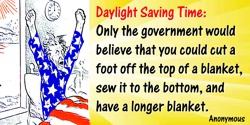
Daylight Saving Time: Only the government would believe that you could cut a foot off the top of a blanket, sew it to the bottom, and have a longer blanket.
Daylight savings time—why are they saving it, and where do they keep it?
Seen, for example, collected in Stephen Motway, Jokes, Quotes, and Other Assorted Things (2010), 327.
Daylight time, a monstrosity in timekeeping.
As quoted in David Prerau, Seize the Daylight: The Curious And Contentious Story of Daylight (2006).
De Morgan was explaining to an actuary what was the chance that a certain proportion of some group of people would at the end of a given time be alive; and quoted the actuarial formula, involving p [pi], which, in answer to a question, he explained stood for the ratio of the circumference of a circle to its diameter. His acquaintance, who had so far listened to the explanation with interest, interrupted him and exclaimed, “My dear friend, that must be a delusion, what can a circle have to do with the number of people alive at a given time?”
In Mathematical Recreations and Problems (1896), 180; See also De Morgan’s Budget of Paradoxes (1872), 172.
Death is what gives life meaning. To know your days are numbered. Your time is short.
— Movie
Spoken by character The Ancient One (actress Tilda Swinton), in movie Doctor Strange (2016).
Debunking bad science should be constant obligation of the science community, even if it takes time away from serious research or seems to be a losing battle. One takes comfort from the fact there is no Gresham’s laws in science. In the long run, good science drives out bad.
In preamble to 'Part III: Pseudoscience', The Night Is Large: Collected Essays 1938-1995 (1996), 171.
Deep beneath the surface of the Sun, enormous forces were gathering. At any moment, the energies of a million hydrogen bombs might burst forth in the awesome explosion…. Climbing at millions of miles per hour, an invisible fireball many times the size of Earth would leap from the Sun and head out across space.
From 'Sunjammer', collected in Harry Harrison (ed.), Worlds of Wonder: Sixteen Tales of Science Fiction (1969), 32-33. Originally published in Boys’ Life (Mar 1964).
Defenders of the short-sighted men who in their greed and selfishness will, if permitted, rob our country of half its charm by their reckless extermination of all useful and beautiful wild things sometimes seek to champion them by saying the “the game belongs to the people.” So it does; and not merely to the people now alive, but to the unborn people. The “greatest good for the greatest number” applies to the number within the womb of time, compared to which those now alive form but an insignificant fraction. Our duty to the whole, including the unborn generations, bids us restrain an unprincipled present-day minority from wasting the heritage of these unborn generations. The movement for the conservation of wild life and the larger movement for the conservation of all our natural resources are essentially democratic in spirit, purpose, and method.
'Bird Reserves at the Mouth of the Mississippi', A Book-Lover's Holidays in the Open (1920), 300-301.
Deprived, therefore, as regards this period, of any assistance from history, but relieved at the same time from the embarrassing interference of tradition, the archaeologist is free to follow the methods which have been so successfully pursued in geology—the rude bone and stone implements of bygone ages being to the one what the remains of extinct animals are to the other. The analogy may be pursued even further than this. Many mammalia which are extinct in Europe have representatives still living in other countries. Our fossil pachyderms, for instance, would be almost unintelligible but for the species which still inhabit some parts of Asia and Africa; the secondary marsupials are illustrated by their existing representatives in Australia and South America; and in the same manner, if we wish clearly to understand the antiquities of Europe, we must compare them with the rude implements and weapons still, or until lately, used by the savage races in other parts of the world. In fact, the Van Diemaner and South American are to the antiquary what the opossum and the sloth are to the geologist.
Pre-historic Times, as Illustrated by Ancient Remains, and the Manners and Customs of Modern Savages, (2nd ed. 1869, 1890), 429-430.
Despite the recurrence of events in which the debris-basin system fails in its struggle to contain the falling mountains, people who live on the front line are for the most part calm and complacent. It appears that no amount of front-page or prime-time attention will ever prevent such people from masking out the problem.
The Control of Nature
Developmental Biology, in capitals, is the wave of the future. The creeping reductionism of biochemistry and molecular biology has taken over the cell and heredity, and looks covetously toward the heights of development and evolution. Recent literature is last year. Ancient literature is a decade ago. The rest is history, doubtfully alive. There is no time and often no opportunity to find and study the work of experimental biologists of 50 or 100 years ago, yet that was a time when the world was fresh.
Developmental biology was a lowercase phrase that graduated about 1950 and had previously lived under the cloak of Experimental Zoology
Developmental biology was a lowercase phrase that graduated about 1950 and had previously lived under the cloak of Experimental Zoology
In obituary by Charles R. Scriver, Biographical Memoirs of Fellows of the Royal Society (Nov 1999), 45, 33.
Dickens, Twain, and Jack London, each in his own way, tried to do the same thing, it seemed to me: to show that civilization is a veneer and to warn us against accepting, without question, the soothsayers of the past. Each author was saying: Don’t hide behind these façades society has erected; don’t repeat the cliches of the past and at the same time act as savagely as your predecessors did.
Recalling his high school reading of library books. In John Scopes and James Presley, Center of the Storm: Memoirs of John T. Scopes (1967), 20.
Dirichlet was not satisfied to study Gauss’ Disquisitiones arithmetical once or several times, but continued throughout life to keep in close touch with the wealth of deep mathematical thoughts which it contains by perusing it again and again. For this reason the book was never placed on the shelf but had an abiding place on the table at which he worked. … Dirichlet was the first one, who not only fully understood this work, but made it also accessible to others.
In Dirichlet, Werke, Bd. 2, 315. As translated in Robert Édouard Moritz, Memorabilia Mathematica; Or, The Philomath’s Quotation-book (1914), 159.
Disease is not something personal and special, but only a manifestation of life under modified conditions, operating according to the same laws as apply to the living body at all times, from the first moment until death.
In Ian F. McNeely, Medicine on a Grand Scale: Rudolf Virchow, Liberalism, and the Public Health (2002), 26.
Disorder increases with time because we measure time in the direction in which disorder increases.
In 'The Direction of Time', New Scientist (9 Jul 1987), 115, No. 1568, 47. Also in 'The Arrow of Time', A Brief History of Time: From the Big Bang to Black Holes (1988, 1998), Chap. 9, 152.
Do not squander time for that is the stuff life is made of.
…...
Doctors coin money when they do procedures—family practice doesn’t have any procedures. A urologist has cystoscopies, a gastroenterologist has gastroscopies, a dermatologist has biopsies. They can do three or four of those and make five or six hundred dollars in a single day. We get nothing for the use of our time to understand the lives of our patients. Technology is rewarded in medicine, it seems to me, and not thinking.
Quoted in John McPhee, 'Heirs of General Practice,' New Yorker (23 Jul 1984), 40-85. In David Barton Smith and Arnold D. Kaluzny, The White Labyrinth (2000), 227.
Does it mean, if you don’t understand something, and the community of physicists don’t understand it, that means God did it? Is that how you want to play this game? Because if it is, here’s a list of the things in the past that the physicists—at the time—didn’t understand … [but now we do understand.] If that’s how you want to invoke your evidence for God, then God is an ever-receding pocket of scientific ignorance, that’s getting smaller and smaller and smaller, as time moves on. So just be ready for that to happen, if that’s how you want to come at the problem. That’s simply the “God of the Gaps” argument that’s been around for ever.
From interview, The Science Studio video series of The Science Network website, episode 'The Moon, the Tides and why Neil DeGrasse Tyson is Colbert’s God' (20 Jan 2011), time 26:58-27:55.
Doubly galling was the fact that at the same time my roommate was taking a history course … filled with excitement over a class discussion. … I was busy with Ampere’s law. We never had any fascinating class discussions about this law. No one, teacher or student, ever asked me what I thought about it.
In Understanding the Universe: An Inquiry Approach to Astronomy and the Nature of Scientific Research (2013), ix.
Doubtless it is true that while consciousness is occupied in the scientific interpretation of a thing, which is now and again “a thing of beauty,” it is not occupied in the aesthetic appreciation of it. But it is no less true that the same consciousness may at another time be so wholly possessed by the aesthetic appreciation as to exclude all thought of the scientific interpretation. The inability of a man of science to take the poetic view simply shows his mental limitation; as the mental limitation of a poet is shown by his inability to take the scientific view. The broader mind can take both.
In An Autobiography (1904), Vol. 1, 485.
During its development the animal passes through all stages of the animal kingdom. The foetus is a representation of all animal classes in time.
In Lorenz Oken, trans. by Alfred Tulk, Elements of Physiophilosophy (1847), 491.
During my stay in London I resided for a considerable time in Clapham Road in the neighbourhood of Clapham Common... One fine summer evening I was returning by the last bus 'outside' as usual, through the deserted streets of the city, which are at other times so full of life. I fell into a reverie (Träumerei), and 10, the atoms were gambolling before my eyes! Whenever, hitherto, these diminutive beings had appeared to me, they had always been in motion: but up to that time I had never been able to discern the nature of their motion. Now, however, I saw how, frequently, two smaller atoms united to form a pair: how the larger one embraced the two smaller ones: how still larger ones kept hold of three or even four of the smaller: whilst the whole kept whirling in a giddy dance. I saw how the larger ones formed a chain, dragging the smaller ones after them but only at the ends of the chain. I saw what our past master, Kopp, my highly honoured teacher and friend has depicted with such charm in his Molekular-Welt: but I saw it long before him. The cry of the conductor 'Clapham Road', awakened me from my dreaming: but I spent part of the night in putting on paper at least sketches of these dream forms. This was the origin of the 'Structural Theory'.
Kekule at Benzolfest in Berichte (1890), 23, 1302.
During seasons of great pestilence men have often believed the prophecies of crazed fanatics, that the end of the world was come. Credulity is always greatest in times of calamity. Prophecies of all sorts are rife on such occasions, and are readily believed, whether for good or evil.
From Memoirs of Extraordinary Popular Delusions (1841), Vol. 1, 170.
During the eighteenth and nineteenth centuries we can see the emergence of a tension that has yet to be resolved, concerning the attitude of scientists towards the usefulness of science. During this time, scientists were careful not to stress too much their relationships with industry or the military. They were seeking autonomy for their activities. On the other hand, to get social support there had to be some perception that the fruits of scientific activity could have useful results. One resolution of this dilemma was to assert that science only contributed at the discovery stage; others, industrialists for example, could apply the results. ... Few noted the ... obvious paradox of this position; that, if scientists were to be distanced from the 'evil' effects of the applications of scientific ideas, so too should they receive no credit for the 'good' or socially beneficial, effects of their activities.
Co-author with Philip Gummett (1947- ), -British social scientist
Co-author with Philip Gummett (1947- ), -British social scientist
Science, Technology and Society Today (1984), Introduction, 4.
During the first half of the present century we had an Alexander von Humboldt, who was able to scan the scientific knowledge of his time in its details, and to bring it within one vast generalization. At the present juncture, it is obviously very doubtful whether this task could be accomplished in a similar way, even by a mind with gifts so peculiarly suited for the purpose as Humboldt's was, and if all his time and work were devoted to the purpose.
In Hermann von Helmholtz and Edmund Atkinson (trans.), 'The Aim and Progress of Physical Science', Popular Scientific Lectures on Scientific Subjects (1873), 363.
During the three years which I spent at Cambridge my time was wasted, as far as the academical studies were concerned…. I attempted mathematics, … but I got on very slowly. The work was repugnant to me, chiefly from my not being able to see any meaning in the early steps in algebra. This impatience was very foolish…
In Charles Darwin and Francis Darwin (ed.), 'Autobiography', The Life and Letters of Charles Darwin (1887, 1896), Vol. 1, 40.
During the time of the Deluge, whilst the Water was out upon, and covered the Terrestrial Globe, … all Fossils whatever that had before obtained any Solidity, were totally dissolved, and their constituent Corpuscles all disjoyned, their Cohesion perfectly ceasing … [A]nd, to be short, all Bodies whatsoever that were either upon the Earth, or that constituted the Mass of it, if not quite down to the Abyss, yet at least to the greatest depth we ever dig: I say all these were assumed up promiscuously into the Water, and sustained in it, in such a manner that the Water, and Bodies in it, together made up one common confused Mass. That at length all the Mass that was thus borne up in the Water, was again precipitated and subsided towards the bottom. That this subsidence happened generally, and as near as possibly could be expected in so great a Confusion, according to the laws of Gravity.
In An Essay Toward A Natural History of the Earth (1695), 74-75.
During the time that [Karl] Landsteiner gave me an education in the field of imununology, I discovered that he and I were thinking about the serologic problem in very different ways. He would ask, What do these experiments force us to believe about the nature of the world? I would ask, What is the most. simple and general picture of the world that we can formulate that is not ruled by these experiments? I realized that medical and biological investigators were not attacking their problems the same way that theoretical physicists do, the way I had been in the habit of doing.
‘Molecular Disease’, Pfizer Spectrum (1958), 6:9, 234.
During this [book preparation] time attacks have not been wanting—we must always be prepared for them. If they grow out of a scientific soil, they cannot but be useful, by laying bare weak points and stimulating to their correction; but if they proceed from that soil, from which the lilies of innocence and the palms of conciliation should spring up, where, however, nothing but the marsh-trefoil of credulity and the poisonous water-hemlock of calumniation grow, they deserve no attention.
From Carl Vogt and James Hunt (ed.), Lectures on Man: His Place in Creation, and in the History of the Earth (1861), Author's Preface, 2-3.
Each of the major sciences has contributed an essential ingredient in our long retreat from an initial belief in our own cosmic importance. Astronomy defined our home as a small planet tucked away in one corner of an average galaxy among millions; biology took away our status as paragons created in the image of God; geology gave us the immensity of time and taught us how little of it our own species has occupied.
…...
Each species may have had its origin in a single pair, or individual, where an individual was sufficient, and species may have been created in succession at such times and in such places as to enable them to multiply and endure for an appointed period, and occupy an appointed space on the globe.
Principles of Geology(1830-3), Vol. 2, 124.
Each time one of the medicine men dies, it's as if a library has burned down.
{Referring to potential knowledge from indiginous peoples of the medicinal value of tropical plants, speaking as director of the plant program of the World Wildlife Fund and having spent many months living with the Tirio tribe on the Suriname-Brazil border.]
{Referring to potential knowledge from indiginous peoples of the medicinal value of tropical plants, speaking as director of the plant program of the World Wildlife Fund and having spent many months living with the Tirio tribe on the Suriname-Brazil border.]
Quoted in Jamie Murphy and Andrea Dorfman, 'The Quiet Apocalypse,' Time (13 Oct 1986).
Each volcano is an independent machine—nay, each vent and monticule is for the time being engaged in its own peculiar business, cooking as it were its special dish, which in due time is to be separately served. We have instances of vents within hailing distance of each other pouring out totally different kinds of lava, neither sympathizing with the other in any discernible manner nor influencing other in any appreciable degree.
In Report on the Geology of the High Plateaus of Utah (1880), 115.
Earlier theories … were based on the hypothesis that all the matter in the universe was created in one big bang at a particular time in the remote past. [Coining the “big bang” expression.]
From microfilmed Speaker's Copy of a radio script held at the BBC Written Archive Centre, for Hoyle's radio talk on the BBC Third Programme (28 Mar 1949). The date and time of the broadcast, 6:30pm, are given in that week’s Radio Times. The quote, with these references given in footnotes, in Simon Mitton, Fred Hoyle: A Life in Science (2011), 127-128 and 332. The text of the talk, the first printed use of the “big bang” expression, in the BBC’s The Listener magazine (7 Apr 1949), Vol.41, 568.
Early in my school career, I turned out to be an incorrigible disciplinary problem. I could understand what the teacher was saying as fast as she could say it, I found time hanging heavy, so I would occasionally talk to my neighbor. That was my great crime, I talked in school.
In In Memory Yet Green: the Autobiography of Isaac Asimov, 1920-1954 (1979), 73.
Education is a mechanism for inducing change and for providing the means of accommodation and adjustment to change. At the same time, as an institution, education is given the responsibility for insuring the preservation and transfer and therefore, the continuity of society’s knowledge, skills, and values.
As quoted by Luther H. Evans and George E. Arnstein (eds.), in Automation and the Challenge to Education: Proceedings of a Symposium (1962).
Education is an admirable thing, but it is well to remember from time to time that nothing that is worth knowing can be taught.
In his dialogue 'The Critic As Artist', collected in Intentions (1904), 101.
Einstein has not ... given the lie to Kant’s deep thoughts on the idealization of space and time; he has, on the contrary, made a large step towards its accomplishment.
…...
Einstein, twenty-six years old, only three years away from crude privation, still a patent examiner, published in the Annalen der Physik in 1905 five papers on entirely different subjects. Three of them were among the greatest in the history of physics. One, very simple, gave the quantum explanation of the photoelectric effect—it was this work for which, sixteen years later, he was awarded the Nobel prize. Another dealt with the phenomenon of Brownian motion, the apparently erratic movement of tiny particles suspended in a liquid: Einstein showed that these movements satisfied a clear statistical law. This was like a conjuring trick, easy when explained: before it, decent scientists could still doubt the concrete existence of atoms and molecules: this paper was as near to a direct proof of their concreteness as a theoretician could give. The third paper was the special theory of relativity, which quietly amalgamated space, time, and matter into one fundamental unity.
This last paper contains no references and quotes no authority. All of them are written in a style unlike any other theoretical physicist’s. They contain very little mathematics. There is a good deal of verbal commentary. The conclusions, the bizarre conclusions, emerge as though with the greatest of ease: the reasoning is unbreakable. It looks as though he had reached the conclusions by pure thought, unaided, without listening to the opinions of others. To a surprisingly large extent, that is precisely what he had done.
This last paper contains no references and quotes no authority. All of them are written in a style unlike any other theoretical physicist’s. They contain very little mathematics. There is a good deal of verbal commentary. The conclusions, the bizarre conclusions, emerge as though with the greatest of ease: the reasoning is unbreakable. It looks as though he had reached the conclusions by pure thought, unaided, without listening to the opinions of others. To a surprisingly large extent, that is precisely what he had done.
In Variety of Men (1966), 100-101. First published in Commentary magazine.
Einstein’s 1905 paper came out and suddenly changed people’s thinking about space-time. We’re again [2007] in the middle of something like that. When the dust settles, time—whatever it may be—could turn out to be even stranger and more illusory than even Einstein could imagine.
Quoted by Tim Folger in 'Newsflash: Time May Not Exist', Discover Magazine (Jun 2007).
Electronic aids, particularly domestic computers, will help the inner migration, the opting out of reality. Reality is no longer going to be the stuff out there, but the stuff inside your head. It's going to be commercial and nasty at the same time, like 'Rite of Spring' in Disney's Fantasia ... our internal devils may destroy and renew us through the technological overload we've invoked.
Interview in Heavy Metal (Apr 1971). Reprinted in Re/Search, No. 8/9 (1984).
Endow the already established with money. Endow the woman who shows genius with time.
In Phebe Mitchell Kendall (ed.), Maria Mitchell: Life, Letters, and Journals (1896), 182.
Entropy is time’s arrow.
Error has indeed long darkened the horizon of medical science; and albeit there have been lightnings like coruscations of genius from time to time, still they have passed away, and left the atmosphere as dark as before.
Memoirs of John Abernethy (1854), 293.
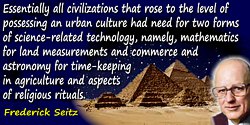
Essentially all civilizations that rose to the level of possessing an urban culture had need for two forms of science-related technology, namely, mathematics for land measurements and commerce and astronomy for time-keeping in agriculture and aspects of religious rituals.
From The Science Matrix: The Journey, Travails, Triumphs (1992, 1998), Preface, x.
Etna presents us not merely with an image of the power of subterranean heat, but a record also of the vast period of time during which that power has been exerted. A majestic mountain has been produced by volcanic action, yet the time of which the volcanic forms the register, however vast, is found by the geologist to be of inconsiderable amount, even in the modern annals of the earth’s history. In like manner, the Falls of Niagara teach us not merely to appreciate the power of moving water, but furnish us at the same time with data for estimating the enormous lapse of ages during which that force has operated. A deep and long ravine has been excavated, and the river has required ages to accomplish the task, yet the same region affords evidence that the sum of these ages is as nothing, and as the work of yesterday, when compared to the antecedent periods, of which there are monuments in the same district.
Travels in North America (1845), Vol. 1, 28-9.
Even as a coin attains its full value when it is spent, so life attains its supreme value when one knows how to forfeit it with grace when the time comes.
In The Crystal Arrow: Essays on Literature, Travel, Art, Love, and the History of Medicine (1964), 436.
Even in the dark times between experimental breakthroughs, there always continues a steady evolution of theoretical ideas, leading almost imperceptibly to changes in previous beliefs.
In Nobel Lecture (8 Dec 1989), 'Conceptual Foundations of the Unified Theory of Weak and Electromagnetic Interactions.'
Even now, the imprisoned winds which the earliest poet made the Grecian warrior bear for the protection of his fragile bark; or those which, in more modern times, the Lapland wizards sold to the deluded sailors;—these, the unreal creations of fancy or of fraud, called, at the command of science, from their shadowy existence, obey a holier spell: and the unruly masters of the poet and the seer become the obedient slaves of civilized man.
In 'Future Prospects', On the Economy of Machinery and Manufactures (1st ed., 1832), chap. 32, 280.
Even the taking of medicine serves to make time go on with less heaviness. I have a sort of genius for physic and always had great entertainment in observing the changes of the human body and the effects produced by diet, labor, rest, and physical operations.
Even those to whom Providence has allotted greater strength of understanding, can expect only to improve a single science. In every other part of learning, they must be content to follow opinions, which they are not able to examine; and, even in that which they claim as peculiarly their own, can seldom add more than some small particle of knowledge, to the hereditary stock devolved to them from ancient times, the collective labour of a thousand intellects.
In Samuel Johnson and W. Jackson Bate (Ed.), ',The Rambler, No. 121, Tuesday, 14 May 1751.' The Selected Essays from the Rambler, Adventurer, and Idler (1968), 172.
Every complete set of chromosomes contains the full code; so there are, as a rule, two copies of the latter in the fertilized egg cell, which forms the earliest stage of the future individual. In calling the structure of the chromosome fibres a code-script we mean that the all-penetrating mind, once conceived by Laplace, to which every causal connection lay immediately open, could tell from their structure whether the egg would develop, under suitable conditions, into a black cock or into a speckled hen, into a fly or a maize plant, a rhododendron, a beetle, a mouse or a woman. To which we may add, that the appearances of the egg cells are very often remarkably similar; and even when they are not, as in the case of the comparatively gigantic eggs of birds and reptiles, the difference is not so much in the relevant structures as in the nutritive material which in these cases is added for obvious reasons.
But the term code-script is, of course, too narrow. The chromosome structures are at the same time instrumental in bringing about the development they foreshadow. They are law-code and executive power?or, to use another simile, they are architect's plan and builder’s craft-in one.
But the term code-script is, of course, too narrow. The chromosome structures are at the same time instrumental in bringing about the development they foreshadow. They are law-code and executive power?or, to use another simile, they are architect's plan and builder’s craft-in one.
In What is Life? : The Physical Aspect of the Living Cell (1944), 20-21.
Every failure teaches a man something, to wit, that he will probably fail again next time.
In A Mencken Chrestomathy (1949, 1956), 617.
Every great improvement has come after repeated failures. Virtually nothing comes out right the first time. Failures, repeated failures, are finger posts on the road to achievement. One fails forward toward success.
Every honest researcher I know admits he’s just a professional amateur. He’s doing whatever he’s doing for the first time. That makes him an amateur. He has sense enough to know that he’s going to have a lot of trouble, so that makes him a professional.
…...
Every living language, like the perspiring bodies of living creatures, is in perpetual motion and alteration; some words go off, and become obsolete; others are taken in, and by degrees grow into common use; or the same word is inverted to a new sense and notion, which in tract of time makes as observable a change in the air and features of a language as age makes in the lines and mien of a face.
Every mathematician worthy of the name has experienced, if only rarely, the state of lucid exaltation in which one thought succeeds another as if miraculously… this feeling may last for hours at a time, even for days. Once you have experienced it, you are eager to repeat it but unable to do it at will, unless perhaps by dogged work….
In The Apprenticeship of a Mathematician (1992), 91.
Every new theory as it arises believes in the flush of youth that it has the long sought goal; it sees no limits to its applicability, and believes that at last it is the fortunate theory to achieve the 'right' answer. This was true of electron theory—perhaps some readers will remember a book called The Electrical Theory of the Universe by de Tunzelman. It is true of general relativity theory with its belief that we can formulate a mathematical scheme that will extrapolate to all past and future time and the unfathomed depths of space. It has been true of wave mechanics, with its first enthusiastic claim a brief ten years ago that no problem had successfully resisted its attack provided the attack was properly made, and now the disillusionment of age when confronted by the problems of the proton and the neutron. When will we learn that logic, mathematics, physical theory, are all only inventions for formulating in compact and manageable form what we already know, like all inventions do not achieve complete success in accomplishing what they were designed to do, much less complete success in fields beyond the scope of the original design, and that our only justification for hoping to penetrate at all into the unknown with these inventions is our past experience that sometimes we have been fortunate enough to be able to push on a short distance by acquired momentum.
The Nature of Physical Theory (1936), 136.
Every species has come into existence coincident both in time and space with a pre-existing closely allied species.
In 'On the Law Which has Regulated the Introduction of New Species', The Annals and Magazine of Natural History, Including Zoology, Botany and Geology (1855), 16, 186.
Every species of plant and animal is determined by a pool of germ plasm that has been most carefully selected over a period of hundreds of millions of years. We can understand now why it is that mutations in these carefully selected organisms almost invariably are detrimental.The situation can be suggested by a statement by Dr. J.B.S. Haldane: “My clock is not keeping perfect time. It is conceivable that it will run better if I shoot a bullet through it; but it is much more probable that it will stop altogether.” Professor George Beadle, in this connection, has asked: “What is the chance that a typographical error would improve Hamlet?”
In No More War! (1958), Chap. 4, 53.
Every time a significant discovery is being made one sets in motion a tremendous activity in laboratories and industrial enterprises throughout the world. It is like the ant who suddenly finds food and walks back to the anthill while sending out material called food attracting substance. The other ants follow the path immediately in order to benefit from the finding and continue to do so as long as the supply is rich.
Nobel Banquet speech (10 Dec 1982). In Wilhelm Odelberg (ed.), Les Prix Nobel. The Nobel Prizes 1982 (1983)
Every time I walk on grass, I feel sorry because I know the grass is screaming at me.
Quoted in Evelyn Fox Keller, A Feeling for the Organism: The Life and Work of Barbara McClintock (1984), 200.
Every time we get slapped down, we can say, “Thank you Mother Nature,” because it means we’re about to learn something important.
Quoted at end of article of Michael D. Lemonick and J. Madeleine Nash, 'Unraveling Universe', Time (6 Mar 1995), 145, 84.
Every time you tear a leaf off a calendar, you present a new place for new ideas and progress.
Every well established truth is an addition to the sum of human power, and though it may not find an immediate application to the economy of every day life, we may safely commit it to the stream of time, in the confident anticipation that the world will not fail to realize its beneficial results.
In 'Report of the Secretary', Annual Report of the Board of Regents of the Smithsonian Institution for 1856 (1857), 20.
Every work of science great enough to be well remembered for a few generations affords some exemplification of the defective state of the art of reasoning of the time when it was written; and each chief step in science has been a lesson in logic.
'The Fixation of Belief (1877). In Justus Buchler, The Philosophy of Pierce (1940), 6.
Everybody now wants to discover universal laws which will explain the structure and behavior of the nucleus of the atom. But actually our knowledge of the elementary particles that make up the nucleus is tiny. The situation calls for more modesty. We should first try to discover more about these elementary particles and about their laws. Then it will be the time for the major synthesis of what we really know, and the formulation of the universal law.
As quoted in Robert Coughlan, 'Dr. Edward Teller’s Magnificent Obsession', Life (6 Sep 1954), 74.
Everyone faces at all times two fateful possibilities: one is to grow older, the other not.
Everything that the greatest minds of all times have accomplished toward the comprehension of forms by means of concepts is gathered into one great science, mathematics.
In 'Pestalozzi's Idee eines A B C der Anschauung', Werke[Kehrbach] (1890), Bd.l, 163. As quoted, cited and translated in Robert Édouard Moritz, Memorabilia Mathematica; Or, The Philomath’s Quotation-Book (1914), 5.
Evolution in the biosphere is therefore a necessarily irreversible process defining a direction in time; a direction which is the same as that enjoined by the law of increasing entropy, that is to say, the second law of thermodynamics. This is far more than a mere comparison: the second law is founded upon considerations identical to those which establish the irreversibility of evolution. Indeed, it is legitimate to view the irreversibility of evolution as an expression of the second law in the biosphere.
In Jacques Monod and Austryn Wainhouse (trans.), Chance and Necessity: An Essay on the Natural Philosophy of Modern Biology (1971), 123.
Evolution is the conviction that organisms developed their current forms by an extended history of continual transformation, and that ties of genealogy bind all living things into one nexus. Panselectionism is a denial of history, for perfection covers the tracks of time. A perfect wing may have evolved to its current state, but it may have been created just as we find it. We simply cannot tell if perfection be our only evidence. As Darwin himself understood so well, the primary proofs of evolution are oddities and imperfections that must record pathways of historical descent–the panda’s thumb and the flamingo’s smile of my book titles (chosen to illustrate this paramount principle of history).
…...
Evolution is the law of policies: Darwin said it, Socrates endorsed it, Cuvier proved it and established it for all time in his paper on 'The Survival of the Fittest.' These are illustrious names, this is a mighty doctrine: nothing can ever remove it from its firm base, nothing dissolve it, but evolution.
'Three Thousand Years Among the Microbes', Which Was the Dream? (1967), Chap. 8. In Mark Twain and Brian Collins (ed.), When in Doubt, Tell the Truth: and Other Quotations from Mark Twain (1996), 47.
Evolution: At the Mind's Cinema
I turn the handle and the story starts:
Reel after reel is all astronomy,
Till life, enkindled in a niche of sky,
Leaps on the stage to play a million parts.
Life leaves the slime and through all ocean darts;
She conquers earth, and raises wings to fly;
Then spirit blooms, and learns how not to die,-
Nesting beyond the grave in others' hearts.
I turn the handle: other men like me
Have made the film: and now I sit and look
In quiet, privileged like Divinity
To read the roaring world as in a book.
If this thy past, where shall they future climb,
O Spirit, built of Elements and Time?
I turn the handle and the story starts:
Reel after reel is all astronomy,
Till life, enkindled in a niche of sky,
Leaps on the stage to play a million parts.
Life leaves the slime and through all ocean darts;
She conquers earth, and raises wings to fly;
Then spirit blooms, and learns how not to die,-
Nesting beyond the grave in others' hearts.
I turn the handle: other men like me
Have made the film: and now I sit and look
In quiet, privileged like Divinity
To read the roaring world as in a book.
If this thy past, where shall they future climb,
O Spirit, built of Elements and Time?
'Evolution: At the Mind's Cinema' (1922), in The Captive Shrew and Other Poems of a Biologist (1932), 55.
Examining this water...I found floating therein divers earthy particles, and some green streaks, spirally wound serpent-wise...and I judge that some of these little creatures were above a thousand times smaller than the smallest ones I have ever yet seen, upon the rind of cheese, in wheaten flour, mould, and the like.
[The first recorded observation of protozoa.]
[The first recorded observation of protozoa.]
Letter to the Royal Society, London (7 Sep 1674). In John Carey, Eyewitness to Science (1997), 28.
Experimental investigation, to borrow a phrase employed by Kepler respecting the testing of hypotheses, is “a very great thief of time.” Sometimes it costs many days to determine a fact that can be stated in a line.
In preface to Scientific Memoirs (1878), xi.
Experimental physicists … walk a narrow path with pitfalls on either side. If we spend all our time developing equipment, we risk the appellation of “plumber,” and if we merely use the tools developed by others, we risk the censure of our peers for being parasitic.
In Nobel Lecture (11 Dec 1968), 'Recent Developments in Particle Physics', collected in Nobel Lectures: Physics 1963-1970 (1972), 241.
Experiments in geology are far more difficult than in physics and chemistry because of the greater size of the objects, commonly outside our laboratories, up to the earth itself, and also because of the fact that the geologic time scale exceeds the human time scale by a million and more times. This difference in time allows only direct observations of the actual geologic processes, the mind having to imagine what could possibly have happened in the past.
In 'The Scientific Character of Geology', The Journal of Geology (Jul 1961), 69, No. 4, 455-6.
Failure is so much more interesting because you learn from it. That’s what we should be teaching children at school, that being successful the first time, there’s nothing in it. There’s no interest, you learn nothing actually.
Interview with Carole Cadwalladr, The Observer (9 May 2014).
False facts are highly injurious to the progress of science, for they often long endure; but false views, if supported by some evidence, do little harm, as every one takes a salutary pleasure in proving their falseness; and when this is done, one path towards error is closed and the road to truth is often at the same time opened.
The Descent of Man (1871), Vol. 2, 385.
Far be it from me to suggest that geologists should be reckless in their drafts upon the bank of Time; but nothing whatever is gained, and very much is lost, by persistent niggardliness in this direction.
Proceedings of the Geological Society of London (1903), 59, lxxii.
Far from becoming discouraged, the philosopher should applaud nature, even when she appears miserly of herself or overly mysterious, and should feel pleased that as he lifts one part of her veil, she allows him to glimpse an immense number of other objects, all worthy of investigation. For what we already know should allow us to judge of what we will be able to know; the human mind has no frontiers, it extends proportionately as the universe displays itself; man, then, can and must attempt all, and he needs only time in order to know all. By multiplying his observations, he could even see and foresee all phenomena, all of nature's occurrences, with as much truth and certainty as if he were deducing them directly from causes. And what more excusable or even more noble enthusiasm could there be than that of believing man capable of recognizing all the powers, and discovering through his investigations all the secrets, of nature!
'Des Mulets', Oeuvres Philosophiques, ed. Jean Piveteau (1954), 414. Quoted in Jacques Roger, The Life Sciences in Eighteenth-Century French Thought, ed. Keith R. Benson and trans. Robert Ellrich (1997), 458.
Faraday thinks from day to day, against a background of older thinking, and anticipating new facts of tomorrow. In other words, he thinks in three dimensions of time; past, present, and future.
In 'The Scientific Grammar of Michael Faraday’s Diaries', Part I, 'The Classic of Science', A Classic and a Founder (1937), collected in Rosenstock-Huessy Papers (1981), Vol. 1, 1.
FAUSTUS: How many heavens or spheres are there?
MEPHASTOPHILIS: Nine: the seven planets, the firmament, and the empyreal heaven.
FAUSTUS: But is there not coelum igneum, et crystallinum?
MEPH.: No Faustus, they be but fables.
FAUSTUS: Resolve me then in this one question: Why are not conjunctions, oppositions, aspects, eclipses all at one time, but in some years we have more, in some less?
MEPH.: Per inaequalem motum respectu totius.
FAUSTUS: Well, I am answered. Now tell me who made the world.
MEPH.: I will not.
FAUSTUS: Sweet Mephastophilis, tell me.
MEPH.: Move me not, Faustus.
FAUSTUS: Villain, have I not bound thee to tell me any thing?
MEPH.: Ay, that is not against our kingdom.
This is. Thou are damn'd, think thou of hell.
FAUSTUS: Think, Faustus, upon God that made the world!
MEPH.: Remember this.
MEPHASTOPHILIS: Nine: the seven planets, the firmament, and the empyreal heaven.
FAUSTUS: But is there not coelum igneum, et crystallinum?
MEPH.: No Faustus, they be but fables.
FAUSTUS: Resolve me then in this one question: Why are not conjunctions, oppositions, aspects, eclipses all at one time, but in some years we have more, in some less?
MEPH.: Per inaequalem motum respectu totius.
FAUSTUS: Well, I am answered. Now tell me who made the world.
MEPH.: I will not.
FAUSTUS: Sweet Mephastophilis, tell me.
MEPH.: Move me not, Faustus.
FAUSTUS: Villain, have I not bound thee to tell me any thing?
MEPH.: Ay, that is not against our kingdom.
This is. Thou are damn'd, think thou of hell.
FAUSTUS: Think, Faustus, upon God that made the world!
MEPH.: Remember this.
Doctor Faustus: A 1604-Version Edition, edited by Michael Keefer (1991), Act II, Scene iii, lines 60-77, 43-4.
Few people think more than two or three times a year. I have made an international reputation for myself by thinking once or twice a week.
As given in 'Quotable Quotes', Reader’s Digest (May 1933). It does not appear in a work written by Shaw. It may have been contributed to the magazine as a personal recollection, though that is not specified in that source.
Few will deny that even in the first scientific instruction in mathematics the most rigorous method is to be given preference over all others. Especially will every teacher prefer a consistent proof to one which is based on fallacies or proceeds in a vicious circle, indeed it will be morally impossible for the teacher to present a proof of the latter kind consciously and thus in a sense deceive his pupils. Notwithstanding these objectionable so-called proofs, so far as the foundation and the development of the system is concerned, predominate in our textbooks to the present time. Perhaps it will be answered, that rigorous proof is found too difficult for the pupil’s power of comprehension. Should this be anywhere the case,—which would only indicate some defect in the plan or treatment of the whole,—the only remedy would be to merely state the theorem in a historic way, and forego a proof with the frank confession that no proof has been found which could be comprehended by the pupil; a remedy which is ever doubtful and should only be applied in the case of extreme necessity. But this remedy is to be preferred to a proof which is no proof, and is therefore either wholly unintelligible to the pupil, or deceives him with an appearance of knowledge which opens the door to all superficiality and lack of scientific method.
In 'Stücke aus dem Lehrbuche der Arithmetik', Werke, Bd. 2 (1904), 296.
Finally, I aim at giving denominations to things, as agreeable to truth as possible. I am not ignorant that words, like money, possess an ideal value, and that great danger of confusion may be apprehended from a change of names; in the mean time it cannot be denied that chemistry, like the other sciences, was formerly filled with improper names. In different branches of knowledge, we see those matters long since reformed: why then should chemistry, which examines the real nature of things, still adopt vague names, which suggest false ideas, and favour strongly of ignorance and imposition? Besides, there is little doubt but that many corrections may be made without any inconvenience.
Physical and Chemical Essays (1784), Vol. I, xxxvii.
Finally, since I thought that we could have all the same thoughts, while asleep, as we have while we are awake, although none of them is true at that time, I decided to pretend that nothing that ever entered my mind was any more true than the illusions of my dreams. But I noticed, immediately afterwards, that while I thus wished to think that everything was false, it was necessarily the case that I, who was thinking this, was something. When I noticed that this truth “I think, therefore I am” was so firm and certain that all the most extravagant assumptions of the sceptics were unable to shake it, I judged that I could accept it without scruple as the first principle of the philosophy for which I was searching. Then, when I was examining what I was, I realized that I could pretend that I had no body, and that there was no world nor any place in which I was present, but I could not pretend in the same way that I did not exist. On the contrary, from the very fact that I was thinking of doubting the truth of other things, it followed very evidently and very certainly that I existed; whereas if I merely ceased to think, even if all the rest of what I had ever imagined were true, I would have no reason to believe that I existed. I knew from this that I was a substance, the whole essence or nature of which was to think and which, in order to exist, has no need of any place and does not depend on anything material. Thus this self—that is, the soul by which I am what I am—is completely distinct from the body and is even easier to know than it, and even if the body did not exist the soul would still be everything that it is.
Discourse on Method in Discourse on Method and Related Writings (1637), trans. Desmond M. Clarke, Penguin edition (1999), Part 4, 24-5.
Fires from beneath, and meteors from above,
Portentous, unexampled, unexplain'd,
Have kindled beacons in the skies; and th' old
And crazy earth has had her shaking fits
More frequent, and foregone her usual rest.
Is it a time to wrangle, when the props
And pillars of our planet seem to fail,
And nature, with a dim and sickly eye,
To wait the close of all?
Alluding the meteors of 17 Aug 1883.
Portentous, unexampled, unexplain'd,
Have kindled beacons in the skies; and th' old
And crazy earth has had her shaking fits
More frequent, and foregone her usual rest.
Is it a time to wrangle, when the props
And pillars of our planet seem to fail,
And nature, with a dim and sickly eye,
To wait the close of all?
Alluding the meteors of 17 Aug 1883.
'The Time-Piece,' Task, Book ii, lines 58-66. In William Cowper, Henry Francis Cary, The Poetical Works of William Cowper (1863), 52-53.
First I would like to wash Bunsen, and then I would like to kiss him because he is such a charming man.
Remark by the wife of Emil Fischer, upon meeting Bunsen for the first time, perhaps noticing a lasting chemical odour from his work.
Remark by the wife of Emil Fischer, upon meeting Bunsen for the first time, perhaps noticing a lasting chemical odour from his work.
Quoted in E. Fischer, Aus meinem Leben (1923). Trans. W. H. Brock.
First Law
In every animal which has not passed the limit of its development, a more frequent and continuous use of any organ gradually strengthens, develops and enlarges that organ, and gives it a power proportional to the length of time it has been so used; while the permanent disuse of any organ imperceptibly weakens and deteriorates it, and progressively diminishes its functional capacity, until it finally disappears.
In every animal which has not passed the limit of its development, a more frequent and continuous use of any organ gradually strengthens, develops and enlarges that organ, and gives it a power proportional to the length of time it has been so used; while the permanent disuse of any organ imperceptibly weakens and deteriorates it, and progressively diminishes its functional capacity, until it finally disappears.
Philosophie Zoologique (1809), Vol. 1, 235, trans. Hugh Elliot (1914), 113.
First, by what means it is that a Plant, or any Part of it, comes to Grow, a Seed to put forth a Root and Trunk... How the Aliment by which a Plant is fed, is duly prepared in its several Parts ... How not only their Sizes, but also their Shapes are so exceedingly various ... Then to inquire, What should be the reason of their various Motions; that the Root should descend; that its descent should sometimes be perpendicular, sometimes more level: That the Trunk doth ascend, and that the ascent thereof, as to the space of Time wherein it is made, is of different measures... Further, what may be the Causes as of the Seasons of their Growth; so of the Periods of their Lives; some being Annual, others Biennial, others Perennial ... what manner the Seed is prepared, formed and fitted for Propagation.
'An Idea of a Philosophical History of Plants', in The Anatomy of Plants With an Idea of a Philosophical History of Plants and Several Other Lectures Read Before the Royal Society (1682), 3-4.
First, the chief character, who is supposed to be a professional astronomer, spends his time fund raising and doing calculations at his desk, rather than observing the sky. Second, the driving force of a scientific project is institutional self-aggrandizement rather than intellectual curiosity.
[About the state of affairs in academia.]
[About the state of affairs in academia.]
In Marc J. Madou, Fundamentals of Microfabrication: the Science of Miniaturization (2nd ed., 2002), 535
Florey was not an easy personality. His drive and ambition were manifest from the day he arrived ... He could be ruthless and selfish; on the other hand, he could show kindliness, a warm humanity and, at times, sentiment and a sense of humour. He displayed utter integrity and he was scathing of humbug and pretence. His attitude was always—“You must take me as you find me.” But to cope with him at times, you had to do battle, raise your voice as high as his and never let him shout you down. You had to raise your pitch to his but if you insisted on your right he was always, in the end, very fair. I must say that at times, he went out of his way to cut people down to size with some very destructive criticism. But I must also say in the years I knew him he did not once utter a word of praise about himself.
Personal communication (1970) to Florey's Australian biographer, Lennard Bickel. By letter, Drury described his experience as a peer, being a research collaborator while Florey held a Studentship at Cambridge in the 1920s. This quote appears without naming Drury, in Eric Lax, The Mold in Dr. Florey's Coat: The Story of the Penicillin Miracle (2004), 40. Dury is cited in Lennard Bickel, Rise Up to Life: A Biography of Howard Walter Florey Who Gave Penicillin to the World (1972), 24. Also in Eric Lax
Food may be defined as material which, when taken into the body, serves to either form tissue or yield energy, or both. This definition includes all the ordinary food materials, since they both build tissue and yield energy. It includes sugar and starch, because they yield energy and form fatty tissue. It includes alcohol, because the latter is burned to yield energy, though it does not build tissue. It excludes creatin, creatininin, and other so-called nitrogeneous extractives of meat, and likewise thein or caffein of tea and coffee, because they neither build tissue nor yield energy, although they may, at times, be useful aids to nutrition.
Methods and Results of Investigations on the Chemistry and Economy of Food, Bulletin 21, US Department of Agriculture (1895). Quoted in Ira Wolinsky, Nutrition in Exercise and Sport (1998), 36.
For a long time it has been known that the first systems of representations with which men have pictured to themselves the world and themselves were of religious origin. There is no religion that is not a cosmology at the same time that it is a speculation upon divine things. If philosophy and the sciences were born of religion, it is because religion began by taking the place of the sciences and philosophy.
The Elementary Forms of the Religious Life (1912), trans. J. W. Swain (2nd edition 1976), 9.
For all at last return to the sea—to Oceanus, the ocean river, like the ever-flowing stream of time, the beginning of the end.
…...
For all these years you were merely
A smear of light through our telescopes
On the clearest, coldest night; a hint
Of a glint, just a few pixels wide
On even your most perfectly-framed portraits.
But now, now we see you!
Swimming out of the dark - a great
Stone shark, your star-tanned skin pitted
And pocked, scarred after eons of drifting
Silently through the endless ocean of space.
Here on Earth our faces lit up as we saw
You clearly for the first time; eyes wide
With wonder we traced the strangely familiar
Grooves raked across your sides,
Wondering if Rosetta had doubled back to Mars
And raced past Phobos by mistake –
Then you were gone, falling back into the black,
Not to be seen by human eyes again for a thousand
Blue Moons or more. But we know you now,
We know you; you’ll never be just a speck of light again.
A smear of light through our telescopes
On the clearest, coldest night; a hint
Of a glint, just a few pixels wide
On even your most perfectly-framed portraits.
But now, now we see you!
Swimming out of the dark - a great
Stone shark, your star-tanned skin pitted
And pocked, scarred after eons of drifting
Silently through the endless ocean of space.
Here on Earth our faces lit up as we saw
You clearly for the first time; eyes wide
With wonder we traced the strangely familiar
Grooves raked across your sides,
Wondering if Rosetta had doubled back to Mars
And raced past Phobos by mistake –
Then you were gone, falling back into the black,
Not to be seen by human eyes again for a thousand
Blue Moons or more. But we know you now,
We know you; you’ll never be just a speck of light again.
…...
For FRICTION is inevitable because the Universe is FULL of God's works.
For the PERPETUAL MOTION is in all works of Almighty GOD.
For it is not so in the engines of man, which are made of dead materials, neither indeed can be.
For the Moment of bodies, as it is used, is a false term—bless God ye Speakers on the Fifth of November.
For Time and Weight are by their several estimates.
For I bless GOD in the discovery of the LONGITUDE direct by the means of GLADWICK.
For the motion of the PENDULUM is the longest in that it parries resistance.
For the WEDDING GARMENTS of all men are prepared in the SUN against the day of acceptation.
For the wedding Garments of all women are prepared in the MOON against the day of their purification.
For CHASTITY is the key of knowledge as in Esdras, Sir Isaac Newton & now, God be praised, in me.
For Newton nevertheless is more of error than of the truth, but I am of the WORD of GOD.
For the PERPETUAL MOTION is in all works of Almighty GOD.
For it is not so in the engines of man, which are made of dead materials, neither indeed can be.
For the Moment of bodies, as it is used, is a false term—bless God ye Speakers on the Fifth of November.
For Time and Weight are by their several estimates.
For I bless GOD in the discovery of the LONGITUDE direct by the means of GLADWICK.
For the motion of the PENDULUM is the longest in that it parries resistance.
For the WEDDING GARMENTS of all men are prepared in the SUN against the day of acceptation.
For the wedding Garments of all women are prepared in the MOON against the day of their purification.
For CHASTITY is the key of knowledge as in Esdras, Sir Isaac Newton & now, God be praised, in me.
For Newton nevertheless is more of error than of the truth, but I am of the WORD of GOD.
From 'Jubilate Agno' (c.1758-1763), in N. Callan (ed.), The Collected Poems of Christopher Smart (1949), Vol. 1, 276.
For God’s sake, please give it up. Fear it no less than the sensual passion, because it, too, may take up all your time and deprive you of your health, peace of mind and happiness in life.
Having himself spent a lifetime unsuccessfully trying to prove Euclid's postulate that parallel lines do not meet, Farkas discouraged his son János from any further attempt.
Having himself spent a lifetime unsuccessfully trying to prove Euclid's postulate that parallel lines do not meet, Farkas discouraged his son János from any further attempt.
Letter (1820) to his son, János Bolyai. Translation as in Philip J. Davis and Reuben Hersh, The Mathematical Experience (1981), 220. In Bill Swainson, Encarta Book of Quotations (2000), 124.
For mathematics, in a wilderness of tragedy and change, is a creature of the mind, born to the cry of humanity in search of an invariant reality, immutable in substance, unalterable with time.
In The American Mathematical Monthly (1949), 56, 19. Excerpted in John Ewing (ed,), A Century of Mathematics: Through the Eyes of the Monthly (1996), 186.
For myself, I found that I was fitted for nothing so well as for the study of Truth; as having a mind nimble and versatile enough to catch the resemblances of things (which is the chief point) , and at the same time steady enough to fix and distinguish their subtler differences; as being gifted by nature with desire to seek, patience to doubt, fondness to meditate, slowness to assert, readiness to reconsider, carefulness to dispose and set in order; and as being a man that neither affects what is new nor admires what is old, and that hates every kind of imposture. So I thought my nature had a kind of familiarity and relationship with Truth.
From 'Progress of philosophical speculations. Preface to intended treatise De Interpretatione Naturæ (1603), in Francis Bacon and James Spedding (ed.), Works of Francis Bacon (1868), Vol. 3, 85.
For myself, I like a universe that, includes much that is unknown and, at the same time, much that is knowable. A universe in which everything is known would be static and dull, as boring as the heaven of some weak-minded theologians. A universe that is unknowable is no fit place for a thinking being. The ideal universe for us is one very much like the universe we inhabit. And I would guess that this is not really much of a coincidence.
Concluding paragraph, 'Can We know the Universe? Reflections on a Grain of Salt', Broca's Brain (1979, 1986), 21.
For strictly scientific or technological purposes all this is irrelevant. On a pragmatic view, as on a religious view, theory and concepts are held in faith. On the pragmatic view the only thing that matters is that the theory is efficacious, that it “works” and that the necessary preliminaries and side issues do not cost too much in time and effort. Beyond that, theory and concepts go to constitute a language in which the scientistic matters at issue can be formulated and discussed.
In Nobel Lecture (8 Dec 1994), 'Slow Neutron Spectroscopy and the Grand Atlas of the Physical World', Nobel Lectures: Physics 1991-1995 (1997), 111.
For the time of making Observations none can ever be amiss; there being no season, nor indeed hardly any place where in some Natural Thing or other does not present it self worthy of Remark: yea there are some things that require Observation all the Year round, as Springs, Rivers, &c. Nor is there any Season amiss for the gathering Natural Things. Bodies of one kind or other presenting themselves at all times, and in Winter as well as Summer.
In Brief Instructions for Making Observations in all Parts of the World (1696), 10-11.
For the first time I saw a medley of haphazard facts fall into line and order. All the jumbles and recipes and Hotchpotch of the inorganic chemistry of my boyhood seemed to fit into the scheme before my eyes-as though one were standing beside a jungle and it suddenly transformed itself into a Dutch garden. “But it’s true,” I said to myself “It’s very beautiful. And it’s true.”
How the Periodic Table was explained in a first-term university lecture to the central character in the novel by C.P. Snow, The Search (1935), 38.
For the first time in my life I saw the horizon as a curved line. It was accentuated by a thin seam of dark blue light - our atmosphere. Obviously this was not the ocean of air I had been told it was so many times in my life. I was terrified by its fragile appearance.
…...
For the first time in our national history the higher-education enterprise that we pass on to our children and grandchildren will be less healthy, less able to respond to national needs … than the enterprise that we ourselves inherited.
For the first time there was constructed with this machine [locomotive engine] a self-acting mechanism in which the interplay of forces took shape transparently enough to discern the connection between the heat generated and the motion produced. The great puzzle of the vital force was also immediately solved for the physiologist in that it became evident that it is more than a mere poetic comparison when one conceives of the coal as the food of the locomotive and the combustion as the basis for its life.
'Leid und Freude in der Naturforschung', Die Gartenlaube (1870), 359. Trans. Kenneth L. Caneva, Robert Mayer and the Conservation of Energy (1993), 145.
For the most part, Western medicine doctors are not healers, preventers, listeners, or educators. But they're damned good at saving a life and the other aspects kick the beam. It's about time we brought some balance back to the scale.
For the philosopher, order is the entirety of repetitions manifested, in the form of types or of laws, by perceived objects. Order is an intelligible relation. For the biologist, order is a sequence in space and time. However, according to Plato, all things arise out of their opposites. Order was born of the original disorder, and the long evolution responsible for the present biological order necessarily had to engender disorder.
An organism is a molecular society, and biological order is a kind of social order. Social order is opposed to revolution, which is an abrupt change of order, and to anarchy, which is the absence of order.
I am presenting here today both revolution and anarchy, for which I am fortunately not the only one responsible. However, anarchy cannot survive and prosper except in an ordered society, and revolution becomes sooner or later the new order. Viruses have not failed to follow the general law. They are strict parasites which, born of disorder, have created a very remarkable new order to ensure their own perpetuation.
An organism is a molecular society, and biological order is a kind of social order. Social order is opposed to revolution, which is an abrupt change of order, and to anarchy, which is the absence of order.
I am presenting here today both revolution and anarchy, for which I am fortunately not the only one responsible. However, anarchy cannot survive and prosper except in an ordered society, and revolution becomes sooner or later the new order. Viruses have not failed to follow the general law. They are strict parasites which, born of disorder, have created a very remarkable new order to ensure their own perpetuation.
'Interaction Among Virus, Cell, and Organism', Nobel Lecture (11 Dec 1965). In Nobel Lectures: Physiology or Medicine 1963-1970 (1972), 174.
For these two years I have been gravitating towards your doctrines, and since the publication of your primula paper with accelerated velocity. By about this time next year I expect to have shot past you, and to find you pitching into me for being more Darwinian than yourself. However, you have set me going, and must just take the consequences, for I warn you I will stop at no point so long as clear reasoning will take me further.
Thomas Henry Huxley, Leonard Huxley, Life and Letters of Thomas Henry Huxley (1901), 211.
For they are not given to idleness, nor go in a proud habit, or plush and velvet garments, often showing their rings upon their fingers, or wearing swords with silver hilts by their sides, or fine and gay gloves upon their hands, but diligently follow their labours, sweating whole days and nights by their furnaces. They do not spend their time abroad for recreation, but take delight in their laboratory. They wear leather garments with a pouch, and an apron wherewith they wipe their hands. They put their fingers amongst coals, into clay, and filth, not into gold rings. They are sooty and black like smiths and colliers, and do not pride themselves upon clean and beautiful faces.
As translated in Paracelsus and Arthur Edward Waite (ed.), The Hermetic and Alchemical Writings of Paracelsus (1894, 1976), Vol. 1, 167.
For thousands of years men have striven and suffered and begotten and woman have brought forth in pain. A hundred years ago, perhaps, another man sat on this spot; like you he gazed with awe and yearning in his heart at the dying light on the glaciers. Like you he was begotten of man and born of woman. He felt pain and brief joy as you do. Was he someone else? Was it not you yourself? What is this Self of yours? What was the necessary condition for making the thing conceived this time into you, just you and not someone else?
In Seek for the Road (1925). Quoted in Ken Wilber, Quantum Questions (1984), 96-97.
For, every time a certain portion is destroyed, be it of the brain or of the spinal cord, a function is compelled to cease suddenly, and before the time known beforehand when it would stop naturally, it is certain that this function depends upon the area destroyed. It is in this way that I have recognized that the prime motive power of respiration has its seat in that part of the medulla oblongata that gives rise to the nerves of the eighth pair [vagi]; and it is by this method that up to a certain point it will be possible to discover the use of certain parts of the brain.
Expériences sur le Principe de la Vie, Notamment sur celui des Mouvements du Coeur, et sur le Siege de ce Principe (1812), 148-149. Translated in Edwin Clarke and L. S. Jacyna, Nineteenth Century Origins of Neuroscientific Concepts (1987), 247.
Force, force, everywhere force; we ourselves a mysterious force in the centre of that. “There is not a leaf rotting on the highway but has Force in it: how else could it rot?” [As used in his time, by the word force, Carlyle means energy.]
On Heroes, Hero-Worship and the Heroic in History (1840), 11.
Foreshadowings of the principles and even of the language of [the infinitesimal] calculus can be found in the writings of Napier, Kepler, Cavalieri, Pascal, Fermat, Wallis, and Barrow. It was Newton's good luck to come at a time when everything was ripe for the discovery, and his ability enabled him to construct almost at once a complete calculus.
In History of Mathematics (3rd Ed., 1901), 366.
Fortunately Nature herself seems to have prepared for us the means of supplying that want which arises from the impossibility of making certain experiments on living bodies. The different classes of animals exhibit almost all the possible combinations of organs: we find them united, two and two, three and three, and in all proportions; while at the same time it may be said that there is no organ of which some class or some genus is not deprived. A careful examination of the effects which result from these unions and privations is therefore sufficient to enable us to form probable conclusions respecting the nature and use of each organ, or form of organ. In the same manner we may proceed to ascertain the use of the different parts of the same organ, and to discover those which are essential, and separate them from those which are only accessory. It is sufficient to trace the organ through all the classes which possess it, and to examine what parts constantly exist, and what change is produced in the respective functions of the organ, by the absence of those parts which are wanting in certain classes.
Letter to Jean Claude Mertrud. In Lectures on Comparative Anatomy (1802), Vol. I, xxiii--xxiv.
Fortunately science, like that nature to which it belongs, is neither limited by time nor by space. It belongs to the world, and is of no country and of no age. The more we know, the more we feel our ignorance; the more we feel how much remains unknown; and in philosophy, the sentiment of the Macedonian hero can never apply,– there are always new worlds to conquer.
…...
Four college students taking a class together, had done so well through the semester, and each had an “A”. They were so confident, the weekend before finals, they went out partying with friends. Consequently, on Monday, they overslept and missed the final. They explained to the professor that they had gone to a remote mountain cabin for the weekend to study, but, unfortunately, they had a flat tire on the way back, didn’t have a spare, and couldn’t get help for a long time. As a result, they missed the final. The professor kindly agreed they could make up the final the following day. When they arrived the next morning, he placed them each in separate rooms, handed each one a test booklet, and told them to begin. The the first problem was simple, worth 5 points. Turning the page they found the next question, written: “(For 95 points): Which tire?”
Four years ago nobody but nuclear physicists had ever heard of the Internet. Today even my cat, Socks, has his own web page. I’m amazed at that. I meet kids all the time, been talking to my cat on the Internet.
Referring to the Next Generation Internet initiative in Remarks at Ohio State University in Columbus, Ohio (29 Oct 1996). American Presidency Project web page. [Clinton took office 20 Jan 1993, and signed the Next Generation Internet Research Act of 1998 on 28 Oct 1998.]
Fractal is a word invented by Mandelbrot to bring together under one heading a large class of objects that have [played] … an historical role … in the development of pure mathematics. A great revolution of ideas separates the classical mathematics of the 19th century from the modern mathematics of the 20th. Classical mathematics had its roots in the regular geometric structures of Euclid and the continuously evolving dynamics of Newton. Modern mathematics began with Cantor’s set theory and Peano’s space-filling curve. Historically, the revolution was forced by the discovery of mathematical structures that did not fit the patterns of Euclid and Newton. These new structures were regarded … as “pathological,” .… as a “gallery of monsters,” akin to the cubist paintings and atonal music that were upsetting established standards of taste in the arts at about the same time. The mathematicians who created the monsters regarded them as important in showing that the world of pure mathematics contains a richness of possibilities going far beyond the simple structures that they saw in Nature. Twentieth-century mathematics flowered in the belief that it had transcended completely the limitations imposed by its natural origins.
Now, as Mandelbrot points out, … Nature has played a joke on the mathematicians. The 19th-century mathematicians may not have been lacking in imagination, but Nature was not. The same pathological structures that the mathematicians invented to break loose from 19th-century naturalism turn out to be inherent in familiar objects all around us.
Now, as Mandelbrot points out, … Nature has played a joke on the mathematicians. The 19th-century mathematicians may not have been lacking in imagination, but Nature was not. The same pathological structures that the mathematicians invented to break loose from 19th-century naturalism turn out to be inherent in familiar objects all around us.
From 'Characterizing Irregularity', Science (12 May 1978), 200, No. 4342, 677-678. Quoted in Benoit Mandelbrot, The Fractal Geometry of Nature (1977, 1983), 3-4.
Fractals are patterns which occur on many levels. This concept can be applied to any musical parameter. I make melodic fractals, where the pitches of a theme I dream up are used to determine a melodic shape on several levels, in space and time. I make rhythmic fractals, where a set of durations associated with a motive get stretched and compressed and maybe layered on top of each other. I make loudness fractals, where the characteristic loudness of a sound, its envelope shape, is found on several time scales. I even make fractals with the form of a piece, its instrumentation, density, range, and so on. Here I’ve separated the parameters of music, but in a real piece, all of these things are combined, so you might call it a fractal of fractals.
Interview (1999) on The Discovery Channel. As quoted by Benoit B. Manelbrot and Richard Hudson in The (Mis)Behaviour of Markets: A Fractal View of Risk, Ruin and Reward (2010), 133.
Freeman’s gift? It’s cosmic. He is able to see more interconnections between more things than almost anybody. He sees the interrelationships, whether it’s in some microscopic physical process or in a big complicated machine like Orion. He has been, from the time he was in his teens, capable of understanding essentially anything that he’s interested in. He’s the most intelligent person I know.
As quoted in Kenneth Brower, 'The Danger of Cosmic Genius', The Atlantic (Dec 2010). Webmaster note: The Orion Project was a study of the possibility of nuclear powered propulsion of spacecraft.
From that night on, the electron—up to that time largely the plaything of the scientist—had clearly entered the field as a potent agent in the supplying of man's commercial and industrial needs… The electronic amplifier tube now underlies the whole art of communications, and this in turn is at least in part what has made possible its application to a dozen other arts. It was a great day for both science and industry when they became wedded through the development of the electronic amplifier tube.
The Autobiography of Robert A. Millikan (1951), 136.
From the level of pragmatic, everyday knowledge to modern natural science, the knowledge of nature derives from man’s primary coming to grips with nature; at the same time it reacts back upon the system of social labour and stimulates its development.
…...
From the time of Aristotle it had been said that man is a social animal: that human beings naturally form communities. I couldn’t accept it. The whole of history and pre-history is against it. The two dreadful world wars we have recently been through, and the gearing of our entire economy today for defensive war belie it. Man's loathsome cruelty to man is his most outstanding characteristic; it is explicable only in terms of his carnivorous and cannibalistic origin. Robert Hartmann pointed out that both rude and civilised peoples show unspeakable cruelty to one another. We call it inhuman cruelty; but these dreadful things are unhappily truly human, because there is nothing like them in the animal world. A lion or tiger kills to eat, but the indiscriminate slaughter and calculated cruelty of human beings is quite unexampled in nature, especially among the apes. They display no hostility to man or other animals unless attacked. Even then their first reaction is to run away.
In Africa's Place In the Emergence of Civilisation (1959), 41.
From this time everything was copulated. Acetic, formic, butyric, margaric, &c., acids, alkaloids, ethers, amides, anilides, all became copulated bodies. So that to make acetanilide, for example, they no longer employed acetic acid and aniline, but they re-copulated a copulated oxalic acid with a copulated ammonia. I am inventing nothing—altering nothing. Is it my fault if, when writing history, I appear to be composing a romance?
Chemical Method (1855), 204.
From thus meditating on the great similarity of the structure of the warm-blooded animals, and at the same time of the great changes they undergo both before and after their nativity; and by considering in how minute a portion of time many of the changes of animals above described have been produced; would it be too bold to imagine that, in the great length of time since the earth began to exist, perhaps millions of ages before the commencement of the history of mankind would it be too bold to imagine that all warm-blooded animals have arisen from one living filament, which THE GREAT FIRST CAUSE endued with animality, with the power of acquiring new parts, attended with new propensities, directed by irritations, sensations, volitions and associations, and thus possessing the faculty of continuing to improve by its own inherent activity, and of delivering down these improvements by generation to its posterity, world without end!
Zoonomia, Or, The Laws of Organic Life, in three parts (1803), Vol. 1, 397.
From time immemorial, the infinite has stirred men's emotions more than any other question. Hardly any other idea has stimulated the mind so fruitfully. Yet, no other concept needs clarification more than it does.
In address (4 Jun 1925), at a congress of the Westphalian Mathematical Society in Munster, in honor of Karl Weierstrass. First published in Mathematische Annalen (1926), 95, 161-190. Translated by Erna Putnam and Gerald J. Massey as 'On the Infinite', collected in Paul Benacerraf (ed.) Philosophy of Mathematics: Selected Readings (1983), 185. Compare another translation elsewhere on this page, beginning, “The Infinite!…”.
From very ancient times, the question of the constitution of matter with respect to divisibility has been debated, some adopting the opinion that this divisibility is infinite …. We have absolutely no means at our disposal for deciding such a question, which remains at the present day in the same state as when it first engaged the attention of the Greek philosophers, or perhaps that of the sages of Egypt and Hindostan long before them.
In Elementary Chemistry, Theoretical and Practical (1854), 206. Note: this was the limit of knowledge, or even speculation, decades before the discovery of the nucleus, electron, proton and other particles.
From whatever I have been able to observe up to this time the series of strata which form the visible crust of the earth appear to me classified in four general and successive orders. These four orders can be conceived to be four very large strata, as they really are, so that wherever they are exposed, they are disposed one above the other, always in the same order.
Quoted in Francesco Rodolico, 'Arduino', In Charles Coulston Gillispie (ed.), Dictionary of Scientific Biography (1970), Vol. 1, 234.
Further study of the division phenomena requires a brief discussion of the material which thus far I have called the stainable substance of the nucleus. Since the term nuclear substance could easily result in misinterpretation..., I shall coin the term chromatin for the time being. This does not indicate that this substance must be a chemical compound of a definite composition, remaining the same in all nuclei. Although this may be the case, we simply do not know enough about the nuclear substances to make such an assumption. Therefore, we will designate as chromatin that substance, in the nucleus, which upon treatment with dyes known as nuclear stains does absorb the dye. From my description of the results of staining resting and dividing cells... it follows that the chromatin is distributed throughout the whole resting nucleus, mostly in the nucleoli, the network, and the membrane, but also in the ground-substance. In nuclear division it accumulates exclusively in the thread figures. The term achromatin suggests itself automatically for the unstainable substance of the nucleus. The terms chromatic and achromatic which will be used henceforth are thus explained.
Furthermore, it’s equally evident that what goes on is actually one degree better than self-reproduction, for organisms appear to have gotten more elaborate in the course of time. Today's organisms are phylogenetically descended from others which were vastly simpler than they are, so much simpler, in fact, that it’s inconceivable, how any kind of description of the latter, complex organism could have existed in the earlier one. It’s not easy to imagine in what sense a gene, which is probably a low order affair, can contain a description of the human being which will come from it. But in this case you can say that since the gene has its effect only within another human organism, it probably need not contain a complete description of what is to happen, but only a few cues for a few alternatives. However, this is not so in phylogenetic evolution. That starts from simple entities, surrounded by an unliving amorphous milieu, and produce, something more complicated. Evidently, these organisms have the ability to produce something more complicated than themselves.
From lecture series on self-replicating machines at the University of Illinois, Lecture 5 (Dec 1949), 'Re-evaluation of the Problems of Complicated Automata—Problems of Hierarchy and Evolution', Theory of Self-Reproducing Automata (1966).
Galileo was no idiot. Only an idiot could believe that science requires martyrdom—that may be necessary in religion, but in time a scientific result will establish itself.
As quoted, without citation, in Harold Eves, Mathematical Circles Squared (1971). Collected in Bill Swainson, The Encarta Book of Quotations (2000), 361.
Gauss was not the son of a mathematician; Handel’s father was a surgeon, of whose musical powers nothing is known; Titian was the son and also the nephew of a lawyer, while he and his brother, Francesco Vecellio, were the first painters in a family which produced a succession of seven other artists with diminishing talents. These facts do not, however, prove that the condition of the nerve-tracts and centres of the brain, which determine the specific talent, appeared for the first time in these men: the appropriate condition surely existed previously in their parents, although it did not achieve expression. They prove, as it seems to me, that a high degree of endowment in a special direction, which we call talent, cannot have arisen from the experience of previous generations, that is, by the exercise of the brain in the same specific direction.
In 'On Heredity', Essays upon Heredity and Kindred Biological Problems (1889), Vol. 1, 96.
Generality of points of view and of methods, precision and elegance in presentation, have become, since Lagrange, the common property of all who would lay claim to the rank of scientific mathematicians. And, even if this generality leads at times to abstruseness at the expense of intuition and applicability, so that general theorems are formulated which fail to apply to a single special case, if furthermore precision at times degenerates into a studied brevity which makes it more difficult to read an article than it was to write it; if, finally, elegance of form has well-nigh become in our day the criterion of the worth or worthlessness of a proposition,—yet are these conditions of the highest importance to a wholesome development, in that they keep the scientific material within the limits which are necessary both intrinsically and extrinsically if mathematics is not to spend itself in trivialities or smother in profusion.
In Die Entwickdung der Mathematik in den letzten Jahrhunderten (1884), 14-15.
Generally speaking, geologists seem to have been much more intent on making little worlds of their own, than in examining the crust of that which they inhabit. It would be much more desirable that facts should be placed in the foreground and theories in the distance, than that theories should be brought forward at the expense of facts. So that, in after times, when the speculations of the present day shall have passed away, from a greater accumulation of information, the facts may be readily seized and converted to account.
Sections and Views Illustrative of Geological Phenomena (1830), iv.
Genetics is the first biological science which got in the position in which physics has been in for many years. One can justifiably speak about such a thing as theoretical mathematical genetics, and experimental genetics, just as in physics. There are some mathematical geniuses who work out what to an ordinary person seems a fantastic kind of theory. This fantastic kind of theory nevertheless leads to experimentally verifiable prediction, which an experimental physicist then has to test the validity of. Since the times of Wright, Haldane, and Fisher, evolutionary genetics has been in a similar position.
Oral history memoir. Columbia University, Oral History Research Office, New York, 1962. Quoted in William B. Provine, Sewall Wright and Evolutionary Biology (1989), 277.
Genetics is to biology what atomic theory is to physics. Its principle is clear: that inheritance is based on particles and not on fluids. Instead of the essence of each parent mixing, with each child the blend of those who made him, information is passed on as a series of units. The bodies of successive generations transport them through time, so that a long-lost character may emerge in a distant descendant. The genes themselves may be older than the species that bear them.
Almost Like a Whale: The Origin of Species Updated (1999), 115.
Genius and science have burst the limits of space, and few observations, explained by just reasoning, have unveiled the mechanism of the universe. Would it not also be glorious for man to burst the limits of time, and, by a few observations, to ascertain the history of this world, and the series of events which preceded the birth of the human race?
'Preliminary discourse', to Recherches sur les Ossemens Fossiles (1812), trans. R. Kerr Essay on the Theory of the Earth (1813), 3-4.
Genius iz always in advance ov the times, and makes sum magnificent hits, but the world owes most ov its tributes to good hoss sense.
In The Complete Works of Josh Billings (1876), 79.
Geological strata are like pages in the book of time and need to be read by qualified experts to learn what happened at the Kennewick find site.
From 'Mystery of the First Americans: Claims for the Remains: C. Vance Haynes, Jr.', web page on pbs.org website.
Geologists have not been slow to admit that they were in error in assuming that they had an eternity of past time for the evolution of the earth’s history. They have frankly acknowledged the validity of the physical arguments which go to place more or less definite limits to the antiquity of the earth. They were, on the whole, disposed to acquiesce in the allowance of 100 millions of years granted to them by Lord Kelvin, for the transaction of the whole of the long cycles of geological history. But the physicists have been insatiable and inexorable. As remorseless as Lear’s daughters, they have cut down their grant of years by successive slices, until some of them have brought the number to something less than ten millions. In vain have the geologists protested that there must somewhere be a flaw in a line of argument which tends to results so entirely at variance with the strong evidence for a higher antiquity, furnished not only by the geological record, but by the existing races of plants and animals. They have insisted that this evidence is not mere theory or imagination, but is drawn from a multitude of facts which become hopelessly unintelligible unless sufficient time is admitted for the evolution of geological history. They have not been able to disapprove the arguments of the physicists, but they have contended that the physicists have simply ignored the geological arguments as of no account in the discussion.
'Twenty-five years of Geological Progress in Britain', Nature, 1895, 51, 369.
Geologists have usually had recourse for the explanation of these changes to the supposition of sundry violent and extraordinary catastrophes, cataclysms, or general revolutions having occurred in the physical state of the earth's surface.
As the idea imparted by the term Cataclysm, Catastrophe, or Revolution, is extremely vague, and may comprehend any thing you choose to imagine, it answers for the time very well as an explanation; that is, it stops further inquiry. But it also has had the disadvantage of effectually stopping the advance of science, by involving it in obscurity and confusion.
As the idea imparted by the term Cataclysm, Catastrophe, or Revolution, is extremely vague, and may comprehend any thing you choose to imagine, it answers for the time very well as an explanation; that is, it stops further inquiry. But it also has had the disadvantage of effectually stopping the advance of science, by involving it in obscurity and confusion.
Considerations on Volcanoes (1825), iv.
Geology is the study of pressure and time. That's all it takes really, pressure, and time.
Narration by Red (Morgan Freeman) in movie The Shawshank Redemption (1994). Screenplay by Frank Darabont, from short story by Stephen King, Rita Hayworth and Shawshank Redemption.

Geology itself is only chemistry with the element of time added.
In 'Progress of Culture', an address read to the Phi Beta Kappa Society at Cambridge, 18 July 1867. Collected in Works of Ralph Waldo Emerson (1883), 475.
Geometric writings are not rare in which one would seek in vain for an idea at all novel, for a result which sooner or later might be of service, for anything in fact which might be destined to survive in the science; and one finds instead treatises on trivial problems or investigations on special forms which have absolutely no use, no importance, which have their origin not in the science itself but in the caprice of the author; or one finds applications of known methods which have already been made thousands of times; or generalizations from known results which are so easily made that the knowledge of the latter suffices to give at once the former. Now such work is not merely useless; it is actually harmful because it produces a real incumbrance in the science and an embarrassment for the more serious investigators; and because often it crowds out certain lines of thought which might well have deserved to be studied.
From 'On Some Recent Tendencies in Geometric Investigations', Rivista di Matematica (1891), 43. In Bulletin American Mathematical Society (1904), 443.
Germs of a theory, though in their present condition they are vague and formless … may be said to resemble stones in the quarry, rough and unhewn, but which may some time become corner-stones, columns, and entablatures in the future edifice.
In Report on the Geology of the High Plateaus of Utah (1880), 114.
Give me a fruitful error any time, full of seeds, bursting with its own corrections. You can keep your sterile truth for yourself.
Pareto’s comment on Kepler. In John Bartlett, Familiar Quotations (12th ed. 1949), 1198. Also in Francis Crick, The Astonishing Hypothesis: the Scientific Search for the Soul (1995), 231.
Give me the third best technology. The second best won’t be ready in time. The best will never be ready.
As quoted in a speech by an unnamed executive of General Electric, excerpted in Richard Dowis, The Lost Art of the Great Speech: How to Write It, How to Deliver It (2000), 150.
By
Go, wondrous creature, mount where science guides.
Go, measure earth, weigh air, and state the tides;
Instruct the planets in what orbs to run,
Correct old Time, and regulate the sun;
Go, teach Eternal Wisdom how to rule,
Then drop into thyself and be a fool.
Go, measure earth, weigh air, and state the tides;
Instruct the planets in what orbs to run,
Correct old Time, and regulate the sun;
Go, teach Eternal Wisdom how to rule,
Then drop into thyself and be a fool.
Quoted in James Wood Dictionary of Quotations from Ancient and Modern, English and Foreign Sources (1893), 125.
Go, wondrous creature! mount where Science guides,
Go, measure earth, weigh air, and state the tides;
Instruct the planets in what orbs to run,
Correct old Time, and regulate the Sun.
Go, measure earth, weigh air, and state the tides;
Instruct the planets in what orbs to run,
Correct old Time, and regulate the Sun.
In An Essay on Man (1736), Epistle II, lines 19-22, 10.
God seems to have left the receiver off the hook, and time is running out.
In The Ghost in the Machine (1967), 339.
Gold and iron at the present day, as in ancient times, are the rulers of the world; and the great events in the world of mineral art are not the discovery of new substances, but of new and rich localities of old ones.
Lecture (26 Npv 1851), to the London Society of Arts, 'The General Bearing of the Great Exhibition on the Progress of Art and Science', collected in Lectures on the Results of the Great Exhibition of 1851' (1852), 3.
Gold is found in our own part of the world; not to mention the gold extracted from the earth in India by the ants, and in Scythia by the Griffins. Among us it is procured in three different ways; the first of which is in the shape of dust, found in running streams. … A second mode of obtaining gold is by sinking shafts or seeking among the debris of mountains …. The third method of obtaining gold surpasses the labors of the giants even: by the aid of galleries driven to a long distance, mountains are excavated by the light of torches, the duration of which forms the set times for work, the workmen never seeing the light of day for many months together.
In Pliny and John Bostock (trans.), The Natural History of Pliny (1857), Vol. 6, 99-101.
Good lawyers know that in many cases where the decisions are correct, the reasons that are given to sustain them may be entirely wrong. This is a thousand times more likely to be true in the practice of medicine than in that of the law, and hence the impropriety, not to say the folly, in spending your time in the discussion of medical belief and theories of cure that are more ingenious and seductive than they are profitable.
Introductory lecture (22 Sep 1885), Hahnemann Medical College, Chicago, printed in United States Medical Investigator (1885), 21, 526.
Gradually the sunken land begins to rise again, and falls perhaps again, and rises again after that, more and more gently each time, till as it were the panting earth, worn out with the fierce passions of her fiery youth, has sobbed herself to sleep once more, and this new world of man is made.
'Thoughts in a Gravel Pit', a lecture delivered at the Mechanics' Institute, Odiham (1857). The Works of Charles Kingsley (1880), 282.
Grand telegraphic discovery today … Transmitted vocal sounds for the first time ... With some further modification I hope we may be enabled to distinguish … the “timbre” of the sound. Should this be so, conversation viva voce by telegraph will be a fait accompli.
Postscript (P.S.) on page 3 of letter to Sarah Fuller (1 Jul 1875). Bell Papers, Library of Congress.
Half a century ago Oswald (1910) distinguished classicists and romanticists among the scientific investigators: the former being inclined to design schemes and to use consistently the deductions from working hypotheses; the latter being more fit for intuitive discoveries of functional relations between phenomena and therefore more able to open up new fields of study. Examples of both character types are Werner and Hutton. Werner was a real classicist. At the end of the eighteenth century he postulated the theory of “neptunism,” according to which all rocks including granites, were deposited in primeval seas. It was an artificial scheme, but, as a classification system, it worked quite satisfactorily at the time. Hutton, his contemporary and opponent, was more a romanticist. His concept of “plutonism” supposed continually recurrent circuits of matter, which like gigantic paddle wheels raise material from various depths of the earth and carry it off again. This is a very flexible system which opens the mind to accept the possible occurrence in the course of time of a great variety of interrelated plutonic and tectonic processes.
In 'The Scientific Character of Geology', The Journal of Geology (Jul 1961), 69, No. 4, 456-7.
Half the time of all medical men is wasted keeping life in human wrecks who have no more intelligible reason for hanging on than a cow has for giving milk.
…...
Hands-on experience at the critical time, not systematic knowledge, is what counts in the making of a naturalist. Better to be an untutored savage for a while, not to know the names or anatomical detail. Better to spend long stretches of time just searching and dreaming.
In Naturalist (1994), 11-12.
Hardly a year passes that fails to find a new, oft-times exotic, research method or technique added to the armamentarium of political inquiry. Anyone who cannot negotiate Chi squares, assess randomization, statistical significance, and standard deviations
…...
Has anyone ever given credit to the Black Death for the Renaissance—in other words, for modern civilization? … [It] exterminated such huge masses of the European proletariat that the average intelligence and enterprise of the race were greatly lifted, and that this purged and improved society suddenly functioned splendidly. … The best brains of the time, thus suddenly emancipated, began to function freely and magnificently. There ensued what we call the Renaissance.
From American Mercury (Jun 1924), 188-189. Collected in 'Eugenic Note', A Mencken Chrestomathy (1949, 1956), 376-377.
Have the changes which lead us from one geologic state to another been, on a long average uniform in their intensity, or have they consisted of epochs of paroxysmal and catastrophic action, interposed between periods of comparative tranquillity? These two opinions will probably for some time divide the geological world into two sects, which may perhaps be designated as the Uniformitarians and the Catastrophists.
In 'Review of Charles Lyell's Principles of Geology', Quarterly Review (1832), 47, 126.
Have you ever plunged into the immensity of space and time by reading the geological treatises of Cuvier? Borne away on the wings of his genius, have you hovered over the illimitable abyss of the past as if a magician’s hand were holding you aloft?
From 'La Peau de Chagrin' (1831). As translated by Herbert J. Hunt in The Wild Ass’s Skin (1977), 40-41.
Have you ever plunged into the immensity of time and space by reading the geological tracts of Cuvier? Transported by his genius, have you hovered over the limitless abyss of the past, as if held aloft by a magician’s hand?
From 'La Peau de Chagrin' (1831). As translated as by Helen Constantine The Wild Ass’s Skin (2012), 19.
Having always observed that most of them who constantly took in the weekly Bills of Mortality made little other use of them than to look at the foot how the burials increased or decreased, and among the Casualties what had happened, rare and extraordinary, in the week current; so as they might take the same as a Text to talk upon in the next company, and withal in the Plague-time, how the Sickness increased or decreased, that the Rich might judg of the necessity of their removal, and Trades-men might conjecture what doings they were likely to have in their respective dealings.
From Natural and Political Observations Mentioned in a Following Index and Made upon Bills of Mortality (1662), Preface. Reproduced in Cornelius Walford, The Insurance Cyclopaedia (1871), Vol. 1, 286. Italicizations from another source.
He (Anaxagoras) is said to have been twenty years old at the time of Xerxes' crossing, and to have lived to seventy-two. Apollodorus says in his Chronicles that he was born in the seventieth Olympiad (500-497 B.C.) and died in the first year of the eighty-eighth (428/7). He began to be a philosopher at Athens in the archonship of Callias (456/5), at the age of twenty, as Demetrius Phalereus tells us in his Register of Archons, and they say he spent thirty years there. … There are different accounts given of his trial. Sotion, in his Succession of Philosophers, says that he was prosecuted by Cleon for impiety, because he maintained that the sun was a red hot mass of metal, and after that Pericles, his pupil, had made a speech in his defence, he was fined five talents and exiled. Satyrus in his Uves, on the other hand, says that the charge was brought by Thucydides in his political campaign against Pericles; and he adds that the charge was not only for the impiety but for Medism as well; and he was condemned to death in his absence. ... Finally he withdrew to Lampsacus, and there died. It is said that when the rulers of the city asked him what privilege he wished to be granted, he replied that the children should be given a holiday every year in the month in which he died. The custom is preserved to the present day. When he died the Lampsacenes buried him with full honours.
Diogenes Laërtius 2.7. In G. S. Kirk, J. E. Raven and M. Schofield (eds.), The Presocratic Philosophers: A Critical History with a Selection of Texts (1983), p. 353.
He [Lord Bacon] appears to have been utterly ignorant of the discoveries which had just been made by Kepler’s calculations … he does not say a word about Napier’s Logarithms, which had been published only nine years before and reprinted more than once in the interval. He complained that no considerable advance had been made in Geometry beyond Euclid, without taking any notice of what had been done by Archimedes and Apollonius. He saw the importance of determining accurately the specific gravities of different substances, and himself attempted to form a table of them by a rude process of his own, without knowing of the more scientific though still imperfect methods previously employed by Archimedes, Ghetaldus and Porta. He speaks of the εὕρηκα of Archimedes in a manner which implies that he did not clearly appreciate either the problem to be solved or the principles upon which the solution depended. In reviewing the progress of Mechanics, he makes no mention either of Archimedes, or Stevinus, Galileo, Guldinus, or Ghetaldus. He makes no allusion to the theory of Equilibrium. He observes that a ball of one pound weight will fall nearly as fast through the air as a ball of two, without alluding to the theory of acceleration of falling bodies, which had been made known by Galileo more than thirty years before. He proposed an inquiry with regard to the lever,—namely, whether in a balance with arms of different length but equal weight the distance from the fulcrum has any effect upon the inclination—though the theory of the lever was as well understood in his own time as it is now. … He speaks of the poles of the earth as fixed, in a manner which seems to imply that he was not acquainted with the precession of the equinoxes; and in another place, of the north pole being above and the south pole below, as a reason why in our hemisphere the north winds predominate over the south.
From Spedding’s 'Preface' to De Interpretations Naturae Proœmium, in The Works of Francis Bacon (1857), Vol. 3, 511-512. [Note: the Greek word “εὕρηκα” is “Eureka” —Webmaster.]
He plucks the pearls that stud the deep Admiring Beauty’s lap to fill;
He breaks the stubborn Marble’s sleep,
Rocks disappear before his skill:
With thoughts that swell his glowing soul
He bids the ore illume the page,
And, proudly scorning Time’s control,
Commences with an unborn age.
He breaks the stubborn Marble’s sleep,
Rocks disappear before his skill:
With thoughts that swell his glowing soul
He bids the ore illume the page,
And, proudly scorning Time’s control,
Commences with an unborn age.
Written for the Mechanics Celebration (1824). In 'Art—An Ode', as quoted and cited in Alpheus Cary, An Address Delivered Before the Massachusetts Charitable Mechanic Association (October 7th, 1824) (1824), 49.
He plucks the pearls that stud the deep Admiring Beauty’s lap to fill;
He breaks the stubborn Marble’s sleep,
Rocks disappear before his skill:
With thoughts that swell his glowing soul
He bids the ore illume the page,
And, proudly scorning Time’s control,
Commences with an unborn age.
He breaks the stubborn Marble’s sleep,
Rocks disappear before his skill:
With thoughts that swell his glowing soul
He bids the ore illume the page,
And, proudly scorning Time’s control,
Commences with an unborn age.
Written for the Mechanics Celebration (1824). In 'Art—An Ode', as quoted and cited in Alpheus Cary, An Address Delivered Before the Massachusetts Charitable Mechanic Association (October 7th, 1824) (1824), 49.
He that in ye mine of knowledge deepest diggeth, hath, like every other miner, ye least breathing time, and must sometimes at least come to terr. alt. for air.
[Explaining how he writes a letter as break from his study.]
[Explaining how he writes a letter as break from his study.]
Letter to Dr. Law (15 Dec 1716) as quoted in Norman Lockyer, (ed.), Nature (25 May 1881), 24, 39. The source refers to it as an unpublished letter.
He who appropriates land to himself by his labor, does not lessen but increases the common stock of mankind. For the provisions serving to the support of human life, produced by one acre of inclosed and cultivated land, are … ten times more than those which are yielded by an acre of land, of an equal richness lying waste in common. And therefore he that incloses land and has a greater plenty of the conveniences of life from ten acres than he could have from a hundred left to nature, may truly be said to give ninety acres to mankind.
In John Locke and Thomas Preston Peardon (ed.), The Second Treatise of Civil Government: An Essay Concerning the True Original, Extent and End of Civil Government (Dec 1689, 1952), 22.
He who gives a portion of his time and talent to the investigation of mathematical truth will come to all other questions with a decided advantage over his opponents. He will be in argument what the ancient Romans were in the field: to them the day of battle was a day of comparative recreation, because they were ever accustomed to exercise with arms much heavier than they fought; and reviews differed from a real battle in two respects: they encountered more fatigue, but the victory was bloodless.
Reflection 352, in Lacon: or Many things in Few Words; Addressed to Those Who Think (1820), 159.
He who has mastered the Darwinian theory, he who recognizes the slow and subtle process of evolution as the way in which God makes things come to pass, … sees that in the deadly struggle for existence that has raged throughout countless aeons of time, the whole creation has been groaning and travailing together in order to bring forth that last consummate specimen of God’s handiwork, the Human Soul
In The Destiny of Man Viewed in the Light of his Origin (1884), 32. Collected in Studies in Religion (1902), 19–20.
He who is unfamiliar with mathematics remains more or less a stranger to our time.
In Die Mathematik die Fackelträgerin einer neuen Zeit (1889), 39. As translated in Robert Édouard Moritz, Memorabilia Mathematica; Or, The Philomath’s Quotation-book (1914), 122. From the original German, “Wer mathematisch ein Laie ist, geht mehr oder weniger als Fremder durch unsere Zeit”. More literally, the first phrase would be translated as, “He who is a layman in mathematics…”.
He who understands Archimedes and Apollonius will admire less the achievements of the foremost men of later times.
Quoted, without citation, in Max Dehn, 'Mathematics, 300 B.C.-200 B.C.', The American Mathematical Monthly (Jan 1944), 51, No. 1, 31.
Heat can never pass from a colder to a warmer body without some other change, connected therewith, occurring at the same time.
'On a Modified Form of the Second Fundamental Theorem in the Mechanical Theory of Heat', Philosophical Magazine, 1856, 12, 86.
Heat may be considered, either in respect of its quantity, or of its intensity. Thus two lbs. of water, equally heated, must contain double the quantity that one of them does, though the thermometer applied to them separately, or together, stands at precisely the same point, because it requires double the time to heat two lbs. as it does to heat one.
In Alexander Law, Notes of Black's Lectures, vol. 1, 5. Cited in Charles Coulston Gillispie, Dictionary of Scientific Biography: Volumes 1-2 (1981), 178.
Here about the beach I wandered, nourishing a youth sublime
With the fairy tales of science, and the long result of Time.
With the fairy tales of science, and the long result of Time.
'Locksley Hall' (1842), collected in Alfred Tennyson and William James Rolfe (ed.) The Poetic and Dramatic Works of Alfred, Lord Tennyson (1898), 90.
Here are a few things to keep in mind the next time ants show up in the potato salad. The 8,800 known species of the family Formicidae make up from 10% to 15% of the world's animal biomass, the total weight of all fauna. They are the most dominant social insect in the world, found almost everywhere except in the polar regions. Ants turn more soil than earthworms; they prune, weed and police most of the earth’s carrion. Among the most gregarious of creatures, they are equipped with a sophisticated chemical communications system. To appreciate the strength and speed of this pesky invertebrate, consider that a leaf cutter the size of a man could run repeated four-minute miles while carrying 750 lbs. of potato salad.
From book review, 'Nature: Splendor in The Grass', Time (3 Sep 1990).
Heroes and scholars represent the opposite extremes... The scholar struggles for the benefit of all humanity, sometimes to reduce physical effort, sometimes to reduce pain, and sometimes to postpone death, or at least render it more bearable. In contrast, the patriot sacrifices a rather substantial part of humanity for the sake of his own prestige. His statue is always erected on a pedestal of ruins and corpses... In contrast, all humanity crowns a scholar, love forms the pedestal of his statues, and his triumphs defy the desecration of time and the judgment of history.
From Reglas y Consejos sobre Investigacíon Cientifica: Los tónicos de la voluntad. (1897), as translated by Neely and Larry W. Swanson, in Advice for a Young Investigator (1999) 41-42.
Heroes of physics, Argonauts of our time
Who leaped the mountains, who crossed the seas …
You have confirmed in uncomfortable places
What Newton knew without leaving his study.
Who leaped the mountains, who crossed the seas …
You have confirmed in uncomfortable places
What Newton knew without leaving his study.
Discours en Vers sur l’Homme (1734), Quatrieme discours: de la Moderation (1738). English translation as in J. L. Heilbron, Weighing Imponderables and Other Quantitative Science around 1800 (1993), 224.
His [Marvin Minsky’s] basic interest seemed to be in the workings of the human mind and in making machine models of the mind. Indeed, about that time he and a friend made one of the first electronic machines that could actually teach itself to do something interesting. It monitored electronic “rats” that learned to run mazes. It was being financed by the Navy. On one notable occasion, I remember descending to the basement of Memorial Hall, while Minsky worked on it. It had an illuminated display panel that enabled one to follow the progress of the “rats.” Near the machine was a hamster in a cage. When the machine blinked, the hamster would run around its cage happily. Minsky, with his characteristic elfin grin, remarked that on a previous day the Navy contract officer had been down to see the machine. Noting the man’s interest in the hamster, Minsky had told him laconically, “The next one we build will look like a bird.”
His genius now began to mount upwards apace & shine out with more strength, & as he told me himself, he excelled particularly in making verses... In everything he undertook he discovered an application equal to the pregnancy of his parts & exceeded the most sanguine expectations his master had conceived of him.
[About Newton's recollection of being a schoolboy at Grantham, written by Conduitt about 65 years after that time.]
[About Newton's recollection of being a schoolboy at Grantham, written by Conduitt about 65 years after that time.]
Quoted in Richard Westfall, Never at Rest: A Biography of Isaac Newton (1980), 65. Footnoted Keynes MS 130.2, p. 32-3, in the collection at King's College, Cambridge.
His Majesty has, with great skill, constructed a cart, containing a corn mill, which is worked by the motion of the carriage. He has also contrived a carriage of such a magnitude as to contain several apartments, with a hot bath; and it is drawn by a single elephant. This movable bath is extremely useful, and refreshing on a journey. … He has also invented several hydraulic machines, which are worked by oxen. The pulleys and wheels of some of them are so adjusted that a single ox will at once draw water out of two wells, and at the same time turn a millstone.
From Ain-i-Akbery (c.1590). As translated from the original Persian, by Francis Gladwin in 'Akbar’s Conduct and Administrative Rules', 'Of Machines', Ayeen Akbery: Or, The Institutes of the Emperor Akber (1783), Vol. 1, 284. Note: Akbar (Akber) was a great ruler and enlightened statesman.
History employs evolution to structure biological events in time.
The Flamingo's Smile (1987), 18.
Hour-glasses remind us, not only of how time flies, but at the same time of the dust into which we shall one day decay.
Aphorism 4 in Notebook C (1772-1773), as translated by R.J. Hollingdale in Aphorisms (1990). Reprinted as The Waste Books (2000), 31.
How can Life grant us boon of living, compensate
For dull grey ugliness and pregnant hate
Unless we dare
The soul’s dominion? Each time we make a choice, we pay
With courage to behold the restless day,
And count it fair.
For dull grey ugliness and pregnant hate
Unless we dare
The soul’s dominion? Each time we make a choice, we pay
With courage to behold the restless day,
And count it fair.
From poem 'Courage' (1927), second half, included in magazine article by Marion Perkins, 'Who Is Amelia Earhart?', Survey (1 Jul 1928), 60. Quoted as epigraph, and cited in Mary S. Lovell, The Sound of Wings: The Life of Amelia Earhart (1989), ix.
How did I discover saccharin? Well, it was partly by accident and partly by study. I had worked a long time on the compound radicals and substitution products of coal tar... One evening I was so interested in my laboratory that I forgot about my supper till quite late, and then rushed off for a meal without stopping to wash my hands. I sat down, broke a piece of bread, and put it to my lips. It tasted unspeakably sweet. I did not ask why it was so, probably because I thought it was some cake or sweetmeat. I rinsed my mouth with water, and dried my moustache with my napkin, when, to my surprise the napkin tasted sweeter than the bread. Then I was puzzled. I again raised my goblet, and, as fortune would have it, applied my mouth where my fingers had touched it before. The water seemed syrup. It flashed on me that I was the cause of the singular universal sweetness, and I accordingly tasted the end of my thumb, and found it surpassed any confectionery I had ever eaten. I saw the whole thing at once. I had discovered some coal tar substance which out-sugared sugar. I dropped my dinner, and ran back to the laboratory. There, in my excitement, I tasted the contents of every beaker and evaporating dish on the table.
Interview with American Analyst. Reprinted in Pacific Record of Medicine and Surgery (1886), 1, No. 3, 78.
How do you find enough time to do all the things you want to do? Well, there are 24 hours in every day… And, if that’s not enough, you’ve always got the nights.
With cartoon, in Nicholas Rose, Mathematical Maxims and Minims.
How I hate the man who talks about the “brute creation”, with an ugly emphasis on Brute. Only Christians are capable of it. As for me, I am proud of my close kinship with other animals. I take a jealous pride in my Simian ancestry. I like to think that I was once a magnificent hairy fellow living in the trees and that my frame has come down through geological time via sea jelly and worms and Amphioxus, Fish, Dinosaurs, and Apes. Who would exchange these for the pallid couple in the Garden of Eden?
In W.N.P. Barbellion, The Journal of a Disappointed Man (1919), 27-28.
How is it, one fine morning, Duchenne discovered a disease which probably existed in the time of Hippocrates.
In Fielding Hudson Garrison, An Introduction to the History of Medicine (1929), 15.
How many times did the sun shine, how many times did the wind howl over the desolate tundras, over the bleak immensity of the Siberian taigas, over the brown deserts where the Earth’s salt shines, over the high peaks capped with silver, over the shivering jungles, over the undulating forests of the tropics! Day after day, through infinite time, the scenery has changed in imperceptible features. Let us smile at the illusion of eternity that appears in these things, and while so many temporary aspects fade away, let us listen to the ancient hymn, the spectacular song of the seas, that has saluted so many chains rising to the light.
In Tectonics of Asia (1924, 1977), 165, trans. Albert V. and Marguerite Carozzi.
How strange is the lot of us mortals! Each of us is here for a brief sojourn; for what purpose he knows not, though he sometimes thinks he senses it. But without deeper reflection one knows from daily life that one exists for other people–first of all for those upon whose smiles and well-being our own happiness is wholly dependent, and then for the many, unknown to us, to whose destinies we are bound by the ties of sympathy. A hundred times every day I remind myself that my inner and outer life are based on the labors of other men, living and dead, and that I must exert myself in order to give in the same measure as I have received and am still receiving.
…...
How to start on my adventure—how to become a forester—was not so simple. There were no schools of Forestry in America. … Whoever turned his mind toward Forestry in those days thought little about the forest itself and more about its influences, and about its influence on rainfall first of all. So I took a course in meteorology, which has to do with weather and climate. and another in botany, which has to do with the vegetable kingdom—trees are unquestionably vegetable. And another in geology, for forests grow out of the earth. Also I took a course in astronomy, for it is the sun which makes trees grow. All of which is as it should be, because science underlies the forester’s knowledge of the woods. So far I was headed right. But as for Forestry itself, there wasn’t even a suspicion of it at Yale. The time for teaching Forestry as a profession was years away.
In Breaking New Ground (1947, 1998), 3.
However improbable we regard [the spontaneous origin of life],… it will almost certainly happen at least once…. The time… is of the order of two billion years.… Given so much time, the “impossible” becomes possible, the possible probable, and the probable virtually certain. One only has to wait: time itself performs the miracles.
In 'The Origin of Life', Scientific American (Aug 1954), 191, No. 2, 46. Note that the quoted time of 2 billion years is rejected as impossibly short by such authors as H. J. Morowitz, in Energy Flow in Biology (1968), 317.
However much we may enlarge our ideas of the time which has elapsed since the Niagara first began to drain the waters of the upper lakes, we have seen that this period was one only of a series, all belonging to the present zoological epoch; or that in which the living testaceous fauna, whether freshwater or marine, had already come into being. If such events can take place while the zoology of the earth remains almost stationary and unaltered, what ages may not be comprehended in those successive tertiary periods during which the Flora and Fauna of the globe have been almost entirely changed. Yet how subordinate a place in the long calendar of geological chronology do the successive tertiary periods themselves occupy! How much more enormous a duration must we assign to many antecedent revolutions of the earth and its inhabitants! No analogy can be found in the natural world to the immense scale of these divisions of past time, unless we contemplate the celestial spaces which have been measured by the astronomer.
Travels in North America (1845), Vol. 1, 51-2.
However strong a mother may be, she becomes afraid when she is pregnant for the third time.
Chinese proverb.
However, if we consider that all the characteristics which have been cited are only differences in degree of structure, may we not suppose that this special condition of organization of man has been gradually acquired at the close of a long period of time, with the aid of circumstances which have proved favorable? What a subject for reflection for those who have the courage to enter into it!
In Recherches sur l'Organization des corps vivans (1802), as translated in Alpheus Spring Packard, Lamarck, the Founder of Evolution: His Life and Work (1901), 363. Packard's italics.
Hubble's observations suggested that there was a time, called the big bang, when the universe was infinitesimally small and infinitely dense. Under such conditions all the laws of science, and therefore all ability to predict the future, would break down. If there were events earlier than this time, then they could not affect what happens at the present time. Their existence can be ignored because it would have no observational consequences. One may say that time had a beginning at the big bang, in the sense that earlier times simply would not be defined. It should be emphasized that this beginning in time is very different from those that had been considered previously. In an unchanging universe a beginning in time is something that has to be imposed by some being outside the universe; there is no physical necessity for a beginning. One can imagine that God created the universe at literally any time in the past. On the other hand, if the universe is expanding, there may be physical reasons why there had to be a beginning. One could still imagine that God created the universe at the instant of the big bang, or even afterwards in just such a way as to make it look as though there had been a big bang, but it would be meaningless to suppose that it was created before the big bang. An expanding universe does not preclude a creator, but it does place limits on when he might have carried out his job!
A Brief History of Time: From the Big Bang to Black Holes (1988), 8-9.
Human civilization is but a few thousand years long. Imagine having the audacity to think that we can devise a program to store lethal radioactive materials for a period of time that is longer than all of human culture to date.
In Jeremy Rifkin and Ted Howard, Entropy: Into the Greenhouse World (1980), 110.
Human consciousness is just about the last surviving mystery. A mystery is a phenomenon that people don’t know how to think about—yet. There have been other great mysteries: the mystery of the origin of the universe, the mystery of life and reproduction, the mystery of the design to be found in nature, the mysteries of time, space, and gravity. These were not just areas of scientific ignorance, but of utter bafflement and wonder. We do not yet have the final answers to any of the questions of cosmology and particle physics, molecular genetics and evolutionary theory, but we do know how to think about them. The mysteries haven't vanished, but they have been tamed. They no longer overwhelm our efforts to think about the phenomena, because now we know how to tell the misbegotten questions from the right questions, and even if we turn out to be dead wrong about some of the currently accepted answers, we know how to go about looking for better answers. With consciousness, however, we are still in a terrible muddle. Consciousness stands alone today as a topic that often leaves even the most sophisticated thinkers tongue-tied and confused. And, as with all the earlier mysteries, there are many who insist—and hope—that there will never be a demystification of consciousness.
Consciousness Explained (1991), 21-22.
Humanity, in the course of time, had to endure from the hands of science two great outrages against its naive self-love. The first was when humanity discovered that our earth was not the center of the universe…. The second occurred when biological research robbed man of his apparent superiority under special creation, and rebuked him with his descent from the animal kingdom, and his ineradicable animal nature.
From a series of 28 lectures for laymen, Part Three, 'General Theory of the Neurons', Lecture 18, 'Traumatic Fixation—the Unconscious' collected in Sigmund Freud and G. Stanley Hall (trans.), A General Introduction to Psychoanalysis (1920), 246-247.
Hunting, fishing, drawing, and music occupied my every moment. ... Cares I knew not, and cared naught about them.
[Recalling his time spent at his father's property, Mill Grove, during his first visit to America.]
[Recalling his time spent at his father's property, Mill Grove, during his first visit to America.]
In John James Audubon and Lucy Audubon (editor), The Life of John James Audubon: the Naturalist (1869), 17.
Hyper-selectionism has been with us for a long time in various guises; for it represents the late nineteenth century’s scientific version of the myth of natural harmony–all is for the best in the best of all possible worlds (all structures well designed for a definite purpose in this case). It is, indeed, the vision of foolish Dr. Pangloss, so vividly satirized by Voltaire in Candide–the world is not necessarily good, but it is the best we could possibly have.
…...
Hypochondriacs squander large sums of time in search of nostrums by which they vainly hope they may get more time to squander.
In Lacon: Or Many Things in Few Words, Addressed to Those who Think (1823), 99. Misattributions to authors born later than this publication include to Mortimer Collins and to Peter Ouspensky.
I … was therefore enforced, as a bear doth her whelps, to bring forth this confused lump; I had not time to lick it into form, as she doth her young ones, but even so to publish it.
The Anatomy of Melancholy (1857), 24.
I [Man] the heir of all the ages, in the foremost files of time.
In 'Locksley Hall', Poems (1842), Vol. 1, 110.
I almost threw up. I got physically ill when I learned that ospreys and peregrine falcons weren't raising chicks because of what people were spraying on bugs at their farms and lawns. This was the first time I learned that humans could impact the environment with chemicals. [That a corporation would create a product that didn’t operate as advertised] was shocking in a way we weren’t inured to.
About reading Rachel Carson's Silent Spring, age 14, in the back seat of his parents’ sedan. As quoted by Eliza Griswold, in 'The Wild Life of “Silent Spring”', New York Times (23 Sep 2012), Magazine 39.
I also ask you my friends not to condemn me entirely to the mill of mathematical calculations, and allow me time for philosophical speculations, my only pleasures.
Letter to Vincenzo Bianchi (17 Feb 1619). Johannes Kepler Gesammelte Werke (1937- ), Vol. 17, letter 827, l. 249-51, p. 327.
I also require much time to ponder over the matters themselves, and particularly the principles of mechanics (as the very words: force, time, space, motion indicate) can occupy one severely enough; likewise, in mathematics, the meaning of imaginary quantities, of the infinitesimally small and infinitely large and similar matters.
In Davis Baird, R.I.G. Hughes and Alfred Nordmann, Heinrich Hertz: Classical Physicist, Modern Philosopher (1998), 159.
I am a believer in unconscious cerebration. The brain is working all the time, though we do not know it. At night it follows up what we think in the daytime. When I have worked a long time on one thing, I make it a point to bring all the facts regarding it together before I retire; I have often been surprised at the results… We are thinking all the time; it is impossible not to think.
In Orison Swett Marden, 'Bell Telephone Talk: Hints on Success by Alexander G. Bell', How They Succeeded: Life Stories of Successful Men Told by Themselves (1901), 33.
I am a hard-core believer that the clean desktop is the way to go…. At the same time, we told OEMs that if they were going to put a bunch of icons on the desktop, then so were we.
From interview with Peter Galli, 'Allchin: Staying the Course on XP', on eWeek website (13 Aug 2001), anticipating the launch of Windows XP.
I am among the most durable and passionate participants in the scientific exploration of the solar system, and I am a long-time advocate of the application of space technology to civil and military purposes of direct benefit to life on Earth and to our national security.
In 'Is Human Spaceflight Obsolete?' Quoted in Issues in Science and Technology (Summer 2004).
I am an atheist, out and out. It took me a long time to say it. I’ve been an atheist for years and years, but somehow I felt it was intellectually unrespectable to say one was an atheist, because it assumed knowledge that one didn't have. Somehow, it was better to say one was a humanist or an agnostic. I finally decided that I’m a creature of emotion as well as of reason. Emotionally, I am an atheist. I don't have the evidence to prove that God doesn’t exist, but I so strongly suspect he doesn’t that I don’t want to waste my time.
'Isaac Asimov on Science and the Bible'. In Sidney Hook, et. al. On the Barricades: Religion and Free Inquiry in Conflict (1989), 329.
I am credited with being one of the hardest workers and perhaps I am, if thought is the equivalent of labour, for I have devoted to it almost all of my waking hours. But if work is interpreted to be a definite performance in a specified time according to a rigid rule, then I may be the worst of idlers. Every effort under compulsion demands a sacrifice of life-energy. I never paid such a price. On the contrary, I have thrived on my thoughts.
In 'My Early Life', My Inventions: And Other Writings (2016), 1. Originally published in serial form in Part 1, 'My Early Life' in the series of articles, 'My Inventions', Electrical Experimenter magazine (1919).
I am just laboring in the vineyard. I am at the operating table, and I make my rounds. I believe there is a cross-fertilization between writing and surgery. If I withdraw from surgery, I would not have another word to write. Having become a writer makes me a better doctor.
[Reply to reporter's question whether he would rather be a full-time writer instead of a surgeon.]
[Reply to reporter's question whether he would rather be a full-time writer instead of a surgeon.]
Quoted in Thomas Lask, 'Publishing:Surgeon and Incisive Writer', New York Times (28 Sep 1979), C24.
I am more and more convinced that the ant colony is not so much composed of separate individuals as that the colony is a sort of individual, and each ant like a loose cell in it. Our own blood stream, for instance, contains hosts of white corpuscles which differ little from free-swimming amoebae. When bacteria invade the blood stream, the white corpuscles, like the ants defending the nest, are drawn mechanically to the infected spot, and will die defending the human cell colony. I admit that the comparison is imperfect, but the attempt to liken the individual human warrior to the individual ant in battle is even more inaccurate and misleading. The colony of ants with its component numbers stands half way, as a mechanical, intuitive, and psychical phenomenon, between our bodies as a collection of cells with separate functions and our armies made up of obedient privates. Until one learns both to deny real individual initiative to the single ant, and at the same time to divorce one's mind from the persuasion that the colony has a headquarters which directs activity … one can make nothing but pretty fallacies out of the polity of the ant heap.
In An Almanac for Moderns (1935), 121
I am not ... asserting that humans are either genial or aggressive by inborn biological necessity. Obviously, both kindness and violence lie with in the bounds of our nature because we perpetrate both, in spades. I only advance a structural claim that social stability rules nearly all the time and must be based on an overwhelmingly predominant (but tragically ignored) frequency of genial acts, and that geniality is therefore our usual and preferred response nearly all the time ... The center of human nature is rooted in ten thousand ordinary acts of kindness that define our days.
In Eight Little Piggies: Reflections in Natural History (1993), 282.
I am not insensible to natural beauty, but my emotional joys center on the improbable yet sometimes wondrous works of that tiny and accidental evolutionary twig called Homo sapiens. And I find, among these works, nothing more noble than the history of our struggle to understand nature—a majestic entity of such vast spatial and temporal scope that she cannot care much for a little mammalian afterthought with a curious evolutionary invention, even if that invention has, for the first time in so me four billion years of life on earth, produced recursion as a creature reflects back upon its own production and evolution. Thus, I love nature primarily for the puzzles and intellectual delights that she offers to the first organ capable of such curious contemplation.
…...
I am not pleading with you to make changes, I am telling you you have got to make them—not because I say so, but because old Father Time will take care of you if you don’t change. Consequently, you need a procurement department for new ideas.
As quoted in book review, T.A. Boyd, 'Charles F. Kettering: Prophet of Progress', Science (30 Jan 1959), 256.
I am reminded of the great French Marshal Lyautey, who once asked his gardener to plant a tree. The gardener objected that the tree was slow-growing and would not reach maturity for a hundred years. The Marshal replied, “In that case, there is no time to lose, plant it this afternoon.”
Address at the University of California, Berkeley, California (23 March 1962), in Public Papers of the Presidents of the United States: John F. Kennedy (1962), 266. Kennedy used this story several times. The indicated source, Marshal Lyautey, has not been verified. Contact Webmaster if you know a primary source.
I am the family face:
Flesh perishes, I live on,
Projecting trait and trace
Through time to times anon,
And leaping from place to place
Over oblivion.
Flesh perishes, I live on,
Projecting trait and trace
Through time to times anon,
And leaping from place to place
Over oblivion.
'Heredity'. In James Gibson (ed.), The Complete Poems of Thomas Hardy (1976), 434.
I am tired of all this thing called science here. … We have spent millions in that sort of thing for the last few years, and it is time it should be stopped.
Seeking to deny any government funding to the Smithsonian Institution. Speaking to the 36th Congress Senate (26 Jan 1860), from Congressional Proceedings reprinted in The Smithsonian Institution: Documents Relative to Its Origin and History (1879), 671.
I ask any one who has adopted the calling of an engineer, how much time he lost when he left school, because he had to devote himself to pursuits which were absolutely novel and strange, and of which he had not obtained the remotest conception from his instructors? He had to familiarize himself with ideas of the course and powers of Nature, to which his attention had never been directed during his school-life, and to learn, for the first time, that a world of facts lies outside and beyond the world of words.
From After-Dinner Speech (Apr 1869) delivered before the Liverpool Philomathic Society, 'Scientific Education', collected in Lay Sermons, Addresses, and Reviews (1870), 63. Previously published in Macmillan’s Magazine.
I await your sentence with less fear than you pass it. The time will come when all will see what I see.
In Robert L. Weber, More Random Walks in Science (1982), 50.

I beg to introduce myself to you as a clerk in the Accounts Department of the Port Trust Office at Madras on a salary of only £20 per annum. I am now about 23 years of age. … After leaving school I have been employing the spare time at my disposal to work at Mathematics.
Opening lines of first letter to G.H. Hardy (16 Jan 1913). In Collected Papers of Srinivasa Ramanujan (1927), xxiii. Hardy notes he did “seem to remember his telling me that his friends had given him some assistance” in writing the letter because Ramanujan's “knowledge of English, at that stage of his life, could scarcely have been sufficient.”
I beg to present Columbus as a man of science and a man of faith. As a scientist, considering the time in which he lived, he eminently deserves our respect. Both in theory and in practice he was one of the best geographers and cosmographers of the age.
Address, in Chicago (12 Oct 1892). In E.S. Werner (ed.), Werner's Readings and Recitations (1908), 71.
I begin my work at about nine or ten o'clock in the evening and continue until four or five in the morning. Night is a more quiet time to work. It aids thought.
In Orison Swett Marden, 'Bell Telephone Talk: Hints on Success by Alexander G. Bell', How They Succeeded: Life Stories of Successful Men Told by Themselves (1901), 31.
I believe as a matter of faith that the extension of space travel to the limits of the solar system will probably be accomplished in several decades, perhaps before the end of the century. Pluto is 4000 million miles from the sun. The required minimum launching velocity is about 10 miles per second and the transit time is 46 years. Thus we would have to make the velocity considerably higher to make the trip interesting to man. Travel to the stars is dependent on radically new discoveries in science and technology. The nearest star is 25 million million miles way and requires a travel time of more than four years at the speed of light. Prof. Dr. Ing. E. Sanger has speculated that velocities comparable with the speed of light might be attained in the next century, but such extrapolation of current technology is probably not very reliable.
In Popular Mechanics (Sep 1961), 262.
I believe that certain erroneous developments in particle theory ... are caused by a misconception by some physicists that it is possible to avoid philosophical arguments altogether. Starting with poor philosophy, they pose the wrong questions. It is only a slight exaggeration to say that good physics has at times been spoiled by poor philosophy.
In 'The Nature of Elementary Particles', collected in Elena Castellani, Interpreting Bodies: Classical and Quantum Objects in Modern Physics (1998), 211. From Physics Today (1976), 29, No. 3, 32.
I believe that life can go on forever. It takes a million years to evolve a new species, ten million for a new genus, one hundred million for a class, a billion for a phylum—and that’s usually as far as your imagination goes. In a billion years, it seems, intelligent life might be as different from humans as humans are from insects. But what would happen in another ten billion years? It’s utterly impossible to conceive of ourselves changing as drastically as that, over and over again. All you can say is, on that kind of time scale the material form that life would take is completely open. To change from a human being to a cloud may seem a big order, but it’s the kind of change you’d expect over billions of years.
Quoted in Omni (1986), 8, 38.
I believe that the laws of physics such as they are, such as they have been taught to us, are not the inevitable truth. We believe in the laws, or we experiment* with them each day, yet I believe it is possible to consider the existence of a universe in which these laws would be extended, changed a very tiny bit, in a precisely demarcated way. Consequently we immediately achieve extraordinary results, different yet certainly not far from the truth. After all, every century or two a new scientist comes along who changes the laws of physics, isn’t that so? After Newton there were many who did, and there were even more after Einstein, right? We have to wait to see how the laws in question will change over time, then… In any case, without being a scientist myself I can still hope to reach parallel results, if you will, in art.
Epigraph, in James Housefield, Playing with Earth and Sky: Astronomy, Geography, and the Art of Marcel Duchamp (2016), ix. As modified by James Housefield, from Guy Viau interview of Marcel Duchamp on Canadian Radio Television (17 July 1960), 'Simply Change Your Name', translated by Sarah Skinner Kilborne in Tout-Fait: the Marcel Duchamp Studies Online Journal 2, no. 4 (2002). [*Note: Where the Housefield in the Epigraph uses the word “experiment”, the original French gives “expérimentons”, which in the unmodified translation by Sarah Skinner Kilborne is written more correctly as “experience.” —Webmaster]
I believe that the useful methods of mathematics are easily to be learned by quite young persons, just as languages are easily learned in youth. What a wondrous philosophy and history underlie the use of almost every word in every language—yet the child learns to use the word unconsciously. No doubt when such a word was first invented it was studied over and lectured upon, just as one might lecture now upon the idea of a rate, or the use of Cartesian co-ordinates, and we may depend upon it that children of the future will use the idea of the calculus, and use squared paper as readily as they now cipher. … When Egyptian and Chaldean philosophers spent years in difficult calculations, which would now be thought easy by young children, doubtless they had the same notions of the depth of their knowledge that Sir William Thomson might now have of his. How is it, then, that Thomson gained his immense knowledge in the time taken by a Chaldean philosopher to acquire a simple knowledge of arithmetic? The reason is plain. Thomson, when a child, was taught in a few years more than all that was known three thousand years ago of the properties of numbers. When it is found essential to a boy’s future that machinery should be given to his brain, it is given to him; he is taught to use it, and his bright memory makes the use of it a second nature to him; but it is not till after-life that he makes a close investigation of what there actually is in his brain which has enabled him to do so much. It is taken because the child has much faith. In after years he will accept nothing without careful consideration. The machinery given to the brain of children is getting more and more complicated as time goes on; but there is really no reason why it should not be taken in as early, and used as readily, as were the axioms of childish education in ancient Chaldea.
In Teaching of Mathematics (1902), 14.
I believe that until comparatively recent times, say a hundred years ago, few scientists would have regarded the word useful as applicable to their work. … If Euclid and Newton did scoff at utility, how useful their work now appears! Where would modern technology be without geometry, without dynamics, without the differential calculus?
From Lecture (28 Nov 1957) in the Queen’s University, Belfast, 'Is the Study of its History a Brake on the Progress of Science', printed in Hermethena (1958), 19, 31-32.
I believe—and human psychologists, particularly psychoanalysts should test this—that present-day civilized man suffers from insufficient discharge of his aggressive drive. It is more than probable that the evil effects of the human aggressive drives, explained by Sigmund Freud as the results of a special death wish, simply derive from the fact that in prehistoric times intra-specific selection bred into man a measure of aggression drive for which in the social order today he finds no adequate outlet.
On Aggression, trans. M. Latzke (1966), 209.
I cannot afford to waste my time making money.
A reply to an offer of a lecture tour.
A reply to an offer of a lecture tour.
Attributed.
I cannot but be astonished that Sarsi should persist in trying to prove by means of witnesses something that I may see for myself at any time by means of experiment. Witnesses are examined in doutbful matters which are past and transient, not in those which are actual and present. A judge must seek by means of witnesses to determine whether Peter injured John last night, but not whether John was injured, since the judge can see that for himself.
'The Assayer' (1623), trans. Stillman Drake, Discoveries and Opinions of Galileo (1957), 271.
I cannot find anything showing early aptitude for acquiring languages; but that he [Clifford] had it and was fond of exercising it in later life is certain. One practical reason for it was the desire of being able to read mathematical papers in foreign journals; but this would not account for his taking up Spanish, of which he acquired a competent knowledge in the course of a tour to the Pyrenees. When he was at Algiers in 1876 he began Arabic, and made progress enough to follow in a general way a course of lessons given in that language. He read modern Greek fluently, and at one time he was furious about Sanskrit. He even spent some time on hieroglyphics. A new language is a riddle before it is conquered, a power in the hand afterwards: to Clifford every riddle was a challenge, and every chance of new power a divine opportunity to be seized. Hence he was likewise interested in the various modes of conveying and expressing language invented for special purposes, such as the Morse alphabet and shorthand. … I have forgotten to mention his command of French and German, the former of which he knew very well, and the latter quite sufficiently; …
In paper, 'William Kingdon Clifford', The Fortnightly Review (1879), 31, 671. Published in advance of Leslie Stephen and Frederick Pollock (eds.), Clifford’s Lectures and Essays (1879), Vol. 1, Introduction, 9. The 'Introduction' was written by Pollock.
I cannot seriously believe in it [quantum theory] because the theory cannot be reconciled with the idea that physics should represent a reality in time and space, free from spooky actions at a distance [spukhafte Fernwirkungen].
Letter to Max Born (3 Mar 1947). In Born-Einstein Letters (1971), 158.
I carried this problem around in my head basically the whole time. I would wake up with it first thing in the morning, I would be thinking about it all day, and I would be thinking about it when I went to sleep. Without distraction I would have the same thing going round and round in my mind.
Recalling the degree of focus and determination that eventually yielded the proof of Fermat's Last Theorem.
Recalling the degree of focus and determination that eventually yielded the proof of Fermat's Last Theorem.
Quoted in interview for PBS TV program Nova. In William Byers, How Mathematicians Think (2007), 1.
I conclude therefore that this star [Tycho’s supernova] is not some kind of comet or a fiery meteor, whether these be generated beneath the Moon or above the Moon, but that it is a star shining in the firmament itself—one that has never previously been seen before our time, in any age since the beginning of the world.
In De Stella Nova, as translated in Dagobert D. Runes, A Treasury of World Science (1962), 108.
I confess, that after I began … to discern how useful mathematicks may be made to physicks, I have often wished that I had employed about the speculative part of geometry, and the cultivation of the specious Algebra I had been taught very young, a good part of that time and industry, that I had spent about surveying and fortification (of which I remember I once wrote an entire treatise) and other parts of practick mathematicks.
In 'The Usefulness of Mathematiks to Natural Philosophy', Works (1772), Vol. 3, 426.
I consider that a man’s brain originally is like a little empty attic, and you have to stock it with such furniture as you choose. A fool takes in all the lumber of every sort that he comes across, so that the knowledge which might be useful to him gets crowded out, or at best is jumbled up with a lot of other things so that he has a difficulty in laying his hands upon it. Now the skilful workman is very careful indeed as to what he takes into his brain-attic. He will have nothing but the tools which may help him in doing his work, but of these he has a large assortment, and all in the most perfect order. It is a mistake to think that that little room has elastic walls and can distend to any extent. Depend upon it there comes a time when for every addition of knowledge you forget something that you knew before. It is of the highest importance, therefore, not to have useless facts elbowing out the useful ones.
In 'The Science Of Deduction', A Study In Scarlet (1887, 1904), 15-16.
I could clearly see that the blood is divided and flows through tortuous vessels and that it is not poured out into spaces, but is always driven through tubules and distributed by the manifold bendings of the vessels... [F]rom the simplicity Nature employs in all her works, we may conclude... that the network I once believed to be nervous [that is, sinewy] is really a vessel intermingled with the vesicles and sinuses and carrying the mass of blood to them or away from them... though these elude even the keenest sight because of their small size... From these considerations it is highly probable that the question about the mutual union and anastomosis of the vessels can be solved; for if Nature once circulates the blood within vessels and combines their ends in a network, it is probable that they are joined by anastomosis at other times too.
'The Return to Bologna 1659-1662', in H. B. Adelmann (ed.), Marcello Malpighi and the Evolution of Embryology (1966), Vol. 1, 194-5.
I could not help laughing at the ease with which he explained his process of deduction. “When I hear you give your reasons,” I remarked, “the thing always appears to me to be so ridiculously simple that I could easily do it myself, though at each successive instance of your reasoning I am baffled, until you explain your process. And yet I believe that my eyes are as good as yours.”
“Quite so,” he answered, lighting a cigarette, and throwing himself down into an arm-chair. “You see, but you do not observe. The distinction is clear. For example, you have frequently seen the steps which lead up from the hall to this room.”
“Frequently.”
“How often?”
“'Well, some hundreds of times.”
“Then how many are there?”
“How many! I don't know.”
“Quite so! You have not observed. And yet you have seen. That is just my point. Now, I know that there are seventeen steps, because I have both seen and observed.”
“Quite so,” he answered, lighting a cigarette, and throwing himself down into an arm-chair. “You see, but you do not observe. The distinction is clear. For example, you have frequently seen the steps which lead up from the hall to this room.”
“Frequently.”
“How often?”
“'Well, some hundreds of times.”
“Then how many are there?”
“How many! I don't know.”
“Quite so! You have not observed. And yet you have seen. That is just my point. Now, I know that there are seventeen steps, because I have both seen and observed.”
From 'Adventure I.—A Scandal in Bohemia', Adventures of Sherlock Holmes, in The Strand Magazine: An Illustrated Monthly (Jul 1891), 2, 62.
I devoted myself to studying the texts—the original and commentaries—in the natural sciences and metaphysics, and the gates of knowledge began opening for me. Next I sought to know medicine, and so read the books written on it. Medicine is not one of the difficult sciences, and therefore, I excelled in it in a very short time, to the point that distinguished physicians began to read the science of medicine under me. I cared for the sick and there opened to me some of the doors of medical treatment that are indescribable and can be learned only from practice. In addition I devoted myself to jurisprudence and used to engage in legal disputations, at that time being sixteen years old.
— Avicenna
W. E. Gohhnan, The Life of Ibn Sina: A Critical Edition and Annotated Translation (1974), 25-7.
I did not expect to find the electric cable in its primitive state, such as it was on leaving the manufactory. The long serpent, covered with the remains of shells, bristling with foraminiferae, was encrusted with a strong coating which served as a protection against all boring mollusks. It lay quietly sheltered from the motions of the sea, and under a favorable pressure for the transmission of the electric spark which passes from Europe to America in .32 of a second. Doubtless this cable will last for a great length of time, for they find that the gutta-percha covering is improved by the sea water.
[Referring to the Transatlantic telegraph cable laid in 1866, as viewed from the fictional submarine Nautilus.]
[Referring to the Transatlantic telegraph cable laid in 1866, as viewed from the fictional submarine Nautilus.]
Twenty Thousand Leagues Under The Seas, (1874), 285. Translated from the original French edition, Vingt Mille Lieues Sous Les Mers (1870).
I do ... humbly conceive (tho' some possibly may think there is too much notice taken of such a trivial thing as a rotten Shell, yet) that Men do generally rally too much slight and pass over without regard these Records of Antiquity which Nature have left as Monuments and Hieroglyphick Characters of preceding Transactions in the like duration or Transactions of the Body of the Earth, which are infinitely more evident and certain tokens than any thing of Antiquity that can be fetched out of Coins or Medals, or any other way yet known, since the best of those ways may be counterfeited or made by Art and Design, as may also Books, Manuscripts and Inscriptions, as all the Learned are now sufficiently satisfied, has often been actually practised; but those Characters are not to be Counterfeited by all the Craft in the World, nor can they be doubted to be, what they appear, by anyone that will impartially examine the true appearances of them: And tho' it must be granted, that it is very difficult to read them, and to raise a Chronology out of them, and to state the intervalls of the Times wherein such, or such Catastrophies and Mutations have happened; yet 'tis not impossible, but that, by the help of those joined to ' other means and assistances of Information, much may be done even in that part of Information also.
Lectures and Discourses of Earthquakes (1668). In The Posthumous Works of Robert Hooke, containing his Cutlerian Lectures and other Discourses read at the Meetings of the Illustrious Royal Society (1705), 411.
I do not define time, space, place, and motion, as being well known to all. … [However] it will be convenient to distinguish them into Absolute and Relative, True and Apparent, Mathematical and Common.
Scholium following opening section of Definitions, Philosophia Naturalis Principia Mathematica (1687) as translated from the original Latin, in Andrew Motte, Newton's Principia: The Mathematical Principles of Natural Philosophy (1729), Vol. 1, 9.
I do not profess to be able thus to account for all the [planetary] motions at the same time; but I shall show that each by itself is well explained by its proper hypothesis.
— Ptolemy
(c. 100 AD). From introduction to 'Hypotheses', translated into French by Abbé N. Halma, Hypothèses et époques des planètes de Cl. Ptolémée et Hypotyposes de Proclus Diadochus (1820), 41-42. As quoted, in English, in John Louis Emil Dreyer History of the Planetary Systems from Thales to Kepler (1906), 201. In French, “Je ne prétends pas pouvoir ainsi rendre raison de tous ces mouvemens à la fois; mais je veux montrer que chacun à part s'explique très-bien par son hypothèse propre.”
I do not see how a man can work on the frontiers of physics and write poetry at the same time. They are in opposition. In science you want to say something that nobody knew before, in words which everyone can understand. In poetry you are bound to say ... something that everyone knows already in words that nobody can understand.
Commenting to him about the poetry J. Robert Oppenheimer wrote.
Commenting to him about the poetry J. Robert Oppenheimer wrote.
Quoted in Steven George Krantz, Mathematical Apocrypha Redux: More Stories and Anecdotes of Mathematicians (2005), 169

I do not think it is possible really to understand the successes of science without understanding how hard it is—how easy it is to be led astray, how difficult it is to know at any time what is the next thing to be done.
In The First Three Minutes: A Modern View of the Origin of the Universe (1977), 132.
I do not think we can impose limits on research. Through hundreds of thousands of years, man’s intellectual curiosity has been essential to all the gains we have made. Although in recent times we have progressed from chance and hit-or-miss methods to consciously directed research, we still cannot know in advance what the results may be. It would be regressive and dangerous to trammel the free search for new forms of truth.
In Margaret Mead and Rhoda Bubendey Métraux (ed.), Margaret Mead, Some Personal Views (1979), 89.
I do not think words alone will solve humanity’s present problems. The sound of bombs drowns out
men’s voices. In times of peace I have great faith in the communication of ideas among thinking men, but today, with brute force dominating so many millions of lives, I fear that the appeal to
man’s intellect is fast becoming virtually meaningless.
In 'I Am an American' (22 Jun 1940), Einstein Archives 29-092. Excerpted in David E. Rowe and Robert J. Schulmann, Einstein on Politics: His Private Thoughts and Public Stands on Nationalism, Zionism, War, Peace, and the Bomb (2007), 470. It was during a radio broadcast for the Immigration and Naturalization Service, interviewed by a State Department Official. Einstein spoke following an examination on his application for American citizenship in Trenton, New Jersey. The attack on Pearl Harbor and America’s declaration of war on Japan was still over a year in the future.
I do verily believe that the time will come when carriages propelled by steam will be in general use, as well for the transportation of passengers as goods, traveling at the rate of fifteen miles an hour, or 300 miles per day.
From 'On the Origin of Steam Boats and Steam Wagons', Thomas Cooper (ed.), The Emporium of Arts and Sciences (Feb 1814), 2, No. 2, 215.

I don't really care how time is reckoned so long as there is some agreement about it, but I object to being told that I am saving daylight when my reason tells me that I am doing nothing of the kind. I even object to the implication that I am wasting something valuable if I stay in bed after the sun has risen. As an admirer of moonlight I resent the bossy insistence of those who want to reduce my time for enjoying it. At the back of the Daylight Saving scheme I detect the bony, blue-fingered hand of Puritanism, eager to push people into bed earlier, and get them up earlier, to make them healthy, wealthy and wise in spite of themselves.
In The Diary of Samuel Marchbanks (1947), 75.
I don’t mind going back to daylight saving time. With inflation, the hour will be the only thing I’ve saved all year.
In Gene Perret and Terry Martin, Hilarious Roasts, Toasts & One-Liners (2004), 360.
I esteem his understanding and subtlety highly, but I consider that they have been put to ill use in the greater part of his work, where the author studies things of little use or when he builds on the improbable principle of attraction.
Writing about Newton's Principia. Huygens had some time earlier indicated he did not believe the theory of universal gravitation, saying it 'appears to me absurd.'
Writing about Newton's Principia. Huygens had some time earlier indicated he did not believe the theory of universal gravitation, saying it 'appears to me absurd.'
Quoted in Archana Srinivasan, Great Inventors (2007), 37.
I feel that to be a director of a laboratory should not be, by definition, a permanent mission. People should have the courage to step down and go back to science. I believe you will never have a good director of a scientific laboratory unless that director knows he is prepared to become a scientist again. … I gave my contribution; I spent five years of my life to work hard for other people’s interest. … It’s time to go back to science again. I have some wonderful ideas, I feel I’m re-born.
From 'Asking Nature', collected in Lewis Wolpert and Alison Richards (eds.), Passionate Minds: The Inner World of Scientists (1997), 202.
I forget whether you take in the Times; for the chance of your not doing so, I send the enclosed rich letter. It is, I am sure, by Fitz-Roy. … It is a pity he did not add his theory of the extinction of Mastodon, etc., from the door of the Ark being made too small.
Letter (5 Dec 1859) to Charles Lyell. In Francis Darwin and Albert Charles Seward (eds.), More Letters of Charles Darwin: A Record of his Work in a Series of Hitherto Unpublished Letters (103), Vol. 1, 129. The referenced letters in the Times were on 1 Dec and 5 Dec 1859, signed under the pseudonym “Senex”, on the topic of “Works of Art in the Drift.”
I grew up in Brooklyn, New York … a city neighborhood that included houses, lampposts, walls, and bushes. But with an early bedtime in the winter, I could look out my window and see the stars, and the stars were not like anything else in my neighborhood. [At age 5] I didn’t know what they were.
[At age 9] my mother … said to me, “You have a library card now, and you know how to read. Take the streetcar to the library and get a book on stars.” … I stepped up to the big librarian and asked for a book on stars. … I sat down and found out the answer, which was something really stunning.I found out that the stars are glowing balls of gas. I also found out that the Sun is a star but really close and that the stars are all suns except really far away I didn’t know any physics or mathematics at that time, but I could imagine how far you’d have to move the Sun away from us till it was only as bright as a star. It was in that library, reading that book, that the scale of the universe opened up to me. There was something beautiful about it.
At that young age, I already knew that I’d be very happy if I could devote my life to finding out more about the stars and the planets that go around them. And it’s been my great good fortune to do just that.
[At age 9] my mother … said to me, “You have a library card now, and you know how to read. Take the streetcar to the library and get a book on stars.” … I stepped up to the big librarian and asked for a book on stars. … I sat down and found out the answer, which was something really stunning.I found out that the stars are glowing balls of gas. I also found out that the Sun is a star but really close and that the stars are all suns except really far away I didn’t know any physics or mathematics at that time, but I could imagine how far you’d have to move the Sun away from us till it was only as bright as a star. It was in that library, reading that book, that the scale of the universe opened up to me. There was something beautiful about it.
At that young age, I already knew that I’d be very happy if I could devote my life to finding out more about the stars and the planets that go around them. And it’s been my great good fortune to do just that.
Quoted in interview with Jack Rightmyer, in 'Stars in His Eyes', Highlights For Children (1 Jan 1997). Ages as given in Tom Head (ed.), Conversations with Carl Sagan (2006), x.
I had a wonderful time the first time. I think I was probably more nervous back in those days because we did not know much about spaceflight in those days; we were sort of feeling our way and finding out what would happen to the human body in space and now we are putting the whole thing to work for everybody up here so I think I was a little more nervous the first time.
Replying to a Whetstone High School students’ question during a school forum held using a downlink with the Discovery Space Shuttle mission (31 Oct 1998). On NASA web page 'STS-95 Educational Downlink'. Sarah Ravely, Holleh Moheimani, Janara Walker asked, “Senator Glenn, were you more nervous being the first American to orbit the Earth or to be the oldest man ever in space?”
I had at one time a very bad fever of which I almost died. In my fever I had a long consistent delirium. I dreamt that I was in Hell, and that Hell is a place full of all those happenings that are improbable but not impossible. The effects of this are curious. Some of the damned, when they first arrive below, imagine that they will beguile the tedium of eternity by games of cards. But they find this impossible, because, whenever a pack is shuffled, it comes out in perfect order, beginning with the Ace of Spades and ending with the King of Hearts. There is a special department of Hell for students of probability. In this department there are many typewriters and many monkeys. Every time that a monkey walks on a typewriter, it types by chance one of Shakespeare's sonnets. There is another place of torment for physicists. In this there are kettles and fires, but when the kettles are put on the fires, the water in them freezes. There are also stuffy rooms. But experience has taught the physicists never to open a window because, when they do, all the air rushes out and leaves the room a vacuum.
'The Metaphysician's Nightmare', Nightmares of Eminent Persons and Other Stories (1954), 38-9.
I had gone on a walk on a fine Sabbath afternoon. I had entered the Green [of Glasgow] by the gate at the foot of Charlotte Street—had passed the old washing-house. I was thinking upon the engine at the time, and had gone as far as the herd's house, when the idea came into my mind that as steam was an elastic body it would rush into a vacuum, and if a communication were made between the cylinder and an exhausted vessel it would rush into it, and might be there condensed without cooling the cylinder. I then saw that I must get rid of the condensed steam and injection water if I used a jet, as in Newcomen's engine. Two ways of doing this occurred to me. First, the water might be run off by a descending pipe, if an outlet could be got at the depth of 35 or 36 feet, and any air might be extracted by a small pump. The second was to make the pump large enough to extract both water and air. ... I had not walked further than the Golf-house when the whole thing was arranged in my mind.
[In Robert Hart's words, a recollection of the description of Watt's moment of inspiration, in May 1765, for improving Thomas Newcomen's steam engine.]
[In Robert Hart's words, a recollection of the description of Watt's moment of inspiration, in May 1765, for improving Thomas Newcomen's steam engine.]
In Robert Hart, 'Reminiscences of James Watt' (read 2 Nov 1857), Transactions of the Glasgow Archaeological Society (1859), Vol. 1, 1. Note that these are not the verbatim words of James Watt, but are only a recollection of them by Robert Hart, who is quoting as best he can from memory of a conversation he and his brother had with James Watt that took place over 43 years previously. In his Reminiscences, Hart explains, “I have accordingly thrown together the following brief narrative:— As these meetings took place forty-three years since, many observations that were made at the time may have escaped me at present; yet, when the same subjects are touched on, I have as distinct recollection of his treatment of them as if it were yesterday.”
I hardly know of a great physical truth whose universal reception has not been preceded by an epoch in which the most estimable persons have maintained that the phenomena investigated were directly dependent on the Divine Will, and that the attempt to investigate them was not only futile but blasphemous. And there is a wonderful tenacity of life about this sort of opposition to physical science. Crushed and maimed in every battle, it yet seems never to be slain; and after a hundred defeats it is at this day as rampant, though happily not so mischievous, as in the time of Galileo.
In Address (10 Feb 1860) to weekly evening meeting, 'On Species and Races, and their Origin', Notices of the Proceedings at the Meetings of the Members of the Royal Institution: Vol. III: 1858-1862 (1862), 199.
I have a true aversion to teaching. The perennial business of a professor of mathematics is only to teach the ABC of his science; most of the few pupils who go a step further, and usually to keep the metaphor, remain in the process of gathering information, become only Halbwisser [one who has superficial knowledge of the subject], for the rarer talents do not want to have themselves educated by lecture courses, but train themselves. And with this thankless work the professor loses his precious time.
Letter to Heinrich Olbers (26 Oct 1802). Quoted in G. Waldo Dunnington, Carl Friedrich Gauss: Titan of Science (2004), 414.
I have always liked horticulturists, people who make their living from orchards and gardens, whose hands are familiar with the feel of the bark, whose eyes are trained to distinguish the different varieties, who have a form memory. Their brains are not forever dealing with vague abstractions; they are satisfied with the romance which the seasons bring with them, and have the patience and fortitude to gamble their lives and fortunes in an industry which requires infinite patience, which raise hopes each spring and too often dashes them to pieces in fall. They are always conscious of sun and wind and rain; must always be alert lest they lose the chance of ploughing at the right moment, pruning at the right time, circumventing the attacks of insects and fungus diseases by quick decision and prompt action. They are manufacturers of a high order, whose business requires not only intelligence of a practical character, but necessitates an instinct for industry which is different from that required by the city dweller always within sight of other people and the sound of their voices. The successful horticulturist spends much time alone among his trees, away from the constant chatter of human beings.
I have been driven to assume for some time, especially in relation to the gases, a sort of conducting power for magnetism. Mere space is Zero. One substance being made to occupy a given portion of space will cause more lines of force to pass through that space than before, and another substance will cause less to pass. The former I now call Paramagnetic & the latter are the diamagnetic. The former need not of necessity assume a polarity of particles such as iron has with magnetic, and the latter do not assume any such polarity either direct or reverse. I do not say more to you just now because my own thoughts are only in the act of formation, but this I may say: that the atmosphere has an extraordinary magnetic constitution, & I hope & expect to find in it the cause of the annual & diurnal variations, but keep this to yourself until I have time to see what harvest will spring from my growing ideas.
Letter to William Whewell, 22 Aug 1850. In L. Pearce Williams (ed.), The Selected Correspondence of Michael Faraday (1971), Vol. 2, 589.
I have been so constantly under the necessity of watching the movements of the most unprincipled set of pirates I have ever known, that all my time has been occupied in defense, in putting evidence into something like legal shape that I am the inventor of the Electro-Magnetic Telegraph.
From a letter to his brother describing the challenge of defending his patents (19 Apr 1848).
From a letter to his brother describing the challenge of defending his patents (19 Apr 1848).
Samuel F. B. Morse, His Letters and Journals (1914), vol.2, 283.
I have devoted my whole life to the study of Nature, and yet a single sentence may express all that I have done. I have shown that there is a correspondence between the succession of Fishes in geological times and the different stages of their growth in the egg,—this is all. It chanced to be a result that was found to apply to other groups and has led to other conclusions of a like nature.
In Methods of Study in Natural History (1863), 23.
I have divers times endeavoured to see and to know, what parts the Blood consists of; and at length I have observ'd, taking some Blood out of my own hand, that it consists of small round globuls driven through a Crystalline humidity or water.
Letter to Henry Oldenburg (Royal Society, 7 Apr 1674). Translated from the original Dutch, and published in 'More Microscopical Observations made by the same M. Leewenhoeck', Philosophical Transactions of the Royal Society (1 Jan 1674), 9, No. 102, 23.
I have divers times examined the same matter (human semen) from a healthy man... not from a sick man... nor spoiled by keeping... for a long time and not liquefied after the lapse of some time... but immediately after ejaculation before six beats of the pulse had intervened; and I have seen so great a number of living animalcules... in it, that sometimes more than a thousand were moving about in an amount of material the size of a grain of sand... I saw this vast number of animalcules not all through the semen, but only in the liquid matter adhering to the thicker part.
Letter to W. Brouncker, President of the Royal Society, undated, Nov 1677. In The Collected Letters of Antoni van Leeuwenhoek (1957), Vol. 2, 283-4.
I have found that a measurable period of time elapses before the stimulus applied to the iliac plexus of the frog is transmitted to the insertion of the crural nerve into the gastrocnemius muscle by a brief electric current. In large frogs, in which the nerves were from 50-60 mm. in length, and which were preserved at a temperature of 2-6° C, although the temperature of the observation chanber was between 11° and 150° C, the elapsed time was 0.0014 to 0.0020 of a second.
'Vorläufiger Bericht über die Fortpflanzungsgeschwindigkeit der Nervenreizung' (1850). Trans. Edwin Clarke and C. D. O'Malley, The Human Brain and Spinal Cord (1968), 207.
I have never had any student or pupil under me to aid me with assistance; but have always prepared and made my experiments with my own hands, working & thinking at the same time. I do not think I could work in company, or think aloud, or explain my thoughts at the time. Sometimes I and my assistant have been in the Laboratory for hours & days together, he preparing some lecture apparatus or cleaning up, & scarcely a word has passed between us; — all this being a consequence of the solitary & isolated system of investigation; in contradistinction to that pursued by a Professor with his aids & pupils as in your Universities.
Letter to C. Ransteed, 16 Dec 1857. In L. Pearce Williams (ed.), The Selected Correspondence of Michael Faraday (1971), Vol. 2, 888.
I have never looked upon ease and happiness as ends in themselves–this critical basis I call the ideal of a pigsty. The ideals that have lighted my way, and time after time have given me new courage to face life cheerfully, have been Kindness, Beauty, and Truth. Without the sense of kinship with men of like mind, without the occupation with the objective world, the eternally unattainable in the field of art and scientific endeavors, life would have seemed empty to me. The trite objects of human efforts–possessions, outward success, luxury–have always seemed to me contemptible.
In 'What I Believe,' Forum and Century (1930).
I have now reached the point where I may indicate briefly what to me constitutes the essence of the crisis of our time. It concerns the relationship of the individual to society. The individual has become more conscious than ever of his dependence upon society. But he does not experience this dependence as a positive asset, as an organic tie, as a protective force, but rather as a threat to his natural rights, or even to his economic existence. Moreover, his position in society is such that the egotistical drives of his make-up are constantly being accentuated, while his social drives, which are by nature weaker, progressively deteriorate. All human beings, whatever their position in society, are suffering from this process of deterioration. Unknowingly prisoners of their own egotism, they feel insecure, lonely, and deprived of the naive, simple, and unsophisticated enjoyment of life. Man can find meaning in life, short and perilous as it is, only through devoting himself to society.
…...
![Joseph Priestley quote: I have procured air [oxygen] ... between five and six times as good as the best common air that I have e](https://todayinsci.com/P/Priestley_Joseph/PriestleyJoseph-ProcuredThm.jpg)
I have procured air [oxygen] ... between five and six times as good as the best common air that I have ever met with.
Experiments and Observations on Different Kinds of Air (1775), Vol. 2, 48.
I have spent much time in the study of the abstract sciences; but the paucity of persons with whom you can communicate on such subjects disgusted me with them. When I began to study man, I saw that these abstract sciences are not suited to him, and that in diving into them, I wandered farther from my real object than those who knew them not, and I forgave them for not having attended to these things. I expected then, however, that I should find some companions in the study of man, since it was so specifically a duty. I was in error. There are fewer students of man than of geometry.
Thoughts of Blaise Pascal (1846), 137.
I have tried to read philosophers of all ages and have found many illuminating ideas but no steady progress toward deeper knowledge and understanding. Science, however, gives me the feeling of steady progress: I am convinced that theoretical physics is actual philosophy. It has revolutionized fundamental concepts, e.g., about space and time (relativity), about causality (quantum theory), and about substance and matter (atomistics), and it has taught us new methods of thinking (complementarity) which are applicable far beyond physics.
— Max Born
My Life & My Views (1968), 48.
I hope that in due time the chemists will justify their proceedings by some large generalisations deduced from the infinity of results which they have collected. For me I am left hopelessly behind and I will acknowledge to you that through my bad memory organic chemistry is to me a sealed book. Some of those here, [August] Hoffman for instance, consider all this however as scaffolding, which will disappear when the structure is built. I hope the structure will be worthy of the labour. I should expect a better and a quicker result from the study of the powers of matter, but then I have a predilection that way and am probably prejudiced in judgment.
Letter to Christian Schönbein (9 Dec 1852), The Letters of Faraday and Schoenbein, 1836-1862 (1899), 209-210.
I hope you enjoy the absence of pupils … the total oblivion of them for definite intervals is a necessary condition for doing them justice at the proper time.
Letter to Lewis Campbell (21 Apr 1862). In P.M. Harman (ed.), The Scientific Letters and Papers of James Clerk Maxwell (1990), Vol. 1, 712.
I knew, however, that it would cost ten times what I had available in order to build a molecular beam machine. I decided to follow a byway, rather than the highway. It is a procedure I have subsequently recommended to beginning scientists in this country, where research strategy is best modelled on that used by Wolfe at the Plains of Abraham.
(British General James Wolfe defeated the French defending Quebec in 1759 after scaling a cliff for a surprise attack.)
(British General James Wolfe defeated the French defending Quebec in 1759 after scaling a cliff for a surprise attack.)
'A Scientist and the World He Lives In', Speech to the Empire Club of Canada (27 Nov 1986) in C. Frank Turner and Tim Dickson (eds.), The Empire Club of Canada Speeches 1986-1987 (1987), 149-161.
I know not what fatal calamity has invaded the sciences, for when an error is born with them and with the lapse of time becomes as it were fixed, those who profess the science will not suffer its withdrawal.
— Jean Rey
Essays of Jean Rey, Doctor of Medicine, on an Enquiry into the Cause Wherefore Tin and Lead Increase in Weight on Calcination (1630). Translated in Alembic Club Reprint No. 11, (1895) 25.
I learnt very quickly that the only reason that would be accepted for not attending a committee meeting was that one already had a previous commitment to attend a meeting of another organization on the same day. I therefore invented a society, the Orion Society, a highly secret and very exclusive society that spawned a multitude of committees, sub-committees, working parties, evaluation groups and so on that, regrettably, had a prior claim on my attention. Soon people wanted to know more about this club and some even decided that they would like to join it. However, it was always made clear to them that applications were never entertained and that if they were deemed to qualify for membership they would be discreetly approached at the appropriate time.
Loose Ends from Current Biology (1997), 14.
I left the woods for as good a reason as I went there. Perhaps it seemed to me that I had several more lives to live, and could not spare any more time for that one.
In Walden: or, Life in the Woods (1854, 1893), 496.
I like to summarize what I regard as the pedestal-smashing messages of Darwin’s revolution in the following statement, which might be chanted several times a day, like a Hare Krishna mantra, to encourage penetration into the soul: Humans are not the end result of predictable evolutionary progress, but rather a fortuitous cosmic afterthought, a tiny little twig on the enormously arborescent bush of life, which, if replanted from seed, would almost surely not grow this twig again, or perhaps any twig with any property that we would care to call consciousness.
…...
I must admit that when I chose the name, “vitamine,” I was well aware that these substances might later prove not to be of an amine nature. However, it was necessary for me to choose a name that would sound well and serve as a catchword, since I had already at that time no doubt about the importance and the future popularity of the new field.
The Vitamines translated by Harry Ennis Dubin (1922), 26, footnote.
I never could do anything with figures, never had any talent for mathematics, never accomplished anything in my efforts at that rugged study, and to-day the only mathematics I know is multiplication, and the minute I get away up in that, as soon as I reach nine times seven— [He lapsed into deep thought, trying to figure nine times seven. Mr. McKelway whispered the answer to him.] I’ve got it now. It’s eighty-four. Well, I can get that far all right with a little hesitation. After that I am uncertain, and I can’t manage a statistic.
Speech at the New York Association for Promoting the Interests of the Blind (29 Mar 1906). In Mark Twain and William Dean Howells (ed.), Mark Twain’s Speeches? (1910), 323.
I prefer rationalism to atheism. The question of God and other objects-of-faith are outside reason and play no part in rationalism, thus you don't have to waste your time in either attacking or defending.
In Isaac Asimov and Janet Asimov (ed.), It's Been a Good Life (2002), 21. Attribution uncertain. If you know an original print citation, please contact Webmaster.
I presume that few who have paid any attention to the history of the Mathematical Analysis, will doubt that it has been developed in a certain order, or that that order has been, to a great extent, necessary—being determined, either by steps of logical deduction, or by the successive introduction of new ideas and conceptions, when the time for their evolution had arrived. And these are the causes that operate in perfect harmony. Each new scientific conception gives occasion to new applications of deductive reasoning; but those applications may be only possible through the methods and the processes which belong to an earlier stage.
Explaining his choice for the exposition in historical order of the topics in A Treatise on Differential Equations (1859), Preface, v-vi.
I recall once saying that when I had given the same lecture several times I couldn’t help feeling that they really ought to know it by now.
In A Mathematician’s Miscellany (1953), reissued as Béla Bollobás, Littlewood’s Miscellany (1986), 135.
I remember being with my grandmother and mother and my uncle came in and asked what I wanted to be when grew up. I said ‘A doctor,’ which took him aback. He was expecting me to say ‘nurse’ or ‘actress.’ And my mother and grandmother laughed like, ‘Kids say the darndest things.’ I grew up in a time when women were not expected to do anything interesting.
As quoted in Anna Azvolinsky, 'Fearless About Folding', The Scientist (Jan 2016).
I returned and saw under the sun that the race is not to the swift, nor the battle to the strong, neither yet bread to the wise, nor yet riches to men of understanding, nor yet favour to men of skill; but time and chance happeneth to them all.
— Bible
Ecclesiastes 9:11. As given in the King James Version.
I saw a horrible brown heap on the floor in the corner, which, but for previous experience in this dismal wise, I might not have suspected to be “the bed.” There was something thrown upon it and I asked what it was. “’Tis the poor craythur that stays here, sur; and ’tis very bad she is, ’tis very bad she’s been this long time, and ’tis better she’ll never be, and ’tis slape she doos all day, and ’tis wake she doos all night, and ‘tis the lead, Sur.” “The what?” “The lead, Sur. Sure, ’tis the lead-mills, where women gets took on at eighteen pence a day, Sur, when they makes application early enough, and is lucky and wanted, and ’tis lead-pisoned she is, Sur, and some of them gits lead-pisoned soon and some of them gets lead-pisoned later, and some but not many, niver, and ’tis all according to the constitooshun, Sur, and some constitooshuns is strong, and some is weak, and her constitooshun is lead-pisoned, bad as can be, Sur, and her brain is coming out at her ear, and it hurts her dreadful, and that’s what it is and niver no more and niver so less, Sur.”
In 'New Uncommercial Samples: A Small Star in the East', All the Year Round (19 Dec 1868), New Series, No. 3, 62.
I saw Eternity the other night,
Like a great Ring of pure and endless light,
All calm, as it was bright;
And round beneath it,
Time, in hours, days, years,
Driv’n by the spheres
Like a vast shadow mov’d; in which the world
And all her train were hurl’d.
Like a great Ring of pure and endless light,
All calm, as it was bright;
And round beneath it,
Time, in hours, days, years,
Driv’n by the spheres
Like a vast shadow mov’d; in which the world
And all her train were hurl’d.
In 'The World', in Silex Scintillans (1650), 91.
I say it is impossible that so sensible a people [citizens of Paris], under such circumstances, should have lived so long by the smoky, unwholesome, and enormously expensive light of candles, if they had really known that they might have had as much pure light of the sun for nothing.
[Describing the energy-saving benefit of adopting daylight saving time. (1784)]
[Describing the energy-saving benefit of adopting daylight saving time. (1784)]
'An Economical Project', The Life and Miscellaneous Writings of Benjamin Franklin (1839), 58. A translation of this letter appeared in one of the Paris daily papers about 1784. He estimated, during six months, a saving of over 64 million pound weight of candles, worth over 96 million livres tournois.
I shall conclude, for the time being, by saying that until Philosophers make observations (especially of mountains) that are longer, more attentive, orderly, and interconnected, and while they fail to recognize the two great agents, fire and water, in their distinct affects, they will not be able to understand the causes of the great natural variety in the disposition, structure, and other matter that can be observed in the terrestrial globe in a manner that truly corresponds to the facts and to the phenomena of Nature.
'Aleune Osservazioni Orittologiche fatte nei Monti del Vicentino', Giomale d’Italia, 1769, 5, 411, trans. Ezio Vaccari.
I should object to any experimentation which can justly be called painful, for the purpose of elementary instruction ... [but I regret] a condition of the law which permits a boy to troll for pike, or set lines with live frog bait, for idle amusement; and, at the same time, lays the teacher of that boy open to the penalty of fine and imprisonment, if he uses the same animal for the purpose of exhibiting one of the most beautiful and instructive of physiological spectacles, the circulation in the web of the foot. ... [Maybe the frog is] inconvenienced by being wrapped up in a wet rag, and having his toes tied out ... But you must not inflict the least pain on a vertebrated animal for scientific purposes (though you may do a good deal in that way for gain or for sport) without due licence of the Secretary of State for the Home Department, granted under the authority of the Vivisection Act.
... [Yet, in] 1877, two persons may be charged with cruelty to animals. One has impaled a frog, and suffered the creature to writhe about in that condition for hours; the other has pained the animal no more than one of us would be pained by tying strings round his fingers, and keeping him in the position of a hydropathic patient. The first offender says, 'I did it because I find fishing very amusing,' and the magistrate bids him depart in peace; nay, probably wishes him good sport. The second pleads, 'I wanted to impress a scientific truth, with a distinctness attainable in no other way, on the minds of my scholars,' and the magistrate fines him five pounds.
I cannot but think that this is an anomalous and not wholly creditable state of things.
... [Yet, in] 1877, two persons may be charged with cruelty to animals. One has impaled a frog, and suffered the creature to writhe about in that condition for hours; the other has pained the animal no more than one of us would be pained by tying strings round his fingers, and keeping him in the position of a hydropathic patient. The first offender says, 'I did it because I find fishing very amusing,' and the magistrate bids him depart in peace; nay, probably wishes him good sport. The second pleads, 'I wanted to impress a scientific truth, with a distinctness attainable in no other way, on the minds of my scholars,' and the magistrate fines him five pounds.
I cannot but think that this is an anomalous and not wholly creditable state of things.
'On Elementary Instruction in Physiology'. Science and Culture (1882), 92.
I simply believe that some part of the human Self or Soul is not subject to the laws of space and time.
In The Guardian, (19 Jul 1975), 9. Also quoted in Kim Lim (ed.), 1,001 Pearls of Spiritual Wisdom: Words to Enrich, Inspire, and Guide Your Life (2014), 36
I sometimes ask myself how it came about that I was the one to develop the theory of relativity. The reason, I think, is that a normal adult never stops to think about the problem of space and time. These are things which he has thought of as a child. But my intellectual development was retarded, as a result of which I began to wonder about space and time only when I had already grown up.
In Ronald W. Clark, Einstein: The Life and Times (1971), 10.
I sometimes wonder how we spent leisure time before satellite television and Internet came along…and then I realise that I have spent more than half of my life in the ‘dark ages’!
From interview (5 Dec 2003) days before his 86th birthday with Nalaka Gunawardene, published on the internet sites http://southasia.oneworld.net and arthurcclarke.net.
I still find it hard to believe how far we have come, from the time I first flew on Friendship 7 and the Discovery flight. I go from being crammed into a capsule the size of a telephone booth to a place where I could live and work in space. … Amazing.
As quoted by Howard Wilkinson in 'John Glenn Had the Stuff U.S. Heroes are Made of', The Cincinnati Enquirer (20 Feb 2002).
I suspect one of the reasons that fantasy and science fiction appeal so much to younger readers is that, when the space and time have been altered to allow characters to travel easily anywhere through the continuum and thus escape physical dangers and timepiece inevitabilities, mortality is so seldom an issue.
…...
I suspect that the changes that have taken place during the last century in the average man's fundamental beliefs, in his philosophy, in his concept of religion. in his whole world outlook, are greater than the changes that occurred during the preceding four thousand years all put together. ... because of science and its applications to human life, for these have bloomed in my time as no one in history had had ever dreamed could be possible.
In The Autobiography of Robert A. Millikan (1951, 1980), xii.
I tell [medical students] that they are the luckiest persons on earth to be in medical school, and to forget all this worry about H.M.O.’s and keep your eye on helping the patient. It’s the best time ever to be a doctor because you can heal and treat conditions that were untreatable even a couple of years ago.
From Cornelia Dean, 'A Conversation with Joseph E. Murray', New York Times (25 Sep 2001), F5.
I think and think for months and years. Ninety-nine times, the conclusion is false. The hundredth time I am right.
…...
I think it’s a very valuable thing for a doctor to learn how to do research, to learn how to approach research, something there isn't time to teach them in medical school. They don't really learn how to approach a problem, and yet diagnosis is a problem; and I think that year spent in research is extremely valuable to them.
On mentoring a medical student.
On mentoring a medical student.
Quoted in interview by Mary Ellen Avery (1997)
I think it’s going to be great if people can buy a ticket to fly up and see black sky and the stars. I’d like to do it myself - but probably after it has flown a serious number of times first!
…...
I think it’s time we recognized the Dark Ages are over. Galileo and Copernicus have been proven right. The world is in fact round; the Earth does revolve around the sun. I believe God gave us intellect to differentiate between imprisoning dogma and sound ethical science, which is what we must do here today.
Debating federal funding for stem cell research as Republican Representative (CT).
Debating federal funding for stem cell research as Republican Representative (CT).
In Eve Herold, George Daley, Stem Cell Wars (2007), 57.
I think my most important work has been done on the borderlines between different areas of science. My first work was in geophysics, a combination of physics and geology, and then at the Bell Laboratories, it was more a combination of physics and electrical engineering. That’s what I’m following more or less as time goes on. My appointment here at the university relates to physics and electrical engineering, but I have also worked in the borderline areas between physics and chemistry. I think reading widely and being interested in many different areas in science is important.
In Robert L. Burtch, 'Interview with a Nobel Laureate: Fifth Graders Learn About a Scientist We All Should Know', Science and Children, (Nov/Dec 1990), 28, No. 3, 16-17.
I think popular belief in bogus sciences is steadily increasing. … Almost every paper except the New York Times, not to mention dozens of magazines, features a horoscope column. Professional astrologers now outnumber astronomers.
As quoted in Kendrick Frazier, 'A Mind at Play: An Interview with Martin Gardner', Skeptical Inquirer (Mar/Apr 1998), 22, No. 2, 37.
I think that the event which, more than anything else, led me to the search for ways of making more powerful radio telescopes, was the recognition, in 1952, that the intense source in the constellation of Cygnus was a distant galaxy—1000 million light years away. This discovery showed that some galaxies were capable of producing radio emission about a million times more intense than that from our own Galaxy or the Andromeda nebula, and the mechanisms responsible were quite unknown. ... [T]he possibilities were so exciting even in 1952 that my colleagues and I set about the task of designing instruments capable of extending the observations to weaker and weaker sources, and of exploring their internal structure.
From Nobel Lecture (12 Dec 1974). In Stig Lundqvist (ed.), Nobel Lectures, Physics 1971-1980 (1992), 187.
I think that the use of tobacco is one of the most evident of all the retrograde influences of our time.
Letter, 'Tobacco and the Diseases It Produces', The Times (25 Sep 1878). Reprinted in Timaru Herald (29 Nov 1878), 29, No. 1309, 3.
I think there probably is life, maybe primitive life, in outer space. There might be very primitive life in our solar system—single-cell animals, that sort of thing. We may know the answer to that in five or ten years. There is very likely to be life in other solar systems, in planets around other stars. But we won’t know about that for a long time.
Interview conducted on Scholastic website (20 Nov 1998).
I think we are living in a new time. I think that the ways of working when there was not the current widespread questioning of what science does are no longer applicable. Besides, there is a difference between the sort of research you do when you’re developing something for the first time and the sort of thing you have to do to make sure it continues to work—and the two different sorts of research are done best by different sorts of people. And, just as with basic science, one needs confirmatory experiments. One can’t just have one group saying “yes they’re safe, yes they’re safe, take our word for it, we made them and we know they’re safe”. Someone else, quite independent, needs to take a look, do the confirmatory experiment. Duplication in this case can do nothing but good.
From interview with Graham Chedd, 'The Lady Gets Her Way', New Scientist (5 Jul 1973), 59, No. 853, 16.
I told him that for a modern scientist, practicing experimental research, the least that could be said, is that we do not know. But I felt that such a negative answer was only part of the truth. I told him that in this universe in which we live, unbounded in space, infinite in stored energy and, who knows, unlimited in time, the adequate and positive answer, according to my belief, is that this universe may, also, possess infinite potentialities.
Nobel Lecture, The Coming Age of the Cell, 12 Dec 1974
I trust and believe that the time spent in this voyage … will produce its full worth in Natural History; and it appears to me the doing what little we can to increase the general stock of knowledge is as respectable an object of life, as one can in any likelihood pursue.
In Charles Darwin and Francis Darwin (ed.), The Life and Letters of Charles Darwin (1888), 245.
I used to wonder how it comes about that the electron is negative. Negative-positive—these are perfectly symmetric in physics. There is no reason whatever to prefer one to the other. Then why is the electron negative? I thought about this for a long time and at last all I could think was 'It won the fight!'
Quoted in George Wald, 'The Origin of Optical Activity', Annals of the New York Academy of Sciences (1957), 60, 352-68.
I was a child in a time of hope. I grew up when the expectations for science were very high: in the thirties and forties. … There was a sense of optimism about science and the future.
In article, 'Wonder and Skepticism', Skeptical Inquirer (Jan/Feb 1995), 19, No. 1.
I was always afraid of things that worked the first time. Long experience proved that there were great drawbacks found generally before they could be got commercial; but here was something there was no doubt of.
[Recalling astonishment when his tin-foil cylinder phonograph first played back his voice recording of “Mary had a little lamb.”]
[Recalling astonishment when his tin-foil cylinder phonograph first played back his voice recording of “Mary had a little lamb.”]
Quoted in Frank Lewis Dyer, Thomas Commerford Martin, Edison: His Life and Inventions (1910), 208.
I was born not knowing and have only had a little time to change that here and there.
…...
I was depressed at that time. I was in analysis. I was suicidal as a matter of fact and would have killed myself, but I was in analysis with a strict Freudian, and, if you kill yourself, they make you pay for the sessions you miss.
As character Alvy Singer doing a stand-up comedy act to a college audience, in movie Annie Hall (1977). Screenplay by Woody Allen with Marshall Brickman, transcript printed in Four films of Woody Allen (1982), 53.
I was fascinated by fractional distillation as a method while still a school-boy, and built in the cellar of my home, which was my combined workshop and laboratory, distillation columns, packed with coke of graded size, some five feet in height. They were made from coffee tins (obtained from the kitchen), with the bottoms removed and soldered together! Experience with them served me in good stead and by the time I graduated I had a good understanding of the problems of fractional distillation.
Nobel Lectures in Chemistry (1999), Vol. 3, 359-360.
I was sitting writing at my textbook but the work did not progress; my thoughts were elsewhere. I turned my chair to the fire and dozed. Again the atoms were gambolling before my eyes. This time the smaller groups kept modestly in the background. My mental eye, rendered more acute by the repeated visions of the kind, could now distinguish larger structures of manifold confirmation: long rows, sometimes more closely fitted together all twining and twisting in snake like motion. But look! What was that? One of the snakes had seized hold of its own tail, and the form whirled mockingly before my eyes. As if by a flash of lightning I awoke; and this time also I spent the rest of the night in working out the rest of the hypothesis. Let us learn to dream, gentlemen, then perhaps we shall find the truth... But let us beware of publishing our dreams till they have been tested by waking understanding.
Kekule at Benzolfest in Berichte (1890), 23, 1302.
I was suffering from a sharp attack of intermittent fever, and every day during the cold and succeeding hot fits had to lie down for several hours, during which time I had nothing to do but to think over any subjects then particularly interesting me. One day something brought to my recollection Malthus's 'Principles of Population', which I had read about twelve years before. I thought of his clear exposition of 'the positive checks to increase'—disease, accidents, war, and famine—which keep down the population of savage races to so much lower an average than that of more civilized peoples. It then occurred to me that these causes or their equivalents are continually acting in the case of animals also; and as animals usually breed much more rapidly than does mankind, the destruction every year from these causes must be enormous in order to keep down the numbers of each species, since they evidently do not increase regularly from year to year, as otherwise the world would long ago have been densely crowded with those that breed most quickly. Vaguely thinking over the enormous and constant destruction which this implied, it occurred to me to ask the question, Why do some die and some live? The answer was clearly, that on the whole the best fitted live. From the effects of disease the most healthy escaped; from enemies, the strongest, swiftest, or the most cunning; from famine, the best hunters or those with the best digestion; and so on. Then it suddenly flashed upon me that this self-acting process would necessarily improve the race, because in every generation the inferior would inevitably be killed off and the superior would remain—that is, the fittest would survive.
[The phrase 'survival of the fittest,' suggested by the writings of Thomas Robert Malthus, was expressed in those words by Herbert Spencer in 1865. Wallace saw the term in correspondence from Charles Darwin the following year, 1866. However, Wallace did not publish anything on his use of the expression until very much later, and his recollection is likely flawed.]
[The phrase 'survival of the fittest,' suggested by the writings of Thomas Robert Malthus, was expressed in those words by Herbert Spencer in 1865. Wallace saw the term in correspondence from Charles Darwin the following year, 1866. However, Wallace did not publish anything on his use of the expression until very much later, and his recollection is likely flawed.]
My Life: A Record of Events and Opinions (1905), Vol. 1, 361-362, or in reprint (2004), 190.
I was then in Germany, where I had been drafted because of the wars that are still going on there, and as I was returning to the army from the emperor's coronation, the arrival of winter delayed me in quarters where, finding no company to distract me and, luckily, having no cares or passions to trouble me, I used to spend the whole day alone in a room, that was heated by a stove, where I had plenty of time to concentrate on my own thoughts.
Discourse on Method in Discourse, on Method and Related Writings (1637), trans. Desmond M. Clarke, Penguin edition (1999), Part 2, 11.
I was there when Abbe Georges Lemaître first proposed this [Big Bang] theory. ... There is no rational reason to doubt that the universe has existed indefinitely, for an infinite time. .... It is only myth that attempts to say how the universe came to be, either four thousand or twenty billion years ago.
[Expressing his belief that the Big Bang is a myth devised to explain creation. He said he heard Lemaître (who was, at the time both a member of the Catholic hierarchy and an accomplished scientist) say in private that this theory was a way to reconcile science with St. Thomas Aquinas' theological dictum of creatio ex nihilo—creation out of nothing.]
[Expressing his belief that the Big Bang is a myth devised to explain creation. He said he heard Lemaître (who was, at the time both a member of the Catholic hierarchy and an accomplished scientist) say in private that this theory was a way to reconcile science with St. Thomas Aquinas' theological dictum of creatio ex nihilo—creation out of nothing.]
Quoted in Anthony L. Peratt, 'Dean of the Plasma Dissidents', Washington Times, supplement: The World and I (May 1988),196.
I was unable to devote myself to the learning of this al-jabr [algebra] and the continued concentration upon it, because of obstacles in the vagaries of Time which hindered me; for we have been deprived of all the people of knowledge save for a group, small in number, with many troubles, whose concern in life is to snatch the opportunity, when Time is asleep, to devote themselves meanwhile to the investigation and perfection of a science; for the majority of people who imitate philosophers confuse the true with the false, and they do nothing but deceive and pretend knowledge, and they do not use what they know of the sciences except for base and material purposes; and if they see a certain person seeking for the right and preferring the truth, doing his best to refute the false and untrue and leaving aside hypocrisy and deceit, they make a fool of him and mock him.
A. P. Youschkevitch and B. A. Rosenfeld, 'Al-Khayyami', in C. C. Gillispie (ed.), Dictionary of Scientific Biography (1973), Vol. 7, 324.
I went to Polynesia to study how animals had reached oceanic islands, carried by winds and currents. I came home with a controversial theory of how man had reached these islands in prehistoric times.
In 'Foreword to the 35th Anniversary Edition', Kon-Tiki: Across the Pacific by Raft (1990), xii.
I wept when I saw the color of the sea—how can a mere color make one cry? Or moonlight, or the luminescence of the sea in a pitch black night? … But if there is one thing which is more worthy of our admiration than natural beauty, it is the art of men who have conquered this never-ending sea so Fully in a struggle that has been going since the time of the Phoenicians.
In an article 'Voyage of a German Professor to Eldorado' describing his summer 1905 travels for a series of lectures at Berkeley in America. As quoted in, George Greenstein, 'The Bulldog: A Profile of Ludwig Boltzmann', The American Scholar (1 Jan 1999), 102.
I will sette as I doe often in woorke use, a paire of paralleles, or gemowe times of one lengthe, thus: =, bicause noe 2 thynges, can be moare equalle.
Explaining the sign he initiated to mean equality.
Explaining the sign he initiated to mean equality.
The Whetstone of Witte (1557). The word gemowe (related to the name Gemini) means twins.)
I would feel more optimistic about a bright future for man if he spent less time proving that he can outwit Nature and more time tasting her sweetness and respecting her seniority.
In An E.B. White Reader (1966), 259.
I would like to emphasize strongly my belief that the era of computing chemists, when hundreds if not thousands of chemists will go to the computing machine instead of the laboratory for increasingly many facets of chemical information, is already at hand. There is only one obstacle, namely that someone must pay for the computing time.
'Spectroscopy, Molecular Orbitals, and Chemical Bonding', Nobel Lecture (12 Dec 1966). In Nobel Lectures: Chemistry 1963-1970 (1972), 159.
I would picture myself as a virus, or as a cancer cell, for example, and try to sense what it would be like to be either. I would also imagine myself as the immune system, and I would try to reconstruct what I would do as an immune system engaged in combating a virus or cancer cell. When I had played through a series of such scenarios on a particular problem and had acquired new insights, I would design laboratory experiments accordingly… Based upon the results of the experiment, I would then know what question to ask next… When I observed phenomena in the laboratory that I did not understand, I would also ask questions as if interrogating myself: “Why would I do that if I were a virus or a cancer cell, or the immune system?” Before long, this internal dialogue became second nature to me; I found that my mind worked this way all the time.
In Anatomy of Reality: Merging of Intuition and Reason (1983), 7, footnote b, as quoted and cited in Roger Frantz, Two Minds: Intuition and Analysis in the History of Economic Thought (2006), 7.
I would rather be ashes than dust!
I would rather that my spark should burn out in a brilliant blaze than it should be stifled by dry-rot.
I would rather be a superb meteor, every atom of me in magnificent glow, than a sleepy and permanent planet.
The proper function of man is to live, not to exist.
I shall not waste my days in trying to prolong them.
I shall use my time.
I would rather that my spark should burn out in a brilliant blaze than it should be stifled by dry-rot.
I would rather be a superb meteor, every atom of me in magnificent glow, than a sleepy and permanent planet.
The proper function of man is to live, not to exist.
I shall not waste my days in trying to prolong them.
I shall use my time.
'Jack London Credo' quoted, without citing a source, in Irving Shepard (ed.), Jack London’s Tales of Adventure (1956), Introduction, vii. (Irving Shepard was London's literary executor.) This sentiment, expressed two months before his death, was quoted by journalist Ernest J. Hopkins in the San Francisco Bulletin (2 Dec 1916), Pt. 2, 1. No direct source in London's writings has been found, though he wrote “I would rather be ashes than dust&rdquo. as an inscription in an autograph book. Biographer Clarice Stasz cautions that although Hopkins had visited the ranch just weeks before London's death, the journalist's quote (as was not uncommon in his time) is not necessarily reliable, or may be his own invention. See this comment in 'Apocrypha' appended to Jack London, The Call Of The Wild (eBookEden.com).
I’d disband NASA for 10 years and take half its budget to avert natural disasters. We could do it, we’ve got the technology. I'd take the other half to deal with disease and suffering. The time has come to do something bold instead of buying wheelchairs.
Quoted in Jennifer Kay 'Neurosurgeon Barth Green: Football player's treatment available to all', Associated Press news report, USA Today website (posted 27 Sep 2007).
If [in a rain forest] the traveler notices a particular species and wishes to find more like it, he must often turn his eyes in vain in every direction. Trees of varied forms, dimensions, and colors are around him, but he rarely sees any of them repeated. Time after time he goes towards a tree which looks like the one he seeks, but a closer examination proves it to be distinct.
In 'Equitorial Vegetation', Natural Selection and Tropical Nature Essays on Descriptive and Theoretical Biology (1891), 267.
If a certain regularity is observed at all times and all places, without exception, then the regularity is expressed in the form of a “universal law”.
In An Introduction to the Philosophy of Science (1966, 1995), 3.
If a hundred or a thousand people, all of the same age, of the same constitution and habits, were suddenly seized by the same illness, and one half of them were to place themselves under the care of doctors, such as they are in our time, whilst the other half entrusted themselves to Nature and to their own discretion, I have not the slightest doubt that there would be more cases of death amongst the former, and more cases of recovery among the latter.
…...
If a little less time was devoted to the translation of letters by Julius Caesar describing Britain 2000 years ago and a little more time was spent on teaching children how to describe (in simple modern English) the method whereby ethylene was converted into polythene in 1933 in the ICI laboratories at Northwich, and to discussing the enormous social changes which have resulted from this discovery, then I believe that we should be training future leaders in this country to face the world of tomorrow far more effectively than we are at the present time.
Quoted in an Obituary, D. P. Craig, Biographical Memoirs of Fellows of the Royal Society (1972), 18, 461.
If a man dies of cancer in fear and despair, then cry for his pain and celebrate his life. The other man, who fought like hell and laughed in the end, but also died, may have had an easier time in his final months, but took his leave with no more humanity.
…...
If a man walked in the woods for love of them half of each day, he is in danger of being regarded as a loafer, but if he spends his whole day as a speculator shearing of those woods and making earth bald before her time, he is estimated as an industrious and enterprising citizen—as if a town had no interest in forests but to cut them down.
Walden. Quoted in Dr. N Sreedharan, Quotations of Wit and Wisdom (2007), 19.
If a photographic plate under the center of a lens focused on the heavens is exposed for hours, it comes to reveal stars so far away that even the most powerful telescopes fail to reveal them to the naked eye. In a similar way, time and concentration allow the intellect to perceive a ray of light in the darkness of the most complex problem.
From Reglas y Consejos sobre Investigacíon Cientifica: Los tónicos de la voluntad. (1897), as translated by Neely and Larry W. Swanson, in Advice for a Young Investigator (1999), 34.
If a small animal and a lighted candle be placed in a closed flask, so that no air can enter, in a short time the candle will go out, nor will the animal long survive. ... The animal is not suffocated by the smoke of the candle. ... The reason why the animal can live some time after the candle has gone out seems to be that the flame needs a continuous rapid and full supply of nitro-aereal particles. ... For animals, a less aereal spirit is sufficient. ... The movements of the lungs help not a little towards sucking in aereal particles which may remain in said flask and towards transferring them to the blood of the animal.
Remarking (a hundred years before Priestley identified oxygen) that a component of the air is taken into the blood.
Remarking (a hundred years before Priestley identified oxygen) that a component of the air is taken into the blood.
Quoted in William Stirling, Some Apostles of Physiology (1902), 45.
If at one time or another I have brushed a few colleagues the wrong way, I must apologize: I had not realized that they were covered with fur.
Heraclitean Fire: Sketches from a Life before Nature (1978), Preface.
If atomic bombs are to be added as new weapons to the arsenals of a warring world, or to the arsenals of nations preparing for war, then the time will come when mankind will curse the names of Los Alamos and Hiroshima. The people must unite, or they will perish.
Speech at Fuller Lodge when the U.S. Army was honouring the work at Los Alamos. (16 Oct 1945). Quoted in Kai Bird, Martin J. Sherwin, American Prometheus: the Triumph and Tragedy of J. Robert Oppenheimer (2005), 323.
If catastrophic geology had at times pushed Nature to almost indecent extremes of haste, uniformitarian geology, on the other hand, had erred in the opposite direction, and pictured Nature when she was “young and wantoned in her prime”, as moving with the lame sedateness of advanced middle age. It became necessary, therefore, as Dr. Haughton expresses it, “to hurry up the phenomena”.
From British Association Address to Workingmen, 'Geology and Deluges', published in Nature (1984), 50, 505-510. Also printed in Popular Science Monthly (Dec 1894), 46 251. “Wontoned” (sic) was likely used for “wanton.” and Dr. Samuel Haughton was an Irish scientific writer —Webmaster.
If each of us can be helped by science to live a hundred years, what will it profit us if our hates and fears, our loneliness and our remorse will not permit us to enjoy them? What use is an extra year or two to the man who “kills” what time he has?
If experiments are performed thousands of times at all seasons and in every place without once producing the effects mentioned by your philosophers, poets, and historians, this will mean nothing and we must believe their words rather our own eyes? But what if I find for you a state of the air that has all the conditions you say are required, and still the egg is not cooked nor the lead ball destroyed? Alas! I should be wasting my efforts... for all too prudently you have secured your position by saying that 'there is needed for this effect violent motion, a great quantity of exhalations, a highly attenuated material and whatever else conduces to it.' This 'whatever else' is what beats me, and gives you a blessed harbor, a sanctuary completely secure.
'The Assayer' (1623), trans. Stillman Drake, Discoveries and Opinions of Galileo (1957), 273.
If finally, the science should prove that society at a certain time revert to the church and recover its old foundation of absolute faith in a personal providence and a revealed religion, it commits suicide.
In The Degradation of the Democratic Dogma (1919), 131.
If human thought is a growth, like all other growths, its logic is without foundation of its own, and is only the adjusting constructiveness of all other growing things. A tree cannot find out, as it were, how to blossom, until comes blossom-time. A social growth cannot find out the use of steam engines, until comes steam-engine-time.
Lo! (1931, 1941), 20.
If I were a comet, I should consider the men of our present age a degenerate breed. In former times, the respect for comets was universal and profound.
In 'On Comets', collected in In Praise of Idleness and Other Essays (1935), 223.
If I were to suggest that between the Earth and Mars there is a china teapot revolving about the sun in an elliptical orbit, nobody would be able to disprove my assertion provided I were careful to add that the teapot is too small to be revealed even by our most powerful telescopes. But if I were to go on to say that, since my assertion cannot be disproved, it is intolerable presumption on the part of human reason to doubt it, I should rightly be thought to be talking nonsense. If, however, the existence of such a teapot were affirmed in ancient books, taught as the sacred truth every Sunday, and instilled into the minds of children at school, hesitation to believe in its existence would become a mark of eccentricity and entitle the doubter to the attentions of the psychiatrist in an enlightened age or of the Inquisitor in an earlier time.
In unpublished manuscript, 'Is There a God', (5 Mar 1952) written for the magazine, Illustrated. Collected in Bertrand Russell, John G. Slater (ed.) and Peter Köllner (ed.) The Collected Papers of Bertran Russell: Volume II: Last Philosophical Testament: 1943-68 (1997), 547-548.
If one could continually satisfy his desires, he would never have time to desire. Happiness then is necessarily composed of alternatives. It could not exist at a constant level.
From Appendix A, 'Extracts From the Unpublished Writings of Carnot', Reflections on the Motive Power of Heat (1890, 2nd ed. 1897), 210.
If physics leads us today to a world view which is essentially mystical, it returns, in a way, to its beginning, 2,500 years ago. ... This time, however, it is not only based on intuition, but also on experiments of great precision and sophistication, and on a rigorous and consistent mathematical formalism.
In The Tao of Physics (1975), 19.
If sleeping and dreaming do not perform vital biological functions, then they must represent nature's most stupid blunder and most colossal waste of time.
Private Myths: Dreams and Dreaming (1995, 1997), 91.
If the 'Principle of Relativity' in an extreme sense establishes itself, it seems as if even Time would become discontinuous and be supplied in atoms, as money is doled out in pence or centimes instead of continuously;—in which case our customary existence will turn out to be no more really continuous than the events on a kinematograph screen;—while that great agent of continuity, the Ether of Space, will be relegated to the museum of historical curiosities.
Continuity: The Presidential Address to the British Association (1913), 40-41.
If the finding of Coines, Medals, Urnes, and other Monuments of famous Persons, or Towns, or Utensils, be admitted for unquestionable Proofs, that such Persons or things have, in former Times, had a being, certainly those Petrifactions may be allowed to be of equal Validity and Evidence, that there have been formerly such Vegetables or Animals. These are truly Authentick Antiquity not to be counterfeited, the Stamps, and Impressions, and Characters of Nature that are beyond the Reach and Power of Humane Wit and Invention, and are true universal Characters legible to all rational Men.
Lectures and Discourses of Earthquakes (1668). In The Posthumous Works of Robert Hooke, containing his Cutlerian Lectures and other Discourses read at the Meetings of the Illustrious Royal Society (1705), 449.
If the germ plasm wants to swim in the ocean, it makes itself a fish; if the germ plasm wants to fly in the air, it makes itself a bird. If it wants to go to Harvard, it makes itself a man. The strangest thing of all is that the germ plasm that we carry around within us has done all those things. There was a time, hundreds of millions of years ago, when it was making fish. Then … amphibia … reptiles … mammals, and now it’s making men.
In talk, 'Origin of Death' (1970). Wald gave the context whereby the most one-celled organisms continued to reproduce by cell division.
If the universe is measurably curved today, cosmologists must accept the miraculous fact that this is so for the first time in the 1010-year history of the universe; if it had been measurably non-flat at much earlier times, it would be much more obviously curved today than it is. This line of reasoning suggests that the observable universe is essentially exactly flat: that it contains precisely the critical density of mass.
(1986). As quoted in Isaac Asimov's Book of Science and Nature Quotations.
If the world has begun with a single quantum, the notions of space and would altogether fail to have any meaning at the beginning; they would only begin to have a sensible meaning when the original quantum had been divided into a sufficient number of quanta. If this suggestion is correct, the beginning of the world happened a little before the beginning of space and time. I think that such a beginning of the world is far enough from the present order of Nature to be not at all repugnant. It may be difficult to follow up the idea in detail as we are not yet able to count the quantum packets in every case. For example, it may be that an atomic nucleus must be counted as a unique quantum, the atomic number acting as a kind of quantum number. If the future development of quantum theory happens to turn in that direction, we could conceive the beginning of the universe in the form of a unique atom, the atomic weight of which is the total mass of the universe. This highly unstable atom would divide in smaller and smaller atoms by a kind of super-radioactive process.
In a seminal short letter (457 words), 'The Beginning of the World from the Point of View of Quantum Theory', Nature (9 May 1931), 127, 706.
If the world may be thought of as a certain definite quantity of force and as a certain definite number of centers of force—and every other representation remains indefinite and therefore useless—it follows that, in the great dice game of existence, it must pass through calculable number of combinations. In infinite time, every possible combination would at some time or another be realized; more: it would be realized an infinite number of times. And since between every combination and its next recurrence all other possible combinations would have to take place, and each of these combination conditions of the entire sequence of combinations in the same series, a circular movement of absolutely identical series is thus demonstrated: the world as a circular movement that has already repeated itself infinitely often and plays its game in infinitum. This conception is not simply a mechanistic conception; for if it were that, it would not condition an infinite recurrence of identical cases, but a final state. Because the world has not reached this, mechanistic theory must be considered an imperfect and merely provisional hypothesis.
The Will to Power (Notes written 1883-1888), book 4, no. 1066. Trans. W. Kaufmann and R. J. Hollingdale and ed. W. Kaufmann (1968), 549.
If time is treated in modern physics as a dimension on a par with the dimensions of space, why should we a priori exclude the possibility that we are pulled as well as pushed along its axis? The future has, after all, as much or as little reality as the past, and there is nothing logically inconceivable in introducing, as a working hypothesis, an element of finality, supplementary to the element of causality, into our equations. It betrays a great lack of imagination to believe that the concept of “purpose” must necessarily be associated with some anthropomorphic deity.
In 'Epilogue', The Sleepwalkers: A History of Man’s Changing Vision of the Universe (1959, 1968), 537.
If to be the Author of new things, be a crime; how will the first Civilizers of Men, and makers of Laws, and Founders of Governments escape? Whatever now delights us in the Works of Nature, that excells the rudeness of the first Creation, is New. Whatever we see in Cities, or Houses, above the first wildness of Fields, and meaness of Cottages, and nakedness of Men, had its time, when this imputation of Novelty, might as well have bin laid to its charge. It is not therefore an offence, to profess the introduction of New things, unless that which is introduc'd prove pernicious in itself; or cannot be brought in, without the extirpation of others, that are better.
The History of the Royal Society (1667), 322.
If we do discover a complete unified theory, it should be in time understandable in broad principle by everyone, not just a few scientists. Then we shall all, philosophers, scientists and just ordinary people, be able to take part in the discussion of why it is that we and the universe exist. If we find the answer to that, it would be the ultimate triumph of human reason—for then we would know the mind of God.
A Brief History of Time (1988), 191.
If we drove an automobile the way we try to run civilization, I think we would face backwards, looking through the back window, admiring where we came from, and not caring where we are going. If you want a good life you must look to the future. … I think it is all right to have courses in history. But history is the “gonest” thing in the world. … Let’s keep history, but let’s take a small part of the time and study where we are going. … We can do something about the unmade history.
As quoted in book review, T.A. Boyd, 'Charles F. Kettering: Prophet of Progress', Science (30 Jan 1959), 256.
If we had had more time for discussing we should probably have made a great many more mistakes.
In My Life (1930).
If we look at the problems raised by Aristotle, we are astonished at his gift of observation. What wonderful eyes the Greeks had for many things! Only they committed the mistake of being overhasty, of passing straightway from the phenomenon to the explanation of it, and thereby produced certain theories that are quite inadequate. But this is the mistake of all times, and still made in our own day.
In The Maxims and Reflections of Goethe (1906), 195.
If we reflect that a small creature such as this is provided, not only with external members, but also with intestines and other organs, we have no reason to doubt that a like creature, even if a thousand million times smaller, may already be provided with all its external and internal organs... though they may be hidden from our eyes. For, if we consider the external and internal organs of animalcules which are so small that a thousand million of them together would amount to the size of a coarse grain of sand, it may well be, however incomprehensible and unsearchable it may seem to us, that an animalcule from the male seed of whatever members of the animal kingdom, contains within itself... all the limbs and organs which an animal has when it is born.
Letter to the Gentlemen of the Royal Society, 30 Mar 1685. In The Collected Letters of Antoni van Leeuwenhoek (1957), Vol. 5, 185.
If we stay strong, then I believe we can stabilize the world and have peace based on force. Now, peace based on force is not as good as peace based on agreement, but … I think that for the time being the only peace that we can have is the peace based on force.
From debate (20 Feb 1958) between Linus Pauling and Edward Teller on WQED-TV, San Francisco. Transcript published as Fallout and Disarmament: The Pauling-Teller Debate (1958). Reprinted in 'Fallout and Disarmament: A Debate between Linus Pauling and Edward Teller', Daedalus (Spring 1958), 87, No. 2, 154.
If we wish to imitate the physical sciences, we must not imitate them in their contemporary, most developed form; we must imitate them in their historical youth, when their state of development was comparable to our own at the present time. Otherwise we should behave like boys who try to copy the imposing manners of full-grown men without understanding their raison d’être, also without seeing that in development one cannot jump over intermediate and preliminary phases.
Gestalt Psychology (1929), 32.
If you do not ask me what time is, I know it; if you ask me, I do not know.
Attributed as quoted by Locke, quoted in Alfred W. Benn, review of the book 'Metaphysik' by F. Erhardt, Mind (1894), 3, 547.
If you don’t wake up at three in the morning and want to do something, you’re wasting your time.
As quoted in J. Kim Vandiver and Pagan Kennedy, 'Harold Eugene Edgerton', Biographical Memoirs (National Academy of Sciences, 2005), Vol. 86, 111.
If you free yourself from the conventional reaction to a quantity like a million years, you free yourself a bit from the boundaries of human time. And then in a way you do not live at all, but in another way you live forever.
In Basin and Range (1981), 135.
If you go far enough out you can see the Universe itself, all the billion light years summed up time only as a flash, just as lonely, as distant as a star on a June night if you go far enough out. And still, my friend, if you go far enough out you are only at the beginning of yourself.
…...
If you take a number and double it and double it again and then double it a few more times, the number gets bigger and bigger and goes higher and higher and only arithmetic can tell you what the number is when you decide to quit doubling.
From 'Arithmetic', Harvest Poems, 1910-1960 (1960), 115-116.
If you're going to spend a long time locked in somebody's basement, take a professor with you.
Speaking at Westfield State College's 157th Commencement. Quoted on webpage www.wsc.ma.edu/math/faculty/fleron/quotes.
If you've got time to kill, work it to death.
In Bob Phillips, Phillips' Treasury of Humorous Quotations (2004), 253.
If, again with the light of science, we trace forward into the future the condition of our globe, we are compelled to admit that it cannot always remain in its present condition; that in time, the store of potential energy which now exists in the sun and in the bodies of celestial space which may fall into it will be dissipated in radiant heat, and consequently the earth, from being the theatre of life, intelligence, of moral emotions, must become a barren waste.
Address (Jul 1874) at the grave of Joseph Priestley, in Joseph Henry and Arthur P. Molella, et al. (eds.), A Scientist in American Life: Essays and Lectures of Joseph Henry (1980), 120.
Imagine the chaos that would arise if time machines were as common as automobiles, with tens of millions of them commercially available. Havoc would soon break loose, tearing at the fabric of our universe. Millions of people would go back in time to meddle with their own past and the past of others, rewriting history in the process. … It would thus be impossible to take a simple census to see how many people there were at any given time.
In Hyperspace: A Scientific Odyssey Through Parallel Universes, Time Warps, and The Tenth Dimension (1994, 1995), 234.
Imperceptibly a change had been wrought in me until I no longer felt alone in a strange, silent country. I had learned to hear the echoes of a time when every living thing upon this land and even the varied overshadowing skies had its voice, a voice that was attentively heard and devoutly heeded by the ancient people of America. Henceforth, to me the plants, the trees, the clouds and all things had become vocal with human hopes, fears and supplications.
From Preface, Indian Games and Dances with Native Songs (1915), v.
In 1684 Dr Halley came to visit him at Cambridge, after they had been some time together, the Dr asked him what he thought the Curve would be that would be described by the Planets supposing the force of attraction towards the Sun to be reciprocal to the square of their distance from it. Sr Isaac replied immediately that it would be an Ellipsis, the Doctor struck with joy & amazement asked him how he knew it, why saith he I have calculated it, whereupon Dr Halley asked him for his calculation without any farther delay. Sr Isaac looked among his papers but could not find it, but he promised him to renew it, & then to send it him.
[Recollecting Newton's account of the meeting after which Halley prompted Newton to write The Principia. When asking Newton this question, Halley was aware, without revealing it to Newton that Robert Hooke had made this hypothesis of plantary motion a decade earlier.]
[Recollecting Newton's account of the meeting after which Halley prompted Newton to write The Principia. When asking Newton this question, Halley was aware, without revealing it to Newton that Robert Hooke had made this hypothesis of plantary motion a decade earlier.]
Quoted in Richard Westfall, Never at Rest: A Biography of Isaac Newton (1980), 403.
In 1735 the solving of an astronomical problem, proposed by the Academy, for which several eminent mathematicians had demanded several months’ time, was achieved in three days by Euler with aid of improved methods of his own. … With still superior methods this same problem was solved by the illustrious Gauss in one hour.
In History of Mathematics (1897), 248.
In 1847 I gave an address at Newton, Mass., before a Teachers’ Institute conducted by Horace Mann. My subject was grasshoppers. I passed around a large jar of these insects, and made every teacher take one and hold it while I was speaking. If any one dropped the insect, I stopped till he picked it up. This was at that time a great innovation, and excited much laughter and derision. There can be no true progress in the teaching of natural science until such methods become general.
In 1891, during the Presidency of William Henry Harrison [Benjamin Harrison], electric lights were first installed in the White House, the residence of the leaders of our country. At that time, commercial electricity was not economically feasible, but President Harrison wanted to affirm his confidence in the technological capability of our country.
Speech, at dedication of solar panels on the White House roof, 'Solar Energy Remarks Announcing Administration Proposals' (20 Jun 1979).
In 1944 Erwin Schroedinger, stimulated intellectually by Max Delbruck, published a little book called What is life? It was an inspiration to the first of the molecular biologists, and has been, along with Delbruck himself, credited for directing the research during the next decade that solved the mystery of how 'like begat like.' Max was awarded this Prize in 1969, and rejoicing in it, he also lamented that the work for which he was honored before all the peoples of the world was not something which he felt he could share with more than a handful. Samuel Beckett's contributions to literature, being honored at the same time, seemed to Max somehow universally accessible to anyone. But not his. In his lecture here Max imagined his imprisonment in an ivory tower of science.
'The Polymerase Chain Reaction', Nobel Lecture (8 Dec 1993). In Nobel Lectures: Chemistry 1991-1995 (1997), 103.
In 1945, therefore, I proved a sentimental fool; and Mr. Truman could safely have classified me among the whimpering idiots he did not wish admitted to the presidential office. For I felt that no man has the right to decree so much suffering, and that science, in providing and sharpening the knife and in upholding the ram, had incurred a guilt of which it will never get rid. It was at that time that the nexus between science and murder became clear to me. For several years after the somber event, between 1947 and 1952, I tried desperately to find a position in what then appeared to me as a bucolic Switzerland,—but I had no success.
Heraclitean Fire: Sketches from a Life before Nature (1978), 4.
In 1946 [we visited] a rock called Le Veyron, around which sea life swarmed … an undersea paradise.… About thirty years later I returned … to the same depth, to the same caves, at the same time of year. The grotto was empty. Not one single fish lived among the rocks. The verdant gardens were gone.…
When I saw Le Veyron, I believed that the sea’s most monstrous force doesn’t live in Loch Ness. It lives in us.
When I saw Le Veyron, I believed that the sea’s most monstrous force doesn’t live in Loch Ness. It lives in us.
In Jacques Cousteau and Susan Schiefelbein, The Human, the Orchid, and the Octopus: Exploring and Conserving Our Natural World (2007), 40-41.
In 1963, when I assigned the name “quark” to the fundamental constituents of the nucleon, I had the sound first, without the spelling, which could have been “kwork.” Then, in one of my occasional perusals of Finnegans Wake, by James Joyce, I came across the word “quark” in the phrase “Three quarks for Muster Mark.” Since “quark” (meaning, for one thing, the cry of a gull) was clearly intended to rhyme with “Mark,” as well as “bark” and other such words, I had to find an excuse to pronounce it as “kwork.” But the book represents the dreams of a publican named Humphrey Chimpden Earwicker. Words in the text are typically drawn from several sources at once, like the “portmanteau words” in Through the Looking Glass. From time to time, phrases occur in the book that are partially determined by calls for drinks at the bar. I argued, therefore, that perhaps one of the multiple sources of the cry “Three quarks for Muster Mark” might be pronunciation for “Three quarts for Mister Mark,” in which case the pronunciation “kwork” would not be totally unjustified. In any case, the number three fitted perfectly the way quarks occur in nature.
The Quark and the Jaguar (1994), 180.
In a lot of scientists, the ratio of wonder to skepticism declines in time. That may be connected with the fact that in some fields—mathematics, physics, some others—the great discoveries are almost entirely made by youngsters.
Quoted in interview with magazine staff, Psychology Today (Jan 1996).
In a moment the ashes are made, but a forest is a long time growing.
Momento fit cinis: diu sylva.
Momento fit cinis: diu sylva.
Cited as from Quæstionum Naturalium, Book III. 27 in Kate Louise Roberts (ed.) Hoyt’s New Cyclopedia of Practical Quotations (1922), 798.
In a sense cosmology contains all subjects because it is the story of everything, including biology, psychology and human history. In that single sense it can be said to contain an explanation also of time's arrow. But this is not what is meant by those who advocate the cosmological explanation of irreversibility. They imply that in some way the time arrow of cosmology imposes its sense on the thermodynamic arrow. I wish to disagree with this view. The explanation assumes that the universe is expanding. While this is current orthodoxy, there is no certainty about it. The red-shifts might be due to quite different causes. For example, when light passes through the expanding clouds of gas it will be red-shifted. A large number of such clouds might one day be invoked to explain these red shifts. It seems an odd procedure to attempt to 'explain' everyday occurrences, such as the diffusion of milk into coffee, by means of theories of the universe which are themselves less firmly established than the phenomena to be explained. Most people believe in explaining one set of things in terms of others about which they are more certain, and the explanation of normal irreversible phenomena in terms of the cosmological expansion is not in this category.
'Thermodynamics, Cosmology) and the Physical Constants', in J. T. Fraser (ed.), The Study of Time III (1973), 117-8.
In a time of drastic change it is the learners who inherit the future. The learned usually find themselves equipped to live in a world that no longer exists.
In Reflections on the Human Condition (1973), 22.
In all our academies we attempt far too much. ... In earlier times lectures were delivered upon chemistry and botany as branches of medicine, and the medical student learned enough of them. Now, however, chemistry and botany are become sciences of themselves, incapable of comprehension by a hasty survey, and each demanding the study of a whole life, yet we expect the medical student to understand them. He who is prudent, accordingly declines all distracting claims upon his time, and limits himself to a single branch and becomes expert in one thing.
Quoted in Johann Hermann Baas, Henry Ebenezer Handerson (trans.), Outlines of the History of Medicine and the Medical Profession (1889), 842-843.
In all times and epochs the greatest happiness for man has been to take part in new discoveries.
First;Enter;Cosmos;Single-Handed;Unprecedented;Duel;Nature;Dream
In all times it is only individuals that have advanced science, not the age.
In James Wood, Dictionary of Quotations from Ancient and Modern, English and Foreign Sources (1893), 184:42.
In attempting to discover how much blood passes from the veins into the arteries I made dissections of living animals, opened up arteries in them, and carried out various other investigations. I also considered the symmetry and size of the ventricles of the heart and of the vessels which enter and leave them (since Nature, who does nothing purposelessly, would not purposelessly have given these vessels such relatively large size). I also recalled the elegant and carefully contrived valves and fibres and other structural artistry of the heart; and many other points. I considered rather often and with care all this evidence, and took correspondingly long trying to assess how much blood was transmitted and in how short a time. I also noted that the juice of the ingested food could not supply this amount without our having the veins, on the one hand, completely emptied and the arteries, on the other hand, brought to bursting through excessive inthrust of blood, unless the blood somehow flowed back again from the arteries into the veins and returned to the right ventricle of the heart. In consequence, I began privately to consider that it had a movement, as it were, in a circle.
De Motu Cordis (1628), The Circulation of the Blood and Other Writings, trans. Kenneth j. Franklin (1957), Chapter 8, 57-8.
In Cairo, I secured a few grains of wheat that had slumbered for more than thirty centuries in an Egyptian tomb. As I looked at them this thought came into my mind: If one of those grains had been planted on the banks of the Nile the year after it grew, and all its lineal descendants had been planted and replanted from that time until now, its progeny would to-day be sufficiently numerous to feed the teeming millions of the world. An unbroken chain of life connects the earliest grains of wheat with the grains that we sow and reap. There is in the grain of wheat an invisible something which has power to discard the body that we see, and from earth and air fashion a new body so much like the old one that we cannot tell the one from the other.…This invisible germ of life can thus pass through three thousand resurrections.
In In His Image (1922), 33.
In despair, I offer your readers their choice of the following definitions of entropy. My authorities are such books and journals as I have by me at the moment.
(a) Entropy is that portion of the intrinsic energy of a system which cannot be converted into work by even a perfect heat engine.—Clausius.
(b) Entropy is that portion of the intrinsic energy which can be converted into work by a perfect engine.—Maxwell, following Tait.
(c) Entropy is that portion of the intrinsic energy which is not converted into work by our imperfect engines.—Swinburne.
(d) Entropy (in a volume of gas) is that which remains constant when heat neither enters nor leaves the gas.—W. Robinson.
(e) Entropy may be called the ‘thermal weight’, temperature being called the ‘thermal height.’—Ibid.
(f) Entropy is one of the factors of heat, temperature being the other.—Engineering.
I set up these bald statement as so many Aunt Sallys, for any one to shy at.
[Lamenting a list of confused interpretations of the meaning of entropy, being hotly debated in journals at the time.]
(a) Entropy is that portion of the intrinsic energy of a system which cannot be converted into work by even a perfect heat engine.—Clausius.
(b) Entropy is that portion of the intrinsic energy which can be converted into work by a perfect engine.—Maxwell, following Tait.
(c) Entropy is that portion of the intrinsic energy which is not converted into work by our imperfect engines.—Swinburne.
(d) Entropy (in a volume of gas) is that which remains constant when heat neither enters nor leaves the gas.—W. Robinson.
(e) Entropy may be called the ‘thermal weight’, temperature being called the ‘thermal height.’—Ibid.
(f) Entropy is one of the factors of heat, temperature being the other.—Engineering.
I set up these bald statement as so many Aunt Sallys, for any one to shy at.
[Lamenting a list of confused interpretations of the meaning of entropy, being hotly debated in journals at the time.]
In The Electrician (9 Jan 1903).
In due time the evolution theory will have to abate its vehemence, cannot be allow’d to dominate everything else, and will have to take its place as a segment of the circle, the cluster—as but one of many theories, many thoughts, of profoundest value—and readjusting the differentiating much, yet leaving the divine secrets just as inexplicable and unreachable as before—maybe more so.
In Specimen days & Collect (1883), 326.
In earlier times they had no statistics and so they had to fall back on lies. Hence the huge exaggerations of primitive literature, giants, miracles, wonders! It's the size that counts. They did it with lies and we do it with statistics: but it's all the same.
In Model Memoirs and Other Sketches from Simple to Serious (1971), 265.
In early times, medicine was an art, which took its place at the side of poetry and painting; to-day, they try to make a science of it, placing it beside mathematics, astronomy, and physics.
In Armand Trousseau and John Rose Cormack (trans.), Lectures on Clinical Medicine: Delivered at the Hôtel-Dieu, Paris (1869), Vol. 2, 40.
In early times, when the knowledge of nature was small, little attempt was made to divide science into parts, and men of science did not specialize. Aristotle was a master of all science known in his day, and wrote indifferently treatises on physics or animals. As increasing knowledge made it impossible for any one man to grasp all scientific subjects, lines of division were drawn for convenience of study and of teaching. Besides the broad distinction into physical and biological science, minute subdivisions arose, and, at a certain stage of development, much attention was, given to methods of classification, and much emphasis laid on the results, which were thought to have a significance beyond that of the mere convenience of mankind.
But we have reached the stage when the different streams of knowledge, followed by the different sciences, are coalescing, and the artificial barriers raised by calling those sciences by different names are breaking down. Geology uses the methods and data of physics, chemistry and biology; no one can say whether the science of radioactivity is to be classed as chemistry or physics, or whether sociology is properly grouped with biology or economics. Indeed, it is often just where this coalescence of two subjects occurs, when some connecting channel between them is opened suddenly, that the most striking advances in knowledge take place. The accumulated experience of one department of science, and the special methods which have been developed to deal with its problems, become suddenly available in the domain of another department, and many questions insoluble before may find answers in the new light cast upon them. Such considerations show us that science is in reality one, though we may agree to look on it now from one side and now from another as we approach it from the standpoint of physics, physiology or psychology.
But we have reached the stage when the different streams of knowledge, followed by the different sciences, are coalescing, and the artificial barriers raised by calling those sciences by different names are breaking down. Geology uses the methods and data of physics, chemistry and biology; no one can say whether the science of radioactivity is to be classed as chemistry or physics, or whether sociology is properly grouped with biology or economics. Indeed, it is often just where this coalescence of two subjects occurs, when some connecting channel between them is opened suddenly, that the most striking advances in knowledge take place. The accumulated experience of one department of science, and the special methods which have been developed to deal with its problems, become suddenly available in the domain of another department, and many questions insoluble before may find answers in the new light cast upon them. Such considerations show us that science is in reality one, though we may agree to look on it now from one side and now from another as we approach it from the standpoint of physics, physiology or psychology.
In article 'Science', Encyclopedia Britannica (1911), 402.
In fact, no opinion should be with fervour. No one holds with fervour that seven times eight is fifty-six, because it can be shown to be the case. Fervour is only necessary in commending an opinion which is doubtful or demonstrably false.
In Institut et Musée Voltaire, Studies on Voltaire and the Eighteenth Century (1994), 314. Also quoted in Max Perutz, Is Science Necessary? (1991), 196.
In fact, whenever energy is transmitted from one body to another in time, there must be a medium or substance in which the energy exists after it leaves one body and before it reaches the other ... and if we admit this medium as an hypothesis, I think it ought to occupy a prominent place in our investigations, and that we ought to endeavour to construct a mental representation of all the details of its action, and this has been my constant aim in this treatise.
A Treatise on Electricity and Magnetism (1873), Vol. 2, 438.
In former times, … when ships buffeted by storms threw a portion of their cargo overboard, it was recognized that those whose goods were sacrificed had a claim in equity to indemnification at the expense of those whose goods were safely delivered. The value of the lost goods was paid for by agreement between all those whose merchandise had been in the same ship. This sea damage to cargo in transit was known as “havaria” and the word came naturally to be applied to the compensation money which each individual was called upon to pay. From this Latin word derives our modern word average.
In 'On the Average', Facts From Figures (1951), Chap. 4, 34.
In future times Tait will be best known for his work in the quaternion analysis. Had it not been for his expositions, developments and applications, Hamilton’s invention would be today, in all probability, a mathematical curiosity.
In Bibliotheca Mathematica (1903), 3, 189. As cited in Robert Édouard Moritz, Memorabilia Mathematica; Or, The Philomath’s Quotation-Book (1914), 178. [Note: Tait is Peter Guthrie Tait; Hamilton is Sir William Rowan Hamilton. —Webmaster]
In general, a fact is worth more than theories in the long run. The theory stimulates, but the fact builds. The former in due time is replaced by one better but the fact remains and becomes fertile.
Letter to Dr. E. B. Krumhaar (11 Oct 1933), in Journal of Bacteriology (Jan 1934), 27, No. 1, 20.
In geologists’ own lives, the least effect of time is that they think in two languages, function on two different scales. … “A million years is a short time—the shortest worth messing with for most problems.”
In Basin and Range (1981), 134.
In man, then, let us take the amount that is extruded by the individual beats, and that cannot return into the heart because of the barrier set in its way by the valves, as half an ounce, or three drachms, or at least one drachm. In half an hour the heart makes over a thousand beats; indeed, in some individuals, and on occasion, two, three, or four thousand. If you multiply the drachms per beat by the number of beats you will see that in half an hour either a thousand times three drachms or times two drachms, or five hundred ounces, or other such proportionate quantity of blood has been passed through the heart into the arteries, that is, in all cases blood in greater amount than can be found in the whole of the body. Similarly in the sheep or the dog. Let us take it that one scruple passes in a single contraction of the heart; then in half an hour a thousand scruples, or three and a half pounds of blood, do so. In a body of this size, as I have found in the sheep, there is often not more than four pounds of blood.
In the above sort of way, by calculating the amount of blood transmitted [at each heart beat] and by making a count of the beats, let us convince ourselves that the whole amount of the blood mass goes through the heart from the veins to the arteries and similarly makes the pulmonary transit.
Even if this may take more than half an hour or an hour or a day for its accomplishment, it does nevertheless show that the beat of the heart is continuously driving through that organ more blood than the ingested food can supply, or all the veins together at any time contain.
In the above sort of way, by calculating the amount of blood transmitted [at each heart beat] and by making a count of the beats, let us convince ourselves that the whole amount of the blood mass goes through the heart from the veins to the arteries and similarly makes the pulmonary transit.
Even if this may take more than half an hour or an hour or a day for its accomplishment, it does nevertheless show that the beat of the heart is continuously driving through that organ more blood than the ingested food can supply, or all the veins together at any time contain.
De Motu Cordis (1628), The Circulation of the Blood and Other Writings, trans. Kenneth J. Franklin (1957), Chapter 9, 62-3.
In modern times the belief that the ultimate explanation of all things was to be found in Newtonian mechanics was an adumbration of the truth that all science, as it grows towards perfection, becomes mathematical in its ideas.
In An Introduction to Mathematics (1911), 13-14. [To suggest, disclose, or outline partially, produces an “adumbration”, which gives only the main facts and not the details. —Webmaster]
In my opinion instruction is very purposeless for such individuals who do no want merely to collect a mass of knowledge, but are mainly interested in exercising (training) their own powers. One doesn't need to grasp such a one by the hand and lead him to the goal, but only from time to time give him suggestions, in order that he may reach it himself in the shortest way.
Letter to Heinrich Schumacher (2 Oct 1808). Quoted in G. Waldo Dunnington, Carl Friedrich Gauss: Titan of Science (2004), 416.
In my work on Fossil Bones, I set myself the task of recognizing to which animals the fossilized remains which fill the surface strata of the earth belong. ... As a new sort of antiquarian, I had to learn to restore these memorials to past upheavals and, at the same time, to decipher their meaning. I had to collect and put together in their original order the fragments which made up these animals, to reconstruct the ancient creatures to which these fragments belonged, to create them once more with their proportions and characteristics, and finally to compare them to those alive today on the surface of the earth. This was an almost unknown art, which assumed a science hardly touched upon up until now, that of the laws which govern the coexistence of forms
of the various parts in organic beings.
Discours sur les révolutions du globe, (Discourse on the Revolutions of the Surface of the Globe), originally the introduction to Recherches sur les ossemens fossiles des quadrupèdes (1812). Translated by Ian Johnston from the 1825 edition. Online at Vancouver Island University website.
In my youth I often asked what could be the use and necessity of smelting by putting powdered charcoal at the bottom of the furnace. Nobody could give me any other reason except that the metal and especially lead, could bury itself in the charcoal and so be protected against the action of the bellows which would calcine or dissipate it. Nevertheless it is evident that this does not answer the question. I accordingly examined the operation of a metallurgical furnace and how it was used. In assaying some litharge [lead oxide], I noticed each time a little charcoal fell into the crucible, I always obtained a bit of lead … I do not think up to the present time foundry-men ever surmised that in the operation of founding with charcoal there was something [phlogiston] which became corporeally united with the metal.
Traité de Soufre (1766), 64. French translation published 1766, first published in German in 1718.
In October 1838, that is, fifteen months after I had begun my systematic enquiry, I happened to read for amusement Malthus on Population, and being well prepared to appreciate the struggle for existence which everywhere goes on from long-continued observation of the habits of animals and plants, it at once struck me that under these circumstances favourable variations would tend to be, preserved, and unfavourable ones to be destroyed. The result of this would be the formation of new species. Here, then, I had at last got a theory by which to work; but I was so anxious to avoid prejudice, that I determined not for some time to write even the briefest sketch of it.
In Charles Darwin and Francis Darwin (ed.), Charles Darwin: His Life Told in an Autobiographical Chapter, and in a Selected Series of His Published Letters (1892), 40.
In order to comprehend and fully control arithmetical concepts and methods of proof, a high degree of abstraction is necessary, and this condition has at times been charged against arithmetic as a fault. I am of the opinion that all other fields of knowledge require at least an equally high degree of abstraction as mathematics,—provided, that in these fields the foundations are also everywhere examined with the rigour and completeness which is actually necessary.
In 'Die Theorie der algebraischen Zahlkorper', Vorwort, Jahresbericht der Deutschen Mathematiker Vereinigung, Bd. 4.
In our time this search [for extraterrestrial life] will eventually change our laws, our religions, our philosophies, our arts, our recreations, as well as our sciences. Space, the mirror, waits for life to come look for itself there.
…...
In pure mathematics we have a great structure of logically perfect deductions which constitutes an integral part of that great and enduring human heritage which is and should be largely independent of the perhaps temporary existence of any particular geographical location at any particular time. … The enduring value of mathematics, like that of the other sciences and arts, far transcends the daily flux of a changing world. In fact, the apparent stability of mathematics may well be one of the reasons for its attractiveness and for the respect accorded it.
In Fundamentals of Mathematics (1941), 463.
In recent times, modern science has developed to give mankind, for the first time in the history of the human race, a way of securing a more abundant life which does not simply consist in taking away from someone else.
In a speech to the American Philosophical Society, 1938.
In recent years it has become impossible to talk about man’s relation to nature without referring to “ecology” … such leading scientists in this area as Rachel Carson, Barry Commoner, Eugene Odum, Paul Ehrlich and others, have become our new delphic voices … so influential has their branch of science become that our time might well be called the “Age of Ecology”.
In opening paragraph of Preface, Nature’s Economy: A History of Ecological Ideas (1994), 14.
In rivers, the water that you touch is the last of what has passed and the first of that which comes; so with present time.
…...
In science “fact” can only mean “confirmed to such a degree that it would be perverse to withhold provisional assent.” I suppose that apples might start to rise tomorrow, but the possibility does not merit equal time in physics classrooms.
'Evolution as Fact and Theory', in Hen’s Teeth and Horse’s Toes: Further Reflections in Natural History (1983), 255.
In science it often happens that scientists say, “You know that's a really good argument; my position is mistaken,” and then they would actually change their minds and you never hear that old view from them again. They really do it. It doesn't happen as often as it should, because scientists are human and change is sometimes painful. But it happens every day. I cannot recall the last time something like that happened in politics or religion. It’s very rare that a senator, say, replies, “That’s a good argument. I will now change my political affiliation.”
From keynote address at CSICOP conference, Pasadena, California (3 Apr 1987). Printed in 'The Burden of Skepticism', Skeptical Inquirer (1987), 12, No. 1. Collected in Kendrick Frazier (ed.), The Hundredth Monkey: And Other Paradigms of the Paranormal (1991), 5.
In science, address the few; in literature, the many. In science, the few must dictate opinion to the many; in literature, the many, sooner or later, force their judgement on the few. But the few and the many are not necessarily the few and the many of the passing time: for discoverers in science have not un-often, in their own day, had the few against them; and writers the most permanently popular not unfrequently found, in their own day, a frigid reception from the many. By the few, I mean those who must ever remain the few, from whose dieta we, the multitude, take fame upon trust; by the many, I mean those who constitute the multitude in the long-run. We take the fame of a Harvey or a Newton upon trust, from the verdict of the few in successive generations; but the few could never persuade us to take poets and novelists on trust. We, the many, judge for ourselves of Shakespeare and Cervantes.
Caxtoniana: A Series of Essays on Life, Literature, and Manners (1863), Vol. 2, 329- 30.
In seed time learn, in harvest teach, in winter enjoy.
In 'Proverbs', The Poems: With Specimens of the Prose Writings of William Blake (1885), 279.
In structure these little animals were fashioned like a bell, and at the round opening they made such a stir, that the particles in the water thereabout were set in motion thereby. … And though I must have seen quite 20 of these little animals on their long tails alongside one another very gently moving, with outstretcht bodies and straitened-out tails; yet in an instant, as it were, they pulled their bodies and their tails together, and no sooner had they contracted their bodies and tails, than they began to stick their tails out again very leisurely, and stayed thus some time continuing their gentle motion: which sight I found mightily diverting.
[Describing the ciliate Vorticella.]
[Describing the ciliate Vorticella.]
Letter to the Royal Society, London (25 Dec 1702). In Clifford Dobell (ed.), Anthony van Leewenhoek and his “Little Animals” (1932), 277.
In that pure enjoyment experienced on approaching to the ideal, in that eagerness to draw aside the veil from the hidden truth, and even in that discord which exists between the various workers, we ought to see the surest pledges of further scientific success. Science thus advances, discovering new truths, and at the same time obtaining practical results.
In The Principles of Chemistry (1891), Vol. 1, preface, footnote, ix, as translated from the Russian 5th edition by George Kamensky, edited by A. J. Greenaway.
In the Anthropocene, the time of humans[,] … rocks … are forming today. Not only will they contain fewer species than the rocks that preceded them but they will contain markers that are completely new—fragments of plastic, plutonium from nuclear activity, and a worldwide distribution of the bones of domesticated chickens.
In 'Conclusion', A Life on Our Planet: My Witness Statement and a Vision for the Future (2020), 215.
In the American colleges, anon and anon, there goes on a crusade against the gross over-accentuation of athletic sports and pastimes, but it is not likely that it will ever yield any substantial reform … against an enterprise that brings in such large sums of money. … The most one hears … is that it is somehow immoral for college stadiums to cost five times as much as college libraries; no one ever argues that the stadiums ought to be abolished altogether.
From American Mercury (Jun 1931). Collected in A Mencken Chrestomathy (1949, 1956), 370.
In the beginning God created Heaven and Earth … Which beginning of time, according to our Cronologie, fell upon the entrance of the night preceding the twenty third day of Octob. in the year of the Julian Calendar, 710 [or 4004 B.C.]. Upon the first day therefore of the world, or Octob. 23. being our Sunday, God, together with the highest Heaven, created the Angels. Then having finished, as it were, the roofe of this building, he fell in hand with the foundation of this wonderfull Fabrick of the World, he fashioned this lowermost Globe, consisting of the Deep, and of the Earth; all the Quire of Angels singing together and magnifying his name therefore … And when the Earth was void and without forme, and darknesse covered the face of the Deepe, on the very middle of the first day, the light was created; which God severing from the darknesses, called the one day, and the other night.
In 'Annals of the Old Testament', The Annals of the World (1658), excerpted in Louis A. Ruprecht, God Gardened East: A Gardener's Meditation on the Dynamics of Genesis (2008), 53-54.
In the beginning of the year 1665 I found the Method of approximating series & the Rule for reducing any dignity of any Bionomial into such a series. The same year in May I found the method of Tangents of Gregory & Slusius, & in November had the direct method of fluxions & the next year in January had the Theory of Colours & in May following I had entrance into ye inverse method of fluxions. And the same year I began to think of gravity extending to ye orb of the Moon & (having found out how to estimate the force with wch [a] globe revolving within a sphere presses the surface of the sphere) from Keplers rule of the periodic times of the Planets being in sesquialterate proportion of their distances from the center of their Orbs, I deduced that the forces wch keep the Planets in their Orbs must [be] reciprocally as the squares of their distances from the centers about wch they revolve: & thereby compared the force requisite to keep the Moon in her Orb with the force of gravity at the surface of the earth, & found them answer pretty nearly. All this was in the two plague years of 1665-1666. For in those days I was in the prime of my age for invention & minded Mathematicks & Philosophy more then than at any time since.
Quoted in Richard Westfall, Never at Rest: A Biography of Isaac Newton (1980), 143.
In the beginning the gods did not at all reveal all things clearly to mortals, but by searching men in the course of time find them out better.
Quoted in Arthur Fairbanks (ed. And trans.), The First Philosophers of Greece (1898), 71, fragment 16.
In the beginning there was an explosion. Not an explosion like those familiar on earth, starting from a definite center and spreading out to engulf more and more of the circumambient air, but an explosion which occurred simultaneously everywhere, filling all space from the beginning, with every particle of matter rushing apart from every other particle. ‘All space’ in this context may mean either all of an infinite universe, or all of a finite universe which curves back on itself like the surface of a sphere. Neither possibility is easy to comprehend, but this will not get in our way; it matters hardly at all in the early universe whether space is finite or infinite. At about one-hundredth of a second, the earliest time about which we can speak with any confidence, the temperature of the universe was about a hundred thousand million (1011) degrees Centigrade. This is much hotter than in the center of even the hottest star, so hot, in fact, that none of the components of ordinary matter, molecules, or atoms, or even the nuclei of atoms, could have held together. Instead, the matter rushing apart in this explosion consisted of various types of the so-called elementary particles, which are the subject of modern high energy nuclear physics.
The First Three Minutes: A Modern View of the Origin of the Universe (1977), 5.
In the benzene nucleus we have been given a soil out of which we can see with surprise the already-known realm of organic chemistry multiply, not once or twice but three, four, five or six times just like an equivalent number of trees. What an amount of work had suddenly become necessary, and how quickly were busy hands found to carry it out! First the eye moves up the six stems opening out from the tremendous benzene trunk. But already the branches of the neighbouring stems have become intertwined, and a canopy of leaves has developed which becomes more spacious as the giant soars upwards into the air. The top of the tree rises into the clouds where the eye cannot yet follow it. And to what an extent is this wonderful benzene tree thronged with blossoms! Everywhere in the sea of leaves one can spy the slender hydroxyl bud: hardly rarer is the forked blossom [Gabelblüte] which we call the amine group, the most frequent is the beautiful cross-shaped blossom we call the methyl group. And inside this embellishment of blossoms, what a richness of fruit, some of them shining in a wonderful blaze of color, others giving off an overwhelming fragrance.
A. W. Hofmann, after-dinner speech at Kekulé Benzolfest (Mar 1890). Trans. in W. H. Brock, O. Theodor Benfrey and Susanne Stark, 'Hofmann's Benzene Tree at the Kekulé Festivities', Journal of Chemical Education (1991), 68, 887-8.
In the case of those solids, whether of earth, or rock, which enclose on all sides and contain crystals, selenites, marcasites, plants and their parts, bones and the shells of animals, and other bodies of this kind which are possessed of a smooth surface, these same bodies had already become hard at the time when the matter of the earth and rock containing them was still fluid. And not only did the earth and rock not produce the bodies contained in them, but they did not even exist as such when those bodies were produced in them.
The Prodromus of Nicolaus Steno's Dissertation Concerning a Solid Body enclosed by Process of Nature within a Solid (1669), trans. J. G. Winter (1916), 218.
In the course of centuries the naïve self-love of men has had to submit to two major blows at the hands of science. The first was when they learnt that our earth was not the centre of the universe but only a tiny fragment of a cosmic system of scarcely imaginable vastness… the second blow fell when biological research destroyed man’s supposedly privileged place in creation and proved his descent from the animal kingdom and his ineradicable animal nature… But human megalomania will have suffered its third and most wounding blow from the psychological research of the present time which seeks to prove to the ego that it is not even master in its own house, but must content itself with scanty information of what is going on unconsciously in its mind.
Introductory Lectures on Psychoanalyis (1916), in James Strachey (ed.), The Standard Edition of the Complete Psychological Works of Sigmund Freud (1963), Vol. 16, 284-5.
In the course of individual development, inherited characters appear, in general, earlier than adaptive ones, and the earlier a certain character appears in ontogeny, the further back must lie in time when it was acquired by its ancestors.
Allgemeine Entwickelungsgeschichte der Organismen (1866), Vol. 2, 298. Trans. Stephen Jay Gould, Ontogeny and Phylogeny (1977), 81.
In the discovery of lemmas the best aid is a mental aptitude for it. For we may see many who are quick at solutions and yet do not work by method ; thus Cratistus in our time was able to obtain the required result from first principles, and those the fewest possible, but it was his natural gift which helped him to the discovery.
— Proclus
As given in Euclid, The Thirteen Books of Euclid's Elements, translated from the text of Johan Ludvig Heiberg by Sir Thomas Little Heath, Vol. 1, Introduction and Books 1,2 (1908), 133. The passage also states that Proclus gives the definition of the term lemma as a proposition not proved beforehand. Glenn Raymond Morrow in A Commentary on the First Book of Euclid's Elements (1992), 165, states nothing more seems to be known of Cratistus.
In the early days of dealing with climate change, I wouldn’t go out on a limb one way or another, because I don’t have the qualifications there. But I do have the qualifications to measure the scientific community and see what the consensus is about climate change. I remember the moment when I suddenly thought it was incontrovertible. There was a lecture given by a distinguished American expert in atmospheric science and he showed a series of graphs about the temperature changes in the upper atmosphere. He plotted time against population growth and industrialisation. It was incontrovertible, and once you think it’s really totally incontrovertible, then you have a responsibility to say so.
From interview with Brian Cox and Robert Ince, in 'A Life Measured in Heartbeats', New Statesman (21 Dec 2012), 141, No. 5138, 32.
In the fall of 1972 President Nixon announced that the rate of increase of inflation was decreasing. This was the first time a sitting president used the third derivative to advance his case for reelection.
In 'Mathematics Is an Edifice, Not a Toolbox', Notices of the AMS (Oct 1996), 43, No. 10, 1108.
In the first papers concerning the aetiology of tuberculosis I have already indicated the dangers arising from the spread of the bacilli-containing excretions of consumptives, and have urged moreover that prophylactic measures should be taken against the contagious disease. But my words have been unheeded. It was still too early, and because of this they still could not meet with full understanding. It shared the fate of so many similar cases in medicine, where a long time has also been necessary before old prejudices were overcome and the new facts were acknowledged to be correct by the physicians.
'The current state of the struggle against tuberculosis', Nobel Lecture (12 Dec 1905). In Nobel Lectures: Physiology or Medicine 1901-1921 (1967), 169.
In the heavens we discover [stars] by their light, and by their light alone ... the sole evidence of the existence of these distant worlds ... that each of them is built up of molecules of the same kinds we find on earth. A molecule of hydrogen, for example, whether in Sirius or in Arcturus, executes its vibrations in precisely the same time. Each molecule therefore throughout the universe bears impressed upon it the stamp of a metric system as distinctly as does the metre of the Archives at Paris, or the royal cubit of the Temple of Karnac.
[Footnote: Where Maxwell uses the term “molecule” we now use the term “atom.”]
[Footnote: Where Maxwell uses the term “molecule” we now use the term “atom.”]
Lecture to the British Association at Bradford (1873), 'Atoms and Molecules'. Quoted by Ernest Rutherford, in 'The Constitution of Matter and the Evolution of the Elements', The Popular Science Monthly (Aug 1915), 112.
In the last fifteen years we have witnessed an event that, I believe, is unique in the history of the natural sciences: their subjugation to and incorporation into the whirls and frenzies of disgusting publicity and propaganda. This is no doubt symptomatic of the precarious position assigned by present-day society to any form of intellectual activity. Such intellectual pursuits have at all times been both absurd and fragile; but they become ever more ludicrous when, as is now true of science, they become mass professions and must, as homeless pretentious parasites, justify their right to exist in a period devoted to nothing but the rapid consumption of goods and amusements. These sciences were always a divertissement in the sense in which Pascal used the word; but what is their function in a society living under the motto lunam et circenses? Are they only a band of court jesters in search of courts which, if they ever existed, have long lost their desire to be amused?
Voices in the Labyrinth: Nature, Man, and Science (1979), 27.
In the last two months I have been very busy with my own mathematical speculations, which have cost me much time, without my having reached my original goal. Again and again I was enticed by the frequently interesting prospects from one direction to the other, sometimes even by will-o'-the-wisps, as is not rare in mathematic speculations.
Letter to Ernst Weber (21 May 1843). Quoted in G. Waldo Dunnington, Carl Friedrich Gauss: Titan of Science (2004), 416.
In the main, Bacon prophesied the direction of subsequent progress. But he “anticipated” the advance. He did not see that the new science was for a long time to be worked in the interest of old ends of human exploitation. He thought that it would rapidly give man new ends. Instead, it put at the disposal of a class the means to secure their old ends of aggrandizement at the expense of another class. The industrial revolution followed, as he foresaw, upon a revolution in scientific method. But it is taking the revolution many centuries to produce a new mind.
In Democracy and Education: An Introduction to the Philosophy of Education (1916), 330-331.
In the old days, they killed the messenger who brought the bad news... a Cassandra is never popular in her time.
Quoted in Gayle Jacoba Greene The Woman Who Knew Too Much (1999).
In the same sense that our judicial system presumes us to be innocent until proven guilty, a medical care system may work best if it starts with the presumption that most people are healthy. Left to themselves, computers may try to do it in the opposite way, taking it as given that some sort of direct, continual, professional intervention is required all the time, in order to maintain the health of each citizen, and we will end up spending all our money on nothing but this.
In 'Aspects of Biomedical Science Policy', The New England Journal of Medicine (12 Oct 1972), 4. Also published as Occasional Paper of the Institute of Medicine.
In the study of this membrane [the retina] I for the first time felt my faith in Darwinism (hypothesis of natural selection) weakened, being amazed and confounded by the supreme constructive ingenuity revealed not only in the retina and in the dioptric apparatus of the vertebrates but even in the meanest insect eye. ... I felt more profoundly than in any other subject of study the shuddering sensation of the unfathomable mystery of life.
Recollections of My Life (1898), 576. Quoted in Sidney Perkowitz, Empire of Light (1999), 16.
In the temple of science are many mansions, and various indeed are they that dwell therein and the motives that have led them thither. Many take to science out of a joyful sense of superior intellectual power; science is their own special sport to which they look for vivid experience and the satisfaction of ambition; many others are to be found in the temple who have offered the products of their brains on this altar for purely utilitarian purposes. Were an angel of the Lord to come and drive all the people belonging to these two categories out of the temple, the assemblage would be seriously depleted, but there would still be some men, of both present and past times, left inside. Our Planck is one of them, and that is why we love him.
Address at Physical Society, Berlin (1918), for Max Planck’s 60th birthday, 'Principles of Research' in Essays in Science (1934, 2004), 1.
In the twenties the late Dr. Glenn Frank, an eminent social scientist, developed a new statement of the scientific code, which has been referred to as the “Five Fingers of the Scientific Method.” It may be outlined as follows: find the facts; filter the facts; focus the facts; face the facts; follow the facts. The facts or truths are found by experimentation; the motivation is material. The facts are filtered by research into the literature; the motivation is material. The facts are focused by the publication of results; again the motivation is material. Thus the first three-fifths of the scientific method have a material motivation. It is about time scientists acknowledge that there is more to the scientific convention than the material aspect. Returning to the fourth and fifth fingers of Dr. Frank's conception of the scientific method, the facts should be faced by the proper interpretation of them for society. In other words, a scientist must assume social responsibility for his discoveries, which means that he must have a moral motivation. Finally, in the fifth definition of the scientific method, the facts are to be followed by their proper application to everyday life in society, which means moral motivation through responsibility to society.
From 'Scientists and Society', American Scientist (Jul 1954), 42, No. 3, 495.
In the year 1902 (while I was attempting to explain to an elementary class in chemistry some of the ideas involved in the periodic law) becoming interested in the new theory of the electron, and combining this idea with those which are implied in the periodic classification, I formed an idea of the inner structure of the atom which, although it contained certain crudities, I have ever since regarded as representing essentially the arrangement of electrons in the atom ... In accordance with the idea of Mendeleef, that hydrogen is the first member of a full period, I erroneously assumed helium to have a shell of eight electrons. Regarding the disposition in the positive charge which balanced the electrons in the neutral atom, my ideas were very vague; I believed I inclined at that time toward the idea that the positive charge was also made up of discrete particles, the localization of which determined the localization of the electrons.
Valence and the Structure of Atoms and Molecules (1923), 29-30.
In the year of our Lord 729, two comets appeared around the sun, striking terror into all who saw them. One comet rose early and preceded the sun, while the other followed the setting sun at evening, seeming to portend awful calamity to east and west alike. Or else, since one comet was the precursor of day and the other of night, they indicated that mankind was menaced by evils at both times. They appeared in the month of January, and remained visible for about a fortnight, pointing their fiery torches northward as though to set the welkin aflame. At this time, a swarm of Saracens ravaged Gaul with horrible slaughter; … Both the outset and course of Ceolwulfs reign were filled by so many grave disturbances that it is quite impossible to know what to write about them or what the outcome will be.
— Bede
From Historia Ecclesiastica Gentis Anglorum, Book V, Chap. XXIII., as translated by Leo Sherley-Price, revised by R.E. Latham, Ecclesiastical History of the English People (1955, 1990), 323. Note: The observation likely was on a single comet seen twice each day. The event is also in both the Laud and Parker manuscripts of The Anglo-Saxon Chronicle.
In the year of our Lord’s incarnation 729, two comets appeared about the sun, to the great terror of the beholders. One of them went before the rising sun in the morning, the other followed him when he set at night, as it were presaging much destruction to the east and west; one was the forerunner of the day, and the other of the night, to signify that mortals were threatened with calamities at both times. They carried their flaming tails towards the north, as it were ready to set the world on fire. They appeared in January, and continued nearly a fortnight. At which time a dreadful plague of Saracens ravaged France with miserable slaughter; … the beginning
and progress of Ceolwulf’s reign were so filled with commotions, that it cannot yet be known what is to be said concerning them, or what end they will have.
— Bede
From Historia Ecclesiastica Gentis Anglorum, Book V, Chap. XXIII, as translated in J.A. Giles (ed.), The Venerable Bede’s Ecclesiastical History of England. Also the Anglo-Saxon Chronicle (1894), 291-292. The editor reprinted the translation based on the 1723 work of John Stevens into modern English. Note: The observation likely was on a single comet seen twice each day. The event is also in both the Laud and Parker manuscripts of The Anglo-Saxon Chronicle.
In theory one is aware that the earth revolves but in practice one does not perceive it, the ground on which one treads seems not to move, and one can live undisturbed. So it is with Time in one's life. (1918)
'À l’ombre des jeunes filles en fleurs', À la recherche du temps perdu (1913-27).
In these strenuous times, we are likely to become morbid and look constantly on the dark side of life, and spend entirely too much time considering and brooding over what we can't do, rather than what we can do, and instead of growing morose and despondent over opportunities either real or imaginary that are shut from us, let us rejoice at the many unexplored fields in which there is unlimited fame and fortune to the successful explorer and upon which there is no color line; simply the survival of the fittest.
In article urging African-Americans to engage in plant breeding to develop improved species.'A New Industry for Colored Men and Women', Colored American (Jan 1908, 14, 33. Cited in Linda O. McMurry, George Washington Carver, Scientist and Symbol (1982), 109.
In this country all a man need to do is to attain a little eminence and immediately he begins to talk. Usually his eminence is financial, and the greater this eminence the more he talks and the further his voice reaches. I don't blame the rich people for talking; many of them don’t know what else to do with themselves. The fault is with these who listen. If no one would listen
no harm would he done. But the American people are willing to listen to any one who has attained prominence. The main fact is that we've heard a man's name a great many times; that makes us ready to accept whatever he says. … We listen to the one who talks the most and loudest.
As quoted in 'Electricity Will Keep The World From Freezing Up', New York Times (12 Nov 1911), SM4.
In time, manufacturing will to a great extent follow the sun.
[Speculating that with development of solar power the deserts would become great industrial areas.]
[Speculating that with development of solar power the deserts would become great industrial areas.]
As quoted in Rene Bache, 'Harnessing the Sun', Popular Mechanics (Apr 1928), 602.
In truth, ideas and principles are independent of men; the application of them and their illustration is man's duty and merit. The time will come when the author of a view shall be set aside, and the view only taken cognizance of. This will be the millennium of Science.
Notes of hints to Mr Ramsey, Professor of Geology, University College London, 1847. In George Wilson and Archibald Geikie, Memoir of Edward Forbes F.R.S. (1861), 429.
In truth, people can generally make time for what they choose to do; it is not really the time but the will that is wanting
The Pleasures of Life (1887, 2007), 44.
In using the present in order to reveal the past, we assume that the forces in the world are essentially the same through all time; for these forces are based on the very nature of matter, and could not have changed. The ocean has always had its waves, and those waves have always acted in the same manner. Running water on the land has ever had the same power of wear and transportation and mathematical value to its force. The laws of chemistry, heat, electricity, and mechanics have been the same through time. The plan of living structures has been fundamentally one, for the whole series belongs to one system, as much almost as the parts of an animal to the one body; and the relations of life to light and heat, and to the atmosphere, have ever been the same as now.
In 'Introduction', Manual of Geology: Treating of the Principles of the Science (1863), 7.
In war, science has proven itself an evil genius; it has made war more terrible than it ever was before. Man used to be content to slaughter his fellowmen on a single plane—the earth’s surface. Science has taught him to go down into the water and shoot up from below and to go up into the clouds and shoot down from above, thus making the battlefield three times as bloody as it was before; but science does not teach brotherly love. Science has made war so hellish that civilization was about to commit suicide; and now we are told that newly discovered instruments of destruction will make the cruelties of the late war seem trivial in comparison with the cruelties of wars that may come in the future.
Proposed summation written for the Scopes Monkey Trial (1925), in Genevieve Forbes Herrick and John Origen Herrick, The Life of William Jennings Bryan (1925), 405. This speech was prepared for delivery at the trial, but was never heard there, as both sides mutually agreed to forego arguments to the jury.
Indeed, nothing more beautifully simplifying has ever happened in the history of science than the whole series of discoveries culminating about 1914 which finally brought practically universal acceptance to the theory that the material world contains but two fundamental entities, namely, positive and negative electrons, exactly alike in charge, but differing widely in mass, the positive electron—now usually called a proton—being 1850 times heavier than the negative, now usually called simply the electron.
Time, Matter and Values (1932), 46. Cited in Karl Raimund Popper and William Warren Bartley (ed.), Quantum Theory and theSchism in Physics (1992), 37.
Indeed, we need not look back half a century to times which many now living remember well, and see the wonderful advances in the sciences and arts which have been made within that period. Some of these have rendered the elements themselves subservient to the purposes of man, have harnessed them to the yoke of his labors and effected the great blessings of moderating his own, of accomplishing what was beyond his feeble force, and extending the comforts of life to a much enlarged circle, to those who had before known its necessaries only.
From paper 'Report of the Commissioners Appointed to Fix the Site of the University of Virginia' (Dec 1818), reprinted in Annual Report of the Board of Visitors of the University of Virginia for the Fiscal Year Ending May 31, 1879 (1879), 10. Collected in Commonwealth of Virginia, Annual Reports of Officers, Boards, and Institutions of the Commonwealth of Virginia, for the Year Ending September 30, 1879 (1879).
Indeed, while Nature is wonderfully inventive of new structures, her conservatism in holding on to old ones is still more remarkable. In the ascending line of development she tries an experiment once exceedingly thorough, and then the question is solved for all time. For she always takes time enough to try the experiment exhaustively. It took ages to find how to build a spinal column or brain, but when the experiment was finished she had reason to be, and was, satisfied.
In The Whence and Whither of Man; a Brief History of his Origin and Development through Conformity to Environment; being the Morse Lectures of 1895. (1896), 173. The Morse lectureship was founded by Prof. Samuel F.B. Morse in 1865 at Union Theological Seminary, the lectures to deal with “the relation of the Bible to any of the sciences.”
Induction, then, is that operation of the mind by which we infer that what we know to be true in a particular case or cases, will be true in all cases which resemble the former in certain assignable respects. In other words, induction is the process by which we conclude that what is true of certain individuals of a class is true of the whole class, or that what is true at certain times will be true in similar circumstances at all times.
In A System of Logic, Ratiocinative and Inductive: Being a Connected View of the Principles of Evidence, and the Methods of Scientific Investigation (1843), Vol. 1, 352.
Intellectual work is an act of creation. It is as if the mental image that is studied over a period of time were to sprout appendages like an ameba—outgrowths that extend in all directions while avoiding one obstacle after another—before interdigitating with related ideas.
From Reglas y Consejos sobre Investigacíon Cientifica: Los tónicos de la voluntad. (1897), as translated by Neely and Larry W. Swanson, in Advice for a Young Investigator (1999), 34.
Investigators are commonly said to be engaged in a search for the truth. I think they themselves would usually state their aims less pretentiously. What the experimenter is really trying to do is to learn whether facts can be established which will be recognized as facts by others and which will support some theory that in imagination he has projected. But he must be ingenuously honest. He must face facts as they arise in the course of experimental procedure, whether they are favourable to his idea or not. In doing this he must be ready to surrender his theory at any time if the facts are adverse to it.
The Way of an Investigator: A Scientist's Experiences in Medical Research (1945), 34.
Is it a fact—or have I dreamt it—that, by means of electricity, the world of matter has become a great nerve, vibrating thousands of miles in a breathless point of time?
In The House of the Seven Gables (1851), 203.
Is it absurd to imagine that our social behavior, from amoeba to man, is also planned and dictated, from stored Information, by the cells? And that the time has come for men to be entrusted with the task, through heroic efforts, of bringing life to other worlds?
From Nobel Prize Lecture (Dec 1974), 'The Coming Age of the Cell'. Collected in Jan Lindsten (ed.) Nobel Lectures, Physiology or Medicine 1971-1980 (1992).
Is it in Time to hide Eternity?
And why not in an Atom on the Shore,
To cover Ocean? or a Mote, the Sun?
And why not in an Atom on the Shore,
To cover Ocean? or a Mote, the Sun?
The Complaint: or, Night-Thoughts on Life, Death, and Immortality (1742, 1750), Night 6, 127. [A mote means a speck - Webmaster]
Is the very mechanism for the universe to come into being meaningless or unworkable or both unless the universe is guaranteed to produce life, consciousness and observership somewhere and for some little time in its history-to-be?
Quoted in P.C.W. Davies, God and the New Physics (1984), 39, from J.A. Wheeler, 'Genesis and observership', Foundational Problems in the Special Science (1977), 39.
Is time the wheel that turns, or the track it leaves behind?
Kelstar’s Riddle – Epigraph in Robin Hobb, The Tawny Man: Book 1: Fool’s Errand (2002), 1.
It [the Euglena] is a perfect laboratory in itself, and it will act and react upon the water and the matters contained therein; converting them into new compounds resembling its own substance, and at the same time giving up portions of its own substance which have become effete.
From Address (22 Jul 1854) delivered at St. Martin’s Hall, published as a pamphlet (1854), 8, and collected in 'Educational Value of Natural History Sciences', Lay Sermons, Addresses, and Reviews (1870), 75.
It always bothers me that according to the laws as we understand them today, it takes a computing machine an infinite number of logical operations to figure out what goes on in no matter how tiny a region of space and no matter how tiny a region of time … I have often made the hypothesis that ultimately physics will not require a mathematical statement, that in the end the machinery will be revealed and the laws will turn out to be simple, like the chequer board with all its apparent complexities. But this speculation is of the same nature as those other people make—“I like it”,“I don't like it”—and it is not good to be too prejudiced about these things.
In The Character of Physical Law (1965, 2001), 57.
It appears that the solution of the problem of time and space is reserved to philosophers who, like Leibniz, are mathematicians, or to mathematicians who, like Einstein, are philosophers.
Collected in Paul Arthur Schilpp (ed.), Albert Einstein: Philosopher-Scientist (1959), Vol. 1, 307. Also, in James Louis Jarrett and Sterling M. McMurrin (eds.), Contemporary Philosophy: A Book of Readings (1954), 71.
It cannot be that axioms established by argumentation should avail for the discovery of new works, since the subtlety of nature is greater many times over than the subtlety of argument. But axioms duly and orderly formed from particulars easily discover the way to new particulars, and thus render sciences active.
From Novum Organum (1620), Book 1, Aphorism 24. Translated as The New Organon: Aphorisms Concerning the Interpretation of Nature and the Kingdom of Man), collected in James Spedding, Robert Ellis and Douglas Heath (eds.), The Works of Francis Bacon (1857), Vol. 4, 51.
It costs … more than a million dollars to produce each gallon of petroleum when the amount of energy as heat and pressure used for the length of time necessary … is charged for at [1980 U.S. retail rates for electrical energy].
In Critical Path (1982), 200.
It does appear that on the whole a physicist… tries to reduce his theory at all times to as few parameters as possible and is inclined to feel that a theory is a “respectable” one, though by no means necessarily correct, if in principle it does offer reasonably specific means for its possible refutation. Moreover the physicist will generally arouse the irritation amongst fellow physicists if he is not prepared to abandon his theory when it clashes with subsequent experiments. On the other hand it would appear that the chemist regards theories—or perhaps better his theories (!) —as far less sacrosanct, and perhaps in extreme cases is prepared to modify them continually as each bit of new experimental evidence comes in.
'Discussion: Physics and Chemistry: Comments on Caldin's View of Chemistry', British Journal of the Philosophy of Science, 1960, 11, 222.
It doesn't seem to me that this fantastically marvelous universe, this tremendous range of time and space and different kinds of animals, and all the different planets, and all these atoms with all their motions, and so on, all this complicated thing can merely be a stage so that God can watch human beings struggle for good and evil—which is the view that religion has. The stage is too big for the drama.
'Viewpoint' Interview (with Bill Stout) for Los Angeles KNXT television station (1 May 1959), printed in Michelle Feynman (ed.) Perfectly Reasonable Deviations (from the Beaten Track) (2006), Appendix I, 426. Also quoted in James Gleick, Genius: The Life and Science of Richard Feynman (1992), 372. Gleick adds that KNXT “felt obliged to suppress” the interview. It was not broadcast until after Feynman, asked to redo the interview, wrote back with a letter objecting to “a direct censorship of the expression of my views.”
It follows from the supreme perfection of God, that in creating the universe has chosen the best possible plan, in which there is the greatest variety together with the greatest order; the best arranged ground, place, time; the most results produced in the most simple ways; the most of power, knowledge, happiness and goodness the creatures that the universe could permit. For since all the possibles in I understanding of God laid claim to existence in proportion to their perfections, the actual world, as the resultant of all these claims, must be the most perfect possible. And without this it would not be possible to give a reason why things have turned out so rather than otherwise.
The Principles of Nature and Grace (1714), The Philosophical Works of Leibnitz (1890), ed. G. M. Duncan, 213-4.
It has become, in my view, a bit too trendy to regard the acceptance of death as something tantamount to intrinsic dignity. Of course I agree with the preacher of Ecclesiastes that there is a time to love and a time to die - and when my skein runs out I hope to face the end calmly and in my own way. For most situations, however, I prefer the more martial view that death is the ultimate enemy - and I find nothing reproachable in those who rage mightily against the dying of the light.
Bully for Brontosaurus: Reflections on Natural History (1991).
It has been calculated that when a factory saves some money by polluting the environment, it costs the citizens living in the vicinity ten times more than it saves the factory.
In 'Ocean Policy and Reasonable Utopias', The Forum (Summer 1981), 16, No. 5, 898
It has been said that computing machines can only carry out the processes that they are instructed to do. This is certainly true in the sense that if they do something other than what they were instructed then they have just made some mistake. It is also true that the intention in constructing these machines in the first instance is to treat them as slaves, giving them only jobs which have been thought out in detail, jobs such that the user of the machine fully understands what in principle is going on all the time. Up till the present machines have only been used in this way. But is it necessary that they should always be used in such a manner? Let us suppose we have set up a machine with certain initial instruction tables, so constructed that these tables might on occasion, if good reason arose, modify those tables. One can imagine that after the machine had been operating for some time, the instructions would have altered out of all recognition, but nevertheless still be such that one would have to admit that the machine was still doing very worthwhile calculations. Possibly it might still be getting results of the type desired when the machine was first set up, but in a much more efficient manner. In such a case one would have to admit that the progress of the machine had not been foreseen when its original instructions were put in. It would be like a pupil who had learnt much from his master, but had added much more by his own work. When this happens I feel that one is obliged to regard the machine as showing intelligence.
Lecture to the London Mathematical Society, 20 February 1947. Quoted in B. E. Carpenter and R. W. Doran (eds.), A. M. Turing's Ace Report of 1946 and Other Papers (1986), 122-3.
It has been stated that the research should be discontinued because it involved “meddling with evolution.” Homo sapiens has been meddling with evolution in many ways and for a long time. We started in a big way when we domesticated plants and animals. We continue every time we alter the environment. In general, recombinant DNA research docs not seem to represent a significant increase in the risks associated with such meddling—although it may significantly increase the rate at which we meddle.
In letter to the Board of Directors of Friends of the Earth, published in The Coevolutionary Quarterly (Spring 1978), as abstracted and cited in New Scientist (6 Jul 1978), 35.
It has hitherto been a serious impediment to the progress of knowledge, that is in investigating the origin or causes of natural productions, recourse has generally been had to the examination, both by experiment and reasoning, of what might be rather than what is. The laws or processes of nature we have every reason to believe invariable. Their results from time to time vary, according to the combinations of influential circumstances; but the process remains the same. Like the poet or the painter, the chemist may, and no doubt often' does, create combinations which nature never produced; and the possibility of such and such processes giving rise to such and such results, is no proof whatever that they were ever in natural operation.
Considerations on Volcanoes (1825), 243.
It has often been said, and certainly not without justification, that the man of science is a poor philosopher. Why then should it not be the right thing for the physicist to let the philosopher do the philosophising? Such might indeed be the right thing to do a time when the physicist believes he has at his disposal a rigid system of fundamental laws which are so well that waves of doubt can't reach them; but it cannot be right at a time when the very foundations of physics itself have become problematic as they are now … when experience forces us to seek a newer and more solid foundation.
‘Physics and Reality’, Franklin Institute Journal (Mar 1936). Collected in Out of My Later Years (1950), 58.
It is … a sign of the times—though our brothers of physics and chemistry may smile to hear me say so—that biology is now a science in which theories can be devised: theories which lead to predictions and predictions which sometimes turn out to be correct. These facts confirm me in a belief I hold most passionately—that biology is the heir of all the sciences.
From Nobel Banquet speech (10 Dec 1960).
It is a common failing–and one that I have myself suffered from–to fall in love with a hypothesis and to be unwilling to take no for an answer. A love affair with a pet hypothesis can waste years of precious time. There is very often no finally decisive yes, though quite often there can be a decisive no.
Advice to a Young Scientist (1979), 73.
It is a common rule with primitive people not to waken a sleeper, because his soul is away and might not have time to get back.
In The Golden Bough: A Study in Magic and Religion: Part II: Taboo and the Perils of the Soul (1890, 1911), 39.
It is a custom often practiced by seafaring people to throw a bottle overboard, with a paper, stating the time and place at which it is done. In the absence of other information as to currents, that afforded by these mute little navigators is of great value.
In The Physical Geography of the Sea (1855), 28.
It is a most gratifying sign of the rapid progress of our time that our best text-books become antiquated so quickly.
The Medical Sciences in the German Universities (1924), 49.
It is a myth that the success of science in our time is mainly due to the huge amounts of money that have been spent on big machines. What really makes science grow is new ideas, including false ideas.
As quoted by Adam Gopnik, writing about his meeting with Popper at home, in 'The Porcupine: A Pilgrimage to Popper' in The New Yorker (1 Apr 2002).
It is admitted, on all hands, that the Scriptures are not intended to resolve physical questions, or to explain matters in no way related to the morality of human actions; and if, in consequence of this principle, a considerable latitude of interpretation were not allowed, we should continue at this moment to believe, that the earth is flat; that the sun moves round the earth; and that the circumference of a circle is no more than three times its diameter.
In The Works of John Playfair: Vol. 1: Illustrations of the Huttonian Theory of the Earth (1822), 137.
It is always the case with the best work, that it is misrepresented, and disparaged at first, for it takes a curiously long time for new ideas to become current, and the older men who ought to be capable of taking them in freely, will not do so through prejudice.
From letter reprinted in Journal of Political Economy (Feb 1977), 85, No. 1, back cover, as cited in Stephen M. Stigler, The History of Statistics: The Measurement of Uncertainty Before 1900 (1986), 307. Stigler notes the letter is held by David E. Butler of Nuffield College, Oxford.
It is as if Cleopatra fell off her barge in 40 BC and hasn't hit the water yet.
[Illustrating how strange the behaviour of kaon particles, when first found in cosmic rays, which lived without predicted decay for a surprisingly long time—seemingly postponed a million billion times longer than early theory expected.]
[Illustrating how strange the behaviour of kaon particles, when first found in cosmic rays, which lived without predicted decay for a surprisingly long time—seemingly postponed a million billion times longer than early theory expected.]
In Frank Close, Michael Marten, Christine Sutton, The Particle Odyssey: a Journey to the Heart of the Matter (2004),75.
It is beyond all doubt that during the sixteenth century, and the years immediately preceding and following it, poisoning had been brought to a pitch of perfection which remains unknown to modern chemistry, but which is indisputably proved by history. Italy, the cradle of modern science, was at that time the inventor and mistress of these secrets, many of which are lost. Romancers have made such extravagant use of this fact, that whenever they introduce Italians they make them play the part of assassins and poisoners.
In Catherine De Medici (1842), 274-275.
It is clear that the twentieth century is the most disturbed century within the memory of humanity. Any contemporary of ours who wants peace and comfort above all has chosen a bad time to be born.
In 'On the New Germany', Manchester Guardian (22 Mar 1933). Also seen paraphrased as, “Anyone desiring a quiet life has done badly to be born in the twentieth century.”
It is computed, that no less than 80,000,000 miles are annually traversed on our railways. Now, to run 80,000,000 miles per annum, 2½ miles of railway, at least, must be covered by trains, during every second of time, throughout the entire year.
From 'Railway System and its Results' (Jan 1856) read to the Institution of Civil Engineers, reprinted in Samuel Smiles, Life of George Stephenson (1857), 512.
It is curious to reflect on how history repeats itself the world over. Why, I remember the same thing was done when I was a boy on the Mississippi River. There was a proposition in a township there to discontinue public schools because they were too expensive. An old farmer spoke up and said if they stopped the schools they would not save anything, because every time a school was closed a jail had to be built.
It's like feeding a dog on his own tail. He'll never get fat. I believe it is better to support schools than jails.
It's like feeding a dog on his own tail. He'll never get fat. I believe it is better to support schools than jails.
Address at a meeting of the Berkeley Lyceum, New York (23 Nov 1900). Mark Twain's Speeches (2006), 69-70.
It is evident that certain genes which either initially or ultimately have beneficial effects may at the same time produce characters of a non-adaptive type, which will therefore be established with them. Such characters may sometimes serve most easily to distinguish different races or species; indeed, they may be the only ones ordinarily available, when the advantages with which they are associated are of a physiological nature. Further, it may happen that the chain of reactions which a gene sets going is of advantage, while the end-product to which this gives rise, say a character in a juvenile or the adult stage, is of no adaptive significance.
Mendelism and Evolution (1931), 78-9.
It is fair to say that astronomy is still just about the only science in which the amateur can make valuable contributions today, and in which the work is welcomed by professionals. For example, amateurs search for new comets and ‘new stars’ or novae, and since they generally know the sky much better than their professional colleagues they have a fine record of success. Routinely, they keep watch on objects such as variable stars, and they monitor the surfaces of the planets in a way that professionals have neither the time nor the inclination to do.
From 'Introduction', The Amateur Astronomer (11th Ed., 1990), 1-2.
It is frivolous to fix pedantically the date of particular inventions. They have all been invented over and over fifty times. Man is the arch machine, of which all these shifts drawn from himself are toy models. He helps himself on each emergency by copying or duplicating his own structure, just so far as the need is.
It is given to but few men to achieve immortality, still less to achieve Olympian rank, during their own lifetime. In a generation that witnesses one of the greatest revolutions in the entire history of science [Ernest Rutherford] was universally acknowledged as the leading explorer of the vast infinitely complex universe within the atom, a universe that he was first to penetrate.
(Rutherford's death was front page news in the New York Times.)
(Rutherford's death was front page news in the New York Times.)
William L. Lawrence, New York Times (20 Oct 1937), 18.
It is going to be necessary that everything that happens in a finite volume of space and time would have to be analyzable with a finite number of logical operations. The present theory of physics is not that way, apparently. It allows space to go down into infinitesimal distances, wavelengths to get infinitely great, terms to be summed in infinite order, and so forth; and therefore, if this proposition [that physics is computer-simulatable] is right, physical law is wrong.
International Journal of Theoretical Physics (1982), 21 Nos. 6-7, 468. Quoted in Brian Rotman, Mathematics as Sign (2000), 82.
It is good to recall that three centuries ago, around the year 1660, two of the greatest monuments of modern history were erected, one in the West and one in the East; St. Paul’s Cathedral in London and the Taj Mahal in Agra. Between them, the two symbolize, perhaps better than words can describe, the comparative level of architectural technology, the comparative level of craftsmanship and the comparative level of affluence and sophistication the two cultures had attained at that epoch of history. But about the same time there was also created—and this time only in the West—a third monument, a monument still greater in its eventual import for humanity. This was Newton’s Principia, published in 1687. Newton's work had no counterpart in the India of the Mughuls.
'Ideals and Realities' (1975). Reprinted in Ideals and Realities (1984), 48.
It is high time that laymen abandoned the misleading belief that scientific enquiry is a cold dispassionate enterprise, bleached of imaginative qualities, and that a scientist is a man who turns the handle of discovery; for at every level of endeavour scientific research is a passionate undertaking and the Promotion of Natural Knowledge depends above all on a sortee into what can be imagined but is not yet known.
The Times Literary Supplement (London), 1963 October 25 (p. 850)
It is impossible for us adequately to conceive the boldness of the measure which aimed at universal education through the establishment of free schools. ... it had no precedent in the world's history ... But time has ratified its soundness. Two centuries proclaim it to be as wise as it was courageous, as beneficient as it was disinterested. ... The establishment of free schools was one of those grand mental and moral experiments whose effects could not be developed and made manifest in a single generation. ... The sincerity of our gratitude must be tested by our efforts to perpetuate and improve what they established. The gratitude of the lips only is an unholy offering.
Tenth Report of the Secretary of the Massachusetts Board of Education (1946). Life and Works of Horace Mann (1891), Vol. 4, 111-112.
It is interesting to transport one’s self back to the times when Astronomy began; to observe how discoveries were connected together, how errors have got mixed up with truth, have delayed the knowledge of it, and retarded its progress; and, after having followed the various epochs and traversed every climate, finally to contemplate the edifice founded on the labours of successive centuries and of various nations.
Description of Bailly’s plan when writing his history of astronomy books, quoted by François Arago, trans. by William Henry Smyth, Baden Powell and Robert Grant, in 'Bailly', Biographies of Distinguished Scientific Men (1859), Vol. 1, 114. Arago first presented this biography of Bailly when he read it to the Academy of Sciences (26 Feb 1844).
It is known that knowledge is power, and power is energy, and energy is matter, and matter is mass, and therefore large accumulations of knowledge distort time and space.
In Terry Pratchett, Ian Stewart and Jack Cohen, Chap. 25, 'Unnatural Selection', The Science of Discworld (1999), 180. Pratchett wrote the fantasy story told in the odd-numbered chapters (such as Chap. 25). Relevant real science is contributed by his co-authors, Stewart and Cohen, in the even-numbered chapters.
It is known that there are an infinite number of worlds, simply because there is an infinite amount of space for them to be in. However, not every one of them is inhabited. Therefore, there must be a finite number of inhabited worlds. Any finite number divided by infinity is as near to nothing as makes no odds, so the average population of all the planets in the Universe can be said to be zero. From this it follows that the population of the whole Universe is also zero, and that any people you may meet from time to time are merely the products of a deranged imagination.
In The Restaurant at the End of the Universe (1980, 2005), 142-143. Slightly revised from 'Fit the Fifth', The Original Hitchhiker Radio Scripts (1985), 102. The show was recorded for the BBC on 21 Feb 1978.
It is not always possible to know what one has learned, or when the dawning will arrive. You will continue to shift, sift, to shake out and to double back. The synthesis that finally occurs can be in the most unexpected place and the most unexpected time. My charge ... is to be alert to the dawnings.
…...
It is not equal time the creationists want. ... Don't kid yourself. They want all the time there is.
In The Roving Mind (1983), 18.
It is not for us to say whether Inspiration revealed to the Psalmist the wonders of the modern astronomy. But even though the mind be a perfect stranger to the science of these enlightened times, the heavens present a great and an elevating spectacle—an immense concave reposing on the circular boundary of the world, and the innumerable lights which are suspended from on high, moving with solemn regularity along its surface.
From Discourse, 'A Sketch of Modern Astronomy', in The Works of Thomas Chalmers (1830), 69.
It is not I who seek to base Man's dignity upon his great toe, or insinuate that we are lost if an Ape has a hippocampus minor. On the contrary, I have done my best to sweep away this vanity. I have endeavoured to show that no absolute structural line of demarcation, wider than that between the animals which immediately succeed us in the scale, can be drawn between the animal world and ourselves; and I may add the expression of my belief that the attempt to draw a physical distinction is equally futile, and that even the highest facuities of feeling and of intellect begin to germinate in lower forms of life. At the same time, no one is more strongly convinced than I am of the vastness of the gulf between civilized man and the brutes; or is more certain that whether from them or not, he is assuredly not of them.
'On the Relations of Man to the Lower Animals' (1863). In Collected Essays (1894), Vol. 7. 152-3.
It is not nature which imposes time and space upon us, it is we who impose them upon nature because we find them convenient.
…...
It is not the organs—that is, the character and form of the animal’s bodily parts—that have given rise to its habits and particular structures. It is the habits and manner of life and the conditions in which its ancestors lived that have in the course of time fashioned its bodily form, its organs and qualities.
In Jean Lamarck and Hugh Elliot (trans.) Zoological Philosophy: An Exposition with Regard to the Natural History of Animals (1914), 114.
It is not worth a first class man’s time to express a majority opinion. By definition, there are already enough people to do that.
Quoted in the foreward to A Mathematician's Apology (1941, reprint with Foreward by C.P. Snow 1992), 46.
It is not, indeed, strange that the Greeks and Romans should not have carried ... any ... experimental science, so far as it has been carried in our time; for the experimental sciences are generally in a state of progression. They were better understood in the seventeenth century than in the sixteenth, and in the eighteenth century than in the seventeenth. But this constant improvement, this natural growth of knowledge, will not altogether account for the immense superiority of the modern writers. The difference is a difference not in degree, but of kind. It is not merely that new principles have been discovered, but that new faculties seem to be exerted. It is not that at one time the human intellect should have made but small progress, and at another time have advanced far; but that at one time it should have been stationary, and at another time constantly proceeding. In taste and imagination, in the graces of style, in the arts of persuasion, in the magnificence of public works, the ancients were at least our equals. They reasoned as justly as ourselves on subjects which required pure demonstration.
History (May 1828). In Samuel Austin Allibone, Prose Quotations from Socrates to Macaulay (1880), 36.
It is notorious that the same discovery is frequently made simultaneously and quite independently, by different persons. Thus, to speak of only a few cases in late years, the discoveries of photography, of electric telegraphy, and of the planet Neptune through theoretical calculations, have all their rival claimants. It would seem, that discoveries are usually made when the time is ripe for them—that is to say, when the ideas from which they naturally flow are fermenting in the minds of many men.
Hereditary Genius (1869), 192.
It is of interest to inquire what happens when the aviator’s speed… approximates to the velocity of light. Lengths in the direction of flight become smaller and smaller, until for the speed of light they shrink to zero. The aviator and the objects accompanying him shrink to two dimensions. We are saved the difficulty of imagining how the processes of life can go on in two dimensions, because nothing goes on. Time is arrested altogether. This is the description according to the terrestrial observer. The aviator himself detects nothing unusual; he does not perceive that he has stopped moving. He is merely waiting for the next instant to come before making the next movement; and the mere fact that time is arrested means that he does not perceive that the next instant is a long time coming.
In Space, Time and Gravitation: An Outline of the General Relativity Theory (1920, 1921), 26.
It is often said that experiments should be made without preconceived ideas. That is impossible. Not only would it make every experiment fruitless, but even if we wished to do so, it could not be done. Every man has his own conception of the world, and this he cannot so easily lay aside. We must, example, use language, and our language is necessarily steeped in preconceived ideas. Only they are unconscious preconceived ideas, which are a thousand times the most dangerous of all.
Science and Hypothesis (1902), trans. W.J.G. (1905), 143.
It is one of the little ironies of our times that while the layman was being indoctrinated with the stereotype image of black holes as the ultimate cookie monsters, the professionals have been swinging round to the almost directly opposing view that black holes, like growing old, are really not so bad when you consider the alternative.
…...
It is one of the signs of the times that modern chemists hold themselves bound and consider themselves in a position to give an explanation for everything, and when their knowledge fails them to make sure of supernatural explanations. Such a treatment of scientific subjects, not many degrees removed from a belief in witches and spirit-rapping, even Wislicenus considers permissible.
In H. Kolbe, 'Sign of the Times', Journal für Praktische Chemie (1877), 15, 473. Trans. W. H. Brock.
It is perhaps difficult for a modern student of Physics to realize the basic taboo of the past period (before 1956) … it was unthinkable that anyone would question the validity of symmetries under “space inversion,” “charge conjugation” and “time reversal.” It would have been almost sacrilegious to do experiments to test such unholy thoughts.
In paper presented to the International Conference on the History of Original Ideas and Basic Discoveries, Erice, Sicily (27 Jul-4 Aug 1994), 'Parity Violation' collected in Harvey B. Newman, Thomas Ypsilantis History of Original Ideas and Basic Discoveries in Particle Physics (1996), 381.
It is possible that in ten years’ time penicillin itself will be a back number and will be replaced by something better. It is quite certain though that to displace penicillin any newcomer will have to be very, very good.
In 'Truman Hails Fleming For Penicillin Drug', New York Times (26 Jul 1945), 17.
It is said that in a certain grassy part of the world a man will walk a mile to catch a horse, whereon to ride a quarter of a mile to pay an afternoon call. Similarly, it is not quite respectable to arrive at a mathematical destination, under the gaze of a learned society, at the mere footpace of arithmetic. Even at the expense of considerable time and effort, one should be mounted on the swift steed of symbolic analysis.
Opening of 'How to Solve Differential Equations Approximately by Arithmetic', The Mathematical Gazette (Jul 1925), 12, No. 177, 415
It is said that the composing of the Lilavati was occasioned by the following circumstance. Lilavati was the name of the author’s daughter, concerning whom it appeared, from the qualities of the ascendant at her birth, that she was destined to pass her life unmarried, and to remain without children. The father ascertained a lucky hour for contracting her in marriage, that she might be firmly connected and have children. It is said that when that hour approached, he brought his daughter and his intended son near him. He left the hour cup on the vessel of water and kept in attendance a time-knowing astrologer, in order that when the cup should subside in the water, those two precious jewels should be united. But, as the intended arrangement was not according to destiny, it happened that the girl, from a curiosity natural to children, looked into the cup, to observe the water coming in at the hole, when by chance a pearl separated from her bridal dress, fell into the cup, and, rolling down to the hole, stopped the influx of water. So the astrologer waited in expectation of the promised hour. When the operation of the cup had thus been delayed beyond all moderate time, the father was in consternation, and examining, he found that a small pearl had stopped the course of the water, and that the long-expected hour was passed. In short, the father, thus disappointed, said to his unfortunate daughter, I will write a book of your name, which shall remain to the latest times—for a good name is a second life, and the ground-work of eternal existence.
In Preface to the Persian translation of the Lilavati by Faizi (1587), itself translated into English by Strachey and quoted in John Taylor (trans.) Lilawati, or, A Treatise on Arithmetic and Geometry by Bhascara Acharya (1816), Introduction, 3. [The Lilavati is the 12th century treatise on mathematics by Indian mathematician, Bhaskara Acharya, born 1114.]
It is tempting to wonder if our present universe, large as it is and complex though it seems, might not be merely the result of a very slight random increase in order over a very small portion of an unbelievably colossal universe which is virtually entirely in heat-death. Perhaps we are merely sliding down a gentle ripple that has been set up, accidently and very temporarily, in a quiet pond, and it is only the limitation of our own infinitesimal range of viewpoint in space and time that makes it seem to ourselves that we are hurtling down a cosmic waterfall of increasing entropy, a waterfall of colossal size and duration.
(1976). In Isaac Asimov’s Book of Science and Nature Quotations (1988), 331.
It is the business of science to offer rational explanations for all the events in the real world, and any scientist who calls on God to explain something is falling down on his job. This applies as much to the start of the expansion as to any other event. If the explanation is not forthcoming at once, the scientist must suspend judgment: but if he is worth his salt he will always maintain that a rational explanation will eventually be found. This is the one piece of dogmatism that a scientist can allow himself—and without it science would be in danger of giving way to superstition every time that a problem defied solution for a few years.
The Mystery of the Expanding Universe (1964), 122.
It is the easiest thing in the world to deny a fact. People do it all the time. Yet it remains a fact just the same.
Epigraph in Isaac Asimov’s Book of Science and Nature Quotations (1988), 97.
It is the individual only who is timeless. Societies, cultures, and civilizations - past and present - are often incomprehensible to outsiders, but the individual’s hunger, anxieties, dreams, and preoccupations have remained unchanged through the millennia. Thus, we are up against the paradox that the individual who is more complex, unpredictable, and mysterious than any communal entity is the one nearest to our understanding; so near that even the interval of millennia cannot weaken our feeling of kinshiIf in some manner the voice of an individual reaches us from the remotest distance of time, it is a timeless voice speaking about ourselves.
In Reflections on the Human Condition (1973), 97.
It is the intertwined and interacting mechanisms of evolution and ecology, each of which is at the same time a product and a process, that are responsible for life as we see it, and as it has been.
In Evolutionary Paleoecology of the Marine Biosphere (1973), 58.
It is the invaluable merit of the great Basle mathematician Leonhard Euler, to have freed the analytical calculus from all geometric bounds, and thus to have established analysis as an independent science, which from his time on has maintained an unchallenged leadership in the field of mathematics.
In Die Entwickelung der Mathematik in den letzten Jahrhunderten (1884), 12. As quoted and cited in Robert Édouard Moritz, Memorabilia Mathematica; Or, The Philomath’s Quotation-Book (1914), 153. Seen incorrectly attributed to Thomas Reid in N. Rose, Mathematical and Maxims and Minims (1988).
It is the malady of our age that the young are so busy teaching us that they have no time left to learn.
In Reflections on the Human Condition (1973), 22.
It is the reciprocity of these appearances—that each party should think the other has contracted—that is so difficult to realise. Here is a paradox beyond even the imagination of Dean Swift. Gulliver regarded the Lilliputians as a race of dwarfs; and the Lilliputians regarded Gulliver as a giant. That is natural. If the Lilliputians had appeared dwarfs to Gulliver, and Gulliver had appeared a dwarf to the Lilliputians—but no! that is too absurd for fiction, and is an idea only to be found in the sober pages of science. …It is not only in space but in time that these strange variations occur. If we observed the aviator carefully we should infer that he was unusually slow in his movements; and events in the conveyance moving with him would be similarly retarded—as though time had forgotten to go on. His cigar lasts twice as long as one of ours. …But here again reciprocity comes in, because in the aviator’s opinion it is we who are travelling at 161,000 miles a second past him; and when he has made all allowances, he finds that it is we who are sluggish. Our cigar lasts twice as long as his.
In Space, Time and Gravitation: An Outline of the General Relativity Theory (1920, 1921), 23-24.
It is the very strangeness of nature that makes science engrossing. That ought to be at the center of science teaching. There are more than seven-times-seven types of ambiguity in science, awaiting analysis. The poetry of Wallace Stevens is crystal-clear alongside the genetic code.
In Late Night Thoughts on Listening to Mahler's Ninth Symphony(1984), 209.
It is time that science, having destroyed the religious basis for morality, accepted the obligation to provide a new and rational basis for human behavior—a code of ethics concerned with man’s needs on earth, not his rewards in heaven.
In 'Toward a New Morality,' IEEE Spectrum, 1972.
It is time, therefore, to abandon the superstition that natural science cannot be regarded as logically respectable until philosophers have solved the problem of induction. The problem of induction is, roughly speaking, the problem of finding a way to prove that certain empirical generalizations which are derived from past experience will hold good also in the future.
Language, Truth and Logic (1960), 49.
It is to geometry that we owe in some sort the source of this discovery [of beryllium]; it is that [science] that furnished the first idea of it, and we may say that without it the knowledge of this new earth would not have been acquired for a long time, since according to the analysis of the emerald by M. Klaproth and that of the beryl by M. Bindheim one would not have thought it possible to recommence this work without the strong analogies or even almost perfect identity that Citizen Haüy found for the geometrical properties between these two stony fossils.
Haüy used the geometry of cleavage to reveal the underlying crystal structure, and thus found the emeral and beryl were geometrically identical. In May Elvira Weeks, The Discovery of the Elements (1934), 153, citing Mellor, Comprehensive Treatise on Inorganic and Theoretical Chemistry (1923), 204-7.
It is utterly beyond our power to measure the changes of things by time. Quite the contrary, time is an abstraction, at which we arrive by means of the changes of things; made because we are not restricted to any one definite measure, all being interconnected.
In Ernst Mach and Thomas J. McCormack (trans.), The Science of Mechanics: A Critical and Historical Exposition of Its Principles (1893), 224.
It is well known that theoretical physicists cannot handle experimental equipment; it breaks whenever they touch it. Pauli was such a good theoretical physicist that something usually broke in the lab whenever he merely stepped across the threshold. A mysterious event that did not seem at first to be connected with Pauli's presence once occurred in Professor J. Franck's laboratory in Göttingen. Early one afternoon, without apparent cause, a complicated apparatus for the study of atomic phenomena collapsed. Franck wrote humorously about this to Pauli at his Zürich address and, after some delay, received an answer in an envelope with a Danish stamp. Pauli wrote that he had gone to visit Bohr and at the time of the mishap in Franck's laboratory his train was stopped for a few minutes at the Göttingen railroad station. You may believe this anecdote or not, but there are many other observations concerning the reality of the Pauli Effect!
From Thirty Years That Shook Physics: The Story of Quantum Theory (1966), 64. Note the so-called Pauli Effect is merely anecdotal to provide humor about supposed parapsychology phenomena in coincidences involving Pauli; it should not be confused with scientifically significant Pauli Exclusion Principle.
It is, as Schrödinger has remarked, a miracle that in spite of the baffling complexity of the world, certain regularities in the events could be discovered. One such regularity, discovered by Galileo, is that two rocks, dropped at the same time from the same height, reach the ground at the same time. The laws of nature are concerned with such regularities.
In 'The Unreasonable Effectiveness of Mathematics in the Natural Sciences,' Communications in Pure and Applied Mathematics (Feb 1960), 13, No. 1 (February 1960). Collected in Eugene Paul Wigner, A.S. Wightman (ed.), Jagdish Mehra (ed.), The Collected Works of Eugene Paul Wigner (1955), Vol. 6, 537.
It is, I believe, justifiable to make the generalization that anything an organic chemist can synthesize can be made without him. All he does is increase the probability that given reactions will “go”. So it is quite reasonable to assume that given sufficient time and proper conditions, nucleotides, amino acids, proteins, and nucleic acids will arise by reactions that, though less probable, are as inevitable as those by which the organic chemist fulfills his predictions. So why not self-duplicating virus-like systems capable of further evolution?
The Place of Genetics in Modern Biology (1959),18.
It may be said of some very old places, as of some very old books, that they are destined to be forever new. The nearer we approach them, the more remote they seem: the more we study them, the more we have yet to learn. Time augments rather than diminishes their everlasting novelty; and to our descendants of a thousand years hence it may safely be predicted that they will be even more fascinating than to ourselves. This is true of many ancient lands, but of no place is it so true as of Egypt.
Opening remark in Pharaohs, Fellahs and Explorers (1891), 3.
It may be that the old astrologers had the truth exactly reversed, when they believed that the stars controlled the destinies of men. The time may come when men control the destinies of stars.
The View from Serendip (1977), 79.
It may metaphorically be said that natural selection is daily and hourly scrutinising, throughout the world, the slightest variations; rejecting those that are bad, preserving and adding up all that are good; silently and insensibly working, whenever and wherever opportunity offers, at the improvement of each organic being in relation to its organic and inorganic conditions of life. We see nothing of these slow changes in progress, until the hand of time has marked the lapse of ages...
The Origin of Species (1870), 80.
It may sound like a lot of work to keep up with organic chemistry, and it is; however, those who haven't the time to do it become subject to decay in the ability to teach and to contribute to the Science—a sort of first-order process the half-life of which can't be much more than a year or two.
Highlights of Organic Chemistry: An Advanced Textbook (1974), 112.
It might interest you that when we made the experiments that we did not read the literature well enough—and you know how that happens. On the other hand, one would think that other people would have told us about it. For instance, we had a colloquium at the time in Berlin at which all the important papers were discussed. Nobody discussed Bohr’s paper. Why not? The reason is that fifty years ago one was so convinced that nobody would, with the state of knowledge we had at that time, understand spectral line emission, so that if somebody published a paper about it, one assumed “probably it is not right.” So we did not know it.
Explaining how his experiment with Gustav Hertz produced results, without them knowing that it proved Niels Bohr’s theory of the atom and its energy levels. From an interview quoted by Gerald Holton in 'On the Recent Past of Physics', American Journal of Physics (1961), 29, 805. As cited in William H. Cropper, Great Physicists: The Life and Times of Leading Physicists from Galileo to Hawking (2001), 251.
It must be conceded that a theory has an important advantage if its basic concepts and fundamental hypotheses are 'close to experience,' and greater confidence in such a theory is certainly justified. There is less danger of going completely astray, particularly since it takes so much less time and effort to disprove such theories by experience. Yet more and more, as the depth of our knowledge increases, we must give up this advantage in our quest for logical simplicity in the foundations of physical theory...
'On the Generalized Theory of Gravitation', Scientific American (Apr 1950), 13. In David H. Levy (Ed.), The Scientific American Book of the Cosmos (2000), 19.
It must happen that in some cases the author is not understood, or is very imperfectly understood; and the question is what is to be done. After giving a reasonable amount of attention to the passage, let the student pass on, reserving the obscurity for future efforts. … The natural tendency of solitary students, I believe, is not to hurry away prematurely from a hard passage, but to hang far too long over it; the just pride that does not like to acknowledge defeat, and the strong will that cannot endure to be thwarted, both urge to a continuance of effort even when success seems hopeless. It is only by experience we gain the conviction that when the mind is thoroughly fatigued it has neither the power to continue with advantage its course in .an assigned direction, nor elasticity to strike out a new path; but that, on the other hand, after being withdrawn for a time from the pursuit, it may return and gain the desired end.
In 'Private Study of Mathematics', Conflict of Studies and other Essays (1873), 68.
It seems reasonable to envision, for a time 10 or 15 years hence, a “thinking center” that will incorporate the functions of present-day libraries together with anticipated advances in information storage and retrieval and ... a network of such centers, connected to one another by wide-band communication lines and to individual users by leased-wire services.
From article 'Man-Computer Symbiosis', in IRE Transactions on Human Factors in Electronics (Mar 1960), Vol. HFE-1, 4-11.
It seems to me it [hands-on experience] was more prevalent in a more primitive society, where you’re closer to machinery. [As a university teacher,] I see this with farm kids all the time. They have a more or less rugged self-reliance.
About the his concern that as society is changing, education is losing the benefits of childhood hand-on experience. In interview, Rushworth M. Kidder, 'Grounded in Space Science', Christian Science Monitor (22 Dec 1989).
It seems to me what is called for is an exquisite balance between two conflicting needs: the most skeptical scrutiny of all hypotheses that are served up to us and at the same time a great openness to new ideas … If you are only skeptical, then no new ideas make it through to you … On the other hand, if you are open to the point of gullibility and have not an ounce of skeptical sense in you, then you cannot distinguish the useful ideas from the worthless ones.
In 'The Burden of Skepticism', Skeptical Inquirer (Fall 1987), 12, No. 1.
It surely can be no offence to state, that the progress of science has led to new views, and that the consequences that can be deduced from the knowledge of a hundred facts may be very different from those deducible from five. It is also possible that the facts first known may be the exceptions to a rule and not the rule itself, and generalisations from these first-known facts, though useful at the time, may be highly mischievous, and impede the progress of the science if retained when it has made some advance.
Sections and Views Illustrative of Geological Phenomena (1830), viii.
It took Galileo 16 years to master the universe. You have one night. It seems unfair. The genius had all that time. While you have a few short hours to learn sun spots from your satellites before the dreaded astronomy exam. On the other hand, Vivarin [caffeine tablets] help you keep awake and mentally alert… So even when the subject matter’s dull, your mind will remain razor sharp. If Galileo had used Vivarin, maybe he could have mastered the solar system faster, too.
Advertisement by Beecham for Vivarin, student newspaper, Columbia Daily Spectator (1 Dec 1988), Vol. 112, No. 186, 5.
It took hundreds of millions of years to produce the life that now inhabits the earth–eons of time in which that developing and evolving and diversifying life reached a state of adjustment and balance with its surroundings.
In Silent Spring (1962), 6.
It took more than three thousand years to make some of the trees in these western woods ... Through all the wonderful, eventful centuries since Christ's time—and long before that—God has cared for these trees, saved them from drought, disease, avalanches, and a thousand straining, leveling tempests and floods; but he cannot save them from fools.
In 'The American Forests', Atlantic Monthly (Aug 1897), Vol. 80, 157.
It was Darwin’s chief contribution, not only to Biology but to the whole of natural science, to have brought to light a process by which contingencies a priori improbable are given, in the process of time, an increasing probability, until it is their non-occurrence, rather than their occurrence, which becomes highly improbable.
From essay 'Retrospect of the Criticisms of the Theory of Natural Selection', reproduced in Julian Huxley, A.C. Hardy, and E.B. Ford (eds.), Evolution as a Process (1954), 91, as cited in Elizabeth Knowles, What They Didn't Say: A Book of Misquotations (2006), 79-80. “Natural selection is a mechanism for generating an exceedingly high degree of improbability,” which is seen more often, is a summary form of Fisher’s idea (not a verbatim quote) written by Julian Huxley, ibid, 5.
It was obvious—to me at any rate—that the answer was to why an enzyme is able to speed up a chemical reaction by as much as 10 million times. It had to do this by lowering the energy of activation—the energy of forming the activated complex. It could do this by forming strong bonds with the activated complex, but only weak bonds with the reactants or products.
Quoted In Thomas Hager, Force of Nature: The Life of Linus Pauling (1995), 284.
It was on the 25th November 1740 that I cut the first polyp. I put the two parts in a flat glass, which only contained water to the height of four to five lignes. It was thus easy for me to observe these portions of the polyp with a fairly powerful lens.
I shall indicate farther on the precautions I took in making my experiments on these cut polyps and the technique I adopted to cut them. It will suffice to say here that I cut the polyp concerned transversely, a little nearer the anterior than the posterior end. The first part was thus a little shorter than the second.
The instant that I cut the polyp, the two parts contracted so that at first they only appeared like two little grains of green matter at the bottom of the glass in which I put them—for green, as I have already said, is the colour of the first polyps that I possessed. The two parts expanded on the same day on which I separated them. They were very easy to distinguish from one another. The first had its anterior end adorned with the fine threads that serve the polyp as legs and arms, which the second had none.
The extensions of the first part was not the only sign of life that it gave on the same day that it was separated from the other. I saw it move its arms; and the next day, the first time I came to observe it, I found that it had changed its position; and shortly afterwards I saw it take a step. The second part was extended as on the previous day and in the same place. I shook the glass a little to see if it were still alive. This movement made it contract, from which I judged that it was alive. Shortly afterwards it extended again. On the following days I saw the same thing.
I shall indicate farther on the precautions I took in making my experiments on these cut polyps and the technique I adopted to cut them. It will suffice to say here that I cut the polyp concerned transversely, a little nearer the anterior than the posterior end. The first part was thus a little shorter than the second.
The instant that I cut the polyp, the two parts contracted so that at first they only appeared like two little grains of green matter at the bottom of the glass in which I put them—for green, as I have already said, is the colour of the first polyps that I possessed. The two parts expanded on the same day on which I separated them. They were very easy to distinguish from one another. The first had its anterior end adorned with the fine threads that serve the polyp as legs and arms, which the second had none.
The extensions of the first part was not the only sign of life that it gave on the same day that it was separated from the other. I saw it move its arms; and the next day, the first time I came to observe it, I found that it had changed its position; and shortly afterwards I saw it take a step. The second part was extended as on the previous day and in the same place. I shook the glass a little to see if it were still alive. This movement made it contract, from which I judged that it was alive. Shortly afterwards it extended again. On the following days I saw the same thing.
In Mémoires, pour servir à l'histoire d'un genre de polyps d'eau douce à bras en forme de cornes (1744), 7-16. Trans. John R. Baker, in Abraham Trembley of Geneva: Scientist and Philosopher 1710-1784 (1952), 31.
It was the failures who had always won, but by the time they won they had come to be called successes. This is the final paradox, which men call evolution.
Concluding sentence in The Star Thrower (1978, 1979), 311.
It would be difficult and perhaps foolhardy to analyze the chances of further progress in almost every part of mathematics one is stopped by unsurmountable difficulties, improvements in the details seem to be the only possibilities which are left… All these difficulties seem to announce that the power of our analysis is almost exhausted, even as the power of ordinary algebra with regard to transcendental geometry in the time of Leibniz and Newton, and that there is a need of combinations opening a new field to the calculation of transcendental quantities and to the solution of the equations including them.
From Rapport historique sur les progrès des sciences mathématiques depuis 1789, et sur leur état actuel (1810), 131. As translated in George Sarton, The Study of the History of Mathematics (1936), 13. In the original French: “Il seroit difficile et peut-être téméraire d’analyser les chances que l’avenir offre à l’avancement des mathématiques: dans presque toutes les parties, on est arrêté par des difficultés insurmontables; des perfectionnements de détail semblent la seule chose qui reste à faire… Toutes ces difficultés semblent annoncer que la puissance de notre analyse est à-peu-près épuisée, comme celle de l’algèbre ordinaire l’étoit par rapport à la géométrie transcendante au temps de Leibnitz et de Newton, et qu’il faut des combinaisons qui ouvrent un nouveau champ au calcul des transcendantes et à la résolution des équations qui les contiennent.” Sarton states this comes from “the report on mathematical progress prepared for the French Academy of Sciences at Napoleon’s request”.
It would be interesting to inquire how many times essential advances in science have first been made possible by the fact that the boundaries of special disciplines were not respected… Trespassing is one of the most successful techniques in science.
Dynamics in Psychology (1940), 115-116
It would indeed be a great delusion, if we stated that those sports of Nature [we find] enclosed in rocks are there by chance or by some vague creative power. Ah, that would be superficial indeed! In reality, those shells, which once were alive in water and are now dead and decomposed, were made thus by time not Nature; and what we now find as very hard, figured stone, was once soft mud and which received the impression of the shape of a shell, as I have frequently demonstrated.
La vana speculazione disingannata del senso (1670), trans. Ezio Vaccari, 83-4.
It would take a civilization far more advanced than ours, unbelievably advanced, to begin to manipulate negative energy to create gateways to the past. But if you could obtain large quantities of negative energy—and that's a big “IF”—then you could create a time machine that apparently obeys Einstein's equation and perhaps the laws of quantum theory.
Quoted by J.R. Minkel in 'Borrowed Time: Interview with Michio Kaku', Scientific American (23 Nov 2003).
It’s a common occurrence in a forefront area of science, where the questions are tough and the measurements extremely difficult. You have different groups using different methods and they get different answers. You see it all the time, and the public rarely notices. But when it happens to be in cosmology, it makes headlines.
As quoted in John Moble Wilford, 'Astronomers Debate Conflicting Answers for the Age of the Universe', New York Times (27 Dec 1994), C9.
It’s important to always bear in mind that life occurs in historical time. Everyone in every culture lives in some sort of historical time, though it might not be perceived in the same way an outside observer sees it. It’s an interesting question, “When is now?” “Now” can be drawn from some point like this hour, this day, this month, this lifetime, or this generation. “Now” can also have occurred centuries ago; things like unfair treaties, the Trail of Tears, and the Black Hawk War, for instance, remain part of the “Now” from which many Native Americans view their place in time today. Human beings respond today to people and events that actually occurred hundreds or even thousands of years ago. Ethnohistorians have played a major role in showing how now is a social concept of time, and that time is part of all social life. I can only hope that their work will further the understanding that the study of social life is a study of change over time.
From Robert S. Grumet, 'An Interview with Anthony F. C. Wallace', Ethnohistory (Winter 1998), 45, No. 1, 127.
It’s the lies that undo us. It’s the lies we think we need to survive. When was the last time you told the truth?
Character in TV series, Homeland.
It’s very dangerous to invent something in our times; ostentatious men of the other world, who are hostile to innovations, roam about angrily. To live in peace, one has to stay away from innovations and new ideas. Innovations, like trees, attract the most destructive lightnings to themselves.
From the play Galileo Galilei (2001) .
John Dalton was a very singular Man, a quaker by profession & practice: He has none of the manners or ways of the world. A tolerable mathematician He gained his livelihood I believe by teaching the mathematics to young people. He pursued science always with mathematical views. He seemed little attentive to the labours of men except when they countenanced or confirmed his own ideas... He was a very disinterested man, seemed to have no ambition beyond that of being thought a good Philosopher. He was a very coarse Experimenter & almost always found the results he required.—Memory & observation were subordinate qualities in his mind. He followed with ardour analogies & inductions & however his claims to originality may admit of question I have no doubt that he was one of the most original philosophers of his time & one of the most ingenious.
J. Z. Fullmer, 'Davy's Sketches of his Contemporaries', Chymia, 1967, 12, 133-134.
Judging from our experience upon this planet, such a history, that begins with elementary particles, leads perhaps inevitably toward a strange and moving end: a creature that knows, a science-making animal, that turns back upon the process that generated him and attempts to understand it. Without his like, the universe could be, but not be known, and this is a poor thing. Surely this is a great part of our dignity as men, that we can know, and that through us matter can know itself; that beginning with protons and electrons, out of the womb of time and the vastnesses of space, we can begin to understand; that organized as in us, the hydrogen, the carbon, the nitrogen, the oxygen, those 16-21 elements, the water, the sunlight—all having become us, can begin to understand what they are, and how they came to be.
In 'The Origins of Life', Proceedings of the National Academy of Sciences of the United States of America (1964), 52, 609-110.
July 11, 1656. Came home by Greenwich ferry, where I saw Sir J. Winter’s project of charring sea-coal to burn out the sulphur and render it sweet [coke]. He did it by burning the coals in such earthen pots as the glassmen melt their metal, so firing them without consuming them, using a bar of iron in each crucible, or pot, which bar has a hook at one end, that so the coals being melted in a furnace with other crude sea-coals under them, may be drawn out of the pots sticking to the iron, whence they are beaten off in great half-exhausted cinders, which being rekindled make a clear pleasant chamber-fire deprived of their sulphur and arsenic malignity. What success it may have, time will discover.
Jupiter is the largest of all the solar system’s planets, more than ten times bigger and three hundred times as massive as Earth. Jupiter is so immense it could swallow all the other planets easily. Its Great Red Spot, a storm that has raged for centuries, is itself wider than Earth. And the Spot is merely one feature visible among the innumerable vortexes and streams of Jupiter’s frenetically racing cloud tops. Yet Jupiter is composed mainly of the lightest elements, hydrogen and helium, more like a star than a planet. All that size and mass, yet Jupiter spins on its axis in less than ten hours, so fast that the planet is clearly not spherical: Its poles are noticeably flattened. Jupiter looks like a big, colorfully striped beach ball that’s squashed down as if some invisible child were sitting on it. Spinning that fast, Jupiter’s deep, deep atmosphere is swirled into bands and ribbons of multihued clouds: pale yellow, saffron orange, white, tawny yellow-brown, dark brown, bluish, pink and red. Titanic winds push the clouds across the face of Jupiter at hundreds of kilometers per hour.
— Ben Bova
Jupiter
Jupiter’s passed through Orion
And come into conjunction with Mars.
Saturn is wheeling through infinite space
To its preordained place in the stars.
And I gaze at the planets in wonder
At the trouble and time they spend,
All to warn me to be careful
In dealings involving a friend!
And come into conjunction with Mars.
Saturn is wheeling through infinite space
To its preordained place in the stars.
And I gaze at the planets in wonder
At the trouble and time they spend,
All to warn me to be careful
In dealings involving a friend!
Lyrics of 'Horoscope' from At the Drop of Another Hat, revue performance by Michael Flanders and Donald Swann (Haymarket Theatre, London, opened 2 Oct 1963), and on LP recording (released 1964).
Just as in the animal and vegetable kingdoms, an individual comes into being, so to speak, grows, remains in being, declines and passes on, will it not be the same for entire species? If our faith did not teach us that animals left the Creator's hands just as they now appear and, if it were permitted to entertain the slightest doubt as to their beginning and their end, may not a philosopher, left to his own conjectures, suspect that, from time immemorial, animal life had its own constituent elements, scattered and intermingled with the general body of matter, and that it happened when these constituent elements came together because it was possible for them to do so; that the embryo formed from these elements went through innumerable arrangements and developments, successively acquiring movement, feeling, ideas, thought, reflection, consciousness, feelings, emotions, signs, gestures, sounds, articulate sounds, language, laws, arts and sciences; that millions of years passed between each of these developments, and there may be other developments or kinds of growth still to come of which we know nothing; that a stationary point either has been or will be reached; that the embryo either is, or will be, moving away from this point through a process of everlasting decay, during which its faculties will leave it in the same way as they arrived; that it will disappear for ever from nature-or rather, that it will continue to exist there, but in a form and with faculties very different from those it displays at this present point in time? Religion saves us from many deviations, and a good deal of work. Had religion not enlightened us on the origin of the world and the universal system of being, what a multitude of different hypotheses we would have been tempted to take as nature's secret! Since these hypotheses are all equally wrong, they would all have seemed almost equally plausible. The question of why anything exists is the most awkward that philosophy can raise- and Revelation alone provides the answer.
Thoughts on the Interpretation of Nature and Other Philosophical Works (1753/4), ed. D. Adams (1999), Section LVIII, 75-6.
Just as, in civil History, one consults title-deeds, one studies coins, one deciphers ancient inscriptions, in order to determine the epochs of human revolutions and to fix the dates of moral [i.e. human] events; so, in Natural History, one must excavate the archives of the world, recover ancient monuments from the depths of the earth, collect their remains, and assemble in one body of proofs all the evidence of physical changes that enable us to reach back to the different ages of Nature. This, then, is the order of the times indicated by facts and monuments: these are six epochs in the succession of the first ages of Nature; six spaces of duration, the limits of which although indeterminate are not less real; for these epochs are not like those of civil History ... that we can count and measure exactly; nevertheless we can compare them with each other and estimate their relative duration.
'Des Époques de la Nature', Histoire Naturelle, Générale et Particulière contenant les Époques de la Nature (1778), Supplement Vol. 9, 1-2, 41. Trans. Martin J. Rudwick.
Keep in mind that new ideas are commonplace, and almost always wrong. Most flashes of insight lead nowhere; statistically, they have a half-life of hours or maybe days. Most experiments to follow up the surviving insights are tedious and consume large amounts of time, only to yield negative or (worse!) ambiguous results.
In Consilience: The Unity of Knowledge (1998, 1999), 60
Kepler’s laws, although not rigidly true, are sufficiently near to the truth to have led to the discovery of the law of attraction of the bodies of the solar system. The deviation from complete accuracy is due to the facts, that the planets are not of inappreciable mass, that, in consequence, they disturb each other's orbits about the Sun, and, by their action on the Sun itself, cause the periodic time of each to be shorter than if the Sun were a fixed body, in the subduplicate ratio of the mass of the Sun to the sum of the masses of the Sun and Planet; these errors are appreciable although very small, since the mass of the largest of the planets, Jupiter, is less than 1/1000th of the Sun's mass.
In Isaac Newton and Percival Frost (ed.) Newton’s Principia: Sections I, II, III (1863), 216.
Know the true value of time; snatch, seize, and enjoy every moment of it. No idleness, no delay, no procrastination; never put off till tomorrow what you can do today.
…...
Knowledge and ability must be combined with ambition as well as with a sense of honesty and a severe conscience. Every analyst occasionally has doubts about the accuracy of his results, and also there are times when he knows his results to be incorrect. Sometimes a few drops of the solution were spilt, or some other slight mistake made. In these cases it requires a strong conscience to repeat the analysis and to make a rough estimate of the loss or apply a correction. Anyone not having sufficient will-power to do this is unsuited to analysis no matter how great his technical ability or knowledge. A chemist who would not take an oath guaranteeing the authenticity, as well as the accuracy of his work, should never publish his results, for if he were to do so, then the result would be detrimental not only to himself, but to the whole of science.
Anleitung zur Quantitativen Analyse (1847), preface. F. Szabadvary, History of Analytical Chemistry (1966), trans. Gyula Svehla, 176.
Knowledge of physical science will not console me for ignorance of morality in time of affliction, but knowledge of morality will always console me for ignorance of physical science.
Pensées (1670), No. 23, translated by A. J. Krailsheimer (1995), 6.
Kurt Gödel’s achievement in modern logic is singular and monumental—indeed it is more than a monument, it is a landmark which will remain visible far in space and time. … The subject of logic has certainly completely changed its nature and possibilities with Gödel's achievement.
From remarks at the Presentation (Mar 1951) of the Albert Einstein Award to Dr. Gödel, as quoted in 'Tribute to Dr. Gödel', in Jack J. Bulloff, Thomas C. Holyok (eds.), Foundations of Mathematics: Symposium Papers Commemorating the Sixtieth Birthday of Kurt Gödel (1969), ix.
https://books.google.com/books?id=irZLAAAAMAAJ
Kurt Gödel, Jack J. Bulloff, Thomas C. Holyoke - 1969 -
Language is simply alive, like an organism. We all tell each other this, in fact, when we speak of living languages, and I think we mean something more than an abstract metaphor. We mean alive. Words are the cells of language, moving the great body, on legs. Language grows and evolves, leaving fossils behind. The individual words are like different species of animals. Mutations occur. Words fuse, and then mate. Hybrid words and wild varieties or compound words are the progeny. Some mixed words are dominated by one parent while the other is recessive. The way a word is used this year is its phenotype, but it has deeply immutable meanings, often hidden, which is its genotype.... The separate languages of the Indo-European family were at one time, perhaps five thousand years ago, maybe much longer, a single language. The separation of the speakers by migrations had effects on language comparable to the speciation observed by Darwin on various islands of the Galapagos. Languages became different species, retaining enough resemblance to an original ancestor so that the family resemblance can still be seen.
in 'Living Language,' The Lives of a Cell: Notes of a Biology Watcher, (1974, 1984), 106.
Laws and institutions are constantly tending to gravitate. Like clocks, they must be occasionally cleansed, and wound up, and set to true time.
In Life Thoughts (1860), 80.
Learn to reverence night and to put away the vulgar fear of it, for, with the banishment of night from the experience of man, there vanishes as well a religious emotion, a poetic mood, which gives depth to the adventure of humanity. By day, space is one with the earth and with man - it is his sun that is shining, his clouds that are floating past; at night, space is his no more. When the great earth, abandoning day, rolls up the deeps of the heavens and the universe, a new door opens for the human spirit, and there are few so clownish that some awareness of the mystery of being does not touch them as they gaze. For a moment of night we have a glimpse of ourselves and of our world islanded in its stream of stars - pilgrims of mortality, voyaging between horizons across eternal seas of space and time. Fugitive though the instant be, the spirit of man is, during it, ennobled by a genuine moment of emotional dignity, and poetry makes its own both the human spirit and experience.
…...
Learning how to access a continuity of common sense can be one of your most efficient accomplishments in this decade. Can you imagine common sense surpassing science and technology in the quest to unravel the human stress mess? In time, society will have a new measure for confirming truth. It’s inside the people-not at the mercy of current scientific methodology. Let scientists facilitate discovery, but not invent your inner truth.
…...
Learning how to operate a soul figures to take time.
Quoted in Kim Lim (ed.), 1,001 Pearls of Spiritual Wisdom: Words to Enrich, Inspire, and Guide Your Life (2014), 22
Leave the beaten track occasionally and dive into the woods. Every time you do so you will be certain to find something that you have never seen before. Of course, it will be a little thing, but do not ignore it. Follow it up, explore all around it: one discovery will lead to another, and before you know it, you will have something worth thinking about to occupy your mind. All really big discoveries are the results of thought.
Address (22 May 1914) to the graduating class of the Friends’ School, Washington, D.C. Printed in 'Discovery and Invention', The National Geographic Magazine (1914), 25, 650.
Leibniz never married; he had considered it at the age of fifty; but the person he had in mind asked for time to reflect. This gave Leibniz time to reflect, too, and so he never married.
From the original French, “Leibnitz ne s'était point marié ; il y avait pensé à l'âge de
cinquante ans; mais la personne qu’il avait en vue voulut avoir le temps de faire ses réflexions. Cela donna à Leibnitz le loisir de faire aussi les siennes, et il ne se maria point.” In 'Éloge de Leibniz' (1768), in Éloges de Fontenelle (1883), 132.
Let him [the author] be permitted also in all humility to add … that in consequence of the large arrears of algebraical and arithmetical speculations waiting in his mind their turn to be called into outward existence, he is driven to the alternative of leaving the fruits of his meditations to perish (as has been the fate of too many foregone theories, the still-born progeny of his brain, now forever resolved back again into the primordial matter of thought), or venturing to produce from time to time such imperfect sketches as the present, calculated to evoke the mental co-operation of his readers, in whom the algebraical instinct has been to some extent developed, rather than to satisfy the strict demands of rigorously systematic exposition.
In Philosophic Magazine (1863), 460.
Let me describe briefly how a black hole might be created. Imagine a star with a mass 10 times that of the sun. During most of its lifetime of about a billion years the star will generate heat at its center by converting hydrogen into helium. The energy released will create sufficient pressure to support the star against its own gravity, giving rise to an object with a radius about five times the radius of the sun. The escape velocity from the surface of such a star would be about 1,000 kilometers per second. That is to say, an object fired vertically upward from the surface of the star with a velocity of less than 1,000 kilometers per second would be dragged back by the gravitational field of the star and would return to the surface, whereas an object with a velocity greater than that would escape to infinity.
When the star had exhausted its nuclear fuel, there would be nothing to maintain the outward pressure, and the star would begin to collapse because of its own gravity. As the star shrank, the gravitational field at the surface would become stronger and the escape velocity would increase. By the time the radius had got down to 10 kilometers the escape velocity would have increased to 100,000 kilometers per second, the velocity of light. After that time any light emitted from the star would not be able to escape to infinity but would be dragged back by the gravitational field. According to the special theory of relativity nothing can travel faster than light, so that if light cannot escape, nothing else can either. The result would be a black hole: a region of space-time from which it is not possible to escape to infinity.
When the star had exhausted its nuclear fuel, there would be nothing to maintain the outward pressure, and the star would begin to collapse because of its own gravity. As the star shrank, the gravitational field at the surface would become stronger and the escape velocity would increase. By the time the radius had got down to 10 kilometers the escape velocity would have increased to 100,000 kilometers per second, the velocity of light. After that time any light emitted from the star would not be able to escape to infinity but would be dragged back by the gravitational field. According to the special theory of relativity nothing can travel faster than light, so that if light cannot escape, nothing else can either. The result would be a black hole: a region of space-time from which it is not possible to escape to infinity.
'The Quantum Mechanics of Black Holes', Scientific American, 1977, 236, 34-40.
Let me tell you how at one time the famous mathematician Euclid became a physician. It was during a vacation, which I spent in Prague as I most always did, when I was attacked by an illness never before experienced, which manifested itself in chilliness and painful weariness of the whole body. In order to ease my condition I took up Euclid’s Elements and read for the first time his doctrine of ratio, which I found treated there in a manner entirely new to me. The ingenuity displayed in Euclid’s presentation filled me with such vivid pleasure, that forthwith I felt as well as ever.
Selbstbiographie (1875), 20. In Robert Édouard Moritz, Memorabilia Mathematica; Or, The Philomath's Quotation-book (1914), 146.
Let us draw an arrow arbitrarily. If as we follow the arrow we find more and more of the random element in the state of the world, then the arrow is pointing towards the future; if the random element decreases the arrow points towards the past … I shall use the phrase “time's arrow” to express this one-way property of time which has no analogue in space.
Gifford Lectures (1927), The Nature of The Physical World (1928), 69.
Let us only imagine that birds had studied their own development and that it was they in turn who investigated the structure of the adult mammal and of man. Wouldn’t their physiological textbooks teach the following? “Those four and two-legged animals bear many resemblances to embryos, for their cranial bones are separated, and they have no beak, just as we do in the first live or six days of incubation; their extremities are all very much alike, as ours are for about the same period; there is not a single true feather on their body, rather only thin feather-shafts, so that we, as fledglings in the nest, are more advanced than they shall ever be … And these mammals that cannot find their own food for such a long time after their birth, that can never rise freely from the earth, want to consider themselves more highly organized than we?”
Über Entwicklungsgeschichte der Thiere: Beobachtung und Reflexion (1828), 203. Trans. Stephen Jay Gould, Ontogeny and Phylogeny (1977), 54.
Life can be thought of as water kept at the right temperature in the right atmosphere in the right light for a long enough period of time.
You and The Universe (1958), 145.
Life has found ways to flourish in boiling hot springs and on icy mountain tops, to fly, glow in the dark, put forth leaves in a rainless desert, or plumb the ocean, reproducing and adapting, reincarnating itself in new forms in defiance of time and death.
…...
Life is short and we have not too much time for gladdening the hearts of those who are traveling the dark way with us. Oh, be swift to love! Make haste to be kind.
Entry for 16 Dec 1868 in Amiel’s Journal: The Journal Intime (1896), Vol. 2, 15, as translated by Mrs. Humphry Ward.
Life, in a body whose order and state of affairs can make it manifest, is assuredly, as I have said, a real power that gives rise to numerous phenomena. This power has, however, neither goal nor intention. It can do only what it does; it is only a set of acting causes, not a particular being. I was the first to establish this truth at a time when life was still thought to be a principle, an archeia, a being of some sort.
'Système Analytique des Connaissances Positives de l’Homme, restreintes a celles qui proviennent directement ou indirectement de I'observation' (1820), trans. M. H. Shank and quoted in Madeleine Barthélemy-Madaule, Lamarck the Mythical Precursor: A Study of the Relations between Science and Ideology (1982), 102.
Like all things of the mind, science is a brittle thing: it becomes absurd when you look at it too closely. It is designed for few at a time, not as a mass profession. But now we have megascience: an immense apparatus discharging in a minute more bursts of knowledge than humanity is able to assimilate in a lifetime. Each of us has two eyes, two ears, and, I hope, one brain. We cannot even listen to two symphonies at the same time. How do we get out of the horrible cacophony that assails our minds day and night? We have to learn, as others did, that if science is a machine to make more science, a machine to grind out so-called facts of nature, not all facts are equally worth knowing. Students, in other words, will have to learn to forget most of what they have learned. This process of forgetting must begin after each exam, but never before. The Ph.D. is essentially a license to start unlearning.
Voices In the Labyrinth: Nature, Man, and Science (1979), 2.
Like almost every subject of human interest, this one [mathematics] is just as easy or as difficult as we choose to make it. A lifetime may be spent by a philosopher in discussing the truth of the simplest axiom. The simplest fact as to our existence may fill us with such wonder that our minds will remain overwhelmed with wonder all the time. A Scotch ploughman makes a working religion out of a system which appalls a mental philosopher. Some boys of ten years of age study the methods of the differential calculus; other much cleverer boys working at mathematics to the age of nineteen have a difficulty in comprehending the fundamental ideas of the calculus.
In Teaching of Mathematics (1902), 19-20.
Like buried treasures, the outposts of the universe have beckoned to the adventurous from immemorial times. Princes and potentates, political or industrial, equally with men of science, have felt the lure of the uncharted seas of space, and through their provision of instrumental means the sphere of exploration has made new discoveries and brought back permanent additions to our knowledge of the heavens.
From article by Hale in Harper's Magazine, 156, (1928), 639-646, in which he urged building a 200-inch optical telescope. Cited in Kenneth R. Lang, Parting the Cosmic Veil (2006), 82 and 210. Also in George Ellery Hale, Signals From the Stars (1931), 1.
Like Molière’s M. Jourdain, who spoke prose all his life without knowing it, mathematicians have been reasoning for at least two millennia without being aware of all the principles underlying what they were doing. The real nature of the tools of their craft has become evident only within recent times A renaissance of logical studies in modern times begins with the publication in 1847 of George Boole’s The Mathematical Analysis of Logic.
Co-authored with James R. Newman in Gödel's Proof (1986, 2005), 30.
LIVER, n. A large red organ thoughtfully provided by nature to be bilious with. The sentiments and emotions which every literary anatomist now knows to haunt the heart were anciently believed to infest the liver; and even Gascoygne, speaking of the emotional side of human nature, calls it "our hepaticall parte." It was at one time considered the seat of life; hence its name— liver, the thing we live with.
The Collected Works of Ambrose Bierce (1911), Vol. 7, The Devil's Dictionary, 195.
Lives of great men remind us
We can make our lives sublime,
And departing leave behind us
Footprints on the sands of time.
We can make our lives sublime,
And departing leave behind us
Footprints on the sands of time.
From poem, 'A Psalm of Life', collected in Poetical Works of Henry Wadsworth Longfellow (1855), 42.
Living with my Indian friends I found I was a stranger in my native land. As time went on, the outward aspect of nature remained the same, but change was wrought in me. I learned to hear the echoes of a time when every living thing even the sky had a voice. That voice devoutly heard by the ancient people of America I desired to make audible to others.
On the plaque over her cremated remains in the patio of the Art Museum at Sante Fe. Edited by William Henry Homes from the preface she wrote in her last book, a small collection of Indian Games and Dances (1915). As stated in concluding pages of Joan T. Mark, A Stranger in Her Native Land: Alice Fletcher and the American Indians (1988), 354-355.
Logic is not concerned with human behavior in the same sense that physiology, psychology, and social sciences are concerned with it. These sciences formulate laws or universal statements which have as their subject matter human activities as processes in time. Logic, on the contrary, is concerned with relations between factual sentences (or thoughts). If logic ever discusses the truth of factual sentences it does so only conditionally, somewhat as follows: if such-and-such a sentence is true, then such-and-such another sentence is true. Logic itself does not decide whether the first sentence is true, but surrenders that question to one or the other of the empirical sciences.
Logic (1937). In The Language of Wisdom and Folly: Background Readings in Semantics (1967), 44.
LOGIC, n. The art of thinking and reasoning in strict accordance with the limitations and incapacities of the human misunderstanding. The basic of logic is the syllogism, consisting of a major and a minor premise and a conclusion—thus:
Major Premise: Sixty men can do a piece of work sixty times as quickly as one man.
Minor Premise: One man can dig a post-hole in sixty seconds; therefore—
Conclusion: Sixty men can dig a post-hole in one second.
This may be called the syllogism arithmetical, in which, by combining logic and mathematics, we obtain a double certainty and are twice blessed.
Major Premise: Sixty men can do a piece of work sixty times as quickly as one man.
Minor Premise: One man can dig a post-hole in sixty seconds; therefore—
Conclusion: Sixty men can dig a post-hole in one second.
This may be called the syllogism arithmetical, in which, by combining logic and mathematics, we obtain a double certainty and are twice blessed.
The Collected Works of Ambrose Bierce (1911), Vol. 7, The Devil's Dictionary, 196.
Long lives are not necessarily pleasurable…. We will be lucky if we can postpone the search for new technologies for a while, until we have discovered some satisfactory things to do with the extra time. Something will surely have to be found to take the place of sitting on the porch re-examining one’s watch.
In 'The Long Habit', The Lives of a Cell: Notes of a Biology Watcher (1974), 57.
Looking at the thunder machine which had been set up, I saw not the slightest indication of the presence of electricity. However, while they were putting the food on the table, I obtained extraordinary electric sparks from the wire. My wife and others approached from it, for the reason that I wished to have witnesses see the various colors of fire about which the departed Professor Richmann used to argue with me. Suddenly it thundered most violently at the exact time that I was holding my hand to the metal, and sparks crackled. All fled away from me, and my wife implored that I go away. Curiosity kept me there two or three minutes more, until they told me that the soup was getting cold. By that time the force of electricity greatly subsided. I had sat at table only a few minutes when the man servant of the departed Richmann suddenly opened the door, all in tears and out of breath from fear. I thought that some one had beaten him as he was on his way to me, but he said, with difficulty, that the professor had been injured by thunder… . Nonetheless, Mr. Richmann died a splendid death, fulfilling a duty of his profession.
As quoted in Boris Menshutkin, 'Lomonosov: Excerpts', collected in Thomas Riha (ed.), Readings for Introduction to Russian Civilization (1963), Vol. 2, 30.
Looking back across the long cycles of change through which the land has been shaped into its present form, let us realise that these geographical revolutions are not events wholly of the dim past, but that they are still in progress. So slow and measured has been their march, that even from the earliest times of human history they seem hardly to have advanced at all. But none the less are they surely and steadily transpiring around us. In the fall of rain and the flow of rivers, in the bubble of springs and the silence of frost, in the quiet creep of glaciers and the tumultuous rush of ocean waves, in the tremor of the earthquake and the outburst of the volcano, we may recognise the same play of terrestrial forces by which the framework of the continents has been step by step evolved.
Lecture at the Evening Meeting, Royal Geographical Society (24 Mar 1879), 'Discussion on Geographical Evolution', in Proceedings of the Royal Geographical Society and Monthly Record (1879), New Monthly Series, 1, 443.
Lord Kelvin was so satisfied with this triumph of science that he declared himself to be as certain of the existence of the ether as a man can be about anything.... “When you can measure what you are speaking about, and express it in numbers, you know something about it....” Thus did Lord Kelvin lay down the law. And though quite wrong, this time he has the support of official modern Science. It is NOT true that when you can measure what you are speaking about, you know something about it. The fact that you can measure something doesn't even prove that that something exists.... Take the ether, for example: didn't they measure the ratio of its elasticity to its density?
In Science is a Sacred Cow (1950), 69-70; 85.
Lost time is never found again.
No. 332, Poor Richard’s Almanack (Jan 1748). Collected in Poor Richard's Almanack (1914), 35.
Man … begins life as an ambiguous speck of matter which can in no way be distinguished from the original form of the lowest animal or plant. He next becomes a cell; his life is precisely that of the animalcule. Cells cluster round this primordial cell, and the man is so far advanced that he might be mistaken for an undeveloped oyster; he grows still more, and it is clear that he might even be a fish; he then passes into a stage which is common to all quadrupeds, and next assumes a form which can only belong to quadrupeds of the higher type. At last the hour of birth approaches; coiled within the dark womb he sits, the image of an ape; a caricature of the man that is to be. He is born, and for some time he walks only on all fours; he utters only inarticulate sounds; and even in his boyhood his fondness for climbing trees would seem to be a relic of the old arboreal life.
In The Martyrdom of Man (1876), 393.
Man has undergone agonizing decentralization. He has waged a steady struggle against decentralization , but at the same time—paradoxically—his accumulated knowledge has gradually forced him to abandon all illusions about his centrality.
…...
Man is only a moral being because he lives in society, since morality consists in solidarity with the group, and varies according to that solidarity. Cause all social life to vanish, and moral life would vanish at the same time, having no object to cling to.
The Division of Labour in Society (1893), trans. W. D. Halls (1984), 331.
Man is still by instinct a predatory animal given to devilish aggression.
The discoveries of science have immensely increased productivity of material things. They have increased the standards of living and comfort. They have eliminated infinite drudgery. They have increased leisure. But that gives more time for devilment.
The work of science has eliminated much disease and suffering. It has increased the length of life. That, together with increase in productivity, has resulted in vastly increased populations. Also it increased the number of people engaged in devilment.
The discoveries of science have immensely increased productivity of material things. They have increased the standards of living and comfort. They have eliminated infinite drudgery. They have increased leisure. But that gives more time for devilment.
The work of science has eliminated much disease and suffering. It has increased the length of life. That, together with increase in productivity, has resulted in vastly increased populations. Also it increased the number of people engaged in devilment.
Address delivered to Annual Meeting of the York Bible Class, Toronto, Canada (22 Nov 1938), 'The Imperative Need for Moral Re-armament', collected in America's Way Forward (1939), 50.
Man, in his quest for knowledge and progress, is determined and cannot be deterred. The exploration of space will go ahead, whether we join in or not, and it is one of the great adventures of all time, and no nation which expects to be the leader of other nations can expect to stay behind in this race for space.
Address at Rice University in Houston (12 Sep 1962). On website of John F. Kennedy Presidential Library and Museum.
Many errors, of a truth, consist merely in the application of the wrong names of things. For if a man says that the lines which are drawn from the centre of the circle to the circumference are not equal, he understands by the circle, at all events for the time, something else than mathematicians understand by it.
In 'Prop. 47: The human mind possesses an adequate knowledge of the eternal and infinite essence of God', Ethic, translated by William Hale White (1883), 93-94. Collected in The English and Foreign Philosophical Library, Vol. 21.
Many people believe the whole catastrophe is the oil we spill, but that gets diluted and eventually disarmed over time. In fact, the oil we don't spill, the oil we collect, refine and use, produces CO2 and other gases that don't get diluted.
As quoted by Mark Bittman in 'What's Worse Than an Oil Spill?', New York Times (20 Apr 2011), A23.
Many scientific theories have, for very long periods of time, stood the test of experience until they had to be discarded owing to man’s decision, not merely to make other experiments, but to have different experiences.
In The Disinherited Mind: Essays in Modern German Literature and Thought (1952), 20.
Many Species of Animals have been lost out of the World, which Philosophers and Divines are unwilling to admit, esteeming the Destruction of anyone Species a Dismembring of the Universe, and rendring the World imperfect; whereas they think the Divine Providence is especially concerned, and solicitous to secure and preserve the Works of the Creation. And truly so it is, as appears, in that it was so careful to lodge all Land Animals in the Ark at the Time of the general Deluge; and in that, of all Animals recorded in Natural Histories, we cannot say that there hath been anyone Species lost, no not of the most infirm, and most exposed to Injury and Ravine. Moreover, it is likely, that as there neither is nor can be any new Species of Animals produced, all proceeding from Seeds at first created; so Providence, without which one individual Sparrow falls not to the ground, doth in that manner watch over all that are created, that an entire Species shall not be lost or destroyed by any Accident. Now, I say, if these Bodies were sometimes the Shells and Bones of Fish, it will thence follow, that many Species have been lost out of the World... To which I have nothing to reply, but that there may be some of them remaining some where or other in the Seas, though as yet they have not come to my Knowledge. Far though they may have perished, or by some Accident been destroyed out of our Seas, yet the Race of them may be preserved and continued still in others.
— John Ray
Three Physico-Theological Discourses (1713), Discourse II, 'Of the General Deluge, in the Days of Noah; its Causes and Effects', 172-3.
Many times every day I think of taking off in that missile. I’ve tried a thousand times to visualize that moment, to anticipate how I’ll feel if I’m first, which I very much want to be. But whether I go first or go later. I approach it now with some awe, and I’m sure I’ll approach it with even more awe on my day. In spite of the fact that I will he very busy getting set and keeping tabs on all the instruments, there’s no question that I’ll need—and will have—all my confidence.
As he wrote in an article for Life (14 Sep 1959), 38.
Mars is the next frontier, what the Old West was, what America was 500 years ago. It’s been 500 years since Columbus. It’s time to strike out anew. There’s a big argument at the moment. The moon is closer, and we’ve got to go back there sometime. But whether it will ever be settled on a large scale is a question. But Mars—there’s no doubt about it. … Everything you need is on Mars.
The characteristic of human nature, and perhaps our simian family group, is curiosity and exploration. When we stop doing that, we won't be human anymore. You say there's been a decline, well, I’ve seen far more happen in my lifetime than I ever dreamed. And the momentary plateau now, well, many of our problems on Earth can only be solved by space technology. … When we get out of the present sort of slump and confusion, well, I mean the next step is space. It's inevitable.
The characteristic of human nature, and perhaps our simian family group, is curiosity and exploration. When we stop doing that, we won't be human anymore. You say there's been a decline, well, I’ve seen far more happen in my lifetime than I ever dreamed. And the momentary plateau now, well, many of our problems on Earth can only be solved by space technology. … When we get out of the present sort of slump and confusion, well, I mean the next step is space. It's inevitable.
Interview in Sri Lanka by Steve Coll for The Washington Post (9 Mar 1992), B1.
Mathematical analysis is as extensive as nature itself; it defines all perceptible relations, measures times, spaces, forces, temperatures; this difficult science is formed slowly, but it preserves every principle which it has once acquired; it grows and strengthens itself incessantly in the midst of the many variations and errors of the human mind.
From Théorie Analytique de la Chaleur (1822), Discours Préliminaire, xiv, (Theory of Heat, Introduction), as translated by Alexander Freeman in The Analytical Theory of Heat (1878), 7. From the original French, “L’analyse mathématique est aussi étendue que la nature elle-même; elle définit tous les rapports sensibles, mesure les temps y les espaces, les forces, les températures; cette science difficile se forme avec lenteur, mais elle conserve tous les principes quelle a une fois acquis; elle s’accroît et s’affermit sans cesse au milieu de tant de variations et d’erreurs de l’esprit humain.”
Mathematics has the completely false reputation of yielding infallible conclusions. Its infallibility is nothing but identity. Two times two is not four, but it is just two times two, and that is what we call four for short. But four is nothing new at all. And thus it goes on and on in its conclusions, except that in the higher formulas the identity fades out of sight.
As quoted in Richard von Mises, 'Mathematical Postulates and Human Understanding', collected in J.R. Newman (ed.) The World of Mathematics (1956), Vol. 3, 1754.
Mathematics is the predominant science of our time; its conquests grow daily, though without noise; he who does not employ it for himself, will some day find it employed against himself.
In Werke [Kehrbach] (1890), Bd. 6, 105. As quoted, cited and translated in Robert Édouard Moritz, Memorabilia Mathematica; Or, The Philomath’s Quotation-Book (1914), 12.
Mathematics, from the earliest times to which the history of human reason can reach, has followed, among that wonderful people of the Greeks, the safe way of science. But it must not be supposed that it was as easy for mathematics as for logic, in which reason is concerned with itself alone, to find, or rather to make for itself that royal road. I believe, on the contrary, that there was a long period of tentative work (chiefly still among the Egyptians), and that the change is to be ascribed to a revolution, produced by the happy thought of a single man, whose experiments pointed unmistakably to the path that had to be followed, and opened and traced out for the most distant times the safe way of a science. The history of that intellectual revolution, which was far more important than the passage round the celebrated Cape of Good Hope, and the name of its fortunate author, have not been preserved to us. … A new light flashed on the first man who demonstrated the properties of the isosceles triangle (whether his name was Thales or any other name), for he found that he had not to investigate what he saw in the figure, or the mere concepts of that figure, and thus to learn its properties; but that he had to produce (by construction) what he had himself, according to concepts a priori, placed into that figure and represented in it, so that, in order to know anything with certainty a priori, he must not attribute to that figure anything beyond what necessarily follows from what he has himself placed into it, in accordance with the concept.
In Critique of Pure Reason, Preface to the Second Edition, (1900), 690.
Maxwell, like every other pioneer who does not live to explore the country he opened out, had not had time to investigate the most direct means of access to the country, or the most systematic way of exploring it. This has been reserved for Oliver Heaviside to do. Maxwell’s treatise is cumbered with the débris of his brilliant lines of assault, of his entrenched camps, of his battles. Oliver Heaviside has cleared those away, has opened up a direct route, has made a broad road, and has explored a considerable tract of country.
Book Review of Heaviside’s Electrical Papers in The Electrician (11 Aug 1893). Collected in Joseph Larmore (ed.), The Scientific Writings of the Late George Francis FitzGerald (1902), 294.
Maxwell's equations… originally consisted of eight equations. These equations are not “beautiful.” They do not possess much symmetry. In their original form, they are ugly. …However, when rewritten using time as the fourth dimension, this rather awkward set of eight equations collapses into a single tensor equation. This is what a physicist calls “beauty.”
In 'Quantum Heresy', Hyperspace: A Scientific Odyssey Through Parallel Universes, Time Warps, and the Tenth Dimension (1995), 130. Note: For two “beauty” criteria, unifying symmetry and economy of expression, see quote on this page beginning “When physicists…”
May the Gods confound that man who first disclosed the hours, and who first, in fact, erected a sun-dial here; who, for wretched me, minced the day up into pieces. For when I was a boy, this stomach was the sun-dial, one much better and truer than all of these; when that used to warn me to eat. Except when there was nothing to eat. Now, even when there is something to eat, it’s not eaten, unless the sun chooses; and to such a degree now, in fact, is the city filled with sun-dials, that the greater part of the people are creeping along the streets shrunk up with famine.
— Plautus
A fragment, preserved in the works of Aulus Gellius, as translated by Henry Thomas Riley, in The Comedies of Plautus (1890), Vol. 2, 517.
May we not suspect that the vague but very real fears of children, which are quite independent of experience, are the inherited effects of real dangers and abject superstitions during ancient savage times?
Mind, 1877
Maybe the situation is hopeless. Television is just the wrong medium, at least in prime time, to teach science. I think it is hopeless if it insists on behaving like television… The people who produce these programs always respond to such complaints by insisting that no one would watch a program consisting of real scientists giving real lectures to real students. If they are right, then this sort of program is just another form of entertainment.
(1986).
Measure, time and number are nothing but modes of thought or rather of imagination.
Letter to Ludvicus Meyer (20 Apr 1663), in Correspondence of Spinoza (2003), 118.
Medical science has proven time and again that when the resources are provided, great progress in the treatment, cure and prevention of disease can occur.
Commencement Address, Medical School Convocation, University of Miami (10 May 2003). Previously on website michaeljfox.org. Quoted as epigraph, in The Edmond J. Safra Fellowship in Movement Disorders: Bridging the Gap in Parkinson’s Research and Care, pdf on same site, page 2.
Men are impatient, and for precipitating things; but the Author of Nature appears deliberate throughout His operations, accomplishing His natural ends by slow, successive steps. And there is a plan of things beforehand laid out, which, from the nature of it, requires various systems of means, as well as length of time, in order to the carrying on its several parts into execution.
Analogy of Religion (1860), 239-240.
Men are noisy, narrow-band devices, but their nervous systems have very many parallel and simultaneously active channels. Relative to men, computing machines are very fast and very accurate, but they are constrained to perform only one or a few elementary operations at a time. Men are flexible, capable of “programming themselves contingently” on the basis of newly received information. Computing machines are single-minded, constrained by their “pre-programming.”
From article 'Man-Computer Symbiosis', in IRE Transactions on Human Factors in Electronics (Mar 1960), Vol. HFE-1, 4-11.
Men at some time are masters of their fates:
The fault, dear Brutus, is not in our stars,
But in ourselves, that we are underlings.
The fault, dear Brutus, is not in our stars,
But in ourselves, that we are underlings.
Julius Caesar Act 1, Scene 2, lines 139-141.
Mere infants of the universe, with no feel for infinity, no sense of place in time and space, we human beings have yet to comprehend the enormity of what we are doing: In a geological second, we are unraveling complexities it took eternity to create.
In Jacques Cousteau and Susan Schiefelbein, The Human, the Orchid, and the Octopus: Exploring and Conserving Our Natural World (2007), 107.
Middle age has been said to be the time of a man’s life when, if he has two choices for an evening, he takes the one that gets him home earlier.
Journal of the American Medical Association (1962), 181, 393.
Minus times Minus equals Plus:
The reason for this we need not discuss.
The reason for this we need not discuss.
The poet W.H. Auden recalled being asked to learn this mnemonic in school around 1919. As stated in 'Auden on Poetry: A Conversation with Stanley Kunitz', The Atlantic (1981), 218, 100.
Miss Stevens’s work is characterized by its precision, and by a caution that seldom ventures far from the immediate observation. Her contributions are models of brevity—a brevity amounting at times almost to meagerness.
In obituary, 'The Scientific Work of Miss N.M. Steves', Science (11 Oct 1912), 36, No. 928, 470.
Modern mathematics, that most astounding of intellectual creations, has projected the mind’s eye through infinite time and the mind’s hand into boundless space.
In 'What Knowledge is of Most Worth?', Presidential address to the National Education Association, Denver, Colorado (9 Jul 1895). In Educational Review (Sep 1895), 10, 108.
Modern theories did not arise from revolutionary ideas which have been, so to speak, introduced into the exact sciences from without. On the contrary they have forced their way into research which was attempting consistently to carry out the programme of classical physics—they arise out of its very nature. It is for this reason that the beginnings of modern physics cannot be compared with the great upheavals of previous periods like the achievements of Copernicus. Copernicus’s idea was much more an import from outside into the concepts of the science of his time, and therefore caused far more telling changes in science than the ideas of modern physics are creating to-day.
In Philosophical Problems of Nuclear Science: Eight Lectures (1952), 13.
Modern times breed modern phobias. Until the present age, for example, it has been impossible for any woman to suffer crippling fear of artificial insemination.
(1986).
Moreover, within the hollows of the earth,
When from one quarter the wind builds up, lunges,
Muscles the deep caves with its headstrong power,
The earth leans hard where the force of wind has pressed it;
Then above ground, the higher the house is built,
The nearer it rises to the sky, the worse
Will it lean that way and jut out perilously,
The beams wrenched loose and hanging ready to fall.
And to think, men can't believe that for this world
Some time of death and ruin lies in wait,
Yet they see so great a mass of earth collapse!
And the winds pause for breath—that's lucky, for else
No force could rein things galloping to destruction.
But since they pause for breath, to rally their force,
Come building up and then fall driven back,
More often the earth will threaten ruin than
Perform it. The earth will lean and then sway back,
Its wavering mass restored to the right poise.
That explains why all houses reel, top floor
Most then the middle, and ground floor hardly at all.
When from one quarter the wind builds up, lunges,
Muscles the deep caves with its headstrong power,
The earth leans hard where the force of wind has pressed it;
Then above ground, the higher the house is built,
The nearer it rises to the sky, the worse
Will it lean that way and jut out perilously,
The beams wrenched loose and hanging ready to fall.
And to think, men can't believe that for this world
Some time of death and ruin lies in wait,
Yet they see so great a mass of earth collapse!
And the winds pause for breath—that's lucky, for else
No force could rein things galloping to destruction.
But since they pause for breath, to rally their force,
Come building up and then fall driven back,
More often the earth will threaten ruin than
Perform it. The earth will lean and then sway back,
Its wavering mass restored to the right poise.
That explains why all houses reel, top floor
Most then the middle, and ground floor hardly at all.
On the Nature of Things, trans. Anthony M. Esolen (1995), Book 6, lines 558-77, 216.
Most of the time we think we’re sick, it’s all in the mind.
In Look Homeward, Angel (1929), 10.
Most people today still believe, perhaps unconsciously, in the heliocentric universe. ... Every newspaper in the land has a section on astrology, yet few have anything at all on astronomy.
[Realizing that his plasma universe may take a long time to penetrate the popular consciousness. When addressing a number of physicists with the first half of the quote, the groups was at first incredulous, but nodded agreement upon hearing the remainder of the quote.]
[Realizing that his plasma universe may take a long time to penetrate the popular consciousness. When addressing a number of physicists with the first half of the quote, the groups was at first incredulous, but nodded agreement upon hearing the remainder of the quote.]
Quoted in Anthony L. Peratt, 'Dean of the Plasma Dissidents', Washington Times, supplement: The World and I (May 1988),196.
Mostly, I spend my time being a mother to my two children, working in my organic garden, raising masses of sweet peas, being passionately involved in conservation, recycling and solar energy.
…...
Much as I admired the elegance of physical theories, which at that time geology wholly lacked, I preferred a life in the woods to one in the laboratory.
From J. Tuzo Wilson, 'Early Days in University Geophysics', Ann. Rev. Earth Planet Sci. (1982), 10, 4.
My “"thinking”" time was devoted mainly to activities that were essentially clerical or mechanical: searching, calculating, plotting, transforming, determining the logical or dynamic consequences of a set of assumptions or hypotheses, preparing the way for a decision or an insight. Moreover ... the operations that fill most of the time allegedly devoted to technical thinking are operations that can be performed more effectively by machines than by men.
From article 'Man-Computer Symbiosis', in IRE Transactions on Human Factors in Electronics (Mar 1960), Vol. HFE-1, 4-11.
My courses in physics and chemistry showed me that science could and indeed should have precise theories, but at that time geology lacked them and all right-minded geologists scoffed at the search for any. They said that this was armchair geology and that more maps were both the aim and the method of geology. So sterile a concept baffled me, but I was too stupid to accept, until I was fifty, the explanation which Frank Taylor and Alfred Wegener had advanced in the year I was born.
In 'Early Days in University Geophysics', Annual Review of Earth and Planetary Sciences (1982), 10, 6.
My definition of an educated man is the fellow who knows the right thing to do at the time it has to be done. You can be sincere and still be stupid.
My father’s collection of fossils was practically unnamed, but the appearance of Phillips’ book [Geology of the Yorkshire Coast], in which most of our specimens were figured, enabled us to remedy this defect. Every evening was devoted by us to accomplishing the work. This was my first introduction to true scientific study. … Phillips’ accurate volume initiated an entirely new order of things. Many a time did I mourn over the publication of this book, and the consequences immediately resulting from it. Instead of indulging in the games and idleness to which most lads are prone, my evenings throughout a long winter were devoted to the detested labour of naming these miserable stones. Such is the short-sightedness of boyhood. Pursuing this uncongenial work gave me in my thirteenth year a thorough practical familiarity with the palaeontological treasures of Eastern Yorkshire. This early acquisition happily moulded the entire course of my future life.
In Reminiscences of a Yorkshire naturalist (1896), 12.
My interest in the biology of tissue and organ transplantation arose from my [WW II] military experience at Valley Forge General Hospital in Pennsylvania … a major plastic surgical center. While there, I spent all my available spare time on the plastic surgical wards which were jammed with hundreds of battle casualties. I enjoyed talking to the patients, helping with dressings, and observing the results of the imaginative reconstructive surgical operations.
As a First Lieutenant with only a nine-month surgical internship, randomly assigned to VFGH to await overseas duty. In Tore Frängsmyr and Jan E. Lindsten (eds.), Nobel Lectures: Physiology Or Medicine: 1981-1990 (1993), 556.
My life has been a continuous fulfillment of dreams. It appears that everything I saw and did has a new, and perhaps, more significant meaning, every time I see it. The earth is good. It is a privilege to live thereon.
In The National Gardener (1952?), 7.
My Lord said that he who knew men only in this way [from history] was like one who had got the theory of anatomy perfectly, but who in practice would find himself very awkward and liable to mistakes. That he again who knew men by observation was like one who picked up anatomy by practice, but who like all empirics would for a long time be liable to gross errors.
My method consists in allowing the mind to play freely for a very brief period, until a couple or so of ideas have passed through it, and then, while the traces or echoes of those ideas are still lingering in the brain, to turn the attention upon them with a sudden and complete awakening; to arrest, to scrutinise them, and to record their exact appearance... The general impression they have left upon me is like that which many of us have experienced when the basement of our house happens to be under thorough sanitary repairs, and we realise for the first time the complex system of drains and gas and water pipes, flues, bell-wires, and so forth, upon which our comfort depends, but which are usually hidden out of sight, and with whose existence, so long as they acted well, we had never troubled ourselves.
Inquiries into Human Faculty and its Development (1883),185-6.
My mother, my dad and I left Cuba when I was two [January, 1959]. Castro had taken control by then, and life for many ordinary people had become very difficult. My dad had worked [as a personal bodyguard for the wife of Cuban president Batista], so he was a marked man. We moved to Miami, which is about as close to Cuba as you can get without being there. It’s a Cuba-centric society. I think a lot of Cubans moved to the US thinking everything would be perfect. Personally, I have to say that those early years were not particularly happy. A lot of people didn’t want us around, and I can remember seeing signs that said: “No children. No pets. No Cubans.” Things were not made easier by the fact that Dad had begun working for the US government. At the time he couldn’t really tell us what he was doing, because it was some sort of top-secret operation. He just said he wanted to fight against what was happening back at home. [Estefan’s father was one of the many Cuban exiles taking part in the ill-fated, anti-Castro Bay of Pigs invasion to overthrow dictator Fidel Castro.] One night, Dad disappeared. I think he was so worried about telling my mother he was going that he just left her a note. There were rumors something was happening back home, but we didn’t really know where Dad had gone. It was a scary time for many Cubans. A lot of men were involved—lots of families were left without sons and fathers. By the time we found out what my dad had been doing, the attempted coup had taken place, on April 17, 1961. Initially he’d been training in Central America, but after the coup attempt he was captured and spent the next two years as a political prisoner in Cuba. That was probably the worst time for my mother and me. Not knowing what was going to happen to Dad. I was only a kid, but I had worked out where my dad was. My mother was trying to keep it a secret, so she used to tell me Dad was on a farm. Of course, I thought that she didn’t know what had really happened to him, so I used to keep up the pretense that Dad really was working on a farm. We used to do this whole pretending thing every day, trying to protect each other. Those two years had a terrible effect on my mother. She was very nervous, just going from church to church. Always carrying her rosary beads, praying her little heart out. She had her religion, and I had my music. Music was in our family. My mother was a singer, and on my father’s side there was a violinist and a pianist. My grandmother was a poet.
…...
My own prejudices are exactly the opposite of the functionalists’: “If you want to understand function, study structure.” I was supposed to have said in my molecular biology days. (I believe I was sailing at the time.)
What Mad Pursuit: A Personal View of Scientific Discovery (1988), 150.
My own thinking (and that of many of my colleagues) is based on two general principles, which I shall call the Sequence Hypothesis and the Central Dogma. The direct evidence for both of them is negligible, but I have found them to be of great help in getting to grips with these very complex problems. I present them here in the hope that others can make similar use of them. Their speculative nature is emphasized by their names. It is an instructive exercise to attempt to build a useful theory without using them. One generally ends in the wilderness.
The Sequence Hypothesis
This has already been referred to a number of times. In its simplest form it assumes that the specificity of a piece of nucleic acid is expressed solely by the sequence of its bases, and that this sequence is a (simple) code for the amino acid sequence of a particular protein...
The Central Dogma
This states that once 'information' has passed into protein it cannot get out again. In more detail, the transfer of information from nucleic acid to nucleic acid, or from nucleic acid to protein may be possible, but transfer from protein to protein, or from protein to nucleic acid is impossible. Information means here the precise determination of sequence, either of bases in the nucleic acid or of amino acid residues in the protein. This is by no means universally held—Sir Macfarlane Burnet, for example, does not subscribe to it—but many workers now think along these lines. As far as I know it has not been explicitly stated before.
The Sequence Hypothesis
This has already been referred to a number of times. In its simplest form it assumes that the specificity of a piece of nucleic acid is expressed solely by the sequence of its bases, and that this sequence is a (simple) code for the amino acid sequence of a particular protein...
The Central Dogma
This states that once 'information' has passed into protein it cannot get out again. In more detail, the transfer of information from nucleic acid to nucleic acid, or from nucleic acid to protein may be possible, but transfer from protein to protein, or from protein to nucleic acid is impossible. Information means here the precise determination of sequence, either of bases in the nucleic acid or of amino acid residues in the protein. This is by no means universally held—Sir Macfarlane Burnet, for example, does not subscribe to it—but many workers now think along these lines. As far as I know it has not been explicitly stated before.
'On Protein Synthesis', Symposia of the Society for Experimental Biology: The Biological Replication of Macromolecules, 1958, 12, 152-3.
My picture of the world is drawn in perspective and not like a model to scale. The foreground is occupied by human beings and the stars are all as small as three-penny bits. I don't really believe in astronomy, except as a complicated description of part of the course of human and possibly animal sensation. I apply my perspective not merely to space but also to time. In time the world will cool and everything will die; but that is a long time off still and its present value at compound discount is almost nothing.
From a paper read to the Apostles, a Cambridge discussion society (1925). In 'The Foundations of Mathematics' (1925), collected in Frank Plumpton Ramsey and D.H. Mellor (ed.), Philosophical Papers (1990), Epilogue, 249. Citation to the paper, in Nils-Eric Sahlin, The Philosophy of F.P. Ramsey (1990), 225.
My position is that it is high time for a calm debate on more fundamental questions. Does human spaceflight continue to serve a compelling cultural purpose and/or our national interest?
In 'Is Human Spaceflight Obsolete?', Issues in Science and Technology (Summer 2004).
My story [Lord of the Rings] is not an allegory of Atomic power, but of Power (exerted for Domination). Nuclear physics can be used for that purpose. But they need not be. They need not be used at all. If there is any contemporary reference in my story at all it is to what seems to me the most widespread assumption of our time: that if a thing can be done, it must be done. This seems to me wholly false.
From Letter draft to Joanna de Bortadano (Apr 1956). In Humphrey Carpenter (ed.) assisted by Christopher Tolkien, The Letters of J.R.R. Tolkien (1995, 2014), 246, Letter No. 186.
Natural history is a matter of observation; it is a harvest which you gather when and where you find it growing. Birds and squirrels and flowers are not always in season, but philosophy we have always with us. It is a crop which we can grow and reap at all times and in all places and it has its own value and brings its own satisfaction.
From Under the Apple-Trees (1916), Preface.
Natural science will in time incorporate into itself the science of man, just as the science of man will incorporate into itself natural science: there will be one science.
Economic and Philosophic Manuscripts of 1844 (1975),304. In Terence Ball and James Farr, After Marx (1984), 229.
Nature bears long with those who wrong her. She is patient under abuse. But when abuse has gone too far, when the time of reckoning finally comes, she is equally slow to be appeased and to turn away her wrath.
'What We Owe to the Trees', Harper's New Monthly Magazine (Apr 1882), 46, No. 383, 686.
Nature being capricious and taking pleasure in creating and producing a continuous sucession of lives and forms because she knows that they serve to increase her terrestrial substance, is more ready and swift in her creating than time is in destroying, and therefore she has ordained that many animals shall serve as food one for the other; and as this does not satisfy her desire she sends forth frequently certain noisome and pestilential vapours and continual plagues upon the vast accumulations and herds of animals and especially upon human beings who increase very rapidly because other animals do not feed upon them.
'Philosophy', in The Notebooks of Leonardo da Vinci, trans. E. MacCurdy (1938), Vol. 1 80.
Nature does nothing without a purpose. In children may be observed the traces and seeds of what will one day be settled psychological habits, though psychologically a child hardly differs for the time being from an animal.
In D. W. Thompson (trans.), Historia Animalium, VIII, 1. Another translation of the first sentence is, “Nature does nothing uselessly.”
Nature intended me for the tranquil pursuits of science, by rendering them my supreme delight. But the enormities of the times in which I have lived, have forced me to take a part in resisting them, and to commit myself on the boisterous ocean of political passions.
Letter to Pierre Samuel Du Pont de Nemours (2 Mar 1809). In Thomas Jefferson and John P. Foley (ed.) The Jeffersonian Cyclopedia (1990), 766.
Nature is the system of laws established by the Creator for the existence of things and for the succession of creatures. Nature is not a thing, because this thing would be everything. Nature is not a creature, because this creature would be God. But one can consider it as an immense vital power, which encompasses all, which animates all, and which, subordinated to the power of the first Being, has begun to act only by his order, and still acts only by his concourse or consent ... Time, space and matter are its means, the universe its object, motion and life its goal.
'De la Nature: Premiere Vue', Histoire Naturelle, Générale et Particulière, Avec la Description du Cabinet du Roi (1764), Vol. 12, iii-iv. Trans. Phillip R. Sloan.
Nature never makes excellent things, for mean or no uses: and it is hardly to be conceived, that our infinitely wise Creator, should make so admirable a Faculty, as the power of Thinking, that Faculty which comes nearest the Excellency of his own incomprehensible Being, to be so idlely and uselesly employ’d, at least 1/4 part of its time here, as to think constantly, without remembering any of those Thoughts, without doing any good to it self or others, or being anyway useful to any other part of Creation.
An Essay Concerning Human Understanding (1690). Edited by Peter Nidditch (1975), Book 2, Chapter 1, Section 15, 113.
Nature offers us a thousand simple pleasures—plays of light and color, fragrance in the air, the sun’s warmth on skin and muscle, the audible rhythm of life’s stir and push—for the price of merely paying attention. What joy! But how unwilling or unable many of us are to pay this price in an age when manufactured sources of stimulation and pleasure are everywhere at hand. For me, enjoying nature’s pleasures takes conscious choice, a choice to slow down to seed time or rock time, to still the clamoring ego, to set aside plans and busyness, and to simply to be present in my body, to offer myself up.
In Sisters of the Earth: Women’s Prose and Poetry (1991), 43.
Nature vibrates with rhythms, climatic and diastrophic, those finding stratigraphic expression ranging in period from the rapid oscillation of surface waters, recorded in ripple-mark, to those long-deferred stirrings of the deep imprisoned titans which have divided earth history into periods and eras. The flight of time is measured by the weaving of composite rhythms- day and night, calm and storm, summer and winter, birth and death such as these are sensed in the brief life of man. But the career of the earth recedes into a remoteness against which these lesser cycles are as unavailing for the measurement of that abyss of time as would be for human history the beating of an insect's wing. We must seek out, then, the nature of those longer rhythms whose very existence was unknown until man by the light of science sought to understand the earth. The larger of these must be measured in terms of the smaller, and the smaller must be measured in terms of years.
'Rhythm and the Measurement of Geologic Time', Bulletin of the Geological Society of America, 1917, 28,746.

Nature, … in order to carry out the marvelous operations [that occur] in animals and plants has been pleased to construct their organized bodies with a very large number of machines, which are of necessity made up of extremely minute parts so shaped and situated as to form a marvelous organ, the structure and composition of which are usually invisible to the naked eye without the aid of a microscope. … Just as Nature deserves praise and admiration for making machines so small, so too the physician who observes them to the best of his ability is worthy of praise, not blame, for he must also correct and repair these machines as well as he can every time they get out of order.
'Reply to Doctor Sbaraglia' in Opera Posthuma (1697), in H. B. Adelmann (ed.), Marcello Malpighi and the Evolution of Embryology (1966), Vol. 1, 568.
Neither the Army nor the Navy is of any protection, or very slight protection, against aerial raids. We may therefore look forward with certainty to the time that is coming, and indeed is almost now at hand, when sea power and land power will be secondary to air power, and that nation which gains control of the air will practically control the world.
In 'Preparedness for Aerial Defense', Addresses Before the Eleventh Annual Convention of the Navy League of the United States, Washington, D.C., April 10-13, 1916 (1916), 76.
Never leave an unsolved difficulty behind. I mean, don’t go any further in that book till the difficulty is conquered. In this point, Mathematics differs entirely from most other subjects. Suppose you are reading an Italian book, and come to a hopelessly obscure sentence—don’t waste too much time on it, skip it, and go on; you will do very well without it. But if you skip a mathematical difficulty, it is sure to crop up again: you will find some other proof depending on it, and you will only get deeper and deeper into the mud.
From letter to Edith Rix with hints for studying (about Mar 1885), in Stuart Dodgson Collingwood, The Life and Letters of Lewis Carroll (1898), 241.
Never mind what two tons refers to. What is it? How has it entered in so definite a way into our exprerience? Two tons is the reading of the pointer when the elephant was placed on a weighing machine. Let us pass on. … And so we see that the poetry fades out of the problem, and by the time the serious application of exact science begins we are left only with pointer readings.
From Gifford Lecture, Edinburgh, (1927), 'Pointer Readings', collected in The Nature of the Physical World (1928), 252.
New ideas seem like frightening ghosts to people at the beginning; they run away from them for a long time, but they get tired of it in the end!
From the play Galileo Galilei (2001) .
New sources of power … will surely be discovered. Nuclear energy is incomparably greater than the molecular energy we use today. The coal a man can get in a day can easily do five hundred times as much work as himself. Nuclear energy is at least one million times more powerful still. If the hydrogen atoms in a pound of water could be prevailed upon to combine and form helium, they would suffice to drive a thousand-horsepower engine for a whole year. If the electrons, those tiny planets of the atomic systems, were induced to combine with the nuclei in hydrogen, the horsepower would be 120 times greater still. There is no question among scientists that this gigantic source of energy exists. What is lacking is the match to set the bonfire alight, or it may be the detonator to cause the dynamite to explode. The scientists are looking for this.
[In his last major speech to the House of Commons on 1 Mar 1955, Churchill quoted from his original printed article, nearly 25 years earlier.]
[In his last major speech to the House of Commons on 1 Mar 1955, Churchill quoted from his original printed article, nearly 25 years earlier.]
'Fifty Years Hence'. Strand Magazine (Dec 1931). Reprinted in Popular Mechanics (Mar 1932), 57:3, 395.
Newton could not admit that there was any difference between him and other men, except in the possession of such habits as … perseverance and vigilance. When he was asked how he made his discoveries, he answered, “by always thinking about them;” and at another time he declared that if he had done anything, it was due to nothing but industry and patient thought: “I keep the subject of my inquiry constantly before me, and wait till the first dawning opens gradually, by little and little, into a full and clear light.”
In History of the Inductive Sciences, Bk. 7, chap, 1, sect. 5.
Newton was the greatest creative genius physics has ever seen. None of the other candidates for the superlative (Einstein, Maxwell, Boltzmann, Gibbs, and Feynman) has matched Newton’s combined achievements as theoretician, experimentalist, and mathematician. … If you were to become a time traveler and meet Newton on a trip back to the seventeenth century, you might find him something like the performer who first exasperates everyone in sight and then goes on stage and sings like an angel.
In Great Physicists (2001), 39.
Newton was the greatest creative genius physics has ever seen. None of the other candidates for the superlative (Einstein, Maxwell, Boltzmann, Gibbs, and Feynman) has matched Newton’s combined achievements as theoretician, experimentalist, and mathematician. … If you were to become a time traveler and meet Newton on a trip back to the seventeenth century, you might find him something like the performer who first exasperates everyone in sight and then goes on stage and sings like an angel.
In Great Physicists (2001), 39.
Next came the patent laws. These began in England in 1624, and in this country with the adoption of our Constitution. Before then any man [might] instantly use what another man had invented, so that the inventor had no special advantage from his own invention. The patent system changed this, secured to the inventor for a limited time exclusive use of his inventions, and thereby added the fuel of interest to the fire of genius in the discovery and production of new and useful things.
Lecture 'Discoveries, Inventions and Improvements' (22 Feb 1860) in John George Nicolay and John Hay (eds.), Complete Works of Abraham Lincoln (1894), Vol. 5, 113. In Eugene C. Gerhart, Quote it Completely! (1998), 802.
No aphorism is more frequently repeated in connection with field trials, than that we must ask Nature few questions, or, ideally, one question, at a time. The writer is convinced that this view is wholly mistaken. Nature, he suggests, will best respond to a logical and carefully thought out questionnaire; indeed, if we ask her a single question, she will often refuse to answer until some other topic has been discussed.
'The Arrangement of Field Experiments', The Journal of the Ministry of Agriculture, 1926, 33, 511.
No collateral science had profited so much by palæontology as that which teaches the structure and mode of formation of the earth’s crust, with the relative position, time, and order of formation of its constituent stratified and unstratified parts. Geology has left her old hand-maiden mineralogy to rest almost wholly on the broad shoulders of her young and vigorous offspring, the science of organic remains.
In article 'Palæontology' contributed to Encyclopædia Britannica (8th ed., 1859), Vol. 17, 91.
No matter when you had been to this spot before, a thousand years ago or a hundred thousand years ago, or if you came back to it a million years from now, you would see some different things each time, but the scene would be generally the same.
[Referring to the topography of the Moon.]
[Referring to the topography of the Moon.]
Co-author with Michael Collins, Buzz Aldrin, Edwin E. Aldrin, Grace Farmer (ed.) and Dora Jane Hamblin (ed.), First on the Moon(1970), 297.
No other part of science has contributed as much to the liberation of the human spirit as the Second Law of Thermodynamics. Yet, at the same time, few other parts of science are held to be so recondite. Mention of the Second Law raises visions of lumbering steam engines, intricate mathematics, and infinitely incomprehensible entropy. Not many would pass C.P. Snow’s test of general literacy, in which not knowing the Second Law is equivalent to not having read a work of Shakespeare.
In The Second Law (1984), Preface, vii.
No paleogeographic map is worth the paper on which it is printed unless it depicts the actual state of affairs for a limited geologic time, say several hundred thousand years.
As quoted in Adolph Knopf, 'Charles Schuchert: 1858-1942)', National Academy Biographical Memoir (1952), Vol. 28, 372.
No person will deny that the highest degree of attainable accuracy is an object to be desired, and it is generally found that the last advances towards precision require a greater devotion of time, labour, and expense, than those which precede them.
Reflections on the Decline of Science in England (1830), 167.
No place affords a more striking conviction of the vanity of human hopes than a publick library; for who can see the wall crouded on every side by mighty volumes, the works of laborious meditation, and accurate inquiry, now scarcely known but by the catalogue, and preserved only to encrease the pomp of learning, without considering how many hours have been wasted in vain endeavours, how often imagination has anticipated the praises of futurity, how many statues have risen to the eye of vanity, how many ideal converts have elevated zeal, how often wit has exulted in the eternal infamy of his antagonists, and dogmatism has delighted in the gradual advances of his authority, the immutability of his decrees, and the perpetuity of his power.
Non unquam dedit
Documenta fors majora, quam fragili loco
Starent superbi.
Seneca, Troades, II, 4-6
Insulting chance ne'er call'd with louder voice,
On swelling mortals to be proud no more.
Of the innumerable authors whose performances are thus treasured up in magnificent obscurity, most are forgotten, because they never deserved to be remembered, and owed the honours which they have once obtained, not to judgment or to genius, to labour or to art, but to the prejudice of faction, the stratagem of intrigue, or the servility of adulation.
Nothing is more common than to find men whose works are now totally neglected, mentioned with praises by their contemporaries, as the oracles of their age, and the legislators of science. Curiosity is naturally excited, their volumes after long enquiry are found, but seldom reward the labour of the search. Every period of time has produced these bubbles of artificial fame, which are kept up a while by the breath of fashion and then break at once and are annihilated. The learned often bewail the loss of ancient writers whose characters have survived their works; but perhaps if we could now retrieve them we should find them only the Granvilles, Montagus, Stepneys, and Sheffields of their time, and wonder by what infatuation or caprice they could be raised to notice.
It cannot, however, be denied, that many have sunk into oblivion, whom it were unjust to number with this despicable class. Various kinds of literary fame seem destined to various measures of duration. Some spread into exuberance with a very speedy growth, but soon wither and decay; some rise more slowly, but last long. Parnassus has its flowers of transient fragrance as well as its oaks of towering height, and its laurels of eternal verdure.
Non unquam dedit
Documenta fors majora, quam fragili loco
Starent superbi.
Seneca, Troades, II, 4-6
Insulting chance ne'er call'd with louder voice,
On swelling mortals to be proud no more.
Of the innumerable authors whose performances are thus treasured up in magnificent obscurity, most are forgotten, because they never deserved to be remembered, and owed the honours which they have once obtained, not to judgment or to genius, to labour or to art, but to the prejudice of faction, the stratagem of intrigue, or the servility of adulation.
Nothing is more common than to find men whose works are now totally neglected, mentioned with praises by their contemporaries, as the oracles of their age, and the legislators of science. Curiosity is naturally excited, their volumes after long enquiry are found, but seldom reward the labour of the search. Every period of time has produced these bubbles of artificial fame, which are kept up a while by the breath of fashion and then break at once and are annihilated. The learned often bewail the loss of ancient writers whose characters have survived their works; but perhaps if we could now retrieve them we should find them only the Granvilles, Montagus, Stepneys, and Sheffields of their time, and wonder by what infatuation or caprice they could be raised to notice.
It cannot, however, be denied, that many have sunk into oblivion, whom it were unjust to number with this despicable class. Various kinds of literary fame seem destined to various measures of duration. Some spread into exuberance with a very speedy growth, but soon wither and decay; some rise more slowly, but last long. Parnassus has its flowers of transient fragrance as well as its oaks of towering height, and its laurels of eternal verdure.
The Rambler, Number 106, 23 Mar 1751. In W. J. Bate and Albrecht B. Strauss (eds.), The Rambler (1969), Vol. 2, 200-1.
No science is immune to the infection of politics and the corruption of power. … The time has come to consider how we might bring about a separation, as complete as possible, between Science and Government in all countries. I call this the disestablishment of science, in the same sense in which the churches have been disestablished and have become independent of the state.
In 'The Disestablishment of Science', Encounter (Jul 1971), 15.
No theory of physics that deals only with physics will ever explain physics. I believe that as we go on trying to understand the universe, we are at the same time trying to understand man.
In The Intellectual Digest (June 1973), as quoted and cited in Mark Chandos, 'Philosophical Essay: Story Theory", Kosmoautikon: Exodus From Sapiens (2015).
Nobody in the world of policy appears to be asking what is best for society, wild fish or farmed fish. And what sort of farmed fish, anyway? Were this question to be asked, and answered honestly, we might find that our interests lay in prioritizing wild fish and making their ecosystems more productive by leaving them alone enough of the time.
In The End of the Line: How Overfishing Is Changing the World and What We Eat (2008), 313.
Nobody, I suppose, could devote many years to the study of chemical kinetics without being deeply conscious of the fascination of time and change: this is something that goes outside science into poetry; but science, subject to the rigid necessity of always seeking closer approximations to the truth, itself contains many poetical elements.
From Nobel Lecture (11 Dec 1956), collected in Nobel Lectures in Chemistry (1999), 474.
None of Darwin’s particular doctrines will necessarily endure the test of time and trial. Into the melting-pot must they go as often as any man of science deems it fitting. But Darwinism as the touch of nature that makes the whole world kin can hardly pass away.
Anthropology (1912), 11.
Nor need you doubt that Pythagoras, a long time before he found the demonstration for the Hecatomb, had been certain that the square of the side subtending the right angle in a rectangular triangle was equal to the square of the other two sides; the certainty of the conclusion helped not a little in the search for a demonstration. But whatever was the method of Aristotle, and whether his arguing a priori preceded sense a posteriori, or the contrary, it is sufficient that the same Aristotle (as has often been said) put sensible experiences before all discourses. As to the arguments a priori, their force has already been examined.
Dialogue on the Great World Systems (1632). Revised and Annotated by Giorgio De Santillana (1953), 60.
Not greatly moved with awe am I
To learn that we may spy
Five thousand firmaments beyond our own.
The best that's known
Of the heavenly bodies does them credit small.
View'd close, the Moon's fair ball
Is of ill objects worst,
A corpse in Night's highway, naked, fire-scarr'd, accurst;
And now they tell
That the Sun is plainly seen to boil and burst
Too horribly for hell.
So, judging from these two,
As we must do,
The Universe, outside our living Earth,
Was all conceiv'd in the Creator's mirth,
Forecasting at the time Man's spirit deep,
To make dirt cheap.
Put by the Telescope!
Better without it man may see,
Stretch'd awful in the hush'd midnight,
The ghost of his eternity.
To learn that we may spy
Five thousand firmaments beyond our own.
The best that's known
Of the heavenly bodies does them credit small.
View'd close, the Moon's fair ball
Is of ill objects worst,
A corpse in Night's highway, naked, fire-scarr'd, accurst;
And now they tell
That the Sun is plainly seen to boil and burst
Too horribly for hell.
So, judging from these two,
As we must do,
The Universe, outside our living Earth,
Was all conceiv'd in the Creator's mirth,
Forecasting at the time Man's spirit deep,
To make dirt cheap.
Put by the Telescope!
Better without it man may see,
Stretch'd awful in the hush'd midnight,
The ghost of his eternity.
'The Two Deserts' (1880-85). Poems, Introduction Basil Champneys (1906), 302.
Not only in antiquity but in our own times also laws have been passed...to secure good conditions for workers; so it is right that the art of medicine should contribute its portion for the benefit and relief of those for whom the law has shown such foresight...[We] ought to show peculiar zeal...in taking precautions for their safety. I for one have done all that lay in my power, and have not thought it beneath me to step into workshops of the meaner sort now and again and study the obscure operations of mechanical arts.
De Morbis Artificum Diatriba (1713). Translation by W.C.Wright, in A.L.Birmingham Classics of Medicine Library (1983). Quoted in Edward J. Huth, T. J. Murray (eds.), Medicine in Quotations: Views of Health and Disease Through the Ages
Not to know what has been transacted in former times is to be always a child. If no use is made of the labors of past ages, the world must remain always in the infancy of knowledge.
In Samuel Johnson and Arthur Murphy, The works of Samuel Johnson (1837), 237.
Nothing has afforded me so convincing a proof of the unity of the Deity as these purely mental conceptions of numerical and mathematical science which have been by slow degrees vouchsafed to man, and are still granted in these latter times by the Differential Calculus, now superseded by the Higher Algebra, all of which must have existed in that sublimely omniscient Mind from eternity.
Martha Somerville (ed.) Personal Recollections, from Early Life to Old Age, of Mary Somerville (1874), 140-141.

Nothing in life is to be feared, it is only to be understood. Now is the time to understand more, so that we may fear less.
Primary source uncertain. Found widely quoted as two sentences, without citation. For example, in Larry Chang, Wisdom for the Soul (2006), 304. If you have a primary source, please contact Webmaster, who has not yet found it in any large collection or biography, but has seen it mentioned without citation in many books as far back as 1952. Webmaster doubts that the second sentence is by Curie. The quote appears in a 1968 publication as the conclusion of an article, and only the first sentence is given in quotes. The second sentence is outside the quotes. See Glenn T. Seaborg, 'Need We Fear Our Nuclear Future?', Bulletin of the Atomic Scientists (Jan 1968), 24, No. 1, 42. Seaborg's article title, on page 36, is followed by the first sentence only, in quotes, citing Maria Sklodowska-Curie. His article condenses the speech he gave before a symposium in celebration of the Maria Sklodowska-Curie Centenary held in Warsaw, Poland (19 Oct 1967). The first sentence, alone, appears in French as «On ne doit rien craindre dans la vie—il suffit de comprendre,» in Université Laval, Faculté de médecine, Société medicale des hôpitaux universitaires de Québec, Laval médical (1951), 16, 569. This French source gives as context Marie Curie's discovery that she had cancer. The second sentence does not easily share that context, so the Webmaster believes it is solely the words of Glenn T. Seaborg, belonging only as a concluding remark to his article.
Nothing is more interesting to the true theorist than a fact which directly contradicts a theory generally accepted up to that time, for this is his particular work.
A Survey of Physics (1925).
Nothing perhaps has so retarded the reception of the higher conclusions of Geology among men in general, as ... [the] instinctive parsimony of the human mind in matters where time is concerned.
Proceedings of the Geological Society of London (1903), 59, lxx.
Nothing puzzles me more than time and space, and yet nothing puzzles me less, for I never think about them.
Letter to Thomas Manning (2 Jan 1810), collected in The Works of Charles Lamb: The Letters of Charles Lamb (1851), Vol. 1, 155.
Nothing tends so much to the advancement of knowledge as the application of a new instrument. The native intellectual powers of men in different times are not so much the causes of the different success of their labors, as the peculiar nature of the means and artificial resources in their possession.
In Elements of Chemical Philosophy (1812), Vol. 1, Part 1, 28.
Notwithstanding all that has been discovered since Newton’s time, his saying that we are little children picking up pretty pebbles on the beach while the whole ocean lies before us unexplored remains substantially as true as ever, and will do so though we shovel up the pebbles by steam shovels and carry them off in carloads.
From 'Lessons from the History of Science: The Scientific Attitude' (c.1896), in Collected Papers (1931), Vol. 1, 47.
Now having (I know not by what accident) engaged my thoughts upon the Bills of Mortality, and so far succeeded therein, as to have reduced several great confused Volumes into a few perspicuous Tables, and abridged such Observations as naturally flowed from them, into a few succinct Paragraphs, without any long Series of multiloquious Deductions, I have presumed to sacrifice these my small, but first publish'd, Labours unto your Lordship, as unto whose benign acceptance of some other of my Papers even the birth of these is due; hoping (if I may without vanity say it) they may be of as much use to persons in your Lordships place, as they are of none to me, which is no more than fairest Diamonds are to the Journeymen Jeweller that works them, or the poor Labourer that first digg'd them from Earth.
[An early account demonstrating the value of statistical analysis of public health data. Graunt lived in London at the time of the plague epidemics.]
[An early account demonstrating the value of statistical analysis of public health data. Graunt lived in London at the time of the plague epidemics.]
From Graunt's 'Epistle Dedicatory', for Natural and Political Observations Mentioned in a Following Index and Made upon Bills of Mortality (1662). Reproduced in Cornelius Walford, The Insurance Cyclopaedia (1871), Vol. 1, 286. (This text used abbreviations for “Mort.” and “vols.”) The italicized words are given as from other sources. Note: bills of mortality are abstracts from parish registers showing the numbers that have died in each week, month or year.
Now is the time to take longer strides—time for a new American enterprise—time for this nation to take a clearly leading role in space achievement, which in many ways may hold the key to our future on earth.
Address to Joint Session of Congress, on Urgent National Needs (25 May 1961). On web site of John F. Kennedy Presidential Library and Museum. Also in Vital Speeches of the Day (15 Jun 1961), Vol. 27, No. 17, 518-9.
Now, at Suiattle Pass, Brower was still talking about butterflies. He said he had raised them from time to time and had often watched them emerge from the chrysalis—first a crack in the case, then a feeler, and in an hour a butterfly. He said he had felt that he wanted to help, to speed them through the long and awkward procedure; and he had once tried. The butterflies came out with extended abdomens, and their wings were balled together like miniature clenched fists. Nothing happened. They sat there until they died. ‘I have never gotten over that,’ he said. ‘That kind of information is all over in the country, but it’s not in town.”
…...
Nowhere would anyone grant that science and poetry can be united. They forgot that science arose from poetry, and did not see that when times change the two can meet again on a higher level as
friends.
On Morphology (Zur Morphologie) (1817). Quoted in Goethe’s Botanical Writings (1952), 171-172.
October 9, 1863
Always, however great the height of the balloon, when I have seen the horizon it has roughly appeared to be on the level of the car though of course the dip of the horizon is a very appreciable quantity or the same height as the eye. From this one might infer that, could the earth be seen without a cloud or anything to obscure it, and the boundary line of the plane approximately the same height as the eye, the general appearance would be that of a slight concavity; but I have never seen any part of the surface of the earth other than as a plane.
Towns and cities, when viewed from the balloon are like models in motion. I shall always remember the ascent of 9th October, 1863, when we passed over London about sunset. At the time when we were 7,000 feet high, and directly over London Bridge, the scene around was one that cannot probably be equalled in the world. We were still so low as not to have lost sight of the details of the spectacle which presented itself to our eyes; and with one glance the homes of 3,000,000 people could be seen, and so distinct was the view, that every large building was easily distinguishable. In fact, the whole of London was visible, and some parts most clearly. All round, the suburbs were also very distinct, with their lines of detached villas, imbedded as it were in a mass of shrubs; beyond, the country was like a garden, its fields, well marked, becoming smaller and smaller as the eye wandered farther and farther away.
Again looking down, there was the Thames, throughout its whole length, without the slightest mist, dotted over its winding course with innumerable ships and steamboats, like moving toys. Gravesend was visible, also the mouth of the Thames, and the coast around as far as Norfolk. The southern shore of the mouth of the Thames was not so clear, but the sea beyond was seen for many miles; when at a higher elevation, I looked for the coast of France, but was unable to see it. On looking round, the eye was arrested by the garden-like appearance of the county of Kent, till again London claimed yet more careful attention.
Smoke, thin and blue, was curling from it, and slowly moving away in beautiful curves, from all except one part, south of the Thames, where it was less blue and seemed more dense, till the cause became evident; it was mixed with mist rising from the ground, the southern limit of which was bounded by an even line, doubtless indicating the meeting of the subsoils of gravel and clay. The whole scene was surmounted by a canopy of blue, everywhere free from cloud, except near the horizon, where a band of cumulus and stratus extended all round, forming a fitting boundary to such a glorious view.
As seen from the earth, the sunset this evening was described as fine, the air being clear and the shadows well defined; but, as we rose to view it and its effects, the golden hues increased in intensity; their richness decreased as the distance from the sun increased, both right and left; but still as far as 90º from the sun, rose-coloured clouds extended. The remainder of the circle was completed, for the most part, by pure white cumulus of well-rounded and symmetrical forms.
I have seen London by night. I have crossed it during the day at the height of four miles. I have often admired the splendour of sky scenery, but never have I seen anything which surpassed this spectacle. The roar of the town heard at this elevation was a deep, rich, continuous sound the voice of labour. At four miles above London, all was hushed; no sound reached our ears.
Always, however great the height of the balloon, when I have seen the horizon it has roughly appeared to be on the level of the car though of course the dip of the horizon is a very appreciable quantity or the same height as the eye. From this one might infer that, could the earth be seen without a cloud or anything to obscure it, and the boundary line of the plane approximately the same height as the eye, the general appearance would be that of a slight concavity; but I have never seen any part of the surface of the earth other than as a plane.
Towns and cities, when viewed from the balloon are like models in motion. I shall always remember the ascent of 9th October, 1863, when we passed over London about sunset. At the time when we were 7,000 feet high, and directly over London Bridge, the scene around was one that cannot probably be equalled in the world. We were still so low as not to have lost sight of the details of the spectacle which presented itself to our eyes; and with one glance the homes of 3,000,000 people could be seen, and so distinct was the view, that every large building was easily distinguishable. In fact, the whole of London was visible, and some parts most clearly. All round, the suburbs were also very distinct, with their lines of detached villas, imbedded as it were in a mass of shrubs; beyond, the country was like a garden, its fields, well marked, becoming smaller and smaller as the eye wandered farther and farther away.
Again looking down, there was the Thames, throughout its whole length, without the slightest mist, dotted over its winding course with innumerable ships and steamboats, like moving toys. Gravesend was visible, also the mouth of the Thames, and the coast around as far as Norfolk. The southern shore of the mouth of the Thames was not so clear, but the sea beyond was seen for many miles; when at a higher elevation, I looked for the coast of France, but was unable to see it. On looking round, the eye was arrested by the garden-like appearance of the county of Kent, till again London claimed yet more careful attention.
Smoke, thin and blue, was curling from it, and slowly moving away in beautiful curves, from all except one part, south of the Thames, where it was less blue and seemed more dense, till the cause became evident; it was mixed with mist rising from the ground, the southern limit of which was bounded by an even line, doubtless indicating the meeting of the subsoils of gravel and clay. The whole scene was surmounted by a canopy of blue, everywhere free from cloud, except near the horizon, where a band of cumulus and stratus extended all round, forming a fitting boundary to such a glorious view.
As seen from the earth, the sunset this evening was described as fine, the air being clear and the shadows well defined; but, as we rose to view it and its effects, the golden hues increased in intensity; their richness decreased as the distance from the sun increased, both right and left; but still as far as 90º from the sun, rose-coloured clouds extended. The remainder of the circle was completed, for the most part, by pure white cumulus of well-rounded and symmetrical forms.
I have seen London by night. I have crossed it during the day at the height of four miles. I have often admired the splendour of sky scenery, but never have I seen anything which surpassed this spectacle. The roar of the town heard at this elevation was a deep, rich, continuous sound the voice of labour. At four miles above London, all was hushed; no sound reached our ears.
Travels in the Air (1871), 99-100.
Of agitating good roads there is no end, and perhaps this is as it should be, but I think you'll agree that it is high time to agitate less and build more. [Here is] a plan whereby the automobile industry of America can build a magnificent “Appian Way” from New York to San Francisco, having it completed by May 1, 1915 and present it to the people of the United States.
From letter (1912) to Elbert Hubbard. In the Lincoln Highway Association, The Lincoln Highway: the Story of a Crusade That Made Transportation History (1935), 15.
Of all obstacles to a thoroughly penetrating account of existence, none looms up more dismayingly than “time.” Explain time? Not without explaining existence. Explain existence? Not without explaining time. To uncover the deep and hidden connection between time and existence, to close on itself our quartet of questions, is a task for the future.
In article, 'Hermann Weyl and the Unity of Knowledge', American Scientist (Jul-Aug 1986), 74, 372. In the online pdf on the website weylmann.com, p. 26.
Of all regions of the earth none invites speculation more than that which lies beneath our feet, and in none is speculation more dangerous; yet, apart from speculation, it is little that we can say regarding the constitution of the interior of the earth. We know, with sufficient accuracy for most purposes, its size and shape: we know that its mean density is about 5½ times that of water, that the density must increase towards the centre, and that the temperature must be high, but beyond these facts little can be said to be known. Many theories of the earth have been propounded at different times: the central substance of the earth has been supposed to be fiery, fluid, solid, and gaseous in turn, till geologists have turned in despair from the subject, and become inclined to confine their attention to the outermost crust of the earth, leaving its centre as a playground for mathematicians.
'The Constitution of the Interior of the Earth, as Revealed by Earthquakes', Quarterly Journal of the Geological Society (1906), 62, 456.
Of all the conceptions of the human mind from unicorns to gargoyles to the hydrogen bomb perhaps the most fantastic is the black hole: a hole in space with a definite edge over which anything can fall and nothing can escape; a hole with a gravitational field so strong that even light is caught and held in its grip; a hole that curves space and warps time.
In Cosmology + I: Readings from Scientific American (1977), 63.
Of all the concepts which the natural inquirer employs, the simplest are the concepts of space and time.
In Ernst Mach and Thomas J. McCormack (trans.), 'Space and Geometry from the Point of View of Physical Inquiry', Space and Geometry in the Light of Physiological, Psychological and Physical Inquiry (1906), 137. Originally written as an article for The Monist (1 Oct 1903), 14, No. 1, Mach believed the realm of science should include only phenomena directly observable by the senses, and rejected theories of unseeable atomic orbitals.
Of all the offspring of Time, Error is the most ancient, and is so old and familiar an acquaintance, that Truth, when discovered, comes upon most of us like an intruder, and meets the intruder’s welcome.
From Memoirs of Extraordinary Popular Delusions (1841), Vol. 1, 314.
Of course we have no means of staying back for any length of Time, any more than a savage or an animal has of staying six feet above the ground. But a civilized man is better off than the savage in this respect. He can go up against gravitation in a balloon, and why should he not hope that ultimately he may be able to stop or accelerate his drift along the Time-Dimension, or even turn about and travel the other way?
In The Time Machine (1898), 13.
Of the nucleosides from deoxyribonucleic acids, all that was known with any certainty [in the 1940s] was that they were 2-deoxy-D-ribosides of the bases adenine, guanine, thymine and cytosine and it was assumed that they were structurally analogous to the ribonucleosides. The chemistry of the nucleotides—the phosphates of the nucleosides—was in a correspondingly primitive state. It may well be asked why the chemistry of these groups of compounds was not further advanced, particularly since we recognize today that they occupy a central place in the history of the living cell. True, their full significance was for a long time unrecognized and emerged only slowly as biochemical research got into its stride but I think a more important reason is to be found in the physical properties of compounds of the nucleotide group. As water-soluble polar compounds with no proper melting points they were extremely difficult to handle by the classic techniques of organic chemistry, and were accordingly very discouraging substances to early workers. It is surely no accident that the major advances in the field have coincided with the appearance of new experimental techniques such as paper and ion-exchange chromatography, paper electrophoresis, and countercurrent distribution, peculiarly appropriate to the compounds of this group.
In 'Synthesis in the Study of Nucleotides', Nobel Lecture, 11 December 1957. In Nobel Lectures: Chemistry 1942-1962 (1964), 524.
Of these three essential factors, space might be said to be one with which biogeography is primarily concerned. However space necessarily interplays with time and form, therefore the three factors are as one of biogeographic concern.
Space, Time Form: The Biological Synthesis (1962, issued 1964)
Official science is fully committed to the principle of muddling through and not looking beyond the tip of your nose. All past experience, it is said, teaches us to take only one step at a time.
From transcript of BBC radio Reith Lecture (12 Nov 1967), 'A Runaway World', on the bbc.co.uk website.
Oh God! that one might read the book of fate,
And see the revolution of the times
Make mountains level, and the continent,
Weary of solid firmness, melt itself
Into the sea.
And see the revolution of the times
Make mountains level, and the continent,
Weary of solid firmness, melt itself
Into the sea.
Henry V (1599), I, ii.
Old and new put their stamp to everything in Nature. The snowflake that is now falling is marked by both. The present moment gives the motion and the color of the flake, Antiquity its form and properties. All things wear a lustre which is the gift of the present, and a tarnish of time.
Epigraph for chapter 'Quotation and Originality', in Letters and Social Aims (1875, 1917), 175.
On Breaking Habits. To begin knocking off the habit in the evening, then the afternoon as well and, finally, the morning too is better than to begin cutting it off in the morning and then go on to the afternoon and evening. I speak from experience as regards smoking and can say that when one comes to within an hour or two of smoke-time one begins to be impatient for it, whereas there will be no impatience after the time for knocking off has been confirmed as a habit.
Samuel Butler, Henry Festing Jones (ed.), The Note-Books of Samuel Butler (1917), 220.
On May 15, 1957 Linus Pauling made an extraordinary speech to the students of Washington University. ... It was at this time that the idea of the scientists' petition against nuclear weapons tests was born. That evening we discussed it at length after dinner at my house and various ones of those present were scribbling and suggesting paragraphs. But it was Linus Pauling himself who contributed the simple prose of the petition that was much superior to any of the suggestions we were making.
Speech, "The 1962 Nobel Peace Prize," at Unitarian Church, Boulder, Colorado (20 Oct 1963). On Oregon State University Library website.
On our planet, all objects are subject to continual and inevitable changes which arise from the essential order of things. These changes take place at a variable rate according to the nature, condition, or situation of the objects involved, but are nevertheless accomplished within a certain period of time. Time is insignificant and never a difficulty for Nature. It is always at her disposal and represents an unlimited power with which she accomplishes her greatest and smallest tasks.
Hydrogéologie (1802), trans. A. V. Carozzi (1964), 61.
On the 20th of May 1747, I took twelve patients in the scurvy, on board the Salisbury at sea. Their cases were as similar as I could have them. They all in general had putrid gums, the spots and lassitude, with weakness of their knees. They lay together in one place, being a proper apartment for the sick in the fore-hold; and had one diet common to all, viz, water-gruel sweetened with sugar in the morning; fresh mutton-broth often times for dinner; at other times puddings, boiled biscuit with sugar, &c.; and for supper, barley and raisins, rice and currents, sago and wine, or the like.
Two of these were ordered each a quart of cider a-day. Two others took twenty-five gutta of elixir vitriol three times a-day, upon an empty stomach; using a gargle strongly acidulated with it for their mouths. Two others took two spoonfuls of vinegar three times a-day, upon an empty stomach; having their gruels and their other food well acidulated with it, as also the gargle for their mouth. Two of the worst patients, with the tendons in the ham rigid, (a symptom none of the rest had), were put under a course of sea-water. Of this they drank half a pint every day, and sometimes more or less as it operated, by way of gentle physics. The others had each two oranges and one lemon given them every day. These they eat with greediness, at different times, upon an empty stomach. They continued but six days under this course, having consumed the quantity that could be spared. The two remaining patients, took the bigness of a nutmeg three times a-day, of an electuary recommended by an hospital-surgeon, made of garlic, mustard-seed, rad. raphan. balsam of Peru, and gum myrrh; using for common drink, barley-water well acidulated with tamarinds; by a decoction of which, with the addition of cremor tartar, they were gently purged three or four times during the course.
The consequence was, that the most sudden and visible good effects were perceived from the use of the oranges and lemons; one of those who had taken them, being at the end of six days fit for duty. …
Next to the oranges, I thought the cider had the best effects.
Two of these were ordered each a quart of cider a-day. Two others took twenty-five gutta of elixir vitriol three times a-day, upon an empty stomach; using a gargle strongly acidulated with it for their mouths. Two others took two spoonfuls of vinegar three times a-day, upon an empty stomach; having their gruels and their other food well acidulated with it, as also the gargle for their mouth. Two of the worst patients, with the tendons in the ham rigid, (a symptom none of the rest had), were put under a course of sea-water. Of this they drank half a pint every day, and sometimes more or less as it operated, by way of gentle physics. The others had each two oranges and one lemon given them every day. These they eat with greediness, at different times, upon an empty stomach. They continued but six days under this course, having consumed the quantity that could be spared. The two remaining patients, took the bigness of a nutmeg three times a-day, of an electuary recommended by an hospital-surgeon, made of garlic, mustard-seed, rad. raphan. balsam of Peru, and gum myrrh; using for common drink, barley-water well acidulated with tamarinds; by a decoction of which, with the addition of cremor tartar, they were gently purged three or four times during the course.
The consequence was, that the most sudden and visible good effects were perceived from the use of the oranges and lemons; one of those who had taken them, being at the end of six days fit for duty. …
Next to the oranges, I thought the cider had the best effects.
A Treatise of the Scurvy (1753), 191-193. Quoted in Carleton Ellis and Annie Louise Macleod, Vital Factors of Foods: Vitamins and Nutrition (1922), 229-230.
On the basis of the results recorded in this review, it can be claimed that the average sand grain has taken many hundreds of millions of years to lose 10 per cent. of its weight by abrasion and become subangular. It is a platitude to point to the slowness of geological processes. But much depends on the way things are put. For it can also be said that a sand grain travelling on the bottom of a river loses 10 million molecules each time it rolls over on its side and that representation impresses us with the high rate of this loss. The properties of quartz have led to the concentration of its grains on the continents, where they could now form a layer averaging several hundred metres thick. But to my mind the most astounding numerical estimate that follows from the present evaluations, is that during each and every second of the incredibly long geological past the number of quartz grains on earth has increased by 1,000 million.
'Sand-its Origin, Transportation, Abrasion and Accumulation', The Geological Society of South Africa (1959), Annexure to Volume 62, 31.
On the contrary, God was always invented to explain mystery. God is always invented to explain those things that you do not understand. Now when you finally discover how something works, you get some laws which you're taking away from God; you don't need him anymore. But you need him for the other mysteries. So therefore you leave him to create the universe because we haven't figured that out yet; you need him for understanding those things which you don't believe the laws will explain, such as consciousness, or why you only live to a certain length of time—life and death—stuff like that. God is always associated with those things that you do not understand. Therefore, I don't think that the laws can be considered to be like God because they have been figured out.
Quoted in P. C. W. Davies and Julian Brown (eds.), Superstrings: A Theory of Everything? (1988), 208-9.
On the morning of 1 November 1956 the US physicist John Bardeen dropped the frying-pan of eggs that he was cooking for breakfast, scattering its contents on the kitchen floor. He had just heard that he had won the Nobel Prize for Physics along with William Shockley and Walter Brattain for their invention of the transistor. That evening Bardeen was startled again, this time by a parade of his colleagues from the University of Illinois marching to the door of his home bearing champagne and singing “For He’s a Jolly Good Fellow”.
In Abstract for 'John Bardeen: An Extraordinary Physicist', Physics World (2008), 21, No. 4, 22.
On the most usual assumption, the universe is homogeneous on the large scale, i.e. down to regions containing each an appreciable number of nebulae. The homogeneity assumption may then be put in the form: An observer situated in a nebula and moving with the nebula will observe the same properties of the universe as any other similarly situated observer at any time.
From 'Review of Cosmology,', Monthly Notices of the Royal Astronomical Society (1948), 107-8; as quoted and cited in Hermann Friedmann, Wissenschaft und Symbol, Biederstein (1949), 472.
On the theory of natural selection we can clearly understand the full meaning of that old canon in natural history, “Natura non facit saltum.” This canon, if we look only to the present inhabitants of the world, is not strictly correct, but if we include all those of past times, it must by my theory be strictly true.
From On the Origin of Species by Means of Natural Selection; or, The Preservation of Favoured Races in the Struggle for Life (1861), 183.
Once upon a time we were just plain people. But that was before we began having relationships with mechanical systems. Get involved with a machine and sooner or later you are reduced to a factor.
In 'The Human Factor,' The Washington Post (Jan 1987).
Once you have mastered time, you will understand how true it is that most people overestimate what they can accomplish in a year-and underestimate what they can achieve in a decade!
…...
One [idea] was that the Universe started its life a finite time ago in a single huge explosion, and that the present expansion is a relic of the violence of this explosion. This big bang idea seemed to me to be unsatisfactory even before detailed examination showed that it leads to serious difficulties.
In radio talk on the BBC Third Programme, as subsequently printed in the BBC’s The Listener magazine (9 Mar 1950), Vol.43, 420. This was his further use of the term “big bang” that he first expressed in a radio talk on 28 Mar 1949.
One can truly say that the irresistible progress of natural science since the time of Galileo has made its first halt before the study of the higher parts of the brain, the organ of the most complicated relations of the animal to the external world. And it seems, and not without reason, that now is the really critical moment for natural science; for the brain, in its highest complexity—the human brain—which created and creates natural science, itself becomes the object of this science.
Natural Science and Brain (1909), 120.
One cannot explain words without making incursions into the sciences themselves, as is evident from dictionaries; and, conversely, one cannot present a science without at the same time defining its terms.
'Of the Division of the Sciences' (1765), Book 4, Chap. 21, in New Essays on Human Understanding, trans. and ed. Peter Remnal (1981), 522.
One day at Fenner's (the university cricket ground at Cambridge), just before the last war, G. H. Hardy and I were talking about Einstein. Hardy had met him several times, and I had recently returned from visiting him. Hardy was saying that in his lifetime there had only been two men in the world, in all the fields of human achievement, science, literature, politics, anything you like, who qualified for the Bradman class. For those not familiar with cricket, or with Hardy's personal idiom, I ought to mention that “the Bradman class” denoted the highest kind of excellence: it would include Shakespeare, Tolstoi, Newton, Archimedes, and maybe a dozen others. Well, said Hardy, there had only been two additions in his lifetime. One was Lenin and the other Einstein.
Variety of Men (1966), 87. First published in Commentary magazine.
One doesn’t discover new lands without consenting to lose sight of the shore for a very long time.
In The Counterfeiters: A Novel (1951, 2012), 353. As translated by Dorothy Bussy from the original French, “On ne découvre pas de terre nouvelle sans consentir à perdre de vue, d'abord et longtemps, tout rivage”, in Les Faux Monnayeurs (1925).
One feature which will probably most impress the mathematician accustomed to the rapidity and directness secured by the generality of modern methods is the deliberation with which Archimedes approaches the solution of any one of his main problems. Yet this very characteristic, with its incidental effects, is calculated to excite the more admiration because the method suggests the tactics of some great strategist who foresees everything, eliminates everything not immediately conducive to the execution of his plan, masters every position in its order, and then suddenly (when the very elaboration of the scheme has almost obscured, in the mind of the spectator, its ultimate object) strikes the final blow. Thus we read in Archimedes proposition after proposition the bearing of which is not immediately obvious but which we find infallibly used later on; and we are led by such easy stages that the difficulties of the original problem, as presented at the outset, are scarcely appreciated. As Plutarch says: “It is not possible to find in geometry more difficult and troublesome questions, or more simple and lucid explanations.” But it is decidedly a rhetorical exaggeration when Plutarch goes on to say that we are deceived by the easiness of the successive steps into the belief that anyone could have discovered them for himself. On the contrary, the studied simplicity and the perfect finish of the treatises involve at the same time an element of mystery. Though each step depends on the preceding ones, we are left in the dark as to how they were suggested to Archimedes. There is, in fact, much truth in a remark by Wallis to the effect that he seems “as it were of set purpose to have covered up the traces of his investigation as if he had grudged posterity the secret of his method of inquiry while he wished to extort from them assent to his results.” Wallis adds with equal reason that not only Archimedes but nearly all the ancients so hid away from posterity their method of Analysis (though it is certain that they had one) that more modern mathematicians found it easier to invent a new Analysis than to seek out the old.
In The Works of Archimedes (1897), Preface, vi.
One has a feeling that one has a kind of home in this timeless community of human beings that strive for truth ... I have always believed that Jesus meant by the Kingdom of God the small group scattered all through time of intellectually and ethically valuable people.
…...
One has to divide one’s time between politics and our equations. But our equations are much more important to me, because politics is for the present, while such an equation is for eternity.
Remark to his assistant, Ernst Straus,(late 1940s) while at Princeton University Institute of Advanced Study. As quoted in Albrecht Fösling and Ewald Osers (trans.), Albert Einstein: A Biography (1997), 725. At the time Einstein was one of the Emergency Committee of Atomic Scientists, concerned with informing the public on the atomic bomb and its effects. (He was its Chairman from May 1946.)
One may characterize physics as the doctrine of the repeatable, be it a succession in time or the co-existence in space. The validity of physical theorems is founded on this repeatability.
In Geschichte der physikalischen Begriffe (1972), 274. Quoted in Erhard Scheibe and Brigitte Falkenburg (ed), Between Rationalism and Empiricism: Selected Papers in the Philosophy of Physics (2001), 276
One must be able to say at all times—instead of points, straight lines, and planes—tables, chairs, and beer mugs.
As quoted in Constance Reid, Hilbert: With an Appreciation of Hilbert’s Mathematical Work (1970), 57. The author notes this was a remark made “during his docent days,” to companions in the Berlin station on his way back to Konigsberg. He had attended a lecture in Halle by Hans Wiener, who had an abstract point of view in dealing with geometric entities. Wiener’s abstract approach, evidently, was an influence when Hilbert uttered the quote. This quote is probably not verbatim, but recounted from memory by a Hilbert colleague (or colleagues) interviewed by the author. It is more fully explained in the cited book.
One must stand stiller than still.
On reverse time travel.
On reverse time travel.
Through Space and Time (1934).
One never knows what remains undiscovered simply because the right equipment is not there at the right time.
As quoted in T.W. Hänsch, 'From (Incr)edible Lasers to New Spectroscopy', collected in William M. Yen and Marc D. Levenson (eds.), Lasers, Spectroscopy and New Ideas: A Tribute to Arthur L. Schawlow (2013), 6.
One of my inventions was a large thermometer made of an iron rod, … The expansion and contraction of this rod was multiplied by a series of levers … so that the slightest change in the length of the rod was instantly shown on a dial about three feet wide multiplied about thirty-two thousand times. The zero-point was gained by packing the rod in wet snow. The scale was so large that … the temperature read while we were ploughing in the field below the house.
From The Story of My Boyhood and Youth (1913), 258-259. One of the inventions made while growing up on his father’s farm, before he left the year after he was 21.
One of the greatest experimental scientists of the time who was really doing something, William Harvey, said that what Bacon said science was, was the science that a lord-chancellor would do. He [Bacon] spoke of making observations, but omitted the vital factor of judgment about what to observe and what to pay attention to.
From address (1966) at the 14th Annual Convention of the National Science Teachers Association, New York City, printed in 'What is science?', The Physics Teacher (1969), 7, No. 6, 321.
One of the greatest superstitions of our time is the belief that it has none.
In The Decline and Fall of Science (1976).
One of the most disturbing ways that climate change is already playing out is through what ecologists call “mismatch” or “mistiming.” This is the process whereby warming causes animals to fall out of step with a critical food source, particularly at breeding times, when a failure to find enough food can lead to rapid population losses.
In 'The Change Within: The Obstacles We Face Are Not Just External', The Nation (12 May 2014).
One of the most striking results of modern investigation has been the way in which several different and quite independent lines of evidence indicate that a very great event occurred about two thousand million years ago. The radio-active evidence for the age of meteorites; and the estimated time for the tidal evolution of the Moon's orbit (though this is much rougher), all agree in their testimony, and, what is far more important, the red-shift in the nebulae indicates that this date is fundamental, not merely in the history of our system, but in that of the material universe as a whole.
The Solar System and its Origin (1935), 137.
One of the ways the telegraph changed us as humans was it gave us a new sense of what time it is. It gave us an understanding of simultaneity. It gave us the ability to synchronize clocks from one place to another. It made it possible for the world to have standard time and time zones and then Daylight Savings Time and then after that jetlag. All of that is due to the telegraph because, before that, the time was whatever it was wherever you were.
From transcript for video interview on bigthink website
One precept for the scientist-to-be is already obvious. Do not place yourself in an environment where your advisor is already suffering from scientific obsolescence. If one is so unfortunate as to receive his training under a person who is either technically or intellectually obsolescent, one finds himself to be a loser before he starts. It is difficult to move into a position of leadership if one’s launching platform is a scientific generation whose time is already past.
In 'Scientific innovation and creativity: a zoologist’s point of view', American Zoologist (1982), 22, 229.
One way of dealing with errors is to have friends who are willing to spend the time necessary to carry out a critical examination of the experimental design beforehand and the results after the experiments have been completed. An even better way is to have an enemy. An enemy is willing to devote a vast amount of time and brain power to ferreting out errors both large and small, and this without any compensation. The trouble is that really capable enemies are scarce; most of them are only ordinary. Another trouble with enemies is that they sometimes develop into friends and lose a great deal of their zeal. It was in this way the writer lost his three best enemies. Everyone, not just scientists, needs a good few enemies.
Quoted in George A. Olah, A Life of Magic Chemistry (2001), 146.
Only dream I ever have... is it the surface of the Sun? Every time I shut my eyes... it’s always the same.
— Movie
Cassie, Sunshine (2007)
Only the healing art enables one to make a name for himself and at the same time give benefit to others.
Chinese proverb.
Only time and money stand between us and knowing the composition of every gene in the human genome.
(1986).
Opium is the only drug to' be rely'd on—all the boasted nostrums only take up time, and as the disease [is] often of short duration, or of small quantity, they have gain'd credit which they do not deserve.
Quoted in Desmond King-Hele, Erasmus Darwin: A Life of Unequalled Achievement (1999), 161.
Orthodoxy can be as stubborn in science as in religion. I do not know how to shake it except by vigorous imagination that inspires unconventional work and contains within itself an elevated potential for inspired error. As the great Italian economist Vilfredo Pareto wrote: ‘Give me a fruitful error any time, full of seeds, bursting with its own corrections. You can keep your sterile truth for yourself.’ Not to mention a man named Thomas Henry Huxley who, when not in the throes of grief or the wars of parson hunting, argued that ‘irrationally held truths may be more harmful than reasoned errors.’
…...
Ostwald was a great protagonist and an inspiring teacher. He had the gift of saying the right thing in the right way. When we consider the development of chemistry as a whole, Ostwald's name like Abou ben Adhem's leads all the rest ... Ostwald was absolutely the right man in the right place. He was loved and followed by more people than any chemist of our time.
'Ostwald', Journal of Chemical Education, 1933, 10, 612, as cited by Erwin N. Hiebert and Hans-Gunther Korber in article on Ostwald in Charles Coulston Gillespie (ed.), Dictionary of Scientific Biography Supplement 1, Vol 15-16, 466, which also says Wilder Bancroft "received his doctorate under Ostwald in 1892."
Our attention will focus on the institutional context of technological innovation rather than … individual inventors, for the actual course of work that leads to the conception and use of technology always involves a group that has worked for a considerable period of time on the basic idea before success is achieved.
In The Social Context of Innovation: Bureaucrats, Families, and Heroes in the Early Industrial Revolution as Foreseen in Bacon’s New Atlantis (1982, 2003), 3.
Our clocks do not measure time. ... Time is defined to be what our clocks measure.
Unnamed person at the National Institute of Standards and Technology in Boulder, U.S.A., quoted by Tim Folger in 'Newsflash: Time May Not Exist', Discover Magazine (Jun 2007).
Our current estimates are that in January ’98, there were 30 million computers on the Net, and about 70 million users. I’m projecting somewhere between 100 million and 200 million computers by the end of December 2000, and about 300 million users by that same time.
From interview with Jonathan Yenkin, 'An Internet Pioneer Finds The View Amazing As More Trails Are Cleared', Chicago Tribune (22 Apr 1998)
Our earth is very old, an old warrior that has lived through many battles. Nevertheless, the face of it is still changing, and science sees no certain limit of time for its stately evolution. Our solid earth, apparently so stable, inert, and finished, is changing, mobile, and still evolving. Its major quakings are largely the echoes of that divine far-off event, the building of our noble mountains. The lava floods and intriguing volcanoes tell us of the plasticity, mobility, of the deep interior of the globe. The slow coming and going of ancient shallow seas on the continental plateaus tell us of the rhythmic distortion of the deep interior-deep-seated flow and changes of volume. Mountain chains prove the earth’s solid crust itself to be mobile in high degree. And the secret of it all—the secret of the earthquake, the secret of the “temple of fire,” the secret of the ocean basin, the secret of the highland—is in the heart of the earth, forever invisible to human eyes.
In Our Mobile Earth (1926), 320.
Our greatest glory is not in never falling, but in rising every time we fall.
…...
Our laboratory work involved close contact with many non-clinical scientists. Sir Peter Medawar, 1960 Nobel Laureate, was a frequent visitor to our lab and to the hospital. He once commented, after visiting an early renal transplant patient, that it was the first time he had been in a hospital ward.
In Tore Frängsmyr and Jan E. Lindsten (eds.), Nobel Lectures: Physiology Or Medicine: 1981-1990 (1993), 556.
Our model of Nature should not be like a building—a handsome structure for the populace to admire, until in the course of time some one takes away a corner stone and the edifice comes toppling down. It should be like an engine with movable parts. We need not fix the position of any one lever; that is to be adjusted from time to time as the latest observations indicate. The aim of the theorist is to know the train of wheels which the lever sets in motion—that binding of the parts which is the soul of the engine.
In 'The Internal Constitution of the Stars', The Scientific Monthly (Oct 1920), 11, No. 4, 302.
Our physicians have observed that, in process of time, some diseases have abated of their virulence, and have, in a manner, worn out their malignity, so as to be no longer mortal.
Our progress in education has truly been a curious one. We have gone from the hard and arbitrary curriculum, with its primary insistence upon training the memory and the consequent devitalization of valuable and beneficial subjects, to the free elective system, with its wholesale invitations to follow the paths of least resistance, back to a half-hearted compromise somewhere between the two extremes, and we have arrived at what? Certainly at little more than an educational jumble. A maelstrom in which the maximum amount of theory and the minimum amount of practice whirl those who are thrown into it round and round for definitely fixed periods of time, to be cast out as flotsam for another period until corporate business and industrial organizations can accomplish that which could and should have been done by general education.
Co-author with Louis Jay Heath, in A New Basis for Social Progress (1917), 151-152.
Our science, in contrast with others, is not founded on a single period of human history, but has accompanied the development of culture through all its stages. Mathematics is as much interwoven with Greek culture as with the most modern problems in Engineering. She not only lends a hand to the progressive natural sciences but participates at the same time in the abstract investigations of logicians and philosophers.
In Klein und Riecke: Ueber angewandte Mathematik und Physik (1900), 228.
Our time is distinguished by wonderful achievements in the fields of scientific understanding and the technical application of those insights. Who would not be cheered by this? But let us not forget that human knowledge and skills alone cannot lead humanity to a happy and dignified life. Humanity has every reason to place the proclaimers of high moral standards and values above the discoverers of objective truth. What humanity owes to personalities like Buddha, Moses, and Jesus ranks for me higher than all the achievements of the inquiring constructive mind.
(Sep 1937). In Helen Dukas and Banesh Hoffman (eds.), Albert Einstein, the Human Side (1979), 70. The editors state that except being unrelated to “a ‘Preaching Mission’, nothing of any consequence is known of the circumstances that prompted its composition.”
Our ultimate end must be precisely what Dr. Pauling says, peace based on agreement, upon understanding, on universally agreed and enforced law. I think this is a wonderful idea, but peace based on force buys us the necessary time, and in this time we can work for better understanding, for closer collaboration.
From debate (20 Feb 1958) between Linus Pauling and Edward Teller on WQED-TV, San Francisco. Transcript published as Fallout and Disarmament: The Pauling-Teller Debate (1958). Reprinted in 'Fallout and Disarmament: A Debate between Linus Pauling and Edward Teller', Daedalus (Spring 1958), 87, No. 2, 160.
Our ultimate task is to find interpretative procedures that will uncover each bias and discredit its claims to universality. When this is done the eighteenth century can be formally closed and a new era that has been here a long time can be officially recognised. The individual human being, stripped of his humanity, is of no use as a conceptual base from which to make a picture of human society. No human exists except steeped in the culture of his time and place. The falsely abstracted individual has been sadly misleading to Western political thought. But now we can start again at a point where major streams of thought converge, at the other end, at the making of culture. Cultural analysis sees the whole tapestry as a whole, the picture and the weaving process, before attending to the individual threads.
As co-author with Baron Isherwood, The World of Goods: Towards an Anthropology of Consumption (1979, 2002), 41-42.
Ours is a brand-new world of allatonceness [all-at-once-ness]. “Time” has ceased, “space” has vanished. We now live in a global village … a simultaneous happening. … The new electronic interdependence recreates the world in the image of a global village.
Co-author with Quentin Fiore, in The Medium is the Massage (1967), 63-67.
Ours is a golden age of minorities. At no time in the past have dissident minorities felt so much at home and had so much room to throw their weight around. They speak and act as if they were “the people,” and what they abominate most is the dissent of the majority.
In 'The Trend Toward Anarchy', In Our Time (1976), 52.
Over the years, many Americans have made sacrifices in order to promote freedom and human rights around the globe: the heroic actions of our veterans, the lifesaving work of our scientists and physicians, and generosity of countless individuals who voluntarily give of their time, talents, and energy to help others—all have enriched humankind and affirmed the importance of our Judeo-Christian heritage in shaping our government and values.
Message on the observance of Christmas (8 Dec 1992). In William J. Federer, A Treasury of Presidential Quotations (2004), 300.
Over very long time scales, when the perturbing influences of both Jupiter and Saturn are taken into account, the seemingly regular orbits of asteroids that stray into the Kirkwood gaps turn chaotic. For millions of years … such an orbit seems predictable. Then the path grows increasingly eccentric until it begins to cross the orbit of Mars and then the Earth. Collisions or close encounters with those planets are inevitable.
In article 'Tales of Chaos: Tumbling Moons and Unstable Asteroids", New York Times (20 Jan 1987), C3.
Owing to the imperfection of language the offspring is termed a new animal, but it is in truth a branch or elongation of the parent; since a part of the embryon-animal is, or was, a part of the parent; and therefore in strict language it cannot be said to be entirely new at the time of its production; and therefore it may retain some of the habits of the parent-system. (1794)
Zoonomia, Or, The Laws of Organic Life, in three parts (1803), Vol. 1, 395.
Papyra, throned upon the banks of Nile,
Spread her smooth leaf, and waved her silver style.
The storied pyramid, the laurel’d bust,
The trophy’d arch had crumbled into dust;
The sacred symbol, and the epic song (Unknown the character, forgot the tongue,)
With each unconquer’d chief, or sainted maid,
Sunk undistinguish’d in Oblivion’s shade.
Sad o’er the scatter’d ruins Genius sigh’d,
And infant Arts but learn’d to lisp, and died.
Till to astonish’d realms Papyra taught To paint in mystic colours Sound and Thought,
With Wisdom’s voice to print the page sublime,
And mark in adamant the steps of Time.
Spread her smooth leaf, and waved her silver style.
The storied pyramid, the laurel’d bust,
The trophy’d arch had crumbled into dust;
The sacred symbol, and the epic song (Unknown the character, forgot the tongue,)
With each unconquer’d chief, or sainted maid,
Sunk undistinguish’d in Oblivion’s shade.
Sad o’er the scatter’d ruins Genius sigh’d,
And infant Arts but learn’d to lisp, and died.
Till to astonish’d realms Papyra taught To paint in mystic colours Sound and Thought,
With Wisdom’s voice to print the page sublime,
And mark in adamant the steps of Time.
Particular and contingent inventions in the solution of problems, which, though many times more concise than a general method would allow, yet, in my judgment, are less proper to instruct a learner, as acrostics, and such kind of artificial poetry, though never so excellent, would be but improper examples to instruct one that aims at Ovidean poetry.
In Letter to Collins (Macclesfield, 1670), Correspondence of Scientific Men (1841), Vol. 2, 307.
Past time is finite, future time is infinite.
The Observational Approach to Cosmology (1937), 62.
Pauli … asked me to tell him what was happening in America. I told him that Mrs. Wu is trying to measure whether parity is conserved. He answered me: “Mrs. Wu is wasting her time. I would bet you a large sum that parity is conserved.” When this letter came I already knew that parity is violated. I could have sent a telegram to Pauli that the bet was accepted. But I wrote him a letter. He said: “I could never let it out that this is possible. I am glad that we did not actually do the bet because I can risk to lose my reputation, but I cannot risk losing my capital.”
In Discussion after paper presented by Chien-Shiung Wu to the International Conference on the History of Original Ideas and Basic Discoveries, Erice, Sicily (27 Jul-4 Aug 1994), 'Parity Violation' collected in Harvey B. Newman, Thomas Ypsilantis (eds.), History of Original Ideas and Basic Discoveries in Particle Physics (1996), 381.
Pauling was shocked by the freedom with which the X-ray crystallographers of the time, including particularly Astbury, played with the intimate chemical structure of their models. They seemed to think that if the atoms were arranged in the right order and about the right distance apart, that was all that mattered, that no further restrictions need to be put on them.
Quoted by John Law in 'The Case of X-ray Protein Crystallography', collected in Gerard Lemaine (ed.), Perspectives on the Emergence of Scientific Disciplines, 1976, 140.
People who look for the first time through a microscope say now I see this and then I see that—and even a skilled observer can be fooled. On these observations I have spent more time than many will believe, but I have done them with joy, and I have taken no notice of those who have said why take so much trouble and what good is it?—but I do not write for such people but only for the philosophical!
As quoted, without citation, by Dugald Caleb Jackson and Walter Paul Jones, in This Scientific Age: Essays in Modern Thought and Achievement (1930), 132.
Perhaps in the times of Ahmes the multiplication table was exciting.
In What I Believe (1925), 3.
Perhaps scientists have been the most international of all professions in their outlook... Every time you scientists make a major invention, we politicians have to invent a new institution to cope with it—and almost invariably, these days, it must be an international institution.
From Address to the Centennial Convocation of the National Academy of Sciences (22 Oct 1963), 'A Century of Scientific Conquest'. Online at The American Presidency Project.
Perhaps the majority of paleontologists of the present time, who believe in orthogenesis, the irreversibility of evolution and the polyphyletic origin families, will assume that a short molar must keep on getting shorter, that it can never get longer and then again grow relatively shorter and therefore that Propliopithecus with its extremely short third molar and Dryopithecus its long m3 are alike excluded from ancestry of the Gorilla, in which the is a slight retrogression in length of m3. After many years reflection and constant study of the evolution of the vertebrates however, I conclude that 'orthogenesis' should mean solely that structures and races evolve in a certain direction, or toward a certain goal, only until the direction of evolution shifts toward some other goal. I believe that the 'irreversibility of evolution' means only that past changes irreversibly limit and condition future possibilities, and that, as a matter of experience, if an organ is once lost the same (homogenous) organ can be regained, although nature is fertile in substituting imitations. But this not mean, in my judgement, that if one tooth is smaller than its fellows it will in all cases continue to grow smaller.
'Studies on the Evolution of the Primates’, Bulletin of the American Museum of Natural History, 1916, 35, 307.
Perhaps the most impressive illustration of all is to suppose that you could label the molecules in a tumbler of water. ... threw it anywhere you please on the earth, and went away from the earth for a few million years while all the water on the earth, the oceans, rivers, lakes and clouds had had time to mix up perfectly. Now supposing that perfect mixing had taken place, you come back to earth and draw a similar tumbler of water from the nearest tap, how many of those marked molecules would you expect to find in it? Well, the answer is 2000. There are 2000 times more molecules in a tumbler of water than there are tumblers of water in the whole earth.
In Lecture (1936) on 'Forty Years of Atomic Theory', collected in Needham and Pagel (eds.) in Background to Modern Science: Ten Lectures at Cambridge Arranged by the History of Science Committee, (1938), 99-100.
Peter Atkins, in his wonderful book Creation Revisited, uses a … personification when considering the refraction of a light beam, passing into a medium of higher refractive index which slows it down. The beam behaves as if trying to minimize the time taken to travel to an end point. Atkins imagines it as a lifeguard on a beach racing to rescue a drowning swimmer. Should he head straight for the swimmer? No, because he can run faster than he can swim and would be wise to increase the dry-land proportion of his travel time. Should he run to a point on the beach directly opposite his target, thereby minimizing his swimming time? Better, but still not the best. Calculation (if he had time to do it) would disclose to the lifeguard an optimum intermediate angle, yielding the ideal combination of fast running followed by inevitably slower swimming. Atkins concludes:
That is exactly the behaviour of light passing into a denser medium. But how does light know, apparently in advance, which is the briefest path? And, anyway, why should it care?
He develops these questions in a fascinating exposition, inspired by quantum theory.
That is exactly the behaviour of light passing into a denser medium. But how does light know, apparently in advance, which is the briefest path? And, anyway, why should it care?
He develops these questions in a fascinating exposition, inspired by quantum theory.
In 'Introduction to the 30th Anniversary Edition', The Selfish Gene: 30th Anniversary Edition (1976, 2006), xi-xii.
Phenomena unfold on their own appropriate scales of space and time and may be invisible in our myopic world of dimensions assessed by comparison with human height and times metered by human lifespans. So much of accumulating importance at earthly scales ... is invisible by the measuring rod of a human life. So much that matters to particles in the microscopic world of molecules ... either averages out to stability at our scale or simply stands below our limits of perception.
…...
Philosophy would long ago have reached a high level if our predecessors and fathers had put this into practice; and we would not waste time on the primary difficulties, which appear now as severe as in the first centuries which noticed them. We would have the experience of assured phenomena, which would serve as principles for a solid reasoning; truth would not be so deeply sunken; nature would have taken off most of her envelopes; one would see the marvels she contains in all her individuals. ...
Les Préludes de l'Harmonie Universelle (1634), 135-139. In Charles Coulston Gillispie (ed.), Dictionary of Scientific Biography (1974), Vol. 9, 316.
Physical misery is great everywhere out here [Africa]. Are we justified in shutting our eyes and ignoring it because our European newspapers tell us nothing about it? We civilised people have been spoilt. If any one of us is ill the doctor comes at once. Is an operation necessary, the door of some hospital or other opens to us immediately. But let every one reflect on the meaning of the fact that out here millions and millions live without help or hope of it. Every day thousands and thousands endure the most terrible sufferings, though medical science could avert them. Every day there prevails in many and many a far-off hut a despair which we could banish. Will each of my readers think what the last ten years of his family history would have been if they had been passed without medical or surgical help of any sort? It is time that we should wake from slumber and face our responsibilities!
In On the Edge of the Primeval Forest, trans. C. T. Campion (1948, 1998), 126-127.
Physically, a man is a man for a much longer time than a woman is a woman.
The Complete Works of Honoré de Balzac: The Physiology of Marriage (1901), 39.
Physicists and astronomers see their own implications in the world being round, but to me it means that only one-third of the world is asleep at any given time and the other two-thirds is up to something.
Speech to American Bar Association, Atlanta, Ga. (22 Oct 1964), quoted in The Atlanta Constitution (23 Oct 1964), 10. In James H. Billington, Respectfully Quoted (2010), 380.
Physicists are people, differing from the common run of humanity only in that from time to time they tend to speak a strange language of their own, much of which they understand.
In 'A Newsman Looks at Physicists', Physics Today (May 1948), 1, No. 1, 15.
Physicists often quote from T. H. White’s epic novel The Once and Future King, where a society of ants declares, “Everything not forbidden is compulsory.” In other words, if there isn't a basic principle of physics forbidding time travel, then time travel is necessarily a physical possibility. (The reason for this is the uncertainty principle. Unless something is forbidden, quantum effects and fluctuations will eventually make it possible if we wait long enough. Thus, unless there is a law forbidding it, it will eventually occur.)
In Parallel Worlds: a Journey Through Creation, Higher Dimensions, and the Future of the Cosmos (2006), 136.
Physics inquires whether the world is eternal, or perpetual, or had a beginning and will have an end in time, or whether none of these alternatives is accurate.
In The Metalogicon of John of Salisbury: A Twelfth-Century Defense of the Verbal and Logical Arts of the Trivium, Book 2, Chap. 12, as translated by Daniel D. McGarry (1955, 2009), 103. The translator footnotes “eternal” as “without beginning or end” and “perpetual” as “having a beginning, but without end.” The context is describing “physics” as one of the three fields of philosophy (literally, faculties): natural, moral and rational—translated as Physics, Ethics, Logic.
Physics is not religion. If it were, we’d have a much easier time raising money.
In Leon Lederman and Dick Teresi, The God Particle: If the Universe is the Answer, What is the
Question (1993), 198.
Pondering is answering questions from essence and answering them practically. One-third of one's time should be spent in pondering.
In On Love & Psychological Exercises: With Some Aphorisms & Other Essays (1998), 50.
Populations of bacteria live in the spumes of volcanic thermal vents on the ocean floor, multiplying in water above the boiling point. And far beneath Earth’s surface, to a depth of 2 miles (3.2 km) or more, dwell the SLIMES (subsurface lithoautotrophic microbial ecosystems), unique assemblages of bacteria and fungi that occupy pores in the interlocking mineral grains of igneous rock and derive their energy from inorganic chemicals. The SLIMES are independent of the world above, so even if all of it were burned to a cinder, they would carry on and, given enough time, probably evolve new life-forms able to re-enter the world of air and sunlight.
In 'Vanishing Before Our Eyes', Time (26 Apr 2000).
Probably I am very naive, but I also think I prefer to remain so, at least for the time being and perhaps for the rest of my life.
…...
Procrustes in modern dress, the nuclear scientist will prepare the bed on which mankind must lie; and if mankind doesn’t fit—well, that will be just too bad for mankind. There will have to be some stretching and a bit of amputation—the same sort of stretching and amputations as have been going on ever since applied science really got going into its stride, only this time they will be a good deal more drastic than in the past. These far from painless operations will be directed by highly centralized totalitarian governments.
Brave New World (1932, 1998), Preface, xiii.
Professor Ayrton said that we were gradually coming within thinkable distance of the realization of a prophecy he had ventured to make four years before, of a time when, if a person wanted to call to a friend he knew not where, he would call in a very loud electromagnetic voice, heard by him who had the electromagnetic ear, silent to him who had it not. “Where are you?” he would say. A small reply would come, “I am at the bottom of a coalmine, or crossing the Andes, or in the middle of the Atlantic.” Or, perhaps in spite of all the calling, no reply would come, and the person would then know that his friend was dead. Think of what this would mean ... a real communication from a distance based on true physical laws.
[His prophecy of cell phones, as a comment on Marconi's paper, 'Syntonic Wireless Telegraphy,' read before the Society of Arts, 15 May 1901, about his early radio signal experiments.]
[His prophecy of cell phones, as a comment on Marconi's paper, 'Syntonic Wireless Telegraphy,' read before the Society of Arts, 15 May 1901, about his early radio signal experiments.]
From Engineering Magazine (Jul 1901) as described in 'Marconi and his Transatlantic Signal', The Century Illustrated Monthly Magazine (1902), Vol. 63, 782.
Professor von Pirquet has come to this country exactly at the right time to aid us. He has shown us how to detect tuberculosis before it has become so developed as to be contagious and has so taken hold of the individual as to be recognized by any other means. In thousands of cases I for my part am unable to detect tuberculosis in infancy or early childhood without the aid of the tuberculin test which Prof. von Pirquet has shown to be the best. He has taught us how by tubercular skin tests, to detect it. ... What Dr. von Pirquet has done already will make his name go down to posterity as one of the great reformers in tuberculin tests and as one who has done an immense amount of good to humanity. The skin test in twenty-four hours will show you whether the case is tubercular.
Discussion on 'The Relation of Tuberculosis to Infant Mortality', read at the third mid-year meeting of the American Academy of Medicine, New Haven, Conn, (4 Nov 1909). In Bulletin of the American Academy of Medicine (1910), 11, 78.
Progress is made by trial and failure; the failures are generally a hundred times more numerous than the successes; yet they are usually left unchronicled. The reason is that the investigator feels that even though he has failed in achieving an expected result, some other more fortunate experimenter may succeed, and it is unwise to discourage his attempts.
From 'Radium and its Products', Harper’s Magazine (Dec 1904), 110, No. 655, 52.
PROJECTILE, n. The final arbiter in international disputes. Formerly these disputes were settled by physical contact of the disputants, with such simple arguments as the rudimentary logic of the times could supply —the sword, the spear, and so forth. With the growth of prudence in military affairs the projectile came more and more into favor, and is now held in high esteem by the most courageous. Its capital defect is that it requires personal attendance at the point of propulsion.
The Collected Works of Ambrose Bierce (1911), Vol. 7, The Devil's Dictionary, 268.
Prophetic of infidel times, and indicating the unsoundness of our general education, “The Vestiges of the Natural History of Creation,” has started into public favour with a fair chance of poisoning the fountains of science, and sapping the foundations of religion.
Review of the 4th edition of Chambers’ Book, 'Vestiges of the Natural History of Creation', The North British Review, 1845, 3, 471.
Psychogenesis has led to man. Now it effaces itself, relieved or absorbed by another and a higher function—the engendering and subsequent development of the mind, in one word noogenesis. When for the first time in a living creature instinct perceived itself in its own mirror, the whole world took a pace forward.
In Teilhard de Chardin and Bernard Wall (trans.), The Phenomenon of Man (1959, 2008), 181. Originally published in French as Le Phénomene Humain (1955).
Psychology … tells us that we rarely work through reasons and evidence in a systematic way; weighing information carefully and suspending the impulse to draw conclusions. Instead, much of the time we use mental shortcuts or rules of thumb that save us mental effort. These habits often work reasonably well, but they also can lead us to conclusions we might dismiss if we applied more thought.
As co-author with Kathleen Hall Jamieson, in unSpun: Finding Facts in a World of Disinformation (2007), 70.
Punctuality is the thief of time.
In 'Dorian Gray', The Writings of Oscar Wilde: Epigrams, Phrases and Philosophies For the Use of the Young (1907), 38.
Pure mathematics and physics are becoming ever more closely connected, though their methods remain different. One may describe the situation by saying that the mathematician plays a game in which he himself invents the rules while the while the physicist plays a game in which the rules are provided by Nature, but as time goes on it becomes increasingly evident that the rules which the mathematician finds interesting are the same as those which Nature has chosen. … Possibly, the two subjects will ultimately unify, every branch of pure mathematics then having its physical application, its importance in physics being proportional to its interest in mathematics.
From Lecture delivered on presentation of the James Scott prize, (6 Feb 1939), 'The Relation Between Mathematics And Physics', printed in Proceedings of the Royal Society of Edinburgh (1938-1939), 59, Part 2, 124.
Questions that pertain to the foundations of mathematics, although treated by many in recent times, still lack a satisfactory solution. Ambiguity of language is philosophy's main source of problems. That is why it is of the utmost importance to examine attentively the very words we use.
Arithmetices Principia, (1889)
Rachel Carson was the best thing America is capable of producing: a modest person, concerned, courageous, and profoundly right—all at the same time. Troubled by knowledge of an emerging threat to the web of life, she took pains to become informed, summoned her courage, breached her confines, and conveyed a diligently constructed message with eloquence enough to catalyze a new social movement. Her life addressed the promise and premise of being truly human.
In his Foreward to Rachel Carson, The Sea Around Us (1950, 2003), xvi.
Read no newspapers, try to find a few friends who think as you do, read the wonderful writers of earlier times, Kant, Goethe, Lessing, and the classics of other lands, and enjoy the natural beauties of Munich’s surroundings. Make believe all the time that you are living, so to speak, on Mars among alien creatures and blot out any deeper interest in the actions of those creatures. Make friends with a few animals. Then you will become a cheerful man once more and nothing will be able to trouble you.
Letter (5 Apr 1933). As quoted in Jamie Sayen, Einstein in America: The Scientist’s Conscience in the Age of Hitler and Hiroshima (1985), 12. This is part of Einstein’s reply to a letter from a troubled, unemployed musician, presumably living in Munich.
Refining is inevitable in science when you have made measurements of a phenomenon for a long period of time.
From interview with Henry Spall, as in an abridged version of Earthquake Information Bulletin (Jan-Feb 1980), 12, No. 1, that is on the USGS website.
Rejoice when other scientists do not believe what you know to be true. It will give you extra time to work on it in peace. When they start claiming that they have discovered it before you, look for a new project.
'Resolution and Reconstitution of Biological Pathways from 1919 to 1984', Federation Proceedings (1983), 12, 2902.
Religion has been compelled by science to give up one after another of its dogmas—of those assumed cognitions which it could not substantiate. In the mean time, Science substituted for the personalities to which Religion ascribed phenomena certain metaphysical entities; and in doing this it trespassed on the province of religion; since it classed among the things which it comprehended certain forms of the incomprehensible.
In First Principles (1864), 109.
Researchers keep identifying new species, but they have no idea about the life cycle of a given species or its other hosts. They cut open an animal and find a new species. Where did it come from? What effect does it have on its host? What is its next host? They don't know and they don't have time to find out, because there are too many other species waiting to be discovered and described.
Talk at Columbia University, 'The Power of Parasites.'
Rest is not idleness, and to lie sometimes on the grass under trees on a summer’s day, listening to the murmur of the water, or watching the clouds float across the sky, is by no means a waste of time.
In The Use of Life (1895), 66.
Returning now to the Malay Archipelago, we find that all the wide expanse of sea which divides Java, Sumatra, and Borneo from each other, and from Malacca and Siam, is so shallow that ships can anchor in any part of it, since it rarely exceeds forty fathoms in depth; and if we go as far as the line of a hundred fathoms, we shall include the Philippine Islands and Bali, east of Java. If, therefore, these islands have been separated from each other and the continent by subsidence of the intervening tracts of land, we should conclude that the separation has been comparatively recent, since the depth to which the land has subsided is so small. It is also to be remarked that the great chain of active volcanoes in Sumatra and Java furnishes us with a sufficient cause for such subsidence, since the enormous masses of matter they have thrown out would take away the foundations of the surrounding district; and this may be the true explanation of the often-noticed fact that volcanoes and volcanic chains are always near the sea. The subsidence they produce around them will, in time, make a sea, if one does not already exist.
Malay Archipelago
Returning to the moon is an important step for our space program. Establishing an extended human presence on the moon could vastly reduce the costs of further space exploration, making possible ever more ambitious missions. Lifting heavy spacecraft and fuel out of the Earth’s gravity is expensive. Spacecraft assembled and provisioned on the moon could escape its far lower gravity using far less energy, and thus, far less cost. Also, the moon is home to abundant resources. Its soil contains raw materials that might be harvested and processed into rocket fuel or breathable air. We can use our time on the moon to develop and test new approaches and technologies and systems that will allow us to function in other, more challenging environments. The moon is a logical step toward further progress and achievement.
Speech, NASA Headquarters (14 Jan 2004). In Office of the Federal Register (U.S.) Staff (eds.), Public Papers of the Presidents of the United States, George W. Bush (2007), 58.
Richard Feynman was fond of giving the following advice on how to be a genius. You have to keep a dozen of your favorite problems constantly present in your mind, although by and large they will lay in a dormant state. Every time you hear or read a new trick or a new result, test it against each of your twelve problems to see whether it helps. Every once in a while there will be a hit, and people will say, “How did he do it? He must be a genius!”
In 'Ten Lessons I Wish I Had Been Taught', Indiscrete Thoughts (2008), 202.
Rising before daylight is also to be commended; it is a healthy habit, and gives more time for the management of the household as well as for liberal studies.
Economics, I.
Rudenesse it selfe she doth refine,
Even like an Alchemist divine,
Grosse times of Iron turning
Into the purest forme of gold:
Not to corrupt, till heaven waxe old,
And be refin'd with burning.
Even like an Alchemist divine,
Grosse times of Iron turning
Into the purest forme of gold:
Not to corrupt, till heaven waxe old,
And be refin'd with burning.
From 'Hymnes of Astraea' (1599), Hymn 1 in Clare Howard (ed.), The Poems of John Davies (1941), 197.
Run the tape again, and let the tiny twig of Homo sapiens expire in Africa. Other hominids may have stood on the threshold of what we know as human possibilities, but many sensible scenarios would never generate our level of mentality. Run the tape again, and this time Neanderthal perishes in Europe and Homo erectus in Asia (as they did in our world). The sole surviving human stock, Homo erectus in Africa, stumbles along for a while, even prospers, but does not speciate and therefore remains stable. A mutated virus then wipes Homo erectus out, or a change in climate reconverts Africa into inhospitable forest. One little twig on the mammalian branch, a lineage with interesting possibilities that were never realized, joins the vast majority of species in extinction. So what? Most possibilities are never realized, and who will ever know the difference? Arguments of this form lead me to the conclusion that biology's most profound insight into human nature, status, and potential lies in the simple phrase, the embodiment of contingency: Homo sapiens is an entity, not a tendency.
Wonderful Life (1989), 320.
Said M. Waldman, “…Chemistry is that branch of natural philosophy in which the greatest improvements have been and may be made; it is on that account that I have made it my peculiar study; but at the same time, I have not neglected the other branches of science. A man would make but a very sorry chemist if he attended to that department of human knowledge alone. If your wish is to become really a man of science and not merely a petty experimentalist, I should advise you to apply to every branch of natural philosophy, including mathematics.”
In Frankenstein: Or, The Modern Prometheus (1823), Vol. 1, 73-74. Webmaster note: In the novel, when the fictional characters meet, M. Waldman, professor of chemistry, sparks Victor Frankenstein’s interest in science. Shelley was age 20 when the first edition of the novel was published anonymously (1818).
Samuel Pierpoint Langley, at that time regarded as one of the most distinguished scientists in the United States … evidently believed that a full sized airplane could be built and flown largely from theory alone. This resulted in two successive disastrous plunges into the Potomac River, the second of which almost drowned his pilot. This experience contrasts with that of two bicycle mechanics Orville and Wilbur Wright who designed, built and flew the first successful airplane. But they did this after hundreds of experiments extending over a number of years.
In article Total Quality: Its Origins and its Future (1995), published at the Center for Quality and Productivity Improvement.
Science … is perpetually advancing. It is like a torch in the sombre forest of mystery. Man enlarges every day the circle of light which spreads round him, but at the same time, and in virtue of his very advance, he finds himself confronting, at an increasing number of points, the darkness of the Unknown.
In Einstein and the Universe; A Popular Exposition of the Famous Theory (1922), xvi.
Science bestowed immense new powers on man, and, at the same time, created conditions which were largely beyond his comprehension.
Science by itself produces a very badly deformed man who becomes rounded out into a useful creative being only with great difficulty and large expenditure of time. … It is a much smaller matter to both teach and learn pure science than it is to intelligently apply this science to the solution of problems as they arise in daily life.
As quoted in Gary W. Matkin, Technology Transfer and the University (1990), 24.
Science can have a purifying effect on religion, freeing it from beliefs of a pre-scientific age and helping us to a truer conception of God. At the same time, I am far from believing that science will ever give us the answers to all our questions.
Essay 'Science Will Never Give Us the Answers to All Our Questions', collected in Henry Margenau, and Roy Abraham Varghese (eds.), Cosmos, Bios, Theos (1992), 65.
Science derives its conclusions by the laws of logic from our sense perceptions, Thus it does not deal with the real world, of which we know nothing, but with the world as it appears to our senses. … All our sense perceptions are limited by and attached to the conceptions of time and space. … Modern physics has come to the same conclusion in the relativity theory, that absolute space and absolute time have no existence, but, time and space exist only as far as things or events fill them, that is, are forms of sense perception.
In 'Religion and Modern Science', The Christian Register (16 Nov 1922), 101, 1089. The article is introduced as “the substance of an address to the Laymen’s League in All Soul’s Church (5 Nov 1922).
Science has hitherto been proceeding without the guidance of any rational theory of logic, and has certainly made good progress. It is like a computer who is pursuing some method of arithmetical approximation. Even if he occasionally makes mistakes in his ciphering, yet if the process is a good one they will rectify themselves. But then he would approximate much more rapidly if he did not commit these errors; and in my opinion, the time has come when science ought to be provided with a logic. My theory satisfies me; I can see no flaw in it. According to that theory universality, necessity, exactitude, in the absolute sense of these words, are unattainable by us, and do not exist in nature. There is an ideal law to which nature approximates; but to express it would require an endless series of modifications, like the decimals expressing surd. Only when you have asked a question in so crude a shape that continuity is not involved, is a perfectly true answer attainable.
Letter to G. F. Becker, 11 June 1893. Merrill Collection, Library of Congress. Quoted in Nathan Reingold, Science in Nineteenth-Century America: A Documentary History (1966), 231-2.
Science has now been for a long time—and to an ever-increasing extent—a collective enterprise. Actually, new results are always, in fact, the work of specific individuals; but, save perhaps for rare exceptions, the value of any result depends on such a complex set of interrelations with past discoveries and possible future researches that even the mind of the inventor cannot embrace the whole.
In Oppression and Liberty (1955, 1958), 109.
Science has taught us to think the unthinkable. Because when nature is the guide—rather than a priori prejudices, hopes, fears or desires—we are forced out of our comfort zone. One by one, pillars of classical logic have fallen by the wayside as science progressed in the 20th century, from Einstein's realization that measurements of space and time were not absolute but observer-dependent, to quantum mechanics, which not only put fundamental limits on what we can empirically know but also demonstrated that elementary particles and the atoms they form are doing a million seemingly impossible things at once.
In op-ed, 'A Universe Without Purpose', Los Angeles Times (1 Apr 2012).
Science is not a sacred cow—but there are a large number of would-be sacred cowherds busily devoting quantities of time, energy and effort to the task of making it one, so they can be sacred cowherds.
From 'Introduction', to Prologue to Analog (1962).
Science is a human activity, and the best way to understand it is to understand the individual human beings who practise it. Science is an art form and not a philosophical method. The great advances in science usually result from new tools rather than from new doctrines. ... Every time we introduce a new tool, it always leads to new and unexpected discoveries, because Nature's imagination is richer
than ours.
Concluding remark from 'The Scientist As Rebel' American Mathemtical Monthly (1996), 103, 805. Reprinted in The Scientist as Rebel (2006), 17-18, identified as originally written for a lecture (1992), then published as an essay in the New York Review.
Science is continually correcting what it has said. Fertile corrections... science is a ladder... poetry is a winged flight... An artistic masterpiece exists for all time... Dante does not efface Homer.
Quoted in Pierre Biquard, Frederic Joliot-Curie: The Man and his Theories (1961), trans. Geoffrey Strachan (1965), 168.
Science is founded on uncertainty. Each time we learn something new and surprising, the astonishment comes with the realization that we were wrong before.
In 'On Science and Certainty', Discover Magazine (Oct 1980), 58.
Science is the art of finding patterns in reality. How do shadows fall as the sun moves in the sky? What does light do when it shines through a prism? What direction do you go in when you fall over? Scientific experiments are designed to elicit these patterns. If they produce the same result time and again, the pattern might be important. It might reveal a law of nature.
In Massive: The Missing Particle That Sparked the Greatest Hunt in Science (), 43.
Science, which now offers us a golden age with one hand, offers at the same time with the other the doom of all that we have built up inch by inch since the Stone Age and the dawn of any human annals. My faith is in the high progressive destiny of man. I do not believe we are to be flung back into abysmal darkness by those fiercesome discoveries which human genius has made. Let us make sure that they are servants, but not our masters.
In The Wit & Wisdom of Winston Churchill by James C. Humes (1994).
Science! true daughter of Old Time thou art!
alterest all things with thy peering eyes.
preyest thou thus upon the poet’s heart,
Vulture, whose wings are dull realities?
How should he love thee? or how deem thee wise,
Who wouldst not leave him in his wandering .
To seek for treasure in the jewelled skies,
Albeit he soared with an undaunted wing?
Hast thou not dragged Diana from her car?
And driven the Hamadryad from the wood
To seek a shelter in some happier star?
Hast thou not torn the Naiad from her flood,
The Elfin from the green grass, and from me
The summer dread beneath the tamarind tree?
alterest all things with thy peering eyes.
preyest thou thus upon the poet’s heart,
Vulture, whose wings are dull realities?
How should he love thee? or how deem thee wise,
Who wouldst not leave him in his wandering .
To seek for treasure in the jewelled skies,
Albeit he soared with an undaunted wing?
Hast thou not dragged Diana from her car?
And driven the Hamadryad from the wood
To seek a shelter in some happier star?
Hast thou not torn the Naiad from her flood,
The Elfin from the green grass, and from me
The summer dread beneath the tamarind tree?
Sonnet, 'To Science' (1829), Saturday Evening Post (11 Sep 1830). In Poems of Edgar Allan Poe (1917), 33, and Notes, 169.
Scientific apparatus offers a window to knowledge, but as they grow more elaborate, scientists spend ever more time washing the windows.
[Unverified. Please contact Webmaster if you can identify the primary source.]
Scientific studies on marine reserves around the world show that if you close a place to fishing, the number of species increases 20 percent, the average size of a fish increases by a third, and the total weight of fish per hectare increases almost five times—in less than a decade.
From interview with Terry Waghorn, 'Can We Eat Our Fish and Protect Them Too?', Forbes (21 Feb 2012)
Scientists [still] refuse to consider man as an object of scientific scrutiny except through his body. The time has come to realise that an interpretation of the universe—even a positivist one—remains unsatisfying unless it covers the interior as well as the exterior of things; mind as well as matter. The true physics is that which will, one day, achieve the inclusion of man in his wholeness in a coherent picture of the world.
In Teilhard de Chardin and Bernard Wall (trans.), The Phenomenon of Man (1959, 2008), 36. Originally published in French as Le Phénomene Humain (1955).
Scientists have been only too willing to show their haughty disregard for philosophy. It is also true that in going against the practices of one’s own time and in ignoring the fashion prevailing in the schools and in books, one runs the risk of being very poorly received. But, after all, each philosopher works in his own way, and each brings to his philosophical speculations the imprint of his other studies and the turn of mind which they have given him. The theologian, the jurist, the mathematician, the physicist, and the philologist can each be recognised at a glance by the way in which he wears the mantle of philosophy.
From Essai sur les Fondements de nos Connaissances et sur les Caractères de la Critique Philosophique (1851), Preface, ii, as translated by Merritt H Moore in An Essay on the Foundations of Our Knowledge (1956), 3. From the original French: “Les savants à montrer volontiers leur peu d’estime pour la philosophie. Il est vrai qu’en allant ainsi contre les habitudes de son temps, et en s’écartant de la manière qui prévaut dans les écoles et dans les livres, on court grand risque d’être fort peu goûté: mais enfin, chacun philosophe à sa mode, et
porte dans la spéculation philosophique l’empreinte de ses autres études, le pli d’esprit que lui ont donné d’autres travaux. Le théologien, le légiste, le géomètre, le médecin, le philologue se laissent encore reconnaître à leur manière de draper le manteau du philosophe.” [Notice from the original French, “médecin”, was given by Moore as “physicist”, but a true translation would be “doctor” or “physician.” —Webmaster]
Scientists have calculated that the chance of anything so patently absurd actually existing are millions to one. But magicians have calculated that million-to-one chances crop up nine times out of ten.
Mort, describing the origin myth of the Discworld. Quoted in Kim Lim (ed.), 1,001 Pearls of Spiritual Wisdom: Words to Enrich, Inspire, and Guide Your Life (2014), 45
Scientists still do not appear to understand sufficiently that all earth sciences must contribute evidence toward unveiling the state of our planet in earlier times, and that the truth of the matter can only be reached by combing all this evidence. ... It is only by combing the information furnished by all the earth sciences that we can hope to determine 'truth' here, that is to say, to find the picture that sets out all the known facts in the best arrangement and that therefore has the highest degree of probability. Further, we have to be prepared always for the possibility that each new discovery, no matter what science furnishes it, may modify the conclusions we draw.
The Origins of Continents and Oceans
Scripture and Nature agree in this, that all things were covered with water; how and when this aspect began, and how long it lasted, Nature says not, Scripture relates. That there was a watery fluid, however, at a time when animals and plants were not yet to be found, and that the fluid covered all things, is proved by the strata of the higher mountains, free from all heterogeneous material. And the form of these strata bears witness to the presence of a fluid, while the substance bears witness to the absence of heterogeneous bodies. But the similarity of matter and form in the strata of mountains which are different and distant from each other, proves that the fluid was universal.
The Prodromus of Nicolaus Steno's Dissertation Concerning a Solid Body enclosed by Process of Nature within a Solid (1669), trans. J. G. Winter (1916), 263-4.
Seeing there is nothing that is so troublesome to mathematical practice … than the multiplications, divisions, square and cubical extractions of great numbers, which besides the tedious expense of time are … subject to many slippery errors, I began therefore to consider [how] I might remove those hindrances.
From Mirifici Logarithmorum Canonis Descriptio (1614), as translated by William Rae Macdonald in A Description of the Wonderful Canon of Logarithms (1889),
Several times every day I observed the portions of the polyp with a magnifying glass. On the 4th December, that is to say on the ninth day after having cut the polyp, I seemed in the morning to be able to perceive, on the edges of the anterior end of the second part (the part that had neither head nor arms), three little points arising from those edges. They immediately made me think of the horns that serve as the legs and arms of the polyp. Nevertheless I did not want to decide at once that these were actually arms that were beginning to grow. Throughout the next day I continually observed these points: this excited me extremely, and awaited with impatience the moment when I should know with certainty what they were. At last, on the following day, they were so big that there was no longer any room for doubt that they were actually arms growing at the anterior extremity of this second part. The next day two more arms started to grow out, and a few days later three more. The second part thus had eight of them, and they were all in a short time as long as those of the first part, that is to say as long as those the polyp possessed before it was cut. I then no longer found any difference between the second part and a polyp that had never been cut. I had remarked the same thing about the first part since the day after the operation. When I observed them with the magnifying glass with all the attention of which I was capable, each of the two appeared perceptibly to be a complete polyp, and they performed all the functions that were known to me: they extended, contracted, and walked.
Mémoires, pour servir à l'histoire d'un genre de polyps d'eau douce à bras en forme de cornes (1744), 7-16. Trans. John R. Baker, in Abraham Trembley of Geneva: Scientist and Philosopher 1710-1784 (1952), 32.
Simple as the law of gravity now appears, and beautifully in accordance with all the observations of past and of present times, consider what it has cost of intellectual study. Copernicus, Galileo, Kepler, Euler, Lagrange, Laplace, all the great names which have exalted the character of man, by carrying out trains of reasoning unparalleled in every other science; these, and a host of others, each of whom might have been the Newton of another field, have all labored to work out, the consequences which resulted from that single law which he discovered. All that the human mind has produced—the brightest in genius, the most persevering in application, has been lavished on the details of the law of gravity.
in The Ninth Bridgewater Treatise: A Fragment (1838), 57.
Since 1849 I have studied incessantly, under all its aspects, a question which was already in my mind [since 1832. I confess that my scheme is still a mere dream, and I do not shut my eyes to the fact that so long as I alone believe it to be possible, it is virtually impossible. ... The scheme in question is the cutting of a canal through the Isthmus of Suez. This has been thought of from the earliest historical times, and for that very reason is looked upon as impracticable. Geographical dictionaries inform us indeed that the project would have been executed long ago but for insurmountable obstacles. [On his inspiration for the Suez Canal.]
Letter to M.S.A. Ruyssenaers, Consul-General for Holland in Egypt, from Paris (8 Jul 1852), seeking support. Collected in Ferdinand de Lesseps, The Suez Canal: Letters and Documents Descriptive of Its Rise and Progress in 1854-1856 (1876), 2.
Since the days of Hippocrates, our father, the aphorism has been the literary vehicle of the doctor… Laymen have stolen the trick from time to time, but the aphorism remains the undisputed contribution of the doctor to literature.
[Coauthor with Ray Marr]
[Coauthor with Ray Marr]
In Howard Fabing and Ray Marr (eds.), Fischerisms. Cited in epigraph, Robert Taylor, White Coat Tales: Medicine's Heroes, Heritage, and Misadventures (2010), 119.
Since the invention of the microprocessor, the cost of moving a byte of information around has fallen on the order of 10-million-fold. Never before in the human history has any product or service gotten 10 million times cheaper-much less in the course of a couple decades. That’s as if a 747 plane, once at $150 million a piece, could now be bought for about the price of a large pizza.
…...
Since the seventeenth century, physical intuition has served as a vital source for mathematical porblems and methods. Recent trends and fashions have, however, weakened the connection between mathematics and physics; mathematicians, turning away from their roots of mathematics in intuition, have concentrated on refinement and emphasized the postulated side of mathematics, and at other times have overlooked the unity of their science with physics and other fields. In many cases, physicists have ceased to appreciate the attitudes of mathematicians. This rift is unquestionably a serious threat to science as a whole; the broad stream of scientific development may split into smaller and smaller rivulets and dry out. It seems therefore important to direct our efforts towards reuniting divergent trends by classifying the common features and interconnections of many distinct and diverse scientific facts.
As co-author with David Hilbert, in Methods of Mathematical Physics (1937, 1989), Preface, v.
Since the time of the Greeks and Romans medicine has made no progress, or hardly any, It should be reconstructed upon an entirely now basis.
…...

Sir how pitiable is it to reflect, that altho you were so fully convinced of the benevolence of the Father of mankind, and of his equal and impartial distribution of those rights and privileges which he had conferred upon them, that you should at the Same time counteract his mercies, in detaining by fraud and violence so numerous a part of my brethren under groaning captivity and cruel oppression, that you should at the Same time be found guilty of that most criminal act, which you professedly detested in others, with respect to yourselves.
In Letter to Thomas Jefferson (19 Aug 1791). In John Hazlehurst Boneval Latrobe, Memoir of Benjamin Banneker: Read Before the Maryland Historical Society, at the Monthly Meeting, May 1, 1845 (1845), 15-16.
Sir W. Ramsay has striven to show that radium is in process of transformation, that it contains a store of energy enormous but not inexhaustible. The transformation of radium then would produce a
million times more heat than all known transformations; radium would wear itself out in 1,250 years; this is quite short, and you see that we are at least certain to have this point settled some hundreds of years from now. While waiting, our doubts remain.
In La Valeur de la Science (1904), 199, as translated by George Bruce Halsted, in The Value of Science (1907), 105.
Small can be beautiful: an eagle may at time go hungry; a pet canary, never.
Aphorism as given by the fictional character Dezhnev Senior, in Fantastic Voyage II: Destination Brain (1987), 57.
So far as physics is concerned, time’s arrow is a property of entropy alone.
Gifford Lectures (1927), The Nature of the Physical World (1928), 80.
So I want to admit the assumption which the astronomer—and indeed any scientist—makes about the Universe he investigates. It is this: that the same physical causes give rise to the same physical results anywhere in the Universe, and at any time, past, present, and future. The fuller examination of this basic assumption, and much else besides, belongs to philosophy. The scientist, for his part, makes the assumption I have mentioned as an act of faith; and he feels confirmed in that faith by his increasing ability to build up a consistent and satisfying picture of the universe and its behavior.
From Science and the Nation (1957), 49. Also quoted in Ronald Keast, Dancing in the Dark: The Waltz in Wonder of Quantum Metaphysics (2009), 106.
So it is clear, since there will be no end to time and the world is eternal, that neither the Tanais nor the Nile has always been flowing, but that the region whence they flow was once dry; for their action has an end, but time does not. And this will be equally true of all other rivers. But if rivers come into existence and perish and the same parts of the earth were not always moist, the sea must needs change correspondingly. And if the sea is always advancing in one place and receding in another it is clear that the same parts of the whole earth are not always either sea or land, but that all this changes in the course of time.
Meteorology, 353a, 14-24. In Jonathan Barnes (ed.), The Complete Works of Aristotle (1984), Vol. I, 575.
So the dividing line between the wave or particle nature of matter and radiation is the moment “Now”. As this moment steadily advances through time, it coagulates a wavy future into a particle past.
In The Development of X-ray analysis (1975) 13.
So the horns of the stag are sharp to offend his adversary, but are branched for the purpose of parrying or receiving the thrusts of horns similar to his own, and have therefore been formed for the purpose of combating other stags for the exclusive possession of the females; who are observed, like the ladies in the times of chivalry, to attend to the car of the victor... The final cause of this contest amongst the males seems to be, that the strongest and most active animal should propagate the species, which should thence become improved.
Zoonomia (1794), Vol. 1, 507.
So why fret and care that the actual version of the destined deed was done by an upper class English gentleman who had circumnavigated the globe as a vigorous youth, lost his dearest daughter and his waning faith at the same time, wrote the greatest treatise ever composed on the taxonomy of barnacles, and eventually grew a white beard, lived as a country squire just south of London, and never again traveled far enough even to cross the English Channel? We care for the same reason that we love okapis, delight in the fossil evidence of trilobites, and mourn the passage of the dodo. We care because the broad events that had to happen, happened to happen in a certain particular way. And something unspeakably holy –I don’t know how else to say this–underlies our discovery and confirmation of the actual details that made our world and also, in realms of contingency, assured the minutiae of its construction in the manner we know, and not in any one of a trillion other ways, nearly all of which would not have included the evolution of a scribe to record the beauty, the cruelty, the fascination, and the mystery.
…...
Some day when you have time, look into the business of prayer, amulets, baths, and poultices, and discover much valuable therapy the profession has cast on the dump
Martin H. Fischer, Howard Fabing (ed.) and Ray Marr (ed.), Fischerisms (1944).
Some of what these pamphlets [of astrological forecasts] say will turn out to be true, but most of it time and experience will expose as empty and worthless. The latter part will be forgotten [literally: written on the winds] while the former will be carefully entered in people’s memories, as is usual with the crowd.
On giving astrology sounder foundations, De fundamentis astrologiae certioribus, (1602), Thesis 2, Johannes Kepler Gesammelte Werke (1937- ), Vol. 4, 12, trans. J. V. Field, in Archive for History of Exact Sciences, 1984, 31, 229-72.
Some people say they cannot understand a million million. Those people cannot understand that twice two makes four. That is the way I put it to people who talk to me about the incomprehensibility of such large numbers. I say finitude is incomprehensible, the infinite in the universe is comprehensible. Now apply a little logic to this. Is the negation of infinitude incomprehensible? What would you think of a universe in which you could travel one, ten, or a thousand miles, or even to California, and then find it comes to an end? Can you suppose an end of matter or an end of space? The idea is incomprehensible. Even if you were to go millions and millions of miles the idea of coming to an end is incomprehensible. You can understand one thousand per second as easily as you can understand one per second. You can go from one to ten, and then times ten and then to a thousand without taxing your understanding, and then you can go on to a thousand million and a million million. You can all understand it.
In 'The Wave Theory of Light' (1884), Popular Lectures and Addresses (1891), Vol. 1, 322.
Some say that science dictates, or at least its old rules said, that it is impossible for bumblebees to fly. This may be a myth, but wouldn't you like to think that every time you look at the bees, you are seeing that there is no such thing as the impossible?
Look at the Bees (2006).
Some see a clear line between genetic enhancement and other ways that people seek improvement in their children and themselves. Genetic manipulation seems somehow worse—more intrusive, more sinister—than other ways of enhancing performance and seeking success. But, morally speaking, the difference is less significant than it seems. Bioengineering gives us reason to question the low-tech, high-pressure child-rearing practices we commonly accept. The hyperparenting familiar in our time represents an anxious excess of mastery and dominion that misses the sense of life as a gift. This draws it disturbingly close to eugenics... Was the old eugenics objectionable only insofar as it was coercive? Or is there something inherently wrong with the resolve to deliberately design our progeny’s traits... But removing coercion does not vindicate eugenics. The problem with eugenics and genetic engineering is that they represent a one-sided triumph of willfulness over giftedness, of dominion over reverence, of molding over beholding.
Michael J. Sandel, 'The Case Against Perfection', The Atlantic Monthly (Apr 2004).
Somebody once observed to the eminent philosopher Wittgenstein how stupid medieval Europeans living before the time of Copernicus must have been that they could have looked at the sky and thought that the sun was circling the earth. Surely a modicum of astronomical good sense would have told them that the reverse was true. Wittgenstein is said to have replied: “I agree. But I wonder what it would have looked like if the sun had been circling the earth.”
In Day the Universe Changed (1985), 11.
Somehow we believe it is normal and natural for us to be alone in the world. Yet in fact, if you look at the fossil record, you find that this is totally unusual—this may be the first time that we have ever had just one species of humans in the world. We have a history of diversity and competition among human species which began some five million years ago and came to an end with the emergence of modern humans. Two million years ago, for example, there were at least four human species on the same landscape.
In interview with Amy Otchet, 'The Humans We Left Behind', UNESCO Courier (Dec 2000), 53, No. 12, 47.
Something to remember. If you have remembered every word in this article, your memory will have recorded about 150 000 bits of information. Thus, the order in your brain will have increased by about 150 000 units. However, while you have been reading the article, you will have converted about 300 000 joules of ordered energy, in the form of food, into disordered energy, in the form of heat which you lose to the air around you by convection and sweat. This will increase the disorder of the Universe by about 3 x 1024 units, about 20 million million million times the increase in order because you remember my article.
An afterword to his three-page article discussing thermodynamics and entropy, in 'The Direction of Time', New Scientist (9 Jul 1987), 49.
Sometime between 1740 and 1780, electricians were for the first time enabled to take the foundations for their field for granted. From that point they pushed on to more concrete and recondite problems.
From The Structure of Scientific Revolutions (1970, 2012), 21-22.
Sometime in my early teens, I started feeling an inner urgency, ups and downs of excitement and frustration, caused by such unlikely occupations as reading Granville’s course of calculus ... I found this book in the attic of a friend’s apartment. Among other standard stuff, it contained the notorious epsilon-delta definition of continuous functions. After struggling with this definition for some time (it was the hot Crimean summer, and I was sitting in the shadow of a dusty apple tree), I got so angry that I dug a shallow grave for the book between the roots, buried it there, and left in disdain. Rain started in an hour. I ran back to the tree and exhumed the poor thing. Thus, I discovered that I loved it, regardless.
'Mathematics as Profession and vocation', in V. Arnold et al. (eds.), Mathematics: Frontiers and Perspectives (2000), 153. Reprinted in Mathematics as Metaphor: Selected Essays of Yuri I. Manin (2007), 79.
Sometimes an idea hangs on, not because it is good, or even seductive, but because it has been around a long time, or constantly repeated. If one wants to verify something written in the newspaper, should one buy 100 more copies of the paper to check it?
As quoted Gordon Younger Craig and John Hewett Hull, James Hutton: Present and Future (1999), 21
Sometimes I am a little unkind to all my many friends in education … by saying that from the time it learns to talk every child makes a dreadful nuisance of itself by asking “Why?.” To stop this nuisance society has invented a marvellous system called education which, for the majority of people, brings to an end their desire to ask that question. The few failures of this system are known as scientists.
'The Making of a Scientist', Journal of the Royal Society of Arts, June 1983, 403.
Sometimes progress is slow. But then there does come a time when a lot of people accept a new idea and see ways in which it can be exploited. And because of the larger number of workers in the field, progress becomes rapid. That is what happened with the study of protein structure.
From interview with Neil A. Campbell, in 'Crossing the Boundaries of Science', BioScience (Dec 1986), 36, No. 11, 739.
Somewhere between 1900 and 1912 in this country, according to one sober medical scientist [Henderson] a random patient, with a random disease, consulting a doctor chosen at random had, for the first time in the history of mankind, a better than fifty-fifty chance of profiting from the encounter.
Quoted in New England Journal of Medicine (1964), 270, 449.
Space exploration is risky. It’s hard. And actually, let me say here that I feel like we need to take on more risk than we have been in space exploration. The public doesn’t like risk, and they hate failure. But failures happen. They shouldn’t happen for stupid reasons. But if they happen when you were trying something risky, you learn. That teaches you something. At least it should. And you try harder next time.
On the failure of the Cosmos-1 solar sail (Jun 2005).
Space is to place as eternity is to time.
…...
Speaking of libraries: A big open-stack academic or public library is no small pleasure to work in. You’re, say, trying to do a piece on something in Nevada, and you go down to C Floor, deep in the earth, and out to what a miner would call a remote working face. You find 10995.497S just where the card catalog and the online computer thought it would be, but that is only the initial nick. The book you knew about has led you to others you did not know about. To the ceiling the shelves are loaded with books about Nevada. You pull them down, one at a time, and sit on the floor and look them over until you are sitting on a pile five feet high, at which point you are late home for dinner and you get up and walk away. It’s an incomparable boon to research, all that; but it is also a reason why there are almost no large open-stack libraries left in the world.
…...
Spontaneous generation, to put the matter simply, takes place in smaller plants, especially in those that are annuals and herbaceous. But still it occasionally occurs too in larger plants whenever there is rainy weather or some peculiar condition of air or soil; for thus it is said that the silphium sprang up in Libya when a murky and heavy sort of wet weather condition occurred, and that the timber growth which is now there has come from some similar reason or other; for it was not there in former times.
De Causis Plantarum 1.5.1, in Robert Ewing Dengler (trans.) Theophrastus: De Causis Plantarum Book One: Text, Critical Apparatus, Translation, and Commentary, (1927), 31.
Statistical accounts are to be referred to as a dictionary by men of riper years, and by young men as a grammar, to teach them the relations and proportions of different statistical subjects, and to imprint them on the mind at a time when the memory is capable of being impressed in a lasting and durable manner, thereby laying the foundation for accurate and valuable knowledge.
In The Statistical Breviary: Shewing, on a Principle Entirely New, the Resources of Every State and Kingdom in Europe (1801), 5-6.
Stop the mindless wishing that things would be different. Rather than wasting time and emotional and spiritual energy in explaining why we don’t have what we want, we can start to pursue other ways to get it.
…...
Subatomic particles do not exist but rather show “tendencies to exist”, and atomic events do not occur with certainty at definite times and in definite ways, but rather show “tendencies to occur”.
In The Tao of Physics (1975), 133.
Subtlety is not a proof of wisdom. Fools and even madmen are at times extraordinarily subtle. One can add that subtlety rarely combines with genius, which is usually ingenuous, or with greatness of character, which is always frank.
(1827). In Aleksandr Sergeevich Pushkin, John Bayley (ed.), Pushkin on Literature (1986), 211.
Such propositions are therefore called Eternal Truths, not because they are Eternal Truths, not because they are External Propositions actually formed, and antecedent to the Understanding, that at any time makes them; nor because they are imprinted on the Mind from any patterns, that are any where out of the mind, and existed before: But because, being once made, about abstract Ideas, so as to be true, they will, whenever they can be supposed to be made again at any time, past or to come, by a Mind having those Ideas, always actually be true. For names being supposed to stand perpetually for the same ideas, and the same ideas having immutably the same habitudes one to another, Propositions concerning any abstract Ideas that are once true, must needs be eternal Verities.
An Essay Concerning Human Understanding (1690). Edited by Peter Nidditch (1975), Book 4, Chapter 11, Section 14, 638-9.
Superman corresponds to the medieval speculations about the nature of angels. The economist Werner Sombart argued that modern abstract finance and mathematical science was a realization at the material level of the elaborate speculations of medieval philosophy. In the same way it could be argued that Superman is the comic-strip brother of the medieval angels. For the angels, as explained by Thomas Aquinas, are quite superior to time or space, yet can exert a local and material energy of superhuman kind.
In The Mechanical Bride: Folklore of Industrial Man (1967), 103.
Suppose a number of equal waves of water to move upon the surface of a stagnant lake, with a certain constant velocity, and to enter a narrow channel leading out of the lake. Suppose then another similar cause to have excited another equal series of waves, which arrive at the same time, with the first. Neither series of waves will destroy the other, but their effects will be combined: if they enter the channel in such a manner that the elevations of one series coincide with those of the other, they must together produce a series of greater joint elevations; but if the elevations of one series are so situated as to correspond to the depressions of the other, they must exactly fill up those depressions. And the surface of the water must remain smooth; at least I can discover no alternative, either from theory or from experiment.
A Reply to the Animadversions of the Edinburgh Reviewers on Some Papers Published in the Philosophical Transactions (1804), 17-8.
Suppose then I want to give myself a little training in the art of reasoning; suppose I want to get out of the region of conjecture and probability, free myself from the difficult task of weighing evidence, and putting instances together to arrive at general propositions, and simply desire to know how to deal with my general propositions when I get them, and how to deduce right inferences from them; it is clear that I shall obtain this sort of discipline best in those departments of thought in which the first principles are unquestionably true. For in all our thinking, if we come to erroneous conclusions, we come to them either by accepting false premises to start with—in which case our reasoning, however good, will not save us from error; or by reasoning badly, in which case the data we start from may be perfectly sound, and yet our conclusions may be false. But in the mathematical or pure sciences,—geometry, arithmetic, algebra, trigonometry, the calculus of variations or of curves,— we know at least that there is not, and cannot be, error in our first principles, and we may therefore fasten our whole attention upon the processes. As mere exercises in logic, therefore, these sciences, based as they all are on primary truths relating to space and number, have always been supposed to furnish the most exact discipline. When Plato wrote over the portal of his school. “Let no one ignorant of geometry enter here,” he did not mean that questions relating to lines and surfaces would be discussed by his disciples. On the contrary, the topics to which he directed their attention were some of the deepest problems,— social, political, moral,—on which the mind could exercise itself. Plato and his followers tried to think out together conclusions respecting the being, the duty, and the destiny of man, and the relation in which he stood to the gods and to the unseen world. What had geometry to do with these things? Simply this: That a man whose mind has not undergone a rigorous training in systematic thinking, and in the art of drawing legitimate inferences from premises, was unfitted to enter on the discussion of these high topics; and that the sort of logical discipline which he needed was most likely to be obtained from geometry—the only mathematical science which in Plato’s time had been formulated and reduced to a system. And we in this country [England] have long acted on the same principle. Our future lawyers, clergy, and statesmen are expected at the University to learn a good deal about curves, and angles, and numbers and proportions; not because these subjects have the smallest relation to the needs of their lives, but because in the very act of learning them they are likely to acquire that habit of steadfast and accurate thinking, which is indispensable to success in all the pursuits of life.
In Lectures on Teaching (1906), 891-92.
Suppose you were given a watch, a tube to sight with and a string, and then asked to determine the distance to the nearest star. Or you were asked the chemical composition, pressure or temperature of the Sun. A hundred or more years ago, these questions seemed impossible. Now astronomers are answering them all the time, and they believe their answers. Why? Because there are many parallel ways and tests, and they all give the same answers.
As quoted in John Noble Wilford, 'Sizing up the Cosmos: An Astronomers Quest', New York Times (12 Mar 1991), C10.
Surely every medicine is an innovation, and he that will not apply new remedies must expect new evils for time is the greatest innovator.
From essay, 'Of Innovations' (1625). As collected and translated in The Works of Francis Bacon (1765), Vol. 1, 479.
Surely the claim of mathematics to take a place among the liberal arts must now be admitted as fully made good. Whether we look at the advances made in modern geometry, in modern integral calculus, or in modern algebra, in each of these three a free handling of the material employed is now possible, and an almost unlimited scope is left to the regulated play of fancy. It seems to me that the whole of aesthetic (so far as at present revealed) may be regarded as a scheme having four centres, which may be treated as the four apices of a tetrahedron, namely Epic, Music, Plastic, and Mathematic. There will be found a common plane to every three of these, outside of which lies the fourth; and through every two may be drawn a common axis opposite to the axis passing through the other two. So far is certain and demonstrable. I think it also possible that there is a centre of gravity to each set of three, and that the line joining each such centre with the outside apex will intersect in a common point the centre of gravity of the whole body of aesthetic; but what that centre is or must be I have not had time to think out.
In 'Proof of the Hitherto Undemonstrated Fundamental Theorem of Invariants', Collected Mathematical Papers (1909), Vol. 3, 123.
Sylvester’s writings are flowery and eloquent. He was able to make the dullest subject bright, fresh and interesting. His enthusiasm is evident in every line. He would get quite close up to his subject, so that everything else looked small in comparison, and for the time would think and make others think that the world contained no finer matter for contemplation. His handwriting was bad, and a trouble to his printers. His papers were finished with difficulty. No sooner was the manuscript in the editor’s hands than alterations, corrections, ameliorations and generalizations would suggest themselves to his mind, and every post would carry further directions to the editors and printers.
In Nature (1897), 55, 494.
Take note, theologians, that in your desire to make matters of faith out of propositions relating to the fixity of sun and earth you run the risk of eventually having to condemn as heretics those who would declare the earth to stand still and the sun to change position—eventually, I say, at such a time as it might be physically or logically proved that the earth moves and the sun stands still.
Note added by Galileo in the preliminary leaves of his copy of Dialogue on the Great World Systems (1632).
Take nothing but pictures, kill nothing but time, leave nothing but footprints.
— Motto
…...
Take the living human brain endowed with mind and thought. …. The physicist brings his tools and commences systematic exploration. All that he discovers is a collection of atoms and electrons and fields of force arranged in space and time, apparently similar to those found in inorganic objects. He may trace other physical characteristics, energy, temperature, entropy. None of these is identical with thought. … How can this collection of ordinary atoms be a thinking machine? … The Victorian physicist felt that he knew just what he was talking about when he used such terms as matter and atoms. … But now we realize that science has nothing to say as to the intrinsic nature of the atom. The physical atom is, like everything else in physics, a schedule of pointer readings.
From a Gifford Lecture, University of Edinburgh (1927), published in 'Pointer Readings: Limits of Physical Knowledge', The Nature of the Physical World (1929), 258-259.
Taken on the whole, I would believe that Gandhi’s views were the most enlightened of all the political men in our time. We should strive to do things in his spirit ... not to use violence in fighting for our cause, but by non-participation in what we believe is evil.
…...
Taking … the mathematical faculty, probably fewer than one in a hundred really possess it, the great bulk of the population having no natural ability for the study, or feeling the slightest interest in it*. And if we attempt to measure the amount of variation in the faculty itself between a first-class mathematician and the ordinary run of people who find any kind of calculation confusing and altogether devoid of interest, it is probable that the former could not be estimated at less than a hundred times the latter, and perhaps a thousand times would more nearly measure the difference between them.
[* This is the estimate furnished me by two mathematical masters in one of our great public schools of the proportion of boys who have any special taste or capacity for mathematical studies. Many more, of course, can be drilled into a fair knowledge of elementary mathematics, but only this small proportion possess the natural faculty which renders it possible for them ever to rank high as mathematicians, to take any pleasure in it, or to do any original mathematical work.]
[* This is the estimate furnished me by two mathematical masters in one of our great public schools of the proportion of boys who have any special taste or capacity for mathematical studies. Many more, of course, can be drilled into a fair knowledge of elementary mathematics, but only this small proportion possess the natural faculty which renders it possible for them ever to rank high as mathematicians, to take any pleasure in it, or to do any original mathematical work.]
In Darwinism, chap. 15.
Taking mathematics from the beginning of the world to the time when Newton lived, what he had done was much the better half.
As quoted in Edmund Fillingham King, A Biographical Sketch of Sir Isaac Newton (1858), 97, stating this was Leibniz’s reply “when asked at the royal table in Berlin his opinion of Newton.” No source citation was given, although all the next quotes that followed had footnotes. The lack of citation leaves the accuracy of the quote unverified. If you know a primary source, please contact the Webmaster.
Telescopes are in some ways like time machines. They reveal galaxies so far away that their light has taken billions of years to reach us. We in astronomy have an advantage in studying the universe, in that we can actually see the past.
We owe our existence to stars, because they make the atoms of which we are formed. So if you are romantic you can say we are literally starstuff. If you’re less romantic you can say we’re the nuclear waste from the fuel that makes stars shine.
We’ve made so many advances in our understanding. A few centuries ago, the pioneer navigators learnt the size and shape of our Earth, and the layout of the continents. We are now just learning the dimensions and ingredients of our entire cosmos, and can at last make some sense of our cosmic habitat.
We owe our existence to stars, because they make the atoms of which we are formed. So if you are romantic you can say we are literally starstuff. If you’re less romantic you can say we’re the nuclear waste from the fuel that makes stars shine.
We’ve made so many advances in our understanding. A few centuries ago, the pioneer navigators learnt the size and shape of our Earth, and the layout of the continents. We are now just learning the dimensions and ingredients of our entire cosmos, and can at last make some sense of our cosmic habitat.
…...
Thales thought that water was the primordial substance of all things. Heraclitus of Ephesus… thought that it was fire. Democritus and his follower Epicurus thought that it was the atoms, termed by our writers “bodies that cannot be cut up” or, by some “indivisibles.” The school of the Pythagoreans added air and the earthy to the water and fire. Hence, although Democritus did not in a strict sense name them, but spoke only of indivisible bodies, yet he seems to have meant these same elements, because when taken by themselves they cannot be harmed, nor are they susceptible of dissolution, nor can they be cut up into parts, but throughout time eternal they forever retain an infinite solidity.
In De Architectura, Book 2, Chap 2, Sec. 1. As translated in Morris Hicky Morgan (trans.), Vitruvius: The Ten Books on Architecture (1914), 42.
That brain of mine is something more than merely mortal; as time will show; (if only my breathing & some other etceteras do not make too rapid a progress towards instead of from mortality).
Before ten years are over, the Devil’s in it if I haven’t sucked out some of the life-blood from the mysteries of this universe, in a way that no purely mortal lips or brains could do.
Before ten years are over, the Devil’s in it if I haven’t sucked out some of the life-blood from the mysteries of this universe, in a way that no purely mortal lips or brains could do.
In letter to Charles Babbage (5 Jul 1843). British Library Additional Manuscripts, MSS 37192, folio 349. As quoted and cited in Dorothy Stein (ed.), 'This First Child of Mine', Ada: A Life and a Legacy (1985), 110.
That a free, or at least an unsaturated acid usually exists in the stomachs of animals, and is in some manner connected with the important process of digestion, seems to have been the general opinion of physiologists till the time of SPALLANZANI. This illustrious philosopher concluded, from his numerous experiments, that the gastric fluids, when in a perfectly natural state, are neither acid nor alkaline. Even SPALLANZANI, however, admitted that the contents of the stomach are very generally acid; and this accords not only with my own observation, but with that, I believe, of almost every individual who has made any experiments on the subject. ... The object of the present communication is to show, that the acid in question is the muriatic [hydrochloric] acid, and that the salts usually met with in the stomach, are the alkaline muriates.
'On the Nature of the Acid and Saline Matters Usually Existing in the Stomachs of Animals', Philosophical Transactions of the Royal Society of London (1824), 114, 45-6.
That hemisphere of the moon which faces us is better known than the earth itself; its vast desert plains have been surveyed to within a few acres; its mountains and craters have been measured to within a few yards; while on the earth's surface there are 30,000,000 square kilometres (sixty times the extent of France), upon which the foot of man has never trod, which the eye of man has never seen.
In 'Mars, by the Latest Observations', Popular Science (Dec 1873), 4, 187.
That John Thomas Scopes, heretofore on the 24th day of April, 1925, in the county aforesaid, then and there unlawfully did wilfully teach in the public schools of Rhea County, Tennessee, which said public schools are supported in part, or in whole by the public school fund of the State, a certain theory or theories that denied the story of the divine creation of man as taught in the Bible, but did teach instead thereof, that man is descended from a lower order of animals, he, the said John Thomas Scopes, being at the time, and prior thereto, a teacher in the public schools of Rhea County, Tennessee, as foresaid, against the peace and dignity of the State.
Text of the indictment of John Scopes for teaching evolution. As given in John Scopes and James Presley, Center of the Storm: Memoirs of John T. Scopes (1967),
That no real Species of Living Creatures is so utterly extinct, as to be lost entirely out of the World, since it was first Created, is the Opinion of many Naturalists; and 'tis grounded on so good a Principle of Providence taking Care in general of all its Animal Productions, that it deserves our Assent. However great Vicissitudes may be observed to attend the Works of Nature, as well as Humane Affairs; so that some entire Species of Animals, which have been formerly Common, nay even numerous in certain Countries; have, in Process of time, been so perfectly soft, as to become there utterly unknown; tho' at the same time it cannot be denyed, but the kind has been carefully preserved in some other part of the World.
'A Discourse concerning the Large Horns frequently found under Ground in Ireland, Concluding from them that the great American Deer, call'd a Moose, was formerly common in that Island: With Remarks on some other things Natural to that Country', Philosophical Transactions of the Royal Society of London (1697), 19, 489.
That so few now dare to eccentric, marks the chief danger of our time.
From On Liberty (1859), 121.
That which the sciences can add to the privileges of the human race has never been more marked than at the present moment. … The air seems to become as accessible to him as the waters…. The name of Montgolfier, the names of those hardy navigators of the new element, will live through time; but who among us, on seeing these superb experiments, has not felt his soul elevated, his ideas expanded, his mind enlarged?
As quoted by François Arago, in a biography of Bailly, read to the Academy of Sciences (26 Feb 1844), as translated by William Henry Smyth, Baden Powell and Robert Grant, published in 'Bailly', Biographies of Distinguished Scientific Men (1859), Vol. 1, 124.
The ‘Doctrine of Uniformity’ in Geology, as held by many of the most eminent of British Geologists, assumes that the earth’s surface and upper crust have been nearly as they are at present in temperature, and other physical qualities, during millions of millions of years. But the heat which we know, by observation, to be now conducted out of the earth yearly is so great, that if this action has been going on with any approach to uniformity for 20,000 million years, the amount of heat lost out of the earth would have been about as much as would heat, by 100 Cent., a quantity of ordinary surface rock of 100 times the earth’s bulk. This would be more than enough to melt a mass of surface rock equal in bulk to the whole earth. No hypothesis as to chemical action, internal fluidity, effects of pressure at great depth, or possible character of substances in the interior of the earth, possessing the smallest vestige of probability, can justify the supposition that the earth’s upper crust has remained nearly as it is, while from the whole, or from any part, of the earth, so great a quantity of heat has been lost.
In 'The “Doctrine of Uniformity” in Geology Briefly Refuted' (1866), Popular Lectures and Addresses (1891), Vol. 2, 6-7.
The [mechanical] bird I have described ought to be able by the help of the wind to rise to a great height, and this will prove to be its safety; since even if… revolutions [of the winds] were to befall it, it would still have time to regain a condition of equilibrium; provided that its various parts have a great power of resistance, so that they can safely withstand the fury and violence of the descent, by the aid of the defenses which I have mentioned; and its joints should be made of strong tanned hide, and sewn with cords of strong raw silk. And let no one encumber himself with iron bands, for these are very soon broken at the joints or else they become worn out, and consequently it is well not to encumber oneself with them.
'Of the Bird’s Movement' from Sul Voio degli Uccelli, 8 [7] r. in Leonardo da Vinci's Notebooks, trans. E. MacCurdy (1906), 153-4.
The arithmetization of mathematics … which began with Weierstrass … had for its object the separation of purely mathematical concepts, such as number and correspondence and aggregate, from intuitional ideas, which mathematics had acquired from long association with geometry and mechanics. These latter, in the opinion of the formalists, are so firmly entrenched in mathematical thought that in spite of the most careful circumspection in the choice of words, the meaning concealed behind these words, may influence our reasoning. For the trouble with human words is that they possess content, whereas the purpose of mathematics is to construct pure thought. But how can we avoid the use of human language? The … symbol. Only by using a symbolic language not yet usurped by those vague ideas of space, time, continuity which have their origin in intuition and tend to obscure pure reason—only thus may we hope to build mathematics on the solid foundation of logic.
In Tobias Dantzig and Joseph Mazur (ed.), Number: The Language of Science (1930, ed. by Joseph Mazur 2007), 99.
The Times is getting more detestable (but that is too weak word) than ever.
Letter to Asa Gray, 23 February 1863. In F. Burkhardt and S. Smith (eds.), The Correspondence of Charles Darwin 1863 (1999), Vol. 11, 167.
The 4th sort of creatures... which moved through the 3 former sorts, were incredibly small, and so small in my eye that I judged, that if 100 of them lay [stretched out] one by another, they would not equal the length of a grain of course Sand; and according to this estimate, ten hundred thousand of them could not equal the dimensions of a grain of such course Sand. There was discover’d by me a fifth sort, which had near the thickness of the former, but they were almost twice as long.
The first time bacteria were observed.
The first time bacteria were observed.
Letter to H. Oldenburg, 9 Oct 1676. In The Collected Letters of Antoni van Leeuwenhoek (1957), Vol. 2, 95.
The achievements of the Beagle did not just depend on FitzRoy’s skill as a hydrographer, nor on Darwin’s skill as a natural scientist, but on the thoroughly effective fashion in which everyone on board pulled together. Of course Darwin and FitzRoy had their quarrels, but all things considered, they were remarkably infrequent. To have shared such cramped quarters for nearly five years with a man often suffering from serious depression, prostrate part of the time with sea sickness, with so little friction, Darwin must have been one of the best-natured
people ever! This is, indeed, apparent in his letters. And anyone who has participated in a scientific expedition will agree that when he wrote from Valparaiso in July 1834 that ‘The Captain keeps all smooth by rowing everyone in turn, which of course he has as much right to do as a gamekeeper to shoot partridges on the first of September’, he was putting a finger on an important ingredient in the Beagle’s success.
From Introduction to The Beagle Record (1979, 2012), 9.
The advanced course in physics began with Rutherford’s lectures. I was the only woman student who attended them and the regulations required that women should sit by themselves in the front row. There had been a time when a chaperone was necessary but mercifully that day was past. At every lecture Rutherford would gaze at me pointedly, as I sat by myself under his very nose, and would begin in his stentorian voice: “Ladies and Gentlemen”. All the boys regularly greeted this witticism with thunderous applause, stamping with their feet in the traditional manner, and at every lecture I wished I could sink into the earth. To this day I instinctively take my place as far back as possible in a lecture room.
In Cecilia Payne-Gaposchkin: An Autobiography and Other Recollections (1996), 118.
The age of the earth was thus increased from a mere score of millions [of years] to a thousand millions and more, and the geologist who had before been bankrupt in time now found himself suddenly transformed into a capitalist with more millions in the bank than he knew how to dispose of … More cautious people, like myself, too cautious, perhaps, are anxious first of all to make sure that the new [radioactive] clock is not as much too fast as Lord Kelvin’s was too slow.
1921 British Association for the Advancement of Science symposium on 'The Age of the Earth'. In Nature (1921), 108, 282.
The aim of natural science is to obtain connections among phenomena. Theories, however, are like withered leaves, which drop off after having enabled the organism of science to breathe for a time.
As quoted in Philipp Frank, Modern Science and its Philosophy (1949), 62, which cites Die Geschichte und die Wurzel des Satzes von der Erhaltung der Arbeit (1871) and English translation, History and Root of the Principle of the Conservation of Energy (1911).
The ancients can still speak to us with authority, even on the themes of geology and chemistry, though these studies are thought to have had their birth in modern times.
In A Week on the Concord and Merrimack Rivers (1862), 384.
The ancients had a taste, let us say rather a passion, for the marvellous, which caused … grouping together the lofty deeds of a great number of heroes, whose names they have not even deigned to preserve, and investing the single personage of Hercules with them. … In our own time the public delight in blending fable with history. In every career of life, in the pursuit of science especially, they enjoy a pleasure in creating Herculeses.
In François Arago, trans. by William Henry Smyth, Baden Powell and Robert Grant, 'Fourier', Biographies of Distinguished Scientific Men (1859), Vol. 1, 408. This comment indicates that a single scientist or inventor may be held as the exemplar, such as James Watt and the steam-engine, although groundwork was laid by predecessors.
The argument of the ‘long view’ may be correct in some meaninglessly abstract sense, but it represents a fundamental mistake in categories and time scales. Our only legitimate long view extends to our children and our children’s children’s children–hundreds or a few thousands of years down the road. If we let the slaughter continue, they will share a bleak world with rats, dogs, cockroaches, pigeons, and mosquitoes. A potential recovery millions of years later has no meaning at our appropriate scale.
…...
The astronomer who studies the motion of the stars is surely like a blind man who, with only a staff [mathematics] to guide him, must make a great, endless, hazardous journey that winds through innumerable desolate places. What will be the result? Proceeding anxiously for a while and groping his way with his staff, he will at some time, leaning upon it, cry out in despair to Heaven, Earth and all the Gods to aid him in his misery.
In The Sleepwalkers by Arthur Koestler (1968).
The Atomic Age began at exactly 5.30 Mountain War Time on the morning of July 15, 1945, on a stretch of semi-desert land about 50 airline miles from Alamogordo, New Mexico. And just at that instance there rose from the bowels of the earth a light not of this world, the light of many suns in one. ... At first it was a giant column that soon took the shape of a supramundane mushroom.
On the first atomic explosion in New Mexico, 16 Jul 1945.
On the first atomic explosion in New Mexico, 16 Jul 1945.
From 'Drama of the Atomic Bomb Found Climax in July 16 Test', in New York Times (26 Sep 1945), 1.
The attempt of Lavoisier to reform chemical nomenclature is premature. One single experiment may destroy the whole filiation of his terms; and his string of sulphates, sulphites, and sulphures, may have served no end than to have retarded the progress of science by a jargon, from the confusion of which time will be requisite to extricate us.
Letter to Rev. James Madison (Paris, 1788). In Thomas Jefferson and John P. Foley (ed.), The Jeffersonian Cyclopedia (1900), 135. From H.A. Washington, The Writings of Thomas Jefferson (1853-54). Vol 2, 432.
The Author of nature has not given laws to the universe, which, like the institutions of men, carry in themselves the elements of their own destruction; he has not permitted in his works any symptom of infancy or of old age, or any sign by which we may estimate either their future or their past duration. He may put an end, as he no doubt gave a beginning, to the present system at some determinate period of time; but we may rest assured, that this great catastrophe will not be brought about by the laws now existing, and that it is not indicated by any thing which we perceive.
'Biographical Account of the Late Dr James Hutton, F.R.S. Edin.' (read 1803), Transactions of the Royal Society of Edinburgh (1805), 5, 55.
The bad news is time flies. The good news is you’re the pilot.
On michaelaltshuler.com website. Also quoted in several books, for example, Michael G. Framberger, Get Happy, Get Healthy, Be Wealthy: It’s Your Choice (2005), 80.
The belief that mathematics, because it is abstract, because it is static and cold and gray, is detached from life, is a mistaken belief. Mathematics, even in its purest and most abstract estate, is not detached from life. It is just the ideal handling of the problems of life, as sculpture may idealize a human figure or as poetry or painting may idealize a figure or a scene. Mathematics is precisely the ideal handling of the problems of life, and the central ideas of the science, the great concepts about which its stately doctrines have been built up, are precisely the chief ideas with which life must always deal and which, as it tumbles and rolls about them through time and space, give it its interests and problems, and its order and rationality. That such is the case a few indications will suffice to show. The mathematical concepts of constant and variable are represented familiarly in life by the notions of fixedness and change. The concept of equation or that of an equational system, imposing restriction upon variability, is matched in life by the concept of natural and spiritual law, giving order to what were else chaotic change and providing partial freedom in lieu of none at all. What is known in mathematics under the name of limit is everywhere present in life in the guise of some ideal, some excellence high-dwelling among the rocks, an “ever flying perfect” as Emerson calls it, unto which we may approximate nearer and nearer, but which we can never quite attain, save in aspiration. The supreme concept of functionality finds its correlate in life in the all-pervasive sense of interdependence and mutual determination among the elements of the world. What is known in mathematics as transformation—that is, lawful transfer of attention, serving to match in orderly fashion the things of one system with those of another—is conceived in life as a process of transmutation by which, in the flux of the world, the content of the present has come out of the past and in its turn, in ceasing to be, gives birth to its successor, as the boy is father to the man and as things, in general, become what they are not. The mathematical concept of invariance and that of infinitude, especially the imposing doctrines that explain their meanings and bear their names—What are they but mathematicizations of that which has ever been the chief of life’s hopes and dreams, of that which has ever been the object of its deepest passion and of its dominant enterprise, I mean the finding of the worth that abides, the finding of permanence in the midst of change, and the discovery of a presence, in what has seemed to be a finite world, of being that is infinite? It is needless further to multiply examples of a correlation that is so abounding and complete as indeed to suggest a doubt whether it be juster to view mathematics as the abstract idealization of life than to regard life as the concrete realization of mathematics.
In 'The Humanization of Teaching of Mathematics', Science, New Series, 35, 645-46.
The bent of our time is towards science, towards knowing things as they are …
On the Study of Celtic Literature (1867), in R.H. Super (ed.) The Complete Prose Works of Matthew Arnold: Lectures and Essays in Criticism (1962), Vol. 3, 298.
The best education will not immunize a person against corruption by power. The best education does not automatically make people compassionate. We know this more clearly than any preceding generation. Our time has seen the best-educated society, situated in the heart of the most civilized part of the world, give birth to the most murderously vengeful government in history.
In Before the Sabbath (1979), 40-41.
The best part of working at a university is the students. They come in fresh, enthusiastic, open to ideas, unscarred by the battles of life. They don't realize it, but they're the recipients of the best our society can offer. If a mind is ever free to be creative, that's the time. They come in believing textbooks are authoritative but eventually they figure out that textbooks and professors don't know everything, and then they start to think on their own. Then, I begin learning from them.
As quoted in autobiography of Stephen Chu in Gösta Ekspong (ed.), Nobel Lectures: Physics 1996-2000 (2002), 120.
The best person to decide what research shall be done is the man who is doing the research. The next best is the head of the department. After that you leave the field of best persons and meet increasingly worse groups. The first of these is the research director, who is probably wrong more than half the time. Then comes a committee which is wrong most of the time. Finally there is a committee of company vice-presidents, which is wrong all the time.
1935, in Biographical Memoirs of Fellows of the Royal Society, 1961.
The best time to plant a tree is twenty years ago. The second best time is now.
The Big Idea that had been developed in the seventeenth century ... is now known as the scientific method. It says that the way to proceed when investigating how the world works is to first carry out experiments and/or make observations of the natural world. Then, develop hypotheses to explain these observations, and (crucially) use the hypothesis to make predictions about the future outcome of future experiments and/or observations. After comparing the results of those new observations with the predictions of the hypotheses, discard those hypotheses which make false predictions, and retain (at least, for the time being) any hypothesis that makes accurate predictions, elevating it to the status of a theory. Note that a theory can never be proved right. The best that can be said is that it has passed all the tests applied so far.
In The Fellowship: the Story of a Revolution (2005), 275.
The big political doings of our time are so disheartening that in our generation one feels quite alone. It is as if people had lost the passion for justice and dignity and no longer treasure what better generations have won by extraordinary sacrifices.
…...
The biggest danger we face is overfishing. We have too many boats out there. We literally could fish out our oceans, some scientists believe, in the next 40, 50, 60 years. We are trending in that direction. … Every year, for the first time in history, we catch fewer and fewer fish with more and more sophisticated boats going out trying to find them.
From transcript of PBS TV interview by Tavis Smiley (28 Mar 2011).
The bird which is drawn to the water by its need of finding there the prey on which it lives, separates the digits of its feet in trying to strike the water and move about on the surface. The skin which unites these digits at their base acquires the habit of being stretched by these continually repeated separations of the digits; thus in course of time there are formed large webs which unite the digits of ducks, geese, etc., as we actually find them. In the same way efforts to swim, that is to push against the water so as to move about in it, have stretched the membranes between the digits of frogs, sea-tortoises, the otter, beaver, etc.
On the other hand, a bird which is accustomed to perch on trees and which springs from individuals all of whom had acquired this habit, necessarily has longer digits on its feet and differently shaped from those of the aquatic animals that I have just named. Its claws in time become lengthened, sharpened and curved into hooks, to clasp the branches on which the animal so often rests.
We find in the same way that the bird of the water-side which does not like swimming and yet is in need of going to the water's edge to secure its prey, is continually liable to sink into the mud. Now this bird tries to act in such a way that its body should not be immersed in the liquid, and hence makes its best efforts to stretch and lengthen its legs. The long-established habit acquired by this bird and all its race of continually stretching and lengthening its legs, results in the individuals of this race becoming raised as though on stilts, and gradually obtaining long, bare legs, denuded of feathers up to the thighs and often higher still.
On the other hand, a bird which is accustomed to perch on trees and which springs from individuals all of whom had acquired this habit, necessarily has longer digits on its feet and differently shaped from those of the aquatic animals that I have just named. Its claws in time become lengthened, sharpened and curved into hooks, to clasp the branches on which the animal so often rests.
We find in the same way that the bird of the water-side which does not like swimming and yet is in need of going to the water's edge to secure its prey, is continually liable to sink into the mud. Now this bird tries to act in such a way that its body should not be immersed in the liquid, and hence makes its best efforts to stretch and lengthen its legs. The long-established habit acquired by this bird and all its race of continually stretching and lengthening its legs, results in the individuals of this race becoming raised as though on stilts, and gradually obtaining long, bare legs, denuded of feathers up to the thighs and often higher still.
Philosophie Zoologique (1809), Vol. 1, 249-50, trans. Hugh Elliot (1914), 119-20.
The black holes of nature are the most perfect macroscopic objects there are in the universe: the only elements in their construction are our concepts of space and time.
…...
The body of the Earth, large, sluggish and inapt for motion, is not to be disturbed by movement (especially three movements), any more than the Aetherial Lights [stars] are to be shifted, so that such ideas are opposed both to physical principles and to the authority of the Holy Writ which many time: confirms the stability of the Earth (as we shall discuss more fully elsewhere).
De Mundi Aetherei Recentioribus Phaenomenis (On Recent Phenomena in the Aetherial World) (1588). Quoted in M. Boas Hall, The Scientific Renaissance 1450-1630 (1962), 115.
The bomb took forty-five seconds to drop thirty thousand feet to its detonation point, our three parachute gauges drifting down above. For half that time we were diving away in a two-g turn. Before we leveled off and flew directly away, we saw the calibration pulses that indicated our equipment was working well. Suddenly a bright flash lit the compartment, the light from the explosion reflecting off the clouds in front of us and back through the tunnel. The pressure pulse registered its N-shaped wave on our screen, and then a second wave recorded the reflection of the pulse from the ground. A few moments later two sharp shocks slammed the plane.
Alvarez: Adventures of a Physicist (1987), 7.
The brain that isn’t used rusts. The brain that is used responds. The brain is exactly like any other part of the body: it can be strengthened by proper exercise, by proper use. Put your arm in a sling and keep it there for a considerable length of time, and, when you take it out, you find that you can’t use it. In the same way, the brain that isn’t used suffers atrophy.
As quoted from an interview by B.C. Forbes in The American Magazine (Jan 1921), 10.
The breaking up of the terrestrial globe, this it is we witness. It doubtless began a long time ago, and the brevity of human life enables us to contemplate it without dismay. It is not only in the great mountain ranges that the traces of this process are found. Great segments of the earth's crust have sunk hundreds, in some cases, even thousands, of feet deep, and not the slightest inequality of the surface remains to indicate the fracture; the different nature of the rocks and the discoveries made in mining alone reveal its presence. Time has levelled all.
The Face of the Earth (1904), Vol. 1, 604.
The bushels of rings taken from the fingers of the slain at the battle of Cannæ, above two thousand years ago, are recorded; … but the bushels of corn produced in England at this day, or the number of the inhabitants of the country, are unknown, at the very time that we are debating that most important question, whether or not there is sufficient substance for those who live in the kingdom.
In The Statistical Breviary: Shewing, on a Principle Entirely New, the Resources of Every State and Kingdom in Europe (1801), 7-8.
The century after the Civil War was to be an Age of Revolution—of countless, little-noticed revolutions, which occurred not in the halls of legislatures or on battlefields or on the barricades but in homes and farms and factories and schools and stores, across the landscape and in the air—so little noticed because they came so swiftly, because they touched Americans everywhere and every day. Not merely the continent but human experience itself, the very meaning of community, of time and space, of present and future, was being revised again and again, a new democratic world was being invented and was being discovered by Americans wherever they lived.
In The Americans: The Democratic Experience (1973, 1974), ix.
The chemists who uphold dualism are far from being agreed among themselves; nevertheless, all of them in maintaining their opinion, rely upon the phenomena of chemical reactions. For a long time the uncertainty of this method has been pointed out: it has been shown repeatedly, that the atoms put into movement during a reaction take at that time a new arrangement, and that it is impossible to deduce the old arrangement from the new one. It is as if, in the middle of a game of chess, after the disarrangement of all the pieces, one of the players should wish, from the inspection of the new place occupied by each piece, to determine that which it originally occupied.
Chemical Method (1855), 18.
The chief art of learning, as Locke has observed, is to attempt but little at a time. The widest excursions of the mind are made by short flights frequently repeated; the most lofty fabrics of science are formed by the continued accumulation of single propositions.
'The Need For General Knowledge,' Rambler No. 137 (9 Jul 1751). In Samuel Johnson, Donald Greene (ed.), Samuel Johnson (1984), 223.
The Chinese are clearly inculcating the idea that science is exciting and important, and that’s why they, as a whole—they're graduating four times as many engineers as we are, and that's just happened over the last 20 years.
NPR Radio interview, Morning Edition, (29 Apr 2005). In Lisa Rogak (ed.) The Impatient Optimist: Bill Gates in his Words (2012), 32.
The claims of certain so-called scientific men as to 'science overthrowing religion' are as baseless as the fears of certain sincerely religious men on the same subject. The establishment of the doctrine of evolution in out time offers no more justification for upsetting religious beliefs than the discovery of the facts concerning the solar system a few centuries ago. Any faith sufficiently robust to stand the—surely very slight—strain of admitting that the world is not flat and does not move round the sun need have no apprehensions on the score of evolution, and the materialistic scientists who gleefully hail the discovery of the principle of evolution as establishing their dreary creed might with just as much propriety rest it upon the discovery of the principle of gravity.
'The Search for Truth in a Reverent Spirit', (originally published in The Outlook, 2 Dec 1911). In The Works of Theodore Roosevelt (1913), Vol. 26, 256.
The combination in time and space of all these thoughtful conceptions [of Nature] exhibits not only thought, it shows also premeditation, power, wisdom, greatness, prescience, omniscience, providence. In one word, all these facts in their natural connection proclaim aloud the One God, whom man may know, adore, and love; and Natural History must in good time become the analysis of the thoughts of the Creator of the Universe….
In Essay on Classification (1851), 205.
The Commonwealth of Learning is not at this time without Master-Builders, whose mighty Designs, in advancing the Sciences, will leave lasting Monuments to the Admiration of Posterity; But every one must not hope to be a Boyle, or a Sydenham; and in an Age that produces such Masters, as the Great-Huygenius, and the incomparable Mr. Newton, with some other of that Strain; 'tis Ambition enough to be employed as an Under-Labourer in clearing Ground a little, and removing some of the Rubbish, that lies in the way to Knowledge.
An Essay Concerning Human Understanding (1690). Edited by Peter Nidditch (1975), The Epistle to the Reader, 9-10.
The computational formalism of mathematics is a thought process that is externalised to such a degree that for a time it becomes alien and is turned into a technological process. A mathematical concept is formed when this thought process, temporarily removed from its human vessel, is transplanted back into a human mold. To think ... means to calculate with critical awareness.
Mathematics and Physics (1981), Foreward. Reprinted in Mathematics as Metaphor: Selected Essays of Yuri I. Manin (2007), 90.
The conflict that exists today is no more than an old-style struggle for power, once again presented to mankind in semireligious trappings. The difference is that, this time, the development of atomic power has imbued the struggle with a ghostly character; for both parties know and admit that, should the quarrel deteriorate into actual war, mankind is doomed.
Address he was writing, left unfinished when he died (Apr 1955).
The Congress shall have power to ... promote the progress of science and useful arts, by securing for limited times to authors and inventors the exclusive right to their respective writings and discoveries.
Founding U.S. Patents.
Founding U.S. Patents.
Constitution of the United States, Art. 1, Sec.8, Par. 8. In George Sewall Boutwell, The Constitution of the United States at the End of the First Century (1895), 219.
The constructions of the mathematical mind are at the same time free and necessary. The individual mathematician feels free to define his notions and set up his axioms as he pleases. But the question is will he get his fellow-mathematician interested in the constructs of his imagination. We cannot help the feeling that certain mathematical structures which have evolved through the combined efforts of the mathematical community bear the stamp of a necessity not affected by the accidents of their historical birth. Everybody who looks at the spectacle of modern algebra will be struck by this complementarity of freedom and necessity.
In 'A Half-Century of Mathematics',The American Mathematical Monthly (Oct 1951), 58, No. 8, 538-539.
The contributions of physiological knowledge to an understanding of distribution are necessarily inferential. Distribution is a historical phenomenon, and the data ordinarily obtained by students of physiology are essentially instantaneous. However, every organism has a line of ancestors which extends back to the beginning of life on earth and which, during this immensity of time, has invariably been able to avoid, to adapt to, or to compensate for environmental changes.
From 'The role of physiology in the distribution of terrestrial vertebrates', collected in C.L. Hubbs (ed.), Zoogeography: Publ. 51 (1958), 84.
The cosmogonist has finished his task when he has described to the best of his ability the inevitable sequence of changes which constitute the history of the material universe. But the picture which he draws opens questions of the widest interest not only to science, but also to humanity. What is the significance of the vast processes it portrays? What is the meaning, if any there be which is intelligible to us, of the vast accumulations of matter which appear, on our present interpretations of space and time, to have been created only in order that they may destroy themselves.
In Astronomy and Cosmogony (1961).
The custom of giving patients appointments weeks in advance, during which time their illness may become seriously aggravated, seems to me to fall short of the ideal doctor-patient relationship.
…...
The dance is four-dimensional art in that it moves concretely in both space and time. For the onlooker, it is an art largely of visual space combined with time. But for the dancer, and this is more important, the dance is more a muscular than a visual space rhythm, a muscular time, a muscular movement and balance. Dancing is not animated sculpture, it is kinesthetic.
In Art Is Action: A Discussion of Nine Arts in a Modern World (1939), 56.
The Dark Ages may return—the Stone Age may return on the gleaming wings of Science; and what might now shower immeasureable material blessings upon mankind may even bring about its total destruction. Beware! I say. Time may be short.
Referring to the discovery of atomic energy.
Referring to the discovery of atomic energy.
“Iron Curtain” speech at Fulton, Missouri (5 Mar 1946). Maxims and Reflections (1947), 164.
The day will come when, after harnessing space, the winds, the tides, and gravitation, we shall harness for God the energies of love. And on that day, for the second time in the history of the world, we shall have discovered fire.
From 'The Evolution of Chastity' (Feb 1934), as translated by René Hague in Toward the Future (1975), 86-87.
The days of the Mosaic creation are not to be strictly construed as implying the same length of time which is at present occupied by a single revolution of our globe, but PERIODS of a much longer extent.
Vindiciae Geologicae (1820),32.
The desire to economize time and mental effort in arithmetical computations, and to eliminate human liability to error is probably as old as the science of arithmetic itself.
Opening of proposal submitted to I.B.M., 'Proposed Automatic Calculating Machine' (1937). As quoted by I. Bernard Cohen, in Howard Aiken: Portrait of a Computer Pioneer (2000), 63.
The desire to fly after the fashion of the birds is an idea handed down to us by our ancestors who, in their grueling travels across trackless lands in prehistoric times, looked enviously on the birds soaring freely through space, at full speed, above all obstacles, on the infinite highway of the air.
In The Papers of Wilbur and Orville Wright: Including the Chanute-Wright Letters (1953), 934.
The determining cause of most wars in the past has been, and probably will be of all wars in the future, the uncertainty of the result; war is acknowledged to be a challenge to the Unknown, it is often spoken of as an appeal to the God of Battles. The province of science is to foretell; this is true of every department of science. And the time must come—how soon we do not know—when the real science of war, something quite different from the application of science to the means of war, will make it possible to foresee with certainty the issue of a projected war. That will mark the end of battles; for however strong the spirit of contention, no nation will spend its money in a fight in which it knows it must lose.
Times Literary Supplement (28 Nov 1902), 353-4.
The devouring tooth of time.
Cliché more current in the nineteenth century than at present. In a list of clichés in The Philistine (Dec 1904), 20, No. 1, 27.
The difference between myth and science is the difference between divine inspiration of “unaided reason” (as Bertrand Russell put it) on the one hand and theories developed in observational contact with the real world on the other. It is the difference between the belief in prophets and critical thinking, between Credo quia absurdum (I believe because it is absurd–Tertullian) and De omnibus est dubitandum (Everything should be questioned–Descartes). To try to write a grand cosmical drama leads necessarily to myth. To try to let knowledge substitute ignorance in increasingly large regions of space and time is science.
In 'Cosmology: Myth or Science?' Journal of Astrophysics and Astronomy (1984), 5, 79-98.
The difference between the long-term average of the graph and the ice age, 12,000 years ago, is just over 3°C. The IPCC 2001 report suggests that the line of the hockey stick graph might rise a further 5°C during this century. This is about twice as much as the temperature change from the ice age to pre-industrial times.
In The Revenge of Gaia: Earth’s Climate Crisis & The Fate of Humanity (2006, 2007), 67.
The disaster was caused neither by carelessness nor human failure. Unknown natural factors that we are still unable to explain today have made a mockery of all our efforts. The very substance intended to provide food and life to millions of our countrymen and which we have produced and supplied for years has suddenly become a cruel enemy for reasons we are as yet unable to fathom. It has reduced our site to rubble.
From the memorial service for the hundreds of people killed by the explosion of the ammonia fertilizer factory at Oppau, Germany. At the time, the explosive nature of ammonium nitrate was not understood.
From the memorial service for the hundreds of people killed by the explosion of the ammonia fertilizer factory at Oppau, Germany. At the time, the explosive nature of ammonium nitrate was not understood.
BASF corporate history webpage.
The discovery of the telephone has made us acquainted with many strange phenomena. It has enabled us, amongst other things, to establish beyond a doubt the fact that electric currents actually traverse the earth’s crust. The theory that the earth acts as a great reservoir for electricity may be placed in the physicist's waste-paper basket, with phlogiston, the materiality of light, and other old-time hypotheses.
From Recent Progress in Telephony: British Association Report (1882). Excerpted in John Joseph Fahie, A History of Wireless Telegraphy (1902), 136.
The dividing line between the wave or particle nature of matter and radiation is the moment “Now.” As this moment steadily advances through time it coagulates a wavy future into a particle past.
Attributed.
The doctrine of evolution implies the passage from the most organised to the least organised, or, in other terms, from the most general to the most special. Roughly, we say that there is a gradual 'adding on' of the more and more special, a continual adding on of new organisations. But this 'adding on' is at the same time a 'keeping down'. The higher nervous arrangements evolved out of the lower keep down those lower, just as a government evolved out of a nation controls as well as directs that nation.
'Evolution and Dissolution of the Nervous System', British Medical Journal (1884), I, 662.
The doctrine that logical reasoning produces no new truths, but only unfolds and brings into view those truths which were, in effect, contained in the first principles of the reasoning, is assented to by almost all who, in modern times, have attended to the science of logic.
In
The Philosophy of the Inductive Sciences: Founded Upon Their History (1840), Vol. 1, 67.
The earth in its rapid motion round the sun possesses a degree of living force so vast that, if turned into the equivalent of heat, its temperature would be rendered at least one thousand times greater than that of red-hot iron, and the globe on which we tread would in all probability be rendered equal in brightness to the sun itself.
'On Matter, Living Force, and Heat' (1847). In The Scientific Papers of James Prescott Joule (1884), Vol. 1, 271.
The Earth Speaks, clearly, distinctly, and, in many of the realms of Nature, loudly, to William Jennings Bryan, but he fails to hear a single sound. The earth speaks from the remotest periods in its wonderful life history in the Archaeozoic Age, when it reveals only a few tissues of its primitive plants. Fifty million years ago it begins to speak as “the waters bring forth abundantly the moving creatures that hath life.” In successive eons of time the various kinds of animals leave their remains in the rocks which compose the deeper layers of the earth, and when the rocks are laid bare by wind, frost, and storm we find wondrous lines of ascent invariably following the principles of creative evolution, whereby the simpler and more lowly forms always precede the higher and more specialized forms.
The earth speaks not of a succession of distinct creations but of a continuous ascent, in which, as the millions of years roll by, increasing perfection of structure and beauty of form are found; out of the water-breathing fish arises the air-breathing amphibian; out of the land-living amphibian arises the land-living, air-breathing reptile, these two kinds of creeping things resembling each other closely. The earth speaks loudly and clearly of the ascent of the bird from one kind of reptile and of the mammal from another kind of reptile.
This is not perhaps the way Bryan would have made the animals, but this is the way God made them!
The earth speaks not of a succession of distinct creations but of a continuous ascent, in which, as the millions of years roll by, increasing perfection of structure and beauty of form are found; out of the water-breathing fish arises the air-breathing amphibian; out of the land-living amphibian arises the land-living, air-breathing reptile, these two kinds of creeping things resembling each other closely. The earth speaks loudly and clearly of the ascent of the bird from one kind of reptile and of the mammal from another kind of reptile.
This is not perhaps the way Bryan would have made the animals, but this is the way God made them!
The Earth Speaks to Bryan (1925), 5-6. Osborn wrote this book in response to the Scopes Monkey Trial, where William Jennings Bryan spoke against the theory of evolution. They had previously been engaged in the controversy about the theory for several years. The title refers to a Biblical verse from the Book of Job (12:8), “Speak to the earth and it shall teach thee.”
The earth’s becoming at a particular period the residence of human beings, was an era in the moral, not in the physical world, that our study and contemplation of the earth, and the laws which govern its animate productions, ought no more to be considered in the light of a disturbance or deviation from the system, than the discovery of the satellites of Jupiter should be regarded as a physical event in the history of those heavenly bodies, however influential they may have become from that time in advancing the progress of sound philosophy among men.
In Principles of Geology, Being an Attempt to Explain the Former Changes of the of the Earth’s Surface, by Reference to Causes Now in Operation(1830), Vol. 1, 163.
The efforts of the great philosopher [Newton] were always superhuman; the questions which he did not solve were incapable of solution in his time
In 'Eulogy on Laplace', Smithsonian Report (1874), 133.
The Egyptian mummies, which Cambyses or time hath spared, avarice now consumeth. Mummy is become merchandise, Mizraim cures wounds, and Pharaoh is sold for balsams.
The empirical basis of objective science has nothing “absolute” about it. Science does not rest upon solid bedrock. The bold structure of its theories rises, as it were, above a swamp. It is like a building erected on piles. The piles are driven down from above into the swamp, but not down to any natural or “given” base; and when we cease our attempts to drive our piles into a deeper layer, it is not because we have reached firm ground. We simply stop when we are satisfied that they are firm enough to carry the structure, at least for the time being.
The Logic of Scientific Discovery: Logik Der Forschung (1959, 2002), 94.
The enemy is not fundamentalism; it is intolerance. In this case, the intolerance is perverse since it masquerades under the ‘liberal’ rhetoric of ‘equal time.’ But mistake it not.
…...
The enthusiasm of Sylvester for his own work, which manifests itself here as always, indicates one of his characteristic qualities: a high degree of subjectivity in his productions and publications. Sylvester was so fully possessed by the matter which for the time being engaged his attention, that it appeared to him and was designated by him as the summit of all that is important, remarkable and full of future promise. It would excite his phantasy and power of imagination in even a greater measure than his power of reflection, so much so that he could never marshal the ability to master his subject-matter, much less to present it in an orderly manner.
Considering that he was also somewhat of a poet, it will be easier to overlook the poetic flights which pervade his writing, often bombastic, sometimes furnishing apt illustrations; more damaging is the complete lack of form and orderliness of his publications and their sketchlike character, … which must be accredited at least as much to lack of objectivity as to a superfluity of ideas. Again, the text is permeated with associated emotional expressions, bizarre utterances and paradoxes and is everywhere accompanied by notes, which constitute an essential part of Sylvester’s method of presentation, embodying relations, whether proximate or remote, which momentarily suggested themselves. These notes, full of inspiration and occasional flashes of genius, are the more stimulating owing to their incompleteness. But none of his works manifest a desire to penetrate the subject from all sides and to allow it to mature; each mere surmise, conceptions which arose during publication, immature thoughts and even errors were ushered into publicity at the moment of their inception, with utmost carelessness, and always with complete unfamiliarity of the literature of the subject. Nowhere is there the least trace of self-criticism. No one can be expected to read the treatises entire, for in the form in which they are available they fail to give a clear view of the matter under contemplation.
Sylvester’s was not a harmoniously gifted or well-balanced mind, but rather an instinctively active and creative mind, free from egotism. His reasoning moved in generalizations, was frequently influenced by analysis and at times was guided even by mystical numerical relations. His reasoning consists less frequently of pure intelligible conclusions than of inductions, or rather conjectures incited by individual observations and verifications. In this he was guided by an algebraic sense, developed through long occupation with processes of forms, and this led him luckily to general fundamental truths which in some instances remain veiled. His lack of system is here offset by the advantage of freedom from purely mechanical logical activity.
The exponents of his essential characteristics are an intuitive talent and a faculty of invention to which we owe a series of ideas of lasting value and bearing the germs of fruitful methods. To no one more fittingly than to Sylvester can be applied one of the mottos of the Philosophic Magazine:
“Admiratio generat quaestionem, quaestio investigationem investigatio inventionem.”
Considering that he was also somewhat of a poet, it will be easier to overlook the poetic flights which pervade his writing, often bombastic, sometimes furnishing apt illustrations; more damaging is the complete lack of form and orderliness of his publications and their sketchlike character, … which must be accredited at least as much to lack of objectivity as to a superfluity of ideas. Again, the text is permeated with associated emotional expressions, bizarre utterances and paradoxes and is everywhere accompanied by notes, which constitute an essential part of Sylvester’s method of presentation, embodying relations, whether proximate or remote, which momentarily suggested themselves. These notes, full of inspiration and occasional flashes of genius, are the more stimulating owing to their incompleteness. But none of his works manifest a desire to penetrate the subject from all sides and to allow it to mature; each mere surmise, conceptions which arose during publication, immature thoughts and even errors were ushered into publicity at the moment of their inception, with utmost carelessness, and always with complete unfamiliarity of the literature of the subject. Nowhere is there the least trace of self-criticism. No one can be expected to read the treatises entire, for in the form in which they are available they fail to give a clear view of the matter under contemplation.
Sylvester’s was not a harmoniously gifted or well-balanced mind, but rather an instinctively active and creative mind, free from egotism. His reasoning moved in generalizations, was frequently influenced by analysis and at times was guided even by mystical numerical relations. His reasoning consists less frequently of pure intelligible conclusions than of inductions, or rather conjectures incited by individual observations and verifications. In this he was guided by an algebraic sense, developed through long occupation with processes of forms, and this led him luckily to general fundamental truths which in some instances remain veiled. His lack of system is here offset by the advantage of freedom from purely mechanical logical activity.
The exponents of his essential characteristics are an intuitive talent and a faculty of invention to which we owe a series of ideas of lasting value and bearing the germs of fruitful methods. To no one more fittingly than to Sylvester can be applied one of the mottos of the Philosophic Magazine:
“Admiratio generat quaestionem, quaestio investigationem investigatio inventionem.”
In Mathematische Annalen (1898), 50, 155-160. As translated in Robert Édouard Moritz, Memorabilia Mathematica; Or, The Philomath’s Quotation-book (1914), 176-178.
The estimate we form of the intellectual capacity of our race, is founded on an examination of those productions which have resulted from the loftiest flights of individual genius, or from the accumulated labors of generations of men, by whose long-continued exertions a body of science has been raised up, surpassing in its extent the creative powers of any individual, and demanding for its development a length of time, to which no single life extends.
In The Ninth Bridgewater Treatise: A Fragment (1838), 30.
The events of the past few years have led to a critical examination of the function of science in society. It used to be believed that the results of scientific investigation would lead to continuous progressive improvements in conditions of life; but first the War and then the economic crisis have shown that science can be used as easily for destructive and wasteful purposes, and voices have been raised demanding the cessation of scientific research as the only means of preserving a tolerable civilization. Scientists themselves, faced with these criticisms, have been forced to consider, effectively for the first time, how the work they are doing is connected around them. This book is an attempt to analyse this connection; to investigate how far scientists, individually and collectively, are responsible for this state of affairs, and to suggest what possible steps could be taken which would lead to a fruitful and not to a destructive utilization of science.
The Social Function of Science (1939), xlii.
The Excellence of Modern Geometry is in nothing more evident, than in those full and adequate Solutions it gives to Problems; representing all possible Cases in one view, and in one general Theorem many times comprehending whole Sciences; which deduced at length into Propositions, and demonstrated after the manner of the Ancients, might well become the subjects of large Treatises: For whatsoever Theorem solves the most complicated Problem of the kind, does with a due Reduction reach all the subordinate Cases.
In 'An Instance of the Excellence of Modern Algebra, etc', Philosophical Transactions, 1694, 960.
The excitement that a gambler feels when making a bet is equal to the amount he might win times the probability of winning it.
As quoted, without citation, in Nicholas J. Rose Mathematical Maxims and Minims (1988). Rose attributes the quote to Blaise Pascal, but Webmaster has, so far, found nothing like it by Pascal. Can you help? [Present opinion: This quote does not ring true for Pascal —Webmaster.]
The experiment left no doubt that, as far as accuracy of measurement went, the resistance disappeared. At the same time, however, something unexpected occurred. The disappearance did not take place gradually but abruptly. From 1/500 the resistance at 4.2K, it could be established that the resistance had become less than a thousand-millionth part of that at normal temperature. Thus the mercury at 4.2K has entered a new state, which, owing to its particular electrical properties, can be called the state of superconductivity.
'Investigations into the Properties of Substances at low Temperatures, which have led, amongst other Things, to the Preparation of Liquid Helium', Nobel Lecture (11 Dec 1913). In Nobel Lectures in Physics 1901-1921 (1967), 333.
The experiments that we will do with the LHC [Large Hadron Collider] have been done billions of times by cosmic rays hitting the earth. ... They're being done continuously by cosmic rays hitting our astronomical bodies, like the moon, the sun, like Jupiter and so on and so forth. And the earth's still here, the sun's still here, the moon's still here. LHC collisions are not going to destroy the planet.
As quoted in Alan Boyle, 'Discovery of Doom? Collider Stirs Debate', article (8 Sep 2008) on a msnbc.com web page.
The explosion of the Alamogordo bomb ended the initial phase of the MED project: the major technical goal had been achieved …. The feat will stand as a great monument of human endeavor for a long time to come.
In Enrico Fermi: Physicist (1970), 148-149. (MED = Manhattan Engineering District, code name for the atomic bomb development project.)
The fact that death from cancer is on the increase is not only a problem of medicine, but its at the same time testifies to the wonderful efficiency of medical science... [as it] enables more persons top live long enough to develop some kind of cancer in old and less resistant tissues.
Charles H. Mayo and William A. Hendricks, 'Carcinoma of the Right Segment of the Colon', presented to Southern Surgical Assoc. (15 Dec 1925). In Annals of Surgery (Mar 1926), 83, 357.
The fact that the general incidence of leukemia has doubled in the last two decades may be due, partly, to the increasing use of x-rays for numerous purposes. The incidence of leukemia in doctors, who are likely to be so exposed, is twice that of the general public. In radiologists … the incidence is ten times greater.
(1965). In Isaac Asimov’s Book of Science and Nature Quotations (1988), 233.
The facts proved by geology are briefly these: that during an immense, but unknown period, the surface of the earth has undergone successive changes; land has sunk beneath the ocean, while fresh land has risen up from it; mountain chains have been elevated; islands have been formed into continents, and continents submerged till they have become islands; and these changes have taken place, not once merely, but perhaps hundreds, perhaps thousands of times.
In 'On the Law which has regulated the Introduction of New Species', The Annals and Magazine of Natural History (1855), 16, No. 93, 184.
The fairest thing we can experience is the mysterious. It is the fundamental emotion which stands at the cradle of true science. He who knows it not, and can no longer wonder, no longer feel amazement, is as good as dead. We all had this priceless talent when we were young. But as time goes by, many of us lose it. The true scientist never loses the faculty of amazement. It is the essence of his being.
Newsweek (31 Mar 1958).
The feeling of it to my lungs was not sensibly different from that of common air; but I fancied that my breast felt peculiarly light and easy for some time afterwards. Who can tell but that, in time, this pure air may become a fashionable article in luxury. Hitherto only two mice and myself have had the privilege of breathing it.
Experiments and Observations on Different Kinds of Air (1775), Vol. 2, 102.
The fertilized germ of one of the higher animals … is perhaps the most wonderful object in nature… . On the doctrine of reversion [atavism] … the germ becomes a far more marvelous object, for, besides the visible changes which it undergoes, we must believe that it is crowded with invisible characters … separated by hundreds or even thousands of generations from the present time: and these characters, like those written on paper with invisible ink, lie ready to be evolved whenever the organization is disturbed by certain known or unknown conditions.
The first concept of continental drift first came to me as far back as 1910, when considering the map of the world, under the direct impression produced by the congruence of the coast lines on either side of the Atlantic. At first I did not pay attention to the ideas because I regarded it as improbable. In the fall of 1911, I came quite accidentally upon a synoptic report in which I learned for the first time of palaeontological evidence for a former land bridge between Brazil and Africa. As a result I undertook a cursory examination of relevant research in the fields of geology and palaeontology, and this provided immediately such weighty corroboration that a conviction of the fundamental soundness of the idea took root in my mind.
In The Origins of Continents and Oceans (4th ed. 1929), trans. John Biram (1966), 1.
The first man who said “fire burns” was employing scientific method, at any rate if he had allowed himself to be burnt several times. This man had already passed through the two stages of observation and generalization. He had not, however, what scientific technique demands—a careful choice of significant facts on the one hand, and, on the other hand, various means of arriving at laws otherwise than my mere generalization. (1931)
In The Scientific Outlook (1931, 2009), 3.
The first nonabsolute number is the number of people for whom the table is reserved. This will vary during the course of the first three telephone calls to the restaurant, and then bear no apparent relation to the number of people who actually turn up, or to the number of people who subsequently join them after the show/match/party/gig, or to the number of people who leave when they see who else has turned up.
The second nonabsolute number is the given time of arrival, which is now known to be one of the most bizarre of mathematical concepts, a recipriversexcluson, a number whose existence can only be defined as being anything other than itself. In other words, the given time of arrival is the one moment of time at which it is impossible that any member of the party will arrive. Recipriversexclusons now play a vital part in many branches of math, including statistics and accountancy and also form the basic equations used to engineer the Somebody Else’s Problem field.
The third and most mysterious piece of nonabsoluteness of all lies in the relationship between the number of items on the check [bill], the cost of each item, the number of people at the table and what they are each prepared to pay for. (The number of people who have actually brought any money is only a subphenomenon of this field.)
The second nonabsolute number is the given time of arrival, which is now known to be one of the most bizarre of mathematical concepts, a recipriversexcluson, a number whose existence can only be defined as being anything other than itself. In other words, the given time of arrival is the one moment of time at which it is impossible that any member of the party will arrive. Recipriversexclusons now play a vital part in many branches of math, including statistics and accountancy and also form the basic equations used to engineer the Somebody Else’s Problem field.
The third and most mysterious piece of nonabsoluteness of all lies in the relationship between the number of items on the check [bill], the cost of each item, the number of people at the table and what they are each prepared to pay for. (The number of people who have actually brought any money is only a subphenomenon of this field.)
Life, the Universe and Everything (1982, 1995), 47-48.
The first time I ever saw a jet, I shot it down.
The first time the appearance of the liquid had really escaped our observation. … [L]ater on we clearly saw the liquid level get hollow by the blowing of the gas from the valve … The surface of the liquid was soon made clearly visible by reflection of light from below and that unmistakably, because it was clearly pierced by the two wires of the thermoelement. … After the surface had once been seen, the sight of it was no more lost. It stood out sharply defined like the edge of a knife against the glass wall.
In 'The Liquefaction of Helium', Communication No. 108 from the Physical Laboratory at Leiden, Proceedings of the Royal Academy of Amsterdam (1909), 11, Part 1, 181.
The following general conclusions are drawn from the propositions stated above, and known facts with reference to the mechanics of animal and vegetable bodies:—
There is at present in the material world a universal tendency to the dissipation of mechanical energy.
Any restoration of mechanical energy, without more than an equivalent of dissipation, is impossible in inanimate material processes, and is probably never effected by means of organized matter, either endowed with vegetable life, or subjected to the will of an animated creature.
Within a finite period of time past the earth must have been, and within a finite period of time to come the earth must again be, unfit for the habitation of man as at present constituted, unless operations have been, or are to be performed, which are impossible under the laws to which the known operations going on at present in the material world are subject.
There is at present in the material world a universal tendency to the dissipation of mechanical energy.
Any restoration of mechanical energy, without more than an equivalent of dissipation, is impossible in inanimate material processes, and is probably never effected by means of organized matter, either endowed with vegetable life, or subjected to the will of an animated creature.
Within a finite period of time past the earth must have been, and within a finite period of time to come the earth must again be, unfit for the habitation of man as at present constituted, unless operations have been, or are to be performed, which are impossible under the laws to which the known operations going on at present in the material world are subject.
In 'On a Universal Tendency in Nature to the Dissipation of Mechanical Energy', Proceedings of the Royal Society of Edinburgh, 1852, 3, 141-142. In Mathematical and Physical Papers (1882-1911), Vol. 1, 513-514.
The following lesson is of great and important significance, worthy of committing to memory, namely, in arranging the composition of medications one should pay careful attention and direct one’s willpower, because many times antagonistic medicines become mixed in which are useless and inappropriate for their intended use.
As quoted in Fred Rosner, The Medical Legacy of Moses Maimonides (1998), 51.
The future … [is] something which everyone reaches at the rate of sixty minutes an hour, whatever he does, whoever he is.
In The Screwtape Letters & Screwtape Proposes a Toast (1961), 130.
The generation of seeds ... is therefore marvelous and analogous to the other productions of living things. For first of all an umbilicus appears. ... Its extremity gradually expands and after gathering a colliquamentous ichor becomes analogous to an amnion. ... In the course of time the seed or fetus begins to become visible.
'On the Developmental Process', in H. B. Adelmann (ed.), Marcello Malpighi and the Evolution of Embryology (1966), Vol. 2, 850.
The genius of Man in our time has gone into jet-propulsion, atom-splitting, penicillin-curing, etc. There is left none over for works of imagination; of spiritual insight or mystical enlightenment. I asked for bread and was given a tranquilizer. It is important to recognize that in our time man has not written one word, thought one thought, put two notes or two bricks together, splashed color on to canvas or concrete into space, in a manner which will be of any conceivable imaginative interest to posterity.
The Most of Malcolm Muggeridge (1966), 70.
The geologist, who is blest with an assured conviction of the immensity of geological time, moves with an ease and freedom from cause to effect wholly denied to those wanting in this conviction.
In 'The Relations of Geology', Scottish Geographical Magazine (Aug 1902), 19, No. 8, 398.
The germ is a unit, in space and time. What we are interested in is ... its fascinating struggle in escaping from ... sphericity.
From Form and Causality in Early Development (1938), 23.
The goal is nothing other than the coherence and completeness of the system not only in respect of all details, but also in respect of all physicists of all places, all times, all peoples, and all cultures.
Acht Vorlesungen (1910), 'Vorwort': 4. Translated in J. L. Heilbron, The Dilemmas of an Upright Man (1986), 51.
The golden age of mathematics—that was not the age of Euclid, it is ours. Ours is the age when no less than six international congresses have been held in the course of nine years. It is in our day that more than a dozen mathematical societies contain a growing membership of more than two thousand men representing the centers of scientific light throughout the great culture nations of the world. It is in our time that over five hundred scientific journals are each devoted in part, while more than two score others are devoted exclusively, to the publication of mathematics. It is in our time that the Jahrbuch über die Fortschritte der Mathematik, though admitting only condensed abstracts with titles, and not reporting on all the journals, has, nevertheless, grown to nearly forty huge volumes in as many years. It is in our time that as many as two thousand books and memoirs drop from the mathematical press of the world in a single year, the estimated number mounting up to fifty thousand in the last generation. Finally, to adduce yet another evidence of a similar kind, it requires not less than seven ponderous tomes of the forthcoming Encyclopaedie der Mathematischen Wissenschaften to contain, not expositions, not demonstrations, but merely compact reports and bibliographic notices sketching developments that have taken place since the beginning of the nineteenth century.
In Lectures on Science, Philosophy and Art (1908), 8.
The Grand Canyon is carven deep by the master hand; it is the gulf of silence, widened in the desert; it is all time inscribing the naked rock; it is the book of earth.
In The Road of a Naturalist (1941), 206.
The Grand Duke [of Tuscany] …after observing the Medicaean plants several times with me … has now invited me to attach myself to him with the annual salary of one thousand florins, and with the title of Philosopher and Principal Mathematicial to His Highness; without the duties of office to perform, but with the most complete leisure; so that I can complete my Treatises...
From a letter to Kepler. Quoted in John Elliot Drinkwater Bethune, Life of Galileo Galilei (1832), 63.
The great age of the earth will appear greater to man when he understands the origin of living organisms and the reasons for the gradual development and improvement of their organization. This antiquity will appear even greater when he realizes the length of time and the particular conditions which were necessary to bring all the living species into existence. This is particularly true since man is the latest result and present climax of this development, the ultimate limit of which, if it is ever reached, cannot be known.
Hydrogéologie (1802), trans. A. V. Carozzi (1964), 77.
The great art consists in devising décisive experiments, leaving no place to the imagination of the observer. Imagination is needed to give wings to thought at the beginning of experimental investigations on any given subject. When, however, the time has come to conclude, and to interpret the facts derived from observations, imagination must submit to the factual results of the experiments.
Speech (8 Jul 1876), to the French Academy of Medicine. As translated in René J. Dubos, Louis Pasteur, Free Lance of Science (1950, 1986), 376. Date of speech identified in Maurice B. Strauss, Familiar Medical Quotations (1968), 502.
The great art of learning is to undertake but little at a time
In Hialmer Day Gould, New Practical Spelling (1905), 14.
The great artifice of regarding small deviations from the truth as being the truth itself is at the same time the foundation of wit, where the whole thing would often collapse if we were to regard these deviations in a spirit of philosophical rigor.
Aphorism from Georg Christoph Lichtenberg and R.J. Hollingdale (trans.) 'Notebook A: 1765-1770', The Waste Books (1990), 4. Also seen translated as, “The great trick of regarding small departures from the truth as the truth itself—on which is founded the entire integral calculus—is also the basis of our witty speculations, where the whole thing would often collapse if we considered the departures with philosophical rigour,” for example, as quoted in FractalVision: Put Fractals to Work For You (1992), 5, citing Aphorisms: 1764-1799.
The great basic thought that the world is not to be comprehended as a complex of ready-made things, but as a complex of processes, in which the things apparently stable no less than their mind-images in our heads, the concepts, go through an uninterrupted change of coming into being and passing away, in which, in spite of all seeming accidents and of all temporary retrogression, a progressive development asserts itself in the end—this great fundamental thought has, especially since the time of Hegel, so thoroughly permeated ordinary consciousness that in this generality it is scarcely ever contradicted.
Ludwig Feuerbach and the Outcome of Classical German Philosophy (1886). C. P. Dutt (ed.) (1934), 54.
The great CREATOR of all things has infinitely diversified the works of his hands, but has at the same time stamped a certain similitude on the features of nature, that demonstrates to us, that the whole is one family of one parent.
Zoonomia (1794), Vol. 1, 1.
The great object of all knowledge is to enlarge and purify the soul, to fill the mind with noble contemplations, to furnish a refined pleasure, and to lead our feeble reason from the works of nature up to its great Author and Sustainer. Considering this as the ultimate end of science, no branch of it can surely claim precedence of Astronomy. No other science furnishes such a palpable embodiment of the abstractions which lie at the foundation of our intellectual system; the great ideas of time, and space, and extension, and magnitude, and number, and motion, and power. How grand the conception of the ages on ages required for several of the secular equations of the solar system; of distances from which the light of a fixed star would not reach us in twenty millions of years, of magnitudes compared with which the earth is but a foot-ball; of starry hosts—suns like our own—numberless as the sands on the shore; of worlds and systems shooting through the infinite spaces.
Oration at Inauguration of the Dudley Astronomical Observatory, Albany (28 Jul 1856). Text published as The Uses of Astronomy (1856), 36.
The great thing [about Kant’s philosophy] was to form the idea that this one thing—mind or world—may well be capable of other forms of appearance that we cannot grasp and that do not imply the notions of space and time. This means an imposing liberation from our inveterate prejudice.
…...

The great workman of nature is time.
'Les Animaux Sauvages', Histoire Naturelle, Générale et Particulière, Avec la Description du Cabinet du Roi (1756), Vol. 6, 60. Quoted in Jacques Roger, The Life Sciences in Eighteenth -Century French Thought, ed. Keith R. Benson and trans. Robert Ellrich (1997), 468.
The greater is the circle of light, the greater is the boundary of the darkness by which it is confined. But, notwithstanding this, the more light we get, the more thankful we ought to be, for by this means we have the greater range for satisfactory contemplation. In time the bounds of light will be still farther extended; and from the infinity of the divine nature, and the divine works, we may promise ourselves an endless progress in our investigation of them: a prospect truly sublime and glorious.
In Experiments and Observations with a Continuation of the Observations on Air (1781), Vol. 2, Preface, ix.
The greater the man, the more he is soaked in the atmosphere of his time; only thus can he get a wide enough grasp of it to be able to change substantially the pattern of knowledge and action.
Science in History (1954), 22.
The greatest achievements in the science of this [twentieth] century are themselves the sources of more puzzlement than human beings have ever experienced. Indeed, it is likely that the twentieth century will be looked back at as the time when science provided the first close glimpse of the profundity of human ignorance. We have not reached solutions; we have only begun to discover how to ask questions.
In 'On Science and Certainty', Discover Magazine (Oct 1980).
The greatest enemy, however, to true arithmetic work is found in so-called practical or illustrative problems, which are freely given to our pupils, of a degree of difficulty and complexity altogether unsuited to their age and mental development. … I am, myself, no bad mathematician, and all the reasoning powers with which nature endowed me have long been as fully developed as they are ever likely to be; but I have, not infrequently, been puzzled, and at times foiled, by the subtle logical difficulty running through one of these problems, given to my own children. The head-master of one of our Boston high schools confessed to me that he had sometimes been unable to unravel one of these tangled skeins, in trying to help his own daughter through her evening’s work. During this summer, Dr. Fairbairn, the distinguished head of one of the colleges of Oxford, England, told me that not only had he himself encountered a similar difficulty, in the case of his own children, but that, on one occasion, having as his guest one of the first mathematicians of England, the two together had been completely puzzled by one of these arithmetical conundrums.
Address before the Grammar-School Section of the Massachusetts Teachers’ Association (25 Nov 1887), 'The Teaching of Arithmetic in the Boston Schools', printed The Academy (Jan 1888).
Collected in Francis Amasa Walker, Discussions in Education (1899), 253.
The greatest Inventions were produced in Times of Ignorance; as the Use of the Compass, Gunpowder, and Printing; and by the dullest Nation, as the Germans.
In 'Thoughts On Various Subjects' (1727), collected in The Works of Jonathan Swift (1746), Vol. 1, 309.
The Greeks in the first vigour of their pursuit of mathematical truth, at the time of Plato and soon after, had by no means confined themselves to those propositions which had a visible bearing on the phenomena of nature; but had followed out many beautiful trains of research concerning various kinds of figures, for the sake of their beauty alone; as for instance in their doctrine of Conic Sections, of which curves they had discovered all the principal properties. But it is curious to remark, that these investigations, thus pursued at first as mere matters of curiosity and intellectual gratification, were destined, two thousand years later, to play a very important part in establishing that system of celestial motions which succeeded the Platonic scheme of cycles and epicycles. If the properties of conic sections had not been demonstrated by the Greeks and thus rendered familiar to the mathematicians of succeeding ages, Kepler would probably not have been able to discover those laws respecting the orbits and motions of planets which were the occasion of the greatest revolution that ever happened in the history of science.
In History of Scientific Ideas, Bk. 9, chap. 14, sect. 3.
The Greeks made Space the subject-matter of a science of supreme simplicity and certainty. Out of it grew, in the mind of classical antiquity, the idea of pure science. Geometry became one of the most powerful expressions of that sovereignty of the intellect that inspired the thought of those times. At a later epoch, when the intellectual despotism of the Church, which had been maintained through the Middle Ages, had crumbled, and a wave of scepticism threatened to sweep away all that had seemed most fixed, those who believed in Truth clung to Geometry as to a rock, and it was the highest ideal of every scientist to carry on his science “more geometrico.”
In Space,Time, Matter, translated by Henry Leopold Brose (1952), 1.
The helium which we handle must have been put together at some time and some place. We do not argue with the critic who urges that the stars are not hot enough for this process; we tell him to go and find a hotter place.
The Internal Constitution of the Stars (1926), 301.
The Historic Method may be described as the comparison of the forms of an idea, or a usage, or a belief, at any given time, with the earlier forms from which they were evolved, or the later forms into which they were developed and the establishment from such a comparison, of an ascending and descending order among the facts. It consists in the explanation of existing parts in the frame of society by connecting them with corresponding parts in some earlier frame; in the identification of present forms in the past, and past forms in the present. Its main process is the detection of corresponding customs, opinions, laws, beliefs, among different communities, and a grouping of them into general classes with reference to some one common feature. It is a certain way of seeking answers to various questions of origin, resting on the same general doctrine of evolution, applied to moral and social forms, as that which is being applied with so much ingenuity to the series of organic matter.
On Compromise (1874), 22-3.
The history of acceptance of new theories frequently shows the following steps: At first the new idea is treated as pure nonsense, not worth looking at. Then comes a time when a multitude of contradictory objections are raised, such as: the new theory is too fancy, or merely a new terminology; it is not fruitful, or simply wrong. Finally a state is reached when everyone seems to claim that he had always followed this theory. This usually marks the last state before general acceptance.
In 'Field Theory and the Phase Space', collected in Melvin Herman Marx, Psychological Theory: Contemporary Readings (1951), 299.
The history of aëronautic adventure affords a curious illustration of the same [dip of the horizon] principle. The late Mr. Sadler, the celebrated aeronaut, ascended on one occasion in a balloon from Dublin, and was wafted across the Irish Channel, when, on his approach to the Welsh coast, the balloon descended nearly to the surface of the sea. By this time the sun was set, and the shades of evening began to close in. He threw out nearly all his ballast, and suddenly sprang upwards to a great height, and by so doing brought his horizon to dip below the sun, producing the whole phenomenon of a western sunrise. Subsequently descending in Wales, he of course witnessed a second sunset on the same evening.
This describes how a rapidly ascending balloonist can see more of a setting sun, from the top down, as the viewer gradually rises more and thus sees further, beyond the curvature of the earth. The sun gradually appears as if at sunrise. It is the reverse of the view of a ship sailing toward the horizon which disappears from its hull up to the tip of the mast. In Outlines of Astronomy (1849), 20. A similar description appeared earlier, in Astronomy (1833), 36, which also footnoted Herschel's comment that he had this anecdote from Dr. Lardner, who was present at the ascent
The history of life is more adequately represented by a picture of 'punctuated equilibria' than by the notion of phyletic gradualism. The history of evolution is not one of stately unfolding, but a story of homeostatic equilibria, disturbed only 'rarely' (i.e. rather often in the fullness of time) by rapid and episodic events of speciation.
'Punctuated Equilibria: An Alternative to Phyletic Gradualism', in Thomas J. M. Schopf (ed.), Models in Paleobiology (1972), 84.
The history of mathematics may be instructive as well as agreeable; it may not only remind us of what we have, but may also teach us to increase our store. Says De Morgan, “The early history of the mind of men with regards to mathematics leads us to point out our own errors; and in this respect it is well to pay attention to the history of mathematics.” It warns us against hasty conclusions; it points out the importance of a good notation upon the progress of the science; it discourages excessive specialization on the part of the investigator, by showing how apparently distinct branches have been found to possess unexpected connecting links; it saves the student from wasting time and energy upon problems which were, perhaps, solved long since; it discourages him from attacking an unsolved problem by the same method which has led other mathematicians to failure; it teaches that fortifications can be taken by other ways than by direct attack, that when repulsed from a direct assault it is well to reconnoiter and occupy the surrounding ground and to discover the secret paths by which the apparently unconquerable position can be taken.
In History of Mathematics (1897), 1-2.
The history of science, like the history of all human ideas, is a history of irresponsible dreams, of obstinacy, and of error. But science is one of the very few human activities—perhaps the only one—in which errors are systematically criticized and fairly often, in time, corrected. This is why we can say that, in science, we often learn from our mistakes, and why we can speak clearly and sensibly about making progress there. In most other fields of human endeavour there is change, but rarely progress ... And in most fields we do not even know how to evaluate change.
From Conjectures and Refutations: The Growth of Scientific Knowledge (1963), 216. Reproduced in Karl Popper, Truth, Rationality and the Growth of Scientific Knowledge (1979), 9.
The history of the knowledge of the phenomena of life and of the organized world can be divided into two main periods. For a long time anatomy, and particularly the anatomy of the human body, was the α and ω of scientific knowledge. Further progress only became possible with the discovery of the microscope. A long time had yet to pass until through Schwann the cell was established as the final biological unit. It would mean bringing coals to Newcastle were I to describe here the immeasurable progress which biology in all its branches owes to the introduction of this concept of the cell concept. For this concept is the axis around which the whole of the modern science of life revolves.
Nobel Lecture (11 Dec 1908) 'Partial Cell Functions.' Collected in Nobel Lectures: Physiology or Medicine 1901-1921 (1967), 304.
The hope that new experiments will lead us back to objective events in time and space is about as well founded as the hope of discovering the end of the world in the unexplored regions of the Antarctic.
In Philosophical Problems of Quantum Physics (1952, 1979), 18.
The House is composed of very good men, not shining, but honest and reasonably well-informed, and in time will be found to improve, and not much inferior in eloquence, science, and dignity, to the British Commons. They are patriotic enough, and I believe there are more stupid (as well as more shining) people in the latter, in proportion.
Letter to George Richard Minot (27 May 1789). Quoted in Set Ames (Ed.) Works of Fisher Ames (1854), Vol. 1, 45.
The human mind prefers something which it can recognize to something for which it has no name, and, whereas thousands of persons carry field glasses to bring horses, ships, or steeples close to them, only a few carry even the simplest pocket microscope. Yet a small microscope will reveal wonders a thousand times more thrilling than anything which Alice saw behind the looking-glass.
In The World Was My Garden (1938, 1941), 11.
The human senses (above all, that of hearing) do not possess one set of constant parameters, to be measured independently, one at a time. It is even questionable whether the various 'senses' are to be regarded as separate, independent detectors. The human organism is one integrated whole, stimulated into response by physical signals; it is not to be thought of as a box, carrying various independent pairs of terminals labeled 'ears', 'eyes', 'nose', et cetera.
On Human Communication: A Review, A Survey and a Criticism (1957), 127-8.
The Humorless Person: I have a friend who has about as much sense of humor as the wooden Indian of commerce. Some time ago he made a trip through the Mammoth Cave of Kentucky. … He did his sight-seeing very thoroughly. He didn’t miss a single ramification in that great crack in the face of Mother Nature. … I asked him what he thought of the Mammoth Cave. “Well,” said he, “taking it as a hole, it is all right.”
In A Sample Case of Humor (1919), 15.
The hype, skepticism and bewilderment associated with the Internet—concerns about new forms of crime, adjustments in social mores, and redefinition of business practices— mirror the hopes, fears, and misunderstandings inspired by the telegraph. Indeed, they are only to be expected. They are the direct consequences of human nature, rather than technology.
Given a new invention, there will always be some people who see only its potential to do good, while others see new opportunities to commit crime or make money. We can expect the same reactions to whatever new inventions appear in the twenty-first century.
Such reactions are amplified by what might be termed chronocentricity—the egotism that one’s own generation is poised on the very cusp of history. Today, we are repeatedly told that we are in the midst of a communications revolution. But the electric telegraph was, in many ways, far more disconcerting for the inhabitants of the time than today’s advances are for us. If any generation has the right to claim that it bore the full bewildering, world-shrinking brunt of such a revolution, it is not us—it is our nineteenth- century forebears.
Given a new invention, there will always be some people who see only its potential to do good, while others see new opportunities to commit crime or make money. We can expect the same reactions to whatever new inventions appear in the twenty-first century.
Such reactions are amplified by what might be termed chronocentricity—the egotism that one’s own generation is poised on the very cusp of history. Today, we are repeatedly told that we are in the midst of a communications revolution. But the electric telegraph was, in many ways, far more disconcerting for the inhabitants of the time than today’s advances are for us. If any generation has the right to claim that it bore the full bewildering, world-shrinking brunt of such a revolution, it is not us—it is our nineteenth- century forebears.
In The Victorian Internet (1998).
The idea of a method that contains firm, unchanging, and absolutely binding principles for conducting the business of science meets considerable difficulty when confronted with the results of historical research. We find, then, that there is not a single rule, however plausible, and however firmly grounded in epistemology, that is not violated at some time or another.
Against Method: Outline of an Anarchistic Theory of Knowledge (1975, 1993), 14.
The idea of an atom has been so constantly associated with incredible assumptions of infinite strength, absolute rigidity, mystical actions at a distance, and individuality, that chemists and many other reasonable naturalists of modern times, losing all patience with it, have dismissed it to the realms of metaphysics, and made it smaller than ‘anything we can conceive.’ But if atoms are inconceivably small, why are not all chemical actions infinitely swift? Chemistry is powerless to deal with this question, and many others of paramount importance, if barred by the hardness of its fundamental assumptions, from contemplating the atom as a real portion of matter occupying a finite space, and forming not an immeasurably small constituent of any palpable body.
Sir William Thomson and Peter Guthrie Tait, A Treatise on Natural Philosophy (1883), Vol. I, Part 2, 495.
The idea that memory is linear is nonsense. What we have in our heads is a collection of frames. As to time itself—can it be linear when all these snatches of other presents exist at once in your mind? A very elusive and tricky concept, time."
Interview with Sarah Crown, in The Guardian (25 Jul 2009).
The idea that time may vary from place to place is a difficult one, but it is the idea Einstein used, and it is correct—believe it or not.
…...
The imagination is … the most precious faculty with which a scientist can be equipped. It is a risky possession, it is true, for it leads him astray a hundred times for once that it conducts him to truth; but without it he has no chance at all of getting at the meaning of the facts he has learned or discovered.
In Respiratory Proteids: Researches in Biological Chemistry (1897), Preface, iv.
The importance of a result is largely relative, is judged differently by different men, and changes with the times and circumstances. It has often happened that great importance has been attached to a problem merely on account of the difficulties which it presented; and indeed if for its solution it has been necessary to invent new methods, noteworthy artifices, etc., the science has gained more perhaps through these than through the final result. In general we may call important all investigations relating to things which in themselves are important; all those which have a large degree of generality, or which unite under a single point of view subjects apparently distinct, simplifying and elucidating them; all those which lead to results that promise to be the source of numerous consequences; etc.
From 'On Some Recent Tendencies in Geometric Investigations', Rivista di Matematica (1891), 44. In Bulletin American Mathematical Society (1904), 444.
The important thing in any science is to do the things that can be done. Scientists naturally have a right and a duty to have opinions. But their science gives them no special insight into public affairs. There is a time for scientists and movie stars and people who have flown the Atlantic to restrain their opinions lest they be taken more seriously than they should be.
As quoted in Robert Coughlan, 'Dr. Edward Teller’s Magnificent Obsession', Life (6 Sep 1954), 69.
The incomplete knowledge of a system must be an essential part of every formulation in quantum theory. Quantum theoretical laws must be of a statistical kind. To give an example: we know that the radium atom emits alpha-radiation. Quantum theory can give us an indication of the probability that the alpha-particle will leave the nucleus in unit time, but it cannot predict at what precise point in time the emission will occur, for this is uncertain in principle.
The Physicist's Conception of Nature (1958), 41.
The increase of disorder or entropy with time is one example of what is called an arrow of time something that gives a direction to time and distinguishes the past from the future. There are at least three different directions of time. First, there is the thermodynamic arrow of time—the direction of time in which disorder or entropy increases. Second, there is the psychological arrow of time. This is the direction in which we feel time passes—the direction of time in which we remember the past, but not the future. Third, there is the cosmological arrow of time. This is the direction of time in which the universe is expanding rather than contracting.
In 'The Direction of Time', New Scientist (9 Jul 1987), 46.
The inherent unpredictability of future scientific developments—the fact that no secure inference can be drawn from one state of science to another—has important implications for the issue of the limits of science. It means that present-day science cannot speak for future science: it is in principle impossible to make any secure inferences from the substance of science at one time about its substance at a significantly different time. The prospect of future scientific revolutions can never be precluded. We cannot say with unblinking confidence what sorts of resources and conceptions the science of the future will or will not use. Given that it is effectively impossible to predict the details of what future science will accomplish, it is no less impossible to predict in detail what future science will not accomplish. We can never confidently put this or that range of issues outside “the limits of science”, because we cannot discern the shape and substance of future science with sufficient clarity to be able to say with any assurance what it can and cannot do. Any attempt to set “limits” to science—any advance specification of what science can and cannot do by way of handling problems and solving questions—is destined to come to grief.
The Limits of Science (1984), 102-3.
The invention of what we may call primary or fundamental notation has been but little indebted to analogy, evidently owing to the small extent of ideas in which comparison can be made useful. But at the same time analogy should be attended to, even if for no other reason than that, by making the invention of notation an art, the exertion of individual caprice ceases to be allowable. Nothing is more easy than the invention of notation, and nothing of worse example and consequence than the confusion of mathematical expressions by unknown symbols. If new notation be advisable, permanently or temporarily, it should carry with it some mark of distinction from that which is already in use, unless it be a demonstrable extension of the latter.
In 'Calculus of Functions', Encyclopaedia of Pure Mathematics (1847), Addition to Article 26, 388.
The investigation of causal relations between economic phenomena presents many problems of peculiar difficulty, and offers many opportunities for fallacious conclusions. Since the statistician can seldom or never make experiments for himself, he has to accept the data of daily experience, and discuss as best he can the relations of a whole group of changes; he cannot, like the physicist, narrow down the issue to the effect of one variation at a time. The problems of statistics are in this sense far more complex than the problems of physics.
In 'On the Theory of Correlation', Journal of the Royal Statistical Society (Dec 1897), 60, 812, as cited in Stephen M. Stigler, The History of Statistics: The Measurement of Uncertainty Before 1900 (1986), 348.
The investigator may be made to dwell in a garret, he may be forced to live on crusts and wear dilapidated clothes, he may be deprived of social recognition, but if he has time, he can steadfastly devote himself to research. Take away his free time and he is utterly destroyed as a contributor to knowledge.
From 'The Career of the Investigator', collected in J. McKeen Cattell (ed.), Science and Education: Vol. 2: Medical Research and Education (1913), 301.
The knowledge whose content makes up astronomy is the gain from more than 2,000 years’ work on one of the most abundant objects of human knowledge, in which the foremost minds of all times have summoned up all the resources of genius and diligence.
From 'Inaugural Lecture on Astronomy', collected in G. Waldo Dunnington (ed.), Carl Friedrich Gauss: Inaugural Lecture on Astronomy and Papers on the Foundations of Mathematics (1937), 49.
The laboratory was an unattractive half basement and low ceilinged room with an inner dark room for the galvanometer and experimental animals. It was dark, crowded with equipment and uninviting. Into it came patients for electrocardiography, dogs for experiments, trays with coffee and buns for lunch. It was hot and dusty in summer and cold in winter. True a large fire burnt brightly in the winter but anyone who found time to warm his backside at it was not beloved by [Sir Thomas] Lewis. It was no good to try and look out of the window for relaxation, for it was glazed with opaque glass. The scientific peaks were our only scenery, and it was our job to try and find the pathways to the top.
— Magazine
'Tribute to Sir Thomas Lewis', University College Hospital Magazine (1955), 40, 71.
The last few meters up to the summit no longer seem so hard. On reaching the top, I sit down and let my legs dangle into space. I don’t have to climb anymore. I pull my camera from my rucksack and, in my down mittens, fumble a long time with the batteries before I have it working properly. Then I film Peter. Now, after the hours of torment, which indeed I didn’t recognize as torment, now, when the monotonous motion of plodding upwards is at an end, and I have nothing more to do than breathe, a great peace floods my whole being. I breathe like someone who has run the race of his life and knows that he may now rest forever. I keep looking all around, because the first time I didn’t see anything of the panorama I had expected from Everest, neither indeed did I notice how the wind was continually chasing snow across the summit. In my state of spiritual abstraction, I no longer belong to myself and to my eyesight. I am nothing more than a single, narrow, gasping lung, floating over the mists and the summits.
In Everest: Expedition to the Ultimate (1979), 180.
The laws of Nature are not the products of science. They are the human glimpses of that which is the “law before all time.”
From Presidential Address (5 Dec 1896) to the Biological Society of Washington, 'The Malarial Parasite and Other Pathogenic Protozoa', Popular Science Monthly (Mar 1897), 642.
The layman, taught to revere scientists for their absolute respect for the observed facts, and for the judiciously detached and purely provisional manner in which they hold scientific theories (always ready to abandon a theory at the sight of any contradictory evidence) might well have thought that, at [Dayton C.] Miller's announcement of this overwhelming evidence of a “positive effect” [indicating that the speed of light is not independent from the motion of the observer, as Einstein's theory of relativity demands] in his presidential address to the American Physical Society on December 29th, 1925, his audience would have instantly abandoned the theory of relativity. Or, at the very least, that scientists—wont to look down from the pinnacle of their intellectual humility upon the rest of dogmatic mankind—might suspend judgment in this matter until Miller's results could be accounted for without impairing the theory of relativity. But no: by that time they had so well closed their minds to any suggestion which threatened the new rationality achieved by Einstein's world-picture, that it was almost impossible for them to think again in different terms. Little attention was paid to the experiments, the evidence being set aside in the hope that it would one day turn out to be wrong.
Personal Knowledge: Towards a Post-Critical Philosophy (1958, 1998), 13. Miller had earlier presented his evidence against the validity of the relativity theory at the annual meeting, 28 Apr 1925, of the National Academy of Sciences. Miller believed he had, by a much-refined and improved repetition of the so-called Michelson-Morley experiment, shown that there is a definite and measurable motion of the earth through the ether. In 1955, a paper by R.S. Shankland, et al., in Rev. Modern Phys. (1955), 27, 167, concluded that statistical fluctuations and temperature effects in the data had simulated what Miller had taken to be he apparent ether drift.
The leading idea which is present in all our [geological] researches, and which accompanies every fresh observation, the sound of which to the ear of the student of Nature seems echoed from every part of her works, is—Time!—Time!—Time!
The Geology and Extinct Volcanoes of Central France (2nd ed., 1858), 208-9.
The life and soul of science is its practical application, and just as the great advances in mathematics have been made through the desire of discovering the solution of problems which were of a highly practical kind in mathematical science, so in physical science many of the greatest advances that have been made from the beginning of the world to the present time have been made in the earnest desire to turn the knowledge of the properties of matter to some purpose useful to mankind.
From 'Electrical Units of Measurement', a lecture delivered at the Institution of Civil Engineers, London (3 May 1883), Popular Lectures and Addresses Vol. 1 (1891), 86-87.
The long-range trend toward federal regulation, which found its beginnings in the Interstate Commerce Act of 1887 and the Sherman Act of 1890, which was quickened by a large number of measures in the Progressive era, and which has found its consummation in our time, was thus at first the response of a predominantly individualistic public to the uncontrolled and starkly original collectivism of big business. In America the growth of the national state and its regulative power has never been accepted with complacency by any large part of the middle-class public, which has not relaxed its suspicion of authority, and which even now gives repeated evidence of its intense dislike of statism. In our time this growth has been possible only under the stress of great national emergencies, domestic or military, and even then only in the face of continuous resistance from a substantial part of the public. In the Progressive era it was possible only because of widespread and urgent fear of business consolidation and private business authority. Since it has become common in recent years for ideologists of the extreme right to portray the growth of statism as the result of a sinister conspiracy of collectivists inspired by foreign ideologies, it is perhaps worth emphasizing that the first important steps toward the modern organization of society were taken by arch-individualists—the tycoons of the Gilded Age—and that the primitive beginning of modern statism was largely the work of men who were trying to save what they could of the eminently native Yankee values of individualism and enterprise.
In The Age of Reform: From Bryan to F.D.R. (1955, 2011), 233-234.
The man of true genius never lives before his time, he never undertakes impossibilities, and always embarks on his enterprise at the suitable place and period. Though he may catch a glimpse of the coming light as it gilds the mountain top long before it reaches the eyes of his contemporaries, and he may hazard a prediction as to the future, he acts with the present.
Closing Address (19 Mar 1858) at the Exhibition of the Metropolitan Mechanics' Institute, of Washington. Published as a pamphlet by the M.M. Institute (1853). Collected in Smithsonian Miscellaneous Collections, Vol. 30.
The mathematician plays a game in which he himself invents the rules while the physicist plays a game in which the rules are provided by nature, but as time goes on it becomes increasingly evident that the rules which the mathematician finds interesting are the same as those which nature has chosen.
In Ian Stewart, Why Beauty is Truth (2007), 279.
The mathematics clearly called for a set of underlying elementary objects—at that time we needed three types of them—elementary objects that could be combined three at a time in different ways to make all the heavy particles we knew. ... I needed a name for them and called them quarks, after the taunting cry of the gulls, “Three quarks for Muster Mark,” from Finnegan's Wake by the Irish writer James Joyce.
From asppearance in the BBC-TV program written by Nigel Calder, 'The Key to the Universe,' (27 Jan 1977). As cited in Arthur Lewis Caso, 'The Production of New Scientific Terms', American Speech (Summer 1980), 55, No. 2, 101-102.
The meaning of human life and the destiny of man cannot be separable from the meaning and destiny of life in general. 'What is man?' is a special case of 'What is life?' Probably the human species is not intelligent enough to answer either question fully, but even such glimmerings as are within our powers must be precious to us. The extent to which we can hope to understand ourselves and to plan our future depends in some measure on our ability to read the riddles of the past. The present, for all its awesome importance to us who chance to dwell in it, is only a random point in the long flow of time. Terrestrial life is one and continuous in space and time. Any true comprehension of it requires the attempt to view it whole and not in the artificial limits of any one place or epoch. The processes of life can be adequately displayed only in the course of life throughout the long ages of its existence.
The Meaning of Evolution: A Study of the History of Life and of its Significance for Man (1949), 9.
The meaning of time has become terribly problematic in contemporary physics. The situation is so uncomfortable that by far the best thing to do is declare oneself an agnostic.
Quoted by Tim Folger in 'Newsflash: Time May Not Exist', Discover Magazine (Jun 2007).
The mechanist is intimately convinced that a precise knowledge of the chemical constitution, structure, and properties of the various organelles of a cell will solve biological problems. This will come in a few centuries. For the time being, the biologist has to face such concepts as orienting forces or morphogenetic fields. Owing to the scarcity of chemical data and to the complexity of life, and despite the progresses of biochemistry, the biologist is still threatened with vertigo.
Problems of Morphogenesis in Ciliates: The Kinetosomes in Development, Reproduction and Evolution (1950), 92-3.
The members of the department became like the Athenians who, according to the Apostle Paul, “spent their time in nothing else, but either to tell or to hear some new thing.” Anyone who thought he had a bright idea rushed out to try it out on a colleague. Groups of two or more could be seen every day in offices, before blackboards or even in corridors, arguing vehemently about these 'brain storms.' It is doubtful whether any paper ever emerged for publication that had not run the gauntlet of such criticism. The whole department thus became far greater than the sum of its individual members.
Obituary of Gilbert Newton Lewis, Biographical Memoirs of the National Academy of Science (1958), 31, 212.
The messages that DNA molecules contain are all but eternal when seen against the time scale of individual lifetimes. The lifetimes of DNA messages (give or take a few mutations) are measured in units ranging from millions of years to hundreds of millions of years; or, in other words, ranging from 10,000 individual lifetimes to a trillion individual lifetimes. Each individual organism should be seen as a temporary vehicle, in which DNA messages spend a tiny fraction of their geological lifetimes.
The Blind Watchmaker (1996), 126.
The mind can quickly scan not only the past, but also the projected future consequences of a choice. Its dynamics transcend the time and space of brain physiology.
From interview collected in Pamela Weintraub (ed.), The Omni Interviews (1984), 187.
The mind is a vagrant thing ... Thinking is not analogous to a person working in a laboratory who invents something on company time.
Answering criticism that the book for which he won a Pulitzer Prize was written in the years he had been employed at the Smithsonian. He specified that did not write on the premises there, but only at home outside of working hours.
Answering criticism that the book for which he won a Pulitzer Prize was written in the years he had been employed at the Smithsonian. He specified that did not write on the premises there, but only at home outside of working hours.
Quoted by Barbara Gamarekian in 'Working Profile: Daniel J. Boorstin. Helping the Library of Congress Fulfill Its Mission', New York Times (8 Jul 1983), B6.
The Mind of Man is, at first, … like a Tabula rasa; or like Wax, which while it is soft, is capable of any Impression, until Time hath hardened it.
In 'A Tritical Essay Upon the Faculties of the Mind' (6 Aug 1707). A tabula rasa means a “scraped tablet” or “blank slate” and refers to a kind of wax-surfaced tablet used to inscribe notes, that can be erased by heating the wax.
The mind-stuff is not spread in space and time. But we must presume that in some other way or aspect it can be differentiated into parts. Only here and there does it arise to the level of consciousness, but from such islands proceeds all knowledge. The latter includes our knowledge of the physical world.
From Gifford Lecture, Edinburgh, (1927), 'Reality', collected in The Nature of the Physical World (1928), 277.
The modern version of Buridan’s ass [a figurative description of a man of indecision] has a Ph.D., but no time to grow up as he is undecided between making a Leonardo da Vinci in the test tube or planting a Coca Cola sign on Mars.
Voices in the Labyrinth: Nature, Man, and Science (1979), 3.
The moon is a very nice place. When we landed, we were 20 minutes behind. Because time on the Moon was so precious, what I remember most is trying to catch up.
As quoted in 'NASA Mourns the Passing of Astronaut John Young' (6 Jan 2018) on nasa.gov website.
The mortality of those who dig minerals is very great, and women who marry men of this sort marry again and again. According to Agricola, at the mines in the Carpathian mountains, women have been known to marry seven times.
Diseases of Workers, translated by W. C. Wright, preface.
The most consequential change in man's view of the world, of living nature and of himself came with the introduction, over a period of some 100 years beginning only in the 18th century, of the idea of change itself, of change over periods of time: in a word, of evolution.
'Evolution', Scientific American (Jul 1978), 239:1, 47.
The most humble research scientist in the Department of Agriculture is at this time contributing more to this country than the most useful member of Congress.
Speaking (29 Dec 1932) as a member of the 72nd Congress, early in the Great Depression, in opposition to curtailing the agricultural appropriation. As quoted in 'Mayor-Elect La Guardia on Research', Science (1933), New Series, 78, No. 2031, 511. Also in A. Hunter Dupree, under subtitle 'Impact of the Great Depression' in Science in the Federal Government: A History of Policies and Activities to 1940, 344.
The most ominous conflict of our time is the difference of opinion, of outlook, between men of letters, historians, philosophers, the so-called humanists, on the one side and scientists on the other. The gap cannot but increase because of the intolerance of both and the fact that science is growing by leaps and bounds.
The History of Science and the New Humanism (1931), 69.Omnious;Conflict;Difference;Opinion;Outlook;Men OfLetters;Historian;Philosopher;Humanist;So-Called;Scientist;Gap;Intolerance;Fact;Growth;Leap;Bound
The most ordinary things are to philosophy a source of insoluble puzzles. In order to explain our perceptions it constructs the concept of matter and then finds matter quite useless either for itself having or for causing perceptions in a mind. With infinite ingenuity it constructs a concept of space or time and then finds it absolutely impossible that there be objects in this space or that processes occur during this time ... The source of this kind of logic lies in excessive confidence in the so-called laws of thought.
'On Statistical Mechanics' (1904), in Theoretical Physics and Philosophical Problems (1974), 164-5.
The most remarkable thing was his [Clifford’s] great strength as compared with his weight, as shown in some exercises. At one time he could pull up on the bar with either hand, which is well known to be one of the greatest feats of strength. His nerve at dangerous heights was extraordinary. I am appalled now to think that he climbed up and sat on the cross bars of the weathercock on a church tower, and when by way of doing something worse I went up and hung by my toes to the bars he did the same.
Quoted from a letter by one of Clifford’s friends to F. Pollock, in Clifford’s Lectures and Essays (1901), Vol. 1, Introduction, 8.
The most striking impression was that of an overwhelming bright light. I had seen under similar conditions the explosion of a large amount—100 tons—of normal explosives in the April test, and I was flabbergasted by the new spectacle. We saw the whole sky flash with unbelievable brightness in spite of the very dark glasses we wore. Our eyes were accommodated to darkness, and thus even if the sudden light had been only normal daylight it would have appeared to us much brighter than usual, but we know from measurements that the flash of the bomb was many times brighter than the sun. In a fraction of a second, at our distance, one received enough light to produce a sunburn. I was near Fermi at the time of the explosion, but I do not remember what we said, if anything. I believe that for a moment I thought the explosion might set fire to the atmosphere and thus finish the earth, even though I knew that this was not possible.
In Enrico Fermi: Physicist (1970), 147.
The mystery of life is certainly the most persistent problem ever placed before the thought of man. There is no doubt that from the time humanity began to think it has occupied itself with the problem of its origin and its future which undoubtedly is the problem of life. The inability of science to solve it is absolute. This would be truly frightening were it not for faith.
Address (10 Sep 1934) to the International Congress of Electro-Radio Biology, Venice. In Associated Press, 'Life a Closed Book, Declares Marconi', New York Times (11 Sep 1934), 15.
The name chronic alcoholism applies to the collective symptoms of a disordered condition of the mental, motor, and sensory functions of the nervous system, these symptoms assuming a chronic form, and without their being immediately connected with any of those (organic) modifications of the central or peripheric portions of the nervous system which may be detected during life, or discovered after death by ocular inspection; such symptoms, moreover, affecting individuals who have persisted for a considerable length of time in the abuse of alcoholic liquors.
Published in Swedish in 1849. Translation quoted in William Marcet On Chronic Alcoholic Intoxication (1868), 21.
The narrow slit through which the scientist, if he wants to be successful, must view nature constructs, if this goes on for a long time, his entire character; and, more often than not, he ends up becoming what the German language so appropriately calls a Fachidiot (professional idiot).
Heraclitean Fire: Sketches from a Life before Nature (1978), 33.
The native intellectual powers of men in different times, are not so much the causes of the different success of their labours, as the peculiar nature of the means and artificial resources in their possession. Independent of vessels of glass, there could have been no accurate manipulations in common chemistry: the air pump was necessary for live investigation of the properties of gaseous matter; and without the Voltaic apparatus, there was no possibility of examining the relations of electrical polarities to chemical attractions.
In Elements of Chemical Philosophy (1812), Vol. 1, Part 1, 28-29.
The natural history of these islands is eminently curious, and well deserves attention. Most of the organic productions are aboriginal creations, found nowhere else; there is even a difference between the inhabitants of the different islands; yet all show a marked relationship with those of America, though separated from that continent by an open space of ocean, between 500 and 600 miles in width. The archipelago is a little world within itself, or rather a satellite attached to America, whence it has derived a few stray colonists, and has received the general character of its indigenous productions. Considering the small size of these islands, we feel the more astonished at the number of their aboriginal beings, and at their confined range. Seeing every height crowned with its crater, and the boundaries of most of the lava-streams still distinct, we are led to believe that within a period, geologically recent, the unbroken ocean was here spread out. Hence, both in space and time, we seem to be brought somewhere near to that great fact—that mystery of mysteries—the first appearance of new beings on this earth.
Journal of Researches into the Natural History and Geology of the Countries Visited During the Voyage of H.M.S. Beagle Round the World, 2nd edn. (1845), 377-8.
The need to make music, and to listen to it, is universally expressed by human beings. I cannot imagine, even in our most primitive times, the emergence of talented painters to make cave paintings without there having been, near at hand, equally creative people making song. It is, like speech, a dominant aspect of human biology.
In 'The Music of This Sphere', The Lives of a Cell: Notes of a Biology Watcher (1974), 25.
The new mathematics is a sort of supplement to language, affording a means of thought about form and quantity and a means of expression, more exact, compact, and ready than ordinary language. The great body of physical science, a great deal of the essential facts of financial science, and endless social and political problems are only accessible and only thinkable to those who have had a sound training in mathematical analysis, and the time may not be very remote when it will be understood that for complete initiation as an efficient citizen of the great complex world-wide States that are now developing, it is as necessary to be able to compute, to think in averages and maxima and minima, as it is now to be able to read and write.
Mankind in the Making (1903), 204. This is seen in a shorter form, somewhat misquoted in a paraphrase as: “Statistical thinking will one day be as necessary for efficient citizenship as the ability to read and write.” However, note that in fact, Wells refers only to “mathematical analysis” such as “averages and maxima and minima” — and did not specify (more complex) “statistics” at all! For citation of the paraphrase, see Samuel Wilks Quotations on this site.
The Newton of drift theory has not yet appeared. His absence need cause no anxiety; the theory is still young and still often treated with suspicion. In the long run, one cannot blame a theoretician for hesitating to spend time and trouble on explaining a law about whose validity no unanimity prevails.
In The Origins of Continents and Oceans (4th ed. 1929), trans. John Biram (1966), 167.
The next difficulty is in the economical production of small lights by electricity. This is what is commonly meant by the phrase, ‘dividing the electric light.’ Up to the present time, and including Mr. Edison’s latest experiments, it appears that this involves an immense loss of efficiency. Next comes the difficulty of distributing on any large scale the immense electric currents which would be needed.
In 'A Scientific View of It: Prof. Henry Morton Not Sanguine About Edison’s Success', New York Times (28 Dec 1879), 1.
The next time you make an assumption, see what happens when you do the opposite.
As originally composed on Twitter. Posted on the copyblogger web page 'What's the Ultimate Creativity Killer', 21 May 2008.
The novelties in the fish line this week are two—brook trout and California salmon. … Long Island cultivated trout, alive, sell for $1.50 a pound; killed $1 a pound; trout from other portions of the state, 75 cents; wild trout from the Adirondacks, 50 cents; Canada trout 25 to 35 cents. … Certainly ten times as many trout are eaten in New-York as in former years. California salmon … brought 45 cents a pound. … This is rather a high price for California fish, but the catch is very light, caused by overfishing. (1879)
In 'Features of the Markets', New York Times (6 Apr 1879), 9.
The number of fixed stars which observers have been able to see without artificial powers of sight up to this day can be counted. It is therefore decidedly a great feat to add to their number, and to set distinctly before the eyes other stars in myriads, which have never been seen before, and which surpass the old, previously known stars in number more than ten times.
In pamphlet, The Sidereal Messenger (1610), reprinted in The Sidereal Messenger of Galileo Galilei: And a Part of the Preface to the Preface to Kepler's Dioptrics Containing the Original Account of Galileo's Astronomical Discoveries (1880), 7-8.
THE OATH. I swear by Apollo [the healing God], the physician and Aesclepius [son of Apollo], and Health [Hygeia], and All-heal [Panacea], and all the gods and goddesses, that, according to my ability and judgment, I will keep this Oath and this stipulation—to reckon him who taught me this Art equally dear to me as my parents, to share my substance with him, and relieve his necessities if required; to look upon his offspring in the same footing as my own brothers, and to teach them this art, if they shall wish to learn it, without fee or stipulation; and that by precept, lecture, and every other mode of instruction, I will impart a knowledge of the Art to my own sons, and those of my teachers, and to disciples bound by a stipulation and oath according to the law of medicine, but to none others. I will follow that system of regimen which, according to my ability and judgment, I consider for the benefit of my patients, and abstain from whatever is deleterious and mischievous. I will give no deadly medicine to any one if asked, nor suggest any such counsel; and in like manner I will not give to a woman a pessary to produce abortion. With purity and with holiness I will pass my life and practice my Art. I will not cut persons laboring under the stone, but will leave this to be done by men who are practitioners of this work. Into whatever houses I enter, I will go into them for the benefit of the sick, and will abstain from every voluntary act of mischief and corruption; and, further, from the seduction of females or males, of freemen and slaves. Whatever, in connection with my professional practice or not, in connection with it, I see or hear, in the life of men, which ought not to be spoken of abroad, I will not divulge, as reckoning that all such should be kept secret. While I continue to keep this Oath unviolated, may it be granted to me to enjoy life and the practice of the art, respected by all men, in all times! But should I trespass and violate this Oath, may the reverse be my lot!
The Genuine Works of Hippocrates, trans. Francis Adams (1886), Vol. 2, 344-5.
The oldest empires,—what we called venerable antiquity, now that we have true measures of duration, show like creations of yesterday. … The old six thousand years of chronology become a kitchen clock,—no more a measure of time than an hour-glass or an egg-glass,—since the duration of geologic periods has come into view.
In 'Progress of Culture', an address read to the Phi Beta Kappa Society at Cambridge, 18 July 1867. Collected in Works of Ralph Waldo Emerson (1883), 475.
The only distinct meaning of the word “natural” is stated, fixed, or
settled; since what is natural as much requires and presupposes an intelligent agent to render it so, i.e. to effect it continually or at stated times, as what is supernatural or miraculous does to effect it for once.
In The Analogy of Revealed Religion, Natural and Revealed, to the Constitution and Course of Nature (1791), 43. Charles Darwin placed this quote on the title page of his On the Origin of Species.
The only ethical principle which has made science possible is that the truth shall be told all the time. If we do not penalize false statements made in error, we open up the way for false statements by intention. And a false statement of fact, made deliberately, is the most serious crime a scientist can commit.
In The Search (1934, rev. ed. 1959), 273.
The only man who behaved sensibly was my tailor; he took my measurement anew every time he saw me, while all the rest went on with their old measurements and expected them to fit me.
…...
The only objections that have occurred to me are, 1st that you have loaded yourself with an unnecessary difficulty in adopting Natura non facit saltum so unreservedly. … And 2nd, it is not clear to me why, if continual physical conditions are of so little moment as you suppose, variation should occur at all. However, I must read the book two or three times more before I presume to begin picking holes.
Comments after reading Darwin's book, Origin of Species.]
Comments after reading Darwin's book, Origin of Species.]
Letter to Charles Darwin (23 Nov 1859). In Charles Darwin and Francis Darwin (ed.), Charles Darwin: His Life Told in an Autobiographical Chapter, and in a Selected Series of His Published Letters (1892), 214.
The only time you mustn't fail is the last time you try.
The opening of a foreign trade, by making them acquainted with new objects, or tempting them by the easier acquisition of things which they had not previously thought attainable, sometimes works a sort of industrial revolution in a country whose resources were previously undeveloped for want of energy and ambition in the people; inducing those who were satisfied with scanty comforts and little work to work harder for the gratification of their new tastes, and even to save, and accumulate capital, for the still more complete satisfaction of those tastes at a future time.
In Principles of Political Economy, with Some of Their Applications to Social Philosophy Vol. 1 (1873), Vol. 1, 351.
The opinion appears to be gaining ground that this very general conception of functionality, born on mathematical ground, is destined to supersede the narrower notion of causation, traditional in connection with the natural sciences. As an abstract formulation of the idea of determination in its most general sense, the notion of functionality includes and transcends the more special notion of causation as a one-sided determination of future phenomena by means of present conditions; it can be used to express the fact of the subsumption under a general law of past, present, and future alike, in a sequence of phenomena. From this point of view the remark of Huxley that Mathematics “knows nothing of causation” could only be taken to express the whole truth, if by the term “causation” is understood “efficient causation.” The latter notion has, however, in recent times been to an increasing extent regarded as just as irrelevant in the natural sciences as it is in Mathematics; the idea of thorough-going determinancy, in accordance with formal law, being thought to be alone significant in either domain.
In Presidential Address British Association for the Advancement of Science, Sheffield, Section A,
Nature (1 Sep 1910), 84, 290.
The opinion of Bacon on this subject [geometry] was diametrically opposed to that of the ancient philosophers. He valued geometry chiefly, if not solely, on account of those uses, which to Plato appeared so base. And it is remarkable that the longer Bacon lived the stronger this feeling became. When in 1605 he wrote the two books on the Advancement of Learning, he dwelt on the advantages which mankind derived from mixed mathematics; but he at the same time admitted that the beneficial effect produced by mathematical study on the intellect, though a collateral advantage, was “no less worthy than that which was principal and intended.” But it is evident that his views underwent a change. When near twenty years later, he published the De Augmentis, which is the Treatise on the Advancement of Learning, greatly expanded and carefully corrected, he made important alterations in the part which related to mathematics. He condemned with severity the pretensions of the mathematicians, “delidas et faslum mathematicorum.” Assuming the well-being of the human race to be the end of knowledge, he pronounced that mathematical science could claim no higher rank than that of an appendage or an auxiliary to other sciences. Mathematical science, he says, is the handmaid of natural philosophy; she ought to demean herself as such; and he declares that he cannot conceive by what ill chance it has happened that she presumes to claim precedence over her mistress.
In 'Lord Bacon', Edinburgh Review (Jul 1837). Collected in Critical and Miscellaneous Essays: Contributed to the Edinburgh Review (1857), Vol. 1, 395.
The ordinary man (or woman) thinks he knows what time is but cannot say. The learned man, physicist or philosopher, is not sure he knows but is ready to write volumes on the subject of his speculation and ignorance.
In Revolution in Time: Clocks and the Making of the Modern World (1983), 1.
The ordinary naturalist is not sufficiently aware that when dogmatizing on what species are, he is grappling with the whole question of the organic world & its connection with the time past & with Man; that it involves the question of Man & his relation to the brutes, of instinct, intelligence & reason, of Creation, transmutation & progressive improvement or development. Each set of geological questions & of ethnological & zool. & botan. are parts of the great problem which is always assuming a new aspect.
Leonard G. Wilson (ed.), Sir Charles Lyell's Scientific Journals on the Species Question (1970), 164.
The origin of a science is usually to be sought for not in any systematic treatise, but in the investigation and solution of some particular problem. This is especially the case in the ordinary history of the great improvements in any department of mathematical science. Some problem, mathematical or physical, is proposed, which is found to be insoluble by known methods. This condition of insolubility may arise from one of two causes: Either there exists no machinery powerful enough to effect the required reduction, or the workmen are not sufficiently expert to employ their tools in the performance of an entirely new piece of work. The problem proposed is, however, finally solved, and in its solution some new principle, or new application of old principles, is necessarily introduced. If a principle is brought to light it is soon found that in its application it is not necessarily limited to the particular question which occasioned its discovery, and it is then stated in an abstract form and applied to problems of gradually increasing generality.
Other principles, similar in their nature, are added, and the original principle itself receives such modifications and extensions as are from time to time deemed necessary. The same is true of new applications of old principles; the application is first thought to be merely confined to a particular problem, but it is soon recognized that this problem is but one, and generally a very simple one, out of a large class, to which the same process of investigation and solution are applicable. The result in both of these cases is the same. A time comes when these several problems, solutions, and principles are grouped together and found to produce an entirely new and consistent method; a nomenclature and uniform system of notation is adopted, and the principles of the new method become entitled to rank as a distinct science.
Other principles, similar in their nature, are added, and the original principle itself receives such modifications and extensions as are from time to time deemed necessary. The same is true of new applications of old principles; the application is first thought to be merely confined to a particular problem, but it is soon recognized that this problem is but one, and generally a very simple one, out of a large class, to which the same process of investigation and solution are applicable. The result in both of these cases is the same. A time comes when these several problems, solutions, and principles are grouped together and found to produce an entirely new and consistent method; a nomenclature and uniform system of notation is adopted, and the principles of the new method become entitled to rank as a distinct science.
In A Treatise on Projections (1880), Introduction, xi. Published as United States Coast and Geodetic Survey, Treasury Department Document, No. 61.
The other book you may have heard of and perhaps read, but it is not one perusal which will enable any man to appreciate it. I have read it through five or six times, each time with increasing admiration. It will live as long as the ‘Principia’ of Newton. It shows that nature is, as I before remarked to you, a study that yields to none in grandeur and immensity. The cycles of astronomy or even the periods of geology will alone enable us to appreciate the vast depths of time we have to contemplate in the endeavour to understand the slow growth of life upon the earth. The most intricate effects of the law of gravitation, the mutual disturbances of all the bodies of the solar system, are simplicity itself compared with the intricate relations and complicated struggle which have determined what forms of life shall exist and in what proportions. Mr. Darwin has given the world a new science, and his name should, in my opinion, stand above that of every philosopher of ancient or modem times. The force of admiration can no further go!!!
Letter to George Silk (1 Sep 1860), in My Life (1905), Vol. I, 372-373.
The outlook seems grim. Natural selection under civilized conditions may lead mankind to evolve towards a state of genetic overspecialization for living in gadget-ridden environments. It is certainly up to man to decide whether this direction of his evolution is or is not desirable. If it is not, man has, or soon will have, the knowledge requisite to redirect the evolution of his species pretty much as he sees fit. Perhaps we should not be too dogmatic about this choice of direction. We may be awfully soft compared to paleolithic men when it comes to struggling, unaided by gadgets, with climatic difficulties and wild beasts. Most of us feel most of the time that this is not a very great loss. If our remote descendants grow to be even more effete than we are, they may conceivably be compensated by acquiring genotypes conducive to kindlier dispositions and greater intellectual capacities than those prevalent in mankind today.
[Co-author with American statistician Gordon Allen.]
[Co-author with American statistician Gordon Allen.]
Theodosius Dobzhansky and Gordon Allen, 'Does Natural Selection Continue to Operate in Modern Mankind?', American Anthropologist, 1956, 58 599.
The Patent-Office Commissioner knows that all machines in use have been invented and re-invented over and over; that the mariner’s compass, the boat, the pendulum, glass, movable types, the kaleidoscope, the railway, the power-loom, etc., have been many times found and lost, from Egypt, China and Pompeii down; and if we have arts which Rome wanted, so also Rome had arts which we have lost; that the invention of yesterday of making wood indestructible by means of vapor of coal-oil or paraffine was suggested by the Egyptian method which has preserved its mummy-cases four thousand years.
In Lecture, second in a series given at Freeman Place Chapel, Boston (Mar 1859), 'Quotation and Originality', Letters and Social Aims (1875, 1917), 178-179.
The patient has two sleeves, one containing a diagnostic and the other a therapeutic armamentarium; these sleeves should rarely be emptied in one move; keep some techniques in reserve; time your manoeuvres to best serve the status and special needs of your patient.
Chinese proverb.
The people of Sydney who can speak of my work [on flying-machine models] without a smile are very scarce; it is doubtless the same with American workers. I know that success is dead sure to come, and therefore do not waste time and words in trying to convince unbelievers.
As quoted in Octave Chanute, Progress in Flying Machines (1894), 231.
The phosphorous smell which is developed when electricity (to speak the profane language) is passing from the points of a conductor into air, or when lightning happens to fall upon some terrestrial object, or when water is electrolysed, has been engaging my attention the last couple of years, and induced me to make many attempts at clearing up that mysterious phenomenon. Though baffled for a long time, at last, I think, I have succeeded so far as to have got the clue which will lead to the discovery of the true cause of the smell in question.
[His first reference to investigating ozone, for which he is remembered.]
[His first reference to investigating ozone, for which he is remembered.]
Letter to Michael Faraday (4 Apr 1840), The Letters of Faraday and Schoenbein, 1836-1862 (1899), 73. This letter was communicated to the Royal Society on 7 May, and an abstract published in the Philosophical Magazine.
The power of man to do work—one man-power—is, in its purely physical sense, now an insignificant accomplishment, and could only again justify his existence if other sources of power failed. … Curious persons in cloisteral seclusion are experimenting with new sources of energy, which, if ever harnessed, would make coal and oil as useless as oars and sails. If they fail in their quest, or are too late, so that coal and oil, everywhere sought for, are no longer found, and the only hope of men lay in their time-honoured traps to catch the sunlight, who doubts that galley-slaves and helots would reappear in the world once more?
Science and Life (1920), 6.
The power of my [steam] engine rises in a geometrical proportion, while the consumption of fuel has only an arithmetical ratio; in such proportion that every time I added one fourth more to the consumption of fuel, the powers of the engine were doubled.
From 'On the Origin of Steam Boats and Steam Wagons', Thomas Cooper (ed.), The Emporium of Arts and Sciences (Feb 1814), 2, No. 2, 211-212.
The powers which tend to preserve, and those which tend to change the condition of the earth's surface, are never in equilibrio; the latter are, in all cases, the most powerful, and, in respect of the former, are like living in comparison of dead forces. Hence the law of decay is one which suffers no exception: The elements of all bodies were once loose and unconnected, and to the same state nature has appointed that they should all return... TIME performs the office of integrating the infinitesimal parts of which this progression is made up; it collects them into one sum, and produces from them an amount greater than any that can be assigned.
Illustrations of the Huttonian Theory of the Earth (1802), 116-7.
The present rate of progress [in X-ray crystallography] is determined, not so much by the lack of problems to investigate or the limited power of X-ray analysis, as by the restricted number of investigators who have had a training in the technique of the new science, and by the time it naturally takes for its scientific and technical importance to become widely appreciated.
Concluding remark in Lecture (1936) on 'Forty Years of Crystal Physics', collected in Needham and Pagel (eds.) in Background to Modern Science: Ten Lectures at Cambridge Arranged by the History of Science Committee, (1938), 89.
The present state of the system of nature is evidently a consequence of what it was in the preceding moment, and if we conceive of an intelligence that at a given instant comprehends all the relations of the entities of this universe, it could state the respective position, motions, and general affects of all these entities at any time in the past or future. Physical astronomy, the branch of knowledge that does the greatest honor to the human mind, gives us an idea, albeit imperfect, of what such an intelligence would be. The simplicity of the law by which the celestial bodies move, and the relations of their masses and distances, permit analysis to follow their motions up to a certain point; and in order to determine the state of the system of these great bodies in past or future centuries, it suffices for the mathematician that their position and their velocity be given by observation for any moment in time. Man owes that advantage to the power of the instrument he employs, and to the small number of relations that it embraces in its calculations. But ignorance of the different causes involved in the production of events, as well as their complexity, taken together with the imperfection of analysis, prevents our reaching the same certainty about the vast majority of phenomena. Thus there are things that are uncertain for us, things more or less probable, and we seek to compensate for the impossibility of knowing them by determining their different degrees of likelihood. So it was that we owe to the weakness of the human mind one of the most delicate and ingenious of mathematical theories, the science of chance or probability.
'Recherches, 1º, sur l'Intégration des Équations Différentielles aux Différences Finies, et sur leur Usage dans la Théorie des Hasards' (1773, published 1776). In Oeuvres complètes de Laplace, 14 Vols. (1843-1912), Vol. 8, 144-5, trans. Charles Coulston Gillispie, Pierre-Simon Laplace 1749-1827: A Life in Exact Science (1997), 26.
The pressures for human cloning are powerful; but, although it seems likely that somebody, at some time, will attempt it, we need not assume that it will ever become a common or significant feature of human life.
In The Second Creation: Dolly and the Age of Biological Control
The Principle of Uncertainty is a bad name. In science or outside of it we are not uncertain; our knowledge is merely confined, within a certain tolerance. We should call it the Principle of Tolerance. And I propose that name in two senses: First, in the engineering sense, science has progressed, step by step, the most successful enterprise in the ascent of man, because it has understood that the exchange of information between man and nature, and man and man, can only take place with a certain tolerance. But second, I also use the word, passionately, about the real world. All knowledge, all information between human beings, can only be exchanged within a play of tolerance. And that is true whether the exchange is in science, or in literature, or in religion, or in politics, or in any form of thought that aspires to dogma. It’s a major tragedy of my lifetime and yours that scientists were refining, to the most exquisite precision, the Principle of Tolerance, and turning their backs on the fact that all around them, tolerance was crashing to the ground beyond repair. The Principle of Uncertainty or, in my phrase, the Principle of Tolerance, fixed once for all the realization that all knowledge is limited. It is an irony of history that at the very time when this was being worked out there should rise, under Hitler in Germany and other tyrants elsewhere, a counter-conception: a principle of monstrous certainty. When the future looks back on the 1930s it will think of them as a crucial confrontation of culture as I have been expounding it, the ascent of man, against the throwback to the despots’ belief that they have absolute certainty. It is said that science will dehumanize people and turn them into numbers. That is false: tragically false. Look for yourself. This is the concentration camp and crematorium at Auschwitz. This is where people were turned into numbers. Into this pond were flushed the ashes of four million people. And that was not done by gas. It was done by arrogance. It was done by dogma. It was done by ignorance. When people believe that they have absolute knowledge, with no test in reality this is how they behave. This is what men do when they aspire to the knowledge of gods. Science is a very human form of knowledge. We are always at the brink of the known; we always feel forward for what is to be hoped. Every judgment in science stands on the edge of error, and is personal. Science is a tribute to what we can know although we are fallible. In the end, the words were said by Oliver Cromwell: “I beseech you, in the bowels of Christ: Think it possible you may be mistaken.” We have to cure ourselves of the itch for absolute knowledge and power. We have to close the distance between the push-button order and the human act. We have to touch people. [Referring to Heisenberg’s Uncertainty Principle.]
'Knowledge or Certainty,' episode 11, The Ascent of Man (1972), BBC TV series.
The problems of the infinite have challenged man’s mind and have fired his imagination as no other single problem in the history of thought. The infinite appears both strange and familiar, at times beyond our grasp, at times easy and natural to understand. In conquering it, man broke the fetters that bound him to earth. All his faculties were required for this conquest—his reasoning powers, his poetic fancy, his desire to know.
With co-author James R Newman, in 'Beyond the Google', Mathematics and the Imagination (1940), 35.
The product of mental labor—science—always stands far below its value, because the labor-time necessary to reproduce it has no relation at all to the labor-time required for its original production.
…...
The progress of science depends less than is usually believed on the efforts and performance of the individual genius ... many important discoveries have been made by men of ordinary talents, simply because chance had made them, at the proper time and in the proper place and circumstances, recipients of a body of doctrines, facts and techniques that rendered almost inevitable the recognition of an important phenomenon. It is surprising that some historian has not taken malicious pleasure in writing an anthology of 'one discovery' scientists. Many exciting facts have been discovered as a result of loose thinking and unimaginative experimentation, and described in wrappings of empty words. One great discovery does not betoken a great scientist; science now and then selects insignificant standard bearers to display its banners.
Louis Pasteur, Free Lance of Science (1986), 368
The progress of Science is generally regarded as a kind of clean, rational advance along a straight ascending line; in fact it has followed a zig-zag course, at times almost more bewildering than the evolution of political thought. The history of cosmic theories, in particular, may without exaggeration be called a history of collective obsessions and controlled schizophrenias; and the manner in which some of the most important individual discoveries were arrived at reminds one more of a sleepwalker’s performance than an electronic brain’s.
From 'Preface', in The Sleepwalkers: A History of Man’s Changing Vision of the Universe (1959), 15.
The progress of synthesis, or the building up of natural materials from their constituent elements, proceeds apace. Even some of the simpler albuminoids, a class of substances of great importance in the life process, have recently been artificially prepared. ... Innumerable entirely new compounds have been produced in the last century. The artificial dye-stuffs, prepared from materials occurring in coal-tar, make the natural colours blush. Saccharin, which is hundreds of times sweeter than sugar, is a purely artificial substance. New explosives, drugs, alloys, photographic substances, essences, scents, solvents, and detergents are being poured out in a continuous stream.
In Matter and Energy (1912), 45-46.
The psychiatric interviewer is supposed to be doing three things: considering what the patient could mean by what he says; considering how he himself can best phrase what he wishes to communicate to the patient; and, at the same time, observing the general pattern of the events being communicated. In addition to that, to make notes which will be of more than evocative value, or come anywhere near being a verbatim record of what is said, in my opinion is beyond the capacity of most human beings.
From The Psychiatric Interview (1954, 1970), 48.
The psychopaths are always around. In calm times we study them, but in times of upheaval, they rule over us.
Gestalten und Gedanken (1963), 94, trans. P. Lerner.
The public is hedged about by so many goddam bookkeepers that no time is left in which to produce. More time is spent in carrying out garbage than in carrying in food.
The quantum is that embarrassing little piece of thread that always hangs from the sweater of space-time. Pull it and the whole thing unravels.
Star Wave: Mind Consciousness of Quantum Physics, 1984
The quantum theory of gravity has opened up a new possibility, in which there would be no boundary to space-time and so there would be no need to specify the behaviour at the boundary. There would be no singularities at which the laws of science broke down and no edge of space-time at which one would have to appeal to God or some new law to set the boundary conditions for space-time. One could say: 'The boundary condition of the universe is that it has no boundary.' The universe would be completely self-contained and not affected by anything outside itself. It would neither be created nor destroyed. It would just BE.
A Brief History of Time: From the Big Bang to Black Holes (1988), 136.
The Question is what is The Question?
Is it all a Magic Show?
Is Reality an Illusion?
What is the framework of The Machine?
Darwin’s Puzzle: Natural Selection?
Where does Space-Time come from?
Is there any answer except that it comes from consciousness?
What is Out There?
T’is Ourselves?
Or, is IT all just a Magic Show?
Einstein told me:
“If you would learn, teach!”
Is it all a Magic Show?
Is Reality an Illusion?
What is the framework of The Machine?
Darwin’s Puzzle: Natural Selection?
Where does Space-Time come from?
Is there any answer except that it comes from consciousness?
What is Out There?
T’is Ourselves?
Or, is IT all just a Magic Show?
Einstein told me:
“If you would learn, teach!”
Speaking at the American Physical Society, Philadelphia (Apr 2003). As quoted and cited in Jack Sarfatti, 'Wheeler's World: It From Bit?', collected in Frank H. Columbus and Volodymyr Krasnoholovets (eds.), Developments in Quantum Physics (2004), 42.
The question now at issue, whether the living species are connected with the extinct by a common bond of descent, will best be cleared up by devoting ourselves to the study of the actual state of the living world, and to those monuments of the past in which the relics of the animate creation of former ages are best preserved and least mutilated by the hand of time.
The Antiquity of Man (1863), 470.
The rate of extinction is now about 400 times that recorded through recent geological time and is accelerating rapidly. If we continue on this path, the reduction of diversity seems destined to approach that of the great natural catastrophes at the end of the Paleozoic and Mesozoic Eras, in other words, the most extreme for 65 million years. And in at least one respect, this human-made hecatomb is worse than any time in the geological past. In the earlier mass extinctions… most of the plant diversity survived even though animal diversity was severely reduced. Now, for the first time ever, plant diversity too is declining sharply.
In 'Edward O. Wilson: The Biological Diversity Crisis: A Challenge to Science', Issues in Science and Technology (Fall 1985), 2, No. 1, 25.
The ravages committed by man subvert the relations and destroy the balance which nature had established between her organized and her inorganic creations; and she avenges herself upon the intruder, by letting loose upon her defaced provinces destructive energies hitherto kept in check by organic forces destined to be his best auxiliaries, but which he has unwisely dispersed and driven from the field of action. When the forest is gone, the great reservoir of moisture stored up in its vegetable mould is evaporated, and returns only in deluges of rain to wash away the parched dust into which that mould has been converted. The well-wooded and humid hills are turned to ridges of dry rock, which encumbers the low grounds and chokes the watercourses with its debris, and–except in countries favored with an equable distribution of rain through the seasons, and a moderate and regular inclination of surface–the whole earth, unless rescued by human art from the physical degradation to which it tends, becomes an assemblage of bald mountains, of barren, turfless hills, and of swampy and malarious plains. There are parts of Asia Minor, of Northern Africa, of Greece, and even of Alpine Europe, where the operation of causes set in action by man has brought the face of the earth to a desolation almost as complete as that of the moon; and though, within that brief space of time which we call “the historical period,” they are known to have been covered with luxuriant woods, verdant pastures, and fertile meadows, they are now too far deteriorated to be reclaimable by man, nor can they become again fitted for human use, except through great geological changes, or other mysterious influences or agencies of which we have no present knowledge, and over which we have no prospective control. The earth is fast becoming an unfit home for its noblest inhabitant, and another era of equal human crime and human improvidence, and of like duration with that through which traces of that crime and that improvidence extend, would reduce it to such a condition of impoverished productiveness, of shattered surface, of climatic excess, as to threaten the depravation, barbarism, and perhaps even extinction of the species.
Man and Nature, (1864), 42-3.
The reason Dick's [Richard Feynman] physics was so hard for ordinary people to grasp was that he did not use equations. The usual theoretical physics was done since the time of Newton was to begin by writing down some equations and then to work hard calculating solutions of the equations. This was the way Hans [Bethe] and Oppy [Oppenheimer] and Julian Schwinger did physics. Dick just wrote down the solutions out of his head without ever writing down the equations. He had a physical picture of the way things happen, and the picture gave him the solutions directly with a minimum of calculation. It was no wonder that people who had spent their lives solving equations were baffled by him. Their minds were analytical; his was pictorial.
Quoted in Michio Kaku and Jennifer Trainer Thompson, Beyond Einstein: the Cosmic Quest for the Theory of the Universe (1987, 1999), 56-57, citing Freeman Dyson, Disturbing the Universe (1979, 1981), 55-56.
The reformer [of the body of law] who would seek to improve such a system in any material degree, mistakes his vocation. That task had better be left to time and experience. He will often find it impossible to know what to eradicate and what to spare, and in plucking up the tares, the wheat may sometimes be destroyed. “The pound of flesh” may be removed, indeed, but with it will come, gushing forth, the blood of life.
From biographical preface by T. Bigelow to Austin Abbott (ed.), Official Report of the Trial of Henry Ward Beecher (1875), Vol. 1, xii.
The remotest discoveries of the Chemist, the Botanist, or the Mineralogist, will be as proper objects of the Poet’s art as any upon which it can be employed, if the time should ever come when these things shall be familiar to us, and the relations under which they are contemplated by the followers of these respective sciences shall be manifestly and palpably material to us as enjoying and suffering beings.
In W. J. B. Owen (ed.), Preface to the Lyrical Ballads (1800, 1957), 124-125.
The reproaches against science for not having yet solved the problems of the universe are exaggerated in an unjust and malicious manner; it has truly not had time enough yet for these great achievements. Science is very young—a human activity which developed late.
The Question of a Weltanschauung? (1932), in James Strachey (ed.), The Standard Edition of the Complete Psychological Works of Sigmund Freud (1964), Vol. 22, 173.
The republic has no need of scientists [savants].
Apocryphal remark; supposedly the judge’s reply to Lavoisier when he appealed at his trial for more time to complete his scientific work.
Apocryphal remark; supposedly the judge’s reply to Lavoisier when he appealed at his trial for more time to complete his scientific work.
Cited in H. Guerlac, 'Lavoisier', in Charles Gillispie (ed.), Dictionary of Scientific Biography (1973), 8, 85. However, Jean-Pierre Poirier and Rebecca Balinski (trans.) in Lavoisier: Chemist, Biologist, Economist (1998), 379, says about the remark that “It is now known that the statement is apocryphal” [meaning it is of questionable authenticity], and that “Jean Noel Halle, in the name of the Advisory Board for Arts and Trades, had sent the judges a long report detailing the services Lavoisier had rendered to the Republic, but Coffinal [president of the Revolutionary Tribunal] had refused to acknowledge it.” Thus, Lavoisier was guillotined on 8 May 1794. Coffinhal was himself guillotined on 6 Aug 1794.
The results of ethnic psychology constitute, at the same time, our chief source of information regarding the general psychology of the complex mental processes.
The ridge of the Lammer-muir hills... consists of primary micaceous schistus, and extends from St Abb's head westward... The sea-coast affords a transverse section of this alpine tract at its eastern extremity, and exhibits the change from the primary to the secondary strata... Dr HUTTON wished particularly to examine the latter of these, and on this occasion Sir JAMES HALL and I had the pleasure to accompany him. We sailed in a boat from Dunglass ... We made for a high rocky point or head-land, the SICCAR ... On landing at this point, we found that we actually trode [sic] on the primeval rock... It is here a micaceous schistus, in beds nearly vertical, highly indurated, and stretching from S.E. to N. W. The surface of this rock... has thin covering of red horizontal sandstone laid over it, ... Here, therefore, the immediate contact of the two rocks is not only visible, but is curiously dissected and laid open by the action of the waves... On us who saw these phenomena for the first time, the impression will not easily be forgotten. The palpable evidence presented to us, of one of the most extraordinary and important facts in the natural history of the earth, gave a reality and substance to those theoretical speculations, which, however probable had never till now been directly authenticated by the testimony of the senses... What clearer evidence could we have had of the different formation of these rocks, and of the long interval which separated their formation, had we actually seen them emerging from the bosom of the deep? ... The mind seemed to grow giddy by looking so far into the abyss of time; and while we listened with earnestness and admiration to the philosopher who was now unfolding to us the order and series of these wonderful events, we became sensible how much farther reason may sometimes go than imagination can venture to follow.
'Biographical Account of the Late Dr James Hutton, F.R.S. Edin.' (read 1803), Transactions of the Royal Society of Edinburgh (1805), 5, 71-3.
The right that must become paramount is not the right to procreate, but rather the right of every child to be born with a sound physical and mental constitution, based on a sound genotype. No parents will in that future time have the right to burden society with a malformed or mentally incompetent child. Just as every child must have the right to full educational opportunity and a sound nutrition, so every child has the inalienable right to a sound heritage.
Expressing concern that in a coming overpopulated world, “sacred rights of man must alter.” Presidential Address (28 Dec 1970) to the American Association for the Advancement of Science. 'Science: Endless Horizons or Golden Age?', Science (8 Jan 1971), 171, No. 3866, 24. As quoted in obituary by Douglas Martin, New York Times (20 Jan 2005).
The rocks are not so close akin to us as the soil; they are one more remove from us; but they lie back of all, and are the final source of all. ... Time, geologic time, looks out at us from the rocks as from no other objects in the landscape.
From Under the Apple-Trees (1916), Chap. 2, 'The Friendly Rocks', 40.
The rocks have a history; gray and weatherworn, they are veterans of many battles; they have most of them marched in the ranks of vast stone brigades during the ice age; they have been torn from the hills, recruited from the mountaintops, and marshaled on the plains and in the valleys; and now the elemental war is over, there they lie waging a gentle but incessant warfare with time and slowly, oh, so slowly, yielding to its attacks!
In Under the Apple-Trees (1916), 42.
The role of hypothesis in research can be discussed more effectively if we consider first some examples of discoveries which originated from hypotheses. One of the best illustrations of such a discovery is provided by the story of Christopher Columbus’ voyage; it has many of the features of a classic discovery in science. (a) He was obsessed with an idea—that since the world is round he could reach the Orient by sailing West, (b) the idea was by no means original, but evidently he had obtained some additional evidence from a sailor blown off his course who claimed to have reached land in the west and returned, (c) he met great difficulties in getting someone to provide the money to enable him to test his idea as well as in the actual carrying out of the experimental voyage, (d) when finally he succeeded he did not find the expected new route, but instead found a whole new world, (e) despite all evidence to the contrary he clung to the bitter end to his hypothesis and believed that he had found the route to the Orient, (f) he got little credit or reward during his lifetime and neither he nor others realised the full implications of his discovery, (g) since his time evidence has been brought forward showing that he was by no means the first European to reach America.
The Art of Scientific Investigation (1950), 41.
The Romans would never have found time to conquer the world if they had been obliged first to learn Latin.
In Heinrich Heinne and Charles Godfrey Leland (trans.), Pictures of Travel (1871), 183.
The routine produces. But each day, nevertheless, when you try to get started you have to transmogrify, transpose yourself; you have to go through some kind of change from being a normal human being, into becoming some kind of slave.
I simply don’t want to break through that membrane. I’d do anything to avoid it. You have to get there and you don’t want to go there because there’s so much pressure and so much strain and you just want to stay on the outside and be yourself. And so the day is a constant struggle to get going.
And if somebody says to me, You’re a prolific writer—it seems so odd. It’s like the difference between geological time and human time. On a certain scale, it does look like I do a lot. But that’s my day, all day long, sitting there wondering when I’m going to be able to get started. And the routine of doing this six days a week puts a little drop in a bucket each day, and that’s the key. Because if you put a drop in a bucket every day, after three hundred and sixty-five days, the bucket’s going to have some water in it.
I simply don’t want to break through that membrane. I’d do anything to avoid it. You have to get there and you don’t want to go there because there’s so much pressure and so much strain and you just want to stay on the outside and be yourself. And so the day is a constant struggle to get going.
And if somebody says to me, You’re a prolific writer—it seems so odd. It’s like the difference between geological time and human time. On a certain scale, it does look like I do a lot. But that’s my day, all day long, sitting there wondering when I’m going to be able to get started. And the routine of doing this six days a week puts a little drop in a bucket each day, and that’s the key. Because if you put a drop in a bucket every day, after three hundred and sixty-five days, the bucket’s going to have some water in it.
https://www.theparisreview.org/interviews/5997/john-mcphee-the-art-of-nonfiction-no-3-john-mcphee
The science of genetics is in a transition period, becoming an exact science just as the chemistry in the times of Lavoisier, who made the balance an indispensable implement in chemical research.
The Genotype Conception of Heredity', The American Naturalist (1911), 45, 131.
The science of our time has attacked but a little department of the field of human disease, but, even so, it spreads its operations very steadily and persistently.
In The Time Machine (1898), 70-71.
The science of the geologist seems destined to exert a marked influence on that of the natural theologian... Not only—to borrow from Paley's illustration—does it enable him to argue on the old grounds, from the contrivance exhibited in the watch found on the moor, that the watch could not have lain upon the moor for ever; but it establishes further, on different and more direct evidence, that there was a time when absolutely the watch was not there; nay, further, so to speak, that there was a previous time in which no watches existed at all, but only water-clocks; yet further, that there was at time in which there we not even water-clocks, but only sun-dials; and further, an earlier time still in which sun-dials were not, nor an measurers of time of any kind.
Lecture to the Edinburgh Philosophical Institution, 'Geology in its Bearings on the Two Theologies, Part 1', collected in The Testimony of the Rocks: or, Geology in Its Bearings on the Two Theologies, Natural and Revealed (1857), 211.
The sciences of Natural History and Botany require so much time to be devoted to them that, however pleasing, they may be justly considered as improper objects for the man of business to pursue scientifically, so as to enter into the exact arrangement and classification of the different bodies of the animal, vegetable, and mineral kingdoms. But reading and personal observation will supply him with ample matter for reflection and admiration.
'On the Advantages of Literature and Philosophy in general and especially on the Consistency of Literary and Philosophical with Commercial Pursuits' (Read 3 Oct 1781). As quoted in Robert Angus Smith, A Centenary of Science in Manchester (1883), 79.
The scientist knows that the ultimate of everything is unknowable. No matter What subject you take, the current theory of it if carried to the ultimate becomes ridiculous. Time and space are excellent examples of this.
As quoted in 'Electricity Will Keep The World From Freezing Up', New York Times (12 Nov 1911), SM4.
The scientist knows very well that he is approaching ultimate truth only in an asymptotic curve and is barred from ever reaching it; but at the same time he is proudly aware of being indeed able to determine whether a statement is a nearer or a less near approach to the truth.
In On Aggression (1966, 2002), 279.
The secrets of evolution are death and time—the deaths of enormous numbers of lifeforms that were imperfectly adapted to the environment; and time for a long succession of small mutations.
Cosmos (1980, 1985), 20.
The sight of day and night, and the months and the revolutions of the years, have created number and have given us conception of time, and the power of inquiring about the nature of the Universe.
— Plato
In Timaeus section 47a, as translated by Benjamin Jowett (1871, 1959), 29. The translation by W.R.M. Lamb gives this passage as “The vision of day and night and of months and circling years has created the art of number and has given us not only the notion of Time but also means of research into the nature of the Universe.”
The Silurian Period—the grandest of all the Periods,—and, as yet, apparently the seed-time of all succeeding life.
Dedication page in Thesaurus Siluricus: The Flora and Fauna of the Silurian Period (1868), iv.
The sociological context of the times [affects education]. Some people call it television culture—you’re supposed to be able to get everything in 30 seconds, a sort of quiz-show attitude.
Recognizing in education a declining “dedication to rigorous thinking and the fact that things are really hard to understand.” In interview, Rushworth M. Kidder, 'Grounded in Space Science', Christian Science Monitor (22 Dec 1989).
The spectacular thing about Johnny [von Neumann] was not his power as a mathematician, which was great, or his insight and his clarity, but his rapidity; he was very, very fast. And like the modern computer, which no longer bothers to retrieve the logarithm of 11 from its memory (but, instead, computes the logarithm of 11 each time it is needed), Johnny didn’t bother to remember things. He computed them. You asked him a question, and if he didn’t know the answer, he thought for three seconds and would produce and answer.
From interview with Donald J. Albers. In John H. Ewing and Frederick W. Gehring, Paul Halmos Celebrating 50 Years of Mathematics (1991), 9.
The stakes are immense, the task colossal, the time is short. But we may hope–we must hope–that man’s own creation, man’s own genius, will not destroy him. Scholars, indeed all men, must move forward in the faith of that philosopher who held that there is no problem the human reason can propound which the human reason cannot reason out.
From 'Is Einstein Right?', in William Allison Shimer (ed.), The American Scholar (1946), 15, 476. Reprinted in American Thought 1947 (1947), 196. Gauss is commenting on an article by Einstein about the challenges following the creation of the atomic bomb, 'The Real Problem Is in the Hearts of Men', New York Times Magazine (23 Jun 1946), SM4.
The standard of proof is not very high for an investigation that announces that a plume is responsible for a bit of magma or a bit of chemistry found in, or near, or away from a volcano. The standard is being lowered all the time. Plumes were invented to explain small-scale features such as volcanoes. They were 100 kilometers wide. Then they were used to provide magmas 600 km away from a volcano, or to interact with distant ridges. Then the whole North Atlantic, from Canada to England needed to be serviced by a single plume. Then all of Africa. Then a bit of basalt on the East Pacific Rise was found to be similar to a Hawaiian basalt, so the plume influence was stretched to 5000 kilometers! No reviewer or editor has been found to complain yet. Superplumes are now routinely used to affect geology all around the Pacific. This is called creeping incredulity. It can also be called a Just-So Story.
Please contact Webmaster if you know the primary source for this quote.
The star [Tycho’s supernova] was at first like Venus and Jupiter, giving pleasing effects; but as it then became like Mars, there will next come a period of wars, seditions, captivity and death of princes, and destruction of cities, together with dryness and fiery meteors in the air, pestilence, and venomous snakes. Lastly, the star became like Saturn, and there will finally come a time of want, death, imprisonment and all sorts of sad things.
The statistics of nihilism … “No matter how many times something new has been observed, it cannot be believed until it has been observed again.” I have also reduced my attitude toward this form of statistics to an axiom: “No matter how bad a thing you say about it, it is not bad enough.”
In Seeing Red: Redshifts, Cosmology and Academic Science (1998), 75.
The steady progress of physics requires for its theoretical formulation a mathematics which get continually more advanced. ... it was expected that mathematics would get more and more complicated, but would rest on a permanent basis of axioms and definitions, while actually the modern physical developments have required a mathematics that continually shifts its foundation and gets more abstract. Non-euclidean geometry and noncommutative algebra, which were at one time were considered to be purely fictions of the mind and pastimes of logical thinkers, have now been found to be very necessary for the description of general facts of the physical world. It seems likely that this process of increasing abstraction will continue in the future and the advance in physics is to be associated with continual modification and generalisation of the axioms at the base of mathematics rather than with a logical development of any one mathematical scheme on a fixed foundation.
Introduction to a paper on magnetic monopoles, 'Quantised singularities in the electromagnetic field', Proceedings of the Royal Society of Lonndon (1931), A, 133 60. In Helge Kragh, Dirac: a Scientific Biography (1990), 208.
The Stone Age did not end because humans ran out of stones. It ended because it was time for a re-think about how we live.
As reported, without quotation marks, in Jo Twist, 'Eco-designs on Future Cities', on BBC News website (14 June 2005). McDonough did not originate the statement about the Stone Age; it has been used earlier and attributed to others. He added his own conclusion to it.
The stories of Whitney’s love for experimenting are legion. At one time he received a letter asking if insects could live in a vacuum. Whitney took the letter to one of the members of his staff and asked the man if he cared to run an experiment on the subject. The man replied that there was no point in it, since it was well established that life could not exist without a supply of oxygen. Whitney, who was an inveterate student of wild life, replied that on his farm he had seen turtles bury themselves in mud each fall, and, although the mud was covered with ice and snow for months, emerge again in the spring. The man exclaimed, “Oh, you mean hibernation!” Whitney answered, “I don’t know what I mean, but I want to know if bugs can live in a vacuum.”
He proceeded down the hall and broached the subject to another member of the staff. Faced with the same lack of enthusiasm for pursuing the matter further, Whitney tried another illustration. “I’ve been told that you can freeze a goldfish solidly in a cake of ice, where he certainly can’t get much oxygen, and can keep him there for a month or two. But if you thaw him out carefully he seems none the worse for his experience.” The second scientist replied, “Oh, you mean suspended animation.” Whitney once again explained that his interest was not in the terms but in finding an answer to the question.
Finally Whitney returned to his own laboratory and set to work. He placed a fly and a cockroach in a bell jar and removed the air. The two insects promptly keeled over. After approximately two hours, however, when he gradually admitted air again, the cockroach waved its feelers and staggered to its feet. Before long, both the cockroach and the fly were back in action.
He proceeded down the hall and broached the subject to another member of the staff. Faced with the same lack of enthusiasm for pursuing the matter further, Whitney tried another illustration. “I’ve been told that you can freeze a goldfish solidly in a cake of ice, where he certainly can’t get much oxygen, and can keep him there for a month or two. But if you thaw him out carefully he seems none the worse for his experience.” The second scientist replied, “Oh, you mean suspended animation.” Whitney once again explained that his interest was not in the terms but in finding an answer to the question.
Finally Whitney returned to his own laboratory and set to work. He placed a fly and a cockroach in a bell jar and removed the air. The two insects promptly keeled over. After approximately two hours, however, when he gradually admitted air again, the cockroach waved its feelers and staggered to its feet. Before long, both the cockroach and the fly were back in action.
'Willis Rodney Whitney', National Academy of Sciences, Biographical Memoirs (1960), 357-358.
The student of biology is often struck with the feeling that historians, when dealing with the rise and fall of nations, do not generally view the phenomena from a sufficiently high biological standpoint. To me, at least, they seem to attach too much importance to individual rulers and soldiers, and to particular wars, policies, religions, and customs; while at the same time they make little attempt to extract the fundamental causes of national success or failure.
Introduction written by Ross for William Henry Samuel Jones, Malaria, a Neglected Factor in the History of Greece and Rome (1907), 1.
The study of mathematics—from ordinary reckoning up to the higher processes—must be connected with knowledge of nature, and at the same time with experience, that it may enter the pupil’s circle of thought.
In Johann Friedrich Herbart, Henry M. Felkin (trans.) and Emmie Felkin (trans.), Letters and Lectures on Education [Felkin] (1898), 117.
The subject matter of the scientist is a crowd of natural events at all times; he presupposes that this crowd is not real but apparent, and seeks to discover the true place of events in the system of nature. The subject matter of the poet is a crowd of historical occasions of feeling recollected from the past; he presupposes that this crowd is real but should not be, and seeks to transform it into a community. Both science and art are primarily spiritual activities, whatever practical applications may be derived from their results. Disorder, lack of meaning, are spiritual not physical discomforts, order and sense spiritual not physical satisfactions.
The Dyer’s Hand and Other Essays (1965), 66.
The sublime discoveries of Newton, and, together with these, his not less fruitful than wonderful application, of the higher mathesis to the movement of the celestial bodies, and to the laws of light, gave almost religious sanction to the corpuscular system and mechanical theory. It became synonymous with philosophy itself. It was the sole portal at which truth was permitted to enter. The human body was treated an hydraulic machine... In short, from the time of Kepler to that of Newton, and from Newton to Hartley, not only all things in external nature, but the subtlest mysteries of life, organization, and even of the intellect and moral being, were conjured within the magic circle of mathematical formulae.
Hints Towards the Formation of a more Comprehensive Theory of Life (1848). In The Collected Works of Samuel Taylor Coleridge: Shorter Works and Fragments (1995), H. J. Jackson and J. R. de J. Jackson (eds.), Vol. 11, 1, 498.
The success of Apollo was mainly due to the fact that the project was conceived and honestly presented to the public as an international sporting event and not as a contribution to science. The order of priorities in Apollo was accurately reflected by the first item to be unloaded after each landing on the Moon's surface, the television camera. The landing, the coming and going of the astronauts, the exploring of the moon's surface, the gathering of Moon rocks and the earthward departure, all were expertly choreographed with the cameras placed in the right positions to make a dramatic show on television. This was to me the great surprise of the Apollo missions. There was nothing surprising in the fact that astronauts could walk on the Moon and bring home Moon rocks. There were no big scientific surprises in the chemistry of the Moon rocks or in the results of magnetic and seismic observations that the astronauts carried out. The big surprise was the quality of the public entertainment that the missions provided. I had never expected that we would see in real time astronauts hopping around in lunar gravity and driving their Rover down the Lincoln- Lee scarp to claim a lunar speed record of eleven miles per hour. Intensive television coverage was the driving force of Apollo. Von Braun had not imagined the possibilities of television when he decided that one kilohertz would be an adequate communication bandwidth for his Mars Project.
From a Danz lecture at University of Washington, 'Sixty Years of Space Science 1958-2018' (1988), collected in From Eros to Gaia (1992), Vol. 5, 52.
The sun rises. In that short phrase, in a single fact, is enough information to keep biology, physics, and philosophy busy for all the rest of time.
In Lifetide: A Biology of the Unconscious (1979), 23.
The Sun truly “comes up like thunder,” and it sets just as fast. Each sunrise and sunset lasts only a few seconds. But in that time you see at least eight different bands of color come and go, from a brilliant red to the brightest and deepest blue. And you see sixteen sunrises and sixteen sunsets every day you’re in space. No sunrise or sunset is ever the same.
…...
The supreme reality of our time is…our common vulnerability on this planet.
Address Before Irish Parliament, Dublin (28 Jun 1963). In Arthur Meier Schlesinger, A Thousand Days: John F. Kennedy in the White House (2002), 901.
The teaching of elementary mathematics should be conducted so that the way should be prepared for the building upon them of the higher mathematics. The teacher should always bear in mind and look forward to what is to come after. The pupil should not be taught what may be sufficient for the time, but will lead to difficulties in the future. … I think the fault in teaching arithmetic is that of not attending to general principles and teaching instead of particular rules. … I am inclined to attack Teaching of Mathematics on the grounds that it does not dwell sufficiently on a few general axiomatic principles.
In John Perry (ed.), Discussion on the Teaching of Mathematics (1901), 33. The discussion took place on 14 Sep 1901 at the British Association at Glasgow, during a joint meeting of the mathematics and physics sections with the education section. The proceedings began with an address by John Perry. Professor Hudson was the first speak in the Discussion which followed.
The Telescope, in fact, was comparatively little used until astronomy annexed that important branch of physics to its aid which gave us a Clock—a means of dividing time in the most accurate manner.
In Stargazing: Past and Present (1878), 2.
The term ‘community’ implies a diversity but at the same time a certain organized uniformity in the units. The units are the many individual plants that occur in every community, whether this be a beech-forest, a meadow, or a heath. Uniformity is established when certain atmospheric, terrestrial, and any of the other factors discussed in Section I are co-operating, and appears either because a certain, defined economy makes its impress on the community as a whole, or because a number of different growth-forms are combined to form a single aggregate which has a definite and constant guise.
Oecology of Plants: An Introduction to the Study of Plant Communities (1909), 91-92.
The term element is applied in chemistry to those forms of matter which have hitherto resisted all attempts to decompose them. Nothing is ever meant to be affirmed concerning their real nature; they are simply elements to us at the present time; hereafter, by new methods of research, or by new combinations of those already possessed by science, many of the substances which now figure as elements may possibly be shown to be compounds; this has already happened, and may again take place.
In Elementary Chemistry, Theoretical and Practical (1854), 103. There follows on this page, 62 listed elements, some indicated as “of recent discovery and yet imperfectly known”. Two of the later names were Norium and Pelopium.
The test of a first-rate intelligence is the ability to hold two opposed ideas in mind at the same time and still retain the ability to function.
The Crack-Up (1936, 1993), 69.
The theory here developed is that mega-evolution normally occurs among small populations that become preadaptive and evolve continuously (without saltation, but at exceptionally rapid rates) to radically different ecological positions. The typical pattern involved is probably this: A large population is fragmented into numerous small isolated lines of descent. Within these, inadaptive differentiation and random fixation of mutations occur. Among many such inadaptive lines one or a few are preadaptive, i.e., some of their characters tend to fit them for available ecological stations quite different from those occupied by their immediate ancestors. Such groups are subjected to strong selection pressure and evolve rapidly in the further direction of adaptation to the new status. The very few lines that successfully achieve this perfected adaptation then become abundant and expand widely, at the same time becoming differentiated and specialized on lower levels within the broad new ecological zone.
Tempo and Mode in Evolution (1944), 123.
The theory of probabilities is at bottom nothing but common sense reduced to calculus; it enables us to appreciate with exactness that which accurate minds feel with a sort of instinct for which of times they are unable to account.
Introduction to Théorie Analytique des Probabilitiés
The theory of punctuated equilibrium, proposed by Niles Eldredge and myself, is not, as so often misunderstood, a radical claim for truly sudden change, but a recognition that ordinary processes of speciation, properly conceived as glacially slow by the standard of our own life-span, do not resolve into geological time as long sequences of insensibly graded intermediates (the traditional, or gradualistic, view), but as geologically ‘sudden’ origins at single bedding planes.
…...
The third [argument of motion is] to the effect that the flying arrow is at rest, which result follows from the assumption that time is composed of moments: if this assumption is not granted, the conclusion will not follow.Arrow paradox
— Zeno
Aristotle, Physics, 239b, 30-1. In Jonathan Barnes (ed.), The Complete Works of Aristotle (1984), Vol. 1, 405.
The time for offense is when a man, once he has cooled down, repeats an insult he has offered in his rage.
Aphorism as given by the fictional character Dezhnev Senior, in Fantastic Voyage II: Destination Brain (1987), 182.
The time has come to link ecology to economic and human development. When you have seen one ant, one bird, one tree, you have not seen them all. What is happening to the rain forests of Madagascar and Brazil will affect us all.
Quoted in Jamie Murphy and Andrea Dorfman, 'The Quiet Apocalypse,' Time (13 Oct 1986).
The time is perhaps at hand when it will be recognized that for intelligent living in modern society it is as necessary to be able to think in averages, percentages, and deviations as it is to be able to read and write.
In 'Statistics in Modern Social Thought', collected in H. E. Barnes, et al. (eds.) Contemporary Social Theory (1940), 140.
The time is ripe for poetry therapy now because the psychiatric profession is more flexible in its willingness to use new techniques.Ten years ago we were laughed at. Now they’re starting to teach it in colleges.”
As quoted in Paul L. Montgomery, 'Psychopoetry: A New Way of Reaching the Disturbed', New York Times (17 Apr 1971), 31.
The time to talk about it [genetic engineering to improve a baby's genes] in schools and churches and magazines and debate societies is now. If you wait, five years from now the gene doctor will be hanging out the MAKE A SMARTER BABY sign down the street.
'If We Have It, Do We Use It?', Time magazine (13 Sep 1999).
The time when we could tolerate accounts presenting us the native as a distorted, childish charicature of a human being are gone. This picture is false, and like many other falsehoods, it has been killed by Science.
Argonauts of the Western Pacific (1961), 83.
The time will come when people will travel in stages moved by steam engines, from city to city, almost as fast as birds fly,—fifteen or twenty miles an hour. Passing through the air with such velocity, changing the scene in such rapid succession, will be the most exhilarating exercise.
(about 1804). As quoted in Henry Howe, 'Oliver Evans', Memoirs of the Most Eminent American Mechanics: (1840), 80.
The time you enjoy wasting is not wasted time.
…...
The total number of people who understand relativistic time, even after eighty years since the advent of special relativity, is still much smaller than the number of people who believe in horoscopes.
'Classical to Quantum: A Generalized Phase Transition', in A. van der Merwe et al. (eds.) Microphysical Reality and Quantum Formalism (1987), 145.
The transition from sea-floor spreading to plate tectonics is largely a change of emphasis. Sea-floor spreading is a view about the method of production of new oceans floor on the ridge axis. The magnetic lineations give the history of this production back into the late Mesozoic and illuminate the history of the new aseismic parts of the ocean floor. This naturally directed attention to the relation of the sea-floor to the continents. There are two approaches: in the first, one looks back in time to earlier arrangements of the continents; in the second, one considers the current problem of the disposal of the rapidly growing sea floor.
'The Emergence of Plate Tectonics: A Personal View', Annual Review of Earth and Planetary Sciences, 1975, 3, 20.
The true men of action in our time, those who transform the world, are not the politicians and statesmen, but the scientists. Unfortunately poetry cannot celebrate them because their deeds are concerned with things, not persons, and are, therefore, speechless.
In 'The Poet and the City' (1962), collected in The Dyer’s Hand and Other Essays (1965), 81.
The truly awesome intellectuals in our history have not merely made discoveries; they have woven variegated, but firm, tapestries of comprehensive coverage. The tapestries have various fates: Most burn or unravel in the foot steps of time and the fires of later discovery. But their glory lies in their integrity as unified structures of great complexity and broad implication.
…...
The truly scientific mind is altogether unafraid of the new, and while having no mercy for ideas which have served their turn or shown their uselessness, it will not grudge to any unfamiliar conception its moment of full and friendly attention, hoping to expand rather than to minimize what small core of usefulness it may happen to contain.
In 'Observation and Experiment and Their Use in the Medical Sciences', British Medical Journal (1930), 2, 129-34. As cited in Edward J. Huth and T.J. Murray, Medicine in Quotations: Views of Health and Disease Through the Ages (2006), 357 and 512.
The truth is, the Science of Nature has been already too long made only a work of the Brain and the Fancy: It is now high time that it should return to the plainness and soundness of Observations on material and obvious things.
Micrographia (1665). In Extracts from Micrographia (1906), 10.
The two sciences which most assist the manufacturer, are mechanics and chemistry; the one for building mills, working mines, and in general for constructing machines, either to shorten the labour of man by performing it in less time, or to perform what the strength of man alone could not accomplish; the other for fusing and working ores, dying, bleaching, and extracting the virtues of various substances for particular occasions.
From 'Commerce and Manufactures', The Artist & Tradesman’s Guide: Embracing Some Leading Facts & Principles of Science, and a Variety of Matter Adapted to the Wants of the Artist, Mechanic, Manufacturer, and Mercantile Community (1827), 127.
The universe does not exist “out there,” independent of us. We are inescapably involved in bringing about that which appears to be happening. We are not only observers. We are participators. In some strange sense, this is a participatory universe. Physics is no longer satisfied with insights only into particles, fields of force, into geometry, or even into time and space. Today we demand of physics some understanding of existence itself.
Quoted in Denis Brian, The Voice Of Genius: Conversations with Nobel Scientists and Other Luminaries, 127.
The universe flows, carrying with it milky ways and worlds, Gondwanas and Eurasias, inconsistent visions and clumsy systems. But the good conceptual models, these serena templa of intelligence on which several masters have worked, never disappear entirely. They are the great legacy of the past. They linger under more and more harmonious forms and actually never cease to grow. They bring solace by the great art that is inseparable from them. Their permanence relies on the immortal poetry of truth, of the truth that is given to us in minute amounts, foretelling an order whose majesty dominates time.
In Tectonics of Asia (1924, 1977), 164, trans. Albert V. and Marguerite Carozzi.
The universe seems to me infinitely strange and foreign. At such a moment I gaze upon it with a mixture of anguish and euphoria; separate from the universe, as though placed at a certain distance outside it; I look and I see pictures, creatures that move in a kind of timeless time and spaceless space, emitting sounds that are a kind of language I no longer understand or ever register.
‘Interviews: Brief Notes for Radio’, Notes and Counter-Notes: Writings on the Theatre (1964), 136.
The University of Cambridge, in accordance with that law of its evolution, by which, while maintaining the strictest continuity between the successive phases of its history, it adapts itself with more or less promptness to the requirements of the times, has lately instituted a course of Experimental Physics.
'Introductory Lecture on Experimental Physics', (1871). In W. D. Niven (ed.), The Scientific Papers of James Clerk Maxwell (1890), Vol. 2, 241.Course;Experiment;Cambridge;History;Promptness;Adapt;Requirement
The unprecedented identification of the spectrum of an apparently stellar object in terms of a large red-shift suggests either of the two following explanations.
The stellar object is a star with a large gravitational red-shift. Its radius would then be of the order of 10km. Preliminary considerations show that it would be extremely difficult, if not impossible, to account for the occurrence of permitted lines and a forbidden line with the same red-shift, and with widths of only 1 or 2 per cent of the wavelength.
The stellar object is the nuclear region of a galaxy with a cosmological red-shift of 0.158, corresponding to an apparent velocity of 47,400 km/sec. The distance would be around 500 megaparsecs, and the diameter of the nuclear region would have to be less than 1 kiloparsec. This nuclear region would be about 100 times brighter optically than the luminous galaxies which have been identified with radio sources thus far. If the optical jet and component A of the radio source are associated with the galaxy, they would be at a distance of 50 kiloparsecs implying a time-scale in excess of 105 years. The total energy radiated in the optical range at constant luminosity would be of the order of 1059 ergs.
Only the detection of irrefutable proper motion or parallax would definitively establish 3C 273 as an object within our Galaxy. At the present time, however, the explanation in terms of an extragalactic origin seems more direct and less objectionable.
The stellar object is a star with a large gravitational red-shift. Its radius would then be of the order of 10km. Preliminary considerations show that it would be extremely difficult, if not impossible, to account for the occurrence of permitted lines and a forbidden line with the same red-shift, and with widths of only 1 or 2 per cent of the wavelength.
The stellar object is the nuclear region of a galaxy with a cosmological red-shift of 0.158, corresponding to an apparent velocity of 47,400 km/sec. The distance would be around 500 megaparsecs, and the diameter of the nuclear region would have to be less than 1 kiloparsec. This nuclear region would be about 100 times brighter optically than the luminous galaxies which have been identified with radio sources thus far. If the optical jet and component A of the radio source are associated with the galaxy, they would be at a distance of 50 kiloparsecs implying a time-scale in excess of 105 years. The total energy radiated in the optical range at constant luminosity would be of the order of 1059 ergs.
Only the detection of irrefutable proper motion or parallax would definitively establish 3C 273 as an object within our Galaxy. At the present time, however, the explanation in terms of an extragalactic origin seems more direct and less objectionable.
'3C 273: A Star-like Object with Large Red-Shift', Nature (1963), 197, 1040.
The use of fetuses as organ and tissue donors is a ticking time bomb of bioethics.
Quoted in Andrea Dorf and Joe Levine 'Help From The Unborn Fetal-Cell', Time magazine (12 Jan 1987).
The use of tobacco is one of the most evident of all the retrograde influences of our time. It invades all classes, destroys social life, and is turning, in the words of Mantegazza, the whole of Europe into a cigar divan.
Letter, 'Tobacco and the Diseases It Produces', The Times (25 Sep 1878), 4. Reprinted in Timaru Herald (29 Nov 1878), 29, No. 1309, 3.
The value of fundamental research does not lie only in the ideas it produces. There is more to it. It affects the whole intellectual life of a nation by determining its way of thinking and the standards by which actions and intellectual production are judged. If science is highly regarded and if the importance of being concerned with the most up-to-date problems of fundamental research is recognized, then a spiritual climate is created which influences the other activities. An atmosphere of creativity is established which penetrates every cultural frontier. Applied sciences and technology are forced to adjust themselves to the highest intellectual standards which are developed in the basic sciences. This influence works in many ways: some fundamental students go into industry; the techniques which are applied to meet the stringent requirements of fundamental research serve to create new technological methods. The style, the scale, and the level of scientific and technical work are determined in pure research; that is what attracts productive people and what brings scientists to those countries where science is at the highest level. Fundamental research sets the standards of modern scientific thought; it creates the intellectual climate in which our modern civilization flourishes. It pumps the lifeblood of idea and inventiveness not only into the technological laboratories and factories, but into every cultural activity of our time. The case for generous support for pure and fundamental science is as simple as that.
In 'Why Pure Science?' in Bulletin of the Atomic Scientists, 1965.
The various elements had different places before they were arranged so as to form the universe. At first, they were all without reason and measure. But when the world began to get into order, fire and water and earth and air had only certain faint traces of themselves, and were altogether such as everything might be expected in the absence of God; this, I say, was their nature at that time, and God fashioned them by form and number.
— Plato
In Plato and B. Jowett (trans.), The Dialogues of Plato: Republic (3rd ed., 1892), Vol. 3, 473.
The vast outpourings of publications by Professor Djerassi and his cohorts marks him as one of the most prolific scientific writers of our day... a plot of N, the papers published by Professor Djerassi in a given year, against T, the year (starting with 1945, T = 0) gives a good straight-line relationship. This line follows the equation N = 2.413T + 1.690 ... Assuming that the inevitable inflection point on the logistic curve is still some 10 years away, this equation predicts (a) a total of about 444 papers by the end of this year, (b) the average production of one paper per week or more every year beginning in 1966, and (c) the winning of the all-time productivity world championship in 10 years from now, in 1973. In that year Professor Djerassi should surpass the record of 995 items held by ...
Steroids Made it Possible (1990), 11-12.
The vernal equinox is a celestial event that embodies the cyclical rhythms of nature. It’s a time when we reflect on the Earth’s journey through space and our own place within the vast cosmos.
A fictional quote imagined in the style of an astrophysicist and Nobel Laureate (19 Mar 2024).
The vernal equinox is Nature’s proclamation of renewal and rejuvenation, a time when the Earth awakens from its winter slumber and bursts forth with new life. It’s a testament to the resilience and vitality of our planet.
A fictional quote imagined in the style typical of a scientist (19 Mar 2024).
The vernal equinox marks a transition in the Earth’s journey around the sun, signaling the beginning of spring in the Northern Hemisphere. It’s a time of equilibrium, when day and night are in perfect balance, showcasing the intricate dynamics of our solar system.
A fictional quote imagined in the style of an astrophysicist and planetary scientist (19 Mar 2024).
The vernal equinox symbolizes a time of renewal and rebirth in nature. It’s a reminder of the Earth’s resilience and its ability to transition from winter’s dormancy to spring’s vitality.
A fictional quote imagined in the style of a theoretical physicist and futurist (19 Mar 2024).
The very foundation of our science is only an inference; far the whole of it rests an the unprovable assumption that, all through the inferred lapse of time which the inferred performance of inferred geological processes involves, they have been going on in a manner consistent with the laws of nature as we know them now.
'The Value of Outrageous Geological Hypotheses', Science, 1926, 63, 465-466.
The views of space and time which I wish to lay before you have sprung from the soil of experimental physics, and therein lies their strength. They are radical. Henceforth space by itself, and time by itself, are doomed to fade away into mere shadows, and only a kind of union of the two will preserve an independent reality.
'Space And Time', a translation of an address delivered at the 80th Assembly of German Natural Scientists and Physicians, at Cologne, 21 Sep 1908. In H.A. Lorentz, H. Weyl, H. Minkowski, et al., The Principle of Relativity: A Collection of Original Memoirs on the Special and General Theory of Relativity (1952), 74. Also seen translated as, “From henceforth, space by itself, and time by itself, have vanished into the merest shadows and only a kind of blend of the two exists in its own right.”
The views of the Earth are really beautiful. If you’ve ever seen a space IMAX movie, that’s really what it looks like. I wish I’d had more time just to sit and look out the window with a map, but our science program kept us very busy in the lab most of the time.
…...
The volumes, the surfaces, the lines—in one word, the structures that build a tectonic construction—do not represent the whole picture: there is also the movement that animated and still animates these bodies because the history continues and we live under no particular privileged conditions at any given time in this great process.
In Tectonics of Asia (1924, 1977), 2, trans. Albert V. and Marguerite Carozzi.
The vulgar opinion, then, which, on health reasons, condemns vegetable food and so much praises animal food, being so ill-founded, I have always thought it well to oppose myself to it, moved both by experience and by that refined knowledge of natural things which some study and conversation with great men have given me. And perceiving now that such my constancy has been honoured by some learned and wise physicians with their authoritative adhesion (della autorevole sequela), I have thought it my duty publicly to diffuse the reasons of the Pythagorean diet, regarded as useful in medicine, and, at the same time, as full of innocence, of temperance, and of health. And it is none the less accompanied with a certain delicate pleasure, and also with a refined and splendid luxury (non è privo nemmeno d’una certa delicate voluttà e d’un lusso gentile e splendido ancora), if care and skill be applied in selection and proper supply of the best vegetable food, to which the fertility and the natural character of our beautiful country seem to invite us. For my part I have been so much the more induced to take up this subject, because I have persuaded myself that I might be of service to intending diet-reformers, there not being, to my knowledge, any book of which this is the sole subject, and which undertakes exactly to explain the origin and the reasons of it.
From Dell Vitto Pitagorico (1743), (The Pythagorean Diet: for the Use of the Medical Faculty), as translated quotes in Howard Williams, The Ethics of Diet: A Catena of Authorities Deprecatory of the Practice of Flesh-Eating (1883), 158.
The whole fabric of the space-time continuum is not merely curved, it is in fact totally bent.
The Restaurant at the End of the Universe (1980)
The whole question of imagination in science is often misunderstood by people in other disciplines. They try to test our imagination in the following way. They say, “Here is a picture of some people in a situation. What do you imagine will happen next?” When we say, “I can’t imagine,” they may think we have a weak imagination. They overlook the fact that whatever we are allowed to imagine in science must be consistent with everything else we know; that the electric fields and the waves we talk about are not just some happy thoughts which we are free to make as we wish, but ideas which must be consistent with all the laws of physics we know. We can’t allow ourselves to seriously imagine things which are obviously in contradiction to the laws of nature. And so our kind of imagination is quite a difficult game. One has to have the imagination to think of something that has never been seen before, never been heard of before. At the same time the thoughts are restricted in a strait jacket, so to speak, limited by the conditions that come from our knowledge of the way nature really is. The problem of creating something which is new, but which is consistent with everything which has been seen before, is one of extreme difficulty
In The Feynman Lectures in Physics (1964), Vol. 2, Lecture 20, p.20-10 to p.20-11.
The wildest stretch of the imagination of that time would not have permitted us to believe that within a space of fifteen years actually thousands of these machines would be in the air engaged in deadly combat.
From radio message (16 Dec 1923) broadcast on Station WLW, Cincinnati for 20th anniversay of the first flight. As quoted in Peter L. Jakab and Rick Young (eds.), The Published Writings of Wilbur and Orville Wright (2004).
The word “electromagnetic” which is used to characterize the phenomena produced by the conducting wires of the voltaic pile, … were those which M. Oersted discovered, exhibited by an electric current and a magnet. I have determined to use the word electrodynamic in order to unite under a common name all these phenomena, and particularly to designate those which I have observed between two voltaic conductors. It expresses their true character, that of being produced by electricity in motion: while the electric attractions and repulsions, which have been known for a long time, are electrostatic phenomena produced by the unequal distribution of electricity at rest in the bodies in which they are observed.
New terminology introduced in 'Experiments on the New Electrodynamical Phenomena', Annales de Chemie et de Physique (1822), Series 2, Vol. 20, 60. As translated in Dagobert David Runes (ed.), A Treasury of World Science (1962), 5.
The word, “Vitamine,” served as a catchword which meant something even to the uninitiated, and it was not by mere accident that just at that time, research developed so markedly in this direction. Our view as to the fortunate choice of this name is strengthened, on the one hand, because it has become popular (and a badly chosen catchword, like a folksong without feeling, can never become popular), and on the other, because of the untiring efforts of other workers to introduce a varied nomenclature, for example, “accessory food factors, food hormones, water-soluble B and fat-soluble A, nutramine, and auximone” (for plants). Some of these designations are certainly not better, while others are much worse than “Vitamine.”
The Vitamines translated by Harry Ennis Dubin (1922), 18.
The works of Lavoisier and his associates operated upon many of us at that time like the Sun's rising after a night of moonshine: but Chemistry is now betrothed to the Mathematics, and is in consequence grown somewhat shy of her former admirers.
In Luke Howard, Johann Wolfgang von Goethe and D.F.S. Scott (ed.), Luke Howard (1772-1864): His Correspondence with Goethe and his Continental Journey of 1816(1976), 2.
The world has changed far more in the past 100 years than in any other century in history. The reason is not political or economic but technological—technologies that flowed directly from advances in basic science. Clearly, no scientist better represents those advances than Albert Einstein: TIME’s Person of the Century.
'A Brief History of Relativity'. Time (31 Dec 1999).
The world of mathematics, which you condemn, is really a beautiful world; it has nothing to do with life and death and human sordidness, but is eternal, cold and passionless. To me, pure, mathematics is one of the highest forms of art; it has a sublimity quite special to itself, and an immense dignity derived, from the fact that its world is exempt I, from change and time. I am quite serious in this. The only difficulty is that none but mathematicians can enter this enchanted region, and they hardly ever have a sense of beauty. And mathematics is the only thing we know of that is capable of perfection; in thinking about it we become Gods.
Letter to Helen Thomas (30 Dec 1901). Quoted in Nicholas Griffin (ed.), The Selected Letters of Bertrand Russell (1992), Vol. 1, 224.
The world we know at present is in no fit state to take over the dreariest little meteor ... If we have the courage and patience, the energy and skill, to take us voyaging to other planets, then let us use some of these to tidy up and civilize this earth. One world at a time, please.
Column in the London News Chronicle as quoted in article, 'Notions in Motion,' Time (24 Nov 1952).
The world, I think, will wait a long time for Nikola Tesla's equal in achievement and imagination.
Attributed.
The world’s first spaceship, Vostok (East), with a man on board was launched into orbit from the Soviet Union on April 12, 1961. The pilot space-navigator of the satellite-spaceship Vostok is a citizen of the U.S.S.R., Flight Major Yuri Gagarin.
The launching of the multistage space rocket was successful and, after attaining the first escape velocity and the separation of the last stage of the carrier rocket, the spaceship went in to free flight on around-the-earth orbit. According to preliminary data, the period of revolution of the satellite spaceship around the earth is 89.1 min. The minimum distance from the earth at perigee is 175 km (108.7 miles) and the maximum at apogee is 302 km (187.6 miles), and the angle of inclination of the orbit plane to the equator is 65º 4’. The spaceship with the navigator weighs 4725 kg (10,418.6 lb), excluding the weight of the final stage of the carrier rocket.
The first man in space was announced by the Soviet newsagency Tass on 12 April 1961, 9:59 a.m. Moscow time.
The launching of the multistage space rocket was successful and, after attaining the first escape velocity and the separation of the last stage of the carrier rocket, the spaceship went in to free flight on around-the-earth orbit. According to preliminary data, the period of revolution of the satellite spaceship around the earth is 89.1 min. The minimum distance from the earth at perigee is 175 km (108.7 miles) and the maximum at apogee is 302 km (187.6 miles), and the angle of inclination of the orbit plane to the equator is 65º 4’. The spaceship with the navigator weighs 4725 kg (10,418.6 lb), excluding the weight of the final stage of the carrier rocket.
The first man in space was announced by the Soviet newsagency Tass on 12 April 1961, 9:59 a.m. Moscow time.
— Tass
Quoted in John David Anderson, Jr., Hypersonic and High Temperature Gas Dynamics (2000), 2.
The X-ray spectrometer opened up a new world. It proved to be a far more powerful method of analysing crystal structure…. One could examine the various faces of a crystal in succession, and by noting the angles at which and the intensity with which they reflected the X-rays, one could deduce the way in which the atoms were arranged in sheets parallel to these faces. The intersections of these sheets pinned down the positions of the atoms in space.… It was like discovering an alluvial gold field with nuggets lying around waiting to be picked up.… It was a glorious time when we worked far into every night with new worlds unfolding before us in the silent laboratory.
In The History of X-ray Analysis (1943), 9.
The year 1918 was the time of the great influenza epidemic, the schools were closed. And this was when, as far as I can remember, the first explicitly strong interest in astronomy developed ... I took a piece of bamboo, and sawed a piece in the middle of each end, to put a couple of spectacle lenses in it. Well, the Pleiades looked nice because the stars were big. I thought I was looking at stars magnified. Well, they weren’t. It was a little thing with two lenses at random on each end, and all you got were extra focal images, big things, but I thought I was looking at star surfaces. I was 12 years old.
'Oral History Transcript: Dr. William Wilson Morgan' (8 Aug 1978) in the Niels Bohr Library & Archives.
The young specialist in English Lit, having quoted me, went on to lecture me severely on the fact that in every century people have thought they understood the Universe at last, and in every century they were proved to be wrong. It follows that the one thing we can say about our modern “knowledge” is that it is wrong.
The young man then quoted with approval what Socrates had said on learning that the Delphic oracle had proclaimed him the wisest man in Greece. “If I am the wisest man,” said Socrates, “it is because I alone know that I know nothing.” The implication was that I was very foolish because I was under the impression I knew a great deal.
Alas, none of this was new to me. (There is very little that is new to me; I wish my correspondents would realize this.) This particular theme was addressed to me a quarter of a century ago by John Campbell, who specialized in irritating me. He also told me that all theories are proven wrong in time.
My answer to him was, “John, when people thought the Earth was flat, they were wrong. When people thought the Earth was spherical, they were wrong. But if you think that thinking the Earth is spherical is just as wrong as thinking the Earth is flat, then your view is wronger than both of them put together.”
The young man then quoted with approval what Socrates had said on learning that the Delphic oracle had proclaimed him the wisest man in Greece. “If I am the wisest man,” said Socrates, “it is because I alone know that I know nothing.” The implication was that I was very foolish because I was under the impression I knew a great deal.
Alas, none of this was new to me. (There is very little that is new to me; I wish my correspondents would realize this.) This particular theme was addressed to me a quarter of a century ago by John Campbell, who specialized in irritating me. He also told me that all theories are proven wrong in time.
My answer to him was, “John, when people thought the Earth was flat, they were wrong. When people thought the Earth was spherical, they were wrong. But if you think that thinking the Earth is spherical is just as wrong as thinking the Earth is flat, then your view is wronger than both of them put together.”
In The Relativity of Wrong (1989), 214.
Then if the first argument remains secure (for nobody will produce a neater one, than the length of the periodic time is a measure of the size of the spheres), the order of the orbits follows this sequence, beginning from the highest: The first and highest of all is the sphere of the fixed stars, which contains itself and all things, and is therefore motionless. It is the location of the universe, to which the motion and position of all the remaining stars is referred. For though some consider that it also changes in some respect, we shall assign another cause for its appearing to do so in our deduction of the Earth’s motion. There follows Saturn, the first of the wandering stars, which completes its circuit in thirty years. After it comes Jupiter which moves in a twelve-year long revolution. Next is Mars, which goes round biennially. An annual revolution holds the fourth place, in which as we have said is contained the Earth along with the lunar sphere which is like an epicycle. In fifth place Venus returns every nine months. Lastly, Mercury holds the sixth place, making a circuit in the space of eighty days. In the middle of all is the seat of the Sun. For who in this most beautiful of temples would put this lamp in any other or better place than the one from which it can illuminate everything at the same time? Aptly indeed is he named by some the lantern of the universe, by others the mind, by others the ruler. Trismegistus called him the visible God, Sophocles' Electra, the watcher over all things. Thus indeed the Sun as if seated on a royal throne governs his household of Stars as they circle around him. Earth also is by no means cheated of the Moon’s attendance, but as Aristotle says in his book On Animals the Moon has the closest affinity with the Earth. Meanwhile the Earth conceives from the Sun, and is made pregnant with annual offspring. We find, then, in this arrangement the marvellous symmetry of the universe, and a sure linking together in harmony of the motion and size of the spheres, such as could be perceived in no other way. For here one may understand, by attentive observation, why Jupiter appears to have a larger progression and retrogression than Saturn, and smaller than Mars, and again why Venus has larger ones than Mercury; why such a doubling back appears more frequently in Saturn than in Jupiter, and still more rarely in Mars and Venus than in Mercury; and furthermore why Saturn, Jupiter and Mars are nearer to the Earth when in opposition than in the region of their occultation by the Sun and re-appearance. Indeed Mars in particular at the time when it is visible throughout the night seems to equal Jupiter in size, though marked out by its reddish colour; yet it is scarcely distinguishable among stars of the second magnitude, though recognized by those who track it with careful attention. All these phenomena proceed from the same course, which lies in the motion of the Earth. But the fact that none of these phenomena appears in the fixed stars shows their immense elevation, which makes even the circle of their annual motion, or apparent motion, vanish from our eyes.
'Book One. Chapter X. The Order of the Heavenly Spheres', in Copernicus: On the Revolutions of the Heavenly Spheres (1543), trans. A. M. Duncan (1976), 49-51.
Theorists write all the popular books on science: Heinz Pagels, Frank Wilczek, Stephen Hawking, Richard Feynman, et al. And why not? They have all that spare time.
In Leon Lederman and Dick Teresi, The God Particle: If the Universe is the Answer, What is the
Question (1993), 15.
There are almost unlimited possibilities for making discoveries and to uncover the unknown. It is in the nature of the discovery that it can not be planned or programmed. On the contrary it consists of surprises and appears many times in the most unexpected places.
Nobel Banquet speech (10 Dec 1982). In Wilhelm Odelberg (ed.), Les Prix Nobel. The Nobel Prizes 1982 (1983)
There are many different styles of composition. I characterize them always as Mozart versus Beethoven. When Mozart began to write at that time he had the composition ready in his mind. He wrote the manuscript and it was ‘aus einem Guss’ (casted as one). And it was also written very beautiful. Beethoven was an indecisive and a tinkerer and wrote down before he had the composition ready and plastered parts over to change them. There was a certain place where he plastered over nine times and one did remove that carefully to see what happened and it turned out the last version was the same as the first one.
…...
There are many fine things which you mean to do some day, under what you think will be more favorable circumstances. But the only time that is yours is the present.
…...
There are now several women astronauts who have a test pilot background, and that was not true for a long time. For quite some time, women at NASA only had scientific backgrounds. So it would’ve been impossible to have an all-women crew because there weren’t women pilots. But now it would be very possible!
Interview conducted on Scholastic website (20 Nov 1998).
There are some viviparous flies, which bring forth 2,000 young. These in a little time would fill the air, and like clouds intercept the rays of the sun, unless they were devoured by birds, spiders, and many other animals.
Oeconomia Naturae, The Oeconomy of Nature. Trans Benjamin Stillingfleet, Miscellaneous Tracts Relating to Natural History (1775), revised edition, 1777, 119.
There are still many unsolved problems about bird life, among which are the age that birds attain, the exact time at which some birds acquire their adult dress, and the changes which occur in this with years. Little, too, is known about the laws and routes of bird migration, and much less about the final disposition of the untold thousands which are annually produced.
There are those who say we cannot afford to invest in science, that support for research is somehow a luxury at moments defined by necessities. I fundamentally disagree. Science is more essential for our prosperity, our security, our health, our environment, and our quality of life than it has ever been before. … we can't allow our nation to fall behind. Unfortunately, that's exactly what's happened. Federal funding in the physical sciences as a portion of our gross domestic product has fallen by nearly half over the past quarter century. Time and again we've allowed the research and experimentation tax credit, which helps businesses grow and innovate, to lapse.
Speech to the National Academy of Sciences Annual Meeting (27 Apr 2009).
There are three departments of architecture: the art of building, the making of time-pieces, and the construction of machinery.
In De Architectura, Book 1, Chap 3, Sec. 3. As translated in Morris Hicky Morgan (trans.), Vitruvius: The Ten Books on Architecture (1914), 16.
There are three times as many people in the world as when I started making television programs 56 years ago. It is frightening. We can’t go on as we have been. We are seeing the consequences in terms of ecology, pollution, space and food production.
On becoming a patron of the Optimum Population Trust, as reported in The Times (14 Apr 2009).
There can be no greater issue than that of conservation in this country. Just as we must conserve our men, women and children, so we must conserve the resources of the land on which they live. We must conserve the soil so that our children shall have a land that is more and not less fertile than our fathers dwelt in. We must conserve the forests, not by disuse, but by use, making them more valuable at the same time that we use them. We must conserve the mines. Moreover, we must insure so far as possible the use of certain types of great natural resources for the benefit of the people as a whole.
Confession of Faith Speech, Progressive National Convention, Chicago, Illinois, 6 Aug 1912. In Marion Mills Miller (Ed.) Great Debates in American History (1913), Vol. 10, 111-112.
There comes a time when every scientist, even God, has to write off an experiment.
…...
There could not be a language more universal and more simple, more exempt from errors and obscurities, that is to say, more worthy of expressing the invariable relations of natural objects. Considered from this point of view, it is coextensive with nature itself; it defines all the sensible relations, measures the times, the spaces, the forces, the temperatures; this difficult science is formed slowly, but it retains all the principles it has once acquired. It grows and becomes more certain without limit in the midst of so many errors of the human mind.
From Théorie Analytique de la Chaleur, Discours Préliminaire (Theory of Heat, Introduction), quoted as translated in F.R. Moulton, 'The Influence of Astronomy on Mathematics', Science (10 Mar 1911), N.S. Vol. 33, No. 845, 359.
There is a moral as well as an intellectual objection to the custom, frequent in these times, of making education consist in a mere smattering of twenty different things, instead of in the mastery of five or six.
As quoted in Tryon Edwards, A Dictionary of Thoughts: Being a Cyclopedia of Laconic Quotations (1891), 266, attributed in the body of the text, with the single name, “Chadwick,” then, in the prefatory material, the 'Index of Authors' lists only “Chadwick, Erwin”. HOWEVER, another quote in this book (“The education of the intellect…”), also attributed in the body of the text to the single name “Chadwick”, has been definitely identified by Webmaster to be from a sermon by clergyman, John White Chadwick. This quote also seems to be more likely from a sermon, than from the pen of Edwin Chadwick, an urban health reformer. Having found no primary source to verify which person authored the quote, Webmaster—tentatively—places this quote under John W. Chadwick. If you know the primary source, please contact Webmaster.
There is a place with four suns in the sky—red, white, blue, and yellow; two of them are so close together that they touch, and star-stuff flows between them. I know of a world with a million moons. I know of a sun the size of the Earth—and made of diamond. There are atomic nuclei a few miles across which rotate thirty times a second. There are tiny grains between the stars, with the size and atomic composition of bacteria. There are stars leaving the Milky Way, and immense gas clouds falling into it. There are turbulent plasmas writhing with X- and gamma-rays and mighty stellar explosions. There are, perhaps, places which are outside our universe. The universe is vast and awesome, and for the first time we are becoming a part of it.
Opening paragraph, in 'Introduction' Planetary Exploration (1970), 15.
There is another approach to the extraterrestrial hypothesis of UFO origins. This assessment depends on a large number of factors about which we know little, and a few about which we know literally nothing. I want to make some crude numerical estimate of the probability that we are frequently visited by extraterrestrial beings.
Now, there is a range of hypotheses that can be examined in such a way. Let me give a simple example: Consider the Santa Claus hypothesis, which maintains that, in a period of eight hours or so on December 24-25 of each year, an outsized elf visits one hundred million homes in the United States. This is an interesting and widely discussed hypothesis. Some strong emotions ride on it, and it is argued that at least it does no harm.
We can do some calculations. Suppose that the elf in question spends one second per house. This isn't quite the usual picture—“Ho, Ho, Ho,” and so on—but imagine that he is terribly efficient and very speedy; that would explain why nobody ever sees him very much-only one second per house, after all. With a hundred million houses he has to spend three years just filling stockings. I have assumed he spends no time at all in going from house to house. Even with relativistic reindeer, the time spent in a hundred million houses is three years and not eight hours. This is an example of hypothesis-testing independent of reindeer propulsion mechanisms or debates on the origins of elves. We examine the hypothesis itself, making very straightforward assumptions, and derive a result inconsistent with the hypothesis by many orders of magnitude. We would then suggest that the hypothesis is untenable.
We can make a similar examination, but with greater uncertainty, of the extraterrestrial hypothesis that holds that a wide range of UFOs viewed on the planet Earth are space vehicles from planets of other stars.
Now, there is a range of hypotheses that can be examined in such a way. Let me give a simple example: Consider the Santa Claus hypothesis, which maintains that, in a period of eight hours or so on December 24-25 of each year, an outsized elf visits one hundred million homes in the United States. This is an interesting and widely discussed hypothesis. Some strong emotions ride on it, and it is argued that at least it does no harm.
We can do some calculations. Suppose that the elf in question spends one second per house. This isn't quite the usual picture—“Ho, Ho, Ho,” and so on—but imagine that he is terribly efficient and very speedy; that would explain why nobody ever sees him very much-only one second per house, after all. With a hundred million houses he has to spend three years just filling stockings. I have assumed he spends no time at all in going from house to house. Even with relativistic reindeer, the time spent in a hundred million houses is three years and not eight hours. This is an example of hypothesis-testing independent of reindeer propulsion mechanisms or debates on the origins of elves. We examine the hypothesis itself, making very straightforward assumptions, and derive a result inconsistent with the hypothesis by many orders of magnitude. We would then suggest that the hypothesis is untenable.
We can make a similar examination, but with greater uncertainty, of the extraterrestrial hypothesis that holds that a wide range of UFOs viewed on the planet Earth are space vehicles from planets of other stars.
The Cosmic Connection: An Extraterrestrial Perspective (1973), 200.
There is another ground of hope that must not be omitted. Let men but think over their infinite expenditure of understanding, time, and means on matters and pursuits of far less use and value; whereof, if but a small part were directed to sound and solid studies, there is no difficulty that might not be overcome.
Translation of Novum Organum, CXI. In Francis Bacon, James Spedding, The Works of Francis Bacon (1864), Vol. 8, 144.
There is in Nature a general prototype in each species on which each individual is modeled, but which seems, in realizing itself, to alter itself or perfect itself according to circumstances. So that, relative to certain qualities, this is an extraordinary appearing variation in the succession of these individuals, and at the same time a constancy which appears wonderful in the entire species. The first animal, the first horse, for example, has been the external model and the interieur mold on which all horses which have been born, all those which now exist, and all those which will be born have been formed.
'Le Cheval', Histoire Naturelle, Générale et Particulière, Avec la Description du Cabinet du Roi (1753), Vol. 4, 215-6. Trans. Phillip R. Sloan.
There is more danger of numerical sequences continued indefinitely than of trees growing up to heaven. Each will some time reach its greatest height.
Grundgesetz der Arithmetik(1893), Vol. 2, Section 60, In P. Greach and M. Black (eds., Translations from the Philosophical Writings of Gottlob Frege (1952), 204.
There is no area in our minds reserved for superstition, such as the Greeks had in their mythology; and superstition, under cover of an abstract vocabulary, has revenged itself by invading the entire realm of thought. Our science is like a store filled with the most subtle intellectual devices for solving the most complex problems, and yet we are almost incapable of applying the elementary principles of rational thought. In every sphere, we seem to have lost the very elements of intelligence: the ideas of limit, measure, degree, proportion, relation, comparison, contingency, interdependence, interrelation of means and ends. To keep to the social level, our political universe is peopled exclusively by myths and monsters; all it contains is absolutes and abstract entities. This is illustrated by all the words of our political and social vocabulary: nation, security, capitalism, communism, fascism, order, authority, property, democracy. We never use them in phrases such as: There is democracy to the extent that… or: There is capitalism in so far as… The use of expressions like “to the extent that” is beyond our intellectual capacity. Each of these words seems to represent for us an absolute reality, unaffected by conditions, or an absolute objective, independent of methods of action, or an absolute evil; and at the same time we make all these words mean, successively or simultaneously, anything whatsoever. Our lives are lived, in actual fact, among changing, varying realities, subject to the casual play of external necessities, and modifying themselves according to specific conditions within specific limits; and yet we act and strive and sacrifice ourselves and others by reference to fixed and isolated abstractions which cannot possibly be related either to one another or to any concrete facts. In this so-called age of technicians, the only battles we know how to fight are battles against windmills.
From 'The Power of Words', collected in Siân Miles (ed.), Simone Weil: An Anthology (2000), 222-223.
There is no difference between Time and any of the three dimensions of Space except that our consciousness moves along it.
In The Time Machine (1898), 8.
There is no existing ‘standard of protein intake’ that is based on the sure ground of experimental evidence. ... Between the two extremes of a very high and a very low protein intake it is difficult to prove that one level of intake is preferable to another. ... Physiologists, in drawing up dietary standards, are largely influenced by the dietary habits of their time and country.
Nutrition and Public Health', League of Nations Health Organization Quarterly Bulletin (1935) 4, 323–474. In Kenneth J. Carpenter, 'The Work of Wallace Aykroyd: International Nutritionist and Author', The Journal of Nutrition (2007), 137, 873-878.
There is no failure for the man who realizes his power, who never knows when he is beaten; there is no failure for the determined endeavor; the unconquerable will. There is no failure for the man who gets up every time he falls, who rebounds like a rubber ball, who persist when everyone else gives up, who pushes on when everyone else turns back.
…...
There is no instrument for measuring the pressure of the Ether, which is probably millions of times greater: it is altogether too uniform for direct apprehension. A deep-sea fish has probably no means of apprehending the existence of water, it is too uniformly immersed in it: and that is our condition in regard to the Ether.
Ether and Reality: A Series of Discourses on the Many Functions of the Ether of Space (1925), 28.
There is no logical impossibility in the hypothesis that the world sprang into being five minutes ago, exactly as it then was, with a population that "remembered" a wholly unreal past. There is no logically necessary connection between events at different times; therefore nothing that is happening now or will happen in the future can disprove the hypothesis that the world began five minutes ago.
In The Analysis of Mind (1921) 159–160.
There is no story in my life. It has always been just one step at a time—one thing which I have tried to do as well as I could and which has led on to something else. It has all been in the day’s work.
Told to an interviewer in her late seventies. As quoted in Joan T. Mark, A Stranger in Her Native Land: Alice Fletcher and the American Indians (1988), 355.
There is not perhaps another object in the heavens that presents us with such a variety of extraordinary phenomena as the planet Saturn: a magnificent globe, encompassed by a stupendous double ring: attended by seven satellites: ornamented with equatorial belts: compressed at the poles: turning upon its axis: mutually eclipsing its ring and satellites, and eclipsed by them: the most distant of the rings also turning upon its axis, and the same taking place with the farthest of the satellites: all the parts of the system of Saturn occasionally reflecting light to each other: the rings and moons illuminating the nights of the Saturnian: the globe and satellites enlightening the dark parts of the rings: and the planet and rings throwing back the sun's beams upon the moons, when they are deprived of them at the time of their conjunctions. (1805)
Quoted in John Vose, A System of Astronomy: On the Principles of Copernicus (1827), 66-67.
There is one great difficulty with a good hypothesis. When it is completed and rounded, the corners smooth and the content cohesive and coherent, it is likely to become a thing in itself, a work of art. It is then like a finished sonnet or a painting completed. One hates to disturb it. Even if subsequent information should shoot a hole in it, one hates to tear it down because it once was beautiful and whole. One of our leading scientists, having reasoned a reef in the Pacific, was unable for a long time to reconcile the lack of a reef, indicated by soundings, with the reef his mind told him was there.
In John Steinbeck and Edward Flanders Ricketts Sea of Cortez: a Leisurely Journal of Travel and Research (1941), 179-80.
There is one thing stronger than all the armies in the world; and that is an idea whose time has come.
The Nation, 15 April 1943.
There is only one law of Nature—the second law of thermodynamics—which recognises a distinction between past and future more profound than the difference of plus and minus. It stands aloof from all the rest. … It opens up a new province of knowledge, namely, the study of organisation; and it is in connection with organisation that a direction of time-flow and a distinction between doing and undoing appears for the first time.
In The Nature of the Physical World (1928, 2005), 67-68.
There is plenty of room left for exact experiment in art, and the gate has been opened for some time. What had been accomplished in music by the end of the eighteenth century has only begun in the fine arts. Mathematics and physics have given us a clue in the form of rules to be strictly observed or departed from, as the case may be. Here salutary discipline is come to grips first of all with the function of forms, and not with form as the final result … in this way we learn how to look beyond the surface and get to the root of things.
Quoted in The Bulletin of the Atomic Scientists (Feb 1959), 59, citing Bauhaus-Zeitschrijt (1928).
There may be some interest in one of my own discoveries in physics, entitled, “A Method of Approximating the Importance of a Given Physicist.” Briefly stated, after elimination of all differentials, the importance of a physicist can be measured by observation in the lobby of a building where the American Physical Society is in session. The importance of a given physicist varies inversely with his mean free path as he moves from the door of the meeting-room toward the street. His progress, of course, is marked by a series of scattering collisions with other physicists, during which he remains successively in the orbit of other individuals for a finite length of time. A good physicist has a mean free path of 3.6 ± 0.3 meters. The shortest m.f.p. measured in a series of observations between 1445 and 1947 was that of Oppenheimer (New York, 1946), the figure being 2.7 centimeters. I know. I was waiting for him on the street.
In 'A Newsman Looks at Physicists', Physics Today (May 1948), 1, No. 1, 33.
There might have been a hundred or a thousand life-bearing planets, had the course of evolution of the universe been a little different, or there might have been none at all. They would probably add, that, as life and man have been produced, that shows that their production was possible; and therefore, if not now then at some other time, if not here then in some other planet of some other sun, we should be sure to have come into existence; or if not precisely the same as we are, then something a little better or a little worse.
From Conclusion to Man's Place in the Universe: A Study of the Results of Scientific Research (1903), 315.
There was a loudspeaker that reported on the time left before the blast: “T-minus ten minutes”—something like that. The last few seconds were counted off one by one. We had all turned away. At zero there was the flash. I counted and then turned around. The first thing I saw was a yellow-orange fireball that kept getting larger. As it grew, it turned more orange and then red. A mushroom-shaped cloud of glowing magenta began to rise over the desert where the explosion had been. My first thought was, “My God, that is beautiful!”
(1982).
There was a time when we wanted to be told what an electron is. The question was never answered. No familiar conceptions can be woven around the electron; it belongs to the waiting list.
The Nature Of The Physical World (1928), 290.
There was a time, I can assure you, when he was possessed with the old fooleries of astrology; and another when he was so far gone in chemistry as to be
upon the hunt after the philosopher’s stone.
As recalled and recorded in Joseph Spence and Edmund Malone (ed.) Anecdotes, Observations, and Characters of Books and Men (1858), 159.
There was yet another disadvantage attaching to the whole of Newton’s physical inquiries, ... the want of an appropriate notation for expressing the conditions of a dynamical problem, and the general principles by which its solution must be obtained. By the labours of LaGrange, the motions of a disturbed planet are reduced with all their complication and variety to a purely mathematical question. It then ceases to be a physical problem; the disturbed and disturbing planet are alike vanished: the ideas of time and force are at an end; the very elements of the orbit have disappeared, or only exist as arbitrary characters in a mathematical formula
Address to the Mechanics Institute, 'An Address on the Genius and Discoveries of Sir Isaac Newton' (1835), excerpted in paper by Luis M. Laita, Luis de Ledesma, Eugenio Roanes-Lozano and
Alberto Brunori, 'George Boole, a Forerunner of Symbolic Computation', collected in John A. Campbell and Eugenio Roanes-Lozano (eds.), Artificial Intelligence and Symbolic Computation: International Conference AISC 2000 (2001), 3.
There will come a time when the world will look back to modern vivisection in the name of science as they now do the burning at the stake in the name of religion.
Concluding remark from 'Vivisection', an original paper in Surgical Anaesthesia: Addresses, and Other Papers (1894, 1900), 370.
There’s a touch of the priesthood in the academic world, a sense that a scholar should not be distracted by the mundane tasks of day-to-day living. I used to have great stretches of time to work. Now I have research thoughts while making peanut butter and jelly sandwiches. Sure it’s impossible to write down ideas while reading “Curious George” to a two-year-old. On the other hand, as my husband was leaving graduate school for his first job, his thesis advisor told him, “You may wonder how a professor gets any research done when one has to teach, advise students, serve on committees, referee papers, write letters of recommendation, interview prospective faculty. Well, I take long showers.”
In 'In Her Own Words: Six Mathematicians Comment on Their Lives and Careers: Susan Landau', Notices of the AMS (Sep 1991), 38, No. 7, 704.
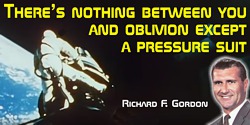
There’s nothing between you and oblivion except a pressure suit, and you just can’t afford to get out there and get in a big rush and tangle yourself up where nobody can help you. … The biggest thing I’ve learned from the people that have gone in the past, you simply have to take your time, and you can’t exhaust yourself.
In AP feed newspaper articles, for example, in the Bridgewater, NJ, The Courier-News (7 Sep 1966), 8. First and last phrases quoted in John Barbour, Footprints on the Moon (1969), 110.
There’s probably 5000 times more solar energy than the humans will ever need. We could cover our highways with solar collectors to make ribbons of energy, and I think that it’s really the largest job creation program in the history of the planet that’s in front of us. It’s a celebration of the abundance of human creativity combined with the abundance of the natural world.
In audio segment, 'William McDonough: Godfather of Green', WNYC, Studio 360 broadcast on NPR radio (18 Mar 2008) and archived on the station website.
Thermodynamics is a funny subject. The first time you go through it, you don’t understand it at all The second time you go through it, you think you understand it, except for one or two points. The third time you go through it, you know you don't understand it, but by that time you are so used to the subject, it doesn't bother you anymore.
Quoted, without citation, in Stanley W. Angrist and Loren G. Hepler, Order and Chaos: Laws of Energy and Entropy (1967), 215. The authors identify it as “perhaps apocryphal.” The quote is used as epigraph, dated as 1950 in Anton Z. Capri, Quips, Quotes, and Quanta: An Anecdotal History of Physics (2011), 50. The quote is introduced as “When asked why he did not write on that field he replied somewhat as follows,” by Keith J. Laidler in Physical Chemistry with Biological Applications (1978), 145.
These days I am not bothering about
Getting enlightenment all the time.
And the result is that
I wake up in the morning feeling fine.
Getting enlightenment all the time.
And the result is that
I wake up in the morning feeling fine.
Quoted in Kim Lim (ed.), 1,001 Pearls of Spiritual Wisdom: Words to Enrich, Inspire, and Guide Your Life (2014), 249
These duplicates in those parts of the body, without which a man might have very well subsisted, though not so well as with them, are a plain demonstration of an all-wise Contriver, as those more numerous copyings which are found among the vessels of the same body are evident demonstrations that they could not be the work of chance. This argument receives additional strength if we apply it to every animal and insect within our knowledge, as well as to those numberless living creatures that are objects too minute for a human eye: and if we consider how the several species in this whole world of life resemble one another in very many particulars, so far as is convenient for their respective states of existence, it is much more probable that a hundred millions of dice should be casually thrown a hundred millions of times in the same number than that the body of any single animal should be produced by the fortuitous concourse of matter.
In The Spectator (22 Nov 1712), No. 543, as collected in Vol. 4 (1721, 10th ed.), 48.
These machines [used in the defense of the Syracusans against the Romans under Marcellus] he [Archimedes] had designed and contrived, not as matters of any importance, but as mere amusements in geometry; in compliance with king Hiero’s desire and request, some time before, that he should reduce to practice some part of his admirable speculation in science, and by accommodating the theoretic truth to sensation and ordinary use, bring it more within the appreciation of people in general. Eudoxus and Archytas had been the first originators of this far-famed and highly-prized art of mechanics, which they employed as an elegant illustration of geometrical truths, and as means of sustaining experimentally, to the satisfaction of the senses, conclusions too intricate for proof by words and diagrams. As, for example, to solve the problem, so often required in constructing geometrical figures, given the two extremes, to find the two mean lines of a proportion, both these mathematicians had recourse to the aid of instruments, adapting to their purpose certain curves and sections of lines. But what with Plato’s indignation at it, and his invectives against it as the mere corruption and annihilation of the one good of geometry,—which was thus shamefully turning its back upon the unembodied objects of pure intelligence to recur to sensation, and to ask help (not to be obtained without base supervisions and depravation) from matter; so it was that mechanics came to be separated from geometry, and, repudiated and neglected by philosophers, took its place as a military art.
— Plutarch
In John Dryden (trans.), Life of Marcellus.
These two orders of mountains [Secondary and Tertiary] offer the most ancient chronicle of our globe, least liable to falsifications and at the same time more legible than the writing of the primitive ranges. They are Nature's archives, prior to even the most remote records and traditions that have been preserved for our observant century to investigate, comment on and bring to the light of day, and which will not be exhausted for several centuries after our own.
Observations sur la Formation des Montagnes', Acta Academiae Scientiarum Imperialis Petropolitanae (1777) [1778], 46. Trans. Albert Carozzi.
They had neither compass, nor astronomical instruments, nor any of the appliances of our time for finding their position at sea; they could only sail by the sun, moon, and stars, and it seems incomprehensible how for days and weeks, when these were invisible, they were able to find their course through fog and bad weather; but they found it, and in the open craft of the Norwegian Vikings, with their square sails, fared north and west over the whole ocean, from Novaya Zemlya and Spitsbergen to Greenland, Baffin Bay, Newfoundland, and North America.
In northern mists: Arctic exploration in early times - Volume 1 - Page 248
https://books.google.com/books?id=I1ugAAAAMAAJ
Fridtjof Nansen - 1911
Think, for a moment, of a cheetah, a sleek, beautiful animal, one of the fastest on earth, which roams freely on the savannas of Africa. In its natural habitat, it is a magnificent animal, almost a work of art, unsurpassed in speed or grace by any other animal. Now, think of a cheetah that has been captured and thrown into a miserable cage in a zoo. It has lost its original grace and beauty, and is put on display for our amusement. We see only the broken spirit of the cheetah in the cage, not its original power and elegance. The cheetah can be compared to the laws of physics, which are beautiful in their natural setting. The natural habitat of the laws of physics is a higher-dimensional space-time. However, we can only measure the laws of physics when they have been broken and placed on display in a cage, which is our three-dimensional laboratory. We only see the cheetah when its grace and beauty have been stripped away.
In Hyperspace by Michio Kaku (1994).
This Academy [at Lagado] is not an entire single Building, but a Continuation of several Houses on both Sides of a Street; which growing waste, was purchased and applied to that Use.
I was received very kindly by the Warden, and went for many Days to the Academy. Every Room hath in it ' one or more Projectors; and I believe I could not be in fewer than five Hundred Rooms.
The first Man I saw was of a meagre Aspect, with sooty Hands and Face, his Hair and Beard long, ragged and singed in several Places. His Clothes, Shirt, and Skin were all of the same Colour. He had been Eight Years upon a Project for extracting Sun-Beams out of Cucumbers, which were to be put into Vials hermetically sealed, and let out to warm the Air in raw inclement Summers. He told me, he did not doubt in Eight Years more, that he should be able to supply the Governor's Gardens with Sunshine at a reasonable Rate; but he complained that his Stock was low, and interested me to give him something as an Encouragement to Ingenuity, especially since this had been a very dear Season for Cucumbers. I made him a small Present, for my Lord had furnished me with Money on purpose, because he knew their Practice of begging from all who go to see them.
I saw another at work to calcine Ice into Gunpowder; who likewise shewed me a Treatise he had written concerning the Malleability of Fire, which he intended to publish.
There was a most ingenious Architect who had contrived a new Method for building Houses, by beginning at the Roof, and working downwards to the Foundation; which he justified to me by the life Practice of those two prudent Insects the Bee and the Spider.
In another Apartment I was highly pleased with a Projector, who had found a device of plowing the Ground with Hogs, to save the Charges of Plows, Cattle, and Labour. The Method is this: In an Acre of Ground you bury at six Inches Distance, and eight deep, a quantity of Acorns, Dates, Chestnuts, and other Masts or Vegetables whereof these Animals are fondest; then you drive six Hundred or more of them into the Field, where in a few Days they will root up the whole Ground in search of their Food, and make it fit for sowing, at the same time manuring it with their Dung. It is true, upon Experiment they found the Charge and Trouble very great, and they had little or no Crop. However, it is not doubted that this Invention may be capable of great Improvement.
I had hitherto seen only one Side of the Academy, the other being appropriated to the Advancers of speculative Learning.
Some were condensing Air into a dry tangible Substance, by extracting the Nitre, and letting the acqueous or fluid Particles percolate: Others softening Marble for Pillows and Pin-cushions. Another was, by a certain Composition of Gums, Minerals, and Vegetables outwardly applied, to prevent the Growth of Wool upon two young lambs; and he hoped in a reasonable Time to propagate the Breed of naked Sheep all over the Kingdom.
I was received very kindly by the Warden, and went for many Days to the Academy. Every Room hath in it ' one or more Projectors; and I believe I could not be in fewer than five Hundred Rooms.
The first Man I saw was of a meagre Aspect, with sooty Hands and Face, his Hair and Beard long, ragged and singed in several Places. His Clothes, Shirt, and Skin were all of the same Colour. He had been Eight Years upon a Project for extracting Sun-Beams out of Cucumbers, which were to be put into Vials hermetically sealed, and let out to warm the Air in raw inclement Summers. He told me, he did not doubt in Eight Years more, that he should be able to supply the Governor's Gardens with Sunshine at a reasonable Rate; but he complained that his Stock was low, and interested me to give him something as an Encouragement to Ingenuity, especially since this had been a very dear Season for Cucumbers. I made him a small Present, for my Lord had furnished me with Money on purpose, because he knew their Practice of begging from all who go to see them.
I saw another at work to calcine Ice into Gunpowder; who likewise shewed me a Treatise he had written concerning the Malleability of Fire, which he intended to publish.
There was a most ingenious Architect who had contrived a new Method for building Houses, by beginning at the Roof, and working downwards to the Foundation; which he justified to me by the life Practice of those two prudent Insects the Bee and the Spider.
In another Apartment I was highly pleased with a Projector, who had found a device of plowing the Ground with Hogs, to save the Charges of Plows, Cattle, and Labour. The Method is this: In an Acre of Ground you bury at six Inches Distance, and eight deep, a quantity of Acorns, Dates, Chestnuts, and other Masts or Vegetables whereof these Animals are fondest; then you drive six Hundred or more of them into the Field, where in a few Days they will root up the whole Ground in search of their Food, and make it fit for sowing, at the same time manuring it with their Dung. It is true, upon Experiment they found the Charge and Trouble very great, and they had little or no Crop. However, it is not doubted that this Invention may be capable of great Improvement.
I had hitherto seen only one Side of the Academy, the other being appropriated to the Advancers of speculative Learning.
Some were condensing Air into a dry tangible Substance, by extracting the Nitre, and letting the acqueous or fluid Particles percolate: Others softening Marble for Pillows and Pin-cushions. Another was, by a certain Composition of Gums, Minerals, and Vegetables outwardly applied, to prevent the Growth of Wool upon two young lambs; and he hoped in a reasonable Time to propagate the Breed of naked Sheep all over the Kingdom.
Gulliver's Travels (1726, Penguin ed. 1967), Part III, Chap. 5, 223.
This change in the conception of reality is the most profound and the most fruitful that physics has experienced since the time of Newton.
Refering to James Clerk Maxwell's contributions to physics.
Refering to James Clerk Maxwell's contributions to physics.
'Maxwell's Influence on the Development of the Conception of Physical Reality', James Clerk Maxwell: A Commemorative Volume 1831-1931 (1931), 71.
This fundamental discovery that all bodies owe their origin to arrangements of single initial corpuscular type is the beacon that lights the history of the universe to our eyes. In its own way, matter obeyed from the beginning that great law of biology to which we shall have to recur time and time again, the law of “complexification.”
In Teilhard de Chardin and Bernard Wall (trans.), The Phenomenon of Man (1959, 2008), 48. Originally published in French as Le Phénomene Humain (1955).
This is the element that distinguishes applied science from basic. Surprise is what makes the difference. When you are organized to apply knowledge, set up targets, produce a usable product, you require a high degree of certainty from the outset. All the facts on which you base protocols must be reasonably hard facts with unambiguous meaning. The challenge is to plan the work and organize the workers so that it will come out precisely as predicted. For this, you need centralized authority, elaborately detailed time schedules, and some sort of reward system based on speed and perfection. But most of all you need the intelligible basic facts to begin with, and these must come from basic research. There is no other source. In basic research, everything is just the opposite. What you need at the outset is a high degree of uncertainty; otherwise it isn’t likely to be an important problem. You start with an incomplete roster of facts, characterized by their ambiguity; often the problem consists of discovering the connections between unrelated pieces of information. You must plan experiments on the basis of probability, even bare possibility, rather than certainty.
The Planning of Science, The Lives of a Cell: Notes of a Biology Watcher, (1974) .
This is the Jurassic Park for particle physicists... [The Large Hadron Collider is a time machine] ... Some of the particles they are making now or are about to make haven't been around for 14 billion years.
As quoted by Alexander G. Higgins and Seth Borenstein (AP) in 'Atom Smasher Will Help Reveal "The Beginning" ', Bloomberg Businessweek (30 Mar 2010).
This is the question
Marry
Children—(if it Please God)—Constant companion (& friend in old age) who will feel interested in one—object to be beloved and played with—better than a dog anyhow. Home, & someone to take care of house—Charms of music and female chit-chat.—These things good for one’s health.—but terrible loss of time.—
My God, it is Intolerable to think of spending ones whole life, like a neuter bee, working, working—& nothing after all.—No, no, won’t do. Imagine living all one’s day solitary in smoky dirty London House.—Only picture to yourself a nice soft wife on a sofa with good fire, & books & music perhaps-—Compare this vision with the dingy reality of Grt. Marlbro’ Street.
Not Marry
Freedom to go where one liked—choice of Society and little of it. —Conversation of clever men at clubs—Not forced to visit relatives, & to bend in every trifle. —to have the expense and anxiety of children—perhaps quarreling—Loss of time. —cannot read in the Evenings—fatness & idleness—Anxiety & responsibility—less money for books &c—if many children forced to gain one’s bread. —(but then it is very bad for ones health to work too much)
Perhaps my wife won’t like London; then the sentence is banishment & degradation into indolent, idle fool.
Marry—Marry—Marry Q.E.D.
It being proved necessary to Marry When? Soon or late?
Marry
Children—(if it Please God)—Constant companion (& friend in old age) who will feel interested in one—object to be beloved and played with—better than a dog anyhow. Home, & someone to take care of house—Charms of music and female chit-chat.—These things good for one’s health.—but terrible loss of time.—
My God, it is Intolerable to think of spending ones whole life, like a neuter bee, working, working—& nothing after all.—No, no, won’t do. Imagine living all one’s day solitary in smoky dirty London House.—Only picture to yourself a nice soft wife on a sofa with good fire, & books & music perhaps-—Compare this vision with the dingy reality of Grt. Marlbro’ Street.
Not Marry
Freedom to go where one liked—choice of Society and little of it. —Conversation of clever men at clubs—Not forced to visit relatives, & to bend in every trifle. —to have the expense and anxiety of children—perhaps quarreling—Loss of time. —cannot read in the Evenings—fatness & idleness—Anxiety & responsibility—less money for books &c—if many children forced to gain one’s bread. —(but then it is very bad for ones health to work too much)
Perhaps my wife won’t like London; then the sentence is banishment & degradation into indolent, idle fool.
Marry—Marry—Marry Q.E.D.
It being proved necessary to Marry When? Soon or late?
Notes on Marriage, July 1838. In F. Burkhardt and S. Smith (eds.), The Correspondence of Charles Darwin 1837-1843 (1986), Vol. 2, 444.
This missing science of heredity, this unworked mine of knowledge on the borderland of biology and anthropology, which for all practical purposes is as unworked now as it was in the days of Plato, is, in simple truth, ten times more important to humanity than all the chemistry and physics, all the technical and indsutrial science that ever has been or ever will be discovered.
Mankind in the Making (1903), 72.
This new power, which has proved itself to be such a terrifying weapon of destruction, is harnessed for the first time for the common good of our community. [Upon opening Calder Hall nuclear power station in 1956.]
Speech, reproduced in Nuclear Power: The Journal of British Nuclear Engineering (1956), Vol. 1, 274.
This theme of mutually invisible life at widely differing scales bears an important implication for the ‘culture wars’ that supposedly now envelop our universities and our intellectual discourse in general ... One side of this false dichotomy features the postmodern relativists who argue that all culturally bound modes of perception must be equally valid, and that no factual truth therefore exists. The other side includes the benighted, old-fashioned realists who insist that flies truly have two wings, and that Shakespeare really did mean what he thought he was saying. The principle of scaling provides a resolution for the false parts of this silly dichotomy. Facts are facts and cannot be denied by any rational being. (Often, facts are also not at all easy to determine or specify–but this question raises different issues for another time.) Facts, however, may also be highly scale dependent–and the perceptions of one world may have no validity or expression in the domain of another. The one-page map of Maine cannot recognize the separate boulders of Acadia, but both provide equally valid representations of a factual coastline.
The World as I See It (1999)
This time like all times is a very good one if we but know what to do with it
…...
This whole period was a golden age of immunology, an age abounding in important synthetic discoveries all over the world, a time we all thought it was good to be alive. We, who were working on these problems, all knew each other and met as often as we could to exchange ideas and hot news from the laboratory.
In Memoir of a Thinking Radish: An Autobiography (1986), 135.
This work should commence with the conception of man, and should describe the nature of the womb, and how the child inhabits it, and in what stage it dwells there, and the manner of its quickening and feeding, and its growth, and what interval there is between one stage of growth and another, and what thing drives it forth from the body of the mother, and for what reason it sometimes emerges from the belly of its mother before the due time.
'Anatomy', in The Notebooks of Leonardo da Vinci, trans. E. MacCurdy (1938), Vol. 1, 139.
Those of us who were familiar with the state of inorganic chemistry in universities twenty to thirty years ago will recall that at that time it was widely regarded as a dull and uninteresting part of the undergraduate course. Usually, it was taught almost entirely in the early years of the course and then chiefly as a collection of largely unconnected facts. On the whole, students concluded that, apart from some relationships dependent upon the Periodic table, there was no system in inorganic chemistry comparable with that to be found in organic chemistry, and none of the rigour and logic which characterised physical chemistry. It was widely believed that the opportunities for research in inorganic chemistry were few, and that in any case the problems were dull and uninspiring; as a result, relatively few people specialized in the subject... So long as inorganic chemistry is regarded as, in years gone by, as consisting simply of the preparations and analysis of elements and compounds, its lack of appeal is only to be expected. The stage is now past and for the purpose of our discussion we shall define inorganic chemistry today as the integrated study of the formation, composition, structure and reactions of the chemical elements and compounds, excepting most of those of carbon.
Inaugural Lecture delivered at University College, London (1 Mar 1956). In The Renaissance of Inorganic Chemistry (1956), 4-5.
Those to whom the harmonious doors
Of Science have unbarred celestial stores,
To whom a burning energy has given
That other eye which darts thro’ earth and heaven,
Roams through all space and unconfined,
Explores the illimitable tracts of mind,
And piercing the profound of time can see
Whatever man has been and man can be.
Of Science have unbarred celestial stores,
To whom a burning energy has given
That other eye which darts thro’ earth and heaven,
Roams through all space and unconfined,
Explores the illimitable tracts of mind,
And piercing the profound of time can see
Whatever man has been and man can be.
In An Evening Walk (1793). In E. de Selincourt (ed.), The Poetical Works of William Wordsworth (1940), Vol. 1, 13.
Those who judge of a work by rule are in regard to others as those who have a watch are in regard to others. One says, “It is two hours ago”; the other says, “It is only three-quarters of an hour.” I look at my watch, and say to the one, “You are weary,” and to the other, “Time gallops with you”; for it is only an hour and a half ago, and I laugh at those who tell me that time goes slowly with me, and that I judge by imagination. They do not know that I judge by my watch.
In Pascal’s Pensées (1958), 3-4.
Those who knew that the judgements of many centuries had reinforced the opinion that the Earth is placed motionless in the middle of heaven, as though at its centre, if I on the contrary asserted that the Earth moves, I hesitated for a long time whether to bring my treatise, written to demonstrate its motion, into the light of day, or whether it would not be better to follow the example of the Pythagoreans and certain others, who used to pass on the mysteries of their philosophy merely to their relatives and friends, not in writing but by personal contact, as the letter of Lysis to Hipparchus bears witness. And indeed they seem to me to have done so, not as some think from a certain jealousy of communicating their doctrines, but so that their greatest splendours, discovered by the devoted research of great men, should not be exposed to the contempt of those who either find it irksome to waste effort on anything learned, unless it is profitable, or if they are stirred by the exhortations and examples of others to a high-minded enthusiasm for philosophy, are nevertheless so dull-witted that among philosophers they are like drones among bees.
'To His Holiness Pope Paul III', in Copernicus: On the Revolutions of the Heavenly Spheres (1543), trans. A. M. Duncan (1976), 24.
Those who nod sagely and quote the tragedy of the commons in relation to environmental problems from pollution of the atmosphere to poaching of national parks tend to forget that Garrett Hardin revised his conclusions many times…. He recognized, most importantly, that anarchy did not prevail on the common pastures of medieval England in the way he had described…. “A managed commons, though it may have other defects, is not automatically subject to the tragic fate of the unmanaged commons,” wrote Hardin…. At sea, where a common exists in most waters… None of Hardin’s requirements for a successfully managed common is fulfilled by high-seas fishery regimes.
In The End of the Line: How Overfishing is Changing the World and what We Eat (2004), 153-155.
Those who suggest that the “dark ages” were a time of violence and superstition would do well to remember the appalling cruelties of our own time, truly without parallel in past ages, as well as the fact that the witch-hunts were not strictly speaking a medieval phenomenon but belong rather to the so-called Renaissance.
From Interview (2003) on the Exhibition, 'Il Medioevo Europeo di Jacques le Goff' (The European Middle Ages by Jacques Le Goff), at Parma, Italy (27 Sep 2003—11 Jan 2004). Published among web pages about the Exhibition, that were on the website of the Province of Parma.
Those who work standing ... carpenters, sawyers, carvers, blacksmiths, masons ... are liable to varicose veins ... [because] the strain on the muscles is such that the circulation of the blood is retarded. Standing even for a short time proves exhausting compared with walking and running though it be for a long time ... Nature delights and is restored by alternating and varied actions.
Thought-economy is most highly developed in mathematics, that science which has reached the highest formal development, and on which natural science so frequently calls for assistance. Strange as it may seem, the strength of mathematics lies in the avoidance of all unnecessary thoughts, in the utmost economy of thought-operations. The symbols of order, which we call numbers, form already a system of wonderful simplicity and economy. When in the multiplication of a number with several digits we employ the multiplication table and thus make use of previously accomplished results rather than to repeat them each time, when by the use of tables of logarithms we avoid new numerical calculations by replacing them by others long since performed, when we employ determinants instead of carrying through from the beginning the solution of a system of equations, when we decompose new integral expressions into others that are familiar,—we see in all this but a faint reflection of the intellectual activity of a Lagrange or Cauchy, who with the keen discernment of a military commander marshalls a whole troop of completed operations in the execution of a new one.
In Populär-wissenschafliche Vorlesungen (1903), 224-225.
Through the ages, man's main concern was life after death. Today, for the first time, we find we must ask questions about whether there will be life before death.
The Crazy Ape (1970), 18.
Throughout the last four hundred years, during which the growth of science had gradually shown men how to acquire knowledge of the ways of nature and mastery over natural forces, the clergy have fought a losing battle against science, in astronomy and geology, in anatomy and physiology, in biology and psychology and sociology. Ousted from one position, they have taken up another. After being worsted in astronomy, they did their best to prevent the rise of geology; they fought against Darwin in biology, and at the present time they fight against scientific theories of psychology and education. At each stage, they try to make the public forget their earlier obscurantism, in order that their present obscurantism may not be recognized for what it is.
From An Outline of Intellectual Rubbish (1937, 1943), 6. Collected in The Basic Writings of Bertrand Russell (2009), 47.
Thus identified with astronomy, in proclaiming truths supposed to be hostile to Scripture, Geology has been denounced as the enemy of religion. The twin sisters of terrestrial and celestial physics have thus been joint-heirs of intolerance and persecution—unresisting victims in the crusade which ignorance and fanaticism are ever waging against science. When great truths are driven to make an appeal to reason, knowledge becomes criminal, and philosophers martyrs. Truth, however, like all moral powers, can neither be checked nor extinguished. When compressed, it but reacts the more. It crushes where it cannot expand—it burns where it is not allowed to shine. Human when originally divulged, it becomes divine when finally established. At first, the breath of a rage—at last it is the edict of a god. Endowed with such vital energy, astronomical truth has cut its way through the thick darkness of superstitious times, and, cheered by its conquests, Geology will find the same open path when it has triumphed over the less formidable obstacles of a civilized age.
More Worlds than One: The Creed of the Philosopher and the Hope of the Christian (1854), 42.
Thus the system of the world only oscillates around a mean state from which it never departs except by a very small quantity. By virtue of its constitution and the law of gravity, it enjoys a stability that can be destroyed only by foreign causes, and we are certain that their action is undetectable from the time of the most ancient observations until our own day. This stability in the system of the world, which assures its duration, is one of the most notable among all phenomena, in that it exhibits in the heavens the same intention to maintain order in the universe that nature has so admirably observed on earth for the sake of preserving individuals and perpetuating species.
'Sur l'Équation Séculaire de la Lune' (1786, published 1788). In Oeuvres complètes de Laplace, 14 Vols. (1843-1912), Vol. 11, 248-9, trans. Charles Coulston Gillispie, Pierre-Simon Laplace 1749-1827: A Life in Exact Science (1997), 145.
Thus there can be no doubt that the world was not created in time but with time. An event in time happens after one time and before another, after the past and before the future. But at the time of creation there could have been no past, because there was nothing created to provide the change and movement which is the condition of time.
De Civitate Dei (The City of God) [413-426], Book XI, chapter 6, trans. H. Bettenson (1972), 436.
Thus we work not in the light of public opinion but in the secrecy of the chamber; and perhaps the best of us are apt at times to forget the delicacies and sincerities which under these conditions are essential to harmony and honour.
On Professional Education with Special Reference to Medicine (), 78.
Thus you may multiply each stone 4 times & no more for they will then become oyles shining in ye dark and fit for magicall uses. You may ferment them with ☉ [gold] and [silver], by keeping the stone and metal in fusion together for a day, & then project upon metalls. This is the multiplication of ye stone in vertue. To multiply it in weight ad to it of ye first Gold whether philosophic or vulgar.
Praxis (c.1693), quoted in Betty Jo Teeter Dobbs, The Janus Faces of Genius: The Role of Alchemy In Newton's Thought (1991), 304.
Thus, we have three principles for increasing adequacy of data: if you must work with a single object, look for imperfections that record historical descent; if several objects are available, try to render them as stages of a single historical process; if processes can be directly observed, sum up their effects through time. One may discuss these principles directly or recognize the ‘little problems’ that Darwin used to exemplify them: orchids, coral reefs, and worms–the middle book, the first, and the last.
…...
Time ends. That is the lesson of the “big bang”. It is also the lesson of the black hole, closer at hand and more immediate object of study. The black hole is a completely collapsed object. It is mass without matter. The Cheshire cat in Alice in Wonderland faded away leaving behind only its grin. A star that falls into an already existing black hole, or that collapses to make a new black hole, fades away. Of the star, of its matter and of its sunspots and solar prominences, all trace disappears. There remains behind only gravitational attraction, the attraction of disembodied mass.
In 'The Lesson of the Black Hole', Proceedings of the American Philosophical Society (1981), 125, 25.
Time flies when you're having fun, and I've been having fun for the last thirty years.
Reflecting on the upcoming 30th anniversary of Apollo 11.
Reflecting on the upcoming 30th anniversary of Apollo 11.
As quoted in Peter Bond, 'Obituary: Charles Conrad, Jnr.', The Independent (10 Jul 1999)
Time has a different quality in a forest, a different kind of flow. Time moves in circles, and events are linked, even if it’s not obvious that they are linked. Events in a forest occur with precision in the flow of tree time, like the motions of an endless dance.
The Wild Trees: A Story of Passion and Daring
Time is a fixed income and, as with any income, the real problem facing most of us is how to live successfully within our daily allotment.
…...
Time is a herb that cures all Diseases.
In Poor Richard's Almanack (1738). http://www. vlib.us/amdocs/texts/prichard38.html
Time is a perpetual perishing.
In On Love & Psychological Exercises: With Some Aphorisms & Other Essays (1998), 55.
Time is awake when all things sleep.
Time stands straight when all things fall.
Time shuts in all and will not be shut.
Is, was, and shall be are Time’s children.
O Reason! be witness! be stable!
Time stands straight when all things fall.
Time shuts in all and will not be shut.
Is, was, and shall be are Time’s children.
O Reason! be witness! be stable!
— Vyasa
In The Mahabarata (1968), Vol. 1, 31, v. 247-248
Time is but a stream I go a-fishing in. I drink at it; but while I drink I see the sandy bottom, and detect how shallow it is. Its thin current slides away, but eternity remains. I would drink deeper; fish in the sky, whose bottom is pebby with stars.
Walden (1882), Vol. 1, 155.
Time is but the stream I go a-fishing in. I drink at it; but while I drink I see the sandy bottom and detect how shallow it is. Its thin current slides away, but eternity remains.
In 'Where I Lived and What I Lived For', in Walden: Or, Life in the Woods (1854, 1899), 112.
Time is defined so that motion looks simple.
In Gravitation (1973).
Time is in itself [not] a difficulty, but a time-rate, assumed on very insufficient grounds, is used as a master-key, whether or not it fits, to unravel all difficulties. What if it were suggested that the brick-built Pyramid of Hawara had been laid brick by brick by a single workman? Given time, this would not be beyond the bounds of possibility. But Nature, like the Pharaohs, had greater forces at her command to do the work better and more expeditiously than is admitted by Uniformitarians.
'The Position of Geology', The Nineteenth Century (1893), 34, 551.
Time is Nature’s way of keeping everything from happening at once.
attributed to Onsager
Time is precious, but truth is more precious than time.
Speech to the Royal and Central Bucks Agricultural Association, Aylesbury (21 Sep 1865). Wit and wisdom of Benjamin Disraeli, collected from his writings and speeches (1881), 356.
Time is that which is measured by a clock. This is a sound way of looking at things. A quantity like time, or any other physical measurement, does not exist in a completely abstract way. We find no sense in talking about something unless we specify how we measure it. It is the definition by the method of measuring a quantity that is the one sure way of avoiding talking nonsense about this kind of thing.
From Relativity and Common Sense: A New Approach to Einstein (1980), 65.

Time is the greatest innovator.
From essay, 'Of Innovations' (1625). As collected and translated in The Works of Francis Bacon (1765), Vol. 1, 479.
Time is the only true purgatory.
Samuel Butler, Henry Festing Jones (ed.), The Note-Books of Samuel Butler (1917), 219.
Time keeps everything from happening at once.
Spoken by character Big Business Man in Ray Cummings, The Girl in the Golden Atom (1922), 46. Also seen as “Time is nature's way to keep everything from happening all at once,” with misattributions including Albert Einstein, John Wheeler, Onsager and Woody Allen. As seen in John Wheeler, 'Information, Physics, Quantum: The Search for Links', collected in Wojciech Hubert Zurek (ed.),Complexity, Entropy, and the Physics of Information: The Proceedings of the 1988 Workshop on Complexity, Entropy, and the Physics of Information Held May-June, 1989, in Santa Fe, New Mexico (1990), 10, footnoted as “Discovered among the graffiti in the men’s room of the Pecan Street Cafe, Austin, Texas.”
Time makes heroes but dissolves celebrities.
Quoted in Ponchitta Pierce, 'Who Are Our Heroes?', Parade Magazine (6 Aug 1995). As cited in Before I Pour This Over Your Head, Remember That I Love You (), 41 & 63.
Time only seems to matter when it’s running out.
…...
Time out of mind—or, rather, ever since Nicolas Le Fèvre … pointed out that chemistry was the art of separations as well as of transmutations—it has been recognized that, with every increase of temperature, or dissociating power, bodies were separated from each other.
In The Chemistry of the Sun (1887), x.
Time present and time past
Are both perhaps present in time future,
And time future contained in time past.
Are both perhaps present in time future,
And time future contained in time past.
Four Quartets (1943), 7.
Time stays long enough for anyone who will use it.
…...
Time was when all the parts of the subject were dissevered, when algebra, geometry, and arithmetic either lived apart or kept up cold relations of acquaintance confined to occasional calls upon one another; but that is now at an end; they are drawn together and are constantly becoming more and more intimately related and connected by a thousand fresh ties, and we may confidently look forward to a time when they shall form but one body with one soul.
In Presidential Address to British Association (19 Aug 1869), 'A Plea for the Mathematician', published in Nature (6 Jan 1870), 1, 262.
Time will soon destroy the works of famous painters and sculptors, but the Indian arrowhead will balk his efforts and Eternity will have to come to his aid. They are not fossil bones, but, as it were, fossil thoughts, forever reminding me of the mind that shaped them… . Myriads of arrow-points lie sleeping in the skin of the revolving earth, while meteors revolve in space. The footprint, the mind-print of the oldest men.
(28 Mar 1859). In Henry David Thoreau and Bradford Torrey (ed.), The Writings of Henry Thoreau: Journal: XII: March, 2, 1859-November 30, 1859 (1906), 91.
Time, inexhaustible and ever accumulating his efficacy, can undoubtedly do much for the theorist in geology; but Force, whose limits we cannot measure, and whose nature we cannot fathom, is also a power never to be slighted: and to call in the one to protect us from the other, is equally presumptuous, to whichever of the two our superstition leans. To invoke Time, with ten thousand earthquakes, to overturn and set on edge a mountain-chain, should the phenomena indicate the change to have been sudden and not successive, would be ill excused by pleading the obligation of first appealing to known causes.
In History of the Inductive Sciences (1857), Vol. 3, 513-514.
Time, which measures everything in our idea, and is often deficient to our schemes, is to nature endless and as nothing; it cannot limit that by which alone it had existence; and as the natural course of time, which to us seems infinite, cannot be bounded by any operation that may have an end, the progress of things upon this globe, that is, the course of nature, cannot be limited by time, which must proceed in a continual succession.
'Theory of the Earth', Transactions of the Royal Society of Edinburgh (1788), 1, 215.
Time, whose tooth gnaws away everything else, powerless against truth.
By Thomas Henry Huxley and Henrietta A. Huxley (ed.), Aphorisms and Reflections (1908), 7.
Time... is an essential requirement for effective research. An investigator may be given a palace to live in, a perfect laboratory to work in, he may be surrounded by all the conveniences money can provide; but if his time is taken from him he will remain sterile.
Quoted in S. Benison, A. C. Barger and E. L. Wolfe, Walter B Cannon: The Life and Times of a Young Scientist (1987), 253.
Time’s arrow of ‘just history’ marks each moment of time with a distinctive brand. But we cannot, in our quest to understand history, be satisfied only with a mark to recognize each moment and a guide to order events in temporal sequence. Uniqueness is the essence of history, but we also crave some underlying generality, some principles of order transcending the distinction of moments–lest we be driven mad by Borges’s vision of a new picture every two thousand pages in a book without end. We also need, in short, the immanence of time’s cycle.
…...
Time’s glory is to calm contending kings,
To unmask falsehood and bring truth to light.
To unmask falsehood and bring truth to light.
In 'Rape of Lucrece', The Plays and Poems of William Shakspeare (1821), Vol. 20, 159.
Times change. But life and science go on.
From Nobel Lecture (7 Dec 1996), 'Discovering the Fullerenes', collected in Ingmar Grenthe (ed.), Nobel Lectures, Chemistry 1996-2000 (2003).
Timorous readers, however, need entertain no feverish fear, on, visiting the Isle of Sheppey, of encountering either wild elephants, crocodiles, sharks, serpents, or man-eating birds of huge dimensions, bearing strange names, and armed with sets of teeth for masticating and digestive purposes, as the author can assure them that they all died out a million or so of years ago, before he undertook to look up their records and write the history of this wonderful little island. Visitors may, however, honestly deplore the absence of the feathery palm trees bearing the luscious date and the lacteous cocoa-nut; but by prosecuting a diligent search they may, at least, be consoled by procuring some of these, rare fossil remains, reminiscent of an incalculable period of time when our particular portion of this hemisphere performed its diurnal revolutions in the immediate zone of the tropics.
Quoted in Augustus A. Daly, History of the Isle of Sheppey (1975), 250.
Tis not always in a physician’s power to cure the sick; at times the disease is stronger than trained art.
Ovid and Arthur Leslie Wheeler (trans.), Ovid Tristia Ex Ponto (2007), 281.
To be a good professional engineer, always start to study late for exams. Because it teaches you how to manage time and tackle emergencies.
Webmaster has not yet found a primary source to verify this quote. Can you help?
To be always poring over the same Object, dulls the Intellects and tires the Mind, which is delighted and improved by a Variety: and therefore it ought, at times, to be relaxed from the more severe mathematical Contemplations, and to be employed upon something more light and agreeable, as Poetry, Physic, History, &c
In Dr. Boerhaave's Academical Lectures on the Theory of Physic (1746), Vol. 6, 264.
To be successful be ahead of your time, but only a little.
City Aphorisms, Tenth Selection (1991).
To choose a rough example, think of a thorn which has stuck in a finger and produces an inflammation and suppuration. Should the thorn be discharged with the pus, then the finger of another individual may be pricked with it, and the disease may be produced a second time. In this case it would not be the disease, not even its product, that would be transmitted by the thorn, but rather the stimulus which engendered it. Now supposing that the thorn is capable of multiplying in the sick body, or that every smallest part may again become a thorn, then one would be able to excite the same disease, inflammation and suppuration, in other individuals by transmitting any of its smallest parts. The disease is not the parasite but the thorn. Diseases resemble one another, because their causes resemble each other. The contagion in our sense is therefore not the germ or seed of the disease, but rather the cause of the disease. For example, the egg of a taenia is not the product of a worm disease even though the worm disease may have been the cause, which first gave rise to the taenia in the intestinal contents—nor of the individual afflicted with the worm disease, but rather of the parasitic body, which, no matter how it may have come into the world at first, now reproduces itself by means of eggs, and produces the symptoms of the worm disease, at least in part. It is not the seed of the disease; the latter multiplies in the sick organism, and is again excreted at the end of the disease.
'On Miasmata and Contagia', trans. G. Rosen, Bulletin of the Institute of the History of Medicine (1938), 6, 924.
To day we made the grand experiment of burning the diamond and certainly the phenomena presented were extremely beautiful and interesting… The Duke’s burning glass was the instrument used to apply heat to the diamond. It consists of two double convex lenses … The instrument was placed in an upper room of the museum and having arranged it at the window the diamond was placed in the focus and anxiously watched. The heat was thus continued for 3/4 of an hour (it being necessary to cool the globe at times) and during that time it was thought that the diamond was slowly diminishing and becoming opaque … On a sudden Sir H Davy observed the diamond to burn visibly, and when removed from the focus it was found to be in a state of active and rapid combustion. The diamond glowed brilliantly with a scarlet light, inclining to purple and, when placed in the dark, continued to burn for about four minutes. After cooling the glass heat was again applied to the diamond and it burned again though not for nearly so long as before. This was repeated twice more and soon after the diamond became all consumed. This phenomenon of actual and vivid combustion, which has never been observed before, was attributed by Sir H Davy to be the free access of air; it became more dull as carbonic acid gas formed and did not last so long.
Entry (Florence, 27 Mar 1814) in his foreign journal kept whilst on a continental tour with Sir Humphry Davy. In Michael Faraday, Bence Jones (ed.), The Life and Letters of Faraday (1870), Vol. 1, 119. Silvanus Phillips Thompson identifies the Duke as the Grand Duke of Tuscany, in Michael Faraday, His Life and Work (1901), 21.
To emphasize this opinion that mathematicians would be unwise to accept practical issues as the sole guide or the chief guide in the current of their investigations, ... let me take one more instance, by choosing a subject in which the purely mathematical interest is deemed supreme, the theory of functions of a complex variable. That at least is a theory in pure mathematics, initiated in that region, and developed in that region; it is built up in scores of papers, and its plan certainly has not been, and is not now, dominated or guided by considerations of applicability to natural phenomena. Yet what has turned out to be its relation to practical issues? The investigations of Lagrange and others upon the construction of maps appear as a portion of the general property of conformal representation; which is merely the general geometrical method of regarding functional relations in that theory. Again, the interesting and important investigations upon discontinuous two-dimensional fluid motion in hydrodynamics, made in the last twenty years, can all be, and now are all, I believe, deduced from similar considerations by interpreting functional relations between complex variables. In the dynamics of a rotating heavy body, the only substantial extension of our knowledge since the time of Lagrange has accrued from associating the general properties of functions with the discussion of the equations of motion. Further, under the title of conjugate functions, the theory has been applied to various questions in electrostatics, particularly in connection with condensers and electrometers. And, lastly, in the domain of physical astronomy, some of the most conspicuous advances made in the last few years have been achieved by introducing into the discussion the ideas, the principles, the methods, and the results of the theory of functions. … the refined and extremely difficult work of Poincare and others in physical astronomy has been possible only by the use of the most elaborate developments of some purely mathematical subjects, developments which were made without a thought of such applications.
In Presidential Address British Association for the Advancement of Science, Section A, (1897), Nature, 56, 377.
To feed applied science by starving basic science is like economising on the foundations of a building so that it may be built higher. It is only a matter of time before the whole edifice crumbles.
In article, 'Lest the Edifice of Science Crumble', New Scientist (4 Sep 1986), 111, No. 1574, 16.
To judge in this [utilitarian] way demonstrates … how small, narrow and indolent our minds are; it shows a disposition always to calculate the reward before the work, a cold heart and a lack of feeling for everything that is great and honours mankind. Unfortunately one cannot deny that such a mode of thinking is common in our age, and I am convinced that this is closely connected with the catastrophes which have befallen many countries in recent times; do not mistake me, I do not talk of the general lack of concern for science, but of the source from which all this has come, of the tendency to look out everywhere for one’s advantage and to relate everything to one’s physical well being, of indifference towards great ideas, of aversion to any effort which derives from pure enthusiasm.
Epigraph before title page, T. W. Körner, The Pleasures of Counting (1996).
To know him [Sylvester] was to know one of the historic figures of all time, one of the immortals; and when he was really moved to speak, his eloquence equalled his genius.
In Florian Cajori, Teaching and History of Mathematics in the United States (1890), 265. [Halsted was J.J. Sylvester’s first student at Johns Hopkins University.]
To live for a time close to great minds is the best kind of education.
…...
To live is so startling it leaves little time for other occupations.
From Letter to T.W. Higginson (late 1872), in Thomas H Johnson (ed.), The Letters of Emily Dickinson (1969), 500.
To me, it [the 1962 space flight of Friendship 7] is not something that happened a long time ago. It seems like a couple of days ago, really. It’s a rare day I don’t think about it, relive it in my mind. I can remember every switch I flipped, every move I made, every word I spoke and every word spoken to me. Clear as a bell.
As reported by Howard Wilkinson in 'John Glenn Had the Stuff U.S. Heroes are Made of', The Cincinnati Enquirer (20 Feb 2002).
To most ... of us, Russia was as mysterious and remote as the other side of the moon and not much more productive when it came to really new ideas or inventions. A common joke of the time [mid 1940s] said that the Russians could not surreptitiously introduce nuclear bombs in suitcases into the United States because they had not yet been able to perfect a suitcase.
In Richard Rhodes, The Making of the Atomic Bomb (1986), 760.
To my knowledge there are no written accounts of Fermi’s contributions to the [first atomic bomb] testing problems, nor would it be easy to reconstruct them in detail. This, however, was one of those occasions in which Fermi’s dominion over all physics, one of his most startling characteristics, came into its own. The problems involved in the Trinity test ranged from hydrodynamics to nuclear physics, from optics to thermodynamics, from geophysics to nuclear chemistry. Often they were closely interrelated, and to solve one’it was necessary to understand all the others. Even though the purpose was grim and terrifying, it was one of the greatest physics experiments of all time. Fermi completely immersed himself in the task. At the time of the test he was one of the very few persons (or perhaps the only one) who understood all the technical ramifications.
In Enrico Fermi: Physicist (1970), 145
To preach conservation at such a time, when all our resources, national and otherwise are being sacrificed in unprecedented measure, might seem to some anomalous, even ironical. ... But we firmly believe, and now are more acutely aware than ever, that conservation is basically related to the peace of the world and the future of the race.
Breaking New Ground
To prove to an indignant questioner on the spur of the moment that the work I do was useful seemed a thankless task and I gave it up. I turned to him with a smile and finished, “To tell you the truth we don’t do it because it is useful but because it’s amusing.” The answer was thought of and given in a moment: it came from deep down in my soul, and the results were as admirable from my point of view as unexpected. My audience was clearly on my side. Prolonged and hearty applause greeted my confession. My questioner retired shaking his head over my wickedness and the newspapers next day, with obvious approval, came out with headlines “Scientist Does It Because It’s Amusing!” And if that is not the best reason why a scientist should do his work, I want to know what is. Would it be any good to ask a mother what practical use her baby is? That, as I say, was the first evening I ever spent in the United States and from that moment I felt at home. I realised that all talk about science purely for its practical and wealth-producing results is as idle in this country as in England. Practical results will follow right enough. No real knowledge is sterile. The most useless investigation may prove to have the most startling practical importance: Wireless telegraphy might not yet have come if Clerk Maxwell had been drawn away from his obviously “useless” equations to do something of more practical importance. Large branches of chemistry would have remained obscure had Willard Gibbs not spent his time at mathematical calculations which only about two men of his generation could understand. With this faith in the ultimate usefulness of all real knowledge a man may proceed to devote himself to a study of first causes without apology, and without hope of immediate return.
From lecture to a scientific society in Philadelphia on “The Mechanism of the Muscle” given by invitation after he received a Nobel Prize for that work. The quote is Hill’s response to a post-talk audience question asking disapprovingly what practical use the speaker thought there was in his research. The above quoted answer, in brief, is—for the intellectual curiosity. As quoted about Hill by Bernard Katz in his own autobiographical chapter, 'Sir Bernard Katz', collected in Larry R. Squire (ed.), The History of Neuroscience in Autobiography (1996), Vol. 1, 350-351. Two excerpts from the above have been highlighted as standalone quotes here in this same quote collection for A. V. Hill. They begin “All talk about science…” and “The most useless investigation may prove…”.
To show, therefore, that we are capable of knowing, i.e. being certain that there is a God, and how we may come by this certainty, I think we need go no further than ourselves, and that undoubted knowledge we have of our own existence... For man knows that he himself exists... If any one pretends to be so sceptical as to deny his own existence, (for really to doubt of it is manifestly impossible,) let him for me enjoy his beloved happiness of being nothing, until hunger or some other pain convince him of the contrary... He knows also that nothing cannot produce a being; therefore something must have existed from eternity... Next, it is evident, that what had its being and beginning from another, must also have all that which is in and belongs to its being from another too. All the powers it has must be owing to and received from the same source. This eternal source, then, of all being must also be the source and original of all power; and so this eternal Being must be also the most powerful... And most knowing. Again, a man finds in himself perception and knowledge. We have then got one step further; and we are certain now that there is not only some being, but some knowing, intelligent being in the world. There was a time, then, when there was no knowing being, and when knowledge began to be; or else there has been also a knowing being from eternity...And therefore God.
Essay Concerning Human Understanding (1690), book 4, ch. 10, sec 19.
To stop short in any research that bids fair to widen the gates of knowledge, to recoil from fear of difficulty or adverse criticism, is to bring reproach on science. There is nothing for the investigator to do but go straight on, 'to explore up and down, inch by inch, with the taper his reason;' to follow the light wherever it may lead, even should it at times resemble a will-o'-the-wisp.
Referring to his interest in psychical (spiritual) research.
Referring to his interest in psychical (spiritual) research.
Presidential address to the British Association (1898). Quoted in Harold Begbie in Pall Mall magazine (Jan 1903). In Albert Shaw, The American Monthly Review of Reviews (1903), 27, 232.
To take one of the simplest cases of the dissipation of energy, the conduction of heat through a solid—consider a bar of metal warmer at one end than the other and left to itself. To avoid all needless complication, of taking loss or gain of heat into account, imagine the bar to be varnished with a substance impermeable to heat. For the sake of definiteness, imagine the bar to be first given with one half of it at one uniform temperature, and the other half of it at another uniform temperature. Instantly a diffusing of heat commences, and the distribution of temperature becomes continuously less and less unequal, tending to perfect uniformity, but never in any finite time attaining perfectly to this ultimate condition. This process of diffusion could be perfectly prevented by an army of Maxwell’s ‘intelligent demons’* stationed at the surface, or interface as we may call it with Prof. James Thomson, separating the hot from the cold part of the bar.
* The definition of a ‘demon’, according to the use of this word by Maxwell, is an intelligent being endowed with free will, and fine enough tactile and perceptive organisation to give him the faculty of observing and influencing individual molecules of matter.
* The definition of a ‘demon’, according to the use of this word by Maxwell, is an intelligent being endowed with free will, and fine enough tactile and perceptive organisation to give him the faculty of observing and influencing individual molecules of matter.
In 'The Kinetic Theory of the Dissipation of Energy', Nature (1874), 9, 442.
To the distracting occupations belong especially my lecture courses which I am holding this winter for the first time, and which now cost much more of my time than I like. Meanwhile I hope that the second time this expenditure of time will be much less, otherwise I would never be able to reconcile myself to it, even practical (astronomical) work must give far more satisfaction than if one brings up to B a couple more mediocre heads which otherwise would have stopped at A.
Letter to Friedrich Bessel (4 Dec 1808). Quoted in G. Waldo Dunnington, Carl Friedrich Gauss: Titan of Science (2004), 415.
To throw in a fair game at Hazards only three-spots, when something great is at stake, or some business is the hazard, is a natural occurrence and deserves to be so deemed; and even when they come up the same way for a second time if the throw be repeated. If the third and fourth plays are the same, surely there is occasion for suspicion on the part of a prudent man.
from De Vita Propria Liber
To use a Southern euphemism, our space program has been snake-bit.
Comment on the failed launch of an unmanned rocket, only a short time after the explosion of Space Shuttle Challenger.
Comment on the failed launch of an unmanned rocket, only a short time after the explosion of Space Shuttle Challenger.
— Al Gore
ABC television interview, Nightline (5 May 1986). In James B. Simpson, Simpson’s Contemporary Quotations (1988).
To use Newton’s words, our efforts up till this moment have but turned over a pebble or shell here and there on the beach, with only a forlorn hope that under one of them was the gem we were seeking. Now we have the sieve, the minds, the hands, the time, and, particularly, the dedication to find those gems—no matter in which favorite hiding place the children of distant worlds have placed them.
[Co-author with Dava Sobel.]
[Co-author with Dava Sobel.]
In Frank Drake and Dava Sobel, Is Anyone Out There? (1993), 236.
Tobacco has not yet been fully tried before the bar of science. But the tribunal has been prepared and the gathering of evidence has begun and when the final verdict is rendered, it will appear that tobacco is evil and only evil; that as a drug it is far more deadly than alcohol, killing in a dose a thousand times smaller, and that it does not possess a single one of the quasi merits of alcohol.
In Tobaccoism: or, How Tobacco Kills (1922), Preface, 8.
Too early and perverse sexual satisfaction injures not merely the mind, but also the body; inasmuch as it induces neuroses of the sexual apparatus (irritable weakness of the centres governing erection and ejaculation; defective pleasurable feeling in coitus), while, at the same time, it maintains the imagination and libido in continuous excitement.
Psychopathia Sexualis: With Special Reference to Contrary Sexual Instinct: A Medico-Legal Study (1886), trans. Charles Gilbert Chaddock (1892), 189.
True science investigates and brings to human perception such truths and such knowledge as the people of a given time and society consider most important. Art transmits these truths from the region of perception to the region of emotion.
…...
Truth is the daughter of time.
(Alice Stewart’s favorite quotation)
(Alice Stewart’s favorite quotation)
Quoted in Gayle Jacoba Greene, The Woman Who Knew Too Much. The quote comes from the Notebooks of Leonardo da Vinci: “Truth was the only daughter of Time.”
Truth travels down from the heights of philosophy to the humblest walks of life, and up from the simplest perceptions of an awakened intellect to the discoveries which almost change the face of the world. At every stage of its progress it is genial, luminous, creative. When first struck out by some distinguished and fortunate genius, it may address itself only to a few minds of kindred power. It exists then only in the highest forms of science; it corrects former systems, and authorizes new generalizations. Discussion, controversy begins; more truth is elicited, more errors exploded, more doubts cleared up, more phenomena drawn into the circle, unexpected connexions of kindred sciences are traced, and in each step of the progress, the number rapidly grows of those who are prepared to comprehend and carry on some branches of the investigation,— till, in the lapse of time, every order of intellect has been kindled, from that of the sublime discoverer to the practical machinist; and every department of knowledge been enlarged, from the most abstruse and transcendental theory to the daily arts of life.
In An Address Delivered Before the Literary Societies of Amherst College (25 Aug 1835), 16-17.
TRUTH, n. An ingenious compound of desirability and appearance. Discovery of truth is the sole purpose of philosophy, which is the most ancient occupation of the human mind and has a fair prospect of existing with increasing activity to the end of time.
The Collected Works of Ambrose Bierce (1911), Vol. 7, The Devil's Dictionary, 352.
Tungsten, X-rays, and Coolidge form a trinity that has left an indelible impression upon our life and times. The key word in this triad is Coolidge, for his work brought the element tungsten from laboratory obscurity to the central role of the industrial stage and gave the X-ray a central role in the progress of medicine throughout the world.
In National Academy of Sciences, Biographical Memoirs, Vol. 53, 141.
Twice in my life I have spent two weary and scientifically profitless years seeking evidence to corroborate dearly loved hypotheses that later proved to be groundless; times such as these are hard for scientists—days of leaden gray skies bringing with them a miserable sense of oppression and inadequacy.
From Advice to a Young Scientist (1979), 6.
Twin sister of natural and revealed religion, and of heavenly birth, science will never belie her celestial origin, nor cease to sympathize with all that emanates from the same pure home. Human ignorance and prejudice may for a time seem to have divorced what God has joined together; but human ignorance and prejudice shall at length pass away, and then science and religion shall be seen blending their particolored rays into one beautiful bow of light, linking heaven to earth and earth to heaven.
…...
Typical of the fundamental scientific problems whose solution should lead to important industrial consequences are, for example, the release of atomic energy, which experiment has shown to exist in quantities millions of times greater than is liberated by combustion.
An early speculation on using the amount of energy that could be released from uranium atoms. In a letter to Henry Ford (18 May 1931). He recorded earlier thoughts on the subject in his Research Notebook, entry for 23 Jul 1930, in Arthur H. Compton Notebooks, Washington University, St. Louis, and AIP. Cited by Stanley Coben, in 'The Scientific Establishment and the Transmission of Quantum Mechanics to the United States, 1919-32', The American Historical Review (Apr 1971), 76, No. 2, 466.
Under the flag of science, art, and persecuted freedom of thought, Russia would one day be ruled by toads and crocodiles the like of which were unknown even in Spain at the time of the Inquisition.
Under the flag of science, art, and persecuted freedom of thought, Russia would one day be ruled by toads and crocodiles the like of which were unknown even in Spain at the time of the Inquisition.
Under the... new hypothesis [of Continental Drift] certain geological concepts come to acquire a new significance amounting in a few cases to a complete inversion of principles, and the inquirer will find it necessary to re-orient his ideas. For the first time he will get glimpses... of a pulsating restless earth, all parts of which are in greater or less degree of movement in respect to the axis of rotation, having been so, moreover, throughout geological time. He will have to leave behind him—perhaps reluctantly—the dumbfounding spectacle of the present continental masses, firmly anchored to a plastic foundation yet remaining fixed in space; set thousands of kilometres apart, it may be, yet behaving in almost identical fashion from epoch to epoch and stage to stage like soldiers, at drill; widely stretched in some quarters at various times and astoundingly compressed in others, yet retaining their general shapes, positions and orientations; remote from one another through history, yet showing in their fossil remains common or allied forms of terrestrial life; possessed during certain epochs of climates that may have ranged from glacial to torrid or pluvial to arid, though contrary to meteorological principles when their existing geographical positions are considered -to mention but a few such paradoxes!
Our Wandering Continents: An Hypothesis of Continental Drifting (1937), 3.
Unfortunately, where there is no experiment of exact science to settle the matter, it takes as much time and trouble to pull down a falsehood as to build up a truth.
In Robert Martin (ed.), 'General Remarks on the Practice of Medicine', The Collected Works of Dr. P. M. Latham (1873), Vol. 2, 398.
Unless you make yourself equal to God, you cannot understand God: for the like is not intelligible save to the like. Make yourself grow to a greatness beyond measure, by a bound free yourself from the body; raise yourself above all time, become Eternity; then you will understand God. Believe that nothing is impossible for you, think yourself immortal and capable of understanding all, all arts, all sciences, the nature of every living being. Mount higher than the highest height; descend lower than the lowest depth. Draw into yourself all sensations of everything created, fire and water, dry and moist, imagining that you are everywhere, on earth, in the sea, in the sky, that you are not yet born, in the maternal womb, adolescent, old, dead, beyond death. If you embrace in your thought all things at once, times, places, substances, qualities, quantities, you may understand God.
Quoted in F. A. Yales, Giordano Bruno and the Hermetic Tradition (1964), 198.
Upon the rivers which are tributary to the Mississippi and also upon those which empty themselves into Lake Michigan, there are interminable forests of pine, sufficient to supply all the wants of the citizens ... for all time to come.
Speech to the U.S. House of Representatives (22 Jul 1852), Congressional Globe (1851-52). In Susan Flader, The Great Lakes Forest: an Environmental and Social History (1983), 124.
Vision, in my view, is the cause of the greatest benefit to us, inasmuch as none of the accounts now given concerning the Universe would ever have been given if men had not seen the stars or the sun or the heavens. But as it is, the vision of day and night and of months and circling years has created the art of number and has given us not only the notion of Time but also means of research into the nature of the Universe. From these we have procured Philosophy in all its range, than which no greater boon ever has come or will come, by divine bestowal, unto the race of mortals.
— Plato
…...
Voluntary attention is … a habit, an imitation of natural attention, which … serves, at the same time, as its point of departure and point of support. … Attention … creates nothing; and if the brain be sterile, if the associations are poor, it will act its part in vain.
As translated in The Psychology of Attention (1890), 45 & 65. Also translated as, “Voluntary attention is a habit, an imitation of natural attention, which is its starting-point and its basis. … Attention creates nothing; and if the brain is barren, if the associations are meagre, it functions in vain”, in William W. Speer, Primary Arithmetic: First Year, for the Use of Teachers (1902), 2-3.
By
We … are profiting not only by the knowledge, but also by the ignorance, not only by the discoveries, but also by the errors of our forefathers; for the march of science, like that of time, has been progressing in the darkness, no less than in the light.
Reflection 490, in Lacon: Or Many Things in Few Words, Addressed to Those who Think (1832), 202.
We all felt the majesty of the body. In a very short period of time we had seen something that was bigger than each of us. A lot of people, even those who were not religious, were reverent and attributed the success to God. As we saw the artificial heart beat in Dr. Clark, the feeling was not aren't we great, but aren't we small.
[Comment after surgery for the world's first human implant of a total artificial heart in the chest of dentist Dr. Barney Clark ]
[Comment after surgery for the world's first human implant of a total artificial heart in the chest of dentist Dr. Barney Clark ]
Quoted by Lawrence K. Altman in “Clark's Surgeon Was ‘Worried To Death’&rdquo, New York Times (12 Apr 1983), C2.
We all know, from what we experience with and within ourselves, that our conscious acts spring from our desires and our fears. Intuition tells us that that is true also of our fellows and of the higher animals. We all try to escape pain and death, while we seek what is pleasant. We are all ruled in what we do by impulses; and these impulses are so organized that our actions in general serve for our self preservation and that of the race. Hunger, love, pain, fear are some of those inner forces which rule the individual’s instinct for self preservation. At the same time, as social beings, we are moved in the relations with our fellow beings by such feelings as sympathy, pride, hate, need for power, pity, and so on. All these primary impulses, not easily described in words, are the springs of man’s actions. All such action would cease if those powerful elemental forces were to cease stirring within us. Though our conduct seems so very different from that of the higher animals, the primary instincts are much alike in them and in us. The most evident difference springs from the important part which is played in man by a relatively strong power of imagination and by the capacity to think, aided as it is by language and other symbolical devices. Thought is the organizing factor in man, intersected between the causal primary instincts and the resulting actions. In that way imagination and intelligence enter into our existence in the part of servants of the primary instincts. But their intervention makes our acts to serve ever less merely the immediate claims of our instincts.
…...
We all pay an involuntary homage to antiquity – a “blind homage,” as Bacon calls it in his “Novum Organum,” which tends greatly to the obstruction of truth. To the great majority of mortal eyes, Time sanctifies everything that he does not destroy. The mere fact of anything being spared by the great foe makes it a favourite with us, who are sure to fall his victims.
From Memoirs of Extraordinary Popular Delusions (1841), Vol. 1, 314.
We are a bit of stellar matter gone wrong. We are physical machinery—puppets that strut and talk and laugh and die as the hand of time pulls the strings beneath. But there is one elementary inescapable answer. We are that which asks the question.
…...
We are all tourists in space and time.
We are apt to think we know what time is because we can measure it, but no sooner do we reflect upon it than that illusion goes. So it appears that the range of the measureable is not the range of the knowable. There are things we can measure, like time, but yet our minds do not grasp their meaning. There are things we cannot measure, like happiness or pain, and yet their meaning is perfectly clear to us.
The Elements of Social Science (1921), 15-16
We are at that very point in time when a four-hundred-year-old age is rattling in its deathbed and another is struggling to be born. A shifting of culture, science, society and institutions enormously greater and swifter than the world has ever experienced. Ahead, lies the possibility of regeneration of individuality, liberty, community and ethics such as the world has never known, and a harmony with nature, with one another and with the divine intelligence such as the world has always dreamed.
Birth of the Chaordic Age (1999), 310-311.
We are at the very beginning of time for the human race. It is not unreasonable that we grapple with problems. But there are tens of thousands of years in the future. Our responsibility is to do what we can, learn what we can, improve the solutions, and pass them on.
…...
We are consuming our forests three times faster than they are being reproduced. Some of the richest timber lands of this continent have already been destroyed, and not replaced, and other vast areas are on the verge of destruction. Yet forests, unlike mines, can be so handled as to yield the best results of use, without exhaustion, just like grain fields.
Address to the Deep Waterway Convention, Memphis, Tennessee (4 Oct 1907), 'Our National Inland Waterways Policy'. In American Waterways (1908), 9.
We are just beginning to understand how molecular reaction systems have found a way to “organize themselves”. We know that processes of this nature ultimately led to the life cycle, and that (for the time being?) Man with his central nervous system, i.e. his memory, his mind, and his soul, stands at the end of this development and feels compelled to understand this development. For this purpose he must penetrate into the smallest units of time and space, which also requires new ideas to make these familiar concepts from physics of service in understanding what has, right into our century, appeared to be beyond the confines of space and time.
Answering “Where Now?” as the conclusion of his Nobel Lecture (11 Dec 1967) on 'Immeasurably Fast Reactions', published in Nobel Lectures, Chemistry 1963-1970 (1972).
We are like the inhabitants of an isolated valley in New Guinea who communicate with societies in neighboring valleys (quite different societies, I might add) by runner and by drum. When asked how a very advanced society will communicate, they might guess by an extremely rapid runner or by an improbably large drum. They might not guess a technology beyond their ken. And yet, all the while, a vast international cable and radio traffic passes over them, around them, and through them... We will listen for the interstellar drums, but we will miss the interstellar cables. We are likely to receive our first messages from the drummers of the neighboring galactic valleys - from civilizations only somewhat in our future. The civilizations vastly more advanced than we, will be, for a long time, remote both in distance and in accessibility. At a future time of vigorous interstellar radio traffic, the very advanced civilizations may be, for us, still insubstantial legends.
…...
We are not to suppose, that there is any violent exertion of power, such as is required in order to produce a great event in little time; in nature, we find no deficiency in respect of time, nor any limitation with regard to power. But time is not made to flow in vain; nor does there ever appear the exertion of superfluous power, or the manifestation of design, not calculated in wisdom to effect some general end.
'Theory of the Earth', Transactions of the Royal Society of Edinburgh, 1788, 1, 294.
We can see that there is only one substance in the universe and that man is the most perfect one. He is to the ape and the cleverest animals what Huygens's planetary clock is to one of Julien Leroy's watches. If it took more instruments, more cogs, more springs to show or tell the time, if it took Vaucanson more artistry to make his flautist than his duck, he would have needed even more to make a speaking machine, which can no longer be considered impossible, particularly at the hands of a new Prometheus. Thus, in the same way, nature needed more artistry and machinery to construct and maintain a machine which could continue for a whole century to tell all the beats of the heart and the mind; for we cannot tell the time from the pulse, it is at least the barometer of heat and liveliness, from which we can judge the nature of the soul.
Machine Man (1747), in Ann Thomson (ed.), Machine Man and Other Writings (1996), 33-4.
We cannot hope to build a better world without improving the individual. Toward this end, each of us must work for his own highest development, accepting at the same time his share of responsibility in the general life of humanity—our particular duty being to aid those to whom we think we can be most useful.
Quoted in Eve Curie Labouisse and Eve Curie, trans. by Vincent Sheean, Madame Curie (1937), 53.
We cannot take one step in geology without drawing upon the fathomless stores of by-gone time.
Letter 2 to William Wordsworth. Quoted in the appendix to W. Wordsworth, A Complete Guide to the Lakes, Comprising Minute Direction for the Tourist, with Mr Wordsworth's Description of the Scenery of the County and Three Letters upon the Geology of the Lake District (1842), 18-9.
We claim to be more moral than other nations, and to conquer and govern and tax and plunder weaker peoples for their good! While robbing them we actually claim to be benefactors! And then we wonder, or profess to wonder, why other Governments hate us! Are they not fully justified in hating us? Is it surprising that they seek every means to annoy us, that they struggle to get navies to compete with us, and look forward to a time when some two or three of them may combine together and thoroughly humble and cripple us? And who can deny that any just Being, looking at all the nations of the earth with impartiality and thorough knowledge, would decide that we deserve to be humbled, and that it might do us good?
In 'Practical Politics', The Clarion (30 Sep 1904), 1.
We consider species to be like a brick in the foundation of a building. You can probably lose one or two or a dozen bricks and still have a standing house. But by the time you’ve lost twenty percent of species, you’re going to destabilize the entire structure. That’s the way ecosystems work.
The Christian Science Monitor (26 May 1989)
We do live in a conceptual trough that encourages such yearning for unknown and romanticized greener pastures of other times. The future doesn’t seem promising, if only because we can extrapolate some disquieting present trends in to further deterioration: pollution, nationalism, environmental destruction, and aluminum bats. Therefore, we tend to take refuge in a rose-colored past ... I do not doubt the salutary, even the essential, properties of this curiously adaptive human trait, but we must also record the down side. Legends of past golden ages become impediments when we try to negotiate our current dilemma.
…...
We do not dwell in the Palace of Truth. But, as was mentioned to me not long since, “There is a time coming when all things shall be found out.” I am not so sanguine myself, believing that the well in which Truth is said to reside is really a bottomless pit.
From 'Electromagnetic Theory, I' in The Electrician (2 Jan 1891), 26, 257.
We do not live in a time when knowledge can be extended along a pathway smooth and free from obstacles, as at the time of the discovery of the infinitesimal calculus, and in a measure also when in the development of projective geometry obstacles were suddenly removed which, having hemmed progress for a long time, permitted a stream of investigators to pour in upon virgin soil. There is no longer any browsing along the beaten paths; and into the primeval forest only those may venture who are equipped with the sharpest tools.
In 'Mathematisches und wissenschaftliches Denken', Jahresbericht der Deutschen Mathematiker Vereinigung, Bd. 11, 55. In Robert Édouard Moritz, Memorabilia Mathematica; Or, The Philomath’s Quotation-book (1914), 91.
We do not worry about being respected in towns through which we pass. But if we are going to remain in one for a certain time, we do worry. How long does this time have to be?
In Pensées (1670), Section 2, No. 7. As translated in in W.H. Auden and L. Kronenberger (eds.) The Viking Book of Aphorisms (1966), 135. Also translated as “We do not trouble ourselves about being esteemed in the towns through which we pass. But if we are to remain a little while there, we are so concerned. How long is necessary? A time commensurate with our vain and paltry life,” in Blaise Pascal and W.F. Trotter (trans.), 'Thoughts', No. 149, collected in Charles W. Eliot (ed.), The Harvard Classics (1910), Vol. 48, 60. From the original French, “Les villes par où on passe, on ne se soucie pas d’y être estimé. Mais, quand on y doit demeurer un peu de temps, on s’en soucie. Combien de temps faut-il? Un temps proportionné à notre durée vaine et chétive,” in Ernest Havet (ed.), Pensées de Pascal (1892), 123.
We don’t teach our students enough of the intellectual content of experiments—their novelty and their capacity for opening new fields… . My own view is that you take these things personally. You do an experiment because your own philosophy makes you want to know the result. It’s too hard, and life is too short, to spend your time doing something because someone else has said it’s important. You must feel the thing yourself—feel that it will change your outlook and your way of life.
In Bernstein, 'Profiles: Physicists: I', The New Yorker (13 Oct 1975), 108.
We grow in time to trust the future for our answers.
In An Anthropologist at Work (1959, 2011), 134.
We have been forced to admit for the first time in history not only the possibility of the fact of the growth and decay of the elements of matter. With radium and with uranium we do not see anything but the decay. And yet, somewhere, somehow, it is almost certain that these elements must be continuously forming. They are probably being put together now in the laboratory of the stars. ... Can we ever learn to control the process. Why not? Only research can tell.
'The Significance of Radium,' an address delivered (in connection with the presentation of a gram of radium to Madame Curie) at the National Museum, Washington, D.C. (25 May 1921). In Science (1921), 54, No. 1383, 1921. In Rodney P. Carlisle, Scientific American Inventions and Discoveries (2004), 375.
We have now got what seems to be definite proof that an X ray which spreads out in a spherical form from a source as a wave through the aether can when it meets an atom collect up all its energy from all round and concentrate it on the atom. It is as if when a circular wave on water met an obstacle, the wave were all suddenly to travel round the circle and disappear all round and concentrate its energy on attacking the obstacle. Mechanically of course this is absurd, but mechanics have in this direction been for some time a broken reed.
Letter to Margery Moseley (2 Feb 1913). In J. L. Heilbron (ed.), H. G. J. Moseley: The Life and Letters of an English Physicist 1887-1915 (1974), 201.
We have one of his [Newton’s] college memorandum-books, which is highly interesting. The following are some of the entries: “Drills, gravers, a hone, a hammer, and a mandril, 5s.;” “a magnet, 16s.;” “compasses, 2s.;” “glass bubbles, 4s.;” “at the tavern several other times, £1;” “spent on my cousin, 12s.;” “on other acquaintances, 10s.;” “Philosophical Intelligences, 9s. 6d.;” “lost at cards twice, 15s.;” “at the tavern twice, 3s. 6d.;” “to three prisms, £3;” “four ounces of putty, 1s. 4d.;” “Bacon’s Miscellanies, 1s. 6d.;” “a bible binding, 3s.;” “for oranges to my sister, 4s. 2d.;” “for aquafortis, sublimate, oyle pink, fine silver, antimony, vinegar, spirit of wine, white lead, salt of tartar, £2;” “Theatrum chemicum, £1 8s.”
In 'Sir Isaac Newton', People’s Book of Biography: Or, Short Lives of the Most Interesting Persons of All Ages and Countries (1868), 255.
We have seen that a proton of energy corresponding to 30,000 volts can effect the transformation of lithium into two fast α-particles, which together have an energy equivalent of more than 16 million volts. Considering the individual process, the output of energy in the transmutation is more than 500 times greater than the energy carried by the proton. There is thus a great gain of energy in the single transmutation, but we must not forget that on an average more than 1000 million protons of equal energy must be fired into the lithium before one happens to hit and enter the lithium nucleus. It is clear in this case that on the whole the energy derived from transmutation of the atom is small compared with the energy of the bombarding particles. There thus seems to be little prospect that we can hope to obtain a new source of power by these processes. It has sometimes been suggested, from analogy with ordinary explosives, that the transmutation of one atom might cause the transmutation of a neighbouring nucleus, so that the explosion would spread throughout all the material. If this were true, we should long ago have had a gigantic explosion in our laboratories with no one remaining to tell the tale. The absence of these accidents indicates, as we should expect, that the explosion is confined to the individual nucleus and does not spread to the neighbouring nuclei, which may be regarded as relatively far removed from the centre of the explosion.
The Transmutation of the Atom (1933), 23-4
We have travelled far from the standpoint which identifies the real with the concrete. Even the older philosophy found it necessary to admit exceptions; for example, time must be admitted to be real, although no one could attribute to it a concrete nature.
Swarthmore Lecture (1929) at Friends’ House, London, printed in Science and the Unseen World (1929), 33.
We have very strong physical and chemical evidence for a large impact; this is the most firmly established part of the whole story. There is an unquestionable mass extinction at this time, and in the fossil groups for which we have the best record, the extinction coincides with the impact to a precision of a centimeter or better in the stratigraphic record. This exact coincidence in timing strongly argues for a causal relationship.
Referring to the theory that he, and his father (physicist Luis W. Alvarez), held that dinosaurs abruptly went extinct as a result of a 6-mile-wide asteroid or comet struck the earth. In American Geophysical Union, EOS (2 Sep 1986), as quoted and cited in John Noble Wilford, 'New Data Extend Era of Dinosaurs' New York Times (9 Nov 1986), A41.
We know, from ordinary life, that we are not able to direct our attention perfectly steadily and uniformly to one and the same object... At times the attention turns towards the object most intensely, and at times the energy flags.
An Introduction to Psychology (1912)
We live at a time when emotions and feelings count more than truth, and there is a vast ignorance of science.
In The Revenge of Gaia: Earth’s Climate Crisis & The Fate of Humanity (2006, 2007), 16.
We may also draw a very important additional conclusion from the gradual dissolution of the milky way; for the state into which the incessant action of the clustering power [presumably, gravity] has brought it at present, is a kind of chronometer that may be used to measure the time of its past and future existence; and although we do not know the rate of going of this mysterious chronometer, it is nevertheless certain, that since the breaking up of the parts of the milky way affords a proof that it cannot last for ever, it equally bears witness that its past duration cannot be admitted to the infinite.
'Astronomical Observations... ' Philosophical Transactions (1814), 104, 284.
We may conclude, that the flux and reflux of the ocean have produced all the mountains, valleys, and other inequalities on the surface of the earth; that currents of the sea have scooped out the valleys, elevated the hills, and bestowed on them their corresponding directions; that that same waters of the ocean, by transporting and depositing earth, &c., have given rise to the parallel strata; that the waters from the heavens gradually destroy the effects of the sea, by continually diminishing the height of the mountains, filling up the valleys, and choking the mouths of rivers; and, by reducing every thing to its former level, they will, in time, restore the earth to the sea, which, by its natural operations, will again create new continents, interspersed with mountains and valleys, every way similar to those we inhabit.
'Second Discours: Histoire et Théorie de la Terre', Histoire Naturelle, Générale et Particulière, Avec la Description du Cabinet du Roi (1749), Vol. I, 124; Natural History, General and Particular (1785), Vol. I, Irans. W. Smellie, 57-8.
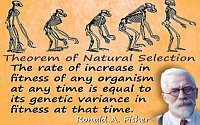
We may consequently state the fundamental theorem of Natural Selection in the form: The rate of increase in fitness of any organism at any time is equal to its genetic variance in fitness at that time.
The Genetical Theory of Natural Selection (1930), 35.
We may consider the renting of a property for several years as a sale of the usufruct during the time of the lease. Now nine years' possession, for example, is equal to more than a third of the value of the property, supposing the annual product to be one twentieth of the capital. It would then be reasonable to apply to this sort of sale the laws which govern that of landed property, and consequently the mutation tax. The person who cannot or will not cultivate his soil, instead of alienating the property itself, binds himself to alienate the usufruct for a time, and the price is paid at stated intervals instead of all at once. There is farm rent.
From Appendix A, 'Extracts From the Unpublished Writings of Carnot', Reflections on the Motive Power of Heat (1890, 2nd ed. 1897), 214.
We must make the following remark: a proof, that after a certain time t1, the spheres must necessarily be mixed uniformly, whatever may be the initial distribution of states, cannot be given. This is in fact a consequence of probability theory, for any non-uniform distribution of states, no matter how improbable it may be, is still not absolutely impossible. Indeed it is clear that any individual uniform distribution, which might arise after a certain time from some particular initial state, is just as improbable as an individual non-uniform distribution; just as in the game of Lotto, any individual set of five numbers is as improbable as the set 1, 2, 3, 4, 5. It is only because there are many more uniform distributions than non-uniform ones that the distribution of states will become uniform in the course of time. One therefore cannot prove that, whatever may be the positions and velocities of the spheres at the beginning, the distributions must become uniform after a long time; rather one can only prove that infinitely many more initial states will lead to a uniform one after a definite length of time than to a non-uniform one. Loschmidt's theorem tells us only about initial states which actually lead to a very non-uniform distribution of states after a certain time t1; but it does not prove that there are not infinitely many more initial conditions that will lead to a uniform distribution after the same time. On the contrary, it follows from the theorem itself that, since there are infinitely many more uniform distributions, the number of states which lead to uniform distributions after a certain time t1, is much greater than the number that leads to non-uniform ones, and the latter are the ones that must be chosen, according to Loschmidt, in order to obtain a non-uniform distribution at t1.
From 'On the Relation of a General Mechanical Theorem to the Second Law of Thermodynamics' (1877), in Stephen G. Brush (ed.), Selected Readings in Physics (1966), Vol. 2, Irreversible Processes, 191-2.
We must not overlook the role that extremists play. They are the gadflies that keep society from being too complacent or self-satisfied; they are, if sound, the spearhead of progress. If they are fundamentally wrong, free discussion will in time put an end to them.
I Remember (1940), 405.
We need another and a wiser and perhaps a more mystical concept of animals. Remote from universal nature, and living by complicated artifice, man in civilization surveys the creature through the glass of his knowledge and sees thereby a feather magnified and the whole image in distortion. We patronize them for their incompleteness, for their tragic fate of having taken form so far below ourselves. And therein we err, and greatly err. For the animal shall not be measured by man. In a world older and more complete than ours they move finished and complete, gifted with extensions of the senses we have lost or never attained, living by voices we shall never hear. They are not brethren, they are not underlings; they are other nations, caught with ourselves in the net of life and time, fellow prisoners of the splendour and travail of the earth.
The Outermost House (1928), 25.
We need another, wiser, and perhaps a more mystical concept of animals. For the animal shall not be measured by man....They are not underlings. They are other nations, caught with ourselves in the net of life and time, fellow prisoners of the splendor and travail of Earth.
The Outermost House: A Year of Life On The Great Beach of Cape Cod (2003), 24-25.
We need to be realistic. There is very little we can do now to stop the ice from disappearing from the North Pole in the Summer. And we probably cannot prevent the melting of the permafrost and the resulting release of methane. In addition, I fear that we may be too late to help the oceans maintain their ability to absorb carbon dioxide. But there is something we can do—and it could make the whole difference and buy us time to develop the necessary low carbon economies. We can halt the destruction of the world’s rainforests—and even restore parts of them—in order to ensure that the forests do what they are so good at—in other words storing carbon naturally. This is a far easier, cheaper and quicker option than imagining we can rely on as yet unproven technology to capture carbon at a cost of some $50 per tonne or, for that matter, imagining we can achieve what is necessary through plantation timber.
Presidential Lecture (3 Nov 2008) at the Presidential Palace, Jakarta, Indonesia. On the Prince of Wales website.
We need to remember that we are spiritual beings spending some time in a human body.
Quoted in Kim Lim (ed.), 1,001 Pearls of Spiritual Wisdom: Words to Enrich, Inspire, and Guide Your Life (2014), 32
We never really see time. We see only clocks. If you say this object moves, what you really mean is that this object is here when the hand of your clock is here, and so on. We say we measure time with clocks, but we see only the hands of the clocks, not time itself. And the hands of a clock are a physical variable like any other. So in a sense we cheat because what we really observe are physical variables as a function of other physical variables, but we represent that as if everything is evolving in time.
Quoted by Tim Folger in 'Newsflash: Time May Not Exist', Discover Magazine (Jun 2007).
We now live in an age in which science is a court from which there is no appeal. And this issue this time around, at the beginning of the twenty-first century, is not the evolution of the species, which can seem a remote business, but the nature of our own precious inner selves.
…...
We pass with admiration along the great series of mathematicians, by whom the science of theoretical mechanics has been cultivated, from the time of Newton to our own. There is no group of men of science whose fame is higher or brighter. The great discoveries of Copernicus, Galileo, Newton, had fixed all eyes on those portions of human knowledge on which their successors employed their labors. The certainty belonging to this line of speculation seemed to elevate mathematicians above the students of other subjects; and the beauty of mathematical relations and the subtlety of intellect which may be shown in dealing with them, were fitted to win unbounded applause. The successors of Newton and the Bernoullis, as Euler, Clairaut, D’Alembert, Lagrange, Laplace, not to introduce living names, have been some of the most remarkable men of talent which the world has seen.
In History of the Inductive Sciences, Vol. 1, Bk. 4, chap. 6, sect. 6.
We reverence ancient Greece as the cradle of western science. Here for the first time the world witnessed the miracle of a logical system which proceeded from step to step with such precision that every single one of its propositions was absolutely indubitable—I refer to Euclid’s geometry. This admirable triumph of reasoning gave the human intellect the necessary confidence in itself for its subsequent achievements. If Euclid failed to kindle your youthful enthusiasm, then you were not born to be a scientific thinker.
From 'On the Method of Theoretical Physics', in Essays in Science (1934, 2004), 13.
We see past time in a telescope and present time in a microscope. Hence the apparent enormities of the present.
In Victor Hugo and Lorenzo O'Rourke (trans.) Victor Hugo's Intellectual Autobiography: (Postscriptum de ma vie) (1907), 380.
We see that the immediate experimental program is largely concerned with measuring the neutron properties of various materials, and with the ordnance problem. It is also necessary to start new studies on techniques for direct experimental determination of critical size and time scale, working with large but sub-critical amounts of active material.
From notes (written up by Edward U. Condon) of introductory lectures by Robert Serber (Apr 1943) at the start-up of the Los Alamos Project. For distribution to new arrivals, the notes were mimeographed as The Los Alamos Primer. See 'Conclusion', Sec.22, p.24. Declassified in 1965. Published with an Introduction and extensive notations added by the editor, in Robert Serber and Richard Rhodes (ed.), The Los Alamos Primer: The First Lectures on How To Build an Atomic Bomb (1992), 63.
We seem to have a compulsion these days to bury time capsules in order to give those people living in the next century or so some idea of what we are like.
…...
We shall never get people whose time is money to take much interest in atoms.
In Samuel Butler and Henry Festing Jones (ed.), The Note-Books of Samuel Butler (1920), Vol. 2, 298.
We shall not cease from exploration
And the end of all our exploring
Will be to arrive where we started
And know the place for the first time.
This was a favorite quotation of John Bahcall, who used it in his presentation at the Neutrino 2000 conference.
And the end of all our exploring
Will be to arrive where we started
And know the place for the first time.
This was a favorite quotation of John Bahcall, who used it in his presentation at the Neutrino 2000 conference.
Poem, 'Little Gidding,' (1942). Collected in Four Quartets (1943), Pt. 5, 39.
We should admit in theory what is already very largely a case in practice, that the main currency of scientific information is the secondary sources in the forms of abstracts, reports, tables, &c., and that the primary sources are only for detailed reference by very few people. It is possible that the fate of most scientific papers will be not to be read by anyone who uses them, but with luck they will furnish an item, a number, some facts or data to such reports which may, but usually will not, lead to the original paper being consulted. This is very sad but it is the inevitable consequence of the growth of science. The number of papers that can be consulted is absolutely limited, no more time can be spent in looking up papers, by and large, than in the past. As the number of papers increase the chance of any one paper being looked at is correspondingly diminished. This of course is only an average, some papers may be looked at by thousands of people and may become a regular and fixed part of science but most will perish unseen.
'The Supply of Information to the Scientist: Some Problems of the Present Day', The Journal of Documentation, 1957, 13, 195.
We sound the future, and learn that after a period, long compared with the divisions of time open to our investigation, the energies of our system will decay, the glory of the sun will be dimmed and the earth, tideless and inert, will no longer tolerate the race which has for a moment disturbed its solitude. Man will go down into the pit, and all his thoughts will perish.
The Foundations of Belief: Being Notes Introductory to the Study of Theology (1895), 30-1.
We speak of it [astrology] as an extinct science; yet let but an eclipse of the sun happen, or a comet visit the evening sky, and in a moment we all believe in astrology. In vain do you tell the gazers on such spectacles that a solar eclipse is only the moon acting for the time as a candle-extinguisher to the sun, and give them bits of smoked glass to look through, and draw diagrams on the blackboard to explain it all. They listen composedly, and seem convinced, but in their secret hearts they are saying—“What though you can see it through a glass darkly, and draw it on a blackboard, does that show that it has no moral significance? You can draw a gallows or a guillotine, or write the Ten Commandments on a blackboard, but does that deprive them of meaning?” And so with the comet. No man will believe that the splendid stranger is hurrying through the sky solely on a momentous errand of his own. No! he is plainly signalling, with that flashing sword of his, something of importance to men,—something at all events that, if we could make it out, would be found of huge concern to us.
From 'Introductory Lecture on Technology for 1858-59', published as The Progress of the Telegraph (1859), 19-20.
We talk about our high standard of living in this country. What we have is a high standard of work. Usually the peaks of civilization have been periods when a large proportion of the population had time to live. I don’t think we’re doing this today. I think the people who could live are still spending their time and supplementary resources on making a living.
As quoted in interview with Frances Glennon, 'Student and Teacher of Human Ways', Life (14 Sep 1959), 147.
We think we understand the regular reflection of light and X rays - and we should understand the reflections of electrons as well if electrons were only waves instead of particles ... It is rather as if one were to see a rabbit climbing a tree, and were to say ‘Well, that is rather a strange thing for a rabbit to be doing, but after all there is really nothing to get excited about. Cats climb trees - so that if the rabbit were only a cat, we would understand its behavior perfectly.’ Of course, the explanation might be that what we took to be a rabbit was not a rabbit at all but was actually a cat. Is it possible that we are mistaken all this time in supposing they are particles, and that actually they are waves?
Franklin Institute Journal Vol. 205, 597. Cited in New Scientist (14 Apr 1977), 66.
We want to explore. We’re curious people. Look back over history, people have put their lives at stake to go out and explore... We believe in what we’re doing. Now it’s time to go.
…...
We will not act prematurely or unnecessarily risk the costs of worldwide nuclear war in which even the fruits of victory would be ashes in our mouth. But neither will we shrink from that risk at any time it must be faced.
(1962) From address televised during the Cuban missile crisis (22 Oct 1962). As quoted in The Uncommon Wisdom of JFK: A Portrait in His Own Words 92003), 89.

Were I asked to define it, I should reply that archæology is that science which enables us to register and classify our knowledge of the sum of man’s achievement in those arts and handicrafts whereby he has, in time past, signalized his passage from barbarism to civilization.
In Pharaohs, Fellahs and Explorers (1891), 24.
What a curious attitude scientists have: ‘We still don’t know that; but it is knowable and it is only a matter of time before we get to know it!’ As if that went without saying.
Quoted in S. Hilmy, The Later Wittgenstein: The Emergence of a New Philosophical Method (1987), 220.
What astronomy has done for space, geology has done for time; the one gives us the idea of infinite distance and magnitude in the starry heavens—the other, of almost infinite duration of time in the immense cycles of changes which our own planet has undergone.
In The Geological Survey of California: An Address Delivered Before the Legislature of California … March 12th, 1861 by J.D. Whitney (1861), 8.
What attracted me to immunology was that the whole thing seemed to revolve around a very simple experiment: take two different antibody molecules and compare their primary sequences. The secret of antibody diversity would emerge from that. Fortunately at the time I was sufficiently ignorant of the subject not to realise how naive I was being.
From Nobel Lecture (8 Dec 1984), collected in Tore Frängsmyr and Jan Lindsten (eds.), Nobel Lectures in Physiology Or Medicine: 1981-1990 (1993), 248.
What binds us to space-time is our rest mass, which prevents us from flying at the speed of light, when time stops and space loses meaning. In a world of light there are neither points nor moments of time; beings woven from light would live “nowhere” and “nowhen”; only poetry and mathematics are capable of speaking meaningfully about such things.
In 'Mathematics and Physics', collected in Mathematics as Metaphor: Selected Essays of Yuri I. Manin (2007), 130.
What clearer evidence could we have had of the different formation of these rocks, and of the long interval which separated their formation, had we actually seen them emerging from the bosom of the deep? … The mind seemed to grow giddy by looking so far into the abyss of time.
As quoted in Dennis R. Dean, James Hutton and the History of Geology (1992), 122.
What does one have to do to be called a scientist? I decided that anyone who spent on science more than 10% of his waking, thinking time for a period of more than a year would be called a scientist, at least for that year.
Quoted in 'The Way it Was', Annual Review of Physical Chemistry (1982), 33, 1-2.
What exploded was–nothing. Space, time, and matter are the products of that explosion: they played no part in its cause. Indeed, in a very real sense, it had no cause.
With co-author Jack Cohen. Explaining the Big Bang, in Terry Pratchett, Ian Stewart and Jack Cohen, Chap. 6, 'Beginnings and Becomings', The Science of Discworld (1999), 50. Pratchett wrote the fantasy story told in the odd-numbered chapters. Following each, relevant real science is provided by his co-authors, Stewart and Cohen, in the even-numbered chapters (such as Chap. 6), but which of the two wrote which lines, is not designated.
What helps luck is a habit of watching for opportunities, of having a patient but restless mind, of sacrificing one’s ease or vanity, or uniting a love of detail to foresight, and of passing through hard times bravely [and cheerfully].
In The Wish of His Life (1878), Vol. 1, 25. The ending "and cheerfully" is not part of the original text, though it is seen added in Tryon Edwards, A Dictionary of Thoughts: Being a Cyclopedia of Laconic Quotations from the Best Authors, Both Ancient and Modern (1891), 320. The original text ends “whistling the air of ‘Marlbrough’.”
What I remember most clearly was that when I put down a suggestion that seemed to me cogent and reasonable, Einstein did not in the least contest this, but he only said, 'Oh, how ugly.' As soon as an equation seemed to him to be ugly, he really rather lost interest in it and could not understand why somebody else was willing to spend much time on it. He was quite convinced that beauty was a guiding principle in the search for important results in theoretical physics.
quoted in Fearful Symmetry: The Search for Beauty in Modern Physics (1987)
What I tell you three times is true.
The Hunting of the Snark: An Agony, in Eight Fits (1876), 3.
What I then got hold of, something frightful and dangerous, a problem with horns but not necessarily a bull, in any case a new problem—today I should say that it was the problem of science itself, science considered for the first time as problematic, as questionable. But the book in which my youthful courage and suspicion found an outlet—what an impossible book had to result from a task so uncongenial to youth! Constructed from a lot of immature, overgreen personal experiences, all of them close to the limits of communication, presented in the context of art—for the problem of science cannot be recognized in the context of science—a book perhaps for artists who also have an analytic and retrospective penchant (in other words, an exceptional type of artist for whom one might have to look far and wide and really would not care to look) …
In The Birth of Tragedy (1872). Collected in Friedrich Nietzsche and Walter Kaufmann (trans.), The Birth of Tragedy and The Case of Wagner (1967), 18.
What is it to see, in an Eagle glide
Which fills a human heart with so much pride?
Is it that it soars effortless above the Earth
That steals us from our own limits & dearth?
Trapped in our seas of befuddling sludge
We try and try but cannot budge.
And then to see a mortal; with such ease take wing
Up in a breeze that makes our failing spirits sing?
Do we, vicarious birds, search in it our childishness -
When we too were young & yearned in heart to fly?
Taking flights of fancy through adolescent nights
Listening little, heeding less, knowing not why?
From its highest perch in the forest of snow
Majestic - the Eagle soars alone.
Riding thermals, lording clouds
Till dropping silent from the sky as a stone
But we, so quick and ready to fold
Give up our wings at the whiff of age
Losing years, cursing time, wasting spirit
Living out entire lives in futile rage!
Which fills a human heart with so much pride?
Is it that it soars effortless above the Earth
That steals us from our own limits & dearth?
Trapped in our seas of befuddling sludge
We try and try but cannot budge.
And then to see a mortal; with such ease take wing
Up in a breeze that makes our failing spirits sing?
Do we, vicarious birds, search in it our childishness -
When we too were young & yearned in heart to fly?
Taking flights of fancy through adolescent nights
Listening little, heeding less, knowing not why?
From its highest perch in the forest of snow
Majestic - the Eagle soars alone.
Riding thermals, lording clouds
Till dropping silent from the sky as a stone
But we, so quick and ready to fold
Give up our wings at the whiff of age
Losing years, cursing time, wasting spirit
Living out entire lives in futile rage!
…...
What makes planets go around the sun? At the time of Kepler, some people answered this problem by saying that there were angels behind them beating their wings and pushing the planets around an orbit. As you will see, the answer is not very far from the truth. The only difference is that the angels sit in a different direction and their wings push inward.
In The Character of Physical Law (1965), 18.
What makes the theory of relativity so acceptable to physicists in spite of its going against the principle of simplicity is its great mathematical beauty. This is a quality which cannot be defined, any more than beauty in art can be defined, but which people who study mathematics usually have no difficulty in appreciating. … The restricted theory changed our ideas of space and time in a way that may be summarised by stating that the group of transformations to which the space-time continuum is subject must be changed from the Galilean group to the Lorentz group.
From Lecture delivered on presentation of the James Scott prize, (6 Feb 1939), 'The Relation Between Mathematics And Physics', printed in Proceedings of the Royal Society of Edinburgh (1938-1939), 59, Part 2, 123.
What matters in science is the body of findings and generalizations available today: a time-defined cross-section of the process of scientific discovery. I see the advance of science as self-erasing in the sense that only those elements survive that have become part of the active body of knowledge.
In A Slot Machine, A Broken Test Tube (1985), 123.
What signifies Philosophy that does not apply to some Use? May we not learn from hence, that black Clothes are not so fit to wear in a hot Sunny Climate or Season, as white ones; because in such Cloaths the Body is more heated by the Sun when we walk abroad, and are at the same time heated by the Exercise, which double Heat is apt to bring on putrid dangerous Fevers? The Soldiers and Seamen, who must march and labour in the Sun, should in the East or West Indies have an Uniform of white?
Letter to Miss Mary Stevenson, 20 Sep 1761. In Albert Henry Smyth (ed.), The Writings of Benjamin Franklin (1906), Vol. 4, 115.
What sir, would you make a ship sail against the wind and currents by lighting a bonfire under her deck? I pray you excuse me. I have no time to listen to such nonsense.
In Ashton Applewhite, Tripp Evans and Andrew Frothingham, And I Quote (1992), 172, but without definitive source. Webmaster has not found any 19th-century book with such a quotation. Contact webmaster if you can help identify if this is a valid quote or merely a joke.
What was really great about 'Star Trek' when I was growing up as a little girl is not only did they have Lt. Uhura played by Nichelle Nichols as a technical officer—she was African. ... At the same time, they had this crew that was composed of people from all around the world and they were working together to learn more about the universe. ... So that helped to fuel my whole idea that I could be involved in space exploration as well as in the sciences.
As quoted in 'Then & Now: Dr. Mae Jemison' (19 Jun 2005) on CNN web site.
What we do see through geological time is the emergence of more complex worlds. ... [W]hen within the animal we see the emergence of larger and more complex brains, sophisticated vocalizations, echolocation, electrical perception, advanced social systems including eusociality, viviparity, warm-bloodedness, and agriculture—all of which are convergent—then to me that sounds like progress.
Life's Solution, 307. In Vinoth Ramachandra, Subverting Global Myths: Theology and the Public Issues Shaping our World (2008), 184.
Whatever may have been imputed to some other studies under the notion of insignificancy and loss of time, yet these [mathematics], I believe, never caused repentance in any, except it was for their remissness in the prosecution of them.
In 'On the Usefulness of Mathematics', Works (1840), Vol. 2, 69.
Whatsoever therefore is consequent to a time of Warre, where every man is Enemy to every man; the same is consequent to the time, wherein men live without other security, than what their own strength, and their own invention shall furnish them withall. In such condition, there is no place for Industry; because the fruit thereof is uncertain: and consequently no Culture of the Earth; no Navigation, nor use of the commodities that may be imported by Sea; no commodious Building; no Instruments of moving, and removing, such things as require much force; no Knowledge of the face of the Earth; no account of Time; no Arts; no Letters; no Society; and which is worst of all, continual fear, and danger of violent death; And the life of man, solitary, poore, nasty, brutish, and short.
Leviathan (1651), ed. C. B. Macpherson (1968), Part 1, Chapter 13, 186.
When [Humphry Davy] saw the minute globules of potassium burst through the crust of potash, and take fire as they entered the atmosphere, he could not contain his joy—he actually bounded about the room in ecstatic delight; some little time was required for him to compose himself to continue the experiment.
Quoted in Memoirs of the Life of Sir Humphry Davy, in J. Davy (ed.), The Collected Works of Sir Humphry Davy(1839-40), Vol 1, 109.
When a machine begins to run without human aid, it is time to scrap it - whether it be a factory or a government.
In Rhoda Thomas Tripp, The International Thesaurus of Quotations (1970).
When a scientist is ahead of his times, it is often through misunderstanding of current, rather than intuition of future truth. In science there is never any error so gross that it won't one day, from some perspective, appear prophetic.
Pensées d'un Biologiste (1939). Translated in The Substance of Man (1962), Chap. 7.
When Aloisio Galvani first stimulated the nervous fiber by the accidental contact of two heterogeneous metals, his contemporaries could never have anticipated that the action of the voltaic pile would discover to us, in the alkalies, metals of a silvery luster, so light as to swim on water, and eminently inflammable; or that it would become a powerful instrument of chemical analysis, and at the same time a thermoscope and a magnet.
In 'Introduction' Cosmos: A Sketch of a Physical Description of the Universe (1860), Vol. 1, 52, as translated by E.C. Otté.
When an Englishman has nothing to do, and a certain time to wait, his one resource is to walk about. A Frenchman sits down and lights a cigar, an Italian goes to sleep, a German meditates, an American invents some new position for his limbs as far as possible asunder from that intended for them by nature, but an Englishman always takes a walk.
In The West Indies and the Spanish Main (1860), 15.
When an inquiry becomes so convoluted, we must suspect that we are proceeding in the wrong way. We must return to go, change gears, and reformulate the problem, not pursue every new iota of information or nuance of argument jn the old style, hoping all the time that our elusive solution simply awaits a crucial item, yet undiscovered.
In The Flamingo’s Smile (1985).
When an observation is made on any atomic system that has been prepared in a given way and is thus in a given state, the result will not in general be determinate, i.e. if the experiment is repeated several times under identical conditions several different results may be obtained. If the experiment is repeated a large number of times it will be found that each particular result will be obtained a definite fraction of the total number of times, so that one can say there is a definite probability of its being obtained any time that the experiment is performed. This probability the theory enables one to calculate. (1930)
The Principles of Quantum Mechanics 4th ed. (1981), 13-14
When chemists have brought their knowledge out of their special laboratories into the laboratory of the world, where chemical combinations are and have been through all time going on in such vast proportions,—when physicists study the laws of moisture, of clouds and storms, in past periods as well as in the present,—when, in short, geologists and zoologists are chemists and physicists, and vice versa,—then we shall learn more of the changes the world has undergone than is possible now that they are separately studied.
Geological Sketches (1866), 73.
When everything moves at the same time, nothing moves in appearance.
Quand tout se remue également, rien ne se remue en apparence.
Quand tout se remue également, rien ne se remue en apparence.
From Pensées Art. vi, 27. In Craufurd Tait Ramage, Beautiful Thoughts from French and Italian Authors (1866), 237.
When first I applied my mind to Mathematics I read straight away most of what is usually given by the mathematical writers, and I paid special attention to Arithmetic and Geometry because they were said to be the simplest and so to speak the way to all the rest. But in neither case did I then meet with authors who fully satisfied me. I did indeed learn in their works many propositions about numbers which I found on calculation to be true. As to figures, they in a sense exhibited to my eyes a great number of truths and drew conclusions from certain consequences. But they did not seem to make it sufficiently plain to the mind itself why these things are so, and how they discovered them. Consequently I was not surprised that many people, even of talent and scholarship, should, after glancing at these sciences, have either given them up as being empty and childish or, taking them to be very difficult and intricate, been deterred at the very outset from learning them. … But when I afterwards bethought myself how it could be that the earliest pioneers of Philosophy in bygone ages refused to admit to the study of wisdom any one who was not versed in Mathematics … I was confirmed in my suspicion that they had knowledge of a species of Mathematics very different from that which passes current in our time.
In Elizabeth S. Haldane (trans.) and G.R.T. Ross (trans.), 'Rules for the Direction of the Mind', The Philosophical Works of Descartes (1911, 1973), Vol. 1, Rule 4, 11.
When Galileo caused balls, the weights of which he had himself previously determined, to roll down an inclined plane; when Torricelli made the air carry a weight which he had calculated beforehand to be equal to that of a definite volume of water; or in more recent times, when Stahl changed metal into lime, and lime back into metal, by withdrawing something and then restoring it, a light broke upon all students of nature. They learned that reason has insight only into that which it produces after a plan of its own, and that it must not allow itself to be kept, as it were, in nature's leading-strings, but must itself show the way with principles of judgement based upon fixed laws, constraining nature to give answer to questions of reason's own determining. Accidental observations, made in obedience to no previously thought-out plan, can never be made to yield a necessary law, which alone reason is concerned to discover.
Critique of Pure Reason (1781), trans. Norman Kemp Smith (1929), 20.
When going ahead in space, it is also important to go back in time.
Gordon Lill and Arthur Maxwell, quoting a proverb of the American Miscellaneous Society (AMSOC, which Lill co-founded), 'The Earth's Mantle', Science (22 May 1959), 129, No. 3360, 1410.
When I hear to-day protests against the Bolshevism of modern science and regrets for the old-established order, I am inclined to think that Rutherford, not Einstein, is the real villain of the piece. When we compare the universe as it is now supposed to be with the universe as we had ordinarily preconceived it, the most arresting change is not the rearrangement of space and time by Einstein but the dissolution of all that we regard as most solid into tiny specks floating in void. That gives an abrupt jar to those who think that things are more or less what they seem. The revelation by modern physics of the void within the atom is more disturbing than the revelation by astronomy of the immense void of interstellar space.
In The Nature of the Physical World (1928, 2005), 1.
When I heard the learn’d astronomer,
When the proofs, the figures, were ranged in columns before me,
When I was shown the charts and diagrams, to add, divide, and measure them,
When I sitting heard the astronomer where he lectured with much applause in the lecture-room,
How soon unaccountable I became tired and sick,
Till rising and gliding out I wander’d by myself,
In the mystical moist night-air, and from time to time,
Look’d up in perfect silence at the stars.
When the proofs, the figures, were ranged in columns before me,
When I was shown the charts and diagrams, to add, divide, and measure them,
When I sitting heard the astronomer where he lectured with much applause in the lecture-room,
How soon unaccountable I became tired and sick,
Till rising and gliding out I wander’d by myself,
In the mystical moist night-air, and from time to time,
Look’d up in perfect silence at the stars.
In Leaves of Grass (1881, 1882), 214.
When I look back upon the past, I can only dispel the sadness which falls upon me by gazing into that happy future when the infection [puerperal fever] will be banished. But if it is not vouchsafed for me to look upon that happy time with my own eyes … the conviction that such a time must inevitably sooner or later arrive will cheer my dying hour.
[Webmaster note: He had identified that puerperal fever was transmitted to women by the “cadaveric material” on the hands of physicians coming direct from the post-mortem room to an examination. He discovered that washing the physician’s hands in a solution of chlorinated lime prevented the transmission of this disease. His doctrine was opposed by many, and he died in an insane asylum in 1865, at age 47.] Original publication, Die Aetiologie, der Begriff und die Prophylaxis des Kindbettfiebvers (1861), trans. by F.P. Murphy as The Etiology, the Concept, and the Prophylaxis of Childbed Fever (1941), Foreword. As quoted in Francis Randolph Packard (ed.), Annals of Medical History (1939), 3rd Series, 1, 94; and Stephen Jay Gould, Hen’s Teeth and Horse’s Toes: Further Reflections in Natural History (1985), 274.
When I observe the luminous progress and expansion of natural science in modern times, I seem to myself like a traveller going eastwards at dawn, and gazing at the growing light with joy, but also with impatience; looking forward with longing to the advent of the full and final light, but, nevertheless, having to turn away his eyes when the sun appeared, unable to bear the splendour he had awaited with so much desire.
In The Maxims and Reflections of Goethe (1906), 197-198.
When I orbited the Earth in a spaceship, I saw for the first time how beautiful our planet is. Mankind, let us preserve and increase this beauty, and not destroy it!
…...
When I read an Italian letter [Saggio by Voltaire] on changes which had occurred on the surface of the earth, published in Paris this year (1746), I believed that these facts were reported by La Loubère. Indeed, they correspond perfectly with the author’s ideas. Petrified fish are according to him merely rare fish thrown away by Roman cooks because they were spoiled; and with respect to shells, he said that they were from the sea of the Levant and brought back by pilgrims from Syria at the time of the crusades. These shells are found today petrified in France, in Italy and in other Christian states. Why did he not add that monkeys transported shells on top of high mountains and to every place where humans cannot live? It would not have harmed his story but made his explanation even more plausible.
In 'Preuves de la Théorie de la Terre', Histoire Naturelle, Générale et Particuliere, Avec la Description du Cabinet du Roi (1749), Vol. I, 281. Trans. Albert V. and Marguerite Carozzi.
When I was 9, my parents gave me a Commodore 64, which was fun. At the time, the opportunity to program your own computer was easier than it is today. Today there are significantly larger barriers because of the complexity built into computing.
From address at a conference on Google campus, co-hosted with Common Sense Media and the Joan Ganz Cooney Center at Sesame Workshop 'Breakthrough Learning in the Digital Age'. As quoted in Technology blog report by Dan Fost, 'Google co-founder Sergey Brin wants more computers in schools', Los Angeles Times (28 Oct 2009). On latimesblogs.latimes.com website.
As quoted, without citation, in Can Akdeniz, Fast MBA (2014), 280.
When I was a little over eight years old,… I was sent to a day-school…. [By this time] my taste for natural history, and more especially for collecting, was well developed. I tried to make out the names of plants, and collected all sorts of things, shells, seals, franks, coins, and minerals. The passion for collecting which leads a man to be a systematic naturalist, a virtuoso, or a miser, was very strong in me.
In Charles Darwin and Francis Darwin (ed.), 'Autobiography', The Life and Letters of Charles Darwin (1887, 1896), Vol. 1, 26.
When I was growing up, I always knew I’d be in the top of my class in math, and that gave me a lot of self-confidence. [But now that students can see beyond their own school, they see that] there are always going to be a million people better than you at times, or someone will always be far better than you. I feel there’s an existential angst among young people. I didn’t have that. They see enormous mountains, where I only saw one little hill to climb.
From address at a conference on Google campus, co-hosted with Common Sense Media and the Joan Ganz Cooney Center at Sesame Workshop 'Breakthrough Learning in the Digital Age'. As quoted in Technology blog report by Dan Fost, 'Google co-founder Sergey Brin wants more computers in schools', Los Angeles Times (28 Oct 2009). On latimesblogs.latimes.com website.
As quoted, without citation, in Can Akdeniz, Fast MBA (2014), 280.
When I was young I observed that nine out of every ten things I did were failures, so I did ten times more work.
…...
When introduced at the wrong time or place, good logic may be the worst enemy of good teaching.
Quoted, without citation, in The American Mathematical Monthly (Mar 1993), 100 No. 3, 286.
When it is considered that this light, when obtained with mercury gas, has an efficiency at least eight times as great as that obtained by an ordinary incandescent lamp, it will be appreciated that it has its use in places where lack of red is not important, for the economy of operation will much more than compensate for the somewhat unnatural color given to illuminated objects.
'Electric Gas Lamps and Gas Electrical Resistance Phenomena', a paper read at the 150th AIEE meeting 3 Jan 1902. In Transactions of the American Institute of Electrical Engineers (1902), 61.
When it’s too easy to get money, then you get a lot of noise mixed in with the real innovation and entrepreneurship. Tough times bring out the best parts of Silicon Valley
As quoted by Jessica Guynn, reporting on a media roundtable at a conference on Google’s campus, in 'Google’s Schmidt, Page and Brin hold court at Zeitgeist', Los Angeles Times (17 Sep 2008). On latimesblogs.latimes.com webpage.
When one considers how hard it is to write a computer program even approaching the intellectual scope of a good paper, and how much greater time and effort have to be put in to make it “almost” formally correct, it is preposterous to claim that mathematics as we practice it is anywhere near formally correct.
In 'On Proof and Progress in Mathematics', For the Learning of Mathematics (Feb 1995), 15, No. 1, 33. Reprinted from Bulletin of the American Mathematical Society (1994), 30, No. 2, 170-171.
When one studies strongly radioactive substances special precautions must be taken if one wishes to be able to take delicate measurements. The various objects used in a chemical laboratory and those used in a chemical laboratory, and those which serve for experiments in physics, become radioactive in a short time and act upon photographic plates through black paper. Dust, the air of the room, and one’s clothes all become radioactive.
Notebook entry. In Eve Curie, Madame Curie: a Biography by Eve Curie (1937, 2007), 196.
When something comes along and is really important to your career and important to science, important enough so that lots of other people are working on it, you have got to do it in a short time. You have got to get in there and run experiments quickly and get published. That is the killer instinct. I do not think women have that part of it. Part of it comes from sports. It's like scoring a goal.
Quoted in The Door in the Dream: Conversations with Eminent Women in Science by Elga Wasserman, National Academy Press/John Henry Press (2000), p. 182
When the first baby laughed for the first time, the laugh broke into a thousand pieces and they all went skipping about, and that was the beginning of fairies.
Peter Pan (1904), Act 1.
When the most abstract and “useless” disciplines have been cultivated for a time, they are often seized upon as practical tools by other departments of science. I conceive that this is no accident, as if one bought a top hat for a wedding, and discovered later when a fire broke out, that it could be used as a water bucket.
In James R. Newman (ed.), 'Commentary on The Use of a Top Hat as a Water Bucket', The World of Mathematics (1956), Vol.4, 2051.
When the old and bewhiskered alchemist mentally planned his transmutations from lead to gold, he no doubt considered his reagent “spiritus vitroli” second only to his trusty Philosopher’s Stone in power and usefulness; for we read of sulphuric acid back through Alchemical times.
Co-author with E.L. Larison, American Sulphuric Acid Practice (1921), 1.
When the time is ripe for certain things, these things appear in different places in the manner of violets coming to light in early spring.
When the war finally came to an end, 1 was at a loss as to what to do. ... I took stock of my qualifications. A not-very-good degree, redeemed somewhat by my achievements at the Admiralty. A knowledge of certain restricted parts of magnetism and hydrodynamics, neither of them subjects for which I felt the least bit of enthusiasm.
No published papers at all … [Only gradually did I realize that this lack of qualification could be an advantage. By the time most scientists have reached age thirty they are trapped by their own expertise. They have invested so much effort in one particular field that it is often extremely difficult, at that time in their careers, to make a radical change. I, on the other hand, knew nothing, except for a basic training in somewhat old-fashioned physics and mathematics and an ability to turn my hand to new things. … Since I essentially knew nothing, I had an almost completely free choice. …
No published papers at all … [Only gradually did I realize that this lack of qualification could be an advantage. By the time most scientists have reached age thirty they are trapped by their own expertise. They have invested so much effort in one particular field that it is often extremely difficult, at that time in their careers, to make a radical change. I, on the other hand, knew nothing, except for a basic training in somewhat old-fashioned physics and mathematics and an ability to turn my hand to new things. … Since I essentially knew nothing, I had an almost completely free choice. …
In What Mad Pursuit (1988).
When was the last time you did something for the first time?
— Emirates
…...
When we build, let us think that we build forever. Let it not be for present delight nor for present use alone. Let it be such work as our descendants will thank us for; and let us think, as we lay stone on stone, that a time is to come when those stones will be held sacred because our hands have touched them, and that men will say, as they look upon the labor and wrought substance of them, “See! This our father did for us.”
From Lectures on 'Architecture and Painting' (Nov 1853), delivered at Edinburgh, collected in The Seven Lamps of Architecture (May 1849, 1887), 172.
When we burn fossil fuel for energy we are, in qualitative terms, doing nothing more wrong than burning wood. Our wrongdoing, if that is an appropriate term, is taking energy from Gaia hundreds of times faster than it is naturally made available. We are sinning in a quantitative not a qualitative way.
In The Revenge of Gaia: Earth’s Climate Crisis & The Fate of Humanity (2006, 2007), 92.
When we had no computers, we had no programming problem either. When we had a few computers, we had a mild programming problem. Confronted with machines a million times as powerful, we are faced with a gigantic programming problem.
…...
When young Galileo, then a student at Pisa, noticed one day during divine service a chandelier swinging backwards and forwards, and convinced himself, by counting his pulse, that the duration of the oscillations was independent of the arc through which it moved, who could know that this discovery would eventually put it in our power, by means of the pendulum, to attain an accuracy in the measurement of time till then deemed impossible, and would enable the storm-tossed seaman in the most distant oceans to determine in what degree of longitude he was sailing?
Hermann von Helmholtz, Edmund Atkinson (trans.), Popular Lectures on Scientific Subjects: First Series (1883), 29.
Whenever you note the time on the clock, realize that it is now—right now—later than it has ever been.
As quoted in Douglas Martin, 'Kenneth Franklin, Astronomer, Dies at 84', New York Times (21 Jun 2007), C13. This was Martin’s concluding remark in a paper for the new millenium making clear it properly began not on in 2000, but on 1 Jan 2001.
Where a body is in motion, there exists space and time, the simplest sentient creature in this world would thus be a measure of them. Our hearing, and perhaps our seeing too, consists of a counting of oscillations.
Aphorism 54 in Notebook D (1773-1775), as translated by R.J. Hollingdale in Aphorisms (1990). Reprinted as The Waste Books (2000), 52.
Where we reach the sphere of mathematics we are among processes which seem to some the most inhuman of all human activities and the most remote from poetry. Yet it is just here that the artist has the fullest scope for his imagination. … We are in the imaginative sphere of art, and the mathematician is engaged in a work of creation which resembles music in its orderliness, … It is not surprising that the greatest mathematicians have again and again appealed to the arts in order to find some analogy to their own work. They have indeed found it in the most varied arts, in poetry, in painting, and in sculpture, although it would certainly seem that it is in music, the most abstract of all the arts, the art of number and time, that we find the closest analogy.
In The Dance of Life (1923), 138-139.
Whereas there is nothing more necessary for promoting the improvement of Philosophical Matters, than the communicating to such, as apply their Studies and Endeavours that way, such things as are discovered or put in practice by others; it is therefore thought fit to employ the Press, as the most proper way to gratifie those, whose engagement in such Studies, and delight in the advancement of Learning and profitable Discoveries, doth entitle them to the knowledge of what this Kingdom, or other parts of the World, do, from time to time, afford as well of the progress of the Studies, Labours, and attempts of the Curious and learned in things of this kind, as of their compleat Discoveries and performances: To the end, that such Productions being clearly and truly communicated, desires after solid and usefull knowledge may be further entertained, ingenious Endeavours and Undertakings cherished, and those, addicted to and conversant in such matters, may be invited and encouraged to search, try, and find out new things, impart their knowledge to one another, and contribute what they can to the Grand design of improving Natural knowledge, and perfecting all Philosophical Arts, and Sciences. All for the Glory of God, the Honour and Advantage of these Kingdoms, and the Universal Good of Mankind.
'Introduction', Philosophical Transactions (1665), 1, 1-2.
Wherefore also these Kinds [elements] occupied different places even before the universe was organised and generated out of them. Before that time, in truth, all these were in a state devoid of reason or measure, but when the work of setting in order this Universe was being undertaken, fire and water and earth and air, although possessing some traces of their known nature, were yet disposed as everything is likely to be in the absence of God; and inasmuch as this was then their natural condition, God began by first marking them out into shapes by means of forms and numbers.
— Plato
Timaeus 53ab, trans. R. G. Bury, in Plato: Timaeus, Critias, Cleitophon, Menexenus, Epistles (1929), 125-7.
Wherever we seek to find constancy we discover change. Having looked at the old woodlands in Hutcheson Forest, at Isle Royale, and in the wilderness of the boundary waters, in the land of the moose and the wolf, and having uncovered the histories hidden within the trees and within the muds, we find that nature undisturbed is not constant in form, structure, or proportion, but changes at every scale of time and space. The old idea of a static landscape, like a single musical chord sounded forever, must be abandoned, for such a landscape never existed except in our imagination. Nature undisturbed by human influence seems more like a symphony whose harmonies arise from variation and change over many scales of time and space, changing with individual births and deaths, local disruptions and recoveries, larger scale responses to climate from one glacial age to another, and to the slower alterations of soils, and yet larger variations between glacial ages.
Discordant Harmonies (1990), 62.
While Newton seemed to draw off the veil from some of the mysteries of nature, he showed at the same time the imperfections of the mechanical philosophy; and thereby restored her ultimate secrets to that obscurity, in which they ever did and ever will remain.
The History Of Great Britain, Containing the Commonwealth and the Reigns of Charles II. and James II. (2nd ed. 1759), Vol. 2, 450.
While reading in a textbook of chemistry, … I came across the statement, “nitric acid acts upon copper.” I was getting tired of reading such absurd stuff and I determined to see what this meant. Copper was more or less familiar to me, for copper cents were then in use. I had seen a bottle marked “nitric acid” on a table in the doctor’s office where I was then “doing time.” I did not know its peculiarities, but I was getting on and likely to learn. The spirit of adventure was upon me. Having nitric acid and copper, I had only to learn what the words “act upon” meant … I put one of them [cent] on the table, opened the bottle marked “nitric acid”; poured some of the liquid on the copper; and prepared to make an observation. But what was this wonderful thing which I beheld? The cent was already changed, and it was no small change either. A greenish blue liquid foamed and fumed over the cent and over the table. The air in the neighborhood of the performance became colored dark red. A great colored cloud arose. This was disagreeable and suffocating—how should I stop this? I tried to get rid of the objectionable mess by picking it up and throwing it out of the window, which I had meanwhile opened. I learned another fact—nitric acid not only acts upon copper but it acts upon fingers. The pain led to another unpremeditated experiment. I drew my fingers across my trousers and another fact was discovered. Nitric acid acts upon trousers. Taking everything into consideration, that was the most impressive experiment, and, relatively, probably the most costly experiment I have ever performed.
In F.H. Getman, The Life of Ira Remsen (1940), 9.
While up to this time contrary sexual instinct has had but an anthropological, clinical, and forensic interest for science, now, as a result of the latest investigations, there is some thought of therapy in this incurable condition, which so heavily burdens its victims, socially, morally, and mentally. A preparatory step for the application of therapeutic measures is the exact differentiation of the acquired from the congenital cases; and among the latter again, the assignment of the concrete case to its proper position in the categories that have been established empirically.
Psychopathia Sexualis: With Special Reference to Contrary Sexual Instinct: A Medico-Legal Study (1886), trans. Charles Gilbert Chaddock (1892), 319.
While we maintain the unity of the human species, we at the same time repel the depressing assumption of superior and inferior races of men. There are nations more susceptible of cultivation, more highly civilized, more ennobled by mental cultivation than others—but none in themselves nobler than others. All are in like degree designed for freedom.
Cosmos: A Sketch of a Physical Description of the Universe (1845-62), trans. E. C. Otte (1849), Vol 1, 368.
While we maintain the unity of the human species, we at the same time repel the depressing assumption of superior and inferior races of men. There are nations more susceptible of cultivation, more highly civilized, more enobled by mental cultivation than others, but none in themselves nobler than others. All are in like degree designed for freedom; a freedom which, in the ruder conditions of society, belongs only to the individual, but which, in social states enjoying political institutions, appertains as a right to the whole body of the community.
In Cosmos: A Sketch of a Physical Description of the Universe (1850), Vol. 1, 358, as translated by E.C. Otté.
While working with staphylococcus variants a number of culture-plates were set aside on the laboratory bench and examined from time to time. In the examinations these plates were necessarily exposed to the air and they became contaminated with various micro-organisms. It was noticed that around a large colony of a contaminating mould the staphylococcus colonies became transparent and were obviously undergoing lysis. Subcultures of this mould were made and experiments conducted with a view to ascertaining something of the properties of the bacteriolytic substance which had evidently been formed in the mould culture and which had diffused into the surrounding medium. It was found that broth in which the mould had been grown at room temperature for one or two weeks had acquired marked inhibitory, bacteriocidal and bacteriolytic properties to many of the more common pathogenic bacteria.
'On the Antibacterial Action of Cultures of a Penicillium, with Special Reference to their Use in the Isolation of B. Influenzae', British Journal of Experimental Pathology, 1929, 10, 226.
While, on the one hand, the end of scientific investigation is the discovery of laws, on the other, science will have reached its highest goal when it shall have reduced ultimate laws to one or two, the necessity of which lies outside the sphere of our cognition. These ultimate laws—in the domain of physical science at least—will be the dynamical laws of the relations of matter to number, space, and time. The ultimate data will be number, matter, space, and time themselves. When these relations shall be known, all physical phenomena will be a branch of pure mathematics.
'Address to the section of Mathematical and Physical Science', Reports of the British Association for the Advancement of Science (1895), 595.
Who does not know Maxwell’s dynamic theory of gases? At first there is the majestic development of the variations of velocities, then enter from one side the equations of condition and from the other the equations of central motions, higher and higher surges the chaos of formulas, suddenly four words burst forth: “Put n = 5.” The evil demon V disappears like the sudden ceasing of the basso parts in music, which hitherto wildly permeated the piece; what before seemed beyond control is now ordered as by magic. There is no time to state why this or that substitution was made, he who cannot feel the reason may as well lay the book aside; Maxwell is no program-musician who explains the notes of his composition. Forthwith the formulas yield obediently result after result, until the temperature-equilibrium of a heavy gas is reached as a surprising final climax and the curtain drops.
In Ceremonial Speech (15 Nov 1887) celebrating the 301st anniversary of the Karl-Franzens-University Graz. Published as Gustav Robert Kirchhoff: Festrede zur Feier des 301. Gründungstages der Karl-Franzens-Universität zu Graz (1888), 29-30, as translated in Robert Édouard Moritz, Memorabilia Mathematica; Or, The Philomath’s Quotation-book (1914), 187. From the original German, “Wer kennt nicht seine dynamische Gastheorie? – Zuerst entwickeln sich majestätisch die Variationen der Geschwindigkeiten, dann setzen von der einen Seite die Zustands-Gleichungen, von der anderen die Gleichungen der Centralbewegung ein, immer höher wogt das Chaos der Formeln; plötzlich ertönen die vier Worte: „Put n=5.“Der böse Dämon V verschwindet, wie in der Musik eine wilde, bisher alles unterwühlende Figur der Bässe plötzlich verstummt; wie mit einem Zauberschlage ordnet sich, was früher unbezwingbar schien. Da ist keine Zeit zu sagen, warum diese oder jene Substitution gemacht wird; wer das nicht fühlt, lege das Buch weg; Maxwell ist kein Programmmusiker, der über die Noten deren Erklärung setzen muss. Gefügig speien nun die Formeln Resultat auf Resultat aus, bis überraschend als Schlusseffect noch das Wärme-Gleichgewicht eines schweren Gases gewonnen wird und der Vorhang sinkt.” A condensed alternate translation also appears on the Ludwig Boltzmann Quotes page of this website.
Who ever thought up the word “Mammogram?” Every time I hear it, I think I’m supposed to put my breast in an envelope and send it to someone.
— Jan King
…...
Who in the same given time can produce more than others has vigour; who can produce more and better, has talents; who can produce what none else can, has genius.
Aphorism 23 (1787), in Aphorisms on Man. Translated from the original manuscript of the Rev. John Caspar Lavater (3rd ed. 1790), 11-12.
Who shall declare the time allotted to the human race, when the generations of the most insignificant insect also existed for unnumbered ages? Yet man is also to vanish in the ever-changing course of events. The earth is to be burnt up, and the elements are to melt with fervent heat—to be again reduced to chaos—possibly to be renovated and adorned for other races of beings. These stupendous changes may be but cycles in those great laws of the universe, where all is variable but the laws themselves and He who has ordained them.
Physical Geography (1848), Vol. 1, 2-3.
Why did I decide to undertake my doctorate research in the exotic field of boron hydrides? As it happened, my girl friend, Sarah Baylen, soon to become my wife, presented me with a graduation gift, Alfred Stock's book, The Hydrides of Boron and Silicon. I read this book and became interested in the subject. How did it happen that she selected this particular book? This was the time of the Depression. None of us had much money. It appears she selected as her gift the most economical chemistry book ($2.06) available in the University of Chicago bookstore. Such are the developments that can shape a career.
'From Little Acorns Through to Tall Oaks From Boranes Through Organoboranes', Nobel Lecture (8 Dec) 1979. In Nobel Lectures: Chemistry, 1971-1980 (1993), 341.
Why do the laws that govern [the universe] seem constant in time? One can imagine a Universe in which laws are not truly law-full. Talk of miracle does just this, invoking God to make things work. Physics aims to find the laws instead, and hopes that they will be uniquely constrained, as when Einstein wondered whether God had any choice when He made the Universe.
Gregory Benford, in John Brockman, What We Believe But Cannot Prove. In Clifford A. Pickover, Archimedes to Hawking: Laws of Science and the Great Minds Behind Them (2008), 182-183.
Why it is that animals, instead of developing in a simple and straightforward way, undergo in the course of their growth a series of complicated changes, during which they often acquire organs which have no function, and which, after remaining visible for a short time, disappear without leaving a trace ... To the Darwinian, the explanation of such facts is obvious. The stage when the tadpole breathes by gills is a repetition of the stage when the ancestors of the frog had not advanced in the scale of development beyond a fish.
In The Works of Francis Maitland Balfour (1885), Vol. 1, 702.
Why, then, are we surprised that comets, such a rare spectacle in the universe, are not known, when their return is at vast intervals?. … The time will come when diligent research over long periods will bring to light things which now lie hidden. A single lifetime, even though entirely devoted to the sky, would not be enough for the investigation of so vast a subject … And so this knowledge will be unfolded only through long successive ages. There will come a time when our descendants will be amazed that we did not know things that are so plain to them …. Many discoveries are reserved for ages still to come, when memory of us will have been effaced. Our universe is a sorry little affair unless it has in it something for every age to investigate … Nature does not reveal her mysteries once and for all. Someday there will be a man who will show in what regions comets have their orbit, why they travel so remote from other celestial bodies, how large they are and what sort they are.
Natural Questions, Book 7. As translated by Thomas H. Corcoran in Seneca in Ten Volumes: Naturales Quaestiones II (1972), 279 and 293.
Wisdom does not inspect, but behold. We must look a long time before we can see.
In 'Natural history of Massachusetts', The Dial: A Magazine for Literature, Philosophy, and Religion (Jul 1842), 3, No. 1, 39.
With NMR we don’t touch the cell at all. We can follow it through time, watch its development.
Describing the benefits of the newly developed nuclear magnetic resonance imaging microscope. As quoted in L. Davis, 'Seeing the Cell and Letting it Live', Science News (19 Jul 1986), 130, No. 3, 39. Reference to Letter, James B. Aguayo, et al.,'Nuclear Magnetic Resonance Imaging of a Single Cell', Nature (10 Jul 1986), 322, 190–191, which announced the first NMR images of a single cell.
With respect to those points, on which the declaration of Scripture is positive and decisive, as, for instance, in asserting the low antiquity of the human race; the evidence of all facts that have yet been established in Geology coincides with the records of Sacred History and Profane Tradition to confirm the conclusion that the existence of mankind can on no account be supposed to have taken its beginning before that time which is assigned to it in the Mosaic writings.
Vindiciae Geologicae (1820), 23.
With the extension of mathematical knowledge will it not finally become impossible for the single investigator to embrace all departments of this knowledge? In answer let me point out how thoroughly it is ingrained in mathematical science that every real advance goes hand in hand with the invention of sharper tools and simpler methods which, at the same time, assist in understanding earlier theories and in casting aside some more complicated developments.
In 'Mathematical Problems', Lecture at the International Congress of Mathematics, Paris, (8 Aug 1900). Translated by Dr. Maby Winton Newson in Bulletin of the American Mathematical Society (1902), 8, 479. As quoted and cited in Robert Édouard Moritz, Memorabilia Mathematica; Or, The Philomath's Quotation-book (1914), 94-95. It is reprinted in Jeremy Gray, The Hilbert Challenge (2000), 282.
With the growth of knowledge our ideas must from time to time be organised afresh. The change takes place usually in accordance with new maxims as they arise, but it always remains provisional.
In The Maxims and Reflections of Goethe (1906), 186.
With the sole guidance of our practical knowledge of those physical agents which we see actually used in the continuous workings of nature, and of our knowledge of the respective effects induced by the same workings, we can with reasonable basis surmise what the forces were which acted even in the remotest times.
Quoted in Francesco Rodolico, 'Arduino', In Charles Coulston Gillispie (ed.), Dictionary of Scientific Biography (1970), Vol. 1, 234.
With the tools and the knowledge, I could turn a developing snail's egg into an elephant. It is not so much a matter of chemicals because snails and elephants do not differ that much; it is a matter of timing the action of genes.
Quoted in Bruce Wallace, The Search for the Gene (1992), 176.
With these developments we have every reason to anticipate that in a time not very distant most telegraphic messages across the oceans will be transmitted without cables. For short distances we need a “wireless” telephone, which requires no expert operators.
In 'The Problem of Increasing Human Energy', Century Illustrated Monthly Magazine (Jun 1900), 209. Collected My Inventions: And Other Writings (2016), 123.
With time, I attempt to develop hypotheses that are more risky. I agree with [Karl] Popper that scientists need to be interested in risky hypotheses because risky hypotheses advance science by producing interesting thoughts and potential falsifications of theories (of course, personally, we always strive for verification—we love our theories after all; but we should be ready to falsify them as well.
'Grand Theories and Mid-Range Theories&3039;, essay in Ken G. Smith (ed.) and Michael A. Hitt (ed), Great Minds in Management: the Theory of Process Development (2005), 89.
With whom [do] the adherents of historicism actually empathize[?] The answer is inevitable: with the victor. And all rulers are the heirs of those who conquered before them. Hence, empathy with the victor invariably benefits the rulers. Historical materialists know what that means. Whoever has emerged victorious participates to this day in the triumphal procession in which the present rulers step over those who are lying prostrate. According to traditional practice, the spoils are carried along in the procession. They are called cultural treasures, and a historical materialist views them with cautious detachment. For without exception the cultural treasures he surveys have an origin which he cannot contemplate without horror. They owe their existence not only to the efforts of the great minds and talents who have created them, but also to the anonymous toil of their contemporaries. There is no document of civilization which is not at the same time a document of barbarism.
'Theses on the Philosophy of History' (completed 1940, first published 1950). In Illuminations, ed. Hannah Arendt and trans. Harry Zohn (1970), 258.
With your talents and industry, with science, and that steadfast honesty which eternally pursues right, regardless of consequences, you may promise yourself every thing—but health, without which there is no happiness. An attention to health then should take place of evey other object. The time necessary to secure this by active exercises, should be devoted to it in preference to every other pursuit.
Letter to Tomas Mann Randolph, Jr., (6 Jul 1787), In Thomas Jefferson and Paul Leicester Ford (ed.) The Works of Thomas Jefferson (1904), Vol. 5, 300.
Julian P. Boyd (Ed.), The Papers of Thomas Jefferson (1955), Vol. 11, 558.
Within a hundred years of physical and chemical science, men will know what the atom is. It is my belief when science reaches this stage, God will come down to earth with His big ring of keys and will say to humanity, 'Gentlemen, it is closing time.'
Quoted in Ralph Oesper, The Human Side of Scientists (1975), 17.
Without death, time would not be precious.
In 'The Nested Emergent Nature of Divine Creativity', Thank God for Evolution: How the Marriage of Science and Religion Will Transform Your Life and Our World (2007), 99.
Without preparing fluorine, without being able to separate it from the substances with which it is united, chemistry has been able to study and to analyze a great number of its compounds. The body was not isolated, and yet its place was marked in our classifications. This well demonstrates the usefulness of a scientific theory, a theory which is regarded as true during a certain time, which correlates facts and leads the mind to new hypotheses, the first causes of experimentation; which, little by little, destroy the theory itself, in order to replace it by another more in harmony with the progress of science.
[Describing the known history of fluorine compounds before his isolation of the element.]
[Describing the known history of fluorine compounds before his isolation of the element.]
'Fluorine', lecture at the Royal Institution (28 May 1897), translated from the French, in Proceedings of the Royal Institution (1897). In Annual Report of the Board of Regents of the Smithsonian Institution to July 1897 (1898), 262.
Words are to the Anthropologist what rolled pebbles are to the Geologist—Battered relics of past ages often containing within them indelible records capable of intelligible interpretion—and when we see what amount of change 2000 years has been able to produce in the languages of Greece & Italy or 1000 in those of Germany, France & Spain we naturally begin to ask how long a period must have lapsed since the Chinese, the Hebrew, the Delaware & the Malesass had a point in common with the German & Italian & each other.—Time! Time! Time!—we must not impugn the Scripture Chronology, but we must interpret it in accordance with whatever shall appear on fair enquiry to be the truth for there cannot be two truths. And really there is scope enough: for the lives of the Patriarchs may as reasonably be extended to 5000 or 50000 years apiece as the days of Creation to as many thousand millions of years.
Letter to Charles Lyell, 20 Feb 1836, In Walter F. Cannon, 'The Impact of Uniformitarianism', Proceedings of the American Philosophical Society, 1961, 105, 308.
Words change their meanings, just as organism s evolve. We would impose an enormous burden on our economy if we insisted on payment in cattle every time we identified a bonus as a pecuniary advantage (from the Latin pecus, or cattle, a verbal fossil from a former commercial reality).
…...
Working is thinking, hence it is not always easy to give an exact accounting of one’s time. Usually I work about four to six hours a day. I am not a very diligent man.
In Cosmic Religion: With Other Opinions and Aphorisms (1931), 105.
Would you have a man reason well, you must use him to it betimes; exercise his mind in observing the connection between ideas, and following them in train. Nothing does this better than mathematics, which therefore, I think should be taught to all who have the time and opportunity, not so much to make them mathematicians, as to make them reasonable creatures; for though we all call ourselves so, because we are born to it if we please, yet we may truly say that nature gives us but the seeds of it, and we are carried no farther than industry and application have carried us.
In Conduct of the Understanding, Sect. 6.
Xenophanes of Kolophon ... believes that once the earth was mingled with the sea, but in the course of time it became freed from moisture; and his proofs are such as these: that shells are found in the midst of the land and among the mountains, that in the quarries of Syracuse the imprints of a fish and of seals had been found, and in Paros the imprint of an anchovy at some depth in the stone, and in Melite shallow impressions of all sorts of sea products. He says that these imprints were made when everything long ago was covered with mud, and then the imprint dried in the mud.
Doxographists, Zeller, Vorsokr. Phil. 543, n. 1. Quoted in Arthur Fairbanks (ed. And trans.), The First Philosophers of Greece (1898), 83.
Yes, we have to divide up our time like that, between our politics and our equations. But to me our equations are far more important, for politics are only a matter of present concern. A mathematical equation stands forever.
…...
Yet the widespread [planetary theories], advanced by Ptolemy and most other [astronomers], although consistent with the numerical [data], seemed likewise to present no small difficulty. For these theories were not adequate unless they also conceived certain equalizing circles, which made the planet appear to move at all times with uniform velocity neither on its deferent sphere nor about its own [epicycle's] center … Therefore, having become aware of these [defects], I often considered whether there could perhaps be found a more reasonable arrangement of circles, from which every apparent irregularity would be derived while everything in itself would move uniformly, as is required by the rule of perfect motion.
From Nicholaus Copernicus, Edward Rosen (trans.), Pawel Czartoryski (ed.) 'Commentariolus', in Nicholas Copernicus: Minor Works (1985), 81-83. Excerpted in Lisa M. Dolling, Arthur F. Gianelli and Glenn N. Statile (eds.) The Tests of Time: Readings in the Development of Physical Theory (2003), 40.
Yield frequently to the first inspiration. Too much meditation on the same subject ends by suggesting the worst part, or at least causes loss of precious time.
From Appendix A, 'Extracts From the Unpublished Writings of Carnot', Reflections on the Motive Power of Heat (1890, 2nd ed. 1897), 206.
You can fool all of the people some of the time, and some of the people all of the time, but you can’t fool all of the people all of the time.
No evidence exists that this quote originated with Abraham Lincoln. A closely matching quote appears in French by Jacques Abbadie in 1684. See details at http://quoteinvestigator.com.
You can fool too many of the people too much of the time.
In 'The Owl Who Was God', The New Yorker (25 Apr 1949).
You can hardly convince a man of error in a life-time, but must content yourself with the reflection that the progress of science is slow. If he is not convinced, his grand-children may be. The geologists tell us that it took one hundred years to prove that fossils are organic, and one hundred and fifty more, to prove that they are not to be referred to the Noachian deluge.
In A Week on the Concord and Merrimack Rivers (1862), 68.
You can talk about people like Buddha, Jesus, Moses, Confucius, but the thing that convinced me that such people existed were the conversations with Bohr.
About his time working with Niels Bohr in Copenhagen.
About his time working with Niels Bohr in Copenhagen.
Quoted in Dennis Overbye, 'John A. Wheeler, Physicist Who Coined the Term Black Hole, Is Dead at 96', New York Times (14 Apr 2008).
You can’t have a better tomorrow if you are thinking about yesterday all the time.
You don't think progress goes in a straight line, do you? Do you recognize that it is an ascending, accelerating, maybe even exponential curve? It takes hell's own time to get started, but when it goes it goes like a bomb.
Day Million (1966)
You have only to take in what you please and leave out what you please; to select your own conditions of time and place; to multiply and divide at discretion; and you can pay the National Debt in half an hour. Calculation is nothing but cookery.
(1849). Epigraph, without citation, in M.J. Moroney, Facts From Figures (1951), 334.
You hear headlines from time to time about the Amazon rainforest disappearing at a greater or lesser rate.... The real story is that over time the rate has stayed just the same. Year after year, decade after decade, we have failed to stop or really even decrease deforestation...
Online transcript of interview, segment 'Amazon Deforestation' on NPR radio program, Living on Earth (25 Feb 2005).
You know that I write slowly. This is chiefly because I am never satisfied until I have said as much as possible in a few words, and writing briefly takes far more time than writing at length.
Quoted in G. Simmons, Calculus Gems (1992).
You know the formula m over naught equals infinity, m being any positive number? [m/0 = ∞]. Well, why not reduce the equation to a simpler form by multiplying both sides by naught? In which case you have m equals infinity times naught [m = ∞ × 0]. That is to say, a positive number is the product of zero and infinity. Doesn't that demonstrate the creation of the Universe by an infinite power out of nothing? Doesn't it?
In Point Counter Point (1928), 162.
You must remember that nothing happens quite by chance. It’s a question of accretion of information and experience … it’s just chance that I happened to be here at this particular time when there was available and at my disposal the great experience of all the investigators who plodded along for a number of years.
on his discovery of the polio vaccine, in Breakthrough: The Saga of Jonas Salk by Richard Carter (1965).
You propound a complicated arithmetical problem: say cubing a number containing four digits. Give me a slate and half an hour’s time, and I can produce a wrong answer.
Cashel Byron's Profession (1886, 1901), xxiii.
You say Beasts are Machines like Watches? But put the Machine called a Dog, and the Machine called a Bitch to one another for some time, and there may result another little Machine; whereas two Watches might be together all their Life-time, without ever producing a third Watch. Now Madam de B— and I think, according to our Philosophy, that all things which being but two, are endued with the Virtue of making themselves three, are of a much higher Nature than a Machine.
'Letter XI to Mr. C: Upon his studying the Philosophy of Descartes', Letters of Gallantry (1685), trans. Mr Ozell (1715), 25.
You sometimes speak of gravity as essential and inherent to matter. Pray do not ascribe that notion to me, for the cause of gravity is what I do not pretend to know, and therefore would take more time to consider of it.
Letter to Dr. Bentley (17 Jan 1692). In Four Letters from Sir Isaac Newton to Doctor Bentley (1756), 20.
You treat world history as a mathematician does mathematics, in which nothing but laws and formulae exist, no reality, no good and evil, no time, no yesterday, no tomorrow, nothing but an eternal, shallow, mathematical present.
From Das Glasperlemspeil (1943) translated as The Glass Bead Game (1969, 1990), 168.
You who are scientists may have been told that you are, in part, responsible for the debacle of today … but I assure you that it is not the scientists … who are responsible. … Surely it is time for our republics … to use every knowledge, every science that we possess. … You and I … will act together to protect and defend by every means … our science, our culture, our American freedom and our civilization.
Address (10 May 1940) to American Scientific Congress in Washington. This was the day the Nazis invaded the Low Countries. As quoted in Robert Coughlan, 'Dr. Edward Teller’s Magnificent Obsession', Life (6 Sep 1954), 64.
You will die but the carbon will not; its career does not end with you. It will return to the soil, and there a plant may take it up again in time, sending it once more on a cycle of plant and animal life.
…...
You will never find anybody who can give you a clear and compelling reason why we observe “Daylight Saving Time.”
From newspaper column '25 Things I Have Learned in 50 Years' (Oct 1998), collected in Dave Barry Turns Fifty (2010), 181.
You will never find time for anything. If you want time you must make it.
…...
![David Attenborough quote: You’ve got to be fairly solemn [about the environment]. I mean the mere notion that there are three ti](https://todayinsci.com/A/Attenborough_David/AttenboroughDavid-ThreeThm.jpg)
You’ve got to be fairly solemn [about the environment]. I mean the mere notion that there are three times as many people on Earth as there were when I started making television. How can the Earth accommodate them? When people, including politicians, set their faces against looking at the consequences—it’s just unbelievable that anyone could ignore it.
In Andrew Pettie, 'Sir David Attenborough interview', The Telegraph (23 Dec 2010). [Checking one population data source, it seems that at the time of the article, in 2010 at age 84, there had been a 2.6 (rounds to roughly three) times increase since 1954 when Attenborough first broadcast. By the year of his 97th birthday, in 2023, the increase was indeed three times (2.99). —Webmaster]
Young men, have confidence in those powerful and safe methods, of which we do not yet know all the secrets. And, whatever your career may be, do not let yourselves become tainted by a deprecating and barren skepticism … Live … until the time comes when you have the immense happiness of thinking that you have contributed in some way to the progress and to the good of humanity.
Acceptance speech (27 Dec 1892) when awarded a 70th birthday commemorative medal by the Academy of Sciences in the great theatre of the Sorbonne, as translated in René Vallery-Radot and Mrs R.L. Devonshire (trans.), The Life of Pasteur (1902), Vol. 2, 297-298. Pasteur addressed an audience that included “deep masses of students” and “boys from the lycées.”
YOUTH AND AGE
Though leaves are many, the root is one;
Through all the lying days of my youth
I swayed my leaves and flowers in the sun;
Now I may wither into the truth.
Though leaves are many, the root is one;
Through all the lying days of my youth
I swayed my leaves and flowers in the sun;
Now I may wither into the truth.
In McClure's Magazine (Dec 1910), 36, No. 2, 168.
 In science it often happens that scientists say, 'You know that's a really good argument; my position is mistaken,' and then they would actually change their minds and you never hear that old view from them again. They really do it. It doesn't happen as often as it should, because scientists are human and change is sometimes painful. But it happens every day. I cannot recall the last time something like that happened in politics or religion.
(1987) --
In science it often happens that scientists say, 'You know that's a really good argument; my position is mistaken,' and then they would actually change their minds and you never hear that old view from them again. They really do it. It doesn't happen as often as it should, because scientists are human and change is sometimes painful. But it happens every day. I cannot recall the last time something like that happened in politics or religion.
(1987) -- 











.jpg)