Thinking Quotes (425 quotes)
...the scientific cast of mind examines the world critically, as if many alternative worlds might exist, as if other things might be here which are not. Then we are forced to ask why what we see is present and not something else. Why are the Sun and moon and the planets spheres? Why not pyramids, or cubes, or dodecahedra? Why not irregular, jumbly shapes? Why so symmetrical, worlds? If you spend any time spinning hypotheses, checking to see whether they make sense, whether they conform to what else we know. Thinking of tests you can pose to substantiate or deflate hypotheses, you will find yourself doing science.
…...
“I think you’re begging the question,” said Haydock, “and I can see looming ahead one of those terrible exercises in probability where six men have white hats and six men have black hats and you have to work it out by mathematics how likely it is that the hats will get mixed up and in what proportion. If you start thinking about things like that, you would go round the bend. Let me assure you of that!”
In The Mirror Crack’d (1962), 190.
“There is no expedient to which a man will not resort to avoid the real labor of thinking.
Sir Joshua Reynolds.”
Sir Joshua Reynolds.”
Sign motto used by Edison in his plant. It is a compacted paraphrase of an original quote by the painter, Joshua Reynolds, (which can been seen on the Reynolds quote page on this site). This form of the quote, was published by B.C. Forbes in The American Magazine (Jan 1921), 10. Forbes wrote about his visit to the Edison’s office, where he was shown a placard bearing the motto and attribution to Sir Joshua Reynolds, and told by Edison that he intended to have copies “put all over the plant.”
“Thinking again?” the Duchess asked, with another dig of her sharp little chin. “I’ve a right to think,” said Alice sharply, for she was beginning to feel a little worried. “Just about as much right,” said the Duchess, “as pigs have to fly.”
Alice’s Adventures in Wonderland (1865)
[1665-12-31] Thus ends this year ... It is true we have gone through great melancholy because of the great plague, and I put to great charges by it, by keeping my family long at Woolwich, and myself and another part of my family, my clerks, at my charge at Greenwich ... But now the plague is abated almost to nothing ... But many of such as I know very well, dead. Yet to our great joy, the town fills apace, and shops begin to open again. Pray God continue the plague's decrease - for that keeps the Court away from the place of business, and so all goes to wrack as to public matters, they at this distance not thinking of it.
Diary of Samuel Pepys (31 Dec 1665)
[A crowd] thinks in images, and the image itself calls up a series of other images, having no logical connection with the first … A crowd scarcely distinguishes between the subjective and the objective. It accepts as real the images invoked in its mind, though they most often have only a very distant relation with the observed facts. * * * Crowds being only capable of thinking in images are only to be impressed by images. It is only images that terrify or attract them and become motives of action.
From Psychologie des Foules (1895), 29 & 56. English text in The Crowd: A Study of the Popular Mind (1897), Book 1, Chap 2, 22 & last sentence, 55. Original French text: “[La foule] pense par images, et l’image évoquée en évoque elle-même une série d’autres n’ayant aucun lien logique avec la première. … La foule ne sépare guère le subjectif de l’objectif. Elle admet comme réelles les images évoquées dans son esprit, et qui le plus souvent n’ont qu’une parenté lointaine avec le fait observé. * * * Les foules, ne pouvant penser que par images,ne se laissent impressionner que par des images. Seules les images les terrifient ou les séduisent, et deviennent des mobiles d’action.”
[Consider] a fence or gate erected across a road] The more modern type of reformer goes gaily up to it and says, “I don't see the use of this; let us clear it away.” To which the more intelligent type of reformer will do well to answer: “If you don't see the use of it, I certainly won't let you clear it away. Go away and think. Then, when you can come back and tell me that you do see the use of it, I may allow you to destroy it.”
In The Thing (1929). Excerpt in Gilbert Keith Chesterton and Alvaro De Silva (ed.), Brave New Family: G.K. Chesterton on Men and Women, Children, Sex, Divorce (1990), 53. Note: This passage may be the source which John F. Kennedy had in mind when he wrote in his personal notebook, “Don't ever take a fence down until you know the reason why it was put up.” (see John F. Kennedy quotes on this site). The words in that terse paraphrase are those of Kennedy, and are neither those of Chesterton, or, as often attributed, Robert Frost (q.v.).
[D]iscovery should come as an adventure rather than as the result of a logical process of thought. Sharp, prolonged thinking is necessary that we may keep on the chosen road but it does not itself necessarily lead to discovery. The investigator must be ready and on the spot when the light comes from whatever direction.
Letter to Dr. E. B. Krumhaar (11 Oct 1933), in Journal of Bacteriology (Jan 1934), 27, No. 1, 19.
[For corporate computing centers:] Probably the biggest threat is people thinking that they can buy broken things and then put patches on afterward and make it secure.
As quoted in magazine article, an interview by John McCormick, 'Computer Security as a Business Enabler', Baseline (7 Jul 2007).
[I attach] little importance to physical size. I don’t feel the least humble before the vastness of the heavens. The stars may be large, but they cannot think or love; and these are qualities which impress me far more than size does.
From a paper read to the Apostles, a Cambridge discussion society (1925). In 'The Foundations of Mathematics' (1925), collected in Frank Plumpton Ramsey and D. H. Mellor (ed.), Philosophical Papers (1990), Epilogue, 249. Citation to the paper, in Nils-Eric Sahlin, The Philosophy of F.P. Ramsey (1990), 225.
[It] is not the nature of things for any one man to make a sudden, violent discovery; science goes step by step and every man depends on the work of his predecessors. When you hear of a sudden unexpected discovery—a bolt from the blue—you can always be sure that it has grown up by the influence of one man or another, and it is the mutual influence which makes the enormous possibility of scientific advance. Scientists are not dependent on the ideas of a single man, but on the combined wisdom of thousands of men, all thinking of the same problem and each doing his little bit to add to the great structure of knowledge which is gradually being erected.
Concluding remark in Lecture ii (1936) on 'Forty Years of Physics', revised and prepared for publication by J.A. Ratcliffe, collected in Needham and Pagel (eds.), Background to Modern Science: Ten Lectures at Cambridge Arranged by the History of Science Committee, (1938), 73-74. Note that the words as prepared for publication may not be verbatim as spoken in the original lecture by the then late Lord Rutherford.
[Learning is] the actual process of broadening yourself, of knowing there’s a little extra facet of the universe you know about and can think about and can understand. It seems to me that when it’s time to die, and that will come to all of us, there’ll be a certain pleasure in thinking that you had utilized your life well, that you had learned as much as you could, gathered in as much as possible of the universe, and enjoyed it. I mean, there’s only this universe and only this one lifetime to try to grasp it. And, while it is inconceivable that anyone can grasp more than a tiny portion of it, at least do that much. What a tragedy to just pass through and get nothing out of it.
'Isaac Asimov Speaks' with Bill Moyers in The Humanist (Jan/Feb 1989), 49. Reprinted in Carl Howard Freedman (ed.), Conversations with Isaac Asimov (2005), 139.
[Public cynicism towards professional expertise is] entirely wrong, and it’s the road back to the cave. The way we got out of the caves and into modern civilisation is through the process of understanding and thinking. Those things were not done by gut instinct. Being an expert does not mean that you are someone with a vested interest in something; it means you spend your life studying something. You’re not necessarily right–but you’re more likely to be right than someone who’s not spent their life studying it.
As quoted in interview with Decca Aitkenhead, 'Prof Brian Cox: Being anti-expert – that’s the way back to the cave', The Guardian (2 Jul 2016)
[Resist the temptation to] work so hard that there is no time left for serious thinking …[Scientists] should heed the saying, “A busy life is a wasted life.”
As quoted in J. Michael Bishop, How to Win the Nobel Prize: An Unexpected Life in Science (2009), 59. Citing What Mad Pursuit: A Personal View of Scientific Discovery (1988), 145.
[Science] is not a job nine to five. When you do science you have to do science 24 hours a day. When you are at home you should be thinking about science; when you are going to bed, you should be dreaming about science. It’s full immersion vou see.
As quoted in Lewis Wolpert and Alison Richards (eds.), Passionate Minds: The Inner World of Scientists (1997), 6.
[There] are cases where there is no dishonesty involved but where people are tricked into false results by a lack of understanding about what human beings can do to themselves in the way of being led astray by subjective effects, wishful thinking or threshold interactions. These are examples of pathological science. These are things that attracted a great deal of attention. Usually hundreds of papers have been published upon them. Sometimes they have lasted for fifteen or twenty years and then they gradually die away.
[Coining the term “pathological science” for the self-deceiving application of science to a phenomenon that doesn't exist.]
[Coining the term “pathological science” for the self-deceiving application of science to a phenomenon that doesn't exist.]
From a Colloquium at The Knolls Research Laboratory (18 Dec 1953). Transcribed and edited by R. N. Hall. In General Electric Laboratories, Report No. 68-C-035 (April 1968).
[To a man expecting a scientific proof of the impossibility of flying saucers] I might have said to him: “Listen, I mean that from my knowledge of the world that I see around me, I think that it is much more likely that the reports of flying saucers are the results of the known irrational characteristics of terrestrial intelligence than of the unknown rational efforts of extra-terrestrial intelligence.” It is just more likely, that is all. It is a good guess. And we always try to guess the most likely explanation, keeping in the back of the mind the fact that if it does not work we must discuss the other possibilities.
In The Character of Physical Law (1965, 2001), 166.
![Arthur Stanley Eddington quote: [When thinking about the new relativity and quantum theories] I have felt a homesickness for the](https://todayinsci.com/E/Eddington_Arthur/EddingtonArthur-Handrails500x250px.jpg)
[When thinking about the new relativity and quantum theories] I have felt a homesickness for the paths of physical science where there are more or less discernible handrails to keep us from the worst morasses of foolishness.
The Nature Of The Physical World (1928), 343.
[Elementary student, laying a cocoon on the teacher's desk:] That is serendipity. The caterpillar thinks it is dying but it is really being born.
As quoted, without citation, by Marcus Bach, 'Serendiptiy in the Business World', in The Rotarian (Oct 1981), 139, No. 4, 40.
[Question: What do you think was the most important physics idea to emerge this year?]
We won't know for a few years.
We won't know for a few years.
Interview with Deborah Solomon, 'The Science of Second-Guessing', in New York Times Magazine (12 Dec 2004), 37.
Alles Gescheite ist schon gedacht worden; man muss nur versuchen, es noch einmal zu denken.
Everything that is worth thinking has already been thought; one must only try to think it again.
Everything that is worth thinking has already been thought; one must only try to think it again.
As translated in William Francis Henry King (ed.), Classical and Foreign Quotations: A Polyglot Manual of Historical (1904), 234.
Dilbert: Wow! According to my computer simulation, it should be possible to create new life forms from common household chemicals
Dogbert: This raises some thorny issues.
Dilbert: You mean legal, ethical and religious issues?
Dogbert: I was thinking about parking spaces.
Dogbert: This raises some thorny issues.
Dilbert: You mean legal, ethical and religious issues?
Dogbert: I was thinking about parking spaces.
Dilbert comic strip (31 May 1989).
Dilbert: I’m obsessed with inventing a perpetual motion machine. Most scientists think it's impossible, but I have something they don’t.
Dogbert: A lot of spare time?
Dilbert: Exactly.
Dogbert: A lot of spare time?
Dilbert: Exactly.
Dilbert cartoon strip (8 Aug 1991).
Douter de tout ou tout croire, ce sont deux solutions également commodes, qui l’une et l’autre nous dispensent de défléchir.
To doubt everything and to believe everything are two equally convenient solutions; each saves us from thinking.
To doubt everything and to believe everything are two equally convenient solutions; each saves us from thinking.
From 'Introduction', La Science et l’Hypothèse (1902), 2. Translation by George Bruce Halsted, 'Introduction', Science and Hypothesis (New York, 1905), 1. In 'Author’s Preface', Science and Hypothesis (London 1905), xxii, it is translated more closely as “To doubt everything and to believe everything are two equally convenient solutions; both dispense with the necessity of reflection.”
L’homme n’est qu’un roseau, le plus faible de la nature; mais c’est un roseau pensant.
Man is but a reed, the weakest thing in nature; but a thinking reed.
Man is but a reed, the weakest thing in nature; but a thinking reed.
Pensées (1670), Section 1, aphorism 160. In H.F. Stewart (ed.), Pascal’s Pensées (1950), 83.
Non cogitant, ergo non sunt.
[They do not think, therefore they are not.]
[They do not think, therefore they are not.]
Aphorism 61 in Notebook J (1789-1793), as translated by R. J. Hollingdale in Aphorisms (1990). Reprinted as The Waste Books (2000), 140. (Compare René Descartes, “Cogito ergo sum”—I think, therefore I am (1637).]
Ohne Phosphor, Kein Gedanke.
Without phosphorus there would be no thought.
[This is wrongly attributed to Büchner.]
Without phosphorus there would be no thought.
[This is wrongly attributed to Büchner.]
Bückner did not originate this quote, even though some sources state “Attributed.” It is included here to provide this correction. Büchner himself quotes it, but credits it as Jakob “Moleschott’s well-known phrase” in Kraft und Stoff (1856), lxxv; translated by the author from the 15th German edition in Force and Matter: Or, Principles of the Natural Order of the Universe (1891), 217. Büchner states that it is from Jakob Moleschott’s book, Lehre der Nahrungsmittel. (That title translates as Science of Food and in the 1850 edition, the maxim in on p.115.) Büchner and Moleschott were contemporaries, and they held the same philosophic view of scientific materialism.
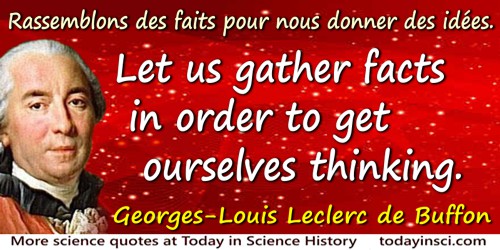
Rassemblons des faits pour nous donner des idées.
Let us gather facts in order to get ourselves thinking.
Let us gather facts in order to get ourselves thinking.
'Histoire des Animaux', Histoire Naturelle, Générale et Particulière, avec la Description du Cabinet du Roi (1749), Vol. 2, 18. Quoted in Jacques Roger, The Life Sciences in Eighteenth- Century French Thought, ed. Keith R. Benson and trans. Robert Ellrich (1997), 440.
Ratbert (as lab rat, to scientist): Doc, we have to talk. Every day you feed me over a hundred pounds of macaroni and cheese. At first I thought you were just being a good host. But lately I’ve been thinking it could be something far more sinister.
Scientist (thinking): Macaroni and cheese causes paranoia.
Scientist (thinking): Macaroni and cheese causes paranoia.
Dilbert cartoon strip (24 Jul 1990).
~~[Attributed]~~ A great many people think they are thinking when they are merely rearranging their prejudices.
Attributed without citation in Clifton Fadiman, American Treasury, 1455-1955 (1955), 719.
~~[Misattributed?]~~ Just remember—when you think all is lost, the future remains.
This probably is NOT an authentic Robert H. Goddard quote, but most likely an anonymous aphorism, which was merely repeated by a different “Bob Goddard.” As given in Reader’s Digest (1975), 106, 23, it is cited as “Quoted by Bob Goddard in St. Louis Globe Democrat.” Later publications and web pages sometimes ascribe the quote to “Bob Goddard” or more vaguely just “Goddard”. In other examples it has morphed, presumably incorrectly, into a quote attributed to “Robert Goddard” or even “Robert H. Goddard” the rocket engineer. And then, as misquotations are wont to do, the likely misattribution has spread virally. Webmaster, as yet, has found no earlier example in print. Since Robert H. Goddard died in 1945, and having found no reliable source earlier than the Reader’s Digest of 1975, Webmaster has confidence, but not certainty, that this “Bob Goddard” is not THE “Robert H. Goddard.” [Webmaster’s note revised 27 Aug 2018.]
~~[Reinterpretation]~~ The significant problems we face cannot be solved at the same level of thinking we were at when we created them.
Yet another of the Einstein-like quotes in common circulation for which there appears to be no known source in the given wording. There are also a number of variations on the the theme. It resembles an authentic quote, “A new type of thinking is essential if mankind is to survive and move toward higher levels,” from a longer discussion, in 'Atomic Education Urged by Einstein', New York Times (25 May 1946), 13. Other reinterpretations, not in exactly Einstein’s wording, include: “No problem can be solved from the same level of consciousness that created it.” “The world will not evolve past its current state of crisis by using the same thinking that created the situation.” “The significant problems we have cannot be solved at the same level of thinking with which we created them.” “The world we have made, as a result of the level of thinking we have done thus far, creates problems we cannot solve at the same level of thinking at which we created them.” For more context, see the authentic quote that begins, “Our world faces a crisis as yet unperceived…,” on the Albert Einstein Quotes page on this website.
A conclusion is the place where you got tired thinking.
In Charlie Walker, My Few Wise Words of Wisdom (200), 151.
A designer must always think about the unfortunate production engineer who will have to manufacture what you have designed; try to understand his problems.
On the official Raymond Loewry website.
A good theoretical physicist today might find it useful to have a wide range of physical viewpoints and mathematical expressions of the same theory (for example, of quantum electrodynamics) available to him. This may be asking too much of one man. Then new students should as a class have this. If every individual student follows the same current fashion in expressing and thinking about electrodynamics or field theory, then the variety of hypotheses being generated to understand strong interactions, say, is limited. Perhaps rightly so, for possibly the chance is high that the truth lies in the fashionable direction. But, on the off-chance that it is in another direction—a direction obvious from an unfashionable view of field theory—who will find it?
In his Nobel Prize Lecture (11 Dec 1965), 'The Development of the Space-Time View of Quantum Electrodynamics'. Collected in Stig Lundqvist, Nobel Lectures: Physics, 1963-1970 (1998), 177.
A lot of people ask, “Do you think humans are parasites?” It’s an interesting idea and one worth thinking about. People casually refer to humanity as a virus spreading across the earth. In fact, we do look like some strange kind of bio-film spreading across the landscape. A good metaphor? If the biosphere is our host, we do use it up for our own benefit. We do manipulate it. We alter the flows and fluxes of elements like carbon and nitrogen to benefit ourselves—often at the expense of the biosphere as a whole. If you look at how coral reefs or tropical forests are faring these days, you’ll notice that our host is not doing that well right now. Parasites are very sophisticated; parasites are highly evolved; parasites are very successful, as reflected in their diversity. Humans are not very good parasites. Successful parasites do a very good job of balancing—using up their hosts and keeping them alive. It’s all a question of tuning the adaptation to your particular host. In our case, we have only one host, so we have to be particularly careful.
Talk at Columbia University, 'The Power of Parasites'.
A mathematician’s work is mostly a tangle of guesswork, analogy, wishful thinking and frustration, and proof, far from being the core of discovery, is more often than not a way of making sure that our minds are not playing tricks.
In Rota's 'Introduction' written (1980) to preface Philip J. Davis and Reuben Hersh, The Mathematical Experience (1981, 2012), xxii.
A multidisciplinary study group ... estimated that it would be 1980 before developments in artificial intelligence make it possible for machines alone to do much thinking or problem solving of military significance. That would leave, say, five years to develop man-computer symbiosis and 15 years to use it. The 15 may be 10 or 500, but those years should be intellectually the most creative and exciting in the history of mankind.
From article 'Man-Computer Symbiosis', in IRE Transactions on Human Factors in Electronics (Mar 1960), Vol. HFE-1, 4-11.
A parable: A man was examining the construction of a cathedral. He asked a stone mason what he was doing chipping the stones, and the mason replied, “I am making stones.” He asked a stone carver what he was doing. “I am carving a gargoyle.” And so it went, each person said in detail what they were doing. Finally he came to an old woman who was sweeping the ground. She said. “I am helping build a cathedral.”
...Most of the time each person is immersed in the details of one special part of the whole and does not think of how what they are doing relates to the larger picture.
[For example, in education, a teacher might say in the next class he was going to “explain Young's modulus and how to measure it,” rather than, “I am going to educate the students and prepare them for their future careers.”]
...Most of the time each person is immersed in the details of one special part of the whole and does not think of how what they are doing relates to the larger picture.
[For example, in education, a teacher might say in the next class he was going to “explain Young's modulus and how to measure it,” rather than, “I am going to educate the students and prepare them for their future careers.”]
In The Art of Doing Science and Engineering: Learning to Learn (1975, 2005), 195.
A quarter-horse jockey learns to think of a twenty-second race as if it were occurring across twenty minutes—in distinct parts, spaced in his consciousness. Each nuance of the ride comes to him as he builds his race. If you can do the opposite with deep time, living in it and thinking in it until the large numbers settle into place, you can sense how swiftly the initial earth packed itself together, how swiftly continents have assembled and come apart, how far and rapidly continents travel, how quickly mountains rise and how quickly they disintegrate and disappear.
Annals of the Former World
A teacher of mathematics has a great opportunity. If he fills his allotted time with drilling his students in routine operations he kills their interest, hampers their intellectual development, and misuses his opportunity. But if he challenges the curiosity of his students by setting them problems proportionate to their knowledge, and helps them to solve their problems with stimulating questions, he may give them a taste for, and some means of, independent thinking.
In How to Solve It (1948), Preface.
About 85 per cent of my “thinking” time was spent getting into a position to think, to make a decision, to learn something I needed to know. Much more time went into finding or obtaining information than into digesting it. Hours went into the plotting of graphs... When the graphs were finished, the relations were obvious at once, but the plotting had to be done in order to make them so.
From article 'Man-Computer Symbiosis', in IRE Transactions on Human Factors in Electronics (Mar 1960), Vol. HFE-1, 4-11.
Accuracy of observation is the equivalent of accuracy of thinking.
Adagia. In Opus Postumous: Poems, Plays, Prose (1958), 158.
Across the road from my cabin was a huge clear-cut—hundreds of acres of massive spruce stumps interspersed with tiny Douglas firs—products of what they call “Reforestation,” which I guess makes the spindly firs en masse a “Reforest,” which makes an individual spindly fir a “Refir,” which means you could say that Weyerhauser, who owns the joint, has Refir Madness, since they think that sawing down 200-foot-tall spruces and replacing them with puling 2-foot Refirs is no different from farming beans or corn or alfalfa. They even call the towering spires they wipe from the Earth’s face forever a “crop”--as if they’d planted the virgin forest! But I'm just a fisherman and may be missing some deeper significance in their nomenclature and stranger treatment of primordial trees.
In David James Duncan, The River Why (1983), 71.
Again and again in reading even his [William Thomson] most abstract writings one is struck by the tenacity with which physical ideas control in him the mathematical form in which he expressed them. An instance of this is afforded by … an example of a mathematical result that is, in his own words, “not instantly obvious from the analytical form of my solution, but which we immediately see must be the case by thinking of the physical meaning of the result.”
As given in Life of Lord Kelvin (1910), Vol. 2, 1136. The ellipsis gives the reference to the quoted footnote, to a passage in his Mathematical and Physical Papers, Vol. 1, 457. [Note: William Thomson, later became Lord Kelvin. —Webmaster]
All great discoveries are made by men whose feelings run ahead of their thinking.
'Sermons. III. Coming to the Truth'. In Anna L. Ward, A Dictionary of Quotations in Prose from American and Foreign Authors (1889), 585, No. 1190
All interpretations made by a scientist are hypotheses, and all hypotheses are tentative. They must forever be tested and they must be revised if found to be unsatisfactory. Hence, a change of mind in a scientist, and particularly in a great scientist, is not only not a sign of weakness but rather evidence for continuing attention to the respective problem and an ability to test the hypothesis again and again.
The Growth of Biological Thought: Diversity, Evolution and Inheritance (1982), 831.
All that can accurately be said about a man who thinks he is a poached egg is that he is in the minority.
In Day the Universe Changed (1985), 310.
All the different classes of beings which taken together make up the universe are, in the ideas of God who knows distinctly their essential gradations, only so many ordinates of a single curve so closely united that it would be impossible to place others between any two of them, since that would imply disorder and imperfection. Thus men are linked with the animals, these with the plants and these with the fossils which in turn merge with those bodies which our senses and our imagination represent to us as absolutely inanimate. And, since the law of continuity requires that when the essential attributes of one being approximate those of another all the properties of the one must likewise gradually approximate those of the other, it is necessary that all the orders of natural beings form but a single chain, in which the various classes, like so many rings, are so closely linked one to another that it is impossible for the senses or the imagination to determine precisely the point at which one ends and the next begins?all the species which, so to say, lie near the borderlands being equivocal, at endowed with characters which might equally well be assigned to either of the neighboring species. Thus there is nothing monstrous in the existence zoophytes, or plant-animals, as Budaeus calls them; on the contrary, it is wholly in keeping with the order of nature that they should exist. And so great is the force of the principle of continuity, to my thinking, that not only should I not be surprised to hear that such beings had been discovered?creatures which in some of their properties, such as nutrition or reproduction, might pass equally well for animals or for plants, and which thus overturn the current laws based upon the supposition of a perfect and absolute separation of the different orders of coexistent beings which fill the universe;?not only, I say, should I not be surprised to hear that they had been discovered, but, in fact, I am convinced that there must be such creatures, and that natural history will perhaps some day become acquainted with them, when it has further studied that infinity of living things whose small size conceals them for ordinary observation and which are hidden in the bowels of the earth and the depth of the sea.
Lettre Prétendue de M. De Leibnitz, à M. Hermann dont M. Koenig a Cité le Fragment (1753), cxi-cxii, trans. in A. O. Lovejoy, Great Chain of Being: A Study of the History of an Idea (1936), 144-5.
All the modern higher mathematics is based on a calculus of operations, on laws of thought. All mathematics, from the first, was so in reality; but the evolvers of the modern higher calculus have known that it is so. Therefore elementary teachers who, at the present day, persist in thinking about algebra and arithmetic as dealing with laws of number, and about geometry as dealing with laws of surface and solid content, are doing the best that in them lies to put their pupils on the wrong track for reaching in the future any true understanding of the higher algebras. Algebras deal not with laws of number, but with such laws of the human thinking machinery as have been discovered in the course of investigations on numbers. Plane geometry deals with such laws of thought as were discovered by men intent on finding out how to measure surface; and solid geometry with such additional laws of thought as were discovered when men began to extend geometry into three dimensions.
In Lectures on the Logic of Arithmetic (1903), Preface, 18-19.
All you really need to know for the moment is that the universe is a lot more complicated than you might think, even if you start from a position of thinking it’s pretty damn complicated in the first place.
In Mostly Harmless (1992), 195.
Almost all the world is natural chemicals, so it really makes you re-think everything. A cup of coffee is filled with chemicals. They've identified a thousand chemicals in a cup of coffee. But we only found 22 that have been tested in animal cancer tests out of this thousand. And of those, 17 are carcinogens. There are ten milligrams of known carcinogens in a cup of coffee and thats more carcinogens than youre likely to get from pesticide residues for a year!
Paper to the American Chemical Society, 'Pollution, Pesticides and Cancer Misconceptions.' As cited by Art Drysdale, 'Latest Insider News: Natural vs. Synthetic Chemical Pesticides' (14 Feb 1999), on the mitosyfraudes.org website. Bruce Ames has delivered a similar statistic in various other publications.
Amazing that the human race has taken enough time out from thinking about food or sex to create the arts and sciences.
City Aphorisms, Eighth Selection (1991).
Analogy is a wonderful, useful and most important form of thinking, and biology is saturated with it. Nothing is worse than a horrible mass of undigested facts, and facts are indigestible unless there is some rhyme or reason to them. The physicist, with his facts, seeks reason; the biologist seeks something very much like rhyme, and rhyme is a kind of analogy.... This analogizing, this fine sweeping ability to see likenesses in the midst of differences is the great glory of biology, but biologists don't know it.... They have always been so fascinated and overawed by the superior prestige of exact physical science that they feel they have to imitate it.... In its central content, biology is not accurate thinking, but accurate observation and imaginative thinking, with great sweeping generalizations.
In Science is a Sacred Cow (1950), 98-100.
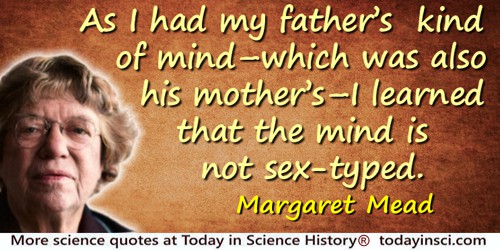
And as I had my father’s kind of mind—which was also his mother’s—I learned that the mind is not sex-typed.
Blackberry Winter: My Earlier Years (1973), 54.
And now, as a germination of planetary dimensions, comes the thinking layer which over its full extent develops and intertwines its fibres, not to confuse and neutralise them but to reinforce them in the living unity of a single tissue.
In Teilhard de Chardin and Bernard Wall (trans.), The Phenomenon of Man (1959, 2008), 244. Originally published in French as Le Phénomene Humain (1955).
Another argument of hope may be drawn from this–that some of the inventions already known are such as before they were discovered it could hardly have entered any man's head to think of; they would have been simply set aside as impossible. For in conjecturing what may be men set before them the example of what has been, and divine of the new with an imagination preoccupied and colored by the old; which way of forming opinions is very fallacious, for streams that are drawn from the springheads of nature do not always run in the old channels.
Translation of Novum Organum, XCII. In Francis Bacon, James Spedding, The Works of Francis Bacon (1864), Vol. 8, 128.
Another characteristic of mathematical thought is that it can have no success where it cannot generalize.
In Eberhard Zeidler, Applied Functional Analysis: main principles and their applications (1995), 282.
Antiessentialist thinking forces us to view the world differently. We must accept shadings and continua as fundamental. We lose criteria for judgment by comparison to some ideal: short people, retarded people, people of other beliefs, colors, and religions are people of full status.
…...
Anton Chekhov wrote that ‘one must not put a loaded rifle on stage if no one is thinking of firing it.’ Good drama requires spare and purposive action, sensible linking of potential causes with realized effects. Life is much messier; nothing happens most of the time. Millions of Americans (many hotheaded) own rifles (many loaded), but the great majority, thank God, do not go off most of the time. We spend most of real life waiting for Godot, not charging once more unto the breach.
…...
Anyone who thinks science is trying to make human life easier or more pleasant is utterly mistaken.
In 'Quotation Marks', New York Times (11 Oct 1931), XX2.
Artificial intelligence is based on the assumption that the mind can be described as some kind of formal system manipulating symbols that stand for things in the world. Thus it doesn't matter what the brain is made of, or what it uses for tokens in the great game of thinking. Using an equivalent set of tokens and rules, we can do thinking with a digital computer, just as we can play chess using cups, salt and pepper shakers, knives, forks, and spoons. Using the right software, one system (the mind) can be mapped onto the other (the computer).
Machinery of the Mind: Inside the New Science of Artificial Intelligence (1986), 250.
As agonizing a disease as cancer is, I do not think it can be said that our civilization is threatened by it. … But a very plausible case can be made that our civilization is fundamentally threatened by the lack of adequate fertility control. Exponential increases of population will dominate any arithmetic increases, even those brought about by heroic technological initiatives, in the availability of food and resources, as Malthus long ago realized.
From 'In Praise of Science and Technology', in Broca's Brain: Reflections on the Romance of Science (1975, 2011), 43.
As followers of natural science we know nothing of any relation between thoughts and the brain, except as a gross correlation in time and space.
Man on his Nature (1942), 290.
As modern physics started with the Newtonian revolution, so modern philosophy starts with what one might call the Cartesian Catastrophe. The catastrophe consisted in the splitting up of the world into the realms of matter and mind, and the identification of “mind” with conscious thinking. The result of this identification was the shallow rationalism of l’esprit Cartesien, and an impoverishment of psychology which it took three centuries to remedy even in part.
The Act of Creation (1964), 148.
As regards religion, on the other hand, one is generally agreed that it deals with goals and evaluations and, in general, with the emotional foundation of human thinking and acting, as far as these are not predetermined by the inalterable hereditary disposition of the human species. Religion is concerned with man’s attitude toward nature at large, with the establishing of ideals for the individual and communal life, and with mutual human relationship. These ideals religion attempts to attain by exerting an educational influence on tradition and through the development and promulgation of certain easily accessible thoughts and narratives (epics and myths) which are apt to influence evaluation and action along the lines of the accepted ideals.
Replying to the Liberal Ministers’ Club of New York City. Published in >The Christian Register, (Jun 1948). As given in Albert Einstein, Cal Seelig (ed.) and Sonja Bargmann (trans., ed.), Ideas and Opinions (1954, 2010), 50.
Astronomers and physicists, dealing habitually with objects and quantities far beyond the reach of the senses, even with the aid of the most powerful aids that ingenuity has been able to devise, tend almost inevitably to fall into the ways of thinking of men dealing with objects and quantities that do not exist at all, e.g., theologians and metaphysicians. Thus their speculations tend almost inevitably to depart from the field of true science, which is that of precise observation, and to become mere soaring in the empyrean. The process works backward, too. That is to say, their reports of what they pretend actually to see are often very unreliable. It is thus no wonder that, of all men of science, they are the most given to flirting with theology. Nor is it remarkable that, in the popular belief, most astronomers end by losing their minds.
Minority Report: H. L. Mencken’s Notebooks (1956), Sample 74, 60.
Astronomy was thus the cradle of the natural sciences and the starting point of geometrical theories. The stars themselves gave rise to the concept of a ‘point’; triangles, quadrangles and other geometrical figures appeared in the constellations; the circle was realized by the disc of the sun and the moon. Thus in an essentially intuitive fashion the elements of geometrical thinking came into existence.
In George Edward Martin, The Foundations of Geometry and the Non-Euclidean Plane (1982), 72.
At present we must confine ourselves to saying that soul is the source of these phenomena and is characterized by them, viz. by the powers of self-nutrition, sensation, thinking, and movement.
On the Soul, 413b, II-3. In Jonathan Barnes (ed.), The Complete Works of Aristotle (1984), Vol. 1, 658.
Behold the mighty dinosaur,
Famous in prehistoric lore,
Not only for his power and strength
But for his intellectual length.
You will observe by these remains
The creature had two sets of brains—
One in his head (the usual place),
The other at his spinal base.
Thus he could reason 'A priori'
As well as 'A posteriori'.
No problem bothered him a bit
He made both head and tail of it.
So wise was he, so wise and solemn,
Each thought filled just a spinal column.
If one brain found the pressure strong
It passed a few ideas along.
If something slipped his forward mind
'Twas rescued by the one behind.
And if in error he was caught
He had a saving afterthought.
As he thought twice before he spoke
He had no judgment to revoke.
Thus he could think without congestion
Upon both sides of every question.
Oh, gaze upon this model beast
Defunct ten million years at least.
Famous in prehistoric lore,
Not only for his power and strength
But for his intellectual length.
You will observe by these remains
The creature had two sets of brains—
One in his head (the usual place),
The other at his spinal base.
Thus he could reason 'A priori'
As well as 'A posteriori'.
No problem bothered him a bit
He made both head and tail of it.
So wise was he, so wise and solemn,
Each thought filled just a spinal column.
If one brain found the pressure strong
It passed a few ideas along.
If something slipped his forward mind
'Twas rescued by the one behind.
And if in error he was caught
He had a saving afterthought.
As he thought twice before he spoke
He had no judgment to revoke.
Thus he could think without congestion
Upon both sides of every question.
Oh, gaze upon this model beast
Defunct ten million years at least.
'The Dinosaur: A Poem' (1912). In E. H. Colbert (ed.), The Dinosaur Book (1951), 78.
Bohr’s standpoint, that a space-time description is impossible, I reject a limine. Physics does not consist only of atomic research, science does not consist only of physics, and life does not consist only of science. The aim of atomic research is to fit our empirical knowledge concerning it into our other thinking. All of this other thinking, so far as it concerns the outer world, is active in space and time. If it cannot be fitted into space and time, then it fails in its whole aim and one does not know what purpose it really serves.
Letter to Willy Wien (25 Aug 1926). Quoted in Walter Moore, Schrödinger: Life and Thought (1989), 226.
But by far the greatest obstacle to the progress of science and to the undertaking of new tasks and provinces therein is found in this—that men despair and think things impossible.
Translation of Novum Organum, CIX. In Francis Bacon, James Spedding, The Works of Francis Bacon (1864), Vol. 8, 140-141.
But if you have seen the soil of India with your own eyes and meditate on its nature - if you consider the rounded stones found in the earth however deeply you dig, stones that are huge near the mountains and where the rivers have a violent current; stones that are of smaller size at greater distance from the mountains, and where the streams flow more slowly; stones that appear pulverised in the shape of sand where the streams begin to stagnate near their mouths and near the sea - if you consider all this, you could scarcely help thinking that India has once been a sea which by degrees has been filled up by the alluvium of the streams.
Alberuni's India, trans. E. C. Sachau (1888), Vol. 1, 198.
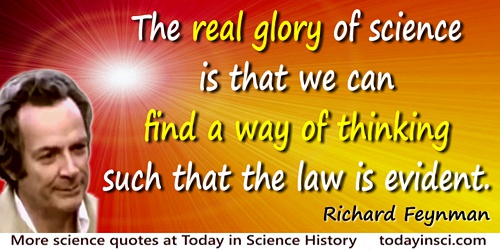
But the real glory of science is that we can find a way of thinking such that the law is evident.
The Feynman Lectures on Physics (1965), Vol. 1, 26-3. In Carver A. Mead, Collective Electrodynamics: Quantum Foundations of Electromagnetism (2002), 1.
Careful and correct use of language is a powerful aid to straight thinking, for putting into words precisely what we mean necessitates getting our own minds quite clear on what we mean.
In The Art of Scientific Investigation (1950,1957), 91.
Children are told that an apple fell on Isaac Newton’s head and he was led to state the law of gravity. This, of course, is pure foolishness. What Newton discovered was that any two particles in the universe attract each other with a force that is proportional to the product of their masses and inversely proportional to the square of the distance between them. This is not learned from a falling apple, but by observing quantities of data and developing a mathematical theory that can be verified by additional data. Data gathered by Galileo on falling bodies and by Johannes Kepler on motions of the planets were invaluable aids to Newton. Unfortunately, such false impressions about science are not universally outgrown like the Santa Claus myth, and some people who don’t study much science go to their graves thinking that the human race took until the mid-seventeenth century to notice that objects fall.
In How to Tell the Liars from the Statisticians (1983), 127.
D’you know how embarrassing it is to mention good and evil in a scientific laboratory? Have you any idea? One of the reasons l became a scientist was not to have to think about that kind of thing.
Spoken by character Dr. Malone in His Dark Materials Omnibus (2012), 370.
Discovery consists of seeing what everybody has seen and thinking what nobody has thought.
Attributed. For example in I.J. Good, The Scientist Speculates (1963), 15. However, this seems to be a variant of a much earlier quote by Arthur Schopenhauer: “The task is, not so much to see what no one has seen yet; but to think what nobody has thought yet, about that which everybody sees.” See the Arthur Schopenhauer Quotes web page on this site for the original German and citation.
Do not say hypothesis, and even less theory: say way of thinking.
Aphorism 263 in Notebook J (1789-1793), as translated by R. J. Hollingdale in Aphorisms (1990). Reprinted as The Waste Books (2000), 181.
Doctors coin money when they do procedures—family practice doesn’t have any procedures. A urologist has cystoscopies, a gastroenterologist has gastroscopies, a dermatologist has biopsies. They can do three or four of those and make five or six hundred dollars in a single day. We get nothing for the use of our time to understand the lives of our patients. Technology is rewarded in medicine, it seems to me, and not thinking.
Quoted in John McPhee, 'Heirs of General Practice,' New Yorker (23 Jul 1984), 40-85. In David Barton Smith and Arnold D. Kaluzny, The White Labyrinth (2000), 227.
During my eighty-seven years I have witnessed a whole succession of technological revolutions. But none of them has done away with the need for character in the individual or the ability to think.
From My Own Story (1957), 320.
During the time that [Karl] Landsteiner gave me an education in the field of imununology, I discovered that he and I were thinking about the serologic problem in very different ways. He would ask, What do these experiments force us to believe about the nature of the world? I would ask, What is the most. simple and general picture of the world that we can formulate that is not ruled by these experiments? I realized that medical and biological investigators were not attacking their problems the same way that theoretical physicists do, the way I had been in the habit of doing.
‘Molecular Disease’, Pfizer Spectrum (1958), 6:9, 234.
Einstein’s 1905 paper came out and suddenly changed people’s thinking about space-time. We’re again [2007] in the middle of something like that. When the dust settles, time—whatever it may be—could turn out to be even stranger and more illusory than even Einstein could imagine.
Quoted by Tim Folger in 'Newsflash: Time May Not Exist', Discover Magazine (Jun 2007).
Enzymes are things invented by biologists that explain things which otherwise require harder thinking.
In Geoff Tibballs, The Mammoth Book of Zingers, Quips, and One-Liners (2004), 475, but without citation. If you know a primary print source, please contact Webmaster.
Essentially only one thing in life interests us: our psychical constitution, the mechanism of which was and is wrapped in darkness. All human resources, art, religion, literature, philosophy and historical sciences, all of them join in bringing lights in this darkness. But man has still another powerful resource: natural science with its strictly objective methods. This science, as we all know, is making huge progress every day. The facts and considerations which I have placed before you at the end of my lecture are one out of numerous attempts to employ a consistent, purely scientific method of thinking in the study of the mechanism of the highest manifestations of life in the dog, the representative of the animal kingdom that is man's best friend.
'Physiology of Digestion', Nobel Lecture (12 Dec 1904). In Nobel Lectures: Physiology or Medicine 1901-1921 (1967), 134
Every Man being conscious to himself, That he thinks, and that which his Mind is employ'd about whilst thinking, being the Ideas, that are there, 'tis past doubt, that Men have in their Minds several Ideas, such as are those expressed by the words, Whiteness, Hardness, Sweetness, Thinking, Motion, Man, Elephant, Army, Drunkenness, and others: It is in the first place then to be inquired, How he comes by them? I know it is a received Doctrine, That Men have native Ideas, and original Characters stamped upon their Minds, in their very first Being.
An Essay Concerning Human Understanding (1690). Edited by Peter Nidditch (1975), Book 2, Chapter 1, Section 1, 104.
Every man has some forte something he can do better than he can do anything else. Many men, however, never find the job they are best fitted for. And often this is because they do not think enough. Too many men drift lazily into any job, suited or unsuited for them; and when they don’t get along well they blame everybody and everything except themselves.
As quoted from an interview by B.C. Forbes in The American Magazine (Jan 1921), 10.
Exercise in the most rigorous thinking that is possible will of its own accord strengthen the sense of truth and right, for each advance in the ability to distinguish between correct and false thoughts, each habit making for rigour in thought development will increase in the sound pupil the ability and the wish to ascertain what is right in life and to defend it.
In Anleitung zum mathematischen Unterricht in den höheren Schulen (1906), 28.
Expertise in one field does not carry over into other fields. But experts often think so. The narrower their field of knowledge the more likely they are to think so.
In Time Enough for Love: The Lives of Lazarus Long (1973), 367.
Faraday thinks from day to day, against a background of older thinking, and anticipating new facts of tomorrow. In other words, he thinks in three dimensions of time; past, present, and future.
In 'The Scientific Grammar of Michael Faraday’s Diaries', Part I, 'The Classic of Science', A Classic and a Founder (1937), collected in Rosenstock-Huessy Papers (1981), Vol. 1, 1.
Fear of something is at the root of hate for others and hate within will eventually destroy the hater. Keep your thoughts free from hate, and you will have no fear from those who hate you. ...
David, though small, was filled with truth, right thinking and good will for others. Goliath represents one who let fear into his heart, and it stayed there long enough to grow into hate for others.
David, though small, was filled with truth, right thinking and good will for others. Goliath represents one who let fear into his heart, and it stayed there long enough to grow into hate for others.
In Alvin D. Smith, George Washington Carver: Man of God (1954), 43. Cited in Linda O. McMurry, George Washington Carver, Scientist and Symbol (1982), 107. Smith's book is about his recollections of G.W. Carver's Sunday School classes at Tuskegee, some 40 years earlier. Webmaster, who has not yet been able to see the original book, cautions this quote may be the gist of Carver's words, rather than a verbatim quote.
Few people think more than two or three times a year. I have made an international reputation for myself by thinking once or twice a week.
As given in 'Quotable Quotes', Reader’s Digest (May 1933). It does not appear in a work written by Shaw. It may have been contributed to the magazine as a personal recollection, though that is not specified in that source.
Fields of learning are surrounded ultimately only by illusory boundaries—like the “rooms” in a hall of mirrors.
It is when the illusion is penetrated that progress takes place. … Likewise science cannot be regarded as a thing apart, to be studied, admired or ignored. It is a vital part of our culture, our culture is part of it, it permeates our thinking, and its continued separateness from what is fondly called “the humanities” is a preposterous practical joke on all thinking men.
It is when the illusion is penetrated that progress takes place. … Likewise science cannot be regarded as a thing apart, to be studied, admired or ignored. It is a vital part of our culture, our culture is part of it, it permeates our thinking, and its continued separateness from what is fondly called “the humanities” is a preposterous practical joke on all thinking men.
In Modern Science and the Nature of Life (1957).
Finally, since I thought that we could have all the same thoughts, while asleep, as we have while we are awake, although none of them is true at that time, I decided to pretend that nothing that ever entered my mind was any more true than the illusions of my dreams. But I noticed, immediately afterwards, that while I thus wished to think that everything was false, it was necessarily the case that I, who was thinking this, was something. When I noticed that this truth “I think, therefore I am” was so firm and certain that all the most extravagant assumptions of the sceptics were unable to shake it, I judged that I could accept it without scruple as the first principle of the philosophy for which I was searching. Then, when I was examining what I was, I realized that I could pretend that I had no body, and that there was no world nor any place in which I was present, but I could not pretend in the same way that I did not exist. On the contrary, from the very fact that I was thinking of doubting the truth of other things, it followed very evidently and very certainly that I existed; whereas if I merely ceased to think, even if all the rest of what I had ever imagined were true, I would have no reason to believe that I existed. I knew from this that I was a substance, the whole essence or nature of which was to think and which, in order to exist, has no need of any place and does not depend on anything material. Thus this self—that is, the soul by which I am what I am—is completely distinct from the body and is even easier to know than it, and even if the body did not exist the soul would still be everything that it is.
Discourse on Method in Discourse on Method and Related Writings (1637), trans. Desmond M. Clarke, Penguin edition (1999), Part 4, 24-5.
First, as concerns the success of teaching mathematics. No instruction in the high schools is as difficult as that of mathematics, since the large majority of students are at first decidedly disinclined to be harnessed into the rigid framework of logical conclusions. The interest of young people is won much more easily, if sense-objects are made the starting point and the transition to abstract formulation is brought about gradually. For this reason it is psychologically quite correct to follow this course.
Not less to be recommended is this course if we inquire into the essential purpose of mathematical instruction. Formerly it was too exclusively held that this purpose is to sharpen the understanding. Surely another important end is to implant in the student the conviction that correct thinking based on true premises secures mastery over the outer world. To accomplish this the outer world must receive its share of attention from the very beginning.
Doubtless this is true but there is a danger which needs pointing out. It is as in the case of language teaching where the modern tendency is to secure in addition to grammar also an understanding of the authors. The danger lies in grammar being completely set aside leaving the subject without its indispensable solid basis. Just so in Teaching of Mathematics it is possible to accumulate interesting applications to such an extent as to stunt the essential logical development. This should in no wise be permitted, for thus the kernel of the whole matter is lost. Therefore: We do want throughout a quickening of mathematical instruction by the introduction of applications, but we do not want that the pendulum, which in former decades may have inclined too much toward the abstract side, should now swing to the other extreme; we would rather pursue the proper middle course.
Not less to be recommended is this course if we inquire into the essential purpose of mathematical instruction. Formerly it was too exclusively held that this purpose is to sharpen the understanding. Surely another important end is to implant in the student the conviction that correct thinking based on true premises secures mastery over the outer world. To accomplish this the outer world must receive its share of attention from the very beginning.
Doubtless this is true but there is a danger which needs pointing out. It is as in the case of language teaching where the modern tendency is to secure in addition to grammar also an understanding of the authors. The danger lies in grammar being completely set aside leaving the subject without its indispensable solid basis. Just so in Teaching of Mathematics it is possible to accumulate interesting applications to such an extent as to stunt the essential logical development. This should in no wise be permitted, for thus the kernel of the whole matter is lost. Therefore: We do want throughout a quickening of mathematical instruction by the introduction of applications, but we do not want that the pendulum, which in former decades may have inclined too much toward the abstract side, should now swing to the other extreme; we would rather pursue the proper middle course.
In Ueber den Mathematischen Unterricht an den hoheren Schulen; Jahresbericht der Deutschen Mathematiker Vereinigung, Bd. 11, 131.
For God's sake, stop researching for a while and begin to think.
The Crisis in the University (1949), 183.
For many of us, water simply flows from a faucet, and we think little about it beyond this point of contact. We have lost a sense of respect for the wild river, for the complex workings of a wetland, for the intricate web of life that water supports.
Last Oasis: Facing Water Scarcity (1997), 184.
For me the most beautiful thing about Meccano is that it teaches you to think.
As quoted in by Hugh Schofield in web article 'Meccano Revives French Production' (23 Dec 2010).
For me too, the periodic table was a passion. ... As a boy, I stood in front of the display for hours, thinking how wonderful it was that each of those metal foils and jars of gas had its own distinct personality.
[Referring to the periodic table display in the Science Museum, London, with element samples in bottles]
[Referring to the periodic table display in the Science Museum, London, with element samples in bottles]
Letter to Oliver Sacks. Quoted in Oliver Sacks, Uncle Tungsten: Memories of a Chemical Boyhood (2001), footnote, 203.
For myself, I like a universe that, includes much that is unknown and, at the same time, much that is knowable. A universe in which everything is known would be static and dull, as boring as the heaven of some weak-minded theologians. A universe that is unknowable is no fit place for a thinking being. The ideal universe for us is one very much like the universe we inhabit. And I would guess that this is not really much of a coincidence.
Concluding paragraph, 'Can We know the Universe? Reflections on a Grain of Salt', Broca's Brain (1979, 1986), 21.
Furious activity is no substitute for analytical thought.
Quoted in New Scientist (1972), 55, 429.
Good work is no done by “humble” men. It is one of the first duties of a professor, for example, in any subject, to exaggerate a little both the importance of his subject and his own importance in it. A man who is always asking “Is what I do worth while?” and “Am I the right person to do it?” will always be ineffective himself and a discouragement to others. He must shut his eyes a little and think a little more of his subject and himself than they deserve. This is not too difficult: it is harder not to make his subject and himself ridiculous by shutting his eyes too tightly.
In A Mathematician’s Apology (1940, 1967), 66.
Great minds don't think alike. If they did, the Patent Office would only have about fifty inventions.
From Dilbert comic strip (10 Mar 2005).
He had constructed for himself a certain system which thereafter exercised such an influence on his way of thinking that those who observed him always saw his judgment walking a few steps in front of his feeling, though he himself believed it was keeping to the rear.
Aphorism 82 in Notebook D (1773-1775), as translated by R.J. Hollingdale in Aphorisms (1990). Reprinted as The Waste Books (2000), 56-57.
How can a modern anthropologist embark upon a generalization with any hope of arriving at a satisfactory conclusion? By thinking of the organizational ideas that are present in any society as a mathematical pattern.
In Rethinking Anthropology (1961), 2.
How many famous men be there in this our age, which make scruple to condemne these old witches, thinking it to bee nothing but a melancholike humour which corrupteth thei imagination, and filleth them with all these vaines toyes. I will not cast my selfe any further into the depth of this question, the matter craveth a man of more leisure.
Describing melancholy as the innocent affliction of those regarded as witches instead of Satanic influence, while distancing himself from the controversy.
Describing melancholy as the innocent affliction of those regarded as witches instead of Satanic influence, while distancing himself from the controversy.
Discours de la conservation de la veue; des maladies mélancholiques, des catarrhes, et de la vieillese (1594). In Richard Surphlet (trans.) A Discourse of the Preservation of the Sight: of Melancholike Diseases; of Rheumes, and of Old Age (1599), 98-9. Quoted in Michael Heyd, Be sober and Reasonable (), 58.
How much has happened in these fifty years—a period more remarkable than any, I will venture to say, in the annals of mankind. I am not thinking of the rise and fall of Empires, the change of dynasties, the establishment of Governments. I am thinking of those revolutions of science which have had much more effect than any political causes, which have changed the position and prospects of mankind more than all the conquests and all the codes and all the legislators that ever lived.
Banquet speech, Glasgow. In Nature (27 Nov 1873), 9, 71.
How near one Species to the next is join'd,
The due Gradations please a thinking Mind;
and there are Creatures which no eye can see,
That for a Moment live and breathe like me:
Whom a small Fly in bulk as far exceeds,
As yon tall Cedar does the waving Reeds:
These we can reach—and may we not suppose
There still are Creatures more minute than those.
The due Gradations please a thinking Mind;
and there are Creatures which no eye can see,
That for a Moment live and breathe like me:
Whom a small Fly in bulk as far exceeds,
As yon tall Cedar does the waving Reeds:
These we can reach—and may we not suppose
There still are Creatures more minute than those.
'The Enquiry'. In Poems Upon Several Occasions (1748), 198.
However, all scientific statements and laws have one characteristic in common: they are “true or false” (adequate or inadequate). Roughly speaking, our reaction to them is “yes” or “no.” The scientific way of thinking has a further characteristic. The concepts which it uses to build up its coherent systems are not expressing emotions. For the scientist, there is only “being,” but no wishing, no valuing, no good, no evil; no goal. As long as we remain within the realm of science proper, we can never meet with a sentence of the type: “Thou shalt not lie.” There is something like a Puritan's restraint in the scientist who seeks truth: he keeps away from everything voluntaristic or emotional.
Essays in Physics (1950), 68.
Humans are not by nature the fact-driven, rational beings we like to think we are. We get the facts wrong more often than we think we do. And we do so in predictable ways: we engage in wishful thinking. We embrace information that supports our beliefs and reject evidence that challenges them. Our minds tend to take shortcuts, which require some effort to avoid … [and] more often than most of us would imagine, the human mind operates in ways that defy logic.
As co-author with Kathleen Hall Jamieson, in unSpun: Finding Facts in a World of Disinformation (2007), 69.
I am a believer in unconscious cerebration. The brain is working all the time, though we do not know it. At night it follows up what we think in the daytime. When I have worked a long time on one thing, I make it a point to bring all the facts regarding it together before I retire; I have often been surprised at the results… We are thinking all the time; it is impossible not to think.
In Orison Swett Marden, 'Bell Telephone Talk: Hints on Success by Alexander G. Bell', How They Succeeded: Life Stories of Successful Men Told by Themselves (1901), 33.
I am always surprised when a young man tells me he wants to work at cosmology. I think of cosmology as something that happens to one, not something one can choose.
In Presidential Address (8 Feb 1963), Quarterly Journal of the Royal Astronomical Society (Mar 1963), 4, 185.
I am merely thinking God’s thoughts after him.
Attributed. Could be a boiled down version of a longer quote that includes: “God wanted us to …
share in his own thoughts.” (Included here; it begins “Those laws [of nature] are…”) This capsulized version is widely seen linked with Kepler’s name, but never with a citation, for example, in Thomas Winthrop Coit, Inaugural Address Delivered in the Chapel of Morrison College (Nov 1835), 32. As far as Webmaster can determine, historians of science have not found any primary source in which Kepler himself expresses this idea in exactly these words. In a 2001 discussion group post, Ted Davis reported: “I know Kepler pretty well and have searched for it. I’ve also asked Owen Gingerich, who knows Kepler as well as anyone alive, and he can’t confirm it either.”
I am one of those who think, like Nobel, that humanity will draw more good than evil from new discoveries.
In Pierre Biquard, Frédéric Joliot-Curie: the Man and his Theories (1966), 11.
I am the thought you are now thinking.
From 'On Self-Referential Sentences' Scientific American (Jan 1981), 244, 28. Collected in Metamagical Themas (1985), 11.
I beseech you in the bowels of Christ, think it possible you may be mistaken.
Letter, to General Assembly of the Church of Scotland (1650). In The Parliamentary or Constitutional History of England (1763), Vol. 19, 322.
I cannot think of a single field in biology or medicine in which we can claim genuine understanding, and it seems to me the more we learn about living creatures, especially ourselves, the stranger life becomes.
In 'On Science and Certainty', Discover Magazine (Oct 1980).
I carried this problem around in my head basically the whole time. I would wake up with it first thing in the morning, I would be thinking about it all day, and I would be thinking about it when I went to sleep. Without distraction I would have the same thing going round and round in my mind.
Recalling the degree of focus and determination that eventually yielded the proof of Fermat's Last Theorem.
Recalling the degree of focus and determination that eventually yielded the proof of Fermat's Last Theorem.
Quoted in interview for PBS TV program Nova. In William Byers, How Mathematicians Think (2007), 1.
I do not know whether my distrust of men of science is congenital or acquired, but I think I should have transmitted it to descendants.
Samuel Butler, edited by Geoffrey Keynes and Brian Hill, Samuel Butler’s Notebooks (1951), 32.
I do not think that G. H. Hardy was talking nonsense when he insisted that the mathematician was discovering rather than creating, nor was it wholly nonsense for Kepler to exult that he was thinking God's thoughts after him. The world for me is a necessary system, and in the degree to which the thinker can surrender his thought to that system and follow it, he is in a sense participating in that which is timeless or eternal.
'Reply to Lewis Edwin Hahn', The Philosophy of Brand Blanshard (1980), 901.
I do not think words alone will solve humanity’s present problems. The sound of bombs drowns out
men’s voices. In times of peace I have great faith in the communication of ideas among thinking men, but today, with brute force dominating so many millions of lives, I fear that the appeal to
man’s intellect is fast becoming virtually meaningless.
In 'I Am an American' (22 Jun 1940), Einstein Archives 29-092. Excerpted in David E. Rowe and Robert J. Schulmann, Einstein on Politics: His Private Thoughts and Public Stands on Nationalism, Zionism, War, Peace, and the Bomb (2007), 470. It was during a radio broadcast for the Immigration and Naturalization Service, interviewed by a State Department Official. Einstein spoke following an examination on his application for American citizenship in Trenton, New Jersey. The attack on Pearl Harbor and America’s declaration of war on Japan was still over a year in the future.
I had gone on a walk on a fine Sabbath afternoon. I had entered the Green [of Glasgow] by the gate at the foot of Charlotte Street—had passed the old washing-house. I was thinking upon the engine at the time, and had gone as far as the herd's house, when the idea came into my mind that as steam was an elastic body it would rush into a vacuum, and if a communication were made between the cylinder and an exhausted vessel it would rush into it, and might be there condensed without cooling the cylinder. I then saw that I must get rid of the condensed steam and injection water if I used a jet, as in Newcomen's engine. Two ways of doing this occurred to me. First, the water might be run off by a descending pipe, if an outlet could be got at the depth of 35 or 36 feet, and any air might be extracted by a small pump. The second was to make the pump large enough to extract both water and air. ... I had not walked further than the Golf-house when the whole thing was arranged in my mind.
[In Robert Hart's words, a recollection of the description of Watt's moment of inspiration, in May 1765, for improving Thomas Newcomen's steam engine.]
[In Robert Hart's words, a recollection of the description of Watt's moment of inspiration, in May 1765, for improving Thomas Newcomen's steam engine.]
In Robert Hart, 'Reminiscences of James Watt' (read 2 Nov 1857), Transactions of the Glasgow Archaeological Society (1859), Vol. 1, 1. Note that these are not the verbatim words of James Watt, but are only a recollection of them by Robert Hart, who is quoting as best he can from memory of a conversation he and his brother had with James Watt that took place over 43 years previously. In his Reminiscences, Hart explains, “I have accordingly thrown together the following brief narrative:— As these meetings took place forty-three years since, many observations that were made at the time may have escaped me at present; yet, when the same subjects are touched on, I have as distinct recollection of his treatment of them as if it were yesterday.”
I had no books as a child. I had real machines, and I went out to work in the fields. I was driving farm machinery at five, and fixing it at age seven or eight. It’s no accident that I worked on Hubble 50 to 60 years later. My books were nature; it was very important to how I related to the Earth, and the Earth from space. No doubt when I go into space, I go back into the cool soil of Earth. I’m always thinking of it. Nature was my book. Other people come from that tradition - Emerson, Thoreau, and especially Whitman. Look at what they said in their philosophy - go out and have a direct relationship with nature.
When asked by Discover magazine what books helped inspire his passion as an astronaut.
When asked by Discover magazine what books helped inspire his passion as an astronaut.
'The 1998 Discover Science Gift Guide: Fantastic Voyages Children's Books That Mattered', Discover (Dec 1998).
I have never had any student or pupil under me to aid me with assistance; but have always prepared and made my experiments with my own hands, working & thinking at the same time. I do not think I could work in company, or think aloud, or explain my thoughts at the time. Sometimes I and my assistant have been in the Laboratory for hours & days together, he preparing some lecture apparatus or cleaning up, & scarcely a word has passed between us; — all this being a consequence of the solitary & isolated system of investigation; in contradistinction to that pursued by a Professor with his aids & pupils as in your Universities.
Letter to C. Ransteed, 16 Dec 1857. In L. Pearce Williams (ed.), The Selected Correspondence of Michael Faraday (1971), Vol. 2, 888.
I have never thought that you could obtain the extremely clumpy, heterogeneous universe we have today, strongly affected by plasma processes, from the smooth, homogeneous one of the Big Bang, dominated by gravitation.
Quoted in Anthony L. Peratt, 'Dean of the Plasma Dissidents', Washington Times, supplement: The World and I (May 1988),196.
I have tried to read philosophers of all ages and have found many illuminating ideas but no steady progress toward deeper knowledge and understanding. Science, however, gives me the feeling of steady progress: I am convinced that theoretical physics is actual philosophy. It has revolutionized fundamental concepts, e.g., about space and time (relativity), about causality (quantum theory), and about substance and matter (atomistics), and it has taught us new methods of thinking (complementarity) which are applicable far beyond physics.
— Max Born
My Life & My Views (1968), 48.
I have written many direct and indirect arguments for the Copernican view, but until now I have not dared to publish them, alarmed by the fate of Copernicus himself, our master. He has won for himself undying fame in the eyes of a few, but he has been mocked and hooted at by an infinite multitude (for so large is the number of fools). I would dare to come forward publicly with my ideas if there were more people of your [Johannes Kepler’s] way of thinking. As this is not the case, I shall refrain.
Letter to Kepler (4 Aug 1597). In James Bruce Ross (ed.) and Mary Martin (ed., trans.), 'Comrades in the Pursuit of Truth', The Portable Renaissance Reader (1953, 1981), 597-599. As quoted and cited in Merry E. Wiesner, Early Modern Europe, 1450-1789 (2013), 377.
I kind of like scientists, in a funny way. … I'm kind of interested in genetics though. I think I would have liked to have met Gregor Mendel. Because he was a monk who just sort of figured this stuff out on his own. That's a higher mind, that’s a mind that's connected. … But I would like to know about Mendel, because I remember going to the Philippines and thinking “this is like Mendel’s garden” because it had been invaded by so many different countries over the years, and you could see the children shared the genetic traits of all their invaders over the years, and it made for this beautiful varietal garden.
Answering question: “If you could go back in time and have a conversation with one person, who would it be and why?” by Anniedog03 during an Internet Reddit AMA (Ask Me Anything) online session (17 Jan 2014).
I learned a lot of different things from different schools. MIT is a very good place…. It has developed for itself a spirit, so that every member of the whole place thinks that it’s the most wonderful place in the world—it’s the center, somehow, of scientific and technological development in the United States, if not the world … and while you don’t get a good sense of proportion there, you do get an excellent sense of being with it and in it, and having motivation and desire to keep on…
From Surely You’re Joking, Mr. Feynman!: Adventures of a Curious Character (1985), 51.
I never pick up an item without thinking of how I might improve it. I never perfected an invention that I did not think about in terms of the service it might give others. I want to save and advance human life, not destroy it. I am proud of the fact that I never invented weapons to kill. The dove is my emblem.
…...
I never said a word against eminent men of science. What I complain of is a vague popular philosophy which supposes itself to be scientific when it is really nothing but a sort of new religion and an uncommonly nasty one. When people talked about the fall of man, they knew they were talking about a mystery, a thing they didn’t understand. Now they talk about the survival of the fittest: they think they do understand it, whereas they have not merely no notion, they have an elaborately false notion of what the words mean.
In The Club of Queer Trades (1903, 1905), 241.
I propose to consider the question, ‘Can machines think?’
In 'Computing Machinery and Intelligence', Mind (1950), 59, 433.
I refrained from writing another one, thinking to myself: Never mind, I will prove that I am able to become a greater scientist than some of you, even without the title of doctor.
Reaction when his thesis (1922) on rocket experiments was rejected as too cursory. In Astronautics (1959), 4, No. 6, 103.
I remember growing up thinking that astronauts and their job was the coolest thing you could possibly do... But I absolutely couldn’t identify with the people who were astronauts. I thought they were movie stars.
…...
I sometimes think about the tower at Pisa as the first particle accelerator, a (nearly) vertical linear accelerator that Galileo used in his studies.
In Leon Lederman and Dick Teresi, The God Particle: If the Universe is the Answer, What is the Question (1993, 2006), 200.
I spend a great deal of the hours that I’m awake within myself. You never want to stop doing it, especially when it’s a pleasure. It’s vital to my existence and I couldn’t live if I wasn’t an inventor.
Quoted in Timothy L. O’Brien, 'Not Invented here: Are U.S. Innovators Losing Their Competitive Edge?', New York Times (13 Nov 2005), B6.
I suddenly realized that no one knew anything. … From that moment I began to think for myself or rather knew that I could.
In Psychological Commentaries on the Teaching of Gurdjieff (1972), 1741.
I take it that a monograph of this sort belongs to the ephemera literature of science. The studied care which is warranted in the treatment of the more slowly moving branches of science would be out of place here. Rather with the pen of a journalist we must attempt to record a momentary phase of current thought, which may at any instant change with kaleidoscopic abruptness.
Valence and the Structure of Atoms and Molecules (1923), Preface.
I tell young people to reach for the stars. And I can't think of a greater high than you could possibly get than by inventing something.
From audio on MIT video '1999 Lemelson-MIT Lifetime Achievement Award Winner', on 'Innovative Lives: Stephanie Kwolek and Kevlar, The Wonder Fiber' on the Smithsonian website.
I then began to study arithmetical questions without any great apparent result, and without suspecting that they could have the least connexion with my previous researches. Disgusted at my want of success, I went away to spend a few days at the seaside, and thought of entirely different things. One day, as I was walking on the cliff, the idea came to me, again with the same characteristics of conciseness, suddenness, and immediate certainty, that arithmetical transformations of indefinite ternary quadratic forms are identical with those of non-Euclidian geometry.
Science and Method (1908), trans. Francis Maitland (1914), 53-4.
I think that I shall never see
A billboard lovely as a tree.
Perhaps, unless the billboards fall
I’ll never see a tree at all.
A billboard lovely as a tree.
Perhaps, unless the billboards fall
I’ll never see a tree at all.
In 'Song of the Open Road', Happy Days (1933), 66.
I think that the formation of [DNA's] structure by Watson and Crick may turn out to be the greatest developments in the field of molecular genetics in recent years.
‘Discussion des rapports de M Pauling’, Rep. Institut International de Chemie Solvay: Conference on Proteins, 6-14 April 1953 (1953), 113.
I think that there is a world market for about five computers.
Quoted in C. Cerf and V. Navasky (eds.), The Experts Speak (1984), 208.
I think the next [21st] century will be the century of complexity. We have already discovered the basic laws that govern matter and understand all the normal situations. We don’t know how the laws fit together, and what happens under extreme conditions. But I expect we will find a complete unified theory sometime this century. The is no limit to the complexity that we can build using those basic laws.
[Answer to question: Some say that while the twentieth century was the century of physics, we are now entering the century of biology. What do you think of this?]
[Answer to question: Some say that while the twentieth century was the century of physics, we are now entering the century of biology. What do you think of this?]
'"Unified Theory" Is Getting Closer, Hawking Predicts', interview in San Jose Mercury News (23 Jan 2000), 29A. Answer quoted in Ashok Sengupta, Chaos, Nonlinearity, Complexity: The Dynamical Paradigm of Nature (2006), vii. Question included in Hans-Joachim Schellnhuber, Nicholas Stern and Mario Molina , Global Sustainability: a Nobel Cause (2010), 13. Cite from Brent Davis and Dennis J. Sumara, Complexity and Education: Inquiries Into Learning, Teaching, and Research (2006), 171.
I was suffering from a sharp attack of intermittent fever, and every day during the cold and succeeding hot fits had to lie down for several hours, during which time I had nothing to do but to think over any subjects then particularly interesting me. One day something brought to my recollection Malthus's 'Principles of Population', which I had read about twelve years before. I thought of his clear exposition of 'the positive checks to increase'—disease, accidents, war, and famine—which keep down the population of savage races to so much lower an average than that of more civilized peoples. It then occurred to me that these causes or their equivalents are continually acting in the case of animals also; and as animals usually breed much more rapidly than does mankind, the destruction every year from these causes must be enormous in order to keep down the numbers of each species, since they evidently do not increase regularly from year to year, as otherwise the world would long ago have been densely crowded with those that breed most quickly. Vaguely thinking over the enormous and constant destruction which this implied, it occurred to me to ask the question, Why do some die and some live? The answer was clearly, that on the whole the best fitted live. From the effects of disease the most healthy escaped; from enemies, the strongest, swiftest, or the most cunning; from famine, the best hunters or those with the best digestion; and so on. Then it suddenly flashed upon me that this self-acting process would necessarily improve the race, because in every generation the inferior would inevitably be killed off and the superior would remain—that is, the fittest would survive.
[The phrase 'survival of the fittest,' suggested by the writings of Thomas Robert Malthus, was expressed in those words by Herbert Spencer in 1865. Wallace saw the term in correspondence from Charles Darwin the following year, 1866. However, Wallace did not publish anything on his use of the expression until very much later, and his recollection is likely flawed.]
[The phrase 'survival of the fittest,' suggested by the writings of Thomas Robert Malthus, was expressed in those words by Herbert Spencer in 1865. Wallace saw the term in correspondence from Charles Darwin the following year, 1866. However, Wallace did not publish anything on his use of the expression until very much later, and his recollection is likely flawed.]
My Life: A Record of Events and Opinions (1905), Vol. 1, 361-362, or in reprint (2004), 190.
I was working with a Crookes tube covered by a shield of black cardboard. A piece of barium platino-cyanide paper lay on the bench there. I had been passing a current through the tube, and I noticed a peculiar black line across the paper. …
The effect was one which could only be produced in ordinary parlance by the passage of light. No light could come from the tube because the shield which covered it was impervious to any light known even that of the electric arc. …
I did not think; I investigated. …
I assumed that the effect must have come from the tube since its character indicated that it could come from nowhere else. … It seemed at first a new kind of invisible light. It was clearly something new something unrecorded. …
There is much to do, and I am busy, very busy. [Describing to a journalist the discovery of X-rays that he had made on 8 Nov 1895.]
The effect was one which could only be produced in ordinary parlance by the passage of light. No light could come from the tube because the shield which covered it was impervious to any light known even that of the electric arc. …
I did not think; I investigated. …
I assumed that the effect must have come from the tube since its character indicated that it could come from nowhere else. … It seemed at first a new kind of invisible light. It was clearly something new something unrecorded. …
There is much to do, and I am busy, very busy. [Describing to a journalist the discovery of X-rays that he had made on 8 Nov 1895.]
In H.J.W. Dam in 'The New Marvel in Photography", McClure's Magazine (Apr 1896), 4:5, 413.
I work for perfection, for perfection's sake. I don't care what the external reasons are. And it's much more like a ballerina on opening night. You've done what you've got to do. When you go out, the purpose is to turn a perfect turn. You are not thinking about the future of the company, you are not thinking about your future, you're not thinking about the critics, it is you and the perfect turn.
[Describing his task of repairing the Hubble Space Telescope.]
[Describing his task of repairing the Hubble Space Telescope.]
Interview (22 May 1997). On Academy of Achievement website.
I would beg the wise and learned fathers (of the church) to consider with all diligence the difference which exists between matters of mere opinion and matters of demonstration. ... [I]t is not in the power of professors of the demonstrative sciences to alter their opinions at will, so as to be now of one way of thinking and now of another. ... [D]emonstrated conclusions about things in nature of the heavens, do not admit of being altered with the same ease as opinions to what is permissible or not, under a contract, mortgage, or bill of exchange.
Letter to Cristina di Lorena, Grand Duchess of Tuscany (the mother of his patron Cosmo), 1615. Quoted in Sedley Taylor, 'Galileo and Papal Infallibility' (Dec 1873), in Macmillan's Magazine: November 1873 to April 1874 (1874) Vol 29, 94.
I’d like the [Cosmos] series to be so visually stimulating that somebody who isn’t even interested in the concepts will just watch for the effects. And I’d like people who are prepared to do some thinking to be really stimulated.
Quoted by Dennis Meredith, in 'Carl Sagan’s Cosmic Connection and Extraterrestrial Life-Wish', Science Digest (Jun 1979), 85, 38. Reproduced in Carl Sagan and Tom Head, Conversations With Sagan (2006), 55.
I’m convinced that the best solutions are often the ones that are counterintuitive—that challenge conventional thinking—and end in breakthroughs. It is always easier to do things the same old way … why change? To fight this, keep your dissatisfaction index high and break with tradition. Don’t be too quick to accept the way things are being done. Question whether there’s a better way. Very often you will find that once you make this break from the usual way - and incidentally, this is probably the hardest thing to do—and start on a new track your horizon of new thoughts immediately broadens. New ideas flow in like water. Always keep your interests broad - don’t let your mind be stunted by a limited view.
1988
I’m sick of people thinking that efficiency is going to be sufficient. I’m sick of seeing people say, “I’m going to reduce my carbon footprint,” and think that being less bad is being good. … I want healthy, safe things in closed cycles, not just being less bad.
In interview with Kerry A. Dolan, 'William McDonough On Cradle-to-Cradle Design', Forbes (4 Aug 2010)
I’ve been very involved in science literacy because it’s critically important in our world today. … As a public, we’re asked to vote on issues, we’re asked to accept explanations, we’re asked to figure out what to do with our own health care, and you can’t do that unless you have some level of science literacy. Science literacy isn’t about figuring out how to solve equations like E=MC². Rather, it’s about being able to read an article in the newspaper about the environment, about health care and figuring out how to vote on it. It’s about being able to prepare nutritious meals. It’s about being able to think your way through the day.
As quoted in 'Then & Now: Dr. Mae Jemison' (19 Jun 2005) on CNN web site.
I’ve never owned a telescope, but it’s something I'm thinking of looking into.
Brain Droppings (1998), 72.
If faith cannot be reconciled with rational thinking, it has to be eliminated as an anachronistic remnant of earlier stages of culture and replaced by science dealing with facts and theories which are intelligible and can be validated.
In Man for Himself: An Inquiry into the Psychology of Ethics (1947), 197.
If the matter is one that can be settled by observation, make the observation yourself. Aristotle could have avoided the mistake of thinking that women have fewer teeth than men, by the simple device of asking Mrs. Aristotle to keep her mouth open while he counted.
In An Outline of Intellectual Rubbish (1943), 22.
If there is a regulation that says you have to do something—whether it be putting in seat belts, catalytic converters, clean air for coal plants, clean water—the first tack that the lawyers use, among others things, and that companies use, is that it’s going to drive the electricity bill up, drive the cost of cars up, drive everything up. It repeatedly has been demonstrated that once the engineers start thinking about it, it’s actually far less than the original estimates. We should remember that when we hear this again, because you will hear it again.
Talk (Apr 2007) quoted in 'Obama's Energy and Environment Team Includes a Nobel Laureate', Kent Garber, US News website (posted 11 Dec 2008).
If you ask ... the man in the street ... the human significance of mathematics, the answer of the world will be, that mathematics has given mankind a metrical and computatory art essential to the effective conduct of daily life, that mathematics admits of countless applications in engineering and the natural sciences, and finally that mathematics is a most excellent instrumentality for giving mental discipline... [A mathematician will add] that mathematics is the exact science, the science of exact thought or of rigorous thinking.
Address (28 Mar 1912), Michigan School Masters' Club, Ann Arbor, 'The Humanization of the Teaching of Mathematics. Printed in Science (26 Apr 1912). Collected in The Human Worth of Rigorous Thinking: Essays and Addresses (1916), 65-66.
If you ask a person, “What were you thinking?” you may get an answer that is richer and more revealing of the human condition than any stream of thoughts a novelist could invent. I try to see through people’s faces into their minds and listen through their words into their lives, and what I find there is beyond imagining.
…...
![Jane Goodall quote: If you look into their [chimpanzees] eyes, you know you’re looking into a thinking mind. They teach us that](https://todayinsci.com/G/Goodall_Jane/GoodallJane-Eyes500x250px.jpg)
If you look into their [chimpanzees] eyes, you know you’re looking into a thinking mind. They teach us that we are not the only beings with personalities, minds capable of rational thought, altruism and a sense of humor. That leads to new respect for other animals, respect for the environment and respect for all life.
From interview by Tamar Lewin, 'Wildlife to Tireless Crusader, See Jane Run', New York Times (20 Nov 2000), F35.
If, for example, I had some idea, which, as it turned out would, say, be quite wrong, was going off of the tangent, Watson would tell me in no uncertain terms this was nonsense, and vice-versa. If he had some idea I didn’t like and I would say so and this would shake his thinking about it and draw him back again. And in fact, it’s one of the requirements for collaboration of this sort that you must be perfectly candid, one might almost say rude, to the person you are working with. It’s useless, working with somebody who’s either much too junior than yourself, or much too senior, because then politeness creeps in. And this is the end of all real collaboration in science.
As quoted in Robert Olby, The Path to the Double Helix: The Discovery of the Double Helix, (1974, 1994), 316, citing Transcript of BBC TV program, The Prizewinners (1962).
If, then, there must be something eternal, let us see what sort of Being it must be. And to that it is very obvious to Reason, that it must necessarily be a cogitative Being. For it is as impossible to conceive that ever bare incogitative Matter should produce a thinking intelligent Being, as that nothing should of itself produce Matter...
In Essay Concerning Human Understanding (1690, 1801), Book 4, Chap. 10, Sec. 10, 114.
Imagine the people who believe such things and who are not ashamed to ignore, totally, all the patient findings of thinking minds through all the centuries since the Bible was written. And it is these ignorant people, the most uneducated, the most unimaginative, the most unthinking among us, who would make themselves the guides and leaders of us all; who would force their feeble and childish beliefs on us; who would invade our schools and libraries and homes. I personally resent it bitterly.
In The Roving Mind (1983), 26.
In a sense, genetics grew up as an orphan. In the beginning botanists and zoologists were often indifferent and sometimes hostile toward it. “Genetics deals only with superficial characters”, it was often said. Biochemists likewise paid it little heed in its early days. They, especially medical biochemists, knew of Garrod’s inborn errors of metabolism and no doubt appreciated them in the biochemical sense and as diseases; but the biological world was inadequately prepared to appreciate fully the significance of his investigations and his thinking. Geneticists, it should be said, tended to be preoccupied mainly with the mechanisms by which genetic material is transmitted from one generation to, the next.
'Genes and Chemical Reactions In Neurospora', Nobel Lecture, 11 Dec 1958. In Nobel Lectures: Physiology or Medicine 1942-1962 (1964), 598.
In a University we are especially bound to recognise not only the unity of science itself, but the communion of the workers in science. We are too apt to suppose that we are congregated here merely to be within reach of certain appliances of study, such as museums and laboratories, libraries and lecturers, so that each of us may study what he prefers. I suppose that when the bees crowd round the flowers it is for the sake of the honey that they do so, never thinking that it is the dust which they are carrying from flower to flower which is to render possible a more splendid array of flowers, and a busier crowd of bees, in the years to come. We cannot, therefore, do better than improve the shining hour in helping forward the cross-fertilization of the sciences.
'The Telephone', Nature, 15, 1878. In W. D. Niven (ed.), The Scientific Papers of James Clerk Maxwell (1890), Vol. 2, 743-4.
In design, people like Buckminster Fuller amazed me at the levels at which he could think. He could think molecularly. And he could think at the almost galactic scale. And the idea that somebody could actually talk about molecules and talk about buildings and structures and talk about space just amazed me. As I get older–I’ll be 60 next year–what I’ve discovered is that I find myself in those three realms too.
In interview with Kerry A. Dolan, 'William McDonough On Cradle-to-Cradle Design', Forbes (4 Aug 2010)
In England, more than in any other country, science is felt rather than thought. … A defect of the English is their almost complete lack of systematic thinking. Science to them consists of a number of successful raids into the unknown.
The Social Function of Science (1939), 197.
In her book My Life With the Chimpanzees, Goodall told the story of “Mike,” a chimp who maintained his dominance by kicking a series of kerosene cans ahead of him as he moved down a road, creating confusion and noise that made his rivals flee and cower. She told me she would be thinking of Mike as she watched [Donald Trump in] the upcoming debates.
In magazine article by 'When Donald Meets Hillary', The Atlantic (Oct 2016). The reporter stated “Jane Goodall … told me shortly before Trump won the GOP nomination.”
In light of new knowledge ... an eventual world state is not just desirable in the name of brotherhood, it is necessary for survival ... Today we must abandon competition and secure cooperation. This must be the central fact in all our considerations of international affairs; otherwise we face certain disaster. Past thinking and methods did not prevent world wars. Future thinking must prevent wars.
…...
In man’s brain the impressions from outside are not merely registered; they produce concepts and ideas. They are the imprint of the external world upon the human brain. Therefore, it is not surprising that, after a long period of searching and erring, some of the concepts and ideas in human thinking should have come gradually closer to the fundamental laws of the world, that some of our thinking should reveal the true structure of atoms and the true movements of the stars. Nature, in the form of man, begins to recognize itself.
In Knowledge and Wonder (1962).
In scientific investigations it is grievously wrong to pander to the public’s impatience for results, or to let them think that for discovery it is necessary only to set up a great manufactory and a system of mass production. If in treatment team work is effective, in research it is the individual who counts first and above all. No great thought has ever sprung from anything but a single mind, suddenly conceiving. Throughout the whole world there has been too violent a forcing of the growth of ideas; too feverish a rush to perform experiments and publish conclusions. A year of vacation for calm detachment with all the individual workers thinking it all over in a desert should be proclaimed.
In Viewless Winds: Being the Recollections and Digressions of an Australian Surgeon (1939), 286.
In some respects, science has far surpassed religion in delivering awe. How is it that hardly any major religion has looked at science and concluded, “This is better than we thought! The Universe is much bigger than our prophets said, grander, more subtle, more elegant. God must be even greater than we dreamed”? Instead they say, 'No, no, no! My god is a little god, and I want him to stay that way.'
Pale Blue Dot: A Vision of the Human Future in Space (1994), 52.
In the 1920s, there was a dinner at which the physicist Robert W. Wood was asked to respond to a toast … “To physics and metaphysics.” Now by metaphysics was meant something like philosophy—truths that you could get to just by thinking about them. Wood took a second, glanced about him, and answered along these lines: The physicist has an idea, he said. The more he thinks it through, the more sense it makes to him. He goes to the scientific literature, and the more he reads, the more promising the idea seems. Thus prepared, he devises an experiment to test the idea. The experiment is painstaking. Many possibilities are eliminated or taken into account; the accuracy of the measurement is refined. At the end of all this work, the experiment is completed and … the idea is shown to be worthless. The physicist then discards the idea, frees his mind (as I was saying a moment ago) from the clutter of error, and moves on to something else. The difference between physics and metaphysics, Wood concluded, is that the metaphysicist has no laboratory.
In 'Wonder and Skepticism', Skeptical Enquirer (Jan-Feb 1995), 19, No. 1.
In the field of thinking, the whole history of science from geocentrism to the Copernican revolution, from the false absolutes of Aristotle’s physics to the relativity of Galileo’s principle of inertia and to Einstein’s theory of relativity, shows that it has taken centuries to liberate us from the systematic errors, from the illusions caused by the immediate point of view as opposed to “decentered” systematic thinking.
As quoted in D. E. Berlyne, Structure and Direction in Thinking (1965), 232.
In the modern world, science and society often interact in a perverse way. We live in a technological society, and technology causes political problems. The politicians and the public expect science to provide answers to the problems. Scientific experts are paid and encouraged to provide answers. The public does not have much use for a scientist who says, “Sorry, but we don’t know.” The public prefers to listen to scientists who give confident answers to questions and make confident predictions of what will happen as a result of human activities. So it happens that the experts who talk publicly about politically contentious questions tend to speak more clearly than they think. They make confident predictions about the future, and end up believing their own predictions. Their predictions become dogmas which they do not question. The public is led to believe that the fashionable scientific dogmas are true, and it may sometimes happen that they are wrong. That is why heretics who question the dogmas are needed.
Frederick S. Pardee Distinguished Lecture (Oct 2005), Boston University. Collected in 'Heretical Thoughts About Science and Society', A Many-Colored Glass: Reflections on the Place of Life in the Universe (2007), 43-44.
In the secondary schools mathematics should be a part of general culture and not contributory to technical training of any kind; it should cultivate space intuition, logical thinking, the power to rephrase in clear language thoughts recognized as correct, and ethical and esthetic effects; so treated, mathematics is a quite indispensable factor of general education in so far as the latter shows its traces in the comprehension of the development of civilization and the ability to participate in the further tasks of civilization.
The purposes of instruction in mathematics in secondary schools formulated by the German Society for the Advancement of Instruction. From Unterrichtsblätter fur Mathematik und Naturwissenschaft (1904), 128. As translated in Robert Édouard Moritz, Memorabilia Mathematica; Or, The Philomath’s Quotation-Book (1914), 72-73.
In the year 1692, James Bernoulli, discussing the logarithmic spiral [or equiangular spiral, ρ = αθ] … shows that it reproduces itself in its evolute, its involute, and its caustics of both reflection and refraction, and then adds: “But since this marvellous spiral, by such a singular and wonderful peculiarity, pleases me so much that I can scarce be satisfied with thinking about it, I have thought that it might not be inelegantly used for a symbolic representation of various matters. For since it always produces a spiral similar to itself, indeed precisely the same spiral, however it may be involved or evolved, or reflected or refracted, it may be taken as an emblem of a progeny always in all things like the parent, simillima filia matri. Or, if it is not forbidden to compare a theorem of eternal truth to the mysteries of our faith, it may be taken as an emblem of the eternal generation of the Son, who as an image of the Father, emanating from him, as light from light, remains ὁμοούσιος with him, howsoever overshadowed. Or, if you prefer, since our spira mirabilis remains, amid all changes, most persistently itself, and exactly the same as ever, it may be used as a symbol, either of fortitude and constancy in adversity, or, of the human body, which after all its changes, even after death, will be restored to its exact and perfect self, so that, indeed, if the fashion of Archimedes were allowed in these days, I should gladly have my tombstone bear this spiral, with the motto, ‘Though changed, I arise again exactly the same, Eadem numero mutata resurgo.’”
In 'The Uses of Mathesis', Bibliotheca Sacra, Vol. 32, 516-516. [The Latin phrase “simillima filia matri” roughly translates as “the daughter resembles the mother”. “Spira mirabilis” is Latin for “marvellous spiral”. The Greek word (?µ???s???) translates as “consubstantial”, meaning of the same substance or essence (used especially of the three persons of the Trinity in Christian theology). —Webmaster]
Innovations, free thinking is blowing like a storm; those that stand in front of it, ignorant scholars like you, false scientists, perverse conservatives, obstinate goats, resisting mules are being crushed under the weight of these innovations. You are nothing but ants standing in front of the giants; nothing but chicks trying to challenge roaring volcanoes!
From the play Galileo Galilei (2001) .
It is a profoundly erroneous truism, repeated by all copy-books and eminent people when they are making speeches, that we should cultivate habit of thinking of what we are doing. The precise opposite is the case. Civilization advances by extending the number of important operations which we can perform without thinking about them. Operations of thought are like cavalry charges in a battle—they are strictly limited in number, they require fresh horses, and must only be made at decisive moments.
In An Introduction to Mathematics (1911), 61.
It is also vital to a valuable education that independent critical thinking be developed in the young human being, a development that is greatly jeopardized by overburdening with too much and too varied subjects. Overburdening necessarily leads to superficiality.
From interview with Benjamin Fine, 'Einstein Stresses Critical Thinking', New York Times (5 Oct 1952), 37. [Here, “superficiality” has been inserted as a correction for a typo, “superciality”, in the original text. —Webmaster]
It is an irony of fate that I myself have been the recipient of excessive admiration and reverence from my fellow-beings, through no fault, and no merit, of my own. The cause of this may well be the desire, unattainable for many, to understand the few ideas to which I have with my feeble powers attained through ceaseless struggle. I am quite aware that for any organisation to reach its goals, one man must do the thinking and directing and generally bear the responsibility. But the led must not be coerced, they must be able to choose their leader.
In 'What I Believe', Forum and Century (1930), 84, 193-194.
It is certainly true that principles cannot be more securely founded than on experience and consciously clear thinking.
'The Goal' lecture at Princeton University (1939), quoted in Philipp Frank and George Rosen, Einstein (2002), 287.
It is change, continuing change, inevitable change, that is the dominant factor in society today. No sensible decision can be made any longer without taking into account not only the world as it is, but the world as it will be … This, in turn, means that our statesmen, our businessmen, our everyman must take on a science fictional way of thinking.
In 'My Own View', Robert Holdstock (ed.), The Encyclopedia of Science Fiction (1978). As cited in Robert Andrews, The Columbia Dictionary of Quotations (1993), 129.
It is clear that the degradation of the position of the scientist as an independent worker and thinker to that of a morally irresponsible stooge in a science-factory has ‘proceeded even more rapidly and devastatingly than I had expected. This subordination of those who ought to think to those who have the administrative power is ruinous for the morale of the scientist, and quite to the same extent it is ruinous to the quality of the subjective scientific output of the country.
In 'A Rebellious Scientist after Two Years', Bulletin of the Atomic Scientists, (1948), 4, 338.
It is inconceivable, that inanimate brute matter should, without the mediation of something else, which is not material, operate upon and affect other matter without mutual contact … That gravity should be innate, inherent, and essential to matter, so that one body may act upon another at a distance, through a vacuum, without the mediation of anything else, by and through which their action and force may be conveyed from one to another, is to me so great an absurdity, that I believe no man who has in philosophical matters a competent faculty of thinking, can ever fall into it. Gravity must be caused by an agent, acting constantly according to certain laws; but whether this agent be material or immaterial, I have left to the consideration of my readers.
Third letter to Bentley, 25 Feb 1693. Quoted in The Works of Richard Bentley, D.D. (1838), Vol. 3, 212-3.
It is mere rubbish thinking, at present, of origin of life; one might as well think of origin of matter.
Letter to J. D. Hooker, 29 March 1863. In F. Burkhardt and S. Smith (eds.), The Correspondence of Charles Darwin 1863 (1999), Vol. 11, 278.
It is not enough that a few brilliant men can create computers to “think” for us; for the greatest thinking machine is inside each of us.
In Best of Sydney J. Harris (1976), 82.
It is rigid dogma that destroys truth; and, please notice, my emphasis is not on the dogma, but on the rigidity. When men say of any question, “This is all there is to be known or said of the subject; investigation ends here,” that is death. It may be that the mischief comes not from the thinker but for the use made of his thinking by late-comers. Aristotle, for example, gave us our scientific technique … yet his logical propositions, his instruction in sound reasoning which was bequeathed to Europe, are valid only within the limited framework of formal logic, and, as used in Europe, they stultified the minds of whole generations of mediaeval Schoolmen. Aristotle invented science, but destroyed philosophy.
Dialogues of Alfred North Whitehead, as recorded by Lucien Price (1954, 2001), 165.
It is structure that we look for whenever we try to understand anything. All science is built upon this search; we investigate how the cell is built of reticular material, cytoplasm, chromosomes; how crystals aggregate; how atoms are fastened together; how electrons constitute a chemical bond between atoms. We like to understand, and to explain, observed facts in terms of structure. A chemist who understands why a diamond has certain properties, or why nylon or hemoglobin have other properties, because of the different ways their atoms are arranged, may ask questions that a geologist would not think of formulating, unless he had been similarly trained in this way of thinking about the world.
‘The Place of Chemistry In the Integration of the Sciences’, Main Currents in Modern Thought (1950), 7, 110.
It is terrifying to think how much research is needed to determine the truth of even the most unimportant fact.
Attributed.
It is the task of science, as a collective human undertaking, to describe from the external side, (on which alone agreement is possible), such statistical regularity as there is in a world “in which every event has a unique aspect, and to indicate where possible the limits of such description. It is not part of its task to make imaginative interpretation of the internal aspect of reality—what it is like, for example, to be a lion, an ant or an ant hill, a liver cell, or a hydrogen ion. The only qualification is in the field of introspective psychology in which each human being is both observer and observed, and regularities may be established by comparing notes. Science is thus a limited venture. It must act as if all phenomena were deterministic at least in the sense of determinable probabilities. It cannot properly explain the behaviour of an amoeba as due partly to surface and other physical forces and partly to what the amoeba wants to do, with out danger of something like 100 per cent duplication. It must stick to the former. It cannot introduce such principles as creative activity into its interpretation of evolution for similar reasons. The point of view indicated by a consideration of the hierarchy of physical and biological organisms, now being bridged by the concept of the gene, is one in which science deliberately accepts a rigorous limitation of its activities to the description of the external aspects of events. In carrying out this program, the scientist should not, however, deceive himself or others into thinking that he is giving an account of all of reality. The unique inner creative aspect of every event necessarily escapes him.
In 'Gene and Organism', American Naturalist, (1953), 87, 17.
It is true that physics gives a wonderful training in precise, logical thinking-about physics. It really does depend upon accurate reproducible experiments, and upon framing hypotheses with the greatest possible freedom from dogmatic prejudice. And if these were the really important things in life, physics would be an essential study for everybody.
In Science is a Sacred Cow (1950), 90-91.
It seems reasonable to envision, for a time 10 or 15 years hence, a “thinking center” that will incorporate the functions of present-day libraries together with anticipated advances in information storage and retrieval and ... a network of such centers, connected to one another by wide-band communication lines and to individual users by leased-wire services.
From article 'Man-Computer Symbiosis', in IRE Transactions on Human Factors in Electronics (Mar 1960), Vol. HFE-1, 4-11.
It sometimes seems necessary to suspend one's normal critical faculties not to find the problems of fusion overwhelming.
Science (1976). In Ervan G. Garrison, A History of Engineering and Technology
It usually takes me from five to seven years to perfect a thing. Some things I have been working on for twenty-five years—and some of them are still unsolved. My average would be about seven years. The incandescent light was the hardest one of all: it took many years not only of concentrated thought but also of world-wide research. The storage battery took eight years. It took even longer to perfect the phonograph.
As quoted from an interview by B.C. Forbes in The American Magazine (Jan 1921), 86.
Jim and I hit it off immediately, partly because our interests were astonishingly similar and partly, I suspect, because a certain youthful arrogance, a ruthlessness, an impatience with sloppy thinking can naturally to both of us.
In What Mad Pursuit (1990), 64.
Know then thyself, presume not God to scan;
The proper study of Mankind is Man.
Plac'd on this isthmus of a middle state,
A being darkly wise, and rudely great:
With too much knowledge for the Sceptic side,
With too much weakness for the Stoic's pride,
He hangs between; in doubt to act, or rest;
In doubt to deem himself a God, or Beast;
In doubt his Mind or Body to prefer,
Born but to die, and reas'ning but to err;
Alike in ignorance, his reason such,
Whether he thinks too little, or too much:
Chaos of Thought and Passion, all confus'd;
Still by himself abus'd, or disabus'd;
Created half to rise, and half to fall;
Great lord of all things, yet a prey to all;
Sole judge of Truth, in endless Error hurl'd:
The glory, jest, and riddle of the world!
... Superior beings, when of late they saw
A mortal Man unfold all Nature's law,
Admir'd such wisdom in an earthly shape,
And shew'd a NEWTON as we shew an Ape.
The proper study of Mankind is Man.
Plac'd on this isthmus of a middle state,
A being darkly wise, and rudely great:
With too much knowledge for the Sceptic side,
With too much weakness for the Stoic's pride,
He hangs between; in doubt to act, or rest;
In doubt to deem himself a God, or Beast;
In doubt his Mind or Body to prefer,
Born but to die, and reas'ning but to err;
Alike in ignorance, his reason such,
Whether he thinks too little, or too much:
Chaos of Thought and Passion, all confus'd;
Still by himself abus'd, or disabus'd;
Created half to rise, and half to fall;
Great lord of all things, yet a prey to all;
Sole judge of Truth, in endless Error hurl'd:
The glory, jest, and riddle of the world!
... Superior beings, when of late they saw
A mortal Man unfold all Nature's law,
Admir'd such wisdom in an earthly shape,
And shew'd a NEWTON as we shew an Ape.
'An Essay on Man' (1733-4), Epistle II. In John Butt (ed.), The Poems of Alexander Pope (1965), 516-7.
Langmuir is a regular thinking machine. Put in facts, and you get out a theory.
Quoted in C. Guy Suits (ed.), The Collected Works of Irving Langmuir (1962), Vol. 12, 6.
Language is a guide to 'social reality.' Though language is not ordinarily thought of as essential interest to the students of social science, it powerfully conditions all our thinking about social problems and processes. Human beings do not live in the objective world alone, nor alone in the world of social activity as ordinarily understood, but are very much at the mercy of the particular language which has become the medium of expression for their society. It is quite an illusion to imagine that one adjusts to reality essentially without the use of language and that language is merely an incidental means of solving specific problems of communication or reflection. The fact of the matter is that the 'real world' is to a large extent unconsciously built up on the language habits of the group. No two languages are ever sufficiently similar to be considered as representing the same social reality. The worlds in which different societies live are distinct worlds, not merely the same world with different labels attached.
'The Status of Linguistics as a Science', Language (1929), 5, 207-14. In David Mandelbaum (ed.), Selected Writings of Edward Sapir in Language, Culture, and Personality (1949), 162.
Laws of Nature are God’s thoughts thinking themselves out in the orbs and the tides.
In James Wood, Dictionary of Quotations from Ancient and Modern, English and Foreign Sources (1893), 232:7.
Leave the beaten track occasionally and dive into the woods. Every time you do so you will be certain to find something that you have never seen before. Of course, it will be a little thing, but do not ignore it. Follow it up, explore all around it: one discovery will lead to another, and before you know it, you will have something worth thinking about to occupy your mind. All really big discoveries are the results of thought.
Address (22 May 1914) to the graduating class of the Friends’ School, Washington, D.C. Printed in 'Discovery and Invention', The National Geographic Magazine (1914), 25, 650.
Let us then suppose the Mind to be, as we say, white Paper, void of all Characters, without any Ideas; How comes it to be furnished? Whence comes it by that vast store, which the busy and boundless Fancy of Man has painted on it, with an almost endless variety? Whence has it all the materials of Reason and Knowledge? To this I answer, in one word, from Experience: In that, all our Knowledge is founded; and from that it ultimately derives it self. Our Observation employ’d either about external, sensible Objects; or about the internal Operations of our Minds, perceived and reflected on by our selves, is that, which supplies our Understandings with all the materials of thinking.
In 'Of Ideas in general, and their Original', An Essay Concerning Human Understanding (1690), Book 2, Chap. 1, Sec. 2, 37.
Liebig was not a teacher in the ordinary sense of the word. Scientifically productive himself in an unusual degree, and rich in chemical ideas, he imparted the latter to his advanced pupils, to be put by them to experimental proof; he thus brought his pupils gradually to think for themselves, besides showing and explaining to them the methods by which chemical problems might be solved experimentally.
As quoted in G. H. Getman, The Life of Ira Remsen (1980), 18-19.
LOGIC, n. The art of thinking and reasoning in strict accordance with the limitations and incapacities of the human misunderstanding. The basic of logic is the syllogism, consisting of a major and a minor premise and a conclusion—thus:
Major Premise: Sixty men can do a piece of work sixty times as quickly as one man.
Minor Premise: One man can dig a post-hole in sixty seconds; therefore—
Conclusion: Sixty men can dig a post-hole in one second.
This may be called the syllogism arithmetical, in which, by combining logic and mathematics, we obtain a double certainty and are twice blessed.
Major Premise: Sixty men can do a piece of work sixty times as quickly as one man.
Minor Premise: One man can dig a post-hole in sixty seconds; therefore—
Conclusion: Sixty men can dig a post-hole in one second.
This may be called the syllogism arithmetical, in which, by combining logic and mathematics, we obtain a double certainty and are twice blessed.
The Collected Works of Ambrose Bierce (1911), Vol. 7, The Devil's Dictionary, 196.
Man does not limit himself to seeing; he thinks and insists on learning the meaning of phenomena whose existence has been revealed to him by observation. So he reasons, compares facts, puts questions to them, and by the answers which he extracts, tests one by another. This sort of control, by means of reasoning and facts, is what constitutes experiment, properly speaking; and it is the only process that we have for teaching ourselves about the nature of things outside us.
In Claude Bernard and Henry Copley Greene (trans.), An Introduction to the Study of Experimental Medicine (1927, 1957), 5.
Man is but a reed, the most feeble thing in nature; but he is a thinking reed.
In Pensees (1670).
Many persons have inquired concerning a recent message of mine that “a new type of thinking is essential if mankind is to survive and move to higher levels.”
From interview with Michael Amrine, 'The Real Problem is in the Hearts of Men', New York Times Magazine, (23 Jun 1946), 7. See more of the message from which Einstein quoted himself, see the longer quote that begins, “Our world faces a crisis as yet unperceived…,” on the Albert Einstein Quotes page of this website.
Mathematicians can and do fill in gaps, correct errors, and supply more detail and more careful scholarship when they are called on or motivated to do so. Our system is quite good at producing reliable theorems that can be backed up. It’s just that the reliability does not primarily come from mathematicians checking formal arguments; it come from mathematicians thinking carefully and critically about mathematical ideas.
Concerning revision of proofs. In 'On Proof and Progress in Mathematics', For the Learning of Mathematics (Feb 1995), 15, No. 1, 33. Reprinted from Bulletin of the American Mathematical Society (1994), 30, No. 2, 170.
Mathematics is a fundamental mode of thinking, impossible to evade.
In 'The Spirit of Research', III, 'Mathematical Research', in The Monist (Oct 1922), 32, No. 4, 543.
Men are more sentimental than women. It blurs their thinking.
In 'From the Notebooks of Lazarus Long', Time Enough for Love: The Lives of Lazarus Long (1973), 256.
Most classifications, whether of inanimate objects or of organisms, are hierarchical. There are “higher” and “lower” categories, there are higher and lower ranks. What is usually overlooked is that the use of the term “hierarchy” is ambiguous, and that two fundamentally different kinds of arrangements have been designated as hierarchical. A hierarchy can be either exclusive or inclusive. Military ranks from private, corporal, sergeant, lieutenant, captain, up to general are a typical example of an exclusive hierarchy. A lower rank is not a subdivision of a higher rank; thus, lieutenants are not a subdivision of captains. The scala naturae, which so strongly dominated thinking from the sixteenth to the eighteenth century, is another good illustration of an exclusive hierarchy. Each level of perfection was considered an advance (or degradation) from the next lower (or higher) level in the hierarchy, but did not include it.
The Growth of Biological Thought: Diversity, Evolution and Inheritance (1982), 205-6.
My “"thinking”" time was devoted mainly to activities that were essentially clerical or mechanical: searching, calculating, plotting, transforming, determining the logical or dynamic consequences of a set of assumptions or hypotheses, preparing the way for a decision or an insight. Moreover ... the operations that fill most of the time allegedly devoted to technical thinking are operations that can be performed more effectively by machines than by men.
From article 'Man-Computer Symbiosis', in IRE Transactions on Human Factors in Electronics (Mar 1960), Vol. HFE-1, 4-11.
My [algebraic] methods are really methods of working and thinking; this is why they have crept in everywhere anonymously.
Letter to H. Hasse (1931). As quoted in Israel Kleiner, A History of Abstract Algebra (2007), 100. The author used the quote to remark on Noether’s widespread influence, either directly or indirectly, for the introduction of algebra (her specialty) or its terminology into a variety of mathematical fields in the twentieth century.
My ambition was to bring to bear on medicine a chemical approach. I did that by chemical manipulation of viruses and chemical ways of thinking in biomedical research.
From interview (1980) quoted in New York Times (24 Jun 1995), 9.
My belief (is) that one should take a minimum of care and preparation over first experiments. If they are unsuccessful one is not then discouraged since many possible reasons for failure can be thought of, and improvements can be made. Much can often be learned by the repetition under different conditions, even if the desired result is not obtained. If every conceivable precaution is taken at first, one is often too discouraged to proceed at all.
Nobel Lectures in Chemistry (1999), Vol. 3, 364.
My mother, my dad and I left Cuba when I was two [January, 1959]. Castro had taken control by then, and life for many ordinary people had become very difficult. My dad had worked [as a personal bodyguard for the wife of Cuban president Batista], so he was a marked man. We moved to Miami, which is about as close to Cuba as you can get without being there. It’s a Cuba-centric society. I think a lot of Cubans moved to the US thinking everything would be perfect. Personally, I have to say that those early years were not particularly happy. A lot of people didn’t want us around, and I can remember seeing signs that said: “No children. No pets. No Cubans.” Things were not made easier by the fact that Dad had begun working for the US government. At the time he couldn’t really tell us what he was doing, because it was some sort of top-secret operation. He just said he wanted to fight against what was happening back at home. [Estefan’s father was one of the many Cuban exiles taking part in the ill-fated, anti-Castro Bay of Pigs invasion to overthrow dictator Fidel Castro.] One night, Dad disappeared. I think he was so worried about telling my mother he was going that he just left her a note. There were rumors something was happening back home, but we didn’t really know where Dad had gone. It was a scary time for many Cubans. A lot of men were involved—lots of families were left without sons and fathers. By the time we found out what my dad had been doing, the attempted coup had taken place, on April 17, 1961. Initially he’d been training in Central America, but after the coup attempt he was captured and spent the next two years as a political prisoner in Cuba. That was probably the worst time for my mother and me. Not knowing what was going to happen to Dad. I was only a kid, but I had worked out where my dad was. My mother was trying to keep it a secret, so she used to tell me Dad was on a farm. Of course, I thought that she didn’t know what had really happened to him, so I used to keep up the pretense that Dad really was working on a farm. We used to do this whole pretending thing every day, trying to protect each other. Those two years had a terrible effect on my mother. She was very nervous, just going from church to church. Always carrying her rosary beads, praying her little heart out. She had her religion, and I had my music. Music was in our family. My mother was a singer, and on my father’s side there was a violinist and a pianist. My grandmother was a poet.
…...
My Opinion is this—that deep Thinking is attainable only by a man of deep Feeling, and that all Truth is a species of Revelation. The more I understand of Sir Isaac Newton’s works, the more boldly I dare utter to my own mind … that I believe the Souls of 500 Sir Isaac Newtons would go to the making up of a Shakspere [sic] or a Milton… Mind in his system is always passive—a lazy Looker-on on an external World. If the mind be not passive, if it be indeed made in God's Image, & that too in the sublimest sense—the image of the Creator—there is ground for suspicion, that any system built on the passiveness of the mind must be false, as a system.
Letter to Thomas Poole, 23 March 1801. In Earl Leslie Griggs (ed.), The Collected Letters of Samuel Taylor Coleridge (1956), Vol. 2, 709.
My own thinking (and that of many of my colleagues) is based on two general principles, which I shall call the Sequence Hypothesis and the Central Dogma. The direct evidence for both of them is negligible, but I have found them to be of great help in getting to grips with these very complex problems. I present them here in the hope that others can make similar use of them. Their speculative nature is emphasized by their names. It is an instructive exercise to attempt to build a useful theory without using them. One generally ends in the wilderness.
The Sequence Hypothesis
This has already been referred to a number of times. In its simplest form it assumes that the specificity of a piece of nucleic acid is expressed solely by the sequence of its bases, and that this sequence is a (simple) code for the amino acid sequence of a particular protein...
The Central Dogma
This states that once 'information' has passed into protein it cannot get out again. In more detail, the transfer of information from nucleic acid to nucleic acid, or from nucleic acid to protein may be possible, but transfer from protein to protein, or from protein to nucleic acid is impossible. Information means here the precise determination of sequence, either of bases in the nucleic acid or of amino acid residues in the protein. This is by no means universally held—Sir Macfarlane Burnet, for example, does not subscribe to it—but many workers now think along these lines. As far as I know it has not been explicitly stated before.
The Sequence Hypothesis
This has already been referred to a number of times. In its simplest form it assumes that the specificity of a piece of nucleic acid is expressed solely by the sequence of its bases, and that this sequence is a (simple) code for the amino acid sequence of a particular protein...
The Central Dogma
This states that once 'information' has passed into protein it cannot get out again. In more detail, the transfer of information from nucleic acid to nucleic acid, or from nucleic acid to protein may be possible, but transfer from protein to protein, or from protein to nucleic acid is impossible. Information means here the precise determination of sequence, either of bases in the nucleic acid or of amino acid residues in the protein. This is by no means universally held—Sir Macfarlane Burnet, for example, does not subscribe to it—but many workers now think along these lines. As far as I know it has not been explicitly stated before.
'On Protein Synthesis', Symposia of the Society for Experimental Biology: The Biological Replication of Macromolecules, 1958, 12, 152-3.
Nature never makes excellent things, for mean or no uses: and it is hardly to be conceived, that our infinitely wise Creator, should make so admirable a Faculty, as the power of Thinking, that Faculty which comes nearest the Excellency of his own incomprehensible Being, to be so idlely and uselesly employ’d, at least 1/4 part of its time here, as to think constantly, without remembering any of those Thoughts, without doing any good to it self or others, or being anyway useful to any other part of Creation.
An Essay Concerning Human Understanding (1690). Edited by Peter Nidditch (1975), Book 2, Chapter 1, Section 15, 113.
Newton could not admit that there was any difference between him and other men, except in the possession of such habits as … perseverance and vigilance. When he was asked how he made his discoveries, he answered, “by always thinking about them;” and at another time he declared that if he had done anything, it was due to nothing but industry and patient thought: “I keep the subject of my inquiry constantly before me, and wait till the first dawning opens gradually, by little and little, into a full and clear light.”
In History of the Inductive Sciences, Bk. 7, chap, 1, sect. 5.
Nicolle was one of those men who achieve their successes by long preliminary thought before an experiment is formulated, rather than by the frantic and often ill-conceived experimental activities that keep lesser men in ant-like agitation. Indeed. I have often thought of ants in observing the quantity output of ‘what-of-it’ literature from many laboratories. … Nicolle did relatively few and simple experiments. But every time he did one, it was the result of long hours of intellectual incubation during which all possible variants had been considered and were allowed for in the final tests. Then he went straight to the point, without wasted motion. That was the method of Pasteur, as it has been of all the really great men of our calling, whose simple, conclusive experiments are a joy to those able to appreciate them.
In As I Remember Him: The Biography of R.S. (1948). As quoted and cited in W.I.B. Beveridge, The Art of Scientific Investigation (1957), 11.
No man ever looks at the world with pristine eyes. He sees it edited by a definite set of customs and institutions and ways of thinking.
In 'The Science of Custom', Patterns of Culture (1934, 2005), 2.
No problem can be solved until it is reduced to some simple form. The changing of a vague difficulty into a specific, concrete form is a very essential element in thinking.
Seen, for example, in The Grain and Feed Review (1931), 21, 34.
No thinking observer was there at the “beginning,” [of the universe] although most of our personal nucleons, borrowed only for our lifetime from the nuclide pool, must have been there shortly thereafter
As quoted in John Noble Wilford, 'Sizing up the Cosmos: An Astronomers Quest', New York Times (12 Mar 1991), C10.
No-one really thought of fission before its discovery.
Oral History Interview with Thomas S. Kuhn where Otto Robert Frisch was also present (12 May 1963), Archive for the History of Quantum Physics, 18-20. Ruth Sime, Lise Meitner: A Life in Physics (1996), 371.
Nor do I know any study which can compete with mathematics in general in furnishing matter for severe and continued thought. Metaphysical problems may be even more difficult; but then they are far less definite, and, as they rarely lead to any precise conclusion, we miss the power of checking our own operations, and of discovering whether we are thinking and reasoning or merely fancying and dreaming.
In Conflict of Studies (1873), 13.
Nothing afflicted Marcellus so much as the death of Archimedes, who was then, as fate would have it, intent upon working out some problem by a diagram, and having fixed his mind alike and his eyes upon the subject of his speculation, he never noticed the incursion of the Romans, nor that the city was taken. In this transport of study and contemplation, a soldier, unexpectedly coming up to him, commanded him to follow to Marcellus, which he declined to do before he had worked out his problem to a demonstration; the soldier, enraged, drew his sword and ran him through. Others write, that a Roman soldier, running upon him with a drawn sword, offered to kill him; and that Archimedes, looking back, earnestly besought him to hold his hand a little while, that he might not leave what he was at work upon inconclusive and imperfect; but the soldier, nothing moved by his entreaty, instantly killed him. Others again relate, that as Archimedes was carrying to Marcellus mathematical instruments, dials, spheres, and angles, by which the magnitude of the sun might be measured to the sight, some soldiers seeing him, and thinking that he carried gold in a vessel, slew him. Certain it is, that his death was very afflicting to Marcellus; and that Marcellus ever after regarded him that killed him as a murderer; and that he sought for his kindred and honoured them with signal favours.
— Plutarch
In John Dryden (trans.), Life of Marcellus.
Nothing afflicted Marcellus so much as the death of Archimedes, who was then, as fate would have it, intent upon working out some problem by a diagram, and having fixed his mind alike and his eyes upon the subject of his speculation, he never noticed the incursion of the Romans, nor that the city was taken. In this transport of study and contemplation, a soldier, unexpectedly coming up to him, commanded him to follow to Marcellus, which he declined to do before he had worked out his problem to a demonstration; the soldier, enraged, drew his sword and ran him through. Others write, that a Roman soldier, running upon him with a drawn sword, offered to kill him; and that Archimedes, looking back, earnestly besought him to hold his hand a little while, that he might not leave what he was at work upon inconclusive and imperfect; but the soldier, nothing moved by his entreaty, instantly killed him. Others again relate, that as Archimedes was carrying to Marcellus mathematical instruments, dials, spheres, and angles, by which the magnitude of the sun might be measured to the sight, some soldiers seeing him, and thinking that he carried gold in a vessel, slew him. Certain it is, that his death was very afflicting to Marcellus; and that Marcellus ever after regarded him that killed him as a murderer; and that he sought for his kindred and honoured them with signal favours.
— Plutarch
In John Dryden (trans.), Life of Marcellus.
Now, I must tell you of a strange experience which bore fruit in my later life. … We had a cold [snap] drier that ever observed before. People walking in the snow left a luminous trail behind them and a snowball thrown against an obstacle gave a flare of light like a loaf of sugar hit with a knife. [As I stroked] Mačak’s back, [it became] a sheet of light and my hand produced a shower of sparks. … My father … remarked, this is nothing but electricity, the same thing you see on the trees in a storm. My mother seemed alarmed. Stop playing with the cat, she said, he might start a fire. I was thinking abstractly. Is nature a cat? If so, who strokes its back? It can only be God, I concluded. …
I cannot exaggerate the effect of this marvelous sight on my childish imagination. Day after day I asked myself what is electricity and found no answer. Eighty years have gone by since and I still ask the same question, unable to answer it.
I cannot exaggerate the effect of this marvelous sight on my childish imagination. Day after day I asked myself what is electricity and found no answer. Eighty years have gone by since and I still ask the same question, unable to answer it.
Letter to Miss Pola Fotitch, 'A Story of Youth Told by Age' (1939). In John Ratzlaff, editor, Tesla Said (1984), 283-84. Cited in Marc J. Seifer, Wizard: The Life and Times of Nikola Tesla (1998), 5.
Often in evolutionary processes a species must adapt to new conditions in order to survive. Today the atomic bomb has altered profoundly the nature of the world as we know it, and the human race consequently finds itself in a new habitat to which it must adapt its thinking.
…...
One of the great challenges in this world is knowing enough about a subject to think you’re right, but not enough about the subject to know you’re wrong.
From video trailer, 'Neil deGrasse Tyson Teaches Scientific Thinking and Communication', Masterclass (19 Dec 2019)
One should not wrongly reify “cause” and “effect,” as the natural scientists do (and whoever, like them, now “naturalizes” in his thinking), according to the prevailing mechanical doltishness which makes the cause press and push until it “effects” its end; one should use “cause” and “effect” only as pure concepts, that is to say, as conventional fictions for the purpose of designation and communication—not for explanation.
In Beyond Good and Evil (1886). Trans. W. Kaufmann (ed.), Basic Writings of Nietzsche (1968), 219.
Only the individual can think, and thereby create new values for society–nay, even set up new moral standards to which the life of the community conforms. Without creative, independently thinking and judging personalities the upward development of society is as unthinkable as the development of the individual personality without the nourishing soil of the community.
…...
Our advanced and fashionable thinkers are, naturally, out on a wide swing of the pendulum, away from the previous swing of the pendulum.... They seem to have an un-argue-out-able position, as is the manner of sophists, but this is no guarantee that they are right.
In Science is a Sacred Cow (1950), 177-78.
Our failure to discern a universal good does not record any lack of insight or ingenuity, but merely demonstrates that nature contains no moral messages framed in human terms. Morality is a subject for philosophers, theologians, students of the humanities, indeed for all thinking people. The answers will not be read passively from nature; they do not, and cannot, arise from the data of science. The factual state of the world does not teach us how we, with our powers for good and evil, should alter or preserve it in the most ethical manner.
…...
Our natural way of thinking about these coarser emotions is that the mental perception of some fact excites the mental affection called the emotion, and that this latter state of mind gives rise to the bodily expression. My theory, on the contrary, is that the bodily changes follow directly the perception of the exciting fact, and that our feeling of the same changes as they occur IS the emotion. Common-sense says, we lose our fortune, are sorry and weep; we meet a bear, are frightened and run; we are insulted by a rival, are angry and strike. The hypothesis here to be defended says that this order of sequence is incorrect, that the one mental state is not immediately induced by the other, that the bodily manifestations must first be interposed between, and that the more rational statement is that we feel sorry because we cry, angry because we strike, afraid because we tremble, and not that we cry, strike, or tremble, because we are sorry, angry, or fearful, as the case may be. Without the bodily states following on the perception, the latter would be purely cognitive in form, pale, colorless, destitute of emotional warmth. We might then see the bear, and judge it best to run, receive the insult and deem it right to strike, but we should not actually feel afraid or angry.
The Principles or Psychology (1890), Vol. 2, 449-50.
Our world faces a crisis as yet unperceived by those possessing power to make great decisions for good or evil. The unleashed power of the atom has changed everything save our modes of thinking and we thus drift toward unparalleled catastrophe. We scientists who released this immense power have an overwhelming responsibility in this world life-and-death struggle to harness the atom for the benefit of mankind and not for humanity’s destruction. … We need two hundred thousand dollars at once for a nation-wide campaign to let people know that a new type of thinking is essential if mankind is to survive and move toward higher levels. This appeal is sent to you only after long consideration of the immense crisis we face. … We ask your help at this fateful moment as a sign that we scientists do not stand alone.
In 'Atomic Education Urged by Einstein', New York Times (25 May 1946), 13. Extract from a telegram (24 May 1946) to “several hundred prominent Americans”, signed by Albert Einstein as Chairman, with other members, of the Emergency Committee of Atomic Scientists. It was also signed by the Federation of American Scientists.
Owing to his lack of knowledge, the ordinary man cannot attempt to resolve conflicting theories of conflicting advice into a single organized structure. He is likely to assume the information available to him is on the order of what we might think of as a few pieces of an enormous jigsaw puzzle. If a given piece fails to fit, it is not because it is fraudulent; more likely the contradictions and inconsistencies within his information are due to his lack of understanding and to the fact that he possesses only a few pieces of the puzzle. Differing statements about the nature of things, differing medical philosophies, different diagnoses and treatments—all of these are to be collected eagerly and be made a part of the individual's collection of puzzle pieces. Ultimately, after many lifetimes, the pieces will fit together and the individual will attain clear and certain knowledge.
'Strategies of Resort to Curers in South India', contributed in Charles M. Leslie (ed.), Asian Medical Systems: A Comparative Study (1976), 185.
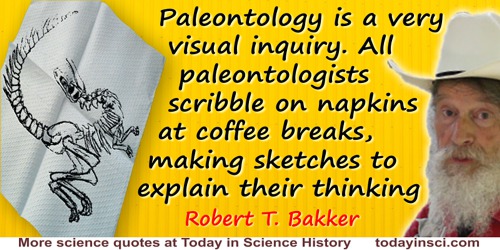
Paleontology is a very visual inquiry. All paleontologists scribble on napkins at coffee breaks, making sketches to explain their thinking
Pauling was shocked by the freedom with which the X-ray crystallographers of the time, including particularly Astbury, played with the intimate chemical structure of their models. They seemed to think that if the atoms were arranged in the right order and about the right distance apart, that was all that mattered, that no further restrictions need to be put on them.
Quoted by John Law in 'The Case of X-ray Protein Crystallography', collected in Gerard Lemaine (ed.), Perspectives on the Emergence of Scientific Disciplines, 1976, 140.
Perhaps the problem is the seeming need that people have of making black-and-white cutoffs when it comes to certain mysterious phenomena, such as life and consciousness. People seem to want there to be an absolute threshold between the living and the nonliving, and between the thinking and the “merely mechanical,” ... But the onward march of science seems to force us ever more clearly into accepting intermediate levels of such properties.
‘Shades of Gray Along the Consciousness Continuum’, Fluid Concepts & Creative Analogies: Computer Models of the Fundamental Mechanisms of Thought (1995), 310.
Physiological response to thinking and to pain is the same; and man is not given to hurting himself.
Primates stand at a turning point in the course of evolution. Primates are to the biologist what viruses are to the biochemist. They can be analysed and partly understood according to the rules of a simpler discipline, but they also present another level of complexity: viruses are living chemicals, and primates are animals who love and hate and think.
'The Evolution of Primate Behavior: A survey of the primate order traces the progressive development of intelligence as a way of life', American Scientist (1985), 73, 288.
Productive thinking is started off by awareness of a difficulty.
In The Art of Scientific Investigation (1950), 66.
Professors have a tendency to think that independent, creative thinking cannot be done by non-science students, and that only advanced science majors have learned enough of the material to think critically about it. I believe this attitude is false. … [Ask] students to use their native intelligence to actually confront subtle scientific issues.
In Understanding the Universe: An Inquiry Approach to Astronomy and the Nature of Scientific Research (2013), ix.
Propose theories which can be criticized. Think about possible decisive falsifying experiments—crucial experiments. But do not give up your theories too easily—not, at any rate, before you have critically examined your criticism.
'The Problem of Demarcation' (1974). Collected in David Miller (ed.) Popper Selections (1985), 126-127.
Psychologists … have found that people making an argument or a supposedly factual claim can manipulate us by the words they choose and the way they present their case. We can’t avoid letting language do our thinking for us, but we can become more aware of how and when language is steering us toward a conclusion that, upon reflection, we might choose to reject.
As co-author with Kathleen Hall Jamieson, in unSpun: Finding Facts in a World of Disinformation (2007), 70.
Rational thinking which is free from assumptions ends therefore in mysticism.
Quoted in Kim Lim (ed.), 1,001 Pearls of Spiritual Wisdom: Words to Enrich, Inspire, and Guide Your Life (2014), 41
Reading furnishes the mind only with materials of knowledge, it is thinking makes what we read ours.
On the Conduct Of Understanding (written 1697, published posthumously 1706), collected in Works (5th Ed. 1751), Vol. 3, 387.
Reading, after a certain age, diverts the mind too much from its creative pursuits. Any man who reads too much and uses his own brain too little falls into lazy habits of thinking.
…...
Realistic thinking accrues only after mistake making, which is the cosmic wisdom's most cogent way of teaching each of us how to carry on.
In Buckminster Fuller and Answar Dil, Humans in Universe (1983), 218.
Regardless of communication between man and man, speech is a necessary condition for the thinking of the individual in solitary seclusion. In appearance, however, language develops only socially, and man understands himself only once he has tested the intelligibility of his words by trial upon others.
On Language (1836), trans. Peter Heath (1988), 56.
Research is four things: brains with which to think, eyes with which to see, machines with which to measure, and fourth, money.
Quoted in obituary by Walter Sullivan, 'Albert Szent-Gyorgyi Dead; Research Isolated Vitamin C', New York Times (25 Oct 1986), 9.
Research is to see what everybody has seen and think what nobody has thought.
Bioenergetics (1957), 57.
Romantics might like to think of themselves as being composed of stardust. Cynics might prefer to think of themselves as nuclear waste.
In Big Bang: The Origin of the Universe (2005), 389.
Science cannot stop while ethics catches up ... and nobody should expect scientists to do all the thinking for the country.
To the 116th meeting of the American Association for the Advancement of Science, New York City (26-31 Dec 1949), as quoted in Life magazine (9 Jan 1950), 28, No. 2, 17.
Science doesn’t purvey absolute truth. Science is a mechanism, a way of trying to improve your knowledge of nature. It’s a system for testing your thoughts against the universe, and seeing whether they match.
'Isaac Asimov Speaks' with Bill Moyers in The Humanist (Jan/Feb 1989), 49. Reprinted in Carl Howard Freedman (ed.), Conversations with Isaac Asimov (2005), 143-144. Bill Moyers asked “What’s real knowledge?” Asimov replied, “Well, we can’t be absolutely certain.” He continued answering as in the quote above.
Science has taught us to think the unthinkable. Because when nature is the guide—rather than a priori prejudices, hopes, fears or desires—we are forced out of our comfort zone. One by one, pillars of classical logic have fallen by the wayside as science progressed in the 20th century, from Einstein's realization that measurements of space and time were not absolute but observer-dependent, to quantum mechanics, which not only put fundamental limits on what we can empirically know but also demonstrated that elementary particles and the atoms they form are doing a million seemingly impossible things at once.
In op-ed, 'A Universe Without Purpose', Los Angeles Times (1 Apr 2012).
Science is a way of thinking much more than it is a body of knowledge.
Broca’s Brain: Reflections on the Romance of Science (1979, 1986), 15.
Science is uncertain. Theories are subject to revision; observations are open to a variety of interpretations, and scientists quarrel amongst themselves. This is disillusioning for those untrained in the scientific method, who thus turn to the rigid certainty of the Bible instead. There is something comfortable about a view that allows for no deviation and that spares you the painful necessity of having to think.
The 'Threat' of Creationism. In Ashley Montagu (ed.), Science and Creationism (1984), 192.
Scientific development depends in part on a process of non-incremental or revolutionary change. Some revolutions are large, like those associated with the names of Copernicus, Newton, or Darwin, but most are much smaller, like the discovery of oxygen or the planet Uranus. The usual prelude to changes of this sort is, I believed, the awareness of anomaly, of an occurrence or set of occurrences that does not fit existing ways of ordering phenomena. The changes that result therefore require 'putting on a different kind of thinking-cap', one that renders the anomalous lawlike but that, in the process, also transforms the order exhibited by some other phenomena, previously unproblematic.
The Essential Tension (1977), xvii.
Scientific method is not just a method which it has been found profitable to pursue in this or that abstruse subject for purely technical reasons. It represents the only method of thinking that has proved fruitful in any subject—that is what we mean when we call it scientific. It is not a peculiar
development of thinking for highly specialized ends; it is thinking, so far as thought has become conscious of its proper ends and of the equipment indispensable for success in their pursuit ... When our schools truly become laboratories of knowledge-making, not mills fitted out with information-hoppers, there will no longer be need to discuss the place of science in education.
Address to Section L, Education, of the American Association for the Advancement of Science, at Boston (1909), 'Science as Subject-Matter and as Method'. Published in Science (28 Jan 1910), N.S. Vol. 31, No. 787, 127.
Scientists are the easiest to fool. ... They think in straight, predictable, directable, and therefore misdirectable, lines. The only world they know is the one where everything has a logical explanation and things are what they appear to be. Children and conjurors—they terrify me. Scientists are no problem; against them I feel quite confident.
Code of the Lifemaker (1983, 2000),Chapter 1.
Seeing and thinking have done much for human progress; in the sphere of mind and morals everything, and could the world have been saved by armchair philosophy, the Greeks would have done it; but only a novum organon could do this, the powerful possibilities of which were only revealed when man began to search our the secrets of nature by way of experiment, to use the words of Harvey.
Address at the opening of the new Pathological Institute of the Royal Infirmary, Glasgow (4 Oct 1911). Printed in 'The Pathological Institute of a General Hospital', Glasgow Medical Journal (1911), 76, 326.
Society exists through a process of transmission quite as much as biological life. This transmission occurs by means of communication of habits of doing, thinking, and feeling from the older to the younger.
Democracy and Education: an Introduction to the Philosophy of Education (1916), 3.
Some persons have contended that mathematics ought to be taught by making the illustrations obvious to the senses. Nothing can be more absurd or injurious: it ought to be our never-ceasing effort to make people think, not feel.
Seven Lectures on Shakespeare and Milton (1856) 24.
Someone with a fresh mind, one not conditioned by upbringing and environment, would doubtless look at science and the powerful reductionism that it inspires as overwhelmingly the better mode of understanding the world, and would doubtless scorn religion as sentimental wishful thinking.
Essay collected in John Cornwell (ed.), 'The Limitless Power of Science', Nature's Imagination: The Frontiers of Scientific Vision (1995), 123.
Strategy is a style of thinking, a conscious and deliberate process, an intensive implementation system, the science of insuring future success.
…...
Stupidity is no excuse for not thinking.
Unkempt Thoughts (1962), 77.
Success is a lousy teacher. It seduces smart people into thinking they can’t lose.
…...
Suppose that you are in love with a lady on Neptune and that she returns the sentiment. It will be some consolation for the melancholy separation if you can say to yourself at some possibly pre-arranged moment, “She is thinking of me now.” Unfortunately a difficulty has arisen because we have had to abolish Now. There is no absolute Now, but only the various relative Nows, differing according to their reckoning of different observers and covering the whole neutral wedge which at the distance of Neptune is about eight hours thick. She will have to think of you continuously for eight hours on end in order to circumvent the ambiguity “Now.”
In The Nature of the Physical World (1929), 49.
Suppose then I want to give myself a little training in the art of reasoning; suppose I want to get out of the region of conjecture and probability, free myself from the difficult task of weighing evidence, and putting instances together to arrive at general propositions, and simply desire to know how to deal with my general propositions when I get them, and how to deduce right inferences from them; it is clear that I shall obtain this sort of discipline best in those departments of thought in which the first principles are unquestionably true. For in all our thinking, if we come to erroneous conclusions, we come to them either by accepting false premises to start with—in which case our reasoning, however good, will not save us from error; or by reasoning badly, in which case the data we start from may be perfectly sound, and yet our conclusions may be false. But in the mathematical or pure sciences,—geometry, arithmetic, algebra, trigonometry, the calculus of variations or of curves,— we know at least that there is not, and cannot be, error in our first principles, and we may therefore fasten our whole attention upon the processes. As mere exercises in logic, therefore, these sciences, based as they all are on primary truths relating to space and number, have always been supposed to furnish the most exact discipline. When Plato wrote over the portal of his school. “Let no one ignorant of geometry enter here,” he did not mean that questions relating to lines and surfaces would be discussed by his disciples. On the contrary, the topics to which he directed their attention were some of the deepest problems,— social, political, moral,—on which the mind could exercise itself. Plato and his followers tried to think out together conclusions respecting the being, the duty, and the destiny of man, and the relation in which he stood to the gods and to the unseen world. What had geometry to do with these things? Simply this: That a man whose mind has not undergone a rigorous training in systematic thinking, and in the art of drawing legitimate inferences from premises, was unfitted to enter on the discussion of these high topics; and that the sort of logical discipline which he needed was most likely to be obtained from geometry—the only mathematical science which in Plato’s time had been formulated and reduced to a system. And we in this country [England] have long acted on the same principle. Our future lawyers, clergy, and statesmen are expected at the University to learn a good deal about curves, and angles, and numbers and proportions; not because these subjects have the smallest relation to the needs of their lives, but because in the very act of learning them they are likely to acquire that habit of steadfast and accurate thinking, which is indispensable to success in all the pursuits of life.
In Lectures on Teaching (1906), 891-92.
Suppose there is something which a person cannot understand. He happens to notice the similarity of this something to some other thing which he understands quite well. By comparing them he may come to understand the thing which he could not understand up to that moment. If his understanding turns out to be appropriate and nobody else has ever come to such an understanding, he can claim that his thinking was really creative.
Creativity and Intuition: A Physicist Looks at East and West (1973), 114.
Surely the mitochondrion that first entered another cell was not thinking about the future benefits of cooperation and integration; it was merely trying to make its own living in a tough Darwinian world
Wonderful Life: the Burgess Shale and the Nature of History (1990), 310.
Take the living human brain endowed with mind and thought. …. The physicist brings his tools and commences systematic exploration. All that he discovers is a collection of atoms and electrons and fields of force arranged in space and time, apparently similar to those found in inorganic objects. He may trace other physical characteristics, energy, temperature, entropy. None of these is identical with thought. … How can this collection of ordinary atoms be a thinking machine? … The Victorian physicist felt that he knew just what he was talking about when he used such terms as matter and atoms. … But now we realize that science has nothing to say as to the intrinsic nature of the atom. The physical atom is, like everything else in physics, a schedule of pointer readings.
From a Gifford Lecture, University of Edinburgh (1927), published in 'Pointer Readings: Limits of Physical Knowledge', The Nature of the Physical World (1929), 258-259.
Taxonomy is often regarded as the dullest of subjects, fit only for mindless ordering and sometimes denigrated within science as mere “stamp collecting” (a designation that this former philatelist deeply resents). If systems of classification were neutral hat racks for hanging the facts of the world, this disdain might be justified. But classifications both reflect and direct our thinking. The way we order represents the way we think. Historical changes in classification are the fossilized indicators of conceptual revolutions.
In Hen’s Teeth and Horse’s Toes: Further Reflections in Natural History (1983, 2010), 72
Teach him to think for himself? Oh, my God, teach him rather to think like other people!
Expressing concern for her son’s education. In Matthew Arnold, Essays in Criticism, Second Series (1888).
That is as natural to man as thinking or throwing snowballs.
Aphorism 18 in Notebook C (1772-1773), as translated by R.J. Hollingdale in Aphorisms (1990). Reprinted as The Waste Books (2000), 34.
That there is no such thing as the scientific method, one might easily discover by asking several scientists to define it. One would find, I am sure, that no two of them would exactly agree. Indeed, no two scientists work and think in just the same ways.
In Science in the Making (1957), 8-9.
The ability to imagine relations is one of the most indispensable conditions of all precise thinking. No subject can be named, in the investigation of which it is not imperatively needed; but it can be nowhere else so thoroughly acquired as in the study of mathematics.
In Darwinism and other Essays (1893), 296.
The act of smelling something, anything, is remarkably like the act of thinking. Immediately at the moment of perception, you can feel the mind going to work, sending the odor around from place to place, setting off complex repertories through the brain, polling one center after another for signs of recognition, for old memories and old connection.
In Late Night Thoughts on Listening to Mahler's Ninth Symphony (1984), 42.
The advance of science is not comparable to the changes of a city, where old edifices are pitilessly torn down to give place to new, but to the continuous evolution of zoologic types which develop ceaselessly and end by becoming unrecognisable to the common sight, but where an expert eye finds always traces of the prior work of the centuries past. One must not think then that the old-fashioned theories have been sterile and vain.
The Value of Science (1905), in The Foundations of Science: Science and Hypothesis, The Value of Science, Science and Method(1946), trans. by George Bruce Halsted, 208.
The aim of science is to apprehend this purely intelligible world as a thing in itself, an object which is what it is independently of all thinking, and thus antithetical to the sensible world.... The world of thought is the universal, the timeless and spaceless, the absolutely necessary, whereas the world of sense is the contingent, the changing and moving appearance which somehow indicates or symbolizes it.
'Outlines of a Philosophy of Art,' Essays in the Philosophy of Art, Indiana University Press (1964).
The aim of science is to seek the simplest explanations of complex facts. We are apt to fall into the error of thinking that the facts are simple because simplicity is the goal of our quest. The guiding motto in the life of every natural philosopher should be, Seek simplicity and distrust it.
In The Concept of Nature: Tarner Lectures Delivered in Trinity College, November 1919 (1920), 163.
The arguments for the two substances [mind and body] have, we believe, entirely lost their validity; they are no longer compatible with ascertained science and clear thinking. The one substance with two sets of properties, two sides, the physical and the mental—a double-faced unity—would appear to comply with all the exigencies of the case. … The mind is destined to be a double study—to conjoin the mental philosopher with the physical philosopher.
From concluding paragraph in Mind and Body: The Theories of their Relation (1872), 195.
The assumptions of population thinking are diametrically opposed to those of the typologist. The populationist stresses the uniqueness of everything in the organic world. What is true for the human species,–that no two individuals are alike, is equally true for all other species of animals and plants ... All organisms and organic phenomena are composed of unique features and can be described collectively only in statistical terms. Individuals, or any kind of organic entities, form populations of which we can determine the arithmetic mean and the statistics of variation. Averages are merely statistical abstractions, only the individuals of which the populations are composed have reality. The ultimate conclusions of the population thinker and of the typologist are precisely the opposite. For the typologist, the type (eidos) is real and the variation. an illusion, while for the populationist the type (average) is an abstraction and only the variation is real. No two ways of looking at nature could be more different.
Darwin and the Evolutionary Theory in Biology (1959), 2.
The attitude which the man in the street unconsciously adopts towards science is capricious and varied. At one moment he scorns the scientist for a highbrow, at another anathematizes him for blasphemously undermining his religion; but at the mention of a name like Edison he falls into a coma of veneration. When he stops to think, he does recognize, however, that the whole atmosphere of the world in which he lives is tinged by science, as is shown most immediately and strikingly by our modern conveniences and material resources. A little deeper thinking shows him that the influence of science goes much farther and colors the entire mental outlook of modern civilised man on the world about him.
Reflections of a Physicist (1950), 81.
The axioms of geometry are—according to my way of thinking—not arbitrary, but sensible. statements, which are, in general, induced by space perception and are determined as to their precise content by expediency.
In George Edward Martin, The Foundations of Geometry and the Non-Euclidean Plane (1982), 142.
The calculus was the first achievement of modern mathematics and it is difficult to overestimate its importance. I think it defines more unequivocally than anything else the inception of modern mathematics; and the system of mathematical analysis, which is its logical development, still constitutes the greatest technical advance in exact thinking.
In 'The Mathematician', Works of the Mind (1947), 1, No. 1. Collected in James Roy Newman (ed.), The World of Mathematics (1956), Vol. 4, 2055.
The century of biology upon which we are now well embarked is no matter of trivialities. It is a movement of really heroic dimensions, one of the great episodes in man’s intellectual history. The scientists who are carrying the movement forward talk in terms of nucleo-proteins, of ultracentrifuges, of biochemical genetics, of electrophoresis, of the electron microscope, of molecular morphology, of radioactive isotopes. But do not be misled by these horrendous terms, and above all do not be fooled into thinking this is mere gadgetry. This is the dependable way to seek a solution of the cancer and polio problems, the problems of rheumatism and of the heart. This is the knowledge on which we must base our solution of the population and food problems. This is the understanding of life.
Letter to H. M. H. Carsan (17 Jun 1949). Quoted in Raymond B. Fosdick, The Story of the Rockefeller Foundation (1952), 166.
The child asks, “What is the moon, and why does it shine?” “What is this water and where does it run?” “What is this wind?” “What makes the waves of the sea?” “Where does this animal live, and what is the use of this plant?” And if not snubbed and stunted by being told not to ask foolish questions, there is no limit to the intellectual craving of a young child; nor any bounds to the slow, but solid, accretion of knowledge and development of the thinking faculty in this way. To all such questions, answers which are necessarily incomplete, though true as far as they go, may be given by any teacher whose ideas represent real knowledge and not mere book learning; and a panoramic view of Nature, accompanied by a strong infusion of the scientific habit of mind, may thus be placed within the reach of every child of nine or ten.
In 'Scientific Education', Lay Sermons, Addresses, and Reviews (1870), 71.
https://books.google.com/books?id=13cJAAAAIAAJ
Thomas Henry Huxley - 1870
The contemplation of celestial things will make a man both speak and think more sublimely and magnificently when he descends to human affairs.
In Louis Klopsch, Many Thoughts of Many Minds (1896), 18.
The difference between a good observer and one who is not good is that the former is quick to take a hint from the facts, from his early efforts to develop skill in handling them, and quick to acknowledge the need to revise or alter the conceptual framework of his thinking. The other—the poor observer—continues dogmatically onward with his original thesis, lost in a maze of correlations, long after the facts have shrieked in protest against the interpretation put upon them.
In The Social Problems of an Industrial Civilization (1945).
The difference between myth and science is the difference between divine inspiration of “unaided reason” (as Bertrand Russell put it) on the one hand and theories developed in observational contact with the real world on the other. It is the difference between the belief in prophets and critical thinking, between Credo quia absurdum (I believe because it is absurd–Tertullian) and De omnibus est dubitandum (Everything should be questioned–Descartes). To try to write a grand cosmical drama leads necessarily to myth. To try to let knowledge substitute ignorance in increasingly large regions of space and time is science.
In 'Cosmology: Myth or Science?' Journal of Astrophysics and Astronomy (1984), 5, 79-98.
The discovery of an interaction among the four hemes made it obvious that they must be touching, but in science what is obvious is not necessarily true. When the structure of hemoglobin was finally solved, the hemes were found to lie in isolated pockets on the surface of the subunits. Without contact between them how could one of them sense whether the others had combined with oxygen? And how could as heterogeneous a collection of chemical agents as protons, chloride ions, carbon dioxide, and diphosphoglycerate influence the oxygen equilibrium curve in a similar way? It did not seem plausible that any of them could bind directly to the hemes or that all of them could bind at any other common site, although there again it turned out we were wrong. To add to the mystery, none of these agents affected the oxygen equilibrium of myoglobin or of isolated subunits of hemoglobin. We now know that all the cooperative effects disappear if the hemoglobin molecule is merely split in half, but this vital clue was missed. Like Agatha Christie, Nature kept it to the last to make the story more exciting. There are two ways out of an impasse in science: to experiment or to think. By temperament, perhaps, I experimented, whereas Jacques Monod thought.
From essay 'The Second Secret of Life', collected in I Wish I'd Made You Angry Earlier (1998), 263-5.
The efforts of most human-beings are consumed in the struggle for their daily bread, but most of those who are, either through fortune or some special gift, relieved of this struggle are largely absorbed in further improving their worldly lot. Beneath the effort directed toward the accumulation of worldly goods lies all too frequently the illusion that this is the most substantial and desirable end to be achieved; but there is, fortunately, a minority composed of those who recognize early in their lives that the most beautiful and satisfying experiences open to humankind are not derived from the outside, but are bound up with the development of the individual's own feeling, thinking and acting. The genuine artists, investigators and thinkers have always been persons of this kind. However inconspicuously the life of these individuals runs its course, none the less the fruits of their endeavors are the most valuable contributions which one generation can make to its successors.
In letter (1 May 1935), Letters to the Editor, 'The Late Emmy Noether: Professor Einstein Writes in Appreciation of a Fellow-Mathematician', New York Times (4 May 1935), 12.
The fact that XY thinks slowly is not serious, but that he publishes faster than he thinks is inexcusable.
Quoted in Ralph Oesper, The Human Side of Scientists (1975), 154.
The first and most important quality of all scientific ways of thinking must be the clear distinction between the outer object of observation and the subjective nature of the observer.
In Max Planck and James Vincent Murphy (trans.), Where Is Science Going? (1932), 139.
The fundamental hypothesis of genetic epistemology is that there is a parallelism between the progress made in the logical and rational organization of knowledge and the corresponding formative psychological processes. With that hypothesis, the most fruitful, most obvious field of study would be the reconstituting of human history—the history of human thinking in prehistoric man. Unfortunately, we are not very well informed in the psychology of primitive man, but there are children all around us, and it is in studying children that we have the best chance of studying the development of logical knowledge, physical knowledge, and so forth.
'Genetic Epistemology', Columbia Forum (1969), 12, 4.
The future offers very little hope for those who expect that our new mechanical slaves will offer us a world in which we may rest from thinking. Help us they may, but at the cost of supreme demands upon our honesty and our intelligence. The world of the future will be an ever more demanding struggle against the limitations of our intelligence, not a comfortable hammock in which we can lie down to be waited upon by our robot slaves.
In God & Golem, Inc (1964), 73-74.
The generality of men are so accustomed to judge of things by their senses that, because the air is indivisible, they ascribe but little to it, and think it but one remove from nothing.
In Mary Elvira Weeks, The Discovery of the Elements (1934), 29, citing Boyle, 'Memoirs for a General History of the Air', in Shaw's Abridgment of Boyle's works (1725), Vol. 3, 61, and Ramsay, The Gases of the Atmosphere (1915), 10.
The great testimony of history shows how often in fact the development of science has emerged in response to technological and even economic needs, and how in the economy of social effort, science, even of the most abstract and recondite kind, pays for itself again and again in providing the basis for radically new technological developments. In fact, most people—when they think of science as a good thing, when they think of it as worthy of encouragement, when they are willing to see their governments spend substance upon it, when they greatly do honor to men who in science have attained some eminence—have in mind that the conditions of their life have been altered just by such technology, of which they may be reluctant to be deprived.
In 'Contemporary World', Bulletin of the Atomic Scientists (Feb 1948), 4, 67.
The Greeks made Space the subject-matter of a science of supreme simplicity and certainty. Out of it grew, in the mind of classical antiquity, the idea of pure science. Geometry became one of the most powerful expressions of that sovereignty of the intellect that inspired the thought of those times. At a later epoch, when the intellectual despotism of the Church, which had been maintained through the Middle Ages, had crumbled, and a wave of scepticism threatened to sweep away all that had seemed most fixed, those who believed in Truth clung to Geometry as to a rock, and it was the highest ideal of every scientist to carry on his science “more geometrico.”
In Space,Time, Matter, translated by Henry Leopold Brose (1952), 1.
The history of psychiatry to the present day is replete with examples of loose thinking and a failure to apply even the simplest rules of logic. “A Court of Statistical Appeal” has now been equated with scientific method.
— Myre Sim
Quoted in book review by Myre Sim about 'Ending the Cycle of Abuse', The Canadian Journal of Psychiatry (May 1997), 42:4, 425.
The history of the universe is in every one of us. Every particle in our bodies has a multibillion-year past, every cell and every bodily organ has a multimillion-year past, and many of our ways of thinking have multithousand-year pasts.
As co-author with Nancy Ellen Abrams, in The View from the Center of the Universe: Discovering Our Extraordinary Place in the Cosmos (2006), 151.
The human race knows enough about thinking to prevent it.
In The Decline and Fall of Science (1976).
The important thing in science is not so much to obtain new facts as to discover new ways of thinking about them.
This is a paraphrase from Bragg’s actual quote, beginning: “The fun in science lies not in discovering facts…” (q.v.) included with citation elsewhere on this web page. The paraphrased quote is as given in Alan Lindsay Mackay, A Dictionary of Scientific Quotations (1991), 38. It is cited by Mackay as collected from Arthur Koestler and J.R. Smithies, Beyond Reductionism (1958), 115. It is mentioned therein without quotation marks. Webmaster finds the source is actually: Arthur Koestler and John Raymond Smythies (eds.), Beyond Reductionism: New Perspectives in the Life Sciences: Proceedings of the Alpbach Symposium (1968) (1969, 1971), 115. (This corrects date from 1958 to 1968, and the spelling of Smythies name.)
The individual within the collective is never, or hardly ever, conscious of the prevailing thought style, which almost always exerts an absolutely compulsive force upon his thinking and with which it is not possible to be at variance.
Genesis and the Development of a Scientific Fact (1935), 41.
The invention of the scientific method and science is, I'm sure we'll all agree, the most powerful intellectual idea, the most powerful framework for thinking and investigating and understanding and challenging the world around us that there is, and it rests on the premise that any idea is there to be attacked. If it withstands the attack then it lives to fight another day and if it doesn't withstand the attack then down it goes. Religion doesn't seem to work like that.
From impromptu speech at a Cambridge conference (1998). Quoted in Richard Dawkins, A Devil's Chaplain: Reflections on Hope, Lies, Science, and Love (2004), 168. In Douglas Adams, The Salmon of Doubt: Hitchhiking the Galaxy One Last Time (2002), 141.
The key to SETI is to guess the type of communication that an alien society would use. The best guesses so far have been that they would use radio waves, and that they would choose a frequency based on 'universal' knowledge—for instance, the 1420 MHz hydrogen frequency. But these are assumptions formulated by the human brain. Who knows what sort of logic a superadvanced nonhuman life form might use? ... Just 150 years ago, an eyeblink in history, radio waves themselves were inconceivable, and we were thinking of lighting fires to signal the Martians.
Quoted on PBS web page related to Nova TV program episode on 'Origins: Do Aliens Exist in the Milky Way'.
The landscape has been so totally changed, the ways of thinking have been so deeply affected, that it is very hard to get hold of what it was like before… It is very hard to realize how total a change in outlook Isaac Newton has produced.
From 'Newton and the Twentieth Century—A Personal View', collected in Raymond Flood, John Fauvel, Michael Shortland and Robin Wilson (eds.), Let Newton Be! A New Perspective on his Life and Works (1988), 241.
The late James McNeil Whistler had a French poodle of which he was extravagantly fond. This poodle was seized with an affection of the throat, and Whistler had the audacity to send for the great throat specialist, Mackenzie. Sir Morell, when he saw that he had been called to treat a dog, didn't like it much, it was plain. But he said nothing. He prescribed, pocketed a big fee, and drove away.
The next day he sent posthaste for Whistler. And Whistler, thinking he was summoned on some matter connected with his beloved dog, dropped his work and rushed like the wind to Mackenzie's. On his arrival Sir Morell said, gravely: “How do you do, Mr. Whistler? I wanted to see you about having my front door painted.”
The next day he sent posthaste for Whistler. And Whistler, thinking he was summoned on some matter connected with his beloved dog, dropped his work and rushed like the wind to Mackenzie's. On his arrival Sir Morell said, gravely: “How do you do, Mr. Whistler? I wanted to see you about having my front door painted.”
Attributed or merely a legend. This anecdote wording is from 'Turn About Is Fair Play', Collier's (26 Mar 1904), 32, No. 26, 24, the earliest version the Webmaster has found so far. It has been variously reworded and printed in a number of books and magazines over the decades since, and is still circulated in the present day. The wording of Mackenzie's remark changes from one version to another, but remains true to the sense of it. In Medical Record (4 Jan 1913), 83, No. 1, 46, a reprinted column from The Universal Medical Record says: “‘X’ relates that he ‘has recently been watching through the weekly papers, of a story anent the artist Whistler and Sir mrell Mackenzie, which, curiously enough, starting in Paris, has now reached the American medical Journals and seems embarked on a long and active career. ... Mr. Ben Trovato, the eminent raconteur, seems for the moment at fault. Still, the natural history of such legends as this leads us to suppose that the story of the laryngologist and the poodle will continue to circulate, till after having served its day it ‘falls on sleep,’ later to be revived by the journalists of the next generation about some heroes of to-day.” Examples of other versions are in La Vulgarisation scientifique: revue mensuelle illustrée (1906); Don C. Seitz Whistler Stories (1913); Lewis C. Henry, Humorous Anecdotes About Famous People (1948); Graeme Garden The Best Medicine (1984); The Reader's Digest (1986), 128, Nos. 765-769, 40. So, in fact, this anecdote has, indeed, been revived for over a century, but is still narrated about Whistler and Mackenzie. Meanwhile, the column in the Medical Record mentioned above comments: “Why Whistler—whose brother, by-the-bye, was almost equally celebrated in the same department of medicine—should have desired the services of a laryngologist for his poodle, heaven only knows.” So, whether to regard this as entirely legend, or perhaps having some foundation of truth, the Webmaster cannot say, but would like to hear from anyone with more historical background to add.
The little girl had the baking of a poet in her who, being told to be sure of her meaning before she spoke, said ‘How can I know what I think till I see what I say?’
In The Art of Thought (1926), 106.
The mind is a vagrant thing ... Thinking is not analogous to a person working in a laboratory who invents something on company time.
Answering criticism that the book for which he won a Pulitzer Prize was written in the years he had been employed at the Smithsonian. He specified that did not write on the premises there, but only at home outside of working hours.
Answering criticism that the book for which he won a Pulitzer Prize was written in the years he had been employed at the Smithsonian. He specified that did not write on the premises there, but only at home outside of working hours.
Quoted by Barbara Gamarekian in 'Working Profile: Daniel J. Boorstin. Helping the Library of Congress Fulfill Its Mission', New York Times (8 Jul 1983), B6.
The more experiences and experiments accumulate in the exploration of nature, the more precarious the theories become. But it is not always good to discard them immediately on this account. For every hypothesis which once was sound was useful for thinking of previous phenomena in the proper interrelations and for keeping them in context. We ought to set down contradictory experiences separately, until enough have accumulated to make building a new structure worthwhile.
Lichtenberg: Aphorisms & Letters (1969), 61.
The more I think of it, I find this conclusion more impressed upon me—that the greatest thing a human soul ever does in this world is to see something, and tell what it saw in a plain way.
Modern Painters: pt. 4. Of Many Things (1850), 268.
books.google.com
John Ruskin - 1850
The mystery of life is certainly the most persistent problem ever placed before the thought of man. There is no doubt that from the time humanity began to think it has occupied itself with the problem of its origin and its future which undoubtedly is the problem of life. The inability of science to solve it is absolute. This would be truly frightening were it not for faith.
Address (10 Sep 1934) to the International Congress of Electro-Radio Biology, Venice. In Associated Press, 'Life a Closed Book, Declares Marconi', New York Times (11 Sep 1934), 15.
The need for a quick, satisfactory copying machine that could be used right in the office seemed very apparent to me—there seemed such a crying need for it—such a desirable thing if it could be obtained. So I set out to think of how one could be made.
In interview with Dumond (1947) quoted in David owen, Copies in Seconds: How a Lone Inventor and an Unknown Company Created the Biggest Communications Breakthrough Since Gutenberg (2008), 70.
The operational approach demands that we make our reports and do our thinking in the freshest terms of which we are capable, in which we strip off the sophistications of millenia of culture and report as directly as we can on what happens.
'Rejoinders and Second Thoughts'. In a Symposium on Operationism, Psychological Review, 1945, 52, 283.
The original question, “Can machines think?,” I believe too meaningless to deserve discussion. Nevertheless I believe that at the end of the century the use of words and general educated opinion will have altered so much that one will be able to speak of machines thinking without expecting to be contradicted.
(1950) As quoted in The World of Mathematics (1956), 2083.
The philosophical implication of race-thinking is that by offering us the mystery of heredity as an explanation, it diverts our attention from the social and intellectual factors that make up personality.
Race(1937), 282.
The physicist cannot simply surrender to the philosopher the critical contemplation of the theoretical foundations for he himself knows best and feels most surely where the shoe pinches. … he must try to make clear in his own mind just how far the concepts which he uses are justified … The whole of science is nothing more than a refinement of everyday thinking. It is for this reason that the critical thinking of the physicist cannot possibly be restricted by the examination of the concepts of his own specific field. He cannot proceed without considering critically a much more difficult problem, the problem of analyzing the nature of everyday thinking.
‘Physics and Reality’, Franklin Institute Journal (Mar 1936). Collected in Out of My Later Years (1950), 59.
The presence of those seeking the truth is infinitely to be preferred to the presence of those who think they’ve found it.
In Monstrous Regiment (2004), 211.
The products of the senses, especially those of sight, hearing, and touch, form the basis of all the higher thought processes. Hence the importance of developing accurate sense concepts. … The purpose of objective thinking is to enable the mind to think without the help of objects.
As quoted in William W. Speer, Primary Arithmetic (1896), 1.
The progress of science depends less than is usually believed on the efforts and performance of the individual genius ... many important discoveries have been made by men of ordinary talents, simply because chance had made them, at the proper time and in the proper place and circumstances, recipients of a body of doctrines, facts and techniques that rendered almost inevitable the recognition of an important phenomenon. It is surprising that some historian has not taken malicious pleasure in writing an anthology of 'one discovery' scientists. Many exciting facts have been discovered as a result of loose thinking and unimaginative experimentation, and described in wrappings of empty words. One great discovery does not betoken a great scientist; science now and then selects insignificant standard bearers to display its banners.
Louis Pasteur, Free Lance of Science (1986), 368
The public image of the scientist tends to be that of a magician, occasionally benevolent, though more often giving rise to disastrous inventions, or perhaps that of a man shutting himself into a laboratory and, in his lonely way, playing with retorts and test tubes, or perhaps leaning back in a comfortable armchair in a darkened room and thinking.
In 'Why Scientists Talk', collected in John Wolfenden, Hermann Bondi, et al., The Languages of Science: A Survey of Techniques of Communication (1963), 35.
The question of the origin of life is essentially speculative. We have to construct, by straightforward thinking on the basis of very few factual observations, a plausible and self-consistent picture of a process which must have occurred before any of the forms which are known to us in the fossil record could have existed.
The Origin of Life (1967), 2.
The real purpose of scientific method is to make sure Nature hasn’t misled you into thinking you know something you don’t actually know. There’s not a mechanic or scientist or technician alive who hasn’t suffered from that one so much that he’s not instinctively on guard. … If you get careless or go romanticizing scientific information, giving it a flourish here and there, Nature will soon make a complete fool out of you.
In Zen and the Art of Motorcycle Maintenance: An inquiry into Values (1974), 100-101.
The real question is not whether machines think but whether men do.
Contingencies of Reinforcement (1969), 288.
The sciences are beneficent. They prevent men from thinking.
Quoted in The Ironic Temper: Anatole France and His Time (1932), 31.
The scientific thinker becomes accustomed to withholding judgment and remaining in doubt when the evidence is insufficient.
In The Art of Scientific Investigation (1950), 67.
The scientist, if he is to be more than a plodding gatherer of bits of information, needs to exercise an active imagination. The scientists of the past whom we now recognize as great are those who were gifted with transcendental imaginative powers, and the part played by the imaginative faculty of his daily life is as least as important for the scientist as it is for the worker in any other field—much more important than for most. A good scientist thinks logically and accurately when conditions call for logical and accurate thinking—but so does any other good worker when he has a sufficient number of well-founded facts to serve as the basis for the accurate, logical induction of generalizations and the subsequent deduction of consequences.
‘Imagination in Science’, Tomorrow (Dec 1943), 38-9. Quoted In Barbara Marinacci (ed.), Linus Pauling In His Own Words: Selected Writings, Speeches, and Interviews (1995), 82.
The sociological context of the times [affects education]. Some people call it television culture—you’re supposed to be able to get everything in 30 seconds, a sort of quiz-show attitude.
Recognizing in education a declining “dedication to rigorous thinking and the fact that things are really hard to understand.” In interview, Rushworth M. Kidder, 'Grounded in Space Science', Christian Science Monitor (22 Dec 1989).
The spectacular thing about Johnny [von Neumann] was not his power as a mathematician, which was great, or his insight and his clarity, but his rapidity; he was very, very fast. And like the modern computer, which no longer bothers to retrieve the logarithm of 11 from its memory (but, instead, computes the logarithm of 11 each time it is needed), Johnny didn’t bother to remember things. He computed them. You asked him a question, and if he didn’t know the answer, he thought for three seconds and would produce and answer.
From interview with Donald J. Albers. In John H. Ewing and Frederick W. Gehring, Paul Halmos Celebrating 50 Years of Mathematics (1991), 9.
The statistician cannot excuse himself from the duty of getting his head clear on the principles of scientific inference, but equally no other thinking man can avoid a like obligation.
The Design of Experiments (1935), 2.
The stimulus of competition, when applied at an early age to real thought processes, is injurious both to nerve-power and to scientific insight.
In The Preparation of the Child for Science (1904), 44.
The struggle for existence holds as much in the intellectual as in the physical world. A theory is a species of thinking, and its right to exist is coextensive with its power of resisting extinction by its rivals.
Science and Culture, and Other Essays (1890), 335.
The study of science teaches young men to think, while study of the classics teaches them to express thought.
In Tryon Edwards. A Dictionary of Thoughts (1908), 506.
The theory that gravitational attraction is inversely proportional to the square of the distance leads by remorseless logic to the conclusion that the path of a planet should be an ellipse, … It is this logical thinking that is the real meat of the physical sciences. The social scientist keeps the skin and throws away the meat. … His theorems no more follow from his postulates than the hunches of a horse player follow logically from the latest racing news. The result is guesswork clad in long flowing robes of gobbledygook.
In Science is a Sacred Cow (1950), 149-150.
The tools we use have a profound (and devious!) influence on our thinking habits, and, therefore, on our thinking abilities.
…...
The truth of the matter is that, though mathematics truth may be beauty, it can be only glimpsed after much hard thinking. Mathematics is difficult for many human minds to grasp because of its hierarchical structure: one thing builds on another and depends on it.
As co-author with D.T.E. Marjoram, Mathematics in a Changing World (1973).
The two fulcra of medicine are reason and observation. Observation is the clue to guide the physician in his thinking.
Praxi Medica (1696), Introduction.
The unleashed power of the atom has changed everything save our modes of thinking and we thus drift toward unparalleled catastrophe.
Telegram (24 May 1946) sent to prominent Americans. Quoted in New York Times (25 May 1946). In Robert Andrews Famous Lines: a Columbia Dictionary of Familiar Quotations (1997), 340. Variations exist due to different translations from the original German.
The use of traveling is to regulate the imagination by reality, and instead of thinking how things may be, to see them as they are.
…...
The value of fundamental research does not lie only in the ideas it produces. There is more to it. It affects the whole intellectual life of a nation by determining its way of thinking and the standards by which actions and intellectual production are judged. If science is highly regarded and if the importance of being concerned with the most up-to-date problems of fundamental research is recognized, then a spiritual climate is created which influences the other activities. An atmosphere of creativity is established which penetrates every cultural frontier. Applied sciences and technology are forced to adjust themselves to the highest intellectual standards which are developed in the basic sciences. This influence works in many ways: some fundamental students go into industry; the techniques which are applied to meet the stringent requirements of fundamental research serve to create new technological methods. The style, the scale, and the level of scientific and technical work are determined in pure research; that is what attracts productive people and what brings scientists to those countries where science is at the highest level. Fundamental research sets the standards of modern scientific thought; it creates the intellectual climate in which our modern civilization flourishes. It pumps the lifeblood of idea and inventiveness not only into the technological laboratories and factories, but into every cultural activity of our time. The case for generous support for pure and fundamental science is as simple as that.
In 'Why Pure Science?' in Bulletin of the Atomic Scientists, 1965.
The whole of science is nothing more than a refinement of everyday thinking.
‘Physics and Reality’, Franklin Institute Journal (Mar 1936). Collected in Out of My Later Years (1950), 59.
The world of mathematics, which you condemn, is really a beautiful world; it has nothing to do with life and death and human sordidness, but is eternal, cold and passionless. To me, pure, mathematics is one of the highest forms of art; it has a sublimity quite special to itself, and an immense dignity derived, from the fact that its world is exempt I, from change and time. I am quite serious in this. The only difficulty is that none but mathematicians can enter this enchanted region, and they hardly ever have a sense of beauty. And mathematics is the only thing we know of that is capable of perfection; in thinking about it we become Gods.
Letter to Helen Thomas (30 Dec 1901). Quoted in Nicholas Griffin (ed.), The Selected Letters of Bertrand Russell (1992), Vol. 1, 224.
The young specialist in English Lit, having quoted me, went on to lecture me severely on the fact that in every century people have thought they understood the Universe at last, and in every century they were proved to be wrong. It follows that the one thing we can say about our modern “knowledge” is that it is wrong.
The young man then quoted with approval what Socrates had said on learning that the Delphic oracle had proclaimed him the wisest man in Greece. “If I am the wisest man,” said Socrates, “it is because I alone know that I know nothing.” The implication was that I was very foolish because I was under the impression I knew a great deal.
Alas, none of this was new to me. (There is very little that is new to me; I wish my correspondents would realize this.) This particular theme was addressed to me a quarter of a century ago by John Campbell, who specialized in irritating me. He also told me that all theories are proven wrong in time.
My answer to him was, “John, when people thought the Earth was flat, they were wrong. When people thought the Earth was spherical, they were wrong. But if you think that thinking the Earth is spherical is just as wrong as thinking the Earth is flat, then your view is wronger than both of them put together.”
The young man then quoted with approval what Socrates had said on learning that the Delphic oracle had proclaimed him the wisest man in Greece. “If I am the wisest man,” said Socrates, “it is because I alone know that I know nothing.” The implication was that I was very foolish because I was under the impression I knew a great deal.
Alas, none of this was new to me. (There is very little that is new to me; I wish my correspondents would realize this.) This particular theme was addressed to me a quarter of a century ago by John Campbell, who specialized in irritating me. He also told me that all theories are proven wrong in time.
My answer to him was, “John, when people thought the Earth was flat, they were wrong. When people thought the Earth was spherical, they were wrong. But if you think that thinking the Earth is spherical is just as wrong as thinking the Earth is flat, then your view is wronger than both of them put together.”
In The Relativity of Wrong (1989), 214.
Then followed months of intense thought in order to find out what the bewildering chaos of scattered observations meant until one day all of a sudden the whole became as clear and comprehensible as if it were illuminated with a flash of light … There are not many joys in human life equal to the joy of the sudden birth of a generalisation illuminating the mind after a long period of patient research.”
In Memoirs of a Revolutionist, 226-227. Concerning his geographical “meticulous research which resulted in his discovery of the configuration of the mountains of Asia—a discovery which he regarded as his most significant contribution to science.” As quoted, commented and cited in Caroline Cahm, Kropotkin: And the Rise of Revolutionary Anarchism, 1872-1886 (2002), 24.
There are many modes of thinking about the world around us and our place in it. I like to consider all the angles from which we might gain perspective on our amazing universe and the nature of existence.
With co-author Kenneth William Ford Geons, Black Holes, and Quantum Foam: A Life in Physics (1998, 2010), 153.
There are science teachers who actually claim that they teach “a healthy skepticism.” They do not. They teach a profound gullibility, and their dupes, trained not to think for themselves, will swallow any egregious rot, provided it is dressed up with long words and an affectation of objectivity to make it sound scientific.
In Science is a Sacred Cow (1950), 189.
There are some modern practitioners, who declaim against medical theory in general, not considering that to think is to theorize; and that no one can direct a method of cure to a person labouring under disease, without thinking, that is, without theorizing; and happy therefore is the patient, whose physician possesses the best theory.
Zoonomia, or, The Laws Of Organic Life (1801), Vol. 2, ix.
There are two ways to slide easily through life; to believe everything or to doubt everything. Both ways save us from thinking.
Manhood of Humanity (1921), 4. Sometimes seen misquoted as 'slice through life.'
There is another ground of hope that must not be omitted. Let men but think over their infinite expenditure of understanding, time, and means on matters and pursuits of far less use and value; whereof, if but a small part were directed to sound and solid studies, there is no difficulty that might not be overcome.
Translation of Novum Organum, CXI. In Francis Bacon, James Spedding, The Works of Francis Bacon (1864), Vol. 8, 144.
There is in the chemist a form of thought by which all ideas become visible in the mind as strains of an imagined piece of music. This form of thought is developed in Faraday in the highest degree, whence it arises that to one who is not acquainted with this method of thinking, his scientific works seem barren and dry, and merely a series of researches strung together, while his oral discourse when he teaches or explains is intellectual, elegant, and of wonderful clearness.
Autobiography, 257-358. Quoted in William H. Brock, Justus Von Liebig (2002), 9.
There is no expedient to which a man will not resort to avoid the real labor of thinking.[Greatly abbreviated and paraphrased.]
The original 1784 version of this quote begins “A provision of endless apparatus…” (see elsewhere on this page). Over the years, the original 35-word quote has been paraphrased, re-paraphrased and abbreviated to these 18 words. In this form, it was published by B.C. Forbes in 'Why Do So Many Men Never Amount to Anything?',The American Magazine (Jan 1921). The journalist, having visited Thomas Edison’s laboratory, wrote that Edison showed him a placard inscribed with this quote, including the name of Joshua Reynolds, with the intention of having copies placed “all over the plant.” The quote was subsequently repeated by other writers, (describing Edison’s use of the sign), some of whom omitted the name of Joshua Reynolds incorrectly implying attribution to Edison.
There is no fundamental difference in the ways of thinking of primitive and civilized man. A close connection between race and personality has never been established.
The Mind of Primitive Man (1938), preface, v.
There is nothing either good or bad, but thinking makes it so.
Hamlet (1601), II, ii.
There it was that I found and visited the famous Galileo, grown old, a prisner to the inquisition, for thinking in astronomy otherwise than the Franciscan and Dominican licencers thought.
Recounting the tyranny of the inquisition that Milton had seen for himself in Italy. When he visited in 1640, he was age 30, and Galileo was age 77 and nearly blind. In 'Proof.—The servile condition of learning in Italy, the home of licencing.' Areopagitica; A Speech of Mr John Milton to the Parlament of England (24 Nov 1644), editted by Edward Arber (1868), 60. The words “prisner” and “Parlment” are sic.
There may be times when what is most needed is, not so much a new discovery or a new idea as a different “slant”; I mean a comparatively slight readjustment in our way of looking at the things and ideas on which attention is already fixed.
In Saving the Appearances (1957), 11.
These were errors in thinking which caused me two years of hard work before at last, in 1915, I recognised them as such. … The final results appear almost simple; any intelligent undergraduate can understand them without much trouble. But the years of searching in the dark for a truth that one feels, but cannot express; the intense desire and the alternations of confidence and misgiving, until one breaks through to clarity and understanding, are only known to him who has himself experienced them.
From address, 'Notes on the Origin of the General Theory of Relativity', part of the collection of essays in Mein Weltbild (1934), translated from the original German. This translation as quoted in W.I.B. Beveridge, The Art of Scientific Investigation (1957), 60. Another translation is given on this web page, beginning: “These were errors of thought…”.
Think like a proton — always positive.
Thinkers perish; thoughts don't.
In Ted Goodman, The Forbes Book of Business Quotations (2007), 595.
Thinking about the universe has now been handed over to specialists. The rest of us merely read about it.
City Aphorisms, Seventh Selection (1990).
Thinking consists in envisaging, realizing structural features and structural requirements; proceeding in accordance with, and determined by, these requirements; thereby changing the situation in the direction of structural improvements.
In Productive Thinking (1959), 235.
Thinking is merely the comparing of ideas, discerning relations of likeness and of difference between ideas, and drawing inferences. It is seizing general truths on the basis of clearly apprehended particulars. It is but generalizing and particularizing. Who will deny that a child can deal profitably with sequences of ideas like: How many marbles are 2 marbles and 3 marbles? 2 pencils and 3 pencils? 2 balls and 3 balls? 2 children and 3 children? 2 inches and 3 inches? 2 feet and 3 feet? 2 and 3? Who has not seen the countenance of some little learner light up at the end of such a series of questions with the exclamation, “Why it’s always that way. Isn’t it?” This is the glow of pleasure that the generalizing step always affords him who takes the step himself. This is the genuine life-giving joy which comes from feeling that one can successfully take this step. The reality of such a discovery is as great, and the lasting effect upon the mind of him that makes it is as sure as was that by which the great Newton hit upon the generalization of the law of gravitation. It is through these thrills of discovery that love to learn and intellectual pleasure are begotten and fostered. Good arithmetic teaching abounds in such opportunities.
In Arithmetic in Public Education (1909), 13. As quoted and cited in Robert Édouard Moritz, Memorabilia Mathematica; Or, The Philomath’s Quotation-book (1914), 68.
Thinking is one thing no one has ever been able to tax.
Thinking is the activity I love best, and writing to me is simply thinking through my fingers. I can write up to 18 hours a day. Typing 90 words a minute, I’ve done better than 50 pages a day. Nothing interferes with my concentration. You could put an orgy in my office and I wouldn't look up—well, maybe once.
When accepting the James T. Grady award from the American Chemical Society. As quoted in Something About the Author (1981), Vol. 26, 32.
Thinking is the hardest work there is. Which is the probable reason why so few engage in it.
…...
Thinking is the most unhealthy thing in the world, and people die of it just as they die of any other disease.
In 'Decay of Lying', The Writings of Oscar Wilde: Epigrams, Phrases and Philosophies For the Use of the Young (1907), 6.
Thinking must never submit itself, neither to a dogma, nor to a party, nor to a passion, nor to an interest, nor to a preconceived idea, nor to whatever it may be, if not to facts themselves, because, for it, to submit would be to cease to be.
…...
Thinking, after a while, becomes the most pleasurable thing in the world. Give me a satchel and a fishing rod, and I could hie myself off and keep busy at thinking forever. I don't need anybody to amuse me. It is the same way with my friends John Burroughs, the naturalist, and Henry Ford, who is a natural-born mechanic. We can derive the most satisfying kind of joy from thinking and thinking and thinking.
As quoted from an interview by B.C. Forbes in The American Magazine (Jan 1921), 86.
This man, one of the chief architects of the atomic bomb, so the story runs, was out wandering in the woods one day with a friend when he came upon a small tortoise. Overcome with pleasurable excitement, he took up the tortoise and started home, thinking to surprise his children with it. After a few steps he paused and surveyed the tortoise doubtfully.
“What's the matter?” asked his friend.
Without responding, the great scientist slowly retraced his steps as precisely as possible, and gently set the turtle down on the exact spot from which he had taken him.
Then he turned solemnly to his friend. “It just struck me,” he said, “that, perhaps for one man, I have tampered enough with the universe.” He turned, and left the turtle to wander on its way.
“What's the matter?” asked his friend.
Without responding, the great scientist slowly retraced his steps as precisely as possible, and gently set the turtle down on the exact spot from which he had taken him.
Then he turned solemnly to his friend. “It just struck me,” he said, “that, perhaps for one man, I have tampered enough with the universe.” He turned, and left the turtle to wander on its way.
From Benjamin Franklin Lecture (1958) at the University of Pennsylvania, printed as 'The Ethic of the Group', in Robert Ernest Spiller, Social Control in a Free Society (1958), 37. Also in The Firmament of Time (1960), 148. Eiseley states that because he cannot vouch for the authenticity of the story, he would not name the scientist, though he hopes “with all his heart that it is true. If it is not, then it ought to be, for it illustrates well what I mean by a growing self-awareness, as sense of responsibility about the universe.”
This relation logical implication is probably the most rigorous and powerful of all the intellectual enterprises of man. From a properly selected set of the vast number of prepositional functions a set can be selected from which an infinitude of prepositional functions can be implied. In this sense all postulational thinking is mathematics. It can be shown that doctrines in the sciences, natural and social, in history, in jurisprudence and in ethics are constructed on the postulational thinking scheme and to that extent are mathematical. Together the proper enterprise of Science and the enterprise of Mathematics embrace the whole knowledge-seeking activity of mankind, whereby “knowledge” is meant the kind of knowledge that admits of being made articulate in the form of propositions.
In Mathematics as a Culture Clue: And Other Essays (1947), 127.
This splendid subject [mathematics], queen of all exact sciences, and the ideal and norm of all careful thinking...
Educational Problems (1911), Vol. 2, 393.
Those laws [of nature] are within the grasp of the human mind; God wanted us to recognize them by creating us after his own image so that we could share in his own thoughts.
[Seen capsulized as: “I am thinking God’s thoughts after him.”]
[Seen capsulized as: “I am thinking God’s thoughts after him.”]
Letter (9/10 Apr 1599) to the Bavarian chancellor Herwart von Hohenburg. Collected in Carola Baumgardt and Jamie Callan, Johannes Kepler Life and Letters (1953), 50. See additional notes with the very short alternate version shown above. Thanks for comparing these two versions go to Ted Davis, Professor of the History of Science, Messiah College.
Through purely logical thinking we can attain no knowledge whatsoever of the empirical world.
In Francis Crick, The Astonishing Hypothesis: the Scientific Search for the Soul (1995), 215.
Thus ordered thinking arises out of the ordered course of nature in which man finds himself, and this thinking is from the beginning nothing more than the subjective reproduction of the regularity according to the law of natural phenomena. On the other hand, this reproduction is only possible by means of the will that controls the concatenation of ideas.
An Introduction to Psychology (1912)
To arrive at the simplest truth, as Newton knew and practiced, requires years of contemplation. Not activity Not reasoning. Not calculating. Not busy behaviour of any kind. Not reading. Not talking. Not making an effort. Not thinking. Simply bearing in mind what it is one needs to know. And yet those with the courage to tread this path to real discovery are not only offered practically no guidance on how to do so, they are actively discouraged and have to set about it in secret, pretending meanwhile to be diligently engaged in the frantic diversions and to conform with the deadening personal opinions which are continually being thrust upon them.
In 'Appendix 1', The Laws of Form (1969), 110.
To be and to think are one and the same for us.
'De la Nature de l'Homme', Histoire Naturelle, Générale et Particulière, Avec la Description du Cabinet du Roi (1749), Vol. 2, 432. Quoted in Jacques Roger, The Life Sciences in Eighteenth- Century French Thought, ed. Keith R. Benson and trans. Robert Ellrich (1997), 434.
To be perfectly original one should think much and read little, and this is impossible, for one must have read before one has learnt to think.
In Select Works of Lord Byron (1834), Vol. 6, 512.
To conclude, therefore, let no man out of a weak conceit of sobriety, or an ill-apply'd moderation, think or maintain, that a man can search too far or be too well studied in the book of God’s word, or in the book of God’s works; divinity or philosophy; but rather let men endeavour an endless progress or proficience in both.
In Of Proficience and Advancement of Learning Divine and Human (1605), collected in The Works of Francis Bacon (1711), Vol. 2, 417. Charles Darwin placed this quote on the title page of his On the Origin of Species.
To eliminate the discrepancy between men's plans and the results achieved, a new approach is necessary. Morphological thinking suggests that this new approach cannot be realized through increased teaching of specialized knowledge. This morphological analysis suggests that the essential fact has been overlooked that every human is potentially a genius. Education and dissemination of knowledge must assume a form which allows each student to absorb whatever develops his own genius, lest he become frustrated. The same outlook applies to the genius of the peoples as a whole.
Halley Lecture for 1948, delivered at Oxford (12 May 1948). In "Morphological Astronomy", The Observatory (1948), 68, 143.
To halt the decline of an ecosystem, it is necessary to think like an ecosystem.
EPA Journal (SepOct 1990)
To say that, a scientific man puts forth a theory and, supports it and adheres to it, not because he thinks it true, but because he wishes it to be true, is the same thing as saying that he is not a seeker after truth at all, and is therefore a traitor to his profession.
In Reason and Belief (1910), 136.
Twenty years ago many chemists would have defended the theory of bond arms as a satisfactory explanation because they had become accustomed to thinking of it as unique and as ultimate.
The Nature of Physical Reality: A Philosophy of Modern Physics (1950), 99, n.1.
Use your feeling brain, not your thinking brain.
As quoted in 'In Memoriam—Jack J. Leedy (1921–2004)', Journal of Poetry Therapy (2004), 17, No. 4, 231.
Very little comes easily to our poor, benighted species (the first creature, after all, to experiment with the novel evolutionary inventions of self-conscious philosophy and art). Even the most ‘obvious,’ ‘accurate,’ and ‘natural’ style of thinking or drawing must be regulated by history and won by struggle. Solutions must therefore arise within a social context and record the complex interactions of mind and environment that define the possibility of human improvement.
…...
We are about to move into the Aquarian age of clearer thinking. Astrology and witchcraft both have a contribution to make to the new age, and it behooves the practitioners of both to realize their responsibilities and obligations to the science and the religion.
In Diary of a Witch (1969), 186.
We are many small puppets moved by fate and fortune through strings unseen by us; therefore, if it is so as I think, one has to prepare oneself with a good heart and indifference to accept things coming towards us, because they cannot be avoided, and to oppose them requires a violence that tears our souls too deeply, and it seems that both fortune and men are always busy in affairs for our dislike because the former is blind and the latter only think of their interest.
'Letter to Bellini' (17 Oct 1689), in H. B. Adelmann (ed.), The Correspondence of Marcello Malpighi (1975), Vol. 4, 1534.
We are not to think that Jupiter has four satellites given him by nature, in order, by revolving round him, to immortalize the name of the Medici, who first had notice of the observation. These are the dreams of idle men, who love ludicrous ideas better than our laborious and industrious correction of the heavens.—Nature abhors so horrible a chaos, and to the truly wise, such vanity is detestable.
From Nodus Gordius, Appendix, as cited in John Elliot Drinkwater Bethune, Life of Galileo Galilei: With Illustrations of the Advancement of Experimental Philosophy (1832), 93.
We can’t solve problems by using the same kind of thinking we used when we created them.
…...
We fooled ourselves into thinking this thing wouldn’t crash. When I was in astronaut training I asked, “what is the likelihood of another accident?” The answer I got was: one in 10,000, with an asterisk. The asterisk meant, “we don’t know.”
…...
We have never had another man like him [Charles Kettering] in America. He is the most willing man to do things I have ever seen. Benjamin Franklin was a little like him. Both had horse sense and love of fun. If a fellow goes to school long enough he gets frozen in his thinking. He is not free any more. But Ket has always been free.
In book review, T.A. Boyd, 'Charles F. Kettering: Prophet of Progress', Science (30 Jan 1959), 256.
We have reason not to be afraid of the machine, for there is always constructive change, the enemy of machines, making them change to fit new conditions.
We suffer not from overproduction but from undercirculation. You have heard of technocracy. I wish I had those fellows for my competitors. I'd like to take the automobile it is said they predicted could be made now that would last fifty years. Even if never used, this automobile would not be worth anything except to a junkman in ten years, because of the changes in men's tastes and ideas. This desire for change is an inherent quality in human nature, so that the present generation must not try to crystallize the needs of the future ones.
We have been measuring too much in terms of the dollar. What we should do is think in terms of useful materials—things that will be of value to us in our daily life.
We suffer not from overproduction but from undercirculation. You have heard of technocracy. I wish I had those fellows for my competitors. I'd like to take the automobile it is said they predicted could be made now that would last fifty years. Even if never used, this automobile would not be worth anything except to a junkman in ten years, because of the changes in men's tastes and ideas. This desire for change is an inherent quality in human nature, so that the present generation must not try to crystallize the needs of the future ones.
We have been measuring too much in terms of the dollar. What we should do is think in terms of useful materials—things that will be of value to us in our daily life.
In 'Quotation Marks: Against Technocracy', New York Times (1 Han 1933), E4.
We haven’t the money, so we’ve got to think.
Quoted, without source, by R. V. Jones, 'Science, Technology, and Civilization', Bulletin of the Institute of Physics (1962), 13, No.4, 102. The context gives nothing specific to verify that these are the actual words of Rutherford. However, the article at least gives proof that the quote was current as early as 1962, perhaps passed through the decades by word of mouth. See the context in a longer excerpt on this site’s Ernest Rutherford Quotations webpage, beginning, “I do not…”.
We live on an obscure hunk of rock and metal circling a humdrum sun, which is on the outskirts of a perfectly ordinary galaxy comprised of 400 billion other suns, which, in turn, is one of some hundred billion galaxies that make up the universe, which, current thinking suggests, is one of a huge number—perhaps an infinite number—of other closed-off universes. From that perspective, the idea that we’re at the center, that we have some cosmic importance, is ludicrous.
From interview with Linda Obst in her article 'Valentine to Science', in Interview (Feb 1996). Quoted and cited in Tom Head (ed.), Conversations with Carl Sagan (2006), ix, and cited on p.xix.
We may safely say, that the whole form of modern mathematical thinking was created by Euler. It is only with the greatest difficulty that one is able to follow the writings of any author immediately preceding Euler, because it was not yet known how to let the formulas speak for themselves. This art Euler was the first one to teach.
As quoted in W. Ahrens Scherz und Ernst in der Mathematik (1904), 251. As translated in Robert Édouard Moritz, Memorabilia Mathematica; Or, The Philomath’s Quotation-Book (1914), 183.
We must make practice in thinking, or, in other words, the strengthening of reasoning power, the constant object of all teaching from infancy to adult age, no matter what may be the subject of instruction. … Effective training of the reasoning powers cannot be secured simply by choosing this subject or that for study. The method of study and the aim in studying are the all-important things.
From 'Wherein Popular Education has Failed' Forum (Dec 1892), collected in American Contributions to Civilization: And Other Essays and Addresses (1897), 229 & 231.
We scientists are clever—too clever—are you not satisfied? Is four square miles in one bomb not enough? Men are still thinking. Just tell us how big you want it!
As quoted in James Gleick, Genius: The Life and Science of Richard Feynman (1992), 204.
We think in generalities, but we live in detail. To make the past live, we must perceive it in detail in addition to thinking of it in generalities.
In 'The Education of an Englishman', The Atlantic Monthly (Aug 1926), 138, 192.
What appear to be the most valuable aspects of the theoretical physics we have are the mathematical descriptions which enable us to predict events. These equations are, we would argue, the only realities we can be certain of in physics; any other ways we have of thinking about the situation are visual aids or mnemonics which make it easier for beings with our sort of macroscopic experience to use and remember the equations.
In The Lost Cause: Causation and the Mind-body Problem (2003).
What does one have to do to be called a scientist? I decided that anyone who spent on science more than 10% of his waking, thinking time for a period of more than a year would be called a scientist, at least for that year.
Quoted in 'The Way it Was', Annual Review of Physical Chemistry (1982), 33, 1-2.
What has been learned in physics stays learned. People talk about scientific revolutions. The social and political connotations of revolution evoke a picture of a body of doctrine being rejected, to be replaced by another equally vulnerable to refutation. It is not like that at all. The history of physics has seen profound changes indeed in the way that physicists have thought about fundamental questions. But each change was a widening of vision, an accession of insight and understanding. The introduction, one might say the recognition, by man (led by Einstein) of relativity in the first decade of this century and the formulation of quantum mechanics in the third decade are such landmarks. The only intellectual casualty attending the discovery of quantum mechanics was the unmourned demise of the patchwork quantum theory with which certain experimental facts had been stubbornly refusing to agree. As a scientist, or as any thinking person with curiosity about the basic workings of nature, the reaction to quantum mechanics would have to be: “Ah! So that’s the way it really is!” There is no good analogy to the advent of quantum mechanics, but if a political-social analogy is to be made, it is not a revolution but the discovery of the New World.
From Physics Survey Committee, U.S. National Academy of Sciences, National
Research Council, 'The Nature of Physics', in report Physics in Perspective (1973), 61-62. As cited in I. Bernard Cohen, Revolution in Science (1985), 554-555.
What merely annoys and discourages a person not accustomed to thinking … is a stimulus and guide to the trained enquirer. … It either brings to light a new problem or helps to define and clarify the problem.
In How We Think (1933), 114.
What progress individuals could make, and what progress the world would make, if thinking were given proper consideration! It seems to me that not one man in a thousand appreciates what can be accomplished by training the mind to think.
As quoted from an interview by B.C. Forbes in The American Magazine (Jan 1921), 10.
What’s the best part of being a mathematician? I'm not a religious man, but it’s almost like being in touch with God when you’re thinking about mathematics. God is keeping secrets from us, and it’s fun to try to learn some of the secrets.
From interview with Donald J. Albers. In John H. Ewing and Frederick W. Gehring, Paul Halmos Celebrating 50 Years of Mathematics (1991), 21.
Whatever be the detail with which you cram your student, the chance of his meeting in after life exactly that detail is almost infinitesimal; and if he does meet it, he will probably have forgotten what you taught him about it. The really useful training yields a comprehension of a few general principles with a thorough grounding in the way they apply to a variety of concrete details. In subsequent practice the men will have forgotten your particular details; but they will remember by an unconscious common sense how to apply principles to immediate circumstances. Your learning is useless to you till you have lost your textbooks, burnt your lecture notes, and forgotten the minutiae which you learned by heart for the examination. What, in the way of detail, you continually require will stick in your memory as obvious facts like the sun and the moon; and what you casually require can be looked up in any work of reference. The function of a University is to enable you to shed details in favor of principles. When I speak of principles I am hardly even thinking of verbal formulations. A principle which has thoroughly soaked into you is rather a mental habit than a formal statement. It becomes the way the mind reacts to the appropriate stimulus in the form of illustrative circumstances. Nobody goes about with his knowledge clearly and consciously before him. Mental cultivation is nothing else than the satisfactory way in which the mind will function when it is poked up into activity.
In 'The Rhythm of Education', The Aims of Education: & Other Essays (1917), 41.
When Benjamin Franklin invented the lightning-rod, the clergy, both in England and America, with the enthusiastic support of George III, condemned it as an impious attempt to defeat the will of God. For, as all right-thinking people were aware, lightning is sent by God to punish impiety or some other grave sin—the virtuous are never struck by lightning. Therefore if God wants to strike any one, Benjamin Franklin [and his lightning-rod] ought not to defeat His design; indeed, to do so is helping criminals to escape. But God was equal to the occasion, if we are to believe the eminent Dr. Price, one of the leading divines of Boston. Lightning having been rendered ineffectual by the “iron points invented by the sagacious Dr. Franklin,” Massachusetts was shaken by earthquakes, which Dr. Price perceived to be due to God’s wrath at the “iron points.” In a sermon on the subject he said,“In Boston are more erected than elsewhere in New England, and Boston seems to be more dreadfully shaken. Oh! there is no getting out of the mighty hand of God.” Apparently, however, Providence gave up all hope of curing Boston of its wickedness, for, though lightning-rods became more and more common, earthquakes in Massachusetts have remained rare.
In An Outline of Intellectual Rubbish (1943), 6-7.
When I worked on the polio vaccine, I had a theory. Experiments were done to determine what might or might not occur. I guided each one by imagining myself in the phenomenon in which I was interested. The intuitive realm is constantly active—the realm of imagination guides my thinking.
From interview with James Reston, Jr., in Pamela Weintraub (ed.), The Omni Interviews (1984), 98. Previously published in magazine, Omni (May 1982).
When someone says “I am thinking, therefore I am, or I exist,” he does not deduce existence from thought by means of a syllogism, but recognises it as something self-evident by a simple intuition of the mind. This is clear from the fact that if he were deducing it by means of a syllogism, he would have to have had previous knowledge of the major premiss 'Everything which thinks is, or exists'; yet in fact he learns it from experiencing in his own case that it is impossible that he should think without existing. It is in the nature of our mind to construct general propositions on the basis of our knowledge of particular ones.
Author's Replies to the Second set of Objections to Meditations on the First Philosophy (1641), in The Philosophical Writings of Descartes (1985), trans. J. Cottingham, R. Stoothoff and D. Murdoch, Vol. 2, 100.
When you say A[tomic] P[ower] is ‘here to stay’ you remind me that Chesterton said that whenever he heard that, he knew that whatever it referred to would soon be replaced, and thought pitifully shabby and old-fashioned. So-called ‘atomic’ power is rather bigger than anything he was thinking of (I have heard it of trams, gas-light, steam-trains). But it surely is clear that there will have to be some ‘abnegation’ in its use, a deliberate refusal to do some of the things it is possible to do with it, or nothing will stay!
From Letter draft to Joanna de Bortadano (Apr 1956). In Humphrey Carpenter (ed.) assisted by Christopher Tolkien, The Letters of J.R.R. Tolkien (1995, 2014), 246, Letter No. 186.
Whenever we pride ourselves upon finding a newer, stricter way of thought or exposition; whenever we start insisting too hard upon “operationalism” or symbolic logic or any other of these very essential systems of tramlines, we lose something of the ability to think new thoughts. And equally, of course, whenever we rebel against the sterile rigidity of formal thought and exposition and let our ideas run wild, we likewise lose. As I see it, the advances in scientific thought come from a combination of loose and strict thinking, and this combination is the most precious tool of science.
In 'Culture Contact and Schismogenesis' (1935), in Steps to an Ecology of Mind: Collected Essays in Anthropology, Psychiatry, Evolution, and Epistemology (1972).
Wherever you may find the inventor … you may give him wealth or you may take from him all that he has; and he will go on inventing. He can no more help inventing than he can help thinking or breathing. Inventors are born, not made.
(1891) As quoted in Stacy V. Jones, You Ought to Patent That (1962), 21.
Who thinks all Science, as all Virtue, vain;
Who counts Geometry and numbers Toys…
Who counts Geometry and numbers Toys…
In 'The First Satire of Persius', The Satires of D. J. Juvenalis, Translated Into English Verse, By Mr. Dryden. (1702), 355.
Why should [persons of artistic sensibility] stop to think when they are not very good at thinking?
In Art (1913), 5.
Without writing, the literate mind would not and could not think as it does, not only when engaged in writing but normally even when it is composing its thoughts in oral form. More than any other single invention writing has transformed human consciousness.
Orality and Literacy: The Technologizing of the Word (1982), 78.
Working is thinking, hence it is not always easy to give an exact accounting of one’s time. Usually I work about four to six hours a day. I am not a very diligent man.
In Cosmic Religion: With Other Opinions and Aphorisms (1931), 105.
Working on the final formulation of technological patents was a veritable blessing for me. It enforced many-sided thinking and also provided important stimuli to physical thought. Academia places a young person under a kind of compulsion to produce impressive quantities of scientific publications–a temptation to superficiality.
…...
You can't possibly be a scientist if you mind people thinking that you're a fool.
Character Wonko the Sane in So Long And Thanks For All The Fish (1985), collected in The Ultimate Hitchhiker's Guide to the Galaxy (2002), 587.
You can't really discover the most interesting conflicts and problems in a subject until you've tried to write about them. At that point, one discovers discontinuities in the data, perhaps, or in one's own thinking; then the act of writing forces you to work harder to resolve these contradictions.
From Robert S. Grumet, 'An Interview with Anthony F. C. Wallace', Ethnohistory (Winter 1998), 45, No. 1, 109.
You can’t have a better tomorrow if you are thinking about yesterday all the time.
You don't need a science degree to understand about science. You just need to think about it.
Quoted in Max Davidson, 'Bill Bryson: Have faith, science can solve our problems', Daily Telegraph (26 Sep 2010)
You’ll be tempted to grouse about the instability of taxonomy; but stability occurs only where people stop thinking and stop working.
In 'Preface', Observing Marine Invertebrates: Drawings from the Laboratory (1987), xvi.
Young men, have confidence in those powerful and safe methods, of which we do not yet know all the secrets. And, whatever your career may be, do not let yourselves become tainted by a deprecating and barren skepticism … Live … until the time comes when you have the immense happiness of thinking that you have contributed in some way to the progress and to the good of humanity.
Acceptance speech (27 Dec 1892) when awarded a 70th birthday commemorative medal by the Academy of Sciences in the great theatre of the Sorbonne, as translated in René Vallery-Radot and Mrs R.L. Devonshire (trans.), The Life of Pasteur (1902), Vol. 2, 297-298. Pasteur addressed an audience that included “deep masses of students” and “boys from the lycées.”
Your remarks upon chemical notation with the variety of systems which have arisen, &c., &c., had almost stirred me up to regret publicly that such hindrances to the progress of science should exist. I cannot help thinking it a most unfortunate thing that men who as experimentalists & philosophers are the most fitted to advance the general cause of science & knowledge should by promulgation of their own theoretical views under the form of nomenclature, notation, or scale, actually retard its progress.
Letter to William Whewell (21 Feb 1831). In Isaac Todhunter, William Whewell, An Account of his Writings (1876), Vol. 1., 307. Faraday may have been referring to a paper by Whewell published in the Journal of the Royal Institution of England (1831), 437-453.
 In science it often happens that scientists say, 'You know that's a really good argument; my position is mistaken,' and then they would actually change their minds and you never hear that old view from them again. They really do it. It doesn't happen as often as it should, because scientists are human and change is sometimes painful. But it happens every day. I cannot recall the last time something like that happened in politics or religion.
(1987) --
In science it often happens that scientists say, 'You know that's a really good argument; my position is mistaken,' and then they would actually change their minds and you never hear that old view from them again. They really do it. It doesn't happen as often as it should, because scientists are human and change is sometimes painful. But it happens every day. I cannot recall the last time something like that happened in politics or religion.
(1987) --