Thermodynamics Quotes (41 quotes)
Thermo-dynamics Quotes, Thermo-dynamic Quotes
Thermo-dynamics Quotes, Thermo-dynamic Quotes
A good many times I have been present at gatherings of people who, by the standards of the traditional culture, are thought highly educated and who have with considerable gusto been expressing their incredulity at the illiteracy of scientists. Once or twice I have been provoked and have asked the company how many of them could describe the Second Law of Thermodynamics. The response was cold: it was also negative. Yet I was asking something which is about the scientific equivalent of: Have you read a work of Shakespeare’s?
The Two Cultures: The Rede Lecture (1959), 15-6.
A perfect thermo-dynamic engine is such that, whatever amount of mechanical effect it can derive from a certain thermal agency; if an equal amount be spent in working it backwards, an equal reverse thermal effect will be produced.
'Thomson on Carnot’s Motive Power of Heat' (appended to 'Réflexions sur la puissance motrice du feu' (1824) translated by R.H. Thurston) in Reflections on the Motive Power of Fire, and on Machines Fitted to Develop that Power (1890), 139.
A theory is the more impressive the greater the simplicity of its premises is, the more different kinds of things it relates, and the more extended is its area of applicability. Therefore the deep impression which classical thermodynamics made upon me. It is the only physical theory of universal content concerning which I am convinced that within the framework of the applicability of its basic concepts, it will never be overthrown.
Autobiographical Notes (1946), 33. Quoted in Gerald Holton and Yehuda Elkana, Albert Einstein: Historical and Cultural Perspectives (1997), 227.
Anybody who looks at living organisms knows perfectly well that they can produce other organisms like themselves. This is their normal function, they wouldn’t exist if they didn’t do this, and it’s not plausible that this is the reason why they abound in the world. In other words, living organisms are very complicated aggregations of elementary parts, and by any reasonable theory of probability or thermodynamics highly improbable. That they should occur in the world at all is a miracle of the first magnitude; the only thing which removes, or mitigates, this miracle is that they reproduce themselves. Therefore, if by any peculiar accident there should ever be one of them, from there on the rules of probability do not apply, and there will be many of them, at least if the milieu is reasonable. But a reasonable milieu is already a thermodynamically much less improbable thing. So, the operations of probability somehow leave a loophole at this point, and it is by the process of self-reproduction that they are pierced.
From lecture series on self-replicating machines at the University of Illinois, Lecture 5 (Dec 1949), 'Re-evaluation of the Problems of Complicated Automata—Problems of Hierarchy and Evolution', Theory of Self-Reproducing Automata (1966).
Augustine's Law XVI: Software is like entropy. It is difficult to grasp, weighs nothing, and obeys the second law of thermodynamics; i.e. it always increases.
In Augustine's Laws (1997), 114.
Classical thermodynamics ... is the only physical theory of universal content which I am convinced ... will never be overthrown.
Quoted in Albert Einstein and Stephen Hawking (ed.), A Stubbornly Persistent Illusion (2007), 353.
Every mathematician knows it is impossible to understand an elementary course in thermodynamics. The reason is that the thermodynamics is based—as Gibbs has explicitly proclaimed—on a rather complicated mathematical theory, on the contact geometry. Contact geometry is one of the few “simple geometries” of the so-called Cartan’s list, but it is still mostly unknown to the physicist.
The first sentence is often seen standing alone as a quote, to imply thermodynamics is a chimera beyond reach. When read in the full context, the point is that thermodynamics becomes possible to understand in an advanced course. It includes a reference to the work of mathematician Élie Cartan. From 'Contact Geometry: The Geometrical Method of Gibbs’ Thermodynamics', collected in D. Caldi and G. Mostow, (eds.) Proceedings of the Gibbs Symposium: Yale University, May 15-17, 1989, (1990), 163.
Evolution in the biosphere is therefore a necessarily irreversible process defining a direction in time; a direction which is the same as that enjoined by the law of increasing entropy, that is to say, the second law of thermodynamics. This is far more than a mere comparison: the second law is founded upon considerations identical to those which establish the irreversibility of evolution. Indeed, it is legitimate to view the irreversibility of evolution as an expression of the second law in the biosphere.
In Jacques Monod and Austryn Wainhouse (trans.), Chance and Necessity: An Essay on the Natural Philosophy of Modern Biology (1971), 123.
For if there is any truth in the dynamical theory of gases the different molecules in a gas at uniform temperature are moving with very different velocities. Put such a gas into a vessel with two compartments [A and B] and make a small hole in the wall about the right size to let one molecule through. Provide a lid or stopper for this hole and appoint a doorkeeper, very intelligent and exceedingly quick, with microscopic eyes but still an essentially finite being.
Whenever he sees a molecule of great velocity coming against the door from A into B he is to let it through, but if the molecule happens to be going slow he is to keep the door shut. He is also to let slow molecules pass from B to A but not fast ones ... In this way the temperature of B may be raised and that of A lowered without any expenditure of work, but only by the intelligent action of a mere guiding agent (like a pointsman on a railway with perfectly acting switches who should send the express along one line and the goods along another).
I do not see why even intelligence might not be dispensed with and the thing be made self-acting.
Moral The 2nd law of Thermodynamics has the same degree of truth as the statement that if you throw a tumblerful of water into the sea you cannot get the same tumblerful of water out again.
Whenever he sees a molecule of great velocity coming against the door from A into B he is to let it through, but if the molecule happens to be going slow he is to keep the door shut. He is also to let slow molecules pass from B to A but not fast ones ... In this way the temperature of B may be raised and that of A lowered without any expenditure of work, but only by the intelligent action of a mere guiding agent (like a pointsman on a railway with perfectly acting switches who should send the express along one line and the goods along another).
I do not see why even intelligence might not be dispensed with and the thing be made self-acting.
Moral The 2nd law of Thermodynamics has the same degree of truth as the statement that if you throw a tumblerful of water into the sea you cannot get the same tumblerful of water out again.
Letter to John William Strutt (6 Dec 1870). In P. M. Hannan (ed.), The Scientific Letters and Papers of James Clerk Maxwell (1995), Vol. 2, 582-3.
For the second law [of thermodynamics], I will burn at the stake.
Comment made to H. Montgomery during his time at Harwell. In D. Shoenberg's obituary of H. London, Biographical Memoirs of Fellows of the Royal Society (1971), 17, 442.
Heat can never pass from a colder to a warmer body without some other change, connected therewith, occurring at the same time.
'On a Modified Form of the Second Fundamental Theorem in the Mechanical Theory of Heat', Philosophical Magazine, 1856, 12, 86.
Heat energy of uniform temperature [is] the ultimate fate of all energy. The power of sunlight and coal, electric power, water power, winds and tides do the work of the world, and in the end all unite to hasten the merry molecular dance.
Matter and Energy (1911), 140.
How did Biot arrive at the partial differential equation? [the heat conduction equation] … Perhaps Laplace gave Biot the equation and left him to sink or swim for a few years in trying to derive it. That would have been merely an instance of the way great mathematicians since the very beginnings of mathematical research have effortlessly maintained their superiority over ordinary mortals.
The Tragicomical History of Thermodynamics, 1822-1854 (1980), 51.
In a sense cosmology contains all subjects because it is the story of everything, including biology, psychology and human history. In that single sense it can be said to contain an explanation also of time's arrow. But this is not what is meant by those who advocate the cosmological explanation of irreversibility. They imply that in some way the time arrow of cosmology imposes its sense on the thermodynamic arrow. I wish to disagree with this view. The explanation assumes that the universe is expanding. While this is current orthodoxy, there is no certainty about it. The red-shifts might be due to quite different causes. For example, when light passes through the expanding clouds of gas it will be red-shifted. A large number of such clouds might one day be invoked to explain these red shifts. It seems an odd procedure to attempt to 'explain' everyday occurrences, such as the diffusion of milk into coffee, by means of theories of the universe which are themselves less firmly established than the phenomena to be explained. Most people believe in explaining one set of things in terms of others about which they are more certain, and the explanation of normal irreversible phenomena in terms of the cosmological expansion is not in this category.
'Thermodynamics, Cosmology) and the Physical Constants', in J. T. Fraser (ed.), The Study of Time III (1973), 117-8.
In all cases where work is produced by heat, a quantity of heat proportional to the work done is expended; and inversely, by the expenditure of a like quantity of work, the same amount of heat may be produced.
'On the Moving Force of Heat, and the Laws regarding the Nature of Heat itself which are deducible therefrom', Philosophical Magazine, 1851, 2, 4.
It has been suggested that thermodynamic irreversibility is due to cosmological expansion.
'Thermodynamics, Cosmology, and the Physical Constants', in J. T. Fraser (ed.), The Study of Time III (1973), 117-8.
It is a remarkable fact that the second law of thermodynamics has played in the history of science a fundamental role far beyond its original scope. Suffice it to mention Boltzmann’s work on kinetic theory, Planck’s discovery of quantum theory or Einstein’s theory of spontaneous emission, which were all based on the second law of thermodynamics.
From Nobel lecture, 'Time, Structure and Fluctuations', in Tore Frängsmyr and Sture Forsén (eds.), Nobel Lectures, Chemistry 1971-1980, (1993), 263.
It was not easy for a person brought up in the ways of classical thermodynamics to come around to the idea that gain of entropy eventually is nothing more nor less than loss of information.
Letter to Irving Langmuir, 5 Aug 1930. Quoted in Arthur Lachman, Borderland of the Unknown: The Life Story of Gilbert Newton, One of the World’s Great Scientists (1955), 64.
It will be noticed that the fundamental theorem proved above bears some remarkable resemblances to the second law of thermodynamics. Both are properties of populations, or aggregates, true irrespective of the nature of the units which compose them; both are statistical laws; each requires the constant increase of a measurable quantity, in the one case the entropy of a physical system and in the other the fitness, measured by m, of a biological population. As in the physical world we can conceive the theoretical systems in which dissipative forces are wholly absent, and in which the entropy consequently remains constant, so we can conceive, though we need not expect to find, biological populations in which the genetic variance is absolutely zero, and in which fitness does not increase. Professor Eddington has recently remarked that “The law that entropy always increases—the second law of thermodynamics—holds, I think, the supreme position among the laws of nature.” It is not a little instructive that so similar a law should hold the supreme position among the biological sciences. While it is possible that both may ultimately be absorbed by some more general principle, for the present we should note that the laws as they stand present profound differences—-(1) The systems considered in thermodynamics are permanent; species on the contrary are liable to extinction, although biological improvement must be expected to occur up to the end of their existence. (2) Fitness, although measured by a uniform method, is qualitatively different for every different organism, whereas entropy, like temperature, is taken to have the same meaning for all physical systems. (3) Fitness may be increased or decreased by changes in the environment, without reacting quantitatively upon that environment. (4) Entropy changes are exceptional in the physical world in being irreversible, while irreversible evolutionary changes form no exception among biological phenomena. Finally, (5) entropy changes lead to a progressive disorganization of the physical world, at least from the human standpoint of the utilization of energy, while evolutionary changes are generally recognized as producing progressively higher organization in the organic world.
The Genetical Theory of Natural Selection (1930), 36.
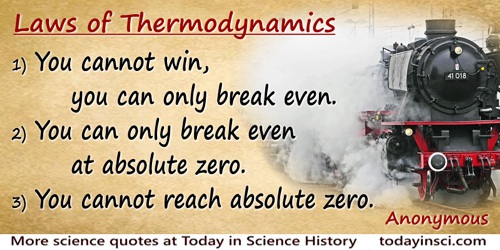
Laws of Thermodynamics
1) You cannot win, you can only break even.
2) You can only break even at absolute zero.
3) You cannot reach absolute zero.
1) You cannot win, you can only break even.
2) You can only break even at absolute zero.
3) You cannot reach absolute zero.
Folklore amongst physicists.
No other part of science has contributed as much to the liberation of the human spirit as the Second Law of Thermodynamics. Yet, at the same time, few other parts of science are held to be so recondite. Mention of the Second Law raises visions of lumbering steam engines, intricate mathematics, and infinitely incomprehensible entropy. Not many would pass C.P. Snow’s test of general literacy, in which not knowing the Second Law is equivalent to not having read a work of Shakespeare.
In The Second Law (1984), Preface, vii.
Scientists have long been baffled by the existence of spontaneous order in the universe. The laws of thermodynamics seem to dictate the opposite, that nature should inexorably degenerate toward a state of greater disorder, greater entropy. Yet all around
John Mitchinson and John Lloyd, If Ignorance Is Bliss, Why Aren't There More Happy People?: Smart Quotes for Dumb Times (2009), 274.
Suppose we take a quantity of heat and change it into work. In doing so, we haven’t destroyed the heat, we have only transferred it to another place or perhaps changed it into another energy form.
From 'In the Game of Energy and Thermodynamics You Can’t Even Break Even', Smithsonian (Aug 1970), 1, No. 5, 6.
Tait dubbed Maxwell dp/dt, for according to thermodynamics dp/dt = JCM (where C denotes Carnot’s function) the initials of (J.C.) Maxwell’s name. On the other hand Maxwell denoted Thomson by T and Tait by T'; so that it became customary to quote Thomson and Tait’s Treatise on Natural Philosophy as T and T'.
In Bibliotheca Mathematica (1903), 3, 187. As cited in Robert Édouard Moritz, Memorabilia Mathematica; Or, The Philomath’s Quotation-Book (1914), 178. [Note: Thomson is William Thomson, later Lord Kelvin. —Webmaster.]
The fundamental laws of the universe which correspond to the two fundamental theorems of the mechanical theory of heat.
1. The energy of the universe is constant.
2. The entropy of the universe tends to a maximum.
1. The energy of the universe is constant.
2. The entropy of the universe tends to a maximum.
The Mechanical Theory of Heat (1867), 365.
The history of thermodynamics is a story of people and concepts. The cast of characters is large. At least ten scientists played major roles in creating thermodynamics, and their work spanned more than a century. The list of concepts, on the other hand, is surprisingly small; there are just three leading concepts in thermodynamics: energy, entropy, and absolute temperature.
In Great Physicists (2001), 93.
The increase of disorder or entropy with time is one example of what is called an arrow of time something that gives a direction to time and distinguishes the past from the future. There are at least three different directions of time. First, there is the thermodynamic arrow of time—the direction of time in which disorder or entropy increases. Second, there is the psychological arrow of time. This is the direction in which we feel time passes—the direction of time in which we remember the past, but not the future. Third, there is the cosmological arrow of time. This is the direction of time in which the universe is expanding rather than contracting.
In 'The Direction of Time', New Scientist (9 Jul 1987), 46.
The law that entropy always increases—the Second Law of Thermodynamics—holds, I think, the supreme position among the laws of Nature. If someone points out to you that your pet theory of the universe is in disagreement with Maxwell’s equations—then so much the worse for Maxwell’s equations. If it is found to be contradicted by observation—well these experimentalists do bungle things sometimes. But if your theory is found to be against the second law of thermodynamics I can give you no hope; there is nothing for it but to collapse in deepest humiliation.
Gifford Lectures (1927), The Nature of the Physical World (1928), 74.
The law that entropy increases—the Second Law of Thermodynamics—holds, I think, the supreme position among the laws of Nature.
Gifford Lectures (1927), The Nature of the Physical World (1928), 74.
The laws of thermodynamics, as empirically determined, express the approximate and probable behavior of systems of a great number of particles, or, more precisely, they express the laws of mechanics for such systems as they appear to beings who have not the fineness of perception to enable them to appreciate quantities of the order of magnitude of those which relate to single particles, and who cannot repeat their experiments often enough to obtain any but the most probable results.
Elementary Principles in Statististical Mechanics (1902), Preface, viii.
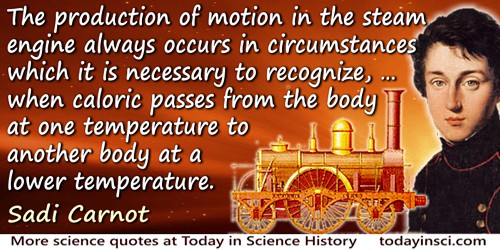
The production of motion in the steam engine always occurs in circumstances which it is necessary to recognize, namely when the equilibrium of caloric is restored, or (to express this differently) when caloric passes from the body at one temperature to another body at a lower temperature.
In 'Réflexions sur la Puissance Motrice du Feu et sur les Machines Propres a Développer cette Puissance' (1824). As translated by Robert Fox, Reflexions on the Motive Power of Fire (1986), 64.
The second law of thermodynamics is, without a doubt, one of the most perfect laws in physics. Any reproducible violation of it, however small, would bring the discoverer great riches as well as a trip to Stockholm. The world’s energy problems would be solved at one stroke… . Not even Maxwell’s laws of electricity or Newton’s law of gravitation are so sacrosanct, for each has measurable corrections coming from quantum effects or general relativity. The law has caught the attention of poets and philosophers and has been called the greatest scientific achievement of the nineteenth century.
In Thermodynamics (1964). As cited in The Mathematics Devotional: Celebrating the Wisdom and Beauty of Physics (2015), 82.
The universe came into being in a big bang, before which, Einstein’s theory instructs us, there was no before. Not only particles and fields of force had to come into being at the big bang, but the laws of physics themselves, and this by a process as higgledy-piggledy as genetic mutation or the second law of thermodynamics.
In 'The Computer and the Universe', International Journal of Theoretical Physics (1982), 21, 565.
There is only one law of Nature—the second law of thermodynamics—which recognises a distinction between past and future more profound than the difference of plus and minus. It stands aloof from all the rest. … It opens up a new province of knowledge, namely, the study of organisation; and it is in connection with organisation that a direction of time-flow and a distinction between doing and undoing appears for the first time.
In The Nature of the Physical World (1928, 2005), 67-68.
Thermodynamics is a funny subject. The first time you go through it, you don’t understand it at all The second time you go through it, you think you understand it, except for one or two points. The third time you go through it, you know you don't understand it, but by that time you are so used to the subject, it doesn't bother you anymore.
Quoted, without citation, in Stanley W. Angrist and Loren G. Hepler, Order and Chaos: Laws of Energy and Entropy (1967), 215. The authors identify it as “perhaps apocryphal.” The quote is used as epigraph, dated as 1950 in Anton Z. Capri, Quips, Quotes, and Quanta: An Anecdotal History of Physics (2011), 50. The quote is introduced as “When asked why he did not write on that field he replied somewhat as follows,” by Keith J. Laidler in Physical Chemistry with Biological Applications (1978), 145.
This perpetual motion machine she [Lisa] made today is a joke, it just keeps going faster and faster…. Lisa … In this house, we OBEY the laws of thermodynamics!
Spoken by fictional animated character, Homer Simpson, in TV show by Matt Groening, 'Simpsons Roasting On an Open Fire' (also known as 'The Simpsons Christmas Special'), The Simpsons (1989), Series 1, Ep. 1, voiced by Dan Castellaneta, written by Mimi Pond.
To my knowledge there are no written accounts of Fermi’s contributions to the [first atomic bomb] testing problems, nor would it be easy to reconstruct them in detail. This, however, was one of those occasions in which Fermi’s dominion over all physics, one of his most startling characteristics, came into its own. The problems involved in the Trinity test ranged from hydrodynamics to nuclear physics, from optics to thermodynamics, from geophysics to nuclear chemistry. Often they were closely interrelated, and to solve one’it was necessary to understand all the others. Even though the purpose was grim and terrifying, it was one of the greatest physics experiments of all time. Fermi completely immersed himself in the task. At the time of the test he was one of the very few persons (or perhaps the only one) who understood all the technical ramifications.
In Enrico Fermi: Physicist (1970), 145
To pick a hole–say in the 2nd law of Ωcs, that if two things are in contact the hotter cannot take heat from the colder without external agency.
Now let A & B be two vessels divided by a diaphragm and let them contain elastic molecules in a state of agitation which strike each other and the sides. Let the number of particles be equal in A & B but let those in A have equal velocities, if oblique collisions occur between them their velocities will become unequal & I have shown that there will be velocities of all magnitudes in A and the same in B only the sum of the squares of the velocities is greater in A than in B.
When a molecule is reflected from the fixed diaphragm CD no work is lost or gained.
If the molecule instead of being reflected were allowed to go through a hole in CD no work would be lost or gained, only its energy would be transferred from the one vessel to the other.
Now conceive a finite being who knows the paths and velocities of all the molecules by simple inspection but who can do no work, except to open and close a hole in the diaphragm, by means of a slide without mass.
Let him first observe the molecules in A and when lie sees one coming the square of whose velocity is less than the mean sq. vel. of the molecules in B let him open a hole & let it go into B. Next let him watch for a molecule in B the square of whose velocity is greater than the mean sq. vel. in A and when it comes to the hole let him draw and slide & let it go into A, keeping the slide shut for all other molecules.
Then the number of molecules in A & B are the same as at first but the energy in A is increased and that in B diminished that is the hot system has got hotter and the cold colder & yet no work has been done, only the intelligence of a very observant and neat fingered being has been employed. Or in short if heat is the motion of finite portions of matter and if we can apply tools to such portions of matter so as to deal with them separately then we can take advantage of the different motion of different portions to restore a uniformly hot system to unequal temperatures or to motions of large masses. Only we can't, not being clever enough.
Now let A & B be two vessels divided by a diaphragm and let them contain elastic molecules in a state of agitation which strike each other and the sides. Let the number of particles be equal in A & B but let those in A have equal velocities, if oblique collisions occur between them their velocities will become unequal & I have shown that there will be velocities of all magnitudes in A and the same in B only the sum of the squares of the velocities is greater in A than in B.
When a molecule is reflected from the fixed diaphragm CD no work is lost or gained.
If the molecule instead of being reflected were allowed to go through a hole in CD no work would be lost or gained, only its energy would be transferred from the one vessel to the other.
Now conceive a finite being who knows the paths and velocities of all the molecules by simple inspection but who can do no work, except to open and close a hole in the diaphragm, by means of a slide without mass.
Let him first observe the molecules in A and when lie sees one coming the square of whose velocity is less than the mean sq. vel. of the molecules in B let him open a hole & let it go into B. Next let him watch for a molecule in B the square of whose velocity is greater than the mean sq. vel. in A and when it comes to the hole let him draw and slide & let it go into A, keeping the slide shut for all other molecules.
Then the number of molecules in A & B are the same as at first but the energy in A is increased and that in B diminished that is the hot system has got hotter and the cold colder & yet no work has been done, only the intelligence of a very observant and neat fingered being has been employed. Or in short if heat is the motion of finite portions of matter and if we can apply tools to such portions of matter so as to deal with them separately then we can take advantage of the different motion of different portions to restore a uniformly hot system to unequal temperatures or to motions of large masses. Only we can't, not being clever enough.
Letter to Peter Guthrie Tait (11 Dec 1867). In P. M. Harman (ed.), The Scientific Letters and Papers of James Clerk Maxwell (1995), Vol. 2, 331-2.
War and the steam engine joined forces and forged what was to become one of the most delicate of concepts. Sadi Carnot … formed the opinion that one cause of France’s defeat had been her industrial inferiority. … Carnot saw steam power as a universal motor. … Carnot was a visionary and sharp analyst of what was needed to improve the steam engine. … Carnot’s work … laid the foundations of [thermodynamics].
In The Second Law (1984), 1-2.
We define thermodynamics ... as the investigation of the dynamical and thermal properties of bodies, deduced entirely from the first and second law of thermodynamics, without speculation as to the molecular constitution.
The Scientific Papers of James Clerk Maxwell (2003), 664-665.
With thermodynamics, one can calculate almost everything crudely; with kinetic theory, one can calculate fewer things, but more accurately; and with statistical mechanics, one can calculate almost nothing exactly.
Edward B. Stuart, Alan J. Brainard and Benjamin Gal-Or (eds.), A Critical Review of Thermodynamics (1970), 205.
 In science it often happens that scientists say, 'You know that's a really good argument; my position is mistaken,' and then they would actually change their minds and you never hear that old view from them again. They really do it. It doesn't happen as often as it should, because scientists are human and change is sometimes painful. But it happens every day. I cannot recall the last time something like that happened in politics or religion.
(1987) --
In science it often happens that scientists say, 'You know that's a really good argument; my position is mistaken,' and then they would actually change their minds and you never hear that old view from them again. They really do it. It doesn't happen as often as it should, because scientists are human and change is sometimes painful. But it happens every day. I cannot recall the last time something like that happened in politics or religion.
(1987) -- 




