Theoretical Physics Quotes (28 quotes)
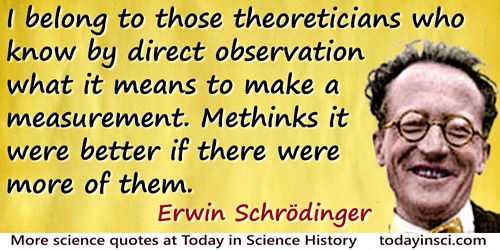
Although I am primarily an experimental physicist, theoretical physics is my hobby.
But, contrary to the lady’s prejudices about the engineering profession, the fact is that quite some time ago the tables were turned between theory and applications in the physical sciences. Since World War II the discoveries that have changed the world are not made so much in lofty halls of theoretical physics as in the less-noticed labs of engineering and experimental physics. The roles of pure and applied science have been reversed; they are no longer what they were in the golden age of physics, in the age of Einstein, Schrödinger, Fermi and Dirac.
'The Age of Computing: a Personal Memoir', Daedalus (1992), 121, 120.
During the time that [Karl] Landsteiner gave me an education in the field of imununology, I discovered that he and I were thinking about the serologic problem in very different ways. He would ask, What do these experiments force us to believe about the nature of the world? I would ask, What is the most. simple and general picture of the world that we can formulate that is not ruled by these experiments? I realized that medical and biological investigators were not attacking their problems the same way that theoretical physicists do, the way I had been in the habit of doing.
‘Molecular Disease’, Pfizer Spectrum (1958), 6:9, 234.
Every theoretical physicist who is any good knows six or seven different theoretical representations for exactly the same physics. He knows that they are all equivalent, and that nobody is ever going to be able to decide which one is right at that level, but he keeps them in his head, hoping that they will give him different ideas for guessing.
In The Character of Physical Law (1965, 2001), 168.
From the age of 13, I was attracted to physics and mathematics. My interest in these subjects derived mostly from popular science books that I read avidly. Early on I was fascinated by theoretical physics and determined to become a theoretical physicist. I had no real idea what that meant, but it seemed incredibly exciting to spend one's life attempting to find the secrets of the universe by using one's mind.
From 'Autobiography', in Tore Frängsmyr (ed.) Les Prix Nobel. The Nobel Prizes 2004, (2005).
I have tried to read philosophers of all ages and have found many illuminating ideas but no steady progress toward deeper knowledge and understanding. Science, however, gives me the feeling of steady progress: I am convinced that theoretical physics is actual philosophy. It has revolutionized fundamental concepts, e.g., about space and time (relativity), about causality (quantum theory), and about substance and matter (atomistics), and it has taught us new methods of thinking (complementarity) which are applicable far beyond physics.
— Max Born
My Life & My Views (1968), 48.
I recognize that many physicists are smarter than I am—most of them theoretical physicists. A lot of smart people have gone into theoretical physics, therefore the field is extremely competitive. I console myself with the thought that although they may be smarter and may be deeper thinkers than I am, I have broader interests than they have.
…...
If the aim of physical theories is to explain experimental laws, theoretical physics is not an autonomous science; it is subordinate to metaphysics.
The Aim and Structure of Physical Theory (1906), 2nd edition (1914), trans. Philip P. Wiener (1954), 10.
It is a common rule in theoretical physics, one accepted by many physicists, that anything not forbidden by the basic laws of nature must take place.
In 'The Ultimate Speed Limit', Saturday Review of Sciences (8 Jul 1972), 56.
Kuhn … [like Popper] rejects the idea that science grows by accumulation of eternal truths. … But while according to Popper science is “revolution in permanence”, and criticism the heart of the scientific enterprise, according to Kuhn revolution is exceptional and, indeed, extra-scientific, and criticism is, in “normal” times, anathema. … The clash between Popper and Kuhn is not about a mere technical point in epistemology. It concerns our central intellectual values, and has implications not only for theoretical physics but also for the underdeveloped social sciences and even for moral and political philosophy.
In Radio Lecture (30 Jun 1973) broadcast by the Open University, collected in Imre Lakatos, John Worrall (ed.) and Gregory Currie (ed.), 'Introduction: Science and Pseudoscience', The Methodology of Scientific Research Programmes (1978, 1980), Vol. 1, 9.
Many scientists have tried to make determinism and complementarity the basis of conclusions that seem to me weak and dangerous; for instance, they have used Heisenberg’s uncertainty principle to bolster up human free will, though his principle, which applies exclusively to the behavior of electrons and is the direct result of microphysical measurement techniques, has nothing to do with human freedom of choice. It is far safer and wiser that the physicist remain on the solid ground of theoretical physics itself and eschew the shifting sands of philosophic extrapolations.
In New Perspectives in Physics (1962), viii.
One of the biggest and most important tools of theoretical physics is the wastebasket.
In interview for the American Association for the Advancement of Science (AAAS), 'Richard Feynman Builds a Universe', collected in Jeffrey Robbins (ed.), The Pleasure of Finding Things Out (1999), Chap. 12, 234.
The bombs on Japan either drew people into theoretical physics or made them leave in their droves. That’s when I began to learn about what was going on. After that, I decided to avoid anything that was to do with weapons.
As quoted, without citation, in Ian Sample, Massive: The Missing Particle That Sparked the Greatest Hunt in Science (2012), 41. [Please contact Webmaster if you know the primary source of this quote.]
The first thing to realize about physics ... is its extraordinary indirectness.... For physics is not about the real world, it is about “abstractions” from the real world, and this is what makes it so scientific.... Theoretical physics runs merrily along with these unreal abstractions, but its conclusions are checked, at every possible point, by experiments.
In Science is a Sacred Cow (1950), 60-62.
The methods of theoretical physics should be applicable to all those branches of thought in which the essential features are expressible with numbers.
Nobel Prize Banquet Speech (10 Dec1933). In Carl Gustaf Santesson (Ed.), Les Prix Nobel en 1933 (1935), 78
The middle third of the twentieth century was the era of hegemony of physics in American science. During that whole period Edward Uhler Condon was a leader in physics, in research of his own, in stimulating research in others, in applying physics, and in calling attention to the effects on all of us of its indiscriminate and irrational application. When he made his first contribution to theoretical physics in 1926, the word physics was not in the vocabularies of most Americans and the revolutionary concepts of quantum mechanics and relativity were just being worked out in Europe; by 1960 the applications of electronics and solid state physics had begun to change our lives irreversibly, and the implications of nuclear physics were manifest to everyone. Ed Condon contributed to each part of this explosive evolution.
From 'Edward Uhler Condon, 1902-1974', Reviews of Modern Physics (1975), 47, 1; as collected in Asim O. Barut, Halis Odabasi and Alwyn van der Merwe (eds.), Selected Popular Writings of E.U. Condon (1991), 42.
The only object of theoretical physics is to calculate results that can be compared with experiment... it is quite unnecessary that any satisfactory description of the whole course of the phenomena should be given.
The Principles of Quantum Mechanics (1930), 7.
The pace of science forces the pace of technique. Theoretical physics forces atomic energy on us; the successful production of the fission bomb forces upon us the manufacture of the hydrogen bomb. We do not choose our problems, we do not choose our products; we are pushed, we are forced—by what? By a system which has no purpose and goal transcending it, and which makes man its appendix.
In The Sane Society (1955), 87.
The physicist, in his study of natural phenomena, has two methods of making progress: (1) the method of experiment and observation, and (2) the method of mathematical reasoning. The former is just the collection of selected data; the latter enables one to infer results about experiments that have not been performed. There is no logical reason why the second method should be possible at all, but one has found in practice that it does work and meets with reasonable success.
From Lecture delivered on presentation of the James Scott prize, (6 Feb 1939), 'The Relation Between Mathematics And Physics', printed in Proceedings of the Royal Society of Edinburgh (1938-1939), 59, Part 2, 122.
The reason Dick's [Richard Feynman] physics was so hard for ordinary people to grasp was that he did not use equations. The usual theoretical physics was done since the time of Newton was to begin by writing down some equations and then to work hard calculating solutions of the equations. This was the way Hans [Bethe] and Oppy [Oppenheimer] and Julian Schwinger did physics. Dick just wrote down the solutions out of his head without ever writing down the equations. He had a physical picture of the way things happen, and the picture gave him the solutions directly with a minimum of calculation. It was no wonder that people who had spent their lives solving equations were baffled by him. Their minds were analytical; his was pictorial.
Quoted in Michio Kaku and Jennifer Trainer Thompson, Beyond Einstein: the Cosmic Quest for the Theory of the Universe (1987, 1999), 56-57, citing Freeman Dyson, Disturbing the Universe (1979, 1981), 55-56.
The supreme task of the physicist is to arrive at those universal elementary laws from which the cosmos can be built up by pure deduction. There is no logical path to these laws; only intuition, resting on sympathetic understanding of experience, can reach them. In this methodological uncertainty, one might suppose that there were any number of possible systems of theoretical physics all equally well justified; and this opinion is no doubt correct, theoretically. But the development of physics has shown that at any given moment, out of all conceivable constructions, a single one has always proved itself decidedly superior to all the rest.
Address (1918) for Max Planck's 60th birthday, at Physical Society, Berlin, 'Principles of Research' in Essays in Science (1934), 4.
The world of mathematics and theoretical physics is hierarchical. That was my first exposure to it. There's a limit beyond which one cannot progress. The differences between the limiting abilities of those on successively higher steps of the pyramid are enormous. I have not seen described anywhere the shock a talented man experiences when he finds, late in his academic life, that there are others enormously more talented than he. I have personally seen more tears shed by grown men and women over this discovery than I would have believed possible. Most of those men and women shift to fields where they can compete on more equal terms
Alvarez: Adventures of a Physicist (1987), 20.
There are, at present, fundamental problems in theoretical physics … the solution of which … will presumably require a more drastic revision of our fundmental concepts than any that have gone before. Quite likely, these changes will be so great that it will be beyond the power of human intelligence to get the necessary new ideas by direct attempts to formulate the experimental data in mathematical terms. The theoretical worker in the future will, therefore, have to proceed in a more direct way. The most powerful method of advance that can be suggested at present is to employ all the resources of pure mathematics in attempts to perfect and generalize the mathematical formalism that forms the existing basis of theoretical physics, and after each success in this direction, to try to interpret the new mathematical features in terms of physical entities.
At age 28.
At age 28.
Proceedings of the Royal Society (1931), A133, 60. In A. Pais, 'Playing With Equations, the Dirac Way'. Behram N. Kursunoglu (Ed.) and Eugene Paul Wigner (Ed.), Paul Adrien Maurice Dirac: Reminiscences about a Great Physicist (1990), 109.
They think that differential equations are not reality. Hearing some colleagues speak, it’s as though theoretical physics was just playing house with plastic building blocks. This absurd idea has gained currency, and now people seem to feel that theoretical physicists are little more than dreamers locked away ivory towers. They think our games, our little houses, bear no relation to their everyday worries, their interests, their problems, or their welfare. But I’m going to tell you something, and I want you to take it as a ground rule for this course. From now on I will be filling this board with equations. … And when I'm done, I want you to do the following: look at those numbers, all those little numbers and Greek letters on the board, and repeat to yourselves, “This is reality,” repeat it over and over.
Zig Zag, trans. Lisa Dillman (2008), 63.
We already know the physical laws that govern everything we experience in everyday life … It is a tribute to how far we have come in theoretical physics that it now takes enormous machines and a great deal of money to perform an experiment whose results we cannot predict.
From Inaugural Lecture (29 Apr 1980) as Lucasian Professor at Cambridge University, 'Is the End in Sight for Theoretical Physics?', collected in Black Holes and Baby Universes and Other Essays (1993), 50 & 64.
What appear to be the most valuable aspects of the theoretical physics we have are the mathematical descriptions which enable us to predict events. These equations are, we would argue, the only realities we can be certain of in physics; any other ways we have of thinking about the situation are visual aids or mnemonics which make it easier for beings with our sort of macroscopic experience to use and remember the equations.
In The Lost Cause: Causation and the Mind-body Problem (2003).
What I remember most clearly was that when I put down a suggestion that seemed to me cogent and reasonable, Einstein did not in the least contest this, but he only said, 'Oh, how ugly.' As soon as an equation seemed to him to be ugly, he really rather lost interest in it and could not understand why somebody else was willing to spend much time on it. He was quite convinced that beauty was a guiding principle in the search for important results in theoretical physics.
quoted in Fearful Symmetry: The Search for Beauty in Modern Physics (1987)
When I began my physical studies [in Munich in 1874] and sought advice from my venerable teacher Philipp von Jolly...he portrayed to me physics as a highly developed, almost fully matured science...Possibly in one or another nook there would perhaps be a dust particle or a small bubble to be examined and classified, but the system as a whole stood there fairly secured, and theoretical physics approached visibly that degree of perfection which, for example, geometry has had already for centuries.
From a lecture (1924). In Damien Broderick (ed.), Year Million: Science at the Far Edge of Knowledge (2008), 104.
 In science it often happens that scientists say, 'You know that's a really good argument; my position is mistaken,' and then they would actually change their minds and you never hear that old view from them again. They really do it. It doesn't happen as often as it should, because scientists are human and change is sometimes painful. But it happens every day. I cannot recall the last time something like that happened in politics or religion.
(1987) --
In science it often happens that scientists say, 'You know that's a really good argument; my position is mistaken,' and then they would actually change their minds and you never hear that old view from them again. They really do it. It doesn't happen as often as it should, because scientists are human and change is sometimes painful. But it happens every day. I cannot recall the last time something like that happened in politics or religion.
(1987) -- 





