Theorem Quotes (116 quotes)
…durch planmässiges Tattonieren.
(…through systematic, palpable experimentation.)
Response, when asked how he came upon his theorems.
(…through systematic, palpable experimentation.)
Response, when asked how he came upon his theorems.
Quoted in A.L. Mackay, Dictionary of Scientific Quotations (1994). Also seen translated as “…through systematic feeling around” in Robert Kaplan and Ellen Kaplan, Out of the Labyrinth: Setting Mathematics Free (2007), 76. Also, “…through systematic trying” in Mathematics in the Modern World: Readings from Scientific American (1968), 340.
…as passionlessly as a Euclidean theorem.
In Lost Horizon (1933, 1962), 49.
[My favourite fellow of the Royal Society is the Reverend Thomas Bayes, an obscure 18th-century Kent clergyman and a brilliant mathematician who] devised a complex equation known as the Bayes theorem, which can be used to work out probability distributions. It had no practical application in his lifetime, but today, thanks to computers, is routinely used in the modelling of climate change, astrophysics and stock-market analysis.
Quoted in Max Davidson, 'Bill Bryson: Have faith, science can solve our problems', Daily Telegraph (26 Sep 2010)
Das ist nicht Mathematik, das ist Theologie!
This is not mathematics; this is theology.
[Remark about David Hilbert's first proof of his finite basis theorem.]
This is not mathematics; this is theology.
[Remark about David Hilbert's first proof of his finite basis theorem.]
Attributed. It does not seem to appear in Gordan’s written work. According to Colin McClarty, in 'Theology and its Discontents: the Origin of the Myth of Modern Mathematics' (2008), “The quote first appeared a quarter of a century after the event, as an unexplained side comment in a eulogy to Gordan by his long-time colleague Max Noether. Noether was a reliable witness, but he says little about what Gordan meant.” See Noether's obituary of Gordan in Mathematische Annalen (1914), 75, 18. It is still debated if the quote is pejorative, complimentary or merely a joke.
Mathematical truth has validity independent of place, personality, or human authority. Mathematical relations are not established, nor can they be abrogated, by edict. The multiplication table is international and permanent, not a matter of convention nor of relying upon authority of state or church. The value of π is not amenable to human caprice. The finding of a mathematical theorem may have been a highly romantic episode in the personal life of the discoverer, but it cannot be expected of itself to reveal the race, sex, or temperament of this discoverer. With modern means of widespread communication even mathematical notation tends to be international despite all nationalistic tendencies in the use of words or of type.
In 'Light Thrown on the Nature of Mathematics by Certain Aspects of Its Development', Mathematics in General Education (1940), 256. This is the Report of the Committee on the Function of Mathematics in General Education of the Commission on Secondary School Curriculum, which was established by the Executive Board of the Progressive Education Association in 1932.
~~[Misquoted ?]~~ It gives me the same pleasure when someone else proves a good theorem as when I do it myself.
Webmaster believes this is a first person paraphrase misquoted from “It was said round 1912 that it gave him the same pleasure when someone else proved a good theorem as if he had done it himself,” as given in Littlewood, A Mathematician’s Miscellany (1953), reissued as Béla Bollobás, Littlewood’s Miscellany (1986), 24. Notice that Littlewood states this in the third person—about Landau. As a first person quote, it is sometimes cited to a much later author, Desmond MacHale, Comic Sections (1993). Webmaster has not yet found a primary source to authenticate this first person version, and since the earlier occurrence is hedged with “it was said”, Webmaster suggests this first person version is a misquote, and is not an authentic verbatim quote.
A distinguished Princeton physicist on the occasion of my asking how he thought Einstein would have reacted to Bell’s theorem. He said that Einstein would have gone home and thought about it hard for several weeks … He was sure that Einstein would have been very bothered by Bell’s theorem. Then he added: “Anybody who’s not bothered by Bell’s theorem has to have rocks in his head.”
In 'Is the Moon There When Nobody Looks? Reality and the Quantum Theory', Physics Today (Apr 1985), 38-47.
A mathematician is a device for turning coffee into theorems.
In D. S. Richeson, Euler's Gem: The Polyhedron Formula and the Birth of Topology (2008), Preface, ix. Also attributed incorrectly to Paul Erdos, who did often repeat it.
All great theorems were discovered after midnight.
In Howard W. Eves Return to Mathematical Circles, (1988), 157.
An applied mathematician loves the theorem. A pure mathematician loves the proof.
Analysis and natural philosophy owe their most important discoveries to this fruitful means, which is called induction. Newton was indebted to it for his theorem of the binomial and the principle of universal gravity.
In Frederick Wilson Truscott (trans.) and Frederick Lincoln Emory (trans.), A Philosophical Essay on Probabilities (1902), 176.
Are we prepared to admit, that our confidence in the regularity of nature is merely a corollary from Bernoulli’s theorem?
In 'On the Foundations of the Theory of Probabilities', read 14 Feb 1842, printed in Transactions of the Cambridge Philosophical Society (1849), 8, 1. Collected in William Walton (ed.), The Mathematical and Other Writings of Robert Leslie Ellis (1863), 1. Note: Jacques Bernouill’s theorem is also known as the Law of Averages.
Bell’s theorem is easy to understand but hard to believe.
…...
But neither thirty years, nor thirty centuries, affect the clearness, or the charm, of Geometrical truths. Such a theorem as “the square of the hypotenuse of a right-angled triangle is equal to the sum of the squares of the sides” is as dazzlingly beautiful now as it was in the day when Pythagoras first discovered it, and celebrated its advent, it is said, by sacrificing a hecatomb of oxen—a method of doing honour to Science that has always seemed to me slightly exaggerated and uncalled-for. One can imagine oneself, even in these degenerate days, marking the epoch of some brilliant scientific discovery by inviting a convivial friend or two, to join one in a beefsteak and a bottle of wine. But a hecatomb of oxen! It would produce a quite inconvenient supply of beef.
Written without pseudonym as Charles L. Dodgson, in Introduction to A New Theory of Parallels (1888, 1890), xvi. Note: a hecatomb is a great public sacrifice, originally of a hundred oxen.
Chebyshev said, and I say it again. There is always a prime between n and 2n.
Rhyme quoted by Béla Bollobás, 'The Life and Work of Paul Erdos", in Shiing-Shen Chern and Friedrich Hirzebruch (eds.) Wolf Prize in Mathematics (2000), Vol. 1, 296. It refers to the theorem known as the Bertrand postulate, partially solved by Joseph Bertrand (1822-1900). Chebyshev produced a complete, but difficult, proof. Paul Erdös gave an elegant new proof at age 18, while a second-year undergraduate.
Everyone believes in the law of errors, the experimenters because they think it is a mathematical theorem, and the mathematicians because they think it is an experimental fact.
Remark to Henri Poincaré about the Gaussian curve. From the original French, “Les expérimentateurs s’imaginent que c’est un théorème de mathématique, et les mathématiciens d’être un fait expérimental”, in Henri Poincaré, Calcul des Probabilités (1896), 149. Poincaré introduces it as, “me disait un jour M. Lippmann” (Mr. Lippman told me one day). Quote above as translated in F. Downton, 'Review: Nonparametric Methods in Statistics', The Mathematical Gazette (Feb 1959), 43, No. 343, 67.
Few will deny that even in the first scientific instruction in mathematics the most rigorous method is to be given preference over all others. Especially will every teacher prefer a consistent proof to one which is based on fallacies or proceeds in a vicious circle, indeed it will be morally impossible for the teacher to present a proof of the latter kind consciously and thus in a sense deceive his pupils. Notwithstanding these objectionable so-called proofs, so far as the foundation and the development of the system is concerned, predominate in our textbooks to the present time. Perhaps it will be answered, that rigorous proof is found too difficult for the pupil’s power of comprehension. Should this be anywhere the case,—which would only indicate some defect in the plan or treatment of the whole,—the only remedy would be to merely state the theorem in a historic way, and forego a proof with the frank confession that no proof has been found which could be comprehended by the pupil; a remedy which is ever doubtful and should only be applied in the case of extreme necessity. But this remedy is to be preferred to a proof which is no proof, and is therefore either wholly unintelligible to the pupil, or deceives him with an appearance of knowledge which opens the door to all superficiality and lack of scientific method.
In 'Stücke aus dem Lehrbuche der Arithmetik', Werke, Bd. 2 (1904), 296.
For hundreds of pages the closely-reasoned arguments unroll, axioms and theorems interlock. And what remains with us in the end? A general sense that the world can be expressed in closely-reasoned arguments, in interlocking axioms and theorems.
In Constructions. 1974, 278.
For the saving the long progression of the thoughts to remote and first principles in every case, the mind should provide itself several stages; that is to say, intermediate principles, which it might have recourse to in the examining those positions that come in its way. These, though they are not self-evident principles, yet, if they have been made out from them by a wary and unquestionable deduction, may be depended on as certain and infallible truths, and serve as unquestionable truths to prove other points depending upon them, by a nearer and shorter view than remote and general maxims. … And thus mathematicians do, who do not in every new problem run it back to the first axioms through all the whole train of intermediate propositions. Certain theorems that they have settled to themselves upon sure demonstration, serve to resolve to them multitudes of propositions which depend on them, and are as firmly made out from thence as if the mind went afresh over every link of the whole chain that tie them to first self-evident principles.
In The Conduct of the Understanding, Sect. 21.
Fourier’s Theorem … is not only one of the most beautiful results of modern analysis, but it may be said to furnish an indispensable instrument in the treatment of nearly every recondite question in modern physics. To mention only sonorous vibrations, the propagation of electric signals along a telegraph wire, and the conduction of heat by the earth’s crust, as subjects in their generality intractable without it, is to give but a feeble idea of its importance.
In William Thomson and Peter Guthrie Tait, Treatise on Natural Philosophy (1867), Vol. 1, 28.
Generality of points of view and of methods, precision and elegance in presentation, have become, since Lagrange, the common property of all who would lay claim to the rank of scientific mathematicians. And, even if this generality leads at times to abstruseness at the expense of intuition and applicability, so that general theorems are formulated which fail to apply to a single special case, if furthermore precision at times degenerates into a studied brevity which makes it more difficult to read an article than it was to write it; if, finally, elegance of form has well-nigh become in our day the criterion of the worth or worthlessness of a proposition,—yet are these conditions of the highest importance to a wholesome development, in that they keep the scientific material within the limits which are necessary both intrinsically and extrinsically if mathematics is not to spend itself in trivialities or smother in profusion.
In Die Entwickdung der Mathematik in den letzten Jahrhunderten (1884), 14-15.
Gradually, at various points in our childhoods, we discover different forms of conviction. There’s the rock-hard certainty of personal experience (“I put my finger in the fire and it hurt,”), which is probably the earliest kind we learn. Then there’s the logically convincing, which we probably come to first through maths, in the context of Pythagoras’s theorem or something similar, and which, if we first encounter it at exactly the right moment, bursts on our minds like sunrise with the whole universe playing a great chord of C Major.
In short essay, 'Dawkins, Fairy Tales, and Evidence', 2.
He [General Nathan Bedford Forrest] possessed a remarkable genius for mathematics, a subject in which he had absolutely no training. He could with surprising facility solve the most difficult problems in algebra, geometry, and trigonometry, only requiring that the theorem or rule be carefully read aloud to him.
In Life of General Nathan Bedford Forrest (1899), 627.
He [Sylvester] had one remarkable peculiarity. He seldom remembered theorems, propositions, etc., but had always to deduce them when he wished to use them. In this he was the very antithesis of Cayley, who was thoroughly conversant with everything that had been done in every branch of mathematics.
I remember once submitting to Sylvester some investigations that I had been engaged on, and he immediately denied my first statement, saying that such a proposition had never been heard of, let alone proved. To his astonishment, I showed him a paper of his own in which he had proved the proposition; in fact, I believe the object of his paper had been the very proof which was so strange to him.
I remember once submitting to Sylvester some investigations that I had been engaged on, and he immediately denied my first statement, saying that such a proposition had never been heard of, let alone proved. To his astonishment, I showed him a paper of his own in which he had proved the proposition; in fact, I believe the object of his paper had been the very proof which was so strange to him.
As quoted by Florian Cajori, in Teaching and History of Mathematics in the United States (1890), 268.
He was 40 yeares old before he looked on Geometry; which happened accidentally. Being in a Gentleman's Library, Euclid's Elements lay open, and 'twas the 47 El. Libri 1 [Pythagoras' Theorem]. He read the proposition. By G-, sayd he (he would now and then sweare an emphaticall Oath by way of emphasis) this is impossible! So he reads the Demonstration of it, which referred him back to such a Proposition; which proposition he read. That referred him back to another, which he also read. Et sic deinceps [and so on] that at last he was demonstratively convinced of that trueth. This made him in love with Geometry .
Of Thomas Hobbes, in 1629.
Of Thomas Hobbes, in 1629.
Brief Lives (1680), edited by Oliver Lawson Dick (1949), 150.
How can you shorten the subject? That stern struggle with the multiplication table, for many people not yet ended in victory, how can you make it less? Square root, as obdurate as a hardwood stump in a pasture nothing but years of effort can extract it. You can’t hurry the process. Or pass from arithmetic to algebra; you can’t shoulder your way past quadratic equations or ripple through the binomial theorem. Instead, the other way; your feet are impeded in the tangled growth, your pace slackens, you sink and fall somewhere near the binomial theorem with the calculus in sight on the horizon. So died, for each of us, still bravely fighting, our mathematical training; except for a set of people called “mathematicians”—born so, like crooks.
In Too Much College: Or, Education Eating up Life, with Kindred Essays in Education and Humour (1939), 8.
I approached the bulk of my schoolwork as a chore rather than an intellectual adventure. The tedium was relieved by a few courses that seem to be qualitatively different. Geometry was the first exciting course I remember. Instead of memorizing facts, we were asked to think in clear, logical steps. Beginning from a few intuitive postulates, far reaching consequences could be derived, and I took immediately to the sport of proving theorems.
Autobiography in Gösta Ekspong (ed.), Nobel Lectures: Physics 1996-2000 (2002), 115.
I believe that mathematical reality lies outside us, that our function is to discover or observe it, and that the theorems which we prove, and which we describe grandiloquently as our “creations,” are simply the notes of our observations.
In A Mathematician's Apology (1940, reprint with Foreward by C.P. Snow 1992), 113.
I believe that the Binomial Theorem and a Bach Fugue are, in the long run, more important than all the battles of history.
In This Week Magazine (19 Dec 1937). As quoted and cited in John T. Moore, Fundamental Principles of Mathematics (1960), 470.
I carried this problem around in my head basically the whole time. I would wake up with it first thing in the morning, I would be thinking about it all day, and I would be thinking about it when I went to sleep. Without distraction I would have the same thing going round and round in my mind.
Recalling the degree of focus and determination that eventually yielded the proof of Fermat's Last Theorem.
Recalling the degree of focus and determination that eventually yielded the proof of Fermat's Last Theorem.
Quoted in interview for PBS TV program Nova. In William Byers, How Mathematicians Think (2007), 1.
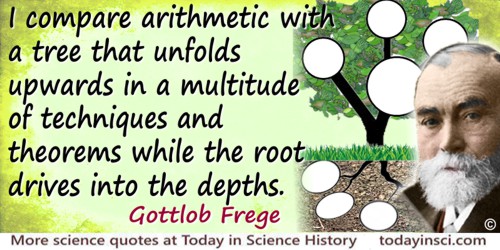
I compare arithmetic with a tree that unfolds upwards in a multitude of techniques and theorems while the root drives into the depths.
Grundgesetze der Arithmetik (1893), xiii, trans. Ivor Grattan-Guinness.
I confess that Fermat’s Theorem as an isolated proposition has very little interest for me, because I could easily lay down a multitude of such propositions, which one could neither prove nor dispose of.
From Letter (Mar 1816), replying to Olbers’ attempt to entice him to work on Fermat’s Theorem. In James R. Newman (ed.) The World of Mathematics (1956), Vol. 1, 312-313.
I confess that Fermat’s Theorem as an isolated proposition has very little interest for me, for a multitude of such theorems can easily be set up, which one could neither prove nor disprove. But I have been stimulated by it to bring our again several old ideas for a great extension of the theory of numbers. Of course, this theory belongs to the things where one cannot predict to what extent one will succeed in reaching obscurely hovering distant goals. A happy star must also rule, and my situation and so manifold distracting affairs of course do not permit me to pursue such meditations as in the happy years 1796-1798 when I created the principal topics of my Disquisitiones arithmeticae. But I am convinced that if good fortune should do more than I expect, and make me successful in some advances in that theory, even the Fermat theorem will appear in it only as one of the least interesting corollaries.
In reply to Olbers' attempt in 1816 to entice him to work on Fermat's Theorem. The hope Gauss expressed for his success was never realised.
In reply to Olbers' attempt in 1816 to entice him to work on Fermat's Theorem. The hope Gauss expressed for his success was never realised.
Letter to Heinrich Olbers (21 Mar 1816). Quoted in G. Waldo Dunnington, Carl Friedrich Gauss: Titan of Science (2004), 413.
I had a dislike for [mathematics], and ... was hopelessly short in algebra. ... [One extraordinary teacher of mathematics] got the whole year's course into me in exactly six [after-school] lessons of half an hour each. And how? More accurately, why? Simply because he was an algebra fanatic—because he believed that algebra was not only a science of the utmost importance, but also one of the greatest fascination. ... [H]e convinced me in twenty minutes that ignorance of algebra was as calamitous, socially and intellectually, as ignorance of table manners—That acquiring its elements was as necessary as washing behind the ears. So I fell upon the book and gulped it voraciously. ... To this day I comprehend the binomial theorem.
In Prejudices: third series (1922), 261-262.
For a longer excerpt, see H. L. Mencken's Recollections of School Algebra.
For a longer excerpt, see H. L. Mencken's Recollections of School Algebra.
I have found a wonderful solution to Fermats’ Last Theorem—but my train is leaving.
Graffiti on wall of subway, New York. As quoted in William Reville, 'The Science of Writing a Good Joke', The Irish Times (5 Jun 2000).
If all sentient beings in the universe disappeared, there would remain a sense in which mathematical objects and theorems would continue to exist even though there would be no one around to write or talk about them. Huge prime numbers would continue to be prime, even if no one had proved them prime.
In When You Were a Tadpole and I Was a Fish: And Other Speculations About This and That (), 124.
If you have to prove a theorem, do not rush. First of all, understand fully what the theorem says, try to see clearly what it means. Then check the theorem; it could be false. Examine the consequences, verify as many particular instances as are needed to convince yourself of the truth. When you have satisfied yourself that the theorem is true, you can start proving it.
In How to Solve It: A New Aspect of Mathematical Method (2004), 15.
If your new theorem can be stated with great simplicity, then there will exist a pathological exception.
In Howard W. Eves Return to Mathematical Circles, (1988), 157.
In 1975, ... [speaking with Shiing Shen Chern], I told him I had finally learned ... the beauty of fiber-bundle theory and the profound Chern-Weil theorem. I said I found it amazing that gauge fields are exactly connections on fiber bundles, which the mathematicians developed without reference to the physical world. I added, “this is both thrilling and puzzling, since you mathematicians dreamed up these concepts out of nowhere.” He immediately protested: “No, no. These concepts were not dreamed up. They were natural and real.”
In 'Einstein's Impact on Theoretical Physics', collected in Jong-Ping Hsu, Leonard Hsu (eds.), JingShin Theoretical Physics Symposium in Honor of Professor Ta-You Wu (1998), 70. Reprinted from Physics Today (Jun 1980), 49. The article was adapted from a talk given at the Second Marcel Grossman meeting, held in Trieste, Italy (Jul 1979), in honor of the 100th anniversary of the birth of Albert Einstein.
In abstract mathematical theorems, the approximation to absolute truth is perfect. … In physical science, on the contrary, we treat of the least quantities which are perceptible.
In The Principles of Science: A Treatise on Logic and Scientific Method (1913), 478.
In both social and natural sciences, the body of positive knowledge grows by the failure of a tentative hypothesis to predict phenomena the hypothesis professes to explain; by the patching up of that hypothesis until someone suggests a new hypothesis that more elegantly or simply embodies the troublesome phenomena, and so on ad infinitum. In both, experiment is sometimes possible, sometimes not (witness meteorology). In both, no experiment is ever completely controlled, and experience often offers evidence that is the equivalent of controlled experiment. In both, there is no way to have a self-contained closed system or to avoid interaction between the observer and the observed. The Gödel theorem in mathematics, the Heisenberg uncertainty principle in physics, the self-fulfilling or self-defeating prophecy in the social sciences all exemplify these limitations.
Inflation and Unemployment (1976), 348.
In Euclid each proposition stands by itself; its connection with others is never indicated; the leading ideas contained in its proof are not stated; general principles do not exist. In modern methods, on the other hand, the greatest importance is attached to the leading thoughts which pervade the whole; and general principles, which bring whole groups of theorems under one aspect, are given rather than separate propositions. The whole tendency is toward generalization. A straight line is considered as given in its entirety, extending both ways to infinity, while Euclid is very careful never to admit anything but finite quantities. The treatment of the infinite is in fact another fundamental difference between the two methods. Euclid avoids it, in modern mathematics it is systematically introduced, for only thus is generality obtained.
In 'Geometry', Encyclopedia Britannica (9th edition).
In many cases a dull proof can be supplemented by a geometric analogue so simple and beautiful that the truth of a theorem is almost seen at a glance.
In 'Mathematical Games', Scientific American (Oct 1973), 229, 114.
In the summer of 1937, … I told Banach about an expression Johnny [von Neumann] had once used in conversation with me in Princeton before stating some non-Jewish mathematician’s result, “Die Goim haben den folgendenSatzbewiesen” (The goys have proved the following theorem). Banach, who was pure goy, thought it was one of the funniest sayings he had ever heard. He was enchanted by its implication that if the goys could do it, Johnny and I ought to be able to do it better. Johnny did not invent this joke, but he liked it and we started using it.
In Adventures of a Mathematician (1976, 1991), 107. Von Neumann, who was raised in Budapest by a Jewish family, knew the Yiddish word “goy” was equivalent to “gentile” or a non-Jew. Stefan Banach, a Polish mathematician, was raised in a Catholic family, hence “pure goy”. Ulam thus gives us the saying so often elsewhere seen attributed to von Neumann without the context: “The goys have proved the following theorem.” It is seen anecdotally as stated by von Neumann to begin a classroom lecture.
In the year 1692, James Bernoulli, discussing the logarithmic spiral [or equiangular spiral, ρ = αθ] … shows that it reproduces itself in its evolute, its involute, and its caustics of both reflection and refraction, and then adds: “But since this marvellous spiral, by such a singular and wonderful peculiarity, pleases me so much that I can scarce be satisfied with thinking about it, I have thought that it might not be inelegantly used for a symbolic representation of various matters. For since it always produces a spiral similar to itself, indeed precisely the same spiral, however it may be involved or evolved, or reflected or refracted, it may be taken as an emblem of a progeny always in all things like the parent, simillima filia matri. Or, if it is not forbidden to compare a theorem of eternal truth to the mysteries of our faith, it may be taken as an emblem of the eternal generation of the Son, who as an image of the Father, emanating from him, as light from light, remains ὁμοούσιος with him, howsoever overshadowed. Or, if you prefer, since our spira mirabilis remains, amid all changes, most persistently itself, and exactly the same as ever, it may be used as a symbol, either of fortitude and constancy in adversity, or, of the human body, which after all its changes, even after death, will be restored to its exact and perfect self, so that, indeed, if the fashion of Archimedes were allowed in these days, I should gladly have my tombstone bear this spiral, with the motto, ‘Though changed, I arise again exactly the same, Eadem numero mutata resurgo.’”
In 'The Uses of Mathesis', Bibliotheca Sacra, Vol. 32, 516-516. [The Latin phrase “simillima filia matri” roughly translates as “the daughter resembles the mother”. “Spira mirabilis” is Latin for “marvellous spiral”. The Greek word (?µ???s???) translates as “consubstantial”, meaning of the same substance or essence (used especially of the three persons of the Trinity in Christian theology). —Webmaster]
Induction and analogy are the special characteristics of modern mathematics, in which theorems have given place to theories and no truth is regarded otherwise than as a link in an infinite chain. “Omne exit in infinitum” is their favorite motto and accepted axiom.
In 'A Plea for the Mathematician', Nature, Vol. 1, 861. [The Latin phrase “Omne exit in infinitum” means “Everything goes to infinity”.
Isolated, so-called “pretty theorems” have even less value in the eyes of a modern mathematician than the discovery of a new “pretty flower” has to the scientific botanist, though the layman finds in these the chief charm of the respective Sciences.
In Die Entwickelung der Mathematik in den letzten Jahrhunderten (1869), 19. As translated in Robert Édouard Moritz, Memorabilia Mathematica; Or, The Philomath’s Quotation-book (1914), 92. From the original German, “Einzelne, sogenannte „hübsche Sätze“ haben an und für sich in den Augen eines modernen Mathematikers noch weniger Werth, als für den wissenschaftlichen Botaniker die Entdeckung einer neuen „hübschen Blume“, obgleich dem Laien gerade hierin der Hauptreiz der betreffenden Wissenschaft zu liegen pflegt.”
It is a melancholy experience for a professional mathematician to find him writing about mathematics. The function of a mathematician is to do something, to prove new theorems, to add to mathematics, and not to talk about what he or other mathematicians have done. Statesmen despise publicists, painters despise art-critics, and physiologists, physicists, or mathematicians have usually similar feelings; there is no scorn more profound, or on the whole more justifiable, than that of men who make for the men who explain. Exposition, criticism, appreciation, is work for second-rate minds.
In A Mathematician's Apology (1940, reprint with Foreward by C.P. Snow 1992), 61 (Hardy's opening lines after Snow's foreward).
It may be appropriate to quote a statement of Poincare, who said (partly in jest no doubt) that there must be something mysterious about the normal law since mathematicians think it is a law of nature whereas physicists are convinced that it is a mathematical theorem.
Quoted in Mark Kac, Statistical Independence in Probability, Analysis and Number Theory (1959), 52.
It may be observed of mathematicians that they only meddle with such things as are certain, passing by those that are doubtful and unknown. They profess not to know all things, neither do they affect to speak of all things. What they know to be true, and can make good by invincible arguments, that they publish and insert among their theorems. Of other things they are silent and pass no judgment at all, chusing [choosing] rather to acknowledge their ignorance, than affirm anything rashly. They affirm nothing among their arguments or assertions which is not most manifestly known and examined with utmost rigour, rejecting all probable conjectures and little witticisms. They submit nothing to authority, indulge no affection, detest subterfuges of words, and declare their sentiments, as in a Court of Judicature [Justice], without passion, without apology; knowing that their reasons, as Seneca testifies of them, are not brought to persuade, but to compel.
Mathematical Lectures (1734), 64.
It was a dark and stormy night, so R. H. Bing volunteered to drive some stranded mathematicians from the fogged-in Madison airport to Chicago. Freezing rain pelted the windscreen and iced the roadway as Bing drove on—concentrating deeply on the mathematical theorem he was explaining. Soon the windshield was fogged from the energetic explanation. The passengers too had beaded brows, but their sweat arose from fear. As the mathematical description got brighter, the visibility got dimmer. Finally, the conferees felt a trace of hope for their survival when Bing reached forward—apparently to wipe off the moisture from the windshield. Their hope turned to horror when, instead, Bing drew a figure with his finger on the foggy pane and continued his proof—embellishing the illustration with arrows and helpful labels as needed for the demonstration.
In 'R. H. Bing', Biographical Memoirs: National Academy of Sciences (2002), 49. Anecdote based on the recollections of Bing's colleagues, Steve Armentrout and C. E. Burgess. The narrative was given in a memorial tribute at the University of Texas at Austin.
It was said round 1912 that it gave him [Edmund Landau] the same pleasure when someone else proved a good theorem as if he had done it himself.
In A Mathematician’s Miscellany (1953), reissued as Béla Bollobás, Littlewood’s Miscellany (1986), 24. Notice that Littlewood states this in the third person—about Landau. The words are found on the web paraphrased as a first person quote (It gives me … as when I do it myself), sometimes citing a later author, Desmond MacHale, Comic Sections (1993). Webmaster has not yet found a primary source to authenticate the first person version, and since the earlier occurrence is hedged with “it was said”, Webmaster suggests the first person version is not an authentic verbatim quote.
It will be noticed that the fundamental theorem proved above bears some remarkable resemblances to the second law of thermodynamics. Both are properties of populations, or aggregates, true irrespective of the nature of the units which compose them; both are statistical laws; each requires the constant increase of a measurable quantity, in the one case the entropy of a physical system and in the other the fitness, measured by m, of a biological population. As in the physical world we can conceive the theoretical systems in which dissipative forces are wholly absent, and in which the entropy consequently remains constant, so we can conceive, though we need not expect to find, biological populations in which the genetic variance is absolutely zero, and in which fitness does not increase. Professor Eddington has recently remarked that “The law that entropy always increases—the second law of thermodynamics—holds, I think, the supreme position among the laws of nature.” It is not a little instructive that so similar a law should hold the supreme position among the biological sciences. While it is possible that both may ultimately be absorbed by some more general principle, for the present we should note that the laws as they stand present profound differences—-(1) The systems considered in thermodynamics are permanent; species on the contrary are liable to extinction, although biological improvement must be expected to occur up to the end of their existence. (2) Fitness, although measured by a uniform method, is qualitatively different for every different organism, whereas entropy, like temperature, is taken to have the same meaning for all physical systems. (3) Fitness may be increased or decreased by changes in the environment, without reacting quantitatively upon that environment. (4) Entropy changes are exceptional in the physical world in being irreversible, while irreversible evolutionary changes form no exception among biological phenomena. Finally, (5) entropy changes lead to a progressive disorganization of the physical world, at least from the human standpoint of the utilization of energy, while evolutionary changes are generally recognized as producing progressively higher organization in the organic world.
The Genetical Theory of Natural Selection (1930), 36.
Mariotte took everything from me, … as can attest those of the Academy, M. du Hamel, M. Gallois, and the registers. [He took] the machine, the experiment on the rebound of glass balls, the experiment of one or more balls pushed together against of line of equal balls, the theorems that I had published. He should have mentioned me. I told him that one day, and he could not respond.
Written in a sketch of an introduction to a treatise on impact never completed. As quoted in Charles Coulston Gillespie (ed.), Michael S. Mahoney, 'Marriote, Edme', Dictionary of Scientific Biogrgaphy (1974), Vol. 9, 115, citing Christiaan Huygens, 'De moto corporum ex percussione', collected in Oeuvers, Vol. 16, (1929), 209. The theorems were given parenthetically as in Philisophical Transactions (1668) and Journal des Sçavans (1669). Through correspondence, Huygens and Mariotte knew of each others’ work. Huygens felt slighted that Mariotte gave no mention of him as a source in a paper written by Mariotte on the same subject. Whether actual plagiarism or merely oversight remains open.
Mathematicians can and do fill in gaps, correct errors, and supply more detail and more careful scholarship when they are called on or motivated to do so. Our system is quite good at producing reliable theorems that can be backed up. It’s just that the reliability does not primarily come from mathematicians checking formal arguments; it come from mathematicians thinking carefully and critically about mathematical ideas.
Concerning revision of proofs. In 'On Proof and Progress in Mathematics', For the Learning of Mathematics (Feb 1995), 15, No. 1, 33. Reprinted from Bulletin of the American Mathematical Society (1994), 30, No. 2, 170.
Mathematics is a public activity. It occurs in a social context and has social consequences. Posing a problem, formulating a definition, proving a theorem are none of them private acts. They are all part of that larger social process we call science.
In 'Mathematics as an Objective Science', The American Mathematical Monthly (Aug-Sep 1979), 86, No. 7, 542. Reprinted in The Mathematical Intelligencer (1983), 5, No. 3.
Mathematics is not a deductive science—that’s a cliché. When you try to prove a theorem, you don’t just list the hypotheses, and then start to reason. What you do is trial and error, experiment and guesswork.
In I Want to be a Mathematician: an Automathography in Three Parts (1985), 321.
Mathematics is not arithmetic. Though mathematics may have arisen from the practices of counting and measuring it really deals with logical reasoning in which theorems—general and specific statements—can be deduced from the starting assumptions. It is, perhaps, the purest and most rigorous of intellectual activities, and is often thought of as queen of the sciences.
Essay,'Private Games', in Lewis Wolpert, Alison Richards (eds.), A Passion for Science (1988), 53.
Most, if not all, of the great ideas of modern mathematics have had their origin in observation. Take, for instance, the arithmetical theory of forms, of which the foundation was laid in the diophantine theorems of Fermat, left without proof by their author, which resisted all efforts of the myriad-minded Euler to reduce to demonstration, and only yielded up their cause of being when turned over in the blow-pipe flame of Gauss’s transcendent genius; or the doctrine of double periodicity, which resulted from the observation of Jacobi of a purely analytical fact of transformation; or Legendre’s law of reciprocity; or Sturm’s theorem about the roots of equations, which, as he informed me with his own lips, stared him in the face in the midst of some mechanical investigations connected (if my memory serves me right) with the motion of compound pendulums; or Huyghen’s method of continued fractions, characterized by Lagrange as one of the principal discoveries of that great mathematician, and to which he appears to have been led by the construction of his Planetary Automaton; or the new algebra, speaking of which one of my predecessors (Mr. Spottiswoode) has said, not without just reason and authority, from this chair, “that it reaches out and indissolubly connects itself each year with fresh branches of mathematics, that the theory of equations has become almost new through it, algebraic geometry transfigured in its light, that the calculus of variations, molecular physics, and mechanics” (he might, if speaking at the present moment, go on to add the theory of elasticity and the development of the integral calculus) “have all felt its influence”.
In 'A Plea for the Mathematician', Nature, 1, 238 in Collected Mathematical Papers, Vol. 2, 655-56.
No mathematician now-a-days sets any store on the discovery of isolated theorems, except as affording hints of an unsuspected new sphere of thought, like meteorites detached from some undiscovered planetary orb of speculation.
In Notes to the Exeter Association Address, Collected Mathematical Papers (1908), Vol. 2, 715.
No matter how correct a mathematical theorem may appear to be, one ought never to be satisfied that there was not something imperfect about it until it also gives the impression of being beautiful.
As quoted in Desmond MacHale. Comic Sections (1993), 107, without citation. Please contact the Webmaster if you know the primary source.
Non-standard analysis frequently simplifies substantially the proofs, not only of elementary theorems, but also of deep results. This is true, e.g., also for the proof of the existence of invariant subspaces for compact operators, disregarding the improvement of the result; and it is true in an even higher degree in other cases. This state of affairs should prevent a rather common misinterpretation of non-standard analysis, namely the idea that it is some kind of extravagance or fad of mathematical logicians. Nothing could be farther from the truth. Rather, there are good reasons to believe that non-standard analysis, in some version or other, will be the analysis of the future.
In 'Remark on Non-standard Analysis' (1974), in S. Feferman (ed.), Kurt Gödel Collected Works: Publications 1938-1974 (1990), Vol. 2, 311.
Nothing in our experience suggests the introduction of [complex numbers]. Indeed, if a mathematician is asked to justify his interest in complex numbers, he will point, with some indignation, to the many beautiful theorems in the theory of equations, of power series, and of analytic functions in general, which owe their origin to the introduction of complex numbers. The mathematician is not willing to give up his interest in these most beautiful accomplishments of his genius.
In 'The Unreasonable Effectiveness of Mathematics in the Natural Sciences,' Communications in Pure and Applied Mathematics (Feb 1960), 13, No. 1 (February 1960). Collected in Eugene Paul Wigner, A.S. Wightman (ed.), Jagdish Mehra (ed.), The Collected Works of Eugene Paul Wigner (1955), Vol. 6, 537.
One evening at a Joint Summer Research Congerence in the early 1990’s Nicholai Reshetikhin and I [David Yetter] button-holed Flato, and explained at length Shum’s coherence theorem and the role of categories in “quantum knot invariants”. Flato was persistently dismissive of categories as a “mere language”. I retired for the evening, leaving Reshetikhin and Flato to the discussion. At the next morning’s session, Flato tapped me on the shoulder, and, giving a thumbs-up sign, whispered, “Hey! Viva les categories! These new ones, the braided monoidal ones.”
In David N. Yetter, Functorial Knot Theory: Categories of Tangles, Coherence, Categorical Deformations, and Topological Invariants (2001), 8. Yetter writes this personal anecdote is given as a narrative in his own words. Presumable the phrases in quotation marks are based on recollection when written years later.
One may characterize physics as the doctrine of the repeatable, be it a succession in time or the co-existence in space. The validity of physical theorems is founded on this repeatability.
In Geschichte der physikalischen Begriffe (1972), 274. Quoted in Erhard Scheibe and Brigitte Falkenburg (ed), Between Rationalism and Empiricism: Selected Papers in the Philosophy of Physics (2001), 276
Professor Cayley has since informed me that the theorem about whose origin I was in doubt, will be found in Schläfli’s De Eliminatione. This is not the first unconscious plagiarism I have been guilty of towards this eminent man whose friendship I am proud to claim. A more glaring case occurs in a note by me in the Comptes Rendus, on the twenty-seven straight lines of cubic surfaces, where I believe I have followed (like one walking in his sleep), down to the very nomenclature and notation, the substance of a portion of a paper inserted by Schlafli in the Mathematical Journal, which bears my name as one of the editors upon the face.
In Philosophical Transactions of the Royal Society (1864), 642.
Some mathematics problems look simple, and you try them for a year or so, and then you try them for a hundred years, and it turns out that they're extremely hard to solve. There's no reason why these problems shouldn't be easy, and yet they turn out to be extremely intricate. [Fermat's] Last Theorem is the most beautiful example of this.
From interview for PBS website on the NOVA program, 'The Proof'.
Some of the most important results (e.g. Cauchy’s theorem) are so surprising at first sight that nothing short of a proof can make them credible.
As co-author with Bertha Swirls Jeffreys, in Methods of Mathematical Physics (1946, 1999), v.
That mathematics “do not cultivate the power of generalization,”; … will be admitted by no person of competent knowledge, except in a very qualified sense. The generalizations of mathematics, are, no doubt, a different thing from the generalizations of physical science; but in the difficulty of seizing them, and the mental tension they require, they are no contemptible preparation for the most arduous efforts of the scientific mind. Even the fundamental notions of the higher mathematics, from those of the differential calculus upwards are products of a very high abstraction. … To perceive the mathematical laws common to the results of many mathematical operations, even in so simple a case as that of the binomial theorem, involves a vigorous exercise of the same faculty which gave us Kepler’s laws, and rose through those laws to the theory of universal gravitation. Every process of what has been called Universal Geometry—the great creation of Descartes and his successors, in which a single train of reasoning solves whole classes of problems at once, and others common to large groups of them—is a practical lesson in the management of wide generalizations, and abstraction of the points of agreement from those of difference among objects of great and confusing diversity, to which the purely inductive sciences cannot furnish many superior. Even so elementary an operation as that of abstracting from the particular configuration of the triangles or other figures, and the relative situation of the particular lines or points, in the diagram which aids the apprehension of a common geometrical demonstration, is a very useful, and far from being always an easy, exercise of the faculty of generalization so strangely imagined to have no place or part in the processes of mathematics.
In An Examination of Sir William Hamilton’s Philosophy (1878), 612-13.
The “seriousness” of a mathematical theorem lies, not in its practical consequences, which are usually negligible, but in the significance of the mathematical ideas which it connects.
In A Mathematician's Apology (1940, 2012), 89.
The analysis of variance is not a mathematical theorem, but rather a convenient method of arranging the arithmetic.
Remarking on the paper, ‘Statistics in Agricultural Research’ by J. Wishart, Journal of the Royal Statistical Society, Supplement (1934), 1, 52. As cited in Michael Cowle, Statistics in Psychology: An Historical Perspective (2005), 210.
The beautiful has its place in mathematics as elsewhere. The prose of ordinary intercourse and of business correspondence might be held to be the most practical use to which language is put, but we should be poor indeed without the literature of imagination. Mathematics too has its triumphs of the Creative imagination, its beautiful theorems, its proofs and processes whose perfection of form has made them classic. He must be a “practical” man who can see no poetry in mathematics.
In A Scrap-book of Elementary Mathematics: Notes, Recreations, Essays (1908), 208.
The development of mathematics toward greater precision has led, as is well known, to the formalization of large tracts of it, so that one can prove any theorem using nothing but a few mechanical rules... One might therefore conjecture that these axioms and rules of inference are sufficient to decide any mathematical question that can at all be formally expressed in these systems. It will be shown below that this is not the case, that on the contrary there are in the two systems mentioned relatively simple problems in the theory of integers that cannot be decided on the basis of the axioms.
'On Formally Undecidable Propositions of Principia Mathematica and Related Systems I' (193 1), in S. Feferman (ed.), Kurt Gödel Collected Works: Publications 1929-1936 (1986), Vol. I, 145.
The elegance of a mathematical theorem is directly proportional to the number of independent ideas one can see in the theorem and inversely proportional to the effort it takes to see them.
In Mathematical Discovery: On Understanding, Learning, and Teaching Problem Solving (1981). As cited, with no more details, in Yi Ma, An Invitation to 3-D Vision (2004), 228.
The Excellence of Modern Geometry is in nothing more evident, than in those full and adequate Solutions it gives to Problems; representing all possible Cases in one view, and in one general Theorem many times comprehending whole Sciences; which deduced at length into Propositions, and demonstrated after the manner of the Ancients, might well become the subjects of large Treatises: For whatsoever Theorem solves the most complicated Problem of the kind, does with a due Reduction reach all the subordinate Cases.
In 'An Instance of the Excellence of Modern Algebra, etc', Philosophical Transactions, 1694, 960.
The fact that the proof of a theorem consists in the application of certain simple rules of logic does not dispose of the creative element in mathematics, which lies in the choice of the possibilities to be examined.
As co-author with Herbert Robbins, in What Is Mathematics?: An Elementary Approach to Ideas and Methods (1941, 1996), 15.
The following theorem can be found in the work of Mr. Cauchy: If the various terms of the series u0 + u1 + u2 +... are continuous functions,… then the sum s of the series is also a continuous function of x. But it seems to me that this theorem admits exceptions. For example the series
sin x - (1/2)sin 2x + (1/3)sin 3x - …
is discontinuous at each value (2m + 1)π of x,…
sin x - (1/2)sin 2x + (1/3)sin 3x - …
is discontinuous at each value (2m + 1)π of x,…
In Oeuvres (1826), Vol. 1, 224-225. As quoted and cited in Ernst Hairer and Gerhard Wanner Analysis by Its History (2008), 213.
The fundamental laws of the universe which correspond to the two fundamental theorems of the mechanical theory of heat.
1. The energy of the universe is constant.
2. The entropy of the universe tends to a maximum.
1. The energy of the universe is constant.
2. The entropy of the universe tends to a maximum.
The Mechanical Theory of Heat (1867), 365.
The geometrical problems and theorems of the Greeks always refer to definite, oftentimes to rather complicated figures. Now frequently the points and lines of such a figure may assume very many different relative positions; each of these possible cases is then considered separately. On the contrary, present day mathematicians generate their figures one from another, and are accustomed to consider them subject to variation; in this manner they unite the various cases and combine them as much as possible by employing negative and imaginary magnitudes. For example, the problems which Apollonius treats in his two books De sectione rationis, are solved today by means of a single, universally applicable construction; Apollonius, on the contrary, separates it into more than eighty different cases varying only in position. Thus, as Hermann Hankel has fittingly remarked, the ancient geometry sacrifices to a seeming simplicity the true simplicity which consists in the unity of principles; it attained a trivial sensual presentability at the cost of the recognition of the relations of geometric forms in all their changes and in all the variations of their sensually presentable positions.
In 'Die Synthetische Geometrie im Altertum und in der Neuzeit', Jahresbericht der Deutschen Mathematiker Vereinigung (1902), 2, 346-347. As translated in Robert Édouard Moritz, Memorabilia Mathematica; Or, The Philomath’s Quotation-book (1914), 112. The spelling of the first “Apollonius” has been corrected from “Appolonius” in the original English text. From the original German, “Die geometrischen Probleme und Sätze der Griechen beziehen sich allemal auf bestimmte, oft recht komplizierte Figuren. Nun können aber die Punkte und Linien einer solchen Figur häufig sehr verschiedene Lagen zu einander annehmen; jeder dieser möglichen Fälle wird alsdann für sich besonders erörtert. Dagegen lassen die heutigen Mathematiker ihre Figuren aus einander entstehen und sind gewohnt, sie als veränderlich zu betrachten; sie vereinigen so die speziellen Fälle und fassen sie möglichst zusammen unter Benutzung auch negativer und imaginärer Gröfsen. Das Problem z. B., welches Apollonius in seinen zwei Büchern de sectione rationis behandelt, löst man heutzutage durch eine einzige, allgemein anwendbare Konstruktion; Apollonius selber dagegen zerlegt es in mehr als 80 nur durch die Lage verschiedene Fälle. So opfert, wie Hermann Hankel treffend bemerkt, die antike Geometrie einer scheinbaren Einfachheit die wahre, in der Einheit der Prinzipien bestehende; sie erreicht eine triviale sinnliche Anschaulichkeit auf Kosten der Erkenntnis vom Zusammenhang geometrischer Gestalten in aller Wechsel und in aller Veränderlichkeit ihrer sinnlich vorstellbaren Lage.”
The greatest unsolved theorem in mathematics is why some people are better at it than others.
In Howard W. Eves Return to Mathematical Circles, (1988), 158.
The inner circle of creative mathematicians have the well-kept trade secret that in a great many cases theorems come first and axioms second.
In 'The Narrow Mathematician', The American Mathematical Monthly (Jun-Jul 1962), 69, No. 6, 464.
The Mean Value Theorem is the midwife of calculus—not very important or glamorous by itself, but often helping to deliver other theorems that are of major significance.
With co-author D. Varberg in Calculus with Analytic Geometry (1984), 191.
The peculiar taste both in pure and in mixed nature of those relations about which it is conversant, from its simple and definite phraseology, and from the severe logic so admirably displayed in the concatenation of its innumerable theorems, are indeed immense, and well entitled to separate and ample illustration.
In Philosophy of the Human Mind (1816), Vol. 2, Chap. 2, Sec. 3, 157.
The presentation of mathematics where you start with definitions, for example, is simply wrong. Definitions aren't the places where things start. Mathematics starts with ideas and general concepts, and then definitions are isolated from concepts. Definitions occur somewhere in the middle of a progression or the development of a mathematical concept. The same thing applies to theorems and other icons of mathematical progress. They occur in the middle of a progression of how we explore the unknown.
Interview for website of the Mathematical Association of America.
The primes are the raw material out of which we have to build arithmetic, and Euclid’s theorem assures us that we have plenty of material for the task.
In A Mathematician's Apology (1940, 2012), 99.
The professor may choose familiar topics as a starting point. The students collect material, work problems, observe regularities, frame hypotheses, discover and prove theorems for themselves. … the student knows what he is doing and where he is going; he is secure in his mastery of the subject, strengthened in confidence of himself. He has had the experience of discovering mathematics. He no longer thinks of mathematics as static dogma learned by rote. He sees mathematics as something growing and developing, mathematical concepts as something continually revised and enriched in the light of new knowledge. The course may have covered a very limited region, but it should leave the student ready to explore further on his own.
In A Concrete Approach to Abstract Algebra (1959), 1-2.
The pursuit of pretty formulas and neat theorems can no doubt quickly degenerate into a silly vice, but so can the quest for austere generalities which are so very general indeed that they are incapable of application to any particular.
In Men of Mathematics (1937), Vol. 2, 488.
The results of mathematics are seldom directly applied; it is the definitions that are really useful. Once you learn the concept of a differential equation, you see differential equations all over, no matter what you do. This you cannot see unless you take a course in abstract differential equations. What applies is the cultural background you get from a course in differential equations, not the specific theorems. If you want to learn French, you have to live the life of France, not just memorize thousands of words. If you want to apply mathematics, you have to live the life of differential equations. When you live this life, you can then go back to molecular biology with a new set of eyes that will see things you could not otherwise see.
In 'A Mathematician's Gossip', Indiscrete Thoughts (2008), 213.
The scientist has to take 95 per cent of his subject on trust. He has to because he can't possibly do all the experiments, therefore he has to take on trust the experiments all his colleagues and predecessors have done. Whereas a mathematician doesn't have to take anything on trust. Any theorem that's proved, he doesn't believe it, really, until he goes through the proof himself, and therefore he knows his whole subject from scratch. He's absolutely 100 per cent certain of it. And that gives him an extraordinary conviction of certainty, and an arrogance that scientists don't have.
Essay, 'Private Games', in Lewis Wolpert and Alison Richards, (eds.), A Passion for Science (1988), 61.
The search for extraterrestrial intelligence (SETI, to us insiders) has so far only proved that no matter what you beam up—the Pythagorean theorem, pictures of attractive nude people, etc.—the big 800 number in the sky does not return calls.
From essay 'First Person Secular: Blocking the Gates to Heaven', Mother Jones Magazine (Jun 1986), 48. Collected in The Worst Years of our Lives: Irreverent Notes from a Decade of Greed (1995), 267.
The speculative propositions of mathematics do not relate to facts; … all that we are convinced of by any demonstration in the science, is of a necessary connection subsisting between certain suppositions and certain conclusions. When we find these suppositions actually take place in a particular instance, the demonstration forces us to apply the conclusion. Thus, if I could form a triangle, the three sides of which were accurately mathematical lines, I might affirm of this individual figure, that its three angles are equal to two right angles; but, as the imperfection of my senses puts it out of my power to be, in any case, certain of the exact correspondence of the diagram which I delineate, with the definitions given in the elements of geometry, I never can apply with confidence to a particular figure, a mathematical theorem. On the other hand, it appears from the daily testimony of our senses that the speculative truths of geometry may be applied to material objects with a degree of accuracy sufficient for the purposes of life; and from such applications of them, advantages of the most important kind have been gained to society.
In Elements of the Philosophy of the Human Mind (1827), Vol. 3, Chap. 1, Sec. 3, 180.
The sum of the square roots of any two sides of an isosceles triangle is equal to the square root of the remaining side.
The original script by Noel Langley was revised by Florence Ryerson and Edgar Allan Woolf to produce the final screenplay of movie The Wizard of Oz. Whoever originated this particular line, it was said by the Scarecrow character on receiving his Doctor of Thinkology Degree from the Wizard. Screenplay as in The Wizard of Oz: The Screenplay (1989), 123.
The theory that gravitational attraction is inversely proportional to the square of the distance leads by remorseless logic to the conclusion that the path of a planet should be an ellipse, … It is this logical thinking that is the real meat of the physical sciences. The social scientist keeps the skin and throws away the meat. … His theorems no more follow from his postulates than the hunches of a horse player follow logically from the latest racing news. The result is guesswork clad in long flowing robes of gobbledygook.
In Science is a Sacred Cow (1950), 149-150.
The traditional method of confronting the student not with the problem but with the finished solution means depriving him of all excitement, to shut off the creative impulse, to reduce the adventure of mankind to a dusty heap of theorems.
In The Act of Creation (1964), 266.
The world is anxious to admire that apex and culmination of modern mathematics: a theorem so perfectly general that no particular application of it is feasible.
In 'A Story With a Moral', Mathematical Gazette (Jun 1973), 57, No. 400, 87.
Theorem I. The first and most simple manifestation and representation of things, non-existent as well as latent in the folds of Nature, happened by means of straight line and circle.
Theorem II. Yet the circle cannot be artificially produced without the straight line, or the straight line without the point. Hence, things first began to be by way of a point, and a monad. And things related to the periphery (however big they may be) can in no way exist without the aid of the central point.
Theorem II. Yet the circle cannot be artificially produced without the straight line, or the straight line without the point. Hence, things first began to be by way of a point, and a monad. And things related to the periphery (however big they may be) can in no way exist without the aid of the central point.
— John Dee
From Monas Hierogyphica: Ioannia Dee, Londinensis (The Hieroglyphic Monad of John Dee, of London) translated by C. H.Josten, in Ambix, vol. 12 (1964). As quoted and cited in Philip Davis with Reuben Hersh, in The Mathematical Experience (1981), 103.
Theorem proving is seductive—and its Lorelei voices can put us on the rocks.
In 'Sunset Salvo', The American Statistician (Feb 1986), 40, No. 1, 74.
Theorems are not to mathematics what successful courses are to a meal.
In Rota's 'Introduction' written (1980) to preface Philip J. Davis and Reuben Hersh, The Mathematical Experience (1981, 2012), xxii-xxiii.
There are no deep theorems—only theorems that we have not understood very well.
In 'Reflections on Bishops Philosophy of Mathematics', Constructive Mathematics: Proceedings of the New Mexico State University Conference Held at Las Cruces, New Mexico, August 11-15, 1980 (1981), 137.
There are very few theorems in advanced analysis which have been demonstrated in a logically tenable manner. Everywhere one finds this miserable way of concluding from the special to the general and it is extremely peculiar that such a procedure has led to so few of the so-called paradoxes.
From letter to his professor Christoffer Hansteen (1826) in Oeuvres, 2, 263-65. In Morris Kline, Mathematical Thought from Ancient to Modern Times (1990), Vol. 3, 947.
There was a seminar for advanced students in Zürich that I was teaching and von Neumann was in the class. I came to a certain theorem, and I said it is not proved and it may be difficult. Von Neumann didn’t say anything but after five minutes he raised his hand. When I called on him he went to the blackboard and proceeded to write down the proof. After that I was afraid of von Neumann.
In George Pólya and Gerald L. Alexanderson (ed.) The Pólya Picture Album: Encounters of a Mathematician (1987), 154. Also footnoted in Matti Tedre, The Development of Computer Science: a Sociocultural Perspective (2006), 198, cited as from How to Solve It: A New Aspect of Mathematical Method (1957), xv.
This [the fact that the pursuit of mathematics brings into harmonious action all the faculties of the human mind] accounts for the extraordinary longevity of all the greatest masters of the Analytic art, the Dii Majores of the mathematical Pantheon. Leibnitz lived to the age of 70; Euler to 76; Lagrange to 77; Laplace to 78; Gauss to 78; Plato, the supposed inventor of the conic sections, who made mathematics his study and delight, who called them the handles or aids to philosophy, the medicine of the soul, and is said never to have let a day go by without inventing some new theorems, lived to 82; Newton, the crown and glory of his race, to 85; Archimedes, the nearest akin, probably, to Newton in genius, was 75, and might have lived on to be 100, for aught we can guess to the contrary, when he was slain by the impatient and ill mannered sergeant, sent to bring him before the Roman general, in the full vigour of his faculties, and in the very act of working out a problem; Pythagoras, in whose school, I believe, the word mathematician (used, however, in a somewhat wider than its present sense) originated, the second founder of geometry, the inventor of the matchless theorem which goes by his name, the pre-cognizer of the undoubtedly mis-called Copernican theory, the discoverer of the regular solids and the musical canon who stands at the very apex of this pyramid of fame, (if we may credit the tradition) after spending 22 years studying in Egypt, and 12 in Babylon, opened school when 56 or 57 years old in Magna Græcia, married a young wife when past 60, and died, carrying on his work with energy unspent to the last, at the age of 99. The mathematician lives long and lives young; the wings of his soul do not early drop off, nor do its pores become clogged with the earthy particles blown from the dusty highways of vulgar life.
In Presidential Address to the British Association, Collected Mathematical Papers, Vol. 2 (1908), 658.
This formula [for computing Bernoulli’s numbers] was first given by James Bernoulli…. He gave no general demonstration; but was quite aware of the importance of his theorem, for he boasts that by means of it he calculated intra semi-quadrantem horæ! the sum of the 10th powers of the first thousand integers, and found it to be
91,409,924,241,424,243,424,241,924,242,500.
In 'Bernoulli’s Expression for ΣNr', Algebra, Vol. 2 (1879, 1889), 209. The ellipsis is for the reference (Ars Conjectandi (1713), 97). [The Latin phrase, “intra semi-quadrantem horæ!” refers to within a fraction of an hour. —Webmaster]
This is one of the greatest advantages of modern geometry over the ancient, to be able, through the consideration of positive and negative quantities, to include in a single enunciation the several cases which the same theorem may present by a change in the relative position of the different parts of a figure. Thus in our day the nine principal problems and the numerous particular cases, which form the object of eighty-three theorems in the two books De sectione determinata of Appolonius constitute only one problem which is resolved by a single equation.
In Histoire de la Géométrie, chap. 1, sect. 35.
This skipping is another important point. It should be done whenever a proof seems too hard or whenever a theorem or a whole paragraph does not appeal to the reader. In most cases he will be able to go on and later he may return to the parts which he skipped.
In George Edward Martin, The Foundations of Geometry and the Non-Euclidean Plane (1982), 19.
Thus, be it understood, to demonstrate a theorem, it is neither necessary nor even advantageous to know what it means. The geometer might be replaced by the logic piano imagined by Stanley Jevons; or, if you choose, a machine might be imagined where the assumptions were put in at one end, while the theorems came out at the other, like the legendary Chicago machine where the pigs go in alive and come out transformed into hams and sausages. No more than these machines need the mathematician know what he does.
From 'Les Mathématiques et la Logique', Science et Méthode (1908, 1920), Livre 2, Chap. 3, Sec. 2, 157. English as in Henri Poincaré and George Bruce Halsted (trans.), 'Mathematics and Logic', Science and Method collected in The Foundations of Science: Science and Hypothesis, The Value of Science, Science and Method (1913), 451. From the French, “Ainsi, c’est bien entendu, pour démontrer un théorème, il n’est pas nécessaire ni même utile de savoir ce qu’il veut dire. On pourrait remplacer le géomètre par le piano à raisonner imaginé par Stanley Jevons; ou, si l’on aime mieux, on pourrait imaginer une machine où l’on introduirait les axiomes par un bout pendant qu’on recueillerait les théorèmes à l’autre bout, comme cette machine légendaire de Chicago où les porcs entrent vivants et d’où ils sortent transformés en jambons et en saucisses. Pas plus que ces machines, le mathématicien n’a besoin de comprendre ce qu’il fait”.
To Descartes, the great philosopher of the 17th century, is due the undying credit of having removed the bann which until then rested upon geometry. The analytical geometry, as Descartes’ method was called, soon led to an abundance of new theorems and principles, which far transcended everything that ever could have been reached upon the path pursued by the ancients.
In Die Entwickelung der Mathematik in den letzten Jahrhunderten (1884), 10.
To state a theorem and then to show examples of it is literally to teach backwards.
As quoted, without citation, in Howard W. Eves Return to Mathematical Circles, (1988), 159. [Note: E. Kim Nebeuts is probably a pen name since reversed it reads Mike Stueben —Webmaster]
Undoubtedly, the capstone of every mathematical theory is a convincing proof of all of its assertions. Undoubtedly, mathematics inculpates itself when it foregoes convincing proofs. But the mystery of brilliant productivity will always be the posing of new questions, the anticipation of new theorems that make accessible valuable results and connections. Without the creation of new viewpoints, without the statement of new aims, mathematics would soon exhaust itself in the rigor of its logical proofs and begin to stagnate as its substance vanishes. Thus, in a sense, mathematics has been most advanced by those who distinguished themselves by intuition rather than by rigorous proofs.
As quoted in Hermann Weyl, Unterrichtsblätter für Mathematik und Naturwissenschaften (1932), 38, 177-188. As translated by Abe Shenitzer, in 'Part I. Topology and Abstract Algebra as Two Roads of Mathematical Comprehension', The American Mathematical Monthly (May 1995), 102, No. 7, 453.
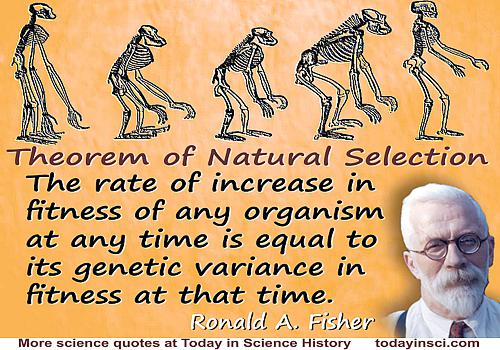
We may consequently state the fundamental theorem of Natural Selection in the form: The rate of increase in fitness of any organism at any time is equal to its genetic variance in fitness at that time.
The Genetical Theory of Natural Selection (1930), 35.
We must make the following remark: a proof, that after a certain time t1, the spheres must necessarily be mixed uniformly, whatever may be the initial distribution of states, cannot be given. This is in fact a consequence of probability theory, for any non-uniform distribution of states, no matter how improbable it may be, is still not absolutely impossible. Indeed it is clear that any individual uniform distribution, which might arise after a certain time from some particular initial state, is just as improbable as an individual non-uniform distribution; just as in the game of Lotto, any individual set of five numbers is as improbable as the set 1, 2, 3, 4, 5. It is only because there are many more uniform distributions than non-uniform ones that the distribution of states will become uniform in the course of time. One therefore cannot prove that, whatever may be the positions and velocities of the spheres at the beginning, the distributions must become uniform after a long time; rather one can only prove that infinitely many more initial states will lead to a uniform one after a definite length of time than to a non-uniform one. Loschmidt's theorem tells us only about initial states which actually lead to a very non-uniform distribution of states after a certain time t1; but it does not prove that there are not infinitely many more initial conditions that will lead to a uniform distribution after the same time. On the contrary, it follows from the theorem itself that, since there are infinitely many more uniform distributions, the number of states which lead to uniform distributions after a certain time t1, is much greater than the number that leads to non-uniform ones, and the latter are the ones that must be chosen, according to Loschmidt, in order to obtain a non-uniform distribution at t1.
From 'On the Relation of a General Mechanical Theorem to the Second Law of Thermodynamics' (1877), in Stephen G. Brush (ed.), Selected Readings in Physics (1966), Vol. 2, Irreversible Processes, 191-2.
We often hear that mathematics consists mainly of “proving theorems.” Is a writer's job mainly that of “writing sentences?”
In Rota's 'Introduction' written (1980) to preface Philip J. Davis and Reuben Hersh, The Mathematical Experience (1981, 2012), xxii.
What we do may be small, but it has a certain character of permanence and to have produced anything of the slightest permanent interest, whether it be a copy of verses or a geometrical theorem, is to have done something utterly beyond the powers of the vast majority of men.
From Inaugural Lecture, Oxford (1920). Recalled in A Mathematician’s Apology (1940, 1967), 76.
When asked what it was like to set about proving something, the mathematician likened proving a theorem to seeing the peak of a mountain and trying to climb to the top. One establishes a base camp and begins scaling the mountain’s sheer face, encountering obstacles at every turn, often retracing one’s steps and struggling every foot of the journey. Finally when the top is reached, one stands examining the peak, taking in the view of the surrounding countryside and then noting the automobile road up the other side!
Space-filler in The Two-Year College Mathematics Journal (Nov 1980), 11, No. 5, 295.
When students hear the story of Andrew J. Wiles’ proof of Fermat’s Last Theorem, it is not the result itself that stirs their emotions, but the revelation that a mathematician was driven by the same passion as any creative artist.
In 'Loving Math Infinitely', The Chronicle of Higher Education (19 Jan 2001).
Young men should prove theorems, old men should write books.
Quoted by Freeman Dyson as the answer from G.H. Hardy about the book An Introduction to the Theory of Numbers. Dyson, while at Cambridge, had asked him why “he spent so much time and effort writing that marvellous book when he might be doing serious mathematics.” In Freeman Dyson 'A Walk Through Ramanujan's Garden', Lecture by Dyson at Ramanujan Centenary Conference (2 Jun 1987). Collected in Selected Papers of Freeman Dyson with Commentary (1996), 189. Also as quoted in 'Mathematician, Physicist, and Writer.' Interview (Jun 1990) with Donald J. Albers, The College Mathematics Journal (Jan 1994), 25, No. 1, 4.
 In science it often happens that scientists say, 'You know that's a really good argument; my position is mistaken,' and then they would actually change their minds and you never hear that old view from them again. They really do it. It doesn't happen as often as it should, because scientists are human and change is sometimes painful. But it happens every day. I cannot recall the last time something like that happened in politics or religion.
(1987) --
In science it often happens that scientists say, 'You know that's a really good argument; my position is mistaken,' and then they would actually change their minds and you never hear that old view from them again. They really do it. It doesn't happen as often as it should, because scientists are human and change is sometimes painful. But it happens every day. I cannot recall the last time something like that happened in politics or religion.
(1987) -- 





