Telephone Quotes (31 quotes)
A fear of intellectual inadequacy, of powerlessness before the tireless electronic wizards, has given rise to dozens of science-fiction fantasies of computer takeovers. ... Other scientists too are apprehensive. D. Raj Reddy, a computer scientist at Pittsburgh’s Carnegie-Mellon University, fears that universally available microcomputers could turn into formidable weapons. Among other things, says Reddy, sophisticated computers in the wrong hands could begin subverting a society by tampering with people’s relationships with their own computers—instructing the other computers to cut off telephone, bank and other services, for example.
— Magazine
An early prediction of DDoS (Distributed Denial of Service), viruses and worms like Stuxnet. As stated, without further citation, in 'The Age of Miracle Chips', Time (20 Feb 1978), 44. The article introduces a special section on 'The Computer Society.' Please contact Webmaster if you know a primary source.
As to Bell’s talking telegraph, it only creates interest in scientific circles, and, as a toy it is beautiful; but … its commercial value will be limited.
Letter to William D. Baldwin, his attorney (1 Nov 1876). Telephone Investigating Committee, House of Representatives, United States 49th Congress, 1st Session, Miscellaneous Documents (1886), No. 355, 1186.
Every improvement that is put upon the real estate is the result of an idea in somebody's head. The skyscraper is another idea; the railroad is another; the telephone and all those things are merely symbols which represent ideas. An andiron, a wash-tub, is the result of an idea that did not exist before.
Speaking to a committee considering a new Copyright Bill (6 Dec 1906). In Mark Twain and William Dean Howells (ed.), Mark Twain’s Speeches? (1910), 320. An andiron is a metal bar, used in a pair, as a stand for logs in a fireplace. The Copyright Bill proposed to give authors, artists and musicians copyright for the term of his life and for 50 years thereafter. John Philip Sousa spoke for the musicians.
Grand telegraphic discovery today … Transmitted vocal sounds for the first time ... With some further modification I hope we may be enabled to distinguish … the “timbre” of the sound. Should this be so, conversation viva voce by telegraph will be a fait accompli.
Postscript (P.S.) on page 3 of letter to Sarah Fuller (1 Jul 1875). Bell Papers, Library of Congress.
I feel that I have at last struck the solution of a great problem—and the day is coming when telegraph wires will be laid on to houses just like water or gas—and friends converse with each other without leaving home.
Letter (10 Mar 1876) to his father on the day his first words were sent by wire to Mr. Watson. As quoted in Robert V. Bruce, Bell: Alexander Graham Bell and the Conquest of Solitude (1973, 1990), 181.
I have read somewhere that the resistance offered by a wire ... is affected by the tension of the wire. If this is so, a continuous current of electricity passed through a vibrating wire should meet with a varying resistance, and hence a pulsatory action should be induced in the current ... [corresponding] in amplitude, as well as in rate of movement, to the vibrations of the string ... [Thus] the timbre of a sound [a quality essential to intelligible speech] could be transmitted ... [and] the strength of the current can be increased ad libitum without destroying the relative intensities of the vibrations.
Letter to Gardiner Greene Hubbard (4 May 1875), 3-4. Bell Papers, Library of Congress.
I still find it hard to believe how far we have come, from the time I first flew on Friendship 7 and the Discovery flight. I go from being crammed into a capsule the size of a telephone booth to a place where I could live and work in space. … Amazing.
As quoted by Howard Wilkinson in 'John Glenn Had the Stuff U.S. Heroes are Made of', The Cincinnati Enquirer (20 Feb 2002).
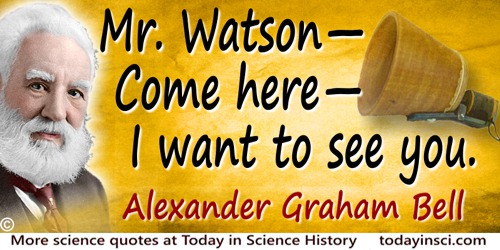
I then shouted into M [the mouthpiece] the following sentence: “Mr. Watson—Come here—I want to see you.” To my delight he came and declared that he had heard and understood what I said. I asked him to repeat the words. He answered “You said—‘Mr. Watson—-come here—I want to see you.’” We then changed places and I listened at S [the reed receiver] while Mr. Watson read a few passages from a book into the mouth piece M. It was certainly the case that articulate sounds proceeded from S. The effect was loud but indistinct and muffled. If I had read beforehand the passage given by Mr. Watson I should have recognized every word. As it was I could not make out the sense—but an occasional word here and there was quite distinct. I made out “to” and “out” and “further”; and finally the sentence “Mr. Bell do you understand what I say? Do—you—un—der—stand—what—I—say” came quite clearly and intelligibly. No sound was audible when the armature S was removed.
Notebook, 'Experiments made by A. Graham Bell, vol. I'. Entry for 10 March 1876. Quoted in Robert V. Bruce, Bell: Alexander Graham Bell and the Conquest of Solitude (1973), 181.
I’ve often been quoted as saying I would rather be governed by the first two thousand people listed in the Boston telephone directory than by the two thousand people on the faculty of Harvard University.
On NBC TV Meet The Press (17 Oct 1965), as quoted and cited in Ralph Keyes, The Quote Verifier: Who Said What, Where, and When (2006), 82-83.
If you had come to me a hundred years ago, do you think I should have dreamed of the telephone? Why, even now I cannot understand it! I use it every day, I transact half my correspondence by means of it, but I don’t understand it. Thnk of that little stretched disk of iron at the end of a wire repeating in your ear not only sounds, but words—not only words, but all the most delicate and elusive inflections and nuances of tone which separate one human voice from another! Is not that something of a miracle?
Quoted in Harold Begbie in Pall Mall magazine (Jan 1903). In Albert Shaw, The American Monthly Review of Reviews (1903), 27, 232.
In the early days of telephone engineering, the mere sending of a message was so much of a miracle that nobody asked how it should be sent.
In The Human Use of Human Beings: Cybernetics and Society (1950), 4.
It was shortly after midday on December 12, 1901, [in a hut on the cliffs at St. John’s, Newfoundland] that I placed a single earphone to my ear and started listening. The receiver on the table before me was very crude—a few coils and condensers and a coherer—no valves [vacuum tubes], no amplifiers, not even a crystal. I was at last on the point of putting the correctness of all my beliefs to test. … [The] answer came at 12:30. … Suddenly, about half past twelve there sounded the sharp click of the “tapper” … Unmistakably, the three sharp clicks corresponding to three dots sounded in my ear. “Can you hear anything, Mr. Kemp?” I asked, handing the telephone to my assistant. Kemp heard the same thing as I. … I knew then that I had been absolutely right in my calculations. The electric waves which were being sent out from Poldhu [Cornwall, England] had travelled the Atlantic, serenely ignoring the curvature of the earth which so many doubters considered a fatal obstacle. … I knew that the day on which I should be able to send full messages without wires or cables across the Atlantic was not far distant.
As quoted in Degna Marconi, My Father, Marconi (2000), 93.
Most American citizens think that life without the telephone is scarcely worth living. The American public telephone system is therefore enormous. Moreover the system belongs to an organization, the Bell companies, which can both control it and make the equipment needed. There is no surer way of getting efficient functional design than having equipment designed by an organization which is going to have to use it. Humans who would have to live with their own mistakes tend to think twice and to make fewer mistakes.
In 'Musical Acoustics Today', New Scientist (1 Nov 1962), 16 No. 311, 256.
Mr. Watson, please come here. I want to see you.
Notable as the first words communicated with his telephone invention. Laboratory notebook, held by the Library of Congress (10 Mar 1876).
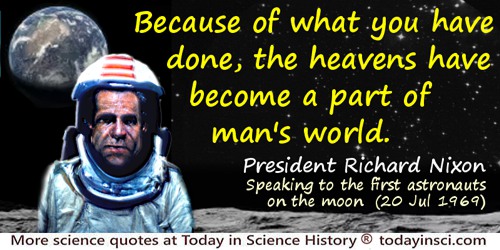
Neil and Buzz, I am talking to you by telephone from the Oval Office at the White House, and this certainly has to be the most historic telephone call ever made. Because of what you have done, the heavens have become a part of man’s world. As you talk to us from the Sea of Tranquility, it inspires us to redouble our efforts to bring peace and tranquility to Earth.
Speaking to the first astronauts while they were standing on the Moon (20 Jul 1969).
Perseverance is my motto. It laid the Atlantic cable; it gave us the telegraph, telephone, and wireless. It gave to the world an Abraham Lincoln, and to a race freedom. It gave to the negro Booker T. Washington and Tuskegee Institute. It made Frederick Douglass the great orator that he was, and it gave to the race Paul Laurence Dunbar, and to poetry a new song.
In 'Wealthiest Negro Woman's Suburban Mansion: Estate at Irvington, Overlooking Hudson and Containing All the Attractions That A Big Fortune Commands', New York Times Sunday Magazine (4 Nov 1917), 4.
Portable communication instruments will be developed that will enable an individual to communicate directly and promptly with anyone, anywhere in the world. As we learn more about the secrets of space, we shall increase immeasurably the number of usable frequencies until we are able to assign a separate frequency to an individual as a separate telephone number is assigned to each instrument.
In address (Fall 1946) at a dinner in New York to commemorate the 40 years of Sarnoff’s service in the radio field, 'Institute News and Radio Notes: The Past and Future of Radio', Proceedings of the Institute of Radio Engineers (I.R.E.), (May 1947), 35, No. 5, 498. [In 1946, foretelling the cell phone and a hint of the communications satellite? —Webmaster]
Qualified scientists in Washington believe that the atom-blasting of Japan is the start toward heating plants the size of telephone booths for great factories, and motor-car trips of 1,000 hours on one gram of fuel. One expert estimated that with a few grams of uranium it might be possible to power the Queen Mary from Europe to the U.S. and back again. One of America’s leading scientists, Doctor Vollrath, said that the new discovery brings man’s attempt to reach the moon within bounds of possibility.
The Maple Leaf (8 Aug 1945), 4.
Some of my youthful readers are developing wonderful imaginations. This pleases me. Imagination has brought mankind through the Dark Ages to its present state of civilization. Imagination led Columbus to discover America. Imagination led Franklin to discover electricity. Imagination has given us the steam engine, the telephone, the talking-machine and the automobile, for these things had to be dreamed of before they became realities. So I believe that dreams—day dreams, you know, with your eyes wide open and your brain-machinery whizzing—are likely to lead to the betterment of the world. The imaginative child will become the imaginative man or woman most apt to create, to invent, and therefore to foster civilization. A prominent educator tells me that fairy tales are of untold value in developing imagination in the young. I believe it.
Opening paragraph of preface, 'To My Readers', The Lost Princess of Oz (1917), 13.
TELEPHONE, n. An invention of the devil which abrogates some of the advantages of making a disagreeable person keep his distance.
The Collected Works of Ambrose Bierce (1911), Vol. 7, The Devil's Dictionary, 341.
TELESCOPE, n. A device having a relation to the eye similar to that of the telephone to the ear, enabling distant objects to plague us with a multitude of needless details. Luckily it is unprovided with a bell summoning us to the sacrifice.
The Collected Works of Ambrose Bierce (1911), Vol. 7, The Devil's Dictionary, 342.
The discovery of the telephone has made us acquainted with many strange phenomena. It has enabled us, amongst other things, to establish beyond a doubt the fact that electric currents actually traverse the earth’s crust. The theory that the earth acts as a great reservoir for electricity may be placed in the physicist's waste-paper basket, with phlogiston, the materiality of light, and other old-time hypotheses.
From Recent Progress in Telephony: British Association Report (1882). Excerpted in John Joseph Fahie, A History of Wireless Telegraphy (1902), 136.
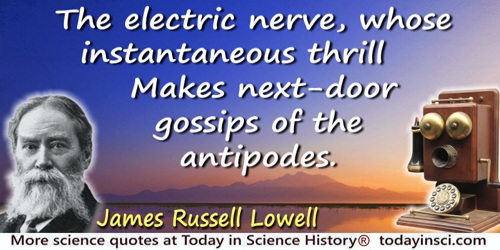
The electric nerve, whose instantaneous thrill
Makes next-door gossips of the antipodes…
Makes next-door gossips of the antipodes…
Poem 'Science and Poetry', collected in The Poetical Works of James Russell (1848, 1897), 437.
The first nonabsolute number is the number of people for whom the table is reserved. This will vary during the course of the first three telephone calls to the restaurant, and then bear no apparent relation to the number of people who actually turn up, or to the number of people who subsequently join them after the show/match/party/gig, or to the number of people who leave when they see who else has turned up.
The second nonabsolute number is the given time of arrival, which is now known to be one of the most bizarre of mathematical concepts, a recipriversexcluson, a number whose existence can only be defined as being anything other than itself. In other words, the given time of arrival is the one moment of time at which it is impossible that any member of the party will arrive. Recipriversexclusons now play a vital part in many branches of math, including statistics and accountancy and also form the basic equations used to engineer the Somebody Else’s Problem field.
The third and most mysterious piece of nonabsoluteness of all lies in the relationship between the number of items on the check [bill], the cost of each item, the number of people at the table and what they are each prepared to pay for. (The number of people who have actually brought any money is only a subphenomenon of this field.)
The second nonabsolute number is the given time of arrival, which is now known to be one of the most bizarre of mathematical concepts, a recipriversexcluson, a number whose existence can only be defined as being anything other than itself. In other words, the given time of arrival is the one moment of time at which it is impossible that any member of the party will arrive. Recipriversexclusons now play a vital part in many branches of math, including statistics and accountancy and also form the basic equations used to engineer the Somebody Else’s Problem field.
The third and most mysterious piece of nonabsoluteness of all lies in the relationship between the number of items on the check [bill], the cost of each item, the number of people at the table and what they are each prepared to pay for. (The number of people who have actually brought any money is only a subphenomenon of this field.)
Life, the Universe and Everything (1982, 1995), 47-48.
The relative importance of the white and gray matter is often misunderstood. Were it not for the manifold connection of the nerve cells in the cortex by the tens of millions of fibres which make up the under-estimated white matter, such a brain would be useless as a telephone or telegraph station with all the interconnecting wires destroyed.
Address to the American Association for the Advancement of Science in Philadelphia (28 Dec 1904), as quoted in 'Americans of Future Will Have Best Brains', New York Times (29 Dec 1904), 6.
There may be a golden ignorance. If Professor Bell had known how difficult a task he was attempting, he would never have given us the telephone.
From chapter 'Jottings from a Note-book', in Canadian Stories (1918), 178.
This invention has been originated in the land which gave birth to the telegraph, the telephone, the Hoe press and the reaper; everybody will know that it came from the United States.
From short Speech at the Chamberlain Hotel, Washington, D.C. (Feb 1885), concluding the exhibition of his own Linotype invention. As given in Carl Schlesinger (ed.), 'Mr. Mergenthaler’s Speech', The Biography of Ottmar Merganthaler: Inventor of the Linotype (1989), 20. [Thanking his funders for support that honored their country. —Webmaster]
Watson, if I can get a mechanism which will make a current of electricity vary in its intensity, as the air varies in density when a sound is passing through it, I can telegraph any sound, even the sound of speech.
As quoted by Thomas A. Watson, in Exploring Life: The Autobiography of Thomas A. Watson (1926), 62.
We know enough to be sure that the scientific achievements of the next fifty years will be far greater, more rapid, and more surprising, than those we have already experienced. … Wireless telephones and television, following naturally upon the their present path of development, would enable their owner to connect up to any room similarly equipped and hear and take part in the conversation as well as if he put his head in through the window.
From 'Fifty Years Hence', Strand Magazine (Dec 1931). Reprinted in Popular Mechanics (Mar 1932), 57, No. 3, 394-396.
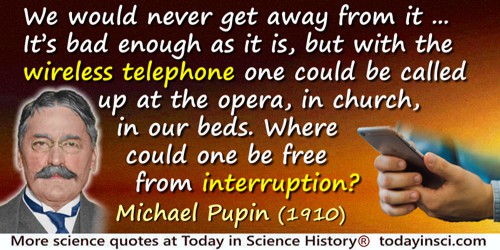
We would never get away from it. … It’s bad enough as it is, but with the wireless telephone one could be called up at the opera, in church, in our beds. Where could one be free from interruption?
[Prediction about the cell phone made over a century ago.]
[Prediction about the cell phone made over a century ago.]
New York Times (23 Jan 1910), Sunday Magazine Section, 6.
With these developments we have every reason to anticipate that in a time not very distant most telegraphic messages across the oceans will be transmitted without cables. For short distances we need a “wireless” telephone, which requires no expert operators.
In 'The Problem of Increasing Human Energy', Century Illustrated Monthly Magazine (Jun 1900), 209. Collected My Inventions: And Other Writings (2016), 123.
 In science it often happens that scientists say, 'You know that's a really good argument; my position is mistaken,' and then they would actually change their minds and you never hear that old view from them again. They really do it. It doesn't happen as often as it should, because scientists are human and change is sometimes painful. But it happens every day. I cannot recall the last time something like that happened in politics or religion.
(1987) --
In science it often happens that scientists say, 'You know that's a really good argument; my position is mistaken,' and then they would actually change their minds and you never hear that old view from them again. They really do it. It doesn't happen as often as it should, because scientists are human and change is sometimes painful. But it happens every day. I cannot recall the last time something like that happened in politics or religion.
(1987) -- 





