Technology Quotes (287 quotes)

[About research with big particle accelerators such as the Large Hadron Collider.] I think the primary justification for this sort of science that we do is fundamental human curiosity. ... It's true, of course, that every previous generation that's made some breakthrough in understanding nature has seen those discoveries translated into new technologies, new possibilities for the human race. That may well happen with the Higgs boson. Quite frankly, at the moment I don't see how you can use the Higgs boson for anything useful.
As quoted in Alan Boyle, 'Discovery of Doom? Collider Stirs Debate', article (8 Sep 2008) on a msnbc.com web page.
[Edison] definitely ended the distinction between the theoretical man of science and the practical man of science, so that today we think of scientific discoveries in connection with their possible present or future application to the needs of man. He took the old rule-of-thumb methods out of industry and substituted exact scientific knowledge, while, on the other hand, he directed scientific research into useful channels.
In My Friend Mr. Edison (1930). Quoted in Dyson Carter, If You Want to Invent (1939), 110.
[On the practical applications of particle physics research with the Large Hadron Collider.] Sometimes the public says, “What's in it for Numero Uno? Am I going to get better television reception? Am I going to get better Internet reception?” Well, in some sense, yeah. … All the wonders of quantum physics were learned basically from looking at atom-smasher technology. … But let me let you in on a secret: We physicists are not driven to do this because of better color television. … That's a spin-off. We do this because we want to understand our role and our place in the universe.
As quoted in Alan Boyle, 'Discovery of Doom? Collider Stirs Debate', article (8 Sep 2008) on a msnbc.com web page. The article writer included the information that Kaku noted that past discoveries from the world of particle physics ushered in many of the innovations we enjoy today, ranging from satellite communications and handheld media players to medical PET scanners (which put antimatter to practical use)."
![Vance Haynes quote: [The ancient Clovis people] had the same gray matter as you or me. They were at a different stage in their t](https://todayinsci.com/H/Haynes_Vance/HaynesVance-GrayMatter500x250px.jpg)
[The ancient Clovis people] had the same gray matter as you or me. They were at a different stage in their technology, that’s all.
As quoted in Sharman Apt Russell, When the Land Was Young: Reflections on American Archaeology (2001), 62.
[To the cultures of Asia and the continent of Africa] it is the Western impact which has stirred up the winds of change and set the processes of modernization in motion. Education brought not only the idea of equality but also another belief which we used to take for granted in the West—the idea of progress, the idea that science and technology can be used to better human conditions. In ancient society, men tended to believe themselves fortunate if tomorrow was not worse than today and anyway, there was little they could do about it.
Lecture at State University of Iowa (6 Apr 1961). In Barbara Ward, The Unity of the Free World (1961), 12.
[Using mice as model systems for genetic engineering in biomedicine, instead of bacterial or yeast systems matters because] this transition will have as big an impact on the future of biology as the shift from printing presses to video technology has had on pop culture. A mouse-based world looks and feels different from one viewed through microorganisms.
Quoted in Michael Schrage, 'Biomedical Researchers Scurry to Make Genetically Altered Mice', San Jose Mercury News (8 Feb 1993), 3D. In Donna Jeanne Haraway and Lynn M. Randolph, [email protected]: Feminism and Technoscience (1996), 98.
[W]e might expect intelligent life and technological communities to have emerged in the universe billions of years ago. Given that human society is only a few thousand years old, and that human technological society is mere centuries old, the nature of a community with millions or even billions of years of technological and social progress cannot even be imagined. ... What would we make of a billion-year-old technological community?
In Are We Alone?(1995), 48.
[With] our critical faculties in decline, unable to distinguish between what feels good and what’s true, we slide, almost without noticing, back into superstition. … We have also arranged things so that almost no one understands science and technology. We might get away with it for a while, but eventually this combustible mixture of ignorance and power is going to blow up in our faces.
In 'With Science on Our Side', Washington Post (9 Jan 1994).
Clarke's Third Law:. Any sufficiently advanced technology is indistinguishable from magic.
In Profiles of the Future: An Enquiry into the Limits of the Possible (1982), 36, footnote.
A fateful process is set in motion when the individual is released “to the freedom of his own impotence” and left to justify his existence by his own efforts. The autonomous individual, striving to realize himself and prove his worth, has created all that is great in literature, art, music, science and technology. The autonomous individual, also, when he can neither realize himself nor justify his existence by his own efforts, is a breeding call of frustration, and the seed of the convulsions which shake our world to its foundations.
In The Passionate State of Mind (1955), 18.
A vast technology has been developed to prevent, reduce, or terminate exhausting labor and physical damage. It is now dedicated to the production of the most trivial conveniences and comfort.
Reflections on Behaviorism and Society (1978), 6.
Across the communication landscape move the specters of sinister technologies and the dreams that money can buy.
In the Introduction to the French edition (1984) of Crash (1974),
Aggression has had definite advantages for survival, but when modern technology meets ancient aggression the entire human race and much of the rest of life on Earth is at risk. … It is not clear that, unlike aggression, intelligence has any long-term survival value.
In 'A Step Backward For Civilization', The Washington Post (16 Feb 2014), Sec. A, 21.
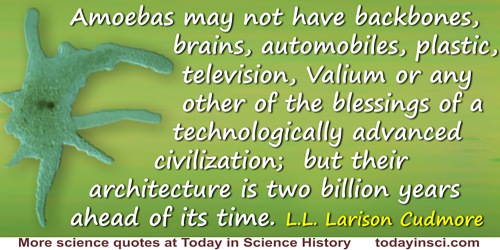
Ah, the architecture of this world. Amoebas may not have backbones, brains, automobiles, plastic, television, Valium or any other of the blessings of a technologically advanced civilization; but their architecture is two billion years ahead of its time.
In The Center of Life: A Natural History of the Cell (1977), 15-16.
All attempts to adapt our ethical code to our situation in the technological age have failed.
— Max Born
My Life & My Views (1968), 52.
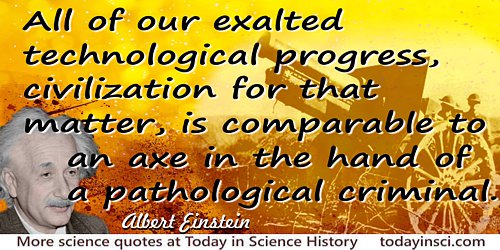
All of our exalted technological progress, civilization for that matter, is comparable to an axe in the hand of a pathological criminal.
Letter to Heinrich Zangger (Dec 1917), Collected Papers Vol. 8, 412, as cited in Jürgen Neffe, Einstein: A Biography (2007), 256.
All the human culture, all the results of art, science and technology that we see before us today, are almost exclusively the creative product of the Aryan. This very fact admits of the not unfounded inference that he alone was the founder of all higher humanity, therefore representing the prototype of all that we understand by the word 'man.' He is the Prometheus of mankind from whose shining brow the divine spark of genius has sprung at all times, forever kindling anew that fire of knowledge which illuminated the night of silent mysteries and thus caused man to climb the path to mastery over the other beings of the earth ... It was he who laid the foundations and erected the walls of every great structure in human culture.
Mein Kampf (1925-26), American Edition (1943), 290. In William Lawrence Shirer, The Rise and Fall of the Third Reich (1990), 86-87.
America’s technology has turned in upon itself; its corporate form makes it the servant of profits, not the servant of human needs.
quoted in Robin Morgan, Sisterhood is Powerful (1970).
Any demanding high technology tends to develop influential and dedicated constituencies of those who link its commercial success with both the public welfare and their own. Such sincerely held beliefs, peer pressures, and the harsh demands that the work i
Foreign Affairs (Oct 1976).
Anything that is theoretically possible will be achieved in practice, no matter what the technical difficulties are, if it is desired greatly enough.
Hazards of Prophecy: An Arresting Inquiry into the limits of the Possible: Failures of Nerve and Failures of Imagination (1962)
Arguably the greatest technological triumph of the century has been the public-health system, which is sophisticated preventive and investigative medicine organized around mostly low- and medium-tech equipment; ... fully half of us are alive today because of the improvements.
In Visions of Technology (1999), 22.
As a scientist and geneticist I started to feel that science would probably soon reach the point where its interference into the life processes would be counterproductive if a properly designed governing policy was not implemented. A heavily overcrowded planet, ninety-five percent urbanized with nuclear energy as the main source of energy and with all aspects of life highly computerized, is not too pleasant a place for human life. The life of any individual soon will be predictable from birth to death. Medicine, able to cure almost everything, will make the load of accumulated defects too heavy in the next two or three centuries. The artificial prolongation of life, which looked like a very bright idea when I started research in aging about twenty-five years ago, has now lost its attractiveness for me. This is because I now know that the aging process is so multiform and complex that the real technology and chemistry of its prevention by artificial interference must be too complex and expensive. It would be the privilege of a few, not the method for the majority. I also was deeply concerned about the fact that most research is now either directly or indirectly related to military projects and objectives for power.
Quoted in 'Zhores A(leksandrovich) Medvedev', Contemporary Authors Online, Gale, 2002.
As our technology evolves, we will have the capacity to reach new, ever-increasing depths. The question is: What kind of technology, in the end, do we want to deploy in the far reaches of the ocean? Tools of science, ecology and documentation, or the destructive tools of heavy industry? Some parts of our oceans, like the rich and mysterious recesses of our Atlantic submarine canyons and seamounts, are so stunning and sensitive they deserve to be protected from destructive activities.
In 'Ocean Oases: Protecting Canyons & Seamounts of the Atlantic Coast', The Huffington Post (8 Jun 2011).
Because it’s my generation that’s going to have to deal with the effects of climate change.
Title of article promoting support future generations, especially for careers in engineering on website of IET (The Institution of Engineering and Technology).
But in practical affairs, particularly in politics, men are needed who combine human experience and interest in human relations with a knowledge of science and technology. Moreover, they must be men of action and not contemplation. I have the impression that no method of education can produce people with all the qualities required. I am haunted by the idea that this break in human civilization, caused by the discovery of the scientific method, may be irreparable.
— Max Born
My Life & My Views (1968), 57-8.
But of all environments, that produced by man’s complex technology is perhaps the most unstable and rickety. In its present form, our society is not two centuries old, and a few nuclear bombs will do it in.
To be sure, evolution works over long periods of time and two centuries is far from sufficient to breed Homo technikos… .
The destruction of our technological society in a fit of nuclear peevishness would become disastrous even if there were many millions of immediate survivors.
The environment toward which they were fitted would be gone, and Darwin’s demon would wipe them out remorselessly and without a backward glance.
To be sure, evolution works over long periods of time and two centuries is far from sufficient to breed Homo technikos… .
The destruction of our technological society in a fit of nuclear peevishness would become disastrous even if there were many millions of immediate survivors.
The environment toward which they were fitted would be gone, and Darwin’s demon would wipe them out remorselessly and without a backward glance.
Asimov on Physics (1976), 151. Also in Isaac Asimov’s Book of Science and Nature Quotations (1988), 181.
But science and technology are only one of the avenues toward reality; others are equally needed to comprehend the full significance of our existence. Indeed, these other avenues are necessary for the prevention of thoughtless and inhuman abuses of the results of science.
In The Privilege of Being a Physicist (1989).
By a recent estimate, nearly half the bills before the U.S. Congress have a substantial science-technology component and some two-thirds of the District of Columbia Circuit Court’s case load now involves review of action by federal administrative agencies; and more and more of such cases relate to matters on the frontiers of technology.
If the layman cannot participate in decision making, he will have to turn himself over, essentially blind, to a hermetic elite. … [The fundamental question becomes] are we still capable of self-government and therefore freedom?
Margaret Mead wrote in a 1959 issue of Daedalus about scientists elevated to the status of priests. Now there is a name for this elevation, when you are in the hands of—one hopes—a benevolent elite, when you have no control over your political decisions. From the point of view of John Locke, the name for this is slavery.
If the layman cannot participate in decision making, he will have to turn himself over, essentially blind, to a hermetic elite. … [The fundamental question becomes] are we still capable of self-government and therefore freedom?
Margaret Mead wrote in a 1959 issue of Daedalus about scientists elevated to the status of priests. Now there is a name for this elevation, when you are in the hands of—one hopes—a benevolent elite, when you have no control over your political decisions. From the point of view of John Locke, the name for this is slavery.
Quoted in 'Where is Science Taking Us? Gerald Holton Maps the Possible Routes', The Chronicle of Higher Education (18 May 1981). In Francis A. Schaeffer, A Christian Manifesto (1982), 80.
By virtue of the way it has organized its technological base, contemporary industrial society tends to be totalitarian. For 'totalitarian' is not only a terroristic political coordination of society, but also a non-terroristic economic-technical coordination which operates through the manipulation of needs by vested interests. It thus precludes the emergence of an effective opposition against the whole. Not only a specific form of government or party rule makes for totalitarianism, but also a specific system of production and distribution which may well be compatible with a 'pluralism' of parties, newspapers, 'countervailing powers,' etc.
One Dimensional Man (1964), 3.
Carbon has this genius of making a chemically stable two-dimensional, one-atom-thick membrane in a three-dimensional world. And that, I believe, is going to be very important in the future of chemistry and technology in general.
From Nobel Lecture (7 Dec 1996), 'Discovering the Fullerenes', collected in Ingmar Grenthe (ed.), Nobel Lectures, Chemistry 1996-2000 (2003).
Clearly, we have compiled a record of serious failures in recent technological encounters with the environment. In each case, the new technology was brought into use before the ultimate hazards were known. We have been quick to reap the benefits and slow to comprehend the costs.
In 'Frail Reeds in a Harsh World', Natural History Journal of the American Museum of Natural History (Feb 1969), 79, No. 2, 44.
Dad, what’s the point of technology?
To make it easier to conquer each other.
To make it easier to conquer each other.
From B.C. syndicated cartoon strip (23 Sep 2018).
Darwin has interested us in the history of nature’s technology.
Capital, 1867
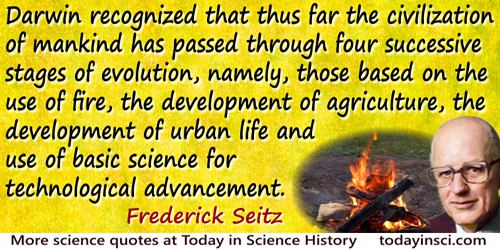
Darwin recognized that thus far the civilization of mankind has passed through four successive stages of evolution, namely, those based on the use of fire, the development of agriculture, the development of urban life and the use of basic science for technological advancement.
In The Science Matrix: The Journey, Travails, Triumphs (1992, 2012), 86.
Despite the dazzling successes of modern technology and the unprecedented power of modern military systems, they suffer from a common and catastrophic fault. While providing us with a bountiful supply of food, with great industrial plants, with high-speed transportation, and with military weapons of unprecedented power, they threaten our very survival.
In Science and Survival (1966).
Developing countries can leapfrog several stages in the development process through the application of bio-technology in agriculture.
In Arbind Prasad and Jagdish Prasad, Development Planning for Agriculture: Policies, Economic Implications, Inputs, Production and Marketing (1994), 93.
Dick Drew took a bunch of misfits—people who wouldn’t fly in formation—and he put together a lab that created technologies that account for 20 percent of 3M's sales in 2000.
— Art Fry
As quoted in W. James McNerney Jr., A Century of Innovation: The 3M Story (2002), 26.
Do you realize we’ve got 250 million years of coal? But coal has got environmental hazards to it, but there’s—I’m convinced, and I know that we—technology can be developed so we can have zero-emissions coal-fired electricity plants.
Remarks at the Associated Builders and Contractors National Legislative Conference (8 Jun 2005). The White house corrected “250 million years” to “250 years” in a footnote to the printed record, 41 WCPD 956 in 'Administration of George W. Bush', 959.
Doctors coin money when they do procedures—family practice doesn’t have any procedures. A urologist has cystoscopies, a gastroenterologist has gastroscopies, a dermatologist has biopsies. They can do three or four of those and make five or six hundred dollars in a single day. We get nothing for the use of our time to understand the lives of our patients. Technology is rewarded in medicine, it seems to me, and not thinking.
Quoted in John McPhee, 'Heirs of General Practice,' New Yorker (23 Jul 1984), 40-85. In David Barton Smith and Arnold D. Kaluzny, The White Labyrinth (2000), 227.
During my eighty-seven years I have witnessed a whole succession of technological revolutions. But none of them has done away with the need for character in the individual or the ability to think.
From My Own Story (1957), 320.
Each workman would receive two or three important parts and would affix them together and pass them on to the next who would add a part and pass the growing article to another who would do the same … until the complete arm is put together.
Describing the first factory assembly line process. The product was Colt’s revolving chamber gun, nicknamed the “equalizer.”
Education in a technological world of replaceable and expendable parts is neuter. Technology needs not people or minds but “hands.”
In The Mechanical Bride: Folklore of Industrial Man (1967) 53.
Engineering is not merely knowing and being knowledgeable, like a walking encyclopedia; engineering is not merely analysis; engineering is not merely the possession of the capacity to get elegant solutions to non-existent engineering problems; engineering is practicing the art of the organizing forces of technological change ... Engineers operate at the interface between science and society.
In Bert Scalzo, et al., Database Benchmarking: Practical Methods for Oracle & SQL Server (2007), 37.
Engineering or Technology is the making of things that did not previously exist, whereas science is the discovering of things that have long existed.
The Tower and the Bridge: The New Art of Structural Engineering (1983), 9.
Engineers apply the theories and principles of science and mathematics to research and develop economical solutions to practical technical problems. Their work is the link between scientific discoveries and commercial applications. Engineers design products, the machinery to build those products, the factories in which those products are made, and the systems that ensure the quality of the product and efficiency of the workforce and manufacturing process. They design, plan, and supervise the construction of buildings, highways, and transit systems. They develop and implement improved ways to extract, process, and use raw materials, such as petroleum and natural gas. They develop new materials that both improve the performance of products, and make implementing advances in technology possible. They harness the power of the sun, the earth, atoms, and electricity for use in supplying the Nation’s power needs, and create millions of products using power. Their knowledge is applied to improving many things, including the
quality of health care, the safety of food products, and the efficient operation of financial systems.
Bureau of Labor Statistics, Occupational Outlook Handbook (2000) as quoted in Charles R. Lord. Guide to Information Sources in Engineering (2000), 5. This definition has been revised and expanded over time in different issues of the Handbook.
Essentially all civilizations that rose to the level of possessing an urban culture had need for two forms of science-related technology, namely, mathematics for land measurements and commerce and astronomy for time-keeping in agriculture and aspects of religious rituals.
From The Science Matrix: The Journey, Travails, Triumphs (1992, 1998), Preface, x.
Even bigger machines, entailing even bigger concentrations of economic power and exerting ever greater violence against the environment, do not represent progress: they are a denial of wisdom. Wisdom demands a new orientation of science and technology towards the organic, the gentle, the non-violent, the elegant and beautiful.
In Small is Beautiful: Economics as if People Mattered (1973).
Every technological success is hailed as a great scientific achievement; every technological disaster is deemed an engineering failure.
Far from attempting to control science, few among the general public even seem to recognize just what “science” entails. Because lethal technologies seem to spring spontaneously from scientific discoveries, most people regard dangerous technology as no more than the bitter fruit of science, the real root of all evil.
In Jacques Cousteau and Susan Schiefelbein, The Human, the Orchid, and the Octopus: Exploring and Conserving Our Natural World (2007), 181.
First were mainframes, each shared by lots of people. Now we are in the personal computing era, person and machine staring uneasily at each other across the desktop. Next comes ubiquitous computing, or the age of calm technology, when technology recedes into the background of our lives.
From biography on University of California, Berkeley, website.
Five centuries ago the printing press sparked a radical reshaping of the nature of education. By bringing a master’s words to those who could not hear a master’s voice, the technology of printing dissolved the notion that education must be reserved for those with the means to hire personal tutors. Today we are approaching a new technological revolution, one whose impact on education may be as far-reaching as that of the printing press: the emergence of powerful computers that are sufficiently inexpensive to be used by students for learning, play and exploration. It is our hope that these powerful but simple tools for creating and exploring richly interactive environments will dissolve the barriers to the production of knowledge as the printing press dissolved the barriers to its transmission.
As co-author with A.A. diSessa, from 'Preface', Turtle Geometry: The Computer as a Medium for Exploring Mathematics (1986), xiii.
Focusing on the science-technology relationship may strike some as strange, because conventional wisdom views this relationship as an unproblematic given. … Technology is seen as being, at best, applied science … the conventional view perceives science as clearly preceding and founding technology. … Recent studies in the history of technology have begun to challenge this assumed dependency of technology on science. … But the conventional view of science is persistent.
In 'Technology and Science', Stephen V. Monsma (ed.), Responsible Technology: A Christian Perspective (1986), 78-79.
For a successful technology, reality must take precedence over public relations, for nature cannot be fooled.
Upon identifying the reason for the explosion of the space shuttle Challenger with his demonstration showing that O-rings grow brittle when cold by immersing a sample in iced water. Concluding remark in Feynman's Appendix to the Rogers Commission Report on the Space Shuttle Challenger Accident. In (Jan 1987). In James B. Simpson, Simpson’s Contemporary Quotations (1988).
Forests are a fundamental component of our planet’s recovery. They are the best technology nature has for locking away carbon. And they are centers of biodiversity. Again, the two features work together. The wilder and more diverse forests are, the more effective they are at absorbing carbon from the atmosphere
From narration to Netflix TV program, A Life on Our Planet: My Witness Statement and a Vision for the Future (4 Oct 2020).
Give me the third best technology. The second best won’t be ready in time. The best will never be ready.
As quoted in a speech by an unnamed executive of General Electric, excerpted in Richard Dowis, The Lost Art of the Great Speech: How to Write It, How to Deliver It (2000), 150.
By
Gradually, … the aspect of science as knowledge is being thrust into the background by the aspect of science as the power of manipulating nature. It is because science gives us the power of manipulating nature that it has more social importance than art. Science as the pursuit of truth is the equal, but not the superior, of art. Science as a technique, though it may have little intrinsic value, has a practical importance to which art cannot aspire.
In The Scientific Outlook (1931, 2009), xxiv.
High technology has done us one great service: It has retaught us the delight of performing simple and primordial tasks—chopping wood, building a fire, drawing water from a spring.
In 'Science and Technology', A Voice Crying in the Wilderness (Vox Clamantis in Deserto) (1989), 91.
Historically, science has pursued a premise that Nature can be understood fully, its future predicted precisely, and its behavior controlled at will. However, emerging knowledge indicates that the nature of Earth and biological systems transcends the limits of science, questioning the premise of knowing, prediction, and control. This knowledge has led to the recognition that, for civilized human survival, technological society has to adapt to the constraints of these systems.
As quoted in Chris Maser, Decision-Making for a Sustainable Environment: A Systemic Approach (2012), 4, citing N. Narasimhan, 'Limitations of Science and Adapting to Nature', Environmental Research Letters (Jul-Sep 2007), 2.
Horace Mann vividly pictures the power of education in his statement about the savage and transportation. Modifying his statement, it can be said: The savage can fasten only a dozen pounds on his back and swim the river. When he is educated enough to make an axe, fell a tree, and build a raft, he can carry many times a dozen pounds. As soon as he learns to rip logs into boards and build a boat, he multiplies his power a hundredfold; and when to this he adds mathematics, chemistry, physics, and other modern sciences he can produce the monster steel leviathans that defy wind, storm, and distance, and bear to the uttermost parts of the earth burdens a millionfold greater than the uneducated savage could carry across the narrow river.
In 'The Money Value of Education', Department of the Interior Bureau of Education Bulletin (1917), No. 22, 11.
How much does your building weigh?
A question often used to challenge architects to consider how efficiently materials were used for the space enclosed.
A question often used to challenge architects to consider how efficiently materials were used for the space enclosed.
In Thomas T. K. Zung, Buckminster Fuller (2002), 5.
I am among the most durable and passionate participants in the scientific exploration of the solar system, and I am a long-time advocate of the application of space technology to civil and military purposes of direct benefit to life on Earth and to our national security.
In 'Is Human Spaceflight Obsolete?' Quoted in Issues in Science and Technology (Summer 2004).
I believe as a matter of faith that the extension of space travel to the limits of the solar system will probably be accomplished in several decades, perhaps before the end of the century. Pluto is 4000 million miles from the sun. The required minimum launching velocity is about 10 miles per second and the transit time is 46 years. Thus we would have to make the velocity considerably higher to make the trip interesting to man. Travel to the stars is dependent on radically new discoveries in science and technology. The nearest star is 25 million million miles way and requires a travel time of more than four years at the speed of light. Prof. Dr. Ing. E. Sanger has speculated that velocities comparable with the speed of light might be attained in the next century, but such extrapolation of current technology is probably not very reliable.
In Popular Mechanics (Sep 1961), 262.
I believe that this Nation should commit itself to achieving the goal, before this decade is out, of landing a man on the moon and returning him safely to earth.
Address to Joint Session of Congress, on Urgent National Needs (25 May 1961). On web site of John F. Kennedy Presidential Library and Museum. Also in Vital Speeches of the Day (15 Jun 1961), Vol. 27, No. 17, 518-9.
I believe that until comparatively recent times, say a hundred years ago, few scientists would have regarded the word useful as applicable to their work. … If Euclid and Newton did scoff at utility, how useful their work now appears! Where would modern technology be without geometry, without dynamics, without the differential calculus?
From Lecture (28 Nov 1957) in the Queen’s University, Belfast, 'Is the Study of its History a Brake on the Progress of Science', printed in Hermethena (1958), 19, 31-32.
I came here to help make America more competitive and prosperous by developing an energy policy that increases conservation, promotes cleaner technologies, encourages development of renewables and enhances domestic production of gas and oil.
…...
I can’t say I’m particularly happy about all the spam and the viruses and the equivalent that we see on the Net, but I think technology can deal with many of the problems that we’re now seeing, whether it’s filtering or whatever, and laws may help a lot.
From transcript of interview by Steve Inskeep, 'Computing Pioneers Discuss the State of the Net', Morning Edition (22 Aug 2005) on npr.org website.
I do not like to see all the fine boys turning to the study of law, instead of to the study of science or technology. … Japan wants no more lawyers now; and I think the professions of literature and of teaching give small promise. What Japan needs are scientific men; and she will need more and more of them every year.
In letter to Masanobu Ōtani (1894), collected in Elizabeth Bisland The Writings of Lafcadio Hearn (1922), Vol. 14, 273.
I don’t believe in evolution, like people believe in God … Science and technology are not advanced by people who believe, but by people who don’t know but are doing their best to find out.
With co-author Jack Cohen. In Terry Pratchett, Ian Stewart and Jack Cohen, Chap. 4, 'Science and Magic', The Science of Discworld (1999), 36-37. Pratchett wrote the fantasy story told in the odd-numbered chapters. Following each, relevant real science is provided by his co-authors, Stewart and Cohen, in the even-numbered chapters (such as Chap. 4), but which of the two wrote which lines, is not designated. For the subject quote, the wider context suggests co-author Jack Cohen was relating his own experience.
I don’t think we’ll go there [Mars] until we go back to the Moon and develop a technology base for living and working and transporting ourselves through space.
As quoted on the nmspacemuseum.org website of the New Mexico Museum of Space History.
I have a boundless admiration for the solitary genius which enabled [Hermann Oberth] to bring into focus all of the essential elements of a gigantic concept, together with the human greatness which allowed him, in shy reserve, to bear with equanimity the “crucify hims” as well as the “hosannas” of public opinion. I myself owe him a debt of gratitude not only for being the guiding light of my life, but also for my first contact with the theoretical and practical aspects of rocket technology and space travel.
Primary source needed for verification. (Can you help?)
I have turned my attention from technological progress to life, from the civilized to the wild.
In Autobiography of Values (1976), p. 358.
I like the word “nanotechnology.” I like it because the prefix “nano” guarantees it will be fundamental science for decades; the “technology” says it is engineering, something you’re involved in not just because you’re interested in how nature works but because it will produce something that has a broad impact.
From interview in 'Wires of Wonder', Technology Review (Mar 2001), 104, No. 2, 88.
I love mathematics not only because it is applicable to technology but also because it is beautiful.
In Eberhard Zeidler, Quantum Field Theory (2006), 955.
I should regard them [the Elves interested in technical devices] as no more wicked or foolish (but in much the same peril) as Catholics engaged in certain kinds of physical research (e.g. those producing, if only as by-products, poisonous gases and explosives): things not necessarily evil, but which, things being as they are, and the nature and motives of the economic masters who provide all the means for their work being as they are, are pretty certain to serve evil ends. For which they will not necessarily be to blame, even if aware of them.
From Letter draft to Peter Hastings (manager of a Catholic bookshop in Oxford, who wrote about his enthusiasm for Lord of the Rings) (Sep 1954). In Humphrey Carpenter (ed.) assisted by Christopher Tolkien, The Letters of J.R.R. Tolkien (1995, 2014), 190, Letter No. 153.
I would teach the world that science is the best way to understand the world, and that for any set of observations, there is only one correct explanation. Also, science is value-free, as it explains the world as it is. Ethical issues arise only when science is applied to technology – from medicine to industry.
Response to question “What is the one thing everyone should learn about science?” in 'Life Lessons' The Guardian (7 Apr 2005).
I’d disband NASA for 10 years and take half its budget to avert natural disasters. We could do it, we’ve got the technology. I'd take the other half to deal with disease and suffering. The time has come to do something bold instead of buying wheelchairs.
Quoted in Jennifer Kay 'Neurosurgeon Barth Green: Football player's treatment available to all', Associated Press news report, USA Today website (posted 27 Sep 2007).
I’m not sure what solutions we’ll find to deal with all our environmental problems, but I’m sure of this: They will be provided by industry; they will be products of technology. Where else can they come from?
Nation's Business (12 Jun 1988).
If a project is truly innovative, you cannot possibly know its exact cost and exact schedule at the beginning. And if you do know the exact cost and the exact schedule, chances are that the technology is obsolete.
From interview with Technology Review, quoted in Douglas Martin, 'Joseph Gavin, Who Helped Put First Man on Moon, Dies at 90', New York Times (4 Nov 2010)
If science fiction is the mythology of modern technology, then its myth is tragic
…...
If the human race wants to go to hell in a basket, technology can help it get there by jet. It won’t change the desire or the direction, but it can greatly speed the passage.
In a speech at Wake Forest University, Winston-Salem, North Carolina, April 25, 1967.
If there is a regulation that says you have to do something—whether it be putting in seat belts, catalytic converters, clean air for coal plants, clean water—the first tack that the lawyers use, among others things, and that companies use, is that it’s going to drive the electricity bill up, drive the cost of cars up, drive everything up. It repeatedly has been demonstrated that once the engineers start thinking about it, it’s actually far less than the original estimates. We should remember that when we hear this again, because you will hear it again.
Talk (Apr 2007) quoted in 'Obama's Energy and Environment Team Includes a Nobel Laureate', Kent Garber, US News website (posted 11 Dec 2008).
If there is a wrong way to do something, then someone will do it.
[Subsequently became known as Murphy's Law: “If anything can go wrong, it will.”]
[Subsequently became known as Murphy's Law: “If anything can go wrong, it will.”]
As quoted in Robert L. Forward, 'Murphy Lives!', Science (Jan-Feb 1983), 83, 78. Short form in J.A. Simpson (ed), The Concise Oxford Dictionary of Proverbs (1982).
If we do not learn to eliminate waste and to be more productive and more efficient in the ways we use energy, then we will fall short of this goal [for the Nation to derive 20 percent of all the energy we use from the Sun, by 2000]. But if we use our technological imagination, if we can work together to harness the light of the Sun, the power of the wind, and the strength of rushing streams, then we will succeed.
Speech, at dedication of solar panels on the White House roof, 'Solar Energy Remarks Announcing Administration Proposals' (20 Jun 1979).
If we have learned anything at all in this century, it is that all new technologies will be put to use, sooner or later, for better or worse, as it is in our nature to do
In 'Autonomy', The Lives of a Cell: Notes of a Biology Watcher (1974), 79.
If you know how to make chemical or electrical energy out of solar energy the way plants do it—without going through a heat engine—that is certainly a trick. And I’m sure we can do it. It’s just a question of how long it will take to solve the technical question.
As quoted in 'Melvin Calvin and Photosynthesis', Science Matters@Berkeley, 2, No. 11.
Imagine Aristotle revivified and visiting Manhattan. Nothing in our social, political, economic, artistic, sexual or religious life would mystify him, but he would be staggered by our technology. Its products—skyscrapers, cars, airplanes, television, pocket calculators—would have been impossible without calculus.
In book review, 'Adventures Of a Mathematician: The Man Who Invented the H-Bomb', New York Times (9 May 1976), 201.
In 1891, during the Presidency of William Henry Harrison [Benjamin Harrison], electric lights were first installed in the White House, the residence of the leaders of our country. At that time, commercial electricity was not economically feasible, but President Harrison wanted to affirm his confidence in the technological capability of our country.
Speech, at dedication of solar panels on the White House roof, 'Solar Energy Remarks Announcing Administration Proposals' (20 Jun 1979).
In fact, the thickness of the Earth's atmosphere, compared with the size of the Earth, is in about the same ratio as the thickness of a coat of shellac on a schoolroom globe is to the diameter of the globe. That's the air that nurtures us and almost all other life on Earth, that protects us from deadly ultraviolet light from the sun, that through the greenhouse effect brings the surface temperature above the freezing point. (Without the greenhouse effect, the entire Earth would plunge below the freezing point of water and we'd all be dead.) Now that atmosphere, so thin and fragile, is under assault by our technology. We are pumping all kinds of stuff into it. You know about the concern that chlorofluorocarbons are depleting the ozone layer; and that carbon dioxide and methane and other greenhouse gases are producing global warming, a steady trend amidst fluctuations produced by volcanic eruptions and other sources. Who knows what other challenges we are posing to this vulnerable layer of air that we haven't been wise enough to foresee?
In 'Wonder and Skepticism', Skeptical Enquirer (Jan-Feb 1995), 19, No. 1.
In my own view, some advice about what should be known, about what technical education should be acquired, about the intense motivation needed to succeed, and about the carelessness and inclination toward bias that must be avoided is far more useful than all the rules and warnings of theoretical logic.
From Reglas y Consejos sobre Investigacíon Cientifica: Los tónicos de la voluntad. (1897), as translated by Neely and Larry W. Swanson, in Advice for a Young Investigator (1999), 6.
In order to imbue civilization with sound principles and enliven it with the spirit of the gospel, it is not enough to be illumined with the gift of faith and enkindled with the desire of forwarding a good cause. For this end it is necessary to take an active part in the various organizations and influence them from within. And since our present age is one of outstanding scientific and technical progress and excellence, one will not be able to enter these organizations and work effectively from within unless he is scientifically competent, technically capable and skilled in the practice of his own profession.
Encyclical (10 Apr 1963). In Pacem in Terris, Pt. 5, 50
In the modern world, science and society often interact in a perverse way. We live in a technological society, and technology causes political problems. The politicians and the public expect science to provide answers to the problems. Scientific experts are paid and encouraged to provide answers. The public does not have much use for a scientist who says, “Sorry, but we don’t know.” The public prefers to listen to scientists who give confident answers to questions and make confident predictions of what will happen as a result of human activities. So it happens that the experts who talk publicly about politically contentious questions tend to speak more clearly than they think. They make confident predictions about the future, and end up believing their own predictions. Their predictions become dogmas which they do not question. The public is led to believe that the fashionable scientific dogmas are true, and it may sometimes happen that they are wrong. That is why heretics who question the dogmas are needed.
Frederick S. Pardee Distinguished Lecture (Oct 2005), Boston University. Collected in 'Heretical Thoughts About Science and Society', A Many-Colored Glass: Reflections on the Place of Life in the Universe (2007), 43-44.
It has become appallingly obvious that our technology has exceeded our humanity.
…...
It has often been said that, if the human species fails to make a go of it here on the Earth, some other species will take over the running. In the sense of developing intelligence this is not correct. We have, or soon will have, exhausted the necessary physical prerequisites so far as this planet is concerned. With coal gone, oil gone, high-grade metallic ores gone, no species however competent can make the long climb from primitive conditions to high-level technology. This is a one-shot affair. If we fail, this planetary system fails so far as intelligence is concerned. The same will be true of other planetary systems. On each of them there will be one chance, and one chance only.
In Of Men and Galaxies (1964, 2005), 61.
It is a commonplace of modern technology that problems have solutions before there is knowledge of how they are to be solved.
In The New Industrial State (1977).
It is a lovely and terrible wilderness, such as wilderness as Christ and the prophets went out into; harshly and beautifully colored, broken and worn until its bones are exposed, its great sky without a smudge of taint from Technocracy, and in hidden corners and pockets under its cliffs the sudden poetry of springs.
Letter (3 Dec 1960) written to David E. Pesonen of the Outdoor Recreation Resources Review Commission. Collected in 'Coda: Wilderness Letter', The Sound of Mountain Water: The Changing American West (1969), 153.
It is appallingly obvious that our technology exceeds our humanity.
…...
It is baffling, I must say, that in our modern world we have such blind trust in science and technology that we all accept what science tells us about everything—until, that is, it comes to climate science. All of a sudden, and with a barrage of sheer intimidation, we are told by powerful groups of deniers that the scientists are wrong and we must abandon all our faith in so much overwhelming scientific evidence. So thank goodness for our young entrepreneurs here this evening, who have the far-sightedness and confidence in what they know is happening to ignore the headless chicken brigade and do something practical to help.
Speech, awards ceremony for green entrepreneurs, Buckingham Palace (30 Jan 2014). As quoted in Benn Quinn, 'Climate Change Sceptics are ‘Headless Chickens’, Says Prince Charles', The Guardian (31 Jan 2014).
It is characteristic of our age to endeavour to replace virtues by technology. That is to say, wherever possible we strive to use methods of physical or social engineering to achieve goals which our ancestors thought attainable only by the training of character. Thus, we try so far as possible to make contraception take the place of chastity, and anaesthetics to take the place of fortitude; we replace resignation by insurance policies and munificence by the Welfare State. It would be idle romanticism to deny that such techniques and institutions are often less painful and more efficient methods of achieving the goods and preventing the evils which unaided virtue once sought to achieve and avoid. But it would be an equal and opposite folly to hope that the take-over of virtue by technology may one day be complete, so that the necessity for the laborious acquisition of the capacity for rational choice by individuals can be replaced by the painless application of the fruits of scientific discovery over the whole field of human intercourse and enterprise.
'Mental Health in Plato's Republic', in The Anatomy of the Soul: Historical Essays in the Philosophy of Mind (1973), 26.
It is clear to me that under the right conditions, future technologies will be created that we cannot even imagine.
From keynote address, 'Will Innovation Flourish in the Future?' (2002), as adapted for Opinion article in The Industrial Physicist (Dec-Jan 2003-03), 8, No. 6, 25. The address was presented at Conference, 'Infrastructure for e-Business, e-Education, e-Science, and e-Medicine', at Scuola Superiore G. Reiss Romoli in L’Aquila, Italy (Jul 29-Aug 4, 2002).
It is good to recall that three centuries ago, around the year 1660, two of the greatest monuments of modern history were erected, one in the West and one in the East; St. Paul’s Cathedral in London and the Taj Mahal in Agra. Between them, the two symbolize, perhaps better than words can describe, the comparative level of architectural technology, the comparative level of craftsmanship and the comparative level of affluence and sophistication the two cultures had attained at that epoch of history. But about the same time there was also created—and this time only in the West—a third monument, a monument still greater in its eventual import for humanity. This was Newton’s Principia, published in 1687. Newton's work had no counterpart in the India of the Mughuls.
'Ideals and Realities' (1975). Reprinted in Ideals and Realities (1984), 48.
It is not clear to anyone, least of all the practitioners, how science and technology in their headlong course do or should influence ethics and law, education and government, art and social philosophy, religion and the life of the affections. Yet science is an all-pervasive energy, for it is at once a mode of thought, a source of strong emotion, and a faith as fanatical as any in history.
Science: The Glorious Entertainment (1964), 3.
It is only when science asks why, instead of simply describing how, that it becomes more than technology. When it asks why, it discovers Relativity. When it only shows how, it invents the atom bomb, and then puts its hands over its eye and says, 'My God what have I done?
The Stalin in Soul (1973). Quoted in Gary Westfahl, Science Fiction Quotations (2005), 322.
It is primarily through the growth of science and technology that man has acquired those attributes which distinguish him from the animals, which have indeed made it possible for him to become human.
In The Human Meaning of Science (1940), 2.
It is the constant attempt in this country [Canada] to make fundamental science responsive to the marketplace. Because technology needs science, it is tempting to require that scientific projects be justified in terms of the worth of the technology they can be expected to generate. The effect of applying this criterion is, however, to restrict science to developed fields where the links to technology are most evident. By continually looking for a short-term payoff we disqualify the sort of science that … attempts to answer fundamental questions, and, having answered them, suggests fundamentally new approaches in the realm of applications.
'A Scientist and the World He Lives In', Speech to the Empire Club of Canada (27 Nov 1986) in C. Frank Turner and Tim Dickson (eds.), The Empire Club of Canada Speeches 1986-1987 (1987), 149-161.
It troubles me that we are so easily pressured by purveyors of technology into permitting so-called “progress” to alter our lives without attempting to control it—as if technology were an irrepressible force of nature to which we must meekly submit.
Quoted in The American Land (1979). In Barbara K. Rodes and Rice Odell, A Dictionary of Environmental Quotations (1992), 274.
Learning how to access a continuity of common sense can be one of your most efficient accomplishments in this decade. Can you imagine common sense surpassing science and technology in the quest to unravel the human stress mess? In time, society will have a new measure for confirming truth. It’s inside the people-not at the mercy of current scientific methodology. Let scientists facilitate discovery, but not invent your inner truth.
…...
Leaving aside genetic surgery applied humans, I foresee that the coming century will place in our hands two other forms of biological technology which are less dangerous but still revolutionary enough to transform the conditions of our existence. I count these new technologies as powerful allies in the attack on Bernal's three enemies. I give them the names “biological engineering” and “self-reproducing machinery.” Biological engineering means the artificial synthesis of living organisms designed to fulfil human purposes. Self-reproducing machinery means the imitation of the function and reproduction of a living organism with non-living materials, a computer-program imitating the function of DNA and a miniature factory imitating the functions of protein molecules. After we have attained a complete understanding of the principles of organization and development of a simple multicellular organism, both of these avenues of technological exploitation should be open to us.
From 3rd J.D. Bernal Lecture, Birkbeck College London (16 May 1972), The World, the Flesh and the Devil (1972), 6. Collected in The Scientist as Rebel (2006), 292. (The World, the Flesh & the Devil: An Enquiry into the Future of the Three Enemies of the Rational Soul is the title of a book by J. D Bernal, a scientist who pioneered X-ray crystallography.)
Long lives are not necessarily pleasurable…. We will be lucky if we can postpone the search for new technologies for a while, until we have discovered some satisfactory things to do with the extra time. Something will surely have to be found to take the place of sitting on the porch re-examining one’s watch.
In 'The Long Habit', The Lives of a Cell: Notes of a Biology Watcher (1974), 57.
Looking back over the last thousand years, one can divide the development of the machine and the machine civilization into three successive but over-lapping and interpenetrating phases: eotechnic, paleotechnic, neotechnic … Speaking in terms of power and characteristic materials, the eotechnic phase is a water-and-wood complex: the paleotechnic phase is a coal-and-wood complex… The dawn-age of our modern technics stretches roughly from the year 1000 to 1750. It did not, of course, come suddenly to an end in the middle of the eighteenth century. A new movement appeared in industrial society which had been gathering headway almost unnoticed from the fifteenth century on: after 1750 industry passed into a new phase, with a different source of power, different materials, different objectives.
Technics and Civilisation (1934), 109.
Mankind cannot survive without technology. But unless technology becomes a true servant of man, the survival of mankind is in jeopardy. And if technology is to be the servant, then the engineer’s paramount loyalty must be to society.
In 'Preface', Conference on Engineering Ethics, May 18-19, 1975, Baltimore, Md. (1975), 1.
Mapping the human genome has been compared with putting a man on the moon, but I believe it is more than that. This is the outstanding achievement not only of our lifetime, but in terms of human history. A few months ago I compared the project to the invention of the wheel. On reflection, it is more than that. I can well imagine technology making the wheel obsolete. But this code is the essence of mankind, and as long as humans exists, this code is going to be important and will be used.
Quoted in the press release 'The first draft of the Book of Humankind has been read', 26 Jun 2000. On the Sanger Institute web site at www.sanger.ac.uk/HGP/draft2000/mainrelease.shtml
Mars is the next frontier, what the Old West was, what America was 500 years ago. It’s been 500 years since Columbus. It’s time to strike out anew. There’s a big argument at the moment. The moon is closer, and we’ve got to go back there sometime. But whether it will ever be settled on a large scale is a question. But Mars—there’s no doubt about it. … Everything you need is on Mars.
The characteristic of human nature, and perhaps our simian family group, is curiosity and exploration. When we stop doing that, we won't be human anymore. You say there's been a decline, well, I’ve seen far more happen in my lifetime than I ever dreamed. And the momentary plateau now, well, many of our problems on Earth can only be solved by space technology. … When we get out of the present sort of slump and confusion, well, I mean the next step is space. It's inevitable.
The characteristic of human nature, and perhaps our simian family group, is curiosity and exploration. When we stop doing that, we won't be human anymore. You say there's been a decline, well, I’ve seen far more happen in my lifetime than I ever dreamed. And the momentary plateau now, well, many of our problems on Earth can only be solved by space technology. … When we get out of the present sort of slump and confusion, well, I mean the next step is space. It's inevitable.
Interview in Sri Lanka by Steve Coll for The Washington Post (9 Mar 1992), B1.
Misuse of reason might yet return the world to pre-technological night; plenty of religious zealots hunger for just such a result, and are happy to use the latest technology to effect it.
The Heart of Things: Applying Philosophy to the 21st Century (2006).
Modern technology has lost its magic. No longer do people stand in awe, thrilled by the onward rush of science, the promise of a new day. Instead, the new is suspect. It arouses our hostility as much as it used to excite our fancy. With each breakthrough there are recurrent fears and suspicion. How will the advance further pollute our lives; modern technology is not merely what it first appears to be. Behind the white coats, the disarming jargon, the elaborate instrumentation, and at the core of what has often seemed an automatic process, one finds what Dorothy found in Oz: modern technology is human after all.
In Science and Liberation edited by Rita Arditti, Pat Brennan, and Steve Cavrak (1980).
Modern technology
Owes ecology
An apology.
Owes ecology
An apology.
From Worse Verse (1969), as cited in Colin Jarman, The Book of Poisonous Quotes (1993), 237.
Most manufacturers take resources out of the ground and convert them to products that are designed to be thrown away or incinerated within months. We call these “cradle to grave” product flows. Our answer to that is “cradle to cradle” design. Everything is reused—either returned to the soil as nontoxic “biological nutrients” that will biodegrade safely, or returned to industry as “technical nutrients” that can be infinitely recycled.
In interview article, 'Designing For The Future', Newsweek (15 May 2005).
Most of us aren’t even sure where science leaves off and technology begins. Neither are the experts.
In Visions of Technology (1999), 22.
New capabilities emerge just by virtue of having smart people with access to state-of-the-art technology.
Epigraph, without source, in Donna Fisher, Power Networking: 59 Secrets for Personal & Professional Success (2nd ed. 2000), 189.
No category of sciences exists to which one could give the name of applied sciences. There are science and the applications of science, linked together as fruit is to the tree that has borne it.
Il n’existe pas une catégorie de sciences auxquelles on puisse donner le nom de sciences appliquées. II y a la science et les applications de la science, liées entre elles comme le fruit à l’arbre qui l’a porté.
Il n’existe pas une catégorie de sciences auxquelles on puisse donner le nom de sciences appliquées. II y a la science et les applications de la science, liées entre elles comme le fruit à l’arbre qui l’a porté.
Original French in 'La Science en france: Pourquoi la France n’a pas trouvé d’hommes supérieurs au moment de péril', La Revue Scientifique de la France et de l’Étranger Revue des Cours Scientifique (22 Jul 1871), 2, No. 4, 74. Translation as given in Isaac Asimov and Jason A. Shulman (eds.), Isaac Asimov’s Book of Science and Nature Quotations (1988), 322. Another translation gives: “…there does not exist a category of science to which one can give the name applied science. There are science and the applications of science, bound together as the fruit to the tree which bears it.”
No society has ever yet been able to handle the temptations of technology, to mastery, to waste, to exuberance, to exploration and exploitation. We have to create something new, something that has never existed in the world before. We have to learn to cherish this Earth and cherish it as something that is fragile, that’s only one, that’s all we have, and we have to set up a system that is sufficiently complex to continue to monitor the whole. We have to use our scientific knowledge to correct the dangers that have come from science and technology.
Speaking at the first Earth Day (22 Apr 1970). As quoted in Hans Baer, Merrill Singer, The Anthropology of Climate Change: An Integrated Critical (2014), 23.
Nothing you can't spell will ever work.
In 'Breaking into the Writing Game', The Illiterate Digest (1924). Also in column 'Rogers Interviews Self' (3 Jan 1933), The Spokesman-Review (4 Jan 1933), 1.
One wonders whether a generation that demands instant satisfaction of all its needs and instant solution of the world’s problems will produce anything of lasting value. Such a generation, even when equipped with the most modern technology, will be essentially primitive - it will stand in awe of nature, and submit to the tutelage of medicine men.
In Reflections on the Human Condition (1973), 38.
Only science can hope to keep technology in some sort of moral order.
In 'The Impact of the School,' The Vanishing Adolescent (1959).
Organization of the Apollo Project [involved] two million tasks…, a million of which required technological performances the design, production, and successful operation of which had never before been undertaken by humans.
In Critical Path (1982), 248.
Others consider us superior because of our cultured ways and intellectual tendencies; our technology lets us drive cars, use word processors and travel great distances by air. Some of us live in air-conditioned houses and we are entertained by the media. We think that we are more intelligent than stone-agers, yet how many modern humans could live successfully in caves, or would know how to light wood fires for cooking, or make clothes and shoes from animal skins or bows and arrows good enough to keep their families fed?
In The Revenge of Gaia: Earth’s Climate Crisis & The Fate of Humanity (2006, 2007), 185
Our ability to live and work on other places in the solar system will end up giving us the science and technology that we need to save the species. I’m talking about human beings. I’d hate to miss all that fun.
Told to Associated Press. As reported in Richard Goldstein, 'John Young, Who Led First Space Shuttle Mission, Dies at 87', New York Times (6 Jan 2018).
Our attention will focus on the institutional context of technological innovation rather than … individual inventors, for the actual course of work that leads to the conception and use of technology always involves a group that has worked for a considerable period of time on the basic idea before success is achieved.
In The Social Context of Innovation: Bureaucrats, Families, and Heroes in the Early Industrial Revolution as Foreseen in Bacon’s New Atlantis (1982, 2003), 3.
Our civilization is shifting from science and technology to rhetoric and litigation.
City Aphorisms, Fourth Selection (1987).
Our contemporary culture, primed by population growth and driven by technology, has created problems of environmental degradation that directly affect all of our senses: noise, odors and toxins which bring physical pain and suffering, and ugliness, barrenness, and homogeneity of experience which bring emotional and psychological suffering and emptiness. In short, we are jeopardizing our human qualities by pursuing technology as an end rather than a means. Too often we have failed to ask two necessary questions: First, what human purpose will a given technology or development serve? Second, what human and environmental effects will it have?
Report of the Subcommittee on Air and Water Pollution (7 Aug 1969). 'Environmental Quality: Summary and Discussion of Major Provisions', U.S. Environmental Protection Agency, Legal Compilation, (Jan 1973), Water, Vol. 3, 1365. EPA website.
Our lifetime may be the last that will be lived out in a technological society. If the world continues to behave as stupidly as it has behaved in the past, we are going to have an increase in population, an increase in violence. We will try to support the population by ripping up earth’s resources, producing pollution at a greater and greater rate, ending, perhaps, in a nuclear war. The earth will have its oil burnt up, most of its most easily available coal used up, its metals distributed thinly over the entire world. We simply won’t have the material basis to build up another technological civilization. The greater the population, the greater the pressure on technology to produce things. Also, there is a great deal of pressure to produce things that don’t directly relate to the quantity of people in the world, but are useless, energy wasting. Socrates is reported to have looked over a bazaar in great wonder and said, “How very many things there are that I do not need.” There are a great many things that we don’t need.
Interview in The Christian Science Monitor (27 Mar 1974), F1.
Our way of life has been influenced by the way technology has developed. In future, it seems to me, we ought to try to reverse this and so develop our technology that it meets the needs of the sort of life we wish to lead.
Men, Machines and Sacred Cows (1984).
Partly because of improved technology, partly because of the pressures of inflation, partly from causes few understand or agree about, prices have soared. A Spitfire cost £5000 in 1940. A Tornado Air Defence Fighter costs £14 million today. That is a lot of inflation! And even when all has been said about the greater effectiveness of the latter machine, so that far fewer are needed, there still remains a mighty problem. There tend to be limits to the extent to which numbers can be reduced by superior quality. A ship can only cover a certain amount of ocean, however sophisticated it may be; and the most formidable of tanks can’t do much beyond the limits of its commander’s sight. There is a minimum numerical requirement, and meeting it with equipment capable of taking on the enemy was already, in 1955, a source of worry.
In Reflect on Things Past: The Memoirs of Lord Carrington (1089), 110.
People are the quintessential element in all technology... Once we recognize the inescapable human nexus of all technology our attitude toward the reliability problem is fundamentally changed.
Skeptic (Jul-Aug 1976).
Philosophers of science constantly discuss theories and representation of reality, but say almost nothing about experiment, technology, or the use of knowledge to alter the world. This is odd, because ‘experimental method’ used to be just another name for scientific method.... I hope [to] initiate a Back-to-Bacon movement, in which we attend more seriously to experimental science. Experimentation has a life of its own.
Representing and Intervening, p. 149f (1983). Announcing the author's intention to stress 'intervening' as an essential component of science.
Physics does not change the nature of the world it studies, and no science of behavior can change the essential nature of man, even though both sciences yield technologies with a vast power to manipulate their subject matters.
In article 'Man', Proceedings of the American Philosophical Society (1964), 108, 482-85. Collected in Cumulative Record: Definitive Edition (2015).
Piecemeal social engineering resembles physical engineering in regarding the ends as beyond the province of technology. (All that technology may say about ends is whether or not they are compatible with each other or realizable.)
In The Poverty of Historicism (1960), 64.
Presumably, technology has made man increasingly independent of his environment. But, in fact, technology has merely substituted nonrenewable resources for renewables, which is more an increase than a decrease in dependence.
Steady-State Economics (1977).
Producing food for 6.2 billion people, adding a population of 80 million more a year, is not simple. We better develop an ever improved science and technology, including the new biotechnology, to produce the food that’s needed for the world today. In response to the fraction of the world population that could be fed if current farmland was convered to organic-only crops: “We are 6.6 billion people now. We can only feed 4 billion. I don’t see 2 billion volunteers to disappear.” In response to extreme critics: “These are utopian people that live on Cloud 9 and come into the third world and cause all kinds of confusion and negative impacts on the developing countries.”
…...
Reliable scientific knowledge is value free and has no moral or ethical value. Science tells us how the world is. … Dangers and ethical issue arise only when science is applied as technology.
Nobel Symposium, at Stockholm, Sweden on 'Virtual Museums and Public Understanding of Science and Culture' (26-29 May 2002), Lecture 'Is Science Dangerous'. Published in 'Is Cell Science Dangerous?', Journal of Medical Ethics (Jun 2007), 33, No. 6, 345.
Returning to the moon is an important step for our space program. Establishing an extended human presence on the moon could vastly reduce the costs of further space exploration, making possible ever more ambitious missions. Lifting heavy spacecraft and fuel out of the Earth’s gravity is expensive. Spacecraft assembled and provisioned on the moon could escape its far lower gravity using far less energy, and thus, far less cost. Also, the moon is home to abundant resources. Its soil contains raw materials that might be harvested and processed into rocket fuel or breathable air. We can use our time on the moon to develop and test new approaches and technologies and systems that will allow us to function in other, more challenging environments. The moon is a logical step toward further progress and achievement.
Speech, NASA Headquarters (14 Jan 2004). In Office of the Federal Register (U.S.) Staff (eds.), Public Papers of the Presidents of the United States, George W. Bush (2007), 58.
Science and technology have freed humanity from many burdens and given us this new perspective and great power. This power can be used for the good of all. If wisdom governs our actions; but if the world is mad or foolish, it can destroy itself just when great advances and triumphs are almost without its grasp.
As quoted in Suranjan Das 'The Nehru Years in Indian politics', Edinburgh Papers on South Asian Studies (16 Nov 2001), 16, 230. As cited in M.J. Vinod and Meena Deshpande, Contemporary Political Theory (2013), 507. Vinod and Deshpande introduce the quote by writing “Nehru was largely instrumental for building a scientific temper and culture in India” and “emphasized the need for building national laboratories and research institutes.”
Science and technology multiply around us. To an increasing extent they dictate the languages in which we speak and think. Either we use those languages, or we remain mute.
In the Introduction to the French edition (1984) of Crash (1974),
Science and technology revolutionize our lives, but memory, tradition and myth frame our response. Expelled from individual consciousness by the rush of change, history finds its revenge by stamping the collective unconsciousness with habits, values, expectations, dreams. The dialectic between past and future will continue to form our lives.
…...
Science and technology were developing at a prodigious speed, and it seemed natural to assume that they would go on developing. This failed to happen, partly because of the impoverishment caused by a long series of wars and revolutions, partly because scientific and technical progress depended on the empirical habit of thought, which could not survive in a strictly regimented society.
In 1984 (1949), Book 2, Chapter 9.
Science and technology, and the various forms of art, all unite humanity in a single and interconnected system. As science progresses, the worldwide cooperation of scientists and technologists becomes more and more of a special and distinct intellectual community of friendship, in which, in place of antagonism, there is growing up a mutually advantageous sharing of work, a coordination of efforts, a common language for the exchange of information, and a solidarity, which are in many cases independent of the social and political differences of individual states.
In The Medvedev Papers (1970).
Science and technology, like all original creations of the human spirit, are unpredictable. If we had a reliable way to label our toys good and bad, it would be easy to regulate technology wisely. But we can rarely see far enough ahead to know which road leads to damnation. Whoever concerns himself with big technology, either to push it forward or to stop it, is gambling in human lives.
In Disturbing the Universe (1979), 7.
Science in the service of humanity is technology, but lack of wisdom may make the service harmful.
Epigraph in Isaac Asimov’s Book of Science and Nature Quotations (1988), 321.
Science is not gadgetry. The desirable adjuncts of modern living, although in many instances made possible by science, certainly do not constitute science. Basic scientific knowledge often (but not always) is a prerequisite to such developments, but technology primarily deserves the credit for having the financial courage, the ingenuity, and the driving energy to see to it that so-called ‘pure knowledge’ is in fact brought to the practical service of man. And it should also be recognized that those who have the urge to apply knowledge usefully have themselves often made significant contribution to pure knowledge and have even more often served as a stimulation to the activities of a pure researcher.
Warren Weaver (1894–1978), U.S. mathematician, scientist, educator. Science and Imagination, ch. 1, Basic Books (1967).
Science is the reduction of the bewildering diversity of unique events to manageable uniformity within one of a number of symbol systems, and technology is the art of using these symbol systems so as to control and organize unique events. Scientific observation is always a viewing of things through the refracting medium of a symbol system, and technological praxis is always handling of things in ways that some symbol system has dictated. Education in science and technology is essentially education on the symbol level.
Essay in Daedalus (Spring1962), 279.
Science only offers three kinds of interest: 1. Technical applications. 2. A game of chess. 3. A road to God. (Attractions are added to the game of chess in the shape of competitions, prizes, and medals.)
In Gravity and Grace, (1947, 1952), 186-187.
Science will continue to surprise us with what it discovers and creates; then it will astound us by devising new methods to surprise us. At the core of science’s self-modification is technology. New tools enable new structures of knowledge and new ways of discovery. The achievement of science is to know new things; the evolution of science is to know them in new ways. What evolves is less the body of what we know and more the nature of our knowing.
'Speculations on the Future of Science'. In Clifford A. Pickover, Archimedes to Hawking: Laws of Science and the Great Minds Behind Them (2008), 172.
Science, unguided by a higher abstract principle, freely hands over its secrets to a vastly developed and commercially inspired technology, and the latter, even less restrained by a supreme culture saving principle, with the means of science creates all the instruments of power demanded from it by the organization of Might.
In the Shadow of Tomorrow, ch. 9 (1936).
Such biological ideas as the “survival of the fittest,” whatever their doubtful value in natural science, are utterly useless in attempting to understand society … The life of a man in society, while it is incidentally a biological fact, has characteristics that are not reducible to biology and must be explained in the distinctive terms of a cultural analysis … the physical well-being of men is a result of their social organization and not vice versa … Social improvement is a product of advances in technology and social organization, not of breeding or selective elimination … Judgments as to the value of competition between men or enterprises or nations must be based upon social and not allegedly biological consequences; and … there is nothing in nature or a naturalistic philosophy of life to make impossible the acceptance of moral sanctions that can be employed for the common good.
Social Darwinism in American Thought 1860-1915 (1945), 176.
Technological progress has merely provided us with more efficient means for going backwards.
In Ends and Means: An Inquiry Into the Nature of Ideals and Into Methods (1937), 9.
Technology [is] the knack of so arranging the world that we don’t have to experience it.
Max Frisch and Michael Bullock (trans.), Homo Faber (1959), 178.
Technology and production can be great benefactors of man, but they are mindless instruments, and if undirected they careen along with a momentum of their own. In our country, they pulverize everything in their path—the landscape, the natural environment,
The Greening of America (1970).
Technology can relieve the symptoms of a problem without affecting the underlying causes. Faith in technology as the ultimate solution to all problems can thus divert our attention from the most fundamental problem—the problem of growth in a finite system
et al., The Limits to Growth (1972).
Technology feeds on itself. Technology makes more technology possible.
Future Shock (1970).
Technology is … “practical arts”; in that guise, technology has been around for a good two million years. The Pleistocene spearpoint flaked from pink flint…was the high technology of its day, as sophisticated and effective as a samurai sword or a fighter jet.
In 'Introduction', Visions of Technology (1999), 21-22
Technology is a gift of God. After the gift of life it is perhaps the greatest of God's gifts. It is the mother of civilizations, of arts and of sciences.
Infinite in All Directions: Gifford lectures given at Aberdeen, Scotland (2004), 270.
Technology is an inherent democratizer. Because of the evolution of hardware and software, you’re able to scale up almost anything you can think up. … We’ll have to see if in our lifetime that means that everybody has more or less tools that are of equal power.
Guest Lecture, UC Berkeley, 'Search Engines, Technology, and Business' (3 Oct 2005). At 10:37 in the YouTube video.
Technology is destructive only in the hands of people who do not realize that they are one and the same process as the universe.
…...
Technology is hot, and science is such an important part of our lives, I’m surprised there’s not more science humor out there. You put a few cartoons in a textbook and it makes the science a little less intimidating.
In Robert A. Hamilton, 'One-Liners to Lighten Up Science', New York Times (17 Apr 1994), Section CN, 14.
Technology is so much fun but we can drown in our technology. The fog of information can drive out knowledge.
Speaking on the computerization of libraries. As quoted by Barbara Gamarekian in 'Working Profile: Daniel J. Boorstin. Helping the Library of Congress Fulfill Its Mission', New York Times (8 Jul 1983), B6.
Technology is the science of arranging life so that one need not experience it.
…...
Technology made large populations possible; large populations now make technology indispensable.
In Human Nature and the Human Condition (1959), 145.
Technology means the systematic application of scientific or other organized knowledge to practical tasks.
In 'The Imperatives of Technology', The New Industrial State (1967), Chap. 2, 12.
Technology shapes society and society shapes technology.
Environmental Science and Technology (1990).
Technology, remember…is a queer thing. It brings you great gifts with one hand, and it stabs you in the back with the other.
As quoted by Anthony Lewis, 'Dear Scoop Jackson', New York Times (15 Mar 1971). Lewis presents the quote as, “C.P. Snow said last month.” Lewis interprets, adding in his own words: “We all know that now. One of the phenomena of the age is the feeling that technology has betrayed us, that it has dehumanized life and left us at the mercy of things beyond our control.”
Technology, when misused, poisons air, soil, water and lives. But a world without technology would be prey to something worse: the impersonal ruthlessness of the natural order, in which the health of a species depends on relentless sacrifice of the weak.
Editorial, 'Nature As Demon', (29 Aug 1986), A26.
Technology, while adding daily to our physical ease, throws daily another loop of fine wire around our souls. It contributes hugely to our mobility, which we must not confuse with freedom. The extensions of our senses, which we find so fascinating, are no
My Faith in Democratic Capitalism, in Fortune (Oct 1955).
Technology.
Coinage of the word in his textbook of 1777.
Coinage of the word in his textbook of 1777.
Anleitung zur Technologie (I777).
That great, growling engine of change—technology.
Future Shock (1970).
The acquired [space exploration] technology has immediately been aimed at practical and profitable applications: worldwide communications, global positioning systems for ships and aircraft, and remote sensing to better know our planet and monitor its resources and to trace migrations of whales, fish, and birds. Unfortunately, it is now almost monopolized by the military.
Written for 'Foreword' to Kevin W. Kelley (ed.), The Home Planet (1988), paragraph 5 (unpaginated).
The advance of technology, like the growth of population and industry, has also been proceeding exponentially.
Foreign Affairs (Summer 1972).
The astronauts go to the moon, and what do they do?
They collect rocks, they lope around like they are stoned, and they hit a golf ball and they plant a flag. … All that technology to get to the moon, and what do we do—we play golf. … The moon walk was out of sight, wasn’t it?
With one giant step mankind took banality out of America and into the Cosmos. …
They collect rocks, they lope around like they are stoned, and they hit a golf ball and they plant a flag. … All that technology to get to the moon, and what do we do—we play golf. … The moon walk was out of sight, wasn’t it?
With one giant step mankind took banality out of America and into the Cosmos. …
In 'Appearing Nightly,' (1980) [See Neil Armstrong].
The automatic computing engine now being designed at N.P.L. [National Physics Laboratory] is atypical large scale electronic digital computing machine. In a single lecture it will not be possible to give much technical detail of this machine, and most of what I shall say will apply equally to any other machine of this type now being planned. From the point of view of the mathematician the property of being digital should be of greater interest than that of being electronic. That it is electronic is certainly important because these machines owe their high speed to this, and without the speed it is doubtful if financial support for their construction would be forthcoming. But this is virtually all that there is to be said on that subject. That the machine is digital however has more subtle significance. It means firstly that numbers are represented by sequences of digits which can be as long as one wishes. One can therefore work to any desired degree of accuracy. This accuracy is not obtained by more careful machining of parts, control of temperature variations, and such means, but by a slight increase in the amount of equipment in the machine.
Lecture to the London Mathematical Society, 20 February 1947. Quoted in B. E. Carpenter and R. W. Doran (eds.), A. M. Turing's Ace Report of 1946 and Other Papers (1986), 106.
The best, particularly in the business of defence, is so often the enemy of the good. … Sophistication inevitably led not only to basic expense, but to additional cost because it usually involved design change during construction, technology having evolved since the start of the project.
In Reflect on Things Past: The Memoirs of Lord Carrington (1089), 161.
The choice of technology, whether for a rich or a poor country, is probably the most important decision to be made.
quoted in Conservation Foundation Letter (Oct 1976).
The companies that can afford to do basic research (and can’t afford not to) are ones that dominate their markets. … It’s cheap insurance, since failing to do basic research guarantees that the next major advance will be owned by someone else.
In Accidental Empires (1992), 79.
The computational formalism of mathematics is a thought process that is externalised to such a degree that for a time it becomes alien and is turned into a technological process. A mathematical concept is formed when this thought process, temporarily removed from its human vessel, is transplanted back into a human mold. To think ... means to calculate with critical awareness.
Mathematics and Physics (1981), Foreward. Reprinted in Mathematics as Metaphor: Selected Essays of Yuri I. Manin (2007), 90.
The dependence on computers is merely the most recent—and the most extreme—example of how man relies on technology in order to escape the burden of acting as an independent agent. It helps him avoid the task of giving meaning to his life, of deciding and pursuing what is truly valuable.
From interview with New Age journal (1985), as quoted in obituary (2008) on M.I.T. News website.
The economic and technological triumphs of the past few years have not solved as many problems as we thought they would, and, in fact, have brought us new problems we did not foresee.
In 'Henry Ford on What’s Wrong With the U.S.', U.S. News & World Report (1966), 60, 24.
The feudal model of agriculture collided, first, with environmental limits and then with a massive external shock – the Black Death. After that, there was a demographic shock: too few workers for the land, which raised their wages and made the old feudal obligation system impossible to enforce. The labour shortage also forced technological innovation. The new technologies that underpinned the rise of merchant capitalism were the ones that stimulated commerce (printing and accountancy), the creation of tradeable wealth (mining, the compass and fast ships) and productivity (mathematics and the scientific method).
In 'The End of Capitalism Has Begun', The Guardian (17 Jul 2015) (online).
The first atomic warhead I saw was … like a piece of beautiful sculpture, a work of the highest level of technological skill. It’s the point of a spear.
In Raymond Mungo, 'Dixy Lee Ray: How Madame Nuke Took Over Washington', Mother Jones (May 1977), 2, No. 4, 40.
The follow-on space shuttle program has fallen far short of the Apollo program in its appeal to human aspirations. The launching of the Hubble Space Telescope and the subsequent repair and servicing missions by skilled crews are highlights of the shuttle’s service to science. … Otherwise, the shuttle’s contribution to science has been modest, and its contribution to utilitarian applications of space technology has been insignificant.
In 'Is Human Spaceflight Obsolete?', Issues in Science and Technology (Summer 2004).
The gentleman [Mr. Taber] from New York says [agricultural research] is all foolish. Yes; it was foolish when Burbank was experimenting with wild cactus. It was foolish when the Wright boys went down to Kitty Hawk and had a contraption there that they were going to fly like birds. It was foolish when Robert Fulton tried to put a boiler into a sail boat and steam it up the Hudson. It was foolish when one of my ancestors thought the world was round and discovered this country so that the gentleman from New York could become a Congressman. (Laughter.) ... Do not seek to stop progress; do not seek to put the hand of politics on these scientific men who are doing a great work. As the gentleman from Texas points out, it is not the discharge of these particular employees that is at stake, it is all the work of investigation, of research, of experimentation that has been going on for years that will be stopped and lost.
Speaking (28 Dec 1932) as a member of the 72nd Congress, early in the Great Depression, in opposition to an attempt to eliminate a small amount from the agricultural appropriation bill. As quoted in 'Mayor-Elect La Guardia on Research', Science (1933), New Series, 78, No. 2031, 511.
The great difference between science and technology is a difference of initial attitude. The scientific man follows his method whithersoever it may take him. He seeks acquaintance with his subjectmatter, and he does not at all care about what he shall find, what shall be the content of his knowledge when acquaintance-with is transformed into knowledge-about. The technologist moves in another universe; he seeks the attainment of some determinate end, which is his sole and obsessing care; and he therefore takes no heed of anything that he cannot put to use as means toward that end.
Systematic Psychology: Prolegomena (1929), 66.
The great testimony of history shows how often in fact the development of science has emerged in response to technological and even economic needs, and how in the economy of social effort, science, even of the most abstract and recondite kind, pays for itself again and again in providing the basis for radically new technological developments. In fact, most people—when they think of science as a good thing, when they think of it as worthy of encouragement, when they are willing to see their governments spend substance upon it, when they greatly do honor to men who in science have attained some eminence—have in mind that the conditions of their life have been altered just by such technology, of which they may be reluctant to be deprived.
In 'Contemporary World', Bulletin of the Atomic Scientists (Feb 1948), 4, 67.
The greatest spiritual revolutionary Western history, Saint Francis, proposed what he thought was an alternative Christian view of nature and man’s relation to it: he tried to substitute the idea of the equality of creatures, including man, for the idea of man’s limitless rule of creation. He failed. Both our present science and our present technology are so tinctured with orthodox Christian arrogance toward nature that no solution for our ecologic crisis can be expected from them alone. Since the roots of our trouble are so largely religious, the remedy must also be essentially religious, whether we call it that or not. We must rethink and refeel our nature and destiny. The profoundly religious, but heretical, sense of the primitive Franciscans for the spiritual autonomy of all parts of nature may point a direction. I propose Francis as a patron saint for ecologists.
In The Historical Roots of our Ecologic Crisis (1967), 1207.
The High-Elves, … the Noldor or Loremasters, were always on the side of ‘science and technology’, as we should call it: they wanted to have the knowledge that Sauron genuinely had.
From Letter draft to Peter Hastings (manager of a Catholic bookshop in Oxford, who wrote about his enthusiasm for Lord of the Rings) (Sep 1954). In Humphrey Carpenter (ed.) assisted by Christopher Tolkien, The Letters of J.R.R. Tolkien (1995, 2014), 190, Letter No. 153.
The hybridoma technology was a by-product of basic research. Its success in practical applications is to a large extent the result of unexpected and unpredictable properties of the method. It thus represents another clear-cut example of the enormous practical impact of an investment in research which might not have been considered commercially worthwhile, or of immediate medical relevance. It resulted from esoteric speculations, for curiosity’s sake, only motivated by a desire to understand nature.
From Nobel Lecture (8 Dec 1984), collected in Tore Frängsmyr and Jan Lindsten (eds.), Nobel Lectures in Physiology Or Medicine: 1981-1990 (1993), 267-268.
The hype, skepticism and bewilderment associated with the Internet—concerns about new forms of crime, adjustments in social mores, and redefinition of business practices— mirror the hopes, fears, and misunderstandings inspired by the telegraph. Indeed, they are only to be expected. They are the direct consequences of human nature, rather than technology.
Given a new invention, there will always be some people who see only its potential to do good, while others see new opportunities to commit crime or make money. We can expect the same reactions to whatever new inventions appear in the twenty-first century.
Such reactions are amplified by what might be termed chronocentricity—the egotism that one’s own generation is poised on the very cusp of history. Today, we are repeatedly told that we are in the midst of a communications revolution. But the electric telegraph was, in many ways, far more disconcerting for the inhabitants of the time than today’s advances are for us. If any generation has the right to claim that it bore the full bewildering, world-shrinking brunt of such a revolution, it is not us—it is our nineteenth- century forebears.
Given a new invention, there will always be some people who see only its potential to do good, while others see new opportunities to commit crime or make money. We can expect the same reactions to whatever new inventions appear in the twenty-first century.
Such reactions are amplified by what might be termed chronocentricity—the egotism that one’s own generation is poised on the very cusp of history. Today, we are repeatedly told that we are in the midst of a communications revolution. But the electric telegraph was, in many ways, far more disconcerting for the inhabitants of the time than today’s advances are for us. If any generation has the right to claim that it bore the full bewildering, world-shrinking brunt of such a revolution, it is not us—it is our nineteenth- century forebears.
In The Victorian Internet (1998).
The influence of modern physics goes beyond technology. It extends to the realm of thought and culture where it has led to a deep revision in man’s conception of the universe and his relation to it
In The Tao of Physics (1975), 17.
The justification for [basic research] is that this constitutes the fount of all new knowledge, without which the opportunities for further technical progress must eventually become exhausted.
From a British government publication, Technological Innovation in Britain (1968), quoted by M. Gibbons and C. Johnson in 'Relationship between Science and Technology', Nature, (11 Jul 1970), 125. As cited in Arie Leegwater, 'Technology and Science', Stephen V. Monsma (ed.), Responsible Technology: A Christian Perspective (1986), 79.
The key to success for Sony, and to everything in business, science and technology for that matter, is never to follow the others.
Founder of Sony, quoted in Fortune (24 Feb 1992). In Julia Vitullo-Martin and J. Robert Moskin, The Executive's Book of Quotations (2002), 271.
The marriage of reason and nightmare which has dominated the 20th century has given birth to an ever more ambiguous world. Across the communications landscape move the specters of sinister technologies and the dreams that money can buy. Thermonuclear weapons systems and soft drink commercials coexist in an overlit realm ruled by advertising and pseudoevents, science and pornography. Over our lives preside the great twin leitmotifs of the 20th century—sex and paranoia.
Crash (1973, 1995), catalogue notes. In J. G. Ballard, The Kindness of Women (2007), 221.
The moon, which is a favorite of the poets and portrayed by the Buddhists as representing the esthetic qualities of peace, serenity and beauty, is now being conquered by man’s ever expanding knowledge of science and technology. What was a mere conceptional imagination is today a concrete reality. The American landing on the moon symbolizes the very acme of scientific achievement. It is indeed a phenomenal feat of far-reaching consequences for the world of science.
In 'Reactions to Man’s Landing on the Moon Show Broad Variations in Opinions', The New York Times (21 Jul 1969), 6.
The more intelligence mankind bestows upon technology, the less knowledge a child is required to learn. If this pattern is never changed, the generation of the future may become reduced to nothing more than lifeless drones born for nothing except pushing buttons on a machine that lives the lives of their masters.
…...
The most important and urgent problems of the technology of today are no longer the satisfactions of the primary needs or of archetypal wishes, but the reparation of the evils and damages by technology of yesterday.
Innovations: Scientific Technological and Social (1970), 9.
The most important thing we can do is inspire young minds and to advance the kind of science, math and technology education that will help youngsters take us to the next phase of space travel.
As summarized on a CNN web page - without quotation marks - from a statement by Glenn about the fourth National Space Day (4 May 2000). 'All systems go for National Space Day' on CNN website.
The most revolutionary aspect of technology is its mobility. Anybody can learn it. It jumps easily over barriers of race and language. … The new technology of microchips and computer software is learned much faster than the old technology of coal and iron. It took three generations of misery for the older industrial countries to master the technology of coal and iron. The new industrial countries of East Asia, South Korea, and Singapore and Taiwan, mastered the new technology and made the jump from poverty to wealth in a single generation.
Infinite in All Directions: Gifford lectures given at Aberdeen, Scotland (2004), 270.
The most technologically efficient machine that man has invented is the book.
Quoted, without citation as epigraph in Claus Grupen, Astroparticle Physics (2005), ix. Need primary source. Can you help?
The nervous system is the most complex and delicate instrument on our planet, by means of which relations, connections are established between the numerous parts of the organism, as well as between the organism, as a highly complex system, and the innumerable, external influences. If the closing and opening of electric current is now regarded as an ordinary technical device, why should there be any objection to the idea that the same principle acts in this wonderful instrument? On this basis the constant connection between the external agent and the response of the organism, which it evokes, can be rightly called an unconditioned reflex, and the temporary connection—a conditioned reflex.
The Conditioned Reflex (1935), 249.
The next decade will perhaps raise us a step above despair to a cleaner, clearer wisdom and biology cannot fail to help in this. As we become increasingly aware of the ethical problems raised by science and technology, the frontiers between the biological and social sciences are clearly of critical importance—in population density and problems of hunger, psychological stress, pollution of the air and water and exhaustion of irreplaceable resources.
As quoted in 'H. Bentley Glass', New York Times (12 Jan 1970), 96.
The oil industry is a stunning example of how science, technology, and mass production can divert an entire group of companies from their main task. ... No oil company gets as excited about the customers in its own backyard as about the oil in the Sahara Desert. ... But the truth is, it seems to me, that the industry begins with the needs of the customer for its products. From that primal position its definition moves steadily back stream to areas of progressively lesser importance until it finally comes to rest at the search for oil.
In 'Marketing Myopia' originally published in Harvard Business Review (). Reprinted in Harvard Business Review Classics: Marketing Myopia (2008), 66-71.
The particular ‘desire’ of the Eregion Elves—an ‘allegory’ if you like of a love of machinery, and technical devices—is also symbolised by their special friendship with the Dwarves of Moria.
From Letter draft to Peter Hastings (manager of a Catholic bookshop in Oxford, who wrote about his enthusiasm for Lord of the Rings) (Sep 1954). In Humphrey Carpenter (ed.) assisted by Christopher Tolkien, The Letters of J.R.R. Tolkien (1995, 2014), 190, Letter No. 153.
The path of civilization is paved with tin cans.
Aphorism in The Philistine (Apr 1905), 20, No. 5, 160.
The path towards sustainable energy sources will be long and sometimes difficult. But America cannot resist this transition, we must lead it. We cannot cede to other nations the technology that will power new jobs and new industries, we must claim its promise. That’s how we will maintain our economic vitality and our national treasure—our forests and waterways, our crop lands and snow-capped peaks. That is how we will preserve our planet, commanded to our care by God. That’s what will lend meaning to the creed our fathers once declared.
In Second Inaugural Address (21 Jan 2013) at the United States Capitol.
The Pleistocene spearhead flaked from pink flint that I display on my coffee table was the high technology of its day, as sophisticated and efficient as a samuri sword or a fighter jet.
In Visions of Technology (1999), 22.
The principal impetus for my entering a career in science … was the successful launching of Sputnik in 1957, and the then current belief that science and technology was going to be where the action was in the coming decades.
From 'Richard E. Smalley: Biographical', collected in Tore Frängsmyr (ed.), Les Prix Nobel: The Nobel Prizes 1996 (1997).
The question is not whether “big is ugly,” “small is beautiful,” or technology is “appropriate.” It is whether technologists will be ready for the demanding, often frustrating task of working with critical laypeople to develop what is needed or whether th
Technology Review (Feb 1980).
The real accomplishment of modern science and technology consists in taking ordinary men, informing them narrowly and deeply and then, through appropriate organization, arranging to have their knowledge combined with that of other specialized but equally ordinary men. This dispenses with the need for genius. The resulting performance, though less inspiring, is far more predictable.
In The New Industrial State (1967), 62.
The Republic of Technology where we will be living is a feedback world.
In The Republic of Technology: Reflections on our Future Community (1979), 9.
The research rat of the future allows experimentation without manipulation of the real world. This is the cutting edge of modeling technology.
…...
The rockets that have made spaceflight possible are an advance that, more than any other technological victory of the twentieth century, was grounded in science fiction… . One thing that no science fiction writer visualized, however, as far as I know, was that the landings on the Moon would be watched by people on Earth by way of television.
In Asimov on Physics (1976), 35. Also in Isaac Asimov’s Book of Science and Nature Quotations (1988), 307.
The same society which receives the rewards of technology must, as a cooperating whole, take responsibility for control. To deal with these new problems will require a new conservation. We must not only protect the countryside and save it from destruction, we must restore what has been destroyed and salvage the beauty and charm of our cities. Our conservation must be not just the classic conservation of protection and development, but a creative conservation of restoration and innovation. Its concern is not with nature alone, but with the total relation between man and the world around him. Its object is not just man's welfare, but the dignity of man's spirit.
In his 'Message to Congress on Conservation and Restoration of Natural Beauty' written to Congress (8 Feb 1965). It was a broad initiative aimed at beautifying America, guaranteeing water and air quality, and preserving natural areas. In Lyndon B. Johnson: Containing the Public Messages, Speeches, and Statements of the President (1965), Vol.1, 156.
United States. President (1963-1969 : Johnson), Lyndon Baines Johnson, United States. Office of the Federal Register - 1970
The science and technology which have advanced man safely into space have brought about startling medical advances for man on earth. Out of space research have come new knowledge, techniques and instruments which have enabled some bedridden invalids to walk, the totally deaf to hear, the voiceless to talk, and, in the foreseeable future, may even make it possible for the blind to “see.”
'From Outer Space—Advances For Medicine on Earth', contributed in Lillian Levy, Space, Its Impact on Man and Society (1965, reprinted 1973), 117.
The science of today is the technology of tomorrow.
Widely seen quoted and attributed to Teller, but it seems to always be without citation. Webmaster has searched, but has so far has not found a primary source or context establishing Teller initiated or popularised the aphorism. Found in general narrative use as early as 1951, not as a quote attributed to Teller, for example, “It is now a commonplace that the science of today is the technology of tomorrow and no one knowledgeable in technology doubts that…”, in the text of an article in Pulp & Paper Magazine of Canada (1951), 52, 86. Therefore, Webmaster places under Anonymous until a primary source is found. Can you help?
The solutions put forth by imperialism are the quintessence of simplicity...When they speak of the problems of population and birth, they are in no way moved by concepts related to the interests of the family or of society...Just when science and technology are making incredible advances in all fields, they resort to technology to suppress revolutions and ask the help of science to prevent population growth. In short, the peoples are not to make revolutions, and women are not to give birth. This sums up the philosophy of imperialism.
From Fidel Castro (1968).
The Soviet Sputnik had demonstrated what seemed a Russian breakthrough in missile technology, and the fear had taken root that … [we] were apparently becoming more and more vulnerable to missiles,… and it had become increasingly questionable whether our delivery aircraft could reach their targets—already assumed to be in the area of Moscow. This had led to the concept of a nuclear missile launched by rocket: the British deterrent ultimately … was to be such a missile, launched from an underground site. A British warhead and a British missile: Blue Streak.
In Reflect on Things Past: The Memoirs of Lord Carrington (1089), 152-153.
The spiritual and intellectual decline which has overtaken us in the last thirty years … [may be due] to the diversion of all the best brains to technology.
In London Review of Books, 1984.
The successful launching of the Sputnik was a demonstration of one of the highest scientific and technological achievements of man—a tantalizing invitation both to the militarist in search of ever more devastating means of destruction and to the astronomer searching for new means of carrying his instruments away from their earthbound environment.
In BBC Reith Lecture (9 Nov 1958), 'Astronomy Breaks Free', published as The Individual and the Universe (1959, 1961), 72.
The supersonic transport (SST) summarizes, in one project, our society’s demented priorities. It is a virtual catalog of the reasons why the United States is ailing in the midst of its affluence—nationalistic vanity, pandering to corporate profit, the worship of technology, and the deteriorating human environment.
In Garrett De Bell, ed., The Environmental Handbook (1970), 177.
The system of nature, of which man is a part, tends to be self-balancing, self-adjusting, self-cleansing. Not so with technology.
Small is Beautiful (1973).
The technical genius which could find answers … was not cooped up in military or civilian bureaucracy, but was to be found in universities and in the people at large.
Quoted by Theodore von Karman, The Wind and Beyond: Theodore von Karman, Pioneer in Aviation and Pathfinder in Science (1967), 268. As cited in Office of Air Force History, Harnessing the Genie: Science and Technology Forecasting for the Air Force 1944-1986 (1988), 186.
Arnold was expressing the value of a balance between independent and government science.
The techniques have galloped ahead of the concepts. We have moved away from studying the complexity of the organism; from processes and organisation to composition.
[Commenting that growing use of new technologies and techniques, from molecular biology to genomics, has proved a mixed blessing.]
[Commenting that growing use of new technologies and techniques, from molecular biology to genomics, has proved a mixed blessing.]
Quoted in Andrew Jack, "An Acute Talent for Innovation", Financial Times (1 Feb 2009).
The technologies which have had the most profound effects on human life are usually simple. A good example of a simple technology with profound historical consequences is hay. ... It was hay that allowed populations to grow and civilizations to flourish among the forests of Northern Europe. Hay moved the greatness of Rome to Paris and London, and later to Berlin and Moscow and New York.
[The year-round growth of green grass in the Mediterranean climate meant that hay was not needed by the Romans. North of the Alps, hay maintained horses and oxen and thus their motive power, and productivity.]
[The year-round growth of green grass in the Mediterranean climate meant that hay was not needed by the Romans. North of the Alps, hay maintained horses and oxen and thus their motive power, and productivity.]
In 'Quick is Beautiful', Infinite in All Directions: Gifford Lectures Given at Aberdeen, Scotland (1988, 2004), 135.
The technologies which have had the most profound effects on human life are usually simple. A good example of a simple technology with profound historical consequences is hay. Nobody knows who invented hay, the idea of cutting grass in the autumn and storing it in large enough quantities to keep horses and cows alive through the winter. All we know is that the technology of hay was unknown to the Roman Empire but was known to every village of medieval Europe. Like many other crucially important technologies, hay emerged anonymously during the so-called Dark Ages. According to the Hay Theory of History, the invention of hay was the decisive event which moved the center of gravity of urban civilization from the Mediterranean basin to Northern and Western Europe. The Roman Empire did not need hay because in a Mediterranean climate the grass grows well enough in winter for animals to graze. North of the Alps, great cities dependent on horses and oxen for motive power could not exist without hay. So it was hay that allowed populations to grow and civilizations to flourish among the forests of Northern Europe. Hay moved the greatness of Rome to Paris and London, and later to Berlin and Moscow and New York. ... Great inventions like hay and printing, whatever their immediate social costs may be, result in a permanent expansion of our horizons, a lasting acquisition of new territory for human bodies and minds to cultivate.
Infinite In All Directions (1988, 2004), 135. The book is a revised version of a series of the Gifford Lectures under the title 'In Praise of Diversity', given at Aberdeen, Scotland.
The technology [semiconductors] which has transformed practical existence is largely an application of what was discovered by these allegedly irresponsible [natural] philosophers.
Address on the Tercentenary of the Royal Society (1960). In Michael Dudley Sturge, Statistical and Thermal Physics (2003), 251.
The transistor came about because fundamental knowledge had developed to a stage where human minds could understand phenomena that had been observed for a long time. In the case of a device with such important consequences to technology, it is noteworthy that a breakthrough came from work dedicated to the understanding of fundamental physical phenomena, rather than the cut-and-try method of producing a useful device.
In 'Discovery of the Transistor Effect: One Researcher’s Personal Account', Adventures in Experimental Physics (1976), 5, 3-13. As quoted and partially cited in Leon M. Lederman, 'Physics and Development', collected in Encyclopedia of Life Support Systems. Citation complete in footnotes of other articles found online.
The unprecedented development of science and technology... so rapid that it is said that 90 per cent of the scientists which this country has ever produced are still living today.
Reflections on Medicine and Humanism: Linacre Lecture (1963), 328.
The value of fundamental research does not lie only in the ideas it produces. There is more to it. It affects the whole intellectual life of a nation by determining its way of thinking and the standards by which actions and intellectual production are judged. If science is highly regarded and if the importance of being concerned with the most up-to-date problems of fundamental research is recognized, then a spiritual climate is created which influences the other activities. An atmosphere of creativity is established which penetrates every cultural frontier. Applied sciences and technology are forced to adjust themselves to the highest intellectual standards which are developed in the basic sciences. This influence works in many ways: some fundamental students go into industry; the techniques which are applied to meet the stringent requirements of fundamental research serve to create new technological methods. The style, the scale, and the level of scientific and technical work are determined in pure research; that is what attracts productive people and what brings scientists to those countries where science is at the highest level. Fundamental research sets the standards of modern scientific thought; it creates the intellectual climate in which our modern civilization flourishes. It pumps the lifeblood of idea and inventiveness not only into the technological laboratories and factories, but into every cultural activity of our time. The case for generous support for pure and fundamental science is as simple as that.
In 'Why Pure Science?' in Bulletin of the Atomic Scientists, 1965.
The way to solve the conflict between human values and technological needs is not to run away from technology, that’s impossible. The way to resolve the conflict is to break down the barriers of dualistic thought that prevent a real understanding of what technology is—not an exploitation of nature, but a fusion of nature and the human spirit into a new kind of creation that transcends both.
In Zen and the Art of Motorcycle Maintenance (1974).
The web is more a social creation than a technical one. I designed it for a social effect—to help people work together—and not as a technical toy. The ultimate goal of the Web is to support and improve our weblike existence in the world. We clump into families, associations, and companies. We develop trust across the miles and distrust around the corner.
Weaving The Web: The Original Design and Ultimate Destiny of the World Wide Web (2004), 123.
The world has changed far more in the past 100 years than in any other century in history. The reason is not political or economic but technological—technologies that flowed directly from advances in basic science. Clearly, no scientist better represents those advances than Albert Einstein: TIME’s Person of the Century.
'A Brief History of Relativity'. Time (31 Dec 1999).
There are, as we have seen, a number of different modes of technological innovation. Before the seventeenth century inventions (empirical or scientific) were diffused by imitation and adaption while improvement was established by the survival of the fittest. Now, technology has become a complex but consciously directed group of social activities involving a wide range of skills, exemplified by scientific research, managerial expertise, and practical and inventive abilities. The powers of technology appear to be unlimited. If some of the dangers may be great, the potential rewards are greater still. This is not simply a matter of material benefits for, as we have seen, major changes in thought have, in the past, occurred as consequences of technological advances.
Concluding paragraph of "Technology," in Dictionary of the History of Ideas (1973), Vol. 4, 364.
There has come about a general public awareness that America is not automatically, and effortlessly, and unquestionably the leader of the world in science and technology. This comes as no surprise to those of us who have watched and tried to warn against the steady deterioration in the teaching of science and mathematics in the schools for the past quarter century. It comes as no surprise to those who have known of dozens of cases of scientists who have been hounded out of jobs by silly disloyalty charges, and kept out of all professional employment by widespread blacklisting practices.
Banquet speech at American Physical Society, St. Louis, Missouri. (29 Nov 1957). In "Time to Stop Baiting Scientists", Bulletin of the Atomic Scientists (Feb 1958), 80.
There is a demon in technology. It was put there by man and man will have to exorcise it before technological civilization can achieve the eighteenth-century ideal of humane civilized life.
A God Within (1972), 216.
There is no doubt that human survival will continue to depend more and more on human intellect and technology. It is idle to argue whether this is good or bad. The point of no return was passed long ago, before anyone knew it was happening.
…...
There’s a certain exuberance that comes from being out there on the edge of technology, where things are not certain, where there is some risk, and where you make something work.
As quoted in Douglas Martin, 'Joseph Gavin, Who Helped Put First Man on Moon, Dies at 90', New York Times (4 Nov 2010).
There’s no question in my mind that the capability of [the space shuttle] to put 65,000 pounds in low earth orbit—to put payloads up there cheaper than we’ve been able to do it before, not having to throw away the booster—will absolutely revolutionize the way we do business here on earth in ways that we just can’t imagine. It will help develop science and technology. With the space shuttle—when we get it operational—we’ll be able to do in 5 or 10 years what it would take us 20 to 30 years to do otherwise in science and technology development.
Interview for U.S. News & World Report (13 Apr 1981), 56.
These expert men, technologists, engineers, or whatever name may best suit them, make up the indispensable General staff of the industrial system; and without their immediate and unremitting guidance and correction the industrial system will not work. It is a mechanically organized structure of technical processes designed, installed, and conducted by these production engineers. Without them and their constant attention the industrial equipment, the mechanical appliances of industry, will foot up to just so much junk.
Collected in 'The Captains of Finance and the Engineers', The Engineers and the Price System (1921), 69. Previously published in The Dial (1919).
This is a moment to seize. The kaleidoscope has been shaken. The pieces are in flux. Soon they will settle again. Before they do, let us re-order this world around us. Today, humankind has the science and technology to destroy itself or to provide prosperity to all. Yet science can’t make that choice for us. Only the moral power of a world acting as a community can.
Address to Labour Party Conference, Brighton (2 Oct 2001), in the wake of the 9/11 destruction of the World Trade Center. Quoted in Tony Blair, A Journey: My Political Life (2011), 367.
This missing science of heredity, this unworked mine of knowledge on the borderland of biology and anthropology, which for all practical purposes is as unworked now as it was in the days of Plato, is, in simple truth, ten times more important to humanity than all the chemistry and physics, all the technical and indsutrial science that ever has been or ever will be discovered.
Mankind in the Making (1903), 72.
Throughout history, engineers have served their neighbours, their towns and their countries by making tools, machines and countless other things that improve every aspect of life. From information technology to medical science and mining, from building roads to space travel, engineers are working to make a difference to our standard of living, and with it our health, wealth and happiness.
From a speech by The Queen at The Queen Elizabeth Prize for Engineering (25 Jun 2013).
Throughout history, engineers have served their neighbours, their towns and their countries by making tools, machines and countless other things that improve every aspect of life. From information technology to medical science and mining, from building roads to space travel, engineers are working to make a difference to our standard of living, and with it our health, wealth and happiness. At its heart, engineering is about using science to find creative, practical solutions. It is a noble profession.
In Speech (25 Jun 2013), for the 2013 Queen Elizabeth Prize for Engineering.
To appeal to contemporary man to revert, in this twentieth century, to a pagan-like nature worship in order to restrain technology from further encroachment and devastation of the resources of nature, is a piece of atavistic nonsense.
Faith and Doubt (1971).
To this day, we see all around us the Promethean drive to omnipotence through technology and to omniscience through science. The effecting of all things possible and the knowledge of all causes are the respective primary imperatives of technology and of science. But the motivating imperative of society continues to be the very different one of its physical and spiritual survival. It is now far less obvious than it was in Francis Bacon's world how to bring the three imperatives into harmony, and how to bring all three together to bear on problems where they superpose.
In 'Science, Technology and the Fourth Discontinuity' (1982). Reprinted in The Advancement of Science, and its Burdens (1986), 183.
Today, more than ever before, science holds the key to our survival as a planet and our security and prosperity as a nation. It’s time we once again put science at the top of our agenda and work to restore America’s place as the world leader in science and technology.
From weekly Democratic address as President-Elect, online video (20 Dec 2008), announcing his selection of science and technology advisers. C-Span video 282995-102.
Today, nothing is unusual about a scientific discovery's being followed soon after by a technical application: The discovery of electrons led to electronics; fission led to nuclear energy. But before the 1880's, science played almost no role in the advances of technology. For example, James Watt developed the first efficient steam engine long before science established the equivalence between mechanical heat and energy.
Edward Teller with Judith L. Shoolery, Memoirs: A Twentieth-Century Journey in Science and Politics (2001), 42.
Today, when so much depends on our informed action, we as voters and taxpayers can no longer afford to confuse science and technology, to confound “pure” science and “applied” science.
In Jacques Cousteau and Susan Schiefelbein, The Human, the Orchid, and the Octopus: Exploring and Conserving Our Natural World (2007), 181.
Today's science is tomorrow's technology.
The Legacy of Hiroshima (1962), 146.
Unless we choose to decentralize and to use applied science, not as the end to which human beings are to be made the means, but as the means to producing a race of free individuals, we have only two alternatives to choose from: either a number of national
Brave New World (1932, 1998), Preface, xvii.
We are like the inhabitants of an isolated valley in New Guinea who communicate with societies in neighboring valleys (quite different societies, I might add) by runner and by drum. When asked how a very advanced society will communicate, they might guess by an extremely rapid runner or by an improbably large drum. They might not guess a technology beyond their ken. And yet, all the while, a vast international cable and radio traffic passes over them, around them, and through them... We will listen for the interstellar drums, but we will miss the interstellar cables. We are likely to receive our first messages from the drummers of the neighboring galactic valleys - from civilizations only somewhat in our future. The civilizations vastly more advanced than we, will be, for a long time, remote both in distance and in accessibility. At a future time of vigorous interstellar radio traffic, the very advanced civilizations may be, for us, still insubstantial legends.
…...
We are stuck with technology when all we really want is just stuff that works. How do you recognize something that is still technology? A good clue is if it comes with a manual.
In The Salmon of Doubt: Hitchhiking the Galaxy One Last Time (2002), 115.
We are taught that the three great planning and control processes of modern society—bureaucracy, technology, and science—are all value-free means or instruments, just tools, which men must decide how to use by standards drawn from some other source than the realms of science, technology, and bureaucracy.
In Legitimacy in the Modern State (1981), 35.
We are too prone to make technological instruments the scapegoats for the sins of those who wield them. The products of modern science are not in themselves good or bad; it is the way they are used that determines their value.
Acceptance speech for an honorary degree from the University of Notre Dame. In Marshall McLuhan, Understanding Media: the Extensions of Man? (2nd Ed.,1964), 11.
We are, of course, extremely concerned that if this did, in fact, happen, that there is going to be a tremendous public outcry, and we will be concerned with what the Congress does, … Obviously, we are concerned about there being a backlash against the medical applications of this technology, which have, of course, the potential to cure millions of patients.
…...
We cannot idealize technology. Technology is only and always the reflection of our own imagination, and its uses must be conditioned by our own values. Technology can help cure diseases, but we can prevent a lot of diseases by old-fashioned changes in behavior.
Remarks at Knoxville Auditorium Coliseum, Knoxville, Tennessee (10 Oct 1996) while seeking re-election. American Presidency Project web page.
We have become a people unable to comprehend the technology we invent.
Report, Integrity in the College Curriculum (Feb 1985).
We live in a society absolutely dependent on science and technology and yet have cleverly arranged things so that almost no one understands science and technology. That’s a clear prescription for disaster.
From interview with Anne Kalosh in her article 'Bringing Science Down to Earth', in Hemispheres (Oct 1994), 99. Collected and cited in Tom Head (ed.), Conversations with Carl Sagan (2006), 100. This was Sagan’s answer to her question, “How does not understanding science cripple people in their daily lives.”
We live in a society exquisitely dependent on science and technology, in which hardly anyone knows anything about science and technology.
In 'Why We Need To Understand Science', The Skeptical Inquirer (Spring 1990), 14, No. 3.
We live in an age of science and of abounding accumulation of material things. These did not create the Declaration. Our Declaration created them. … If we are to maintain the great heritage which has been bequeathed to us, we must be like-minded as the fathers who created it.
Address at a Celebration of the 150th Anniversary of the Declaration of Independence, Philadelphia (5 Jul 1926). In William J. Federer, A Treasury of Presidential Quotations (2004), 252.
We must ask whether our machine technology makes us proof against all those destructive forces which plagued Roman society and ultimately wrecked Roman civilization. Our reliance—an almost religious reliance—upon the power of science and technology to for
Philadelphia Inquirer (1978).
We need a number of solutions - we need more efficiency and conservation. Efficiency is a big one. I think car companies need to do a lot better in producing more efficient cars. They have the technology, we just need to demand them as consumers.
…...
We need to be realistic. There is very little we can do now to stop the ice from disappearing from the North Pole in the Summer. And we probably cannot prevent the melting of the permafrost and the resulting release of methane. In addition, I fear that we may be too late to help the oceans maintain their ability to absorb carbon dioxide. But there is something we can do—and it could make the whole difference and buy us time to develop the necessary low carbon economies. We can halt the destruction of the world’s rainforests—and even restore parts of them—in order to ensure that the forests do what they are so good at—in other words storing carbon naturally. This is a far easier, cheaper and quicker option than imagining we can rely on as yet unproven technology to capture carbon at a cost of some $50 per tonne or, for that matter, imagining we can achieve what is necessary through plantation timber.
Presidential Lecture (3 Nov 2008) at the Presidential Palace, Jakarta, Indonesia. On the Prince of Wales website.
We regard as 'scientific' a method based on deep analysis of facts, theories, and views, presupposing unprejudiced, unfearing open discussion and conclusions. The complexity and diversity of all the phenomena of modern life, the great possibilities and dangers linked with the scientific-technical revolution and with a number of social tendencies demand precisely such an approach, as has been acknowledged in a number of official statements.
Progress, Coexistence and Intellectual Freedom (1968), 25.
We set sail on this new sea because there is new knowledge to be gained, and new rights to be won, and they must be won and used for the progress of all people. For space science, like nuclear science and technology, has no conscience of its own. Whether it will become a force for good or ill depends on man, and only if the United States occupies a position of preeminence can we help decide whether this new ocean will be a sea of peace or a new terrifying theater of war.
Address at Rice University in Houston (12 Sep 1962). On website of John F. Kennedy Presidential Library and Museum. [This go-to-the-moon speech was largely written by presidential advisor and speechwriter Ted Sorensen.]
We should be very jealous of who speaks for science, particularly in our age of rapidly expanding technology. How can the public be educated? I do not know the specifics, but of this I am certain: The public will remain uninformed and uneducated in the sciences until the media professionals decide otherwise. Until they stop quoting charlatans and quacks and until respected scientists speak up.
In article, 'Who Speaks For Science?', Chemical Times and Trends (Jan 1990). As quoted in Jay H. Lehr (ed.), Rational Readings on Environmental Concerns (1992), 730, and cited on p.735.
We should have positive expectations of what is in the universe, not fears and dreads. We are made with the realization that we’re not Earthbound, and that our acceptance of the universe offers us room to explore and extend outward. It’s like being in a dark room and imagining all sorts of terrors. But when we turn on the light – technology - suddenly it’s just a room where we can stretch out and explore. If the resources here on Earth are limited, they are not limited in the universe. We are not constrained by the limitations of our planet. As children have to leave the security of family and home life to insure growth into mature adults, so also must humankind leave the security and familiarity of Earth to reach maturity and obtain the highest attainment possible for the human race.
…...
We were agreed that the war was bound to break out into an intense struggle, that America was sure to get into it in one way or another sooner or later, that it would be a highly technical struggle, that we were by no means prepared in this regard, and … that the military system as it existed … would never fully produce the new instrumentalities which we would certainly need.
About the National Defense Research Committee, that was subsumed into the U.S. Office of Scientific Research and Development (OSRD), which Bush headed. As quoted in Pieces of the Action (1970), 33.
We will build the roads and bridges, the electric grids and digital lines that feed our commerce and bind us together. We'll restore science to its rightful place, and wield technology's wonders to raise health care's quality and lower its cost. We will harness the sun and the winds and the soil to fuel our cars and run our factories. And we will transform our schools and colleges and universities to meet the demands of a new age. All this we can do. All this we will do.
From First Inaugural Address (20 Jan 2009)
We’ve arranged a global civilization in which most critical elements profoundly depend on science and technology. We have also arranged things so that almost no one understands science and technology. This is a prescription for disaster. We might get away with it for a while, but sooner or later this combustible mixture of ignorance and power is going to blow up in our faces.
From The Demon-Haunted World: Science as a Candle in the Dark (1996), 26.
Well-established theories collapse under the weight of new facts and observations which cannot be explained, and then accumulate to the point where the once useful theory is clearly obsolete.
[Using Thomas S. Kuhn's theories to frame his argument about the relationship beween science and technology: as new facts continue to accumulate, a new, more accurate paradigm must replace the old one.]
[Using Thomas S. Kuhn's theories to frame his argument about the relationship beween science and technology: as new facts continue to accumulate, a new, more accurate paradigm must replace the old one.]
— Al Gore
Commencement address at M.I.T. (7 Jun 1996). In obituary, 'Thomas S. Kuhn', The Tech (26 Jun 1996), 9.
Were I to make the announcement and to run, the reasons I would run is because I have a great belief in this country [America]. … There’s more natural resources than any nation in the world; the greatest education population in the world; the greatest technology of any country in the world; the greatest capacity for innovation in the world; and the greatest political system in the world.
Answer to “Why do you want to be President,” interview with Roger Mudd, CBS TV documentary (12 Oct 1979). In Jim Lehrer and James Lehrer, Tension City: Inside the Presidential Debates (2011), 184.
What does it mean for a civilisation to be a million years old? We have had radio telescopes and spaceships for a few decades; our technical civilisation is a few hundred years old … an advanced civilisation millions of years old is as much beyond us as we are beyond a bushbaby or a macaque
'Star Makers', Cosmos (Feb 2006).
What is peculiar and new to the [19th] century, differentiating it from all its predecessors, is its technology. It was not merely the introduction of some great isolated inventions. It is impossible not to feel that something more than that was involved. … The process of change was slow, unconscious, and unexpected. In the nineteeth century, the process became quick, conscious, and expected. … The whole change has arisen from the new scientific information. Science, conceived not so much in its principles as in its results, is an obvious storehouse of ideas for utilisation. … Also, it is a great mistake to think that the bare scientific idea is the required invention, so that it has only to be picked up and used. An intense period of imaginative design lies between. One element in the new method is just the discovery of how to set about bridging the gap between the scientific ideas, and the ultimate product. It is a process of disciplined attack upon one difficulty after another This discipline of knowledge applies beyond technology to pure science, and beyond science to general scholarship. It represents the change from amateurs to professionals. … But the full self-conscious realisation of the power of professionalism in knowledge in all its departments, and of the way to produce the professionals, and of the importance of knowledge to the advance of technology, and of the methods by which abstract knowledge can be connected with technology, and of the boundless possibilities of technological advance,—the realisation of all these things was first completely attained in the nineteeth century.
In Science and the Modern World (1925, 1997), 96.
What we are finding out now is that there are not only limits to growth but also to technology and that we cannot allow technology to go on without public consent.
Skeptic (Jul-Aug 1976).
What’s needed more than anything else, I believe, is an energetic program of technological detoxification. We must admit that we are intoxicated with our science and technology and that we tire deeply committed to a Faustian bargain that is rapidly killing us spiritually and may eventually kill us all physically.
From interview with Marion Long, 'The Turncoat of the Computer Revolution', New Age Journal (1985), II, No. 5, 49-51, as quoted in Lester W. Milbrath, Envisioning a Sustainable Society: Learning Our Way Out (1989), 258.
When a machine begins to run without human aid, it is time to scrap it - whether it be a factory or a government.
In Rhoda Thomas Tripp, The International Thesaurus of Quotations (1970).
When I came back from Munich, it was September, and I was Professor of Mathematics at the Eindhoven University of Technology. Later I learned that I had been the Department’s third choice, after two numerical analysts had turned the invitation down; the decision to invite me had not been an easy one, on the one hand because I had not really studied mathematics, and on the other hand because of my sandals, my beard and my ‘arrogance’ (whatever that may be).
…...
When you look at the companies that have really won customers over in technology—say, Apple and Google—you find that they spend billions of dollars on R&D [research and development] each year, often spending that much on a product before they ever make a dime back in profits. Unfortunately, in the environment, I don’t see as much willingness to invest heavily in R&D as I do in consumer technology. And that’s a pity.
From interview with Mark Tercek, 'Q&A With Ramez Naam: Dialogues on the Environment', Huffington Post (1 Jul 2013).
Whether or not it draws on new scientific research, technology is a branch of moral philosophy, not of Science. It aims at prudent goods for the comnonweal and to provide efficient means for these goods … philosopher, a technician should be able to criticize the programs given him (or her) to implement.
In 'Can Technology Be Humane?', New York Review of Books (20 Nov 1969),
While there is still much to learn and discover through space exploration, we also need to pay attention to our unexplored world here on earth. Our next big leap into the unknown can be every bit as exciting and bold as our pioneering work in space. It possesses the same “wow” factor: alien worlds, dazzling technological feats and the mystery of the unknown.
In 'Why Exploring the Ocean is Mankind’s Next Giant Leap', contributed to CNN 'Lightyears Blog' (13 Mar 2012)
Who is running the science and technology in a democracy if the people don’t know anything about it?
From transcript of interview on PBS TV show, Charlie Rose (27 May 1996). On Charlie Rose website.
Women's liberation could have not succeeded if science had not provided them with contraception and household technology.
'The Impact of Science on Society: The Challenge for Education', in J. L. Lewis and P. J. Kelly (eds.), Science and Technology and Future Human Needs (1987), 18.
 In science it often happens that scientists say, 'You know that's a really good argument; my position is mistaken,' and then they would actually change their minds and you never hear that old view from them again. They really do it. It doesn't happen as often as it should, because scientists are human and change is sometimes painful. But it happens every day. I cannot recall the last time something like that happened in politics or religion.
(1987) --
In science it often happens that scientists say, 'You know that's a really good argument; my position is mistaken,' and then they would actually change their minds and you never hear that old view from them again. They really do it. It doesn't happen as often as it should, because scientists are human and change is sometimes painful. But it happens every day. I cannot recall the last time something like that happened in politics or religion.
(1987) --