Teach Quotes (304 quotes)
…indeed what reason may not go to Schoole to the wisdome of Bees, Aunts, and Spiders? what wise hand teacheth them to doe what reason cannot teach us? Ruder heads stand amazed at those prodigious pieces of nature, Whales, Elephants, Dromidaries and Camels; these I confesse, are the Colossus and Majestick pieces of her hand; but in these narrow Engines there is more curious Mathematicks, and the civilitie of these little Citizens more neatly sets forth the wisedome of their Maker.
In Religio Medici and Other Writings (1909), 17.
[The object of education is] to train the mind to ascertain the sequence of a particular conclusion from certain premises, to detect a fallacy, to correct undue generalisation, to prevent the growth of mistakes in reasoning. Everything in these must depend on the spirit and the manner in which the instruction itself is conveyed and honoured. If you teach scientific knowledge without honouring scientific knowledge as it is applied, you do more harm than good. I do think that the study of natural science is so glorious a school for the mind, that with the laws impressed on all these things by the Creator, and the wonderful unity and stability of matter, and the forces of matter, there cannot be a better school for the education of the mind.
Giving Evidence (18 Nov 1862) to the Public Schools Commission. As quoted in John L. Lewis, 125 Years: The Physical Society & The Institute of Physics (1999), 168-169.
[We need not think] that there is any Contradiction, when Philosophy teaches that to be done by Nature; which Religion, and the Sacred Scriptures, teach us to be done by God: no more, than to say, That the balance of a Watch is moved by the next Wheel, is to deny that Wheel, and the rest, to be moved by the Spring; and that both the Spring, and all the other Parts, are caused to move together by the Maker of them. So God may be truly the Cause of This Effect, although a Thousand other Causes should be supposed to intervene: For all Nature is as one Great Engine, made by, and held in His Hand.
'An Idea of a Philosophical History of Plants', in The Anatomy of Plants With an Idea of a Philosophical History of Plants and Several Other Lectures Read Before the Royal Society (1682),80.
[William Gull] sought to teach his students not to think they could cure disease. “The best of all remedies,” he would say, “is a warm bed.” “ I can tell you something of how you get ill, but I cannot tell you how you get well.” “ Healing is accomplished ‘By an operation more divine Than tongue or pen can give expression to.’” “Remedies act best when there is a tendency to get well.”
Stated in Sir William Withey Gull and Theodore Dyke Acland (ed.), A Collection of the Published Writings of William Withey Gull (1896), xxvi.
[Responding to a student whose friend asked about studying Agricultural Chemistry at Johns Hopkins:]
We would be glad to have your friend come here to study, but tell him that we teach Chemistry here and not Agricultural Chemistry, nor any other special kind of chemistry. ... We teach Chemistry.
We would be glad to have your friend come here to study, but tell him that we teach Chemistry here and not Agricultural Chemistry, nor any other special kind of chemistry. ... We teach Chemistry.
In Frederick Hutton Getman, The Life of Ira Remsen, 71.
Les faits scientifiques, et à fortiori, les lois sont l’œuvre artificielle du savant ; la science ne peut donc rien nous apprendre de la vérité, elle ne peut nous servir que de règle d’action.
The facts of science and, à fortiori, its laws are the artificial work of the scientist; science therefore can teach us nothing of the truth; it can only serve us as rule of action.
The facts of science and, à fortiori, its laws are the artificial work of the scientist; science therefore can teach us nothing of the truth; it can only serve us as rule of action.
In La Valeur de la Science (1904), 214, translated by George Bruce Halsted, in The Value of Science (1907), 112.
Lyveris to-forn us
Useden to marke
For selkouthes that thei seighen,
Hir sones for to teche;
And helden it an heigh science
Hir wittes to knowe.
Ac thorugh hir science soothly
Was nevere no soule y-saved,
Ne broght by hir bokes
To blisse ne to joye;
For alle hir kynde knowynges
Come but of diverse sightes.
Patriarkes and prophetes
Repreveden hir science,
And seiden hir wordes and hir wisdomes
Nas but a folye
And to the clergie of Crist
Counted it but a trufle.
Our ancestors in olden days used to record
The strange things they saw, and teach them to their sons;
And they held it a high science, to have knowledge of such things.
But no soul was ever saved by all that science,
Nor brought by books into eternal bliss;
Their science was only a series of sundry observations.
So patriarchs and prophets disapproved of their science,
And said their so-called words of wisdom were but folly—
And compared with Christian philosophy, a contemptible thing.
Useden to marke
For selkouthes that thei seighen,
Hir sones for to teche;
And helden it an heigh science
Hir wittes to knowe.
Ac thorugh hir science soothly
Was nevere no soule y-saved,
Ne broght by hir bokes
To blisse ne to joye;
For alle hir kynde knowynges
Come but of diverse sightes.
Patriarkes and prophetes
Repreveden hir science,
And seiden hir wordes and hir wisdomes
Nas but a folye
And to the clergie of Crist
Counted it but a trufle.
Our ancestors in olden days used to record
The strange things they saw, and teach them to their sons;
And they held it a high science, to have knowledge of such things.
But no soul was ever saved by all that science,
Nor brought by books into eternal bliss;
Their science was only a series of sundry observations.
So patriarchs and prophets disapproved of their science,
And said their so-called words of wisdom were but folly—
And compared with Christian philosophy, a contemptible thing.
In William Langland and B. Thomas Wright (ed.) The Vision and Creed of Piers Ploughman (1842), 235-236. Modern translation by Terrence Tiller in Piers Plowman (1981, 1999), 123.
Ron Hutcheson, a Knight-Ridder reporter: [Mr. President, what are your] personal views [about the theory of] intelligent design?
President George W. Bush: [Laughing. You're] doing a fine job of dragging me back to the past [days as governor of Texas]. ... Then, I said that, first of all, that decision should be made to local school districts, but I felt like both sides ought to be properly taught...”
Hutcheson: Both sides ought to be properly taught?
President: Yes ... so people can understand what the debate is about.
Hutcheson: So the answer accepts the validity of “intelligent design” as an alternative to evolution?
President: I think that part of education is to expose people to different schools of thought, and I'm not suggesting—you're asking me whether or not people ought to be exposed to different ideas, and the answer is yes.
Hutcheson: So we've got to give these groups—...
President: [interrupting] Very interesting question, Hutch. [Laughter from other reporters]
President George W. Bush: [Laughing. You're] doing a fine job of dragging me back to the past [days as governor of Texas]. ... Then, I said that, first of all, that decision should be made to local school districts, but I felt like both sides ought to be properly taught...”
Hutcheson: Both sides ought to be properly taught?
President: Yes ... so people can understand what the debate is about.
Hutcheson: So the answer accepts the validity of “intelligent design” as an alternative to evolution?
President: I think that part of education is to expose people to different schools of thought, and I'm not suggesting—you're asking me whether or not people ought to be exposed to different ideas, and the answer is yes.
Hutcheson: So we've got to give these groups—...
President: [interrupting] Very interesting question, Hutch. [Laughter from other reporters]
From conversation with reporters at the White House (1 Aug 2005), as quoted by Matthew Cooper in 'Fanning the Controversy Over “Intelligent Design”', Time (3 Aug 2005). The Time writer stated, “The president has gone farther in questioning the widely-taught theories of evolution and natural selection than any president since Ronald Reagan, who advocated teaching creationism in public schools alongside evolution.” Just a few months later, in the nation's first case on that point, on 20 Dec 2005, “a federal judge [John E. Jones] ruled it was unconstitutional for a Pennsylvania school district to present intelligent design as an alternative in high school biology courses, because it is a religious viewpoint,” as reported by Laurie Goodstein in 'Judge Rejects Teaching Intelligent Design', New York Times (21 Dec 2005). Goodstein also wrote “Judge Jones, a Republican appointed by President Bush, concluded that intelligent design was not science,” and that “the evidence in the trial proved that intelligent design was 'creationism relabeled.' The Supreme Court has already ruled that creationism ... cannot be taught as science in a public school.”
~~[Attributed]~~ You cannot teach a man anything, you can only help him find it within himself.
Doubtful that this was said by Galileo because it is never cited with a primary source, and does not seem to appear in 19th century collections of quotations. The earliest Webmaster has found so far is a passing mention (without citation) in a weekly paper by J. Vila Blake, 'Compensation', in Benjamin Franklin Underwood (ed.), The Index (6 Apr 1882), 2, Volume 2, new series, No. 40, 476.
A science cannot be played with. If an hypothesis is advanced that obviously brings into direct sequence of cause and effect all the phenomena of human history, we must accept it, and if we accept it, we must teach it.
In The Degradation of the Democratic Dogma (1919), 131.
A science cannot be played with. If an hypothesis is advanced that obviously brings into direct sequence of cause and effect all the phenomena of human history, we must accept it, and if we accept it, we must teach it.
In The Degradation of the Democratic Dogma (1919), 131.
A superficial knowledge of mathematics may lead to the belief that this subject can be taught incidentally, and that exercises akin to counting the petals of flowers or the legs of a grasshopper are mathematical. Such work ignores the fundamental idea out of which quantitative reasoning grows—the equality of magnitudes. It leaves the pupil unaware of that relativity which is the essence of mathematical science. Numerical statements are frequently required in the study of natural history, but to repeat these as a drill upon numbers will scarcely lend charm to these studies, and certainly will not result in mathematical knowledge.
In Primary Arithmetic: First Year, for the Use of Teachers (1897), 26-27.
A wise system of education will at least teach us how little man yet knows, how much he has still to learn.
The Pleasures of Life (Appleton, 1887), 132, or (2007), 73.
After 16 months of teaching, consulting, fellowship, and special project activities on matters ranging from conservation to healthcare to international trade, Gov. Ventura appointed me to the Minnesota Court of Appeals.
…...
Alexander is said to have asked Menæchmus to teach him geometry concisely, but Menæchmus replied: “O king, through the country there are royal roads and roads for common citizens, but in geometry there is one road for all.”
As quoted in Robert Édouard Moritz, Memorabilia Mathematica; Or, The Philomath’s Quotation-Book (1914), 152-153, citing Stobaeus, Edition Wachsmuth (1884), Ecl. II, 30.
Alexander the king of the Macedonians, began like a wretch to learn geometry, that he might know how little the earth was, whereof he had possessed very little. Thus, I say, like a wretch for this, because he was to understand that he did bear a false surname. For who can be great in so small a thing? Those things that were delivered were subtile, and to be learned by diligent attention: not which that mad man could perceive, who sent his thoughts beyond the ocean sea. Teach me, saith he, easy things. To whom his master said: These things be the same, and alike difficult unto all. Think thou that the nature of things saith this. These things whereof thou complainest, they are the same unto all: more easy things can be given unto none; but whosoever will, shall make those things more easy unto himself. How? With uprightness of mind.
In Thomas Lodge (trans.), 'Epistle 91', The Workes of Lucius Annaeus Seneca: Both Morrall and Naturall (1614), 383. Also in Robert Édouard Moritz, Memorabilia Mathematica (1914), 135.
All versions written for nonscientists speak of fused males as the curious tale of the anglerfish–just as we so often hear about the monkey swinging through the trees, or the worm burrowing through soil. But if nature teaches us any lesson, it loudly proclaims life’s diversity. There ain’t no such abstraction as the clam, the fly, or the anglerfish. Ceratioid anglerfishes come in nearly 100 species, and each has its own peculiarity.
…...
America has never been united by blood or birth or soil. We are bound by ideals that move us beyond our backgrounds, lift us above our interests and teach us what it means to be citizens. Every child must be taught these principles. Every citizen must uphold them. And every immigrant, by embracing these ideals, makes our country more, not less, American.
…...
An extraterrestrial being, newly arrived on Earth - scrutinizing what we mainly present to our children in television, radio, movies, newspapers, magazines, the comics, and many books - might easily conclude that we are intent on teaching them murder, rape, cruelty, superstition, credulity and consumerism.
…...
An ignorant or half-informed teacher may present science as an accumulation of unconnected facts. … To teach in that fashion is like going to the tree of science with its glorious fruit in order to pick up a handful of the dry fallen leaves from the ground.
In Inaugural Presidential Address (9 Sep 1885) to the British Association for the Advancement of Science, Aberdeen, Scotland, 'Relations of Science to the Public Weal', Report to the Fifty-Fifth Meeting of the British Association (1886), 11.
An incidental remark from a German colleague illustrates the difference between Prussian ways and our own. He had apparently been studying the progress of our various crews on the river, and had been struck with the fact that though the masters in charge of the boats seemed to say and do very little, yet the boats went continually faster and faster, and when I mentioned Dr. Young’s book to him, he made the unexpected but suggestive reply: “Mathematics in Prussia! Ah, sir, they teach mathematics in Prussia as you teach your boys rowing in England: they are trained by men who have been trained by men who have themselves been trained for generations back.”
In John Perry (ed.), Discussion on the Teaching of Mathematics (1901), 43. The discussion took place on 14 Sep 1901 at the British Association at Glasgow, during a joint meeting of the mathematics and physics sections with the education section. The proceedings began with an address by John Perry. Langley related this anecdote during the Discussion which followed.
An inventor is simply a fellow who doesn’t take his education too seriously. You see, from the time a person is six years old until he graduates form college he has to take three or four examinations a year. If he flunks once, he is out. But an inventor is almost always failing. He tries and fails maybe a thousand times. It he succeeds once then he’s in. These two things are diametrically opposite. We often say that the biggest job we have is to teach a newly hired employee how to fail intelligently. We have to train him to experiment over and over and to keep on trying and failing until he learns what will work.
In 'How Can We Develop Inventors?' presented to the Annual meeting of the American Society of Society Engineers. Reprinted in Mechanical Engineering (Apr 1944). Collected in Prophet of Progress: Selections from the Speeches of Charles F. Kettering (1961), 108.
And since geometry is the right foundation of all painting, I have decided to teach its rudiments and principles to all youngsters eager for art…
From 'Preface' in Course in the Art of Measurement with Compass and Ruler (1525). As quoted in Stacey Bieler, Albrecht Durer: Artist in the Midst of Two Storms (2017), 189.
And teach me how
To name the bigger light, and how the less,
That burn by day and night …
To name the bigger light, and how the less,
That burn by day and night …
The Tempest, Act 1, Scene 2. In Carl Sagan, Broca's Brain (1986), 188.
And yet I think that the Full House model does teach us to treasure variety for its own sake–for tough reasons of evolutionary theory and nature’s ontology, and not from a lamentable failure of thought that accepts all beliefs on the absurd rationale that disagreement must imply disrespect. Excellence is a range of differences, not a spot. Each location on the range can be occupied by an excellent or an inadequate representative– and we must struggle for excellence at each of these varied locations. In a society driven, of ten unconsciously, to impose a uniform mediocrity upon a former richness of excellence–where McDonald’s drives out the local diner, and the mega-Stop & Shop eliminates the corner Mom and Pop–an understanding and defense of full ranges as natural reality might help to stem the tide and preserve the rich raw material of any evolving system: variation itself.
…...
Armed with all the powers, enjoying all the wealth they owe to science, our societies are still trying to practice and to teach systems of values already destroyed at the roots by that very science. Man knows at last that he is alone in the indifferent immensity of the universe, whence which he has emerged by chance. His duty, like his fate, is written nowhere.
In Jacques Monod and Austryn Wainhouse (trans.), Chance and Necessity: An Essay on the Natural Philosophy of Modern Biology (1971), 171.
Astronomy has not only taught us that there are laws, but that from these laws there is no escape, that with them there is no possible compromise.
In Henri Poincaré and George Bruce Halsted (trans.), The Value of Science: Essential Writings of Henri Poincare (1907), 86.
Because basic learning takes place so early—as…the classic musical South Pacific reminds us, “You've got to be taught before it’s too late, before you are six or seven or eight; you’ve got to be carefully taught,”—we must strengthen our pre-school program, especially Headstart, Kindergarten and Day Care.
In address, to the Economic Club of Detroit (14 Jan 1990), 'Where Do We Go From Here?' on the massiechairs.com website.
Besides accustoming the student to demand, complete proof, and to know when he has not obtained it, mathematical studies are of immense benefit to his education by habituating him to precision. It is one of the peculiar excellencies of mathematical discipline, that the mathematician is never satisfied with à peu près. He requires the exact truth. Hardly any of the non-mathematical sciences, except chemistry, has this advantage. One of the commonest modes of loose thought, and sources of error both in opinion and in practice, is to overlook the importance of quantities. Mathematicians and chemists are taught by the whole course of their studies, that the most fundamental difference of quality depends on some very slight difference in proportional quantity; and that from the qualities of the influencing elements, without careful attention to their quantities, false expectation would constantly be formed as to the very nature and essential character of the result produced.
In An Examination of Sir William Hamilton’s Philosophy (1878), 611. [The French phrase, à peu près means “approximately”. —Webmaster]
Besides science museums, which hold stocks of artifacts, there are science centres which show
manufactured models. Everyone knows that the best way to teach science is by doing experiments.
Science centres are in effect public science laboratories … that enable the public to try scientific experiments with their own hands.
In 'Early Days in University Geophysics', Annual Review of Earth and Planetary Sciences (1982), 10, 13.
Bias has to be taught. If you hear your parents downgrading women or people of different backgrounds, why, you are going to do that.
…...
Blessings on Science! When the earth seem’d old,
When Faith grew doting, and the Reason cold,
Twas she discover’d that the world was young,
And taught a language to its lisping tongue:
’Twas she disclosed a future to its view,
And made old knowledge pale before the new.
When Faith grew doting, and the Reason cold,
Twas she discover’d that the world was young,
And taught a language to its lisping tongue:
’Twas she disclosed a future to its view,
And made old knowledge pale before the new.
From poem, 'Railways' (1846), collected in The Poetical Works of Charles Mackay: Now for the First Time Collected Complete in One Volume (1876), 214.
But psychoanalysis has taught that the dead—a dead parent, for example—can be more alive for us, more powerful, more scary, than the living. It is the question of ghosts.
Quoted in 'Jacques Derrida,' by Mitchell Stephens, New York Times Magazine (January 23, 1994).
Cats are intended to teach us that not everything in nature has a purpose.
As quoted in Hy Bender, Essential Software for Writers: A Complete Guide for Everyone Who Write With a PC (1994), 64.
Chemistry teaches us to regard under one aspect, as various types of combustion or oxidation, the burning of a candle, the rusting of metals, the physiological process of respiration, and the explosion of gunpowder. In each process there is the one common fact that oxygen enters into new chemical combinations. Similarly to the physicist, the fall of the traditional apple of Newton, the revolution of the earth and planets round the sun, the apparitions of comets, and the ebb and flow of the tides are all phases of the universal law of gravitation. A race ignorant of the nature of combustion or of the law of gravitation, and ignorant of the need of such generalisations, could not be considered to have advanced far along the paths of scientific discovery.
In 'The Discovery of Radioactivity: Radioactivity, a New Science', The Interpretation of Radium and the Structure of the Atom (4th ed., 1920), 1.
Children must be taught how to think, not what to think.
In 'Education for Choice', Coming of Age in Samoa (1928, 1961), 246.
Come forth into the light of things,
Let Nature be your teacher. …
One impulse from a vernal wood
May teach you more of man,
Of moral evil and of good,
Than all the sages can.
Let Nature be your teacher. …
One impulse from a vernal wood
May teach you more of man,
Of moral evil and of good,
Than all the sages can.
From poem, 'The Tables Turned', collected in Lyrical Ballads, With a Few Other Poems (1798), 187.
Computers teach us to withdraw, to retreat into the warm comfort of their false reality.
In Clifford Stoll, Silicon Snake Oil: Second Thoughts on the Information Highway (1995), 136.
Cosmic evolution may teach us how the good and evil tendencies of man may have come about; but, in itself, it is incompetent to furnish any better reason why what we call good is preferable to what we call evil than we had before. Some day, I doubt not, we shall arrive at an understanding of the evolution of the aesthetic faculty; but all the understanding in the world will neither increase nor diminish the force of the intuition that this is beautiful and that is ugly.
'Evolution and Ethics' (1893). In Collected Essays (1894), Vol. 9, 80.
Creativity is the basis of all innovation, and although it is doubtful that it can be taught, creativity should be nurtured in those who have it.
From keynote address, 'Will Innovation Flourish in the Future?' (2002), as adapted for Opinion article in The Industrial Physicist (Dec-Jan 2003-03), 8, No. 6, 23. The address was presented at Conference, 'Infrastructure for e-Business, e-Education, e-Science, and e-Medicine', at Scuola Superiore G. Reiss Romoli in L’Aquila, Italy (Jul 29-Aug 4, 2002).
Creatures that by a rule in nature teach
The act of order to a peopled kingdom.
They have a king and officers of sorts;
Where some, like magistrates, correct at home,
Others, like merchants, venture trade abroad,
Others, like soldiers, armed in their stings,
Make boot upon the summer's velvet buds;
Which pillage they with merry march bring home
To the tent-royal of their emperor.
Who, busied in his majesty, surveys
The singing masons building roofs of gold;
The civil citizens kneading up the honey;
The poor mechanic porters crowding
Their heavy burdens at his narrow gate;
The sad-eyed justice, with his surly hum,
Delivering o'er to executors pale
The lazy yawning drone.
The act of order to a peopled kingdom.
They have a king and officers of sorts;
Where some, like magistrates, correct at home,
Others, like merchants, venture trade abroad,
Others, like soldiers, armed in their stings,
Make boot upon the summer's velvet buds;
Which pillage they with merry march bring home
To the tent-royal of their emperor.
Who, busied in his majesty, surveys
The singing masons building roofs of gold;
The civil citizens kneading up the honey;
The poor mechanic porters crowding
Their heavy burdens at his narrow gate;
The sad-eyed justice, with his surly hum,
Delivering o'er to executors pale
The lazy yawning drone.
Henry V (1599), I, ii.
Culture can be regarded as a constitution of recipes for behavior … which are taught and learned on various levels of awareness; not all of the individuals in any society know all these recipes; and many of the recipes are alternative to one another.
Acknowledging the significance of variation for the culture concept. In The Modal Personality Structure of the Tuscarora Indians As Revealed by the Rorschach Test (1952), 61-62.
Each of the major sciences has contributed an essential ingredient in our long retreat from an initial belief in our own cosmic importance. Astronomy defined our home as a small planet tucked away in one corner of an average galaxy among millions; biology took away our status as paragons created in the image of God; geology gave us the immensity of time and taught us how little of it our own species has occupied.
…...
Earth and sky, woods and fields, lakes and rivers, the mountain and the sea, are excellent schoolmasters, and teach some of us more than we can ever learn from books.
The Use of Life (1895), 70 or (2005), 66.
Earth’s history, which it is the object of Geology to teach, is the true introduction to human history.
In 'Concluding Remarks', A Text-book of Geology: Designed for Schools and Academies (1863), 339.
Education is not a matter of getting facts and sowing them within brains, but that it is an attitude of mind that you teach children to find out for themselves
Interview with David Barrett, 'Attenborough: Children Don’t Know Enough About Nature', Daily Telegraph (17 Apr 2011).
Enlist a great mathematician and a distinguished Grecian; your problem will be solved. Such men can teach in a dwelling-house as well as in a palace. Part of the apparatus they will bring; part we will furnish.
Advice given to the Trustees of Johns Hopkins University on the choice of a professorial staff. In Report of the President of Johns Hopkins University (1888), 29. As quoted and cited in Robert Édouard Moritz, Memorabilia Mathematica; Or, The Philomath’s Quotation-book (1914), 122.
Etna presents us not merely with an image of the power of subterranean heat, but a record also of the vast period of time during which that power has been exerted. A majestic mountain has been produced by volcanic action, yet the time of which the volcanic forms the register, however vast, is found by the geologist to be of inconsiderable amount, even in the modern annals of the earth’s history. In like manner, the Falls of Niagara teach us not merely to appreciate the power of moving water, but furnish us at the same time with data for estimating the enormous lapse of ages during which that force has operated. A deep and long ravine has been excavated, and the river has required ages to accomplish the task, yet the same region affords evidence that the sum of these ages is as nothing, and as the work of yesterday, when compared to the antecedent periods, of which there are monuments in the same district.
Travels in North America (1845), Vol. 1, 28-9.
Every failure teaches a man something, to wit, that he will probably fail again next time.
In A Mencken Chrestomathy (1949, 1956), 617.
Everything material which is the subject of knowledge has number, order, or position; and these are her first outlines for a sketch of the universe. If our feeble hands cannot follow out the details, still her part has been drawn with an unerring pen, and her work cannot be gainsaid. So wide is the range of mathematical sciences, so indefinitely may it extend beyond our actual powers of manipulation that at some moments we are inclined to fall down with even more than reverence before her majestic presence. But so strictly limited are her promises and powers, about so much that we might wish to know does she offer no information whatever, that at other moments we are fain to call her results but a vain thing, and to reject them as a stone where we had asked for bread. If one aspect of the subject encourages our hopes, so does the other tend to chasten our desires, and he is perhaps the wisest, and in the long run the happiest, among his fellows, who has learned not only this science, but also the larger lesson which it directly teaches, namely, to temper our aspirations to that which is possible, to moderate our desires to that which is attainable, to restrict our hopes to that of which accomplishment, if not immediately practicable, is at least distinctly within the range of conception.
From Presidential Address (Aug 1878) to the British Association, Dublin, published in the Report of the 48th Meeting of the British Association for the Advancement of Science (1878), 31.
Experience is the sole source of truth: it alone can teach us something new; it alone can give us certainty.
In La Science et l’Hypothèse (1901, 1908), 167, as translated in Henri Poincaré and William John Greenstreet (trans.), Science and Hypothesis (1902, 1905), 140. From the original French, “L'expérience est la source unique de la vérité: elle seule peut nous apprendre quelque chose de nouveau; elle seule peut nous donner la certitude. Voilà deux points que nul ne peut contester.”
Experience teaches nothing without theory.
In On the Management of Statistical Techniques for Quality and Productivity (1981), 86.
Experiment is the sole source of truth. It alone can teach us something new; it alone can give us certainty.
Science and Hypothesis (1902), trans. W. J. G. and preface by J. Larmor (1905), 140.
First let a man teach himself, and then he will be taught by others.
In The Maxims and Reflections of Goethe (1906), 184.
First, as concerns the success of teaching mathematics. No instruction in the high schools is as difficult as that of mathematics, since the large majority of students are at first decidedly disinclined to be harnessed into the rigid framework of logical conclusions. The interest of young people is won much more easily, if sense-objects are made the starting point and the transition to abstract formulation is brought about gradually. For this reason it is psychologically quite correct to follow this course.
Not less to be recommended is this course if we inquire into the essential purpose of mathematical instruction. Formerly it was too exclusively held that this purpose is to sharpen the understanding. Surely another important end is to implant in the student the conviction that correct thinking based on true premises secures mastery over the outer world. To accomplish this the outer world must receive its share of attention from the very beginning.
Doubtless this is true but there is a danger which needs pointing out. It is as in the case of language teaching where the modern tendency is to secure in addition to grammar also an understanding of the authors. The danger lies in grammar being completely set aside leaving the subject without its indispensable solid basis. Just so in Teaching of Mathematics it is possible to accumulate interesting applications to such an extent as to stunt the essential logical development. This should in no wise be permitted, for thus the kernel of the whole matter is lost. Therefore: We do want throughout a quickening of mathematical instruction by the introduction of applications, but we do not want that the pendulum, which in former decades may have inclined too much toward the abstract side, should now swing to the other extreme; we would rather pursue the proper middle course.
Not less to be recommended is this course if we inquire into the essential purpose of mathematical instruction. Formerly it was too exclusively held that this purpose is to sharpen the understanding. Surely another important end is to implant in the student the conviction that correct thinking based on true premises secures mastery over the outer world. To accomplish this the outer world must receive its share of attention from the very beginning.
Doubtless this is true but there is a danger which needs pointing out. It is as in the case of language teaching where the modern tendency is to secure in addition to grammar also an understanding of the authors. The danger lies in grammar being completely set aside leaving the subject without its indispensable solid basis. Just so in Teaching of Mathematics it is possible to accumulate interesting applications to such an extent as to stunt the essential logical development. This should in no wise be permitted, for thus the kernel of the whole matter is lost. Therefore: We do want throughout a quickening of mathematical instruction by the introduction of applications, but we do not want that the pendulum, which in former decades may have inclined too much toward the abstract side, should now swing to the other extreme; we would rather pursue the proper middle course.
In Ueber den Mathematischen Unterricht an den hoheren Schulen; Jahresbericht der Deutschen Mathematiker Vereinigung, Bd. 11, 131.
For me, the first challenge for computing science is to discover how to maintain order in a finite, but very large, discrete universe that is intricately intertwined. And a second, but not less important challenge is how to mould what you have achieved in solving the first problem, into a teachable discipline: it does not suffice to hone your own intellect (that will join you in your grave), you must teach others how to hone theirs. The more you concentrate on these two challenges, the clearer you will see that they are only two sides of the same coin: teaching yourself is discovering what is teachable.
…...
For you teach very clearly by your behaviour how slowly and how meagerly our senses proceed in the investigation of ever inexhaustible nature.
Elettricismo artificiale (1772), vii-viii, trans. in Antonio Pace, Franklin and Italy (1958), 58.
FORTRAN —’the infantile disorder’—, by now nearly 20 years old, is hopelessly inadequate for whatever computer application you have in mind today: it is now too clumsy, too risky, and too expensive to use. PL/I —’the fatal disease’— belongs more to the problem set than to the solution set. It is practically impossible to teach good programming to students that have had a prior exposure to BASIC: as potential programmers they are mentally mutilated beyond hope of regeneration. The use of COBOL cripples the mind; its teaching should, therefore, be regarded as a criminal offence. APL is a mistake, carried through to perfection. It is the language of the future for the programming techniques of the past: it creates a new generation of coding bums.
…...
From somewhere, back in my youth, heard Prof say, “Manuel, when faced with a problem you do not understand, do any part of it you do understand, then look at it again.” He had been teaching me something he himself did not understand very well—something in math—but had taught me something far more important, a basic principle.
In The Moon Is a Harsh Mistress (1996), 365. The sentence in quote marks is also listed on this webpage as a quote in its own right.
Genius is supposed to be a power of producing excellences which are put of the reach of the rules of art: a power which no precepts can teach, and which no industry can acquire.
From 'A Discourse Delivered to the Students of the Royal Academy, on the Distribution of Prizes' (10 Dec 1774), in Seven Discourses Delivered in the Royal Academy (1778), 202-203.
Genius must be born, and never can be taught.
Louis Klopsch, Many Thoughts of Many Minds (1896), 106.
Go, wondrous creature, mount where science guides.
Go, measure earth, weigh air, and state the tides;
Instruct the planets in what orbs to run,
Correct old Time, and regulate the sun;
Go, teach Eternal Wisdom how to rule,
Then drop into thyself and be a fool.
Go, measure earth, weigh air, and state the tides;
Instruct the planets in what orbs to run,
Correct old Time, and regulate the sun;
Go, teach Eternal Wisdom how to rule,
Then drop into thyself and be a fool.
Quoted in James Wood Dictionary of Quotations from Ancient and Modern, English and Foreign Sources (1893), 125.
Good methods can teach us to develop and use to better purpose the faculties with which nature has endowed us, while poor methods may prevent us from turning them to good account. Thus the genius of inventiveness, so precious in the sciences, may be diminished or even smothered by a poor method, while a good method may increase and develop it.
He that could teach mathematics well, would not be a bad teacher in any of [physics, chemistry, biology or psychology] unless by the accident of total inaptitude for experimental illustration; while the mere experimentalist is likely to fall into the error of missing the essential condition of science as reasoned truth; not to speak of the danger of making the instruction an affair of sensation, glitter, or pyrotechnic show.
In Education as a Science (1879), 298.
He that desires to learn Truth should teach himself by Facts and Experiments; by which means he will learn more in a Year than by abstract reasoning in an Age.
In Academical Lectures on the Theory of Physic (1751), Vol. 1. As quoted in Thomas Steele Hall, A Source Book in Animal Biology (1951), 485.
He who knows not, and knows not he knows not, he is a fool—shun him;
He who knows not, and knows he knows not, he is simple—teach him;
He who knows, and knows not he knows, he is asleep—wake him;
He who knows, and knows he knows, he is wise—follow him.
He who knows not, and knows he knows not, he is simple—teach him;
He who knows, and knows not he knows, he is asleep—wake him;
He who knows, and knows he knows, he is wise—follow him.
Hesiod, 'Works and Days,' 293-7. In William White, Notes and Queries (1904), Series 10, Vol. 1, 235, the correspondent H.A. Strong says that the origin of these lines is to be found in Hesiod [Greek, 8th Century B.C.], Works and Days, 293-7; that the passage was very celebrated in antiquity, and is quoted by Aristotle, Nic. Eth., i. 4; and that both Livy (xxii. 29) and Cicero (Pro Cluent., 31) refer to it. Another correspondent (J.H.K.) said it was stated to be an Arab proverb in Lady [Isabel] Burton, Life of [Captain] Sir Richard [F.] Burton (1893), Vol. 1, 548, footnote, which prepends to the quote, “Men are four.”
He who would know what geometry is, must venture boldly into its depths and learn to think and feel as a geometer. I believe that it is impossible to do this, and to study geometry as it admits of being studied and am conscious it can be taught, without finding the reason invigorated, the invention quickened, the sentiment of the orderly and beautiful awakened and enhanced, and reverence for truth, the foundation of all integrity of character, converted into a fixed principle of the mental and moral constitution, according to the old and expressive adage “abeunt studia in mores”.
In 'A Probationary Lecture on Geometry, in Collected Mathematical Papers (1908), Vol. 2, 9. [The Latin phrase, “abeunt studia in mores” translates as “studies pass on into character”. —Webmaster]
Heraclitus son of Bloson (or, according to some, of Herakon) of Ephesus. This man was at his prime in the 69th Olympiad. He grew up to be exceptionally haughty and supercilious, as is clear also from his book, in which he says: “Learning of many things does not teach intelligence; if so it would have taught Hesiod and Pythagoras, and again Xenophanes and Hecataeus.” … Finally he became a misanthrope, withdrew from the world, and lived in the mountains feeding on grasses and plants. However, having fallen in this way into a dropsy he came down to town and asked the doctors in a riddle if they could make a drought out of rainy weather. When they did not understand he buried himself in a cow-stall, expecting that the dropsy would be evaporated off by the heat of the manure; but even so he failed to effect anything, and ended his life at the age of sixty.
Diogenes Laertius 9.1. In G. S. Kirk, E. Raven, and M. Schofield (eds.), The Presocratic philosophers: A Critical History with a Selection of Texts (1983), 181.
His [Marvin Minsky’s] basic interest seemed to be in the workings of the human mind and in making machine models of the mind. Indeed, about that time he and a friend made one of the first electronic machines that could actually teach itself to do something interesting. It monitored electronic “rats” that learned to run mazes. It was being financed by the Navy. On one notable occasion, I remember descending to the basement of Memorial Hall, while Minsky worked on it. It had an illuminated display panel that enabled one to follow the progress of the “rats.” Near the machine was a hamster in a cage. When the machine blinked, the hamster would run around its cage happily. Minsky, with his characteristic elfin grin, remarked that on a previous day the Navy contract officer had been down to see the machine. Noting the man’s interest in the hamster, Minsky had told him laconically, “The next one we build will look like a bird.”
Holding then to science with one hand—the left hand—we give the right hand to religion, and cry: ‘Open Thou mine eyes, that I may behold wondrous things, more wondrous than the shining worlds can tell.’ Obedient to the promise, religion does awaken faculties within us, does teach our eyes to the beholding of more wonderful things. Those great worlds blazing like suns die like feeble stars in the glory of the morning, in the presence of this new light. The soul knows that an infinite sea of love is all about it, throbbing through it, everlasting arms of affection lift it, and it bathes itself in the clear consciousness of a Father’s love.
…...
How to tell students what to look for without telling them what to see is the dilemma of teaching.
…...
However far modern science and technics have fallen short of their inherent possibilities, they have taught mankind at least one lesson: Nothing is impossible.
Technics and Civilization (1934), 435.
I am always willing to learn, however I do not always like to be taught.
Speech in the House of Commons (4 Nov 1952). As quoted in Colin Coote, Sir Winston Churchill: A Self-Portrait (1954), 35.
I believe that the laws of physics such as they are, such as they have been taught to us, are not the inevitable truth. We believe in the laws, or we experiment* with them each day, yet I believe it is possible to consider the existence of a universe in which these laws would be extended, changed a very tiny bit, in a precisely demarcated way. Consequently we immediately achieve extraordinary results, different yet certainly not far from the truth. After all, every century or two a new scientist comes along who changes the laws of physics, isn’t that so? After Newton there were many who did, and there were even more after Einstein, right? We have to wait to see how the laws in question will change over time, then… In any case, without being a scientist myself I can still hope to reach parallel results, if you will, in art.
Epigraph, in James Housefield, Playing with Earth and Sky: Astronomy, Geography, and the Art of Marcel Duchamp (2016), ix. As modified by James Housefield, from Guy Viau interview of Marcel Duchamp on Canadian Radio Television (17 July 1960), 'Simply Change Your Name', translated by Sarah Skinner Kilborne in Tout-Fait: the Marcel Duchamp Studies Online Journal 2, no. 4 (2002). [*Note: Where the Housefield in the Epigraph uses the word “experiment”, the original French gives “expérimentons”, which in the unmodified translation by Sarah Skinner Kilborne is written more correctly as “experience.” —Webmaster]
I believe that the useful methods of mathematics are easily to be learned by quite young persons, just as languages are easily learned in youth. What a wondrous philosophy and history underlie the use of almost every word in every language—yet the child learns to use the word unconsciously. No doubt when such a word was first invented it was studied over and lectured upon, just as one might lecture now upon the idea of a rate, or the use of Cartesian co-ordinates, and we may depend upon it that children of the future will use the idea of the calculus, and use squared paper as readily as they now cipher. … When Egyptian and Chaldean philosophers spent years in difficult calculations, which would now be thought easy by young children, doubtless they had the same notions of the depth of their knowledge that Sir William Thomson might now have of his. How is it, then, that Thomson gained his immense knowledge in the time taken by a Chaldean philosopher to acquire a simple knowledge of arithmetic? The reason is plain. Thomson, when a child, was taught in a few years more than all that was known three thousand years ago of the properties of numbers. When it is found essential to a boy’s future that machinery should be given to his brain, it is given to him; he is taught to use it, and his bright memory makes the use of it a second nature to him; but it is not till after-life that he makes a close investigation of what there actually is in his brain which has enabled him to do so much. It is taken because the child has much faith. In after years he will accept nothing without careful consideration. The machinery given to the brain of children is getting more and more complicated as time goes on; but there is really no reason why it should not be taken in as early, and used as readily, as were the axioms of childish education in ancient Chaldea.
In Teaching of Mathematics (1902), 14.
I cannot serve as an example for younger scientists to follow. What I teach cannot be learned. I have never been a “100 percent scientist.” My reading has always been shamefully nonprofessional. I do not own an attaché case, and therefore cannot carry it home at night, full of journals and papers to read. I like long vacations, and a catalogue of my activities in general would be a scandal in the ears of the apostles of cost-effectiveness. I do not play the recorder, nor do I like to attend NATO workshops on a Greek island or a Sicilian mountain top; this shows that I am not even a molecular biologist. In fact, the list of what I have not got makes up the American Dream. Readers, if any, will conclude rightly that the Gradus ad Parnassum will have to be learned at somebody else’s feet.
In Heraclitean Fire: Sketches from a Life before Nature (1978), 7.
I confess that Magic teacheth many superfluous things, and curious prodigies for ostentation; leave them as empty things, yet be not ignorant of their causes. But those things which are for the profit of men—for the turning away of evil events, for the destroying of sorceries, for the curing of diseases, for the exterminating of phantasms, for the preserving of life, honor, or fortune—may be done without offense to God or injury to religion, because they are, as profitable, so necessary.
In De Occulta Philosophia (1533), Vol. 1. Translation by J.F. (1651) reprinted as The Philosophy of Natural Magic (1913), 28.
I confess, that after I began … to discern how useful mathematicks may be made to physicks, I have often wished that I had employed about the speculative part of geometry, and the cultivation of the specious Algebra I had been taught very young, a good part of that time and industry, that I had spent about surveying and fortification (of which I remember I once wrote an entire treatise) and other parts of practick mathematicks.
In 'The Usefulness of Mathematiks to Natural Philosophy', Works (1772), Vol. 3, 426.
I had a Meccano set with which I “played” endlessly. Meccano which was invented by Frank Hornby around 1900, is called Erector Set in the US. New toys (mainly Lego) have led to the extinction of Meccano and this has been a major disaster as far as the education of our young engineers and scientists is concerned. Lego is a technically trivial plaything and kids love it partly because it is so simple and partly because it is seductively coloured. However it is only a toy, whereas Meccano is a real engineering kit and it teaches one skill which I consider to be the most important that anyone can acquire: This is the sensitive touch needed to thread a nut on a bolt and tighten them with a screwdriver and spanner just enough that they stay locked, but not so tightly that the thread is stripped or they cannot be unscrewed. On those occasions (usually during a party at your house) when the handbasin tap is closed so tightly that you cannot turn it back on, you know the last person to use the washroom never had a Meccano set.
Nobel laureate autobiography in Les Prix Nobel/Nobel Lectures 1996 (1997), 189.
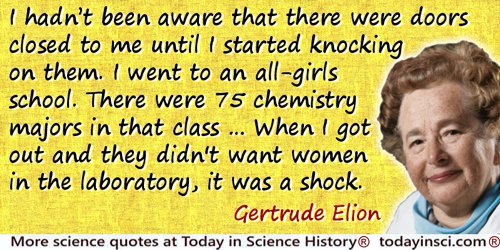
I hadn’t been aware that there were doors closed to me until I started knocking on them. I went to an all-girls school. There were 75 chemistry majors in that class, but most were going to teach it … When I got out and they didn't want women in the laboratory, it was a shock … It was the Depression and nobody was getting jobs. But I had taken that to mean nobody was getting jobs … [when I heard] “You're qualified. But we’ve never had a woman in the laboratory before, and we think you’d be a distracting influence.”
As quoted in Sharon Bertsch McGrayne, Nobel Prize Women in Science: Their Lives, Struggles and Momentous Discoveries (1993).
I have a true aversion to teaching. The perennial business of a professor of mathematics is only to teach the ABC of his science; most of the few pupils who go a step further, and usually to keep the metaphor, remain in the process of gathering information, become only Halbwisser [one who has superficial knowledge of the subject], for the rarer talents do not want to have themselves educated by lecture courses, but train themselves. And with this thankless work the professor loses his precious time.
Letter to Heinrich Olbers (26 Oct 1802). Quoted in G. Waldo Dunnington, Carl Friedrich Gauss: Titan of Science (2004), 414.
I have no fault to find with those who teach geometry. That science is the only one which has not produced sects; it is founded on analysis and on synthesis and on the calculus; it does not occupy itself with the probable truth; moreover it has the same method in every country.
In Oeuvres de Frederic Le Grand edited by J.D.E. Preuss (1849), Vol. 7, 100. In Robert Édouard Moritz, Memorabilia Mathematica (1917), 310.
I know that most men, including those at ease with problems of the greatest complexity, can seldom accept even the simplest and most obvious truth if it be such as would oblige them to admit the falsity of conclusions which they have delighted in explaining to colleagues, which they have proudly taught to others, and which they have woven, thread by thread, into the fabric of their lives.
First sentence in Chap. 14, of What is Art?, (1898), collected in The Works of Tolstóy (1929), Vol. 18, 218, as translated from the original Russian manuscript, by Aylmer Maude.
I learned easily mathematics and physics, as far as these sciences were taken in consideration in the school. I found in this ready help from my father, who loved science and had to teach it himself. He enjoyed any explanation he could give us about Nature and her ways. Unhappily, he had no laboratory and could not perform experiments.
About her childhood schooling. As translated by Charlotte and Vernon Kellogg in Marie Curie, 'Autobiographical Notes', Pierre Curie (1923), 188. [Her father, Władysław Skłodowski, had studied Physics and Mathematics at the St. Petersburg University. For the early years of his career, he was a teacher in Warsaw schools. —Webmaster]]
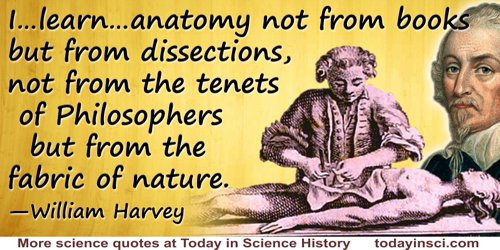
I profess to learn and to teach anatomy not from books but from dissections, not from the tenets of Philosophers but from the fabric of Nature.
De Motu Cordis (1628), The Circulation of the Blood and Other Writings, trans. Kenneth J. Franklin (1957), Dedication to Doctor Argent, 7.
I realize that Galen called an earth which contained metallic particles a mixed earth when actually it is a composite earth. But it behooves one who teaches others to give exact names to everything.
As translated by Mark Chance Bandy and Jean A. Bandy from the first Latin Edition of 1546 in De Natura Fossilium: (Textbook of Mineralogy) (2004), 19. Originally published by Geological Society of America as a Special Paper (1955). There are other translations with different wording.
I recall my own emotions: I had just been initiated into the mysteries of the complex number. I remember my bewilderment: here were magnitudes patently impossible and yet susceptible of manipulations which lead to concrete results. It was a feeling of dissatisfaction, of restlessness, a desire to fill these illusory creatures, these empty symbols, with substance. Then I was taught to interpret these beings in a concrete geometrical way. There came then an immediate feeling of relief, as though I had solved an enigma, as though a ghost which had been causing me apprehension turned out to be no ghost at all, but a familiar part of my environment.
In Tobias Dantzig and Joseph Mazur (ed.), 'The Two Realities', Number: The Language of Science (1930, ed. by Joseph Mazur 2007), 254.
I should rejoice to see mathematics taught with that life and animation which the presence and example of her young and buoyant sister [natural and experimental science] could not fail to impart, short roads preferred to long ones.
From Presidential Address (1869) to the British Association, Exeter, Section A, collected in Collected Mathematical Papers of Lames Joseph Sylvester (1908), Vol. 2, 657.
I think it’s a very valuable thing for a doctor to learn how to do research, to learn how to approach research, something there isn't time to teach them in medical school. They don't really learn how to approach a problem, and yet diagnosis is a problem; and I think that year spent in research is extremely valuable to them.
On mentoring a medical student.
On mentoring a medical student.
Quoted in interview by Mary Ellen Avery (1997)
I went to the woods because I wished to live deliberately, to front only the essential facts of life, and see if I could not learn what it had to teach, and not, when I came to die, discover that I had not lived.
Walden (1854), 143.
I would say here something that was heard from an ecclesiastic of the most eminent degree [Cardinal Baronius (1538-1607)]: “That the intention of the holy ghost is to teach us how one goes to heaven, not how heaven goes.”
Letter to Madame Christina of Lorraine, Grand Duchess of Tuscany: concerning the Use of Biblical Quotations in Matters of Science (1611 5), trans. Stillman Drake, Discoveries and Opinions of Galileo (1957), 186.
I would say here something that was heard from an ecclesiastic of the most eminent degree: 'That the intention of the Holy Ghost is to teach us how one goes to heaven, not how heaven goes.
Letter to Cristina di Lorena, Grand Duchess of Tuscany (the mother of his patron Cosmo), 1615. Translation as given in the Galilean Library web page www.galilean-library.org/manuscript.php?postid=43841.
I would teach the world that science is the best way to understand the world, and that for any set of observations, there is only one correct explanation. Also, science is value-free, as it explains the world as it is. Ethical issues arise only when science is applied to technology – from medicine to industry.
Response to question “What is the one thing everyone should learn about science?” in 'Life Lessons' The Guardian (7 Apr 2005).
I, Galileo Galilei, son of the late Vincenzo Galilei, of Florence, aged seventy years, being brought personally to judgment, and kneeling before your Most Eminent and Most Reverend Lords Cardinals, General Inquisitors of the universal Christian republic against heretical depravity, having before my eyes the Holy Gospels, which I touch with my own hands, swear that I have always believed, and now believe, and with the help of God will in future believe, every article which the Holy Catholic and Apostolic Church of Rome holds, teaches, and preaches. But because I have been enjoined by this Holy Office altogether to abandon the false opinion which maintains that the sun is the centre and immovable, and forbidden to hold, defend, or teach the said false doctrine in any manner, and after it hath been signified to me that the said doctrine is repugnant with the Holy Scripture, I have written and printed a book, in which I treat of the same doctrine now condemned, and adduce reasons with great force in support of the same, without giving any solution, and therefore have been judged grievously suspected of heresy; that is to say, that I held and believed that the sun is the centre of the universe and is immovable, and that the earth is not the centre and is movable; willing, therefore, to remove from the minds of your Eminences, and of every Catholic Christian, this vehement suspicion rightfully entertained toward me, with a sincere heart and unfeigned faith, I abjure, curse, and detest the said errors and heresies, and generally every other error and sect contrary to Holy Church; and I swear that I will never more in future say or assert anything verbally, or in writing, which may give rise to a similar suspicion of me; but if I shall know any heretic, or anyone suspected of heresy, that I will denounce him to this Holy Office, or to the Inquisitor or Ordinary of the place where I may be; I swear, moreover, and promise, that I will fulfil and observe fully, all the penances which have been or shall be laid on me by this Holy Office. But if it shall happen that I violate any of my said promises, oaths, and protestations (which God avert!), I subject myself to all the pains and punishments which have been decreed and promulgated by the sacred canons, and other general and particular constitutions, against delinquents of this description. So may God help me, and his Holy Gospels which I touch with my own hands. I, the above-named Galileo Galilei, have abjured, sworn, promised, and bound myself as above, and in witness thereof with my own hand have subscribed this present writing of my abjuration, which I have recited word for word. At Rome, in the Convent of Minerva, June 22, 1633. I, Galileo Galilei, have abjured as above with my own hand.
Abjuration, 22 Jun 1633. In J.J. Fahie, Galileo, His Life and Work (1903), 319-321.
I’ll teach you differences.
King Lear (1605-6), I, iv.
If a teacher is full of his subject, and can induce enthusiasm in his pupils; if his facts are concrete and naturally connected, the amount of material that an average child can assimilate without injury is as astonishing as is the little that will fag him if it is a trifle above or below or remote from him, or taught dully or incoherently.
In The North American Review (Mar 1883), No. 316, 289.
If I am given a sign [formula], and I am ignorant of its meaning, it cannot teach me anything, but if I already know it what does the formula teach me?
In De Magistro (400s), Book 1, chap 10, 23. As quoted in Ettore Carruccio, Mathematics And Logic in History And in Contemporary Thought (1964), 152.
If I had been taught from my youth all the truths of which I have since sought out demonstrations, and had thus learned them without labour, I should never, perhaps, have known any beyond these; at least, I should never have acquired the habit and the facility which I think I possess in always discovering new truths in proportion as I give myself to the search.
In Discours de la Méthode (1637). In English from John Veitch (trans.), A Discourse on Method (1912), 57.
If it is good to teach students about the chemical industry then why is it not good to assign ethical qualities to substances along with their physical and chemical ones? We might for instance say that CS [gas] is a bad chemical because it can only ever be used by a few people with something to protect against many people with nothing to lose. Terylene or indigotin are neutral chemicals. Under capitalism their production is an exploitive process, under socialism they are used for the common good. Penicillin is a good chemical.
Quoted in T. Pateman (ed.), Countercourse (1972), 215.
If one purges the Judaism of the Prophets and Christianity as Jesus Christ taught it of all subsequent additions, especially those of the priests, one is left with a teaching which is capable of curing all the social ills of humanity.
…...
If the study of all these sciences which we have enumerated, should ever bring us to their mutual association and relationship, and teach us the nature of the ties which bind them together, I believe that the diligent treatment of them will forward the objects which we have in view, and that the labor, which otherwise would be fruitless, will be well bestowed.
— Plato
…...
If today you can take a thing like evolution and make it a crime to teach it in the public schools, tomorrow you can make it a crime to teach it in the private schools, and next year you can make it a crime to teach it to the hustings or in the church. At the next session you may ban books and the newspapers. Soon you may set Catholic against Protestant and Protestant against Protestant, and try to foist your own religion upon the minds of men. If you can do one you can do the other. Ignorance and fanaticism are ever busy and need feeding. Always it is feeding and gloating for more. Today it is the public school teachers; tomorrow the private. The next day the preachers and the lecturers, the magazines, the books, the newspapers. After a while, Your Honor, it is the setting of man against man and creed against creed until with flying banners and beating drums we are marching backward to the glorious ages of the sixteenth century when bigots lighted fagots to burn the men who dared to bring any intelligence and enlightenment and culture to the human mind.
Darrow’s concluding remarks before adjournment of the second day of the Scopes Monkey Trial, Dayton, Tennessee (Monday, 13 Jul 1925). In The World's Most Famous Court Trial: Tennessee Evolution Case: a Complete Stenographic Report of the Famous Court Test of the Tennessee Anti-Evolution Act, at Dayton, July 10 to 21, 1925 (1925), Second Day's Proceedings, 87.
![Jane Goodall quote: If you look into their [chimpanzees] eyes, you know you’re looking into a thinking mind. They teach us that](https://todayinsci.com/G/Goodall_Jane/GoodallJane-Eyes500x250px.jpg)
If you look into their [chimpanzees] eyes, you know you’re looking into a thinking mind. They teach us that we are not the only beings with personalities, minds capable of rational thought, altruism and a sense of humor. That leads to new respect for other animals, respect for the environment and respect for all life.
From interview by Tamar Lewin, 'Wildlife to Tireless Crusader, See Jane Run', New York Times (20 Nov 2000), F35.
If you want to build a ship, don’t recruit the men to gather the wood, divide the work and give orders. Instead, teach them to yearn for vast and endless sea.
Not found as such in a work by Saint-Exupéry. Probably an anonymous paraphrase of a related passage in Citadelle (1948), section 75, 687. See the quote beginning, “One will weave the canvas…” on the Antoine de Saint-Exupéry Quotes page of this website.
In 1925 [state legislators] prohibited by law the teaching of evolution in Tennessee. … Anti-evolutionists feared that a scientific idea would undermine religious belief. In the present…, pro-evolutionists fear that a religious idea will undermine scientific belief. The former had insufficient confidence in religion; the latter, insufficient confidence in science.
In Building a Bridge to the 18th Century: How the Past Can Improve Our Future (1999), 167.
In addition to instructing them in the holy Scriptures, they also taught their pupils poetry, astronomy, and the calculation of the church calendar.
— Bede
Referring to the teaching methods of Theodore, Archbishop of Canterbury, and Hadrian, abbot of Canterbury (A.D. 669).
In an era in which the domain of intellect and politics were almost exclusively male, Theon [her father] was an unusually liberated person who taught an unusually gifted daughter [Hypatia] and encouraged her to achieve things that, as far as we know, no woman before her did or perhaps even dreamed of doing.
From 'Hypatia', in Louise S. Grinstein (ed.), Women of Mathematics, (1987), 74.
In my opinion the English excel in the art of writing text-books for mathematical teaching; as regards the clear exposition of theories and the abundance of excellent examples, carefully selected, very few books exist in other countries which can compete with those of Salmon and many other distinguished English authors that could be named.
In Projective Geometry (1886), Preface.
In my opinion, there is absolutely no trustworthy proof that talents have been improved by their exercise through the course of a long series of generations. The Bach family shows that musical talent, and the Bernoulli family that mathematical power, can be transmitted from generation to generation, but this teaches us nothing as to the origin of such talents. In both families the high-watermark of talent lies, not at the end of the series of generations, as it should do if the results of practice are transmitted, but in the middle. Again, talents frequently appear in some member of a family which has not been previously distinguished.
In 'On Heredity', Essays upon Heredity and Kindred Biological Problems (1889), Vol. 1, 95-96.
In seed time learn, in harvest teach, in winter enjoy.
In 'Proverbs', The Poems: With Specimens of the Prose Writings of William Blake (1885), 279.
In teaching man, experimental science results in lessening his pride more and more by proving to him every day that primary causes, like the objective reality of things, will be hidden from him forever and that he can only know relations.
…...
In the end, we conserve only what we love. We will love only what we understand. We will understand only what we are taught.
…...
In the history of science and throughout the whole course of its progress we see certain epochs following one another more or less rapidly. Some important view is expressed, it may be original or only revived; sooner or later it receives recognition; fellow-Workers spring up; the outcome of it finds its way into the schools; it is taught and handed down; and we observe, unhappily, that it does not in the least matter whether the view be true or false. In either case its course is the same; in either case it comes in the end to he a mere phrase, a lifeless word stamped on the memory.
In The Maxims and Reflections of Goethe (1906), 184.
In the information age, you don’t teach philosophy as they did after feudalism. You perform it. If Aristotle were alive today he’d have a talk show.
…...
In the patient who succumbed, the cause of death was evidently something which was not found in the patient who recovered; this something we must determine, and then we can act on the phenomena or recognize and foresee them accurately. But not by statistics shall we succeed in this; never have statistics taught anything, and never can they teach anything about the nature of the phenomenon.
From An Introduction to the Study of Experimental Medicine (1865), as translated by Henry Copley Greene (1957), 138.
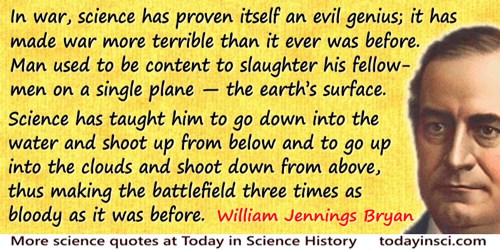
In war, science has proven itself an evil genius; it has made war more terrible than it ever was before. Man used to be content to slaughter his fellowmen on a single plane—the earth’s surface. Science has taught him to go down into the water and shoot up from below and to go up into the clouds and shoot down from above, thus making the battlefield three times as bloody as it was before; but science does not teach brotherly love. Science has made war so hellish that civilization was about to commit suicide; and now we are told that newly discovered instruments of destruction will make the cruelties of the late war seem trivial in comparison with the cruelties of wars that may come in the future.
Proposed summation written for the Scopes Monkey Trial (1925), in Genevieve Forbes Herrick and John Origen Herrick, The Life of William Jennings Bryan (1925), 405. This speech was prepared for delivery at the trial, but was never heard there, as both sides mutually agreed to forego arguments to the jury.
Indeed, the aim of teaching [mathematics] should be rather to strengthen his [the pupil’s] faculties, and to supply a method of reasoning applicable to other subjects, than to furnish him with an instrument for solving practical problems.
In John Perry (ed.), Discussion on the Teaching of Mathematics (1901), 84. The discussion took place on 14 Sep 1901 at the British Association at Glasgow, during a joint meeting of the mathematics and physics sections with the education section. The proceedings began with an address by John Perry. Magnus spoke in the Discussion that followed.
Introductory physics courses are taught at three levels: physics with calculus, physics without calculus, and physics without physics.
…...
It has been said that numbers rule the world; but I know that the numbers teach us, whether it is governed well or badly.
English using Google translate from the original German, “Man hat behauptet, die Welt werde durch Zahlen regiert; das aber weiss ich, dass die Zahlen uns belehren, ob sie gut oder schlecht regiert werde,” in J.P. Eckermann, entry for Sonntag den 31 Januar 1830', Gespräche mit Goethe (1836), 180. However, notice that in the original context, the sense of Zahen is “pay.” In the translation by S.M. Fuller, the full context is thus: “Goethe read in the French periodical, the ‘Times,’ an article on the enormous salaries of the English clergy, who receive more than all other ecclesiastics in Christendom put together. ‘It has been maintained,’ said Goethe, ‘that the world is governed by pay; this I know, by examining the distribution of pay, we can find out whether it is well or ill governed.’” In J.P. Eckermann and S.M. Fuller (trans.), 'Sunday, 31st January', Conversations with Goethe in the Last Years of His Life (1839), 336. Yet commonly seen on the web as “It has been said that figures rule the world. Maybe. But I am sure that figures show us whether it is being ruled well or badly.”
It has long been a complaint against mathematicians that they are hard to convince: but it is a far greater disqualification both for philosophy, and for the affairs of life, to be too easily convinced; to have too low a standard of proof. The only sound intellects are those which, in the first instance, set their standards of proof high. Practice in concrete affairs soon teaches them to make the necessary abatement: but they retain the consciousness, without which there is no sound practical reasoning, that in accepting inferior evidence because there is no better to be had, they do not by that acceptance raise it to completeness.
In An Examination of Sir William Hamilton’s Philosophy (1878), 611.
It is above all the duty of the methodical text-book to adapt itself to the pupil’s power of comprehension, only challenging his higher efforts with the increasing development of his imagination, his logical power and the ability of abstraction. This indeed constitutes a test of the art of teaching, it is here where pedagogic tact becomes manifest. In reference to the axioms, caution is necessary. It should be pointed out comparatively early, in how far the mathematical body differs from the material body. Furthermore, since mathematical bodies are really portions of space, this space is to be conceived as mathematical space and to be clearly distinguished from real or physical space. Gradually the student will become conscious that the portion of the real space which lies beyond the visible stellar universe is not cognizable through the senses, that we know nothing of its properties and consequently have no basis for judgments concerning it. Mathematical space, on the other hand, may be subjected to conditions, for instance, we may condition its properties at infinity, and these conditions constitute the axioms, say the Euclidean axioms. But every student will require years before the conviction of the truth of this last statement will force itself upon him.
In Methodisches Lehrbuch der Elementar-Mathemalik (1904), Teil I, Vorwort, 4-5.
It is almost a miracle that modern teaching methods have not yet entirely strangled the holy curiousity of inquiry; for what this delicate little plant needs more than anything, besides stimulation, is freedom.
Quoted in H. Eves, Return to Mathematical Circles.
It is better to have a few forms well known than to teach a little about many hundred species. Better a dozen specimens thoroughly studied as the result of the first year’s work, than to have two thousand dollars’ worth of shells and corals bought from a curiosity-shop. The dozen animals would be your own.
Lecture at a teaching laboratory on Penikese Island, Buzzard's Bay. Quoted from the lecture notes by David Starr Jordan, Science Sketches (1911), 147.
It is better to teach the child arithmetic and Latin grammar than rhetoric and moral philosophy, because they require exactitude of performance it is made certain that the lesson is mastered, and that power of performance is worth more than knowledge.
In Lecture on 'Education'. Collected in J.E. Cabot (ed.), The Complete Works of Ralph Waldo Emerson: Lectures and Biographical Sketches (1883), 145.
It is good to realize that if love and peace can prevail on Earth, and if we can teach our children to honor nature’s gifts, the joys and beauties of the outdoors will be here forever.
…...
It is noble to teach oneself, but still nobler to teach others and less trouble.
Attributed (doubtfully?) to Max Planck. Widely seen on the web, but always without citation. Webmaster has not yet found any evidence in print that this is a valid Planck quote, and must be skeptical that it is. Contact Webmaster if you know a primary source.
It is not enough to teach man a specialty. Through it he may become a kind of useful machine, but not a harmoniously developed personality. It is essential that the student acquire an understanding of and a lively feeling for values. He must acquire a vivid sense of the beautiful and of the morally good. Otherwise he—with his specialized knowledge—more closely resembles a well-trained dog than a harmoniously developed person.
From interview with Benjamin Fine, 'Einstein Stresses Critical Thinking', New York Times (5 Oct 1952), 37.
It is the duty of every man of good will to strive steadfastly in his own little world to make this teaching of pure humanity a living force, so far as he can. If he makes an honest attempt in this direction without being crushed and trampled under foot by his contemporaries, he may consider himself and the community to which he belongs lucky.
…...
It is the malady of our age that the young are so busy teaching us that they have no time left to learn.
In Reflections on the Human Condition (1973), 22.
It is, so to speak, a scientific tact, which must guide mathematicians in their investigations, and guard them from spending their forces on scientifically worthless problems and abstruse realms, a tact which is closely related to esthetic tact and which is the only thing in our science which cannot be taught or acquired, and is yet the indispensable endowment of every mathematician.
In Die Entwickelung der Mathematik in den letzten Jahrhunderten (1869), 28. As translated in Robert Édouard Moritz, Memorabilia Mathematica; Or, The Philomath’s Quotation-book (1914), 92. From the original German, “Es ist, so zu sagen, ein wissenschaftlicher Tact, welcher die Mathematiker bei ihren Untersuchungen leiten, und sie davor bewahren muss, ihre Kräfte auf wissenschaftlich werthlose Probleme und abstruse Gebiete zu wenden, ein Tact, der dem ästhetischen nahe verwandt, das einzige ist, was in unserer Wissenschaft nicht gelehrt und gelernt werden kann, aber eine unentbehrliche Mitgift eines Mathematikers sein sollte.”
It may sound like a lot of work to keep up with organic chemistry, and it is; however, those who haven't the time to do it become subject to decay in the ability to teach and to contribute to the Science—a sort of first-order process the half-life of which can't be much more than a year or two.
Highlights of Organic Chemistry: An Advanced Textbook (1974), 112.
It’s always been true that whatever pleases teaches more efficiently.
In 'Classroom Without Walls', Explorations (May 1957), No. 7. Collected in Edmund Carpenter and Marshall McLuhan (eds.), Explorations in Communication, an Anthology (1960), 3.
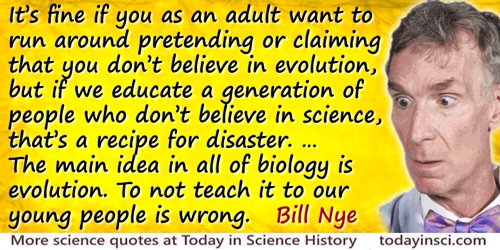
It’s fine if you as an adult want to run around pretending or claiming that you don’t believe in evolution, but if we educate a generation of people who don’t believe in science, that’s a recipe for disaster. … The main idea in all of biology is evolution. To not teach it to our young people is wrong.
— Bill Nye
As quoted in Sarah Fecht, 'Science Guy Bill Nye Explains Why Evolution Belongs in Science Education', Popular Mechanics (4 Feb 2011).
J. J. Sylvester was an enthusiastic supporter of reform [in the teaching of geometry]. The difference in attitude on this question between the two foremost British mathematicians, J. J. Sylvester, the algebraist, and Arthur Cayley, the algebraist and geometer, was grotesque. Sylvester wished to bury Euclid “deeper than e’er plummet sounded” out of the schoolboy’s reach; Cayley, an ardent admirer of Euclid, desired the retention of Simson’s Euclid. When reminded that this treatise was a mixture of Euclid and Simson, Cayley suggested striking out Simson’s additions and keeping strictly to the original treatise.
In History of Elementary Mathematics (1910), 285.
Just as in the animal and vegetable kingdoms, an individual comes into being, so to speak, grows, remains in being, declines and passes on, will it not be the same for entire species? If our faith did not teach us that animals left the Creator's hands just as they now appear and, if it were permitted to entertain the slightest doubt as to their beginning and their end, may not a philosopher, left to his own conjectures, suspect that, from time immemorial, animal life had its own constituent elements, scattered and intermingled with the general body of matter, and that it happened when these constituent elements came together because it was possible for them to do so; that the embryo formed from these elements went through innumerable arrangements and developments, successively acquiring movement, feeling, ideas, thought, reflection, consciousness, feelings, emotions, signs, gestures, sounds, articulate sounds, language, laws, arts and sciences; that millions of years passed between each of these developments, and there may be other developments or kinds of growth still to come of which we know nothing; that a stationary point either has been or will be reached; that the embryo either is, or will be, moving away from this point through a process of everlasting decay, during which its faculties will leave it in the same way as they arrived; that it will disappear for ever from nature-or rather, that it will continue to exist there, but in a form and with faculties very different from those it displays at this present point in time? Religion saves us from many deviations, and a good deal of work. Had religion not enlightened us on the origin of the world and the universal system of being, what a multitude of different hypotheses we would have been tempted to take as nature's secret! Since these hypotheses are all equally wrong, they would all have seemed almost equally plausible. The question of why anything exists is the most awkward that philosophy can raise- and Revelation alone provides the answer.
Thoughts on the Interpretation of Nature and Other Philosophical Works (1753/4), ed. D. Adams (1999), Section LVIII, 75-6.
Lectures which really teach will never be popular; lectures which are popular will never really teach.
(1846.) In Bence Jones (ed.), The Life and Letters of Michael Faraday (1870), Vol. 2, 228. Faraday made this statement to the Secretary of the Royal Institution who consulted him regarding evening lectures. Faraday’s reply began with, “I see no objection to evening lectures if you can find a fit man to give them. As to popular lectures (which at the same time are to be respectable and sound), none are more difficult to find.”
Let us only imagine that birds had studied their own development and that it was they in turn who investigated the structure of the adult mammal and of man. Wouldn’t their physiological textbooks teach the following? “Those four and two-legged animals bear many resemblances to embryos, for their cranial bones are separated, and they have no beak, just as we do in the first live or six days of incubation; their extremities are all very much alike, as ours are for about the same period; there is not a single true feather on their body, rather only thin feather-shafts, so that we, as fledglings in the nest, are more advanced than they shall ever be … And these mammals that cannot find their own food for such a long time after their birth, that can never rise freely from the earth, want to consider themselves more highly organized than we?”
Über Entwicklungsgeschichte der Thiere: Beobachtung und Reflexion (1828), 203. Trans. Stephen Jay Gould, Ontogeny and Phylogeny (1977), 54.
Liebig taught the world two great lessons. The first was that in order to teach chemistry it was necessary that students should be taken into a laboratory. The second lesson was that he who is to apply scientific thought and method to industrial problems must have a thorough knowledge of the sciences. The world learned the first lesson more readily than it learned the second.
Ira Remsen, Address to the Industrial Chemistry Society, Glasgow (1910). Quoted in Frederick Hutton Getman, The Life of Ira Remsen (1980), 121-122.
Life is good for only two things: to do mathematics and to teach it.
From François Arago, 'Mort de Poisson', Œvres Complètes de François Arago (1854), Vol.2, 662, translated by Webmaster from the original French, “La vie n’est bonne qu’à deux choses: à faire des mathématiques et à les professer.” Quote introduced by Arago as “Poisson … avait l’habitude de dire” (“Poisson … used to say”). Also seen in a book of quotes, Alphonse Rebière (ed.), Mathématiques et Mathématiciens: Pensées et Curiosités (1893), 158, as “La vie n’est bonne qu'à étudier et à enseigner les mathématiques”, which Webmaster translates as “Life is good only to study and to teach mathematics”. Also currently found online as “La vie n’est bonne que pour deux choses: découvrir les mathématiques et enseigner les mathématiques”, translated as “Life is good for only two things, discovering mathematics and teaching mathematics”, in Howard Whitley Eves, Mathematical Circles Adieu: A Fourth Collection of Mathematical Stories and Anecdotes (1977), 22. Arago was a contemporary of Poisson, and Webmaster speculates from the context of the biography that perhaps Arago knew the quote firsthand from Poisson. Webmaster has not yet been able to trace either version to a primary source written by Poisson. (Can you help?)
Logic does not pretend to teach the surgeon what are the symptoms which indicate a violent death. This he must learn from his own experience and observation, or from that of others, his predecessors in his peculiar science. But logic sits in judgment on the sufficiency of that observation and experience to justify his rules, and on the sufficiency of his rules to justify his conduct. It does not give him proofs, but teaches him what makes them proofs, and how he is to judge of them.
In A System of Logic, Ratiocinative and Inductive: Being a Connected View of the Principles of Evidence, and the Methods of Scientific Investigation (1843), Vol. 1, 11.
Logic has borrowed the rules of geometry without understanding its power. … I am far from placing logicians by the side of geometers who teach the true way to guide the reason. … The method of avoiding error is sought by every one. The logicians profess to lead the way, the geometers alone reach it, and aside from their science there is no true demonstration.
From De l’Art de Persuader, (1657). Pensées de Pascal (1842), Part 1, Article 3, 41-42. As translated in Robert Édouard Moritz, Memorabilia Mathematica; Or, The Philomath’s Quotation-Book (1914), 202. From the original French, “La logique a peut-être emprunté les règles de la géométrie sans en comprendre la force … je serai bien éloigné de les mettre en parallèle avec les géomètres, qui apprennent la véritable méthode de conduire la raison. … La méthode de ne point errer est recherchée de tout le monde. Les logiciens font profession d'y conduire, les géomètres seuls y arrivent; et, hors de leur science …, il n'y a point de véritables démonstrations ….”
Logic teaches us that on such and such a road we are sure of not meeting an obstacle; it does not tell us which is the road that leads to the desired end. For this, it is necessary to see the end from afar, and the faculty which teaches us to see is intuition. Without it, the geometrician would be like a writer well up in grammar but destitute of ideas.
…...
Man, so far as natural science by itself is able to teach us, is no longer the final cause of the universe, the heaven-descended heir of all the ages. His very existence is an accident, his story a brief and discreditable episode in the life of one of the meanest of the planets. Of the combination of causes which first converted a piece or pieces of unorganised jelly into the living progenitors of humanity, science indeed, as yet, knows nothing.
In 'The Religion of Humanity', Essays and Addresses by the Right Hon. Arthur J. Balfour (1893), 307.
Mathematical instruction, in this as well as in other countries, is laboring under a burden of century-old tradition. Especially is this so with reference to the teaching of geometry. Our texts in this subject are still patterned more or less closely after the model of Euclid, who wrote over two thousand years ago, and whose text, moreover, was not intended for the use of boys and girls, but for mature men.
In Lectures on Fundamental Concepts of Algebra and Geometry (1911), 5.
Mathematics gives the young man a clear idea of demonstration and habituates him to form long trains of thought and reasoning methodically connected and sustained by the final certainty of the result; and it has the further advantage, from a purely moral point of view, of inspiring an absolute and fanatical respect for truth. In addition to all this, mathematics, and chiefly algebra and infinitesimal calculus, excite to a high degree the conception of the signs and symbols—necessary instruments to extend the power and reach of the human mind by summarizing an aggregate of relations in a condensed form and in a kind of mechanical way. These auxiliaries are of special value in mathematics because they are there adequate to their definitions, a characteristic which they do not possess to the same degree in the physical and mathematical [natural?] sciences.
There are, in fact, a mass of mental and moral faculties that can be put in full play only by instruction in mathematics; and they would be made still more available if the teaching was directed so as to leave free play to the personal work of the student.
There are, in fact, a mass of mental and moral faculties that can be put in full play only by instruction in mathematics; and they would be made still more available if the teaching was directed so as to leave free play to the personal work of the student.
In 'Science as an Instrument of Education', Popular Science Monthly (1897), 253.
Mathematics will not be properly esteemed in wider circles until more than the a b c of it is taught in the schools, and until the unfortunate impression is gotten rid of that mathematics serves no other purpose in instruction than the formal training of the mind. The aim of mathematics is its content, its form is a secondary consideration and need not necessarily be that historic form which is due to the circumstance that mathematics took permanent shape under the influence of Greek logic.
In Die Entivickelung der Mathematik in den letzten Jahrhunderten (1884), 6.
Mathematics, among all school subjects, is especially adapted to further clearness, definite brevity and precision in expression, although it offers no exercise in flights of rhetoric. This is due in the first place to the logical rigour with which it develops thought, avoiding every departure from the shortest, most direct way, never allowing empty phrases to enter. Other subjects excel in the development of expression in other respects: translation from foreign languages into the mother tongue gives exercise in finding the proper word for the given foreign word and gives knowledge of laws of syntax, the study of poetry and prose furnish fit patterns for connected presentation and elegant form of expression, composition is to exercise the pupil in a like presentation of his own or borrowed thoughtsand their development, the natural sciences teach description of natural objects, apparatus and processes, as well as the statement of laws on the grounds of immediate sense-perception. But all these aids for exercise in the use of the mother tongue, each in its way valuable and indispensable, do not guarantee, in the same manner as mathematical training, the exclusion of words whose concepts, if not entirely wanting, are not sufficiently clear. They do not furnish in the same measure that which the mathematician demands particularly as regards precision of expression.
In Anleitung zum mathematischen Unterricht in höheren Schulen (1906), 17.
Maybe the situation is hopeless. Television is just the wrong medium, at least in prime time, to teach science. I think it is hopeless if it insists on behaving like television… The people who produce these programs always respond to such complaints by insisting that no one would watch a program consisting of real scientists giving real lectures to real students. If they are right, then this sort of program is just another form of entertainment.
(1986).
Men of science, fit to teach, hardly exist. There is no demand for such men. The sciences make up life; they are important to life. The highly educated man fails to understand the simplest things of science, and has no peculiar aptitude for grasping them. I find the grown-up mind coming back to me with the same questions over and over again.
Giving Evidence (18 Nov 1862) to the Public Schools Commission. As quoted in John L. Lewis, 125 Years: The Physical Society & The Institute of Physics (1999), 168.
Modern anthropology has taught us, through comparative investigation of so-called primitive cultures, that the social behavior of human beings may differ greatly, depending upon prevailing cultural patterns and the types of organisation which predominate in society. It is on this that those who are striving to improve the lot of man may ground their hopes: human beings are not condemned, because of their biological constitution, to annihilate each other or to be at the mercy of a cruel, self-inflicted fate.
…...
Modern Physics impresses us particularly with the truth of the old doctrine which teaches that there are realities existing apart from our sense-perceptions, and that there are problems and conflicts where these realities are of greater value for us than the richest treasures of the world of experience.
In The Universe in the Light of Modern Physics (1931), 107.
Modern warfare is in every respect so horrifying, that scientific people will only regret that it draws its means from the progress of the sciences. I hope that the present war [World War I] will teach the peoples of Europe a lasting lesson and bring the friends of peace into power. Otherwise the present ruling classes will really deserve to be swept away by socialism.
Fischer to Margaret Oppenheim, 14 Dec 1917. Fischer Papers, Bancroft Library, University of California. Quotation supplied by W. H. Brock.
My grandpa taught me how to read. I read the encyclopedia when I was five.
As quoted in 'NASA Mourns the Passing of Astronaut John Young' (6 Jan 2018) on nasa.gov website.
Nature does not know extinction; all it knows is transformation. … Everything science has taught me—and continues to teach me—strengthens my belief in the continuity of our spiritual existence after death. Nothing disappears without a trace.
Wehner von Braun article in This Week Magazine (24 Jan 1960), 2. Excerpted in Viola Walden, Sword Scrapbook (1980), 66.
Nature that framed us of four elements,
Warring within our breasts for regiment,
Doth teach us all to have aspiring minds:
Our souls, whose faculties can comprehend
The wondrous architecture of the world
And measure every wandering planet’s course,
Still climbing after knowledge infinite,
And always moving as the restless spheres,
Will us to wear ourselves, and never rest…
Warring within our breasts for regiment,
Doth teach us all to have aspiring minds:
Our souls, whose faculties can comprehend
The wondrous architecture of the world
And measure every wandering planet’s course,
Still climbing after knowledge infinite,
And always moving as the restless spheres,
Will us to wear ourselves, and never rest…
From Christopher Marlowe, Arthur Henry Bullen (ed.), 'Tamburlaine the Great', The Works of Christopher Marlowe (Vol. 1, 1885), Pt 1, Act 2, Scene 7, lines 18-26.
Nearly every subject has a shadow, or imitation. It would, I suppose, be quite possible to teach a deaf and dumb child to play the piano. When it played a wrong note, it would see the frown of its teacher, and try again. But it would obviously have no idea of what it was doing, or why anyone should devote hours to such an extraordinary exercise. It would have learnt an imitation of music. and it would fear the piano exactly as most students fear what is supposed to be mathematics.
In Mathematician's Delight (1943), 8.
Negative facts when considered alone never teach us anything.
No collateral science had profited so much by palæontology as that which teaches the structure and mode of formation of the earth’s crust, with the relative position, time, and order of formation of its constituent stratified and unstratified parts. Geology has left her old hand-maiden mineralogy to rest almost wholly on the broad shoulders of her young and vigorous offspring, the science of organic remains.
In article 'Palæontology' contributed to Encyclopædia Britannica (8th ed., 1859), Vol. 17, 91.
No man who has not a decently skeptical mind can claim to be civilized. Euclid taught me that without assumptions there is no proof. Therefore, in any argument, examine the assumptions. Then, in the alleged proof, be alert for inexplicit assumptions. Euclid’s notorious oversights drove this lesson home. Thanks to him, I am (I hope!) immune to all propaganda, including that of mathematics itself.
In 'What Mathematics Has Meant to Me', Mathematics Magazine (Jan-Feb 1951), 24, 161.
No! What we need are not prohibitory marriage laws, but a reformed society, an educated public opinion which will teach individual duty in these matters. And it is to the women of the future that I look for the needed reformation. Educate and train women so that they are rendered independent of marriage as a means of gaining a home and a living, and you will bring about natural selection in marriage, which will operate most beneficially upon humanity. When all women are placed in a position that they are independent of marriage, I am inclined to think that large numbers will elect to remain unmarried—in some cases, for life, in others, until they encounter the man of their ideal. I want to see women the selective agents in marriage; as things are, they have practically little choice. The only basis for marriage should be a disinterested love. I believe that the unfit will be gradually eliminated from the race, and human progress secured, by giving to the pure instincts of women the selective power in marriage. You can never have that so long as women are driven to marry for a livelihood.
In 'Heredity and Pre-Natal Influences. An Interview With Dr. Alfred Russel Wallace', Humanitarian (1894), 4, 87.
No. I have been teaching it all my life, and I do not want to have my ideas upset.
Reply when James Clerk Maxwell’s asked if he would like to see an experimental demonstration of conical refraction. As given in James G. Crowther, The Cavendish Laboratory, 1874-1974 (1974), 9.
Not only did he teach by accomplishment, but he taught by the inspiration of a marvelous imagination that refused to accept the permanence of what appeared to others to be insuperable difficulties: an imagination of the goals of which, in a number of instances, are still in the realms of speculation.
Testimonial on Tesla’s 75th birthday, Tesla Museum, Belgrade, Serbia. In Margaret Cheney, Tesla: Man Out of Time (2001), 86.
Not to teach a class, but to conduct it: I punch the tickets and call out the stops along the way.
As quoted in Carol Edgarian and Tom Jenks (eds.), The Writer’s Life: Intimate Thoughts on Work, Love, Inspiration, and Fame from the Diaries of the World's Great Writers (1997), 16.
Now, what I want is, Facts. Teach these boys and girls nothing but Facts. Facts alone are wanted in life. Plant nothing else. And root out everything else. You can only form the minds of reasoning animals upon Facts: nothing else will ever be of any service to them. This is the principle on which I bring up my own children, and this is the principle on which I bring up these children. Stick to Facts, sir! ... In this life, we want nothing but Facts, sir: nothing but Facts!
Spoken by fictional character Thomas Gringrind, first paragraph, chap. 1, Hard Times, published in Household Words (1 Apr 1854), Vol. 36, 1.
Nursing at its highest level encompasses the teaching of the individual to know his body and its functions for the maintenance and promotion of health and prevention of disease. Self-care can be, and is, very efficacious when people are encouraged and guided to learn to care for themselves, whenever possible.
As quoted in American Nurses’ Association, Contemporary Minority Leaders in Nursing: Afro-American, Hispanic, Native American Perspectives (1983), 92.
Of course I know that “knickers” begins with a “k”. I’ve been to Oxford—it’s one of the first things they teach you.
As quoted in William Reville, 'The Science of Writing a Good Joke', The Irish Times (5 Jun 2000).
Official science is fully committed to the principle of muddling through and not looking beyond the tip of your nose. All past experience, it is said, teaches us to take only one step at a time.
From transcript of BBC radio Reith Lecture (12 Nov 1967), 'A Runaway World', on the bbc.co.uk website.
One of the grandest figures that ever frequented Eastern Yorkshire was William Smith, the distinguished Father of English Geology. My boyish reminiscence of the old engineer, as he sketched a triangle on the flags of our yard, and taught me how to measure it, is very vivid. The drab knee-breeches and grey worsted stockings, the deep waistcoat, with its pockets well furnished with snuff—of which ample quantities continually disappeared within the finely chiselled nostril—and the dark coat with its rounded outline and somewhat quakerish cut, are all clearly present to my memory.
From Reminiscences of a Yorkshire Naturalist (1896), 13.
One word characterises the most strenuous of the efforts for the advancement of science that I have made perseveringly during fifty-five years; that word is failure. I know no more of electric and magnetic force, or of the relation between ether, electricity and ponderable matter, or of chemical affinity, than I knew and tried to teach to my students of natural philosophy fifty years ago in my first session as Professor.
Address (16 Jun 1896), at Celebration for his Jubilee as Professor, at Glasgow University. Printed in The Electrician (19 Jun 1896), 37, 247.
Only the mathematically minded can really teach mathematics; and it takes a great deal of mathematics to teach any mathematics well.
In A Preface to Mathematics (1938), 75.
Our children will attain to a far more fundamental insight into language, if we, when teaching them, connect the words more with the actual perception of the thing and the object. … Our language would then again become a true language of life, that is, born of life and producing life.
In Friedrich Fröbel and Josephine Jarvis (trans.), The Education of Man (1885), 145.
Our failure to discern a universal good does not record any lack of insight or ingenuity, but merely demonstrates that nature contains no moral messages framed in human terms. Morality is a subject for philosophers, theologians, students of the humanities, indeed for all thinking people. The answers will not be read passively from nature; they do not, and cannot, arise from the data of science. The factual state of the world does not teach us how we, with our powers for good and evil, should alter or preserve it in the most ethical manner.
…...
Our indirect methods have taught us a mountain of things about horses, but if you wished to learn even more, would you rather be Whirlaway in the stretch, than interview Eddie Arcaro afterwards?
…...
Overwhelming evidences of an intelligence and benevolent intention surround us, show us the whole of nature through the work of a free will and teach us that all alive beings depend on an eternal creator-ruler.
…...
Oxford and Cambridge. The dons are too busy educating the young men to be able to teach them anything.
Samuel Butler, Henry Festing Jones (ed.), The Note-Books of Samuel Butler (1917), 222.
People have now-a-days got a strange opinion that everything should be taught by lectures. Now, I cannot see that lectures can do so much good as reading the books from which the lectures are taken. I know nothing that can best be taught by lectures, except where experiments are to be shewn. You may teach chemistry by lectures.
Elements of Chemistry (1830)
Permanence of instinct must go with permanence of form. … The history of the present must teach us the history of the past.
Referring to studying fossil remains of the weevil, largely unchanged to the present day. In Jean-Henri Fabre and Alexander Teixeira de Mattos (trans.), The Life and Love of the Insect, (1911, 1914), 183.
Philosophy may teach us to bear with equanimity the misfortunes of our neighbours, and science resolve the moral sense into a secretion of sugar, but art is what makes the life of each citizen a sacrament.
In Epigrams of Oscar Wilde (2007), 48.
Physical investigation, more than anything besides, helps to teach us the actual value and right use of the Imagination—of that wondrous faculty, which, left to ramble uncontrolled, leads us astray into a wilderness of perplexities and errors, a land of mists and shadows; but which, properly controlled by experience and reflection, becomes the noblest attribute of man; the source of poetic genius, the instrument of discovery in Science, without the aid of which Newton would never have invented fluxions, nor Davy have decomposed the earths and alkalies, nor would Columbus have found another Continent.
Presidential Address to Anniversary meeting of the Royal Society (30 Nov 1859), Proceedings of the Royal Society of London (1860), 10, 165.
Physical science has taught us to associate Deity with the normal rather than with the abnormal.
In James Wood, Dictionary of Quotations from Ancient and Modern, English and Foreign Sources (1893), 348.
Poor teaching leads to the inevitable idea that the subject [mathematics] is only adapted to peculiar minds, when it is the one universal science and the one whose four ground-rules are taught us almost in infancy and reappear in the motions of the universe.
In Mathematical Teaching (1907), 19.
Realistic thinking accrues only after mistake making, which is the cosmic wisdom's most cogent way of teaching each of us how to carry on.
In Buckminster Fuller and Answar Dil, Humans in Universe (1983), 218.
Relativity teaches us the connection between the different descriptions of one and the same reality.
…...
Research lifts teaching to a high plane. No one can be a really great educator unless he himself is an investigator.
As quoted in Vincent T. Andriole, 'Florence Rena Sabin—Teacher, Scientist, Citizen', Journal of the History of Medicine and Allied Sciences (Jul 1959), 14, No. 3, (July 1959), 325. Cited as from 'F. R. Sabin', Current Biography (Apr 1945).
Science … is teaching the world that the ultimate court of appeal is observation and experiment, and not authority; she is teaching it to estimate the value of evidence.
From lecture, 'On Zoology', delivered at The South Kensington Museum (14 May 1860), published as a 16-page pamphlet, Lectures Addressed to Teachers: Lecture IV (1869), 14. Also known in later collections by the title, 'A Lobster; or, The Study of Zoology', for example, in Twelve Lectures and Essays (1908), 128.
Science by itself produces a very badly deformed man who becomes rounded out into a useful creative being only with great difficulty and large expenditure of time. … It is a much smaller matter to both teach and learn pure science than it is to intelligently apply this science to the solution of problems as they arise in daily life.
As quoted in Gary W. Matkin, Technology Transfer and the University (1990), 24.
Science has not yet taught us if madness is or is not the sublimity of intelligence.
In Giancarlo Livraghi, The Power of Stupidity (2009), 179, but without further citation, and not yet found by Webmaster in a work before 2009. Please contact Webmaster if you know a primary source. Perhaps it is a short restatement of the quotation which begins, “Men have called me mad… ” (also on this page).
Science is teaching man to know and reverence truth, and to believe that only so far as he knows and loves it can he live worthily on earth, and vindicate the dignity of his spirit.
In Where are We and Whither Tending?: Three Lectures on the Reality and Worth of Human Progress (1886), 26.
Science makes people reach selflessly for truth and objectivity; it teaches people to accept reality, with wonder and admiration, not to mention the deep awe and joy that the natural order of things brings to the true scientist.
Lecture, Austrian UNESCO Commision (30 Mar 1953), in Atomenergie und Frieden: Lise Meitner und Otto Hahn (1953), 23-4. Trans. Ruth Sime, Lise Meitner: A Life in Physics (1996), 375.
Science seems to me to teach in the highest and strongest manner the great truth which is embodied in the Christian conception of entire surrender to the will of God. Sit down before fact as a little child, be prepared to give up every preconceived notion, follow humbly wherever and to whatever abysses nature leads, or you shall learn nothing. I have only begun to learn content and peace of mind since I have resolved at all risks to do this.
Letter to Charles Kingsley (23 Sep 1860). In L. Huxley, The Life and Letters of Thomas Henry Huxley (1903), Vol. 1, 316.
Sex is a natural function. You can’t make it happen, but you can teach people to let it happen.
NY Times 29 Oct 84
Since my first discussions of ecological problems with Professor John Day around 1950 and since reading Konrad Lorenz's “King Solomon's Ring,” I have become increasingly interested in the study of animals for what they might teach us about man, and the study of man as an animal. I have become increasingly disenchanted with what the thinkers of the so-called Age of Enlightenment tell us about the nature of man, and with what the formal religions and doctrinaire political theorists tell us about the same subject.
'Autobiography of Allan M. Cormack,' Les Prix Nobel/Nobel Lectures 1979, editted by Wilhelm Odelberg.
Since my logic aims to teach and instruct the understanding, not that it may with the slender tendrils of the mind snatch at and lay hold of abstract notions (as the common logic does), but that it may in very truth dissect nature, and discover the virtues and actions of bodies, with their laws as determined in matter; so that this science flows not merely from the nature of the mind, but also from the nature of things.
In Novum Organum (1620), Book 2, Aphorism 42.
So much is human genius limited, by the limits of human nature, that we just know what our five senses teach.
In The Works of Thomas Sydenham, (1850), Vol. 2, 182.
Some persons have contended that mathematics ought to be taught by making the illustrations obvious to the senses. Nothing can be more absurd or injurious: it ought to be our never-ceasing effort to make people think, not feel.
Seven Lectures on Shakespeare and Milton (1856) 24.
Space exploration is risky. It’s hard. And actually, let me say here that I feel like we need to take on more risk than we have been in space exploration. The public doesn’t like risk, and they hate failure. But failures happen. They shouldn’t happen for stupid reasons. But if they happen when you were trying something risky, you learn. That teaches you something. At least it should. And you try harder next time.
On the failure of the Cosmos-1 solar sail (Jun 2005).
Speak to the earth and it shall teach thee.
— Bible
Book of Job (12:8), The Holy Bible: containing the Old and New Testaments, in the Common Version (1833), 409.
Statistical accounts are to be referred to as a dictionary by men of riper years, and by young men as a grammar, to teach them the relations and proportions of different statistical subjects, and to imprint them on the mind at a time when the memory is capable of being impressed in a lasting and durable manner, thereby laying the foundation for accurate and valuable knowledge.
In The Statistical Breviary: Shewing, on a Principle Entirely New, the Resources of Every State and Kingdom in Europe (1801), 5-6.
![Thomas Clifford Allbutt quote: Students who have attended my [medical] lectures may remember that I try not only to teach them w](https://todayinsci.com/A/Allbutt_Thomas/AllbuttThomas-Doubt500x250px.jpg)
Students who have attended my [medical] lectures may remember that I try not only to teach them what we know, but also to realise how little this is: in every direction we seem to travel but a very short way before we are brought to a stop; our eyes are opened to see that our path is beset with doubts, and that even our best-made knowledge comes but too soon to an end.
In Notes on the Composition of Scientific Papers (1904), 3.
Surely the immutable laws of the universe can teach more impressive and exalted lessons than the holy books of all the religions on earth.
…...
Teach him to think for himself? Oh, my God, teach him rather to think like other people!
Expressing concern for her son’s education. In Matthew Arnold, Essays in Criticism, Second Series (1888).
Teach me your mood,
O patient stars.
Who climb each night,
the ancient sky.
leaving on space no shade, no scars,
no trace of age, no fear to die.
O patient stars.
Who climb each night,
the ancient sky.
leaving on space no shade, no scars,
no trace of age, no fear to die.
…...
Teach to the the problems, not to the text.
As quoted, without citation, in Howard W. Eves Return to Mathematical Circles, (1988), 159. [Note the E. Kim Nebeuts is probably a pen name since reversed it reads Mike Stueben —Webmaster]
Teach your tongue to say “I do not know” and you will progress.
As quoted in Robert Taylor, White Coat Tales: Medicine's Heroes, Heritage, and Misadventures (2010), 124.
Teachers should be able to teach subjects, not manuals merely.
Annual Reports of the Secretary of the Board of Education of Massachusetts for the years 1839-1844, Life and Works of Horace Mann (1891), Vol. 3, 58.
Teaching a school is but another word for sure and not very slow destruction.
In Thomas Carlyle and Charles Eliot Norton (ed.), Early Letters of Thomas Carlyle (1886), Vol. 1, 281.
Teaching is not telling. If it were telling, we’d all be so smart we couldn't stand ourselves.
Sometimes seen in recent publications attributed to Mark Twain, for example, in Thomas R. Rosebrough and Ralph G. Leverett Transformational Teaching in the Information Age (2011), 71. Also seen as “If teaching were just telling then we’d all be so smart we couldn’t stand up.” Webmaster has tried, but has not yet been able to find a primary source in Twain’s writings, and so believes “Anonymous” is the most likely source. Can you help?
Tests conducted before I graduated predicted a future for me in journalism, forestry or the teaching of music.
In 'J. Michael Bishop: Biographical', website of nobelprize.org.
That ability to impart knowledge … what does it consist of? … a deep belief in the interest and importance of the thing taught, a concern about it amounting to a sort of passion. A man who knows a subject thoroughly, a man so soaked in it that he eats it, sleeps it and dreams it—this man can always teach it with success, no matter how little he knows of technical pedagogy. That is because there is enthusiasm in him, and because enthusiasm is almost as contagious as fear or the barber’s itch. An enthusiast is willing to go to any trouble to impart the glad news bubbling within him. He thinks that it is important and valuable for to know; given the slightest glow of interest in a pupil to start with, he will fan that glow to a flame. No hollow formalism cripples him and slows him down. He drags his best pupils along as fast as they can go, and he is so full of the thing that he never tires of expounding its elements to the dullest.
This passion, so unordered and yet so potent, explains the capacity for teaching that one frequently observes in scientific men of high attainments in their specialties—for example, Huxley, Ostwald, Karl Ludwig, Virchow, Billroth, Jowett, William G. Sumner, Halsted and Osler—men who knew nothing whatever about the so-called science of pedagogy, and would have derided its alleged principles if they had heard them stated.
This passion, so unordered and yet so potent, explains the capacity for teaching that one frequently observes in scientific men of high attainments in their specialties—for example, Huxley, Ostwald, Karl Ludwig, Virchow, Billroth, Jowett, William G. Sumner, Halsted and Osler—men who knew nothing whatever about the so-called science of pedagogy, and would have derided its alleged principles if they had heard them stated.
In Prejudices: third series (1922), 241-2.
For a longer excerpt, see H.L. Mencken on Teaching, Enthusiasm and Pedagogy.
For a longer excerpt, see H.L. Mencken on Teaching, Enthusiasm and Pedagogy.
That John Thomas Scopes, heretofore on the 24th day of April, 1925, in the county aforesaid, then and there unlawfully did wilfully teach in the public schools of Rhea County, Tennessee, which said public schools are supported in part, or in whole by the public school fund of the State, a certain theory or theories that denied the story of the divine creation of man as taught in the Bible, but did teach instead thereof, that man is descended from a lower order of animals, he, the said John Thomas Scopes, being at the time, and prior thereto, a teacher in the public schools of Rhea County, Tennessee, as foresaid, against the peace and dignity of the State.
Text of the indictment of John Scopes for teaching evolution. As given in John Scopes and James Presley, Center of the Storm: Memoirs of John T. Scopes (1967),
The action of the mind in the acquisition of knowledge of any sort is synthetic-analytic; that is, uniting and separating. These are the two sides, or aspects, of the one process. … There is no such thing as a synthetic activity that is not accompanied by the analytic; and there is no analytic activity that is not accompanied by the synthetic. Children cannot be taught to perform these knowing acts. It is the nature of the mind to so act when it acts at all.
In The Public-School Journal (Jan 1895), Vol. 14, 281-282.
The Almighty lecturer, by displaying the principles of science in the structure of the universe, has invited man to study and to imitation. It is as if he had said to the inhabitants of this globe that we call ours, “I have made an earth for man to dwell upon, and I have rendered the starry heavens visible, to teach him science and the arts. He can now provide for his own comfort, and learn from my munificence to all, to be kind to all, to be kind to each other.”
In The Age of Reason: Being an Investigation of True and Fabulous Theology (27 Jan O.S. 1794), 44.
The authority of those who profess to teach is often a positive hindrance to those who desire to learn.
In De Natura Deorum: Academica (c. 45 B.C.), as translated to English (1933), 13.
The average English author [of mathematical texts] leaves one under the impression that he has made a bargain with his reader to put before him the truth, the greater part of the truth, and nothing but the truth; and that if he has put the facts of his subject into his book, however difficult it may be to unearth them, he has fulfilled his contract with his reader. This is a very much mistaken view, because effective teaching requires a great deal more than a bare recitation of facts, even if these are duly set forth in logical order—as in English books they often are not. The probable difficulties which will occur to the student, the objections which the intelligent student will naturally and necessarily raise to some statement of fact or theory—these things our authors seldom or never notice, and yet a recognition and anticipation of them by the author would be often of priceless value to the student. Again, a touch of humour (strange as the contention may seem) in mathematical works is not only possible with perfect propriety, but very helpful; and I could give instances of this even from the pure mathematics of Salmon and the physics of Clerk Maxwell.
In Perry, Teaching of Mathematics (1902), 59-61.
The description of right lines and circles, upon which geometry is founded, belongs to mechanics. Geometry does not teach us to draw these lines, but requires them to be drawn.
From Principia Mathematica, Book 1, in Author’s Preface to the translation from the Latin by Andrew Motte, as The Mathematical Principles of Natural Philosophy (1729), Vol. 1, second unpaginated page of the Preface.

The earth is large and old enough to teach us modesty.
In 'Prologue', Conversation with the Earth (1954), 8. As translated by E.B. Garside from Gespräch mit der Erde (1947).
The energy available for each individual man is his income, and the philosophy which can teach him to be content with penury should be capable of teaching him also the uses of wealth.
Science and Life: Aberdeen Addresses (1920), 6.
The ethics of science regards the search for truth as one of the highest duties of man; it regards noble human character as the finest product of evolution; it considers the service of all mankind as the universal good; it teaches that human nature and humane nurture may be improved, that reason may replace unreason, cooperation supplement competition, and the progress of the human race through future ages be promoted by intelligence and goodwill.
From Address as retiring president before the American Association for the Advancement of Science, Indianapolis (27 Dec 1937). Published in 'Science and Ethics', Science (31 Dec 1937), 86, No. 2244, 602.
The fading of ideals is sad evidence of the defeat of human endeavour. In the schools of antiquity philosophers aspired to impart wisdom, in modern colleges our humbler aim is to teach subjects
Opening lines of 'The Rhythmic Claims of Freedom and Discipline', The Aims of Education: & Other Essays (1917), 45.
The fear of mathematics is a tradition handed down from days when the majority of teachers knew little about human nature and nothing at all about the nature of mathematics itself. What they did teach was an imitation.
in Mathematician’s Delight (1946), 12.
The first steps in Agriculture, Astronomy, Zoology, (those first steps which the farmer, the hunter, and the sailor take,) teach that nature's dice are always loaded; that in her heaps and rubbish are concealed sure and useful results.
In Nature (1849), 36.
The history of mathematics may be instructive as well as agreeable; it may not only remind us of what we have, but may also teach us to increase our store. Says De Morgan, “The early history of the mind of men with regards to mathematics leads us to point out our own errors; and in this respect it is well to pay attention to the history of mathematics.” It warns us against hasty conclusions; it points out the importance of a good notation upon the progress of the science; it discourages excessive specialization on the part of the investigator, by showing how apparently distinct branches have been found to possess unexpected connecting links; it saves the student from wasting time and energy upon problems which were, perhaps, solved long since; it discourages him from attacking an unsolved problem by the same method which has led other mathematicians to failure; it teaches that fortifications can be taken by other ways than by direct attack, that when repulsed from a direct assault it is well to reconnoiter and occupy the surrounding ground and to discover the secret paths by which the apparently unconquerable position can be taken.
In History of Mathematics (1897), 1-2.
The important thing is not so much that every child should be taught, as that every child should have the opportunity of teaching itself. What does it matter if the pupil know a little more or a little less? A boy who leaves school knowing much, but hating his lessons, will soon have forgotten all he ever learned; while another who had acquired a thirst for knowledge, even if he had learned little, would soon teach himself more than the first ever knew.
[Elementary Education, Revised New Code (1871), Resolution.] Hansard's Parliamentary Debates (19 Jul 1872), vol. 207, 1463. Also in The Pleasures of Life (2007), 71.(Appleton, 1887), 183-184, or (2007), 71.
The inhabitants of the sea have much to teach us.
…...
The issue is not to teach [a child] the sciences, but to give him the taste for loving them.
Émile, or, On Education, new translation by Alan Bloom (1979), 172.
The logic of the subject [algebra], which, both educationally and scientifically speaking, is the most important part of it, is wholly neglected. The whole training consists in example grinding. What should have been merely the help to attain the end has become the end itself. The result is that algebra, as we teach it, is neither an art nor a science, but an ill-digested farrago of rules, whose object is the solution of examination problems. … The result, so far as problems worked in examinations go, is, after all, very miserable, as the reiterated complaints of examiners show; the effect on the examinee is a well-known enervation of mind, an almost incurable superficiality, which might be called Problematic Paralysis—a disease which unfits a man to follow an argument extending beyond the length of a printed octavo page.
In Presidential Address British Association for the Advancement of Science (1885), Nature, 32, 447-448.
The mathematician starts with a few propositions, the proof of which is so obvious that they are called self-evident, and the rest of his work consists of subtle deductions from them. The teaching of languages, at any rate as ordinarily practised, is of the same general nature authority and tradition furnish the data, and the mental operations are deductive.
In 'Scientific Education: Notes of an After-Dinner Speech' (Delivered to Liverpool Philomathic Society, Apr 1869), published in Macmillan’s Magazine (Jun 1869), 20, No. 116, 177. Collected in Lay Sermons, Addresses, and Reviews (1871), Chap 4, 66.
The more we study Art, the less we care for Nature. What Art really reveals to us is Nature’s lack of design, her curious crudities, her extraordinary monotony, her absolutely unfinished condition. … It is fortunate for us, however, that Nature is so imperfect, as otherwise we should have had no art at all. Art is our spirited protest, our gallant attempt to teach Nature her proper place. As for the infinite variety of Nature, that is a pure myth. It is not to be found in Nature herself. It resides in the imagination, or fancy, or cultivated blindness of the man who looks at her.
In 'Decay of Lying', The Writings of Oscar Wilde: Epigrams, Phrases and Philosophies For the Use of the Young (1907), 5.
THE OATH. I swear by Apollo [the healing God], the physician and Aesclepius [son of Apollo], and Health [Hygeia], and All-heal [Panacea], and all the gods and goddesses, that, according to my ability and judgment, I will keep this Oath and this stipulation—to reckon him who taught me this Art equally dear to me as my parents, to share my substance with him, and relieve his necessities if required; to look upon his offspring in the same footing as my own brothers, and to teach them this art, if they shall wish to learn it, without fee or stipulation; and that by precept, lecture, and every other mode of instruction, I will impart a knowledge of the Art to my own sons, and those of my teachers, and to disciples bound by a stipulation and oath according to the law of medicine, but to none others. I will follow that system of regimen which, according to my ability and judgment, I consider for the benefit of my patients, and abstain from whatever is deleterious and mischievous. I will give no deadly medicine to any one if asked, nor suggest any such counsel; and in like manner I will not give to a woman a pessary to produce abortion. With purity and with holiness I will pass my life and practice my Art. I will not cut persons laboring under the stone, but will leave this to be done by men who are practitioners of this work. Into whatever houses I enter, I will go into them for the benefit of the sick, and will abstain from every voluntary act of mischief and corruption; and, further, from the seduction of females or males, of freemen and slaves. Whatever, in connection with my professional practice or not, in connection with it, I see or hear, in the life of men, which ought not to be spoken of abroad, I will not divulge, as reckoning that all such should be kept secret. While I continue to keep this Oath unviolated, may it be granted to me to enjoy life and the practice of the art, respected by all men, in all times! But should I trespass and violate this Oath, may the reverse be my lot!
The Genuine Works of Hippocrates, trans. Francis Adams (1886), Vol. 2, 344-5.
The peculiar character of mathematical truth is, that it is necessarily and inevitably true; and one of the most important lessons which we learn from our mathematical studies is a knowledge that there are such truths, and a familiarity with their form and character.
This lesson is not only lost, but read backward, if the student is taught that there is no such difference, and that mathematical truths themselves are learned by experience.
This lesson is not only lost, but read backward, if the student is taught that there is no such difference, and that mathematical truths themselves are learned by experience.
In Thoughts on the Study of Mathematics. Principles of English University Education (1838).
The psychoanalysis of individual human beings, however, teaches us with quite special insistence that the god of each of them is formed in the likeness of his father, that his personal relation to God depends on his relation to his father in the flesh and oscillates and changes along with that relation, and that at bottom God is nothing other than an exalted father.
(Originally published 1913). Totem and Taboo, vol. 13, pt. 4, sct. 6, Complete Works, Standard Edition, eds. James Strachey and Anna Freud (1953).
The Question is what is The Question?
Is it all a Magic Show?
Is Reality an Illusion?
What is the framework of The Machine?
Darwin’s Puzzle: Natural Selection?
Where does Space-Time come from?
Is there any answer except that it comes from consciousness?
What is Out There?
T’is Ourselves?
Or, is IT all just a Magic Show?
Einstein told me:
“If you would learn, teach!”
Is it all a Magic Show?
Is Reality an Illusion?
What is the framework of The Machine?
Darwin’s Puzzle: Natural Selection?
Where does Space-Time come from?
Is there any answer except that it comes from consciousness?
What is Out There?
T’is Ourselves?
Or, is IT all just a Magic Show?
Einstein told me:
“If you would learn, teach!”
Speaking at the American Physical Society, Philadelphia (Apr 2003). As quoted and cited in Jack Sarfatti, 'Wheeler's World: It From Bit?', collected in Frank H. Columbus and Volodymyr Krasnoholovets (eds.), Developments in Quantum Physics (2004), 42.
The religious conservatives make an important point when they oppose presenting evolution in a manner that suggests it has been proved to be entirely determined by random, mechanistic events, but they are wrong to oppose the teaching of evolution itself. Its occurrence, on Earth and in the Universe, is by now indisputable. Not so its processes, however. In this, there is need for a nuanced approach, with evidence of creative ordering presented as intrinsic both to what we call matter and to the unfolding story, which includes randomness and natural selection.
Epigraph, without citation, in Michael Dowd, Thank God for Evolution: How the Marriage of Science and Religion Will Transform Your Life and Our World (2008), 109.
The result of teaching small parts of a large number of subjects is the passive reception of disconnected ideas, not illuminated with any spark of vitality. Let the main ideas which are introduced into a child’s education be few and important, and let them be thrown into every combination possible.
In The Organisation of Thought: Educational and Scientific (1917), 5.
The science of constructing a commonwealth, or renovating it, or reforming it, is, like every other experimental science, not to be taught a priori. Nor is it a short experience that can instruct us in that practical science, because the real effects of moral causes are not always immediate.
Reflections on the Revolution in France, p. 53, ed. Pocock (1790).
The sciences are taught in following order: morality, arithmetic, accounts, agriculture, geometry, longimetry, astronomy, geomancy, economics, the art of government, physic, logic, natural philosophy, abstract mathematics, divinity, and history.
From Ain-i-Akbery (c.1590). As translated from the original Persian, by Francis Gladwin in 'Akbar’s Conduct and Administrative Rules', 'Regulations For Teaching in the Public Schools', Ayeen Akbery: Or, The Institutes of the Emperor Akber (1783), Vol. 1, 290. Note: Akbar (Akber) was a great ruler; he was an enlightened statesman. He instituted a great system for general education.
The scientific method can teach us nothing else beyond how facts are related to, and conditioned by, each other. The aspiration toward such objective knowledge belongs to the highest of which man is capable…. Yet it is equally clear that knowledge of what is does not open the door directly to what should be. One, can have the clearest and most complete knowledge of is, and yet not be able to deduct from that what should be the goal of our human aspirations.
From an Address (19 May 1939) at Princeton Theological Seminary, 'Science and Religion', collected in Ideas And Opinions (1954, 2010), 41.
The strangest thing of all is that our ulama these days have divided science into two parts. One they call Muslim science, and one European science. Because of this they forbid others to teach some of the useful sciences. They have not understood that science is that noble thing that has no connection with any nation, and is not distinguished by anything but itself. Rather, everything that is known is known by science, and every nation that becomes renowned becomes renowned through science. Men must be related to science, not science to men. How very strange it is that the Muslims study those sciences that are ascribed to Aristotle with the greatest delight, as if Aristotle were one of the pillars of the Muslims. However, if the discussion relates to Galileo, Newton, and Kepler, they consider them infidels. The father and mother of science is proof, and proof is neither Aristotle nor Galileo. The truth is where there is proof, and those who forbid science and knowledge in the belief that they are safeguarding the Islamic religion are really the enemies of that religion. Lecture on Teaching and Learning (1882).
In Nikki R. Keddie, An Islamic Response to Imperialism (1983), 107.
The teacher who is attempting to teach without inspiring the pupil to learn is hammering on cold iron.
Thoughts Selected from the Writings of Horace Mann (1872), 225.
The teaching of elementary mathematics should be conducted so that the way should be prepared for the building upon them of the higher mathematics. The teacher should always bear in mind and look forward to what is to come after. The pupil should not be taught what may be sufficient for the time, but will lead to difficulties in the future. … I think the fault in teaching arithmetic is that of not attending to general principles and teaching instead of particular rules. … I am inclined to attack Teaching of Mathematics on the grounds that it does not dwell sufficiently on a few general axiomatic principles.
In John Perry (ed.), Discussion on the Teaching of Mathematics (1901), 33. The discussion took place on 14 Sep 1901 at the British Association at Glasgow, during a joint meeting of the mathematics and physics sections with the education section. The proceedings began with an address by John Perry. Professor Hudson was the first speak in the Discussion which followed.
The teaching process, as commonly observed, has nothing to do with the investigation and establishment of facts, assuming that actual facts may ever be determined. Its sole purpose is to cram the pupils, as rapidly and as painlessly as possible, with the largest conceivable outfit of current axioms, in all departments of human thought—to make the pupil a good citizen, which is to say, a citizen differing as little as possible, in positive knowledge and habits of mind, from all other citizens.
From Baltimore Evening Sun (12 Mar 1923). Collected in A Mencken Chrestomathy (1949, 1956), 316.
The time is ripe for poetry therapy now because the psychiatric profession is more flexible in its willingness to use new techniques.Ten years ago we were laughed at. Now they’re starting to teach it in colleges.”
As quoted in Paul L. Montgomery, 'Psychopoetry: A New Way of Reaching the Disturbed', New York Times (17 Apr 1971), 31.
The true purpose of education is to teach a man to carry himself triumphant to the sunset.
In Philip Dorf, Liberty Hyde Bailey: An Informal Biography: a Pioneer Educator in Horticulture (1956), 227.
The truth is, when all is said and done, one does not teach a subject, one teaches a student how to learn it.
Begin Here: The Forgotten Conditions of Teaching and Learning (1991), 35. In Richard J. Cox, Managing Records as Evidence and Information (2001), 217.
The universe is one great kindergarten for man. Everything that exists has brought with it its own peculiar lesson. The mountain teaches stability and grandeur; the ocean immensity and change. Forests, lakes, and rivers, clouds and winds, stars and flowers, stupendous glaciers and crystal snowflakes—every form of animate or inanimate existence, leaves its impress upon the soul of man.
…...
The wisest man could ask no more of fate
Than to be simple, modest, manly, true,
Safe from the many, honored by the few;
Nothing to count in world, or church, or state,
But inwardly in secret to be great;
To feel mysterious nature ever new,
To touch, if not to grasp, her endless clue,
And learn by each discovery how to wait,
To widen knowledge and escape the praise;
Wisely to teach because more wise to learn;
To toil for science, not to draw men’s gate,
But for her love of self denial stern;
That such a man could spring from our decays
Fans the soul’s nobler faith until it burn.
Than to be simple, modest, manly, true,
Safe from the many, honored by the few;
Nothing to count in world, or church, or state,
But inwardly in secret to be great;
To feel mysterious nature ever new,
To touch, if not to grasp, her endless clue,
And learn by each discovery how to wait,
To widen knowledge and escape the praise;
Wisely to teach because more wise to learn;
To toil for science, not to draw men’s gate,
But for her love of self denial stern;
That such a man could spring from our decays
Fans the soul’s nobler faith until it burn.
Elegy to Dr. Leidy for introduction to the inauguration of the Joseph Leidy Memorial Lectureship. As published in 'The Joseph Leidy Lecture: Introduction by the Provost of the University of Pennsylvania', Science (30 May 1913), 37, No. 961, 809.
The world is so full of wonderful things we should all, if we were taught how to appreciate it, be far richer than kings.
In Growing Young (1989), 120.
The worst primary school scolding I ever received was for ridiculing a classmate who asked, ‘What’s an atom?’ To my third grader’s mind, the question betrayed a level of ignorance more befitting a preschooler, but the teacher disagreed and banned me from recess for a week. I had forgotten the incident until a few years ago, while sitting in on a quantum mechanics class taught by a Nobel Prizewinning physicist. Midway through a brutally abstract lecture on the hydrogen atom, a plucky sophomore raised his hand and asked the very same question. To the astonishment of all, our speaker fell silent. He stared out the window for what seemed like an eternity before answering, ‘I don’t know.’
'The Secret Life of Atoms'. Discover (Jun 2007), 28:6, 52.
Theory is a window into the world. Theory leads to prediction. Without prediction, experience and examples teach nothing.
In The New Economics for Industry, Government, Education (1993), 103.
There are four subjects which must be taught: reading, writing and arithmetic, and the fear of God. The most difficult of these is arithmetic.
Quoted as a filler, without citation in The Record (3 Nov 1948), 40, No. 8, 2. (Student newspaper of the New York State College for Teachers.)
There are science teachers who actually claim that they teach “a healthy skepticism.” They do not. They teach a profound gullibility, and their dupes, trained not to think for themselves, will swallow any egregious rot, provided it is dressed up with long words and an affectation of objectivity to make it sound scientific.
In Science is a Sacred Cow (1950), 189.
There is no part of the country where in the summer you cannot get a sufficient supply of the best specimens. Teach your children to bring them in for themselves. Take your text from the brooks, not from the booksellers.
Lecture at a teaching laboratory on Penikese Island, Buzzard's Bay. Quoted from the lecture notes by David Starr Jordan, Science Sketches (1911), 146-147.
There is no point in trying to teach a thief to steal.
Aphorism as given by the fictional character Dezhnev Senior, in Fantastic Voyage II: Destination Brain (1987), 198.
There is no science which teaches the harmonies of nature more clearly than mathematics.
In Andrews, Magic Squares and Cubes (1908), Introduction.
There’s a touch of the priesthood in the academic world, a sense that a scholar should not be distracted by the mundane tasks of day-to-day living. I used to have great stretches of time to work. Now I have research thoughts while making peanut butter and jelly sandwiches. Sure it’s impossible to write down ideas while reading “Curious George” to a two-year-old. On the other hand, as my husband was leaving graduate school for his first job, his thesis advisor told him, “You may wonder how a professor gets any research done when one has to teach, advise students, serve on committees, referee papers, write letters of recommendation, interview prospective faculty. Well, I take long showers.”
In 'In Her Own Words: Six Mathematicians Comment on Their Lives and Careers: Susan Landau', Notices of the AMS (Sep 1991), 38, No. 7, 704.
Thinking is merely the comparing of ideas, discerning relations of likeness and of difference between ideas, and drawing inferences. It is seizing general truths on the basis of clearly apprehended particulars. It is but generalizing and particularizing. Who will deny that a child can deal profitably with sequences of ideas like: How many marbles are 2 marbles and 3 marbles? 2 pencils and 3 pencils? 2 balls and 3 balls? 2 children and 3 children? 2 inches and 3 inches? 2 feet and 3 feet? 2 and 3? Who has not seen the countenance of some little learner light up at the end of such a series of questions with the exclamation, “Why it’s always that way. Isn’t it?” This is the glow of pleasure that the generalizing step always affords him who takes the step himself. This is the genuine life-giving joy which comes from feeling that one can successfully take this step. The reality of such a discovery is as great, and the lasting effect upon the mind of him that makes it is as sure as was that by which the great Newton hit upon the generalization of the law of gravitation. It is through these thrills of discovery that love to learn and intellectual pleasure are begotten and fostered. Good arithmetic teaching abounds in such opportunities.
In Arithmetic in Public Education (1909), 13. As quoted and cited in Robert Édouard Moritz, Memorabilia Mathematica; Or, The Philomath’s Quotation-book (1914), 68.
This brings me to the final point of my remarks, the relation between creativity and aging, a topic with which I have had substantial experience. Scientific research, until it has gone through the grueling and sometimes painful process of publication, is just play, and play is characteristic of young vertebrates, particularly young mammals. In some ways, scientific creativity is related to the exuberant behavior of young mammals. Indeed, creativity seems to be a natural characteristic of young humans. If one is fortunate enough to be associated with a university, even as one ages, teaching allows one to contribute to, and vicariously share, in the creativity of youth.”
In 'Integrative Biology: An Organismic Biologist’s Point of View', Integrative and Comparative Biology (2005), 45, 331.
This is our fifth White House Science Fair. And every year, I walk out smarter than I walked in, because … these young scientists and engineers teach us something beyond the specific topics that they’re exploring. They teach us how to question assumptions; to wonder why something is the way it is, and how we can make it better. And they remind us that there’s always something more to learn, and to try, and to discover, and to imagine—and that it’s never too early, or too late to create or discover something new.
From remarks at the fifth White House Science Fair, in Press Release (23 Mar 2015).
Those who can—do. Those who cannot—teach. Those who cannot teach become deans.
[Martin was himself dean at Brigham young University.]
Those who can’t do, teach. And those who can’t teach, teach gym.
From movie script, Annie Hall, as quoted and cited in The Illustrated Woody Allen Reader (1993), 45.
To a person uninstructed in natural history, his country or sea-side stroll is a walk through a gallery filled with wonderful works of art, nine-tenths of which have their faces turned to the wall. Teach him something of natural history, and you place in his hands a catalogue of those which are worth turning around. Surely our innocent pleasures are not so abundant in this life, that we can afford to despise this or any other source of them.
On the Educational Value of the Natural History Sciences' (1854). In Collected Essays (1893). Vol. 3, 63.
To be a good professional engineer, always start to study late for exams. Because it teaches you how to manage time and tackle emergencies.
Webmaster has not yet found a primary source to verify this quote. Can you help?
To discover and to teach are distinct functions; they are also distinct gifts, and are not commonly found united in the same person.
Discourses on the Scope and Nature of University Education. Addressed to the Catholics of Dublin (1852), Preface, xii.
To state a theorem and then to show examples of it is literally to teach backwards.
As quoted, without citation, in Howard W. Eves Return to Mathematical Circles, (1988), 159. [Note: E. Kim Nebeuts is probably a pen name since reversed it reads Mike Stueben —Webmaster]
To teach doubt and Experiment Certainly was not what Christ meant.
To teach effectively a teacher must develop a feeling for his subject; he cannot make his students sense its vitality if he does not sense it himself. He cannot share his enthusiasm when he has no enthusiasm to share. How he makes his point may be as important as the point he makes; he must personally feel it to be important.
Mathematical Methods in Science (1963, 1977), 1.
To teach is to learn twice.
Pensées and Letters of Joseph Joubert (1928), 122.
To teach one who has no curiosity to learn, is to sow a field without ploughing it.
From Annotation to Essay 50, 'Of Studies', in Bacon’s Essays: With Annotations (1856), 446.
To teach vain Wits that Science little known,
T' admire Superior Sense, and doubt their own!
T' admire Superior Sense, and doubt their own!
In An Essay on Criticism (1711), 13.
True science teaches us to doubt and, in ignorance, to refrain.
…...
True that Huxley was attacked for teaching that men and monkeys were somewhat the same; but he was never exiled for refusing to teach that Jews and Gentiles were altogether different.
In To You, Mr. Chips (1938), in Goodbye, Mr. Chips; and, To You, Mr. Chips (1995), 148.
Truth can only be found by the human intellect, exercised in perfect freedom, and trained to submit itself to the facts of nature. This is the essence of the Scientific Method, which is the exact opposite of the Theological Method. Science teaches men to think with absolute independence of all arbitrary authority, but to submit all their thoughts to the test of actual experiences of Nature. Christianity teaches them to think only according to its own foregone dogmatic conclusions, and to stick to these dogmatic conclusion in defiance of all possible experience.
Leading article in Francis Ellingwood Abbot (ed.), The Index (1 Jan 1880), Volume 11, No. 523, 1.
Very nice sort of place, Oxford, I should think, for people that like that sort of place. They teach you to be a gentleman there. In the polytechnic they teach you to be an engineer or such like. See?
Man and Superman: A Comedy and a Philosophy (1903), Act 2, 50.
We all teach ... the chemistry of Lavoisier and Gay-Lussac.
Comment made in 1877. Cited in Maurice Crosland, Gay-Lussac, Scientist and Bourgeois (1972), 248.
We are not talking about what to teach; we are talking about what science is. It is not science to know how to change Centigrade to Fahrenheit. It’s necessary, but it is not exactly science.
From address to the National Science Teachers’ Association convention (Apr 1966), 'What Is Science?', collected in Richard Phillips Feynman and Jeffrey Robbins (ed.), The Pleasure of Finding Things Out: The Best Short Works of Richard P. Feynman (1999, 2005), 179.
We are taught that the three great planning and control processes of modern society—bureaucracy, technology, and science—are all value-free means or instruments, just tools, which men must decide how to use by standards drawn from some other source than the realms of science, technology, and bureaucracy.
In Legitimacy in the Modern State (1981), 35.
We cannot hope to fill the schools with persons of high intelligence, for persons of high intelligence simply refuse to spend their lives teaching such banal things as spelling and arithmetic. Among the teachers male we may safely assume that 95% are of low mentality, else they would depart for more appetizing pastures. And even among the teachers female the best are inevitably weeded out by marriage, and only the worst (with a few romantic exceptions) survive. The task before us, as I say, is … to search out and put to use the value lying concealed in it.
In 'Education' Prejudices: Third Series (1922), 3, 247.
We don’t teach our students enough of the intellectual content of experiments—their novelty and their capacity for opening new fields… . My own view is that you take these things personally. You do an experiment because your own philosophy makes you want to know the result. It’s too hard, and life is too short, to spend your time doing something because someone else has said it’s important. You must feel the thing yourself—feel that it will change your outlook and your way of life.
In Bernstein, 'Profiles: Physicists: I', The New Yorker (13 Oct 1975), 108.
We live in a capitalist economy, and I have no particular objection to honorable self-interest. We cannot hope to make the needed, drastic improvement in primary and secondary education without a dramatic restructuring of salaries. In my opinion, you cannot pay a good teacher enough money to recompense the value of talent applied to the education of young children. I teach an hour or two a day to tolerably well-behaved near-adults–and I come home exhausted. By what possible argument are my services worth more in salary than those of a secondary-school teacher with six classes a day, little prestige, less support, massive problems of discipline, and a fundamental role in shaping minds. (In comparison, I only tinker with intellects already largely formed.)
…...
We may conclude that from what science teaches us, there is in nature an order independent of man's existence, a meaningful order to which nature and man are subordinate.
Sometimes seen attributed (doubtfully?) to Max Planck. Widely seen on the web, but always without citation. Webmaster has not yet found any evidence in print that this is a valid Planck quote, and must be skeptical that it is. Contact Webmaster if you know a primary source.
We may safely say, that the whole form of modern mathematical thinking was created by Euler. It is only with the greatest difficulty that one is able to follow the writings of any author immediately preceding Euler, because it was not yet known how to let the formulas speak for themselves. This art Euler was the first one to teach.
As quoted in W. Ahrens Scherz und Ernst in der Mathematik (1904), 251. As translated in Robert Édouard Moritz, Memorabilia Mathematica; Or, The Philomath’s Quotation-Book (1914), 183.
We must also teach science not as the bare body of fact, but more as human endeavor in its historic context—in the context of the effects of scientific thought on every kind of thought. We must teach it as an intellectual pursuit rather than as a body of tricks.
In Kermit Lansner, Second-Rate Brains: A Factual, Perceptive Report by Top Scientists, Educators, Journalists, and Their Urgent Recommendations (1958), 31. Note: Dr. I.I. Rabi was chairman of President Eisenhower's Science Advisory Committee.
We must not only prepare [students] in sciences, we must prepare them in other areas. For example, I teach Chemistry but on every test I give I have an English question. And I give a simple question. I say, “Discuss your understanding of this topic.”
In address, to the Economic Club of Detroit (14 Jan 1990), 'Where Do We Go From Here?' on the massiechairs.com website.
We need to teach the highly educated man that it is not a disgrace to fail and that he must analyze every failure to find its cause. He must learn how to fail intelligently, for failing is one of the greatest arts in the world.
We profess to teach the principles and practice of medicine, or, in other words, the science and art of medicine. Science is knowledge reduced to principles; art is knowledge reduced to practice. The knowing and doing, however, are distinct. ... Your knowledge, therefore, is useless unless you cultivate the art of healing. Unfortunately, the scientific man very often has the least amount of art, and he is totally unsuccessful in practice; and, on the other hand, there may be much art based on an infinitesimal amount of knowledge, and yet it is sufficient to make its cultivator eminent.
From H.G. Sutton, Abstract of Lecture delivered at Guy's Hospital by Samuel Wilks, 'Introductory to Part of a Course on the Theory and Practice of Medicine', The Lancet (24 Mar 1866), 1, 308
We sign treaties with all nations agreeing to give up war as an instrument of national policy, and then relax as if war had been made unlikely. The premises and the reasoning are very much like those underlying magical rain-making. That is, we want it to rain, therefore it should rain, therefore it will rain. We have discovered the invalidity of this reasoning in the case of rain, and our schools for the most part no longer teach magical methods of influencing physical events.
In 'Education in a Scientific Age', Can Science Save Us? (1947, 2nd ed. 1961), 68.
Western doctors are like poor plumbers. They treat a splashing tube by cleaning up the water. These plumbers are extremely apt at drying up the water, constantly inventing new, expensive, and refined methods of drying up water. Somebody should teach them how to close the tap.
What a master a man would be in his own subject if he taught nothing useless!
In The Maxims and Reflections of Goethe (1906), 196.
What I am going to tell you about is what we teach our physics students in the third or fourth year of graduate school… It is my task to convince you not to turn away because you don’t understand it. You see my physics students don’t understand it… That is because I don’t understand it. Nobody does.
From Lecture, the first in the first series of Alix G. Mauntner Lectures, trascribed and editted by Ralph Leighton, 'Introduction', QED, The Strange Theory of Light and Matter (1985, 1988), 9.
What is education? Teaching a man what his powers and relations are, and how he can best extend, strengthen, and employ them.
In Sir William Withey Gull and Theodore Dyke Acland (ed.), A Collection of the Published Writings of William Withey Gull (1896), lxi.
What matters in learning is not to be taught, but to wake up. A spark must explode the sleeping explosives.
As quoted in Bostonia: The Boston University Alumni Magazine (1949), 22. No. 9, 12.
What, then, is it in particular that can be learned from teachers of special distinction? Above all, what they teach is high standards. We measure everything, including ourselves, by comparisons; and in the absence of someone with outstanding ability there is a risk that we easily come to believe that we are excellent and much better than the next man. Mediocre people may appear big to themselves (and to others) if they are surrounded by small circumstances. By the same token, big people feel dwarfed in the company of giants, and this is a most useful feeling. So what the giants of science teach us is to see ourselves modestly and not to overrate ourselves.
Reminiscences and Reflections (1981), 175.
Whatever you can teach him from the nature of things themselves, do not teach him by words. Leave him to himself to see, hear, find, stumble, rise again, and be mistaken. Give no words when action or deed is possible. What he can do for himself, let him do.
…...
When scientists discovered that liquid water, which brought forth life on Earth, exists nowhere else in great quantities in the solar system, the most significant lesson they taught was not that water, or the life that depends on it, is necessarily the result of some chemical accident in space; their most important revelation was that water is rare in infinity, that we should prize it, preserve it, conserve it.
In Jacques Cousteau and Susan Schiefelbein, The Human, the Orchid, and the Octopus: Exploring and Conserving Our Natural World (2007), 201-202.
When someone says “science teaches such and such,” he is using the word incorrectly. Science doesn’t teach it; experience teaches it.
From address to the National Science Teachers’ Association convention (Apr 1966), 'What Is Science?', collected in Richard Phillips Feynman and Jeffrey Robbins (ed.), The Pleasure of Finding Things Out: The Best Short Works of Richard P. Feynman (1999, 2005), 187.
Whenever a textbook is written of real educational worth, you may be quite certain that some reviewer will say that it will be difficult to teach from it. Of course it will be difficult to teach from it. It it were easy, the book ought to be burned; for it cannot be educational. In education as elsewhere, the broad primrose path leads to a nasty place. This evil path is represented by a book or a set of lectures which will practically enable the student to learn by heart all the questions likely to be asked at the next external examination.
In 'The Aims of Education', The Aims of Education: & Other Essays (1917), 6-7.
Who—aside from certain big children who are indeed found in the natural sciences—still believes that the findings of astronomy, biology, physics, or chemistry could teach us anything about the meaning of the world?
From a Speech (1918) presented at Munich University, published in 1919, and collected in 'Wissenschaft als Beruf', Gessammelte Aufsätze zur Wissenschaftslehre (1922), 524-525. As given in H.H. Gerth and C. Wright-Mills (translators and eds.), 'Science as a Vocation', Max Weber: Essays in Sociology (1946), 142.
Would you have a man reason well, you must use him to it betimes; exercise his mind in observing the connection between ideas, and following them in train. Nothing does this better than mathematics, which therefore, I think should be taught to all who have the time and opportunity, not so much to make them mathematicians, as to make them reasonable creatures; for though we all call ourselves so, because we are born to it if we please, yet we may truly say that nature gives us but the seeds of it, and we are carried no farther than industry and application have carried us.
In Conduct of the Understanding, Sect. 6.
Yes, Shakespeare foremost and forever (Darwin too). But also teach about the excellence of pygmy bushcraft and Fuegian survival in the world’s harshest climate. Dignity and inspiration come in many guises. Would anyone choose the tinhorn patriotism of George Armstrong Custer over the eloquence of Chief Joseph in defeat?
…...
You cannot teach a man anything; you can only help him find it within himself.
Unverified (even though seen attributed—without citation—to Galileo Galilei). Notably, Webmaster has, so far, been unable to found it in any old books of quotations. The earliest use Webmaster found was in a weekly paper, Benjamin Franklin Underwood (ed.), The Index (6 Apr 1881), New Series Vol. 2, 476. Webmaster found no primary evidence that it came from Galileo.
You have to dream. We all have to dream. Dreaming is okay. Imagine me teaching from space, all over the world, touching so many people’s lives. That’s a teacher’s dream!
From an interview during her training. As quoted in Danielle Kovacs, 'Christa McAuliffe: Biography', record for Christa Corrigan McAuliffe Papers, Archives and Special Collections, Henry Whittemore Library on Framingham State College website.
You have to grow from the inside out. None can teach you, none can make you spiritual. There is no other teacher but your own soul.
Quoted in Kim Lim (ed.), 1,001 Pearls of Spiritual Wisdom: Words to Enrich, Inspire, and Guide Your Life (2014), 247
You tell me of an invisible planetary system in which electrons gravitate around a nucleus. You explain this world to me with an image. I realize that you have been reduced to poetry. … So that science that was to teach me everything ends up in a hypothesis, that lucidity founders in metaphor, that uncertainty is resolved in a work of art.
In Albert Camus and Justin O’Brien (trans.), 'An Absurd Reasoning', The Myth of Sisyphus and Other Essays (1955), 15.
You’re aware the boy failed my grade school math class, I take it? And not that many years later he’s teaching college. Now I ask you: Is that the sorriest indictment of the American educational system you ever heard? [pauses to light cigarette.] No aptitude at all for long division, but never mind. It’s him they ask to split the atom. How he talked his way into the Nobel prize is beyond me. But then, I suppose it’s like the man says, it’s not what you know...
Karl Arbeiter (former teacher of Albert Einstein)
 In science it often happens that scientists say, 'You know that's a really good argument; my position is mistaken,' and then they would actually change their minds and you never hear that old view from them again. They really do it. It doesn't happen as often as it should, because scientists are human and change is sometimes painful. But it happens every day. I cannot recall the last time something like that happened in politics or religion.
(1987) --
In science it often happens that scientists say, 'You know that's a really good argument; my position is mistaken,' and then they would actually change their minds and you never hear that old view from them again. They really do it. It doesn't happen as often as it should, because scientists are human and change is sometimes painful. But it happens every day. I cannot recall the last time something like that happened in politics or religion.
(1987) -- 





