System Quotes (547 quotes)
… man-midwifery, with other “indecencies,” is a great system of fashionable prostitution; a primary school of infamy—as the fashionable hotel and parlor wine glass qualify candidates for the two-penny grog-shop and the gutter.
Man-midwifery Exposed and Corrected (1848)
... there is an external world which can in principle be exhaustively described in scientific language. The scientist, as both observer and language-user, can capture the external facts of the world in prepositions that are true if they correspond to the facts and false if they do not. Science is ideally a linguistic system in which true propositions are in one-to-one relation to facts, including facts that are not directly observed because they involve hidden entities or properties, or past events or far distant events. These hidden events are described in theories, and theories can be inferred from observation, that is the hidden explanatory mechnism of the world can be discovered from what is open to observation. Man as scientist is regarded as standing apart from the world and able to experiment and theorize about it objectively and dispassionately.
'Introduction', Revolutions and Reconstructions in the Philosophy of Science (1981), xii. In John Templeton and Robert L. Herrmann, Is God the Only Reality (1994), 11-12.
...(that) any general system of conveying passengers would ... go at a velocity exceeding ten miles an hour, or thereabouts, is extremely improbable.
…from the same principles, I now demonstrate the frame of the System of the World.
From Principia Mathematica, Book 3, as translated from the Latin by Andrew Motte, revised by William Davis, in The Mathematical Principles of Natural Philosophy (1803), Vol. 2, 159.
…reality is a system, completely ordered and fully intelligible, with which thought in its advance is more and more identifying itself. We may look at the growth of knowledge … as an attempt by our mind to return to union with things as they are in their ordered wholeness…. and if we take this view, our notion of truth is marked out for us. Truth is the approximation of thought to reality … Its measure is the distance thought has travelled … toward that intelligible system … The degree of truth of a particular proposition is to be judged in the first instance by its coherence with experience as a whole, ultimately by its coherence with that further whole, all comprehensive and fully articulated, in which thought can come to rest.
In The Nature of Thought (1921), Vol II, 264.
...the scientific attitude implies what I call the postulate of objectivity—that is to say, the fundamental postulate that there is no plan, that there is no intention in the universe. Now, this is basically incompatible with virtually all the religious or metaphysical systems whatever, all of which try to show that there is some sort of harmony between man and the universe and that man is a product—predictable if not indispensable—of the evolution of the universe.
Quoted in John C. Hess, 'French Nobel Biologist Says World Based On Chance', New York Times (15 Mar 1971), 6. Cited in Herbert Marcuse, Counter-Revolution and Revolt (1972), 66.
“Archaeology is made up entirely of anomalies,” said Terrence, “rearranged to make them fit in a fluky pattern. There'd be no system to it otherwise.”
Continued on Next Rock (1970). Quoted in Gary Westfahl, Science Fiction Quotations (2005), 321
“But in the binary system,” Dale points out, handing back the squeezable glass, “the alternative to one isn’t minus one, it’s zero. That’s the beauty of it, mechanically.” “O.K. Gotcha. You’re asking me, What’s this minus one? I’ll tell you. It’s a plus one moving backward in time. This is all in the space-time foam, inside the Planck duration, don’t forget. The dust of points gives birth to time, and time gives birth to the dust of points. Elegant, huh? It has to be. It’s blind chance, plus pure math. They’re proving it, every day. Astronomy, particle physics, it’s all coming together. Relax into it, young fella. It feels great. Space-time foam.”
In Roger's Version: A Novel (1986), 304.
“Cradle to Cradle” is in counterpoint to “Cradle to Grave.” It basically says that if we look at everything as a take, make and waste system, then it’s a one-way system. Whereas If we think about things having multiple lives, cradle to cradle, we could design things that can go back to either nature or back to industry forever.
In audio segment, 'William McDonough: Godfather of Green', WNYC, Studio 360 broadcast on NPR radio (18 Mar 2008) and archived on the station website.
[Am I vegetarian?] No. If you understand about the natural world, we’re a part of the system and you can’t feed lions grass. But because we have the intelligence to choose… But we haven’t got the gut to allow us to be totally vegetarian for a start. You can tell by the shape of our guts and the shape of our teeth that we evolved to be omnivores. We aren’t carnivores like lions but neither are we elephants.
Interview by Simon Gage in 'David Attenborough: I’m not an animal lover', Metro newspaper (29 Jan 2013, London).
[Coleridge] selected an instance of what was called the sublime, in DARWIN, who imagined the creation of the universe to have taken place in a moment, by the explosion of a mass of matter in the womb, or centre of space. In one and the same instant of time, suns and planets shot into systems in every direction, and filled and spangled the illimitable void! He asserted this to be an intolerable degradation—referring, as it were, all the beauty and harmony of nature to something like the bursting of a barrel of gunpowder! that spit its combustible materials into a pock-freckled creation!
In Seamus Perry (eds.), Coleridge’s Responses: Vol. 1: Coleridge on Writers and Writing (2007), 338-339.
[Culture] denotes an historically transmitted pattern of meanings embodied in symbols, a system of inherited conceptions expressed in symbolic forms, by means of which men communicate, perpetuate, and develop their knowledge about and attitudes toward life.
The Interpretation of Cultures (1977), 89.
[Man] … his origin, his growth, his hopes and fears, his loves and his beliefs are but the outcome of accidental collocations of atoms; that no fire, no heroism, no intensity of thought and feeling can preserve an individual life beyond the grave; that all the labour of the ages, all the devotion, all the inspiration, all the noonday brightness of human genius are destined to extinction in the vast death of the solar system, and that the whole temple of Man's achievement must inevitably be buried beneath the debris of a universe in ruins…
From 'A Free Man's Worship', Independent Review (Dec 1903). Collected in Mysticism and Logic: And Other Essays (1918), 47-48.
[Mercurial medicines] affect the human constitution in a peculiar manner, taking, so to speak, an iron grasp of all its systems, and penetrating even to the bones, by which they not only change the healthy action of its vessels, and general structure, but greatly impair and destroy its energies; so that their abuse is rarely overcome. When the tone of the stomach, intestines, or nervous system generally, has been once injured by this mineral ... it could seldom be restored.
Quoted in Wooster Beach, A Treatise on Anatomy, Physiology, and Health (1848), 177.
[My Book] will endeavour to establish the principle[s] of reasoning in ... [geology]; and all my geology will come in as illustration of my views of those principles, and as evidence strengthening the system necessarily arising out of the admission of such principles, which... are neither more nor less than that no causes whatever have from the earliest time to which we can look back, to the present, ever acted, but those now acting; and that they never acted with different degrees of energy from that which they now exert.
Letter to Roderick Murchison Esq. (15 Jan 1829). In Mrs Lyell (ed.), The Life, Letters and Journals of Sir Charles Lyell, Bart (1881), Vol. 1, 234.
[My] numberless observations... made on the Strata... [have] made me confident of their uniformity throughout this Country & [have] led me to conclude that the same regularity... will be found to extend to every part of the Globe for Nature has done nothing by piecemeal. [T]here is no inconsistency in her productions. [T]he Horse never becomes an Ass nor the Crab an Apple by any intermixture or artificial combination whatever[. N]or will the Oak ever degenerate into an Ash or an Ash into an Elm. [H]owever varied by Soil or Climate the species will still be distinct on this ground. [T]hen I argue that what is found here may be found elsewhere[.] When proper allowances are made for such irregularities as often occur and the proper situation and natural agreement is well understood I am satisfied there will be no more difficulty in ascertaining the true quality of the Strata and the place of its possition [sic] than there is now in finding the true Class and Character of Plants by the Linean [sic] System.
Natural Order of the Strata in England and Wales Accurately Delineated and Described, unpublished manuscript, Department of Geology, University of Oxford, 1801, f. 7v.
[The principle, in building a sewer system, was] ...of diverting the cause of the mischief to a locality where it can do no mischief.
Quoted in George Drysdale Dempsey and Daniel Kinnear Clark, On the Drainage of Lands, Towns, & Buildings (1887), 246.
[There was] in some of the intellectual leaders a great aspiration to demonstrate that the universe ran like a piece of clock-work, but this was was itself initially a religious
aspiration. It was felt that there would be something defective in Creation itself—something not quite worthy of God—unless the whole system of the universe could be shown to be interlocking, so that it carried the pattern of reasonableness and orderliness. Kepler, inaugurating the scientist’s quest for a mechanistic universe in the seventeenth century, is significant here—his mysticism, his music of the spheres, his rational deity demand a system which has the beauty of a piece of mathematics.
In The Origins of Modern Science (1950), 105.
[To] explain the phenomena of the mineral kingdom ... systems are usually reduced to two classes, according as they refer to the origin of terrestrial bodies to FIRE or to WATER; and ... their followers have of late been distinguished by the fanciful names of Vulcanists and Neptunists. To the former of these Dr HUTTON belongs much more than to the latter; though, as he employs the agency both of fire and water in his system, he cannot, in strict propriety, be arranged with either.
Illustrations of the Huttonian Theory of the Earth (1802) collected in The Works of John Playfair (1822), Vol. 1, 21
[Using mice as model systems for genetic engineering in biomedicine, instead of bacterial or yeast systems matters because] this transition will have as big an impact on the future of biology as the shift from printing presses to video technology has had on pop culture. A mouse-based world looks and feels different from one viewed through microorganisms.
Quoted in Michael Schrage, 'Biomedical Researchers Scurry to Make Genetically Altered Mice', San Jose Mercury News (8 Feb 1993), 3D. In Donna Jeanne Haraway and Lynn M. Randolph, [email protected]: Feminism and Technoscience (1996), 98.
Ich have auf eine geringe Vermutung eine gefährliche Reise gewagt und erblicke schon die Vorgebirge neuer Länder. Diejenigen, welche die Herzhaftigheit haben die Untersuchung fortzusetzen, werden sie betreten.
Upon a slight conjecture [on the origin of the solar system] I have ventured on a dangerous journey and I already behold the foothills of new lands. Those who have the courage to continue the search will set foot on them.
Upon a slight conjecture [on the origin of the solar system] I have ventured on a dangerous journey and I already behold the foothills of new lands. Those who have the courage to continue the search will set foot on them.
From Allgemeine Naturgeschichte und Theorie des Himmels (Natural History and Theory of the Heavens (1755). As quoted in D. ter Haar and A.G.W. Cameron, 'Historical Review of Theories of the Origin of the Solar System', collected in Robert Jastrow and A. G. W. Cameron (eds.), Origin of the Solar System: Proceedings of a Conference Held at the Goddard Institute for Space Studies, New York, January 23-24, 1962, (1963), 3.
'Cosmogonical Hypotheses' (1913), collected in Harlow Shapley, Source Book in Astronomy, 1900-1950 (1960), 347.
A … difference between most system-building in the social sciences and systems of thought and classification of the natural sciences is to be seen in their evolution. In the natural sciences both theories and descriptive systems grow by adaptation to the increasing knowledge and experience of the scientists. In the social sciences, systems often issue fully formed from the mind of one man. Then they may be much discussed if they attract attention, but progressive adaptive modification as a result of the concerted efforts of great numbers of men is rare.
The Study of Man (1941), 19-20.
A cell of a higher organism contains a thousand different substances, arranged in a complex system. This great organized system was not discovered by chemical or physical methods; they are inadequate to its refinement and delicacy and complexity.
'The Cell in Relation to its Environment', Journal of the Maryland Academy of Sciences (1931), 2, 25.
A good method of discovery is to imagine certain members of a system removed and then see how what is left would behave: for example, where would we be if iron were absent from the world: this is an old example.
Aphorism 258 in Notebook J (1789-1793), as translated by R. J. Hollingdale in Aphorisms (1990). Reprinted as The Waste Books (2000), 181.
A great man, [who] was convinced that the truths of political and moral science are capable of the same certainty as those that form the system of physical science, even in those branches like astronomy that seem to approximate mathematical certainty.
He cherished this belief, for it led to the consoling hope that humanity would inevitably make progress toward a state of happiness and improved character even as it has already done in its knowledge of the truth.
He cherished this belief, for it led to the consoling hope that humanity would inevitably make progress toward a state of happiness and improved character even as it has already done in its knowledge of the truth.
Describing administrator and economist Anne-Robert-Jacques Turgot in Essai sur l’application de l’analyse à la probabilité des décisions rendues à la pluralité des voix (1785), i. Cited epigraph in Charles Coulston Gillispie, Science and Polity in France: The End of the Old Regime (2004), 3
A marine protozoan is an aqueous salty system in an aqueous salty medium, but a man is an aqueous salty system in a medium in which there is but little water and most of that poor in salts.
Quoted in Larry R. Squire (ed.), The History of Neuroscience in Autobiography (1996), Vol. 1, 558.
A regiment of soldiers on parade is, according to some philosophers, a system.
From Selected Aphorisms from the Lyceum (1797-1800). As translated by Luis H. Gray in Kuno Francke and Isidore Singer (eds.), The German Classics: Masterpieces of German Literature Translated Into English (1913), Vol. 4, 176.
A rock or stone is not a subject that, of itself, may interest a philosopher to study; but, when he comes to see the necessity of those hard bodies, in the constitution of this earth, or for the permanency of the land on which we dwell, and when he finds that there are means wisely provided for the renovation of this necessary decaying part, as well as that of every other, he then, with pleasure, contemplates this manifestation of design, and thus connects the mineral system of this earth with that by which the heavenly bodies are made to move perpetually in their orbits.
Theory of the Earth, with Proofs and l1lustrations, Vol. 1 (1795), 276.
A scientifically unimportant discovery is one which, however true and however interesting for other reasons, has no consequences for a system of theory with which scientists in that field are concerned.
The Structure of Social Action (1937), Vol. 1, 7.
A soil adapted to the growth of plants, is necessarily prepared and carefully preserved; and, in the necessary waste of land which is inhabited, the foundation is laid for future continents, in order to support the system of the living world.
In 'Concerning and System of the Earth, its Duration and Stability', a Dissertation presented to the Royal Society of Edinburgh (Mar-Apr 1785). The surviving Abstract is excerpted in Frank H. T. Rhodes, Richard O. Stone and Bruce D. Malamud (eds.), Language of the Earth: A Literary Anthology (2002, 2nd. ed. 2008), 110.
A strict materialist believes that everything depends on the motion of matter. He knows the form of the laws of motion though he does not know all their consequences when applied to systems of unknown complexity.
Now one thing in which the materialist (fortified with dynamical knowledge) believes is that if every motion great & small were accurately reversed, and the world left to itself again, everything would happen backwards the fresh water would collect out of the sea and run up the rivers and finally fly up to the clouds in drops which would extract heat from the air and evaporate and afterwards in condensing would shoot out rays of light to the sun and so on. Of course all living things would regrede from the grave to the cradle and we should have a memory of the future but not of the past.
The reason why we do not expect anything of this kind to take place at any time is our experience of irreversible processes, all of one kind, and this leads to the doctrine of a beginning & an end instead of cyclical progression for ever.
Now one thing in which the materialist (fortified with dynamical knowledge) believes is that if every motion great & small were accurately reversed, and the world left to itself again, everything would happen backwards the fresh water would collect out of the sea and run up the rivers and finally fly up to the clouds in drops which would extract heat from the air and evaporate and afterwards in condensing would shoot out rays of light to the sun and so on. Of course all living things would regrede from the grave to the cradle and we should have a memory of the future but not of the past.
The reason why we do not expect anything of this kind to take place at any time is our experience of irreversible processes, all of one kind, and this leads to the doctrine of a beginning & an end instead of cyclical progression for ever.
Letter to Mark Pattison (7 Apr 1868). In P. M. Hannan (ed.), The Scientific Letters and Papers of James Clerk Maxwell (1995), Vol. 2, 1862-1873, 360-1.
A system such as classical mechanics may be ‘scientific’ to any degree you like; but those who uphold it dogmatically — believing, perhaps, that it is their business to defend such a successful system against criticism as long as it is not conclusively disproved — are adopting the very reverse of that critical attitude which in my view is the proper one for the scientist.
In The Logic of Scientific Discovery (1959, reprint 2002), 28.
A theory of physics is not an explanation; it is a system of mathematical oppositions deduced from a small number of principles the aim of which is to represent as simply, as completely, and as exactly as possible, a group of experimental laws.
As quoted in Philipp Frank, Modern Science and its Philosophy (1949), 15, which cites Théorie Physique; Son Objet—Son Structure (1906), 24.
A vital phenomenon can only be regarded as explained if it has been proven that it appears as the result of the material components of living organisms interacting according to the laws which those same components follow in their interactions outside of living systems.
Gesammelte Schriften (1904), Vol. 3, 767. Trans. Paul F. Cranefield, 'The Organic Physics of 1847 and the Biophysics of Today', Journal of the History of Medicine and Allied Sciences, 1957, 12, 410.
A wise system of education will at least teach us how little man yet knows, how much he has still to learn.
The Pleasures of Life (Appleton, 1887), 132, or (2007), 73.
About two million years ago, man appeared. He has become the dominant species on the earth. All other living things, animal and plant, live by his sufferance. He is the custodian of life on earth, and in the solar system. It’s a big responsibility.
From speech given at an anti-war teach-in at the Massachusetts Institute of Technology, (4 Mar 1969) 'A Generation in Search of a Future', as edited by Ron Dorfman for Chicago Journalism Review, (May 1969).
Abstract as it is, science is but an outgrowth of life. That is what the teacher must continually keep in mind. … Let him explain … science is not a dead system—the excretion of a monstrous pedantism—but really one of the most vigorous and exuberant phases of human life.
In 'The Teaching of the History of Science', The Scientific Monthly (Sep 1918), 195-196.
According to our ancient Buddhist texts, a thousand million solar systems make up a galaxy. … A thousand million of such galaxies form a supergalaxy. … A thousand million supergalaxies is collectively known as supergalaxy Number One. Again, a thousand million supergalaxy Number
Ones form a Supergalaxy Number Two. A thousand million supergalaxy Number Twos make up a supergalaxy Number Three, and of these, it is stated in the texts that there are a countless number in the universe.
In 'Reactions to Man’s Landing on the Moon Show Broad Variations in Opinions', The New York Times (21 Jul 1969), 6.
According to the system of modern economists, it would be desirable that the government should interfere as little as possible in the commerce and industry of the country. Nevertheless we cannot deny that in certain circumstances this intervention is very useful.
From Appendix A, 'Extracts From the Unpublished Writings of Carnot', Reflections on the Motive Power of Heat (1890, 2nd ed. 1897), 211.
After a duration of a thousand years, the power of astrology broke down when, with Copernicus, Kepler, and Galileo, the progress of astronomy overthrew the false hypothesis upon which the entire structure rested, namely the geocentric system of the universe. The fact that the earth revolves in space intervened to upset the complicated play of planetary influences, and the silent stars, related to the unfathomable depths of the sky, no longer made their prophetic voices audible to mankind. Celestial mechanics and spectrum analysis finally robbed them of their mysterious prestige.
Franz Cumont, translated by J.B. Baker, Astrology and Religion Among the Greeks and Romans (1912, 2007), 6.
Aimed by us are futuristic humane machines wherein human level electronic intelligence and nerve system are combined to machines of ultraprecision capabilities.
In Marc J. Madou, Fundamentals of Microfabrication: the Science of Miniaturization (2nd ed., 2002), 467.
All knowledge is profitable; profitable in its ennobling effect on the character, in the pleasure it imparts in its acquisition, as well as in the power it gives over the operations of mind and of matter. All knowledge is useful; every part of this complex system of nature is connected with every other. Nothing is isolated. The discovery of to-day, which appears unconnected with any useful process, may, in the course of a few years, become the fruitful source of a thousand inventions.
In 'Report of the Secretary', Sixth Annual Report of the Board of Regents of the Smithsonian Institution for 1851 (1852), 10.
All organs of an animal form a single system, the parts of which hang together, and act and re-act upon one another; and no modifications can appear in one part without bringing about corresponding modifications in all the rest.
Histoire des Progrès des Sciences naturelles depuis (1789), Vol. I, 310. Quoted in E. S. Russell, Form and Function(1916), 35.
Almost all of the space program’s important advances in scientific knowledge have been accomplished by hundreds of robotic spacecraft in orbit about Earth and on missions to the distant planets Mercury, Venus, Mars, Jupiter, Saturn, Uranus, and Neptune. Robotic exploration of the planets and their satellites as well as of comets and asteroids has truly revolutionized our knowledge of the solar system.
In 'Is Human Spaceflight Obsolete?', Issues in Science and Technology (Summer 2004).
Almost every major systematic error which has deluded men for thousands of years relied on practical experience. Horoscopes, incantations, oracles, magic, witchcraft, the cures of witch doctors and of medical practitioners before the advent of modern medicine, were all firmly established through the centuries in the eyes of the public by their supposed practical successes. The scientific method was devised precisely for the purpose of elucidating the nature of things under more carefully controlled conditions and by more rigorous criteria than are present in the situations created by practical problems.
Personal Knowledge (1958), 183.
Among nonclassical ions the ratio of conceptual difficulty to molecular weight reaches a maximum with the cyclopropylcarbinyl-cyclobutyl system.
Nonclassical Ions (1965), 272.
An act cannot be defined by the end sought by the actor, for an identical system of behaviour may be adjustable to too many different ends without altering its nature.
Suicide: A Study in Sociology (1897), trans. J. A. Spaulding and G. Simpson (1952), 43.
An aromatic compound may be defined as a cyclic compound with a large resonance energy where all the annular atoms take part in a single conjugated system.
Electronic Theory of Organic Chemistry (1949), 160.
An autocratic system of coercion, in my opinion, soon degenerates. For force always attracts men of low morality, and I believe it to be an invariable rule that tyrants of genius are succeeded by scoundrels. For this reason I have always been passionately opposed to systems such as we see in Italy and Russia to-day.
In The World As I See It (1934), 240.
An immune system of enormous complexity is present in all vertebrate animals. When we place a population of lymphocytes from such an animal in appropriate tissue culture fluid, and when we add an antigen, the lymphocytes will produce specific antibody molecules, in the absence of any nerve cells. I find it astonishing that the immune system embodies a degree of complexity which suggests some more or less superficial though striking analogies with human language, and that this cognitive system has evolved and functions without assistance of the brain.
'The Generative Grammar of the Immune System', Nobel Lecture, 8 Dec 1984. In Nobel Lectures: Physiology or Medicine 1981-1990 (1993), 223.
And as long as industrial systems have bowels
The boss should reside in the nest that he fouls.
Economists argue that all the world lacks is
A suitable system of effluent taxes.
The boss should reside in the nest that he fouls.
Economists argue that all the world lacks is
A suitable system of effluent taxes.
In Kenneth Ewart Boulding and Richard P. Beilock (Ed.), Illustrating Economics: Beasts, Ballads and Aphorisms (1980, 2009), 3.
And by the influence of heat, light, and electrical powers, there is a constant series of changes [in animal and vegetal substances]; matter assumes new forms, the destruction of one order of beings tends to the conservation of another, solution and consolidation, decay and renovation, are connected, and whilst the parts of the system, continue in a state of fluctuation and change, the order and harmony of the whole remain unalterable.
The Elements of Agricultural Chemistry (1813), in J. Davy (ed.) The Collected Works of Sir Humphry Davy(1839-40), Vol 7, 182.
And yet I think that the Full House model does teach us to treasure variety for its own sake–for tough reasons of evolutionary theory and nature’s ontology, and not from a lamentable failure of thought that accepts all beliefs on the absurd rationale that disagreement must imply disrespect. Excellence is a range of differences, not a spot. Each location on the range can be occupied by an excellent or an inadequate representative– and we must struggle for excellence at each of these varied locations. In a society driven, of ten unconsciously, to impose a uniform mediocrity upon a former richness of excellence–where McDonald’s drives out the local diner, and the mega-Stop & Shop eliminates the corner Mom and Pop–an understanding and defense of full ranges as natural reality might help to stem the tide and preserve the rich raw material of any evolving system: variation itself.
…...
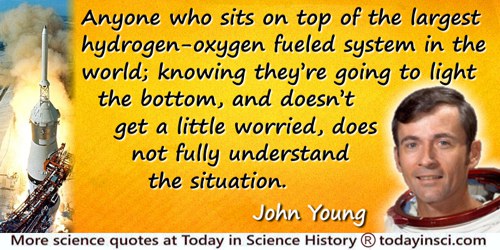
Anyone who sits on top of the largest hydrogen-oxygen fueled system in the world; knowing they’re going to light the bottom, and doesn’t get a little worried, does not fully understand the situation.
Response to question whether he was worried about embarking on the first space shuttle flight. As quoted on the nmspacemuseum.org website of the New Mexico Museum of Space History.
Arguably the greatest technological triumph of the century has been the public-health system, which is sophisticated preventive and investigative medicine organized around mostly low- and medium-tech equipment; ... fully half of us are alive today because of the improvements.
In Visions of Technology (1999), 22.
Armed with all the powers, enjoying all the wealth they owe to science, our societies are still trying to practice and to teach systems of values already destroyed at the roots by that very science. Man knows at last that he is alone in the indifferent immensity of the universe, whence which he has emerged by chance. His duty, like his fate, is written nowhere.
In Jacques Monod and Austryn Wainhouse (trans.), Chance and Necessity: An Essay on the Natural Philosophy of Modern Biology (1971), 171.
Artificial intelligence is based on the assumption that the mind can be described as some kind of formal system manipulating symbols that stand for things in the world. Thus it doesn't matter what the brain is made of, or what it uses for tokens in the great game of thinking. Using an equivalent set of tokens and rules, we can do thinking with a digital computer, just as we can play chess using cups, salt and pepper shakers, knives, forks, and spoons. Using the right software, one system (the mind) can be mapped onto the other (the computer).
Machinery of the Mind: Inside the New Science of Artificial Intelligence (1986), 250.
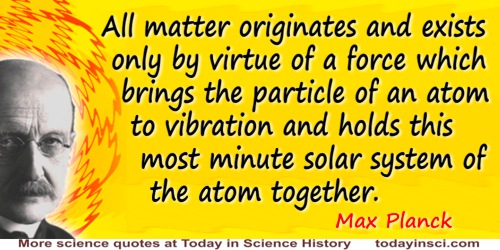
As a man who has devoted his whole life to the most clear headed science, to the study of matter, I can tell you as a result of my research about atoms this much: There is no matter as such. All matter originates and exists only by virtue of a force which brings the particle of an atom to vibration and holds this most minute solar system of the atom together. … We must assume behind this force the existence of a conscious and intelligent mind. This mind is the matrix of all matter.
Lecture, 'Das Wesen der Materie' [The Essence/Nature/Character of Matter], Florence, Italy (1944). Archiv zur Geschichte der Max-Planck-Gesellschaft, Abt. Va, Rep. 11 Planck, Nr. 1797. Original German and this English translation, as in Gregg Braden, The Spontaneous Healing of Belief: Shattering the Paradigm of False Limits (2009), 334-35. Note: a number of books showing this quote cite it as from Planck’s Nobel Prize acceptance speech (1918), which the Webmaster has checked, and does not see this quote therein. The original German excerpt, and a slightly more complete translation is also on this web page, beginning: “As a physicist who devoted ….”
As a rule, software systems do not work well until they have been used, and have failed repeatedly, in real applications.
As for Galen’s netlike plexus, I do not need to pass on a lot of misinformation about it here, as I am quite sure that I have examined the whole system of the cerebral vessels. There is no occasion for making things up, since we are certain that Galen was deluded by his dissection of ox brains and described the cerebral vessels, not of a human but of oxen.
From De Humani Corporis Fabrica Libri Septem (1543), Book III, 310, as translated by William Frank Richardson and John Burd Carman, in 'Structure of the Plexus in the Prior Ventricles of the Brain; Galen’s Netlike Plexus', On The Fabric of the Human Body: Book III: The Veins And Arteries; Book IV: The Nerves (1998), 140.
As systematic unity is what first raises ordinary knowledge to the rank of science, that is, makes a system out of a mere aggregate of knowledge, architectonic is the doctrine of the scientific in our knowledge, and therefore necessarily forms part of the doctrine of method.
In'The Transcendental Doctrine of Method', Critique of Pure Reason (2016), 653. Note: architectonic = the art of constructing systems.
As usual, the author in his thorough, unobjective fashion has marshalled up all the good, indifferent and bad arguments ... I offer the following detailed comments ... though I realize that many of them will arouse him to a vigorous, if not violent rebuttal. In order to preserve the pH of Dr. Brown's digestive system I would not require a rebuttal as a condition of publication...
With heartiest greetings of the season to you and yours! Jack Roberts
PS The above comments should (help) to reduce your winter heating bill!
Jack Roberts' referee's report on Herbert Charles Brown's paper with Rachel Kornblum on the role of steric strain in carbonium ion reactions.
With heartiest greetings of the season to you and yours! Jack Roberts
PS The above comments should (help) to reduce your winter heating bill!
Jack Roberts' referee's report on Herbert Charles Brown's paper with Rachel Kornblum on the role of steric strain in carbonium ion reactions.
As quoted by D. A. Davenport, in 'On the Comparative Unimportance of the Invective Effect', Chemtech (Sep 1987), 17, 530.
As, no matter what cunning system of checks we devise, we must in the end trust some one whom we do not check, but to whom we give unreserved confidence, so there is a point at which the understanding and mental processes must be taken as understood without further question or definition in words. And I should say that this point should be fixed pretty early in the discussion.
Samuel Butler, Henry Festing Jones (ed.), The Note-Books of Samuel Butler (1917), 220-221.
Astronomy is a cold, desert science, with all its pompous figures,—depends a little too much on the glass-grinder, too little on the mind. ’Tis of no use to show us more planets and systems. We know already what matter is, and more or less of it does not signify.
In 'Country Life', collected in The Complete Works of Ralph Waldo Emerson (1904), Vol. 12, 166.
At the beginning of its existence as a science, biology was forced to take cognizance of the seemingly boundless variety of living things, for no exact study of life phenomena was possible until the apparent chaos of the distinct kinds of organisms had been reduced to a rational system. Systematics and morphology, two predominantly descriptive and observational disciplines, took precedence among biological sciences during the eighteenth and nineteenth centuries. More recently physiology has come to the foreground, accompanied by the introduction of quantitative methods and by a shift from the observationalism of the past to a predominance of experimentation.
In Genetics and the Origin of Species (1937, 1982), 6.
At the planet’s very heart lies a solid rocky core, at least five times larger than Earth, seething with the appalling heat generated by the inexorable contraction of the stupendous mass of material pressing down to its centre. For more than four billion years Jupiter’s immense gravitational power has been squeezing the planet slowly, relentlessly, steadily, converting gravitational energy into heat, raising the temperature of that rocky core to thirty thousand degrees, spawning the heat flow that warms the planet from within. That hot, rocky core is the original protoplanet seed from the solar system’s primeval time, the nucleus around which those awesome layers of hydrogen and helium and ammonia, methane, sulphur compounds and water have wrapped themselves.
— Ben Bova
Jupiter

Atoms or systems into ruin hurl’d,
And now a bubble burst, and now a world.
And now a bubble burst, and now a world.
From An Essay on Man (1734), Epistle I, lines 89-90. In An Essay on Man: enlarged and improved by the author. With notes by William Warburton (1745), 5.
Because of the way it came into existence, the solar system has only one-way traffic—like Piccadilly Circus. … If we want to make a model to scale, we must take a very tiny object, such as a pea, to represent the sun. On the same scale the nine planets will be small seeds, grains of sand and specks of dust. Even so, Piccadilly Circus is only just big enough to contain the orbit of Pluto. … The whole of Piccadilly Circus was needed to represent the space of the solar system, but a child can carry the whole substance of the model in its hand. All the rest is empty space.
In The Stars in Their Courses (1931, 1954), 49-50 & 89.

Before we talk about ecosystem design, we have to talk about ego-system management.
As quoted in John King, 'Green Pioneer William McDonough', SFGate (13 Nov 2012).
Besides electrical engineering theory of the transmission of messages, there is a larger field [cybernetics] which includes not only the study of language but the study of messages as a means of controlling machinery and society, the development of computing machines and other such automata, certain reflections upon psychology and the nervous system, and a tentative new theory of scientific method.
In Cybernetics (1948).
Beyond a critical point within a finite space, freedom diminishes as numbers increase. ...The human question is not how many can possibly survive within the system, but what kind of existence is possible for those who do survive.
Dune
Beyond these are other suns, giving light and life to systems, not a thousand, or two thousand merely, but multiplied without end, and ranged all around us, at immense distances from each other, attended by ten thousand times ten thousand worlds, all in rapid motion; yet calm, regular and harmonious—all space seems to be illuminated, and every particle of light a world. ... all this vast assemblages of suns and worlds may bear no greater proportion to what lies beyond the utmost boundaries of human vision, than a drop of water to the ocean.
In The Geography of the Heavens and Class-Book of Astronomy (1874), 148 That knowledge is not happiness.
Biological evolution is a system of constant divergence without subsequent joining of branches. Lineages, once distinct, are separate forever. In human history, transmission across lineages is, perhaps, the major source of cultural change. Europeans learned about corn and potatoes from Native Americans and gave them smallpox in return.
…...
But I shall certainly admit a system as empirical or scientific only if it is capable of being tested by experience. These considerations suggest that not the verifiability but the falsifiability of a system is to be taken as a criterion of demarcation. In other words: I shall not require of a scientific system that it shall be capable of being singled out, once and for all, in a positive sense; but I shall require that its logical form shall be such that it can be singled out, by means of empirical tests, in a negative sense: it must be possible for an empirical scientific system to be refuted by experience. (1959)
The Logic of Scientific Discovery: Logik Der Forschung (1959, 2002), 18.
But I think that in the repeated and almost entire changes of organic types in the successive formations of the earth—in the absence of mammalia in the older, and their very rare appearance (and then in forms entirely. unknown to us) in the newer secondary groups—in the diffusion of warm-blooded quadrupeds (frequently of unknown genera) through the older tertiary systems—in their great abundance (and frequently of known genera) in the upper portions of the same series—and, lastly, in the recent appearance of man on the surface of the earth (now universally admitted—in one word, from all these facts combined, we have a series of proofs the most emphatic and convincing,—that the existing order of nature is not the last of an uninterrupted succession of mere physical events derived from laws now in daily operation: but on the contrary, that the approach to the present system of things has been gradual, and that there has been a progressive development of organic structure subservient to the purposes of life.
'Address to the Geological Society, delivered on the Evening of the 18th of February 1831', Proceedings of the Geological Society (1834), 1, 305-6.
But in the heavens we discover by their light, and by their light alone, stars so distant from each other that no material thing can ever have passed from one to another; and yet this light, which is to us the sole evidence of the existence of these distant worlds, tells us also that each of them is built up of molecules of the same kinds as those which we find on earth. A molecule of hydrogen, for example, whether in Sirius or in Arcturus, executes its vibrations in precisely the same time. Each molecule, therefore, throughout the universe, bears impressed on it the stamp of a metric system as distinctly as does the metre of the Archives at Paris, or the double royal cubit of the Temple of Karnac ... the exact quantity of each molecule to all others of same kind gives it, as Sir John Herschel has well said, the essential character of a manufactured article and precludes the idea of its being external and self-existent.
'Molecules', 1873. In W. D. Niven (ed.), The Scientific Papers of James Clerk Maxwell (1890), Vol. 2, 375-6.
By a generative grammar I mean simply a system of rules that in some explicit and well-defined way assigns structural descriptions to sentences. Obviously, every speaker of a language has mastered and internalized a generative grammar that expresses his knowledge of his language. This is not to say that he is aware of the rules of the grammar or even that he can become aware of them, or that his statements about his intuitive knowledge of the language are necessarily accurate.
Aspects of the Theory of Syntax (1965), 8.

By their very nature chemical controls are self-defeating, for they have been devised and applied without taking into account the complex biological systems against which they have been blindly hurled.
Silent Spring (1962), 246.
By virtue of the way it has organized its technological base, contemporary industrial society tends to be totalitarian. For 'totalitarian' is not only a terroristic political coordination of society, but also a non-terroristic economic-technical coordination which operates through the manipulation of needs by vested interests. It thus precludes the emergence of an effective opposition against the whole. Not only a specific form of government or party rule makes for totalitarianism, but also a specific system of production and distribution which may well be compatible with a 'pluralism' of parties, newspapers, 'countervailing powers,' etc.
One Dimensional Man (1964), 3.
Can we separate object and subject? Myself is nothing but a part of my body, my body is nothing but a part of my food, my food is nothing but a part of the earth, the earth is nothing but a part of the solar system.
In Sir William Withey Gull and Theodore Dyke Acland (ed.), A Collection of the Published Writings of William Withey Gull (1896), lii.
Cells are required to stick precisely to the point. Any ambiguity, any tendency to wander from the matter at hand, will introduce grave hazards for the cells, and even more for the host in which they live. … There is a theory that the process of aging may be due to the cumulative effect of imprecision, a gradual degrading of information. It is not a system that allows for deviating.
In 'Information', The Lives of a Cell: Notes of a Biology Watcher (1974), 110-111.
Changes, cyclic or otherwise, within the solar system or within our galaxy, would seem to be the easy and incontrovertible solution for everything that I have found remarkable in the stratigraphical record.
In The Nature of the Stratigraphical Record (1973), 83.
Chemical analysis and synthesis go no farther than to the separation of particles one from another, and to their reunion. No new creation or destruction of matter is within the reach of chemical agency. We might as well attempt to introduce a new planet into the solar system, or to annihilate one already in existence, as to create or destroy a particle of hydrogen.
A New System of Chemical Philosophy (1808), Vol. 1, 212.
Chemically induced hallucinations, delusions and raptures may be frightening or wonderfully gratifying; in either case they are in the nature of confidence tricks played on one’s own nervous system.
In 'Return Trip to Nirvana', Sunday Telegraph (12 Mar 1961), as collected in Kaleidoscope: Essays from Drinkers of Infinity, and The Heel of Achilles and Later Pieces and Stories (1981), 80 (source cited on p.72, footnote).
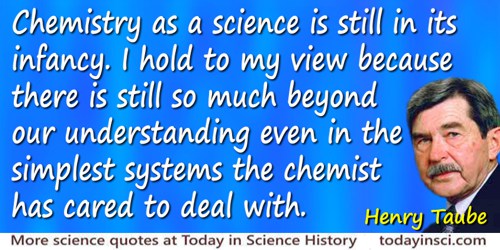
Chemistry as a science is still in its infancy. I hold to my view because there is still so much beyond our understanding even in the simplest systems the chemist has cared to deal with.
Speech at the Nobel Banquet (10 Dec 1983) for his Nobel Prize in Chemistry. In Wilhelm Odelberg (ed.), Les Prix Nobel: The Nobel Prizes (1984), 43.
Chemistry is an art that has furnished the world with a great number of useful facts, and has thereby contributed to the improvement of many arts; but these facts lie scattered in many different books, involved in obscure terms, mixed with many falsehoods, and joined to a great deal of false philosophy; so that it is not great wonder that chemistry has not been so much studied as might have been expected with regard to so useful a branch of knowledge, and that many professors are themselves but very superficially acquainted with it. But it was particularly to be expected, that, since it has been taught in universities, the difficulties in this study should have been in some measure removed, that the art should have been put into form, and a system of it attempted—the scattered facts collected and arranged in a proper order. But this has not yet been done; chemistry has not yet been taught but upon a very narrow plan. The teachers of it have still confined themselves to the purposes of pharmacy and medicine, and that comprehends a small branch of chemistry; and even that, by being a single branch, could not by itself be tolerably explained.
John Thomson, An Account of the Life, Lectures and Writings of William Cullen, M.D. (1832), Vol. 1, 40.
Chemistry is yet, indeed, a mere embryon. Its principles are contested; experiments seem contradictory; their subjects are so minute as to escape our senses; and their result too fallacious to satisfy the mind. It is probably an age too soon to propose the establishment of a system.
Letter to Rev. James Madison (Paris, 19 Jul 1788). In Thomas Jefferson and John P. Foley (ed.), The Jeffersonian Cyclopedia (1900), 135. From H.A. Washington, The Writings of Thomas Jefferson (1853-54). Vol 2, 431.
Classes and concepts may, however, also be conceived as real objects, namely classes as “pluralities of things” or as structures consisting of a plurality of things and concepts as the properties and relations of things existing independently of our definitions and constructions. It seems to me that the assumption of such objects is quite as legitimate as the assumption of physical bodies and there is quite as much reason to believe in their existence. They are in the same sense necessary to obtain a satisfactory system of mathematics as physical bodies are necessary for a satisfactory theory of our sense perceptions…
In 'Russell's Mathematical Logic', in P.A. Schilpp (ed.), The Philosophy of Bertrand Russell (1944), Vol. 1, 137.
Combining in our survey then, the whole range of deposits from the most recent to the most ancient group, how striking a succession do they present:– so various yet so uniform–so vast yet so connected. In thus tracing back to the most remote periods in the physical history of our continents, one system of operations, as the means by which many complex formations have been successively produced, the mind becomes impressed with the singleness of nature's laws; and in this respect, at least, geology is hardly inferior in simplicity to astronomy.
The Silurian System (1839), 574.
Commenting on Archimedes, for whom he also had a boundless admiration, Gauss remarked that he could not understand how Archimedes failed to invent the decimal system of numeration or its equivalent (with some base other than 10). … This oversight Gauss regarded as the greatest calamity in the history of science.
In Men of Mathematics (1937), 256.
Communism is at once a complete system of proletarian ideology and a new social system. It is different from any other ideological and social system, and is the most complete, progressive, revolutionary, and rational system in human history.
In Mao Tse-Tung: On New Democracy: Talks at the Yenan Forum on Literature and Art (1967), 32.
Computers are composed of nothing more than logic gates stretched out to the horizon in a vast numerical irrigation system.
In State of the Art: A Photographic History of the Integrated Circuit (1983), vii.
Copernicus … did not publish his book [on the nature of the solar system] until he was on his deathbed. He knew how dangerous it is to be right when the rest of the world is wrong.
In a speech at Waterville, Maine, July 30, 1885.
Creativity is what cannot wait, cannot stop, cannot backstep: faster or slower, it always goes ahead—through, alongside, above, regardless of crises or systems.
In a speech at Brown University, March 11, 1979.
Damn the Solar System. Bad light; planets too distant; pestered with comets; feeble contrivance; could make a better myself.
Attributed.
Despite its importance to navigation, fishing, oil and gas development, and maritime safety, our understanding of how the Gulf system works remains extremely limited.
In 'Opinion: Why we can’t forget the Gulf', CNN (16 Apr 2015).
Despite the dazzling successes of modern technology and the unprecedented power of modern military systems, they suffer from a common and catastrophic fault. While providing us with a bountiful supply of food, with great industrial plants, with high-speed transportation, and with military weapons of unprecedented power, they threaten our very survival.
In Science and Survival (1966).
Despite the recurrence of events in which the debris-basin system fails in its struggle to contain the falling mountains, people who live on the front line are for the most part calm and complacent. It appears that no amount of front-page or prime-time attention will ever prevent such people from masking out the problem.
The Control of Nature
Development of Western science is based on two great achievements: the invention of the formal logical system (in Euclidean geometry) by the Greek philosophers, and the discovery of the possibility to find out causal relationships by systematic experiment (during the Renaissance). In my opinion, one has not to be astonished that the Chinese sages have not made these steps. The astonishing thing is that these discoveries were made at all.
Letter to J. S. Switzer, 23 Apr 1953, Einstein Archive 61-381. Quoted in Alice Calaprice, The Quotable Einstein (1996), 180.
Differences between individuals are the raw materials for evolutionary change and for the evolution of adaptations, yet of course most physiologists treat these differences as noise that is to be filtered out. From the standpoint of physiological ecology, the traditional emphasis of physiologists on central tendencies rather than on variance has some unhappy consequences. Variation is not just noise; it is also the stuff of evolution and a central attribute of living systems. The physiological differences between individuals in the same species or population, and also the patterns of variation in different groups, must not be ignored.
From 'Interspecific comparison as a tool for ecological physiologists', collected in M.E. Feder, A.F. Bennett, W.W. Burggren, and R.B. Huey, (eds.), New Directions in Ecological Physiology (1987), 32-33,
Do all the stars have systems of planets?
Movie character
Doubtless the reasoning faculty, the mind, is the leading and characteristic attribute of the human race. By the exercise of this, man arrives at the properties of the natural bodies. This is science, properly and emphatically so called. It is the science of pure mathematics; and in the high branches of this science lies the truly sublime of human acquisition. If any attainment deserves that epithet, it is the knowledge, which, from the mensuration of the minutest dust of the balance, proceeds on the rising scale of material bodies, everywhere weighing, everywhere measuring, everywhere detecting and explaining the laws of force and motion, penetrating into the secret principles which hold the universe of God together, and balancing worlds against worlds, and system against system. When we seek to accompany those who pursue studies at once so high, so vast, and so exact; when we arrive at the discoveries of Newton, which pour in day on the works of God, as if a second fiat had gone forth from his own mouth; when, further, we attempt to follow those who set out where Newton paused, making his goal their starting-place, and, proceeding with demonstration upon demonstration, and discovery upon discovery, bring new worlds and new systems of worlds within the limits of the known universe, failing to learn all only because all is infinite; however we may say of man, in admiration of his physical structure, that “in form and moving he is express and admirable,” it is here, and here without irreverence, we may exclaim, “In apprehension how like a god!” The study of the pure mathematics will of course not be extensively pursued in an institution, which, like this [Boston Mechanics’ Institute], has a direct practical tendency and aim. But it is still to be remembered, that pure mathematics lie at the foundation of mechanical philosophy, and that it is ignorance only which can speak or think of that sublime science as useless research or barren speculation.
In Works (1872), Vol. 1, 180.
During the war years I worked on the development of radar and other radio systems for the R.A.F. and, though gaining much in engineering experience and in understanding people, rapidly forgot most of the physics I had learned.
From Autobiography in Wilhelm Odelberg (ed.), Les Prix Nobel en 1974/Nobel Lectures (1975)
Each ray of light moves in the coordinate system 'at rest' with the definite, constant velocity V independent of whether this ray of light is emitted by a body at rest or a body in motion.
Annalen der Physik, 1905, 17, 891-921. Trans. John Stachel et al (eds.), The Collected Papers of Albert Einstein, Vol. 2, (1989), Doc. 23, 143.
Engineering is the application of scientific and mathematical principles to practical ends such as the design, manufacture, and operation of efficient and economical structures, machines, processes, and systems.
In Bernice Zeldin Schacter, Issues and Dilemmas of Biotechnology: A Reference Guide (1999), 1, citing the American Heritage Dictionary, 2nd College Edition.
Engineers apply the theories and principles of science and mathematics to research and develop economical solutions to practical technical problems. Their work is the link between scientific discoveries and commercial applications. Engineers design products, the machinery to build those products, the factories in which those products are made, and the systems that ensure the quality of the product and efficiency of the workforce and manufacturing process. They design, plan, and supervise the construction of buildings, highways, and transit systems. They develop and implement improved ways to extract, process, and use raw materials, such as petroleum and natural gas. They develop new materials that both improve the performance of products, and make implementing advances in technology possible. They harness the power of the sun, the earth, atoms, and electricity for use in supplying the Nation’s power needs, and create millions of products using power. Their knowledge is applied to improving many things, including the
quality of health care, the safety of food products, and the efficient operation of financial systems.
Bureau of Labor Statistics, Occupational Outlook Handbook (2000) as quoted in Charles R. Lord. Guide to Information Sources in Engineering (2000), 5. This definition has been revised and expanded over time in different issues of the Handbook.
Engineers participate in the activities which make the resources of nature available in a form beneficial to man and provide systems which will perform optimally and economically.
1957
English science … isolates the reptile or mollusk it assumes to explain; whilst reptile or mollusk only exists in system, in relation.
In essay, 'Literature', English Traits (1856), collected in Works of Ralph Waldo Emerson: Essays First and Second Series (1883), 341.
Even today I still get letters from young students here and there who say, Why are you people trying to program intelligence? Why don’t you try to find a way to build a nervous system that will just spontaneously create it? Finally I decided that this was either a bad idea or else it would take thousands or millions of neurons to make it work and I couldn’t afford to try to build a machine like that.
As quoted in Jeremy Bernstein, 'A.I.', The New Yorker (14 Dec 1981), 57, 70.
Every kid starts out as a natural-born scientist, and then we beat it out of them. A few trickle through the system with their wonder and enthusiasm for science intact.
Quoted in interview with magazine staff, Psychology Today (Jan 1996).
Every river appears to consist of a main trunk, fed from a variety of branches, each running in a valley proportional to its size, and all of them together forming a system of vallies, communicating with one another, and having such a nice adjustment of their declivities that none of them join the principal valley on too high or too low a level; a circumstance which would be infinitely improbable if each of these vallies were not the work of the stream that flows in it.
Illustrations of the Huttonian Theory of the Earth (1802), 102.
Every science has for its basis a system of principles as fixed and unalterable as those by which the universe is regulated and governed. Man cannot make principles; he can only discover them.
In The Age of Reason (1794, 1834), 30-31.
Faced with the admitted difficulty of managing the creative process, we are doubling our efforts to do so. Is this because science has failed to deliver, having given us nothing more than nuclear power, penicillin, space travel, genetic engineering, transistors, and superconductors? Or is it because governments everywhere regard as a reproach activities they cannot advantageously control? They felt that way about the marketplace for goods, but trillions of wasted dollars later, they have come to recognize the efficiency of this self-regulating system. Not so, however, with the marketplace for ideas.
Quoted in Martin Moskovits (ed.), Science and Society, the John C. Polanyi Nobel Lareates Lectures (1995), 8.
Few scientists acquainted with the chemistry of biological systems at the molecular level can avoid being inspired. Evolution has produced chemical compounds exquisitely organized to accomplish the most complicated and delicate of tasks. Many organic chemists viewing crystal structures of enzyme systems or nucleic acids and knowing the marvels of specificity of the immune systems must dream of designing and synthesizing simpler organic compounds that imitate working features of these naturally occurring compounds.
In 'The Design of Molecular Hosts, Guests, and Their Complexes', Nobel Lecture, 8 December 1987. In Nobel Lectures: Chemistry 1981-1990 (1992), 419.
Few will deny that even in the first scientific instruction in mathematics the most rigorous method is to be given preference over all others. Especially will every teacher prefer a consistent proof to one which is based on fallacies or proceeds in a vicious circle, indeed it will be morally impossible for the teacher to present a proof of the latter kind consciously and thus in a sense deceive his pupils. Notwithstanding these objectionable so-called proofs, so far as the foundation and the development of the system is concerned, predominate in our textbooks to the present time. Perhaps it will be answered, that rigorous proof is found too difficult for the pupil’s power of comprehension. Should this be anywhere the case,—which would only indicate some defect in the plan or treatment of the whole,—the only remedy would be to merely state the theorem in a historic way, and forego a proof with the frank confession that no proof has been found which could be comprehended by the pupil; a remedy which is ever doubtful and should only be applied in the case of extreme necessity. But this remedy is to be preferred to a proof which is no proof, and is therefore either wholly unintelligible to the pupil, or deceives him with an appearance of knowledge which opens the door to all superficiality and lack of scientific method.
In 'Stücke aus dem Lehrbuche der Arithmetik', Werke, Bd. 2 (1904), 296.
Finally, in regard to those who possess the largest shares in the stock of worldly goods, could there, in your opinion, be any police so vigilant and effetive, for the protections of all the rights of person, property and character, as such a sound and comprehensive education and training, as our system of Common Schools could be made to impart; and would not the payment of a sufficient tax to make such education and training universal, be the cheapest means of self-protection and insurance?
Annual Reports of the Secretary of the Board of Education of Massachusetts for the years 1839-1844, Life and Works of Horace Mann (1891), Vol. 3, 100.
Finite systems of deterministic ordinary nonlinear differential equations may be designed to represent forced dissipative hydrodynamic flow. Solutions of these equations can be identified with trajectories in phase space. For those systems with bounded solutions, it is found that nonperiodic solutions are ordinarily unstable with respect to small modifications, so that slightly differing initial states can evolve into considerably different states. Systems with bounded solutions are shown to possess bounded numerical solutions.
A simple system representing cellular convection is solved numerically. All of the solutions are found to be unstable, and almost all of them are nonperiodic.
The feasibility of very-long-range weather prediction is examined in the light of these results
A simple system representing cellular convection is solved numerically. All of the solutions are found to be unstable, and almost all of them are nonperiodic.
The feasibility of very-long-range weather prediction is examined in the light of these results
Abstract from his landmark paper introducing Chaos Theory in relation to weather prediction, 'Deterministic Nonperiodic Flow', Journal of the Atmospheric Science (Mar 1963), 20, 130.
For a long time it has been known that the first systems of representations with which men have pictured to themselves the world and themselves were of religious origin. There is no religion that is not a cosmology at the same time that it is a speculation upon divine things. If philosophy and the sciences were born of religion, it is because religion began by taking the place of the sciences and philosophy.
The Elementary Forms of the Religious Life (1912), trans. J. W. Swain (2nd edition 1976), 9.
For chemistry is no science form’d à priori; ’tis no production of the human mind, framed by reasoning and deduction: it took its rise from a number of experiments casually made, without any expectation of what follow’d; and was only reduced into an art or system, by collecting and comparing the effects of such unpremeditated experiments, and observing the uniform tendency thereof. So far, then, as a number of experimenters agree to establish any undoubted truth; so far they may be consider'd as constituting the theory of chemistry.
From 'The Author's Preface', in A New Method of Chemistry (1727), vi.
For the environmentalists, The Space Option is the ultimate environmental solution. For the Cornucopians, it is the technological fix that they are relying on. For the hard core space community, the obvious by-product would be the eventual exploration and settlement of the solar system. For most of humanity however, the ultimate benefit is having a realistic hope in a future with possibilities.... If our species does not soon embrace this unique opportunity with sufficient commitment, it may miss its one and only chance to do so. Humanity could soon be overwhelmed by one or more of the many challenges it now faces. The window of opportunity is closing as fast as the population is increasing. Our future will be either a Space Age or a Stone Age.
Arthur Woods and Marco Bernasconi
For what is thought to be a ‘system’ is after all, just conventional, and I do not see how one is supposed to divide up the world objectively so that one can make statements about parts.
…...
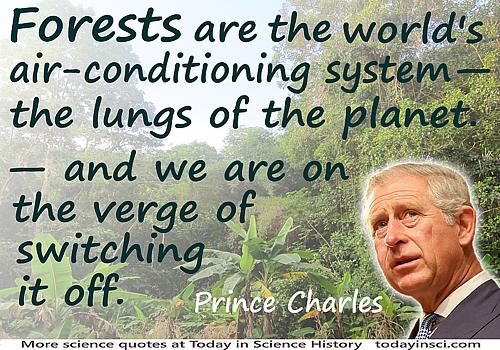
Forests … are in fact the world’s air-conditioning system—the very lungs of the planet—and help to store the largest body of freshwater on the planet … essential to produce food for our planet’s growing population. The rainforests of the world also provide the livelihoods of more than a billion of the poorest people on this Earth… In simple terms, the rainforests, which encircle the world, are our very life-support system—and we are on the verge of switching it off.
Presidential Lecture (3 Nov 2008) at the Presidential Palace, Jakarta, Indonesia. On the Prince of Wales website.
From a mathematical standpoint it is possible to have infinite space. In a mathematical sense space is manifoldness, or combinations of numbers. Physical space is known as the 3-dimension system. There is the 4-dimension system, the 10-dimension system.
As quoted in 'Electricity Will Keep The World From Freezing Up', New York Times (12 Nov 1911), SM4.
From an entertainment point of view, the Solar System has been a bust. None of the planets turns out to have any real-estate potential, and most of them are probably even useless for filming Dune sequels.
From essay 'First Person Secular: Blocking the Gates to Heaven', Mother Jones Magazine (Jun 1986), 48. Collected in The Worst Years of our Lives: Irreverent Notes from a Decade of Greed (1995), 267.
From the level of pragmatic, everyday knowledge to modern natural science, the knowledge of nature derives from man’s primary coming to grips with nature; at the same time it reacts back upon the system of social labour and stimulates its development.
…...
Gaia is a thin spherical shell of matter that surrounds the incandescent interior; it begins where the crustal rocks meet the magma of the Earth’s hot interior, about 100 miles below the surface, and proceeds another 100 miles outwards through the ocean and air to the even hotter thermosphere at the edge of space. It includes the biosphere and is a dynamic physiological system that has kept our planet fit for life for over three billion years. I call Gaia a physiological system because it appears to have the unconscious goal of regulating the climate and the chemistry at a comfortable state for life. Its goals are not set points but adjustable for whatever is the current environment and adaptable to whatever forms of life it carries.
In The Revenge of Gaia: Earth’s Climate Crisis & The Fate of Humanity (2006, 2007), 19.
Genuine science, of course, is neutral. But its practical effects, when harnessed to the appetites of the market, are something less than neutral. Heartbeats are human, but when harnessed to a public-address system, they can be terrifying. Ordinary human appetites for comfort, prestige, or power have in history been troublesome enough, but when they are given exaggerated expression by means of applied science they promise swift destruction.
In The Mechanical Bride: Folklore of Industrial Man (1967), 93.
Geometrical axioms are neither synthetic a priori conclusions nor experimental facts. They are conventions: our choice, amongst all possible conventions, is guided by experimental facts; but it remains free, and is only limited by the necessity of avoiding all contradiction. ... In other words, axioms of geometry are only definitions in disguise.
That being so what ought one to think of this question: Is the Euclidean Geometry true?
The question is nonsense. One might as well ask whether the metric system is true and the old measures false; whether Cartesian co-ordinates are true and polar co-ordinates false.
That being so what ought one to think of this question: Is the Euclidean Geometry true?
The question is nonsense. One might as well ask whether the metric system is true and the old measures false; whether Cartesian co-ordinates are true and polar co-ordinates false.
In George Edward Martin, The Foundations of Geometry and the Non-Euclidean Plane (1982), 110.
Given a situation, a system with a Leerstelle [a gap], whether a given completion (Lueckenfuellung) does justice to the structure, is the “right” one, is often determined by the structure of the system, the situation. There are requirements, structurally determined; there are possible in pure cases unambiguous decisions as to which completion does justice to the situation, which does not, which violates the requirements and the situation.
From 'Some Problems in the Theory of Ethics', collected in Mary Henle (ed.), Documents of Gestalt Psychology (1961), 36.
Given any domain of thought in which the fundamental objective is a knowledge that transcends mere induction or mere empiricism, it seems quite inevitable that its processes should be made to conform closely to the pattern of a system free of ambiguous terms, symbols, operations, deductions; a system whose implications and assumptions are unique and consistent; a system whose logic confounds not the necessary with the sufficient where these are distinct; a system whose materials are abstract elements interpretable as reality or unreality in any forms whatsoever provided only that these forms mirror a thought that is pure. To such a system is universally given the name MATHEMATICS.
In 'Mathematics', National Mathematics Magazine (Nov 1937), 12, No. 2, 62.
God may forgive your sins, but your nervous system won't.
This is not a statement made by Alfred Korzybski, although he quoted it and attributed it as "an old maxim" in the Introduction to the second edition of his book, Science and Sanity: An Introduction to Non-Aristotelian Systems and General Semantics (1941, 4th ed. 1958), xxxvii. It is included here to provide a correction for readers who find it listed elsewhere as an original quote he made.
God put a secret art into the forces of Nature so as to enable it to fashion itself out of chaos into a perfect world system.
Universal Natural History and Theory of the Heavens (1755), editted and translated by William Hastie in Kant's Cosmogony (1900), 27.
Governments are trying to achieve unanimity by stifling any scientist who disagrees. Einstein could not have got funding under the present system.
Quoted in Tom Harper, 'Scientists threatened for "climate denial",' The Telegraph (11 Mar 2007).
Great thinkers build their edifices with subtle consistency. We do our intellectual forebears an enormous disservice when we dismember their visions and scan their systems in order to extract a few disembodied ‘gems’–thoughts or claims still accepted as true. These disarticulated pieces then become the entire legacy of our ancestors, and we lose the beauty and coherence of older systems that might enlighten us by their unfamiliarity–and their consequent challenge in our fallible (and complacent) modern world.
…...
Half a century ago Oswald (1910) distinguished classicists and romanticists among the scientific investigators: the former being inclined to design schemes and to use consistently the deductions from working hypotheses; the latter being more fit for intuitive discoveries of functional relations between phenomena and therefore more able to open up new fields of study. Examples of both character types are Werner and Hutton. Werner was a real classicist. At the end of the eighteenth century he postulated the theory of “neptunism,” according to which all rocks including granites, were deposited in primeval seas. It was an artificial scheme, but, as a classification system, it worked quite satisfactorily at the time. Hutton, his contemporary and opponent, was more a romanticist. His concept of “plutonism” supposed continually recurrent circuits of matter, which like gigantic paddle wheels raise material from various depths of the earth and carry it off again. This is a very flexible system which opens the mind to accept the possible occurrence in the course of time of a great variety of interrelated plutonic and tectonic processes.
In 'The Scientific Character of Geology', The Journal of Geology (Jul 1961), 69, No. 4, 456-7.
He [Samuel Johnson] bid me always remember this, that after a system is well settled upon positive evidence, a few objections ought not to shake it. “The human mind is so limited that it cannot take in all parts of a subject; so that there may be objections raised against anything. There are objections against a plenum, and objections against a vacuum. Yet one of them must certainly be true.”
Note: Whereas vacuum means devoid of matter, plenum regards a space with matter throughout.
He had constructed for himself a certain system which thereafter exercised such an influence on his way of thinking that those who observed him always saw his judgment walking a few steps in front of his feeling, though he himself believed it was keeping to the rear.
Aphorism 82 in Notebook D (1773-1775), as translated by R.J. Hollingdale in Aphorisms (1990). Reprinted as The Waste Books (2000), 56-57.
Heavy dependence on direct observation is essential to biology not only because of the complexity of biological phenomena, but because of the intervention of natural selection with its criterion of adequacy rather than perfection. In a system shaped by natural selection it is inevitable that logic will lose its way.
In 'Scientific innovation and creativity: a zoologist’s point of view', American Zoologist (1982), 22, 229.
Hence, a generative grammar must be a system of rules that can iterate to generate an indefinitely large number of structures. This system of rules can be analyzed into the three major components of a generative grammar: the syntactic, phonological, and semantic components... the syntactic component of a grammar must specify, for each sentence, a deep structure that determines its semantic interpretation and a surface structure that determines its phonetic interpretation. The first of these is interpreted by the semantic component; the second, by the phonological component.
Aspects of the Theory of Syntax (1965), 15-6.
Here are a few things to keep in mind the next time ants show up in the potato salad. The 8,800 known species of the family Formicidae make up from 10% to 15% of the world's animal biomass, the total weight of all fauna. They are the most dominant social insect in the world, found almost everywhere except in the polar regions. Ants turn more soil than earthworms; they prune, weed and police most of the earth’s carrion. Among the most gregarious of creatures, they are equipped with a sophisticated chemical communications system. To appreciate the strength and speed of this pesky invertebrate, consider that a leaf cutter the size of a man could run repeated four-minute miles while carrying 750 lbs. of potato salad.
From book review, 'Nature: Splendor in The Grass', Time (3 Sep 1990).
Here I shall present, without using Analysis [mathematics], the principles and general results of the Théorie, applying them to the most important questions of life, which are indeed, for the most part, only problems in probability. One may even say, strictly speaking, that almost all our knowledge is only probable; and in the small number of things that we are able to know with certainty, in the mathematical sciences themselves, the principal means of arriving at the truth—induction and analogy—are based on probabilities, so that the whole system of human knowledge is tied up with the theory set out in this essay.
Philosophical Essay on Probabilities (1814), 5th edition (1825), trans. Andrew I. Dale (1995), 1.
His [Sherlock Holmes] ignorance was as remarkable as his knowledge. … he was ignorant of the Copernican Theory and of the composition of the Solar System. … “But the Solar System!" I protested. “What the deuce is it to me?” he interrupted impatiently; “you say that we go round the sun. If we went round the moon it would not make a pennyworth of difference to me or to my work.”
In 'The Science Of Deduction', A Study In Scarlet (1887, 1904), 15-16.
Historically, science has pursued a premise that Nature can be understood fully, its future predicted precisely, and its behavior controlled at will. However, emerging knowledge indicates that the nature of Earth and biological systems transcends the limits of science, questioning the premise of knowing, prediction, and control. This knowledge has led to the recognition that, for civilized human survival, technological society has to adapt to the constraints of these systems.
As quoted in Chris Maser, Decision-Making for a Sustainable Environment: A Systemic Approach (2012), 4, citing N. Narasimhan, 'Limitations of Science and Adapting to Nature', Environmental Research Letters (Jul-Sep 2007), 2.
Historically, Statistics is no more than State Arithmetic, a system of computation by which differences between individuals are eliminated by the taking of an average. It has been used—indeed, still is used—to enable rulers to know just how far they may safely go in picking the pockets of their subjects.
In Facts from Figures (1951), 1.
However, all scientific statements and laws have one characteristic in common: they are “true or false” (adequate or inadequate). Roughly speaking, our reaction to them is “yes” or “no.” The scientific way of thinking has a further characteristic. The concepts which it uses to build up its coherent systems are not expressing emotions. For the scientist, there is only “being,” but no wishing, no valuing, no good, no evil; no goal. As long as we remain within the realm of science proper, we can never meet with a sentence of the type: “Thou shalt not lie.” There is something like a Puritan's restraint in the scientist who seeks truth: he keeps away from everything voluntaristic or emotional.
Essays in Physics (1950), 68.
I am afraid all we can do is to accept the paradox and try to accommodate ourselves to it, as we have done to so many paradoxes lately in modern physical theories. We shall have to get accustomed to the idea that the change of the quantity R, commonly called the 'radius of the universe', and the evolutionary changes of stars and stellar systems are two different processes, going on side by side without any apparent connection between them. After all the 'universe' is an hypothesis, like the atom, and must be allowed the freedom to have properties and to do things which would be contradictory and impossible for a finite material structure.
Kosmos (1932), 133.
I am afraid I shall have to give up my trade; I am far too inert to keep up with organic chemistry, it is becoming too much for me, though I may boast of having contributed something to its development. The modern system of formulae is to me quite repulsive.
Letter to Christian Schönbein (21 May 1862), The Letters of Faraday and Schoenbein, 1836-1862 (1899), footnote, 225.
I am among the most durable and passionate participants in the scientific exploration of the solar system, and I am a long-time advocate of the application of space technology to civil and military purposes of direct benefit to life on Earth and to our national security.
In 'Is Human Spaceflight Obsolete?' Quoted in Issues in Science and Technology (Summer 2004).
I am convinced there is only one way to eliminate these grave evils, namely through the establishment of a socialist economy, accompanied by an educational system which would be oriented toward social goals.
In Essay, 'Why Socialism?', Monthly Review (May 1949), 1, No. 1.
I am happy to report to you that the assignment of the Central Committee of the Communist party of the Soviet Union and the Soviet Government has been carried out. The world's first space flight has been accomplished in the Soviet space ship Vostok. All systems and equipment worked impeccably, I feel very well and am prepared to carry out any assignment of the party and the government.
Speech beside Khrushchev, at the tomb of Lenin and Stalin, Red Square, Moscow (14 Apr 1961). As quoted in Osgood Caruthers, 'Krushchev Leads Russian Tribute to Astronaut', New York Times (15 Apr 1961), 2.
I am much occupied with the investigation of the physical causes [of motions in the Solar System]. My aim in this is to show that the celestial machine is to be likened not to a divine organism but rather to a clockwork … insofar as nearly all the manifold movements are carried out by means of a single, quite simple magnetic force. This physical conception is to be presented through calculation and geometry.
Letter to Ilerwart von Hohenburg (10 Feb 1605) Quoted in Holton, Johannes Kepler's Universe: Its Physics and Metaphysics, 342, as cited by Hylarie Kochiras, Force, Matter, and Metaphysics in Newton's Natural Philosophy (2008), 57.
I am of opinion, then, ... that, if there is any circumstance thoroughly established in geology, it is, that the crust of our globe has been subjected to a great and sudden revolution, the epoch of which cannot be dated much farther back than five or six thousand years ago; that this revolution had buried all the countries which were before inhabited by men and by the other animals that are now best known; that the same revolution had laid dry the bed of the last ocean, which now forms all the countries at present inhabited; that the small number of individuals of men and other animals that escaped from the effects of that great revolution, have since propagated and spread over the lands then newly laid dry; and consequently, that the human race has only resumed a progressive state of improvement since that epoch, by forming established societies, raising monuments, collecting natural facts, and constructing systems of science and of learning.
'Preliminary discourse', to Recherches sur les Ossemens Fossiles (1812), trans. R. Kerr Essay on the Theory of the Earth (1813), 171-2.
I am of the decided opinion, that mathematical instruction must have for its first aim a deep penetration and complete command of abstract mathematical theory together with a clear insight into the structure of the system, and doubt not that the instruction which accomplishes this is valuable and interesting even if it neglects practical applications. If the instruction sharpens the understanding, if it arouses the scientific interest, whether mathematical or philosophical, if finally it calls into life an esthetic feeling for the beauty of a scientific edifice, the instruction will take on an ethical value as well, provided that with the interest it awakens also the impulse toward scientific activity. I contend, therefore, that even without reference to its applications mathematics in the high schools has a value equal to that of the other subjects of instruction.
In 'Ueber das Lehrziel im mathemalischen Unterricht der höheren Realanstalten', Jahresbericht der Deutschen Mathematiker Vereinigung, 2, 192. (The Annual Report of the German Mathematical Association. As translated in Robert Édouard Moritz, Memorabilia Mathematica; Or, The Philomath’s Quotation-Book (1914), 73.
I believe as a matter of faith that the extension of space travel to the limits of the solar system will probably be accomplished in several decades, perhaps before the end of the century. Pluto is 4000 million miles from the sun. The required minimum launching velocity is about 10 miles per second and the transit time is 46 years. Thus we would have to make the velocity considerably higher to make the trip interesting to man. Travel to the stars is dependent on radically new discoveries in science and technology. The nearest star is 25 million million miles way and requires a travel time of more than four years at the speed of light. Prof. Dr. Ing. E. Sanger has speculated that velocities comparable with the speed of light might be attained in the next century, but such extrapolation of current technology is probably not very reliable.
In Popular Mechanics (Sep 1961), 262.
I believe myself to possess a most singular combination of qualities exactly fitted to make me pre-eminently a discoverer of the hidden realities of nature… the belief has been forced upon me…
Firstly: Owing to some peculiarity in my nervous system, I have perceptions of some things, which no one else has… and intuitive perception of… things hidden from eyes, ears, & ordinary senses…
Secondly: my sense reasoning faculties;
Thirdly: my concentration faculty, by which I mean the power not only of throwing my whole energy & existence into whatever I choose, but also of bringing to bear on anyone subject or idea, a vast apparatus from all sorts of apparently irrelevant & extraneous sources…
Well, here I have written what most people would call a remarkably mad letter; & yet certainly one of the most logical, sober-minded, cool, pieces of composition, (I believe), that I ever framed.
Firstly: Owing to some peculiarity in my nervous system, I have perceptions of some things, which no one else has… and intuitive perception of… things hidden from eyes, ears, & ordinary senses…
Secondly: my sense reasoning faculties;
Thirdly: my concentration faculty, by which I mean the power not only of throwing my whole energy & existence into whatever I choose, but also of bringing to bear on anyone subject or idea, a vast apparatus from all sorts of apparently irrelevant & extraneous sources…
Well, here I have written what most people would call a remarkably mad letter; & yet certainly one of the most logical, sober-minded, cool, pieces of composition, (I believe), that I ever framed.
Lovelace Papers, Bodleian Library, Oxford University, 42, folio 12 (6 Feb 1841). As quoted and cited in Dorothy Stein (ed.), 'This First Child of Mine', Ada: A Life and a Legacy (1985), 86.
I can say, if I like, that social insects behave like the working parts of an immense central nervous system: the termite colony is an enormous brain on millions of legs; the individual termite is a mobile neurone.
In Late Night Thoughts on Listening to Mahler's Ninth Symphony(1984), 224. Note: Spelling “neurone&rdwuo; [sic].
I do not intend to go deeply into the question how far mathematical studies, as the representatives of conscious logical reasoning, should take a more important place in school education. But it is, in reality, one of the questions of the day. In proportion as the range of science extends, its system and organization must be improved, and it must inevitably come about that individual students will find themselves compelled to go through a stricter course of training than grammar is in a position to supply. What strikes me in my own experience with students who pass from our classical schools to scientific and medical studies, is first, a certain laxity in the application of strictly universal laws. The grammatical rules, in which they have been exercised, are for the most part followed by long lists of exceptions; accordingly they are not in the habit of relying implicitly on the certainty of a legitimate deduction from a strictly universal law. Secondly, I find them for the most part too much inclined to trust to authority, even in cases where they might form an independent judgment. In fact, in philological studies, inasmuch as it is seldom possible to take in the whole of the premises at a glance, and inasmuch as the decision of disputed questions often depends on an aesthetic feeling for beauty of expression, or for the genius of the language, attainable only by long training, it must often happen that the student is referred to authorities even by the best teachers. Both faults are traceable to certain indolence and vagueness of thought, the sad effects of which are not confined to subsequent scientific studies. But certainly the best remedy for both is to be found in mathematics, where there is absolute certainty in the reasoning, and no authority is recognized but that of one’s own intelligence.
In 'On the Relation of Natural Science to Science in general', Popular Lectures on Scientific Subjects, translated by E. Atkinson (1900), 25-26.
I do not personally want to believe that we already know the equations that determine the evolution and fate of the universe; it would make life too dull for me as a scientist. … I hope, and believe, that the Space Telescope might make the Big Bang cosmology appear incorrect to future generations, perhaps somewhat analogous to the way that Galileo’s telescope showed that the earth-centered, Ptolemaic system was inadequate.
From 'The Space Telescope (the Hubble Space Telescope): Out Where the Stars Do Not Twinkle', in NASA Authorization for Fiscal Year 1978: Hearings before the Committee on Commerce, Science and Transportation, United States Senate, 95th Congress, first session on S.365 (1977), 124. This was testimony to support of authorization for NASA beginning the construction of the Space Telescope, which later became known as the Hubble Space Telescope.
I do not think that G. H. Hardy was talking nonsense when he insisted that the mathematician was discovering rather than creating, nor was it wholly nonsense for Kepler to exult that he was thinking God's thoughts after him. The world for me is a necessary system, and in the degree to which the thinker can surrender his thought to that system and follow it, he is in a sense participating in that which is timeless or eternal.
'Reply to Lewis Edwin Hahn', The Philosophy of Brand Blanshard (1980), 901.
I grew up in Japan and Hong Kong and then came to the States. Japan was a huge influence on me because, as a child, I would hear the oxcarts come and collect our sewage at night out of our house from the latrine and then take it off to the farms as fertilizer. And then the food would come back in oxcarts during the day. I always had this sort of “our poop became food” mental model. The idea of “waste equals food” was pretty inculcated, that everything was precious and the systems were coherent and cyclical.
In interview with Kerry A. Dolan, 'William McDonough On Cradle-to-Cradle Design', Forbes (4 Aug 2010)
I have always consistently opposed high-tension and alternating systems of electric lighting, not only on account of danger, but because of their general unreliability and unsuitability for any general system of distribution.
In 'The Dangers of Electric Lighting', North American Review (Nov 1889), 149, No. 396, 633.
I have decided today that the United States should proceed at once with the development of an entirely new type of space transportation system designed to help transform the space frontier of the 1970s into familiar territory, easily accessible for human endeavor in the 1980s and ’90s.
This system will center on a space vehicle that can shuttle repeatedly from Earth to orbit and back. It will revolutionize transportation into near space, by routinizing it. It will take the astronomical costs out of astronautics. In short, it will go a long way toward delivering the rich benefits of practical space utilization and the valuable spin-offs from space efforts into the daily lives of Americans and all people.
Statement by President Nixon (5 Jan 1972).
I have long been interested in landscape history, and when younger and more robust I used to do much tramping of the English landscape in search of ancient field systems, drove roads, indications of prehistoric settlement. Towns and cities, too, which always retain the ghost of their earlier incarnations beneath today's concrete and glass.
From 'An Interview With Penelope Lively', in a Reading Guide to the book The Photograph on the publisher's Penguin website.
I have never had any student or pupil under me to aid me with assistance; but have always prepared and made my experiments with my own hands, working & thinking at the same time. I do not think I could work in company, or think aloud, or explain my thoughts at the time. Sometimes I and my assistant have been in the Laboratory for hours & days together, he preparing some lecture apparatus or cleaning up, & scarcely a word has passed between us; — all this being a consequence of the solitary & isolated system of investigation; in contradistinction to that pursued by a Professor with his aids & pupils as in your Universities.
Letter to C. Ransteed, 16 Dec 1857. In L. Pearce Williams (ed.), The Selected Correspondence of Michael Faraday (1971), Vol. 2, 888.
I have never had reason, up to now, to give up the concept which I have always stressed, that nerve cells, instead of working individually, act together, so that we must think that several groups of elements exercise a cumulative effect on the peripheral organs through whole bundles of fibres. It is understood that this concept implies another regarding the opposite action of sensory functions. However opposed it may seem to the popular tendency to individualize the elements, I cannot abandon the idea of a unitary action of the nervous system, without bothering if, by that, I approach old conceptions.
'The Neuron Doctrine-Theory and Facts', Nobel Lecture 11 Dec 1906. In Nobel Lectures: Physiology or Medicine 1901-1921 (1967), 216.
I have often noticed that when people come to understand a mathematical proposition in some other way than that of the ordinary demonstration, they promptly say, “Oh, I see. That’s how it must be.” This is a sign that they explain it to themselves from within their own system.
Lichtenberg: A Doctrine of Scattered Occasions: Reconstructed From: Reconstructed From His Aphorisms and Reflections (1959), 291.
I hope that in 50 years we will know the answer to this challenging question: are the laws of physics unique and was our big bang the only one? … According to some speculations the number of distinct varieties of space—each the arena for a universe with its own laws—could exceed the total number of atoms in all the galaxies we see. … So do we live in the aftermath of one big bang among many, just as our solar system is merely one of many planetary systems in our galaxy? (2006)
In 'Martin Rees Forecasts the Future', New Scientist (18 Nov 2006), No. 2578.
I know that to personalize the Earth System as Gaia, as I have often done and continue to do in this book, irritates the scientifically correct, but I am unrepentant because metaphors are more than ever needed for a widespread comprehension of the true nature of the Earth and an understanding of the lethal dangers that lie ahead.
In The Revenge of Gaia: Earth’s Climate Crisis & The Fate of Humanity (2006, 2007), 188.
I look upon the whole system of giving pensions to literary and scientific people as a piece of gross humbug. It is not done for any good purpose; it ought never to have been done. It is gross humbug from beginning to end.
Words attributed to Melbourne in Fraser's Magazine (1835), 12, 707.
I propose to substitute the word 'autonomic'. The word implies a certain degree of independent action, but exercised under control of a higher power. The 'autonomic' nervous system means the nervous system of the glands and of the involuntary muscle; it governs the 'organic' functions of the body.
'On the Union of Cranial Autonomic (Visceral) Fibres w;th the Nerve Cells of the Superior Cervical Ganglion', The Journal of Physiology, 1898-99, 23, 241.
I said that there is something every man can do, if he can only find out what that something is. Henry Ford has proved this. He has installed in his vast organization a system for taking hold of a man who fails in one department, and giving him a chance in some other department. Where necessary every effort is made to discover just what job the man is capable of filling. The result has been that very few men have had to be discharged, for it has been found that there was some kind of work each man could do at least moderately well. This wonderful system
adopted by my friend Ford has helped many a man to find himself. It has put many a fellow on his feet. It has taken round pegs out of square holes and found a round hole for them. I understand that last year only 120 workers out of his force of 50,000 were discharged.
As quoted from an interview by B.C. Forbes in The American Magazine (Jan 1921), 10.
I shall devote all my efforts to bring light into the immense obscurity that today reigns in Analysis. It so lacks any plan or system, that one is really astonished that so many people devote themselves to it—and, still worse, it is absolutely devoid of any rigour.
In Oeuvres (1826), Vol. 2, 263. As translated and cited in Ernst Hairer and Gerhard Wanner Analysis by Its History (2008), 188. From the original French, “Je consacrerai toutes mes forces à répandre de la lumière sur l’immense obscurité qui règne aujourd’hui dans l’Analyse. Elle est tellement dépourvue de tout plan et de tout système, qu’on s’étonne seulement qu’il y ait tant de gens qui s’y livrent—et ce qui pis est, elle manque absolument de rigueur.”
I shall explain a System of the World differing in many particulars from any yet known, answering in all things to the common Rules of Mechanical Motions: This depends upon three Suppositions. First, That all Cœlestial Bodies whatsoever, have an attraction or gravitating power towards their own Centers, whereby they attract not only their own parts, and keep them from flying from them, as we may observe the Earth to do, but that they do also attract all the other Cœlestial bodies that are within the sphere of their activity; and consequently that not only the Sun and Moon have an influence upon the body and motion the Earth, and the Earth upon them, but that Mercury also Venus, Mars, Saturn and Jupiter by their attractive powers, have a considerable influence upon its motion in the same manner the corresponding attractive power of the Earth hath a considerable influence upon every one of their motions also. The second supposition is this, That all bodies whatsoever that are put into a direct and simple motion, will continue to move forward in a streight line, till they are by some other effectual powers deflected and bent into a Motion, describing a Circle, Ellipse, or some other more compounded Curve Line. The third supposition is, That these attractive powers are so much the more powerful in operating, by how much the nearer the body wrought upon is to their own Centers. Now what these several degrees are I have not yet experimentally verified; but it is a notion, which if fully prosecuted as it ought to be, will mightily assist the Astronomer to reduce all the Cœlestial Motions to a certain rule, which I doubt will never be done true without it. He that understands the nature of the Circular Pendulum and Circular Motion, will easily understand the whole ground of this Principle, and will know where to find direction in Nature for the true stating thereof. This I only hint at present to such as have ability and opportunity of prosecuting this Inquiry, and are not wanting of Industry for observing and calculating, wishing heartily such may be found, having myself many other things in hand which I would first compleat and therefore cannot so well attend it. But this I durst promise the Undertaker, that he will find all the Great Motions of the World to be influenced by this Principle, and that the true understanding thereof will be the true perfection of Astronomy.
An Attempt to Prove the Motion of the Earth from Observations (1674), 27-8. Based on a Cutlerian Lecture delivered by Hooke at the Royal Society four years earlier.
I tell my students, with a feeling of pride that I hope they will share, that the carbon, nitrogen, and oxygen that make up ninety-nine per cent of our living substance were cooked in the deep interiors of earlier generations of dying stars. Gathered up from the ends of the universe, over billions of years, eventually they came to form, in part, the substance of our sun, its planets, and ourselves. Three billion years ago, life arose upon the earth. It is the only life in the solar system.
From speech given at an anti-war teach-in at the Massachusetts Institute of Technology, (4 Mar 1969) 'A Generation in Search of a Future', as edited by Ron Dorfman for Chicago Journalism Review, (May 1969).
I think I may fairly make two postulata. First, That food is necessary to the existence of man. Secondly, That the passion between the sexes is necessary and will remain nearly in its present state. These two laws ever since we have had any knowledge of mankind, appear to have been fixed laws of our nature; and, as we have not hitherto seen any alteration in them, we have no right to conclude that they will ever cease to be what they are now, without an immediate act of power in that Being who first arranged the system of the universe; and for the advantage of his creatures, still executes, according to fixed laws, all its various operations.
First 'Essay on the Principle of Population' (1798), reprinted in Parallel Chapters from the First and Second editions of An Essay on the Principle of Population (1895), 6.
I think that we shall have to get accustomed to the idea that we must not look upon science as a 'body of knowledge,' but rather as a system of hypotheses; that is to say, as a system of guesses or anticipations which in principle cannot be justified, but with which we work as long as they stand up to tests, and of which we are never justified in saying that we know they are 'true' or 'more or less certain' or even 'probable.'
The Logic of Scientific Discovery (1959), 317.
I think there probably is life, maybe primitive life, in outer space. There might be very primitive life in our solar system—single-cell animals, that sort of thing. We may know the answer to that in five or ten years. There is very likely to be life in other solar systems, in planets around other stars. But we won’t know about that for a long time.
Interview conducted on Scholastic website (20 Nov 1998).
I would picture myself as a virus, or as a cancer cell, for example, and try to sense what it would be like to be either. I would also imagine myself as the immune system, and I would try to reconstruct what I would do as an immune system engaged in combating a virus or cancer cell. When I had played through a series of such scenarios on a particular problem and had acquired new insights, I would design laboratory experiments accordingly… Based upon the results of the experiment, I would then know what question to ask next… When I observed phenomena in the laboratory that I did not understand, I would also ask questions as if interrogating myself: “Why would I do that if I were a virus or a cancer cell, or the immune system?” Before long, this internal dialogue became second nature to me; I found that my mind worked this way all the time.
In Anatomy of Reality: Merging of Intuition and Reason (1983), 7, footnote b, as quoted and cited in Roger Frantz, Two Minds: Intuition and Analysis in the History of Economic Thought (2006), 7.
I’m trying to assemble pieces of this great jigsaw puzzle of the origin of the solar system, to see if we can illuminate our own processes on the Earth more fundamentally.
In interview, Rushworth M. Kidder, 'Grounded in Space Science', Christian Science Monitor (22 Dec 1989).
If and when all the laws governing physical phenomena are finally discovered, and all the empirical constants occurring in these laws are finally expressed through the four independent basic constants, we will be able to say that physical science has reached its end, that no excitement is left in further explorations, and that all that remains to a physicist is either tedious work on minor details or the self-educational study and adoration of the magnificence of the completed system. At that stage physical science will enter from the epoch of Columbus and Magellan into the epoch of the National Geographic Magazine!
'Any Physics Tomorrow', Physics Today, January 1949, 2, 17.
If any one should ask me what I consider the most distinctive, progressive feature of California, I should answer promptly, its cable-car system. And it is not alone its system which seems to have reached a point of perfection, but the amazing length of the ride that is given you for the chink of a nickel. I have circled this city of San Francisco, … for this smallest of Southern coins.
In Letters from California (1888), 33.
If I was to establish a system, it would be, that Mountains are produced by Volcanoes, and not Volcanoes by Mountains.
Observations on Mount Vesuvius, Mount Etna, and other Volcanoes (1774), 52.
If more of our resources were invested in preventing sickness and accidents, fewer would have to be spent on costly cures. … In short, we should build a true “health” system—and not a “sickness” system alone.
'Special Message to the Congress Proposing a National Health Strategy' (18 Feb 1971), Public Papers of the Presidents of the United States: Richard M. Nixon (1972), 172.
If one has left this entire system to itself for an hour, one would say that the cat still lives if meanwhile no atom has decayed. The psi-function of the entire system would express this by having in it the living and dead cat (pardon the expression) mixed or smeared out in equal parts.
…...
If there were some deep principle that drove organic systems towards living systems, the operation of the principle should easily be demonstrable in a test tube in half-a-morning. Needless to say, no such demonstration has ever been given. Nothing happens when organic materials are subjected to the usual prescription of showers of electrical sparks or drenched in ultraviolet light, except the eventual production of a tarry sludge.
In Facts and Dogmas in Cosmology and Elsewhere: The Rede Lecture 1982 (1982), 12-13.
If we knew exactly what to expect throughout the Solar System, we would have no reason to explore it.
The Saturn Game (1981)
If we take a survey of our own world … our portion in the immense system of creation, we find every part of it, the earth, the waters, and the air that surround it, filled, and as it were crouded with life, down from the largest animals that we know of to the smallest insects the naked eye can behold, and from thence to others still smaller, and totally invisible without the assistance of the microscope. Every tree, every plant, every leaf, serves not only as an habitation, but as a world to some numerous race, till animal existence becomes so exceedingly refined, that the effluvia of a blade of grass would be food for thousands.
In The Age of Reason: Being an Investigation of True and Fabulous Theology (27 Jan O.S. 1794), 60. The word “crouded” is as it appears in the original.
If you're overfishing at the top of the food chain, and acidifying the ocean at the bottom, you're creating a squeeze that could conceivably collapse the whole system.
As quoted by Mark Bittman in 'What's Worse Than an Oil Spill?', New York Times (20 Apr 2011), A23.
If you're shopping for a home entertainment system you can't do better than a good dissecting microscope.
Quoted from NPR radio interview, also published on NPR web page by Christopher Joyce, Morning Edition (1 Aug 2013).
In an objective system … any mingling of knowledge with values is unlawful, forbidden. But [the] … “first commandment” which ensures the foundation of objective knowledge, is not itself objective. It cannot be objective: it is an ethical guideline, a rule for conduct. True knowledge is ignorant of values, but it cannot be grounded elsewhere than upon a value judgment…
In Chance and Necessity (1970), 176.
In arranging the bodies in order of their electrical nature, there is formed an electro-chemical system which, in my opinion, is more fit than any other to give an idea of chemistry.
Essai sur le théorie des proportions chimiques (1819). Translated in Henry M. Leicester and Herbert S. Klickstein, A Source Book in Chemistry 1400-1900 (1952), 260.
In both social and natural sciences, the body of positive knowledge grows by the failure of a tentative hypothesis to predict phenomena the hypothesis professes to explain; by the patching up of that hypothesis until someone suggests a new hypothesis that more elegantly or simply embodies the troublesome phenomena, and so on ad infinitum. In both, experiment is sometimes possible, sometimes not (witness meteorology). In both, no experiment is ever completely controlled, and experience often offers evidence that is the equivalent of controlled experiment. In both, there is no way to have a self-contained closed system or to avoid interaction between the observer and the observed. The Gödel theorem in mathematics, the Heisenberg uncertainty principle in physics, the self-fulfilling or self-defeating prophecy in the social sciences all exemplify these limitations.
Inflation and Unemployment (1976), 348.
In despair, I offer your readers their choice of the following definitions of entropy. My authorities are such books and journals as I have by me at the moment.
(a) Entropy is that portion of the intrinsic energy of a system which cannot be converted into work by even a perfect heat engine.—Clausius.
(b) Entropy is that portion of the intrinsic energy which can be converted into work by a perfect engine.—Maxwell, following Tait.
(c) Entropy is that portion of the intrinsic energy which is not converted into work by our imperfect engines.—Swinburne.
(d) Entropy (in a volume of gas) is that which remains constant when heat neither enters nor leaves the gas.—W. Robinson.
(e) Entropy may be called the ‘thermal weight’, temperature being called the ‘thermal height.’—Ibid.
(f) Entropy is one of the factors of heat, temperature being the other.—Engineering.
I set up these bald statement as so many Aunt Sallys, for any one to shy at.
[Lamenting a list of confused interpretations of the meaning of entropy, being hotly debated in journals at the time.]
(a) Entropy is that portion of the intrinsic energy of a system which cannot be converted into work by even a perfect heat engine.—Clausius.
(b) Entropy is that portion of the intrinsic energy which can be converted into work by a perfect engine.—Maxwell, following Tait.
(c) Entropy is that portion of the intrinsic energy which is not converted into work by our imperfect engines.—Swinburne.
(d) Entropy (in a volume of gas) is that which remains constant when heat neither enters nor leaves the gas.—W. Robinson.
(e) Entropy may be called the ‘thermal weight’, temperature being called the ‘thermal height.’—Ibid.
(f) Entropy is one of the factors of heat, temperature being the other.—Engineering.
I set up these bald statement as so many Aunt Sallys, for any one to shy at.
[Lamenting a list of confused interpretations of the meaning of entropy, being hotly debated in journals at the time.]
In The Electrician (9 Jan 1903).
In France, where an attempt has been made to deprive me of the originality of these discoveries, experiments without number and without mercy have been made on living animals; not under the direction of anatomical knowledge, or the guidance of just induction, but conducted with cruelty and indifference, in hope to catch at some of the accidental facts of a system, which, is evident, the experimenters did not fully comprehend.
An Exposition of the Natural System of the Nerves of the Human Body (1824), 2-3.
In going on with these Experiments, how many pretty systems do we build, which we soon find ourselves oblig’d to destroy! If there is no other Use discover’d of Electricity, this, however, is something considerable, that it may help to make a vain Man humble.
Letter to Peter Collinson, 14 Aug 1747. In I. Bernard Cohen (ed.), Benjamin Franklin’s Experiments (1941), 63.
In high school, when I first heard of entropy, I was attracted to it immediately. They said that in nature all systems are breaking down, and I thought, What a wonderful thing; perhaps I can make some small contribution to this process, myself. And, of course, it’s not just true of nature, it’s true of society as well. If you look carefully, you can see that the social structure is just beginning to break down, just beginning to come apart at the seams.
In Napalm and Silly Putty (2001), 130.
In India, rice is grown below sea level in Kuttanad in Kerala and at above 3,000 meters in Kashmir and Himachal Pradesh. The importance of rice as the mainstay of a sustainable food security system will grow during this century because of climate change. No other cereal has the resilience of rice to grow under a wide range of growing conditions.
In 'Science and Shaping the Future of Rice', collected in Pramod K. Aggarwal et al. (eds.), 206 International Rice Congress: Science, Technology, and Trade for Peace and Prosperity (2007), 4.
In my considered opinion the peer review system, in which proposals rather than proposers are reviewed, is the greatest disaster visited upon the scientific community in this century. No group of peers would have approved my building the 72-inch bubble chamber. Even Ernest Lawrence told me he thought I was making a big mistake. He supported me because he knew my track record was good. I believe that U.S. science could recover from the stultifying effects of decades of misguided peer reviewing if we returned to the tried-and-true method of evaluating experimenters rather than experimental proposals. Many people will say that my ideas are elitist, and I certainly agree. The alternative is the egalitarianism that we now practice and I’ve seen nearly kill basic science in the USSR and in the People's Republic of China.
Alvarez: Adventures of a Physicist (1987), 200-1.
In our daily lives, we enjoy the pervasive benefits of long-lived robotic spacecraft that provide high-capacity worldwide telecommunications; reconnaissance of Earth’s solid surface and oceans, with far-reaching cultural and environmental implications; much-improved weather and climatic forecasts; improved knowledge about the terrestrial effects of the Sun’s radiations; a revolutionary new global navigational system for all manner of aircraft and many other uses both civil and military; and the science of Earth itself as a sustainable abode of life.
In 'Is Human Spaceflight Obsolete?', Issues in Science and Technology (Summer 2004).
In scientific investigations it is grievously wrong to pander to the public’s impatience for results, or to let them think that for discovery it is necessary only to set up a great manufactory and a system of mass production. If in treatment team work is effective, in research it is the individual who counts first and above all. No great thought has ever sprung from anything but a single mind, suddenly conceiving. Throughout the whole world there has been too violent a forcing of the growth of ideas; too feverish a rush to perform experiments and publish conclusions. A year of vacation for calm detachment with all the individual workers thinking it all over in a desert should be proclaimed.
In Viewless Winds: Being the Recollections and Digressions of an Australian Surgeon (1939), 286.
In some remote corner of the universe, poured out and glittering in innumerable solar systems, there once was a star on which clever animals invented knowledge. That was the haughtiest and most mendacious minute of ‘world history’—yet only a minute. After nature had drawn a few breaths the star grew cold, and the clever animals had to die. ... There have been eternities when [human intellect] did not exist; and when it is done for again, nothing will have happened.
…...
In the course of centuries the naïve self-love of men has had to submit to two major blows at the hands of science. The first was when they learnt that our earth was not the centre of the universe but only a tiny fragment of a cosmic system of scarcely imaginable vastness… the second blow fell when biological research destroyed man’s supposedly privileged place in creation and proved his descent from the animal kingdom and his ineradicable animal nature… But human megalomania will have suffered its third and most wounding blow from the psychological research of the present time which seeks to prove to the ego that it is not even master in its own house, but must content itself with scanty information of what is going on unconsciously in its mind.
Introductory Lectures on Psychoanalyis (1916), in James Strachey (ed.), The Standard Edition of the Complete Psychological Works of Sigmund Freud (1963), Vol. 16, 284-5.
In the discussion of the. energies involved in the deformation of nuclei, the concept of surface tension of nuclear matter has been used and its value had been estimated from simple considerations regarding nuclear forces. It must be remembered, however, that the surface tension of a charged droplet is diminished by its charge, and a rough estimate shows that the surface tension of nuclei, decreasing with increasing nuclear charge, may become zero for atomic numbers of the order of 100. It seems therefore possible that the uranium nucleus has only small stability of form, and may, after neutron capture, divide itself into two nuclei of roughly equal size (the precise ratio of sizes depending on liner structural features and perhaps partly on chance). These two nuclei will repel each other and should gain a total kinetic energy of c. 200 Mev., as calculated from nuclear radius and charge. This amount of energy may actually be expected to be available from the difference in packing fraction between uranium and the elements in the middle of the periodic system. The whole 'fission' process can thus be described in an essentially classical way, without having to consider quantum-mechanical 'tunnel effects', which would actually be extremely small, on account of the large masses involved.
[Co-author with Otto Robert Frisch]
[Co-author with Otto Robert Frisch]
Lise Meitner and O. R. Frisch, 'Disintegration of Uranium by Neutrons: a New Type of Nuclear Reaction', Nature (1939), 143, 239.
In the heavens we discover [stars] by their light, and by their light alone ... the sole evidence of the existence of these distant worlds ... that each of them is built up of molecules of the same kinds we find on earth. A molecule of hydrogen, for example, whether in Sirius or in Arcturus, executes its vibrations in precisely the same time. Each molecule therefore throughout the universe bears impressed upon it the stamp of a metric system as distinctly as does the metre of the Archives at Paris, or the royal cubit of the Temple of Karnac.
[Footnote: Where Maxwell uses the term “molecule” we now use the term “atom.”]
[Footnote: Where Maxwell uses the term “molecule” we now use the term “atom.”]
Lecture to the British Association at Bradford (1873), 'Atoms and Molecules'. Quoted by Ernest Rutherford, in 'The Constitution of Matter and the Evolution of the Elements', The Popular Science Monthly (Aug 1915), 112.
In the same sense that our judicial system presumes us to be innocent until proven guilty, a medical care system may work best if it starts with the presumption that most people are healthy. Left to themselves, computers may try to do it in the opposite way, taking it as given that some sort of direct, continual, professional intervention is required all the time, in order to maintain the health of each citizen, and we will end up spending all our money on nothing but this.
In 'Aspects of Biomedical Science Policy', The New England Journal of Medicine (12 Oct 1972), 4. Also published as Occasional Paper of the Institute of Medicine.
In the spring of 1760, [I] went to William and Mary college, where I continued two years. It was my great good fortune, and what probably fixed the destinies of my life, that Dr. William Small of Scotland, was then Professor of Mathematics, a man profound in most of the useful branches of science, with a happy talent of communication, correct and gentlemanly manners, and an enlarged and liberal mind. He, most happily for me, became soon attached to me, and made me his daily companion when not engaged in the school; and from his conversation I got my first views of the expansion of science, and of the system of things in which we are placed.
In Thomas Jefferson and Andrew Adgate Lipscomb (ed.), The Writings of Thomas Jefferson (1904), Vol. 1, 3.
In this great celestial creation, the catastrophy of a world, such as ours, or even the total dissolution of a system of worlds, may possibly be no more to the great Author of Nature, than the most common accident in life with us, and in all probability such final and general Doomsdays may be as frequent there, as even Birthdays or mortality with us upon the earth. This idea has something so cheerful in it, that I know I can never look upon the stars without wondering why the whole world does not become astronomers; and that men endowed with sense and reason should neglect a science they are naturally so much interested in, and so capable of enlarging their understanding, as next to a demonstration must convince them of their immortality, and reconcile them to all those little difficulties incident to human nature, without the least anxiety. All this the vast apparent provision in the starry mansions seem to promise: What ought we then not to do, to preserve our natural birthright to it and to merit such inheritance, which alas we think created all to gratify alone a race of vain-glorious gigantic beings, while they are confined to this world, chained like so many atoms to a grain of sand.
In The Universe and the Stars: Being an Original Theory on the Visible Creation, Founded on the Laws of Nature (1750, 1837), 132.
In this lecture I would like to conclude with … some characteristics [of] gravity … The most impressive fact is that gravity is simple. It is simple to state the principles completely and not have left any vagueness for anybody to change the ideas of the law. It is simple, and therefore it is beautiful. It is simple in its pattern. I do not mean it is simple in its action—the motions of the various planets and the perturbations of one on the other can be quite complicated to work out, and to follow how all those stars in a globular cluster move is quite beyond our ability. It is complicated in its actions, but the basic pattern or the system beneath the whole thing is simple. This is common to all our laws; they all turn out to be simple things, although complex in their actual actions.
In 'The Law of Gravitation, as Example of Physical Law', the first of his Messenger Lectures (1964), Cornell University. Collected in The Character of Physical Law (1967), 33-34.
In using the present in order to reveal the past, we assume that the forces in the world are essentially the same through all time; for these forces are based on the very nature of matter, and could not have changed. The ocean has always had its waves, and those waves have always acted in the same manner. Running water on the land has ever had the same power of wear and transportation and mathematical value to its force. The laws of chemistry, heat, electricity, and mechanics have been the same through time. The plan of living structures has been fundamentally one, for the whole series belongs to one system, as much almost as the parts of an animal to the one body; and the relations of life to light and heat, and to the atmosphere, have ever been the same as now.
In 'Introduction', Manual of Geology: Treating of the Principles of the Science (1863), 7.
Is evolution a theory, a system or a hypothesis? It is much more: it is a general condition to which all theories, all hypotheses, all systems must bow and which they must satisfy henceforth if they are to be thinkable and true. Evolution is a light illuminating all facts, a curve that all lines must follow. ... The consciousness of each of us is evolution looking at itself and reflecting upon itself....Man is not the center of the universe as once we thought in our simplicity, but something much more wonderful—the arrow pointing the way to the final unification of the world in terms of life. Man alone constitutes the last-born, the freshest, the most complicated, the most subtle of all the successive layers of life. ... The universe has always been in motion and at this moment continues to be in motion. But will it still be in motion tomorrow? ... What makes the world in which we live specifically modern is our discovery in it and around it of evolution. ... Thus in all probability, between our modern earth and the ultimate earth, there stretches an immense period, characterized not by a slowing-down but a speeding up and by the definitive florescence of the forces of evolution along the line of the human shoot.
In The Phenomenon of Man (1975), pp 218, 220, 223, 227, 228, 277.
It has been a fortunate fact in the modern history of physical science that the scientist constructing a new theoretical system has nearly always found that the mathematics he required for his system had already been worked out by pure mathematicians for their own amusement. … The moral for statesmen would seem to be that, for proper scientific “planning”, pure mathematics should be endowed fifty years ahead of scientists.
In 'Scientific Deductive Systems and Their Representations', Scientific Explanation: A Study of the Function of Theory, Probability and Law in Science (1968), 48-49. This book is elaborated and developed from his series of Tarner lectures (Lent 1946).
It has been asserted … that the power of observation is not developed by mathematical studies; while the truth is, that; from the most elementary mathematical notion that arises in the mind of a child to the farthest verge to which mathematical investigation has been pushed and applied, this power is in constant exercise. By observation, as here used, can only be meant the fixing of the attention upon objects (physical or mental) so as to note distinctive peculiarities—to recognize resemblances, differences, and other relations. Now the first mental act of the child recognizing the distinction between one and more than one, between one and two, two and three, etc., is exactly this. So, again, the first geometrical notions are as pure an exercise of this power as can be given. To know a straight line, to distinguish it from a curve; to recognize a triangle and distinguish the several forms—what are these, and all perception of form, but a series of observations? Nor is it alone in securing these fundamental conceptions of number and form that observation plays so important a part. The very genius of the common geometry as a method of reasoning—a system of investigation—is, that it is but a series of observations. The figure being before the eye in actual representation, or before the mind in conception, is so closely scrutinized, that all its distinctive features are perceived; auxiliary lines are drawn (the imagination leading in this), and a new series of inspections is made; and thus, by means of direct, simple observations, the investigation proceeds. So characteristic of common geometry is this method of investigation, that Comte, perhaps the ablest of all writers upon the philosophy of mathematics, is disposed to class geometry, as to its method, with the natural sciences, being based upon observation. Moreover, when we consider applied mathematics, we need only to notice that the exercise of this faculty is so essential, that the basis of all such reasoning, the very material with which we build, have received the name observations. Thus we might proceed to consider the whole range of the human faculties, and find for the most of them ample scope for exercise in mathematical studies. Certainly, the memory will not be found to be neglected. The very first steps in number—counting, the multiplication table, etc., make heavy demands on this power; while the higher branches require the memorizing of formulas which are simply appalling to the uninitiated. So the imagination, the creative faculty of the mind, has constant exercise in all original mathematical investigations, from the solution of the simplest problems to the discovery of the most recondite principle; for it is not by sure, consecutive steps, as many suppose, that we advance from the known to the unknown. The imagination, not the logical faculty, leads in this advance. In fact, practical observation is often in advance of logical exposition. Thus, in the discovery of truth, the imagination habitually presents hypotheses, and observation supplies facts, which it may require ages for the tardy reason to connect logically with the known. Of this truth, mathematics, as well as all other sciences, affords abundant illustrations. So remarkably true is this, that today it is seriously questioned by the majority of thinkers, whether the sublimest branch of mathematics,—the infinitesimal calculus—has anything more than an empirical foundation, mathematicians themselves not being agreed as to its logical basis. That the imagination, and not the logical faculty, leads in all original investigation, no one who has ever succeeded in producing an original demonstration of one of the simpler propositions of geometry, can have any doubt. Nor are induction, analogy, the scrutinization of premises or the search for them, or the balancing of probabilities, spheres of mental operations foreign to mathematics. No one, indeed, can claim preeminence for mathematical studies in all these departments of intellectual culture, but it may, perhaps, be claimed that scarcely any department of science affords discipline to so great a number of faculties, and that none presents so complete a gradation in the exercise of these faculties, from the first principles of the science to the farthest extent of its applications, as mathematics.
In 'Mathematics', in Henry Kiddle and Alexander J. Schem, The Cyclopedia of Education, (1877.) As quoted and cited in Robert Édouard Moritz, Memorabilia Mathematica; Or, The Philomath’s Quotation-book (1914), 27-29.
It has been said by a distinguished philosopher that England is “usually the last to enter into the general movement of the European mind.” The author of the remark probably meant to assert that a man or a system may have become famous on the continent, while we are almost ignorant of the name of the man and the claims of his system. Perhaps, however, a wider range might be given to the assertion. An exploded theory or a disadvantageous practice, like a rebel or a patriot in distress, seeks refuge on our shores to spend its last days in comfort if not in splendour.
Opening from essay, 'Elementary Geometry', included in The Conflict of Studies and Other Essays (1873), 136.
It has often been said, and certainly not without justification, that the man of science is a poor philosopher. Why then should it not be the right thing for the physicist to let the philosopher do the philosophising? Such might indeed be the right thing to do a time when the physicist believes he has at his disposal a rigid system of fundamental laws which are so well that waves of doubt can't reach them; but it cannot be right at a time when the very foundations of physics itself have become problematic as they are now … when experience forces us to seek a newer and more solid foundation.
‘Physics and Reality’, Franklin Institute Journal (Mar 1936). Collected in Out of My Later Years (1950), 58.
It is a fraud of the Christian system to call the sciences human invention; it is only the application of them that is human.
In The Age of Reason (1794, 1834), 30.
It is a vulgar belief that our astronomical knowledge dates only from the recent century when it was rescued from the monks who imprisoned Galileo; but Hipparchus…who among other achievements discovered the precession of the eqinoxes, ranks with the Newtons and the Keplers; and Copernicus, the modern father of our celestial science, avows himself, in his famous work, as only the champion of Pythagoras, whose system he enforces and illustrates. Even the most modish schemes of the day on the origin of things, which captivate as much by their novelty as their truth, may find their precursors in ancient sages, and after a careful analysis of the blended elements of imagination and induction which charaterise the new theories, they will be found mainly to rest on the atom of Epicurus and the monad of Thales. Scientific, like spiritual truth, has ever from the beginning been descending from heaven to man.
Lothair (1879), preface, xvii.
It is contrary to the usual order of things, that events so harmonious as those of the system of the world, should depend on such diversified agents as are supposed to exist in our artificial arrangements; and there is reason to anticipate a great reduction in the number of undecompounded bodies, and to expect that the analogies of nature will be found conformable to the refined operations of art. The more the phenomena of the universe are studied, the more distinct their connection appears, and the more simple their causes, the more magnificent their design, and the more wonderful the wisdom and power of their Author.
Elements of Chemical Philosophy (1812), in J. Davy (ed.), The Collected Works of Sir Humphry Davy(1839-40), Vol. 4, 42.
It is interesting thus to follow the intellectual truths of analysis in the phenomena of nature. This correspondence, of which the system of the world will offer us numerous examples, makes one of the greatest charms attached to mathematical speculations.
Exposition du système du monde (1799)
It is not only a decided preference for synthesis and a complete denial of general methods which characterizes the ancient mathematics as against our newer Science [modern mathematics]: besides this extemal formal difference there is another real, more deeply seated, contrast, which arises from the different attitudes which the two assumed relative to the use of the concept of variability. For while the ancients, on account of considerations which had been transmitted to them from the Philosophie school of the Eleatics, never employed the concept of motion, the spatial expression for variability, in their rigorous system, and made incidental use of it only in the treatment of phonoromically generated curves, modern geometry dates from the instant that Descartes left the purely algebraic treatment of equations and proceeded to investigate the variations which an algebraic expression undergoes when one of its variables assumes a continuous succession of values.
In 'Untersuchungen über die unendlich oft oszillierenden und unstetigen Functionen', Ostwald’s Klassiker der exacten Wissenschaften (1905), No. 153, 44-45. As translated in Robert Édouard Moritz, Memorabilia Mathematica; Or, The Philomath’s Quotation-book (1914), 115. From the original German, “Nicht allein entschiedene Vorliebe für die Synthese und gänzliche Verleugnung allgemeiner Methoden charakterisiert die antike Mathematik gegenüber unserer neueren Wissenschaft; es gibt neben diesem mehr äußeren, formalen, noch einen tiefliegenden realen Gegensatz, welcher aus der verschiedenen Stellung entspringt, in welche sich beide zu der wissenschaftlichen Verwendung des Begriffes der Veränderlichkeit gesetzt haben. Denn während die Alten den Begriff der Bewegung, des räumlichen Ausdruckes der Veränderlichkeit, aus Bedenken, die aus der philosophischen Schule der Eleaten auf sie übergegangen waren, in ihrem strengen Systeme niemals und auch in der Behandlung phoronomisch erzeugter Kurven nur vorübergehend verwenden, so datiert die neuere Mathematik von dem Augenblicke, als Descartes von der rein algebraischen Behandlung der Gleichungen dazu fortschritt, die Größenveränderungen zu untersuchen, welche ein algebraischer Ausdruck erleidet, indem eine in ihm allgemein bezeichnete Größe eine stetige Folge von Werten durchläuft.”
It is now widely realized that nearly all the “classical” problems of molecular biology have either been solved or will be solved in the next decade. The entry of large numbers of American and other biochemists into the field will ensure that all the chemical details of replication and transcription will be elucidated. Because of this, I have long felt that the future of molecular biology lies in the extension of research to other fields of biology, notably development and the nervous system.
Letter to Max Perua, 5 June 1963. Quoted in William B. Wood (ed.), The Nematode Caenorhabditis Elegans (1988), x-xi.
It is true that Fourier had the opinion that the principal end of mathematics was public utility and the explanation of natural phenomena; but a philosopher as he is should have known that the unique end of science is the honor of the human mind and that from this point of view a question of [the theory of] number is as important as a question of the system of the world.
From letter to Legendre, translation as given in F.R. Moulton, 'The Influence of Astronomy on Mathematics', Science (10 Mar 1911), N.S. Vol. 33, No. 845, 359. A different translation begins, “It is true that M. Fourier believed…” on the Karl Jacobi Quotes web page on this site.
It is true that M. Fourier believed that the main aim of mathematics was public utility and the explanation of natural phenomena; but a philosopher of his ability ought to have known that the sole aim of science is the honour of the human intellect, and that on this ground a problem in numbers is as important as a problem on the system of the world.
In Letter to Legendre, as quoted in an Address by Emile Picard to the Congress of Science and Art, St. Louis (22 Sep 1904), translated in 'Development of Mathematical Analysis', The Mathematical Gazette (Jul 1905), 3, No. 52, 200. A different translation begins, “It is true that Fourier had the opinion…” on the Karl Jacobi Quotes web page on this site.
It is unreasonable to expect science to produce a system of ethics—ethics are a kind of highway code for traffic among mankind—and the fact that in physics atoms which were yesterday assumed to be square are now assumed to be round is exploited with unjustified tendentiousness by all who are hungry for faith; so long as physics extends our dominion over nature, these changes ought to be a matter of complete indifference to you.
Letter to Oskar Pfister, 24 Feb 1928. Quoted in H. Meng and E. Freud (eds.), Psycho-Analysis and Faith: The Letters of Sigmund Freud and Oscar Pfister (1963), 123.
It is very different to make a practical system and to introduce it. A few experiments in the laboratory would prove the practicability of system long before it could be brought into general use. You can take a pipe and put a little coal in it, close it up, heat it and light the gas that comes out of the stem, but that is not introducing gas lighting. I'll bet that if it were discovered to-morrow in New York that gas could be made out of coal it would be at least five years before the system would be in general use.
From the New York Herald (30 Jan 1879), as cited in Leslie Tomory, 'Building the First Gas Network, 1812-1820', Technology and Culture (Jan 2011), 52, No. 1, 75-102.
It is when physicians are bogged down … when they lack a clear understanding of disease mechanisms, that the deficiencies of the health-care system are most conspicuous. If I were a policy-maker, interested in saving money for health care over the long haul, I would regard it as an act of high prudence to give high priority to a lot more basic research in biologic science.
In 'The Technology of Medicine', The Lives of a Cell: Notes of a Biology Watcher (1974), 41-42.
It is, I believe, justifiable to make the generalization that anything an organic chemist can synthesize can be made without him. All he does is increase the probability that given reactions will “go”. So it is quite reasonable to assume that given sufficient time and proper conditions, nucleotides, amino acids, proteins, and nucleic acids will arise by reactions that, though less probable, are as inevitable as those by which the organic chemist fulfills his predictions. So why not self-duplicating virus-like systems capable of further evolution?
The Place of Genetics in Modern Biology (1959),18.
It seems to me that the physical constitution of the valley, on which I am reporting, must cast doubt in the minds of those who may have accepted the assumptions of any of the geologic systems hitherto proposed; and that those who delight in science would do better to enrich themselves with empirical facts than take upon themselves the burden of defending and applying general hypotheses.
Della valle vulcanico-marina di Roncà nel Territorio Veronese (1778), trans. Ezio Vaccari, vii-viii.
It seems to me that the view toward which we are tending is that the specificity in gene action is always a chemical specificity, probably the production of enzymes which guide metabolic processes along particular channels. A given array of genes thus determines the production of a particular kind of protoplasm with particular properties—such, for example, as that of responding to surface forces by the formation of a special sort of semipermeable membrane, and that of responding to trivial asymmetries in the play of external stimuli by polarization, with consequent orderly quantitative gradients in all physiologic processes. Different genes may now be called into play at different points in this simple pattern, either through the local formation of their specific substrates for action, or by activation of a mutational nature. In either case the pattern becomes more complex and qualitatively differentiated. Successive interactions of differentiated regions and the calling into play of additional genes may lead to any degree of complexity of pattern in the organism as a largely self-contained system. The array of genes, assembled in the course of evolution, must of course be one which determines a highly selfregulatory system of reactions. On this view the genes are highly specific chemically, and thus called into play only under very specific conditions; but their morphological effects, if any, rest on quantitative influences of immediate or remote products on growth gradients, which are resultants of all that has gone on before in the organism.
In 'Genetics of Abnormal Growth in the Guinea Pig', Cold Spring Harbor Symposia on Quantitative Biology (1934), 2, 142.
It took Galileo 16 years to master the universe. You have one night. It seems unfair. The genius had all that time. While you have a few short hours to learn sun spots from your satellites before the dreaded astronomy exam. On the other hand, Vivarin [caffeine tablets] help you keep awake and mentally alert… So even when the subject matter’s dull, your mind will remain razor sharp. If Galileo had used Vivarin, maybe he could have mastered the solar system faster, too.
Advertisement by Beecham for Vivarin, student newspaper, Columbia Daily Spectator (1 Dec 1988), Vol. 112, No. 186, 5.
It was his [Leibnitz’s] love of method and order, and the conviction that such order and harmony existed in the real world, and that our success in understanding it depended upon the degree and order which we could attain in our own thoughts, that originally was probably nothing more than a habit which by degrees grew into a formal rule. This habit was acquired by early occupation with legal and mathematical questions. We have seen how the theory of combinations and arrangements of elements had a special interest for him. We also saw how mathematical calculations served him as a type and model of clear and orderly reasoning, and how he tried to introduce method and system into logical discussions, by reducing to a small number of terms the multitude of compound notions he had to deal with. This tendency increased in strength, and even in those early years he elaborated the idea of a general arithmetic, with a universal language of symbols, or a characteristic which would be applicable to all reasoning processes, and reduce philosophical investigations to that simplicity and certainty which the use of algebraic symbols had introduced into mathematics.
A mental attitude such as this is always highly favorable for mathematical as well as for philosophical investigations. Wherever progress depends upon precision and clearness of thought, and wherever such can be gained by reducing a variety of investigations to a general method, by bringing a multitude of notions under a common term or symbol, it proves inestimable. It necessarily imports the special qualities of number—viz., their continuity, infinity and infinite divisibility—like mathematical quantities—and destroys the notion that irreconcilable contrasts exist in nature, or gaps which cannot be bridged over. Thus, in his letter to Arnaud, Leibnitz expresses it as his opinion that geometry, or the philosophy of space, forms a step to the philosophy of motion—i.e., of corporeal things—and the philosophy of motion a step to the philosophy of mind.
A mental attitude such as this is always highly favorable for mathematical as well as for philosophical investigations. Wherever progress depends upon precision and clearness of thought, and wherever such can be gained by reducing a variety of investigations to a general method, by bringing a multitude of notions under a common term or symbol, it proves inestimable. It necessarily imports the special qualities of number—viz., their continuity, infinity and infinite divisibility—like mathematical quantities—and destroys the notion that irreconcilable contrasts exist in nature, or gaps which cannot be bridged over. Thus, in his letter to Arnaud, Leibnitz expresses it as his opinion that geometry, or the philosophy of space, forms a step to the philosophy of motion—i.e., of corporeal things—and the philosophy of motion a step to the philosophy of mind.
In Leibnitz (1884), 44-45. [The first sentence is reworded to better introduce the quotation. —Webmaster]
It will be noticed that the fundamental theorem proved above bears some remarkable resemblances to the second law of thermodynamics. Both are properties of populations, or aggregates, true irrespective of the nature of the units which compose them; both are statistical laws; each requires the constant increase of a measurable quantity, in the one case the entropy of a physical system and in the other the fitness, measured by m, of a biological population. As in the physical world we can conceive the theoretical systems in which dissipative forces are wholly absent, and in which the entropy consequently remains constant, so we can conceive, though we need not expect to find, biological populations in which the genetic variance is absolutely zero, and in which fitness does not increase. Professor Eddington has recently remarked that “The law that entropy always increases—the second law of thermodynamics—holds, I think, the supreme position among the laws of nature.” It is not a little instructive that so similar a law should hold the supreme position among the biological sciences. While it is possible that both may ultimately be absorbed by some more general principle, for the present we should note that the laws as they stand present profound differences—-(1) The systems considered in thermodynamics are permanent; species on the contrary are liable to extinction, although biological improvement must be expected to occur up to the end of their existence. (2) Fitness, although measured by a uniform method, is qualitatively different for every different organism, whereas entropy, like temperature, is taken to have the same meaning for all physical systems. (3) Fitness may be increased or decreased by changes in the environment, without reacting quantitatively upon that environment. (4) Entropy changes are exceptional in the physical world in being irreversible, while irreversible evolutionary changes form no exception among biological phenomena. Finally, (5) entropy changes lead to a progressive disorganization of the physical world, at least from the human standpoint of the utilization of energy, while evolutionary changes are generally recognized as producing progressively higher organization in the organic world.
The Genetical Theory of Natural Selection (1930), 36.
It’s only through honesty and courage that science can work at all. The Ptolemaic understanding of the solar system was undermined and corrected by the constant pressure of more and more honest reporting.
In essay, 'The Origin of the Universe,' 6. Written after hearing Stephen Hawking's lecture (2006) at Oxford, about the origin of the universe.
Jupiter is the largest of all the solar system’s planets, more than ten times bigger and three hundred times as massive as Earth. Jupiter is so immense it could swallow all the other planets easily. Its Great Red Spot, a storm that has raged for centuries, is itself wider than Earth. And the Spot is merely one feature visible among the innumerable vortexes and streams of Jupiter’s frenetically racing cloud tops. Yet Jupiter is composed mainly of the lightest elements, hydrogen and helium, more like a star than a planet. All that size and mass, yet Jupiter spins on its axis in less than ten hours, so fast that the planet is clearly not spherical: Its poles are noticeably flattened. Jupiter looks like a big, colorfully striped beach ball that’s squashed down as if some invisible child were sitting on it. Spinning that fast, Jupiter’s deep, deep atmosphere is swirled into bands and ribbons of multihued clouds: pale yellow, saffron orange, white, tawny yellow-brown, dark brown, bluish, pink and red. Titanic winds push the clouds across the face of Jupiter at hundreds of kilometers per hour.
— Ben Bova
Jupiter
Just as certain as death, Westinghouse will kill a customer within six months after he puts in a [alternating current] system of any size.
Found in Jonathan R. T. Hughes, The Vital Few: American Economic Progress and Its Protagonists (1965), 194. The author did not use quotation marks, or footnote any source, but did skip to the next line and use indented lines, when he stated Edison’s stubborn (and rather malicious) opposition to alternating current for home service. [Webmaster, as yet, has not found any earlier use of these words attributed to Edison, and is therefore fairly skeptical, and doubts that this is a verbatim quote, because it seems to have no earlier provenance. But this book may have been used by others to repeat these words as a quote. For example, without citation, in Isaac Asimov, Isaac Asimov's Book of Science and Nature Quotations (1988), 71. Can you help identify a primary source?]
Just as in the animal and vegetable kingdoms, an individual comes into being, so to speak, grows, remains in being, declines and passes on, will it not be the same for entire species? If our faith did not teach us that animals left the Creator's hands just as they now appear and, if it were permitted to entertain the slightest doubt as to their beginning and their end, may not a philosopher, left to his own conjectures, suspect that, from time immemorial, animal life had its own constituent elements, scattered and intermingled with the general body of matter, and that it happened when these constituent elements came together because it was possible for them to do so; that the embryo formed from these elements went through innumerable arrangements and developments, successively acquiring movement, feeling, ideas, thought, reflection, consciousness, feelings, emotions, signs, gestures, sounds, articulate sounds, language, laws, arts and sciences; that millions of years passed between each of these developments, and there may be other developments or kinds of growth still to come of which we know nothing; that a stationary point either has been or will be reached; that the embryo either is, or will be, moving away from this point through a process of everlasting decay, during which its faculties will leave it in the same way as they arrived; that it will disappear for ever from nature-or rather, that it will continue to exist there, but in a form and with faculties very different from those it displays at this present point in time? Religion saves us from many deviations, and a good deal of work. Had religion not enlightened us on the origin of the world and the universal system of being, what a multitude of different hypotheses we would have been tempted to take as nature's secret! Since these hypotheses are all equally wrong, they would all have seemed almost equally plausible. The question of why anything exists is the most awkward that philosophy can raise- and Revelation alone provides the answer.
Thoughts on the Interpretation of Nature and Other Philosophical Works (1753/4), ed. D. Adams (1999), Section LVIII, 75-6.
Kepler’s laws, although not rigidly true, are sufficiently near to the truth to have led to the discovery of the law of attraction of the bodies of the solar system. The deviation from complete accuracy is due to the facts, that the planets are not of inappreciable mass, that, in consequence, they disturb each other's orbits about the Sun, and, by their action on the Sun itself, cause the periodic time of each to be shorter than if the Sun were a fixed body, in the subduplicate ratio of the mass of the Sun to the sum of the masses of the Sun and Planet; these errors are appreciable although very small, since the mass of the largest of the planets, Jupiter, is less than 1/1000th of the Sun's mass.
In Isaac Newton and Percival Frost (ed.) Newton’s Principia: Sections I, II, III (1863), 216.
Knowing reality means constructing systems of transformations that correspond, more or less adequately, to reality. … Knowledge, then, is a system of transformations that become progressively adequate.
In Richard Isadore Evans and Eleanor Duckworth (trans.), Jean Piaget: The Man and His Ideas (1973), xliv.
Knowing what we now know about living systems—how they replicate and how they mutate—we are beginning to know how to control their evolutionary futures. To a considerable extent we now do that with the plants we cultivate and the animals we domesticate. This is, in fact, a standard application of genetics today. We could even go further, for there is no reason why we cannot in the same way direct our own evolutionary futures. I wish to emphasize, however—and emphatically—that whether we should do this and, if so, how, are not questions science alone can answer. They are for society as a whole to think about. Scientists can say what the consequences might be, but they are not justified in going further except as responsible members of society.
The Place of Genetics in Modern Biology (1959), 20.
Knowledge and wonder are the dyad of our worthy lives as intellectual beings. Voyager did wonders for our knowledge, but performed just as mightily in the service of wonder–and the two elements are complementary, not independent or opposed. The thought fills me with awe–a mechanical contraption that could fit in the back of a pickup truck, traveling through space for twelve years, dodging around four giant bodies and their associated moons, and finally sending exquisite photos across more than four light-hours of space from the farthest planet in our solar system.
…...
Let us ... consider the ovum [egg] as a physical system. Its potentialities are prodigious and one's first impulse is to expect that such vast potentialities would find expression in complexity of
structure. But what do we find? The substance is clouded with particles, but these can be
centrifuged away leaving it optically structureless but still capable of development.... On the
surface of the egg there is a fine membrane, below it fluid of high viscosity, next fluid of
relatively low viscosity, and within this the nucleus, which in the resting stage is simply a bag
of fluid enclosed in a delicate membrane.... The egg's simplicity is not that of a machine or a
crystal, but that of a nebula. Gathered into it are units relatively simple but capable by their
combinations of forming a vast number of dynamical systems...
As guest of honour, closing day address (Jun 1928), Sixth Colloid Symposium, Toronto, Canada, 'Living Matter', printed in Harry Boyer Weiser (ed.), Colloid Symposium Monograph (1928), Vol. 6, 15. Quoted in Joseph Needham, Chemical Embryology (1931), Vol. 1, 612-613.
Let us now discuss the extent of the mathematical quality in Nature. According to the mechanistic scheme of physics or to its relativistic modification, one needs for the complete description of the universe not merely a complete system of equations of motion, but also a complete set of initial conditions, and it is only to the former of these that mathematical theories apply. The latter are considered to be not amenable to theoretical treatment and to be determinable only from observation.
From Lecture delivered on presentation of the James Scott prize, (6 Feb 1939), 'The Relation Between Mathematics And Physics', printed in Proceedings of the Royal Society of Edinburgh (1938-1939), 59, Part 2, 125.
Life is order, death is disorder. A fundamental law of Nature states that spontaneous chemical changes in the universe tend toward chaos. But life has, during milliards of years of evolution, seemingly contradicted this law. With the aid of energy derived from the sun it has built up the most complicated systems to be found in the universe—living organisms. Living matter is characterized by a high degree of chemical organisation on all levels, from the organs of large organisms to the smallest constituents of the cell. The beauty we experience when we enjoy the exquisite form of a flower or a bird is a reflection of a microscopic beauty in the architecture of molecules.
The Nobel Prize for Chemistry: Introductory Address'. Nobel Lectures: Chemistry 1981-1990 (1992), 69.
Life through many long periods has been manifested in a countless host of varying structures, all circumscribed by one general plan, each appointed to a definite place, and limited to an appointed duration. On the whole the earth has been thus more and more covered by the associated life of plants and animals, filling all habitable space with beings capable of enjoying their own existence or ministering to the enjoyment of others; till finally, after long preparation, a being was created capable of the wonderful power of measuring and weighing all the world of matter and space which surrounds him, of treasuring up the past history of all the forms of life, and considering his own relation to the whole. When he surveys this vast and co-ordinated system, and inquires into its history and origin, can he be at a loss to decide whether it be a work of Divine thought and wisdom, or the fortunate offspring of a few atoms of matter, warmed by the anima mundi, a spark of electricity, or an accidental ray of sunshine?
Life on the Earth: Its Origin and Succession (1860), 216-7.
Like almost every subject of human interest, this one [mathematics] is just as easy or as difficult as we choose to make it. A lifetime may be spent by a philosopher in discussing the truth of the simplest axiom. The simplest fact as to our existence may fill us with such wonder that our minds will remain overwhelmed with wonder all the time. A Scotch ploughman makes a working religion out of a system which appalls a mental philosopher. Some boys of ten years of age study the methods of the differential calculus; other much cleverer boys working at mathematics to the age of nineteen have a difficulty in comprehending the fundamental ideas of the calculus.
In Teaching of Mathematics (1902), 19-20.
Linnaeus had it constantly in mind:“The closer we get to know the creatures around us, the clearer is the understanding we obtain of the chain of nature, and its harmony and system, according to which all things appear to have been created.”
In 'The Two Faces of Linnaeus', in Tore Frängsmyr (ed.), Linnaeus: The Man and his Work (1983, 1994), 16. Quoted in David Weinberger, Everything is Miscellaneous (2007), 241.
Man is a rational animal—so at least I have been told. … Aristotle, so far as I know, was the first man to proclaim explicitly that man is a rational animal. His reason for this view was … that some people can do sums. … It is in virtue of the intellect that man is a rational animal. The intellect is shown in various ways, but most emphatically by mastery of arithmetic. The Greek system of numerals was very bad, so that the multiplication table was quite difficult, and complicated calculations could only be made by very clever people.
From An Outline of Intellectual Rubbish (1937, 1943), 5. Collected in The Basic Writings of Bertrand Russell (2009), 45.
Man may be excused for feeling some pride at having risen, though not through his own exertions, to the very summit of the organic scale; and the fact of his having thus risen, instead of having been aboriginally placed there, may give him hopes for a still higher destiny in the distant future. But we are not here concerned with hopes or fears, only with the truth as far as our reason allows us to discover it. I have given the evidence to the best of my ability; and we must acknowledge, as it seems to me, that man with all his noble qualities, with sympathy which feels for the most debased, with benevolence which extends not only to other men but to the humblest living creature, with his god-like intellect which has penetrated into the movements and constitution of the solar system—with all these exalted powers—Man still bears in his bodily frame the indelible stamp of his lowly origin.
Concluding remarks. The Descent of Man (1871), Vol. 2, 405.
Man must at all costs overcome the Earth’s gravity and have, in reserve, the space at least of the Solar System. All kinds of danger wait for him on the Earth… We are talking of disaster that can destroy the whole of mankind or a large part of it… For instance, a cloud of bolides [meteors] or a small planet a few dozen kilometers in diameter could fall on the Earth, with such an impact that the solid, liquid or gaseous blast produced by it could wipe off the face of the Earth all traces of man and his buildings. The rise of temperature accompanying it could alone scorch or kill all living beings… We are further compelled to take up the struggle against gravity, and for the utilization of celestial space and all its wealth, because of the overpopulation of our planet. Numerous other terrible dangers await mankind on the Earth, all of which suggest that man should look for a way into the Cosmos. We have said a great deal about the advantages of migration into space, but not all can be said or even imagined.
Man's health and well-being depends upon, among many things, the proper functioning of the myriad proteins that participate in the intricate synergisms of living systems.
Nobel Prize Banquet Speech (10 Dec 1972).
Man’s unconscious… contains all the patterns of life and behaviour inherited from his ancestors, so that every human child, prior to consciousness, is possessed of a potential system of adapted psychic functioning.
The Basic Postulates of Analytical Psychology (1931), 186.
Mankind have been slow to believe that order reigns in the universe—that the world is a cosmos and a chaos.
… The divinities of heathen superstition still linger in one form or another in the faith of the ignorant, and even intelligent men shrink from the contemplation of one supreme will acting regularly, not fortuitously, through laws beautiful and simple rather than through a fitful and capricious system of intervention.
... The scientific spirit has cast out the demons, and presented us with nature clothed in her right mind and living under the reign of law. It has given us, for the sorceries of the alchemist, the beautiful laws of chemistry; for the dreams of the astrologer, the sublime truths of astronomy; for the wild visions of cosmogony, the monumental records of geology; for the anarchy of diabolism, the laws of God.
… The divinities of heathen superstition still linger in one form or another in the faith of the ignorant, and even intelligent men shrink from the contemplation of one supreme will acting regularly, not fortuitously, through laws beautiful and simple rather than through a fitful and capricious system of intervention.
... The scientific spirit has cast out the demons, and presented us with nature clothed in her right mind and living under the reign of law. It has given us, for the sorceries of the alchemist, the beautiful laws of chemistry; for the dreams of the astrologer, the sublime truths of astronomy; for the wild visions of cosmogony, the monumental records of geology; for the anarchy of diabolism, the laws of God.
Speech (16 Dec 1867) given while a member of the U.S. House of Representatives, introducing resolution for the appointment of a committee to examine the necessities for legislation upon the subject of the ninth census to be taken the following year. Quoted in John Clark Ridpath, The Life and Work of James A. Garfield (1881), 216.
Mathematicians can and do fill in gaps, correct errors, and supply more detail and more careful scholarship when they are called on or motivated to do so. Our system is quite good at producing reliable theorems that can be backed up. It’s just that the reliability does not primarily come from mathematicians checking formal arguments; it come from mathematicians thinking carefully and critically about mathematical ideas.
Concerning revision of proofs. In 'On Proof and Progress in Mathematics', For the Learning of Mathematics (Feb 1995), 15, No. 1, 33. Reprinted from Bulletin of the American Mathematical Society (1994), 30, No. 2, 170.
Mathematicians deal with possible worlds, with an infinite number of logically consistent systems. Observers explore the one particular world we inhabit. Between the two stands the theorist. He studies possible worlds but only those which are compatible with the information furnished by observers. In other words, theory attempts to segregate the minimum number of possible worlds which must include the actual world we inhabit. Then the observer, with new factual information, attempts to reduce the list further. And so it goes, observation and theory advancing together toward the common goal of science, knowledge of the structure and observation of the universe.
Lecture to Sigma Xi, 'The Problem of the Expanding Universe' (1941), printed in Sigma Xi Quarterly (1942), 30, 104-105. Reprinted in Smithsonian Institution Report of the Board of Regents (1943), 97, 123. As cited by Norriss S. Hetherington in 'Philosophical Values and Observation in Edwin Hubble's Choice of a Model of the Universe', Historical Studies in the Physical Sciences (1982), 13, No. 1, 63.
Mathematicians pretend to count by means of a system supposed to satisfy the so-called Peano axioms. In fact, the piano has only 88 keys; hence, anyone counting with these axioms is soon played out.
In Mathematics Made Difficult (1971). As quoted in Michael Stueben and Diane Sandford,
Twenty Years Before the Blackboard (1998), 131.
Mathematics accomplishes really nothing outside of the realm of magnitude; marvellous, however, is the skill with which it masters magnitude wherever it finds it. We recall at once the network of lines which it has spun about heavens and earth; the system of lines to which azimuth and altitude, declination and right ascension, longitude and latitude are referred; those abscissas and ordinates, tangents and normals, circles of curvature and evolutes; those trigonometric and logarithmic functions which have been prepared in advance and await application. A look at this apparatus is sufficient to show that mathematicians are not magicians, but that everything is accomplished by natural means; one is rather impressed by the multitude of skilful machines, numerous witnesses of a manifold and intensely active industry, admirably fitted for the acquisition of true and lasting treasures.
In Werke [Kehrbach] (1890), Bd. 5, 101. As quoted, cited and translated in Robert Édouard Moritz, Memorabilia Mathematica; Or, The Philomath’s Quotation-Book (1914), 13.
Mathematics associates new mental images with ... physical abstractions; these images are almost tangible to the trained mind but are far removed from those that are given directly by life and physical experience. For example, a mathematician represents the motion of planets of the solar system by a flow line of an incompressible fluid in a 54-dimensional phase space, whose volume is given by the Liouville measure
Mathematics and Physics (1981), Foreward. Reprinted in Mathematics as Metaphor: Selected Essays of Yuri I. Manin (2007), 90.
Mathematics, or the science of magnitudes, is that system which studies the quantitative relations between things; logic, or the science of concepts, is that system which studies the qualitative (categorical) relations between things.
In 'The Axioms of Logic', Tertium Organum: The Third Canon of Thought; a Key to the Enigmas of the World (1922), 246.
Maxwell's theory is Maxwell's system of equations.
Electric Waves (1893), 21.
Meanwhile I flatter myself with so much success, that: students... will not be so easily mistaken in the subjects of the mineral kingdom, as has happened with me and others in following former systems; and I also hope to obtain some protectors against those who are so possessed with the figuromania, and so addicted to the surface of things, that they are shocked at the boldness of calling a marble a limestone, and of placing the Porphyry amongst the Saxa.
An Essay Towards a System of Mineralogy (1770), trans. G. Von Engestrom, xxi.
Men always fool themselves when they give up experience for systems born of the imagination. Man is the work of nature, he exists in nature, he is subject to its laws, he can not break free, he can not leave even in thought; it is in vain that his spirit wants to soar beyond the bounds of the visible world, he is always forced to return.
Opening statement of first chapter of Système de la Nature (1770), Vol. 1, 1. Translation by Webmaster using Google Translate. From the original French, “Les hommes se tromperont toujours, quand ils abandonneront l'expérience pour des systèmes enfantés par l’imagination. L’homme est l’ouvrage de la nature, il existe dans la nature, il est soumis à ses lois, il ne peut s’en affranchir, il ne peut même par la pensée en sortir; c’est en vain que son esprit veut s’élancer au delà des bornes du monde visible, il est toujours forcé d’y rentrer.” In the English edition (1820-21), Samuel Wilkinson gives this as “Man has always deceived himself when he abandoned experience to follow imaginary systems.—He is the work of nature.—He exists in Nature.—He is submitted to the laws of Nature.—He cannot deliver himself from them:—cannot step beyond them even in thought. It is in vain his mind would spring forward beyond the visible world: direful and imperious necessity ever compels his return.”
Men are impatient, and for precipitating things; but the Author of Nature appears deliberate throughout His operations, accomplishing His natural ends by slow, successive steps. And there is a plan of things beforehand laid out, which, from the nature of it, requires various systems of means, as well as length of time, in order to the carrying on its several parts into execution.
Analogy of Religion (1860), 239-240.
Men are noisy, narrow-band devices, but their nervous systems have very many parallel and simultaneously active channels. Relative to men, computing machines are very fast and very accurate, but they are constrained to perform only one or a few elementary operations at a time. Men are flexible, capable of “programming themselves contingently” on the basis of newly received information. Computing machines are single-minded, constrained by their “pre-programming.”
From article 'Man-Computer Symbiosis', in IRE Transactions on Human Factors in Electronics (Mar 1960), Vol. HFE-1, 4-11.
Men are weak now, and yet they transform the Earth’s surface. In millions of years their might will increase to the extent that they will change the surface of the Earth, its oceans, the atmosphere, and themselves. They will control the climate and the Solar System just as they control the Earth. They will travel beyond the limits of our planetary system; they will reach other Suns, and use their fresh energy instead of the energy of their dying luminary.
In Plan of Space Exploration (1926). Quote as translated in Vitaliĭ Ivanovich Sevastʹi︠a︡nov, Arkadiĭ Dmitrievich Ursul, I︠U︡riĭ Andreevich Shkolenko, The Universe and Civilisation (1981), 104.
Microsoft isn’t evil, they just make really crappy operating systems.
…...
Moreover, the works already known are due to chance and experiment rather than to sciences; for the sciences we now possess are merely systems for the nice ordering and setting forth of things already invented; not methods of invention or directions for new works.
From Novum Organum (1620), Book 1, Aphorism 8. Translated as The New Organon: Aphorisms Concerning the Interpretation of Nature and the Kingdom of Man), collected in James Spedding, Robert Ellis and Douglas Heath (eds.), The Works of Francis Bacon (1857), Vol. 4, 48.
Most American citizens think that life without the telephone is scarcely worth living. The American public telephone system is therefore enormous. Moreover the system belongs to an organization, the Bell companies, which can both control it and make the equipment needed. There is no surer way of getting efficient functional design than having equipment designed by an organization which is going to have to use it. Humans who would have to live with their own mistakes tend to think twice and to make fewer mistakes.
In 'Musical Acoustics Today', New Scientist (1 Nov 1962), 16 No. 311, 256.
Mr. Lyell’s system of geology is just half the truth, and no more. He affirms a great deal that is true, and he denies a great deal which is equally true; which is the general characteristic of all systems not embracing the whole truth. .
29 June 1833. Table Talk (1836). In The Collected Works of Samuel Taylor Coleridge: Table Talk (1990), Vol. 14, 2, Carl Woodring (ed.), 235.
My method consists in allowing the mind to play freely for a very brief period, until a couple or so of ideas have passed through it, and then, while the traces or echoes of those ideas are still lingering in the brain, to turn the attention upon them with a sudden and complete awakening; to arrest, to scrutinise them, and to record their exact appearance... The general impression they have left upon me is like that which many of us have experienced when the basement of our house happens to be under thorough sanitary repairs, and we realise for the first time the complex system of drains and gas and water pipes, flues, bell-wires, and so forth, upon which our comfort depends, but which are usually hidden out of sight, and with whose existence, so long as they acted well, we had never troubled ourselves.
Inquiries into Human Faculty and its Development (1883),185-6.
My Opinion is this—that deep Thinking is attainable only by a man of deep Feeling, and that all Truth is a species of Revelation. The more I understand of Sir Isaac Newton’s works, the more boldly I dare utter to my own mind … that I believe the Souls of 500 Sir Isaac Newtons would go to the making up of a Shakspere [sic] or a Milton… Mind in his system is always passive—a lazy Looker-on on an external World. If the mind be not passive, if it be indeed made in God's Image, & that too in the sublimest sense—the image of the Creator—there is ground for suspicion, that any system built on the passiveness of the mind must be false, as a system.
Letter to Thomas Poole, 23 March 1801. In Earl Leslie Griggs (ed.), The Collected Letters of Samuel Taylor Coleridge (1956), Vol. 2, 709.
Napoleon: M. Laplace, they tell me you have written this large book [Système du Monde] on the system of the universe, and have never even mentioned its Creator.
Laplace: I have no need for this hypothesis. (Je n’avais pas besoin de cette hypothèse-là.)
Laplace: I have no need for this hypothesis. (Je n’avais pas besoin de cette hypothèse-là.)
Quoted in Augustus De Morgan, Budget of Paradoxes (1915), Vol. 2, 2-3.
Natural causes, as we know, are at work, which tend to modify, if they do not at length destroy, all the arrangements and dimensions of the earth and the whole solar system. But though in the course of ages catastrophes have occurred and may yet occur in the heavens, though ancient systems may be dissolved and new systems evolved out of their ruins, the molecules [i.e. atoms] out of which these systems are built—the foundation stones of the material universe—remain unbroken and unworn. They continue to this day as they were created—perfect in number and measure and weight.
Lecture to the British Association at Bradford, 'Molecules', Nature (1873), 8, 437-441. Reprinted in James Clerk Maxwell and W. D. Niven, editor, The Scientific Papers of James Clerk Maxwell (2003), 377.
By
Natural selection produces systems that function no better than necessary. It results in ad hoc adaptive solutions to immediate problems. Whatever enhances fitness is selected. The product of natural selection is not perfection but adequacy, not final answers but limited, short-term solutions.
In 'The role of natural history in contemporary biology', BioScience (1986), 36, 325.
Nature is disordered, powerful and chaotic, and through fear of the chaos we impose system on it. We abhor complexity, and seek to simplify things whenever we can by whatever means we have at hand. We need to have an overall explanation of what the universe is and how it functions. In order to achieve this overall view we develop explanatory theories which will give structure to natural phenomena: we classify nature into a coherent system which appears to do what we say it does.
In Day the Universe Changed (1985), 11.
Nature is the system of laws established by the Creator for the existence of things and for the succession of creatures. Nature is not a thing, because this thing would be everything. Nature is not a creature, because this creature would be God. But one can consider it as an immense vital power, which encompasses all, which animates all, and which, subordinated to the power of the first Being, has begun to act only by his order, and still acts only by his concourse or consent ... Time, space and matter are its means, the universe its object, motion and life its goal.
'De la Nature: Premiere Vue', Histoire Naturelle, Générale et Particulière, Avec la Description du Cabinet du Roi (1764), Vol. 12, iii-iv. Trans. Phillip R. Sloan.
Nature progresses by unknown gradations and consequently does not submit to our absolute division when passing by imperceptible nuances, from one species to another and often from one genus to another. Inevitably there are a great number of equivocal species and in-between specimens that one does not know where to place and which throw our general systems into turmoil.
Jean Piveteau (ed.), Oeuvres Philosophiques de Buffon (1965), 10. Trans. in Paul Farber, 'Buffon and the Concept of Species', in Journal of the History of Biology, 1972, 5, 260.
New sources of power … will surely be discovered. Nuclear energy is incomparably greater than the molecular energy we use today. The coal a man can get in a day can easily do five hundred times as much work as himself. Nuclear energy is at least one million times more powerful still. If the hydrogen atoms in a pound of water could be prevailed upon to combine and form helium, they would suffice to drive a thousand-horsepower engine for a whole year. If the electrons, those tiny planets of the atomic systems, were induced to combine with the nuclei in hydrogen, the horsepower would be 120 times greater still. There is no question among scientists that this gigantic source of energy exists. What is lacking is the match to set the bonfire alight, or it may be the detonator to cause the dynamite to explode. The scientists are looking for this.
[In his last major speech to the House of Commons on 1 Mar 1955, Churchill quoted from his original printed article, nearly 25 years earlier.]
[In his last major speech to the House of Commons on 1 Mar 1955, Churchill quoted from his original printed article, nearly 25 years earlier.]
'Fifty Years Hence'. Strand Magazine (Dec 1931). Reprinted in Popular Mechanics (Mar 1932), 57:3, 395.
Newton and Laplace need myriads of ages and thick-strewn celestial areas. One may say a gravitating solar system is already prophesied in the nature of Newton’s mind.
In Essay on History.
Newton was the greatest genius that ever existed, and the most fortunate, for we cannot find more than once a system of the world to establish.
Quoted by F. R. Moulton, in Introduction to Astronomy (1906), 199.
Next came the patent laws. These began in England in 1624, and in this country with the adoption of our Constitution. Before then any man [might] instantly use what another man had invented, so that the inventor had no special advantage from his own invention. The patent system changed this, secured to the inventor for a limited time exclusive use of his inventions, and thereby added the fuel of interest to the fire of genius in the discovery and production of new and useful things.
Lecture 'Discoveries, Inventions and Improvements' (22 Feb 1860) in John George Nicolay and John Hay (eds.), Complete Works of Abraham Lincoln (1894), Vol. 5, 113. In Eugene C. Gerhart, Quote it Completely! (1998), 802.
No anatomist ever discovered a system of organization, calculated to produce pain and disease; or, in explaining the parts of the human body, ever said, this is to irritate; this is to inflame; this duct is to convey the gravel to the kidneys; this gland to secrete the humour which forms the gout: if by chance he come at a part of which he knows not the use, the most he can say is, that it is useless; no one ever suspects that it is put there to incommode, to annoy, or torment.
The Principles of Moral and Political Philosophy (1785), Vol. 1, 79.
No occupation is more worthy of an intelligent and enlightened mind, than the study of Nature and natural objects; and whether we labour to investigate the structure and function of the human system, whether we direct our attention to the classification and habits of the animal kingdom, or prosecute our researches in the more pleasing and varied field of vegetable life, we shall constantly find some new object to attract our attention, some fresh beauties to excite our imagination, and some previously undiscovered source of gratification and delight.
In A Practical Treatise on the Cultivation of the Dahlia (1838), 1-2.
No one, it has been said, will ever look at the Moon in the same way again. More significantly can one say that no one will ever look at the earth in the same way. Man had to free himself from earth to perceive both its diminutive place in a solar system and its inestimable value as a life-fostering planet. As earthmen, we may have taken another step into adulthood. We can see our planet earth with detachment, with tenderness, with some shame and pity, but at last also with love.
In Earth Shine (1969). As quoted and cited in Joseph J. Kerski, Interpreting Our World: 100 Discoveries That Revolutionized Geography (2016), 93.
Nobody knows more than a tiny fragment of science well enough to judge its validity and value at first hand. For the rest he has to rely on views accepted at second hand on the authority of a community of people accredited as scientists. But this accrediting depends in its turn on a complex organization. For each member of the community can judge at first hand only a small number of his fellow members, and yet eventually each is accredited by all. What happens is that each recognizes as scientists a number of others by whom he is recognized as such in return, and these relations form chains which transmit these mutual recognitions at second hand through the whole community. This is how each member becomes directly or indirectly accredited by all. The system extends into the past. Its members recognize the same set of persons as their masters and derive from this allegiance a common tradition, of which each carries on a particular strand.
Personal Knowledge (1958), 163.
Not only do the various components of the cells form a living system, in which the capacity to live, react, and reproduce is dependent on the interactions of all the members of the system; but this living system is identical with the genetic system. The form of life is determined not only by the specific nature of the hereditary units but also by the structure and arrangement of the system. The whole system is more than the sum of its parts, and the effect of each of the components depends on and is influenced by all previous reactions, whose sequence is in turn determined by the whole idiotype.
'Cytoplasmic Inheritance in Epilobium and Its Theoretical Significance', Advances in Genetics (1954), 6, 320.
Nothing in the whole system of nature is isolated or unimportant. The fall of a leaf and the motion of a planet are governed by the same laws. … It is in the study of objects considered trivial and unworthy of notice by the casual observer that genius finds the most important and interesting phenomena. It was in the investigation of the varying colors of the soap-bubble that Newton detected the remarkable fact of the fits of easy reflection and easy refraction presented by a ray of light in its passage through space, and upon which he established the fundamental principle of the present generalization of the undulatory theory of light. … The microscopic organization of animals and plants is replete with the highest instruction; and, surely, in the language of one of the fathers of modern physical science, “nothing can be unworthy of being investigated by man which was thought worthy of being created by GOD.”
In 'Report of the Secretary', Seventh Annual Report of the Board of Regents of the Smithsonian Institution for 1852 (1853), 15.
Now when we think that each of these stars is probably the centre of a solar system grander than our own, we cannot seriously take ourselves to be the only minds in it all.
…...
Now, there are a very large number of bodily movements, having their source in our nervous system, that do not possess the character of conscious actions.
Obvious facts are apt to be over-rated. System-makers see the gravitation of history, and fail to observe its chemistry, of greater though less evident power.
From chapter 'Jottings from a Note-book', in Canadian Stories (1918), 179.
Obviously we biologists should fit our methods to our materials. An interesting response to this challenge has been employed particularly by persons who have entered biology from the physical sciences or who are distressed by the variability in biology; they focus their research on inbred strains of genetically homogeneous laboratory animals from which, to the maximum extent possible, variability has been eliminated. These biologists have changed the nature of the biological system to fit their methods. Such a bold and forthright solution is admirable, but it is not for me. Before I became a professional biologist, I was a boy naturalist, and I prefer a contrasting approach; to change the method to fit the system. This approach requires that one employ procedures which allow direct scientific utilization of the successful long-term evolutionary experiments which are documented by the fascinating diversity and variability of the species of animals which occupy the earth. This is easy to say and hard to do.
In 'Scientific innovation and creativity: a zoologist’s point of view', American Zoologist (1982), 22, 232.
Of all the works of civilization that interfere with the natural water distribution system, irrigation has been by far the most pervasive and powerful. (1992)
— Al Gore
Earth in the Balance: Ecology and the Human Spirit (2006), 111.
Ohm found that the results could be summed up in such a simple law that he who runs may read it, and a schoolboy now can predict what a Faraday then could only guess at roughly. By Ohm's discovery a large part of the domain of electricity became annexed by Coulomb's discovery of the law of inverse squares, and completely annexed by Green's investigations. Poisson attacked the difficult problem of induced magnetisation, and his results, though differently expressed, are still the theory, as a most important first approximation. Ampere brought a multitude of phenomena into theory by his investigations of the mechanical forces between conductors supporting currents and magnets. Then there were the remarkable researches of Faraday, the prince of experimentalists, on electrostatics and electrodynamics and the induction of currents. These were rather long in being brought from the crude experimental state to a compact system, expressing the real essence. Unfortunately, in my opinion, Faraday was not a mathematician. It can scarely be doubted that had he been one, he would have anticipated much later work. He would, for instance, knowing Ampere's theory, by his own results have readily been led to Neumann’s theory, and the connected work of Helmholtz and Thomson. But it is perhaps too much to expect a man to be both the prince of experimentalists and a competent mathematician.
From article 'Electro-magnetic Theory II', in The Electrician (16 Jan 1891), 26, No. 661, 331.
Once regarded as the herald of enlightenment in all spheres of knowledge, science is now increasingly seen as a strictly instrumental system of control. Its use as a means of social manipulation and its role in restricting human freedom now parallel in every detail its use as a means of natural manipulation.
In The Ecology of Freedom (1982).
Once upon a time we were just plain people. But that was before we began having relationships with mechanical systems. Get involved with a machine and sooner or later you are reduced to a factor.
In 'The Human Factor,' The Washington Post (Jan 1987).
One day when the whole family had gone to a circus to see some extraordinary performing apes, I remained alone with my microscope, observing the life in the mobile cells of a transparent star-fish larva, when a new thought suddenly flashed across my brain. It struck me that similar cells might serve in the defence of the organism against intruders. Feeling that there was in this something of surpassing interest, I felt so excited that I began striding up and down the room and even went to the seashore in order to collect my thoughts.
I said to myself that, if my supposition was true, a splinter introduced into the body of a star-fish larva, devoid of blood-vessels or of a nervous system, should soon be surrounded by mobile cells as is to be observed in a man who runs a splinter into his finger. This was no sooner said than done.
There was a small garden to our dwelling, in which we had a few days previously organised a 'Christmas tree' for the children on a little tangerine tree; I fetched from it a few rose thorns and introduced them at once under the skin of some beautiful star-fish larvae as transparent as water.
I was too excited to sleep that night in the expectation of the result of my experiment, and very early the next morning I ascertained that it had fully succeeded.
That experiment formed the basis of the phagocyte theory, to the development of which I devoted the next twenty-five years of my life.
I said to myself that, if my supposition was true, a splinter introduced into the body of a star-fish larva, devoid of blood-vessels or of a nervous system, should soon be surrounded by mobile cells as is to be observed in a man who runs a splinter into his finger. This was no sooner said than done.
There was a small garden to our dwelling, in which we had a few days previously organised a 'Christmas tree' for the children on a little tangerine tree; I fetched from it a few rose thorns and introduced them at once under the skin of some beautiful star-fish larvae as transparent as water.
I was too excited to sleep that night in the expectation of the result of my experiment, and very early the next morning I ascertained that it had fully succeeded.
That experiment formed the basis of the phagocyte theory, to the development of which I devoted the next twenty-five years of my life.
In Olga Metchnikoff, Life of Elie Metchnikoff 1845-1916 (1921), 116-7.
One of the most striking results of modern investigation has been the way in which several different and quite independent lines of evidence indicate that a very great event occurred about two thousand million years ago. The radio-active evidence for the age of meteorites; and the estimated time for the tidal evolution of the Moon's orbit (though this is much rougher), all agree in their testimony, and, what is far more important, the red-shift in the nebulae indicates that this date is fundamental, not merely in the history of our system, but in that of the material universe as a whole.
The Solar System and its Origin (1935), 137.
One strength of the communist system of the East is that it has some of the character of a religion and inspires the emotions of a religion.
…...
Only when he has published his ideas and findings has the scientist made his contribution, and only when he has thus made it part of the public domain of scholarship can he truly lay claim to it as his own. For his claim resides only in the recognition accorded by peers in the social system of science through reference to his work.
In The Sociology of Science: An Episodic Memoir (1977), 47. As quoted and cited in David A. Kronick, The Literature of the Life Sciences: Reading, Writing, Research (1985), 89. This has been summarized as a paradox “the more freely the scientist gives his intellectual property away, the more securely it becomes his property” by Mengxiong Liu, in 'The Complexity of Citation Practice: A Review of Citation Studies', The Journal of Documentation (1993), 49, No. 4, 372.
Order is not sufficient. What is required, is something much more complex. It is order entering upon novelty; so that the massiveness of order does not degenerate into mere repetition; and so that the novelty is always reflected upon a background of system.
Alfred North Whitehead, David Ray Griffin (ed.), Donald W. Sherburne (ed.), Process and Reality: an Essay in Cosmology (2nd Ed.,1979), 339.
Organisms are not billiard balls, propelled by simple and measurable external forces to predictable new positions on life’s pool table. Sufficiently complex systems have greater richness. Organisms have a history that constrains their future in myriad, subtle ways.
In The Panda’s Thumb: More Reflections in Natural History (1987, 2010), 16.
Our ability to live and work on other places in the solar system will end up giving us the science and technology that we need to save the species. I’m talking about human beings. I’d hate to miss all that fun.
Told to Associated Press. As reported in Richard Goldstein, 'John Young, Who Led First Space Shuttle Mission, Dies at 87', New York Times (6 Jan 2018).
Our challenge is to give what account we can of what becomes of life in the solar system, this corner of the universe that is our home; and, most of all, what becomes of men—all men, of all nations, colors, and creeds. This has become one world, a world for all men. It is only such a world that can now offer us life, and the chance to go on.
From speech given at an anti-war teach-in at the Massachusetts Institute of Technology, (4 Mar 1969) 'A Generation in Search of a Future', as edited by Ron Dorfman for Chicago Journalism Review, (May 1969).
Our commercial and mercantile law was no sudden invention. It was not the work of a day, or of one set of minds… In the incipient, the early existence of this system, a single maxim obtained force, others succeeded; one rule of right formed a nucleus around which other kindred rules might cling; the necessities of trade originated customs, customs ripened into law; a few feeble decisions of courts laid the foundation for others; the wisdom and experience of each succeeding generation improved upon the wisdom and experience of generations that were past; and thus the edifice arose, perfect in its parts, beautiful in its proportions.
From biographical preface by T. Bigelow to Austin Abbott (ed.), Official Report of the Trial of Henry Ward Beecher (1875), Vol. 1, xi-xii.
Our educational system is like an automobile which has strong rear lights, brightly illuminating the past. But looking forward things are barely discernible.
As quoted by his daughter, as given in Marsha Freeman, How We Got to the Moon: The Story of the German Space Pioneers (1993), 5.
Our exploration of the planets represents a triumph of imagination and will for the human race. The events of the last twenty years are perhaps too recent for us to adequately appreciate their proper historical significance.
We can, however, appraise the scientific significance of these voyages of exploration: They have been nothing less than revolutionary both in providing a new picture of the nature of the solar system, its likely origin and evolution, and in giving us a new perspective on our own planet Earth.
We can, however, appraise the scientific significance of these voyages of exploration: They have been nothing less than revolutionary both in providing a new picture of the nature of the solar system, its likely origin and evolution, and in giving us a new perspective on our own planet Earth.
— NASA
NASA Advisory Committee, report of Solar System Exploration Committee, Planetary Exploration Through Year 2000: A Core Program (1983).
Our highest claim to respect, as a nation, rests not in the gold, nor in the iron and the coal, nor in inventions and discoveries, nor in agricultural productions, nor in our wealth, grown so great that a war debt of billions fades out under ministrations of the revenue collector without fretting the people; nor, indeed, in all these combined. That claim finds its true elements in our systems of education and of unconstrained religious worship; in our wise and just laws, and the purity of their administration; in the conservative spirit with which the minority submits to defeat in a hotly-contested election; in a free press; in that broad humanity which builds hospitals and asylums for the poor, sick, and insane on the confines of every city; in the robust, manly, buoyant spirit of a people competent to admonish others and to rule themselves; and in the achievements of that people in every department of thought and learning.
From his opening address at an annual exhibition of the Brooklyn Industrial Institute. As quoted in biographical preface by T. Bigelow to Austin Abbott (ed.), Official Report of the Trial of Henry Ward Beecher (1875), Vol. 1, xiv.
Our new idea is simple: to build a physics valid for all coordinate systems.
Our present work sets forth mathematical principles of philosophy. For the basic problem of philosophy seems to be to discover the forces of nature from the phenomena of motions and then to demonstrate the other phenomena from these forces. It is to these ends that the general propositions in books 1 and 2 are directed, while in book 3 our explanation of the system of the world illustrates these propositions.
The Principia: Mathematical Principles of Natural Philosophy (1687), 3rd edition (1726), trans. I. Bernard Cohen and Anne Whitman (1999), Preface to the first edition, 382.
Our progress in education has truly been a curious one. We have gone from the hard and arbitrary curriculum, with its primary insistence upon training the memory and the consequent devitalization of valuable and beneficial subjects, to the free elective system, with its wholesale invitations to follow the paths of least resistance, back to a half-hearted compromise somewhere between the two extremes, and we have arrived at what? Certainly at little more than an educational jumble. A maelstrom in which the maximum amount of theory and the minimum amount of practice whirl those who are thrown into it round and round for definitely fixed periods of time, to be cast out as flotsam for another period until corporate business and industrial organizations can accomplish that which could and should have been done by general education.
Co-author with Louis Jay Heath, in A New Basis for Social Progress (1917), 151-152.
Our system of philosophy is itself on trial; it must stand or fall according as it is broad enough to find room for this experience as an element of life.
Swarthmore Lecture (1929) at Friends’ House, London, printed in Science and the Unseen World (1929), 46.
Our truest systems of science had small beginnings, gradual and countless contributions, and finally took their place in use, as each of you, from helpless childhood and feeble boyhood, have grown to your present strength and maturity. No such system could be born in a day. It was not as when nature in fitful pulsations of her strength suddenly lifted the land into mountain ranges, but rather, as with small accretions, gathered in during countless years, she builds her islands in the seas.
From Address (1 Aug 1875), 'The Growth of Principles' at Saratoga. Collected in William L. Snyder (ed.), Great Speeches by Great Lawyers: A Collection of Arguments and Speeches (1901), 246.
Outside intelligences, exploring the solar system with true impartiality, would be quite likely to enter the sun in their records thus: Star X, spectral class G0, 4 planets plus debris.
Essay 16, 'By Jove!'. In View From a Height (1963), 227.
Overemphasis on the competitive system and premature specialization on the ground of immediate usefulness kill the spirit on which all cultural life depends.
From interview with Benjamin Fine, 'Einstein Stresses Critical Thinking', New York Times (5 Oct 1952), 37.
Owing to the imperfection of language the offspring is termed a new animal, but it is in truth a branch or elongation of the parent; since a part of the embryon-animal is, or was, a part of the parent; and therefore in strict language it cannot be said to be entirely new at the time of its production; and therefore it may retain some of the habits of the parent-system. (1794)
Zoonomia, Or, The Laws of Organic Life, in three parts (1803), Vol. 1, 395.
Paradoxically, science … has produced institutions, systems of thought and eventually social-political programs that bind people even more than the “superstitions” they replaced.
With co-author Hansfried Kellner, in Sociology Reinterpreted (1981).
People give ear to an upstart astrologer [Copernicus] who strove to show that the earth revolves, not the heavens or the firmament, the sun and the moon. Whoever wishes to appear clever must devise some new system, which of all systems is of course the very best. This fool wishes to reverse the entire science of astronomy.
c. 1543, in The Experts Speak by Christopher Cerf and Victor Navasky (1998).
Physical science comes nearest to that complete system of exact knowledge which all sciences have before them as an ideal. Some fall far short of it. The physicist who inveighs against the lack of coherence and the indefiniteness of theological theories, will probably speak not much less harshly of the theories of biology and psychology. They also fail to come up to his standard of methodology. On the other side of him stands an even superior being—the pure mathematician—who has no high opinion of the methods of deduction used in physics, and does not hide his disapproval of the laxity of what is accepted as proof in physical science. And yet somehow knowledge grows in all these branches. Wherever a way opens we are impelled to seek by the only methods that can be devised for that particular opening, not over-rating the security of our finding, but conscious that in this activity of mind we are obeying the light that is in our nature.
Swarthmore Lecture (1929) at Friends’ House, London, printed in Science and the Unseen World (1929), 77-78.
Physiology seeks to derive the processes in our own nervous system from general physical forces, without considering whether these processes are or are not accompanied by processes of consciousness.
Picture yourself during the early 1920's inside the dome of the [Mount Wilson Observatory]. …
[Milton] Humason is showing [Harlow] Shapley stars he had found in the Andromeda Nebula that appeared and disappeared on photographs of that object. The famous astronomer very patiently explains that these objects could not be stars because the Nebula was a nearby gaseous cloud within our own Milky Way system. Shapley takes his handkerchief from his pocket and wipes the identifying marks off the back of the photographic plate.
Of course, Hubble came along in 1924 and showed that it was just these Cepheid variable stars in the Andromeda Nebula which proved it was a separate galaxy system.
Of course, Hubble came along in 1924 and showed that it was just these Cepheid variable stars in the Andromeda Nebula which proved it was a separate galaxy system.
In Quasars, Redshifts and Controversies (1998), 168. Arp writes that this was “a piece of real history which I happen to know because it was told to me by one of the participants. It dramatically illustrate the critical role of discordant evidence.”
Pure mathematics is a collection of hypothetical, deductive theories, each consisting of a definite system of primitive, undefined, concepts or symbols and primitive, unproved, but self-consistent assumptions (commonly called axioms) together with their logically deducible consequences following by rigidly deductive processes without appeal to intuition.
In 'Non-Euclidian Geometry of the Fourth Dimension', collected in Henry Parker Manning (ed.), The Fourth Dimension Simply Explained (1910), 58.
Returning to the moon is an important step for our space program. Establishing an extended human presence on the moon could vastly reduce the costs of further space exploration, making possible ever more ambitious missions. Lifting heavy spacecraft and fuel out of the Earth’s gravity is expensive. Spacecraft assembled and provisioned on the moon could escape its far lower gravity using far less energy, and thus, far less cost. Also, the moon is home to abundant resources. Its soil contains raw materials that might be harvested and processed into rocket fuel or breathable air. We can use our time on the moon to develop and test new approaches and technologies and systems that will allow us to function in other, more challenging environments. The moon is a logical step toward further progress and achievement.
Speech, NASA Headquarters (14 Jan 2004). In Office of the Federal Register (U.S.) Staff (eds.), Public Papers of the Presidents of the United States, George W. Bush (2007), 58.
Science and technology, and the various forms of art, all unite humanity in a single and interconnected system. As science progresses, the worldwide cooperation of scientists and technologists becomes more and more of a special and distinct intellectual community of friendship, in which, in place of antagonism, there is growing up a mutually advantageous sharing of work, a coordination of efforts, a common language for the exchange of information, and a solidarity, which are in many cases independent of the social and political differences of individual states.
In The Medvedev Papers (1970).
Science asks no questions about the ontological pedigree or a priori character of a theory, but is content to judge it by its performance; and it is thus that a knowledge of nature, having all the certainty which the senses are competent to inspire, has been attained—a knowledge which maintains a strict neutrality toward all philosophical systems and concerns itself not with the genesis or a priori grounds of ideas.
Originally published in North American Review (1865). 'The Philosophy of Herbert Spencer,' repr. In Philosophical Writings of Chauncey Wright (1963), p. 8.
Science doesn’t purvey absolute truth. Science is a mechanism, a way of trying to improve your knowledge of nature. It’s a system for testing your thoughts against the universe, and seeing whether they match.
'Isaac Asimov Speaks' with Bill Moyers in The Humanist (Jan/Feb 1989), 49. Reprinted in Carl Howard Freedman (ed.), Conversations with Isaac Asimov (2005), 143-144. Bill Moyers asked “What’s real knowledge?” Asimov replied, “Well, we can’t be absolutely certain.” He continued answering as in the quote above.
Science gains from it [the pendulum] more than one can expect. With its huge dimensions, the apparatus presents qualities that one would try in vain to communicate by constructing it on a small [scale], no matter how carefully. Already the regularity of its motion promises the most conclusive results. One collects numbers that, compared with the predictions of theory, permit one to appreciate how far the true pendulum approximates or differs from the abstract system called 'the simple pendulum'.
In 'Demonstration Experimentale du Movement de Rotation de la Terre' (31 May 1851). In C.M. Gariel (ed.), J. Bertrand (ed.) and Harold Burstyn (trans.), Recueil des Travaux Scientifiques de Lion Foucault (1878), Vol. 2, 527.
Science is a system of statements based on direct experience, and controlled by experimental verification. Verification in science is not, however, of single statements but of the entire system or a sub-system of such statements.
The Unity of Science (1934), trans. Max Black, 42.
Science is not a system of certain, or -established, statements; nor is it a system which steadily advances towards a state of finality... And our guesses are guided by the unscientific, the metaphysical (though biologically explicable) faith in laws, in regularities which we can uncover—discover. Like Bacon, we might describe our own contemporary science—'the method of reasoning which men now ordinarily apply to nature'—as consisting of 'anticipations, rash and premature' and as 'prejudices'.
The Logic of Scientific Discovery (1959), 278.
Science is the attempt to make the chaotic diversity of our sense-experience correspond to a logically uniform system of thought.
Out of my Later Years (1950, 1995), 98.
Science is the organised attempt of mankind to discover how things work as causal systems. The scientific attitude of mind is an interest in such questions. It can be contrasted with other attitudes, which have different interests; for instance the magical, which attempts to make things work not as material systems but as immaterial forces which can be controlled by spells; or the religious, which is interested in the world as revealing the nature of God.
In The Scientific Attitude (1941), Foreword, 9.
Science is the reduction of the bewildering diversity of unique events to manageable uniformity within one of a number of symbol systems, and technology is the art of using these symbol systems so as to control and organize unique events. Scientific observation is always a viewing of things through the refracting medium of a symbol system, and technological praxis is always handling of things in ways that some symbol system has dictated. Education in science and technology is essentially education on the symbol level.
Essay in Daedalus (Spring1962), 279.
Science is the systematic classification of experience.
The Physical Basis of Mind (1877), 4.
Science was false by being unpoetical. It assumed to explain a reptile or a mollusk, and isolated it—which is hunting for life in graveyards. Reptile or mollusk or man or angel only exists in system, in relation.
In 'Letters and Social Aims: Poetry and Imagination', Prose works of Ralph Waldo Emerson (1880), Vol. 3, 199.
Science, while it penetrates deeply the system of things about us, sees everywhere, in the dim limits of vision, the word mystery.
In Corals and Coral Islands (1879), 17-18.
Scientific discovery consists in the interpretation for our own convenience of a system of existence which has been made with no eye to our convenience at all.
The Human Use of Human Beings: Cybernetics and Society (1950), 137.
Shortly after electrons were discovered it was thought that atoms were like little solar systems, made up of a … nucleus and electrons, which went around in “orbits,” much like the planets … around the sun. If you think that’s the way atoms are, then you’re back in 1910.
In QED: The Strange Theory of Light and Matter (1985, 2006), 84.
Since a given system can never of its own accord go over into another equally probable state but into a more probable one, it is likewise impossible to construct a system of bodies that after traversing various states returns periodically to its original state, that is a perpetual motion machine.
'The Second Law of Thermodynamics', Populäre Schriften, Essay 3. Address to a Formal meeting of the Imperial Academy of Science, 29 May 1886. In Brian McGuinness (ed.), Ludwig Boltzmann: Theoretical Physics and Philosophical Problems, Selected Writings (1974), 30.
Since an organism is inseparable from its environment, any person who attempts to understand an organism’s distribution must keep constantly in mind that the item being studied is neither a stuffed skin, a pickled specimen, nor a dot on a map. It is not even the live organism held in the hand, caged in a laboratory, or seen in the field. It is a complex interaction between a self-sustaining physicochemical system and the environment. An obvious corollary is that to know the organism it is necessary to know its environment.
From 'The role of physiology in the distribution of terrestrial vertebrates', collected in C.L. Hubbs (ed.), Zoogeography: Publ. 51 (1958), 83.
Since as the Creation is, so is the Creator also magnified, we may conclude in consequence of an infinity, and an infinite all-active power, that as the visible creation is supposed to be full of siderial systems and planetary worlds, so on, in like similar manner, the endless Immensity is an unlimited plenum of creations not unlike the known Universe.… That this in all probability may be the real case, is in some degree made evident by the many cloudy spots, just perceivable by us, as far without our starry Regions, in which tho’ visibly luminous spaces, no one Star or particular constituent body can possibly be distinguished; those in all likelyhood may be external creation, bordering upon the known one, too remote for even our Telescopes to reach.
In The Universe and the Stars: Being an Original Theory on the Visible Creation, Founded on the Laws of Nature (1750, 1837), 143-144.
Slavery in America was perpetuated not merely by human badness but also by human blindness. … Men convinced themselves that a system that was so economically profitable must be morally justifiable. … Science was commandeered to prove the biological inferiority of the Negro. Even philosophical logic was manipulated [exemplified by] an Aristotlian syllogism:
All men are made in the image of God;
God, as everyone knows, is not a Negro;
Therefore, the Negro is not a man.
All men are made in the image of God;
God, as everyone knows, is not a Negro;
Therefore, the Negro is not a man.
'Love in Action', Strength To Love (1963, 1981), 44.
So many of the chemical reactions occurring in living systems have been shown to be catalytic processes occurring isothermally on the surface of specific proteins, referred to as enzymes, that it seems fairly safe to assume that all are of this nature and that the proteins are the necessary basis for carrying out the processes that we call life.
In 'The Physical Basis of Life', (1951), 39. As given in Andrew Brown, J.D. Bernal: The Sage of Science (2005), 359.
So numerous are the objects which meet our view in the heavens, that we cannot imagine a point of space where some light would not strike the eye;—innumerable stars, thousands of double and multiple systems, clusters in one blaze with their tens of thousands of stars, and the nebulae amazing us by the strangeness of their forms and the incomprehensibility of their nature, till at last, from the limit of our senses, even these thin and airy phantoms vanish in the distance.
On the Connexion of the Physical Sciences (1858), 420.
Society is not a mere sum of individuals. Rather, the system formed by their association represents a specific reality which has its own characteristics... The group thinks, feels, and acts quite differently from the way in which its members would were they isolated. If, then, we begin with the individual, we shall be able to understand nothing of what takes place in the group.
The Rules of Sociological Method (1895), 8th edition, trans. Sarah A. Solovay and John M. Mueller, ed. George E. G. Catlin (1938,1964 edition), 103-4.
Sometimes I am a little unkind to all my many friends in education … by saying that from the time it learns to talk every child makes a dreadful nuisance of itself by asking “Why?.” To stop this nuisance society has invented a marvellous system called education which, for the majority of people, brings to an end their desire to ask that question. The few failures of this system are known as scientists.
'The Making of a Scientist', Journal of the Royal Society of Arts, June 1983, 403.
Sooner or later for good or ill, a united mankind, equipped with science and power, will probably turn its attention to the other planets, not only for economic exploitation, but also as possible homes for man... The goal for the solar system would seem to be that it should become an interplanetary community of very diverse worlds... each contributing to the common experience its characteristic view of the universe. Through the pooling of this wealth of experience, through this “commonwealth of worlds,” new levels of mental and spiritual development should become possible, levels at present quite inconceivable to man.
…...
Spaf's First Law of System Administration: If your position in an organization includes responsibility for security, but does not include corresponding authority, then your role in the organization is to take the blame when something happens. You should make sure your resume is up-to-date.
From 'Quotable Spaf' on his faculty webpage at purdue.com.
Strategy is a style of thinking, a conscious and deliberate process, an intensive implementation system, the science of insuring future success.
…...
Suppose then I want to give myself a little training in the art of reasoning; suppose I want to get out of the region of conjecture and probability, free myself from the difficult task of weighing evidence, and putting instances together to arrive at general propositions, and simply desire to know how to deal with my general propositions when I get them, and how to deduce right inferences from them; it is clear that I shall obtain this sort of discipline best in those departments of thought in which the first principles are unquestionably true. For in all our thinking, if we come to erroneous conclusions, we come to them either by accepting false premises to start with—in which case our reasoning, however good, will not save us from error; or by reasoning badly, in which case the data we start from may be perfectly sound, and yet our conclusions may be false. But in the mathematical or pure sciences,—geometry, arithmetic, algebra, trigonometry, the calculus of variations or of curves,— we know at least that there is not, and cannot be, error in our first principles, and we may therefore fasten our whole attention upon the processes. As mere exercises in logic, therefore, these sciences, based as they all are on primary truths relating to space and number, have always been supposed to furnish the most exact discipline. When Plato wrote over the portal of his school. “Let no one ignorant of geometry enter here,” he did not mean that questions relating to lines and surfaces would be discussed by his disciples. On the contrary, the topics to which he directed their attention were some of the deepest problems,— social, political, moral,—on which the mind could exercise itself. Plato and his followers tried to think out together conclusions respecting the being, the duty, and the destiny of man, and the relation in which he stood to the gods and to the unseen world. What had geometry to do with these things? Simply this: That a man whose mind has not undergone a rigorous training in systematic thinking, and in the art of drawing legitimate inferences from premises, was unfitted to enter on the discussion of these high topics; and that the sort of logical discipline which he needed was most likely to be obtained from geometry—the only mathematical science which in Plato’s time had been formulated and reduced to a system. And we in this country [England] have long acted on the same principle. Our future lawyers, clergy, and statesmen are expected at the University to learn a good deal about curves, and angles, and numbers and proportions; not because these subjects have the smallest relation to the needs of their lives, but because in the very act of learning them they are likely to acquire that habit of steadfast and accurate thinking, which is indispensable to success in all the pursuits of life.
In Lectures on Teaching (1906), 891-92.
Taxonomy is often regarded as the dullest of subjects, fit only for mindless ordering and sometimes denigrated within science as mere “stamp collecting” (a designation that this former philatelist deeply resents). If systems of classification were neutral hat racks for hanging the facts of the world, this disdain might be justified. But classifications both reflect and direct our thinking. The way we order represents the way we think. Historical changes in classification are the fossilized indicators of conceptual revolutions.
In Hen’s Teeth and Horse’s Toes: Further Reflections in Natural History (1983, 2010), 72
Technology can relieve the symptoms of a problem without affecting the underlying causes. Faith in technology as the ultimate solution to all problems can thus divert our attention from the most fundamental problem—the problem of growth in a finite system
et al., The Limits to Growth (1972).
The activity characteristic of professional engineering is the design of structures, machines, circuits, or processes, or of combinations of these elements into systems or plants and the analysis and prediction of their performance and costs under specified working conditions.
1954
The alternating current will kill people, of course. So will gunpowder, and dynamite, and whisky, and lots of other things; but we have a system whereby the deadly electricity of the alternating current can do no harm unless a man is fool enough to swallow a whole dynamo.
(1884). As quoted in Francis Ellington Leupp, George Westinghouse: His Life and Achievements (1918), 149.
The art of progress is to preserve order amid change and to preserve change amid order. Life refuses to be embalmed alive. The more prolonged the halt in some unrelieved system of order, the greater the crash of the dead society.
In Process and Reality: An Essay in Cosmology (1929), 515. As cited in Paul Grimley Kuntz, Alfred North Whitehead (1984), 14.
The astronomers said, ‘Give us matter and a little motion and we will construct the universe. It is not enough that we should have matter, we must also have a single impulse, one shove to launch the mass and generate the harmony of the centrifugal and centripetal forces.’ ... There is no end to the consequences of the act. That famous aboriginal push propagates itself through all the balls of the system, and through every atom of every ball.
From essay, 'Nature', collected in Ralph Waldo Emerson and J.E. Cabot (ed.), Emerson's Complete Works: Essays, Second Series (1884), Vol. 3, 176-177.
The Author of nature has not given laws to the universe, which, like the institutions of men, carry in themselves the elements of their own destruction; he has not permitted in his works any symptom of infancy or of old age, or any sign by which we may estimate either their future or their past duration. He may put an end, as he no doubt gave a beginning, to the present system at some determinate period of time; but we may rest assured, that this great catastrophe will not be brought about by the laws now existing, and that it is not indicated by any thing which we perceive.
'Biographical Account of the Late Dr James Hutton, F.R.S. Edin.' (read 1803), Transactions of the Royal Society of Edinburgh (1805), 5, 55.
The average scientist is good for at most one revolution. Even if he has the power to make one change in his category system and carry others along, success will make him a recognized leader, with little to gain from another revolution.
In An Introduction to General Systems Thinking (1975).
The belief is growing on me that the disease is communicated by the bite of the mosquito. … She always injects a small quantity of fluid with her bite—what if the parasites get into the system in this manner.
Letter (27 May 1896) to Patrick Manson. In The Great Malaria Problem and Its Solution: From the Memoirs of Ronald Ross (1988), 72. Ross asked for Manson’s opinion; the ellipsis above, in full is: “What do you think?” As quoted in William Derek Foster, A History of Parasitology (1965), 173. (It was for this insight that Ross was awarded a Nobel Prize.)
The belief that mathematics, because it is abstract, because it is static and cold and gray, is detached from life, is a mistaken belief. Mathematics, even in its purest and most abstract estate, is not detached from life. It is just the ideal handling of the problems of life, as sculpture may idealize a human figure or as poetry or painting may idealize a figure or a scene. Mathematics is precisely the ideal handling of the problems of life, and the central ideas of the science, the great concepts about which its stately doctrines have been built up, are precisely the chief ideas with which life must always deal and which, as it tumbles and rolls about them through time and space, give it its interests and problems, and its order and rationality. That such is the case a few indications will suffice to show. The mathematical concepts of constant and variable are represented familiarly in life by the notions of fixedness and change. The concept of equation or that of an equational system, imposing restriction upon variability, is matched in life by the concept of natural and spiritual law, giving order to what were else chaotic change and providing partial freedom in lieu of none at all. What is known in mathematics under the name of limit is everywhere present in life in the guise of some ideal, some excellence high-dwelling among the rocks, an “ever flying perfect” as Emerson calls it, unto which we may approximate nearer and nearer, but which we can never quite attain, save in aspiration. The supreme concept of functionality finds its correlate in life in the all-pervasive sense of interdependence and mutual determination among the elements of the world. What is known in mathematics as transformation—that is, lawful transfer of attention, serving to match in orderly fashion the things of one system with those of another—is conceived in life as a process of transmutation by which, in the flux of the world, the content of the present has come out of the past and in its turn, in ceasing to be, gives birth to its successor, as the boy is father to the man and as things, in general, become what they are not. The mathematical concept of invariance and that of infinitude, especially the imposing doctrines that explain their meanings and bear their names—What are they but mathematicizations of that which has ever been the chief of life’s hopes and dreams, of that which has ever been the object of its deepest passion and of its dominant enterprise, I mean the finding of the worth that abides, the finding of permanence in the midst of change, and the discovery of a presence, in what has seemed to be a finite world, of being that is infinite? It is needless further to multiply examples of a correlation that is so abounding and complete as indeed to suggest a doubt whether it be juster to view mathematics as the abstract idealization of life than to regard life as the concrete realization of mathematics.
In 'The Humanization of Teaching of Mathematics', Science, New Series, 35, 645-46.
The Builder of this Universe was wise,
He plann’d all souls, all systems, planets, particles:
The Plan He shap'd all Worlds and Æons by,
Was—Heavens!—was thy small Nine-and-thirty Articles!
He plann’d all souls, all systems, planets, particles:
The Plan He shap'd all Worlds and Æons by,
Was—Heavens!—was thy small Nine-and-thirty Articles!
In 'Practical-Devotional', Past and Present, Book 2, Chap 15, collected in On Heroes, Hero-Worship and the Heroic in History (1840), 101. Note: “Nine-and-thirty Articles” of the Church of England.
The calculus was the first achievement of modern mathematics and it is difficult to overestimate its importance. I think it defines more unequivocally than anything else the inception of modern mathematics; and the system of mathematical analysis, which is its logical development, still constitutes the greatest technical advance in exact thinking.
In 'The Mathematician', Works of the Mind (1947), 1, No. 1. Collected in James Roy Newman (ed.), The World of Mathematics (1956), Vol. 4, 2055.
The chemical compounds are comparable to a system of planets in that the atoms are held together by chemical affinity. They may be more or less numerous, simple or complex in composition, and in the constitution of the materials, they play the same role as Mars and Venus do in our planetary system, or the compound members such as our earth with its moon, or Jupiter with its satellites... If in such a system a particle is replaced by one of different character, the equilibrium can persist, and then the new compound will exhibit properties similar to those shown by the original substance.
Quoted in Ralph Oesper, The Human Side of Scientists (1975), 55.
The claims of certain so-called scientific men as to 'science overthrowing religion' are as baseless as the fears of certain sincerely religious men on the same subject. The establishment of the doctrine of evolution in out time offers no more justification for upsetting religious beliefs than the discovery of the facts concerning the solar system a few centuries ago. Any faith sufficiently robust to stand the—surely very slight—strain of admitting that the world is not flat and does not move round the sun need have no apprehensions on the score of evolution, and the materialistic scientists who gleefully hail the discovery of the principle of evolution as establishing their dreary creed might with just as much propriety rest it upon the discovery of the principle of gravity.
'The Search for Truth in a Reverent Spirit', (originally published in The Outlook, 2 Dec 1911). In The Works of Theodore Roosevelt (1913), Vol. 26, 256.
The comparatively small progress toward universal acceptance made by the metric system seems to be due not altogether to aversion to a change of units, but also to a sort of irrepressible conflict between the decimal and binary systems of subdivision.
[Remarking in 1892 (!) that although decimal fractions were introduced about 1585, America retains measurements in halves, quarters, eights and sixteenths in various applications such as fractions of an inch, the compass or used by brokers.]
[Remarking in 1892 (!) that although decimal fractions were introduced about 1585, America retains measurements in halves, quarters, eights and sixteenths in various applications such as fractions of an inch, the compass or used by brokers.]
'Octonary Numeration', Bulletin of the New York Mathematical Society (1892),1, 1.
The concept of an independent system is a pure creation of the imagination. For no material system is or can ever be perfectly isolated from the rest of the world. Nevertheless it completes the mathematician’s “blank form of a universe” without which his investigations are impossible. It enables him to introduce into his geometrical space, not only masses and configurations, but also physical structure and chemical composition. Just as Newton first conclusively showed that this is a world of masses, so Willard Gibbs first revealed it as a world of systems.
The Order of Nature: An Essay (1917), 126.
The constant conditions which are maintained in the body might be termed equilibria. That word, however, has come to have fairly exact meaning as applied to relatively simple physico-chemical states, in closed systems, where known forces are balanced. The coordinated physiological processes which maintain most of the steady states in the organism are so complex and so peculiar to living beings—involving, as they may, the brain and nerves, the heart, lungs, kidneys and spleen, all working cooperatively—that I have suggested a special designation for these states, homeostasis. The word does not imply something set and immobile, a stagnation. It means a condition—a condition which may vary, but which is relatively constant.
In The Wisdom of the Body (1932), 24.
The crippling of individuals I consider the worst evil of capitalism. Our whole educational system suffers from this evil. An exaggerated competitive attitude is inculcated into the student, who is trained to worship acquisitive success as a preparation for his future career.
…...
The critical mathematician has abandoned the search for truth. He no longer flatters himself that his propositions are or can be known to him or to any other human being to be true; and he contents himself with aiming at the correct, or the consistent. The distinction is not annulled nor even blurred by the reflection that consistency contains immanently a kind of truth. He is not absolutely certain, but he believes profoundly that it is possible to find various sets of a few propositions each such that the propositions of each set are compatible, that the propositions of each such set imply other propositions, and that the latter can be deduced from the former with certainty. That is to say, he believes that there are systems of coherent or consistent propositions, and he regards it his business to discover such systems. Any such system is a branch of mathematics.
In George Edward Martin, The Foundations of Geometry and the Non-Euclidean Plane (1982), 94. Also in Science (1912), New Series, 35, 107.
The determination of the average man is not merely a matter of speculative curiosity; it may be of the most important service to the science of man and the social system. It ought necessarily to precede every other inquiry into social physics, since it is, as it were, the basis. The average man, indeed, is in a nation what the centre of gravity is in a body; it is by having that central point in view that we arrive at the apprehension of all the phenomena of equilibrium and motion.
A Treatise on Man and the Development of his Faculties (1842). Reprinted with an introduction by Solomon Diamond (1969), 96.
The development of mathematics toward greater precision has led, as is well known, to the formalization of large tracts of it, so that one can prove any theorem using nothing but a few mechanical rules... One might therefore conjecture that these axioms and rules of inference are sufficient to decide any mathematical question that can at all be formally expressed in these systems. It will be shown below that this is not the case, that on the contrary there are in the two systems mentioned relatively simple problems in the theory of integers that cannot be decided on the basis of the axioms.
'On Formally Undecidable Propositions of Principia Mathematica and Related Systems I' (193 1), in S. Feferman (ed.), Kurt Gödel Collected Works: Publications 1929-1936 (1986), Vol. I, 145.
The discovery in 1846 of the planet Neptune was a dramatic and spectacular achievement of mathematical astronomy. The very existence of this new member of the solar system, and its exact location, were demonstrated with pencil and paper; there was left to observers only the routine task of pointing their telescopes at the spot the mathematicians had marked.
In J.R. Newman (ed.), 'Commentary on John Couch Adams', The World of Mathematics (1956), 820.
The discovery of the laws of definite proportions is one of the most important and wonderful among the great and brilliant achievements of modern chemistry. It is sufficient of itself to convince any reasoning mind, that order and system pervade the universe, and that the minutest atoms of matter, and the vast orbs that move round the heavens are equally under the control of the invariable laws of the creator.
Elements of Chemistry (1845), 84.
The diseases which are hard to cure in neighborhoods… are catarrh, hoarseness, coughs, pleurisy, consumption, spitting of blood, and all others that are cured not by lowering the system but by building it up. They are hard to cure, first, because they are originally due to chills; secondly, because the patient's system being already exhausted by disease, the air there, which is in constant agitation owing to winds and therefore deteriorated, takes all the sap of life out of their diseased bodies and leaves them more meager every day. On the other hand, a mild, thick air, without drafts and not constantly blowing back and forth, builds up their frames by its unwavering steadiness, and so strengthens and restores people who are afflicted with these diseases.
In De Architectura, Book 1, Chap 6, Sec. 3. As translated in Morris Hicky Morgan (trans.), Vitruvius: The Ten Books on Architecture (1914), 25.
The distributed architecture and its technique of packet switching were built around the problem of getting messages delivered despite blockages, holes and malfunctions. Imagine the poor censor faced with such a system. There is no central exchange to seize and hold; messages actively “seek out” alternative routes so that even if one path is blocked another may open up. Here is the civil libertarian’s dream.
As quoted in Richard Rogers, 'The Internet Treats Censorship as a Malfunction and Routes Around It? : A New Media Approach to the Study of State Internet Censorship', collected in Jussi Parikka and Tony D. Sampson (eds.), The Spam Book: On Viruses, Porn, and Other Anomalies from the Dark Side of Digital Culture (2009), 243.
The dog [in Pavlov’s experiments] does not continue to salivate whenever it hears a bell unless sometimes at least an edible offering accompanies the bell. But there are innumerable instances in human life where a single association, never reinforced, results in the establishment of a life-long dynamic system. An experience associated only once with a bereavement, an accident, or a battle, may become the center of a permanent phobia or complex, not in the least dependent on a recurrence of the original shock.
Personality: A Psychological Interpretation(1938), 199.
The Earth has no business possessing such a Moon. It is too huge—over a quarter Earth’s diameter and about 1/81 of its mass. No other planet in the Solar System has even nearly so large a satellite.
In Asimov on Physics (1976), 46. Also in Isaac Asimov’s Book of Science and Nature Quotations (1988), 166.
The earth’s becoming at a particular period the residence of human beings, was an era in the moral, not in the physical world, that our study and contemplation of the earth, and the laws which govern its animate productions, ought no more to be considered in the light of a disturbance or deviation from the system, than the discovery of the satellites of Jupiter should be regarded as a physical event in the history of those heavenly bodies, however influential they may have become from that time in advancing the progress of sound philosophy among men.
In Principles of Geology, Being an Attempt to Explain the Former Changes of the of the Earth’s Surface, by Reference to Causes Now in Operation(1830), Vol. 1, 163.
The electric age ... established a global network that has much the character of our central nervous system.
Understanding Media: the Extensions of Man? (2nd Ed.,1964), 302.
The elements of human nature are the learning rules, emotional reinforcers, and hormonal feedback loops that guide the development of social behaviour into certain channels as opposed to others. Human nature is not just the array of outcomes attained in existing societies. It is also the potential array that might be achieved through conscious design by future societies. By looking over the realized social systems of hundreds of animal species and deriving the principles by which these systems have evolved, we can be certain that all human choices represent only a tiny subset of those theoretically possible. Human nature is, moreover, a hodgepodge of special genetic adaptations to an environment largely vanished, the world of the IceAge hunter-gatherer.
In On Human Nature (1978), 196.
The energy liberated when substrates undergo air oxidation is not liberated in one large burst, as was once thought, but is released in stepwise fashion. At least six separate steps seem to be involved. The process is not unlike that of locks in a canal. As each lock is passed in the ascent from a lower to a higher level a certain amount of energy is expended. Similarly, the total energy resulting from the oxidation of foodstuffs is released in small units or parcels, step by step. The amount of free energy released at each step is proportional to the difference in potential of the systems comprising the several steps.
'Oxidative Mechanisms in Animal Tissues', A Symposium on Respiratory Enzymes (1942), 22.
The enthusiasm of Sylvester for his own work, which manifests itself here as always, indicates one of his characteristic qualities: a high degree of subjectivity in his productions and publications. Sylvester was so fully possessed by the matter which for the time being engaged his attention, that it appeared to him and was designated by him as the summit of all that is important, remarkable and full of future promise. It would excite his phantasy and power of imagination in even a greater measure than his power of reflection, so much so that he could never marshal the ability to master his subject-matter, much less to present it in an orderly manner.
Considering that he was also somewhat of a poet, it will be easier to overlook the poetic flights which pervade his writing, often bombastic, sometimes furnishing apt illustrations; more damaging is the complete lack of form and orderliness of his publications and their sketchlike character, … which must be accredited at least as much to lack of objectivity as to a superfluity of ideas. Again, the text is permeated with associated emotional expressions, bizarre utterances and paradoxes and is everywhere accompanied by notes, which constitute an essential part of Sylvester’s method of presentation, embodying relations, whether proximate or remote, which momentarily suggested themselves. These notes, full of inspiration and occasional flashes of genius, are the more stimulating owing to their incompleteness. But none of his works manifest a desire to penetrate the subject from all sides and to allow it to mature; each mere surmise, conceptions which arose during publication, immature thoughts and even errors were ushered into publicity at the moment of their inception, with utmost carelessness, and always with complete unfamiliarity of the literature of the subject. Nowhere is there the least trace of self-criticism. No one can be expected to read the treatises entire, for in the form in which they are available they fail to give a clear view of the matter under contemplation.
Sylvester’s was not a harmoniously gifted or well-balanced mind, but rather an instinctively active and creative mind, free from egotism. His reasoning moved in generalizations, was frequently influenced by analysis and at times was guided even by mystical numerical relations. His reasoning consists less frequently of pure intelligible conclusions than of inductions, or rather conjectures incited by individual observations and verifications. In this he was guided by an algebraic sense, developed through long occupation with processes of forms, and this led him luckily to general fundamental truths which in some instances remain veiled. His lack of system is here offset by the advantage of freedom from purely mechanical logical activity.
The exponents of his essential characteristics are an intuitive talent and a faculty of invention to which we owe a series of ideas of lasting value and bearing the germs of fruitful methods. To no one more fittingly than to Sylvester can be applied one of the mottos of the Philosophic Magazine:
“Admiratio generat quaestionem, quaestio investigationem investigatio inventionem.”
Considering that he was also somewhat of a poet, it will be easier to overlook the poetic flights which pervade his writing, often bombastic, sometimes furnishing apt illustrations; more damaging is the complete lack of form and orderliness of his publications and their sketchlike character, … which must be accredited at least as much to lack of objectivity as to a superfluity of ideas. Again, the text is permeated with associated emotional expressions, bizarre utterances and paradoxes and is everywhere accompanied by notes, which constitute an essential part of Sylvester’s method of presentation, embodying relations, whether proximate or remote, which momentarily suggested themselves. These notes, full of inspiration and occasional flashes of genius, are the more stimulating owing to their incompleteness. But none of his works manifest a desire to penetrate the subject from all sides and to allow it to mature; each mere surmise, conceptions which arose during publication, immature thoughts and even errors were ushered into publicity at the moment of their inception, with utmost carelessness, and always with complete unfamiliarity of the literature of the subject. Nowhere is there the least trace of self-criticism. No one can be expected to read the treatises entire, for in the form in which they are available they fail to give a clear view of the matter under contemplation.
Sylvester’s was not a harmoniously gifted or well-balanced mind, but rather an instinctively active and creative mind, free from egotism. His reasoning moved in generalizations, was frequently influenced by analysis and at times was guided even by mystical numerical relations. His reasoning consists less frequently of pure intelligible conclusions than of inductions, or rather conjectures incited by individual observations and verifications. In this he was guided by an algebraic sense, developed through long occupation with processes of forms, and this led him luckily to general fundamental truths which in some instances remain veiled. His lack of system is here offset by the advantage of freedom from purely mechanical logical activity.
The exponents of his essential characteristics are an intuitive talent and a faculty of invention to which we owe a series of ideas of lasting value and bearing the germs of fruitful methods. To no one more fittingly than to Sylvester can be applied one of the mottos of the Philosophic Magazine:
“Admiratio generat quaestionem, quaestio investigationem investigatio inventionem.”
In Mathematische Annalen (1898), 50, 155-160. As translated in Robert Édouard Moritz, Memorabilia Mathematica; Or, The Philomath’s Quotation-book (1914), 176-178.
The examination system, and the fact that instruction is treated mainly as a training for a livelihood, leads the young to regard knowledge from a purely utilitarian point of view as the road to money, not as the gateway to wisdom.
In 'Education as a Political Institution', Atlantic Monthly, (Jun 1916), 117 755.
Also in Principles of Social Reconstruction (1916, 2013), 113.
The famous balance of nature is the most extraordinary of all cybernetic systems. Left to itself, it is always self-regulated.
Saturday Review (8 Jun 1963).
The fate of the physiology of the brain is independent of the truth and falsity of my assertions relative to the laws of the organization of the nervous system, in general, and of the brain in particular, just as the knowledge of the functions of a sense is independent of the knowledge of the structure of its apparatus.
Critical Review of Some Anatomical- Physiological Works; With an Explanation of a New Philosophy of the Moral Qualities and Intellectual Faculties (1835), 237-8.
The framing of hypotheses is, for the enquirer after truth, not the end, but the beginning of his work. Each of his systems is invented, not that he may admire it and follow it into all its consistent consequences, but that he may make it the occasion of a course of active experiment and observation. And if the results of this process contradict his fundamental assumptions, however ingenious, however symmetrical, however elegant his system may be, he rejects it without hesitation. He allows no natural yearning for the offspring of his own mind to draw him aside from the higher duty of loyalty to his sovereign, Truth, to her he not only gives his affections and his wishes, but strenuous labour and scrupulous minuteness of attention.
Philosophy of the Inductive Sciences (1847), Vol. 2, 57.
The fundamental essence of science, which I think we've lost in our education system, is poking something with a stick and seeing what happens. Embrace that process of inquiry.
The Gaia Hypothesis asserts that Earth’s atmosphere is continually interacting with geology (the lithosphere). Earth’s cycling waters (the hydrosphere), and everything that lives (the biosphere). … The image is that the atmosphere is a circulatory system for life’s bio-chemical interplay. If the atmosphere is pan of a larger whole that has some of the qualities of an organism, one of those qualities we must now pray for is resilience.
In Praise of Nature
The game of status seeking, organized around committees, is played in roughly the same fashion in Africa and in America and in the Soviet Union. Perhaps the aptitude for this game is a part of our genetic inheritance, like the aptitude for speech and for music. The game has had profound consequences for science. In science, as in the quest for a village water supply, big projects bring enhanced status; small projects do not. In the competition for status, big projects usually win, whether or not they are scientifically justified. As the committees of academic professionals compete for power and influence, big science becomes more and more preponderant over small science. The large and fashionable squeezes out the small and unfashionable. The space shuttle squeezes out the modest and scientifically more useful expendable launcher. The Great Observatory squeezes out the Explorer. The centralized adduction system squeezes out the village well. Fortunately, the American academic system is pluralistic and chaotic enough that first-rate small science can still be done in spite of the committees. In odd corners, in out-of the-way universities, and in obscure industrial laboratories, our Fulanis are still at work.
From a Danz lecture at University of Washington, 'Six Cautionary Tales for Scientists' (1988), collected in From Eros to Gaia (1992), Vol. 5, 19.
The goal is nothing other than the coherence and completeness of the system not only in respect of all details, but also in respect of all physicists of all places, all times, all peoples, and all cultures.
Acht Vorlesungen (1910), 'Vorwort': 4. Translated in J. L. Heilbron, The Dilemmas of an Upright Man (1986), 51.
The great horde of physicians are always servile imitators, who can neither perceive nor correct the faults of their system, and are always ready to growl at and even to worry the ingenious person that could attempt it. Thus was the system of Galen secured in the possession of the schools of physic.
In Lectures Introductory to the Practice of Physic, Collected in The Works of William Cullen: Containing his Physiology, Nosology, and first lines of the practice of physic (1827), Vol. 1, 386.
The great object of all knowledge is to enlarge and purify the soul, to fill the mind with noble contemplations, to furnish a refined pleasure, and to lead our feeble reason from the works of nature up to its great Author and Sustainer. Considering this as the ultimate end of science, no branch of it can surely claim precedence of Astronomy. No other science furnishes such a palpable embodiment of the abstractions which lie at the foundation of our intellectual system; the great ideas of time, and space, and extension, and magnitude, and number, and motion, and power. How grand the conception of the ages on ages required for several of the secular equations of the solar system; of distances from which the light of a fixed star would not reach us in twenty millions of years, of magnitudes compared with which the earth is but a foot-ball; of starry hosts—suns like our own—numberless as the sands on the shore; of worlds and systems shooting through the infinite spaces.
Oration at Inauguration of the Dudley Astronomical Observatory, Albany (28 Jul 1856). Text published as The Uses of Astronomy (1856), 36.
The Greeks in the first vigour of their pursuit of mathematical truth, at the time of Plato and soon after, had by no means confined themselves to those propositions which had a visible bearing on the phenomena of nature; but had followed out many beautiful trains of research concerning various kinds of figures, for the sake of their beauty alone; as for instance in their doctrine of Conic Sections, of which curves they had discovered all the principal properties. But it is curious to remark, that these investigations, thus pursued at first as mere matters of curiosity and intellectual gratification, were destined, two thousand years later, to play a very important part in establishing that system of celestial motions which succeeded the Platonic scheme of cycles and epicycles. If the properties of conic sections had not been demonstrated by the Greeks and thus rendered familiar to the mathematicians of succeeding ages, Kepler would probably not have been able to discover those laws respecting the orbits and motions of planets which were the occasion of the greatest revolution that ever happened in the history of science.
In History of Scientific Ideas, Bk. 9, chap. 14, sect. 3.
The highway system devours land resources and atmosphere at a rate that is impossible to sustain.
(1972).
The hostility of the state would be assured toward any system or science that might not strengthen its arm.
In The Degradation of the Democratic Dogma (1919), 129.
The idea that our natural resources were inexhaustible still obtained, and there was as yet no real knowledge of their extent and condition. The relation of the conservation of natural resources to the problems of National welfare and National efficiency had not yet dawned on the public mind. The reclamation of arid public lands in the West was still a matter for private enterprise alone; and our magnificent river system, with its superb possibilities for public usefulness, was dealt with by the National Government not as a unit, but as a disconnected series of pork-barrel problems, whose only real interest was in their effect on the re-election or defeat of a Congressman here and there —a theory which, I regret to say, still obtains.
The Works of Theodore Roosevelt. Vol. 20: Theodore Roosevelt, An Autobiography (1926), 386.
The importance of C.F. Gauss for the development of modern physical theory and especially for the mathematical fundament of the theory of relativity is overwhelming indeed; also his achievement of the system of absolute measurement in the field of electromagnetism. In my opinion it is impossible to achieve a coherent objective picture of the world on the basis of concepts which are taken more or less from inner psychological experience.
Quoted in G. Waldo Dunnington, Carl Friedrich Gauss: Titan of Science (2004), 350.
The incomplete knowledge of a system must be an essential part of every formulation in quantum theory. Quantum theoretical laws must be of a statistical kind. To give an example: we know that the radium atom emits alpha-radiation. Quantum theory can give us an indication of the probability that the alpha-particle will leave the nucleus in unit time, but it cannot predict at what precise point in time the emission will occur, for this is uncertain in principle.
The Physicist's Conception of Nature (1958), 41.
The Indian may now become a free man; free from the thralldom of the tribe; free from the domination of the reservation system; free to enter into the body of our citizens. This bill may therefore be considered as the Magna Carta of the Indians of our country.
On the General Allotment Act (The Dawes Severalty Act) passed 8 Feb 1887. The Act had tragic negative consequences for Indian tribal life. Quoted from David Phillips Hansen, Native Americans, The Mainline Church, and the Quest for Interracial Justice (2017), 62.
The information we have so far from the exploration of the planets seems to indicate that the earth is probably the only place in this solar system where there is life.
In Space World (1985), 5, 25.
The inhibitory nerves are of as fundamental importance in the economy of the body as the motor nerves. No evidence exists that the same nerve fibre is sometimes capable of acting as a motor nerve, sometimes as a nerve of inhibition, but on the contrary the latter nerves form a separate and complete nervous system subject to as definite anatomical and histological laws as the former.
'On the Structure, Distribution and Function of the Nerves which Innervate the Visceral and Vascular Systems', The Journal of Physiology, 1886, 7, 40.
The laws expressing the relations between energy and matter are, however, not solely of importance in pure science. They necessarily come first in order ... in the whole record of human experience, and they control, in the last resort, the rise or fall of political systems, the freedom or bondage of nations, the movements of commerce and industry, the origin of wealth and poverty, and the general physical welfare of the race.
In Matter and Energy (1912), 10-11.
The laws of thermodynamics, as empirically determined, express the approximate and probable behavior of systems of a great number of particles, or, more precisely, they express the laws of mechanics for such systems as they appear to beings who have not the fineness of perception to enable them to appreciate quantities of the order of magnitude of those which relate to single particles, and who cannot repeat their experiments often enough to obtain any but the most probable results.
Elementary Principles in Statististical Mechanics (1902), Preface, viii.
The main steps of my argument may be summarized thus:
1. Organisms are highly coordinated structures.
2. Only certain avenues of change are compatible with their conditions of coordination.
3. The formative and selective action of these internal conditions is theoretically and empirically different from that of Darwinian selection.
4. Mutations in the mode of coordination of the genetic system lie outside the scope of the classical arguments purporting to show that natural selection is the only directive agency.
5. The coordinative conditions constitute a second directive agency.
1. Organisms are highly coordinated structures.
2. Only certain avenues of change are compatible with their conditions of coordination.
3. The formative and selective action of these internal conditions is theoretically and empirically different from that of Darwinian selection.
4. Mutations in the mode of coordination of the genetic system lie outside the scope of the classical arguments purporting to show that natural selection is the only directive agency.
5. The coordinative conditions constitute a second directive agency.
In Internal Factors in Evolution (1965), 73.
The major gift of science to the world is a mighty increase of power. Did science then create that power? Not a bit of it! Science discovered that power in the universe and set it free. Science found out the conditions, fulfilling which, the endless dynamic forces of the cosmos are liberated. Electricity is none of man’s making, but man has learned how to fulfill the conditions that release it. Atomic energy is a force that man did not create, but that some day man may liberate. Man by himself is still a puny animal; a gorilla is much the stronger. Man's significance lies in another realm—he knows how to fulfill conditions so that universal power not his own is set free. The whole universe as man now sees it is essentially a vast system of power waiting to be released.
In 'When Prayer Means Power', collected in Living Under Tension: Sermons On Christianity Today (1941), 78-79.
The marriage of reason and nightmare which has dominated the 20th century has given birth to an ever more ambiguous world. Across the communications landscape move the specters of sinister technologies and the dreams that money can buy. Thermonuclear weapons systems and soft drink commercials coexist in an overlit realm ruled by advertising and pseudoevents, science and pornography. Over our lives preside the great twin leitmotifs of the 20th century—sex and paranoia.
Crash (1973, 1995), catalogue notes. In J. G. Ballard, The Kindness of Women (2007), 221.
The modern system of elevating every minor group, however trifling the characters by which it is distinguished, to the rank of genus, evinces, we think, a want of appreciation of the true value of classification. The genus is the group which, in consequence of our system of nomenclature, is kept most prominently before the mind, and which has therefore most importance attached to it ... The rashness of some botanists is productive of still more detrimental effects to the science in the case of species; for though a beginner may pause before venturing to institute a genus, it rarely enters into his head to hesitate before proposing a new species.
(With Thomas Thomson) Flora Indica: A Systematic Account of the Plants of British India (1855),10-11.
The name chronic alcoholism applies to the collective symptoms of a disordered condition of the mental, motor, and sensory functions of the nervous system, these symptoms assuming a chronic form, and without their being immediately connected with any of those (organic) modifications of the central or peripheric portions of the nervous system which may be detected during life, or discovered after death by ocular inspection; such symptoms, moreover, affecting individuals who have persisted for a considerable length of time in the abuse of alcoholic liquors.
Published in Swedish in 1849. Translation quoted in William Marcet On Chronic Alcoholic Intoxication (1868), 21.
The nature of the atoms, and the forces called into play in their chemical union; the interactions between these atoms and the non-differentiated ether as manifested in the phenomena of light and electricity; the structures of the molecules and molecular systems of which the atoms are the units; the explanation of cohesion, elasticity, and gravitation—all these will be marshaled into a single compact and consistent body of scientific knowledge.
In Light Waves and Their Uses? (1902), 163.
The nervous system is the most complex and delicate instrument on our planet, by means of which relations, connections are established between the numerous parts of the organism, as well as between the organism, as a highly complex system, and the innumerable, external influences. If the closing and opening of electric current is now regarded as an ordinary technical device, why should there be any objection to the idea that the same principle acts in this wonderful instrument? On this basis the constant connection between the external agent and the response of the organism, which it evokes, can be rightly called an unconditioned reflex, and the temporary connection—a conditioned reflex.
The Conditioned Reflex (1935), 249.
THE OATH. I swear by Apollo [the healing God], the physician and Aesclepius [son of Apollo], and Health [Hygeia], and All-heal [Panacea], and all the gods and goddesses, that, according to my ability and judgment, I will keep this Oath and this stipulation—to reckon him who taught me this Art equally dear to me as my parents, to share my substance with him, and relieve his necessities if required; to look upon his offspring in the same footing as my own brothers, and to teach them this art, if they shall wish to learn it, without fee or stipulation; and that by precept, lecture, and every other mode of instruction, I will impart a knowledge of the Art to my own sons, and those of my teachers, and to disciples bound by a stipulation and oath according to the law of medicine, but to none others. I will follow that system of regimen which, according to my ability and judgment, I consider for the benefit of my patients, and abstain from whatever is deleterious and mischievous. I will give no deadly medicine to any one if asked, nor suggest any such counsel; and in like manner I will not give to a woman a pessary to produce abortion. With purity and with holiness I will pass my life and practice my Art. I will not cut persons laboring under the stone, but will leave this to be done by men who are practitioners of this work. Into whatever houses I enter, I will go into them for the benefit of the sick, and will abstain from every voluntary act of mischief and corruption; and, further, from the seduction of females or males, of freemen and slaves. Whatever, in connection with my professional practice or not, in connection with it, I see or hear, in the life of men, which ought not to be spoken of abroad, I will not divulge, as reckoning that all such should be kept secret. While I continue to keep this Oath unviolated, may it be granted to me to enjoy life and the practice of the art, respected by all men, in all times! But should I trespass and violate this Oath, may the reverse be my lot!
The Genuine Works of Hippocrates, trans. Francis Adams (1886), Vol. 2, 344-5.
The observing mind is not a physical system, it cannot interact with any physical system. And it might be better to reserve the term ‘subject ‘ for the observing mind ... For the subject, if anything, is the thing that senses and thinks. Sensations and thoughts do not belong to the ‘world of energy.’
…...
The occurrence of an internal skeleton, in definite relations to the other organ systems, and the articulation of the body into homologous segments, are points in the general organization of Vertebrates to which especial weight must be given. This metameric structure is more or less definitely expressed in most of the organs, and as it extends to the axial skeleton, the latter also gradually articulates into separate segments, the vertebrae. The latter, however, must be regarded only as the partial expression of a general articulation of the body which is all the more important in consequence of its appearing prior to the articulation of the originally inarticulate axial skeleton. Hence this general articulation may be considered as a primitive vertebral structure, to which the articulation of the axial skeleton is related as a secondary process of the same sort.
As translated and quoted in Ernst Haeckel and E. Ray Lankester (trans.) as epigraph for Chap. 11, The History of Creation (1886), Vol. 1, 328-329.
The oceans are the life support system of this planet, providing us with up to 70 percent of our oxygen, as well as a primary source of protein for billions of people, not to mention the regulation of our climate.
In 'Why Exploring the Ocean is Mankind’s Next Giant Leap', contributed to CNN 'Lightyears Blog' (13 Mar 2012).
The only truly secure system is one that is powered off, cast in a block of concrete and sealed in a lead-lined room with armed guards—and even then I have my doubts.
As quoted in epigraph to A.K. Dewdney, 'Computer Recreations: Of Worms, Viruses and Core War' by A. K. Dewdney in Scientific American (Mar 1989), 110. Also on the koth.org website.
The origin of a science is usually to be sought for not in any systematic treatise, but in the investigation and solution of some particular problem. This is especially the case in the ordinary history of the great improvements in any department of mathematical science. Some problem, mathematical or physical, is proposed, which is found to be insoluble by known methods. This condition of insolubility may arise from one of two causes: Either there exists no machinery powerful enough to effect the required reduction, or the workmen are not sufficiently expert to employ their tools in the performance of an entirely new piece of work. The problem proposed is, however, finally solved, and in its solution some new principle, or new application of old principles, is necessarily introduced. If a principle is brought to light it is soon found that in its application it is not necessarily limited to the particular question which occasioned its discovery, and it is then stated in an abstract form and applied to problems of gradually increasing generality.
Other principles, similar in their nature, are added, and the original principle itself receives such modifications and extensions as are from time to time deemed necessary. The same is true of new applications of old principles; the application is first thought to be merely confined to a particular problem, but it is soon recognized that this problem is but one, and generally a very simple one, out of a large class, to which the same process of investigation and solution are applicable. The result in both of these cases is the same. A time comes when these several problems, solutions, and principles are grouped together and found to produce an entirely new and consistent method; a nomenclature and uniform system of notation is adopted, and the principles of the new method become entitled to rank as a distinct science.
Other principles, similar in their nature, are added, and the original principle itself receives such modifications and extensions as are from time to time deemed necessary. The same is true of new applications of old principles; the application is first thought to be merely confined to a particular problem, but it is soon recognized that this problem is but one, and generally a very simple one, out of a large class, to which the same process of investigation and solution are applicable. The result in both of these cases is the same. A time comes when these several problems, solutions, and principles are grouped together and found to produce an entirely new and consistent method; a nomenclature and uniform system of notation is adopted, and the principles of the new method become entitled to rank as a distinct science.
In A Treatise on Projections (1880), Introduction, xi. Published as United States Coast and Geodetic Survey, Treasury Department Document, No. 61.
The other book you may have heard of and perhaps read, but it is not one perusal which will enable any man to appreciate it. I have read it through five or six times, each time with increasing admiration. It will live as long as the ‘Principia’ of Newton. It shows that nature is, as I before remarked to you, a study that yields to none in grandeur and immensity. The cycles of astronomy or even the periods of geology will alone enable us to appreciate the vast depths of time we have to contemplate in the endeavour to understand the slow growth of life upon the earth. The most intricate effects of the law of gravitation, the mutual disturbances of all the bodies of the solar system, are simplicity itself compared with the intricate relations and complicated struggle which have determined what forms of life shall exist and in what proportions. Mr. Darwin has given the world a new science, and his name should, in my opinion, stand above that of every philosopher of ancient or modem times. The force of admiration can no further go!!!
Letter to George Silk (1 Sep 1860), in My Life (1905), Vol. I, 372-373.
The pace of science forces the pace of technique. Theoretical physics forces atomic energy on us; the successful production of the fission bomb forces upon us the manufacture of the hydrogen bomb. We do not choose our problems, we do not choose our products; we are pushed, we are forced—by what? By a system which has no purpose and goal transcending it, and which makes man its appendix.
In The Sane Society (1955), 87.
The patent system was established, I believe, to protect the lone inventor. In this it has not succeeded. … The patent system protects the institutions which favor invention
'Inventors I Have Known', in Philip Alger, The Human Side of Engineering (1972), 137). Cited in David F. Noble, America By Design (1979), 84.
The present state of the system of nature is evidently a consequence of what is in the preceding moment, and if we conceive of an intelligence which at a given instant knew all the forces acting in nature and the position of every object in the universe—if endowed with a brain sufficiently vast to make all necessary calculations—could describe with a single formula the motions of the largest astronomical bodies and those of the smallest atoms. To such an intelligence, nothing would be uncertain; the future, like the past, would be an open book.
As quoted in The Fascination of Physics by Jacqueline D. Spears and Dean Zollman (1986). Alternate translation: “The present state of the system of nature is evidently a consequence of what is in the preceding moment, and if we conceive of an intelligence which at a given instant comprehends all the relations of the entities of this universe, it could state the respective positions, motions, and general effects of all these entities at any time in the past or future.” In Harry Woolf, The Analytic spirit: essays in the history of science in honor of Henry Guerlac (1981), 91, the author states that “the language Laplace used was obviously borrowed from Concdorset, though now the words were reshuffled to express a new idea.”
The present state of the system of nature is evidently a consequence of what it was in the preceding moment, and if we conceive of an intelligence that at a given instant comprehends all the relations of the entities of this universe, it could state the respective position, motions, and general affects of all these entities at any time in the past or future. Physical astronomy, the branch of knowledge that does the greatest honor to the human mind, gives us an idea, albeit imperfect, of what such an intelligence would be. The simplicity of the law by which the celestial bodies move, and the relations of their masses and distances, permit analysis to follow their motions up to a certain point; and in order to determine the state of the system of these great bodies in past or future centuries, it suffices for the mathematician that their position and their velocity be given by observation for any moment in time. Man owes that advantage to the power of the instrument he employs, and to the small number of relations that it embraces in its calculations. But ignorance of the different causes involved in the production of events, as well as their complexity, taken together with the imperfection of analysis, prevents our reaching the same certainty about the vast majority of phenomena. Thus there are things that are uncertain for us, things more or less probable, and we seek to compensate for the impossibility of knowing them by determining their different degrees of likelihood. So it was that we owe to the weakness of the human mind one of the most delicate and ingenious of mathematical theories, the science of chance or probability.
'Recherches, 1º, sur l'Intégration des Équations Différentielles aux Différences Finies, et sur leur Usage dans la Théorie des Hasards' (1773, published 1776). In Oeuvres complètes de Laplace, 14 Vols. (1843-1912), Vol. 8, 144-5, trans. Charles Coulston Gillispie, Pierre-Simon Laplace 1749-1827: A Life in Exact Science (1997), 26.
The process of discovery is very simple. An unwearied and systematic application of known laws to nature, causes the unknown to reveal themselves. Almost any mode of observation will be successful at last, for what is most wanted is method.
In A Week on the Concord and Merrimack Rivers (1862), 382.
The proof given by Wright, that non-adaptive differentiation will occur in small populations owing to “drift,” or the chance fixation of some new mutation or recombination, is one of the most important results of mathematical analysis applied to the facts of neo-mendelism. It gives accident as well as adaptation a place in evolution, and at one stroke explains many facts which puzzled earlier selectionists, notably the much greater degree of divergence shown by island than mainland forms, by forms in isolated lakes than in continuous river-systems.
Evolution: The Modern Synthesis (1942), 199-200.
The question of a possible physiological significance, in the resemblance between the action of choline esters and the effects of certain divisions of the involuntary nervous system, is one of great interest, but one for the discussion of which little evidence is available. Acetyl-choline is, of all the substances examined, the one whose action is most suggestive in this direction. The fact that its action surpasses even that of adrenaline, both in intensity and evanescence, when considered in conjunction with the fact that each of these two bases reproduces those effects of involuntary nerves which are absent from the action of the other, so that the two actions are in many directions at once complementary and antagonistic, gives plenty of scope for speculation.
In 'The Action of Certain Esters and Ethers of Choline, and Their Relation to Muscarine', The Journal of Pharmacology and Experimental Therapeutics, 1914-15, 6, 188.
The reformer [of the body of law] who would seek to improve such a system in any material degree, mistakes his vocation. That task had better be left to time and experience. He will often find it impossible to know what to eradicate and what to spare, and in plucking up the tares, the wheat may sometimes be destroyed. “The pound of flesh” may be removed, indeed, but with it will come, gushing forth, the blood of life.
From biographical preface by T. Bigelow to Austin Abbott (ed.), Official Report of the Trial of Henry Ward Beecher (1875), Vol. 1, xii.
The road to the general, to the revelatory simplicities of science, lies through a concern with the particular, the circumstantial, the concrete, but a concern organized and directed in terms of … theoretical analysis … analyses of physical evolution, of the functioning of the nervous system, of social organization, of psychological process, of cultural patterning, and so on—and, most especially, in terms of the interplay among them. That is to say, the road lies, like any genuine Quest, through a terrifying complexity.
In 'The Impact of the Concept of Culture on the Concept of Man' (1966), The Interpretation of Cultures (1973).
The role of inhibition in the working of the central nervous system has proved to be more and more extensive and more and more fundamental as experiment has advanced in examining it. Reflex inhibition can no longer be regarded merely as a factor specially developed for dealing with the antagonism of opponent muscles acting at various hinge-joints. Its role as a coordinative factor comprises that, and goes beyond that. In the working of the central nervous machinery inhibition seems as ubiquitous and as frequent as is excitation itself. The whole quantitative grading of the operations of the spinal cord and brain appears to rest upon mutual interaction between the two central processes 'excitation' and 'inhibition', the one no less important than the other. For example, no operation can be more important as a basis of coordination for a motor act than adjustment of the quantity of contraction, e.g. of the number of motor units employed and the intensity of their individual tetanic activity. This now appears as the outcome of nice co-adjustment of excitation and inhibition upon each of all the individual units which cooperate in the act.
Inhibition as a Coordinative Factor', Nobel Lecture (12 Dec 1932). Nobel Lectures: Physiology or Medicine 1922-1941 (1965), 288.
The same algebraic sum of positive and negative charges in the nucleus, when the arithmetical sum is different, gives what I call “isotopes” or “isotopic elements,” because they occupy the same place in the periodic table. They are chemically identical, and save only as regards the relatively few physical properties which depend upon atomic mass directly, physically identical also. Unit changes of this nuclear charge, so reckoned algebraically, give the successive places in the periodic table. For any one “place” or any one nuclear charge, more than one number of electrons in the outer-ring system may exist, and in such a case the element exhibits variable valency. But such changes of number, or of valency, concern only the ring and its external environment. There is no in- and out-going of electrons between ring and nucleus.
Concluding paragraph of 'Intra-atomic Charge', Nature (1913), 92, 400. Collected in Alfred Romer, Radiochemistry and the Discovery of Isotopes (1970), 251-252.
The science fair has long been a favorite educational tool in the American school system, and for a good reason: Your teachers hate you.
'Science: It’s just not fair', Miami Herald (22 Mar 1998)
The science of medicine is a barbarous jargon and the effects of our medicine on the human system are in the highest degree uncertain, except indeed that they have already destroyed more lives than war, pestilence, and famine combined.
…...
The so-called “scientific revolution,” popularly associated with the sixteenth and seventeenth centuries, but reaching back in an unmistakably continuous line to a period much earlier still. Since that revolution overturned the authority in science not only of the middle ages but of the ancient world—since it ended not only in the eclipse of scholastic philosophy but in the destruction of Aristotelian physics—it outshines everything since the rise of Christianity and reduces the Renaissance and Reformation to the rank of mere episodes, mere internal displacements, within the system of medieval Christendom … It looms so large as the real origin of the modern world and of the modern mentality that our customary periodisation of European history has become an anachronism and an encumbrance.
The Origins of Modern Science (1949), viii.
The solar system has no anxiety about its reputation.
In Lily Splane, Quantum Consciousness (2004),307
The solar system was formed 4.6 billion years ago, and the oldest fossils on Earth have been dated at about 3.8 billion years. Sometime between these two points, the chemicals of the young planet were organized into the responsive, reproducing systems we call “life.”
In 'Cosmochemistry The Earliest Evolution', The Science Teacher (Oct 1983), 50, No. 7, 35.
The starting-point for all systems of æsthetics must be the personal experience of a peculiar emotion. The objects that provoke this emotion we call works of art.
In Art (1913), 8.
The study of geometry is a petty and idle exercise of the mind, if it is applied to no larger system than the starry one. Mathematics should be mixed not only with physics but with ethics; that is mixed mathematics.
A Week on the Concord and Merrimack Rivers (1862), 381-382.
The subject matter of the scientist is a crowd of natural events at all times; he presupposes that this crowd is not real but apparent, and seeks to discover the true place of events in the system of nature. The subject matter of the poet is a crowd of historical occasions of feeling recollected from the past; he presupposes that this crowd is real but should not be, and seeks to transform it into a community. Both science and art are primarily spiritual activities, whatever practical applications may be derived from their results. Disorder, lack of meaning, are spiritual not physical discomforts, order and sense spiritual not physical satisfactions.
The Dyer’s Hand and Other Essays (1965), 66.
The sublime discoveries of Newton, and, together with these, his not less fruitful than wonderful application, of the higher mathesis to the movement of the celestial bodies, and to the laws of light, gave almost religious sanction to the corpuscular system and mechanical theory. It became synonymous with philosophy itself. It was the sole portal at which truth was permitted to enter. The human body was treated an hydraulic machine... In short, from the time of Kepler to that of Newton, and from Newton to Hartley, not only all things in external nature, but the subtlest mysteries of life, organization, and even of the intellect and moral being, were conjured within the magic circle of mathematical formulae.
Hints Towards the Formation of a more Comprehensive Theory of Life (1848). In The Collected Works of Samuel Taylor Coleridge: Shorter Works and Fragments (1995), H. J. Jackson and J. R. de J. Jackson (eds.), Vol. 11, 1, 498.
The Sun is no lonelier than its neighbors; indeed, it is a very common-place star,—dwarfish, though not minute,—like hundreds, nay thousands, of others. By accident the brighter component of Alpha Centauri (which is double) is almost the Sun's twin in brightness, mass, and size. Could this Earth be transported to its vicinity by some supernatural power, and set revolving about it, at a little less than a hundred million miles' distance, the star would heat and light the world just as the Sun does, and life and civilization might go on with no radical change. The Milky Way would girdle the heavens as before; some of our familiar constellations, such as Orion, would be little changed, though others would be greatly altered by the shifting of the nearer stars. An unfamiliar brilliant star, between Cassiopeia and Perseus would be—the Sun. Looking back at it with our telescopes, we could photograph its spectrum, observe its motion among the stars, and convince ourselves that it was the same old Sun; but what had happened to the rest of our planetary system we would not know.
The Solar System and its Origin (1935), 2-3.

The Superfund legislation set up a system of insurance premiums collected from the chemical industry to clean up toxic wastes. This new program may prove to be as far-reaching and important as any accomplishment of my administration. The reduction of the threat to America's health and safety from thousands of toxic-waste sites will continue to be an urgent but bitterly fought issue—another example for the conflict between the public welfare and the profits of a few private despoilers of our nation's environment.
Keeping Faith: Memoirs of a President (1980), 591.
The supreme task of the physicist is to arrive at those universal elementary laws from which the cosmos can be built up by pure deduction. There is no logical path to these laws; only intuition, resting on sympathetic understanding of experience, can reach them. In this methodological uncertainty, one might suppose that there were any number of possible systems of theoretical physics all equally well justified; and this opinion is no doubt correct, theoretically. But the development of physics has shown that at any given moment, out of all conceivable constructions, a single one has always proved itself decidedly superior to all the rest.
Address (1918) for Max Planck's 60th birthday, at Physical Society, Berlin, 'Principles of Research' in Essays in Science (1934), 4.
The system of nature, of which man is a part, tends to be self-balancing, self-adjusting, self-cleansing. Not so with technology.
Small is Beautiful (1973).
The tastes and pursuits of manhood will bear on them the traces of the earlier impressions of our education. It is therefore not unreasonable to suppose that some portion of the neglect of science in England, may be attributed to the system of education we pursue.
Reflections on the Decline of Science in England (1830), 3.
The thought that we’re in competition with Russians or with Chinese is all a mistake, and trivial. We are one species, with a world to win. There’s life all over this universe, but the only life in the solar system is on earth, and in the whole universe we are the only men.
From speech given at an anti-war teach-in at the Massachusetts Institute of Technology, (4 Mar 1969) 'A Generation in Search of a Future', as edited by Ron Dorfman for Chicago Journalism Review, (May 1969).
The totality of our so-called knowledge or beliefs, from the most casual matters of geography and history to the profoundest laws of atomic physics or even of pure mathematics and logic, is a man-made fabric which impinges on experience only along the edges. Or, to change the figure, total science is like a field of force whose boundary conditions are experience. A conflict with experience at the periphery occasions readjustments in the interior of the field. Truth values have to be redistributed over some of our statements. Reevaluation of some statements entails reevaluation of others, because of their logical interconnections—the logical laws being in turn simply certain further statements of the system, certain further elements of the field.
'Two Dogmas of Experience,' in Philosophical Review (1951). Reprinted in From a Logical Point of View (1953), 42.
The traditional boundaries between various fields of science are rapidly disappearing and what is more important science does not know any national borders. The scientists of the world are forming an invisible network with a very free flow of scientific information - a freedom accepted by the countries of the world irrespective of political systems or religions. ... Great care must be taken that the scientific network is utilized only for scientific purposes - if it gets involved in political questions it loses its special status and utility as a nonpolitical force for development.
Banquet speech accepting Nobel Prize in Physiology or Medicine (10 Dec 1982). In Wilhelm Odelberg (editor) Les Prix Nobel. The Nobel Prizes 1982 (1983)
The true-spinal system consists of a series of nerves passing principally from the cutaneous surface, and the surface of the mucous membranes, to the spinal marrow; and of another series of nerves passing from the spinal marrow to a series of muscles, destined to be moved simultaneously. The former, thence designated the incident nerves; the latter, reflex nerves: the spinal marrow is their common centre.
On the Mutual Relations between Anatomy, Physiology, Pathology and Therapeutics, and the Practice of Medicine. Being the Gulstonian Lectures for 1842 (1842), 32.
The truth is that other systems of geometry are possible, yet after all, these other systems are not spaces but other methods of space measurements. There is one space only, though we may conceive of many different manifolds, which are contrivances or ideal constructions invented for the purpose of determining space.
In Science (1903), 18, 106. In Robert Édouard Moritz, Memorabilia Mathematica (1914), 352.
The ultimate aim of those who are devoted to science is to penetrate beyond the phenomena observed on the surface to the ultimate causes, and to reduce the whole … to a simple deductive system of mechanics, in which the phenomena observed shall be shown to flow naturally from the few simple laws that underlie the structure of the universe.
In article, 'Meteorolgy', Encyclopaedia Britannica, (11th ed., 1911), Vol. 18, 281
The universe flows, carrying with it milky ways and worlds, Gondwanas and Eurasias, inconsistent visions and clumsy systems. But the good conceptual models, these serena templa of intelligence on which several masters have worked, never disappear entirely. They are the great legacy of the past. They linger under more and more harmonious forms and actually never cease to grow. They bring solace by the great art that is inseparable from them. Their permanence relies on the immortal poetry of truth, of the truth that is given to us in minute amounts, foretelling an order whose majesty dominates time.
In Tectonics of Asia (1924, 1977), 164, trans. Albert V. and Marguerite Carozzi.
The universe is an asymmetrical entity. I am inclined to believe that life as it is manifested to us must be a function of the asymmetry of the universe or of the consequence of this fact. The universe is asymmetrical; for if one placed the entire set of bodies that compose the solar system, each moving in its own way, before a mirror, the image shown would not be superimposable on the reality.
Rene Vallery-Radot, Vie de Pasteur (1900), 79. Quoted in Patrice Debre, Louis Pasteur, trans. Elborg Forster (1994), 78.
The various systems of doctrine that have held dominion over man have been demonstrated to be true beyond all question by rationalists of such power—to name only a few—as Aquinas and Calvin and Hegel and Marx. Guided by these master hands the intellect has shown itself more deadly than cholera or bubonic plague and far more cruel. The incompatibility with one another of all the great systems of doctrine might surely be have expected to provoke some curiosity about their nature.
In 'Has the Intellect A Function?', The Collected Papers of Wilfred Trotter, FRS (1941), 167.
The weight of our civilization has become so great, it now ranks as a global force and a significant wild card in the human future along with the Ice Ages and other vicissitudes of a volatile and changeable planetary system
Rethinking Environmentalism (13 Dec 1998).
The wonderful structure of the animal system will probably never permit us to look upon it as a merely physical apparatus, yet the demands of science require that the evidently magnified principles of vitality should be reduced to their natural spheres, or if truth requires, wholly subverted in favor of those more cognizable by the human understanding. The spirit of the age will not tolerate in the devotee of science a quiet indifference. ...
In 'An Inquiry, Analogical and Experimental, into the Different Electrical conditions of Arterial and Venous Blood', New Orleans Medical and Surgical Journal (1853-4), 10, 584-602 & 738-757. As cited in George B. Roth, 'Dr. John Gorrie—Inventor of Artificial Ice and Mechanical Refrigeration', The Scientific Monthly (May 1936) 42 No. 5, 464-469.
The words are strung together, with their own special grammar—the laws of quantum theory—to form sentences, which are molecules. Soon we have books, entire libraries, made out of molecular “sentences.” The universe is like a library in which the words are atoms. Just look at what has been written with these hundred words! Our own bodies are books in that library, specified by the organization of molecules—but the universe and literature are organizations of identical, interchangeable objects; they are information systems.
In The Cosmic Code: Quantum Physics as the Language of Nature (1983), 255.
The worlds of our solar system are widely different, but all share a common gravitational tie to the sun.
Epigraph in Isaac Asimov’s Book of Science and Nature Quotations (1988), 218.
Then I have more than an impression—it amounts to a certainty—that algebra is made repellent by the unwillingness or inability of teachers to explain why we suddenly start using a and b, what exponents mean apart from their handling, and how the paradoxical behavior of + and — came into being. There is no sense of history behind the teaching, so the feeling is given that the whole system dropped down readymade from the skies, to be used only by born jugglers. This is what paralyzes—with few exceptions—the infant, the adolescent, or the adult who is not a juggler himself.
In Teacher in America (1945), 82.
There are four classes of Idols which beset men’s minds. To these for distinction’s sake I have assigned names,—calling the first class Idols of the Tribe; the second, Idols of the Cave; the third, Idols of the Market Place; the fourth, Idols of the Theatre …
The Idols of the Tribe have their foundation in human nature itself, and in the tribe or race of men. For it is a false assertion that the sense of man is the measure of things. On the contrary, all perceptions as well of the sense as of the mind are according to the measure of the individual and not according to the measure of the universe. And the human understanding is like a false mirror, which, receiving rays irregularly, distorts and discolours the nature of things by mingling its own nature with it.
The Idols of the Cave are the idols of the individual man. For every one (besides the errors common to human nature in general) has a cave or den of his own, which refracts and discolours the light of nature; owing either to his own proper and peculiar nature; or to his education and conversation with others; or to the reading of books, and the authority of those whom he esteems and admires; or to the differences of impressions, accordingly as they take place in a mind preoccupied and predisposed or in a mind indifferent and settled; or the like.
There are also Idols formed by the intercourse and association of men with each other, which I call Idols of the Market-place, on account of the commerce and consort of men there. For it is by discourse that men associate; and words are imposed according to the apprehension of the vulgar, and therefore the ill and unfit choice of words wonderfully obstructs the understanding. Nor do the definitions or explanations where with in some things learned men are wont to guard and defend themselves, by any means set the matter right. But words plainly force and overrule the understanding, and throw all into confusion, and lead men away into numberless empty controversies and idle fancies.
Lastly, there are Idols which have immigrated into men’s minds from the various dogmas of philosophies, and also from wrong laws of demonstration. These I call Idols of the Theatre; because in my judgment all the received systems are but so many stage-plays, representing worlds of their own creation after an unreal and scenic fashion.
The Idols of the Tribe have their foundation in human nature itself, and in the tribe or race of men. For it is a false assertion that the sense of man is the measure of things. On the contrary, all perceptions as well of the sense as of the mind are according to the measure of the individual and not according to the measure of the universe. And the human understanding is like a false mirror, which, receiving rays irregularly, distorts and discolours the nature of things by mingling its own nature with it.
The Idols of the Cave are the idols of the individual man. For every one (besides the errors common to human nature in general) has a cave or den of his own, which refracts and discolours the light of nature; owing either to his own proper and peculiar nature; or to his education and conversation with others; or to the reading of books, and the authority of those whom he esteems and admires; or to the differences of impressions, accordingly as they take place in a mind preoccupied and predisposed or in a mind indifferent and settled; or the like.
There are also Idols formed by the intercourse and association of men with each other, which I call Idols of the Market-place, on account of the commerce and consort of men there. For it is by discourse that men associate; and words are imposed according to the apprehension of the vulgar, and therefore the ill and unfit choice of words wonderfully obstructs the understanding. Nor do the definitions or explanations where with in some things learned men are wont to guard and defend themselves, by any means set the matter right. But words plainly force and overrule the understanding, and throw all into confusion, and lead men away into numberless empty controversies and idle fancies.
Lastly, there are Idols which have immigrated into men’s minds from the various dogmas of philosophies, and also from wrong laws of demonstration. These I call Idols of the Theatre; because in my judgment all the received systems are but so many stage-plays, representing worlds of their own creation after an unreal and scenic fashion.
From Novum Organum (1620), Book 1, Aphorisms 39, 41-44. Translated as The New Organon: Aphorisms Concerning the Interpretation of Nature and the Kingdom of Man), collected in James Spedding, Robert Ellis and Douglas Heath (eds.), The Works of Francis Bacon (1857), Vol. 4, 53-55.
There are living systems; there is no living “matter.” No substance, no single molecule, extracted and isolated from a living being possess, of its own, the aforementioned paradoxical properties. They are present in living systems only; that is to say, nowhere below the level of the cell.
Inaugural lecture on taking the chair of molecular biology, Collège de France (3 Nov 1967). From Biology to Ethics (1969), 5.
There are two kinds of biologists, those who are looking to see if there is one thing that can be understood and those who keep saying it is very complicated and that nothing can be understood. ... You must study the simplest system you think has the properties you are interested in.
As quoted, without source, by John R. Platt in 'Science, Strong Inference', Science (16 Oct 1964), 146, No. 3642, 349.
There is a hidden healthcare system with clear definitions and roles. Eighty-five percent of
healthcare takes place in a big pool without the ‘benefit’ of ‘medical clergy’.
As quoted in 'Aphorism of the Month', Journal of Epidemiology and Community Health (Nov 2005), 59, No. 11, 933.
There is a kind of plant that eats organic food with its flowers: when a fly settles upon the blossom, the petals close upon it and hold it fast till the plant has absorbed the insect into its system; but they will close on nothing but what is good to eat; of a drop of rain or a piece of stick they will take no notice. Curious! that so unconscious a thing should have such a keen eye to its own interest.
In Erewhon: Or Over the Range (1880), 190.
There is a point of view among astronomical researchers that is generally referred to as the Principle of Mediocrity. ... If the Sun and its retinue of worlds is only one system among many, then many other systems will be like ours: home to life. Indeed, to the extent that this is true, we should be prepared for the possibility that, even in the Milky Way galaxy, billions of planets may be carpeted by the dirty, nasty business known as life.
Quoted in 'Do Aliens Exist in the Milky Way', PBS web page for WGBH Nova, 'Origins.'
There is an insistent tendency among serious social scientists to think of any institution which features rhymed and singing commercials, intense and lachrymose voices urging highly improbable enjoyment, caricatures of the human esophagus in normal and impaired operation, and which hints implausibly at opportunities for antiseptic seduction as inherently trivial. This is a great mistake. The industrial system is profoundly dependent on commercial television and could not exist in its present form without it.
In The New Industrial State (1967), 208.
There is no end of hypotheses about consciousness, particularly by philosophers. But most of these are not what we might call principled scientific theories, based on observables and related to the functions of the brain and body. Several theories of consciousness based on functionalism and on the machine model of the mind... have recently been proposed. These generally come in two flavors: one in which consciousness is assumed to be efficacious, and another in which it is considered an epiphenomenon. In the first, consciousness is likened to the executive in a computer systems program, and in the second, to a fascinating but more or less useless by-product of computation.
Bright and Brilliant Fire, On the Matters of the Mind (1992), 112.
There is no such thing as a good nuclear weapons system. There is no way to achieve, in the sound sense, national security through nuclear weapons.
Quoted from interview (1983) in 'Herbert York dies at 87', L.A. Times (21 May 2009)
There is not perhaps another object in the heavens that presents us with such a variety of extraordinary phenomena as the planet Saturn: a magnificent globe, encompassed by a stupendous double ring: attended by seven satellites: ornamented with equatorial belts: compressed at the poles: turning upon its axis: mutually eclipsing its ring and satellites, and eclipsed by them: the most distant of the rings also turning upon its axis, and the same taking place with the farthest of the satellites: all the parts of the system of Saturn occasionally reflecting light to each other: the rings and moons illuminating the nights of the Saturnian: the globe and satellites enlightening the dark parts of the rings: and the planet and rings throwing back the sun's beams upon the moons, when they are deprived of them at the time of their conjunctions. (1805)
Quoted in John Vose, A System of Astronomy: On the Principles of Copernicus (1827), 66-67.
There isn’t one, not one, instance where it’s known what pattern of neural connectivity realizes a certain cognitive content, inate or learned, in either the infant’s nervous system or the adult’s. To be sure, our brains must somehow register the contents of our mental states. The trouble is: Nobody knows how—by what neurological means—they do so. Nobody can look at the patterns of connectivity (or of anything else) in a brain and figure out whether it belongs to somebody who knows algebra, or who speaks English, or who believes that Washington was the Father of his country.
In Critical Condition: Polemic Essays on Cognitive science and the Philosophy of the Mind (1988), 269-71. In Vinoth Ramachandra, Subverting Global Myths: Theology and the Public Issues Shaping our World (2008), 180.
Therefore on long pondering this uncertainty of mathematical traditions on the deduction of the motions of the system of the spheres, I began to feel disgusted that no more certain theory of the motions of the mechanisms of the universe, which has been established for us by the best and most systematic craftsman of all, was agreed by the philosophers, who otherwise theorised so minutely with most careful attention to the details of this system. I therefore set myself the task of reading again the books of all philosophers which were available to me, to search out whether anyone had ever believed that the motions of the spheres of the, universe were other than was supposed by those who professed mathematics in the schools.
'To His Holiness Pope Paul III', in Copernicus: On the Revolutions of the Heavenly Spheres (1543), trans. A. M. Duncan (1976), 25.
These expert men, technologists, engineers, or whatever name may best suit them, make up the indispensable General staff of the industrial system; and without their immediate and unremitting guidance and correction the industrial system will not work. It is a mechanically organized structure of technical processes designed, installed, and conducted by these production engineers. Without them and their constant attention the industrial equipment, the mechanical appliances of industry, will foot up to just so much junk.
Collected in 'The Captains of Finance and the Engineers', The Engineers and the Price System (1921), 69. Previously published in The Dial (1919).
These facts shaw that mitosis is due to the co-ordinate play of an extremely complex system of forces which are as yet scarcely comprehended. Its purpose is, however, as obvious as its physiological explanation is difficult. It is the end of mitosis to divide every part of the chromatin of the mother-cell equally between the daughter-nuclei. All the other operations are tributary to this. We may therefore regard the mitotic figure as essentially an apparatus for the distribution of the hereditary substance, and in this sense as the especial instrument of inheritance.
The Cell in Development and Inheritance (1896), 86.
These results demonstrate that there is a new polymerase inside the virions of RNA tumour viruses. It is not present in supernatents of normal cells but is present in virions of avian sarcoma and leukemia RNA tumour viruses. The polymerase seems to catalyse the incorporation of deoxyrinonucleotide triphosphates into DNA from an RNA template. Work is being performed to characterize further the reaction and the product. If the present results and Baltimore's results with Rauscher leukemia virus are upheld, they will constitute strong evidence that the DNA proviruses have a DNA genome when they are in virions. This result would have strong implications for theories of viral carcinogenesis and, possibly, for theories of information transfer in other biological systems. [Co-author with American virologist Satoshi Mizutani]
'RNA-dependent DNA Polymerase in Virions of Rous Sarcoma Virus', Nature (1970), 226, 1213.
This integrative action in virtue of which the nervous system unifies from separate organs an animal possessing solidarity, an individual, is the problem before us.
The Integrative Action of the Nervous System (1906), 2.
This irrelevance of molecular arrangements for macroscopic results has given rise to the tendency to confine physics and chemistry to the study of homogeneous systems as well as homogeneous classes. In statistical mechanics a great deal of labor is in fact spent on showing that homogeneous systems and homogeneous classes are closely related and to a considerable extent interchangeable concepts of theoretical analysis (Gibbs theory). Naturally, this is not an accident. The methods of physics and chemistry are ideally suited for dealing with homogeneous classes with their interchangeable components. But experience shows that the objects of biology are radically inhomogeneous both as systems (structurally) and as classes (generically). Therefore, the method of biology and, consequently, its results will differ widely from the method and results of physical science.
Atom and Organism: A New Approach to Theoretical Biology (1966), 34.
This is in a real sense the capstone of the initial missions to explore the planets. Pluto, its moons and this part of the solar system are such mysteries that New Horizons will rewrite all of the textbooks.
…...
This is the element that distinguishes applied science from basic. Surprise is what makes the difference. When you are organized to apply knowledge, set up targets, produce a usable product, you require a high degree of certainty from the outset. All the facts on which you base protocols must be reasonably hard facts with unambiguous meaning. The challenge is to plan the work and organize the workers so that it will come out precisely as predicted. For this, you need centralized authority, elaborately detailed time schedules, and some sort of reward system based on speed and perfection. But most of all you need the intelligible basic facts to begin with, and these must come from basic research. There is no other source. In basic research, everything is just the opposite. What you need at the outset is a high degree of uncertainty; otherwise it isn’t likely to be an important problem. You start with an incomplete roster of facts, characterized by their ambiguity; often the problem consists of discovering the connections between unrelated pieces of information. You must plan experiments on the basis of probability, even bare possibility, rather than certainty.
The Planning of Science, The Lives of a Cell: Notes of a Biology Watcher, (1974) .
This leads us to ask for the reasons which call for this new theory of transmutation. The beginning of things must needs lie in obscurity, beyond the bounds of proof, though within those of conjecture or of analogical inference. Why not hold fast to the customary view, that all species were directly, instead of indirectly, created after their respective kinds, as we now behold them,--and that in a manner which, passing our comprehension, we intuitively refer to the supernatural? Why this continual striving after “the unattained and dim,”—these anxious endeavors, especially of late years, by naturalists and philosophers of various schools and different tendencies, to penetrate what one of them calls “the mystery of mysteries,” the origin of species? To this, in general, sufficient answer may be found in the activity of the human intellect, “the delirious yet divine desire to know,” stimulated as it has been by its own success in unveiling the laws and processes of inorganic Nature,—in the fact that the principal triumphs of our age in physical science have consisted in tracing connections where none were known before, in reducing heterogeneous phenomena to a common cause or origin, in a manner quite analogous to that of the reduction of supposed independently originated species to a common ultimate origin,—thus, and in various other ways, largely and legitimately extending the domain of secondary causes. Surely the scientific mind of an age which contemplates the solar system as evolved from a common, revolving, fluid mass,— which, through experimental research, has come to regard light, heat, electricity, magnetism, chemical affinity, and mechanical power as varieties or derivative and convertible forms of one force, instead of independent species,—which has brought the so-called elementary kinds of matter, such as the metals, into kindred groups, and raised the question, whether the members of each group may not be mere varieties of one species,—and which speculates steadily in the direction of the ultimate unity of matter, of a sort of prototype or simple element which may be to the ordinary species of matter what the protozoa or component cells of an organism are to the higher sorts of animals and plants,—the mind of such an age cannot be expected to let the old belief about species pass unquestioned.
— Asa Gray
'Darwin on the Origin of Species', The Atlantic Monthly (Jul 1860), 112-3. Also in 'Natural Selection Not Inconsistent With Natural Theology', Darwiniana: Essays and Reviews Pertaining to Darwinism (1876), 94-95.
This most beautiful system of the sun, planets, and comets could only proceed from the counsel and dominion of an intelligent and powerful Being.
In The Mathematical Principles of Natural Philosophy (1729), Vol. 2, 388.
This remarkable [nuclear] energy is spreading its tentacles to almost all walks of life - be it power, agriculture, medicine, laser systems, satellite imagery or environment protection.
Interview in newsletter of the Raja Ramanna Centre for Advanced Technology (Oct 2001), online.
This spontaneous emergence of order at critical points of instability, which is often referred to simply as “emergence,” is one of the hallmarks of life. It has been recognized as the dynamic origin of development, learning, and evolution. In other words, creativity—the generation of new forms—is a key property of all living systems.
From 'Complexity and Life', in Fritjof Capra, Alicia Juarrero, Pedro Sotolongo (eds.) Reframing Complexity: Perspectives From the North and South (2007), 16.
This topic brings me to that worst outcrop of the herd nature, the military system, which I abhor. That a man can take pleasure in marching in formation to the strains of a band is enough to make me despise him. He has only been given his big brain by mistake; a backbone was all he needed. This plague-spot of civilisation ought to be abolished with all possible speed. Heroism by order, senseless violence, and all the pestilent nonsense that goes by the name of patriotism–how I hate them! War seems to me a mean, contemptible thing: I would rather be hacked in pieces than take part in such an abominable business.
…...
Those of us who were familiar with the state of inorganic chemistry in universities twenty to thirty years ago will recall that at that time it was widely regarded as a dull and uninteresting part of the undergraduate course. Usually, it was taught almost entirely in the early years of the course and then chiefly as a collection of largely unconnected facts. On the whole, students concluded that, apart from some relationships dependent upon the Periodic table, there was no system in inorganic chemistry comparable with that to be found in organic chemistry, and none of the rigour and logic which characterised physical chemistry. It was widely believed that the opportunities for research in inorganic chemistry were few, and that in any case the problems were dull and uninspiring; as a result, relatively few people specialized in the subject... So long as inorganic chemistry is regarded as, in years gone by, as consisting simply of the preparations and analysis of elements and compounds, its lack of appeal is only to be expected. The stage is now past and for the purpose of our discussion we shall define inorganic chemistry today as the integrated study of the formation, composition, structure and reactions of the chemical elements and compounds, excepting most of those of carbon.
Inaugural Lecture delivered at University College, London (1 Mar 1956). In The Renaissance of Inorganic Chemistry (1956), 4-5.
Thought once awakened does not again slumber; unfolds itself into a System of Thought; grows, in man after man, generation after generation,—till its full stature is reached, and such System of Thought can grow no farther, and must give place to another.
Lecture, 'The Hero As Divinity' (5 May 1840). In On Heroes, Hero-Worship and the Heroic in History: Six Lectures (1857), 19.
Thought-economy is most highly developed in mathematics, that science which has reached the highest formal development, and on which natural science so frequently calls for assistance. Strange as it may seem, the strength of mathematics lies in the avoidance of all unnecessary thoughts, in the utmost economy of thought-operations. The symbols of order, which we call numbers, form already a system of wonderful simplicity and economy. When in the multiplication of a number with several digits we employ the multiplication table and thus make use of previously accomplished results rather than to repeat them each time, when by the use of tables of logarithms we avoid new numerical calculations by replacing them by others long since performed, when we employ determinants instead of carrying through from the beginning the solution of a system of equations, when we decompose new integral expressions into others that are familiar,—we see in all this but a faint reflection of the intellectual activity of a Lagrange or Cauchy, who with the keen discernment of a military commander marshalls a whole troop of completed operations in the execution of a new one.
In Populär-wissenschafliche Vorlesungen (1903), 224-225.
Three engineering students were discussing who designed the human body. One said, “It was a mechanical engineer. Just look at all the joints and levers.” The second said, “No, it was an electrical engineer. The nervous system has thousands of electrical connections.” The last said, “Obviously, it was a civil engineer. Who else would run a toxic waste pipeline through a major recreation area?”
Thus one becomes entangled in contradictions if one speaks of the probable position of the electron without considering the experiment used to determine it ... It must also be emphasized that the statistical character of the relation depends on the fact that the influence of the measuring device is treated in a different manner than the interaction of the various parts of the system on one another. This last interaction also causes changes in the direction of the vector representing the system in the Hilbert space, but these are completely determined. If one were to treat the measuring device as a part of the system—which would necessitate an extension of the Hilbert space—then the changes considered above as indeterminate would appear determinate. But no use could be made of this determinateness unless our observation of the measuring device were free of indeterminateness. For these observations, however, the same considerations are valid as those given above, and we should be forced, for example, to include our own eyes as part of the system, and so on. The chain of cause and effect could be quantitatively verified only if the whole universe were considered as a single system—but then physics has vanished, and only a mathematical scheme remains. The partition of the world into observing and observed system prevents a sharp formulation of the law of cause and effect. (The observing system need not always be a human being; it may also be an inanimate apparatus, such as a photographic plate.)
The Physical Principles of the Quantum Theory, trans. Carl Eckart and Frank C. Hoyt (1949), 58.
Thus science strips off, one after the other, the more or less gross materialisations by which we endeavour to form an objective image of the soul, till men of science, speculating, in their non-scientific intervals, like other men on what science may possibly lead to, have prophesied that we shall soon have to confess that the soul is nothing else than a function of certain complex material systems.
Review of B. Stewart and P. G. Tait's book on Paradoxical Philosophy, in Nature, 19, 1878. In W. D. Niven (ed.), The Scientific Papers of James Clerk Maxwell (1890), Vol. 2, 760.
Thus the system of the world only oscillates around a mean state from which it never departs except by a very small quantity. By virtue of its constitution and the law of gravity, it enjoys a stability that can be destroyed only by foreign causes, and we are certain that their action is undetectable from the time of the most ancient observations until our own day. This stability in the system of the world, which assures its duration, is one of the most notable among all phenomena, in that it exhibits in the heavens the same intention to maintain order in the universe that nature has so admirably observed on earth for the sake of preserving individuals and perpetuating species.
'Sur l'Équation Séculaire de la Lune' (1786, published 1788). In Oeuvres complètes de Laplace, 14 Vols. (1843-1912), Vol. 11, 248-9, trans. Charles Coulston Gillispie, Pierre-Simon Laplace 1749-1827: A Life in Exact Science (1997), 145.
To find out what happens to a system when you interfere with it you have to interfere with it (not just passively observe it).
Use and Abuse of Regression (1966), 629.
To illustrate the apparent contrast between statistics and truth … may I quote a remark I once overheard: “There are three kinds of lies: white lies, which are justifiable; common lies—these have no justification; and statistics.” Our meaning is similar when we say: “Anything can be proved by figures”; or, modifying a well-known quotation from Goethe, with numbers “all men may contend their charming systems to defend.”
In Probability, Statistics, and Truth (1939), 1.
To pick a hole–say in the 2nd law of Ωcs, that if two things are in contact the hotter cannot take heat from the colder without external agency.
Now let A & B be two vessels divided by a diaphragm and let them contain elastic molecules in a state of agitation which strike each other and the sides. Let the number of particles be equal in A & B but let those in A have equal velocities, if oblique collisions occur between them their velocities will become unequal & I have shown that there will be velocities of all magnitudes in A and the same in B only the sum of the squares of the velocities is greater in A than in B.
When a molecule is reflected from the fixed diaphragm CD no work is lost or gained.
If the molecule instead of being reflected were allowed to go through a hole in CD no work would be lost or gained, only its energy would be transferred from the one vessel to the other.
Now conceive a finite being who knows the paths and velocities of all the molecules by simple inspection but who can do no work, except to open and close a hole in the diaphragm, by means of a slide without mass.
Let him first observe the molecules in A and when lie sees one coming the square of whose velocity is less than the mean sq. vel. of the molecules in B let him open a hole & let it go into B. Next let him watch for a molecule in B the square of whose velocity is greater than the mean sq. vel. in A and when it comes to the hole let him draw and slide & let it go into A, keeping the slide shut for all other molecules.
Then the number of molecules in A & B are the same as at first but the energy in A is increased and that in B diminished that is the hot system has got hotter and the cold colder & yet no work has been done, only the intelligence of a very observant and neat fingered being has been employed. Or in short if heat is the motion of finite portions of matter and if we can apply tools to such portions of matter so as to deal with them separately then we can take advantage of the different motion of different portions to restore a uniformly hot system to unequal temperatures or to motions of large masses. Only we can't, not being clever enough.
Now let A & B be two vessels divided by a diaphragm and let them contain elastic molecules in a state of agitation which strike each other and the sides. Let the number of particles be equal in A & B but let those in A have equal velocities, if oblique collisions occur between them their velocities will become unequal & I have shown that there will be velocities of all magnitudes in A and the same in B only the sum of the squares of the velocities is greater in A than in B.
When a molecule is reflected from the fixed diaphragm CD no work is lost or gained.
If the molecule instead of being reflected were allowed to go through a hole in CD no work would be lost or gained, only its energy would be transferred from the one vessel to the other.
Now conceive a finite being who knows the paths and velocities of all the molecules by simple inspection but who can do no work, except to open and close a hole in the diaphragm, by means of a slide without mass.
Let him first observe the molecules in A and when lie sees one coming the square of whose velocity is less than the mean sq. vel. of the molecules in B let him open a hole & let it go into B. Next let him watch for a molecule in B the square of whose velocity is greater than the mean sq. vel. in A and when it comes to the hole let him draw and slide & let it go into A, keeping the slide shut for all other molecules.
Then the number of molecules in A & B are the same as at first but the energy in A is increased and that in B diminished that is the hot system has got hotter and the cold colder & yet no work has been done, only the intelligence of a very observant and neat fingered being has been employed. Or in short if heat is the motion of finite portions of matter and if we can apply tools to such portions of matter so as to deal with them separately then we can take advantage of the different motion of different portions to restore a uniformly hot system to unequal temperatures or to motions of large masses. Only we can't, not being clever enough.
Letter to Peter Guthrie Tait (11 Dec 1867). In P. M. Harman (ed.), The Scientific Letters and Papers of James Clerk Maxwell (1995), Vol. 2, 331-2.
To suppose that so perfect a system as that of Euclid’s Elements was produced by one man, without any preceding model or materials, would be to suppose that Euclid was more than man. We ascribe to him as much as the weakness of human understanding will permit, if we suppose that the inventions in geometry, which had been made in a tract of preceding ages, were by him not only carried much further, but digested into so admirable a system, that his work obscured all that went before it, and made them be forgot and lost.
In Essay on the Powers of the Human Mind (1812), Vol. 2, 368.
To work our railways, even to their present extent, there must be at least 5,000 locomotive engines; and supposing an engine with its tender to measure only 35 feet, it will be seen, that the whole number required to work our railway system would extend, in one straight line, over 30 miles, or the whole distance from London to Chatham.
From 'Railway System and its Results' (Jan 1856) read to the Institution of Civil Engineers, reprinted in Samuel Smiles, Life of George Stephenson (1857), 512.
Truth travels down from the heights of philosophy to the humblest walks of life, and up from the simplest perceptions of an awakened intellect to the discoveries which almost change the face of the world. At every stage of its progress it is genial, luminous, creative. When first struck out by some distinguished and fortunate genius, it may address itself only to a few minds of kindred power. It exists then only in the highest forms of science; it corrects former systems, and authorizes new generalizations. Discussion, controversy begins; more truth is elicited, more errors exploded, more doubts cleared up, more phenomena drawn into the circle, unexpected connexions of kindred sciences are traced, and in each step of the progress, the number rapidly grows of those who are prepared to comprehend and carry on some branches of the investigation,— till, in the lapse of time, every order of intellect has been kindled, from that of the sublime discoverer to the practical machinist; and every department of knowledge been enlarged, from the most abstruse and transcendental theory to the daily arts of life.
In An Address Delivered Before the Literary Societies of Amherst College (25 Aug 1835), 16-17.
Two impressions remaining, after a life of scientific research:
1. The inexhaustible oddity of nature.
2. The capacity of the human system for recovery.
1. The inexhaustible oddity of nature.
2. The capacity of the human system for recovery.
Unverified. Found as an epigraph, without citation, in Boris A Kupershmidt, The Variational Principles of Dynamics (1992).
Understanding a theory has, indeed, much in common with understanding a human personality. We may know or understand a man's system of dispositions pretty well; that is to say, we may be able to predict how he would act in a number of different situations. But since there are infinitely many possible situations, of infinite variety, a full understanding of a man's dispositions does not seem to be possible.
Objective Knowledge: an Evolutionary Approach (1972), 299.
Unless the structure of the nucleus has a surprise in store for us, the conclusion seems plain—there is nothing in the whole system if laws of physics that cannot be deduced unambiguously from epistemological considerations. An intelligence, unacquainted with our universe, but acquainted with the system of thought by which the human mind interprets to itself the contents of its sensory experience, and should be able to attain all the knowledge of physics that we have attained by experiment.
In Clive William Kilmister, Eddington's Search for a Fundamental Theory (1994), 202.
Until its results have gone through the painful process of publication, preferably in a refereed journal of high standards, scientific research is just play. Publication is an indispensable part of science. “Publish or perish” is not an indictment of the system of academia; it is a partial prescription for creativity and innovation. Sustained and substantial publication favors creativity. Novelty of conception has a large component of unpredictability. ... One is often a poor judge of the relative value of his own creative efforts. An artist’s ranking of his own works is rarely the same as that of critics or of history. Most scientists have had similar experiences. One’s supply of reprints for a pot-boiler is rapidly exhausted, while a major monograph that is one’s pride and joy goes unnoticed. The strategy of choice is to increase the odds favoring creativity by being productive.
In 'Scientific innovation and creativity: a zoologist’s point of view', American Zoologist (1982), 22, 233-234.
Very different would be the position of the profession toward homeopathy if it had aimed, like other doctrines advanced by physicians, to gain a foothold among medical men alone or chiefly, instead of making its appeal to the popular favour and against the profession. … And as its adherents do not aim simply at the establishment of a system of doctrines, but wage a war of radicalism against the profession, and seek to throw down the barricades and guard it from the intrusion of ignorance and quackery … our duty is to expel them.
Proceedings of the Connecticut Medical Society (1847), 24. Quoted by Harris L. Coulter in Divided Legacy: the Conflict Between Homeopathy and the American Medical Association (1982), 204.
Water from clay pipes is much more wholesome than that which is conducted through lead pipes, because lead is found to be harmful for the reason that white lead is derived from it, and this is said to be hurtful to the human system.
In De Architectura, Book 8, Chap 6, Sec. 10. As translated in Morris Hicky Morgan (trans.), Vitruvius: The Ten Books on Architecture (1914), 246.
We are in the presence of a recruiting drive systematically and deliberately undertaken by American business, by American universities, and to a lesser extent, American government, often initiated by talent scouts specially sent over here to buy British brains and preempt them for service of the U.S.A. … I look forward earnestly to the day when some reform of the American system of school education enables them to produce their own scientists so that, in an amiable free trade of talent, there may be adequate interchange between our country and theirs, and not a one-way traffic.
Speaking as Britain's Minister of Science in the House of Lords (27 Feb 1963). In 'The Manhunters: British Minister Blames American Recruiters for Emigration of Scientists', Science Magazine (8 Mar 1963), 893. See also the reply from the leader of the Labour Party, Harold Wilson, by using the link below.
We are just beginning to understand how molecular reaction systems have found a way to “organize themselves”. We know that processes of this nature ultimately led to the life cycle, and that (for the time being?) Man with his central nervous system, i.e. his memory, his mind, and his soul, stands at the end of this development and feels compelled to understand this development. For this purpose he must penetrate into the smallest units of time and space, which also requires new ideas to make these familiar concepts from physics of service in understanding what has, right into our century, appeared to be beyond the confines of space and time.
Answering “Where Now?” as the conclusion of his Nobel Lecture (11 Dec 1967) on 'Immeasurably Fast Reactions', published in Nobel Lectures, Chemistry 1963-1970 (1972).
We Buddhists have always held that firm conviction that there exists life and civilization on other planets in the many systems of the universe, and some of them are so highly developed that they are superior to our own.
In 'Reactions to Man’s Landing on the Moon Show Broad Variations in Opinions', The New York Times (21 Jul 1969), 6.
We can allow satellites, planets, suns, universe, nay whole systems of universe[s,] to be governed by laws, but the smallest insect, we wish to be created at once by special act.
In Notebook N (1838), 36. Excerpted in Charles Darwin, Thomas F. Glick (ed.) and David Kohn (ed.) On Evolution: The Development of the Theory of Natural Selection (1996), 80.
We can trace the development of a nervous system, and correlate with it the parallel phenomena of sensation and thought. We see with undoubting certainty that they go hand in hand. But we try to soar in a vacuum the moment we seek to comprehend the connexion between them … Man the object is separated by an impassable gulf from man the subject.
In 'Address Delivered Before The British Association Assembled at Belfast' (19 Aug 1874), in Fragments of Science for Unscientific People: A Series of Detached Essays, Lectures, and Reviews (1892), Vol. 2, 194-195.
We come back then to our records of nervous messages with a reasonable assurance that they do tell us what the message is like. It is a succession of brief waves of surface breakdown, each allowing a momentary leakage of ions from the nerve fibre. The waves can be set up so that they follow one another in rapid or in slow succession, and this is the only form of gradation of which the message is capable. Essentially the same kind of activity is found in all sorts of nerve fibres from all sorts of animals and there is no evidence to suggest that any other kind of nervous transmission is possible. In fact we may conclude that the electrical method can tell us how the nerve fibre carries out its function as the conducting unit of the nervous system, and that it does so by reactions of a fairly simple type.
The Mechanism of Nervous Action (1932), 21.
We come finally, however, to the relation of the ideal theory to real world, or “real” probability. If he is consistent a man of the mathematical school washes his hands of applications. To someone who wants them he would say that the ideal system runs parallel to the usual theory: “If this is what you want, try it: it is not my business to justify application of the system; that can only be done by philosophizing; I am a mathematician”. In practice he is apt to say: “try this; if it works that will justify it”. But now he is not merely philosophizing; he is committing the characteristic fallacy. Inductive experience that the system works is not evidence.
In A Mathematician’s Miscellany (1953). Reissued as Béla Bollobás (ed.), Littlewood’s Miscellany (1986), 73.
We dissect nature along lines laid down by our native languages. The categories and types that we isolate from the world of phenomena we do not find there because they stare every observer in the face; on the contrary, the world is presented in a kaleidoscopic flux of impressions which has to be organized by our minds—and this means largely by the linguistic systems in our minds.
In Four Articles on Metalinguistics (1950), 5.
We expect that the study of lunar geology will help to answer some longstanding questions about the early evolution of the earth. The moon and the earth are essentially a two-planet system, and the two bodies are probably closely related in origin. In this connection the moon is of special interest because its surface has not been subjected to the erosion by running water that has helped to shape the earth’s surface.
In Scientific American (Sep 1964). As cited in '50, 100 & 150 Years Ago', Scientific American (Dec 2014), 311, No. 6, 98.
We find ourselves, in consequence of the progress of physical science, at the pinnacle of one ascent of civilisation, taking the first step upwards out on to the lowest plane of the next. Above us still rises indefinitely the ascent of physical power—far beyond the dreams of mortals in any previous system of philosophy.
Lecture (1908) at Glasgow University. Collected in The Interpretation of Radium: Being the Substance of Six Free Popular Experimental Lectures Delivered at the University of Glasgow (1912), 252.
We have learned that there is an endocrinology of elation and despair, a chemistry of mystical insight, and, in relation to the autonomic nervous system, a meteorology and even... an astro-physics of changing moods.
Literature and Science (1963), 90.
We have the satisfaction to find, that in nature there is wisdom, system and consistency. For having, in the natural history of this earth, seen a succession of worlds, we may from this conclude that, there is a system in nature; in like manner as, from seeing revolutions of the planets, it is concluded, that there is a system by which they are intended to continue those revolutions. But if the succession of worlds is established in the system of nature, it is vain to look for anything higher in the origin of the earth. The result, therefore, of our present enquiry is, that we find no vestige of a beginning,-no prospect of an end.
'Theory of the Earth', Transactions of the Royal Society of Edinburgh, 1788, 1, 304.
We live in an essential and unresolvable tension between our unity with nature and our dangerous uniqueness. Systems that attempt to place and make sense of us by focusing exclusively either on the uniqueness or the unity are doomed to failure. But we must not stop asking and questing because the answers are complex and ambiguous.
In 'Our Natural Place', Hen's Teeth and Horse’s Toes: Further Reflections in Natural History (1994, 2010), 250.
We love to discover in the cosmos the geometrical forms that exist in the depths of our consciousness. The exactitude of the proportions of our monuments and the precision of our machines express a fundamental character of our mind. Geometry does not exist in the earthly world. It has originated in ourselves. The methods of nature are never so precise as those of man. We do not find in the universe the clearness and accuracy of our thought. We attempt, therefore, to abstract from the complexity of phenomena some simple systems whose components bear to one another certain relations susceptible of being described mathematically.
In Man the Unknown (1935), 8.
We must regard it rather as an accident that the Earth (and presumably the whole solar system) contains a preponderance of negative electrons and positive protons. It is quite possible that for some of the stars it is the other way about.
(1902)
We reverence ancient Greece as the cradle of western science. Here for the first time the world witnessed the miracle of a logical system which proceeded from step to step with such precision that every single one of its propositions was absolutely indubitable—I refer to Euclid’s geometry. This admirable triumph of reasoning gave the human intellect the necessary confidence in itself for its subsequent achievements. If Euclid failed to kindle your youthful enthusiasm, then you were not born to be a scientific thinker.
From 'On the Method of Theoretical Physics', in Essays in Science (1934, 2004), 13.
We shall therefore take an appropriately correct view of the origin of our life, if we consider our own embryos to have sprung immediately from those embryos whence our parents were developed, and these from the embryos of their parents, and so on for ever. We should in this way look on the nature of mankind, and perhaps on that of the whole animated creation, as one Continuous System, ever pushing out new branches in all directions, that variously interlace, and that bud into separate lives at every point of interlacement.
'Hereditary Talent and Character', Macmillan's Magazine, 1865, 12, 322.
We should scarcely be excused in concluding this essay without calling the reader's attention to the beneficent and wise laws established by the author of nature to provide for the various exigencies of the sublunary creation, and to make the several parts dependent upon each other, so as to form one well-regulated system or whole.
'Experiments and Observations to Determine whether the Quantity of Rain and Dew is Equal to the Quantity of Water carried off by the Rivers and Raised by Evaporation', Memoirs Manchester Literary and Philosophical Society, 1803, 5, part 2, 372.
We sound the future, and learn that after a period, long compared with the divisions of time open to our investigation, the energies of our system will decay, the glory of the sun will be dimmed and the earth, tideless and inert, will no longer tolerate the race which has for a moment disturbed its solitude. Man will go down into the pit, and all his thoughts will perish.
The Foundations of Belief: Being Notes Introductory to the Study of Theology (1895), 30-1.
We thus begin to see that the institutionalized practice of citations and references in the sphere of learning is not a trivial matter. While many a general reader–that is, the lay reader located outside the domain of science and scholarship–may regard the lowly footnote or the remote endnote or the bibliographic parenthesis as a dispensable nuisance, it can be argued that these are in truth central to the incentive system and an underlying sense of distributive justice that do much to energize the advancement of knowledge.
In ''he Matthew Effect in Science, II: Cumulative Advantage and the Symbolism of Intellectual Property', Isis (1988), 79, 621.
Were I to make the announcement and to run, the reasons I would run is because I have a great belief in this country [America]. … There’s more natural resources than any nation in the world; the greatest education population in the world; the greatest technology of any country in the world; the greatest capacity for innovation in the world; and the greatest political system in the world.
Answer to “Why do you want to be President,” interview with Roger Mudd, CBS TV documentary (12 Oct 1979). In Jim Lehrer and James Lehrer, Tension City: Inside the Presidential Debates (2011), 184.
What chemists took from Dalton was not new experimental laws but a new way of practicing chemistry (he himself called it the “new system of chemical philosophy”), and this proved so rapidly fruitful that only a few of the older chemists in France and Britain were able to resist it.
The Structure of Scientific Revolutions (1962), 133.
What motives have influenced the writers who have rejected all religious systems? Is it the conviction that the ideas which they oppose are all injurious to society? Have they not rather included in the same proscription religion and the abuse of it?
From Appendix A, 'Extracts From the Unpublished Writings of Carnot', Reflections on the Motive Power of Heat (1890, 2nd ed. 1897), 216-217.
What these two sciences of recognition, evolution and immunology, have in common is not found in nonbiological systems such as 'evolving' stars. Such physical systems can be explained in terms of energy transfer, dynamics, causes, and even 'information transfer'. But they do not exhibit repertoires of variants ready for interaction by selection to give a population response according to a hereditary principle. The application of a selective principle in a recognition system, by the way, does not necessarily mean that genes must be involved—it simply means that any state resulting after selection is highly correlated in structure with the one that gave rise to it and that the correlation continues to be propagated. Nor is it the case that selection cannot itself introduce variation. But a constancy or 'memory' of selected events is necessary. If changes occurred so fast that what was selected could not emerge in the population or was destroyed, a recognition system would not survive. Physics proper does not deal with recognition systems, which are by their nature biological and historical systems. But all the laws of physics nevertheless apply to recognition systems.
Bright and Brilliant Fire, On the Matters of the Mind (1992), 79.
What was once called the objective world is a sort of Rorschach ink blot, into which each culture, each system of science and religion, each type of personality, reads a meaning only remotely derived from the shape and color of the blot itself.
In 'Orientation to Life,' The Conduct of Life (1951).
What we call recycling is typically the product losing its quality. Paper gets mixed with other papers, re-chlorinated and contaminated with toxic inks. The fiber length gets shorter…and you end up with gray, fuzzy stuff that doesn't really work for you. That's downcycling. Michael Braungart and I coined the term upcycling, meaning that the product could actually get better as it comes through the system.
In interview article, 'Designing For The Future', Newsweek (15 May 2005).
What we do see through geological time is the emergence of more complex worlds. ... [W]hen within the animal we see the emergence of larger and more complex brains, sophisticated vocalizations, echolocation, electrical perception, advanced social systems including eusociality, viviparity, warm-bloodedness, and agriculture—all of which are convergent—then to me that sounds like progress.
Life's Solution, 307. In Vinoth Ramachandra, Subverting Global Myths: Theology and the Public Issues Shaping our World (2008), 184.
Whatever Nature undertakes, she can only accomplish it in a sequence. She never makes a leap. For example she could not produce a horse if it were not preceded by all the other animals on which she ascends to the horse’s structure as if on the rungs of a ladder. Thus every one thing exists for the sake of all things and all for the sake of one; for the one is of course the all as well. Nature, despite her seeming diversity, is always a unity, a whole; and thus, when she manifests herself in any part of that whole, the rest must serve as a basis for that particular manifestation, and the latter must have a relationship to the rest of the system.
Jeremy Naydler (ed.), Goethe On Science: An Anthology of Goethe's Scientific Writings (1996), 60
Whatever opinions we may adopt as to the physical constitution of comets, we must admit that they serve some grand and important purpose in the economy of the universe; for we cannot suppose that the Almighty has created such an immense number of bodies, and set them in rapid motion according to established laws, without an end worthy of his perfections, and, on the whole, beneficial to the inhabitants of the system through which they move.
In The Sidereal Heavens and Other Subjects Connected with Astronomy: As Illustrative of the Character of the Deity, and of an Infinity of Worlds (1871), 353.
When an observation is made on any atomic system that has been prepared in a given way and is thus in a given state, the result will not in general be determinate, i.e. if the experiment is repeated several times under identical conditions several different results may be obtained. If the experiment is repeated a large number of times it will be found that each particular result will be obtained a definite fraction of the total number of times, so that one can say there is a definite probability of its being obtained any time that the experiment is performed. This probability the theory enables one to calculate. (1930)
The Principles of Quantum Mechanics 4th ed. (1981), 13-14
When coming to close quarters with a skunk … one has to fear from an encounter; the worst is that effluvium, after which crushed garlic is lavender, which tortures the olfactory nerves, and appears to pervade the whole system like a pestilent ether, nauseating one until sea-sickness seems almost a pleasant sensation in comparison.
In The Naturalist in La Plata (1892, 1895), 116-117.
When I began my physical studies [in Munich in 1874] and sought advice from my venerable teacher Philipp von Jolly...he portrayed to me physics as a highly developed, almost fully matured science...Possibly in one or another nook there would perhaps be a dust particle or a small bubble to be examined and classified, but the system as a whole stood there fairly secured, and theoretical physics approached visibly that degree of perfection which, for example, geometry has had already for centuries.
From a lecture (1924). In Damien Broderick (ed.), Year Million: Science at the Far Edge of Knowledge (2008), 104.
When scientists discovered that liquid water, which brought forth life on Earth, exists nowhere else in great quantities in the solar system, the most significant lesson they taught was not that water, or the life that depends on it, is necessarily the result of some chemical accident in space; their most important revelation was that water is rare in infinity, that we should prize it, preserve it, conserve it.
In Jacques Cousteau and Susan Schiefelbein, The Human, the Orchid, and the Octopus: Exploring and Conserving Our Natural World (2007), 201-202.
When the state is shaken to its foundations by internal or external events, when commerce, industry and all trades shall be at a stand, and perhaps on the brink of ruin; when the property and fortune of all are shaken or changed, and the inhabitants of towns look forward with dread and apprehension to the future, then the agriculturalist holds in his hand the key to the money chest of the rich, and the savings-box of the poor; for political events have not the slightest influence on the natural law, which forces man to take into his system, daily, a certain number of ounces of carbon and nitrogen.
Reflecting on events of 1848.
Reflecting on events of 1848.
Familiar Letters on Chemistry (1851), 3rd edn., 483.
When we talk mathematics, we may be discussing a secondary language built on the primary language of the nervous system.
As quoted in John C. Oxtoby and B. J. Pettis (eds.), 'John von Neumann, 1903-1957', Bulletin of the American Mathematical Society (May 1958), 64, No. 3, Part 2, 128.
When we trace the part of which this terrestrial system is composed, and when we view the general connection of those several parts, the whole presents a machine of a peculiar construction by which it is adapted to a certain end. We perceive a fabric, erected in wisdom, to obtain a purpose worthy of the power that is apparent in the production of it.
'Theory of the Earth', Transactions of the Royal Society of Edinburgh (1788), 1, 209.
When you are criticizing the philosophy of an epoch do not chiefly direct your attention to these intellectual positions which its exponents feel it necessary to defend. There will be some fundamental assumption which adherents of all the various systems of the epoch unconsciously presuppose.
In Science and the Modern World (1925, 2011), 61. This idea can be seen summarized as “All epochs of thought have unconscious assumptions,” but this is not a quote found in these few words in Whitehouse’s writings.
Whenever we pride ourselves upon finding a newer, stricter way of thought or exposition; whenever we start insisting too hard upon “operationalism” or symbolic logic or any other of these very essential systems of tramlines, we lose something of the ability to think new thoughts. And equally, of course, whenever we rebel against the sterile rigidity of formal thought and exposition and let our ideas run wild, we likewise lose. As I see it, the advances in scientific thought come from a combination of loose and strict thinking, and this combination is the most precious tool of science.
In 'Culture Contact and Schismogenesis' (1935), in Steps to an Ecology of Mind: Collected Essays in Anthropology, Psychiatry, Evolution, and Epistemology (1972).
Where there is dirt there is a system. Dirt is the by-product of a systematic ordering and classification of matter, in so far as ordering involves rejecting inappropriate elements.
In Purity and Danger: An Analysis of the Concepts of Pollution and Taboo (1966), 35.
Who can estimate the value to civilization of the Copernican system of the sun and planets? A round earth, an earth not the centre of the universe, an earth obeying law, an earth developed by processes of evolution covering tens of millions of years, is incomparably grander than the earth which ante-Copernican imagination pictured.
In 'The Nature of the Astronomer’s Work', North American Review (Jun 1908), 187, No. 631, 915.
Why Become Extinct? Authors with varying competence have suggested that dinosaurs disappeared because the climate deteriorated (became suddenly or slowly too hot or cold or dry or wet), or that the diet did (with too much food or not enough of such substances as fern oil; from poisons in water or plants or ingested minerals; by bankruptcy of calcium or other necessary elements). Other writers have put the blame on disease, parasites, wars, anatomical or metabolic disorders (slipped vertebral discs, malfunction or imbalance of hormone and endocrine systems, dwindling brain and consequent stupidity, heat sterilization, effects of being warm-blooded in the Mesozoic world), racial old age, evolutionary drift into senescent overspecialization, changes in the pressure or composition of the atmosphere, poison gases, volcanic dust, excessive oxygen from plants, meteorites, comets, gene pool drainage by little mammalian egg-eaters, overkill capacity by predators, fluctuation of gravitational constants, development of psychotic suicidal factors, entropy, cosmic radiation, shift of Earth’s rotational poles, floods, continental drift, extraction of the moon from the Pacific Basin, draining of swamp and lake environments, sunspots, God’s will, mountain building, raids by little green hunters in flying saucers, lack of standing room in Noah’s Ark, and palaeoweltschmerz.
'Riddles of the Terrible Lizards', American Scientist (1964) 52, 231.
Why there is one Body in or System qualified to give Light and Heat to all ye rest, I know no reason, but because ye author of the Systeme thought it convenient.
Letter to Bentley (10 Dec 1692). In The Works of Richard Bentley (1838), Vol. 3, 204.
With every passing hour our solar system comes forty-three thousand miles closer to globular cluster 13 in the constellation Hercules, and still there are some misfits who continue to insist that there is no such thing as progress.
…...
With the nervous system intact the reactions of the various parts of that system, the 'simple reflexes', are ever combined into great unitary harmonies, actions which in their sequence one upon another constitute in their continuity what may be termed the 'behaviour'.
The Integrative Action of the Nervous System (1906), 237.
Work done on any system of bodies (in Newton’s statement, the parts of any machine) has its equivalent in work done against friction, molecular forces, or gravity, if there be no acceleration; but if there be acceleration, part of the work is expended in overcoming the resistance to acceleration, and the additional kinetic energy developed is equivalent to the work so spent.
In William Thomson and Peter Guthrie Tait, Treatise on Natural Philosophy (1867), Vol. 1, 186.
Worry affects circulation, the heart, the glands, the whole nervous system, and profoundly affects the heart. I have never known a man who died from overwork, but many who died from doubt.
Leonard Louis Levinson, Bartlett's Unfamiliar Quotations (1972). Cited in Bill Swainson,
Encarta Book of Quotations (2000), 624.
You tell me of an invisible planetary system in which electrons gravitate around a nucleus. You explain this world to me with an image. I realize that you have been reduced to poetry. … So that science that was to teach me everything ends up in a hypothesis, that lucidity founders in metaphor, that uncertainty is resolved in a work of art.
In Albert Camus and Justin O’Brien (trans.), 'An Absurd Reasoning', The Myth of Sisyphus and Other Essays (1955), 15.
You, in this country [the USA], are subjected to the British insularity in weights and measures; you use the foot, inch and yard. I am obliged to use that system, but must apologize to you for doing so, because it is so inconvenient, and I hope Americans will do everything in their power to introduce the French metrical system. ... I look upon our English system as a wickedly, brain-destroying system of bondage under which we suffer. The reason why we continue to use it, is the imaginary difficulty of making a change, and nothing else; but I do not think in America that any such difficulty should stand in the way of adopting so splendidly useful a reform.
Journal of the Franklin Institute, Nov 1884, 118, 321-341
You’re aware the boy failed my grade school math class, I take it? And not that many years later he’s teaching college. Now I ask you: Is that the sorriest indictment of the American educational system you ever heard? [pauses to light cigarette.] No aptitude at all for long division, but never mind. It’s him they ask to split the atom. How he talked his way into the Nobel prize is beyond me. But then, I suppose it’s like the man says, it’s not what you know...
Karl Arbeiter (former teacher of Albert Einstein)
Your admission of the late appearance of the great intellectual crown of the whole animal race [man] strikes me as perfectly fatal to the analogy of your system of a continually recurring series of identical terms.
Letter to Charles Lyell February 1841. In M.J.S. Rudwick, 'A Critique of Uniformitarian Geology: A Letter from W. D. Conybeare to Charles Lyell', Proceedings of the American Philosophical Society, 1967, 111, 282.
Your remarks upon chemical notation with the variety of systems which have arisen, &c., &c., had almost stirred me up to regret publicly that such hindrances to the progress of science should exist. I cannot help thinking it a most unfortunate thing that men who as experimentalists & philosophers are the most fitted to advance the general cause of science & knowledge should by promulgation of their own theoretical views under the form of nomenclature, notation, or scale, actually retard its progress.
Letter to William Whewell (21 Feb 1831). In Isaac Todhunter, William Whewell, An Account of his Writings (1876), Vol. 1., 307. Faraday may have been referring to a paper by Whewell published in the Journal of the Royal Institution of England (1831), 437-453.
Zoocentrism is the primary fallacy of human sociobiology, for this view of human behavior rests on the argument that if the actions of ‘lower’ animals with simple nervous systems arise as genetic products of natural selection, then human behavior should have a similar basis.
…...
 In science it often happens that scientists say, 'You know that's a really good argument; my position is mistaken,' and then they would actually change their minds and you never hear that old view from them again. They really do it. It doesn't happen as often as it should, because scientists are human and change is sometimes painful. But it happens every day. I cannot recall the last time something like that happened in politics or religion.
(1987) --
In science it often happens that scientists say, 'You know that's a really good argument; my position is mistaken,' and then they would actually change their minds and you never hear that old view from them again. They really do it. It doesn't happen as often as it should, because scientists are human and change is sometimes painful. But it happens every day. I cannot recall the last time something like that happened in politics or religion.
(1987) -- 





.jpg)

.jpg)


