Synthesis Quotes (58 quotes)
…comparing the capacity of computers to the capacity of the human brain, I’ve often wondered, where does our success come from? The answer is synthesis, the ability to combine creativity and calculation, art and science, into whole that is much greater than the sum of its parts.
In How Life Imitates Chess: Making the Right Moves, from the Board to the Boardroom (2007), 4.
[About the great synthesis of atomic physics in the 1920s:] It was a heroic time. It was not the doing of any one man; it involved the collaboration of scores of scientists from many different lands. But from the first to last the deeply creative, subtle and critical spirit of Niels Bohr guided, restrained, deepened and finally transmuted the enterprise.
Quoted in Bill Becker, 'Pioneer of the Atom', New York Times Sunday Magazine (20 Oct 1957), 54.
[Student describing Niels Bohr's main gift, the ability to synthesize:] Like Socrates, he wages a fight to bring harmony out of chaos and diversity.
Quoted in Bill Becker, 'Pioneer of the Atom', New York Times Sunday Magazine (20 Oct 1957), 52.
A popular cliche in philosophy says that science is pure analysis or reductionism, like taking the rainbow to pieces; and art is pure synthesis, putting the rainbow together. This is not so. All imagination begins by analyzing nature.
In The Ascent of Man (1973).
All scientists must focus closely on limited targets. Whether or not one’s findings on a limited subject will have wide applicability depends to some extent on chance, but biologists of superior ability repeatedly focus on questions the answers to which either have wide ramifications or lead to new areas of investigation. One procedure that can be effective is to attempt both reduction and synthesis; that is, direct a question at a phenomenon on one integrative level, identify its mechanism at a simpler level, then extrapolate its consequences to a more complex level of integration.
In 'Scientific innovation and creativity: a zoologist’s point of view', American Zoologist (1982), 22, 230-231,
An example of such emergent phenomena is the origin of life from non-living chemical compounds in the oldest, lifeless oceans of the earth. Here, aided by the radiation energy received from the sun, countless chemical materials were synthesized and accumulated in such a way that they constituted, as it were, a primeval “soup.” In this primeval soup, by infinite variations of lifeless growth and decay of substances during some billions of years, the way of life was ultimately reached, with its metabolism characterized by selective assimilation and dissimilation as end stations of a sluiced and canalized flow of free chemical energy.
In 'The Scientific Character of Geology', The Journal of Geology (Jul 1961), 69, No. 4, 458.
Both the man of science and the man of art live always at the edge of mystery, surrounded by it; both always, as to the measure of their creation, have had to do with the harmonization of what is new with what is familiar, with the balance between novelty and synthesis, with the struggle to make partial order in total chaos.
Address at the close of the year-long Bicentennial Celebration of Columbia University (26 Dec 54). Printed in 'Prospects in the Arts and Sciences', Bulletin of the Atomic Scientists (Feb 1955), 52.
Chemical analysis and synthesis go no farther than to the separation of particles one from another, and to their reunion. No new creation or destruction of matter is within the reach of chemical agency. We might as well attempt to introduce a new planet into the solar system, or to annihilate one already in existence, as to create or destroy a particle of hydrogen.
A New System of Chemical Philosophy (1808), Vol. 1, 212.
Chemistry affords two general methods of determining the constituent principles of bodies, the method of analysis, and that of synthesis. When, for instance, by combining water with alkohol, we form the species of liquor called, in commercial language, brandy or spirit of wine, we certainly have a right to conclude, that brandy, or spirit of wine, is composed of alkohol combined with water. We can produce the same result by the analytical method; and in general it ought to be considered as a principle in chemical science, never to rest satisfied without both these species of proofs. We have this advantage in the analysis of atmospherical air, being able both to decompound it, and to form it a new in the most satisfactory manner.
Elements of Chemistry (1790), trans. R. Kerr, 33.
Chemistry is the study of material transformations. Yet a knowledge of the rate, or time dependence, of chemical change is of critical importance for the successful synthesis of new materials and for the utilization of the energy generated by a reaction. During the past century it has become clear that all macroscopic chemical processes consist of many elementary chemical reactions that are themselves simply a series of encounters between atomic or molecular species. In order to understand the time dependence of chemical reactions, chemical kineticists have traditionally focused on sorting out all of the elementary chemical reactions involved in a macroscopic chemical process and determining their respective rates.
'Molecular Beam Studies of Elementary Chemical Processes', Nobel Lecture, 8 Dec 1986. In Nobel Lectures: Chemistry 1981-1990 (1992), 320.
Contrary to popular parlance, Darwin didn't discover evolution. He uncovered one (most would say the) essential mechanism by which it operates: natural selection. Even then, his brainstorm was incomplete until the Modern Synthesis of the early/mid-20th century when (among other things) the complementary role of genetic heredity was fully realized. Thousands upon thousands of studies have followed, providing millions of data points that support this understanding of how life on Earth has come to be as it is.
In online article, 'The Day That Botany Took on Bobby Jindal by Just Being Itself', Huffington Post (5 Aug 2013).
Either one or the other [analysis or synthesis] may be direct or indirect. The direct procedure is when the point of departure is known-direct synthesis in the elements of geometry. By combining at random simple truths with each other, more complicated ones are deduced from them. This is the method of discovery, the special method of inventions, contrary to popular opinion.
Ampère gives this example drawn from geometry to illustrate his meaning for “direct synthesis” when deductions following from more simple, already-known theorems leads to a new discovery. In James R. Hofmann, André-Marie Ampère (1996), 159. Cites Académie des Sciences Ampère Archives, box 261.
Everybody now wants to discover universal laws which will explain the structure and behavior of the nucleus of the atom. But actually our knowledge of the elementary particles that make up the nucleus is tiny. The situation calls for more modesty. We should first try to discover more about these elementary particles and about their laws. Then it will be the time for the major synthesis of what we really know, and the formulation of the universal law.
As quoted in Robert Coughlan, 'Dr. Edward Teller’s Magnificent Obsession', Life (6 Sep 1954), 74.
Evolution: The Modern Synthesis.
Book title
Book title
Evolution: The Modern Synthesis (1942).
Finally one should add that in spite of the great complexity of protein synthesis and in spite of the considerable technical difficulties in synthesizing polynucleotides with defined sequences it is not unreasonable to hope that all these points will be clarified in the near future, and that the genetic code will be completely established on a sound experimental basis within a few years.
From Nobel Lecture (11 Dec 1962), 'On the Genetic Code'. Collected in Nobel Lectures: Physiology or Medicine 1942-1962 (1964), 808.
First they said my [cyclol] structure [of proteins] couldn’t exist. Then when it was found in Nature they said it couldn’t be synthesized in a laboratory. Then when it was synthesized they said it wasn’t important in any way.
Quoted in Maureen M. Julian in G. KassSimon and Patricia Farnes (eds.), Women of Science (1990), 368.
I have no fault to find with those who teach geometry. That science is the only one which has not produced sects; it is founded on analysis and on synthesis and on the calculus; it does not occupy itself with the probable truth; moreover it has the same method in every country.
In Oeuvres de Frederic Le Grand edited by J.D.E. Preuss (1849), Vol. 7, 100. In Robert Édouard Moritz, Memorabilia Mathematica (1917), 310.
If we sink to the biochemical level, then the human being has lost a great many synthetic abilities possessed by other species and, in particular, by plants and microorganisms. Our loss of ability to manufacture a variety of vitamins makes us dependent on our diet and, therefore, on the greater synthetic versatility of other creatures. This is as much a “degenerative” change as the tapeworm’s abandonment of a stomach it no longer needs, but since we are prejudiced in our own favor, we don’t mention it.
In 'The Modern Demonology' (Jan 1962). Collected in Asimov on Physics (1976), 150.
In 1945 J.A. Ratcliffe … suggested that I [join his group at Cavendish Laboratory, Cambridge] to start an investigation of the radio emission from the Sun, which had recently been discovered accidentally with radar equipment. … [B]oth Ratcliffe and Sir Lawrence Bragg, then Cavendish Professor, gave enormous support and encouragement to me. Bragg’s own work on X-ray crystallography involved techniques very similar to those we were developing for “aperture synthesis,” and he always showed a delighted interest in the way our work progressed.
From Autobiography in Wilhelm Odelberg (ed.), Les Prix Nobel en 1974/Nobel Lectures (1975)
In order to pursue chemotherapy successfully we must look for substances which possess a high affinity and high lethal potency in relation to the parasites, but have a low toxicity in relation to the body, so that it becomes possible to kill the parasites without damaging the body to any great extent. We want to hit the parasites as selectively as possible. In other words, we must learn to aim and to aim in a chemical sense. The way to do this is to synthesize by chemical means as many derivatives as possible of relevant substances.
'Ueber den jetzigen Stand der Chemotherapie'. Berichte der Deutschen Chemischen Gesellschagt, 1909, 42, 17-47. Translated in B. Holmstedt and G. Liljestrand (eds.), Readings in Pharmacology (1963), 286.
It is a very strange thing to reflect that but for the invention of Professor Haber the Germans could not have continued the War after their original stack of nitrates was exhausted. The invention of this single man has enabled them, utilising the interval in which their accumulations were used up, not only to maintain an almost unlimited supply of explosives for all purposes, but to provide amply for the needs of agriculture in chemical manures. It is a remarkable fact, and shows on what obscure and accidental incidents the fortunes of possible the whole world may turn in these days of scientific discovery.
[During World War I, Fritz Haber and Karl Bosch invented a large scale process to cause the direct combination of hydrogen and nitrogen gases to chemically synthesize ammonia, thus providing a replacement for sodium nitrate in the manufacture of explosives and fertilizers.]
[During World War I, Fritz Haber and Karl Bosch invented a large scale process to cause the direct combination of hydrogen and nitrogen gases to chemically synthesize ammonia, thus providing a replacement for sodium nitrate in the manufacture of explosives and fertilizers.]
Parliamentary debate (25 Apr 1918). In Winston Churchill, Richard Langworth (ed.), Churchill by Himself: The Definitive Collection of Quotations (2008), 469.
by Winston Churchill, Richard Langworth
It is not always possible to know what one has learned, or when the dawning will arrive. You will continue to shift, sift, to shake out and to double back. The synthesis that finally occurs can be in the most unexpected place and the most unexpected time. My charge ... is to be alert to the dawnings.
…...
It is not only a decided preference for synthesis and a complete denial of general methods which characterizes the ancient mathematics as against our newer Science [modern mathematics]: besides this extemal formal difference there is another real, more deeply seated, contrast, which arises from the different attitudes which the two assumed relative to the use of the concept of variability. For while the ancients, on account of considerations which had been transmitted to them from the Philosophie school of the Eleatics, never employed the concept of motion, the spatial expression for variability, in their rigorous system, and made incidental use of it only in the treatment of phonoromically generated curves, modern geometry dates from the instant that Descartes left the purely algebraic treatment of equations and proceeded to investigate the variations which an algebraic expression undergoes when one of its variables assumes a continuous succession of values.
In 'Untersuchungen über die unendlich oft oszillierenden und unstetigen Functionen', Ostwald’s Klassiker der exacten Wissenschaften (1905), No. 153, 44-45. As translated in Robert Édouard Moritz, Memorabilia Mathematica; Or, The Philomath’s Quotation-book (1914), 115. From the original German, “Nicht allein entschiedene Vorliebe für die Synthese und gänzliche Verleugnung allgemeiner Methoden charakterisiert die antike Mathematik gegenüber unserer neueren Wissenschaft; es gibt neben diesem mehr äußeren, formalen, noch einen tiefliegenden realen Gegensatz, welcher aus der verschiedenen Stellung entspringt, in welche sich beide zu der wissenschaftlichen Verwendung des Begriffes der Veränderlichkeit gesetzt haben. Denn während die Alten den Begriff der Bewegung, des räumlichen Ausdruckes der Veränderlichkeit, aus Bedenken, die aus der philosophischen Schule der Eleaten auf sie übergegangen waren, in ihrem strengen Systeme niemals und auch in der Behandlung phoronomisch erzeugter Kurven nur vorübergehend verwenden, so datiert die neuere Mathematik von dem Augenblicke, als Descartes von der rein algebraischen Behandlung der Gleichungen dazu fortschritt, die Größenveränderungen zu untersuchen, welche ein algebraischer Ausdruck erleidet, indem eine in ihm allgemein bezeichnete Größe eine stetige Folge von Werten durchläuft.”
It is, I believe, justifiable to make the generalization that anything an organic chemist can synthesize can be made without him. All he does is increase the probability that given reactions will “go”. So it is quite reasonable to assume that given sufficient time and proper conditions, nucleotides, amino acids, proteins, and nucleic acids will arise by reactions that, though less probable, are as inevitable as those by which the organic chemist fulfills his predictions. So why not self-duplicating virus-like systems capable of further evolution?
The Place of Genetics in Modern Biology (1959),18.
It seems plain and self-evident, yet it needs to be said: the isolated knowledge obtained by a group of specialists in a narrow field has in itself no value whatsoever, but only in its synthesis with all the rest of knowledge and only inasmuch as it really contributes in this synthesis toward answering the demand, ‘Who are we?’
…...
Leaving aside genetic surgery applied humans, I foresee that the coming century will place in our hands two other forms of biological technology which are less dangerous but still revolutionary enough to transform the conditions of our existence. I count these new technologies as powerful allies in the attack on Bernal's three enemies. I give them the names “biological engineering” and “self-reproducing machinery.” Biological engineering means the artificial synthesis of living organisms designed to fulfil human purposes. Self-reproducing machinery means the imitation of the function and reproduction of a living organism with non-living materials, a computer-program imitating the function of DNA and a miniature factory imitating the functions of protein molecules. After we have attained a complete understanding of the principles of organization and development of a simple multicellular organism, both of these avenues of technological exploitation should be open to us.
From 3rd J.D. Bernal Lecture, Birkbeck College London (16 May 1972), The World, the Flesh and the Devil (1972), 6. Collected in The Scientist as Rebel (2006), 292. (The World, the Flesh & the Devil: An Enquiry into the Future of the Three Enemies of the Rational Soul is the title of a book by J. D Bernal, a scientist who pioneered X-ray crystallography.)
Life is not found in atoms or molecules or genes as such, but in organization; not in symbiosis but in synthesis.
In 'Cell and Protoplasm Concepts: Historical Account', The Cell and the Protoplasm: Publication of the American Association of Science (1940), No. 114, 18.
Mathematics as an expression of the human mind reflects the active will, the contemplative reason, and the desire for aesthetic perfection. Its basic elements are logic and intuition, analysis and construction, generality and individuality. Though different traditions may emphasize different aspects, it is only the interplay of these antithetic forces and the struggle for their synthesis that constitute the life, usefulness, and supreme value of mathematical science.
As co-author with Herbert Robbins, in What Is Mathematics?: An Elementary Approach to Ideas and Methods (1941, 1996), x.
More about the selection theory: Jerne meant that the Socratic idea of learning was a fitting analogy for 'the logical basis of the selective theories of antibody formation': Can the truth (the capability to synthesize an antibody) be learned? If so, it must be assumed not to pre-exist; to be learned, it must be acquired. We are thus confronted with the difficulty to which Socrates calls attention in Meno [ ... ] namely, that it makes as little sense to search for what one does not know as to search for what one knows; what one knows, one cannot search for, since one knows it already, and what one does not know, one cannot search for, since one does not even know what to search for. Socrates resolves this difficulty by postulating that learning is nothing but recollection. The truth (the capability to synthesize an antibody) cannot be brought in, but was already inherent.
'The Natural Selection Theory', in John Cairns, Gunther S. Stent, and James D. Watson (eds.) Phage and the Origins of Molecular Biology (1966), 301.
No Geologist worth anything is permanently bound to a desk or laboratory, but the charming notion that true science can only be based on unbiased observation of nature in the raw is mythology. Creative work, in geology and anywhere else, is interaction and synthesis: half-baked ideas from a bar room, rocks in the field, chains of thought from lonely walks, numbers squeezed from rocks in a laboratory, numbers from a calculator riveted to a desk, fancy equipment usually malfunctioning on expensive ships, cheap equipment in the human cranium, arguments before a road cut.
An Urchin in the Storm (1988), 98.
Once a molecule is asymmetric, its extension proceeds also in an asymmetrical sense. This concept completely eliminates the difference between natural and artificial synthesis. The advance of science has removed the last chemical hiding place for the once so highly esteemed vis vitalis.
‘Synthesen in der Zuckergruppe', Berichte der deutschen Chemischen Gesellschaft, 1894, 27, 3189.
Organic chemistry has literally placed a new nature beside the old. And not only for the delectation and information of its devotees; the whole face and manner of society has been altered by its products. We are clothed, ornamented and protected by forms of matter foreign to Nature; we travel and are propelled, in, on and by them. Their conquest of our powerful insect enemies, their capacity to modify the soil and control its microscopic flora, their ability to purify and protect our water, have increased the habitable surface of the earth and multiplied our food supply; and the dramatic advances in synthetic medicinal chemistry comfort and maintain us, and create unparalleled social opportunities (and problems).
In 'Synthesis', in A. Todd (ed.), Perspectives in Organic Chemistry (1956), 180.
Our knowledge of the external world must always consist of numbers, and our picture of the universe—the synthesis of our knowledge—must necessarily be mathematical in form. All the concrete details of the picture, the apples, the pears and bananas, the ether and atoms and electrons, are mere clothing that we ourselves drape over our mathematical symbols— they do not belong to Nature, but to the parables by which we try to make Nature comprehensible. It was, I think, Kronecker who said that in arithmetic God made the integers and man made the rest; in the same spirit, we may add that in physics God made the mathematics and man made the rest.
From Address (1934) to the British Association for the Advancement of Science, Aberdeen, 'The New World—Picture of Modern Physics'. Printed in Nature (Sep 1934) 134, No. 3384, 356. As quoted and cited in Wilbur Marshall Urban, Language and Reality: The Philosophy of Language and the Principles of Symbolism (2004), Vol. 15, 542.
Painting is but one single small mode of expressing my own cosmology, which enables me, through my genius and paranoia, to create a synthesis of nature impossible even for the scientist, because the scientist is too much involved in his specialization.
As quoted in 'Playboy Interview: Salvador Dalí, a candid conversation with the flamboyantly eccentric grand vizier of surrealism', Playboy Magazine (Jul 1964), 46, 48. Quoted and cited in Michael R. Taylor, 'God and the Atom: Salvador Dalí’s Mystical Manifesto and the Contested Origins of Nuclear Painting', Avant-garde Studies (Fall 2016), No. 2, 10.
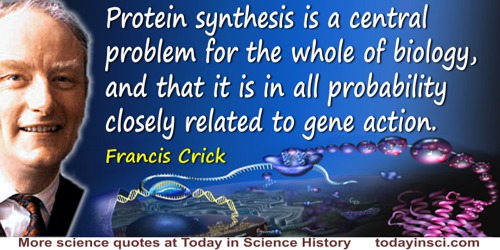
Protein synthesis is a central problem for the whole of biology, and that it is in all probability closely related to gene action.
'On Protein Synthesis', Symposia of the Society for Experimental Biology: The Biological Replication of Macromolecules, 1958, 12, 160.
Science is spectral analysis. Art is light synthesis.
Pro domo et Mundo, (1912), 83. Translated by Harry Zohn (ed.), in 'Riddles and Solutions', Half-Truths and One-And-A-Half-Truths: Selected Aphorisms (1976), 47. From the original German, “Wissenschaft ist Spektralanalyse. Kunst ist Lichtsynthese.”
Since many cases are known in which the specificities of antigens and enzymes appear to bear a direct relation to gene specificities, it seems reasonable to suppose that the gene’s primary and possibly sole function is in directing the final configurations of protein molecules.
Assuming that each specific protein of the organism has its unique configuration copied from that of a gene, it follows that every enzyme whose specificity depends on a protein should be subject to modification or inactivation through gene mutation. This would, of course, mean that the reaction normally catalyzed by the enzyme in question would either have its rate or products modified or be blocked entirely.
Such a view does not mean that genes directly “make” proteins. Regardless of precisely how proteins are synthesized, and from what component parts, these parts must themselves be synthesized by reactions which are enzymatically catalyzed and which in turn depend on the functioning of many genes. Thus in the synthesis of a single protein molecule, probably at least several hundred different genes contribute. But the final molecule corresponds to only one of them and this is the gene we visualize as being in primary control.
Assuming that each specific protein of the organism has its unique configuration copied from that of a gene, it follows that every enzyme whose specificity depends on a protein should be subject to modification or inactivation through gene mutation. This would, of course, mean that the reaction normally catalyzed by the enzyme in question would either have its rate or products modified or be blocked entirely.
Such a view does not mean that genes directly “make” proteins. Regardless of precisely how proteins are synthesized, and from what component parts, these parts must themselves be synthesized by reactions which are enzymatically catalyzed and which in turn depend on the functioning of many genes. Thus in the synthesis of a single protein molecule, probably at least several hundred different genes contribute. But the final molecule corresponds to only one of them and this is the gene we visualize as being in primary control.
In 'Genetics and Metabolism in Neurospora', Physiological Reviews, 1945, 25, 660.
The action of the mind in the acquisition of knowledge of any sort is synthetic-analytic; that is, uniting and separating. These are the two sides, or aspects, of the one process. … There is no such thing as a synthetic activity that is not accompanied by the analytic; and there is no analytic activity that is not accompanied by the synthetic. Children cannot be taught to perform these knowing acts. It is the nature of the mind to so act when it acts at all.
In The Public-School Journal (Jan 1895), Vol. 14, 281-282.
The actual evolution of mathematical theories proceeds by a process of induction strictly analogous to the method of induction employed in building up the physical sciences; observation, comparison, classification, trial, and generalisation are essential in both cases. Not only are special results, obtained independently of one another, frequently seen to be really included in some generalisation, but branches of the subject which have been developed quite independently of one another are sometimes found to have connections which enable them to be synthesised in one single body of doctrine. The essential nature of mathematical thought manifests itself in the discernment of fundamental identity in the mathematical aspects of what are superficially very different domains. A striking example of this species of immanent identity of mathematical form was exhibited by the discovery of that distinguished mathematician … Major MacMahon, that all possible Latin squares are capable of enumeration by the consideration of certain differential operators. Here we have a case in which an enumeration, which appears to be not amenable to direct treatment, can actually be carried out in a simple manner when the underlying identity of the operation is recognised with that involved in certain operations due to differential operators, the calculus of which belongs superficially to a wholly different region of thought from that relating to Latin squares.
In Presidential Address British Association for the Advancement of Science, Sheffield, Section A,
Nature (1 Sep 1910), 84, 290.
The artist does not illustrate science; … [but] he frequently responds to the same interests that a scientist does, and expresses by a visual synthesis what the scientist converts into analytical formulae or experimental demonstrations.
'The Arts', in Charles Austin Beard, Whither Mankind: a Panorama of Modern Civilization (1928, 1971), 296.
The attempted synthesis of paleontology and genetics, an essential part of the present study, may be particularly surprising and possibly hazardous. Not long ago, paleontologists felt that a geneticist was a person who shut himself in a room, pulled down the shades, watched small flies disporting themselves in milk bottles, and thought that he was studying nature. A pursuit so removed from the realities of life, they said, had no significance for the true biologist. On the other hand, the geneticists said that paleontology had no further contributions to make to biology, that its only point had been the completed demonstration of the truth of evolution, and that it was a subject too purely descriptive to merit the name 'science'. The paleontologist, they believed, is like a man who undertakes to study the principles of the internal combustion engine by standing on a street corner and watching the motor cars whiz by.
Tempo and Mode in Evolution (1944), 1.
The best instrument of synthesis, and the most natural hyphen between scientist and philosopher is the history of science.
In 'The History of Science', The Monist (July 1916), 26, No. 3, 330.
The inducing substance, on the basis of its chemical and physical properties, appears to be a highly polymerized and viscous form of sodium desoxyribonucleate. On the other hand, the Type m capsular substance, the synthesis of which is evoked by this transforming agent, consists chiefly of a non-nitrogenous polysaccharide constituted of glucose-glucuronic acid units linked in glycosidic union. The presence of the newly formed capsule containing this type-specific polysaccharide confers on the transformed cells all the distinguishing characteristics of Pneumococcus Type III. Thus, it is evident that the inducing substance and the substance produced in turn are chemically distinct and biologically specific in their action and that both are requisite in determining the type of specificity of the cell of which they form a part. The experimental data presented in this paper strongly suggest that nucleic acids, at least those of the desoxyribose type, possess different specificities as evidenced by the selective action of the transforming principle.
Oswald T. Avery (1877-1955), Colin Macleod (1909-72) and Maclyn McCarty (1911-2005), ‘Studies in the Chemical Nature of the Substance Inducing Transformation of Pneumococcal Types', Journal of Experimental Medicine 1944, 79, 152.
The other line of argument, which leads to the opposite conclusion, arises from looking at artificial automata. Everyone knows that a machine tool is more complicated than the elements which can be made with it, and that, generally speaking, an automaton A, which can make an automaton B, must contain a complete description of B, and also rules on how to behave while effecting the synthesis. So, one gets a very strong impression that complication, or productive potentiality in an organization, is degenerative, that an organization which synthesizes something is necessarily more complicated, of a higher order, than the organization it synthesizes. This conclusion, arrived at by considering artificial automaton, is clearly opposite to our early conclusion, arrived at by considering living organisms.
From lecture series on self-replicating machines at the University of Illinois, Lecture 5 (Dec 1949), 'Re-evaluation of the Problems of Complicated Automata—Problems of Hierarchy and Evolution', Theory of Self-Reproducing Automata (1966).
The ponderous instrument of synthesis, so effective in his [Newton’s] hands, has never since been grasped by one who could use it for such purposes; and we gaze at it with admiring curiosity, as on some gigantic implement of war, which stands idle among the memorials of ancient days, and makes us wonder what manner of man he was who could wield as a weapon what we can hardly lift as a burden.
In History of the Inductive Sciences (1857), Vol. 2, 128.
The progress of synthesis, or the building up of natural materials from their constituent elements, proceeds apace. Even some of the simpler albuminoids, a class of substances of great importance in the life process, have recently been artificially prepared. ... Innumerable entirely new compounds have been produced in the last century. The artificial dye-stuffs, prepared from materials occurring in coal-tar, make the natural colours blush. Saccharin, which is hundreds of times sweeter than sugar, is a purely artificial substance. New explosives, drugs, alloys, photographic substances, essences, scents, solvents, and detergents are being poured out in a continuous stream.
In Matter and Energy (1912), 45-46.
The responsibility for maintaining the composition of the blood in respect to other constituents devolves largely upon the kidneys. It is no exaggeration to say that the composition of the blood is determined not by what the mouth ingests but by what the kidneys keep; they are the master chemists of our internal environment, which, so to speak, they synthesize in reverse. When, among other duties, they excrete the ashes of our body fires, or remove from the blood the infinite variety of foreign substances which are constantly being absorbed from our indiscriminate gastrointestinal tracts, these excretory operations are incidental to the major task of keeping our internal environment in an ideal, balanced state. Our glands, our muscles, our bones, our tendons, even our brains, are called upon to do only one kind of physiological work, while our kidneys are called upon to perform an innumerable variety of operations. Bones can break, muscles can atrophy, glands can loaf, even the brain can go to sleep, without immediately endangering our survival, but when the kidneys fail to manufacture the proper kind of blood neither bone, muscle, gland nor brain can carry on.
'The Evolution of the Kidney', Lectures on the Kidney (1943), 3.
The science of optics, like every other physical science, has two different directions of progress, which have been called the ascending and the descending scale, the inductive and the deductive method, the way of analysis and of synthesis. In every physical science, we must ascend from facts to laws, by the way of induction and analysis; and we must descend from laws to consequences, by the deductive and synthetic way. We must gather and group appearances, until the scientific imagination discerns their hidden law, and unity arises from variety; and then from unity must reduce variety, and force the discovered law to utter its revelations of the future.
In On a General Method of Expressing the Paths of Light, & of the Planets, by the Coefficients of a Characteristic Function (1833), 7-8. [The spelling as “groupe” in the original text, has her been corrected to “group” to avoid an intrusive “sic”.]
The structure known, but not yet accessible by synthesis, is to the chemist what the unclimbed mountain, the uncharted sea, the untilled field, the unreached planet, are to other men … The unique challenge which chemical synthesis provides for the creative imagination and the skilled hand ensures that it will endure as long as men write books, paint pictures, and fashion things which are beautiful, or practical, or both.
In 'Art and Science in the Synthesis of Organic Compounds: Retrospect and Prospect', in Maeve O'Connor (ed.), Pointers and Pathways in Research (1963), 41.
The Synthesis consists in assuming the Causes discovered and established as Principles, and by them explaining the Phænomena proceeding from them, and proving the Explanations.
From 'Query 31', Opticks (1704, 2nd ed., 1718), 380-381.
The synthesis of substances occurring in Nature, perhaps in greater measure than activities in any other area of organic chemistry, provides a measure of the conditions and powers of science.
'Synthesis', in A. Todd (ed.), Perspectives in Organic Chemistry (1956), 155.
There is synthesis when, in combining therein judgments that are made known to us from simpler relations, one deduces judgments from them relative to more complicated relations.
There is analysis when from a complicated truth one deduces more simple truths.
There is analysis when from a complicated truth one deduces more simple truths.
In James R. Hofmann, André-Marie Ampère (1996), 158. Cites Académie des Sciences Ampère Archives, lecture notes, box 261.
We have three approaches at our disposal: the observation of nature, reflection, and experimentation. Observation serves to assemble the data, reflection to synthesise them and experimentation to test the results of the synthesis. The observation of nature must be assiduous, just as reflection must be profound, and experimentation accurate. These three approaches are rarely found together, which explains why creative geniuses are so rare.
Thoughts on the Interpretation of Nature and Other Philosophical Works (1753/4), ed. D. Adams (1999), section XV, 42.
We praise the eighteenth century for concerning itself chiefly with analysis. The task remaining to the nineteenth is to discover the false syntheses which prevail, and to analyse their contents anew.
In The Maxims and Reflections of Goethe (1906), 198.
We should like to propose instead that the specificity of DNA self replication is accomplished without recourse to specific protein synthesis and that each of our complementary DNA chains serves as a template or mould for the formation onto itself of a new companion chain.
[Co-author with Francis Crick]
[Co-author with Francis Crick]
In James D. Watson and Francis H. C. Crick, 'The Structure of DNA', Cold Spring Harbor Symposium on Quantitative Biology (1953), 18, 128.
What nature demands of us is not a quantum theory or a wave theory, instead nature demands of us a synthesis both conceptions, which, to be sure, until now still exceeds the powers of thought of the physicists.
Concluding remark in Lecture (23 Feb 1927) to Mathematisch-physikalische Arbeitsgemeinschaft, University of Berlin, reported in 'Theoretisches und Experimentelles zur Frage der Lichtentstehung', Zeitschr. f. ang. Chem., 40, 546. As translated and cited in Arthur I. Miller, Sixty-Two Years of Uncertainty: Historical, Philosophical, and Physical Inquiries into the Foundations of Quantum Mechanics (2012), 89 & 108.
Why can the chemist not take the requisite numbers of atoms and simply put them together? The answer is that the chemist never has atoms at his disposal, and if he had, the direct combination of the appropriate numbers of atoms would lead only to a Brobdingnagian potpourri of different kinds of molecules, having a vast array of different structures. What the chemist has at hand always consists of substances, themselves made up of molecules, containing defined numbers of atoms in ordered arrangements. Consequently, in order to synthesize anyone substance, his task is that of combining, modifying, transforming, and tailoring known substances, until the total effect of his manipulations is the conversion of one or more forms of matter into another.
In 'Art and Science in the Synthesis of Organic Compounds: Retrospect and Prospect', in Maeve O'Connor (ed.), Pointers and Pathways in Research (1963), 28.
Without analysis, no synthesis.
Herr Eugen Dühring's Revolution in Science (Anti-Dühring), First Publication (1878). Trans. Emile Burns and ed. C.P. Dutt (1935), 52.
 In science it often happens that scientists say, 'You know that's a really good argument; my position is mistaken,' and then they would actually change their minds and you never hear that old view from them again. They really do it. It doesn't happen as often as it should, because scientists are human and change is sometimes painful. But it happens every day. I cannot recall the last time something like that happened in politics or religion.
(1987) --
In science it often happens that scientists say, 'You know that's a really good argument; my position is mistaken,' and then they would actually change their minds and you never hear that old view from them again. They really do it. It doesn't happen as often as it should, because scientists are human and change is sometimes painful. But it happens every day. I cannot recall the last time something like that happened in politics or religion.
(1987) -- 





